
Washington County Unincorporated
City Zoning Code
City Zoning Code
ARTICLE V
PUBLIC FACILITIES AND SERVICES
501 - PUBLIC FACILITY AND SERVICE REQUIREMENTS
501-1
Intent and Purpose
The intent of this Section is to identify those public facilities and services that are necessary at a minimum level to accommodate development authorized by Article III and Article VI. The standards of this Section are not applicable to uses authorized by Article VII unless specifically required by Article VII.
501-2
Application of the Public Facility and Service Standards Inside an Urban Growth Boundary
Application of the Public Facility and Service Standards (Section 501-1 through 501-13) shall apply to the Urban Unincorporated Area as follows:
501-2.1
To all Standard Land Divisions, Middle Housing Land Divisions and property line adjustments, except:
A.
Land Divisions where each resulting lot or parcel measures 10 acres or greater, except as required by Subsection 501-8.5; or
B.
As otherwise specified for a property line adjustment under Article VI.
501-2.2
To any new structure or expansion of an existing structure, except as otherwise indicated below:
A.
A Single Detached Dwelling Unit (one only) on a lot that is not subject to conditions of a Standard Land Division, expansion or replacement of an existing Single Detached Dwelling Unit that will not create an additional primary dwelling unit and will result in a net increase of more than 2,000 square feet of habitable space, a Duplex on an approved Duplex lot (Section 430-13.3), and Middle Housing are subject to limited requirements of Article V as indicated within specific Subsections.
B.
Any other structure that meets all of the following is exempt from Article V, except for the Transportation Development Tax (TDT) requirement:
(1)
Contains 2,000 square feet or less;
(2)
Does not, in itself, generate more than 14 vehicle trips per day, as defined by the Institute of Transportation Engineers, Trip Generation Information Report;
(3)
Contains no plumbing fixtures, or has less than 12 additional fixtures attached to an existing, approved septic system or public sewer; and
(4)
Does not pose any unique public health or safety issues.
The exceptions of Section 501-2.2 A through D are not applicable in the North Bethany Subarea in the Bethany Community Plan. In the North Bethany Subarea, all new construction of structures or expansion of an existing structure, except for construction of a single (one only) detached dwelling unit, is subject to the applicable standards of Section 501-10. For example, a Type I or Type II park adjacent to a Primary Street would need to build a half-street along the park's frontage on this street consistent with the requirements of Section 501-8.
501-2.3
To any change in use, except when all of the following are met:
A.
Does not require a building permit;
B.
Does not, in itself, generate more than 14 additional vehicle trips per day as defined by the Institute of Transportation Engineers, Trip Generation Information Report;
C.
Has less than 12 additional fixtures attached to an existing, approved septic system or public sewer; and
D.
Does not pose any unique public health or safety issues.
501-2.4
To the following off-street parking areas:
A.
New commercial parking facilities (Section 313-3.21);
B.
New surface parking lots or parking garages that have not been approved in conjunction with an allowed use; and
C.
Expansions to existing commercial parking facilities (Section 313-3.21), surface parking lots, or parking garages that:
(1)
Add or relocate existing access points;
(2)
Provide connections to developed adjoining properties that were not approved through the initial development approval; or
(3)
Have additional road frontage that was not part of the initial development approval.
501-2.5
Public Facility and Service Standards (Section 501-1 through 501-13) shall not apply to Type I Temporary Uses (Section 430-135.1).
501-2.6
Public Facility and Service Standards (Section 501-3 through 501-13) shall apply only as noted below, to the following uses:
A.
Urban Accessory Dwelling Unit(s) (Section 430-2) - Section 501-8.5 (Access to Public Roads) shall apply.
B.
The following uses are subject to requirements of Sections 501-2.8 (Transportation Development Tax, North Bethany and Bonny Slope West Transportation System Development Charges), 501-8.1 (Critical Services), 501-8.2 A, B, H, J and K (Essential Services), 501-8.3 B (Desirable Services), 501-8.4 (Dedication of Right-of-Way), and 501-8.5 F (Sight Distance), except to the extent otherwise indicated within the referenced standards:
(1)
A Single Detached Dwelling Unit on a lot that is not subject to conditions of a Standard Land Division (430-37.1 A or B);
(2)
A Duplex that does not meet the definition of Middle Housing in Section 106, on an approved Duplex lot (Section 430-13.3);
(3)
Middle Housing (430-84). In addition to requirements above, Middle Housing Triplexes, Quadplexes and Townhouses are subject to access spacing standards of 501-8.5 in specific circumstances, as described in 430-84.3 B (4) and 430-84.4 B (5).
(See table below).
C.
Expansion or replacement of an existing Single Detached Dwelling Unit (Section 430-37.1 A) that will not create an additional primary dwelling unit and will result in a net increase of more than 2,000 square feet of habitable space - Sections 501-8.1 (Critical Services), 501-8.2 B, J and K (Essential Services), 501-8.3 B (Desirable Services), 501-8.4 (Dedication of Right-of-Way) and 501-8.5 F (Sight Distance) shall apply, except to the extent otherwise indicated within the referenced standards.
(See table below).
D.
Middle Housing Land Division (Article VI) - Sections 501-2.8 (Transportation Development Tax, North Bethany and Bonny Slope West Transportation System Development Charges), 501-8.1 (Critical Services), 501-8.2 A, B, C, E, G, H, J and K (Essential Services), 501-8.3 B (Desirable Services), 501-8.4 (Dedication of Right-of-Way), 501-8.5 [Sight Distance, and for Middle Housing Triplexes, Quadplexes and Townhouses, access spacing standards in specific circumstances, as described in 430-84.3 B(4) and 430-84.4 B(5)], and 502 (Sidewalk Standards), except to the extent otherwise indicated within the referenced standards.
(See table below).
Basic Requirements for Uses Under 501-2.6 B through D
(see full requirements in standards)
501-2.7
Public Facility and Service Standards (Section 501-3 through 501-13) shall not apply to a new structure or addition to an existing structure that meets all of the following criteria:
A.
Does not constitute a use described in and made subject to Public Facility and Service Standards by other subsections of 501-2, above;
B.
Contains 2,000 square feet or less;
C.
Does not, in itself, generate more than 14 vehicle trips per day, as defined by the Institute of Transportation Engineers, Trip Generation Information Report;
D.
Contains no plumbing fixtures, or has less than 12 additional fixtures attached to an existing, approved septic system or public sewer; and
E.
Does not pose any unique public health or safety issues.
The exceptions of Section 501-2.7 A through D are not applicable in the North Bethany Subarea of the Bethany Community Plan.
501-2.8
Notwithstanding above subsections of 501-2, all new construction and expansion of existing structures shall pay the:
A.
Transportation Development Tax, except as provided in the Transportation Development Tax Ordinance; and
B.
North Bethany Transportation System Development Charge (NBTSDC), except as provided in the Resolution and Order adopting the NBTSDC; or
C.
Bonny Slope West Transportation System Development Charge (BSWTSDC), except as provided in the Resolution and Order adopting the BSWTSDC.
(Ord. No. 814, § 2.D.(Exh. 4, § 2), 10-25-16; Ord. No. 831A, § 2.A.(Exh. 1, § 19), 7-17-18, eff. 8-16-18; Ord. No. 866, § 2.C.(Exh. 3, § 24), 9-1-20, eff. 10-1-20; Ord. No. 885A, § 2.1.(Exh. 1, § 30.), 6-28-22, eff. 7-28-22; Ord. No. 890A, § 2.A.(Exh. 1, §§ 1., 25.), 2-7-23, eff. 3-9-23; Ord. No. 912A, § 2.B.(Exh. 2, § 1), 4-28-26, eff. 5-28-26)
501-3
Application of the Public Facility and Service Standards for Multiple Actions
501-3.1
When multiple development actions are proposed for a site, the Public Facility and Service Standards shall be applied to the first action unless during that action specific findings are presented which make it appropriate to postpone application of the standards to a subsequent development action. Postponement of payment of the Transportation Development Tax shall be allowed only as provided in the Transportation Development Tax Ordinance.
501-3.2
When initial application of the Public Facility and Service Standards is through a Type II or Type III process, subsequent development actions on the property for the same development may be reviewed for consistency with the action taken in the initial application of the Public Facility and Service Standards through a Type I process.
If the Review Authority determines and makes findings that circumstances have changed or the impacts of the subsequent development exceed the Public Facility and Service requirements by an amount greater than would be allowed by the exceptions of Section 501-2, the application shall be reevaluated for conformance with the Public Facility and Service Standards through the same procedure type as the prior approval.
(Ord. No. 885A, § 2.1.(Exh. 1, § 30.), 6-28-22, eff. 7-28-22)
501-4
Deferral of Public Facility and Service Standards
Based on a preliminary analysis of Public Facility and Service Standards impacts, the Review Authority may:
501-4.1
Defer final application of the Public Facilities and Service Standards, within the impact or analysis area, until a subsequent stage in the development process if the Review Authority determines that there is insufficient certainty as to the ultimate use and resulting public facility and service demands to accurately assess the facility and service impacts and appropriate conditions of approval.
501-4.2
If such a deferral is allowed, consideration of the deferred public facility and service issues shall occur through a Type II or III process, separate from or in conjunction with other required development hearings. Building permits for any phase of a development shall not be issued until all public facility and service issues associated with that phase are satisfactorily resolved in accordance with this Article.
501-5
Exemptions from Public Facility and Service Standards of Section 501-2
501-5.1
When an applicant seeks a development permit for a proposal exempt from the Public Facility and Service Standards as provided in Section 501-2, the applicant shall demonstrate that the service or services are in fact not available for the proposal.
501-5.2
In the case of sewer service, if sewer is within 300 feet of a property line of the proposed development, the service shall be deemed available for purposes of application of Sections 501-2 and 501-5.
501-6
Exceptions for Critical and Essential Services
501-6.1
Development proposals that cannot ensure critical and essential services applicable to the development, other than those required by Sections 501-8.1 B (9) or 501-8.2 G. (Half-street improvements), within the required time frames shall be denied unless all of the following findings can be made:
A.
The particular inadequate facility(ies) or service(s) is not necessary for the particular proposal within the time period identified by the service provider;
B.
The approval of the development application will not substantially interfere with the ability to later provide the particular inadequate facility(ies) or service(s) to anticipated uses in the vicinity of the subject property;
C.
The approval of the development application without the assurance of the particular inadequate facility(ies) and service(s) will not cause a danger to the public or residents in the vicinity of the subject property; and
D.
It is shown that the applicant has exhausted all practical methods within the ability of the applicant to ensure the provisions of the unacceptable facility(ies) and service(s).
501-6.2
Exceptions to the Public Facility and Service Standards as provided under Section 501-6.1 will be reviewed through a Type III process.
501-6.3
Development proposals subject to improvements required by Sections 501-8.1 B (9) or 501-8.2 G. (Half-street improvements) that cannot ensure those improvements within the required time frames shall be denied unless the Review Authority determines that the findings required under Sections 501-6.1 B. and C. plus the findings required by at least one of Sections 501-6.3 A. through C. below can be made.
A.
Within 500 feet of the subject site (not including the subject site), measured in each direction along the frontage road, but not beyond the nearest intersecting Collector or Arterial road:
(1)
No similar frontage improvements exist on the same side of the street as the subject site; and
(2)
Seventy-five percent or more of the parcels fronting on the same side as the subject site cannot be divided based on the allowed minimum lot size or density requirements of the applicable land use district(s).
B.
The subject improvements will be constructed as part of a planned and funded public road improvement project scheduled to begin construction within 12 months of the proposed development's approval date.
C.
The County Engineer makes a written determination that there are technical feasibility constraints that preclude construction of the required improvements with the proposed development, including but not limited to one or more of the following:
(1)
The ultimate alignment and grade for the roadway cannot be established;
(2)
Construction of the required improvements would be inconsistent with the ultimate alignment and grade for the roadway, due to existing conditions in the vicinity of the proposed development site;
(3)
Topographic or environmental features make construction physically impracticable; or
(4)
Construction of the subject improvements would cause substantial negative effects on adjacent properties or on natural resources, provided that the negative effects could be avoided with a comprehensive public roadway improvement project on the subject road, designed and constructed in accordance with the Washington County Transportation System Plan and Road Design and Construction Standards.
501-6.4
Requests for exceptions to the requirements of Sections 501-8.1 B. (4) or 501-8.2 G. (Half-street improvements) as provided under Section 501-6.3 shall be reviewed through the same procedure type otherwise required for the proposed development action(s), separate from or in conjunction with other required development hearings.
501-6.5
If an exception to Sections 501-8.1 B. (4) or 501-8.2 G. (Half-street improvements) is granted pursuant to Section 501-6.3, the applicant shall:
A.
Be required to provide improvements necessary to mitigate the impact of the proposed development on the road system; and
B.
Assure the following, with said assurance provided prior to issuance of a building permit:
(1)
All other applicable requirements of Sections 501-8.1 and 501-8.2, as determined by the Review Authority, shall be satisfied prior to occupancy of the development;
(2)
All identified safety improvements, both on-site and within the impact and analysis area (pursuant to Resolution and Order No. 86-95 "Determining Traffic Safety Improvements under the Traffic Impact Fee Ordinance - Process Documentation" as modified or updated), shall be constructed prior to occupancy of the development; and
(3)
Sidewalks must be constructed adjacent to any road directly abutting the development site as otherwise required by this Article prior to occupancy of the development.
501-6.6
Notwithstanding the provisions of this Section 501-6, all new construction and expansion of the existing structures shall pay the Transportation Development Tax, except as provided in the Transportation Development Tax Ordinance (Ordinance 691 as amended). No exception to the Transportation Development Tax shall be granted except as provided in the Transportation Development Tax Ordinance.
(Ord. No. 885A, § 2.1.(Exh. 1, § 30.), 6-28-22, eff. 7-28-22; Ord. No. 890A, § 2.A.(Exh. 1, § 25.), 2-7-23, eff. 3-9-23)
501-7
Levels of Public Facilities and Services
501-7.1
Implementation strategies of the Comprehensive Plan have placed Public Facilities and Services into three categories for development:
A.
Critical Services. Public water, public sewer, fire protection, drainage and access on Local and Neighborhood Route roads;
B.
Essential Services. Schools, Arterial (including State highways) and Collector roads, Regional Trails identified on the Transportation System Plan Pedestrian System map, transit improvements, police protection, street lighting and on-site pedestrian and bicycle facilities in the public right-of-way; and
C.
Desirable Services. Public transportation service, parks, traffic calming devices, mid-block crossings, Community Trails identified on the Transportation System Plan Pedestrian System Map, Special Area Trails, Pedestrian Connectivity Areas identified on the Community Plans and off-site pedestrian and bicycle facilities.
501-7.2
As used in Article V, the words listed below include the following meaning unless otherwise specifically identified:
A.
When the term "Collector" is used, it shall include "Special Area Collector" facilities.
B.
When the term "Neighborhood Route" is used, it shall include "Special Area Neighborhood Route" facilities.
C.
When the term "Local" street or road is used, it shall include "Special Area Local Streets" and "Special Area Commercial Street" facilities.
501-7.3
The level of on- and off-site improvements shall be determined based upon the impact and benefit of the proposed development on each facility or service. The boundaries of the impact area for each facility or service shall be determined by the service provider. The boundaries of each impact area need not be identical.
501-7.4
The service provider's information shall be treated as a rebuttable assumption as to the ability to provide an acceptable level of service. However, the evidence that can rebut it must be compelling evidence based upon objective data in order to controvert the determination of the service provider.
501-7.5
The analysis area for collector and arterial roads shall be that geographic area directly impacted and benefited by the proposed development. Data required for determining this area is the responsibility of the applicant and shall be provided to and approved as to adequacy by the county prior to processing of the application by the county.
501-8
Standards for Development
501-8.1
Critical Services
A.
An applicant for development shall provide documentation from the appropriate non-county service provider that adequate water, sewer and fire protection can be provided to the proposed development prior to occupancy. The documentation shall be no more than 90 days old.
For Middle Housing other than a Duplex:
(1)
The applicant shall submit written statements from the applicable water, sewer and fire protection service providers, consistent with requirements for "Sufficient Infrastructure" as defined in Section 106, that demonstrate:
(a)
Existing connections to public water and sewer systems are capable of meeting established service levels, or that describe improvements needed to comply; and
(b)
Access via public or private streets meets emergency vehicle access standards to a public street system, or that describe improvements needed to comply.
(2)
Improvements deemed necessary by service providers, for "Sufficient Infrastructure" as defined in Section 106, must be shown on the applicant's site plan and the applicant must include a written statement within the application agreeing to complete and obtain inspection approval for these improvements prior to issuance of the first occupancy permit.
(3)
In addition, for a Middle Housing Land Division:
(a)
The applicant shall comply with requirements of (1) and (2) above; and
(b)
Standard road improvement requirements and associated requirements for drainage may be applied where resulting lots or parcels abut the street.
B.
No development shall be approved without an adequate level of access to the proposed development in place or assured at the time of occupancy, with "adequate" defined for critical road services as:
(1)
For housing types described under (1)(a) through (e), below, compliance with (2) through (5) below, except as noted:
(a)
A Single Detached Dwelling Unit on a lot that is not subject to conditions of a Standard Land Division;
(b)
Expansion or replacement of an existing Single Detached Dwelling Unit that will not create an additional primary dwelling unit and will result in a net increase of more than 2,000 square feet of habitable space - except that site access requirements of (3), below, apply only where a new driveway is proposed;
(c)
A Duplex that does not meet the definition of Middle Housing on an approved Duplex lot;
(d)
Middle Housing on a single shared lot;
(e)
Middle Housing Land Division - additional requirements apply to this land use action as noted in (5) below.
(2)
Right-of-way along the entire site frontage meets the following, at minimum, unless modified through a Type II exception approval under Section 501-8.4 B (2), or the site fronts only private street(s):
(a)
For uses under 501-8.1 B (1)(a) through (d):
(i)
Local street: 25 feet to centerline;
(ii)
Neighborhood route: 30 feet to centerline;
(iii)
Collector: 37 feet to centerline;
(iv)
Arterial: 45 feet to centerline; or
If road improvements built to ultimate County standard exist, no additional right-of-way is required.
Right-of-way dedications needed to meet minimums above, shall be provided using a document prepared and approved by the County Surveyor's Office, and recorded prior to issuance of the first building permit.
(b)
For a Middle Housing Land Division, Washington County Functional Classification standards.
Right-of-way dedications needed to meet this requirement shall be shown on the preliminary plat and recorded with the final plat.
(3)
Site access is consistent with Sight Distance provisions of Section 501-8.5 F.
(4)
Additionally, for Middle Housing (except Duplexes), and Middle Housing Land Divisions ((1)(c) and (d) above), compliance with emergency vehicle access requirements of 501-8.1 A.
(5)
The remainder of Section 501-8.1 B does not apply to housing as described under 501-8.1 B (1)(a) through (d), but may be applied to other housing.
Application of the remainder of 501-8.1 B, below, to a Middle Housing Land Division (Article VI) shall be limited as follows:
(a)
Street frontage improvement requirements exceeding "Sufficient Infrastructure" as defined in Section 106 may be required only where a resulting lot or parcel abuts the street; and
(b)
Where beyond frontage of resulting lots, improvement requirements shall not exceed those necessary to accommodate "Sufficient Infrastructure" requirements for access meeting adopted emergency vehicle standards, to a public street system, as defined in Section 106.
(6)
Those Local and Neighborhood Route roads, new or existing, lying wholly within the property's real property boundaries or future roadway alignments designated in the Washington County Transportation System Plan (TSP). Roadways shall be developed in accordance with Washington County's Road Design and Construction Standards and roadway alignments designated in the TSP may be adjusted within the subject property as approved by the County Engineer; and
(7)
For those access roads lying adjacent to and between the property owner's proposed development and the nearest adequate Collector or Arterial road, as defined in Essential Services, or future roadway alignments designated in the Washington County Transportation System Plan, likely to attract the highest traffic volume from the proposed development (based on existing and/or forecast traffic volumes) the road(s) must meet the following minimum standards:
(a)
Have a wearing surface and structural life expectancy period of no less than 5 years (paved) as determined by the County Engineer;
(b)
Paved surfaces for existing roadways shall be 22 feet or greater in width. New roads shall meet the adopted County Road Standards as determined by the County Engineer;
(c)
On-site means all lands in the land use application and one-half the right-of-way of existing roads lying adjacent to such lands;
(d)
On-site entering sight distance meets standards as specified in "A Policy on Geometric Design of Highways and Streets," American Association of State Highway and Transportation Officials (AASHTO); and
(e)
Right-of-way on or adjacent to the frontage property meets Washington County Functional Classification standards.
(8)
For a proposed development which abuts an existing Local or Neighborhood Route stub street, the applicant must develop a site plan which extends the stub street into or through the development site.
(9)
A half-street improvement shall be constructed along the site's frontage of existing Local and Neighborhood Route roads which abut the site and are not improved in accordance with the Washington County Transportation System Plan and Road Design and Construction Standards. This standard does not apply to housing types described in 501-8.1 B (1), except in the case of a Middle Housing Land Division. For a Middle Housing Land Division, this requirement may be applied only where resulting lots abut the street.
C.
No development shall be approved without adequate drainage as prescribed by the county Drainage Master Plan or the adopted Drainage Ordinance or Resolution and Order, and adequate provisions for stormwater, surface water and water quality management as required by the Clean Water Services' "Design and Construction Standards for Sanitary Sewer and Surface Water Management" or its successor.
For Middle Housing other than a Duplex:
(1)
The applicant shall submit a written statement from Clean Water Services consistent with requirements for "Sufficient Infrastructure" as defined in Section 106, that existing storm drainage facilities are capable of meeting established service levels for storm drainage, or describing improvements needed to comply; and
(2)
Improvements deemed necessary by Clean Water Services, for "Sufficient Infrastructure" as defined in Section 106, must be shown on the site plan, and the application must include a written agreement to complete and obtain inspection approval for these improvements prior to issuance of the first occupancy permit; and
(3)
Comply with applicable grading and drainage requirements of Section 410.
(4)
For a Middle Housing Land Division:
(a)
The applicant shall comply with requirements of (1) through (3) above; and
(b)
Standard road improvement and sidewalk requirements, and associated drainage requirements, may be applied only where resulting lots or parcels abut the street.
D.
No development shall be approved on property that is located outside of the Washington County Urban Road Maintenance District. The subject property shall be annexed into this district prior to being granted final approval of a development application. For applications where both preliminary and final approval are not required, the property shall annex into the district prior to being granted preliminary approval.
E.
For development in a Transit Oriented District, or development outside a Transit Oriented District but adjacent to a designated Special Area street, a 9-foot pedestrian/utility easement shall be recorded adjacent to frontage on a Special Area Neighborhood Route or Special Area Commercial street. A 10-foot pedestrian/utility easement shall be recorded adjacent to a Special Area Local street. If the required sidewalk width is greater than the sidewalk/utility easement, additional sidewalk easements shall be recorded to the outside edge of the required sidewalk. (See Section 431 for use-specific exclusions and limitations).
501-8.2
Essential Services
A.
Service Provider Documentation
(1)
An applicant shall provide documentation from the appropriate school district, police or sheriff department, transit agency, trail provider and highway department that adequate levels of service are available or will be available to the proposed development within the time-frames required by the service provider. Accessory Dwelling Units are exempt from this requirement and development of housing as described under 501-8.1 B(1) is subject only to requirements for documentation from the school district and police or sheriff, and is not subject to (2) (c) or (d) below.
(2)
If the service provider documents that an adequate level of service is not available or will not be available within the time-frame required, the service provider shall be requested to provide information regarding the service provider's ability to provide adequate levels of services and alternative means which could be employed to provide adequate levels of service. Documentation of adequacy and alternatives to provide adequate levels of services may include but are not limited to the following:
(a)
Schools:
(i)
Amount of bonded indebtedness;
(ii)
Use of double shifting;
(iii)
Extended school periods;
(iv)
Bussing to underutilized facilities;
(v)
Year-round school;
(vi)
Construction of new facilities;
(vii)
Portable classrooms;
(viii)
Impact fees;
(ix)
Any combination of these or other alternatives.
(b)
Police or Sheriff Services:
(i)
Contracting with private agency;
(ii)
Contracting with other public agency;
(iii)
Impact fees;
(iv)
Any combination of these or other alternatives.
(c)
Provision of Transit Improvements:
(i)
All applications subject to Article V shall provide documentation from the transit agency which demonstrates whether or not an appropriate level of transit access to the proposed site exists. The documentation from the Transit District shall indicate: a) whether existing transit service exists near the site, and if it does b) whether bus stops located near the site are adequate, and, if not, what improvements are necessary.
(ii)
Property located along a Regular Bus Service route, Frequent Bus Service route or an Existing High Capacity Transit station; as designated on the Transportation System Plan. If an existing or planned transit stop is located in front of the subject property, the Transit District may request via the service availability letter that the county require an easement or dedication of right-of-way at the stop in order to make future passenger boarding facility improvements.
Additionally, the Transit District may relocate a stop or request via the service availability letter that the county require a new stop in front of the property along with an easement at the stop. The Transit District shall make the determination as to whether or not additional right-of-way or an easement is necessary.
(iii)
Properties subject to this section may also be subject to more expansive transit related requirements as set forth in Section 380, Convenient Access to Transit Overlay District.
(d)
Regional Trails
(i)
The applicant shall provide documentation from the current or identified long-term trail provider about needed open space or easement reservations or dedications and/or any necessary improvements for any identified Regional Trail on the Transportation System Plan; and
(ii)
The applicant shall include in the submitted site plan any open space or easement reservation or dedication area and/or off-street trail, pathway or walkway identified by the trail provider in the documentation provided pursuant to (i) above.
B.
Adequate Level of Arterial and Collector Roads
No development shall be approved without an adequate level of Arterial and Collector roads available to the proposed development in place or assured at the time of occupancy. This requirement is satisfied by payment of the Transportation Development Tax. In addition, payment of the Transportation Development Tax is not an assurance for improvements required by Sections 501-8.2 C. through J. In addition to payment of the Transportation Development Tax an applicant shall, at a minimum, assure the following with said assurance provided prior to issuance of a building permit:
(1)
All identified safety improvements within the impact and analysis area (pursuant to Resolution and Order No. 86-95 "Determining Traffic Safety Improvements under the Traffic Impact Fee Ordinance - Process Documentation" as modified or updated), shall be constructed prior to occupancy of the development; except that arterial and collector road requirements for uses listed under 501-8.1 B (1) are limited as described under 501-8.1.
(2)
On-site road drainage is adequate to protect the facility. On-site means all lands in the land use application and ½ the right-of-way of existing roads lying adjacent to such lands. Development of housing as described under 501-8.1 B (1), as required therein, shall comply with 501-8.1 C to meet this standard;
(3)
Entering sight distance meets standards as specified in "A Policy on Geometric Design of Highways and Streets," American Association of State Highway and Transportation Officials (AASHTO);
(4)
Right-of-way on or adjacent to the frontage property meets Washington County Functional Classification Standards including Streetscape Overlay and Enhanced Major Street Bikeway designations; except that development of housing as described under 501-8.1 B (1)(a) through (d) need only meet right-of-way dimensions specified in 501-8.1 B (2)(a);
(5)
Access to Arterials and Collectors is in accordance with Section 501-8.5, except that arterial and collector road requirements for housing as described under 501-8.1 B (1) are limited as described under 501-8.1; and
(6)
Collectors or Arterials inside the UGB that abut a site and have an existing gravel surface must be brought up to urban standards in accordance with Section 501-8.2 E; except that requirements for housing as described under 501-8.1 B (1) are limited as described under 501-8.1.
C.
Street Lighting
For all new Local, Neighborhood Route, Collector and Arterial streets, and half-street improvements an applicant shall provide street lighting consistent with county engineering standards and procedures and the requirements of the electrical utility company providing service to the area. The applicant shall ensure the construction, maintenance and power costs of street light facilities through the annexation and petition for service to an existing county service district for lighting or other funding method approved by the County Engineer. This standard does not apply to housing types described in 501-8.1 B (1), except in the case of a Middle Housing Land Division. For a Middle Housing Land Division, this requirement may be applied only where resulting lots abut the street.
D.
Applicants shall be required to dedicate or reserve appropriate right-of-way for the planned transit corridor if it is determined in the development review process that the county has the funds available to pay for the land to be acquired or the applicant chooses to receive the density bonus provided in Section 375-13.2.
E.
Gravel roads are unacceptable for development within the Urban Growth Boundary and they shall be improved in accordance with the Washington County Transportation System Plan and Road Design and Construction Standards, including the installation of street lights consistent with County engineering standards and procedures and the requirements of the electrical utility company providing service to the area. The applicant shall ensure the construction, maintenance and power costs of street light facilities through the annexation and petition for service to an existing county service district for lighting or other funding method approved by the County Engineer.
F.
Future alignments of Collectors or Arterials as designated on the Transportation System Plan (TSP) or an adopted study, lying within or adjacent to the development's boundary shall be constructed in accordance with the Washington County TSP and Road Design and Construction Standards. Roadway alignments identified in the TSP may be adjusted within the subject property, as approved by the County Engineer.
G.
A half-street improvement shall be constructed along the site's frontage of existing Collector and Arterial roads which abut the site and are not improved in accordance with the Washington County Transportation System Plan and Road Design and Construction Standards. This standard does not apply to housing types described in 501-8.1 B (1), except in the case of a Middle Housing Land Division. For a Middle Housing Land Division, this requirement may be applied only where resulting lots abut the street.
H.
For development in a Transit Oriented District, a 9-foot pedestrian/utility easement shall be recorded adjacent to frontage on a Special Area Collector street. If the required sidewalk width is greater than this sidewalk/utility easement, additional sidewalk easements shall be recorded to the outside edge of the required sidewalk. (See Section 431 for use-specific exclusions and limitations).
I.
Where off-site road improvements are otherwise required as a condition of development approval, they shall include facilities accommodating convenient pedestrian and bicycle travel, including bicycle ways along Arterials and Collectors. The level of pedestrian and bicycle improvement shall be determined by the Review Authority, based upon the impact of the proposed development.
J.
When a development site includes frontage on a roadway that is identified as a "Pedestrian Parkway" or "Streetscape Overlay" on the Pedestrian System Map in the Transportation System Plan, the Director shall determine if additional right-of-way, setbacks, easements or right-of-way reservations are required so that implementation of Pedestrian System designations will not be precluded. For development of housing described under 501-8.1 B (1)(a) through (d), required right-of-way dedications shall not exceed dimensions specified in 501-8.1 B (2). For Middle Housing and Middle Housing Land Divisions, above noted easements and right-of-way reservations shall not preclude siting of buildings at minimum setbacks of the district, and for purposes of meeting this requirement, easements may overlap the district-specified setback.
K.
Law Enforcement Services
No development shall be approved on property that is located outside of the Washington County Enhanced Sheriff's Patrol District. The subject property shall be annexed into the district prior to being granted final approval of a development application. For applications where both preliminary and final approval are not required, the property shall annex into the district prior to being granted preliminary approval.
L.
Applications may be conditioned to provide on- and off-site Regional Trails including appropriate on-site open space or easement reservations or dedications, when identified by the appropriate agency. Applications shall address any regional trail, identified on the Transportation System Plan Pedestrian System map, or the applicable community plan, that is adjacent to or in proximity to the subject site. Specifically, the applicant shall:
(a)
Provide documentation from the current or identified long-term trail provider about needed open space or easement reservations or dedications and/or any necessary improvements for any Regional Trail or pathway identified on the Transportation System Plan Pedestrian System map or on the applicable community plan; and
(b)
Show on the submitted site plans any open space or easement reservation or dedication area for any Regional Trail, pathway or walkway identified by the trail provider in the documentation provided pursuant to (a) above.
501-8.3
Desirable Services
A.
Pedestrian walkways, Community Trails and other off-street accessways, traffic calming devices, and mid-block crossings, pathways and bicycle facilities
(1)
Applications may be conditioned to provide Community Trail connections identified on the Transportation System Plan Pedestrian System map, on- and off- site traffic calming devices, on- and off-site mid-block crossings, on- and off-site pedestrian walkways, off-street trails and pathways; and on- and off-site bicycle facilities, including appropriate open space or easement reservations or dedications, when identified by the appropriate agency and a direct impact or benefit to the proposed use is identified.
Mid-block crossings or traffic calming devices may be required if all the following circumstances are met:
(a)
The County Engineer makes a written determination that traffic calming devices or mid-block crossings are necessary.
(b)
Placement of traffic calming devices on or within the pavement must be coordinated with fire protection service provider.
(c)
Traffic calming devices and mid-block crossings shall be constructed in accordance with the Road Design and Construction Standards.
(2)
Applications shall address any Community Trail, off-street trail, pathway, walkway or other feature identified on the Transportation System Plan Pedestrian System map or the applicable Community Plan (including facilities identified in Pedestrian Connectivity Areas), that is on, adjacent to or in proximity to the subject site. Specifically, the applicant shall:
(a)
Provide documentation from the current or identified long-term trail provider about needed open space or easement reservations or dedications and/or any necessary improvements for any identified Community Trail, on- or off-site walkway, or pathway; and
(b)
Include in the submitted site plan any open space or easement reservation or dedication area and/or Community Trail, off-street trail, pathway or walkway identified by the trail provider in the documentation provided pursuant to (a) above.
B.
Park and recreation facilities
(1)
Properties not currently located within the boundary of a Park District shall annex to the District when the following conditions are met:
(a)
The property lies within an area identified for park service by the Park District in an urban service agreement; or,
(b)
If no urban service agreement applies to the property, the property lies between the Hillsboro, Tigard and Portland Urban Service Boundaries or lies within an area for which the District is designated a party in a cooperative agreement; and
(c)
The Park District has adopted a Park Master Plan for the area the property is located in.
(2)
Provision of park and recreation services to properties added to the UGB after 1998:
No development shall be approved on property added to the UGB after 1998 when a Park District is identified as the long-term park and recreation service provider and the subject property is located outside of the Park District's boundary unless the property is annexed to the District.
(3)
If the conditions in Subsection (1) and (2) exist, the development application shall not be approved unless the applicant has filed with the county a legally sufficient petition for annexation to the Park District containing the consent of all property owners and a majority of the electors for the property that is the subject of the application.
Further, the application shall be conditioned that documentation of final annexation approval be provided prior to issuance of final approval for Standard Land Divisions and Middle Housing Land Divisions, and prior to issuance of final approval and building permits for other development. The requirements of Subsections (1) and (2) may be waived only if the applicant provides documentation from the Park District that the District is unable or unwilling to accept annexation of the property into the District.
501-8.4
Dedication of Right-of-Way
Dedication of right-of-way shall be required as follows:
A.
Pursuant to the classification of the facility as designated by the Washington County Transportation System Plan and based upon the county Road Standards; or
B.
For a Single Detached Dwelling Unit on a lot that is not subject to conditions of a Standard Land Division, a Duplex, expansion or replacement of a Single Detached Dwelling Unit that will result in a net habitable space increase of more than 2,000 square feet, and Middle Housing when all units are on a shared lot:
(1)
Required right-of-way dedication shall not exceed minimum right-of-way required for such uses by district standards (also reflected in 501-8.1 B (2));
(2)
Through a Type II procedure, the Review Authority may exempt a proposed development from full compliance with district right-of-way minimums, subject to evidence that an existing structure (intended to remain), environmental features, or other physical constraints make full dedication impracticable.
When all exemption criteria above are met, reduction of the right-of-way requirement shall be to the minimum extent necessary to accommodate the constraint, and the review authority may require a fee in lieu as long as such fee is consistent with a program adopted by the Board of County Commissioners.
C.
Setback requirements of this Code shall not apply to existing structures to the extent that setbacks are reduced by a public dedication.
501-8.5
Access to Public Roads
All developments shall have legal access to a public road. Except for interim access as provided in Section 501-8.5 E. (Interim Access), access onto any public road in the unincorporated or incorporated urban area shall be permitted only upon issuance of an access permit upon demonstration of compliance with the provisions of the county road standards and the standards of Section 501. For Middle Housing, access spacing requirements Section 501 apply only to Triplexes, Quadplexes and Townhouses, and only in specific circumstances described in 430-84.3 B (4) and 430-84.4 B (5).
A.
Roadway Access
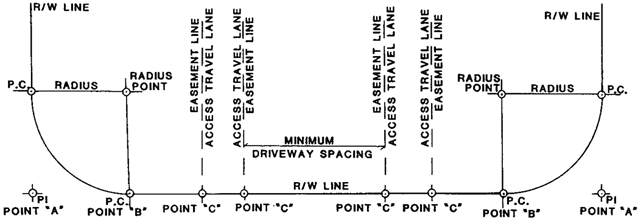
See following access diagram where R/W = Right-of-Way; and P.I. = Point-of-Intersection where P.I. shall be located based upon a 90-degree angle of intersection between ultimate right-of-way lines.
(1)
Minimum right-of-way radius at intersections shall conform to the county Road Standards.
(2)
All minimum distances stated in the following sections shall be governed by sight distance requirements according to county Road Standards.
(3)
All minimum distances stated in the following sections shall be measured to the nearest easement line of the access or edge of travel lane of the access on both sides of the road.
(4)
All minimum distances between accesses shall be measured from existing or approved accesses on both sides of the road.
(5)
Minimum spacing between driveways shall be measured from Point "C" to Point "C" as shown below:
B.
Roadway Access:
No use will be permitted to have direct access to a street or road except as specified below, or as provided in Section 501-8.5 E. (Interim Access), exceptions to access criteria are provided for in subsection C below. Access spacing shall be measured from existing or approved accesses on either side of a street or road.
(1)
Local Streets
Minimum right-of-way radius is 15 feet. Access will not be permitted within 10 feet of Point "B," if no radius exists, access will not be permitted within 25 feet of Point "A." Access points near an intersection with a Collector or Arterial shall be located beyond the influence of standing queues of the intersection in accordance with AASHTO standards. This requirement may result in an access spacing greater than 10 feet. Interim access may be permitted, pursuant to the standards of Section 501-8.5 E. (Interim Access).
(2)
Neighborhood Routes
All residential, commercial, institutional and industrial uses with 70 feet or more of frontage will be permitted direct access to a Neighborhood Route. Uses with less than 70 feet of frontage shall not be permitted a permanent single or separate direct access to a Neighborhood Route. Interim access which does not preclude a future common entrance with adjacent property may be permitted pursuant to the standards of Section 501-8.5 E. (Interim Access). Where a common access is available it shall be used, provided that such use will not result in serious operational or safety problems.
No use will be permitted direct access to a Neighborhood Route within 50 feet of Point "A"; or future "P.I." as designated in or consistent with the Transportation System Plan (TSP). New Neighborhood Route alignments identified in the TSP can be adjusted within the subject property, as approved by the County Engineer. In the case of a Neighborhood Route which is entirely within a development, double aisle parking areas will be permitted direct access to that Neighborhood Route. Minimum spacing between driveways (Point "C" to Point "C") shall be 50 feet with the exception of single detached residential lots in a recorded Standard Subdivision. Such lots shall not be subject to a minimum spacing requirement between driveways (Point "C" to Point "C"). In all instances, access points near an intersection with a Collector or Arterial shall be located beyond the influence of standing queues of the intersection in accordance with AASHTO standards. This requirement may result in an access spacing greater than 50 feet.
(3)
Collectors
All commercial, industrial and institutional uses with 150 feet or more of frontage will be permitted direct access to a Collector. Uses with less than 150 feet of frontage shall not be permitted direct access to Collectors. Interim access which does not preclude future common entrance with adjacent property may be permitted pursuant to the standards of Section 501-8.5 E. (Interim Access). Where a common access is available it shall be used, provided that such use will not result in serious operational or safety problems. No use will be permitted direct access to a Collector within 100 feet of any present Point "A"; or future "P.I." as designated in the Transportation System Plan (TSP). New Collector Street alignments identified in the TSP may be adjusted within the subject property, as approved by the County Engineer.
In the case of a Collector which is entirely within a single development and which provides circulation only within that development, double aisle parking areas will be permitted access to that Collector. Minimum spacing between driveways (Point "C" to Point "C") shall be 100 feet. In all instances, access points near an intersection with a Collector or Arterial shall be located beyond the influence of standing queues of the intersection in accordance with AASHTO standards. Additionally, access shall be located to provide adequate left turn refuge as required by Resolution and Order No. 86-95 as modified or updated. This requirement may result in an access spacing greater than 100 feet.
(4)
Arterials
Direct access to arterial roads shall be from collector or other arterial streets. Exceptions for local streets and private accesses may be allowed through a Type II process when collector access is found to be unavailable and impracticable by the Director. New Arterial Street alignments identified in the TSP may be adjusted within the subject property, as approved by the County Engineer. Access to arterials shall comply with the following standards:
(a)
Arterials
Direct access to an arterial will be permitted provided that Point 'A' of such access is more than 600 feet from any intersection Point 'A' or other access to that Minor Arterial (Point 'C').
(b)
Principal Arterials
Principal Arterials shall be designed and developed as limited access facilities. Access to a Principal Arterial is subject to approval by ODOT through the State's Access Management Policy and its implementing measures. Access to Tualatin Valley Highway, between SW 170th and SW 209th Avenues, is subject to the provisions of the TV Highway Access Management Plan contained in the Aloha-Reedville-Cooper Mountain Community Plan.
(c)
On sites where direct access may be provided to more than one Arterial or Principal Arterial only one such access shall be granted.
C.
Exception to Access Criteria
(1)
Alternate points of access may be allowed if an access management plan which maintains the classified function and integrity of the applicable facility is reviewed and approved by the Review Authority after considering the applicant's compliance with this Article.
(2)
An application for an Access Management Plan shall explain the need for the modification and demonstrate that the modification maintains the classified function and integrity of the facility. References to standards or publications used to prepare the Access Management Application shall be included with the application.
(3)
An access management plan shall address the safety and operational problems which would be encountered should a modification to the access spacing standards be granted. An access management plan shall be prepared and certified by a traffic or civil engineer registered in the State of Oregon. An access management plan shall at minimum contain the following:
(a)
The minimum study area shall include the length of the site's frontage plus the distance of the applicable access spacing standard, as set forth in Section 501-8.5 B., measured from the property lines or access point(s), whichever is greater. For example, a property with 500 feet of frontage on a minor arterial (required 600-foot access spacing standard) shall have a minimum study area which is 1,700 feet in length.
(b)
The access management plan shall address the potential safety and operational problems associated with the proposed access point. The access management plan shall review both existing and future access for all properties within the study area as defined above.
(c)
The access management plan shall include a comparison of all alternatives examined. At a minimum, the access management plan shall evaluate the proposed modification to the access spacing standard and the impacts of a plan utilizing the county standard for access spacing. Specifically, the access management plan shall identify any impacts on the operations and/or safety of the various alternatives.
(d)
The access management plan shall include a list of improvements and recommendations necessary to implement the proposed access modification, specifically addressing all safety and operational concerns identified.
(4)
Notice for a proposed access management plan shall include all property owners within the study area defined in 501-8.5 C. (3) (a).
D.
Access in Transit Oriented Districts and the North Bethany Subarea Plan
Access points shown in the Transportation System Plan, on a Community Plan within a Transit Oriented District, or in the North Bethany Subarea Plan are not subject to the access spacing standards and do not need an access spacing variance or an access management plan. However, as part of the development review process, the exact location of such access points shall be determined and safety impacts associated with such access points shall be identified and mitigated. Additional access points are subject to the access spacing standards.
E.
Interim Access
No development shall be denied a Development Permit for the sole reason that the parcel for which it is sought cannot physically accommodate the access spacing requirements of this Code. In such an event, the use may be issued an interim access permit which shall expire when access as required under Article V becomes available. An interim access permit may be granted based upon the following:
(1)
The site is situated such that adequate access cannot otherwise be provided in accord with the access spacing requirements of this Code.
(2)
The interim access shall meet minimum county traffic safety and operational requirements, including sight distance.
(3)
Alternate access shall not be deemed adequate and connections to alternate access shall not be required if the resulting route of access would require a trip in excess of one block or 500 feet out of direction (whichever is less).
(4)
New interim access locations on Arterials and Collectors shall be posted with a sign. The sign shall note that the access is interim and will be removed once ultimate access is available. The sign and its location shall be approved by the County Engineer.
(5)
The property owner signs a waiver of the right to remonstrate against the formation of a Local Improvement District or similar financing mechanism for the primary purpose of constructing a public road or right-of-way providing access to the arterial or collector road; such access shall meet the minimum applicable county standard.
(6)
The property owner records an agreement to participate in any project that would consolidate access points where such project would not result in new or more severe traffic operation or safety problems.
(7)
The property owner records an agreement to abandon use of the existing private access way when an adequate alternative access becomes available.
(8)
The property owner records an agreement stating that the interim access shall ultimately be removed.
F.
Sight Distance
The following specifies the minimum requirements for sight distance for roads intersecting each other and for driveways intersecting public roads. It is the intent of this section to regulate the creation of new access points to maximize the safety of access to public roads.
(1)
Inside a UGB, existing access points that do not meet the sight distance standards and are on property included with a development action which will not add any additional vehicle trips to that access or will only add trips from approved Urban Accessory Dwelling Units (Section 430-2), are exempt from this Section (501-8.5 F.), except as required by Section 501-2.1 A.
Improvements at these existing access points may be required to maximize sight distance to the extent practicable by the county Operations Division through an Access Permit or Right-of-way Permit.
(2)
The minimum intersectional sight distance shall be based on the vehicular speeds of the road. The vehicular speeds for the purpose of determining intersectional sight distance shall be the greater of the following unless the 85 percentile speed is determined to be less by the Review Authority pursuant to the standards of Section 501-8.5 F. (2)(c).
(a)
Design Speed - A speed selected by a registered engineer (Oregon) for purposes of design and correlation of those features of a road, such as curvature, superelevation, and sight distance, upon which the safe operation of vehicles is dependent.
(b)
Posted Speed - That speed which has been established by the Oregon State Speed Control Board and is posted by the county.
(c)
Eighty-five Percentile Speed - That speed as certified by a registered engineer (Oregon) below which 85% of all traffic units travel, and above which 15% travel. The 85 percentile speed shall be measured at the point where the sight restriction occurs.
(3)
The intersectional sight distance shall:
(a)
Be based on an eye height of 3.5 feet and an object height of 4.25 feet above the road; and
(b)
Be assumed to be 15 feet from the near edge of pavement or the extended curb line or the near edge of the graveled surface of a gravel road to the eye of the driver of a stopped vehicle.
(4)
Minimum intersectional sight distance shall be equal to ten times the vehicular speed of the road as determined by the standards of Section 501-8.5 F. (1) and (2) such as in the following table.
(5)
Intersectional sight distance values shall conform with section (3) and (4) above. For significant road improvement projects, the above intersectional standards shall be met in addition to the AASHTO remaining sight distance standards.
(6)
For land development actions, the following specifies the procedure for determining whether or not minimum sight distance requirements are met:
(a)
Current Planning personnel will review the Traffic Impact Statement.
(b)
County personnel will perform the initial sight distance measurements.
(c)
If the measurements made under (b) above do not meet the minimum requirements shown in the table, the applicant may retain a State of Oregon registered professional engineer to perform the field measurements. If the applicant's engineer does perform the measurements and submits the information to the county for acceptance, the information must bear the stamp and signature of the engineer and must meet the minimum sight distance requirements.
(7)
In those instances where there are no access locations available to the site that meet or can meet the sight distance requirements, a written request for modification may be submitted to the Director. The request for modification shall be specifically stated in the notice for the accompanying development permit and shall be considered as part of said development permit. The request for modification of the sight distance requirements shall be subject to the following:
(a)
Submitted and certified by a registered engineer (Oregon);
(b)
Documented and reference nationally accepted specifications or standards;
(c)
Certified that the modification will not compromise safety or the intent of the county's transportation standards, which include but are not limited to the following: Washington County Transportation System Plan; Washington County Road Design and Construction Standards; Resolution and Order No. 86-95 as modified or updated, (Determining Traffic Safety Improvements Under the Traffic Impact Ordinance - Process Documentation); Community Plans; Comprehensive Framework Plan for the Urban Area; and the Community Development Code;
(d)
The cost of any modifications agreed to must be borne by the applicant; and
(e)
There shall be no location available to provide access to the proposed development site which currently meets the sight distance requirements, or which can be altered to meet the sight distance requirements. Alterations needed to provide adequate sight distance include but are not limited to grading and the removal of vegetation. For the purpose of this subsection alternative access location means:
1.
Any location on the proposed development site which meets or can meet the sight distance requirements; or
2.
Any location off the proposed development site which:
(i)
Can provide access to the site by an existing access easement or through an access easement which will be provided to the site as part of the development application; and
(ii)
Meets or can meet the sight distance requirements.
G.
Motor Vehicle Access Restriction
(1)
In order to implement the access spacing and safety requirements of this article, a motor vehicle access restriction shall be recorded along a development site's frontage on a Collector or Arterial road, except at approved motor vehicle access locations. The Review Authority may require a motor vehicle access restriction to be recorded along a site's frontage on a Local or Neighborhood Route street that intersects with a Collector or Arterial road in order to address operational and safety concerns at the intersection(s).
(2)
The motor vehicle access restriction shall be recorded as a restrictive covenant or, if a plat is filed, as a Partition or Subdivision plat restriction.
H.
Road Standards
(1)
All roads proposed to be of public ownership shall conform to the county Road Standards.
(2)
All proposed curve radii shall be designed to county Road Standards for truck-turning requirements.
(3)
All roads not proposed to be of public ownership shall conform to Section 409 (Private Streets).
501-8.6
Methods to Assure Facilities and Services
A legal and enforceable document, contract or process which assures the county that a public improvement will be accomplished. Assurances may include but are not limited to the following:
A.
For Arterial and Collector roadways, payment of the Transportation Development Tax, except:
(1)
For improvements required by Sections 501-8.2 C. through J.; and
(2)
For safety improvements required by Resolution and Order 86-95 as modified or updated.
B.
All Critical, Essential [including 501-8.2 B. (2) through (6)], and Desirable Facilities and Services
(1)
Cash in escrow, letter of credit, or cash deposit with the county, or other form of financial assurance acceptable to the county.
(2)
Establishment of a Local Improvement District (LID) through the post-remonstrance period. Failure of the county to accept the LID shall constitute a waiver of the assurance requirement.
(3)
Evidence of formal action by public or private agencies or companies, including Washington County, appropriating monies for the requisite public improvement.
(4)
Annexation of the subject property into an area where a public agency has jurisdiction and has pledged to assume the responsibility for the required improvement.
(5)
Any other legally binding arrangement that assures the improvements will be made within the required timeframe, including:
(a)
Phasing of the development;
(b)
Construction of interim improvements;
(c)
Construction of improvements on a phased basis; or
(d)
Modification of engineering standards (i.e., reduced right-of-way widths, sidewalks on only one side of a street, etc.), only when approved through a Type III process.
(6)
State road capacity and intersection deficiencies will be determined to be assured if they are included in the Metro adopted Transportation Improvement Program (TIP), which includes the State of Oregon's Six-Year Highway Improvement Plan (HIP), unless otherwise specified by the State during the processing of the application.
501-8.7
Notwithstanding any other provision, the Board may, by Resolution and Order, adopt an updated version of the generally accepted transportation manuals cited herein. Upon such adoption, the updated version adopted shall control.
501-8.8
Definitions
A.
Half-Street Improvement
Improvement of one-half of an existing substandard road directly abutting a proposed development site in accordance with the Washington County Community Development Code, Transportation System Plan, Road Design and Construction Standards, and other applicable county standards. One-half of the road shall mean the area between the right-of-way centerline and the ultimate right-of-way line directly abutting the development site, along the entire length of the development site's frontage on the abutting road(s), except as provided herein. Required improvements may include any or all of the following elements as determined by the Review Authority and the county Engineering Division through the development review process:
(1)
Dedication of right-of-way and/or easements;
(2)
Grading and subgrade preparation;
(3)
Construction or reconstruction of roadway paving, which may include:
(a)
Turn lanes and/or bike lanes where required by the applicable standards, and/or
(b)
Up to 11 feet of additional roadway paving width beyond the centerline of the right-of-way, if determined necessary by the County Engineer;
(4)
Construction or reconstruction of concrete curb and gutter;
(5)
Pavement markings where required;
(6)
Construction or reconstruction of concrete sidewalk paving as otherwise required in this Article;
(7)
Construction, reconstruction, or extension of underground storm drainage and inlets;
(8)
Construction, reconstruction, or extension of fire, water, or sanitary sewer facilities;
(9)
Relocation of existing utilities where required;
(10)
Illumination at access points and along roadways where required;
(11)
Street trees, where required; and
(12)
Construction or reconstruction of roadway crossing locations for pedestrians or bicyclists at appropriate intersections, accessways, trails or other locations.
B.
Impact or Analysis Area. That geographic area determined by a service provider within which the development will impact upon or benefit from the service. A preliminary area will be defined by the service provider if deemed necessary and a final area will be defined based upon information provided by the applicant.
C.
Impact and Benefit (with respect to roads in the impact area). A development shall be determined to impact a roadway or intersection and benefit from improvements if the road or intersection meets any of the following criteria:
(1)
The estimated traffic to be generated by the development exceeds 10% of the existing average daily traffic (ADT) (See existing traffic below).
(2)
"In Process" traffic volumes result in the facilities operating below Level of Service "E" for more than 20 minutes of one peak hour and the proposed development's traffic will be 5% or greater of total "In Process" traffic.
(3)
Pavement structure, pavement surface, vertical or horizontal alignments or drainage do not meet county standards.
D.
On-Site Improvements. "On-site" shall mean all lands in the development application and one-half the right-of-way (to centerline) of roads lying adjacent to such lands.
E.
Off-Site Improvements. "Off-site" facilities or improvements shall mean any existing or new facility improvement which is within the analysis area but does not lie adjacent to the applicant's or owner's land.
F.
Existing Traffic Volumes. Traffic volumes observed within 12 months of the traffic analysis for the application and adjusted for daily and seasonal traffic variations using factors supplied by the county.
G.
Routine Maintenance Procedure. Any road maintenance activity except pavement seals or overlays or the installation of new drainage facilities.
H.
Total Traffic. The sum of projected and site generated traffic.
I.
"In Process" Traffic. "In Process" traffic on any road segment is defined as including the following:
(1)
Proposed development's (site's) traffic; and
(2)
Traffic from other developments which have been approved by the county but not yet occupied.
J.
Level of Service. The Interim Washington County Motor Vehicle Level of Service standards identified in the Transportation System Plan.
K.
Projected Traffic. Forecast traffic for year of opening, includes all existing and in-process traffic.
(Ord. No. 809, § 2.E.(Exh. 5, § 4), 8-16-2016, eff. 9-15-2016; Ord. No. 814, § 2.D.(Exh. 4, § 2), 10-25-16; Ord. No. 834, § 2.B.(Exh. 2, § 2), 8-21-18, 11-23-18; Ord. No. 866, § 2.C.(Exh. 3, § 24), 9-1-20, eff. 10-1-20; Ord. No. 885A, § 2.1.(Exh. 1, § 30.), 6-28-22, eff. 7-28-22; Ord. No. 890A, § 2.A.(Exh. 1, §§ 1., 25.), 2-7-23, eff. 3-9-23; Ord. No. 912A, § 2.B.(Exh. 2, § 1), 4-28-26, eff. 5-28-26)
501-9
Limited Application of the Public Facility and Service Standards Outside the UGB
501-9.1
For the purpose of determining the impact and adequacy of public facilities and service outside the UGB only this Section of Article V applies.
501-9.2
For all Type II and Type III applications, with the exceptions noted below, impact on the following public facilities shall be considered: school, fire, police protection and public roads.
501-9.3
For the purpose of determining impact and adequacy of public roads, Section 501-8.5 F. (Sight Distance), 501-8.5 H. (Road Standards), and 501-8.4 (Dedication of Right-of-way) of this article shall apply except as provided in Sections 501-9.4 and 501-9.5. However, in all instances, traffic safety issues shall be addressed. Consideration of traffic safety shall include but not be limited to the following:
A.
Applicants for developments that will generate 500 or more average daily trips (ADT), based on the current edition of the Institute of Transportation Engineers (ITE) Trip Generation Manual, shall submit a traffic analysis which evaluates and makes recommendations for traffic safety. The traffic analysis shall be prepared by a certified Traffic or Civil Engineer registered in the State of Oregon. Submitted traffic analyses will be reviewed by the County Engineer for adequacy and completeness. Where development will access a state highway, the requirement to provide a traffic report shall be determined by the Oregon Department of Transportation (ODOT).
B.
Based on evaluation of the traffic analysis by the County Engineer, improvements such as signalization, acceleration lanes, deceleration lanes, turning lanes, and channelization may be required by the County Engineer when found to be necessary for traffic safety under accepted traffic engineering standards and practices.
C.
Sections 501-8.5 A., 501-8.5 B.(4), 501-8.5 C. and 501-8.5 E. may apply to development that will generate at least 200 ADT and that will access arterial roadways upon the County Engineer's determination that the application of these standards is in the best interest of preserving the safety of arterial roadways.
501-9.4
Applications for Type II replacement dwellings, property line adjustments, nonbuildable parcels, temporary housing permits, home occupations and Type II and Type III applications for one dwelling on an existing vacant parcel, are not subject to the requirements of Section 501-8.4 (Dedication of Right-of-way).
501-9.5
The standards of Section 501-8.5 F. (Sight Distance Standards) shall apply to all property line adjustment applications except as specifically provided in this subsection. Property line adjustments for parcels or lots which do not meet the sight distance standards of Section 501-8.5 F, (including existing accesses), shall be approved if the parcel or lot's sight distance is not decreased as a result of the property line adjustment.
501-9.6
Accesses for the following development actions are exempt from the Sight Distance standards (Section 501-8.5 F.), but are subject to improvements to maximize sight distance to the extent practicable by the county Operations Division through an Access Permit or Right-of-way Permit:
A.
Replacement dwellings;
B.
Nonbuildable parcels;
C.
Type II and Type III applications for one dwelling on an existing vacant parcel;
D.
Home Occupation applications under Section 430-63.1 in the EFU, AF-20 and EFC Districts;
E.
Temporary Health Hardships; or
F.
Applications which will not add additional vehicle trips to an existing access which does not meet the sight distance standards, except as required by Section 501-9.5.
501-9.7
Where a Standard Land Division creates less than four lots or parcels, or there is a request for a Special Use for a dwelling, the applicant shall not be required to obtain service letters except from the applicable school district (Section 501-9.10).
501-9.8
For those Local and Neighborhood Route roads which are not improved in accordance with Washington County's Road Design and Construction Standards or maintained by the county, and which abut the property owner's proposed development or which do not abut the development but provide direct access to the development, the property owner shall sign a waiver not to remonstrate against the formation of a local improvement district or other mechanism to improve and maintain these roads to county standards. Applications for Type II property line adjustments, nonbuildable parcels, temporary housing permits, and Type II and III applications for one dwelling on an existing vacant parcel, are not subject to this requirement.
501-9.9
For those Arterial and Collector roads which are not improved in accordance with Washington County's Road Design and Construction Standards and which abut the development site or those roads which do not abut the development site but provide access to the site, the property owner shall sign a waiver not to remonstrate against the formation of a local improvement district or other mechanism to improve the base facility of this road (s) to county standards. Applications for Type II property line adjustments, nonbuildable parcels, temporary housing permits, and Type II and III applications for one dwelling on an existing vacant parcel, are not subject to this requirement.
501-9.10
For Partitions, Subdivisions, and any other development that results in the addition of dwellings (as defined in Section 106-70), the applicant shall provide documentation from the appropriate school district that adequate levels of service are available or will be available to the proposed development within the time frame required by the school district.
(Ord. No. 822A, § 2.C.(Exh. 3, § 10), 10-17-17, eff. 11-24-17; Ord. No. 885A, § 2.1.(Exh. 1, § 30.), 6-28-22, eff. 7-28-22; Ord. No. 889A, § 2.C.(Exh. 3, § 18.), 2-7-23, eff. 3-9-23; Ord. No. 890A, § 2.A.(Exh. 1, § 1.), 2-7-23, eff. 3-9-23)
501-10
Standards for Development Within the North Bethany Subarea Plan Area
501-10.1
Development within the North Bethany Subarea Plan shall be subject to the following provisions of Article V. In the event of a conflict with any other provision of Article V, Section 501-10 shall control.
A.
Section 501-2, Application of the Public Facility and Service Standards inside a UGB;
B.
Section 501-5, Exemptions from Public Facility and Service Standards;
C.
Subsections 501-6.3, 501-6.4, 501-6.5 and 501-6.6;
D.
Section 501-7, Levels of Public Facilities and Services;
E.
Section 501-8, Standards for Development, except for the following subsections;
(1)
501-8.1 B. (8) (b);
(2)
501-8.3; and
(3)
501-8.5 B. (2) relating to the 70-foot frontage access spacing requirements. Roadway access to a Neighborhood Route from adjacent lots or parcels with less than 70-feet of frontage may be permitted when the following standards are met:
(a)
The Neighborhood Route, where fronting the lot or parcel, is defined as a Primary Street in the North Bethany Subarea Plan; and
(b)
A traffic or civil engineer registered in the State of Oregon certifies the following:
(i)
The facility will carry fewer than 3,500 ADT over the planning horizon identified in the adopted Transportation Plan; and
(ii)
The access meets minimum county traffic safety and operational requirements, including sight distance; and
(c)
No use will be permitted direct access to a Neighborhood Route within 50 feet of Point "A"; or future "P.I." (designated in the Transportation Plan) as described in Section 501-8.5 A. Access points near an intersection with a Collector or Arterial shall be located beyond the influence of standing queues of the intersection in accordance with AASHTO standards. This requirement may result in access spacing greater than 50 feet.
F.
Section 501-10, Standards for Development Within the North Bethany Subarea Plan Area; and
G.
Section 502, Sidewalk Standards.
H.
Requirements for housing as described under 501-8.1 B (1) are limited as described under 501-2 through 501-8, except that 501-10.1 E (3) and 501-10.2 A through D shall apply.
I.
Public improvements for Middle Housing Land Divisions (Article VI) shall be limited as follows:
(1)
Street frontage improvement requirements exceeding "Sufficient Infrastructure" as defined in Section 106 may be required only where a resulting lot or parcel abuts the street; and
(2)
Where beyond frontage of resulting lots, improvement requirements shall not exceed those necessary to accommodate "Sufficient Infrastructure" as defined in Section 106.
501-10.2
In addition to the provisions identified in Section 501-10.1, except for exempt development, an application for development approval within the North Bethany Subarea Plan shall be denied unless the applicant demonstrates that:
A.
The property(ies) has been annexed to the following jurisdictions: Clean Water Services, Metro, Tualatin Hills Park & Recreation District, Tualatin Valley Fire and Rescue, Tualatin Valley Water District, Enhanced Sheriff's Patrol District, and Urban Road Maintenance District.
B.
Master plans for the following service districts, including a financing plan that substantially implements the master plan, have been adopted by the applicable service district.
(1)
Tualatin Hills Park & Recreation District (THPRD): parks and trails;
(2)
Tualatin Valley Water District (TVWD): water master plan; and
(3)
Clean Water Services (CWS): sewer master plan and North Bethany Drainage Master Plan.
C.
The appropriate non-county service provider has assured that the following services shall be provided to the subject property(ies) in the time frames specified below. The assurance shall be no more than 90 days old:
(1)
Water, sewer, fire protection, and drainage (stormwater quality/quantity management) meeting the service provider's standards, including but not limited to the CWS' North Bethany Drainage Master Plan, will be provided. This shall include acquisition of any portion of the parcel that is needed for regional stormwater facilities.
(2)
Acquisition by THPRD of any portion of the subject property(ies) shown on the "Park, Trails and Pedestrian Connections" map of the North Bethany Subarea Plan as the site of a "fixed" park.
(3)
For property(ies) shown on the "Park, Trails and Pedestrian Connections" map of the North Bethany Subarea Plan as the approximate location of a neighborhood park, trail or off-street pedestrian route, the service provider has:
(a)
Delineated the specific location of the neighborhood park, trail or off-street pedestrian route; and
(b)
Acquired or otherwise secured that portion of the subject property(ies) so delineated.
(4)
The location of a neighborhood park, trail or off-street pedestrian route delineated in Subsection (3) above that is not on the subject property(ies) shall be noted on the land use maps of the Department of Land Use & Transportation. The land use maps include but are not limited to the North Bethany Subarea maps in the Bethany Community Plan.
D.
No development application subject to this Article shall be approved on property that has a neighborhood park, trail or off-street pedestrian route as provided in Section 501-10.2 C.(3) unless acquisition of the park, trail or pedestrian route has been assured as provided in Section 501-10.2 G. The location or configuration of the facility may be modified through a development application when the following requirements are met:
(1)
The proposed location is consistent with the provisions of the North Bethany Subarea Plan, including the "Park, Trails and Pedestrian Connections" map;
(2)
In the case of a park, the size is not smaller than the park size specified in the applicable General Design Element and Neighborhood Design Element;
(3)
The proposed new location and size and configuration of the site are acceptable to the service provider after considering the following factors:
(a)
The proposed site will maintain or increase the facility's level of functionality (e.g., maintains sufficient area for a playground and a ball field);
(b)
The amount of available on-street parking; and
(c)
The cost to acquire the proposed site and construct and maintain the facility.
E.
To provide an interim bicycle network, paved surfaces of existing access roads lying adjacent to and between the applicant's proposed development and the nearest a) existing Arterial or Collector, or b) existing Neighborhood Route that is built to county standard and connects to a Collector or Arterial, shall be a minimum of 28 feet. Through a Type III process, the Review Authority may approve a modification to, or waiver of, this bicycle improvement requirement based on a determination that this requirement is impracticable for one of the following reasons:
(1)
The applicant could not obtain necessary easements or additional right-of-way at a reasonable cost where sufficient right-of-way to accommodate the interim bicycle improvements is unavailable; or
(2)
Topographical, natural resource or other physical circumstances make it impracticable to construct the interim bicycle improvements.
(3)
For the purposes of Subsection E., Portland Community College shall not be required to use its powers of eminent domain to acquire property or easements to provide for the interim bicycle network.
F.
To provide an interim pedestrian network in areas where ultimate facilities have not been constructed, the following shall be required. In addition to the sidewalk requirements of Section 502 and accessway requirements of Section 408, a direct, safe and continuous pedestrian connection shall be required to be provided to the following pedestrian-oriented uses that are existing or have received final land use approval and required public improvements have been assured: schools, parks, recreation centers, commercial uses, and the nearest transit stops that do not abut the development site's frontage, on both sides of a street with transit service.
Interim pedestrian connections shall be provided in the quantities outlined below and shall be constructed in accordance with County Engineer approval:
(1)
For development applications that generate less than 500 Average Daily Trips (ADT), one connection shall be required to a pedestrian-oriented use within one-quarter mile of the development site if the existing connection is deficient. If two or more pedestrian-oriented uses (as defined above) are within one-quarter mile, the connection shall be to the use that is likely to generate the most pedestrian travel. The length of the interim connection is not required to exceed 1,450 feet.
In some cases, the subject development may be required to construct off-site pedestrian improvements and acquire easements as appropriate to construct such improvements. Easements may be temporary if the underdeveloped land that has the easement on it will likely redevelop and include a more permanent pedestrian connection that serves the same purpose.
(2)
For development applications that generate 500 Average Daily Trips (ADT) or more, connections shall be required to no more than two pedestrian-oriented uses within one-quarter mile of the development site if the existing connections are deficient. If two or more pedestrian-oriented uses (as defined above) are within one-quarter mile, the connections shall be to the two uses that are likely to generate the most pedestrian travel. The sum of the length of the interim connections are not required to exceed 2,900 feet.
In some cases, the subject development may be required to construct off-site pedestrian improvements and acquire easements as appropriate to construct such improvements. Easements may be temporary if the underdeveloped land that has the easement on it will likely redevelop and include a more permanent pedestrian connection that serves the same purpose. If more than one of the same use is within one-quarter mile, only one connection is required to that particular use.
(3)
For pedestrian connections required by Sections (1) and (2) above, street crossing improvements on Arterials and Collectors are not required unless determined necessary by the County Engineer to address a safety issue.
(4)
For developments that already have direct, safe and continuous connections to the two nearest sets of transit stops that are located either on-site, along the frontage, or off-site, no additional connections are required.
(5)
Through a Type II process, for developments that need an easement or additional right-of-way to provide a particular connection, the Review Authority may waive or modify the particular connection requirement if:
(a)
The applicant provides a signed letter from the off-site property owner that states that the particular easement or right-of-way is not for sale and is not available; or,
(b)
The off-site property owner does not respond to the applicant's inquiry to purchase an easement or right-of-way. The applicant shall submit a sworn, notarized statement describing the applicant's unsuccessful efforts to obtain the easement. Copies of written correspondence to the off-site property owner shall be included with the statement.
(6)
Through a Type III process, the Review Authority may approve a modification to, or waiver of, these pedestrian improvement requirements based on a determination that this requirement is impracticable for one of the following reasons:
(a)
The applicant could not obtain necessary easements or additional right-of-way at a reasonable cost where sufficient right-of-way to accommodate the interim pedestrian improvements is unavailable; or
(b)
Topographical, natural resource or other physical circumstances make it impracticable to construct the interim pedestrian improvements.
(7)
For the purposes of Subsection F., Portland Community College shall not be required to use its powers of eminent domain to acquire property or easements to provide for the interim pedestrian network.
G.
For purposes of Section 501-10.2 C. (1), (2) and (3)(b) and Section 501-10.2 D, acquisition of land shall be deemed assured if the applicant provides a deed or an executed and recorded purchase and sale agreement, land sale contract or similar arrangement and written documentation that all contingencies identified therein have been resolved to the satisfaction of the service provider, or a restrictive covenant enforceable by and acceptable to the county and the service provider. An irrevocable option in favor of and on terms acceptable to the service provider may be deemed acceptable provided that, at a minimum, the purchase price, or the mechanism for establishing the price and all other significant terms are specified.
The Review Authority may impose a condition requiring that the transaction transferring the delineated land to the service provider be completed prior to issuance of building permits if the Review Authority concludes that such a condition is reasonably necessary to ensure that the transaction will, in fact, be completed.
H.
For the purposes of Section 501-10.2 E. and F., an applicant may elect to use the following process to assure the provision of interim bicycle and pedestrian improvements prior to preliminary approval:
(1)
The development application shall include a statement that the applicant intends to construct the required improvement(s) in conjunction with on-site public streets;
(2)
Prior to final approval of the development application, assure the construction of the required improvement(s); and
(3)
Prior to the occupancy of any building in the development, the required improvement(s) shall be constructed.
I.
An adequate Level of Arterial and Collector Roads exists or is assured.
(1)
The facilities listed in (2) below, shall be deemed assured only if, in addition to the requirements of Section 501-8.1 B, the county has adopted and implemented a North Bethany Transportation Improvement Financing Resolution and Order that provides adequate funding over 30 years. Components may include, but are not limited to, a supplemental transportation system development charge (SDC) for North Bethany, commitment of county transportation funds, dedication of Transportation Development Tax (TDT) resources in the form of revenues and credits, county service district taxes or local improvement districts.
(2)
Capital road improvements:
(a)
Road A - western boundary to Joss Road - 3 lanes
(b)
Road A - Joss Road to Kaiser Road - 3 lanes
(c)
Springville Road - 185th to Joss Road - 5 lanes
(d)
Springville Road - Joss Road to Kaiser Road - 3 lanes
(e)
Kaiser Road - Road A to Springville Road - 3 lanes
(f)
185th Ave. - Springville Road to West Union Road - 5 lanes
(g)
Road A bridge over Rock Creek - half-funded
(h)
185th Ave. - Intersection improvements north of Springville Road
(i)
Kaiser Road - Springville Road to Bethany Blvd. - 3 lanes
(j)
Preliminary engineering of the Road A alignment east of Kaiser Road to Springville Road
(k)
Brugger Road - Joss Road to Kaiser Road - build consistent with neighborhood route standard
(l)
Joss Road - Arbor Oaks to Road A - build consistent with collector standard or neighborhood route
(m)
P15 - Springville Road to Brugger Road - build consistent with neighborhood route standard
J.
All roadways shall conform to the requirements of the North Bethany Subarea Plan and county Road Standards. In the case of conflict, the Subarea Plan shall control.
(Ord. No. 885A, § 2.1.(Exh. 1, § 30.), 6-28-22, eff. 7-28-22)
501-13
Standards for Development Within the Bonny Slope West subarea of the Cedar Hills - Cedar Mill Community Plan
501-13.1
Development within the Bonny Slope West subarea shall be subject to all provisions of Article V, with the exception of Section 501-10 (Standards for Development Within the North Bethany Subarea Plan Area). In the event of a conflict with any other provision of Article V, Section 501-13 shall control except as noted below.
A.
Requirements for housing as described under 501-8.1 B (1) are limited as described under 501-2 through 501-8, except that 501-13.3 A shall apply.
B.
Public improvements for Middle Housing Land Divisions (Article VI) shall be limited as follows:
(1)
Street frontage improvement requirements exceeding "Sufficient Infrastructure" as defined in Section 106 may be required only where a resulting lot or parcel abuts the street; and
(2)
Where beyond frontage of resulting lots, improvement requirements shall not exceed those necessary to accommodate "Sufficient Infrastructure" as defined in Section 106.
501-13.2
In addition to the provisions identified in Section 501-13.1, except for exempt development, an application for development approval within the Bonny Slope West subarea shall be denied unless the applicant demonstrates that:
A.
An adequate Level of Arterial and Collector Roads exists or is assured.
(1)
The facilities listed in (2) below, shall be deemed assured only if, in addition to the requirements of Section 501-8.1 B, the county has adopted and implemented a Bonny Slope West Transportation Improvement Financing Resolution and Order that provides adequate funding over 30 years. Components may include, but are not limited to, a supplemental transportation system development charge (SDC) for Bonny Slope West, commitment of county transportation funds, dedication of Transportation Development Tax (TDT) resources in the form of revenues and credits, county service district taxes or local improvement districts.
(2)
Capital road improvements:
(a)
Thompson Road - Saltzman Road to Marcotte Road - 3 lanes
(b)
Laidlaw Road - Saltzman Road to existing Marcotte Road right-of-way - 3 lanes
(c)
Marcotte Road - Laidlaw Road to Thompson Road - right-of-way acquisition for 2 lane collector
(d)
Saltzman Road - Laidlaw Road to Thompson Road - interim improvements to existing alignment
501-13.3
In addition to the provisions identified in Sections 501-13.1 and 501-13.2, except for exempt development, an application for final development approval within the Bonny Slope West subarea shall be denied unless the applicant demonstrates that:
A.
The property(ies) has been annexed to the following jurisdictions: Clean Water Services, Metro, Tualatin Hills Park & Recreation District, Tualatin Valley Fire and Rescue, Tualatin Valley Water District, Enhanced Sheriff's Patrol District, and Urban Road Maintenance District.
(Ord. No. 885A, § 2.1.(Exh. 1, § 30.), 6-28-22, eff. 7-28-22)
502 - SIDEWALK STANDARDS
502-1
Intent, Purpose, Application, Authority, Requirement
502-1.1
It is the intent and purpose of Section 502 to protect the health, safety and general welfare of the citizens of Washington County by requiring an urban area pedestrian walkway or sidewalk system to be constructed and maintained in an orderly, convenient, safe and pleasant manner and to implement the land use and transportation elements of the Comprehensive Plan and Community Development Code.
502-1.2
Section 502 shall apply to all the unincorporated areas of Washington County within an LCDC acknowledged urban growth boundary.
502-1.3
Section 502 is adopted under the authority of the county Charter and ORS Chapter 368.
502-1.4
Sidewalks shall be required to be constructed prior to occupancy for development in the unincorporated areas of Washington County within an urban growth boundary. This applies to all development subject to Public Facility and Service Standards per Section 501-2, except to the extent Section 501 precludes sidewalk requirements by precluding or limiting street improvement requirements for certain uses, development that meets the exemption criteria in Section 502-14, or where applicable private street standards of Section 409 do not require sidewalk.
(Ord. No. 814, § 2.D.(Exh. 4, § 3), 10-25-16; Ord. No. 885A, § 2.1.(Exh. 1, § 30.), 6-28-22, eff. 7-28-22; Ord. No. 890A, § 2.A.(Exh. 1, § 26.), 2-7-23, eff. 3-9-23)
502-2
Definitions
The definitions of Section 106 of the Community Development Code shall apply to Section 502 except that the following shall also apply and supersede the provisions of Section 106 in case of conflict:
502-2.1
Community Development Code means Washington County Ordinance No. 264 as adopted and revised from time to time by the Washington County Board of Commissioners.
502-2.2
Pedestrian Walkway or Sidewalk means a concrete sidewalk which meets adopted design standards and is used primarily by pedestrians as a means of travel.
502-2.3
Property Owner means the owner(s) of record as shown on the tax rolls of the county, except that if there is a purchaser of the land according to a recorded land sales contract, the purchaser is the owner.
502-2.4
Temporary Pedestrian Walkway or Temporary Sidewalk means a walkway used primarily by pedestrians as a means of travel but, which is not a permanent sidewalk and is not constructed to ultimate design standards. The temporary walk may be constructed of asphaltic concrete or Portland cement constructed in accordance with Washington County's Urban Road Standards.
502-3
Sidewalk Standards
502-3.1
Sidewalks shall be built in accordance with adopted county standards, including Table 1 of the county Road Standards and the county Transportation System Plan, and shall be built to line and grade as set forth by the county.
When required, sidewalks shall be separated from the curb by a minimum 4-foot wide planter strip, except where a different width or a wide curbside sidewalk is required.
The County Engineer may approve modifications to this requirement pursuant to Article III Design Specifications of Chapter 15.08 of the Washington County Code (Section 250 of the County Road Standards).
Development applications that propose alternate sidewalk locations (such as curbside sidewalks) shall include a copy of the County Engineer's design modification approval.
502-3.2
Temporary sidewalks will be constructed as directed by the county.
502-3.3
When sidewalks or temporary sidewalks are constructed which are not immediately adjacent to a road, and do not connect to another sidewalk or temporary sidewalk, the Director may require the installation of a paved connection to the roadway edge.
(Ord. No. 885A, § 2.1.(Exh. 1, § 30.), 6-28-22, eff. 7-28-22)
502-4
Repairs
502-4.1
All property owners shall maintain sidewalks within public rights-of-way or on public easements adjacent to their property in good repair. If any such sidewalk is out of repair, the Director may send a notice by mail to the owner to repair the sidewalk, setting forth the nature and extent of repairs and the time, not less than 30 days, within which they must be made.
502-4.2
If the owner does not make the repairs within the time allowed per 502-4.1, the Director may order the repairs to be made. The Director shall file the order with the Department of Assessment & Taxation Recording Division which includes a description of the abutting property. The recorded order is notice that the described property is subject to a lien for the cost of the repairs, in an amount to be determined later by the Director.
The county may seek payment, reimbursement and enforcement of the lien in accordance with ORS 368.910 through ORS 368.925.
502-5
Permit for Sidewalk Construction
502-5.1
The obtaining of a permit from the county is required prior to the commencement of any repair, alteration or construction of a sidewalk. In addition, where a sidewalk is to be constructed subsequent to obtaining a building permit, the right-of-way permit is required prior to or in conjunction with the issuance of the building permit.
502-5.2
The permit should be issued pursuant to a Type I procedure except that the initial determination shall be made by the Director.
502-6
Sidewalk Requirements for New Building Construction
For any development for which a sidewalk is required by Section 502-1.4, if a sidewalk consistent with 502-3 does not exist, an applicant for a building permit shall, prior to obtaining the building permit, or in conjunction with the issuance of the building permit, obtain a permit to construct a sidewalk for the full frontage of the lot or parcel. No final inspection or certificate of occupancy shall be issued for said building permit until there exists such a sidewalk in accordance with the requirements of the permit to construct the sidewalk.
502-7
Land Division Sidewalk Requirements
502-7.1
Sidewalk requirements imposed upon an applicant by Section 502-1.4 shall be met and ensured as follows:
For that portion of the required sidewalk which cannot be constructed as a function of a building permit, the applicant shall ensure construction in the same manner as required for essential facilities or services listed in Article V of the Community Development Code.
Examples of said portions include, but are not limited to:
(1)
Common areas;
(2)
Public or quasi-public lands;
(3)
Double frontage lots where ingress is prohibited, except corner lots;
(4)
Internal connecting sidewalks; or
(5)
Within or abutting lands which are unbuildable or already built upon.
502-7.2
Prior to recording any Subdivision or Partition, the owner(s) shall have recorded in Department of Assessment & Taxation Recording Division an executed waiver of the right to remonstrate against the formation of a Local Improvement District for the purpose of constructing the required sidewalks within the development. Such a waiver shall be a restrictive covenant on the subject property and shall run with the land.
For that portion of the required sidewalk not constructed in accordance with 502-7.1 above, the Board shall initiate a Local Improvement District as described in the waiver(s) of remonstrance. In addition or in lieu thereof, the county may seek enforcement pursuant to Section.
502-7.3
For those Subdivisions or Partitions where new roads are constructed to county specifications, the lack of completed sidewalks, except as required under 502-7.1., above, shall not preclude the establishment of said roads as county roads.
(Ord. No. 890A, § 2.A.(Exh. 1, § 1.), 2-7-23, eff. 3-9-23)
502-8
Developed Area Sidewalks
The county shall develop a comprehensive urban pedestrian walkway system to implement the land use and transportation plans. This Section will enable sidewalks to be constructed adjacent to existing development which is essential to achieving the objectives of the Transportation Plan.
502-8.1
Whenever the Board deems it necessary, upon its own motion, the Board may initiate
proceedings to consider a Local Improvement District for the
construction, alteration, repair and/or maintenance of sidewalks. The Board shall
initiate said proceedings upon receipt of a petition from at least 51% of the property
owners within the proposed Local Improvement District provided they also represent
a majority of the foot frontage within the proposed area.
502-8.2
The Director shall propose and submit to the Board an annual sidewalk improvement program. Upon acceptance and approval of said program, by Resolution and Order of the Board, it shall be implemented through the Local Improvement District process whenever feasible. Otherwise, the procedures of Section 502-4 may be used for said implementation.
502-8.3
Notwithstanding Section 502-8.2 above, where an existing pedestrian sidewalk is incomplete due to missing segments which are no longer in length than three parcels or lots, the county may direct such segments be constructed through a Local Improvement District or in accordance with the procedures of Section 502-4.
502-9
Prohibited Activities and Uses
502-9.1
Unless an appropriate permit has been issued, any activity or use which might obstruct or otherwise impede the normal passage of pedestrians and bicycles or sidewalks shall be prohibited. Such activities or uses shall include, but not be limited to the following:
A.
The parking of a motor vehicle, except emergency vehicles, on or over any portion of a sidewalk;
B.
The dumping, depositing or placing of refuse, leaves, or snow upon a sidewalk;
C.
The sale or display of merchandise on or near a sidewalk in such a way that the merchandise or prospective buyers of it might impede or obstruct the passage of pedestrians or bicyclists; and
D.
The growth of trees, bushes or other plants in such a way that any part of the plant growing on or over a sidewalk might impede or obstruct the passage of pedestrians or bicyclists or create a sight distance hazard for users of the right-of-way.
502-9.2
The use of motorized vehicles, horse-drawn vehicles, or horses on any sidewalk is prohibited, except where sidewalks must be crossed in order to gain access to a driveway, road, street, alley or parking area. Non-motorized vehicles such as bicycles may be used on sidewalks for normal passage. The users of such vehicles shall not operate them in such a manner to impede, hazard or prevent the normal passage of pedestrians.
502-10
Owners to Fill Ground Between Curb and Sidewalk
It shall be the duty of all property owners to fill with earth, river rock, brick, gravel, loam, cinders, mulching materials or Portland Cement concrete any space between a curb and sidewalk in front of their property and to the curb line of the street at the intersections to a level grade with the curb and sidewalk. A ground cover, flowers, or trees may be used in compliance with Section 502-9.
502-11
Liability for Sidewalk Injuries
502-11.1
The owner(s) of real property is responsible for constructing, maintaining and removing obstructions from a sidewalk adjacent to the property and shall be liable for all personal injury or property damage arising from their fault or negligence in failing to keep clear, maintain new or construct an abutting sidewalk.
502-11.2
If the county is required to pay damages for an injury to persons or property caused by the failure of a person to perform the duty which this Section imposes the person shall compensate the county for the amount of the damages thus paid. The county may maintain an action in a court of competent jurisdiction to enforce the provisions of this Section.
502-12
Access
During the construction of walks, it shall be the permit holder's responsibility to afford and assure reasonable access to private property by the property owner. This shall include the placing of planks, gravel or crushed rock on walkways and driveway approaches.
502-13
Pedestrian Circulation
502-13.1
When a development's sidewalk abuts or is within a public right-of-way the sidewalk shall be constructed to county Road Standards.
502-13.2
Where public access is to be provided on private land, easements shall be provided.
502-13.3
Sidewalks shall be constructed in accordance with the adopted county Road Standards, except an 8-foot width shall be required along Beaverton-Hillsdale Highway, Canyon Road and Tualatin Valley Highway.
502-13.4
All sidewalks shall be constructed in accordance with the standards set forth in the county Road Standards and Section 502-3 and installed prior to the issuance of an occupancy permit, or in accordance with the provisions of Section 502.
502-14
Exemption From The Sidewalk and Temporary Sidewalk Construction Requirements
502-14.1
Through a Type I procedure, an applicant may request that the Review Authority exempt a proposed development from the requirement to construct a concrete sidewalk on existing street frontage, subject to the following criteria:
A.
Residential development is proposed on the subject site;
B.
The subject site is a single lot that was created through a lawful, recorded Standard Subdivision or Standard Partition in the R-5, R-6, R-9, R-15, R-24, R-25+, R-6 NB, R-9 NB, R-15 NB, TO: R9-12, TO: R12-18 or TO: R18-24 district; and
C.
Submittal of copies of conditions of approval for the Standard Subdivision or Standard Partition that created the lot (and any approved modifications/revisions to that original Standard Subdivision or Standard Partition) that either:
(1)
Did not require sidewalks for any lots within the Standard Subdivision or Standard Partition; or
(2)
Excluded the subject lot from sidewalk requirements.
Prior Standard Subdivision or Standard Partition conditions of approval that temporarily defer sidewalk requirements do not satisfy these requirements.
D.
Prior to issuance of the first building permit, property owner(s) shall sign a waiver of the right to remonstrate against the formation of a Local Improvement District for the purpose of constructing sidewalks along the subject lot frontage, record the waiver with the Department of Assessment & Taxation Recording Division, and submit a copy of the recorded document to the Current Planning Section. The waiver shall be a restrictive covenant on the subject property and shall run with the land.
E.
The Review Authority may require temporary sidewalk and/or a fee-in-lieu for future concrete sidewalk as long as such fee is consistent with a program adopted by the County Board of Commissioners.
502-14.2
Through a Type II or Type III procedure, the Review Authority may exempt a proposed development from the requirement to construct a concrete sidewalk on existing street frontage when:
A.
Topographic or environmental features make construction physically impracticable; or
B.
In industrial areas where access to schools, residences, employment or shopping centers, recreation or transit facilities is not necessary; or
C.
Adequate right-of-way cannot be obtained or line and grade cannot be established or met; and
D.
Prior to issuance of the first building permit, property owner(s) shall sign a waiver of the right to remonstrate against the formation of a Local Improvement District for the purpose of constructing sidewalks along the subject site frontage, record the waiver with the Department of Assessment & Taxation Recording Division, and submit a copy of the recorded document to the Current Planning Section. The waiver shall be a restrictive covenant on the subject property and shall run with the land.
E.
In any of the circumstances described under A, B, or C above, the review authority may require temporary sidewalk and/or a fee-in-lieu for future concrete sidewalk as long as such fee in lieu is consistent with a sidewalk fee in lieu program adopted by the County Board of Commissioners.
502-14.3
Through a Type II procedure, the review authority may exempt a proposed development from the requirement to construct a concrete sidewalk on frontage of an existing local street or neighborhood route when the following criteria are met:
A.
Residential development; and
B.
The subject site has frontage on an existing local street or neighborhood route, which measures no more than 150 feet; and
C.
Does not abut a Collector or Arterial street; and
D.
Within 500 feet of the subject site (not including the subject site), measured in each direction along the same side of the Local street as the developing parcel but not beyond the nearest intersecting Collector or Arterial:
(1)
No curb, sidewalk or temporary sidewalks exist; and
(2)
At least 75% or more of the lots/parcels along the street frontage:
(a)
Cannot accommodate a Middle Housing Triplex, Quadplex or Cottage Cluster development based on the district minimum parent lot size for each of these Middle Housing types and the maximum number of units; or at least two Middle Housing Townhouses based on the district's minimum average lot size for individual Townhouse lots and associated maximum density; or
(b)
Cannot be further divided or developed with housing types other than Middle Housing based on the minimum density of the district for housing other than Middle Housing.
E.
Prior to issuance of the first building permit, property owner(s) shall sign a waiver of the right to remonstrate against the formation of a Local Improvement District for the purpose of constructing sidewalks along the subject site frontage, record the waiver with the Department of Assessment & Taxation Recording Division, and submit a copy of the recorded document to the Current Planning Section. The waiver shall be a restrictive covenant on the subject property and shall run with the land.
F.
The Review Authority may require temporary sidewalk and/or a fee-in-lieu for future concrete sidewalk as long as such fee is consistent with a program adopted by the County Board of Commissioners.
502-14.4
Notwithstanding the exemption criteria listed above, the review authority may require sidewalks or temporary sidewalks based on findings that:
A.
A sidewalk or temporary sidewalk is needed for safe access to transit or pedestrian oriented land uses; or
B.
There is a need for a sidewalk or temporary sidewalk based on safety, high vehicle speeds, or high vehicle volume on the street; or
C.
The development is within a transit oriented land use district or in an area designated as a pedestrian district as adopted in the Comprehensive Plan.
(Ord. No. 814, § 2.D.(Exh. 4, § 3), 10-25-16; Ord. No. 885A, § 2.1.(Exh. 1, § 30.), 6-28-22, eff. 7-28-22; Ord. No. 890A, § 2.A.(Exh. 1, § 1.), 2-7-23, eff. 3-9-23)
502-15
Penalty
Violation of this Section (502) is punishable pursuant to the same penalties and procedures of Section 215.

