
Watkinsville City Zoning Code
ARTICLE 5
- BUILDING STANDARDS
The goal of this article is the creation of a healthy and vital public realm through good street space which is consistent with the traditional and predominant development patterns in the city. The BUILDING ENVELOPE standards set the basic parameters governing BUILDING construction, including the BUILDING ENVELOPE (in three dimensions) and certain required/permitted elements, such as balconies, stoops, and walls.
Chapter 5.01. - General guiding principles.
A.
BUILDINGS in some districts are aligned and close to the street as this is compatible with the community's existing design and will build on the city established character and identity.
B.
The street and contiguous areas together form a coherent space, with consistent BUILDING forms on both sides of the street. This consistency between BUILDINGS facing across the street contributes to a clear public space and community identity.
C.
BUILDINGS are to be designed for towns and cities, on an appropriate scale consistent with the historical and/or traditional building construction types of the city. Rather than being simply pushed closer together, as in many suburban developments, BUILDINGS must be designed for the surrounding environment of the city. Front facades and the majority of the windows should face the street, not toward the neighbors.
D.
Vehicle storage, garbage and mechanical equipment shall not be visible from the frontage street.
E.
Retail or office uses shall be on the GROUND FLOOR in specified districts. Retail and office uses shall provide a diversity of uses.
F.
Parking (not including on-street parking) and shared by multiple property owners/users when possible.
G.
HISTORIC STRUCTURES should be restored for adaptive reuse or, if restoration is not feasible, the historic elements of the structure should be incorporated in the redevelopment site.
H.
INFILL DEVELOPMENT compatible within the district is encouraged to further the goals of the CONCEPT PLAN.
I.
FOUNDATIONS. All new single-family detached homes in Subdivisions that have a Final Plat approved after January 1, 2023 shall be constructed with either crawlspace or basement foundations. This requirement shall not apply to the following:
(1)
Age-Restricted Active Adult (55 and Older) Communities.
(2)
Continuing Care Retirement Communities (CCRC).
(3)
Single-Family Detached homes in Subdivisions on undivided acreage tracts, or in Subdivisions having received a Final Plat prior to January 1, 2023, unless otherwise specified in a Development Agreement with the city.
(4)
Lots with existing predeveloped grades (as shown on the Land Disturbance Permit Application) with a maximum slope grade change of 5.0 percent in the building envelope.
Where raised slab foundations are allowed the slab shall be at least 2 feet above the finished grade. This requirement shall not apply to additions to an existing dwelling.
(Amd. of 12-21-2022)
Chapter 5.02. - Building envelope standards.
The BUILDING ENVELOPE STANDARDS for each district are defined below.
A.
HISTORIC MAIN STREET. This district is located along Main Street and comprises a number of HISTORIC STRUCTURES that contribute to the city's downtown character. The district is intended primarily for small-scale retail and office development that is pedestrian-oriented and compatible with the historic character of the city. Development within the district should strive to retain and ADAPTIVELY REUSE existing STRUCTURES. Development within the district should retain and adaptively reuse existing structures pursuant to Article 12.
1.
Height Specifications.
a.
Building Height.PRINCIPAL BUILDINGS shall be no more than 36 feet in height as detailed in paragraphs b and c below.
b.
Ground Story Height.
(1)
Space at ground level is considered as the first STORY if it is six feet or more in height.
(2)
The GROUND STORY floor elevation shall be between 6 inches below and 48 inches above the sidewalk elevation at the front of the building. The maximum floor-to-floor STORY HEIGHT limit for the GROUND FLOOR is 16 feet.
c.
Upper Story Height.
(1)
The maximum floor-to-floor STORY HEIGHT limit for the section STORY cannot exceed 12 feet.
(2)
Space within a roof line that is entirely uninhabitable shall not be considered to be a STORY.
2.
Siting Specifications.
a.
Street Facade.
(1)
The STREET FACADE shall be built to not less than 75 percent of the overall required BUILD-TO-LINE. However, the GROUND FLOOR portions of the STREET FACADE within 7 feet of a BLOCK CORNER are exempt from this requirement in order to allow special corner treatment in these areas.
(2)
The STREET FACADE shall be composed as a simple plane (limited jogs (facade indentations or protrusions) less than 24 inches are considered a simple plane within this requirement) interrupted only by stoops, shop fronts, porches, and balconies (where permitted).
(3)
BUILDING FACADES shall be oriented parallel to the street. ForCORNER LOTS, BUILDING FACADES shall be oriented to the STREET with the greatest LOT frontage or the STREET where to which adjacent principal BUILDINGS are oriented.
b.
Buildable Area.
(1)
Buildings shall occupy only the area of the lot specified in the siting specifications of the BUILDING ENVELOPE standards as BUILDABLE AREA. No part of any BUILDING excepting overhanging eaves, AWNINGS or stoops shall encroach beyond the required BUILD-TO-LINE.
c.
Side Yard SETBACK.
(1)
There are no required side yard SETBACKS unless a side yard is contiguous to an existing single-family dwelling or a BUILDING initially constructed as a single-family dwelling, where a 10-foot SETBACK is required.
d.
Parking Facilities.
(1)
Residential STRUCTURES only; shall not face the front of the LOT, and are to be enclosed with overhead doors. DETACHED and ATTACHED GARAGES are permissible as long as such garage is constructed in the same architectural style, with the same colors and materials as the dwelling. EXCEPTIONS: Lots platted on or before May 8, 2013, that are too narrow or the shape of the lot is such that the request doesn't comply with the above requirements may apply for a variance. A variance request made under this exception may be approved by Mayor and Council. The submitted documents and justification will conform to requirements of Article 14 Administration, Chapter 14.05 and be submitted to the City Clerk and Code Enforcement Officer for review 30 days prior to the next scheduled Council Meeting. (Rev. 5/8/2013)
(2)
Commercial STRUCTURES or Commercial/Residential STRUCTURES: OFF-STREET PARKING shall meet the standards of Chapter 8.06.A.4.J and shall be set back 20 feet from the front property line and 10 feet from the side and rear property line.
(3)
Vehicle access between adjacent parking LOTS across property lines is required.
(4)
All nonresidential off-street parking shall be screened from abutting STREETS with a fence, wall or hedge at least 4 feet in height and meeting the standards of § 6.08.
(5)
Parking LOTS shall not have direct access to Main Street but instead shall be accessed from First Street or Water Street, as appropriate.
(6)
Circular drives are prohibited.
e.
Drive-Through Facilities.
(1)
Drive-through service windows shall be sited in the rear with access from either First Street or Water Street, as appropriate, so as not to interfere with pedestrian flow or surrounding uses.
f.
Corner Lots.
(1)
CORNER LOTS shall have STREET FRONTAGE on the primary STREET only. The side of the lot abutting the secondary street shall meet the side yard setback.
3.
Element Specifications.
a.
Awnings.
(1)
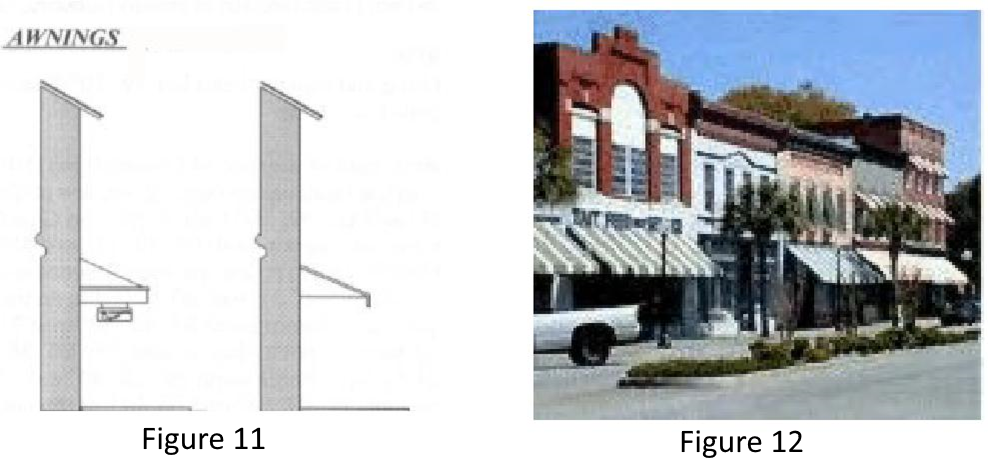
AWNINGS extending from the first STORY and facing the street must conform to the following BUILD-TO-LINE and must dimensions:
(a)
Depth - 5 feet minimum, but no closer than 2 feet to an existing curb.
(b)
Height - 8 feet minimum clear, including suspended signs.
(c)
Upper STORY AWNINGS shall meet the depth requirements of first STORY AWNINGS.
(d)
AWNINGS may occur forward of the required build-to-line and may encroach within the RIGHT-OF-WAY, but shall not interfere with any STREET LIGHTS or trees.
(e)
AWNINGS shall be made of canvas, vinyl or metal and in a color that is consistent with the overall color scheme of the facade. Solid colors or simple, muted-stripe patterns are appropriate. High-gloss or plasticized fabrics are prohibited. (Amended 4/9/2008)
(f)
AWNINGS shall be rectangular or bubble in form.
(g)
Figure 11 indicates typical cross-sections of AWNINGS and Figure 12 illustrates the proper use of AWNINGS.
b.
Front Porches.
(1)
Front porches are permitted only on BUILDINGS that are residential in character.
(2)
Front porches facing the street must have a minimum depth of 8 feet.
(3)
Front porches shall not be built forward of the required build-to-line and must be open, un-air conditioned parts of the BUILDING.
(4)
Figure 13 indicates typical proportions of front porches.
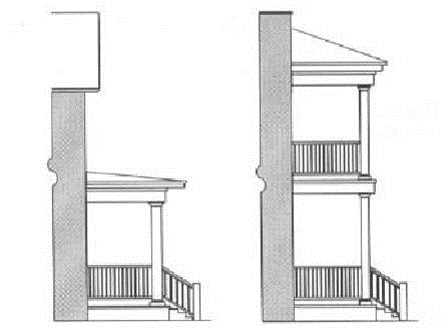
Figure 13. Front Porches
c.
Patios.
(1)
Patios are permitted on the front, side or rear of a building.
(2)
Patios facing the street must have a minimum depth of 5 feet.
(3)
Patios and the required screening shall not be built forward of the required BUILD-TO-LINE.
(4)
Patios, at the time of installation, must be screened from the public street with a visual barrier at least 4 feet wide and 3 feet high that shall be either an evergreen hedge or a combination of wall or decorative fence and evergreen plant material where the plant material is used to soften the visual impact of the wall.
(5)
Walls or fences shall be 4 feet high and shall meet the requirements of Chapter 6.08.
d.
Entries.
(1)
Front entries must be recessed and entry doors should be centered. However, if the building is on a corner lot, the front entry may be located on the corner rather than centered on the front facade.
(2)
Doors must be solid and well detailed, matching the materials, design and character of the display window framing. "Narrow line" aluminum doors are not permitted.
e.
Windows.
(1)
Window-to-Wall Proportion - Second stories must have a window to wall area proportion of 30 - 50 % that is smaller than that of GROUND FLOOR storefronts.
(2)
Window Openings - must be vertical or square in shape and compatible with window openings on existing buildings within the district. If square, windows and/or window panes must be vertical in shape.
(3)
Shaped Frames and Sills - must be used to enhance openings and add additional relief. They should be proportional to the glass area framed; e.g., a larger window should have thicker framing members.
(4)
MUNTINS - "true divided light" windows or sectional windows are recommended where a divided window design is desired; "snap-in" grilles or MUNTINS should not be used.
(5)
Replacement/Renovation - Wood windows must be replaced with wood windows of the same operating type (e.g., double-hung, casement, etc.; vinyl-covered wood windows are available for lower maintenance). Do not replace a double hung window with a horizontal sliding window.
(6)
Factory painted or fluorocoated to match the original; color anodized is also acceptable.
(7)
Similar in size and thickness to the original frame and MUNTINS.
4.
Use Specification Limitations. Allowable uses within the district are specified in § 13.01. However, limitation on some of those uses are specified below.
a.
GROUND FLOOR.
(1)
The GROUND FLOOR shall house uses as specified in §[Chapter] 13.01 that are pedestrian-oriented including access for upper STORY uses.
b.
Upper Floor.
(1)
Retail uses are permitted as specified in §[Chapter] 13.01 but only as an extension to the GROUND FLOOR use.
(2)
LIVE/WORK units are permitted provided the work unit is located on the GROUND FLOOR and the live unit is located on the upper floor.
(3)
Residential units are permitted provided there is an independent method of ingress and egress from the GROUND FLOOR use.
B.
Downtown District. This district is intended to be the civic and commercial heart of Watkinsville with a focus on retail and services to provide for local needs. BUILDINGS shall be designed to complement the pedestrian scale of the district and in accordance with the scale and character of the district.
1.
Height Specifications.
a.
Building Height. PRINCIPAL BUILDINGS shall be no more than 36 feet in height as detailed in paragraphs b and c below.
b.
Ground Story Height.
(1)
Space at ground level is considered as the first STORY if it is six feet or more in height.
(2)
The GROUND STORY floor elevation shall be between 6 inches below and 48 inches above the sidewalk elevation at the front of the building. The maximum floor-to-floor STORY HEIGHT limit for the GROUND FLOOR is 16 feet.
c.
Upper Story Height.
(1)
The maximum floor-to-floor STORY HEIGHT limit for the section STORY cannot exceed 12 feet.
(2)
Space within a roof line that is entirely uninhabitable shall not be considered to be a STORY.
2.
Siting Specifications.
a.
STREET FACADE.
(1)
The width of a BUILDING'S FACADE must be at least 50% of the LOT'S width. For adjoining LOTS under single control, for a single LOT with multiple BUILDINGS, and for CORNER LOTS, these percentages apply to the combination of LOT(S), BUILDING(S), and BUILDING FACADES.
(2)
BUILDING FACADES shall be oriented parallel to the STREET.
b.
BUILDABLE AREA.
(1)
BUILDINGS shall occupy only the area of the LOT specified in the siting specifications of the BUILDING ENVELOPE standards as BUILDABLE AREA. No part of any BUILDING except overhanging eaves, AWNINGS, or stoops shall encroach into the right-of-way beyond the required BUILD-TO-LINE.
c.
Side Yard SETBACK.
(1)
No side yard SETBACKS are required alongside property lines that abut non-residential LOTS; 20 feet is required adjacent to residential-only LOTS. Residential-only LOTS shall have a side yard SETBACK of 20 feet.
d.
CORNER LOTS.
(1)
CORNER LOTS shall be treated as having STREET FRONTAGE on the primary STREET only. The side of the lot abutting the secondary street shall meet the side yard setback (or required build-to-lines).
e.
THROUGH LOTS. For LOTS that front two parallel streets, minimum required rear yards SETBACKS is measured from the right-of-way of the street parallel to the front street.
(1)
For principal and ACCESSORY STRUCTURES, the minimum SETBACK is 20 feet from the right-of-way.
(2)
For off-street parking spaces, the minimum SETBACK is 15 feet from the right-of-way.
(3)
For commercial trash receptacles and their opaque visual barriers, the minimum SETBACK is 15 feet from the right-of-way.
f.
Rear Yards.
(1)
For rear Yards that are not located on THROUGH LOTS, the minimum SETBACK for principal and ACCESSORY STRUCTURES is 20 feet from the adjacent property line. (Revised 3/14/2012)
(2)
For commercial trash receptacles and their opaque visual barriers, the minimum SETBACK is 20 feet.
g.
Parking and Circulation Facilities.
(1)
ATTACHED RESIDENTIAL STRUCTURES only: garages shall not face the front of the LOT, and are to be enclosed with overhead doors. DETACHED and ATTACHED GARAGES are permissible as long as such garage is constructed in the same architectural style, with the same colors and materials as the dwelling. EXCEPTIONS: Lots platted on or before May 8, 2013, that are too narrow or the shape of the lot is such that the request doesn't comply with the above requirements may apply for a variance. A variance request made under this exception may be approved by Mayor and Council. The submitted documents and justification will conform to requirements of Article 14 Administration, Chapter 14.05, and be submitted to the City Clerk and Code Enforcement Office for review 30 days prior to the next scheduled Council Meeting. (Revised 5/8/2013)
(2)
Upper Floor Residential only: At least one surface parking space within at least 400 feet of the unit shall be reserved at all times for the residential unit.
(3)
All off-street parking shall be screened from abutting streets with a visual barrier at least 4 feet wide and 3 feet high that shall be either an evergreen hedge or a combination of wall or decorative fence and evergreen plant materials are used to soften the visual impact of the wall.
(4)
Commercial STRUCTURES or Commercial/Residential STRUCTURES: off-street parking shall meet the standards of Chapter 8.06.A.4.J and shall be set back 20 feet from the front property line and 10 feet from the side and rear property line.
(5)
All off-street parking shall be screened from abutting streets with a fence, wall, or hedge at least 4 feet in height and meeting the standards of §[Chapter] 6.08.
(6)
Vehicle access between adjacent parking LOTS across property lines is required.
(7)
Circular drives are prohibited.
3.
Element Specifications.
a.
Attached Residential Buildings.
(1)
In addition to the other requirements of this ordinance, unless the building contains MANSION FLATS, ATTACHED RESIDENTIAL BUILDINGS shall contain architectural features that clearly delineate one DWELLING UNIT from the adjacent unit. To ensure consistency with other ATTACHED RESIDENTIAL BUILDINGS in the district, no more than 5 DWELLING UNITS shall be permitted in one building.
(2)
Each unit shall be provided with a 2-car garage.
b.
AWNINGS.
(1)
AWNINGS extending from the first STORY and facing the street must conform to the following dimensions:
(a)
Depth- 5 feet minimum, but no closer than 2 feet to an existing curb.
(b)
Height - 8 feet minimum clear, including suspended signs.
(c)
Upper STORY AWNINGS shall meet the depth requirements of first STORY AWNINGS.
(d)
AWNINGS may occur forward of the required build-to line and may encroach within the RIGHT-OF-WAY, but shall not interfere with any STREET LIGHTS.
(e)
AWNINGS shall be made of canvas, vinyl or metal and in a color that is consistent with the overall color scheme of the facade. Solid colors or simple, muted-stripe patterns are appropriate. High-gloss or plasticized fabrics are prohibited (Adopted 4/9/2008)
(f)
AWNINGS shall be rectangular or bubble in form.
(g)
Figure 14 indicates typical cross-sections of AWNINGS and Figure 15 illustrates the proper use of AWNINGS.
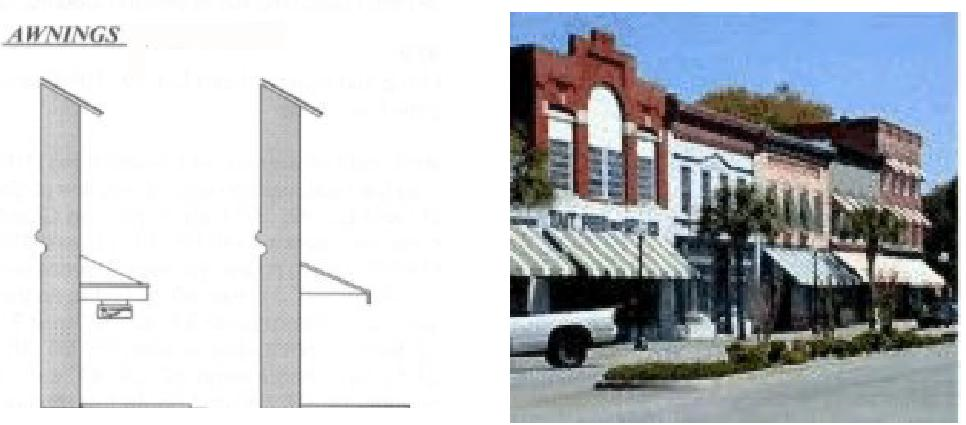
Figure 14 Figure 15
c.
Porches.
(1)
Front porches are permitted only on BUILDINGS that are residential in character.
(2)
Front porches facing the street must have a minimum depth of 8 feet.
(3)
Front porches shall not be built forward of the required build-to line and must be open, un-air conditioned parts of the building.
(4)
Figure 16 indicates typical proportions of front porches.
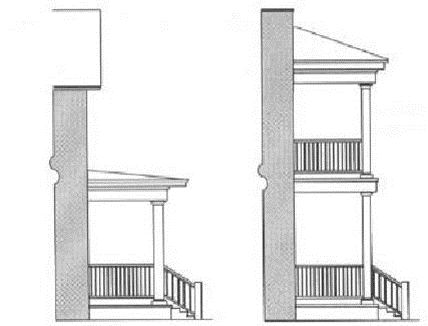
Figure 16. Front Porches
d.
Patios.
(1)
Patios are permitted on the front or side of a BUILDING.
(2)
Patios facing the street must have a minimum depth of 8 feet.
(3)
Patios and the required screening shall not be built forward of the required BUILD-TO-LINE.
(4)
Patios must be screened from the public street with a visual barrier at least 4 feet wide and 3 feet high that shall be either an evergreen hedge or a combination of wall or decorative fence and evergreen plant material where the plant material is used to soften the visual impact of the wall.
(a)
Walls or fences shall be 4 feet high and shall meet the requirements of Chapter 5.08.
e.
Entries.
(1)
Front entries shall be recessed and entry doors shall be centered.
(2)
Doors - shall be solid and well detailed, matching the materials, design and character of the display window framing. "Narrow line" aluminum doors are not recommended.
f.
Windows.
(1)
Window-to-Wall Proportion - In general, second stories shall have a window to wall area proportion (typically 30 - 50%) that is smaller than that of GROUND FLOOR storefronts.
(2)
Window Openings - shall be vertical or square in shape; if square, windows and/or windowpanes shall be vertical in shape.
(3)
Shaped Frames and Sills - shall be used to enhance openings and add additional relief. They shall be proportional to the glass area framed; e.g., a larger window shall have thicker framing members.
(4)
MUNTINS - "true divided light" windows or sectional windows are recommended where a divided window design is desired; "snap-in" grilles or MUNTINS should not be used.
(5)
Replacement/Renovation - Wood windows should be replaced with wood windows of the same operating type (e.g., double-hung, casement, etc., vinyl-covered wood windows are available for lower maintenance). Do not replace a double hung window with a horizontal sliding window.
(6)
Factory painted - or flurocoated to match the original; color anodized is also acceptable.
(7)
Similar in size - and thickness to the original frame and MUNTINS.
4.
Use Specification Limitations. Allowable uses within the district are specified in 13.01. However, limitations on some of those uses are specified below.
a.
GROUND FLOOR.
(1)
The GROUND FLOOR shall house uses as specified in §[Chapter] 13.01 that are pedestrian-oriented as well as access for upper STORY uses.
b.
Upper Floor.
(1)
Retail uses are permitted as specified in §[Chapter] 13.01 but only as an extension to the GROUND FLOOR use.
(2)
Residential units are permitted provided there is an independent method of ingress and egress from the GROUND FLOOR use.
C.
South Main Street Scenic Corridor. This district is located along SOUTH MAIN STREET SCENIC CORRIDOR and comprises a number of HISTORIC STRUCTURES that contribute to the district's character. This district is a transition from the Downtown District to the Detached Residential District and is intended primarily for residential uses while allowing limited small-scale, convenience-type retail sales and services as well as cafés and restaurants. Retail uses cannot be stand-alone uses, must be incorporated in a residential unit, and must be an accessory component of the principal use of the property. At least 50 percent of the heated floor area must contain the residential dwelling unit. Development within the district should retain and adaptively reuse existing structures pursuant to Article 12.
1.
Height Specifications.
a.
BUILDING Height.PRINCIPAL BUILDINGS shall be no more than 36 feet in height in height as detailed in paragraphs b and c below.
b.
GROUND STORY Height.
(1)
Space at ground level is considered as the first STORY if it is six feet or more in height.
(2)
The GROUND STORY floor elevation shall be between 6 inches below and 48 inches above the sidewall elevation at the front of the building. The maximum floor-to- building STORY height for the GROUND FLOOR is 16 feet.
c.
Upper STORY HEIGHT.
(1)
The maximum floor-to-floor STORY HEIGHT limit for the section STORY cannot exceed 12 feet.
(2)
Space within a roof line that is entirely non-habitable shall not be considered to be a STORY.
2.
Siting Specifications.
a.
STREET FACADE.
(1)
The width of a BUILDING'S FACADE must be at least 40% of the lot's width.
(2)
BUILDING FACADES shall be oriented parallel to the STREET.
b.
BUILDABLE AREA.
(1)
The required BUILD-TO-LINE for new construction on a LOT with an existing residential structure shall be to the rear of the existing structure. The required BUILD-TO-LINE for new construction on a vacant LOT shall be between the minimum and maximum SETBACK of principal BUILDINGS within 300 feet of each side of the parcel.
c.
Side Yard SETBACK.
(1)
Side YARD SETBACK shall be a minimum of 10'.
d.
Rear Lot SETBACK.
(1)
For principal and ACCESSORY STRUCTURES, the minimum SETBACK is 15 feet from the right-of-way.
(2)
For commercial trash receptacles and their opaque visual barriers, the minimum SETBACK is 15 feet.
e.
Parking and Circulation Facilities Residential STRUCTURES only.
(1)
Parking shall be either in a DETACHED GARAGE or ATTACHED GARAGE. Such garages shall be no less than 200 square feet nor larger than 400 square feet, not facing the front of the LOT, and are to be enclosed with overheard doors. DETACHED and ATTACHED GARAGES are permissible as long as such garage is constructed in the same architectural style, with the same colors and materials as the dwelling. Exceptions: Lots platted on or before May 8, 2013, that are too narrow or the shape of the lot is such that the request doesn't comply with the above requirements may apply for a variance. A variance request made under this exception may be approved by Mayor and Council. The submitted documents and justification will conform to requirements of Article 14 Administration, Chapter 14.05 and be submitted to the City Clerk and Code Enforcement Officer for review 30 days prior to the next scheduled Council Meeting (Revised 5/8/2013)
(2)
All OFF-STREET PARKING shall be screened from abutting STREETS with a visual barrier at least 4 feet wide and 3 feet high that shall be either combination of wall or decorative fence and evergreen plant materials where the plant materials are used to soften the visual impact of the wall.
(3)
Commercial Structures or Commercial/Residential structures: OFF-STREET PARKING shall meet the standards of Chapter 8.06.A.4.J and shall be set back 20 feet from the front property line and 10 feet from the side and rear property line.
(4)
All OFF-STREET PARKING shall be screened from abutting STREETS with a fence, wall, or hedge at least 4 feet in height and meeting the standards of §[Chapter] 6.08.
(5)
Vehicle access between adjacent parking lots across property lines is required.
(6)
Circular drives are prohibited unless they are historically associated with the existing structure.
f.
CORNER LOTS.
(1)
CORNER LOTS shall be treated as having STREET FRONTAGE on the primary STREET only. The side of the lot abutting the secondary street shall meet the side yard setback (or required build-to lines).
3.
Element Specifications.
a.
AWNINGS.
(1)
AWNING extending from the first STORY and facing the street must conform to the following dimensions:
(a)
Depth - 5 feet minimum, but no closer than 2 feet to an existing curb.
(b)
Height - 8 feet minimum clear, including suspended signs.
(c)
Upper STORY AWNINGS shall meet the depth requirements of first STORY AWNINGS.
(d)
AWNING may occur forward of the build-to line and may encroach within the RIGHT-OF-WAY, but shall not interfere with any STREET LIGHTS.
(e)
AWNINGS shall be made of canvas, vinyl or metal and in a color that is consistent with the overall color scheme of the facade. Solid colors or simple, muted-stripe patterns are appropriate. High-gloss or plasticized fabrics are prohibited. (Amended 4/9/2008)
(f)
AWNINGS shall be rectangular in form.
(g)
Figure 17 indicates typical cross-sections of AWNINGS and Figure 18 illustrates the proper use of AWNINGS.
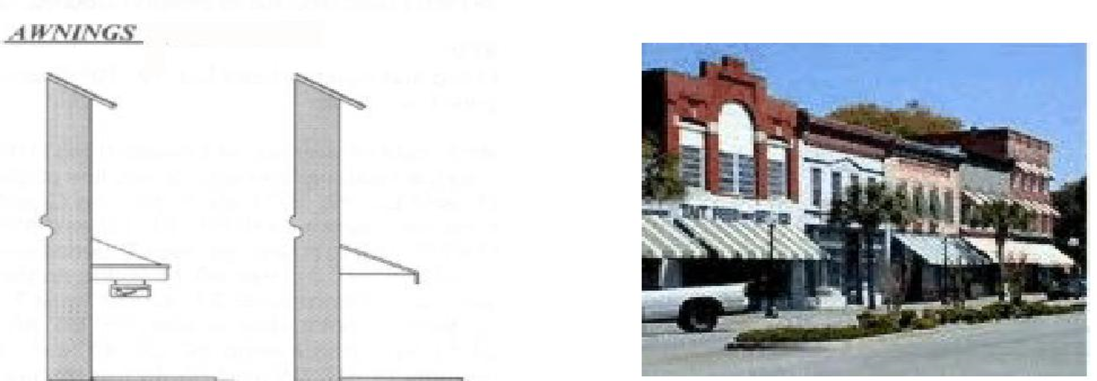
Figure 17. Figure 18.
b.
Front Porches.
(1)
Front porches facing the street must have a minimum depth of 8 feet.
(2)
Front porches may not have a multi-STORY veranda and/or BALCONY above.
(3)
Front porches shall not be built forward of the build-to line and must be open, un-air conditioned parts of the BUILDING.
(4)
Figure 19 indicates typical proportions of front porches.
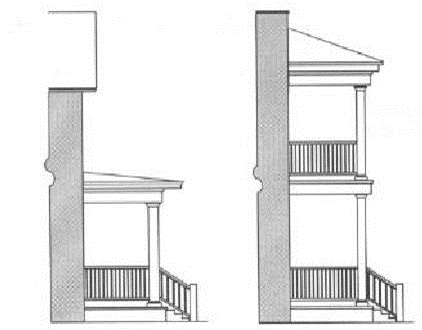
Figure 19. Front Porches
c.
Entries.
(1)
Front entries should be recessed and entry doors should be centered.
(2)
Doors - should be solid and well detailed. They should match the materials, design and character of the BUILDING FACADE window framing. "Narrow line" aluminum doors are not recommended.
4.
Use Specifications.
a.
Allowable uses within the district are specified in §[Chapter] 13.01. However, limitations on some of those uses are specified below.
b.
A BUSINESS ENTITY cannot be a standalone use but must be incorporated in a residential unit and must be an accessory component of the principal use of the property.
5.
Accessory Units.
a.
Accessory units shall be located behind the rear building line for the existing structure.
b.
Architectural elements and standards for the ACCESSORY UNIT shall be compatible with the principal structure.
D.
Simonton Bridge Scenic Corridor. This district is located along Simonton Bridge Road and comprises a number of HISTORIC STRUCTURES that contribute to the district's character. This district is a transition from the Downtown District to the detached residential District and is intended only for DETACHED RESIDENTIAL uses.
1.
Height Specifications.
a.
Building Height. PRINCIPAL BUILDINGS shall be no more than 36 feet in height as detailed in paragraphs b and c below.
b.
Each building shall be no more than 3 stories in height as specified in paragraphs c and d below.
c.
GROUND STORY HEIGHT.
(1)
Space at ground level is considered as the first STORY if it is six feet or more in height.
(2)
The GROUND STORY floor elevation shall be between 6 inches below and 48 inches above the sidewalk elevation at the floor of the building. The maximum floor-to-BUILDINGSTORY HEIGHT for the GROUND FLOOR is 16 feet.
d.
UpperSTORY HEIGHT.
(1)
The maximum floor-to-floor STORY HEIGHT limit for the STORY cannot exceed 12 feet each, excluding vaulted or cathedral ceilings.
(2)
Space within a roofline that is entirely non-habitable shall not be considered to be a STORY.
2.
Siting Specifications.
a.
STREET FACADE.
(1)
The width of a BUILDING'S facade must be at least 30% of the lot's width.
(2)
BUILDING facades shall be oriented parallel to the street.
b.
CORNER LOTS.
(1)
CORNER LOTS shall be treated as having STREET FRONTAGE on the primary STREET only. The side of the lot abutting the secondary street shall meet the side yard setback (or required build-to lines).
c.
BUILDABLE AREA.
(1)
The required BUILD-TO-LINE for new construction on a lot with an existing residential structure shall be to the rear of the existing structure. The required BUILD-TO-LINE for new construction on a vacant lot shall be between the minimum and maximum setback of buildings within 300 feet of each side of the parcel.
d.
Side Yard SETBACK.
(1)
Side yard SETBACK shall be a minimum of 30'.
e.
Rear Yard SETBACK.
(1)
For principal and ACCESSORY STRUCTURES, the minimum SETBACK is 40'.
f.
Parking and Circulation Facilities Residential STRUCTURES only.
(1)
Parking shall be either in a DETACHED GARAGE or an ATTACHED GARAGE. Such garages shall be no less than 200 square feet nor larger than 400 square feet, not facing the front of the LOT, and are to be enclosed with overhead doors. DETACHED and ATTACHED GARAGES are permissible as long as such garage is constructed in the same architectural style. With the same colors and materials as the dwelling. EXCEPTIONS: Lots platted on or before May 8, 2013, that are too narrow or the shape of the lot is such that the request doesn't comply with the above requirements may apply for a variance. A variance request made under this exception may be approved by Mayor and Council. The submitted documents and justification will conform to requirements of Article 14 Administration, Chapter 14.05 and be submitted to the City Clerk and Code Enforcement Officer for review 30 days prior to the next scheduled Council Meeting. (Revised 5/8/2013)
(2)
Circular drives are prohibited unless they are historically associated with the structure.
3.
Element Specifications.
a.
Front Porches.
(1)
Front porches facing the street must have a minimum depth of 8 feet.
(2)
Front porches shall not be built forward of the build-to line and must be open, un-air conditioned parts of the BUILDING.
(3)
Figure 20 indicates typical proportions of front porches.
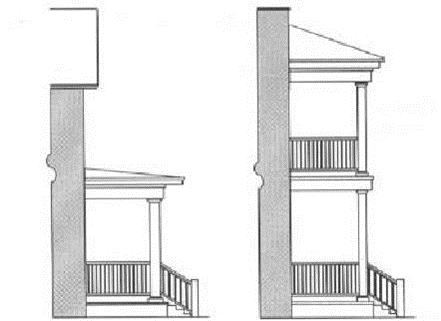
Figure 20. Front Porches
4.
Accessory Units.
a.
Accessory units shall be located behind the rear Building line for the existing structure.
b.
Architectural elements and standards of the accessory unit shall be compatible with the principal structure.
c.
The square footage of accessory units shall not exceed 30% of the square footage of the GROUND FLOOR of the principal unit.
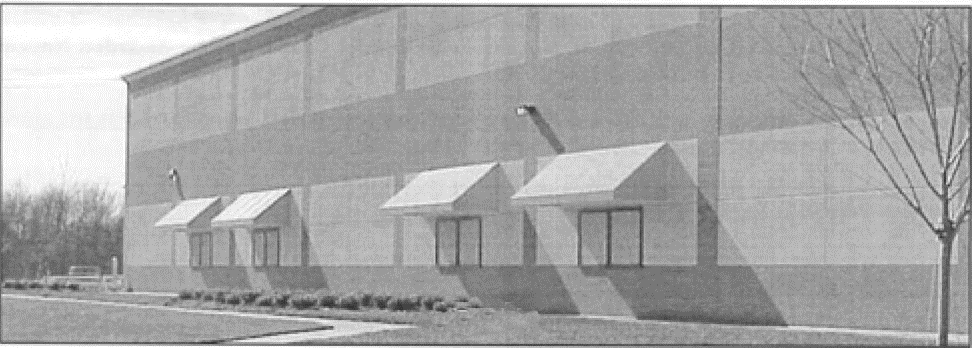
Figure 21. Unacceptable
E.
Corridor Commercial. This district is intended primarily for larger-scale commercial development that is more auto-oriented in nature, requiring increased visibility and road access. The district is intended to accommodate commercial uses requiring major road access and targets retail. Service, light industry, or office development that is incompatible with the Downtown environment and require additional space to accommodate their activity. Development in the district should conform to the scale and character of the district.
1.
Height Specifications.
a.
BUILDING Height. Principal BUILDING height is measured in stories. These parameters preserve appropriate street-space.
(1)
Maximum: 40 feet.
(2)
Minimum: 1 story.
b.
GROUND STORY HEIGHT.
(1)
Space at ground level is considered as the first STORY if it is six feet or more in height.
(2)
The GROUND STORY floor elevation shall be between 6 inches below and 48 inches above the sidewalk elevation at the front of the building. The maximum floor-to-BUILDING STORY HEIGHT for the GROUND FLOOR is 16 feet.
c.
Upper STORY HEIGHT.
(1)
The maximum floor-to-floor STORY HEIGHT limit for the section STORY cannot exceed 12 feet.
(2)
Space within a roof line that is entirely non-habitable shall not be considered to be a STORY.
2.
Architectural Elements. Buildings shall avoid long, monotonous, uninterrupted walls or roof planes on their visible FACADES. Building wall offsets, including projections, recesses, and changes in floor level, shall be used in order to add architectural interest and variety; relieve the visual effect of a single, long wall; and subdivide the wall into human scale proportions. Similarly, roofline offsets shall be provided to lend architectural interest and variety to the massing of a BUILDING and to relieve the effect of a single, long roof. For larger scale developments, the BUILDING facade shall create repetitive bays, or the facades shall be divided into an asymmetrical, yet balanced, composition. All sides of the building shall use materials consistent with those on the front if visible from public streets or neighboring properties, and should be carefully designed with similar detailing, comparable quality, and compatible materials.
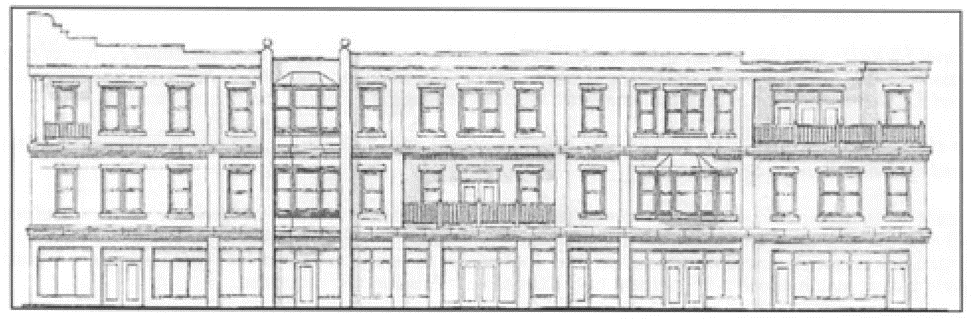
Figure 22. Acceptable
3.
Facades.
a.
All visibly exposed FACADES should have:
(1)
A recognizable base course consisting of, but not limited to:
(a)
Thicker walls, ledges or sills;
(b)
Integrally textured materials such as stone or other masonry;
(c)
Integrally colored and patterned materials such as smooth finished stone or tile;
(d)
Lighter or darker colored materials, mullions, or panels.
(2)
A recognizable top consisting of, but not limited to:
(a)
CORNICE treatments, other than just colored stripes or bands, with integrally textured materials such as stone or other masonry or differently colored materials;
(b)
A roof overhang with brackets;
(c)
Stepped parapets;
(d)
A CORNICE capping the top of a building wall;
(e)
Visible false fronts are not permitted.
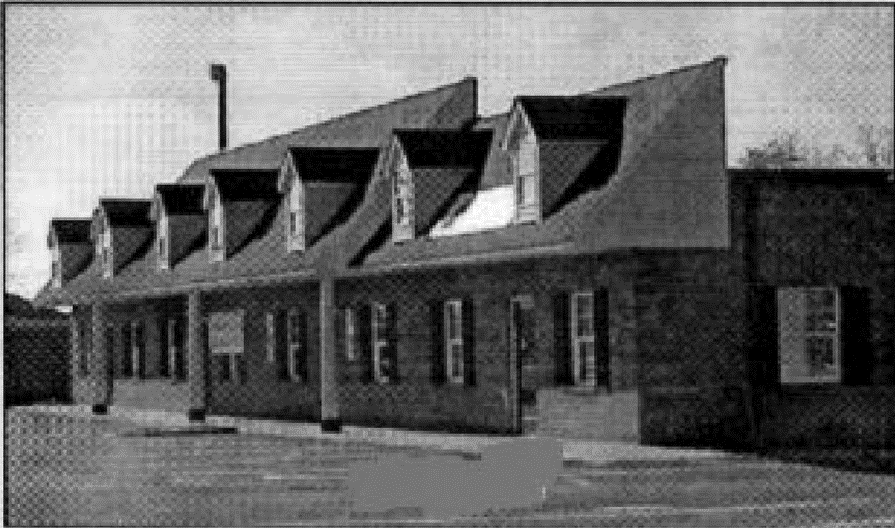
Figure 23. Visible False Front
4.
Siting Specifications.
a.
STREET FACADE.
(1)
Principal building facades shall be oriented parallel to the Street.
b.
BUILDABLE AREA.
(1)
The required BUILD-TO-LINE for new construction is 30'.
c.
Side Yard SETBACK.
(1)
Side yard SETBACK shall be a minimum of 10'.
d.
Rear Yard Setback.
(1)
For principal and ACCESSORY STRUCTURES, the minimum SETBACK is 15'.
(2)
For off-street parking spaces, the minimum SETBACK is 15'.
(3)
For commercial trash receptacles and their opaque visual barriers, the minimum SETBACK is 15'.
e.
Parking and Circulation Facilities.
(1)
Off-street parking shall, where practical unless otherwise certified by a professional engineer or architect, shall[sic] meet the requirements of chapter 8.06.A.3 and shall be no closer than 10 feet to an abutting street.
(2)
All off-street parking shall be screened from abutting STREETS with a visual barrier at least 4 feet wide and 3 feet high that shall be either an evergreen hedge or a combination of wall or decorative fence and evergreen plant material where the plant material is used to soften the visual impact of the wall.
(3)
Where a development application is for land located adjacent to an existing parking lot used for similar purposes, a vehicular connection between the parking lots shall be provided wherever possible. For development applications adjacent to vacant properties, the site shall be designed and constructed to provide for a future connection.
f.
Corridor Access.
(1)
Number.
(a)
Each parcel shall be permitted one driveway access to the Corridor. Such corridor access shall consist of either a single two-way driveway, or a paired driveway system where one driveway is designed and marked to accommodate only ingress traffic and other is designed and marked to accommodate only egress traffic.
(2)
Shared-Access.
(a)
Wherever possible, the permitted driveway access shall be provided by a shared-driveway.
(3)
Additional Driveways.
(a)
Additional driveways may be allowed when the need for such additional access is demonstrated by way of a supporting Traffic Impact Study, and such study finds that the additional driveway(s) will not create negative impacts on through-traffic flow. The Traffic Impact Study shall review and identify the minimum number of access points necessary to service the proposed development and shall include consideration of traffic generated by shared-access from adjacent development. Additional driveways permitted shall comply with the access-space standards below.
g.
Spacing.
* Driveway spacing shall be measured from the right-of-way of each driveway.
(1)
When the road frontage of a parcel is insufficient to meet the spacing standards of this district, and shared-access by way of a frontage road or rear access-service drive from an adjacent parcel is not available, the driveway shall be located and constructed along the property line furthest from the intersection to facilitate future shared-driveway use.
5.
Accessory Units.
a.
ACCESSORY UNITS shall be located behind the rear building line for the existing structure.
b.
Architectural elements and standards of the ACCESSORY UNIT shall be compatible with the principal structure.
c.
The square footage of an ACCESSORY UNIT shall not exceed 40% of the spare footage of the GROUND FLOOR of the principal unit.
F.
Employment Center. This district is intended primarily for larger-scale LIGHT INDUSTRY, wholesale, and office uses that may be land intensive, generate high consumer traffic, or create impacts associated with manufacturing and production uses. Light manufacturing should be limited to ensure compatibility with other employment uses with the district.
1.
Height Specifications.
a.
Building Height. Principal building height shall not exceed 40 feet and shall be a minimum of 1 STORY.
b.
GROUND STORY HEIGHT.
(1)
Space at ground level is considered as the first STORY if it is six feet or more in height.
(2)
The GROUND STORY floor elevation shall be between 6 inches below and 48 inches above the sidewalk elevation at the front of the building.
2.
Architectural Elements. All Sides of the building shall use materials consistent with those on the front if visible from public streets or neighboring properties, and should be carefully designed with similar detailing, comparable quality, and compatible materials.
3.
Siting Specifications.
a.
STREET FACADE.
(1)
Principal building facades shall be oriented parallel to the STREET.
b.
BUILDABLE AREA.
(1)
The required BUILD-TO-LINE for new construction is 50'.
c.
Side Yard SETBACK.
(1)
Side yard SETBACK shall be a minimum of 10'. Side YARD SETBACK shall be increased to 75' where the parcel abuts a residential district.
d.
Rear Yard SETBACK.
(1)
For principal and ACCESSORY STRUCTURES, the minimum SETBACK is 50'.
(2)
For off-street parking spaces, the minimum SETBACK is 50'.
(3)
For commercial trash receptacles and their opaque visual barriers, the minimum SETBACK is 50'.
(4)
Rear YARD SETBACK shall be increased to 75' where the parcel abuts a residential district.
e.
Corner Lot Setbacks.
(1)
CORNER LOTS shall be treated as having STREET FRONTAGE on the primary STREET only. The side of the lot abutting the secondary street shall meet the side yard setback (or required build-to-lines).
f.
Parking and Circulation Facilities.
(1)
Off-street parking shall, where practical unless otherwise certified by a professional engineer or architect, shall[sic] meet the requirements of chapter 8.06.A.3 and shall be no closer than 10 feet to an abutting street.
(2)
All off-street parking shall be screened from abutting streets with a visual barrier at least 4 feet wide and 3 feet high that shall be either an evergreen hedge or a combination of wall or decorative fence and evergreen plant material where the plant material is used to soften the visual impact of the wall.
(3)
Where a development application is for land located adjacent to an existing parking lot used for similar purposes, a vehicular connection between the parking LOTS shall be provided wherever possible. For development applications adjacent to vacant properties, the site shall be designed and constructed to provide for a future connection.
g.
Loading/Unloading Areas.
(1)
Loading and unloading areas shall be placed to the side or the rear of the principal structure.
(2)
Areas shall be screened from public STREETS and adjacent parcels with 8 foot tall opaque fence and/or evergreen hedge that will grow 8 feet tall in 3 years.
h.
Corridor Access.
(1)
Number.
(a)
Each parcel shall be permitted one driveway access to the Corridor. Such corridor access shall consist of either a single two-way driveway, or a paired driveway system where one driveway is designed and marked to accommodate only ingress traffic and the other is designed and marked to accommodate only egress traffic.
(2)
Shared-Access.
(a)
Wherever possible, the permitted driveway access shall be provided by a shared-driveway or service-drive.
(3)
Additional Driveways.
(a)
Additional driveways may be allowed when the need for such additional access is demonstrated by way of a supporting Traffic Impact Study, and such study finds that the additional driveway(s) will not create negative impacts on through-traffic flow. The Traffic Impact Study shall review and identify the minimum number of access points necessary to service the proposed development and shall include consideration of traffic generated by shared-access from adjacent development.
(b)
Additional driveways permitted shall comply with the access-space standards below.
* Driveway spacing shall be measured from the right-of-way of each driveway
(4)
Accessory Units.
a.
ACCESSORY UNITS shall be located behind the rear building line for the existing structure.
b.
Architectural elements and standards of the ACCESSORY UNIT shall be consistent with the principal structure.
c.
The square footage of an ACCESSORY UNIT shall not exceed 20% of the spare footage of the GROUND FLOOR of the principal unit.
G.
Cultural Arts Preservation District. This is an OVERLAY DISTRICT intended to preserve the Oconee Cultural Arts Foundation (OCAF) as the focal point of the district. The underlying Downtown District addresses allowable uses and the general principles of development patterns in the district; however, this OVERLAY DISTRICT further regulates development patterns within the district for the purpose of retaining and enhancing the aesthetic qualities of the area with an emphasis on the scale of new and re-development projects with OCAF facilities and existing residential dwellings in the district. Development within this district should strive to retain and adaptively reuse existingSTRUCTURES.
1.
Height Specifications.
a.
Building Height.PRINCIPAL BUILDINGS shall be no more than 36 feet in height as detailed in paragraphs b and c below.
b.
GROUND STORY HEIGHT.
(1)
Space at ground level is considered as the first STORY if it is six feet or more in height.
(2)
The GROUND STORY floor elevation shall be between 6 inches below and 48 inches above the sidewalk elevation at the front of the building.
(3)
The maximum floor-to-floor STORY HEIGHT limit for the GROUND FLOOR is 16 feet.
c.
UPPER FLOOR.
(1)
The maximum floor-to-floor STORY HEIGHT limit for the second STORY cannot exceed 12 feet.
(2)
Space within a roofline that is entirely non-habitable shall not be considered to be a STORY.
d.
Within the OVERLAY DISTRICT, new construction should be consistent with the heights of adjacent and nearby buildings.
2.
Siting Specifications.
a.
STREET FACADE.
(1)
Building FACADES shall be oriented parallel to the street.
(2)
The width of BUILDING'S facade must be no more than 60% of the lot's width.
b.
Corner Lots.
(1)
CORNER LOTS shall be treated as having STREET FRONTAGE on the primary STREET only. The side of the LOT abutting the secondary STREET shall meet the side YARD SETBACK (or required build-to lines).
c.
BUILDABLE AREA.
(1)
The required BUILD-TO-LINE for new construction on a lot with an existing principal structure shall be to the rear of the principal structure. The required BUILD-TO-LINE for new construction on a vacant lot shall be between the minimum and maximum SETBACK of buildings within the district that are within 300' of each side of the parcel.
d.
Side Yard SETBACK.
(1)
Side yard SETBACK shall be a minimum of 10'.
e.
Corner Lots.
(1)
CORNER LOTS shall be treated as having STREET FRONTAGE on the primary STREET only. The side of the lot abutting the secondary street shall meet the side yard setback (or required built-to lines).
f.
Rear Yards. The minimum SETBACK is 15 feet.
g.
Parking and Circulation Facilities.
(1)
Off-street parking shall be in the rear yard of the principal building and never closer than 10 feet to any property line that abuts a street.
(2)
All off-street parking shall be screened from abutting streets with a fence, wall, or hedge at least 4 feet in height, and meeting the standards of §[Chapter] 6.08.
(3)
Residential STRUCTURE. Parking shall be either in a DETACHED GARAGE or ATTACHED GARAGE. Such garages shall be no less than 200 square feet nor larger than 400 square feet, not facing the front of the LOT, and are to be enclosed with overhead doors. DETACHED and ATTACHED GARAGES are permissible as long as such garage is constructed in the same architectural style, with the same colors and materials as the dwelling. EXCEPTIONS: Lots platted on or before May 8, 2013, that are too narrow or the shape of the lot is such that the request doesn't comply with the above requirements may apply for a variance. A variance request made under this exception may be approved by Mayor and Council. The submitted documents and justification will conform to requirements of Article 14 Administration, Chapter 14.05 and be submitted to the City Clerk and Code Enforcement Officer for review 30 days prior to the next scheduled Council Meeting. (Revised 5/8/2013)
3.
Element Specifications.
a.
Residential Character.
(1)
All buildings within this OVERLAY DISTRICT shall be single-family residential in character and shall be consistent in form and massing with existing residential STRUCTURES.
b.
FRONT PORCHES.
(1)
Front porches facing the street must have a minimum depth of 8 feet.
(2)
Front porches shall not be built forward of the build-to line.
c.
Entries.
(1)
Front entries should be recessed and entry doors should be centered.
(2)
Doors should be substantial and well detailed. They should match the materials, design and character of the display window framing. "Narrow line" aluminum doors are not recommended.
4.
Accessory Units.
a.
ACCESSORY UNITS shall be located behind the rear building line for the existing structure.
b.
Architectural Elements and standards of the accessory unit shall be compatible with the principal structure.
H.
Mixed Use Office. This district is intended to allow for a mix of offices, professional services, and residential uses designed at a pedestrian scale. Primary uses shall include office and professional activities that generate higher employment densities than retail sales and services while encouraging a creative mix of compatible residential uses. Residential uses should be limited to higher density attached units clustered along the edge of the district and should serve as a buffer between the more intense non-residential uses and the stream.
1.
Height Specifications.
a.
Building Height.PRINCIPAL BUILDINGS shall be no more than 40 feet in height as detailed in paragraphs b and c below.
b.
GROUND STORY HEIGHT.
(1)
Space at ground level is considered as the first STORY if it is six feet or more in height.
(2)
TheGROUND STORY floor elevation shall be between 6 inches below and 48 inches above the sidewalk elevation at the front of the building.
(3)
The maximum floor-to-building STORY HEIGHT for the GROUND FLOOR is 16 feet.
c.
Upper STORY HEIGHT.
(1)
The height of each upper STORY floor, measured floor-to-floor cannot exceed 12 feet excluding vaulted or cathedral ceilings.
(2)
Space within a roof line that is entirely non-habitable shall not be considered to be a STORY.
d[2].
Siting Specifications.
e[a].
STREET FAÇADE,
(1)
The STREET FACADE shall be built to not less than 75 percent of the width of the overall required BUILD-TO-LINE. However, the GROUND FLOOR portions of the STREET FACADE within 7 feet of a lot corner are exempt from this requirement in order to allow special corner treatment in these areas.
(2)
STREET FACADES shall be composed as a simple plane (limited jogs less than 24 inches are considered a simple plane within this requirement) interrupted only by porches, stoops, by windows, office window fronts, and balconies.
(3)
BUILDING facades shall be parallel to the street.
f[b].
BUILDABLE AREA,
(1)
Buildings shall occupy only the area of the lot specified in the siting specifications of the BUILDING ENVELOPE standards as BUILDABLE AREA. No part of any building excepting balconies, shall encroach into the right-of-way beyond the required BUILD-TO-LINE. The minimum OPEN SPACE shall comprise at least 15% of the total BUILDABLE AREA and can be located nowhere within the BUILDABLE AREA of the site.
g[c].
Side Yard SETBACK,
(1)
Side yard SETBACK shall be a minimum of 30 feet.
h[d].
Garage and Parking Entrances.
(1)
Garage/parking entrances shall be no closer than 50 feet from any BUILDING CORNER or 100 feet from any BLOCK CORNER, except where otherwise designated.
(2)
Designated garage entries and ALLEYS shall be the sole means of automobile access to a site.
(3)
Garage doors shall not face (be at an angle of less than 90 degrees from the required BUILD-TO-LINE or right-of-way) the required BUILD-TO-LINE. Vehicle parking areas (except where a street wall exists or parking is enclosed within an ancillary BUILDING) on private property shall not be located within 25 feet of the required BUILD-TO-LINE. These requirements are not applicable to on-street parallel parking.
i[e].
ALLEYS.
(1)
On sites with no ALLEY access, there shall be a 15' SETBACK from the rear lot line for buildings and parking.
j[f].
CORNER LOTS.
(1)
CORNER LOTS shall be treated as having STREET FRONTAGE on the primary STREET only. The side of the LOT abutting the secondary street shall meet the side yard setback (or required build-to-lines).
k[g].
Parking and Circulation Facilities.
(1)
All off-street parking shall be screened from abutting streets with a visual barrier at least 4 feet wide and 3 feet high that shall be either an evergreen hedge or a combination of wall or decorative fence and evergreen plant materials where the plant material is used to soften the visual impact of the wall.
(2)
Where there is one principal building on the site, off-street surface parking shall be to the rear of the non-residential building. Where there are several principal buildings on the site, off-street surface parking shall be to the rear of the principal building parallel to the public street.
(3)
Where there is a single principal building, off-street parking shall be screened from abutting streets with a fence, wall, or hedge at least 4 feet in height and meeting the standards of §[Chapter] 6.08.
2[3].
Element Specifications.
a.
Residential Buildings.
(1)
Each residential unit shall be provided 2 parking spaces in a non-front loading garage.
b.
Ground Story Windows.
(1)
The GROUND STORY facade shall have between 50 percent and 75 percent FENESTRATION (measured as a percentage of the facade that is between the ceiling for the GROUND STORY and the finished floor). AWNINGS and overhangs are encouraged (except where otherwise designated by this ordinance).
c.
Upper Story Windows.
(1)
Upper STORY facades shall have between 30 percent and 50 percent FENESTRATION (measured for each STORY as a percentage of the facade that is between the ceiling for that STORY and the finished floor for the same STORY).
d.
AWNINGS.
(1)
AWNINGS extending from the first STORY and facing the street must conform to the following dimensions:
(a)
Depth - 5 feet minimum, but no closer than 2 feet to an existing curb.
(b)
Height - 8 feet minimum clear, including suspended signs.
(c)
Upper STORY AWNINGS shall meet the depth requirement of first STORY AWNINGS.
(d)
AWNINGS may occur forward of the build-to line and may encroach within the RIGHT-OF-WAY, but shall not interfere with any STREET LIGHTS or existing trees.
(e)
AWNINGS shall be made of canvas, vinyl or metal and in a color that is consistent with the overall color scheme of the facade. Solid colors or simple, muted-stripe patterns are appropriate. High-gloss or plasticized fabrics are prohibited. (Amended 4/9/2008)
(f)
AWNINGS shall be rectangular in form.
(g)
Figure 25 indicates typical cross-sections of AWNINGS and Figure 26 illustrates the proper use of AWNINGS.
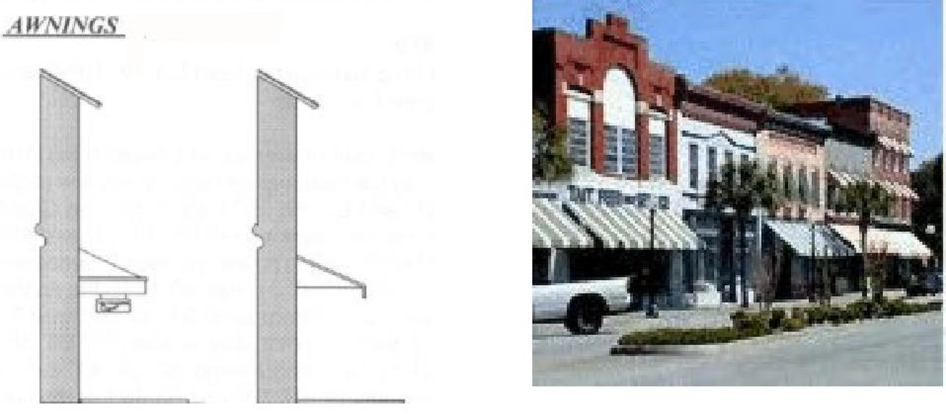
Figure 25. Figure 26.
e.
Front Porches.
(1)
Front porches facing the street must have a minimum depth of 8 feet.
(2)
Front porches shall not be built forward of the build-to line and must be open, un-air conditioned parts of the building.
(3)
Figure 27 indicates typical proportions of front porches.
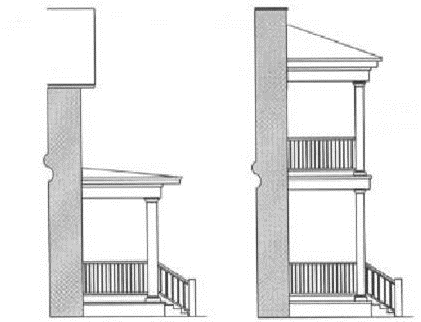
Figure 27. Front Porches
f.
Entries.
(1)
Front entries should be recessed and entry doors should be centered.
(2)
Doors - should be solid and well detailed. They should match the materials, design and character of the display window framing. "Narrow line" aluminum doors are not recommended.
g.
Windows.
(1)
Window Openings - should be vertical or square in shape; if square, windows and/or window panes should be vertical in shape.
(2)
Shaped Frames and Sills - should be used to enhance openings and add additional relief. They should be proportional to the glass area framed; e.g., a larger window should have thicker framing members.
(3)
MUNTINS - "true divided light" windows or sectional windows are recommended where a divided window design is desired; "snap-in" grilles or MUNTINS should not be used.
3[4].
Use Specifications. Allowable uses within the district are specified in §[Chapter] 13.01. However, limitations on some of those uses specified below.
a.
GROUND FLOOR.
(1)
The GROUND FLOOR shall provide access to upper STORY uses.
(2)
There shall be functioning entry door(s) along the STREET at intervals not greater than 30 feet within any site.
b.
Upper Floor.
(1)
Professional offices, professional services, and retail are permitted both as an extension of the GROUND STORY use and as an independent upper STORY use.
c.
Attached Residential.
(1)
ATTACHED RESIDENTIAL is permitted only along the edge of the district and shall serve as a buffer between the non-residential uses and any stream.
(2)
There are no density limitations: however, the ATTACHED RESIDENTIAL development should be in character with the City and should not exceed 40% of the total square footage of the total development.
I.
Detached Residential. This district is intended primarily for a variety of detached single-family units providing a mix of housing types and values. This area is also appropriate for supportive land uses servicing the neighborhood population such as parks, PLAYGROUNDS, fire stations, and childcare centers, as part of the effort to complete neighborhoods.
1.
Height Specifications.
a.
Building Height. Principal building height is measured in stories. These parameters preserve appropriate street space.
b.
Each building shall be a maximum of 35 feet in height as measured from the NATURAL GRADE.
c.
GROUND STORY HEIGHT.
(1)
Space at ground level is considered as the first STORY if it is six feet or more in height.
d.
Upper STORY HEIGHT.
(1)
Space within a roof line that is entirely non-habitable shall not be considered to be a STORY.
2.
Siting Specifications.
a.
Street Facade.
(1)
Building FACADES shall be oriented parallel to the street.
b.
BUILDABLE AREA.
(1)
The required BUILD-TO-LINE for a new principal dwelling shall be between the minimum and maximum SETBACK of BUILDINGS within 300' of each side of the parcel.
(2)
The required BUILD-TO-LINE for an addition to an existing residential structure shall not be forward of the existing structure building line.
(3)
The required BUILD-TO-LINE for ACCESSORY STRUCTURES shall be to the rear of the principal dwelling.
(4)
Side Yard SETBACK.
(a)
Side YARD SETBACK shall be a minimum of 10'.
(5)
Rear Lot SETBACK.
(a)
For principal and ACCESSORY structures, the minimum SETBACK is 15 feet from the adjacent property line. (Revised 3/14/2012)
c.
Parking and Circulation Facilities.
(1)
Parking shall be either in a DETACHED GARAGE or ATTACHED GARAGE. Such garages shall be no less than 200 square feet nor larger than 400 square feet, not facing the front of the LOT, and are to be enclosed with overhead doors. DETACHED and ATTACHED GARAGES are permissible as long as such garage is constructed in the same architectural style, with the same colors and materials as the dwelling. EXCEPTIONS: Lots platted on or before May 8, 2013, that are too narrow or the shape of the lot is such that the request doesn't comply with the above requirements may apply for a variance. A variance request made under this exception may be approved by Mayor and Council. The submitted documents and justification will conform to requirements of Article 14 Administration, Chapter 14.05 and be submitted to the City Clerk and Code Enforcement Officer for review 30 days prior to the next scheduled Council Meeting. (Revised 5/8/2013)
d.
Corner Lots.
(1)
CORNER LOTS shall be treated as having STREET FRONTAGE on the primary STREET only. The side of the lot abutting the secondary street shall meet the side yard setback (or required build-to lines).
3.
Density.
a.
Detached Residential.
(1)
Maximum overall residential density of 2.2 dwelling units per acre of land with access to public water and sewer. In areas not served by public sewer, net residential density shall be determined by soil conditions and their ability to accommodate on-site septic systems.
b.
Attached Residential.
(1)
Maximum density of ATTACHED RESIDENTIAL units within the subdivision is 6.0 dwelling units per acre with access to public water and sewer. The total number of attached residential units shall not exceed a predefined maximum of the total development as determined by the MAYOR and COUNCIL.
(2)
The percentage of attached residential units shall not exceed 25% of total residential units in a new development. However, no ATTACHED RESIDENTIAL units shall be permitted as infill units within an existing development or neighborhood that contains only DETACHED RESIDENTIAL. (Amended 4/9/2008)
(3)
ATTACHED RESIDENTIAL units constructed within the DR District shall meet the requirements of the AR District.
4.
Neighborhood Parks, Open Space or Playground.
a.
The developer is encouraged to include NEIGHBORHOOD PARKS, OPEN SPACE (connecting within the development and with community OPEN SPACE) or PLAYGROUNDS in the development. Such amenities, of adequate size and correctly sited will facilitate new development that is built to the scale and character of the community.
(1)
NEIGHBORHOOD PARKS are generally located in the center of the neighborhood and are typically OPEN SPACES intended to provide unstructured recreation may also include PLAYGROUND equipment.
(2)
Access to the NEIGHBORHOOD PARK should be through OPEN SPACE within the development that is interconnected within the development and with planned or existing community greenways.
5.
Pedestrian/Bicycle Access.
a.
Residential development shall include sidewalks throughout the development that can serve for pedestrian and bicycle access. See chapter 8.05C for sidewalk standards.
b.
The pedestrian connectivity between developments is encouraged and shall be preserved wherever possible.
6.
Accessory Units.
a.
ACCESSORY UNITS shall be located behind the rear building line for the existing structure.
b.
Architectural elements and standards for the ACCESSORY UNIT shall be compatible with the principal structure.
J.
ATTACHED RESIDENTIAL. This district is intended primarily for ATTACHED RESIDENTIAL units developed at higher densities, typically ROWHOUSE, TOWNHOUSE, or similar type development, and apartment homes but, not including DUPLEX development. This area may also be appropriate for small lot DETACHED RESIDENTIAL, parks, OPEN SPACE, and PLAYGROUNDS.
1.
Height Specifications.
a.
BUILDING Height. principal BUILDING height is measured in stories. These parameters preserve appropriate street space.
b.
Each BUILDING shall be a maximum of 35 feet in height as measured from NATURAL GRADE.
c.
GROUND STORY HEIGHT.
(1)
Space at ground level is considered as the first STORY if it is six feet or more in height.
d.
Upper STORY HEIGHT.
(1)
Space within a roof line that is entirely non-habitable shall not be considered to be a STORY.
2.
Siting Specifications.
a.
Street Facade.
(1)
Building FACADES shall be oriented parallel to the STREET.
b.
Buildable Area.
(1)
The required BUILD-TO-LINE for buildings adjacent to the street shall be 15' from the property line.
(2)
ACCESSORY STRUCTURES shall be to the rear of the principal dwelling.
(3)
Side Yard Setback.
(a)
Side yard SETBACK shall be a minimum of 10'.
(4)
Rear Lot SETBACK.
(a)
For principal and ACCESSORY STRUCTURES, the minimum SETBACK is 10 feet from the property line.
c.
Parking and Circulation Facilities.
(1)
Parking shall be in a non-front loading garage.
d.
CORNER LOTS.
(1)
CORNER LOTS shall be treated as having STREET FRONTAGE on the primary STREET only. The side of the lot abutting the secondary street shall meet the side yard setback.
3.
Element Specifications.
a.
Attached Residential.
(1)
No more than 5 DWELLING UNITS shall be permitted per building.
(2)
In addition to the other requirements of this Ordinance, attached residential buildings shall contain architectural features that clearly delineate one DWELLING UNIT from the adjacent unit.
(3)
Each unit shall be provided covered parking or 2 vehicles.
b.
Detached Residential.
(1)
DETACHED RESIDENTIAL units shall be of a smaller scale, compatible with the square footage of an individual ATTACHED RESIDENTIAL unit.
(2)
Each unit shall be provided with a non-front loading garage.
(3)
DETACHED RESIDENTIAL units constructed within the AR District shall meet the requirements of the DR District.
c.
Front Porches.
(1)
Front porches facing the STREET must have a minimum depth of 8 feet.
(2)
Front porches shall not be built forward of the build-to line and must be open, un-air conditioned parts of the building.
(3)
Figure 28 indicates typical proportions of front porches.
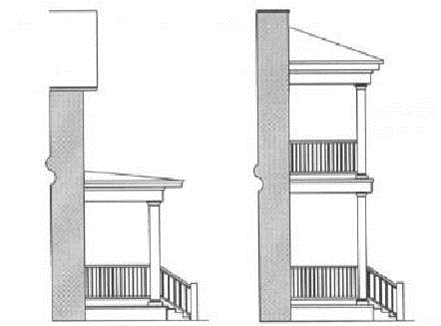
Figure 28. Front Porches
d.
Entries.
(1)
Front entries shall be recessed and entry doors shall be centered.
(2)
Doors - shall be substantial and well detailed. They shall match the materials, design and character of the display window framing. "Narrow line" aluminum doors are not recommended.
e.
Windows.
(1)
Window Openings - should be vertical or square in shape; if square, windows and/or window panes should be vertical in shape.
(2)
Shaped frames and sills - should be used to enhance openings and add additional relief. They should be proportional to the glass area framed; e.g., a larger window should have thicker framing members.
(3)
MUNTINS - "true divided light" windows or sectional windows are recommended where a divided window design is desired; "snap-in" grilles or MUNTINS should not be used.
f.
Parking and Circulation Facilities.
(1)
Parking shall be either in a DETACHED GARAGE or ATTACHED GARAGE. Such garages shall be no less than 200 square feet nor larger than 400 square feet, not facing the front of the LOT, and are to be enclosed with overhead doors. DETACHED and ATTACHED GARAGES are permissible as long as such garage is constructed in the same architectural style, with the same colors and materials as the dwelling. EXCEPTIONS: Lots platted on or before May 8, 2013, that are too narrow or the shape of the lot is such that the request doesn't comply with the above requirements may apply for a variance. A variance request made under this exception may be approved by Mayor and Council. The submitted documents and justification will conform to requirements of Article 14 Administration, Chapter 14.05 and be submitted to the City Clerk and Code Enforcement Officer for review 30 days prior to the next scheduled Council Meeting. (Revised 5/8/2013)
4.
Density.
a.
Maximum density of ATTACHED RESIDENTIAL units and small single-family detached is 6 DWELLING UNITS per acre with access to public water and sewer. In areas not served by public sewer, net residential density shall be determined by soil conditions and their ability to accommodate on-site septic systems.
5.
Accessory Units.
a.
ACCESSORY UNITS shall be located behind the rear building line for the existing structure.
b.
Architectural elements and standards for the ACCESSORY UNIT shall be compatible with the principal structure.
6.
Neighborhood Parks, Open Space and Playground.
a.
The developer is encouraged to include NEIGHBORHOOD PARKS, OPEN SPACE (connecting within the development and with community OPEN SPACE) and PLAYGROUNDS in the development. Such amenities, of adequate size and correctly sited will facilitate new development that is built to the scale and character of the community.
(1)
NEIGHBORHOOD PARKS are generally located in the center of the neighborhood and are typically OPEN SPACES intended to provide unstructured recreation and may also include PLAYGROUND equipment.
(2)
Access to the NEIGHBORHOOD PARK should be through OPEN SPACE within the development that is interconnected within the development and with planned or existing community greenways.
7.
Pedestrian/Bicycle Access.
a.
Residential development shall include sidewalks throughout the development that can serve for pedestrian and bicycle access. See §[Chapter] 8.05C for sidewalk standards.
b.
The pedestrian and bicycle network within the development must connect to the city planned or existing network.
K.
Public Institutional. This district represents the various civic functions scattered throughout the city. Large scale government uses should be concentrated in the district along GA Highway 53. Smaller scale government administration offices generating higher point of service demand should remain clustered downtown. Certain civic uses may be suitable within predominantly residential areas provided they do not general significant traffic and are built to scale with the surround areas.
1.
Height Specifications.
a.
Building Height.
(1)
PRINCIPAL BUILDINGS shall be no more than 40 feet in height as detailed in paragraphs b and c below.
b.
GROUND STORY HEIGHT.
(1)
Space at ground level is considered as the first STORY if it is six feet or more in height.
(2)
TheGROUND STORY floor elevation shall be between 6 inches below and 48 inches above the sidewalk elevation at the front of the BUILDING. The maximum floor to BUILDING STORY HEIGHT for the GROUND FLOOR is 16 feet.
c.
Upper Story Height.
(1)
The maximum floor-to-BUILDING STORY HEIGHT for the GROUND FLOOR is 12 feet.
(2)
Space within a roofline that is entirely non-habitable shall not be considered to be a STORY.
2.
Siting Specifications.
a.
Building FACADES shall be oriented parallel to the STREET.
b.
Side Yard SETBACK.
(1)
A 10-foot side yard is required alongside property lines that abut non-residential LOTS; 20 feet is required adjacent to residential-only LOTS.
c.
CORNER LOTS.
(1)
CORNER LOTS shall be treated as having STREET FRONTAGE on the primary STREET only. The side of the lot abutting the secondary street shall meet the side yard setback.
d.
Rear Yards.
(1)
The minimum SETBACK for principal and ACCESSORY STRUCTURES is 20 feet from the property line.
(2)
For commercial trash receptacles and their opaque visual barriers, the minimum SETBACK is 20 feet from the property line.
e.
Parking and Circulation Facilities.
(1)
All off-street parking shall be screened from abutting streets with a fence, wall, or hedge at least 4 feet in height and meeting the standards of §[Chapter] 6.08.
(2)
Access between adjacent parking LOTS across property lines is required.
L.
Parks, Recreation, and Conservation. This district is dedicated to LOW-IMPACT AGRICULTURE, passive or active recreation uses or for the preservation or active recreation uses or for the preservation of environmentally sensitive lands and may include COMMUNITY PARKS, NEIGHBORHOOD PARKS, or GREENSPACE.
1.
On-site parking.
a.
On-site parking for recreation facilities shall be provided that meets the standards of § 8.06.
2.
Agricultural Uses.
a.
Agricultural Uses are subject to the following regulations:
(1)
Tract Size is a minimum of 18 acres.
(2)
The agricultural use is an accessory use to the residential use.
(3)
There is no more than one horse per 2 acres of fenced area on the same lot as the principal dwelling, not to exceed 10 horses per lot.
(4)
There is no more than one stable having no more than 10 stalls with no stall exceeding 200 square feet in area.
(5)
Stables are considered an accessory building and shall meet applicable standards.
b.
The following uses are prohibited within the district:
(1)
Crop production.
(2)
Dirt farming.
(3)
Sod production.
(4)
Poultry farms.
(5)
Fur farms.
(6)
Fish farms.
(7)
Kennels/catteries.
(8)
Swine.
(9)
Poultry.
(10)
Alpacas.
(11)
Ostrich.
(12)
Goats.
(13)
Sheep.
(14)
Application of chicken litter on the property.
(15)
Any other animals or birds besides horses and cattle.
3.
Residential Uses.
a.
A maximum of 1 DETACHED RESIDENTIAL unit is permitted per nine acres.
(Amd. of 12-21-2022)

