
Watkinsville City Zoning Code
ARTICLE 6
- ARCHITECTURAL STANDARDS
Chapter 6.01. - Purpose.
In order to further development that is architecturally consistent with existing development in terms of building syntax, including proportion, FENESTRATION, and style, architectural standards are established. After basic standards such as building placement, dwelling access, and OPEN SPACE arrangements are achieved, development proposals are subject to further review for compliance with the intent of this Article.
Chapter 6.02. - Equivalent or better.
While only materials, techniques, and product types prescribed here are allowed, equivalent or better practices and products are encouraged.
Chapter 6.03. - Entergy efficiency and environmental conservation.
LEED (Leadership in Energy and Environmental Design) standards, or equivalent standards, are encouraged to be incorporated into the building design including the submission of a LEED scorecard in the review process.
Chapter 6.04. - Where clearly visible from the street.
Many of these standards apply only to conditions WHERE CLEARLY VISIBLE FROM THE STREET. For the purpose of this article, the definition of STREET includes parks, PLAYGROUNDS, and OPEN SPACE. These controls therefore concentrate on the public space and views from public space and minimize impact on the private realm.
Chapter 6.05. - What requires architectural review.
The following attributes require design review by the DEVELOPMENT REVIEW Committee:
A.
All new development except individual single-family homes in the DR and AR districts.
B.
Additions and exterior changes to all structures providing for non-residential uses and all structures with three (3) or more DWELLING UNITS existing prior to the adoption of this ordinance.
C.
All development located in the National Register District excluding ordinary repair and replacement.
Chapter 6.06. - Building walls (exterior).
BUILDING walls should reflect and complement the traditional materials and design of Watkinsville's historic architecture. They should express the construction techniques and structural constraints of traditional, long lasting building materials. Simple configurations and solid craftsmanship are favored over complexity and ostentation in BUILDING form and the articulation of details. All building materials used shall express their specific functional properties. For example, heavier, more permanent materials (masonry) support lighter materials (wood). Specific prescriptions of this Chapter follow.
A.
Standards for BUILDING walls (WHERE CLEARLY VISIBLE FROM THE STREET).
1.
Materials. The following materials are permitted:
a.
Brick.
b.
Stucco (cementitious finish).
c.
Native stone (or synthetic equivalent).
d.
Pre-cast masonry (for trim and CORNICE elements only).
e.
Gypsum Reinforced Fiber Concrete (GRFC-for trim elements only).
f.
Metal (for beams, lintels, trim elements and ornamentation only).
g.
Split-faced block (only for piers, foundation walls, and chimneys).
h.
Wood lap siding.
i.
Hardie-Plank™ equivalent or better siding.
2.
Configurations and Techniques. The following configurations and techniques are permitted:
a.
Walls.
(1)
Wall openings shall not span vertically more than one STORY.
(2)
Wall openings shall correspond to interior space and shall not span across building structure such as the floor structural and mechanical thickness.
(3)
Wall materials shall be consistent horizontally (i.e., joints between different materials must be horizontal and continue around corners) except for chimneys and piers.
(4)
Material changes shall be made within a constructional logic - as where an addition (of a different material) is built onto the original building.
(5)
An EXPRESSION LINE shall delineate the division between the first STORY and the second STORY of every facade of all principal commercial only or commercial/residential buildings.
(6)
AWNINGS, where permitted, may not conceal or replace EXPRESSION LINES.
b.
Wood Siding and Wood Simulation Materials.
(1)
Lap siding (horizontal) configuration.
(2)
Smooth or rough-sawn finish (no faux wood grain).
c.
Brick, Block, and Stone.
(1)
Must be properly detailed and in appropriate load-bearing configurations.
(2)
Stucco (cementitious finish).
(a)
Smooth or sand only, no "cake icing" finish.
Chapter 6.07. - Roofs and parapets.
Roofs and PARAPETS shall utilize appropriate pitch, drainage, and materials in order to provide visual coherence to the individual zoning district and the city. Specific prescriptions of this Chapter follow.
A.
Standardsfor roof andPARAPETS (WHERE CLEARLY VISIBLE FROM THE STREET).
1.
Materials. The following materials are permitted:
a.
Shingles - Asphalt or Metal (dimensional type).
b.
Metal - galvanized steel, copper, aluminum, or zinc-alum.
2.
Down spouts must match gutters in material and finish.
B.
Configurations and Techniques. The following configurations and techniques are permitted:
1.
Hip roofs (with sloping sides and ends).
2.
Gable roofs (with sloping sides and ends).
3.
Shed roofs (with a single slope).
4.
Flat roof (with minimal pitch as required by building code).
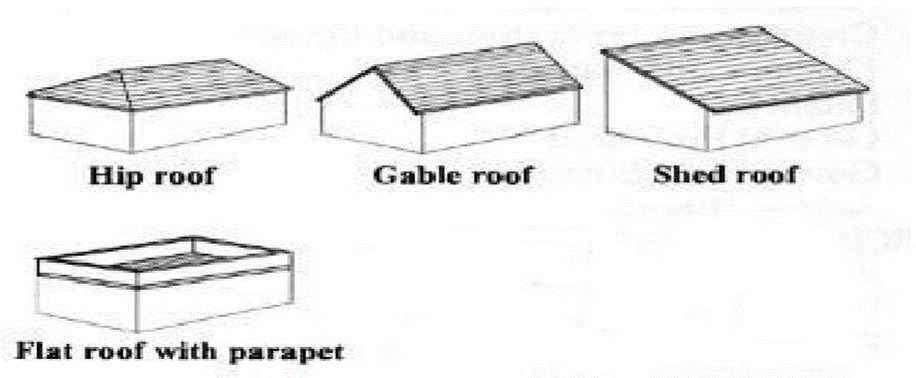
Figure 29.
5.
Roofs may use combinations of these permitted types and may supplement these types with dormers and valleys.
6.
Flat or low-slope roofs (less than 2:12 slope) shall have their edges concealed with PARAPETS wherever the edges concealed with STREETS.PARAPET walls must be of sufficient height to visually conceal rooftop mechanical equipment.
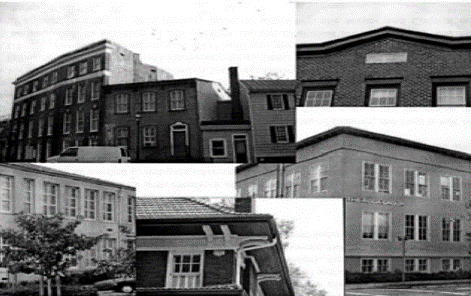
Figure 30. Roof with Parapet
C.
Overhang.
1.
Eaves must overhang at least 24 inches on the primary structure.
2.
Rakes (gable end) must overhang at least 18 inches.
3.
Eaves and rakes on accessory BUILDINGS, dormers, and other small structures must overhang at least 8 inches.
4.
Open eaves and simple traditional soffits and fascia are allowed.
5.
Soffits shall be placed perpendicular to the building wall, not sloping in plane with the roof (except for gable end rakes).
6.
Timber eaves and BALCONY brackets must be a minimum of 5.5 inches in dimension.
D.
Parapet Roofs.
1.
PARAPET roofs are permitted only in the following districts and only where the roof material is not visible from any adjacent STREET:
a.
Historic Main STREET.
b.
Public Institutional.
c.
Corridor Commercial.
d.
Employment Center.
e.
Downtown.
f.
Mixed-Use Office.
E.
Cornices and Other Features.
1.
Buildings without visible roof surfaces and overhanging eaves may satisfy the overhang requirement with a CORNICE projecting horizontally between 6 and 12 inches beyond the building walls. For buildings of three stories, the CORNICE projection shall increase an additional 6 to 12 inches per STORY.
2.
Skylights and roof vents are permitted only on the roof plane opposite the primary STREET or BUILD-TO-LINE or when shielded from the STREET view by the building's PARAPET wall.
3.
Overly elaborate, "postmodern" and/or "high-tech" designs are discouraged. However, ornamentation which contributes to the character of the building is encouraged.
4.
GREEN ROOF technologies are encouraged. Vegetative cover should be considered for flat roofs and solar panels should be considered for integration into pitched roof structures.
Chapter 6.08. - Fences, walls and hedges.
Fences, walls, or hedges establish a clear edge to the STREET where the buildings do not. They define outdoor spaces and separate the STREET from the private realm (parking, trash cans, gardens, and equipment). All fence and wall facades shall be as carefully designed as the building FACADE, with the finished side out, i.e., the "better" side facing the STREET. Specific prescriptions of this Chapter follow.
A.
Standards for Fences, Walls, and Hedges (WHERE CLEARLY VISIBLE FROM THE STREET).
1.
Only the following materials are permitted:
a.
Native/regional stone and equivalent imitation stone.
b.
Metal (welded steel and/or black aluminum for gates only).
c.
Brick of a color to match existing walls.
d.
Stucco on concrete block (or poured) only with brick or stone capping.
e.
A combination of materials (e.g., stone piers with brick infill panels).
f.
Wood (for residential only), decay resistant or pressure treated.
B.
Height of Fences, Walls and Hedges.
1.
In front yards and within the front 30 inches of vacant LOTS: maximum height of 48 inches; pillars and posts may be taller.
2.
In side yards (behind the front plane of the PRINCIPAL BUILDING), in rear yards, and beyond the front 30 feet of vacant LOTS: minimum height of 36 includes, maximum height of 96 inches.
Chapter 6.09. - Columns, piers, guardrails, and balustrades.
A.
Columns, Piers, Guardrails, and Balustrades.
1.
Permitted Finish Materials.
a.
Columns that support front porches must use:
(1)
Wood (decay resistant or pressure treated), painted or stained;
(2)
Concrete block with stucco finish (CBS);
(3)
Reinforced concrete with stucco finish; or
(4)
Natural or cast (simulated) stone, or brick.
b.
Guardrails and balustrades surrounding front porches and stoops must use:
(1)
Wood (decay resistant or pressure treated), painted or stained;
(2)
Aluminum;
(3)
Stone, including cast (simulated) stone; or
(4)
Brick.
Chapter 6.10. - Windows and doors.
Windows shall be divided by multiple panes of glass. This helps the window "Hold" the surface of the facade, rather than appearing like a "hole" in the wall (an effect produced by a large single sheet of glass). All windows and doors should be selected with their energy conservation value in mind so as to achieve the highest possible energy savings. Specific prescriptions of this Chapter follow.
A.
Materials. The following materials are permitted:
1.
Windows shall be of anodized aluminum, wood, clad wood, vinyl, or steel.
2.
Window glass shall be clear, with light transmission at the GROUND STORY at least 90 percent and for the upper stories 75 percent (modification as necessary to meet any applicable building code requirements). Specialty windows may utilize stained, opalescent, or glass block (one per facade, maximum).
3.
Window screens shall be black or gray.
4.
Screen frames shall match window frame material or be dark anodized.
5.
Doors shall be of wood, clad wood, or steel.
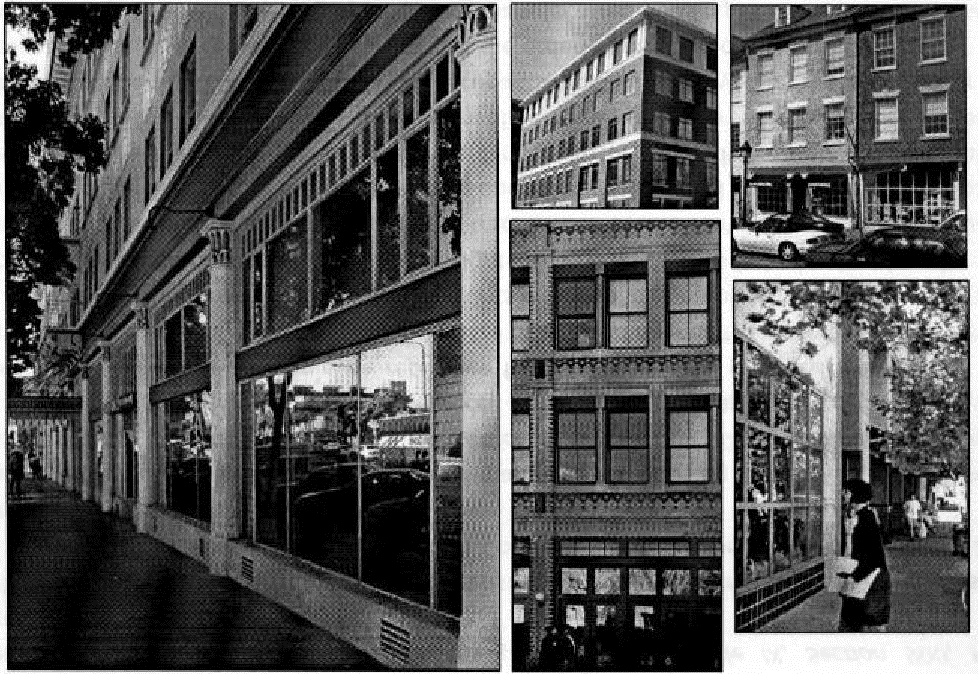
Figure 31.
B.
Configurations and Techniques. The following configurations and techniques are permitted:
1.
The following requirements apply to all windows:
a.
Windows may be ganged horizontally (maximum 5 per group) if each grouping is separated by mullion, column, pier, or wall section that is at least 7 inches wide.
b.
Windows shall be no closer than 30 inches to BUILDING CORNERS (excluding BAY WINDOWS and where the BUILDING CORNER is also a BLOCK CORNER).
c.
Exterior shutters, if applied, shall be size and mounted appropriate for the window (one-half the width), even if inoperable. Plastic shutters are prohibited.
2.
The following requirements apply to all upper STORY windows:
a.
Windows shall be double-hung, single-hung, AWNING, or casement windows.
b.
Fixed windows are permitted only as a component of a system including operable windows within a single wall opening.
c.
Residential buildings/floors: panes of glass no larger than 36 inches vertical by 30 inches horizontal.
d.
The maximum pane size for office uses is 48 inches vertical by 40 inches horizontal.
e.
Egress windows may be installed according to the appropriate building code.
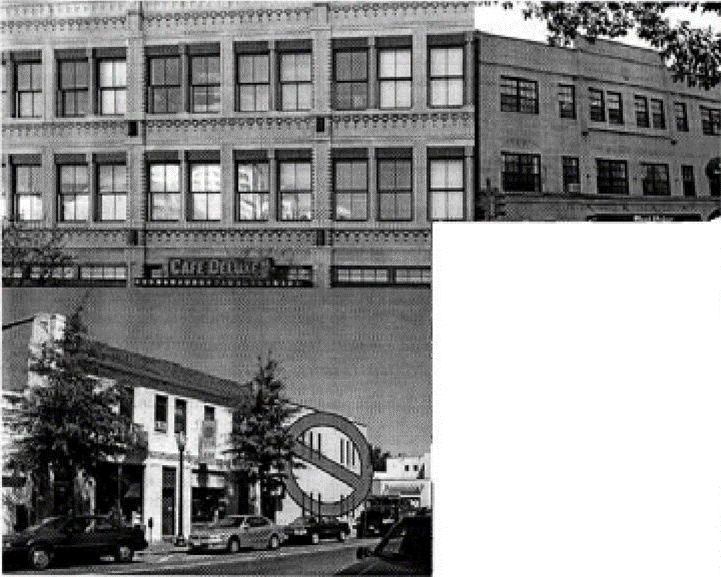
Figure 32.
C.
Shop front (GROUND FLOOR) Windows and Doors.
1.
Single panels of glass not larger than 6 feet in height by 4 feet wide.
2.
GROUND FLOOR windows shall not be made opaque by window treatments (excepting operable sun screen devices within the conditional space) and shall allow a minimum 60 percent of surface view into the building for a depth of at least 20 feet.
3.
Shop fronts may extend up to 24 inches beyond the facade (BUILD-TO-LINE) into the right-of-way.
D.
Doors.
1.
Double-height entryways (those that span more than one STORY) are not allowed.
2.
Doors shall not be recessed more than 3 feet behind the shop-front windows and, in any case, shall have a clear view and path to a 45-degree angle past the perpendicular from each side of the door.
3.
Front entries should be recessed and entry doors should be centered.
4.
Roll-down security gates and doors are prohibited.
Chapter 6.11. - Renovation of existing structures.
A.
All new construction must comply with these regulations.
B.
Changing or rebuilding 50% or more of any STREET FACADE of a BUILDING requires the entire building to comply with design regulations that are specific to facades.
C.
Changing or rebuilding less than 50% of any facade of a building, requires only that facade to comply with design regulations.
D.
All new windows, entrances, storefronts, and doorways must be designed in accordance with these regulations.
E.
Any addition of 50% or more of the first floor area of a one STORY building requires the entire building to come into compliance with these regulations. In general, additions to two STORY buildings shall be two STORY. Exceptions will be made if there are topographic constraints. One STORY additions to two STORY buildings may only be built if the addition is on the rear of the building and does not front on a STREET or pedestrian way.
F.
Routine maintenance and repair are exempt from these requirements.
Chapter 6.12. - Accessory buildings.
A.
ACCESSORY BUILDINGS shall be located behind the rear building line of the PRINCIPAL BUILDING.
B.
Architectural elements and standards of the ACCESSORY BUILDINGS shall be compatible with the principal structure.
C.
The ACCESSORY BUILDING shall be of a size and nature customarily incidental and subordinate to the PRINCIPAL BUILDING.
Chapter 6.13. - Large footprint building.
Buildings covering more than 20,000 square feet of ground and/or a building frontage of greater than 150 feet can create special problems when inserted into the downtown's connected system of walkable STREET frontages. To decrease the need for solely auto oriented patronage and encourage use by pedestrians, any such building constructed within the HM District must meet the following requirements, in addition to any other requirements of this Ordinance:
A.
Large footprint buildings may not be larger than a single BLOCK.
B.
Buildings shall avoid long, monotonous, uninterrupted walls or roof planes on their visible facades. Building wall offsets, including projections and recesses shall be used in order to add architectural interest and variety; relieve the visual effect of a single, long wall; and subdivide the wall into human scale proportions.
C.
Roofline offsets shall be provided to lend architectural interest and variety to the massing of a building and to relieve the effect of a single, long roof.
D.
For large footprint building, the building facade shall create repetitive bays, or the facades shall be divided into asymmetrical, yet balanced, composition.
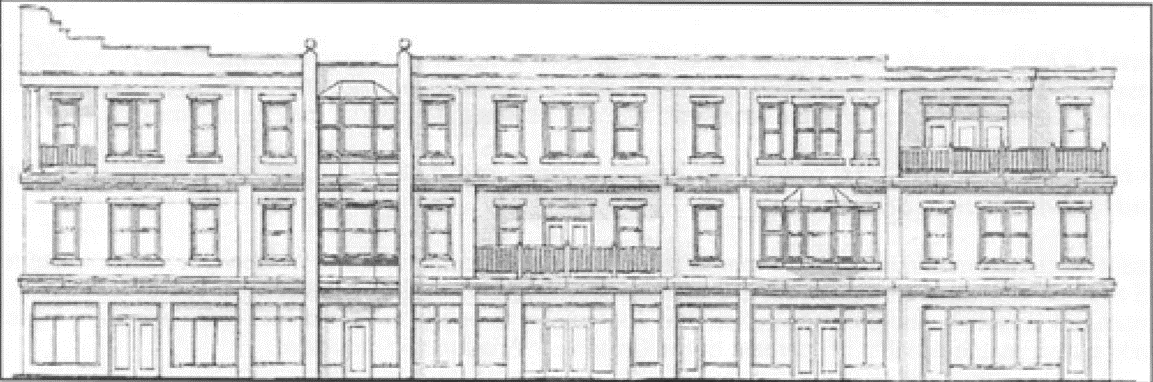
Large Footprint Building—Required Facade Design
E.
All sides of the building shall use materials consistent with those on the front if visible from public STREETS or neighboring properties, and should be carefully designed with similar detailing, comparable quality, and compatible materials.
F.
BUILDING FACADES visible from public STREETS cannot be separated from public STREETS by parking LOTS except for permitted parking in the EC and CC districts.
G.
Loading docks, service areas, and trash disposal facilities cannot be visible to persons standing on public STREETS, sidewalks, or parks.

