
Weatherford City Zoning Code
CHAPTER 3
- ZONING DISTRICTS
Sec. 12-3-100. - "AG" Agriculture.
(a)
Purpose. The Agriculture (AG) district is established for purpose of regulating existing country living and open areas that are desirable to single-family detached homes and agricultural pursuits. This land use district allows for a range of agricultural pursuits, including the sale of agriculture products raised on the premises. In the AG district, no building or premises shall be used, configured, erected, or altered except in conformity with the following use, area, height regulations, and specific conditional and special uses. This district is used in areas designated in the General Plan as cluster residential, rural living, and ranching and agricultural.
(b)
Permitted uses.
(c)
Special uses.
(d)
Conditional uses.
(e)
Design standards.
(1)
Height regulations.
a.
No structure shall exceed:
1.
45 feet in height for the main building/house.
2.
50 feet for agricultural structures (e.g., barns, silos, water towers, windmills).
3.
A conditional use permit may be issued for agricultural structures greater than 50 feet in height.
(2)
Area and yard regulations.
a.
Front yard.
1.
In all locations where setback lines are shown on a recorded plat, the minimum setback or front yard shall be as shown on the plat, however the minimum setback shall be no less than 50 feet.
2.
No accessory structures shall be located in front yards.
b.
Side yard.
1.
In all locations where setback lines, are shown on a recorded plat the minimum side yard shall be as shown on the plat, however the minimum setback shall be no less than 20 feet.
c.
Rear yard.
1.
There shall be a rear yard with a depth of not less than 25 feet.
(3)
Lot area. The lot area shall be no less than two acres.
(Ord. No. O2025-11, § 1, 4-22-25)
Sec. 12-3-200. - "RE" Residential Estate.
(a)
Purpose. The Residential Estate (RE district) is established for the purpose of regulating large lot, single-family residential detached homes, compatible accessory uses, certain public facilities, and specific conditional and special uses. This district is also designed to protect and preserve existing development of similar character. In the RE district, no building or premises shall be used, configured, erected, or altered except in conformity with the following use, area, and height regulations. This district is used in areas designated in the General Plan as suburban living, estate residential, cluster residential, ranching and agricultural.
(b)
Permitted uses.
(c)
Special uses.
(d)
Conditional uses.
(e)
Design standards.
(1)
Height regulations. No structure shall exceed 45 feet in height.
(2)
Area and yard regulations.
a.
Front yard.
1.
The front yard is determined as the yard that has the front door facing the street right-of-way, whether a public or private street.
2.
In all locations where setback lines are shown on a recorded plat, the minimum setback or front yard shall be as shown on the plat; however the minimum setback shall be no less than 20 feet.
3.
No accessory structures shall be located in front yards.
b.
Side yard.
1.
In all locations where setback lines are shown on a recorded plat, the minimum side yard shall be as shown on the plat; however the minimum setback shall be no less than five feet.
2.
There shall be a side yard on the street side of the structure of no less than 20 feet.
c.
Rear yard.
1.
There shall be a rear yard with a depth of not less than 20 feet from the main building.
(3)
Lot area.
a.
The lot area shall be no less than 21,000 square feet.
b.
The minimum lot width shall be 100 feet.
c.
The minimum lot depth shall be 210 feet.
(4)
Front entrance.
a.
The front entrance of the home must be forward of any front entry garage door.
(5)
Garage criteria.
a.
Front entry garages.
1.
Front loading garages shall have a minimum driveway depth of 36 feet.
2.
Front loading garages shall have a minimum driveway width of 20 feet.
b.
Side entry garages.
1.
Side entry garages shall have a minimum driveway depth of 24 feet.
2.
Side entry garages shall have a minimum driveway width of 20 feet.
3.
There shall a side yard between the outside edge of the driveway and the property line of no less than five feet in width.
4.
There shall be a minimum driveway width of 30 feet from the outside edge of the driveway to garage entrance to allow for sufficient turning radius and safe ingress/egress (Ref. Figure A).
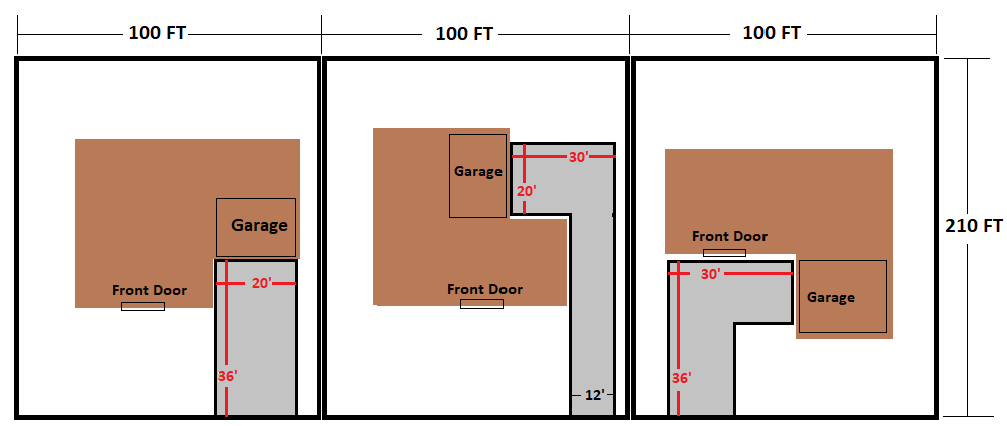
Figure A. Front EntryGarage example (left) and Side Entry Garage example (right).
c.
Rear entry garages.
1.
Rear entry garages shall have a minimum driveway depth of 24 feet.
2.
Side entry garages shall have a minimum driveway width of 20 feet.
3.
Rear entry garages should typically be associated with an alley entrance.
(Ord. No. O2025-05, § 4, 1-28-25)
Sec. 12-3-201. - "SF 8.5" Single-Family 8.5 Residential.
(a)
Purpose. The Single-Family 8.5 Residential (SF 8.5) district is established for the purpose of new single-family subdivision developments of one-family detached dwellings and compatible accessory uses, certain public facilities, and specific conditional and special uses. This district is also designed to protect and preserve existing development and character of the neighborhood. In the SF 8.5 district, no building or premises shall be used, configured, erected, or altered except in conformity with the following use, area, and height regulations. This district is used in areas designated in the General Plan as suburban living and cluster residential.
(b)
Permitted uses.
(c)
Special uses.
(d)
Conditional uses.
(e)
Design standards.
(1)
Height regulations.
a.
40 feet in height for the main building/house.
(2)
Area regulations.
a.
Front entrance.
1.
The front entrance of the home must be forward of any front entry garage door.
b.
Front yard.
1.
The front yard is determined as the yard that has the front door facing the street right-of-way whether a public or private street.
2.
In all locations where setback lines are shown on a recorded plat, the minimum setback or front yard shall be as shown on the plat, however the minimum setback shall be no less than 20 feet.
3.
No accessory structures shall be located in front yards.
c.
Side yard.
1.
In all locations where setback lines are shown on a recorded plat the minimum side yard shall be as shown on the plat, however the minimum setback shall be no less than five feet.
2.
There shall be a side yard on the street side of the structure of no less than 20 feet.
d.
Rear yard.
1.
There shall be a rear yard with a depth of not less than 20 feet for the main building.
e.
Lot area.
1.
The lot area shall be no less than 8,500 square feet.
2.
The minimum lot width shall be 85 feet. Corner lots shall provide an additional 15 feet in width.
3.
The minimum lot depth shall be 100 feet.
f.
Garage criteria. A two-car garage is required.
1.
Front entry garages.
(i)
Front loading garages shall have a minimum driveway depth of 36 feet.
(ii)
Front loading garages shall have a minimum driveway width of 20 feet.
2.
Side entry garages.
(i)
Side entry garages shall have a minimum driveway depth of 24 feet.
(ii)
Side entry garages shall have a minimum driveway width of 20 feet.
(iii)
There shall a side yard between the outside edge of the driveway and the property line of no less than five feet in width.
(iv)
There shall be a minimum driveway width of 30 feet from the outside edge of the driveway to garage entrance to allow for sufficient turning radius and safe ingress/egress (Ref. Figure B).
(v)
Side entry garages may be single car garages.
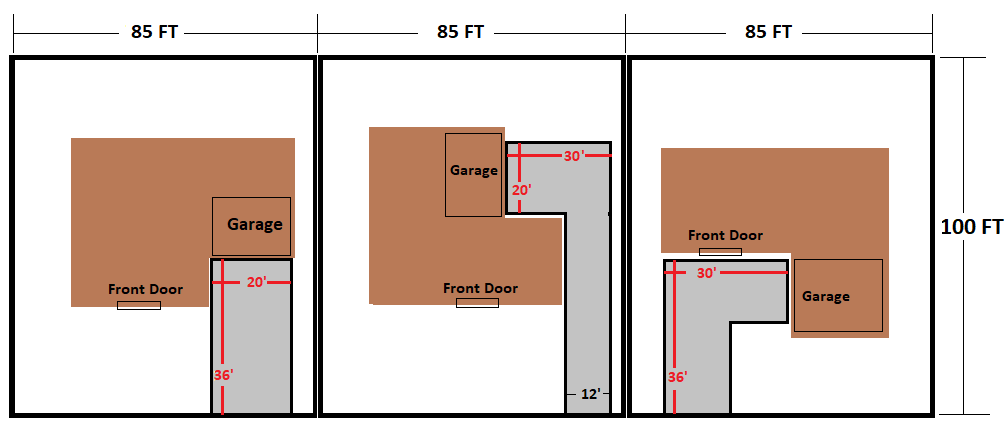
Figure B. Front Entry Garage example (left) and Side Entry Garage example (right).
3.
Rear entry garages.
(i)
Rear entry garage shall have a minimum driveway depth of 24 feet.
(ii)
Side entry garages shall have a minimum driveway width of 20 feet.
(iii)
Rear entry garages should typically be associated with an alley entrance.
(Ord. No. O2025-05, § 4, 1-28-25)
Sec. 12-3-202. - "SF 7.5" Single-Family 7.5 Residential.
(a)
Purpose. The Single-Family 7.5 Residential (SF 7.5) district is established for the purpose of new single-family subdivision developments of one-family detached dwellings and compatible accessory uses, certain public facilities, and specific conditional and special uses. This district is also designed to protect and preserve the existing development and character of a neighborhood. In the SF 7.5 district, no building or premises shall be used, configured, erected or altered except in conformity with the following use, area, and height regulations. This district is used in areas designated in the General Plan as suburban living and cluster residential.
(b)
Permitted uses.
(c)
Special uses.
(d)
Conditional uses.
(e)
Design standards.
(1)
Height regulations.
a.
40 feet in height for main building/house.
(2)
Area and yard regulations.
a.
Front yard.
1.
The front yard is determined as the yard that has the front door facing the street right-of-way, whether a public or private street.
2.
In all locations where setback lines are shown on a recorded plat, the minimum setback or front yard shall be as shown on the plat, however the minimum setback shall be no less than 20 feet.
3.
No accessory structures shall be located in front yards.
b.
Side yard.
1.
In all locations where setback lines are shown on a recorded plat, the minimum side yard shall be as shown on the plat, however the minimum setback shall be no less than five feet.
2.
There shall be a side yard on the street side of the structure of no less than 20 feet.
c.
Rear yard.
1.
There shall be a rear yard with a depth of not less than 20 feet from the main building.
(3)
Lot area.
a.
The lot area shall be no less than 7,500 square feet.
b.
The minimum lot width shall be 75 feet. Corner lots shall provide an additional 15 feet in width.
c.
The minimum lot depth shall be 100 feet.
(4)
Front entrance.
a.
The front entrance of the home must be forward of any garage door.
(5)
Garage criteria. A two-car garage is required.
a.
Front entry garages.
1.
Front loading garages shall have a minimum driveway depth of 36 feet.
2.
Front loading garages shall have a minimum driveway width of 20 feet.
b.
Side entry garages.
1.
Side entry garages shall have a minimum driveway depth of 24 feet.
2.
Side entry garages shall have a minimum driveway width of 20 feet.
3.
There shall a side yard between the outside edge of the driveway and the property line of no less than five feet in width.
4.
There shall be a minimum driveway width of 30 feet from the outside edge of the driveway to garage entrance to allow for sufficient turning radius and safe ingress/egress (Ref. Figure C).
5.
Side entry garages may be single car garages.
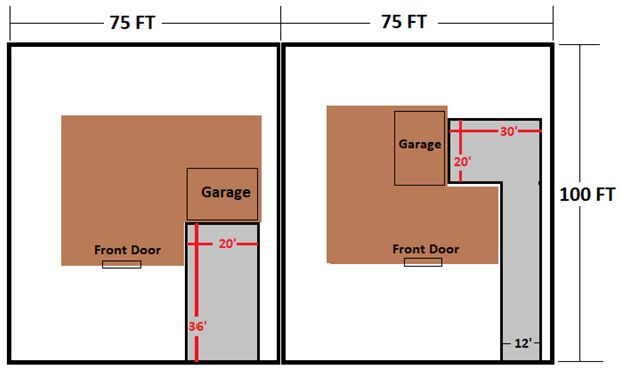
Figure C. Front Entry Garage example (left) and Side Entry Garage example (right).
c.
Rear entry garages.
1.
Rear entry garage shall have a minimum driveway depth of 24 feet.
2.
Side entry garages shall have a minimum driveway width of 20 feet.
3.
Rear entry garages should typically be associated with an alley entrance.
(Ord. No. O2025-05, § 4, 1-28-25)
Sec. 12-3-203. - "R1" One-Family Residential.
(a)
Purpose. The One-Family Residential (R1) district is established for the purpose of single-family residential detached homes, compatible accessory uses, certain public facilities, and specific conditional and special uses. This district is also designed to protect and preserve existing development of similar character. In the R1 district, no building or premises shall be used, configured, erected, or altered except in conformity with the following use, area, and height regulations. This district is used in areas designated in the General Plan as urban living, entertainment center.
(b)
Permitted uses.
(c)
Special uses.
(d)
Conditional uses.
(e)
Design standards.
(1)
Height regulations.
a.
No structure shall exceed 35 feet in height.
(2)
Area and yard regulations.
a.
Front yard.
1.
The front yard is determined as the yard that has the front door facing the street right-of-way, whether a public or private street.
2.
In all locations where setback lines are shown on a recorded plat, the minimum setback or front yard shall be as shown on the plat; however, the minimum setback shall be no less than 20 feet.
3.
No accessory structures shall be located in front yards.
b.
Side yard.
1.
In all locations where setback lines are shown on a recorded plat, the minimum side yard shall be as shown on the plat; however, the minimum setback shall be no less than five feet.
2.
There shall be a side yard on the street side of the structure of no less than 15 feet.
c.
Rear yard.
1.
There shall be a rear yard with a depth of not less than 15 feet from the main building.
(3)
Lot area.
a.
The lot area shall be no less than 6,000 square feet.
b.
The minimum lot width shall be 60 feet. Corner lots shall provide an additional 15 feet in width.
c.
The minimum lot depth shall be 100 feet.
(4)
Garage. A two-car garage is required. For lots with less than 50 feet of frontage a single car garage may be approved by the Director.
(Ord. No. O2025-05, § 4, 1-28-25)
Sec. 12-3-204. - "R2" Two-Family Residential.
(a)
Purpose. The Two-Family Residential (R2) district is established for the purpose of one-family residential, two-family residential attached homes, commonly referred to as duplexes, townhouse compatible accessory uses, certain public facilities, and specific conditional uses. This district is also designed to protect and preserve existing development of similar character. In the R2 district, no building or premises shall be used, configured, erected, or altered except in conformity with the following use, area, and height regulations. This district is a legacy district that is not intended to be added to or expanded. No additional rezoning applications will be considered for rezoning to this district from the adoption of this regulation.
(b)
Permitted uses.
(c)
Special uses.
(d)
Conditional uses.
(e)
Design standards.
(1)
Height regulations.
a.
No structure shall exceed 35 feet in height.
(2)
Area and yard regulations—One-family detached lots.
a.
Front yard.
1.
In all locations where setback lines are shown on a recorded plat, the minimum setback or front yard shall be as shown on the plat; however, the minimum setback shall be no less than 25 feet.
2.
No accessory structures shall be located in front yards.
b.
Side yard.
1.
In all other locations there shall be a side yard on each side of the structures of no less than five feet in width.
2.
The minimum side yard setback to a street shall be 15 feet.
c.
Rear yard.
1.
There shall be a rear yard with a depth of not less than 25 feet for the main building.
d.
Lot area.
1.
The lot area shall be no less than 8,400 square feet.
2.
The minimum lot width shall be 70 feet. Corner lots shall provide an additional 15 feet in width.
3.
The minimum lot depth shall be 110 feet.
(3)
Area and yard regulations—One-family attached lots.
a.
Front yard.
1.
In all other locations the minimum front yard setback shall be 15 feet for main building and 20 feet with front-facing garage.
2.
No accessory structures shall be located in front yards.
b.
Side yard.
1.
Zero lot line patio home. There shall be a minimum interior side yard on one side of the structure(s) of no less than ten feet in width. The adjacent side shall have a side yard of zero feet.
2.
Townhouse. There shall be a side yard of zero feet in width where the units join.
3.
The minimum side yard setback to a street shall be 15 feet.
c.
Rear yard.
1.
There shall be a rear yard with a depth of not less than 20 feet for the main building or rear-facing garage.
d.
Lot area.
1.
The lot area shall be no less than 4,200 square feet.
2.
The minimum lot width shall be 35 feet. Corner lots shall provide an additional 15 feet in width.
3.
The minimum lot depth shall be 110 feet.
(4)
Area and yard regulations—Two-family lots.
a.
Front yard.
1.
In all other locations, the minimum front yard setback shall be 25 feet.
2.
No accessory structures shall be located in front yards.
b.
Side yard.
1.
In all other locations, there shall be a side yard on each side of the structures of no less than five feet in width.
2.
The minimum side yard setback to a street shall be 15 feet.
c.
Rear yard.
1.
There shall be a rear yard with a depth of not less than 25 feet for the main building.
d.
Lot area.
1.
The lot area shall be no less than 8,400 square feet for each two-family lot (4,200 square feet minimum for each dwelling unit).
2.
The minimum lot width shall be 70 feet for each two-family lot (35 feet minimum for each dwelling unit). Corner lots shall provide an additional 15 feet in width.
3.
The minimum lot depth shall be 110 feet.
(Ord. No. O2025-05, § 4, 1-28-25)
Sec. 12-3-205. - "R3" Multifamily Residential.
(a)
Purpose. The Multifamily Residential (R3) district is established for the purpose of one-family attached dwellings (townhomes, patio homes), two-family, and multifamily dwellings (duplexes, triplexes, fourplexes/quads, cottage housing, and apartments), along with compatible accessory, special, and conditional uses. This district is also designed to protect and preserve existing developments of similar character. In the R3 district, no building or premises shall be used, configured, erected, or altered except in conformity with the following use, area, and height regulations. This district is used in areas designated in the General Plan as urban living, entertainment center, and regional activity center.
(b)
Permitted uses.
(c)
Conditional uses.
(d)
Design standards.
(1)
Lots containing four dwellings or fewer (one-family attached, duplex, triplex, fourplex/quad).
a.
Height regulations.
1.
Primary structures (i.e., structures containing dwelling units) shall not exceed 45 feet in height for the main building/house.
b.
Area and yard regulations.
1.
Setback from streets.
(i)
In all locations adjacent to existing or future local or collector streets, primary structures shall be set back a minimum of 25 feet from the right-of-way.
(ii)
In all locations adjacent to existing or future arterial streets, primary structures shall be set back a minimum of 50 feet from the right-of-way.
2.
Front yard.
(i)
The required front yard setback shall be no less than 25 feet.
(ii)
In no case shall the minimum front yard setback be reduced to less than building lines, setback lines, or front yard lines shown on a recorded plat.
3.
Side yard.
(i)
For attached one-family dwellings, no minimum side yard setback is required where the units join.
(ii)
The side yard setback adjacent to any property zoned for one-family detached residential use or containing an existing one-family detached dwelling shall be a minimum of 15 feet.
(iii)
In all other locations, the side yard setback shall be a minimum of 5 feet.
(iv)
In no case shall the minimum side yard setback be reduced to less than building lines, setback lines, or side yard lines shown on a recorded plat.
4.
Rear yard.
(i)
The rear yard setback adjacent to any property zoned for one-family detached residential use or containing an existing one-family detached dwelling shall be a minimum of 25 feet.
(ii)
In all other locations, the rear yard setback shall be a minimum of 15 feet.
(iii)
In no case shall the minimum rear yard setback be reduced to less than building lines, setback lines, or rear yard lines shown on a recorded plat.
5.
Lot area.
(i)
The lot area shall be a minimum of 3,500 square feet for each dwelling unit.
(ii)
The minimum lot width shall be 35 feet for one-family attached dwellings and 70 feet for duplex, triplex, or fourplex/quad dwellings. Corner lots shall provide an additional 15 feet in width.
(iii)
The minimum lot depth shall be 100 feet.
6.
Accessory structures.
(i)
Accessory structures shall be subordinate in height and floor area to all primary structures, may not be located in front yards, and shall be set back a minimum of five feet from side and rear lot lines.
(2)
Lots containing five dwellings or greater (apartments, cottage housing).
a.
Height regulations.
1.
Primary structures (i.e., structures containing dwelling units) shall not exceed three stories or 45 feet in height, except a structure may exceed this limit up to a maximum of four stories or 60 feet in height provided it is set back a distance equal to or greater than the building height from any adjacent property zoned for one-family residential use or containing an existing one-family dwelling.
b.
Setback from streets.
1.
In all locations adjacent to existing or future local or collector streets, primary structures shall be set back a minimum of 25 feet from the right-of-way.
2.
In all locations adjacent to existing or future arterial streets, primary structures shall be set back a minimum of 50 feet from the right-of-way.
c.
Front yard.
1.
The required front yard setback shall be no less than the following, based on the height of primary structures:
(i)
One or two stories: 25 feet.
(ii)
Three or four stories: 35 feet.
(iii)
In no case shall the minimum front yard setback be reduced to less than building lines, setback lines, or front yard lines shown on a recorded plat.
d.
Side and rear yards.
1.
Structures up to 45 feet in height shall be set back a minimum of 25 feet from any adjacent property zoned for one-family residential use or containing an existing one-family dwelling.
2.
Structures exceeding 45 feet in height shall be set back a distance equal to or greater than the building height from any adjacent property zoned for one-family residential use or containing an existing one-family dwelling.
3.
In all other locations, the side and rear yard shall be a minimum of 15 feet.
4.
In no case shall the minimum side or rear yard setback be reduced to less than building lines, setback lines, or side or rear yard lines shown on a recorded plat.
e.
Accessory buildings.
1.
Accessory buildings including detached garages, carports, clubhouses, gazebos, recreational facilities, mail kiosks, laundry facilities, and maintenance sheds shall not exceed 25 feet in height, may not be located in front yards, and shall be set back a minimum of five feet from side and rear lot lines.
f.
Lot area.
1.
The lot area shall be no less than 11,000 square feet.
2.
The minimum lot width shall be 100 feet.
3.
The minimum lot depth shall be 110 feet.
4.
The maximum density shall be 30 units per acre.
g.
Building features.
1.
Buildings shall not exceed 200 feet in length.
2.
Horizontal separation between units shall be double 2" x 4" stud walls with insulation and sound deadening with a minimum of 60 STC.
3.
Ceiling/floor separation between units shall be poured gypcrete or other masonry type/sound deadening product.
h.
Dwelling unit variety.
1.
One-bedroom and efficiency units may not exceed 50 percent of the total units.
2.
A minimum of 15 percent of units above the first 20 units shall be three-bedroom units.
3.
Minimum average living area:
Table 1. Minimum Average Living Area.
i.
Dwelling unit features.
1.
All units shall have a clothes washer and dryer or connections for their installation.
2.
All units shall have a dishwasher and garbage disposal in the kitchen.
3.
All units shall have individual HVAC systems with central air conditioning and heat. Individual window units are not permitted.
j.
Site features.
1.
Security gates shall be provided at all entrances to a complex with two (2) or more buildings. A leasing office or any other areas open to the public shall provide standard parking and a turnaround outside of the gates. All gates shall be installed with an entry device approved by the Fire Department to facilitate emergency access.
2.
A main entrance feature consistent with the architectural and landscape themes of the development shall be provided.
3.
Green spaces, trails, playgrounds, pools, and other amenities shall be integrated into the multifamily development, be made accessible by walkable pathways, and be linked to a public sidewalk or the city's trail system.
4.
Community mail areas shall be contained within a building equipped with internal lighting.
5.
Refuse containers shall be provided within 600 feet of all dwelling units, shall be screened with a solid wall no less than six feet in height, and shall be located on concrete pads for pickup.
6.
Storage and utility areas shall be indoors or screened on all sides by a solid wall no less than six feet in height.
k.
Amenities.
1.
For each eight units, or portion thereof, in the development, an amenity approved by the director shall be provided. Amenities may include, but are not limited to, the following:
(i)
Community room or detached clubhouse with kitchen facilities.
(ii)
Fitness center.
(iii)
Swimming pool with covered deck areas or cabana.
(iv)
Playground with equipment constructed, installed, and maintained to community park standards.
(v)
Paved trail a minimum of six feet in width, and 300 feet in length, and not immediately adjacent to parking areas or streets (except for connections to public sidewalks or internal walkways).
(vi)
Community laundry center.
l.
Off-street parking and access requirements.
1.
All required tenant parking spaces shall be provided within 600 feet of the dwelling units they will serve. Spaces shall be assigned to individual units.
2.
All tenant parking shall be located in rear or side yards of the primary structure(s), except as specifically allowed in the approved Site Plan. Visitor parking in front of the office or recreation/amenity center and outside of any security fencing is allowed.
3.
Tenant parking shall be enclosed or covered as follows:
(i)
A minimum of 15 percent of required tenant parking shall be enclosed in garages.
(ii)
An additional 60 percent of required tenant parking shall be covered by carports.
(iii)
Detached garages and carports shall be consistent in their construction with the primary dwelling structures.
4.
Boats, campers, trailers, and other recreational vehicles shall be prohibited unless oversize parking areas are provided in garage or carport structures and are entirely screened from view from any adjacent property and the public right-of-way. This parking area shall not be used to meet the minimum parking requirements.
5.
All parking areas, driveways, and vehicular circulation areas shall be constructed of concrete.
6.
All parking areas, driveways, and vehicular circulation areas shall have appropriate lighting and shall be positioned such that lights are shielded and do not adversely impact adjacent properties. All driveways shall be lighted from sunset to sunrise with a minimum intensity of two foot-candles' illumination. Lighting shall be of the same architectural style and character as the primary structures.
7.
Walkways shall be provided to meet all of the following specifications:
(i)
A walkway no less than five feet in width shall connect the front door of each ground floor unit (or each entrance to a structure with interior dwelling unit entries) to the parking area, to all community amenities, and to a public sidewalk.
(ii)
Walkways installed to meet these requirements shall be constructed of concrete.
(iii)
Walkways shall be illuminated from sunset to sunrise.
(Ord. No. O2025-05, § 4, 1-28-25)
Sec. 12-3-206. - "Rl" Residential Lake Lot.
(a)
Purpose. The Residential Lake Lot (RL) district is established for the purpose of preserving the character and natural beauty of the Lake Weatherford area, and for the development of single-family detached dwellings, compatible uses, certain public facilities, and specific conditional uses. This district is also designed to protect and preserve the character of the area. In the RL district, no building or premises shall be used, configured, erected, or altered except in conformity with the following use, area, and height regulations, or as outline by any city issued license/lease agreement.
(b)
Permitted uses.
(c)
Special uses.
(d)
Conditional uses.
(e)
Design standards.
(1)
Height regulations.
a.
No structure shall exceed 40 feet in height.
(2)
Area and design regulations.
a.
For the purposes of this section, it shall be generally understood that the area leased from the city shall be all of the area extending from full pool (lake) elevation of 896 feet to the edge of street pavement.
b.
Front yard.
1.
On all lake lots, the front yard shall be that area adjacent to the shoreline. There shall be a front yard having a depth of not less than 25 feet for the main building as measured from the full pool (lake) elevation of 896 feet.
c.
Side yard.
1.
There shall be a side yard on each side of the structures of no less than five feet in width.
2.
Side yard shall extend from the full (lake) pool conservation elevation of 896 feet to the edge of pavement of the adjoining right-of-way.
d.
Rear yard.
1.
The minimum rear yard setback shall be 35 feet as measured from the centerline of the adjoining right-of-way.
(3)
Garage. A two-car garage is required. For lots with less than 50 feet of frontage a single car garage may be approved by the Director.
Sec. 12-3-207. - "MH" Manufactured Home Park.
(a)
Purpose.
(1)
The Manufactured Home Park (MH) district is established for the purpose of providing residential environments within the city for the accommodation of manufactured homes within a manufactured home park under one ownership, or one parcel designated as a manufactured home park. Manufactured homes shall not be used for dwelling purposes, except in a manufactured home park, as authorized in these regulations. Manufactured home parks are prohibited in any district other than those authorized in these regulations. In the MH district, no building or premises shall be used, configured, erected, or altered except in conformity with the following use, area, and height regulations.
(2)
As a prerequisite to the development or redevelopment of a manufactured home park, a detailed site plan shall be prepared. The submittal of property/park covenants and park rules is required with the site plan application.
(b)
Definitions.
Manufactured home. A factory-built home or structure, federally regulated by the HUD Code, placed on a site upon a permanent foundation unless located in a manufactured home park, which may be placed according to manufacturer's specifications.
Mobile home or structure. A factory-built home or structure built prior to June 15, 1976.
(c)
Permitted uses.
(d)
Conditional uses.
(e)
Development standards for manufactured home parks.
(1)
Water and wastewater. Water and wastewater systems are required to be connected to public systems. Adequate provision shall be made for public water supply, wastewater, fire protection, and other necessary facilities to satisfy state and local codes, regulations, and specifications.
(2)
Minimum lots. Minimum number of lots completed and ready for occupancy before first occupancy is permitted: 20 manufactured home lots.
(3)
Density of homes. There shall be no more than one manufactured home per park space.
(4)
Lot identification. Each lot within the manufactured home park shall be numbered in an orderly fashion and in a sequential and consistent manner throughout the manufactured home park as approved by the city. The lot number and address shall be displayed on the lot and be visible at all times from the street, and minimum size of lettering shall be six inches.
(5)
Skirting. Every manufactured home within the park shall have skirting made of fire-resistant material matching the primary structure.
(6)
Insulation. Every manufactured home controlled by this regulation shall meet all installation requirements including but not limited to anchoring, foundation, tie-down, and support requirements as per state law and/or federal law, or as required by local building code.
(7)
Storm shelter. A storm shelter shall be provided by the park owner. Further, each new manufactured home park will provide a storm shelter for the park residents or a storm shelter for each individual lot. The storm shelter shall be constructed to accommodate the population of the park, which is established as three persons per household/manufactured home space, times four square feet per person. The facility shall have adequate fresh air during occupancy and be accessible to the park residents during all storm notices involving the emergency siren notification system or the emergency broadcast notification system where the citizens are instructed to take shelter.
(8)
Off-street parking. There shall be provided at least two off-street parking spaces to be located on the manufactured home space. There shall be no on-street parking within the park except for moving trucks/vans, emergency vehicles, or for temporary (15-minute) loading/unloading of vehicles. In addition, there shall be provided one and one-half visitors' off-street parking spaces for every two manufactured homes. Visitor parking spaces shall be located within convenient walking distances to home spaces. (On-street parking will need to be increased if visitor parking is eliminated).
(9)
Signs. One non-animated or non-flashing identification sign shall be allowed in conformance with state and local codes, ordinances, and specifications.
(10)
Management. Each manufactured home park or non-conforming mobile home park shall be operated in a sanitary, orderly, and efficient manner, and shall maintain a neat appearance at all times. No damaged or deteriorated manufactured homes or mobile homes shall be permitted to remain. Suitable and effective rules for regulating the outside storage of equipment, removal of wheels, installation of skirting, collection of trash and garbage, and attachment of appurtenances to the manufactured homes shall be continually enforced by manufactured home park owners. All drives, playground areas and equipment, lawn and trees, and any recreation or accessory buildings shall be maintained at a level at least equal to the average residential neighborhood in the city. All portions of the manufactured home park shall be open and accessible to fire, law enforcement, and other emergency and protective vehicles and personnel, including city, state inspectors, and utility meter readers.
(11)
Duration. No space shall be rented for residential use of a manufactured home in any park except for periods of 30 days or more.
(12)
Height regulations. No structure shall exceed 35 feet in height.
(f)
Area regulations.
(1)
Front yard.
a.
In all locations where building lines, setback lines, or front yard lines are shown on recorded plats, the minimum setback or front yard shall be as shown on the plat.
b.
In all other locations, the minimum front yard setback shall be 20 feet.
c.
No accessory structures shall be located in front yards.
(2)
Side yard.
a.
In all locations where building lines or side lines on corner lots are shown on recorded plats, the minimum side yard shall be as shown on the plat.
b.
In all other locations, there shall be a side yard on each side of the structure of no less than five feet in width.
c.
The minimum side yard setback to a street or private drive shall be 15 feet.
(3)
Rear yard.
a.
There shall be a rear yard with a depth of not less than 15 feet for the main building.
(4)
Lot area.
a.
The lot area shall be no less than 6,600 square feet.
b.
The minimum lot width shall be 60 feet.
c.
The minimum lot depth shall be 110 feet.
_____
Sec. 12-3-300. - "CBD" Central Business District.
(a)
Purpose. The CBD central business district is intended to maintain the integrity of historic downtown Weatherford, to encourage compatible development and redevelopment, and to promote an environment conducive to active streetscapes, special events, and pedestrian-oriented commerce. Design standards and architectural guidelines are intended to protect and enhance the unique character of the city's original business district while encouraging appropriate, incremental change over time. Through the application of these standards and guidelines, existing, renovated, and new buildings all contribute to a visually and functionally unified downtown. Streetscape guidelines and sign regulations are intended to ensure a safe, attractive, and active pedestrian environment. Uses or dimensional allowances requiring a conditional use permit may be granted by the city council only in accordance with these intents and purposes.
In the central business district, no building or premises shall be used, configured, erected, or altered except in conformity with the following standards. This district is used in areas designated in the General Plan as historic downtown (HD).
(b)
Permitted uses.
(c)
Conditional uses.
(d)
Design standards.
(1)
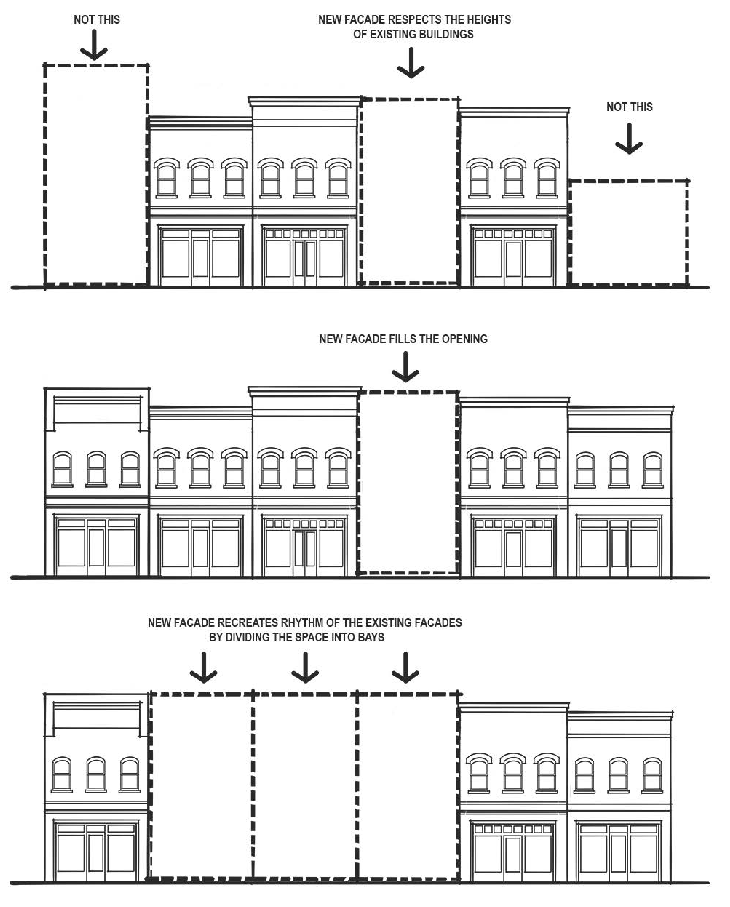
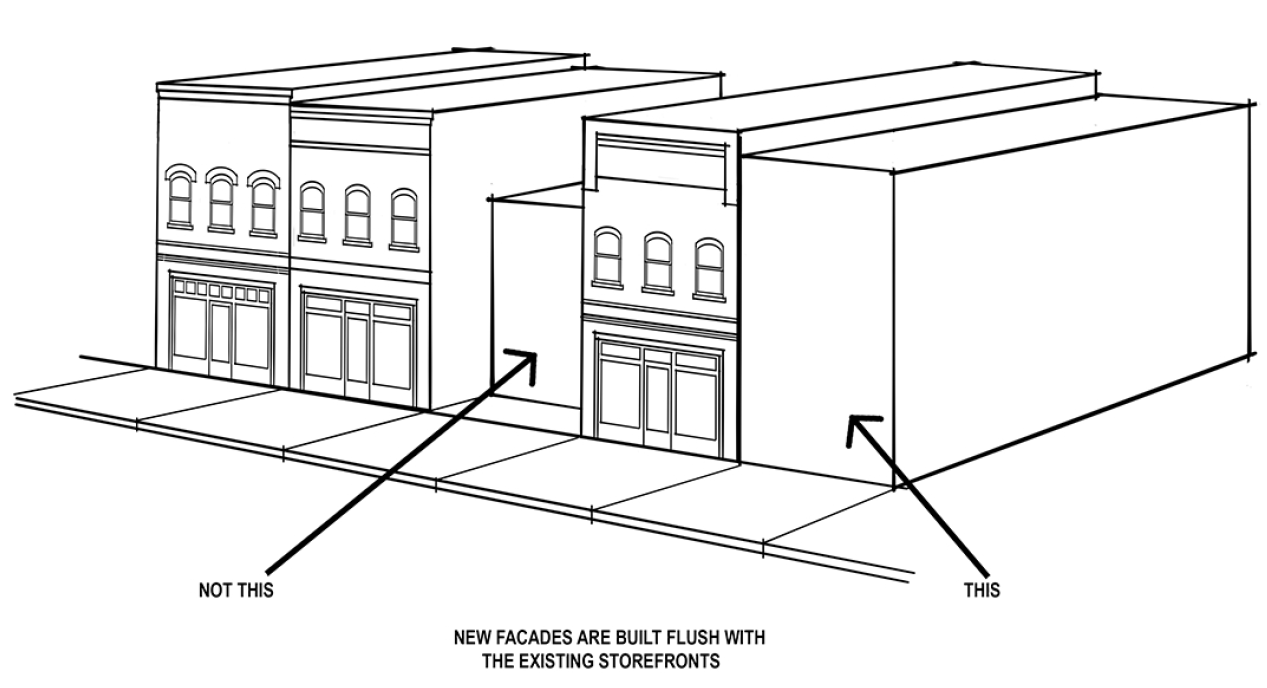
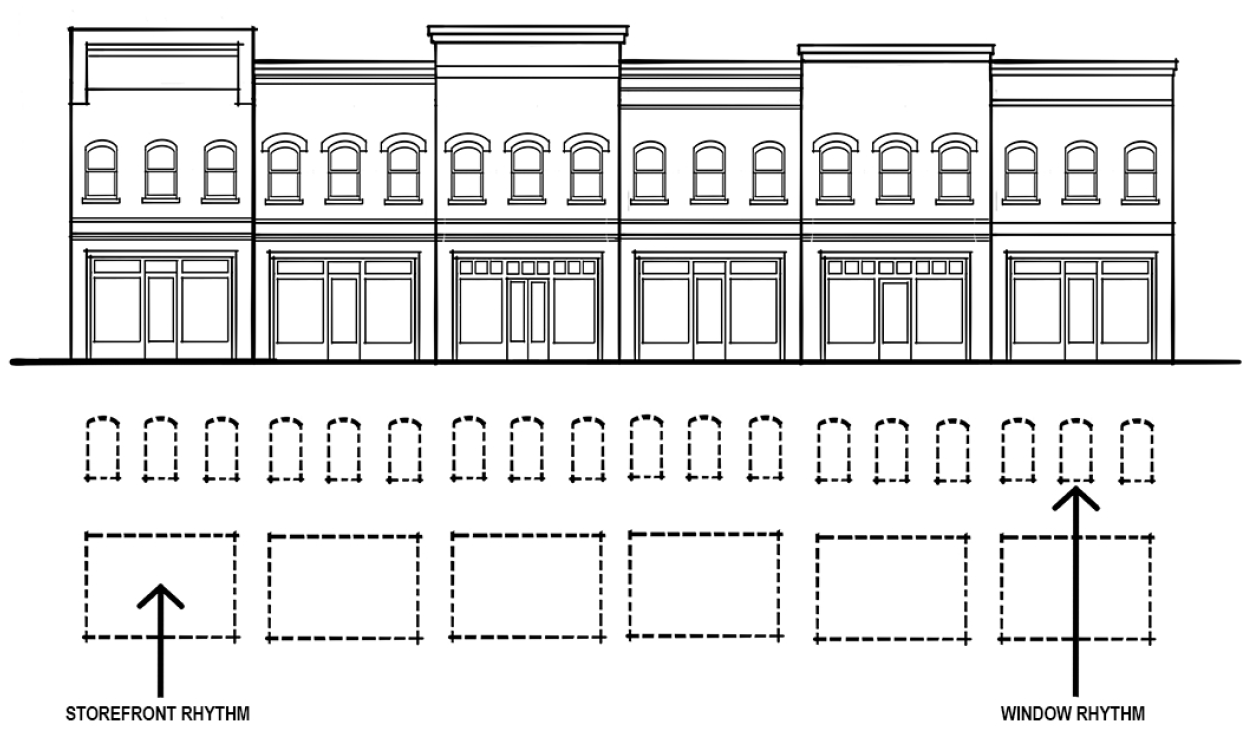
Height and bulk regulations. No structure shall exceed 35 feet in height for the main building, except as approved by conditional use permit. The height and width of new and renovated structures will be determined by the proportions of buildings immediately adjacent. Width should fill the entire void between buildings. If the void is very wide, the façade should be broken up into discernible bays which mimic the rhythm of façades on the streetscape.
(2)
Area regulations.
a.
Lot area. None specified.
b.
Required yards. None specified. However, new structures should align their façades with the adjacent buildings to reinforce the rhythm and consistency of the streetscape, except as approved by conditional use permit.
(e)
Architectural guidelines.
(1)
Design objectives. The architectural design of buildings and sites shall strive to achieve the following objectives:
a.
Architectural compatibility.
b.
Integration of uses.
c.
Pedestrian-scaled design and encouragement of pedestrian activity.
d.
Buildings that relate to, and are oriented toward, the pedestrian areas and surrounding buildings.
(2)
Traditional Façade. The basic, traditional commercial façade consists of three parts: the storefront - with an entrance and large window displays, the upper masonry façade - with regularly spaced windows, and the decorative cornice that caps the building. These components may appear in various shapes, sizes, and styles. In downtown Weatherford, the typical building façade is a two-story masonry construction.
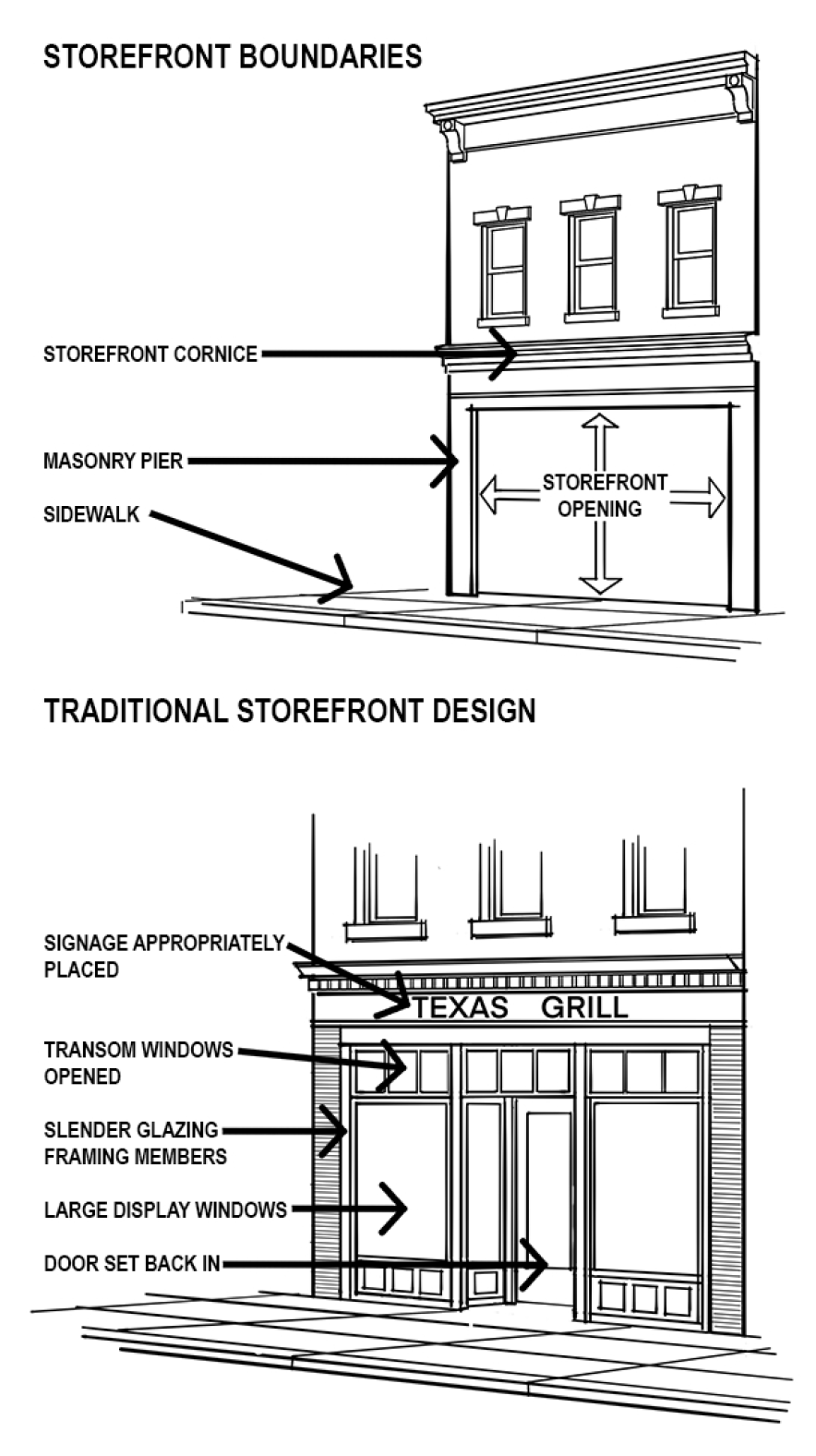
The traditional Weatherford building façade has a well-defined opening that the original storefront filled. The storefront opening is bounded on each side by piers, which were usually constructed of masonry. The storefront is bounded on the top by the storefront cornice, which is the structural member supporting the upper façade, and bounded below by the sidewalk. The upper façade is bounded by storefront cornice below and the decorative cornice above.
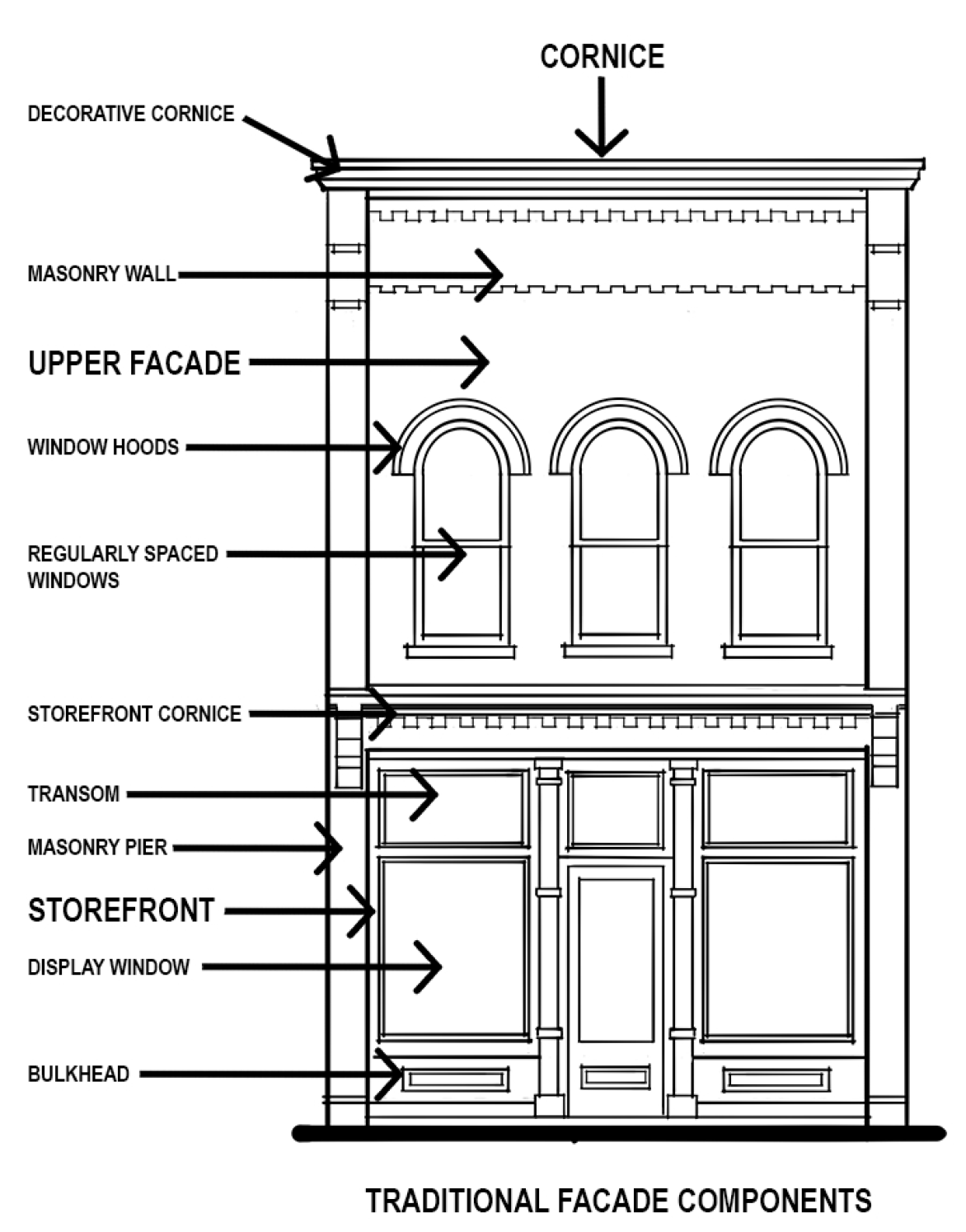
The storefront is composed almost entirely of windows. The large, glazed opening of the storefront serves to display the goods the business has to sell as well as to allow natural light deep into the store, thus minimizing the need for artificial light sources. The visual openness of the storefront is also important, because it is part of the overall proportion system of the façade.
(3)
Façade design. Façade design should be historically appropriate or true to an approved historic landmark designation.
a.
The basic storefront design includes large windows with thin framing members, a recessed entrance with overhead transom, a storefront cornice, exposed structural element, or a horizontal sign panel at the top of the storefront to separate it from the upper façade, and low bulkheads at the base to protect the windows and act as a platform for window displays. Remodeled storefronts designed to fit inside the original opening and not extend beyond or in front of it will preserve the basic storefront design.
b.
The proportion of window to wall areas in the traditional façade calls for more glass and less wall at the storefront level, balanced by more wall and less glass on the upper façade. The storefront is composed almost entirely of glass. Glass shall be clear. Detailing for windows, doors, and other openings shall be of wood, glass, or a metal material that is complementary to the period or building style. If glass is not appropriate for the business, consider the use of interior window treatments as a solution. Window opening patterns in the upper façade shall be maintained in keeping with the rhythm of nearby buildings.
c.
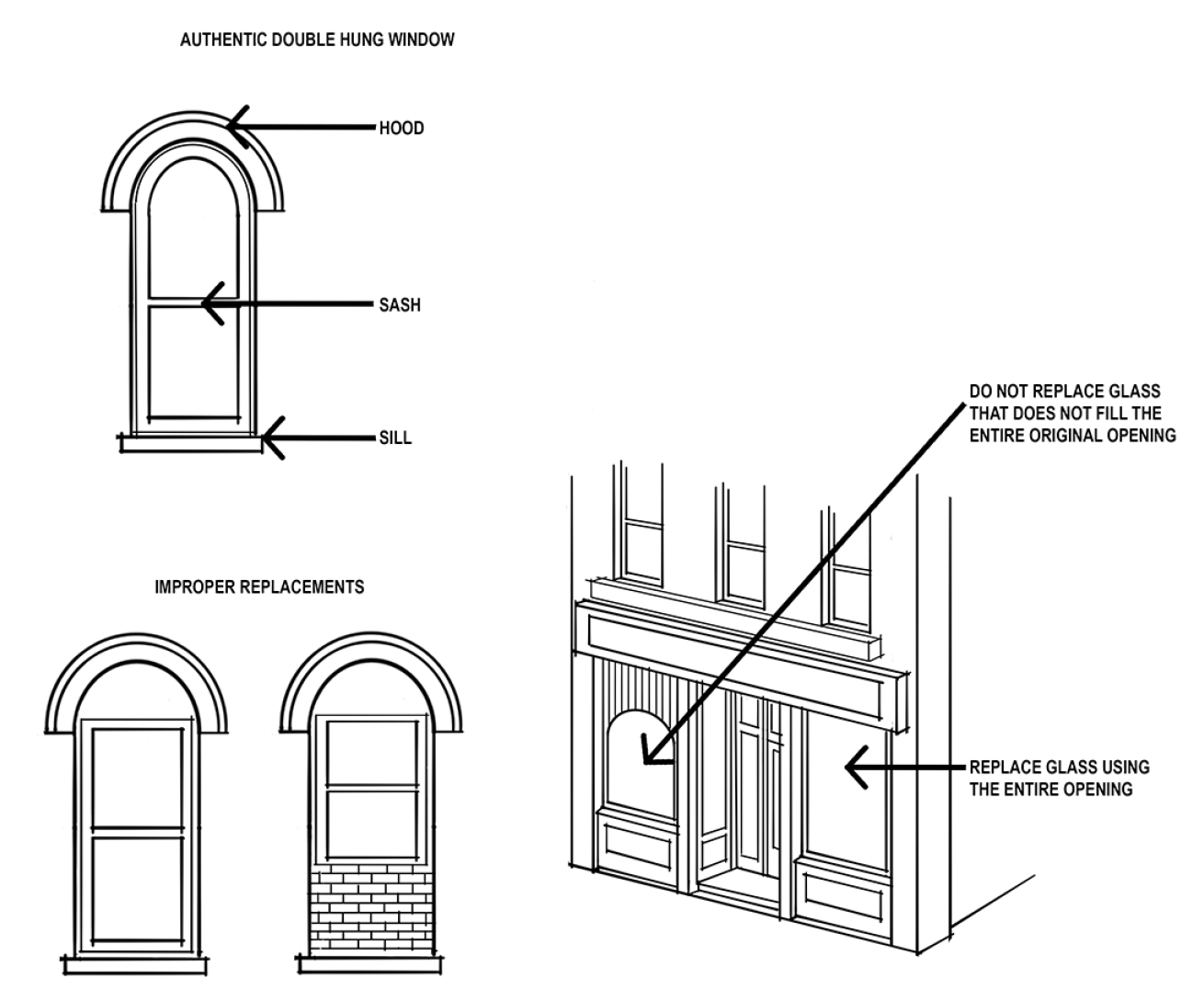
Historic windows should be repaired if at all possible. If irreparable or altered, new replacements should be based on the window's historic appearance. Replacement window units shall contain the same proportions as the original. Consideration should be given to horizontal and vertical mullions that provide design continuity throughout the building. Always use the entire original window opening, even if the opening was partially filled in from previous remodeling.
d.
The entry shall be maintained and restored in its original location and configuration. If the original entry is gone, the new entry should be designed and placed considering traditional design themes and its relationship to the overall building façade and symmetry.
e.
Transom windows that are covered or blocked may be required to be reopened and restored.
f.
Storefront bulkheads may be required to be restored or renovated.
g.
Storefront cornices and decorative cornices may be required to be restored or renovated.
h.
Original elements such as cast-iron columns, entry doors, window hoods, and lighting fixtures may be required to be restored or renovated.
i.
Signage shall be integrated into the storefront design.
j.
Lighting shall be integrated into the storefront design.
k.
Canopies shall be integrated into the storefront design.
l.
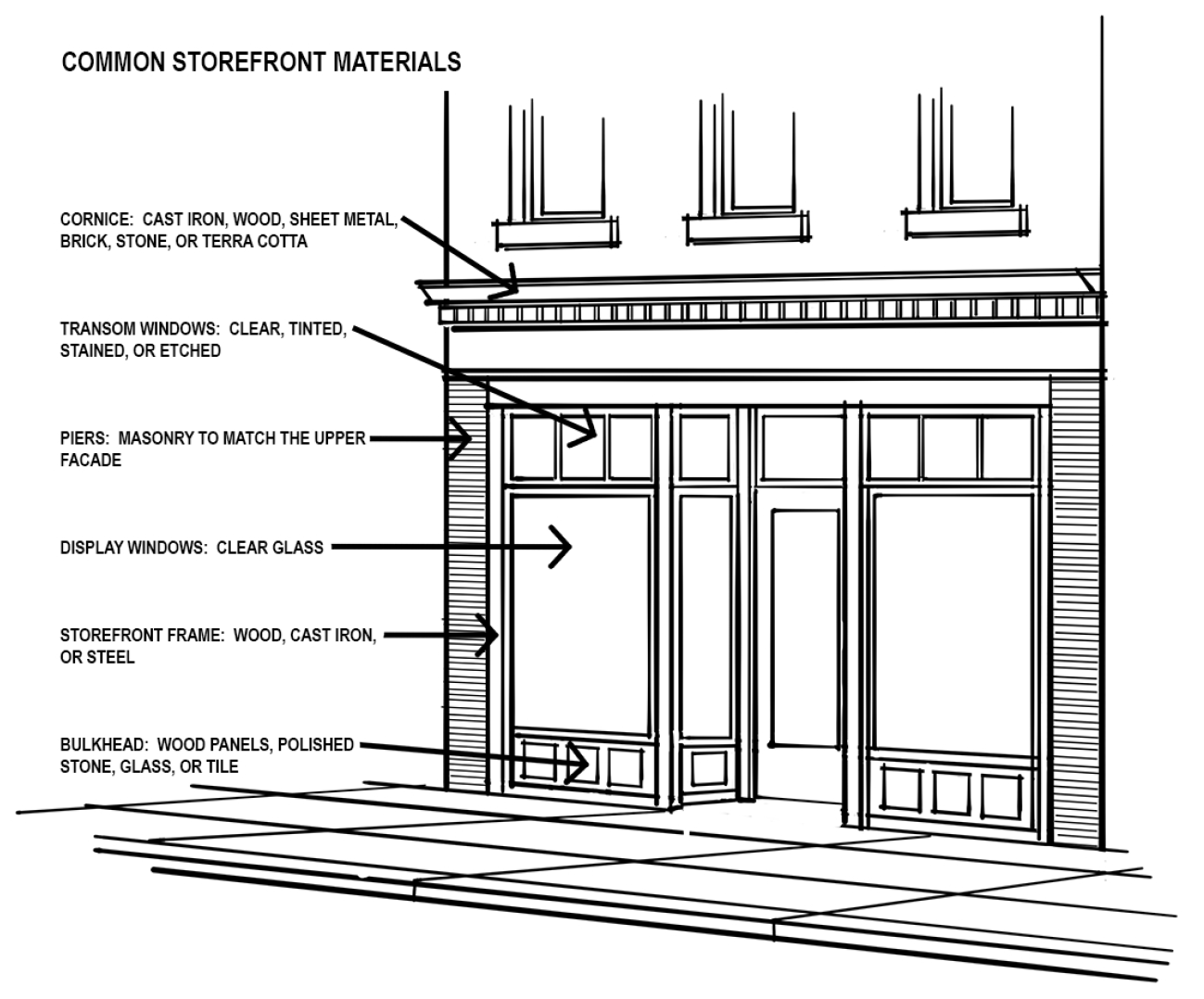
Certain materials should never be used on the traditional commercial building, because they have no relationship to the original building's design themes and may serve to flaw the consistency of appearance of the building and the downtown area. Such inappropriate materials may include cultured stone, fake brick, rough textured wood siding, wooden shingles on mansard roofs, gravel aggregate materials, and stucco materials. Appropriate examples of common storefront materials and their location on a storefront are as shown in the figure below.
m.
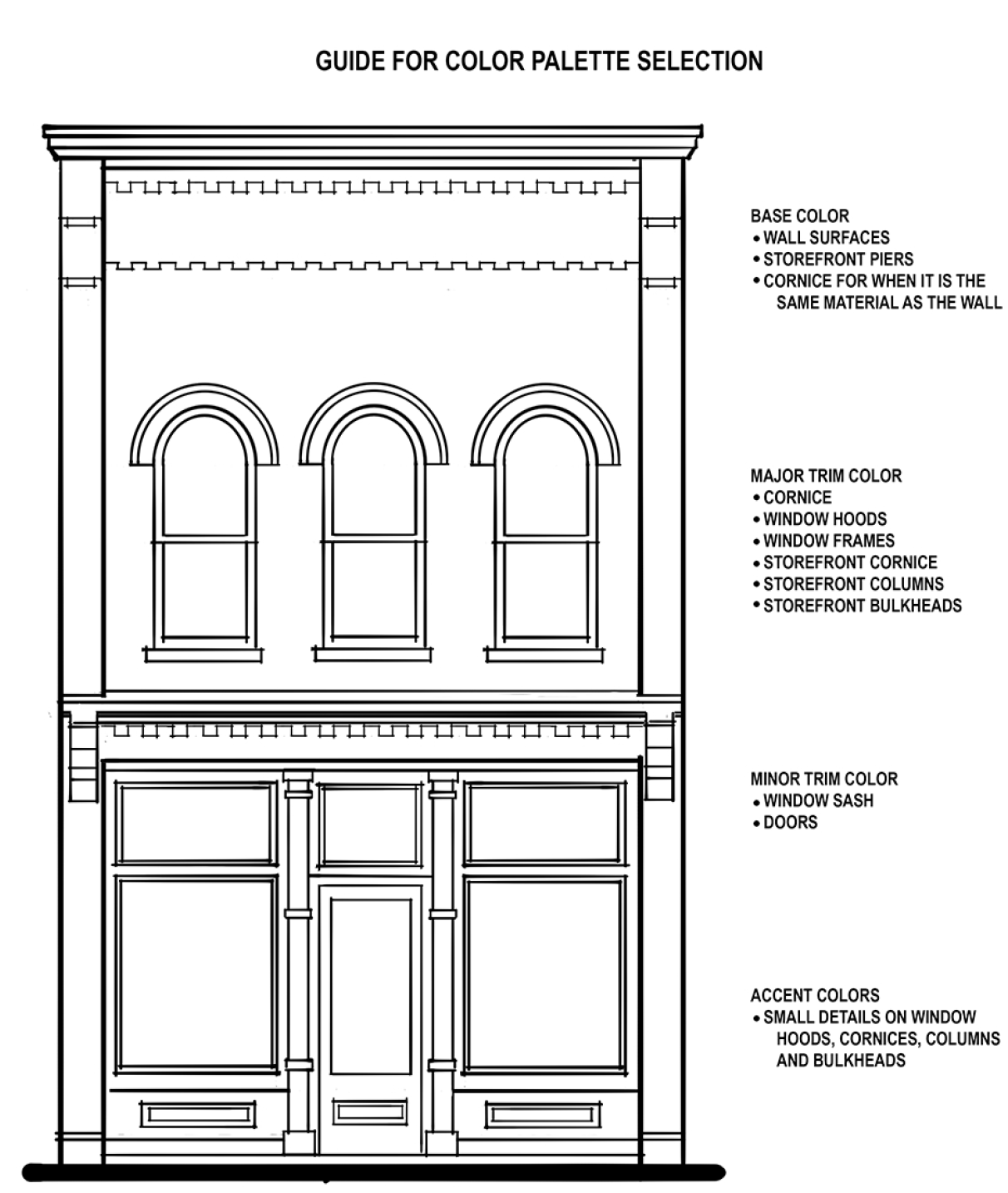
Façade color should be compatible with the time period of the building or historic district. The painting of unpainted masonry is discouraged. If a masonry façade is already painted it may be repainted. If masonry is to be painted, the property owner or tenant shall consult available resources such as the city's historic preservation officer and Main Street program, available historic color palettes from professional paint consultants or retailers, and online guides to historically appropriate painting.
n.
All utility services shall be placed underground.
o.
Projections. Projections located within the public right-of-way are subject to all material requirements of the city. All projections are subject to the following:
1.
Awnings. Awnings provide shade and rain protection in front of a storefront. Traditional awnings are matte-finish, fade-resistant canvas material attached to or stretched over a frame, which is supported by the building and not by the ground. Awnings have a pitch of greater than five percent.
i.
The installation of new awnings is prohibited.
ii.
Existing awnings shall be maintained free of any defect including tears, fading, broken frames.
2.
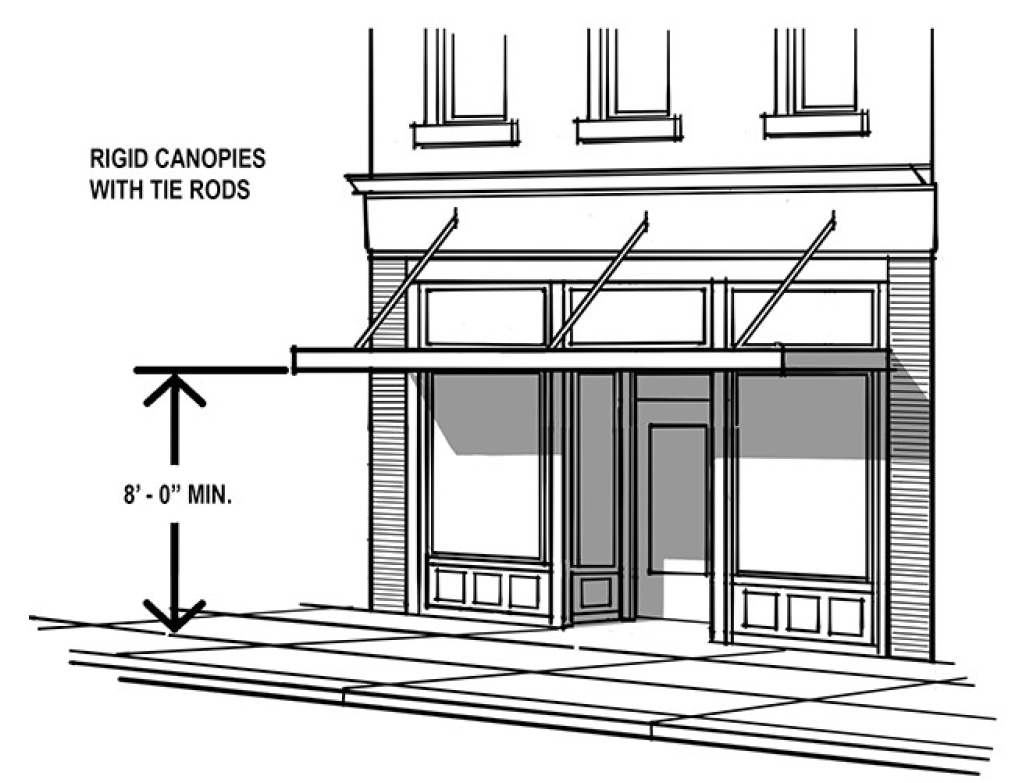
Canopies. Canopies provide shade and rain protection in front of a storefront. Traditional canopies are of rigid construction finished with wood, tin, or other metal. Canopies have a pitch of less than two percent and drain towards the street. Canopies shall complement the architecture of the building.
i.
Canopies shall be at an appropriate scale to the building size and configuration.
ii.
Canopies shall not extend above the storefront cornice (except for tie-rod support structure).
iii.
No canopies shall extend closer than two feet from the back of the curb.
iv.
New canopies shall be supported by the building (e.g., by tie-rod attachment) and not by the ground. No posts or other supports shall be installed in the sidewalk.
v.
A canopy shall have a minimum vertical clearance of eight feet.
vi.
A canopy shall be a solid color, and all canopies on a single building shall use the same color scheme.
vii.
Canopies shall be maintained free of any defect.
(f)
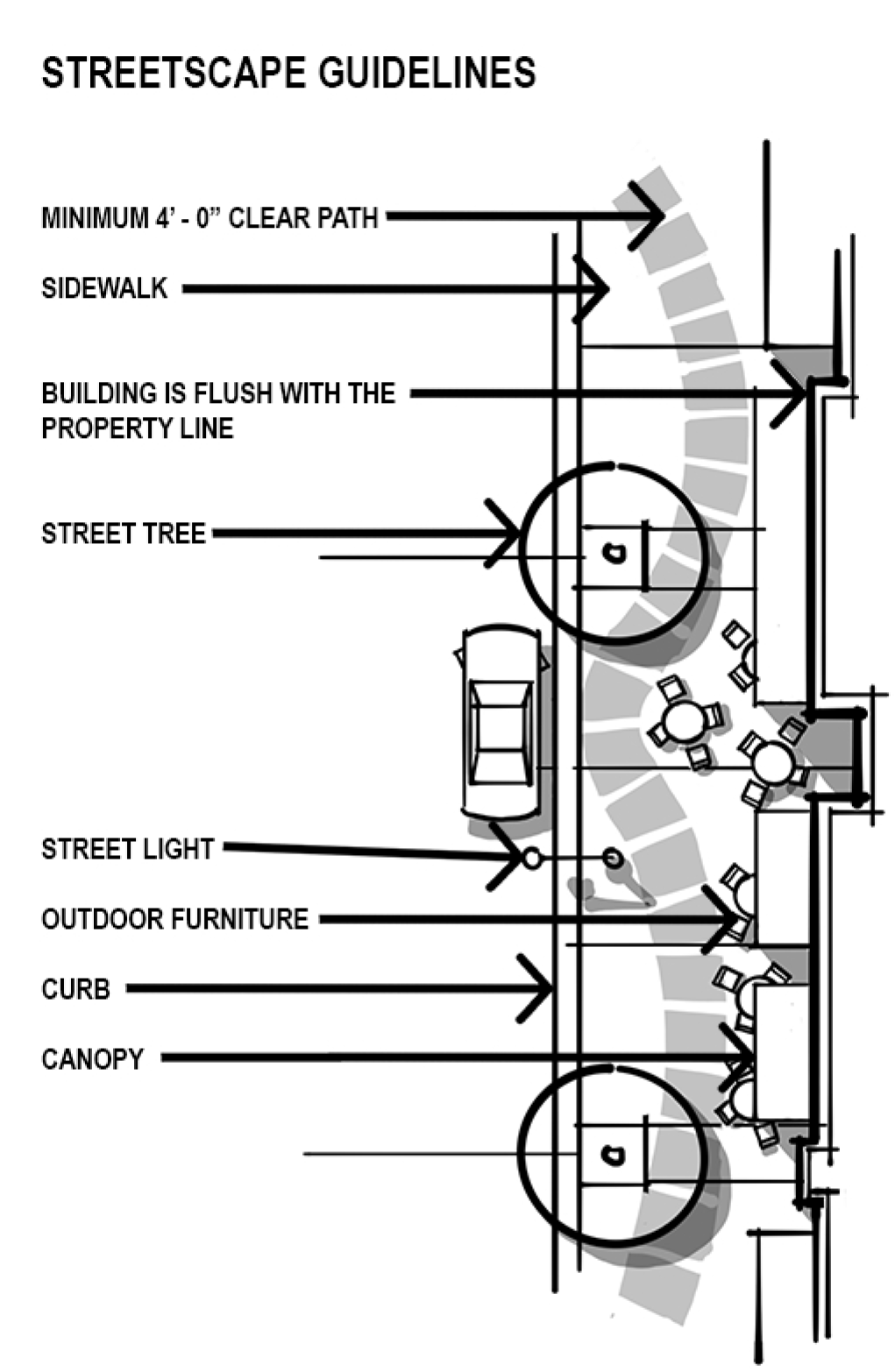
Streetscape guidelines. Streetscapes shall be treated with amenities that are selected based upon their ability to unify the streetscape with the area's historic past. It is important that elements such as street furniture, planters, window boxes, and other fixtures and furnishings complement the area's historic qualities.
(1)
Outside storage is prohibited in the CBD, except as provided herein.
(2)
Outside display of merchandise and/or seasonal items shall:
a.
Not occupy any on-street or off-street parking spaces.
b.
Not pose a safety or visibility hazard, nor impede public vehicular or pedestrian circulation, and shall provide a clear path with a minimum of four feet wide on all portions of the sidewalk.
c.
Only be located in front of the property/business that is selling the item(s).
d.
Be removed at the end of business each day (except for large seasonal items such as Christmas trees).
e.
Be displayed in a neat, orderly manner, and the display area shall be maintained in a clean, litter-free manner.
(3)
Outside furniture. The purpose of outside furniture is to promote outdoor activity on the sidewalk directly in front of the business or on the sidewalk directly beside the business.
a.
A maximum of one table per ten linear feet of adjacent wall space, excluding doors, may be placed on the sidewalk adjacent to the business. The planning director will ultimately determine the location and number of tables, chairs, or benches allowed.
b.
Street furniture will be maintained by the business owner and will be kept clean, free of visual defects, and in good repair.
c.
Street furniture may encroach into the public right-of-way as long as a clear path is provided with a minimum of four feet wide on all portions of the sidewalk.
d.
No street furniture shall extend closer than two feet from the back of the curb.
e.
The city may, from time to time, require temporarily relocating the street furniture for special events or other needs.
(g)
Signs.
(1)
General provisions.
a.
Except as provided herein, signs within the central business district are subject to the provisions in section 12-4-101 of this zoning ordinance. Where any conflict between regulations exists, the provisions of this section shall govern.
b.
Prohibited. The following sign types are prohibited in the central business district.
1.
Advertising on street furniture.
2.
Balloons or other inflated signs.
3.
Box/cabinet type signs, unless in the shape of a logo or unique design that is integral to the sign.
4.
Electronic message centers.
5.
Freestanding signs.
6.
Internally illuminated cabinets or panels.
7.
Revolving, animated, or moving signs.
8.
Signs with exposed raceways.
9.
Temporary signs.
c.
Number.
1.
Each business shall be allowed exactly one primary sign, subject to the specific allotments for each sign type below, or as provided in a comprehensive sign plan.
2.
Each business shall be allowed up to three secondary signs, subject to the specific allotments for each sign type below, or as provided in a comprehensive sign plan.
d.
Location.
1.
New signs shall not obscure historic signage, disrupt the character of a building, or cause physical damage or alteration to the building affecting its historic integrity.
2.
Signs shall not project above the building eave, cornice, or parapet.
3.
Signs shall be limited to façades which have a public entrance to the building.
e.
Light.
1.
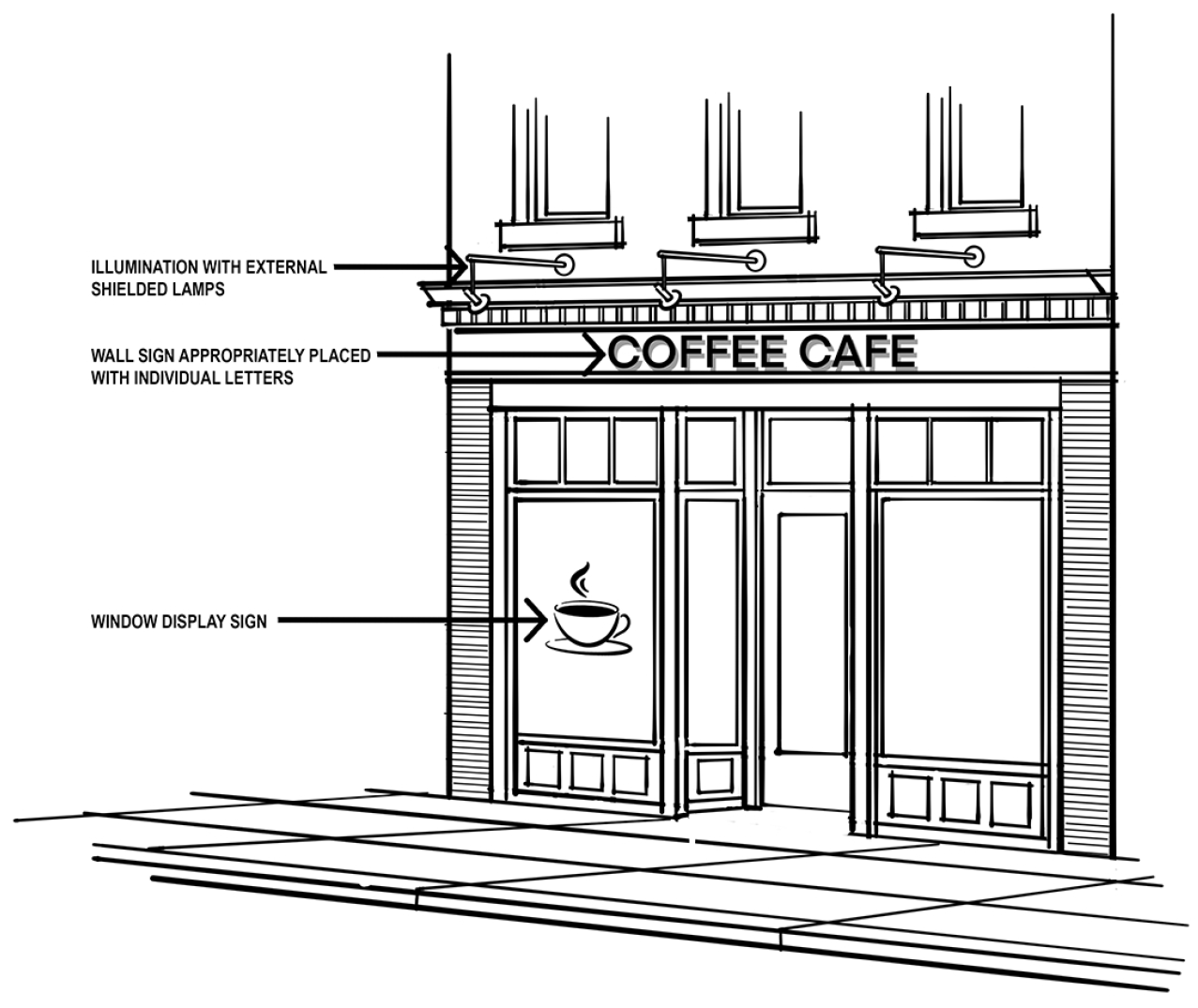
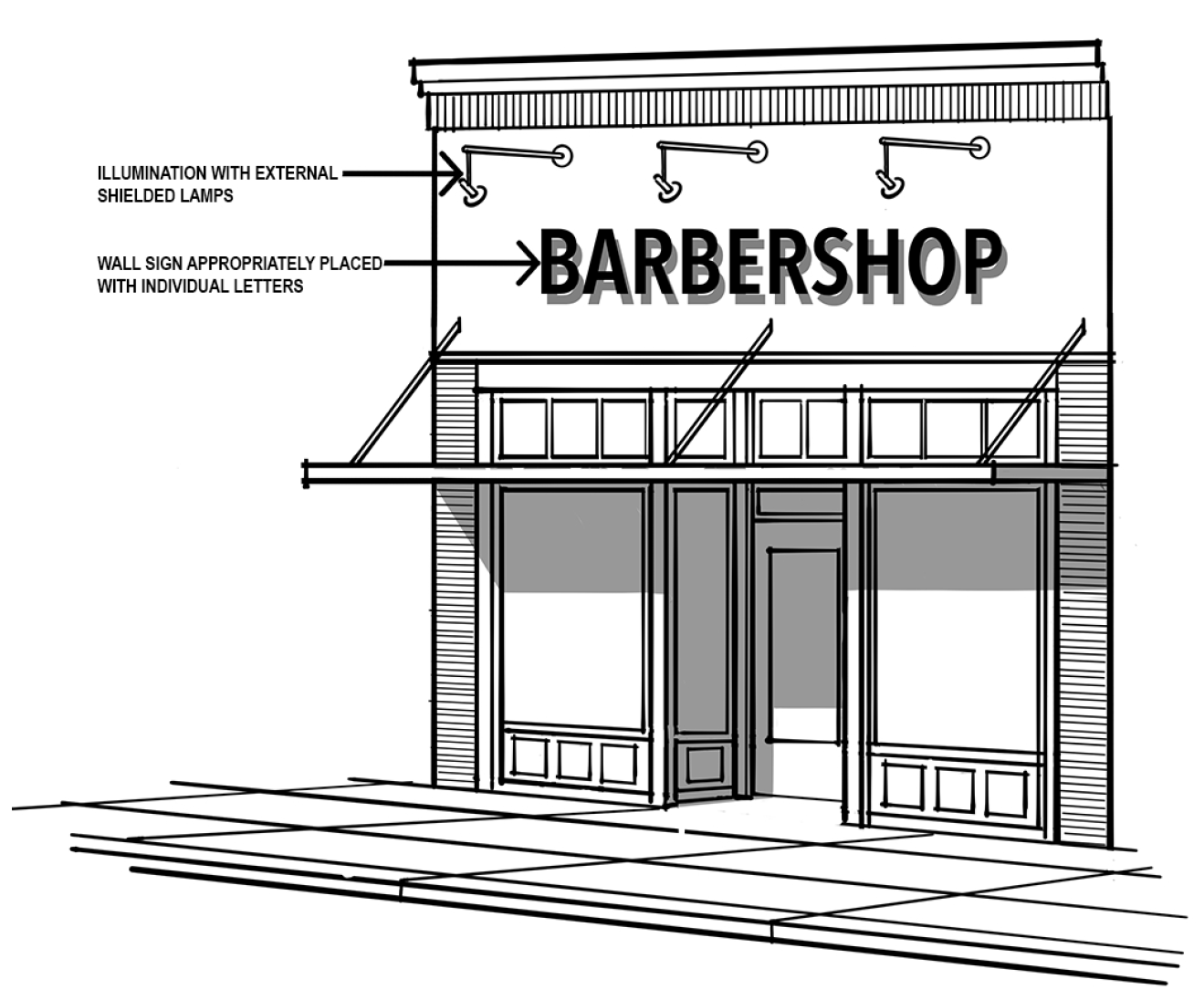
Light should be directed at the sign from an external, shielded lamp. Light should be warm in temperature, similar to daylight. Light shall not shine directly or reflect into the eyes of pedestrians or motorists.
2.
Internal illumination is permitted only for individual letters or logos, not for a cabinet containing multiple letters, symbols, or combination thereof.
f.
Design.
1.
Signs shall be subordinate to the overall building composition and shall emphasize architectural features of the building.
2.
Signs shall be wood, cast or stamped metal, or gilded or sandblasted glass. Vinyl, plastic, or highly reflective material is not permitted.
3.
Signs shall be attached at mortar joints and shall not penetrate masonry. The number of anchor points shall be minimized.
4.
All exposed conduit, junction boxes, and electrical transformer boxes shall be concealed from public view.
g.
Comprehensive sign plan.
1.
For all new buildings, remodels of vacant buildings, and expansions, a comprehensive sign plan is required.
2.
The comprehensive sign plan shall establish the allowable areas of all allowable sign types for existing and future tenants.
3.
The comprehensive sign plan shall indicate existing conforming and nonconforming signs and the number and location of signage to be allocated to each tenant under the plan.
4.
The comprehensive sign plan is subject to approval by the planning director in accordance with the intent of all provisions contained herein and may be appealed to the zoning board of adjustments.
h.
Historic signs. Signs installed prior to January 1, 1973, may be rehabilitated with any original nonconformities maintained. The applicant shall be responsible for documenting the age and original conditions of the sign.
i.
Government signs. Signs installed by a government entity or its agent are permitted.
j.
Special event signs. Special event signs are permitted, subject to all requirements for special event signs in section 12-4-101 and the city's special event policies.
(2)
Wall signs.
a.
Number.
1.
A maximum of one wall sign is permitted for each building.
2.
On multitenant buildings with internal entrances to tenant spaces, one additional wall sign is permitted, which may not exceed three feet in height or three feet in width, and which shall be located at eye level for pedestrians on the sidewalk within five feet of a public entrance to the building. This additional wall sign is intended to be used as a tenant directory.
b.
Location.
1.
If an area is provided from signage on a building above the transom windows, wall signage shall be limited to this area. If such area is not provided, every attempt shall be made to locate wall signage below any second-story windows. If it is not feasible to locate a sign within the area below second-story windows on a two-story building, wall signage shall be limited to the largest continuous flat surface between the top of the second-story windows and the cornice. Wall signs shall not be located above the bottom of third-story windows.
2.
When feasible, wall signs shall be aligned with others on the same block.
c.
Size.
1.
Maximum area: 45 square feet.
2.
Maximum height: three feet.
3.
Maximum width: 75 percent of the width of the tenant space.
(3)
Plaque signs.
a.
Number. A maximum of one plaque sign is permitted per building.
b.
Location.
1.
May be located adjacent to the main entrance to the building or near a corner of the building.
2.
Shall be installed flush against the building.
c.
Size.
1.
Maximum area: four square feet.
2.
Maximum height: two feet.
3.
Maximum width: two feet.
4.
Maximum projection: three inches.
d.
Design.
1.
Shall be constructed of cast or stamped metal.
2.
No wrap, decal, or other impermanent cover shall be affixed to the sign.
(4)
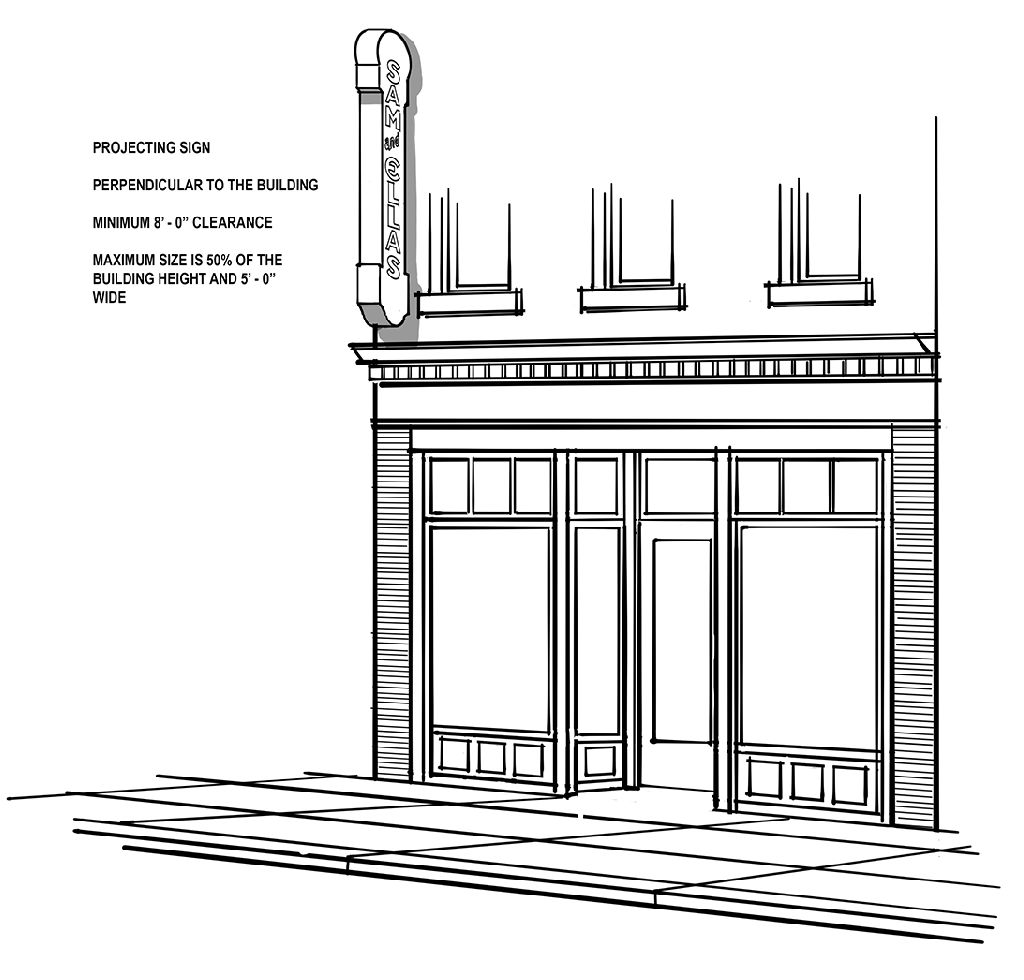
Projecting signs.
a.
Number.
1.
A maximum of one projecting sign is permitted for each building.
2.
On multitenant buildings, one additional projecting sign is permitted for each tenant space.
b.
Location.
1.
Minimum clearance. 8 feet above the sidewalk or other grade.
c.
Size.
1.
Maximum area: 16 square feet.
2.
Maximum height: 50 percent of building height.
3.
Maximum width: five feet.
4.
Maximum projection: 50 percent of sidewalk width.
(5)
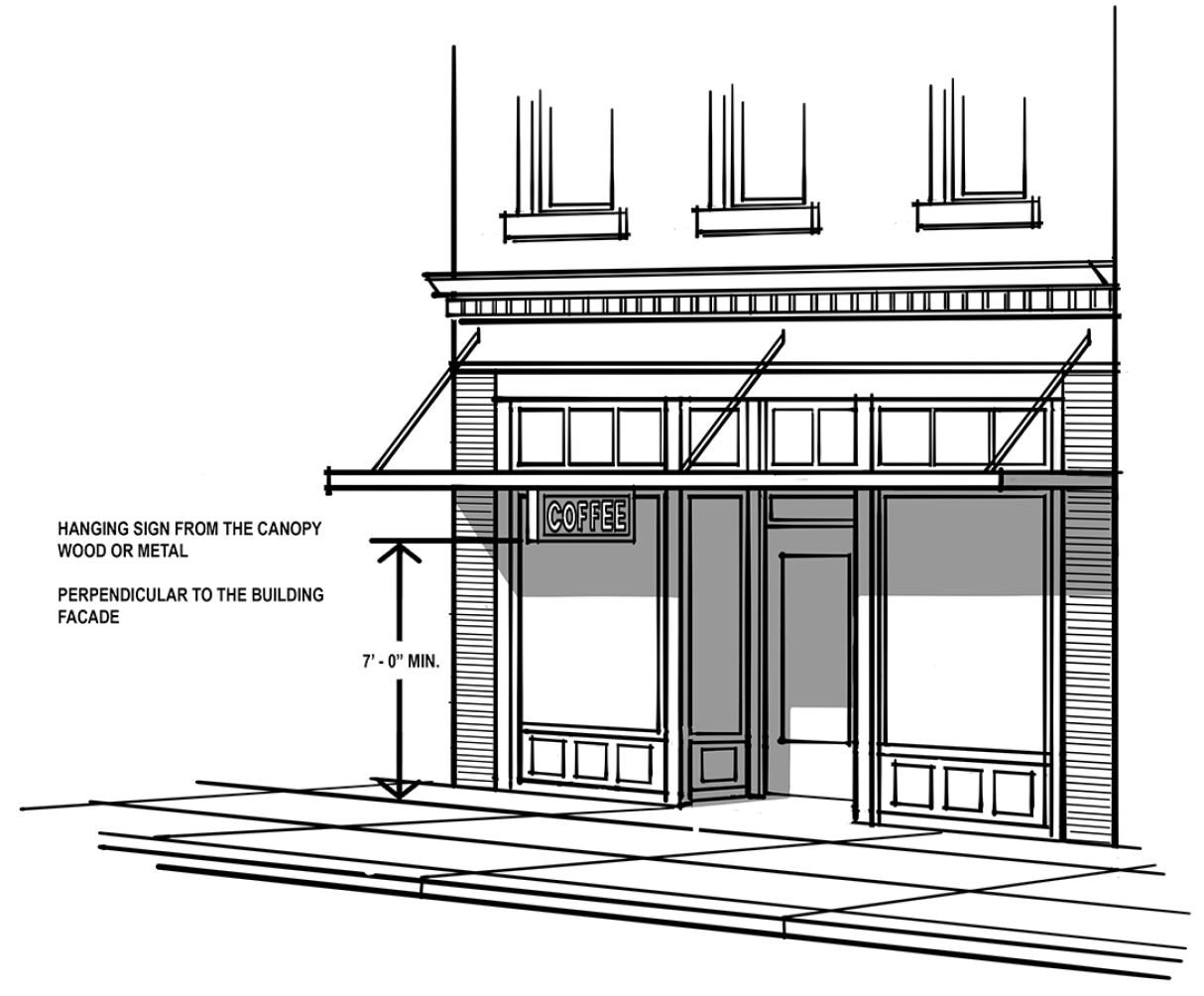
Hanging signs.
a.
Number. A maximum of one hanging sign is permitted for each tenant space.
b.
Location.
1.
Shall be located at the entrance to the tenant space.
2.
Limited to the first story of the building.
3.
When feasible, hanging signs shall be aligned with others on the same block.
4.
Minimum clearance: seven feet above the sidewalk or other grade.
c.
Size.
1.
Maximum area: eight square feet.
2.
Maximum height: two feet.
3.
Maximum width: 75 percent of the awning/canopy width.
d.
Design. Shall not be illuminated except by lights recessed inside of a canopy.
(6)
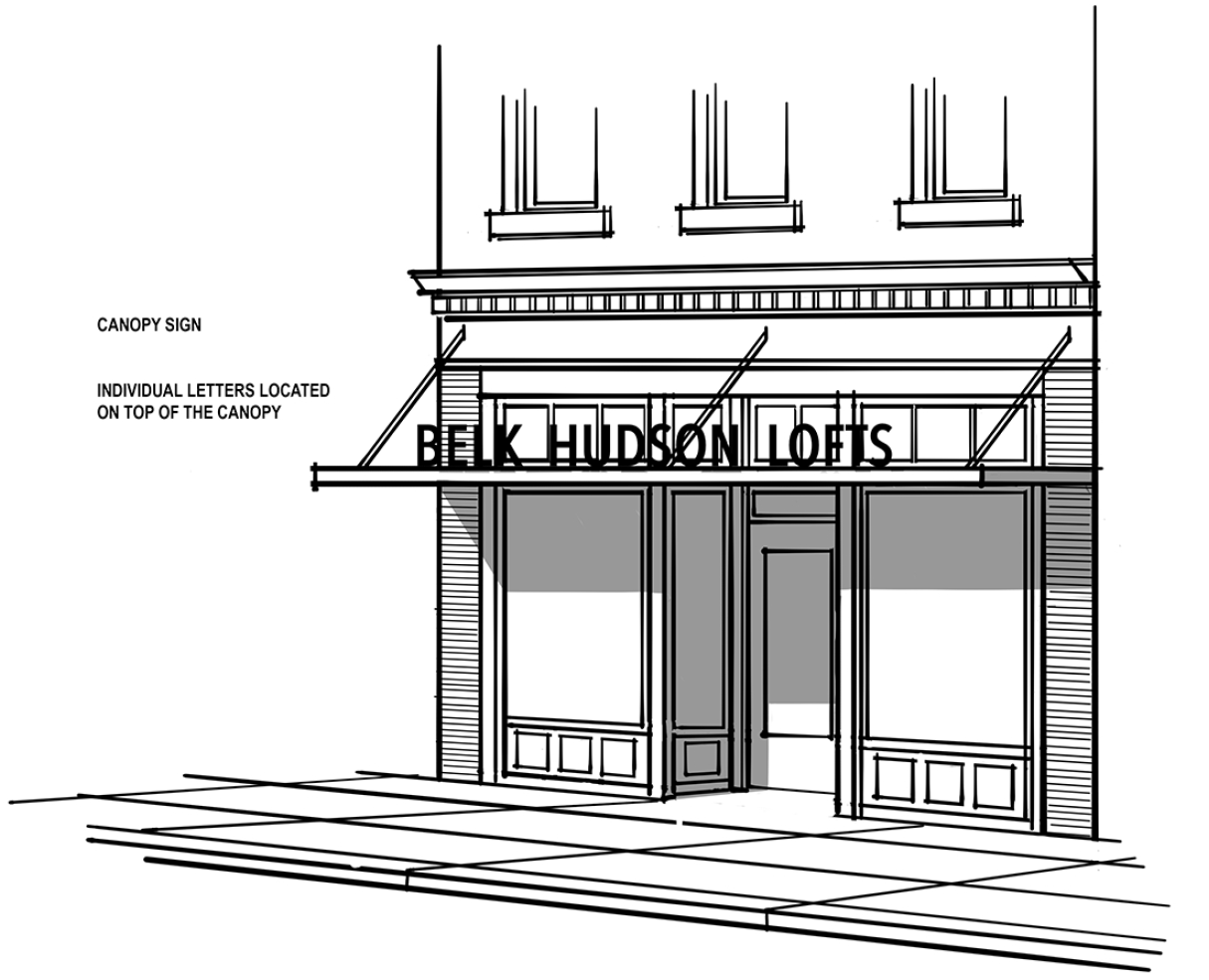
Canopy signs.
a.
Number. A maximum of one canopy sign is permitted for each tenant space, provided such tenant space does not have a wall sign.
b.
Location. Shall be located on top of the canopy.
c.
Size.
1.
Maximum height: two feet.
2.
Maximum width: 75 percent of the canopy width.
d.
Design. Shall consist of letters individually attached to the canopy.
(7)
Window display signs.
a.
Number. A maximum of one window display sign is permitted per windowpane.
b.
Location. Limited to first-story windows below the transom.
c.
Size. Shall not occupy more than 25 percent of the area of any window.
d.
Design. Shall not obscure visibility into the ground floor.
(8)
Sandwich board signs.
a.
Number. A maximum of one sandwich board sign is permitted for each tenant space.
b.
Location.
1.
Shall be located directly in front of entrance to tenant space.
2.
Shall allow for the flow of pedestrian traffic on the sidewalk, with a minimum horizontal clearance of four feet.
3.
Shall be removed at the close of business each day.
c.
Size.
1.
Maximum area: 12 square feet per side.
2.
Minimum height: three feet.
3.
Maximum height: four feet.
4.
Minimum width: two feet
5.
Maximum width: three feet.
(h)
Predevelopment meeting. Prior to submission of a building permit or commencing any exterior work on a building in the central business district, the owner/applicant shall contact the development services department to schedule a predevelopment meeting to assist the owner/applicant in preparing a complete submittal that complies with all requirements and guidelines herein.
(Ord. No. O2021-48, § 1(Exh. A), 8-24-21; Ord. No. O2022-17, § 2(Exh. A), 7-26-22; Ord. No. O2022-47, § 2(Exh. A), 12-13-22; Ord. No. O2024-41, § 3, 12-17-24; Ord. No. O2025-05, §§ 4, 6, 1-28-25; Ord. No. O2025-08, § 3, 3-27-25; Ord. No. O2025-15, § 1, 4-22-25)
Sec. 12-3-301. - "CN" Central Neighborhood.
(a)
Purpose. The CN Central Neighborhood district is intended to accommodate a mix of residential and complementary commercial uses in a historic neighborhood environment adjacent to the city's historic downtown district and major commercial corridors. Design standards for the district are intended to regulate development such that historic structures are preserved either as single-family dwellings or appropriate reuse as neighborhood-serving commercial, and such that new structures are consistent with the community feel. Permitted uses include single-family detached dwellings, household living - 2 nd story and above in mixed use buildings, offices, retail shops, or restaurants, which are sustainable within a limited trade area or as a supplement to nearby corridors. Uses exceeding 7,500 square feet or requiring substantial off-street parking may be approved with a conditional use permit. In the Central Neighborhood district, no building or premises shall be used, configured, erected, or altered except in conformity with the following use, area, and height regulations.
(b)
Permitted uses.
(c)
Special uses.
(d)
Conditional uses.
(e)
Design standards.
(1)
Height regulations.
a.
No structure shall exceed 35 feet in height for the main building.
(2)
Area and yard regulations.
a.
Size of lot.
1.
Minimum lot area—5,000 square feet.
2.
Minimum lot width—50 feet.
3.
Minimum lot depth—100 feet.
b.
Size of yard.
1.
Minimum front yard—15 feet.
2.
Minimum side yard—Five feet.
3.
Minimum side yard adjacent to a public street—15 feet.
4.
Minimum rear yard—15 feet.
c.
Maximum lot coverage—80 percent including main and accessory buildings.
d.
Maximum floor-area-ratio (FAR)—0.5:1 commercial, 2:1 total.
(f)
Special requirements.
(1)
For nonresidential conversions, exterior renovations, or new construction, building facade (i.e., elevation) plans shall be submitted for review and approval along with the site plan. Facade plans shall clearly show how the building(s) will look, especially as viewed from the road(s) upon which the property faces and/or sides, and will portray a reasonably accurate depiction of the materials and colors to be used. Architectural style and scale of new/renovated buildings within the CN district shall be compatible with the styles and scale of other adjacent buildings in order to preserve the unique character of the historic neighborhood.
(2)
Design standards for the CN district.
a.
False fronts or parapets may be added to existing buildings in order to add character and detail to simple facades.
b.
Facade openings shall comprise at least 40 percent of a new commercial building's facade area. At least one such opening shall be an entrance connected by a walkway to the right-of-way.
c.
Driveways or parking areas shall not comprise more than 24 feet or 40 percent of the street frontage, whichever is greater.
d.
Awnings and other canopies.
1.
Ratios. Awnings and other canopies visible from other properties or the public right-of-way shall be at an appropriate scale to the building size and shall not completely obstruct any windows or significant architectural features. They shall not extend above the roofline of any single-story structure or above the top of the second floor of any multi-story structure.
2.
Projection. No awning or canopy shall extend more than five feet outward from the building face/surface, except that a canopy over a porch or outdoor seating area may extend no more than ten feet into a required front or rear yard setback and no more than five feet into a required street side setback.
3.
Colors and materials. A mixture of colors is recommended, but no more than three different colors shall be used for awnings on a single building facade (excluding business logo, which may have more colors). Materials shall be of cloth, canvas, or another material that is complementary to the period or building style. Metal or plastic shall be prohibited.
4.
Movement. Except for slight movements that are normal for fabric canopies (i.e., along fringe, etc.), no movement shall be allowed for awnings and canopy structures.
e.
New utility lines to business establishments shall be placed underground.
f.
Pedestrian spaces shall be treated with amenities that are selected based upon their ability to unify the streetscape with the area's historic past. It is important that elements such as construction materials, colors, textures, and fixture designs complement the area's historic qualities. These features shall be repeated throughout the streetscape so as to unify the district as a whole.
g.
Planters, window boxes, street furniture, and other streetscape furnishings shall not be located in any public right-of-way.
h.
Open storage is prohibited in the CN district.
i.
Outside display of merchandise and/or seasonal items is limited to 100 square feet and shall not encroach on any public right-of-way. All items on display during business hours shall be removed at the end of each business day. All merchandise shall be displayed in a neat, orderly manner, and the display area shall be maintained in a clean, litter-free manner.
j.
All commercial uses shall be limited to a maximum of 10,000 square feet and 0.5:1 FAR.
k.
The architectural design of buildings and sites shall strive to achieve the following objectives:
1.
Scale new structures and commercial conversions to historic single-family residences;
2.
Encourage pedestrian activity;
3.
Relate to, and orient toward, pedestrian areas and surrounding buildings; and
4.
Signify entrances with special architectural features.
(Ord. No. O2021-48, § 1(Exh. A), 8-24-21; Ord. No. O2022-17, § 2(Exh. A), 7-26-22; O2024-48, § 1, 12-17-2024; Ord. No. O2025-05, §§ 4, 6, 1-28-25; Ord. No. O2025-08, § 3, 3-27-25; Ord. No. O2025-43, § 1, 9-23-25)
Sec. 12-3-302. - "C1" General Commercial.
(a)
Purpose. The General Commercial (C1) district is intended to accommodate commercial uses with a neighborhood or citywide trade area as well as a range of civic and institutional uses, located predominantly along the city's arterial thoroughfares. In the General Commercial district, no building or premises shall be used, configured, erected, or altered except in conformity with the following use, area, and height regulations. This district is used in areas designated in the General Plan as Community Commercial (CC), Employment Mix (EM), Entertainment Center (EC), Professional Campus (PC), and Urban Living (UL).
(b)
Permitted uses.
(b)
Permitted uses.
(c)
Special uses.
(d)
Conditional uses.
(e)
Design standards.
(1)
Height regulations.
a.
No structure shall exceed 45 feet in height for the main building.
(2)
Area regulations.
a.
Front yard.
1.
In all locations where building lines, setback lines, or front yard lines are shown on recorded plats, the minimum setback or front yard shall be as shown on the plat.
2.
In all other locations, the minimum front yard setback shall be 25 feet.
3.
No accessory structures shall be located in front yards.
b.
Side yard.
1.
In all locations where building lines, or side lines on corner lots, are shown on recorded plats, the minimum side yard shall be as shown on the plat.
2.
In all other locations, there shall be a side yard on each side of the structures of no less than five feet in width. Except when retail uses are platted adjacent to other retail uses and integrated into an overall shopping center site (i.e., lots/lease spaces abutting one another), no side yard is required provided it complies with the building code.
3.
Corner lots shall have a side yard on the street side of the structure of no less than 20 feet.
c.
Rear yard.
1.
There shall be a rear yard with a depth of not less than ten feet for the main building.
d.
Lot area.
1.
Lot area—None specified.
2.
Minimum lot width—None specified.
3.
Minimum lot depth—None specified.
(3)
Supplemental conditional use standards.
a.
Auto wash. Shall not be authorized within a two-mile radius of a pre-existing auto or truck wash.
b.
Mini-warehouse/self storage.
1.
Shall not be authorized within a three-mile radius of a pre-existing mini-warehouse/self storage facility
2.
Sixty percent of the units must be temperature controlled with air-conditioning and heating
3.
Shall have a minimum lot size of two acres.
c.
Hotel/motel.
1.
All rooms shall have internal entry only, no individual outside entry into rooms.
2.
Shall be a minimum of two stories in height.
d.
Alternative financial institution. Due consideration should be given to prevent the over-proliferation of such uses.
(Ord. No. O2021-48, § 1(Exh. A), 8-24-21; Ord. No. O2022-17, § 2(Exh. A), 7-26-22; Ord. No. O2024-41, § 1, 12-17-24; Ord. No. O2025-08, § 3, 3-27-25; Ord. No. O2025-53, § 1, 12-16-25)
Sec. 12-3-303. - "C2" Interstate Commercial.
(a)
Purpose. The Interstate Commercial (C2) district is intended to accommodate commercial uses with a regionwide trade area along the Interstate 20 freeway corridor. Uses within the C2 district are typically within multitenant or big-box developments. Access to and from the Interstate for shoppers, travelers, and freight vehicles may be prioritized. Limited building trades or heavy truck uses may be approved with a conditional use permit. In the Interstate Commercial district, no building or premises shall be used, configured, erected, or altered except in conformity with the following use, area, and height regulations. This district is predominantly used in areas designated in the General Plan as Regional Activity Center (RAC).
(b)
Permitted uses.
(c)
Special uses.
(d)
Conditional uses.
(e)
Design standards.
(1)
Height regulations.
a.
No structure shall exceed 45 feet in height for the main building, except as approved by conditional use permit.
(2)
Area regulations.
a.
Front yard.
1.
In all locations where building lines, setback lines, or front yard lines are shown on recorded plats, the minimum setback or front yard shall be as shown on the plat.
2.
In all other locations, the minimum front yard setback shall be 25 feet.
3.
No accessory structures shall be located in front yards.
b.
Side yard.
1.
In all locations where building lines, or side lines on corner lots, are shown on recorded plats, the minimum side yard shall be as shown on the plat.
2.
In all other locations there shall be a side yard on each side of the structures (interior) of no less than ten feet in width. Except, when retail uses are platted adjacent to other retail uses and integrated into an overall shopping center site (i.e., lots/lease spaces abutting one another), no side yard is required provided it complies with the city's building code.
3.
For corner lots, there shall be a side yard on the street side of the structure of no less than 20 feet.
c.
Rear yard.
1.
There shall be a rear yard having a depth of not less than ten feet for the main building.
d.
Lot area.
1.
Lot area—None specified.
2.
Minimum lot width—None specified.
3.
Minimum lot depth—None specified.
(3)
Supplemental conditional use standards.
a.
Auto or truck wash. Shall not be authorized within a two-mile radius of a pre-existing auto or truck wash.
b.
Mini-warehouse/self storage.
1.
Shall not be authorized within a three-mile radius of a pre-existing mini-warehouse/self storage facility.
2.
Sixty percent of the units must be temperature controlled with air-conditioning and heating.
3.
Shall have a minimum lot size of two acres.
c.
Hotel/motel.
1.
All rooms shall have internal entry only, no individual outside entry into rooms.
2.
Shall be a minimum of two stories in height.
d.
Alternative financial institution. Due consideration should be given to prevent the over-proliferation of such uses.
(Ord. No. O2021-48, § 1(Exh. A), 8-24-21; Ord. No. O2022-17, § 2(Exh. A), 7-26-22; Ord. No. O2024-41, § 2, 12-17-24; Ord. No. O2025-08, § 3, 3-27-25; Ord. No. O2025-53, § 1, 12-16-25)
Sec. 12-3-304. - "C3" Heavy Commercial.
(a)
Purpose. The Heavy Commercial (C3) district is intended to accommodate commercial uses related to the building trades, research and development, light manufacturing, and the storage and transport of finished products at a range of scales from neighborhood-supporting to regional. Access to and from the thoroughfares for freight vehicles may be prioritized. Uses requiring extensive noise or other impact mitigation may be approved with a special use or conditional use permit. In the Heavy Commercial district, no building or premises shall be used, configured, erected, or altered except in conformity with the following use, area, and height regulations. This district is used in areas designated in the General Plan as Manufacturing and Warehouse (MW).
(b)
Permitted uses.
(c)
Special uses.
(d)
Conditional uses.
(e)
Design standards.
(1)
Height regulations. No structure shall exceed 45 feet in height for the main building.
(2)
Area regulations.
a.
Front yard.
1.
In all locations where building lines, setback lines, or front yard lines are shown on recorded plats, the minimum setback or front yard shall be as shown on the plat.
2.
In all other locations, the minimum front yard setback shall be 25 feet.
3.
No accessory structures shall be located in front yards.
b.
Side yard.
1.
In all locations where building lines, or side lines on corner lots, are shown on recorded plats, the minimum side yard shall be as shown on the plat.
2.
In all other locations there shall be a side yard on each side of the structure of no less than five feet in width. Except when retail uses are platted adjacent to other retail uses and integrated into an overall shopping center site (i.e., lots/lease spaces abutting one another), no side yard is required provided it complies with the city's building code.
3.
For corner lots, there shall be a side yard on the street side of the structure of no less than 20 feet.
c.
Rear yard.
1.
There shall be a rear yard having a depth of not less than 20 feet for the main building.
d.
Lot area.
1.
The lot area shall be no less than 11,250 square feet.
2.
The minimum lot width shall be 75 feet.
3.
The minimum lot depth shall be 150 feet.
(3)
Supplemental conditional use standards.
a.
Auto or truck wash. Shall not be authorized within a two-mile radius of a pre-existing auto or truck wash.
b.
Mini-warehouse/self storage.
1.
Shall not be authorized within a three-mile radius of a pre-existing mini-warehouse/self storage facility.
2.
Sixty percent of the units must be temperature controlled with air-conditioning and heating.
3.
Shall have a minimum lot size of two acres.
c.
Hotel/motel.
1.
All rooms shall have internal entry only, no individual outside entry into rooms.
2.
Shall be a minimum of two stories in height.
d.
Alternative financial institution. Due consideration should be given to prevent the over-proliferation of such uses.
(Ord. No. O2021-48, § 1(Exh. A), 8-24-21; Ord. No. O2022-17, § 2(Exh. A), 7-26-22; Ord. No. O2024-41, § 3, 12-17-24; Ord. No. O2025-08, § 3, 3-27-25)
Sec. 12-3-305. - "I" Industrial District.
(a)
Purpose. The Industrial (I) district is intended to accommodate areas in the city where industrial manufacturing and other firms can engage in processing, manufacturing, and related activities protected from the encroachment of commercial and residential uses. Access to and from major thoroughfares for freight vehicles is prioritized. This district is intended to allow extensive obnoxious sounds, glare, dust, or odor. In the Industrial district, no building or premises shall be used, configured, erected, or altered except in conformity with the following use, area, and height regulations. This district is used in areas designated in the General Plan as Manufacturing and Warehouse (MW).
(b)
Permitted uses.
(c)
Special uses.
(d)
Conditional uses.
(e)
Design standards.
(1)
Height regulations—None specified.
(2)
Area regulations.
a.
Front yard.
1.
In all locations where building lines, setback lines, or front yard lines are shown on recorded plats, the minimum setback or front yard shall be as shown on the plat.
2.
In all other locations, the minimum front yard setback shall be 50 feet.
3.
No accessory structures shall be located in front yards.
b.
Side yard.
1.
In all locations where building lines or side lines on corner lots are shown on recorded plats, the minimum side yard shall be as shown on the plat.
2.
In all other locations, there shall be a side yard on each side of the structure of no less than 25 feet in width.
3.
Corner lots shall have a side yard on the street side of the structure of no less than 25 feet.
c.
Rear yard.
1.
There shall be a rear yard with a depth of not less than 25 feet for the main building.
d.
Lot area.
1.
Lot area—None specified.
i.
Minimum lot width—None specified.
ii.
Minimum lot depth—None specified.
(3)
Supplemental conditional use standards.
a.
Automobile wash. Shall not be authorized within a two-mile radius of a pre-existing automobile wash.
b.
Mini-warehouse/self storage.
1.
Shall not be authorized within a three-mile radius of a pre-existing mini-warehouse/self storage facility
2.
Sixty percent of the units must be temperature controlled with air-conditioning and heating
3.
Shall have a minimum lot size of two acres.
c.
Hotel/motel.
1.
All rooms shall have internal entry only, no individual outside entry into rooms.
2.
Shall be a minimum of two stories in height.
d.
Alternative financial institution. Due consideration should be given to prevent the over-proliferation of such uses.
e.
Alternative wellness product establishment. Shall not be authorized within a two-mile radius of a pre-existing alternative wellness product sales establishment.
(Ord. No. O2021-48, § 1(Exh. A), 8-24-21; Ord. No. O2022-17, § 2(Exh. A), 7-26-22; Ord. No. O2024-12, § 2, 5-14-24; Ord. No. O2025-08, § 3, 3-27-25)
Sec. 12-3-400. - "CC" Corridor Commercial Overlay.
(a)
Purpose. In the CC Corridor Commercial overlay, no building or premises shall be used, configured, erected, or altered except in conformity with the following use, area, height regulations, and design standards. The Corridor Commercial Overlay applies to properties with frontage along the following corridors:
US 180 (Fort Worth HWY) from Santa Fe Drive to FM 730 (Azle HWY)
US 180 (Palo Pinto Street) from Alamo Street to Bowie Street
FM 51 (North Main Street) from the railroad ROW to Ric Williamson HWY
FM 51 (South Main Street) from Columbia Street to College Park Drive
(b)
Design standards.
(1)
Height regulations. No structure shall exceed 45 feet in height for the main building. All buildings in the Commercial Corridor Overlay must have a minimum height of 20 feet which also must include at least five feet of a solid parapet to cover any roof top units or equipment as applicable, not to exceed 45 feet in height. The minimum height can be achieved with a front façade. Parapets or architectural designs such as arches may be used to achieve the front height requirement (Figure D and E).
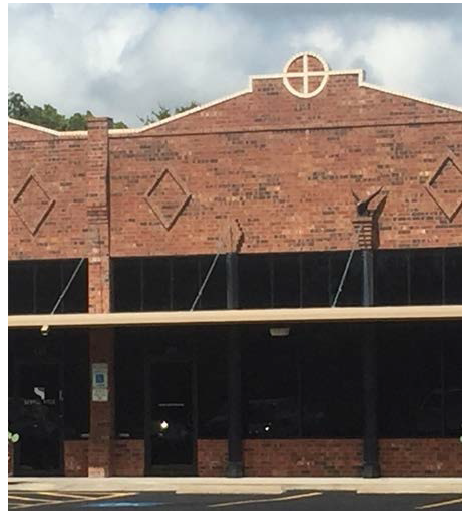
Figure D. Façade with architectural designs.
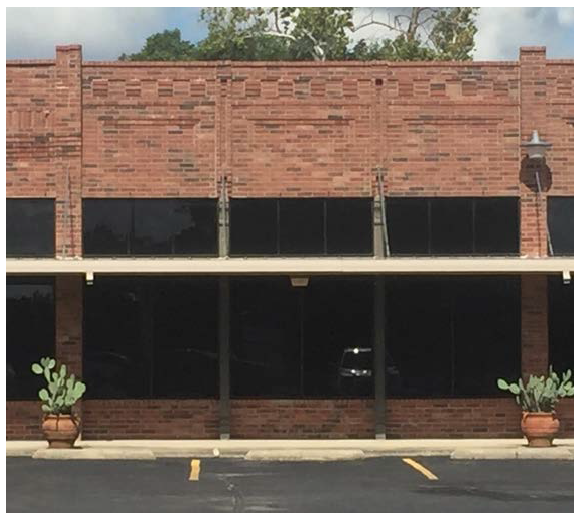
Figure E. Façade with parapets.
(2)
Area regulations.
a.
Front yard.
1.
In all locations where building lines, setback lines, or front yard lines are shown on recorded plats, the minimum setback or front yard shall be as shown on the plat.
2.
In all other locations, the minimum front yard setback shall be 15 feet.
(i)
No accessory structures shall be located in front yards.
b.
Side yard.
1.
For corner lots, there shall be a side yard on the street side of the structure of no less than 15 feet.
c.
Rear yard. There shall be a rear yard having a depth of not less than ten feet for the main building.
(3)
Additional design standards within the Corridor Commercial Overlay.
a.
Parking: For new development 75 percent of required parking shall be located behind the front yard setback of all properties within the Corridor Commercial Overlay. For redevelopment utilizing the existing structure, no new parking should increase the proportion of parking in the front setback.
b.
Building style: Structures that incorporate the cities western heritage are strongly encouraged. The use of facades as seen in Figures D and E are encouraged for all new development.
Sec. 12-3-401. - "HP" Historic Preservation Overlay.
(a)
General purpose and description.
(1)
The City Council of Weatherford hereby declares that as a matter of public policy, the protection, enhancement, and perpetuation of landmarks or districts of historical and cultural importance and significance is necessary to promote the economic, cultural, educational, and general welfare of the public. It is recognized that the City of Weatherford represents the unique confluence of time and place that shaped the identity of generations of citizens, collectively and individually, and preceded significant historic, architectural, and cultural resources that constitute our heritage.
(2)
This section establishes the procedure to request and designate a historic preservation overlay (HP). The HP overlay, through separate ordinance, will provide design criteria for the redevelopment, revitalization, and preservation of specific sites, neighborhoods and commercial areas.
(3)
A historic preservation overlay recognizes the city's desire to promote and protect the health, safety, economic, cultural, educational, and general welfare of the public through the protection, enhancement, and perpetuation of one or more districts of historical, archeological, and cultural importance and significance.
(4)
The city council may designate sites, buildings, structures, landscapes, and objects as within a historic preservation overlay along with the public rights-of-way in and surrounding them and define, amend, and delineate the boundaries thereof by adopting a historic preservation overlay.
(5)
The purposes of historic preservation overlay are to:
a.
Protect and enhance the landmarks, districts, and resources which represent distinctive elements of Weatherford's historic, architectural, archeological, and cultural heritage.
b.
Strengthen and foster civic pride in the accomplishments of the past through neighborhood conservation.
c.
Protect and enhance Weatherford's attractiveness to visitors and the support and stimulus to the economy thereby provided.
d.
Ensure the harmonious, orderly, and efficient growth and development of the city.
e.
Stabilize and promote the economy of the city through the continued use, preservation, and revitalization of its historic resources.
f.
Encourage the stabilization, restoration, and improvement of historic properties and their values.
g.
Strengthen civic pride and cultural stability through neighborhood conservation.
(6)
Separate ordinances are required to designate each historic preservation overlay. Ordinances designating each overlay shall identify the designated boundaries, applicable designation criteria, and design standards for that overlay.
(7)
Nothing contained in this section or in the designation of property as being in a historic preservation overlay shall affect the present legal use of property. Use classifications as to all property which may be included in a historic preservation overlay shall continue to be governed by the general zoning ordinance and the procedures therein established. In no case, however, shall any use be permitted which requires the demolition, razing, remodeling, or alteration of any buildings or structures in such a historic preservation overlay so as to adversely affect the character of the area and buildings within the historic preservation overlay, except upon compliance with the terms of this section.
(8)
If there is a conflict between the regulations in a historic preservation overlay ordinance and the regulations of the underlying zoning district, the regulations contained in the historic preservation overlay ordinance control. If there is a conflict between the regulations contained in a historic preservation overlay ordinance and these regulations, the regulations contained in the historic preservation overlay ordinance control.
(9)
It is not the intent of the historic preservation commission, planning and zoning commission, or city council to place individual property owners involuntarily in a historic preservation overlay or be subject to design guidelines except in circumstances when the future of a high-priority, single property site, as designated by the adopted historic resources survey, becomes threatened. The city council may initiate historic preservation overlay designation without consent of the owners of the property in accordance with subsection (d)(3) below.
(b)
Definitions. Terms shall be as defined in the City of Weatherford Code of Ordinances, either in the Definitions section of this title or in appendix 1, definitions, chapter 13, historic preservation, of title IV, building and property maintenance regulations and historic preservation and unless specifically noted otherwise, are standard throughout this section.
(c)
Historic preservation overlay criteria. A historic preservation overlay may be established on one or more properties, the majority of which are more than 50 years old, to preserve places and areas of historical, cultural, or architectural importance and significance if the place or area has one or more of the following characteristics:
(1)
History, heritage, and culture. Represents the historical development, ethnic heritage, or cultural characteristics of the city, state, or country.
(2)
Historic event. Location as or association with the site of a significant historic event.
(3)
Significant persons. Identification with a person or persons who significantly contributed to the culture and development of the city, state, or country.
(4)
Architecture. Embodiment of distinguishing characteristics of an architectural style, landscape design, method of construction, exceptional craftsmanship, architectural innovation, or contains details which represent folk or ethnic art.
(5)
Architect or master builder. Represents the work of an architect, designer, or master builder whose individual work has influenced the development of the city, state or country.
(6)
Historic context. Relationship to other distinctive buildings, sites, or areas which are eligible for preservation based on historic, cultural, or architectural characteristics.
(7)
Unique visual feature. Unique location of singular physical characteristics representing an established and familiar visual feature of a neighborhood, community, or the city that is a source of pride or cultural significance.
(8)
Archeological. Archeological or paleontological value, in that it has produced or can be expected to produce data-affecting theories of historic or prehistoric interest.
(9)
National and state recognition. Eligible for or designated as a National Historic Landmark, recorded State Historic Landmark, State Archeological Landmark, American Civil Engineering Landmark, or eligible for inclusion in the National Register of Historic Places.
(10)
Historic education. Represents an era of architectural, social, or economic history that allows an understanding of how the place or area was used by past generations.
(d)
Historic preservation overlay designation.
(1)
Multi-property overlay initiation.
a.
The procedure for adopting an ordinance to establish or amend a multi-property historic preservation overlay may be initiated by any of the following:
1.
Owner(s) of the property;
2.
Historic preservation commission;
3.
Planning and zoning commission;
4.
City council.
b.
The procedure for establishing or amending a historic preservation overlay may be initiated by the city or by at least 51 percent of the property owners of the potential overlay. City council shall make a determination, upon recommendation of the historic preservation commission and planning and zoning commission, which of the remaining 49 percent is threatened and shall be included in the historic preservation overlay. For historic preservation overlay requests, a favorable vote of three-fourths of all members of the city council shall be required to approve any change in zoning when written objections are received in accordance with the provisions of V.T.C.A., Local Government Code, § 211.006 (commonly referred to as the "20 percent rule") which provides for a written petition, in opposition to the zoning overlay, of the owners of more than 20 percent of the property being rezoned or within 200 feet of the rezoning.
c.
At any time after designation, property owners may request the historic preservation commission, planning and zoning commission, or city council to initiate an amendment to remove their particular property from the historic preservation overlay. This process will require an amendment to the overlay as well as to the zoning map to remove the historic preservation overlay designation in accordance with the procedures outlined for zoning map amendments in this title.
(2)
Single property overlay initiation.
a.
The procedure for adopting an ordinance to establish or amend a single property historic preservation overlay is followed by any of the parties below:
1.
Owner(s) of the property;
2.
Historic preservation commission;
3.
Planning and zoning commission;
4.
City council.
b.
Requests for a single property historic preservation overlay designation or amendment must have the concurrence of the owner located within the boundaries of the proposed single property historic preservation overlay, except in accordance with the "Single Property Overlay Initiation, High Priority Resources" subsection below.
c.
At any time after designation, property owners may request the historic preservation commission, planning and zoning commission, or city council to initiate an amendment to remove their particular property from the historic preservation overlay. This process will require an amendment to the overlay as well as to the zoning map to remove the historic preservation overlay designation in accordance with the procedures outlined for zoning map amendments in this title.
(3)
Single property overly initiation, high priority resources.
a.
In circumstances when the future of a high priority single property site, as designated by the adopted historic resources survey, becomes threatened, the city council may initiate historic preservation overlay designation without consent of the owner of the property.
b.
Within 30 days of such initiation, city council shall hold a public hearing and determine if the historic preservation overlay designation process is to be continued or withdrawn.
c.
If city council withdraws the original designation, the property is no longer affected by the initiation of designation.
d.
If city council determines to proceed with the designation, the property will be subject to the public hearing procedure stated below.
(4)
Initiation of designation.
a.
The historic preservation overlay designation procedure is considered to be initiated immediately when the city council, planning and zoning commission, or historic preservation commission votes to initiate it or, in the case of initiation by the property owner(s), when the completed designation report is filed with the planning director.
b.
Upon initiation of the historic preservation overlay designation procedure, the director shall immediately notify the building official. The building official shall not accept any application for a permit to alter, demolish, or remove any structure or site subject to the initiated designation, unless a certificate of appropriateness or certificate for demolition or removal has been issued.
(5)
Designation report.
a.
Requests by property owners shall be made on a designation report obtained from the planning director. Completed designation reports shall be returned to the director for processing. For purposes of this section, the historic preservation officer is the administrative official with original jurisdiction to review an application for completeness. The information shall include but not be limited to:
1.
A statement of the historical, cultural, and architectural significance of the place or area proposed for historic designation, including the criteria in subsections 12-3-12(b)(3)a—j upon which the designation is based.
2.
A description, photographs, and map of the boundaries of the proposed historic preservation overlay.
(6)
Public hearing procedure.
a.
These provisions pertaining to the designation of historic preservation overlays constitute a part of the comprehensive zoning ordinance of the city. Application and notification procedures shall coincide with provisions pertaining to zoning map amendments and applicable state laws. Owners of properties within a proposed historic preservation overlay shall be notified in accordance with those notification procedures at least ten days prior to the Planning and Zoning Commission hearing on the recommended designation.
b.
At all public hearings, owners, interested parties, and technical experts may present testimony or documentary evidence which will become part of a record regarding the historic, architectural, or cultural importance of the proposed historic preservation overlay.
(7)
Planning and zoning commission.
a.
The planning and zoning commission shall give notice and conduct its hearing on the proposed designation within 30 days upon receipt of such recommendation from the historic preservation commission or as directed by the city council.
b.
Upon recommendation of the planning and zoning commission, the proposed historic preservation overlay shall be submitted to the city council.
(8)
City council.
a.
City council shall give notice and conduct its hearing on the proposed designation within 30 days upon receipt of the recommendation of the planning and zoning commission.
b.
Upon designation of a building, object, site, or structure as a historic preservation overlay, city council shall cause the designation to be recorded in the Parker County official public records of real property, the City of Weatherford tax records, and the Parker County Appraisal District as well as the official zoning maps of the city. All zoning maps should indicate the designated historic preservation overlay with an appropriate mark or designation.
(9)
Certificate of appropriateness and certificate for demolition or removal in an overlay district required.
a.
Prior to the commencement of any work or repairs in a historic preservation overlay, the property owner shall consult the historic preservation officer to determine the necessary requirements for the proposed work.
b.
Unless a certificate of appropriateness or a certificate of demolition has been approved by the city in accordance with title IV, chapter 13, historic preservation, this subsection and the regulations and design guidelines contained in a historic preservation overlay ordinance, no person or entity shall construct, reconstruct, alter, change, expand, remove, demolish, or fail to maintain any building, object, site, landscape, architectural feature, or group of such within a historic preservation overlay.
c.
No building permit shall be issued for such proposed work until a certificate of appropriateness or a certificate of demolition has first been issued in accordance with this section and title IV, chapter 13, historic preservation. The certificate of appropriateness or certificate of demolition shall be in addition to and not in lieu of any building permit that may otherwise be required.
(e)
Administration.
(1)
Enforcement.
a.
All work performed pursuant to a certificate of appropriateness issued under this section shall conform to all its requirements. It shall be the duty of the planning director to inspect periodically to assure such compliance.
(2)
Penalties.
a.
Any person who adversely affects or demolishes a structure on property subject to the pending designation or in a historic preservation overlay in violation of this section is liable pursuant to V.T.C.A. Local Government Code § 315.006 for damages to restore or replicate the structure to its appearance and setting prior to the violation, using as many of the original materials as possible. No pending designation certificates of appropriateness, certificates of appropriateness, or building permits will be issued for construction on the site except to restore or replicate the structure.
b.
When these restrictions become applicable to a site, the planning director shall cause to be filed a verified notice in the county deed records and these restrictions shall be binding on future owners of the property. These restrictions are in addition to any fines imposed.
c.
Prosecution in municipal court of competent jurisdiction for an offense under this section does not prevent the use of other enforcement remedies or procedures provided by other city ordinances or state or federal laws applicable to the person charged with or the conduct involved in the offense.
Sec. 12-3-402. - "P" Planned Unit Development Overlay.
(a)
Purpose. The Planned Unit Development (P) Overlay is applied to accommodate flexibility with respect to certain development standards applicable to a base zoning district in order to achieve higher-quality, innovative, or mixed-use developments. A planned unit development overlay differs from an administrative adjustment or variance in that the latter procedures are intended to allow relief from standards which constitute a hardship or irreconcilable impediment to otherwise permitted development, whereas the planned unit development procedure is intended to facilitate exceptional development that will benefit the public above and beyond what is possible with strict adherence to the standards. This overlay may be used with any base zoning district, provided that the base zoning district and Planned Unit Development overlay in combination achieve a set of development standards consistent with the approved General Plan place type designation for the subject property.
(b)
Applicability. This section applies to all new requests for planned unit development and substantial changes to existing planned unit developments. A planned unit development overlay may be applied to a base zoning district for adjustments to the following development standards and subdivision requirements:
(1)
Minimum front, rear, or side yard setback.
(2)
Minimum lot size.
(3)
Maximum dwelling units per acre (may be averaged over multiple properties or transferred across zoning districts within the overall project area).
(4)
Uses permitted (may be transferred across zoning districts within the overall project area).
(5)
Maximum building height or length.
(6)
Maximum floor-area ratio.
(7)
Maximum lot coverage.
(8)
Minimum landscape planting.
(9)
Minimum right-of-way width.
(10)
Minimum or maximum block length.
(11)
Standard street or sidewalk construction details.
(12)
Multifamily dwelling unit variety.
(c)
Procedure. A property owner or owners may request a planned unit development overlay by filing a complete application with the planning director.
(1)
Pre-application meeting. The property owner(s) or authorized representative shall request a pre-application meeting with the planning director. At the meeting, the director and other city staff will provide information and early assistance on the application and approval process.
(2)
Application requirements.
a.
Completed application form.
b.
Applicable fee.
c.
A written narrative that includes all of the following:
1.
Summary. Describe the overall land use pattern, development scale, vehicle and pedestrian circulation, infrastructure, types and densities of dwellings and other uses, and all unique or unusual features of the project.
2.
Adjustments. Address all proposed adjustments from base zoning district and subdivision requirements, including the reasons why each adjustment is necessary. Address any uses proposed where not allowed in the underlying base zone by demonstrating the need for or benefit of each such use. These statements shall be accompanied by a table that lists each base zoning district and compares all applicable development standards, allowed uses, and subdivision requirement with the proposed adjusted standards, uses, and subdivision requirements in a side-by-side column format.
3.
Compatibility. Evaluate the relationship between the proposed planned unit development and the surrounding community. Explain how the proposal integrates with and responds to existing development patterns through a discussion about the arrangement, location, and massing of all proposed buildings, uses, and site improvements, including streets and paths.
4.
Impacts. Account for any adverse impacts of the proposal on adjacent properties or the surrounding community that would not occur if the site developed according to the base zoning district standards. Describe all protections or measures proposed to mitigate the anticipated impacts.
5.
Benefits. Provide a detailed statement of all public benefits, which may include contributions to citywide goals and policies as well as all those features, amenities, or protections that in some way exceed the minimum standards of this title to the benefit of the general public or to the residents, customers, and employees of the planned unit development. A successful public benefits statement will make specific reference to the policies and goals contained within the Comprehensive Plan and explain why the applicant believes the public benefits from the proposal are sufficient to warrant the type and amount of flexibility requested. Ad valorem tax revenues or other financial projections are not considered public benefits for purposes of this section.
d.
Conceptual site plan, elevation drawings, construction details, and other graphics as needed to convey the location, mass, dimensions, appearance, and use of all project elements, as well as their relationship to the existing built and natural environment. The boundaries of the area proposed for inclusion within the planned unit development shall be clearly indicated.
e.
Any studies, reports, or analyses prepared to support the statements made in the project narrative.
f.
If any subdivision of land is proposed as a part of the planned unit development, an application for preliminary plat shall be submitted concurrently with the request for the planned unit development overlay.
(3)
Approval process. A request for a planned unit development overlay will be processed through the zoning map amendment procedure described in this title.
(4)
Approval criteria. The director and the planning and zoning commission shall make a recommendation to the city council, and the city council may approve, approve with conditions, or disapprove the request, based upon findings concerning the following approval criteria, as applicable:
a.
All required information is provided and sufficient to effectively evaluate the proposed development.
b.
Utilities, transportation infrastructure, and other public facilities are available and adequate to serve the proposed development at the time of occupancy.
c.
The proposed development is compatible with and thoughtfully integrated into the surrounding community, particularly where adjacent to existing historic and residential neighborhoods.
d.
Auto-oriented or other high-intensity uses are concentrated away from edges which are adjacent to existing historic and residential neighborhoods.
e.
The proposed development contributes to citywide goals and policies and includes features, amenities, or protections which benefit the general public or the residents, customers, and employees of the Planned Unit Development, and such benefits are sufficient to warrant the type and amount of flexibility requested.
f.
Buildings, streets, and other improvements are designed and located to preserve heritage trees and other significant natural features to the greatest extent possible.
g.
Impacts from the proposed development are mitigated to the extent practicable.
h.
Adjustments to right-of-way, block, or street standards do not result in unsafe conditions.
i.
All applicable development standards and requirements are met, except as adjusted.
j.
Proposed adjustments are within the following limits:
1.
Maximum number of dwelling units within the project area does not exceed the maximum allowed by the base zoning district standard.
2.
Maximum building height does not exceed the base zoning district standard by more than 50 percent.
3.
Maximum floor-area ratio does not exceed the base zoning district standard by more than 50 percent.
4.
Minimum landscape requirements are not reduced by more than ten percent.
(d)
Approval effect.
(1)
The adopting ordinance designating an approved planned unit development overlay shall identify the designated boundaries and include the concept plan, base zoning district(s), and standards adjusted for that overlay.
(2)
Upon approval of a planned unit development overlay by the city council, the planning director shall cause the designation to be recorded on the official zoning maps of the city.
(3)
All development within the area designated by the planned unit development overlay shall be subject to the approved development standards and concept plan applicable to it. If there is a conflict between the requirements indicated in the adopting ordinance and the regulations of the underlying zoning district, the regulations contained in the adopting ordinance shall govern.
(4)
Administrative adjustments to any quantitative standards adopted within a planned unit development shall be limited to ten percent. The zoning board of adjustments shall not grant any variances from the standards adopted within a planned unit development or relief from required adherence to the concept plan.
(Ord. No. O2022-17, § 2(Exh. A), 7-26-22)
Sec. 12-3-403. - "CCI" Commercial Corridor Interstate Overlay
(a)
Purpose.
The CCI Commercial Corridor Interstate Overlay is an overlay on the base zoning district that establishes additional standards that supplement the underlying base zoning district. This overlay aims to maintain a high level of quality and aesthetic character that promotes ongoing economic development, adding value to both the development and the city. The CCI Overlay is designed primarily to accommodate larger-scale and regional retail shopping centers. Given their visibility along IH-20, these sites should feature attractive landscaping, well-designed and strategically placed parking, and regulated traffic flow. These areas are expected to handle high volumes of traffic, appropriate for locations near regional roadways. Although surface parking along the roadway is allowed, strip development along the entire highway or arterial frontage is strongly discouraged. All other standards from the City of Weatherford Development Ordinances will apply, provided they do not conflict with these new standards. The Commercial Corridor Interstate Overlay applies to properties as depicted in Figure A.
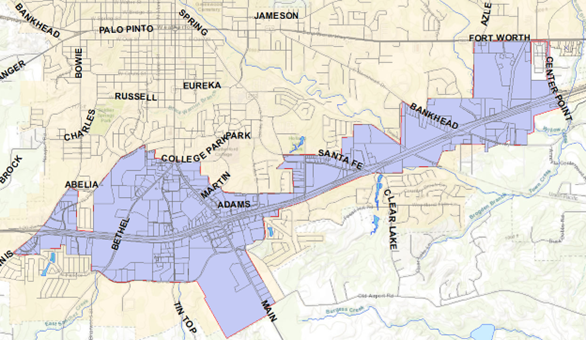
Fig. A.
(Refer to GIS Map at www.WeatherfordTX. gov)
(b)
Applicability.
(1)
New development: Full compliance with this overlay is required on all new commercial buildings and sites constructed within this overlay.
(2)
Enlargements and expansions: Full compliance with this section is required on any enlargement or expansion of the main structure for commercial purposes. Enlargements or expansions must be reviewed and approved by the planning director in accordance with the required review process.
(3)
Facade changes: Full compliance with section (e) (Architectural guidelines), of this section is required when an existing commercial building proposes any facade changes.
(4)
The following uses are not subject to the regulations in this overlay:
a.
One-family dwelling, two-family dwelling, and multifamily dwelling.
b.
Existing model homes utilized for commercial purposes.
(c)
Procedure.
(1)
All commercial development (site plans) shall be approved administratively if they meet the standards in this overlay. All development that does not meet the standards in this overlay may be considered by the city council after a recommendation from the planning and zoning commission.
(d)
Design standards.
(1)
Height regulations.
a.
No structure shall exceed four stories or 70 feet (whichever is shorter).
(2)
Area and yard regulations.
a.
Front yard.
1.
The minimum front yard setback shall be 30 feet along Interstate Highway 20 Frontage Road.
2.
Accessory structures may be permitted in the front yard upon approval of a conditional use permit application.
b.
Side yard.
1.
For corner lots, there shall be a side yard on the street side of the structure of no less than 15 feet.
c.
Size of lot.
1.
The minimum lot area shall be 20,000 square feet.
(3)
Parking.
a.
Placement.
1.
For new development, 25 percent of required parking shall be located behind the front yard setback of all properties within the Corridor Commercial Interstate Overlay. For redevelopment utilizing the existing structure, no new parking should increase the proportion of parking in the front setback.
(4)
Encroachments.
a.
All required yards shall be open to the sky, except for the following permitted encroachments: patio, awning, and porte-cocheres, which may extend into the front yard up to a maximum of six feet or 50 percent of the front yard, whichever is less.
(5)
Building style.
a.
The use of facades as seen in Figure B are encouraged for all new development.

Fig. B. Facade
(e)
Architectural guidelines.
(1)
Design objectives. The architectural design of buildings and sites shall strive to achieve the following objectives:
a.
The primary building entrance shall be readily apparent as a prominent architectural component on the building facade facing the primary street, thus creating a focal point. However, commercial buildings with multiple tenants on the ground floor or multiple primary entrances shall have all entrances treated architecturally.
b.
Primary building entrances are to be defined and articulated with architectural elements such as pediments, columns, porticos, porches, and overhangs.
(2)
Building design.
a.
Building articulation.
1.
Buildings having primary facades wider than 60 feet shall be designed to reduce apparent mass by dividing the primary facade into a series of smaller components. No individual component shall have a length of more than 60 feet. Components shall be distinguished from one another through two or more of the following:
i.
Variations in roof form or variations in roof height or parapet of five feet or more.
ii.
Changes in wall plane of a minimum ten percent in width and a minimum of 24 inches depth.
iii.
Variations in the arrangement and recessing of doors and windows.
b.
Windows and transparency.
1.
At ground level, buildings shall have a high level of transparency. All facades and walls that face any street, pedestrian walkways, or plazas (except rear or side service facades) must have windows for at least 30 percent of the facade between two feet and seven feet above the grade.
2.
For any single use retail establishments 20,000 square feet GFA or larger, or where the internal arrangement of a building makes it impossible to provide transparency along a portion of a wall as determined by the director, a combination of building articulation, changing color or texture to imitate the rhythm of windows or storefront displays may substitute for the required transparency along these facades, except when fronting a plaza or sidewalk café areas.
c.
Roof forms.
1.
General provisions.
i.
Variations in rooflines shall be used to add interest and reduce the scale of large buildings.
ii.
Roof features shall correspond to and denote building elements and functions such as entrances, arcades, canopies, etc.
iii.
They shall also complement the character of the overall development.
2.
Flat roofs.
i.
Unless the director determines otherwise, flat roofs shall include parapets that adhere to articulation requirements for the main facade of the structure in section (e)(2)a. above.
ii.
The average height of the parapet shall not exceed 15 percent of the height of the supporting wall, unless rooftop equipment cannot be sufficiently screened.
iii.
Parapets shall be constructed around the entire building structure.
3.
Sloped roofs.
i.
Pitched roofs shall have a minimum pitch of 4:12 for all structures. This requirement excludes roofs for entries and dormers.
d.
Facade color.
1.
Facade colors shall be low reflectance, subtle, neutral, or earth tone colors. The use of any colors outside of a neutral palate is strongly discouraged unless national trade dress is required.
e.
Lighting.
1.
Building lighting: All outdoor lighting (building and site) shall comply with the existing performance standards as outlined in section 12-4-107 of the title XII Zoning Ordinance.
(f)
Streetscape guidelines.
(1)
General provisions.
a.
All surface parking and service areas located along a public street shall be screened with a three feet high screen made up of one of the following:
1.
A vegetative screen composed of shrubs planted to be opaque at maturity, or
2.
A low wall made up of the same material as the building material, or
3.
A combination of a low wall and vegetative screen
b.
Street screens shall not block any required sight visibility triangles along a cross street or driveway.
c.
Street screens may include breaks to provide pedestrian access from any surface parking or service area to the public sidewalk.
(g)
Signs.
(1)
General provisions.
a.
A shared monument and pole sign is encouraged for redevelopment or revitalization and required for new development. Materials must be consistent with main structures.
(h)
Pre-development meeting.
Prior to submission of a building permit or commencing any exterior work on a building in the Commercial Corridor Interstate Overlay, the owner/applicant shall contact the development services department to schedule a predevelopment meeting to assist the owner/applicant in preparing a complete submittal that complies with all requirements and guidelines herein.
(Ord. No. O2024-22, § 2 (Exh. A.), 6-25-24; Ord. No. O2025-15, § 1, 4-22-25)
Sec. 12-3-500. - "PD" Planned Development.
(a)
Purpose.
(1)
The purpose of the Planned Development (PD) regulations are to encourage flexibility in the use and development of land in order to promote its most appropriate use, to provide a high level of urban amenities, to preserve the quality of the natural environment, and to provide flexibility in the development of land subject to development standards coordinated with the provisions of necessary public services and facilities. This district is a legacy district that is not intended to be added to or expanded. No additional rezoning applications will be considered for rezoning to this district from the adoption of this regulation.
(b)
Pre-application review.
(1)
Prior to making an application to the planning and zoning commission, the application shall be reviewed by the development review committee. There is no fee for this review. DRC review is for the purpose of providing information to the applicant prior to their entering into binding contractual commitments or incurring substantial expense in the preparation of plans, surveys, or other data.
(c)
Application of planned development district provisions.
(1)
An application for a PD district is considered the same as a zoning change and is therefore made to the planning and zoning commission and City Council in the same manner that an application for zoning change is made according to this ordinance.
a.
The application for PD zoning shall be accompanied by a development site plan, the appropriate filing fee, and a list of supplemental development regulations, which will become a part of the amending ordinance and be referenced on the zoning map. Changes in the development site plan or supplemental development regulations shall be considered the same as changes in the zoning map. The proposed application and site plan shall be processed as required except that minor changes, which do not cause any of the following circumstances to occur, may be authorized by the city manager (or their designee):
1.
A five percent or greater increase in the gross floor areas of structures.
2.
Any substantial and material changes in external effects on adjacent property, such as noise, heat, light, glare, and vibration.
3.
A ten percent or greater increase in the height of structures.
4.
A ten percent or greater reduction in the originally approved setbacks from property lines.
5.
A five percent or greater reduction in the ratio of off-street parking and loading space.
6.
A change in the size, height, lighting, flashing, animation, or orientation of originally approved signs, which were approved as part of the PD approval as a sign plan.
b.
The city manager shall prepare a written report analyzing the development site plan which shall be given to the planning and zoning commission and the applicant prior to the public hearing. Upon recommendation for approval by the planning and zoning commission to the city council, the request will be presented to the city council for a first reading and a final reading.
c.
Approval of a PD district shall constitute an amendment to the Zoning Ordinance. Designation of a property as a PD district, in accordance with an approved development plan, shall supersede all existing and prior zoning classifications. Such property shall, for zoning purposes, be identified by the letters "PD" followed by an identifying number assigned by the city manager.
(d)
Design standards.
(1)
All planned development districts shall, at a minimum, satisfy the following standards and requirements:
a.
Uses permitted. The development plan shall specify, both for the project as a whole and/or for subareas within the project, as appropriate, permitted principal and accessory uses, conditional uses, and prohibited uses. The city council may include or exclude uses from the development plan or include uses with attached conditions as appropriate to achieve the intent of these provisions.
1.
In making its determinations of the uses to be permitted within the PD district, city council may consider the compatibility and relationship of uses within the project, the compatibility and relationship of permitted uses adjoining or in proximity to the PD district, the appropriateness of permitted uses for the area in general, their overall impact on the community, and the consistency of the permitted uses with other adopted plans and policies.
b.
Intensity of development. The development plan shall contain provisions to regulate the intensity of development within the PD district. Such provisions may apply to the project as a whole or to subareas within the project, as appropriate.
1.
For non-residential development, the intensity of development may be regulated by:
(i)
Specifying an appropriate floor area ratio(s) (FAR).
(ii)
Specifying maximum square footage or gross leasable area.
(iii)
Specifying setbacks, height, and bulk restrictions.
(iv)
A combination of such restrictions for the project as a whole or for components or subareas within the project.
(2)
For residential development, the density of residential dwelling units within a PD district shall be computed in accordance with a formula identified as part of a development plan. The density formula shall be accompanied by supporting documentation and logic behind the density formula.
(3)
The permitted number of dwelling units may be distributed in any manner over the residential portion of the project consistent with the intent and provisions of this ordinance. The development plan shall specify distribution of residential density for the project as a whole or for subareas within the project as appropriate. In making its determination regarding the distribution of residential densities, the City Council may consider compatibility of residential densities with other uses within the district as well as outside the district, the impact of residential densities on public facilities and services, and the consistency with the master plan, the Comprehensive Plan, and/or other adopted plans and policies.
(4)
Bulk, area, and height requirements. The development plan shall specify bulk, area, and height restrictions for the project as a whole and for subareas and/or components of the project as appropriate. City council may impose alternate or additional standards or restrictions to achieve the intent of this ordinance. In making its determination regarding such standards or restrictions, city council may consider the character and scale of the proposed development as it relates to other uses and structures both within the district and outside the district, the general character and scale of similar developments within the area of the proposal, and the consistency with adopted plans and policies.
(5)
Public facilities. The development plan shall specify conditions, restrictions, and standards relating to the timely provisions of necessary public facilities as appropriate. City council may impose conditions, restrictions, and standards as appropriate to achieve the intent of this title. In making its determination regarding such conditions, restrictions, and standards, city council may consider the adequacy of existing facilities, the timely provision of adequate facilities, and the overall cost to the community.
(6)
Access to public thoroughfares. The development plan shall specify the location and general design of ingress and egress to the project along with access restrictions as appropriate. City council may impose such access standards and restrictions as necessary to protect the integrity and function of the city's thoroughfare system and to otherwise achieve the intent of this title. In making its determination regarding access standards and restriction, city council may consider the classification and function of the thoroughfare system, existing and projected traffic volumes, the condition and design of the affected thoroughfares, the effect of the proposed development on traffic flow and circulation patterns on other adopted plans and policies.
(7)
Off-street parking and loading requirements. Unless specifically modified by the development plan, the off-street parking and loading requirements contained within the zoning regulations shall apply. Reductions in off-street parking and loading standards shall be approved only if it can be demonstrated that parking demand will be less due to density and/or occupancy characteristics of the project and/or the availability of public transportation.
(8)
Signs. Unless specifically modified by the development plan, the sign regulations contained within these zoning regulations shall apply. Modifications to the sign regulations shall be approved only if the general intent to the sign regulations regarding size, location, illumination, structural integrity, and relation to surrounding uses is satisfied.
(9)
Perimeter treatment. The development plan shall specify any special treatment of perimeter areas designed to mitigate the impact of the project upon adjoining properties and/or to achieve an appropriate transition between land uses and densities. City Council may impose those standards and requirements for perimeter treatment if it deems necessary to protect adjoining properties from adverse effects and to achieve an appropriate transition of land uses and densities.
(e)
Application process.
(1)
Procedure. Applications for Planned Development (PD) district designation shall be processed pursuant to a three-step review process as specified in this subsection.
a.
The three-step procedure shall include:
1.
A pre-application conference (development review committee).
2.
A preliminary development plan (planning and zoning commission).
3.
A final development plan (city council).
(2)
Pre-application conference. The pre-application conference is an informal procedure to assist the applicant in meeting various requirements of the city and to provide an early preview of the application.
(3)
Preliminary development plan. Upon satisfying the pre-application conference requirement, an applicant may submit an application to the planning and zoning commission.
a.
The following information shall, at a minimum, be included in the application:
1.
A legal description of the site proposed for PD designation, including a statement regarding present ownership and present zoning.
2.
A master conceptual plan that indicates parcel, tract, or lot locations and dimensions; density per gross and per net acres in the development and in each land use component, if appropriate; the intensity of land use in the development and each land use component, if appropriate; the amount of land in common area open space, recreation use, or public use, if appropriate; and the treatment of project boundaries.
3.
Written text which includes supporting graphics describing the overall concept of the plan; the uses included and any limitations upon uses; building types and prototypical site layouts, if appropriate; provisions for maintenance of common areas; any proposed agreements, dedications, or easements; any proposed private covenants and restrictions; and any other information required by this subsection or pertinent to a determination of compliance with this subsection.
4.
A circulation plan that indicates roads adjoining the property, the location of access from public roads into the project, and vehicular and pedestrian circulation systems within the project. The circulation plan may be included as part of the master conceptual plan.
5.
An improvement plan that indicates water supply and distribution facilities as well as the source of the water supply, wastewater collection, and disposal including method and location of discharge, methods, and facilities for the management of stormwater runoff, improvements to streets and roads, and any other physical improvements required to support the project.
6.
A statistical summary that indicates the number of acres in the project; the number of acres allocated to each land use within the project; the gross and net residential density within the project and within each land use component of the project; and floor area, floor area ratios, open space ratios, and other data relating the intensity of the development to the site size and location.
7.
A parking analysis showing that the total parking demand for uses in the planned development district does not exceed the total supply of available parking spaces.
b.
The following elements are optional at the request of the planning and zoning commission:
1.
A sign plan which indicates the location, size, design, and other pertinent provisions relating to signs within the project.
2.
A parking plan which shows the number of parking spaces as well as their general location and design.
3.
An environmental impact statement indicating possible problem areas within the site and solutions to these problems, as intended by the developer.
(4)
Final development plan. City council, after public hearing and proper notice to all parties affected, and after recommendation from the planning and zoning commission, shall review the planned development zoning request for final approval.

