
Weatherford City Zoning Code
CHAPTER 6
- INTERPRETATION
Sec. 12-6-100. - Definitions.
(a)
Purpose. For the purpose of these regulations, certain terms and words are to be used and interpreted as defined hereinafter. For any term or use not defined herein, Webster's Dictionary (latest edition) shall be used.
(b)
Definitions (in alphabetical order).
A
Accessory dwelling unit. Accessory dwelling units are accessory structures with a kitchen (or kitchenette). Accessory dwelling units permitted as an incidental residential use of a building on the same lot as the main dwelling unit.
Accessory structure. A structure located on the same premise that is customarily incidental, detached, and subordinate in height, size, and area to the primary structure or use.
Accessory use. A use that is customarily incidental, appropriate, and subordinate to the principal use of land or building(s).
Adult arcade. Any place to which the public is permitted or invited, wherein coin-operated, token-operated, or electronic, electrically or mechanically controlled, still or motion picture machines, projectors, or other image-producing devices are maintained to show images to five or fewer persons per machine at any one time, and where the images so displayed are distinguished or characterized by an emphasis on matter depicting or describing specified sexual activities or specified anatomical areas.
Adult bookstore. A commercial establishment which, as one of its business purposes, offers books, magazines, periodicals, other printed matters, or any combination thereof for sale or rental, and for any form of consideration, which are distinguished or characterized by an emphasis on matters depicting or describing specified sexual activities or specified anatomical areas.
Adult cabaret. A nightclub, bar, restaurant, or similar commercial establishment which regularly features persons who appear in a state of nudity or give live performances which are distinguished or characterized by an emphasis on the exposure of specified anatomical areas or by an emphasis on specified sexual activities.
Adult motel. A hotel, motel, or similar commercial establishment which:
(1)
Offers accommodations to the public, for any form of consideration, and provides patrons with closed-circuit television transmissions, films, motion pictures, video cassettes, slides, or other pornographic reproductions which are distinguished or characterized by an emphasis on matters depicting or describing specified sexual activities or specified anatomical areas and has a sign visible from the public right-of-way which advertises the availability of this adult type of photographic reproductions;
(2)
Offers a sleeping room for rent for a period of time that is less than ten hours; or
(3)
Allows a tenant or occupant of a sleeping room to sub-rent the room for a period of time that is less than ten hours.
Adult movie theater. A commercial establishment where films, motion pictures, video cassettes, video reproductions, slides, other visual representations, or any combination thereof, are regularly shown, for any form of consideration, which are distinguished or characterized by an emphasis on matters depicting or describing specified sexual activities or specified anatomical areas.
Adult novelty store. A commercial establishment which ,as one of its business purposes, offers for sale or rental any one or more of the following for any form of consideration:
(1)
Books, magazines, periodicals, other printed matter, photographs, films, motion pictures, videocassettes, video reproductions, slides, objects, or other visual representations which depict or describe specified sexual activities or specified anatomical areas; or
(2)
Instruments, devices, or paraphernalia which are designed or manufactured for use in connection with specified sexual activities. This does not include items used for birth control or for prevention of sexually transmitted diseases.
Adult service establishment. A commercial establishment which offers services or sells products to customers and in which one or more of the employees or the customer appears in a state of nudity or simulated nudity.
Adult video store. A commercial establishment which, as one of its business purposes, offers for sale or rental photographs, films, motion pictures, video cassettes, video reproductions, slides, other visual representations, or any combination thereof, for any form of consideration, which are distinguished or characterized by an emphasis on matters depicting or describing specified sexual activities or specified anatomical areas.
Agricultural product processing. Uses involving the physical manipulation of agricultural plant or animal products for packaging, preservation, sale, storage, transport, or other consumer or industrial uses. May occur on or away from the production site. Does not include slaughterhouses.
Alley. A public or private right-of-way primarily designed to serve as secondary access roadway to the side or rear of those properties whose principal frontage is on some other street.
Alter; alters; alteration. Any act which causes or may reasonably be expected to cause a tree to die. Alteration includes, but is not limited to, damage inflicted up the tree's root system by machinery, storage of materials, or the compaction of soil above the root system of a tree; a change in the natural grade above the root system of a tree; an application of herbicidal or other lethal chemicals; excessive pruning; placement of non-permeable pavement over the root system of a tree; and trenching within the critical root zone. A tree shall be considered to be altered if less than 75 percent of the critical root zone is maintained at undisturbed natural grade, or more than 25 percent of the canopy is removed, or the tree is disfigured to the extent that its survival is threatened.
Alternative financial institution. An establishment such as a payday advance/loan business or a motor vehicle title loan business, that makes or arranges small, short-term consumer loans typically backed by postdated check or the title to a motor vehicle as collateral. Does not include state or federally chartered banks, community development financial institutions, savings and loans, credit unions, or regulated lenders licensed in accordance with V.T.C.A. Finance Code, Ch. 342, except when any such institution also offers services as a 'credit service organization' and/or a 'credit access business' under V.T.C.A. Finance Code, Ch. 393, in which case that business is an alternative financial institution.
Alternative wellness product establishment. A retail establishment that offers for sale any form of the following: Cannabidiol (CBD), E-cigarette, Hemp, Cannabis, and/or similar products and accessories. This does not include an establishment that meets the following criteria: (a) less than ten percent of the establishment's displayed merchandise consists of said items; and (b) the establishment maintains less than 30 square feet of its floor space for the sale and storage of said items.
Amusement, commercial - indoor. Uses involving commercial, recreational activities contained entirely or mostly inside one or more buildings. Includes arcades, archery or gun ranges (indoor), art galleries, billiards halls, bowling alleys, museums, and theaters for motion pictures or performing arts. Does not include uses which are customarily accessory to household living, such as backyard or common area amenities, or uses categorized as government use.
Amusement, commercial - outdoor. Uses involving commercial, recreational activities with a significant outdoor component. Includes amusement parks, archery or gun ranges (outdoor), miniature golf courses, theme or water parks, and zoos. Does not include temporary amusement uses, such as carnivals, fairs, and haunted houses, which are permitted only by special event permit. Does not include uses which are customarily accessory to household living, such as backyard or common area amenities, or uses categorized as government use.
Antenna. The arrangement of wires or metal rods used in transmission, retransmission, and/or reception of radio, television, electromagnetic, or microwave signals (including microwave reflectors/antennae).
(1)
Commercial: An antenna or antenna support structure used for the purpose of transmission, retransmission, and/or reception of radio, television, electromagnetic, or microwave signals primarily for the purpose of operating a business and/or for financial gain (commercial broadcasting, cellular/wireless telecommunications, etc.). A satellite dish antenna that exceeds six feet in diameter shall also be considered as a commercial antenna.
(2)
Non-commercial/amateur: An antenna or antenna support structure used for the purpose of transmission, retransmission, and/or reception of radio, television, electromagnetic, or microwave signals for private or personal use and not for the purpose of operating a business and/or for financial gain. A satellite dish antenna not exceeding six feet in diameter shall also be considered as a non-commercial antenna.
Antenna support structure. An antenna support structure is any tower, mast, pole, tripod, box frame, or other structure utilized for the purpose of supporting one or more antennae or microwave reflectors.
Antenna, temporary or mobile. An antenna and any associated support structure/equipment (including, but not limited to, a support pole, a vehicle, etc.) that is placed and/or used on a temporary basis only, usually in conjunction with a special event, news coverage, or emergency situation, or in case of equipment failure or temporary augmentation of permanent communications equipment.
Applicant. The owner of record of a property, the agent or lessee thereof, or a person holding a bona fide contract to purchase the property with approval of the property owner (or their authorized representative(s), who requests action under the provisions of this title.
Arborist. A person certified by the International Society of Arboriculture as a certified arborist.
Artisan manufacturing/small-scale production. Uses involving the assembly, manufacture, packaging, processing, or treatment of finished or semi-finished products or components, typically from previously prepared materials or components. Activities are storage are generally contained entirely within a building less than 5,000 square feet and do not have adverse impacts (such as noise, odor, glare, or vibration) on neighboring properties or involve the use of hazardous materials.
Assisted living/nursing facility. An establishment that furnishes, in one or more facilities, food and shelter to four or more persons who are unrelated to the proprietor of the establishment and provides personal care services.
Auto (automobile). A single vehicle or combination of vehicles that do not require a class A or B driver license to operate. For purposes of this title, autos and the auto-related uses below do not include vehicles requiring a class A or B driver license to operate; such vehicles and their related uses are classified as trucks or truck-related uses.
Auto accessories/auto parts store. Uses involving the retail sale of aftermarket auto accessories and parts. Installation is customarily completed by the purchaser at home or onsite while the purchaser waits. Examples of accessories or parts sold in this category include alarms, batteries, bumpers, filters, lights, motor oil and related accessories, pickup liners, pickup bed caps, stereos, tires, wheels, and windshield wipers. Does not include uses categorized as auto repair or auto quick lube/oil change/state vehicle inspection.
Auto quick lube/oil change/state vehicle inspection. Uses involving the primary activities of oil change and state vehicle inspections. Customary accessory uses are preventative maintenance activities such as the changing of fluids, filters, or lights. Does not include uses categorized as auto accessories/auto parts store or auto repair.
Auto rental. Uses involving the short-term rental of cars, motorcycles, and other vehicles that do not require a class A or B driver license to operate. Customary accessory uses include office and auto repair.
Auto repair. Uses involving the servicing or maintenance of autos. Examples of work performed include body, brakes, engines, glass, paint, transmissions, and upholstery. Does not include uses categorized as auto accessories/auto parts store or quick lube/oil change/state vehicle inspection.
Auto sales and service. Uses involving the sale or lease of autos, motorcycles, and other vehicles that do not require a class A or B driver license to operate. Customary accessory uses include office and auto repair.
Auto wash. Uses involving the automatic, self-service, or full-service interior and exterior washing, cleaning, and detailing of autos. Subject to supplemental use standards specified by zoning district.
B
Bed and breakfast inn. A single-family dwelling also engaged in providing overnight or otherwise short-term lodging for guests. A bed and breakfast may provide meals to guests but is not a full-service restaurant open to the general public.
Block. A unit of land bounded by streets or by a combination of street right-of-way and public lands, railroad right-of-way, shorelines of waterways, or boundary lines of municipalities that typically contains individual lots.
Block sale. The term means an informal, irregularly scheduled event for the sale of used goods by private individuals, in which "block sales" or a number of garage sales are allowed within the same street block so that sellers are not required to obtain business licenses or collect sales tax. A block sale as defined will have to comply with the requirements of a garage unless a special event permit is obtained from the city.
Boarding/rooming house. A single-family dwelling where two or more rooms are provided for lodging in exchange for compensation to separate tenants or groups of tenants for terms of 30 or more days. Meals may or may not be provided, but no meals are provided to outside guests.
Brewpub. A combination retail, wholesale, and manufacturing business that brews and serves beer and/or food.
Building. Any structure used or intended for supporting or sheltering any use or occupancy
Building line. A line beyond which a building shall not extend, except as specifically provided by law. Typically established by plat. Distinguished from, and may supersede, required yards and other setback lines established by this ordinance.
Building, main or primary A building or buildings in which the principal use of the lot on which it is situated is conducted. In a residential district, a dwelling shall be deemed to be a main building on the lot on which it is situated. Where two dwellings exist on one lot, the building in which the largest dwelling is situated is the primary building Where three or more dwellings exist on one lot, all buildings in which dwellings are situated are considered primary buildings.
Building official. The officer or other designated authority (or their designee) charged with the administration and enforcement of the building code.
Building pad. The actual foundation area of a building and a reasonable area not to exceed six feet around the foundation necessary for construction and grade transitions.
Building permit. Written authorization as required by the current building code, issued by the building official for the erection, construction, reconstruction, alteration, repair, conversion, demolition, moving, or maintenance of any building, structure, or improvement to a given lot or tract of land or portion thereof, and which allows construction to proceed in accordance with construction documents approved by the building official.
C
Caliper. A measure, or a tool for measuring, of the size of a tree. For purposes of this title, caliper size shall be the diameter at breast height (DBH) as defined below.
Cannabidiol (CBD). Substance derived from the cannabis plant that does not have the psychoactive properties tetrahydrocannabinol (THC) does.
Canopy. The area above ground which is covered by the trunk, branches, and foliage of a tree or stand of trees' crowns.
Carport A structure that is open on a minimum of two sides and designed or used to shelter vehicles. Carports are not included in the definition of structured or garage parking.
Cemetery or mausoleum. A place that is used or intended to be used for interment and that includes a graveyard, burial park, or mausoleum
Certificate of occupancy. An official certificate issued by the city through the building official which indicates conformance with the zoning regulations and building codes and which authorizes legal use of the premises for which it is issued.
City. The City of Weatherford, Texas, its governing body, administrative departments, or officials designated to carry out the responsibilities of this title.
City council. The governing body of the city.
City engineer. The city official appointed to review and make recommendations or determinations with regard to the provision of public facilities and management of the flood plain.
City manager. The city manager of the city or their designee.
Comprehensive (general) plan. A plan prepared and adopted by the city council, and including any part of such plan separately adopted and any amendment to such plan, or parts thereof, setting forth goals, policies, and guidelines intended to direct the present and future development of the city.
Conditioned space. A space within a building that is heated or cooled, or both, to the standards set forth in applicable building codes.
Continuing care facility. A place in which a person provides continuing care to an individual.
Contractor office/facility. A firm or individual that completes commercial or residential construction projects on a contractual basis. Contractors include land developers, general contractors and sub-contractors engaged in trades such as plumbing, HVAC, electrical, mechanical, structural, extermination, security systems, janitorial, and the like. Offices typically provide consultation or design services and may include small retail sales. Storage of materials and vehicles are defined in zoning districts.
Critical root zone. The area of undisturbed natural soil around a tree defined by a circle extending from the root flare at ground level with a radius equal to one foot for every one inch DBH.
Customer. Any person who:
(1)
Is allowed to enter a business in return for the payment of an admission fee or any other form of consideration or gratuity; or
(2)
Enters a business and purchases, rents, or otherwise partakes of any merchandise, goods, entertainment, or other services offered therein; or
(3)
Is a member of and on the premises of a business operating as a private club.
D
Detached. Having no physical connection with any other building or structure.
Development. Any human-initiated change to improved or unimproved real estate, including, but not limited to, new construction or the enlargement of any exterior dimension of a building or other structure, and the installation of any type of site improvement, including offsite features, such as street median openings and clearing of vegetation, but not including bona fide agricultural activities. When used as a noun within this ordinance, the term "development" shall be construed to also include subdivisions, redevelopments, and land disturbing activities.
Development impact area. Area on a site or right-of-way associated with a site affected by any and all site or right-of-way improvements, including, but not limited to, buildings, structures, walls, parking and loading areas, street improvements, paved and graveled areas, utilities, irrigation, equipment storage, construction parking, storm water management, and landscaping. The development impact area also refers to areas of grading (cutting or filling), stockpiling, demolition, tree removal, trenching, boring, and any other activities that require excavation or soil disturbance
Diameter at breast height (DBH). The diameter of the trunk of a tree measured four and one-half feet above mean ground level at the base of the trunk. If the tree splits into multiple trunks below four and one-half feet, the DBH is the sum of the diameter of each trunk measured four and one-half feet above mean ground level. If the tree has excessive swelling at four and one-half feet, the DBH is the diameter of the narrowest point beneath the swelling.
Distribution center. A facility where freight is unloaded from interstate trucks and/or intermodal containers and loaded onto local or regional delivery vehicles. May include facilities for the temporary storage of loads prior to shipment. Includes uses such as motor freight transportation center, freight storage, truck depot, and truck terminal.
Domestic animal services. Uses and facilities involving the boarding, care, or training of domestic animals. Activities may be contained entirely indoors or include an outdoor component, as allowed by zoning district. Examples include doggy day care, overnight boarding, pet grooming, pet training, and veterinary clinics. Does not include uses pertaining to livestock or large animals or retail pet stores.
Drinking establishment. A retail business that serves alcoholic beverages for on-premise consumption.
Drip line. Whichever is greater of:
(1)
a vertical line run through the outermost portion of the canopy of a tree and extending to the ground, or
(2)
if the tree is damaged or deformed, a circular area with a radius of one-half the height of the tree extending outward from the tree.
Dwelling. Any building or portion thereof, which is designed or used exclusively for residential purposes.
Dwelling, multifamily. A building or portion of a building having suitable accommodations for three or more families, living independently of each other, who may or may not have joint uses of utilities, halls, yards, etc. This term includes premises occupied more or less permanently for residential purposes in which rooms are occupied in apartments, suites, or groups, such as apartment buildings and other dwellings similarly occupied.
Dwelling, one-family. A detached building used exclusively for residential purposes having suitable accommodations for only one family.
Dwelling, two-family. A detached building used exclusively for residential purposes and designed for or occupied by two families living independently of each other. Also known as a duplex.
E
E-cigarette. Any device or delivery system sold in combination with nicotine which can be used to deliver to a person nicotine in aerosolized or vaporized form, including, but not limited to, an e-cigarette, e-cigar, e-pipe, vape pen, or e-hookah [including] any component, part, or accessory of such a device that is used during the operation of the device when sold in combination with any liquid or substance containing nicotine [and also includes] any liquid or substance containing nicotine, whether sold separately or sold in combination with any device that could be used to deliver to a person nicotine in aerosolized or vaporized form.
Easement. A grant by a property owner to the public, a corporation, or persons, of the use of designated land area for specific purposes, such as access of persons, utilities or services within which the owner of the property shall not erect any permanent structures.
Electric vehicle charging station. Any level 2 or direct-current fast charging station that supplies electricity from an external source to charge an electric vehicle and is accessible for public or commercial use. This excludes charging stations located on private property that are solely for personal use.
Employee. Any person who renders any service whatsoever to the customers of a business or who works in or about a business and who receives compensation for such service or work from the operator or owner of the business or from its customers.
Escort. A person who agrees or offers to act as a companion or date for another person or who agrees or offers to privately model lingerie or to privately perform a striptease for another person, for any form of consideration.
Escort agency. A person or business association who, as one of its principal business purposes, furnishes, offers to furnish, or advertises to furnish escorts, or any combination thereof, for a fee, tip, or other consideration.
Estate sale. The term means an informal, irregularly scheduled event for the sale of the used goods of an estate of a deceased person or persons. An estate sale as defined will have to comply with the requirements of a garage sale permit. A professional auctioneer or firm that specializes in estate sales may also be used.
F
Fall zone. An area surrounding a proposed wind energy system or wireless communications tower, circular in shape, with a radius equal to the height of the tower.
Family. One or more persons related by blood, marriage, or adoption; or a group not to exceed four persons not all related by blood or marriage, adoption or guardianship, occupying a dwelling unit.
Family home. A home that provides regular care in the caretaker's own residence for not more than six children under 14 years of age, excluding children who are related to the caretaker, and that provides care after school hours for not more than six additional elementary school children, but the total number of children, including children who are related to the caretaker, does not exceed 12 at any given time. The term does not include a home that provides care exclusively for any number of children who are related to the caretaker.
Financial institution. An establishment, open to the public, for the deposit, custody, loan, exchange or issue of money, the extension of credit, and/or facilitating the transmission of funds and that is licensed by the appropriate state or federal agency as a bank, savings and loan association, or credit union. Onsite, drive-thru or walkup ATMs are customary accessory uses. Does not include alternative financial institutions, bail bonds, pawn shops, or regulated lenders licensed in accordance with Chapter 342 of the Texas Finance Code that also offer services as credit access businesses under Chapter 393 of the Texas Finance Code.
Flood plain tree. Any tree within an area identified as flood plain on the City of Weatherford's Interactive Web Map, unless a flood study is provided for a site, in which case the latter will determine the boundaries of the flood plain.
Food truck (also known as mobile food unit). A mobile vending unit equipped with facilities to store, prepare, display, serve, or sell food including, but not limited to, trucks, trailers, and push carts. A mobile food unit does not include a stand or a booth. The terms food truck and mobile food unit shall be interchangeable.
Forester. A person certified by the Society of American Foresters as a certified forester.
Fueling station. A full or self-service filling station which sells fuel for use in on or off-road passenger vehicles, light trucks, and other class B and C rated motor vehicles. Fuel stations may be capable of selling a variety of fuel sources including gasoline, diesel, compressed natural gas, and the like. Customary accessory uses subordinate to a fueling station may include convenience or c-store.
G
Garage sale. The term means the offer or sale of personal property open to the public, conducted from or on a premise in any residential zone, typically in the garage, carport, driveway, yard, or porch of the home of the seller. The term "garage sale" includes, but is not limited to, all sales advertised as or called yard sale, lawn sale, porch sale, attic sale, patio sale, estate sale, moving sale, flea market (unless otherwise permitted in a commercial or industrial district), rummage sale or various other sales where personal property is sold. Lemonade stands and the like are exempt from the requirements of this ordinance.
General retail. Uses involving the sale of consumer products or services to customers who make one or more visit to the business for each transaction. Merchandise and services are predominantly contained indoors within a conditioned space with the exception of limited outdoor display during business hours as allowed by zoning district. Examples of consumer products in this category include antiques, art and office supplies, bicycles, cards and gifts, clothing, convenience goods, electronics, fabric, flowers, groceries, hardware, household goods, jewelry, media, pets, pharmaceuticals, small appliances, and stationary and other printed materials. Examples of consumer services in this category include art and craft schools, banks or financial institutions, barber/beauty shops, copy or print shops, dry cleaners, laundromats, locksmiths, pet grooming, photography studios, shoe repair, and travel agencies. General retail does not include any uses requiring a significant outdoor display or storage component, fueling stations with or without a retail component, or other uses listed separately in this title.
Grading. Generally described as any stripping, cutting, filling, or stockpiling of earth or land or combination thereof; or any leveling to a smooth horizontal or sloping surface on a property; to create new grades. Specifically, the city defines grading in the following types:
(1)
Excavation. The mechanical removal of earth material for the installation or improvement of public infrastructure within an easement or public right-of-way.
(2)
Preliminary grading or grubbing. The clearance of shrubs, grasses, or natural vegetation not exceeding six inches in solid depth and not to exceed one acre in area.
(3)
Final grading. Any land disturbing activity as generally defined above impacting one acre or more, or a soil disturbing activity greater than 5,000 square feet or that alters drainage patterns as part of a commercial or residential development.
H
Hanging sign. Any sign suspended from a canopy above a sidewalk or suspended from a bracket attached to the face of a building.
Hazard tree.
(1)
Any tree or tree part that poses an imminent or immediate threat to persons or property requiring immediate remedial action up to and including removal.
(2)
Any tree or tree part that has been determined to be hazardous by a certified arborist or certified forester.
Hazard tree abatement. The process of eliminating a hazard caused by a hazard tree through pruning, removal, or other means in a manner that complies with all applicable rules and procedures.
Hazard tree owner. The property owner or responsible party of the land from which a hazard tree originates. A responsible party includes a person, persons, or entity who:
(1)
Owns the hazard tree;
(2)
Is the entity or person acting as agent of the owner and is responsible for the hazard tree's maintenance or management;
(3)
Is any person occupying the property with the hazard tree, including lessee or tenant; or
(4)
Is the person who is alleged to have committed the act(s) or omission(s) resulting in the hazard tree or who allowed the hazard tree to exist on the property.
Heavy industrial. Uses involving the assembly, manufacture, packaging, processing, or treatment of finished or semi-finished products or components, typically from raw materials. Activities and storage are generally contained within one or more buildings but may have a significant outdoor component. Heavy industrial uses are distinguished from light industrial uses by the presence of adverse impacts (such as noise, odor, glare, or vibration) on neighboring properties and/or the presence of hazardous materials or waste.
Heavy load vehicle. A self-propelled vehicle having a manufacturer's recommended gross vehicle weight (GVW) of greater than 16,000 pounds, including trailers. The term "truck" shall be construed to mean "heavy load vehicle," unless specifically stated otherwise.
Height. Measured from existing grade to the highest point of the structure, except for features such as chimney, flues, and stacks or similar roof components.
Hemp. A plant or plant material that includes the plant Cannabis sativa L. and any part of that plant, including the seeds of the plant and all derivatives, extracts, cannabinoids, isomers, acids, salts, and salts on isomers, whether growing or not, with a delta-9 tetrahydrocannabinol concentration of not more than 0.3 percent on a dry weight basis.
Heritage tree.
(1)
A tree with a DBH of 20 inches or greater, which is of a species native or adapted to North Central Texas, as identified by the Texas SmartScape plant database.
(2)
Any tree or stand of trees of landmark importance due to age, size, species, horticultural quality, or historic significance that has been designated through the Heritage Tree Designation Procedure in the Landscape and Tree Manual.
Home occupation. An occupation carried on in a dwelling unit, or in an accessory building to a dwelling unit, by a resident of the premises, which occupation is clearly incidental and secondary to the use of the premises for residential purposes.
Hospice. A business or organization licensed to provide hospice services, including a person who owns or operates a residential unit or an inpatient unit.
Hotel/motel. A building containing guest rooms, rented for less than 30 days, and designed to be used for sleeping purposes, which provides a common entrance, lobby, halls, and stairways.
Household living. The residential occupancy of a dwelling unit by related or unrelated individuals, subject to the limitations on occupancy specified within applicable building codes. Does not include assisted living/nursing facilities, childcare homes, community homes, group homes, hotels/motels, registered family homes, rehabilitation care facilities/halfway houses, or short-term rentals.
I
Itinerant vendor. Any person, firm, corporation or other entity, including any agents or employees of any person, firm, corporation or other entity, who engages in the temporary business of selling, offering to sell or soliciting orders for goods or services of any kind from a fixed location on private property within the corporate limits of the City of Weatherford, Texas. Itinerant venders do not include peddlers or solicitors, which are regulated under separate title.
J
K
Kiosk. A small, freestanding structure or other installation used for business purposes such as vending or receiving goods, providing services, or displaying information. A kiosk may be manned or unmanned. Examples include ice and water vending machines, receptables for clothing or other goods, standalone ATMs, and food or beverage booths. Kiosks do not include ATMs associated with an onsite bank, food trucks regulated elsewhere in this title, and vending machines within the permitted outside display limits specified in this title.
L
Landscape. Any planting or planted area preserved, installed, or maintained as required by the landscaping provisions of this title.
Landscape, L1. Supplemental landscape, which may include such treatments as approved L2 ground cover or shrubs, lawn, mulch, bark, decorative rock, outdoor furniture, art installations, and other landscape or hardscape features, and which present a finished, orderly appearance and reasonably complete coverage of the landscape area.
Landscape, L2. Shrubs and ornamental ground covers selected from the evergreen shrub, perennial or seasonal flowering plant, or ornamental grass species on the Preferred Plant List in the Landscape and Tree Manual. Shrubs include woody plant material smaller than a tree with several stems rising at or near the ground, installed for buffering, aesthetic, or other purposes. Ornamental ground covers include low growing, spreading plants, ornamental grasses covering open soil for aesthetic, storm water management, or other purposes.
Landscape, L3. Trees, installed for shade, buffering, aesthetic, or other purposes, provided in appropriate quantity and proportion as required, and selected from among the canopy trees in the Preferred Plant List provided in the Landscape and Tree Manual.
Licensee. A person in whose name a license to operate a sexually oriented business has been issued, as well as any and all individuals listed as applicants on the application for a license.
Light industrial. Uses involving the assembly, manufacture, packaging, processing, or treatment of finished or semi-finished products or components, typically from previously prepared materials or components. Activities and storage are generally contained within a building greater than 2,000 square feet and may have impacts (such as occasional noise, odor, glare, or vibration) which are generally inoffensive to neighboring properties. Light industrial uses do not involve the use of hazardous materials.
Light load vehicle. A self-propelled vehicle having a manufacturer's recommended gross vehicle weight (GVW) not greater than 16,000 pounds and having no more than two axles.
Liquor Store. A building or premises where the primary use is the retail sale of vinous (wine) or spiritous alcoholic beverages for off-premises consumption.
Livestock and large animal services. Uses and facilities involving the boarding, care, or training of livestock or other large animals. Activities may be indoors or outdoors. Examples include commercial stables, horse grooming or training, riding academies, and veterinary clinics for livestock and large animals.
Lot. A platted parcel of land that is occupied or intended to be occupied by one main building, or a group of main buildings, and any accessory building(s) having principal frontage upon a public street and including parking, landscaping, and open space, as are required by this ordinance.
Lot area. The total area, measured on a horizontal plane, included within lot lines.
Lot, corner. A lot which has at least two adjacent sides abutting for their full lengths upon a street, provided that the interior angle at the intersection of such two sides is less than 135 degrees.
Lot depth. The mean horizontal distance between the front and rear lot lines
Lot, double frontage. A lot having frontage upon two non-intersecting streets, as distinguished from a corner lot.
Lot, flag. A lot having access to a street by means of a parcel of land generally having a depth greater than its frontage, but not less than 35 feet. Flag or panhandle lots are typically discouraged.
Lot, interior. A lot other than a corner lot.
Lot frontage. That dimension of a lot or portion of a lot abutting onto a street, excluding the side dimension of a corner lot.
Lot width. The horizontal distance measured between side lot lines parallel to the front lot line and measured from the point on the building line that is closest to the front lot line.
M
Manager. Any person who:
(1)
Supervises, directs, or manages any employee of a business; or
(2)
Is charged by the licensee, owner, or operator with directly supervising the operation of the business and with monitoring and observing all areas of the enterprise to which customers are admitted at all times during which the enterprise is open for business or customers are on the premises.
Manufactured home. A structure that:
(1)
was constructed on or after June 15, 1976, according to the rules of the United States Department of Housing and Urban Development;
(2)
was built on a permanent chassis;
(3)
was designed for use as a dwelling with or without a permanent foundation when the structure is connected to the required utilities;
(4)
is transportable in one or more sections;
(5)
includes the plumbing, heating, air conditioning, and electrical systems of the home; and
(6)
does not include a recreational vehicle.
Market, open air. Uses involving the sale of goods by one or more vendors predominantly or solely in an open-air setting. The market may be covered and/or partially enclosed but is not contained predominantly within a conditioned building. Examples include permanent art and craft bazaars, farmers markets, and flea markets. Open air markets do not include limited outdoor or partially enclosed display or storage areas that are clearly incidental and accessory to general retail and that do not exceed the limits provided elsewhere in this title, or special events regulated elsewhere in the Weatherford Municipal Code.
Medical office. Uses involving outpatient, by-appointment healthcare to humans by a licensed professional or group of licensed professionals in an office setting. Examples include counseling, dental, and medical clinics. Medical offices do not include ambulance services, emergency care facilities, emergency medical services, hospitals, urgent care centers, or veterinary offices.
Mixed use building. A building that combines the mixed use of commercial and residential within a single structure.
Mobile home. A structure that:
(1)
was constructed before June 15, 1976;
(2)
was built on a permanent chassis;
(3)
was designed for use as a dwelling with or without a permanent foundation when the structure is connected to the required utilities;
(4)
is transportable in one or more sections.
Mobile vending unit. A motor vehicle or vehicle-mounted unit — licensed, insured, and operable for transport on public streets — engaged in the temporary business of selling, offering to sell, or soliciting orders for goods or services of any kind
Modular home or structure. A home or structure that is modular in nature and may be partially or completely fabricated off site designed and constructed to the currently adopted building code of the city placed on a site upon a permanent foundation, to be used for residential, commercial, educational, or industrial purposes.
Motor vehicle. Any vehicle designed to carry one or more persons which is propelled or drawn by mechanical power, such as automobiles, vans, trucks, motorcycles, and buses.
N
Nude modeling studio. Any place where a person who appears in a state of nudity or displays specified anatomical areas is provided or allowed to be observed, sketched, drawn, painted, sculptured, photographed, or similarly depicted by other persons who pay money or any form of consideration.
Nudity or state of nudity. Less than completely and opaquely covered:
(1)
Human genitals, pubic region, or pubic hair;
(2)
All portions of a female breast below a point immediately above the top of the areola continuing downward to the lowest portion of the breast;
(3)
Human buttock; or
(4)
Any combination of the above.
Nuisance tree. Any tree included on the Nuisance Tree List in the Landscape and Tree Manual.
Nursery industry standards. Generally accepted industry standards for plant materials detailed in the most current version of the American Standard for Nursery Stock. In addition, nursery industry standards shall include adherence to all applicable regulations and administrative rules for the selection and planting of any plant materials to meet the requirements of this title.
O
Occupancy. The use or intended use of land or buildings by proprietors or tenants.
Office. Uses involving professional, clerical, or technical work performed in an office setting. Office uses are not typically consumer-oriented except by appointment. Examples include call centers, consultants, design firms, financial services, insurance sales, legal services, media headquarters and studios, real estate sales, software development companies.
Open grown tree. Any tree that has grown and established without significant competition from other trees for light, space, and nutrients (i.e., any tree that is not a stand grown tree).
Operated or causes to be operated. To cause to function or to put or keep in operation. A person may be found to be operating or causing to be operated a business establishment or other use whether or not that person is an owner, part owner, licensee, or manager of the establishment or use.
Over speed controls. Mechanisms to limit the speed of the blade rotation on a wind energy system.
P
Parcel. Any unplatted tract of land or any portion of an unplatted tract of land (also see "Tract").
Park/playground. An area of land set aside for public or private use as a piece of land with few or no buildings that is maintained for recreational and ornamental purposes.
Park tree. Any tree, shrub, or other woody vegetation in a public park or other areas owned by or under the management of the City of Weatherford to which the public has free access as a park.
Parking lot tree. Any tree used to meet the requirements for parking lot landscaping.
Parsonage. A residence or residences allowed as accessory dwelling unit or units on the same lot as a religious institution. Temporary, mobile, or manufactured dwellings are not considered a parsonage.
Person. An individual, firm, association, organization, partnership, trust, foundation, company, or corporation.
Planning director. Director of development services or other person appointed by the city manager to administer the provisions of this title. Unless otherwise indicated, references to the planning director also include staff designated by the planning director to carry out the responsibilities stated herein.
Plaque sign. Any sign constructed of cast or stamped metal, measuring less than 4 square feet in area, and installed flush against a building, typically for purposes of building identification.
Preferred tree. Any tree included on the Preferred Plant List in the Landscape and Tree Manual.
Premises. Land together with any buildings or structures situated thereon.
Primary sign. Any sign designed to be visible to automobile traffic or distant pedestrian traffic. Freestanding signs, wall signs, canopy signs, and awning signs are all primary signs.
Protection fencing. Fencing placed to meet the Tree Protection Standards in the Landscape and Tree Manual.
Public right-of-way. Land in which title is held in the name of government entity, or which is dedicated for public ownership, on which public facilities, including streets, sidewalks, pathways or utilities may be located, and which generally lies between property lines on either side of such facilities. For purposes of landscape and tree related regulations and administrative rules, public right-of-way includes public access easements established for the benefit of the City of Weatherford.
Q
R
Recreational vehicle (RV). A vehicular type unit primarily designed as temporary living quarters for recreational, camping, or travel use, which either has its own motive power or is mounted on or drawn by another vehicle. Recreational vehicles are not an authorized residence within the city.
Regularly. Featuring, promoting, or advertising a happening or occurrence on a recurring basis.
Religious institution. A facility providing meeting space that is primarily used for religious worship. Examples include churches, temples, synagogues, mosques, and other places of worship. Accessory uses may include offices, classrooms, daycare, parking, social halls, indoor and outdoor recreation, and a rectory or parsonage.
Residential use. Any use of a dwelling or dwellings for household living.
Retail. Firms involve in the sale, leasing, and rental of new or used products to the general public. (examples include apparel shops, electronic goods, household products, and pharmacies)
S
Salvage facility, commercial. Uses involving the buying, selling, reclamation, storage, or processing of discarded materials. The discarded materials found in a salvage facility are typically junked, wrecked, scrapped, or dismantled and may include autos, auto parts, equipment, metal, paper, rubber, trash, or other debris. A salvage facility typically requires a large outside component but may also include one or more buildings for storage, processing, or offices. Commercial salvage facilities do not include landfills or government uses.
Screening. Any wall, fence, or other built feature, or any berm, trees, or shrubs densely planted so as to form a hedge or living wall, or any approved combination thereof, which effectively restricts the view and/or access between adjoining areas in accordance with all applicable standards in the Landscape and Tree Manual.
Screening, S1. A screen installed for limited sight-obstruction or access control purposes. S1 screening is achieved with shrubs, landscape berm, or other plants to a minimum height of three feet zero inches, except that screening around parking lots in streetscape areas may be a masonry wall with a height of three feet zero inches to four feet zero inches in height consistent with the architecture of the main building or within a coherent hardscape theme.
Screening, S2. A screen installed to eliminate clear sight lines between areas with minimal breaks where necessary for controlled access and to maintain required visibility triangles. S2 screening is achieved with a berm or fencing such as wood, masonry, or other materials as approved by the planning director, along with evergreen shrubs densely planted so as to form a solid hedge or living wall
Screening, S3. A screen installed to eliminate clear sight lines to any mechanical equipment, trash bins, loading areas, or storage areas on all sides. S3 screening is a solid plane which is architecturally consistent with the structure on or adjacent to which it is installed.
Seasonal outdoor sales. Includes pumpkin patches, tree lots, haunted houses, produce stands, holiday sales and the like.
Secondary sign. Any sign designed to be visible principally to passersby or pedestrian traffic within the same block. Plaque signs, projecting signs, hanging signs, window display signs, and sandwich board signs are all secondary signs.
Setback. The minimum required horizontal distance between the outside wall of any structure and the lot lines of the lot on which it is located (see figure below).
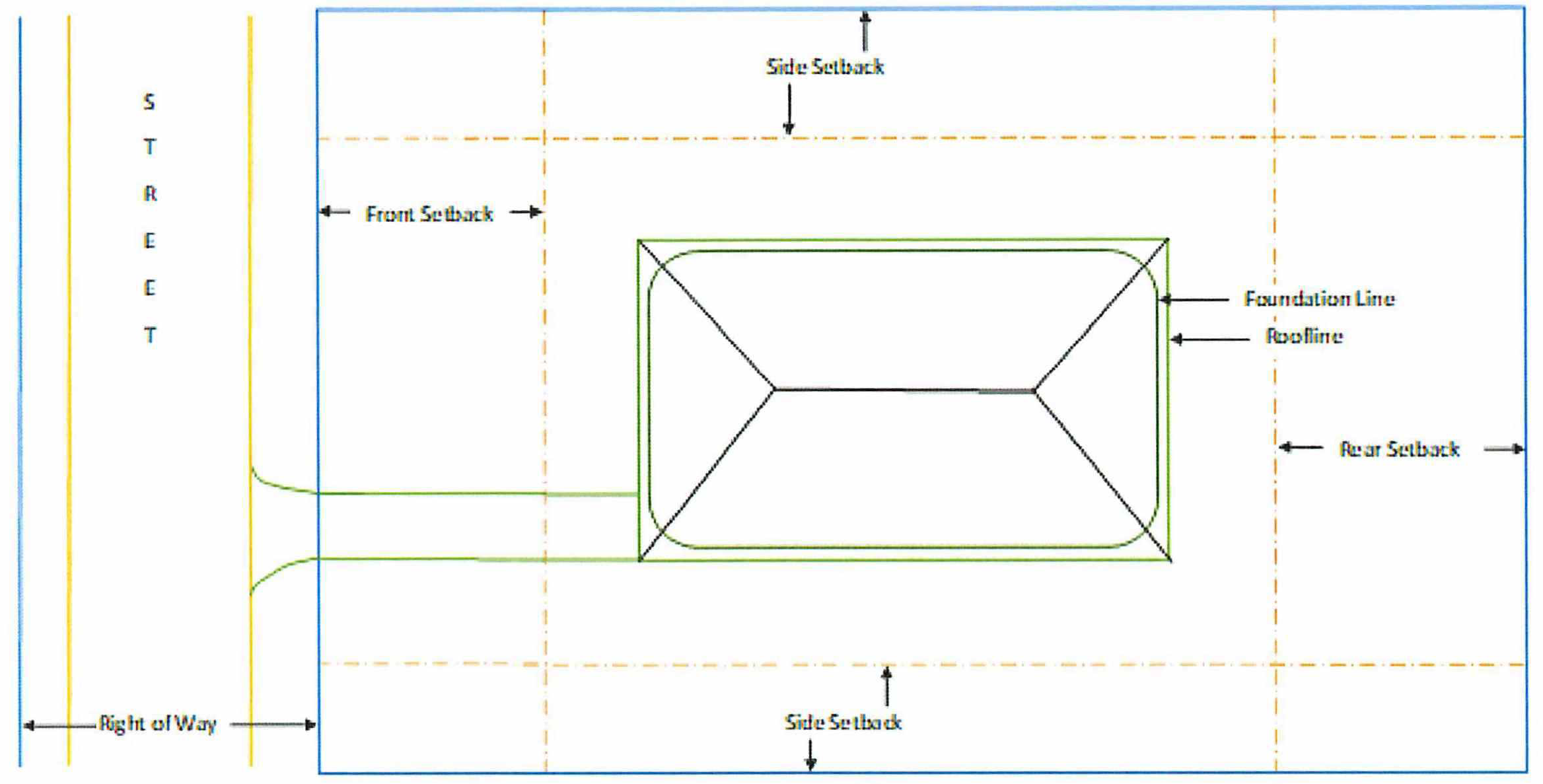
Figure I. Minimum Setback Distance.
Sex parlor. An establishment that is operated for the purpose of giving massages, at the establishment or on a home-call basis, which are intended to provide sexual stimulation or sexual gratification in combination with a massage.
Sexual encounter center. A business or commercial enterprise that offers, for any form of consideration, physical contact in the form of wrestling or tumbling between persons of the opposite sex, or activities between male and female persons and/or persons of the same sex, when one or more of the persons is in a state of nudity or simulated nudity.
Sexually oriented business. An adult arcade, adult bookstore, adult cabaret, adult novelty store, adult motel, adult movie theater, adult service establishment, adult video store, sex parlor, sexual encounter center, nude modeling studio, or other commercial enterprise, or any combination thereof, which devotes a significant or substantial portion of its business to the offering of a service or the selling, renting, or exhibiting of devices or any other items intended to provide sexual stimulation or sexual gratification to its customers, and which is distinguished by or characterized by an emphasis on matter depicting, describing, or relating to specified sexual activities or specified anatomical areas, or whose employees or customers appear in a state of nudity. As used in this definition, "significant or substantial portion" shall be construed with reference to all relevant factors, including but not limited to the following:
(1)
Whether the business uses advertising or signage identifying the business as having sexually explicit merchandise or services for sale, rental, or viewing, including the use of terms such as "adult," "sex," or "XXX;"
(2)
The proportion of retail floor space, display areas, presentation time, or stock in trade devoted to sexually explicit content (Stock in trade shall be measured with all titles or objects available on the premises for sale or rental, including those that are identical considered as a separate title or object.);
(3)
The percentage of the business's overall sales or revenues attributable to sexually explicit content; and
(4)
The percentage of sales or revenues attributable to sexually explicit content within each category of merchandise, including books, magazines, movies for rental, movies for sale, movies for on-site viewing, performances, sexual paraphernalia, or other products or services.
The term "sexually oriented business" shall not be construed to include:
(1)
Any business operated by or employing licensed psychologists, licensed physical therapists, registered massage therapists, registered nurses, or licensed athletic trainers engaged in practicing such licensed professions;
(2)
Any business operated by or employing licensed physicians or licensed chiropractors engaged in practicing the healing arts;
(3)
Any retail establishment whose principal business is the offering of wearing apparel for sale to customers, which does not exhibit merchandise on live models, and which does not offer for sale or rental any:
a.
Materials of any kind containing depictions of specified anatomical areas; or
b.
Instruments, devices, or paraphernalia which are designed or manufactured for use in connection with specified sexual activities; or
(4)
Any activity conducted or sponsored by any Texas independent school district, licensed or accredited private school, or public or private college or university.
Short-term rental. The rental for compensation for the purpose of overnight lodging for a period of less than 30 days of any single-family detached residence or residential structure, or portion thereof, located within a residential zoning district in which short-term rentals are a permitted use; in a residential structure lawfully in existence in the 'CN' Central Neighborhood District; in any legal nonconforming single-family detached residence within the 'C1' General Commercial District, 'C2' Interstate Commercial District, or 'CBD' Central Business District; or in any second-story household living unit, or portion thereof, within the 'CN' Central Neighborhood District or 'CBD' Central Business District. A short-term rental shall not include a hotel/motel, bed and breakfast inn, or boarding or rooming house. A short-term rental is further subject to the provisions of chapter 15 of title V of the Official City Code of the City of Weatherford.
Simulated nudity. A state of dress in which any device or covering is worn and exposed to view that simulates any part of the genitals, buttocks, anus, pubic region, or areola of the female breast.
Slaughterhouse. A building, or the use of such a building, involving the slaughter and processing of livestock for distribution to butcher shops or other retail stores. A slaughterhouse may accommodate both the confinement and slaughtering of live animals and the packing, treating, storage, or sale of the product on the premises.
Small wind energy system. A wind turbine, a tower, and associated control or conversion electronics which has a rated capacity of not more than 100 kilowatts (kW) and which is intended to primarily reduce the on-site consumption of utility power.
Soil volume. Soil which contains existing, new, or amended soil with the physical, chemical, and biological properties necessary to support the growth of a tree. If covered by pavement, the soil shall also support the loadbearing requirements and engineering standards of the overlying pavement.
Specified anatomical areas. Human genitals, pubic regions, buttocks, and female breast below a point immediately above the top of the areola.
Specified sexual activities. Any of the following:
(1)
The fondling or other erotic touching of human genitals, pubic region, pubic hair, perineum, buttocks, anus, or female breasts;
(2)
Sex acts, normal or perverted, actual or simulated, including intercourse, oral copulation, sodomy, or bestiality;
(3)
Masturbation, actual or simulated; or
(4)
Excretory functions.
Stand (of trees). A distinct area of stand grown trees with contiguous canopies which form a visual and/or biological unit.
Stand grown tree. Any tree that has grown and established in close association with other trees and, as a result, has experienced significant competition for light, space, and nutrients from other trees (i.e., any tree that is not an open grown tree).
Story. That portion of a building included between the upper surface of a floor and the upper surface of the floor or roof next above.
Street. Any dedicated public thoroughfare that affords the principal means of access to abutting property. A street is termed a major thoroughfare or arterial when the right-of-way is greater than 60 feet.
Street intersection. Any street that joins another street at an angle, whether or not it crosses the other.
Streetscape. The area above the ground between the face of a building and the edge of the adjacent vehicular traffic or parking lanes. The principal streetscape components are curbs, sidewalks, street trees, landscaping areas and features, bicycle racks, litter containers, benches, and street lights. Treatments may also include parking areas, pathways, or other paved surfaces, bollards, signs, utility boxes or other infrastructure.
Streetscape tree.
(1)
Any tree within public right-of-way under City of Weatherford jurisdiction.
(2)
Any tree within an existing or proposed streetscape area as defined above or within a front yard setback.
(3)
Any tree which was planted or preserved as a streetscape tree in order to meet a landscape or mitigation requirement.
Subdivision. The division of any lot, tract, or parcel of land into two or more lots for the purpose, whether immediate or future, of offer, sale, or lease or for the purpose of development. Subdivision includes the division or development of land, whether by deed, metes and bounds description, devise, intestacy, lease, map, plat, or other recorded instrument. Subdivision also refers to the land so divided, as the context may indicate.
T
Temporary. A period of 30 days or less, unless otherwise specified within these regulations.
Temporary portable buildings. Include overseas shipping containers, cargo or freight containers, PODS "portable on demand storage," and PSUs "portable storage units."
Tent. Any form of structure, canopy, enclosure, or shelter with or without sides that is supported by poles, stakes, beams, ropes, or cables and is constructed, wholly or partially, of fabric or other pliable material. Tents are distinguished from permanent structures by their material, support, and portability. Tents are not considered primary or accessory structures but may be permitted on a temporary basis by the planning director.
Thinning. A tree removal practice that reduces tree density and competition between trees in a stand. Thinning concentrates growth on fewer, high-quality trees and generally enhances tree health
Tower. A self-supporting engineered structure of tubular or open steel lattice construction which is anchored in the ground with suitable foundation.
Townhouse. A one-family dwelling unit constructed in a group of three or more attached units separated by property lines in which each unit extends from foundation to roof and with open space on at least two sides.
Transfer station. A facility where solid waste materials, including yard waste, demolition materials, and household refuse are transferred from small vehicles to large trucks for efficient transport to landfills, recycling centers, and other disposal sites.
Tree. Any self-supporting woody perennial plant with single or multiple trunks which will normally attain a trunk diameter at breast height of at least two inches and an overall height of at least 15 feet at maturity, and which is primarily referred to as a tree in scientific and tree care industry literature
Tree care industry standards. Generally accepted industry standards for tree care practices detailed in the most current version of the American National Standards Institute (ANSI) A300 Standards for Tree Care Operations. In addition, tree care industry standards shall include adherence to all applicable regulations and administrative rules for the completion of any tree care operation.
Tree care professional. Any certified arborist, certified forester, or other person certified by a credible professional organization for the evaluation and performance of tree planting, maintenance, pruning, protection, or removal, as the situation may require.
Tree owner. Any person, persons, or entity with an interest in land, or a lessee, tenant, agent, employee, or other person acting on behalf of the owner, or a person, persons, or entity with responsibility for the maintenance or management of trees on a site.
Tree removal. The cutting, altering, topping, or other act on a tree that removes 50 percent or more of a crown, trunk, or root system of a tree, or any action which results in the loss of aesthetic or physiological viability of a tree or causes the tree to fall or to become a hazard tree.
Tree topping. The severe cutting back of limbs to stubs larger than three inches in diameter within the tree's crown to such a degree as to remove the normal canopy and disfigure the tree; also, tree removal which results from that act of tree topping.
Truck. A single vehicle or combination of vehicles that require a class A or B driver license to operate. Typically, the gross vehicle weight rating or gross combination weight rating of a truck as defined herein exceeds 26,000 pounds. Trucks may include buses, motor homes, recreational vehicles, and any autos which customarily haul other autos, freight, or trailers, depending on the weight rating and license requirement.
Truck sales, repair, and services. Uses involving the sale, lease, rental, or repair of trucks or truck parts.
Truck stop. A full or self-service filling station which sells fuel for use in on or off-road passenger vehicles, light trucks, heavy trucks, and other class A, B and/or C rated motor vehicles. Truck stops typically have separate large vehicle fuel islands and may have overnight parking; truck stops are distinguished from fueling stations by the capability to serve class A rated motor vehicles. Customary accessory uses subordinate to a truck stop may include convenience or c-store.
Truck wash. Uses involving the automatic, self-service, or full-service interior and exterior washing, cleaning, and detailing of trucks. Subject to supplemental use standards specified by zoning district.
U
Use. The purpose for which land or buildings are or may be occupied in a zoning district.
Utilities. Any facility or structure which provides services to the general public including but not limited to electric, gas, telephone, water, and television cable systems.
V
Variance. An adjustment in the application of the specific regulations of the Zoning Ordinance to a particular parcel of property which, because of special conditions or circumstances of hardship peculiar to the particular parcel, is necessary to prevent the property from being deprived of rights and privileges enjoyed by other parcels in the same vicinity and zoning district. Only the zoning board of adjustments can grant a variance for only the items as specified in this title.
Vending machine. A small, unmanned, automatic freestanding structure or other installation used for dispensing goods, providing services, or displaying information. Examples include machines displaying information or dispensing beverages, food, movies, newspapers, periodicals, and miscellaneous small goods, and electric charging stations. Vending machines are distinguished from kiosks in that the former are contained entirely within areas permitted for outside display, depending on zoning district, whereas kiosks may be conditionally permitted outside of such areas.
W
Warehouse. A building, or the use of such a building, involving the storage of large quantities of materials or products, typically with little or no customer activity onsite. Includes cold storage or other temperature-controlled facilities. Does not include mini-warehouse/self-storage or outdoor storage of materials or products.
Wind energy system. Equipment that converts and then stores or transfers energy from the wind into useable forms of energy. This equipment includes any base, blade, foundation, generator, nacelle, rotor, tower, transformer, vane, wire, inverter, batteries, or other components used in the system. The height of such system in its totality is measured as the vertical distance from ground level to the tip of a wind generator blade, when the blade is at its highest point.
Wind generator. Blades and associated mechanical and electrical conversion components mounted on top of a tower or other engineered support structure.
Window display sign. Any sign flush with a window or displayed within view of the sidewalk and less than three feet back from the window face. Includes paint on glass, vinyl, and any other permitted method of posting signage on or inside of a window.
Wireless communications facility. Any antenna, microwave reflector, or other equipment that is used for communications operations, as well as any tower, building, or other support structure utilized for the purpose of supporting such equipment. The height of a wireless communications facility in its totality is measured as the vertical distance from ground level to the highest point on the support structure or other structure(s), including the base pad and the communications equipment.
X
Y
Yard. An open space at grade between a building and the adjoining lot lines, unoccupied and unobstructed by any portion of a structure from the ground upward, except where otherwise specifically provided in this ordinance that the building or structure may be located in a portion of a yard required for a main building.
Yard, front. A yard located in front of the front elevation of a building and extending across a lot between the side yard lines and being the minimum horizontal distance between the front property line and the outside wall of the main building.
Yard, rear. The area extending across the rear of a lot measured between the lot lines and being the minimum horizontal distance between the rear lot line and the rear of the outside wall of the main building. On both corner lots and interior lots, the rear yard shall in all cases be at the opposite end of the lot from the front yard.
Yard, side The area between the building and sideline of the lot, extending from the front lot line to the rear lot line and being the minimum horizontal distance between a side lot line and the outside wall of the side of the main building.
Z
Zoning district. A classification applied to any certain land area within the city stipulating the limitations and requirements of land use and development.
(Ord. No. O2021-48, § 1(Exh. A), 8-24-21; Ord. No. O2022-17, § 2(Exh. A), 7-26-22; Ord. No. O2022-47, § 2(Exh. D), 12-13-22; Ord. No. O2024-12, § 1, 5-14-24; Ord. No. O2024-41, § 4, 12-17-24; Ord. No. O2025-05, § 3, 1-28-25; Ord. No. O2025-08, § 2, 3-27-25; Ord. No. O2025-15, § 1, 4-22-25; Ord. No. O2025-43, § 2, 9-23-25; Ord. No. O2025-53, § 3, 12-16-25)

