
Weatherford City Zoning Code
CHAPTER 4
- SUPPLEMENTAL DESIGN REQUIREMENTS
Sec. 12-4-100. - Exterior construction and design requirements.
(a)
Masonry requirements. Masonry construction shall include all construction of stone material, brick material, concrete masonry units, or concrete panel construction, which is composed of solid, cavity, faced, or veneered-wall construction.
(1)
The following materials will be considered masonry for the purpose of this ordinance:
a.
Stone material: May consist of granite, marble, limestone, slate, river rock, and other hard and durable, naturally-occurring, all-weather stone. Cut stone and dimensioned stone techniques are acceptable.
b.
Brick material: Shall be hard fired (kiln fired) clay or slate material which meets the latest version of ASTM Standard C216, Standard Specification for Facing Brick, and shall be Severe Weather (SW) grade, and Type FBA, FBS, or better.
c.
Concrete masonry units: Shall meet the latest version of the following applicable specifications: ASTM C90, Standard Specification for Hollow Load Bearing Concrete Masonry Units; ASTM C145, Standard Specification for Solid Load Bearing Masonry Units; and ASTM C129, Standard Specification for Hollow and Solid Nonload Bearing Units. Concrete masonry units shall have an indented, hammered, split-face finish or other similar architectural finish as approved by the city manager. Lightweight concrete block or cinder block construction is not acceptable as an exterior finish.
d.
Cementitious composition reinforced panel construction: Is allowed but shall not be considered as masonry for the purposes of calculating the masonry percentage required for exterior finishes under this ordinance.
e.
Concrete panel finish, pre-cast panel, tilt wall: Shall be painted, fluted, or finished with an architectural finish. Exposed aggregate, smooth, or untextured concrete finishes are not acceptable unless painted.
f.
Copper.
g.
Rustic wood: When used as part of a historic appearing exterior. Such exterior may be approved as part of (12) below.
h.
Stucco.
i.
Tile.
j.
Other stone materials: As approved by the city manager (or their designee).
k.
Glass: Not used as part of a window or door.
(2)
Strict adherence to the masonry requirements should not be such as to prevent architectural creativity for alterations or repairs, or for structures that are designed to meet franchise affiliation. Alternative exterior materials that meet the intent of this ordinance may be approved by the city manager (or their designee).
(b)
Construction standards. The standards and criteria contained within this section are deemed to be minimum standards and shall apply to all new, altered, or repaired construction occurring within the city.
(1)
Residential.
a.
All one-family dwellings, two-family dwellings, and townhouses shall be of exterior construction having at least 75 percent of the total exterior walls above grade level and below the first floor plate line, excluding doors and windows, constructed of masonry as listed in (a) above.
b.
Alterations, repairs, additions, or new residences located in a subdivision and/or within the same block in which more than 50 percent of the lots have been developed with primary structures that do not meet the masonry requirements herein may be allowed, provided the exterior construction is deemed compatible with the majority of the structures in the area. Appeals to determine compatibility shall be to the city council upon recommendation of the planning and zoning commission.
c.
All principal buildings and structures located in multifamily dwelling districts shall be of exterior construction having at least 75 percent of the total exterior walls, excluding doors and windows, constructed of masonry as listed in (a) above.
(2)
Nonresidential.
a.
All nonresidential structures shall be of exterior construction having at least 75 percent of the total exterior walls above grade level, excluding doors and windows, constructed of the following materials, as defined above.
(3)
Exemptions.
a.
One-story detached accessory structures used as tool and storage sheds, playhouses, and similar uses, provided the floor area does not exceed 200 square feet and in non-residential areas screened in accordance with this ordinance from a public right of way. In Residential Estate (RE) and One-Family Residential (R-1) zoned districts, such buildings within 50 feet of a right-of-way shall also be screened in accordance with this ordinance.
b.
Provided the construction closely matches the aesthetics of the main structure, additions to the main structure and accessory buildings exceeding 200 square feet, which are located on a premise in which the main structure is not in compliance with the exterior masonry requirements as contained herein. The exemption applies only to a maximum square footage of all future additions that does not exceed 50 percent of the main structure's square footage at the time of the first addition permitted after the effective date of this ordinance.
c.
In Commercial 3 (C-3) and Industrial (I) zoning districts, exterior walls that are not visible from a public right-of-way may be constructed of alternative materials that do not meet the masonry requirements and such exterior wall(s) shall be excluded from the calculations in meeting the masonry requirements.
d.
Accessory structures on property of two acres or more, located in Agricultural Districts (AG), provided that such structures are used solely for agricultural purposes.
Sec. 12-4-101. - Signs.
(a)
Purpose. These regulations balance the need to protect public safety and welfare, the need for a well maintained and attractive community, and the need for adequate identification, communication, and advertising. The regulations for signs have the following specific objectives:
(1)
To promote the safety of persons and property by providing that signs do not:
a.
Create a hazard due to collapse, fire, collision, decay, or abandonment.
b.
Obstruct firefighting or police observation abilities.
c.
Create traffic hazards by confusing or distracting pedestrians, bicyclists, and motorists, or by impairing the operator's ability to see pedestrians, other vehicles, or traffic signs.
d.
Become obstacles that hinder free passage along streets or sidewalks to pedestrians, bicyclists, or motorists.
(2)
To protect the public welfare and to enhance the appearance and economic value of the landscape, by:
a.
Recognizing that visual clutter leads to a decline in the community's appearance, property values, and the effectiveness of the signs.
b.
Encouraging a better aesthetic environment by enhancing the appearance of the city's major corridors and downtown area.
c.
Not interfering with scenic views.
d.
Not creating a nuisance to persons using the public rights-of-way.
e.
Not creating a nuisance to occupants of adjacent and contiguous property by their brightness, size, height, or movement.
f.
Ensuring signs are not detrimental to land or property values.
g.
Not contributing to visual blight or clutter, and are similar in construction materials, and style as that of the structure or tract of land.
(3)
To promote the efficient transfer of information in sign messages provided that:
a.
Those signs which provide public safety messages and information are given priority.
b.
Businesses and services can identify themselves.
c.
Customers and other persons can locate a business or service.
d.
No person or group is arbitrarily denied the use of the sight lines from the public rights-of-way for communication purposes.
e.
Persons exposed to signs are not overwhelmed by the number of messages presented and are able to exercise freedom of choice to observe or pay no attention to such messages, according to the observer's purpose.
f.
The right of free speech is preserved and exercised through the use of signs.
4.
To promote the stated purposes of the International Building Code, as adopted and modified by the city, which are expressly incorporated herein.
(b)
Applicability. The requirements of this section apply to all signs, sign structures, awnings, and other types of sign devices located within the city, except as specified below:
(1)
Signs and sign structures located in the city that cannot be seen from a public roadway are not subject to the size, height, location, and number regulations listed herein. These signs must however comply with safety and construction as outlined in the applicable building code.
(c)
Hierarchy of regulations.
(1)
Where there is a conflict between specific sign regulations and the base or general sign regulations of this Code, the specific sign regulations supersede the base sign regulations.
(2)
Where there is a conflict between a land use regulation and a structural regulation, or other conflicts not otherwise addressed by this section, the most restrictive applies.
(d)
Definitions. For purposes of this section of the Zoning Ordinance, the following words, terms, and phrases shall have the meanings indicated. Definitions of other terms used within this section may be found elsewhere in the Zoning Ordinance. Words, terms, and phrases not defined herein or elsewhere in the zoning ordinance shall be construed to have the meaning given by common and ordinary use and shall be interpreted within the context of the sentence or section in which they appear.
Abandoned sign. A sign that no longer identifies or advertises an ongoing business, product, location, service, idea, or activity conducted on the premises on which the sign is located.
Alteration. A change in the size or shape of an existing sign. Copy or color change of an existing sign is not an alteration. Changing or replacing a sign face or panel is not an alteration.
Animated sign. A sign employing actual motion, the illusion of motion, or light and/or color changes achieved through mechanical, electrical, or electronic means. Animated signs, which are differentiated from changeable signs as defined and regulated by this Code, include the following types:
(1)
Environmentally activated. Animated signs or devices motivated by wind, thermal changes, or other natural environmental input. Includes spinners, pinwheels, pennant strings, and/or other devices or displays that respond to naturally occurring external motivation.
(2)
Mechanically activated. Animated signs characterized by repetitive and/or rotation activated by a mechanical system powered by electric motors or other mechanically-induced means.
(3)
Electrically activated. Animated signs producing the illusion of movement by means of electronic, electrical, or electromechanical input and/or illumination capable of simulating movement through employment of a cycle of repetitive flashing in phases of four seconds or less or through the use of patterned illusionary movement (simulated movement through alternating or sequential activation of illuminated elements).
Architectural projection. Any projection from a building that is decorative and/or functional and not intended for occupancy, and that extends beyond the face of an exterior wall of a building but that does not include signs as defined herein. See also: Awning; back-lit awning; and canopy, attached and freestanding.
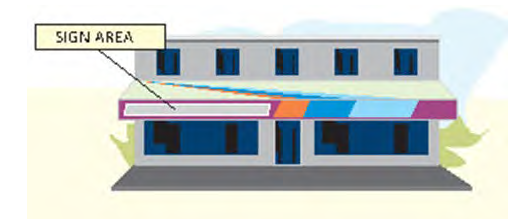
Awning sign. A sign displayed on or attached flat against the surface or surfaces of an awning. An awning that contains a "sign" section or copy area shall comply with the applicable sign area requirements for parallel signs. Only the sign or copy area displayed on an awning shall be used to determine the permitted sign area. The entire awning shall not be included in a sign area calculation. See also: Wall or fascia sign.
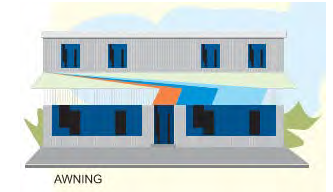
Banner. A temporary flexible substrate on which copy or graphics may be displayed.
Bench sign. A sign applied or affixed to the seat or back of a bench.
Billboard. A sign designed for the purpose of off-premise advertising or commercial outdoor advertising. Billboards signs are prohibited.
Canopy sign. A sign affixed to the visible surface(s) of an attached or freestanding canopy. May be internally or externally illuminated. Similar to a marquee sign.
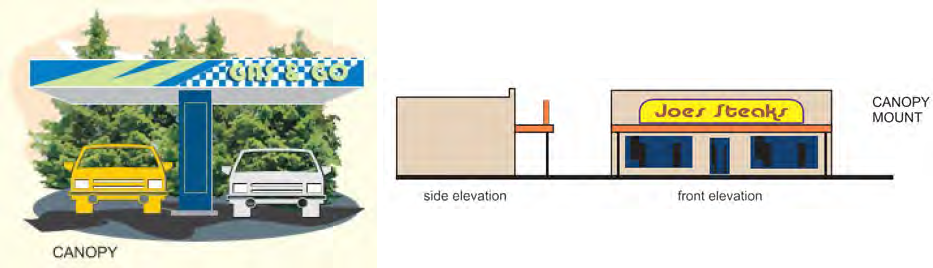
Changeable sign. A sign with the capability of content change by means of manual or remote input, including the following types:
(1)
Manually activated. Changeable sign where the message copy or content can be changed manually on a display surface.
(2)
Electrically activated. Changeable sign where the message copy or content can be changed by means of remote, electrically energized on-off switching combinations of alphabetic or pictographic components arranged on a display surface. Illumination may be integral to the components, such as characterized by lamps or other light-emitting devices, or it may be from an external light source designed to reflect off the changeable component display. See also: Electronic message center.
Channel letter (internally illuminated). A dimensional letter with a back, sides, and a translucent front face capable of transmitting light from an internal light source within the letter.
Directional sign. Any sign that is designed and erected for the purpose of providing direction and/or orientation for pedestrian or vehicular traffic.
Electronic message center or sign (EMC). An electrically activated, changeable sign whose variable message and/or graphic presentation capability can be electronically programmed by computer from a remote location. EMCs typically use light emitting diodes (LEDs) as a lighting source. See also, these following terms principally associated with EMCs: Display time, dissolve, dynamic frame effect, fade, frame, frame effect, scroll, transition, and travel.
Illuminance. The amount of light falling upon a real or imaginary surface, commonly called "light level" or "illumination."
Illuminated sign. A sign characterized by the use of artificial light, either projecting through its surface(s)—internally or trans-illuminated, or reflecting off its surface(s)—externally illuminated.
Marquee sign. See Canopy sign.
Monument sign. A freestanding sign that is constructed with brick or covered in masonry. Monument signs are limited to 12 feet in height and 15 feet in width.

Multiple-faced sign. A sign containing three or more faces.
On-premise sign. A sign erected, maintained, or used in the outdoor environment for the purpose of the display of messages appurtenant to the use of, products sold on, or the sale or lease of, the property on which it is displayed.
Pole sign. A sign principally supported by one or more columns, poles, or braces placed in or upon the ground. May also be referenced as a pylon sign.
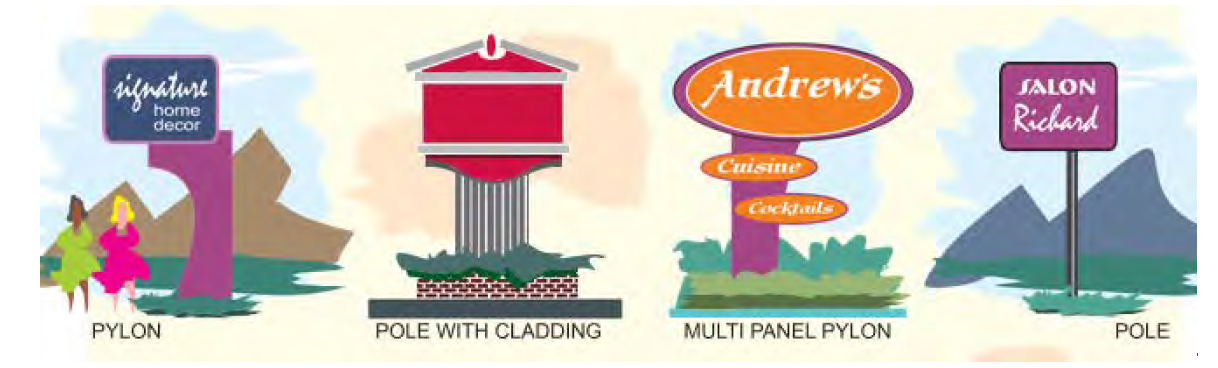
Portable sign. Any cord-connected sign not permanently attached to the ground that can be removed without the use of tools.
Projecting sign. A sign other than a wall sign that is attached to or projects more than 18 inches from a building face or wall or from a structure whose primary purpose is other than the support of a sign.

Pylon sign. See Pole sign.
Revolving sign. A sign that has the capability to revolve 360 degrees about an axis.
Roof sign. A sign mounted on the main roof portion of a building or on the uppermost edge of a parapet wall of a building and which is wholly or partially supported by such building. Signs mounted on mansard facades, pent eaves, and architectural projections such as canopies or marquees shall not be considered to be roof signs.
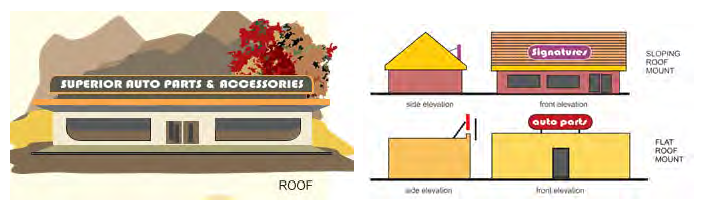
Sign. Any device visible from a public place whose essential purpose and design is to convey either commercial or noncommercial messages by means of graphic presentation of alphabetic or pictorial symbols or representations. Noncommercial flags or any other flags displayed from flagpoles or staffs will not be considered to be signs.
Sign structure. Any structure designed for the support of a sign.
Sign area. The area of the smallest geometric figure, or the sum of the combination of regular geometric figures, which comprise the sign face. The area of any double-sided or "V" shaped sign shall be the area of the largest single face only. The area of a sphere shall be computed as the area of a circle. The area of all other multiple- sided signs shall be computed as 50 percent of the sum of the area of all faces of the sign.
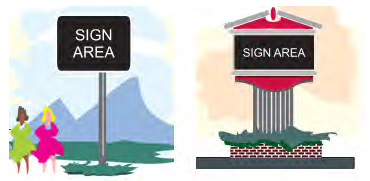
Sign face. The surface upon, against, or through which the sign copy is displayed or illustrated, not including structural supports, architectural features of a building or sign structure, nonstructural thematic or decorative trim, or any areas that are separated from the background surface upon which the sign copy is displayed by a distinct delineation, such as a reveal or border.
(1)
In the case of panel or cabinet type signs, the sign face shall include the entire area of the sign panel, cabinet, or face substrate upon which the sign copy is displayed or illustrated, but not open space between separate panels or cabinets.
(2)
In the case of signs painted on a building or individual letters or graphic elements affixed to a building or structure, the sign face shall comprise the sum of the geometric figures or combination of regular geometric figures drawn closest to the edge of the letters or separate graphic elements comprising the sign copy, but not the open space between separate groupings of sign copy on the same building or structure.

(3)
In the case of sign copy enclosed within a painted or illuminated border or displayed on a background contrasting in color with the color of the building or structure, the sign face shall comprise the area within the contrasting background or within the painted or illuminated border.
Special event sign. A temporary sign pertaining to any civic, patriotic, or special event of general public interest.
Temporary sign. A sign intended to display either commercial or noncommercial messages of a transitory or temporary nature. Portable signs or any sign not permanently embedded in the ground or not permanently affixed to a building or sign structure that is permanently embedded in the ground, are considered temporary signs.
V sign. A sign containing two faces of equal size, positioned at an interior angle subtending less than 179 degrees at the point of juncture of the individual faces.
Wall or fascia sign. A sign that is in any manner affixed to any exterior wall of a building or structure and that projects not more than 18 inches from the building or structure wall. Also includes signs affixed to architectural projections that extend away from a building, provided the copy area of such signs remain on a parallel plane to the face of the building facade or to the face or faces of the architectural projection to which it is affixed.

(e)
Exemptions. The following are exempt from permit, fee requirements, and the regulations of this Code:
(1)
Signs which are not visible from a public roadway. However, these signs must comply with any building and construction provisions enacted by the city.
(2)
Signs inside a building.
(3)
Signs carved into a building or raised in integral relief on a building.
(4)
Signs required by federal or state law.
(5)
Flags (not to exceed six on any lot) and pennants on a string.
(6)
Signs required by municipal authority.
(7)
Painted and/or applied wall accents and decorations.
(8)
Illuminated building accents and decorations.
(9)
Public art, including original art murals. Murals are not considered advertisement.
(10)
Name and address - up to two signs indicating address, number, and/or name of occupants of the premises that do not exceed two square feet in area per side, and do not include any commercial advertising or other identification.
(11)
Decals and/or logos affixed to windows or door glass panels, such as those indicating membership in a business group or identifying credit cards accepted at the establishment.
(12)
Handicapped parking space signs not exceeding two square feet in area reserving parking for handicapped individuals.
(13)
On-premise private drive signs are limited to one per driveway entrance, not exceeding two square feet in area.
(14)
Public signs erected by government agencies or utilities, including traffic, utility, safety, railroad crossing, and identification signs for public facilities and any signs erected by the city.
(15)
On-premise security and warning signs regulating the use of the premises, such as "no trespassing," "no hunting," and "no soliciting" signs. These signs shall not exceed one sign that is two square feet in area in residential areas and one sign that is five square feet in area in commercial and industrial zones. These limitations shall not apply to the posting of conventional "no trespassing" signs in accordance with state law.
(16)
Seasonal signs (e.g., political, real estate, holiday). No more than two seasonal signs may be displayed on any property at the same time, each sign is limited to eight square feet in size for residential uses and 24 square feet in size for nonresidential uses. The typical display time for a seasonal sign is 60 days or less.
(f)
Prohibited signs. The following signs are prohibited:
(1)
Signs containing strobe lights.
(2)
Abandoned sign structures, as defined by this code.
(3)
Signs placed on or painted on a motor vehicle or trailer parked with the primary purpose of providing signage not otherwise allowed by the Code. Any sign displayed on a parked trailer or truck or other vehicle where the primary purpose of the vehicle is to advertise a product, service business, or other activity is prohibited. This regulation shall permit the use of business logos, identification, or advertising on vehicles primarily and actively used for business purposes and/or personal transportation.
(4)
Signs on fences, fence posts, railings, gutters, standpipes, fire escapes, courtesy benches or any other device on which to sit, sidewalks, curbs (except house numbers), or any other public facility.
(5)
Signs attached to rocks or any natural growth, such as trees, shrubs, or other natural foliage.
(6)
Signs constructed of nondurable material including, but not limited to, paper or cardboard.
(7)
Signs that imitate or resemble official traffic lights, signs, or signals, or signs that interfere with the effectiveness of any official traffic light, sign, or signal.
(8)
An environmentally activated sign or other display with actual mechanical motion powered by natural, manual, mechanical, electrical or other means, including but not limited to pennant strings, streamers, spinners, propellers, and search lights.
(9)
Flashing signs (see Definitions). For the purposes of this code, a sign that has a change rate or dwell time of four seconds or longer does not fit within the prohibition noted herein.
(10)
Signs and other objects which are inflated, including but not limited to, balloons. Balloons may be permitted in temporary non-commercial situations, for instance, they are permitted for special occasions at a residence.
(11)
Any posters and handbills affixed to any structures, trees, or other natural vegetation, rocks or poles.
(12)
Any sign which may be confused with or obstructs the view of any authorized traffic sign or signal, obstructs the sight-distance triangle at any road intersection, or extends into the public right-of-way.
(13)
Signs which prevent free ingress or egress from any door, window, fire escape, or that prevent free access from one part of a roof to any other part. No sign other than a safety sign shall be attached to a stand-pipe or fire escape.
(14)
No sign which emits smoke, visible vapors, particles, sound, or odor shall be permitted. Open flames used to attract public attention to a place of business or to an advertising sign shall not be permitted.
(15)
Billboards.
(16)
No mirror device shall be used as part of a sign.
(17)
A-frame signs, except as defined in section (l)(3)c.
(18)
Signs that are obscene as defined by § 43.21 of the Texas Penal Code.
(g)
General rules for reading and applying the code language.
(1)
Literal readings of the code language will be used. Regulations are no more or less strict than as stated. Application of the regulations that are consistent with the rules of this code are non-discretionary actions of the code officer to implement the code. The action of the code officer is final.
(2)
Where the code is silent, or where the rules of this code do not provide a basis for concluding that a sign is allowed, the sign is prohibited.
(h)
Sign face area.
(1)
Sign cabinets. The area of sign faces enclosed in frames or cabinets is determined based on the outer dimensions of the frame or cabinet.
(2)
Double-sided signs. Only one side of a double-sided sign is counted in determining the area of sign faces. Where the two sides are not of equal size, the larger of the two sides is used for the determination of sign area. The area of multiple-faced signs in which the interior angle formed by the faces is greater than 91 degrees shall be expressed as the sum of the areas of all the faces, except for multiple-faced signs containing faces that are configured back to back, in which case the area of the faces configured back to back will be calculated according to the rule for double-sided signs.
(3)
Round, oval, and irregularly shaped signs. To be measured based on the appropriate mathematical formula to obtain the sign area for a circle, an oval or irregularly shaped sign.
(4)
Calculating sign area.
a.
For square or rectangular signs, the area shall be measured by multiplying the length by the height of the outside edges of the sign frame
b.
For irregular shaped signs, the area shall be measured by calculating the area of rectangles, triangles, or a combination thereof measured from the outside edges of the sign frame necessary to enclose the sign face.
c.
For signs composed of only letters, words, or symbols, the area shall be measured or determined by the area included within imaginary straight lines drawn around the entire copy or grouping of such letters, words, or symbols.
d.
For signs with two or more faces, the area of a double-faced sign is calculated using the area of one side only. The area of all other multiple-sided signs shall be computed as 50 percent of the sum of the area of all faces of the sign.
(5)
Awnings and marquees. When graphics or sign copy is incorporated into an awning, the sign area is determined by computing the area of a standard imaginary geometric shape or combination of shapes drawn around the sign copy area or graphics. When the ends of awnings or marquees are parallel and contain graphics or sign copy, only one side is counted in addition to the sign face area on the front.
(i)
Height of signs.
(1)
The overall height of a freestanding sign or sign structure is measured from the lowest point of the ground directly below the sign to the highest point of the freestanding sign or sign structure.
(2)
Exception. Where a freestanding sign or sign structure is mounted along a roadway that has a higher grade level as compared to the grade level directly below the freestanding sign or sign structure, then the freestanding sign or structure's height will be measured from the roadway grade level nearest the sign to the highest point of the freestanding sign or sign structure. See Figure F.
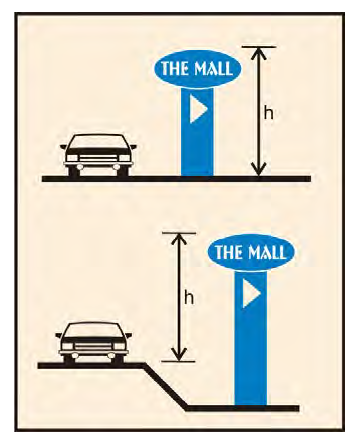
Figure F. Height of freestanding signs.
(j)
Standards in residential zones.
(1)
General standards for permanent, on-premise signs in the residential, apartment, multi-family, agricultural, and sub-division development zones are described below.
(2)
All single-family residential properties that are located in residential zoning districts are permitted signs not to exceed eight square feet in total sign area per road frontage. Corner lots and lots with frontage on more than one street are entitled to eight square feet per frontage. This sign area allowance covers but is not limited to address signs, home occupation signs, lawn signs, real estate signs, contractor signs, and political signs. Signs may be freestanding, mounted to a permanent building structure, or displayed in a window. Trees, rocks, or other naturally occurring landscape features may not be used to support a residential sign.
(3)
Subdivisions, apartments, multi-family dwellings, and condominium complexes are permitted a freestanding sign not to exceed 32 square feet, and further provided that one such sign shall be permitted for each separate street and/or separate building frontage occupied by the subdivision, apartment, or condominium complex and/or for each means of entrance to or exit from the subdivision, apartment, or condominium complex.
(4)
For properties located in a residential zone as described above, other directional, incidental, and/or accessory signs are also permitted to be located within the subdivision, complex, or multi-family residential development. Such directional, incidental, and/or accessory signs shall not exceed six square feet in sign area and six feet in height (if freestanding).
(5)
Electronic message centers (EMC's) are allowed by special exception only, on properties with permitted non-residential uses in a residential zone. They are prohibited on residential properties and on subdivision, apartment, multi-family dwellings, and condominium properties.
(6)
Animated signs as defined by this Code are prohibited in residential zones.
(7)
Roof signs as defined by this Code are prohibited in residential zones.
(k)
Standards in commercial and industrial zones.
(1)
The standards for permanent signs in commercial and industrial zones are as follows. All such signs must conform to the regulations of this section.
(2)
Any signs permitted in a residential zone are permitted in commercial and industrial zones.
(3)
Signs on commercial and industrial properties as regulated by reference to types noted below.
a.
Monument and pole signs.
1.
Monument signs shall be limited to two per property, not to exceed 180 square feet in sign area unless otherwise permitted by these regulations. A minimum distance of 150 lineal feet shall exist between any monument or pole signs. One pole sign not to exceed 20 feet in height and 180 square feet in area, may be authorized in lieu of an otherwise allowed monument sign. In no case shall two pole signs exist on the same lot. A pole sign in lieu of a monument sign will not be authorized in the following districts; CBD Central Business District, CN Central Neighborhood, and within the Commercial Corridor Overlay
2.
Height. Monument signs shall not exceed 12 feet in height above existing finish grade level. Pole signs shall not exceed 20 feet unless specified herein. Pole signs are prohibited in all Residential Districts, CBD Central Business District, CN Central Neighborhood, and within the Commercial Corridor Overlay. A business situated in a nonresidential zoning district that has frontage directly along Interstate 20 or within 500 feet of the Interstate may have one free standing pole sign that shall not exceed 40 feet in height and 400 square feet in sign area.
3.
Location. Pole and monument signs shall not intrude into any public right-of-way and all structures, supports and sign faces shall be a minimum of five feet from any property line. The distance between such signs shall be a minimum of 150 lineal feet and the signs must be principally placed on different property lines (e.g. north and east property line, or east and west property lines).
4.
Vehicles used as a monument sign. A vehicle may be converted into a monument sign if it is a model year of 1969 or older, does not exceed 15½ feet in length, does not exceed six feet in width, does not exceed six feet in height, is placed on a masonry platform with a minimum of 30 inches in height but not to exceed 36 inches in height, is anchored to the platform to withstand minimum sustained (three seconds) wind gusts of 90 miles per hour, has no shattered glass or windows, the motor and all fluids have been removed, and has no flat tires.
b.
Building signs.
1.
Building signs include wall or fascia signs, roof signs, and signs otherwise permanently applied to walls or other building surfaces.
2.
Within nonresidential zoning districts, total signage allowed shall not exceed ten square feet per lineal foot of building frontage. Accessory structures not housing primary business activity shall not be included in the calculation of maximum allowable signage.
3.
In addition to other signs allowed under this subsection, a business situated in a nonresidential zoning district may have either one projecting sign or one awning sign. Projecting signs and awning signs shall not exceed 12 square feet in area.
(i)
Graphic treatment and/or embellishment in the form of striping, patterns, or valances shall be permitted on the face or side surfaces of any awning or backlit awning without restriction, and the area of any such graphic treatment and/or embellishment shall not be calculated as a component of permitted area.
(ii)
Projecting signs shall be limited to one per building facade on which any such sign is mounted except for a use that fronts on more than one street, in which case, one such sign shall be permitted per facade for each separate street frontage.
(iii)
No projecting sign shall extend in a vertical dimension above the highest architectural point of the facade to which it is mounted in excess of 25 percent of the vertical dimension of the facade itself.
(iv)
Projecting signs extending over a public sidewalk shall be limited to a projection distance not to exceed two-thirds of the width of the sidewalk.
c.
Canopy and marquee signs. In addition to other signs allowed under this subsection, a business situated in a nonresidential zoning district may have one canopy or marquee sign. A canopy or marquee sign shall not exceed 12 square feet in sign area.
1.
Canopy signs, marquee signs and signs on Architectural Projections are signs that are mounted to either structures that project off the face of the building more than 18 inches or signs that are mounted to a freestanding structure not attached to a building that creates a canopy or covering over an area below.
2.
Signs affixed or applied in an essentially flat plane to the face of a building or freestanding canopy, marquee, or architectural projection provided that the copy area of any such sign, as defined herein, does not exceed an area equal to 40 percent of the product of the height and length of the face area of the canopy, marquee, or architectural projection to which such sign is affixed or applied, or 15 percent of the building façade to which it is attached, whichever is greater.
3.
Graphic treatment in the form of striping or patterns shall be permitted on the face of any building or freestanding canopy, marquee, or architectural projection without restriction, and the area of any such graphic treatment shall not be calculated as a component of permitted copy area.
d.
Wall signs. A business situated in a nonresidential zoning district shall be allowed wall signage for each side of its building. Wall signs shall not project more than 18 inches from the building wall. The total sign area permitted for all wall signs on a wall fronting a street or a wall housing the primary entrance to the business, shall not exceed 20 percent of the wall face. The total sign area of all other walls shall not exceed ten percent of the wall face. Window signs shall be considered as part of the total wall sign area permitted and shall not exceed 25 percent of the window area.
e.
Roof signs. A business situated in a nonresidential zoning district may have one roof sign, not to exceed 30 square feet in sign area, in lieu of an otherwise permitted free-standing sign.
f.
Roof sign special consideration. A business situated in a nonresidential zoning district that has frontage directly along an Interstate may have one roof sign, not to exceed 50 square feet in sign area, in lieu of an otherwise permitted free-standing sign.
(l)
Additional standards in all zones.
(1)
These regulations apply to all signs regulated by this code.
(2)
All signs and sign structures must be erected and attached totally on or within the site or property to which they refer, behind any applicable legal right of way.
(3)
Exceptions for signs extending into the right-of-way:
a.
Projecting signs: in a Downtown or Central Business District, projecting over a public sidewalk.
b.
Awnings and marquees: in a Downtown or Central Business District, projecting over a public sidewalk.
c.
A-frame signs. A-frame signs may be used in a Downtown or Central Business District if they meet the following standards:
1.
The sign is entirely outside the street or roadway;
2.
The sign is no larger than ten square feet;
3.
The sign does not obstruct a continuous through pedestrian zone of at least six feet in width.
4.
The sign does not obstruct pedestrian and wheelchair access from the sidewalk to any of the following:
(i)
transit stop areas;
(ii)
designated disabled parking spaces;
(iii)
disabled access ramps; or
(iv)
building exits including fire escapes.
(4)
Pole and monument signs. Freestanding signs may not extend into the right-of-way.
(5)
Fascia or wall signs.
a.
Vertical extensions: Fascia or wall signs may not extend above the top of the building wall upon which they are mounted.
b.
Horizontal extensions: Fascia or wall signs may not extend more than 18 inches out from the wall or structure to which they are attached.
(6)
Pitched roof signs.
a.
Vertical extensions: A pitched roof sign may not extend above the roofline.
b.
Placement and angle: Pitched roof signs must be parallel to the building face. They may not extend beyond the building wall.
c.
Support structures: Support structures must be designed so that there is no visible support structure above the sign.
d.
Projecting signs. Projecting signs are not allowed on rooftops or on pitched roofs. Projecting signs may not extend over a right-of-way unless they are located in a Downtown or Central Business District.
(7)
Directional signs.
a.
General standards: Directional signs that meet the standards of this subsection are allowed in all zones and are not counted in the total square footage of permanent signage allowed on any property or site.
b.
Size: Freestanding directional signs may be up to six square feet in area and 96 inches in height. Fascia directional signs may be up to 16 square feet in area.
c.
Directional signs in any zone may have internal or external illumination.
(8)
Permanent banners.
a.
General: Banners used as permanent wall signs are allowed in all commercial and industrial zones and will be included in the total square footage of permanent signage allowed on the site. The banner must have a permanent frame to which it is attached.
b.
Standards: Permanent banners are subject to the standards for either fascia signs or projecting signs depending on how the banner is supported or anchored.
(9)
Temporary signs.
a.
Signs that meet the standards of this subsection are exempt from the standards for permanent signs and are not counted in the total square footage of signage allowed on any particular property or site. signs that do not meet the standards of this subsection are subject to the standards for permanent signs.
b.
Temporary signs may not have external or internal illumination.
c.
Temporary banners are subject to the following regulations:
1.
In all residential zones, temporary banners are not permitted on sites with houses, duplexes, and attached houses. Exception: banners for holidays, religious commemoration, and special family events.
2.
In the commercial, and industrial zones, one banner no larger than 32 square feet in size is permitted per property or, on a multi-use property, per storefront. Only one of these banners may be hung on each building wall or on each separate structure.
3.
One feather flag type banner not to exceed 15 feet is allowed per business in addition to a temporary banner. In no case may a site or storefront have more than two temporary signs.
4.
In no case shall a temporary banner be larger than 32 square feet in size.
5.
A temporary banner may be displayed no longer than 90 days per calendar year.
6.
Banners that do not meet the regulations of this subparagraph, must meet the standards for permanent signs.
d.
Temporary wall or fascia signs. One temporary wall sign is allowed per street frontage in the commercial and industrial zones. Temporary wall signs may be up to 32 square feet in area. Temporary wall signs may not extend above roof lines. Extensions into the right-of-way are prohibited. A temporary wall sign may be displayed no longer than 90 days per calendar year.
e.
Temporary freestanding or portable signs. One (1) temporary freestanding sign is allowed per property in the commercial zones and is not counted in the total square footage of permanent signage allowed on the site. Temporary freestanding signs may be up to 32 square feet in area. Extensions into the right-of-way are prohibited. A temporary freestanding sign may be displayed no longer than 90 days per calendar year.
(m)
Electronic message centers.
(1)
In Commercial, and industrial zones, electronic message centers (EMCs) are permitted.
(2)
Additional general EMC regulations:
a.
An EMC sign may be a portion of a building sign or freestanding sign or may comprise the entire sign area.
b.
All EMC signs shall have automatic dimming controls, either by photocell (hardwired) or via software settings, in order to bring the EMC lighting level at night into compliance with section (n) of this Code "sign Illumination Standards."
(3)
EMC regulations by zone:
a.
In residential zones, EMC signs are permitted only in certain circumstances by special exception in accordance with section (j)(5) of this Code. They are otherwise prohibited in residential zones.
b.
In Residential Zones, where permitted, EMC signs shall have a minimum display time of 12 seconds. The transition time between messages and/or message frames is limited to one second.
c.
In residential zones, where permitted, the following EMC display features and functions are prohibited: scrolling, traveling, flashing, spinning, rotating, fade, dissolve, any other moving effects, and all dynamic frame effects or patterns of illusionary movement or simulated movement.
d.
In commercial and industrial zones, EMC signs shall have a minimum display time of eight seconds. The transition time between messages and/or message frames is limited to three seconds and these transitions may employ fade, dissolve, and or other transition effects.
e.
In commercial and industrial zones, the following EMC display features and functions are prohibited: continuous scrolling and/or traveling, flashing, spinning, rotating, and similar moving effects, and all dynamic frame effects or patterns of illusionary movement or simulating movement.
(n)
Sign illumination standards. Signs may be illuminated consistent with the following standards:
(1)
A sign in any district may be illuminated at night. signs that are illuminated at night may not exceed a maximum luminance level of 750 cd/m² or Nits, regardless of the method of illumination.
(2)
Signs that have external illumination, whether the lighting is mounted above or below the sign face or panel, shall have lighting fixtures or luminaires that are fully shielded.
(3)
All illuminated signs must comply with the maximum luminance level of 750 cd/m² or Nits at least one-half hour before Apparent Sunset, as determined by the National Oceanic and Atmospheric Administration (NOAA), U.S. Department of Commerce, for the specific geographic location and date. All illuminated signs must comply with this maximum luminance level throughout the night, if the sign is energized, until Apparent Sunrise, as determined by the NOAA, at which time the sign may resume luminance levels appropriate for daylight conditions, when required or appropriate.
(4)
On-premise signs do not constitute a form of outdoor lighting at night and are exempt from any other outdoor lighting regulations that the city has adopted or will adopt in the future.
(o)
Nonconforming signs.
(1)
Nonconforming permanent signs may continue to exist after passage of this Code. Nonconforming signs will be removed and changed in accordance with the provisions of this Code.
(2)
Permanent signs and sign structures that are moved, removed, replaced, or structurally altered must be brought into conformance with the sign regulations. However, nonconforming signs required to be moved because of public right-of-way improvements may be re-established. Removable faces or sign panel inserts in a cabinet style sign may also be changed by right, and such change does not constitute a structural alteration nor trigger loss of nonconforming status.
(3)
Nonconforming temporary signs must be removed within two months of the passage of this Code.
(4)
Ownership. The status of a nonconforming sign is not affected by changes in ownership.
(5)
Once a sign is altered to conform or is replaced with a conforming sign, the nonconforming rights for that sign are lost and a nonconforming sign may not be re-established.
(6)
Destruction. When a sign or sign structure is removed or intentionally destroyed, replacement signs and sign structures must comply with the current standards.
(p)
Electrical regulations applying to all permanent and temporary on-premise signs.
(1)
All on-premise electric signs, outline lighting systems and skeleton neon lighting systems shall be manufactured and installed in compliance with NFPA 70, the National Electric Code (NEC).
(2)
The listing label number for all signs shall be provided on the sign permit application, or, if the sign has not been manufactured yet, through Nationally Recognized Testing Laboratory (NRTL) validation: A NRTL file number from the sign manufacturer shall be provided for all electric signs on the sign permit application.
(3)
The code officer shall have the authority to immediately remove any sign that is not in conformance with this section, or to have said sign removed, at the owner's expense.
(q)
Construction and structural requirements.
(1)
Structural standards.
a.
Signs, sign structures, sign foundations and methods to attach and anchor signs must be designed and constructed in accordance with applicable provisions of the building code adopted by the city. All signs and their foundations and attachments must be designed for the appropriate dead, wind and snow loads for the geographic area in question.
b.
The supports and foundations used in construction for all signs and sign structures must be located outside of any rights-of-way.
c.
Welds of sign structures and sections of sign structures must be welded in accordance with the building code.
(2)
Engineering standards.
a.
Signs, sign structures, sign foundations and anchorages to a building must be individually designed in accordance with the building code and the provisions of this sign code.
b.
When the building code of the city, or any building code enacted after passage of this sign code, calls for sealed sign design construction plans to be submitted as a part of any sign permit application, this requirement is not compulsory as it relates to on- premise signs regulated under this sign code.
(3)
Clearances.
a.
Vision clearance areas: Vision clearance areas are triangular- shaped areas located at the intersection of any combination of rights- of-way, alleys or driveways. The sides of the triangle extend 25 feet from the intersection of the right-of-way, alley or driveway in either/each direction. No sign may be installed within this clear sight triangle.
b.
Vehicle area clearances: In areas outside of rights-of-way, when a sign or awning extends over an area in which vehicles travel or are parked, the bottom of the structure must be at least 14 feet above the ground. Vehicle areas include driveways, alleys, parking areas, and loading and maneuvering areas.
c.
Pedestrian area clearances. When a sign or awning extends more than 12 inches over a sidewalk, walkway, or other space used by pedestrians, the bottom of the structure must be at least eight feet above the ground.
d.
Clearances from fire escapes, means of egress or standpipes. signs, sign structures and awnings are prohibited from being erected in any manner that interferes in any way with the free use of any fire escape, means of egress or standpipe. Attaching signs, sign structures or awnings to a fire escape is prohibited.
e.
Obstruction of windows and ventilation. signs, sign structures and awnings are prohibited from being installed in any way that obstructs any building openings to such an extent that light, ventilation or exhaust are reduced to a level below that required by either the building code, plumbing regulations, heating and ventilating regulations or housing and maintenance regulations.
(r)
Maintenance requirements.
(1)
Signs, sign structures and awnings, together with their supports, braces, guys, anchors and electrical components must be maintained in a proper state of repair. The code officer may order the removal of any sign, sign structure or awning that is not maintained in accordance to this Code.
(2)
Dangerous structures and equipment. signs, sign structures or awnings that are dangerous must be taken down and removed or made safe as the code officer or building official deems necessary. signs may be deemed dangerous for one or more of the following reasons:
a.
Whenever a sign structure or its foundation, a sign's attachments to a building, or a building to which a sign is attached is damaged by fire, earthquake, wind, flood or by any other cause, to such an extent that the structural strength or stability is materially less than it was before the catastrophe and is less than the minimum requirements of the Building Code.
b.
Whenever any portion or member of a sign, sign structure or awning is likely to fail, or become detached or dislodged, or to collapse and thereby injure persons or property.
c.
Whenever any portion or member of a sign, sign structure or awning is likely to partially or completely collapse as a result of any cause, including, dilapidation, deterioration, or decay; faulty construction or wiring; or removal, movement or instability of any portion of the ground or building necessary for supporting such structure.
d.
Whenever a sign, sign structure or awning is structurally or electrically unsafe or otherwise hazardous to human life or safety by reason of inadequate maintenance, dilapidation, obsolescence, fire hazard, disaster, damage or abandonment.
e.
All signs, sign structures and awnings determined after inspection by the code officer to be dangerous must be abated by repair, rehabilitation, demolition or removal.
(s)
Permits and registration.
(1)
Permits required. Unless specifically exempted, a permit must be obtained from the director of planning and development to erect, alter, renovate, or demolish any sign or sign structure within the city and its extraterritorial jurisdiction and in accordance with other ordinances of the city. Exemptions from the necessity of securing a permit, however, shall not be construed to relieve the owner of the sign from responsibility for its erection and maintenance in a safe manner and in a manner in accordance with all the other provisions of this ordinance. A permit shall not be required for the ordinary maintenance and repair of a sign or sign structure for which a permit has previously been issued under this section. Ordinary maintenance and repair shall not include additions to, alteration of, replacement of or relocation of any sign or sign structure.
(2)
Sign permit application. Before any permit is granted for the erection of a sign or sign structure requiring such permit, construction documents shall be filed with the director of planning and development showing the dimensions, materials and required details of construction, including loads, stresses, anchorage and any other pertinent data. The permit application shall be accompanied by a written consent of the owner or lessee of the premise upon which the sign is to be erected and by engineering calculations signed and sealed by a registered design professional where required.
(3)
Applications shall provide the following information in order to be considered complete:
a.
The type of sign and cost of sign construction.
b.
The street address of the property upon which the sign is to be located. In the absence of a street address, a method of location acceptable to the city shall be used.
c.
Sign details to include a technical drawing or picture of the sign which includes shape and dimensions, text size and design, artwork, and proposed colors. Additionally, a scaled elevation of the size and height of the proposed sign from ground level and adjacent street level shall be provided.
d.
The square foot area per sign and the aggregate square foot area if there is more than one sign face.
e.
The gross floor area of all building(s) on the property.
f.
The name(s) and address(es) of the owner(s) of the real property upon which the sign is to be located.
g.
Written consent of the property owner, or his authorized agent, granting permission for the placement and/or maintenance of the sign on the property.
h.
The name, address and phone number of the sign contractor.
i.
For free-standing signs, a site plan drawn to scale, showing the proposed location of all primary and accessory free-standing sign(s) on the property. The site plan shall include, at a minimum, a closed boundary survey of the property, gross acreage, the proposed sign location, street right-of-way lines, public and/or private easements, driveway locations and parking spaces.
j.
For wall signs, two sets of building elevations, mounting details and weight of signs.
k.
When required by the building official, plans for certain signs shall be prepared by a registered professional engineer.
(4)
Changes to signs. No sign shall be structurally altered, enlarged or relocated except in conformity to the provisions in this section, nor until a proper permit, if required, has been secured. The changing or maintenance of movable parts or components of an approved sign that is designed for such changes, or the changing of copy, business names, lettering, sign faces, colors, display and/or graphic matter, or the content of any sign shall not be deemed a structural alteration.
(5)
Expiration of permit. Every permit issued shall become invalid unless the work on the site authorized by such permit is commenced within 180 days after its issuance, or if the work authorized on the site by such permit is suspended or abandoned for a period of 180 days after the time the work is commenced. The building official is authorized to grant, in writing one or more extensions of time, for periods not more than 180 days each. The extension shall be requested in writing and justifiable cause demonstrated.
(t)
Inspection. Construction or work for which a permit is required shall be subject to inspection by the director of planning and development and such construction or work shall remain accessible and exposed for inspection purposes until approved. It shall be the duty of the permit applicant to cause the work to remain accessible and exposed for inspection purposes. Neither the director of development services nor the city shall be liable for expense entailed in the removal or replacement of any material require to allow inspection. Approval as a result of an inspection shall not be construed to authorize a violation of the provisions of this section or of any other ordinances or regulations of the city. Inspections presuming to give authority to violate or waive the provisions of this section or any other ordinances of the city shall not be valid.
(1)
Footing and foundation inspection. Footing and foundation inspections shall be made after excavations for footings are complete and any required reinforcing steel is in place. For concrete foundations, any required forms shall be in place prior to inspection.
(2)
Other inspections. In addition to the inspections specified above, the building official is authorized to make or require other inspections of any construction work to ascertain compliance with the provisions of this section, any other ordinances or regulations of the city and other laws that are enforced by the department of building safety.
(u)
Enforcement.
(1)
Removal or securing of sign. The director of planning and development or other authorized representative of the city may immediately remove or secure a sign without notice in the following circumstances constituting a violation of this section:
a.
The sign is prohibited under this section and constitutes an immediate threat to persons or property.
b.
The sign is prohibited under this section and is a classified as a temporary sign.
c.
The sign is nonconforming or otherwise authorized under this section, but in its present condition constitutes an immediate threat to persons or property.
d.
The sign is a political sign and is not removed within 15 days following the election to which it pertains.
e.
The sign is a garage sale sign and is not removed within 24 hours after the date of the sale.
f.
The city is not required to store these signs which may be immediately destroyed.
(2)
Notice and hearing following removal or securing of sign. With the exception of the summary removal of political signs and garage sale signs as provided herein, following summary removal of a sign pursuant to this subsection, the director of planning and development shall give written notice to the owner of the sign or the owner of the property on which the sign was placed of such person's right to appeal the decision of the city regarding removal or securing of the sign. The person(s) so notified shall provide the city written notice of appeal of the director of planning and development's determination within ten days of receipt of notice, setting forth the reasons in detail why the director of planning and development's determination was in error. Failure to provide written notice of appeal within the ten-day period provided herein shall constitute a waiver of the right to appeal the removal or other action.
3.
For purposes of this subsection, the director of planning and development shall be deemed to have given written notice by either personal delivery of or the mailing of said notice, by United States Postal Service certified mail, to the entity or person identified on the sign made the subject of the notice; or to the person or entity identified on the sign for purposes of notice; or to the owner of the property on which the sign was placed or displayed.
4.
Removal of sign following notice.
a.
A sign may be removed by the city following 15 days written notice from the director of planning and development, or other official authorized herein, to the owner of the sign or the owner of the property on which the sign is located, upon determination of one of the following:
1.
The sign is prohibited under this section, but is not subject to summary removal under this section, and the sign is not a nonconforming sign;
2.
There is no sign permit as required under this section authorizing the sign;
3.
The sign did not comply with the sign regulations in effect on the date it was erected, or was otherwise unlawful on such date;
4.
The sign has been destroyed; for purposes of this provision, a sign is considered destroyed whenever the cost to repair it exceeds 60 percent of the cost of erecting a new sign of the same type at the same location on the date of the damage.
5.
Any condition occurs which would have been cause for removal of the sign under the sign regulations in effect when the sign was erected.
b.
If the sign owner does not remove the sign or give written notice of his/her intent to obtain a permit authorizing the sign, or repair or reconstruct the sign in accordance with the terms in the notice within such 15-day period, the director of planning and development may enter the property upon which such sign is located, and cause the removal of the sign. The director of planning and development may specify a reasonable amount of time for the sign owner to obtain a sign permit, or repair or reconstruct the sign to meet the requirements of this section.
c.
The sign owner or the owner of the property on which the sign is erected may appeal the determination of the director of planning and development or other authorized person under this subsection to the City Council within ten days following receipt of the notice of the violation.
d.
Responsibility for costs of removal. Whenever the city lawfully removes or causes a sign to be removed under this section, the sign permit holder, if any, the owner of the sign and the owner of the property on which the sign is erected shall be jointly and severally liable to the city for any expenses incurred in removal of the sign.
(v)
Fees.
(1)
Permit fees. Permit fees to erect, alter, replace or relocate a sign shall be in accordance with the fee schedule adopted by the city. Whenever any work for which a permit is required by this section has been commenced without first obtaining said permit, a special investigation shall be made to determine compliance with this section before a permit may be issued for such work. An investigation fee, in addition to the permit fee, shall be collected whether or not a permit is then or subsequently issued. The investigation fee shall be equal to the amount of the permit fee.
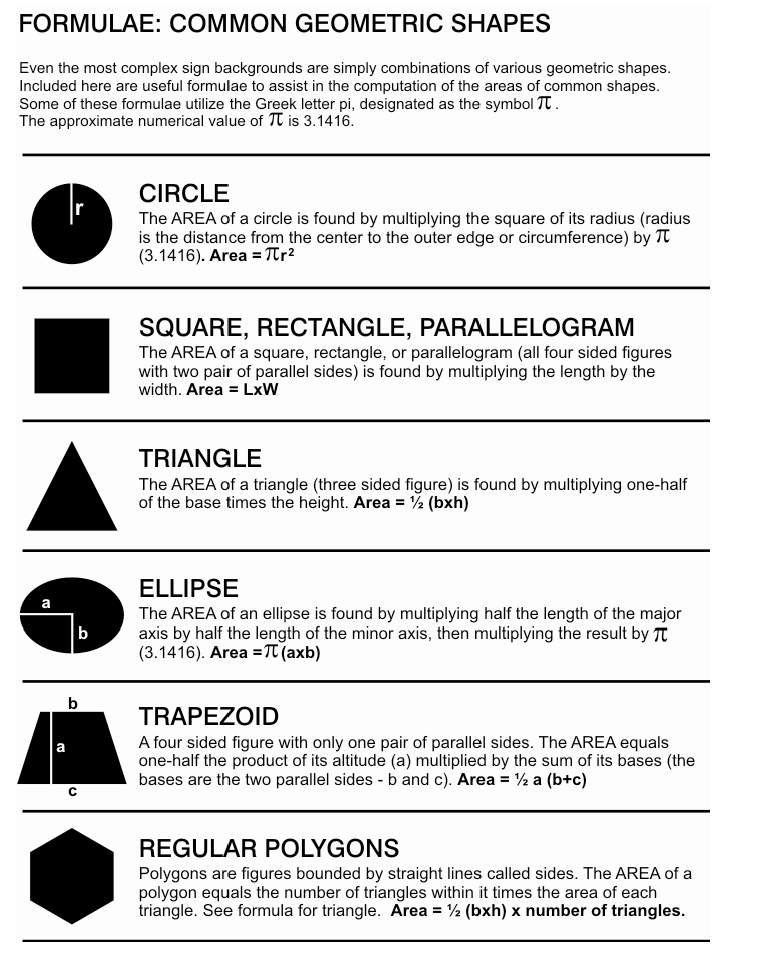
Figure G. Common Geometric Shapes.
(Ord. No. O2025-15, § 1, 4-22-25)
Sec. 12-4-102. - Landscaping and tree preservation.
(a)
Purpose. The purposes of the landscaping regulations, tree preservation regulations, and of the administrative rules adopted for their implementation are to:
(1)
Enhance quality of life and community character within Weatherford's neighborhoods and built environment, especially through the preservation and addition of pleasant streetscapes;
(2)
Facilitate site design and construction such that they preserve mature trees and natural areas;
(3)
Maximize the aesthetic, environmental, and economic value of development;
(4)
Mitigate the impacts of development on air quality, groundwater recharge, storm water runoff, noise, and glare;
(5)
Protect healthy, quality trees and promote the natural ecological environment of the city;
(6)
Regulate the removal of trees when necessary; and
(7)
Enable administrative rulemaking pursuant to title I, chapter 8 of the Official City Code of the City of Weatherford to adopt and amend landscape and tree preservation related administrative rules located in the Landscape and Tree Manual.
(b)
Applicability.
(1)
Landscaping requirements apply to all new and existing development within the City of Weatherford and shall be met according to the following schedule:
a.
Full compliance. All quantitative standards shall be met at 100 percent whenever any of the following occurs:
1.
Construction of any new primary structure.
2.
Expansion of a primary structure, where such expansion increases the floor area by 50 percent or greater or adds an additional story.
3.
Increase in the number of off-street parking spaces by five spaces or 50 percent, whichever is greater.
4.
Ground disturbance greater than or equal to 10,000 square feet.
b.
Incremental compliance. All quantitative standards shall be met proportionally whenever any of the following occurs. The requirements for incremental compliance shall apply to each successive instance until all quantitative requirements are met at 100 percent.
1.
Expansion of a primary structure, where such expansion increases the floor area by less than 50 percent, in which case requirements shall be applied to the new floor area only. For example, an increase in floor area of ten percent requires that a minimum of ten percent of the planting quantities specified herein shall be provided.
2.
Increase in the number of off-street parking spaces by fewer than five spaces or 50 percent, whichever is greater.
3.
Ground disturbance less than 10,000 square feet, when such disturbance exceeds 1,000 square feet or results in the removal of existing landscaping.
4.
Any change in use, in which case a minimum of 20 percent of the planting quantities specified herein shall be provided.
c.
Nonconforming properties. Properties which are nonconforming with respect to these standards shall maintain and replace as necessary any existing landscaping which contributes towards compliance with the planting quantities specified herein. d. Exceptions. Landscaping standards shall not be applied to the following:
1.
Expansion of a one-family or two-family dwelling.
2.
Ground disturbances on property with a one-family or two-family dwelling.
3.
Renovations or repairs which do not increase floor area.
4.
Accessory structures.
5.
Properties within the AG agricultural district.
6.
Properties within the CBD central business district and CN central neighborhood district, upon a determination by the historic preservation officer that the purposes of this section and of historic preservation are met by existing conditions or proposed exterior treatments that are compatible with the character of adjacent structures or properties.
(2)
Tree preservation regulations apply to all trees and all land within the City of Weatherford and shall be met whenever any of the following occurs:
a.
A tree is planted.
b.
A tree is pruned.
c.
A tree is removed.
d.
A tree is within the development impact area of a project site.
e.
Exceptions. Tree permits are not required to remove trees in any of the following situations:
1.
Any tree which is located on property less than one acre on which there is an occupied one-family or two-family residence, or is located within 100 feet of an occupied one-family residence on property larger than one acre.
2.
Any tree which is located on the property of a commercial plant or tree nursery and which has been planted for the purpose of sale to the public in the ordinary course of the nursery's business.
3.
Any tree which, due to some catastrophe, is disrupting or will disrupt a public utility service, or which presents a danger to the public. Pruning or removal shall be performed by the city or utility, or agent thereof, and shall be limited to the extent necessary to restore and maintain reliable service or public safety.
4.
Park trees, as defined by this title, when the City of Weatherford or its agent is performing maintenance of the city's parks or making improvements to the city's parks for enhanced landscaping, habitat or native species restoration, or pathways.
5.
Trees within the public right-of-way, when the City of Weatherford or its agent is improving a public street to implement the City of Weatherford Thoroughfare Plan or when removal is necessary to complete repairs or improvements in accordance with the city's Engineering Design and Construction Manual (EDCM).
(c)
Landscape quantity standards.
(1)
Landscape is required to be installed in the quantities and locations specified in the following tables, when full or incremental compliance is required as indicated above.
(2)
The landscape types - L1, L2, L3 - refer to the plants and other treatments detailed in the Landscape and Tree Manual.
Table 2. Landscape Requirements.
(d)
Landscape quality standards.
(1)
All landscaping shall be designed, planted or otherwise installed, irrigated where required, and maintained according to the standards provided herein and in the Landscape and Tree Manual.
(2)
Plant materials shall be selected and planted in accordance with nursery industry standards.
(3)
Applicable landscape plans shall be provided and approved prior to issuance of construction permits. Plans shall be prepared in accordance with the standards provided in the Landscape and Tree Manual.
a.
A landscape plan is required when multifamily or nonresidential landscape standards apply, when a buffer yard is required, or when alternatives to landscape standards are proposed.
b.
A tree protection plan is required whenever trees are preserved during development.
c.
A tree removal plan is required whenever a tree permit is required as provided below.
(4)
L2 and L3 landscape preserved or planted to meet the requirements of this section shall be chosen from the Preferred Plant List provided in the Landscape and Tree Manual unless another species is approved by the planning director. L3 trees planted to meet the requirements in Table 2 above shall be selected from the canopy trees in the Preferred Plant List, except for ornamental parking lot trees, which are to be selected from the ornamental trees list. Nuisance species identified on the Nuisance Tree List in the Landscape and Tree Manual shall not be preserved or planted in any required landscape area.
(5)
L1 treatments may include approved L2 ground cover or shrubs, lawn, mulch, bark, decorative rock, outdoor furniture, art installations, and other landscape or hardscape features, and shall present a finished, orderly appearance and reasonably complete coverage of the landscape area. Creativity in combining multiple, complementary elements is encouraged.
(6)
No required landscape may be removed from multifamily or nonresidential development without an approved landscape plan, which provides for replacement conforming to all provisions of this section. Replacement of individual shrubs or small areas of living ground cover which have become damaged or diseased, or are dead, with identical materials which meet all specifications and planting requirements in the Landscape and Tree Manual is exempted from the landscape plan requirement.
(7)
Required landscaping shall be installed and shall pass inspection by the director prior to the issuance of a certificate of occupancy (CO), unless seasonal limitations or other special circumstances prevent planting. In such circumstances, a schedule for completion and security in the form of cash, performance bond, cashier's check, or irrevocable letter of credit equal to the cost of the landscaping and installation costs shall be provided. Any such deferral shall be limited to the minimum extent necessary and shall be at the discretion of the director. Should the permittee fail to complete the required landscaping as required by the plan submitted and approved, the city shall use the security to complete the landscaping as required by the plan.
(8)
Plant materials which exhibit evidence of insects, pests, disease, and/or damage shall be appropriately treated.
(9)
Plant materials which die shall be replaced with healthy plant material meeting all specifications and planting requirements provided herein and in the Landscape and Tree Manual within six months.
(10)
The owner of the property shall be responsible to maintain all required landscaping. The maintenance requirement runs with the land over the life of the development until such time as new development occurs which is subject to review under these requirements.
(e)
Tree preservation.
(1)
Tree permit process. Except as otherwise exempted above, a person must obtain a tree permit from the director before removing or altering any tree in the City of Weatherford.
a.
Administrative review procedures. The director shall be responsible for reviewing all requests for tree permits submitted in accordance with the requirements specified herein and in the Landscape and Tree Manual.
1.
Submittal requirements. Any person applying for an administrative tree permit shall provide sufficient information to demonstrate that one or more of the relevant approval criteria is met. The director may require additional documentation, including the report of a tree care professional, in order to determine that a criterion is met. At a minimum, administrative tree permit applications shall:
(i)
A complete application form.
(ii)
Include a Tree Removal Plan prepared in accordance with the standards in the Landscape and Tree Manual.
(iii)
Include a Tree Mitigation Plan prepared in accordance with the standards herein and in the Landscape and Tree Manual.
(iv)
Address the relevant approval criteria in sufficient detail for review.
2.
Approval criteria. The director shall approve an application for a tree permit to remove a tree if any one of the following criteria is met:
(i)
The tree is dead.
(ii)
The tree is in an advanced state of decline with insufficient live foliage, branches, roots, or other tissue to sustain life.
(iii)
The tree is infested with pests or disease that if left untreated will cause the tree to die or enter an advanced state of decline or will cause other trees to die or enter an advanced state of decline.
(iv)
The tree is a hazard tree as defined by this title and presents a credible hazard to persons or property requiring immediate removal to abate.
(v)
The tree is listed on the Nuisance Tree List in the Landscape and Tree Manual.
(vi)
The tree roots are causing verifiable damage to buildings, utilities, or pavement, and a tree care professional certifies that root pruning or other mitigation will not prevent further damage or will cause the tree to die or enter an advanced state of decline.
(vii)
The tree location conflicts with areas of public street widening or extension as shown in the City of Weatherford Thoroughfare Plan.
(viii)
The tree presents a significant fire risk to a dwelling or limits emergency access for rescue workers, and the risk or access issue cannot be abated through pruning or other means that results in tree retention.
(ix)
The tree is a stand-grown tree and is not a heritage tree, and an arborist or forester determines that selective thinning will promote overall stand health.
(x)
The tree is located on a property zoned AG Agricultural and must be removed as part of an agricultural use.
(xi)
The tree must be removed for new development, and a Tree Mitigation Plan which satisfies all mitigation requirements has been submitted.
3.
Director's determination. The director's determination shall address the relevant approval criteria. The director shall approve, approve with conditions, or deny the requested tree permit in writing based on the relevant approval criteria.
4.
Emergency tree permit. If a hazard tree presents such a clear and present danger to persons, structures, infrastructure, or utilities that there is insufficient time to obtain a permit, a person may remove such a tree prior to obtaining a tree permit. The person completing the removal shall submit a retroactive permit application, including documentation of the hazard, no later than five days after commencing such removal. If the emergency is found not to be credible, the permit shall be denied and the person who removed the tree shall be found in violation of this title.
b.
Discretionary review procedures. An applicant may request discretionary review either upon initial application or on appeal to the director's determination on an administrative tree removal permit. The planning and zoning commission shall be responsible for reviewing all requests for a discretionary tree permit. The decision of the planning and zoning commission shall be final.
1.
Submittal requirements. All discretionary tree permit review applications shall:
(i)
Include a complete application form.
(ii)
Include a Tree Removal Plan prepared in accordance with the standards in the Landscape and Tree Manual.
(iii)
Include a Tree Mitigation Plan prepared in accordance with the standards in the Landscape and Tree Manual.
(iv)
Include a narrative addressing the approval criteria for discretionary tree permit approval or the administrative approval criteria.
(v)
Be accompanied by the required fee.
2.
Approval criteria. The planning and zoning commission shall approve, approve with conditions, or deny the requested tree permit based upon a determination of whether or not the proposal satisfies the purposes of this section. Relevant considerations for the commission's findings may include but are not limited to:
(i)
The quality of trees proposed for removal.
(ii)
Solar access to the subject property.
(iii)
Views from or within the subject property.
(iv)
Contributions to the natural environment and community amenities.
(v)
Overall project aesthetics.
3.
Approval. If the planning and zoning commission approves or approves with conditions a proposal through discretionary review, the director shall issue a tree permit in accordance with the planning and zoning commission's determination.
4.
Expiration. An approved tree permit issued in connection with a building permit or site development permit shall be valid for the period of that permit's validity (i.e., until the permit expires, the improvements are accepted, or a certificate of occupancy is issued). All other tree permits shall expire one year after issuance. Nothing shall prevent a person from submitting another application for a tree permit if the conditions or circumstances have changed, if a new plan is proposed, or if discretionary review or appeal of the director's determination is sought.
(2)
Mitigation. It is a condition of all approved tree permits that removal shall be mitigated in accordance with the mitigation schedule below and the applicable planting standards in the Landscape and Tree Manual. The planning and zoning commission may condition the approval of a discretionary tree permit on alternative mitigation measures.
a.
Removal and mitigation standards.
1.
Tree removal shall be conducted in a manner consistent with tree care industry standards.
2.
When removing required landscape trees, stumps shall be removed below the surface of the ground so that the top of the stump shall not project above the surface of the ground.
b.
Mitigation schedule. The removal of trees under permit shall be mitigated as follows:
1.
Heritage trees as defined by this title shall be mitigated by planting replacement trees with a total number of caliper inches at the time of planting equal to the total number of caliper inches removed.
2.
Streetscape trees as defined by this title, which are not heritage trees and which are greater than or equal to six-inch caliper, shall be mitigated by planting one replacement tree (minimum three-inch caliper) for each such tree removed.
3.
Unless exempted below, all trees, which are not heritage trees or streetscape trees, and which are greater than or equal to six-inch caliper, shall be mitigated by planting one inch for each 20 caliper inches removed.
c.
Exemptions. No mitigation is required for the following:
1.
Any tree that is dead, diseased, or in an advanced state of decline.
2.
Any tree listed on the Nuisance Tree List in the Landscape and Tree Manual.
3.
Any tree removed for selective thinning within a stand of trees, as proposed by an arborist or forester.
4.
Any tree removed for agricultural use. However, if the agricultural use is discontinued within three years following issuance, the owner of the land shall be required to provide mitigation in accordance with the schedule above. This requirement runs with the land.
5.
Any tree, which is not a heritage tree, located within a proposed building pad associated with new development.
6.
Any tree which is less than six-inch caliper.
d.
Replacement trees shall be selected from the canopy trees on the Preferred Species List and shall be planted and maintained in accordance with all applicable standards in the Landscape and Tree Manual.
e.
Replacement trees required as mitigation shall be planted in the same or nearby location. If the planting standards in the Landscape and Tree Manual preclude planting a replacement tree within the same or nearby location as the tree that was removed, the director or the planning and zoning commission may require the applicant to plant a replacement tree in another location on the property or plant a replacement tree on public property.
f.
Replacement trees required as mitigation for removal associated with new development shall be planted prior to issuance of a certificate of occupancy. All other replacement trees shall be planted within one year following issuance of a tree permit.
g.
If the planning and zoning commission approves an alternative plan for mitigation under a discretionary tree permit, the alternative plan for mitigation shall specify whether and how any mitigation requirements herein apply.
h.
Mitigation requirements shall remain with the land regardless of ownership.
(3)
Tree protection.
a.
When any permit is requested which includes ground disturbance in its scope of work, and any trees within 25 feet of the development impact area are to be preserved, the application shall be accompanied by a tree protection plan satisfying the standards in the Landscape and Tree Manual.
b.
Tree protection measures satisfying the standards in the Landscape and Tree Manual shall be in place prior to and throughout all construction activities for all trees to be preserved within 25 feet of the development impact area.
(4)
Violations.
a.
Violations may include, but are not limited to:
1.
Removal or alteration of a tree without an approved tree permit, unless exempted.
2.
Failure to plant a replacement as required for mitigation.
3.
Failure to establish and maintain tree protection measures as required.
4.
Failure to plant or maintain any tree subject to the planting and maintenance standards specified in the Landscape and Tree Manual according to such standards.
5.
Committing an act or omission resulting in a hazard tree or allowing a hazard tree to exist on a property for which the person is owner or a responsible party.
b.
Each calendar day a violation persists shall be considered a separate offense.
c.
Each removal or alteration of a tree in violation of this section, and each hazard tree caused, shall be considered a separate offense.
(f)
Landscape and tree manual.
(1)
The city manager is authorized to adopt and amend administrative rules to implement the details of landscape and tree related regulations in this section. These administrative rules shall be adopted by the city council pursuant to title I, chapter 8 and may be amended by the city manager without further action by the city council.
(2)
The administrative rules shall be known collectively as the Landscape and Tree Manual.
(3)
The Landscape and Tree Manual shall include the following:
a.
Specifications for all types of required landscape.
b.
A preferred plant list to incentivize the preservation and planting of desirable species suitable for flourishing in Weatherford.
c.
A nuisance tree list to establish tree species which are undesirable or harmful to desirable tree species and should therefore be exempt from the protections provided herein.
d.
Landscape and tree protection, planting, and maintenance standards based on sound scientific principles to ensure plants are provided adequate spacing, soil volume, and protection during development to grow to maturity and thrive, and to ensure trees do not disrupt other vegetation, the built environment, or functioning streets and pathways.
e.
Landscape and tree plan standards so that submittal requirements, measurements, calculations, and other requirements are clearly explained.
f.
Heritage tree designation standards for the identification of valuable trees.
(Ord. No. O2022-47, § 2(Exh. B), 12-13-22)
Sec. 12-4-103. - Screening and buffering.
(a)
Purpose. The purposes of the Screening and Buffering regulations and of the administrative rules adopted for their implementation are to:
(1)
Soften or screen the visual impact of large structures, parking and other paved areas, mechanical equipment, trash receptacles, and other unsightly features.
(2)
Provide privacy between residential and nonresidential uses.
(3)
Mitigate the visual, auditory, and other impacts of nonresidential uses on the character of adjacent properties and streetscapes.
(b)
Applicability. Screening and buffering standards apply to all new and existing development and shall be met whenever any of the following occurs:
(1)
New construction, including expansions or renovations which increase the floor area of an existing multifamily or nonresidential use.
(2)
Any change in use on property zoned for nonresidential uses.
(3)
Installation of trash or other receptacles outside of a multifamily or nonresidential use.
(4)
Installation of mechanical equipment outside of structures in all zones and for all uses, including on rooftops.
(c)
Exception. The Central Business District and Central Neighborhood zoning districts are exempt from the buffering requirements of this section.
(d)
Screening.
1.
Screening shall be provided in the locations and quantities specified in the tables below.
2.
All screening shall be designed, planted or otherwise installed, and maintained according to the standards provided herein and in the Landscape and Tree Manual. Trees or shrubs preserved or planted to meet screening requirements shall achieve the applicable sight obstruction within one year of planting.
3.
Screening shall not encroach on the sight visibility triangle at intersecting streets or preclude visibility during ingress or egress of driveways and parking lots. The standard clear sight triangle for private drives will normally be 15 feet and the standard clear sight triangle for intersection of streets is 25 feet.
Table 3. Screening Requirements.
(e)
Buffering.
(1)
Buffer yards shall be provided where specified in the table below to the extent indicated.
(2)
Buffer yards shall be landscaped and screened according to the standards provided herein and in the Landscape and Tree Manual. Plants preserved or planted to meet screening requirements shall achieve the applicable sight obstruction within one year of planting.
(3)
When a buffer yard is required, a landscape plan prepared according to the standards in the Landscape and Tree Manual shall be submitted to the planning director. The plan shall show the location, dimensions, and materials provided to meet applicable requirements.
Table 4. Buffer Yard Requirements.
(f)
General provisions.
(1)
The planning director may approve encroachments through required screening or within required buffer yards to the minimum extent necessary for vehicular or pedestrian access from an abutting property or right-of-way.
(2)
All living screening and all landscape within buffer yards shall be irrigated according to the standards provided in the Landscape and Tree Manual.
(g)
Landscape and tree manual.
(1)
The city manager is authorized to adopt and amend administrative rules to implement the details of the regulations in this section. These administrative rules shall be adopted by the city council pursuant to title I, chapter 8, and may be amended by the city manager without further action by the city council.
(2)
The administrative rules shall be published in the Landscape and Tree Manual.
Sec. 12-4-104. - Fencing and walls.
(a)
Purpose. The purpose of the fence and wall regulations is to ensure the safe and attractive placement and maintenance of fences and walls.
(b)
Definition. For the purposes of this subsection, the following special definition shall apply:
Fence. A free-standing structure of metal, masonry, glass, wood, or any combination thereof, specifically engineered or designed for use as a fence, resting on or partially buried in the ground and rising above ground level and used for confinement, screening, or partition purposes. All materials used for fencing shall meet the requirements of the manufacturer's intended use and specifications and building code specifically relating to wind and gust thresholds and construction materials.
(c)
Applicability. Fence and wall standards apply to the installation, replacement, relocation, or repair of any new or existing fence or wall within the city.
(d)
Permit. A permit is required prior to the installation, replacement, relocation, or repair of any new or existing fence or wall, excluding routine repair or replacement of materials on an existing fence or wall previously approved under permit with the same materials.
(e)
Fences for one- and two-family residential uses.
(1)
No fence or wall shall be erected in any front yard which is adjacent to a public street, except fences or walls less than five feet in height with a maximum opacity of 50 percent. A masonry or stone wall with a height of three feet or less is not subject to the maximum opacity requirement.
(2)
In a rear or side yard that is internal and not adjacent to a public street, a fence or wall not more than eight feet in height may be placed within the rear or side yard setback and may encroach on an easement.
(3)
In a rear or side yard adjacent to a public street, a fence or wall not more than eight feet in height may be placed within the rear or side yard setback but may not encroach upon an easement. The fence or wall may be placed in the rear or side yard provided it is not along a block face on which the adjacent lot or lots has front yard setbacks along the same street and such fence will visually be in front of the front yard setback line of the adjacent lots. In this case, the fence or wall shall not encroach on the side or rear setback.
(f)
Fences for multifamily and nonresidential uses.
(1)
No fence or wall shall be erected in any front yard or side yard which is adjacent to a public street, except fences or walls less than eight feet in height with a maximum opacity of 50 percent, unless greater opacity is required to meet the screening provisions of this title. A masonry or stone wall with a height of three feet or less is not subject to the maximum opacity requirement.
(2)
Any fence or wall located to the rear of the minimum required front yard line or side yard line adjacent to a public street shall not exceed eight feet in height.
(g)
General provisions.
(1)
Fences shall be wood, masonry, stone, or other materials that meet wind threshold requirements and as approved by the planning director. R-Panel is not an approved fence material. No barbed wire or electrical fencing shall be allowed except as used for farm or ranching purposes on undeveloped land over two acres in size. Chain link, woven wire, or mesh (e.g. chicken wire) are not authorized in the front yard of any property or any side yard that is adjacent to a public street.
(2)
Fences and walls shall not encroach on the sight visibility triangle at intersecting streets or preclude visibility during ingress or egress of driveways and parking lots. Sight visibility is required at all intersections via sight visibility triangles as described in the Engineering Design and Construction Manual (EDCM) for the City of Weatherford.
(3)
Prior to construction or relocation of any fence or wall, the property owner or contractor shall cause all municipal and franchise utilities (water, wastewater, electric, gas, telecommunications, and other utilities) to locate any existing facilities within or near the project area.
(4)
Retaining walls exceeding five feet in height, measured from the base of the footings to the top of the wall, and any wall with a surcharge must be engineered and sealed plans shall be provided. A surcharge is any added weight above the retaining wall like a parking lot, driveway, swimming pool or accessory structure.
(5)
Special purpose fencing for agricultural uses or fencing around outdoor athletic or special event facilities may be permitted by the planning director upon receiving findings that the intent of all requirements contained herein are met by the proposal.
(6)
In a rear yard that is directly adjacent to Interstate 20 or an access road that parallels and connects with the interstate, the city council may approve a conditional use permit to construct a sound-absorbing fence exceeding eight feet in height. The planning director shall not recommend approval unless findings are made that all of the following criteria are met:
(Ord. No. O2022-47, § 2(Exh. C), 12-13-22)
Sec. 12-4-105. - Parking and loading.
(a)
Purpose.
(1)
The purposes of the parking standards are to:
a.
Protect and promote the desired neighborhood and aesthetic character and development patterns of the City of Weatherford and its General Plan;
b.
Provide for parking areas that are safe and efficient for motor vehicles, pedestrians, and other modes of transportation and adequate to the needs of all land uses; and
c.
Establish reductions and alternatives to parking quantity standards to respond to special circumstances and facilitate innovative solutions that fulfil the purposes of this section.
d.
Minimize and mitigate for the impact of impervious surface parking areas on stormwater runoff.
(2)
The purpose of the loading standards is to provide for the safe and efficient transport of goods by vehicle to and from nonresidential uses while protecting the neighborhood and aesthetic character of surrounding properties.
(b)
Applicability.
(1)
Parking standards apply to all new and existing development and shall be met whenever any of the following occurs:
a.
New construction, including expansion which increases the floor area of an existing structure or use by 50 percent or greater. For purposes of calculation, all expansions shall be considered together with any other expansions during the previous two-year period.
b.
Change in use which increases the minimum parking required by ten percent or more.
c.
Construction, reconstruction, alteration, or enlargement of a parking lot or garage.
d.
Exceptions.
1.
Parking quantity standards shall not apply in the CBD Central Business District.
2.
Parking quantity standards for all uses except dwellings shall not apply in the CN Central Neighborhood district.
3.
Any parking quality standards provided in chapter 3 of this title, Zoning Districts, which conflict with the standards of this section, shall govern.
(2)
Loading standards apply to all new and existing multifamily and nonresidential development and shall be met whenever any of the following occurs:
a.
New construction, including expansion which increases the floor area of a nonresidential structure or use by 50 percent or greater. For purposes of calculation, all expansions shall be considered together with any other expansions during the previous two-year period.
b.
Change in use to a nonresidential use.
c.
Ground disturbance exceeding 5,000 square feet, when a site is nonconforming with respect to loading standards and the Planning Director determines that the scope of work could reasonably include the addition or modification of loading space to achieve compliance.
(c)
Parking—Quality standards.
(1)
Location.
a.
All required parking shall be located on the same site as the primary use and structure to be served, except as provided in a shared parking agreement approved in accordance with the provisions below.
b.
Off-street parking areas, and any vehicles parked thereupon, shall not encroach on any public street, sidewalk, easement, or right-of-way. Drive aisles for onsite circulation and/or maneuvering into or from an off-street parking space shall likewise be provided outside of the public right-of-way, except when an improved alley is approved for this purpose by the planning director.
c.
Driveways and drive aisles for site ingress, egress, and interior circulation shall provide adequate vehicle queuing space to prevent hazards and traffic congestion within the site and adjoining public streets. Driveway and approach design are subject to approval by the planning director and the city engineer. An applicant may request that an alternative to the planning director's determination be approved by the city council upon a recommendation by the planning and zoning commission.
d.
Parking areas adjacent to a public right-of-way, including streets, sidewalks, and multiuse paths or trails, shall incorporate walkways connecting the right-of-way to the building. Walkways shall have a minimum width of four feet, be separated from the parking area by stopping devices, and connect the right-of-way to a building entrance by the shortest reasonable route.
(2)
Construction.
a.
All parking areas, aisles, driveways, and approaches shall be located on an approved all-weather surface adequate to support the anticipated loads and traffic for the intended use. Approved all-weather surfaces shall be concrete or asphalt, except that the city council may approve alternative construction methods for nonresidential uses by conditional use permit, provided other applicable parking quality standards and the following conditions are met:
1.
Alternative construction methods may include chipseal, crushed stone, geogrid, grass, gravel, or pavers.
2.
No heavy truck traffic will occur to, from, or within the area of alternative construction methods.
3.
No alternative construction methods will be located within a front yard or between any street-facing wall and the street.
4.
Alternative construction methods will not exceed 50 percent of the parking provided for the use.
b.
Parking areas and aisles shall be graded to drain into onsite landscape areas or, when approved by the city engineer, into a storm water detention or conveyance facility.
c.
Stopping devices shall be provided for all multifamily residential and nonresidential parking spaces, except when alternative construction methods are approved by the planning director. Acceptable stopping devices include concrete curbs and wheel stops with a minimum height of six inches and minimum width of six feet. When a curb provided for the required stopping device is adjacent to a required pedestrian walkway, that walkway shall be no less than six feet in width to allow for vehicle overhang.
d.
The perimeter of all parking areas and driveways for multifamily and nonresidential development shall be provided with concrete curbs or other methods approved by the city engineer to control vehicle movements to, from, and within the site. Curbs may have intermittent gaps to allow storm water to pass into adjacent landscape areas.
e.
All multifamily residential and nonresidential parking spaces shall be permanently and clearly identified by stripes, buttons, tiles, curbs, or barriers, except when alternative construction methods are approved by the planning director. Impermanent markings, such as by paint, shall be regularly maintained to ensure continuous clear identification of the space.
(3)
Dimensional requirements.
a.
Motor vehicle parking spaces and drive aisles shall be designed to meet the following minimum dimensions, exclusive of any columns, signs, or other features:
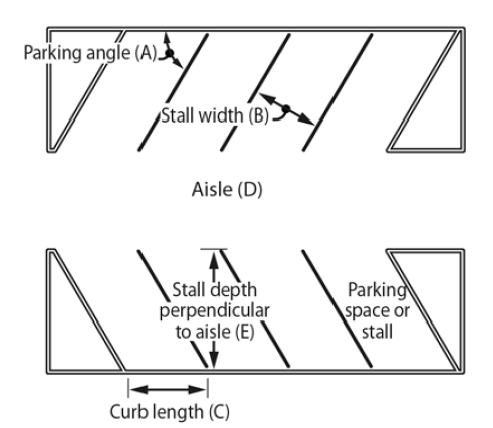
Figure H. Parking Layout.
Table 5. Parking dimension requirements.
b.
Motorcycle parking spaces shall measure a minimum of four feet by eight feet and shall be provided with adequate unobstructed maneuvering areas to permit easy access to the space.
c.
Bicycle parking spaces, when installed to meet any requirements of this title, shall measure a minimum of two feet by seven feet, be separated from adjacent parking and drive aisles be a curb or other stopping device, and be constructed of one or more among the following types of bicycle parking facilities:
1.
A rack that secures the frame and wheel with a lock.
2.
An enclosed bike locker.
3.
A fenced, covered, and locked or attended bike storage area.
(4)
Accessible parking spaces for persons with disabilities. Parking spaces, access aisles, and accessible paths shall be provided and reserved for the physically disabled in accordance with all applicable requirements of the Americans with Disabilities Act (ADA) and Texas Accessibility Standards (TAS).
(5)
Availability.
a.
Parking spaces, drive aisles, and other vehicle maneuvering areas shall remain clear for the purposes of vehicle parking and vehicle movement at all times.
b.
Signs, exterior displays, and storage of merchandise or other goods are prohibited from occupying a parking space, drive aisle, or other vehicle maneuvering area.
c.
Auto repair or storage of vehicles pending auto repair shall not occur in required parking spaces; all such activities shall occur indoors or be screened from the public right-of-way and adjacent properties by minimum S2 screening according to the standards in this title.
d.
Exception. Food trucks, garage sales, or seasonal sales, operating in accordance with all applicable provisions of this title, may temporarily occupy parking areas.
(6)
Maintenance. All parking areas, drive aisles, and driveway approaches shall be maintained free of defect and in the condition in which they are approved and installed. Failure to maintain a parking area, drive aisle, or driveway approach, or failure to correct any defect, constitutes a violation of this title.
(d)
Parking—Quantity standards.
(1)
General provisions.
a.
When new construction or a change in use is proposed, the applicant shall provide information concerning each proposed new or expanded use. The planning director shall determine the minimum parking required using the parking ratios provided in the table below. Appeals to the planning director's determination may be made to the zoning board of adjustments. In no instance shall fewer than four spaces be provided. In no instance shall fewer than four spaces be provided.
b.
When new construction is proposed with no specified use, the planning director shall determine the number of spaces required from the available information indicating the use or uses which may occupy the property. In no instance shall fewer than four spaces be provided.
c.
Parking for accessory uses is not calculated independently of the primary use when determining minimum parking requirements, except as specified in the table below or when the accessory use is a restaurant or assembly space, in which case that area of such accessory use shall be subject to the minimum requirements for that use category.
d.
When calculation of minimum parking required results in a fractional space, one space shall be provided for that fraction. Fractional spaces above 100 spaces may be omitted.
e.
Uses involving the fueling, repair, sales, or parts installation of motor vehicles shall provide the required parking indicated below for customers and employees in addition to any spaces or bays where fueling, repair, sales, parts installation, or temporary automobile storage occurs.
f.
In mixed-use and multitenant developments, the minimum parking required is calculated as follows unless a shared parking agreement is approved by the planning director:
1.
The nonresidential use with the largest floor area shall provide 100 percent of the minimum parking required for its use category.
2.
All other nonresidential uses shall provide 80 percent of the minimum parking required for their use categories.
3.
Residential uses in mixed-use developments shall provide 100 percent of the minimum parking required for multifamily dwelling units.
(2)
Minimum parking requirements. Parking shall be provided in accordance with the following ratios. Unless otherwise indicated, the ratio is based on floor area of conditioned space, measured in square feet.
Table 6. Minimum Parking Requirements.
(3)
Parking mitigation strategies. Upon calculating the minimum parking required for a use or multiple uses, the Planning Director may reduce the total number of spaces that must be provided to meet the purposes of this section when one or more of the parking mitigation strategies below is employed. The maximum reduction for all of these provisions in combination is thirty percent (30%). No other reductions or variances from minimum parking requirements shall be granted.
a.
Minimum parking requirements may be reduced by ten percent when an L2 or L3 landscape requirement is exceeded by at least 25 percent. For example, if 40 plants are required for L2 landscape and at least 50 are provided, the number of parking spaces required may be reduced by ten percent. Likewise, if 12 trees are required and at least 15 are provided, the ten percent reduction may be granted. The additional landscape shall meet all applicable specifications in the landscape and tree manual.
b.
Minimum parking requirements may be reduced by 20 percent when all parking and loading areas are located behind the wall nearest to the street of the building or buildings containing the uses for which the parking is required, when all parking and loading areas extend over less than 40 percent of the overall lot width, and when and a paved walkway connects the public right-of-way to a building entrance (facing the same right-of-way) within 50 feet.
c.
Minimum parking requirements may be reduced by one space for every two motorcycle parking spaces provided, up to a maximum reduction of three spaces. Motorcycle parking shall meet all quality standards of this section.
d.
Minimum parking requirements may be reduced by one space if a minimum of four bicycle parking spaces are provided within 50 feet of a building entrance. Bicycle parking shall meet all quality standards of this section.
(4)
Shared parking agreement.
a.
Parking areas may be shared by multiple tenants, buildings, or properties to meet the minimum parking requirements subject to the following requirements and approval by the planning director:
1.
Shared parking is intended for mixed-use developments and uses which have varying peak parking demands and are located near enough to one another to share parking facilities. Sufficient information shall be provided to the planning director to demonstrate that all uses will at all times on all days meet the proportion of the minimum parking requirements specified in the following demand table:
Table 7: Shared Parking Calculations.
2.
Parking spaces shall not be separated from any use they serve by a highway or arterial road unless a grade-separated pedestrian walkway is provided to cross the roadway. A parking shuttle may substitute for this requirement.
3.
Shared parking areas spanning multiple properties shall be connected by an approved combination of pedestrian walkways and public sidewalks to ensure the safe and efficient movement of pedestrians among them.
4.
Shared parking agreements spanning multiple properties shall be written into a form of agreement acceptable to the city attorney, signed by all owners of record, and notarized.
5.
Change or expansion of a use subject to a shared parking agreement shall require amendment to the agreement and is subject to approval by the Director.
(e)
Drive-thru design requirements.
(1)
Stacking lanes. All uses with drive-thru facilities shall provide stacking lanes for inbound vehicles designed so that vehicles queued in stacking lanes do not interfere with vehicle or pedestrian circulation onsite, on adjacent properties, or within public rights-of-way.
(2)
Stacking lanes for all drive-thru uses shall have a minimum width of nine feet.
(3)
Stacking lane minimum length shall be measured along the centerline beginning at the center of the service window, order board, kiosk, bay, etc., and determined according to the use as follows:
a.
All drive-thru uses not listed below: 110 feet for each lane.
b.
Auto Repair/Auto Wash/Auto Quick Lube/Oil Change/State Installation: 44 feet for each lane.
c.
Restaurant: 198 feet for each lane with a minimum of 154 feet behind the order board.
d.
Truck Fueling/Repair/Scales/Wash: 325 feet for each lane.
(4)
Restaurants providing drive-thru service shall indicate a minimum of one parking spot per lane for customers waiting for an order to be completed. This is in addition to the minimum required parking for the restaurant.
(5)
Directional signage and pavement markings shall be provided to indicate the flow of vehicles to and through the drive-thru facility, subject to the applicable sign regulations.
(f)
Loading space requirements.
(1)
Loading spaces shall be provided for nonresidential and mixed-use buildings for the exclusive purpose of loading and unloading of goods.
(2)
Loading spaces shall be paved and maintained in a smooth condition suitable for the heaviest vehicle loads using them.
(3)
Location:
a.
Loading spaces shall be provided with a means of unobstructed access to a public street or alley allowing the vehicle both ingress and egress in a forward motion.
b.
Loading spaces shall not interfere with typical movements of vehicles and pedestrians onsite or in the public right-of-way.
c.
Type A loading spaces shall not be located in a front yard setback and shall be screened from any adjacent right-of-way or property zoned for residential uses.
(4)
Dimensional standards.
a.
Type A loading spaces shall have a minimum width of 14 feet, a minimum length of 35 feet, and a minimum vertical clearance of 14 feet.
b.
Type B loading spaces shall have a minimum width of 9 feet, a minimum length of 20 feet, and a minimum vertical clearance of 10 feet.
(5)
Minimum loading spaces required:
Table 8. Minimum Loading Space Requirements.
(Ord. No. O2022-28, § 2(Exh. A), 9-27-22)
Sec. 12-4-106. - Outside display and storage.
(a)
Purpose. The purposes of these outside storage and display standards are to:
(1)
Protect and promote the desired neighborhood character and development patterns of the City of Weatherford and its General Plan.
(2)
Ensure that outside storage and display areas are sufficient for the needs of the full range of multifamily residential and nonresidential uses and are provided in an orderly and attractive manner consistent with other exterior features.
(b)
Applicability. Outside storage and display standards apply to all new and existing development in zoning districts which permit multifamily residential and nonresidential uses. This section does not apply to the storage or display of motor vehicles, seasonal outdoor sales or to plants for sale as part of a commercial nursery.
(c)
Outside storage standards. The storage of bulk merchandise, equipment, or goods not directly or immediately available for purchase by the public outside of buildings shall be limited to goods which are related to the primary activity on the site and is subject to the following restrictions:
(1)
Outside storage is not permitted in the CBD or CN zoning districts.
(2)
Outside storage in the C1 and C2 zoning districts, and outside storage accessory to multifamily residential uses in all zoning districts shall not be located forward of the front (i.e., street-facing) walls of the primary building(s) and shall be enclosed by a wall, fence, one or more structures, landscaping, or a combination thereof sufficient to screen it from view from any public right-of-way or adjacent property. Outside storage shall be limited to five percent of the total area of the lot.
(3)
Outside storage in the C3 and I zoning districts shall be enclosed by a wall, fence, one or more structures, landscaping, or a combination thereof, sufficient to screen it from view from any public right-of-way or adjacent property. Outside storage shall be limited to 50 percent of the total area of the lot.
(4)
Outside storage in all districts and for all uses shall not encroach on any required parking space, driveway, drive aisle, pedestrian path, or public right-of-way including streets, alleys, sidewalks, and multiuse paths or trails, nor shall any storage area or item stored thereupon pose a safety or visibility hazard, nor impede public vehicular or pedestrian circulation, either on-site or off-site, in any way.
(5)
Outside storage in all districts and for all uses shall not be located on a rooftop.
(6)
Outside storage shall be on an approved all-weather surface adequate to support the anticipated materials, except that outside storage of unfinished or waste-related materials in the C3 and I zoning districts may be on unimproved surfaces such as dirt, grass, or loose gravel only when drainage into an onsite stormwater collection and treatment facility is provided.
(d)
Outside display standards. The display of merchandise, excluding large/bulk items (which are considered outside storage) for sale to the public outside of buildings is subject to the following restrictions:
(1)
Outside display is not permitted in the CBD or CN zoning districts, or for residential uses in any district, except as provided in the design standards for each district.
(2)
Outside display shall not encroach on any required parking space, driveway, drive aisle, pedestrian path, or public right-of-way including streets, alleys, sidewalks, and multiuse paths or trails, nor shall any display area or item displayed thereupon pose a safety or visibility hazard, nor impede public vehicular or pedestrian circulation, either on-site or off-site, in any way.
(3)
Outside display in the C1 and C2 zoning districts is limited to 200 square feet and shall be within 15 feet of the building containing the use to which the outside display is accessory, unless otherwise approved under a conditional use permit. All items on display during business hours shall be removed or screened from view at the end of each business day, except for large/bulk items, which shall be secured.
(4)
Outside display in the C3 and I zoning districts is limited to 50 percent of the total area of the lot.
(5)
All items on display shall be displayed in a neat, orderly manner, and the display area shall remain clean and free of litter at all times.
Sec. 12-4-107. - Performance standards.
(a)
Purpose. In all zoning districts, any use indicated in the permitted use list shall conform in operation, location, and construction to the performance standards as administered by county, state, and/or federal agencies. All uses, including those that may be allowed by conditional use, unless expressly provided for otherwise, shall conform in operation, location, and construction to appropriate performance standards for noise, smoke, and particulate matter, odorous matter, fire, explosive hazard material, toxic and noxious matter, vibration, and glare. All federal and state pollution, noise, and requirements for toxic waste disposal shall be observed.
(b)
Noise. At no point at the bounding property line* of any use shall the sound pressure level of any operation or plant exceed the decibel limits specified in the octave band groups designated in the following table:
Table 9. Maximum Permissible Daytime** Octave Band
* Bounding property line shall be interpreted as being at the near side of any street, alley, stream, or other permanently dedicated open space from the noise source when such open space exists between the property line of the noise source and adjacent property. When no such open space exists, the common line between two parcels of property shall be interpreted as the bounding property line.
** Daytime shall refer to the hours between sunrise and sunset on any given day.
*** "A scale" levels are provided for monitoring purposes only and are not applicable to detailed sound analysis.
(1)
Corrections. The following corrections shall be made to the table of octave band-decibel limits in determining compliance with the noise level standards:
a.
When noise is present at nighttime, subtract (-7db.)
b.
When noise contains strong pure-tone components or is impulsive, that is when meter changes at ten decibels or more per second, subtract (-7db.)
c.
When noise is present for not more than the following, add (+10db):
1.
One minute in any one-hour period;
2.
Ten minutes in any two-hour period;
3.
Twenty minutes in any four-hour period.
(2)
Measurement. Measurement of noise shall be made with a sound level meter with an octave band analyzer meeting the standards prescribed by the American Standards Association.
(3)
Exemptions. The following uses and activities shall be exempt from the noise level regulations herein specified:
a.
Noises not directly under control of the property user.
b.
Noises emanating from construction and maintenance activities between the hours of 7:00 a.m. and 7:00 p.m. (daylight hours).
c.
Noises of safety signals, warning devices, and emergency pressure relief valves.
d.
Transient noise of moving sources such as automobiles, trucks, and airplanes.
e.
Smoke and particulate matter. No operation or use shall cause, create, or allow the emission for more than three minutes in any one hour of air contaminants which at the emission point or within the bounds of the property are:
1.
Of such opacity as to obscure an observer's view to a degree equal to or greater than does smoke or contaminants in the standard prescribed by the American Society for Testing Materials (ASTM) except the standards specified in A.S.T.M.D. 3-1302-1 and 3-1302-2 shall not apply when the presence of uncombined water is the only reason for failure to comply or when such contaminants are emitted inside a building which prevents their escape into the atmosphere.
2.
The emission of particulate matter from all sources shall not exceed one-half pounds per acre of property within the plant site per any one hour.
3.
Open storage and open processing operations shall be so conducted that dust and other particulate matter generated are not transported across the boundary line of the tract on which the use is located in concentrations exceeding four grains per 1,000 cubic feet of air, including on-site transportation movements which are the source of wind or air borne dust or other particulate matter or which involves dust or other particulate air contaminants, and generating equipment such as used in paint spraying, grain handling, sand and gravel processing or storage, or sand blasting.
(c)
Odorous matter.
(1)
No use shall be located or operated which involves the emission of odorous matter from a source of operation where the odorous matter exceeds the odor threshold at the bounding property line or any point beyond the tract on which such use or operation is located.
(2)
The odor threshold as herein set forth shall be determined by observation by any person or persons. Where uncertainty may arise or where the operator or owner of an odor-emitting use may disagree with the enforcing officer or where specific measurement of odor concentration is required, the method and procedures specified by American Society for Testing Materials A.S.T.M.D. 1391-57, entitled "Standard Method for Measurement of Odor in Atmospheres," shall be used. A copy of A.S.T.M.D. 1391-57 is available at the Development Services office for reference.
(d)
Fire or explosive hazard material.
(1)
No use involving the manufacture or storage of compounds or products which decompose by detonation shall be permitted except that chlorates, nitrates, perchlorates, phosphorus, and similar substances and compounds in small quantities for use by industry, school laboratories, druggists. or wholesalers may be permitted when approved by the Fire Chief of the City of Weatherford.
(2)
The storage and use of all flammable liquids and materials such as pyroxylin plastics, nitrocellulose film, solvents, and petroleum products shall be permitted only when such storage or use conforms to the standards and regulations of the City of Weatherford Fire Code or are approved by the fire chief.
(e)
Toxic and noxious matter.
(1)
No operation or use shall emit a concentration of toxic or noxious matter which will exceed ten percent of the concentration (exposure) considered as the threshold limit for an industrial worker across the bounding property line of the tract on which such operation or use is located. Such standards are set forth by the Texas State Department of Health in "Threshold Limit Values Occupational Health Regulation No. 3," a copy of which is available at the development services office for reference.
(f)
Vibration.
(1)
No operation or use shall at any time create earthborne vibrations which, when measured at the bounding property line of the source operation, exceed the limits of displacement set forth in the following table in the frequency ranges specified:
Table 10. Vibration Displacement Limits.
(g)
Lighting and glare standards.
(1)
Standards for controlling lighting and glare are set forth to reduce the annoyance and inconvenience to property owners and traffic hazards to motorists. These standards are intended to allow reasonable enjoyment of adjacent and nearby property by their owners and occupants while requiring adequate levels of lighting of parking areas.
(2)
Nonresidential site lighting and glare standards.
a.
Any use shall be operated so as not to produce obnoxious and intense glare or direct illumination across the bounding property line from a visible source of illumination of such intensity as to create a nuisance or detract from the use or enjoyment of adjacent property. All outside lights shall be made up of a light source and reflector so selected that acting together, the light beam is controlled and not directed across any bounding property line above a height of three feet. The allowable maximum intensity measured at the property line of a residential use in a residential district shall be 0.25 foot candles.
b.
Light poles shall be placed on the site a setback equal to its height from all adjacent residential property.
c.
All off-street parking areas for non-residential uses in non-residential districts that are used after dark shall be illuminated beginning 30 minutes after sunset and continuing throughout the hours of business operation. If only a portion of a parking area is offered for use after dark, only that part is required to be illuminated in accordance with these standards. However, the portion offered for use shall be clearly designated. Lighting within the parking areas shall meet the following minimum requirements:
(3)
Intensity.
a.
Minimum at any point on the parking area surface to be at least 0.6 foot candles initial and at least 0.3 foot candles maintained or one-third of the average, whichever is greater.
b.
Illumination shall not exceed an average of one foot candle at ground level and shall distribute not more than 0.25 foot candles of light upon any adjacent, residentially zoned area.
(4)
Height.
a.
The maximum height for poles with lights is 35 feet.
(5)
Residential lighting and glare standards.
a.
Residential lighting for security and night recreation use is permitted in all residential districts provided the following requirements are met:
1.
Direct lighting over ten feet in height is shielded from adjacent property.
2.
No light source shall exceed 25 feet in height. Streetlights and other traffic safety lighting are exempt from this standard.
3.
Lighting shall not directly shine on adjacent dwellings.
(6)
Luminaires.
a.
Light sources shall be of a down-light type, indirect, diffused, or shielded type luminaires installed and maintained so as to reduce glare effect and consequent interference with use of adjacent properties and boundary streets. Bare bulbs above 75 watts and strings of lamps are prohibited, except for temporary lighting as provided in 46.5 below.
(7)
Special or temporary lighting—Low wattage.
a.
Bare bulbs or strings of lamps are prohibited, except during holidays. Special lighting shall be permitted for a maximum time period of 45 days for each city-recognized holiday.
(Ord. No. O2025-15, § 1, 4-22-25)

