
Whitesburg City Zoning Code
ARTICLE I
- IN GENERAL
Sec. 32-1.- Purpose.
(a)
The purpose of this chapter is to establish minimum standards for the use of land and improvements in the city. The zoning regulations and districts herein established are designed to:
(1)
Lessen congestion in the streets;
(2)
Provide safety from fire, panic, and other dangers;
(3)
Promote health, and general welfare;
(4)
Provide adequate light and air;
(5)
Avoid undue concentration of the population;
(6)
Provision of transportation, water, sewerage, schools, parks and other public requirements;
(7)
Conserve the value of economy;
(8)
Encourage the most appropriate use of land and structures;
(9)
Promote quality of life for all citizens;
(10)
Provide consistency with land use element of the comprehensive plan;
(b)
The requirements of these regulations are minimum permissible standards; and it is expected that developers and the respective decision-making authority will normally strive for quality developments which will exceed these minimum requirements.
(c)
By this section, the comprehensive plan adopted by resolution of the city is established as the official policy of the city concerning land uses. The incorporated areas of the city are divided into land use categories consistent with the future land use plan in the land use element of the comprehensive plan. The comprehensive plan does not alter or affect the existing zoning districts in the city, does not effectuate an amendment to the official zoning maps, and does not itself permit or prohibit any existing land uses. The land use element of the comprehensive plan shall be amended on an annual basis to reflect changes in land use and to discover any inconsistencies zoning changes have caused in the future land use map.
(d)
The land use element of the comprehensive plan shall be updated once each year. This update shall be used to identify current uses of land, emerging growth patterns and any significant change in land use policy as identified by the future land use map of the comprehensive plan. This update shall also be used as policy in the city's consideration of proposed amendments to the zoning map or text of the zoning chapter. All amendments to the city's comprehensive plan shall be in accordance with the minimum planning standards and procedures of the state planning act.
(Prior Code, app. D, art. 2(2.1); Ord. of 12-21-1998)
Sec. 32-2. - Legal status.
This chapter is not intended to interfere with or annul any easement, covenant, or other agreement between parties. However, where this chapter imposes a greater restriction upon the use of property or by private easements, covenants, or agreements, the provisions of this chapter shall govern. Whenever other ordinances or parts of ordinances require greater restrictions than those required by this ordinance such ordinances or parts of ordinances shall govern.
(Prior Code, app. D, art. 23(23.1); Ord. of 12-21-1998)
Sec. 32-3. - Use of definitions.
Any word not defined in section 32-4 shall be as defined elsewhere in this chapter or, if not defined elsewhere in this chapter, as defined in Webster's New World Dictionary of the American Language - Second College Edition, the said definition to be read in context with the purposes and provision of the part of the chapter it is being used to define.
(Prior Code, app. D, art. 3(3.2); Ord. of 12-21-1998)
Sec. 32-4. - Definitions.
The following words, terms and phrases, when used in this chapter, shall have the meanings ascribed to them in this section, except where the context clearly indicates a different meaning:
Accessory structure means a structure detached from the principal building on the same lot and customarily incidental and subordinate to the principal building.
Accessory use means a use of land or of a building or portion thereof customarily incidental and subordinate to the principal use of the land or building and located on the same lot with the principal use.
Addition to an existing building means any walled or roofed expansion to the perimeter of a building in which the addition is connected by a common load bearing wall other than a fire wall. Any walled and roofed addition which is connected by a fire wall or is separated by an independent perimeter load bearing wall is new construction.
Administrator, zoning, means the person, officer, or official and his duly authorized representative, whom the city council has designated as its agent for the administration of this chapter.
Alley means a public thoroughfare which affords only a secondary means of access to abutting property and not intended for general traffic circulation.
Alteration means any change in the supporting members of a building or structure such as bearing walls, columns, and girders, except such emergency change as may be required for safety purposes; any addition to a building; any change in use from one district classification to another; or, any movement of a building from one location to another.
Animal hospital means a facility for the temporary boarding and treatment of domestic animals operated under the supervision of a licensed veterinarian.
Apartment. See Dwelling, multifamily.
Basement means the area below the first-floor level in a building and having not more than one-half of its height above grade.
Bed and breakfast inn means a building, not necessarily owner occupied, which offers transient lodging accommodations and breakfast for four or more guest rooms for compensation, provided:
(1)
Compliance with the same licensing, inspection and taxation requirements as hotels, motels, and restaurants.
(2)
If within a residential district, the building shall be residential in character.
(3)
Breakfast is the only meal served and only to overnight guests.
(4)
The owners may have employees.
(5)
The owner shall provide one off street parking space for each rental room and one space for each employee.
(6)
In a residential district, signage shall be limited to one sign and maximum size of two square feet.
Berm means a mound of earth or the act of pushing earth into a mound. A berm is usually two to six feet high and is used to shield, screen, and buffer undesirable views or to separate incompatible land uses. In traffic work, berm refers to the raised area between the curb line and right of way line.
Buffer means a portion of a lot set aside for open space and/or screening purposes, to shield or block noise, light, glare, or visual or other nuisances; to block physical passage to dangerous areas; or, to reduce air pollution, dust, dirt and litter. A buffer may contain a barrier, such as a berm, wall or fence, where such additional screening is necessary to achieve the desired level of buffering between various activities and/or land uses.
Building means any structure having a roof supported by columns or walls designed or built for the support, enclosure, shelter, or protection of persons, animals, or property of any kind.
Building height means the vertical distance measured from the highest grade adjacent to the highest point of roof surface of a flat roof, to the deck line of a, mansard roof, or to the average height between eaves and ridges of a gable, hip or gambrel roof.
Building line means a line parallel to the street right-of-way line at a distance from the right-of-way line equal to the depth of the required front yard for the zoning district in which the lot is located.
Cemetery, private, means any plot of ground, building, mausoleum, or other enclosure not located on property owned by or adjacent to a religious institution but used for the burial of deceased persons.
Cemetery, public, means any plot of ground, building, mausoleum, or other enclosure used for the burial of deceased persons of one collateral line of descent.
Cemetery, religious institution, means a plot of ground, building, mausoleum, or other enclosure owned by or adjacent to a religious institution and used for the burial of deceased persons who are generally members of that religious institution.
Childcare, group, means a building or portion of a building which provides care and supervision of persons away from their place of residence for less than 24 hours a day on a regular basis for compensation; serves seven to 18 persons and is licensed by the state.
Childcare facility means a building or portion of a building where care and supervision is provided to persons away from their place of residence for less than 24 hours per day on a regular basis for compensation; serves 19 or more persons and is licensed by the state; for children, the outdoor play area shall be enclosed by a fence of not less than four feet in height in the rear yard only. For the purpose of this chapter, the term "childcare" shall include, but not be limited to, the terms "day care," "nursery school," "early learning center," "pre-kindergarten," "private kindergarten," "play school" and "pre-school."
Childcare home, family, means a customary home occupation which provides for six or less persons who are not residents of the premises; care and supervision by a state-registered resident adult for less than 24 hours per day on a regular basis for compensation.
Church means a building or structure, or groups of buildings or structures, which by design and construction are primarily intended for conducting organized religious services and associated accessory uses.
Clinic means an establishment where patients are admitted for examination and treatment on an outpatient basis by one or more physicians, dentists, other medical personnel, psychologists, or social workers and where patients are not lodged overnight.
Club, private, means an establishment or premises owned or operated by a corporation, association, person or persons for a social, educational or recreational purpose but not primarily for profit or to render a service which is customarily carried on as a for-profit business.
Comprehensive plan means an all-inclusive, long-range plan intended to guide the growth and development of a community or region which typically includes inventory and analytic sections leading to a recommendation for the community's future economic development, housing, recreation, transportation, community facilities and land use, all related to the community's goals and objectives for these elements.
Conditional use means a use not ordinarily permitted, but which may be permitted with imposition of conditions related to the promotion of the public health, safety, morals, or general welfare and designed to minimize the negative impact on surrounding lands. Such conditions may include, but are not limited to, restriction on land use; height, setback and other non-use requirements; physical improvements, including infrastructure, to the property.
Development means subdividing a tract of land into two or more lots whether for sale or rental; construction, erection or expansion of a structure, filling, grading, excavation or land-disturbing activities affect more than one acre; recording a plat in the office of the clerk of superior court; or location of a facility.
District means a delineated section of the city for which the zoning regulations governing the use of buildings and premises, the height of buildings, the size of yards, and the intensity of use are uniform.
Dwelling means a building which is designed or used exclusively for residential purposes, including single-family, multifamily residential buildings, roominghouses and boardinghouses, manufactured homes and industrialized homes but not including hotels and motels.
Dwelling, apartment. See Dwelling, multifamily.
Dwelling, loft, means a dwelling unit, occupied by no more than four persons, and located only on the floor above a ground level commercial business.
Dwelling, multifamily, means a building designed as two or more separate units for or occupied exclusively by two or more families.
Dwelling, single-family attached, means a building containing two or more dwelling units, each of which is deeded with separate ownership and has primary ground floor access to the outside and which are attached to each other by party walls without openings. The term "dwelling, single-family attached" can include fee-simple townhouses and condominiums.
Dwelling—Single-family detached means a residential building containing not more than one dwelling unit entirely surrounded by open space. The term "single-family detached dwelling" includes site-built houses and industrialized houses. (A manufactured or mobile home is not a single-family detached dwelling.) All single-family detached dwellings shall meet the appearance standards as provided in section 32-60.
Easement means a grant of one or more property rights to and/or for a person, government agency, or public utility company to use public or private land owned by another for a specific purpose.
Family means one or more individuals permanently occupying a swelling unit and living as a single housekeeping unit, as distinguished from persons occupying a boarding house, group home, or hotel, as defined in this chapter.
Flood means a rise in stream flow or stage that results in temporary inundation of the areas adjacent to the channel.
Floor area, gross, means the gross heated areas of all floors, measured from the exterior faces of the exterior walls of the building.
Game room means any establishment which operates solely on the proceeds from any amusement machine or device operated by means of insertion of a coin, token, or similar object for the purpose of amusement or skill and for playing where a fee is charged.
Garage, private, means an accessory building designed or used for the storage of motor-driven vehicles owned and used by the occupants of the buildings to which it is an accessory.
Grade means the average level of the finished ground surface adjacent to the exterior walls of the building.
Group home means a residence composed of non-related individuals with one or more surrogate parents that function as a singular house-keeping unit. All group homes shall be approved and licensed by the state department of human resources.
Hardship means an unusual situation on the part of an individual property owner which will not permit the owner to enjoy the full utilization of the property which is given to others in the community. A hardship exists only when it is not self-created, or when it is not economic in nature.
Health department means the county health department.
Home occupation means an occupation customarily carried on by an occupant of a dwelling unit as a secondary use which is clearly incidental to the use of the dwelling unit for residential purposes and operated in accordance with the provisions of these regulations.
Industrialized home means any structure or component thereof which is wholly or in substantial part made, fabricated, formed, or assembled in manufacturing facilities for installation on a building site and has been manufactured in such a manner that all parts or processes cannot be inspected at the installation site without disassembly, damage to, or destruction thereof. Industrialized buildings are constructed and regulated in accordance with the Industrialized Building Act, Georgia Law 1982 pp. 1637-1643 and O.C.G.A. title 8, chapter 2, article 2, part 1 (O.C.G.A. § 8-2-110 et seq.).
Junk means any used article of commerce which is composed principally of iron, steel, brass, copper, or zinc, or their alloys, or any other base metal, and which is commonly bought for the purpose of resale and refabrication, either or both (See O.C.G.A. § 43-22-1); provided further, the term "junk," as used by this chapter, means worn out and discarded material that may be returned to some use, especially old rope, chain, iron, copper, parts or machinery, electrical and electronics equipment, and bottles gathered or brought up by trade persons called junk dealers; hence, rubbish of any kind; odds and ends; provided further, the term "junk," as used by this chapter, does not include scrap or steel recovered from automobiles, etc., being cut to size with or without being baled to meet specifications of steel mills and foundries for remelting.
Junk business means, for the purposes of this chapter, the term "junk business" is the pursuit, for profit, of purchasing old iron, brass, bottles etc., and selling them again in the condition in which they were purchased by said dealer.
Junk dealer means any person, firm or corporation having a fixed place of business, or officer, agent and employee of any person, firm or corporation who engages in the purchase of used articles of commerce principally composed of iron, steel, brass, copper, or zinc, or their alloys, or any other base metals, and which is commonly bought for the purpose of resale and re-fabrication, either or both (see O.C.G.A. § 43-22-1).
Junkyard means an uncovered lot or part thereof, whether enclosed or not, used for the collection, storage, keeping, sale, abandonment, or resale of junk including scrap metal, rags, paper and other scrap materials and equipment, or for the dismantling, demolition or abandonment of three or more disabled automobiles, not bearing current auto tags/decals, or other machinery, appliances or parts thereof.
Kennel means any location where breeding, raising, boarding, caring for, and the keeping of more than five dogs or cats or other small animals or a combination thereof (except litters of animals not more than six months of age) is carried on for commercial purposes.
Land-disturbing activity means any grading, scraping, excavating, or filling of land, clearing of vegetation; and any construction, rebuilding, or alteration of a structure. The term "land-disturbing activity" does not include activities, such as ordinary maintenance and landscaping operations, individual home gardens, yard and grounds upkeep, repairs, additions, or minor modifications to a single-family dwelling, and the cutting of firewood for personal use.
Livestock means and includes cattle, horses, goats, sheep, swine, rabbits, poultry, ducks, geese, and other fowl customarily bred or raised in captivity, owned and kept for pleasure.
Lot means a designated parcel, tract or area of land established by plat, subdivision or as otherwise permitted by law, to be separately owned, used, developed or built upon. The term "lot" includes the terms "plot" and/or "parcel."
Lot, corner, means a lot abutting upon two or more streets at their intersection.
Lot, through, means a lot other than a corner lot abutting two streets.
Lot of record means a lot which exists prior to the first published notice or subsequent amendment of this chapter, as shown or described on a plat or deed in the records of the local registry of deeds.
Lot width means the width of the lot at the front setback line.
Manufactured home means a structure defined by and constructed in accordance with the National Manufactured Housing Construction and Safety Standards Act of 1974, 42 USC 5401 et seq., as amended.
Manufactured home means a structure transportable in one or more sections, which, in the traveling mode, is eight body feet or more in width, 40 feet or more in length, or, when erected onsite, is 320 or more square feet, and which is built on a permanent chassis designed to be used as a dwelling with or without a permanent foundation when connected to the required utilities, and includes the plumbing, heating, air conditioning, and electrical system contained therein; except that such term shall include any structure which meets all the requirements and the manufacturer voluntarily files a certification required by the secretary of housing and urban development complying with the standards established under this title.
Masseur andmasseuse mean people who practice the art of body massage, by hand or mechanical apparatus, oil rubs, corrective gymnastics, dietetics, hot packs and mechanotherapy.
Mobile home means a structure, transportable in one or more sections, which, in the traveling mode, is eight body feet or more in width or 40 body feet or more in length or, when erected onsite, is 320 or more square feet and which is built on a permanent chassis and designed to be used as a dwelling with or without a permanent foundation when connected to the required utilities and includes the plumbing, heating, air conditioning, and electrical systems contained therein and manufactured prior to June 15, 1976.
Motel means a permanent building or group of permanent buildings in which overnight sleeping accommodations are provided for travelers and having a parking space near or adjacent to the entrance of the room. Such use has 80 percent of the rooms occupied by a different registered guest every five days, provides patrons with daily maid service, 24-hour desk/counter clerk service, and telephone service to receive incoming and outgoing messages, and shall comply with the applicable requirements of the county health department and O.C.G.A. § 31-28-1 et seq., and may provide additional services such as restaurants, retail gift shops, meeting rooms, swimming pools and exercise facilities.
Non-conforming use means the use of any building or land which was lawful at the time of passage of the ordinance from which this chapter is derived, or amendment thereto, but which use does not conform, after the passage of the ordinance from which this chapter is derived, or amendment thereto, with the regulations of the district in which it is situated.
Parking lot means an open area used exclusively for the temporary parking of vehicles and bicycles and which no gasoline or vehicular accessories are sold or no other business is conducted.
Parking space means a space, enclosed or unenclosed, having an area of not less than 108 square feet (nine-foot by 12-foot) exclusive of access, permanently reserved for the temporary storage of one vehicle and having access to the street.
Permit means any written authorization for building, construction, alteration, development, occupancy, or other matter required by this chapter to be approved a designated commission, board, official or employee. The person to whom such permit is issued shall be known as the permittee.
Permitted use means any use allowed in a zoning district and subject to the restrictions applicable to that zoning district.
Personal care home means a building or group of buildings, facility or place in which is provided two or more beds and other facilities and services, including room, meals and personal care, for non-family ambulatory adults. For the purpose of these rules, personal care homes shall be classified as:
(1)
Congregate personal care home means a home for adults which offers care to 16 or more persons.
(2)
Family personal care means a home for adults in a family-type residence, noninstitutional in character, which offers care for two to six persons.
(3)
Group personal care home means a home for adult persons in a residence or other type building, noninstitutional in character, which offers care for seven to 15 persons.
The term "personal care home" does not include buildings which are devoted to independent living units which include kitchen facilities where residents have the option of preparing and serving some or all of their own meals or boarding facilities which do not provide personal care.
Planning commission means the city planning commission.
Plat means a map, plan or layout of a county, city, town, lot, section, subdivision or development indicating the location and boundaries of properties.
Principal building means a building where the main or principal use of the lot is conducted.
Scale of development means the relationship of a particular project or development, in terms of size, height, bulk, intensity and aesthetics.
Setback means the mean horizontal distance between the front street right-of-way line and the front line of the building or the allowable building lines as defined by the front yard regulations of this chapter.
Setback line means the line which is the required minimum distance from any lot line and that established the area within which the principal structure must be erected or placed.
Sign means a name, identification, description, display, or illustration which is affixed to, painted or represented, directly or indirectly, upon a building, structure, parcel or lot and which directs attention to an object, product, place, activity, person, institution, organization, or business located on the premises. The term "sign" does not include official court, governmental notices, traffic warning or control devices or street signs, flag, emblem or insignia of a nation, school or religion.
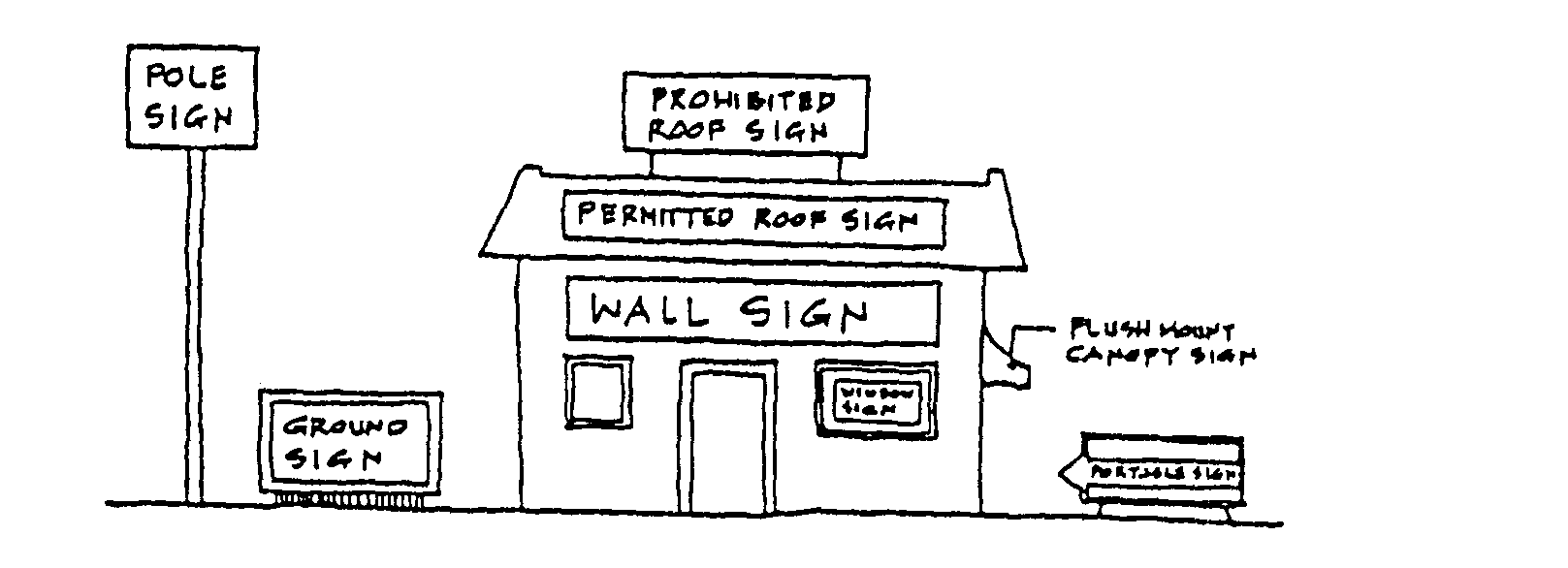
Figure 1: Sign Types
Street means a public right-of-way, whether designated as an avenue, boulevard, road, highway, expressway, lane or other way, that is dedicated or devoted to the public pedestrian or vehicular use by deed, plat, and/or prescription, which affords the principal means of access to abutting property.
Collector street means a street that collects traffic from local streets and connects with minor and major arterials.
Local street means a street designed to provide vehicular access to abutting property and to discharge through traffic.
Major arterial means a street with access control channelized intersections, restricted parking, and that collects and distributes traffic to and from collector streets.
Minor arterial means a street with signals at important intersections and stop signs on the side streets and collects and distributes traffic to and from collector streets.
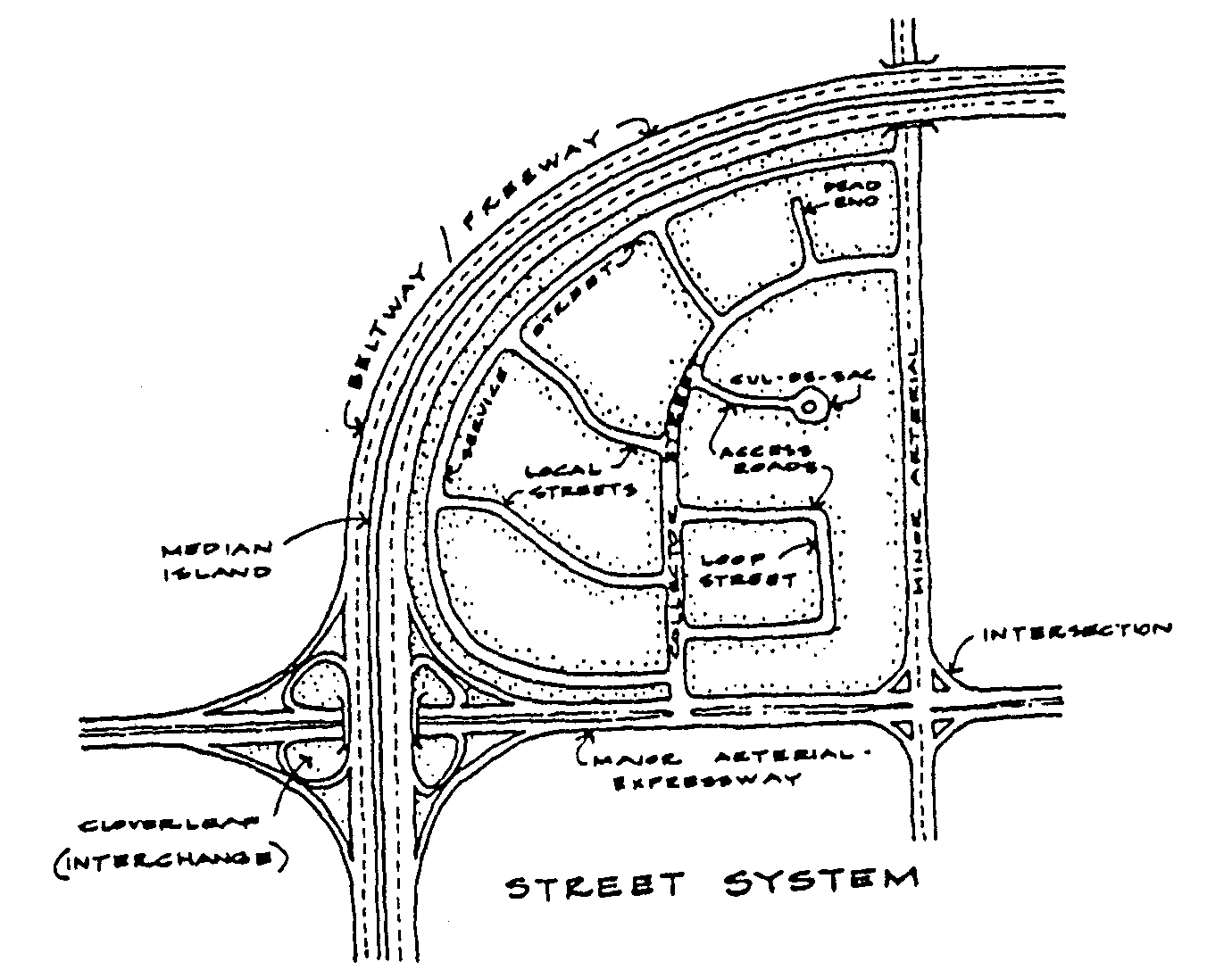
Figure 2: Street Types
Subdivision means all divisions of a tract or parcel of land into two or more lots, parcels, building sites, or other divisions for the purpose, whether immediate or future, of sale, or building development, including all division of land involving a new street or a change in existing streets. The term "subdivision" includes resubdivision of property and creation of condominiums. The term "subdivision" shall not include a division of land caused by public acquisition.
Temporary structure means a structure without any foundation or footings and which is removed when the designated time period, activity or use for which the temporary structure was erected has ceased.
Travel center means any single commercial development which includes restaurants, hotels, motels and other commercial uses which cater primarily to commercial vehicles.
Truck stop means any building, premises or land in which or upon which a business, service or industry involving the maintenance, servicing, storage, or repair of commercial vehicles is conducted or rendered, including dispensing of motor fuel or other petroleum products directly into motor vehicles and the sale of accessories or equipment for trucks and similar commercial vehicles. The term "truck stop" also may include overnight accommodations and restaurant facilities primarily for the use of truck crews.
Variance means the permission to depart from the literal requirements of a zoning ordinance.
Variance use means a variance granted for a use or structure that is not permitted in the zone.
Yard means an open space that lies between the principal building or buildings and the nearest lot line. The minimum required yard as set forth in this chapter is unoccupied and unobstructed from the ground upward except as may be specifically provided in the zoning ordinance.
Yard, front, means a space extending the full width of the lot between any building and the front lot line and measured perpendicular to the building at the closest point to the front lot line.
Yard, rear, means a space extending across the full width of the lot between the principal building and the rear lot line and measured perpendicular to the building to the closest point of the rear lot line.
Zoning means the delineation of districts and the establishment of regulations governing the use, placement, spacing and size of land and buildings.
Zoning map means the map which is part of the zoning ordinance and delineates the boundaries of zone districts.
(Prior Code, app. D, art. 3(3.3); Ord. of 12-21-1998; Ord. of 9-12-2005(1), § 1; Ord. of 7-6-2020 , § 1)

