
Whitesburg City Zoning Code
ARTICLE IV
BUFFER REQUIREMENTS
Sec. 32-81.- Applicability.
A buffer shall be required whenever two adjoining properties are in dissimilar zone districts as shown in Table 32-81.
(Ord. of 9-12-2005(1), § 5)
Sec. 32-82. - Determination of buffer requirements between residential, commercial and industrial zones.
When two adjoining properties are in dissimilar residential, commercial or industrial zone districts as indicated in Table 32-81, the property within the zone district allowing the most intensive uses is required to provide the buffer when acquiring a building permit unless the buffer was pre-existing. When two adjoining vacant parcels are in dissimilar zone districts as indicated in Table 32-81, no buffer is required when the parcel zoned for the less intensive use acquires a building permit.
(Prior Code, app. D, art. 6(6.1); Ord. of 12-21-1998)
Sec. 32-83. - Buffer requirement, 100-foot setback.
The required buffer shall consist of a 100-foot setback from the adjoining property line containing not less than a 20-foot base width consisting of plantings plus a fence, wall (not otherwise part of a structure or accessory structure), a berm, or any combination thereof, which meets the screening standards of section 32-85.
(Prior Code, app. D, art. 6(6.1-1); Ord. of 12-21-1998)
Sec. 32-84. - Buffer requirement, 500-foot unvegetated setback or 200-foot vegetated setback.
The required buffer shall consist of either an unvegetated 500-foot setback or 200-foot vegetated setback from the adjoining property line. A 200-foot minimum setback shall consist of 75 feet of vegetated buffer area, measured along the entire portion of the property line abutting said use, and such buffer shall extend an additional 100 feet in each direction along the common property line. The 75-foot vegetated buffer shall meet the planting requirements contained in section 32-85.
(Prior Code, app. D, art. 6(6.1-2); Ord. of 12-21-1998)
Sec. 32-85. - Screening standards.
(a)
Screening is a method of visually shielding or obscuring one use from another by fence, walls, a berm or densely planted vegetation.
(b)
Plantings. Plantings shall consist of either trees or shrubs or any combination of both. Planted areas shall be located along the abutting property lines or in areas that will provide the best screening effectiveness.
(c)
If trees or large shrubs are used solely as the screening device, they shall be any evergreen species from the list provided by the city clerk which, under normal growing conditions, will attain a minimum height of 8 feet and a canopy spread often feet within four years. They shall be planted a minimum 20 feet on center.
(d)
If trees are used in combination with shrubs, they may be of any species from the list provided by the city clerk. Small trees shall be planted 30 feet on center, and large trees 40 feet on center as shown in the following illustration. Shrubs shall be any evergreen species from the list provided by the city clerk planted four feet on center as shown in the following illustration. Shrubs shall initially be of any size, which would normally attain a minimum height of six feet within three years after planting.
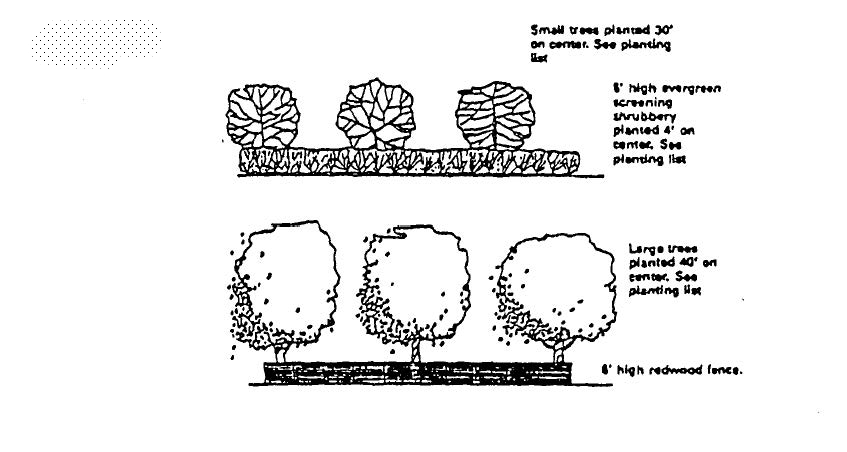
Figure 1.
Tree/Shrub Planting Requirements
(e)
Walls. Walls shall be of masonry construction and a minimum height of eight feet. The wall shall be placed on the edge of the buffer nearest the most intensive land use.
(f)
Fences. Fences shall be a minimum of eight feet in height and constructed of standard wood fencing materials and methods or chain link with woven inserts that will provide 90 percent visual blockage as shown in the examples provided by the zoning administrator. The fence shall be placed on the edge of the buffer nearest the most intense land use.
(g)
Berms. Earthen berms shall have a minimum height of eight feet.
(Prior Code, app. D, art. 6(6.2); Ord. of 12-21-1998)
Sec. 32-86. - Buffer design.
All buffers required by this article shall conform to the following specifications:
(1)
Prior to development, a buffer plan shall be required to show the types and locations of all plantings within a required buffer. If a site plan is required, a buffer plan shall be incorporated as part of the site development plan.
(2)
Landscaping within buffer areas shall be used to screen objectionable views or nuisances, such as parking and service areas, refuse containers, air conditioning units and transformers.
(3)
Existing onsite trees may be credited as meeting the requirements of this article if the zoning administrator determines that such plant materials achieve the purposes of this article.
(Prior Code, app. D, art. 6(6.3); Ord. of 12-21-1998)
Sec. 32-87. - Location of buffers.
Buffers shall be located on the outer perimeter of a lot or parcel along all lot lined adjoining dissimilar zones including adjacent property lines, which may be separated by an existing or proposed public right of way. Buffers shall not be located on any portion of existing, dedicated or reserved public or private street right of way.
(Prior Code, app. D, art. 6(6.4); Ord. of 12-21-1998)
Sec. 32-88. - Variances.
The requirements of this article may be waived by the appropriate agency under any of the following conditions:
(1)
If it is clearly demonstrated that the existing topography and/or vegetation will achieve the purpose of this article.
(2)
If it is clearly demonstrated that for topographic reasons, no required screening device could possibly screen the ground level activities of the use from the first-floor view of the residential structure abutting the use.
(3)
The adjoining property owners mutually agree in writing that the required buffer is not necessary for a satisfactory use and enjoyment of their property rights.
(4)
It is clearly demonstrated that an existing or proposed public right-of-way separation between adjoining properties will achieve the purposes of this article.
(Prior Code, app. D, art. 6(6.5); Ord. of 12-21-1998)
Sec. 32-89. - Use of buffers.
A buffer may be used for some forms of passive recreation such as pedestrian, bike, equestrian trails, or as a stormwater retention area, provided that no planted materials shall be eliminated, and the total width of the required buffer area shall be maintained.
(Prior Code, app. D, art. 6(6.6); Ord. of 12-21-1998)
Sec. 32-90. - Maintenance.
The responsibility for maintenance of buffers shall remain with the owner of the property. Any required plant that has died shall be replaced. Maintenance of planted areas shall consist of mowing, removal of litter and dead plant materials and necessary pruning. Fences and walls shall be kept in a condition that meets the requirements of this article.
(Prior Code, app. D, art. 6(6.7); Ord. of 12-21-1998)
Sec. 32-91. - Failure to comply with these provisions.
The penalties for violation of any of the provisions of this article shall be the same as those set forth in section 1-14.
(Prior Code, app. D, art. 6(6.8); Ord. of 12-21-1998)
Sec. 32-92. - Surety for buffer installation.
When the date for issuing a certificate of occupancy does not coincide with the planting conditions that are necessary to install a required buffer, the city clerk shall accept a letter of credit or other acceptable surety for the buffer installation. Such surety shall be in the amount and form satisfactory to the city clerk and shall certify the following:
(1)
That the creditor does guarantee funds in an amount to cover the cost of installing all buffers as estimated and approved by the building inspector;
(2)
That in case of failure of the developer to complete the specified improvements, the creditor shall pay the government immediately, and without further action, such funds as are necessary to finance the completion of those improvements up to the limit of the secured credit; and
(3)
That the letter of credit or other surety may not be withdrawn or reduced in amount until released by the building inspector after final inspection and certification of approval of the buffer.
(Prior Code, app. D, art. 6(6.9); Ord. of 12-21-1998)

