
Whiteside County Unincorporated
City Zoning Code
City Zoning Code
ARTICLE IV
PROCEDURES
Sec. 39-112. - Summary and purpose.
(a)
This article establishes procedures for zoning and subdivision plat decisions. These include:
(1)
Legislative decisions, including rezoning or amendments to this chapter. These involve the development of countywide land development policy.
(2)
Quasi-judicial decisions, including special uses, variances and appeals. These proceedings require a weighing of the evidence, a balancing of the equities, an application of rules, regulations and ordinances to facts, and a resolution of specific issues. These also involve a public hearing and the exercise of discretion by the decision-making agency.
(3)
Administrative decisions, such as zoning permits and temporary use permits. These apply the rules in this chapter or conditions of a quasi-judicial or legislative decision to a specific project that is either clearly defined in this chapter or that has already obtained all necessary legislative and quasi-judicial approvals. Because these involve the application of non-discretionary rules to specific projects, these decisions are made by county staff without a public hearing.
(b)
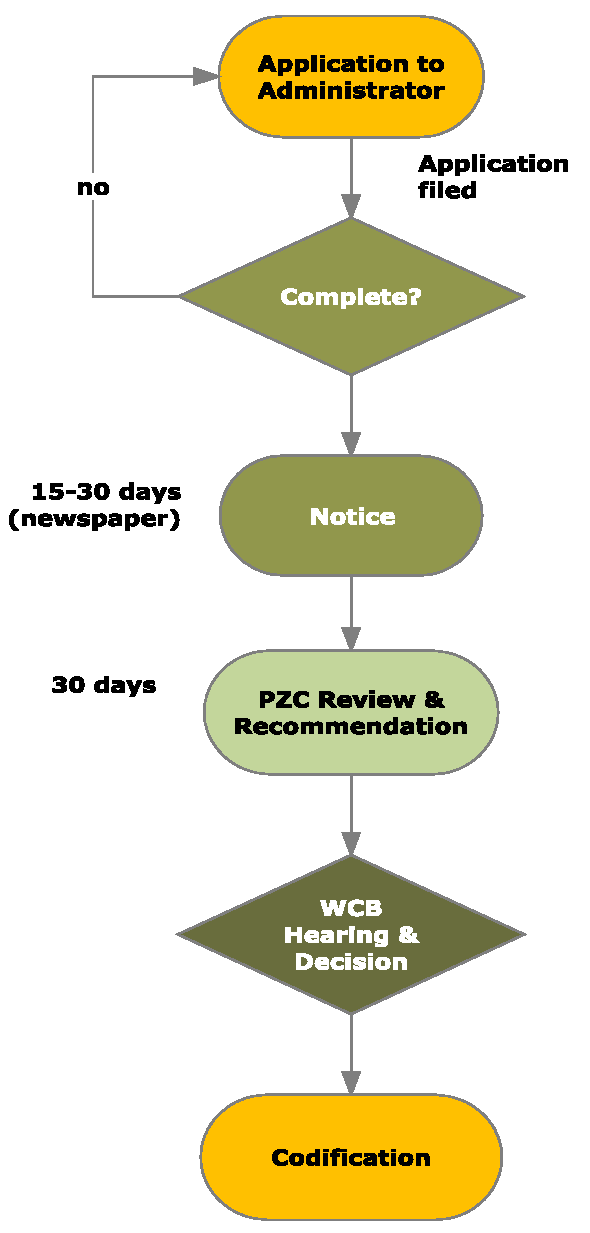
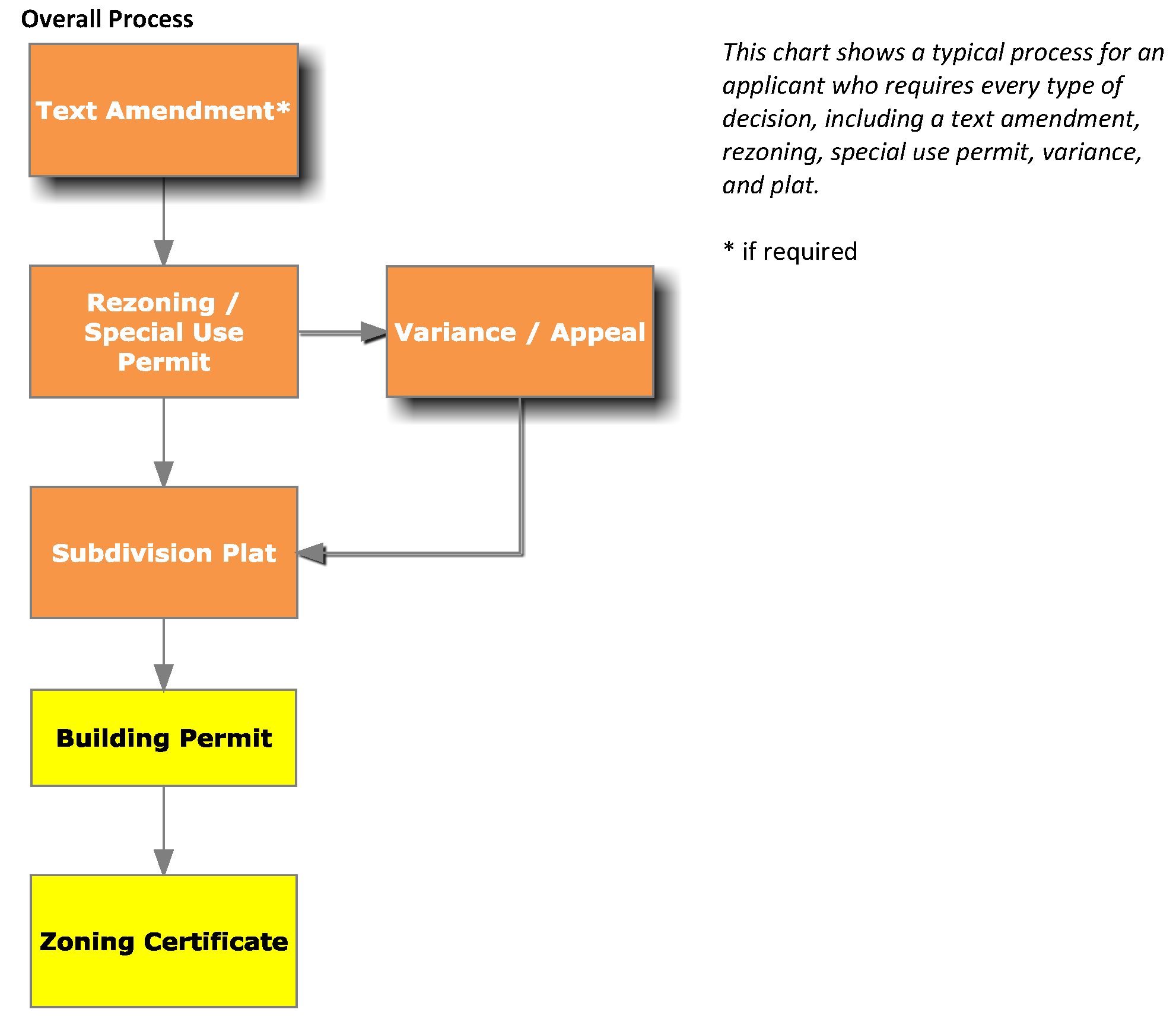
This article sets up rules for procedures, such as pre-application, neighborhood notification, notices and public hearings. It then describes the process for specific land use decisions. The procedures all have a common workflow and description, as follows:
This chart shows a typical process for an applicant who requires every type of decision, including a text amendment, rezoning, special use permit, variance, and plat.
(Compiled Ords. 2013, § 19-4.1)
Sec. 39-113. - Illustration of process.
(Compiled Ords. 2013, § 19-4.1)
Sec. 39-114. - Public hearings.
Public hearings will follow the rules prescribed by the agency conducting the hearing and any requirements of state law.
(1)
Failure to appear at hearing. In the event a petitioner or his agent fails to appear at the designated time and place for a scheduled public hearing, the zoning hearing officer may vote to revoke the petition on the basis that it was not represented. In such cases, subsection (b) of this section will then apply. If the petitioner requests in writing, at least ten days prior to the scheduled public hearing date, that the public hearing on the petition be postponed, the zoning hearing officer may vote to table the matter to their next scheduled hearing date. In such instances, the petitioner will pay a fee equal to the original fee for the public hearing.
(2)
Rehearing of cases. Upon the rendering of a final decision on a variance or a special use by the zoning hearing officer or a final decision on a rezoning by the county board, a rehearing of the same request will not be scheduled until the passage of one year, beginning on the date of the final decision.
(Compiled Ords. 2013, § 19-4.2; Ord. No. 12-2020-19, § 3, 12-22-2020)
Sec. 39-115. - Fees.
(a)
Establishment. The county board may, from time to time, establish by separate resolution, certain fees to be charged by the administrator. These changes are made no more than one time in any given calendar year. Applications required by this chapter are not processed until the appropriate fee is paid.
(b)
Hearing fee refunds. If a fee is paid to the county to hold a hearing, a partial refund of that fee may be made if that hearing is not officially scheduled. A refund is made only if the petitioner withdraws the application in writing. The county will retain a sum of $50.00 for expenses incurred.
(c)
How fees are used. All fees shall be deposited in the general fund.
(d)
Withdrawal and refund. If the application is withdrawn prior to any required publication of legal notice, the fee will be returned upon the applicant's written request.
(Compiled Ords. 2013, § 19-4.3)
Sec. 39-116. - Completeness.
(a)
Applications filed under this chapter must include the information required by article IX of this chapter (submittal requirements). The county will not process incomplete applications.
(b)
A time period required by this chapter to process an application does not commence until the administrator determines that the application is properly submitted and the applicant has corrected any deficiencies in the application. Review for completeness of application forms is solely to determine whether preliminary information required for submission with the application is sufficient to allow further processing. It does not constitute a decision as to whether an application complies with this chapter.
(c)
The administrator shall determine whether the application is complete and shall transmit the determination to the applicant. If the administrator determines that the application is not complete, the administrator will specify those parts of the application that are incomplete and will indicate how they can be made complete, including a list and description of the specific information needed to complete the application.
(Compiled Ords. 2013, § 19-4.4)
Sec. 39-144. - Text amendments.
(a)
Applicability. In accordance with the provisions of 55 ILCS, the county board may from time to time amend or change this chapter.
(b)
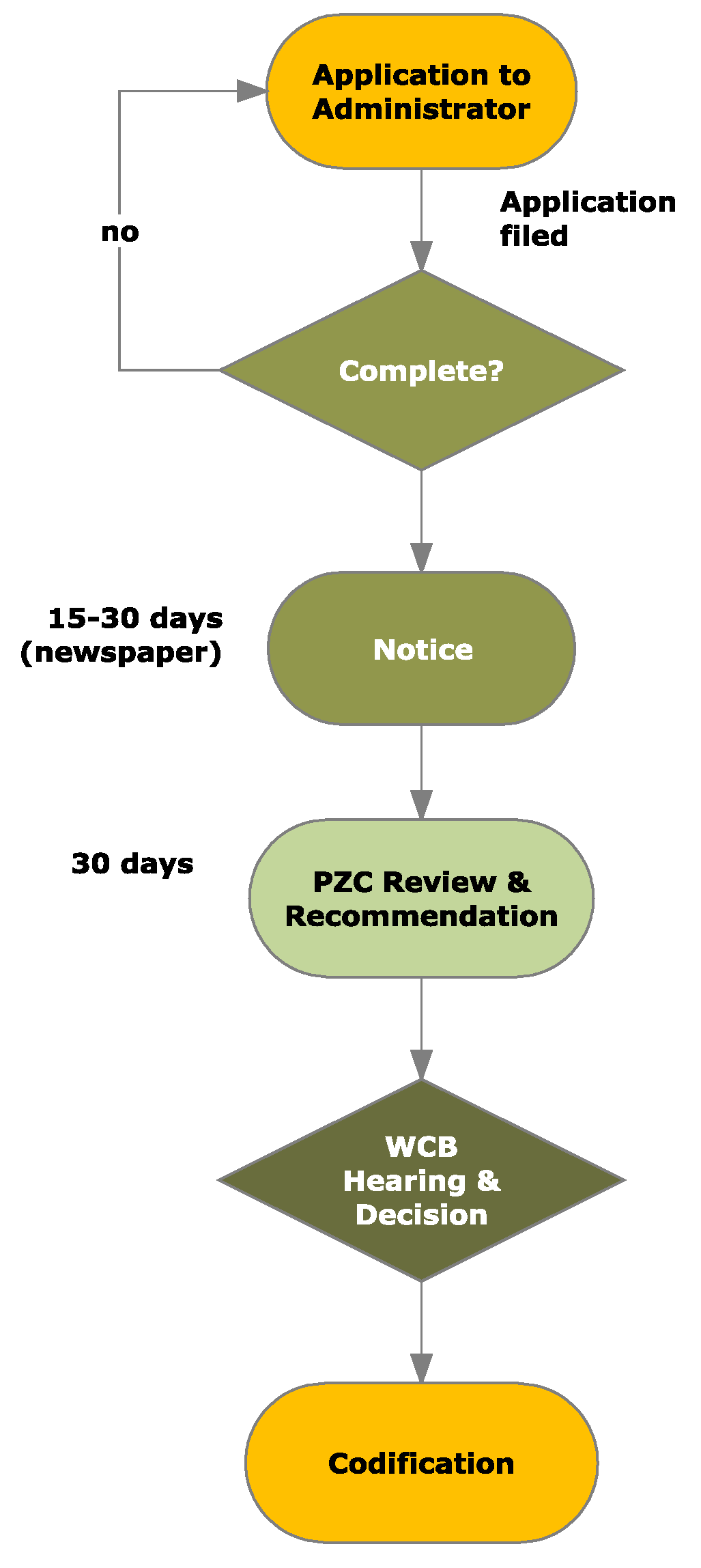
Initiation. The applicant shall file a proposed amendment with the information required by article IX of this chapter.
(c)
Completeness. The administrator will review the application for completeness.
(d)
Notice. The applicant shall give at least 15 and no more than 30 days' notice of the time and place of such hearing by publication of a notice in a newspaper whose general circulation covers the entire county.
(e)
Decision.
(1)
Zoning hearing officer referral.
a.
The resolution proposing an amendment or change shall first be submitted to the zoning hearing officer for hearing and action.
b.
The zoning hearing officer shall be allowed a reasonable time, not less than 30 days, for consideration and report.
c.
The zoning hearing officer shall hold a public hearing on the proposed text amendment, supplement or change.
d.
Changes on file. During the 15 days prior to the public hearing the text or copy of the text of the resolution or petition will be on file, for public examination, in the office of the secretary of the zoning hearing officer.
(2)
County board.
a.
The county board will review the zoning hearing officer's recommendation at a county board meeting.
b.
The county board will approve, approve with revisions, remand, or disapprove the proposed text amendment.
(3)
Protests. The county board meets once each month. In order for a petition of protest to a text amendment to be considered by the county board, it must be filed with the county clerk's office on the Friday just prior to the county board meeting at which the text amendment will be considered. A copy should also be filed with the development office. Protests against text amendments must be in written form and must contain the signatures of five percent of all land owners of the county. The filing of a legitimate petition of objection will require a supermajority vote of the county board in order to approve the proposed text amendment.
(f)
Approval criteria. An amendment is a legislative decision that is committed to the zoning hearing officer or county board's discretion. The agencies will consider whether the amendment is reasonable, including:
(1)
Whether amendment is consistent with the comprehensive plan;
(2)
Whether the amendment is internally consistent with other parts of this chapter and this Code;
(3)
Whether the amendment is consistent with sound planning principles;
(4)
Whether the amendment is consistent with state and federal law; and
(5)
Any other factors those agencies deem appropriate.
(g)
Review. Any text amendment to this chapter, adopted by the county board, shall be subject to de novo judicial review as a legislative decision, regardless of whether the process of its adoption is considered administrative for other purposes. This is per the state supreme court decision in Klaeren v. Village of Lisle.
(h)
Scope of approval. A text amendment does not authorize development. Any development that occurs after the amendment is adopted is subject to all applicable requirements of this chapter.
(i)
Recordkeeping. An adopted text amendment becomes part of this Code.
(Compiled Ords. 2013, § 19-4.5; Ord. No. 12-2020-19, § 3, 12-22-2020)
Sec. 39-145. - Rezonings (zoning map amendments).
(a)
Applicability. In accordance with 55 ILCS 5/5-12014, the county board may, from time to time, amend or change by resolution the number, shape or area of districts established on the zoning maps.
(b)
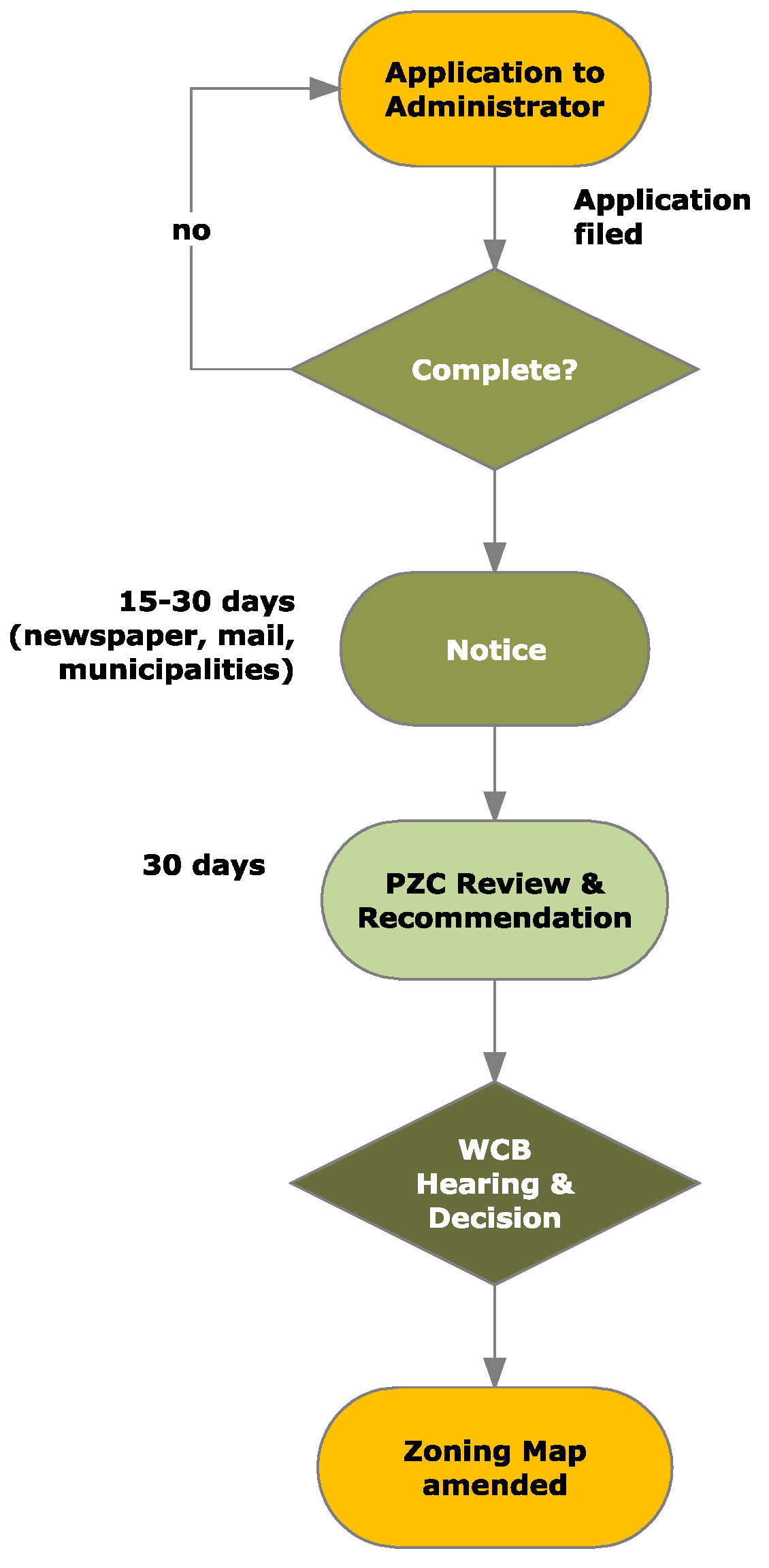
Initiation. The applicant shall file an application with the information required by article IX of this chapter.
(c)
Completeness. The administrator will review the application for completeness.
(d)
Notice. The applicant shall give not less than 15 or more than 30 days' notice of the time and place of the hearing by:
(1)
Publication in a newspaper of general circulation in the area affected by the change; and
(2)
Mailing notices to:
a.
Other owners of the property involved;
b.
All property owners contiguous to the site of the area proposed to be rezoned; and
c.
Any zoned municipality whose corporate limits are within 1½ miles of the site.
(3)
Failure to provide notice. This section provides for timely notice of a proposed map amendment to be given to property owners and municipalities affected by the amendment. The failure to provide notice as directed by subsection (d)(2) of this section does not automatically invalidate any action on the proposed amendment if the failure was not intentional. If, however, in the opinion of the zoning hearing officer, the omission was intentional and could invalidate any resolution passed under this section, it may take any steps it sees fit to correct the situation including the requirement that the public notice and mailings to adjoining property owners be started over.
(e)
Decision.
(1)
Zoning hearing officer.
a.
The rezoning application shall first be submitted to the zoning hearing officer for hearing and action. The commission has a reasonable time (at least 30 days) for consideration and report.
b.
Public hearing. The commission shall hold a public hearing on the proposed rezoning.
c.
Changes on file. During the 15 days prior to the public hearing the text or copy of the text of the resolution or petition, together with the maps or plans (or copies), shall be on file, for public examination, in the office of the secretary of the commission.
d.
Finding of fact/recommendation. Within a reasonable time after the close of the hearing on a proposed amendment, the commission shall make written findings of fact and shall submit the findings and its recommendation to the county board.
(2)
County board.
a.
The county board will review the zoning hearing officer's recommendation at a county board meeting.
b.
The county board will approve, approve with revisions, remand, or disapprove the proposed rezoning.
(3)
Protests.
a.
If a protest is filed against a proposed amendment in the boundaries of a district, the amendment shall not be passed or become effective except by a favorable vote of three-fourths of all members of the county board. This supermajority vote of the county board is required when:
a.
If a protest is filed against a proposed amendment in the boundaries of a district, the amendment shall not be passed or become effective except by a favorable vote of three-fourths of all members of the county board. This supermajority vote of the county board is required when:
1.
The protest is signed and acknowledged by 20 percent of the ownership of the property proposed to be changed;
2.
The protest is signed and acknowledged by a person who owns adjacent property constituting an equivalent of 20 percent of the total perimeter of the site of the proposed change;
3.
The protest is in the form of a resolution to that effect, passed by a zoned municipality whose corporate limits are within 1½ miles of the site of the proposed change; or
4.
The protest is in the form of a resolution passed by a township board of trustees, upon the recommendation of that township's plan commission.
b.
The county board meets once each month. In order for a petition of protest to a map amendment to be considered by the county board, it must be filed with the county clerk's office on the Friday just prior to the county board meeting at which the map amendment will be considered. A copy should also be filed with the administrator. A copy must also be forwarded to the applicant or the applicant's agent, by certified mail with a return receipt. A protest by a township must be filed with the county clerk's office within 30 days of the close of the county board meeting. The filing of a legitimate petition of objection requires a supermajority vote of the county board in order to approve the proposed map amendment.
(f)
Approval criteria.
(1)
The zoning hearing officer shall make findings based on the evidence presented to it in each specific case about:
a.
Existing uses and zoning of nearby property;
b.
The extent property values will be diminished by the zoning restrictions;
c.
The extent to which the destruction of property values promotes health, safety and welfare of the public;
d.
The relative gain to the public versus the hardship to the individual property owner;
e.
The suitability of the subject property for zoned purposes;
f.
The length of time the property has been vacant as zoned, considered in context of land development in the vicinity of the subject property;
g.
Whether the ordinance is based upon adequate planning;
h.
Whether there is a public need in the neighborhood for the proposed use.
(2)
Spot zoning not to be allowed. The zoning hearing officer shall not recommend the adoption of a proposed amendment unless it finds that the amendment is in the public interest and is not solely for the interest of the applicant.
(3)
Commission may recommend higher classification. The zoning hearing officer may recommend an amendment changing the zoning classification to any higher classification than that requested by the applicant. For the purpose of this subsection, the C-1 district is considered the highest classification and the I-2 district is considered the lowest classification.
(4)
L.E.S.A. When reviewing any application for amendments to the zoning maps of the county, the zoning hearing officer will consider the L.E.S.A. report, if one is required under this subsection, in making their recommendation to the county board.
(g)
Review. Any map amendment to the county zoning regulations, adopted by the county board, is subject to de novo judicial review as a legislative decision, regardless of whether the process of its adoption is considered administrative for other purposes. This is per the state supreme court decision in Klaeren v. Village of Lisle.
(h)
Scope of approval. Optional revocation of zoning. If property zoned by the county after March 1, 1983, is not used within one year from date of the zoning, for purposes permitted in classification to which said property has been zoned, or, if the use of the property is discontinued for a continuous period of three years, the zoning hearing officer may institute proceedings on its own motion to rezone the property to its original classification. In these cases, the rezoning procedures established in this section apply.
(i)
Recordkeeping. After the rezoning is approved, the administrator causes the zoning map to be revised to reflect the new zoning classification for the property.
(Compiled Ords. 2013, § 19-4.6; Ord. No. 12-2020-19, § 3, 12-22-2020)
Sec. 39-146. - Special uses.
(a)
Applicability. In accordance with 55 ILCS 5/5-12009.5, the county board may, by resolution, grant special uses in districts established on the zoning maps.
(b)
Initiation. The applicant shall file an application with the information required by article IX of this chapter.
(c)
Completeness. The administrator will review the application for completeness.
(d)
Notice.
(1)
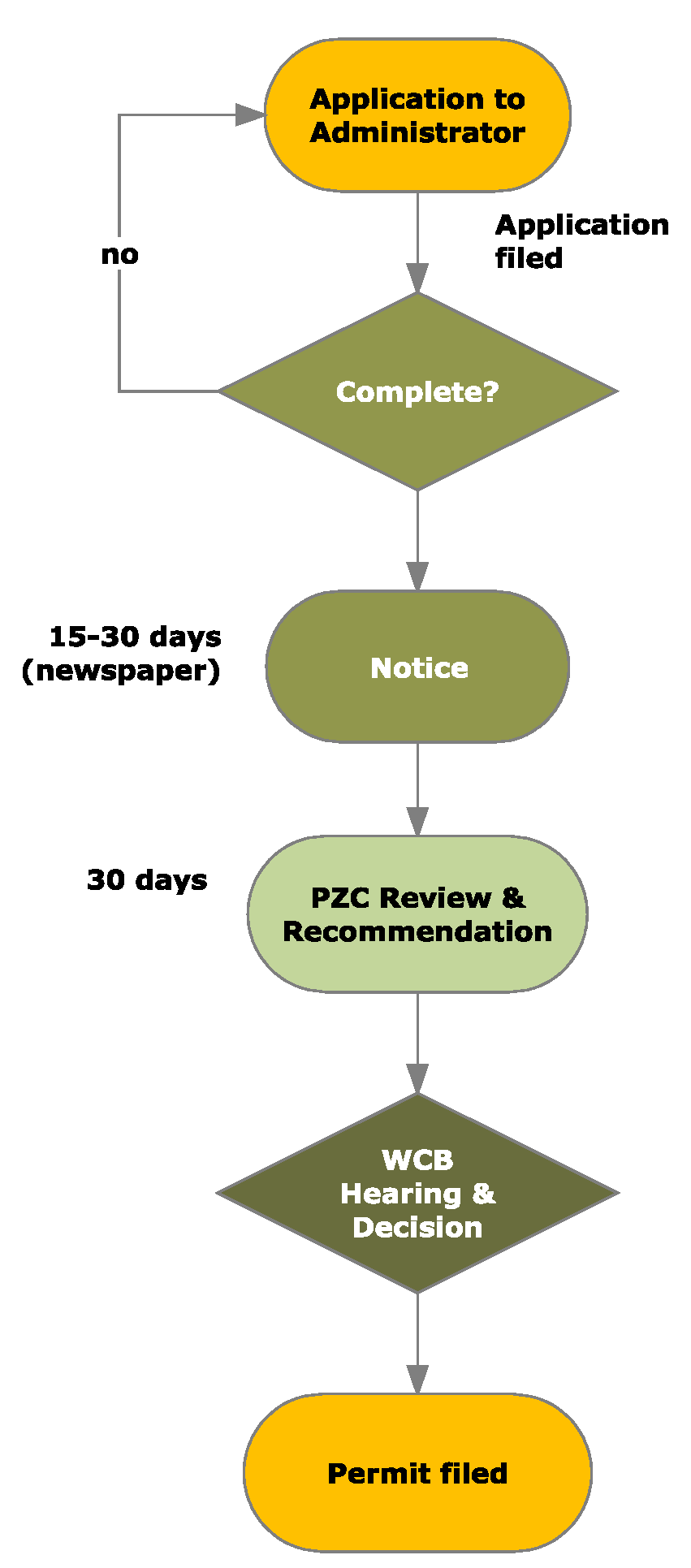
Type and timing. The applicant shall give at least 15 and no more than 30 days' notice of the time and place of the hearing by publication in a newspaper of general circulation in the area affected by the change and by mailing notices to:
a.
Other owners of the property involved;
b.
All property-owners contiguous to the site proposed to be altered; and
c.
Any zoned municipality whose corporate limits are within 1½ miles of the site.
(2)
Failure to provide notice. It is the intention of this article to provide for timely notice of a proposed special use to be given to property owners and municipalities directly affected by the use. If the zoning hearing officer determines that the petitioner or his agent knowingly failed to provide proper notice, as required by subsection (1) of this section, the board shall require that the public hearing process be started over including the publishing of the public notice and the certified mailings to the adjoining property owners be started over.
(e)
Decision.
(1)
Zoning hearing officer.
a.
The zoning hearing officer shall consider a petition requesting the special use. The board has a reasonable time (at least 30 days) to consider and report on the application.
b.
Public hearing. The zoning hearing officer shall hold a public hearing on the proposed special use.
c.
Changes on file. During the 15 days prior to the public hearing the text or copy of the text of the resolution or petition, together with the maps or plans (or copies) shall be on file, for public examination, in the office of the secretary of the zoning hearing officer.
d.
Examination by zoning hearing officer. Before making a recommendation to the county board, the zoning hearing officer shall hold a public hearing and review special use applications
e.
Finding of fact/recommendation. Within a reasonable time after the close of the hearing on a special use, the zoning hearing officer shall make written finding of fact and shall submit same together with its recommendation to the county board. The zoning hearing officer shall make its findings based on the evidence presented to it in each specific case with respect to the standards found in subsection (f) of this section.
(2)
County board.
a.
The county board will review the zoning hearing officer recommendation at a county board meeting.
b.
The county board will approve, approve with revisions, remand, or disapprove the proposed special use permit.
(3)
Final action on special use requests. Special uses shall be granted or denied by a simple majority vote of the county board.
(f)
Approval criteria. When considering an application for a special use, the zoning hearing officer, based on evidence presented, shall find:
(1)
That the special use shall, in all other respects, conform to the applicable regulations of the county zoning regulations for the district in which it is located, except as such regulations may in each instance be modified by the county board pursuant to the recommendations of the zoning hearing officer. Special uses, when combined with variances for this same property, shall be considered compliant for the purposes of this section.
(2)
That the special use will be consistent with the purposes, goals, objectives, and standards of an officially adopted county comprehensive land use plan and these regulations or of any officially adopted comprehensive plan of a municipality with a 1½ mile planning jurisdiction.
(3)
That the petitioner has provided the information required by article IX of this chapter, and has provided, in writing, a narrative on how the requested special use meets the standards required in this section of the zoning regulations.
(4)
That in presenting any application for a special use, the burden of proof shall rest with the applicant to clearly establish that the proposed special use shall meet the following standards:
a.
That the establishment, maintenance or operation of the special use shall not be detrimental to or endanger the public health, safety, morals, comfort or general welfare of the neighboring vicinity.
b.
That the special use will not be injurious to the use and enjoyment of other property in the immediate vicinity for the purpose already permitted, nor substantially diminish and impair property values within the neighborhood, and will be located and operated to minimize incompatibility with the character of the surrounding area and to minimize the effect on the value of the surrounding property. The applicant need not demonstrate complete compatibility, but the applicant shall demonstrate reasonable efforts to minimize incompatibility.
c.
That adequate utilities, access roads, drainage and/or other necessary facilities have been or are being provided.
d.
That adequate measures have been or will be taken to provide ingress and egress so designed as to minimize traffic congestion and hazard on the public streets.
e.
That the establishment of the special use will not impede the normal and orderly development and improvement of surrounding property for uses permitted in the district.
f.
That consideration is given to any special facilities such as churches, schools or hospitals located near the proposed special use.
(5)
The requirement of certain safeguards may be needed at times. Such safeguards may include, but are not to be limited to:
a.
Special setback and buffers.
b.
Fences and/or walls.
c.
Lighting.
d.
Sewer and water.
e.
Paving or parking areas.
f.
Regulation of time for certain activities.
g.
Regulation of points of vehicular ingress and egress.
h.
Regulation of noise, vibrations, orders, etc.
i.
Regulation of signs.
j.
Landscaping and maintenance thereof.
k.
Other conditions which may be necessary to ensure orderly and proper development.
(6)
L.E.S.A. When reviewing any application for amendments to the zoning maps of the county, the zoning hearing officer will consider the L.E.S.A. report, if one is required under section 39-146(f)(4), in making their recommendation to the county board.
(g)
Review. A final decision regarding a special use is subject to de novo review pursuant to 55 ILCS 5/5-12012.1.
(h)
Scope of approval.
(1)
Noncompliance. The failure to comply with any of the conditions or restrictions imposed on a special use permit is a violation of this chapter. Any permit is subject to restriction or revocation at any time by the county board, on its own motion or on the recommendation of the zoning hearing officer, if:
a.
The operator of such special use fails to comply with any conditions or restrictions imposed on the permit and, after 30 days' notice of such failure to comply, fails to remedy the noncompliance; or
b.
The operator of the special use or any affiliate is engaged in any other area of the county in any activity for which a special use permit is required but for which no permit has been obtained, or if the operator or affiliate fails to remedy any noncompliance with any conditions or restrictions on any other special use permit after 30 days' notice.
(2)
Revocation. Where an approved special use is not started within one year from date of approval, or is discontinued for a continuous period of one year, the zoning hearing officer may institute proceedings on its own motion to revoke the special use. The special use hearing procedures in this section apply, with the county acting as the applicant. Notice of the public hearing shall be provided to the owner of the parcel in question.
(i)
Recordkeeping. The administrator and the applicant shall maintain copies of the special use permit approval, and all supporting documentation.
(Compiled Ords. 2013, § 19-4.7; Ord. No. 12-2020-19, § 3, 12-22-2020)
Sec. 39-147. - Variances.
(a)
Applicability.
(1)
Generally. This section applies to any application to vary the terms of this chapter. This section does not apply to applications to vary the terms of standards that apply to subdivision plats.
(2)
Nonconforming uses. The zoning hearing officer or administrator shall not approve a variance to establish a nonconforming use where none previously existed.
(b)
Initiation. The applicant shall file an application with the information required by article IX of this chapter.
(c)
Completeness. The administrator will review the application for completeness.
(d)
Notice.
(1)
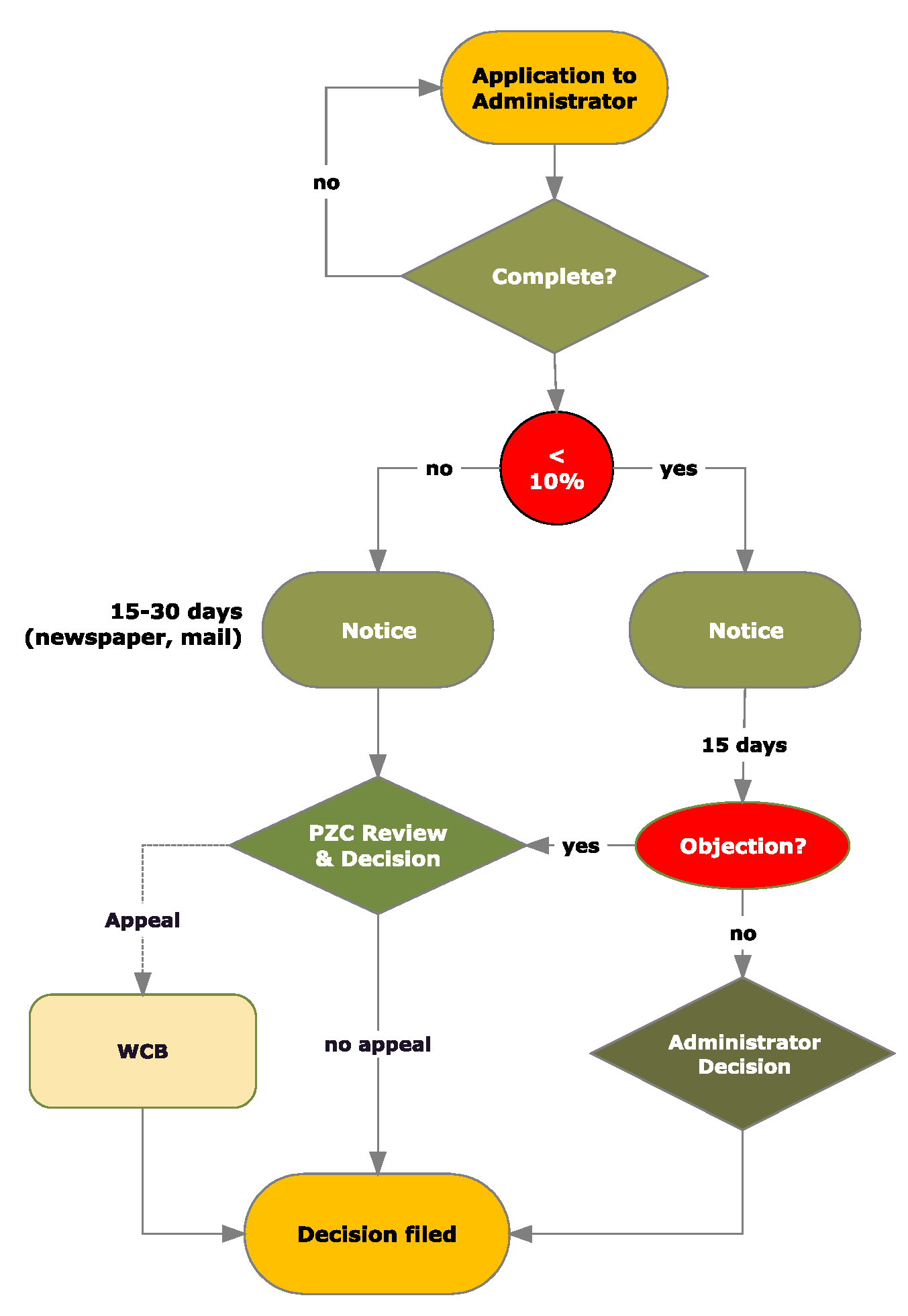
Zoning hearing officer decisions. The applicant for a variance to be heard by the zoning hearing officer shall give at least 15 and no more than 30 days' notice of the time and place of the hearing by:
a.
Publication in a newspaper of general circulation in the area affected by the variance; and
b.
Mailing copies of the notice to all property owners contiguous to the site of the proposed variance, whether those owners be private or public. The administrator will determine who specifically should receive notification.
(2)
Administrator decisions. See subsection (e)(2)b of this section.
(e)
Decision.
(1)
Zoning hearing officer.
a.
The zoning hearing officer shall hold public hearings on any proposed variance not subject to subsection (e)(2) of this section. After the public hearing is closed, the zoning hearing officer may approve, approve with conditions, or deny the variance.
b.
The applicant or a party with standing under state law may appeal the zoning hearing officer's decision to the county board. The county board will consider the application at a county board meeting. After reviewing the application and the record, the county board may approve, approve with conditions, deny, or remand the application.
(2)
The administrator may grant a variance if:
a.
The variance request for either the location of a building or for bulk requirements under this chapter are ten percent or less than required;
b.
A notice of intent to grant the variance is sent by certified mail to all adjoining property owners; and
c.
No adjoining owner files with the administrator a written objection to the variance request within 15 days of receipt of the notice of intent. Filing of a written objection within 15 days requires that the variance request be heard by the zoning hearing officer in a public hearing as provided in subsection (e)(1) of this section.
(3)
Findings of fact. The zoning hearing officer or administrator shall make a finding of fact with regard to the standards listed in subsection (f) of this section. The findings are part of the record of the hearing. The finding shall indicate how each standard is met by the applicant and, in general, how the zoning hearing officer or administrator arrived at their decision.
(f)
Approval criteria.
(1)
General requirements. A variance from strict application of this chapter may be granted by the decision making agency (see subsection (e) of this section) where:
a.
By reason of:
1.
Exceptional narrowness, shallowness or shape of a specific piece of property at the time of enactment of these regulations;
2.
By reason of exceptional topographic conditions; or
3.
Other extraordinary and exceptional situation or condition of a property, or the use of the property, or the use or development of property immediately adjoining the piece of property in question.
b.
The literal enforcement of this chapter would result in:
1.
Peculiar and exceptional practical difficulties; or
2.
Exceptional and undue hardship, other than economic, upon the property owner; and
c.
The variance observes the spirit and purpose of this chapter and does substantial justice.
(2)
In authorizing a variance, the decision making agency (see subsection (e) of this section) may attach conditions regarding the location, character and other features of the proposed building, structure or use that it deems advisable in the interest of the purposes of the regulations.
(3)
Standards. No variance shall be authorized unless findings are made beyond reasonable doubt that all of subsections (f)(4) or (5) of this section, as applicable, are met.
(4)
Area variances. The following standards apply where variances in area requirements are requested:
a.
The particular physical surroundings, shape or topographical condition of the specific property involved would result in a particular hardship upon the owner, as distinguished from a mere inconvenience, if the strict letter of the regulations were carried out;
b.
The conditions on which a variance is based would not apply generally to other property in the same zoning classification;
c.
The purpose of the variance is not based exclusively upon a desire to obtain a higher financial return on the property;
d.
The alleged difficulty or hardship is not created by the present owner of the property;
e.
The variance is not detrimental to the public safety or welfare or will not injure the value of other property or improvements in the neighborhood where the property is located; and
f.
The proposed variance will not substantially increase the congestion in the public streets or increase the danger of fire.
(5)
Use variances. The following standards apply to variances which affect the uses allowed on a parcel of land:
a.
The use requested in the petition for a variance does not require a specific zoning class or special use;
b.
The purpose of the variation in use is not based exclusively upon a desire to obtain a higher financial return on the property;
c.
The proposed use cannot be economically conducted elsewhere and would result in an unnecessary hardship if the owner were not able to conduct the proposed use on this property;
d.
The proposed use will not be detrimental to the public safety or welfare;
e.
The proposed use will not injure the value of other property or improvements in the neighborhood where the property is located; and
f.
The proposed use will not substantially increase the congestion in the public streets or increase the danger of fire.
(6)
No grant or variance shall be authorized unless the decision making agency (see subsection (e) of this section) specifically finds the condition or situation of the specific piece of property for which the variance is sought is not so typical or recurrent a nature as to make reasonably practicable the formulation of a general regulation, under an amendment of these regulations, for the conditions or situations.
(g)
Review. All final administrative decisions of the zoning hearing officer or administrator are subject to judicial review pursuant to the Illinois Administrative Review Act.
(h)
Scope of approval. If the variance is approved, the applicant may apply for any permits or approvals required for development or establishment of the use, as provided in this chapter.
(i)
Recordkeeping. The administrator will maintain a record of approved variances. The applicant must maintain a copy of the approved variances, including any attachments.
(Compiled Ords. 2013, § 19-4.8; Ord. No. 12-2020-19, § 3, 12-22-2020)
Sec. 39-148. - Appeals.
(a)
Applicability. An appeal to the zoning hearing officer may be taken by any property owner, including a tenant, or by any governmental officer, department, board or bureau affected by any ruling of the administrator.
(b)
Initiation.
(1)
The applicant shall file an application with the information required by article IX of this chapter.
(2)
Time limit. The appeal shall be taken within 20 days of the date of the action for which the appeal is being taken, specifying the grounds for the appeal.
(3)
Stay of proceedings. An appeal stays all proceedings in furtherance of the action appealed from, unless the administrator certifies to the board that, by reason of the facts stated in the certificate, a stay would in his opinion cause imminent peril to life or property. In that case, proceedings are not stayed other than by an order which may, on due cause shown, be granted by the board on application, after notice to the administrator, or by a court of record.
(c)
Completeness. The administrator will review the application for completeness.
(d)
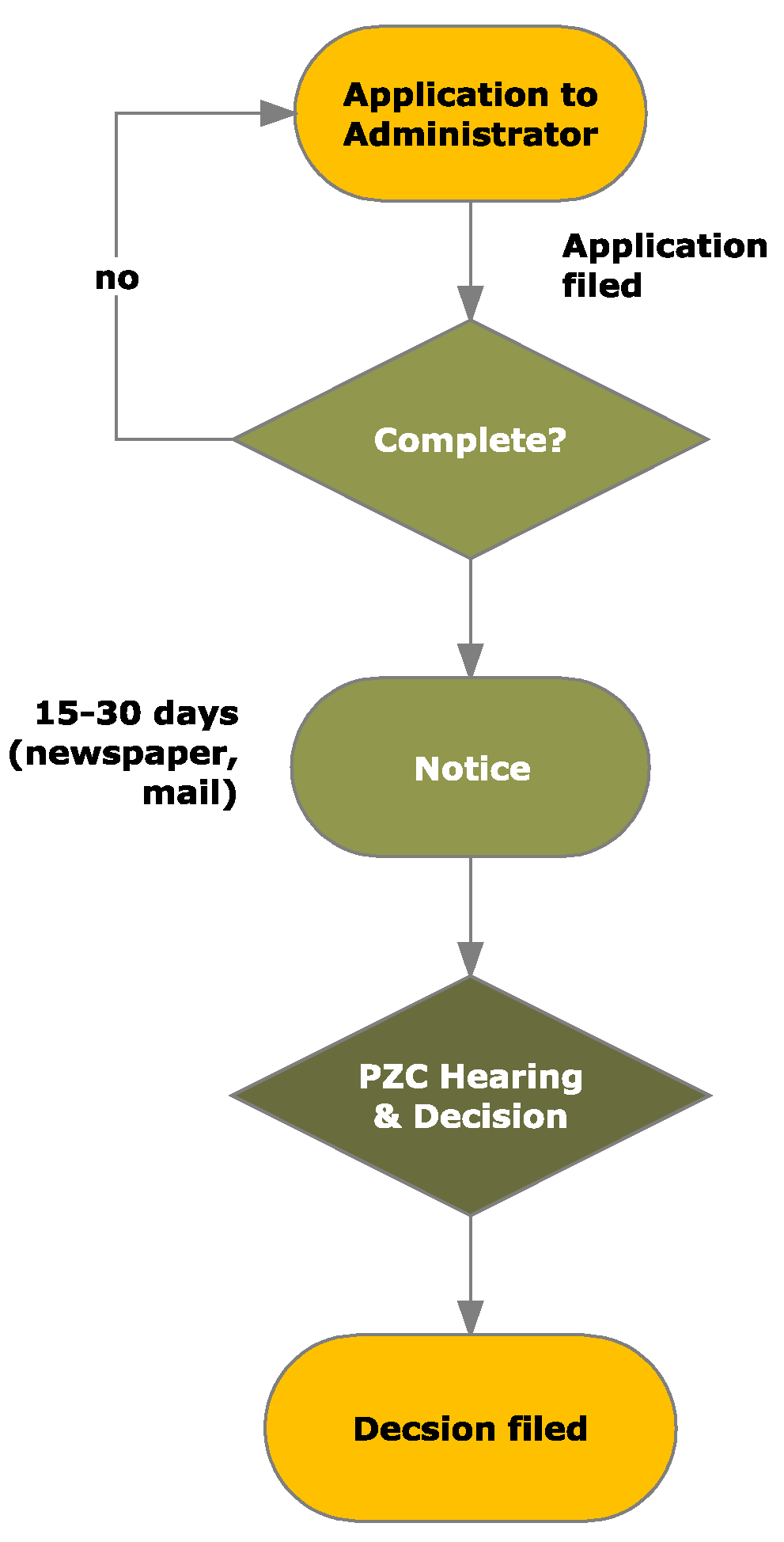
Notice. The applicant shall give at least 15 days' prior notice of the time and place of the hearing shall be given by:
(1)
A public notice, furnished by the administrator, in a newspaper of general circulation published in the county; and
(2)
Certified mail to the property owners of record adjoining or adjacent to the premises in question at least five days before the time fixed for the hearing. Such notice of adjoining owners will also be done by the applicant.
(e)
Decision.
(1)
Hearing date established.
a.
The secretary of the board shall establish a date for a hearing and transmit to the board the notice of appeals, and all the plans and papers constituting the record upon which the action appealed from was taken.
b.
A fee as required by article IX of this chapter shall accompany the appeal. Should the appeal be withdrawn prior to the publication of legal notice, the fee will be returned upon written request of the applicant.
(2)
Administrative review. All final administrative decisions of the zoning hearing officer are subject to judicial review pursuant to the provisions of the Administrative Review Act.
(f)
Approval criteria. The zoning hearing officer may approve the appeal if the decision subject to the appeal:
(1)
Is the result of an incorrect interpretation of this chapter;
(2)
Would violate state or federal statues; or
(3)
Would violate the applicant's state or federal constitutional rights.
(g)
Appeals. A final decision of the zoning hearing officer is subject to review pursuant to 55 ILCS 5/5-12012.
(h)
Scope of approval. If the appeal is approved, the applicant may apply for any permits or approvals required for development or establishment of the use, as provided in this chapter.
(i)
Recordkeeping. The planning official will maintain a file of the final decision on appeal. The applicant must maintain a copy of the final decision on appeal, including any attachments.
(Compiled Ords. 2013, § 19-4.9; Ord. No. 12-2020-19, § 3, 12-22-2020)
Sec. 39-149. - Zoning certificates.
(a)
Applicability.
(1)
Generally. This section applies to any certificate or permit for the use of land or buildings issued by any officer, department or employee of the county.
(2)
Permanent zoning certificates. A zoning certificate is required before:
a.
Any building or addition to a previously existing building is occupied;
b.
Any land vacant on the effective date of these regulations is used for any purpose; or
c.
Any change in use occurs, other than that of a permitted use to another similar permitted use.
(3)
Temporary zoning certificates.
a.
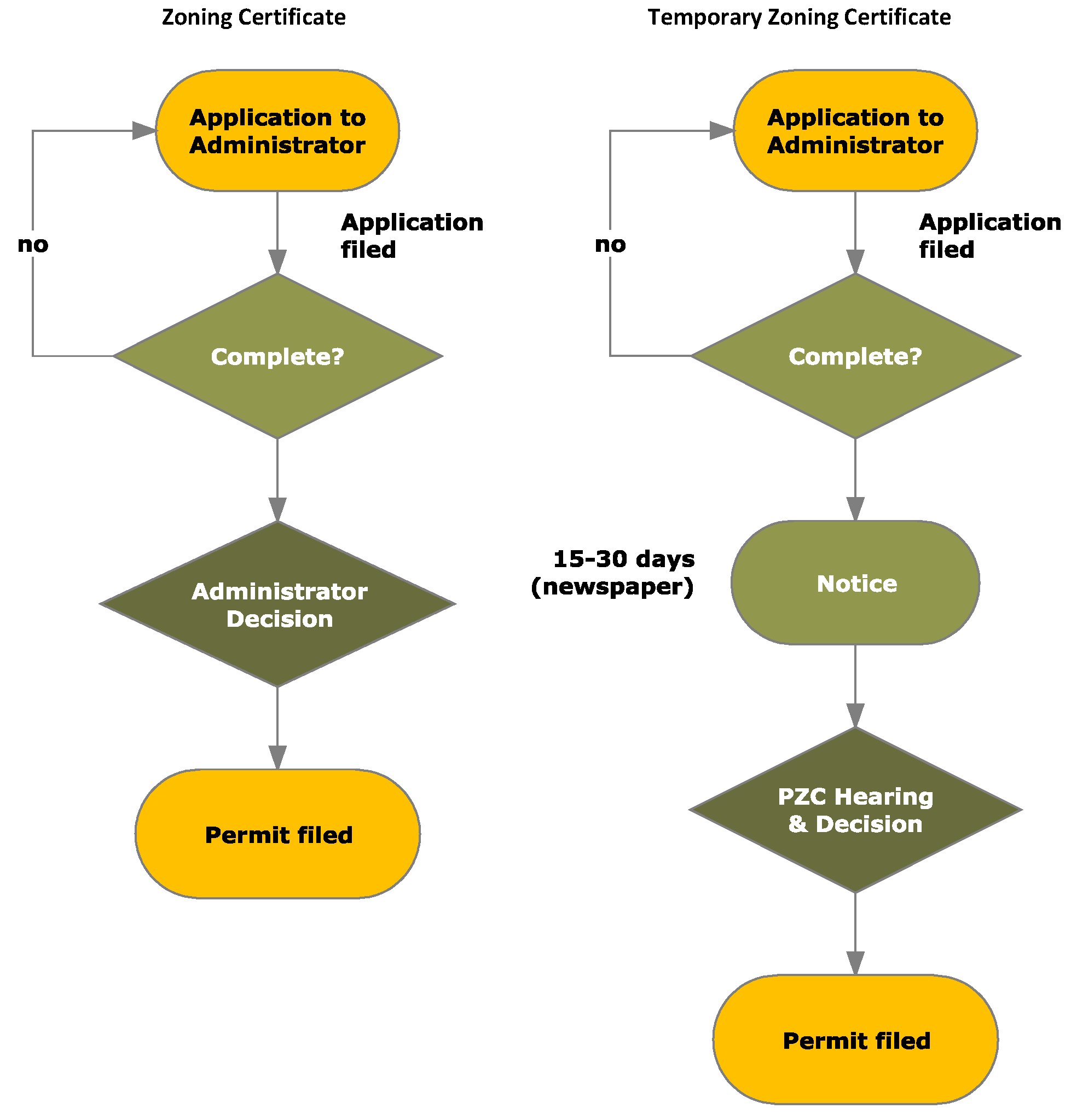
The administrator may issue a temporary zoning certificate for up to 60 days where a hardship will exist for a petitioner who is awaiting the outcome of a rezoning, special use or a variance request.
b.
The zoning hearing officer may approve:
1.
The temporary use of a building or premises in any district for a purpose or use that does not conform to the standards prescribed by these regulations, provided that such use is of a true temporary nature and does not involve the erection of substantial buildings. Such permit shall be granted in the form of a temporary and revocable permit for not more than a 12-month period, subject to such conditions as will safeguard the public health, safety, convenience and general welfare.
2.
The temporary use of a building or premises in undeveloped sections for a purpose that does not conform to the standards prescribed by these regulations, provided that such structure or use is of a true temporary nature, is promotive of or incidental to the development of such undeveloped sections, and does not involve the erection of substantial buildings.
(4)
The administrator shall not issue zoning certificates:
a.
For any structure on a lot in any subdivision until the final plat is approved; or
b.
For any structure on any lot of less than five acres which has been created through the recording, within a two-year period, of two property deeds, the second deed returning a portion of the property of the first deed to its original owner.
(b)
Initiation. The applicant shall file an application with the information required by article IX of this chapter.
(c)
Completeness. The administrator will review the application for completeness.
(d)
Notice. Not required.
(e)
Decision.
(1)
The administrator will review and approve or deny the application for a zoning certificate.
(2)
Temporary zoning certificates approved by the zoning hearing officer require approval in the same manner as a special use (section 39-146).
(3)
Reasons in writing for refusal to issue a zoning certificate must be forwarded to the applicant no later than 14 days after the request for said permit.
Zoning Certificate
(f)
Approval criteria. The administrator will issue a zoning certificate if the proposed building or structure complies with all applicable provisions of this chapter.
(g)
Subsequent applications. There is no limit on subsequent applications.
(h)
Appeals. See section 39-148.
(i)
Scope of approval.
(1)
Every zoning permit shall state that the use or occupancy complies with the provisions of the regulations.
(2)
The zoning hearing officer may grant an extension to a temporary zoning certificate for up to 60 days while the petition is being considered.
(3)
A temporary zoning certificate does not imply any official approval by the county.
(4)
Construction permitted by a permanent certificate must begin within 90 days of issuance and must be completed within one year. The administrator may grant an extension for another year when the applicant shows good cause and requests an extension in writing. If the extension expires, a new permit is required.
(5)
Any permit issued in conflict with the provisions of these regulations is null and void.
(j)
Recordkeeping.
(1)
The administrator will sign and return one copy of the approved plans to the applicant, together with the approved permit.
(2)
The administrator will maintain a record of approved zoning certificates. The applicant must maintain a copy of the approved zoning certificate, including any attachments.
(Compiled Ords. 2013, § 19-4.10; Ord. No. 12-2020-19, § 3, 12-22-2020)
Sec. 39-150. - Temporary use permits.
Refer to section 39-263.
(Compiled Ords. 2013, § 19-4.11)
Sec. 39-169. - Applicability.
(a)
Generally. A preliminary plat (and the requirements of 765 ILCS 205/0.01-14) is required before any of the following may occur:
(1)
Change, re-subdivision, or rearrangement of the boundary or division line of any lot or parcel of land;
(2)
Any division of any lot or parcel of land by any means into lots for any purpose; and
(3)
Any construction work in a proposed subdivision, including grading.
(b)
Enforcement through building permits. The administrator shall not issue building or repair permits for any structure on a lot in any subdivision, nor shall the county or its townships accept any public improvements or services in a subdivision, until a required final plat is approved.
(c)
Municipal review.
(1)
The rules and standards governing plats and subdivisions of land contained in this chapter apply to all land not within an incorporated municipality. However, no plat purporting to lay out land within 1½ miles of a municipality having a duly adopted plan and subdivision regulations shall be approved until it has first been approved by the governing body of the municipality under whose jurisdiction the proposed subdivision falls. In the event of overlapping municipal jurisdictions, the extent of jurisdiction hereunder shall be a line equidistant between the incorporated municipalities.
(2)
Where the proposed subdivision lies outside the corporate limits of a zoned municipality but within 1½ miles of the corporate limits of said jurisdiction, a copy of the preliminary plat shall be transmitted to the city or village clerk for review and approval by that jurisdiction. The county will not officially accept the preliminary plat or begin its formal review of same until said municipal review has been concluded and their findings or recommendations have been forwarded in writing to the county.
(d)
IDOT review. Where the proposed subdivision is bounded on one or more sides by a state or federal highway, the preliminary plat will be forwarded to the state department of transportation, district 2 office for their review and comment. The county will not officially accept the preliminary plat or begin its formal review of same until said department of transportation review has been concluded and their findings or recommendations have been forwarded in writing to the county.
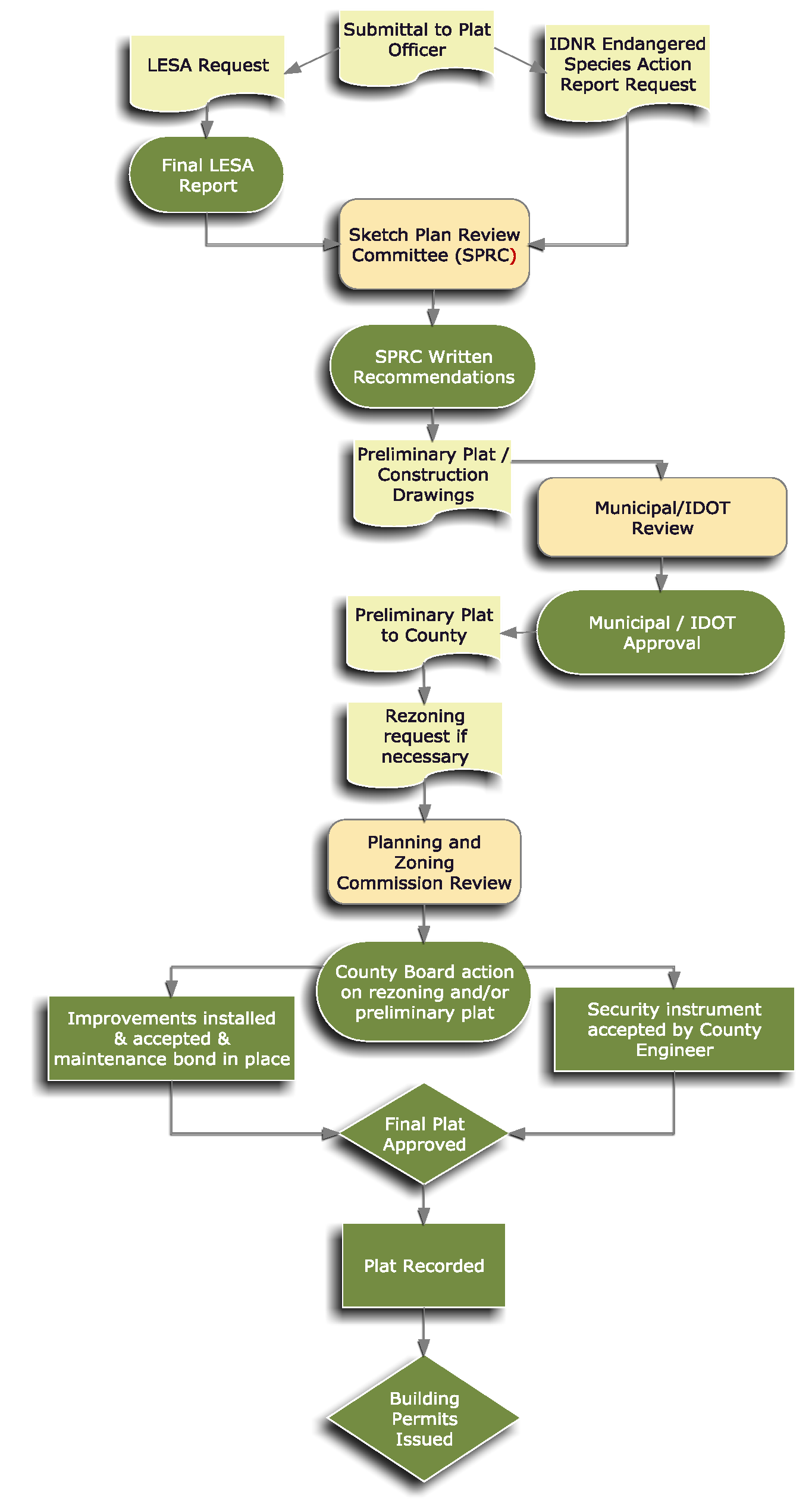
Subdivision Platting Sequence
(Compiled Ords. 2013, § 19-4.12)
Sec. 39-170. - Sketch plan.
(a)
Applicability. A sketch plan is required before a subdivider files a formal preliminary plat application.
(b)
Initiation. The applicant shall file an application with the information required by article IX of this chapter.
(c)
Completeness. The administrator will review the application for completeness.
(d)
Notice. No public notice is required.
(e)
Decision.
(1)
Sketch plan conference. The subdivider or his engineer/surveyor shall first submit his proposed plat in sketch form to the plat officer at a pre-scheduled conference. The subdivider or his engineer/surveyor will explain the proposed plan to the plat officer and answer any questions. The plat officer will be provided with five copies of the sketch plan for the sketch plan review committee.
(2)
LESA report. Upon receipt of a sketch plan, the plat officer will direct the developer to initiate a land evaluation and site assessment (LESA) report at the the county Soil And Water Conservation District (WCS and WCD). The zoning officer will prepare the site assessment portion of the report and combine it with the land evaluation from the WCS and WCD. Upon completion of the LESA report, the plat officer will schedule a meeting of the sketch plan review committee.
(3)
Review by committee. The plat officer will then schedule a meeting of the sketch plan review committee within 15 days of the presentation of the sketch plan. The committee, the developer or his engineer/surveyor, along with any other agencies deemed necessary, will meet and review the sketch plan and preliminary LESA report as follows:
a.
The health administrator or his representative will review the sketch plan in terms of soils information to determine lot size and well septic system requirements. There may be instances where the soil mapping, as published in the soil survey of the county, indicates the presence of category 4 soils as the predominant soil type on part of the site proposed for development. In such cases, the health department may require a more detailed soils investigation, to a minimum depth of 72 inches, by a soil classifier. The sketch plan review will be halted at that point and resumed at a later date when the detailed soils report is complete. That report will be accompanied by a sanitation plan and an engineered, on-site sewage system design. The specific information required is found in section 39-84.
b.
The county engineer or his representative will review the sketch plan in terms of, at a minimum, the adequacy of access roads, lot entrance points and the proposed layout of any subdivision streets.
c.
The administrator or his representative will review the sketch plan in regard to the requirements of the zoning regulations, airport zoning regulations and the flood protection regulations.
d.
The district conservationist or his representative will review the sketch plan with regard to potential soil erosion problems, disruption of natural drainage systems and potential loss of prime farm lands.
(4)
Recommendations to developer. The committee shall prepare a report of its recommendations within ten days of the adjournment of their sketch plan review meeting and forward said report to the developer or his engineer/surveyor for consideration when preparing the preliminary plat.
(f)
Approval criteria. The committee's recommendations to the applicant will relate to whether the sketch plat complies with the applicable requirements of this chapter.
(g)
Subsequent applications. Not applicable.
(h)
Appeals. There is no appeal process, because a sketch plan does not result in a formal determination by the county.
(i)
Scope of approval. The applicant may submit a preliminary plat application after the committee submits its recommendations.
(j)
Recordkeeping. Not applicable.
(Compiled Ords. 2013, § 19-4.13)
Sec. 39-171. - Preliminary plat.
(a)
Applicability. Preliminary plat approval is required before a subdivider files an application for final plat approval.
(b)
Initiation.
(1)
The subdivider, after submitting the plat in sketch form to the plat officer and receiving the report of the sketch plan review committee, shall prepare a preliminary plat of the proposed subdivision and construction plans for improvements along with plans for any improvements, signed and stamped by a registered professional engineer, showing that said improvements conform with the requirements set forth in article III of this chapter.
(2)
The applicant shall file an application with the information required by article IX of this chapter.
(c)
Completeness. The administrator will review the application for completeness.
(d)
Notice. Not applicable.
(e)
Decision.
(1)
Transmittal. The plat officer shall transmit one copy of the plat submission to the office of the county soil and water conservation district for a final review pertaining to soil erosion control and other appropriate conservation measures. The soil and water conservation district will be allowed 35 days to complete its report from the date of mailing. The plat officer will also forward one copy of the plat to the health and highway and public works departments for their final review and comments.
(2)
Staff review. The plat officer will check the preliminary plat as to its conformity with the adopted county plan, the county zoning resolution, resource information recommendation of the soil and water conservation district, comments from the county departments and principles, standards and requirements set forth in this chapter. The plat officer will check the construction plans of proposed improvements.
(3)
Sketch plan review committee final review. Upon completion of the preliminary plat and construction drawings, the plat officer may call a meeting of the sketch plan review committee for a final review. The need for this meeting will be determined at the final sketch plan review committee members during the sketch plan phase. The purpose of this review will be to go over the construction drawings, soil mapping and sanitation plans.
(4)
Zoning hearing officer review. The plat officer, upon review of the preliminary plat for completeness, shall schedule a review by the zoning hearing officer. A copy of the plat will be sent to each member for their review prior to their meeting. In their review, the zoning hearing officer shall:
a.
Hear comments from any affected property owners regarding the proposed subdivision and take such comments into consideration in their recommendations.
b.
Review the L.E.S.A. report taking into consideration the possible loss of prime farm land versus the need for the proposed subdivision.
c.
Consider any requests by the developer for variances from the requirements of this chapter as allowed under article III of this chapter.
d.
Make recommendations to the plat officer concerning items which they feel are needed on the plat to protect future owners of the proposed lots.
e.
Make a recommendation to the plat officer regarding the final disposition of the preliminary plat including approval, approval with other requirements, or disapproval with recommended changes, if any, to make it approvable.
(5)
Final approval of preliminary plat.
a.
The plat officer will have 60 days, from the date that a preliminary plat is accepted for review, to approve, approve with modifications or disapprove the plat.
b.
Formal notification, in the form of a letter, will be made to the developer when modifications are required or in the case of disapproval and will explain the reasons for said modifications or disapproval. A copy of that letter will be sent to the county engineer, the health administrator, the soil and water conservation district and the administrator.
c.
If a review has been conducted by a municipality or by IDOT, a copy will also be sent to them.
(f)
Approval criteria. A preliminary plat shall comply with all applicable requirements of this chapter.
(g)
Appeals. An applicant or any party with standing may appeal a final decision on a preliminary plat as provided by state law.
(h)
Scope of approval.
(1)
Improvements/security instrument. The subdivider, after approval of the preliminary plat, may secure from the plat officer the necessary permits to proceed with the street and sanitary improvements after approval of final construction drawings.
(2)
Security instrument. Minimum improvements shall be installed, unless the developer posts a good and sufficient security instrument with the county highway and public works department, in the penal sum sufficient to cover the estimate of expenditures prepared and certified by the developer's engineer. The security instrument shall be conditioned upon faithful adherence to such rules and regulations promulgated by the county board. And in such cases, no such map, plat or subdivision shall be entitled to record in the proper county or have any validity until it has been so approved.
(i)
Recordkeeping. A preliminary plat application is not recorded. The planning official will maintain a record of approved preliminary plats. The applicant must maintain a copy of the approved preliminary plat, including any attachments.
(Compiled Ords. 2013, § 19-4.14; Ord. No. 12-2020-19, § 3, 12-22-2020)
Editor's note— Based on directions from the Illinois Department of Public Health, the Whiteside County Health Department may or may not issue septic permits in areas shown as "A" or "AE" zones on the FEMA flood insurance rate maps.
Sec. 39-172. - Final plat.
(a)
Applicability. Final plat approval is required before a subdivider records a subdivision.
(b)
Initiation.
(1)
The subdivider, upon completion of all improvements required by this chapter, or upon posting of a sufficient security instrument to construct the improvements, and upon posting of a maintenance bond as per section 39-75(e)(1)—(3), may file the final or record plat for approval.
(2)
The subdivider shall submit the final plat not later than one year after approval of the preliminary plat. The final or record plat may be a portion of a larger subdivision for which a preliminary plat had been previously approved. However, improvements shall be made for all parts of the subdivision submitted for final approval.
(3)
The applicant shall file an application with the information required by article IX of this chapter.
(c)
Completeness. The administrator will review the application for completeness.
(d)
Notice. Not applicable.
(e)
Decision.
(1)
The plat officer and county engineer will check the final plat, the plans and specifications for improvements. If found satisfactory, the original tracing shall be certified by each showing that the technical details of the plat itself have been checked and found satisfactory, all required improvements have been satisfactorily completed, or that a security instrument has been posted, assuring their installation.
(2)
After certifying that improvements are in order and that the final plat conforms with the approved preliminary plat and this chapter, the plat officer shall approve and certify the final plat within seven days.
(f)
Approval criteria. The plat must conform in every respect with the requirements specified in article III of this chapter, and any conditions of preliminary plat approval.
(g)
Appeals. A party with standing may pursue any action to challenge a final decision relating to a final plat authorized by state law.
(h)
Scope of approval.
(1)
The applicant may record an approved final plat.
(2)
After the applicant provides public improvements assurances and records the final plat, the applicant may seek any additional zoning approvals or building permits required for development.
(i)
Recordkeeping.
(1)
A final plat is recorded with the county recorder.
(2)
The plat officer shall transmit copies of the approved plat to the county engineer, the county health administrator, the administrator, the appropriate road authority and the E911 coordinator. The original tracing shall be made available to the subdivider for recording.
(Compiled Ords. 2013, § 19-4.15)
Sec. 39-173. - Modifications.
(a)
Applicability. The general principles of design and minimum requirements for the laying out of subdivisions, set forth in article III of this chapter, may be varied by the zoning hearing officer in the case of a subdivision large enough to constitute a more or less self-contained neighborhood which is to be developed in accordance with a comprehensive plan safeguarded by appropriate restrictions.
(b)
Initiation. The applicant shall file an application with the information required by article IX of this chapter.
(c)
Completeness. The administrator will review the application for completeness.
(d)
Notice. Not applicable.
(e)
Decision. The zoning hearing officer may approve, approve with conditions, or deny the modification as part of the plat application.
(f)
Approval criteria.
(1)
The application shall adequately provide for all essential community requirements.
(2)
No modification shall be granted by the zoning hearing officer which would conflict with the proposals of the transportation plan, the community facilities plan, or with the intent and purposes of the general principles of design and minimum requirements or where such modifications would conflict with the requirements of any county municipality, having its own comprehensive plan for development, when the proposed subdivision is within one and one-half miles of that municipality.
(3)
In any particular case where the subdivider can show that, by reason of exceptional topographic or other physical conditions, strict compliance with any requirements of this chapter could cause practical difficulty or exceptional and undue hardship, the zoning hearing officer may relax such requirement to the extent deemed just and proper, so as to relieve such difficulty or hardship; provided such relief may be granted without detriment to the public good and without impairing the intent and purposes of this chapter or the desirable general development of the county. Any modification thus granted shall be entered in the minutes of the zoning hearing officer setting forth the reasons which, in the opinion of the commission, justified the modification.
(4)
In the case of a request for a private road or street, the zoning hearing officer may grant such request, provided that the required minimum right-of-way as per article III of this chapter is adhered to. The final plat will also show that the street or road is private and will contain a statement indicating that the subdivision residents are responsible for road maintenance and the cost of bringing the road to required standards in the event that the residents wish to dedicate the street or road to public use in the future.
(Compiled Ords. 2013, § 19-4.16; Ord. No. 12-2020-19, § 3, 12-22-2020)
Sec. 39-174. - Resubdivision.
(a)
Applicability.
(1)
This section applies to the re-subdivision of an already approved final subdivision plat.
(2)
Re-subdivision includes:
a.
Any change in any street layout or any other public improvement;
b.
Any change in any lot lines except sales to adjoining owners;
c.
Any change in the amount of land reserved for public use or the common use of lot owners;
d.
Any change in any easements shown on the approved plat;
e.
In all cases where re-subdividing lots is being requested, every effort should be made to avoid creating sub-standard lots under the county zoning regulations.
(b)
Initiation.
(1)
The developer shall first submit a sketch plan to the plat officer.
(2)
The applicant shall file the information required by article IX of this chapter.
(c)
Completeness. The administrator will review the application for completeness.
(d)
Notice. Not applicable.
(e)
Decision. The plat officer will determine the proper procedure needed to obtain approval for the re-subdivision. This may be by using the mini-subdivision procedures or by the same procedures prescribed for a final plat, depending on the number of lots involved.
(f)
Approval criteria. The criteria are the same as required for the appropriate re-subdivision process (see subsection (d) of this section).
(Compiled Ords. 2013, § 19-4.17)
Sec. 39-175. - Plat vacation.
(a)
Applicability.
(1)
Any plat, or part thereof, may be vacated by the owner of the premises at any time before the sale of any lot therein, by a written instrument to which a copy of the plat is attached, declaring it to be vacated.
(2)
Any part of a plat may be vacated in the manner provided in this section.
(b)
Initiation. The applicant shall file an application with the information required by article IX of this chapter.
(c)
Completeness. The administrator will review the application for completeness.
(d)
Notice. Not applicable.
(e)
Decision.
(1)
The instrument of plat vacation shall be approved by the county's plat officer in the same manner as subdivision plats.
(2)
The instrument shall also be submitted for approval, as applicable, to the appropriate township road commissioner, to the county engineer and to the district engineer of the state department of transportation. It shall also be submitted to the public utility or utilities involved. The county plat officer, township road commissioner, county engineer or district engineer of the state department of transportation, as the case may be, may reject any instrument that abridges or destroys any public rights in any of its streets and/or alleys.
(f)
Approval criteria.
(1)
If there are public service facilities in the highways, streets, alleys and other public ways and in easements shown on the plat, the instrument shall reserve to the applicable governmental unit or public utility owning such facilities, the property, rights of way and easements necessary for continuing public service by means of those facilities and for the maintenance, renewal and reconstruction of the same.
(2)
Any partial plat vacation shall not abridge or destroy any of the rights or privileges of other property owners in said plat.
(3)
Nothing contained in this subsection shall authorize the closing or obstructing of any public highway or road laid out according to law. Such instances shall fall under the proper procedures for vacating a public road.
(g)
Scope of approval. Once recorded or filed the instrument operates to destroy the effect of the recording of the plat vacated and to divest all public rights in the streets, alleys and public grounds and all dedications laid out or described in the plat.
(h)
Recordkeeping. The instrument of plat vacation shall be executed, acknowledged or proved and recorded or filed in the same manner as subdivision plats.
(Compiled Ords. 2013, § 19-4.18; Ord. No. 3.5, 4-20-2010)
Sec. 39-176. - Mini-subdivision.
(a)
Applicability.
(1)
Generally. This article reduces the normal platting requirements when dealing with a mini-subdivision.
(2)
In laying out a mini-subdivision, the subdivider shall comply with the general principles and requirements of this chapter. Subsequent subdivisions of one or two lots, created from the same parent parcel as an existing subdivision or mini-subdivision, are considered a regular subdivision and are not governed by the regulations in this section.
(b)
Initiation. The applicant shall file an application with the information required by article IX of this chapter.
(c)
Completeness. The administrator will review the application for completeness.
(d)
Notice. Not applicable.
(e)
Decision.
(1)
Sketch plan and conference. The subdivider or his engineer/surveyor shall only have to submit a sketch plan and attend a sketch plan conference if the plat officer determines that a sketch plan is necessary.
(2)
LESA report. The subdivider or his engineer/surveyor will have to complete a land evaluation and site assessment (LESA) report only if a sketch plan is required by the plat officer. The subdivider will then follow the requirements found in article III of this chapter.
(3)
Municipal/IDOT approval. The rules and standards governing plats and subdivisions of land contained in this chapter shall apply to all land not within an incorporated municipality. However, no plat purporting to lay out land within 1½ miles of a municipality having a duly adopted plan and subdivision regulations shall be approved until it has first been approved by the governing body of the municipality under whose jurisdiction the proposed subdivision falls. In the event of overlapping municipal jurisdictions, the extent of jurisdiction hereunder shall be a line equidistant between the incorporated municipalities.
(4)
Where the proposed subdivision lies outside the corporate limits of a zoned municipality but within 1½ miles of the corporate limits of said jurisdiction, a copy of the preliminary plat shall be transmitted to the city or village clerk for the review and approval by that jurisdiction. The county will not officially accept the preliminary plat or begin its formal review of same until said municipal review has been concluded and their findings or recommendations have been forwarded in writing to the county.
(5)
Where the proposed subdivision is bounded on one or more sides by a state or federal highway, the preliminary plat will be forwarded to the state department of transportation, district 2 offices for their review and comment. The county will not officially accept the preliminary plat or begin its formal review of same until said department of transportation review has been concluded and their findings or recommendations have been forwarded in writing to the county.
(6)
Zoning hearing officer review. The plat officer, upon review of the preliminary plat for completeness, shall only schedule a review by the zoning hearing officer when he feels that the plat warrants such review. Section 39-171(e)(4) will apply in such cases.
(7)
Final approval requirements. The subdivider shall file with the plat officer a formal request for approval along with six black line or blue line prints, the original tracing, six copies of all covenants or restrictions pertaining to the plat. The plat officer shall transmit copies of the approved plat to the county engineer, the county health administrator, the administrator, the appropriate road authority and the E911 coordinator. The original tracing shall be made available to the subdivider for recording.
(8)
Modifications and exceptions. All modifications and/or exceptions shall be handled as prescribed in this article IV.
(f)
Approval criteria. The approval criteria are the same as that required for a preliminary and final plat.
(g)
Appeals. A mini-subdivision is appealed in the same manner as a final plat.
(h)
Scope of approval. Approval of a mini-subdivision has the same effect as approval of a final plat.
(i)
Recordkeeping. A mini-subdivision is recorded with the county recorder.
(Compiled Ords. 2013, § 19-4.19; Ord. No. 12-2020-19, § 3, 12-22-2020)
Sec. 39-206. - Violation remedies.
Remedial action on violations of the zoning regulations will be based on the type of violation as follows:
(1)
Land use violations. When any building, structure or parcel of land is used in violation of the provisions of this division, and upon a complaint being filed by the administrator, the state's attorney is hereby authorized to institute such action or proceeding, under state law, to bring said violation into compliance with the zoning regulations.
(2)
Revocation of zoning certificates. The administrator may revoke any zoning certificate if the facts were misrepresented on the application or where the applicant violates the terms or conditions of the certificate or this chapter.
a.
The zoning officer will prepare a notice of revocation detailing the reasons for the revocation and forward it to the permit holder.
b.
The permit holder may appeal the revocation to the zoning hearing officer.
(3)
Certificate violations. When any building or structure is being constructed, either without a zoning certificate or in violation of a properly issued zoning certificate, the administrator is hereby empowered to issue and post a stop work order on the premises where the violation is taking place.
a.
The stop work order shall cite the violated section of the zoning regulations and shall be presented to the owner of the property, the owner's agent or to the person doing the work.
b.
Compliance with the order shall be the responsibility of the owner of record, the current occupant and the person performing the work upon the property in question.
c.
Within five working days of issuing a stop work order, the action shall be approved in writing by the state's attorney or the order shall be lifted.
d.
After a stop work order has been posted pursuant to this subsection by the county zoning officer or his designated representative, it shall be unlawful for any person to remove or deface the posted stop work order. Removal or defacement of the stop work order shall be punishable as a petty offense as set forth in 55 ILCS 5/5-12017.
e.
Any person who shall continue any work in, on or about the building or structure shall be considered as having violated this provision and subject to section 39-207.
(Compiled Ords. 2013, § 19-4.20; Ord. No. 12-2020-19, § 3, 12-22-2020)
Sec. 39-207. - Penalties.
Penalties for violations of the provisions of the county zoning regulations will be based on the type of violation as follows:
(1)
Violation where permit can be issued. In the event where work is begun on construction of a building or structure or where a change in land or building use is commenced, and such construction or use change meets the requirements of the zoning regulations with the exception of a required permit having been issued by the administrator, an additional charge as prescribed by the fee schedule in appendix A, shall be added to the fee charged for the permit. It will be deemed that construction has begun if the builder has formed up and poured the foundation.
(2)
Violations requiring court action. Any persons, firms or corporations, or agents, employees or contractors of same who violate, disobey, omit, neglect or refuse to comply with any of the provisions of this division shall be charged with a petty offense and subject to a fine of not more than $500.00 and each week a violation continues shall constitute a separate offense.
(3)
Violations and penalties. Any person, firm or corporation who violates or fails to comply with any of the provisions of this division shall be guilty of a misdemeanor, and upon conviction, shall be subject to a fine of not less than $25.00 or more than $1,000.00 and up to six months in the county jail. A separate offense shall be deemed committed upon each day during or on which a violation occurs or continues.
(Compiled Ords. 2013, § 19-4.21)

