
Whiteside County Unincorporated
City Zoning Code
City Zoning Code
ARTICLE V
- SUPPLEMENTAL USE REGULATIONS
Sec. 39-238.- Generally.
(a)
This article establishes standards for individual uses or activities that supplement the other requirements of this chapter. This article addresses requirements that are unique to those uses.
(b)
In some situations, replacing discretionary review (such as special use permits) with clear predictable standards, which avoids the need for additional permit review, and for some uses, establishing additional permissions or options for location or design that meet the unique needs of the use.
(1)
This article establishes standards for particular uses. These standards apply to a use that is subject to this chapter in addition to the standards established in the zoning regulations (article II of this chapter) and any applicable development standards (article III of this chapter).
(2)
All uses shall comply with all other applicable requirements of this Code.
(3)
If a requirement of this article conflicts with a requirement established elsewhere in this chapter, the requirement of this article governs.
(Compiled Ords. 2013, § 19-5.1)
Sec. 39-239. - Accessory buildings and uses.
(a)
Accessory buildings. Accessory buildings are those buildings as defined in section 39-3.
(1)
No accessory building shall be erected in any required yard other than a rear yard and shall occupy less than an aggregate of 30 percent of the required rear yard. Accessory buildings shall be limited in height to 20 feet at the peak on lots under 40,000 square feet and a height of 25 feet at the peak on lots of 40,000 square feet and over. Accessory buildings shall be at least five feet from the side and rear lot lines and a minimum of ten feet from an alley right-of-way line. Accessory buildings built in the buildable area shall conform to all other yard requirements. Conveyances/structures constructed for purposes of the transportation of people or goods, including, but not limited to, truck trailers, railroad cars, rail piggy-back container units, travel trailers, mobile or manufactured homes and other similar units, shall not be placed on any lot or parcel of land as an accessory, on-site storage structure. Intermodal shipping containers, as defined in section 39-3, may be allowed to be placed on non-residential sites, as well as residential sites, as an accessory building tor the purposes of an accessory on-site storage use only. A maximum of three intermodal shipping containers may be allowed on a non-residential site as accessory buildings for the purposes of accessory on-site storage use only. No more than two intermodal shipping containers may be located on a residential property site as accessory buildings for the purposes of an accessory on-site storage use only. No intermodal shipping container shall be stacked or abutting another intermodal shipping container. No intermodal shipping container shall be modified in any manner including, but not limited to, adding plumbing or electrical service, creating any openings such as windows, doors, removing sides to allow for connections to one another, etc., nor shall any intermodal shipping container that has been previously modified in any manner be used as an accessory on-site storage building/use.
(2)
Where the natural grade of a lot at the front wall of the principal building is more than eight feet above the average established curb grade in front of the lot, a private garage may be erected within any yard or court, but not within ten feet of any street line, provided that at least one-half of the height of such private garage shall be below the level of the yard or court.
(b)
Maximum sizes for residential accessory buildings.
(1)
For purposes of this section, the term "residential lots" shall include any lot in the A-1 district, used for residential purposes, and any lot in the A-R, R-1 and R-2 districts. It shall not include farms in any district. This section augments subsection (a) of this section (accessory buildings).
(2)
The following maximums shall apply to accessory buildings by zoning district. Larger structures can be placed on these lots when granted a variance by the zoning hearing officer. In certain instances, the applicant may be required to obtain a sign-off from the health department. The maximum sizes for accessory buildings on residential lots shall be as follows:
(3)
In any A-1, A-R, R-1 or R-2 zoning district, where no primary use or structure exists on a non-farm lot, the largest accessory structure allowed will be 600 square feet
(c)
Pre-residence, accessory building requirements.
(1)
For purposes of this section, residential lots shall again include any lot in the A-1 District, used for residential purposes, and any lot in the A-R, R-1 and R-2 Districts. It shall not include farms in any district. This section augments subsection (a) of this section (accessory buildings).
(2)
As per subsection (b)(3) of this section, a 600 square foot accessory building would be the maximum allowed on vacant, non-farm property. A larger accessory building will be allowed either through a variance or when the following conditions are met:
a.
A permit for a residence, to be built within two years, must be obtained at the same time as the permit for the accessory building.
b.
A well and septic permit must be obtained for the residential structure.
c.
The permit fee for the residence must be paid in advance in the form of a cashier's check or money order. This fee will be held by the development office until construction has begun on the residence and the setback has been checked. At that time, the fee will be corrected, if necessary, and deposited in the county's general fund.
d.
The permit fee for the residence will be based on a minimum 1,150 square foot residence.
(Compiled Ords. 2013, § 19-5.2; Ord. No. 11-2019-7, 11-19-2019; Ord. No. 12-2020-19, § 3, 12-22-2020)
Sec. 39-240. - Adult uses.
(a)
Applicability. This section applies to any adult use, as defined in section 39-3.
(b)
Standards. Adult uses shall be no closer than:
(1)
600 feet to any "R" district or residential subdivision; or
(2)
1,000 feet to any schools, parks or churches.
(Compiled Ords. 2013, § 19-5.3)
Sec. 39-241. - Animal related uses.
(a)
Applicability. This section applies to the following uses, as defined in the Use matrix (section 39-41):
(1)
Veterinary clinics; and
(2)
Animal boarding kennels.
(b)
Open air confinement of animals shall be at least 1,320 feet from any "R" district.
(Compiled Ords. 2013, § 19-5.4)
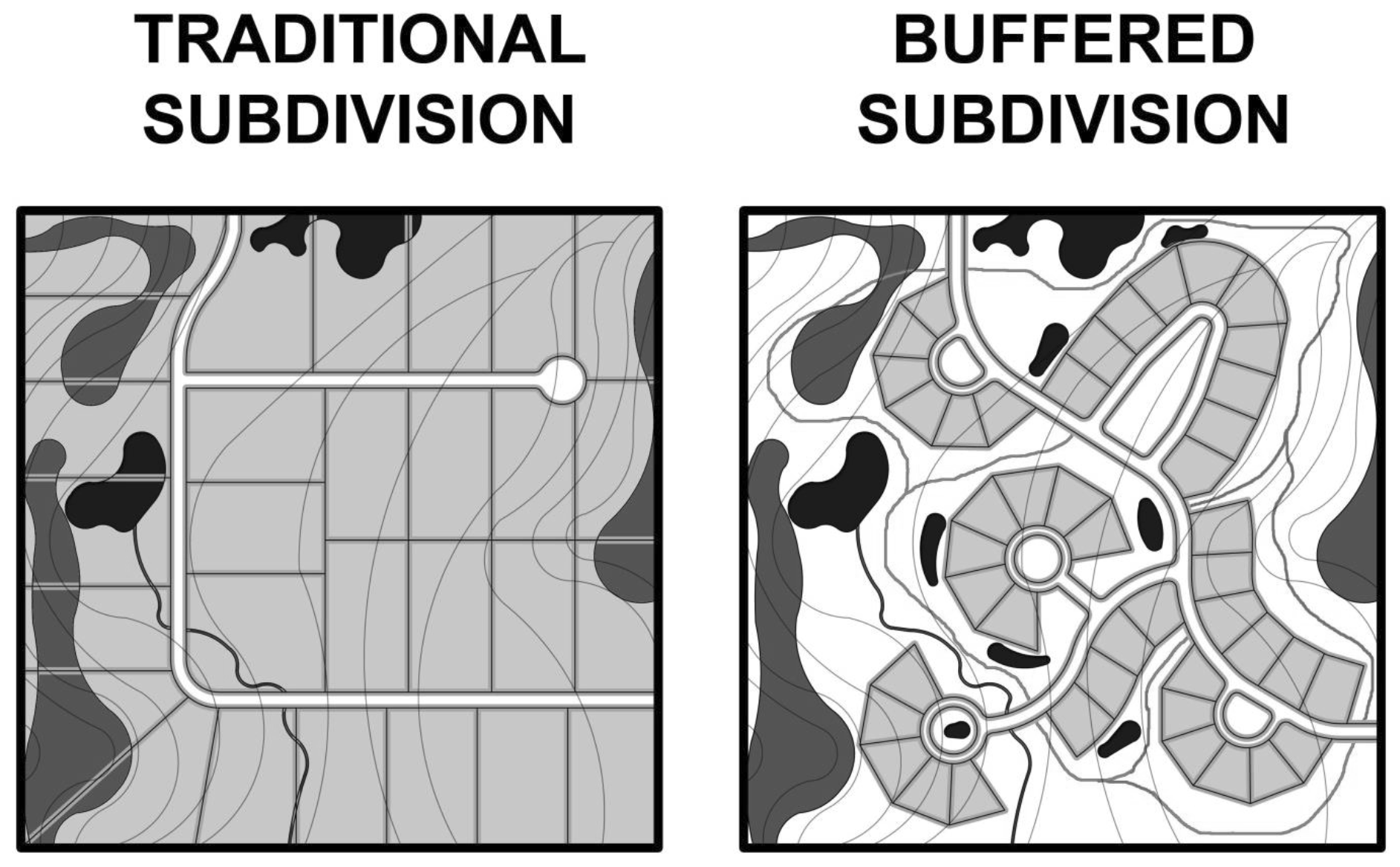
Sec. 39-242. - Buffered subdivisions.
(a)
Intent.
(1)
The intent of buffered subdivisions is to allow for residential development which will enhance living environments by preserving a sense of agriculture, the natural environment and rural landscapes. These provisions should encourage innovative and livable housing environments which include both permanent dedication of open space and a planned reduction of individual lot area requirements. Buffered subdivisions will be allowed in an "A-1" Zone, without requiring a rezoning to "A-R," provided that the entire buffered subdivision is surrounded by open space.
(2)
Use of the provisions that follow should result in residential developments which are consistent with zoning regulations standards and these regulations, yet allow for modifications from the general standards to ensure appropriate, fair and consistent decision making.
(b)
Objectives. The following objectives shall be considered in conducting the review of any application for a buffered subdivision:
(1)
Provision of more environmentally sensitive, residential developments through preservation of the natural character of the landscape including open fields, stands of trees, ponds, streams, wetlands, hills and similar natural features.
(2)
Preservation of the rural landscape of the county and protection of environmentally sensitive lands from the disruptive effects of conventional subdivision designs.
(3)
Provision of more efficient and aesthetic use of open space by allowing developers to reduce lot sizes without sacrificing the public health, morals and general welfare, while maintaining the residential density required within the zoning district.
(4)
Allowance of a more flexible and economical residential layout and street design that encourages diversity and originality in lot layout and dwelling placement to achieve the best possible relationship between development and the land.
(5)
Encouragement of design creativity in all aspects of the development, including lot layout, street design and sewage disposal methods.
(6)
Assurance of permanent preservation of open space, rural lands and natural resources.
(c)
Principles for site location. The following general principles shall be utilized to evaluate the proposed location of any buffered subdivision. These principles shall be applied by the zoning hearing officer as a general guideline to help assess the impact of the proposed development.
(1)
Natural features protected. Buffered subdivisions should maintain the rural, natural and scenic qualities of the county. Toward this end, all buffered subdivisions shall be designed to promote the preservation of natural features. Significant wildlife habitats, sensitive environmental lands and scenic vistas are to be protected.
(2)
Single ownership control. The proposed development shall be under single ownership or control, such that a single person or entity has proprietary responsibility for the completion of the development.
(3)
Access to public roadway. Buffered subdivisions shall have not less than one property line abutting a public roadway. All entrances and exits shall be directly onto or from said roadway.
(d)
Development requirements. The following development requirements are to be applied to buffered subdivisions:
(1)
Density standards. Applicants for a buffered subdivision shall be entitled to develop the land remaining after the required dedication of open space to its maximum potential subject to the lot size requirements established herein.
(2)
Lot size requirements. Lot sizes may vary; however, all lots shall comply with the following standards:
a.
Lots not served by public or common sanitary sewer and public or community water shall be at least eight-tenths of one acre (35,000 square feet) in area with a minimum lot width of not less than 155 feet measured at the approved building setback line. Additionally, lots shall be sized and designed to accommodate an area, or not more than two areas, of contiguous, suitable soil reserved for the installation of a primary subsurface absorption system and a secondary (replacement) subsurface absorption system. Said areas shall be clearly delineated and labeled on the preliminary plat. Suitable soils are those soils classified as Category 1 or 2 pursuant to section 39-84(f). Those soils with moderate, severe or very severe limitations for subsurface absorption systems (Category 3 and 4, pursuant to this Code) shall not be included in the reserved areas for conventional subsurface absorption systems. Category 1 soil types require a total reserved area of at least 6,500 square feet. Category 2 soil types require a total reserved area of at least 10,500 square feet. At least one of the two reserved areas must be on each lot.
b.
Lots served by public sewer and sewerage treatment facilities and public water shall be at least 10,000 square feet in area with a minimum lot width of not less than 80 feet measured at the approved building setback line.
c.
Lots served only by a public or community water system shall be at least 22,000 square feet in area with a minimum lot width of not less than 120 feet measured at the approved building setback line. Additionally, lots shall be sized and designed to accommodate an area, or not more than two areas, of contiguous, suitable soil reserved for the installation of a primary subsurface absorption system and a secondary (replacement) subsurface absorption system pursuant to subsection (d)(b)1 of this section.
d.
Lots served only by public or community sewers (sewage treatment facilities) shall be at least 18,000 square feet with a minimum lot width of not less than 95 feet measured at the building line.
e.
Lots served by on-site wells shall be sized and designed to accommodate a private well located not less than 75 feet from the subsurface absorption system in Category 1 and 2 soils, or less than 100 feet in Category 3 and 4 soils. Any variation from this requirement will require a sign-off from the county health department.
f.
Lots served by off-site subsurface absorption systems or other approved off-site sewage treatment methods shall be treated, for the purposes of lot size requirements, as being served by public or community sewers (sewage treatment facilities).
(3)
Setback and yard area requirements.
a.
Building setback and yard area requirements. The building setback and yard area requirements of the zoning district in which the buffered subdivision is located shall apply. However, when reduced building envelopes are utilized, the required building setback may be reduced up to, but not more than, 25 percent.
b.
Reduced zoning envelopes (RZE). The use of RZE's is strongly encouraged in order to minimize site disturbance, reserve on-site areas for subsurface sewage disposal, and create a better overall subdivision design. The RZE shall be clearly delineated as such on the subdivision plat, shall be binding upon the owner/developer of each lot, and shall be enforceable by the county. The following design standards shall apply to RZE's:
1.
RZE's shall be selected that do not include the tops of ridge lines.
2.
RZE's shall not be located in areas reserved for the installation of a primary subsurface absorption system and a secondary (replacement) subsurface absorption system as required in subsection (d)(c)2 of this section.
3.
RZE's should avoid open fields where feasible.
4.
RZE's should be located on the edges of fields and in wooded areas to minimize the visual impact of development.
5.
Front, rear and side yard setbacks may be staggered to provide for maximum variety in the size of such yards; however, the yard area requirements of the zoning district in which the buffered subdivision is located shall apply and the required building setback may be reduced up to, but not more than, 25 percent. This building setback reduction will not apply to county highways.
6.
Maximum possible rear yards onto open space shall be provided.
7.
RZE placement should be as far as possible from open space.
(e)
Open space standards.
(1)
Areas not considered open space. Areas devoted to public or private streets or rights-of-way or any land that has been or is to be conveyed to a public agency for purposes other than conservation of open space shall not be calculated as dedicated open space.
(2)
Areas that may be included as open space. Except as noted above, any undeveloped land area within the boundaries of the designated development parcel may be included as required open space, including land designated "Zone A" or "Zone AE" (special flood hazard areas inundated by the 100-year flood) as shown on the county flood insurance rate maps prepared by the Federal Emergency Management Agency (FEMA).
(3)
Use of open space. All land within a buffered subdivision that is not devoted to a residential unit, an accessory use, vehicular access, vehicular parking, a roadway, an approved land improvement, or is not considered open space as defined above shall be considered dedicated open space, preserved in an undeveloped state. Further subdivision of open space lands, or their use for other than recreation, conservation or agriculture shall be prohibited.
(4)
Location of open space. Open space shall be comprised of two types of land: primary hold-harmless areas and secondary hold-harmless areas. All lands within both primary and secondary hold-harmless areas shall be protected by a permanent conservation easement prohibiting further development, and setting other standards safe-guarding the site's special resources from negative changes. In an A-1 Agricultural District, at least 50 percent of the total site area designated for development shall be designated as open space and permanently protected; in an R-1 Single-Family Residence District, at least 33.33 percent of the total site area designated for development shall be designated as open space and permanently protected.
a.
Primary hold-harmless areas. This category consists of wetlands, lands that are generally inundated (under ponds, lakes, creeks, rivers, etc.), land within the 100-year floodplain, and slopes exceeding 25 percent.
b.
Secondary hold-harmless areas.
1.
In addition to the primary hold-harmless areas, additional land shall be designated as open space and permanently protected to total the required percentage of the total site area designated for development.
2.
Although the locations of primary hold-harmless areas are predetermined by the locations of floodplains, wetlands, and steep slopes, greater latitude exists in the designation of secondary hold-harmless areas (except that they shall include a 100-foot deep greenway buffer along all water bodies and watercourses, and a 50-foot greenway buffer alongside wetlands soils classified as very poorly drained in the detailed soil report).
3.
The location of secondary hold-harmless areas shall typically contain all or part of the following kinds of resources: mature woodlands, aquifer recharge areas, areas with highly permeable (excessively drained) soils, significant wildlife habitat areas, sites listed on the state natural areas inventory, prime farmland, historic, archaeological or cultural features listed (or eligible to be listed) on national, state or county registers or inventories, and scenic views into the property from existing public roads. Secondary hold-harmless areas therefore typically consist of upland forest, meadows, pastures, and farm fields, part of the ecologically connected matrix of natural areas significant for wildlife habitat, water quality protection, and other reasons.
(5)
General locational standards.
a.
Buffered subdivisions shall be designed around both the primary and secondary hold-harmless areas, which together constitute the total required open space. The design process should therefore commence with the delineation of all potential open space, after which potential house sites are located. Following that, access road alignments are identified, with lot lines being drawn in as the final step.
b.
Both primary and secondary hold-harmless areas shall be placed in undivided preserves, which may adjoin housing areas that have been designed more compactly to create larger areas that may be enjoyed equally by all residents of the development. Undivided open space shall be directly accessible to the largest practicable number of lots within a buffered subdivision. To achieve this, the majority of house-lots should abut undivided open space in order to provide direct views and access. Safe and convenient pedestrian access to the open space from all lots not adjoining the open space shall be provided (except in the case of farmland, or other resource areas vulnerable to trampling damage of human disturbance). Where the undivided open space is designated as separate, non-contiguous parcels, no parcel shall consist of less than three acres in area nor have a length-to-width ratio in excess of 4:1, except such areas that are specifically designed as athletic fields, upland buffers to wetlands, water bodies or watercourses, or trail links.
(6)
Preservation of open space. Open space shall be set aside by the developer through an irrevocable conveyance that is acceptable to the county. Forms of dedicating open space may include:
a.
A recorded deed restriction;
b.
Covenants that run perpetually with the land; or
c.
A conservation easement. Such conveyance shall ensure that the open space will be protected from all forms of development, except as shown on an approved site plan, and shall never be changed to another use except for public highway purposes. Such conveyance shall:
1.
Indicate the proposed allowable uses of the dedicated open space.
2.
Require that the dedicated open space be maintained by parties who have an ownership interest in the open space.
3.
Provide standards for scheduled maintenance of the open space.
(7)
Structures built in open space areas. Any structures or buildings accessory to recreation, conservation or agriculture may be erected within the dedicated open space, subject to the approved open space plan. These accessory structures or buildings shall not exceed, in the aggregate, one percent of the required open space area. County zoning permits will be required for such structures, to be paid for by the owners in the subdivision.
(8)
Access to open space. Open space intended for recreation or use by the residents shall be easily accessible to pedestrians. Accessibility should meet the needs of the physically challenged and senior citizens.
(9)
Ownership and maintenance of open space. Different ownership and management options apply to the permanently protected open space created through the buffered subdivision development process. The open space shall remain undivided and may be owned and managed by a homeowners' association, a recognized land trust or conservancy, or a public agency such as a park district or forest preserve district. A narrative describing ownership, use and maintenance responsibilities shall be submitted for all common and public improvements, utilities, and open spaces.
(10)
Ownership standards. Common open space within a development shall be owned, administered, and maintained by any of the following methods, either individually or in combination.
a.
Homeowners' association. The undivided open space and associated facilities may be held in common ownership by a homeowners' association. The association shall he formed and operated under the following provisions:
1.
The developer shall provide a description of the association, including its bylaws and methods for maintaining the open space.
2.
The association shall be organized by the developer and shall be operated with a financial subsidy from the developer, before the sale of any lots within the development.
3.
Membership in the association is automatic (mandatory) for all purchasers of homes therein and their successors. The conditions and timing of transferring control of the association from developer to homeowners shall be identified.
4.
The association shall be responsible for maintenance of insurance and taxes on undivided open space, enforceable by liens placed by the county on the association. The association may place liens on the homes or house-lots of its members who fail to pay their association dues in a timely manner. Such liens may require the imposition of penalty interest charges.
5.
The members of the association shall share equitably the costs of maintaining and developing such undivided open space. Shares shall be defined within the association bylaws.
6.
The association shall have or hire adequate staff to administer common facilities and properly and continually maintain the undivided open space.
b.
Condominiums. The undivided open space and associated facilities may be controlled through the use of condominium agreements, approved by the county. Such agreements shall be in conformance with the state's uniform condominium act. All undivided open space land shall be held as a common element.
c.
Transfer of conservation easements to a private conservation organization or public agency. With the permission of the county, an owner may transfer easements to a private, nonprofit organization or ownership to a public agency, among whose purposes it is to conserve open space and/or natural resources, provided that:
1.
The organization is a bona fide conservation organization with perpetual existence;
2.
The conveyance contains appropriate provisions for proper reverter or retransfer in the event that the organization becomes unwilling or unable; and
3.
A maintenance agreement acceptable to the county is entered into by the developer and the organization.
(11)
Maintenance standards.
a.
The ultimate owner of the open space (typically a homeowners' association) shall be responsible for raising all monies required for operations, maintenance, or physical improvements to the open space through annual dues, special assessments, etc. The homeowners' association shall be authorized under its bylaws to place liens on the property of residents who fall delinquent in payment of such dues, assessments, etc.
b.
In the event that the association or any successor organization shall, at any time after establishment of a development containing undivided open space, fail to maintain the undivided open space in reasonable order and condition in accordance with the development plan, the county may serve written notice upon the owner of record, setting forth the manner in which the owner of record has failed to maintain the undivided open space in reasonable condition.
c.
Failure to adequately maintain the undivided open space in reasonable order and condition constitutes a violation of these regulations. The county is hereby authorized to give written notice to the owner or occupant, as the case may be, of any violation, directing the owner to remedy the same within 15 days.
(f)
Evaluation criteria/design standards. In evaluating the layout of lots and open space, the following criteria will be considered by the county as appropriate to the site's natural, historic, and cultural features, and meeting the purpose and objectives of buffered subdivisions. Diversity and originality in lot layout shall be encouraged to achieve relationship between development and conservation areas. Accordingly, the county shall to determine whether the proposed sketch or preliminary plat:
(1)
Protects and serves all floodplains. wetlands, and steep slopes from clearing, grading, filling, or excavation (except as may be approved by the county for essential infrastructure or active or recreation amenities).
(2)
Preserves and maintains mature woodlands, existing fields, pastures, meadows, and orchards, and sufficient buffer areas to minimize conflicts between residential and agricultural uses. For locating house-lots and driveways within wooded areas is generally recommended, with two exceptions. The first involves significant preservation concern. The second involves predominantly agricultural areas, where remnant tree groups provide the natural areas for wildlife habitat.
(3)
If development must be located on open fields or pastures because of greater constraints in all other parts of the site, dwellings should be sited on the least prime agricultural soils, or in locations at the far edge of a field, as seen from existing public roads. Other considerations include whether the development will be visually buffered from existing public roads, such as by a planting screen of a variety of indigenous native trees, shrubs and wildflowers.
(4)
Maintains or creates an upland buffer of natural native species vegetation of at least 100 feet in depth adjacent to wetlands and surface waters, including creeks, streams, rivers, springs, lakes and ponds.
(5)
Designs around existing hedgerows and tree lines between fields or meadows, and minimizes impacts on large woodlands (greater than five acres), especially those containing many mature trees or a significant wildlife habitat. Also, woodlands of any size on highly credible soils with slopes greater than ten percent should be avoided. However, woodlands in poor condition with limited management potential can provide suitable locations for residential development. When any woodland is developed, great care shall be taken to design all disturbed areas (for buildings, roads, yards, subsurface septic absorption systems, etc.) in locations where there are no large trees or obvious wildlife areas, to the fullest extent that is practicable.
(6)
Leaves scenic views and vistas unblocked or uninterrupted, particularly as seen from public roads. For example, in open agrarian landscapes, a deep "no-build, no-plant" buffer is recommended along the public road where those views or vistas are prominent or locally significant. The concept of foreground meadows with homes facing the public road across a broad grassy expanse (as illustrated in Fig. 5-5 of Open space for Subdivisions: A Practical Guide to Creating Open Space Networks, Arendt, Randall G., 1996) is strongly preferred to mere buffer strips, with or without berms or vegetative screening. In wooded areas where the sense of enclosure is a feature that should be maintained, a deep no-build, no-cut buffer should be respected, to preserve existing vegetation.
(7)
Avoids siting new construction on prominent hilltops or ridges, by taking advantage of lower topographic features.
(8)
Protects wildlife habitat areas of species listed as endangered, threatened, or of special concern by the U.S. Environmental Protection Agency and/or by the state natural areas inventory.
(9)
Designs around and preserves sites of historic, archaeological, or cultural value, and their environs, insofar as needed to safeguard the character of the feature, including barns, barn foundations, and burial grounds.
(10)
Protects rural roadside character and improves public safety and vehicular carrying capacity by avoiding development fronting directly onto existing public roads. Establishes buffer zones along the scenic corridor of rural roads with historic buildings, hedgerows, and so on.
(11)
Provides active recreational areas in suitable locations that offer convenient access by residents and adequate screening from nearby house-lots.
(12)
Includes a pedestrian circulation system designed to ensure that pedestrians can walk safely and easily on the site, between properties and activities or special features within the neighborhood open space system. All roadside footpaths should connect with off-road trails, which in turn should link with potential open space on adjoining undeveloped parcels (or with existing open space on adjoining developed parcels, where applicable).
(13)
Provides open space that is reasonably contiguous. For example, fragmentation of open space should be minimized so that these resource areas are not divided into numerous small parcels located in various parts of the development. To the greatest extent practicable, this land shall be designed as a single block with logical, straightforward boundaries. Long thin strips of conservation land shall be avoided, unless the conservation feature is linear or unless such configuration is necessary to connect with other streams or trails. The open space shall generally abut existing or potential open space land on adjacent parcels (such as in other subdivisions, public parks/preserves, or properties owned by or eased to private land conservation organizations). Such subdivision open space shall be designed as part of larger contiguous and integrated greenway systems.
(g)
Submission requirements. All submissions for buffered subdivisions shall comply with articles II, III and IV of this chapter.
(h)
Improvement requirements. Any improvements will comply with article III of this chapter.
(i)
Stormwater management plan. A stormwater management plan will be required under the county stormwater management regulations. Secondary hold-harmless areas may be used as a part of that plan. Primary hold-harmless areas will not be used as a part of the stormwater management plan.
(j)
Requirements set by other offices or agencies. The provisions of this article do not negate any requirements set by any other county office or department or by any agency that regulates development in the county.
(Compiled Ords. 2013, § 19-5.5; Ord. No. 12-2020-19, § 3, 12-22-2020)
Sec. 39-243. - Burial grounds.
(a)
No lot may be used for the interment of human dead except for any lot legally recognized as a public, private, fraternal, municipal, or religious cemetery or family burying ground as recognized under 760 ILCS 100/2.
(b)
This prohibition does not apply to the burial of human remains in the form of cremated ashes.
(Compiled Ords. 2013, § 19-5.6)
Sec. 39-244. - Campers; campgrounds.
Travel trailers, campers, recreational vehicles and motor homes. The following restrictions shall apply to use of all units intended for travel, vacation or recreational purposes:
(1)
Use of any of the above, or unlisted units constructed with a similar intent, as permanent housing outside of a legal campground is prohibited.
(2)
Use of any of the above, or unlisted units constructed with a similar intent, as temporary housing units on developed or undeveloped private property will be allowed for a period not to exceed 90 days in any calendar year with the following restrictions and exception:
a.
A temporary zoning certificate will be required;
b.
The unit may be hooked to electricity and water but not permanently to a well and septic system;
c.
No more than two units may be on a single parcel at one time; and
d.
An exception to the 90-day rule will be units placed, for recreational purposes, in a floodplain. Such units will comply with the requirements of the county flood prevention and protection regulations.
(3)
In the event of a manmade or natural disaster, in which a permanent residence is destroyed by 50 percent or more, use of these type of temporary living units may be allowed by the administrator for up to 180 days, provided that:
a.
A temporary zoning certificate is obtained for the unit;
b.
Provisions are made to replace the unit, on a temporary basis, with a manufactured home at the end of 180 days; and
c.
A zoning certificate is obtained for the replacement of the original home that has been destroyed.
(4)
An extension, in the form of a temporary special use, may be granted by the zoning hearing officer after a public hearing.
(Compiled Ords. 2013, § 19-5.7; Ord. No. 12-2020-19, § 3, 12-22-2020)
Sec. 39-245. - Duplexes (split-lot).
(a)
Generally. It is the intent of this article to provide a means of splitting a lot which houses a duplex structure so that each side of the duplex may be sold with its own parcel. Each half of a split-lot duplex will be considered a unit for purposes of this article.
(b)
New subdivisions. Split-lot duplexes will be allowed only as a part of a subdivision and not as a subdivision unto its own. Such lots can make up no more than ten percent of the lots in the subdivision and should be grouped together as much as possible. All lots to be used for split-lot duplexes will be rezoned to R-2 with a special use.
(c)
Existing subdivision. Split-lot duplexes will be allowed only as a part of an existing subdivision. Such lots can make up no more than five percent of the lots in the subdivision and should also be grouped together as much as possible. All lots to be used for split-lot duplexes will be rezoned to R-2 with a special use. In an existing subdivision, split-lot duplexes shall not be allowed adjacent to:
(1)
Already developed lots zoned A-1, A-R or R-1.
(2)
Residential lots zoned A-1, A-R or R-1 in another, existing subdivision.
(d)
Lot sizes. Lot size for split-lot duplexes will be based on the soil categories shown in section 39-84(f). The following lot sizes will apply based on the soil category that makes up the majority of the lot:
(e)
Wells and septics. For split-lot duplexes, wells may be shared between the duplex units or each unit may have individual wells. This will be determined between the developer and the county health department. Septic systems will not be shared. Each unit will have an individual tank, septic field and reserve septic field. Field sizes are required as follows:
*Half of the square footage will be used initially; half will be held in reserve. To be shown on plat.
**Bedrooms can be split two-two or three-one by units.
(Compiled Ords. 2013, § 19-5.8)
Sec. 39-246. - Government uses and buildings.
(a)
Where permitted. Any facility where county services are provided, as approved by the county board, is considered a permitted use in every zoning district.
(b)
Government offices.
(1)
Applicability. This section applies to any government office/ public building as defined in the Use matrix (section 39-41).
(2)
Setback. Any building associated with a government office/public building must be located at least 20 feet from any lot in any "R" district.
(Compiled Ords. 2013, § 19-5.9)
Sec. 39-247. - Home occupations and small rural businesses.
(a)
Applicability.
(1)
The terms and phrases specific to this section are defined below:
(2)
This section applies to home occupations or small rural businesses.
(3)
This section does not apply to telecommuting. Telecommuting is considered a permitted use in any dwelling unit.
(b)
Generally.
(1)
If a home occupation or small rural business grows to become the dominant use on the premises and is no longer subordinate to the established residential and/or agricultural uses, the owner/operator shall either:
a.
Re-zone the site to the appropriate zoning classification (see sections 39-29—39-39); or
b.
Re-locate the business to an area that is properly zoned for the use conducted.
(c)
Uses.
(1)
The following uses are allowed as a home occupation or small rural business, as indicated below.
(2)
The administrator may approve additional uses not listed below if the applicant demonstrates that the use complies with all of the standards listed in subsections (d) through (h) of this section.
(d)
Location.
(1)
A home occupation shall be carried on wholly within a principal building or accessory building.
(2)
A small rural business is allowed only in an accessory structure. It is not allowed on a lot that is part of an existing subdivision.
(e)
Scale and space requirements.
(1)
The following scale and space requirements apply:
(2)
Applicants must provide a site plan indicating where the home occupation or small rural business and any necessary, off-street parking will be located.
(f)
Signs. Signs identifying a home occupation or small rural business are limited to those allowed in article III of this chapter.
(g)
Operations.
(h)
Zoning certificates.
(1)
A zoning certificate is required before any home occupation or small rural business is established. The applicant must obtain a zoning certificate before applying for any permit required by the health department.
(2)
The administrator may set reasonable conditions on zoning certificates including, but not limited to, hours of operation, off-street parking and delivery/storage of raw materials.
(3)
If the applicant feels that the conditions set by the zoning officer are too restrictive, the applicant may appeal the conditions to the zoning hearing officer (see section 39-148).
(Compiled Ords. 2013, § 19-5.10; Ord. No. 2, 2-19-2008; Ord. No. 12-2020-19, § 3, 12-22-2020)
Sec. 39-248. - Hospitals/nursing homes.
(a)
Applicability. This section applies to any hospital or nursing home, as defined in the Use matrix (section 39-41).
(b)
Standards. Facilities subject to this section shall be:
(1)
At least 50 feet from any lot in any "R" district; and
(2)
Located on lots of at least five acres.
(Compiled Ords. 2013, § 19-5.11)
Sec. 39-249. - Junkyards, salvage and wrecking yards.
(a)
Applicability. This section applies to the following uses, as defined in the Use matrix (section 39-41):
(1)
Automobile wrecking yard; and
(2)
Junkyards.
(b)
Permit requirements. The following requirements apply to the establishment and/or operation of the uses referenced in subsection (a) of this section:
(1)
A zoning certificate is required before the use is established (see section 39-149).
(2)
The application shall be accompanied by a location map of the proposed site showing:
a.
The relationship of the site to existing roads.
b.
The dimensions of the site.
c.
The area to be used for storage, salvage or wrecking of materials shown in crosshatching.
d.
The dimensions of the storage, salvage or wrecking area.
(3)
After the initial application requirements are met, an annual permit is required. This may be obtained from the planning and zoning office. Permits must be renewed by January 1 of each year. The permit fee shall be as established by resolution by the county board. Failure to obtain the permit by January 1 will result in a penalty fee, also set by resolution of the county board.
(c)
Screening.
(1)
The applicant shall provide a plan for screening the storage, salvage or wrecking area including location on the above map and construction details. Screening shall be in the form of a fence and shall:
a.
Be located totally on the proposed site;
b.
Be in place prior to the issuance of the permit;
c.
At no time have materials piled such that said material is higher than the screening;
d.
Be maintained in good condition through repair or replacement.
(2)
Subject to the approval of the planning and zoning office, acceptable fencing shall include:
a.
Chain-link type with aluminum, steel, plastic or wood slat inserts;
b.
Solid metal sheeting supported by wood or metal posts;
c.
Wooden fences which cannot be viewed through;
d.
Masonry.
(Compiled Ords. 2013, § 19-5.13)
Sec. 39-250. - Livestock operations.
(a)
Setbacks from existing livestock operations. All livestock management facilities, approved by the state department of agriculture, require certain setbacks as follows:
(b)
Animal units occupied residence populated area.
(1)
When any new home construction is applied for or any A-R, R-1, R-2 or R-3 rezonings are proposed for the purpose of subdividing or new home construction, consideration will be given to the above requirements.
(2)
When any proposed development does not meet the minimum requirements above, a sign-off will be required indicating that the home owner/builder or subdivision developer is aware of the proximity to the nearby livestock management facility. The proximity of a livestock management facility will also be noted on the final subdivision plat.
(Compiled Ords. 2013, § 19-5.13)
Sec. 39-251. - Lodging.
Motels or motor hotels shall have the following requirements applied to them:
(1)
No vehicular entrances to or exits from any motel or motor hotel whatsoever shall be located within 200 feet along the street from any school, public playground, church, hospital, library or institution for dependents or children, except where such property is in another block or on another street, which premises in question do not abut.
(2)
The following regulations shall also be complied with:
a.
Any lot to be used for a motel or motor hotel shall be not less than 20,000 square feet in area and shall contain not less than 1,200 square feet of lot area per sleeping unit. All buildings and structures on the lot shall occupy, in the aggregate, not more than 25 percent of the area of the lot.
b.
All areas used for automobile access or parking shall comply with the provisions of section 39-79(e)(6).
c.
All areas not used for access, parking, circulation, buildings and services shall be completely grass covered or equivalent and maintained in good condition.
d.
No enlargements or extensions to any motel or motor hotel shall be permitted unless the existing one is made to conform substantially with all the requirements for new construction for such establishment.
(Compiled Ords. 2013, § 19-5.14)
Sec. 39-252. - Manufactured/modular homes/mobile homes.
The placement of manufactured/modular homes in the A-1 and A-R districts must comply with the following:
(1)
A manufactured home shall be:
a.
Used for residential purposes only. Connection to any public or private utility, water system or sewer system will constitute occupancy for purposes of this chapter.
b.
HUD approved and no more than ten years old. Proof, in the form of a title, is required when applying for a zoning permit. Manufactured homes older than ten years are permitted as seasonal dwellings only in areas along the Mississippi or Rock Rivers when properly permitted.
(2)
All modular homes will be placed on a permanent foundation or basement, with footings below the frost line. If a basement is not used, the permanent foundation will be of poured concrete or mortared concrete block. Any slabs will be poured inside and independent to the foundation walls. All modular homes will have a perimeter framing system to allow support by the permanent foundation. Wheels and tongues must be removed.
(3)
The requirements listed above do not apply to:
a.
Homes which are allowed by the zoning hearing officer as a second dwelling on a parcel.
b.
Homes to be used for a period not to exceed three years while another home is being constructed.
c.
Homes used on a farm to house full-time farm workers.
(4)
Special uses for manufactured/modular homes. The purpose of this section is to set standards for granting a special use for a manufactured/modular home. Such special uses will be required when dealing with manufactured/modular homes over ten years old, homes on parcels already occupied by another dwelling unit or manufactured/modular homes of any age which are not to be placed on a perimeter foundation. The standards to be followed in such cases are as follows:
a.
That the establishment, maintenance or placement of the manufactured/modular home under this special use shall not be detrimental to or endanger the public health, safety, morals, comfort or general welfare.
b.
That the placement of the manufactured/modular home under this special use shall not be injurious to the use and enjoyment of other property in the immediate vicinity for the purpose already permitted nor substantially diminish and impair values within the neighborhood.
c.
That the placement of the manufactured/modular home under this special use shall not impede the normal and orderly development and improvement of surrounding property for uses permitted in the district.
d.
That adequate utilities, access roads, drainage, and/or other necessary facilities have been or are being provided.
e.
That adequate measures have been or will be taken to provide ingress and egress so designed as to minimize traffic congestion in the public streets.
f.
That the special use shall in all other respects conform to the applicable regulations of the district in which it is located, except as such regulations may in each instance be modified by the county board pursuant to the recommendations of the zoning hearing officer.
(5)
Manufactured home land lease community. A manufactured home land lease community ("community") shall comply with the following:
a.
The community shall be located on a parcel at least five acres in size.
b.
The applicant shall provide a site plan designating the community's boundaries, including all spaces for lease, internal roads, and amenities. The site plan boundary line shall be at least 100 feet from any residential structure located outside the community unless separated by a natural or artificial barrier that obscures views or access into the community, such as a highway, river, stream, or significant change in elevation.
(Compiled Ords. 2013, § 19-5.15; Ord. No. 12-2020-19, § 3, 12-22-2020)
Sec. 39-253. - Medical cannabis cultivation and distribution centers.
(a)
Cultivation centers.
(1)
Minimum distance from protected uses. No medical cannabis cultivation center shall be established, maintained or operated on any lot that has a property line within 2,500 feet of the property line of a pre-existing public or private preschool or elementary or secondary school or day care center, day care home, group day care home, part day child care facility, or an area zoned for residential use.
(2)
Measurement. For the purposes of subsection (a)(1) of this section, distances shall be measured in a straight line, without regard to intervening structures or objects, from the nearest point on the property line of the lot on an applicable cultivation center is located to the nearest point on a property line of any protected use (as defined in subsection (a)(1) of this section).
(3)
Compliance with state regulations and rules. Each cultivation center shall comply with the Compassionate Use of Medical Cannabis Pilot Program Act (410 ILCS 130/1 et seq.) and all rules and regulations adopted in accordance thereto.
(4)
Single use site. No cultivation center may be established in multiple use or tenant property or on a site that shares parking with other uses.
(5)
Setbacks. Each cultivation center shall be a minimum of 50 feet from its surrounding property lines.
(6)
Parking. Parking areas shall be well lit and monitored by video surveillance equipment whose live images can be viewed by cultivation center staff and are continually recorded in a tamper proof format.
(7)
Signage.
a.
All commercial signage for a cultivation center shall be limited to one flat wall sign not to exceed ten square feet in area, and one identifying sign, not to exceed two square feet in area, which may only include the cultivation center address. Such signs shall not be directly illuminated.
b.
Electronic message boards and temporary signs are not permitted in connection with a cultivation center.
c.
Signage shall not contain cannabis imagery such as cannabis leaves, plants, smoke, paraphernalia, or cartoonish imagery oriented towards youth or language referencing cannabis.
(8)
Age and access limitations. Each cultivation center shall prohibit any person who is not at least 18 years of age from entering the cultivation center property. Cultivation centers shall not employ anyone under the age of 18 years. Access to the cultivation center site shall be limited exclusively to cultivation center staff, local and state officials and those specifically authorized under the Compassionate Use of Medical Cannabis Pilot Program Act (410 ILCS 130/1 et seq.).
(9)
Security and video surveillance.
a.
All cultivation, production and related operations at a medical cannabis cultivation center shall occur in an enclosed locked facility ("facility"). Each cultivation center shall provide and maintain adequate security on the entire site on which the cultivation center sits, including lighting, video surveillance, security personnel and alarms reasonably designed to ensure the safety of persons and to protect the site from theft. The facility shall be enclosed by high security fence. The fence must be adequately secure to prevent unauthorized entry and include gates tied into an access control system.
b.
The medical cannabis cultivation center parking area, cultivation, production, warehousing areas and shipping bays and entrance shall be monitored by video surveillance equipment whose live images can be viewed by cultivation center staff and continually recorded in a tamper proof format.
c.
A sign shall be posted in a prominent location which includes the following language "This area is under live/recorded video surveillance to aid in the prosecution of any crimes committed against this facility."
d.
The sheriff's department shall review the adequacy of lighting, security and video surveillance installations with assistance from state law enforcement officials. The sheriff has the discretion to conduct periodic review of security features as appropriate.
e.
Loading of product shall occur within secure enclosed shipping bays and shall not be visible from the exterior of the facility.
(10)
Noxious odors. All cultivation centers shall operate in a manner that prevents odor impacts on neighboring premises or properties and, if necessary, the facility shall be ventilated with a system for odor control.
(11)
Conduct on site.
a.
It shall be prohibited to conduct retail sales of medical cannabis or medical cannabis infused products at medical cannabis cultivation centers. A cultivation center may not sell or distribute any cannabis to any individual or entity other than a dispensary organization registered under the Compassionate Use of Medical Cannabis Pilot Program Act (410 ILCS 130/1 et seq.).
b.
It shall be prohibited to cultivate, manufacture, process or package any product, other than medical cannabis and cannabis infused products, at a cultivation center.
c.
It shall be prohibited to consume cannabis products in a cultivation center or anywhere on the site occupied by the cultivation center. A sign, at least 8.5 by 11 inches, shall be posted inside a cultivation center building in a conspicuous place and visible to staff and shall include the following language: "Smoking, eating, drinking or other forms of consumption of cannabis products is prohibited on cultivation center property."
(b)
Medical cannabis dispensary.
(1)
Minimum distance from protected uses.
a.
No medical cannabis dispensing organization shall be established, maintained or operated on any lot that has a property line within 1,000 feet of the property line of a pre-existing public or private preschool or elementary or secondary school or day care center, day care home, group day care home, or part day child care facility.
b.
No medical cannabis dispensary shall be established, maintained or operated on any lot that has a property line within 500 feet of the property line of a pre-existing residential zoning district, place of worship, or park.
(2)
Measurement. For the purposes of subsection (b)(1) of this section, distances shall be measured in a straight line, without regard to intervening structures or objects, from the nearest point on the property line of the lot on which an applicable dispensary is located to the nearest point on any property line of any protected use (as identified in subsection (b)(1) of this section).
(3)
Compliance with state regulations and rules. All dispensaries shall comply with the Compassionate Use of Medical Cannabis Pilot Program Act, 410 ILCS 130/1 et seq., and all rules and regulations adopted in accordance thereto.
(4)
Single use site. No dispensary shall be established in multiple use or tenant property or on a site that shares parking with other uses.
(5)
Setbacks. Each medical cannabis dispensary shall be a minimum of 30 feet from its surrounding property lines.
(6)
Buffering from other medical cannabis dispensaries. Each dispensary shall be a minimum of 1,000 feet from all other dispensaries, as measured from the applicable property lines.
(7)
Parking.
a.
Parking shall be located in an area which is visible from a public road or a private road that is accessible to the public. It cannot be screened from the roadway with vegetation, fencing or other obstructions.
b.
Parking areas shall be well lit and monitored by video surveillance equipment whose live images can be viewed by dispensary staff and are continually recorded in a tamper proof format.
(8)
Exterior display. No dispensary shall be maintained or operated in a manner that causes, creates or allows the public viewing of medical cannabis, medical cannabis infused products or cannabis paraphernalia or similar products from any sidewalk, public or private right-of-way or any property other than the lot on which the dispensary is located. No portion of the exterior of the dispensary shall utilize or contain any flashing lights, search lights or spot lights or any similar lighting system.
(9)
Signage and advertising.
a.
All commercial signage for a dispensary shall be limited to one flat wall sign not to exceed ten square feet in area, and one identifying sign, not to exceed two square feet in area, which may only include the dispensary address; such signs shall not be directly illuminated. Exterior signs on the dispensary building shall not obstruct the entrance or windows on the dispensary.
b.
Electronic message boards and temporary signs are not permitted in connection with a dispensary.
c.
Signage shall not contain cannabis imagery such as cannabis leaves, plants, smoke, paraphernalia, or cartoonish imagery oriented towards youth, or language referencing cannabis.
d.
A sign shall be posted in a conspicuous place at or near all dispensary entrances and shall include the following language: "Only cardholders, designated caregivers, and staff may enter these premises. Persons under the age of 18 are prohibited from entering." The required text shall be no larger than one inch in height.
e.
Any additional merchandise packaging provided by a dispensary, such as bags, sacks, totes or boxes, shall be opaque without text or graphics advertising or identifying the contents of the products contained within.
(10)
Drug paraphernalia sales. Dispensaries that display or sell drug paraphernalia shall do so in compliance with the Illinois Drug Paraphernalia Control Act, 720 ILCS 600/1 et seq., and the Compassionate Use of Medical Cannabis Pilot Program Act, 410 ILCS 130/1 et seq.
(11)
Age and access limitations. Each dispensary shall prohibit any person who is not at least 18 years of age from entering the dispensary facility. Dispensaries shall not employ anyone under the age of 18. Access to the dispensary facility shall be limited exclusively to dispensary staff, cardholders, designated caregivers, local and state officials, and those specifically authorized under Compassionate Use of Medical Cannabis Pilot Program Act, 410 ILCS 130/1 et seq.
(12)
Hours of operation. Dispensaries shall operate only between 8:00 a.m. and 6:00 p.m.
(13)
Drive-thru windows. Dispensaries may not have a drive-through service.
(14)
Security and video surveillance.
a.
Each dispensary shall be an enclosed, locked facility. Each dispensary shall provide and maintain adequate security on the entire property on which the dispensary exists, including lighting, video surveillance, security personnel and alarms reasonably designed to ensure the safety of persons and to protect the site from theft.
b.
The dispensary parking area, client entrance, sales area, back room, storage areas and delivery bay and entrance shall be monitored by video surveillance equipment whose live images can be viewed by dispensary staff and continually recorded in a tamper proof format.
c.
A sign shall be posted in a prominent location which includes the following language "This area is under live/recorded video surveillance to aid in the prosecution of any crimes committed against this facility or its patrons."
d.
The sheriff's department shall review the adequacy of lighting, security and video surveillance installations with assistance from state law enforcement officials. The sheriff has the discretion to conduct periodic review of security features as appropriate.
e.
Each dispensary shall report all criminal activities occurring on the property to the applicable law enforcement agency immediately upon discovery.
f.
Deliveries shall occur during normal business hours within a secure enclosed delivery bay and shall not be visible from the exterior of the facility.
(15)
Conduct on site.
a.
Loitering is prohibited on the dispensary property.
b.
It shall be prohibited to consume cannabis products in the medical cannabis dispensary or anywhere on the site occupied by the dispensary. A sign, at least 8.5 by 11 inches, shall be posted inside the dispensary building in a conspicuous place and visible to a client and shall include the following language: "Smoking, eating, drinking or other forms of consumption of cannabis products is prohibited on dispensary property."
(Compiled Ords. 2013, § 19-5.16; Ord. No. 4, 5-20-2014)
Sec. 39-254. - Mini-rental storage.
Mini-rental storage facilities will meet the following requirements:
(1)
Maximum height will be one story.
(2)
There will be a minimum of 32 feet between buildings.
(3)
There will be electric service for lighting only and no water service to any rental unit.
(4)
There will be no outside storage except when such outside storage is separately fenced and lighted. Outside storage will not include business fleet vehicles and/or equipment or inoperable/un-licensed vehicles. Outside storage areas will be kept neat and orderly.
(Compiled Ords. 2013, § 19-5.17)
Sec. 39-255. - Mining/quarrying.
All equipment, buildings or structures for screening, crushing, mixing, washing and storage associated with mining or quarrying shall be located at least 500 feet from any scenic highway designated in the comprehensive plan.
(Compiled Ords. 2013, § 19-5.18)
Sec. 39-256. - Outdoor display.
(a)
Applicability.
(1)
This subsection applies to the following:
(2)
This section does not apply to roadside stands.
(b)
Standards.
(1)
Outdoor display is allowed only for the uses designated below. The area occupied by an outdoor display may not occupy an area of more than the following percent of the ground floor area of the building housing the principal use:
(2)
The applicant shall provide a site plan as part of any rezoning, special use, or zoning certification application that designates the location, area, and boundaries of outdoor display areas.
(3)
The outdoor display must be customarily incidental to the principal use that occupies the lot, and only if that principal use is allowed in the district in which the outdoor display is permitted.
(4)
Only the business or entity occupying the principal use or structure shall sell merchandise in the outdoor display areas.
(5)
All outdoor displays must be located on the same lot as the principal use.
(6)
The outdoor display is permitted in any yard, subject to a minimum setback of 20 feet from an adjoining property line.
(7)
Outdoor display shall be screened from view along any property line abutting a residential zoning district by a landscaped buffer, an existing wooded area, or an opaque wall at least six feet in height. The buffer shall be at least ten feet in width. To the extent that buildings on the premises are located so as to screen views from adjacent streets and properties, those buildings may be considered part of the required screening in lieu of landscaping, wooded areas, or walls.
(8)
The maximum height of displayed merchandise is limited to the height of any fence or wall along the lot's boundaries, or six feet, whichever is less.
(9)
Areas used for such display shall be furnished with an all weather hard surface of a material such as bituminous or concrete.
(10)
Merchandise shall not be placed or located so as to interfere with pedestrian or building access or egress, required vehicular parking and handicap parking, aisles, access or egress, loading space parking or access, public or private utilities, services or drainage systems, fire lanes, alarms, hydrants, standpipes, or other fire protection equipment, or emergency access or egress.
(11)
Outdoor display areas shall not be located on any parking spaces needed to comply with the minimum parking ratios of article III, section 39-79. Outdoor display areas are considered part of the floor area of the principal use or structure for purposes of computing the minimum number of parking spaces required.
(12)
The display shall not violate applicable federal, state, or local laws specific to the use of solid, liquid and gaseous chemicals, materials or products.
(Compiled Ords. 2013, § 19-5.19)
Sec. 39-257. - Pollution control facility.
(a)
Applicability. As defined in 415 ILCS 5/3.330. Examples include waste storage sites, sanitary landfill, waste disposal sites, waste transfer stations, waste treatment facilities, waste incinerators, sewers, and sewage treatment plants.
(b)
Standards. Pollution control facilities shall:
(1)
Comply with county and state regulations; and
(2)
Be operated at least 1,320 feet away from any "R" district.
(Compiled Ords. 2013, § 19-5.20)
Sec. 39-258. - Railroad freight stations.
(a)
Setback. Service yards or docks shall be at least 100 feet from any lot in any "R" district.
(b)
Applicability. This section applies to any railroad freight station, as defined in the use matrix.
(Compiled Ords. 2013, § 19-5.21)
Sec. 39-259. - Recreational uses.
(a)
Generally. Any principal or accessory building in connection with any resort, lake (used for recreational purposes), or outdoor recreation use shall be located:
(1)
Above flood hazard elevation; and
(2)
At least 200 feet from any lot in an "R" district.
(b)
Recreational dwellings.
(1)
The term "recreational dwelling" means a dwelling, including any mobile home, of at least 500 square feet of livable space, permanently placed with adequate sewer and water facilities and used strictly for recreational purposes but not used as a year-round dwelling.
(2)
Where applicable, recreational dwellings will conform to the regulations found in chapter 16. Owners of property leased for recreational dwellings are responsible for complying with chapter 16.
(c)
Outdoor recreation.
(1)
Outdoor recreation is defined as large, generally outdoor facilities primarily used for recreational or sports activities. Examples include: commercial sports (as defined in this section), sports stadiums and arenas, amusement and theme parks, racetracks, driving ranges, swimming or wave pools, riding stables or academies, campgrounds, recreational vehicle parks, miniature golf, golf courses and country clubs, batting cages, driving ranges, go cart tracks, public or commercial swimming pools (meaning those intended for the use of members and their guests of a nonprofit club or organization), commercial tennis courts, or similar recreational uses.
(2)
Any accessory building in connection with outdoor recreation shall be located at least 200 feet from any lot in an "R" district.
(d)
Sports.
(1)
This subsection applies to any:
a.
Commercial sport, defined as a sports activity for which a fee is charged to participate, a fee is charged to spectate or both, and for which a prize, either monetary, material or both may be awarded to various winners involved in the activity.
b.
Membership sports and recreation club, defined as any public or private club that promotes some form of sports or recreation activities, whether active or passive, and uses a paid membership or solicits donations or free will offerings to support the activities of the club.
(2)
Commercial sports. Commercial sports shall be located no closer than 1,320 feet to any pre-existing confinement operation, "A-R" or "R" district, or platted subdivision.
(3)
Membership sports and recreation club. If the zoning hearing officer determines that the proposed activities create conditions detrimental to surrounding properties, they may require that a buffer be placed between the proposed use and any pre-existing confinement operation, "A-R" or "R" district or platted subdivision.
(e)
Amusement parks.
(1)
The term "amusement park" is defined as a commercially operated outdoor facility with a predominance of outdoor games and activities for entertainment, including motorized rides, water slides, miniature golf, batting cages, and similar devices or activities. An amusement park may include booths for the sale of food and drink. For purposes of this subsection, the term "motorized ride" is a mechanical, aquatic, or other device or attraction that carries passengers over a fixed or restricted area, primarily for the passengers' amusement.
(2)
Amusement parks shall be located no closer than 1,320 feet to any pre-existing confinement operation, "A-R" or "R" district, or platted subdivision.
(Compiled Ords. 2013, § 19-5.23; Ord. No. 2, 3-21-2018; Ord. No. 12-2020-19, § 3, 12-22-2020)
Sec. 39-260. - Residential uses.
(a)
Conversions. The conversion of any building into a dwelling, or the conversion of any dwelling so as to accommodate an increased number of dwelling units or families, is permitted only if:
(1)
The applicable zoning district allows a new building for similar occupancy;
(2)
The resulting occupancy will comply with the requirements governing new construction in that district with respect to minimum lot size, density, dimensions of yards and other open spaces, and off-street parking; and
(3)
The conversion complies with all applicable requirements of the district.
(b)
Underground/earth sheltered dwelling.
(1)
The term "underground/earth sheltered dwelling" means a home having up to three of its sides covered with earth.
(2)
Such homes shall have one side exposed to the outside and shall have two separate means of ingress and egress.
(Compiled Ords. 2013, § 19-5.23)
Sec. 39-261. - Swimming pools; outdoor, residential.
(a)
Applicability.
(1)
This section applies to any swimming pool for household use.
(2)
For purposes of this section, the term "swimming pool" means a receptacle for water, or an artificial pool of water, that:
a.
Has a depth at any point of more than two feet;
b.
Is intended for immersion or partial immersion of human beings; and
c.
Is constructed, installed and maintained in or above the ground outside of a building used as a single or two-family dwelling unit.
(b)
Generally. A swimming pool shall be maintained by an individual primarily for the sole use of his household and guests and not for the purpose of profit or in connection with any business operated for profit.
(c)
Barrier/cover. In order to protect against the potential for drowning and near drowning, any newly constructed or installed outdoor residential swimming pool shall include a barrier and protective cover as follows:
(1)
The barrier shall consist of a permanent fence, wall, building wall, or combination thereof that completely obstructs access to the swimming pool. For purposes of this subsection, the term "permanent" means not being able to be removed, lifted, or relocated without the use of a tool.
(2)
The top of the barrier shall be at least four feet above grade where measured on the side of the barrier that faces away from the swimming pool.
(3)
The vertical distance between grade and the bottom of the barrier shall not exceed two inches, measured on the side of the barrier that faces away from the vessel.
(4)
Gates shall be self-closing and have a self-latching device.
(d)
No liability. This section does not create any liability on behalf of the county. Property owners are advised that it is their legal responsibility to maintain swimming pools in a safe condition at all times.
(Compiled Ords. 2013, § 19-5.24)
Sec. 39-262. - Telecommunications carriers/AM broadcast stations.
(a)
Purpose. This section is designed to protect public safety and community character, while reasonably accommodating the needs of wireless carriers and AM broadcast stations and complying with state and federal law.
(b)
Applicability. This section applies to telecommunications carriers/AM broadcast stations as defined by 55 ILCS 5/5-12001.1 and the use matrix. The term "facility" refers to any telecommunications carriers/AM broadcast station, Type 1 or telecommunications carriers/AM broadcast stations, Type 2, as defined in the use matrix.
(c)
Standards. A facility shall comply with all applicable standards established by 55 ILCS 5/5-12001.1.
(1)
A facility shall comply with all applicable standards of 55 ILCS 5/5-12001.1.
(2)
A Type 2 facility is only permitted in the zoning districts identified in the use matrix.
(3)
To the extent that a standard in 55 ILCS 5/5-12001.1 conflicts with a standard established in this section, the requirements of state law govern.
(d)
Procedures.
(1)
Where the use matrix requires special use permit approval, section 39-146 applies and the zoning hearing officer and county board shall comply with all procedural requirements of 55 ILCS 5/5-12001.1.
(2)
Where the use matrix allows a facility by right, section 39-149 applies and the administrator shall comply with all procedural requirements of 55 ILCS 5/5-12001.1.
(Compiled Ords. 2013, § 19-5.25; Ord. No. 12-2020-19, § 3, 12-22-2020)
Sec. 39-263. - Temporary uses.
(a)
Temporary use permit. The administrator is authorized to issue a permit for a temporary use provided it meets the requirements of this section. The permit shall be issued for a specified period of time and may contain health, safety and traffic restrictions, and may require such assurances or guarantees of compliance with conditions as is reasonable and appropriate under the circumstances. The fee to be charged for a temporary use permit will be that of a temporary use permit as listed in the planning and zoning fee schedule. This shall apply to the following temporary uses:
(1)
Christmas tree sales. Christmas tree sales for a period not to exceed 60 days. This will not include sales on properties that raise and harvest said trees. Display of Christmas trees need not comply with the applicable yard setback provided that no display will encroach within the required setback for any district by more than 50 percent and no display or equipment shall block any sight requirements along a road or at an intersection. This shall also apply to any temporary signs associated with the Christmas tree sales.
(2)
Temporary mobile home placements. Temporary mobile home placements, of up to two years, may be issued in instances where a permanent home is going to be constructed. This will include instances where a home has been destroyed by fire or natural disaster. At the end of the two-year period, or after the permanent home has been completed, the temporary mobile home will be removed from the site.
(3)
Contractor's offices. Temporary buildings or trailers may be used as construction offices, field offices or for storage of materials to be use in connection with the development of said tract, provided that said temporary structures are removed from said tract within 30 days after completion of the project development. Temporary buildings or trailers must also be removed from said tract within 30 days after voluntary suspension of work on the project or development or after revocation of building permits, or on order by the administrator upon finding by him that said temporary structure is deemed hazardous to the public health and welfare. Temporary buildings or trailers will not be used for storage of materials on individual building lots by private individuals, whether the property owner or his contractor.
(4)
Pursuant to 55 ILCS 5/5-12001, the temporary use of land for the installation, maintenance and operation of facilities used by contractors in the ordinary course of construction activities is permitted in all zoning districts, subject to the following:
a.
The facilities shall be located at least 1,000 feet from any building used for residential purposes; and
b.
The period of the temporary use shall not exceed the duration of the construction contract.
(5)
Amusement activities.
a.
The administrator is authorized to issue a permit for the operation or conducting of an amusement activity on a temporary basis within the A-1 zoning district. The administrator may request that a report be submitted with respect to any traffic or public safety aspect of the proposal if appropriate. For the purpose of this section, the term "amusement activity" includes a circus, carnival, fair, craft show, trade or animal show, concert, dance, rally, parade, athletic competition, haunted house/barn, corn maze, petting zoo and any similar activity not involving the erection of any permanent structure or facility. The permit shall be issued for a specific period of time not exceeding ten days with the exception of a haunted house/barn and/or corn maze and attending uses or activities, which shall be issued for a specific period of time not exceeding 60 days. The permit shall contain such conditions as are necessary for the protection of public health, safety and traffic. These may require coordination with the county health department and the county sheriff. The administrator may require such assurance or guarantee of compliance with said conditions as is reasonable and appropriate under the circumstances.
b.
This permit is in addition to any zoning certificate, construction or operating permit, or other permits or licenses required by law for any proposed activity or facility. No more than two temporary amusement activity permits shall be issued in any calendar year with regard to any particular property; provided, however, that this limitation with respect to temporary amusement activity permits shall not apply to any public property, nor to property not held for private corporate profit and used exclusively for religious worship, for schools and colleges, for purposes purely charitable, for agricultural and horticultural societies.
(6)
Real estate offices. Temporary real estate offices or sales offices may be established in a display dwelling unit. Said dwelling unit must be of the same type as the units being sold.
(b)
In instances where a temporary use permit is applied for, said temporary use permit may be granted by the administrator, provided that the following conditions are met:
(1)
A notice of intent to grant said temporary use permit shall be sent by certified mail to all adjoining property owners; and
(2)
No adjoining owner files, with the zoning office, a written objection to said temporary use permit request within 15 days of receipt of the notice of intent. Filing of a written objection within 15 days shall then require that a special use request be filed for a public hearing by the zoning hearing officer as per section 39-146(f).
(c)
Subsequent temporary use permits can be obtained each year, without notification to adjoining owners, as long as the temporary use does not change. This will not apply to temporary mobile homes placed under these provisions. The administrator shall have the right to revoke a temporary use permit if the terms of the zoning regulations are not being adhered to or activities beyond the scope of the temporary use permit are being conducted. In such cases, the administrator shall provide the operator of the temporary use permit the reasons for the revocation in writing. If the operator and administrator cannot agree on a solution, the operator can appeal to the zoning hearing officer for a ruling, or request a hearing for a special use.
(Compiled Ords. 2013, § 19-5.26; Ord. No. 12-2020-19, § 3, 12-22-2020)
Sec. 39-264. - Transitional uses.
Transitional uses in "R" districts. In any "R-1" or "R-2" district a transitional use shall be permitted on a lot, the side lot line adjoining, either directly or across an alley, any "B" or district. The permitted transitional uses for any such lot in an "R-1" district shall be any use permitted in the "R-2" district and for any such lot in an "R-2" district any use permitted in the "R-3" district. In the case of any such lot in an "R-1" or "R-2" district, the requirements governing lot area per dwelling unit, off-street parking, yards and other open spaces shall be the same as for the district respectively next listed in chapter 6. A transitional use authorized under this section shall not extend more than 100 feet from the side lot line of the lot abutting the zoning district boundary line.
(Compiled Ords. 2013, § 19-5.27)
Sec. 39-265. - Utilities.
Essential services shall be permitted as authorized and regulated by law and other regulations of the county, it being the intention hereon to exempt such essential services from the application of the regulations with the exception of the construction of buildings.
(Compiled Ords. 2013, § 19-5.28)
Sec. 39-266. - Vehicle repair.
Garages, motor fuel stations and car washes shall have the following requirements applied to them:
(1)
No building, structure or premises shall be used, erected or altered which is intended or designed to be used as a public garage, automobile repair shop, motor fuel station or car wash having an entrance or exit for vehicles in the same block front and within 200 feet of any school, public playground, church, hospital, public library or institution for dependents or for children and no such entrance or exit shall be located within the same block front and within 20 feet of any "R" district; nor shall any part of such public garage, automobile repair shop, motor fuel station or car wash be located within 100 feet of any building or grounds of any of the aforesaid public or institutional uses.
(2)
All activities incidental to the sale of gasoline or oil such as battery and tire repair, car washing and greasing shall be conducted within the building and there shall be no storage or accumulation of miscellaneous equipment, machinery or motor vehicles, disabled or otherwise, outside of the principal structure except when enclosed by an eight-foot-high opaque fence.
(Compiled Ords. 2013, § 19-5.29)
Sec. 39-267. - Wind power.
(a)
Purpose.
(1)
This section is designed as such because the enactment of 55 ILCS 5/5-12020 required the county to amend its existing zoning ordinance(s) to comply with the provisions of said statute, and in order to protect public safety and community character, while reasonably accommodating the need for commercial wind energy facilities and complying with state and federal law.
(b)
Application. This section applies to all commercial wind energy facilities, as those terms are defined by 55 ILCS 5/5-12020(a).
(c)
Standards.
(1)
A commercial wind energy facility shall comply with the requirements set forth in 55 ILCS 5/5-12020, including each and every subsection thereof, as may be amended from time to time.
(2)
Test wind towers may be sited without formal board approval.
(3)
Sound emanating from the wind energy facility shall not exceed those established by the Illinois Pollution Control Board under 35 Ill. Adm. Code Parts 900, 901 and 910.
(4)
Any supporting facilities necessary to facilitate the production of energy shall be constructed in conformance with the zoning district regulations in which it is located.
(5)
Vegetative screening may be required to reduce the visual impact of a facility to the neighboring property owners.
(6)
The results and recommendations from consultation with the Illinois Department of Natural Resources (IDNR) that are obtained through an EcoCAT (Ecological Compliance Assessment Tool) shall be provided. The facility shall adhere to those recommendations provided in the EcoCAT.
(7)
The results of the U.S. Fish and Wildlife Service's Information for Planning and Consulting environmental review that is consistent with the U.S. Fish and Wildlife Service's Land-Based Wind Energy Guidelines shall be provided.
(8)
Facility owner shall demonstrate avoidance of protected lands identified by the Illinois Department of Resources (IDNR) and the Illinois Nature Preserves Commission (INPC).
(9)
The results from consultation with the Illinois Historic Preservation Division to assess potential impacts on state-registered historic sites under the Illinois State Agency Historic Resources Preservation Act shall be provided.
(10)
Special use permit. Commercial wind facilities are special uses in all zoning districts.
(d)
Procedure. When an application is made for siting approval and special use permits for the purpose of constructing or modifying a commercial wind energy facility, the zoning hearing officer and the county board shall comply with all procedural requirements of 55 ILCS 5/5-12020(c).
(e)
Private, noncommercial wind energy facilities. This subsection applies to the siting of private, noncommercial wind energy facilities for primarily on-site energy consumption with a total nameplate generating capacity of 3MW or less.
(1)
These towers require a special use permit when not being placed on a working farm, and are allowed as special uses in any zoning classification.
(2)
These towers shall be setback 500 feet from any primary structure on any adjacent property. This shall be measured from the nearest point of the foundation of the primary structure to the center of the wind facility foundation. The owner of the primary structure on an adjacent property may waive this setback requirement; but in no case shall a tower be located closer to a primary structure than 1.1 times the tower height. Any setback distance waiver requested by the owner of the primary structure located on adjacent property shall provide a notarized letter requesting said waiver. Any waiver shall run with the land and be recorded as part of the chain of title in the deed of the subject property.
(3)
These towers shall be setback a minimum distance of 1.1 times the tower height from public road right-of-way, third party transmission lines, and communication towers.
(4)
These towers shall be setback a minimum distance of 1.1 times the tower height from adjacent property lines. Any setback distance waiver requested by the owner of the adjacent property affected shall provide a notarized letter requesting said waiver. Any waiver shall run with the land and be recorded as part of the chain of title in the deed of the subject property.
(5)
The distance between any protruding blades utilized on a private wind energy facility and the ground shall be a minimum of 15 feet as measured at the lowest point of the blade tip to grade.
(6)
Sale of excess power. Excess power generated by a private wind energy facility may be sold to an energy company, provided the facility in question is already providing all of the power needed for the private property on which it is located. These towers shall not be constructed solely for the sale of the power generated.
(7)
Noise. The private wind energy facility shall not exceed a noise level of 60 decibels as measured at the closest property line to the tower. The noise level may be exceeded during short-term events such as utility outages and/or severe wind storms.
(8)
Structural drawings. Building permit applications shall be accompanied by standard drawings of the system structure, including the tower, base, footings, and guy cables certified by an Illinois licensed Structural Engineer. This certification may be supplied by the manufacturer.
(9)
FAA compliance. Private wind energy facilities shall comply with all applicable FAA regulations, including any necessary approvals for installations less than two miles from an airport.
(10)
Utility notification. Grid-tied wind energy facilities shall be installed to utility company specifications. It is the responsibility of the installer to contact the local utility company for details, regulations and file appropriate applications/documents as this may vary among utility companies. Copies of all applications/documents shall be submitted to the building and zoning office upon acceptance by the utility company to be filed with the wind facility building permit documentation.
(11)
Radio and television signals. The private wind energy facility shall not cause any radio, television, microwave, or navigation interference. If a signal disturbance issue is identified, the owner of the facility shall correct the issue within 90 days of the notification of the interference.
(12)
Aesthetics. The private wind energy facility shall maintain a galvanized neutral finish or be painted a neutral color to blend the facility color to the surrounding environment to minimize adverse visual effects. No private wind energy facility shall have any signage, verbiage, pictures or decorations placed on it at any time other than required warning, equipment and ownership information. No private wind energy facility shall have any flags, streamers, banners, and other decorative items that extend from any part of the facility placed on it at any time.
(13)
Decommissioning. When the facility reaches the end of its useful life and can no longer function properly, the owner of the facility shall remove the facility in its entirety within 120 days of the day the facility last functioned. The owner is solely responsible for the decommissioning of the facility and all costs, financial or otherwise, of facility removal.
(14)
Fencing. The tower shall be enclosed with a fence of a least six feet in height or the base of the tower shall not be climbable for a distance of eight feet measured from grade.
(15)
Required safety features. The private wind energy facility shall have an automatic overspeed control to render the system inoperable when winds are blowing in excess of the speeds for which the facility is designed and a manually operable method to render the facility inoperable in the event of a structural or mechanical failure of any part of the facility.
(16)
Facility height. Facility height shall be measured from grade to the maximum blade tip height and shall be limited as follows:
(f)
State and federal compliance. Nothing in this section is intended to preempt any other applicable state and federal laws and/or regulations.
(Compiled Ords. 2013, § 19-5.30; Ord. No. 10, 12-16-2003; Ord. No. 4, 5-20-2014; Ord. No. 2, 3-21-2018; Ord. No. 05-2023-5, 5-16-2023)
Sec. 39-268. - Solar power.
(a)
Purpose.
(1)
This section is designed as such because the enactment of 55 ILCS 5/5-12020 required the county to amend its existing zoning ordinance(s) to comply with the provisions of said statute, and in order to protect public safety and community character, while reasonably accommodating the need for commercial solar energy facilities and complying with state and federal law.
(b)
Application. This section applies to all commercial solar energy facilities, as those terms are defined by 55 ILCS 5/5-12020(a).
(c)
Standards.
(1)
A commercial solar energy facility shall comply with the requirements set forth in 55 ILCS 5/5-12020, including each and every subsection thereof, as may be amended from time to time.
(2)
Test solar facilities may be sited without formal board approval.
(3)
Sound emanating from the solar energy facility shall not exceed those established by the Illinois Pollution Control Board under 35 Ill. Adm. Code Parts 900, 901 and 910.
(4)
Any supporting facilities necessary to facilitate the production of energy shall be constructed in conformance with the zoning district regulations in which it is located.
(5)
Vegetative screening may be required to reduce the visual impact of a facility to the neighboring property owners.
(6)
The results and recommendations from consultation with the Illinois Department of Natural Resources (IDNR) that are obtained through an EcoCAT (Ecological Compliance Assessment Tool) shall be provided. The facility shall adhere to those recommendations provided in the EcoCAT.
(7)
The results of the U.S. Fish and Wildlife Service's Information for Planning and Consulting environmental review that is consistent with any applicable U.S. Fish and Wildlife Service solar wildlife guidelines that have been subject to public review shall be provided.
(8)
Facility owner shall demonstrate avoidance of protected lands identified by the Illinois Department of Resources (IDNR) and the Illinois Nature Preserves Commission (INPC).
(9)
The results from consultation with the Illinois Historic Preservation Division to assess potential impacts on state-registered historic sites under the Illinois State Agency Historic Resources Preservation Act shall be provided.
(10)
A vegetative ground cover to be maintained for the life of the facility that is consistent with the goals of the Pollinator-Friendly Solar Site Act shall be provided.
(11)
A vegetation management plan utilizing the guidelines as set by the Illinois Department of Natural Resources (IDNR) shall be provided.
(12)
Special use permit. Commercial solar facilities are special uses in all zoning districts with the exception of the I-2 heavy industrial district. These facilities are a permitted use in the I-2 District, in airport safety zones and at the landfill.
(d)
Procedure. When an application is made for siting approval and/or special use permit for the purpose of constructing or modifying a commercial solar energy facility, the zoning hearing officer and the county board shall comply with all procedural requirements of 55 ILCS 5/5-12020(c).
(e)
Private, noncommercial solar energy facilities. This subsection applies to the siting of private, noncommercial solar energy facilities for primarily on-site energy consumption as a permitted accessory use in all zoning districts where structures are allowed, subject to the requirements as set forth below:
(1)
Building or roof-mount solar energy facilities shall not exceed the maximum height allowed in the zoning district in which it is located.
(2)
Ground-mount solar energy facilities shall not exceed 20 feet in height at maximum tilt.
(3)
Building or roof-mount solar energy facilities shall not extend beyond any roof line or any exterior perimeter of the structure. Exterior piping for solar hot water facilities shall be allowed to extend beyond the perimeter of the building in the side yard. Solar facilities mounted on the building and serving as an awning shall be considered to be a building integrated facility and shall be regulated as an awning.
(4)
Ground-mount solar energy facilities shall not extend into the side or rear yard setbacks at minimum tilt. Ground-mount facilities shall meet the setback requirements for the zoning district in which it is located.
(5)
FAA Compliance. The results of a completed solar glare hazard analysis tool (SGHAT) for the airport traffic control tower cab and final approach paths, consistent with policy, FAA Review of Solar Energy Projects on Federally Obligated Airports or most recent version adopted by the FAA shall be provided for any private solar energy facility located within 500 feet of an airport or within the approach zones of an airport.
(6)
Reflectors. All solar energy facilities using a reflector to enhance solar production shall minimize glare from the reflector affecting adjacent or nearby properties. Measures to minimize glare include but are not limited to selective placement of the facility, screening on the north side of the solar array, modifying the orientation of the facility and reducing use of the reflector facility.
(7)
Historic building. Solar energy facilities on buildings within designated historic districts or on locally designated historic buildings (exclusive of state or federal historic designation) must be consistent with the standards for solar energy facilities on historically designated buildings published by the U.S. Department of the Interior.
(8)
Approved solar components. Electric solar energy facilities components must have a UL listing or approved equivalent and solar hot water facilities must have an SRCC rating.
(9)
Restrictions on solar energy facilities. Consistent with 765 ILCS 165/, no homeowners' agreement, covenant, common interest community or other contract between multiple property owners within a subdivision of the unincorporated county shall prohibit or restrict homeowners from installing solar energy facilities. No energy policy statement enacted by a common interest community shall be more restrictive than the county's solar energy regulations.
(10)
Sale of excess power. Excess power generated by a private solar energy facility may be sold to an energy company, provided the facility in question is already providing all of the power needed for the private property on which it is located. These facilities shall not be constructed solely for the sale of the power generated.
(11)
Utility notification. Grid-tied solar energy facilities shall be installed to utility company specifications. It is the responsibility of the installer to contact the local utility company for details, regulations and file appropriate applications/documents as this may vary among utility companies. Copies of all applications/documents shall be submitted to the building and zoning office upon acceptance by the utility company to be filed with the solar facility building permit documentation.
(12)
Ground-mount facilities shall be exempt from impervious surface calculations if the soil under the facility is not compacted and maintained in vegetation. Foundations, gravel or compacted soils are considered impervious.
(13)
Definitions.
Building-integrated solar energy facilities. A solar energy facility that is an integral part of a principal or accessory building, rather than a separate mechanical device, replacing or substituting for an architectural or structural component of the building. Building-integrated systems include but are not limited to photovoltaic or hot water solar energy facilities that are contained within roofing materials, windows, skylights and awnings.
Grid-tied solar energy facility. A photovoltaic solar energy system that is connected to an electric circuit served by an electric utility company.
Ground-mount solar facility. A solar energy facility mounted on a rack or pole that rests or is attached to the ground. Ground-mount facilities can be either accessory or principal uses.
Photovoltaic facility. An active solar energy facility that converts solar energy directly into electricity.
Roof-mount solar facility. A solar energy facility mounted on a rack that is fastened to or ballasted on a building roof. Roof-mount facilities are accessory to the principal use.
Solar facility. A device, structure or a part of a device or structure for which the primary purpose is to transform solar radiant energy into thermal, mechanical, chemical or electrical energy.
Solar energy. Radiant energy received from the sun that can be collected in the form of heat or light by a solar facility.
Solar energy facility. A device, array of devices or structural design feature for which the primary purpose is to transform solar radiant energy into thermal, mechanical, chemical or electrical energy. This may include the collection, storage and distribution of solar energy for space heating or cooling, daylight for interior lighting or water heating.
Solar hot water system. A system (also referred to as solar thermal) that includes a solar collector and a heat exchanger that heats or preheats water for building heating systems or other hot water needs, including residential domestic hot water and hot water for commercial processes.
Solar storage. A component of a solar energy facility that is used to store solar generated electricity or heat for later use.
(f)
State and federal compliance. Nothing in this section is intended to preempt any other applicable state and federal laws and/or regulations.
(Ord. No. 1-2017(2), 4-18-2017; Ord. No. 2, 3-21-2018; Ord. No. 12-2020-19, § 3, 12-22-2020; Ord. No. 05-2023-5, 5-16-2023)
Sec. 39-269. - Recreational cannabis.
(a)
Cannabis craft grower. In those zoning districts in which a cannabis craft grower may be located, the proposed facility must comply with the following:
(1)
A craft grower facility may not be located within 1,500 feet of the property line of a pre-existing public or private nursery school, preschool, primary or secondary school, day care center, day care home, residential care home, park, playground or religious assembly. Learning centers and vocational/trade centers shall not be classified as a public or private school for purposes of this section.
(2)
A facility may not be located within 500 feet of the property line of a pre-existing property zoned or used for residential purposes.
(3)
A facility may not conduct any sales or distribution of cannabis other than as authorized by the Cannabis Regulation and Tax Act.
(4)
For purposes of determining required parking, a cannabis craft grower shall be classified as "greenhouse, nursery and floriculture" per section 39-79, table 3-5 of the Whiteside County Code.
(5)
An applicant shall file an affidavit with the county building and zoning office affirming compliance with section 39-269 as provided herein and all other requirements of the Cannabis Regulation and Tax Act.
(b)
Cannabis cultivation center. In those zoning districts in which a cannabis cultivation center may be located, the proposed facility must comply with the following:
(1)
A cultivation center facility may not be located within 1,500 feet of the property line of a pre-existing public or private nursery school, preschool, primary or secondary school, day care center, day care home, residential care home, park, playground or religious assembly. Learning centers and vocational/trade centers shall not be classified as a public or private school for purposes of this section.
(2)
A facility may not be located within 500 feet of the property line of a pre-existing property zoned or used for residential purposes.
(3)
A facility may not conduct any sales or distribution of cannabis other than as authorized by the Act.
(4)
For purposes of determining required parking, a cannabis cultivation center shall be classified as "production, general" per section 39-79, table 3-5 of the County Code.
(5)
An applicant shall file an affidavit with the county building and zoning office affirming compliance with section 39-269 as provided herein and all other requirements of the Act.
(c)
Cannabis dispensing organization. In those zoning districts in which a cannabis dispensing organization may be located, the proposed facility must comply with the following:
(1)
A dispensing organization facility may not be located within 1,500 feet of the property line of a pre-existing public or private nursery school, preschool, primary or secondary school, day care center, day care home, residential care home, park, playground or religious assembly. Learning centers and vocational/trade centers shall not be classified as a public or private school for purposes of this section.
(2)
A facility may not be located in a dwelling unit or within 500 feet of the property line of a pre-existing property zoned or used for residential purposes.
(3)
At least 75 percent of the floor area of any tenant space occupied by a dispensing organization shall be devoted to the activities of the dispensing organization as authorized by the Act, and no dispensing organization shall sell food for consumption other than as authorized by the Act in the same tenant space.
(4)
A facility may not conduct any sales or distribution of cannabis other than as authorized by the Act.
(5)
For purposes of determining required parking, a cannabis dispensing organization shall be classified as "alcohol sales: retail package liquor" per section 39-79, table 3-5 of the County Code.
(6)
An applicant shall file an affidavit with the county building and zoning office affirming compliance with section 39-269 as provided herein and all other requirements of the Act.
(d)
Cannabis infusing organization. In those zoning districts in which a cannabis infuser organization may be located, the proposed facility must comply with the following:
(1)
An infuser organization facility may not be located within 1,500 feet of the property line of a pre-existing public or private nursery school, preschool, primary or secondary school, day care center, day care home, residential care home, park, playground or religious assembly. Learning centers and vocational/trade centers shall not be classified as a public or private school for purposes of this section.
(2)
A facility may not be located in a dwelling unit or within 500 feet of the property line of a pre-existing property zoned or used for residential purposes.
(3)
At least 75 percent of the floor area of any tenant space occupied by an infusing organization shall be devoted to the activities of the infusing organization as authorized by the Act. Facility may not conduct any sales or distribution of cannabis other than as authorized by the Act.
(4)
For purposes of determining required parking, a cannabis infuser organization shall be classified as "production, general" per section 39-79, table 3-5 of the Whiteside County Code.
(5)
An applicant shall file an affidavit with the county building and zoning office affirming compliance with section 39-269 as provided herein and all other requirements of the Act.
(e)
Cannabis processing organization. In those zoning districts in which a cannabis processing organization may be located, the proposed facility must comply with the following:
(1)
A processing organization facility may not be located within 1,500 feet of the property line of a pre-existing public or private nursery school, preschool, primary or secondary school, day care center, day care home, residential care home, park, playground or religious assembly. Learning centers and vocational/trade centers shall not be classified as a public or private school for purposes of this section.
(2)
A facility may not be located in a dwelling unit or within 500 feet of the property line of a pre-existing property zoned or used for residential purposes.
(3)
At least 75 percent of the floor area of any tenant space occupied by a processing organization shall be devoted to the activities of the processing organization as authorized by the Act. Facility may not conduct any sales or distribution of cannabis other than as authorized by the Act.
(4)
For purposes of determining required parking, a cannabis processing organization shall be classified as "production, general" per section 39-79, table 3-5 of the Whiteside County Code.
(5)
An applicant shall file an affidavit with the county building and zoning office affirming compliance with section 39-269 as provided herein and all other requirements of the Act.
(f)
Cannabis transportation organization. In those zoning districts in which a cannabis transporting organization may be located, the proposed facility must comply with the following:
(1)
A transporting organization facility may not be located within 1,500 feet of the property line of a pre-existing public or private nursery school, preschool, primary or secondary school, day care center, day care home, residential care home, park, playground or religious assembly. Learning centers and vocational/trade centers shall not be classified as a public or private school for purposes of this section.
(2)
A facility may not be located in a dwelling unit or within 500 feet of the property line of a pre-existing property zoned or used for residential purposes.
(3)
The transporting organization shall be the sole use of the tenant space in which it is located. Facility may not conduct any sales or distribution of cannabis other than as authorized by the Act.
(4)
For purposes of determining required parking, a cannabis transporting organization shall be classified as "truck transportation" per section 39-79, table 3-5 of the Whiteside County Code.
(5)
An applicant shall file an affidavit with the county building and zoning office affirming compliance with section 39-269 as provided herein and all other requirements of the Act.
(g)
On-site consumption of cannabis. On-site consumption of cannabis is prohibited in the unincorporated areas of the county.
(h)
Measurements to property lines. For the purposes of section 39-269 of the Whiteside County Code, distances shall be measured in a straight line, without regard to intervening structures or objects, from the nearest point on the property line of the lot/parcel on which an applicable cannabis business establishment facility is located to the nearest point on the property line of the lot/parcel of any protected use as identified in section 39-269.
(Ord. No. 11-2019-3, 12-17-2019)

