
Willard City Zoning Code
24.56 TELECOMMUNICATIONS
24.56.010 Purpose
The purpose of this ordinance is to provide guidelines and regulations for the construction, use and maintenance of telecommunication facilities and antennae.
24.56.020 Definitions - Telecommunications Ordinance
"Antenna" means any system of wires, poles, rods, reflector discs or similar devices of various sizes, materials and shapes, including but not limited to solid or wire-mesh dish, horn, spherical or bar configuration, used for the transmission and reception of electromagnetic (radio) waves.
"Antenna Tower or Mast" means any structure used to support an antenna. These are generally tall, thin structures used to place the antenna at some distance above the surface of the earth. The purpose of the tower is to get the antenna high enough in the air to avoid ground effects, electrical interference, and to overcome line-of-sight limitations such as hills, buildings, etc.
- Lattice Tower. A self-supported, multi-sided, open support structure.
- Monopole Tower. A single pole, free standing support structure.
"Co-location" means a telecommunication facility comprising a single telecommunication tower or building supporting one or more antennae, dishes, or similar devices owned or used by more than one public or private entity.
"Stealth Design" means antennae and accessory structures so designed as to blend with the surrounding land, building and landscaping.
"Telecommunication Facility/Accessory Building" means any building, shelter, or cabinet used by telecommunication providers to house equipment at the telecommunication site. It may be an integral part of the building/tower complex or may be located adjacent, but not attached, to the tower.
24.56.030 Applicable Regulations
The following regulations are applicable to this ordinance:
- Federal Communication Commission (FCC) regulations;
- National Electric Code;
- Uniform Building Code.
24.56.040 Non-Applicable Regulations
Federal Aviation Administration (FAA) allowable communication tower height requirements (Part 77.13) are not applicable to this ordinance because (1) the distance between Willard and the Brigham City Municipal Airport exceeds the line-of-sight distances specified in said regulations and (2) there are no helipads, landing strips, etc., presently located within the Willard City limits. If and when construction of a helipad and landing strip is requested, FAA part 77.13 shall then apply.
24.56.050 Amateur Radio Operator (HAM) Telecommunication Facilities
Amateur Radio Operator (HAM) owned and operated telecommunication facilities, even though exempt from most of the regulations of this section, are still subject to FCC regulations, part 97, the National Electric Code, and the Uniform Building Code. Requirements imposed upon an amateur radio operator by this ordinance include the following:
- HAM antennae structures and facilities shall be permitted only on property owned or rented by the amateur radio operator.
- All HAM antennae structures shall be fenced or barricaded to prevent unauthorized persons, especially children, from climbing the structure.
- Antenna tower height shall not exceed 25 feet above the roof line of the facility or any adjacent building.
- Tower location shall be such that in the event of a structural failure, the tower will not fall on adjacent property.
- The amateur radio operator shall display his/her station license in accordance with FCC regulations.
- The telecommunication facility shall be maintained in good operating condition and be free from electrical shock hazard, etc.
- The owner of the amateur telecommunication facility shall allow inspection of the facility by the Zoning Administrator or his designated representative without recourse for permission through the courts, etc. The inspection, when conducted, shall be at a time convenient to both the amateur radio operator and the Zoning Administrator.
24.56.060 Site Master Plan
Any person or company desiring to establish a commercial telecommunications facility within the boundaries of the City of Willard shall submit for review, a telecommunications master site plan showing the proposed location, site details, equipment and antennae, support structures, roads, utility easements, right-of-ways, etc. A preliminary review by the Zoning Administrator or his designated representative shall be conducted prior to submission of the site plan to the Planning Commission for its consideration. Accompanying the site master plan shall be a detailed technical discussion justifying the aspects of the master site plan, which shall include operational frequency, signal strength, signal-to-noise-ratios, power output, electrical power consumption, utilities required, tower design and height, antenna length, coverage radius, etc. Upon Planning Commission approval the master site plan will be submitted to the Willard City Council for review and approval or denial.
24.56.070 Permitted Uses
Wireless telecommunication facilities are "permitted uses", providing the antenna towers are no greater than 100 feet in height and are located west of Interstate 1-15, no more than 800 feet east of Interstate 1-15, or are located on city property. Facilities utilizing stealth, wall/roof-mounted antennae, and co-location of multiple antennae are encouraged. Any authorization to allow such facilities on city-owned property shall be reviewed annually by both the Planning Commission and the City Council as per the requirements of the Utah Code.
24.56.080 Conditional Uses
Any wireless telecommunication facility requiring a tower height greater than 100 feet and no more than 150 feet shall be considered a conditional use. Tower heights greater than 150 feet are not permitted. Tower locations within the 100-year flood plain boundaries, the historic district and landmark sites are also considered conditional and shall not extend more than 20 feet above the roof line of the building or buildings in the immediate area. Locating antennae in this area are strongly discouraged. Any tower or antenna structure located within the flood plain will also require permission of the Flood Control District. All such permits shall expire one year from the final approval date unless an annual extension is approved by both the Planning Commission and the City Council.
24.56.090 Design/Location Requirements
The following types of antennae structures pertinent to this ordinance are:
- Wall-mounted antennae;
- Roof-mounted antennae;
- Monopole towers and associated antennae structures;
- Lattice towers and associated antennae structures.
The design criteria for each of these four types follows:
- Wall-Mounted Antennae.
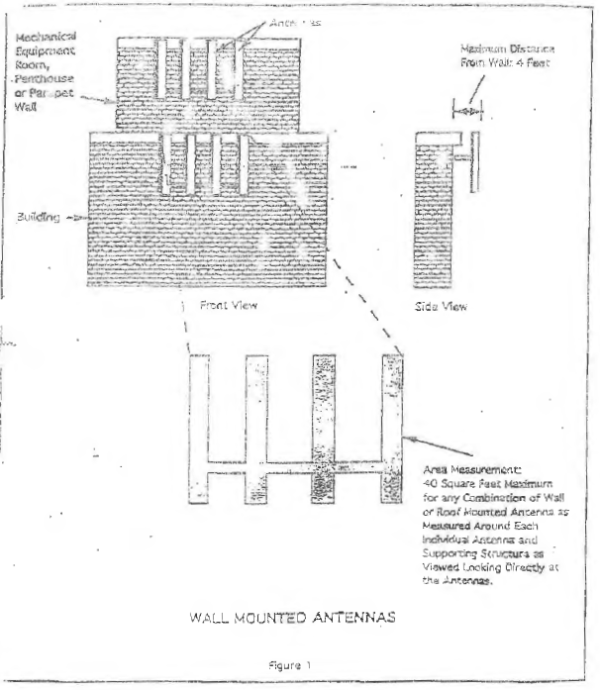
- A wall-mounted antenna mast shall not extend more than 25 feet above the roof line of the building or extend more than four (4) feet horizontally from the side of the building. It is understood that the antenna will be placed on the top of the mast. The length of the antenna placed on top of the mast is dependant upon the operating frequency of the transmitter.
- The antenna supporting structure and any accessory equipment shall be painted to harmonize with the building and the general landscape of the location. Stealth technology shall be used where it harmonizes with the building architecture.
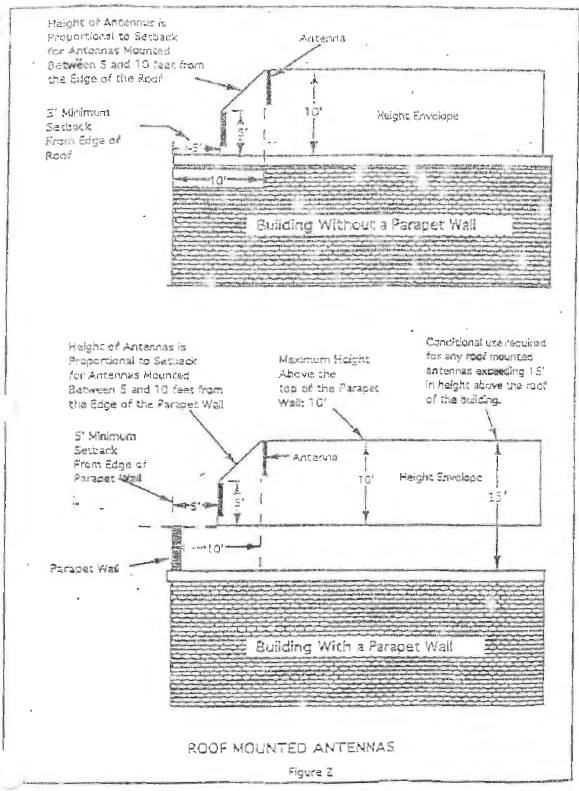
- Roof-Mounted Antenna. A roof-mounted antenna mast shall not extend more than 25 feet in height above the highest point of the roof. It is understood that the antenna will be placed on the top of the mast. The length of the antenna is dependant upon the frequency of the transmitter.
- Monopole And Supporting Antennae Structures
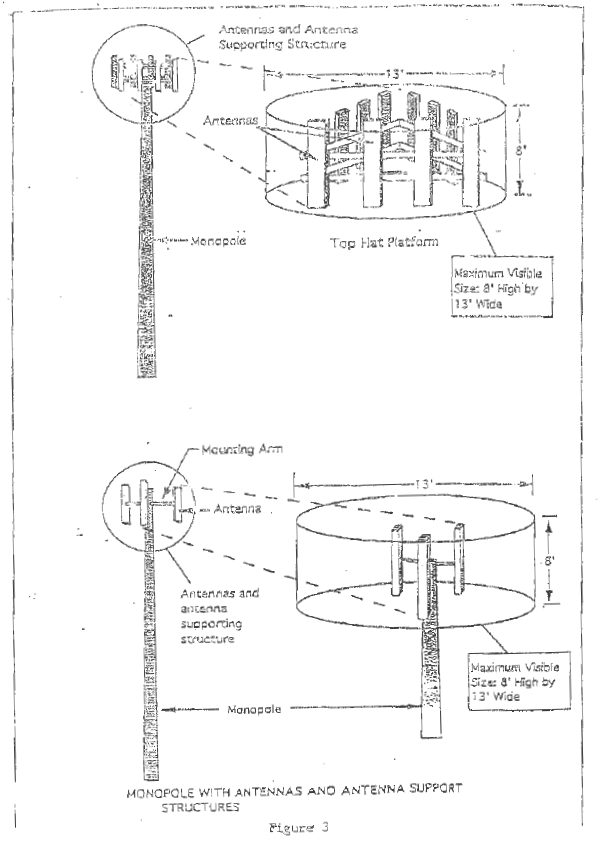
- The maximum height of the monopole shall not exceed 100 feet, unless it can be shown by signal propagation measurements that an acceptable signal-to-noise ratio cannot be achieved without increasing the tower height. In such cases heights above 100 feet but no more than 150 feet are allowable by conditional use permit. Verification by a disinterested third party can by required if the Planning Commission deems it prudent.
- The maximum dimensions of the antenna structure mounted on top of the monopole is dependant upon the frequency at which the communication equipment is operating.
- Lattice Tower. A lattice tower design is permitted west of Interstate I-15 and shall comply with the same requirements as those for a monopole tower.
- Guyed Tower. A tower that requires guy wires or cable stays, etc., is not permitted.
24.56.100 Landscaping
The telecommunication site shall be landscaped to match the general landscaping of the area in which the facility is located.
24.56.110 Site Access
The site shall be fenced, etc., to prevent entrance by unauthorized persons, especially children, and careful attention shall be taken to prevent unauthorized persons from climbing the tower.
24.56.120 Accessory Building(s)
Accessory buildings shall comply with the required setback and landscaping requirements of the zoning district in which they are located. Ground based antennae structures shall be appropriately fenced to prevent children, etc., from climbing the structure. All power lines, antenna feed lines, etc., on the lot between the accessory building(s) and the tower shall be underground and comply with the current edition of the regulatory electric code.
24.56.130 Antennae And Mounting Structures On Or Over Public Right-Of-Ways
Antennae or mounting structures are not permitted within or over public right-of-ways and public sidewalks.
24.56.140 Non-Maintained Or Abandoned Facilities
The Zoning Administrator can require each facility which is not properly maintained or is abandoned for a period of one calendar year to be removed from its premises. Removal of the non-maintained or abandoned equipment, etc., can occur no earlier than 30 days after the owner has been given notice of non-maintenance or abandonment. The cost of the removal shall be borne by the owner of the structure/equipment.
24.56.150 Engineering Review
The Planning Commission can at its discretion elect to conduct a engineering review of the proposed communication facility by a qualified radio/communications engineer or an electrical engineer with a communications background. The costs of the review shall be borne by the applicant.
24.56.160 Building Permits
Prior to construction of any facility, the applicant shall obtain a proper building, road cut, excavation, and other permits as required.
24.56.170 Exemptions
This ordinance shall not apply to the following types of communication devices, although they may be regulated by other city ordinances and policies:
- Amateur Radio. Any FCC licensed amateur radio-operator-owned communication facility and equipment, except compliance to WZC 24.56.050.
- Satellite. Any device designed for over-the-air reception of television broadcast signals, multi-channel/multi-point distribution service or direct satellite service for personal use.
- Television (TV). Any television tower or antenna owned and operated by a homeowner, landlord, tenant, or other individual or business for TV reception only.
24.56.180 Planning Commission Review
- Planning Commission review shall occur at a regularly scheduled meeting.
- At the time of the meeting the applicant shall provide as a minimum the following:
- Complete site plan and drawings, including existing building elevations, stamped by a Utah State licensed mechanical engineer.
- Landscaping and screening plans.
- Technical details of the communication facility which shall include such items as tower height, antenna type and length, operating frequency, estimated signal-to-noise ratio, power output, commercial electrical power required, tower lighting, hours of operation, etc.
- Upon approval of the application, the Planning Commission shall send the approved application to the City Council for study, acceptance, approval or denial for construction.

