
Winder City Zoning Code
ARTICLE II
DEFINITIONS
Sec. 2-1.- As used in this Appendix.
For the purpose of this Appendix, certain words or terms are defined as follows. All other words not defined below shall have their customary dictionary meanings.
All words used in the present tense include the future tense. All words in the plural number include the singular number, and all words in the singular number include the plural number, unless the natural construction of the wording indicates otherwise. The word building includes the word structure the words shall and must are intended to be mandatory; the word used or occupied as applied to any land or building shall be construed to include the words intended, arranged, or designed to be used or occupied.
Abandoned vehicle. Any motor vehicle which is either non-operable, dismantled, or does not bear a current state license plate, unless said vehicle is stored within a completely enclosed building or on a bona fide sales lot and is in satisfactory operating condition.
Accessory building or use. A use or building customarily incident and subordinate to that of the principal building on the same building lot.
Accessory dwelling. A dwelling unit within, or on the same lot as, a single-family dwelling. It is an independent dwelling unit that includes accommodations such as a guesthouse and in-law suite, but it may share an entrance, yard, and parking with the principal unit.
Alcohol Manufacturing (Brewery). Light malt beverage manufacturer licensed by the state as a brewery. All state and federal licensing and regulatory requirements shall be met prior to the approval of a certificate of occupancy. Such establishment may include restaurants as an accessory use.
Alcohol manufacturing (distilled spirits). Any maker, producer, or bottler engaging in distilling, rectifying, or blending any distilled spirits; provided, however, that a vintner that blends wine with distilled spirits to produce a fortified wine shall not be considered a manufacturer of distilled spirits. All state and federal licensing and regulatory requirements shall be met prior to the approval of a certificate of occupancy.
Alley. A privately owned access drive located in the rear of a single or multifamily residential unit that provides residents with vehicular access.
Assembly hall. A meeting place at which civic, educational, political, religious, or social groups assemble regularly or occasionally; including, but not limited to, schools, churches, theaters, auditoriums, funeral homes, stadiums, and similar places of assembly.
Assisted living facility. A multifamily structure whose occupants are 55 years of age or older, or where each unit is occupied by at least one person who is 55 years of age, and where occupants receive assistance with daily living activities.
Automobile wrecking yard or automobile used parts lot. See salvage yard/junkyard.
Automotive or other vehicle sales. Any business or dealer that engages in the sale or lease of new or used motor vehicles, motorcycles, boats or any motorized watercraft, recreational vehicles, or trailers.
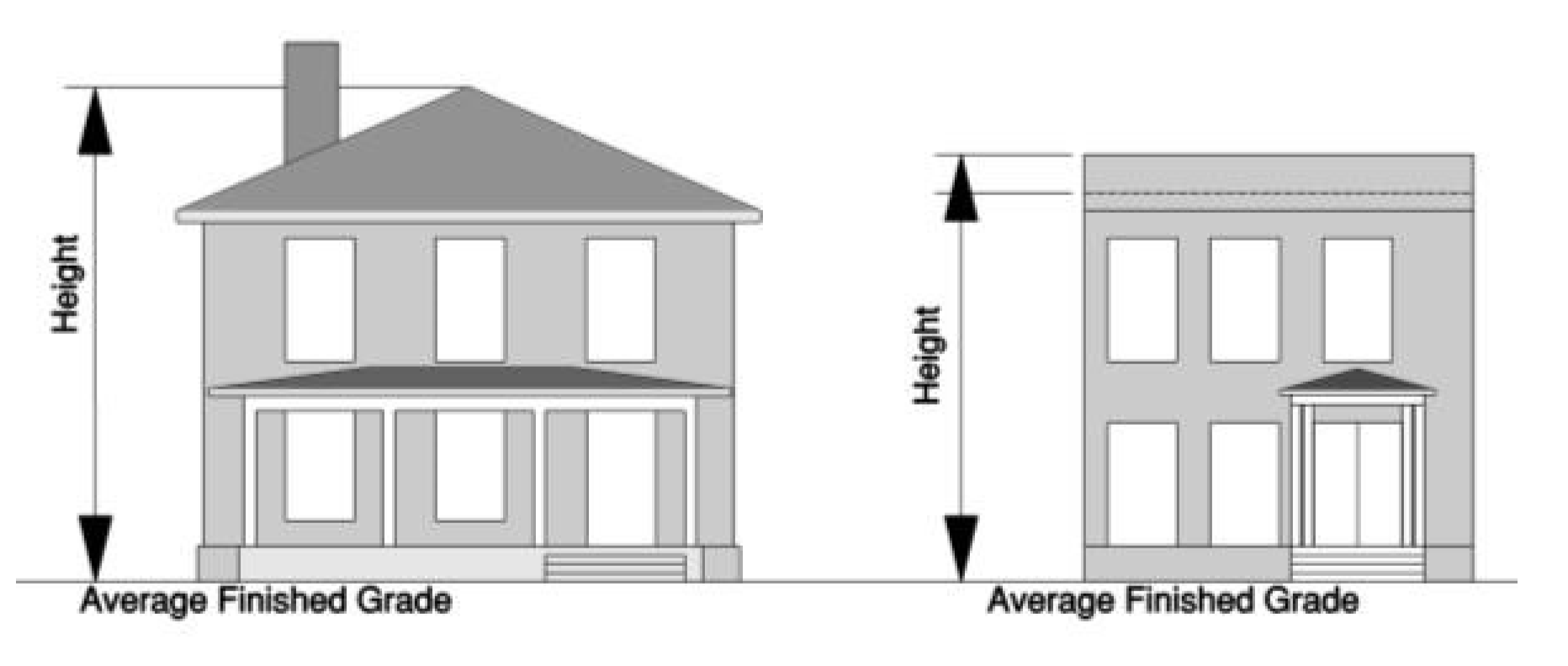
Average finished grade. The average final elevation and contour of the ground after cutting or filling and conforming to the proposed design.
For the purpose of determining building height, average finished grade shall be the average of the highest and lowest point of the building footprint on a given elevation.
Bank, savings & loan, or credit union. A financial institution as defined by O.C.G.A. § 7-1-4 and regulated by the Georgia Department of Banking and Finance or Federal law as national banks, savings and loans, or credit unions.
Bar, pub, or tavern. Any establishment selling alcoholic beverages for consumption on the premises not otherwise qualified as a restaurant or brew pub.
Basement. Any portion of a building in which the floor elevation is below the finished grade of the adjoining ground.
Bed and breakfast. An owner-occupied dwelling unit in which no more than four rooms are provided for sleeping accommodations for transient guests, for a daily fee and for no more than 14 consecutive days. Breakfast and refreshments are the only food typically served for guests staying at the bed and breakfast. A bed and breakfast is not a hotel or a boarding house.
Block. Land surrounded on all sides by streets or other transportation or utility rights-of-way, or by physical barriers such as bodies of water or public open spaces.
Boardinghouse. A building containing one or more lodging units but not more than 20 lodging units, all of which offer non-transient lodging accommodations, available only at weekly or longer rental rates to the general public. Meals may only be provided from a single central kitchen and compensation for such meals, if provided, shall be included in the weekly or longer rental rate. No restaurant, meeting, reception, or banquet facilities shall be provided.
Boundary Tree. A tree on a property adjacent to a permitting property whose critical root zone extends into the permitting property.
Brew pub. Any restaurant in which beer or malt beverages are manufactured or brewed, subject to the barrel production limitation prescribed in O.C.G.A. § 3-5-36, for retail consumption on the premises and solely in draft form.
Buffer. An area or portion of a lot set aside for open space or visual screening purposes, to separate different zoning districts, or to separate uses on one property from uses on another property of the same zoning district or a different zoning district.
Building. Any structure for the shelter, housing, or enclosure of persons, animals, or property of any kind.
Building height. The vertical distance measured from the average finished grade to the highest point of the roof or building.
Building coverage. The proportion of a lot or parcel of land that is covered by the footprint of buildings or structures on that land. It is expressed as a percentage and is used to control the amount of land that can be developed or built upon within a given area.
Catering establishment. An establishment with a commercial kitchen used for preparing food for transportation to off-site events.
CBD store. Any retail establishment that devotes at least ten percent of the floor area to sale or advertisement of cannabidiol infused products or makes at least ten percent of its revenue from cannabidiol infused products.
Chord length. The length of the front property line of a cul-de-sac lot that follows a straight line with end points on the circumference of the cul-de-sac right-of-way.
Church. See place of worship.
City. The City of Winder or its designee.
Clinic. An establishment where patients who are not lodged overnight are admitted for examination and treatment by one or more physicians or dentists.
Corner lot: A lot which abuts two (2) or more streets at their intersection, or upon a curved street, provided that the two (2) sides of the lot intersect to form an interior angle of not more than one hundred and thirty-five (135) degrees.
Club. Buildings and facilities owned or operated by a corporation, association, person or persons for a social, educational, or recreational purpose but not primarily for profit or to render a service which is customarily carried on as a business.
Combination-use district: A zoning district where more than one category of use is permitted. Also known as a mixed-use district.
Comprehensive Plan. Any part or element of the overall plan for development adopted by the City of Winder as provided by the General Planning and Zoning Enabling Act of 1957, No. 358 as amended.
Conditional use. A use within certain zoning districts of this Zoning Ordinance which is not permitted as a matter of right, but may be permitted within these districts by the City Council. A conditional use permit shall remain in force until three months after the use is discontinued.
Concentrated animal feeding operation. A facility where animals are kept and raised in confined situations and where feed is brought to the animals rather than the animals grazing or otherwise seeking feed in pastures or fields.
Consignment store. Any retail establishment primarily engaged in the sale of goods on consignment, not otherwise meeting the definition of pawn shop.
Copy, print, or mailing shop. A retail location offering photocopying, small batch printing, office supplies, mailing and packaging services, and similar goods and services to walk-in customers.
Cottage court. A group of five or more detached single-family dwelling units organized around a shared courtyard.
Council. The Mayor and City Council Members of the City of Winder, Georgia. The word Council is synonymous with City Council.
Craft manufacturing. The use of hand-operated tools for the manufacturing of products or parts, including their design, processing, fabrication, assembly, treatment, and packaging. Craft manufacturing may also include the incidental storage, sale, and distribution of said products or parts. Craft manufacturing specifically includes, but is not limited to, the manufacturing of electronic goods, food and bakery products, non-alcoholic beverages, printmaking, household appliances, leather products, jewelry and clothing, soap and cosmetics, metal work, furniture or cabinets, glass or ceramics, and paper. No equipment or process may be used that creates, without limitation, noise, dust, vibration, glare, fumes, odors, or electrical interference detectable to the normal senses, off the premises.
Critical Root Zone (CRZ). The minimum area beneath a tree, 70% of which must be left undisturbed to preserve a sufficient root mass to give a tree a reasonable chance of survival. The CRZ is typically shown as a concentric circle centering on the trunk of the tree that is measured at 1 radial foot for every inch DBH.
Cul-de-sac lot. Generally, refers to a dead-end street where there is room for a vehicle to turn at a circular end. Any lot fronting primarily on a cul-de-sac turnaround or any right-of-way having a curve radius of 60 feet or less.
Curb cut. A curb break, or a place or way provided for the purpose of gaining vehicular access between a street and abutting property. Curb cut is also known as a driveway.
Day care center. A firm, partnership, corporation, individual, or other business entity, licensed by the State of Georgia as a day care facility, providing care for more than six children not related by blood or marriage and under the age of 18 years for less than 24 hours per day without transfer of legal custody.
DBH (diameter at breast height). The circumference of a tree trunk measured at 4.5 feet above the ground- in inches and divided by 3.14.
Dead-end street: A street with no outlet at one end.
Distilled spirit. Any alcoholic beverage obtained by distillation or containing more than 24 percent alcohol by volume.
Distribution center or warehouse. A facility involved in the storage or movement of goods. Goods are generally delivered to other firms or the final consumer with little on-site sales activity to customers.
Drive-through facility. A facility at which the customer is served while sitting in a vehicle.
Dry cleaning establishment or laundromat. A retail location offering dry cleaning or laundering services to walk-in customers, or where washers and driers are provided for use by walk-in customers.
Dwelling, single-family detached. A residential building with a permanent foundation, other than a manufactured home, and designed for and used by one Family.
Dwelling, two-family. A building which contains two dwelling units.
Dwelling unit. One or more rooms located within a building and forming a single habitable unit with facilities which are used or intended to be used by one family for living, sleeping, cooking, and eating purposes.
Dwelling, multi-family. A building or portion thereof designed for three or more dwelling units, with the number of families in residence not exceeding the number of dwelling units provided, and not otherwise meeting the definition of townhouse or two-family dwelling.
Electric vehicle charging station. A public or private parking space that is served by electric vehicle supply equipment that has as its primary purpose the transfer of electric energy (by conductive or inductive means) to a battery in an electric vehicle.
Family. A person living alone, or any of the following groups living together as a single nonprofit housekeeping unit and sharing common living, sleeping, cooking and eating facilities:
1.
Any number of persons related by blood, marriage, adoption, guardianship, foster or other duly authorized custodial relationship; or
2.
A maximum of four unrelated persons; or
3.
Two unrelated persons and any parents or children related to either.
Feed manufacturing. An industrial facility for the processing and manufacturing of animal feed.
Fitness facility or gym. A commercial establishment that provides services or facilities that assist patrons in improving their physical condition or appearance.
Flag Lot: A flag lot is a land parcel characterized by a narrow, pole-like access strip that connects to a larger, typically rectangular, or square-shaped area of land. Flag lots are often configured in a way that places the main part of the lot behind other properties along a street. Flag lots are prohibited within the City.
Flood hazard area. The area possibly threatened by periodic flooding as determined by various data, including maps provided by the United States Department of Housing and Urban Development, United States Soil Conservation Service, Army Corps of Engineers, Federal Emergency Management Agency, or hydrological studies utilizing generally accepted engineering practices. Flood hazard areas shall include all lands underneath a permanent body of water, such as a lake, pond, river, and stream, and all land within the limits of a flood hazard area having a 100-year return frequency.
Floor area, gross. The total number of square feet of heated floor area in a building determined by horizontal measurements between the exterior faces of walls, excluding basement areas, unfinished attics, porches, carports, and garages.
Game room. Any business in which 'bona fide coin operated amusement machines' as defined by the State of Georgia, are available for the entertainment of the public, and where the proceeds from the operation of said amusement machines consists of 50% or more of the gross revenues of said business, or in which there exist more than eight such machines or more than two pool or billiard tables.
General retail. A facility involved in the sale, lease, or rental of new or used products to the general public.
Government building. Any building owned by the City of Winder, Barrow County, any County or City, the State of Georgia, or the United States government.
Greenhouse, nursery, or landscape service. An establishment with greenhouses or areas where plants are grown for sale or distribution, or where landscaping equipment is stored for use off site.
Green-space. Undeveloped land that has been designated, dedicated, reserved, or restricted in perpetuity from further development, which is not a part of an individual residential lot.
Hardwood tree. A deciduous tree, an angiosperm, that has broad leaves, produces a fruit or nut, and generally goes dormant in the winter months.
Home occupation. Any business, profession, occupation, trade, or activity conducted within a dwelling or its accessory building, which is clearly incidental to the residential use, which is conducted by a person or family residing on the premises, and which does not change the essential residential character of the building.
Hospital. A facility providing health services and medical or surgical care to persons suffering from illness, disease, injury, deformity, and other abnormal physical or mental conditions, licensed by the State of Georgia, including facilities such as laboratories, outpatient facilities, or training facilities that are an integral part of the facility.
Hotel. A facility containing five or more guest rooms with provisions for transient living, sanitation, and sleeping, that is specifically constructed, kept, used, maintained, advertised, and held out to the public to be a place where temporary lodging of 30 days or less is offered for pay to guests, and is not intended for long-term occupancy. Related ancillary uses may include but shall not be limited to conference and meeting rooms, restaurants, bars, and recreational facilities.
Indoor recreation. A commercial recreational land use conducted entirely within a building, including arcade, arena, art gallery and studio, art center, assembly hall, athletic and health clubs, auditorium, bowling alley, club or lounge, community center, conference center, exhibit hall, gymnasium, library, movie theater, museum, performance theater, pool, axe throwing, or billiard hall, skating rink, swimming pool, tennis court.
Infill development. A development surrounded by or in close proximity to areas that are substantially or fully developed.
In-Lieu Payment: A financial contribution made to the city by a property owner or developer in lieu of fulfilling a specific requirement, such as the installation of sidewalks, as mandated by this code. An in-lieu payment allows property owners or developers to satisfy code requirements by providing monetary compensation rather than directly undertaking the prescribed action, while ensuring that the intended public benefit or purpose of the requirement is still achieved within the community.
Impervious surface. Any road, driveway, parking area, building, swimming pool, concrete, pavement, rooftop landscape, or other impermeable material covering the natural land surface which impedes the free passage of water, air, or nutrients through the soil to the natural watershed, aquifer, or water zone below the surface. For an uncovered deck with drainage spaces between the deck boards and that is located over a pervious surface, 50 percent of the horizontal area of the deck is included in the measurement of impervious surface.
Impound lot. A facility used for the storage of non-consensual towing by the act of towing improperly parked or trespassing on private property, at the request of the property owner or their authorized agent, without prior consent or authorization of the owner or operator of the vehicle and in which a fee is required to release the vehicle.
Junkyard. See Salvage yard/junkyard.
Kennel, commercial. Any location which provides board and care for profit for domestic animals but not livestock.
Kennel, non-commercial. Any location upon which more than six domestic animals but not livestock are kept as pets, or otherwise not for profit.
Land Disturbance Permit (LDP): A regulatory authorization issued by the City, granting permission for activities that involve significant alteration or disruption of the natural state of the land. This permit is required for activities such as grading, excavation, filling, or any other land-disturbing activities that may impact soil stability, water runoff, or environmental conditions. The purpose of the permit is to ensure that such activities comply with applicable regulations, mitigate environmental impacts, and promote responsible land development practices.
LED strip lighting. Any lighting using LED technology to attract attention and typically applied as a row or ribbon of lights to buildings, windows, or glass doors as accent lighting.
Light manufacturing. A facility conducting light manufacturing operations within a fully enclosed building and not meeting the definition of craft manufacturing. Light manufacturing includes but is not limited the following:
1.
Clothing, textile, or apparel manufacturing;
2.
Food manufacturing;
3.
Facilities engaged in the assembly or manufacturing of scientific measuring instruments; semiconductor and related devices, including, but not limited to, clocks, integrated circuits, jewelry, medical, musical instruments, photographic or optical instruments or timing instruments;
4.
Pharmaceutical or medical supply manufacturing;
5.
Sheet metal, welding, machine shop, tool repair;
6.
Stone, clay, glass, or concrete products;
7.
Woodworking, cabinet makers, or furniture manufacturing.
Live/work. Non-residential activity conducted wholly within a dwelling unit that allows employees, customers, clients, or patrons to visit.
Lot of record. A lot which is part of a subdivision, a plat of which has been recorded by the Barrow County Clerk of Superior Court; or a parcel of land, the deed of which has been recorded by the same office as of the effective date of this ordinance.
Lot coverage. That portion of a lot that is covered by buildings, structures, driveways or parking areas, and any other impervious surface. For purposes of calculating lot coverage, wooden decks, stone walkways and patios set without grout, or pervious, permeable, or porous pavements shall be considered pervious.
Lot, corner. A lot which abuts the intersection of two public streets or is bounded on two or more adjacent sides by public street lines.
Lot line. A boundary of a lot. Lot line is synonymous with property line.
Lot frontage. The linear distance along which a lot abuts a public right-of-way or prescriptive easement for public access.
Lot width. The distance between the side lot lines as measured at the front setback.
Lot, through. A lot, other than a corner lot, having frontage on more than one public street, or a corner lot having frontage on three or more public streets.
Manufactured home. A structure, transportable in one or more sections, which, in the traveling mode, is eight body feet or more in width or 40 body feet or more in length or, when erected on site, is 320 or more square feet and which is built on a permanent chassis and designed to be used as a dwelling with or without a permanent foundation when connected to the required utilities and includes the plumbing, heating, air-conditioning, and electrical systems contained therein; except that such term shall include any structure which meets all the requirements of this paragraph except the size requirements and with respect to which the manufacturer voluntarily files a certification required by the secretary of housing and urban development and complies with the standards established under the National Manufactured Housing Construction and Safety Standards Act of 1974, 42 U.S.C. Section 5401, et seq.
Media production facility. A facility in which video or audio content is created and/or recorded, whether for live broadcasting or for recording, and including television and radio stations, recording studios, and film studios.
Net useable acres. The total acreage of any parcel or combined parcels of land to be developed as a single development, less the sum of the total number of acres contained in the 100-year flood hazard area, wetlands, the total number of acres contained in rights-of-way for roads, and the total number of acres contained in detention or retention ponds to be constructed.
Nonconforming structure. Any structure lawfully constructed at the time of the effective date of this ordinance, or at the time of the effective date of an amendment to this zoning ordinance, which does not conform with the regulations of this zoning ordinance, including the district in which it is situated.
Nonconforming use. Any building or lot lawfully occupied by a use at the time of the effective date of this ordinance, or at the time of the effective date of an amendment to this zoning ordinance, which does not conform with this zoning ordinance, including the use regulations of the district in which it is situated.
Nonconforming lot. A lot of record that does not conform to the lot requirements of the applicable zoning district, but which was a conforming lot of record prior to the effective date of this ordinance or an amendment to this ordinance.
Open Space. A common area designated on the final plans of the development, permanently set aside for the common use of the residents of the development and, if so designated, for the use of the community as a whole.
Outdoor display. An outdoor arrangement of items or products for sale, typically not in a fixed location capable of rearrangement, designed for short-term advertising or identifying a business, product or service.
Outdoor recreation facility. A commercial facility providing regularly scheduled recreation activities that primarily take place outdoors or within outdoor structures. Includes the following: extreme sports facility (such as BMX, skateboarding, or roller blading), outdoor amusements (such as batting cage, golf driving range, miniature golf, or water park), outdoor sports field or court, and shooting range.
Outdoor storage. The keeping, in an unenclosed area, of any goods, inventory, material, or merchandise associated with a land use. Storage does not include the parking of any vehicles or outdoor display of merchandise. The term "outdoor storage" includes outdoor work areas. See Vehicle storage yard.
Pain clinic. A clinic where more than 50% of the patients receive Schedule II or III controlled substances to treat chronic pain.
Panhandle Lot: A panhandle lot is a type of land parcel characterized by a narrow, elongated access strip (the "panhandle") that connects the main portion of the lot to a public road or street. The access strip is usually narrower than the main part of the lot, creating a configuration similar to the handle of a pan. Panhandle lots are designed to provide access to a larger, often rectangular, or square-shaped area of land situated behind other properties along a road. Panhandle Lots are prohibited within the City.
Parking space, off-street. An enclosed or unenclosed space, other than a driveway or loading area, used exclusively for the temporary storage of a vehicle and directly connected with a street or alley by a driveway.
Pawn shop. A business involved in any part of the pledge, pawn, or exchange of any goods, wares, merchandise, or any kind of personal property or title as security for the repayment of money lent.
Personal care home. A building in which housing, meals, personal assistance services, and 24-hour continuous watchful oversight for adults are provided and which facility is licensed or permitted as a personal care home by the state. The term "personal care home" shall not include the term "daycare center," "rehabilitation housing facility," or "boardinghouse." The term "personal care home" includes the term "community living arrangement," which is an establishment licensed by the state and providing a residence for adults receiving care for mental health, development disabilities, and/or addictive disease.
Personal care home, community. A personal care home that offers care to seven or more persons
Personal care home, group. A personal care home that offers care to between four and six persons
Personal service. A facility providing personal or repair services to the general public, including animal care; barber shop; beauty or hair salon; day care center; dry cleaning establishment or laundromat; copy, print, or mailing shop; food catering; fortune telling; funeral home or crematory; massage therapist; nail salon; photography studio; repair of personal goods; tailor or upholsterer; and tattoo artist and/or body piercing establishment.
Place of worship. A facility that is primarily intended for conducting organized religious services. Associated accessory uses include, but are not limited to, schools, meeting halls, indoor and outdoor recreational facilities, rectories, day care centers, nursing homes, counseling centers, and commercial kitchens.
Public plaza. A privately owned open area adjacent to a building and accessible to the public. It must generally be at the level of the sidewalk it adjoins and be unobstructed to the sky except for seating and other permitted amenities.
Public tree. Any tree located in the public right-of-way or City-owned property.
Porch. A raised and not fully enclosed structure that is attached to and forms a covered entrance to and/or exit from a building.
Principal building. A building or structure in which is conducted the principal use of the lot on which the principal building is situated.
Produce stand. A roadside stand for the sale of agricultural products that does not exceed 500 square feet in floor area.
Recompense. The dollar value to the City of a tree on private or public property used for the purpose of calculating cash recompense for removal or destruction.
Recreational vehicle (RV). A motorized vehicle, designed and/or maintained for use as a temporary dwelling or sleeping place exclusively for travel or recreation purposes, having no foundation other than wheels or jacks.
Recreational vehicle (RV) park. A parcel of land of at least five acres which is used solely for the rental or lease of lots or areas for recreational vehicles.
Rehabilitation housing facility. An establishment primarily engaged in inpatient care of a specialized nature with staff to provide diagnosis and/or treatment.
Renewable energy facility. A facility used for generating electricity with solar panels, wind turbines, geothermal sources, and similar devices.
Repair of personal goods. An establishment where small personal goods are repaired on site. Personal goods include jewelry, clocks, small appliances, bicycles, computers, cellular telephones, electronics, canvas products, office equipment, musical instruments, radios, shoes, watches, televisions, or similar items.
Research and development. A facility focused primarily on the research and development of new products. Research and development includes laboratories, offices, and other facilities used for research and development; prototype production facilities that manufacture a limited amount of a product in order to fully investigate its merits; and pilot plants used to test manufacturing processes planned for use in production elsewhere.
Restaurant. A business which regularly prepares and serves food and drink for on- or off-premise consumption and which derives at least 50% of its monthly gross income from the sale of prepared food. A restaurant is not a catering establishment.
Retail package liquor store. A retail business establishment owned by an individual, partnership, corporation, association, or other business entity:
1.
Primarily engaged in the retail sale of distilled spirits, malt beverages, and wine in unbroken packages, not for consumption on the premises, except as authorized under this chapter; and
2.
Which derives from such retail sale of alcoholic beverages in unbroken packages at least 75 percent of its total annual gross sales from the sale of a combination of distilled spirits, malt beverages, and wine.
Riding stable. A facility used primarily for the care, breeding, boarding, rental, riding, or training of horses or for the teaching of equestrian skills.
Salvage yard/junkyard. Any land or building used for dismantling, cutting up, compressing or other processing or storage of waste items or materials, such as scrap, paper, metal, tires, used plumbing fixtures, used brick, wood, or other building/structural materials, large household appliances, such as washing machines or refrigerators, automobiles or other vehicles, or inoperable machinery. These uses shall be considered salvage yards/junkyards regardless of whether these operations are conducted inside a building, or in conjunction with or accessory to other uses on the premises.
School bus. Means a passenger motor vehicle designed to carry a driver and more than 10 passengers, that the State of Georgia Department of Education has determined to be used to transport preprimary, primary, and secondary school students to or from school or an event related to school.
School, private (K—12). An educational facility having a curriculum at least equal to a public school, but not operated by the Barrow County School System.
Seasonal activity or temporary event. An event open to the general public, including fairs, carnivals, temporary livestock exhibits, temporary sales events, flea markets, parades, marches, rallies, assemblies, concerts, temporary camping, and festivals.
Self-service storage facility. A facility providing independent bays and/or self-contained units which are leased to or owned by individuals exclusively for storage of personal property.
Setback. A line, established by yard requirements, between which and any property line no building, structure, or part thereof may be erected.
Short-term rental. An accommodation for transient guests where, in exchange for compensation, an entire residential dwelling unit is provided for lodging for a period of time not to exceed thirty days in one year. For the purposes of this definition, a residential dwelling shall include all housing types and shall exclude group living, bed and breakfasts, and hotels.
Sign. See definitions contained in Article X of this Appendix.
Softwood tree. Needle-bearing trees or conifers, a gymnosperm, with "naked" seeds not contained by a fruit or nut.
Specimen tree. Any hardwood tree that is 24" DBH or larger, any softwood tree that is 30" DBH and larger, and any understory tree that is 4" DBH and larger.
Stoop. A small, raised, covered platform that serves as an entrance to a building.
Storefront. A separately enclosed space, floor area, tenant space or unit that has a storefront window or storefront entrance that fronts on a Public Street. Storefront Property includes a storefront window and/or storefront entrance that is not more than eight feet (8') above or below the grade of the adjacent public street and where such entrance is not a service or emergency entrance to the building. For purposes of this provision, the term "fronts on a public street" shall mean a separately enclosed space, floor area, tenant space or unit.
Structure. Anything constructed or erected on the ground or attached to the ground. The term includes tents, bleachers, gasoline pumps, walls, fences, signs, antennas site-built buildings, industrialized buildings, or manufactured homes.
Street: The term "street" or "streets" means, relates to, and includes streets and avenues, boulevards, roads, highways, expressways, lanes, alleys, and other ways.
Subdivider: An individual, firm, association, syndicate, partnership, corporation, trust, or any other legal entity (or agent thereof), that undertakes the activities covered by these regulations. Inasmuch as the subdivision plat is merely a necessary means to the end of assuring a satisfactory development, the term "subdivider" is intended to include the terms "developer" and "builder" even though the persons involved in successive stages of the project may vary.
Subdivision. A subdivision shall be construed to be a division of a tract or parcel of land into two (2) or more lots, building sites or divisions for the purpose, whether immediate or future, of conveyance, transfer, improvement, sale, legacy or building development, and includes all division of land involving a new street or a change in existing streets, and includes resubdivision, and where appropriate to the context relates to the process of subdividing or to the land or areas subdivided; provided however, that the following are not included within this definition:
1.
The combination or recombination of portions of previously platted lots where the total number of lots is not increased and the resultant lots are equal to the standards set forth in this chapter.
2.
The division of land into parcels of five (5) acres or more where no new street is involved.
Temporary outdoor display. See 'outdoor display.'
Temporary storage container. A portable, weather resistant container capacity that is designed and used for the temporary storage or shipment of household furniture, clothing, and other household goods, excluding refuse, and is transported by truck or trailer to desired locations for drop off and retrieval.
Townhouse. Three or more dwelling units where each unit is separated vertically by a common side fire wall. Units cannot be vertically mixed.
Travel trailer. Any vehicle or similar portable structure mounted on wheels, designed and intended primarily for short-term occupancy, for dwelling or sleeping or other purposes and not exceeding 30 feet in length.
Tree Density Factor. All applicable sites must maintain a minimum tree density of 100 inches DBH per acre. Tree removal. Any act which causes a tree to die within 2 years after commission of the act, including but not limited to, damage inflicted upon the root system in the Critical Root Zone or trunk, as the result of:
1.
The improper use of machinery on trees;
2.
The storage of materials in or around the trees;
3.
Soil compaction;
4.
Altering the natural grade to expose the roots or to cover the tree's root system with more than 4" of soil or mulch;
5.
Causing the infection or infestation of the tree by pests, fungus, or harmful bacteria;
6.
Pruning judged to be excessive by the City Arborist or not in accordance with the standard set forth by the International Society of Arboriculture (ISA);
7.
Paving with concrete, asphalt, or other impervious surfaces within such proximity as to be harmful to the tree or its root system; and
8.
Application of herbicides or defoliants to any tree without first obtaining a permit.
Understory tree. A tree that, when mature, reaches a height of 10—35 feet.
Undisturbed buffer: No land-disturbing activities shall be conducted within the buffer and the buffer shall remain on its natural, undisturbed state of vegetation until all land-disturbing activities on the construction site are completed. Once the final stabilization of the site is achieved, the buffer may be thinned or trimmed of noxious week, noxious plants and like vegetation, as long as protective vegetative cover remains. No trees, other than dead or diseased trees shall be removed from the buffer, but additional trees and plant material may be added to the zone. Dead limbs and branches, trash, litter and like debris may be removed from the buffer at any time. The buffer zone shall be maintained in a natural state and shall not be paved or graded. No building shall be erected or placed in a buffer zone and a buffer zone shall not be used for parking, storage, loading, animal pens or any other use. Unless otherwise specified by the Winder City Council, all undisturbed buffers shall have a minimum width of twenty-five (25) feet.
Use. The purpose or purposes for which land or a building is designed, arranged, intended, or for which said land or building is occupied, maintained, or leased.
Utility facility, major. Public or private infrastructure, including, but not limited to, water, sewer, gas, electric, telephone, Internet, cable and other similar services serving the general community and possibly having on-site personnel. Major utilities includes, but is not limited to, the following: electrical substation, electric or gas generation plant, and water or sanitary sewer treatment plant.
Utility facility, minor. Public or private infrastructure, including, but not limited to, water, sewer, gas, electric, telephone, Internet, cable and other similar services serving a limited area with no on-site personnel and less than 6 feet in height. Minor utilities includes, but is not limited to, the following: on-site stormwater retention or detention facility; neighborhood-serving cable, telephone, gas or electric facility; and water or wastewater pump or lift station.
Vape shop: A vape shop is defined as a retail business substantially engaged in selling vape products, which may include electronic smoking devices, their components, or e-liquid. The term "substantially engaged" is clarified by meeting one or more of the following conditions:
1)
Ten percent or more of the retail stock in trade consists of the subject products, as measured by the number of individual items available for purchase at any given time;
2)
Ten percent or more of the value of gross sales receipts for any day that the entity is open is derived from the sale of subject products;
3)
The subject products make up ten percent or more of the retail value of the retail stock in trade; or
4)
Ten percent of more of the establishment's floor area is devoted to the marketing of the subject products.
Variance. A minimal variation of the terms of this Zoning Ordinance which permits construction in a manner otherwise prohibited by this Zoning Ordinance.
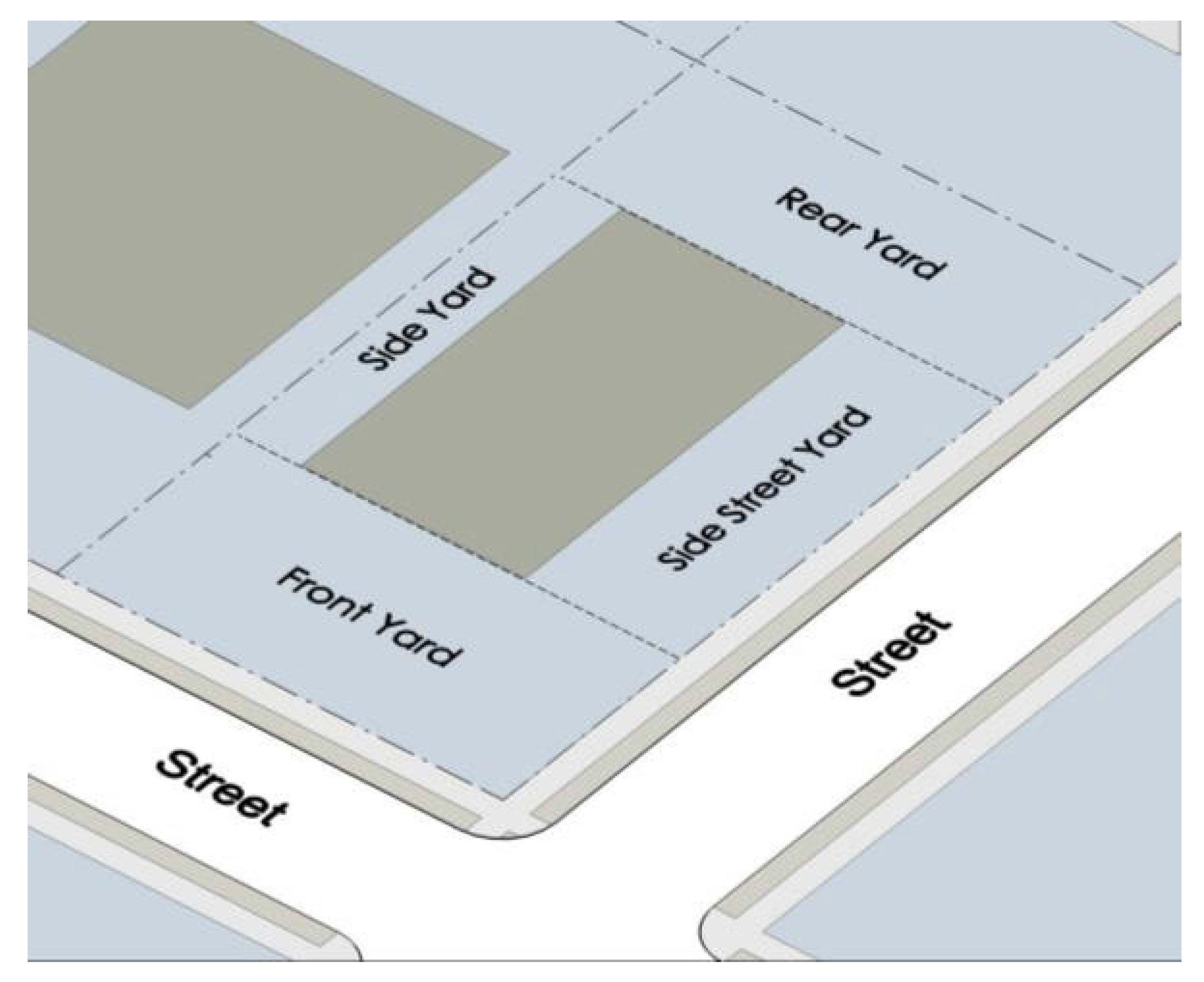
Yard. An open space on a lot situated between the principal building or use on the lot and a lot line, and unoccupied by any structure except as otherwise provided herein.
Yard, front. An open, unoccupied space on the same lot with a principal building or use, extending the full width of the lot and located between the street line and the front line of the building projected parallel to the street to the side lines of the lot. Corner lots shall be considered to have two front yards.
Yard, rear. An open space on the same lot with a principal building or use, unoccupied except by an accessory building or use, extending the full width of the lot and located between the rear line of the lot and the rear line of the building or use projected to the side lines of the lot.
Yard, side. An open, unoccupied space on the same lot with a principal building or use, located between the building or use and the side line of the lot and extending from the rear line of the front yard to the front line of the rear yard.
Yard, side street. For corner or through lots, the yard the area on a corner or through lot that lies between the side right-of-way line and any buildings or structures on that lot. It starts from the front yard, which is the space required to be open at the front of the property, and extends all the way to the rear yard, which is the area at the back of the property.
Zoning Administrator. The Director of Planning and Development Services or their designee.
Zoning district. Area of zoned property within the City of Winder, Georgia, and shown on the Official Zoning Map which is part of this Zoning Ordinance.
Zoning ordinance. The zoning and land use regulations contained in this Zoning Ordinance and adopted for use within the City of Winder that constitute a Zoning Ordinance within the meaning of O.C.G.A. § 36-66-1 et seq.

