
Winder City Zoning Code
ARTICLE III
GENERAL PROVISIONS
Sec. 3-1.- Design standards.
A.
The purpose and intent of these standards is to:
1.
Promote high quality, long-lasting development and building materials.
2.
Enhance visual appeal and livability.
3.
Foster architectural diversity and interest, yet achieve a consistent, durable, and pleasing aesthetic.
4.
Ensure that large commercial/retail buildings incorporate designs that reduce their visual mass and create the impression of smaller buildings.
B.
These standards shall apply to properties within any historic district, however, standards in Chapter 19 shall supersede those found in this chapter.
C.
Application requirements. The application process outlined in this document encompasses both architectural permits and building permits, along with the submission of site plans.
1.
Applicants are required to submit drawings that clearly indicate compliance with all the requirements specified in this article. These drawings should be to scale and provide a comprehensive representation of the proposed project, ensuring that all relevant regulations are met. While sealed plans are not mandatory, they should meet the necessary standards and codes.
2.
Grouping of Buildings: To streamline the application process and foster originality and design flexibility, groups of buildings located on the same site may be reviewed as a single application. The criteria for grouping buildings together will be specified in the application guidelines, and this practice is encouraged to minimize the number of reviews required.
3.
Confirmation of Compliance: Prior to the issuance of a certificate of occupancy, the Zoning Administrator or their designee will play a crucial role in confirming that all aspects of the design have been completed in conformance with the requirements of this section. The exact process for this confirmation will be detailed in the application procedures, ensuring transparency and accountability.
D.
Setbacks Required.
1.
Setbacks are required in all zoning districts as outlined in this chapter.
2.
If a building is constructed on a through lot, the front yard setback shall apply to each frontage.
3.
If a building or structure is constructed without meeting the specified setback requirements in any zoning district as outlined in this chapter, the following actions shall be taken:
i.
Compliance Period: The property owner or developer shall be notified of the setback non-compliance by the relevant authorities. They shall be granted a specified period, as determined by the City, to rectify the setback violation and bring the building into compliance with the setback regulations.
ii.
Remedial Action: During the compliance period, the property owner or developer must take appropriate remedial action to correct the setback violation. This may include adjusting the building's location, obtaining necessary variances or approvals, or any other measures required to meet the setback requirements.
iii.
Non-Compliance Penalties: If the property owner or developer fails to rectify the setback violation within the specified compliance period, penalties, fines, or legal actions may be imposed as per local regulations. The building may be subject to stop work orders, fines, or other enforcement actions.
iv.
Occupancy Restrictions: In cases where the setback violation remains unresolved, occupancy of the non-compliant building may be restricted or prohibited until compliance with setback requirements is achieved.
Sec. 3-2. - Residential design standards.
A.
All residential buildings (including all detached single-family dwellings, cottage courts, duplexes, townhouses, and multifamily buildings) in any zoning district shall be subject to the standards of this section, unless alternate standards are approved by City Council. Accessory buildings shall be subject to only the exterior wall requirements of this section, except in agricultural districts, where accessory buildings shall be exempt from all requirements of this section.
B.
Exterior walls. The following standards apply to all exterior walls.
1.
Exterior wall finish materials (excluding windows, doors, trim, soffits, porches, balconies, foundations, or architectural details) are limited to the following:
i.
Brick, including full-depth and half-depth masonry brick, but not simulated brick veneers;
ii.
Stone, including unpainted natural stone, unpainted cast stone having the appearance of natural stone, and unpainted terra cotta;
iii.
Stucco, including true cement stucco but not EIFS;
iv.
Wood, including natural wood, engineered wood, or cementitious siding; and
v.
Shingles, including wood or cementitious shakes and shingles.
2.
Where more than one exterior finish material is used, visually lighter materials must be used above visually heavier materials.
3.
Between two and four different exterior finish materials, textures, colors, or combinations thereof must be used on a single building, excluding materials used on windows, doors, porches, balconies, foundations, or architectural details.
4.
Foundation when visible must be constructed as a distinct building element that is finished in a different material or color. Above-ground foundations must be coated or faced in brick or stone.
5.
Single Family detached units, townhouse units and condominium units shall not have identical units adjacent to each other. Differentiation between adjacent façades may be accomplished by a change in materials, building height, color, roof form or architectural styles.
6.
Single family detached units, townhouse units and condominium units shall have a minimum of twenty-four (24) inches of brick or stone on all sides, measured from where the final grade of the lot meets the outside of the building.
i.
Slab Foundations: For buildings with slab foundations, the measurement of the minimum required brick or stone on all sides shall commence from the point where the final grade of the lot intersects the exterior walls of the building. This measurement shall be taken vertically from said point, without regard to any variations in slope or elevation across the lot.
ii.
Sloped Foundations: In the case of buildings featuring a sloped foundation or located on lots with uneven terrain, the measurement of the required minimum brick or stone shall be adapted to accommodate the topography. Should the final grade of the lot exhibit variations due to slope, the minimum required brick or stone shall be adjusted to ensure a consistent measurement from the point at which the final grade meets the exterior of the building. In such circumstances, this measurement shall follow the contour of the slope to maintain the intended architectural and aesthetic consistency.
C.
Windows and doors. The following standards apply to all street-facing exterior walls.
1.
The total area of all windows on an individual story must not be less than 10%, nor greater than 50%, of the total exterior wall area for that story. Total exterior wall area shall include the area of garages and other doors.
2.
Doors and windows that operate as horizontal sliders are prohibited as building front walls.
3.
Individual windows must be vertically shaped, with a height greater than width.
4.
Windows must have true or simulated divided lites, or be one-over-one lites.
5.
Transom windows are permitted, but do not need to be vertically shaped, have divided lites, or include a sill.
6.
Window panes must be recessed a minimum of 1 inch from the face of the exterior wall where no trim is provided, or a minimum of 1.5 inches from the face of the trim where trim is provided.
D.
Porches and stoops.
1.
Any porch shall have minimum dimensions of four feet by eight feet for porches, and any stoop shall have minimum dimensions of four feet by four feet.
E.
Roofs and chimneys.
1.
Pitched roofs, if provided, must be symmetrically sloped at no less than 5:12, except that roofs for front porches and attached sheds may be sloped at no less than 2:12.
2.
Flat roofs shall be enclosed by parapets a minimum of 42 inches high, or as required to conceal mechanical equipment.
3.
All exposed roofing materials must have a minimum 25 year manufacturer's warranty and no visible roll roofing.
4.
Eaves and overhangs. Eaves and gables on pitched roofs must extend a minimum of 12 inches beyond the façade.
5.
Chimneys, where provided must extend to the ground and must be faced in brick, stone, cast stone or hard coat stucco or cementitious siding.
F.
Garages and carports. The following standards shall apply to all residential types except for multifamily residential.
1.
For lots with alley access, the garage or carport shall be placed to the rear of the dwelling unit or incorporated into the dwelling unit with the garage door or vehicular opening facing the alley.
2.
Garage doors that face a public or private street may not be more than 50% of the overall width of the front façade.
3.
Garage doors that face a street must be separated by at least 12 inches of material identical to the adjacent exterior wall material.
4.
Each detached and attached single family residential unit shall have a garage, enclosed on at least 4 sides, of at least 500 square feet of interior clear space as measured outside wall to outside wall. The garage must meet the following standards:
i.
All garages on single-family detached and attached residences shall be able to accommodate two standard vehicles.
ii.
A garage, whether detached or attached, shall not be enclosed to be used as living space unless other accommodations are approved for an enclosure that meets these garage requirements.
iii.
Clear space shall not include utility and storage offsets.
G.
Driveway standards.
1.
Slope. The maximum slope for all driveways shall be 10%. (Site grading requirements are provided in Section 3-6.)
2.
Minimum length for driveways. Driveways shall be at least 25 feet between the garage door and sidewalk, where sidewalk is required or exists. If sidewalks are not required or does not exist, driveways shall be at least 25 feet between the garage door and the back of curb.
3.
Shared driveways in residential developments shall not be permitted.
4.
Driveways shall not count towards overall parking requirements within a development.
H.
Additional standards for multifamily residential developments, excluding townhouse developments.
1.
All dwelling units above the first floor shall have balconies with minimum dimensions of four feet by eight feet.
2.
Interior floor to ceiling height for all floors shall be a minimum of 9 feet.
J.
No more than 6 townhouse units may be connected in a single structure.
K.
Solar Panels.
1.
Solar panels are permitted and shall be placed on the rear of the building or back side of roof when feasible.
2.
Permit Required. A permit is required for all solar panels. Applications for solar panels on historic properties, as defined in Chapter 19, require approval from the historic preservation commission.
Sec. 3-3. - Non-residential design standards.
A.
All non-residential buildings shall be subject to the following standards.
B.
Exterior walls. The following standards apply to all exterior walls.
1.
Within the I Industrial district, exterior wall finish materials (excluding windows, doors, awnings, foundations, or architectural details) shall be limited to the following:
i.
Brick, including full-depth and half-depth masonry brick, but not simulated brick veneers;
ii.
Stone, including unpainted natural stone, unpainted cast stone having the appearance of natural stone, and unpainted terra cotta;
iii.
Stucco, including true cement stucco and EIFS; Impact resistant EIFS shall be used from ground level to a height of 4 feet;
iv.
Painted concrete block
v.
Wood, including natural wood or cementitious siding;
vi.
Shingles, including wood or cementitious shakes and shingles;
vii.
Tilt/architectural pre-cast concrete;
viii.
Glass; and
ix.
Decorative architectural metal, a siding with imbedded color or finish.
2.
Within all other non-residential districts, exterior wall finish materials (excluding windows, doors, awnings, foundations, or architectural details) are limited to the following:
i.
Brick, including full-depth and half-depth masonry brick, but not simulated brick veneers;
ii.
Stone, including unpainted natural stone, unpainted cast stone having the appearance of natural stone, and unpainted terra cotta;
iii.
Stucco, including true cement stucco and EIFS; Impact resistant EIFS shall be used from ground level to a height of 4 feet;
iv.
Wood, including natural wood or cementitious siding;
v.
Shingles, including wood or cementitious shakes and shingles;
vi.
Glass; and
vii.
Decorative architectural metal, a siding with imbedded color or finish.
3.
Notwithstanding subsection B.2 above, painted concrete block shall be allowed only on the rear of the building in all non-residential districts on exterior walls that are not visible from a public or private right-of-way.
4.
Where more than one exterior finish material is used, visually lighter materials must be used above visually heavier materials.
5.
Building floors shall be delineated and shall be executed through windows, belt courses, cornice lines, or similar architectural detailing, so as to distinguish each floor.
C.
Building massing. In any non-residential district except the I Industrial district, facades over 50 feet in length must incorporate wall projections or recesses a minimum of 12 inches in depth. The combined length of said recesses and projections must constitute at least 20% of the total façade length.
D.
Storefront standards.
1.
A vibrant commercial storefront is a Storefront Property, as defined in Section 2-1 in a non-residential based zoning Districts, which meets the following conditions:
i.
Is found to be engaging in business for at least sixty (60) days during each quarter; and
ii.
Has an active Occupational Tax Certificate.
2.
Ground floor storefronts along a public street, or as required along an open space, must:
i.
Provide fenestration for at least 65 percent of the exterior facade area, with each facade calculated separately.
ii.
Provide no more than 20 linear feet without fenestration.
iii.
Allow views into the building interior for a depth of at least five feet.
iv.
The transparency of these windows shall not be obstructed, obscured, or diminished by any means, including but not limited to curtains, blinds, signs, banners, decals, or tinting, which reduce the clear view of the interior from the exterior.
3.
In the DT and, storefronts must also include:
i.
A non-glass bulkhead of 12 to 24 inches in height directly above the finished floor;
ii.
A glass display window directly above the bulkhead and extending to at least ten feet above the finished floor;
iii.
An awning or canopy installed directly above the storefront window that is at least as wide as the display window.
Sec. 3-4. - Required open space amenities for residential developments.
A.
All single-family and multifamily residential developments with more than 15 units shall provide open space amenities as specified in this section.
1.
For residential developments in a TNPD, or PUD district, these requirements shall apply to the portion of the development that is residential.
2.
Residential developments in the DT Downtown district shall be exempt from these requirements.
B.
Cottage court developments shall be exempt from these requirements but shall provide a landscaped courtyard of at least 40 feet in width and 3,000 square feet in total area for every 10 units or fraction thereof. No more than 10 dwelling units may face any courtyard. Portions of the courtyard located in a setback or buffer shall not count toward this requirement. The courtyard shall not be parked or driven on, except for emergency access and permitted temporary events.
C.
All open spaces must be designed to be accessible to all residents of the development. The Zoning Administrator may allow other amenities to count toward these requirements where they are of equal or greater value to those listed below.
D.
Open space amenities shall make up at least 20% of the development area.
E.
10% of the open space shall be green space which must remain in its natural state or remain undeveloped.
F.
Prior to the issuance of a certificate of occupancy for 50 percent of the units in a development, each development shall provide open space amenities as specified below.
1.
Required amenities for single-family developments.
i.
1—14 units: no amenities required.
ii.
15—100 units: one Type 1 amenity or two Type 2 amenities.
iii.
101—150 units: the requirement in 1(ii) above, plus one additional Type 1 amenity or one additional Type 2 amenity.
iv.
151+ units: the requirement in 1(ii) above, plus one additional Type 1 amenity or two additional Type 2 amenities.
2.
Required amenities for townhouse and multifamily developments.
i.
1—14 units: one Type 1 amenity or one Type 2 amenity.
ii.
15—100 units: one Type 1 amenity or two Type 2 amenities.
iii.
101—150 units: the requirement in 1(ii) above, plus one additional Type 1 amenity or one additional Type 2 amenity.
iv.
151+ units: the requirement in 1(ii) above, plus one additional Type 1 amenity or two additional Type 2 amenities.
G.
Type 1 amenities.
H.
Type 2 amenities.
I.
Covenants or other legal arrangements must specify ownership of all open space amenities, the method of and responsibility for maintenance, taxes, and insurance, compulsory membership and assessment provisions (where applicable), and must be incorporated into legal instruments sufficient to ensure that the open space requirements of this section are maintained.
J.
The following areas shall not count as required open space amenities, unless designed as an amenity as approved by the Zoning Administrator.
1.
Required setbacks or buffers.
2.
Wetlands, floodplains, or required stream buffers.
3.
Utility easements.
4.
Slopes in excess of 25%.
5.
Stormwater management facility must be designed by a registered landscape architect or registered civil engineer as a formal or a natural amenity, and may not be fenced or enclosed by walls over 30 inches in height.
6.
Mail kiosk.
Sec. 3-5. - Landscaping and buffer standards.
A.
Residential and Commercial.
1.
Within all commercial and residential developments, all disturbed areas on a lot must be landscaped with sod or incorporated into a landscape bed prior to the issuance of a certificate of occupancy for the lot. All drainage swells must be sodded with turf.
2.
Prior to the issuance of a certificate of occupancy, any parcel of land for which a building permit has been requested shall plant trees according to the following:
i.
All applicable sites shall maintain a minimum tree density of 100 inches DBH per acre. This includes existing single-family dwellings that request tree removal.
B.
Planted buffer requirements.
1.
In addition to the screening and landscaping requirements provided in Section 3-14, all property in an I Industrial district must provide a planted buffer of at least 20 feet in depth along all property lines abutting a residential district or use. This planted buffer shall not be inclusive of any required yard setback, as specified in this code.
2.
In addition to the screening and landscaping requirements provided in Section 3-14, all property in a B-1 or B-2 district must provide a planted buffer of at least 5 feet in depth along all property lines abutting a residential district or use. This planted buffer shall not be inclusive of any required yard setback, as specified in this code.
3.
All property in an R-3 or MH district must provide a planted buffer of at least 10 feet in depth along all property lines abutting an R-1, R-1A, R-1B, or R-2 district. This planted buffer shall not be inclusive of any required yard setback, as specified in this code.
4.
Buffers are not required within the DT Downtown district, except when a proposed commercial or multi-family building within the DT Downtown district shares a property line with an existing single-family home in a residential zoning district. In such instances, the DT Downtown property must establish a planted buffer of a minimum depth of 50 feet along all property lines adjoining an R-1, R-1A, R-1B, or R-2 district.
5.
Where a buffer is required, all setbacks shall be measured from the interior edge of the required buffer and shall be in addition to the required setback. Where a buffer is required, all setbacks shall be measured from the interior edge of the required buffer, and the buffer shall not be inclusive of any required yard setback, as specified in this code.
6.
Residential development directly abutting all state highways, shall require a 40-foot buffer adjacent to that road. This buffer shall not be inclusive of any required yard, as specified in this code.
7.
The following are minimum specifications for required planted buffers. Buffers shall:
i.
Be depicted in detail on each site plan or plat prior to approval. The type and location of natural and planted vegetation are to be clearly illustrated.
ii.
Utilize existing vegetation in an undisturbed state where the Zoning Administrator has determined that existing vegetation is appropriate for inclusion within the buffer.
iii.
Be completely installed in accordance with the approved plan prior to issuance of the certificate of occupancy.
iv.
Not be used for temporary or permanent parking or loading or for a structure other than fence.
v.
Attain a minimum height of six feet within three years of the planting date.
vi.
Be densely planted, including a minimum of one tree for each 20 linear feet of required buffer, or majority portion thereof. Retention of existing trees on site in order to meet this requirement is encouraged.
8.
Where the natural vegetation and topography are insufficient to achieve the desired level of screening as determined by the Zoning Administrator, existing vegetation must be supplemented to provide a visual screen.
9.
All buffers required by this section shall be guaranteed for the life of the commercial development. Necessary trimming and maintenance shall be performed to maintain the health of the plant materials, to provide an aesthetically pleasing appearance, and to assure that the buffer serves the purpose for which it is intended.
C.
Tree requirements.
1.
This subsection outlines mandatory requirements applicable to both residential and non-residential developments. Compliance with the Landscaping and Tree Protection Ordinance is necessary.
2.
Existing tree cover and natural vegetation shall be preserved and/or replaced with suitable vegetation. All existing, healthy hardwood or softwood trees with a DBH (diameter measured at beast height or 4.5 feet above the ground) of two (2) or more inches shall be retained whenever feasible; if not feasible, the tree shall be replaced.
3.
A minimum of one (1) overstory tree and one (1) understory tree shall be required for each five hundred (500) square feet of the total minimum required open space outside the parking areas. All other existing trees of at least twenty (20) feet in canopy diameter and height shall be counted. Trees required for screening purposes shall not be included in the aforementioned calculation.
4.
Except as required by this section and to meet specific community design policies established for various areas of Winder, trees shall be planted and/or retained in areas of the site to enhance the overall project design and provide such amenities as visual attractiveness, natural resources preservation, energy conservation, etc.
5.
All retained or planted trees shall be protected or situated as to prevent damage from environmental changes, particularly grading and other contractor operations, resulting from any building or other improvements.
6.
Tree replacement and all tree plantings shall be submitted and approved coincident with the landscaping plan for the site.
7.
The following native trees shall be permitted (*Indicated Street Tree):
Canopy (Overstory) Trees
Understory Trees
8.
Other trees may be approved on a case-by-case basis. The general criteria for overstory replacement trees are large growing (forty (40) feet tall or greater), and ecologically compatible with the site. The general criteria for understory replacement trees are medium growing (ten (10) to thirty-five (35) in height), and ecologically compatible with the site. All planting and replanting plans are subject to the City Arborist's approval.
(Ord. (W-25-25), § I, of 11-3-25)
Sec. 3-6. - Grading standards.
The maximum finished grade for disturbed areas in all developments shall not exceed 33%. Retaining walls shall be subject to the requirements of Section 3-20.
Sec. 3-7. - Site lighting.
A.
Purpose and Intent. The purpose and intent of this section is to permit reasonable uses of outdoor lighting for nighttime safety, utility, security, productivity, enjoyment, and commerce; curtail and reverse the degradation of the nighttime visual environment and the night sky; preserve the dark night sky for astronomy; minimize glare, obtrusive light and artificial sky glow by limiting outdoor lighting that is misdirected, excessive, or unnecessary; conserve energy and resources; and help to protect the natural environment from the damaging effects of night lighting from man-made sources.
B.
Applicability. All outdoor lighting fixtures in all zoning districts shall meet the requirements of this section.
C.
Exempt lighting. The following are exempt from these requirements:
1.
Interior lighting;
2.
Lighting for pools used at night;
3.
Underwater lighting used for the illumination of swimming pools and fountains;
4.
Temporary holiday lighting;
5.
Lighting required and regulated by the Federal Aviation Administration or other federal or state agency;
6.
Emergency lighting used by police, fire, or medical personnel, or at their direction;
7.
All outdoor light fixtures producing light directly from the combustion of fossil fuels, such as natural gas; and
8.
Security lighting controlled and activated by a motion sensor device for a duration of 10 minutes or less.
D.
Prohibited lighting. The following lighting systems are prohibited:
1.
Searchlight style lights. (Temporary searchlights may be turned on for 8 hours within a 24-hour period and for no more than 3 consecutive days, once each calendar year.)
2.
Other very intense lighting, defined as
i.
Having a light source exceeding 200,000 lumens, or intensity in any direction of 2 million candelas or more.
ii.
Having a maximum of 3,000 Kelvins for color temperature
3.
Bare lamps with illumination ratings exceeding 50 lumens, or 20 lumens if clear glass, that are not housed and protected within a light fixture, and are visible anywhere from beyond the property on which they are located;
4.
LED strip lighting, rope lighting and similar lighting around windows, roof lines, doors, or signs.
E.
Outdoor lighting standards. All nonexempt outdoor lighting fixtures shall meet the following criteria:
1.
Flood or spot lamps must be positioned no higher than 45 degrees above straight down (half way between the vertical and the horizontal) when the source is visible from any lot with an occupied dwelling unit or a public street.
2.
All light fixtures that are required to be shielded shall be installed and maintained in such a manner that the shielding is effective as described herein for fully shielded fixtures.
F.
Specific uses. All lighting not directly associated with the specific uses designated in this subsection must conform to the lighting standards described elsewhere in this section.
1.
Outdoor sports, recreation fields, or performance areas. Lighting of outdoor recreational facilities (public or private), such as, but not limited to, outdoor athletic fields, courts, tracks, special event or show areas shall meet the following requirements:
i.
Luminaires. Facilities shall utilize luminaires with minimal uplight consistent with the illumination constraints of the design. Where fully shielded fixtures are not used, acceptable luminaires shall include those which are provided with internal or external glare control louvers or lenses, are installed so as to minimize uplight and offsite light trespass and glare, and are installed and maintained so as to avoid aiming more than 2.5 times the mounting height.
ii.
Off-site spill. The installation must also limit off-site spill (off the parcel containing the sports facility) to the maximum extent possible consistent with the illumination constraints of the design. Illumination levels must not exceed 1.5 foot-candles at any location along any non-residential property line, and 0.5 foot-candles at any location along the property line of any lot with an occupied dwelling unit.
iii.
Curfew. Field lighting for these outdoor athletic facilities shall be turned off within 30 minutes after the last night of the event.
iv.
Setback. All light poles shall be set back the greater of 50 feet or one foot for every foot in height from any right-of-way or property line of any lot with an occupied dwelling unit. This shall not apply to street lights.
2.
Gas station or drive-in establishment canopies and parking structures.
i.
All luminaires mounted on or recessed into the lower surface of canopies and parking structures must be fully shielded and use flat lenses.
ii.
The total light output of luminaires mounted on the lower surface, or recessed into the lower surface of the canopy, and any lighting within signage or illuminated panels must not exceed 50 foot-candles.
iii.
The total light output of illuminated areas other than as detailed in 2(ii) above shall not exceed 15 foot-candles.
iv.
Illuminance levels for the interior of parking structures, where interior lighting is visible from outside the structure, must conform to the IESNA recommendation (RP-20).
v.
Lights must not be mounted on the top or sides of a canopy and the sides of a canopy must not be illuminated.
3.
Security lighting. Security lighting is lighting that provides a level of illumination to clearly identify persons or objects and creates a psychological deterrent to unwanted or unsafe activity in the area being protected. Security lighting. Security lighting is lighting that provides a level of illumination to clearly identify persons or objects and creates a psychological deterrent to unwanted or unsafe activity in the area being protected.
i.
Security lighting must be directed toward the targeted area, and not adjacent properties.
ii.
Sensor activated lighting must be located in such a manner as to prevent direct glare and lighting into properties of others or into a public right-of-way, and the light must not be triggered by activity off the property.
4.
Pedestrian path lighting. Lighting posts shall not exceed 16 feet in height above finished grade.
5.
Architectural accent lighting.
i.
Fixtures used to accent architectural features, materials, colors, style of buildings, landscaping, or art must be located, aimed and shielded so that light is directed only on those features. Such fixtures must be aimed or shielded to minimize light spill into the dark night sky in conformance with the luminaire standards.
ii.
Lighting fixtures must not generate glare or direct light beyond the façade onto a neighboring property, streets, or into the night sky.
6.
Commercial parking areas.
i.
All lighting fixtures servicing parking lots, except floodlights, must be cutoff fixtures, directed downward and not toward buildings or other areas.
ii.
The minimum illumination level for a parking lot is 0.5 foot-candles at grade level and the ratio of the average illumination to the minimum illumination must not exceed 4:1.
iii.
Floodlights must be aimed or shielded to minimize uplight.
iv.
Light poles used in parking lots must not exceed 35 feet in height.
G.
Variances. Any person may submit an application for a variance from the provisions of this section. The application should include, but not be limited to, evidence about the following. The application may include the recommended practices of the Illuminating Engineering Society of North America, a professional engineer, or other authority on outdoor lighting.
1.
How the proposed design and appearance of the luminaire are superior;
2.
How light trespass and glare will be limited;
3.
How the proposed solution will provide a benefit without negative impact on the health, safety, or welfare of the community.
Sec. 3-8. - Curb cut design standards.
Within any zoning district where the lowering or cutting away of any street curbs for purposes of ingress and egress is required, such curb cut shall be subject to the following provisions:
A.
Curb cuts for an individual lot containing exclusively non-residential uses shall be a minimum of 300 feet apart, except that properties with more than one frontage may have one curb cut per frontage.
B.
For any lot with less than 100 feet of frontage on a public street, only one combined entrance-exit shall be permitted per lot frontage. For lots with more than 100 and less than 300 feet of frontage, no more than two combined entrances and exits shall be allowed but shall not be located closer than 50 feet apart curb to curb. For lots with greater than 300 feet of frontage, additional entrances or exits may be permitted by the Zoning Administrator where necessary.
B.
No residential curb cut shall be allowed within 5 feet of any property line. No commercial curb cut shall be allowed within 8 feet of any property line.
C.
All driveways shall be constructed so as to be located at least two feet from any property line.
D.
The maximum width of any driveway shall not exceed 30 feet measured at the right-of-way line, except where wider driveways are permitted by the Zoning Administrator to accommodate vehicles larger than a passenger vehicle, and except where stricter standards apply in the Downtown District.
Sec. 3-9. - Interparcel access.
A.
For all parcels designated for non-residential uses along state highways, the design and installation of internal vehicular circulation areas must conform to GDOT's Regulations for Driveway and Encroachment Control. All other non-residential parcels shall conform to the following standards unless noted otherwise.
B.
Vehicle cross-access may not be gated.
C.
When an abutting parcel is vacant or already developed, a stub for a future cross-access connection must be provided at the point where the connection to the abutting parcel is expected to occur in the future.
D.
The stub street right-of-way, pavement and curbing must extend to the boundary of the abutting property to the point where the connection to the anticipated street is expected.
E.
Where a stub street is provided, a barricade using a design approved by the City must be constructed at the end of the stub street, pending the extension of the street into abutting property. A sign noting the future street extension must be posted at the developer's expense.
F.
If a cross-access driveway stub exists on an abutting parcel, the internal vehicular circulation area must connect to the stub to form a cross-access connection.
G.
When cross-access for vehicles is deemed impractical by the Zoning Administrator on the basis of steep slopes in excess of 18%, the presence of natural features, easements, vehicular safety factors, or challenges with infill development, relief from the requirement for interparcel access may be granted by administrative variance. Bicycle and pedestrian connections must be provided between abutting parcels when cross-access relief is granted.
H.
Property owners who establish cross-access easements must:
1.
Allow pedestrian and vehicular access to all properties on the same block face as the property owner establishing the cross-access. Pedestrian and vehicular access is contingent upon the granting of reciprocal vehicular, bicycle, and pedestrian access rights to the granting property;
2.
Record an easement allowing cross-access to and from properties served by the cross-access easement;
3.
Record a joint maintenance agreement requiring each property owner to maintain the vehicular, bicycle, and pedestrian access areas on their lot;
4.
Contain a provision prohibiting the erection of fences, walls, and other obstructions that prevent the use of vehicular, bicycle, and pedestrian access ways;
5.
Include a statement that the cross-access agreement is conveyed with the land, is binding on all successors, heirs and assigns and that the easement rights are perpetual; and
6.
Ensure that all of the owners of the granting property sign the interparcel access agreement.
Sec. 3-10. - Parking or Storage of vehicles.
A.
In any residential district:
1.
The parking of any vehicle on other than surface concrete or asphalt to accommodate the vehicle is prohibited. The parking of any vehicle in the front yard, side yard or in front of the principal building line is prohibited except on a concrete, asphalt or traffic rated paver driveway.
2.
Not more than twenty-five (25) percent of each yard area (front, sides or back) shall be used for parking under any circumstances. This shall not apply to townhouses or condominiums.
3.
Graveled parking areas may be approved by the Zoning Administrator on a case by case basis.
B.
No parking of any boat, boat trailer, travel recreational vehicle, or abandoned vehicle shall be used for living or sleeping purposes when parked or stored on a lot in any district.
C.
Parking, storing, or maintaining any commercial vehicle, trailer over 24 feet in length, is allowed only in I, B-2, or G districts. Commercial vehicle is defined as any vehicle whose gross vehicle weight rating (GVWR) is over 26,000 pounds, or a trailer with a GVWR of over 10,000 pounds, such as commercial tractor-trailers, dump trucks, wreckers, and construction equipment. Exceptions:
1.
Agricultural vehicles and equipment shall be excluded from this definition in AG districts only.
2.
School buses are permitted to park in residential zones under the following conditions:
i.
The school bus must be parked on a private driveway.
ii.
The school bus parking must comply with all other applicable regulations and ordinances.
iii.
It is prohibited to park a school bus in a manner that blocks or obstructs the public right-of-way, including but not limited to sidewalks and streets. School buses are prohibited from parking on public streets within residential zones.
Sec. 3-11. - Parking requirements.
A.
After the effective date of this ordinance, no building shall be constructed, converted, enlarged, used or moved except in conformity with the off-street parking requirements of this section. The Zoning Administrator may determine if a reduction in the parking requirements is appropriate on a case by case basis.
B.
Required parking spaces shall be located entirely on the same property as the primary use, except in the DT Downtown District, with no portion of the parking area other than necessary drives extending into any street or other public right-of-way.
C.
Two or more neighboring uses of the same or different types and located on separate lots, may provide joint facilities, provided that the number of off-street parking spaces are not less than the sum of the individual requirements, unless a shared parking analysis is approved per subsection G below.
D.
When multiple uses occupy a building, the parking requirement shall be met by determining the percentage of the total building area devoted to each type of use and then applying the appropriate requirements by use, unless a shared parking analysis is approved per subsection G below.
E.
Exemptions. There shall be no minimum parking requirements for any use in DT Downtown district.
F.
Shared parking.
1.
Shared Parking Analysis: Applicants interested in utilizing shared parking to meet parking requirements may submit a shared parking analysis study. This study should demonstrate how parking demand can be efficiently shared among various land uses or businesses within a development. While the ULI Shared Parking Model (latest edition) is recommended for this analysis, alternative industry standard methodologies may be considered, subject to approval by the Zoning Administrator.
2.
Submission Requirements: The shared parking analysis study should be submitted in a format prescribed by the Zoning Administrator to ensure consistency and completeness.
3.
Case-by-Case Evaluation: Reductions in the total number of required parking spaces for shared parking arrangements will be considered on a case-by-case basis. The Zoning Administrator will evaluate the proposed shared parking strategy using the selected methodology and assess its suitability for the specific development.
4.
Compatible Hours of Operation: To be eligible for shared parking, users seeking to share parking resources must demonstrate that their hours of operation are either mutually exclusive or compatibly overlapping. The Zoning Administrator will determine the compatibility of hours of operation for each case, using the selected shared parking methodology.
G.
Reduction in parking requirements for on-street parking. A reduction in the number of required off-street parking spaces shall be allowed in all zoning districts as follows:
1.
Where on-street parking spaces exist in a public right-of-way, one on-street parking space may be substituted for every required off-street parking space, provided the on-street space immediately abuts the subject property.
2.
Each on-street parking space shall only be counted for one property. Where a space straddles a property line (as projected into the right-of-way), the space shall only be counted by the owner whose property more than 50% of the on-street parking space.
3.
The Director of Public Works may determine that to ensure future road capacity, the on-street parking reduction may not be available.
H.
No vehicle shall be allowed to park on any surface unless it is designed to accommodate vehicle parking and paved with concrete, asphalt, or pavers, and striping.
I.
Design standards. All parking areas and driveways shall be paved with asphalt, concrete, or pavers, unless alternate paving materials are approved by the Zoning Administrator. Driveways in Agricultural districts shall be exempt from this requirement.
1.
Driveways serving all commercial uses shall be limited to one-way entrances with a minimum width of 12 feet or two-way entrances with a minimum width of 26 feet.
2.
Driveways serving residential uses shall have a minimum width of 10 feet and a maximum width of 20 feet.
3.
Adjacent commercial lots may share driveways, provided they do not exceed the maximum widths established above.
4.
No circular drives shall be located between any building and any street.
5.
Each standard automobile parking space shall not be less than 9 feet wide by 18 feet deep, exclusive of access or maneuvering area. Compact car spaces shall not be less than 8 feet wide by 16 feet deep.
6.
Accessible automobile parking spaces shall have an access aisle at least 60 inches wide adjacent to the parking space. Van-accessible parking spaces shall have an access aisle at least 96 inches wide adjacent to the parking.
7.
All accessible spaces must be identified by pavement markings and appropriate signage.
8.
All off-street parking areas shall be separated from walkways, sidewalks, and public streets by curbing, landscaping, or other suitable protective device. No portion of any vehicle shall overhang any walkway, sidewalk, or public street. See Sec. 3-12 for additional parking lot landscaping requirements.
9.
Where a parking area adjoins a single-family residential use, a wall, fence, or compact planting screen at least 6 feet high shall be erected and maintained between such area and the residential use.
10.
All off-street parking facilities shall be designed with maneuvering area and appropriate means of access to a public right-of-way.
11.
Parking deck facades shall conceal automobiles from visibility from any public right-of-way or private driveway or street that is open to the public. Parking deck facades shall have the appearance of a horizontal storied building.
J.
Bicycle parking required.
1.
A building, commercial establishment, recreation area, or other property, whether privately or publicly-owned or -operated, that is required to provide automobile parking facilities, whether free of charge or for a fee, to any employees, tenants, customers, clients, patrons, residents, or other members of the public shall provide at least one bicycle off-street parking space for every 20 required automobile parking spaces. No such building, commercial establishment or other property subject to the provisions of this section shall have fewer than three, nor be required to have more than 50 bicycle off-street parking spaces. The requirements of this section shall not apply to properties being operated primarily as commercial parking facilities, residences, or churches.
2.
All bicycle/moped spaces shall be located within 250 feet of a regularly used building entrance and shall not interfere with pedestrian traffic. Each space shall include a metal anchor that will secure the frame and both wheels of a bicycle or moped in conjunction with a user-supplied lock. If bicycle/moped parking is not visible to the general visiting public, then a sign no larger than ten inches by 15 inches shall be displayed that directs cyclists to the bicycle/moped parking.
3.
The provisions of this section shall apply to property owners, persons occupying the property pursuant to a leasehold interest, or other managers or operators of buildings, commercial establishments and property subject to the provisions of this section.
4.
The provisions of this section shall apply to any building, commercial establishment or property for which a permit for new construction is issued following the effective date of the ordinance from which this article is derived, and to the alteration of existing buildings in all cases where sufficient space exists to provide such parking facilities.
K.
Parking spaces required. The following table indicates the minimum number of off-street parking spaces required by type of permitted use. Where a use is not specifically listed or only a use category is shown, the Zoning Administrator shall categorize the use in accordance with the table below.
Sec. 3-12. - Parking lot landscaping requirements.
A.
Shade trees and landscaping shall be provided within or adjacent to any parking lot designed or intended to accommodate ten or more cars, in accordance with the requirements of this section.
B.
Landscaping requirements.
1.
Landscape islands, strips or other planting areas shall be located within the parking lot and shall constitute at least 12% of the entire area devoted to parking spaces, aisles, and connecting driveways.
2.
Parking areas shall be separated from public sidewalks by a strip of landscaping at least 5 feet wide (except for sidewalks that cross the planting strip).
3.
Landscape islands, strips or other planting areas shall be landscaped with a combination of such plant materials as trees, shrubs, grass or ground cover. Such planting areas shall be well drained and contain suitable soil and natural irrigation characteristics for the planting materials they contain.
4.
A landscaping island shall be located at the end of every parking bay between the last parking space and an adjacent travel aisle or driveway. The island shall be no less than 7 feet wide for the full length of the adjacent parking space. Interior landscaped islands, strips, or other planting areas must also be installed so that no more than ten adjacent parking spaces exist without a landscaped separation of at least 5 feet in width.
5.
Landscape islands between side-by-side parking spaces shall be no less than 7 feet in width and extend for at least one-half the length of the adjacent parking space. Landscaping strips between head-to-head parking spaces shall be no less than 5 feet in width and provided with wheel stops in the parking spaces so that no vehicular overhang is permitted.
C.
Tree planting requirements.
1.
Each landscaped island, strip, or planting area shall include at least 1 shade tree.
2.
Shade trees shall be provided within or immediately adjacent to and surrounding the parking lot at a ratio of at least one tree for every ten parking spaces, or portion thereof.
3.
Trees must be placed in or around the parking lot such that every parking space is within 50 feet of a shade tree. The fifty-foot distance is measured from the center of the tree to any point within the parking space.
4.
New trees shall have a caliper of no less than two (2) inches measured at six inches above the soil line upon planting, and shall be maintained in good condition. Trees must be removed as a result of disease, damage or death, and must be replaced.
5.
Tree planting areas. Tree planting areas shall be no less than 5 feet in width and shall provide at least 120 square feet of useable planting area per tree. No tree shall be located less than two and one half feet from the back of curb. All parking lot landscape islands, strips or other planting areas shall be curbed in accordance with City specifications.
6.
Parking lot trees must be reviewed and approved by the City Arborist.
7.
Trees planted in landscape islands or adjacent to sidewalks must have a root barrier that is a minimum of 24" in depth.
D.
Other requirements.
1.
Landscape islands shall require regular maintenance including, but not limited to, the following; pruning, mulching, weeding and shall remain free of litter, rubbish and other obstructions.
2.
Plants that die will be required to be replaced. To assure plant material survivability it is imperative that all generally accepted professional horticultural standards and practices be conducted. All plant material is to be installed to meet or exceed current industry standards.
3.
A landscape plan along with a list of desired plants shall be submitted to the Planning Department for approval. In general, all plant material selected shall be tolerant of the local growing conditions.
4.
All required landscaping shall be installed prior to occupancy or commencement of use. Where compliance is not possible due to the season of the year or other circumstances beyond the control of the owner or contractor, the City may grant a temporary certificate of occupancy until installation is completed. At the time installation is completed, a standard certificate of occupancy will be issued.
E.
Administrative variance. If there are conditions pertaining to a particular piece of property because of its size, shape, or topography where the strict application of the provisions of this subsection would create an unnecessary hardship, and where relief if granted would not cause a substantial detriment to the public good or impair the purpose of this subsection, then the Zoning Administrator is authorized to grant a variance to the conditions of this section.
(Ord. (W-25-25), § I, of 11-3-25)
Sec. 3-13. - Relocated structures.
No structure or building previously constructed and used at another location shall be allowed to be occupied as a dwelling.
Sec. 3-14. - Screening requirements.
A.
Dumpsters. The visible materials of the enclosure shall be made up of brick, stucco, stone, or composite materials that are secured with metal joints and borders. Dumpsters and trash compactors shall be screened to a height of 8 feet on three sides with an opaque screen made of a permitted façade material that is also compatible with the façade material on the primary building on the parcel. The fourth side must be screened with an opaque gate of wood or metal, but not a chain link fence.
1.
The operable side of the dumpster shall be concealed with a gate equal to or higher than the height of the dumpster. The gate shall be opaque and constructed of durable materials. Gates shall remain in the closed position unless actively being serviced.
2.
Dumpsters shall be placed in the rear yard and shall be located a minimum of five feet from all property lines. If the dumpster cannot be placed in compliance with this section, than the Zoning Administrator may approve an administrative variance based on the criteria below for Administrative Variances.
3.
In no case shall loading activities hinder or obstruct the free movement of vehicles, and pedestrians over a street, sidewalk, alley, or to interrupt parking lot circulation.
4.
Temporary construction trash and recycling dumpsters, which are not enclosed, shall be permitted up until such time as the certificate of occupancy is issued.
5.
All dumpsters and trash compactors shall be placed on a concrete pad at least 6 inches thick, sloped to drain. The pad shall extend 10 feet in front of the dumpster enclosure for the full width of the dumpster.
6.
All mechanical, HVAC, and similar systems, including pool equipment, shall be screened from view from any public or private street in a residential district using a fence, or vegetated screening. In the event of damage or death of vegetative screening, replacement shall be required with the same type of vegetation as originally planted. All mechanical, HVAC and similar systems on any commercial lot shall be screened from view if the unit(s) are located on ground level, regardless of being in a rear, front, or side yard. All rooftop units shall be placed in such a location as not to be visible from 20 feet at ground level.
7.
All utility substations, salvage yards, junkyards, and commercial outdoor storage shall be screened from view from any public or private street by a fence, wall, or opaque landscaping. See Sections 4-10 and 4-15.
8.
All properties in any commercial district must provide an opaque fence or wall or landscaping or compact planting or combination thereof of at least 6 feet in height along all property lines abutting a residential district or use. A natural undisturbed buffer may satisfy this requirement but must be approved by the Zoning Administrator on a case by case basis.
9.
All screening on commercial and industrial properties must meet the standards in Sec. 4-15.
10.
Administrative variance. An administrative variance to dumpster location and screening requirements may be granted by the Zoning Administrator as specified in this section:
i.
Practical Hardship: The applicant must demonstrate that strict adherence to standard location and screening requirements would result in a practical and unavoidable hardship due to unique site-specific conditions, such as the property's size, configuration, or existing structures.
ii.
Aesthetic Compatibility: The proposed alternative site location, screening method or design should maintain the aesthetics and visual harmony of the immediate area, ensuring that the dumpster is not visible from public rights-of-way or neighboring properties to the maximum extent allowed given the practical hardship.
iii.
Written Request: The applicant is required to submit a written request for the administrative variance, including a detailed description of the proposed variance and its justifications, along with any relevant supporting documentation.
iv.
Review: Upon a thorough review by the Zoning Administrator, the administrative variance may be granted, with the Director documenting and filing the decision for public record.
v.
Final Decision: The decision of the Zoning Administrator concerning administrative variances is considered final and may include conditions as necessary to align with the intent and objectives of the dumpster screening requirements.
(Ord. (W-8-25), § 1, of 4-8-25)
Sec. 3-15. - Accessory buildings.
A.
All accessory buildings, regardless of size, require a building permit in the city.
B.
No accessory building shall be located closer than 10 feet to any lot line.
C.
No accessory building shall be located closer than 10 feet to any structure containing one or more dwelling units, as measured at the closest point between the two structures, excluding building projections such as cornices, eaves, steps, handrails, gutters, and downspouts, except where a greater distance is required by the City of Winder Ordinance Code.
D.
All accessory buildings shall be located in the rear yard, except detached garages, which can be located in the side yard. No accessory buildings shall be located in front of the façade of the principal structure.
E.
Accessory buildings shall not be used for any residential inhabitants whether permanent or part-time, unless it meets all standards for an accessory dwelling unit, see Sec 3-16.
F.
Accessory buildings shall be wood-framed.
G.
Exterior walls shall be finished with brick, stone, cementitious siding, wood or with materials and colors similar to that of the principal building. Roofing materials shall closely match that of the principal building. Pre-fabricated metal buildings shall not be permitted.
H.
In all districts, a maximum of two accessory structures shall be permitted.
I.
In districts where accessory dwelling units are permitted, the accessory dwelling unit counts towards the total number of accessory structures.
1.
No accessory building shall exceed 25 feet in height, or the height of the principal building, whichever is less.
2.
There shall be no maximum size for accessory buildings in agricultural or industrial districts. The combined square footage of all accessory buildings on a lot in any other district must not exceed 40% of the square footage of the primary structure. Tents shall be allowed in any residential or agricultural district. No permit is required for the use of a tent, but tents are subject to Section 3-15.B. A tent shall not remain in use for more than thirty days in any 12-month period.
(Ord. (W-8-25), § 1, of 4-8-25)
Sec. 3-16. - Accessory dwelling unit.
A.
Accessory dwellings are only permitted in the zoning districts as illustrated in the use table. On these lots, an accessory dwelling unit may be allowed as a detached permanent structure.
B.
The minimum lot size to construct an accessory dwelling unit is 10,000 square feet.
C.
The property owner, who shall include titleholders and contract purchasers, must occupy either the primary dwelling unit or the accessory dwelling unit as their residence, and possess a homestead exemption.
D.
Accessory dwellings must include their own independent code-compliant kitchen and bathroom facilities.
E.
Accessory dwellings shall be limited to one (1) such structure per qualified lot.
F.
Accessory dwellings shall be located either beside or behind the primary dwelling. For detached ADU's, a minimum 10-foot separation from the primary home. No portion of an accessory building may be located in the front yard of the primary dwelling or in front of the primary structure. In cases of corner lots, the accessory structure may not be closer to any right-of-way than the primary dwelling.
G.
Accessory dwellings shall be permitted to have a first floor (main floor) area of up to one thousand (1,000) square feet or the area of the first floor of the primary dwelling on the same lot, whichever is smaller.
H.
Building materials of the accessory dwelling unit shall meet those required in this chapter, and be similar to that of the principal residence.
I.
Accessory dwellings may be a maximum of 25 feet in height but cannot be taller than the primary dwelling.
1.
Building height shall be measured from average finished grade (determined by averaging the elevations of finished grade around the entire footprint of the structure) to the top of the highest roof beams on a flat roof, to the deck level on a mansard roof, and to the average distance between the eaves and the ridge level for gable, hip, shed and gambrel roofs.
J.
Setbacks for accessory dwelling units shall meet the following:
1.
Side: Minimum shall be equal to the required side setback in underlying zoning district.
2.
Rear: Minimum shall be equal to 50% of the required rear setback in the underlying zoning district.
K.
Each accessory dwelling shall be provided with at least one standard size off-street parking space located on the same lot as the accessory dwelling. This requirement excludes driveway parking associated with the primary residence. Additionally, the off-street parking space shall have a paved surface, and no additional driveway shall be permitted on the same property if it results in a spacing of less than one driveway every 100 feet. The main entrance for a detached accessory dwelling unit shall not face the closest property line. The design of the structure shall ensure the privacy of neighboring properties.
L.
Accessory dwellings shall comply with all applicable codes for residential dwelling units.
M.
Accessory dwelling placement shall be no greater than 150 feet measured from an approved fire department apparatus access. Fire department shall approve placement prior to issuance of building permit.
Sec. 3-17. - Swimming pools.
A.
The construction, installation, or establishment of swimming pools within the City shall require a valid building permit. No person shall commence the construction, installation, or establishment of a swimming pool without obtaining the necessary building permit from the City. The permit application shall comply with all relevant zoning regulations, safety standards, and any other applicable local ordinances. The issuance of the permit shall be contingent upon the satisfactory review and approval of the proposed swimming pool plans by the designated authorities. Failure to obtain the required permit prior to the commencement of construction shall constitute a violation of this zoning provision.
B.
No swimming pool, including any decks, fences, or associated structures or improvements, may be located closer than 10 feet to any lot line.
C.
No swimming pool shall be located in any front yard.
D.
Be completely enclosed with an adequate protective fence of not less than six feet in height with latching or similar secure closure.
Sec. 3-18. - Exceptions to height limits.
In any district, the following structures and structures similar to the following may extend above the maximum height, providing that they shall not be used for dwelling purposes:
1.
Agricultural buildings or silos;
2.
Antennas;
3.
Chimneys or smokestacks;
4.
Elevator penthouses;
5.
Energy generation devices;
6.
Fire or parapet walls;
7.
Flagpoles;
8.
Skylights;
9.
Steeples, spires, belfries, cupolas, domes, and monuments;
10.
Water tanks or standpipes.
Sec. 3-19. - Projections into required yards.
A.
Cornices, sills, eaves, gutters, chimneys, and other similar architectural features may project up to 12 inches into a required yard.
B.
Every part of a required yard shall be open to the sky and unobstructed except for the ordinary projections of sills, belt courses, cornices, eaves, awnings, chimneys, buttresses and other ornamental and architectural features, provided that these features do not project more than one foot into any required yard and do not encroach on other lots or rights-of-way.
C.
An open, unenclosed (no roof) porch balcony or hard-surfaced terrace, steps, stoops, and similar fixtures of a building may project into a required front yard or rear yard for a distance not to exceed ten feet, and into a side yard to a point not closer than five feet from any lot line.
Sec. 3-20. - Fences and walls.
A.
Fences, walls, and retaining walls in the City of Winder require a permit.
B.
Fences and walls, including chain link fencing, shall be prohibited in the front yards of all B-1 and B-2 commercial districts. However, detention ponds located in the front yard may be enclosed with a fence
C.
Where conflicts exist between the maximum height requirements of this section, the higher maximum height shall apply. Lower maximum heights may be established by the Zoning Administrator on properties where public safety issues have been identified and presented to the property owner by the Zoning Administrator.
D.
Nothing in this section shall be construed to limit City Council from imposing conditions on any rezoning or conditional use permit to allow fences or walls higher than allowed in this section or in any yard where the City Council determines that walls or fences are necessary to provide screening.
E.
The maximum height for any fence or wall in a front yard shall be as follows:
F.
The maximum height for specific fence and wall types shall be as follows:
1.
No fence or wall that encloses an approved stormwater management pond, utility, or telecommunications facility shall exceed 6 feet in height.
2.
No fence or wall that encloses an approved gated multi-family dwelling shall exceed 8 feet in height.
3.
No fence or wall that encloses an approved cemetery shall exceed 6 feet in height.
4.
No fence or wall that encloses an approved playground or recreational area for a day care center, non-profit organization, or private K-12 school, shall exceed 6 feet in height.
5.
No fence or wall enclosing a tennis court, basketball court, or other recreational facility shall exceed 12 feet in height.
G.
The maximum height for all other fences shall be 8 feet.
H.
All fences and walls located in required front or side street yards shall be decorative and shall be constructed of brick, stone, cast stone vinyl, wood (including split rail), vinyl, or wrought iron. Additional decorative fence or wall materials may be approved in writing by the Zoning Administrator.
I.
Notwithstanding the requirements of subsection (G) above, vinyl coated chain link fences shall be allowed in front yards and side street yards only where they enclose a stormwater facility, and woven wire or metal fabric fences shall be allowed in front yards and side street yards in any agricultural, I Industrial, or G Government/Institutional district.
J.
Barbed wire fences, razor wire fences, electrified fences, and other similar fences intended to cause injury to persons shall be prohibited in residential districts. Provided however, that barbed wire fences may be approved as a conditional use in the agricultural district, commercial districts and industrial district.
K.
Exposed concrete block, tires, scrap metal, sheet metal, plastic/fiberglass sheeting, vinyl siding or fabric, plywood, pallet material, junk or other discarded items shall be prohibited as fence material in all districts. Cattle fencing shall be prohibited as a fence material in residential or commercial districts.
L.
Retaining Walls.
1.
No retaining wall within 20 feet of any right-of-way, easement, or property line shall exceed 6 feet in height.
2.
Where multiple retaining walls are necessary, they must be separated by at least 36 horizontal inches, at least 24 inches of which shall be landscaped.
3.
All retaining walls visible from any public or private street shall be faced with brick, stone, cast stone, hard coat stucco, interlocking decorative block, or concrete block having the appearance of brick or stone. Gabion walls or similar construction shall be prohibited.
4.
No fence or wall shall be allowed within any public right-of-way unless approved in writing by the Zoning Administrator. Approval may be revoked if any fence or wall is determined to be in direct conflict with public utilities or public safety.
Sec. 3-21. - Visibility at intersections.
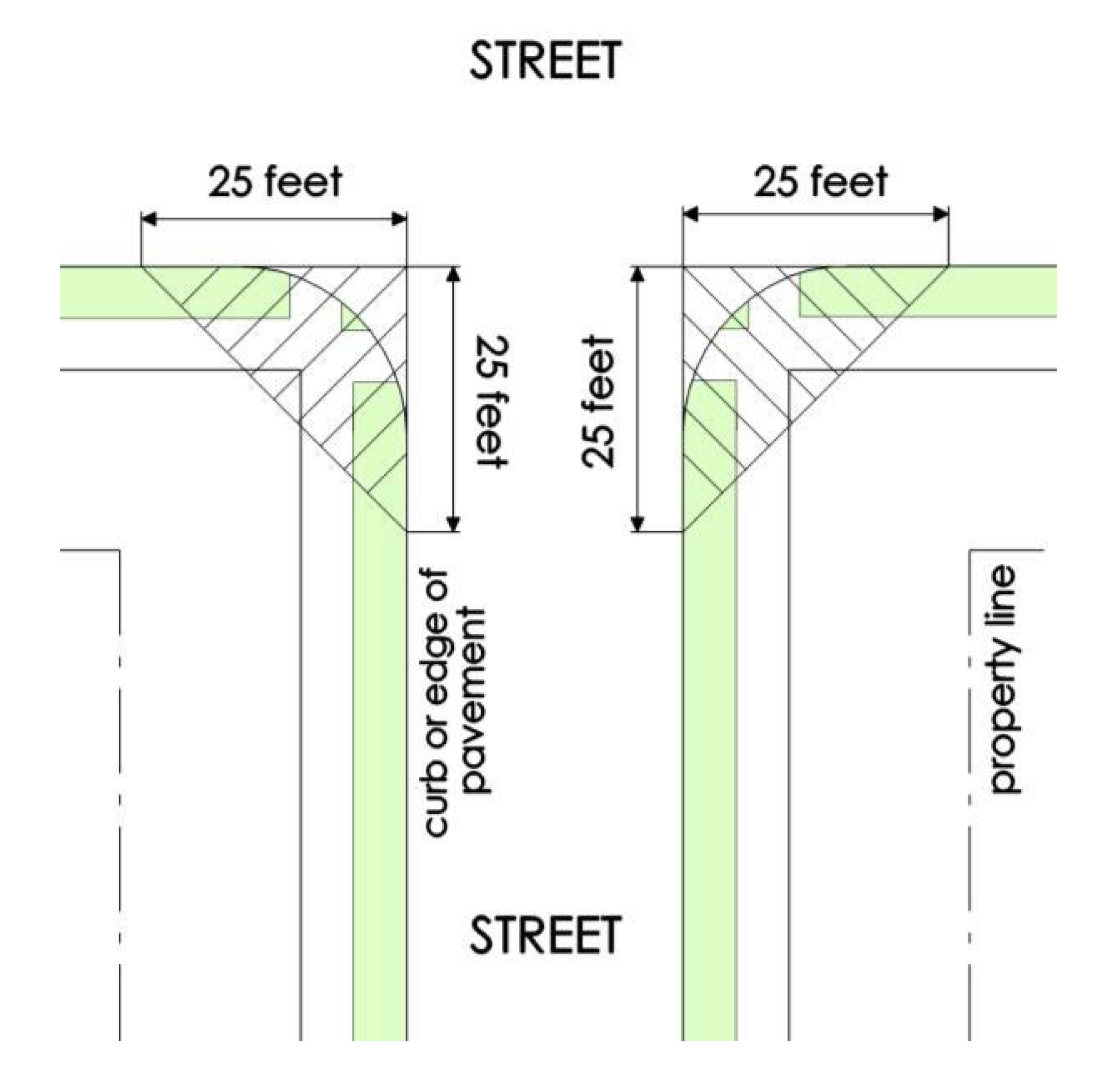
A.
Except in zoning districts with 0 foot setbacks, an unobstructed view shall be provided at all intersections within a triangle formed by joining two points measured 25 feet from the intersection of the edge of pavement or curbs at the intersection of two streets.
B.
Within this triangle there shall be no sight obscuring walls, signs, fences, or foliage higher than 30 inches above grade, or in the case of trees, foliage lower than eight feet above grade. Height shall be measured from the top of the curb or, where there is no curb, from the edge of pavement.
Sec. 3-22. - Required streetscapes.
A.
Sidewalks Required.
1.
Sidewalks are required along the frontage of any property abutting a public or private street.
2.
Where a property or development abuts both sides of an existing or future street, sidewalk will be required on both sides of the street.
3.
Exemptions.
i.
Where City Council determines the topography of the road frontage is such that a special hardship exists on the property, the City Council may authorize a payment to the City in lieu of the required installation of the sidewalk.
a.
Topographical Assessment: The Zoning Administrator will conduct a thorough assessment of the topography of the road frontage of the property to determine if special hardships exist and make their recommendation to City Council.
b.
Hardship Determination: Special hardships will be deemed to exist if the topography presents significant challenges or obstacles to the installation of the sidewalk.
c.
City Council Discretion: The decision to authorize a payment in lieu of sidewalk installation will be at the discretion of the City Council based on the assessment of the hardship by the Zoning Administrator.
d.
Consistency: The criteria for determining payment amounts will be applied consistently to all properties with approved hardships to ensure fairness and equity.
e.
Documentation: The Zoning Administrator will maintain detailed documentation of the assessment process, hardship determinations, and payment calculations for transparency and accountability purposes.
f.
Public Benefit: The Zoning Administrator will ensure that any payments made in lieu of sidewalk installation contribute to sidewalk improvement projects within the city to mitigate the absence of sidewalk installation on the property.
ii.
Subject to the approval of the City Council, sidewalks may be waived on a single lot development if said lot abuts a local road, there is no sidewalk on the adjacent properties, and the waiver would not adversely affect pedestrian safety or future pedestrian connectivity, including, but not limited to, proximity to a school, park, or public place. If sidewalk requirement is waived:
a.
Payment to the City in lieu of the required installation of the sidewalk is required, or
b.
Alternate pedestrian accommodations may be approved by the City Council.
B.
Landscape strip materials and maintenance.
1.
Required mix of materials. Landscape strips in the streetscape zone shall be planted with a variety of deciduous, overstory and understory trees. Species of shrubs, flowering plants, grass and other ground covers, which are well adapted to the local climate, may be included in the landscape strip.
2.
Sidewalks. Sidewalks shall be paved in concrete and paver accents approved by the planning and Zoning Administrator and kept clear and unobstructed for the safe and convenient use of pedestrians.
3.
Pedestrian crossings. Landscape strips may include brick, concrete, or granite pavers where on-street parking is provided or regular pedestrian crossing of the landscape strip is reasonably anticipated to occur.
4.
Maintenance. Required landscape strips shall be established and maintained by the owner. Topping of canopy trees is prohibited.
5.
Permanent structures. Permanent structures such as buildings, driveways that are not perpendicular to the landscape strip, parking spaces, dumpsters, drainage structures and detention facilities shall be prohibited in required landscape strips. The prohibition of this subsection shall not include crossings perpendicular to the strip, necessary retaining walls four feet or lower, bike racks, benches, trash receptacles, signs, mailboxes, and drainage swales.
6.
Planting areas for trees shall contain a minimum depth of 12 inches of screened topsoil. Below 12 inches the soil shall be un-compacted to a depth sufficient to allow proper drainage and root growth.
7.
Use of root barriers such as U.B. 36 or an equivalent is required at the back of the sidewalk or back of the curb if no sidewalk exists.
8.
Street trees.
i.
Street trees shall be overstory trees unless site constraints prohibit the use of large maturing trees, subject to the approval of the planning and Zoning Administrator.
ii.
Street trees shall be provided with spacing as depicted in table 5.1.
iii.
Street trees shall not be planted closer than 20 feet from the curb line of intersecting streets and not closer than ten feet from intersecting lines of alleys or private drives.
iv.
Street trees shall not be planted closer than 12 feet from light standards. No new light standard location shall be positioned closer than ten feet to any existing street tree.
v.
Street trees shall not be planted closer than two and one-half feet from the back of the curb.
vi.
Where there are overhead power lines, street tree species are to be chosen from a list provided by the arborist that will not interfere with those lines.
vii.
Street trees, as they grow, shall be pruned to provide at least eight feet of clearance above sidewalks and 12 feet above driveways and roadway surfaces.
viii.
Street trees shall have a caliper of no less than two (2) inches measured at six (6) inches above the soil line at the time of planting and shall have a mature height of at least 25 feet.
ix.
Street trees shall be planted in a mulched area of at least 25 square feet.
9.
Street lighting. Street lighting shall be accomplished with pedestrian scale lighting and street lights. Street lights shall be placed on property lot lines abutting the street. Lighting plans must be approved by the department of public works. Lighting shall be installed by local power company employees or contractors.
10.
Administrative variance. An administrative variance to streetscape standards may be granted by the planning and Zoning Administrator for adaptive reuse and redevelopment projects as specified in this section or to preserve historic patterns. In addition to other required materials, an applicant for an administrative variance to the streetscape standards shall include a site plan, drawn to scale, showing the existing right-of-way and specific conditions of the lot.
C.
Streetscape dimensions and placement:
(Ord. (W-25-25), § I, of 11-3-25)
Sec. 3-23. - Infill development.
A.
Infill and redevelopment should provide exemplary site design, architectural design and high quality materials that are compatible with, and does not negatively alter the character of, the existing neighborhood.
1.
Lot size: Existing Small Lot Amnesty. A legal lot of record that existed prior to the date of record of this ordinance and is being used for infill or redevelopment may use the minimum lot standards that follow.
2.
Building height shall conform to:
i.
Maximum heights allowed in the zoning district in accordance with this chapter, or
ii.
A height that is equal to or the average of adjacent building heights.
iii.
If the proposed building height(s) is greater than the allowed maximum, the proposed building or structure must meet the following criteria for community compatibility:
■
Neighborhood scale
■
Privacy
■
Light and shadow
■
Views
■
Architectural compatibility
3.
Setbacks. Minimum setbacks for infill development shall be the average of the established front and side setbacks on properties within the block or six-hundred (600) feet on both sides of the subject lot parallel to its side lot lines. It shall be the responsibility of the applicant to conduct a survey to determine setback requirements.
4.
Bulk and Scale. Bulk and scale shall be similar to and consistent with the surrounding neighborhood as evaluated by the bulk of buildings adjacent, abutting and surrounding the proposed development. Larger buildings should be designed to adhere to the existing architectural pattern of the surrounding neighborhood.
5.
Orientation of the house. The infill home shall have the same orientation to the streets as the majority (51 percent) of the existing homes within the survey area.
6.
Relief. To apply for relief from any of these requirements, the property owner, or his or her representatives, may file for a variance with the City Council. That variance shall be considered in conformance with the procedures and standards contained in article XI.

