
Winter Garden City Zoning Code
ARTICLE X
- SUPPLEMENTAL DESIGN STANDARDS, REQUIREMENTS AND REGULATIONS PERTAINING TO SPECIFIED COMMERCIAL CORRIDORS WITHIN THE CITY OF WINTER GARDEN
DIVISION 2. - RESERVED[20]
Editor's note— Ord. No. 13-19, § 6, adopted May 23, 2013, repealed §§ 118-1511—118-1515, which pertained to sign regulations and derived from Ord. No. 03-30, § 2B(2.1)—(2.5), 9-17-03; Ord. No. 10-08, § 3(Exh. B), 7-8-10.
Sec. 118-1502. - Applicability.
The design standards, requirements and regulations provided herein are in addition to and supplemental to the City of Winter Garden Code of Ordinances, including, but not limited to, all ordinances, resolutions, rules, or land development requirements, heretofore or hereafter adopted by the City of Winter Garden. Said design standards, requirements and regulations, or portions thereof, shall apply to all properties located within designated commercial corridors (or such other areas) as are identified by ordinance or may apply, in whole or part, as a condition of development, variance or special exception.
(Ord. No. 03-30, § 2B(1.1), 9-17-03)
Sec. 118-1503. - Conflict.
Unless otherwise provided for in the adopting ordinance designating the commercial corridor (or such other areas), if any provision of the design standards, requirements and regulations provided herein are found to be in conflict with any other provision of the City of Winter Garden Code, including, but not limited to, all ordinances, resolutions, rules, or land development requirements (including the underlying zoning classification), the provision which establishes the higher and/or more restrictive standard shall prevail. The provisions of the design standards, requirements and regulations provided herein, are declared to be severable and if any section, sentence, clause or phrase of said design standards, requirements and regulations shall, for any reason, be held invalid, unlawful or unconstitutional, such decision shall not be held to impair the validity, force or effect of the remaining sections, sentences, clauses or phrases or part thereof of said design standards, requirements and regulations.
(Ord. No. 03-30, § 2B(1.2), 9-17-03)
Sec. 118-1521. - General.
All landscaping shall be designed and located to provide a logical, consistent and attractive pattern of landscaping that relates to the human-scale, softens the built environment, and creates an attractive environment within the Commercial Corridors of Winter Garden.
All landscaping standards shall meet the requirements of the "Commercial Corridor Plant List" for plant species, specification standard and use.
All parts of a required landscape buffer or other landscape planting area shall contain shrubs, groundcovers or sod. No portion of a required buffer may contain parking, non-landscaped retention or other non-landscaping treatment such as gravel or mulch.
(Ord. No. 03-30, § 2B(3.1), 9-17-03)
Sec. 118-1522. - Building open areas.
The green spaces around buildings shall be landscaped completely with trees, shrubs, groundcovers, annuals or sod.
(1)
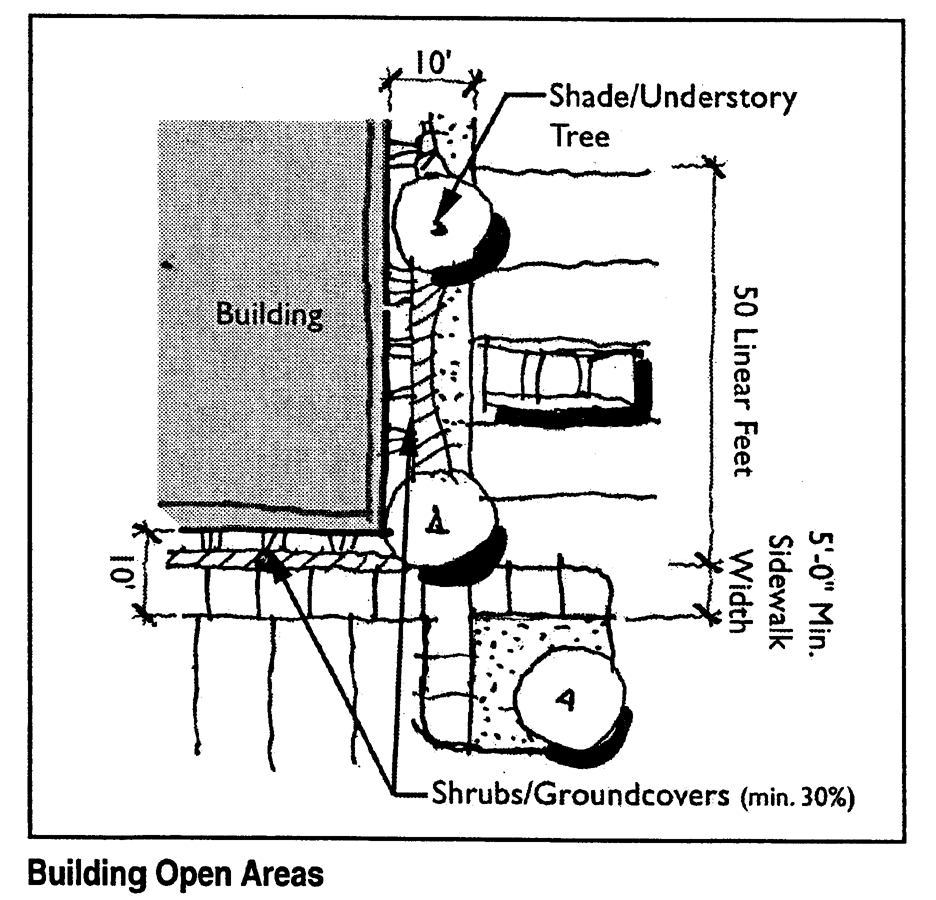
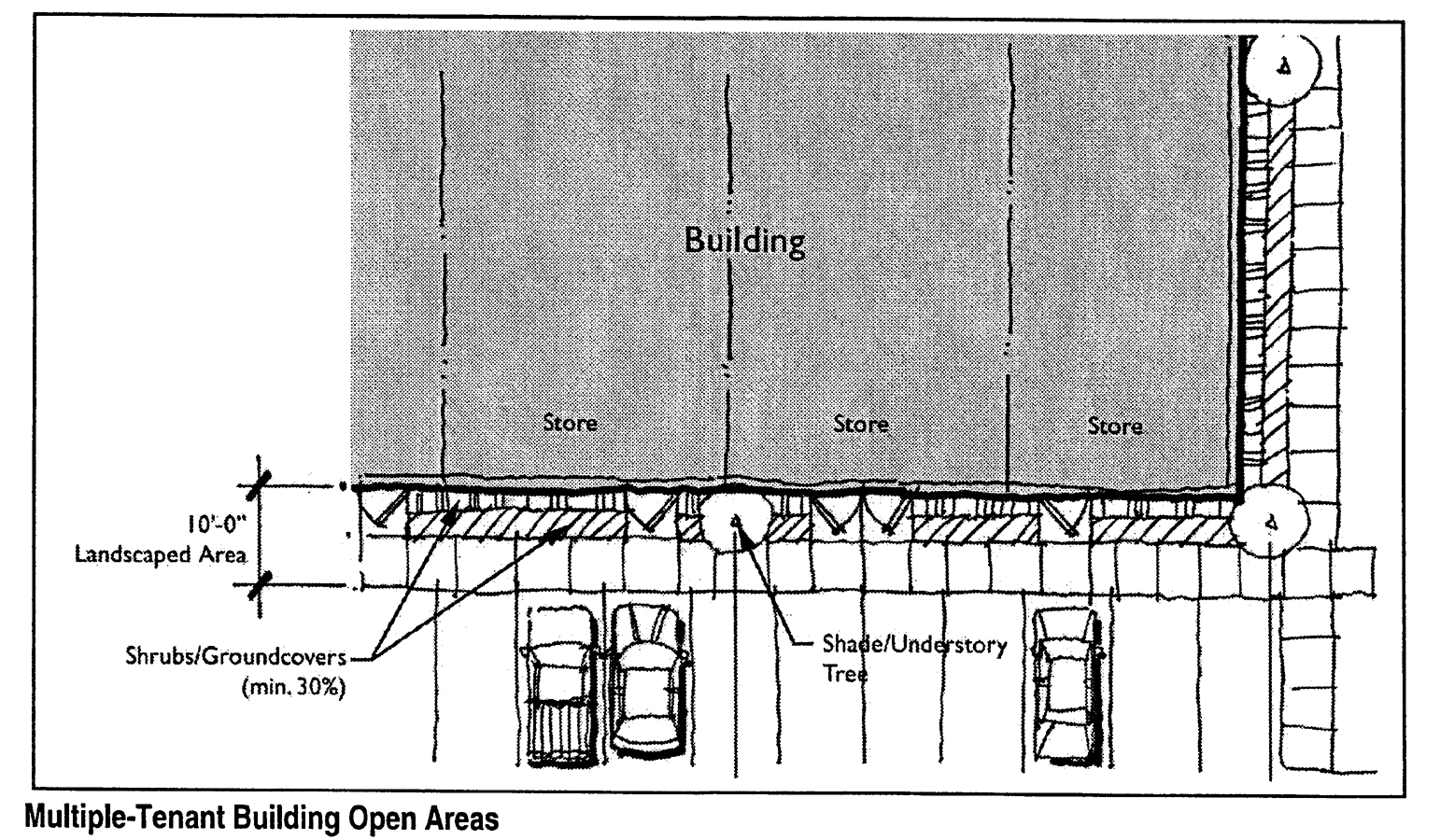
A minimum ten-foot wide landscape area shall be located around all buildings. A five-foot sidewalk may be included in this buffer area.
(2)
An average of one canopy tree shall be located for every 50 linear feet of building perimeter.
(3)
All edges of buildings shall have a foundation planting of shrubs and groundcovers as a minimum. Shrubs and groundcovers shall comprise at least 30 percent of the required green space.
(4)
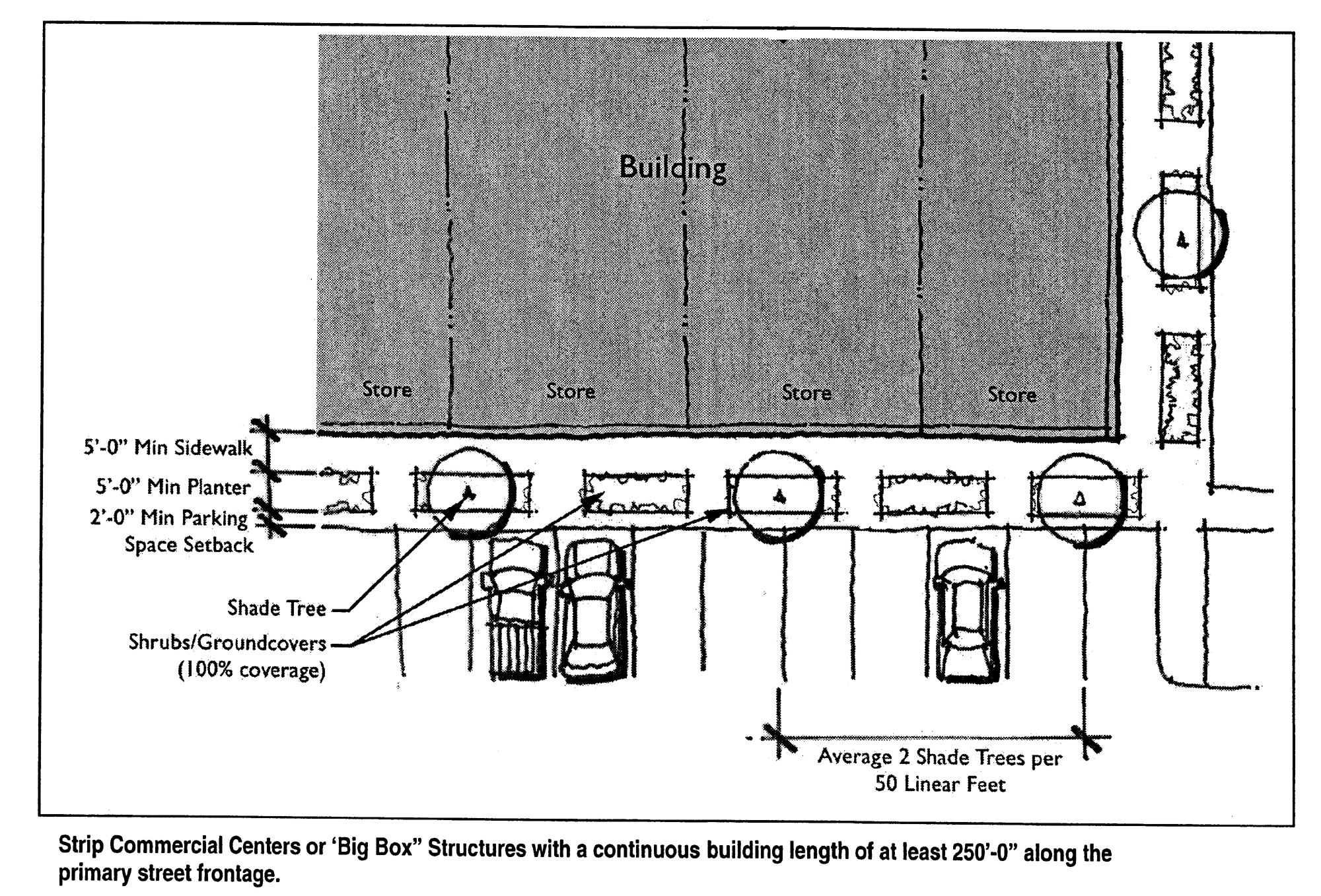
Landscaping shall be required around the perimeter of large strip commercial centers or "big box" structures with a continuous building length of at least 250′—0″ along the primary street frontage as follows:
a.
Rear/service area does not require planting.
b.
The remaining three sides of building perimeter shall include a 5′—0″ minimum continuous sidewalk as well as landscape planter areas along at least 60 percent of that linear distance.
c.
The required 60 percent landscape coverage shall be in at-grade or raised planters at least 5′—0″ deep and 5′—0″ wide. Raised planters shall not exceed 24″ overall height.
d.
Planters may be located along building edge, or along street, drive or parking edge. Planters along head-in parking shall be located at least 2′-0″ clear from edge of curb to allow for continuous pedestrian access without stepping in landscape area.
e.
All required planters shall be planted 100 percent with shrubs and groundcovers. Sod is prohibited.
f.
An average of one canopy tree per 50 linear feet shall be required for the remaining three sides of building perimeter. Trees may be placed in planter areas.
(Ord. No. 03-30, § 2B(1.1), 9-17-03)
Sec. 118-1523. - Landscape buffer along public streets.
Landscape buffers along public streets shall meet the following guidelines:
(1)
A minimum 15-foot wide landscape buffer is required for parcels along any public streets and requires 50 percent coverage with shrubs and groundcover. A ten-foot wide landscape buffer is otherwise allowed and requires 75 percent shrubs and ground cover for parcels with 100 or less existing and/or proposed parking spaces or any parcel with a parcel lot depth equal to or less than 250 feet. An administrative waiver may be requested for any existing parcel that may require a front buffer width reduction that results in a landscape buffer less than the required minimum 10 feet and was caused or created by the State Road 50 Road Improvements or any other third party.
(2)
All planted shrub and groundcover areas shall achieve 100 percent coverage of their planting area within one year.
(3)
In areas where the landscape buffer must be reduced to meet individual site constraints, the planting area should be planted according to the following table of required buffer standards. Landscape buffers smaller than ten feet may only be allowed through a variance process.
(4)
Additional features such as maximum 24-inch knee walls and maximum 48 inches decorative 'wrought iron' picket fences shall also be allowable elements. Decorative fences must have at least 50 percent of required buffer planting adjacent to right-of-way.
(5)
Permitted features for front buffers include sidewalks, signs, low wall and "wrought iron" picket fences, retention features according to section 118-1527 and equipment according to section 118-1529.
(6)
Prohibited features in front buffers include chain-link, wood or PVC fences, walls greater than two feet in height, loading, service or dumpster areas or similar items, which may not be placed in the front buffer or in any additional "open space" adjacent to the street or any direction visible from the street.
(7)
The City of Winter Garden encourages the use of drought tolerant plants for all landscape buffers as recommended by the Florida-Friendly Landscaping Program as set forth by the Institute of Food and Agricultural Sciences ("IFAS") at the University of Florida. Further details may be found at http://fyn.ifas.ufl.edu/index.html.
STATE ROAD 50 FRONTAGE BUFFER REQUIREMENTS:
Note: An administrative waiver may be requested for any existing parcel that may require a front buffer width reduction that results in a landscape buffer less than the required minimum 10′ and was caused or created by the State Road 50 Road Improvements or any other third party.
Front Buffer Yard - 15′ Width Buffers. A 15-foot wide landscape buffer is required for parcels along any public streets and requires 50 percent coverage with shrubs and groundcover.
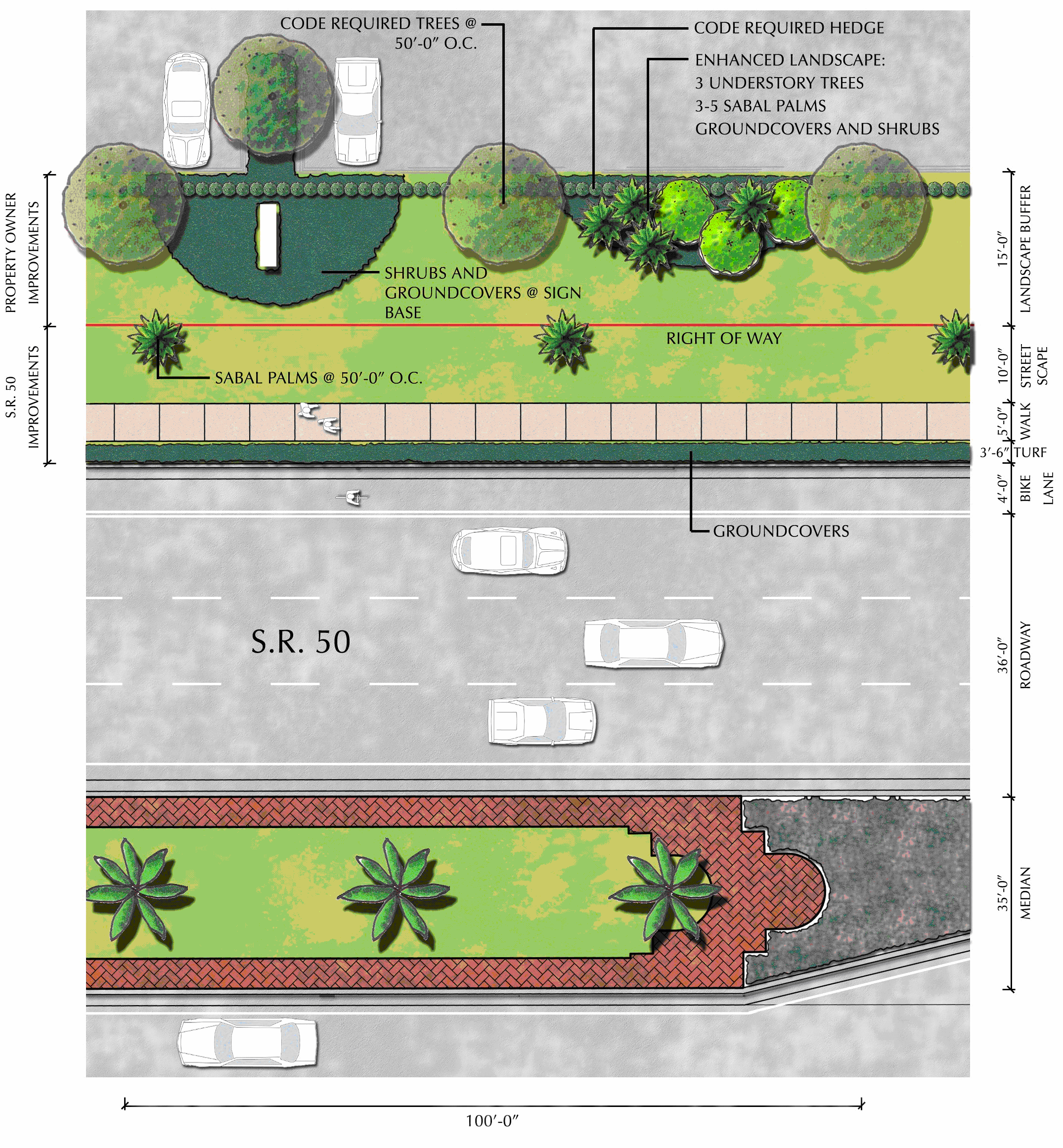
Front Buffer Yard - 10′ Width Buffers. A ten-foot wide landscape buffer is allowed and requires 75 percent shrubs and ground cover for parcels with 100 or less existing and/or proposed parking spaces or any parcel with a parcel lot depth equal to or less than 250 feet.
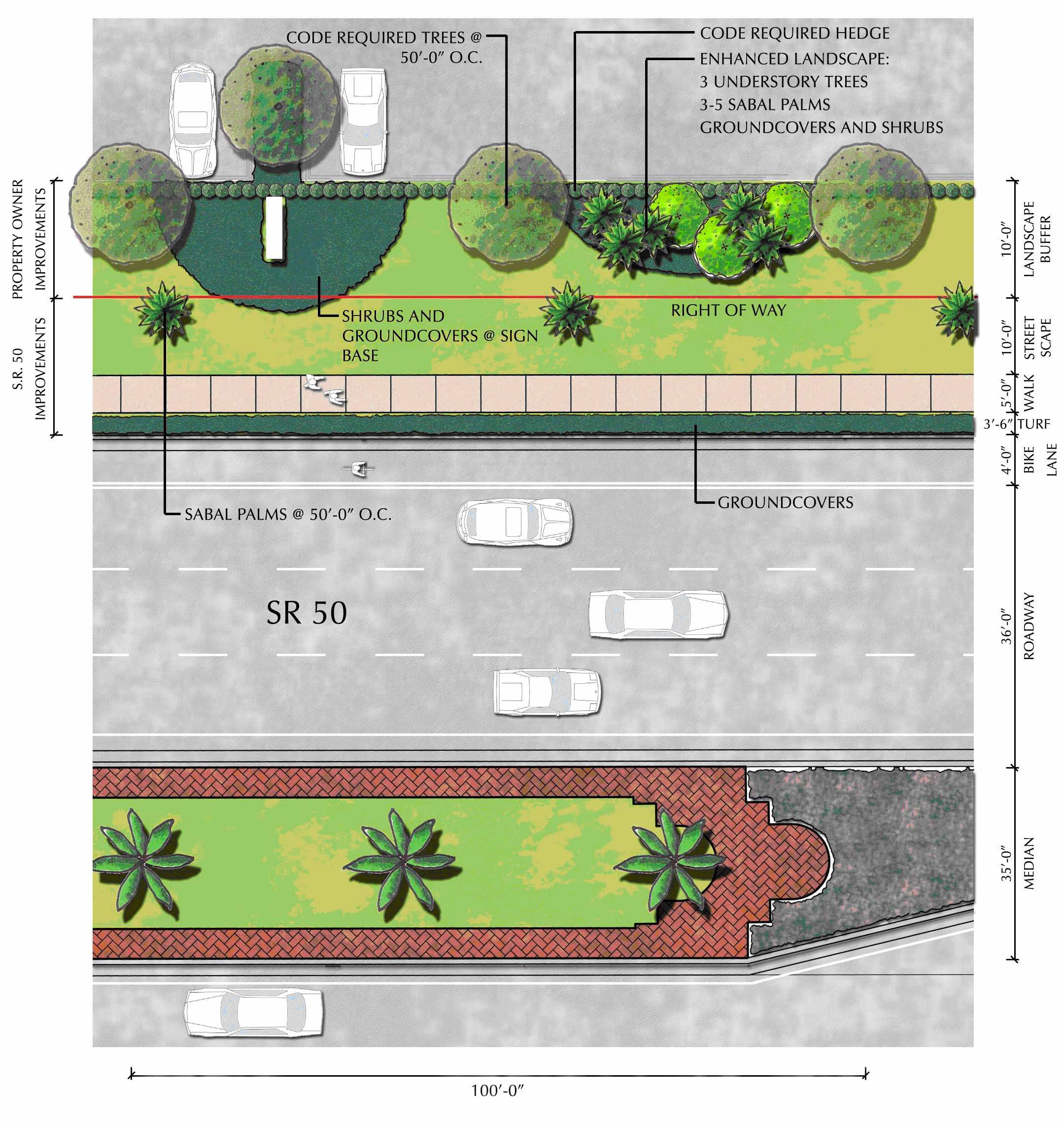
An administrative waiver may be requested for any existing parcel that may require a front buffer width reduction that results in a landscape buffer less than the required minimum ten feet and was caused or created by the State Road 50 Road Improvements or any other third party.
(Ord. No. 03-30, § 2B(3.3), 9-17-03; Ord. No. 10-08, § 3(Exh. B), 7-8-10)
Sec. 118-1524. - Landscape buffers between parcels.
(a)
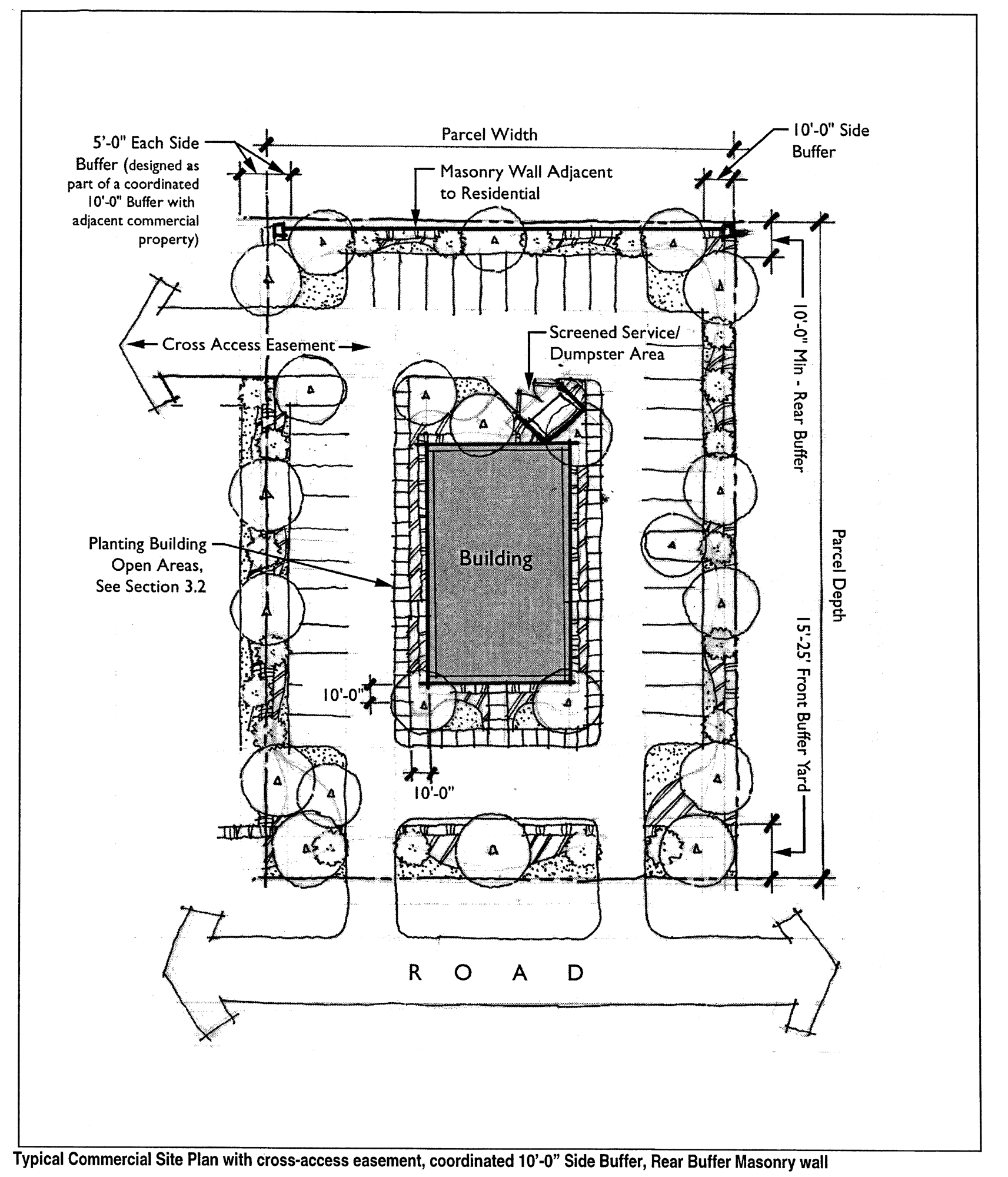
A minimum ten-foot width landscape buffer is required for rear property boundaries and shall be planted in accordance with Table 3.4.1. Shrubs and Groundcover shall comprise at least 50 percent of the landscaped areas.
(b)
A minimum five-foot width landscape buffer is required for side property boundaries and shall be planted in accordance with Table 3.4.2. Shrubs and ground cover shall comprise 50 percent of the landscaped areas.
(c)
Side or rear buffers adjoining noncommercial or residential parcels, churches or institutional uses shall also require a six-foot masonry wall in addition to the minimum ten-foot wide landscape buffer requirement. The wall shall be constructed from decorative "split face" concrete masonry, "Norman" brick or standard concrete masonry clad with painted stucco or other masonry veneer. The wall shall include a continuous cap and end column features. The wall shall be placed a minimum of six inches from the adjoining property line. In addition, all active "yard and shop" spaces with open work areas or other supply areas shall be treated with a similar six-foot masonry wall. The city and applicant must mutually agree on which landscape buffer requirements are most appropriate with the submission of the development and/or site plan proposal.
As an alternative to the six-foot masonry wall, a minimum 20-foot wide landscape buffer with 50 percent opacity may be permitted on application to and approval by the planning and zoning board at a duly noticed public hearing. The planning and zoning board shall review the proposed alternative buffer and approve such buffer upon determining that the buffer will (1) be planted in accordance with Table 3.4.1, (2) include additional shrubs and groundcover planting to achieve 100 percent coverage, and (3) meet all other relevant landscaping standards set forth herein.
Table 3.4.1 - Rear Yard Landscape Buffer Requirements
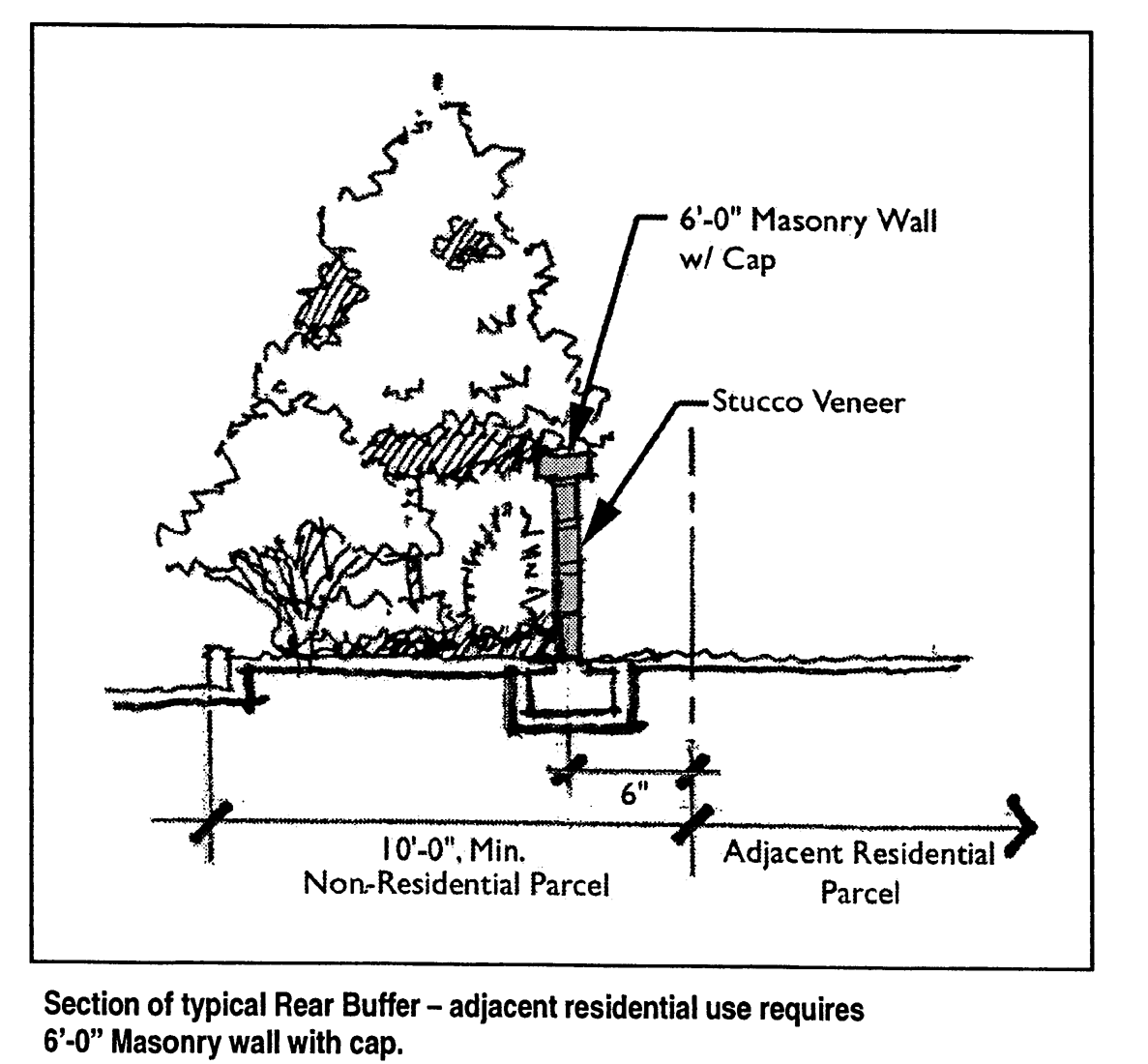
Table 3.4.2 - Side Yard Landscape Buffer Requirements
(Ord. No. 03-30, § 2B(3.4), 9-17-03; Ord. No. 10-08, § 3(Exh. B), 7-8-10)
Sec. 118-1525. - Parking lot landscaping.
(a)
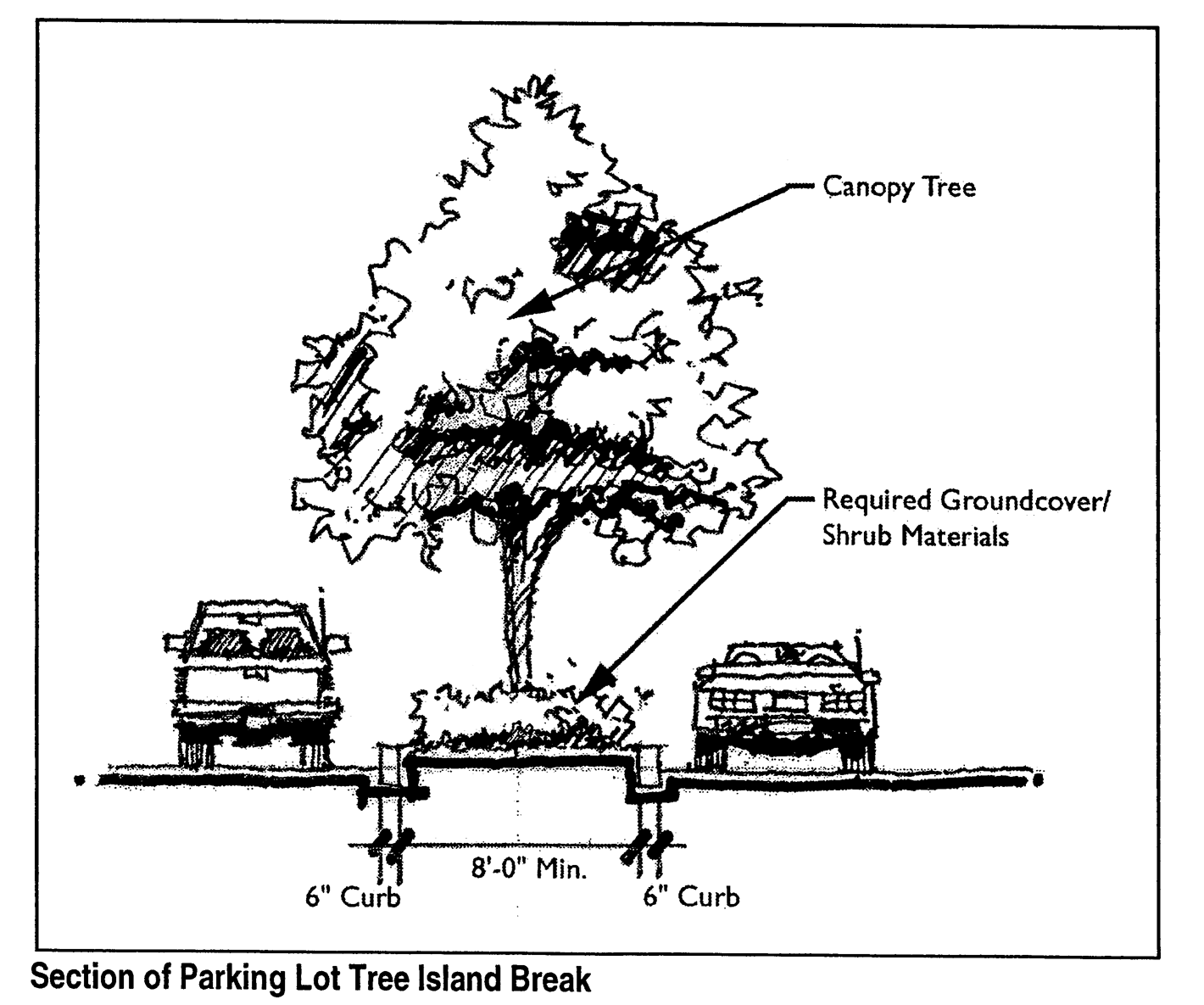
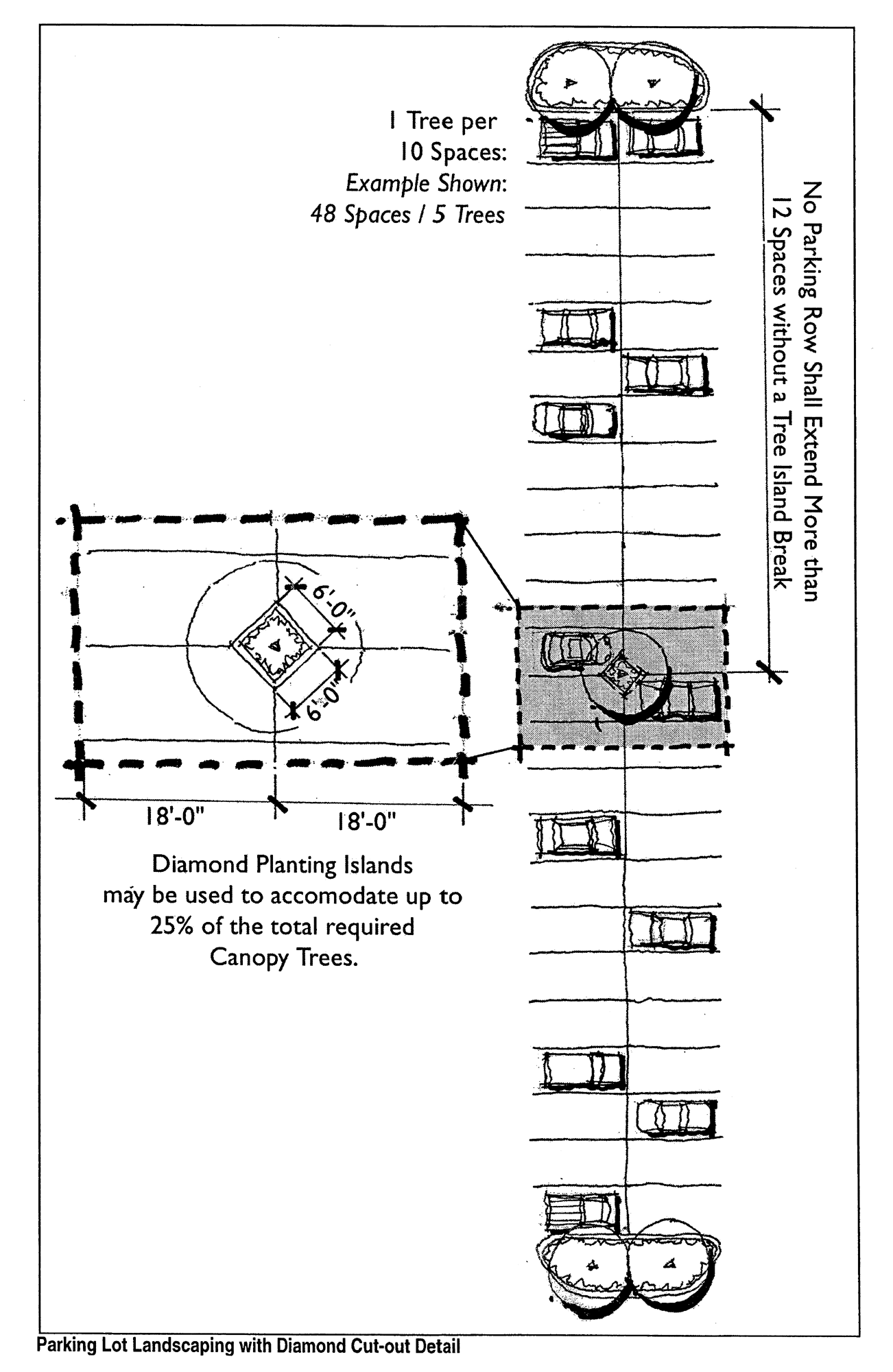
Parking lots shall be planted with canopy trees at a rate of one tree per ten spaces. Parking shall not extend more than 12 spaces without a tree island break.
(b)
At time of parking lot construction and planter installation, all planter islands shall be excavated to the full width of the parking planter island and through the full depth of compacted subgrade to remove all compacted material, all limerock or other material deleterious to plant health, and backfilled with clean planting fill.
(c)
Planting areas shall be provided equal to or greater than ten percent of the paved area within the project site, not including building square footage or retention ponds.
(Ord. No. 03-30, § 2B(3.5), 9-17-03)
Sec. 118-1526. - Walkways and pedestrian connections.
(a)
Pedestrian walkways shall be landscaped with additional shade or understory trees equal to an average of one tree per 50 linear feet of walkway, unless the walkway is adjacent or included within an existing compliant buffer or frontage planting.
(b)
One canopy tree shall be planted for each 200 square feet of separate additional landscaped area.
(Ord. No. 03-30, § 2B(3.6), 9-17-03)
Sec. 118-1527. - Stormwater facilities.
(a)
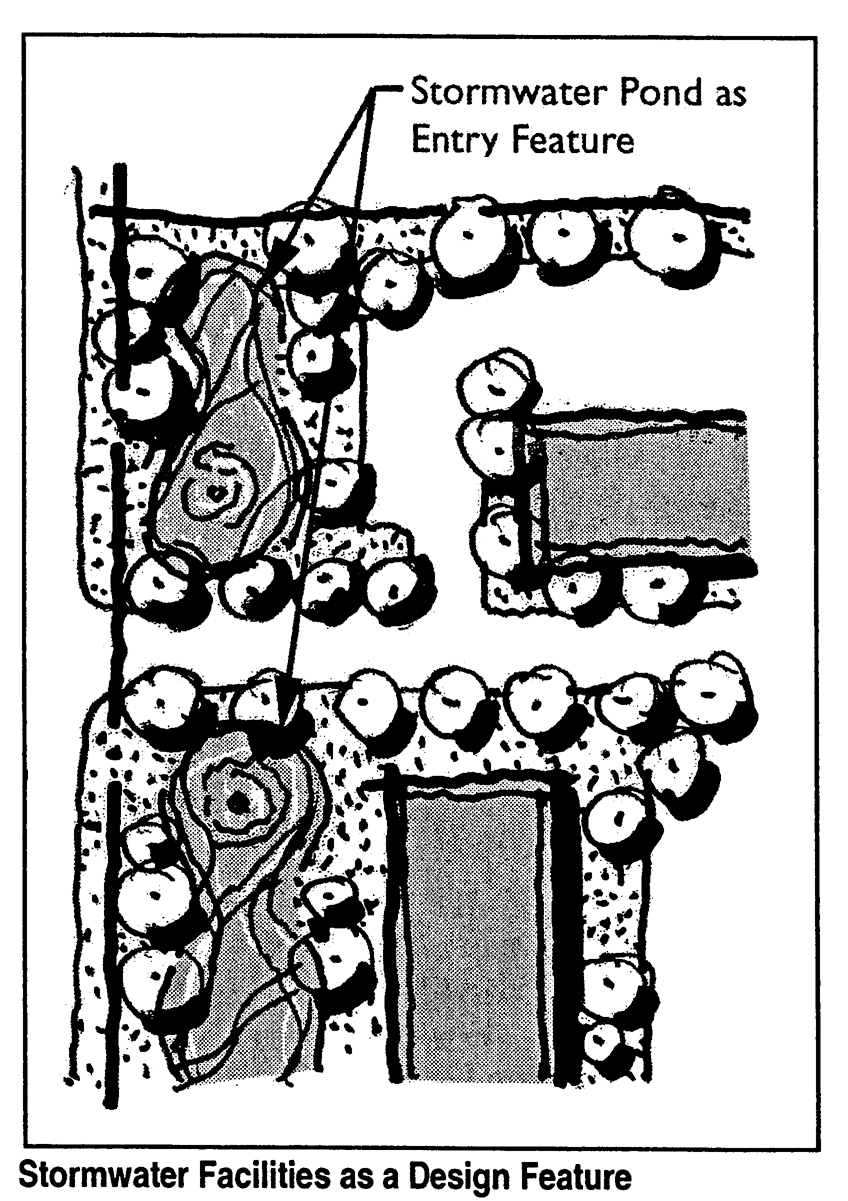
Stormwater facilities (ponds and/or depressions) shall be designed and utilized as site amenities along entrances and street frontages or incorporated with buffers between incompatible uses. These areas shall count toward open space requirements if the impervious area of the site does not exceed 75 percent.
(b)
Stormwater facilities should be designed and permitted so as not to require fencing. If fencing is required, a green or black vinyl/painted finish is required. Walls or other railings for structured stormwater "boxes" must be decorative. Fenced or walled ponds shall not count toward open space requirements within a project and shall only be located at the side or rear of a site. The maximum allowable fence height is 4′-0″.
(c)
Subject to the requirements of St. Johns River Management District, other governmental agencies, and a consideration of safety related issues, stormwater facilities that are located in the front of a property may be prohibited from having fencing.
(d)
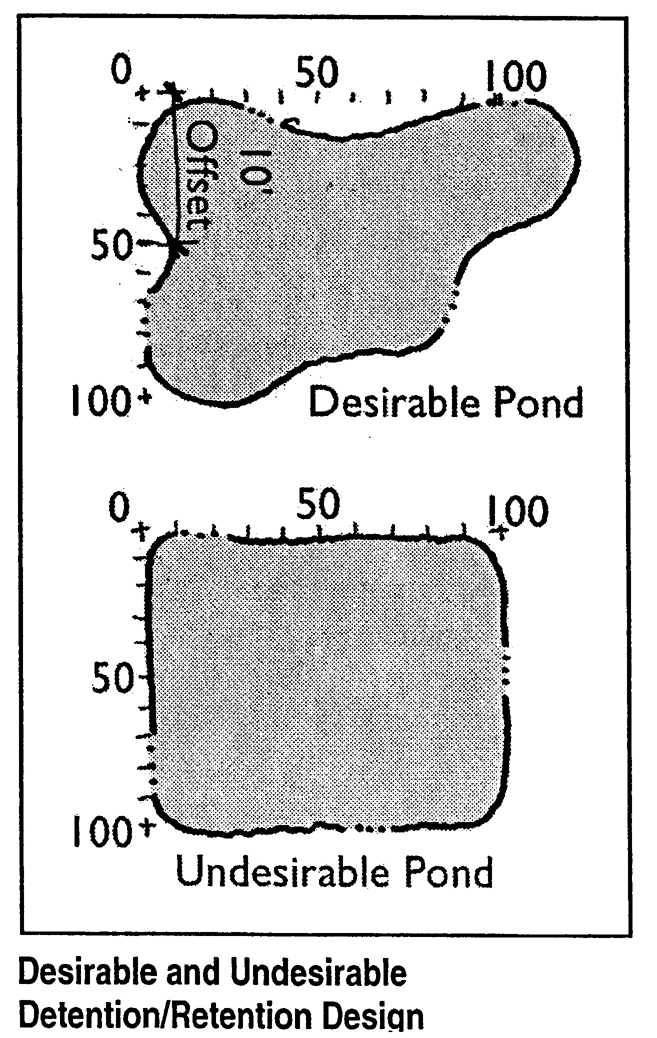
Wet stormwater detention/retention facilities adjoining public streets shall include a water feature such as a fountain or spray jet, and shall be planted with appropriate aquatic materials as outlined in the "Commercial Corridor Plant List." Detention/Retention along the front of a property shall be designed with curvilinear edges not as a straight "box." Retention embankments shall be planted with one tree per 50 linear feet of retention perimeter measured from top of slope. Trees shall be suitable for wet locations as identified in the Commercial Corridor Planter Materials List.
(e)
Dry retention areas shall be planted with grass, and unless maintained as an open lawn swale, shall be screened from view with a continuous hedge of shrubs on 36-inch centers around at least 75 percent of the perimeter at the top of the slope.
(Ord. No. 03-30, § 2B(3.7), 9-17-03)
Sec. 118-1528. - Lake edges and wetlands.
Development abutting surface water bodies or wetlands shall be planted with appropriate aquatic plantings as outlined in the "Commercial Corridor Plant List."
(Ord. No. 03-30, § 2B(3.8), 9-17-03)
Sec. 118-1529. - Storage areas and site utilities.
(a)
All storage or dumpster/solid waste areas shall be designed with a six-foot masonry wall. The wall shall be of a decorative "split face" concrete masonry, "Norman" brick or standard concrete masonry clad with painted stucco or other masonry veneer. The wall shall include a continuous cap feature and closing gate.
(b)
In addition to the masonry enclosure, storage and dumpster/solid waste areas shall be treated with a 24-inch high planted hedge that shall reach 36″—42″ height and 90 percent opacity within one year.
(c)
Other above-ground utility elements such as pull boxes, transformers, and backflow preventers shall be located and designed to permit convenient maintenance access, painted dark green and screened with a 24-inch planted hedge that shall reach 36″—42″ height and 90 percent opacity within one year.
(d)
Long-term storage containers are prohibited unless located on a parcel with a fully screened masonry or brick enclosure designed and constructed for that purpose.
(Ord. No. 03-30, § 2B(3.9), 9-17-03)
Sec. 118-1530. - Irrigation and maintenance.
(a)
All landscaped areas within the commercial corridor shall be designed, installed and maintained at a high level of quality, following best management practices for landscaping. Broken lines or damaged spray heads shall be repaired to minimize wasted water.
(b)
All landscaped areas shall be irrigated with a timed, automatic underground system utilizing pop-up heads and/or tree bubblers and providing coverage of not more than one and one half inches of water per week. (Use of xeric plant materials may require only three-fourths inch water per week).
(c)
The automatic irrigation system shall include a rain gauge or other water saving features to minimize wasted water.
(d)
All landscape areas shall have 100 percent irrigated coverage.
(e)
Irrigation is not required in "existing wooded/forested" areas which are intended to be maintained in a natural condition.
(Ord. No. 03-30, § 2B(3.10), 9-17-03)
Sec. 118-1536. - General requirements.
(a)
Commercial buildings and projects, including their outparcels, shall be designed to provide safe, convenient and efficient lighting for pedestrians and vehicles. Lighting shall be designed in a consistent and coordinated manner for the entire project. Lighting shall be used to accent key architectural elements and/or to emphasize landscape features, and shall be designed and installed to avoid the creation of hot spots, glare or a nuisance. Please refer to Ordinance 08-01; amending City Code sections 118-1536, 118-1537 and 118-1538 of article X, chapter 118, of the Code of Ordinances of the City of Winter Garden for additional lighting requirements.
(b)
Light fixtures shall be designed as dark skies lighting and shall be an integral design element that complements the design of the project through style, material or color. All light poles and fixtures shall be black, dark green or some similarly dark color that is consistent with the architectural design scheme of the property. Lighting of on-site buildings shall be limited to wall-washer type fixtures or up-lights, which do not produce spillover lighting or glare. Site lighting shall not incorporate floodlight fixtures mounted on building walls, roofs, or poles. Light fixtures shall be full cut off with zero light above 90 degrees.
(c)
To provide cohesiveness and uniformity, a lighting plan prepared by an architect or engineer licensed to practice in the State of Florida shall be submitted to the city as part of an application for site plan, special exception permit or subdivision approval, and said professional shall: (1) certify that the lighting plans are compliant with the requirements of the design standards and regulations provided for herein; or (2) so certify to the extent said lighting plans are compliant with the requirements of the design standards and regulations provided for herein and provide a written explanation for any deviations.
(d)
Lighting levels for fire lanes or driveways at building entrances shall not exceed five foot-candles (fc). Lighting at fire lanes or driveways at building entrances may exceed allowable standards of intensity for safety purposes upon demonstration to the city that compliance with these lighting criteria would otherwise create a safety hazard, provided, however, that such lights shall be directed downward to minimize spillover lighting and glare.
(e)
Lighting intensities for ATM machines shall comply with Florida Statutes.
(f)
Lighting intensities shall be designed as recommended by the Illuminating Engineering Society (IES).
(g)
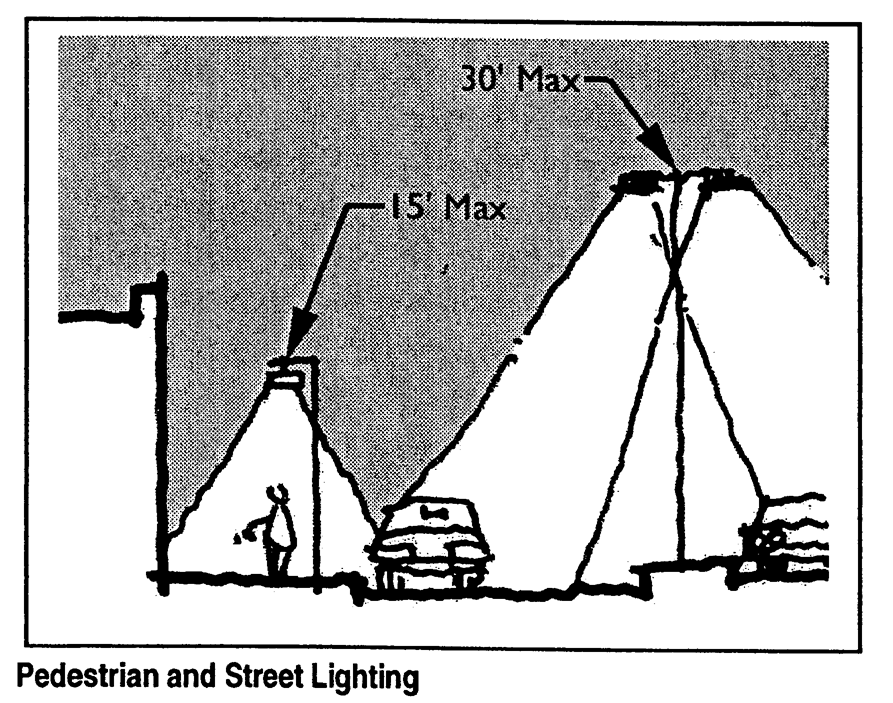
A light fixture (the pole and light source/luminary) shall be a maximum of 30 feet in height within any parking lot, and a maximum of 16 feet in height within any non-vehicular pedestrian area (with height being measured from the finished grade to the top of the light fixture).
(h)
At service stations and convenience centers, lighting under awnings, canopies, porte-cocheres, etcetera, should be recessed. If not recessed, the box type or other lighting fixture shall be opaque on all sides (no light shall emanate from any side of the fixture). Additionally, the following lighting standards shall apply:
(1)
The light source shall be metal halide (a maximum of 250 watts) or fluorescent;
(2)
The metal halide shall be phosphor coated when used with a clear flat glass lens, or may be clear when used with a diffused flat glass lens; and
(3)
The maximum foot-candle level shall be 20 fc with proper shielding of under canopy light fixtures to substantially reduce the "spray light" effect (average maintained maximum) - see the IES Lighting Handbook, 8th edition, at Chapter 11, Figure 11-1, Part IV, Outdoor Facilities, Service Stations (lighting level at grade).
(i)
Illumination levels at the property line shall range between a minimum of 0.0 fc and a maximum of 1.0 fc, with as close to 0.0 fc as reasonably feasible when lighting is located next to residential. To keep light rays and glare from encroaching onto adjacent properties, illumination shall be installed with house-side shields and reflectors, and shall be maintained in such a manner as to confine light rays to the premises. A photometric plan prepared by an engineer licensed to practice in the State of Florida shall be submitted to the city as part of an application for site plan approval, and said professional shall certify that the lighting plans are complementary with landscaping plans and compliant with the requirements of this guideline.
(j)
All parking areas, pedestrian walkways, bikeways, loading/service and other areas shall, to the extent applicable, conform to these general requirements.
(k)
Street lighting shall be provided on all private developments contiguous to all rights-of-way, roadways, streets, alleys or lanes.
(Ord. No. 03-30, § 2B(4.1), 9-17-03; Ord. No. 08-01, § 2, 1-10-08; Ord. No. 10-08, § 3(Exh. B), 7-8-10)
Sec. 118-1537. - Parking areas.
Except for areas of service stations and convenience centers located under an awning, canopy, porte-cochere, etcetera, as noted in section 118-1536(h) above, parking areas shall be illuminated as follows, with horizontal lamps highly recommended:
(1)
Parking area lighting shall be shielded from adjacent properties by utilizing flat glass lenses, houseside shields, and "NEMA" type II, III, and IV reflectors.
(2)
The lamp source shall be metal halide. Wattage shall not exceed 400 watts per bulb. Illumination levels shall range between a minimum of 0.6 fc to a maximum (outside a 20-foot radius from the pole) of 3.6 fc, not including overflow lighting in a transition zone adjacent to a service station and convenience center canopy.
(3)
Phosphor coated lamps shall be utilized in all luminaries where the lamp source is not hidden by the luminary housing or equipped with a diffused lens.
(4)
Where specifically approved by the city commission, decorative acorn-type fixtures shall not exceed 18 feet in height and 250 watts per bulb, and shall have a textured clear lens/globe, frosted/phosphor coated bulbs, and an internal optical system.
(Ord. No. 03-30, § 2B(4.2), 9-17-03; Ord. No. 08-01, § 2, 1-10-08)
Sec. 118-1538. - Pedestrian walkways and bikeways.
Pedestrian walkways and bikeways shall be illuminated as follows:
(1)
The lamp shall be decorative in appearance, style and finish and shall be consistent with the architectural standards of the surrounding area. Selected luminaries shall have the lamp source shielded from view. Translucent diffusers may be an acceptable substitute to avoid visual glare and brightness.
(2)
The lamp source shall be metal halide. Wattage shall not exceed 150 watts. Illumination levels shall range between a minimum of 0.5 fc to a maximum of 2.5 fc.
(3)
Phosphor coated lamps shall be utilized in all luminaries where the lamp source is not hidden by the luminary housing or equipped with a diffused lens.
(Ord. No. 03-30, § 2B(4.3), 9-17-03; Ord. No. 08-01, § 2, 1-10-08)

