
Winter Garden City Zoning Code
ARTICLE IV
- DISTRICT REGULATIONS
DIVISION 8. - C-1 CENTRAL COMMERCIAL DISTRICT[4]
Cross reference— Businesses, ch. 22.
DIVISION 9. - C-2 ARTERIAL COMMERCIAL DISTRICT[5]
Cross reference— Businesses, ch. 22.
DIVISION 10. - C-3 PROFESSIONAL OFFICE DISTRICT[6]
Cross reference— Businesses, ch. 22.
DIVISION 11. - C-4 NEIGHBORHOOD COMMERCIAL DISTRICT[7]
Cross reference— Businesses, ch. 22.
DIVISION 12. - I-1 LIGHT INDUSTRIAL AND WAREHOUSING DISTRICT[8]
Cross reference— Businesses, ch. 22.
DIVISION 13. - I-2 GENERAL INDUSTRIAL DISTRICT[9]
Cross reference— Businesses, ch. 22.
Sec. 118-226.- Occupancy of single-family dwelling unit.
(a)
The occupancy of a single-family dwelling unit for residential use by persons not constituting a family is prohibited; except that this subsection does not prohibit temporary guests or invitees of a family residing in the dwelling unit from temporarily occupying the dwelling unit.
(b)
There shall be at least one bedroom in a dwelling unit for each two persons over the age of 15 residing in the dwelling.
(c)
There shall be a rebuttal presumption that three or more persons living in a dwelling unit that are not related by blood, marriage, legal guardianship or adoption are not a family. Further, there shall be a rebuttal presumption that a dwelling unit having more than two vehicles parked overnight on a regular basis on the premises that are registered in different last names contains a group of persons not constituting a family. When a rebuttal presumption exists, the burden is upon the persons living in a dwelling unit to show by competent, substantial evidence that such persons constitute a family considering the following factors: (i) a single, non-profit housekeeping unit; (ii) permanent and stable living arrangement, rather than transient living arrangement; (iii) headed by a householder caring for children as one would likely find in a biologically unitary family; (iv) persons share the entire dwelling unit and culinary facilities; (v) persons share use of vehicle(s); and (vi) whether Florida Statutes or case law deems such persons to be a family unit or permitted to reside in a single-family dwelling as a matter of law.
(Ord. No. 17-21, § 5, 8-24-17)
Sec. 118-227. - Urban farm.
The urban farm use, where permitted under this code, is subject to and shall comply with the following:
(a)
No raising, keeping or slaughtering of animals.
(b)
Any equipment or supplies needed for farm operations shall be fully enclosed or otherwise effectively screened from the street and any adjacent residential uses.
(c)
The use shall not be located in a required interior side yard.
(d)
Outdoor growing associated with an urban farm shall be exempt from the enclosed building requirements of the zoning code.
(e)
A farm stand is allowed as an accessory use to an urban farm subject to the following conditions:
(1)
The farm stand shall only sell products of the urban farm occupied and cultivated by the same producer within the city limits;
(2)
The operation of the farm stand shall not exceed a duration of 75 days in one calendar year;
(3)
Sales shall be limited to between the hours of 7:00 a.m. and sunset;
(4)
The farm stand must be removed from the premises or stored inside a structure when not in operation;
(5)
Only one farm stand is permitted per urban farm parcel;
(6)
The farm stand shall not use the public right-of-way for its operations, including in regards to the placement of its signage or for customer or employee parking; and
(7)
One temporary sign not exceeding 20 square foot in copy area may be displayed to advertise the farm stand operations. Such sign must be removed from the premises or stored inside a structure at other times of the year when the farm stand is not in operation.
(Ord. No. 17-21, § 5, 8-24-17)
Sec. 118-261.- Intent.
The R-1A single-family residential district is intended to be low-density residential, with nonresidential uses restricted to public park and recreational facilities.
(Code 1988, § 24-39(a))
Sec. 118-262. - Permitted principal uses and structures.
Permitted principal uses and structures in the R-1A single-family residential district are as follows:
(1)
Single-family residences.
(2)
Public parks and recreational facilities and related structures.
(3)
Groves and noncommercial gardens.
(Code 1988, § 24-39(b)(1))
Sec. 118-263. - Permitted accessory uses and structures.
Permitted accessory uses and structures in the R-1A single-family residential district are the accessory uses and structures customarily incidental and subordinate to permitted principal uses and structures, provided that for residential uses, no accessory structure shall be located on property other than that on which the principal residential structure is located. Customary home occupations are permitted in connection with residential uses, provided that there shall be no external evidence of such home occupation, except that one sign, unilluminated, and not exceeding one square foot in area may be erected flat against the wall of the principal building.
(Code 1988, § 24-39(b)(2))
Sec. 118-264. - Special exceptions.
In the R-1A single-family residential district, the uses permitted as special exceptions pursuant to section 118-97 are as follows:
(1)
Public schools and private schools with conventional curriculums.
(2)
Public libraries.
(3)
Churches and other places of worship; parish houses.
(4)
Golf courses and golf clubs, tennis and racquet clubs and similar activities in keeping with the residential character of the district.
(5)
Public safety structures and equipment, such as fire substations, civil defense facilities, etc.
(6)
Hospitals.
(7)
Any structure over 40 feet in height.
(8)
Children day care centers.
(Code 1988, § 24-39(b)(3); Ord. No. 02-01, § 1, 2-28-02)
Sec. 118-265. - Prohibited uses and structures.
In the R-1A single-family residential district, the uses and structures prohibited are as follows:
(1)
House trailers in vacant lots or residential yards;
(2)
Communication towers; and
(3)
Any structure or use not of a nature specifically or provisionally permitted in this article.
(Code 1988, § 24-39(b)(4); Ord. No. 97-31, § 3, 9-11-97)
Sec. 118-266. - Minimum lot requirements.
In the R-1A single-family residential district, the minimum lot requirements are as follows:
(1)
Single-family residences.
a.
Width: 100 feet at building front setback line;
b.
Depth: 100 feet;
c.
Area: 13,000 square feet; and
d.
Width at the curb on a cul-de-sac: 35 feet.
(2)
Churches and other uses permitted by special exception.
a.
Width: 200 feet.
b.
Area: two acres.
(Code 1988, § 24-39(c))
Sec. 118-267. - Maximum lot coverage.
In the R-1A single-family residential district, the maximum lot coverage is as follows:
(1)
Single-family residences: 35 percent.
(2)
Churches and other uses: 35 percent.
(Code 1988, § 24-39(d))
Sec. 118-268. - Minimum yard requirements.
In the R-1A single-family residential district, the minimum yard requirements are as follows:
(1)
Single-family.
a.
Front: 30 feet.
b.
Side: ten feet each.
c.
Rear: 20 percent of depth of lot.
(2)
Churches and other uses.
a.
Front: 30 feet.
b.
Side interior lot: 50 feet.
c.
Side corner lot: 30 feet.
d.
Rear: 50 feet.
(Code 1988, § 24-39(e))
Sec. 118-269. - Maximum height of structures.
In the R-1A single-family residential district, the maximum height of structures is as follows:
(1)
Single-family residences: 30 feet.
(2)
Churches and other uses: 40 feet or higher, if approved by special exception.
(Code 1988, § 24-39(f))
Sec. 118-270. - Off-street parking and loading.
The minimum off-street parking and loading requirements for the R-1A single-family residential district shall be as provided in article VIII of this chapter.
(Code 1988, § 24-39(g))
Sec. 118-271. - Minimum living area.
Each residential unit constructed in this zoning district after October 1, 1998, must have at least 1,800 square feet of living area.
(Ord. No. 98-42, § II, 9-24-98)
Sec. 118-301.- Intent.
The R-1 single-family residential district is intended to be low-density residential, with nonresidential uses restricted to public park and recreational facilities.
(Code 1988, § 24-40(a))
Sec. 118-302. - Permitted principal uses and structures.
Permitted principal uses and structures in the R-1 single-family residential district are as follows:
(1)
Single-family residences.
(2)
Public parks and recreational facilities and related structures.
(3)
Groves; noncommercial gardens and plant nurseries.
(Code 1988, § 24-40(b)(1))
Sec. 118-303. - Permitted accessory uses and structures.
Permitted accessory uses and structures in the R-1 single-family residential district are the accessory uses and structures customarily incidental and subordinate to permitted principal uses and structures, provided that for residential uses no accessory structure shall be located on property other than that on which the principal residential structure is located. Customary home occupations are permitted in connection with residential uses, provided that there shall be no external evidence of such home occupation, except that one sign, unilluminated, and not exceeding one square foot in area, may be erected flat against the wall of the principal building.
(Code 1988, § 24-40(b)(2))
Sec. 118-304. - Special exceptions.
In the R-1 single-family residential district, the uses permitted as special exceptions pursuant to section 118-97 are as follows:
(1)
Public schools and private schools with conventional curriculums.
(2)
Public libraries.
(3)
Churches and other places of worship; parish houses.
(4)
Golf courses and clubs, tennis and racquet clubs and similar activities in keeping with the residential character of the district.
(5)
Public safety structures and equipment, such as fire substations, civil defense facilities, etc.
(6)
Hospitals.
(7)
Any structure over 40 feet in height.
(8)
Children day care centers.
(Code 1988, § 24-40(b)(3); Ord. No. 02-01, § 2, 2-28-02)
Sec. 118-305. - Prohibited uses and structures.
In the R-1 single-family residential district, the uses and structures prohibited are as follows:
(1)
House trailers in vacant lots or residential yards;
(2)
Communication towers; and
(3)
Any structure or use of a nature not specifically or provisionally permitted in this division.
(Code 1988, § 24-40(b)(4); Ord. No. 97-31, § 3, 9-11-97)
Sec. 118-306. - Minimum lot requirements.
In the R-1 single-family residential district, the minimum lot requirements are as follows:
(1)
Single-family residences.
a.
Width: 85 feet at building front setback line;
b.
Depth: 100 feet;
c.
Area: not less than 10,000 square feet; and
d.
Lot width at the curb on a cul-de-sac: 35 feet.
(2)
Churches and other uses permitted by special exception.
a.
Width: 200 feet.
b.
Area: two acres.
(Code 1988, § 24-40(c))
Sec. 118-307. - Maximum lot coverage.
In the R-1 single-family residential district, the maximum lot coverage is as follows:
(1)
Single-family residences: 35 percent.
(2)
Churches and other uses: 35 percent.
(Code 1988, § 24-40(d))
Sec. 118-308. - Minimum yard requirements.
In the R-1 single-family residential district, the minimum yard requirements are as follows:
(1)
Single-family.
a.
Front: 30 feet.
b.
Side: ten feet each.
c.
Rear: 20 percent of depth of lot.
(2)
Churches and other uses.
a.
Front: 30 feet.
b.
Side interior lot: 50 feet.
c.
Side corner lot: 30 feet.
d.
Rear: 50 feet.
(Code 1988, § 24-40(e))
Sec. 118-309. - Maximum height of structures.
In the R-1 single-family residential district, the maximum height of structures is as follows:
(1)
Single-family residences: 30 feet.
(2)
Churches and other uses: 40 feet or higher, if approved by special exception.
(Code 1988, § 24-40(f))
Sec. 118-310. - Off-street parking and loading.
The minimum off-street parking and loading requirements for the R-1 single-family residential district shall be as provided in article VIII of this chapter.
(Code 1988, § 24-40(g))
Sec. 118-311. - Minimum living area.
Each residential unit constructed in this zoning district after October 1, 1998, must have at least 1,500 square feet of living area.
(Ord. No. 98-42, § II, 9-24-98)
Sec. 118-346.- Intent.
The R-1B single-family residential district is intended to be low-density residential, with nonresidential uses restricted to public park and recreational facilities.
(Code 1988, § 24-41(a))
Sec. 118-347. - Permitted principal uses and structures.
Permitted principal uses and structures in the R-1B single-family residential district are the same as for the R-1 district.
(Code 1988, § 24-41(b)(1))
Sec. 118-348. - Permitted accessory uses and structures.
Permitted accessory uses and structures in the R-1B single-family residential district are the accessory uses and structures customarily incidental and subordinate to permitted principal uses and structures, provided that for residential uses no accessory structure shall be located on property other than that on which the principal residential structure is located. Customary home occupations are permitted in connection with residential uses, provided that there shall be no external evidence of such home occupation, except that one sign, unilluminated, and not exceeding one square foot in area, may be erected flat against the wall of the principal building.
(Code 1988, § 24-41(b)(2))
Sec. 118-349. - Special exceptions.
In the R-1B single-family residential district, the uses permitted as special exceptions pursuant to section 118-97 are as follows:
(1)
Public schools and private schools with conventional curriculums.
(2)
Public libraries.
(3)
Churches and other places of worship, parish houses.
(4)
Golf courses and clubs, tennis and racquet clubs and similar activities in keeping with the residential character of the district.
(5)
Public safety structures and equipment, such as fire substations, civil defense facilities, etc.
(6)
Hospitals.
(7)
Permitted uses in structures over 40 feet in height.
(8)
Kindergartens, nurseries and child day care facilities.
(Code 1988, § 24-41(b)(3))
Sec. 118-350. - Prohibited uses and structures.
In the R-1B single-family residential district, the uses and structures prohibited are as follows:
(1)
House trailers in vacant lots or residential yards;
(2)
Communication towers; and
(3)
Any structure or use not of a nature specifically or provisionally permitted in this division.
(Code 1988, § 24-41(b)(4); Ord. No. 97-31, § 1, 9-11-97)
Sec. 118-351. - Minimum lot requirements.
In the R-1B single-family residential district, the minimum lot requirements are as follows:
(1)
Single-family residences.
a.
Width: 75 feet at building front setback line;
b.
Depth: 100 feet;
c.
Area: not less than 7,500 square feet; and
d.
Lot width at the curb or cul-de-sac: 35 feet.
(2)
Churches and other uses permitted by special exception.
a.
Width: 200 feet.
b.
Area: two acres.
(Code 1988, § 24-41(c))
Sec. 118-352. - Minimum yard requirements.
In the R-1B single-family residential district, the minimum yard requirements are as follows:
(1)
Single-family.
a.
Front: 25 feet.
b.
Side: ten feet each.
c.
Rear: 25 feet.
(2)
Churches and other uses.
a.
Front: 30 feet.
b.
Side interior lot: 50 feet.
c.
Side corner lot: 30 feet.
d.
Rear: 50 feet.
(Code 1988, § 24-41(e))
Sec. 118-353. - Maximum height of structures.
In the R-1B single-family residential district, the maximum height of structures is as follows:
(1)
Single-family residences: 30 feet.
(2)
Churches and other uses: 40 feet or higher, if approved by special exception.
(Code 1988, § 24-41(f))
Sec. 118-354. - Off-street parking and loading.
The minimum off-street parking and loading requirements for the R-1B single-family residential district shall be as provided in article VIII of this chapter.
(Code 1988, § 24-41(g))
Sec. 118-355. - Minimum living area.
Each residential unit constructed in this zoning district after October 1, 1998, must have at least 1,200 square feet of living area.
(Ord. No. 98-42, § II, 9-24-98)
Sec. 118-391.- Intent.
The R-2 residential district is intended to be medium-density residential. Single-family and two-family residential uses are permitted subject to appropriate density controls and provisions for reducing interresidential friction. Structures and uses required to serve governmental, religious, educational, and noncommercial recreational needs are permitted in this district subject to restrictions and requirements intended to protect its character.
(Code 1988, § 24-42(a))
Sec. 118-392. - Permitted principal uses and structures.
Permitted principal uses and structures in the R-2 residential district are the same as in the R-1 district and, in addition, the following:
(1)
Two-family dwellings.
(2)
Public schools and private schools with academic curriculums similar to those in public schools.
(3)
Churches.
(4)
Public parks, playgrounds in keeping with the character and requirements of the district.
(5)
Customary agricultural uses and structures including groves and gardens.
(6)
Utility substations.
(Code 1988, § 24-42(b)(1))
Sec. 118-393. - Permitted accessory uses and structures.
Permitted accessory uses and structures in the R-2 residential district are the accessory uses and structures customarily incidental and subordinate to permitted principal uses and structures, provided that for residential uses no accessory structure shall be located on property other than that on which the principal residential structure is located. Customary home occupations are permitted in connection with residential uses, provided that there shall be no external evidence of such home occupation, except that one sign, unilluminated, and not exceeding one square foot in area, may be erected flat against the wall of the principal building.
(Code 1988, § 24-42(b)(2))
Sec. 118-394. - Special exceptions.
In the R-2 residential district, the uses permitted as special exceptions pursuant to section 118-97 are as follows:
(1)
Golf clubs and golf courses.
(2)
Marinas and boat basins operated as private clubs.
(3)
Roominghouses in single-family or two-family dwellings.
(4)
Hospitals, restoriums, convalescent homes, nursing homes.
(5)
Public and private clubs and lodges not involved in the conduct of commercial activities.
(6)
Governmental institutions and cultural facilities.
(7)
Mobile home parks subject to division 5 of article VI of this chapter.
(8)
Medical and dental clinics, excluding animal clinics.
(9)
Children day care centers.
(Code 1988, § 24-42(b)(3); Ord. No. 02-01, § 3, 2-28-02)
Sec. 118-395. - Prohibited uses and structures.
In the R-2 residential district, the uses and structures prohibited are as follows:
(1)
House trailers in vacant lots or residential yards;
(2)
Establishments for the conduct of retail trade, including filling stations;
(3)
Private driveways for access to commercial or industrial uses in commercial or industrial districts;
(4)
Storage yards or warehouses for commercial or industrial vehicles or materials;
(5)
Communication towers; and
(6)
Any structure or use not of a nature specifically or provisionally permitted in this article.
(Code 1988, § 24-42(b)(4); Ord. No. 97-31, § 4, 9-11-97)
Sec. 118-396. - Minimum lot requirements.
In the R-2 residential district, the minimum lot requirements are as follows:
(1)
Single-family.
a.
Lot width: 75 feet at building front setback line;
b.
Lot depth: 100 feet;
c.
Lot area: not less than 7,500 square feet; and
d.
Lot width at curb on a cul-de-sac: 35 feet.
(2)
Two-family.
a.
Lot width: 100 feet at building front setback line;
b.
Lot depth: 100 feet;
c.
Lot area: not less than 10,000 square feet; and
d.
Lot width at curb on a cul-de-sac: 35 feet.
(3)
Churches.
a.
Lot width: 200 feet.
b.
Lot area: two acres.
(Code 1988, § 24-42(c))
Sec. 118-397. - Maximum lot coverage.
In the R-2 residential district, the maximum lot coverage is as follows:
(1)
Single-family: 35 percent.
(2)
Two-family: 35 percent.
(3)
Hospitals, governmental institutions, private clubs, etc.: 40 percent.
(4)
Churches: 35 percent.
(Code 1988, § 24-42(d))
Sec. 118-398. - Minimum yard requirements.
In the R-2 residential district, the minimum yard requirements are as follows:
(1)
Single-family and two-family.
a.
Front: 30 feet.
b.
Side: ten feet.
c.
Rear: 20 percent of depth of lot.
(2)
Churches.
a.
Front: 30 feet.
b.
Side:
1.
Adjacent to street, 30 feet.
2.
Adjacent to interior lot, 50 feet.
c.
Rear: 50 feet.
(Code 1988, § 24-42(e))
Sec. 118-399. - Maximum height of structures.
In the R-2 residential district, the maximum height of structures is as follows:
(1)
Single-family, two-family and churches: 30 feet for portions of buildings intended for human occupancy.
(2)
One hundred feet for other structures or portions of structures.
(Code 1988, § 24-42(f))
Sec. 118-400. - Off-street parking and loading.
The minimum off-street parking and loading requirements for the R-2 residential district shall be as provided in article VIII of this chapter.
(Code 1988, § 24-42(g))
Sec. 118-401. - Minimum living area.
Each single family detached residential unit constructed in this zoning district after October 1, 1998, must have at least 1,200 square feet of living area. Each half of a duplex constructed in this zoning district after October 1, 1998, must have at least 700 square feet of living area. This requirement excludes mobile homes in mobile home parks that are permitted via a special exception.
(Ord. No. 98-42, § II, 9-24-98)
Sec. 118-436.- Intent.
The R-3 multifamily residential district is intended to be high-density multifamily residential. Structures and uses required to serve governmental, religious, educational and noncommercial recreational needs are permitted in this district subject to restrictions and requirements intended to protect its character.
(Code 1988, § 24-43(a))
Sec. 118-437. - Permitted principal uses and structures.
Permitted principal uses and structures in the R-3 multifamily residential district are as follows:
(1)
Garden apartments, townhouses and all multifamily dwellings in excess of two-family dwellings.
(2)
Public schools and private schools with academic curriculums similar to those in public schools.
(3)
Churches.
(4)
Public parks, playgrounds in keeping with the character and requirements of the district.
(5)
Customary agricultural uses and structures including groves and gardens.
(6)
Utility substations.
(Code 1988, § 24-43(b)(1))
Sec. 118-438. - Permitted accessory uses and structures.
Permitted accessory uses and structures in the R-3 multifamily residential district are the appropriate accessory structures.
(Code 1988, § 24-43(b)(2))
Sec. 118-439. - Special exceptions.
In the R-3 multifamily residential district, the uses permitted as special exceptions pursuant to section 118-97 are as follows:
(1)
Roominghouses.
(2)
Golf clubs and golf courses.
(3)
Cemeteries.
(4)
Marinas and boat basins operated as private clubs.
(5)
Hospitals, restoriums, convalescent homes, nursing homes.
(6)
Public and private clubs and lodges not involved in the conduct of commercial activities.
(7)
Governmental institutions and cultural facilities.
(8)
Kindergartens, nurseries and child care facilities.
(9)
Any structure over 40 feet in height.
(10)
Planned unit developments subject to division 2 of article V of this chapter.
(Code 1988, § 24-43(b)(3))
Sec. 118-440. - Prohibited uses and structures.
In the R-3 multifamily residential district, the uses and structures prohibited are as follows:
(1)
House trailers in vacant lots or residential yards;
(2)
Establishments for the conduct of retail trade, including filling stations;
(3)
Private driveways for access to commercial or industrial uses in commercial or industrial districts;
(4)
Storage yards or warehouses for commercial or industrial vehicles or materials;
(5)
Communication towers; and
(6)
Any structure or use not of a nature specifically or provisionally permitted in this article.
(Code 1988, § 24-43(b)(4); Ord. No. 97-31, § 4, 9-11-97)
Sec. 118-441. - Minimum lot requirements.
In the R-3 multifamily residential district, the minimum lot requirements are as follows:
(1)
Multifamily.
a.
For first dwelling unit:
1.
Lot width, 75 feet.
2.
Lot area, 7,500 square feet.
b.
For each additional dwelling unit, an additional 2,500 square feet of lot area.
(2)
Garden apartments. See division 4 of article VI of this chapter.
(3)
Hospitals, governmental institutions, private clubs, etc.
a.
Lot width: 150 feet.
b.
Lot depth: 100 feet.
c.
Minimum lot area: one-half acre.
(4)
Churches.
a.
Lot width: 200 feet.
b.
Lot area: two acres.
(Code 1988, § 24-43(c))
Sec. 118-442. - Maximum lot coverage.
In the R-3 multifamily residential district, the maximum lot coverage is as follows:
(1)
Multifamily: 40 percent.
(2)
Garden apartments: See division 4 of article VI of this chapter.
(3)
Hospitals, governmental institutions, private clubs, etc.: 40 percent.
(4)
Churches: 35 percent.
(Code 1988, § 24-43(d))
Sec. 118-443. - Minimum yard requirements.
In the R-3 multifamily residential district, the minimum yard requirements are as follows:
(1)
Multifamily.
a.
Front: 30 feet.
b.
Rear: 25 feet.
c.
Side interior lot: 20 feet.
d.
Side corner lot: 25 feet.
(2)
Churches.
a.
Front: 30 feet.
b.
Side:
1.
Adjacent to street, 30 feet.
2.
Adjacent to interior lot, 50 feet.
c.
Rear: 50 feet.
(Code 1988, § 24-43(e))
Sec. 118-444. - Maximum height requirements.
In the R-3 multifamily residential district, the maximum height of structures is as follows:
(1)
Garden apartments: See division 4 of article VI of this chapter.
(2)
Hospitals, governmental institutions, private clubs, etc.: 40 feet or higher if approved by special exception.
(Code 1988, § 24-43(f))
Sec. 118-445. - Off-street parking and loading.
The minimum off-street parking and loading requirements for the R-3 multifamily residential district shall be as provided in article VIII of this chapter.
(Code 1988, § 24-43(g))
Sec. 118-446. - Maximum development.
Ten units per acre is the maximum development permitted in the R-3 multifamily residential district.
(Code 1988, § 24-43(h))
Sec. 118-447. - Minimum living area.
Each residential unit constructed in this zoning district after October 1, 1998, must have the following living area:
• 1,000 s.f. for a 3 or more bedroom apartment.
• 750 s.f. for a 2 or 1 bedroom apartment.
(Ord. No. 98-42, § II, 9-24-98)
Sec. 118-451.- Intent.
The intent of the R-4 zoning district is to provide for quality residential neighborhoods in an urban setting. These neighborhoods should contain predominantly single family residential, churches, and daycares. With the exception of low intensity home occupations, no commercial or industrial uses are allowed. The overall residential density of this area should be between 2 to 6 dwelling units per acre. A fundamental goal of this district is to foster and protect the existing residential character of the district.
(Ord. No. 06-32, § 2, 8-24-06)
Sec. 118-452. - Permitted principal uses and structures.
Permitted principal uses and structures in the R-4 zoning district are as follows:
(1)
All permitted principal uses and structures identified in the R-1 zoning district.
(2)
Public parks and playgrounds in keeping with the character and requirements of the district.
(3)
Government facilities.
(Ord. No. 06-32, § 2, 8-24-06)
Sec. 118-453. - Permitted accessory uses and structures.
Permitted accessory uses and structures in the R-4 zoning districts are the accessory uses and structures customarily incidental and subordinate to permitted principal uses and structures, provided that for residential uses no accessory structure shall be located on property other than that on which the principal residential structure is located. Customary home occupations are permitted in connection with residential uses, provided that there shall be no external evidence of such home occupation, except that one sign, unilluminated, and not exceeding one square foot in area, may be erected flat against the wall of the principal building. Home occupations shall have no customers or employees visiting the site. Only inside storage of material and goods is allowed. No outdoor assemble or work is allowed as part of the home occupation.
(Ord. No. 06-32, § 2, 8-24-06)
Sec. 118-454. - Special exceptions.
Special exception uses and structures in the R-4 zoning district are as follows:
(1)
Day care facilities.
(2)
Public schools and private schools with academic curriculums similar to those in public schools.
(3)
Churches.
(4)
Any structure exceeding the maximum height requirement.
(Ord. No. 06-32, § 2, 8-24-06)
Sec. 118-455. - Prohibited uses and structures.
In the following uses and structures are prohibited R-4 zoning district:
(1)
Recreational vehicles and house trailers.
(2)
Duplexes, townhomes, apartments and other multi-family structures.
(3)
Commercial uses (except home occupations).
(4)
Agriculture.
(5)
Communication towers and communication antennas.
(6)
Rooming or boarding houses.
(7)
Accessory dwelling units or garage apartment.
(8)
Any structure or use not of a nature specifically or provisionally permitted in this article.
(Ord. No. 06-32, § 2, 8-24-06)
Sec. 118-456. - Minimum lot requirements.
In the R-4 zoning district, the minimum lot requirements are as follows:
(1)
Single-family.
a.
Lot width: 50 feet at building front setback line;
b.
Lot depth: 110 feet;
c.
Lot area: not less than 5,500 square feet;
d.
Lot width at curb on a cul-de-sac: 25 feet.
(2)
Churches.
a.
Lot area: One acre;
b.
Lot width: 100 feet.
(5)
Other permitted and special exception uses.
a.
Lot area: one-half acre;
b.
Lot width: 100 feet;
c.
Lot depth: 100 feet.
(Ord. No. 06-32, § 2, 8-24-06)
Sec. 118-457. - Maximum lot coverage.
In the R-4 zoning district, the maximum lot coverage is as follows:
(1)
Single-family: 40 percent.
(2)
Churches: 40 percent.
(3)
Other permitted and special exception uses: 40 percent
(Ord. No. 06-32, § 2, 8-24-06)
Sec. 118-458. - Minimum yard requirements.
In the R-4 zoning district, the minimum yard requirements are as follows:
(1)
Single-family.
a.
Front: 20 feet.
b.
Side: 7.5 feet.
c.
Rear: 30 feet.
(2)
Churches.
a.
Front: 30 feet.
b.
Side:
1.
Adjacent to street, 30 feet.
2.
Adjacent to interior lot, 50 feet.
c.
Rear: 50 feet.
(3)
Other permitted and special exception uses.
a.
Front: 30 feet.
b.
Side:
1.
Side interior lot, 20 feet.
2.
Side corner lot, 25 feet.
c.
Rear: 25 feet; 20 feet when abutting an alley.
(4)
Accessory buildings (shed). See section 118-1310.
(Ord. No. 06-32, § 2, 8-24-06)
Sec. 118-459. - Maximum height of structures.
In the R-4 zoning district, the maximum heights of structures are 35 feet, unless higher height approved by special exception.
(Ord. No. 06-32, § 2, 8-24-06)
Sec. 118-460. - Off-street parking and loading.
The minimum off-street parking and loading requirements for the R-4 zoning district shall be provided in article VIII of this chapter.
(Ord. No. 06-32, § 2, 8-24-06)
Sec. 118-461. - Maximum density of development.
Unless preempted by the comprehensive plan, the maximum development permitted in the R-4 zoning district will be six dwelling units per acre.
(Ord. No. 06-32, § 2, 8-24-06)
Sec. 118-462. - Minimum living area.
Each residential unit constructed in the R-4 zoning district constructed after January 1, 2007, must have a minimum living area of 1,200 square feet.
(Ord. No. 06-32, § 2, 8-24-06)
Sec. 118-471.- Intent.
The intent of the R-5 zoning district is to provide for quality residential neighborhoods in an urban setting. These neighborhoods should contain predominantly single family residential, churches, and daycares. With the exception of low intensity home occupations, no commercial or industrial uses are allowed. The overall residential density of this area should be between two to six dwelling units per acre. A fundamental goal of this district is to foster and protect the existing residential character of the district
(Ord. No. 06-33, § 2, 8-24-06)
Sec. 118-472. - Permitted principal uses and structures.
Permitted principal uses and structures in the R-5 Zoning district are as follows:
(1)
All permitted principal uses and structures identified in the R-1 zoning district.
(2)
Public parks and playgrounds in keeping with the character and requirements of the district.
(3)
Government facilities.
(Ord. No. 06-33, § 2, 8-24-06)
Sec. 118-473. - Permitted accessory uses and structures.
Permitted accessory uses and structures in the R-5 zoning districts are the accessory uses and structures customarily incidental and subordinate to permitted principal uses and structures, provided that for residential uses no accessory structure shall be located on property other than that on which the principal residential structure is located. Customary home occupations are permitted in connection with residential uses, provided that there shall be no external evidence of such home occupation, except that one sign, unilluminated, and not exceeding one square foot in area, may be erected flat against the wall of the principal building. Home occupations shall have no customers or employees visiting the site. Only inside storage of material and goods is allowed. No outdoor assemblage or work is allowed as part of the home occupation.
(Ord. No. 06-33, § 2, 8-24-06)
Sec. 118-474. - Special exceptions.
Special exception uses and structures in the R-5 zoning district are as follows:
(1)
Day care facilities.
(2)
Public schools and private schools with academic curriculums similar to those in public schools.
(3)
Churches.
(4)
Any structure exceeding the maximum height requirement.
(Ord. No. 06-33, § 2, 8-24-06)
Sec. 118-475. - Prohibited uses and structures.
In the following uses and structures are prohibited R-5 zoning district:
(1)
Recreational vehicles and house trailers.
(2)
Duplexes, townhomes, apartments and other multi-family structures.
(3)
Commercial uses (except home occupations).
(4)
Agriculture.
(5)
Communication towers and communication antennas.
(6)
Rooming or boarding houses.
(7)
Accessory dwelling units or garage apartment.
(8)
Any structure or use not of a nature specifically or provisionally permitted in this article.
(Ord. No. 06-33, § 2, 8-24-06)
Sec. 118-476. - Minimum lot requirements.
In the R-5 zoning district, the minimum lot requirements are as follows:
(1)
Single-family:
a.
Lot width: 60 feet at building front setback line;
b.
Lot depth: 100 feet;
c.
Lot area: not less than 6,000 square feet;
d.
Lot width at curb on a cul-de-sac: 25 feet.
(2)
Churches:
a.
Lot area: One acre;
b.
Lot width: 100 feet.
(3)
Other permitted and special exception uses.
a.
Lot area: One-half acre;
b.
Lot width: 100 feet;
c.
Lot depth: 100 feet.
(Ord. No. 06-33, § 2, 8-24-06)
Sec. 118-477. - Maximum lot coverage.
In the R-5 zoning district, the maximum lot coverage is as follows:
(1)
Single-family: 40 percent.
(2)
Churches: 40 percent.
(3)
Other permitted and special exception uses: 40 percent.
(Ord. No. 06-33, § 2, 8-24-06)
Sec. 118-478. - Minimum yard requirements.
In the R-5 zoning district, the minimum yard requirements are as follows:
(1)
Single-family.
a.
Front: 20 feet.
b.
Side: 5 feet.
c.
Rear: 30 feet.
(2)
Churches.
a.
Front: 30 feet.
b.
Side:
1.
Adjacent to street, 30 feet.
2.
Adjacent to interior lot, 50 feet.
c.
Rear: 50 feet.
(3)
Other permitted and special exception uses.
a.
Front: 30 feet.
b.
Side:
1.
Side interior lot, 20 feet.
2.
Side corner lot, 25 feet.
c.
Rear: 25 feet; 20 feet when abutting an alley.
(4)
Accessory buildings (shed). See section 118-1310.
(Ord. No. 06-33, § 2, 8-24-06)
Sec. 118-479. - Maximum height of structures.
In the R-5 zoning district, the maximum heights of structures are 35 feet, unless higher height approved by special exception.
(Ord. No. 06-33, § 2, 8-24-06)
Sec. 118-480. - Off-street parking and loading.
The minimum off-street parking and loading requirements for the R-5 zoning district shall be provided in article VIII of this chapter.
(Ord. No. 06-33, § 2, 8-24-06)
Sec. 118-481. - Maximum density of development.
Unless preempted by the comprehensive plan, the maximum development permitted in the R-5 zoning district will be six dwelling units per acre.
(Ord. No. 06-33, § 2, 8-24-06)
Sec. 118-482. - Minimum living area.
Each residential unit constructed in the R-5 zoning district constructed after January 1, 2007, must have a minimum living area of 1,200 square feet.
(Ord. No. 06-33, § 2, 8-24-06)
Sec. 118-486.- Intent.
The R-NC residential-neighborhood commercial district is intended to include one- and two-family residential uses, schools, churches, parks and playgrounds.
(Code 1988, § 24-44(a))
Sec. 118-487. - Permitted uses and structures.
Permitted principal uses and structures in the R-NC residential-neighborhood commercial district are as follows:
(1)
Single-family and two-family dwellings.
(2)
Public schools and private schools with academic curriculums similar to those in public schools.
(3)
Churches.
(4)
Public parks, playgrounds in keeping with the character and requirements of the district.
(Code 1988, § 24-44(b)(1))
Sec. 118-488. - Special exceptions.
In the R-NC residential-neighborhood commercial district, the uses permitted as special exceptions pursuant to section 118-97 are as follows:
(1)
Convenience foodstores and convenience food stores with retail gas sales, with average gross revenue from the sale of gas being less than 60 percent of the store's total average gross revenue.
(2)
Golf clubs and golf courses.
(3)
Marinas and boat basins.
(4)
Hospitals, restoriums and convalescent homes.
(5)
Public and private clubs and lodges not involved in the conduct of commercial activities.
(6)
Governmental institutions and cultural facilities.
(7)
Kindergartens and nurseries.
(8)
Any structure over 40 feet in height.
(9)
All uses permitted in the C-4 neighborhood commercial district and subject to dimensional requirements of that zone.
(10)
Rooming houses provided one paved parking space per room exists, such use is compatible with surrounding uses, such use is in character with the neighborhood, and evidence is provided establishing that the existing building to be used for a rooming house has either been:
a.
Previously utilized as a rooming house within the preceeding two (2) years, or
b.
Previously utilized as a commercial business within the preceeding two (2) years.
(Code 1988, § 24-44(b)(2); Ord. No. 05-01, § 2, 1-13-05)
Sec. 118-489. - Prohibited uses and structures.
In the R-NC residential-neighborhood commercial district, the uses and structures prohibited are as follows:
(1)
Agriculture.
(2)
Communication towers.
(3)
Any structure or use not of a nature specifically or provisionally permitted.
(Code 1988, § 24-44(b)(3); Ord. No. 97-31, § 5, 9-11-97)
Sec. 118-490. - Minimum lot requirements.
In the R-NC residential-neighborhood commercial district, the minimum lot requirements are as follows:
(1)
Single-family.
a.
Lot area: not less than 7,500 square feet;
b.
Lot width: 75 feet at building front setback line;
c.
Lot depth: 100 feet; and
d.
Lot width at curb on a cul-de-sac: 35 feet.
(2)
Two-family.
a.
Lot area: 10,000 square feet;
b.
Lot width: 100 feet; and
c.
Lot depth: 100 feet.
(3)
Hospitals, governmental institutions and private clubs.
a.
Lot area: one-half acre;
b.
Lot width: 150 feet; and
c.
Lot depth: 100 feet.
(4)
Churches.
a.
Lot area: one acre; and
b.
Lot width: 150 feet.
(Code 1988, § 24-44(c))
Sec. 118-491. - Maximum lot coverage.
In the R-NC residential-neighborhood commercial district, the maximum lot coverage is as follows:
(1)
One-family: 35 percent.
(2)
Two-family: 40 percent.
(3)
Hospitals, governmental institutions and private clubs: 40 percent.
(4)
Churches: 40 percent.
(Code 1988, § 24-44(d))
Sec. 118-492. - Minimum yard requirements.
In the R-NC residential-neighborhood commercial district, the minimum yard requirements are as follows:
(1)
Single-family and two-family.
a.
Front: 30 feet.
b.
Side interior lot: ten feet.
c.
Side corner lot: 20 feet.
d.
Rear: 20 percent of depth of lot.
(2)
Hospitals, governmental institutions and private clubs.
a.
Front: 30 feet.
b.
Side interior lot: 20 feet.
c.
Side corner lot: 25 feet.
d.
Rear: 25 feet; 20 feet when abutting on an alley.
(3)
Churches.
a.
Front: 30 feet.
b.
Side interior lot: 50 feet.
c.
Side corner lot: 30 feet.
d.
Rear: 50 feet.
(Code 1988, § 24-44(e))
Sec. 118-493. - Maximum height of structures.
In the R-NC residential-neighborhood commercial district, the maximum height of structures is as follows:
(1)
Single-family and two-family: 30 feet.
(2)
Hospitals, governmental institutions and private clubs: 40 feet or higher if approved by special exception.
(3)
Churches: 30 feet for portions of building intended for human occupancy; 100 feet for other structures or portions of structures.
(Code 1988, § 24-44(f))
Sec. 118-494. - Off-street parking and loading.
The minimum off-street parking and loading requirements for the R-NC residential-neighborhood commercial district shall be as provided in article VIII of this chapter.
(Code 1988, § 24-44(g))
Sec. 118-495. - Minimum living area.
Each single family detached residential unit constructed in this zoning district after October 1, 1998, must have at least 1,100 s.f. of living area. Each half of a duplex constructed in this zoning district after October 1, 1998, must have at least 700 s.f. of living area.
(Ord. No. 98-42, § II, 9-24-98)
Sec. 118-510.- Intent.
The intent of the residential/neighborhood commercial-2 (or RNC-2) zoning district is to provide for quality residential neighborhoods with a limited amount of neighborhood oriented commercial in an urban setting. These neighborhoods should contain predominantly single family residential with some multifamily housing and accessory housing mixed within the overall area. Churches, daycares, and limited neighborhood commercial in the historical business area are also intended to be within the neighborhood. The overall residential density of this area should be between two to six dwelling units per acre. A fundamental goal of this district is to foster and protect the existing residential character of the district.
(Ord. No. 06-34, § 2, 8-24-06)
Sec. 118-511. - Definitions.
In addition to the definitions found in section 118-486, the following definitions apply to the RNC-2 zoning district:
Accessory dwelling unit or garage apartment is a secondary dwelling unit that is in compliance with the Florida Residential Building Code latest edition (kitchen and bathroom facilities) and is either attached or detached and subordinate to the permitted principal dwelling unit in accordance with the provisions of this chapter. Accessory dwelling units are intended to be secondary and accessory to the main structure. An accessory dwelling unit must have a minimum living area of 300 square feet of but shall not have over 700 square feet of living area. In addition, an accessory dwelling unit shall occupy no more than 40 percent of the total heated, above grade floor area of the main dwelling unit. An accessory dwelling unit shall be located on the same lot or parcel as the main (or parent) dwelling unit and shall be considered a multifamily dwelling unit for the purpose of assessing impact fees. Only one accessory dwelling unit shall be allowed per parcel. No accessory dwelling units shall be allowed on lots containing two or more attached dwelling units such as duplexes, townhomes, tandem housing and apartments.
Tandem housing. (As defined in section 118-519).
(Ord. No. 06-34, § 2, 8-24-06)
Sec. 118-512. - Permitted principal uses and structures.
Permitted principal uses and structures in the RNC-2 Zoning district are as follows:
(1)
All permitted principal uses and structures identified in the R-1 zoning district.
(2)
Public schools and private schools with academic curriculums similar to those in public schools.
(3)
Churches.
(4)
Public parks and playgrounds in keeping with the character and requirements of the district.
(5)
Governmental facilities.
(6)
Two-family dwellings (duplexes).
(7)
Modular and manufactured homes that were constructed after January 1, 2000.
(Ord. No. 06-34, § 2, 8-24-06)
Sec. 118-513. - Permitted accessory uses and structures.
Permitted accessory uses and structures in the RNC-2 zoning district are the accessory uses and structures customarily incidental and subordinate to permitted principal uses and structures, provided that for residential uses no accessory structure shall be located on property other than that on which the principal residential structure is located. Customary home occupations are permitted in connection with residential uses, provided that there shall be no external evidence of such home occupation, except that one sign, unilluminated, and not exceeding one square foot in area, may be erected flat against the wall of the principal building. Only inside storage of material and goods is allowed. No outdoor assembly or work is allowed as part of the home occupation.
(Ord. No. 06-34, § 2, 8-24-06)
Sec. 118-514. - Special exceptions.
Special exception uses and structures in the RNC-2 zoning districts are as follows:
(1)
Existing rooming houses (as allowed as a special exception in the R-NC zoning district).
(2)
Convalescent homes and nursing homes.
(3)
Public and private clubs and lodges not involved in the conduct of commercial activities.
(4)
Cultural facilities.
(5)
Day care facilities.
(6)
Multifamily buildings.
(7)
Single family attached housing (townhomes).
(8)
Funeral homes.
(9)
Tandem housing (as defined in section 118-519).
(10)
Unless specifically prohibited, any commercial business that are identified as a permitted principal use in the C-4 zoning district providing the parcel fronts and the building faces center street and is of a nature and intensity that will not negatively affect the adjacent residential neighborhood. Note: In order to protect the adjacent neighborhood, conditions such as number of deliveries, type and volume of services and goods sold, and hours of operation will be appropriate conditions of approval.
(11)
Upper story residential, above commercial uses.
(12)
Accessory dwelling unit or garage apartment as defined in section 118-511 maximum one accessory dwelling unit per each single family lot with conditions set by the P and Z board concerning size, maximum number of occupancies, and nature of the use, and providing the owner of the property lives in either the main structure or the accessory dwelling unit or garage apartment.
(13)
Other uses of similar nature and intensity as approved by the planning and zoning board.
(14)
Any structure exceeding the maximum height requirement.
(Ord. No. 06-34, § 2, 8-24-06)
Sec. 118-515. - Prohibited uses and structures.
The following uses and structures are prohibited in the RNC-2 zoning district:
(1)
Recreational vehicles and house trailers.
(2)
Modular and manufactured homes that were constructed before January 1, 2000.
(3)
Agriculture.
(4)
Communication towers and communication antennas.
(5)
Industrial or storage uses.
(6)
New rooming houses.
(7)
Any structure or use not of a nature specifically or provisionally permitted in this article.
(Ord. No. 06-34, § 2, 8-24-06)
Sec. 118-516. - Minimum lot requirements.
In the RNC-2 zoning district, the minimum lot requirements are as follows:
(1)
Single-family:
a.
Lot width: 50 feet at building front setback line;
b.
Lot depth: 80 feet;
c.
Lot area: Not less than 4,000 square feet;
d.
Lot width at curb on a cul-de-sac: 25 feet.
(2)
Two-family:
a.
Lot width: 100 feet at building setback line;
b.
Lot depth: 80 feet;
c.
Lot area: Not less than 8,000 square feet.
(3)
Multi-family (apartments and condominiums):
a.
Lot width: 100 feet;
b.
Lot depth: 150 feet;
c.
Lot area: Not less than 15,000 square feet for the parcel;
d.
Maximum density: 6 DUs/acre.
(4)
Single-family attached (townhomes):
a.
Lot width - Building: 100 feet;
b.
Lot width - Individual townhome: 25 feet
c.
Lot depth: 150 feet;
d.
Lot area - Building: Not less than 15,000 square feet.
e.
Maximum density: 6 DUs/acre
(5)
Churches:
a.
Lot area: None but must comply with setback and parking requirements;
b.
Lot width: 100 feet.
(6)
Other permitted and special exception uses.
a.
Lot area: None but must comply with setback and parking requirements;
b.
Lot widths: 100 feet;
c.
Lot depth: 100 feet.
(7)
Tandem houses. (See section 118-519.)
(8)
Accessory dwelling units - Same as the principle building.
(Ord. No. 06-34, § 2, 8-24-06)
Sec. 118-517. - Maximum lot coverage.
In the RNC-2 zoning district, the maximum lot coverage is as follows:
(1)
Single-family: 50 percent.
(2)
Two-family: 50 percent.
(3)
Multi-family and townhomes: 50 percent.
(4)
Churches: 40 percent.
(5)
Tandem houses: 50 percent.
(6)
Other permitted and special exception uses: 40 percent.
(Ord. No. 06-34, § 2, 8-24-06)
Sec. 118-518. - Minimum yard requirements.
In the RNC-2 zoning district, the minimum yard requirements are as follows:
(1)
Single-family and two-family residential.
a.
Front: 15 feet main structure; 10 feet for an open front porch; 20 feet for a garage or car port.
b.
Side: 5 feet.
c.
Rear: 20 feet.
(2)
Multi-family (apartments) and townhomes (single-family attached).
a.
Front: 15 feet for the main structure; 10 feet for an open front porch; 20 feet for a garage or car port.
b.
Side: 10 percent of lot width with a minimum of 10 feet.
c.
Rear: 20 feet.
(3)
Churches.
a.
Front: 30 feet.
b.
Side:
1.
Adjacent to street, 30 feet.
2.
Adjacent to interior lot, 30 feet.
c.
Rear: 30 feet.
(4)
Other permitted and special exception uses.
a.
Front: 30 feet.
b.
Side:
1.
Side interior lot, 20 feet.
2.
Side corner lot, 25 feet.
c.
Rear: 25 feet; 20 feet when abutting an alley.
(5)
Accessory buildings (shed). See section 118-1310.
(6)
Tandem housing. See section 118-1310.
(7)
Accessory dwelling unit. Five feet for rear and side yard setbacks. Additional setback maybe required as a condition of approval of the SEP. No accessory dwelling unit may be located in the front yard or the street side yard of a corner lot.
(Ord. No. 06-34, § 2, 8-24-06)
Sec. 118-519. - Tandem housing.
(1)
General. Tandem housing allows two detached single family residential units along the street front and two detached single family residential units in the rear all connected by a common center driveway. The minimum lot dimension and zoning requirements for tandem housing are identified below in the "four lot" tandem housing illustration:
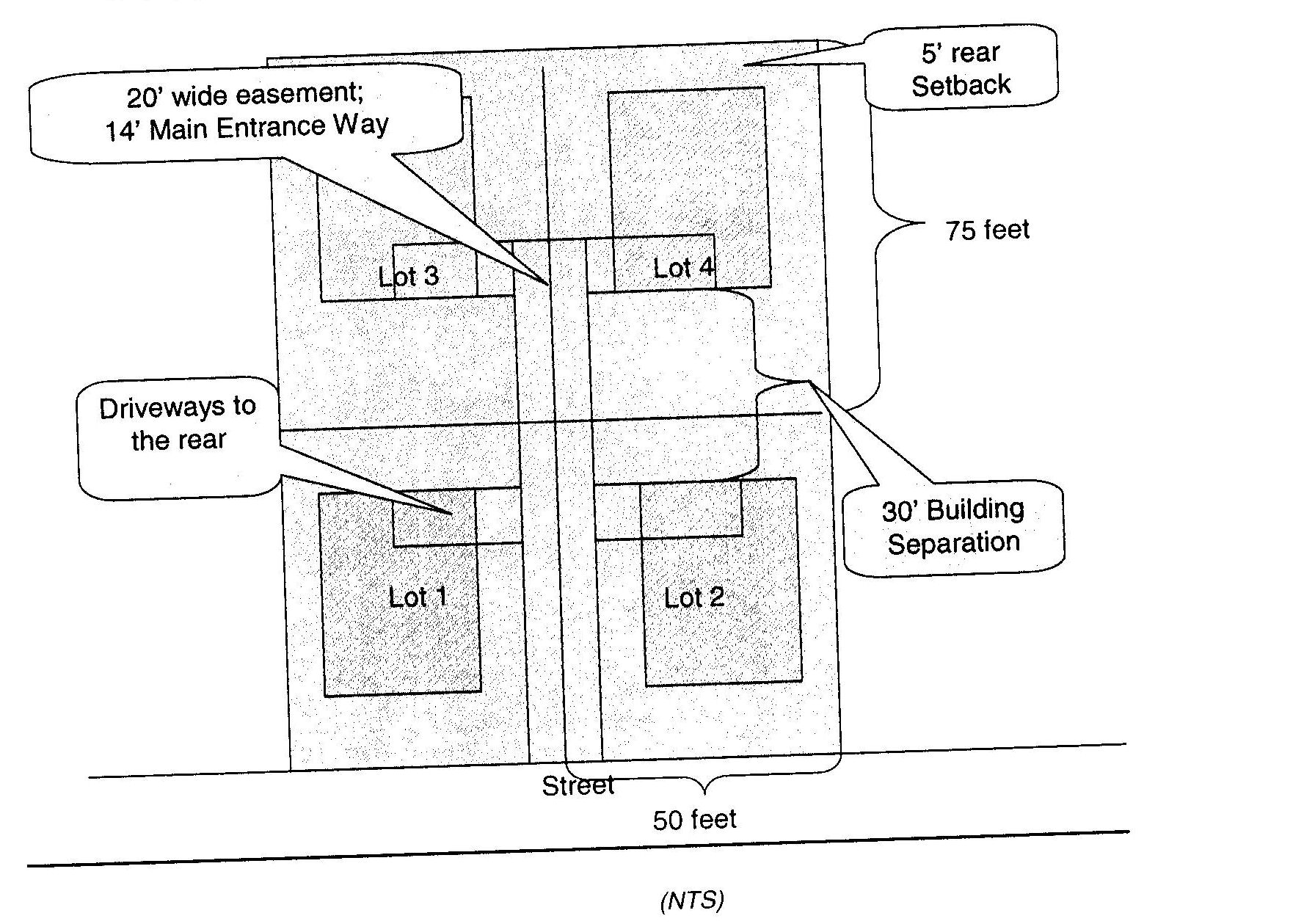
Four lot tandem housing
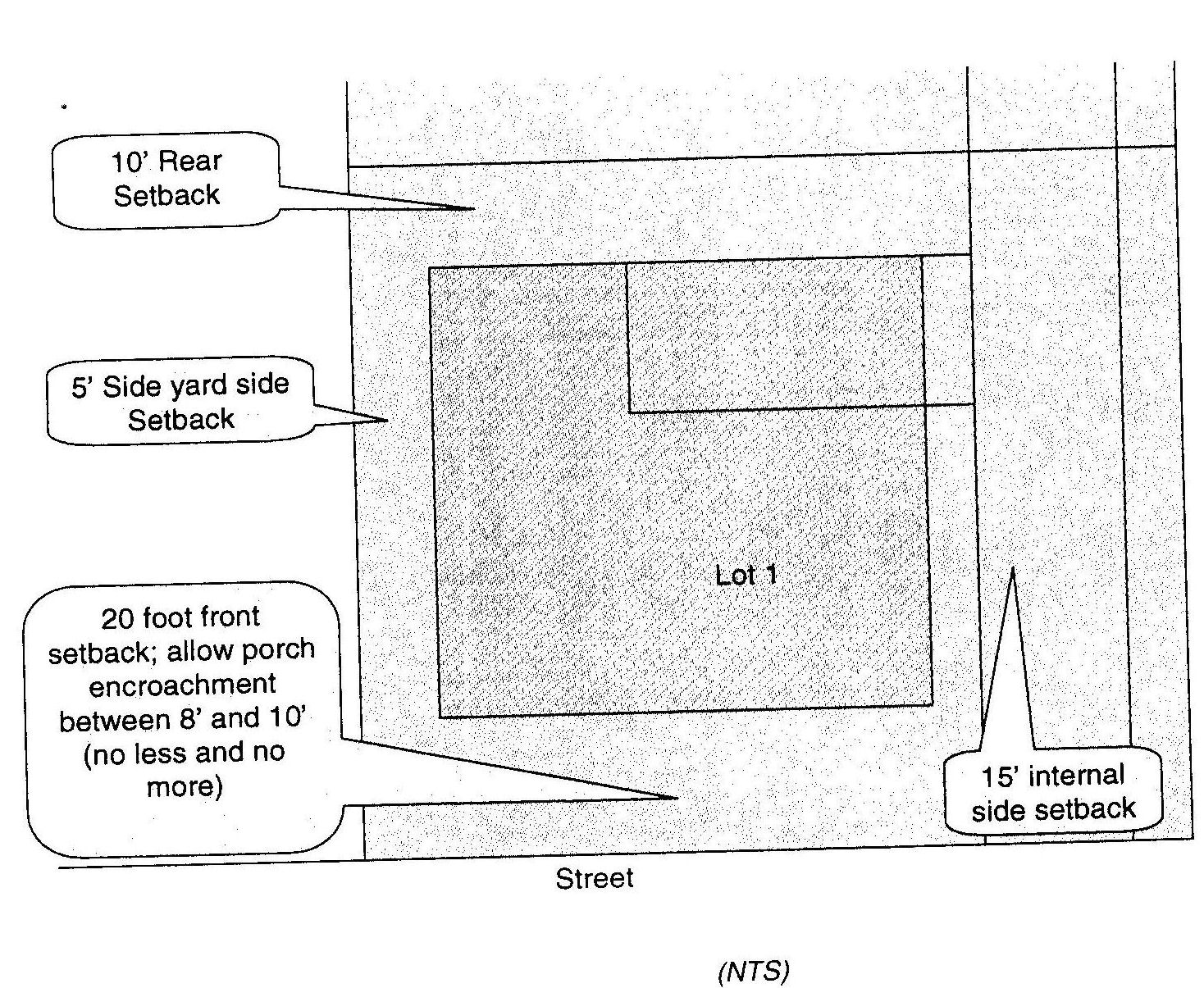
Lot 1—Setbacks
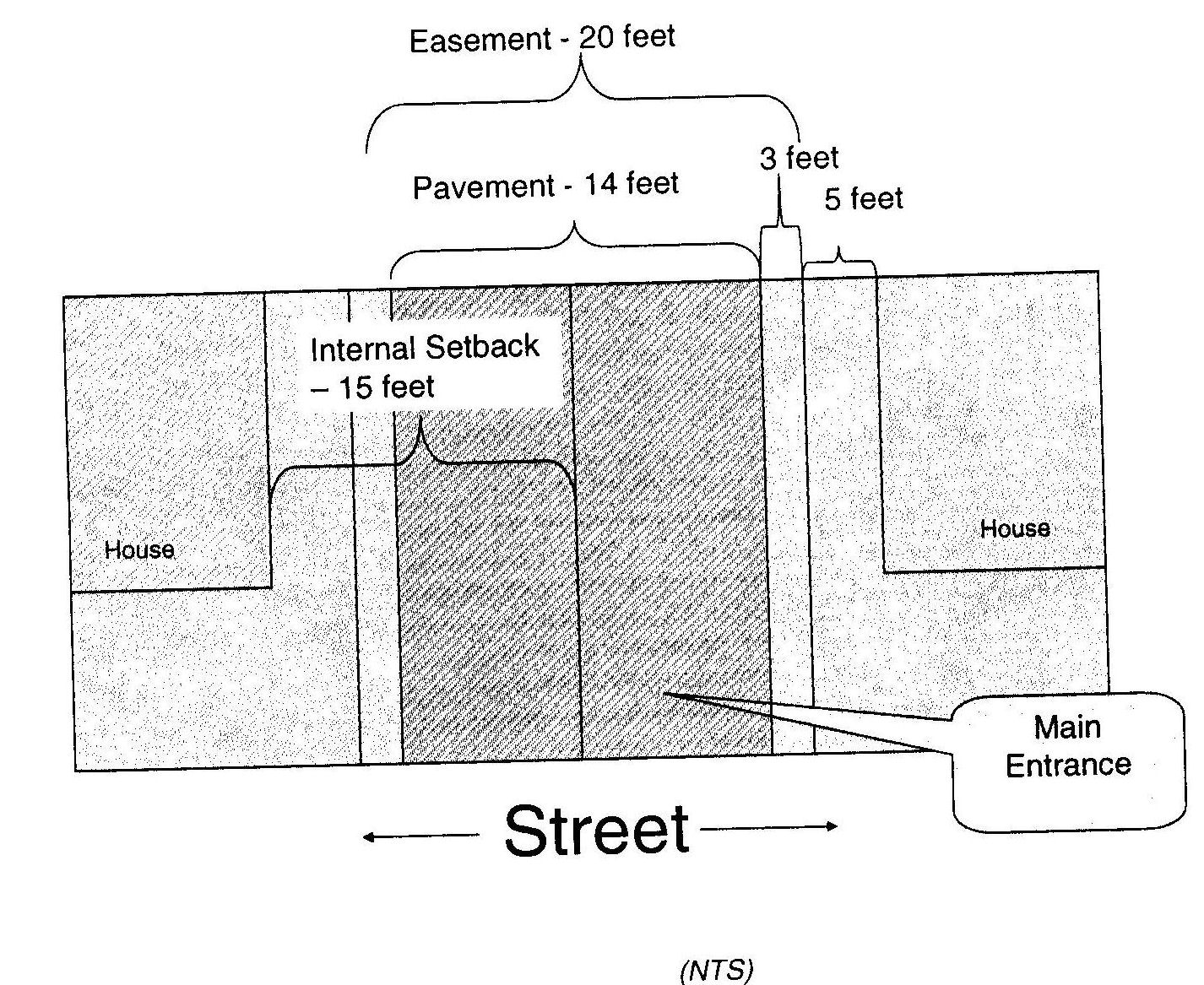
Shared drive
In addition to the above, all tandem housing must have a shared drive down the center of the project that consist of a 20 feet wide access easement with a 14-foot wide paved driveway. All parking spaces shall be located out of sight of the street with each space having a back out area of at least 25 feet. All tandem house projects must be platted. The minimum living area for a tandem house is 1,200 square feet. The minimum lot area is 3,750 square feet unless specifically identified in this zoning district, all other rights and requirements of the R-1 zone applies.
(2)
Design criteria for tandem houses. The intent of these design criteria is to assist in the review and evaluation of building design during preliminary and final plan. All tandem housing must have the following:
a.
Roof design: The pitch of the roof shall be at least 3 in 12, and the roof eaves shall extend at least 15 inches beyond the wall of the dwelling on the two longer sides. A roof with lesser pitch and/or lesser eaves may be approved by the planning commission.
b.
Exterior surfaces: The nonglass exterior surfaces of the dwelling shall not be made of shiny metal and shall, in general, not reflect light to a greater extent than would a coat of semi-gloss enamel applied to wood.
c.
Windows: Each exposure in a tandem house must have at least one window. All windows must have wooden frames (no "punch-out" or metal framed windows).
d.
Porch and garage: All tandem houses shall include a garage or carport, constructed with the same materials as the dwelling. In addition, all tandem house dwellings that face the street shall include an open (but covered) front porch that is a minimum of 130 square feet under roof in size. The internal driveways must be either concrete or brick. No asphalt.
(3)
Approval process. All tandem housing must be approved through the platting process as identified in chapter 110. Each tandem unit must be developed as a "stand alone" lot with access and utility easements.
(Ord. No. 06-34, § 2, 8-24-06)
Sec. 118-520. - Maximum height of structures.
In the RNC-2 zoning district, the maximum height of structures is 35 feet, unless higher height is approved by special exception.
(Ord. No. 06-34, § 2, 8-24-06)
Sec. 118-521. - Off-street parking and loading.
The minimum off-street parking and loading requirements for the RNC-2 zoning district shall be provided in article VIII of this chapter. Accessory dwelling units must provide one additional on-site parking space. Each dwelling unit in a tandem housing development will need to provide two on-site parking spaces.
(Ord. No. 06-34, § 2, 8-24-06)
Sec. 118-522. - Maximum density of development.
Unless preempted by the comprehensive plan, the maximum development permitted in the RNC-2 zoning district will be six dwelling units per acre.
(Ord. No. 06-34, § 2, 8-24-06)
Sec. 118-523. - Minimum living area.
Each residential unit constructed in the RNC-2 zoning district constructed after January 1, 2007, must have the following living area:
(1)
Individual single-family, tandem homes, and townhomes: 1,200 square feet.
(2)
Multi-family:
a.
Three or more bedrooms: 1,000 square feet.
b.
Two or one bedroom: 750 square feet.
(3)
Accessory dwelling unit: Minimum living area of 300 square feet and a maximum living area of 700 square feet or 40 percent of the living area of the main unit, whichever is less.
(Ord. No. 06-34, § 2, 8-24-06)
Secs. 118-524—118-530. - Reserved.
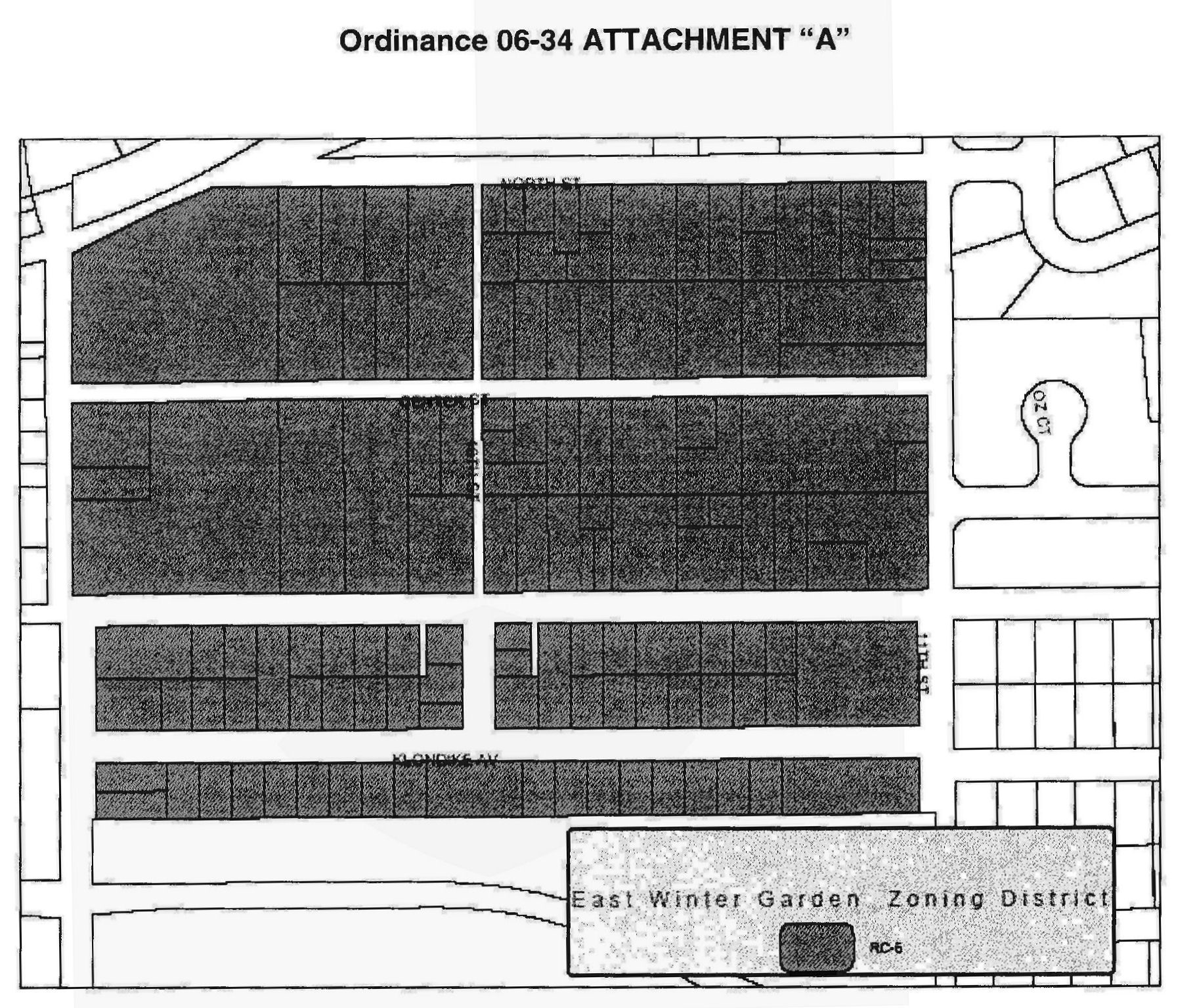
East Winter Garden Zoning District
Sec. 118-531.- Intent.
The C-1 central commercial district is intended to serve most of the trade and service requirements of the city and the surrounding area, and to concentrate such facilities in a convenient central location in such a manner as to minimize the need for small, scattered commercial areas.
(Code 1988, § 24-46(a))
Sec. 118-532. - Principal permitted uses and structures.
Permitted principal uses and structures in the C-1 central commercial district are as follows:
(1)
Retail establishments.
(2)
Eating and drinking establishments.
(3)
Offices, studios.
(4)
Financial institutions.
(5)
Hotels.
(6)
Private clubs and lodges.
(7)
Personal services.
(8)
Recreational and entertainment uses.
(9)
Public buildings.
(10)
Churches.
(11)
Upper story residential.
(Code 1988, § 24-46(b)(1); Ord. No. 97-31, § 7, 9-11-97; Ord. No. 13-27, § 2, 6-27-13)
Sec. 118-533. - Permitted accessory uses and structures.
Permitted accessory uses and structures in the C-1 central commercial district are the customary accessory uses and structures, except that no such accessory use shall be of a nature prohibited as a principal use. The permitted accessory uses and structures for churches in the C-1 central commercial district include a meeting hall, parsonage, baptismal fountains, and columbarium.
(Code 1988, § 24-46(b)(2); Ord. No. 13-27, § 2, 6-27-13)
Sec. 118-534. - Special exceptions.
In the C-1 central commercial district, the uses permitted as special exceptions pursuant to section 118-97 are as follows:
(1)
All types of businesses in buildings not of standard construction or without restroom facilities.
(2)
Planned shopping centers.
(3)
Service stations.
(4)
Educational facilities as an accessory use to a church.
(5)
Other uses which the planning and zoning board determines as the type and intensity of activity similar to and compatible with the permitted uses in the C-1 district.
(Code 1988, § 24-46(b)(3); Ord. No. 98-30, § I, 5-28-98; Ord. No. 13-27, § 2, 6-27-13)
Sec. 118-535. - Prohibited uses and structures.
In the C-1 central commercial district, the uses and structures prohibited are as follows:
(1)
Single-family, two-family and mobile home parks.
(2)
Manufacturing and warehousing activities, freight, or cargo transportation terminals, truck parking facilities, and other activities of similar nature.
(3)
Industrial activities.
(4)
Body art establishments.
(5)
Mobile body art establishments.
(6)
All uses not specifically or provisionally permitted in this division.
(7)
Any use not in keeping with the commercial character of the district.
(Code 1988, § 24-46(b)(4); Ord. No. 99-38, § I(b), 5-27-99; Ord. No. 11-05, § 3, 3-24-11)
Sec. 118-536. - Minimum lot requirements.
In the C-1 central commercial district, the minimum lot requirements, when permitted by special exception, are as follows:
(1)
Multifamily, subject to requirements for the R-NC district.
(2)
Planned shopping centers, subject to subdivision III of division 3 of article V of this chapter.
(3)
Other uses, subject to requirements of the appropriate use.
(Code 1988, § 24-46(c))
Sec. 118-537. - Maximum lot coverage.
In the C-1 central commercial district, there is no limitation on the maximum lot coverage, except such as is involved in the provision of off-street parking and loading space.
(Code 1988, § 24-46(d))
Sec. 118-538. - Minimum yard requirements.
(a)
In the C-1 central commercial district, the minimum yard requirements are as follows:
(1)
Front yard: 25 feet (see subsection (b) of this section).
(2)
Side yard: None, except 15 feet when abutting a public street. (See subsection (c) of this section.)
(3)
Rear yard: 25 feet (see subsection (b) of this section).
(b)
The community development director may, upon written request by the applicant, reduce or waive the minimum front and rear yard requirements, provided the following determinations are made:
(1)
The required yards would prevent the continuous development of a compact and coordinated row of commercial buildings fronting on an already established commercial block or shopping area.
(2)
Off-street parking space required under this division has been provided off the premises in accordance with article VIII of this chapter or within the principal building being proposed or has been waived entirely.
(3)
The required yards would severely limit the overall utilization of the property and would detract from the overall desirability of the adjoining buildings and premises.
The community development director may elect to have the city commission make a decision on the applicant's request based on the above criteria after conducting a public hearing.
(c)
If a side yard is provided it shall be not less than ten feet in width.
(Code 1988, § 24-46(e); Ord. No. 17-21, § 6, 8-24-17)
Sec. 118-539. - Maximum height of structures.
In the C-1 central commercial district, there is no maximum height of structures.
(Code 1988, § 24-46(f))
Sec. 118-540. - Off-street parking and loading.
The minimum off-street parking and loading requirements for the C-1 central commercial district shall be as provided in article VIII of this chapter.
(Code 1988, § 24-46(g))
Sec. 118-576.- Intent.
The C-2 arterial commercial district is intended to apply to retail and professional service areas adjacent to and fronting on designated arterial streets. The purpose of this district is to provide for the development of needed highway-oriented commercial services in a manner harmonious to nearby noncommercial development and in a manner which minimizes traffic congestion and hazards.
(Code 1988, § 24-47(a))
Sec. 118-577. - Principal permitted uses and structures.
Permitted principal uses and structures in the C-2 arterial commercial district are as follows:
(1)
All uses permitted in the C-1 district.
(2)
Motels, with a minimum of 300 square feet per unit exclusive of lobbies and accessory floor areas.
(Code 1988, § 24-47(b)(1); Ord. No. 17-57, § 2, 10-26-17)
Sec. 118-578. - Permitted accessory uses and structures.
Permitted accessory uses and structures in the C-2 arterial commercial district are the customary accessory uses of one or more of the principal uses clearly incidental and subordinate to the principal uses, in keeping with the commercial character of the district.
(Code 1988, § 24-47(b)(2))
Sec. 118-579. - Special exceptions.
In the C-2 arterial commercial district, the uses permitted as special exceptions pursuant to section 118-97 are as follows:
(1)
Campgrounds.
(2)
Planned shopping centers.
(3)
Automobile sales and service.
(4)
All types of businesses in buildings not of standard construction or without restroom facilities.
(5)
Miniwarehouse facilities.
(6)
Truck parking facilities, and other activities of similar nature without adequate buffering from view from a public road and/or adjacent property
(7)
Other uses which the planning and zoning board determines are of the type and intensity of activity similar to and compatible with the permitted uses in the C-2 district.
(8)
Children day care centers.
(9)
Urban farm.
(10)
Gasoline station or a convenient store with gasoline sales.
(11)
Any permitted use with a drive-in or drive-through window, aisle or lane which permits or encourages service directly to patrons or occupants within their vehicles without the need to leave their vehicles.
(Code 1988, § 24-47(b)(3); Ord. No. 99-38, § I(c), 5-27-99; Ord. No. 02-01, § 4, 2-28-02; Ord. No. 13-27, § 3, 6-27-13; Ord. No. 17-21, § 7, 8-24-17; Ord. No. 17-57, § 2, 10-26-17)
Sec. 118-580. - Prohibited uses and structures.
In the C-2 arterial commercial district, the uses and structures prohibited are as follows:
(1)
Residential uses.
(2)
Manufacturing activities.
(3)
Industrial activities.
(4)
Junkyards.
(5)
Body art establishments.
(6)
Mobile body art establishments.
(7)
All uses not specifically or provisionally permitted in this division; any uses not in keeping with the commercial character of the district.
(8)
Garages (commercial).
(Code 1988, § 24-47(b)(4); Ord. No. 11-05, § 4, 3-24-11)
Sec. 118-581. - Minimum lot area.
In the C-2 arterial commercial district, there is no minimum lot requirement except as follows:
(1)
Gasoline stations: 15,000 square feet.
(2)
Motels: 20,000 square feet plus 2,000 square feet for each unit over seven units in the first story and add 1,500 square feet for each unit on second and third stories.
(3)
Planned shopping centers, when permitted by special exception: See subdivision III of division 3 of article V of this chapter.
(Code 1988, § 24-47(c))
Sec. 118-582. - Minimum average lot width.
In the C-2 arterial commercial district, there is no minimum average lot width except as follows:
(1)
Gasoline stations: 150 feet.
(Code 1988, § 24-47(d))
Sec. 118-583. - Minimum average lot depth.
In the C-2 arterial commercial district there is no minimum average lot depth except as follows:
(1)
Gasoline stations: 100 feet.
(Code 1988, § 24-47(e))
Sec. 118-584. - Maximum lot coverage.
In the C-2 arterial commercial district, the maximum lot coverage is none, except such as is involved in the provision of front, side and rear yards and off-street parking and loading space.
(Code 1988, § 24-47(f))
Sec. 118-585. - Maximum height.
In the C-2 arterial commercial district, the maximum height of structures for gasoline stations is 35 feet.
(Code 1988, § 24-47(g))
Sec. 118-586. - Minimum building setbacks.
In the C-2 arterial commercial district, the minimum building setbacks are as follows:
(1)
Generally.
a.
Front: 40 feet, except State Road 50 shall be 50 feet.
b.
Side interior lot: 20 feet when abutting a residential zoning district.
c.
Side corner lot: 40 feet.
d.
Rear: 20 feet when abutting a residential zoning district.
(2)
Gasoline stations.
a.
Front: 40 feet, 20 feet to pump islands.
b.
Side interior lot: ten feet.
c.
Side corner lot: 40 feet, 20 feet to pump islands.
d.
Rear: 15 feet when abutting alley.
(Code 1988, § 24-47(h))
Sec. 118-587. - Off-street parking and loading.
The minimum off-street parking and loading requirements for the C-2 arterial commercial district shall be as provided in article VIII of this chapter.
(Code 1988, § 24-47(i))
Sec. 118-626.- Intent.
The C-3 professional office district is designed to provide for proper development in locations where professional and related commercial uses can be permitted without conflicting with abutting and adjacent uses, by establishment of development standards and buffering requirements. This district is intended to provide a convenient physical relationship between professional office and service uses and related institutional uses.
(Code 1988, § 24-48(a))
Sec. 118-627. - Principal permitted uses and structures.
Permitted principal uses and structures in the C-3 professional office district are as follows:
(1)
Professional and business offices.
(2)
Laboratories and clinics.
(3)
Nursing homes.
(4)
Studios.
(5)
Public uses.
(6)
Communication towers and communication antennas.
(Code 1988, § 24-48(b)(1); Ord. No. 97-31, § 7, 9-11-97)
Sec. 118-628. - Permitted accessory uses and structures.
Permitted accessory uses and structures in the C-3 professional office district are the customary accessory uses of one or more of the principal uses clearly incidental and subordinate to the principal uses, in keeping with the commercial character of the district.
(Code 1988, § 24-48(b)(2))
Sec. 118-629. - Special exceptions.
In the C-3 professional office district, the uses permitted as special exceptions pursuant to section 118-97 are as follows:
(1)
Recreation facilities.
(2)
All types of businesses in buildings not of standard construction or without restroom facilities.
(3)
Other commercial uses which the planning and zoning board determines are of the type and intensity of activity similar to and compatible with the permitted uses in the C-3 district.
(4)
Permitted structures over 40 feet in height.
(5)
Apartments subject to division 4 of article VI of this chapter.
(6)
Children day care centers.
(Code 1988, § 24-48(b)(3); Ord. No. 02-01, § 5, 2-28-02; Ord. No. 13-27, § 4, 6-27-13)
Sec. 118-630. - Prohibited uses and structures.
In the C-3 professional office district, the uses and structures prohibited are as follows:
(1)
Residential uses.
(2)
Manufacturing and warehousing activities, freight or cargo transportation terminals, truck parking facilities, and other activities of similar nature.
(3)
Industrial activities.
(4)
Gasoline stations.
(5)
All uses not specifically or provisionally permitted in this division; any use not in keeping with the commercial character of the district.
(Code 1988, § 24-48(b)(4); Ord. No. 99-38, § I(d), 5-27-99)
Sec. 118-631. - Minimum lot area.
In the C-3 professional office district, the minimum lot area for offices, clinics and nursing homes shall be 10,000 square feet.
(Code 1988, § 24-48(c))
Sec. 118-632. - Minimum average lot width.
In the C-3 professional office district, the minimum average lot width shall be 100 feet.
(Code 1988, § 24-48(d))
Sec. 118-633. - Minimum average lot depth.
In the C-3 professional office district, the minimum average lot depth shall be 100 feet.
(Code 1988, § 24-48(e))
Sec. 118-634. - Maximum lot coverage.
In the C-3 professional office district, the maximum lot coverage shall be 40 percent.
(Code 1988, § 24-48(f))
Sec. 118-635. - Maximum height.
In the C-3 professional office district, the maximum height of structures is 40 feet or higher if approved by special exception.
(Code 1988, § 24-48(g))
Sec. 118-636. - Minimum building setbacks.
In the C-3 professional office district, the minimum building setbacks are as follows:
(1)
Front: 20 feet.
(2)
Side interior lot: 20 feet, when abutting a residential zoning district.
(3)
Side corner lot: 20 feet.
(4)
Rear: 20 feet, when abutting a residential zoning district.
(Code 1988, § 24-48(h))
Sec. 118-637. - Off-street parking and loading.
The minimum off-street parking and loading requirements for the C-3 professional office district shall be as provided in article VIII of this chapter.
(Code 1988, § 24-48(i))
Sec. 118-676.- Intent.
The C-4 neighborhood commercial district is intended to serve the needs of nearby residential neighborhoods with commercial and service facilities. This district provides areas for commercial development such as compact shopping areas located in the neighborhoods which they serve. The location of such areas is intended to conveniently supply the immediate needs of the neighborhood where the types of services rendered and the commodities sold are those which are needed daily and purchased at frequent intervals.
(Code 1988, § 24-49(a))
Sec. 118-677. - Principal permitted uses and structures.
Permitted principal uses and structures in the C-4 neighborhood commercial district are as follows:
(1)
Recreational facilities.
(2)
Communication towers and communication antennas.
(3)
Retail stores and shops of a neighborhood convenience, such as convenience foodstores, dry cleaning and laundry facilities, bakeries, drug and sundries, barbershops and beauty shops and the like.
(4)
Professional offices, studios and personal service establishments of a similar nature.
(Code 1988, § 24-49(b)(1); Ord. No. 97-31, § 7, 9-11-97)
Sec. 118-678. - Permitted accessory uses and structures.
Permitted accessory uses and structures in the C-4 neighborhood commercial district are the customary accessory uses of one or more of the principal uses clearly incidental and subordinate to the principal use, in keeping with the low-density commercial character of the district.
(Code 1988, § 24-49(b)(2))
Sec. 118-679. - Special exceptions.
In the C-4 neighborhood commercial district, the uses permitted as special exceptions pursuant to section 118-97 are as follows:
(1)
Convenience foodstores with retail gas sales, with the average gross revenue from the sale of gas being less than 60 percent of the store's total average gross revenue.
(2)
All types of businesses in buildings not of standard construction or without restroom facilities.
(3)
Any other retail store or service establishment that is consistent with those included in this district, and further that will be in harmony with the spirit of this article.
(Code 1988, § 24-49(b)(3))
Sec. 118-680. - Prohibited uses and structures.
In the C-4 neighborhood commercial district, the uses and structures prohibited are as follows:
(1)
Residential uses.
(2)
Manufacturing and industrial activities, transportation terminals, storage warehousing and other activities of a similar nature.
(3)
Outdoor sales displays.
(4)
All uses not specifically or provisionally permitted in this division; any use not in keeping with the low-density commercial character of the district.
(5)
Churches.
(6)
Gasoline stations.
(Code 1988, § 24-49(b)(4))
Sec. 118-681. - Minimum lot area.
In the C-4 neighborhood commercial district, the minimum lot requirements shall be 7,200 square feet.
(Code 1988, § 24-49(c))
Sec. 118-682. - Minimum average lot width.
In the C-4 neighborhood commercial district, the minimum average lot width shall be 60 feet.
(Code 1988, § 24-49(d))
Sec. 118-683. - Minimum average lot depth.
In the C-4 neighborhood commercial district, the minimum average lot depth shall be 120 feet.
(Code 1988, § 24-49(e))
Sec. 118-684. - Maximum lot coverage.
In the C-4 neighborhood commercial district, the maximum lot coverage is 40 percent.
(Code 1988, § 24-49(f))
Sec. 118-685. - Maximum height.
In the C-4 neighborhood commercial district, the maximum height of structures is 35 feet.
(Code 1988, § 24-49(g))
Sec. 118-686. - Minimum building setbacks.
In the C-4 neighborhood commercial district, the minimum building setbacks are as follows:
(1)
Front: 40 feet.
(2)
Side interior lot: 20 feet when abutting a residential zoning district.
(3)
Side corner lot: 40 feet.
(4)
Rear: 20 feet when abutting a residential zoning district.
(Code 1988, § 24-49(h))
Sec. 118-687. - Off-street parking and loading.
The minimum off-street parking and loading requirements for the C-4 neighborhood commercial district shall be as provided in article VIII of this chapter.
(Code 1988, § 24-49(i))
Sec. 118-726.- Intent.
The I-1 light industrial and warehousing district is intended to apply to an area which can serve light manufacturing, warehousing, distribution, wholesaling, and other light industrial functions of the city and the surrounding area. Restrictions are intended to minimize adverse impacts to nonindustrial uses or to minimize adverse impacts to abutting residential and commercial uses and adjacent industrial uses.
(Code 1988, § 24-50(a))
Sec. 118-727. - Permitted uses.
Permitted uses in the I-1 light industrial and warehousing district are as follows:
(1)
Warehousing, wholesaling, and storage facilities within enclosed structures.
(2)
Ministorage warehouse facilities.
(3)
Light manufacturing, processing, and assembly, including precision manufacturing, electrical machinery, instrumentation, and similar uses.
(4)
Research and development facilities, provided that all activities are within an enclosed structure.
(5)
Vocational and trade schools.
(6)
Public utility equipment and facilities.
(7)
Radio or television transmitter, towers, or broadcasting facilities.
(8)
Communication towers and communication antennas.
(9)
Truck parking facilities (but not transportation terminals or freight handling facilities).
(10)
Urban farm.
(11)
Mobile food dispensing vehicle as defined by F.S. § 509.102.
(Code 1988, § 24-50(b); Ord. No. 97-31, § 8, 9-11-97; Ord. No. 99-38, § I(e), 5-27-99; Ord. No. 17-21, § 8, 8-24-17; Ord. No. 21-38, § 2, 10-28-21)
Sec. 118-728. - Permitted accessory structures and uses.
Permitted accessory uses and structures in the I-1 light industrial and warehousing district are as follows:
(1)
Dwelling unit for caretaker or watchman employed on the premises.
(2)
Customary accessory uses clearly incidental and subordinate to one of the principal uses.
(3)
Retail sales of products manufactured, processed, or stored on the premises.
(4)
Offices clearly accessory to one or more principal uses.
(Code 1988, § 24-50(c))
Sec. 118-729. - Special exceptions.
In the I-1 light industrial and warehousing district, the uses permitted as special exceptions pursuant to section 118-97 are as follows:
(1)
Freight handling and transportation terminals.
(2)
Planned industrial developments including office and business parks.
(3)
Commercial uses which are deemed compatible with the principal uses in this zone.
(4)
Body art establishments.
(Code 1988, § 24-50(d); Ord. No. 11-05, § 5, 3-24-11)
Sec. 118-730. - Special regulations.
(a)
Permitted uses within the I-1 light industrial and warehousing district include only those light uses which are nonhazardous and whose premises do not contain any outdoor or open storage or aboveground tank storage of merchandise, products or materials or any outdoor or open storage of equipment, materials or other items utilized by such establishments in practicing the vocation or occupation, except for automobiles and delivery or service trucks. The term "nonhazardous" as used in this subsection refers to those structures, uses, materials or premises that do not constitute a fire, explosion or safety hazard or that do not emit any atmospheric or environmental pollutant, light flashes, noxious gases, electromagnetic interference, radioactive emissions, smoke or heat, glare, dust, dirt, odor, noise or vibrations which may be heard or felt off the premises.
(b)
The planning and zoning board shall determine whether or not a use proposed to be located within the I-1 industrial district is considered a light use in regard to subsection (a) of this section and article VII of this chapter whenever the classification of the use is in doubt.
(Code 1988, § 24-50(e))
Sec. 118-731. - Prohibited uses and structures.
In the I-1 light industrial and warehousing district, the uses and structures prohibited are as follows:
(1)
Residential uses, except as provided under section 118-728 for permitted accessory structures and uses.
(2)
Motels, hotels, roominghouses.
(3)
Outside storage, except for wholesale automobile or farm equipment. Any motor vehicles stored outside must be in operating condition at all times.
(4)
All uses not specifically or provisionally permitted in this division or any use not in keeping with the industrial character of the district.
(5)
Concrete, block, and asphalt plants including batch plants.
(6)
Automobile junkyards, scrap yards, and salvage yards.
(7)
Any use deemed objectionable because it may be noxious or injurious because of the production or emission of dust, smoke, refuse matter, odor, gas, fumes, noise, vibration or similar substances or conditions, and any one or combination of these may be prohibited; however, any one of these uses may be permitted if approved by the planning and zoning board and subject to the conditions, restrictions, requirements and safeguards as may be deemed necessary by the planning and zoning board for the protection of health, safety and general welfare of the area.
(8)
Storage of liquefied petroleum products and petrochemical products.
(Code 1988, § 24-50(f))
Sec. 118-732. - Dimensions and area regulations.
Dimensions and area regulations for lots and structures in the I-1 light industrial and warehousing district are as follows:
(1)
Building height. The maximum building height shall be 40 feet.
(2)
Front yard. The minimum front yard shall be 50 feet.
(3)
Rear yard. The minimum rear yard shall be 30 feet. The planning and zoning board may upon application by the developer reduce the required rear yard where such rear yard would be adjacent to a railroad siding if such reduction would not be detrimental to surrounding areas.
(4)
Side yard. The minimum side yard shall be 35 feet for corner lots and 25 feet for interior lots. The planning and zoning board may upon application by the developer reduce the required side yard where such side yard would be adjacent to a railroad siding if such reduction would not be detrimental to surrounding areas.
(5)
Lot area. The minimum lot area shall be 18,750 square feet.
(6)
Lot width. The minimum lot width shall be 125 feet.
(7)
Lot depth. The minimum lot depth shall be 150 feet.
(8)
Maximum lot coverage. The maximum lot coverage shall be 50 percent.
(Code 1988, § 24-50(g))
Sec. 118-733. - Off-street parking and loading.
The minimum off-street parking and loading requirements for the I-1 light industrial and warehousing district shall be as provided in article VIII of this chapter.
(Code 1988, § 24-50(g)(9))
Sec. 118-734. - General requirements.
(a)
Location; designs for routing traffic. Each I-1 light industrial and warehousing district shall be located on a major street. Driveways, streets and facilities for routing traffic shall be designed in such a manner that entrances and exits to public streets are not hazardous and that traffic congestion is minimized. Furthermore, no entrances or exits shall direct traffic into adjacent residential district.
(b)
Buffer yards. A buffer yard of not less than 50 feet in width shall be provided along each I-1 district boundary that abuts any residential district. Such buffer yard shall be in lieu of front, side, or rear yards. The 20 feet of such yard nearest the district boundary shall not be used for any processing activity, building, or structure other than fences, wall, or berms and shall be landscaped and maintained with shrubs and trees. A minimum of one tree shall be planted for each 25 feet of common lot line or fraction thereof. Landscaped materials shall attain a minimum height of six feet and shall be at least 75 percent opaque when viewed from any point along the adjoining boundary within 18 months after planting. The remaining 30 feet of the buffer yard shall not be used for any processing activities, buildings, or structures other than fences, wall, berms, or off-street parking lots of passenger cars.
(Code 1988, § 24-50(h))
Sec. 118-771.- Intent.
The I-2 general industrial district is intended to apply to an area located in close proximity to transportation facilities and which can serve heavy manufacturing, storage, distribution and other heavy industrial functions of the city and surrounding region. Restrictions in this division are intended to minimize adverse influences of heavy industrial areas and to eliminate unnecessary industrial traffic through nonindustrial areas.
(Code 1988, § 24-51(a))
Sec. 118-772. - Permitted uses.
Permitted uses in the I-2 general industrial district are as follows:
(1)
Those uses permitted in the I-1 district.
(2)
Transportation terminals and freight handling facilities.
(3)
Commercial garages.
(4)
Food processing, bottling plants, bakeries, fruit packing, dairy products plants, and similar uses.
(5)
Textile and apparel manufacturing, processing, and storage.
(6)
Lumber and wood products manufacturing, processing, and storage.
(7)
Communication towers and communication antennas.
(8)
Urban farm.
(9)
Mobile food dispensing vehicle as defined by F.S. § 509.102.
(Code 1988, § 24-51(b); Ord. No. 97-31, § 9, 9-11-97; Ord. No. 17-21, § 9, 8-24-17; Ord. No. 21-38, § 2, 10-28-21)
Sec. 118-773. - Permitted accessory uses and structures.
Permitted accessory uses and structures in the I-2 general industrial district are as follows:
(1)
Offices clearly accessory to one or more principal uses.
(2)
Retail sales of products manufactured, processed or stored upon the premises.
(3)
Customary accessory uses of one or more of the principal uses, clearly incidental and subordinate to the principal use, in keeping with the industrial character of the district.
(4)
Dwelling unit for caretaker or watchman employed on the premises.
(5)
Outside display or storage; however, if any outside display or storage is approved the area shall have an opaque screen on all sides in order to avoid any deleterious impact on adjacent properties.
(Code 1988, § 24-51(c))
Sec. 118-774. - Special exceptions.
In the I-2 general industrial district, the uses permitted as special exceptions pursuant to section 118-97 are as follows:
(1)
Concrete, block, and asphalt plants including batch plants.
(2)
Bulk storage of chemical or petrochemical products.
(3)
Any structure higher than 40 feet.
(4)
Any outside display or storage. Any outside display or storage area shall have an opaque screen on all sides in order to avoid any deleterious impact on adjacent property.
(5)
Bulk storage of compressed gases or cryogenic materials.
(6)
Body art establishments.
(Code 1988, § 24-51(d); Ord. No. 11-05, § 6, 3-24-11)
Sec. 118-775. - Prohibited uses and structures.
In the I-2 general industrial district, the uses and structures prohibited are as follows:
(1)
Residential uses.
(2)
Motels, hotels, roominghouses.
(3)
All uses not specifically or provisionally permitted in this division; except as provided for under section 118-774, any uses not in keeping with the industrial character of the district.
(4)
Any use deemed objectionable because it may be noxious or injurious because of the production or emission of dust, smoke, refuse matter, odor, gas, fumes, noise, vibration or similar substances or conditions and any one or combination of these may be prohibited; however, any one of these uses may be permitted if approved by the planning and zoning board and subject to the conditions, restrictions, requirements and safeguards as may be deemed necessary by the planning and zoning board for the protection of health, safety and general welfare of the area.
(Code 1988, § 24-51(e))
Sec. 118-776. - Dimensions and area requirements.
Dimensions and area regulations for lots and structures in the I-2 general industrial district are as follows:
(1)
Maximum building height: 40 feet.
(2)
Minimum lot area: 18,750 square feet.
(3)
Minimum average lot width: 125 feet.
(4)
Minimum average lot depth: 150 feet.
(5)
Maximum lot coverage: 50 percent.
(6)
Minimum building setbacks:
a.
Front: 50 feet.
b.
Side interior lot: 25 feet.
c.
Side corner lot: 35 feet; however, where adjacent to a use district requiring greater setbacks, the same setbacks will be provided as required for the abutting district. In addition, additional setbacks may be required by the planning and zoning board for reasons of public safety and welfare.
d.
Rear: 30 feet. Rear yards may be reduced to zero when the real property line coincides with a railroad siding; however, no tracking shall be located nearer than 300 feet to any residential district.
(Code 1988, § 24-51(f))
Sec. 118-777. - Off-street parking and loading.
The minimum off-street parking and loading requirements for the I-2 general industrial district shall be as provided in article VIII of this chapter.
(Code 1988, § 24-51(f)(6)5)
Sec. 118-778. - Landscaping of yards; reservation of land adjacent to single-family residential use.
(a)
All required yards in the I-2 general industrial district shall be grassed or landscaped. Required yards shall not be used for off-street parking or for the storage of materials.
(b)
Whenever property zoned I-2 shall abut or adjoin property zoned primarily for single-family residential use, the property zoned I-2, for a depth of 50 feet adjoining any such single-family residential property, shall be reserved for the planting of trees and bushes; provided, however, that such property may be used for driveway access, but not for off-street parking purposes.
(Code 1988, § 24-51(f)(6)6, (f)(6)7)
Sec. 118-779. - General requirements.
(a)
Location; designs for traffic routing. Each I-2 general industrial district shall be located on a major street. Driveways, streets and facilities for routing traffic shall be designed in such a manner that entrances and exits to public streets are not hazardous and that traffic congestion is minimized. Furthermore, no entrances or exits shall direct traffic into adjacent residential district.
(b)
Buffer yards. A buffer yard of not less than 50 feet in width shall be provided along each I-2 district boundary which abuts any residential district. Such buffer yard shall be in lieu of front, side, or rear yards. The 20 feet of such yard nearest the district boundary shall not be used for any processing activity, building, or structure other than fences, wall, or berms, and shall be landscaped and maintained with shrubs and trees. A minimum of one tree shall be planted for each 25 feet of common lot line or fraction thereof. Landscape materials shall attain a minimum height of six feet and shall be at least 75 percent opaque when viewed from any point along the adjoining boundary within 18 months after planting. The remaining 30 feet of the buffer yard shall not be used for any processing activities, buildings, or structures other than fences, wall, berms, or off-street parking lots of passenger cars.
(Code 1988, § 24-51(g))

