
Winter Garden City Zoning Code
ARTICLE IX
WEST STATE ROAD 50 OVERLAY COMMERCIAL DEVELOPMENT STANDARDS
DIVISION 3. - RESERVED[19]
Editor's note— Ord. No. 13-19, § 5, adopted May 23, 2013, repealed §§ 118-1430—118-1431, which pertained to signage within the commercial corridor and derived from Ord. No. 03-30, § 2, 9-17-03; Ord. No. 03-52, § 2, 12-11-03.
Sec. 118-1400. - Establishment.
In addition to and supplemental to the Code, there is hereby created an overlay zoning classification known as the "West State Road 50 Commercial Corridor" (the "commercial corridor district"). The effect thereof being the creation of an overlay zoning district consisting of the regulations and requirements of the existing, or as such may be amended from time to time, underlying zoning district and the regulations and requirements contained in this article. That is, the commercial corridor district shall be in addition to and shall overlay all other existing, or as such may be amended from time to time, underlying zoning classification where it is applied so that any parcel of land lying within the commercial corridor district shall also lie within one or more of the other zoning classifications provided in the city land development code.
(Ord. No. 03-30, § 2, 9-17-03)
Sec. 118-1401. - Intent and purpose.
The recitals to the ordinance adopting this article are hereby incorporated into this section as legislative findings and represent the intent of the city commission in adopting this article to provide specific and uniform design standards for properties within the hereafter identified commercial corridor for the purposes of ensuring that said commercial corridor is developed in a manner which:
(1)
Ensures that the commercial corridor is developed into a well-landscaped, scenic gateway into the city;
(2)
Provides uniform design standards to establish high quality development with a positive visual ambiance;
(3)
Prevents visual pollution caused by unplanned and uncoordinated uses, buildings and structures;
(4)
Maximizes traffic circulation patterns and functions from the standpoint of safety, roadway capacity, vehicular and non-vehicular movement;
(5)
Maintains and enhances property values;
(6)
Preserves natural features to the extent practicable;
(7)
Encourages high quality economic development within the city;
(8)
Preserves and enhances the high-quality lifestyle and standard of living available to the residents of the city;
(9)
Takes into consideration the future widening of State Road 50 to a six-lane divided highway and development associated therewith;
(10)
Creates and maintains a strong community image, identity and sense of place;
(11)
Promotes a high degree of compatibility between surrounding structures and attendant uses;
(12)
Fosters civic pride and community spirit by maximizing the impact of quality development;
(13)
Recognizes and makes allowances for existing uses and buildings;
(14)
Promotes the health, safety and general welfare of the commercial corridor, the city and its citizens;
(15)
Promotes the orderly growth and development within the commercial corridor along with the achievement of the goals, objectives and policies of the city's comprehensive plan;
(16)
Establishes coordinated and uniform standards and regulations which will encourage capital investment in the city and preserve the public investment in the commercial corridor spurring commercial activity and the attraction of new businesses and commercial activity; and
(17)
Reduces the risk of creating blighted areas resulting from uncoordinated and non-uniform standards and regulations.
(Ord. No. 03-30, § 2, 9-17-03)
Sec. 118-1402. - Boundaries of the commercial corridor.
The commercial corridor consists of those parcels within the city limits located within 350 feet of the centerline of State Road 50. The boundaries of the commercial corridor are graphically depicted on the commercial corridor map, attached hereto as Exhibit "A" and incorporated herein by this reference. Parcels located within the aforedescribed commercial corridor shall be subject to the provisions in this article, except as otherwise provided herein.
Where uncertainty exists with respect to the boundaries of the commercial corridor as shown on the commercial corridor map, the following shall apply:
(1)
The boundaries for the West State Road 50 Overlay area extend 350 feet from the centerline of West State Road 50 and includes all parcels in the 350 foot distance. In addition, any parcel of land which is located within the 350 foot area that also has a portion of the entire parcel outside the 350 foot area but is part of the same parcel of land, shall be included within the commercial corridor as if the parcel was wholly situated within the stated corridor width and is also zoned C-2 or PCD. Single use residential zoned parcels are not included in the West State Road 50 Overlay Zone.
Parcels which are subsequently annexed into the city and are within the 350 foot distance requirement from the centerline of West State Road 50 and a portion of the entire parcel outside the 350 foot area but is part of the same parcel of land, shall be included within the commercial corridor as if the parcel was wholly situated within the stated corridor width shall be made part of the West State Road 50 Overlay as a part of the city approving annexation of the parcel and subject to the provisions as outlined in section 118-1403(3).
(2)
Notwithstanding subsection (1) above, any parcel adjacent to State Road 50 or which has direct access to or from State Road 50 shall be included within the commercial corridor. Furthermore, notwithstanding subsection (1) above, any parcel, deriving in whole or in part from a parcel to which these commercial corridor standards and regulations apply as of the effective date of this article, shall also be subject to this article. Adjoining parcels created by subdividing a larger parcel shall be required to conform to these standards and regulations.
(Ord. No. 03-30, § 2, 9-17-03; Ord. No. 10-08, § 2(Exh. A), 7-8-10)
Sec. 118-1403. - Applicability.
(1)
The standards and regulations set forth in this article, in addition to existing land development regulations provided for in the Code, shall be the minimum standards and regulations for parcels, buildings, structures and/or improvements within the commercial corridor which undergo new development or substantial modification after the effective date of this article. It is the express intent of this article that, except as provided in section 118-1431, the standards and regulations provided in this article shall not apply to existing developed parcels, or buildings, structures or improvements existing as of the effective date of this article unless and until such time as said parcels, buildings, structures and/or improvements undergo a substantial modification or new development occurs.
(2)
Existing buildings or uses. The site requirements of the West State Road 50 Overlay shall not apply to any modification, alteration, renovation or refurbishment of an existing building or use provided that: (1) such reconstruction is necessitated due to an Act of God; (2) such reconstruction is substantially similar to such building or accessory structure, or portions thereof, which was damaged or destroyed by an Act of God; and (3) such reconstruction does not cause nonconformity with the provisions of this article or increase its size, height, or other physical characteristics or intensity of the site when compared to the building or accessory structure, or portions thereof, which was destroyed or damaged by an Act of God. Any such modification, alteration, renovation or refurbishment shall, however, remain subject to the architectural requirements of the overlay of a building or accessory structure, or portions thereof, legally existing and lawfully conforming with the Code as of the effective date of this article.
(3)
Annexation of commercial property. For the purposes of this article, the existing physical condition of properties annexed into the city after the date of this article shall be treated as if such physical condition existed on the effective date of this article.
(Ord. No. 03-30, § 2, 9-17-03; Ord. No. 10-08, § 2(Exh. A), 7-8-10)
Sec. 118-1404. - Definitions.
The following words, terms, phrases, when used in this article, shall have the meanings ascribed to them in this section, except where the context clearly indicates a different meaning:
Building (or structure) footprint means the area of the lot covered by the building as measured from the outside of the perimeter walls of the building. In the absence of the exterior walls, the building footprint shall be the area under the horizontal projection of the roof.
City means the City of Winter Garden, Florida. As used throughout, the term "city" also includes the designated agent of the city.
Code means the City of Winter Garden Code of Ordinances, including, but not limited to, all ordinances, resolutions, rules, regulations or land development requirements, heretofore and hereafter adopted by the City of Winter Garden.
Commercial corridor means that geographic area identified in section 118-1402 as an overlay district and special area of control for the purposes provided in section 118-1401.
Design standards means the "Supplemental Design Standards, Requirements and Regulations Pertaining to Specified Commercial Corridors within the City of Winter Garden," as such may be amended from time to time. The design standards, adopted by the city as part of this article and attached thereto as Exhibit "B", are incorporated herein by this reference. It is the express intent of this article that the design standards, or any portion thereof, are in addition to and supplemental to the Code. Unless otherwise expressly provided for in the design standards, in the event of a conflict between the design standards, or any portion thereof, and any of the provisions of the Code the more restrictive provision shall control.
New development means the construction of a building upon a vacant parcel; construction of a building upon a parcel whereon a building existed as of the effective date of this Ordinance and such building was razed; or the construction, alteration, improvement, expansion, renovation or modification of a building which involves the complete demolition of said building. Notwithstanding the foregoing, "new development" does not include the construction, alteration, improvement, expansion, renovation or modification of all or part of a building razed or demolished by (or which is required to be razed or demolished due to) an Act of God when such building, or portions thereof, legally existed and lawfully conformed with the Code prior to the effective date of this article.
Substantial modification means any improvement, expansion, renovation, alteration, construction or modification of a building or accessory structure existing as of the effective date of this article in which said improvement, expansion, renovation, alteration, construction or modification:
(1)
Results in greater than a 50 percent increase in the total square footage of the existing building and accessory structure footprint if said existing building and accessory structure footprint is 10,000 square feet or less; or
(2)
Results in greater than a 25 percent increase in the total square footage of the existing building and accessory structure footprint if said building and accessory structure footprint is greater than 10,000 square feet; or
(3)
Results in an improvement, expansion, renovation, alteration, construction or modification where the cost of the proposed improvements is greater than 50 percent of the assessed value of the existing improvements. For purposes of this paragraph, "assessed value" shall be as determined by the Orange County Property Appraiser and "costs of the proposed improvements" shall be submitted with a cost estimate from the contractor and approved by the building official; or
(4)
Results in greater than a 100 percent increase in the number of parking spaces, as required by the Code, due to a change in the use of the subject property when compared to the number of paved parking spaces required for the prior use of the subject property.
Nonsubstantial modification means any improvements, expansions, renovations alterations or modifications of a building or accessory structure existing as of the effective date of this article in which:
(1)
Results in a redevelopment, modification, alteration, renovation or refurbishment of the existing business building façade and building design with no proposed change of uses for the subject property. Although, the site may be exempt from the standards and regulations set forth in this article, all proposed building improvements shall comply with section 118-1441, building design standards, set forth in this article.
(2)
It is expressly provided that the reconstruction of a building or accessory structure, or portions thereof, legally existing and lawfully conforming with the Code as of the effective date of this article shall not constitute a "substantial modification" provided that: (1) such reconstruction is necessitated due to an Act of God; (2) such reconstruction is substantially similar to such building or accessory structure, or portions thereof, which was damaged or destroyed by an Act of God; and (3) such reconstruction does not cause nonconformity with the provisions of this article or increase its size, height, or other physical characteristics or intensity of the site when compared to the building or accessory structure, or portions thereof, which was destroyed or damaged by an Act of God.
(Ord. No. 03-30, § 2, 9-17-03; Ord. No. 03-52, § 2, 12-11-03; Ord. No. 10-08, § 2(Exh. A), 7-8-10)
Sec. 118-1405. - Conflicts and severability.
Unless otherwise expressly provided for in this article, in the event of a conflict between this article, or any portion thereof, and any provision of the Code, the city's resolutions, ordinances, rules, regulations or policies, including but not limited to, any building, fire safety, or health ordinance, the provision which establishes the higher and/or more restrictive standard shall control. The provisions of this article are declared to be severable and if any section, sentence, clause or phrase of this article shall, for any reason, be held invalid, unlawful or unconstitutional, such decision shall not be held to impair the validity, force or effect of the remaining sections, sentences, clauses or phrases or part thereof of this article. It being the legislative intent that this article shall stand notwithstanding the invalidity of any part.
(Ord. No. 03-30, § 2, 9-17-03; Ord. No. 04-73, § 2, 11-11-04)
Sec. 118-1408. - Special exceptions.
(a)
In the commercial corridor, all permitted, prohibited, and special exception uses remain the same as identified in the underlying zoning districts. In addition, within the commercial corridor, display areas, outdoor sales areas, outdoor storage areas, commercial play devices, kiosks or other permanent enclosed structures used for commercial purposes may be permitted as a special exception use, provided, in addition to complying with the requirements of division 3, article II, chapter 118 of the Code, such use is consistent with sound and generally accepted land use planning principles and practices. Except as provided in this section, all special exception requests pertaining to this article shall be submitted, reviewed, advertised, granted, denied or granted with conditions pursuant to division 3, article II, chapter 118 of the Code. Appeals of the decision of the planning and zoning board shall be pursuant to division 5, article II, chapter 118 of the Code.
(b)
Pursuant to section 22-28(b) of the Code, an open air vendor must obtain an occupational license as required of agents, peddlers and solicitors in section 66-104. It shall be unlawful for any open air vender to operate without a regulatory permit granted by the city commission.
(Ord. No. 03-30, § 2, 9-17-03)
Sec. 118-1409. - Violations.
Code enforcement officers and fire inspectors are hereby expressly designated as designees of the city for purposes of issuing warning notices and citations for all violations of this article, including the adopted design standards, in accordance with the established procedures. Life safety violations are defined as those conditions which exist involving serious threat to the public health, safety or welfare, including violations of the state accessibility code or building construction, in which case no warning notice shall be required.
(Ord. No. 03-30, § 2, 9-17-03)
Sec. 118-1410. - Classes of violations and penalties.
Violations of this article, including the adopted design standards, shall be classified as class 3 violations under division 3, article II, chapter 2, part II of this Code.
(Ord. No. 03-30, § 2, 9-17-03)
Sec. 118-1411. - Non-exclusivity.
Nothing contained in this article shall prevent or restrict the city from taking such other lawful action in any court of competent jurisdiction as is necessary to prevent or remedy any violation or situation of noncompliance. Such other lawful actions shall include, but shall not be limited to, an equitable action for injunctive relief or an action at law for damages. All remedies and penalties provided for in this article shall be cumulative and independently available.
(Ord. No. 03-30, § 2, 9-17-03)
Sec. 118-1412. - Suit to collect lien.
If the city brings suit to collect liens, expenses, costs or assessments or to restrain, enjoin or otherwise prevent or remedy any violation of this article, including the adopted design standards, the city is entitled to recover reasonable attorneys' fees and court costs from the named defendant in such action.
(Ord. No. 03-30, § 2, 9-17-03)
Sec. 118-1413. - Variances.
(a)
A variance may be granted from the regulations contained in this article, including the adopted design standards, by the planning and zoning board provided, in addition to complying with the requirements of division 4, article II, chapter 118 of the Code, the planning and zoning board concludes that literal enforcement of the provisions of this article, including the adopted design standards, would result in unnecessary and unreasonable hardships for the property at issue and that the granting of a variance is consistent with sound and generally accepted land use planning principles and practices. In order for a variance to be granted, the planning and zoning board must also find that, by granting the variance, the remaining regulations will protect the public safety and welfare of the city. Except as provided in this section, all variance requests pertaining to this article shall be submitted, reviewed, advertised, granted, denied or granted with conditions pursuant to division 4, article II, chapter 118 of the Code. Appeals of the decision of the planning and zoning board shall be pursuant to division 5, article II, chapter 118 of the Code.
(b)
In considering the grant of a variance from the standards and regulations imposed by this article, the planning and zoning board shall not grant a variance if the request is based solely on the following:
(1)
Compliance with this article will not allow the property or business owner to maximize profits; or
(2)
As to sign and landscaping requirements, visibility of the business is not maximized.
(Ord. No. 03-30, § 2, 9-17-03)
Sec. 118-1420. - Submittal of landscape plans.
When a development request necessitates site plan approval, a landscape plan delineating the location, height, and type of all plant and groundcover materials, as well as the irrigation system must be provided with the submittal of a site plan. Unless otherwise approved by the city planning director, the landscape plan must be prepared by a landscape architect licensed to practice in the State of Florida.
(Ord. No. 03-30, § 2, 9-17-03)
Sec. 118-1421. - Landscape design standards.
All landscaping shall be designed and located to provide a logical, consistent, and attractive pattern of landscaping that softens the as-built environment, provides visual relief, separates different land uses, eliminates or minimizes potential nuisances or adverse impacts such as dirt, litter, or noise and assists in reducing air pollution hazards. Except as provided in this article, the landscaping design standards, requirements, and regulations set forth in division 3 of the design standards shall apply to all properties within the commercial corridor.
(Ord. No. 03-30, § 2, 9-17-03)
Sec. 118-1440. - Required drawings.
Architectural elevations of all facades, buildings and structures subject to this article shall be a required exhibit for development plan approval. Such exhibits shall include colors, materials, building dimensions, elevations of all building sides, location of service areas and mechanical equipment, screening devices, site furnishings, lighting fixtures, all signage and any other information as determined necessary to ensure consistency with the intent of this article by the city. All elevations must be signed and sealed by a licensed architect registered in the State of Florida.
(Ord. No. 03-30, § 2, 9-17-03)
Sec. 118-1441. - Building design standards.
(a)
Building Orientation. All parcels adjacent to State Road 50 shall have as the primary customer entrance, an entrance along the facade that faces State Road 50. Additionally, secondary entrances facing other public streets or adjacent buildings shall be encouraged
(b)
Building setbacks. Except as provided for herein, all new development and any additions to existing buildings must comply with the setbacks established by the underlying zoning classification of each specific parcel. The rear yard setback shall be at least 20 feet and the side yard setback shall be at least ten feet from the property line. In the event the rear or side yard is adjacent to a public street, the rear yard setback shall be at least 20 feet and the side yard setback shall be at least 20 feet from the property line.
(c)
Architectural cohesiveness. Architectural style will be coordinated to create a visual cohesiveness that integrates individual projects, buildings, and signs within the commercial corridor.
(1)
Buildings, principal structures, accessory structures, awnings, canopies, and signs shall have a consistent and cohesive style.
(2)
This division is not intended to prohibit or discourage unique and distinctive designs but rather prohibit and discourage visually disjointed projects or buildings that are conspicuous to the casual observer.
(d)
Size and mass of buildings.
(1)
The design of buildings shall include elements such as color, shape, materials, varying height, and forms that break up large expanses of blank walls. All design plans submitted to the city for approval shall contain these design elements.
(2)
Building designs shall create visually appealing entrances and provide decorative roof and facade treatments.
(3)
Windows and door openings shall relate to human scale and integrate the building with the surrounding site. The wall or walls of any nonresidential structure, building, or addition shall be constructed without openings that would allow occupants of the structure to view directly into adjacent residential developments.
(4)
All nonresidential sites included in this requirement shall be oriented in a manner that will promote and strengthen pedestrian activity.
(e)
Exterior designs, materials and color.
(1)
Predominant exterior building materials shall be high quality materials, including, but not limited to, brick, sandstone or other stone, split-face decorative block, glass, stucco and/or masonry. Exterior building materials shall not include smooth-faced concrete block, tilt-up concrete panels or prefabricated steel panels, unless the visible finish is brick, stucco, stone, or split-face decorative block. Except as provided in this division, the rear and side facades shall be of materials and design characteristics consistent with that of the front; use of inferior or lesser quality materials for side or rear facades shall be prohibited. Metal-skinned buildings or structures are prohibited.
(2)
The use of day-glow or fluorescent colors shall be prohibited. The use of black, gray, primary and/or secondary colors are prohibited as the predominant exterior building or roof color(s). Earth-tone colors are encouraged.
(3)
Building trim and accent areas may feature any color(s) not specifically excluded in this division provided said color is limited to ten percent of the affected facade segment, with a maximum trim height of 24 inches total for its shortest distance. Neon tubing shall not be an acceptable feature for building trim or accent areas.
(4)
Walls not used as part of a structure shall not exceed a height of six feet, however, decorative features and appurtenances of a wall may project above the six feet a maximum of two feet. Walls shall be maintained and in good repair.
(5)
Exterior building design shall integrate appropriate design features such as fenestration, bays, fascia, cornices, columns, cupolas, entry focal points, gables, belt courses, lintels, pilasters, porticos, or other decorative elements to enhance overall architectural design. Entrances to a building shall be articulated with porches, porticos or other architectural forms which create a distinct entrance.
(6)
Awnings, arcades and canopies shall be designed to shelter pedestrians from sun and rain, create a transition of scale from the street to the building entry, reduce heat against the storefront glass, and provide a distinctive image and identity for each business in the building. Lighting shall not be directly attached to a canopy or awning.
(7)
All building facades and exterior walls which are visible from adjoining properties and/or public rights-of-way shall be visually established by architectural features such as columns, ribs or pilasters, piers and fenestration pattern. In order to add architectural interest and variety and avoid the effect of a single, long or massive wall with no relation to human size, the following additional standards shall apply:
a.
No wall that faces a street or connecting walkway shall have a blank, uninterrupted length exceeding 100 linear feet without including at least two of the following: pilasters, columns, canopies/porticos, arcades, colonnades, change in texture or masonry pattern, windows, trellis with vines, or an equivalent element that subdivides the wall into human scale proportions. Such walls shall also incorporate wall plane projections or recesses having a depth of at least two feet in off-set and extending at least 20 feet in length.
b.
Building walls facing the front yard or street side yard shall have window(s) and door(s). Such facades shall have display windows a minimum of six feet in height along no less than 60 percent of their horizontal length. Side or rear walls that face walkways may include false windows and door openings defined by frames, sills and lintels, or similarly proportioned modulations of the wall, only when actual doors and windows are not feasible because of the nature of the use of the building.
(f)
Roofs. All buildings shall incorporate sloped roofs. Flat roofs may be permitted upon approval by the planning and zoning board provided that architectural features are incorporated which provide the appearance of a sloped roof structure. In addition, parapets concealing flat roofs and rooftop equipment such as HVAC units from public view shall be provided. The average height of such parapets shall not exceed 15 percent of the height of the supporting wall and such parapets shall not at any point exceed one-third of the height of the supporting wall. Such parapets shall feature three-dimensional cornice treatment or a decorative tower.
(Ord. No. 03-30, § 2, 9-17-03)
Sec. 118-1442. - Screening of mechanical systems, equipment and facilities.
Equipment and appurtenances mounted on the tops of buildings shall be screened from view. Mechanical systems, equipment and facilities such as, but not limited to, utility, transformers, backflow preventors, condensers, hardware, loading and unloading areas, exterior storage and work areas, shall be screened from public view or located at a location that is not visible from public streets or from the parking area. All screening shall be, at a minimum, the same height as the mechanical systems, equipment, or facility. Screens shall be compatible to the building, proximate properties and reflect or complement the architecture, color, and materials of the building as determined by the city-based upon sound and generally accepted architectural practices and principles. Landscaping is permitted for at-grade screening. All outside electrical, telephone, cable and gas equipment or facilities shall be placed as close to the building as feasible and screened with landscaping.
(Ord. No. 03-30, § 2, 9-17-03)
Sec. 118-1450. - Parking.
Parking areas and driveways (including paved areas) shall be designed to establish a logical pattern of pedestrian access, traffic flow, and parking lots with visible connections between building entrances, parking lot entrances, roads, parking spaces, sidewalks and adjacent properties, all as are consistent with sound and generally accepted engineering principles and practices. Parking lots and driveways within the commercial corridor shall be subject to, in addition to other requirements imposed by the Code, the following standards and regulations:
(1)
Parking areas containing more than 100 parking spaces shall be visually and functionally segmented into smaller lots. Parking in excess of 100 parking spaces shall divided into individual areas containing no more than 100 parking spaces per area. Said area shall be clearly delineated by landscaped or weather-protected pedestrian walkways, significant landscape or geographic features and/or by design components of the proposed building(s). The design of these separators shall consider pedestrian movements, conflict points with vehicles, aesthetics, site distances and angles, security site lighting and safety within the parking lot area.
(2)
All parking lots shall provide box curbing unless a drainage design requires an alternative curbing.
(3)
Parking of any vehicle for anyone other than persons engaging in commerce at the business located on the property is prohibited. Overnight parking of commercial motor vehicles, tractor trailers, boats, vessels, recreational vehicles, campers, motor homes or similar means of conveyance or places of abode is prohibited, except in conjunction with a special event where a permit has been issued by the city.
(4)
Loading and unloading of commercial vehicles or of any other vehicles used for commercial purposes is only permitted between the hours of 7:00 a.m. and 11:00 p.m. when property assigned a residential zoning classification or used for residential purposes is within 100 feet of the loading area. Within such areas, such activities are prohibited at all other times.
(5)
Vehicular cross access shall be provided between adjacent parcels consistent with sound and generally accepted engineering practices and principles.
(Ord. No. 03-30, § 2, 9-17-03)
Sec. 118-1451. - Walkways, pedestrian connections and pedestrian circulation.
All development shall encourage pedestrian-oriented ingress and egress through design features that enhance pedestrian safety, efficiency and connectivity with a clear delineation between vehicular areas and pedestrian walkways. All design plans submitted to the city shall incorporate the following minimum standards:
(1)
Continuous internal pedestrian concrete walkways, no less than six feet in width, shall be provided from the public sidewalk or right-of-way to the principal customer entrance of all nonresidential establishments on the site. If a building fronts on more than one street, each street frontage shall have a connection. At a minimum, walkways shall connect focal points of pedestrian activity such as, but not limited to, transit stops, street crossings, building and store entry points, and shall feature adjoining landscaped areas that include trees, shrubs, benches, flower beds, ground covers or other such materials for no less than 50 percent of the length of the walkway. Commercial development greater than 25,000 square feet in size must provide a seating area for pedestrians along the portion of sidewalk which fronts the parcel. The surface of the seating area shall be constructed of concrete or decorative pavers.
(2)
Sidewalks shall be constructed along the entire length of the property's frontage adjacent to public streets to facilitate direct pedestrian connections from surrounding neighborhoods and adjacent developments, shall be six feet wide, and the sidewalk's nearest edge to the street shall be located a minimum of four feet from the edge of the curb or five feet from the edge of pavement of each adjacent street. Upon a finding of good cause, including, but not limited to a finding that the Florida Department of Transportation plans provide for such sidewalks, the planning and zoning board may defer the foregoing requirement, in part or in whole, provided such relief is conditioned upon the applicant's contribution to the city's sidewalk fund in an amount approved by the city engineer to construct the otherwise required sidewalks. Said funds shall be used by the city for sidewalk improvement, construction or repair within the city.
(3)
Benches, bicycle racks and trash receptacles shall be provided and located at the entrance to each building and within pedestrian areas situated along the main facade of the building and at the seating areas provided for in subsection (1). All selected materials must be similar in design and color to provide a consistent and cohesive style for each parcel.
(4)
At vehicular entrances to properties abutting State Road 50, pedestrian crosswalks shall provide a specialty design which delineates said crosswalks in a decorative manner such as texture paving, brick pavers or other surface treatments; simple striping shall not be sufficient.
(5)
Pedestrian cross access shall be provided between adjacent parcels consistent with sound and generally accepted engineering practices and principles.
(Ord. No. 03-30, § 2, 9-17-03; Ord. No. 10-08, § 2(Exh. A), 7-8-10)
Sec. 118-1452. - External site lighting.
In order to, among other things, provide uniform design standards as it pertains to exterior lighting, reduce light pollution, enhance the aesthetics and visual impact of the commercial corridor, promote a high degree of compatibility between surrounding structures, and for safety concerns, the site lighting design standards, requirements, and regulations set forth in division 3 of the design standards shall apply to all properties within the commercial corridor.
(Ord. No. 03-30, § 2, 9-17-03)
Sec. 118-1453. - Water retention/detention areas (stormwater facilities).
In order to provide, among other things, uniform design standards as it pertains to water retention/detention areas (stormwater facilities), create useable and aesthetic open spaces in and adjacent to new developments, enhance the visual impact of the commercial corridor, promote a high degree of compatibility between surrounding properties, and for safety concerns, the water retention/detention areas (stormwater facilities) design standards, requirements, and regulations set forth in division 2 of the design standards shall apply to all properties within the commercial corridor.
(Ord. No. 03-30, § 2, 9-17-03)
Sec. 118-1455. - Outdoor displays/work.
(a)
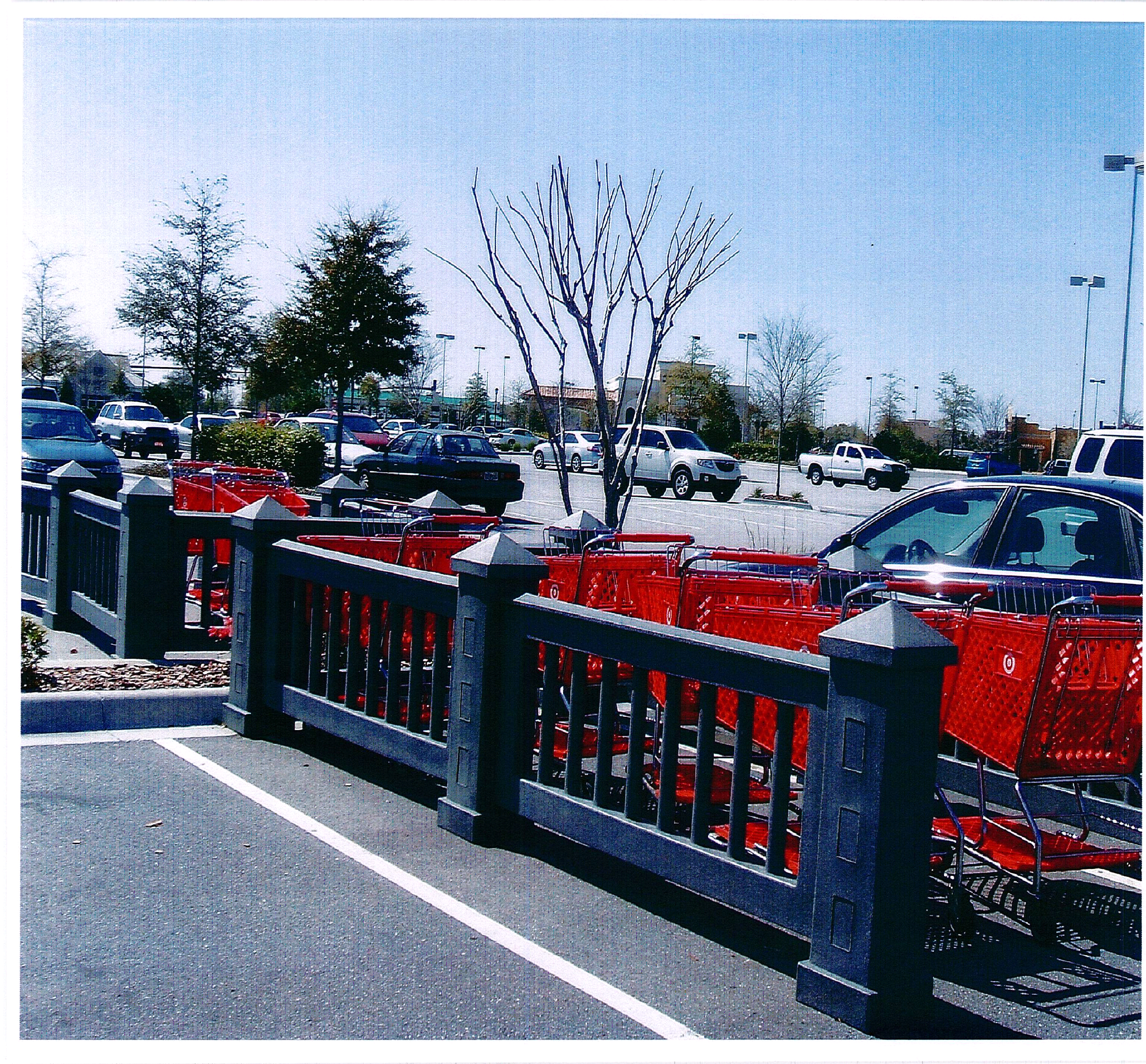
Shopping cart corrals adjoining the building are prohibited unless screened with masonry walls, landscaping or other buffers measuring at least one foot higher than the height of the shopping cart.
(b)
Shopping cart corrals within parking areas must be located within an acceptably designed nonmetal enclosure. Such enclosures must be designed to be compatible with the design and overall aesthetic vision of the commercial building they serve and meet the design standards illustrated herein. Landscaping may be employed to enhance the acceptability of a design by camouflaging or otherwise enhancing the appearance of corrals.
(c)
Outdoor freestanding propane stations must be opaquely screened from public view with landscaping or a wall.
(d)
Subject to section 118-1408, commercial outdoor display areas, sales areas, tents, play areas, and commercial play devices are prohibited, except where a special event is held and a permit is issued. This subsection does not apply to garden supply areas. Chain link security fence enclosures may only be utilized within industrial areas if there is no reasonable alternative and only when screened by landscape material to create a six-foot tall opaque screen. If permitted, chain link fences, including posts and rails, shall be green and vinyl coated.
(e)
Except as provided pursuant to chapter 62, streets and sidewalks, of the Code, the outdoor display of merchandise or operation of sidewalk cafes within the public ways or right-of-ways is prohibited.
(Ord. No. 03-30, § 2, 9-17-03; Ord. No. 10-08, § 2(Exh. A), 7-8-10)
Sec. 118-1457. - Bicycle and transit facilities.
Individual projects shall create a safe enjoyable environment for pedestrians, motorists, and cyclists as well as encouraging transit ridership, at a minimum, by accomplishing the following:
(1)
Accommodating bicycle and pedestrian facilities.
(2)
Providing bicycle racks on each site at or near building entrances.
(3)
Designating transit access points and pick-up areas and transit shelters on-site, if determined to be necessary by the city or LYNX.
(4)
Providing for future transit stops, if determined to be necessary by the city or LYNX, if a project contains new commercial uses totaling more than 100,000 square feet.
(5)
Providing a sidewalk connection to the front entrance of any adjoining building to transit stops located adjacent to a site.
(Ord. No. 03-30, § 2, 9-17-03)
Sec. 118-1458. - Special building uses.
(a)
Gas stations and commercial convenience stores shall utilize either gable or hip roof structures. The canopies over the gas pumps shall be attached to the main building and integrated into the architectural roof design.
(b)
Automobile service areas containing more than four bays shall be totally screened from view from the right-of-way with walls and landscaping. No outside auto service operations shall be permitted. Automobile service bays, regardless of amount, shall not face State Road 50.
(c)
Outdoor garden supply area centers (with or without a canopy) shall be constructed with a 100 percent opaque screen six feet in height, which shall be incorporated into the building architecture. Fencing shall be covered with green vinyl coating and the use of slats is prohibited. If landscape materials are used for the screen, the screen may be counted towards the ten-foot wide building perimeter landscape area.
(Ord. No. 03-30, § 2, 9-17-03)
Sec. 118-1500. - Development of community impact.
Because of its character, magnitude and impact on surrounding properties, the site plans for all new development within the commercial corridor that are greater than 25,000 square feet in building area or once developed, will generate more than 2,500 weekday trip ends shall be considered developments of community impact and must be approved by the city commission.
(Ord. No. 03-30, § 2, 9-17-03)
Sec. 118-1501. - Additional requirements.
The following additional requirements shall apply to all existing and proposed nonresidential structures and developments exceeding 25,000 square feet of building area or exceeding 50,000 square feet of impervious surface area:
(1)
General requirements.
a.
Such buildings must be separated from lands designated, zoned or used for a residential purpose by at least 50 feet, which distance shall be measured by the shortest distance between the building occupied by the use and nearest property line of the residential use.
b.
Said buildings or developments must have frontage on a public street.
c.
All shopping centers, complexes of buildings designed as a group, retail uses or uses exceeding 25,000 gross square feet having continuous covered pedestrian arcades shall provide such covering utilizing awnings or canopies at least eight feet in width extending for the length of the main entrance facade to provide shade for pedestrians and create human scale.
(2)
Outparcel/auxiliary uses. When a development includes an outparcel site, the architecture of the outparcel buildings shall complement the architectural design of the non-outparcel buildings in types of colors, roof treatments and architectural details. Such architectural design shall be incorporated within the development orders and development permits relating to those buildings. Outparcels may be developed as permitted in the underlying zoning classification assigned to a parcel consistent with the provisions of this article. Outparcels must provide parking, independent of that provided by surrounding lots, as required by this Code. Outparcels shall conform to the master architectural, signage, lighting and landscaping plan prepared by the developer of the primary lot. All perimeter landscape buffers and sidewalks shall be maintained by the owner of the primary lot including, but not limited to, maintenance and irrigation until such time as the ownership of the outparcel is transferred. Prior to the recordation of the plat, the owner of the primary lot must enter into a lot tying developer's agreement, in a form acceptable to the city attorney, tying the ownership of the primary lot to the tracts. Sidewalks shall be installed between outparcels and the primary lot, and between each outparcel, to enhance internal circulation and create a streetscape experience for customers.
(Ord. No. 03-30, § 2, 9-17-03)
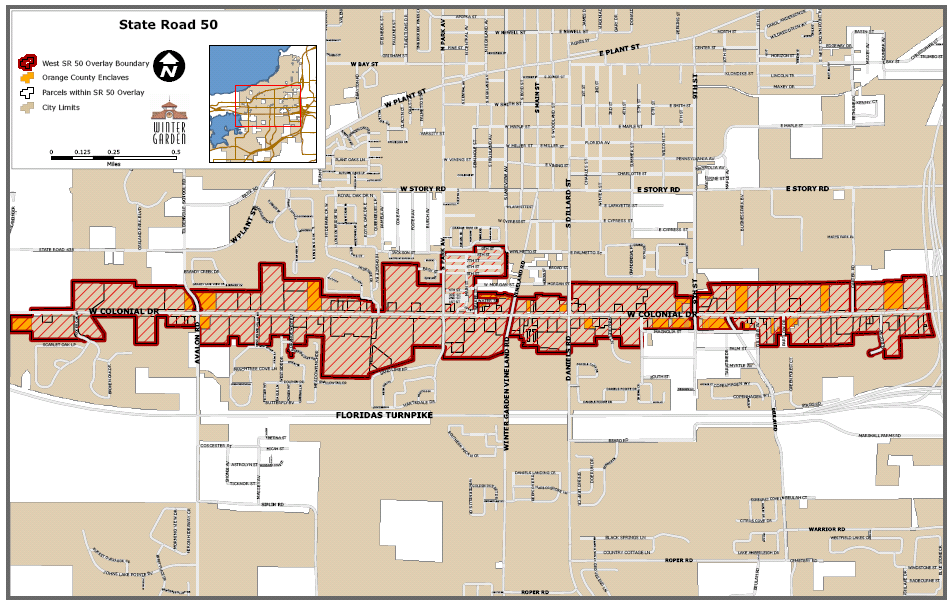
Exhibit A, Map of State Road 50
(Ord. No. 10-08, § 2(Exh. A), 7-8-10)

