
Woodfin City Zoning Code
ARTICLE I
- IN GENERAL
Sec. 54-1.- Short title.
This chapter shall be known as and may be cited as "The Zoning Ordinance for the Town of Woodfin, North Carolina," and the map referred to, which is identified by the title "The Official Zoning Map, Town of Woodfin, North Carolina," shall be known as the "zoning map."
(Ord. of 5-18-2021)
Sec. 54-2. - Purpose and authority.
The purpose of the zoning regulations and districts as set forth in this chapter is to promote the health, safety, morals and general welfare of the inhabitants of the town. This chapter is adopted pursuant to the authority granted in G.S. ch. 160D and ch. 160A, art. 8.
(Ord. of 5-18-2021)
Sec. 54-3. - Introduction.
As the proper regulation of the use of certain structures, land, waters, and air is neither feasible nor adequate through the use of the zoning districts alone, the following restrictions and regulations, which shall be applied in addition to the district regulations are necessary to accomplish the intent of this chapter. The provisions of this chapter shall apply to all structures, lands, waters, and air within the jurisdiction of the town.
(Ord. of 5-18-2021)
Sec. 54-4. - Interpretation, purpose, and conflict.
In interpreting and applying the provisions of this chapter, they shall be held to be the minimum requirements for the promotion of public safety, health, morals, and general welfare. It is not intended by this chapter to interfere with or abrogate or annul any easements, covenants, or other agreements between parties; provided, however, that where this chapter imposes greater restrictions upon the use of buildings or premises, upon the height of buildings or premises or requires larger open spaces than are imposed or required by other ordinances, rules, regulations, or by easements, covenants, or agreements, the provisions of this chapter shall be construed to amend or repeal any other existing ordinance of the town.
(Ord. of 5-18-2021)
Sec. 54-5. - Intent.
It is the general intent of this chapter to:
(1)
Lessen congestion in the streets;
(2)
Secure safety from fire, panic and other danger;
(3)
Promote health and the general welfare;
(4)
Provide adequate light and air;
(5)
Prevent the overcrowding of land;
(6)
Avoid undue concentration of population; and
(7)
Facilitate the adequate provision of transportation, water, sewerage, schools, parks, and other public requirements.
(Ord. of 5-18-2021)
Sec. 54-6. - Zoning affects every building and use.
No building or land shall hereafter be used and no building or part thereof shall be erected, moved or altered except in conformity with the regulations herein specified for the district in which it is located except hereinafter provided in this article.
(Ord. of 5-18-2021)
Sec. 54-7. - Reduction of lot and yard areas.
No yard or lot existing on September 16, 1973, shall be reduced in size or area below the minimum requirements set forth herein, except for street widening. Yards or lots created after September 16, 1973 shall meet at least the minimum requirements established by this article.
(Ord. of 5-18-2021)
Sec. 54-8. - Relationship of building to lot.
Every building hereafter erected, moved or structurally altered shall be located on a lot, and in no case shall there be more than one principal building and its customary accessory building on the lot, except in the case of a specially designed group development of institutional, residential, commercial or industrial building in an appropriate zoning district, i.e., school campus, cluster housing, shopping center, industrial park, and so forth, as permitted by section 54-159(11).
(Ord. of 5-18-2021)
Sec. 54-9. - Relationship to the comprehensive plan.
It is the intention of the town board of commissioners that this ordinance implement the planning policies adopted by the board as reflected in the comprehensive plan and other planning documents. While the town board of commissioners reaffirms its commitment that this ordinance and any amendment to it be in conformity with adopted planning policies, the town board of commissioners hereby expresses its intent that neither this ordinance nor any amendment to it may be challenged on the basis of any alleged nonconformity with any planning document.
When acting on any proposed zoning amendment, the Town of Woodfin shall carefully consider its adopted plans and policies. In accordance with the state law, the town, including the planning board, when such zoning requests are heard, and the town board of commissioners when such requests are acted upon, shall note in written statements from each board whether such amendment is consistent with these plans.
(Ord. of 5-18-2021)
Sec. 54-10. - Definitions.
The following words, terms and phrases, when used in this chapter, shall have the meanings ascribed to them in this section, except where the context clearly indicates a different meaning:
Accessory use or structure means a use or detached structure subordinate to the principal use of a structure or land and located on the same lot or parcel serving a purpose customarily incidental or ancillary to the principal use or the principal structure.
Addition means an extension or increase in the floor area or height of a building or structure. Additions to existing buildings and structures shall comply with the requirements for new construction.
Adult entertainment establishment means any of the following subcategories, and for purposes of this ordinance shall be consistent with Chapter 14, Article 26A of the North Carolina General Statutes, including definitions found in section 14-202.10, as currently written or hereafter amended.
Agriculture and/or horticulture means the use of land for agricultural purposes including farming, silviculture, viticulture, fish culture, animal and poultry husbandry and/or horticultural purposes including the growing and production for income of fruits, vegetables, flowers, nursery stock, or ornamental plants.
Alteration means any change because of construction, repair, maintenance or otherwise to buildings that does not result in an increase in the gross floor area or expand the structure in any horizontal or vertical dimension.
Animal shelter means a facility that houses or contains animals that are seized, stray, homeless, quarantined, abandoned, or unwanted. Animal shelters are owned, operated, or maintained by a county, city, town, or other municipality, or by a nonprofit organization devoted to the welfare, protection, rehabilitation, or humane treatment of animals.
Applicant means a person or entity filing an application under this ordinance.
Application means any development application submitted to the Town of Woodfin for approval of a permit, site plan, certificate or any other authorization required for development and includes all forms, site plans and building plans as required by the Town of Woodfin.
Appraised value means the value assigned to a structure by the Buncombe County Tax Assessor or by an MAI-certified real estate appraiser.
Artificial slope shall mean any land disturbing activity that modifies an existing slope.
Bank and/or other financial institution means a financial institution that is open to the public and engaged in deposit banking, and that performs closely related functions such as making loans, investments, and fiduciary activities.
Billboard (See Outdoor advertising sign).
Board of adjustment means a quasi-judicial board composed of five residents of the Town of Woodfin empowered to hear appeals from decisions of the Zoning Administrator, grant variances from provisions of the zoning ordinance and grant special use permits.
Brewery means an establishment where beer and malt beverages are made on the premises at an annual beer production rate of over 15,000 barrels. A brewery of this scale is considered a heavy manufacturing use.
Bufferyard means a linear strip of land combined with a vertical element such as plants, berms, fences, or walls, which physically separates and screens incompatible land uses.
Building means any structure used or intended for supporting or sheltering any use or occupancy.
Building frontage means the linear length of only that portion of a building used by an individual tenant in a multiple tenant development and which faces a public street or alley.
Building setback line means a line delineating the minimum allowable distance between the property line and a building on a lot, within which no building or other structure shall be placed except as otherwise provided. If the property line extends into a roadway or highway itself, then the setback line shall be measured from the edge of the traveled way (which is the edge of the road or the actual area that vehicles travel upon) when computing setback requirements on lots abutting highways.
Building supply sales yard means a business primarily engaged in selling building materials and construction supplies.
Campground means an outdoor area designed to accommodate non-permanent travel trailers, tents, cabins, camper vans, and recreational vehicles on a temporary basis. Electrical, cable, water and sewage hookups may be provided on site.
Canopy means a permanent attached structure which projects from and is supported by a building, which serves as a cover providing shelter or decoration and which extends beyond the building.
Car wash means a facility that is used to clean the exterior and/or interior of motor vehicles. Including but not limited to hand washing, coin-operated, automatic in-bay and tunnel washing.
Cemetery means a tract of land used for burials not associated with a place of worship.
Change of use means the act of eliminating the type of land use in a structure or on a lot and replacing it with another type of land use; or the act of adding another type of land use in a building or on a lot which did not previously exist there. A change of use may or may not involve any type of new construction or building renovation.
Channel means those flood lands normally occupied by a stream of water under average annual high-water flow conditions while confined within generally well-established banks.
Common plan of development means a construction or land disturbing activity is part of a larger common plan of development if it is completed in one or more of the following ways: In separate stages; in separate phases; or in combination with other construction activities. It is identified by the documentation (including, but not limited to, a sign, public notice or hearing, sales pitch, advertisement, loan application, drawing, plats, blueprints, marketing plans, contracts, permit application, zoning request, or computer design) or physical demarcation (including, but not limited to, boundary signs, lot stakes, or surveyor markings) indicating that construction activities may occur on a specific plot; it can include one operator or many operators.
Community center, club and/or lodge means any government or non-profit whose activities are conducted for civic or humanitarian motives and not for the gain of any private individual or group and may include, but shall not be limited to, recreation, social service, welfare, education, civic, fraternal, or cultural activities.
Concrete and/or asphalt plant means a manufacturing or processing plant in a fixed location associated with the storage of raw materials used in the production of concrete and the mixing of concrete products prior to their use or transportation.
Condominium means a dwelling unit within a multiple-unit property together with an undivided portion of ownership in areas and facilities held in common with other property owners in the development. Condominiums may take a number of forms such as attached townhouses, apartments, or other forms of residential structures. The common areas and structures may include underlying land, parking areas, recreation facilities, swimming pools, and in the case of an apartment house, hallways, basements, heating units, and elevators.
Conference and/or training center means facilities used for business or professional conferences, seminars, and training programs.
Critical root zone shall mean the minimum area beneath a tree which must be left undisturbed and protected from construction disturbance in order to preserve a sufficient root mass to give a tree a reasonable chance of survival. The critical root zone is delineated by a concentric circle with the tree trunk as the center. The radius of the critical root zone equals one foot for every one inch of tree diameter. Example: a 20-inch diameter tree will have a critical root zone radius of 20 feet.
Cut slope shall mean the exposed ground surface resulting from excavation of material.
Data center and/or server farm means an establishment engaged in the storage, management, processing, and/or transmission of digital data, which houses computer and/or network equipment, systems, servers, appliances and other associated components related to digital data operations. Includes crypto-currency mining.
Day care center means an individual, agency, or organization providing supervision or care on a regular basis for children who are not related by blood or marriage to, and who are not the legal wards or foster children of the supervising adult.
Day care home means supervision or care provided on a regular basis as an accessory use within a principal residential dwelling unit, by a resident of the dwelling, for up to five children who are not related by blood or marriage to, and who are not the legal wards or foster children of the supervising adult OR for up to five adults who do not reside in the dwelling.
Development shall mean any man-made change to improved or unimproved real estate, including, but not limited to, new buildings and structures, including additions/expansions, mining, dredging, filling, grading, paving, excavation, or drilling operations.
Dimensional nonconformity means any lawful nonconformity involving a dimensional or numerical development requirement except those involving outdoor lighting or signs which are addressed in Chapter 26 and Chapter 34, respectively. Dimensional nonconformities may include, without limitation, nonconformities associated with lot size, lot width, lot depth, lot coverage setbacks, impervious surface standards, open space, number of parking spaces, or separation requirements between particular uses or zoning districts, and structure size and placement standards including height, gross floor area, footprint area, number of stories, build-to zone, fenestration, step-back and building frontage.
Disturbed areas shall mean any area subject to a land-disturbing activity.
Downhill sections shall mean areas of the property which fall ten feet or more in elevation within 50 feet of the structure.
Drive-through means a window or series of windows associated with a commercial establishment that permits patrons to transact business or order goods while remaining in a vehicle. A drive-thru service window shall only be permitted as an accessory use.
Dwelling means a building that contains one or two dwelling units used, intended or designed to be used, rented, leased, let or hired out to be occupied for living purposes.
Dwelling, accessory unit means a separate and complete dwelling unit that is ancillary and subordinate to a principal single-family dwelling located on the same lot. Accessory dwelling units may be either detached or attached to the primary dwelling.
Dwelling, multi-family means a building containing three or more dwelling units.
Dwelling, single-family detached means a home on an individual lot or parcel of land intended, designed, used, and/or occupied by no more than one family.
Dwelling, single-family means a dwelling containing one dwelling unit either attached, semi-attached, or detached.
Dwelling, single-family attached means a dwelling which occupies its own lot, but which is physically connected to one or more other dwellings. The lot line separating the lots is congruent with the part wall connecting the dwellings.
Eating and drinking establishment means any establishment whose principal business is the sale of food, frozen desserts or beverages to the customer in a ready-to-consume state, and whose design or method of operation provides for consumption of foods, frozen desserts or beverages within the restaurant building, within a motor vehicle parked upon the premises, off-premise consumption (to-go orders), or at other facilities on the premises outside the building. This definition does not include bars, nightclubs, lounges, hookah or cigar bars.
Eave line means the extension of a roof line beyond the vertical wall of a building.
Equipment rental means an establishment that rents or leases construction tools or equipment to an entity for a period of time but does not transfer ownership of the tools or equipment to the entity renting or leasing it.
Erect means to construct, build, raise, assemble, install, place, locate, relocate, affix, attach, display, alter, use, create, paint, draw, illuminate or in any other way bring into being or establish.
Essential service means publicly or privately owned facilities or systems for the distribution of gas, electricity, steam or water, the collection and disposal of sewage or refuse; the transmission of communications; or similar functions necessary for the provision of public services. Radio transmission facilities for use by ham radio operators or two-way radio facilities for business communications shall be deemed accessory uses and not under this definition as essential services, provided no transmitter or antenna tower exceeds 40 feet in height, with the exception of 100 feet for governmental communications. Wireless telecommunications are not included within this definition. Essential services are divided into three classes:
(1)
Class 1 means transmission lines (above and below ground) including electrical, natural gas, and water/wastewater distribution lines; small, enclosed facilities up to 200 square feet such as and including pumping stations, lift stations, and telephone switching facilities.
(2)
Class 2 means water storage tanks; package treatment plants; telephone switching facilities, substations, or other similar facilities used in connection with telephone, electric, steam, and water facilities greater than 200 square feet; raw water treatment facilities; battery storage facilities when accessory to a substation.
(3)
Class 3 means generation, production, or treatment facilities such as power plants, sewage/septage treatment facilities, recycling sorting operations, compost and mulching yards. But does not include solid or hazardous waste landfills, construction and demolition landfills.
Event venue, indoor means a fully enclosed and conditioned space to watch and/or to hear athletic events, musical/dramatic performances, including auditoriums, arenas, stadiums, coliseums, athletic centers and theaters. Use of a membrane structure (e.g. tent) does not qualify as an indoor venue.
Event venue, outdoor means an outdoor or partially enclosed space to watch and/or to hear athletic events, musical/dramatic performances including auditorium, arena, stadium, coliseums, athletic centers, theaters, and drive-in theaters.
Expansion means any construction that increases the size of a building or structure in terms of site coverage, height, length, width, or gross floor area.
Façade means building sides including parapet and wing wall.
Familial relationship, close means a spouse, parent, child, brother, sister, grandparent, or grandchild. The term includes the step, half, and in-law relationships.
Family means any number of related persons, or up to five unrelated persons, living together as a single housekeeping unit.
Family care home means a home that provides room, support and supervision to no more than six persons with disabilities as defined in G.S. 160D-907(a)2.
Fill slope shall mean the exposed ground surface resulting from deposition of material.
Flag lot means a type of lot whose shape resembles a flag and where the access to the road is commonly provided along a long narrow flagpole, and the shape of the buildable portion of the lot is rectangular, similar to a flag.
Forested areas shall mean an ecosystem supporting a dense growth of trees covering a large area.
Freight terminal means a collection and distribution point for trucks or freight.
Fuel oil dealer means a facility and business used to warehouse and dispense various types of fuel oil.
Funeral home and/or mortuary means a building or part thereof used for human funeral services. Such building may contain space and facilities for:
(a)
Embalming and the performance of other services used in the preparation of other services used in the preparation of the dead for burial;
(b)
The performance of autopsies and other surgical procedures;
(c)
The storage of caskets, funeral supplies funeral urns, and other related funeral supplies;
(d)
Facilities for cremation where funeral home is permitted, a funeral chapel shall also be permitted.
Geotechnical assessment shall mean a comprehensive analysis of soil type(s), composition, and characteristics (colluvial, cohesive or expansive, pH, water retention, etc.) conducted pursuant to proposed development of a building site.
Governing body means, as it pertains to this ordinance, Town of Woodfin Town Council as authorized by NC General Statute or the town council.
Grade means the average level of the finished surface of the ground adjacent to the exterior walls of the building.
Gross floor area means the total floor area of all buildings in a project including basements, mezzanines, and upper floors, exclusive of stairways and elevator shafts. Gross floor area excludes separate service facilities outside the main building such as boiler rooms and maintenance rooms.
Group care home means a residential facility requiring a license by the state of NC housing 12 or fewer persons.
Group living means any residential facility, dwelling unit, and/or combination thereof that does not meet the definition of a family care home or group care home; examples include boarding/rooming houses, half-way homes, dwellings occupied by six or more unrelated persons, fraternity and sorority houses. Lodging uses are not included under this definition.
Height, building means the average of the shortest and tallest sides of a building, from the tallest peak of the roof to the base of the building at grade. Chimneys, ventilators, antennas, skylights, tanks, bulkheads, or solar panels shall not be considered part of the height of the building if they do not extend more than four feet above the specific height limit. Domes, towers, or spires which are an integral part of institutional buildings shall not be subject to these limitations, provided that such features shall in no way be occupiable space.
Height, structure means the greatest vertical distance from the top of the structure to the base of the structure at grade.
Home occupation means an accessory use of a dwelling unit or an accessory structure for limited non-residential purposes which is clearly incidental and subordinate to the use of the dwelling unit as a permanent and full-time residence.
Hospital means an institution for health care providing patient treatment by specialized staff and equipment, and often, but not always providing for longer-term patient stays.
Impact means the effect of one land use upon another as measured by traffic or noise generation, site activity, hours of operation, site lighting, vibration, smoke or odor emissions, or similar factors.
Impervious surface shall mean any surface that does not allow water to percolate through, or significantly penetrate, for natural absorption by the ground within a 24-hour period, including but not limited to: rooftops, parking/driving areas finished with asphalt, concrete, or densely compacted gravel, patios, or pools.
Junkyard means a lot, land, or structure or part thereof, used primarily for the collecting, storage, and sale of waste paper, rags, scrap metal, or discarded material; or for the collecting, dismantling, storage and/or salvaging of machinery or vehicles not in operating condition and for the sale of parts thereof. Shall also include any outdoor area containing more than five motor vehicles that do not display a current license plate, or are partially dismantled or wrecked, or cannot be self-propelled or moved in the manner in which it is intended to move.
Kennel means a commercial establishment wherein any person engages in business or practice, for fee, of boarding, breeding, letting for hire, or training of multiple domesticated animals at any one time, not including pets owned by the landowner; or an establishment wherein any person engages in the business or practice, for a fee, of selling more than one litter of domesticated animals at any one time.
Laboratory means an analytical, experimental or testing facility that provides controlled conditions in which scientific research, experiments, and measurement may be performed.
Land-disturbing activity shall mean any use of the land by any person in a residential, industrial, educational, institutional, or commercial development, highway and road construction, and maintenance that results in a change in the natural cover or topography.
Landfill means a facility for disposal of solid waste on land in a sanitary manner, in accordance with rules concerning sanitary landfills set by the NC Department of Environmental Quality, called for in G.S. ch. 130A. Construction and demolition landfills are also included in this definition.
Laundromat means a facility where patrons wash, dry, or dry clean clothing or other fabrics in machines operated by the patron.
Lawful nonconformity means any nonconformity involving a dimensional or numerical requirement or use of property that affects a structure erected or a lot created in conformity with the then-applicable development requirements of the town, but subsequently made nonconforming by action of the town through a zoning map or text amendment. For non-construction related purposes such as but not limited to, financing, appraisals, or zoning verification, a lawful nonconformity shall be regarded as conforming.
Library, museum and/or art gallery means a room or building for exhibiting, or an institution in charge of, a collection of books, artistic, historical, or scientific objects.
Lodging means any land use contained within a building or series of buildings under single ownership providing accommodations to transients for compensation, offering either short or extended-stay facilities, and that may customarily include incidental or ancillary services including housekeeping, dining, meeting rooms and recreational facilities that includes the renting of room(s) for transient stays. This includes any of the following hotels, motels, bed and breakfast inns, and short-term rentals. Use of a dwelling, or any portion thereof, rented or leased for intervals of less than one month is considered a "lodging" use.
Lot shall mean a parcel of land occupied or intended for occupancy by one or more uses permitted in the Town of Woodfin Zoning Ordinance, including the principal building and all accessory building(s), and having its principal frontage upon a dedicated street.
Lot coverage means the area under a roof and enclosed by the exterior permanent walls.
Lot of record means any lot or parcel of land that was lawfully created and recorded by a subdivision or a lawfully created unit of land that was created by deed or land sales contract prior to the town's subdivision regulations.
Lot width means the distance between the side lines of a lot measured at the front building setback line.
Lot, corner means a lot abutting two or more streets at their intersection, provided that the corner of such intersection has an angel of 135 degrees or less, measured on the lot side.
Manufactured home—Class A means a multi-section manufactured home with a permanent, masonry perimeter curtain wall, having siding consistent with standard residential construction and built/constructed in accordance with the standards established by the North Carolina Department of Insurance as set forth in the most current edition of the State of North Carolina Regulations for Manufactured Homes.
Manufactured home—Class B means a manufactured home that does not meet the definition of a manufactured home—Class A, meeting the following appearance criteria: Continuous skirting under all sides of the home except for required ventilation and access; skirting shall be installed no later than 60 days after the set-up of the home, and built/constructed in accordance with the standards established by the North Carolina Department of Insurance as set forth in the most current edition of the State of North Carolina Regulations for Manufactured Homes.
Manufactured home—Class C means any manufactured home built before 6/15/1976 and does not meet the definitional criteria of a manufactured home—Class A or manufactured home—Class B.
Manufactured home lot means any space, area, or tract of land, or portion of a manufactured home community (park), which is designated or used for occupancy by one manufactured home.
Manufactured home park means a parcel (or contiguous parcels under common ownership) of land which has been so designated and improved that it contains three or more manufactured home lots available to the public for the placement thereon of manufactured homes for occupancy.
Manufactured home space means any lot within a manufactured home community (park), which is designated or used for occupancy by one manufactured home.
Manufacturing, heavy means the assembly, fabrication, or processing of goods and materials using processes that have greater than average impacts on the environment, or that ordinarily have significant impacts on the use and enjoyment of adjacent property in terms of noise, smoke, fumes, odors, glare, vibrations, or health and safety hazards; or that otherwise do not constitute "light manufacturing;" or any use where the area occupied by outdoor storage of goods and materials used in the assembly, fabrication, or processing exceeds 25 percent of the floor area of all buildings on the lot.
Manufacturing, light means the assembly, fabrication, or processing of goods and materials using processes that do not create noise, smoke, fumes, odors, glare, vibrations, or health or safety hazards outside of the building or lot where such assembly, fabrication, or processing takes place; where such processes are housed entirely within a building; or where the area occupied by outdoor storage of goods and materials used in such processes does not exceed 25 percent of the floor area of all buildings on the property.
Medical office means the clinic or office of physicians, medical doctors, chiropractors, or dentists licensed to practice medicine or dentistry in the State of North Carolina, where the primary use is the delivery of health care services, where sale of merchandise is incidental to the delivery of services. This use includes addiction recovery facilities that provide for the treatment of persons having drug or alcohol abuse problems under the supervision of professional health care or social services providers, where no overnight accommodations are provided.
Microbrewery means an establishment where beer and malt beverages are made on the premises and then sold or distributed, and which produces less than 15,000 barrels (a barrel is approximately 31 gallons) of beer per year. Microbreweries must sell 25 percent or more of its beer on-site and does not include an eating and drinking establishment.
Mining means the breaking of the surface soil in order to facilitate or accomplish the extraction or removal of minerals, ores, or other solid matter; any activity or process constituting all or part of a process for the extraction or removal of minerals, ores, and other solid matter from its original location; and the preparation, washing, cleaning, or other treatment of minerals, ores, or other solid matter so as to make them suitable for commercial, industrial, or construction use; and shall not include excavation or grading when conducted solely in aid of on site farming or construction.
Motor vehicle repair garage means any building, structure, improvements, or land used for the storage, care, repair, or refinishing of motor vehicles including both minor and major mechanical overhauling, paint and body work. Also referred to as vehicle repair shop. Junk vehicles or the operation of an automobile wrecking and junking yard are not permitted as part of this use.
Motor vehicle sales mean storage and display for sale of more than two motor vehicles or any type of trailer provided the trailer is unoccupied, and where repair or body work is incidental to the operation of the new or used vehicle sales includes motor vehicles retail or wholesale sales. Sales of boats, recreational equipment, ATVs, motorcycles, trailers, tractors, and travel trailers are included within this definition.
Motor vehicle service station means any premises where gasoline and other petroleum products are sold, and light maintenance activities are performed. Also called a gas station.
Multi-tenant development means a development in which there exists a number of individual and or separate activities and in which there are appurtenant shared facilities (such as parking areas or pedestrian mall areas).
Nightclub, bar and/or lounge means any commercial establishment serving alcoholic beverages and/or providing entertainment for patrons that do not operate significant food services.
Nonconforming lot means any lot of record which does not meet the minimum area, width or open space requirements established in these regulations or any amendment thereto, whichever may be applicable.
Nonconforming open use of land means a use not enclosed by a building and which was in existence prior to the effective date of this chapter or at the time the lot was brought into the town's jurisdiction, and which would not be permitted by this chapter in the zoning district in which it is located. An open use of land may be the principal use or ancillary to another use on the property.
Nonconforming structure means any structure, lawfully existing on the effective date of these regulations or on the effective date of any subsequent amendments to these regulations or the zoning maps which render such structure nonconforming, which does not comply with all standards and regulations of this ordinance or any amendments thereto, whichever may be applicable.
Nonconforming use means a nonconformity involving the use of the property when that use was lawfully established. This may include, without limitation, nonconformities associated with a use not permitted in the zoning district in which it is located, a use specially allowed in the zoning district in which it is located but for which no special use permit has been obtained, or residential density that exceeds the maximum permitted in the zoning district in which it is located.
Office means administrative, executive, professional, research, or similar organizations, and laboratories having only limited contact with public, provided that no merchandising services are sold on the premises, except such as are incidental or accessory to the principal permissible use.
Outdoor advertising sign or billboard means an offsite sign means a sign which directs attention to a business, commodity, service, good, product, entertainment, or similar enterprise not related to the site upon which such sign is located or to which it is affixed.
Outdoor storage means the storage of any material for a period greater than 24 hours not in an enclosed building. Outdoor storage may be standalone or ancillary to another use.
Parapet means that portion of a building wall that rises above the roofline.
Park and/or playground means a place, structure, area, or facility used for one or more sports or recreation activities such as, but not limited to, bowling, skating, water sports, baseball, basketball, tennis, golf, riding, hiking, fishing or similar sports or recreational uses and providing social or recreational programs generally open to the public and designed to accommodate and serve significant segments of the community.
Parking lot means any place maintained for the outdoor parking of motor vehicles not associated with another use. Parking lots do not include parking on public streets.
Parking space means a graded and surfaced area of at least nine feet wide and 19 feet long, either enclosed or open, for the parking of a motor vehicle, having adequate ingress or egress to a public street or alley.
Parking, off-street means a designated area intended to support another use(s) by providing space for temporary storage of motor vehicles for employees, residents, and visitors.
Permanently affixed means anchored to a foundation.
Personal service means a business providing personal or household services typically by appointment or on a walk-in basis during normal business hours with some limited weekend hours. Examples include barber and beauty shops, nail salons, spas, shoe repair, tailors, massage therapists, and other personal or household services accomplished on site.
Place of worship means a building wherein persons regularly assemble for religious worship and which is maintained and controlled by a religious body organized to sustain public worship, together with all accessory buildings and uses customarily associated with such primary purpose. Includes synagogue, temple, mosque, or other such place for worship and religious activities.
Planar surface is defined as the combined exterior surface area of all vertical surfaces within a single face of the structure.
Planning board means an advisory board composed of seven residents of the Town of Woodfin that provides recommendations to the Woodfin Town Council on legislative requests for conditional rezonings, general rezonings, and text amendment to the zoning ordinance.
Prefabricated home display area means any business engaged in the sale and distribution of prefabricated homes for resale. Including, but not limited to manufactured and modular homes.
Principal use means the primary use and chief purpose for which a lot is used.
Prison means a facility, public or private, established for the temporary placement of persons who require secure custody for their own or the community's protection in physically restricting facilities.
Public safety facility means a government facility for public safety and emergency services, including a facility that provides police or fire protection and related administrative facilities. The term shall not include jails, prisons, hospitals, or institutional and commercial services.
Public transportation means transportation of passengers whether or not for hire by any means of conveyance, including but not limited to motor vehicle or motor bus, either publicly or privately owned and operated, holding itself out to the general public for the transportation of persons within the territorial jurisdiction of the authority, including charter service.
Public works facility means a government facility for public works services, such as refuse collection, street and building maintenance, parks and land management, vehicle maintenance, parking, and associated accessory uses.
Radio and/or television station means establishments primarily engaged in the provision of broadcasting and other information relay services accomplished using electronic and telephonic mechanisms excluded are facilities classified as major utility services or broadcasting or communication towers typical uses include television studios, telecommunication service centers, telegraph service offices, or film and sound recording facilities.
Recreational facility, indoor means any business establishment which is primarily engaged in providing an amusement and/or recreational activity within a fully enclosed building such as a public or private health or exercise clubs, tennis or other racquet courts, swimming pools, video arcade, billiard parlor, skating rink, bowling alley, axe throwing, or similar uses which are enclosed in buildings, but does not include indoor motion picture theaters, adult establishments, or shooting ranges.
Recreational facility, outdoor means any business establishment which is primarily engaged in providing amusement and/or recreational activities that are outside of a fully enclosed building that include but not limited to, miniature golf, skateboard parks, paintball, water slide and swimming pools, batting cages, laser tag, mechanical ride, golf course, golf driving range, go-cart or motorcycle course, fish ranch, or similar activity to the general public, but does not include outdoor motion picture theaters or shooting ranges.
Recreational vehicle/travel trailer means a travel trailer which may operate independently of connections to electricity, water, and sewer for a limited period of time, having its own battery or LP gas system or both, to operate lights, refrigerator, stove, and heater; having a water tank with a pressure system; and having a holding tank with a toilet. A travel trailer shall not be used as a dwelling.
Recycling drop-off center means a facility where residents may drop off recyclable materials, typically unstaffed.
Recycling facility means an establishment primarily engaged in (1) operating facilities for separating and sorting recyclable materials from nonhazardous waste streams (i.e., garbage); and/or (2) operating facilities where commingled recyclable materials such as paper, plastics, used beverage cans, and metals are sorted into distinct categories.
Regulated tree shall mean all native trees of with a caliper of three or more inches when measured six inches above the root ball and any mature grouping of rhododendron or mountain laurel of 250 square feet or more in area. Invasive non-native species shall not be included in this definition.
Rehab and/or skilled nursing facility means a facility that provides residentially based services for people who require constant nursing care and have significant deficiencies with activities of daily living. Residents include the elderly and younger adults with physical or mental disabilities.
Renovation means the repairing or remodeling of a structure in which the exterior walls, foundation and roof are maintained structurally intact.
Retail establishment means a commercial enterprise that provides goods and/or services directly to the consumer, where such goods are available for immediate purchase and removal from the premises by the purchaser, where products include but are not limited to clothing, fabric, shoes, varieties, notions, drugs, hardware, furniture, appliances, floor coverings, paints, antiques, art goods, jewelry, gifts, music, toys, sporting goods, books and stationary, magazines, candy, tobacco, pets, hobbies, and crafts. Manufacturing, wholesale, bulk storage, and/or processing is not considered a retail use. Uses specifically enumerated in the Table of Uses shall follow the more specific standards.
Retail, large means any building or collection of buildings as part of a single development greater than 20,000 square feet gross floor area.
Retail, small means any building or collection of buildings as part of a single development that are 20,000 square feet or less in gross floor area.
Revegetation shall mean reintroducing native plant species, as defined by the Natural Resource Conservation Service of the United States Department of Agriculture, into a disturbed area to restore native plant communities, mitigate erosion and landslides, and minimize the expansion of non-native invasive plants.
Sawmill means a facility where logs or partially processed cants are sawn, split, shaved, stripped, chipped, or otherwise processed to produce wood products, not including the processing of timber for use on the same lot by the owner or resident of that lot.
School means an institution where academic instruction is given to persons K—12. School, post-secondary means a public or private educational institution providing higher education that grants associate degrees or higher, or specific professional or vocational training.
Self-storage warehouse means a building or group of buildings in a controlled-access and fenced compound that contains varying sizes of individual, compartmentalized and controlled-access stalls or lockers for the dead storage of customers' goods or wares.
Setback line means a line delineating the minimum allowable distance between the property line and a building on a lot, within which no building or other structure shall be placed except as otherwise provided.
Shooting range, indoor means an indoor area designed and operated for the use of rifles, shotguns, pistols, silhouettes, skeet, trap, black powder, or any other similar sport shooting.
Shooting range, outdoor means an outdoor area designed and operated for the use of rifles, shotguns, pistols, silhouettes, skeet, trap, black powder, or any other similar sport shooting.
Short-term rental (STR) means a lodging use that occurs within a single dwelling unit containing a maximum of three bedrooms that is rented to transients for compensation for a period of less than one month. (See Lodging).
Sign, on-site means any sign, the content of which relates to the site on which it is located, referring exclusively to businesses, commodities, services, products, goods, entertainment, or similar enterprise on the site, or the sale, lease, or construction of those sites. On-site signs do not include signs erected by the outdoor advertising business.
Single tenant means a single business establishment, activity or use.
Site plan means a scaled drawing and supporting text showing the relationship between lot lines and the existing or proposed uses, buildings, or structures on the lot. The site plan may include site-specific details such as building areas, building height and floor area, setbacks from lot lines and street rights-of-way, intensities, densities, utility lines and locations, parking, access points, roads and stormwater control facilities that are depicted to show compliance with all legally required development regulations that are applicable to the project and the site plan review. A site plan approval based solely upon application of objective standards is an administrative decision, and a site plan approval based in whole or in part upon the application of standards involving judgment and discretion is a quasi-judicial decision. A site plan may also be approved as part of a conditional zoning decision.
Skirting means a weather-resistant material used to enclose the perimeter, under the living area of the home, from the bottom of the manufactured home to grade.
Slope shall mean the extent to which a landform deviates from the perfectly horizontal as expressed in percent, degree or ratio. To ensure consistent conversion between these separate methods of expressing the extent of slope, the following explanatory table is provided as part of this definition.
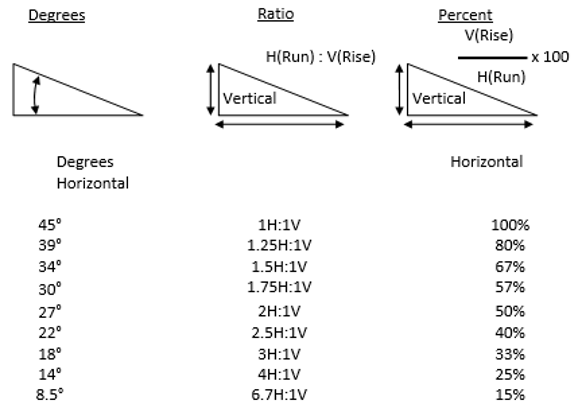
Snags shall mean any dead or dying standing tree. For wildlife purposes, snags should be at least three inches in diameter at breast height (dbh) and at least six feet tall. Snags may develop cavities which either occur naturally or are excavated by birds and mammals. The removal of snags can negatively impact wildlife populations that are dependent on them as essential habitat components. Generally, the value of a snag tree increases as its size increases. To assure that the minimum requirements of most wildlife species are being met, three snags of 12 inches dbh or greater should be available per acre. A minimum of one 15-inch dbh or greater diameter den tree should also remain per acre.
Soffit means the underside of a structural component such as an arch, beam or cornice.
Solar farm means a use where a series of solar collectors are placed in an area for the purpose of generating photovoltaic power for an area greater than the principal use on the site. Also referred to as solar power plant and solar photovoltaic farm.
Special event means a temporary outdoor activity held on public or private property, including, but not limited to, seasonal sales, the display of goods and merchandise associated with a retail use, community or cultural events, music or arts events, performances, celebrations/parties, festivals, fairs, and carnivals.
Street frontage means that portion of a lot abutting a publicly maintained street or alley.
Structure means any erection or construction, such as buildings, towers, mash poles, booms, signs, decorations, carports, machinery, and equipment excluding utility lines and appurtenances.
Substantial damage means damage of any origin sustained by a structure whereby the cost of restoring the structure to its before-damaged condition would equal or exceed 50 percent of the market value of the structure before the damage occurred. Improvements, modifications, and additions to existing buildings are counted cumulatively for at least three years.
Substantial improvement means any repair, reconstruction, rehabilitation, addition, renovation, or other improvement of a structure, the cost of which equals or exceeds 50 percent of the fair market value of the structure before the start of construction of the improvement or when an existing building is structurally altered such that the gross floor area is increased by more than 25 percent. Improvements, modifications, and additions to existing buildings are counted cumulatively for three years. This term includes structures which have incurred substantial damage, regardless of the actual repair work performed. The term does not, however, include either: (1) any project of improvement of a structure to correct existing violations of state or local health, sanitary, or safety codes specifications which have been identified by the local code enforcement official and which are the minimum necessary to assure safe conditions; or (2) any alteration of an historic structure, provided that the alteration will not preclude the structure's continued designation as a historic structure.
Temporary health care structure means a transportable residential structure providing an environment facilitating a caregiver's provision of care for a mentally or physically impaired person that (i) is primarily assembled at a location other than its site of installation, (ii) is limited to one occupant who shall be the mentally or physically impaired person, (iii) has no more than 300 gross square feet, and (iv) complies with applicable provisions of the State Building Code and G.S. 143-139.1(b).
Trademark means a name, symbol, or other device identifying a product which is officially registered and legally restricted to the use by its owner.
Truck stop means an establishment engaged primarily in the fueling, servicing, repair or parking of tractor trucks or similar heavy commercial vehicles, including the sale of accessories and equipment for such vehicles. A truck stop may also include overnight accommodations, showers, or restaurant facilities primarily for the use of truck crews.
Use means the purpose or activity for which the land or building thereon is designed, arranged, or intended, or for which it is occupied or maintained.
Utilities means public, quasi-public or private facilities such as water well water and sewage pumping stations, water storage tanks, power and communications transmission lines, electrical power substations, static transformer stations, telephone and telegraph exchanges, microwave radio relays, gas regulation stations, sewage disposal plants, sludge incinerators, warehouses, shops, and storage yards.
Veterinary clinic means a use or structure intended or used primarily for the testing and treatment of the physical disorders of animals; not principally used for the overnight boarding or grooming of well animals; not permitting outdoor cages, pens, or runs for the confinement of animals unless expressly permitted in the district; and not used for the training of animals.
Vision clearance means an unoccupied triangular space at the intersection of highways or streets with other highways or streets or at the intersection of highway or streets with railroads. Such vision clearance triangle shall be bounded by the intersection highway, street, or railroad right-of-way lines and a setback line connecting points located on such right-of-way lines by measurements from their intersection as specified in this chapter.
Warehouse means a commercial building for storage of goods. Warehouses are used by manufacturers, importers, exporters, wholesalers, transport businesses, etc. Self-storage is not included within this definition.
Wholesale storage means a facility engaged in the storage or movement of goods for themselves or other businesses. Goods are generally delivered to other businesses or the final consumer, except for some will-call pickups. There is little on-site sales activity.
Wireless telecommunication, co-location means the placement, installation, maintenance, modification, operation, or replacement of wireless facilities on, under, within, or on the surface of the earth adjacent to existing structures, including utility poles, city utility poles, water towers, buildings, and other structures capable of structurally supporting the attachment of wireless facilities in compliance with applicable codes. Attachment to existing utility owned transmission towers (e.g. high-tension power line support towers) may be permitted as a co-location type. The term does not include the installation of new utility poles, city utility poles, or wireless support structures. When placed on existing towers, there must be no increase in height of existing tower and must present a site plan showing the location of equipment structures to be located within previous approved fenced-in area.
Wireless telecommunication, concealed means a tower, ancillary structure, or equipment compound that is not readily identifiable as such, and is designed to be aesthetically compatible with existing and proposed building(s) and uses on a site.
Wireless telecommunication, tower means a tower erected for the purpose of transmitting or receiving signals, including, without limitation, telephone, radio, television, cable television, or microwave signals.
Yard means a space on the same lot with a principal building, open, unoccupied and unobstructed by buildings or structures from ground to sky, except where encroachments and accessory buildings are expressly permitted.
Yard, front means an open, unoccupied space on the same lot with a principal building, extending the full width of the lot and situated between the street or property line and the front line of the building projected to the side lot lines of the lot.
Yard, rear means an open, unoccupied space on the same lot with the principal building, extending the full width of the lot and situated between the rear line of the lot and the rear line of the building projected to the side lot lines of the lot.
Yard, side means an open, unoccupied space on the same lot with a principal building, situated between the building and the side lot line extending from the rear line of the front yard to the front line of the rear yard.
Zoning administrator means the Town of Woodfin employee or employees appointed by the town manager to have overall responsibility for the enforcement and interpretation of this ordinance, to include zoning officers, planners and the planning director.
(Ord. of 5-18-2021; Ord. of 12-21-2021; Ord. of 2-15-2022(2); Ord. of 5-17-2022(3); Ord. No. 2022-0802, § 1, 8-16-2022; Ord. No. 2022-151101, § 1, 11-15-2022; Ord. No. 2022-151102, § 1, 11-15-2022; Ord. No. 2023-024, § 1, 10-17-2023; Ord. No. 2023-026, § 1, 11-21-2023; Ord. No. 2024-06, § 1, 3-19-2024; Ord. No. 2024-017, § 1(Att.), 9-17-2024; Ord. No. 2025-010, § 1, 6-17-2025)
Sec. 54-11. - Bona fide farms exempt.
The provisions of this chapter shall not apply to bona fide farms. This chapter does not exercise any controls over crop lands, timber lands, pasture lands, apple orchards, idle or other farmlands, nor over any farmhouse, barn poultry house, or other farm buildings including tenant or other houses for a person working on the farms as long as such houses shall be in the same ownership as the farm and located on the farm. Such agricultural uses maintain the openness of the land and achieve the purposes of this chapter without the need for regulations. Residences for non-farm use or occupancy and other non-farm uses shall be subject to the provisions of this chapter.
(Ord. of 5-18-2021)
Sec. 54-12. - Traffic visibility.
No obstruction, such as structures, parking, or vegetation, shall be permitted in any district above the height of three feet above the plane, through the mean centerline roadway grades, within the triangular space formed by any two existing or proposed intersecting street or alley right-of-way lines and a line joining points on such lines located 50 feet from their point of intersection.
(Ord. of 5-18-2021)
Sec. 54-13. - On-site sewage service.
The width and area of all lots not served by a public sanitary sewer system or other approved system shall be sufficient to permit the use of an on-site soil absorption sewage disposal system designed in accordance with the county health department regulations.
(Ord. of 5-18-2021)
Sec. 54-14. - Cemeteries.
Expansion of present cemeteries and new cemeteries may be allowed as a special use. The board of adjustment shall determine the district, location, size and number of cemeteries in the town. Consideration shall be given to topography, soil, groundwater, erosion, health hazards, and other such conditions before issuance of a special use permit for a cemetery.
(Ord. of 5-18-2021; Ord. of 12-21-2021)
Sec. 54-15. - Projection and encroachments.
(a)
Every part of a required yard shall be kept open and unobstructed from its lowest level to the sky, except for the ordinary projection of sills, belt courses, chimneys, flues, buttresses, ornamental features and eaves; provided, however, that none of the aforesaid projections shall project into a minimum side yard more than one-third of the width of such yard and in any case more than 24 inches. Chimneys or flues may be erected within a rear yard, provided they do not exceed five square feet in the aggregate and do not obstruct ventilation.
(b)
Open or lattice-enclosed fire escapes, fireproof outside stairways, and balconies opening upon fire towers projecting into a required yard not more than five feet shall be permitted where so placed as not to obstruct light and ventilation.
(c)
Unenclosed porches not more than one story in height shall be allowed to project not more than ten feet into the setback of the front yards and rear yards.
(d)
Steps for entrance to a building may project into any yard. An oriel or bay window may project not more than three feet into any required yard.
(Ord. of 5-18-2021)

