
Woodfin City Zoning Code
ARTICLE X
- ENVIRONMENTAL STANDARDS4
Editor's note— Ord. No. 2023-022, § 1, adopted Sept. 19, 2023, amended the title of Art. X to read as herein set out. The former Art. X title pertained to floodway district regulations. Formerly, Art. IX, §§ 54-203—54-208. See the editor's note at Article IX.
Sec. 54-213.- Reserved.
Editor's note— Ord. No. 2025-07, § 1, adopted May 20, 2025, repealed § 54-213, which pertained to floodway district regulations and derived from Ord. of 5-18-2021; Ord. No. 2023-022, § 1, 9-19-2023.
Sec. 54-214. - Steep slopes.
(a)
Purpose. The purpose of this section is to regulate development in steep slope areas to preserve the Town of Woodfin's unique character, conserve the public health, safety, and general welfare and to promote environmentally sound design and planning in accordance with the following objectives:
•
To protect life and property from all potentially hazardous conditions particular to steep slopes, e.g., rock falls, flash flooding, debris flows, mud slides and increased wildfire hazard.
•
To preserve and enhance the scenic and environmental resources of the landscape by encouraging the maximum retention of prominent natural topographic features, i.e., drainage swales, streams, slopes, ridgelines, rock outcroppings, vistas, natural plant formations, and trees.
•
To encourage innovative site and architectural design and planning for the development to adapt to the natural terrain and be harmonious with the character of the area.
•
To minimize grading and cut and fill operations inconsistent with the retention of the natural character of the hillside.
•
To preserve, where possible, natural streams, ponds and associated riparian vegetation.
•
To require the retention of trees and other vegetation to stabilize steep hillsides, retain moisture, prevent erosion, and enhance the natural scenic beauty.
•
To encourage the retention of trees and other vegetation throughout the site instead of just the periphery of the development.
•
To encourage minimal grading which relates to the natural contour of the land, thus rounding off sharp angles at the top and bottom of cut and fill slopes in a natural manner.
•
To provide land use densities to promote the best possible development of hillside areas to retain significant natural features and to preserve slope stability.
•
To encourage road design that follows the natural topography wherever possible to minimize grading.
•
To preserve predominant views from and of the hillside areas to retain the sense of identity and imagery that the hills and mountains now impart to the Town of Woodfin.
(b)
Determining steep slope areas. For the purposes of this section, steep slopes are defined as: (1) any lot, parcel, tract, or portion thereof, that has a natural elevation of 2,200 feet above mean sea level or higher and has an average natural slope of 20 percent or greater, or (2) that has a natural elevation of 3,000 feet above mean sea level or higher, regardless of slope.
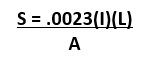
For the purposes of this section, slope means the average natural slope of an entire parcel. The average natural slope for the parcel shall be calculated using the following formula.
 |
Where:
S = Existing grade of parcel in percent I = Contour interval of map in feet, with said contour intervals to be five feet or less L = Total length of the contour lines within the parcel in feet A = Area of the parcel in acres 0.0023 = Product of two constants, one of which converts feet into acres and one of which converts a decimal into a percentage |
(c)
Applicability. Steep slope standards shall apply to the following:
(1)
New building construction and individual lot improvements, including but not limited to drives, retaining walls, utilities, and stormwater controls.
(2)
Communal infrastructure including, but not limited to, roadways, shared drives, public utilities, public facilities, and stormwater controls, when installed in accordance with an approved major subdivision plan. For the purpose of applying this section, approval of a subdivision plat shall not constitute approval of a development plan for the individual lots in the subdivision, which shall be reviewed under separate applications.
(3)
Building elements exempted from steep slope standards shall include:
a.
Individual septic systems.
b.
Expansions to existing structures applied for on or before February 15, 2022, that are less than 500 square feet.
(d)
Reserved.
(e)
Steep slope development standards. In addition to development standards identified elsewhere in this code, development in designated steep slope areas must also comply with the following:
(1)
Lot size. Any new lot created with greater than ten percent of the area considered steep slope as defined in section 54-214(b), and which is created after February 15, 2022, shall be a minimum of 1.5 acres.
This subsection shall not prohibit the development on any lot which was a lot of record on or before February 15, 2022, and which does not meet the lot size requirements of this section, provided that all other ordinance requirements are satisfied.
(2)
Density. No single lot may contain more than two dwelling units.
(3)
Number and height of buildings and structures.
a.
Buildings. No single lot may contain more than two detached buildings, with principal buildings not exceeding a height of 35 feet and accessory buildings not exceeding a height of 20 feet.
b.
Accessory structures. The number of accessory structures, not including buildings, are not limited in number however, height shall be limited to no more than 20 feet, except as noted below:
i.
All retaining walls are limited to a maximum height of 12 feet. Separate walls that are stacked or tiered shall be combined for the purposes of this section.
ii.
Fences and free-standing walls shall meet the standards found in section 54-317.
c.
Measuring height. Height shall be limited as described elsewhere in this code.
d.
Setbacks. The planning director may approve reductions of front setbacks from 30 feet to 20 feet in R-43 and R-21 district, when said setback reduction results in reducing site grading by 10 percent or more in previously undisturbed areas based on the allowance provided in subsection (4) below.
(4)
Land disturbance and impervious surface standards. Land disturbance and impervious surface limits shall apply to all steep slope areas as follows:
(5)
Geotechnical assessment. A geotechnical assessment prepared by a NC registered professional engineer shall be required for lots with existing grade 35 percent or greater to determine the stability of the underlying geology and soils to support the proposed development. The geotechnical analysis report shall be required prior to the issuance of a zoning permit.
(6)
Screening of buildings and structures.
a.
Applicability. Screening and revegetation standards apply within steep slope areas for all new construction including new buildings and structures and additions to buildings and structures, and any modification to an existing building exceeding 50 percent of the appraised or tax assessed value.
b.
Planting standards.
i.
Calculating the requirement. The surfaces of the structure which are oriented to the downhill sections of the lot must be screened at a ratio of one tree for every 200 square feet of planar surface. Retaining walls visible from public property or public right-of-way shall be screened at a ratio of one large maturing tree, one small maturing tree and five shrubs for every 50 linear feet.
ii.
Minimum tree size. Trees planted must be a minimum of 1.5 inches in diameter measured six inches above the root ball and 75 percent of all new trees must be a large maturing species.
iii.
Tree spacing. Trees must be located no greater than 50 feet from the furthest extending portion of the structure (measured perpendicularly) and shall be spaced a minimum often feet, but no greater than 30 feet, apart.
iv.
Tree composition. Trees must be of varying, native species, as defined by the Natural Resources Conservation Service of the United States Department of Agriculture, and no single species shall comprise more than 50 percent of the trees planted, unless applying existing tree credits. Existing trees which are left intact and that appear in good health may be credited toward the required plantings based on the following table.
The following credit system may be applied, provided tree protection standards outlined in section 54-216(5) are met:
Trees to be credited shall be marked using flagging tape and cordoned off with tree protection fencing spaced one foot for every one inch of tree diameter measured from the edge of tree prior to site disturbance to ensure their health throughout site development.
(7)
Artificial slopes.
a.
Maximum slope standards. Artificial slopes shall not exceed a 1.5:1 cut and 2:1 fill. Artificial slopes may increase to 1:1 cut and 1,5:1 fill with submittal of a geotechnical certification from a North Carolina registered professional engineer. However, if stable exposed rock is the intended result, the cut and/or fill slope(s) may be increased upon certification from a North Carolina registered professional engineer.
b.
Revegetating artificial slopes. Artificial slopes shall be remediated through reforestation or revegetation to visually integrate disturbed areas into surrounding terrain with the purpose of maintaining a natural appearance. Revegetation shall consist of a combination of trees, shrubs, and groundcover plants native to the area.
(8)
Maintenance plan. A maintenance plan shall be required for revegetated areas and such plan shall include provisions for replacement of dead vegetation when greater than 50 percent mortality rate occurs.
(9)
Preservation of vegetation. The removal of trees, vegetation, and snags from lots within steep slope zones is prohibited unless such trees, vegetation, and snags are located within a permitted land disturbance area or within 30 feet of any dwelling unit and 20 feet of a combustible accessory structure. Non-native invasive species may be removed. For all new development, these preservation areas shall be designated on plans submitted for approval. Preservation areas shall be clearly designated during all land disturbing activities using protective fencing and shall be inspected prior to the zoning permit being issued.
(f)
Zoning permit required. Compliance with the requirements of this chapter shall be included in the zoning permit review. Site and building plan information necessary to demonstrate compliance with the steep slope development standards, along with all other applicable development requirements will be required at time of zoning permit application.
(1)
Site plan requirements. Site plans shall be prepared by a licensed design professional and shall include the following:
a.
A boundary line survey of the property.
b.
The size, location, and species of regulated trees.
c.
Limits of disturbance identifying where trees, vegetation, and soils are to be protected and preserved and areas where trees, vegetation, and soils are to be removed or modified. This includes proposed grading, utilities, and improvements as well as access, staging, and storage areas.
d.
The critical root zones of all existing trees within or overlapping the disturbed area including those trees on adjacent properties with root areas that would be impacted by construction, and the placement of tree, vegetation, and soil protection measures that will be used before, during, and after all construction activities to promote the survival and/or retention of such elements.
e.
The location of all proposed underground utilities, construction material storage, debris dumpster locations, and the location of proposed sanitary facilities.
f.
The location of tree protection fencing required with detail of the fencing construction and a note indicating that a pre-construction meeting with Town of Woodfin staff will be scheduled prior to commencing any work on the site.
Explanatory note: In addition to recognizing the importance of retaining and using native trees and shrubs, dead and deteriorating trees often provide valuable wildlife habitat. Property owners and managers are encouraged to retain significant portions of dead trees as wildlife snags. A tree care or forestry management professional should be consulted to consider ways to reduce the threats to human life and property. Hazardous snags should be cut to a height as close to ten feet as is deemed safe to remove the falling hazard.
(2)
Implementation of tree protection.
a.
Pre-construction conference. Prior to commencing any activity requiring a development approval, a pre-construction conference with Town of Woodfin staff shall take place to review procedures for protection and management of all protected elements identified on the tree protection plan.
b.
Tree protection procedures. Tree protection procedures must follow the specifications written in accordance with standards in the current ANSI A300 Standards for Tree Care Operations, ANSI Z133 Safety Standards, industry best management practices and administrative standards.
c.
Protective barriers. Fences or other equally protective barriers as determined by the Town of Woodfin shall be used to protect areas identified on an approved tree protection plan as to limit access to the protected area, prevent the compaction of soil and the destruction or damage of the trees. Prior to any development activity, the installation of the protective barrier shall be approved by the Town of Woodfin. The protective barriers shall not be relocated or moved temporarily without the written approval of the Town of Woodfin and shall remain in place until all development activity is completed and approved.
d.
Restrictions within the protected areas. The following activities are prohibited within the protected area inside of fences: parking of vehicles or equipment; storage of building materials, refuse, or excavated soil; use of tree trunks as a backstop, winch support, anchorage, power pole, signpost, or other similar function.
(g)
Enforcement and penalties. The Town of Woodfin shall perform inspections to assure that the work conforms to the approved plan and the provisions of this section. Violations of this chapter shall be enforced with the standards found in section 54-41.
(Ord. of 5-18-2021; Ord. of 12-21-2021; Ord. No. 2023-022, § 1, 9-19-2023; Ord. No. 2025-010, § 1, 6-17-2025)
Cross reference— Excavation and repair, § 42-21 et seq.; flood damage prevention, § 14-1 et seq.; subdivisions, § 46-1 et seq.
Sec. 54-215. - Grading restrictions.
(a)
Grading without an approved development plan. Any land-disturbing activity without an approved development plan shall not be permitted, except as otherwise exempted by G.S. 160D-903.
(Ord. No. 2025-010, § 1, 6-17-2025)
Editor's note— Prior to reenactment by Ord. No. 2025-010, Ord. No. 2023-022, § 1, adopted Sept. 19, 2023, repealed § 54-215, which pertained to general provisions and derived from Ord. of 5-18-2021.
Sec. 54-216. - Landscape and green space.
(1)
Purpose. The purpose of the landscape and green space standards is to preserve or provide quality outdoor spaces that improve the natural scenic beauty, provide areas of respite or recreation, encourage preservation of existing trees and other vegetation, replenish trees and vegetation removed due to development, reduce stormwater runoff, decrease erosion, improve water quality, and protect wildlife habitat.
(2)
Applicability. Landscape and green space standards shall be required for the following new construction developments within the Town of Woodfin:
a.
Multi-family or single-family residential projects with five or more units or lots.
b.
Non-residential development with one or more buildings and/or business areas, as defined in section 54-10, totaling 5,000 square feet or more.
c.
Expansions of pre-existing buildings and/or business areas that are:
•
50 percent or more of the existing building and/or business area, or
•
Greater than 20,000 square feet, regardless of existing square footage.
(3)
Standards.
a.
General.
i.
Minimum tree size at planting. All large maturing trees shall be a minimum of 2-inch caliper or 8—10' tall, while all small-maturing trees shall be a minimum of 1½-inch caliper or 6—8' tall.
ii.
Minimum planting area. All trees shall have a minimum planting area of 300 square feet with tree wells dug a minimum of 3-feet deep.
iii.
Maintenance requirements. The owner or lessee of the property where landscaping is required shall be responsible for the maintenance and protection of all required trees. Landscaped areas shall be maintained in good condition and kept free of debris. Required material may not be replaced without approval from the zoning administrator. Failure to maintain may result in enforcement action per section 54-41
iv.
Pruning of required trees. Pruning of required trees shall be in accordance with the American National Standards Institute (ANSI) standards A300 or its successor. No topping of trees shall be permitted.
v.
Selection & suitability. All plant materials shall be in good health and free of disease. All required plant material shall be selected from the Town of Woodfin's Recommended Plant List—Appendix A. Plant material native to Western North Carolina shall be required in environmentally sensitive areas including steep slopes and regulated flood areas and shall be selected based on a species suitability to those areas. In all other areas, native plant material is encouraged, as is the use of pollinator species.
b.
Street trees.
i.
Minimum requirement. One large maturing tree meeting for every 50 linear feet of street frontage shall be required. Where overhead utility lines are present, one small maturing tree for every 40 linear feet shall be required.
ii.
Placement. Street trees shall be placed parallel to the street, within 20 feet of the edge of pavement. Trees may be located within the town right-of-way or on private property. Trees proposed to be located within state-controlled rights-of-way must obtain approval from the North Carolina Department of Transportation prior to zoning approval.
iii.
Spacing. Street trees shall be spaced not closer than 15-feet and no further than 60-feet apart.
c.
Landscape bufferyards.
i.
Minimum requirement. A 20-foot-wide vegetated buffer shall be required along the property boundary between non-residential and residential zoning.
ii.
Planting rate. A minimum of eight trees and 14 shrubs shall be planted for every 100 linear feet of property line buffer.
iii.
Planting composition. A minimum of 50 percent of all material must be evergreen.
iv.
Plant spacing. Plant material shall be arranged in a naturalistic manner. Trees shall be spaced no closer than 15-feet from other trees.
v.
Bufferyard reduction. A bufferyard width and planting rate may be reduced by 50-percent with the installation of a minimum eight-foot tall, opaque fence or wall.
vi.
Stream buffers. All built upon areas shall provide a minimum setback from all regulated streams as described in section 41-12 and may be used to meet the requirements of this sub-section.
d.
Vehicular use area landscaping.
i.
Minimum requirement. A minimum of one tree shall be required for every 1,500 square feet of vehicular use areas with more than ten parking spaces, or greater than 5,000 square feet. A maximum of 25 percent of all required vehicular use area trees may be small maturing.
ii.
Placement. Trees shall be planted within 20-feet of the edge of the vehicular use area.
iii.
Interior islands. For vehicular use areas with interior rows of parking, interior planting islands shall be included and spaced to ensure that no parking space is more than 50-feet from a tree. No utilities, light poles, or other structures are permitted in tree islands and islands must be a minimum of 300 square feet per tree.
e.
Screening. Screening of dumpsters, loading docks, outdoor storage, shall be required with one of the following methods:
i.
A continuous hedge of evergreen trees spaced no less than eight feet apart planted in a minimum seven-foot wide planning strip, or
ii.
An opaque fence or wall with a minimum height of six feet with the finished side of the fence facing out.
f.
Green space. Required green space may include undisturbed natural areas or areas developed for passive or active recreation purposes.
i.
Minimum requirement. Green space shall be set aside at the following rates based on the cumulative parcel size:
•
Less than one acre: 5% of total lot area.
•
One—three acres: 10% of total lot area.
•
Over three acres: 15% of total lot area.
•
Subdivisions with five or more lots: 15% of total lot area.
ii.
Minimum size. Non-contiguous green space areas must be a minimum of 1,000 square feet in size.
iii.
Prohibited structures and features. Required green space may not include above ground stormwater facilities, vehicular use areas, utility substations, retaining walls, community identification signage, retaining walls over four-feet in height, cluster mailboxes, and slopes with a grade greater than 3:1.
iv.
Structures or features allowed at a reduced rate. Fifty percent of all areas dedicated to innovative stormwater management that are publicly accessible and do not require fencing, and hardscaped passive or active recreation areas may count towards required green space.
v.
Canopy coverage. Green space shall be required to include tree plantings at a minimum rate of one tree per 1,000 square feet. Seventy-five percent of all required trees shall be large maturing species. New trees must be spaced a minimum of 20 feet from any existing tree, and 15 feet from any proposed tree.
(4)
Tree credits. Credits for existing trees may be applied to any landscape requirement provided other requirements can be met. Credits shall be applied at the following rates:
(5)
Tree protection. No grading or other land-disturbing activity may occur on a site with existing trees which are designated to be preserved to meet the landscaping requirements until protective barriers are installed by the developer and inspected by the zoning administrator. The diameter at breast height (DBH) of the preserved trees, the species, and the location of protective barriers must be shown on the landscape and grading plans with the dimension between the tree trunk and barrier indicated.
i.
Placement of protective barriers. Barricades shall be placed around the critical root zone of preserved trees that are within 50 feet of any grading or construction activity. All protective barriers must include clear and visible signage that describes the delineated area as a "Tree Protection Area". All protective barriers and signs must be maintained throughout the building construction process.
ii.
Protective barriers. A fence or other barrier which is at least three feet high and constructed with durable, weather-proof, and high-visibility materials must be used to identify the tree protection area.
iii.
Prohibited activities. Land disturbance and other activities may not occur within the tree protection area including:
•
Grading
•
Filling
•
Parking or staging of vehicles, equipment, dumpsters or trailers
•
Storage of debris, topsoil, mulch, sand or any other construction material
•
Installation of sedimentation and erosion control measures except that erosion control fencing which may run parallel to the tree protection barrier
•
Disposal of hazardous or other wastes including concrete washout
•
Attaching of nails, ropes, cables, signs, or fencing to any preserved tree.
(6)
Enforcement and penalties. The Town of Woodfin shall perform inspections to ensure that work conforms to the approved plan and the provisions of this section. Violations of this section shall be enforced per section 54-41 of this chapter.
(Ord. No. 2025-010, § 1, 6-17-2025)
Editor's note— Prior to reenactment by Ord. No. 2025-010, Ord. No. 2023-022, § 1, adopted Sept. 19, 2023, repealed § 54-216, which pertained to administration and derived from Ord. of 5-18-2021.
Sec. 54-217. - Reserved.
Editor's note— Ord. No. 2023-022, § 1, adopted Sept. 19, 2023, repealed § 54-217, which pertained to local administrator and derived from Ord. of 5-18-2021.
Sec. 54-218. - Reserved.
Editor's note— Ord. No. 2023-022, § 1, adopted Sept. 19, 2023, repealed § 54-218, which pertained to variance procedures and derived from Ord. of 5-18-2021; Ord. of 12-21-2021.

