
Youngtown City Zoning Code
CHAPTER 17
64 - SIGN REGULATIONS8
Editor's note— Ord. No. 10-11, § I, adopted June 24, 2010, repealed Ch. 17.64 and enacted a new Ch. 17.64 as set out herein. The former Ch. 1764 pertained to "Signs." See also the Code Comparative Table and Disposition List.
17.64.010 - Purpose of regulations.
A.
To promote the creation of an attractive visual environment that promotes a healthy economy by:
1.
Allowing individuals and businesses to inform, identify, and communicate effectively; and
2.
Directing the general public through the use of signs while maintaining an attractive application of signs on the buildings and sites.
B.
To protect and enhance the physical appearance of the community in a lawful manner that recognizes the rights of property owners by:
1.
Encouraging the appropriate design, scale, and placement of signs;
2.
Encouraging the orderly placement of signs while avoiding regulations that are inflexible; and
3.
Assuring that the information displayed on a sign is clearly visible, conspicuous, legible and readable so that the sign achieves the intended purpose.
C.
To foster public safety along public and private streets within the community by assuring that all signs are in safe and appropriate locations.
D.
To have administrative review procedures that are the minimum necessary to:
1.
Balance the community's objectives and regulatory requirements with the reasonable advertising and way to finding needs of businesses; and
2.
Allow for consistent enforcement of the sign code and to minimize the time required to review a sign application.
(Ord. No. 10-11, § I, 6-24-10)
17.64.020 - Definitions.
The following words and phrases used in this sign code shall have the following meanings:
"Abandoned sign" means a sign for a period of at least ninety (90) consecutive calendar days or more that no longer advertises or identifies a legal business establishment, product or activity.
"Address sign" means a sign used to show the address number of the building or property and may show street name, owner or tenants' name.
"A-frame sign" means a movable sign used to display advertising or business logo (see portable sign).
"Alteration" means any change in color, size or shape, which changes appearance of a sign, or a change in position, location, construction or supporting structure of a sign, except that a copy change on a sign is not an alteration.
"Animated sign" means a sign which has any visible moving part, flashing or osculating lights, visible mechanical movement of any description, or other apparent visible movement achieved by any means that move, change, flash, osculate or visibly alters in appearance in a manner that is not permitted by these regulations.
"Area of sign" refer to measurement standards [section] 17.64.040.
"Attraction or reader board" means any sign having changeable copy for the purpose of advertising events, sales, services or products provided at the site on which the sign is located.
"Awning" means a shelter extending from the exterior wall of a building and composed of nonrigid materials except for the supporting framework.
"Awning sign" means any sign painted on, attached to, or supported by an awning.
"Balloon sign" means a lighter-than-air gas-filled balloon tethered in a fixed location that has a sign with a message on its surface or attached in any manner to the balloon.
"Banner sign" means a temporary, lightweight sign that contains a message which is attached or imprinted on a flexible surface that deforms under light pressure and that is typically constructed of a cloth material or plastic.
"Billboard" or "poster panel" means an "off-premises" sign.
"Blade sign" see projecting signs.
"Building identification sign" means any sign containing the name or address of a building and may include hours of operation and emergency information that is located on the same site as the structure to which the sign refers.
"Business sign" means a sign which attracts attention to a business, profession, commodity or service sold, offered or manufactured, or to entertainment offered on the premises where sign is located (see "on-premises" sign).
"Cabinet sign (can sign)" means signage mounted on or in a cabinet mounted on a wall, pole or structure and which may be illuminated.
"Canopy" means a permanent roof-like shelter or cover attached to a building, but not requiring support from the ground or an adjacent structure.
"Canopy sign" means any permanent sign attached to or constructed underneath a canopy. These signs are below a projecting structure which extends over the pedestrian walkway which effectively prevents the wall signs for being visible to the pedestrian walking under the canopy. See projecting sign.
"Carport sale sign" means a sign announcing a temporary residential sale of personal property on an informal basis for the sale of used goods such as, but not limited to, household items, clothing, tools, toys, recreation equipment or other used or secondhand items normally found in an about the home and sold by private individuals. Carport sales are also commonly referred to as a yard sale, garage sale, craft sale, basement sale, rummage sale, tag sale, moving sale, junk sale, or block sales.
"Changeable copy sign" means a sign or portion thereof on which the copy or symbols change either automatically through electrical or electronic means (for example, time and temperature units), or manually through placement of letters or symbols on a panel mounted in or on a track system.
"Comprehensive sign plan (CSP)" means a coordinated program of all signs, including exempt and temporary signs for a business, or businesses if applicable, located on a development site. The sign program shall include, but not be limited to, indications of the locations, dimensions, colors, letter styles and sign types of all signs to be installed on a site for a new development.
"Construction sign" means a nonpermanent sign identifying the persons, firms or business directly connected to a construction project at the site where the sign is located.
"Digital sign" means an electronic illuminated sign with changeable copy.
"Directional sign" means a wall or freestanding instructional sign located on private property at or near the public right-of-way, directing or guiding personnel or vehicular traffic onto the property toward parking or other identified locations or offices on the property.
"Double faced sign" means any sign having copy on two faces of equal dimension with an angle between the two faces of forty-five (45) degrees or less.
"Footcandle" means a measure of illumination on a surface that is one foot from the uniform source of light of one candle and equal to one lumen per square foot.
"Freestanding sign" means any ground, monument, pole or similar sign which is permanently affixed in or upon the ground, supported by one or more structural members.
"Frontage" means the horizontal width of any given building, business or tenant as measured at grade, along the face of the building which is closest to and most nearly parallel with the contiguous street right-of-way line.
"Governmental sign" means a sign erected and maintained pursuant to and in discharge of any governmental function, or required by law, ordinance or other governmental regulation.
"Grade" means the level of the site at the property line located at the closest distance to the sign.
"Ground sign" see freestanding sign.
"Height of sign" refer to measurement standards [section] 17.64.40.
"Illegal sign" means any sign placed without proper approval or permits as required by this code at the time of sign placement. "Illegal sign" shall also mean any sign placed contrary to the terms or time limits of any permit and any nonconforming sign which has not been brought into compliance with any applicable provisions of this code.
"Illuminated sign" means any sign for which an artificial source of light is used in order to make readable the sign's message, including internally- and externally-lighted signs and reflecting, glowing or radiating signs.
"Instructional sign" means a sign clearly for instructional purposes shall not be included in the permitted sum of the sign area of identification wall signs, provided such sign is not larger than otherwise provided for by ordinance.
"Length of frontage" means:
1.
For measurement purposes, the length of any primary or secondary frontage as defined in section 17.64.040 shall be the sum of all wall lengths parallel, or nearly parallel, to such frontage, excluding any such wall length determined clearly unrelated to the frontage criteria.
2.
For buildings with two or more frontages, the length and allowable sign area shall be calculated separately for each such frontage.
3.
The building frontage for a building unit shall be measured from the centerline of the party walls defining the building unit.
"Logo, logogram, or logotype" means an emblem, letter, character, pictograph, trademark, or symbol used to represent any firm, organization, entity, or product.
"Monument sign" see freestanding sign.
"Mural" means a picture on an exterior surface of a structure. A mural is a sign only if it is related by language, logo, or pictorial depiction to the advertisement of any product or service or the identification of any business.
"Neon sign" means a sign with tubing that is internally illuminated by neon or other electrically-charged gas.
"Noncommercial sign" means a sign with a message which is not commercial in nature. Such messages typically relate to debatable matters of public concern, such as, by way of example and not limitation, religion, arts, science, philosophy, commentary on governmental policy, etc. A noncommercial sign is not a "political sign," which is defined below, but is treated the same as a "political sign" except that a noncommercial sign may not be placed in the right-of-way.
"Nonconforming sign" means a sign which was validly installed under laws or ordinances in effect at the time of its installation, but which is in conflict with the current provisions of this code.
"Obscene signs" means any sign that shows or depicts any state of nudity, semi-nudity, or simulated nudity, or any activity prohibited under section 5.17.020 and following of this code.
"Off-premises (off-site) sign" means a sign used to promote an interest other than that of a business, individual, products, or service available on the premises where the sign is located.
"On-premises (on-site) sign" means any sign used for promoting a business, individual, product or service available on the premises where the sign is located.
"Plaza sign" means town plaza (kiosk) signs [that] are directional signs owned by the town and installed by a third-party contractor vendor which serve as off-premises signs for town buildings, parks and businesses.
"Pole sign" see freestanding sign.
"Political sign" means a temporary sign which supports candidates for office or urges action on any other matter on the ballot of primary, general and special elections relating to any national, state or local election.
"Portable sign" means any movable sign not permanently attached to the ground or a building and easily removable by using ordinary hand tools, but does not include a "walking sign" as defined, below.
"Primary and secondary frontage" means the primary frontage of any building or site [that] shall include the elevation(s) facing a public street, facing a primary parking area for the building or tenants, or containing the public entrance(s) to the building or building unit. The secondary frontage shall include frontages containing secondary public entrances to the building or building units, and all walls facing a public street or primary parking area not designated as the primary frontage above.
"Private street" means primary accessways that are intended to provide vehicular access to multiple commercial businesses and/or ownerships and are not dedicated as a public thoroughfare.
"Projecting sign" means a sign which projects from and is supported by a ceiling or canopy or a wall or parapet of a building with the display surface of the sign in a plane perpendicular to or approximately perpendicular to the wall. Also see "canopy sign".
"Real estate sign" means any nonpermanent sign pertaining to the sale, exchange, lease, rental, or availability of land, buildings, condominium and similar units, or apartments. Such signs may include building name and address, price and amenities, identity of seller or broker, and similar information.
"Revolving or rotating sign" means an animated sign.
"Right-of-way" means public land used for streets, sidewalks, utilities, or for future expansion and similar uses.
"Roof sign" means any sign erected upon a roof, parapet, or roof-mounted equipment structure and extending above a roof, parapet, or roof-mounted equipment structure of a building or structure.
"Sign" means any name, figure, character, outline, display, announcement, or device, or structure supporting the same, or any other device of similar nature designed to attract attention outdoors, and shall include all parts, portions, units, and materials composing the same, together with the frame, background, and supports or anchoring thereof. A sign shall not include any architectural or landscape features that may also attract attention.
"Sign face" means an exterior display surface of a sign, including nonstructural trim exclusive of the supporting structure.
"Site" means all the contiguous ground area legally assembled into one development location which is a zoning lot. A zoning lot is defined as a permanent parcel (lot of record), multiple lots of record, or a portion of a lot of record.
"Special event sign" means any temporary or nonpermanent sign advertising or pertaining to any assembly, gathering, activity, or meeting sponsored, arranged, or promoted by a religious, charitable, community service, educational, or other similar nonprofit organization.
"Super graphic" means a painted design which covers all or a major portion of a wall, building or structure. A super graphic is a sign only if it is related by language, logo, or pictorial depiction to the advertisement of any product or service or the identification of any business.
"Temporary sign" means any sign which is placed for a period not to exceed thirty (30) days.
"Vehicle sign" means any sign permanently or temporarily attached to or placed on a vehicle or trailer.
"Variances" means a variance is a legal device that allows a local government to provide a property owner with relief from the normal application of some restriction in the zoning code, such as minimum lot or building size, height limits, or setback requirements. Variances are granted when government determines that there are special circumstances, unique to the property in question, that would create practical difficulties if the zoning code were enforced as written.
"Walking sign" means a sign that is carried, worn, toted or held by a person, robotic device or any animal. A walking sign is also commonly referred to as a sign walker.
"Wall sign" means any sign attached to or painted on the wall of a building or structure in a plane parallel or approximately parallel to the plane of said wall.
"Window, area of" means the area of a single window [and] includes all of the window panes in an area that is separated by mullions, frames or other dividers.
"Window sign" means any sign viewable through and/or affixed in any manner to a window or exterior glass door such that it is intended to be viewable from the exterior (beyond the sidewalk immediately adjacent to the window), including signs located within six feet inside a building but visible primarily from the outside of the building.
(Ord. No. 10-11, § I, 6-24-10)
17.64.30 - General regulations.
A.
No sign shall be allowed on any property unless the sign is specifically allowed in that zoning district.
B.
No sign may be posted on public or private property without the property owner's prior permission.
C.
Every sign and its supporting structure shall be designed and constructed to conform to the provisions of all applicable codes and ordinances.
D.
No sign shall be erected, relocated or maintained so as to prevent free ingress to, or egress from, any door, window or fire escape nor shall any sign be attached to a standpipe or fire escape.
E.
No sign shall be erected, installed or maintained at or near any intersection of streets in such a manner as to obstruct free and clear vision; or at any location where, by reason of its position, shape, color or illumination, it may interfere with, obstruct the view of, or be confused with any authorized traffic sign, signal or device, or makes use of the words, "stop," "look," "danger," or any other word, phrase, symbol or character in such manner as to interfere with, mislead, or confuse drivers, riders or pedestrians.
F.
No sign shall be erected or painted upon or attached to any tree, rock or other natural feature, or to any street sign, utility pole or similar structure, except that portable signs authorized under subsection 17.64.050E. may be temporarily secured while on display, provided that the sign is secured in a manner that does not damage public property or impair public safety.
G.
The regulations of this code shall not apply to signs of metal, stone or other noncombustible material when built into the walls of a building or structure provided that such inlays or tablets shall bear only the name of the owner or architect, name or use of the building, date of building erection or reading matter commemorating a person or event. Size of such signs shall be limited to two square feet and not more than one per building.
H.
Nothing contained herein shall prevent the erection, construction and maintenance of official traffic, fire department or police signs, signals, devices and other posters or markings of the federal, state, or local jurisdictions or other competent public authorities, or the posting of notices as required by law.
I.
No signs shall be placed in the right-of-way except political signs installed per Town Code [section] 9.08.090, town plaza signs, and public directional signs owned by the town. All others will be removed by public works or public safety officials and either retained as evidence of a violation of this code or destroyed.
J.
All signs shall be maintained and owners are responsible for preventing and eliminating any peeling, cracking, discoloration, covering with dirt or other material and other similar problems caused by wear and tear and common weather conditions. All signs shall be cleaned and repainted as necessary. All cracked or broken sign faces and nonfunctioning interior lamps shall be repaired or replaced or within forty-five (45) working days following receipt of notification from code enforcement that the sign requires repair or maintenance. Any party who may be aggrieved by the issuance of a maintenance directive by public officials may appeal the notification of a violation to the building official.
K.
Any sign allowed under this code may contain a noncommercial message.
(Ord. No. 10-11, § I, 6-24-10; Ord. No. 14-02, § I, 3-6-14; Ord. No. 14-06, § I, 9-18-14)
17.64.040 - Measurement standards.
A.
Determining Sign Area and Dimensions.
1.
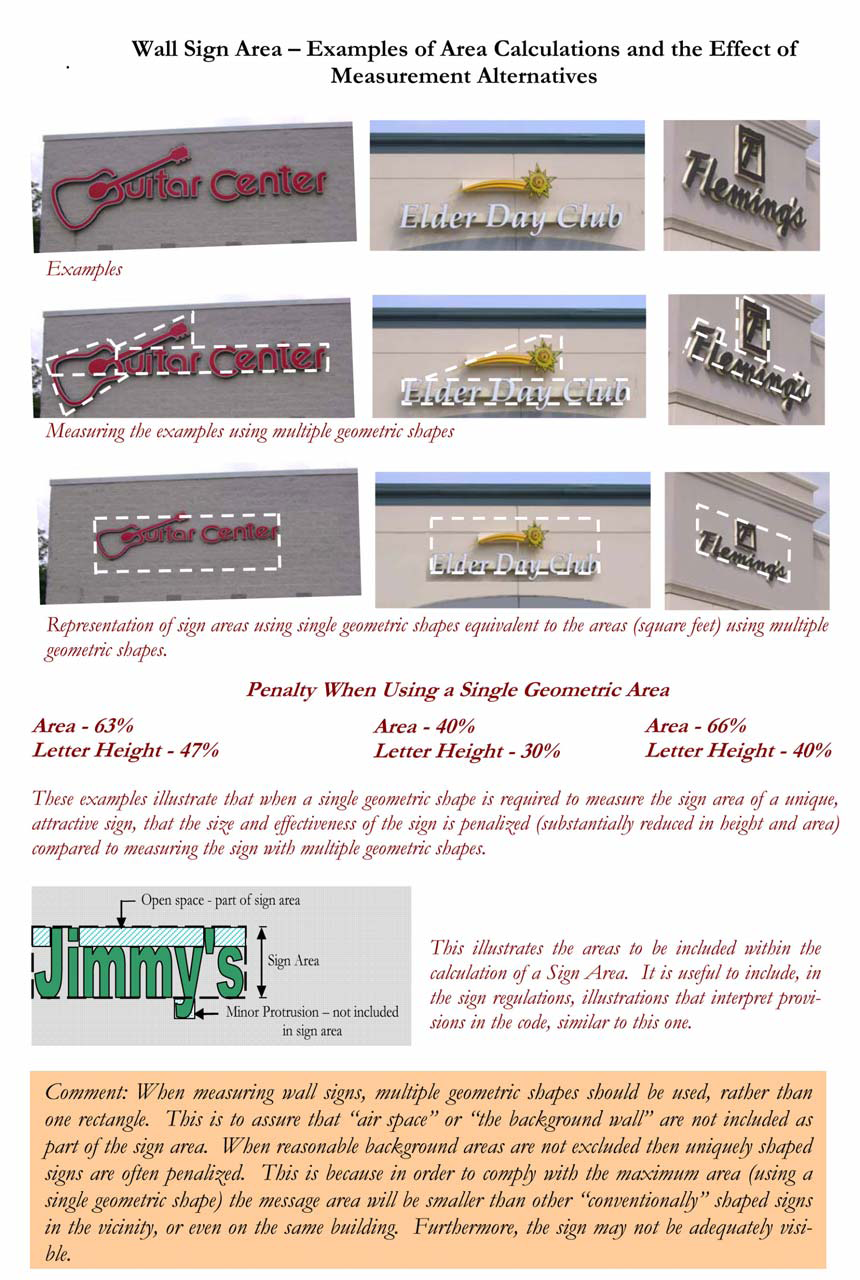
For a wall sign which is framed, outlined, painted or otherwise prepared and intended to provide a background for a sign display, the area and dimensions shall include the entire portion within such background or frame.
2.
For a wall sign comprised of individual letters, figures or elements on a wall or similar surface of the building or structure, the area and dimensions of the sign shall encompass a regular geometric shape (rectangle, circle, trapezoid, triangle, etc.), or a combination of regular geometric shapes, which form, or approximate, the perimeter of all elements in the display, the frame, and any applied background that is not part of the architecture of the building. When separate elements are organized to form a single sign but are separated by open space, the sign area and dimensions shall be calculated by determining the geometric form, or combination of forms, which comprises all of the display areas, including the space between different elements. Minor appendages to a particular regular shape, as determined by the zoning, building safety and code enforcement staff, and shall not be included in the total area of a sign.
B.
Calculation of Wall Sign Area.
1.
The basic allowance for wall signs shall be limited to one square feet of sign area for each lineal foot of building or tenant frontage.
2.
All businesses are entitled up to a minimum of twenty-four (24) square feet of sign area provided all other provisions of this title are in compliance.
3.
Each tenant may have multiple wall signs as long as the total wall sign area does not exceed the allowances established for wall signs. The wall sign or signs shall not be greater than eighty (80) percent of the width of the tenant space or the length of the building frontage for single tenant buildings.
4.
The minimum area of any wall sign may be increased by twenty-five (25) percent when the building is setback at least two hundred (200) feet from the public right-of-way and may be further increased an additional twenty-five (25) percent for each additional two hundred (200) feet of setback, up to a maximum increase of one hundred (100) percent.
5.
Additional wall sign area is permitted for a secondary frontage (see definitions) which shall be equal to one hundred (100) percent of the primary sign area allowance based on allowances selected.
6.
Signs shall not project above the wall or parapet.
7.
Additional wall signs for multiple-story buildings are permitted on each of the building's primary and secondary frontages according to the following:
a.
For a building with two floors the additional permitted sign area is twenty (20) square feet for each eligible wall.
b.
This additional permitted sign area may be increased by ten (10) square feet for each additional building floor.
c.
The sign must be placed at the height for which the bonus has been granted.
8.
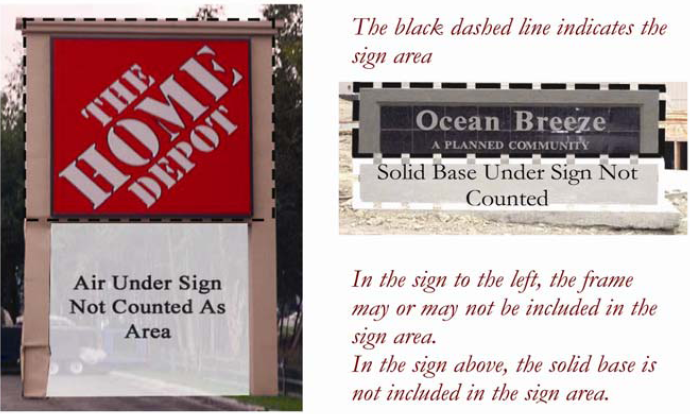
For a freestanding sign, the sign area shall include the frame, if any, but shall not include:
a.
A pole or other structural support unless such pole or structural support is internally illuminated or otherwise so designed to constitute a display device, or a part of a display device.
b.
Architectural features that are either part of the building or part of a freestanding structure, and not an integral part of the sign, and which may consist of landscaping, building or structural forms complementing the site in general.
9.
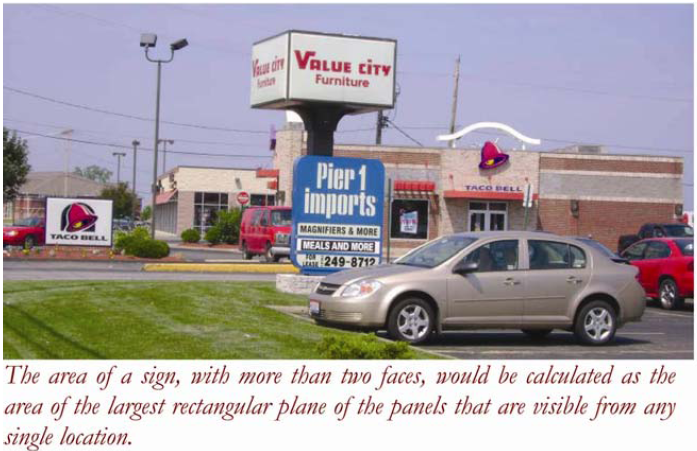
When two identical sign faces are placed back to back so that both faces cannot be viewed from any point at the same time or a maximum forty-five (45) degree angle for double-faced sign, and are part of the same sign structure, the sign area shall be computed as the measurement of one of the two faces. When the sign has more than two display surfaces, the area of the sign shall be the area of largest display surfaces that are visible from any single direction.
10.
In the event of a dispute in determining the area or dimension of any sign, a negative decision of the administration may be appealed, by the applicant submitting a formal application to the board of adjustment with the appropriate nonrefundable fees.
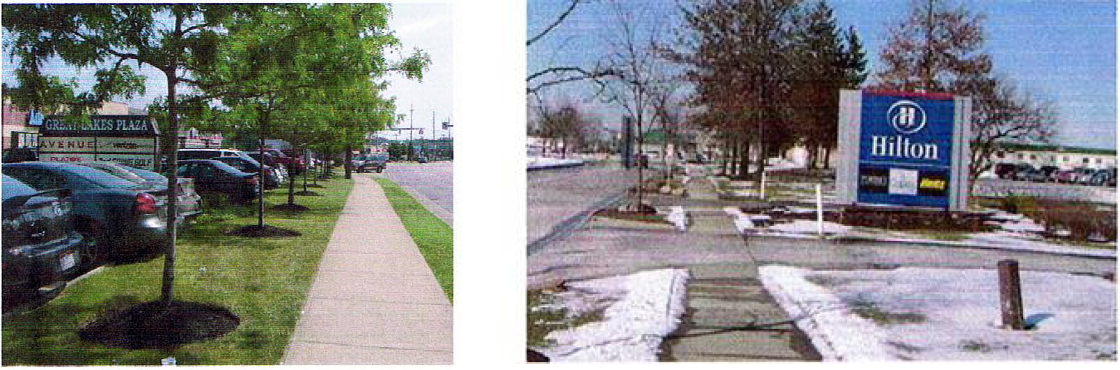
Comment: The minimum height should assure that the bottom of the sign is visible above parked and moving vehicles and any other obstructions that would block the view of the sign. To accomplish this, the minimum height of the sign (to accommodate a minimum clearance of seven feet from the ground and the message area) should be twelve (12) feet to the top of the sign. This limited height, however, only permits a sign area five feet in height. A fourteen-foot sign would afford greater design flexibility for the shape of the sign. Lower signs should only be considered on local retail or industrial streets when there is a generous landscaped area adjacent to the street in which to place the sign, the traffic volumes are light and the speed is relatively slow.
C.
Determining Sign Height (See [section] 17.64.050 for commercial zoning district dimensions)
The height of a freestanding sign shall be measured from the base of the sign or supportive structure at its point of attachment to the ground, to the highest point of the sign. A freestanding sign on a manmade base, including a graded earth mound, shall be measured from the grade of the nearest pavement or top of any pavement curb.
1.
There shall be both a minimum and a maximum height of freestanding signs for each property with the standards established for each character area.
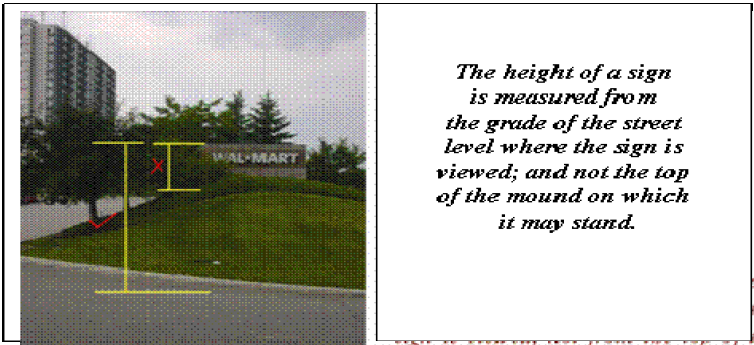
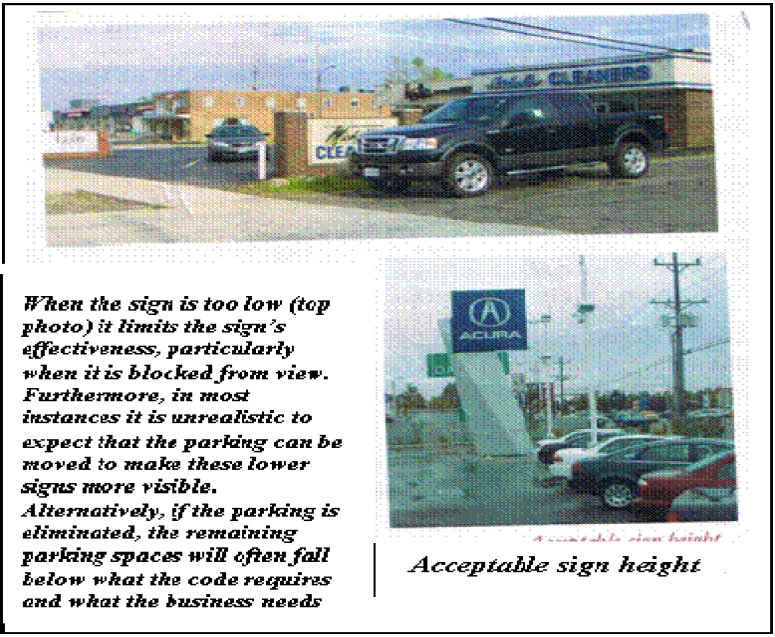
Comment: The measurement of the sign height is to assure that each sign has reasonable and generally equal visibility. This means that if the grade of the site is substantially lower than the adjacent public street, the building inspector or code enforcement official should have the authority to determine that additional sign height is warranted (above the lower grade) to assure that the sign has visibility equal to the other signs along the street. Alternatively, the sign should not be granted extra height by measuring the height from an "artificial" site feature that has raised the base of the sign substantially above the grade of the adjacent street.
2.
No portion of a freestanding sign shall be in or project over a public right-of-way and the maximum setback shall be no greater than twenty (20) feet from the property line.
D.
Determining Building Frontages and Frontage Lengths.
1.
Building Unit - The building unit is equivalent to the tenant space. The frontage of the tenant space on the first floor shall be the basis for determining the permissible sign area for wall signs.
2.
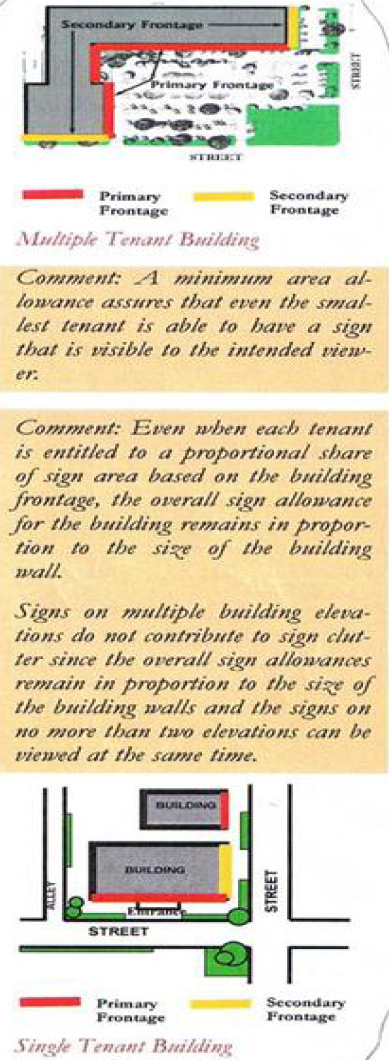
Primary and Secondary Frontage - The frontage of any building unit shall include the elevation(s) facing a public street, facing a primary parking area for the building or tenants, or containing the public entrance(s) to the building or building units.
a.
The primary frontage shall be considered the portion of any frontage with the primary public entrance(s) to the building or building units.
b.
The secondary frontage shall include those frontages containing secondary public entrances to the building or building units, and all building walls facing a public street or primary parking area that are not designated as the primary building frontage by subsection above.
E.
Length of Building Frontage.
1.
The length of any primary or secondary building frontage, as defined above, shall be the sum of all wall lengths parallel, or nearly parallel, to such frontage, excluding any such wall length determined by the administration clearly unrelated to the frontage criteria.
2.
For buildings with two or more frontages, the length of the wall and allowable sign area shall be calculated separately for each such building frontage. The building frontage for a building unit shall be measured from the centerline of the party walls defining the building unit.
(Ord. No. 10-11, § I, 6-24-10)
17.64.050 - Allowed signs.
The signs allowed in each of the zoning districts are those as indicated.
A.
Rural, Parks and R-43 Districts.
1.
The following signs are allowed in Rural, Parks and R-43 Districts without a permit:
a.
A nonilluminated sign not exceeding four square feet for the address number (required) and additional identification that pertains to the address or ownership.
b.
A single nonilluminated sign per street frontage not exceeding twelve (12) square feet for the sale or lease of the property on which the sign is displayed.
c.
Signs erected by the town or other government agencies on parks districts to identify the name and other pertinent information of a park.
d.
Directional signs are permitted. Such signs are limited up to six square feet and the freestanding signs are limited to three feet high.
e.
Political and noncommercial signs. Political and noncommercial signs shall not exceed twelve (12) square feet each, and no more than four total political and noncommercial signs may be posted and only with the property owner's permission.
2.
A nonilluminated or illuminated freestanding or wall sign not exceeding thirty-two (32) square feet for announcing an allowed use on the property. A sign permit is required.
3.
All other signs require an application for a temporary or special use permit.
B.
R-3 and R-2 Single-Family and Two-Family Zoning District.
1.
A nonilluminated sign not exceeding two square feet for the address number (required) and the street name, owner or tenant or combination of. A sign permit is not required.
2.
Real estate signs not exceeding six square feet and not placed in the right-of-way. Only one sign is permitted per street frontage of lot. A sign permit is not required.
3.
Carport signs installed pursuant to Town Code [section] 5.16.010 and not exceeding six square feet shall be placed during sale hours only, one sign per street frontage. Off-site signs for directional purposes to the sales event shall have prior permission from property owners. Signs shall not be placed in the right-of-way, affixed to a pole, structure, traffic signal or similar device. A sign permit is not required.
4.
A nonilluminated or indirectly illuminated sign not to exceed thirty-two (32) square feet for a subdivision name or marketing of homes of five lots or more may be permitted with the approved subdivision site plan or separate permit.
5.
Political and noncommercial signs. Political and noncommercial signs shall not exceed twelve (12) square feet each, and no more than four total political and noncommercial signs may be posted and only with the property owner's permission. A sign permit is not required.
6.
Signs for home occupation are not permitted in any size, shape or form.
C.
R-1 Multi-Family Zoning District.
1.
Same as R-3 and R-2 except directional signs are permitted not exceeding six square feet. Freestanding directional signs shall not exceed three feet in height above grade level.
2.
Nonilluminated realty signs advertising residential units for sale or lease that do not exceed twelve (12) square feet and are allowed without a sign permit.
3.
A nonilluminated or illuminated realty sign advertising residential units for sale or lease is allowed with a sign permit if it is between twelve (12) square feet and thirty-two (32) square feet. No nonilluminated or illuminated reality signs advertising residential units for sale or lease exceeding thirty-two (32) square feet shall be allowed.
4.
All other signs require an application for a temporary or special use permit.
D.
Commercial Zoning Districts (C-1 and C-2).
1.
Wall signs for businesses are subject to the measurement standards and calculations based on lineal feet of business. Freestanding signs are limited to a maximum sixty-four (64) square feet and fifteen (15) feet in height for the freestanding signs for individual parcels with three tenants or less. See section 17.64.040. A sign permit is required.
2.
Shopping center identification freestanding signs are limited to an area of one hundred fifty (150) square feet and twenty (20) feet in height. The shopping center identification signs with four tenants or more are limited to one sign per street frontage. A sign permit is required. Any empty business sign faces shall have a blank opaque face inserted to avoid a blight appearance.
3.
The freestanding monument or ground-mounted-type signs are highly recommended for the above for aesthetic looks and value. Such signs should be located to be highly visible from the street by use of landscaping so as not to be blocked by parked vehicles, and shall not limit visibility of traffic or pedestrians. Signs erected in a parking lot that have open areas below the sign shall be a minimum ten (10) feet above the paved surface. Freestanding pole signs are permitted under design review when space is limited. A sign permit is required.
4.
Projecting signs from a wall or ceiling/awning are permitted when there is multiple tenants along a building wall. Such signs are limited to six square feet and may project a maximum four feet out from a wall and shall be a minimum eight feet above the walking surface. Minimum spacing between projecting signs shall be fifteen (15) feet. A sign permit is required.
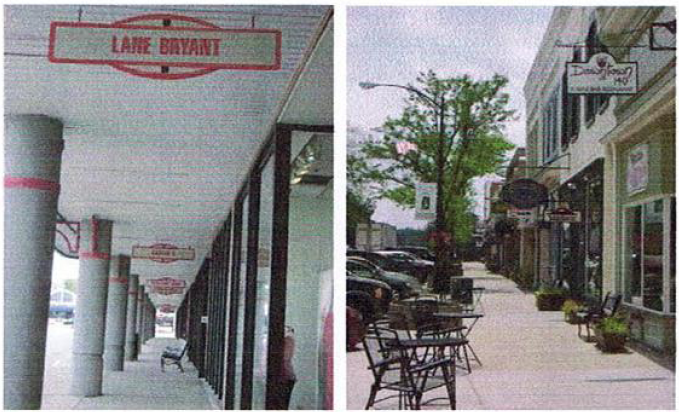
Comment: The illustration on the left shows under-canopy signs and on the right signs projecting from the building frontage.
5.
Directional signs are limited to six square feet and when freestanding, shall not exceed three feet above the surface. A sign permit is not required.
6.
Address identification signs (required) are limited to four square feet. A sign permit is not required.
7.
Window signs are limited to twenty-five (25) percent of the window area of the business. A permanent window sign is included with a wall or freestanding sign permit or by a separate permit. The additional square footage is not added to the overall square feet allowed.
8.
Billboard signs are permitted along Grand Avenue or Olive Avenue in C-2 zoning with a permit. Signs are permitted up to four hundred (400) square feet of face area with a minimum one thousand three hundred (1,300) feet between digital billboard signs. All other billboard signs shall be a minimum three hundred (300) feet between any types of billboard sign. Any portion of the billboard sign must meet the minimum setbacks for C-2 zoning and maintain a side setback of seven feet or half the sign height, whichever amount is greater when next to a residential use or district or when the adjacent property is undeveloped. Billboard signs are limited to thirty (30) feet in height above curb line elevation or nearest right-of-way. The sign shall not limit vehicle or pedestrian traffic or visibility.
9.
Banners, pennants, and similar advertising attention getting devices are allowed with a permit. Such permits are good for thirty (30) days at a time for a maximum three times within any one-year time span. The announcement of a grand opening or change of ownership of a business would be permitted for no longer than thirty (30) days.
10.
Building directory. In addition to wall or freestanding signs permitted by these regulations, an additional sign maybe permitted up to a maximum of twelve (12) square feet for the purpose of identifying first floor or upper floor tenants that do not have outside building frontage. No sign permit is required.
11.
For new commercial development, a comprehensive sign plan shall be submitted for review.
12.
Political and noncommercial signs. Political and noncommercial signs shall not exceed twelve (12) square feet each, and no more than four total political and noncommercial signs may be posted and only with the property owner's permission. A sign permit is not required.
13.
Nonilluminated realty signs advertising units for sale or lease that do not exceed twelve (12) square feet and are allowed without a sign permit.
14.
A nonilluminated or illuminated realty sign advertising units for sale or lease is allowed with a sign permit if it is between twelve (12) square feet and thirty-two (32) square feet. No nonilluminated or illuminated reality signs advertising residential units for sale or lease exceeding thirty-two (32) square feet shall be allowed.
15.
Walking signs, subject to the regulations set forth in section[s] 17.64.030 and 17.64.70.
E.
Portable Signs. Portable signs (e.g., A-frame or sandwich signs) that are professionally made shall be allowed in C-1 and C-2 zoning districts as long as the signs are on the premises (on site) in a size not to exceed a maximum of six square feet per side and three feet high. One portable sign is permitted per street frontage, may be displayed only during the hours of the business to which the sign relates, and may not be in the right-of-way or in any manner that limits vehicle or pedestrian traffic or visibility. A sign permit is required.
(Ord. No. 10-11, § I, 6-24-10; Ord. No. 14-02, § I, 3-6-14)
17.64.060 - Design standards.
A.
Signs are regarded as an integral and complementary element of the overall architectural character of the town and shall be integrated with the building and landscape design.
B.
All freestanding ground or monument signs shall have a foundation base or planter capable of supporting all gravity and wind loads.
C.
All signs except those consisting of individual letters mounted against a nondifferentiated surface shall have edge treatment or border.
D.
All signs shall be professionally made except for temporary carport signs, signs announcing an open house, political signs, noncommercial signs, and real estate signs.
(Ord. No. 10-11, § I, 6-24-10)
17.64.070 - Specific sign regulations.
A.
Walking Signs.
1.
Walking signs shall be allowed in C-1 and C-2 districts thirty (30) feet from a street or driveway intersection measured from the back of the curb or edge of pavement if no curb exists, and five feet from the street measured from the back of curb or edge of pavement if no curb exists.
2.
Walking signs shall yield right-of-way to pedestrians, bicycles and all others traveling or located on the sidewalks.
3.
Prohibited locations. Walking signs shall not be located:
a.
In raised or painted medians;
b.
In parking aisles or stalls;
c.
In driving lanes or driveways;
d.
On equestrian or multi-use trails;
e.
So that less than a minimum of four feet is clear for pedestrian passage on all sidewalks and walkways, or so as to cause a hazard to pedestrian traffic;
f.
On fences, boulders, planters, other signs, vehicles, utility facilities, or any structure;
g.
Within a minimum distance of twenty (20) feet from any other walking sign;
h.
In a manner that results in sign walkers physically interacting with motorists, pedestrians, or bicyclists;
i.
In the right-of-way.
4.
Display. Signs shall be:
a.
Displayed only during the hours the business is open to conduct business;
b.
Held, worn or balanced at all times;
5.
Elements prohibited. The following shall be prohibited:
a.
Any form of illumination, including flashing, blinking, or rotating lights;
b.
Animation on the sign itself;
c.
Mirrors or other reflective materials;
d.
Attachments, including, but not limited to, balloons, ribbons, speakers.
B.
Menu Signs.
1.
One preview menu board and one ordering menu board with a maximum of thirty-two (32) square feet per sign is allowed per drive-thru restaurant. Such signs may be freestanding or wall mounted.
2.
The menu board items and prices shall not be visible from the public street or roadway.
3.
Any menu wall sign outside a building shall be placed near the entrance and shall be limited to a maximum size of three square feet. A permit is not required.
C.
Window Signs.
1.
Permanent window signs for business name, hours, etc., shall not exceed twenty-five (25) percent of the window area and are included with the wall or freestanding sign permit or by separate permit. The area of a window sign is not added to the overall area allowed for wall or freestanding signs.
a.
The area is determined as an imagined border around all exterior wording and logos.
b.
Temporary nonilluminated window sign(s) for promotional sales of goods and products are allowed for an additional six square feet maximum of window area. These temporary signs do not require a permit.
D.
Official Government Signs.
1.
Official government signs are allowed in all zoning districts.
2.
Official government signs are not subject to any of the restrictions or regulations of this title, including that no sign permit is required for any official government sign.
E.
Obsolete and Abandoned Signs. [An] obsolete sign and its supporting structure and frames shall be removed by the owner of the property, his agent, or person having the beneficial use of the building or structure within ninety (90) consecutive calendar days of the date of the business vacating the premises or of receipt of notification from the building inspector or code enforcement officer that the sign is obsolete, whichever is earlier.
F.
Political Signs.
1.
Political signs may be placed in the right-of-way as regulated by Town Code section 9.08.090.
2.
No political signs are allowed within seventy-five (75) feet of any polling place or voting sites on any election day.
3.
Political signs placed in the public right-of-way may not be posted more than sixty (60) days prior to the election to which the sign refers and shall comply with state law. Political signs placed in the public right-of-way shall be removed no later than fifteen (15) days after the general election, except that a sign for a candidate in a primary election who does not advance to the general election shall be removed no later than fifteen (15) days after the primary election.
4.
Political signs do not require a permit.
G.
Digital Signs.
1.
Digital sign may only be a monument sign or a billboard.
2.
Digital message centers copy information shall not change more than once every eight seconds and are limited to fifty (50) percent of the sign face area except for billboards which are not limited. This subsection shall not apply to official traffic control signs erected by any agency of a federal, state or local government.
3.
Only one digital sign is allowed on any lot located within the appropriate zoning district. Location and operational characteristics of any digital monument sign must be approved by the public works manager or his designee.
4.
Digital signs shall have dimming capabilities that adjust the brightness to the ambient light—regardless of the time of day.
5.
Digital signs will go dark from eleven p.m. to sunrise.
H.
Offsite and Onsite Directional Signs.
1.
Offsite business directional signs in the right-of-way are permitted only on town plaza (kiosk) signs through a designated third-party sign contractor authorized by the town to place signs within the community.
2.
Onsite directional signs shall be limited in area to six square feet.
3.
Freestanding onsite directional signage shall not exceed three feet in height.
4.
Onsite directional signs shall not be counted against the total allowed sign area for a given site, building or occupancy.
5.
Offsite directional signs relating to a carport sale, special event, or open house may be placed on an owner's lot with the property owner's permission, must be removed daily immediately after event.
I.
Grand Opening, Going-Out-of-Business and Change-of-Ownership or Management Signs.
1.
Onsite signs relating to grand openings, going-out-of-business sales, or change of ownership or management are allowed on the property at which the business is located, for a thirty-day maximum, commencing with the first day of the event, subject to the following:
2.
The sign may include attention getting devices that do not interfere with the safe and orderly flow of traffic or in any way present a danger to the health, safety and welfare of the public at large.
3.
The sign may include attention-getting devices that do not violate the regulations of any applicable codes or ordinances.
4.
A site plan must be submitted and approved prior to installation of such signs.
5.
A banner sign is limited to three feet in height by fourteen (14) feet in width.
J.
Special Events.
1.
A maximum of thirty (30) days at a time, with a maximum of three times within a one-year time span, for special event signs and attraction-getting devices subject to permit may be allowed, subject to the following:
2.
A sign permit authorizing the use of special event signs, pennants and other attention-attracting devices is required except for window signs or posters on windows not to exceed an additional six square feet of window area. Such signs displayed are not to exceed thirty (30) days for the special event. All such window signs shall be removed immediately after the special event.
3.
Banner-type signs hung for special events shall be a maximum three feet high and fourteen (14) feet wide, have steel-reinforced grommets on every corner, hung on the building or other device on site within the parking lot or developed area and be constructed of a durable material.
K.
Prohibited Signs.
1.
Signs not specifically listed within or authorized by this Code are prohibited including, but not limited to, the following:
a.
Animated, revolving, sparkling, searchlights, and flashing signs are prohibited except as permitted below:
(1)
Where otherwise permissible by this title or any town code or ordinance, any revolving barber poles and clocks including those which alternately display time and temperature having a maximum face area not to exceed three square feet may be installed.
(2)
On and off flashing "open" signs during business hours provided that such sign shall not exceed a maximum size of three square feet.
b.
Obscene signs. No person, as principal, agent or otherwise, shall exhibit, post or display or cause or permit to be exhibited, posted or displayed, upon any advertising structure, any obscene statements, symbol or sign, or false statements relating to goods, products, or services advertised.
c.
Miscellaneous signs and posters. The tacking, painting, pasting or otherwise affixing of signs or posters of a miscellaneous character, visible from a public way, on the walls of buildings, sheds, trees, fences, utility poles or other structures, or upon vehicles or trailers where such vehicles or trailers are used primarily as support for such signs, is prohibited.
(1)
Pole signs, except as specifically approved through design review.
(2)
Signs which are mounted on, attached to, or painted on motor vehicles, trailers, or boats that are parked on the premises for advertisement of business. This does not apply to licensed operable service vehicles.
(3)
Offsite signs, including any form of remote signage such as off-premises advertising signs or billboards unless specifically allowed by this title.
(4)
All signage erected for a home occupation on the property.
(5)
Internally illuminated cabinet or can signs when light source is visible (must be opaque).
(6)
Banner signage shall not be used for permanent signage on a property.
(7)
Any sign emitting sound or emitting any substance.
L.
Temporary Residential Subdivision Signs. Temporary residential subdivision signs are permitted in single-family residential zoning districts for each builder in a recorded subdivision plat only in conjunction with a valid building permit for a model home complex. Temporary residential subdivision signs are unlawful if they do not meet the criteria and limitations set forth below in Table 17.64.070.L(1), temporary residential subdivision signs: criteria and limitations.
TABLE 17.64.070.L(1)
TEMPORARY RESIDENTIAL SUBDIVISION SIGNS: CRITERIA AND LIMITATIONS
M.
Offsite Temporary Signs on Private Property. Offsite temporary signs are permitted in all zoning districts on unimproved lots or parcels subject to criteria and limitations set forth below in Table 17.64.070.L(1)[M(1)], offsite temporary signs on private property: criteria and limitations.
TABLE 17.64.070.L(1)[M(1)]
OFFSITE TEMPORARY SIGNS ON PRIVATE PROPERTY: CRITERIA AND LIMITATIONS
(Ord. No. 10-11, § I, 6-24-10; Ord. No. 11-16, § I, 12-15-11; Ord. No. 14-06, § I, 9-18-14; Ord. No. 2022-01, § I, 3-3-22)
17.64.080 - Permits, plans and approval required.
A.
When this code requires a sign permit, an application for a sign permit shall be made on forms provided by the building inspector. Permit fees shall be established by the town council by resolution. When a sign permit is required, the building inspector shall review applications within a reasonable time after filing for the permit. If it appears from the application and any supporting documents that the requested sign(s) and any existing sign(s) or uses directly related to the application and in the ownership and control of the permit applicant violate any applicable provision of this title or any other town code or ordinance, no permit shall be issued until the violation is corrected.
B.
Sign permits shall not be required for minor repairs or for repainting of existing wording and color of any permitted sign.
C.
Application for sign permit must include:
1.
Site plan indicating the location of the sign in relationship to nearby buildings, structures, rights-of-way, easements and driveways.
2.
A scaled elevation drawing indicating the dimensions of the sign, sign copy, all materials and the method of construction and attachment to the building or support on the ground. Engineered design may be required.
3.
Name of person, firm, or corporation erecting signs and all attendant structures.
4.
Written consent of the owner of the building, structure or premises on which sign is to be erected.
5.
Other reasonable information as may be required by the building inspector when reviewing the application or as the applicant may believe will assist the building inspector.
6.
All contractor and business license information.
D.
Appeal of Decision. If an applicant is aggrieved by a decision of the building inspector, the applicant or interested person may appeal such decision to the building official, who shall render a decision within ten (10) days. If the applicant or interested person is aggrieved by the decision of the building official, the applicant or interested person may submit an appeal in writing together with the appropriate nonrefundable appeal fee as established by town council resolution, to the board of adjustment within ten (10) days following the date of decision by the building official. Within thirty (30) days of the date the appeal is filed, the board of adjustment shall affirm, modify or reverse the decision of the building inspector.
E.
Issuance of and Effect of Permit:
1.
If the work authorized by a sign permit has not been completed within six months after issuance, the permit shall expire.
2.
All rights and privileges acquired under a sign permit are mere licenses that are revocable at any time by the Town of Youngtown, and all such permits shall so state.
3.
The granting of a sign permit shall not be deemed to be a permit for approval of any violation of this title. The provisions of this title shall not be construed as relieving or limiting in any way the responsibility or liability of any person, firm or corporation, erecting or owning any sign, or resulting from the negligence or willful acts of such person, firm or corporation, its agents, employees or workmen, in the construction, maintenance, repair or removal of any sign erected in accordance with a permit issued hereunder. Nor shall issuance of such permit be construed as imposing on the town or its officers or employees, any responsibility or liability by reasons of the approval of any signs, material or devices under the provisions of this title. No error or misinterpretation of the provisions of this title, or any other chapter of Town Code will prevent, prejudice or extinguish the right of the town to revoke, reject or deny any sign permit.
(Ord. No. 10-11, § I, 6-24-10)
17.64.090 - Sign lighting standards.
The following lighting standards apply to all signs within all zoning districts:
A.
Lighting shall be placed to reflect the light away from residences.
B.
Signs illuminated by external lighting shall have the light source shielded in such a manner as to eliminate visibility from and reduce light glare to adjacent properties.
C.
Subdivision entrance signs shall be illuminated by reverse pan-channel lettering or hard-mounted lettering where light source is shielded in such a way as to eliminate visibility from and reduce light glare to adjacent properties.
D.
No lighting is allowed to interfere with or obscure the vision of any motor vehicle operator or pedestrian.
E.
All wires furnishing electricity to a freestanding sign shall be underground.
(Ord. No. 10-11, § I, 6-24-10)
17.64.100 - Nonconforming signs.
A.
Legal nonconforming signs shall mean a sign or signs lawfully existing at the time of the enactment of this title that does not conform to the regulations as set forth herein. Notwithstanding any provisions to the contrary contained herein, a legal nonconforming sign may be utilized in perpetuity except as noted below.
1.
A legal nonconforming sign may not be altered in any manner not in conformance with this title; however, the sign(s) shall be maintained as required by section 17.64.070 of this title.
2.
Whenever the owner or tenant of a given building or premises changes or use changes, such as from retail to office, or beauty shop to clothing store or minimart, all nonconforming signs on the building and/or premises shall be modified to bring them into conformance with these regulations.
3.
A notice shall be sent by code enforcement to the owner for all signage on a property that has been abandoned/vacant for six months or more to be brought into compliance or removed.
B.
Nonconforming signs. Upon adoption of this title, the following signs shall be removed from display, obliterated or dismantled within six months:
1.
Portable signs, unless as specifically authorized in subsection 17.64.050E of this title.
2.
Any sign that has lost legal nonconforming status.
(Ord. No. 10-11, § I, 6-24-10)
17.64.110 - Flying banners.
Flying banners shall be permitted for apartment complexes and businesses in the commercial zoning districts, subject to the following regulations:
A.
Size. Signs shall be no greater than fifteen (15) feet in height.
B.
Number. Up to three flying banners shall be permitted per apartment complex or per business. One sign per individual business shall be permitted to be placed on any one adjacent street frontage. In no event shall the combined number of flying banners and A-frame signs exceed three per apartment complex or business.
C.
Display. Flying banners shall be displayed only:
1.
During the hours the business is open to conduct business; or
2.
During the hours an apartment complex rental office is open to conduct business.
D.
Location. Flying banners shall be located only:
1.
With a base at grade level.
2.
On site or adjacent to apartment buildings.
3.
Adjacent to the business being advertised, as follows:
a.
For stand-alone single businesses, the flying banners shall be placed on the business property being advertised or in the right-of-way adjacent to the business property.
b.
For businesses located in a commercial/office complex with multiple tenants and/or buildings, the flying banner may be placed within or at the perimeter of the complex or in the abutting right-of-way.
E.
Prohibited Locations. Flying banners shall not be located:
1.
In raised or painted medians.
2.
With stakes fastened to or driven into concrete.
3.
Across any street from the business being advertised.
4.
In parking aisles or stalls.
5.
So that less than a minimum of four feet is clear for pedestrian passage on all sidewalks and walkways, or so as to cause a hazard to pedestrian traffic.
6.
On fences, boulders, planters, other signs, vehicles, utility facilities, or any structure.
7.
Within a minimum distance of twenty (20) feet from an access drive or street intersection.
F.
Construction and Maintenance. Flying banner signs shall be:
1.
Supported by a base of a sufficient weight and durability to withstand wind gusts, storms, etc., and
2.
Maintained in a good condition, repair and appearance at all times so as not to constitute hazard to the public safety or create a visual blight (i.e., free from fading, tearing, or similar defect).
(Ord. No. 17-03, § I, 10-19-17)
17.64.120 - Enforcement and penalties.
A.
The Town of Youngtown has the authority to revoke any permit if the sign authorized by the permit has been constructed or is being maintained in violation of this title or the sign permit.
B.
Notice of the town's decision to revoke a sign permit shall be served upon the holder of the permit: i) by personally delivering a copy of the notice to the holder of the permit or to officer or manager of the corporation; or ii) by handing a copy of any such notice to any person known to be in control of the premises; or iii) in the event that no such person can be found, a copy of the revocation notice may be affixed in a conspicuous position at any entrance to the premises and by depositing in the United States Postal Service a certified letter enclosing a copy of the revocation notice that is addressed to the last known address of the holder of the permit.
C.
The notice shall state the reasons and grounds for revoking the permit, specifying the deficiencies or defects in such sign in a reasonable and definitive manner and the violations charged. Such notice shall specify what repairs, if any, will make such an installation conform to the requirements of this title and shall specify that the sign must be removed or brought into compliance with the provisions of this code within the time periods set in the notice. This notice shall be known as a noncompliance notice.
D.
The holder of the permit may appeal the decision of the town in writing to the building official, who shall render a decision within ten (10) days. If the applicant or interested person is aggrieved by the decision of the building official, the applicant or interested person may submit an appeal in writing together with the appropriate nonrefundable appeal fee as established by town council resolution, to the board of adjustment within ten (10) days following the date of decision by the building official. Within thirty (30) days of the date the appeal is filed, the board of adjustment shall affirm, modify or reverse the decision of the building inspector. This appeal must be filed within fourteen (14) calendar days of the date the notice was initially served at the premises where the sign has been placed or is being placed, regardless of whether or not the holder of the permit has taken delivery of the certified letter mailed to the last known address of the permit holder. All required fees are the responsibility of the permit holder.
E.
If no appeal has been filed by the end of the fourteen-calendar-day appeal period, or if the holder of the permit files to appear and then fails to appear at the board of adjustment hearing, then the permit remains revoked and the sign will be considered illegal. The town may then initiate the procedure for the removal of the illegal sign at the expense of the permit holder. If the permit holder is the legal owner of the property where the sign exists or is being placed, a lien maybe filed with the county recorder against the property's title to ensure reimbursement of the removal fees to the town. If the permit holder is not the owner of the property, the town may take any other legal actions necessary to obtain reimbursement.
(Ord. No. 10-11, § I, 6-24-10; Ord. No. 17-03, § I, 10-19-17)
Editor's note— Ord. No. 17-03, § I, adopted Oct. 19, 2017, renumbered § 17.64.110 as § 17.64.120.

