


Aiken City Zoning Code
CHAPTER 10
DEFINITIONS
10.1.1.- General.
The following provisions shall govern the text of this Ordinance.
1.
Words used in the present tense include the future.
2.
Words in the singular number include the plural, and words in the plural number include the singular.
3.
The word "building" includes the word "structure."
4.
The word "shall" is mandatory and not directory.
5.
All time periods are in calendar days, unless expressly stated otherwise.
10.1.2. - Words and Terms.
For the purpose of this Ordinance, certain terms and words are defined as follows.
ACCESS: Entrance for vehicles to and/or exit from land fronting on the public street system.
ACCESSORY BUILDING: A detached subordinate building not more than two stories in height, the use of which is incidental to that of the principal building on the same lot.
ACCESSORY USE: A use which is subordinate to but associated with the principal use on the same lot.
ADULT BUSINESS: Any business activity, establishment, store, club, or other use that allows or involves the following.
1.
Persons appearing live before the public or audiences in a state of nudity or semi-nudity for any form of compensation or consideration.
2.
Live performances characterized by specified sexual activities.
3.
Sale or rental in any form of films, motion pictures, video cassettes, slides, or other photographic reproductions characterized by the depiction or description of specified sexual activities or specified anatomical areas.
4.
Coin-operated or slug operated or electronically, electrically, or mechanically controlled still or motion picture machines, projectors, or other image-producing devices maintained to show images to five or fewer persons per machine at any one time, and where the images so displayed are distinguished or characterized by the depicting or describing of specified sexual activities or specified anatomical areas.
5.
As one of its principal business purposes, offering for sale or rental for any form of consideration audio recordings in any form, books, magazines, periodicals, other printed matter, or visual representations depicting or describing specified sexual activities or specified anatomical areas, or instruments, devices or paraphernalia designed for use in connection with specified sexual activities.
ADULT CARE FACILITY: A facility providing care for nonresident adults for portions of any 24-hour period. As an incidental use, any such facility may provide overnight stays for brief period of time, not to exceed two weeks, for a client whose primary caregiver is unavailable.
AGRICULTURE, INTENSIVE: Animal agricultural practices that intensify traditional farming or ranching techniques, including feedlots, brooders, and factory farming.
AIKEN HISTORIC REGISTER: The listing of all districts and sites designated by City Council under this Ordinance.
ALLEY: A service roadway that usually affords only a secondary means of access to abutting property, is not intended for general traffic circulation, and is 20 feet or less in width.
ALTERATION: For the purposes of Chapter 5, any act or process that changes the exterior architectural appearance of a structure.
ANTENNA: A device, dish, or an array of the same used to transmit or receive telecommunications signals.
APARTMENT, ACCESSORY: An additional dwelling unit that is subordinate to the principal dwelling unit on the property whether located within the principal structure or in a separate accessory building. (Ord. 04082002A)
APPROVED TREE LIST: A listing of tree varieties set forth in the Tree Protection and Landscaping Manual prepared by the City Horticulturist including trees specifically allowed in parking lots.
ARTERIAL, MAJOR: A street whose primary function is to carry large volumes of traffic at higher speeds through the City or from one part of the City to another, that provides access to adjacent properties only if absolutely necessary, that typically has a minimum ADT of 15,000, and is usually designated as a State or federal primary highway.
ARTERIAL, MINOR: A street whose primary function is to carry large volumes of traffic at higher speeds through the City or from one part of the City to another, that provides access to adjacent properties on a limited basis, and typically has an ADT of 5,000 to 15,000.
ASSISTED LIVING FACILITY: See "Residential Assisted Living Facility."
ATTACHED SINGLE-FAMILY RESIDENTIAL: A group of at least three dwelling units each having ground-floor outside access and separated by common walls without openings.
ATTACHED SINGLE-FAMILY RESIDENTIAL PROJECT: A one-family dwelling with ground-floor outside access attached to one or more similar one-family dwellings by common vertical walls without openings; such units are in groups of at least three (with two units being considered a duplex).
AUTOMOBILE REPAIR SHOPS: A building or site on or in which a business is engaged in repair or equipping of vehicles.
AUTOMOBILE SALES or STORAGE YARDS or LOTS: An open premise used for the storage or sale of complete and operable automobiles.
AUTOMOBILE WRECKING YARD or JUNK YARD: Any place used principally for wrecking or storage where one or more vehicles not in running condition, or the parts thereof, are stored in the open, or any building or structure used principally for wrecking or storage of automobiles not in running condition.
BANK: Any bank, savings and loan, credit union, or similar institution accepting deposits insured by the Federal Deposit Insurance Corporation (FDIC).
BED AND BREAKFAST HOME STAY: An owner-occupied building or portion thereof and associated accessory buildings offering transient lodging with a maximum of three guest bedrooms and meals, with no meeting rooms.
BED AND BREAKFAST INN: An owner-occupied building or portion thereof and associated accessory buildings offering transient lodging in four to ten guest bedrooms and meals and, with special exception approval, offering meeting rooms and meals to those other than guests on a limited basis.
BED AND BREAKFAST/MEETING FACILITY: An owner-occupied building or portion thereof and associated accessory buildings offering transient lodging in four to ten guest bedrooms and meals and, with special exception approval, offering meeting rooms and meals to those other than guests on a larger scale than that possible in a Bed and Breakfast Inn.
BOARD OF ZONING APPEALS: The board or body as set forth under the laws of the State of South Carolina whose purpose is to hear appeals from decisions of administrative officials and make decisions on requests for variances and special exceptions pursuant to the Zoning Ordinance.
BUFFER: Open spaces, landscaped areas, fences, walls, berms or any combination thereof used to physically separate or screen one use or property from another so as to shield or block noise, lights, or other nuisances.
BUILDABLE AREA: That portion of a lot or site on which a principal building could be erected or placed as permitted by this Ordinance.
BUILDING: A free-standing, roofed structure for the shelter of persons, animals, equipment, or materials.
BUILDING HEIGHT: The vertical distance measured from the level of the established grade opposite the middle of the front of the building, to the highest point of the roof surface if a flat roof; to the deck line of a mansard roof; and to the mean height level between eaves and ridge for a gable, hip, or gabled roof. For buildings set back from the street or right-of-way line, the height shall be measured from the average elevation of the natural grade along the front of the buildings, provided the distance of the building or buildings from the street right-of-way line is not less than the heights of such grade above the established grade of the street. In case of through lots, or double front lots, the established grade of such abutting street shall govern to one-half the depth of the lot.
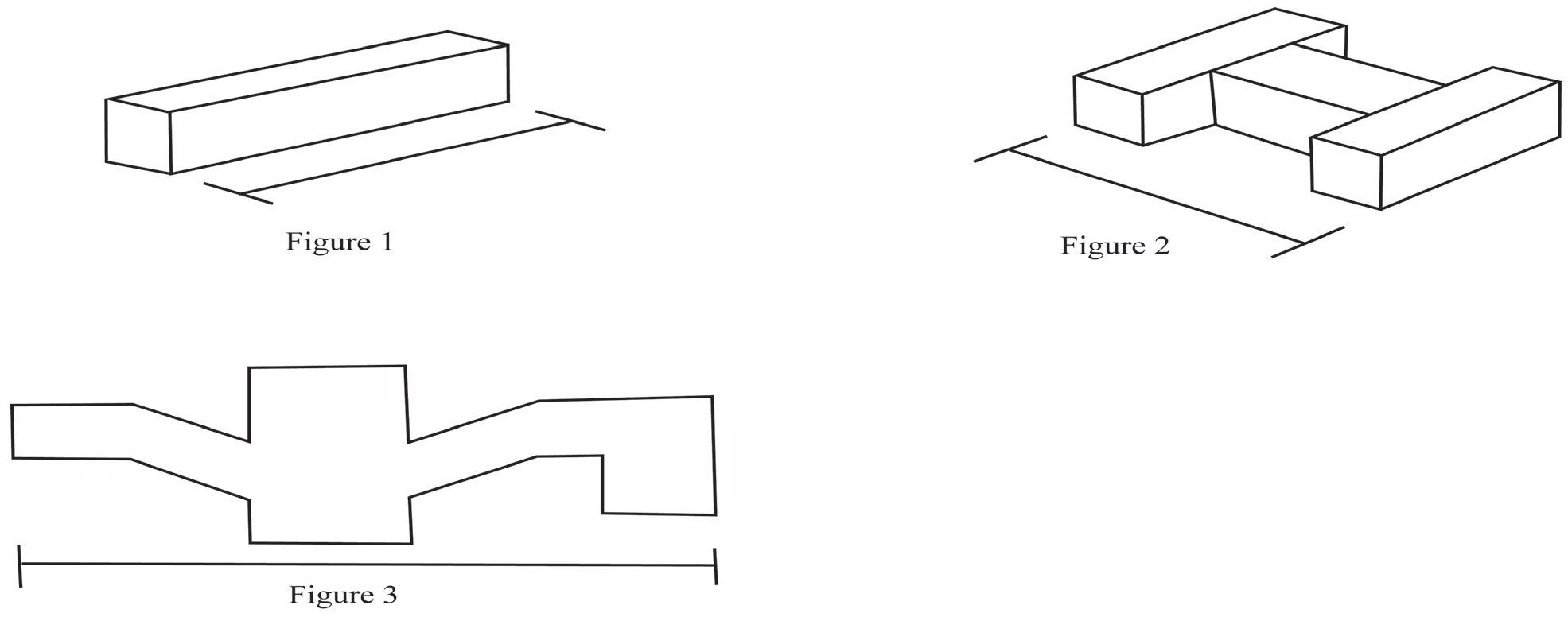
BUILDING LENGTH: For a rectangular building, the horizontal dimension that is greater (Figure 1). For a building that is composed of two or more interconnected rectangles, the horizontal dimension of that composite building that is greater (Figure 2). For a building with an irregular shape, the greater horizontal dimension measured to the farthest extent of the exterior walls (Figure 3). (Ord. 04082013)
BUILDING OFFICIAL: The person who issues building permits and Certificates of Occupancy and performs other duties as set forth at 7.1.1.
BUILDING, PRINCIPAL: A building in which is conducted the principal use of the lot on which it is situated. In a residential zoning district, any dwelling shall be deemed to be a principal building on the lot on which the same is situated.
CALIPER: The diameter in inches of a tree trunk measured six inches above the grade of the surface of the ground at the base of the tree. For a tree to be acceptable as a replacement tree and for measurement pursuant to this method, the tree must consist of only one trunk at the point of measurement.
CANDELA: The basic unit of luminous intensity adopted under the Systeme International d'Unites; equal to 1/60 of the luminous intensity per square centimeter of a black body radiating at a temperature of 2.046 degrees Kelvin.
CANDLE POWER: Luminous intensity measured in candelas.
CANOPY, ATTACHED: An attached canopy is a rigid multi-sided structure covered with fabric, metal, or other materials supported by a building at one or more points or extremities and by columns or posts embedded in the ground at other points or extremities; may be illuminated by means of internal or external source.
CANOPY, FREE STANDING: A rigid multi-sided structure covered with fabric, metal, or other materials supported by columns or posts embedded in the ground; may be illuminated by means of internal or external source.
CATERING TRUCK: A vehicle mounted food product establishment designed to be readily movable (including, but not limited to food trucks, food trailers and pushcarts) from which food and/or drink is distributed or served to attendees of an event in which service is not targeting sale to the general public.
CENTRAL BUSINESS DISTRICT: An area generally bounded by Barnwell Avenue, Union Street, the Railroad Cut, and Greenville Street SW.

CITY PARK: See Park, City.
CLASSIFICATION: The category of a street based upon its intended purposes and operating characteristics.
COLLECTOR, MAJOR: A street whose primary function is to connect a local street to another local street or to a collector or arterial street, that provides direct access to abutting properties unless such access would significantly impede traffic flow, and typically has an ADT of 2,000 to 5,000.
COLLECTOR, MINOR: A street whose primary function is to connect a local street to another local street or collector street, that provides direct access to adjacent properties, and typically has an ADT of 500 to 2,000.
COMMERCIAL VEHICLE: For the purposes of this Ordinance, a commercial vehicle shall mean any vehicle which exceeds 10,000 pounds gross vehicular weight, or 20 feet in length, or has more than two axles.
COMMUNICATIONS TOWER: A tower, pole, or similar structure which supports a telecommunications antenna above ground in a fixed location, free-standing, guyed, or on a structure but not including communications towers for amateur radio operators licensed by the Federal Communications Commission which are exempt from municipal zoning restrictions.
COMPREHENSIVE PLAN: The legally adopted Comprehensive Land Use and Transportation Plan, and any amendments or attachments thereto.
CONDITIONAL USE: A use allowed on a lot in a zoning district only upon a showing by the applicant that such use on the lot will comply with all applicable conditions and standards for such use as set forth in Chapter 3, Article 3.
CONGREGATE CARE FACILITY: See Residential Assisted Living Facility.
CONSTRUCTION: For the purposes of Chapter 5, the act of adding height or enclosed area to an existing structure, expanding the footprint of an existing structure, or erecting a structure.
CONTRIBUTING STRUCTURE: A structure that contributes to the character of an Historic Site or an Historic District.
CONVENIENCE STORE: A business establishment, often accompanied by fuel sales, stocking a limited selection of food and household products, generally oriented toward convenience and traveler shopping needs.
CROWN PRUNING: The pruning method of crown reduction accomplished by cutting back limbs to laterals that are at least one-third the size of the parent limb (also called drop-crotch pruning). (Ord. 04082002A)
CROWN RAISING: The removal of the lower branches of a tree in order to provide clearance for buildings, vehicles, pedestrians, and vistas. (Ord. 04082002A)
CROWN REDUCTION: Reducing the height or spread of a tree by pruning methods which maintain the structural integrity and natural form of the tree. (Ord. 04082002A)
CROWN TOPPING: The cutting back of limbs to a stub, bud, or lateral branch not large enough to assume the terminal role. (Ord. 04082002A)
DBH (Diameter at Breast Height): The diameter of a tree trunk measured in inches 4.5 feet above grade except that a tree with multiple trunks that fork below the 4.5-foot level is measured below the fork. (Ord. 04082002A)
DEMOLITION: Any act or process that destroys a structure in whole. (Ord. 01282008A)
DESIGN REVIEW BOARD: The board appointed by City Council pursuant to the Overlay Districts provisions in Chapter 5 of this Ordinance and State law.
DESIGNATION, HISTORIC DISTRICT OR HISTORIC SITE: Placement of a site, structure, or area to the Aiken Historic Register by City Council. See 6.2.13.
DETENTION POND: A drainage facility designed to manage and temporarily hold storm water and release it gradually as determined by the City Engineer.
DIRECTOR OF ENGINEERING/PUBLIC WORKS: The Director of the Public Works Department of the City.
DISTRIBUTION LINE: Any utility line providing connection between transmission lines and service lines.
DRIVEWAY: An access point that is not a public street, road, or highway.
DWELLING: Any building or portion thereof intended exclusively for residential purposes.
DWELLING, SINGLE-FAMILY: A building containing only one housekeeping unit and designed or used to house not more than one family in a permanent manner.
DWELLING, MULTIFAMILY: A building designed for, or portion of a building having accommodations for, two or more families being independent of each other, and each having its own kitchen and bath facilities. This term includes premises occupied more or less permanently for residential purposes in which the rooms are occupied in apartments, suites, or groups such as apartment units, apartment hotel, studio apartments, and all other dwellings similarly occupied, but does not include duplexes or single-family dwellings.
DWELLING UNIT: A single housekeeping unit, whether in a single-family or multifamily structure, including, at a minimum, a kitchen, bathroom, and sleeping area. In Residential and Planned Residential zoning districts, dwelling unit density for any multifamily dwellings with a communal kitchen will include the number of units with bathroom and sleeping areas. (Ord. 09232013A)
ELECTRONIC READERBOARD: A sign attached to a freestanding sign which uses light emitting diodes or similar technology to display changeable messages.
EXTERIOR ARCHITECTURAL APPEARANCE: The architectural features, character, and general composition of the exterior of a structure, including, but not limited to, the kind and texture of the building material and the type, design, and character of windows, doors, light fixtures, signs, and appurtenant elements.
FAMILY: One or two persons or parents with their direct descendants and adopted children together with not more than two persons not so related, living together in a room or rooms comprising a single housekeeping unit. Every additional group of five or fewer persons living in such housekeeping unit shall be considered a separate family. Family does not include a group occupying a club, dormitory, etc.
FLOOR AREA, GROSS: The total enclosed area of all floors of a building measured to the outside face of the structural members in exterior walls, and including halls, stairways, elevator shafts at each floor level, service and mechanical equipment rooms, and basement or attic areas having a height of more than seven feet. Gross floor area shall exclude areas used exclusively for vehicle parking or loading.
FOOTCANDLE: The amount of light generated by one candle shining one foot away from a one-square-foot surface as measured by a photometric light meter.
FRONTAGE: The length of that portion of a property which directly adjoins a street.
FRONTAGE STREET: A street that is parallel to, adjacent to, but separate from an arterial and that is designed to provide access to abutting properties so that these properties are somewhat sheltered from the effects of the through traffic on the arterial street and so that the flow of traffic on the arterial street is not impeded by direct driveway access to these properties.
FULL CUT-OFF LIGHTING FIXTURE: A lighting fixture from which no light is emitted at or above a horizontal plane drawn through the bottom of the fixture.
GARAGE: A building or structure or part thereof intended to be used for storage or housing of vehicles.
GROCERY STORE: A business establishment where the majority of floor area is dedicated to the sale of produce, dry goods, meats, baked goods, dairy items, and/or pre-prepared foods. This includes supermarkets, food stores, dairies, and delicatessens, but does not include convenience stores.
GROUP HOME, TYPE 1: A home serving nine or fewer mentally or physically handicapped persons provided the home provides care on a 24-hour basis and is approved or licensed by a state agency or department for that purpose (South Carolina Code of Laws - Title 6, Chapter 29, Section 770).
GROUP HOME, TYPE 2 or 3: Any group home not meeting the definition of a Type 1 group home.
HARDSHIP: A condition caused by peculiar characteristics of a lot or tract of land that hinders strict compliance with this Ordinance, but that does not include personal or economic disadvantages or self-created conditions.
HEIGHT, COMMUNICATIONS TOWER: The distance from the base of the tower to the top of the structure.
HIGHWAY; STREET; ROAD: The entire width between right-of-way or boundary lines of a public way open for vehicular travel.
HISTORIC DISTRICT: A geographically definable area designated by City Council as possessing a concentration, linkage, or continuity of sites, structures, or objects of historic, archeological, architectural, or aesthetic value. A district may also be comprised of individual sites, buildings, structures, or objects linked by association or history.
HISTORIC SITE: An individual property not contiguous to an Historic District designated by City Council as historic because of its historic, archeological, architectural, or aesthetic value.
HOME OCCUPATION TYPE 1: A low-intensity business conducted inside a dwelling which is allowed by right, is essentially imperceptible to nearby residents, and does not involve the sale of merchandise or provision of services to customers on-site on any sort of regular basis.
HOME OCCUPATION TYPE 2: A business which may involve the sale of merchandise or provision of services to customers on-site conducted inside a dwelling which requires approval of a special exception by the Board of Zoning Appeals including possible restrictions imposed by the BZA and other limitations set forth in the Zoning Ordinance to minimize the impact on nearby residents.
HOTEL or MOTEL: A commercial building with guest rooms for sleeping designed for and occupied by transients renting rooms on a daily basis and usually staying less than seven days.
INSTITUTION: A nonprofit or quasi-public use. See 3.2.4.F
KENNEL: Any building or premises where four or more dogs or cats (at least 8 weeks of age) or other small animals are kept, and for which remuneration is received. This definition shall not include premises that are used for residential purposes at which the occupant is keeping his own personal animals.
KITCHEN: A room or space used, intended, or designed to be used for the cooking or preparation of food. (Ord. 09232013A)
LAKE: A body of water with a permanent pool of a depth sufficient to preclude the growth of noxious weeds as determined by the City Engineer.
LANDMARK: A structure that is essential to the character of an Historic Site or Historic District.
LANDSCAPED AREA: That area not covered by buildings or pavement and containing landscaping.
LANDSCAPING: Plant material including but not limited to grass, ground covers, shrubs, vines, trees, and organic matter such as mulch. This may also include stone, gravel (except in parking lots and driveways), walls and fences, and certain lakes or ponds meeting the requirements in 4.6.7.
LARGE RETAIL PROJECT: Any new predominantly retail development or collection of retail uses with a gross indoor floor area in excess of 40,000 square feet or any enlargement or alteration to an existing predominantly retail project that would result in a gross indoor floor area in excess of 40,000 square feet.
LOCAL STREET: A street whose primary function is to provide access to abutting properties and typically has an ADT of up to 500.
LODGING or BOARDING HOUSE: A dwelling unit or part thereof in which lodging and meals are provided in exchange for compensation.
LOT or LOT OF RECORD or PLAT: A lot or parcel of land, the dimensions of which are shown on a map on file with the Registrar of Mesne Conveyance of Aiken County, South Carolina, or in common use by County officials.
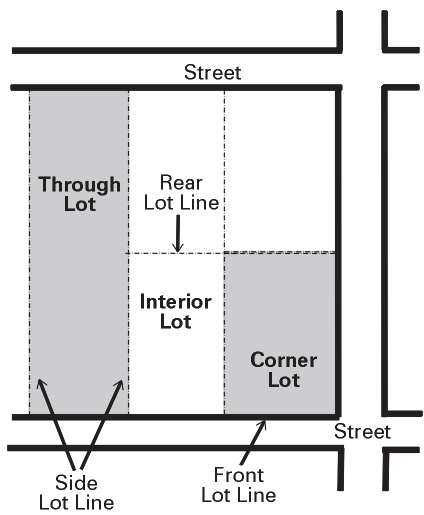
LOT, CORNER: A lot which abuts on two or more streets at their intersection, or upon two parts of the same street that form an interior angle of not more than 135 degrees.
LOT DEPTH: The average distance measured from the front lot line to the rear lot line.
LOT, INTERIOR: A lot that is not a corner lot and is bounded by a lot on each side line.
LOT LINE, FRONT: The front lot line of an interior lot is the line separating the lot from the street right-of-way or easement of principal access. The front lot line of a corner lot shall be the lot line upon which the principal building entrance will front and/or where the principal address is assigned as determined by the City Engineer.
LOT LINE, REAR: The rear lot line is the boundary opposite and more or less parallel to the front lot line. The rear lot line of an irregular or triangular lot shall be a line not less than ten feet long, lying wholly within the lot, and parallel to and at the farthest distance from the front lot line.
LOT LINE, SIDE: A side lot line is any lot boundary line not a front line or a rear lot line.
LOT, THROUGH: A lot that fronts upon two streets that do not intersect at the boundaries of the lot.
LOT WIDTH: The horizontal distance between side lot lines measured at the minimum building setback line.
LUMEN: A unit of measurement of the rate at which light is emitted from a source. The International System unit of luminous flux, equal to the light emitted in a unit solid angle by a uniform point source of one candela.
MANUFACTURED HOME: A structure constructed on or after June 15, 1976, according to the rules of the U.S. Department of Housing and Urban Development (HUD-Code), transportable in one or more sections are eight feet or more in width and 40 feet or more in length, and which is built on a permanent chassis and designed to be used as a dwelling with or without a permanent foundation when connected to required utilities, and includes the plumbing, heating, air-conditioning, and electrical systems. This term does not include a recreational vehicle.
MANUFACTURED HOME SPACE: A unit of ground indicated by corner markers on which a manufactured home may be placed in a manufactured home park.
MANUFACTURED HOME SUBDIVISION: A unified development of lots for the placement of one manufactured home per platted lot for non-transient occupancy, established for the purpose of having individually-owned lots.
MANUFACTURED HOME PARK: Any site, lot, parcel, or tract of land under single ownership with sites available for rent or lease upon which two or more manufactured housing units or mobile homes are placed.
MOBILE FOOD VENDOR: A vehicle mounted food product establishment designed to be readily movable (including, but not limited to food trucks, catering trucks, food trailers and pushcarts) from which food is distributed, sold, or served to walk-up customers.
MOBILE HOME: A manufactured home constructed prior to June 15, 1976 or that otherwise does not meet the HUD-Code standards.
MOTEL: See "Hotel or Motel."
MULCH: A layer of organic material placed on the soil around plants to retain moisture and prevent weeds.
NATURAL GRADE: The slope of the ground adjoining the building.
NONCONFORMING USE: Any use of a building or of land that does not conform to the regulations for the district in which it is situated but which was existing and lawful prior to the adoption of this Ordinance or amendment.
NONCONTRIBUTING STRUCTURE: A structure that does not contribute to the character of an Historic Site or an Historic District.
NURSING HOME: A facility which is operated for the purpose of providing long-term individualized and substantial nursing, personal assistance, or convalescent care for residents unrelated to the operator.
OPEN SPACE: Outdoor or unenclosed area on the ground accessible for outdoor living, recreation, pedestrian access, or landscaping. Open space shall not include parking areas, driveways, deck or terrace areas, utility or service areas, or any space with a dimension of less than six feet in any direction.
OUTPARCEL: Any lot created from an overall tract wherein the remaining tract is larger than any single lot created and wherein the conditions and locations of access to such lot from a public street may be restricted and/or provided through easements granted by the larger tract holder.
OVERLAY DISTRICT: A geographic area designated on the Official Zoning Map where certain regulations of this Ordinance apply in addition to the underlying zoning district regulations. See 2.1.1 and 2.6.1.
PARK, CITY: All premises and facilities owned, leased, or used by the City or its Department of Parks and Recreation for any recreational purposes, not including a street right-of-way.
PARK, COMMUNITY: A park commonly 20 acres or more in size providing an area or building for community gathering, and including areas for active games such as baseball, softball, soccer, tennis, basketball and volleyball. May also include a swimming pool, as well as passive areas for hiking, biking, sitting, and picnicking. A maintenance building may also be provided.
PARK, NEIGHBORHOOD: A park commonly no more than five acres in size that is easily accessible to a neighborhood within safe walking and biking distance. A neighborhood park provides facilities for all ages, passive as well as active, including play equipment, open space for games, paved game areas, ballfields and landscaped areas. A small maintenance building may also be provided.
PARKING LOT, COMMERCIAL: A parcel of land devoted to unenclosed parking spaces which may include partially enclosed one-story buildings, or a parking garage that is the principal structure on the parcel and where a charge is made for storage or parking of vehicles.
PARKING SPACE: An area of appropriate dimensions to be used exclusively as a temporary storage space for private motor vehicles and not for truck loading and unloading space.
PERMIT: A legal document in which the City or SCDOT gives written permission for an access to an applicant.
PHASED DEVELOPMENT PLAN: A development plan submitted to the City by a landowner that shows the types and density or intensity of uses for a specific property or properties to be developed in phases, but which do not satisfy the requirements for a site specific development plan. (Ord. 06132005H)
PLANNED COMMERCIAL DEVELOPMENT (PC): A commercial or mixed use development project comprehensively planned as a unified entity with a master concept plan that permits flexibility in siting buildings, shared access and parking, and mixtures of land uses.
PLANNED RESIDENTIAL DEVELOPMENT (PR): A development primarily used for residential purposes comprehensively planned as a unified entity with a concept plan approved by City Council that generally permits flexibility in siting buildings and a mixture of housing types and land uses but requires the preservation of usable open spaces and significant environmental features. Commercial and institutional uses may be included if they are primarily for the benefit of the residents of the project.
PLANNING COMMISSION: Refers to the Planning Commission of the City of Aiken, South Carolina, as set forth under the laws of the State of South Carolina.
PLANNING DIRECTOR: Director of the Planning Department of the City.
PLANTING STRIP: A portion of the required landscaping on a site. See Chapter 4, Article 6.
PUBLIC PROJECT: In accordance with Section 6-29-540, Code of Laws of South Carolina, any new street, structure, utility, square, park, or other public way, grounds, or open space or public buildings for any use, with the exception of telephone, sewer, and gas utilities or electric suppliers, utilities, and providers, whether publicly or privately owned, whose plans have been approved by a state or federal regulatory agency.
PUSHCART: Mobile food vending unit that must be moved by non-motorized means.
RECREATIONAL VEHICLE: A self-propelled or towable vehicle of such size and weight as not to require special highway movement permits, primarily designed, constructed, or modified to provide temporary living quarters or for recreation, camping, or vacation use, and not for commercial purposes or for profit, including, but not limited to, motor homes, travel or camper trailers, pickup campers, boats and boat trailers. This definition does not include mobile or manufactured homes.
RECREATIONAL VEHICLE PARK: Any parcel or tract of land under the control of any person, organization, or governmental entity where two or more recreational vehicle sites are offered for use by the public or members of an organization for overnight stay.
RECREATIONAL VEHICLE SITE: A specific area within a recreational vehicle park that is set aside for one recreational vehicle.
RELOCATION: For the purposes of Chapter 5, any moving of a structure on its site or to another site.
REPAIR: For the purposes of Chapter 5, any minor change to a structure that is not construction, relocation, demolition, or alteration.
RESIDENTIAL ASSISTED LIVING FACILITY or RESIDENTIAL CARE FACILITY: A facility which offers room (regardless of whether leased or owned by the occupant or any other person), board, and a limited degree of personal assistance on a long-term basis for two or more persons, 18 years old or older, unrelated to the operator, but excluding any facility which offers or represents to the public that it offers such services primarily to or specifically for the mentally ill, mentally disabled, or drug or alcohol addicted or provides or purports to provide specific procedures or processes for those diseases or conditions. Personal assistance as used herein shall be interpreted and applied using the applicable provisions in South Carolina Code Annotated Regulation 61-84, or any successor provisions thereto, as guidelines.
RIGHT-OF-WAY: Land reserved for use as a highway, street, or road whether or not formally dedicated to the City including the area between the edge of pavement and the abutting property.
ROAD: See "Highway; Street; Road."
SCDOT: The South Carolina Department of Transportation.
SEMI-NUDITY: A state of dress in which clothing covers no more than the genitals, pubic region, and areolae of the female breast, as well as portions of the body covered by supporting straps or devices.
SERVICE LINE: Any utility line that connects a distribution line to an end user.
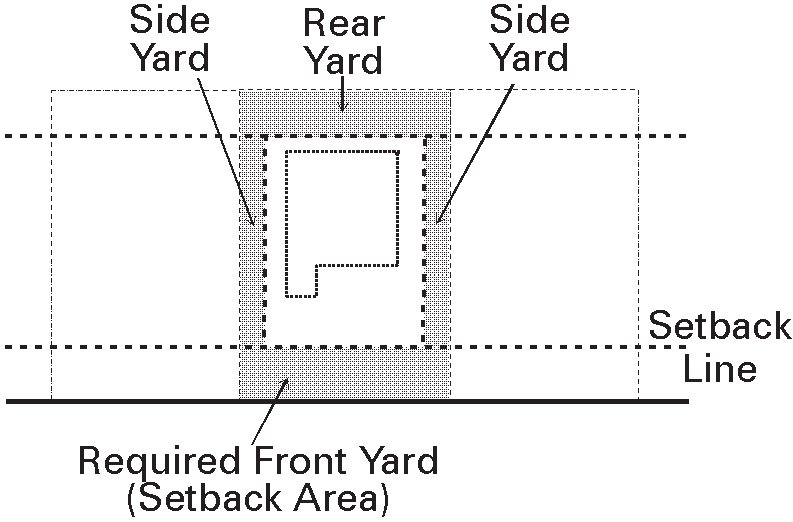
SETBACK LINE: That line that is the required minimum distance from the street right-of-way line or any other lot line that establishes the area within which the principal structure must be constructed or placed. A setback line shall also apply to any accessory structure.
SHOPPING CENTER: A group of at least two commercial establishments typically planned, constructed, and managed as a single entity, with on-site parking for customers and employees, and with delivery of goods separate from customer access.
SIDEWALK: A paved or surfaced area, paralleling and usually separated from a public or private street, used as a pedestrian walkway.
SIGN: Any sign, poster panel, free-standing sign, monument sign, projecting sign, pylon sign, illuminated sign, sign painted on a wall, window marquee, awning or canopy, and shall include any announcement, declaration, demonstration, display, ribbon, banner, illustration or insignia used to advertise or promote the interests of any person, business or entity, public or private, when the same is placed in view of the general public, traveling along a public street right-of-way.
SIGN, MOBILE OR PORTABLE: Portable advertising signs or identification signs, either illuminated or non-illuminated, mounted on wheels or so constructed as to provide for temporary use.
SIGN, READER BOARD: A portion of a sign designed for changeable copy.
SIGN, TEMPORARY: A sign which is not intended for permanent display. See 4.4.9.
SITE SPECIFIC DEVELOPMENT PLAN: a development plan submitted to the City by a landowner describing with reasonable certainty the types and density or intensity of uses for a specific property or properties. The plan may be in the form of, but is not limited to, the following plans or approvals: planned unit development; subdivision plat; preliminary or general development plan; variance; conditional use or special use permit plan; conditional or special use district zoning plan; or other land-use approval designations as are used by a county or municipality. (Ord. 06132005H)
SPECIAL EXCEPTION: A use permitted following approval by the Board of Zoning Appeals in accordance with 6.2.18.
SPECIFIED ANATOMICAL AREAS: The male genitals or the vulva or other parts of the female genitals.
SPECIFIED SEXUAL ACTIVITIES: Any of the following:
1.
Fondling or other erotic touching of the human genitals, pubic region, buttocks, anus or female breasts;
2.
Sex acts, normal or perverted, actual or simulated, including intercourse, oral copulation, or sodomy;
3.
Masturbation, actual or simulated; or
4.
Excretory functions as part of or in connection with any of the activities set forth in 1 through 3 above.
STABLE: A building intended for the accommodation of one or more horses, mules, burros, or ponies.
STABLE, PLEASURE: A stable used to shelter horses, mules, burros, or ponies which are kept or ridden for the sole purpose of recreation or pleasure.
STABLE, COMMERCIAL: Any stable that does not meet the definition of a pleasure stable.
STORY: The vertical distance of a building included between the surface of any floor and the surface of the next floor above it, or, if there be no floor above it, then the space between such floor and ceiling next above it. A cellar or basement shall not be considered a story. Attic space is construed as one-half story.
STREET: See "Highway; Street; Road."
STREET WIDTH: The horizontal distance between the side right-of-way lines of a street, road, or highway measured at right angles to the side right-of-way lines.
STRUCTURE: Anything constructed or erected, the use of which requires more or less permanent or temporary location on or in the ground, or which is attached to something having a permanent location on the ground. The term includes, but is not limited to buildings, gazebos, signs, billboards, tennis courts, backstops for tennis courts, radio and television antennae and satellite dishes, including supporting towers, swimming pools, decks, patios, light standards, walls, and fences. This definition shall not include play equipment, benches, birdbaths, mailboxes, or any other insignificant objects as determined by the Planning Director.
SUBDIVISION: The division of a lot, tract, or parcel of land into two or more lots, plats, sites, or other divisions of land for the purpose, whether immediate or future, of sale or of building development for purposes other than agricultural. It includes re-subdivision and when appropriate to the context, relates to the process of subdividing or to the land or territory subdivided.
SWALE: A grassy depression used to channel storm drainage with sides having a slope gradual enough to be mowed as determined by the City Engineer.
SWIMMING POOL: Any structure intended for swimming or recreational bathing that contains water over 24 inches deep including in-ground, above-ground, and on-ground pools as well as hot tubs and spas.
TELECOMMUNICATIONS: As defined in the Telecommunications Act of 1996, the transmission, between or among points specified by the user, of information of the user's choosing, without change in the form or content of the information as sent and received.
TEMPORARY SIGN: See "Sign, Temporary."
TOWNHOUSE: A single-family dwelling constructed as part of a series of dwellings, all of which are attached to the adjacent dwelling by party walls with no visible space between them. Each dwelling is located on a separately platted lot.
TRAFFIC CONTROL DEVICE: Signs; signals, and markings used to regulate, warn, and guide traffic.
TRANSMISSION LINE: Any utility line intended to move large quantities of utility service from generation sources to distribution lines but not to the end user.
TREE: A usually tall, woody plant, distinguished from a shrub by having comparatively greater height and, characteristically, a single trunk rather than several stems.
TREE, CANOPY: A variety of large tree designated by the City Horticulturist that will at maturity provide substantial shade. (Ord. 04082002A)
TREE, LARGE: A tree that typically exceeds a height of 30 feet at maturity as determined by the City Horticulturist and that is listed or identified in the Tree Protection and Landscaping Manual.
TREE, SIGNIFICANT: A large tree with a DBH of eight to 24 inches, or a small tree with a DBH of four to eight inches. Unless otherwise specified, this term refers to existing trees on a site.
TREE, SMALL: A tree that typically does not exceed a height of 30 feet at maturity as determined by the City Horticulturist and that is listed or identified in the Tree Protection and Landscaping Manual.
TREE, GRAND: A large tree with a DBH of 24 inches or more, a small tree with a DBH of eight inches or more, or any tree designated by the City Horticulturist to be of exceptional value because of its type, size, age, or other criteria. Unless otherwise specified, this term refers to existing trees on a site.
TREES, REMOVAL OF: Any intentional or negligent act that will cause a tree to decline and die within a period of one year from the act as determined exclusively by the City Horticulturist, including, but not limited to, damage inflicted upon the root system of a tree by application of toxic substances; the operation of machinery; the change of natural grade by excavation or filling above the root system or around the trunk of a tree; damages from injury or fire inflicted on trees that result in or permit pest infestation; and improper pruning.
UNDERGROWTH: Vines and bushes as determined by the City Horticulturist.
UPPER-STORY RESIDENTIAL: A residential dwelling unit located above another use.
USE CATEGORY: A mechanism to classify land uses and activities based on common functional, product, or physical characteristics. Characteristics include the type and amount of activity, the type of customers or residents, how goods or services are sold or delivered, likely impact on surrounding properties, and site conditions. The Use Categories provide a systematic basis for assigning land uses to appropriate zoning districts. See Chapter 3, Article 2.
VARIANCE: Permission granted by the Board of Zoning Appeals to vary from the literal requirements of this Ordinance. See 6.2.19.
VEHICLE REPAIR: Any building in which, or premises on which, a business involving the maintenance, servicing, repair, or painting of vehicles is conducted or rendered. Vehicle repair does not involve the storage of vehicles for extended periods of time.
VEHICULAR USE AREA: Areas covered by pavement intended for use by automobiles and other vehicles for parking or any other purpose.
VESTED RIGHT: The right to undertake and complete the development of property under the terms and conditions of a site specific development plan or a phased development plan as provided in this article and in the local land development ordinances or regulations adopted pursuant to this chapter. (Ord. 06132005H)
VISIBLE FROM A STREET: Able to be seen by a person standing at any point on any public street right-of-way, including, but not limited to, any object that could be seen from a street if not for obstructing trees, vegetation, or fences.
YARD: An open space on the same site as a structure, unoccupied and unobstructed by structures from the ground upward, except as otherwise provided in this Ordinance, including a front yard, side yard, and rear yard.
YARD, FRONT: An open space extending the full width of a lot and of a depth measured horizontally at right angles to the front lot line.
YARD, REAR: An open space extending the full width of a lot and of a depth measured horizontally at right angles to the rear lot line.
YARD, REQUIRED: Any setback area required in this Ordinance. See 4.2.1 and 4.3.1.
YARD, SIDE: An open space extending along the side line of a lot between the front yard and the rear yard and of a width measured horizontally at right angles to the side lot line.
ZONING OFFICIAL: The person appointed by the Planning Director involved in the enforcement of the Zoning Ordinance (see 7.1.2 and 9.1.1).
(Ord. No. 04142014B , § 1(Exh. A), 4-14-2014; Ord. No. 11092015 , § 1(Exh. A), 11-9-2015; Ord. No. 07102017A , § 1(Exh. A), 7-10-2017; Ord. No. 11122018C , § 1(Exh. A), 11-12-2018)