
Aiken City Zoning Code
CHAPTER 6
APPROVAL PROCEDURES
6.1.1. - Conformity With Zoning Ordinance.
Every official and employee of the City of Aiken, South Carolina vested with the duty or authority to issue a building permit, grading permit, or business license shall not issue a permit or license for any use, building, or purpose that conflicts with any provision of this Ordinance. Any permit or license or certificate issued in conflict with the provisions of this Zoning Ordinance shall be null and void.
6.1.2. - Optional Preapplication Conference.
Prior to the submission of any application required by this Ordinance, a potential applicant may request an optional preapplication conference to discuss procedures, standards, or regulations required by this Ordinance. Upon receipt of such request, the Planning Director, Zoning Official, or Building Official, as appropriate, shall afford the potential applicant an opportunity for such a preapplication conference at the earliest reasonable time.
6.1.3. - Application Submittal.
A.
Application to Building Official. Plans and applications for the following review shall be submitted to the Building Official:
1.
Building permits;
2.
Certificates of Occupancy; and
3.
Telecommunication facility plans for an antenna on an existing structure, a replacement tower, or a new tower.
B.
Application to Planning Director. All other applications and plans submitted for review under this Ordinance shall be submitted to the Planning Director.
C.
Application Forms and Fees. The following regulations shall apply to all applications.
1.
Forms. Applications shall be submitted on forms and in such numbers as required by the City.
2.
Primary Contact. For all applications, a single agent shall be identified for all official communications with the City. The agent may be either the applicant or a representative of the applicant. If a contact is not specified, the applicant shall be considered the primary contact.
3.
Fees. Filing fees shall be established from time to time by the City Manager, as set forth in Sec. 2-63.1 of the Aiken Code, to defray the actual cost of processing the application.
D.
Application Deadlines.
1.
Applications for which no public hearing is required shall have no application deadlines.
2.
All applications for which a public hearing is required shall be completed and submitted to the appropriate official prior to the meeting at which the permit or approval will be considered in accordance with the following table unless waived by the Planning Director.
E.
Complete Application Required.
1.
Review by City. The Building Official or Planning Director shall have five working days from receipt of the application to confirm that all the required items have been submitted, except for applications required by Chapter 5.
2.
Incomplete Applications.
a.
If the application is not complete, the reviewing official shall inform the applicant in writing within the five-day period specifying the ways in which the application is incomplete. This notification shall be considered complete when the letter is mailed.
b.
Following notification in writing that an application is incomplete, the applicant shall have 60 days during which to provide the requested materials and complete the application. Any application for which additional materials have not been forthcoming during this 60-day period shall be considered withdrawn unless the time period is extended by mutual agreement between the City and the applicant.
F.
Waiver of Application Requirements. The Building Official and Planning Director shall have the authority to waive any application requirements that do not apply to a proposed project or approval.
A.
Summary. Notice shall be required for approvals as shown in the Table below.
B.
Types of Notice.
1.
Published Notice. For each application requiring a public hearing, a public notice shall be placed in a local newspaper of general circulation within the City not less than twenty days prior to each such hearing for the purpose of notifying the public.
2.
Posted Notice. For each application requiring a public hearing, a public notice sign shall be posted not less than twenty days prior to such hearing on the subject property in a location clearly visible from each adjacent street. Where more than one lot is involved in an application, the Planning Director shall determine the number and location of required public notice signs.
3.
Mailed Notice.
a.
The City shall provide notice via U.S. mail to:
i.
owners of property contiguous to or across a street or railroad right-of-way from the subject property; and
ii.
any and all parties, including homeowners' and condominium associations, who register with the Planning Director to receive such notice.
b.
Notice shall be sent not less than 20 days prior to the public hearing. The notice shall be considered given when placed in the U.S. Post Office at Aiken, South Carolina with proper postage affixed.
C.
Content of Notices.
1.
Published or Mailed Notice. A published or mailed notice shall provide at least the following information:
a.
the general location of land that is the subject of the application;
b.
street address, where applicable;
c.
the nature of the application;
d.
the time, date, and location of the public hearing;
e.
a phone number to contact the City; and
f.
a statement that interested parties may appear at the public hearing.
2.
Posted Notice. Required posted notices shall indicate the following:
a.
the nature of the application;
b.
the time, date, and location of the public hearing; and
c.
a phone number to contact the City.
6.1.5. Public Notice for City Council Public Hearing.
For every annexation, rezoning, or utility request before Aiken City Council affecting a particular piece of property that is the subject of a recommendation from the Planning Commission, notice of the public hearing before City Council on such matter shall be given to the public by the posting of a sign at least 13 days prior to the public hearing on the subject property clearly visible from each street adjacent to the particular piece of property. The notice shall set forth the following statement: "You are hereby notified that the date of the public hearing may be changed by City Council to a later date. Interested persons should contact the City Manager's Office at 642.7654 prior to the date of the public hearing to confirm the actual hearing date." (Ord. 06092003) (Ord. 11082004B)
6.1.6. Written Decisions Required.
Within 25 days after a final decision is made by the Planning Commission under the requirements of this Chapter, a copy of the written decision shall be sent to the applicant, or appellant, by certified mail. A copy of the notice shall be filed in the office of the Planning Director or Building Official, as appropriate, where it shall be available for public inspection during regular office hours. No later than 48 hours after its next regularly scheduled meeting after a final decision has been made by the Board of Zoning Appeals under the requirements of this Chapter, a copy of its written decision, signed by the Board members present and voting on the agenda item, at the prior meeting, shall be sent to the applicant, or appellant, by certified mail. The original written decision shall be filed in the Office of the City Clerk for permanent retention, as appropriate. (Ord. 02092004D)
6.1.7. Time Limits for Resubmission of Applications.
In the event that any application is denied or disapproved by the City staff, Planning Commission, City Council, or Board of Zoning Appeals, an application for the same request shall not be refiled for one year from the date of mailing of the notice of denial. The Planning Director or Building Official, as appropriate, upon petition by the applicant, may permit the refiling of an application prior to the end of the one-year period upon a determination that significant physical, economic, or land use changes have taken place on the subject tract or within the immediate vicinity, or a significant text amendment to this Ordinance has been adopted.
6.1.8. Expiration of Permits and Approvals.
A.
General. All permits and approvals shall expire as set forth in each specific procedure in Article 2 of this Chapter, without further action of the Planning Director, Building Official, Board of Zoning Appeals, Historic Preservation Commission, Planning Commission, or City Council, as may be applicable, except as set forth in paragraph B below.
B.
Exceptions. The expiration or approvals and permits shall follow paragraph A above except where one of the following applies.
1.
A specific time period during which the permit or approval shall remain valid is expressly set forth in the permit or approval; or
2.
A specific time period during which a specific action that must be undertaken by the holder of the permit or approval is expressly set forth in the permit or approval; or
3.
The holder of the permit or approval either submits a complete application for the appropriate subsequent permit or approval; or, if no subsequent permit or approval is required, completes the work described in the permit or approval within the time-frames established.
C.
Diligent Pursuit of Subsequent Applications.
1.
An applicant who submits an appropriate subsequent application for a permit or approval must diligently pursue approval of such application, which means, at a minimum, the following.
a.
Submission of any required additional materials, upon notification of incompleteness by the Planning Director or Building Official, within the time-frame specified in the notice of incompleteness, unless an extension of time is mutually agreed upon by the applicant and the Planning Director or Building Official; and
b.
Timely pursuit of administrative remedies, where applicable, as established within this Chapter.
2.
Expiration of a permit or approval, including a building permit, shall invalidate previously issued permits or approvals that have exceeded their own respective time limits.
6.1.9. Vested Rights.
A.
General.
1.
Pursuant to South Carolina Code Section 6-29-1510, et seq., a vested right is hereby established for two years upon the approval of a site specific development plan as evidenced by the issuance of an approved site plan by the Planning Department.
2.
At least 60 days prior to the end of the vesting period, the landowner of real property with a vested right may apply to the Planning Director for an annual extension of the vested right. The Planning Director must approve applications for at least five annual extensions of the vested right unless an amendment to the land development ordinances or regulations has been adopted that prohibits approval.
B.
Conditions and Limitations on Vested Rights. A vested right established by this article and in accordance with the standards and procedures in the land development ordinances or regulations is subject to the following conditions and limitations:
1.
if City Council establishes a vested right for a phased development plan, a site specific development plan may be required for approval with respect to each phase in accordance with regulations in effect at the time of vesting;
2.
a vested right established under a conditionally approved site specific development plan or conditionally approved phased development plan may be terminated by the City Council upon its determination, following notice and public hearing, that the landowner has failed to meet the terms of the conditional approval;
3.
a site specific development plan or phased development plan for which a variance, regulation, or special exception is necessary does not confer a vested right until the variance, regulation, or special exception is obtained;
4.
a vested right for a site specific development plan expires two years after vesting;
5.
a vested site specific development plan or vested phased development plan may be amended if approved by the City Council pursuant to the provisions of the land development ordinances or regulations;
6.
a validly issued building permit does not expire or is not revoked upon expiration of a vested right, except for public safety reasons or as prescribed by the applicable building code;
7.
a vested right to a site specific development plan or phased development plan is subject to revocation by the City Council upon its determination, after notice and public hearing, that there was a material misrepresentation by the landowner or substantial noncompliance with the terms and conditions of the original or amended approval;
a vested site specific development plan or vested phased development plan is subject to later enacted federal, state, or local laws adopted to protect public health, safety, and welfare including, but not limited to, building, fire, plumbing, electrical, and mechanical codes and nonconforming structure and use regulations which do not provide for the grandfathering of the vested right. The issuance of a building permit vests the specific construction project authorized by the building permit to the building, fire, plumbing, electrical, and mechanical codes in force at the time of the issuance of the building permit;
8.
a vested site specific development plan or vested phased development plan is subject to later local governmental overlay zoning that imposes site plan-related requirements but does not affect allowable types, height as it affects density or intensity of uses, or density or intensity of uses;
9.
a change in the zoning district designation or land use regulations made subsequent to vesting that affect real property does not operate to affect, prevent, or delay development of the real property under a vested site specific development plan or vested phased development plan without consent of the landowner;
10.
if real property having a vested site specific development plan or vested phased development plan is annexed, the governing body of the municipality to which the real property has been annexed must determine, after notice and public hearing in which the landowner is allowed to present evidence, if the vested right is effective after the annexation; and
11.
a City Council must not require a landowner to waive his vested rights as a condition of approval or conditional approval of a site specific development plan or a phased development plan.
C.
Vested Right Attaches to Real Property. A vested right pursuant to this section is not a personal right, but attaches to and runs with the applicable real property. The landowner and all successors to the landowner who secure a vested right pursuant to this article may rely upon and exercise the vested right for its duration subject to applicable federal, state, and City laws adopted to protect public health, safety, and welfare including, but not limited to, building, fire, plumbing, electrical, and mechanical codes and nonconforming structure and use regulations which do not provide for the grandfathering of the vested right. This article does not preclude judicial determination that a vested right exists pursuant to other statutory provisions. This article does not affect the provisions of a development agreement executed pursuant to the South Carolina Local Government Development Agreement Act. (Ord. 06132005H)
6.1.4. - Public Notice for Public Hearing.
A.
Summary. Notice shall be required for approvals as shown in the Table below.
B.
Types of Notice.
1.
Published Notice. For each application requiring a public hearing, a public notice shall be placed in a local newspaper of general circulation within the City not less than twenty days prior to each such hearing for the purpose of notifying the public.
2.
Posted Notice. For each application requiring a public hearing, a public notice sign shall be posted not less than twenty days prior to such hearing on the subject property in a location clearly visible from each adjacent street. Where more than one lot is involved in an application, the Planning Director shall determine the number and location of required public notice signs.
3.
Mailed Notice.
a.
The City shall provide notice via U.S. mail to:
i.
owners of property contiguous to or across a street or railroad right-of-way from the subject property; and
ii.
any and all parties, including homeowners' and condominium associations, who register with the Planning Director to receive such notice.
b.
Notice shall be sent not less than 20 days prior to the public hearing. The notice shall be considered given when placed in the U.S. Post Office at Aiken, South Carolina with proper postage affixed.
C.
Content of Notices.
1.
Published or Mailed Notice. A published or mailed notice shall provide at least the following information:
a.
the general location of land that is the subject of the application;
b.
street address, where applicable;
c.
the nature of the application;
d.
the time, date, and location of the public hearing;
e.
a phone number to contact the City; and
f.
a statement that interested parties may appear at the public hearing.
2.
Posted Notice. Required posted notices shall indicate the following:
a.
the nature of the application;
b.
the time, date, and location of the public hearing; and
c.
a phone number to contact the City.
For every annexation, rezoning, or utility request before Aiken City Council affecting a particular piece of property that is the subject of a recommendation from the Planning Commission, notice of the public hearing before City Council on such matter shall be given to the public by the posting of a sign at least 13 days prior to the public hearing on the subject property clearly visible from each street adjacent to the particular piece of property. The notice shall set forth the following statement: "You are hereby notified that the date of the public hearing may be changed by City Council to a later date. Interested persons should contact the City Manager's Office at 642.7654 prior to the date of the public hearing to confirm the actual hearing date." (Ord. 06092003) (Ord. 11082004B)
6.1.6. Written Decisions Required.
Within 25 days after a final decision is made by the Planning Commission under the requirements of this Chapter, a copy of the written decision shall be sent to the applicant, or appellant, by certified mail. A copy of the notice shall be filed in the office of the Planning Director or Building Official, as appropriate, where it shall be available for public inspection during regular office hours. No later than 48 hours after its next regularly scheduled meeting after a final decision has been made by the Board of Zoning Appeals under the requirements of this Chapter, a copy of its written decision, signed by the Board members present and voting on the agenda item, at the prior meeting, shall be sent to the applicant, or appellant, by certified mail. The original written decision shall be filed in the Office of the City Clerk for permanent retention, as appropriate. (Ord. 02092004D)
6.1.7. Time Limits for Resubmission of Applications.
In the event that any application is denied or disapproved by the City staff, Planning Commission, City Council, or Board of Zoning Appeals, an application for the same request shall not be refiled for one year from the date of mailing of the notice of denial. The Planning Director or Building Official, as appropriate, upon petition by the applicant, may permit the refiling of an application prior to the end of the one-year period upon a determination that significant physical, economic, or land use changes have taken place on the subject tract or within the immediate vicinity, or a significant text amendment to this Ordinance has been adopted.
6.1.8. Expiration of Permits and Approvals.
A.
General. All permits and approvals shall expire as set forth in each specific procedure in Article 2 of this Chapter, without further action of the Planning Director, Building Official, Board of Zoning Appeals, Historic Preservation Commission, Planning Commission, or City Council, as may be applicable, except as set forth in paragraph B below.
B.
Exceptions. The expiration or approvals and permits shall follow paragraph A above except where one of the following applies.
1.
A specific time period during which the permit or approval shall remain valid is expressly set forth in the permit or approval; or
2.
A specific time period during which a specific action that must be undertaken by the holder of the permit or approval is expressly set forth in the permit or approval; or
3.
The holder of the permit or approval either submits a complete application for the appropriate subsequent permit or approval; or, if no subsequent permit or approval is required, completes the work described in the permit or approval within the time-frames established.
C.
Diligent Pursuit of Subsequent Applications.
1.
An applicant who submits an appropriate subsequent application for a permit or approval must diligently pursue approval of such application, which means, at a minimum, the following.
a.
Submission of any required additional materials, upon notification of incompleteness by the Planning Director or Building Official, within the time-frame specified in the notice of incompleteness, unless an extension of time is mutually agreed upon by the applicant and the Planning Director or Building Official; and
b.
Timely pursuit of administrative remedies, where applicable, as established within this Chapter.
2.
Expiration of a permit or approval, including a building permit, shall invalidate previously issued permits or approvals that have exceeded their own respective time limits.
6.1.9. Vested Rights.
A.
General.
1.
Pursuant to South Carolina Code Section 6-29-1510, et seq., a vested right is hereby established for two years upon the approval of a site specific development plan as evidenced by the issuance of an approved site plan by the Planning Department.
2.
At least 60 days prior to the end of the vesting period, the landowner of real property with a vested right may apply to the Planning Director for an annual extension of the vested right. The Planning Director must approve applications for at least five annual extensions of the vested right unless an amendment to the land development ordinances or regulations has been adopted that prohibits approval.
B.
Conditions and Limitations on Vested Rights. A vested right established by this article and in accordance with the standards and procedures in the land development ordinances or regulations is subject to the following conditions and limitations:
1.
if City Council establishes a vested right for a phased development plan, a site specific development plan may be required for approval with respect to each phase in accordance with regulations in effect at the time of vesting;
2.
a vested right established under a conditionally approved site specific development plan or conditionally approved phased development plan may be terminated by the City Council upon its determination, following notice and public hearing, that the landowner has failed to meet the terms of the conditional approval;
3.
a site specific development plan or phased development plan for which a variance, regulation, or special exception is necessary does not confer a vested right until the variance, regulation, or special exception is obtained;
4.
a vested right for a site specific development plan expires two years after vesting;
5.
a vested site specific development plan or vested phased development plan may be amended if approved by the City Council pursuant to the provisions of the land development ordinances or regulations;
6.
a validly issued building permit does not expire or is not revoked upon expiration of a vested right, except for public safety reasons or as prescribed by the applicable building code;
7.
a vested right to a site specific development plan or phased development plan is subject to revocation by the City Council upon its determination, after notice and public hearing, that there was a material misrepresentation by the landowner or substantial noncompliance with the terms and conditions of the original or amended approval;
a vested site specific development plan or vested phased development plan is subject to later enacted federal, state, or local laws adopted to protect public health, safety, and welfare including, but not limited to, building, fire, plumbing, electrical, and mechanical codes and nonconforming structure and use regulations which do not provide for the grandfathering of the vested right. The issuance of a building permit vests the specific construction project authorized by the building permit to the building, fire, plumbing, electrical, and mechanical codes in force at the time of the issuance of the building permit;
8.
a vested site specific development plan or vested phased development plan is subject to later local governmental overlay zoning that imposes site plan-related requirements but does not affect allowable types, height as it affects density or intensity of uses, or density or intensity of uses;
9.
a change in the zoning district designation or land use regulations made subsequent to vesting that affect real property does not operate to affect, prevent, or delay development of the real property under a vested site specific development plan or vested phased development plan without consent of the landowner;
10.
if real property having a vested site specific development plan or vested phased development plan is annexed, the governing body of the municipality to which the real property has been annexed must determine, after notice and public hearing in which the landowner is allowed to present evidence, if the vested right is effective after the annexation; and
11.
a City Council must not require a landowner to waive his vested rights as a condition of approval or conditional approval of a site specific development plan or a phased development plan.
C.
Vested Right Attaches to Real Property. A vested right pursuant to this section is not a personal right, but attaches to and runs with the applicable real property. The landowner and all successors to the landowner who secure a vested right pursuant to this article may rely upon and exercise the vested right for its duration subject to applicable federal, state, and City laws adopted to protect public health, safety, and welfare including, but not limited to, building, fire, plumbing, electrical, and mechanical codes and nonconforming structure and use regulations which do not provide for the grandfathering of the vested right. This article does not preclude judicial determination that a vested right exists pursuant to other statutory provisions. This article does not affect the provisions of a development agreement executed pursuant to the South Carolina Local Government Development Agreement Act. (Ord. 06132005H)
6.1.5. - Public Notice for City Council Public Hearing.
For every annexation, rezoning, or utility request before Aiken City Council affecting a particular piece of property that is the subject of a recommendation from the Planning Commission, notice of the public hearing before City Council on such matter shall be given to the public by the posting of a sign at least 13 days prior to the public hearing on the subject property clearly visible from each street adjacent to the particular piece of property. The notice shall set forth the following statement: "You are hereby notified that the date of the public hearing may be changed by City Council to a later date. Interested persons should contact the City Manager's Office at 642.7654 prior to the date of the public hearing to confirm the actual hearing date." (Ord. 06092003) (Ord. 11082004B)
6.1.6. - Written Decisions Required.
Within 25 days after a final decision is made by the Planning Commission under the requirements of this Chapter, a copy of the written decision shall be sent to the applicant, or appellant, by certified mail. A copy of the notice shall be filed in the office of the Planning Director or Building Official, as appropriate, where it shall be available for public inspection during regular office hours. No later than 48 hours after its next regularly scheduled meeting after a final decision has been made by the Board of Zoning Appeals under the requirements of this Chapter, a copy of its written decision, signed by the Board members present and voting on the agenda item, at the prior meeting, shall be sent to the applicant, or appellant, by certified mail. The original written decision shall be filed in the Office of the City Clerk for permanent retention, as appropriate. (Ord. 02092004D)
6.1.7. - Time Limits for Resubmission of Applications.
In the event that any application is denied or disapproved by the City staff, Planning Commission, City Council, or Board of Zoning Appeals, an application for the same request shall not be refiled for one year from the date of mailing of the notice of denial. The Planning Director or Building Official, as appropriate, upon petition by the applicant, may permit the refiling of an application prior to the end of the one-year period upon a determination that significant physical, economic, or land use changes have taken place on the subject tract or within the immediate vicinity, or a significant text amendment to this Ordinance has been adopted.
6.1.8. - Expiration of Permits and Approvals.
A.
General. All permits and approvals shall expire as set forth in each specific procedure in Article 2 of this Chapter, without further action of the Planning Director, Building Official, Board of Zoning Appeals, Historic Preservation Commission, Planning Commission, or City Council, as may be applicable, except as set forth in paragraph B below.
B.
Exceptions. The expiration or approvals and permits shall follow paragraph A above except where one of the following applies.
1.
A specific time period during which the permit or approval shall remain valid is expressly set forth in the permit or approval; or
2.
A specific time period during which a specific action that must be undertaken by the holder of the permit or approval is expressly set forth in the permit or approval; or
3.
The holder of the permit or approval either submits a complete application for the appropriate subsequent permit or approval; or, if no subsequent permit or approval is required, completes the work described in the permit or approval within the time-frames established.
C.
Diligent Pursuit of Subsequent Applications.
1.
An applicant who submits an appropriate subsequent application for a permit or approval must diligently pursue approval of such application, which means, at a minimum, the following.
a.
Submission of any required additional materials, upon notification of incompleteness by the Planning Director or Building Official, within the time-frame specified in the notice of incompleteness, unless an extension of time is mutually agreed upon by the applicant and the Planning Director or Building Official; and
b.
Timely pursuit of administrative remedies, where applicable, as established within this Chapter.
2.
Expiration of a permit or approval, including a building permit, shall invalidate previously issued permits or approvals that have exceeded their own respective time limits.
6.1.9. - Vested Rights.
A.
General.
1.
Pursuant to South Carolina Code Section 6-29-1510, et seq., a vested right is hereby established for two years upon the approval of a site specific development plan as evidenced by the issuance of an approved site plan by the Planning Department.
2.
At least 60 days prior to the end of the vesting period, the landowner of real property with a vested right may apply to the Planning Director for an annual extension of the vested right. The Planning Director must approve applications for at least five annual extensions of the vested right unless an amendment to the land development ordinances or regulations has been adopted that prohibits approval.
B.
Conditions and Limitations on Vested Rights. A vested right established by this article and in accordance with the standards and procedures in the land development ordinances or regulations is subject to the following conditions and limitations:
1.
if City Council establishes a vested right for a phased development plan, a site specific development plan may be required for approval with respect to each phase in accordance with regulations in effect at the time of vesting;
2.
a vested right established under a conditionally approved site specific development plan or conditionally approved phased development plan may be terminated by the City Council upon its determination, following notice and public hearing, that the landowner has failed to meet the terms of the conditional approval;
3.
a site specific development plan or phased development plan for which a variance, regulation, or special exception is necessary does not confer a vested right until the variance, regulation, or special exception is obtained;
4.
a vested right for a site specific development plan expires two years after vesting;
5.
a vested site specific development plan or vested phased development plan may be amended if approved by the City Council pursuant to the provisions of the land development ordinances or regulations;
6.
a validly issued building permit does not expire or is not revoked upon expiration of a vested right, except for public safety reasons or as prescribed by the applicable building code;
7.
a vested right to a site specific development plan or phased development plan is subject to revocation by the City Council upon its determination, after notice and public hearing, that there was a material misrepresentation by the landowner or substantial noncompliance with the terms and conditions of the original or amended approval;
a vested site specific development plan or vested phased development plan is subject to later enacted federal, state, or local laws adopted to protect public health, safety, and welfare including, but not limited to, building, fire, plumbing, electrical, and mechanical codes and nonconforming structure and use regulations which do not provide for the grandfathering of the vested right. The issuance of a building permit vests the specific construction project authorized by the building permit to the building, fire, plumbing, electrical, and mechanical codes in force at the time of the issuance of the building permit;
8.
a vested site specific development plan or vested phased development plan is subject to later local governmental overlay zoning that imposes site plan-related requirements but does not affect allowable types, height as it affects density or intensity of uses, or density or intensity of uses;
9.
a change in the zoning district designation or land use regulations made subsequent to vesting that affect real property does not operate to affect, prevent, or delay development of the real property under a vested site specific development plan or vested phased development plan without consent of the landowner;
10.
if real property having a vested site specific development plan or vested phased development plan is annexed, the governing body of the municipality to which the real property has been annexed must determine, after notice and public hearing in which the landowner is allowed to present evidence, if the vested right is effective after the annexation; and
11.
a City Council must not require a landowner to waive his vested rights as a condition of approval or conditional approval of a site specific development plan or a phased development plan.
C.
Vested Right Attaches to Real Property. A vested right pursuant to this section is not a personal right, but attaches to and runs with the applicable real property. The landowner and all successors to the landowner who secure a vested right pursuant to this article may rely upon and exercise the vested right for its duration subject to applicable federal, state, and City laws adopted to protect public health, safety, and welfare including, but not limited to, building, fire, plumbing, electrical, and mechanical codes and nonconforming structure and use regulations which do not provide for the grandfathering of the vested right. This article does not preclude judicial determination that a vested right exists pursuant to other statutory provisions. This article does not affect the provisions of a development agreement executed pursuant to the South Carolina Local Government Development Agreement Act. (Ord. 06132005H)
6.2.1. - Summary of Development Review Procedures.
The following Table summarizes the development review procedures of the City of Aiken. In case of conflict between this table and the individual procedures, the text of the procedures shall control.
A.
Authority. The Planning Director shall have authority to make written interpretations of this Ordinance.
B.
Request for Interpretation. A written request for interpretation shall be submitted to the Planning Director.
C.
Interpretation by Planning Director.
1.
The Planning Director shall take the following steps within 15 days of receipt of a written request for interpretation.
a.
Review and evaluate the request in light of the text of this Ordinance, the Official Zoning Map, the Comprehensive Plan, and any other relevant information;
b.
Consult with other staff, as necessary; and
c.
Render an opinion.
2.
The interpretation shall be provided to the applicant in writing by mail.
D.
Official Record. The Planning Director shall maintain an official record of interpretations which shall be available for public inspection during normal business hours.
E.
Appeals. Appeals of written interpretations shall be made to the Board of Zoning Appeals within 30 days of mailing of the interpretation in accordance with the procedures in 6.2.20.
6.2.3. Building Permit.
A.
Application Requirements.
1.
In addition to any other requirements determined by the Building Official, all applications for building permits shall be accompanied by plans in duplicate, drawn to a scale of not less than 1/8" = 1 foot, showing the actual shape and dimensions of the lot to be built upon, the exact size and location on the lot of the proposed building or structure, and the exact size and location of any existing buildings or structures on the lot.
2.
Plans shall show the existing or proposed use of each building or part of building, and such other information with regard to the building or lot, parking areas, distances from nearby buildings, or neighboring lots as may be necessary to determine compliance with this Ordinance.
3.
One copy of such plans shall be returned to the owner or agent when approved by the Building Official.
B.
Approval Process. The Building Official shall approve or deny a building permit application within 15 working days of receipt of all required information. Such permit shall not be issued without the approval of the Planning Director.
C.
Expiration of Approval.
1.
Work described in any building permit that has not begun within six months from the date of issuance of the permit shall cause the permit to expire and be of no further effect. In such cases, no further work shall occur until a new building permit or an extension has been obtained.
2.
If, after substantial commencement of construction, work is discontinued or no substantial work has occurred for a period of six months or more, the building permit shall expire and be of no further effect. In such cases, no further work shall occur until a new building permit or an extension has been obtained.
3.
The Building Official shall have the authority to grant one extension not to exceed 90 days.
6.2.4. Certificate of Occupancy.
A.
Applicability. A Certificate of Occupancy shall be required for any of the following.
1.
Occupancy and use of a building hereafter erected or enlarged; or
2.
Change in use of an existing building to a different Use Category as set forth in Chapter 3; or
3.
Any change in a nonconforming use.
B.
Unlawful to Occupy Without Valid Certificate of Occupancy. No such occupancy, use, or change of use shall take place until the Certificate of Occupancy has been issued by the Building Official. No Certificate of Occupancy shall be issued for any development, or phase thereof, where a Certificate of Compliance is required by 6.2.8 until such Certificate of Compliance has been issued.
C.
Temporary Certificate of Occupancy. Pending the issuance of a permanent Certificate of Occupancy, a temporary Certificate may be issued. The temporary Certificate shall be valid for a period established by the Building Official not to exceed a maximum of 120 days pending completion of an addition or during partial occupancy of a structure.
D.
Expiration.
1.
A Certificate of Occupancy shall not expire.
2.
A temporary Certificate of Occupancy shall expire no later than 120 days after issuance.
E.
Appeals. A decision on a Certificate of Occupancy may be appealed not later than 30 days after the decision to the Board of Zoning Appeals in accordance with 6.2.20.
6.2.5. Telecommunication Facility Plan Review.
A.
Applicability. The application and review procedures in this Section, along with the conditions in 3.3.22, Telecommunications Facilities, shall apply to all such facilities located within the City limits.
B.
Who May Apply. The property owner or an agent with written authorization from all owners of record may apply.
C.
Application Requirements.
1.
An application accompanied by a fee set by the City Manager (in order to defray the cost of technical review) for an antenna on an existing structure, replacement of an existing tower, or a new tower shall be submitted to and reviewed by the Building Official. The applicant shall provide such information deemed necessary by the Building Official.
2.
All telecommunication facilities must submit an application accompanied by a fee set by the City Manager (in order to defray the cost of technical review) to the Planning Director, along with the following documents, if applicable.
a.
One copy of typical specifications for proposed structures and antennas, including description of design characteristics and materials.
b.
A site plan drawn to scale showing property boundaries, tower location, tower height, guy wires and anchors, existing structures, parking, fences, landscape plan, existing land uses on adjacent property, and significant and Grand trees to be affected.
c.
Photographs or elevation drawings depicting typical design of proposed structures.
d.
A current map showing locations of applicant's existing and proposed antennas and towers in Aiken County.
e.
A report from a structural engineer registered in South Carolina showing the tower antenna capacity by type and number, a certification that the tower is designed to withstand winds in accordance with ANSI/EIA/TIA 222 standards (latest revision), and a determination of the fall zone.
f.
Identification of the owners of all antennas and equipment to be located on the site.
g.
If the applicant is not the owner, written authorization from the site owner for the application.
h.
Evidence that a valid FCC license for the proposed activity has been issued.
i.
A written agreement to allow other users to co-locate on the tower and documentation that the tower will be designed to allow it.
j.
A written agreement to remove the tower and/or antenna within 180 days after cessation of use.
k.
Evidence that applicable conditions in 3.3.22.B will be met.
l.
Additional information as required by the Planning Director or Building Official.
D.
Technical Review.
1.
Engineering Certification. The applicant must submit the following information to the Building Official.
a.
A certificate from an engineer registered in South Carolina that the proposed facility will contain only equipment meeting Federal Communication Commission rules and will be operated in accordance therewith.
b.
Certification that the new tower is designed to accommodate additional antennas equal in number to applicant's present and future requirements.
c.
Written indemnification of the City and proof of liability insurance or financial ability to respond to claims of up to $1,000,000 in the aggregate which may arise from operation of the facility during its life, at no cost to the City, in form approved by the City Attorney.
2.
Engineering Review. City Council may retain an engineer licensed in South Carolina to review any telecommunication plan application or determine whether a suitable alternate location for a tower or antenna is available.
E.
Approval Process. The Building Official shall have authority to approve Telecommunication Facility Plans, although special exception approval by the Board of Zoning Appeals is also required in some districts (see the Use Tables in Chapter 3, Article 1). The decision on approval by the Building Official must be granted within 45 days of submission of a completed application unless a variance is required or an extension of time is granted in writing by the applicant. In accordance with the Telecommunications Act of 1996, denial of an application for a telecommunications facility shall be supported by substantial evidence explained in a letter to the applicant sent certified mail within two business days of the decision.
F.
Expiration of Approval. Approval of a Telecommunication Facility Plan pursuant to this Ordinance shall expire two years from the date of final approval by the City.
G.
Appeals. Appeals of administrative decisions made by the Building Official shall be made to the Board of Zoning Appeals within 30 days of mailing of the decision, in accordance with the procedures in 6.2.20. An applicant may appeal the following.
1.
Denial of permit by the Building Official, which includes failure to act within 45 days on an application that is determined to be complete, unless extended by mutual agreement.
2.
Requests for variances from the general district regulations and setback requirements, but not from any other conditions in this Section.
6.2.6. Sign Permit.
A.
Applicability.
1.
This Section shall apply to any sign located within the City limits except for those signs specifically exempted in 4.4.2.
2.
Sign Alterations Exempt from Permit. A permit is not required prior to engaging in sign alterations if such alterations involve only:
a.
The changing of copy on a sign designed for changeable copy;
b.
The painting or refinishing of the surface of a sign face or sign structure of a permitted sign so as to maintain the appearance as approved on the date such sign received a permit; or
c.
The changing of any tenant panels on a permitted directory sign provided such tenant panel matches the approved design.
B.
Who May Apply. The property owner or an agent with written authorization from all owners-of-record may apply.
C.
Application Requirements. The following information shall be submitted with an application for a sign permit unless waived by the Planning Director.
1.
A complete application form as approved by the Planning Director and appropriate fee.
2.
A scaled plan and drawings showing front and side elevations of the sign as proposed.
3.
For freestanding signs, a survey showing property lines; proposed sign location; a landscaping and lighting plan or a written statement stating there will be none; and any existing site improvements.
4.
For facade signs, a scaled drawing showing the entire facade or tenant space facade, the proposed sign location, and any existing facade signs.
5.
Such other information as the Planning Director may require to verify compliance with all applicable requirements.
D.
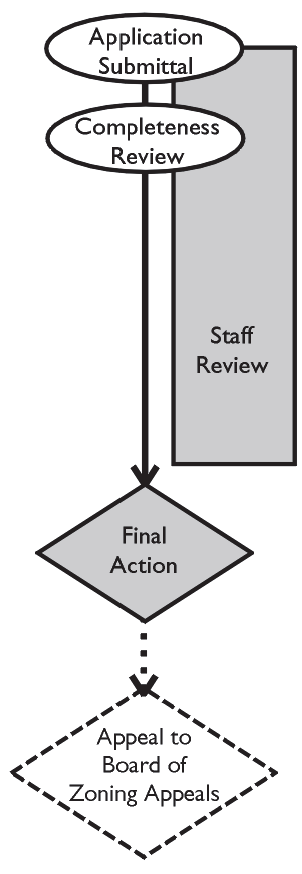
Approval Process. The Planning Director shall approve any sign that meets the requirements of Chapter 4, Article 4. If the application for a sign permit is denied, the applicant shall be notified in writing by certified mail within 15 days.
E.
Expiration of Approval. A sign permit shall expire 180 days from the date of its issuance unless the sign and all items required by the permit have been completed in compliance with the permit. The Planning Director shall have the authority to grant one extension not to exceed 60 days.
F.
Appeals. A decision on a sign permit may be appealed not later than 30 days after the decision to the Board of Zoning Appeals in accordance with 6.2.20.
6.2.7. Conditional Use Permit.
A.
Applicability. A conditional use permit is a permit issued by right for a use subject to listed conditions (see the Use Tables in Chapter 3, Article 1). Every conditional use is subject to special conditions set forth in Chapter 3, Article 3.
B.
Who May Apply. The property owner or an agent with written authorization from all owners-of-record may apply.
C.
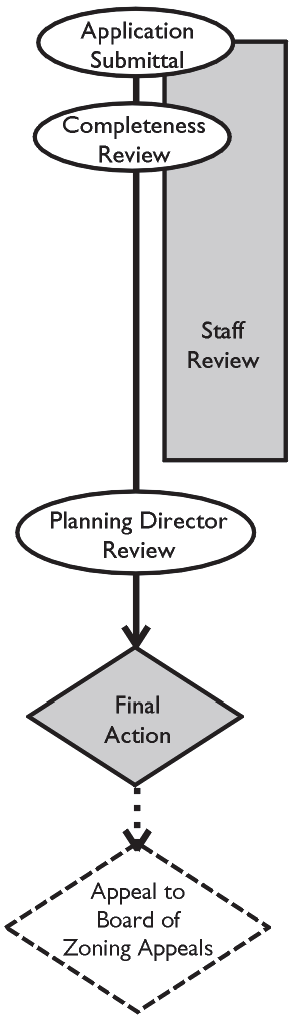
Application Requirements. Application for a conditional use permit shall follow the procedure for obtaining a building permit set forth in 6.2.3. Where a site plan is required by 6.2.9, the site plan review procedures shall apply prior to application for a building permit. Any special requirements or conditions set forth in Chapter 3, Article 3 shall be met prior to the issuance of any building permit.
D.
Approval Process.
1.
When a Site Plan is Required. Where site plan review is required (see 6.2.9), the Planning Director shall approve the site plan and so advise the applicant in writing. A determination by the Planning Director that all requirements and provisions have not been satisfied shall result in disapproval of the site plan, notice of which shall be provided to the applicant in writing. The Planning Director shall notify the applicant within 30 days of receipt of a complete application.
2.
When a Site Plan is Not Required. Where no site plan review is required, the Planning Director shall approve or deny a conditional use permit application within 15 working days of receipt of all required information.
E.
Expiration of Approval. A conditional use permit shall expire two years from the date of final approval by the City.
F.
Approval is Site-Specific. A conditional use permit is specific to the site identified as part of the approval process, and all conditions and approvals shall run with the land unless otherwise stated in the approval.
G.
Appeals. Appeal of a decision regarding a conditional use permit shall be made to the Board of Zoning Appeals within 30 days of mailing of the decision, in accordance with the procedures in 6.2.20.
6.2.8. Certificate of Compliance.
A.
Applicability.
1.
This Section applies to development that has obtained site plan approval or a prior development permit. No Certificate of Occupancy shall be issued for any development, or phase thereof, where a Certificate of Compliance is required by this Section until such Certificate of Compliance has been issued.
2.
The development, or an approved phase, may not be occupied or used until a Certificate of Compliance has been obtained from the Planning Director. Approved phase for purposes of this Section shall be a phase approved through the site plan review process, or a phase approved by the Planning Director prior to a request for an inspection for a Certificate of Compliance. In order for a phase to receive a Certificate of Compliance, that phase must be able to function alone with all required infrastructure, including, but not limited to, access drives, parking, drainage facilities, utilities, and required landscaping.
B.
Approval Process.
1.
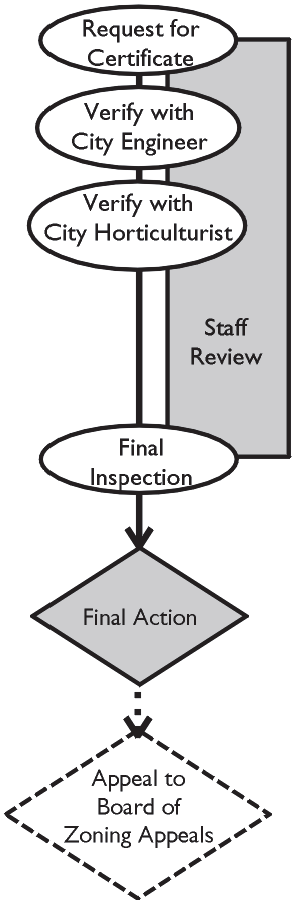
The Planning Director shall verify with the City Engineer that construction has occurred in accordance with submitted plans for roads, parking, drainage systems and utilities, DHEC permits to operate water and sewer systems, and acceptance of completed water and sewer lines for permanent ownership, operation and maintenance. The Planning Director shall also verify with the City Horticulturist that compliance with the approved landscape plan, or submission of an approved performance guarantee, has occurred.
2.
Following verification in accordance with paragraph 1 above, the Planning Director shall schedule and conduct a final inspection to verify compliance with all applicable provisions of this Ordinance, requirements of subdivision approval, site plan approval or permit, and any other applicable approval.
3.
Upon determination of compliance, the Planning Director shall issue a Certificate of Compliance to the applicant within 15 days of receipt of all required information. A determination by the Planning Director that all requirements and provisions have not been satisfied shall result in disapproval, notice of which shall be provided to the applicant in writing.
C.
Temporary Certificate of Compliance.
1.
At the discretion of the Planning Director, a Temporary Certificate of Compliance may be issued for a period not to exceed six months.
2.
No Temporary Certificate of Compliance shall be issued for a development, or approved phase thereof, unless it meets both of the following conditions.
a.
Development is substantially complete and the site is in a safe, accessible and useable condition; and
b.
Development surety in an amount adequate to cover the cost of any incomplete improvements has been provided to the City.
D.
Expiration.
1.
A Certificate of Compliance shall not expire.
2.
A Temporary Certificate of Compliance shall expire no later than six months after issuance.
E.
Appeals. Appeal of a decision regarding a Certificate of Compliance shall be made to the Board of Zoning Appeals within 30 days of mailing of the decision, in accordance with the procedures in 6.2.20.
6.2.9. Site Plan Review.
A.
Applicability.
1.
All proposed development shall be subject to site plan review by the Planning Director, unless expressly exempted in paragraph B below.
2.
For all development requiring site plan review by the Planning Director, simultaneous review by the Building Official may occur; however, no building permit shall be issued until site plan approval has been granted.
B.
Development Exempt from Approval. The following activities or uses shall be exempt from site plan review although they may be reviewed under other administrative procedures where noted in this Section or other sections of this Ordinance.
1.
Public Projects. The construction of any public street or utility service line, whether publicly or privately owned; such public project plans shall be submitted and reviewed by the Planning Director under a separate administrative procedure consistent with State law as specified in 6.2.12.
2.
Maintenance. Maintenance of any structure.
3.
Agriculture. The use or intended use of land, with or without accessory structures, for purposes of agriculture, raising of crops or animals, forestry, and similar uses, except for intensive agriculture.
4.
Single-Family Residences. A detached single-family dwelling on a single lot, and, where permitted, a manufactured home not located in a manufactured home park.
5.
Accessory Structures Integral to Permitted Development. The Planning Director may waive the site plan review requirement for any accessory structure or use, whether temporary or permanent.
6.
Renovation or Improvement. Any renovation or improvement that does not involve an increase in impervious surface area (paved or roofed area or other surfaces that do not absorb water).
C.
Who May Apply. The property owner or an agent with written authorization from all owners-of-record may apply.
D.
Application Requirements. A site plan review application shall be considered complete when the following items have been submitted (unless expressly waived by the Planning Director).
1.
Application Form and Fee. A complete application form as approved by the Planning Director and appropriate fee.
2.
Certification of Owner Consent. Certification, written and signed by the property owner-of-record, that such owner formally consents to the proposed development.
3.
Property Deed. If necessary, a copy of the deed for the subject property.
4.
Written Narrative. If necessary, a written narrative outlining the following.
a.
The nature and details of the proposed development.
b.
If the proposed site plan is a phase of a previously approved multi-phase plan or PR concept plan, a description of how such phase relates to such plan, in whole or in part.
c.
The proposed form of ownership of the development (e.g. fee simple, horizontal property regime, property owner association, etc.) and detailed provisions for maintenance responsibility for all improvements, including, but not limited to, streets, parking areas, bikeways, pedestrian ways, storm drainage facilities, water and sewer systems, and landscaping and open space areas.
d.
Any proposed dedication of improvements to any public agency, specifying such improvements and the affected agencies.
e.
Any other information necessary to further clarify the proposed development.
5.
Site Plan. A final site plan or set of plans in a quantity set by the Planning Director at a minimum scale of 1" = 30' or other appropriate scale showing the following (unless waived by the Planning Director).
a.
Name of development;
b.
Graphic scale;
c.
Date of drawing and date of any revisions;
d.
Vicinity sketch showing the general site location and depicting vehicular access routes accurately referenced to the nearest public road;
e.
Topographic survey at one-foot contour intervals, or other topographic information acceptable to the City Engineer, unless waived by the City Engineer;
f.
All existing permanent structures and facilities within 50 feet of the subject property;
g.
All existing and proposed easements within 50 feet of the subject property;
h.
Proposed site development, including land uses, any building or other structure locations and gross floor area, number and dimension of manufactured housing spaces, street, driveway, bike and pedestrian way, parking area layouts, interconnections with off-site facilities, and freestanding sign locations, if applicable. The plan view of buildings shall show limits of roofed areas and indicate the exterior wall line dimensioned to property lines;
i.
Lighting standards (including height and intensity);
j.
Location of proposed drainage system, including off-site areas of interconnection;
k.
Location of proposed water and sanitary sewer system, including off-site areas of interconnection;
l.
Location of other proposed waste disposal systems, including solid waste collection areas;
m.
Table indicating calculations for required parking;
n.
Location and dimensions for parking, handicapped accessible spaces, and off-street loading areas, where applicable;
o.
Location of other utilities such as electrical, telephone, natural gas, and cable television;
p.
Location of proposed open space areas;
q.
Location of proposed buffer areas;
r.
Zoning of the site, including overlay zones;
s.
Where applicable, surveyed delineation of any wetland area and required buffers or other delineation of a natural feature on the site which is protected or defined under provisions of this Ordinance;
t.
Notation as to FEMA/FIRM flood zones covering the site and proposed first floor elevation of all buildings; and
u.
Fire hydrants and fire lanes.
6.
Landscape Plan. Proposed landscape plan as required in 6.2.10.
7.
Development Phasing Plan. A plan indicating the contemplated phasing of the proposed development, including the following.
a.
A map depicting proposed phases at a minimum scale of 1" = 100' or other appropriate scale acceptable to the Planning Director.
b.
A schedule report, listing by each proposed phase (as applicable) the number of residential units by type, number of hotel rooms, amount of gross building square footage for all nonresidential uses by type, expected type of open space improvements, and public improvements to be dedicated to any governmental or other public agency.
8.
Approvals, Certifications, and Recommendations. Copy of approvals, certifications, and recommendations required by all appropriate City, County, State, and federal regulations for the proposed development, and documentation of compliance with such, as applicable, including, but not limited to the following.
a.
South Carolina Department of Health and Environmental Control approval of water and sewer system design, where applicable.
b.
South Carolina Department of Health and Environmental Control air, water quality, or solid waste permit.
c.
Approval by providers of electric, natural gas, telephone, or cable television of the utility service and layout shown on the site plan.
d.
South Carolina Department of Transportation encroachment permit, if necessary.
9.
Offers of Dedication to Public Ownership. Any offers of dedication to public ownership and permanent public maintenance of improvements, such as streets, drainage systems, parks, pathways, etc., including the proposed manner of such dedication.
10.
Legal Documents. Draft easements and other legal documents pertaining to the operation and management of the proposed development if required by any other provisions of this Ordinance.
11.
Other Requirements. Any other items specifically required of a site plan application by any other provisions of this Ordinance, or other information deemed necessary for review by the Planning Director.
E.
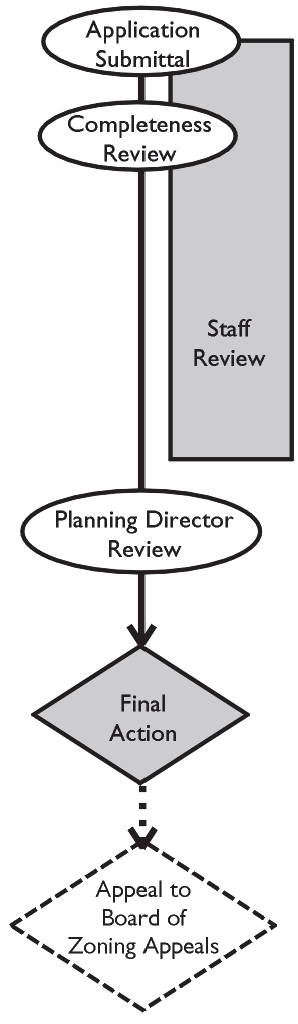
Approval Process. If the proposed site plan is determined by the Planning Director to be consistent with all applicable provisions of this Ordinance, the Planning Director shall approve the site plan and so advise the applicant in writing. A determination by the Planning Director that all such requirements and provisions have not been satisfied shall result in disapproval of the site plan, notice of which shall be provided to the applicant in writing. The Planning Director shall notify the applicant within 30 days of receipt of a complete application.
F.
Maximum Review Period for Site Plan.
1.
Failure to Act. Once an application for review of a site plan is considered complete according to 6.1.3.E, failure by the City to act within 60 days shall constitute approval of the plan, as set forth in Section 6-29-1150 of the Code of Laws of South Carolina.
2.
Authorization to Proceed. A letter of approval, copy of the site plan signed by the Planning Director, or other authorization to proceed shall be sent by the Planning Director to the applicant within this 60-day period. If the plan is not approved, a written statement detailing the deficiencies shall be sent within the required 60-day period.
3.
Extensions. The 60-day time period may be extended by mutual agreement between the Planning Director and the applicant.
G.
Expiration of Approval.
1.
The applicant shall have two years following approval of the site plan to submit a complete building permit application or, if no building permit is required, to obtain a Certificate of Compliance, or the site plan approval shall expire.
2.
For any project where more than one building is to be built, the applicant may submit a series of building permit applications. The first application must be submitted within two years from the date site plan approval is granted. Each subsequent application must be submitted within 180 days from the date of issuance of a Certificate of Compliance or Certificate of Occupancy for the previous building, whichever shall occur first. The lapse of more than 180 days shall cause the expiration of the site plan approval.
H.
Appeals. Appeals of administrative decisions shall be made to the Board of Zoning Appeals within 30 days of mailing of the decision, in accordance with the procedures in 6.2.20.
6.2.10. Landscape Plan Review.
A.
Applicability.
1.
Project Area. Except as set forth in paragraph 3. below, only the actual project area shall be used as the basis in determining compliance with this Section and the standards in Chapter 4, Article 6.
2.
New Project. Landscape plan approval pursuant to this Ordinance shall be required for the following.
a.
The project area of a multifamily residential or commercial development.
b.
Conversion of a site from single-family residential use to any multifamily residential or commercial use.
c.
Any off-street parking area in any zoning district, except for such an area for a detached single-family residential use with individual lots.
3.
Renovation or Expansion of an Existing Development.
a.
If the Building Official determines that the cost of renovation or expansion of an existing development in any one-year period exceeds 50 percent of the appraised value of the development as set by the Aiken County Tax Assessor, the South Carolina Tax Commission, or any other State or local governmental entity or official with authority to do so, or by the Building Official for developments that are tax-exempt, the entire development or site shall be brought into compliance with Chapter 4, Article 6. For a development composed of individual lots, the determination of whether the aforesaid limit has been exceeded shall be based on the appraised value of the individual lot or lots on which the proposed improvement or improvements will be located and not on the appraised value of the entire development, including other lots.
b.
The Planning Director may waive any provision of Chapter 4 Article 6 if compliance would be impractical.
c.
With the authorization of the Planning Director, the Building Inspector may issue a building permit to allow work on existing structures prior to approval of a landscape plan, but no other work may proceed.
4.
Exemptions.
a.
Those portions of public or private plant nurseries, tree farms, or botanical gardens used for the growing of plants for sale or for public use or enjoyment shall be exempt from the tree replacement provisions in 4.6.4.
b.
A commercial or multifamily project under development in the DB District shall be exempt from the provisions of this Section, except that the project shall comply with the provisions of 4.6.4 regarding the following:
i.
the removal or replacement of Significant and Grand trees; and
ii.
the provision of a planting strip where off-street parking is provided along or adjacent to the street.
B.
Approval Required Prior to Permit Allowing Grading or Construction. No grading permit, building permit, or other permit or approval allowing construction of a project may be issued by the City on a project subject to this Section without a Landscape Plan having been approved pursuant to this Section prior to such issuance.
C.
Who May Apply. The property owner or an agent with written authorization from all owners-of-record may apply.
D.
Application Requirements.
1.
An application for landscape plan approval shall be submitted to the Planning Director with the number of copies set by the Planning Director and the appropriate fee.
2.
The Landscape Plan shall include the following (unless waived by the Planning Director).
a.
Name of the project;
b.
Tax parcel number;
c.
Acreage or square footage of the lot or parcel on which the project is situated;
d.
Acreage or square footage to be disturbed;
e.
Dimensions of the lot or parcel on which the project is situated;
f.
Graphic scale and north arrow;
g.
Name, address, and telephone number of the property owner;
h.
Name, address, and telephone number of the plan preparer;
i.
Zoning of the site;
j.
Location map at a scale sufficient to depict the exact location of the site;
k.
Calculation of the area of the total site required to be landscaped and that actually provided;
l.
In the planting strip, the location, type, and caliper of all Grand and Significant trees indicating those to be removed and existing trees to be counted in meeting the requirement for trees in the planting strip set forth in 4.6.4.B.1;
m.
A tree survey on paper copies and a transparent medium depicting either
i.
the DBH, location, and variety of the Grand and Significant Trees on the entire site and a clear indication of trees to be removed; and
ii.
the total DBH of Significant Trees on the entire site and the total DBH of Significant Trees being removed;
or
iii.
the DBH, location, and variety of Grand Trees on the entire site and the Significant Trees in the yard area and a clear indication of trees to be removed;
iv.
a listing of all Significant Trees in the buildable area including DBH and variety and the location of Significant Trees being saved to reach the 20 percent requirement;
v.
the total DBH of Significant Trees on the entire site and the total DBH of Significant Trees being removed.
n.
The protected area required around each tree based on one foot radius for each inch DBH;
o.
A statement of the total caliper of the replacement inches required and the total caliper of those provided;
p.
Clear delineation of the limits of clearing;
q.
The number, location, and botanical and common names of plants to be installed including:
i.
the caliper of required trees;
ii.
shrubbery; and
iii.
a clear indication of the areas to be seeded or sodded;
r.
A notation that protective measures for trees, installation methods for new plant material, and maintenance of landscaped areas will comply with the standards established by this Ordinance, the Tree Protection and Landscaping Manual, and the City Horticulturist; and
s.
A notation provided by City Staff regarding maintenance and pruning; and
t.
Other information as required by City staff to facilitate review.
E.
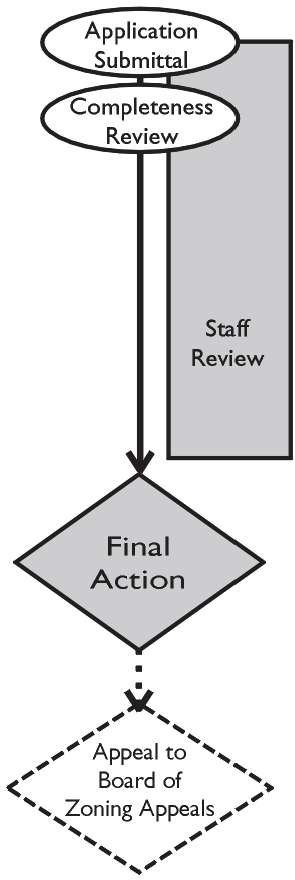
Approval Process. The Planning Director shall have authority to approve landscape plans. The decision on approval by the Planning Director must be granted within 60 days of submission of a complete application unless a variance is required or an extension of time is mutually agreed upon in writing by the applicant and the Planning Director.
F.
Expiration of Approval. Approval of a landscape plan shall expire two years from the date of final approval by the City, unless a building permit has been obtained and kept current.
G.
Appeals. Appeals of administrative decisions shall be made to the Board of Zoning Appeals within 30 days of mailing of the decision, in accordance with the procedures in 6.2.20.
6.2.11. Street Name.
A.
General. The Planning Commission shall have the authority to approve or deny the proposed name of any street consistent with the criteria set forth below.
B.
Application Requirements. Any person proposing to name a street or change the name of a street shall submit a list of at least three proposed names in priority order to the Planning Commission. Where such application is not part of another development approval according to this Chapter, an appropriate application fee shall be required.
C.
Criteria for New Names and Name Changes.
1.
No new street name or proposed renaming of an existing street shall duplicate, be phonetically similar to, or in any way be likely to be confused with an existing street name, in spite of the use of prefixes or suffixes.
2.
Names must be simple, logical, easy to read and pronounce, clear, and brief with no frivolous or complicated words or unconventional spellings.
3.
Names that might reasonably be perceived as offensive shall not be permitted.
4.
The use of alphabetical letters (such as "A" Street) is prohibited.
5.
Preference will be given to names that have some association with Aiken or the immediate location of the road or place such as reference to local history or physiographic features.
6.
Use of a common theme is recommended for names of streets that are associated with one another, such as those within a residential development.
7.
In changing any street name, care should be taken to preserve local history and to minimize disruption and cost.
8.
Intersecting streets shall not have the same or similar name.
9.
A proposed street obviously in alignment with an existing street shall bear the name of the existing street to the extent practicable.
10.
Street sections planned to be or likely to be connected in a straight line shall bear the same name; street sections not planned to be or unlikely to be connected shall not bear the same name.
11.
A street that continues through an intersection should generally bear the same name.
12.
A street making an approximate right-angle turn where there is no possibility of extending the street in either direction shall be considered to be continuous and be so named; where there is a choice of direction or a possibility of extending either section in the future, such configuration shall be considered to be an intersection and different names assigned.
13.
A street name that otherwise meets the above criteria but in the judgment of the Planning Commission may be misleading or otherwise be inappropriate shall be disapproved.
D.
Approval Process.
1.
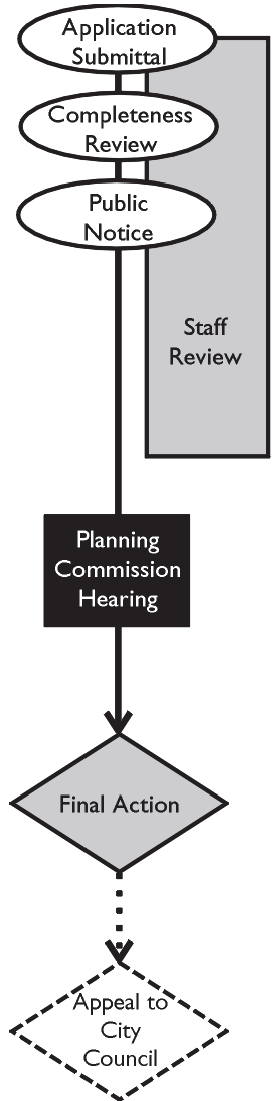
Public notice is required in accordance with 6.1.4.
2.
Notice shall be mailed to the owners of property whose addresses would be affected at least ten days in advance of the required public hearing.
3.
After holding the required public hearing, the Planning Commission shall determine if the name is suitable.
4.
If the Planning Commission approves a new street name or name change, it shall so certify in writing and forward such certification by certified mail to the applicant, the Aiken County Register of Mesne Conveyance, the Aiken County 911 office, the post office and any other affected agencies, including all property owners-of-record on the affected street.
5.
If the Planning Commission disapproves a new street name or name change, it shall so state in writing, including all reasons for the disapproval, and shall forward such notice to the party proposing the change within 15 days.
E.
Appeals. Appeal of a decision on a street name may be made to City Council within 15 days by submission of a letter requesting it to the City Manager.
6.2.12. Public Project Review.
A.
Applicability. The Planning Commission shall review all proposed public projects, except for minor utilities, for location, character, and extent.
B.
Who May Apply. Any owner of land which is the subject of a public project or an agent authorized by such entity in writing may apply for public project review.
C.
Application Requirements. An application for public project review shall include, but not be limited to, the following information and an appropriate fee for review.
1.
An application form approved by the Planning Director;
2.
Documentation in the form of a deed showing public ownership of the subject parcel, a lease indicating a public tenancy, or a notarized affidavit that more than 50 percent of the proposed project is funded with public monies;
3.
A written narrative addressing the following.
a.
The need for the project, with supporting documentation.
b.
A reference to and, where practical, graphic depiction of the location of the proposed development on an Aiken County tax map with parcel number.
c.
any freshwater wetland or conservation district boundary line.
d.
The character of the proposed development and its compatibility with the surrounding area and with the characteristics of the site on which it is to be located.
e.
The extent of the proposed development in terms of number of buildings, height of structures, total amount of square footage, number of parking spaces, site acreage, and other pertinent items as may be applicable.
4.
Description of maintenance responsibility for all improvements including, but not limited to, streets, parking areas, paths, storm drainage facilities, water and sewer systems, open space areas, and solid waste disposal;
5.
If applicable, a dimensioned site plan that conforms to the requirements of 6.2.9.D.5; and
6.
Comments or approvals of affected agencies.
D.
Approval Process.
1.
Staff Review and Report. The Planning Director shall prepare a staff report that reviews the proposed public project in light of the Comprehensive Plan; the report shall be provided to the Planning Commission and the applicant before the scheduled Planning Commission public hearing.
2.
Action by Planning Commission.
a.
Following published and posted notice in accordance with 6.1.4, the Planning Commission shall hold a public hearing regarding any proposed public project.
b.
The Planning Commission shall study the proposed public project taking into account the consistency of the proposed project with the Comprehensive Plan.
c.
At the close of the public hearing, the Planning Commission shall determine whether the public project proposal is compatible with the Comprehensive Plan and shall include written findings.
d.
If the Planning Commission finds the proposal conflicts with the Comprehensive Plan, it shall forward its written findings and an explanation of its reasoning to the public entity proposing the project.
e.
If the public entity proposes to proceed with its public project in conflict with the Comprehensive Plan, then the entity must publicly state its intention to proceed and its reasons for proceeding. The public entity must also provide written notice of its intention to proceed and its reasons to City Council and Planning Commission, and publish a notice in a publication of general circulation at least 30 days in advance of award of a contract or beginning of construction of the proposed public project.
6.2.13. Historic District/Landmark Designation.
See 5.2.2, Designation to the Aiken Historic Register.
6.2.14. Rezoning.
A.
Applicability. This Section shall apply to any land within the City limits for which the existing zoning district is proposed to be changed.
B.
Who May Apply. A proposed rezoning may be initiated by City Council, the Planning Commission, the City Manager or by the owner (or a designated agent with written authorization from all owners-of-record) of such property for which the rezoning is sought. Rezoning concurrent with annexation shall follow the procedures for annexation set forth in the Aiken City Code and 2.1.4.
C.
Application Requirements.
1.
A complete application shall be on a form approved by the Planning Director accompanied by the appropriate fee and shall include the following.
a.
A narrative addressing the reasons for the requested rezoning and the applicable review criteria set forth in 6.2.14.E.
b.
A boundary plat of the subject property prepared and sealed by a registered land surveyor.
c.
Any additional information deemed necessary by the Planning Director.
2.
Any designated agent shall submit written consent from all of the property owners-of-record.
D.
Approval Process.
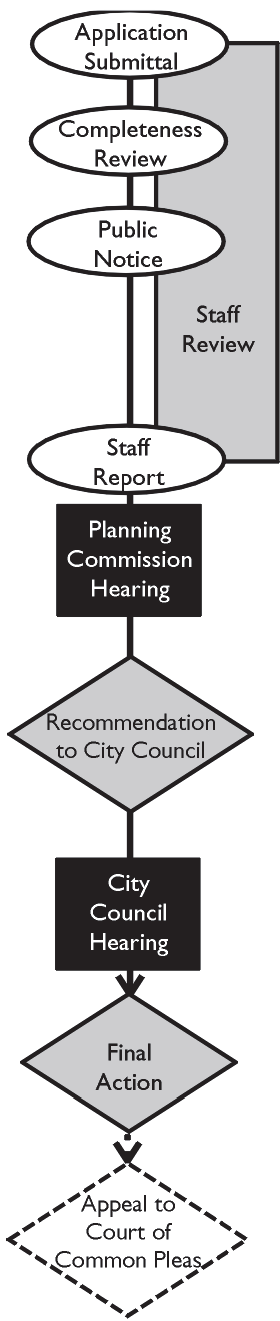
1.
Staff Review and Report. The Planning Director shall prepare a report that reviews the proposed rezoning in light of the Comprehensive Plan, the review criteria listed below, and the general requirements of this Ordinance. A copy of the report shall be provided to the Planning Commission and the applicant before the scheduled public hearing.
2.
Planning Commission Recommendation.
a.
Within 60 days of receipt of a complete application, and following appropriate notice in accordance with 6.1.4, the Planning Commission shall hold a public hearing regarding any proposed rezoning.
b.
The Planning Commission shall study the proposed rezoning taking into account all factors which it may deem relevant including, but not limited to, consistency with the Comprehensive Plan, the review criteria listed below, and whether the proposed rezoning serves to carry out the purposes of this Ordinance.
c.
At the close of the public hearing, the Planning Commission shall recommend approval, modified approval, or denial of the rezoning.
d.
The staff shall prepare a report of the Planning Commission deliberations and recommendation which shall be forwarded to City Council.
3.
City Council Action.
a.
A required public hearing by City Council held for the purpose of considering a rezoning shall be scheduled concurrent with the second reading of the ordinance adopting the proposed rezoning.
b.
City Council shall consider the proposed rezoning at the earliest reasonable date and shall consider the report of the Planning Commission in making its decision.
c.
Following City Council action, the applicant shall be notified within 15 days of the decision in writing.
E.
Review Criteria. In making recommendations regarding proposed rezoning, the Commission shall consider and make findings on the following matters.
1.
Consistency with the Comprehensive Plan.
2.
Compatibility with the zoning, conforming uses of nearby property, and character of the surrounding area.
3.
Suitability of the subject property for uses permitted by the existing zoning.
4.
Suitability of the subject property for uses permitted by the proposed zoning.
5.
The need for additional property with the proposed zoning classification within the City limits.
6.
Availability of sanitary sewer, water, stormwater, and transportation facilities.
F.
Amendment of Official Zoning Map. Within 60 days of approval of a rezoning by City Council, the Planning Director shall amend the Official Zoning Map to reflect the change.
G.
Appeals. Any applicant aggrieved by City Council's decision may appeal to the Court of Common Pleas of Aiken County within 30 days of written notification.
6.2.15. Text Amendment.
A.
Applicability. This Section shall apply to any portion of the text of this Ordinance that is proposed to be changed.
B.
Who May Apply.

1.
Any proposed text amendment to this Ordinance may be initiated by any member of City Council, the Planning Commission, or the City Manager. Any citizen of the City may request in writing to the Planning Commission that a proposed text amendment be considered after which the Planning Commission may initiate an amendment.
2.
Any proposed text amendment to this Ordinance initiated by a member of City Council may be given first reading prior to being referred to the Planning Commission for its review and recommendation.
C.
Approval Process.
1.
Staff Review and Report. The Planning Director shall prepare a staff report that reviews the proposed amendment in light of the Comprehensive Plan and the general requirements of this Ordinance. A copy shall be provided to the Planning Commission and the applicant before the scheduled public hearing.
2.
Planning Commission Recommendation.
a.
Following published notice in accordance with 6.1.4, the Planning Commission shall hold a public hearing.
b.
The Planning Commission shall study the proposed amendment taking into account all factors which it may deem relevant including, but not limited to, the consistency of the proposed amendment with the Comprehensive Plan and whether the proposed amendment serves to carry out the purposes of this Ordinance.
c.
At the close of the public hearing, the Planning Commission shall recommend approval, modified approval, or denial of the amendment.
d.
The staff shall prepare a report of the Planning Commission deliberations and recommendation which shall be forwarded to City Council.
3.
City Council Action.
a.
A required public hearing by City Council held for the purpose of considering a text amendment shall be scheduled concurrent with the second reading of the ordinance adopting the proposed amendment.
b.
City Council shall consider the proposed amendment at the earliest reasonable date and shall consider the report of the Planning Commission in making a decision.
c.
City Council shall act to approve, approve with modifications, or deny the proposed amendment
d.
Following City Council action, the applicant shall be notified within 15 days of the decision in writing.
D.
Appeals. Any applicant aggrieved by City Council's decision may appeal to the Court of Common Pleas of Aiken County within 30 days of written notification.
6.2.16. Planned Residential, Planned Commercial, Planned Mixed-Use Industrial, and Planned Institutional.
A.
Applicability. Land in the Horse District or listed on the Aiken Historic Register may not be zoned PR, PC, PMI, or PI. (Ord. 11082004A)
B.
Who May Apply. The owner or an agent with written authorization from all owners-of-record may apply.
C.
Application Requirements.
1.
An application form approved by the Planning Director and appropriate fee.
2.
The concept plan shall include a sketch plan schematically showing major streets, major utilities, land uses, entrance locations on existing streets, major open space and buffers, and a conceptual drainage plan, along with a narrative addressing the proposed development explaining and tabulating the following:
a.
Land uses;
b.
Number of dwelling units by housing type;
c.
Elevations of facades of proposed buildings visible from an abutting street; (Ord. 05142007A)
d.
Residential density and/or square footage of nonresidential uses;
e.
Open space acreage;
f.
Potential traffic generation;
g.
Overall character and architectural style;
h.
Relationship of the proposed development to existing conforming development in the area; and
i.
Other related development features.
3.
If the concept plan includes a subdivision plat in lieu of a sketch plan, maximum structure heights and maximum buildable area for each lot shall be shown.
4.
A statement of how the proposed development is consistent with the Comprehensive Plan.
5.
Other relevant information as may be requested by the Planning Director.
D.
Approval Process.
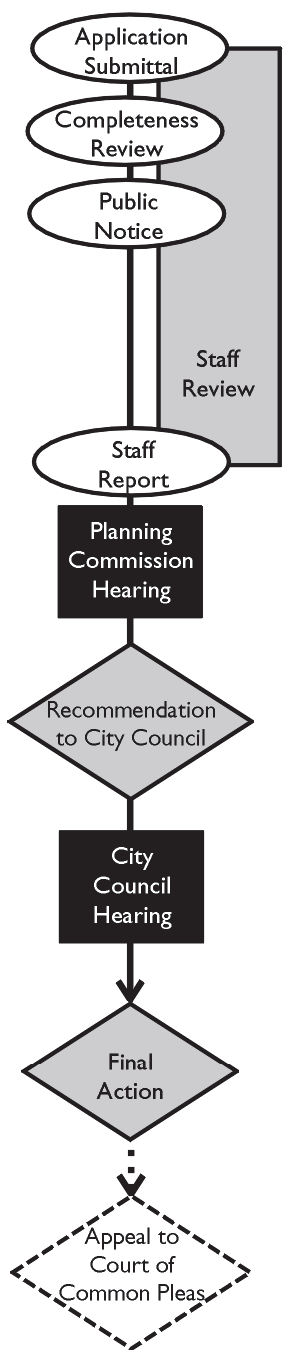
1.
Staff Review and Report. The Planning Director shall prepare a staff report that reviews the proposed concept plan in light of the design criteria in Chapter 4, the Comprehensive Plan, and the general requirements of this Ordinance. The report shall be provided to the Planning Commission and the applicant before the scheduled public hearing.
2.
Planning Commission Recommendation.
a.
Within 60 days of receipt of a complete application, and following published, posted, and mailed notice in accordance with 6.1.4, the Planning Commission shall hold a public hearing.
b.
The Planning Commission shall study the proposed concept plan taking into account all factors which it may deem relevant including, but not limited to, the design criteria in Chapter 4, the consistency of the proposed amendment with the Comprehensive Plan, and whether the proposed project serves to carry out the purposes of this Ordinance.
c.
At the close of the public hearing, the Planning Commission shall recommend approval, modified approval, or denial.
d.
The staff shall prepare a report of the Planning Commission deliberations and recommendation which shall be forwarded to City Council.
3.
City Council Action.
a.
A required public hearing by City Council held for the purpose of considering a concept plan shall be scheduled concurrent with the second reading of the ordinance adopting the proposed annexation or rezoning.
b.
City Council shall consider the proposed concept plan and the report of the Planning Commission in making a decision. City Council shall act to approve, approve with modifications, or deny it.
c.
Following City Council action, the applicant shall be notified within 15 days of the decision in writing.
E.
Expiration of Approval. City Council shall have the right to review a concept plan when no building permits have been issued in the past five years, and may choose not to issue further permits for the project until a revised concept plan has been approved.
F.
Appeals. Any applicant aggrieved by City Council's determination may appeal to the Court of Common Pleas of Aiken County within 30 days of written notification.
(Ord. No. 02102020C , § 1(Exh. A), 2-10-2020)
6.2.17. Attached Single-Family Residential.
A.
Applicability. This Section shall apply to any attached single-family residential project.
1.
Who May Apply. The property owner or an agent with written authorization from all owners-of-record may apply.
2.
Application Requirements.
a.
An application form as approved by the Planning Director and appropriate fee.
b.
The concept plan shall include a site plan schematically showing major streets, major utilities, land uses, entrance locations on existing streets, major open space and buffers, along with a narrative addressing the proposed development explaining and tabulating the following:
i.
A site plan depicting the arrangement of streets, off-street parking, and buildings;
ii.
Number of dwelling units by housing type;
iii.
Dwelling unit density;
iv.
Open space acreage and percentage;
v.
A tree survey complying with Chapter 4, Article 6 of this Ordinance;
vi.
Elevations of typical buildings;
vii.
Signage;
viii.
A traffic study if required by the City's Traffic Management Ordinance; and
ix.
Other related development features.
c.
A statement of how the proposed development is consistent with the Comprehensive Plan.
d.
Other relevant information as may be requested by the Planning Director.
3.
Approval Process.
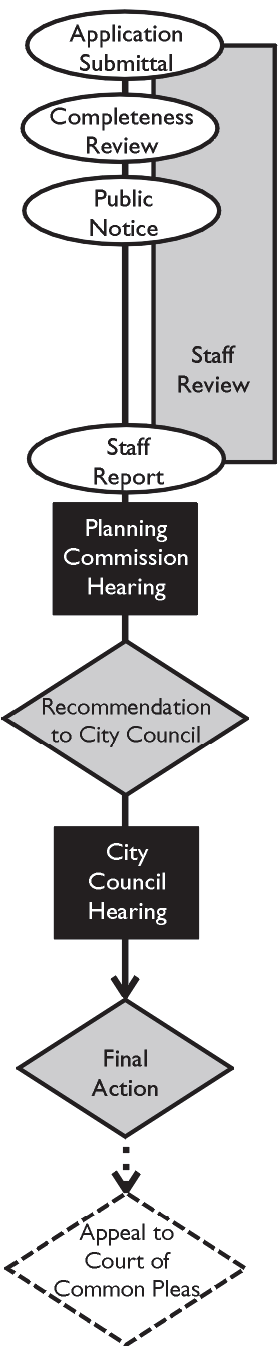
a.
Staff Review and Report. The Planning Director shall prepare a staff report that reviews the proposed concept plan in light of the design criteria in 4.2.9, the Comprehensive Plan, and the general requirements of this Ordinance. The report shall be provided to the Planning Commission and the applicant before the scheduled hearing.
b.
Planning Commission Recommendation.
i.
Within 60 days of receipt of a complete application, and following published, posted, and mailed notice in accordance with 6.1.4, the Planning Commission shall hold a public hearing.
ii.
The Planning Commission shall study the proposed concept plan taking into account all factors which it may deem relevant including, but not limited to, the design criteria in 4.2.9, the consistency of the proposed amendment with the Comprehensive Plan, and whether the proposed project serves to carry out the purposes of this Ordinance.
iii.
At the close of the public hearing, the Planning Commission shall recommend approval, modified approval, or denial.
iv.
The staff shall prepare a report of the Planning Commission deliberations and recommendation which shall be forwarded to City Council.
c.
City Council Action.
i.
A required public hearing by City Council held for the purpose of considering a concept plan shall be scheduled concurrent with the second reading of the ordinance.
ii.
City Council shall consider the proposed concept plan and the report of the Planning Commission in making a decision. City Council shall act to approve, approve with modifications, or deny the proposed concept plan.
iii.
Following City Council action, the applicant shall be notified within 15 days of the decision in writing.
4.
Amendments. Changes to an approved concept plan not considered significant may be approved by the Planning Director. Any change in the approved concept plan that would increase the dwelling unit density, substantially change the character of a development, or constitute a major revision of a development as determined by the Planning Director shall require approval by City Council after receipt of the recommendation of the Planning Commission regarding the changes. A request for a revision of the concept plan shall be supported by a written statement explaining why the revisions are necessary or desirable and shall follow the approval procedure at 6.2.16.
5.
Expiration of Approval. City Council shall have the right to review a concept plan when no building permits have been issued in the past five years, and the City may choose not to issue further permits until a revised concept plan has been approved.
6.
Appeals. Any applicant aggrieved by City Council's determination may appeal to the Court of Common Pleas of Aiken County within 30 days of written notification.
6.2.18. Special Exception.
A.
Applicability. A special exception shall require approval by the Board of Zoning Appeals.
B.
Who May Apply. The property owner or an agent with written authorization from all owners-of-record may apply.
C.
Application Requirements. An application for a special exception shall consist of information necessary for the Board of Zoning Appeals to make a determination regarding the request, including, but not limited to the following.
1.
An application form as approved by the Planning Director and appropriate fee;
2.
A sketch plan showing the preliminary proposed siting of structures or uses on the subject property.
3.
The proposed density expressed in terms of dwelling units per acre, total square footage per acre, or other acceptable measure.
4.
A letter addressing the consistency of the proposed use with the character and purpose of the zoning district in which it would be located.
5.
The consistency of the proposed use with the Comprehensive Plan;
6.
Any relevant conditions or restrictions as set forth in Chapter 3, Article 3; and
7.
Any other information deemed necessary by the Planning Director.
D.
Approval Process.
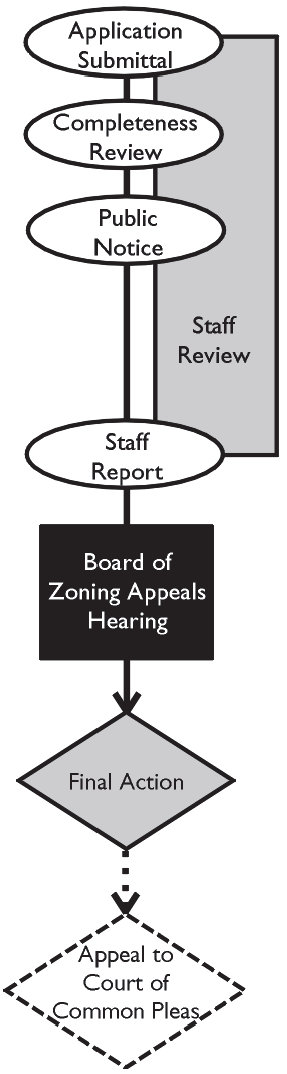
1.
Staff Review and Report. The Planning Director shall prepare a staff report that reviews the proposed development in light of the Comprehensive Plan, the review criteria listed below, and the requirements of this Ordinance. A copy of the report shall be provided to the Board of Zoning Appeals and the applicant before the scheduled hearing.
2.
Action by Board of Zoning Appeals.
a.
Within 60 days of receipt of a complete application, and following posted and mailed notice in accordance with 6.1.4, the Board of Zoning Appeals shall hold a public hearing on the special exception application.
b.
After review of the application and the public hearing, the Board of Zoning Appeals shall make a written finding and approve, approve with modifications or conditions, or disapprove the request.
c.
If approval, or approval with modifications or conditions, is granted, the decision shall be communicated in writing by certified mail to the applicant within 25 days, and the applicant shall then be authorized to submit a site plan or building permit application consistent with this Chapter. (Ord. 01222001)
E.
Special Exception Review Criteria. The Board of Zoning Appeals shall approve an application for a special exception if, and only if, the applicant demonstrates that the proposed use and any associated development will meet all of the following criteria.
1.
Be in accordance with the Comprehensive Plan; and
2.
Be consistent with the "character and purpose' statement of the applicable district; and
3.
Be of a size, shape, and character suited for the proposed site; and
4.
Be compatible with the existing uses adjacent to and near the property, and not otherwise adversely affect the development of the general neighborhood or of the district in which the use is proposed; and
5.
Not generate vehicular traffic or create vehicular circulation problems or parking demands that have an unacceptably adverse impact on nearby properties when compared with uses permitted by right in the same district; and
6.
Not be hazardous, detrimental, or disturbing to surrounding land uses due to noise, glare, smoke, dust, odor, fumes, water pollution, or general nuisance; and
7.
Be consistent with existing and planned pedestrian and vehicular circulation adjacent to and near the property; and
8.
Be adequately served by essential public services and facilities not requiring additional public expense; and
9.
Not adversely affect any site or feature of historical, cultural, natural, or scenic importance; and
10.
Conform to any specific criteria or conditions specified for that use as set forth in Chapter 3, Article 3; and
11.
Not be contrary to the public health, safety, and welfare, provided that a denial based exclusively on this language shall include explicit findings regarding the way in which granting the special exception would be contrary to the public health, safety, and welfare.
F.
Conditions on Approvals. To ensure that a proposed special exception use will meet the criteria set forth above or to alleviate or mitigate potential adverse effects of such use, the Board of Zoning Appeals may place specific conditions on the approval addressing various issues including, but not limited to, the following.
1.
Location, size, and orientation of uses, structures, and enclosures.
2.
Additional setbacks for proposed uses, structures, or enclosures, from property lines or other structures or objects on nearby lots.
3.
Additional buffers.
4.
Fencing or walls.
5.
Shielding of lighting.
6.
Pedestrian circulation, including sidewalks or other pedestrian connections.
7.
Vehicle circulation, including points of ingress and egress.
8.
Improvements on adjacent streets.
9.
Location of paving, off-street parking and loading, and service and delivery areas.
10.
Hours of operation.
11.
Protection of trees and other natural assets and additional landscaping.
12.
Protection of sites of scenic, historical, or cultural importance.
13.
Restriction on number, size, and location of signs.
14.
Siting of uses to improve capability with adjacent development.
15.
Restrictions on or reduction of the extent or intensity of the proposed use.
G.
Expiration of Approval. A special exception approval shall expire on the date specified by the Board of Zoning Appeals in the approval, but not less than two years from approval, or two years after the date of the approval hearing where no date is specified, unless the applicant submits a complete site plan review application, or building permit application, where no site plan is required.
H.
Revocation of Special Exception.
1.
If an owner of property granted a special exception fails in any manner to follow the conditions of the special exception or engages in any activity prohibited by this Ordinance, or prohibited under the special exception, then the City of Aiken may, after five days of posting notice on the subject property granted the special exception, suspend the special exception for a period of 60 days.
2.
Within 30 days of the date of posting this notice, the Board of Zoning Appeals shall hold a hearing to ascertain all the facts in the matter. Notice of such hearing shall be in writing and shall set forth the reason for the hearing or the complaint against the property owner and shall be served upon the property owner in person, or by registered or certified mail return receipt requested to the owner's last known address.
3.
In the event the City is not able to serve notice upon the owner in person, and any notice sent by registered or certified mail return receipt requested is returned by the postal service, the City shall cause such notice to be posted at the property-in-question, and such posting shall be a valid means of service.
4.
If the Board of Zoning Appeals finds and concludes from the evidence that the special exception has been violated by the owner in any of the provisions under the special exception granted or conditions attached to it, it may suspend, revoke or refuse to renew such special exception.
5.
In the case of revocation or nonrenewal, no application for special exception may be filed for a period of one year after the revocation becomes effective.
6.
Following the entry of an order suspending or revoking a special exception, the property owner may seek judicial review in a manner provided by South Carolina law. The Board of Zoning Appeals may stay enforcement proceedings fur such order for a period of 30 days pending the filing or final disposition of proceedings of judicial review.
I.
Approval is Site-Specific. Special exception approval is specific to the site identified as part of the approval process, and all conditions and approvals shall run with the land unless otherwise stated in the approval.
J.
Appeal. Any applicant aggrieved by the Board's decision may appeal such determination to the Court of Common Pleas of Aiken County within 30 days of written notification.
6.2.19. Variance.
A.
Who May File. The owner, developer, or agent with authorization from the owner, may initiate a request for a variance by filing an application with the Planning Director.
B.
Approval Process.
1.
Staff Review and Report. The Planning Director shall prepare a staff report which shall be provided to the applicant or appellant before the Board of Zoning Appeals meeting at which the application is scheduled to be reviewed.
2.
Action by Board of Zoning Appeals.
a.
Within 60 days of receipt of a complete application, and following published and posted notice in accordance with 6.1.4, the Board of Zoning Appeals shall hold a public hearing.
b.
After review of the variance application and the public hearing, the Board of Zoning Appeals shall make a written finding and give its approval; approval with modifications or conditions; or disapproval.
c.
If approval or approval with modifications or conditions is granted, the decision shall be communicated in writing by certified mail to the applicant within 25 days, and the applicant shall then be authorized to submit a site plan or building permit application where no site plan is required. (Ord. 01222001)
C.
Criteria for Approval of Variances.
1.
Required Findings. A variance may be granted by the Board of Zoning Appeals if the Board concludes that the strict enforcement of any design and performance standard set forth in this Ordinance would result in unnecessary hardship to the applicant and that, by granting the variance, the spirit of this Ordinance will be observed, public health, safety, and welfare will not be diminished, and substantial justice will be done. A variance may be granted in an individual case of unnecessary hardship if the Board determines and expresses in writing all of the following findings.
a.
There are extraordinary and exceptional conditions pertaining to the particular piece of property; and
b.
These conditions do not generally apply to other properties in the vicinity; and
c.
Due to these conditions, the application of the Ordinance to the particular piece of property would effectively prohibit or unreasonably restrict the utilization of the property; and
d.
The conditions are not the result of the applicant's own actions; and
e.
Granting of the variance would not substantially conflict with the Comprehensive Plan and the purposes of this Ordinance; and
f.
The authorization of the variance will not be of substantial detriment to adjacent property or the public good, and the character of the district will not be harmed by the granting of the variance.
2.
Limitations. The Board may not grant a variance the effect of which would be any of the following.
a.
To permit a use of land or a structure that is not allowed in the applicable district.
b.
To allow an increase in intensity or physical extension of a nonconforming use.
c.
To increase the density of a use above that permitted by the applicable district.
3.
Profitability Not to Be Considered. The fact that property may be developed more profitably should a variance be granted may not be considered grounds for a variance.
4.
Hardship Due to Eminent Domain. Where the alleged hardship results from the taking of part of the property by eminent domain, thus reducing the land area available for parking, buffers, and other purposes, the applicant shall have the burden of proving that, after good-faith efforts by the applicant or previous owner, the condemning authority failed or refused to provide the applicant compensation adequate to cover the value of both the land actually taken and the economic impacts of the reduction in the size of the remaining property. Only if the applicant meets this burden of proof will a hardship under these conditions be considered adequate to justify the granting of a variance.
D.
Expiration of Approval. A variance shall expire on the date specified by the Board of Zoning Appeals in the approval, but not less than two years from approval, or two years after the date of the approval hearing where no date is specified, unless the applicant submits a complete site plan review application, or building permit application where no site plan is required.
E.
Appeal. Any party aggrieved by the Board's decision may appeal such determination to the Court of Common Pleas of Aiken County within 30 days of written notification.
6.2.20. Appeal of Administrative Decision.
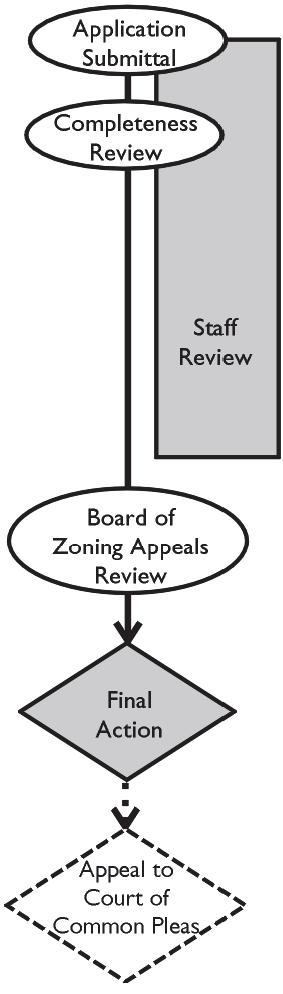
A.
Who May Appeal. Any person aggrieved by an administrative decision or interpretation made pursuant to this Ordinance may bring an appeal to the Board of Zoning Appeals by filing an application with the Planning Director. An aggrieved person is defined as any property owner within 300 feet of the property for which a decision has been rendered and may include persons owning property beyond 300 feet if it is determined by the Board of Zoning Appeals (based upon information provided by the appellant) that such property owners may be affected by a decision or interpretation.
B.
Deadline for Submission of Application. An application for appeal shall be filed (received by the Planning Director or postmarked) not later than 15 days after the decision being appealed in order to be considered by the Board of Zoning Appeals.
C.
Review Process.
1.
Within 60 days of receipt of a complete application, and at the conclusion of the proceeding on the variance request or the appeal, the Board of Zoning Appeals shall take one of the following actions, consistent with the provisions of this Article.
a.
Affirm the action of the official that made the decision.
b.
Modify the action of the official and, to that end, have all the powers of the official from which the appeal is taken, and may issue a permit or direct that a permit be issued.
c.
Reverse the action of the official and, to that end, have all the powers of the officer from which the appeal is taken, and may issue a permit or direct that a permit be issued.
2.
Every order, requirement, decision, or determination of the Board shall be filed in the office of the City Clerk and shall be a public record.
D.
Appeal to Court of Common Pleas. Any party aggrieved by the Board's decision may appeal to the Court of Common Pleas of Aiken County within 30 days of written notification.
6.2.2. - Written Interpretation.
A.
Authority. The Planning Director shall have authority to make written interpretations of this Ordinance.
B.
Request for Interpretation. A written request for interpretation shall be submitted to the Planning Director.
C.
Interpretation by Planning Director.
1.
The Planning Director shall take the following steps within 15 days of receipt of a written request for interpretation.
a.
Review and evaluate the request in light of the text of this Ordinance, the Official Zoning Map, the Comprehensive Plan, and any other relevant information;
b.
Consult with other staff, as necessary; and
c.
Render an opinion.
2.
The interpretation shall be provided to the applicant in writing by mail.
D.
Official Record. The Planning Director shall maintain an official record of interpretations which shall be available for public inspection during normal business hours.
E.
Appeals. Appeals of written interpretations shall be made to the Board of Zoning Appeals within 30 days of mailing of the interpretation in accordance with the procedures in 6.2.20.
6.2.3. - Building Permit.
A.
Application Requirements.
1.
In addition to any other requirements determined by the Building Official, all applications for building permits shall be accompanied by plans in duplicate, drawn to a scale of not less than 1/8" = 1 foot, showing the actual shape and dimensions of the lot to be built upon, the exact size and location on the lot of the proposed building or structure, and the exact size and location of any existing buildings or structures on the lot.
2.
Plans shall show the existing or proposed use of each building or part of building, and such other information with regard to the building or lot, parking areas, distances from nearby buildings, or neighboring lots as may be necessary to determine compliance with this Ordinance.
3.
One copy of such plans shall be returned to the owner or agent when approved by the Building Official.
B.
Approval Process. The Building Official shall approve or deny a building permit application within 15 working days of receipt of all required information. Such permit shall not be issued without the approval of the Planning Director.
C.
Expiration of Approval.
1.
Work described in any building permit that has not begun within six months from the date of issuance of the permit shall cause the permit to expire and be of no further effect. In such cases, no further work shall occur until a new building permit or an extension has been obtained.
2.
If, after substantial commencement of construction, work is discontinued or no substantial work has occurred for a period of six months or more, the building permit shall expire and be of no further effect. In such cases, no further work shall occur until a new building permit or an extension has been obtained.
3.
The Building Official shall have the authority to grant one extension not to exceed 90 days.
6.2.4. - Certificate of Occupancy.
A.
Applicability. A Certificate of Occupancy shall be required for any of the following.
1.
Occupancy and use of a building hereafter erected or enlarged; or
2.
Change in use of an existing building to a different Use Category as set forth in Chapter 3; or
3.
Any change in a nonconforming use.
B.
Unlawful to Occupy Without Valid Certificate of Occupancy. No such occupancy, use, or change of use shall take place until the Certificate of Occupancy has been issued by the Building Official. No Certificate of Occupancy shall be issued for any development, or phase thereof, where a Certificate of Compliance is required by 6.2.8 until such Certificate of Compliance has been issued.
C.
Temporary Certificate of Occupancy. Pending the issuance of a permanent Certificate of Occupancy, a temporary Certificate may be issued. The temporary Certificate shall be valid for a period established by the Building Official not to exceed a maximum of 120 days pending completion of an addition or during partial occupancy of a structure.
D.
Expiration.
1.
A Certificate of Occupancy shall not expire.
2.
A temporary Certificate of Occupancy shall expire no later than 120 days after issuance.
E.
Appeals. A decision on a Certificate of Occupancy may be appealed not later than 30 days after the decision to the Board of Zoning Appeals in accordance with 6.2.20.
6.2.5. - Telecommunication Facility Plan Review.
A.
Applicability. The application and review procedures in this Section, along with the conditions in 3.3.22, Telecommunications Facilities, shall apply to all such facilities located within the City limits.
B.
Who May Apply. The property owner or an agent with written authorization from all owners of record may apply.
C.
Application Requirements.
1.
An application accompanied by a fee set by the City Manager (in order to defray the cost of technical review) for an antenna on an existing structure, replacement of an existing tower, or a new tower shall be submitted to and reviewed by the Building Official. The applicant shall provide such information deemed necessary by the Building Official.
2.
All telecommunication facilities must submit an application accompanied by a fee set by the City Manager (in order to defray the cost of technical review) to the Planning Director, along with the following documents, if applicable.
a.
One copy of typical specifications for proposed structures and antennas, including description of design characteristics and materials.
b.
A site plan drawn to scale showing property boundaries, tower location, tower height, guy wires and anchors, existing structures, parking, fences, landscape plan, existing land uses on adjacent property, and significant and Grand trees to be affected.
c.
Photographs or elevation drawings depicting typical design of proposed structures.
d.
A current map showing locations of applicant's existing and proposed antennas and towers in Aiken County.
e.
A report from a structural engineer registered in South Carolina showing the tower antenna capacity by type and number, a certification that the tower is designed to withstand winds in accordance with ANSI/EIA/TIA 222 standards (latest revision), and a determination of the fall zone.
f.
Identification of the owners of all antennas and equipment to be located on the site.
g.
If the applicant is not the owner, written authorization from the site owner for the application.
h.
Evidence that a valid FCC license for the proposed activity has been issued.
i.
A written agreement to allow other users to co-locate on the tower and documentation that the tower will be designed to allow it.
j.
A written agreement to remove the tower and/or antenna within 180 days after cessation of use.
k.
Evidence that applicable conditions in 3.3.22.B will be met.
l.
Additional information as required by the Planning Director or Building Official.
D.
Technical Review.
1.
Engineering Certification. The applicant must submit the following information to the Building Official.
a.
A certificate from an engineer registered in South Carolina that the proposed facility will contain only equipment meeting Federal Communication Commission rules and will be operated in accordance therewith.
b.
Certification that the new tower is designed to accommodate additional antennas equal in number to applicant's present and future requirements.
c.
Written indemnification of the City and proof of liability insurance or financial ability to respond to claims of up to $1,000,000 in the aggregate which may arise from operation of the facility during its life, at no cost to the City, in form approved by the City Attorney.
2.
Engineering Review. City Council may retain an engineer licensed in South Carolina to review any telecommunication plan application or determine whether a suitable alternate location for a tower or antenna is available.
E.
Approval Process. The Building Official shall have authority to approve Telecommunication Facility Plans, although special exception approval by the Board of Zoning Appeals is also required in some districts (see the Use Tables in Chapter 3, Article 1). The decision on approval by the Building Official must be granted within 45 days of submission of a completed application unless a variance is required or an extension of time is granted in writing by the applicant. In accordance with the Telecommunications Act of 1996, denial of an application for a telecommunications facility shall be supported by substantial evidence explained in a letter to the applicant sent certified mail within two business days of the decision.
F.
Expiration of Approval. Approval of a Telecommunication Facility Plan pursuant to this Ordinance shall expire two years from the date of final approval by the City.
G.
Appeals. Appeals of administrative decisions made by the Building Official shall be made to the Board of Zoning Appeals within 30 days of mailing of the decision, in accordance with the procedures in 6.2.20. An applicant may appeal the following.
1.
Denial of permit by the Building Official, which includes failure to act within 45 days on an application that is determined to be complete, unless extended by mutual agreement.
2.
Requests for variances from the general district regulations and setback requirements, but not from any other conditions in this Section.
6.2.6. - Sign Permit.
A.
Applicability.
1.
This Section shall apply to any sign located within the City limits except for those signs specifically exempted in 4.4.2.
2.
Sign Alterations Exempt from Permit. A permit is not required prior to engaging in sign alterations if such alterations involve only:
a.
The changing of copy on a sign designed for changeable copy;
b.
The painting or refinishing of the surface of a sign face or sign structure of a permitted sign so as to maintain the appearance as approved on the date such sign received a permit; or
c.
The changing of any tenant panels on a permitted directory sign provided such tenant panel matches the approved design.
B.
Who May Apply. The property owner or an agent with written authorization from all owners-of-record may apply.
C.
Application Requirements. The following information shall be submitted with an application for a sign permit unless waived by the Planning Director.
1.
A complete application form as approved by the Planning Director and appropriate fee.
2.
A scaled plan and drawings showing front and side elevations of the sign as proposed.
3.
For freestanding signs, a survey showing property lines; proposed sign location; a landscaping and lighting plan or a written statement stating there will be none; and any existing site improvements.
4.
For facade signs, a scaled drawing showing the entire facade or tenant space facade, the proposed sign location, and any existing facade signs.
5.
Such other information as the Planning Director may require to verify compliance with all applicable requirements.
D.
Approval Process. The Planning Director shall approve any sign that meets the requirements of Chapter 4, Article 4. If the application for a sign permit is denied, the applicant shall be notified in writing by certified mail within 15 days.
E.
Expiration of Approval. A sign permit shall expire 180 days from the date of its issuance unless the sign and all items required by the permit have been completed in compliance with the permit. The Planning Director shall have the authority to grant one extension not to exceed 60 days.
F.
Appeals. A decision on a sign permit may be appealed not later than 30 days after the decision to the Board of Zoning Appeals in accordance with 6.2.20.
6.2.7. - Conditional Use Permit.
A.
Applicability. A conditional use permit is a permit issued by right for a use subject to listed conditions (see the Use Tables in Chapter 3, Article 1). Every conditional use is subject to special conditions set forth in Chapter 3, Article 3.
B.
Who May Apply. The property owner or an agent with written authorization from all owners-of-record may apply.
C.
Application Requirements. Application for a conditional use permit shall follow the procedure for obtaining a building permit set forth in 6.2.3. Where a site plan is required by 6.2.9, the site plan review procedures shall apply prior to application for a building permit. Any special requirements or conditions set forth in Chapter 3, Article 3 shall be met prior to the issuance of any building permit.
D.
Approval Process.
1.
When a Site Plan is Required. Where site plan review is required (see 6.2.9), the Planning Director shall approve the site plan and so advise the applicant in writing. A determination by the Planning Director that all requirements and provisions have not been satisfied shall result in disapproval of the site plan, notice of which shall be provided to the applicant in writing. The Planning Director shall notify the applicant within 30 days of receipt of a complete application.
2.
When a Site Plan is Not Required. Where no site plan review is required, the Planning Director shall approve or deny a conditional use permit application within 15 working days of receipt of all required information.
E.
Expiration of Approval. A conditional use permit shall expire two years from the date of final approval by the City.
F.
Approval is Site-Specific. A conditional use permit is specific to the site identified as part of the approval process, and all conditions and approvals shall run with the land unless otherwise stated in the approval.
G.
Appeals. Appeal of a decision regarding a conditional use permit shall be made to the Board of Zoning Appeals within 30 days of mailing of the decision, in accordance with the procedures in 6.2.20.
6.2.8. - Certificate of Compliance.
A.
Applicability.
1.
This Section applies to development that has obtained site plan approval or a prior development permit. No Certificate of Occupancy shall be issued for any development, or phase thereof, where a Certificate of Compliance is required by this Section until such Certificate of Compliance has been issued.
2.
The development, or an approved phase, may not be occupied or used until a Certificate of Compliance has been obtained from the Planning Director. Approved phase for purposes of this Section shall be a phase approved through the site plan review process, or a phase approved by the Planning Director prior to a request for an inspection for a Certificate of Compliance. In order for a phase to receive a Certificate of Compliance, that phase must be able to function alone with all required infrastructure, including, but not limited to, access drives, parking, drainage facilities, utilities, and required landscaping.
B.
Approval Process.
1.
The Planning Director shall verify with the City Engineer that construction has occurred in accordance with submitted plans for roads, parking, drainage systems and utilities, DHEC permits to operate water and sewer systems, and acceptance of completed water and sewer lines for permanent ownership, operation and maintenance. The Planning Director shall also verify with the City Horticulturist that compliance with the approved landscape plan, or submission of an approved performance guarantee, has occurred.
2.
Following verification in accordance with paragraph 1 above, the Planning Director shall schedule and conduct a final inspection to verify compliance with all applicable provisions of this Ordinance, requirements of subdivision approval, site plan approval or permit, and any other applicable approval.
3.
Upon determination of compliance, the Planning Director shall issue a Certificate of Compliance to the applicant within 15 days of receipt of all required information. A determination by the Planning Director that all requirements and provisions have not been satisfied shall result in disapproval, notice of which shall be provided to the applicant in writing.
C.
Temporary Certificate of Compliance.
1.
At the discretion of the Planning Director, a Temporary Certificate of Compliance may be issued for a period not to exceed six months.
2.
No Temporary Certificate of Compliance shall be issued for a development, or approved phase thereof, unless it meets both of the following conditions.
a.
Development is substantially complete and the site is in a safe, accessible and useable condition; and
b.
Development surety in an amount adequate to cover the cost of any incomplete improvements has been provided to the City.
D.
Expiration.
1.
A Certificate of Compliance shall not expire.
2.
A Temporary Certificate of Compliance shall expire no later than six months after issuance.
E.
Appeals. Appeal of a decision regarding a Certificate of Compliance shall be made to the Board of Zoning Appeals within 30 days of mailing of the decision, in accordance with the procedures in 6.2.20.
6.2.9. - Site Plan Review.
A.
Applicability.
1.
All proposed development shall be subject to site plan review by the Planning Director, unless expressly exempted in paragraph B below.
2.
For all development requiring site plan review by the Planning Director, simultaneous review by the Building Official may occur; however, no building permit shall be issued until site plan approval has been granted.
B.
Development Exempt from Approval. The following activities or uses shall be exempt from site plan review although they may be reviewed under other administrative procedures where noted in this Section or other sections of this Ordinance.
1.
Public Projects. The construction of any public street or utility service line, whether publicly or privately owned; such public project plans shall be submitted and reviewed by the Planning Director under a separate administrative procedure consistent with State law as specified in 6.2.12.
2.
Maintenance. Maintenance of any structure.
3.
Agriculture. The use or intended use of land, with or without accessory structures, for purposes of agriculture, raising of crops or animals, forestry, and similar uses, except for intensive agriculture.
4.
Single-Family Residences. A detached single-family dwelling on a single lot, and, where permitted, a manufactured home not located in a manufactured home park.
5.
Accessory Structures Integral to Permitted Development. The Planning Director may waive the site plan review requirement for any accessory structure or use, whether temporary or permanent.
6.
Renovation or Improvement. Any renovation or improvement that does not involve an increase in impervious surface area (paved or roofed area or other surfaces that do not absorb water).
C.
Who May Apply. The property owner or an agent with written authorization from all owners-of-record may apply.
D.
Application Requirements. A site plan review application shall be considered complete when the following items have been submitted (unless expressly waived by the Planning Director).
1.
Application Form and Fee. A complete application form as approved by the Planning Director and appropriate fee.
2.
Certification of Owner Consent. Certification, written and signed by the property owner-of-record, that such owner formally consents to the proposed development.
3.
Property Deed. If necessary, a copy of the deed for the subject property.
4.
Written Narrative. If necessary, a written narrative outlining the following.
a.
The nature and details of the proposed development.
b.
If the proposed site plan is a phase of a previously approved multi-phase plan or PR concept plan, a description of how such phase relates to such plan, in whole or in part.
c.
The proposed form of ownership of the development (e.g. fee simple, horizontal property regime, property owner association, etc.) and detailed provisions for maintenance responsibility for all improvements, including, but not limited to, streets, parking areas, bikeways, pedestrian ways, storm drainage facilities, water and sewer systems, and landscaping and open space areas.
d.
Any proposed dedication of improvements to any public agency, specifying such improvements and the affected agencies.
e.
Any other information necessary to further clarify the proposed development.
5.
Site Plan. A final site plan or set of plans in a quantity set by the Planning Director at a minimum scale of 1" = 30' or other appropriate scale showing the following (unless waived by the Planning Director).
a.
Name of development;
b.
Graphic scale;
c.
Date of drawing and date of any revisions;
d.
Vicinity sketch showing the general site location and depicting vehicular access routes accurately referenced to the nearest public road;
e.
Topographic survey at one-foot contour intervals, or other topographic information acceptable to the City Engineer, unless waived by the City Engineer;
f.
All existing permanent structures and facilities within 50 feet of the subject property;
g.
All existing and proposed easements within 50 feet of the subject property;
h.
Proposed site development, including land uses, any building or other structure locations and gross floor area, number and dimension of manufactured housing spaces, street, driveway, bike and pedestrian way, parking area layouts, interconnections with off-site facilities, and freestanding sign locations, if applicable. The plan view of buildings shall show limits of roofed areas and indicate the exterior wall line dimensioned to property lines;
i.
Lighting standards (including height and intensity);
j.
Location of proposed drainage system, including off-site areas of interconnection;
k.
Location of proposed water and sanitary sewer system, including off-site areas of interconnection;
l.
Location of other proposed waste disposal systems, including solid waste collection areas;
m.
Table indicating calculations for required parking;
n.
Location and dimensions for parking, handicapped accessible spaces, and off-street loading areas, where applicable;
o.
Location of other utilities such as electrical, telephone, natural gas, and cable television;
p.
Location of proposed open space areas;
q.
Location of proposed buffer areas;
r.
Zoning of the site, including overlay zones;
s.
Where applicable, surveyed delineation of any wetland area and required buffers or other delineation of a natural feature on the site which is protected or defined under provisions of this Ordinance;
t.
Notation as to FEMA/FIRM flood zones covering the site and proposed first floor elevation of all buildings; and
u.
Fire hydrants and fire lanes.
6.
Landscape Plan. Proposed landscape plan as required in 6.2.10.
7.
Development Phasing Plan. A plan indicating the contemplated phasing of the proposed development, including the following.
a.
A map depicting proposed phases at a minimum scale of 1" = 100' or other appropriate scale acceptable to the Planning Director.
b.
A schedule report, listing by each proposed phase (as applicable) the number of residential units by type, number of hotel rooms, amount of gross building square footage for all nonresidential uses by type, expected type of open space improvements, and public improvements to be dedicated to any governmental or other public agency.
8.
Approvals, Certifications, and Recommendations. Copy of approvals, certifications, and recommendations required by all appropriate City, County, State, and federal regulations for the proposed development, and documentation of compliance with such, as applicable, including, but not limited to the following.
a.
South Carolina Department of Health and Environmental Control approval of water and sewer system design, where applicable.
b.
South Carolina Department of Health and Environmental Control air, water quality, or solid waste permit.
c.
Approval by providers of electric, natural gas, telephone, or cable television of the utility service and layout shown on the site plan.
d.
South Carolina Department of Transportation encroachment permit, if necessary.
9.
Offers of Dedication to Public Ownership. Any offers of dedication to public ownership and permanent public maintenance of improvements, such as streets, drainage systems, parks, pathways, etc., including the proposed manner of such dedication.
10.
Legal Documents. Draft easements and other legal documents pertaining to the operation and management of the proposed development if required by any other provisions of this Ordinance.
11.
Other Requirements. Any other items specifically required of a site plan application by any other provisions of this Ordinance, or other information deemed necessary for review by the Planning Director.
E.
Approval Process. If the proposed site plan is determined by the Planning Director to be consistent with all applicable provisions of this Ordinance, the Planning Director shall approve the site plan and so advise the applicant in writing. A determination by the Planning Director that all such requirements and provisions have not been satisfied shall result in disapproval of the site plan, notice of which shall be provided to the applicant in writing. The Planning Director shall notify the applicant within 30 days of receipt of a complete application.
F.
Maximum Review Period for Site Plan.
1.
Failure to Act. Once an application for review of a site plan is considered complete according to 6.1.3.E, failure by the City to act within 60 days shall constitute approval of the plan, as set forth in Section 6-29-1150 of the Code of Laws of South Carolina.
2.
Authorization to Proceed. A letter of approval, copy of the site plan signed by the Planning Director, or other authorization to proceed shall be sent by the Planning Director to the applicant within this 60-day period. If the plan is not approved, a written statement detailing the deficiencies shall be sent within the required 60-day period.
3.
Extensions. The 60-day time period may be extended by mutual agreement between the Planning Director and the applicant.
G.
Expiration of Approval.
1.
The applicant shall have two years following approval of the site plan to submit a complete building permit application or, if no building permit is required, to obtain a Certificate of Compliance, or the site plan approval shall expire.
2.
For any project where more than one building is to be built, the applicant may submit a series of building permit applications. The first application must be submitted within two years from the date site plan approval is granted. Each subsequent application must be submitted within 180 days from the date of issuance of a Certificate of Compliance or Certificate of Occupancy for the previous building, whichever shall occur first. The lapse of more than 180 days shall cause the expiration of the site plan approval.
H.
Appeals. Appeals of administrative decisions shall be made to the Board of Zoning Appeals within 30 days of mailing of the decision, in accordance with the procedures in 6.2.20.
6.2.10. - Landscape Plan Review.
A.
Applicability.
1.
Project Area. Except as set forth in paragraph 3. below, only the actual project area shall be used as the basis in determining compliance with this Section and the standards in Chapter 4, Article 6.
2.
New Project. Landscape plan approval pursuant to this Ordinance shall be required for the following.
a.
The project area of a multifamily residential or commercial development.
b.
Conversion of a site from single-family residential use to any multifamily residential or commercial use.
c.
Any off-street parking area in any zoning district, except for such an area for a detached single-family residential use with individual lots.
3.
Renovation or Expansion of an Existing Development.
a.
If the Building Official determines that the cost of renovation or expansion of an existing development in any one-year period exceeds 50 percent of the appraised value of the development as set by the Aiken County Tax Assessor, the South Carolina Tax Commission, or any other State or local governmental entity or official with authority to do so, or by the Building Official for developments that are tax-exempt, the entire development or site shall be brought into compliance with Chapter 4, Article 6. For a development composed of individual lots, the determination of whether the aforesaid limit has been exceeded shall be based on the appraised value of the individual lot or lots on which the proposed improvement or improvements will be located and not on the appraised value of the entire development, including other lots.
b.
The Planning Director may waive any provision of Chapter 4 Article 6 if compliance would be impractical.
c.
With the authorization of the Planning Director, the Building Inspector may issue a building permit to allow work on existing structures prior to approval of a landscape plan, but no other work may proceed.
4.
Exemptions.
a.
Those portions of public or private plant nurseries, tree farms, or botanical gardens used for the growing of plants for sale or for public use or enjoyment shall be exempt from the tree replacement provisions in 4.6.4.
b.
A commercial or multifamily project under development in the DB District shall be exempt from the provisions of this Section, except that the project shall comply with the provisions of 4.6.4 regarding the following:
i.
the removal or replacement of Significant and Grand trees; and
ii.
the provision of a planting strip where off-street parking is provided along or adjacent to the street.
B.
Approval Required Prior to Permit Allowing Grading or Construction. No grading permit, building permit, or other permit or approval allowing construction of a project may be issued by the City on a project subject to this Section without a Landscape Plan having been approved pursuant to this Section prior to such issuance.
C.
Who May Apply. The property owner or an agent with written authorization from all owners-of-record may apply.
D.
Application Requirements.
1.
An application for landscape plan approval shall be submitted to the Planning Director with the number of copies set by the Planning Director and the appropriate fee.
2.
The Landscape Plan shall include the following (unless waived by the Planning Director).
a.
Name of the project;
b.
Tax parcel number;
c.
Acreage or square footage of the lot or parcel on which the project is situated;
d.
Acreage or square footage to be disturbed;
e.
Dimensions of the lot or parcel on which the project is situated;
f.
Graphic scale and north arrow;
g.
Name, address, and telephone number of the property owner;
h.
Name, address, and telephone number of the plan preparer;
i.
Zoning of the site;
j.
Location map at a scale sufficient to depict the exact location of the site;
k.
Calculation of the area of the total site required to be landscaped and that actually provided;
l.
In the planting strip, the location, type, and caliper of all Grand and Significant trees indicating those to be removed and existing trees to be counted in meeting the requirement for trees in the planting strip set forth in 4.6.4.B.1;
m.
A tree survey on paper copies and a transparent medium depicting either
i.
the DBH, location, and variety of the Grand and Significant Trees on the entire site and a clear indication of trees to be removed; and
ii.
the total DBH of Significant Trees on the entire site and the total DBH of Significant Trees being removed;
or
iii.
the DBH, location, and variety of Grand Trees on the entire site and the Significant Trees in the yard area and a clear indication of trees to be removed;
iv.
a listing of all Significant Trees in the buildable area including DBH and variety and the location of Significant Trees being saved to reach the 20 percent requirement;
v.
the total DBH of Significant Trees on the entire site and the total DBH of Significant Trees being removed.
n.
The protected area required around each tree based on one foot radius for each inch DBH;
o.
A statement of the total caliper of the replacement inches required and the total caliper of those provided;
p.
Clear delineation of the limits of clearing;
q.
The number, location, and botanical and common names of plants to be installed including:
i.
the caliper of required trees;
ii.
shrubbery; and
iii.
a clear indication of the areas to be seeded or sodded;
r.
A notation that protective measures for trees, installation methods for new plant material, and maintenance of landscaped areas will comply with the standards established by this Ordinance, the Tree Protection and Landscaping Manual, and the City Horticulturist; and
s.
A notation provided by City Staff regarding maintenance and pruning; and
t.
Other information as required by City staff to facilitate review.
E.
Approval Process. The Planning Director shall have authority to approve landscape plans. The decision on approval by the Planning Director must be granted within 60 days of submission of a complete application unless a variance is required or an extension of time is mutually agreed upon in writing by the applicant and the Planning Director.
F.
Expiration of Approval. Approval of a landscape plan shall expire two years from the date of final approval by the City, unless a building permit has been obtained and kept current.
G.
Appeals. Appeals of administrative decisions shall be made to the Board of Zoning Appeals within 30 days of mailing of the decision, in accordance with the procedures in 6.2.20.
6.2.11. - Street Name.
A.
General. The Planning Commission shall have the authority to approve or deny the proposed name of any street consistent with the criteria set forth below.
B.
Application Requirements. Any person proposing to name a street or change the name of a street shall submit a list of at least three proposed names in priority order to the Planning Commission. Where such application is not part of another development approval according to this Chapter, an appropriate application fee shall be required.
C.
Criteria for New Names and Name Changes.
1.
No new street name or proposed renaming of an existing street shall duplicate, be phonetically similar to, or in any way be likely to be confused with an existing street name, in spite of the use of prefixes or suffixes.
2.
Names must be simple, logical, easy to read and pronounce, clear, and brief with no frivolous or complicated words or unconventional spellings.
3.
Names that might reasonably be perceived as offensive shall not be permitted.
4.
The use of alphabetical letters (such as "A" Street) is prohibited.
5.
Preference will be given to names that have some association with Aiken or the immediate location of the road or place such as reference to local history or physiographic features.
6.
Use of a common theme is recommended for names of streets that are associated with one another, such as those within a residential development.
7.
In changing any street name, care should be taken to preserve local history and to minimize disruption and cost.
8.
Intersecting streets shall not have the same or similar name.
9.
A proposed street obviously in alignment with an existing street shall bear the name of the existing street to the extent practicable.
10.
Street sections planned to be or likely to be connected in a straight line shall bear the same name; street sections not planned to be or unlikely to be connected shall not bear the same name.
11.
A street that continues through an intersection should generally bear the same name.
12.
A street making an approximate right-angle turn where there is no possibility of extending the street in either direction shall be considered to be continuous and be so named; where there is a choice of direction or a possibility of extending either section in the future, such configuration shall be considered to be an intersection and different names assigned.
13.
A street name that otherwise meets the above criteria but in the judgment of the Planning Commission may be misleading or otherwise be inappropriate shall be disapproved.
D.
Approval Process.
1.
Public notice is required in accordance with 6.1.4.
2.
Notice shall be mailed to the owners of property whose addresses would be affected at least ten days in advance of the required public hearing.
3.
After holding the required public hearing, the Planning Commission shall determine if the name is suitable.
4.
If the Planning Commission approves a new street name or name change, it shall so certify in writing and forward such certification by certified mail to the applicant, the Aiken County Register of Mesne Conveyance, the Aiken County 911 office, the post office and any other affected agencies, including all property owners-of-record on the affected street.
5.
If the Planning Commission disapproves a new street name or name change, it shall so state in writing, including all reasons for the disapproval, and shall forward such notice to the party proposing the change within 15 days.
E.
Appeals. Appeal of a decision on a street name may be made to City Council within 15 days by submission of a letter requesting it to the City Manager.
6.2.12. - Public Project Review.
A.
Applicability. The Planning Commission shall review all proposed public projects, except for minor utilities, for location, character, and extent.
B.
Who May Apply. Any owner of land which is the subject of a public project or an agent authorized by such entity in writing may apply for public project review.
C.
Application Requirements. An application for public project review shall include, but not be limited to, the following information and an appropriate fee for review.
1.
An application form approved by the Planning Director;
2.
Documentation in the form of a deed showing public ownership of the subject parcel, a lease indicating a public tenancy, or a notarized affidavit that more than 50 percent of the proposed project is funded with public monies;
3.
A written narrative addressing the following.
a.
The need for the project, with supporting documentation.
b.
A reference to and, where practical, graphic depiction of the location of the proposed development on an Aiken County tax map with parcel number.
c.
any freshwater wetland or conservation district boundary line.
d.
The character of the proposed development and its compatibility with the surrounding area and with the characteristics of the site on which it is to be located.
e.
The extent of the proposed development in terms of number of buildings, height of structures, total amount of square footage, number of parking spaces, site acreage, and other pertinent items as may be applicable.
4.
Description of maintenance responsibility for all improvements including, but not limited to, streets, parking areas, paths, storm drainage facilities, water and sewer systems, open space areas, and solid waste disposal;
5.
If applicable, a dimensioned site plan that conforms to the requirements of 6.2.9.D.5; and
6.
Comments or approvals of affected agencies.
D.
Approval Process.
1.
Staff Review and Report. The Planning Director shall prepare a staff report that reviews the proposed public project in light of the Comprehensive Plan; the report shall be provided to the Planning Commission and the applicant before the scheduled Planning Commission public hearing.
2.
Action by Planning Commission.
a.
Following published and posted notice in accordance with 6.1.4, the Planning Commission shall hold a public hearing regarding any proposed public project.
b.
The Planning Commission shall study the proposed public project taking into account the consistency of the proposed project with the Comprehensive Plan.
c.
At the close of the public hearing, the Planning Commission shall determine whether the public project proposal is compatible with the Comprehensive Plan and shall include written findings.
d.
If the Planning Commission finds the proposal conflicts with the Comprehensive Plan, it shall forward its written findings and an explanation of its reasoning to the public entity proposing the project.
e.
If the public entity proposes to proceed with its public project in conflict with the Comprehensive Plan, then the entity must publicly state its intention to proceed and its reasons for proceeding. The public entity must also provide written notice of its intention to proceed and its reasons to City Council and Planning Commission, and publish a notice in a publication of general circulation at least 30 days in advance of award of a contract or beginning of construction of the proposed public project.
6.2.13. - Historic District/Landmark Designation.
See 5.2.2, Designation to the Aiken Historic Register.
6.2.14. - Rezoning.
A.
Applicability. This Section shall apply to any land within the City limits for which the existing zoning district is proposed to be changed.
B.
Who May Apply. A proposed rezoning may be initiated by City Council, the Planning Commission, the City Manager or by the owner (or a designated agent with written authorization from all owners-of-record) of such property for which the rezoning is sought. Rezoning concurrent with annexation shall follow the procedures for annexation set forth in the Aiken City Code and 2.1.4.
C.
Application Requirements.
1.
A complete application shall be on a form approved by the Planning Director accompanied by the appropriate fee and shall include the following.
a.
A narrative addressing the reasons for the requested rezoning and the applicable review criteria set forth in 6.2.14.E.
b.
A boundary plat of the subject property prepared and sealed by a registered land surveyor.
c.
Any additional information deemed necessary by the Planning Director.
2.
Any designated agent shall submit written consent from all of the property owners-of-record.
D.
Approval Process.
1.
Staff Review and Report. The Planning Director shall prepare a report that reviews the proposed rezoning in light of the Comprehensive Plan, the review criteria listed below, and the general requirements of this Ordinance. A copy of the report shall be provided to the Planning Commission and the applicant before the scheduled public hearing.
2.
Planning Commission Recommendation.
a.
Within 60 days of receipt of a complete application, and following appropriate notice in accordance with 6.1.4, the Planning Commission shall hold a public hearing regarding any proposed rezoning.
b.
The Planning Commission shall study the proposed rezoning taking into account all factors which it may deem relevant including, but not limited to, consistency with the Comprehensive Plan, the review criteria listed below, and whether the proposed rezoning serves to carry out the purposes of this Ordinance.
c.
At the close of the public hearing, the Planning Commission shall recommend approval, modified approval, or denial of the rezoning.
d.
The staff shall prepare a report of the Planning Commission deliberations and recommendation which shall be forwarded to City Council.
3.
City Council Action.
a.
A required public hearing by City Council held for the purpose of considering a rezoning shall be scheduled concurrent with the second reading of the ordinance adopting the proposed rezoning.
b.
City Council shall consider the proposed rezoning at the earliest reasonable date and shall consider the report of the Planning Commission in making its decision.
c.
Following City Council action, the applicant shall be notified within 15 days of the decision in writing.
E.
Review Criteria. In making recommendations regarding proposed rezoning, the Commission shall consider and make findings on the following matters.
1.
Consistency with the Comprehensive Plan.
2.
Compatibility with the zoning, conforming uses of nearby property, and character of the surrounding area.
3.
Suitability of the subject property for uses permitted by the existing zoning.
4.
Suitability of the subject property for uses permitted by the proposed zoning.
5.
The need for additional property with the proposed zoning classification within the City limits.
6.
Availability of sanitary sewer, water, stormwater, and transportation facilities.
F.
Amendment of Official Zoning Map. Within 60 days of approval of a rezoning by City Council, the Planning Director shall amend the Official Zoning Map to reflect the change.
G.
Appeals. Any applicant aggrieved by City Council's decision may appeal to the Court of Common Pleas of Aiken County within 30 days of written notification.
6.2.15. - Text Amendment.
A.
Applicability. This Section shall apply to any portion of the text of this Ordinance that is proposed to be changed.
B.
Who May Apply.
1.
Any proposed text amendment to this Ordinance may be initiated by any member of City Council, the Planning Commission, or the City Manager. Any citizen of the City may request in writing to the Planning Commission that a proposed text amendment be considered after which the Planning Commission may initiate an amendment.
2.
Any proposed text amendment to this Ordinance initiated by a member of City Council may be given first reading prior to being referred to the Planning Commission for its review and recommendation.
C.
Approval Process.
1.
Staff Review and Report. The Planning Director shall prepare a staff report that reviews the proposed amendment in light of the Comprehensive Plan and the general requirements of this Ordinance. A copy shall be provided to the Planning Commission and the applicant before the scheduled public hearing.
2.
Planning Commission Recommendation.
a.
Following published notice in accordance with 6.1.4, the Planning Commission shall hold a public hearing.
b.
The Planning Commission shall study the proposed amendment taking into account all factors which it may deem relevant including, but not limited to, the consistency of the proposed amendment with the Comprehensive Plan and whether the proposed amendment serves to carry out the purposes of this Ordinance.
c.
At the close of the public hearing, the Planning Commission shall recommend approval, modified approval, or denial of the amendment.
d.
The staff shall prepare a report of the Planning Commission deliberations and recommendation which shall be forwarded to City Council.
3.
City Council Action.
a.
A required public hearing by City Council held for the purpose of considering a text amendment shall be scheduled concurrent with the second reading of the ordinance adopting the proposed amendment.
b.
City Council shall consider the proposed amendment at the earliest reasonable date and shall consider the report of the Planning Commission in making a decision.
c.
City Council shall act to approve, approve with modifications, or deny the proposed amendment
d.
Following City Council action, the applicant shall be notified within 15 days of the decision in writing.
D.
Appeals. Any applicant aggrieved by City Council's decision may appeal to the Court of Common Pleas of Aiken County within 30 days of written notification.
6.2.16. - Planned Residential, Planned Commercial, Planned Mixed-Use Industrial, and Planned Institutional.
A.
Applicability. Land in the Horse District or listed on the Aiken Historic Register may not be zoned PR, PC, PMI, or PI. (Ord. 11082004A)
B.
Who May Apply. The owner or an agent with written authorization from all owners-of-record may apply.
C.
Application Requirements.
1.
An application form approved by the Planning Director and appropriate fee.
2.
The concept plan shall include a sketch plan schematically showing major streets, major utilities, land uses, entrance locations on existing streets, major open space and buffers, and a conceptual drainage plan, along with a narrative addressing the proposed development explaining and tabulating the following:
a.
Land uses;
b.
Number of dwelling units by housing type;
c.
Elevations of facades of proposed buildings visible from an abutting street; (Ord. 05142007A)
d.
Residential density and/or square footage of nonresidential uses;
e.
Open space acreage;
f.
Potential traffic generation;
g.
Overall character and architectural style;
h.
Relationship of the proposed development to existing conforming development in the area; and
i.
Other related development features.
3.
If the concept plan includes a subdivision plat in lieu of a sketch plan, maximum structure heights and maximum buildable area for each lot shall be shown.
4.
A statement of how the proposed development is consistent with the Comprehensive Plan.
5.
Other relevant information as may be requested by the Planning Director.
D.
Approval Process.
1.
Staff Review and Report. The Planning Director shall prepare a staff report that reviews the proposed concept plan in light of the design criteria in Chapter 4, the Comprehensive Plan, and the general requirements of this Ordinance. The report shall be provided to the Planning Commission and the applicant before the scheduled public hearing.
2.
Planning Commission Recommendation.
a.
Within 60 days of receipt of a complete application, and following published, posted, and mailed notice in accordance with 6.1.4, the Planning Commission shall hold a public hearing.
b.
The Planning Commission shall study the proposed concept plan taking into account all factors which it may deem relevant including, but not limited to, the design criteria in Chapter 4, the consistency of the proposed amendment with the Comprehensive Plan, and whether the proposed project serves to carry out the purposes of this Ordinance.
c.
At the close of the public hearing, the Planning Commission shall recommend approval, modified approval, or denial.
d.
The staff shall prepare a report of the Planning Commission deliberations and recommendation which shall be forwarded to City Council.
3.
City Council Action.
a.
A required public hearing by City Council held for the purpose of considering a concept plan shall be scheduled concurrent with the second reading of the ordinance adopting the proposed annexation or rezoning.
b.
City Council shall consider the proposed concept plan and the report of the Planning Commission in making a decision. City Council shall act to approve, approve with modifications, or deny it.
c.
Following City Council action, the applicant shall be notified within 15 days of the decision in writing.
E.
Expiration of Approval. City Council shall have the right to review a concept plan when no building permits have been issued in the past five years, and may choose not to issue further permits for the project until a revised concept plan has been approved.
F.
Appeals. Any applicant aggrieved by City Council's determination may appeal to the Court of Common Pleas of Aiken County within 30 days of written notification.
(Ord. No. 02102020C , § 1(Exh. A), 2-10-2020)
6.2.17. - Attached Single-Family Residential.
A.
Applicability. This Section shall apply to any attached single-family residential project.
1.
Who May Apply. The property owner or an agent with written authorization from all owners-of-record may apply.
2.
Application Requirements.
a.
An application form as approved by the Planning Director and appropriate fee.
b.
The concept plan shall include a site plan schematically showing major streets, major utilities, land uses, entrance locations on existing streets, major open space and buffers, along with a narrative addressing the proposed development explaining and tabulating the following:
i.
A site plan depicting the arrangement of streets, off-street parking, and buildings;
ii.
Number of dwelling units by housing type;
iii.
Dwelling unit density;
iv.
Open space acreage and percentage;
v.
A tree survey complying with Chapter 4, Article 6 of this Ordinance;
vi.
Elevations of typical buildings;
vii.
Signage;
viii.
A traffic study if required by the City's Traffic Management Ordinance; and
ix.
Other related development features.
c.
A statement of how the proposed development is consistent with the Comprehensive Plan.
d.
Other relevant information as may be requested by the Planning Director.
3.
Approval Process.
a.
Staff Review and Report. The Planning Director shall prepare a staff report that reviews the proposed concept plan in light of the design criteria in 4.2.9, the Comprehensive Plan, and the general requirements of this Ordinance. The report shall be provided to the Planning Commission and the applicant before the scheduled hearing.
b.
Planning Commission Recommendation.
i.
Within 60 days of receipt of a complete application, and following published, posted, and mailed notice in accordance with 6.1.4, the Planning Commission shall hold a public hearing.
ii.
The Planning Commission shall study the proposed concept plan taking into account all factors which it may deem relevant including, but not limited to, the design criteria in 4.2.9, the consistency of the proposed amendment with the Comprehensive Plan, and whether the proposed project serves to carry out the purposes of this Ordinance.
iii.
At the close of the public hearing, the Planning Commission shall recommend approval, modified approval, or denial.
iv.
The staff shall prepare a report of the Planning Commission deliberations and recommendation which shall be forwarded to City Council.
c.
City Council Action.
i.
A required public hearing by City Council held for the purpose of considering a concept plan shall be scheduled concurrent with the second reading of the ordinance.
ii.
City Council shall consider the proposed concept plan and the report of the Planning Commission in making a decision. City Council shall act to approve, approve with modifications, or deny the proposed concept plan.
iii.
Following City Council action, the applicant shall be notified within 15 days of the decision in writing.
4.
Amendments. Changes to an approved concept plan not considered significant may be approved by the Planning Director. Any change in the approved concept plan that would increase the dwelling unit density, substantially change the character of a development, or constitute a major revision of a development as determined by the Planning Director shall require approval by City Council after receipt of the recommendation of the Planning Commission regarding the changes. A request for a revision of the concept plan shall be supported by a written statement explaining why the revisions are necessary or desirable and shall follow the approval procedure at 6.2.16.
5.
Expiration of Approval. City Council shall have the right to review a concept plan when no building permits have been issued in the past five years, and the City may choose not to issue further permits until a revised concept plan has been approved.
6.
Appeals. Any applicant aggrieved by City Council's determination may appeal to the Court of Common Pleas of Aiken County within 30 days of written notification.
6.2.18. - Special Exception.
A.
Applicability. A special exception shall require approval by the Board of Zoning Appeals.
B.
Who May Apply. The property owner or an agent with written authorization from all owners-of-record may apply.
C.
Application Requirements. An application for a special exception shall consist of information necessary for the Board of Zoning Appeals to make a determination regarding the request, including, but not limited to the following.
1.
An application form as approved by the Planning Director and appropriate fee;
2.
A sketch plan showing the preliminary proposed siting of structures or uses on the subject property.
3.
The proposed density expressed in terms of dwelling units per acre, total square footage per acre, or other acceptable measure.
4.
A letter addressing the consistency of the proposed use with the character and purpose of the zoning district in which it would be located.
5.
The consistency of the proposed use with the Comprehensive Plan;
6.
Any relevant conditions or restrictions as set forth in Chapter 3, Article 3; and
7.
Any other information deemed necessary by the Planning Director.
D.
Approval Process.
1.
Staff Review and Report. The Planning Director shall prepare a staff report that reviews the proposed development in light of the Comprehensive Plan, the review criteria listed below, and the requirements of this Ordinance. A copy of the report shall be provided to the Board of Zoning Appeals and the applicant before the scheduled hearing.
2.
Action by Board of Zoning Appeals.
a.
Within 60 days of receipt of a complete application, and following posted and mailed notice in accordance with 6.1.4, the Board of Zoning Appeals shall hold a public hearing on the special exception application.
b.
After review of the application and the public hearing, the Board of Zoning Appeals shall make a written finding and approve, approve with modifications or conditions, or disapprove the request.
c.
If approval, or approval with modifications or conditions, is granted, the decision shall be communicated in writing by certified mail to the applicant within 25 days, and the applicant shall then be authorized to submit a site plan or building permit application consistent with this Chapter. (Ord. 01222001)
E.
Special Exception Review Criteria. The Board of Zoning Appeals shall approve an application for a special exception if, and only if, the applicant demonstrates that the proposed use and any associated development will meet all of the following criteria.
1.
Be in accordance with the Comprehensive Plan; and
2.
Be consistent with the "character and purpose' statement of the applicable district; and
3.
Be of a size, shape, and character suited for the proposed site; and
4.
Be compatible with the existing uses adjacent to and near the property, and not otherwise adversely affect the development of the general neighborhood or of the district in which the use is proposed; and
5.
Not generate vehicular traffic or create vehicular circulation problems or parking demands that have an unacceptably adverse impact on nearby properties when compared with uses permitted by right in the same district; and
6.
Not be hazardous, detrimental, or disturbing to surrounding land uses due to noise, glare, smoke, dust, odor, fumes, water pollution, or general nuisance; and
7.
Be consistent with existing and planned pedestrian and vehicular circulation adjacent to and near the property; and
8.
Be adequately served by essential public services and facilities not requiring additional public expense; and
9.
Not adversely affect any site or feature of historical, cultural, natural, or scenic importance; and
10.
Conform to any specific criteria or conditions specified for that use as set forth in Chapter 3, Article 3; and
11.
Not be contrary to the public health, safety, and welfare, provided that a denial based exclusively on this language shall include explicit findings regarding the way in which granting the special exception would be contrary to the public health, safety, and welfare.
F.
Conditions on Approvals. To ensure that a proposed special exception use will meet the criteria set forth above or to alleviate or mitigate potential adverse effects of such use, the Board of Zoning Appeals may place specific conditions on the approval addressing various issues including, but not limited to, the following.
1.
Location, size, and orientation of uses, structures, and enclosures.
2.
Additional setbacks for proposed uses, structures, or enclosures, from property lines or other structures or objects on nearby lots.
3.
Additional buffers.
4.
Fencing or walls.
5.
Shielding of lighting.
6.
Pedestrian circulation, including sidewalks or other pedestrian connections.
7.
Vehicle circulation, including points of ingress and egress.
8.
Improvements on adjacent streets.
9.
Location of paving, off-street parking and loading, and service and delivery areas.
10.
Hours of operation.
11.
Protection of trees and other natural assets and additional landscaping.
12.
Protection of sites of scenic, historical, or cultural importance.
13.
Restriction on number, size, and location of signs.
14.
Siting of uses to improve capability with adjacent development.
15.
Restrictions on or reduction of the extent or intensity of the proposed use.
G.
Expiration of Approval. A special exception approval shall expire on the date specified by the Board of Zoning Appeals in the approval, but not less than two years from approval, or two years after the date of the approval hearing where no date is specified, unless the applicant submits a complete site plan review application, or building permit application, where no site plan is required.
H.
Revocation of Special Exception.
1.
If an owner of property granted a special exception fails in any manner to follow the conditions of the special exception or engages in any activity prohibited by this Ordinance, or prohibited under the special exception, then the City of Aiken may, after five days of posting notice on the subject property granted the special exception, suspend the special exception for a period of 60 days.
2.
Within 30 days of the date of posting this notice, the Board of Zoning Appeals shall hold a hearing to ascertain all the facts in the matter. Notice of such hearing shall be in writing and shall set forth the reason for the hearing or the complaint against the property owner and shall be served upon the property owner in person, or by registered or certified mail return receipt requested to the owner's last known address.
3.
In the event the City is not able to serve notice upon the owner in person, and any notice sent by registered or certified mail return receipt requested is returned by the postal service, the City shall cause such notice to be posted at the property-in-question, and such posting shall be a valid means of service.
4.
If the Board of Zoning Appeals finds and concludes from the evidence that the special exception has been violated by the owner in any of the provisions under the special exception granted or conditions attached to it, it may suspend, revoke or refuse to renew such special exception.
5.
In the case of revocation or nonrenewal, no application for special exception may be filed for a period of one year after the revocation becomes effective.
6.
Following the entry of an order suspending or revoking a special exception, the property owner may seek judicial review in a manner provided by South Carolina law. The Board of Zoning Appeals may stay enforcement proceedings fur such order for a period of 30 days pending the filing or final disposition of proceedings of judicial review.
I.
Approval is Site-Specific. Special exception approval is specific to the site identified as part of the approval process, and all conditions and approvals shall run with the land unless otherwise stated in the approval.
J.
Appeal. Any applicant aggrieved by the Board's decision may appeal such determination to the Court of Common Pleas of Aiken County within 30 days of written notification.
6.2.19. - Variance.
A.
Who May File. The owner, developer, or agent with authorization from the owner, may initiate a request for a variance by filing an application with the Planning Director.
B.
Approval Process.
1.
Staff Review and Report. The Planning Director shall prepare a staff report which shall be provided to the applicant or appellant before the Board of Zoning Appeals meeting at which the application is scheduled to be reviewed.
2.
Action by Board of Zoning Appeals.
a.
Within 60 days of receipt of a complete application, and following published and posted notice in accordance with 6.1.4, the Board of Zoning Appeals shall hold a public hearing.
b.
After review of the variance application and the public hearing, the Board of Zoning Appeals shall make a written finding and give its approval; approval with modifications or conditions; or disapproval.
c.
If approval or approval with modifications or conditions is granted, the decision shall be communicated in writing by certified mail to the applicant within 25 days, and the applicant shall then be authorized to submit a site plan or building permit application where no site plan is required. (Ord. 01222001)
C.
Criteria for Approval of Variances.
1.
Required Findings. A variance may be granted by the Board of Zoning Appeals if the Board concludes that the strict enforcement of any design and performance standard set forth in this Ordinance would result in unnecessary hardship to the applicant and that, by granting the variance, the spirit of this Ordinance will be observed, public health, safety, and welfare will not be diminished, and substantial justice will be done. A variance may be granted in an individual case of unnecessary hardship if the Board determines and expresses in writing all of the following findings.
a.
There are extraordinary and exceptional conditions pertaining to the particular piece of property; and
b.
These conditions do not generally apply to other properties in the vicinity; and
c.
Due to these conditions, the application of the Ordinance to the particular piece of property would effectively prohibit or unreasonably restrict the utilization of the property; and
d.
The conditions are not the result of the applicant's own actions; and
e.
Granting of the variance would not substantially conflict with the Comprehensive Plan and the purposes of this Ordinance; and
f.
The authorization of the variance will not be of substantial detriment to adjacent property or the public good, and the character of the district will not be harmed by the granting of the variance.
2.
Limitations. The Board may not grant a variance the effect of which would be any of the following.
a.
To permit a use of land or a structure that is not allowed in the applicable district.
b.
To allow an increase in intensity or physical extension of a nonconforming use.
c.
To increase the density of a use above that permitted by the applicable district.
3.
Profitability Not to Be Considered. The fact that property may be developed more profitably should a variance be granted may not be considered grounds for a variance.
4.
Hardship Due to Eminent Domain. Where the alleged hardship results from the taking of part of the property by eminent domain, thus reducing the land area available for parking, buffers, and other purposes, the applicant shall have the burden of proving that, after good-faith efforts by the applicant or previous owner, the condemning authority failed or refused to provide the applicant compensation adequate to cover the value of both the land actually taken and the economic impacts of the reduction in the size of the remaining property. Only if the applicant meets this burden of proof will a hardship under these conditions be considered adequate to justify the granting of a variance.
D.
Expiration of Approval. A variance shall expire on the date specified by the Board of Zoning Appeals in the approval, but not less than two years from approval, or two years after the date of the approval hearing where no date is specified, unless the applicant submits a complete site plan review application, or building permit application where no site plan is required.
E.
Appeal. Any party aggrieved by the Board's decision may appeal such determination to the Court of Common Pleas of Aiken County within 30 days of written notification.
6.2.20. - Appeal of Administrative Decision.
A.
Who May Appeal. Any person aggrieved by an administrative decision or interpretation made pursuant to this Ordinance may bring an appeal to the Board of Zoning Appeals by filing an application with the Planning Director. An aggrieved person is defined as any property owner within 300 feet of the property for which a decision has been rendered and may include persons owning property beyond 300 feet if it is determined by the Board of Zoning Appeals (based upon information provided by the appellant) that such property owners may be affected by a decision or interpretation.
B.
Deadline for Submission of Application. An application for appeal shall be filed (received by the Planning Director or postmarked) not later than 15 days after the decision being appealed in order to be considered by the Board of Zoning Appeals.
C.
Review Process.
1.
Within 60 days of receipt of a complete application, and at the conclusion of the proceeding on the variance request or the appeal, the Board of Zoning Appeals shall take one of the following actions, consistent with the provisions of this Article.
a.
Affirm the action of the official that made the decision.
b.
Modify the action of the official and, to that end, have all the powers of the official from which the appeal is taken, and may issue a permit or direct that a permit be issued.
c.
Reverse the action of the official and, to that end, have all the powers of the officer from which the appeal is taken, and may issue a permit or direct that a permit be issued.
2.
Every order, requirement, decision, or determination of the Board shall be filed in the office of the City Clerk and shall be a public record.
D.
Appeal to Court of Common Pleas. Any party aggrieved by the Board's decision may appeal to the Court of Common Pleas of Aiken County within 30 days of written notification.

