
Aiken City Zoning Code
CHAPTER 5
OVERLAY DISTRICTS
5.1.1. - Purpose.
City Council may designate overlay districts which impose regulations in addition to the underlying zone or relax requirements imposed by the underlying zone when there is a special public interest which the underlying zone does not address. An overlay district promotes the health, safety, and general welfare of residents and the economic prosperity of the particular area as well as the entire City by protecting and enhancing the appearance of existing structures and the appearance of new structures.
5.1.2. - Applicability.
The standards and other specific provisions of this Ordinance shall apply within overlay districts including Historic Districts and to Historic Sites (Ord. 04142003A). Regulations applicable in an overlay district shall be governed by the Design Review Board. Whenever there is conflict between the regulations of the remainder of this Ordinance and this Chapter, the more restrictive shall apply.
5.1.3. - Determination of Economic Hardship.
A.
Submission Requirements. If an application for a Certificate of Appropriateness is denied by the Board, the applicant may request that the application be reviewed for economic hardship pursuant to this Section. The Board may obtain expert testimony and require the applicant make submissions concerning the following information before the Board makes a final determination on the application.
1.
Estimate of the cost of the proposed construction, alteration, demolition, or relocation and an estimate of any additional cost that would be incurred to comply with the recommendations or directives of the Board for changes necessary for issuance of a Certificate.
2.
A report from a licensed engineer or architect with experience in rehabilitation on the structural soundness of any structures and their suitability for rehabilitation.
3.
Estimated market value of the property under the following conditions: in its current condition; after completion of the proposed construction, alteration, demolition, or relocation; after any changes recommended or directed by the Board; and, in case of a proposed demolition, or relocation, after renovation of the existing property for continued use. The Board may require that these estimates be prepared by a qualified expert.
4.
In the case of a proposed demolition or relocation, an estimate from an architect, developer, real estate consultant, appraiser, or other real estate professional experienced in rehabilitation as to the economic feasibility of continued use, rehabilitation, or reuse of the existing structure at its current location.
5.
Amount paid for the property, the date of purchase, and the party from whom purchased, including a description of the relationship, if any, between the owner-of-record or applicant and the person from whom the property was or is to be purchased, and the terms of financing.
6.
If the property is income-producing, the annual gross income from the property for the previous two calendar or fiscal years; itemized operating and maintenance expenses during the same period; and depreciation, deduction, and annual cash flow before and after debt service, if any, during the same period.
7.
Any other information requested by the Board in its discretion to reach a determination as to whether the property does yield or may yield a reasonable return to the owners.
B.
Review. The Board shall review all of the evidence and information required from the applicant, hold a public hearing, and make a determination thereon within 30 days after receipt of all required information of whether the denial of a Certificate of Appropriateness will result in economic hardship to the owner because he will not receive a reasonable rate of economic return on the property or will be deprived of all reasonable use of the property. If the Board makes a determination that, in its discretion, economic hardship has not been proven by the applicant, the application for a Certificate of Appropriateness based upon economic hardship shall be denied. If the Board determines, in its discretion, that economic hardship would occur to the owner, the Board may issue a Certificate of Appropriateness based upon economic hardship or delay action on the application for a period of 90 days. During this period the Board shall investigate and make recommendations for alternative uses and plans for the property. If at the end of the 90-day period, the Board finds, after a public hearing with the notice required by 5.2.3.D being given, that without issuance of the Certificate of Appropriateness, an economic hardship would still occur, then the Board shall issue a Certificate of Appropriateness based upon economic hardship.
5.2.1. - Applicability.
Any property or structure listed on the Aiken Historic Register shall be subject to this Article.
5.2.2. - Designation to the Aiken Historic Register.
A.
Initiation of Designations. Initiation of the proposed designation of Historic Sites (Ord. 04142003A) or Historic Districts to the Aiken Historic Register may be made by any member of the Board, any member of City Council, or a board or commission appointed by City Council, or an owner thereof. A request for designation shall be made on the appropriate application form provided by the Board and submitted to the Board for review and public hearing.
B.
Designation Criteria. For an Historic Site or Historic District (Ord. 04142003A) to be designated to the Aiken Historic Register, City Council must conclude that it:
1.
is significant in American, South Carolina, or Aiken history, architecture, archeology, engineering, or culture; and (Ord. 04142003A)
2.
has integrity of location, design, setting, materials, or workmanship that need to be protected or preserved and meets one or more of the following criteria:
a.
it is associated with events that have made a significant contribution to history;
b.
it is associated with the lives of persons significant in history;
c.
it has distinctive characteristics of a type, period, or method of architecture or construction; represents the work of a master; possesses high artistic values; or represents a significant and distinguishable entity whose components may lack individual distinction;
d.
it has yielded or is likely to yield information important in prehistory or history; or
e.
it is listed on the National Register of Historic Places.
C.
Public Notice.
1.
The Board shall give the owners of properties proposed for designation as a Historic District or as an Historic Site (Ord. 04142003A) written notice of the hearing by the Board on the application for such designation by mail sent to the address for the property listed on the most current City of Aiken real property tax records, unless another address is known by the Board, no fewer than 15 days prior to the scheduled date of the hearing. Such notice shall state the date, time, place, and purpose of the hearing. The notice shall be considered given when placed in the U.S. Post Office at Aiken, South Carolina with proper postage affixed.
2.
In addition, one public notice sign shall be posted on each street frontage of the subject property stating the date, time, place, and purpose of the public hearing. Where more than one property is proposed for designation, the number and location of required public notice signs shall be determined by the Planning Director.
D.
Consideration by Planning Commission and City Council. Within 15 days after the meeting at which a designation is considered, the Board shall forward its recommendation on the designation to the Planning Commission which shall conduct a public hearing on the recommendation pursuant to 6.2.14 and make its recommendation thereon to City Council. The proposed designation shall not become effective unless approved by City Council by adoption of an ordinance. At the time of designation of an Historic Site, City Council shall determine whether the affected structure is considered a Landmark, Contributing, or Non-Contributing, and, if a Landmark, whether work on the exterior not visible from a public street would require a Certificate pursuant to 5.2.3.A.1 (Ord. 04142003A)
E.
Nominations to the National Register of Historic Places. The Board may conduct first review and evaluation of all proposed National Register nominations within the City, including any which may have been submitted to the State Historic Preservation Office (SHPO), and forward all reviewed nominations to the SHPO with recommendations for consideration by the State Board of Review.
F.
Refiling for Designation. If a request for designation is denied, the request may not be filed again for one year from the date of that denial unless the applicant can demonstrate to the Board a substantial change in circumstances relevant to the request.
G.
Procedure for Removing Designation. The procedure followed for removing a designation shall be the same as that for initial designation.
5.2.3. - Certificate of Appropriateness.
A.
Activities Requiring a Certificate.
1.
On Property Not in a Street or City Park.
a.
A Certificate of Appropriateness may be required for alteration, construction, demolition, or relocation of property listed on the Aiken Historic Register visible from a public street right-of-way except that any change to a landmark may require a Certificate even if not visible. (Ord. 04142003A)
b.
For the purposes of this Chapter, an activity shall be considered visible even if hidden by vegetation or a fence. An alteration requires a Certificate even if the color, texture, and composition of the material (excluding paint) is not discernible from a street right-of-way.
c.
The Board may authorize the Planning Director to approve a Certificate for certain types of work with the concurrence of the Chairman.
d.
Either the Chairman or Planning Director may require approval by the Board of any Certificate for an activity deemed to be significant enough to warrant it or for any activity not specifically covered.
2.
In a Street (Including a Parkway). A Certificate of Appropriateness may be required for the following.
a.
In a street (including a parkway) individually designated as an Historic Site (Ord. 04142003A): widening a street or the improved surface of a street or paving an unpaved street; or eliminating the parkway or providing parking areas thereon.
b.
In a street (including a parkway) within an Historic District or individually designated as an Historic Site (Ord. 04142003A): alteration, construction, demolition, or relocation of buildings, bridges and related approaches, (Ord. 11112013A) walls, fences, gates, and stone curbs.
3.
In a City Park Individually Designated as an Historic Site (Ord. 04142003A). A Certificate of Appropriateness shall be required for alteration, construction, demolition, or relocation of buildings, walls, fences, and gates.
4.
Vegetation. For plant materials or trees individually designated as Historic Sites (Ord. 04142003A) or required as a condition of approval of a Certificate of Appropriateness, a Certificate shall be required for cutting down, destroying, relocating, or eliminating plant materials or trees.
B.
Activities Exempt from Certificate of Appropriateness. A Certificate of Appropriateness shall not be required for the following.
1.
Interior renovations.
2.
Alteration, construction, demolition, relocation, or other work on a property not in a street or City park not visible from a street (see paragraph A above).
3.
Exterior painting of previously painted structures.
4.
Repairs, replacements, and routine maintenance that do not constitute alteration.
5.
Installing, cutting down, destroying, relocating, pruning, or eliminating plant materials or trees not designated or required as a condition of a Certificate of Appropriateness.
6.
Any work in a street that does not involve an activity listed in 5.2.3.A.2 or any work in a City Park that does not involve an activity listed in 5.2.3.A.3;
7.
Any work on objects that the Planning Director determines are not structures because of their insignificance.
C.
Application for Certificate of Appropriateness.
1.
Applications for Certificates of Appropriateness are available at the Planning Department, and completed applications shall be submitted to the Department. An application for a Certificate of Appropriateness must be made by an owner-of-record of the property or by an agent with written authorization to make such application.
2.
Applications for a Certificate shall be accompanied by the following unless waived by the Secretary or otherwise specified on the application form provided by the Board.
a.
Drawings, including plans and exterior elevations, drawn to scale, with sufficient detail to show the exterior architectural design of the structure.
b.
Specifications or other information describing proposed materials and textures; samples of materials may be required by the Board.
c.
Plot plan or site layout showing all existing structures and any improvements affecting appearances such as walls, walks, terraces, accessory buildings, signs, lights, plantings, and other elements.
d.
Photographs of the site location, showing contiguous properties and streetscapes.
e.
All other information requested by the Board.
3.
Applicants for a Certificate of Appropriateness shall pay the standard fee set by the Secretary, which fee shall be subject to review and approval by the Board, to cover the reasonable administrative costs of processing such applications.
4.
Where a variance or other approval is required for a project from the Board of Zoning Appeals, such approval shall be obtained prior to consideration of a request for a Certificate of Appropriateness by the Design Review Board.
D.
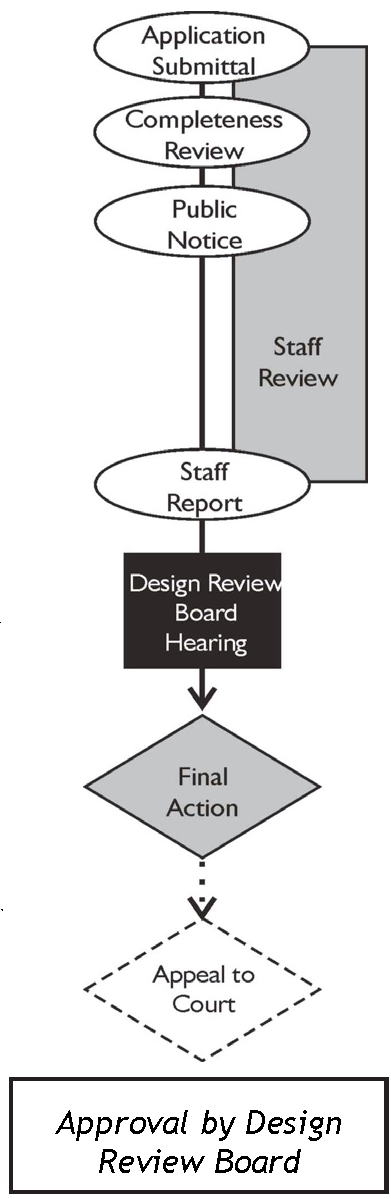
Public Hearing and Public Notice. For any Certificate of Appropriateness application that it must consider, the Board shall conduct a public hearing not later than 30 days following receipt of a completed application form accompanied by all required information and documents. Public notice of each such public hearing shall be given at least seven days prior to the hearing by the posting of a sign by the City on each street frontage of the subject property clearly visible to the public stating the date, time, and place of the public hearing.
E.
Notice to Applicants and Owners.
1.
The Board shall give the applicant written notice of the public hearing on his application. This notice shall be sent by certified mail to the address listed on the application and shall be considered given when placed in the U.S. Post Office at Aiken, South Carolina with proper postage affixed.
2.
If the applicant is not the owner, a copy of the letter providing notice shall be sent by certified mail to the owner-of-record. This notice shall be considered given when placed in the U.S. Post Office at Aiken, South Carolina with proper postage affixed.
3.
The notices required by this Section shall state the identity, address, and telephone number of the applicant and property owner; the address or location of the subject property; and the time, place, and purpose of the hearing.
F.
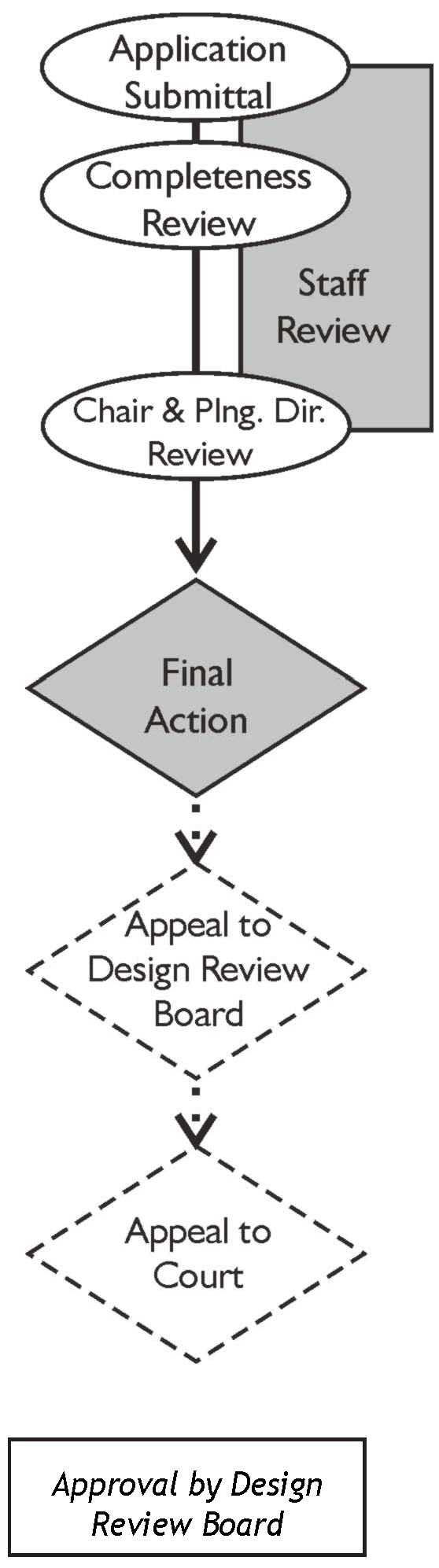
Administrative Approval. (Ord. 04142003A) With the concurrence of the Chairman, the Planning Director may approve or amend Certificates of Appropriateness for the following activities on sites not owned by the City or may refer them to the Board for a decision.
1.
Activities expressly authorized by the Board.
2.
Minor design changes to projects for which a Certificate of Appropriateness has been issued by the Board. (Ord. 04142003A)
3.
Extension of the expiration date of a Certificate of Appropriateness for an additional period not to exceed six months. (Ord. 04142003A)
4.
Any alteration which would restore an original feature of a structure as proven through clear documentation. (Ord. 04142003A)
5.
Anything not specifically covered by this Chapter that the Planning Director determines is not so significant as to impair or affect historic, architectural, or aesthetic character.
Such an application shall be considered by the Planning Director as soon as possible but not later than 15 days following receipt of a completed application form accompanied by all required information and documents. A public hearing or public notice shall not be required unless the application is referred to the Board. Applications referred to the Board by the Planning Director must be considered within 30 days following receipt of the completed application form accompanied by all required information and documents.
G.
Procedures Following Approval. If an application for a Certificate of Appropriateness is approved, the following apply.
1.
The decision shall be filed with the Secretary and a Certificate of Appropriateness issued to the applicant. Specific conditions upon which the Certificate is issued and with which the applicant must comply shall be listed on the Certificate.
2.
If an application is approved by the Board, the Certificate shall be signed by the Chairman, Vice-Chairman, or presiding member of the Board; if approved by the Planning Director, he shall sign the Certificate and shall notify the Board of the decision.
3.
A copy of the Certificate and the approved application shall be provided to the Building Official and the Zoning Official who shall periodically inspect the work and report any violation of the Certificate or this Chapter to the Planning Director.
4.
The Certificate shall expire two years from the date of issuance unless the work allowed thereunder has been substantially completed or unless another expiration date is specified by the Board or by the Planning Director pursuant to 5.2.3.F.3.
H.
Denial of Application.
1.
By the Planning Director. If an application is denied by the Planning Director, the Director shall file his written decision with the Secretary including the reasons for denial, send a copy to the applicant by certified mail, and provide a copy to the Building Official and the Zoning Official and each Board member.
2.
By the Board. If an application is denied by the Board, the following apply.
a.
The Board shall file with the Secretary its written decision, which shall include a statement of the reasons for denial, and shall provide a copy of the statement to the applicant and to the Building Official, the Zoning Official, and each Board member within 15 days of the public hearing thereon.
b.
The Board in its decision may make recommendations to the applicant concerning changes in the proposed action that may cause it to reconsider denial. The applicant may submit an amended application to the Secretary incorporating those recommendations. Such an amended application shall be subject to the same procedures as an initial application but is exempted from the limitations in 5.2.3.K.
c.
The applicant may apply under 5.1.3 for an exemption.
I.
Appeal.
1.
From the Planning Director. Any property owner, City official, or other person aggrieved by and seeking relief from any final decision of the Planning Director on an application for a Certificate of Appropriateness or interpretation of Chapter 5 and related provisions may appeal the decision of the Planning Director to the Design Review Board by submitting to the Secretary a written request stating the grounds for the appeal. The appeal request must be submitted to the Secretary within 20 days of the date on which the written decision is mailed to the applicant. The appeal shall meet the public notice requirements under 5.2.3.D, and it shall be placed on the next Board meeting agenda for which public notice requirements can be met. An appeal must be decided within 45 days of submission of the written appeal request.
2.
From the Board. Any property owner, City official, or other person aggrieved by and seeking relief from any final decision of the Board on an application for a Certificate of Appropriateness may appeal that decision to the Circuit Court pursuant to Section 6-29-900, Code of Laws of South Carolina, 1976, by filing a petition with the court within 30 days of the filing of the written decision of the Board with the Secretary.
J.
Review Standards.
1.
General. In reviewing applications, the Board and the Planning Director shall consider the standards stated in this Chapter for the purpose of determining whether alterations, construction, demolitions, or relocations are in harmony with the prevailing historical, architectural, archeological, or aesthetic character of the Historic District, a structure in a Historic District, or an Historic Site, or a structure included in an Historic Site. (Ord. 04142003A)
2.
Construction and Alteration. In reviewing an application for construction or alteration, the Board and the Planning Director shall consider general design, character and appropriateness of design, scale of buildings, texture and materials, relationship of such elements to similar features of structures in the immediate area, and the extent to which the alteration or construction would be harmonious with the Historic District or Historic Site in which it is located. (Ord. 04142003A) The Board and the Planning Director also shall consider the relevant standards and guidelines in the most current edition of the U.S. Secretary of the Interior's Standards for Rehabilitation.
3.
Demolition. In reviewing an application for demolition, the Board and the Planning Director shall consider the historical, archeological, and aesthetic character of the structure (or portion thereof) proposed for demolition. They shall also consider: (1) the structural integrity (i.e., condition) of the structure and (2) the integrity of materials, location, and design of the structure. No application for demolition shall be approved solely on the basis of a structure's deteriorated condition where the Board determines that the applicant is primarily responsible for the deteriorated condition. Finally, the Board shall consider the extent to which demolition would, in the judgment of the Board, produce a detrimental effect upon the character of the structure or property affected or upon the surrounding properties, or upon the district in which the structure is located. No application for demolition of a Landmark shall be approved.
4.
Specific Guidelines. The Board shall adopt additional guidelines, subject to review and approval by City Council, consistent with this Chapter for reviewing applications for a Certificate of Appropriateness.
K.
Refiling of an Application. If an application for a Certificate of Appropriateness is denied, the application may not be considered by the Board again for one year unless the applicant can demonstrate to the Board a substantial change in circumstances relevant to the application.
5.2.4. - Demolition or Relocation.
A.
Certificate of Appropriateness Required.
1.
No structure within an Historic District or Historic Site (Ord. 04142003A) shall be demolished or relocated until the owner thereof has applied for and received a Certificate of Appropriateness from the Board.
2.
The Board may delay the granting of the Certificate for a period of up to 60 days from the time of the filing of the application. The Board may extend this postponement for another 180 days after a public hearing and finding by the Board that the structure or landmark is of historical, architectural, or archeological importance to the public or City of Aiken. Within any period of postponement, the Board shall endeavor to ascertain what may be done to preserve the structure or landmark. Such steps shall include, but are not limited to, consultation with civic groups, interested citizens, public interest groups, and public boards and agencies.
3.
After the postponement period has ended and the Board has been unable to determine a reasonable alternative to demolition or relocation, the Certificate shall be granted after a public hearing, with the notice required by 5.2.3.D being given. However, if the Board finds that the structure contributes to the character of the Historic District or that the landmark is of historical, archeological, or architectural significance or that, for any other reason, preservation in the public interest is warranted, the application shall be denied. In the event of such denial, the owner may apply for an exception under 5.1.3.
B.
Demolition by Neglect. The following provisions shall take effect six months after the effective date of this Ordinance.
1.
Prevention of Demolition by Neglect of Exterior. No owner or person with an interest in real property which is designated an Historic Site (Ord. 04142003A) in any part of the City or any property in an Historic District, whether that property is occupied or not, shall permit the structure or property to fall into a serious state of disrepair or to remain in a serious state of disrepair so as to result in the deterioration of any exterior architectural feature which would, in the judgment of the Board, produce a detrimental effect upon the character of the structure or property, or, if the structure or property is in an Historic District, upon the district. Examples of such deterioration include:
a.
deterioration of exterior walls or other vertical supports;
b.
deterioration of roofs or other horizontal members;
c.
deterioration of exterior chimneys;
d.
deterioration or crumbling of exterior stucco or mortar;
e.
ineffective waterproofing of exterior walls, roofs or foundations, including broken windows or doors;
f.
deterioration of any exterior feature so as to create a hazardous condition which could make demolition necessary for the public safety; or
g.
deterioration or removal of any unique exterior architectural feature which would detract from the original architectural style.
2.
Prevention of Demolition by Neglect of Interior. No owner or person with an interest in real property which is designated an Historic Site (Ord. 04142003A) in any part of the City, or any property in an Historic District, whether that property is occupied or not, shall permit the interior portions of such structure or property to fall into a serious state of disrepair which, in the judgment of the Board, produces a detrimental effect upon the structural integrity of such structure or property which could make demolition necessary for the public safety.
5.3.1. - Applicability.
The Old Aiken Overlay District applies to land zoned Downtown Business (DB) and the area shown on the map adopted by City Council on April 14, 2008. The boundaries of the District shall be depicted on the Zoning Map. (Ordinance 04142008)
5.3.2. - Certificate of Appropriateness.
A.
Activities Requiring a Certificate on Land Zoned Downtown Business. On land zoned Downtown Business, a Certificate of Appropriateness shall be required for the following activities visible from a public street right-of-way:
1.
the construction, alteration, demolition or relocation of a detached single-family dwelling; (Ord. 06262006)
2.
the construction, alteration, demolition, or relocation of a multiple-unit residential building including one composed of attached single-family units;
3.
the construction, alteration, demolition, or relocation of a building any portion of which is or would be occupied by a nonresidential use; and
4.
any activity not specifically covered which either the Chairman of the Design Review Board or the Planning Director deems is significant enough to warrant approval.
B.
Activities Requiring a Certificate on Land Not Zoned Downtown Business. On land zoned other than Downtown Business, a Certificate of Appropriateness shall be required for the following activities visible from a public street right-of-way:
1.
the construction, demolition, or relocation of a detached single-family dwelling;
2.
the construction, demolition, or relocation of a multiple-unit residential building including one composed of attached single-family units;
3.
the construction, demolition, or relocation of a building any portion of which is or would be occupied by a nonresidential use; and
4.
the alteration of an existing building where the cost of such alteration within a one-year period exceeds 50 percent of the appraised value of the building as set by the Aiken County Tax Assessor, or any other State or local government entity or official with authority to do so, or by the Building Official for a building that is tax-exempt.
No approval shall be required for any work involving an accessory building associated with a residential use and not used for commercial purposes, including, but not limited to, a shed or garage. (Ord. 04142008)
C.
Activities in a Street Right-of-Way. Construction, alteration, demolition, or relocation of a bridge and its related approaches shall require a Certificate of Appropriateness. (Ord. 11112013A)
D.
Administrative Approval. The Board may authorize the Planning Director to approve a Certificate for certain types of work with the concurrence of the Chairman.
E.
Activities Exempt from Certificate of Appropriateness.
1.
On land zoned Downtown Business, the provisions at 5.3.2.A apply except that painting of any surface requires a Certificate.
2.
On land zoned other than Downtown Business, any work not specifically requiring a Certificate as set forth at 5.3.2.B shall be exempt.
F.
Application for Certificate of Appropriateness. The provisions at 5.2.3.C apply.
G.
Public Hearing and Public Notice. The provisions at 5.2.3.D apply.
H.
Notice to Applicants and Owners. The provisions at 5.2.3.E apply.
I.
Administrative Approval. The provisions at 5.2.3.F apply.
J.
Procedures Following Approval. The provisions at 5.2.3.G apply.
K.
Denial of Application. The provisions at 5.2.3.H apply.
L.
Appeal. The provisions at 5.2.3.I apply.
M.
Review Standards. In reviewing applications, the Board and the Planning Director shall use the Old Aiken Architectural Design Guidelines as adopted by City Council. Where a determination is needed as to which standards apply, the Board Chairman and Planning Director shall decide unless they do not agree in which case the final decision shall be made by the Board. (Ord. 06262006)
N.
Refiling of an Application. The provisions at 5.2.3.K apply.
5.3.3. - Demolition or Relocation.
The provisions at 5.2.4 apply to any structure in the Old Aiken Overlay District.

