
Alachua County Unincorporated
City Zoning Code
City Zoning Code
CHAPTER 402
- DEVELOPMENT APPLICATION REVIEW PROCEDURES CONTENTS
ARTICLE XXV.- TEMPORARY USE PERMITS[3]
Editor's note—Ord. No. 2024-10, § 2(Exh. A), adopted May 14, 2024, amended Article XXV in its entirety to read as herein set out. Former Article XXV, §§ 402.147—402.156, pertained to similar subject matter, and derived from Ord. No. 05-10, § 2, 12-8-05; Ord. No. 07-01, § 4, 1-23-07; Ord. No. 07-07, § 2(Exh. A), 4-27-07; Ord. No. 08-06, § 2(Exh. A), 4-22-08; Ord. No. 12-09, § 2(Exh. A), 10-9-12; Ord. No. 13-14, § 2(Exh. A), 8-27-13; Ord. No. 2020-25, § 2(Exh. A), 11-10-20.
Sec. 402.01.- Purpose.
The purpose of this Chapter is to provide the procedures and general standards for review of development, development activity and other applications that are submitted to officers or bodies of Alachua County for review under this ULDC. Unless otherwise provided in this Chapter or this ULDC, the Director shall establish the detailed procedures for development review, including the following:
(a)
Dates and deadlines for submitting applications;
(b)
Application forms;
(c)
Required documents and information to accompany application forms;
(d)
Public notice;
(e)
Application review;
(f)
Form and preparation of department or DRC recommendations; and
(g)
Such other action as may be needed to provide development review in an objective, timely and thorough manner.
(Ord. No. 05-10, § 2, 12-8-05; Ord. No. 2020-25, § 2(Exh. A), 11-10-20; Ord. No. 2024-04, § 2(Exh. A), 2-27-24)
Sec. 402.02. - Applications for development approval.
(a)
Applicability. All development applications shall comply with the requirements of this Article and this Chapter.
(b)
Submittal of applications. Unless otherwise provided herein, all development applications shall be filed with the department.
(Ord. No. 05-10, § 2, 12-8-05; Ord. No. 2020-25, § 2(Exh. A), 11-10-20)
Sec. 402.03. - Overdue taxes, liens and fines.
(a)
In addition to any application information required by other parts of this ULDC, an applicant shall provide evidence regarding the current status of all property taxes and other obligations owed Alachua County related to the property that is the subject of the application and that the applicant has legal authority to represent.
(b)
An application that includes property for which there are overdue taxes or other financial obligations to Alachua County shall not be approved, except in one of the following cases:
(1)
Those cases where approval by the County is a requirement to correct a violation.
(2)
The property for which an application is made is included in a development plan, planned development, or a platted subdivision; the property for which there are overdue taxes is not owned or controlled by the applicant; and the approval would not change the rights or obligations of the property for which taxes have not been paid.
(3)
The applicant has properly initiated an appeal for the taxes owed.
(Ord. No. 05-10, § 2, 12-8-05; Ord. No. 2020-09, § 2(Exh. A), 3-10-20; Ord. No. 2020-25, § 2(Exh. A), 11-10-20)
Sec. 402.03.5. - Building permit review for affordable housing units.
(a)
Applicability. This Section applies to all housing units funded by any of the following programs below:
(1)
Community Development Block Grant (CDBG).
(2)
State Housing Initiatives Partnership Program (SHIP).
(3)
Impact fee assistance program.
(4)
Other (i.e. housing tax credit program).
(b)
Processing of building permits. Building permits for projects meeting the affordable housing guidelines above shall be available (processed) within six (6) business days from the day the application is found sufficient and complete. No default permit is issued on account of this deadline.
(c)
Application information. In addition to the required information necessary to obtain a building permit, all affordable housing units seeking expedited permit review shall submit a written request that demonstrates compliance with this Section.
(Ord. No. 09-05, § 2(Exh. A), 9-8-09; Ord. No. 2020-25, § 2(Exh. A), 11-10-20)
Sec. 402.04.- Pre-application screening for administrative permits.
(a)
Pre-application screening. Before an application is approved by the County for an administrative permit as provided for in Chapter 401, Development Review Bodies, the following application material shall be submitted to the Growth Management Department to determine compliance with this ULDC and signed off by the Growth Management Department, Public Works Department, and the Environmental Protection Department:
(1)
Content.
a.
Survey map or drawing of the parcel where activity is proposed, drawn to scale, including a north arrow and scale showing:
1.
Parcel boundaries with dimensions;
2.
Locations of all proposed improvements with dimensions from two (2) intersecting property lines to the proposed structure and showing all proposed improvements including but not limited to access, structures, septic system, wells, and utilities;
3.
Locations of all existing improvements, and
4.
Locations of all existing and proposed easements.
b.
Tax parcel number and physical address; and
c.
Contact information, including name, telephone number, and e-mail address if applicable.
(b)
Exceptions. The following administrative applications are not required to submit the information in Subsection (a) of this Section for application screening:
(1)
Subdivisions, plats and non-residential developments approved after May 2, 2005. Subdivisions, plats and non-residential developments approved after May 2, 2005 by the DRC or BOCC under this ULDC, provided the administrative permit request is consistent with the approved activities, parameters, and requirements of the development plan, subdivision and/or plat, unless the lot is specifically identified by the authorizing review body as needing pre-screening review as part of final approval.
(2)
Lots approved through pre-screening. Administrative applications where the property has been prescreened for the proposed activity through the prescreening process identified in Subsection (a) of this Section.
(3)
Other lots found to be in compliance. Other subdivisions, projects, plats, or lots that have been found to be in compliance with this ULDC and the Comprehensive Plan, and already reviewed by the Growth Management Department, Public Works Department, and the Environmental Protection Department. A list of such developments or properties shall be maintained at the Growth Management Department.
(Ord. No. 05-10, § 2, 12-8-05; Ord. No. 06-14, § 2(Exh. A), 7-20-06; Ord. No. 2020-25, § 2(Exh. A), 11-10-20)
Sec. 402.05. - Development application forms.
(a)
Content. The Director shall establish application forms to be submitted to the department for all development applications referenced in this Chapter. The information required to accompany each type of development application that is submitted to the department shall include but is not limited to the following:
(1)
Authority to submit an application, in a form approved by the County Attorney;
(2)
Statement of how the development proposal is consistent with the Comprehensive Plan;
(3)
Statement of how the development proposal is consistent with the Comprehensive Plans of all other jurisdictions within the market area, if applicable.
(4)
Statement of how the development proposal is consistent with the applicable standards and criteria of this ULDC;
(5)
Statement of request of alternative compliance citing code section to be modified.
(6)
Evidence of compliance with all applicable elements of the County's concurrency management system as provided in Chapter 407, Article XII of this ULDC;
(7)
To the extent applicable, documentation or professional studies such as:
a.
Natural resources assessment (Section 406.04, Chapter 406);
b.
Tree survey and landscape plan;
c.
Public school impact;
d.
Solid waste disposal and recycling;
e.
Stormwater management, erosion and sedimentation control;
f.
Traffic impacts including intersection analysis (Subsection 407.136(c)) in accordance with an approved traffic methodology agreement;
g.
Water and sewer utilities;
h.
Environmental monitoring plan;
i.
Pollution prevention plan;
j.
Topographic survey of area subjected to development impact meeting the technical standards of Florida Administrative Code 5J-17.052 and signed and sealed by a Florida Professional Surveyor and Mapper (PSM);
k.
Similar information as may be required by the Director;
(8)
Development plans (citation for alternative compliance ULDC section noted, if applicable);
(9)
Master plan or zoning master plan with all related attachments, if applicable (citation for alternative compliance ULDC section noted, if applicable);
(10)
Phasing plan, if applicable (citation for alternative compliance ULDC section noted, if applicable);
(11)
Boundary survey of the entire property meeting the technical standards of Florida Administrative Code 5J-17.052 and signed and sealed by a Florida Professional Surveyor Mapper (PSM), completed within two (2) years of the application date and containing a legal description and the total acreage; calculated to one tenth (.1) of an acre, if applicable.
(12)
Architectural elevations, if applicable;
(13)
Warranty deed, or such other deed as may be required by the Director;
(14)
Fees, as established by the BOCC;
(15)
Fiscal impacts including the timing of any needed infrastructure improvements or new facilities, if applicable;
(16)
An evaluation of the impacts of proposed Comprehensive Plan or land development regulation amendments on the initial cost of housing, the long-term cost of home ownership and the fiscal impacts to the County and the County's taxpayers, if applicable;
(17)
All ADA accessible routes must be identified on the development plans;
(18)
Subdivision plat and any underlying plat, if applicable;
(19)
Homeowners' or other property association documentation, if applicable;
(20)
Plans, details and structural calculations for retaining walls which are not in accordance with the FDOT Index or certified and signed and sealed by a Florida Professional Engineer (PE);
(21)
Temporary construction easements, drainage easements, and public access easements, if applicable.
(22)
Any application for a special exception for a commercial use greater than five thousand (5,000) square feet of gross floor area in a rural cluster in accordance with Subsection 403.13(e) shall include the following:
a.
Demonstration that there is a need for such use to serve the population within the rural cluster and the immediate surrounding areas, and that this need cannot be met through existing commercial uses within the market area or commercially-zoned undeveloped land within the rural cluster;
b.
Demonstration that such use would be compatible with the size, scale, and character of the existing land uses within the rural cluster and the immediate surrounding land uses designated in the Comprehensive Plan; and
c.
Analysis of how approval of the special exception would impact any existing commercially- zoned undeveloped land within the rural cluster in light of the limitation on the total amount of commercial uses within rural clusters pursuant to Policy 6.4.3 of the Comprehensive Plan, Future Land Use Element and Subsection 403.13(e) of this ULDC.
(b)
Submittal of forms. All development applications shall be submitted, on these forms and in such numbers as required, to the Department of Growth Management.
(Ord. No. 05-10, § 2, 12-8-05; Ord. No. 06-14, § 2(Exh. A), 7-20-06; Ord. No. 07-07, § 2(Exh. A), 4-24-07; Ord. No. 09-05, § 2(Exh. A), 9-9-09; Ord. No. 12-09, § 2(Exh. A), 10-9-12; Ord. No. 13-14, § 2(Exh. A), 8-27-13; Ord. No. 2016-10, § 2(Exh. A), 6-28-16; Ord. No. 2020-25, § 2(Exh. A), 11-10-20; Ord. No. 2024-04, § 2(Exh. A), 2-27-24)
Sec. 402.06. - Authority to file applications.
(a)
Legal authority required. Applications shall only be accepted with signatures from persons having the legal authority to submit them.
(b)
Persons with legal authority. For the purposes of this Article, applications shall be made by any of the following:
(1)
Owners of a property that is subject to a development application;
(2)
Lessees of property subject to a development application, with the notarized written permission of the property owner;
(3)
The agents of a property owner or lessee, with the notarized written permission of the property owner; or
(4)
Persons who have contracted to purchase property contingent upon receiving the necessary approval under this ordinance, or the agents of such persons, with the notarized written permission of the property owner.
(c)
Authority to submit application. The Director of Growth Management may require an applicant to present evidence of authority to submit the application whenever there appears to be a reasonable basis for questioning this authority.
(d)
Authority to access the property. Owners of property shall make available to Alachua County staff a means of reasonable access to the property for which an application has been submitted.
(Ord. No. 05-10, § 2, 12-8-05; Ord. No. 06-14, § 2(Exh. A), 7-20-06; Ord. No. 2020-25, § 2(Exh. A), 11-10-20)
Sec. 402.07. - Fees.
Fees shall be paid according to the fee schedule established by resolution by the BOCC.
(a)
Revised applications. Any substantial applicant-initiated revisions shall require payment of additional fees. For the purposes of this Section, the Director shall determine if a proposed revision is to be deemed substantial, and the determination can include such factors as:
(1)
Increase or decrease in land area included within an application;
(2)
Change in uses;
(3)
Change in the density or intensity of a project;
(4)
Modification of proposed development plan, such as a change in vehicular access, change in building location or change in dwelling unit type;
(5)
Reduction or relocation of proposed buffers, landscaping or conservation areas; and
(6)
Change or elimination of conditions included as part of a development application approval.
(b)
Withdrawn applications. Upon written request to the Director, an applicant who has paid the appropriate fee but withdraws the application prior to any review or advertising by County staff may be entitled to a partial refund.
(Ord. No. 05-10, § 2, 12-8-05; Ord. No. 2020-25, § 2(Exh. A), 11-10-20)
Sec. 402.08.- Applicability of preliminary procedures.
The requirements of this Article shall, unless otherwise expressly provided in this Chapter, apply to all development applications.
(Ord. No. 05-10, § 2, 12-8-05; Ord. No. 2020-25, § 2(Exh. A), 11-10-20; Ord. No. 2024-04, § 2(Exh. A), 2-27-24)
Sec. 402.09. - Acceptance of application.
(a)
Acceptance determination. Applications will be checked for all required documents and plans needed for review at time of submittal. An application will be accepted if all required information and documents have been prepared in accordance with professionally accepted standards and all other eligibility requirements are met.
(b)
Once an application has been accepted, County staff will then perform the completeness review.
(Ord. No. 05-10, § 2, 12-8-05; Ord. No. 2020-25, § 2(Exh. A), 11-10-20; Ord. No. 2024-04, § 2(Exh. A), 2-27-24)
Sec. 402.10. - Determination of completeness.
(a)
Determination of completeness. A determination of completeness will be made after an application has been accepted for review. An application will be deemed complete, and sufficient for a hearing when all required information has been reviewed by staff and found to be consistent with the Comprehensive Plan and ULDC. If an application is determined to be insufficient for a recommendation of approval due to lack of information or inconsistency with the Comprehensive Plan or ULDC, the applicant will be notified in writing of the specific nature of the insufficiency and offered an opportunity to submit additional information or to conclude review of the application and proceed to a hearing with a recommendation of denial.
(b)
Complete and sufficient application. Once an application has been deemed to be complete, and sufficient for a hearing, County staff will prepare the application for the next available agenda of the appropriate reviewing body. Administrative development plan applications reviewed under Section 401.20(b) will receive a development order upon approval.
(Ord. No. 05-10, § 2, 12-8-05; Ord. No. 09-01, § 2(Exh. A), 2-24-09; Ord. No. 2020-25, § 2(Exh. A), 11-10-20; Ord. No. 2024-04, § 2(Exh. A), 2-27-24)
Sec. 402.10.5. - Expiration of applications.
If more than a year has passed since an application was determined to be incomplete and the applicant has not demonstrated an undue hardship or that they are continuing in good faith to remedy the incompleteness, then the application will be deemed expired and a new application must be submitted for review, unless otherwise approved by the Director.
(Ord. No. 07-07, § 2(Exh. A), 4-27-07; Ord. No. 2020-25, § 2(Exh. A), 11-10-20; Ord. No. 2024-04, § 2(Exh. A), 2-27-24)
Sec. 402.11.- Applicability.
(a)
Public meetings. All meetings of the BOCC, the Planning Commission and the DRC are public meetings and subject to the notice requirements under the Florida Statutes and the Rules of Procedure of the BOCC.
(b)
Hearings required by this ULDC. Additional notice is required for most public hearings held in accordance with this ULDC. This Article sets out the minimum requirements for notice for such hearings.
(Ord. No. 05-10, § 2, 12-8-05; Ord. No. 2016-10, § 2(Exh. A), 6-28-16; Ord. No. 2020-25, § 2(Exh. A), 11-10-20)
Sec. 402.12. - Types of public notice.
Forms of notice required for various public hearings may include mailed notice, published notice provided via a newspaper of general circulation or via the County's publicly accessible website, pursuant to F.S. ch. 50, and posted notice by signs located on the subject property. Neighborhood workshops, in accordance with the procedures of Article V, Neighborhood Workshops, of this Chapter, provide additional notice to the public regarding certain types of development applications. The public notice requirements for development applications are indicated in Table 402.12.1.
(Ord. No. 05-10, § 2, 12-8-05; Ord. No. 06-14, § 2(Exh. A), 7-20-06; Ord. No. 09-01, § 2(Exh. A), 2-24-09; Ord. No. 12-09, § 2(Exh. A), 10-9-12; Ord. No. 2017-17, § 2(Exh. A), 10-10-17; Ord. No. 2018-23, § 2(Exh. A), 10-9-18; Ord. No. 2020-25, § 2(Exh. A), 11-10-20; Ord. No. 2023-09, § 2(Exh. A), 4-25-23; Ord. No. 2023-14, § 4, 9-24-23; Ord. No. 2023-16, § 2(Exh. A), 10-24-23; Ord. No. 2024-04, § 2(Exh. A), 2-27-24; Ord. No. 2024-07, § 2(Exh. A), 9-10-24; Ord. No. 2025-11, § 2(Exh. B), 6-24-25)
Sec. 402.13. - Content of mailed and published notices.
In addition to the content of mailed and published notices provided in this Section, published notice for a neighborhood workshop shall also be consistent with Article V of this Chapter. All mailed and published notices shall include, at a minimum, the information listed below.
(a)
Statutory requirements. Any information required by the Florida Statutes for published notice for the type of application which is the subject of the notice.
(b)
Nature of application. The application number, the application type, and a description of the proposal or request.
(c)
Public hearing location, time and date. The location, time and date of all scheduled public hearings or workshops on the application.
(d)
Location of the subject property.
(1)
A description of the land involved by street address, if any, or by legal description or parcel number(s) of the subject parcels.
(2)
For mailed notices, a location map shall be included, indicating the location and general boundaries of the property, with reference to the closest intersection of public streets, when possible.
(e)
Size of subject property. The total size of the parcels, rounded to the nearest one-tenth (0.1) of an acre.
(f)
Comprehensive Plan and zoning designations. The future land use map designation and zoning district of the property subject to the application, if applicable.
(g)
Materials available for public information. The name, address and telephone number of the department in which the application, staff report and related materials may be inspected by the public, and the fact that information is available for public inspection during normal business hours.
(1)
Submittal of written materials. The name, address and telephone number of the department where the public may submit written comments or evidence prior to the public hearing.
(2)
Public comment allowed. A statement that affected parties may appear at the public hearing, be heard, and submit evidence and written comments.
(h)
Additional content for virtual neighborhood meeting mailed and published notices.
(1)
The name, telephone number, and email address of a contact dedicated to providing technical support to attendees before and during the virtual meeting. To minimize interruptions, it is recommended that the technical support contact be different from the applicant or the person primarily responsible for running the presentation;
(2)
A clear explanation that the meeting can be accessed by calling a telephone number if an attendee is unable to access the meeting via the internet, and instructions on how to do so;
(3)
A phone number to allow attendees to call into the virtual meeting platform; and
(4)
A URL to allow attendees to access the online platform that is hosting the virtual meeting.
(Ord. No. 05-10, § 2, 12-8-05; Ord. No. 06-14, § 2(Exh. A), 7-20-06; Ord. No. 08-06, § 2(Exh. A), 4-22-08; Ord. No. 09-05, § 2(Exh. A), 9-9-09; Ord. No. 15-06, § 2(Exh. A), 4-14-15; Ord. No. 2020-25, § 2(Exh. A), 11-10-20)
Sec. 402.14. - Procedure for written notice.
When required, as shown in Table 402.12.1, notice shall be provided to all individuals and property owners as indicated below. Notice for neighborhood workshops shall be mailed by the applicant.
(a)
To whom provided.
(1)
Property owners of the subject property. All property owners of the land subject to the application shall be mailed a written notice of a public hearing or workshop.
(2)
Jurisdictions. All bodies of government, including other counties or municipalities, abutting to the land subject to the application shall be emailed a notice of a public hearing or workshop.
(3)
Alachua County School Board. The Alachua County School Board shall be emailed a notice of a public hearing or workshop concerning residential development.
(4)
Nearby property owners. The property owners listed below shall be mailed a written notice of a public hearing or workshop. When the distance measurement from a property boundary as required below ends in a roadway, the property directly across the roadway shall also be mailed a written notice. Requirements for notice to abutting property owners shall mean those identified using the most recent available tax rolls at the time of development application.
a.
All property owners. All property owners within seven hundred-fifty (750) feet of the boundaries of the parcel(s) subject to the application shall receive notice.
b.
Properties designated rural agriculture. If the subject parcel(s) is located in an area designated rural/agriculture on the future land use map, all property owners within one thousand five hundred (1,500) feet of the boundaries of the parcel(s) subject to the application shall receive notice.
c.
Neighborhood and property owners' associations. If any dwelling within the required notification area is part of a neighborhood association or property owner's association, and that information is a matter of record with the department, the association shall receive notice.
d.
Registered associations or individuals to receive agendas. All neighborhood associations or similar property owners' associations, or individuals that have registered with the department shall receive an email with the agenda for public meetings that consider development applications in Alachua County.
(5)
Expanded written notice for specified uses. An application, requiring a public hearing, shall notify all properties owners within one-half mile (2,640 feet) of the boundaries of the parcel(s) with the following land use categories in Article II Use Table: Transportation Terminals, Utilities, Personal Wireless Service Facility, Waste Related Services, and Mining Excavation and Fill Operations.
(b)
Mailing and postmarking.
(1)
Timing of mailed notice. For any application requiring mailed notice, such notice shall be mailed a minimum of fifteen (15) days prior to the initial public hearing or workshop.
(2)
When notice deemed to be mailed. Notice shall be deemed mailed by its deposit in the mail, properly addressed and with postage paid.
(c)
Department verification. The following information shall be submitted to the department for notice of neighborhood workshops. This information shall be submitted as part of the application packet for which the neighborhood workshop was required.
(1)
A copy of the notice of publication; and
(2)
A copy of the mailed notice; and
(3)
A copy of the attendance sheet; and
(4)
The name and address list of property owners, neighborhood and property owners' associations, registered associations and individuals, and jurisdictions to whom the mailed notices were provided.
(Ord. No. 05-10, § 2, 12-8-05; Ord. No. 06-14, § 2(Exh. A), 7-20-06; Ord. No. 12-09, § 2(Exh. A), 10-9-12; Ord. No. 2016-10, § 2(Exh. A), 6-28-16; Ord. No. 2020-25, § 2(Exh. A), 11-10-20; Ord. No. 2023-16, § 2(Exh. A), 10-24-23)
Sec. 402.15. - Procedure for published notice.
(a)
Preparation of content and publishing. The department shall prepare the content of the notice and be responsible for publishing the notice in the newspaper of general circulation selected by the County or on a publicly accessible website designated by the County for the publication of legal notices and advertisements that is accessible to the public via the Internet, pursuant to F.S. ch. 50.
(b)
Content and form of notice.
(1)
For published notice required by F.S. § 125.66 or F.S. § 163.3184, the standards of those sections shall apply. In addition, the notice shall contain the information as required by Section 402.13 of this ULDC.
(2)
For other published notices required by Table 402.12.1 the following standards shall apply:
a.
The title of the advertisement shall be "Notice of Public Hearing";
b.
Content of the advertisement shall include information as required in Section 402.13 of this ULDC; and
c.
The advertisement shall be published no less than seven (7) days prior to the date of the public hearing.
(3)
The form of the published notice shall comply with the requirements of F.S. ch. 50.
(Ord. No. 05-10, § 2, 12-8-05; Ord. No. 12-09, § 2(Exh. A), 10-9-12; Ord. No. 2020-25, § 2(Exh. A), 11-10-20; Ord. No. 2023-14, § 5, 9-24-23; Ord. No. 2023-16, § 2(Exh. A), 10-24-23)
Sec. 402.16. - Requirements for posted notice.
(a)
Content of notice. When required, as shown in Table 402.12.1, posted notices shall include the following information clearly written on the sign:
(1)
The type of application, visible from the street;
(2)
Description of proposal or request;
(3)
Zoning districts and future land use designations for Comprehensive Plan amendments and zoning applications (zoning districts shall be spelled out, not abbreviated, and applicable densities shall be included with land use designations); and
(4)
A phone number to contact the Department for additional information.
(5)
Applicant or agent name and a phone number to contact.
(b)
Posting of notice. Posting of property shall comply with the requirements listed below.
(1)
Responsibility for posting. Signs shall be posted by the applicant.
(2)
Form of required signs. Notice shall be posted on weather resistant signs in a form established by the department.
(c)
Timing of posted notice. For any application requiring posted notice, signs shall be posted within forty-eight (48) hours after the application has been accepted for review by the Department.
(d)
Location of signs.
(1)
Street frontage. Signs shall be placed along each street at maximum intervals of four hundred (400) feet for properties within the Urban Cluster and maximum intervals of one thousand three hundred twenty (1,320) feet for properties outside of the Urban Cluster. They shall be set back a maximum of five (5) feet from the property line so that the signs are visible from the street.
(2)
Lack of street frontage. If the land does not have frontage on a street, at least one (1) sign shall be placed on the property at the access point and additional signs shall be placed on the nearest public right-of-way with an indication of the location of the subject property.
(3)
Additional locations. Additional signs with specific locations as required by the Director, or their designee.
(4)
Installation. Signs shall be posted in a professional manner, able to withstand normal weather events.
(e)
Affidavit. A notarized affidavit shall be submitted to the department within seventy-two (72) hours after the posting, certifying that the signs were posted in compliance with the standards of this Section. Applications will not be considered complete until the notarized posted notice affidavit has been received. The Director, or their designee, may require submittal of photographs of all signs as part of the affidavit.
(f)
Maintenance. The applicant shall ensure that the signs are maintained on the land until completion of the final action on the application.
(g)
Removal. The applicant shall remove the sign within ten (10) days after final action on the application.
(Ord. No. 05-10, § 2, 12-8-05; Ord. No. 06-14, § 2(Exh. A), 7-20-06; Ord. No. 09-01, § 2(Exh. A), 2-24-09; Ord. No. 12-09, § 2(Exh. A), 10-9-12; Ord. No. 13-14, § 2(Exh. A), 8-27-13; Ord. No. 15-06, § 2(Exh. A), 4-14-15; Ord. No. 2020-25, § 2(Exh. A), 11-10-20; Ord. No. 2023-16, § 2(Exh. A), 10-24-23)
Sec. 402.17.- Neighborhood workshop.
(a)
Purpose. The purpose of a neighborhood workshop is to ensure early citizen participation in an informal forum in conjunction with development applications, and to provide an applicant the opportunity to understand and try to mitigate any impacts an application may have on an affected community. These workshops ensure that citizens and property owners have an adequate opportunity to learn about applications that may affect them and to work with the applicant to resolve any concerns at an early stage of the process. A neighborhood workshop is not intended to produce complete consensus on all applications, but to encourage applicants to be good neighbors and to allow for informed decision making. If an applicant fails to hold a required neighborhood meeting, the department shall not accept that development application for review.
(b)
Public notice. Public notice of a neighborhood workshop shall be provided as indicated below.
(1)
Notice to Director. An applicant holding a neighborhood workshop shall coordinate with the Director prior to scheduling the workshop.
(2)
Notice required.
a.
The applicant shall provide notification by mail according to Article IV, Notice of Hearings, of this chapter. The director shall provide a mailing list to the applicant. The applicant shall mail these notices with proper postage a minimum of fifteen (15) days before the workshop.
b.
The applicant shall publish notice of the workshop according to Article IV, Notice of Hearings, of this Chapter, in a newspaper of general circulation, or on a publicly accessible website designated by the County for the publication of legal notices and advertisements that is accessible to the public via the Internet, pursuant to F.S. ch. 50 a minimum of ten (10) days before the workshop. The advertisement shall be a minimum of two (2) columns wide and four (4) inches long. The ad shall be titled "Public Notice," with a description of the request, a location map and contact information.
(3)
Postponed workshops. New public notice consistent with the Section above shall be provided for any rescheduled workshop.
(Ord. No. 05-10, § 2, 12-8-05; Ord. No. 06-14, § 2(Exh. A), 7-20-06; Ord. No. 2020-25, § 2(Exh. A), 11-10-20; Ord. No. 2023-14, § 6, 9-24-23)
Sec. 402.18. - General requirements.
(a)
Workshop time and location.
(1)
Time. The workshop shall start between 6:00 p.m. and 8:00 p.m. on a weekday or between 9:00 a.m. and 7:00 p.m. on a weekend. The workshop shall not be held on a holiday, holiday weekend, day before a holiday, or day before a holiday weekend. (see definition for "Holiday" in Chapter 410, Definitions).
(2)
Location. When held in person, the initial workshop shall be held within the general area of the subject property. Additional workshops may be held but are not required.
(b)
Virtual workshops.
(1)
Virtual neighborhood workshops must be held using an interactive online video conferencing software such as Microsoft Teams, Zoom, WebEx, or other similar platforms as approved by the Director.
(2)
As some members of the public do not have internet access or are otherwise unable to access digital platforms, the meeting (workshop) platform must have the ability for attendees to call into the conference using a telephone. If a platform can only be accessed via the internet, it cannot be used to hold the virtual workshop.
(3)
Those who access the workshop via telephone must be given the same information, graphics, maps, and any other pertinent information as those accessing the meeting via the internet. If the applicant intends to screenshare presentation slides or graphics during the video conference, that material must be included in hardcopy format in the virtual meeting (workshop) notification packet.
(c)
Workshop summary. The applicant shall submit to the Department, as part of the application, a summary of the materials presented at the workshop, the issues raised by those in attendance, the suggestions and concerns of those in attendance, a copy of the sign-in sheet, a copy of the workshop advertisement and a copy of the mailed notices sent to property owners.
(d)
Workshop elements. At the workshop, the applicant shall present the following, as applicable:
(1)
A general concept plan for the use of all included lands. Such plans shall indicate the general location of residential areas (including density and unit types), Open Space, active or resource-based recreation areas, natural areas (including wetlands and flood plains), and non-residential areas (including maximum square footage and maximum height).
(2)
A plan of vehicular, bicycle, and pedestrian circulation showing the general locations and right-of-way widths of roads, sidewalks and access points to the external and internal thoroughfare network.
(3)
Drawings indicating the conceptual architectural theme or appearance and representative building types.
(Ord. No. 05-10, § 2, 12-8-05; Ord. No. 2020-09, § 2(Exh. A), 3-10-20; Ord. No. 2020-25, § 2(Exh. A), 11-10-20)
Sec. 402.19.- Development orders expire.
Any development order, permit, or other approval, other than a rezoning, shall expire in accordance with the terms of this ULDC.
(Ord. No. 05-10, § 2, 12-8-05; Ord. No. 2020-25, § 2(Exh. A), 11-10-20; Ord. No. 2024-04, § 2(Exh. A), 2-27-24)
Sec. 402.20. - Extension of time limit.
An applicant may apply for an extension of a time limit, subject to the requirements of this Section, except for extension requests identified in Article X, Section 402.47.
(a)
Deadline for application. An application for an extension of a time limit shall be filed a minimum of sixty (60) days prior to the expiration of the time limit.
(b)
Additional application requirements.
(1)
Concurrency. Unless concurrency approval is vested, an application shall demonstrate compliance with the concurrency management system as established in Chapter 407, Article XII of this ULDC.
(2)
Demonstration of good faith efforts. An application shall include a demonstration of good faith efforts to comply with applicable time limits by including one or more of the following items, dependent upon the type of development order requested for extension:
a.
All efforts to design a project, including engineering, architectural and similar plans;
b.
The number and type of development permits that have been applied for, including all relevant federal, state, county or related permits;
c.
The number and timeliness of any plats that have been recorded;
d.
The number and timeliness of any prior phases that have been developed or implemented;
e.
The completion or status of site development improvements including substantial and on-going site clearing, grading and the substantial and on-going construction of stormwater management facilities, if applicable;
f.
Any granting of rights-of-way, easements or similar public dedications;
g.
Compliance with applicable conditions of development approval;
h.
Execution of agreements for water or sewer services; and
i.
Such other information as may be required by the Director.
(c)
Review of applications. The application for extension shall be deemed an amendment to the original approval and shall be subject to review at a public hearing by the body that granted the order, permit or approval.
(d)
Consistency. The application shall be consistent with the current Comprehensive Plan, ULDC, and other County requirements.
(Ord. No. 05-10, § 2, 12-8-05; Ord. No. 09-01, § 2(Exh. A), 2-24-09; Ord. No. 12-09, § 2(Exh. A), 10-9-12; Ord. No. 13-14, § 2(Exh. A), 8-27-13; Ord. No. 15-06, § 2(Exh. A), 4-14-15; Ord. No. 2020-25, § 2(Exh. A), 11-10-20; Ord. No. 2024-04, § 2(Exh. A), 2-27-24)
Sec. 402.20.5. - Permit extensions granted by act of Legislature.
From time to time, the Legislature of the State of Florida has and may adopt legislation that provides for extension of local government permits that would otherwise expire. Where the legislature provides for such extensions of local government permits, the Growth Management Department shall provide for extension of local government permits in accordance with the specific terms of the legislation.
(Ord. No. 12-09, § 2(Exh. A), 10-9-12; Ord. No. 2020-25, § 2(Exh. A), 11-10-20)
Sec. 402.21.- Amendments generally.
The provisions of this Article shall govern all amendments to the Comprehensive Plan.
(Ord. No. 05-10, § 2, 12-8-05; Ord. No. 2020-25, § 2(Exh. A), 11-10-20)
Sec. 402.22. - Types of Comprehensive Plan amendments.
For the purposes of this ULDC, there shall be two (2) types of Comprehensive Plan amendments: small scale plan amendments and large scale plan amendments.
(Ord. No. 05-10, § 2, 12-8-05; Ord. No. 2020-25, § 2(Exh. A), 11-10-20)
Sec. 402.23. - Pre-application conference.
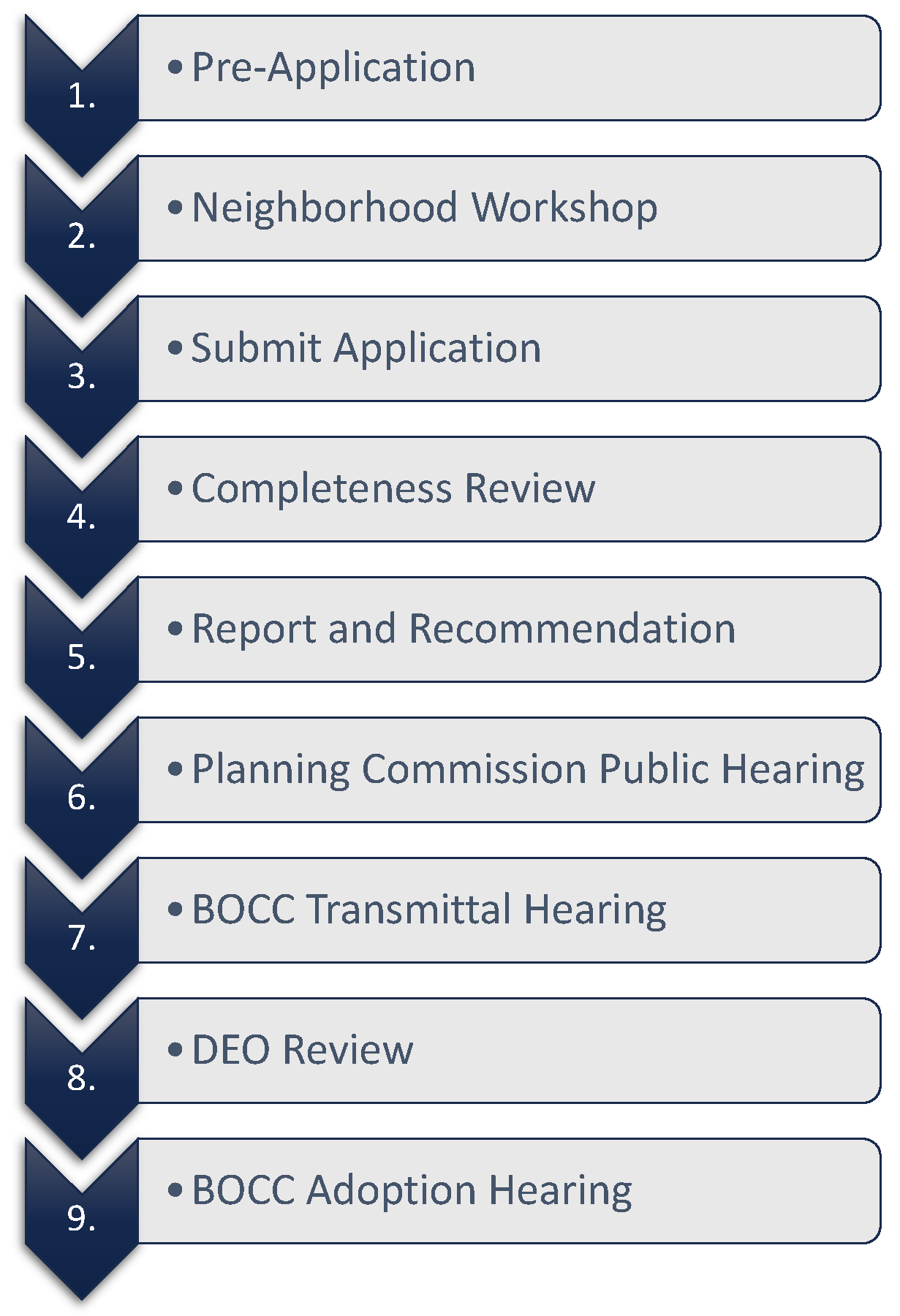
Prior to the submittal of an application for a Comprehensive Plan amendment, an applicant other than the County shall request and participate in a pre-application conference with the Department.
(Ord. No. 05-10, § 2, 12-8-05; Ord. No. 2020-25, § 2(Exh. A), 11-10-20)
Sec. 402.24. - Neighborhood workshop.
An applicant shall hold a neighborhood workshop prior to submittal of an application for an amendment to the future land use map, in accordance with Article V, Neighborhood Workshops, of this Chapter.
(Ord. No. 05-10, § 2, 12-8-05; Ord. No. 2020-25, § 2(Exh. A), 11-10-20)
Sec. 402.25. - Public notice requirements.
As indicated in Table 402.12.1 mailed, published and posted notice shall be required before the first public hearing on any application for a Comprehensive Plan amendment affecting a particular mapped area. Applications for an amendment to the text of the Comprehensive Plan require published notice only. All notice shall be prepared according to the procedures in Article IV, Notice of Hearings, of this Chapter.
(Ord. No. 05-10, § 2, 12-8-05; Ord. No. 2020-25, § 2(Exh. A), 11-10-20)
Sec. 402.26. - Submittal of applications.
Applications for all Comprehensive Plan amendments shall be submitted in accordance with Article II, Common Development Application Elements, of this Chapter and the submittal schedule established by the Department.
(Ord. No. 05-10, § 2, 12-8-05; Ord. No. 12-09, § 2(Exh. A), 10-9-12; Ord. No. 2020-25, § 2(Exh. A), 11-10-20)
Sec. 402.27. - Standards for review.
When considering an application for a Comprehensive Plan amendment, the review shall include all standards and criteria of F.S. Ch. 163.
(Ord. No. 05-10, § 2, 12-8-05; Ord. No. 2020-25, § 2(Exh. A), 11-10-20)
Secs. 402.28, 402.29. - Reserved.
Editor's note— Ord. No. 12-09, § 2(Exh. A), adopted Oct. 9, 2012, repealed former §§ 402.28, 402.29, in their entirety which respectively pertained to large-scale comprehensive plan amendment cycles and completeness of comprehensive plan amendment applications and were both derived from Ord. No. 05-10, § 2, adopted Dec. 8, 2005.
Sec. 402.30. - Review of applications.
(a)
Local Planning Agency review. The Planning Commission shall serve as the local planning agency. The Local Planning Agency (LPA) shall review and consider all applications for amendments to the Comprehensive Plan in accordance with F.S. Ch. 163.
(b)
Local Planning Agency recommendation. The LPA shall submit a recommendation, including the proposals' consistency with the Comprehensive Plan, to the BOCC regarding each application, and may recommend that an application be:
(1)
Approved;
(2)
Approved subject to modifications; or
(3)
Denied.
(c)
BOCC review.
(1)
Required public hearings for large-scale amendments. The BOCC shall hold two (2) public hearings, as provided below, to consider all large-scale Comprehensive Plan amendments.
a.
Transmittal public hearing. A public hearing shall be held prior to transmittal of all proposed Comprehensive Plan amendments to the State Land Planning Agency for review.
1.
The public hearing shall be held following receipt of recommendations from the Local Planning Agency.
2.
At the public hearing, the BOCC may:
(A)
Approve an application for transmittal;
(B)
Approve an application for transmittal subject to modification; or
(C)
Deny transmittal of an application.
b.
Adoption public hearing for large-scale amendments. A public hearing shall be held within one hundred eighty (180) days of receipt of State agency comments or the objections, recommendations and comments report on each proposed Comprehensive Plan amendment. At the public hearing, the BOCC may take action to:
1.
Approve an amendment;
2.
Approve an amendment subject to modification; or
3.
Deny an amendment.
(2)
Adoption public hearing for small-scale amendments. An adoption public hearing shall be held following receipt of recommendations from the LPA. No transmittal hearing is required for small-scale amendments. At the public hearing, the BOCC may:
a.
Approve an amendment;
b.
Approve an amendment subject to modification; or
c.
Deny an amendment.
(Ord. No. 05-10, § 2, 12-8-05; Ord. No. 12-09, § 2(Exh. A), 10-9-12; Ord. No. 2020-25, § 2(Exh. A), 11-10-20)
Sec. 402.31.- Applicability.
An application to amend the text of this ULDC shall comply with the requirements of this Article.
(Ord. No. 05-10, § 2, 12-8-05; Ord. No. 2020-25, § 2(Exh. A), 11-10-20)
Sec. 402.32. - Initiation of a text amendment.
A text amendment may be proposed by:
(a)
The BOCC;
(b)
Any department or other agency of the County; or
(c)
Any resident or landowner in the County.
(Ord. No. 05-10, § 2, 12-8-05; Ord. No. 2020-25, § 2(Exh. A), 11-10-20)
Sec. 402.33. - Application requirements.
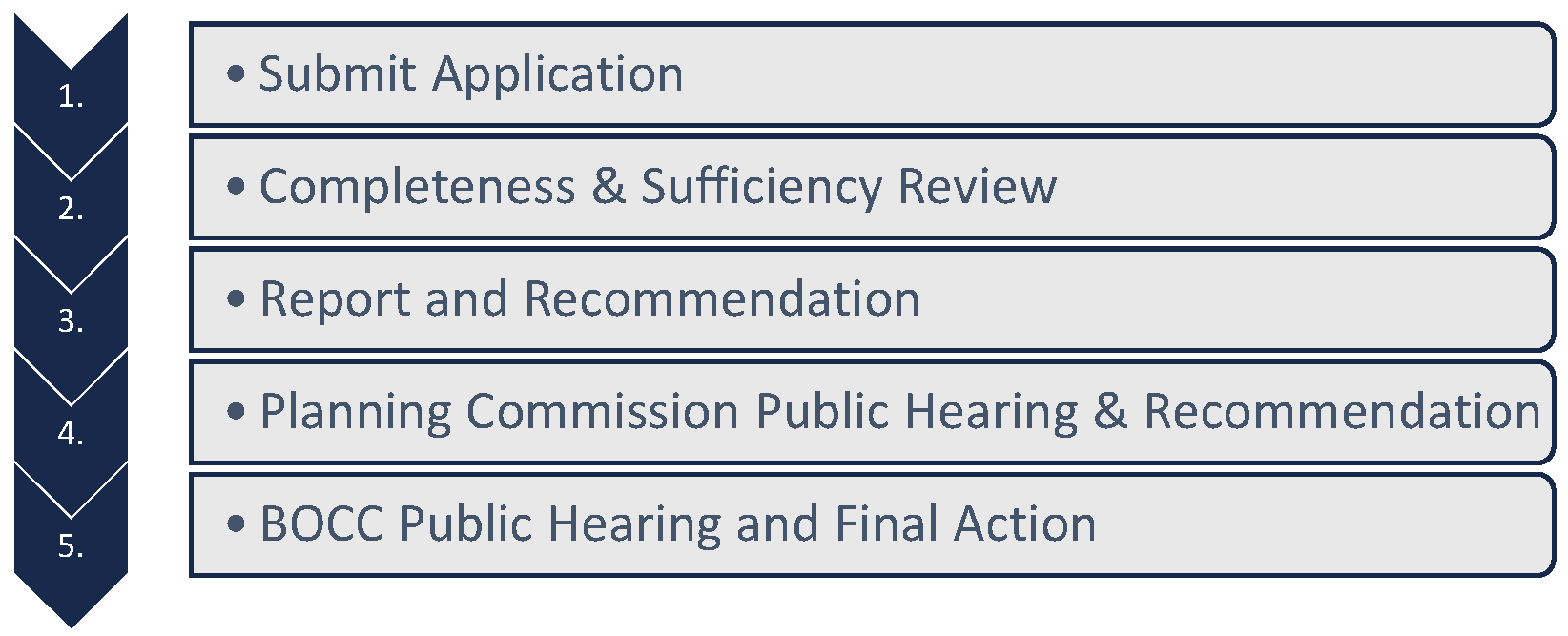
An application for a text amendment shall be submitted in accordance with Article II, Common Development Application Elements, of this Chapter.
ULDC Text Amendment
(Ord. No. 05-10, § 2, 12-8-05; Ord. No. 2020-25, § 2(Exh. A), 11-10-20)
Sec. 402.34. - Required notice.
(a)
Published notice in accordance with the procedures outlined in Article IV, Notice of Hearings, of this Chapter is required prior to a public hearing on a text amendment.
(b)
In the case of any proposed text amendment which would have the effect of changing the actual list of permitted, limited, special or prohibited uses within a zoning district, the notice of the required hearings shall conform with F.S. § 125.66(4)(b), as well as with such additional requirements as may appear in Article IV, Notice of Hearings, of this Chapter.
(Ord. No. 05-10, § 2, 12-8-05; Ord. No. 2020-25, § 2(Exh. A), 11-10-20)
Sec. 402.35. - Planning Commission recommendation.
(a)
The Planning Commission shall consider a proposed text amendment at the request of the BOCC.
(b)
The Planning Commission shall review such proposed amendment, based upon the criteria listed below:
(1)
The need and justification for the change;
(2)
The consistency of the proposed amendment with the Comprehensive Plan; and
(3)
Whether the proposed change shall further the purposes of this ULDC and other County codes, regulations, and actions designed to implement the Comprehensive Plan.
(c)
The Planning Commission shall make a finding of whether the proposed amendment is consistent with the Comprehensive Plan and a recommendation shall be prepared and forwarded to the BOCC, indicating if the proposed amendment should be:
(1)
Approved as proposed;
(2)
Approved with amendments proposed by the Planning Commission; or
(3)
Denied.
(Ord. No. 05-10, § 2, 12-8-05; Ord. No. 2020-25, § 2(Exh. A), 11-10-20)
Sec. 402.36. - Hearing(s) by Board of County Commissioners.
The decision to process a text amendment is within the sole discretion of the BOCC, according to the following procedures.
(a)
For any text amendment. For any proposed text amendment, the BOCC, sitting as the LDRC (Land Development Regulation Commission), shall hold a minimum of one (1) public hearing before taking action on the amendment.
(b)
For text amendment affecting list of uses. For any text amendment which would have the effect of changing the actual list of permitted, limited, special or prohibited uses within a zoning district, the BOCC shall hold a minimum of two (2) hearings, conforming with the requirements of F.S. § 125.66(4)(b).
(Ord. No. 05-10, § 2, 12-8-05; Ord. No. 2020-25, § 2(Exh. A), 11-10-20)
Sec. 402.37. - Action by Board of County Commissioners.
Following the public hearings, the BOCC shall make a finding of whether the proposed text amendment is consistent with the Comprehensive Plan and may approve, approve with changes or deny the proposed amendment.
(Ord. No. 05-10, § 2, 12-8-05; Ord. No. 2020-25, § 2(Exh. A), 11-10-20)
Sec. 402.38.- Applicability.
The County has authority to enter development agreements pursuant to F.S. §§ 163.3220 through 163.3243, as well as other agreements concerning development.
(Ord. No. 05-10, § 2, 12-8-05; Ord. No. 2020-25, § 2(Exh. A), 11-10-20)
Sec. 402.39.- Applicability.
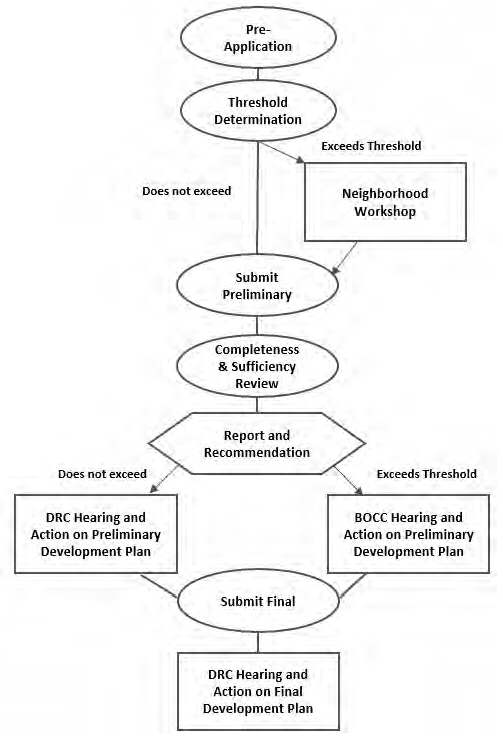
This Article shall apply to all development, development activity or other use requiring development plan review within the unincorporated area of Alachua County. No development shall be undertaken without prior approval and issuance of a final development order, and any other required permits.
(Ord. No. 05-10, § 2, 12-8-05; Ord. No. 06-14, § 2(Exh. A), 7-20-06; Ord. No. 09-01, § 2(Exh. A), 2-24-09; Ord. No. 09-05, § 2(Exh. A), 9-9-09; Ord. No. 2020-25, § 2(Exh. A), 11-10-20; Ord. No. 2024-04, § 2(Exh. A), 2-27-24)
Sec. 402.40. - Pre-application conference.
Prior to the submittal of an application for preliminary development plan approval, an applicant is required to attend a pre-application conference with the development review departments. Staff must provide the applicant with information about the potential ULDC and Comprehensive Plan requirements as well as elements required for the preliminary development plan application. Staff may also provide initial comments about the proposal and recommend specific items that must be addressed prior to submittal of the application, such as staff site visits, neighborhood workshops, etc. Specific requirements for the pre-application conference will be determined by the Director of Growth Management.
(Ord. No. 05-10, § 2, 12-8-05; Ord. No. 09-01, § 2(Exh. A), 2-24-09; Ord. No. 2020-25, § 2(Exh. A), 11-10-20; Ord. No. 2024-04, § 2(Exh. A), 2-27-24)
Sec. 402.41. - Neighborhood workshop.
Prior to the submittal of a preliminary development plan application that is required to be considered by the BOCC, an applicant shall hold an advertised neighborhood workshop in accordance with Article V, Neighborhood Workshops, of this Chapter. A neighborhood workshop held as a requirement of a land use or zoning application may satisfy this requirement if, as determined by the Director, sufficient detail was presented at that time. Materials documenting the neighborhood workshop shall be submitted with an application for preliminary development plan.
(Ord. No. 05-10, § 2, 12-8-05; Ord. No. 09-01, § 2(Exh. A), 2-24-09; Ord. No. 2020-25, § 2(Exh. A), 11-10-20)
Sec. 402.42. - Public notice required.
Posted notice in accordance with the procedures in Article IV, Notice of Hearings, of this Chapter is required for all development plans to be heard by the DRC. Mailed and posted notice, in accordance with the procedures in Article IV, Notice of Hearings, of this Chapter, is required for all development plans required to be considered by the BOCC.
(Ord. No. 05-10, § 2, 12-8-05; Ord. No. 2020-25, § 2(Exh. A), 11-10-20)
Sec. 402.43. - Development plan review steps.
(a)
Preliminary development plan. The purpose of this stage is for the DRC and the applicant to determine the specific characteristics of a site that will influence its design. The preliminary development plan must detail regulated natural resources that exist on site, approximate access points, and location of utilities that will serve the site. Minimum open space areas and required tree protection defined with the preliminary development plan shall be utilized in the final development plan.
(1)
The preliminary development plan shall be considered at a public hearing. When a preliminary development plan proposes development that meets or exceeds the thresholds listed in Table 402.44.1, the BOCC shall hold the public hearing. The DRC shall hold the public hearing for all other preliminary development plans. The decision from either body may be for approval, approval with conditions or denial.
(2)
No preliminary development plan will be approved unless a determination can be made that all required public facilities and/or levels of service will be adequate to support and service the area of the development, consistent with Chapter 407 Article XII. The applicant must submit sufficient information and data on the development to demonstrate the necessary public services are adequate to address the impact created by the development and to demonstrate that the proposed development is consistent with the Comprehensive Plan.
(3)
An application for preliminary development plan review must be submitted in accordance with Chapter 402, Article II, Common Development Application Elements, of this Chapter.
(b)
Final development plan. The purpose of this stage is for the developer to present the fully engineered final development plan to the DRC for review. The final development plan must be consistent with the approved preliminary development plan, other applicable provisions of this ULDC, and the Comprehensive Plan. The final development plan shall contain all items necessary to demonstrate compliance with this ULDC and Comprehensive Plan.
(1)
The final development plan shall be considered by the DRC at a public hearing. The decision may be for approval, approval with conditions or denial. Conditions of approval shall be such that no changes that affect the requirements of other portions of this ULDC are necessary to remedy a solution.
(2)
No final development plan shall be approved unless a determination can be made that all required public facilities and/or levels of service will be adequate to support and service the area of the development. This determination shall be made consistent with Chapter 407, Article XII.
(3)
An application for final development plan review shall be submitted in accordance with Chapter 402, Article II, Common Development Application Elements, of this Chapter.
(Ord. No. 05-10, § 2, 12-8-05; Ord. No. 06-14, § 2(Exh. A), 7-20-06; Ord. No. 09-01, § 2(Exh. A), 2-24-09; Ord. No. 2020-09, § 2(Exh. A), 3-10-20; Ord. No. 2020-25, § 2(Exh. A), 11-10-20; Ord. No. 2024-04, § 2(Exh. A), 2-27-24)
Sec. 402.44. - Thresholds for development review.
Any proposed development that meets or exceeds the thresholds established in Table 402.44.1 below, including expansions of existing development that cumulatively cause the threshold to be met or exceeded, shall require preliminary development plan consideration and action by the BOCC. Projects classified as redevelopment under Chapter 407 Article XV may exclude from the threshold calculation any existing square footage. Any preliminary development plans submitted for review concurrently with a zoning application for a planned development, special use permit, or special exception may request BOCC consideration and action, regardless of whether they are above the thresholds in Table 402.44.1.
GFA = gross floor area
(Ord. No. 05-10, § 2, 12-8-05; Ord. No. 09-01, § 2(Exh. A), 2-24-09; Ord. No. 09-05, § 2(Exh. A), 9-9-09; Ord. No. 12-09, § 2(Exh. A), 10-9-12; Ord. No. 2017-17, § 2(Exh. A), 10-10-17; Ord. No. 2019-21, § II(Exh. A), 10-8-19; Ord. No. 2020-25, § 2(Exh. A), 11-10-20; Ord. No. 2024-04, § 2(Exh. A), 2-27-24)
Sec. 402.45. - Reserved.
Editor's note— Ord. No. 06-14, § 2(Exh. A), adopted July 20, 2006 repealed former section 402.45 in its entirety which derived from Ord. No. 05-10, § 2, adopted Dec. 8, 2005.
Sec. 402.46. - Development plans to be platted.
Plat requirements are detailed in Article XII, Platting, of this Chapter. The proposed plat may be submitted with the final development plan or after the final development plan has been approved.
(Ord. No. 05-10, § 2, 12-8-05; Ord. No. 2020-25, § 2(Exh. A), 11-10-20)
Sec. 402.47. - Time limitation for expiration of development plans.
In accordance with Article VI of this Chapter, Development Plans shall expire. Expirations shall be governed by the following provisions.
(a)
Preliminary development plan.
(1)
An approved preliminary development plan shall expire unless an application for final development plan approval has been accepted by the department within twelve (12) months of the date of preliminary development plan approval.
(2)
The reviewing body shall have the authority to approve a preliminary development plan for a planned development (PD), a traditional neighborhood development (TND), transit oriented development (TOD), or an affordable housing development consistent with the time frames established in the phasing schedule of the approved PD, TND, TOD, or affordable housing project.
(b)
Final development plan. An approved final development plan shall expire unless a complete application for a construction, building or other required permit has been accepted by the appropriate reviewing department within twelve (12) months of the date of final approval and that such development is continuing in good faith.
(c)
Extension of expiration of development order.
(1)
One (1) extension, of up to one (1) year, may be granted administratively contingent upon a finding by the Director of Growth Management that the approved final development plan or plat is consistent with all elements of the Comprehensive Plan and all of this ULDC in effect at the time of the application for the extension. Any such extension will be issued only if no imminent or existing public facility deficiencies exist at the time of the application for extension. A request for administrative extension of expiration shall be submitted in writing to the Department no less than sixty (60) days prior to the expiration of the final development plan or plat.
(2)
All other extensions of expiration of development plans shall be governed as set forth in Article VI of this Chapter.
(Ord. No. 05-10, § 2, 12-8-05; Ord. No. 08-06, § 2(Exh. A), 4-22-08; Ord. No. 09-01, § 2(Exh. A), 2-24-09; Ord. No. 09-07, § 1, 10-13-09; Ord. No. 10-17, § 1, 8-17-10; Ord. No. 12-09, § 2(Exh. A), 10-9-12; Ord. No. 2020-25, § 2(Exh. A), 11-10-20; Ord. No. 2024-04, § 2(Exh. A), 2-27-24)
Editor's note— Ord. No. 09-01, § 2(Exh. A), adopted Feb. 24, 2009, repealed former § 402.47.5, which pertained to an extension of approved development plans and derived from Ord. No. 08-06, § 2(Exh. A), adopted April 22, 2008.
Sec. 402.48. - Activities requiring administrative development plan approval.
Certain development permits or activities shall not require a development plan approval by the DRC or BOCC. Applicants for these permits or activities may apply to the specific department(s) having authority to grant an administrative development approval. Application types requiring only an administrative approval are listed in Subsections 401.20(b), (c), [and] (d).
(Ord. No. 05-10, § 2, 12-8-05; Ord. No. 09-01, § 2(Exh. A), 2-24-09; Ord. No. 2020-25, § 2(Exh. A), 11-10-20)
Sec. 402.49.- Director authorized to interpret code.
Unless otherwise provided herein, the Director of Growth Management is authorized to interpret all provisions of this ULDC.
(Ord. No. 05-10, § 2, 12-8-05; Ord. No. 2020-25, § 2(Exh. A), 11-10-20)
Sec. 402.50. - Formal request for interpretation.
The Director shall render interpretations of this ULDC pursuant to this Article. Unless waived by the Director, all formal requests for an interpretation shall be submitted in writing to the Director.
(Ord. No. 05-10, § 2, 12-8-05; Ord. No. 2020-25, § 2(Exh. A), 11-10-20)
Sec. 402.51. - Form of response.
(a)
Written response. The interpretation shall be provided in writing to the applicant.
(b)
Notice to property owner. If the individual requesting an interpretation is not the property owner, the interpretation shall also be mailed to the property owner within seven (7) working days after the Director issues the written response.
(Ord. No. 05-10, § 2, 12-8-05; Ord. No. 2020-25, § 2(Exh. A), 11-10-20)
Sec. 402.52. - Official record.
The Department shall maintain an official record of all formal interpretations.
(Ord. No. 05-10, § 2, 12-8-05; Ord. No. 12-09, § 2(Exh. A), 10-9-12; Ord. No. 2020-25, § 2(Exh. A), 11-10-20)
Sec. 402.53.- Applicability and general provisions.
(a)
Applicability. Platting and subdivision of land, including final plats, re-plats, plat vacation, plat abandonment, plat revocation and plat modification or suspension, shall comply with the requirements of this Article and Section 20, Chapter 85-55, Laws of Florida, regarding vacation of plats. All proposed plats shall comply with F.S. Ch. 177, and any other applicable statutes and Chapter 407, Article VIII, Subdivision Regulations, regarding the platting of land. For the purposes of this Article, the term plat or platting shall include subdivision of land, re-platting of land, and vacation or abandonment of all or a portion of an approved plat. Alachua County, as a Charter County of the State of Florida, utilizes the provisions in F.S. Ch. 177.071(5) providing that an ordinance adopted by the County shall prevail when in conflict with the remainder of the F.S. Ch. 177.01.
(b)
Consistency with Comprehensive Plan. All proposed plats shall be consistent with the Comprehensive Plan and shall comply with all applicable standards and requirements of this ULDC.
(c)
Consistency with development approval.
(1)
Compliance with development approvals. Plats shall comply with all development approvals, including any conditions, restrictions or other limitations included in such approval, that are granted by the BOCC, the DRC, or any other board, body, officer or County employee possessing authority to approve a development application.
(2)
Preliminary plat approval required. No development order, development permit, building permit, tree clearing permit or construction permit or other similar permit may be issued until a preliminary plat has been approved by the DRC.
(3)
Final plat approval required. No certificate of occupancy may be issued for any structure in a development where a preliminary plat has been approved until a final plat is approved by the Board of County Commissioners and it is recorded in the Public Records of Alachua County.
(Ord. No. 05-10, § 2, 12-8-05; 06-14, § 2(Exh. A), 7-20-06; Ord. No. 12-09, § 2(Exh. A), 10-9-12; Ord. No. 2018-23, § 2(Exh. A), 10-9-18; Ord. No. 2020-25, § 2(Exh. A), 11-10-20; Ord. No. 2024-07, § 2(Exh. A), 9-10-24; Ord. No. 2025-13, § 2(Exh. A), 6-24-25)
Sec. 402.54. - Application requirements.
An application for a plat approval shall be submitted in accordance with Article II, Common Development Application Elements, of this Chapter.
(Ord. No. 05-10, § 2, 12-8-05; Ord. No. 2020-25, § 2(Exh. A), 11-10-20)
Sec. 402.55. - Public notice requirements.
Published notice in accordance with Section 402.15 and posted notice in accordance with Section 402.16 shall be required before the public hearing on any application for plat approval.
(Ord. No. 05-10, § 2, 12-8-05; Ord. No. 2020-25, § 2(Exh. A), 11-10-20)
Sec. 402.56. - Platting required.
(a)
Platting is required for development of detached and attached single-family lots. Individual platted lots may not be divided further except as follows:
(1)
Where such divisions are expressly provided for on an approved plat; or
(2)
Upon approval of a plat vacation by the BOCC or where a re-plat is approved per Subsection (b) below for all or a portion of an existing plat and subject to approval of a new development plan and/or plat for the vacated area.
(b)
Re-plats. A re-plat is required for the modification or reconfiguration of previously recorded platted lots, buffers and easements, except as provided in Subsection 407.73(f)(3).
(c)
A re-plat is not required to combine or reconfigure two (2) or more platted lots, subject to the requirements of 407.73(g) and the following requirements:
(1)
The revised exterior property lines shall be used in determining the setbacks rather than the original platted lot lines.
(2)
Any easements or buffers on the approved plat must be avoided unless a re-plat is approved.
(3)
The highest finished floor elevation of the original lots shall be maintained, if applicable.
(Ord. No. 05-10, § 2, 12-8-05; Ord. No. 2020-25, § 2(Exh. A), 11-10-20; Ord. No. 2025-06, § 2(Exh. A), 3-25-25)
Sec. 402.56.5 - Changes to the setbacks of platted lots.
The owner of a lot in an existing platted subdivision may amend the setback shown on the original plat to the zoning district setbacks in Chapter 403 through an administrative process permitted by Section 401.20 of this ULDC subject to the following:
(a)
The amended setback shall not be less than the zoning setback standards outlined in Chapter 403, unless a variance is approved by the DRC as provided in Chapter 402, Article XXVI.
(b)
The change shall not affect existing natural resources setbacks.
(c)
Any easements or buffers on the original plat must be avoided unless a re-plat is approved by the BOCC.
(d)
The change shall be documented by the recording of the affidavit, signed and stamped by the department, in the Office of the Clerk of the Court in such a manner that it appears in the chain of title of the affected parcel of land. The affidavit shall be in a form established by the department.
(e)
The affidavit is required to be recorded with the Clerk of the Court within one (1) year of approval or prior to permitting any new structures to be effective. Recording of an affidavit without prior approval from the department will not be recognized as the legal setback for the lot.
(Ord. No. 2025-06, § 2(Exh. A), 3-25-25)
Sec. 402.57. - Platting optional.
Platting is optional for new multi-family and nonresidential developments. Multi-family and nonresidential developments previously recorded as platted lots shall be required to be re-platted when such lots are reconfigured.
(Ord. No. 05-10, § 2, 12-8-05; Ord. No. 2020-25, § 2(Exh. A), 11-10-20)
Sec. 402.58. - Preliminary plat action by Development Review Committee.
Once the DRC determines a proposed preliminary plat to be complete, they shall approve, approve with changes, or deny the proposed the preliminary plat, including revisions and recommend approval of the final plat to the BOCC.
(Ord. No. 05-10, § 2, 12-8-05; Ord. No. 2016-10, § 2(Exh. A), 6-28-16; Ord. No. 2020-25, § 2(Exh. A), 11-10-20; Ord. No. 2024-07, § 2(Exh. A), 9-10-24)
Sec. 402.59. - Final plat action by Board of County Commissioners.
The BOCC has the authority to approve, approve with changes, or deny the proposed final plat that is consistent with the preliminary plat approved by the DRC. The BOCC shall not make changes to the preliminary plat where an applicant has relied in good faith on the preliminary plat and has incurred obligations and expenses, commenced construction and is continuing in good faith with the development of the property.
(Ord. No. 05-10, § 2, 12-8-05; Ord. No. 2016-10, § 2(Exh. A), 6-28-16; Ord. No. 2020-25, § 2(Exh. A), 11-10-20; Ord. No. 2024-07, § 2(Exh. A), 9-10-24)
Sec. 402.60. - Filing of a final plat approved by the Board of County Commissioners.
(a) Once the final plat has been approved by the BOCC the plat document must be submitted for signature, along with all necessary supporting documentation including surety for one hundred ten (110) percent of the contract amount, itemized construction contract for the paving, grading and drainage, off-site easements and rights-of-way, supporting survey documentation, E-911 addresses assigned by Alachua County Enhanced E-911 Office and a title opinion dated within thirty (30) days of the date of submittal to obtain the signature of County officials.
(b) The developer shall file the final plat, bearing the signatures of all applicable County representatives, for recording with the Clerk of the Circuit Court of Alachua County no later than two (2) years from the date of final plat approval by the BOCC. If a plat is not recorded by the developer within the specified time frame, such plat approval shall be deemed expired, and the final plat must be resubmitted for final plat approval by the BOCC. The developer shall be responsible for all recording costs.
(Ord. No. 05-10, § 2, 12-8-05; Ord. No. 06-14, § 2(Exh. A), 7-20-06; Ord. No. 09-05, § 2(Exh. A), 9-9-09; Ord. No. 2018-23, § 2(Exh. A), 10-9-18; Ord. No. 2020-25, § 2(Exh. A), 11-10-20; Ord. No. 2024-07, § 2(Exh. A), 9-10-24)
Sec. 402.61. - Preliminary plat expiration.
Approval of a preliminary plat shall expire two (2) years from the date of approval of the DRC unless the applicant has received a construction permit, has commenced construction and is continuing in good faith with the development.
(Ord. No. 05-10, § 2, 12-8-05; Ord. No. 2020-25, § 2(Exh. A), 11-10-20; Ord. No. 2024-07, § 2(Exh. A), 9-10-24)
Sec. 402.62. - Appeal.
A decision on a plat may be appealed in accordance with this ULDC, regardless of whether improvements have been installed or the plat recorded. The time limit for filing an appeal shall run from the date of approval of the plat and not be affected by the recording date or other subsequent actions.
(Ord. No. 05-10, § 2, 12-8-05; Ord. No. 12-09, § 2(Exh. A), 10-9-12; Ord. No. 2020-25, § 2(Exh. A), 11-10-20)
Sec. 402.63. - Plat vacations.
Any application to vacate all or part of a plat shall comply with the requirements of this Section.
(a)
Application requirements. An application for a plat vacation shall be submitted in accordance with Article II, Common Development Application Elements, of this Chapter. An applicant must also provide the information listed below:
(1)
Proof of fee simple title to the whole or that part of the tract covered by the plat sought to be vacated.
(2)
A certificate, acceptable to the Director, showing that all State and County taxes have been paid.
(3)
If a portion of a platted subdivision lies within the corporate limits of any incorporated municipality within Alachua County, the applicant shall furnish a certified copy of the resolution previously approved by the municipal governing body that indicates the approval of the proposed plat vacation, or part thereof.
(b)
Review.
(1)
An application shall be reviewed by the County staff.
(2)
Once County staff determines an application for plat vacation to be complete, it shall prepare a recommendation for action by the BOCC.
(Ord. No. 05-10, § 2, 12-8-05; Ord. No. 2020-25, § 2(Exh. A), 11-10-20)
Sec. 402.64. - Action by Board of County Commissioners.
(a)
Approval of vacation of plat. If the BOCC determines at a public hearing that vacating the plat will not affect the ownership or right of convenient access of persons owning other parts of the subdivision or adjacent properties and other standards of this ULDC, it may adopt the appropriate resolution vacating all or a portion of the plat.
(b)
Exception for state roads. Any plat vacation approved by the BOCC shall not apply to any state roads lying within said plat.
(Ord. No. 05-10, § 2, 12-8-05; Ord. No. 2020-25, § 2(Exh. A), 11-10-20)
Sec. 402.65. - County-initiated plat vacations.
(a)
Vacation of an existing plat. The BOCC may initiate a proceeding to order the vacation and reversion to acreage of all or part of a subdivision within its jurisdiction if capital improvements have not been properly installed, including the vacation of streets or other parcels of land dedicated for public purposes.
(b)
Revocation, modification or suspension of an existing plat.
(1)
Plat revocation, modification or suspension. The BOCC may initiate a proceeding to order a revocation, modification, or suspension of an existing plat, when:
a.
The plat was legally recorded not less than twenty (20) years before the date of such action; and
b.
Not more than ten (10) percent of the total subdivision area to be vacated has been sold as lots.
(2)
Basis for revocation, modification or suspension. The BOCC action shall be based upon findings that vacation and reversion to acreage will:
a.
Conform to and be consistent with the Comprehensive Plan; and
b.
Promote the public health, safety, and welfare.
(c)
Action to vacate, revoke, modify or suspend a plat.
(1)
Board of County Commissioners approval required. Any action to vacate, revoke, modify or suspend an approved plat is subject to approval by the BOCC at a public hearing for which public notice has been provided.
(2)
Public notice. Mailed and published public notice of proposed action to vacate, revoke, modify or suspend an approved plat shall comply with the requirements of Article IV, Notice of Hearings, of this chapter.
(3)
Adoption of resolution required. In the event a vacation, revocation, modification or suspension is ordered, a resolution shall be adopted, setting forth the BOCC's findings and action.
(4)
Publishing of resolution. The adopted resolution shall be published one (1) time in a newspaper of general circulation, or on a publicly accessible website designated by the county for the publication of legal notices and advertisements that is accessible to the public via the Internet, pursuant to F.S. ch. 50, within 30 days following the adoption.
(5)
Execution of deed.
a.
The chair of the BOCC is hereby authorized to execute a deed, approved by the county attorney, deeding the vacated plat, or part thereof, to the appropriate parties.
b.
The adopted resolution and county deed shall be recorded in the public records along with proof of publication of the notice of public hearing, and the proof of publication of the adopted resolution, and a transfer of interest form.
c.
The county will pay for the documentary stamps and any other costs associated with the recording.
(Ord. No. 05-10, § 2, 12-8-05; Ord. No. 2020-25, § 2(Exh. A), 11-10-20; Ord. No. 2023-14, § 7, 9-24-23)
Sec. 402.66. - Reserved.
Editor's note— Ord. No. 13-14, § 2(Exh. A), adopted Aug. 27, 2013, repealed former § 402.66 in its entirety which pertained to appeal of decisions to vacate, revoke, modify or suspend existing plats and derived from Ord. No. 05-10, § 2, adopted Dec. 8, 2005.
Sec. 402.67. - Prohibited action.
Action by the BOCC to vacate, revoke, modify or suspend an existing plat shall not have the result of depriving an owner of any parcel of land in the subdivision or adjacent property owner of reasonable access to such parcel nor of reasonable access to existing facilities to which such parcel has theretofore had access.
(Ord. No. 05-10, § 2, 12-8-05; Ord. No. 2020-25, § 2(Exh. A), 11-10-20)
Sec. 402.68. - Effect of vacating plat and recording of resolution.
Every resolution of the BOCC vacating a plat shall have the effect of vacating all streets and alleys within the portion of the plat vacated that have not become highways necessary for use by the traveling public. Such vacation shall not become effective until a certified copy of the adopted resolution has been recorded in the public records.
(Ord. No. 05-10, § 2, 12-8-05; Ord. No. 2020-25, § 2(Exh. A), 11-10-20)
Sec. 402.69.- Applicability.
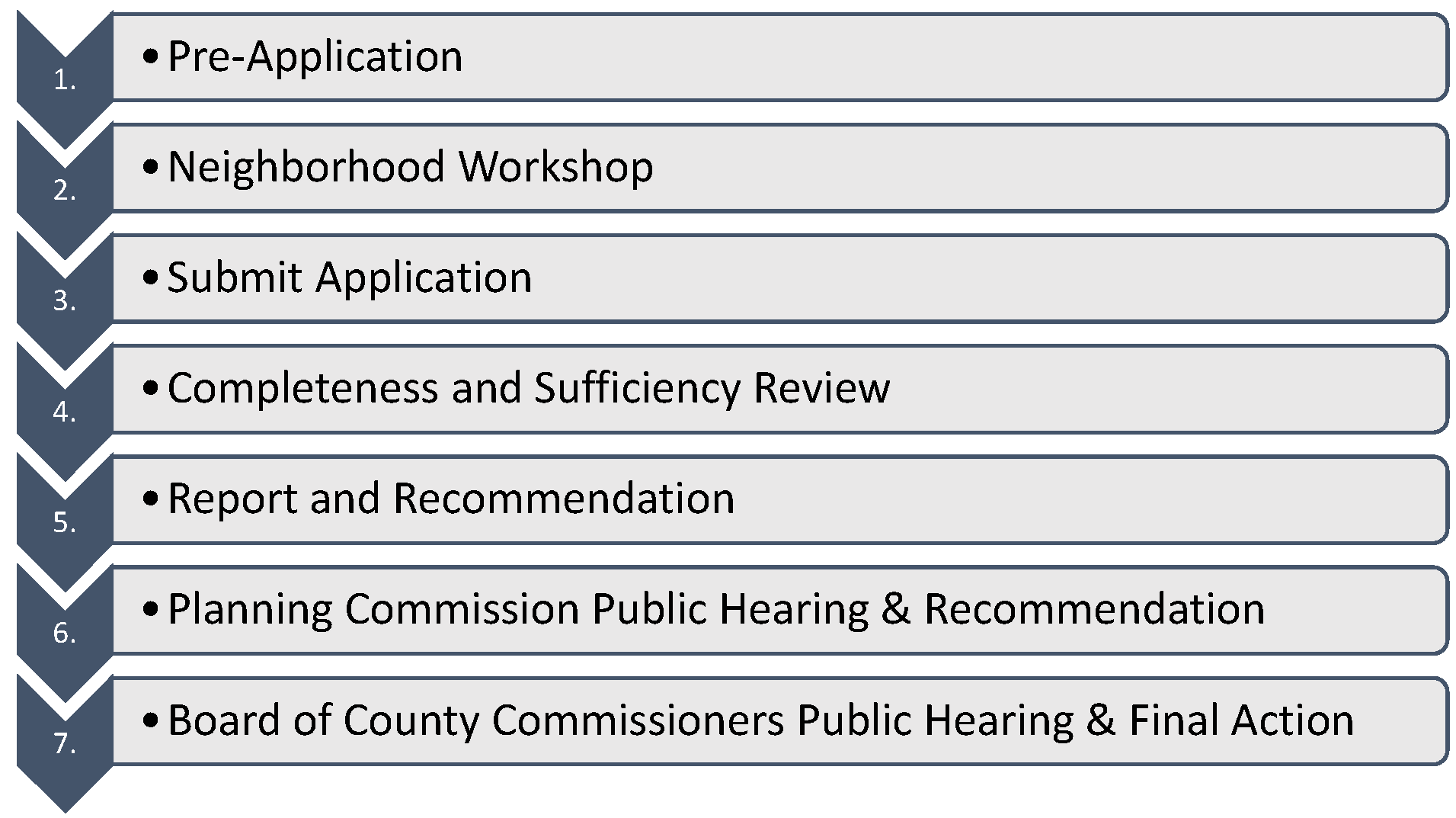
The provisions of this Article shall apply to all amendments to the Official Zoning Map of Alachua County. Additional requirements for rezoning to a planned development district are found in Article XIV of this Chapter.
Rezoning
(Ord. No. 05-10, § 2, 12-8-05; Ord. No. 2020-25, § 2(Exh. A), 11-10-20)
Sec. 402.70. - Initiation of rezoning.
An application for rezoning may be initiated by either of the following:
(a)
The BOCC; or
(b)
Any other person or agent with authority to file an application, as provided in Section 402.06, Authority to file applications.
(Ord. No. 05-10, § 2, 12-8-05; Ord. No. 2020-25, § 2(Exh. A), 11-10-20)
Sec. 402.71. - Pre-application conference.
Prior to the submittal of an application for a rezoning, the applicant shall request and participate in a pre-application conference with the Department.
(Ord. No. 05-10, § 2, 12-8-05; Ord. No. 2020-25, § 2(Exh. A), 11-10-20)
Sec. 402.72. - Neighborhood workshop.
A neighborhood workshop shall be held in accordance with Article V, Neighborhood Workshops, of this Chapter. All required neighborhood workshops shall be held prior to the submittal of a rezoning application. The following types of rezoning applications are required to hold a neighborhood workshop:
(a)
All rezoning applications to the planned development zoning district;
(b)
All rezoning applications to non-residential zoning districts;
(c)
All rezoning applications to residential zoning districts that result in an increase of more than two (2) potential dwelling units on the property.
(Ord. No. 05-10, § 2, 12-8-05;; Ord. No. 06-14, § 2(Exh. A), 7-20-06; Ord. No. 2020-25, § 2(Exh. A), 11-10-20)
Sec. 402.73. - Required public notice.
Mailed notice, published notice and posted notice shall be required before the first public hearing on any application for rezoning in accordance with the procedures in Article IV, Notice of Hearings, of this Chapter.
(Ord. No. 05-10, § 2, 12-8-05; Ord. No. 2020-25, § 2(Exh. A), 11-10-20)
Sec. 402.74. - Application requirements.
An application for a rezoning shall be submitted in accordance with Article II, Common Development Application Elements, of this Chapter.
(Ord. No. 05-10, § 2, 12-8-05; Ord. No. 2020-25, § 2(Exh. A), 11-10-20)
Sec. 402.75. - Review by the Planning Commission.
(a)
Consideration by Planning Commission. All rezoning applications shall be considered by the Planning Commission at a public hearing, prior to public hearing or action by the BOCC.
(b)
Standards and criteria. The Planning Commission shall review and make a recommendation on the proposed rezoning based on the standards in Section 402.77.
(c)
Planning Commission recommendation. A recommendation shall be prepared and forwarded to the BOCC. The recommendation shall indicate if the proposed rezoning should be:
(1)
Approved;
(2)
Approved with conditions, where conditions may be attached to the proposed rezoning;
(3)
Approved a rezoning to a zoning district other than the district requested by the applicant, that is consistent with the land use designation; or
(4)
Denied.
(Ord. No. 05-10, § 2, 12-8-05; Ord. No. 2020-25, § 2(Exh. A), 11-10-20)
Sec. 402.76. - Action by the Board of County Commissioners.
(a)
Public hearing. The BOCC shall hold a minimum of one (1) public hearing, conforming with the requirements of F.S. § 125.66(4)(b), to consider the proposed rezoning after receiving a recommendation from the Planning Commission.
(b)
Action by Board of County Commissioners. Following the public hearing, the BOCC may take one of the following actions:
(1)
Approve;
(2)
Approve with conditions, where conditions may be attached to the proposed rezoning;
(3)
Approve to rezone to a zoning district other than the district requested by the applicant, that is consistent with the land use designation; or
(4)
Deny.
(Ord. No. 05-10, § 2, 12-8-05; Ord. No. 10-16, § 2(Exh. A), 8-10-10; Ord. No. 2020-25, § 2(Exh. A), 11-10-20)
Sec. 402.77. - Review criteria and standards for rezoning applications.
When considering any application for rezoning, the standards and criteria listed below shall apply.
(a)
Consistency. The proposed rezoning is consistent with the Comprehensive Plan and this ULDC.
(b)
Compatibility. The proposed rezoning is compatible with the present zoning pattern and conforming uses of nearby property and the character of the surrounding area.
(c)
Development patterns. The proposed rezoning shall result in logical and orderly development patterns.
(d)
Suitability. The affected property is suitable for the uses that are permitted by the proposed zoning districts.
(e)
Adequate public services. The proposed rezoning is consistent with the adequate public facilities requirements of Article XII, Chapter 407 of this ULDC.
(f)
Access. Available ingress and egress is adequate for potential uses in the proposed zoning district.
(g)
Public health, safety, and welfare. The uses allowed within the proposed zoning district shall not adversely affect health, safety, and welfare.
(Ord. No. 05-10, § 2, 12-8-05; Ord. No. 2020-25, § 2(Exh. A), 11-10-20)
Sec. 402.78. - Limitations on rezoning applications.
If the BOCC denies an application for the rezoning of property, the applicant shall not resubmit an application to rezone any part or all of the same property to the same or any more intensive category for a period of twelve (12) months from the date the initial application for rezoning is denied.
(Ord. No. 05-10, § 2, 12-8-05; Ord. No. 2020-25, § 2(Exh. A), 11-10-20)
Sec. 402.79. - Conditions for approval.
The BOCC may, when considering development applications that include a request for rezoning to a planned development district, a special use permit, special exception or similar types of applications, include conditions or limitations as part of the development approval.
(Ord. No. 05-10, § 2, 12-8-05; Ord. No. 2020-25, § 2(Exh. A), 11-10-20)
Sec. 402.80.- Processing.
Applications for a rezoning for a planned development district (PD) shall be processed in accordance with Article XIII, Rezoning, of this Chapter. An application for a planned development district rezoning may be submitted concurrently with an application for a preliminary development plan.
(Ord. No. 05-10, § 2, 12-8-05; Ord. No. 09-01, § 2(Exh. A), 2-24-09; Ord. No. 09-05, § 2(Exh. A), 9-9-09; Ord. No. 2020-25, § 2(Exh. A), 11-10-20)
Sec. 402.81. - Pre-application conference.
Prior to the submittal of an application for a rezoning for a planned development district, the applicant shall request and participate in a pre-application conference with the department.
(Ord. No. 05-10, § 2, 12-8-05; Ord. No. 2020-25, § 2(Exh. A), 11-10-20)
Sec. 402.82. - Neighborhood workshop.
An applicant shall hold a neighborhood workshop prior to submittal of an application for rezoning to a planned development district in accordance with Article V, Neighborhood Workshops, of this Chapter.
(Ord. No. 05-10, § 2, 12-8-05; Ord. No. 09-01, § 2(Exh. A), 2-24-09; Ord. No. 2020-25, § 2(Exh. A), 11-10-20)
Sec. 402.83. - Required public notice.
Prior to a public hearing on a rezoning, published, posted and mailed notice is required in accordance with the procedures in Article IV, Notice of Hearings, of this Chapter.
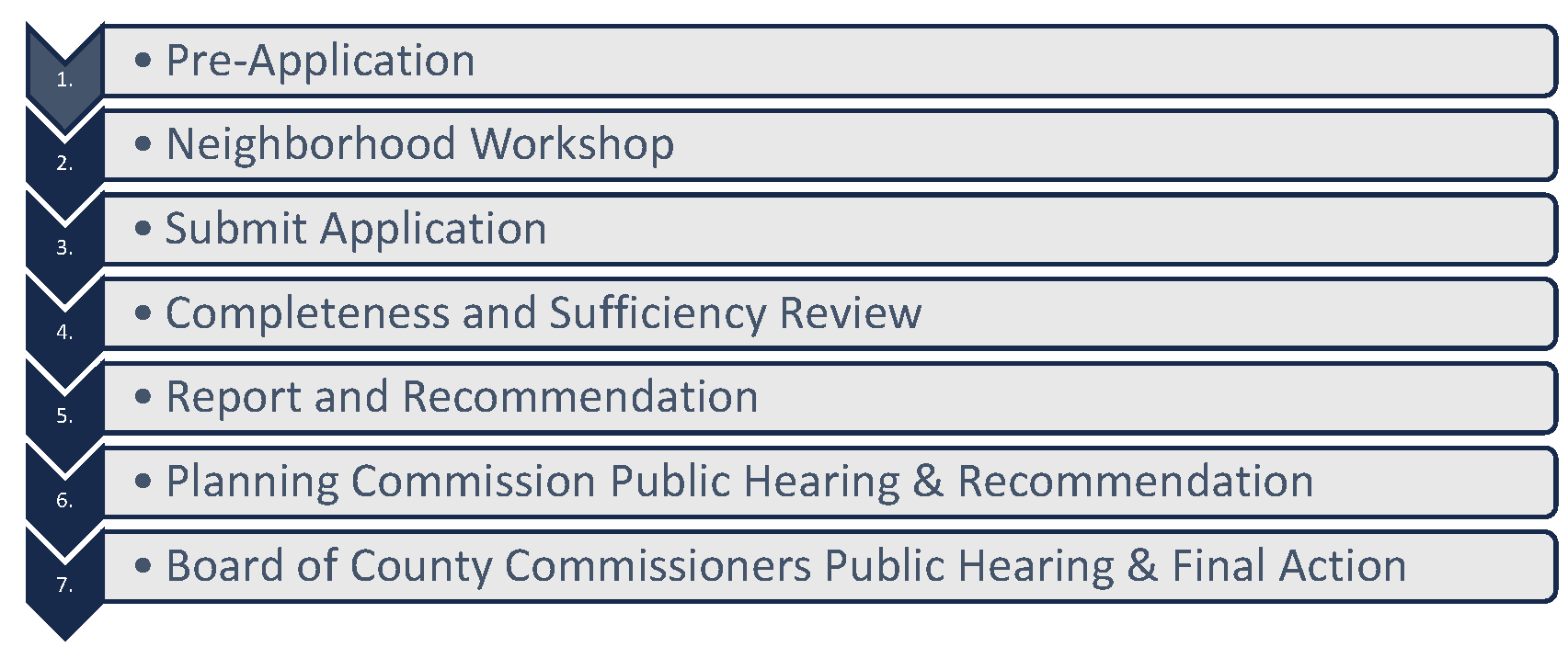
(Ord. No. 05-10, § 2, 12-8-05; Ord. No. 2020-25, § 2(Exh. A), 11-10-20)
Sec. 402.84. - Application requirements.
(a)
Basic application requirements. An application for a rezoning to planned development district rezoning shall be submitted in accordance with Article II, Common Development Application Elements, of this Chapter.
(b)
Additional application requirements. In addition, the application for a planned development shall include a proposed PD zoning master plan for the property. The required elements of a PD zoning master plan shall be established by the Director. The application shall also include materials sufficient to demonstrate compliance with Section 403.17, Planned Development (PD) District.
(Ord. No. 05-10, § 2, 12-8-05; Ord. No. 09-01, § 2(Exh. A), 2-24-09; Ord. No. 2020-25, § 2(Exh. A), 11-10-20)
Sec. 402.85. - Action upon rezoning and zoning master plan approval.
Prior to submitting a preliminary development plan for an approved PD or any phase of an approved PD, the applicant shall submit a copy of the approved zoning master plan to the department for signatures from the development review departments. The zoning master plan shall contain all changes and conditions approved by the BOCC.
(Ord. No. 05-10, § 2, 12-8-05; Ord. No. 2016-10, § 2(Exh. A), 6-28-16; Ord. No. 2020-25, § 2(Exh. A), 11-10-20)
Sec. 402.86. - Implementation of zoning master plan.
(a)
Development plan required. An approved PD zoning master plan, including individual phases of such plan, shall be implemented through the development plan process, in accordance with Article X, Development Plan Review, of this Chapter. A copy of the approved PD zoning master plan, signed by the development review departments, shall be submitted with each application for development plan approval. Any development plan approval shall be consistent with the approved PD zoning master plan.
(b)
Progress report. With each application for development plan approval, the developer of a planned development shall submit a progress report to the review body. At a minimum, the progress report shall include the following information listed below.
(1)
Updated zoning master plan. An updated zoning master plan for the entire development indicating the status of approvals, phasing schedule, undeveloped areas and within developed areas, the number, size, type and locations of all structures and improvements that have been installed or constructed.
(2)
Subsequent developers or owners. The names of any subsequent developers and owners of any increments, phases or portions of the planned development.
(3)
Failure to file or update progress report. If the required progress report is not up to date or is not filed, additional development approvals shall not be granted.
(Ord. No. 05-10, § 2, 12-8-05; Ord. No. 12-09, § 2(Exh. A), 10-9-12; Ord. No. 2020-25, § 2(Exh. A), 11-10-20)
Sec. 402.87. - Covenants, grants, and easements.
(a)
As part of the approval for any development plan, the plan shall include the substance and exact language of covenants, grants, easements or other restrictions to be imposed on the use of the land, buildings and structures pursuant to this ULDC, including proposed easements for public and private utilities.
(b)
Prior to final approval of the development plan, the language of all covenants, grants, easements or other restrictions, including any required homeowners' associations and deed restrictions, shall be approved by the County Attorney.
(Ord. No. 05-10, § 2, 12-8-05; Ord. No. 2020-25, § 2(Exh. A), 11-10-20)
Sec. 402.88. - Other restrictions.
(a)
Limit on occupancy permits. Occupancy permits exceeding fifty (50) percent of the total number of approved dwelling units shall not be issued unless and until the homeowners' association and all applicable and agreed-upon covenants or deed restrictions have become operational or are imposed to the satisfaction of the County Attorney.
(b)
Development plan approval requisite for permits. Permits shall not be issued for any phase of a planned development, nor shall any public facility or improvement be constructed therein, until a development plan and/or plat has been approved for the planned development or phase of such development.
(Ord. No. 05-10, § 2, 12-8-05; Ord. No. 2020-25, § 2(Exh. A), 11-10-20)
Sec. 402.89. - Revision of planned development district.
(a)
Minor amendment to planned development district approval. An amendment to an existing planned development shall be considered minor where it will not cause an expansion to the existing use or additional impacts to surrounding properties, natural resources, or public infrastructure. A minor amendment to an existing planned development shall not require a Planning Commission public hearing and shall only require one (1) public hearing with the BOCC.
(b)
Major amendment to planned development district approval. Except as specified herein, all changes to an approved zoning master plan not determined to be a minor amendment shall be deemed a major amendment that requires a public hearing with the Planning Commission and approval by the BOCC. Any proposed amendment that alters the character or purpose of the Planned Development District shall be deemed a major amendment.
(c)
Minor changes to planned development district approval. A proposed change that would not affect the intent and purpose of the planned development may be deemed a minor change that may be approved by the DRC as listed below:
(1)
Setbacks on single lots;
(2)
Slight shifts in building orientation;
(3)
Slight shifts in phase lines;
(4)
Reserved;
(5)
For lots located on the interior of the development, changes to lot sizes or dimensions;
(6)
Residential unit types on the interior portion of a PD may be shifted between phases provided the overall gross residential density is maintained;
(7)
Creation of active recreation in common Open Space areas, not to include a designated Conservation Management Area;
(8)
Slight changes in alignment, location, direction or length of an interior street as a result of site engineering;
(9)
An increase in the number of exterior access points or the relocation of exterior access points where it can be shown that such a change furthers the intent of the Comprehensive Plan to provide for interconnectivity between developments;
(10)
Additions of bicycle or pedestrian connections;
(11)
Time table extensions of one (1) year or less for a specific phase of development; or
(12)
Other minor changes approved by the Growth Management Director.
(Ord. No. 05-10, § 2, 12-8-05; Ord. No. 06-14, § 2(Exh. A), 7-20-06; Ord. No. 08-06, § 2(Exh. A), 4-22-08; Ord. No. 12-09, § 2(Exh. A), 10-9-12; Ord. No. 13-14, § 2(Exh. A), 8-27-13; Ord. No. 2016-10, § 2(Exh. A), 6-28-16; Ord. No. 2017-17, § 2(Exh. A), 10-10-17; Ord. No. 2017-17, § 2(Exh. A), 10-10-17; Ord. No. 2020-09, § 2(Exh. A), 3-10-20; Ord. No. 2020-25, § 2(Exh. A), 11-10-20)
Sec. 402.90. - Control of planned development districts.
(a)
Control following completion. After completion of all construction and improvements associated with a planned development district, the use of the land, including any modification or alteration of any buildings or structures within the Planned Development District shall continue to be regulated in accordance with the approved zoning master plan, except as otherwise provided herein.
(b)
Minor modifications to buildings or structures. Minor extensions, alterations or modification of existing non-residential or mixed use buildings or structures may be permitted after review and approval by the DRC provided they are substantially consistent with the purposes of the development plan, and are not deemed a major change as provided in Section 402.89.
(Ord. No. 2020-25, § 2(Exh. A), 11-10-20)
Sec. 402.91. - Previously approved planned developments.
(a)
The DRC has the authority to approve, approve with conditions or deny a proposed development plan for planned developments that were approved without a phasing schedule or time frame provided the DRC determines that the unbuilt portion of the PD or PUD is consistent with the Comprehensive Plan.
(b)
PDs or PUDs with a time frame that has expired or that were approved without a time frame and that are not consistent with the Comprehensive Plan and are not eligible for vesting, require either:
(1)
Review and approval of a revised PD by the BOCC; or
(2)
Rezoning to another zoning district.
(Ord. No. 05-10, § 2, 12-8-05; Ord. No. 2017-17, § 2(Exh. A), 10-10-17; Ord. No. 2020-25, § 2(Exh. A), 11-10-20)
Sec. 402.92.- Activity center master plan.
Where the County has determined that a master plan is the appropriate process to support redevelopment of existing activity centers, the master plan shall be developed and approved consistent with this Article. Master plans shall ensure that development within activity centers is coordinated in such a way that promotes the creation of pedestrian-friendly compact centers that are economically viable, served by adequate public facilities, connected to a multi-modal transportation system and are integrated with surrounding and internal land uses.
(Ord. No. 05-10, § 2, 12-8-05; Ord. No. 12-09, § 2(Exh. A), 10-9-12; Ord. No. 2020-25, § 2(Exh. A), 11-10-20)
Sec. 402.93. - Master plan application.
(a)
Master plan elements. An activity center master plan shall provide for a specific plan of development for each activity center to implement the general activity center policies and existing activity center plans contained in the Comprehensive Plan's Future Land Use Element 2.0 Urban Activity Center Policies. The master plan shall, at a minimum, address the following considerations:
(1)
All of the requirements of Article II, Common Development Application Elements, of this Chapter.
(2)
All of the requirements of Article VIII, Unified Land Development Code Text Amendments, of this Chapter.
(3)
General arrangement and location of permitted land use types, including:
a.
A range of gross floor area and type of non-residential uses, and
b.
A range of the number and type of residential dwelling units.
(4)
General development standards for the master plan area including arrangement of buildings and streets, setbacks, building heights, lot coverage, floor area ratio, and building design.
(5)
Estimate of the required parking for the proposed land use types, general location of parking areas, and opportunities for shared parking if applicable.
(6)
Infrastructure planning, including identification of needs, means of financing, phasing, and opportunities for shared infrastructure for the master plan area.
(7)
Landscaping and buffering standards.
(8)
General location, dimensions, and type of stormwater facilities that will serve all land uses within the master plan area. Opportunities for shared stormwater facilities shall be identified at the master plan stage.
(9)
General standards for signage within the master plan area.
(10)
General location, dimensions, and type of conservation and Open Space areas that will serve all land uses within the master plan area. This shall include any opportunities for shared Open Space if applicable.
(11)
General location, dimensions, and type of civic use areas that will serve all land uses within the master plan area. This shall include any opportunities for shared civic use areas if applicable.
(12)
Traffic circulation plan for the Master Plan area including automobile, transit, bicycle, and pedestrian circulation. The traffic circulation plan shall provide for multi-modal connections throughout the activity center and into surrounding areas. The traffic circulation plan shall also provide for proposed access points to the activity center from the surrounding road network.
(13)
Multi-modal transportation impact analysis. A multi-modal transportation analysis shall be prepared by a qualified traffic engineer. This analysis shall provide detailed information on the availability of facilities to accommodate multiple modes of transportation, including but not limited to, vehicle roadways, bicycle thoroughfares, pedestrian infrastructure, and transit service. For proposed retail establishments of one hundred thousand (100,000) square feet GFA or more, the transportation study should include the effect the proposed retail establishment would have on average vehicle miles traveled.
(14)
Infrastructure plan. An infrastructure plan shall provide a general analysis of the infrastructure needs for the master plan area at buildout conditions, and a phasing plan for any needed infrastructure improvements associated with development in the master plan area. Infrastructure shall include, but is not limited to multi-modal transportation facilities, stormwater management facilities, utilities, Open Space, and civic space. Mechanisms for implementing shared infrastructure shall be provided.
(b)
Processing of applications.
(1)
Notice to property owners. Prior to development of an activity center master plan, the County shall notify all property owners within the activity center in writing of the intent to develop a master plan for the area and shall be encouraged to participate in the planning process.
(2)
Initiation of master plans.
a.
Master plans shall be initiated by resolution of the BOCC.
b.
Requests to initiate a master plan shall specify the following:
1.
The area to be covered by the master plan.
2.
A list of all individual properties and current landowners within the master plan area.
3.
General description of the proposed planning process that will be used to develop the master plan.
4.
A scope of study that outlines the specific planning issues that will be addressed through the Master Planning process.
c.
Upon receiving a request to initiate a master plan by resolution, the BOCC shall take one (1) of the following actions:
1.
Approval;
2.
Approval with modifications; or
3.
Denial.
(3)
Neighborhood workshop. Upon approval of a request to initiate a master plan, the County, shall hold a neighborhood workshop prior to any public hearings on a master plan. The neighborhood workshop shall be conducted in accordance with Article V, Neighborhood Workshops, of this Chapter. In addition, posted notice on the subject property shall be required.
(4)
Public hearings. An activity center master plan shall be adopted through public hearings, as amendments to this Land Development Code, in accordance with Article VIII of this Chapter, Unified Land Development Code Text Amendments.
(c)
Relationship of a Master Plan to the Comprehensive Plan. The Comprehensive Plan may require map or text amendments in connection with the adoption of an activity center master plan, in order to permit the land uses and development types provided in the master plan. Such amendments shall be processed in accordance with Article VII of this Chapter.
(d)
Conflict with underlying zoning. Where the provisions of an adopted activity center master plan are in conflict with the provisions of the underlying zoning district, the provisions of any master plan adopted in accordance with this Article shall control.
(Ord. No. 05-10, § 2, 12-8-05; Ord. No. 07-07, § 2(Exh. A), 4-27-07; Ord. No. 12-09, § 2(Exh. A), 10-9-12; Ord. No. 2020-09, § 2(Exh. A), 3-10-20; Ord. No. 2020-25, § 2(Exh. A), 11-10-20)
Secs. 402.94, 402.95. - Reserved.
Editor's note— Ord. No. 12-09, § 2(Exh. A), adopted Oct. 9, 2012, repealed former §§ 402.94, 402.95 in their entirety which respectively pertained to activity center development plan applications and new activity centers and changes to activity center boundaries. Both these former sections derived from Ord. No. 05-10, § 2, adopted Dec. 8, 2005.
Sec. 402.96.- Purpose.
Special area plans are established as one mechanism to protect unique environmental, historic, or cultural resources within strategic ecosystems, significant habitat areas, and listed species habitat areas, or to address unique issues and circumstances that are not addressed through the generally applicable Comprehensive Plan policies and this ULDC. Special area plans may be utilized to enhance the livability of an area, protect the character of a neighborhood, plan for infrastructure and public facility needs, or facilitate joint planning with other jurisdictions. Special area planning is a collaborative planning process based on broad participation by members of the community.
(Ord. No. 05-10, § 2, 12-8-05; Ord. No. 2015-17, § 2, 12-8-15; Ord. No. 2020-25, § 2(Exh. A), 11-10-20)
Sec. 402.97. - Applicability.
A special area plan may be appropriate for the following areas and circumstances:
(a)
Strategic ecosystems, as identified within the KBN/Golder Associates report, "Alachua County Ecological Inventory Project" (1996) and mapped generally on the KBN/Golder Ecological Inventory Map adopted in the Comprehensive Plan; except as provided in Article V, Strategic Ecosystems, of Chapter 406.
(b)
Areas specifically identified by the BOCC as part of a community and neighborhood planning program effort to address specific needs and circumstances.
(c)
Addressing unique issues and circumstances identified by residents or property owners of a particular geographic area, where such issues and circumstances are not otherwise addressed in the Comprehensive Plan policies or ULDC.
(d)
Properties containing significant habitat areas or listed species habitat areas if required by Chapter 406, Article III and Article IV.
(Ord. No. 05-10, § 2, 12-8-05; Ord. No. 2015-17, § 2, 12-8-15; Ord. No. 2016-10, § 2(Exh. A), 6-28-16; Ord. No. 2020-25, § 2(Exh. A), 11-10-20)
Sec. 402.98. - Special area planning process.
The special area planning process shall be initiated by the BOCC. Property owners, residents, or community organizations may request that the BOCC initiate the special area planning process for a particular geographic area in accordance with Section 402.99.
The special area planning process consists of the following basic components:
(a)
A scope of work that identifies the geographic extent of the study; the unique issues or circumstances to be addressed as part of the study; the existing conditions, infrastructure, and natural resources relevant to an analysis of these issues or circumstances; the potential outcomes of the planning process in terms of the kinds of actions that would be implemented to address the issues or circumstances that have been identified; and the public participation process for the development of the study.
(b)
A special area study that includes an analysis of the existing conditions, infrastructure, and natural resources relevant to the issues or circumstances identified in the scope of work and recommendations for potential strategies or actions, such as Comprehensive Plan amendments, ULDC amendments, capital improvement needs identification, or other initiatives by the County or through public/private partnerships to address the unique issues or circumstances identified in the scope of work.
(c)
A special area plan that provides for implementation of the recommended strategies or actions identified as part of the special area study.
(Ord. No. 05-10, § 2, 12-8-05; Ord. No. 2015-17, § 2, 12-8-15; Ord. No. 2020-25, § 2(Exh. A), 11-10-20)
Sec. 402.99. - Requests by residents, property owners, or community organizations for the County to initiate a special area plan.
Residents, property owners, or community organizations that wish to request that the County initiate a special area plan, shall submit a letter to the Growth Management Department describing the reasons for requesting the special area plan and identifying the geographic area for which the special area plan is proposed. Upon receiving this request, Growth Management staff shall schedule a meeting with the requestors to discuss the purposes and procedures for Special area plans, the specific issues to be addressed, and the desired outcomes of the special area planning process. The request shall then be forwarded to the BOCC by County staff for direction regarding preparation of a formal scope of work, in coordination with the interested persons, to be brought to the BOCC for consideration in accordance with Subsection 402.100(b).
(Ord. No. 05-10, § 2, 12-8-05; Ord. No. 2015-17, § 2, 12-8-15; Ord. No. 2020-25, § 2(Exh. A), 11-10-20)
Sec. 402.100. - Scope of work components and procedures.
A scope of work is the first step in the special area planning process and should be a collaborative effort between the County, property owners, and the public. The components and procedures for a scope of work shall be in accordance with the following:
(a)
Specific elements of a scope of work. The scope of work shall specify the following information, where relevant to the specific issues or circumstances proposed to be addressed as part of the special area study and plan:
(1)
The geographic extent to be covered by the special area plan. A special area plan may be conducted for all or for portions of one (1) or multiple adjacent strategic ecosystems, or for other areas of natural, cultural, community, or historic significance as specifically designated by the BOCC. The defined area for study shall be sufficient to understand the nature of system values and function and relevant historic resources and infrastructure.
(2)
Basic information concerning all properties within and immediately abutting the strategic ecosystem(s) or other planning area, including the acreage, current uses and owners for each parcel.
(3)
Identification of the important ecological functions for the strategic ecosystem(s), or an inventory of the natural resources within other planning areas, based on available historical and digital map data, and other information sources.
(4)
For strategic ecosystem special area plans, the type, extent, and schedule for ground-truthing to be conducted, identifying opportunities for verification of results by the County and affected owners within the strategic ecosystem(s).
(5)
Description of relevant infrastructure and public facilities that serve the planning area, including transportation facilities.
(6)
Detailed description of the planning process that will be used to develop the special area plan. This shall include a description of the public participation requirements including community workshops and process for engaging stakeholders and the public in the development of the special area study and plan, and the format of the outcome to be provided in the special area plan.
(7)
The specific planning issues that will be addressed through the special area planning process and their relationship to County-wide Comprehensive Planning goals and/or the vision of the community or neighborhood.
(8)
For strategic ecosystem special area plans, the minimum qualifications of the environmental professionals that will be participating in the study.
(9)
A work plan for development of the components to be completed as part of the special area study, as required under Section 402.101.
(b)
Consideration of scope of work by BOCC. The proposed scope of work for a special area study and plan shall be presented to the BOCC. Upon receiving the proposed scope of work, the BOCC shall take one (1) of the following actions:
(1)
Approval;
(2)
Approval with modifications; or
(3)
Denial.
(Ord. No. 05-10, § 2, 12-8-05; Ord. No. 2015-17, § 2, 12-8-15; Ord. No. 2020-25, § 2(Exh. A), 11-10-20)
Sec. 402.101. - Special area study.
After the scope of work is approved, the special area study shall be conducted in accordance with the approved scope of work. The study shall include data and analysis relating to land use, natural resources, and infrastructure that will be a basis for the recommendations and strategies to address the issues or circumstances that are the focus of the study, as detailed in Subsections 402.101(b) through (e). This process shall be a collaborative effort between the County, property owners, and the public, and shall involve the following steps.
(a)
Stakeholders workshop. All property owners within the area defined by the scope of the special area study, as well as other registered stakeholders, shall be notified in writing of the intent to conduct a study for the area, and shall be encouraged to participate in the process. As part of the development of the special area study the County shall conduct a minimum of one (1) stakeholders' workshop in accordance with Article V, Neighborhood Workshops, of this Chapter.
(b)
Ground-truthing of site. Where relevant to the specific issues or circumstances identified as part of the scope of work, site-specific ground-truthing of natural resources shall be conducted to evaluate critical system functions and values in accordance with the requirements of the natural and historic resources assessment (see Chapter 406, Section 406.04). For special area studies within strategic ecosystems, site-specific ground-truthing shall be conducted using the KBN/Golder report, background mapping and historical data, and other specific factors identified in Article V of Chapter 406, as a guide to develop a current scientific assessment of the systems involved. The location and extent of specific natural resources, as well as higher and lower valued portions of the strategic ecosystem(s), shall be delineated within the study area, and with respect to surrounding ecosystems. Those areas found not to contain strategic ecosystem resources shall be eligible for consideration for development as part of a development plan or special area plan provided the ecological integrity of the strategic ecosystem as a whole will be sufficiently protected.
(c)
Public infrastructure and services. The study shall identify potential access to public infrastructure and services, and issues and needs related to public infrastructure and services.
(d)
Land use analysis. The study shall analyze the existing and future land uses within the study area. For strategic ecosystem special area studies, the study participants shall identify one (1) or more scenarios for the future uses of land within the area of study and identify the most appropriate locations for various types of land use, including as applicable, agriculture or silviculture activities, conservation areas, and development areas. Parcel ownership and management considerations shall be evaluated in order to develop a scenario that balances protection of the natural and historic resources with ownership interests and protection of private property rights.
(e)
Recommendations and strategies. The study shall include recommendations and strategies for follow-up action to address the specific issues or circumstances that have been analyzed as part of the study. Such recommendations and strategies may include, but are not limited to, proposed Comprehensive Plan amendments, proposed ULDC amendments, proposed capital improvement needs identification, or other initiatives by the County or through public/private partnerships.
(f)
Presentation to Board of County Commissioners. The draft special area study shall be presented to the BOCC. The BOCC shall consider whether to accept the study and whether to authorize any specific follow-up recommendations or strategies that have been identified as part of the study.
(Ord. No. 05-10, § 2, 12-8-05; Ord. No. 2015-17, § 2, 12-8-15; Ord. No. 2020-25, § 2(Exh. A), 11-10-20)
Sec. 402.102. - Special area plan.
Once completed, the special area study shall form the basis for a special area plan. The special area plan may include actions such as proposed Comprehensive Plan amendments, proposed ULDC amendments, proposed capital improvement needs identification, or other initiatives by the County or through public/private partnerships that have been identified in the special area study. The special area plan may address topic areas such as land use, development standards, natural and historic resource protection, economic development and infrastructure planning. The special area plan shall be consistent with the overall goals, objectives, and policies of the Comprehensive Plan.
(Ord. No. 05-10, § 2, 12-8-05; Ord. No. 2015-17, § 2, 12-8-15; Ord. No. 2020-25, § 2(Exh. A), 11-10-20)
Sec. 402.103. - Adoption of special area plans.
A special area plan shall be adopted through public hearings, as amendments to this ULDC, in accordance with Article VIII, Unified Land Development Code Text Amendments, of this Chapter. The Comprehensive plan may require map or text amendments in connection with the adoption of a special area plan, in order to permit the land uses and development types. Such amendments shall be processed in accordance with Article VII, Comprehensive Plan Amendment, of this Chapter. Once adopted, the special area plan will govern all subsequent development requests within its boundaries.
(Ord. No. 05-10, § 2, 12-8-05; Ord. No. 2020-25, § 2(Exh. A), 11-10-20)
Sec. 402.104. - Implementation of special area plans.
Development plan applications within established special area plans shall be submitted and processed in accordance with Article X of this Chapter, Development Plan Review. If a special area plan has been adopted that applies to the parcels proposed for development, the applicant shall be required to demonstrate compliance with the adopted special area plan.
(Ord. No. 05-10, § 2, 12-8-05; Ord. No. 07-07, § 2(Exh. A), 4-27-07; Ord. No. 2020-25, § 2(Exh. A), 11-10-20)
Sec. 402.105.- Applicability.
All development applications for special exception approval shall comply with the requirements of this Article.
(Ord. No. 05-10, § 2, 12-8-05; Ord. No. 2020-25, § 2(Exh. A), 11-10-20)
Sec. 402.106. - Definition of special exception.
(a)
Limits or restrictions on special exceptions. A special exception use may be permitted in a zoning district when listed in the Use Table, Article II of Chapter 404, subject to special conditions, limits or restrictions to ensure that the use is consistent with the Comprehensive Plan, this ULDC, and other requirements of the Alachua County Code.
(b)
Exemption. Upon approval of a special exception by the BOCC, the applicant may submit a development plan to the DRC for preliminary and final approval and is exempt from the requirements of Article X, Section 402.44 requiring preliminary development plan approval by the BOCC for those proposals meeting or exceeding the development thresholds.
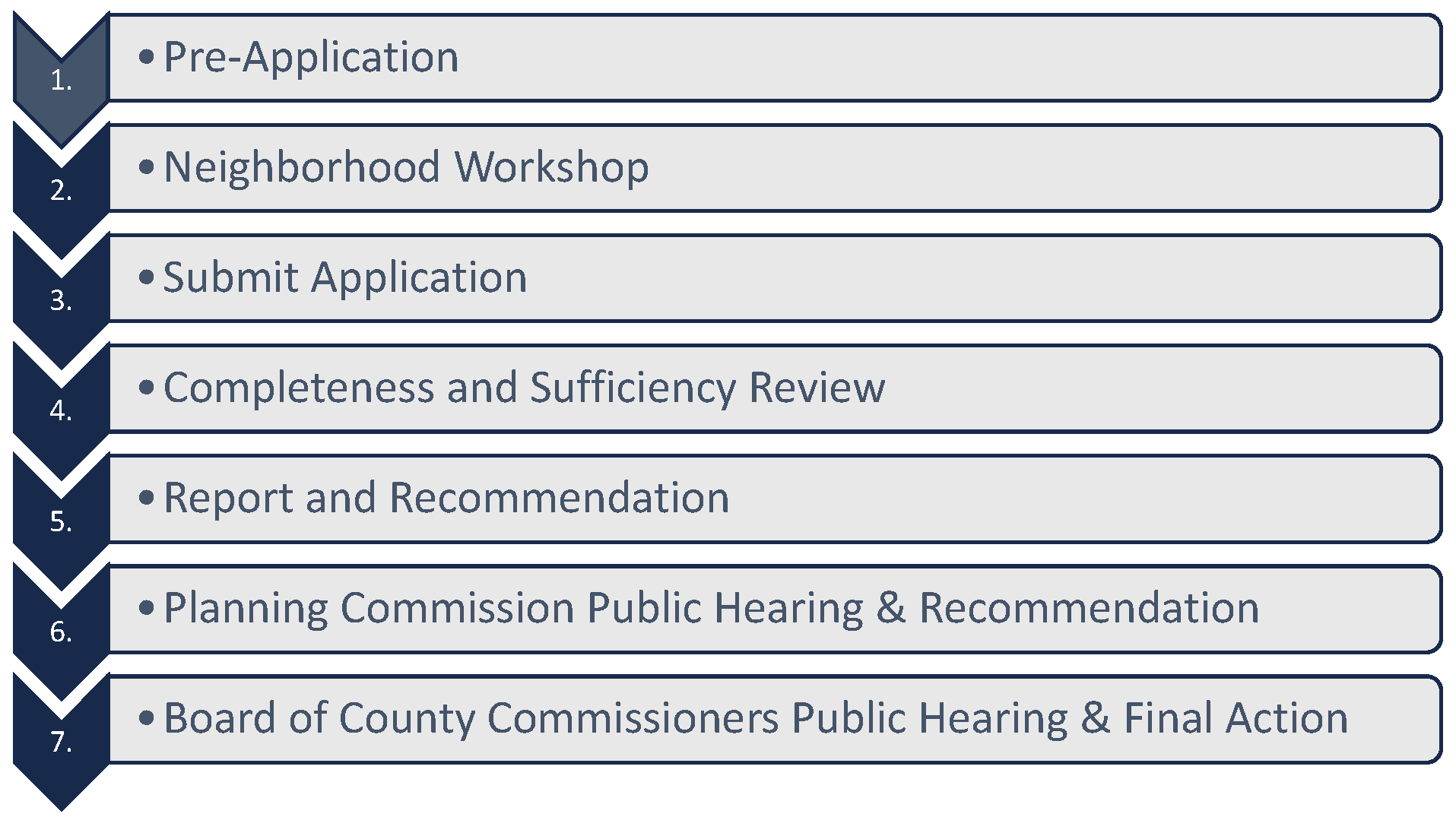
(Ord. No. 05-10, § 2, 12-8-05; Ord. No. 2020-25, § 2(Exh. A), 11-10-20)
Sec. 402.107. - Pre-application conference.
Prior to the submittal of an application for a special exception, the applicant shall request and participate in a pre-application conference with the Department.
(Ord. No. 05-10, § 2, 12-8-05; Ord. No. 2020-25, § 2(Exh. A), 11-10-20)
Sec. 402.108. - Neighborhood workshop.
An applicant shall hold a neighborhood workshop prior to submittal of a special exception application in accordance with Article V, Neighborhood Workshops, of this Chapter, except for minor amendments to existing special exceptions.
(Ord. No. 05-10, § 2, 12-8-05; Ord. No. 12-09, § 2(Exh. A), 10-9-12; Ord. No. 2020-25, § 2(Exh. A), 11-10-20)
Sec. 402.109. - Application requirements.
An application for a special exception shall be submitted in accordance with Article II, Common Development Application Elements, of this Chapter. Applications for preliminary development plan approval may be processed concurrently with applications for Special Exceptions. Applications submitted concurrently may have additional requirements for submittal.
(Ord. No. 05-10, § 2, 12-8-05; Ord. No. 09-01, § 2(Exh. A), 2-24-09; Ord. No. 2020-25, § 2(Exh. A), 11-10-20)
Sec. 402.110. - Public notice requirements.
Prior to a public hearing on a special exception, published, posted and mailed notice is required in accordance with the procedures in Article IV, Notice of Hearings, of this Chapter.
(Ord. No. 05-10, § 2, 12-8-05; Ord. No. 12-09, § 2(Exh. A), 10-9-12; Ord. No. 2020-25, § 2(Exh. A), 11-10-20)
Sec. 402.111. - Review by the Planning Commission.
(a)
Planning Commission public hearing. All development applications for special exception approval shall be considered by the Planning Commission at a public hearing, prior to a public hearing or action by the BOCC.
(b)
Consideration of special exception applications. The Planning Commission shall consider a proposed special exception utilizing the criteria for approval listed in Section 402.113.
(c)
Planning Commission recommendation. A recommendation shall be prepared and forwarded to the BOCC. The recommendation shall indicate if the proposed special exception should be approved, approved with conditions or denied.
(Ord. No. 05-10, § 2, 12-8-05; Ord. No. 2020-25, § 2(Exh. A), 11-10-20)
Sec. 402.112. - Action by the Board of County Commissioners.
(a)
Public hearing. Upon receipt of the recommendations from the Planning Commission, the BOCC shall hold a public hearing to consider a proposed special exception.
(b)
Action by the Board of County Commissioners. Following the public hearing, the BOCC may take one (1) of the following actions:
(1)
Approve the special exception application;
(2)
Approve the special exception application with conditions and limitations; or
(3)
Deny the special exception application.
(Ord. No. 05-10, § 2, 12-8-05; Ord. No. 2020-25, § 2(Exh. A), 11-10-20)
Sec. 402.112.5. - Limitations on special exceptions.
If the BOCC denies an application for a special exception for a property, the applicant shall not resubmit an application for a special exception on any part of the same property for the same use for a period of twelve (12) months from the date of the denial of the special exception.
(Ord. No. 2023-16, § 2(Exh. A), 10-24-23)
Sec. 402.113. - Criteria for approval.
The BOCC shall, as part of a decision to approve an application for special exception, make a finding that an application complies with both the general criteria and the review factors listed below.
(a)
The proposed use is consistent with the Comprehensive Plan and ULDC;
(b)
The proposed use is compatible with the existing land use pattern and future uses designated by the Comprehensive Plan;
(c)
The proposed use shall not adversely affect the health, safety, and welfare of the public; and
(d)
Satisfactory provisions and arrangements have been made concerning the following matters, where applicable:
(1)
Ingress and egress to the property and proposed structures thereon with particular reference to automotive, bicycle, and pedestrian safety and convenience, traffic flow and control and access in case of fire or catastrophe;
(2)
Off-street parking and loading areas where required, with particular attention to Item (1) above;
(3)
The noise, glare, or odor effects of the special exception on surrounding properties;
(4)
Refuse and service areas, with particular reference to location, screening, and Items (1) and (2);
(5)
Utilities, with reference to location and availability;
(6)
Enhanced nutrient-reducing onsite sewage treatment and disposal system (ENR-OSTDS) if sewer connection is not available;
(7)
Screening and buffering with reference to type, dimensions and character with particular emphasis on screening and buffering between residential and non-residential uses;
(8)
Signs, if any, and proposed exterior lighting with reference to glare, traffic safety and compatibility with surrounding properties;
(9)
Required yards and other greenspace;
(10)
General compatibility with surrounding properties;
(11)
Environmental justice issues related to the location of the facility within the county;
(12)
Impacts to both publicly and privately maintained road facilities and
(13)
Any special requirements set forth in this ULDC for the particular use involved.
(e)
For special exception applications not incorporating specific review criteria provided elsewhere in this Code, the board shall make a finding using the general review criteria above and the additional considerations for those uses below by project type found in the Chapter 404, Article II Use Table when considering approval.
(1)
For agricultural uses including but not limited to agricultural services, livestock market, slaughter plant and rural medical clinics, the board shall consider consistency with surrounding agricultural and residential properties with emphasis on impacts to agricultural operations in the area.
(2)
For transportation uses including but not limited to bus stations, airports and private landing strips, the board shall consider the service area of the proposed transportation facility if serving the public; transportation infrastructure needed to serve the proposed public facility including parking; noise impacts to outlying residential areas from facility operations and impacts to existing telecommunications facilities.
(3)
For entertainment and recreation uses including but not limited to entertainment and recreation, amusement park and zoos, the board shall consider limits on the potential hours of operation and impacts from outdoor lighting and noise resulting from the intended use (for example an outdoor track or arena).
(4)
For retail uses including but not limited to cocktail lounges or flea markets, the board shall consider limits on the potential hours of operation and impacts from outdoor lighting, especially in regard to parking areas.
(5)
For personal services uses including but not limited to gyms or dance studios, the board shall consider limits on the potential hours of operation and impacts from outdoor lighting, especially in regard to parking areas.
(6)
For industrial uses including but not limited to heavy machinery sales and repair, asphalt plant, waste services and storage of hazardous waste, the board shall consider proximity to transportation facilities to serve the proposed use and potential long-term impacts related to closure of the facility.
(7)
For all proposed special exceptions outside the urban cluster area for which water and sewer are not available, the board shall consider enhanced nutrient-reducing onsite sewage treatment and disposal systems and provisions for water efficiency.
(Ord. No. 05-10, § 2, 12-8-05; Ord. No. 2020-09, § 2(Exh. A), 3-10-20; Ord. No. 2020-25, § 2(Exh. A), 11-10-20; Ord. No. 2025-05, § 2(Exh. A), 3-25-25)
Sec. 402.114. - Conditions and safeguards.
In granting any special exception, the BOCC may prescribe appropriate conditions and safeguards in order to protect public health, safety, and welfare, in conformity with this ULDC. Failure to comply with the conditions adopted as part of a special exception shall constitute a violation punishable by the penalties and remedies outlined in Chapter 409 of this ULDC.
(Ord. No. 05-10, § 2, 12-8-05; Ord. No. 07-07, § 2(Exh. A), 4-27-07; Ord. No. 2020-25, § 2(Exh. A), 11-10-20)
Sec. 402.115. - Minor and major amendments to existing special exceptions.
(a)
Minor amendments. An amendment to an existing special exception shall be considered minor where it will not cause an expansion to the existing use, or additional impacts to surrounding properties, natural resources, or public infrastructure. A minor amendment to an existing special exception shall not require a Planning Commission public hearing and shall only require one (1) public hearing with the Board of County Commissioners with notice as provided in Article IV of this Chapter.
(b)
Major amendments. A major amendment to an existing special exception is any change that is not deemed to be a minor amendment in accordance with Subsection (a) above. A major amendment to an existing special exception shall be reviewed in public hearings of the Planning Commission and the BOCC with notice as provided in Article IV of this Chapter.
(Ord. No. 05-10, § 2, 12-8-05; Ord. No. 12-09, § 2(Exh. A), 10-9-12; Ord. No. 2020-25, § 2(Exh. A), 11-10-20)
Sec. 402.115.5. - Voluntary termination.
A property owner or the BOCC may initiate the following process to terminate a special exception. Noncompliance with the conditions of a special exception or other provisions of this ULDC shall be governed by Article II, Penalties and Remedies, of Chapter 409.
(a)
Initiated by property owner. Where a property owner requests that the BOCC terminate a special exception that applies to their property the request shall be submitted in writing to the Department of Growth Management and shall be accompanied by a fee sufficient to cover the cost of advertising, as required herein. The Department shall schedule the item for a public hearing by the BOCC and provide mailed notification in accordance with Section 402.14 of this ULDC. The Department shall provide published notice in accordance with Section 402.15 of this ULDC. The BOCC may either approve or deny the request for termination.
(b)
Initiated by County. Where the BOCC chooses to request a termination of a special exception, the Department of Growth Management shall be responsible for processing the request. The Department shall provide mailed notification of the request to the property owner by certified mail. The property owner must submit written consent to the Department. If the property owner provides consent for terminating the special exception, the Department shall schedule the item for a public hearing by the BOCC and provide mailed notification in accordance with Section 402.14 of this ULDC. The Department shall provide published notice in accordance with Section 402.15 of this ULDC and schedule the item for public hearing. The BOCC may either approve or deny the request for termination.
(Ord. No. 12-09, § 2(Exh. A), 10-9-12; Ord. No. 2020-25, § 2(Exh. A), 11-10-20)
Sec. 402.116. - Administrative time extensions.
The Director may grant a one-time extension, for a maximum of ninety (90) days, if a complete and sufficient application for development plan review, in accordance with Article III, Preliminary Procedures for all Applications, of this Chapter, has been submitted to the DRC a minimum of sixty (60) days prior to the expiration of the time limit.
(Ord. No. 05-10, § 2, 12-8-05; Ord. No. 2020-25, § 2(Exh. A), 11-10-20)
Sec. 402.117.- Applicability.
All development applications for a special use permit approval shall comply with the requirements of this Article.
(Ord. No. 05-10, § 2, 12-8-05; Ord. No. 2020-25, § 2(Exh. A), 11-10-20)
Sec. 402.118. - Pre-application conference.
Prior to the submittal of an application for a special use permit, the applicant shall request and participate in a pre-application conference with the Department.
(Ord. No. 05-10, § 2, 12-8-05; Ord. No. 2020-25, § 2(Exh. A), 11-10-20)
Sec. 402.119. - Neighborhood workshop.
An applicant shall hold a neighborhood workshop prior to submittal of a special use permit application in accordance with Article V, Neighborhood Workshops, of this Chapter, except for minor amendments to existing special use permits.
(Ord. No. 05-10, § 2, 12-8-05; Ord. No. 12-09, § 2(Exh. A), 10-9-12; Ord. No. 2020-25, § 2(Exh. A), 11-10-20)
Sec. 402.120. - Application requirements.
An application for a special use permit shall be submitted in accordance with Article II, Common Development Application Elements, of this Chapter. Applications for preliminary development plan approval may be processed concurrently with applications for special use permit. Applications submitted concurrently may have additional requirements for submittal.
(Ord. No. 05-10, § 2, 12-8-05; Ord. No. 09-01, § 2(Exh. A), 2-24-09; Ord. No. 2020-25, § 2(Exh. A), 11-10-20)
Sec. 402.121. - Public notice requirements.
Mailed notice, published notice, and posted notice shall be required for any application for a special use permit in accordance with the procedures in Article IV, Notice of Hearings, of this Chapter.
(Ord. No. 05-10, § 2, 12-8-05; Ord. No. 2020-25, § 2(Exh. A), 11-10-20)
Sec. 402.122. - Review by the Planning Commission.
(a)
Planning Commission public hearing. All development applications for special use permits shall be considered by the Planning Commission at a public hearing, prior to a public hearing or action by the BOCC.
(b)
Consideration of special use permit applications. The Planning Commission shall consider a proposed special use permit utilizing the criteria for approval listed in Section 402.114.
(c)
Planning Commission recommendation. A recommendation shall be prepared and forwarded to the BOCC. The recommendation shall indicate if the proposed special use permit should be approved, approved with conditions, or denied.
(Ord. No. 05-10, § 2, 12-8-05; Ord. No. 2020-25, § 2(Exh. A), 11-10-20)
Sec. 402.123. - Action by the Board of County Commissioners.
(a)
Public hearing. Upon receipt of the recommendation from the Planning Commission, the BOCC shall hold a public hearing to consider a proposed special use permit.
(b)
Action by the Board of County Commissioners. Following the public hearing, the BOCC may take one (1) of the following actions:
(1)
Approve the special use permit application;
(2)
Approve the special use permit application with conditions and limitations; or
(3)
Deny the special use permit application.
(c)
Development plan approval exemption. Upon approval of a special use permit by the BOCC, the applicant may submit a development plan to the DRC for preliminary and final approval and is exempt from the requirements of Article X, Section 402.44 requiring preliminary development plan approval by the BOCC for those proposals meeting or exceeding the development thresholds.
(Ord. No. 05-10, § 2, 12-8-05; Ord. No. 2020-25, § 2(Exh. A), 11-10-20)
Sec. 402.123.5. - Limitations on special use permits
If the BOCC denies an application for a Special Use Permit for a property, the applicant shall not resubmit an application for a Special Use Permit on any part of the same property for the same use for a period of twelve (12) months from the date of the denial of the Special Use Permit.
(Ord. No. 2023-16, § 2(Exh. A), 10-24-23)
Sec. 402.124. - Criteria for approval.
The BOCC shall, as part of a decision to approve an application for a special use permit, make a finding that an application complies with both the general criteria and the review factors listed below:
(a)
The proposed use is consistent with the Comprehensive Plan and ULDC;
(b)
The proposed use is compatible with the existing land use pattern and future uses designated by the Comprehensive Plan;
(c)
The proposed use shall not adversely affect the health, safety, and welfare of the public; and
(d)
Satisfactory provisions and arrangements have been made concerning the following matters, where applicable:
(1)
Ingress and egress to the property and proposed structures thereon with particular reference to automotive, bicycle, and pedestrian safety and convenience, traffic flow and control and access in case of fire or catastrophe;
(2)
Off-street parking and loading areas where required, with particular attention to Item (1) above;
(3)
The noise, glare, or odor effects of the special use permit on surrounding properties;
(4)
Refuse and service areas, with particular reference to location, screening and Items (1) and (2) above;
(5)
Utilities, with reference to location and availability;
(6)
Screening and buffering with reference to type, dimensions and character;
(7)
Signs, if any, and proposed exterior lighting with reference to glare, traffic safety and compatibility with surrounding properties;
(8)
Required yards and other greenspace;
(9)
General compatibility with surrounding properties; and
(10)
Any special requirements set forth in this ULDC for the particular use involved.
(Ord. No. 05-10, § 2, 12-8-05; Ord. No. 12-09, § 1(Exh. A), 10-9-12; Ord. No. 2020-09, § 2(Exh. A), 3-10-20; Ord. No. 2020-25, § 2(Exh. A), 11-10-20)
Sec. 402.125. - Conditions and safeguards.
In granting any special use permit, the BOCC may prescribe appropriate conditions and safeguards in order to protect public health, safety, and welfare, in conformity with this ULDC. Failure to comply with the conditions adopted as part of a special use permit shall constitute a violation punishable by the penalties and remedies outlined in Chapter 409 of this ULDC.
(Ord. No. 05-10, § 2, 12-8-05; Ord. No. 07-07, § 2(Exh. A), 4-27-07; Ord. No. 2020-25, § 2(Exh. A), 11-10-20)
Sec. 402.126. - Minor and major amendments to existing special use permits.
(a)
Minor amendments. An amendment to an existing special use permit shall be considered minor where it will not cause an expansion to the existing use, or additional impacts to surrounding properties, natural resources, or public infrastructure. A minor amendment to an existing special use permit shall not require a Planning Commission public hearing and shall only require one (1) public hearing with the BOCC with notice as provided in Article IV of this Chapter.
(b)
Major amendments. A major amendment to an existing special use permit is any change that is not deemed to be a minor amendment in accordance with Subsection (a) above. A major amendment to an existing special use permit shall be reviewed in public hearings of the Planning Commission and the BOCC in the same manner as a new application with notice as provided in this Chapter.
(Ord. No. 05-10, § 2, 12-8-05; Ord. No. 12-09, § 2(Exh. A), 10-9-12; Ord. No. 2020-25, § 2(Exh. A), 11-10-20)
Sec. 402.126.5. - Voluntary termination.
A property owner or the BOCC may initiate the following process to terminate a special use permit. Noncompliance with the conditions of a special use permit or other provisions of this ULDC shall be governed by Article II, Penalties and Remedies, of Chapter 409.
(a)
Initiated by property owner. Where a property owner requests that the BOCC terminate a special use permit that applies to their property the request shall be submitted in writing to the Department of Growth Management and shall be accompanied by a fee sufficient to cover the cost of advertising, as required herein. The Department shall schedule the item for a public hearing by the BOCC and provide mailed notification in accordance with Section 402.14 of this ULDC. The Department shall provide published notice in accordance with Section 402.15 of this ULDC. The BOCC may either approve or deny the request for termination.
(b)
Initiated by County. Where the BOCC chooses to request a termination of a special use permit, the Department of Growth Management shall be responsible for processing the request. The Department shall provide mailed notification of the request to the property owner by certified mail. The property owner must submit written consent to the Department. If the property owner provides consent for terminating the special use permit, the Department shall schedule the item for a public hearing by the BOCC and provide mailed notification in accordance with Section 402.14 of this ULDC. The Department shall provide published notice in accordance with Section 402.15 of this ULDC and schedule the item for public hearing. The BOCC may either approve or deny the request for termination.
(Ord. No. 12-09, § 2(Exh. A), 10-9-12; Ord. No. 2020-25, § 2(Exh. A), 11-10-20)
Sec. 402.127. - Administrative time extensions.
The Director may grant a one-time extension, for a maximum of ninety (90) days, if a complete and sufficient application, in accordance with Article III, Preliminary Procedures for all Applications, of this Chapter, has been submitted a minimum of sixty (60) days prior to the expiration of the time limit.
(Ord. No. 05-10, § 2, 12-8-05; Ord. No. 2020-25, § 2(Exh. A), 11-10-20)
Sec. 402.128.- Applicability.
Development. The requirements of this Article shall apply to all development applications for approval of TND or TOD, as established in the Comprehensive Plan and this ULDC.
(Ord. No. 05-10, § 2, 12-8-05; Ord. No. 10-16, § 2(Exh. A), 8-10-10; Ord. No. 2020-25, § 2(Exh. A), 11-10-20)
Sec. 402.129. - Reserved.
Editor's note— Ord. No. 10-16, § 2(Exh. A), adopted Aug. 10, 2010, repealed former § 402.129 in its entirety which pertained to types of development applications and derived from Ord. No. 05-10, § 2, adopted Dec. 8, 2005.
Sec. 402.130. - Development review of TND and TOD applications.
(a)
Pre-application conference. Prior to the submittal of an application for a TND or TOD, the applicant shall request a pre-application conference with the Department.
(b)
Procedures for review. An application for approval of a TND or a TOD shall be reviewed as a development plan as set forth in Article X. The reviewing body may approve a preliminary development plan with a phasing schedule for TNDs or TODs allowing for implementation over a time period up to ten (10) years. TODs may establish a longer phasing schedule as agreed upon between the County and the Developer as part of a binding development agreement.
(c)
Preliminary development plan. An application for preliminary development plan review for a TND or TOD shall be submitted in accordance with Chapter 402, Article X, Development Plan Review, of this Chapter. As part of the preliminary development plan submittal, a master plan shall be submitted for the entire development that includes the following:
(1)
Conceptual location of the village center, transit supportive area and residential areas;
(2)
Detailed phasing schedule, including timing and location of proposed development and infrastructure, in accordance with Subsection (d) below;
(3)
Conceptual block pattern for the development, including locations for future connections to adjacent properties;
(4)
Location of multi-use paths with interconnections to adjacent paths;
(5)
Conceptual street types and typical section details for all roadways within the TND/TOD as they relate to Table 407.68.4 of this ULDC; and
(6)
The maintenance entity for all proposed roads within the TND/TOD shall be identified.
(d)
Phasing.
(1)
TNDs and TODs with:
a.
Less than two hundred fifty (250) dwelling units or one hundred fifty thousand (150,000) square feet of non-residential use may be approved with one (1) phase.
b.
Between two hundred fifty (250) and five hundred (500) dwelling units or one hundred fifty thousand (150,000) and three hundred thousand (300,000) square feet of non-residential use shall be approved with two (2) phases.
c.
Between five hundred one (501) and three thousand (3,000) dwelling units or three hundred thousand one (300,001) and one million five hundred thousand (1,500,000) square feet of non-residential uses shall be approved with three (3) phases.
d.
Projects with greater than three thousand (3,000) dwelling units or one million five hundred thousand (1,500,000) square feet of non-residential use shall be approved with four (4) phases.
(2)
Each TND or TOD, approved with multiple phases, shall provide for phasing of development in phases that include no less than twenty (20) percent and no more than sixty (60) percent of the total residential and non-residential uses proposed for the entire development. The percentage of residential and non-residential shall be the same within each phase.
(3)
Each phase of a TND or TOD shall include a mix of residential and non-residential uses proportional to the total amount of residential and non-residential uses in the whole development.
(4)
Within each phase of development, final development plans may be approved for portions of a phase. For the first phase of development, the difference between dwelling units and nonresidential square footage may not be greater than seventy-five (75) percent of the approved development within the phase. For single phase developments and the additional phases of multi-phased developments, the difference between dwelling units and non-residential square footage may not be greater than fifty (50) percent of the approved development within the phase. The percentages shall be based on final development plan approval within each phase. (For example, a development with one hundred (100) dwelling units and ten thousand (10,000) square feet of non-residential uses in phase one may only receive final development plan approval for all one hundred (100) dwelling units once final development plans have been approved for at least two thousand five hundred (2,500) square feet of non-residential uses.)
(5)
For multi-phase developments, the difference between dwelling units and non-residential square footage for the total approved development may not be greater than the following percentages in order to receive development plan approval in a subsequent phase:
a.
Thirty (30) percent to proceed to Phase 2.
b.
Fifteen (15) percent to proceed to Phase 3.
c.
Five (5) percent to proceed to Phase 4.
(e)
Developer agreement. Prior to approval of any final development plan, the developer shall enter into a developer's agreement with Alachua County to provide for any required transportation funding. If no funding is required, no developer's agreement will be required.
(f)
Minor changes to preliminary development plans. Where the preliminary development plan for a TND or TOD has been approved by the BOCC, the DRC may approve the following minor changes.
(1)
Reductions in number of units up to five (5) percent provided the minimum density required by the Comprehensive Plan is still being met.
(2)
Reductions in the amount of non-residential square footage up to five (5) percent provided the requirements of the Comprehensive Plan are still being met.
(3)
Slight changes in alignment, location, direction or length of an interior street as a result of site engineering.
(4)
Slight shifts in phase lines that do not affect the amount of development allowed within a phase.
(5)
An increase in the number of exterior access points or the relocation of exterior access points where it can be shown that such a change furthers the intent of the Comprehensive Plan to provide for interconnectivity between developments.
(g)
Final development plan.
(1)
Final development plans shall be submitted for each phase or unit of development consistent with the timeframes established in the phasing schedule.
(2)
Each final development plan shall demonstrate consistency with the approved preliminary development plan and shall include sufficient infrastructure to be consistent with applicable elements of this ULDC.
(h)
Public notice. Public notice of the review of development applications submitted in accordance with this Section shall comply with the requirements of Article IV, Notice of Hearings, of this Chapter.
(i)
Neighborhood workshops. Prior to the submittal of a TND or TOD for preliminary development plan review, an applicant shall hold an advertised neighborhood workshop in accordance with Article V, Neighborhood Workshops, of this Chapter.
(Ord. No. 05-10, § 2, 12-8-05; Ord. No. 10-16, § 2(Exh. A), 8-10-10; Ord. No. 12-09, § 2(Exh. A), 10-9-12; Ord. No. 13-14, § 2(Exh. A), 8-27-13; Ord. No. 2020-25, § 2(Exh. A), 11-10-20)
Sec. 402.131.- Applicability.
This Article shall apply to all applications for sector plans as defined in F.S. § 163.3245, Sector Plans, as provided for in F.S. § 163.3245, are intended for substantial areas of at least five thousand (5,000) acres of one or more local government jurisdictions and are to emphasize urban form and protection of regionally significant resources and public facilities. Sector plans are also intended to promote and encourage long-term planning for conservation, development, and agriculture on a landscape scale and to further the purposes of F.S. Ch. 163, Pt. II and F.S. Ch. 380, Pt. I. This Article is intended to implement the sector plan within the context of this ULDC. The statute contains additional details that are relevant to the sector plan process and all sector plans shall be consistent with Florida Statutes and this Article.
(Ord. No. 05-10, § 2, 12-8-05; Ord. No. 12-09, § 2(Exh. A), 10-9-12; Ord. No. 2020-25, § 2(Exh. A), 11-10-20)
Sec. 402.132. - Sector plan.
(a)
Scoping meeting.
(1)
Prior to preparation of a sector plan, an applicant shall notify the County of their intent to prepare a sector plan. The applicant shall provide the County a map showing the location of the area intended to be subject to the sector plan.
(2)
The County shall request that the North Central Florida Regional Planning Council (NCFRPC) schedule, notice, and conduct a scoping meeting pursuant to F.S. § 163.3245(2) to assist the state land planning agency, the County and the potential applicant in identification of relevant planning issues to be addressed and the data and resources available to assist in the preparation of the sector plan.
(3)
Pursuant to F.S. § 163.3245(2), the NCFRPC will make written recommendations to the state land planning agency and any local governments with jurisdiction on the issues requested by the local governments. Once the County has received written recommendations from the NCFRPC the County shall provide the written recommendations to the potential applicant.
(b)
Joint planning agreement. Where the planning area of a proposed sector plan is within the jurisdiction of Alachua County and one or more other local governments, the County may enter into a joint planning agreement with the other local governments pursuant to F.S. § 163.3171. Any interlocal agreement shall include information detailing the geographic area subject to the sector plan, the planning issues to be emphasized, procedures for intergovernmental coordination to address extrajurisdictional impacts, supporting application materials including data and analysis, procedures for public participation, or other issues relevant to the local governments.
(c)
Long-term master plan.
(1)
An application for a sector plan shall require preparation of a Long-Term Master Plan (LTMP) for the entire planning area pursuant to F.S. § 163.3245(3)(a). The LTMP will be considered as a Comprehensive Plan amendment and shall be processed in accordance with F.S. § 163.3245(4) and Article VII, Comprehensive Plan Amendment, of this Chapter.
(2)
In addition to the other requirements of F.S. ch. 163, Part II, and Article VII of this Chapter, an application for a LTMP shall include maps, illustrations, and policies supported by data and analysis addressing the requirements of F.S. § 163.3245(3)(a). The application shall include an analysis of the issues and recommendations identified through the scoping meeting and consistency of the proposed LTMP with the adopted Alachua County Comprehensive Plan. The application shall identify proposed amendments to the adopted goals, objectives, policies, maps, or capital improvement plans that would be necessary for internal consistency of the LTMP with the Comprehensive Plan, including data and analysis to support the proposed amendments.
(3)
Pursuant to F.S. § 163.3245(3)(a), a LTMP may be based upon a planning period longer than the generally applicable planning period of the Comprehensive Plan. The LTMP shall specify the projected population within the planning area during the chosen planning period. A phasing or staging schedule that allocates a portion of the County's future growth to the planning area through the planning period may be included.
(Ord. No. 05-10, § 2, 12-8-05; Ord. No. 12-09, § 2(Exh. A), 10-9-12; Ord. No. 2020-25, § 2(Exh. A), 11-10-20)
Sec. 402.133. - Master development approval.
An applicant for a LTMP may apply for master development approval concurrently with or subsequent to the LTMP pursuant to F.S. § 163.3245(6). The master development approval may be approved, approved with modifications, or denied by the BOCC by resolution at a public hearing. The fees for processing an application for master development approval shall be the hourly rate of those County staff members reviewing the application and shall include any costs for advertising.
(Ord. No. 05-10, § 2, 12-8-05; Ord. No. 12-09, § 2(Exh. A), 10-9-12; Ord. No. 2020-25, § 2(Exh. A), 11-10-20)
Sec. 402.134. - Detailed specific area plan.
(a)
Implementation. All detailed specific area plans (DSAP) required to implement an approved LTMP shall be processed as a planned development rezoning, as outlined in Article XIV, Rezoning, Planned Development District, of this Chapter and Section 403.17. An application for a DSAP shall include conditions and commitments that provide for the items identified in F.S. § 163.3245(3)(b). The application shall also include all applicable elements of Article II, Common Development Application Elements, of this Chapter. An application for a DSAP may be submitted concurrently with an application for a LTMP.
(b)
Minimum size. A DSAP shall include a minimum of one thousand (1,000) acres unless the DSAP furthers the purposes of F.S. Ch. 163, Pt. II and F.S. Ch. 380, Pt. I and is specifically provided for in the LTMP.
(c)
Review. A DSAP implemented by a planned development shall be reviewed for consistency with F.S. § 163.3245, the Comprehensive Plan, including the LTMP, and this ULDC.
(d)
Time limitations and phasing. Notwithstanding the provisions of Article XIV, Rezoning, Planned Development District, of this Chapter and Section 403.17, a DSAP and the planned development may include a phasing schedule for a planning period longer than the planning period of the Comprehensive Plan.
(e)
Rendition of DSAP. After adoption of a DSAP planned development the County shall render the DSAP planned development resolution to the State Land Planning Agency, owners, and developer pursuant to F.S. § 163.3245(3)(e). The DSAP shall not be effective until forty-five (45) days after rendition.
(Ord. No. 05-10, § 2, 12-8-05; Ord. No. 12-09, § 2(Exh. A), 10-9-12; Ord. No. 2020-25, § 2(Exh. A), 11-10-20)
Sec. 402.135. - Reserved.
Editor's note— Ord. No. 12-09, § 2(Exh. A), adopted Oct. 9, 2012 repealed former § 402.135 in its entirety which pertained to review of new development proposals by the board of county commissioners and derived from Ord. No. 05-10, § 2, adopted Dec. 8, 2005.
Sec. 402.136.- Applicability.
Any request for extension of potable water or central sewer service outside the Urban Cluster Line established in the Comprehensive Plan shall comply with the requirements of this Article.
(Ord. No. 05-10, § 2, 12-8-05; Ord. No. 2020-25, § 2(Exh. A), 11-10-20)
Sec. 402.137. - Consistency with Comprehensive Plan.
Any extension of water and sewer service shall be consistent with all applicable portions of the Comprehensive Plan.
(Ord. No. 05-10, § 2, 12-8-05; Ord. No. 2020-25, § 2(Exh. A), 11-10-20)
Sec. 402.138. - Compliance with other criteria and standards.
An application for extension of water and sewer service shall comply with all applicable federal, state or County criteria, standards, and requirements regarding the extension of water and sewer service.
(Ord. No. 05-10, § 2, 12-8-05; Ord. No. 2020-25, § 2(Exh. A), 11-10-20)
Sec. 402.139. - Water or sewer extension outside the urban cluster line.
(a)
Action by Board of County Commissioners. Any request for extension of central sewer or potable water service outside the Urban Cluster Line shall be subject to approval by the BOCC.
(b)
Criteria and standards for approval. Approval of such extensions shall be based on one or more of the following findings:
(1)
Absence of such facilities would result in a threat to public health, safety, or the environment; or
(2)
Extension of such facilities is necessary to enhance the safe, effective, and efficient delivery of central potable water and sanitary sewer service within an existing urban service area; or
(3)
Extension of such facilities would serve a purpose consistent with the Comprehensive Plan, such as the retention and expansion of existing business and industry or the attraction of new business and industry in accordance with the Economic Element, or the service of institutional or tourist/entertainment uses consistent with the Future Land Use Element; or
(c)
Water or sewer extensions requiring a Comprehensive Plan amendment. A request for extension of central water and sewer service may be approved if the extension does not meet one (1) of the criteria in Section 402.139(b) above, but only where the extension of such facilities is needed as part of an expansion of public services to encourage development in a new area. Such extensions require identification, scheduling, and designation of funding for capital improvements to other public facilities needed to extend urban services, which shall be incorporated into the five-year capital improvement program of the Comprehensive Plan's Capital Improvement Element. These requests for extensions shall be considered amendments to the Future Land Use Map by extending the Urban Cluster boundary and designation of appropriate land use designations within the new boundary. Review and approval of these Comprehensive Plan amendments shall be based upon the following factors:
(1)
Population growth rate;
(2)
Maintenance of level of service standards for the potable water or sanitary sewer system; and
(3)
Adequacy of existing and planned supporting infrastructure.
(Ord. No. 05-10, § 2, 12-8-05; Ord. No. 12-09, § 2(Exh. A), 10-9-12; Ord. No. 2020-25, § 2(Exh. A), 11-10-20)
Sec. 402.140.- General provisions.
(a)
Consistency and compliance. All building permits shall be consistent with and comply with the following:
(1)
The Comprehensive Plan;
(2)
This ULDC;
(3)
All applicable provisions of the Florida Building Code, as may be amended; and
(4)
All other applicable federal, state and County laws, codes, and requirements.
(b)
Improvement of property prior to issuance of a building permit. When a building permit is required, site work, site clearing, grading, improvement of property, or construction of any type shall not be commenced prior to the issuance of the permit unless approved subsequent to a pre-application screening and building permit application with a finding by the County that there is no potential for adverse environmental impacts.
(Ord. No. 05-10, § 2, 12-8-05; Ord. No. 2020-25, § 2(Exh. A), 11-10-20)
Sec. 402.141.- Applicability.
A family homestead exception may be granted in accordance with the provisions of this Article on a parcel designated on the Comprehensive Plan's Future Land Use Map as rural/agriculture without meeting the density and intensity standards of the land use designation. A family homestead exception shall be used solely as a homestead by an immediate family member of the person who conveyed the property. Once a family homestead exception is granted, the division of land may then occur in accordance with the requirements of Article VIII, Subdivision Regulations, of Chapter 407 of this ULDC.
(Ord. No. 05-10, § 2, 12-8-05; Ord. No. 2016-10, § 2(Exh. A), 6-28-16; Ord. No. 2020-25, § 2(Exh. A), 11-10-20)
Sec. 402.142. - Application requirements.
(a)
Application. An application for a family homestead exception approval shall be submitted in accordance with Article III, Preliminary Procedures for all Applications, of this Chapter.
(b)
Documentation. Documentation shall be provided, as listed below:
(1)
Legal lot of record. Documentation that the parcel for which a family homestead exception is requested is being created from a legal lot of record as defined in this ULDC. In addition, the legal lot of record shall not be a platted lot or a non-conforming lot or a lot previously created as part of a subdivision with unpaved roads in the rural agricultural area or created by variance through the Board of Adjustment or BOCC, unless the variance was approved prior to October 2, 1991.
(2)
Location. Documentation that the parcel for which a family homestead exception is requested is designated on the Comprehensive Plan's Future Land Use Map as rural/agriculture.
(3)
Immediate family member.
a.
Each application for family homestead exception shall be accompanied by personal identification and proof of relationship, to establish the required immediate family member status, of both the property owner and the immediate family member. The personal identification shall consist of original documents or notarized copies from public records. Such documents may include birth certificates, adoption records, marriage certificates, and other public records.
b.
To qualify as an immediate family member, an individual who will use the property as a homestead must be one (1) of the following: a grandparent, parent, stepparent, adopted parent, sibling, child, stepchild, adopted child, or grandchild of the property owner.
(4)
Ownership. Proof of ownership verifying that:
a.
The subject property, a portion of which is proposed for use as a homestead by an immediate family member, has been in fee simple ownership, by an immediate family member, for a minimum of five (5) years.
b.
The intended owner of the land (under a contract, will or other documented conveyance or estate) is an immediate family member of the person from whom the parcel is conveyed, devised, or transferred; and the person from whom the parcel is conveyed, devised, or transferred has owned the property for a minimum of five (5) years.
(5)
Affidavit of homestead exception use. As part of the application for a family homestead exception, the immediate family member shall provide an affidavit stating that the family homestead lot is being created for use solely as a homestead by the immediate family member, that the family member shall occupy the residence for at least five (5) years from the date a certificate of occupancy is issued for the residence, and acknowledging that the homestead shall not be transferable within that five-year period unless a determination is made by the County that the criteria found in Subsection 402.143(d) for permitting such a transfer have been met.
(c)
Jurisdiction for family homestead exception applications.
(1)
The Director. The Director has the authority to approve, approve with conditions, or deny an application to create one or more family homestead exception lots from a parent parcel in accordance with the provisions of this Article provided all of the following requirements are met:
a.
All lots have frontage on an existing publicly maintained road, provide joint driveway access to the public road, or have obtained an exception from the Public Works Department allowing the lots to provide access to a private easement road with direct connection to a public road in accordance with Subsection 401.20(d)(10);
b.
All parcels are consistent with all other requirements of this ULDC;
c.
All parcels have buildable area outside the limits of any conservation areas including wetland and/or flood-prone areas and do not require access through these conservation areas.
(d)
Development standards.
(1)
Minimum property size. The parent parcel from which a family homestead exception lot is being requested must be a minimum of two (2) acres.
(2)
Minimum family homestead exception lot size. The lot for which a family homestead exception is requested shall be a minimum of one (1) acre and shall comply with the minimum dimensional standards for the agriculture zoning district in Chapter 403 or as provided in Chapter 408 for legally nonconforming agricultural lots of record.
(3)
Compliance with other requirements. The residual parcel and all parcels for which a family homestead exception is requested shall comply with these and all other applicable Comprehensive Plan policies and federal, state, regional, and County regulations.
(4)
Compliance not a basis for other approvals. Demonstration of compliance with all the requirements for a family homestead exception shall not itself constitute a basis for the granting of a variance from any other applicable County regulation or requirement.
(5)
Limit on number of family homestead exceptions. Only one (1) family homestead exception may be granted per immediate family member. Once a family homestead exception lot is created, that family homestead parcel from which the homestead exception lot was created shall not be further split or subdivided under the provisions of this Article.
(Ord. No. 05-10, § 2, 12-8-05; ; Ord. No. 06-14, § 2(Exh. A), 7-20-06; Ord. No. 07-07, § 2(Exh. A), 4-27-07; Ord. No. 2016-10, § 2(Exh. A), 6-28-16; Ord. No. 2020-25, § 2(Exh. A), 11-10-20; Ord. No. 2025-06, § 2(Exh. A), 3-25-25)
Sec. 402.143. - Family homestead exception certificate.
(a)
Issuance of certificate. If the Director, per Subsection 402.142(c), finds that an application complies with all of the requirements for a family homestead, then a family homestead exception certificate shall be issued.
(b)
Receiver of certificate. The family homestead exception certificate shall be issued in the name of the immediate family member identifying by legal description the property to be utilized.
(c)
Use of certificate and recording of information. The recipient of a family homestead exception shall record in the real property record the family homestead exception certificate and the affidavit required in Subsection 402.142(b)(5). For those lots that are not required to be platted or to obtain development plan approval from the DRC, a legal description of the lots created by the exception must also be recorded. Proof that the required documents have been recorded must be submitted with any application for a building permit on a family homestead lot prior to approval by the County.
(d)
Transferability of family homestead. The family homestead shall not be transferable except as follows:
(1)
To another individual meeting the definition of immediate family member in Subsection 402.142(b)(3); or
(2)
To an individual not meeting the definition of immediate family member provided a residential structure has been constructed on the homestead lot and, due to circumstances beyond the control of the family member to whom the original certificate was issued such as divorce, death, or job change resulting in unreasonable commuting distances, the family member is no longer able to occupy or retain ownership of the family homestead.
(Ord. No. 05-10, § 2, 12-8-05; Ord. No. 06-14, § 2(Exh. A), 7-20-06; Ord. No. 07-07, § 2(Exh. A), 4-27-07; Ord. No. 2016-10, § 2(Exh. A), 6-28-16; Ord. No. 2020-25, § 2(Exh. A), 11-10-20)
Sec. 402.144.- Application.
An application for a temporary placement permit (TPP) shall be submitted in accordance with Article II, Common Development Application Elements, of this Chapter.
(Ord. No. 05-10, § 2, 12-8-05; Ord. No. 2020-25, § 2(Exh. A), 11-10-20)
Sec. 402.145. - Temporary placement of manufactured or mobile homes.
(a)
Temporary placement permitted. A manufactured home, mobile home, or recreational vehicle may be permitted on a limited basis by the issuance of a temporary placement permit (TPP) by the Department.
(b)
Removal of temporary home. Unless otherwise provided in this Article, a manufactured home or a mobile home permitted by a TPP shall be removed from the site within sixty (60) days after completion of the activity associated with the approved permit, or at the time of the expiration of the TPP, whichever is earlier. A recreational vehicle permitted by a TPP shall be removed at the expiration date of the temporary placement permit.
(Ord. No. 05-10, § 2, 12-8-05; Ord. No. 12-09, § 2(Exh. A), 10-9-12; Ord. No. 2020-25, § 2(Exh. A), 11-10-20)
Sec. 402.146. - Types of temporary placement permits.
A TPP may be granted as indicated below.
(a)
Emergency residence.
(1)
Emergency residence permitted. A TPP for a manufactured home or mobile home or recreational vehicle may be issued for the purposes of providing emergency residence on a site where the existing living unit has become uninhabitable due to fire, structural damage, adverse weather damage, or other acts of God, while the damaged living unit is being repaired or a replacement living unit is being constructed.
(2)
Restrictions.
a.
Effect of common ownership. A TPP for emergency residence shall not be renewed, reissued, or reassigned for a home on the same parcel or on lands under common ownership with the parcel for which the permit was originally approved.
b.
Maximum period of time. A TPP shall not be issued for a period of time in excess of two (2) years.
(b)
Construction residence.
(1)
Temporary residence permitted. A TPP for a manufactured home, mobile home, or recreational vehicle (RV) may be issued for the purpose of providing a temporary construction residence for the owner of a site who is constructing or is acting as the contractor for the construction of a site built single-family dwelling or modular dwelling.
(2)
Restrictions.
a.
Residency in permanent dwelling unit. The dwelling being constructed is intended to be the sole residence of the owner upon completion of the unit.
b.
Building permit required. A TPP may be issued for a construction residence only after the issuance of a building permit for the construction of the conventionally built or modular single-family dwelling.
c.
Validity of temporary placement permit. A TPP shall remain in effect only as long as the building permit is valid.
d.
Building setbacks. The temporary construction residence shall comply with the setback requirements of the zoning district.
e.
Effect of common ownership. A TPP shall not be renewed, reissued or reassigned for a home on the same parcel or on lands under common ownership with the parcel for which the building permit was originally approved.
(c)
Construction and sales and leasing office.
(1)
Office, sales and leasing permitted. A manufactured building meeting the requirements of the Florida Building Code may be utilized as a temporary construction office or a sales and leasing office on a construction site for which a building permit has been applied for.
(2)
Location. The location of such temporary offices shall be shown on an approved development plan. The building must be permitted through the building permit process. Where a construction or sales or leasing office is not shown on an approved development plan, an office may be approved through the building permit process where the location of the office can be shown to not interfere with construction of the site or impact natural resource protections. Such location shall require the approval of the Department of Growth Management, Department of Public Works, and Environmental Protection Department.
(3)
Restrictions.
a.
Single-family dwelling. A TPP for an office of this nature shall not include a construction project which is limited to the building of only one (1) single-family residential structure.
b.
Use as a living quarters. A construction office shall not be used as a living unit.
c.
Maximum time period. A TPP may be issued for a period not to exceed two (2) years and may be renewed by the Department as long as the project is under active construction, development, and sales or leasing. The temporary unit shall be removed within ninety (90) days after construction is completed.
d.
Accessibility. Leasing and sales offices must provide for accessibility as required by the Americans with Disabilities Act and Architectural Barriers Act Accessibility Guidelines.
(d)
Declared local state of emergency.
Commercial. A TPP for an RV is permitted for a commercially zoned site and the business owner is authorized to conduct business while the business structure is being reconstructed, if the commercial building located on that site has been determined to be "unsafe" by Alachua County due to damage caused by the disaster leading to a declared local state of emergency. Such use shall comply with all requirements of the Alachua County Health Department. A TPP may be issued for a period of six (6) months and extended in six-month increments subject to review and approval by the Alachua County Building Department.
(Ord. No. 05-10, § 2, 12-8-05; Ord. No. 12-09, § 2(Exh. A), 10-9-12; Ord. No. 2018-23, § 2(Exh. A), 10-9-18; Ord. No. 2020-25, § 2(Exh. A), 11-10-20)
Sec. 402.147.- Applicability.
A temporary use permit shall be required from the County prior to the temporary use of property in unincorporated Alachua County where the activities have a significant impact on public infrastructure, services, and surrounding land uses. The issuance of a temporary use permit shall not be deemed to amend the official zoning map or this ULDC. The standards for temporary filming activities are addressed separately in Section 402.153 in this Article.
The following activities are exempt from this Article provided that public streets, rights-of-way, and public sidewalks are not closed due to the activity and the activity does not create on-street parking impacts:
(1)
Events within County parks and park property, as defined in Section 76.2 of this Code, are subject to Alachua County Park rules and procedures.
(2)
Events held at the Alachua County Sports and Events Center or Cuscowilla Nature and Retreat Center.
(3)
Events held on property owned by the Alachua County School District.
(4)
Any temporary activity that has been permitted as part of a Planned Development, Zoning Master Plan, Special Use Permit, Special Exception or Development Plan.
(5)
Funeral repast and similar ceremonies.
(6)
Events connected to a confirmed agritourism operation per F.S. § 570.85 that do not create substantial offsite impacts.
(Ord. No. 2024-10, § 2(Exh. A), 5-14-24)
Sec. 402.148. - Approval.
Unless otherwise provided herein, the Director has the authority to approve, deny and revoke a temporary use permit and place any conditions or restrictions on the proposed activities in this Article.
(Ord. No. 2024-10, § 2(Exh. A), 5-14-24)
Sec. 402.149. - Categories of temporary uses.
(a)
Tier A.
(1)
Market events for the temporary sale of retail products as a single- or multi-vendor event where vendors sell goods or personal services directly to the public, such as but not limited to pop-up farmers markets, art fairs, and craft fairs.
(2)
Temporary sales and/or promotional events on non-residential property, such as but not limited to grand openings, special promotional sales, sidewalk sales, tent sales, or other similar uses related to the principal activities in operation at the subject property.
(3)
Sports, religious, political, music and community events sponsored by for-profit, nonprofit, charitable, civil or membership organizations, such as but not limited to concerts, carnivals, and car shows.
(4)
Rights-of-way or roadway events, such as but not limited to block parties, parades, and marathons.
(b)
Tier B. Seasonal and holiday sales and events, such as but not limited to fall festivals, Christmas trees, fireworks, and pumpkin patches.
(c)
Tier C. The following shall require a public hearing with the BOCC:
(1)
Any event that has overnight camping.
(2)
Any event with an anticipated attendance of more than two thousand (2,000) people.
(3)
Any request for a temporary use permit exceeding the duration or number of permits indicated by Table 402.150.5.
(Ord. No. 2024-10, § 2(Exh. A), 5-14-24)
Sec. 402.150. - Duration and maximum number of permits.
The following Table 402.150.1 provides the timeframes and maximum number of temporary use permits allowed:
(Ord. No. 2024-10, § 2(Exh. A), 5-14-24)
Sec. 402.151. - Application and review.
Upon receipt of the temporary use permit application the Director will check for required documents and plans needed to accept the application for review. Once an application has been accepted the Director will review the application and issue a decision.
(a)
An application for temporary use approval shall be submitted at least the following number of days prior to the event for review:
(1)
Tier A or Tier B: thirty (30) calendar days;
(2)
Tier C: ninety (90) calendar days.
(b)
The Director may consider accepting an untimely application if county staff have the capacity to conduct an ordinary review of the application without neglecting other duties.
(c)
For all applications the following items shall be required for a temporary use permit and any other information required by the Director:
(1)
Statement of use and activities. A general statement of use including purpose of event, types of proposed activities, duration of use, hours of operation, anticipated attendance, any overnight camping, use of amplified sound, and other information that may be required by the Director. The applicant must provide assurance that the site will be returned to its original state when the temporary permitted activity has ceased.
(2)
Development plan. A general development plan for the temporary use, including property boundaries, access to the site, location of tents or other temporary structures, location of proposed activities, parking, signs, temporary lighting, utilities, generators and other mechanical equipment, and setbacks of all structures, equipment, and activities from adjacent properties.
(3)
Sanitation and public health. Plans for sanitation and public health protection including temporary bathroom facilities, inspection of food facilities, drainage, garbage and litter control, dust control, and recycling shall be approved by the Director through consultation with appropriate State, County or other agencies, when applicable.
(4)
Property description. The address and/or parcel number of the real property where the temporary use will be held. If the property is not owned by the applicant, the name, address, and telephone number of the owner(s) of the real property and notarized authorization from the owner(s) that the property may be used for such purpose.
(5)
Emergency management. Plans for public safety including fire safety, safe ingress/egress and traffic control, first aid care, security and crowd control, shall be approved by the Director through consultation with appropriate State and/or County departments, when applicable. A Special Event Permit from Alachua County Fire Rescue per Alachua County Code Section 52.47 may also be required.
(d)
Enforcement. Failure to comply with the conditions or restrictions of the temporary use permit, once issued, or the application was false in any material detail, the permit may be suspended, and all permitted activity will cease immediately, until the noncompliance is remedied.
(1)
The suspension will be communicated orally and followed by a written suspension order.
(2)
Continued failure to comply with the terms and conditions of the permit may result in revocation of the temporary use permit.
(3)
Additionally, a violation of this Article may be enforced by injunction or by subjecting the violator to the penalties provided in Sections 10.08 and 10.09 of the Alachua County Code, or by any other remedy available to the County at law or equity.
(Ord. No. 2024-10, § 2(Exh. A), 5-14-24)
Sec. 402.152. - General standards.
The Director may require conditions or restrictions on a temporary use permit, including but not limited to the following:
(a)
Signage. Signage advertising a temporary use shall be limited to signs, flags, or banners located within the property for which the permit is issued. These shall not exceed sixteen (16) square feet of surface area per sign.
(b)
Setbacks. Temporary uses do not involve the construction or alteration of any permanent structure. The minimum setbacks for the zoning district and for the existing use of the property where a temporary use occurs shall apply to the temporary use. These setbacks shall apply to all tents and other temporary structures, uses, activities, or equipment related to the temporary use.
(c)
Hours of operation.
(d)
Traffic and access. With approved agreements with the Alachua County Sheriff, FDOT, and/or other agencies, as required.
(e)
Noise Control. Compliance with standards in Title 11, Chapter 110 of this Code.
(f)
Fire safety and public health. With approved agreements with Alachua County Fire Rescue and/or other agencies, as required.
(g)
Alcoholic beverages. Proof of Temporary Alcohol Permit per F.S. §§ 561.181, 561.421, 561.422, as required.
(h)
Insurance. Proof of insurance as determined by Alachua County Risk Management for activities located on Alachua County Property or within Alachua County Facilities. For purposes of this Section, Alachua County Property and Facilities include any public street, sidewalk, place, or building owned or controlled by or under the jurisdiction of the County.
(i)
Revocation. If an applicant's permit has previously been revoked the Director will consider the violation(s) in the issuance of future temporary use permits. Once revoked the applicant cannot apply for a temporary use permit on any property within the unincorporated Alachua County for a period of twelve (12) months from the date of the revocation.
(Ord. No. 2024-10, § 2(Exh. A), 5-14-24)
Sec. 402.153. - Temporary use permit for filming.
(a)
Applicability. All temporary filming permits shall be required from the County prior to the temporary filming use of property in unincorporated Alachua County which, because of the activities' impact on public infrastructure, services, and surrounding land uses, requires a permit. The issuance of a temporary filming permit shall not be deemed to amend the official zoning map or this ULDC.
(1)
The following filming activities are exempt from this Article provided that public streets, rights-of-way, and public sidewalks are not closed due to the activity and the activity does not create on-street parking impacts:
a.
Filming activity for print or electronic news media when filming news events, newspaper, press association, newsreel or television news by media personnel.
b.
Filming activity with a film production crew and talent of fourteen (14) people or less.
c.
Individuals filming or videotaping for noncommercial personal or family use only.
d.
Student and faculty filming activity exclusively for educational purposes.
e.
Filming activity within County Parks and Park property as defined in Alachua County Code Section 76.2, are subject to Alachua County Park rules and procedures.
f.
Filming activity at the Alachua County Sports and Events Center or Cuscowilla Nature and Retreat Center.
g.
Filming activity connected to a confirmed agritourism operation per F.S. § 570.85 that do not create substantial offsite impacts.
h.
Filming activity conducted by law enforcement for use in an investigation of civil or criminal court proceedings.
(b)
Approval. Unless otherwise provided herein, the Director has the authority to approve, deny and revoke a temporary filming permit and place any conditions or restrictions on the proposed activities in this Article.
(c)
Application and review. Upon receipt of the application the Director will check for required documents and plans needed to accept the application for review. Once an application has been accepted the Director will review the application and issue a decision.
(1)
An application for temporary filming permit approval shall be submitted at least fifteen (15) calendar days prior to the filming activity for review. The Director may consider accepting an untimely application if county staff have the capacity to conduct an ordinary review of the application without neglecting other duties.
(2)
For all applications the following items shall be required for a temporary filming permit and any other information required by the Director:
a.
Statement of use and activities. A general statement of use including type of film production, proposed activities (staging, animal use, drone use, stunt work, special effects, explosions, etc.), product or service involved, a summary of the film content, number of people employed for the project, duration of use, hours of operation, any overnight camping, use of amplified sound, and other information that may be required by the Director. The applicant must provide assurance that the site will be returned to its original state when the temporary filming activity has ceased.
b.
Development plan. A general development plan for the temporary filming use, including property boundaries, access to the site, location of trailers, tents or other temporary structures, signage, parking, location of proposed filming activities, catering, temporary lighting, utilities, generators and other mechanical equipment, and setbacks of all structures, equipment, and activities from adjacent properties.
c.
Sanitation and public health. Plans for sanitation and public health protection including temporary bathroom facilities, inspection of food facilities and catering, drainage, garbage and litter control, dust control, and recycling shall be approved by the Director through consultation with appropriate State, County, or other agencies, when applicable.
d.
Property description. The address and parcel number of the real property where the temporary filming use will be held. If the property is not owned by the applicant, the name, address and telephone number of the owner(s) of the real property and notarized authorization from the owner(s) that the property may be used for such purpose.
e.
Emergency management. Plans for public safety including fire safety, safe ingress/egress and traffic control, first aid care, security and crowd control shall be approved by the Director through consultation with appropriate State, County or other agencies, when applicable. A Special Event Permit from Alachua County Fire Rescue per Section 52.47 of this Code may also be required.
f.
Additional requirements involving use of County property or facilities. An application for temporary filming or audio recording activities involving the use of County property or facilities shall include an agreement with the County and proof of insurance as determined by Alachua County Risk Management. For purposes of this Section, County property or facilities include any public street, sidewalk, place, or building owned or controlled by or under the jurisdiction of the County.
(3)
Enforcement. Failure to comply with the conditions or restrictions of the temporary filming permit, once issued, or the application was false in any material detail, the permit may be suspended, and all permitted activity will cease immediately, until the noncompliance is remedied.
a.
The suspension will be communicated orally and followed by a written suspension order.
b.
Continued failure to comply with the terms and conditions of the permit may result in revocation of the temporary filming permit.
c.
Additionally, a violation of this Article may be enforced by injunction or by subjecting the violator to the penalties provided in Sections 10.08 and 10.09 of this Code, or by any other remedy available to the County at law or equity.
(d)
General filming standards. The Director may require conditions or restrictions on a temporary filming permit, including but not limited to the following:
(1)
Signage. Signage publicizing the temporary filming activity shall be limited to signs located within the property for which the permit is issued. These shall not exceed sixteen (16) square feet of surface area per sign.
(2)
Setbacks. Temporary filming activity does not involve the construction or alteration of any permanent structure. The minimum setbacks for the zoning district and for the existing use of the property where a temporary filming activity occurs shall apply. These setbacks shall apply to all trailers, tents and other temporary structures, uses, activities, apparatus, or equipment related to the temporary filming use.
(3)
Hours of operation.
(4)
Traffic and access. With approved agreements with the Alachua County Sheriff, FDOT, or other agencies, as required.
(5)
Noise control. Compliance with standards in Title 11, Chapter 110 of this Code.
(6)
Fire safety and public health. With approved agreements with Alachua County Fire Rescue or other agencies, as required.
(7)
Insurance. Proof of insurance as determined by Alachua County Risk Management for activities located on Alachua County Property or within Alachua County Facilities. For purposes of this Section, Alachua County Property and Facilities include any public street, sidewalk, place, or building owned or controlled by or under the jurisdiction of the County.
(8)
Temporary filming activity involving use of County property and facilities. In addition to meeting the other requirements of this Article, the Director must make a finding that the proposed filming or audio recording activity will:
a.
Not unduly impede governmental business or public access.
b.
Not conflict with previously scheduled activities; and
c.
Will not imperil public health, safety, or welfare.
(9)
Revocation. If an applicant's permit has been revoked the Director will consider the violation(s) in the issuance of future temporary filming permits. Once revoked the applicant cannot apply for a temporary filming permit on any property within the unincorporated Alachua County for a period of twelve (12) months from the date of the revocation of the temporary filming permit.
(Ord. No. 2024-10, § 2(Exh. A), 5-14-24)
Sec. 402.157.- Applicability.
As authorized under Chapter 401 of this ULDC, the DRC may vary certain requirements of this ULDC, in harmony with the general purpose of these regulations, where special conditions applicable to the property in question would make the strict enforcement of the regulations impractical and result in a hardship in making reasonable use of the property.
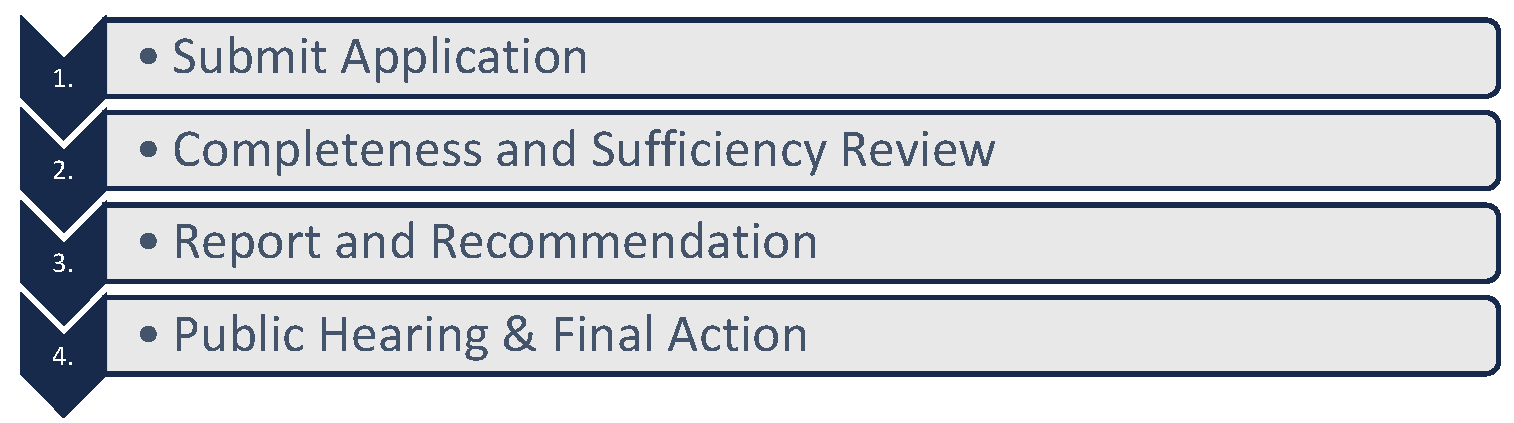
(Ord. No. 05-10, § 2, 12-8-05; Ord. No. 2016-10, § 2(Exh. A), 6-28-16; Ord. No. 2020-25, § 2(Exh. A), 11-10-20)
Sec. 402.158. - Application requirements.
An application for a variance shall be submitted in accordance with Article II, Common Development Application Elements, of this Chapter.
(Ord. No. 05-10, § 2, 12-8-05; Ord. No. 2020-25, § 2(Exh. A), 11-10-20)
Sec. 402.159. - Public notice requirements.
Published notice and posted notice shall be required, according to the procedures in Article IV, Notice of Hearings, of this Chapter, before public hearing on any application for a variance.
(Ord. No. 05-10, § 2, 12-8-05; Ord. No. 2018-23, § 2(Exh. A), 10-9-18; Ord. No. 2020-25, § 2(Exh. A), 11-10-20)
Sec. 402.160. - Burden of proof.
The applicant seeking the variance shall have the burden of presenting evidence demonstrating that the request complies with each of the criteria for approval established in Section 402.162.
(Ord. No. 05-10, § 2, 12-8-05; Ord. No. 2020-25, § 2(Exh. A), 11-10-20)
Sec. 402.161. - Action on variance requests.
The DRC shall hold a public hearing on the proposed variance and has the authority to approve, approve with conditions or deny the variance.
(Ord. No. 05-10, § 2, 12-8-05; Ord. No. 2016-10, § 2(Exh. A), 6-28-16; Ord. No. 2020-25, § 2(Exh. A), 11-10-20)
Sec. 402.162. - Criteria for approval.
When considering an application for a variance, the DRC shall make a finding that the application complies or does not comply with each of the individual criteria of this Section.
(a)
Public interest. The granting of a variance shall not be contrary to the public interest.
(b)
Special conditions.
(1)
Special conditions and circumstances exist which are peculiar to the land, structure, or building involved and which are not applicable to other lands, structures, or buildings in the same zoning district.
(2)
The special conditions and circumstances do not result from the actions of the applicant.
(c)
Literal interpretation. Literal interpretation of the provisions of regulations would deprive the applicant of rights commonly enjoyed by other properties in the same zoning district under the terms of this ULDC and would work unnecessary and undue hardship on the applicant.
(d)
Minimum variance. The variance, if granted, is the minimum variance that shall make possible the reasonable use of the land, building, or structure.
(e)
Special privilege not granted. The variance shall not confer on the applicant any special privilege that is denied by this ULDC to other lands, buildings, or structures in the same zoning district.
(f)
General harmony. The variance shall be in harmony with the purpose of this ULDC, and the Comprehensive Plan, and shall not be injurious to the neighborhood or otherwise detrimental to the public health, safety, or welfare.
(Ord. No. 05-10, § 2, 12-8-05; Ord. No. 2016-10, § 2(Exh. A), 6-28-16; Ord. No. 2020-25, § 2(Exh. A), 11-10-20)
Sec. 402.163. - Conditions and safeguards.
In granting any variance, the DRC may prescribe appropriate conditions and safeguards, including, but not limited to, reasonable time limits within which the action for which the requested variance shall be begun or completed.
(Ord. No. 05-10, § 2, 12-8-05; Ord. No. 2016-10, § 2(Exh. A), 6-28-16; Ord. No. 2020-25, § 2(Exh. A), 11-10-20)
Sec. 402.164. - Power to grant variances.
Provided the proposed variance is consistent with the Comprehensive Plan and all other chapters of this ULDC, the DRC shall have the authority to grant variances from the following requirements contained in any zoning district, except the planned development (PD) zoning district:
(a)
The minimum yard/setback requirements, lot width, or lot depth; and
(b)
The maximum height or building coverage.
(Ord. No. 05-10, § 2, 12-8-05; Ord. No. 06-14, § 2(Exh. A), 7-20-06; Ord. No. 09-01, § 2(Exh. A), 2-24-09; Ord. No. 12-09, § 2(Exh. A), 10-9-12; Ord. No. 2016-10, § 2(Exh. A), 6-28-16; Ord. No. 2020-25, § 2(Exh. A), 11-10-20)
Sec. 402.165. - Reserved.
Editor's note— Ord. No. 12-09, § 2(Exh. A), adopted Oct. 9, 2012, repealed former § 402.165 in its entirety which pertained to a time limit for commencing construction and derived from Ord. No. 05-10, § 2, 12-8-05; 09-01, § 2(Exh. A), 2-24-09.
Sec. 402.166. - Limitations on power to grant variances.
(a)
Use variance prohibited. Variances may not be granted to permit a use that is not otherwise permitted by this ULDC.
(b)
Variances to conditions of development approvals. An amendment to a condition of approval granted by the BOCC or the DRC shall be approved only by that body.
(c)
Use of nonconforming lands or structures. The nonconforming use of neighboring lands, structures, or buildings in the same zoning district, and the permitted use of lands, structures, or buildings in any other district, shall not be deemed grounds for the granting of a variance.
(Ord. No. 05-10, § 2, 12-8-05; Ord. No. 2016-10, § 2(Exh. A), 6-28-16; Ord. No. 2020-25, § 2(Exh. A), 11-10-20)
Sec. 402.167.- Purpose.
(a)
It is the specific purpose of this Article to implement the provisions relative to vested rights in Policy 7.1.15 of the Future Land Use Element and to provide for administrative procedures to ensure that nothing in the Comprehensive Plan or new land development regulations adopted to implement the Plan:
(1)
Limits or modifies the rights of any person to complete any development that has been authorized as a development of regional impact pursuant to F.S. Ch. 380 or the rights of any person who has been issued a final development order and development has commenced and is continuing in good faith; or
(2)
Shall be construed as affecting validly existing vested rights that have been affirmatively demonstrated to meet the legal requirements of vested rights.
(b)
However, it is also the express intent of Alachua County to fully apply the provisions of the Comprehensive Plan and this ULDC to development and property without violating legally vested rights.
(Ord. No. 05-10, § 2, 12-8-05; Ord. No. 2020-25, § 2(Exh. A), 11-10-20; Ord. No. 2021-12, § 2(Exh. A), 9-28-21)
Sec. 402.168. - Reserved.
Editor's note— Ord. No. 2020-25, § 2(Exh. A), adopted November 10, 2020, repealed the former Section 402.168 in its entirety, which pertained to definitions and derived from Ord. No. 05-10, § 2, adopted December 8, 2005.
Sec. 402.169. - Statutory vested rights.
In accordance with Policy 7.1.15(a) of the Future Land Use Element of the Comprehensive Plan, notwithstanding that all or some part of a development or use is inconsistent with the Comprehensive Plan or a new provision of the ULDC that has been adopted to implement the Comprehensive Plan, certain development and uses determined to meet the requirements of this Section shall be vested pursuant to Florida Statutes. Such development may be completed, or use may continue, despite the inconsistency of the development or use with the Comprehensive Plan or ULDC adopted to implement the Comprehensive Plan. Nothing in this Section shall be construed to create rights that otherwise do not exist, including authorization of any action that would pose an imminent peril to health, safety, or welfare, and any development covered by statutory vested rights as defined in this Section shall continue to be subject in all other respects to all laws, ordinances, rules, and regulations other than those based on the Comprehensive Plan or ULDC to implement the Plan with which it would be inconsistent if not covered by statutory vested rights. In addition, the development or use shall continue to be subject to all terms, conditions, requirements, and restrictions contained in the development order that was the basis for the statutory vesting, and any substantial change, shall be required to be consistent with the Comprehensive Plan.
(a)
Developments.
(1)
Developments meeting the following requirements shall be deemed to have statutory vesting pursuant to this Section:
a.
Developments of regional impact for which a development order has been approved pursuant to F.S. § 380.06 prior to the effective date of the Comprehensive Plan provision or implementing ULDC provision for which vesting is asserted, to the extent that the development is consistent with and authorized by the terms and conditions of the development of regional impact (DRI) development order and the DRI development order is valid and unexpired.
b.
Other developments, for which:
1.
A valid final development order in the form of a building permit, final development plan, subdivision plat, or final site plan, or phase thereof, or final development plan for a planned development or other development, or phase thereof, was issued as of the effective date of the Comprehensive Plan provision or implementing ULDC provision for which vesting is asserted;
2.
The development order has not expired; and
3.
Substantial construction in accordance with the development order has lawfully commenced within the time frames and expiration period specified in the development order, or within one (1) year of issuance of the development order where no time frame or expiration is specified therein and is continuing in good faith.
(2)
In all cases, where a final development order has been approved for only a phase of a larger proposed development, statutory vesting applies only to the phase or phases that have received final approval and for which construction has commenced in accordance with the criteria in this paragraph. Each statutory vesting determination also requires that all material requirements, conditions, limitations, and regulations of the development order have been met.
(b)
Procedures for implementation of statutory vested rights. The procedures for implementation of statutory vested rights shall be as follows:
(1)
Any development that meets the requirements for statutory vested rights under Paragraph (1) or (2) of Subsection (a) of this Section shall not have a development order or permit to complete the development withheld on the grounds of inconsistency with the Comprehensive Plan or ULDC adopted to implement the Comprehensive Plan. The procedures for determination of whether such statutory vested rights apply are as follows:
a.
An applicant for such a development order or permit within a development the applicant believes is covered by statutory vested rights shall, submit to the Director of the Alachua County Department of Growth Management documentation demonstrating that the requirements for statutory vesting are met;
b.
If the Director verifies that the requirements for statutory vesting are met, then the development order or permit shall be issued consistent with the terms of this Section. If the Director cannot verify that the requirements for statutory vesting under Paragraph (1) or (2) of Subsection (a) are met based on the documentation submitted, then the applicant shall be informed that the Director cannot confirm that statutory vested rights apply to the development and any development order or permit that is inconsistent with this ULDC or the Comprehensive Plan cannot be issued. The applicant shall also be informed that, if he or she disagrees with the Director's determination, the applicant may file an application for a statutory vested rights certificate in accordance with Section 402.169 of this Chapter.
(Ord. No. 05-10, § 2, 12-8-05; Ord. No. 12-09, § 2(Exh. A), 10-9-12; Ord. No. 2020-25, § 2(Exh. A), 11-10-20)
Sec. 402.170. - Equitable vested rights.
A person with a valid legal or equitable interest in land may request from Alachua County a determination of whether the person's right to complete a development or continue a use on that land is vested pursuant to Policy 7.1.15(c) of the Future Land Use Element of the Comprehensive Plan, notwithstanding that all or some part of the development or use is inconsistent with a specified provision of the Comprehensive Plan or a new provision of ULDC that has been adopted to implement the Comprehensive Plan. It shall be the duty and responsibility of the person alleging equitable vested rights to demonstrate affirmatively the legal prerequisites of equitable vested rights based on the standards described in this Section. If the standards for equitable vested rights are determined to be met, then an equitable vested rights certificate shall be issued to confirm that the development may be completed or use continued despite the inconsistency of that development or use with the specified provision of Comprehensive Plan or ULDC adopted to implement the Comprehensive Plan. Nothing in this Section shall be construed to create rights that otherwise do not exist, including authorization of any action that would pose an imminent peril to the health and safety of the people of Alachua County, and any development or use for which an equitable vested rights certificate is issued shall continue to be subject in all other respects to laws, ordinances, rules, and regulations other than those covered by the equitable vesting certificate.
(a)
In assessing whether the requirements for equitable vested rights have been met, the following factors and guidelines shall be considered:
(1)
Those factors identified in Florida case law addressing equitable estoppel or vested rights, including the essential elements that a person with sufficient legal or equitable interest in real property:
a.
Has relied in good faith;
b.
Upon some act or omission of the government; and
c.
Has made such a substantial change in position or incurred such extensive obligations and expenses that it would be highly inequitable and unjust to destroy the rights to develop or continue to develop or use the property.
(2)
Statements made by County personnel without authority shall not support equitable vesting.
(3)
Omissions shall not support equitable vesting unless such omission was negligent or culpable and the County failed to act when it was under a legal duty to do so.
(4)
An act of the County upon which a person relied while such act was being contested in court or other hearing process shall not support equitable vesting.
(5)
Good faith reliance shall not include ignorance or unawareness of the law.
(6)
The following shall not be considered as a basis for equitable vested rights in and of themselves:
a.
Expenditures for legal and other professional services that are not related to the design or construction of improvements;
b.
Preexisting zoning contrary to the Comprehensive Plan;
c.
Expenditures related to a rezoning action;
d.
Taxes paid; and
e.
Expenditures for initial acquisition of the land not made in good faith reliance upon the act or omission of the government that is the basis for equitable vested rights.
(7)
Failure to comply with the material time requirements or other terms of a development order or this Chapter shall be presumed to negate a claim that the owner acted in good faith upon some act or omission of the County or that the development has continued in good faith.
(8)
Expenditures or obligations shall be presumed not to have been made or incurred in good faith, unless rebutted by substantial competent evidence, if they were made or incurred:
a.
When a person misled the County; and
b.
When the act of the County on which a person is relying has been invalidated or has expired and the person knew or should have known of such invalidity or expiration.
(9)
Other factors that shall be considered include:
a.
Whether substantial construction in accordance with a valid final development order has occurred and is continuing in good faith; and
b.
Whether the obligations and expenses incurred cannot be substantially utilized in a development that is consistent with the Comprehensive plan or ULDC adopted to implement the Plan.
(b)
Procedures for determination of equitable vested rights. The sole procedure for determining the existence of the equitable vested rights and obtaining an equitable vested rights certificate shall be as identified in Section 402.171.
(Ord. No. 05-10, § 2, 12-8-05; Ord. No. 12-09, § 2(Exh. A), 10-9-12; Ord. No. 2020-25, § 2(Exh. A), 11-10-20)
Sec. 402.171. - Applications for vested rights certificate.
A person who believes he or she is entitled to a statutory vested rights certificate or an equitable vested rights certificate for a particular development or use may complete, execute and file an application for a vested rights certificate with the Director of the Department of Growth Management. The applicant shall simultaneously tender any application fees established by the BOCC for review of such applications.
(a)
Application filing deadline. An application for determination of vested rights shall be filed within one (1) year of the effective date of the Comprehensive Plan policies or ULDC for which vesting is asserted. In the case of denial of a development order, denial of a certificate of level of service compliance when the denial is based on inconsistency with the Comprehensive Plan or this ULDC adopted to implement the Plan, or approval of a development order with a condition that is based on a Comprehensive Plan or ULDC provision for which vested rights is asserted, an application for determination of vested rights shall be filed within twenty-one (21) days of the date of denial or approval with condition. The failure to file an application within the above time frames shall constitute an abandonment and waiver of any claim to statutory vested rights or equitable vested rights.
(b)
Contents of application. The application shall contain a sworn statement including information sufficient to enable a determination to be made whether the development or use is vested pursuant to either Section 402.169 or Section 402.170 of this Chapter. The applicant may submit any relevant supporting information, including development orders and permits, contracts, letters, appraisals, reports, inspection reports, or any other documents, dates and specific identification of development order or permit approvals, items or things upon which the application is based and a list of any development orders or permits denied on the grounds of inconsistency with the Comprehensive Plan or ULDC and the specific provision of the plan or regulation that was the basis for the denial. The Director may require the applicant to submit additional information to enable a determination to be made whether the development or use is vested. An incomplete or insufficient application shall be returned to the applicant for additional information. Until the proceedings to grant or deny the application are final (including the time during which judicial appeals are pending), the applicant shall have a continuing obligation to correct any statement or representation found to have been incorrect when made or which becomes incorrect by virtue of changed circumstances.
(c)
Verification by and continuing obligation of applicant. The applicant, or any agent or attorney for the applicant, shall verify the application in accordance with F.S. § 92.525(2), and sign a written declaration under penalty of perjury that he or she has read the application and relevant supporting information and that the facts stated in it are true to the best of his or her knowledge and belief. Until the proceedings to grant or deny the application are final (including the time during which judicial appeals are pending), the applicant shall have a continuing obligation to correct any statement or representation found to have been incorrect when made or which becomes incorrect by virtue of changed circumstances.
(d)
Report on application.
(1)
The Director or his or her designee shall review the application and any supporting or background information and shall consult with other County staff as he or she deems necessary or desirable including any County official who participated in a determination as to consistency of the development or use with the Comprehensive Plan or this ULDC to implement the plan, and the County Attorney, who shall provide counsel on issues of law. Within forty-five (45) days after receipt of a complete and sufficient application for a vested rights certificate, the Director shall either grant the certificate or transmit in writing to the applicant the reason or reasons for denial, including findings of fact and conclusions of law pertaining to the reason or reasons for denial. The certificate may be issued with conditions or limitations. The decision shall be mailed by U.S. mail, return receipt requested.
(2)
If the applicant is aggrieved by the action of the Director, he may notify the Director in writing that he is appealing the Director's decision. The notification shall be delivered to the Director no later than thirty (30) days after the Director renders his or her decision on the application; otherwise, the applicant shall be deemed to have waived all rights to challenge the decision. (For purposes of this Section, the term "renders" means the date of signature on the return receipt card accompanying the decision. However, in the event the certified mail is not accepted or is returned, the term "renders" means ten (10) calendar days after the date the decision was signed by the Director.) The applicant shall also submit with the notification a list of the names and addresses of any witnesses whom the applicant shall present in support of the appeal and a summary of the testimony of each witness. Upon receipt by the Director of a timely notice of appeal, the appeal shall be assigned to a hearing officer, and a hearing on the appeal shall be held in accordance with the provisions of Section 323.08 on a date no later than ninety (90) days after receipt of the notice or at such other date as the hearing officer and parties may consent to. The Director shall file with the hearing officer the notice of appeal, information and a list of witnesses submitted by the applicant, any supporting or background information, and his or her written determination regarding the application. The applicant and the County shall equally share the cost of conducting the hearing, including the services of the hearing officer and legal stenographer.
(3)
Nothing in this Section or any other part of this Chapter prohibits the Director from reconsidering and reversing a denial of a statutory vested rights certificate or equitable vested rights certificate at any time prior to the start of the hearing before the hearing officer.
(Ord. No. 05-10, § 2, 12-8-05; Ord. No. 12-09, § 2(Exh. A), 10-9-12; Ord. No. 2020-25, § 2(Exh. A), 11-10-20)
Sec. 402.172. - Vested rights certificate binding on the land.
Any vested rights certificate issued pursuant to this Chapter shall inure to the benefit of and run with the land to which it applies and is therefore transferable from owner to owner of the land subject to the certificate.
(Ord. No. 05-10, § 2, 12-8-05; Ord. No. 2020-25, § 2(Exh. A), 11-10-20)
Sec. 402.173. - Limitation on determination of vested rights.
(a)
A determination of vested rights which grants an application for determination of vested rights as to new development shall expire and be null and void unless substantial construction is commenced pursuant to a final development order, final subdivision plat, or final site development plan within two (2) years after the date of issuance of the determination of vested rights or of the effective date of this Section, whichever is later, and unless such substantial construction continues in good faith until project completion. Failure to obtain a building permit within two (2) years after the issuance of the determination of vested rights under this Chapter shall render said vested rights to expire and become null and void.
(b)
If an applicant has failed to satisfy the above criteria or the deadlines or requirements incorporated in the vested rights determination, then the applicant may apply to the Director for a determination that it has in fact continued to develop in good faith since the date of the vested rights determination. Such subsequent determination will be limited solely to a consideration of applicant's development activities and other matters occurring since the date of the vested rights determination, in order to ascertain whether the applicant has continued in good faith to develop since the date of the vested rights determination. That determination shall be governed by the procedures for an initial vested rights determination under this Chapter.
(c)
All development granted a certificate of vested rights shall not substantially deviate from the terms and conditions upon which the certificate was granted, unless such a deviation is reviewed and approved by the DRC. Any deviation determined to be substantial by the DRC shall be subject to the concurrency requirements of the Comprehensive Plan, this ULDC, and approval by the BOCC. Any substantial deviation constructed without prior County approval shall result in the forfeiture of the vested rights certificate and any vested rights claim.
(Ord. No. 05-10, § 2, 12-8-05; Ord. No. 12-09, § 2(Exh. A), 10-9-12; Ord. No. 2020-25, § 2(Exh. A), 11-10-20)
Sec. 402.174. - Termination or suspension of vested status.
(a)
Notwithstanding anything in this Chapter to the contrary, subject to the requirements of Paragraph (b) of this Section, a valid and unexpired equitable or statutory vested rights certificate may be suspended or revoked upon a showing by Alachua County of an imminent peril to the health and safety of the people of Alachua County which did not exist or was unknown at the time the certificate was issued or at the time of the development order or act of the government on which the claim for vesting is based. In addition, vested rights certificate may be suspended or revoked upon a showing by Alachua County that the certificate was issued based upon false, inaccurate, misleading, or incomplete information.
(b)
A valid and unexpired equitable or statutory vested rights certificate issued pursuant to this Chapter shall not be revoked prior to a hearing being held by the BOCC. However, such certificate may be suspended prior to a hearing being held by the BOCC, provided the BOCC shall hold a hearing within thirty (30) days after the suspension.
(Ord. No. 05-10, § 2, 12-8-05; Ord. No. 2020-25, § 2(Exh. A), 11-10-20)
Sec. 402.175. - Savings provision.
If any part of this Article is held to be unconstitutional, it shall be construed to have the legislative intent to pass this Article without such unconstitutional part; and the remainder of this Article as to exclusion of such part shall be deemed and held to be valid as if such part had not been included herein.
(Ord. No. 05-10, § 2, 12-8-05; Ord. No. 2020-25, § 2(Exh. A), 11-10-20)
Sec. 402.176.- Appeal process.
Appeals of all development orders and other applications included in this ULDC shall be by petition for writ of certiorari filed in the Circuit Court for Alachua County within thirty (30) days of the date of the final development decision, except as otherwise provided in Florida Statute.
(Ord. No. 05-10, § 2, 12-8-05; Ord. No. 06-14, § 2(Exh. A), 7-20-06; Ord. No. 12-09, § 2(Exh. A), 10-9-12; Ord. No. 2020-25, § 2(Exh. A), 11-10-20)
Sec. 402.177. - Effects of challenges and appeals.
The timely filing of a petition for appeal in a court of law, challenging a final decision granting a development order, shall have the effect of staying the development order, unless the applicant furnishes the County with a properly executed waiver of claims, release from liability and hold harmless instrument, in a form approved by the County Attorney, that protects the County from liability for the issuance of further development permits for the project while the legal challenge is pending. No construction, building, or other development permits that depend upon the development order shall be issued, unless the aforementioned waiver is provided.
(Ord. No. 05-10, § 2, 12-8-05; Ord. No. 12-09, § 2(Exh. A), 10-9-12; Ord. No. 2020-25, § 2(Exh. A), 11-10-20)
Secs. 402.178, 402.179. - Reserved.
Editor's note— Ord. No. 12-09, § 2(Exh. A), adopted Oct. 9, 2012, repealed former sections 402.178 and 402.179 in their entirety which pertained to interpretation of the ULDC and appeals of other development decisions. Both former sections derived from Ord. No. 05-10, § 2, adopted Dec. 8, 2005.
Sec. 402.180.- Purpose.
It is the purpose of this Article to implement the provisions of Section 9.0 Transfer of Development Rights Program, in the Future Land Use Element, as a tool that will protect the County's environmental resources and promote viable agriculture while encouraging efficient use of services and infrastructure within the Urban Cluster.
(Ord. No. 09-05, § 2(Exh. A), 9-9-09; Ord. No. 2020-25, § 2(Exh. A), 11-10-20)
Sec. 402.181. - Applicability.
Development rights may be sold or otherwise transferred in accordance with the provisions of this Article to facilitate transfers of development rights from regulated conservation and viable agriculture areas (sending areas) to areas more suitable for development within the Urban Cluster (receiving areas). The County shall maintain a publicly accessible database of potential development rights for sale or transfer and completed transactions of transfers of development rights.
(Ord. No. 09-05, § 2(Exh. A), 9-9-09; Ord. No. 2020-25, § 2(Exh. A), 11-10-20)
Sec. 402.182. - Establishment of sending and receiving areas.
(a)
Sending areas.
(1)
Agricultural sending areas shall be defined as any legally created parcel or combination of contiguous parcels that meet the following criteria:
a.
Property has an approved agricultural classification from the Alachua County Property Appraiser;
b.
Property is located outside the Urban Cluster; and
c.
Property is greater than or equal to one hundred sixty (≥160) acres.
1.
An exception to the size threshold may be permitted where the property is contiguous to a designated sending area;
2.
An exception to the size threshold may be permitted where the property is determined by the County to be of exceptional agricultural value based on factors such as the following:
(A)
Current agricultural use of the property;
(B)
Economic value of the use;
(C)
Types of soils;
(D)
Local marketing of products;
(E)
Sustainable farming practices such as low-loss irrigation and organic certification.
3.
If an exception to the 160-acre size threshold is granted, any agricultural sending area parcel or combination of contiguous parcels must still be a minimum of forty (40) acres in size.
(2)
Conservation sending areas shall be defined as any legally created parcel or combination of contiguous parcels that meet the following criteria:
a.
Property contains strategic ecosystems or is on the Alachua County Forever (ACF) active acquisition list; and
b.
Property is greater than or equal to one hundred sixty (≥160) acres.
1.
An exception to the size threshold may be permitted where the property is contiguous to a designated sending area; or
2.
An exception to the size threshold may be permitted where the property is contiguous to a 160-acre or larger property designated as a strategic ecosystem or on the Alachua County Forever active acquisition list.
3.
An exception to the size threshold may be permitted where the property is contiguous to an established preservation area or an equivalent property designated on the Future Land Use Map of any adjacent jurisdiction or any other public park or preserve established for the purpose of preserving natural habitats.
4.
An exception to the size threshold may be permitted where the property is determined by the County to contain critical resources and ecological value based on ground-truthing of the property.
5.
If an exception to the 160-size threshold is granted, any conservation sending area parcel or combination of contiguous parcels must still be a minimum of forty (40) acres in size.
(b)
Receiving areas.
(1)
Any proposed amendment to expand the Urban Cluster must include a commitment to purchase development rights at a rate of two (2) development rights per unit of proposed increase in density for residential or a rate of ten (10) development rights purchased per acre of non-residential land uses created.
(2)
Additional receiving areas may be established within municipalities through interlocal agreements. These agreements shall address development right purchasing procedures including the required rate of transfer.
(Ord. No. 09-05, § 2(Exh. A), 9-9-09; Ord. No. 2020-09, § 2(Exh. A), 3-10-20; Ord. No. 2020-25, § 2(Exh. A), 11-10-20)
Sec. 402.183. - Calculating development rights and residual uses.
(a)
Calculation of transferable development rights.
(1)
Development rights available for transfer shall be equal to the lesser of the following, minus the residual units not to be included in the transfer:
a.
Number of residential units otherwise allowed on the sending area property; or
b.
Number of upland acres on the sending area property.
(2)
As an incentive to transfer development rights away from a sending property, a total of two (2) development rights in addition to the number of rights granted through the calculations identified above are allowed, plus one (1) additional right per every ten (10) acres of conservation area on site and one (1) additional right per every twenty (20) acres of non-conservation area on site.
(b)
Residual uses.
(1)
Agriculture. Residential densities of up to one (1) dwelling unit per forty (40) acres may be retained in the sending area and continuation of agricultural uses in accordance with the most recent best management practices (BMPs) adopted by the State. When a portion of the property contains mapped conservation areas, conservation sending area residual guidelines apply.
(2)
Conservation. Residential densities of up to one (1) dwelling unit per two hundred (200) acres may be retained on the sending parcel where consistent with a conservation management plan.
a.
Higher densities of up to one (1) dwelling unit per forty (40) acres may be proposed where it can be demonstrated that there is no impact on resource protection and where consistent with a Conservation Area Management Plan to be developed consistent with this ULDC Chapter 406 Article XVII, Conservation Management Areas and Article XX, Management Plans.
b.
The amount of density to be retained shall be based on what is necessary to protect the integrity of the ecological system and conservation resources.
c.
Continuation of agricultural uses is allowed in accordance with the most recent best management practices (BMPs) adopted by the State.
d.
Residual units shall be developed in a clustered pattern to protect the integrity of the environmental resources on and adjacent to the site. Alternative design patterns may be considered if it can be demonstrated that an alternative layout and design protects the integrity of the resources and has less impact than a typical clustered pattern based on site characteristics and location, access issues, previous site impacts, and historic uses.
e.
If the property is less than two hundred (200) acres existing homesteaded units may still be retained.
(3)
Development plan approval by the DRC is required for development of the residual units. Development may not occur until the parcel has been rezoned to Ag-TDR or C-TDR as required by Subsection 402.185(a)(3) below. The entire planning parcel, defined as the original parcel rezoned to a TDR sending district, must be used for determining development and placement of residual units.
(Ord. No. 09-05, § 2(Exh. A), 9-9-09; Ord. No. 2020-25, § 2(Exh. A), 11-10-20)
Sec. 402.184. - Application for and issuance of a transfer of development rights certificate.
(a)
Application for a transfer of development rights certificate. A potential sending property applicant shall submit an application for a transfer of development rights certificate. That application shall include the following:
(1)
Authority to submit an application, in a form approved by the County Attorney;
(2)
Legal description of the property;
(3)
Natural resources assessment;
(4)
Statement of how the property qualifies as a sending parcel as consistent with the Comprehensive Plan and Subsection 402.182(a) above;
(5)
A statement of the number of development rights proposed for transfer from the sending parcel and calculations showing their determination;
(6)
Applicable fees; and
(7)
Such additional information as may be required by the Director as necessary to determine the number of development rights that qualify for transfer.
(b)
Issuance of a transfer of development rights certificate.
(1)
Once the potential development rights for transfer have been calculated and an application for a certificate has been approved, the Director shall issue a transfer of development rights certificate containing the following information:
a.
Name of the transferor;
b.
A legal description of the sending parcel;
c.
A statement of the number of development rights available for transfer;
d.
Statement of the remaining development rights on the sending parcel;
e.
A general description of the potential area for development of the remaining units; and
f.
The date of issuance of the certificate.
(2)
The Growth Management Director's determination, as shown on the transfer of development rights certificate, shall become final within thirty (30) days of the date of determination. Alternatively, the applicant may submit an application to the DRC for a preliminary development plan review for transfer of development rights determination within thirty (30) days of the Growth Management Director's determination. The Director's determination shall then become void and the DRC shall consider the matter anew and make the final decision on the application.
(c)
Authority to transfer development rights.
(1)
Each transferor granted a transfer of development rights certificate shall have the authority to sever all of the development rights (minus the residual uses) from the parcel in a sending district and to sell or otherwise transfer those rights to a transferee in a receiving district consistent with Section 402.185 below.
(2)
The transferee may apply the rights to a property in the receiving area in accordance with Subsection 402.185(c) below.
(3)
Any transfer of development rights pursuant to this ordinance authorizes only a reduction in Open Space or is fulfilling a requirement of an application to expand the Urban Cluster. Development standards of the receiving district shall not otherwise be altered or waived including standards for stormwater, landscaping, floodplains, wetlands, or other environmentally sensitive areas.
(Ord. No. 09-05, § 2(Exh. A), 9-9-09; Ord. No. 12-09, § 2(Exh. A), 10-9-12; Ord. No. 2020-09, § 2(Exh. A), 3-10-20; Ord. No. 2020-25, § 2(Exh. A), 11-10-20)
Sec. 402.185. - Transfer of development rights.
(a)
Development rights eligible for sale or transfer. Prior to the development rights contained in the transfer of development rights certificate being eligible for sale or transfer to a receiving property, the owner of the sending property shall:
(1)
Record a perpetual easement for conservation or agricultural purposes on the sending property in a form acceptable to and enforceable by the County and submit a copy to the Growth Management Department;
(2)
For sending properties retaining densities of one (1) unit per two hundred (200) acres or greater, develop and submit for approval a conservation management area plan in accordance with this ULDC Chapter 406, Article XVII, Conservation Management Areas and Article XX, Management Plans Conservation; and
(3)
Submit an application for a rezoning of the property to a sending area zoning designation;
(b)
Sale of development rights Instruments of transfer. An instrument of transfer must be completed and notarized prior to the transfer of development rights from a sending parcel to a receiving parcel. This instrument shall contain the following information:
(1)
The names of the transferor and transferee;
(2)
A legal description of the sending and receiving parcels;
(3)
A statement that the transferor grants to the transferee and the transferee's heirs, assigns, and successors, a specific number of development rights from the sending parcel to the receiving parcel and the method by which the rights will be sold or transferred to the receiving parcel;
(4)
A statement that the transferor acknowledges he has no further right of use with respect to the rights being transferred;
(5)
Any other relevant information as required by the Director to establish that rights have been transferred.
(c)
Use of transferred development rights by a receiving property. Comprehensive Plan amendment to expand the Urban Cluster. For applications to expand the Urban Cluster, the applicant shall submit the Comprehensive Plan amendment application in accordance with Article VII, Comprehensive Plan Amendment with the following additional information:
(1)
Completed and notarized instrument of transfer as described in Subsection 402.185(b) above;
(2)
Proof of contract to purchase development rights; and
(3)
Prior to the adoption hearing for the amendment, the receiving property owner shall provide proof of purchase of the development rights.
(d)
Rezoning of sending parcel. Once proof that a property owner has sold their development rights has been submitted to the County, the County shall process a rezoning to a TDR zoning district on the sending parcel.
(Ord. No. 09-05, § 2(Exh. A), 9-9-09; Ord. No. 2020-09, § 2(Exh. A), 3-10-20; Ord. No. 2020-25, § 2(Exh. A), 11-10-20)
Sec. 402.186.- Purpose.
The purpose of this Article is to outline the requirement for and implementation of the construction permitting process for development and redevelopment in the unincorporated portion of Alachua County. The construction permit authorizes a developer or contractor to undertake construction activity on a site that has received development plan approval. The construction permit is intended to ensure coordination between the County, the developer and any contractors so that sites are constructed according to approved development plans, and that all elements of an approved plan are physically protected as well as constructed.
(Ord. No. 2020-25, § 2(Exh. A), 11-10-20)
Sec. 402.187. - Construction permit required.
The following types of development shall require the issuance of a construction permit:
(a)
All development resulting from an approved development plan by the Development Review Committee, or Development Review Departments outlined in Section 401.20 unless otherwise exempted in an approved development order.
(b)
Any proposed alterations of a County roadway or right-of-way.
(c)
County funded infrastructure projects are exempt from this provision.
(Ord. No. 2020-25, § 2(Exh. A), 11-10-20)
Sec. 402.188. - Consistency and compliance.
All construction permits shall be consistent with and comply with the following:
(a)
The Comprehensive Plan;
(b)
This ULDC;
(c)
Any approved development order;
(d)
All other applicable federal, state and County laws, codes and requirements.
(Ord. No. 2020-25, § 2(Exh. A), 11-10-20)
Sec. 402.189. - Improvement of property prior to issuance of a construction permit.
When a construction permit is required, site work, site clearing, grading, improvement of property, or construction of any type, including any construction regulated by the Florida Building Code, shall not be commenced prior to the issuance of the construction permit.
(Ord. No. 2020-25, § 2(Exh. A), 11-10-20; Ord. No. 2024-07, § 2(Exh. A), 9-10-24)
Sec. 402.190. - Process.
(a)
Applications for construction permit shall be in a form established by Public Works Department. All documents shall be consistent with any approved development plan.
(b)
The Public Works Department shall set a date for a preconstruction meeting for projects that contain new public infrastructure, or alter count rights-of-way, which may include the owner, contractors, design engineer and Alachua County Staff that will be inspecting the site.
(c)
The construction permit shall not be issued until Staff has approved a tree barricade inspection, and other associated natural resource barriers, or erosion and sedimentation control measures included in the development plan.
(d)
Clearing may only occur after the issuance of the construction permit. Limited clearing may be authorized by Staff for installation of barriers and when allowed as part of the approved development plan.
(e)
Construction on the site shall occur consistent with Alachua County's Construction and Inspection Standards, and the approved development plan.
(f)
A "stop work" order may be issued in writing by the Public Works Director/County Engineer, the Growth Management Director, or the Environmental Protection Director, or their designee, when development activity does not comply with the approved development plan and construction permit.
(g)
Once all construction is complete, an inspection shall be performed by Alachua County to ensure that the site has been constructed in compliance with the approved development plan.
(h)
Any deficiencies identified by Alachua County shall be remedied prior to issuance of a certificate of completion for residential subdivisions, or issuance of a certificate of occupancy for all other types of development.
(Ord. No. 2020-25, § 2(Exh. A), 11-10-20)
Sec. 402.191.- Purpose.
The purpose of this Article is to define the requirements and process for expediting building permitting consistent with F.S. § 177.073. The article provides for the issuance of building permits for a residential subdivision prior to the recording of a final plat with the Clerk of the Court.
(Ord. No. 2024-07, § 2(Exh. A), 9-10-24)
Sec. 402.192. - Applicability.
The provisions of this section are applicable to any residential subdivisions that have not received final development plan approval prior to the effective date of this section.
(Ord. No. 2024-07, § 2(Exh. A), 9-10-24)
Sec. 402.193. - Notification required.
An applicant choosing to take advantage of this allowance to receive a building permit prior to the recording of a final plat with the Clerk of the Court shall provide notice to the Building Division not later than thirty (30) days prior to the submittal of a building permit. Failure to provide the required notice will result in a delay in the acceptance of building permits. The following items shall be included with the notification.
(a)
The name of the plat, application number under which it was approved, and listing of lot numbers for the building permits that will be requested prior to the recording of the final plat;
(b)
The anticipated date of submittal of the building permits;
(c)
Whether any building permit will use a master building permit on file with the County;
(d)
Documentation of a performance bond in the amount of one hundred thirty (130) percent of the required improvements necessary to complete the infrastructure to support the development;
(e)
Documentation that the preliminary plat has been provided to all relevant utility providers;
(f)
Acknowledgement that no temporary or final Certificate of Occupancy will be issued for the permits, nor any of the lots sold, until the final plat is recorded with the Clerk of the Court;
(g)
A hold harmless agreement in a format provided by the County;
(h)
The required fee for processing the permits requested.
(Ord. No. 2024-07, § 2(Exh. A), 9-10-24)
Sec. 402.194. - Additional building permit requirements.
A building permit submitted pursuant to this Article may, at the sole discretion of the building official, be reviewed by a third-party who has been retained by the County for this purpose. No building permit submitted pursuant to this section will be issued prior to the issuance of a Construction Permit consistent with Article XXX of this Chapter.
(Ord. No. 2024-07, § 2(Exh. A), 9-10-24)
Sec. 402.195.- Purpose.
The purpose of this Article is to provide clarity about the implementation of certain multi-family and mixed-use developments identified in F.S. § 125.01055 in unincorporated Alachua County. The requirements and process included here have been found by the County to be necessary for proper evaluation and approval of such developments.
(Ord. No. 2024-07, § 2(Exh. A), 9-10-24)
Sec. 402.196. - Applicability.
This Article applies to certain affordable multifamily and mixed-use residential developments located within AP, BP, BR, BR-1, BH, BA, BA-1, BW, MB, ML, MS, MP, RP zoning districts and within the Eastside Activity Center Overlay District and planned developments with allowed mixed-use. For the purposes of this Article, the term 'affordable multifamily and mixed-use development' means a project that, for a period of at least thirty (30) years, has at least forty (40) percent of its units available for rental and affordable as defined in F.S. § 420.0004, and for mixed-use development at least sixty-five (65) percent of the total square footage is used for residential purposes.
(Ord. No. 2024-07, § 2(Exh. A), 9-10-24)
Sec. 402.197. - Standards specific to live local act developments.
As provided in F.S. § 125.01055, the following may apply to any permit issued pursuant to this Article. All other multi-family residential requirements of this ULDC shall remain in effect.
(a)
Density will not exceed twenty-four (24) dwelling units per acre.
(b)
No maximum floor area ratio shall be applicable.
(c)
Developments will have a maximum height of sixty-five (65) feet.
(Ord. No. 2024-07, § 2(Exh. A), 9-10-24)
Sec. 402.198. - Live local act development bonuses.
Development subject to this Article are permitted to develop consistent with either of the following:
1.
Up to forty-eight (48) dwelling units per acre subject to the following:
a.
They are located within an activity center and not in industrial zoning districts; and
b.
at least forty (40) percent of the number of units up to twenty-four (24) dwelling units per acre are maintained as affordable and for rent at or below one hundred twenty (120) percent of the area median income for a period not less than thirty (30) years; and
(c)
at least thirty (30) percent of the number of units exceeding twenty-four (24) dwelling units per acre are maintained as affordable at or below eighty (80) percent of the area median income for a period not less than thirty (30) years.
(2)
Up to seventy-two (72) dwelling units per acre subject to the following:
a.
They are located within an activity center and not in industrial zoning districts; and
b.
at least forty (40) percent of the number of units up to twenty-four (24) dwelling units per acre are maintained as affordable and for rent at or below one hundred twenty (120) percent of the area median income for a period not less than thirty (30) years; and
c.
at least thirty (30) percent of the number of units exceeding twenty-four (24) dwelling units per acre are maintained as affordable at or below fifty (50) percent of the area median income for a period not less than thirty (30) years.
(Ord. No. 2024-07, § 2(Exh. A), 9-10-24)
Sec. 402.199. - Development plan approval required.
An applicant choosing to use the provisions of this Article must submit a development plan for review by the County. The application must include all applicable items in Sections 402.05, 402.06 and 402.07.
(a)
Any application made pursuant to this Article that meets applicable development standards in Chapters 403, 405, 406, 407 for multi-family residential development for R-2, R-2a or R-3, as determined by the density proposed by the development application shall be approved administratively by the Growth Management Department, in conjunction with other reviewing agencies, as outlined in Chapter 401 Article VI.
(b)
Any application pursuant to this Article that does not meet applicable development standards, as outlined in subsection (a), above, may use other applicable review processes in the ULDC, that may require approval by the BOCC or by the DRC.
(c)
Notwithstanding the above process provisions, nothing shall require the County to approve an application pursuant to this Article that is found to be inconsistent with the County Comprehensive Plan or ULDC.
(Ord. No. 2024-07, § 2(Exh. A), 9-10-24)
Sec. 402.200. - Process.
(a)
Applications for a Live Local Act Development shall be in a form established by the County.
(b)
Fee for review shall be established in the Alachua County Fee Schedule.
(c)
After submittal, the application shall be reviewed for consistency with F.S § 125.01055, this Article, and all other applicable requirements of this ULDC.
(d)
Should any deficiencies be noted in the submitted plans, the County must provide the applicant with a report detailing those deficiencies that must be corrected prior to the issuance of a development order.
(e)
Once the development plan has been determined to be consistent with the land development regulations staff shall approve the development plan, or, in the case of a development plan that cannot be approved administratively, will schedule the application for a hearing with the appropriate reviewing body.
(f)
Prior to issuance of a Construction Permit, all applicants for a Live Local Act Development must sign and record a Land Use Restriction Agreement (LURA), in a form established by the County for compliance monitoring and penalties, that is irrevocable for a period of thirty (30) years from development approval.
(Ord. No. 2024-07, § 2(Exh. A), 9-10-24)

