
Alachua County Unincorporated
City Zoning Code
City Zoning Code
CHAPTER 404
- USE REGULATIONS
ARTICLE XXV.- PUBLIC FAIRGROUND[4]
Editor's note— Ord. No. 08-06, § 2(Exh. A), adopted April 22, 2008, amended the Code by adding provisions designated as Art. XXIV, § 404.104. In order to avoid conflicts in section numbering the editor has renumbered these provisions added as Art. XXV, § 404.105.
Sec. 404.01.- Purpose.
This Chapter establishes permitted, limited, accessory, and prohibited uses, as well as uses that require special use permits or special exceptions, according to the various zoning districts. Where such uses are allowed within a zoning district but are not permitted by right, applicable standards are established for the use.
(Ord. No. 05-10, § 2, 12-8-05; Ord. No. 2020-25, § 2(Exh. A), 11-10-20)
Sec. 404.02. - Principal uses within planned development districts.
Within planned development districts, all principal uses shall be set out within the development order approved by the BOCC, in a manner consistent with the Comprehensive Plan and this ULDC.
(Ord. No. 05-10, § 2, 12-8-05; Ord. No. 12-09, § 2(Exh. A), 10-9-12; Ord. No. 2020-25, § 2(Exh. A), 11-10-20)
Sec. 404.03. - Uses within TDR (transfer of development rights) districts.
The uses allowed within the silvicultural (SLV-TDR) district, the agriculture (AG-TDR) district, and the rural residential (RR-TDR) district will be established at the time that the County officially adopts a transfer of development rights program.
(Ord. No. 05-10, § 2, 12-8-05; Ord. No. 2020-25, § 2(Exh. A), 11-10-20)
Sec. 404.04. - Uses within conservation and preservation management areas.
The uses allowed within conservation and preservation management areas shall be set out within the management plan approved for the area, in accordance with the requirements of Chapter 406 of this ULDC.
(Ord. No. 05-10, § 2, 12-8-05; Ord. No. 2020-25, § 2(Exh. A), 11-10-20)
Sec. 404.04.5. - Uses within traditional neighborhood developments and transit oriented developments.
Uses allowed within TNDs and TODs are listed within the Use Table similar to the zoning districts. TND/TOD is not a zoning district. Article VII of Chapter 407 provides further limitations about the location and design of some uses.
(Ord. No. 10-16, § 2(Exh. A), 8-10-10; Ord. No. 2020-25, § 2(Exh. A), 11-10-20)
Sec. 404.04.6. - Uses within the Eastside Activity Center zoning districts.
Uses allowed within the Eastside Activity Center zoning districts are identified in Table 405.42.1 of this ULDC.
(Ord. No. 12-09, § 2(Exh. A), 10-9-12; Ord. No. 2020-25, § 2(Exh. A), 11-10-20)
Sec. 404.05.- Applicability.
Permitted, limited, special, accessory, and prohibited uses are established in the Use Table. The use of all new or existing structures and properties shall conform with the requirements of the Use Table and with all other applicable requirements of this ULDC.
(Ord. No. 05-10, § 2, 12-8-05; Ord. No. 2020-25, § 2(Exh. A), 11-10-20)
Sec. 404.06. - Types of uses.
(a)
Permitted use by right (P). A "P" indicates a use that is permitted by right. Standards established in this Chapter do not apply to uses that are permitted by right within a particular zoning district.
(b)
Limited use (L). An "L" indicates a use that is permitted by right, provided that the use meets the additional standards established in this or other referenced Chapters of this ULDC.
(c)
Special exception (SE). An "SE" indicates a use that is permitted only where approved with a special exception by the BOCC in accordance with the procedures in Article XVII of Chapter 402.
(d)
Special use permit (SU). An "SU" indicates that a use is permitted only where approved with a special use permit by the BOCC in accordance with the procedures in Article XVIII of Chapter 402.
(e)
Accessory use (A). An "A" indicates a use that is permitted as an accessory to a principal use in the respective district. An accessory use is incidental and subordinate to a principal use and may be subject to additional standards established in this Chapter.
(f)
Prohibited uses (blank cell). A blank cell in the Use Table indicates that a use is not permitted in the respective district.
(g)
Not applicable (NA). A "NA" indicates that the permitted location of a use is not determined by zoning district but other factors, including future land use designation.
(Ord. No. 05-10, § 2, 12-8-05; Ord. No. 12-09, § 2(Exh. A), 10-9-12; Ord. No. 2020-25, § 2(Exh. A), 11-10-20)
Sec. 404.07. - Standards for uses.
The "Standards" column on the Use Table contains cross-references to standards that are applicable to the limited or accessory use, or the use allowed by special exception or special use permit, which is listed in that row.
(Ord. No. 05-10, § 2, 12-8-05; Ord. No. 2020-25, § 2(Exh. A), 11-10-20)
Sec. 404.08. - Similar uses.
A use not listed in the Use Table, but possessing similar characteristics, including but not limited to size, intensity, density, operating hours, demands for public facilities such as water and sewer, traffic and environmental impacts, and business practices, may be allowed upon approval by the Director. Such uses will be determined based on the use category tables and definitions in Chapter 410. Similar uses shall be subject to all requirements of the uses to which they are similar.
(Ord. No. 05-10, § 2, 12-8-05; Ord. No. 2020-25, § 2(Exh. A), 11-10-20)
Sec. 404.08.5. - Development review required.
Development plan review may be required for any use authorized under this ULDC in accordance with Chapter 401 or as expressly required by the standards for a specific use as identified in this Chapter. Where a use identifies a requirement for development plan approval, the reviewing body shall be determined by the threshold requirements specified in Chapter 401 unless review by the DRC is expressly required.
(Ord. No. 08-06, § 2(Exh. A), 4-22-08; Ord. No. 12-09, § 2(Exh. A), 10-9-12; Ord. No. 2020-25, § 2(Exh. A), 11-10-20)
(Ord. No. 05-10, § 2, 12-8-05; Ord. No. 06-14, § 2(Exh. A), 7-20-06; Ord. No. 07-07, § 2(Exh. A), 4-27-07; Ord. No. 08-06, § 2(Exh. A), 4-22-08; Ord. No. 09-01, § 2(Exh. A), 2-24-09; Ord. No. 09-05, § 2(Exh. A), 9-9-09; Ord. No. 10-09, § 2(Exh. B, 4-13-10; Ord. No. 10-13, § 2(Exh. A), 6-8-10; Ord. No. 10-16, § 2(Exh. A), 8-10-10; Ord. No. 12-09, § 2(Exh. A), 10-9-12; Ord. No. 13-14, § 2(Exh. A), 8-27-13; Ord. No. 2014-08, § 2, Exh. A, 5-3-14; Ord. No. 15-06, § 2(Exh. A), 4-14-15; Ord. No. 2016-15, § 2(Exh. B, 8-9-16; Ord. No. 2016-19, § 2(Exh. A), 10-11-16; Ord. No. 2018-23, § 2(Exh. A), 10-9-18; Ord. No. 2020-25, § 2(Exh. A), 11-10-20; Ord. No. 2021-02, § 2(Exh. A), 1-26-21; Ord. No. 2021-18, § 2(Exh. A), 12-14-21; Ord. No. 2022-18, § 2(Exh. A), 10-25-22; Ord. No. 2023-09, § 2(Exh. A), 4-25-23; Ord. No. 2023-16, § 2(Exh. A), 10-24-23; Ord. No. 2024-07, § 2(Exh. A), 9-10-24; Ord. No. 2025-04, § 2(Exh. A), 3-11-25; Ord. No. 2025-19, § 2(Exh. A), 9-23-25; Ord. No. 2025-21, §§ 2(Exh. A), 3(Exh. B), 12-9-25; Ord. No. 2025-22, § 2(Exh. A), 12-9-25)
Sec. 404.09.- Agricultural uses.
Agricultural uses are permitted in the A and A-RB districts, and are allowed as limited uses in all other districts only on properties of one (1) acre or more, except as otherwise prohibited in Section 404.13 for raising of poultry and livestock on less than five (5) acres. Growing and processing of all other agricultural products for personal use is permitted on any property.
(Ord. No. 05-10, § 2, 12-8-05; Ord. No. 12-09, § 2(Exh. A), 10-9-12; Ord. No. 2020-25, § 2(Exh. A), 11-10-20; Ord. No. 2021-12, § 2(Exh. A), 9-28-21; Ord. No. 2025-19, § 2(Exh. A), 9-23-25)
Sec. 404.10. - Agricultural processing offsite.
Off-site agricultural processing is allowed as a limited use in the A, A-RB, BW, ML, MS, and MP districts, subject to development plan approval and the following standards, as well as any applicable state or federal regulations.
(a)
Sale of products.
(1)
On-site sale of agricultural products processed or packaged at the facility is permitted.
(2)
Temporary seasonal sales of additional agricultural products that are not processed at the facility may be approved by the Director in accordance with Chapter 402, Article XXV, Temporary Use Permits.
(b)
Enclosure of activities. Where processing activities are not located within enclosed buildings, a medium density buffer, as defined in Table 407.43.2, shall be provided at the edge of the development area.
(c)
Minimum setbacks. The minimum setback of any structure housing processing activities shall be 100 feet. The reviewing body may approve a setback of as little as 50 feet where a medium density buffer, as defined in Table 407.43.2 is provided at the property line.
(Ord. No. 05-10, § 2, 12-8-05; Ord. No. 06-14, § 2(Exh. A), 7-20-06; Ord. No. 10-14, § 2(Exh. A), 6-22-10; Ord. No. 10-14, § 2(Exh. A), 6-22-10; Ord. No. 12-09, § 2(Exh. A), 10-9-12; Ord. No. 2020-25, § 2(Exh. A), 11-10-20)
Sec. 404.11. - Produce stand.
Produce stands are allowed as limited uses in the A, A-RB, BR, BR-1, BH, BA, BA-1, and MB districts, and in traditional neighborhood and TODs, subject to the following standards:
(a)
A (Agriculture) district. Within the A district, produce stands shall only be allowed as accessory to a working farm. Sales in a roadside produce stand shall be limited to only produce and related value added goods produced in accordance with federal and state regulations. Up to 20 square feet of sales area may be devoted to the sale of prepackaged foods and beverages, subject to any applicable federal and state regulations.
(b)
Commercial districts A-RB, BR, BR-1, BH, BA, BA-1, and MB. Produce stands may be permitted as a principal use or accessory to an existing principal use.
(c)
Structures and outdoor sales areas.
(1)
Produce may be sold from permanent or temporary structures.
(2)
The area of the structure(s) and outdoor sales areas from which products are sold to the public shall not exceed 500 square feet. Additional area for temporary seasonal sales of additional agricultural products may be approved by the Director in accordance with Chapter 402, Article XXV, Temporary Use Permits.
(d)
Signage. Signage shall be allowed pursuant to the provisions of Chapter 407, Article III, Signs.
(e)
Review. Produce stands require development plan approval in accordance with Chapter 402, Article X, Development Plan Review. For those produce stands that qualify for administrative development plan review the following information shall be submitted:
(1)
A general development plan including property boundaries, access to the site, location of tents or other temporary structures, outdoor sales areas, parking and signs, lighting, utilities, generators and other mechanical equipment, waste collection bins and setbacks of all structures, equipment, and sales areas from adjacent properties.
(2)
All approved plans or permits for sanitation and public health protection including temporary bathroom facilities, inspection of food facilities, and drainage as required by the Alachua County Health Department and the Department of Agriculture and Consumer Services.
(Ord. No. 05-10, § 2, 12-8-05; Ord. No. 06-14, § 2(Exh. A), 7-20-06; Ord. No. 09-05, § 2(Exh. A), 9-9-09; Ord. No. 12-09, § 2(Exh. A), 10-9-12; Ord. No. 13-14, § 2(Exh. A), 8-27-13; Ord. No. 2020-25, § 2(Exh. A), 11-10-20)
Sec. 404.12. - Agritourism activities.
Agritourism activities such as tours, farm meals, classes, wildlife observation, workshops, and other educational activities are permitted as an accessory use to an ongoing agricultural use in all zoning district and in traditional neighborhood and transit oriented developments subject to the following standards:
(a)
Any related site alteration or construction of permanent structures not otherwise required for the ongoing agricultural operation shall be subject to building permit approval.
(b)
Restaurants and tasting rooms are subject to the standards of Section 404.67.5 of this Chapter.
(c)
Bed and breakfast facilities are subject to the standards of Section 404.70 of this Chapter.
(d)
All agritourism activities shall mitigate substantial offsite impacts as follows:
(1)
Lighting associated with agritourism activities for necessary security and safety shall minimize direct glare and light trespass onto adjacent properties and right-of-way and the following standards will apply:
a.
Mounted to a maximum height of thirty-five (35) feet.
b.
Located no closer than fifty (50) feet from the property line or right-of-way.
c.
Lighting must use fully shielded "full cutoff" fixtures.
d.
Encouraged use of warm-toned amber lights not exceeding two thousand two hundred (2,200) Kelvins to minimize disturbance and potential harmful effects on wildlife.
(2)
Parking associated with agritourism activities shall have adequate space on-site and outside of the public right-of-way.
(3)
Weekday traffic associated with agritourism activities that generate fifty (50) peak hour trips on a county-maintained collector or arterial road will require a traffic impact analysis to assess the need for potential improvements.
(Ord. No. 2025-19, § 2(Exh. A), 9-23-25)
Sec. 404.13. - Poultry or livestock on parcels less than five (5) acres.
(a)
Livestock on parcels less than five (5) acres. The keeping of livestock on less than five (5) acres is allowed as a limited use within the A, A-RB, RE, or RE-1 districts and as an accessory use to any legal single-family residence within the A, A-RB, RE or RE-1 districts subject to the following standards.
(1)
Permitted activities. Livestock permitted in this Section shall be for personal use only, except youth projects such as 4-H/FFA activities.
(2)
Prohibited activities. The commercial raising of livestock shall be prohibited.
(3)
Setbacks. Structures that are used to house livestock kept for personal use shall not be located closer than fifty (50) feet to the property line.
(4)
Nuisance prohibited. The keeping of all livestock permitted in this Section shall be done in such a manner as to control noise, noxious odors and the breeding of rodents, flies or other insects, so as not to create a nuisance of any kind.
(5)
Livestock limitations. The number of livestock permitted shall comply with Table 404.13.1 below.
Table 404.13.1
Livestock Limits
(b)
Poultry on parcels less than five (5) acres. The keeping of poultry on less than five (5) acres is allowed as an accessory use to any legal single-family residence subject to the following standards:
(1)
Permitted activities.
a.
Poultry permitted in this Section shall be for personal use only, except youth projects such as 4-H/FFA activities.
b.
The harvesting of poultry and poultry byproducts raised onsite may occur only in accordance with applicable federal and state regulations.
(2)
Prohibited activities.
a.
The commercial raising of poultry shall be prohibited.
b.
Roosters and drakes are prohibited in residential zoning districts (RE, RE-1, R1-a, R-1aa, R-1c, R-1b).
(3)
Setbacks and enclosures.
a.
All poultry shall be housed within covered and fenced enclosures, either movable or stationary.
b.
Poultry may roam freely within fenced areas during daylight hours.
c.
Covered or fenced enclosures for housing poultry shall be subject to the accessory setbacks established in Chapter 403 for the zoning district or in Article VII of Chapter 407 for traditional neighborhood or transit oriented developments.
(4)
Nuisance prohibited. The keeping of poultry shall be done in such a manner as to control noise, noxious odors and the breeding of rodents, flies or other insects, so as not to create a nuisance of any kind, including keeping feed in enclosed containers and disposing of waste regularly.
(5)
Poultry limitations. The number of poultry permitted shall comply with Table 404.13.2 below.
Table 404.13.2
Poultry Limits
(c)
Vietnamese pot-bellied pigs on parcels less than five (5) acres. The keeping of Vietnamese pot-bellied pigs is allowed as a limited use in the A, A-RB, RE, and RE-1 districts, and in residential districts within rural clusters, subject to the following standards.
(1)
Minimum lot area shall be one-half (½) acre.
(2)
The number of Vietnamese pot-bellied pigs allowed shall be one (1) pig per one-half (½) acre.
(3)
Commercial raising of pot-bellied pigs shall be prohibited.
(4)
The keeping of pot-bellied pigs shall be done in such a manner as to control noise, noxious odors and the breeding of rodents, flies or other insects, so as not to create a nuisance of any kind.
(5)
Structures used to house the pig(s) shall not be located closer than twenty-five (25) feet to the property line.
(Ord. No. 05-10, § 2, 12-8-05; Ord. No. 06-14, § 2(Exh. A), 7-20-06; Ord. No. 12-09, § 2(Exh. A), 10-9-12; Ord. No. 2016-10, § 2(Exh. A), 6-28-16; Ord. No. 2020-25, § 2(Exh. A), 11-10-20; Ord. No. 2025-22, § 2(Exh. A), 12-9-25)
Sec. 404.13.1. - Community garden.
Community gardens are allowed as a limited use in all zoning districts, in traditional neighborhood and TODs, and in designated Open Space and common areas within developments including planned developments, subject to the following standards:
(a)
Garden management. Each community garden shall post a sign at the site with the name and contact information of the person or entity responsible for the garden and may also include the name of the garden. The sign shall not exceed six (6) square feet in area. If the sign is a freestanding sign it shall be no more than four (4) feet tall.
(b)
Site design.
(1)
Use of the site shall be subject to all standards in this ULDC and to any approved development plan.
(2)
The following accessory buildings or structures may be permitted on site in conjunction with a community garden:
a.
Greenhouses used for plant cultivation;
b.
Sheds used for tool and materials storage; and
c.
Seasonal farm stands if approved by the Director in accordance with Chapter 402, Article XXV, Temporary Use Permits.
(c)
Sustainable practices encouraged. Site users are encouraged to use sustainable gardening practices, such as organic techniques, and the use of non-organic pesticides is discouraged.
(Ord. No. 12-09, § 2(Exh. A), 10-9-12; Ord. No. 2020-09, § 2(Exh. A), 3-10-20; Ord. No. 2020-25, § 2(Exh. A), 11-10-20)
Sec. 404.13.2. - Farmers' market.
Farmers' markets are allowed as a limited use in the A, A-RB, RP, AP, BP, BR, BR-1, BH, BA, BA-1, and BW districts, and in Traditional Neighborhood and TODs, subject to the following standards.
(a)
Compliance. All farmers' markets and their vendors shall comply with all federal, state, and local laws and regulations pertaining to the operation and use of the market. Copies of any required operation or health permits must be kept on site by the market manager and/or vendors during all hours of operation.
(b)
Development plan required.
(1)
Farmer's market as a principal use. Farmers' markets proposed as a principal use of a site shall be subject to development plan approval by the DRC to address issues such as stormwater, parking and circulation, signage, and setbacks to adjacent properties.
(2)
Farmer's market as an accessory use. Farmers' markets proposed as an accessory use shall require development plan approval to address issues such as stormwater, parking and circulation, signage, and setbacks to adjacent properties.
(c)
Sanitation and health. Plans for sanitation and public health protection including temporary bathroom facilities, drainage, and garbage and litter control, shall be approved by the Public Works Department and Health Department as needed.
(Ord. No. 12-09, § 2(Exh. A), 10-9-12; Ord. No. 2020-09, § 2(Exh. A), 3-10-20; Ord. No. 2020-25, § 2(Exh. A), 11-10-20)
Sec. 404.13.3. - Mobile farmers market.
Mobile farmers markets are allowed as a limited use in the A, A-RB, RP, AP, BP, BR, BR-1, BH, BA, BA-1, and BW districts, and in traditional neighborhood and TODs, and as an accessory use to a government facility, civic organization, or place of worship in any zoning district, subject to the following standards:
(a)
Permitting. Mobile farmers markets shall obtain a permit from the Growth Management Department. Permits shall include a list of all properties where the mobile market will stop along with written permission from the owner(s) of each property authorizing the operation of the mobile farmers market in accordance with the standards of this ULDC.
(b)
Compliance.
(1)
All mobile farmers markets shall comply with all federal, state, and local laws and regulations pertaining to their operation and use. Copies of any required operation or health permits must be kept with the mobile unit by the vendor during all hours of operation.
(2)
Commercially prepared and commercially prepackaged seafood, meats, and milk may be sold in addition to, but not without the concurrent sale of uncut perishable fruits, vegetables, and/or herbs.
(3)
Prepared foods that are meant for consumption on site are not permissible, except where prepared as part of a cooking demonstration for educational purposes.
(c)
Sales areas.
(1)
Mobile farmers markets shall not conduct business in any way that creates a hazard to pedestrians, life or property, or obstructs vehicular circulation, pedestrian circulation, access to emergency exits, or that creates a traffic hazard or nuisance on or off the site.
(2)
No drive-through sales are allowed.
(3)
The vendor must keep the sidewalks, parking areas, and other areas adjacent to the unit clean and free of refuse of any kind generated from their operation.
(d)
Hours of operation. Mobile farmers markets shall be limited to the hours of operation between 7:00 a.m. and 9:00 p.m.
(e)
Prohibitions. Mobile farmers sales are prohibited in the following areas:
(1)
Within twenty-five (25) feet of any loading zone or transit stop;
(2)
Within twenty-five (25) feet of any fire hydrant, fire escape, or fire control device;
(3)
Within twenty-five (25) feet of any ADA parking space in such manner to restrict mobility or within twenty-five (25) feet of any access ramp designated for persons with disabilities; or
(f)
Within the building setback area required by the zoning district.
(Ord. No. 2016-10, § 2(Exh. A), 6-28-16; Ord. No. 2020-25, § 2(Exh. A), 11-10-20)
Sec. 404.14. - Dairy, commercial.
Commercial dairies may be allowed by special exception in the A district, subject to the following standards.
(a)
Industrial discharge permit required. All proposed dairies shall require an approved industrial discharge permit from the Florida Department of Environmental Protection (FDEP). The owner/operator of each dairy shall submit a copy of all correspondence to the FDEP relating to permit applications, permit violations, noncompliance, unauthorized discharges, and any monitoring results to the Alachua County Department of Environmental Protection.
(b)
Development plan requirements. A commercial dairy must obtain development plan approval through the DRC, providing a conceptual site plan and a groundwater monitoring plan.
(1)
Conceptual site plan. Any party requesting a special exception for a dairy shall be required to submit a conceptual site plan developed by a registered professional engineer.
a.
The conceptual site plan shall incorporate current FDEP best management practices for dairies and shall include:
1.
County tax assessor's parcel numbers, address, and legal description for the site of the proposed facility.
2.
Name, address, and telephone number of the owner and operator of the proposed facility.
3.
Total gross acreage of the property, showing the general location of existing and proposed facilities (including buildings, ingress and egress, setbacks, storage areas, holding ponds, surface water features, and disposal areas associated with the proposed dairy). The site plan shall be submitted at an appropriate scale that shows sufficient detail of the proposed facility and site operations.
4.
A description of the existing and proposed disposal areas for wastewater shall be provided. This description should include all disposal areas and/or cropland designated to receive dairy wastes.
b.
The conceptual site plan may be altered during the review process.
c.
The applicant may submit the nutrient management plan required by the FDEP industrial discharge permit in order to satisfy the requirements of this Section if Items (1) through (4) above are addressed.
(2)
Groundwater monitoring plan. If the special exception is approved, a groundwater monitoring plan (GMP) must be submitted for approval by the DRC. The applicant may submit a copy of the GMP that may be required by the FDEP industrial discharge permit in order to satisfy the requirements of this Section.
a.
The DRC shall review the GMP based on soil and aquifer types, size of the proposed dairy, direction and rate of groundwater flow, background water quality, vertical permeability, wastewater volume, and surrounding land uses.
b.
Primary and secondary drinking water standards listed in Florida Administrative Code Section 62-550 may not be exceeded, except as provided in Section 62-28 Florida Administrative Code, and no violations of surface water quality criteria listed in Florida Administrative Code Section 62-302 may occur; demonstration of this may be accomplished by appropriate soil, hydrogeologic and hydraulic studies.
c.
Zones of discharge shall not extend a distance closer than one hundred fifty (150) feet from the applicant's property boundary.
(3)
Revision of development plan. Any major deviation from an approved development plan of a permitted dairy shall require re-submittal for approval through the special exception process.
(Ord. No. 05-10, § 2, 12-8-05; Ord. No. 06-14, § 2(Exh. A), 7-20-06; Ord. No. 2020-25, § 2(Exh. A), 11-10-20)
Sec. 404.14.5. - Rural event center or arena.
Rural event centers or arenas are allowed as a limited use in the A district, subject to development plan approval by the DRC and in accordance with the following standards.
(a)
The minimum lot area shall be twenty (20) acres.
(b)
The site must be served by a public road. If located on an unpaved road, a maintenance agreement may be required.
(c)
A medium-density, 25-foot wide buffer, in accordance with Chapter 407, shall be provided between the facility and adjacent properties. The DRC may increase this buffer to a 50-foot width where the operation is adjacent to residential uses. All temporary structures such as tents, stages, and dance floors shall be located a minimum of fifty (50) feet from the property line.
(d)
Only those activities or events consistent with the Rural/Agriculture policies of the Comprehensive Plan shall be allowed.
(e)
If an owner/operator does not live on or adjacent to the site, they must seek approval as a special exception from the BOCC.
(f)
All structures that will be used by the public for the events shall be constructed in accordance with the Florida Building Code.
(g)
No events may be held during the week, or between the hours of 11:00 p.m. and 7:00 a.m. Friday through Sunday, unless otherwise approved as part of a special exception by the BOCC, or as a temporary use permit in accordance with Article XXV of Chapter 402 of this ULDC. Any multi-day events must be submitted for approval as a temporary use permit.
(h)
The property must have adequate space available for parking on-site. Parking off-site is prohibited.
(i)
Overnight stay is prohibited unless otherwise approved as a special exception by the BOCC, or under the requirements for a bed and breakfast per Section 404.70 of this ULDC, a hunting or fishing camp per Section 404.109 of this ULDC, or a recreational camp under Section 404.111 of this ULDC.
(j)
As part of the application for a rural event center or arena, the owner/operator shall submit an operations plan including the following information:
(1)
A copy of the site plan indicating the location of the primary residence, parking area(s), ingress/egress point(s), maximum capacity anticipated on the site, and the location, size, and maximum capacity of all existing or proposed permanent and temporary structures.
(2)
A traffic control plan that identifies sufficient ingress and egress for emergency vehicles and provides for the orderly and safe arrival, parking, and departure of all vehicles using means such as parking attendants, shuttle service, law enforcement service, directional signage, etc. Additional traffic control measures may be required.
(3)
Plans for sanitation and public health protection including bathroom facilities, inspection of food facilities, drainage, garbage and litter control, and recycling, as required by the Florida Department of Health and Alachua County Waste Management.
(k)
Event venues shall post an updated schedule of future events to their website and an annual/seasonal schedule of future events shall be mailed to all adjacent property owners and to all neighbors within three hundred (300) feet of the subject property line at least two (2) weeks prior to the beginning of the first of the year, with a copy provided to the Department. The schedule shall show days planned for events, hours of operation, and include a phone number for inquiries.
(Ord. No. 07-07, § 2(Exh. A), 4-27-07; Ord. No. 2016-10, § 2(Exh. A), 6-28-16; Ord. No. 2020-25, § 2(Exh. A), 11-10-20)
Sec. 404.15. - Farm machinery and lawn and garden equipment repair.
Farm machinery and lawn and garden equipment repair is permitted by right in the following districts: A-RB, BA, BA-1, MS, and MP. Where permitted as a limited use in the A district, a farm machinery or lawn and garden repair facility shall operate only as a home-based business in compliance with the standards of Section 404.62 of this Chapter.
(Ord. No. 05-10, § 2, 12-8-05; Ord. No. 08-06, § 2(Exh. A), 4-22-08; Ord. No. 2020-25, § 2(Exh. A), 11-10-20; Ord. No. 2025-19, § 2(Exh. A), 9-23-25)
Sec. 404.16. - Wood processing facilities.
Wood processing facilities may be allowed by special exception in the A district subject to the following standards.
(a)
Minimum lot size. The minimum lot area shall be fifteen (15) acres.
(b)
Maximum square footage. The total square footage of all structures used for the wood processing facility shall not exceed fifty thousand (50,000) square foot, unless otherwise approved as part of the special exception.
(c)
Access. The site shall have direct access on a paved public road, unless otherwise approved as part of the special exception. If approved on an unpaved road, a maintenance agreement may be required.
(d)
Setbacks. All buildings and stock piles shall meet the required setbacks of the zoning district or the setbacks that would be required to meet Florida Fire Prevention Code standards, whichever is greater.
(e)
Buffering At minimum, a 25-foot wide medium density buffer consistent with Table 407.43.2 in Chapter 407 of this ULDC shall be provided if the facility is located adjacent to existing single-family uses or property with residential zoning. Buffers may be increased and may also be required from other adjacent uses if warranted based on an analysis of the noise, dust, visual impact, or other potential negative impacts of the wood processing facility on those adjacent uses.
(f)
Storage of materials. All materials processed or stockpiled shall be screened from view of a public right-of-way by an opaque fence or wall or by existing landscaping that provides equal opacity.
(g)
Florida Fire Prevention Code. The facility and operations must comply with the Florida Fire Prevention Code.
(h)
Operations plan. As part of the special exception application, an operations plan shall be submitted that includes the following information:
(1)
Site plan that indicates the type and location of all proposed activities, buffers buildings, parking, storage of any wood or wood products, equipment or materials, and ingress and egress.
(2)
Manner of processing wood products at the facility, including specifics on recycling, hauling, composting, hazardous materials management, noise, odor and air pollution controls, and other operations.
(3)
Whether or not any of the processed wood will be available for retail sale, with all sales areas indicated on the site plan.
(4)
How the facility and operations comply with the Florida Fire Prevention Code.
(5)
Days and hours of operation.
(Ord. No. 2014-08, § 2(Exh. A), 5-13-14; Ord. No. 15-06, § 2(Exh. A), 4-14-15; Ord. No. 2020-25, § 2(Exh. A), 11-10-20)
Sec. 404.17. - Reserved.
Editor's note— Ord. No. 12-09, § 2(Exh. A), adopted Oct. 9, 2012, repealed former § 404.17 in its entirety which pertained to rural conference centers and derived from Ord. No. 05-10, § 2, adopted Dec. 8, 2005, and Ord. No. 06-14, § 2(Exh. A), adopted July 20, 2006.
Sec. 404.18. - Kennel, cattery, or private animal shelter.
A kennel, cattery, or private animal shelter is allowed as a limited use in the A, RE, and RE-1 districts, subject to development plan approval by the DRC and in accordance with the following standards. Where the total number of domesticated animals exceeds twenty (20) (or, for a private animal shelter operated by a certified 501(c)3 organization, forty (40) animals), a facility may only be allowed as a special exception, subject to the following standards.
(a)
Kennel.
(1)
The minimum lot area shall be five (5) acres.
(2)
All outdoor areas allocated for use by dogs shall be fenced or walled to safely contain the animals.
(3)
Structures housing dogs shall be completely enclosed and designed to suppress noise.
(4)
The structure housing dogs, and any outdoor areas allocated for use by such dogs, shall be located a minimum of one hundred (100) feet from any property line.
(5)
A medium-density, 25-foot wide buffer, as described in Subsection 407.43(b)(2), shall be provided between the facility and adjacent properties. The reviewing body may increase this buffer to a 40-foot wide high density buffer where the operation is adjacent to residential uses.
(6)
Hours of operation, including times for feeding and use of outdoor areas by the dogs, shall be between 7:00 a.m. and 9:00 p.m.
(7)
No rural kennel shall accommodate more than fifty (50) dogs at any one (1) time.
(8)
Methods of waste disposal and odor abatement shall be detailed as part of the review process.
(9)
A single-family residence shall be allowed on the site.
(b)
Cattery.
(1)
The minimum lot area shall be five (5) acres.
(2)
All outdoor areas allocated for use by the animals shall be fenced or walled to safely contain the animals.
(3)
Enclosed structures shall be provided such that the animals have access to shelter from the elements.
(4)
Structures housing the animals and any outdoor areas allocated for use by such animals shall be located a minimum of one hundred (100) feet from any property line.
(5)
A medium-density, 25-foot wide buffer, as described in Subsection 407.43(b)(2), shall be provided between the facility and adjacent properties. The reviewing body may increase this buffer to a 40-foot wide high density buffer where the operation is adjacent to residential uses.
(6)
Hours of operation, including times for feeding and maintenance, shall be between 7:00 a.m. and 9:00 p.m.
(7)
No rural cattery shall accommodate more than one hundred twenty-five (125) cats and/or ferrets at any one (1) time.
(8)
Methods of waste disposal and odor abatement shall be detailed as part of the review process.
(9)
A single-family residence shall be allowed on the site.
(c)
Private animal shelter.
(1)
No facility shall accommodate more than fifty (50) dogs or one hundred twenty-five (125) cats or ferrets at any one (1) time, unless the applicant provides proof of the facility's nonprofit status as a 501(c)3 and the additional animals are approved by the BOCC as part of a special exception. Litters younger than six (6) months of age shall not count against these totals.
(2)
The minimum lot area shall be five (5) acres. Facilities designed to exceed the thresholds of Subsection (c)(1) of this Section shall have a minimum lot area of eight (8) acres.
(3)
All outdoor areas allocated for use by the animals shall be fenced or walled to safely contain the animals.
(4)
Structures on the site shall be designed to provide appropriate shelter, noise reduction, and odor prevention, as appropriate for the type of animal and adjacent uses.
(5)
Structures allocated for housing animals and any outdoor areas allocated for use by such animals shall be located a minimum of one hundred (100) feet from any property line.
(6)
A medium-density, 25-foot wide buffer, as described in Subsection 407.43(b)(2)2, shall be provided between the facility and adjacent properties. The reviewing body may increase this buffer to a 40-foot wide high density buffer where the operation is adjacent to existing residential uses.
(7)
Hours of operation, including times for feeding and use of outdoor areas by dogs, shall occur between 7:00 a.m. and 9:00 p.m. Visitation hours for the public may be further restricted by the reviewing body. The operator shall be responsible for any improvements identified by the reviewing body as necessary to accommodate public access to the site.
(8)
Methods of waste disposal and odor abatement shall be detailed as part of the review process.
(9)
A single-family residence shall be allowed on the site.
(10)
All facilities with more than twenty (20) animals that maintain 501(c)3 status shall be operated in cooperation with a local veterinarian. An annual letter from the veterinarian certifying the facility shall be submitted to the Growth Management Department.
(Ord. No. 05-10, § 2, 12-8-05; Ord. No. 06-14, § 2(Exh. A), 7-20-06; Ord. No. 07-07, § 2(Exh. A), 4-27-07; Ord. No. 09-01, § 2(Exh. A), 2-24-09; Ord. No. 11-04, § 2(Exh. A), 5-10-11; Ord. No. 12-09, § 2(Exh. A), 10-9-12; Ord. No. 2020-25, § 2(Exh. A), 11-10-20)
Sec. 404.18.5. - Animal sanctuary.
An animal sanctuary may be allowed as a special exception in the A and C-1 districts, subject to the following standards.
(a)
In the C-1 district, only those facilities designed to further the conservation objectives of the Comprehensive Plan shall be permitted.
(b)
Any required permits for Class I, II, or III captive wildlife must be obtained from the Florida Fish and Wildlife Conservation Commission in accordance with Chapter 68A-6, F.A.C. (see www.myFWC.com), as a condition of approval for an application for a special exception. A copy of the approved permit must be provided to the Department prior to beginning operations.
(Ord. No. 06-14, § 2(Exh. A), 7-20-06; Ord. No. 12-09, § 2(Exh. A), 10-9-12; Ord. No. 2020-25, § 2(Exh. A), 11-10-20)
Editor's note— Ord. No. 06-14, § 2(Exh. A), adopted July 20, 2006, added provisions numbered as § 404.19. In order to avoid conflicts in section numbering the editor has renumbered these provisions as § 404.18.5.
Sec. 404.19. - Farmworker housing.
Housing for legally verified agricultural workers as defined in F.S. 163.3162 is allowed as an accessory use on parcels with an agricultural classification by the Alachua County Property Appraiser, and consistent with the following:
(a)
Farmworker housing standards. Construction or installation of housing units must satisfy all of the following:
(1)
The dwelling units must meet federal, state, and local building standards, including standards of the Department of Health adopted pursuant to Sections 381.008-381.00897 and federal standards for H-2A visa housing.
(2)
All structures containing dwelling units must be located a minimum of ten (10) feet apart.
(3)
The square footage of the housing site's climate-controlled facilities may not exceed one and one-half (1.5) percent of the property's area or thirty-five thousand (35,000) square feet, whichever is less.
(4)
A housing site must provide front, side, and rear yard setbacks of at least fifty (50) feet. An internal project driveway may be located in the required yard space if the yard is adjacent to a public roadway or to property that is under common ownership with the housing site.
(5)
A housing site may not be located less than one hundred (100) feet from a property line adjacent to property zoned for residential use. If the housing site is located less than two hundred fifty (250) feet from any property line, screening must be provided between the housing site and any residentially developed adjacent parcels that are under different ownership. The screening must be designed to be consistent with F.S. 163.3162.
(b)
Removal of farmworker housing A housing site may not continue to be used and may be required to be removed under the following circumstances:
(1)
If, for any reason, a housing site is not being used for housing for legally verified agricultural workers for longer than three hundred sixty-five (365) days, any structure used as living quarters must be removed from the site within one hundred eighty (180) days after receipt of written notification from the County unless the property owner can demonstrate that use of the site for housing legally verified agricultural workers will occur within ninety (90) days after the written notification.
(2)
If the property on which the housing site is located ceases to be classified as agricultural land by the Alachua County Property Appraiser.
(3)
If the permit authorized by the Department of Health for the housing site is revoked, all structures must be removed from the housing site within one hundred eighty (180) days after receipt of written notification from the county unless the permit is reinstated by the Department of Health.
(c)
Administrative review required. Applicants for farmworker housing shall submit a site plan demonstrating compliance with the standards of this Section.
(Ord. No. 05-10, § 2, 12-8-05; Ord. No. 2020-25, § 2(Exh. A), 11-10-20; Ord. No. 2024-16, § 2(Exh. A), 11-12-24; Ord. No. 2025-21, § 2(Exh. A), 12-9-25)
Sec. 404.20.- Reserved.
Editor's note— Ord. No. 12-09, § 2(Exh. A), adopted Oct. 9, 2012, repealed former § 404.20 in its entirety which pertained to single family attached dwellings in certain residential districts and derived from Ord. No. 05-10, § 2, adopted Dec. 8, 2005, and Ord. No. 06-14, § 2(Exh. A), adopted July 20, 2006.
Sec. 404.20.5. - Multiple-family dwelling.
A multiple-family dwelling is allowed as permitted use in R-2, R-2a, R-3, RP, within TNDs/TODs, and as a limited use in BH, within an activity center, subject to the following standards:
(a)
Multiple-family dwellings must be a part of an adaptively reused hotel or motel site in existing or new multiple-family structure(s). The total number of dwelling units is equivalent to no more than two hundred (200) percent of the number of rooms in the existing hotel or motel structure.
(b)
The use must be served by centralized water and sewer.
(c)
For sites within one-quarter (¼) mile of an existing transit route, or a future route identified in the transportation mobility element, the parking required in Table 407.14.1 may be reduced up to fifty (50) percent.
(d)
At least forty (40) percent of the units shall be maintained as affordable and for rent at or below eighty (80) percent of the area median income for a period not less than thirty (30) years. Prior to issuance of a construction or building permit, all applicants for this section must sign and record a land use restriction agreement (LURA), in a form established by the County for compliance monitoring and penalties, that is irrevocable for a period of thirty (30) years from development approval.
(Ord. No. 2021-02, § 2(Exh. A), 1-26-21; Ord. No. 2024-14, § 2(Exh. A), 9-24-24)
Sec. 404.21. - Manufactured home.
A manufactured home is allowed as a limited use on an individual lot within the A, R-1c, and RM districts, subject to the following standards.
(a)
Installation standards. The installation of all manufactured housing for residential purposes shall comply with the following standards.
(1)
Certification. The unit shall be labeled or possess documents certifying construction in compliance with the National Manufactured Housing Construction and Safety Standards Act.
(2)
Transportation apparatus. The wheels, axles, tongue, towing apparatus, and transporting lights shall be removed prior to final installation of the unit.
(3)
Foundation screening. A skirting or a curtain wall shall be installed and maintained to enclose the entire foundation area and all area below the bottom of a unit. The skirting or curtain wall shall be a continuous, complete, opaque, and rigid surface that lends permanency to the appearance of the unit and completely screens the crawl space below the unit.
(b)
Manufactured home storage.
(1)
Storage permitted. Unoccupied manufactured homes shall be permitted in districts in which the sale and rental of manufactured and mobile homes is allowed or may be stored in a manufactured or mobile home park.
(2)
Storage in other zoning districts. Manufactured homes not used for living purposes may be stored in any other district provided they are contained within a completely enclosed garage or building.
(Ord. No. 05-10, § 2, 12-8-05; Ord. No. 06-14, § 2(Exh. A), 7-20-06; Ord. No. 2020-25, § 2(Exh. A), 11-10-20)
Sec. 404.22. - Mobile home.
A mobile home is allowed as a limited use on an individual lot within the A, R-1c, and RM districts, subject to the following standards.
(a)
Mobile home inspection and certification requirements. Mobile homes shall comply with the following inspection and certification requirements.
(1)
Compliance with state requirements.
a.
Mobile homes shall be certified in compliance with F.S. Ch. 320, regarding construction, alteration, modification, remodeling and repair of such units; and Section 15C-2.0081, Florida Administrative Code, regarding the repair and remodeling of mobile homes. Certification inspections of any repairs or remodeling shall be made by a licensed manufactured home dealer or a licensed inspection agency.
b.
Any fees associated with the certification inspection shall be paid by the owner of the unit.
(2)
Mobile home installation standards. A mobile home shall not be used as a residence unless the installation complies with each of the following requirements.
a.
Every mobile home not placed on a permanent foundation, as defined in Chapter 409, shall be located on an approved support system and be properly anchored in accordance with the manufacturer's specifications and F.S. § 320.8325, and Chapter 15C-1.0102, Florida Administrative Code.
b.
Mobile homes which are to be located within an area of special of flood hazard as defined by Chapter 406 of the Alachua County Code related to flood hazards, shall comply with the additional anchoring and elevation requirements of that ordinance.
c.
Electrical inspection shall be required and shall comply with the requirements of the National Electrical Code.
d.
A building permit shall be obtained prior to the installation of a mobile home on any mobile home park lot or parcel of land within Alachua County. Such permit shall be deemed to authorize placement, erection, and use of the manufactured or mobile home only at the location specified in the permit. The building permit shall be posted prominently on the manufactured or mobile home before such manufactured or mobile home is moved onto the site.
(3)
Mobile home storage.
a.
Unoccupied mobile homes shall be permitted in districts permitting the sale and rental of manufactured and mobile homes or may be parked and stored in a manufactured/mobile home park.
b.
Mobile homes not used for living purposes may be stored in any other district provided they are contained within a completely enclosed garage or building.
(Ord. No. 05-10, § 2, 12-8-05; Ord. No. 2020-25, § 2(Exh. A), 11-10-20)
Sec. 404.22.5 - Recreational vehicles/tiny house on wheels.
A recreational vehicle (RV) or a tiny house on wheels (THOW) is allowed as a limited use on an individual lot within A, A-RB and RM zoning districts. The use is limited to one (1) RV or THOW, per legal lot of record, in lieu of either an allowable primary dwelling unit or accessory dwelling unit with an issued address. The RV/THOW, for living, sleeping, and housekeeping purposes, must meet the following installation and certification standards and an approved zoning compliance permit:
(a)
Placement. Must be placed to meet the current setbacks of the zoning districts.
(b)
Potable water. All plumbing fixtures must be connected to an approved potable water source.
(c)
Sanitary sewer. All plumbing fixture drains must be connected to an approved sanitary sewer system or to an onsite sewage treatment and disposal system permitted by the Florida Department of Health.
(d)
Electrical. Any connection to an electric utility must be made with equipment and wiring methods compliant with the Florida Building Code.
(e)
Tie down/anchoring. Must be anchored to the ground.
(f)
Life safety. Smoke and carbon monoxide alarms appropriate for RV use are installed and maintained per manufacturer's recommendations. Applicable fire safety requirements of the Florida Fire Prevention Code shall be utilized if the RV or THOW is found to be a public lodging establishment.
(g)
Certification. Must have documentation of compliance with any of the following or their equivalent: ANSI 119.5, NFPA 1192, ASTME 541, or NOAH+.
(Ord. No. 2024-10, § 2(Exh. A), 5-14-24)
Sec. 404.23. - Manufactured or mobile home park.
A manufactured or mobile home park is allowed as a limited use in the RM district and shall comply with all requirements in Article VI of Chapter 403.
(Ord. No. 05-10, § 2, 12-8-05; Ord. No. 2020-25, § 2(Exh. A), 11-10-20)
Sec. 404.24. - Accessory dwelling units.
In the A, RE, RE-1, R-1aa, R-1a, R-1b, and R-1c districts, located within the rural/agriculture, rural cluster, estate residential, low density, or medium density residential land use designations a single accessory dwelling unit is allowed as an accessory use to a principal structure, without being included in gross residential density calculations, subject to the following standards.
(a)
Location. An accessory dwelling unit may be attached or detached from the principal building.
(b)
Style. The type of dwelling unit may be any such unit allowed in the zoning district.
(c)
Parking and access.
(1)
Off-street parking for the accessory dwelling, if provided, shall be located on the lot on which the principal building is located.
(2)
An accessory dwelling unit and any off-street parking spaces shall be served by the same driveway as the principal building.
(d)
Standards. Each accessory dwelling unit shall comply with all standards applicable within the zoning district, including required setbacks and building height limits.
(e)
Owner occupancy required. Property owner residency in either the primary or accessory dwelling unit shall be a requirement for permitting of accessory dwelling units.
(1)
Existing residential areas. Prior to the issuance of a building permit for the construction of an accessory dwelling unit in an existing residential area, the applicant shall provide proof of homestead exemption status establishing ownership and principal residence of the lot unless building permits for both units are being applied for together, in which case an affidavit must be submitted stating the property owner intends to reside on the lot.
(2)
New developments. Prior to the issuance of a building permit for the construction of an accessory dwelling unit(s) in a new development, the applicant shall provide proof of deed restrictions or covenants requiring that an accessory unit may not be inhabited unless homestead status is maintained on the lot.
(f)
Building size. The living area of the unit shall be a maximum of fifty (50) percent of the principal residence or one thousand seven hundred (1,700) square feet, whichever is greater.
(g)
Water and wastewater services. Unless located in the A (agriculture) district in the rural agriculture land use designation, an accessory dwelling unit is required to connect to the central water and sewer system of the principal residence where available and shall not have separate services. Where central water and sewer service is not available, the accessory dwelling unit shall be required to connect to the septic system and well of the primary residence in accordance with all applicable requirements of the Florida Department of Health and shall meet the residential lot requirements for well and septic, outlined in Section 407.110.
(h)
Subdivision. An accessory unit may not be sold separately unless properly subdivided in accordance with Chapter 407, Article VIII, Subdivision Regulations.
(i)
Minimum lot size in the rural/agriculture land use category.
(1)
The minimum lot size on which an accessory dwelling unit may be allowed on properties with a rural/agriculture future land use designation shall be five (5) acres, except as provided in Item (2) below. In no case shall a lot have less than one (1) acre of buildable area outside the limits of any regulated conservation areas.
(2)
An accessory dwelling unit may be permitted on lots as small as one (1) acre, provided the total estimated daily flow for the primary and secondary unit combined does not exceed seven hundred (700) gallons per day as determined by the Florida Department of Health.
(Ord. No. 05-10, § 2, 12-8-05; Ord. No. 06-14, § 2(Exh. A), 7-20-06; Ord. No. 12-09, § 2(Exh. A), 10-9-12; Ord. No. 13-14, § 2(Exh. A), 8-27-13; Ord. No. 2016-10, § 2(Exh. A), 6-28-16; Ord. No. 2020-25, § 2(Exh. A), 11-10-20; Ord. No. 2022-01, § 2(Exh. A), 1-11-22; Ord. No. 2024-07, § 2(Exh. A), 9-10-24)
Sec. 404.25. - Security quarters.
Security quarters are allowed as an accessory use in the RM, RM-1, RP, AP, BP, HM, BR, BR-1, BH, BA, BA-1, BW, ML, MS, MP, and MB districts and in traditional neighborhood and TODs. A single unit may be permitted on the premises of the principal use, subject to the following standards. In addition, security quarters are allowed in the A, A-RB, C-1, RE, RE-1, R-1aa, R-1a, R-1b, R-1c, R-2, R-2a, and R-3 districts for government buildings and facilities, subject to development plan review and the additional standards in Subsection (c) of this Section.
(a)
Location. A security quarters may be attached or detached from a principal structure and may be a manufactured home.
(b)
Standards. Each security quarters shall comply with all standards applicable within the zoning district, including required setbacks and building height limits.
(c)
Additional standards for government facilities in other districts.
(1)
Property size. The property on which the principal use is located must be at least five (5) acres.
(2)
Location and screening. Where the property is adjacent to existing residential uses or parcels with residential zoning, the appropriate location and screening requirements necessary to minimize impacts to residential areas shall established by the DRC.
(Ord. No. 05-10, § 2, 12-8-05; Ord. No. 08-06, § 2(Exh. A), 4-22-08; Ord. No. 10-16, § 2(Exh. A), 8-10-10; Ord. No. 12-09, § 2(Exh. A), 10-9-12; Ord. No. 2020-25, § 2(Exh. A), 11-10-20)
Sec. 404.26. - Model home.
A model home is allowed as an accessory use in the A, RE, RE-1, R-1aa, R-1a, and R-1b, R-1c, R-2, R-2a, and R-3 districts and in traditional neighborhood and TODs, subject to the following standards.
(a)
Up to ten (10) percent of the lots of a development may be used for model homes or temporary parking but in no case shall a development have more than five (5) model homes.
(b)
If a sales office is located in the model home, it is restricted to twenty (20) percent of the floor area of the unit.
(c)
Permanent, hard surface parking shall not exceed that allowed for similar residential structures within the same development. Temporary parking, such as mulch, gravel or removable paving may be allowed on the adjoining lot or lots.
(d)
One (1) sign, no larger than seven and one-half (7.5) square feet, may be allowed per unit.
(e)
When all lots within a development are developed, the home may no longer be used as a model home or office.
(Ord. No. 05-10, § 2, 12-8-05; Ord. No. 10-16, § 2(Exh. A), 8-10-10; Ord. No. 2016-10, § 2(Exh. A), 6-28-16; Ord. No. 2020-25, § 2(Exh. A), 11-10-20)
Sec. 404.27.- Assisted living facility.
An assisted living facility is allowed as a limited use in the R-2, R-2a, R-3, RP, AP, BP, BR, BH, and HM districts, and in Traditional Neighborhood and Transit Oriented Developments subject to the following standards.
(a)
Compliance. An assisted living facility (ALF) shall comply with the requirements of F.S. Ch. 429, Pt. I.
(b)
Density calculation. For purposes of determining the maximum number of ALF units in relation to the Comprehensive Plan Future Land Use Classification of residential density ranges, the following density calculations shall apply.
(1)
For ALFs that are constructed as single-family or multiple-family residential dwellings, two and one-half (2.5) ALF units shall be the equivalent of one (1) dwelling unit.
(2)
For ALFs that are operated with congregate living facilities, every four (4) beds shall be the equivalent of one (1) dwelling unit.
(3)
ALFs constructed in the AP, BP, BR, and BH districts shall have a minimum of seventeen (17) beds.
(Ord. No. 05-10, § 2, 12-8-05; Ord. No. 10-16, § 2(Exh. A), 8-10-10; Ord. No. 12-09, § 2(Exh. A), 10-9-12; Ord. No. 2020-25, § 2(Exh. A), 11-10-20)
Sec. 404.27.5. - Nursing home.
A nursing home is allowed as a permitted use in the AP, BP and HM districts and in Traditional Neighborhood and TODs. They are allowed as a limited use in the BR, and BH districts, subject to the following standards. Nursing homes may be allowed only by special exception in the R-2, R-2a, R-3 districts, and subject to the following standards.
(a)
Compliance. A nursing home shall comply with the requirements of Florida Statutes.
(b)
Density calculation. For purposes of determining the maximum number of nursing home beds in relation to the Comprehensive Plan Future Land Use classification of residential density ranges, every four (4) beds shall be the equivalent of one (1) dwelling unit.
(c)
When located in the R-2, R-2a, or R-3 districts, the minimum lot area shall be one (1) acre.
(Ord. No. 2020-25, § 2(Exh. A), 11-10-20)
Sec. 404.28. - Community residential home, small.
A small community residential home, housing six (6) or fewer residents, is allowed as a limited use in the A, RE, RE-1, R-1aa, R-1a, R-1b, R-1c, R-2, R-2a, R-3, and in Traditional Neighborhood and Transit Oriented Developments subject to the following standards.
(a)
The home shall not be located within a radius of one thousand (1,000) feet of another existing small community residential home.
(b)
Such a home shall only be occupied by persons meeting the definition for a resident in F.S. § 419.001, and not by persons found by a court to have committed a delinquent act.
(c)
The establishment must conform to setback and height regulations for the zoning district.
(d)
The home shall be located to assure the safe care and supervision of all clients.
(Ord. No. 05-10, § 2, 12-8-05; Ord. No. 10-16, § 2(Exh. A), 8-10-10; Ord. No. 2020-25, § 2(Exh. A), 11-10-20)
Sec. 404.29. - Community residential home, large.
A large community residential home, housing seven (7) or more residents, may be allowed as a special exception in the A district, or as a limited use in the R-2, R-2a, R-3, and RP districts and in traditional neighborhood and TODs subject to the following standards.
(a)
The home shall not be located within a radius of one thousand two hundred (1,200) feet of another existing large community residential home, or within five hundred (500) feet of existing areas of single-family zoning.
(b)
Such a home shall only be occupied by persons meeting the definition for a resident in F.S. § 419.001, and not by persons found by a court to have committed a delinquent act.
(c)
The establishment must conform to existing regulations for the zoning district and design standards applicable to multi-family uses.
(d)
The home shall be located to assure the safe care and supervision of all clients.
(Ord. No. 05-10, § 2, 12-8-05; Ord. No. 06-14, § 2(Exh. A), 7-20-06; Ord. No. 09-01, § 2(Exh. A), 2-24-09; Ord. No. 10-16, § 2(Exh. A), 8-10-10; Ord. No. 2020-25, § 2(Exh. A), 11-10-20)
Sec. 404.29.5. - Certified recovery residence.
A certified recovery residence is allowed as a limited use in the A, RE, RE-1, R-1a, R-1aa, R-1b, R-1c, R-2, R-2a, R-3 and RP districts and in Traditional Neighborhood and Transit Oriented Developments subject to the following standards:
(a)
The certified recovery residence must conform to the development regulations and process for the applicable zoning district.
(b)
The certified recovery residence has been issued or shows it has applied for the license or certification that the State of Florida requires to operate.
(c)
Such a home shall only be occupied by persons meeting the definition for a resident in F.S. § 397.487.
(d)
A certified recovery residence that does not comply with the standards of this subsection may be approved only by an application for a reasonable accommodation, consistent with the Fair Housing Amendments Act of 1988 and Title II of the Americans with Disabilities Act following the process in F.S. § 397.487(15)(b), as may be amended.
(Ord. No. 2025-21, § 3(Exh. B), 12-9-25)
Sec. 404.30.- Reserved.
Editor's note— Ord. No. 2016-10, § 2, Exh. A, adopted June 28, 2016, repealed former § 404.30 in its entirety which pertained to adult day care and derived from Ord. No. 05-10, § 2, adopted Dec. 8, 2005; Ord. No. 10-16, § 2(Exh. A), adopted Aug. 10, 2010, and Ord. No. 12-09, § 2(Exh. A), adopted Oct. 9, 2012.
Sec. 404.31. - Adult or child care centers.
Adult or child care centers, as defined by F.S. Ch. 402.302 and F.S. Ch. 429.901, are allowed as limited uses in the R-1b, R-2, R-2a, R-3, RP, AP, BP, HM, BR, BH, BA, BA-1, BW, ML, MS, MP, and MB districts, and as an accessory use in BR-1 district, and within a Traditional Neighborhood and Transit Oriented Developments, subject to the following standards. Within the A, A-RB, RE, RE-1, R-1aa, R-1a, and R-1c districts, child care centers are only allowed by special exception and must be accessory to government buildings or facilities, civic organizations, places of worship, or hospitals. All adult or child care centers are subject to the following standards.
(a)
Standards for all adult or child care centers.
(1)
Licensing. An adult day care center or child care facility shall be licensed in accordance with Florida Statutes.
(2)
Recreational facilities. Outdoor recreational facilities shall be located in the rear yard for child care centers within residential zoning districts.
(3)
Landscaping. In addition to the landscaping requirements of Article IV of Chapter 407, one (1) additional shade tree per one thousand (1,000) square feet of outdoor play or activity area shall be installed.
(4)
Setbacks from residential. All stationary play equipment, dumpsters, garbage cans or recycling bins, and similar equipment shall be located at least fifty (50) feet from any abutting residential property line and twenty-five (25) feet from any abutting multi-family residential property.
(5)
Hours of operation. Unless otherwise approved as part of a special exception, adult or child care centers within residential zoning districts shall not operate between the hours of 7:00 p.m. and 6:00 a.m.
(6)
Parking. Parking areas for adult or child care centers that are located within the single-family residential districts shall be located to the side or rear of the principal building. Parking areas for child care centers located within a Traditional Neighborhood and Transit Oriented Developments must meet all requirements of Chapter 407, Article VII, Traditional Neighborhood and Transit Oriented Developments.
(7)
Additional standards for child care centers.
a.
Vehicle circulation. In addition to the requirements of Chapter 402, Article II, an application shall provide a vehicular circulation plan showing onsite queuing and circulation based upon the location and number of patrons that utilize the facility.
(b)
Additional standards for adult or child care centers approved by special exception.
(1)
Maximum building size. The maximum size of the adult or child care center shall be conditioned as part of the special exception based on the size of the principal use, lot size, and compatibility with surrounding uses.
(Ord. No. 05-10, § 2, 12-8-05; Ord. No. 08-06, § 2(Exh. A), 4-22-08; Ord. No. 09-01, § 2(Exh. A), 2-24-09; Ord. No. 10-16, § 2(Exh. A), 8-10-10; Ord. No. 12-09, § 2(Exh. A), 10-9-12; Ord. No. 2016-10, § 2(Exh. A), 6-28-16; Ord. No. 2020-25, § 2(Exh. A), 11-10-20; Ord. No. 2023-16, § 2(Exh. A), 10-24-23)
Sec. 404.32. - Family child care home.
Family child care homes, as defined by F.S. Ch. 402, are allowed as limited uses in the A, RE, RE-1, R-1aa, R-1a, R-1b, R-1c, R-2, R-2a, R-3, and RP districts, and in traditional neighborhood and transit oriented developments. A family child care home shall comply with all applicable requirements of F.S. Ch. 402.
(Ord. No. 05-10, § 2, 12-8-05; Ord. No. 06-14, § 2(Exh. A), 7-20-06; Ord. No. 08-06, § 2(Exh. A), 4-22-08; Ord. No. 10-16, § 2(Exh. A), 8-10-10; Ord. No. 12-09, § 2(Exh. A), 10-9-12; Ord. No. 2020-25, § 2(Exh. A), 11-10-20)
Sec. 404.33. - Reserved.
Editor's note— Ord. No. 12-09, § 2(Exh. A), adopted Oct. 9, 2012, repealed former § 404.33 in its entirety which pertained to large family child care homes and derived from Ord. No. 05-10, § 2, adopted Dec. 8, 2005; Ord. No. 06-14, § 2(Exh. A), adopted July 20, 2006, and Ord. No. 10-16, § 2(Exh. A), adopted Aug. 10, 2010.
Sec. 404.34.- Educational facility, public or private.
Where educational facilities may be allowed as a limited use or special use permit, the following standards shall apply. The determination of whether a facility is a limited use or requires a special use permit depends on the future land use designation of the property, based on Table 404.34.1 below.
(a)
Location.
(1)
Public educational facilities. Public educational facilities shall be allowed either as a limited use or by special use permit in all zoning districts, and within a Traditional Neighborhood or Transit Oriented Developments, except C-1, RM-1, BW, ML, MS, MP, and MB subject to the requirements of Table 404.34.1 below.
(2)
Private educational facilities. Private educational facilities shall be allowed either as a limited use or by special use permit in all zoning districts, and within a Traditional Neighborhood or Transit Oriented Developments, except C-1, RM-1, BW, ML, MS, MP, and MB subject to the requirements of Table 404.34.1 below.
(3)
Facilities in activity centers and special area studies. Educational facilities with any land use category designated within activity centers or special area studies shall be allowed as a limited use subject to specific policies within the Comprehensive Plan and the activity center implementing master plans or special area plans located in Chapter 405 of this ULDC.
(b)
General standards. The following standards shall apply to all educational facilities.
(1)
Accessibility.
a.
Sites for all schools shall be located on publicly accessible paved roads constructed to County standards.
b.
Access to elementary schools shall be available from a local road or on a residential collector road or from arterials with an interior road access to the school. Elementary schools are encouraged to be located within existing or proposed residential areas or village centers.
c.
Access to middle and high schools shall be available from a collector or arterial road. Those middle or high schools within Traditional Neighborhood or Transit Oriented Developments may be accessed from a local road if the school is located within one thousand three hundred twenty (1,320) feet (one-quarter (1/4) mile) of an existing or proposed collector or arterial road, as shown in the Transportation Mobility Element of the Comprehensive Plan.
d.
All schools shall be linked with surrounding residential areas by bikeways and sidewalks.
e.
All schools shall be designed to accommodate public bus transportation and/or other means of public transit.
(2)
Minimum setbacks. All buildings shall comply with the yard and setback requirements of the district in which they are located; and, in no case shall be less than twenty-five (25) feet on the front, twenty (20) feet in the rear, and ten (10) feet on interior side, and twenty-five (25) feet on street side.
(3)
Outdoor lighting. Any lighting installed for sports facilities or parking areas shall be consistent with the standards of Article XIV, Outdoor Lighting, of Chapter 407 and with Subsection (c)(3) below.
(4)
Vehicular circulation. In addition to the requirements of Chapter 402, Article II, an applicant shall provide a vehicular circulation plan, showing onsite queuing and circulation, vehicle stacking, drop-off areas, and interior roads, based upon the location of and number of patrons that utilize the facility.
(c)
Additional requirements for private educational facilities. In addition to the standards specified above, the following standards shall apply to all private educational facilities.
(1)
Hours of operation. No activities shall be conducted on-site between the hours of 11:00 p.m. and 6:00 a.m. unless approved otherwise as part of a special use permit.
(2)
Additional buffering. All private facilities shall meet the landscape buffer requirements in Article IV, Landscaping, of Chapter 407. For facilities serving one hundred (100) or more students, a minimum 25-foot wide medium-density buffer shall be maintained along any boundaries adjacent to residential areas or as required by Chapter 407, whichever is greater.
(3)
Athletic fields adjacent to single-family residential areas. Unless approved as part of a new special use permit or added as an amendment to an existing special use permit for a school, a special exception is required where designated outdoor athletic fields designed for formal athletic competition including lighting and installation and/or use of an audio system are included on the site of a private educational facility that is adjacent to an area either zoned for single-family residential use or with existing single-family homes. The following criteria shall apply:
a.
No activities shall occur on the athletic field(s) between the hours of 11:00 p.m. and 7:00 a.m. unless approved otherwise as part of a special use permit or special exception.
b.
All applications for special exceptions shall be submitted and analyzed in accordance with Chapter 402, Article XVII, Special Exceptions.
c.
All applications for new or amended special use permits shall be submitted and analyzed in accordance with Chapter 402, Article XVIII, Special Use Permits.
(Ord. No. 05-10, § 2, 12-8-05; Ord. No. 09-05, § 2(Exh. A), 9-9-09;Ord. No. 11-14, § 2, 9-27-11; Ord. No. 12-09, § 2(Exh. A), 10-9-12; Ord. No. 2020-25, § 2(Exh. A), 11-10-20; Ord. No. 2023-16, § 2(Exh. A), 10-24-23)
Sec. 404.35.- Government buildings and facilities.
Government buildings and facilities may be allowed by a special use permit in all zoning districts. In any district except A, A-RB, C-1, or RM-1, such buildings or facilities may be allowed as limited uses, provided that the site is located within an activity center or in a traditional neighborhood or TOD. In these cases, no special use permit shall be required.
(Ord. No. 05-10, § 2, 12-8-05; Ord. No. 10-16, § 2(Exh. A), 8-10-10; Ord. No. 12-09, § 2(Exh. A), 10-9-12; Ord. No. 2020-25, § 2(Exh. A), 11-10-20)
Sec. 404.36. - Cemetery.
Unless exempted from regulation by F.S. § 497.260, a cemetery may only be allowed by special use permit in all zoning districts, provided that it complies with all applicable requirements in F.S. Ch. 497.
(Ord. No. 05-10, § 2, 12-8-05; Ord. No. 07-07, § 2(Exh. A), 4-27-07; Ord. No. 2020-25, § 2(Exh. A), 11-10-20)
Sec. 404.37. - Funeral homes.
Funeral homes are permitted by right in the AP, BR and BP districts and within traditional neighborhood or TODs. In the RP district, where a funeral home may be allowed by special exception, the following standards shall apply.
(a)
Permitted services. No embalming and crematory services shall be permitted.
(b)
Building size and height.
(1)
Within TND or TOD, the building shall meet the design standards of Chapter 407, Article 7.
(2)
In the RP district, the gross leasable area of the funeral home shall not exceed seven thousand (7,000) square feet and the building height shall not exceed two (2) stories. Where the funeral home is adjacent to properties zoned single-family residential, the maximum building height shall not exceed one (1) story.
(Ord. No. 05-10, § 2, 12-8-05; Ord. No. 10-16, § 2(Exh. A), 8-10-10; Ord. No. 2020-25, § 2(Exh. A), 11-10-20; Ord. No. 2021-02, § 2(Exh. A), 1-26-21)
Sec. 404.38. - Homeless shelter, principal use.
Homeless shelters as a principal use may be allowed by special use permit in every district except for A, A-RB, BR-1 and C-1, subject to the following standards.
(a)
Minimum lot size. The minimum lot area shall be one (1) acre when located within the Urban Cluster, and three (3) acres when located outside of the Urban Cluster.
(b)
Required setbacks. All principal and accessory buildings shall meet the required setbacks for the zoning district.
(Ord. No. 05-10, § 2, 12-8-05; Ord. No. 2020-25, § 2(Exh. A), 11-10-20; Ord. No. 2023-16, § 2(Exh. A), 10-24-23)
Sec. 404.39. - Homeless shelter, accessory.
In any district except for C-1, homeless shelters are allowed as accessory uses to government buildings or facilities, civic organizations, places of worship, or hospitals, subject to the following standards.
(a)
Maximum number of clients. The overnight accommodations capacity of an accessory homeless shelter shall not exceed fifteen (15) clients, except in emergency periods such as extended cold weather or natural disaster.
(b)
Meal services. An accessory homeless shelter may only offer meal services to persons currently residing in the shelter.
(c)
Maximum building size. The maximum size of an accessory homeless shelter shall be the lesser of two thousand five hundred (2,500) square feet or twenty-five (25) percent of the gross floor area of the principal structure.
(Ord. No. 05-10, § 2, 12-8-05; Ord. No. 2020-25, § 2(Exh. A), 11-10-20)
Sec. 404.40. - Soup kitchen, principal use.
Soup kitchens as a principal use may be allowed by special use permit in every district except for A, A-RB, and C-1, subject to the following standards.
(a)
Minimum lot size. The minimum lot area shall be one (1) acre when located within the Urban Cluster, and three (3) acres when located outside of the Urban Cluster.
(b)
Required setbacks. All principal and accessory buildings shall meet the required setbacks for the zoning district.
(c)
Hours of operation. The hours of operation for a principal soup kitchen shall be limited to between 7:00 a.m. and 8:00 p.m.
(Ord. No. 05-10, § 2, 12-8-05; Ord. No. 2020-25, § 2(Exh. A), 11-10-20)
Sec. 404.41. - Soup kitchen, accessory.
In any district except for BR-1 and C-1, soup kitchens are allowed as accessory uses to government buildings or facilities, civic organizations, places of worship, or hospitals, subject to the following standards.
(a)
Maximum number of clients. The service capacity of an accessory soup kitchen shall not exceed twenty-five (25) clients, except in emergency periods such as extended cold weather or natural disaster.
(b)
Maximum building size. The maximum size of an accessory soup kitchen shall be the lesser of two thousand five hundred (2,500) square feet or twenty-five (25) percent of the gross floor area of the principal structure.
(c)
Hours of operation. The hours of operation for an accessory soup kitchen shall be limited to between 7:00 a.m. and 8:00 p.m.
(Ord. No. 05-10, § 2, 12-8-05; Ord. No. 2020-25, § 2(Exh. A), 11-10-20; Ord. No. 2023-16, § 2(Exh. A), 10-24-23)
Sec. 404.42. - Civic organizations and places of worship.
Civic organizations and places of worship are allowed as permitted uses in the A-RB, RP, AP, HM, BP, BR, BR-1, BH, BA, BA-1, BW, ML, MS, MP, and MB districts and in traditional neighborhood and TODs. They are also allowed as limited uses in the A, RE, RE-1, R-1aa, R-1a, R-1b, R-1c, R-2, R-2a, and R-3 districts, subject to the following standards. Civic organizations and places of worship may be allowed only by special exception in the C-1 district, and subject to the following standards.
(a)
Minimum lot size. The minimum lot area shall be one (1) acre when located within the Urban Cluster or Rural Clusters, and three (3) acres when located outside of the Urban Cluster or Rural Clusters.
(b)
Required setbacks and building standards. All principal and accessory buildings shall meet the required setbacks and other building standards for the zoning district.
(c)
Buffering. Buffering and screening shall be provided from adjacent land uses pursuant to the requirements in Subsection 407.43(b), project boundary buffers, of Chapter 407, General Development Standards.
(d)
Parking. Parking areas for civic organizations and places of worship within the residential districts shall be located to the side or rear of the principal building.
(e)
Access. All civic organizations and places of worship shall be located on a paved, publicly-maintained road. Properties separated from a paved, publicly-maintained road by a utility right-of-way shall be considered to be located on the publicly-maintained road for purposes of this Section provided proof of legal access across the utility right-of-way is provided.
(f)
Athletic fields adjacent to single-family residential areas. A special exception is required where athletic fields designed for formal athletic competition including lighting and installation and/or use of an audio system are included on the site of a new or existing civic organization or place of worship that is adjacent to an area either zoned for single-family residential use or with existing single-family homes. All applications for special exception shall be submitted and analyzed in accordance with Chapter 402, Article XVII, Special Exceptions. The athletic fields shall not be used between the hours of 11:00 p.m. and 7:00 a.m. unless otherwise approved as part of the special exception or special use permit for a private school located on the same site.
(Ord. No. 05-10, § 2, 12-8-05; Ord. No. 06-14, § 2(Exh. A), 7-20-06; Ord. No. 07-07, § 2(Exh. A), 4-27-07; Ord. No. 09-05, § 2(Exh. A), 9-9-09; Ord. No. 10-16, § 2(Exh. A), 8-10-10; Ord. No. 12-09, § 2(Exh. A), 10-9-12; Ord. No. 13-14, § 2(Exh. A), 8-27-13; Ord. No. 2020-25, § 2(Exh. A), 11-10-20)
Sec. 404.43. - Museum.
Museums are allowed as a permitted use in the BR, BR-1, BH, BA, and BA-1 districts and within Traditional Neighborhood and TODs. They are also allowed as a limited use in A, A-RB, RE, RE-1, R-1aa, R-1a, R-1b, R-1c, R-2, R-2a, R-3, RP, AP, BP, BW, ML, MS, MP, and MB districts if the type of museum is consistent with other uses allowed in the district.
(Ord. No. 05-10, § 2, 12-8-05; Ord. No. 10-16, § 2(Exh. A), 8-10-10; Ord. No. 2020-25, § 2(Exh. A), 11-10-20)
Sec. 404.44. - Commercial animal boarding or training facility.
Commercial animal boarding or training facilities may be allowed by special exception in the A-RB, BH, BA, BA-1, ML, MS, and MP districts, subject to site plan approval by the DRC and the following standards.
(a)
The minimum lot area shall be two (2) acres.
(b)
The structure housing the dogs or other domesticated animals shall be completely enclosed and designed to suppress noise. Noise from the boarded animals at the property line shall be subject to the noise regulations in Chapter 110 of the Alachua County ULDC.
(c)
The structure housing the dogs or other domesticated animals and any outdoor areas allocated for use by such animals shall be located a minimum of fifty (50) feet from any property line and two hundred (200) feet from any residential zoning district.
(d)
At minimum, a medium-density, 25-foot wide buffer, in accordance with Chapter 407, shall be provided between the facility and adjacent properties.
(e)
Use of outdoor areas by the animals shall occur no earlier than 7:00 a.m. and no later than 9:00 p.m.
(f)
Overnight boarding shall be limited to no more than thirty (30) consecutive days.
(Ord. No. 05-10, § 2, 12-8-05; Ord. No. 06-12, § 2, 7-11-06; Ord. No. 08-06, § 2(Exh. A), 4-22-08; Ord. No. 2020-25, § 2(Exh. A), 11-10-20)
Sec. 404.44.5. - Pet rescue organization.
Pet rescue organizations are allowed as a limited use in the A, BR, BH, BA, and BA-1 districts and within traditional neighborhood and TODs, subject to development plan review by the DRC and in accordance with the following standards.
(a)
The structure housing the animals shall be completely enclosed and designed to suppress noise. Noise from boarded animals at the property line shall be subject to the noise regulations in Chapter 110 of the Alachua ULDC.
(b)
The structure housing the animals and any outdoor areas allocated for use by such animals shall be located a minimum of twenty-five (25) feet from any property line in the commercial districts (BR, BR-1, BH, BA, or BA-1) and one hundred (100) feet from any property line in the Agriculture (A) District.
(c)
Hours of operation, including times for feeding and use of outdoor areas by the animals, shall occur between 7:00 a.m. and 9:00 p.m.
(d)
No facility shall accommodate more than fifty (50) dogs or one hundred twenty-five (125) cats or ferrets at any one (1) time unless the additional animals are approved by the BOCC as a special exception.
(e)
Any facility where the animals are boarded overnight shall be considered a private animal shelter and shall be subject to the permitted districts and standards in Section 404.18 of this Chapter.
(Ord. No. 07-07, § 2(Exh. A), 4-27-07; Ord. No. 10-16, § 2(Exh. A), 8-10-10; Ord. No. 2020-25, § 2(Exh. A), 11-10-20)
Sec. 404.45.- Medical marijuana dispensary.
Medical marijuana dispensaries distributing low-THC and medical cannabis for therapeutic purposes are allowed as limited uses in the BR, BR-1, BH, BA, BA-1, and HM districts, subject to the following standards.
(a)
Separation requirements for medical marijuana dispensaries.
(1)
Generally. Medical marijuana dispensaries shall be permitted only in those zoning districts in which a medical marijuana dispensary is listed as a limited use in this Chapter.
(2)
Measurement. Measurements shall be made from the nearest property line of the use that is not a medical marijuana dispensary to the nearest property line of the medical marijuana dispensary. If the medical marijuana dispensary is located in a multi-tenant building, then the distance shall be measured from the nearest property line of the use that is not a medical marijuana dispensary to the nearest line of the leasehold or other space actually controlled or occupied by the medical marijuana dispensary.
(Ord. No. 2016-15, § 2(Exh. A), 8-9-16; Ord. No. 2017-17, § 2(Exh. A), 10-10-17; Ord. No. 2020-25, § 2(Exh. A), 11-10-20)
Sec. 404.46. - Veterinary clinic or hospital.
A veterinary clinic or hospital is allowed as a limited use in the A-RB, AP, BP, BR, BR-1, BH, BA, BA-1, BW, MS, and MP districts and in traditional neighborhood and TODs, subject to the following standards. A veterinary clinic or hospital may be allowed by special exception in the A district, subject to the following standards.
(a)
Any veterinary clinic or hospital that provides boarding facilities shall provide a structure that is completely enclosed and designed to suppress noise.
(b)
Outdoor areas allocated for use by the animals shall be fenced or walled to safely contain the animals and shall only be allowed for facilities located on a minimum of two (2) acres. Outdoor areas shall be located a minimum of fifty (50) feet from any residential zoning district.
(Ord. No. 05-10, § 2, 12-8-05; Ord. No. 06-14, § 2(Exh. A), 7-20-06; Ord. No. 09-01, § 2(Exh. A), 2-24-09; Ord. No. 10-16, § 2(Exh. A), 8-10-10; Ord. No. 12-09, § 2(Exh. A), 10-9-12; Ord. No. 2020-25, § 2(Exh. A), 11-10-20)
Sec. 404.47. - Massage therapist.
In the AP, BP, BR, BR-1, BH, BA, BA-1, and BW districts and in traditional neighborhood and TODs, a massage therapist or other establishment operated or staffed by one or more massage therapists is allowed as a limited use, subject to the following standards.
(a)
Licensing.
(1)
The establishment shall be licensed by the Board of Massage Therapy in accordance with the Florida Massage Therapy Practice Act, as codified at F.S. § 480.031 et seq.
(2)
Any massage therapists shall be licensed by the Board of Massage Therapy.
(3)
A massage therapist shall maintain posted on-premises copies of the licenses of the therapists who provide services at the establishment.
(b)
Violation. There shall be a rebuttable presumption that any therapist who is not licensed and any facility that does not have posted on its premises licenses of massage therapists who provide services there, is operating in violation of this Section and subject to enforcement action and penalty under Chapter 409, in addition to any violation of the Massage Therapy Practice Act.
(c)
Massage education. Nothing in this Section shall be construed to limit the operation of a massage school in accordance with the applicable provisions of the Massage Therapy Practices Act or the provision of clinical experience to students of a massage school in a setting consistent with the provisions of the Massage Therapy Practices Act.
(Ord. No. 05-10, § 2, 12-8-05; Ord. No. 10-16, § 2(Exh. A), 8-10-10; Ord. No. 2020-25, § 2(Exh. A), 11-10-20)
Sec. 404.48.- Helicopter landing pad.
A helicopter landing pad may be allowed by a special exception in the HM, ML, MS, and MP districts, provided that it complies with the Federal Aviation Administration and National Fire Protection Association guidelines for heliport design, and only as an accessory to an existing or approved hospital, institutional, or industrial facility.
(Ord. No. 05-10, § 2, 12-8-05; Ord. No. 2020-25, § 2(Exh. A), 11-10-20)
Sec. 404.48.5.- Major utilities.
Major utilities may be allowed with a special exception in A, A-RB, RE, RE-1, R-1a, R-1aa, R-1b, R-1c, R-2, R-2a, R-3, RM, RM-1, RP, HM, BP, AP, BR, BR-1, BH, BA, BA-1, BW, ML, MS, MP, and MB districts subject to the following standards:
Shall provide a high density buffer with vegetation and screening consistent with Table 407.43.2 unless otherwise approved by the Board through a special exception. The buffer shall be of the following minimum widths:
(Ord. No. 2021-18, § 2(Exh. A), 12-14-21)
Sec. 404.49. - Minor utilities.
Except as follows and in the C-1 district, minor utilities are permitted in all zoning districts and in traditional neighborhood and TODs. In the RE, RE-1, R-1aa, R-1a, R-1c, R-1b, R-2, R-2a, R-3, RM, and RM-1 districts, minor utilities such as lift stations and telephone exchanges are considered limited uses, and must be completely screened or enclosed within these residential districts and in TNDs and TODs.
(Ord. No. 05-10, § 2, 12-8-05; Ord. No. 10-16, § 2(Exh. A), 8-10-10; Ord. No. 2020-25, § 2(Exh. A), 11-10-20)
Sec. 404.50. - Broadcasting or communications tower.
Broadcasting or communications towers may be allowed by special exception in the A, BH, BA, BA-1, BW, ML, MS, and MP districts and in traditional neighborhood and TODs, subject to the following standards.
(a)
Broadcasting or communications towers shall be located on the lot in such a manner that, in the event of collapse, the tower and supporting devices shall be contained within the confines of the property lines.
(b)
Tower supports, peripheral anchors, guy wires, or other supporting devices shall be located no closer than five (5) feet from any property line.
(c)
All towers shall comply with the airport impact overlay district restrictions in Chapter 405 of this ULDC.
(d)
Towers exceeding two hundred (200) feet in height are required to perform a pre-application visual impact analysis, according to Subsection 404.56(c) of this Chapter.
(Ord. No. 05-10, § 2, 12-8-05; Ord. No. 2020-25, § 2(Exh. A), 11-10-20)
Sec. 404.50.5. - Solar facilities.
Solar facilities may be allowed as a limited use in the A district with the exception of those parcels subject to a special exception application to construct a solar facility prior to July 1, 2021, where they may be allowed with a special exception. Solar facilities may also be allowed with a special exception in A-RB, RE, RE-1, R-1a, R-1aa, R-1b, R-1c, R-2, R-2a, R-3, RM, RM-1, RP, HM, BP, AP, BR, BR-1, BH, BA, BA-1, BW, ML, MS, MP, and MB districts.
Where allowed as a limited use, Solar facilities shall provide a high density buffer with vegetation and screening consistent with Table 407.43.2, and a width consistent with the table below. Where approved as part of a special exception, the Board may approve a different buffer width or density.
(Ord. No. 2021-18, § 2(Exh. A), 12-14-21; Ord. No. 2025-19, § 2(Exh. A), 9-23-25)
Sec. 404.50.6 - Electric substation.
In accordance with Florida Statute § 163.3208, Electric Substations are permitted as a limited use in all zoning districts except C-1 and Preservation. Except for solar facility substations as provided in F.S. § 163.3205(2)(c), Electric Substations shall comply with the following standards:
(1)
For placement or construction of a new Electric Substation in a residential area.
a.
Before development plan submittal for an Electric Substation where the substation infrastructure is within one-quarter (1/4) mile of a residence or within a residential zoning district, the Utility shall provide locational information to the Growth Management Department regarding their preferred site and three (3) technically and electrically reasonable alternative sites, if available, including nonresidential areas after holding a neighborhood workshop in accordance with Article V of this Chapter. The Neighborhood Workshop must include mailed notification as provided in Article V of this Chapter for the preferred and all alternative sites.
b.
Within ninety (90) days of submittal of all necessary and required information, the Growth Management Director shall make a recommendation for the Electric Substation site selection to the Board of County Commissioners for their review and final site determination.
c.
If the Utility and the Board of County Commissioners are unable to reach agreement on an appropriate site, the Electric Substation site determination shall be submitted to mediation in accordance with the provisions of Florida Statute § 163.3208(6)a.
d.
Once final site selection has been determined, the application for an Electric Substation can be submitted for review through the development review process consistent with this ULDC and F.S. § 163.3208(8).
(2)
All Electric Substations shall provide a high-density buffer with vegetation and screening consistent with Table 407.43.2, Article IV, Chapter 407, and shall be of the minimum widths provided in the table below. Vegetative buffers and screening shall not be required to have a mature height in excess of fourteen (14) feet within aerial access points to the substation equipment. A security fence shall be required to protect the substation equipment.
(Ord. No. 2023-09, § 2(Exh. A), 4-25-23; Ord. No. 2023-16, § 2(Exh. A), 10-24-23)
Sec. 404.51.- Purpose and intent.
Personal wireless service facilities (PWSF) may be either allowed by limited use or special use permit in all districts but Conservation (C-1) (See Table 404.54.2). The intent of this Article is to minimize the visual impact personal wireless service facilities have on the surrounding community. To obtain a special use permit, such facilities shall meet the standards for location, siting and design established in this Article. The goals of this Article are to:
(a)
Allow for alternative types of PWSFs in any location pursuant to the standards;
(b)
Encourage the use of existing structures through structural improvements and colocation, including but not limited to, rooftops, utility poles, church steeples, and existing towers for deploying PWSFs;
(c)
Discourage the construction of new PWSF towers in locations proximate to an existing PWSF tower;
(d)
Expedite the review process for those applications choosing the least intrusive alternative of deploying PWSFs;
(e)
Encourage users of towers to locate, site, and design them in a way that minimizes the adverse visual impact of the towers and associated equipment;
(f)
Enhance the ability of the providers of personal wireless services to provide such services to the community quickly, effectively, and efficiently; and
(g)
To promote compatibility of PWSFs with surrounding land uses, and protect the attractiveness, health, safety, and general welfare of the community.
(Ord. No. 05-10, § 2, 12-8-05; Ord. No. 06-14, § 2(Exh. A), 7-20-06; Ord. No. 2020-25, § 2(Exh. A), 11-10-20; Ord. No. 2024-11, § 2(Exh. A), 5-28-24)
Sec. 404.52. - Applicability.
(a)
Pre-existing facilities. A PWSF for which a permit has been issued prior to the effective date of this ULDC or which lawfully existed because no permit was required at the time the PWSF was constructed shall be deemed a permitted use, subject to the conditions of an applicable permit. When an unlawful PWSF is identified by Alachua County, the unlawful PWSF must obtain a separate permit, even when (1) sharing a legal mount, (2) already in operation, and (3) duly licensed by the Federal Communications Commission. Such unpermitted PWSFs will be considered out of compliance with this Article and subject to abatement. The issuance of permit renewals or other new permits for such facilities shall be in accordance with the provisions of this Article.
(b)
Damaged or destroyed facilities. Damaged or destroyed PWSF towers may be rebuilt in compliance with the applicable provisions of Chapter 408, and in compliance with the terms of this Article. Towers that are maliciously damaged or destroyed may be repaired or rebuilt at the same location provided the appearance of the tower is not changed. In the event the County declares the effects of damage or destruction to be a state of emergency, the County may waive the requirements of this paragraph to permit the expeditious re-construction of the damaged or destroyed facility.
(c)
Amateur radio facilities. This Article shall not govern the installation of any amateur radio facility that is owned and operated by a federally-licensed amateur radio station operator.
(d)
Unlawful structures, towers, or personal wireless service facilities. No issuance of any permit under this Article shall occur for a request to co-locate, attach, or share an existing PWSF site or structure when such existing site or structure is found to have one or more PWSFs without permits and/or any structure is found to lack one or more building, electrical, or any other permit required by the Alachua County Office of Codes Enforcement and the laws that office is authorized to implement and enforce.
(e)
Relationship to other regulations. The PWSF regulations shall supersede conflicting requirements contained in this ULDC regarding the siting and permitting of PWSFs, except that in the event of a conflict with provisions of the airport impact regulations in Chapter 405 of this ULDC, the more stringent requirement shall apply.
(Ord. No. 05-10, § 2, 12-8-05; Ord. No. 2020-25, § 2(Exh. A), 11-10-20; Ord. No. 2024-11, § 2(Exh. A), 5-28-24)
Sec. 404.53. - Specification of land use classifications.
Personal wireless service facilities shall be a permitted use or a special use in all land use designations on the Future Land Use Map of the Alachua County Comprehensive Plan and pursuant to the policies of the Alachua County Comprehensive Plan, provided that such PWSFs comply with the standards of this Article and the permits under which PWSFs are regulated.
(Ord. No. 05-10, § 2, 12-8-05; Ord. No. 2020-25, § 2(Exh. A), 11-10-20; Ord. No. 2024-11, § 2(Exh. A), 5-28-24)
Sec. 404.54. - Tiered permit process and standards.
The intent of this Article is to prioritize and encourage PWSF which have the least visual impact on the surrounding community. Below is a table which breaks out each type of PWSF into four (4) tiers: Ranging from Tier One, the least intrusive and therefore the most desired by the County, to Tier Four, the most intrusive and therefore least desired by the County. All PWSF applications shall be processed according to the following tiers, which are depicted generally in the tables below and further detailed in the following sections:
Table 404.54.1: Tier classification based on PWSF type.
Table 404.54.2: Application and review process for each tier classification.
(a)
Tier one. Tier one applications are subject to local building regulations and any existing permits, including special use permits, or agreements for the property or existing structure. There are five (5) categories of tier one applications:
(1)
Placed on new or existing utility poles (commonly defined as small cell, small wireless facility (SWF), or distributed antenna systems (DAS)). Close-mounted or concealed PWSF antennas on new or existing utility poles (telephone poles, utility distribution and transmission poles, light poles, streetlights, and traffic signal stanchions) no more than twenty (20) feet taller than the existing structure.
a.
Ground-mounted accessory equipment in the public road right-of-way shall be placed underground or be no more than four (4) feet in height. If the accessory equipment is not placed underground, the compound shall be no more than one hundred (100) square feet and shall be concealed by a row of shrubs. Zoning district setback requirements shall not apply to accessory equipment located in the road right-of-way. All cables between the pole and the accessory equipment shall be placed underground. A right-of-way permit shall be obtained for a PWSF where equipment will be placed in the public right-of-way.
b.
Ground-mounted accessory equipment to serve PWSF antennas on utility poles within road rights-of-way may be located outside of the road right-of-way. If such equipment is located underground or does not exceed a total of one hundred (100) square feet, a height of four (4) feet and is screened by a row of shrubs, such equipment may be located within the zoning district setbacks. If these requirements cannot be met, the equipment must meet primary structure setbacks and requirements.
(2)
Co-locations on existing towers. Antennas co-located with an existing PWSF of a design and configuration consistent with all applicable regulations, restrictions or conditions, if any, applied to the initial antenna array placed on the PWSF tower. Any regulation, restriction, or condition that limits the number of collocations or require a review process inconsistent with this Section shall not apply. As part of such co-locations, new accessory equipment shall be allowed within the existing compound.
(3)
Concealed in existing structures. PWSFs that are completely concealed within existing structures.
(4)
Placed on other non-tower structures. PWSFs mounted on structures that are not towers or utility poles, that do not project more than ten (10) feet above the height of the structure and that are not on historic structures or structures within historic districts. If the antenna is a concealed PWSF antenna, the height may be up to twenty (20) feet above the height of the structure.
(5)
Tower replacement.
a.
Replacement of existing towers, conforming or lawfully nonconforming, with replacement towers that:
1.
Do not increase the height of the existing tower;
2.
Will be located within fifty (50) feet of the location of the existing tower; and
3.
Are of a monopole or concealed tower design or, if the tower to be replaced is a concealed tower, the replacement tower will be of a similar concealed design.
b.
Such replacements shall be subject to administrative development approval.
(6)
A Non-substantial change. Any PWSFs that falls under the FCC 47 C.F.R. § 1.40001(b)(7)(i) for non-substantial change.
(b)
Tier two. Applications for new PWSFs that meet the following criteria shall be considered for tier two review. If the application is determined to be a tier two, development plan review and approval, as found in Chapter 402, Article X, is required before building permits may be obtained.
(1)
Co-locations not meeting tier one criteria. This category is limited to co-locations that do not completely meet the tier one criteria or are considered a substantial change per FCC 47 C.F.R. § 1.40001(b)(7)(i) that does not result in an overall tower height over two hundred (200) feet. If only a portion of a co-location does not qualify as a tier one, where all other portions of the co-location do qualify, that portion of the co-location only shall be reviewed as a tier two and the rest of the co-location shall be reviewed as a tier one.
(2)
Concealed towers. This category is limited to applications for new concealed towers that:
a.
Are located within non-residential land uses; and
1.
Are one hundred fifty (150) feet or less in overall height in the rural/agriculture, light industrial or heavy industrial land use categories;
2.
Are one hundred twenty (120) feet or less in overall height in the commercial, commercial enclaves, rural commercial, rural employment center, rural community employment center, or tourist/entertainment land use categories;
3.
Are one hundred (100) feet or less in overall height in the institutional land use category;
b.
Are located at least two (2) times the overall height of the tower from the property lines of any nearby property with an urban residential land use designation or with a residence on it;
c.
Are not located in preservation areas, conservation areas, or passive recreation areas of County parks as defined by this ULDC and the Comprehensive Plan;
d.
Are not located on a historic property or historic resource as defined by this ULDC and the Comprehensive Plan;
e.
Are located at least three (3) times the overall height of the tower from any designated scenic road or corridor or roads designated Old Florida Heritage Highway.
(3)
Monopole towers. This category is limited to applications for new monopoles that:
a.
Are located within non-residential land uses; and
1.
Are one hundred twenty (120) feet or less in overall height in the rural/agriculture, light industrial or heavy industrial land use categories;
2.
Are eighty (80) feet or less in overall height in the office, commercial, commercial enclaves, rural commercial, rural employment center, rural community employment center, activity centers, or tourist/entertainment land use categories; and
3.
Are eighty (80) feet or less in overall height in the institutional land use category;
b.
Are located at least three (3) times the overall height of the tower from the property lines of any nearby property with an urban residential land use designation or with a residence on it;
c.
Are located at least one (1) times the overall height of the tower from the property lines of all dissimilar land use districts;
d.
Are not located in preservation areas, conservation areas, or passive recreation areas of County parks as defined by this ULDC and the Comprehensive Plan;
e.
Are not located on a historic property or historic resource as defined by this ULDC and the Comprehensive Plan;
f.
Are located at least three (3) times the overall height of the tower from any designated scenic road or corridor or roads designated Old Florida Heritage Highway; and
g.
Use close-mount antennas.
(c)
Tier three. Those applications proposing a tower of less than two hundred (200) feet in height that are not consistent with tier one or tier two standards shall be reviewed as special use permits, as found in Chapter 402, Article XVIII,. Tier three reviews are subject to the following review criteria:
(1)
Location.
a.
The proposed PWSF shall be located in an area where the adverse visual impact on the community is minimized, as demonstrated by the visual impact analysis report described in Subsection 404.56(c). Adverse visual impact is defined herein as an uncharacteristic disruption in the line of sight, such as an outlying structure in scale, massing, height, lighting, and/or materials.
b.
The location of a proposed PWSF shall minimize environmental impacts. Ground-mounted PWSFs should not be located in preservation areas, conservation areas, or passive recreation areas of County parks as defined by this ULDC and the Comprehensive Plan.
c.
Lighted towers using guyed-wires are prohibited in conservation areas as defined by this ULDC and the Comprehensive Plan.
d.
Proposed PWSFs should not be visible from any designated scenic road or corridor or roads designated Old Florida Heritage Highway.
(2)
Design. All Tier Three PWSFs should be designed in such a way to minimize the adverse visual impact on the community. This may include reducing the height and silhouette in order to create the least adverse visual impact to the surrounding community. The minimum height necessary to provide the applicant carrier's designed service to the area should be utilized, as verified by an independent radio frequency (RF) analysis. In general, a monopole tower or concealed tower is considered to have less visual impact than alternative tower designs and therefore is the preferred tower design. A facility other than a monopole or concealed facility, that is visible against the skyline must be painted light gray, or a similar color approved by staff, and have a reflectivity of less than fifty-five (55) percent, unless the Federal Communications Commission, Federal Aviation Administration, or any state or federal law, regulation, or rule requires the facility or antenna to be painted, designed, or marked otherwise. Additional ways of reducing the visual impact on the community, that shall be pursued by the applicant, are as follows:
a.
Reducing the height and silhouette;
b.
Maintain a galvanized steel or concrete finish;
c.
Use materials, colors, textures, screening, and landscaping that will blend the PWSF with the natural setting and built environment;
d.
Shall not be artificially lighted unless otherwise required by FAA;
(d)
Tier four. Those applications proposing a tower equal to or greater than two hundred (200) feet in height shall be reviewed as special use permits, as found in Chapter 402, Article XVIII. Tier four reviews are subject to the following review criteria:
(1)
Location.
a.
To minimize the visual impact on the community, the proposed PWSF shall be located on a parcel, or leased portion of a parcel, that is equal to, or larger than, the parcel radius equivalent to the proposed tower height (Ex: 200 ft tower in height = 200 ft parcel radius).
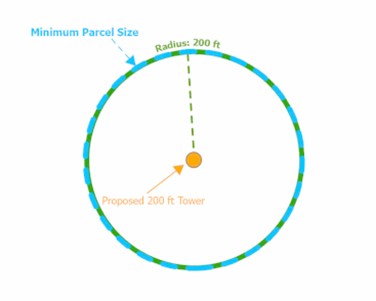
b.
The visual impact shall be demonstrated by a visual impact analysis report described in Subsection 404.56(c). Adverse visual impact is defined herein as an uncharacteristic disruption in the line of sight, such as an outlying structure in scale, massing, height, lighting, and/or materials.
c.
The location of a proposed PWSF shall minimize environmental impacts. Ground-mounted PWSFs should not be located in preservation areas, conservation areas, or passive recreation areas of County parks as defined by this ULDC and the Comprehensive Plan.
d.
Lighted towers using guyed wires are prohibited in conservation areas as defined by this ULDC and the Comprehensive Plan.
e.
Proposed PWSFs should not be visible from any designated scenic road or corridor or roads designated Old Florida Heritage Highway.
f.
Proposed PWSFs greater than two hundred (200) feet in height should not be located in areas where the increased potential for bird kills is shown to exist.
g.
The proposed PWSF structure shall be centered on the subject parcel or the leased portion of the parcel. Centered is defined as set back from each property boundary a distance equivalent to or greater than the proposed tower height (Ex: two hundred (200) foot tower in height shall be setback from each property boundary a minimum of two hundred (200) feet).
(2)
Design. All Tier Four PWSF should be designed in such a way to minimize the adverse visual impact on the community. This may include reducing the height and silhouette in order to create the least adverse visual impact. The minimum height necessary to provide the carrier's designed service to the area should be utilized, as verified by an independent radio frequency (RF) analysis. In general, a monopole tower or concealed tower is considered to have less visual impact than alternative tower designs and therefore is the preferred tower design. A facility other than a monopole or concealed facility, that is visible against the skyline must be painted light gray, or a similar color approved by staff, and have a reflectivity of less than fifty-five (55) percent, unless the Federal Communications Commission, Federal Aviation Administration, or any state or federal law, regulation, or rule requires the facility or antenna to be painted, designed, or marked otherwise. Additional ways of reducing the visual impact on the community, that shall be pursued by the applicant, are as follows:
a.
Reducing the height and silhouette;
b.
Maintain a galvanized steel or concrete finish;
c.
Use materials, colors, textures, screening, and landscaping that will blend the PWSF with the natural setting and built environment;
d.
Shall not be artificially lighted unless otherwise required by FAA;
(e)
Development standards for tier two, tier three, and tier four. All applications for tier two, tier three, and tier four review shall comply with the following standards:
(1)
Setbacks and separation. All new towers and accessory structures shall comply with standard zoning district setbacks for a primary structure or other setbacks described in this Article, whichever is greater. All non-concealed PWSFs shall be located behind the principal building line. If the PWSF is mounted on a building, it shall not be visible from the front of the building at the pedestrian level.
(2)
Security barrier. All ground mounted equipment for PWSF facilities shall be secured with locked gate and chain-link fence or masonry wall of at least six (6) feet in height from finished grade. The security barrier shall be maintained by the operator of the PWSF or tower for the life of the installation.
(3)
Airport impacts. All PWSFs must comply with Alachua County Airport Impact Regulations found in Article VII of Chapter 405.
(4)
Signs. Signs for site identification and contact information are required. In addition, for public safety purposes, each PWSF shall have a weather-proof plaque mounted at eye level at or near the PWSF or structure identifying the carriers and dates of permit approval for all antennas on the structure and the location of the County office where further information can be obtained. Such information for PWSFs mounted on buildings may be maintained by the building superintendent or similar agent provided such information is readily accessible on reasonable demand during normal business hours. Any signs required by the FCC or FAA are also allowed. No other signage shall be permitted on any PWSF.
(5)
Landscape buffers. Existing natural vegetation shall be undisturbed to the greatest extent practicable and may be counted toward the buffer requirement. Landscaping materials shall consist of xeric or drought-resistant native species and shall be maintained by the operator of the PWSF for the life of the installation.
a.
Landscape buffers shall be required around any ground-mounted security barrier. Landscape buffers, located outside and within ten (10) feet of the fence, shall include one (1) non-deciduous tree for every twenty (20) linear feet of fence and a continuous row of shrubs spaced not more than three (3) feet apart. The trees shall be at least ten (10) feet in height and the shrubs shall be at least two (2) feet in height at time of planting. Landscaping shall be installed prior to final building inspection.
b.
Ground-mounted accessory equipment for PWSFs mounted on structures not originally intended as PWSF mounts shall be concealed from view within existing structures or shall be limited to twelve (12) feet in height and shall be buffered by a continuous row of shrubs spaced not more than three (3) feet apart.
c.
The Board of County Commissioners may waive the landscaping requirement if the applicant can demonstrate that the site will not be visible from adjacent lots or rights-of-way for the duration of the tower's operation.
d.
For tier three and tier four applications, natural vegetative buffers on the perimeter of the property are required to be retained for the life of the tower to reduce the adverse visual impact of the facility on surrounding residences.
e.
If there is not existing landscaping along the perimeter of the property, the applicant shall provide landscaping along the perimeter of the property in the same capacity as is required around any ground-mounted security barrier, as detailed in Section 404.54(e)(5)a.
f.
If it is determined by the County's Forester that the existing landscaping is not adequate, the applicant shall work with the County's Forester to determine a planting plan. For Tier Four applications, the County's Forester shall review the required tree survey of the perimeter of the property to determine if additional landscape planting is necessary to adequately screen the proposed PWSF tower.
(6)
Access. A 12-foot wide stabilized access driveway and turn-around area are acceptable unless staff determines, based on public safety concerns, that circumstances require paved access.
(7)
Occupancy. PWSFs and accessory structures shall be unoccupied.
(8)
Modifications. All modifications that, when viewed from ground level from surrounding properties, appear to be of a different size, type, or appearance than what currently exists on or associated with the PWSF, as determined by the Director, must comply with the design standards of this Article. For the purposes of this subsection, a co-location shall not be considered a modification. All modifications must comply with any conditions or provisions of an existing permit, including special use permits, for the property or structure.
(Ord. No. 05-10, § 2, 12-8-05; Ord. No. 12-09, § 2(Exh. A), 10-9-12; Ord. No. 2020-25, § 2(Exh. A), 11-10-20; Ord. No. 2024-11, § 2(Exh. A), 5-28-24)
Sec. 404.55. - Submittal requirements for tier two, tier three, and tier four applications.
In addition to the information required for all development applications as found in Chapter 402, Article X, all applicants shall submit the following information, as applicable, as part of an application for a PWSF.
(a)
A licensed carrier must either be an applicant or a co-applicant and authorization to act on behalf of the carrier must be submitted.
(b)
Co-applicants may include the landowner of the subject property, licensed carriers and tenants for the PWSF.
(c)
Copy of the FCC License (Radio Authorization Form).
(d)
Evidence of compliance with applicable FAA requirements under 14 C.F.R. § 77, as amended. This may be in the form of a copy of the FAA notice of proposed construction.
(e)
A propagation map which demonstrates a gap in coverage that justifies:
(1)
The need for the proposed tower type,
(2)
The proposed location, and
(3)
The proposed height.
(f)
For tier four applications, a tree survey for the perimeter of the subject property shall be required. Said tree survey shall survey the existing trees along the perimeter of the site, defined as the thirty (30) foot width inside the subject property which must meet the minimum size criteria as specified in Section 404.54.(d)(1)a.
(g)
For applications for ground-mounted facilities, proposed site plan submittal should include the following:
(1)
The entire subject property with the lease parcel fully dimensioned, including property lines, setbacks, roads (public and private) on or adjacent to the subject property, and easements proposed to serve the PWSF.
(2)
Outline of all existing buildings, including purpose (e.g., residential buildings, garages, accessory structures, etc.) on subject property.
(3)
Proposed location of antenna, tower, and equipment facilities.
(4)
Proposed security barrier, indicating type and extent as well as point of controlled entry.
(5)
Proposed and existing access easements, utility easements, and parking for the PWSF.
(6)
All proposed changes to the subject property, including grading, vegetation removal, temporary or permanent roads and driveways, stormwater management facilities, and any other construction or development attendant to the PWSF.
(7)
Scaled elevation drawing of proposed PWSF including all towers, antennas, equipment buildings, fencing, and landscaping.
(8)
A map to scale showing the subject property and all properties within a distance of one thousand (1,000) feet of the subject property boundary, the location of and distances to all buildings, including accessory structures, and the Future Land Use designation and zoning district of all properties shown. An aerial enhanced with the required information may be used to satisfy this requirement.
(h)
Information showing all private aircraft landing facilities registered by the Florida Department of Transportation that are within one (1) mile of the proposed PWSF.
(i)
A statement certifying that, as proposed, the PWSF complies with Alachua County Airport Impact Zoning Regulations in Article VII of Chapter 405.
(j)
A fall zone certificate from a licensed structural engineer or evidence satisfactory to the County that the tower and attached PWSFs will not pose a material danger from collapse or debris fall to habitable structures or outdoor areas where people congregate.
(Ord. No. 05-10, § 2, 12-8-05; Ord. No. 2020-25, § 2(Exh. A), 11-10-20; Ord. No. 2024-11, § 2(Exh. A), 5-28-24)
Sec. 404.56. - Additional requirements for tier three and tier four applications.
In addition to the requirements above, an applicant for a tier three or tier four review shall submit the following information:
(a)
Detailed description of request and justification report. Written justification report and description of request is required. The justification report shall address how the request is consistent with the Comprehensive Plan, this ULDC, the special use permit criteria for approval, as specified in Section 402.124 of the ULDC, and the following criteria in which the Board of County Commissioners will make a finding:
(1)
The applicant has justified the proposed location by providing the required propagation map and demonstrating the following,
a.
Collocation is not feasible to provide the necessary level of service, and
b.
The proposed geographic location is the least intrusive location in relation to the surrounding community.
(2)
The applicant has made efforts to reduce the tower height to the maximum extent possible that still maintains the necessary coverage (usually demonstrated by a propagation map);
(3)
The applicant has made design improvements to the proposed tower to reduce the adverse visual impact of the tower as specified in the design criteria for tier three and tier four applications, or can justify the visual impact of the tower through economic hardship, an RF engineering report, or another reasonable form of substantial competent evidence;
(4)
The applicant has complied with the minimum parcel size requirements and landscaping requirements in this Article.
(b)
Neighborhood workshop. For all tier three and tier four applications, the applicant must conduct a neighborhood workshop pursuant to Chapter 402, Article V of this ULDC.
(c)
Visual impact analysis report.
(1)
The applicant shall provide a line-of-sight analysis, including elevation views of the proposed tower. The line-of-site analysis shall include a description of significant natural and manmade features that affect the buffering of the potential visual impact of the proposed structure.
(2)
For tier three applications, the applicant shall submit photo simulations ("photosims") from a minimum of four (4) views identified on the site plan or aerial map of the surrounding area from locations determined at the preapplication review. These views shall incorporate before and after scenarios, a scaled color image of the proposed type of tower, an aerial image with the location of the views noted, and a description of the technical approach used to create the photo simulations.
(3)
For tier four applications, the applicant shall submit photo simulations from a minimum of six (6) views identified on the site plan or aerial map of the surrounding area from locations determined at the preapplication review. These views shall incorporate before and after scenarios, a scaled color image of the proposed type of tower, an aerial image with the location of the views noted, and a description of the technical approach used to create the photo simulations.
(4)
Upon receipt of the visual impact analysis report, County staff may require the applicant to conduct a visual impact demonstration consisting of a two-hour balloon test, which shall demonstrate the maximum height of the proposed PWSF facility. During the test, County staff shall be provided access to the parcel for the purpose of observing and photographing the test from several locations surrounding the PWSF site. Staff will evaluate the photosims in the visual impact analysis report based on the balloon test. If the photosims are not clearly representative of the proposed PWSF, County staff shall produce, or have produced by an independent consultant, additional photosims at the applicant's expense.
(d)
RF information. To verify that a new tower at the proposed height of the tower or antennas is necessary to provide the carrier's designed service, the following RF information shall be submitted:
(1)
Areas to be served by the PWSF.
(2)
The applicant shall use reasonable efforts to collocate or place antennas proposed to be located on a new PWSF tower on other currently permitted facilities or structures. Prior to approval for a new tower, the applicant shall demonstrate that there are no other suitable existing antenna towers or structures on which the applicant/provider can reasonably place its antennas, by providing evidence of any of the following:
a.
No existing PWSF towers or tall structures (those adequate to serve the proposed height) are located within the search area.
b.
Existing PWSF towers or structures are not of sufficient height to meet engineering requirements of the provider proposed to be located on the tower.
c.
Existing PWSF towers or structures do not have sufficient structural strength or capacity to support the provider's proposed antenna and related equipment.
d.
The proposed antenna and related equipment would cause electromagnetic interface with the antenna(s) on the existing tower or tall structures, or the antenna on the existing tower or tall structure would cause interference with the applicant's proposed antenna.
e.
The economic burden on the applicant to use an existing tower or tall structure, or to adapt an existing tower or tall structure for use exceeds the cost of a new tower or is proven as unreasonable.
f.
The applicant demonstrates that there are other limiting factors that render existing towers and tall structures unsuitable.
(3)
Relationship to the carrier's other PWSFs existing or currently in review by Alachua County.
(4)
Technical data concerning the proposed facility and each existing, authorized, pending, and proposed adjacent cell site:
a.
Primary frequency band;
b.
Site name or other reference;
c.
Latitude and longitude (NAD 83 or WGS 84) of the tower; and
d.
Site elevation (amsl).
(5)
For each proposed and each adjacent cell omni, microwave and sector antenna:
a.
Manufacturer;
b.
Model number;
c.
Frequency band (if not primary frequency band);
d.
Height of antenna radiation center (agl);
e.
Maximum effective radiated output power (specify units);
f.
Azimuth of main lobe (degrees east of north Nxxx E);
g.
If used, mechanical and electrical beam-tilt parameters; and
h.
Other additional information as may be required to technically verify an applicant's assertions.
(e)
Fees. The fee for PWSF special use permit applications shall include the costs of retaining independent technical consultants and experts to properly evaluate the proposed PWSFs. This may include an independent RF evaluation and the preparation of photo simulations of the proposed site.
(Ord. No. 05-10, § 2, 12-8-05; Ord. No. 2020-25, § 2(Exh. A), 11-10-20; Ord. No. 2024-11, § 2(Exh. A), 5-28-24)
Sec. 404.57. - Completeness review.
(a)
Within twenty (20) business days of receipt of an application for a PWSF, County staff shall determine if the application form has been completed and if all required items have been submitted.
(b)
If County staff determines that the application form is not complete and/or if all required items have not been submitted, the County staff shall send the applicant a letter of incompletion stating that the application is incomplete and cannot be considered by the County. The letter of incompletion shall list those items that are incomplete or missing. The applicant may choose to resubmit a completed application or withdraw the application and request a refund of application fees.
(c)
If the applicant resubmits materials to make the application complete, County staff shall review the resubmitted materials and determine if the application is now complete. If the application is still not complete, County staff shall send the applicant another letter of incompletion indicating the remaining deficiencies, within normal review timeframes, but in no case longer than twenty (20) business days after the materials are resubmitted.
(d)
After issuance of the letter of incompletion, if the applicant does not complete the application form and submit all required items within sixty (60) days of mailing of the letter of incompletion, nor withdraws the application by the date specified, the County shall notify the applicant that the application is closed and any fees paid are nonrefundable.
(e)
If County staff does not notify the applicant in writing that the application is not complete within twenty (20) business days after the application is initially submitted or additional information is resubmitted, the application is deemed, for administrative purposes only, to be properly complete.
(f)
When the application form is complete and all required items have been submitted, the County staff shall send the applicant a letter of completion and begin processing the application.
(f)
When the application form is complete and all required items have been submitted, the County staff shall send the applicant a letter of completion and begin processing the application.
(Ord. No. 05-10, § 2, 12-8-05; Ord. No. 2020-25, § 2(Exh. A), 11-10-20; Ord. No. 2024-11, § 2(Exh. A), 5-28-24)
Sec. 404.58. - Review timeframes.
(a)
Tier one. Applications for tier one co-locations shall be reviewed within the normal time frames for similar building permits, but in no case later than forty-five (45) business days after the date the application is determined to be properly completed, as provided in Section 404.57. All other tier one applications shall be reviewed within the normal time frames for similar building permits but in no case later than ninety (90) business days after the date the application is determined to be properly completed.
(b)
Tier two, tier three, and tier four.
(1)
The County shall review and grant or deny each properly completed application for tier two, tier three, or tier four review within the normal timeframes for a development plan approval or a special use permit, as applicable, but in no case shall the review and decision on the application take more than ninety (90) business days from the date the application is determined to be properly complete, in accordance with Section 404.57.
(2)
If the County does not grant or deny a properly completed application for a PWSF within the timeframes set forth in this subsection and Subsection (a), the application shall be deemed automatically approved and the applicant may proceed with the next level of review or, if no additional levels of review are required, with the placement of the PWSF without interference or penalty.
(3)
For tier three and tier four applications only, the ninety (90) business day timeframe may be extended if the hearing on the special use permit before the BOCC, following the review process and timeframe applicable to all special use permits for all uses, cannot reasonably occur within the ninety (90) business days. Under such circumstances, the BOCC must either grant or deny the application at its next regularly scheduled meeting after the ninety (90) business days have expired or the application shall be deemed automatically approved.
(4)
If during the review period the application is significantly amended, unless the review timeframe is waived by both the applicant and the County, it shall be considered a new application and a new 90-day review period will be established.
(5)
These timeframes may be waived if a waiver is voluntarily agreed to by the applicant and the County. A one-time waiver may be required by the County in the case of a declared local, state, or federal emergency, which directly affects the permitting activities of the County, for the length of that emergency.
(Ord. No. 05-10, § 2, 12-8-05; Ord. No. 2020-25, § 2(Exh. A), 11-10-20; Ord. No. 2024-11, § 2(Exh. A), 5-28-24)
Sec. 404.59. - PWSFS at public sites.
The County shall work with carriers to facilitate the siting of PWSFs on County-owned or other publicly-owned property, by identifying existing structures, the appropriate contact persons, and the appropriate leasing procedures.
(Ord. No. 05-10, § 2, 12-8-05; Ord. No. 2020-25, § 2(Exh. A), 11-10-20; Ord. No. 2024-11, § 2(Exh. A), 5-28-24)
Sec. 404.60. - Inspection, abandonment and obsolescence.
(a)
Inspection. The owner or operator of a tower shall provide for and conduct an inspection of the tower at least once every three (3) years, and is encouraged to conduct an inspection following any extreme weather conditions or a weather related state of emergency. A statement shall be provided to the Alachua County Office of Codes Enforcement verifying structural integrity and tenants on the tower.
(b)
Abandonment and removal. Any PWSF that is not operated for a continuous period of eighteen (18) months shall be considered abandoned, and the owner of such PWSF shall remove same within ninety (90) days of notice to the Alachua County Office of Codes Enforcement that the PWSF is abandoned. If such PWSF is not removed within said ninety (90) days, the County may have the PWSF removed at the PWSF owner's expense.
(Ord. No. 05-10, § 2, 12-8-05; Ord. No. 2020-25, § 2(Exh. A), 11-10-20; Ord. No. 2024-11, § 2(Exh. A), 5-28-24)
Sec. 404.61. - Lighting.
A PWSF shall not be artificially lighted, except for:
(a)
Security and safety lighting of equipment buildings if such lighting is appropriately down-shielded to keep light within the boundaries of the site; and
(b)
Such lighting of the PWSF as may be required by the Federal Communications Commission, Federal Aviation Administration (FAA) or other applicable authority installed in a manner to minimize impacts on adjacent residences. "Dual lighting" (red at night/strobe during day) shall be utilized unless otherwise recommended by FAA guidelines. Towers that require flashing illumination shall have synchronized flashing to deter bird collisions with the tower.
(Ord. No. 05-10, § 2, 12-8-05; Ord. No. 2020-25, § 2(Exh. A), 11-10-20; Ord. No. 2024-11, § 2(Exh. A), 5-28-24)
Sec. 404.62.- Standards for home-based business.
A home-based business is allowed as accessory to any legal residential use in the urban or rural area. Use of the residential property for a home-based business is subject to the following standards and all other applicable regulations for the zoning district:
(a)
Participation in business. Only lawful residents of a dwelling with a home-based business shall be engaged or employed on-site. The home-based business may employ up to a total of two (2) employees or independent contractors who do not reside at the residential dwelling to work on-site and may have additional remote employees who do not work on-site.
(b)
Nature of use.
(1)
The use of the dwelling unit for the home-based business shall be clearly incidental and subordinate to its use for residential purposes.
(2)
Structural or architectural modification to the dwelling to accommodate the home-based business shall conform to the residential character of the neighborhood. View from public street and neighboring properties shall generally conform to the residential character of the neighborhood.
(3)
All retail transactions shall be conducted in the residential dwelling; however, incidental business uses and activities may be conducted on the residential property.
(c)
Parking.
(1)
Parking for the home-based business may not be greater in volume than would normally be expected at a similar residential dwelling where no business is conducted. All vehicles and trailers used in conjunction with the home-based business shall be parked in legal parking spaces that are not located within the right-of-way, on or over a sidewalk, or on any unimproved surfaces at the residential property.
(2)
Vehicle storage. The home-based business shall be limited to the parking and storage of commercial vehicles, heavy equipment, and trailers on the premises, in accordance with the standards for parking of trucks, trailers, and other non-recreational vehicles in Subsection 404.82.5(a) of this Chapter. For purposes of this paragraph, the term "heavy equipment" means commercial, industrial, or agricultural vehicles, equipment, or machinery.
(d)
Signage. Shall be in accordance with Chapter 407, Article III, Signs, for a home-based business in any zoning district.
(e)
Operation of mechanical equipment. A home-based business shall be subject to the noise regulations in Chapter 110, Title 11 of the Alachua County Code.
(Ord. No. 05-10, § 2, 12-8-05; Ord. No. 06-14, § 2(Exh. A), 7-20-06; Ord. No. 12-09, § 2(Exh. A), 10-9-12; Ord. No. 13-14, § 2(Exh. A), 8-27-13; Ord. No. 2020-25, § 2(Exh. A), 11-10-20; Ord. No. 2023-09, § 2(Exh. A), 4-25-23)
Sec. 404.63. - Reserved.
Editor's note— Ord. No. 2023-09, § 2(Exh. A), adopted April 25, 2023, repealed § 404.63, which pertained to standards for rural home-based business and derived from Ord. No. 05-10, § 2, 12-8-05; Ord. No. 08-06, § 2(Exh. A), 4-22-08; Ord. No. 12-09, § 2(Exh. A), 10-9-12; Ord. No. 2020-25, § 2(Exh. A), 11-10-20.
Sec. 404.64.- Outdoor recreation.
Outdoor recreational facilities are allowed as limited uses in the A, C-1, RM-1, BR-1, BH, BA, BA-1, BW, and MB districts, subject to development plan review by the DRC and in accordance with the following standards. Any outdoor recreational use that exceeds these standards may be allowed as a special exception within these districts.
(a)
Where outdoor recreational activities will occur on site, the minimum lot area shall be ten (10) acres in the C-1 district, and five (5) acres in all other districts.
(b)
A medium-density, 25-foot wide buffer, in accordance with Article IV, Landscaping, of Chapter 407, shall be provided to adjacent properties. A 50-foot wide setback from the property line shall be provided adjacent to residential land uses, including a medium-density, 25-foot wide buffer in accordance with Article IV, Landscaping, of Chapter 407.
(c)
Permanent structures on the site shall be limited in size to one thousand (1,000) square feet and shall be subject to the setbacks and height limitations of the district. Permanent residence or overnight accommodations within these structures is prohibited.
(d)
Hours of operation shall be limited to between 7:00 a.m. and 9:00 p.m.
(e)
Commercial uses shall be limited to payment for rental of equipment and for use of facilities, and retail sales of goods related to the activity on site.
(f)
Outdoor lighting and installation and/or use of an audio system for recreational activities on the site is prohibited within the A and C-1 zoning districts.
(g)
Within the C-1 district, only activities considered as resource-based recreation shall be permitted to occur on the site, provided that they do not significantly alter the natural functions of the conservation area.
(Ord. No. 05-10, § 2, 12-8-05; Ord. No. 07-07, § 2(Exh. A), 4-27-07; Ord. No. 06-14, § 2(Exh. A), 7-20-06; Ord. No. 12-09, § 2(Exh. A), 10-9-12; Ord. No. 2020-25, § 2(Exh. A), 11-10-20)
Sec. 404.65. - Motorized sports.
Motorized sports facilities are allowed by special exception in the BR-1 districts, subject to development plan review by the DRC and in accordance with the following standards.
(a)
The minimum lot size shall be fifty (50) acres.
(b)
Provisions for buffers, hours of operation and audio systems shall be evaluated as part of the special exception process.
(c)
Outdoor lighting is subject to Chapter 407, Article 14, Outdoor Lighting.
(Ord. No. 13-14, § 2(Exh. A), 8-27-13; Ord. No. 2020-25, § 2(Exh. A), 11-10-20)
Sec. 404.66. - Private motorized vehicle practice facility.
Private motorized vehicle practice facilities involving the removal or filling of more than two hundred (200) cubic yards of material on site are allowed by special exception in the A district, subject to development plan review by the DRC and in accordance with the following standards:
(a)
The minimum lot size shall be ten (10) acres in the A zoning district.
(b)
A 50-foot wide high-density buffer shall be required on all sides of the property, unless otherwise approved as part of the special exception.
(c)
Private motorized vehicle practice facilities may be used only for non-commercial private purposes.
(d)
Outdoor lighting at the facility shall not be allowed.
(e)
Hours of operation shall be Monday through Saturday from 8:00 a.m. until dusk. No use of the facility shall be allowed on Sunday.
(f)
Facilities are limited to all-terrain vehicles (ATV's) and their variants as defined in Chapter 410 of this Code.
(g)
Provisions for number of people and number of ATVs shall be evaluated as part of the special exception process.
(Ord. No. 2018-23, § 2(Exh. A), 10-9-18; Ord. No. 2020-25, § 2(Exh. A), 11-10-20)
Sec. 404.66.5. - Golf courses.
Golf courses are allowed as a limited use in the A, RE, RE-1, R-1a, R-1aa, and R-1b zoning districts subject to the following standards. Golf courses shall be constructed and managed to conserve water, protect existing vegetation and minimize the use of fertilizers and pesticides. Golf course construction and operation shall follow applicable State best management practices (BMPs).
(a)
Golf course landscape design. An application for a golf course shall include a design plan that integrates plant species that are best suited to the local area and include the following elements.
(1)
Golf courses shall be located, designed and operated to provide for the following:
a.
Conservation of sensitive habitat;
b.
Retention of native vegetation;
c.
Protection of wildlife corridors and habitat connectivity; and
d.
Protection of natural drainage patterns.
(2)
The design shall incorporate native drought tolerant plants and preserve clusters or significant stands of trees and understory vegetation.
(3)
A natural resources plan that specifies strategies for invasive exotic plant control, restoration of appropriate habitat-specific hydrology, prescribed fire or other means of fuel load reduction or habitat improvement, and natural plant community restoration.
(4)
A water conservation and irrigation plan that minimizes water use, proposes construction techniques and soil amendment for greens and tees that reduces excess irrigation, provides controls for proper irrigation management and conservation, and uses harvested rainfall for on-site irrigation. Artificial turf is encouraged as a water conserving measure. Aesthetic water features requiring augmentation are discouraged.
(5)
A stormwater management plan that incorporates low impact design (LID) techniques to enhance aquifer recharge and incorporate the use of stormwater for irrigation.
(b)
Water quality monitoring plan.
(1)
A monitoring plan shall be developed to monitor surface water (where applicable) and groundwater quality and flow and/or level.
(2)
Pre- and regular post-development surface water and groundwater sampling shall be required.
(Ord. No. 12-09, § 2(Exh. A), 10-9-12; Ord. No. 2020-25, § 2(Exh. A), 11-10-20)
Sec. 404.67. - Sexually oriented business.
Sexually oriented businesses are allowed as limited uses in the BH, BA, and BA-1 districts, including but not limited to a sexually oriented media store, subject to the following standards. Sex shops and sexually oriented theatres or cabarets are allowed in the BA or BA-1 districts, subject to the following standards.
(a)
Separation requirements for sexually oriented businesses.
(1)
Generally. Sexually oriented businesses shall be permitted only in the zoning districts in which a specific sexually oriented business is listed as a permitted use in this Chapter. Any sexually oriented business established or expanded after February 1, 2004, in such a district shall be separated from other specified uses by the distances specified in Table 404.67.1.
(2)
Measurement. Measurements shall be made from the nearest property line of the use which is not a sexually oriented business to the nearest property line of the sexually oriented business. If the sexually oriented business is located in a multi-tenant building, then the distance shall be measured from the nearest property line of the use which is not a sexually oriented business to the nearest line of the leasehold or other space actually controlled or occupied by the sexually oriented business.
(3)
Limitations.
a.
School. The separation requirement from a "school" shall apply only if one or more of the following applies:
1.
The school is a public school; or
2.
The school has been in operation at the same location for one (1) year or more; or
3.
The location at which the school is now operating is owned by the organization operating the school.
b.
Place of worship. The separation requirement from a "place of worship" shall apply only if one or more of the following applies:
1.
The place of worship has been in operation at the same location for one (1) year or more; or
2.
The location at which the place of worship is now operating is owned by the organization operating the place of worship.
c.
Residentially zoned land. For purposes of this Section only, "residentially zoned land" shall mean land carrying an Alachua County zoning district designation beginning with an R and codified as part of Chapter 403, Article III or an exclusively residential planned development.
(b)
Sexually oriented cabarets—Design standards. Any building used for the operation of a sexually oriented cabaret shall meet the following design standards:
(1)
Stage required. The building shall include one or more stages, on which all performances shall take place. Each such stage shall be in a room open to all customers of the establishment and containing a minimum of six hundred (600) square feet of floor area. The stage shall be raised a minimum of eighteen (18) inches above the level of the floor on which customers stand or are seated and shall be further separated from customers by a rail or other barrier a minimum of thirty (30) inches high. If the stage is a minimum of thirty (30) inches high, the additional barrier shall not be required.
(2)
Performance areas.
a.
All performances and interactions between performers and customers shall occur so that the performers (and any customer directly involved) are visible from the room in which the stage is located. No doors, curtains, screens, or other devices shall be used to obscure any part of the room or any booth.
b.
Any private performance booth in existence on January 27, 2004, may continue in use regardless of whether it is fully visible from the larger room, provided that it shall be visible from a hallway meeting the lighting standards required in Paragraph (3) below. Such hallway shall be open to all customers of the establishment and other persons lawfully entering onto the premises and the entrance to the booth shall not be obscured from the hallway by any doors, curtains, screens, or other devices.
(3)
Lighting. The lighting level in the primary area occupied by customers shall be a minimum of five (5) footcandles at a height of three (3) feet above the floor. This lighting standard shall not apply to the stage or to performance booths but shall apply in any hallway or other access area to the booths and in the area around the stage.
(c)
Sexually oriented theaters—Design standards. Any building used for the operation of a sexually oriented theater shall meet the following design standards:
(1)
Presentation area. All screenings and presentations of motion pictures, videos or other media shall occur in a room open to all customers of the establishment and containing a minimum six hundred (600) square feet of floor area. No doors, curtains, screens, or other devices shall be used to obscure any part of the room.
(2)
Lighting. The lighting level in the area occupied by customers shall be a minimum of two (2) footcandles at floor level.
(3)
Seating. Seating shall consist of individual, theater-style chairs, with solid arms separating the chairs. No couches, benches, individual chairs, beds, loose cushions, mattresses, or other forms of seating may be provided. Separate spaces for wheelchairs shall be provided in accordance with the applicable provisions of the Southern Building Code and the Americans with Disabilities Act.
(Ord. No. 05-10, § 2, 12-8-05; Ord. No. 06-14, § 2(Exh. A), 7-20-06; Ord. No. 2020-25, § 2(Exh. A), 11-10-20)
Sec. 404.67.5.- Restaurant.
A restaurant is allowed as a permitted use in the BR, BR-1, BH, BA, BA-1, BW, and MB districts and in traditional neighborhood and transit oriented developments. A restaurant is allowed as an accessory use to industrial uses within the ML, MS and MP districts. A restaurant is allowed as an accessory use to an ongoing agricultural operation for agritourism purposes in the A and A-RB zoning districts in accordance with the following standards:
(a)
Any construction of a permanent structure, not otherwise required for the ongoing agricultural operation, shall be subject to development plan and building permit approval.
(b)
Restaurants must utilize or feature agricultural resources grown onsite.
(c)
The restaurant must not be part of a chain or a franchise
(d)
The property must have direct access to a public road meeting County requirements for sufficient right-of-way, minimum width, stabilization requirements and maintenance.
(e)
Drive-through facilities are prohibited.
(Ord. No. 12-09, § 2(Exh. A), 10-9-12; Ord. No. 2020-25, § 2(Exh. A), 11-10-20; Ord. No. 2025-19, § 2(Exh. A), 9-23-25)
Sec. 404.68. - Restaurant with drive-through.
A restaurant with a drive-through is allowed as a limited use in the BR-1, BH, BA, BA-1, and BW districts and within traditional neighborhood and TODs, subject to the following standards. A restaurant with a drive-through may be allowed by special exception in the BR district, subject to the following standards.
(a)
Location of drive-through windows. Drive-through windows shall be constructed as an integral part of the principal structure. Menu boards and equipment for ordering from a vehicle may be a stand-alone feature.
(b)
Circulation.
(1)
Stacking lanes for drive-through windows shall provide at least five (5) stacking spaces for each drive-through service window. Such spaces shall be designed so as to avoid conflict between pedestrian and vehicular circulation on the site or any abutting street.
(c)
Additional standards for traditional neighborhood and TODs.
(1)
Restaurants with a drive-through lane are only allowed in a multi-tenant building.
(2)
Drive-through lanes and drive aisles shall be located at the rear of buildings and shall be architecturally integrated with the building or screened from the street.
(3)
Building shall be designed to meet a nationally or locally recognized green building standard.
(Ord. No. 05-10, § 2, 12-8-05; Ord. No. 07-07, § 2(Exh. A), 4-27-07; Ord. No. 10-16, § 2(Exh. A), 8-10-10; Ord. No. 2018-23, § 2(Exh. A), 10-9-18; Ord. No. 2020-25, § 2(Exh. A), 11-10-20)
Sec. 404.69. - Incidental food sales.
Food and/or beverage sales are allowed as an accessory use to commercial and industrial uses within the A-RB, BR, BR-1, BH, BA, BA-1, BW, ML, MS, MP, and MB districts and within traditional neighborhood and TODs, provided that the area utilized for the sales, storage, preparation, and service of foods and/or beverages does not exceed twenty (20) percent of the gross floor area of the principal structure.
(Ord. No. 05-10, § 2, 12-8-05; Ord. No. 07-07, § 2(Exh. A), 4-27-07; Ord. No. 10-16, § 2(Exh. A), 8-10-10; Ord. No. 2020-25, § 2(Exh. A), 11-10-20)
Sec. 404.69.1. - Mobile food sales.
Mobile food sales are allowed as a limited use in the A-RB, BR, BR-1, BH, BA, BA-1, BW, ML, MS, MP, and MB districts, Traditional Neighborhood and Transit Oriented Developments, and on properties with a Mixed-Use Future Land Use designation, subject to the following standards.
(a)
Required licenses. All required licenses from the appropriate State or County agencies must be displayed conspicuously on the mobile food service unit from which the food is sold.
(b)
Sales areas.
(1)
Mobile food service units shall not conduct business in any way that restricts or interferes with the entrance or exit of a business, creates a hazard to pedestrians, life or property, or obstructs vehicular circulation, pedestrian circulation, access to emergency exits or that creates a traffic hazard or nuisance off-site.
(2)
No drive-through sales are allowed.
(3)
The mobile food service unit must keep the sidewalks, parking areas, and other areas adjacent to the unit clean and free of refuse of any kind generated from their operation.
(c)
Hours of operation. Mobile food sales shall be limited to the hours of operation between 7:00 a.m. and 10:00 p.m. or close of business, whichever is later, of the principal use on site. Transient mobile food sales shall be limited to the hours between 11:00 a.m. and 3:00 p.m.
(d)
Additional requirements for undeveloped properties. Where mobile food service units are located on undeveloped properties, the following additional requirements shall apply:
(1)
The mobile food service unit must be set back at least one hundred (100) feet from any existing residential development.
(2)
The property shall have a minimum area of at least one thousand five hundred (1,500) square feet for parking to accommodate at least five (5) vehicles.
(e)
Prohibitions. Mobile food sales are prohibited in the following areas:
(1)
Within twenty-five (25) feet of any loading zone or transit stop;
(2)
Within twenty-five (25) feet of any fire hydrant, fire escape, or fire control device;
(3)
Within twenty-five (25) feet of any parking space or access ramp designated for persons with disabilities; or
(4)
Within the building setback area required by the zoning district.
(Ord. No. 15-06, § 2(Exh. A), 4-14-15; Ord. No. 2020-25, § 2(Exh. A), 11-10-20)
Sec. 404.69.2. - Small-scale alcoholic beverage production facility.
A small-scale alcoholic beverage production facility is allowed as a permitted use within the BW, ML, MS and MP districts and as an accessory use in the A district, with an active agricultural operation for agritourism purposes and utilizing agricultural products grown and processed on site.
(Ord. No. 2025-04, § 2(Exh. A), 3-11-25)
Sec. 404.69.5.- Hotel or motel.
A hotel or motel is allowed as a permitted use in the HM, BR, BR-1, BH, BA, and BA-1 districts. A hotel or motel is allowed by special exception in the MB district. In traditional neighborhood and TODs, a hotel or motel is allowed as a limited use subject to the following:
(a)
Density calculation. For the purposes of a TND or TOD, a hotel shall be considered a residential use. The number of dwelling units for a hotel or motel shall be equal to fifty (50) percent of the number of rooms in the facility.
(b)
Non-residential development. For hotels and motels in a TND or TOD, all of the accessory uses that are customarily associated with a hotel or motel, such as a lobby, reception area, pool, and offices for facility management, shall be considered part of the residential development. In addition, any hotel or motel may contain up to three thousand (3,000) square feet of commercial uses, such as a restaurant or nightclub. Any square footage above three thousand (3,000) square feet shall be counted as non-residential square footage for the development.
(Ord. No. 10-16, § 2(Exh. A), 8-10-10; Ord. No. 2020-25, § 2(Exh. A), 11-10-20)
Sec. 404.70. - Bed and breakfast.
A bed and breakfast is allowed as a limited use in the A, RE, RE-1, R-1aa, R-1a, R-1b, and RP districts, subject development plan approval and the following standards.
(a)
Location. The bed and breakfast shall be located in a single-family detached dwelling.
(b)
Owner occupancy required. The owner of the bed and breakfast shall reside on the premises.
(c)
Maximum number of rooms. A maximum of five (5) rooms shall be used for rental lodging purposes.
(d)
Parking and access. In the A district, the facility shall have direct access to a public road meeting County standards for sufficient right-of-way, minimum width, stabilization requirements, and maintenance. In all other districts, the facility shall have access to a publicly maintained paved road. All facilities must provide one (1) parking space per room plus two (2) additional spaces.
(e)
Maximum nights per stay. Each guest in a bed and breakfast is limited to a maximum number of thirty (30) nights per stay.
(f)
Limitations within platted subdivisions. A bed and breakfast may only be located within a platted subdivision in one of the following areas, unless a special exception is approved by the BOCC:
(1)
Rural Clusters;
(2)
Transit supportive area of a TND or TOD;
(3)
Planned developments where consistent with the zoning master plan; or
(4)
Structures identified on the Department's list of historic properties.
(g)
Meal service. A bed and breakfast shall be limited to providing meal services only to registered guests.
(h)
Other functions by special exception. A bed and breakfast may obtain a special exception in order to provide facilities such as banquet halls or ballrooms that may be used to host events such as weddings, meetings, dinners, and catered parties.
(Ord. No. 05-10, § 2, 12-8-05; Ord. No. 06-14, § 2(Exh. A), 7-20-06; Ord. No. 10-16, § 2(Exh. A), 8-10-10; Ord. No. 12-09, § 2(Exh. A), 10-9-12; Ord. No. 2020-25, § 2(Exh. A), 11-10-20)
Sec. 404.71. - RV park/campground.
An RV park or campground shall comply with all requirements in Article VI of Chapter 403 regarding the RM-1 zoning district.
(Ord. No. 05-10, § 2, 12-8-05; Ord. No. 2020-25, § 2(Exh. A), 11-10-20)
Sec. 404.71.5. - Farm stay.
A farm stay is allowed as a limited use in the A, RE, RE-1, R-1a, R-1aa, R-1b, R-1c districts, subject to the following standards and DRC approval.
a.
Ag classification status. Evidence of current agricultural classification status by the Alachua County Property Appraiser is required for all zoning districts except A.
b.
Minimum lot size. The minimum lot size shall be five acres.
c.
Owner occupancy required. The owner of the farm stay shall reside on or adjacent to the premises.
d.
Number of lodging units. The farm stay shall have no more than four units for rental lodging purposes. Each lodging unit shall be limited to a maximum of six guests.
e.
Type of lodging units. Lodging units may be tent spaces, RV spaces or camping cabins. Unserviceable RVs are prohibited. Camping cabins shall be no more than 400 sq. ft. with a minimum of 50 sq. ft. per occupant and constructed in compliance with the Florida Building Code and Florida Fire Prevention Code.
f.
Setbacks. All recreational vehicle spaces, camping cabin spaces, tent spaces and the central sanitation facility shall be located a minimum of 50 feet from any property line. Setbacks between lodging units shall comply with the Florida Fire Prevention Code.
g.
Access. The farm stay shall have direct access to a public or private road meeting County standards for sufficient right-of-way, minimum width, stabilization requirements, and maintenance. For private roads, a road maintenance agreement may be required as part of the development plan approval process. An access road shall be provided to each cabin or RV site in accordance with the Florida Fire Prevention Code. RV and cabin sites must have a stabilized surface access road within 50 feet of an exterior door. Access roads over 150 feet in length must have a turnaround approved by the Fire/Rescue Department.
h.
Sanitation. A unified plan for water distribution and wastewater disposal meeting the requirements of the Health Department shall be required as part of any application for a farm stay. No lodging unit shall be served by an individual well or septic tank.
i.
Permanent residence prohibited. Residence in any recreational vehicle space, camping cabin or tent within a farm stay is restricted to 90 consecutive days, and a maximum of 180 calendar days during any one-year period.
j.
Farmworker housing. Farm stays may not be used for farmworker housing purposes.
(Ord. No. 2022-18, § 2(Exh. A), 10-25-22)
Sec. 404.72.- Neighborhood convenience center.
A neighborhood convenience center is allowed as a limited use in the BR, BR-1, BH, BA, BA-1, ML, MS, and MP districts, subject to the following standards:
(a)
Permitted and prohibited uses. Permitted uses in the neighborhood convenience center shall be those specified for the district in which it is located except for the following prohibited uses:
(1)
Cocktail lounge, bar, or tavern;
(2)
Hotel or motel;
(3)
Nightclub within the principal building;
(4)
Vehicle sales and service;
(5)
Vehicle paint and body shop;
(6)
Service stations;
(7)
Entertainment and recreation;
(8)
Vehicle or trailer rental;
(9)
Outdoor temporary display and sales of automobiles, light trucks, motorcycles, boats, and similar products accessory to retail uses.
(b)
Location. A neighborhood convenience center shall meet the following standards:
(1)
A neighborhood convenience center shall be a minimum of one mile traveling distance from any other neighborhood convenience center or other facility with similar uses. Such distance shall be calculated by the shortest distance following collector and arterial roadways, as measured from the middle of the neighborhood convenience centers.
(2)
Each neighborhood convenience center shall have a minimum depth of 300 feet unless waived by the DRC to provide a better site design.
(3)
No building shall be erected closer than 25 feet to any road right-of-way.
(4)
The maximum gross floor area shall be 30,000 square feet.
(5)
Parking and loading areas shall be paved and kept in good repair at all times with a hard, all-weather surface. Parking areas shall be located a minimum of 50 feet from a residentially zoned property or property designated urban residential on the future land use map.
(6)
Neighborhood convenience centers shall be located on collector or principal arterial streets, as defined and identified in the transportation mobility element of the comprehensive plan.
(7)
All commercial waste receptacles, storage areas, and electrical and mechanical equipment, such as heat pumps and air conditioners, shall be screened from view from a public right-of-way and from any residential development.
(Ord. No. 05-10, § 2, 12-8-05; Ord. No. 06-14, § 2(Exh. A), 7-20-06; Ord. No. 08-06, § 2(Exh. A), 4-22-08; Ord. No. 2020-25, § 2(Exh. A), 11-10-20)
Sec. 404.73. - Convenience store.
A convenience store is allowed as a permitted use in traditional neighborhood and TOD and a limited use in the BR, BR-1, BH, BA, BA-1, and BW districts, subject to the following standards:
(a)
Additional principal uses. A convenience store may offer an additional principal use, such as a restaurant or fuel sales. A convenience store with two or more principal uses shall comply with the standards for all of these uses.
(b)
Maximum gross floor area. A convenience store, including additional principal uses, shall not exceed 8,000 square feet of total floor area.
(c)
Parking for additional principal uses. Parking for additional principal uses shall be calculated separately to determine the total number of required parking spaces.
(Ord. No. 05-10, § 2, 12-8-05; Ord. No. 10-16, § 2(Exh. A), 8-10-10; Ord. No. 12-09, § 2(Exh. A), 10-9-12; Ord. No. 2020-25, § 2(Exh. A), 11-10-20)
Sec. 404.74. - Pharmacy.
A pharmacy is allowed as a limited use in the HM, BR, BR-1, BH, BA, and BA-1 districts and within traditional neighborhood and transit oriented districts, subject to the following standards:
(a)
Location of drive-through windows. Drive-through windows shall be constructed as an integral part of the principal structure.
(b)
Circulation.
(1)
Stacking lanes for drive-through windows shall be located so as to avoid conflict with the normal flow of traffic on the site.
(2)
A vehicle pass-by lane shall be constructed adjacent to each window to provide for complete, unimpeded circulation throughout the site.
(c)
Additional standards for traditional neighborhood and TODs.
(1)
Pharmacies are allowed a maximum of two drive-through lanes.
(2)
Drive-through lanes and drive aisles shall be located at the rear of buildings and shall be architecturally integrated with the building or screened from the street.
(3)
Building shall be designed to meet a nationally or locally recognized green building standard.
(Ord. No. 05-10, § 2, 12-8-05; Ord. No. 10-16, § 2(Exh. A), 8-10-10; Ord. No. 2020-25, § 2(Exh. A), 11-10-20)
Sec. 404.74.5. - Dry-cleaners.
Dry cleaners are allowed as a permitted use within the BR, BR-1, BH, BA, and BA-1 districts. Dry-cleaners are allowed as a limited use within traditional neighborhood and TODs subject to the following standards:
(a)
Dry cleaners with drive-through lanes are only allowed in a multi-tenant building.
(b)
Drive-through lanes and drive aisles shall be located at the rear of buildings and shall be architecturally integrated with the building or screened from the street.
(c)
Building shall be designed to meet a nationally or locally recognized green building standard.
(Ord. No. 10-16, § 2(Exh. A), 8-10-10; Ord. No. 2020-25, § 2(Exh. A), 11-10-20)
Sec. 404.75. - Media sales and rental.
A retail establishment that devotes less than thirty (30) percent of its floor area or inventory to sexually-explicit material sales and rental shall be allowed in the BR, BR-1, BH, BA, and BA-1 districts and within the transit supportive area in traditional neighborhood and transit oriented districts. An establishment that devotes more than ten (10) percent of its floor area or inventory to sexually explicit material, but that devotes less than thirty (30) percent of its floor area or inventory to sexually-explicit material sales and rental shall not be treated as a sexually oriented media shop (see Section 404.67) but must meet the following conditions.
(a)
All sexually-explicit media shall be maintained in a room that is separated from other material by an opaque wall that extends to the ceiling or eight (8) feet above the floor, whichever is less.
(b)
Access to the room containing the sexually-explicit media shall be through an opaque, solid door.
(c)
The room containing sexually-explicit media shall be posted with a notice indicating that only persons eighteen (18) years of age or older may enter the room.
(d)
Access to the room shall be physically limited to adults through control of access by an employee of the store, through use of an access release located a minimum of sixty-six (66) inches off the floor, or through constant monitoring of the room by an employee on duty through electronic means or through a window or mirror providing visibility into the room from the manager's or cashier's work station.
(Ord. No. 05-10, § 2, 12-8-05; Ord. No. 06-14, § 2(Exh. A), 7-20-06; Ord. No. 10-16, § 2(Exh. A), 8-10-10; Ord. No. 2020-25, § 2(Exh. A), 11-10-20)
Sec. 404.75.5. - Large scale retail.
A retail establishment of one hundred thousand (100,000) square feet gross leasable area or greater or a group of stores within a development under the same ownership of one hundred thousand (100,000) square feet or more is allowed as a limited use in the BH, BA, BA-1, and BW districts within an activity center.
(Ord. No. 07-07, § 2(Exh. A), 4-27-07; Ord. No. 12-09, § 2(Exh. A), 10-9-12; Ord. No. 2020-25, § 2(Exh. A), 11-10-20)
Sec. 404.76.- Self-service storage facility.
Self-service storage facilities are allowed as a limited use in the BH, BW, ML, MS, and MP districts subject to the standards in Subsection (a) below and within TODs, subject to the standards in Subsection (b) below.
(a)
Storage of boats, recreational vehicles, and similar equipment. Storage of boats, recreational vehicles, and similar equipment shall be permitted, subject to the following standards.
(1)
Storage shall occur only within a designated area, approved as part of the development plan.
(2)
Storage areas shall not exceed twenty-five (25) percent of the lot area of the site.
(3)
Boats shall be stored on trailers with wheels.
(4)
Storage areas shall be completely screened from public rights-of-way or adjacent residential zoning districts, utilizing either the buildings associated with the storage facility or by an opaque masonry wall, or equivalent approved by the Director, a minimum of six (6) feet in height.
(b)
TODs. Developments that are at least one hundred (100) acres in size may contain self-service storage facilities designed principally to serve the project, subject to the following criteria:
(1)
The facility shall not be located within the village center.
(2)
The square footage of the facility shall not count towards the allowed non-residential intensity allowed by Subsection 407.65(d)(3).
(3)
The building(s) containing the use shall exhibit architectural detail similar to other buildings in the development.
(4)
Storage unit entrances shall not be visible from the right-of-way.
(5)
Building facades facing public streets shall meet the building design requirements of Subsection 407.69(b)4.
(6)
Outside storage of boats, recreational vehicles, and similar equipment is not allowed.
(Ord. No. 05-10, § 2, 12-8-05; Ord. No. 06-14, § 2(Exh. A), 7-20-06; Ord. No. 10-16, § 2(Exh. A), 8-10-10; Ord. No. 2020-25, § 2(Exh. A), 11-10-20)
Sec. 404.76.5.- Car wash.
Car washes are permitted by right in the BH, BA, BA-1, BW, ML, MS and, MP district. Car washes are allowed as a limited use in traditional neighborhood and TODs subject to the following standards:
(a)
Car washes shall be located in multi-tenant buildings and proximate to park and ride facilities, if present.
(b)
Stalls, bays, or other servicing facilities and vehicles awaiting cleaning shall be located to the rear of buildings and either be architecturally integrated with the principal building or be screened from the street.
(c)
Building shall be designed to meet a nationally or locally recognized green building standard.
(Ord. No. 2021-18, § 2(Exh. A), 12-14-21)
Sec. 404.77. - Vehicle sales and service.
Vehicle sales and service is permitted by right in the BA, BA-1, MS, and MP districts, and may be allowed by special exception in the BW district. In the MB district, this use shall be limited to the sales and service of boats. Vehicle sales are allowed as a limited use in traditional neighborhood and TODs subject to the following standards:
(a)
Vehicles for sale shall be kept in a fully enclosed building, except that one (1) vehicle per five thousand (5,000) square feet of building area may be displayed internal to the block. For multi-tenant buildings only the area of the establishment selling the vehicles may be counted toward the calculation of vehicles allowed. The location of these vehicle display areas shall be identified on the development plan.
(b)
All buildings shall meet the design standards of Chapter 407, Article VII Traditional Neighborhood and TODs.
(c)
In developments greater than one hundred (100) acres in size, inventory for vehicle sales and service may also be located interior to a block or within a transitional off-street parking area as provided for in Subsection 407.68(c)(1)e. or Subsection 407.68(c)(1)f. No additional signage shall be allowed on the transitional off-street parking area. If the inventory is in a parking area that is at the perimeter of the development, the parking area shall be screened from adjacent uses by a medium density buffer as provided for in Section 407.43 of this ULDC.
(Ord. No. 05-10, § 2, 12-8-05; Ord. No. 10-16, § 2(Exh. A), 8-10-10; Ord. No. 2015-07, § 2(Exh. A), 6-9-15; Ord. No. 2020-25, § 2(Exh. A), 11-10-20)
Sec. 404.78. - Vehicle and trailer rental.
Vehicle and trailer rental is allowed as a permitted use in the BA, BA-1, MS, and MP zoning districts. Vehicle and trailer rental is allowed as an accessory use in the BH zoning district subject to the following standards:
(a)
Vehicles available for rent at a facility established accessory to another use shall not exceed eight thousand (8,000) lbs. GVWR;
(b)
No more than six (6) vehicles available for rent may be located on the site at any one (1) time;
(c)
No repair or maintenance of the rental vehicles shall occur on site unless the principal use is a service station or car wash;
(d)
A dedicated parking area shall be designated for the rental vehicles;
(e)
Development plan approval shall be required.
(Ord. No. 10-09, § 2(Exh. A), 4-13-10; Ord. No. 12-09, § 2(Exh. A), 10-9-12; Ord. No. 2020-25, § 2(Exh. A), 11-10-20)
Sec. 404.78.5. - Service station.
Service stations are permitted by right in the BH, BA, and BA-1 districts and are allowed by special exception in the BW district. Service stations are allowed as a limited use in traditional neighborhood and TODs subject to the following standards:
(a)
Service stations shall be located in multi-tenant buildings and proximate to park and ride facilities, if present.
(b)
Stalls, bays, or other servicing facilities and vehicles awaiting service shall be located to the rear of buildings and either be architecturally integrated with the principal building or be screened from the street.
(c)
Building shall be designed to meet a nationally or locally recognized green building standard.
(Ord. No. 10-16, § 2(Exh. A), 8-10-10; Ord. No. 2020-25, § 2(Exh. A), 11-10-20)
Editor's note— Ord. No. 10-16, § 2(Exh. A), adopted Aug. 10, 2010, added provisions numbered as § 404.78. In order to avoid conflicts in section numbering the editor had redesignated these provisions as § 404.78.5.
Sec. 404.79. - Vehicle repair.
Vehicle repair is permitted by right in the MS and MP districts. It is allowed as a limited use in the BA and BA-1 districts, subject to the following standards.
(a)
Permitted activities. Vehicle repair includes tune ups, oil and fluid changes, and similar maintenance work. Vehicle repair also includes the repair or replacement work on the following parts or systems: air conditioning, alternators, brakes, front end alignment, mufflers, radiators, starters, tire alignment and balancing, tire repair and replacement, and window and lock repair and replacement, removing or rebuilding engines or transmissions, steam cleaning engines, paint, and body repair and frame repair.
(b)
Bay doors. Bay doors shall be oriented to the side or rear of the building.
(c)
Conduct of work. All repair work shall occur within an enclosed structure.
(Ord. No. 05-10, § 2, 12-8-05; Ord. No. 08-06, § 2(Exh. A), 4-22-08; Ord. No. 2020-25, § 2(Exh. A), 11-10-20)
Sec. 404.80. - Fuel sales.
Fuel sales are allowed as a limited use in traditional neighborhood and TODs and as an accessory to a principal use in the A-RB, BR-1, BH, BA, and BA-1 districts and may be allowed by special exception in the BR, and BW districts, provided that the locations of fuel pump islands and fuel storage tanks meet the standards in this Section and the requirements of Article VIII of Chapter 406 for high aquifer recharge areas. Other structures on the premises shall follow the standards for the zoning district. Within the MB district, fuel sales shall be limited to boats and other water vehicles.
(a)
Location of fuel pump islands. Pump islands shall be a minimum of twenty-five (25) feet from any road right-of-way line, ten (10) feet from any other property line, or twelve (12) feet from any building line.
(b)
Location of fuel tanks. Gasoline and fuel storage tanks shall be located twenty (20) feet from any property line or building.
(c)
Additional standards for traditional neighborhood and TODs:
(1)
Building shall be designed to meet a nationally or locally recognized green building standard.
(2)
Uses for fueling, quick service, or cleaning of motor vehicles shall locate stalls, pumps, cleaning and servicing facilities to the rear or side of the building and these shall be architecturally integrated with the building and screened from the street.
(Ord. No. 05-10, § 2, 12-8-05; Ord. No. 06-14, § 2(Exh. A), 7-20-06; Ord. No. 10-16, § 2(Exh. A), 8-10-10; Ord. No. 2018-16, § 2(Exh. A), 6-12-18; Ord. No. 2020-25, § 2(Exh. A), 11-10-20; Ord. No. 2023-09, § 2(Exh. A), 4-25-23)
Sec. 404.81.- Outdoor storage.
Outdoor storage of merchandise, inventory, equipment, or similar material is permitted as an accessory use, in the A-RB, HM, BH, BA, BA-1, BW, MS, MP, and MB districts, subject to the following standards.
(a)
Permitted activity. Any outdoor storage shall be incidental and subordinate to the primary use located on the property.
(b)
Location. Outdoor storage areas shall not be located in any required setbacks, fire lanes, or sidewalks as provided on an approved development plan.
(c)
Screening. The DRC may require any outdoor storage area to be screened with a minimum six-foot tall masonry wall; six-foot tall opaque fence, such as vinyl or wood (no chain link); existing dense vegetation; or a berm three (3) feet in height planted with materials that at maturity shall reach a combined minimum height of six (6) feet. Within the HM and BH districts, storage areas shall be located to the side or rear of the principal building and completely screened from view.
(d)
Exceptions. The following uses or materials are exempt from these requirements:
(1)
Storage and sales of landscape plant material; and
(2)
Storage of material used for road construction on a lot directly adjacent to the roadway under construction; and
(3)
Uses that allow outdoor storage by definition or as otherwise provided in this ULDC.
(Ord. No. 05-10, § 2, 12-8-05; Ord. No. 09-01, § 2(Exh. A), 2-24-09; Ord. No. 2020-25, § 2(Exh. A), 11-10-20)
Sec. 404.82. - Outdoor display.
Temporary outdoor display of merchandise, inventory, equipment, refuse, or similar material is permitted as an accessory use in the A-RB, AP, BP, BR, BR-1, BH, BA, BA-1, BW, ML, MS, MP, and MB districts and in traditional neighborhood and TODs. As part of the final development plan, the applicant shall demonstrate that the proposed use complies with these standards.
(a)
Storage requirement. Merchandise must be mobile and stored indoors overnight.
(b)
Nature of use. Merchandise display must be accessory to a principal use located on the same property.
(c)
Use restrictions. Merchandise shall not be located in or obstruct any required setback, parking space, loading space, loading area, vehicular use area, fire lane, landscape buffer, sidewalk, ADA accessibility route, or drainage easement.
(Ord. No. 05-10, § 2, 12-8-05; Ord. No. 2020-25, § 2(Exh. A), 11-10-20)
Sec. 404.82.3. - Remote parking.
Remote parking is allowed as a limited use in the BH, BA, BA-1, BW, MS, and MP districts, subject to the following standards and approval by the appropriate reviewing body.
(a)
Parking areas shall not be located closer than one hundred (100) feet to existing single-family residential lots.
(b)
No parking space or vehicle overhang shall encroach upon the required landscape or sidewalk area, or the right-of-way of any public road, street, alley, or walkway.
(c)
No parking space shall be located within thirty (30) feet travel distance of the nearest right-of-way lines of a collector roadway or within fifty (50) feet travel distance of the nearest right-of-way line of an arterial roadway.
(d)
All paved remote parking areas shall meet the landscaping requirements for paved surface areas of Subsection 407.43.1(c).
(e)
There shall be no fuel pumps or other hazardous materials storage located on the site.
(f)
Sites shall not be used for storage of construction materials. The site shall comply with the requirements of Chapter 74 of the Alachua County Code.
(g)
The owner of the site shall provide dumpster service on the site and all dumpsters shall be screened.
(h)
Additional requirements for unsurfaced remote parking.
(1)
The applicant for off-site parking shall demonstrate that there will be no detrimental impacts to stormwater quantity or quality, the environment, or public health, safety, or welfare.
(2)
A twice-a-year inspection of the site by the Growth Management Department, and in coordination with the Environmental Protection Department, shall be required, with an appropriate inspection fee paid by the property owner.
(3)
No tree removal shall be permitted. No parking shall be permitted within fifty (50) feet of existing trees. Rigid fencing or a suitable physical deterrent shall be provided to prohibit parking within this area.
(Ord. No. 2016-19, § 2(Exh. A), 10-11-16; Ord. No. 2020-25, § 2(Exh. A), 11-10-20)
Sec. 404.82.5. - Parking of trucks, recreational vehicles and trailers.
The parking of serviceable trucks, recreational vehicles, and trailers is allowed as an accessory use in the A, A-RB, RE, RE-1, R-1aa, R-1a, R-1b, R-1c, RM, and RM-1 districts, subject to the following standards. Unserviceable vehicles shall be subject to the requirements of Chapter 74, Article III of the Alachua County Code regarding the accumulation of junk and unserviceable vehicles.
(a)
Parking of trucks, trailers, and other non-recreational vehicles. The following standards shall apply in all residential districts to the parking of serviceable trucks, trailers, and vehicles, other than recreational vehicles.
(1)
Parking for any truck, trailer, or other vehicle is permitted inside any enclosed structure that complies with the dimensional standards and/or setback requirements of the district in which it is located.
(2)
Parking shall not be allowed outside of an enclosed structure for any of the following, whether for personal or commercial use:
a.
Semi-trucks;
b.
Semi-trailers;
c.
Box trucks;
d.
Panel trucks; or
e.
Buses, except those located on the site of a legal institutional use.
(3)
Trucks, trailers, or other vehicles shall not be parked in the setbacks of a lot, except as normally exists in driveways.
(b)
Parking of recreational vehicles.
(1)
The following standards shall apply in all residential districts to the parking, storage, or keeping of serviceable recreational vehicles:
a.
Parking is permitted inside any enclosed structure that complies with the minimum dimensional standards and/or setback requirements of the district in which it is located.
b.
Parking is permitted outside any structure in the side or rear yard, provided the recreational vehicle is a minimum of two (2) feet from the lot line.
c.
Parking is permitted outside any structure in the front yard, provided:
1.
Space is not available in the rear or side yard and no structure for storage is available or there is no access to either the side or rear yard.
2.
The recreational vehicle must be parked perpendicular to the front property line. No part of the recreational vehicle may extend over a public sidewalk, trail, bike path, or street.
(2)
Parking of recreational vehicles is permitted only for the purpose of storing the recreational vehicles within residential districts, and such recreational vehicles shall not:
a.
Be used for the storage of goods, materials, or equipment other than those items considered to be part of the vehicle essential for immediate use;
b.
Discharge or discard litter, effluent, sewage, or other matter into any public right-of-way or upon any private property while parked;
c.
Be occupied or used for living, sleeping, or housekeeping purposes for a period in excess of seven (7) consecutive days, not to exceed fourteen (14) days in any calendar year, except as provided in Subsections (b)(3), (b)(4), and (b)(5) of this Section. This does not preclude a vehicle from being plugged in for climate control purposes, however, the recreational vehicle shall be stored in a road ready manner with any awnings and slide rooms securely closed ; or
d.
Be stored or occupied on any vacant, unoccupied, or unimproved lot.
(3)
A recreational vehicle may be used for living, sleeping, or housekeeping purposes in an RM-1 zoning district subject to the standards of Subsection 403.23(i)(1).
(4)
A recreational vehicle may be utilized for living, sleeping, and housekeeping purposes in designated areas as part of a state or locally approved management plan for parks, preserves, and historic sites.
(5)
A recreational vehicle may be utilized for living, sleeping, and housekeeping purposes in A, A-RB and RM zoning districts subject to the standards in Household Living Section 404.22.5.
(Ord. No. 06-14, § 2(Exh. A), 7-20-06; Ord. No. 09-05, § 2(Exh. A), 9-9-09; Ord. No. 09-05, § 2(Exh. A), 9-9-09; Ord. No. 12-09, § 2(Exh. A), 10-9-12; Ord. No. 2020-25, § 2(Exh. A), 11-10-20; Ord. No. 2024-10, § 2(Exh. A), 5-14-24)
Sec. 404.82.6.- Wholesaling, warehousing, storage, and distribution.
Wholesaling, warehousing, storage, and distribution is allowed as a permitted use in the BW, ML, MS, and MP districts. Wholesaling, warehousing, storage, and distribution of agricultural related products is allowed as a special exception in the A and A-RB districts subject to the following standards.
(a)
Permitted activities in A and A-RB. Wholesaling, warehousing, storage, and distribution of agricultural related products shall be limited to animal feed and supplies, fertilizers and pesticides, farm equipment and farm supplies, horticultural or garden items, and bulk food products.
(b)
Outdoor storage in A and A-RB. Outdoor storage shall be limited to farm equipment and supplies and horticultural and garden items only.
(Ord. No. 12-09, § 2(Exh. A), 10-9-12; Ord. No. 2020-25, § 2(Exh. A), 11-10-20)
Sec. 404.83. - Storage yard.
A permanent outdoor storage yard is allowed as a limited use in the MS and MP districts, subject to the following standards.
(a)
An outdoor storage yard shall be a minimum of twenty-five (25) feet from any public street.
(b)
Such yard shall be completely enclosed, except for necessary ingress and egress, by a solid fence or wall not less than six (6) feet high.
(c)
Where bulk storage of flammable liquids is permitted, a special exception shall be required, and the following standards shall apply. No special exception shall be issued unless the application demonstrates that the proposed use complies with these standards, and the requirements of Article IX of Chapter 406 for high aquifer recharge areas.
(1)
Where the bulk storage of flammable liquids is permitted, the following standards shall apply. No permit shall be issued unless the application demonstrates that the proposed use complies with these standards.
(2)
A lot to be used for the bulk storage of flammable liquids shall be a minimum of two hundred (200) feet, measured in a straight line, from the nearest wall of any structure used as a place of worship, school, hospital, nursing home, or theater, except open-air or drive-in theaters. This provision shall not prevent the use of liquefied gases for domestic heating purposes.
(Ord. No. 05-10, § 2, 12-8-05; Ord. No. 2020-25, § 2(Exh. A), 11-10-20)
Sec. 404.83.5.- Light industrial.
Light industrial uses include office, research and development, and small-scale manufacturing that take place in fully-enclosed structures. Manufacturing activities typically have no off-site impacts, do not require the bulk storage of raw materials outdoors, and may not require heavy volumes of traffic to supply materials. Light industrial uses are permitted in the ML, MS, and MP zoning districts, and within a Traditional Neighborhood or Transit Oriented Developments.
(Ord. No. 12-09, § 2(Exh. A), 10-9-12; Ord. No. 2020-25, § 2(Exh. A), 11-10-20; Ord. No. 2023-16, § 2(Exh. A), 10-24-23)
Sec. 404.84. - Research, development, or experimental laboratory.
A research, development, or experimental laboratory is permitted by right in the ML, MS and MP districts. The use of tires, plastics, or plastic derived materials as a fuel source or as a feedstock is prohibited except by special exception. Use by special exception shall be subject to the requirements of Section 404.89.5 of this ULDC. In the HM district, this use shall be limited to investigation, testing, or experimentation related to human health and medical research.
(Ord. No. 05-10, § 2, 12-8-05; Ord. No. 06-14, § 2(Exh. A), 7-20-06; Ord. No. 2020-25, § 2(Exh. A), 11-10-20)
Sec. 404.85.- Junk, salvage, or recycled metal yard.
A junk, salvage, or recycled metal yard may be allowed by special exception in the MS and MP districts, subject to the following standards and the requirements of Article VIII of Chapter 406 for high aquifer recharge areas.
(a)
Review and approval. An application to establish a junk, salvage, or recycled metal yard shall include the following materials.
(1)
Environmental assessment. The environmental assessment shall be prepared by a registered professional engineer, landscape architect, architect, or environmental professional with the appropriate qualifications and shall include the following information:
a.
All applicable federal, state, and County standards for protection of water, air, and other natural resources; and
b.
The manner in which the proposed facility complies with all requirements.
(2)
Plan of operation. A proposed plan of operation for the facility shall include the following:
a.
Days and hours of operation; and
b.
Manner of disposal or sale of waste products or recycled materials.
(3)
Conditions of approval. As part of considering an application for development approval, the BOCC may include conditions that address the following:
a.
Containment structures and procedures to protect ground water resources;
b.
Dust and emission control;
c.
Fencing of processing, storage, and shipping areas as required by Subsection (e) below;
d.
Height of stockpiles of processed and unprocessed materials;
e.
Hours of operation;
f.
Lighting;
g.
Monitoring program for protection of air, natural, and water resources;
h.
Litter control;
i.
Noise; and
j.
Traffic impacts, including any truck traffic on local residential roads.
(b)
Prohibited activities.
(1)
Sale of vehicles. The sale of operable vehicles is prohibited.
(2)
Processing of debris. A yard or facility shall not process any woody or vegetative wastes or construction or demolition debris.
(c)
Minimum lot area. The minimum lot area shall be five (5) acres.
(d)
Compliance with natural resources protection laws. A yard shall comply with all applicable federal, state, and County regulations regarding protection of air, ground water, surface water, and other environmental and natural resources.
(e)
Screening. All junk, salvage, or recycled metal yards shall be screened from view of a public right-of-way on all sides by an opaque masonry wall a minimum of six (6) feet in height and with two (2) feet of ornamental superstructure. The required wall along a public right-of-way shall conform to the front setback requirement of the district in which it is located.
(f)
Storage of materials.
(1)
Materials stored on-site shall be retained for a maximum of fifteen (15) days prior to processing.
(2)
Processed materials shall be stored on site for a maximum of forty-five (45) days.
(g)
Fire protection. The facility shall adopt and maintain a fire prevention and suppression program, including all necessary equipment, that is acceptable to the Alachua County Fire Rescue Department.
(Ord. No. 05-10, § 2, 12-8-05; Ord. No. 06-14, § 2(Exh. A), 7-20-06; Ord. No. 2020-25, § 2(Exh. A), 11-10-20; Ord. No. 2025-06, § 2(Exh. A), 3-25-25)
Sec. 404.86. - Solid waste transfer station.
A solid waste transfer station is allowed as a limited use in the A, MS, and MP districts, subject to the following standards.
(a)
Compliance. A solid waste transfer station shall comply with Chapter 62.701, Florida Administrative Code, and other applicable federal, state, and Alachua County Health Department requirements.
(b)
Minimum lot area. The minimum lot area shall be five (5) acres.
(c)
Monitoring. If required by the Director, a ground water and surface water monitoring system shall be established and maintained by the applicant.
(d)
Screening. Screening of the transfer station facility shall be installed, as required by Article IV, Landscaping, of Chapter 407. Screening may include a permanent building or structure constructed as part of the transfer station.
(e)
Prohibited materials. Materials that are prohibited at transfer stations shall include hazardous waste, asbestos, biomedical waste, biological waste, radioactive waste, sludge, and liquid waste.
(Ord. No. 05-10, § 2, 12-8-05; Ord. No. 2020-25, § 2(Exh. A), 11-10-20)
Sec. 404.87. - Package treatment plant.
A package treatment plant may be allowed as a special use permit in any district, except for C-1, subject to the standards outlined in Chapter 407, General Development Standards, Section 407.114.
(Ord. No. 05-10, § 2, 12-8-05; Ord. No. 2020-25, § 2(Exh. A), 11-10-20; Ord. No. 2023-16, § 2(Exh. A), 10-24-23)
Sec. 404.88. - Spray irrigation.
Spray irrigation of reclaimed water is allowed as a limited use in any district except C-1, subject to DRC review and the standards outlined in Chapter 406, Natural and Historic Resources Protection, Subsection 406.70(d).
(Ord. No. 05-10, § 2, 12-8-05; Ord. No. 13-14, § 2(Exh. A), 8-27-13; Ord. No. 2020-25, § 2(Exh. A), 11-10-20)
Sec. 404.89. - Land application of biosolids.
Land application of Class A & B residuals biosolids may be allowed as a special exception in the A and A-RB districts outside of the Urban Cluster, and subject to the standards outlined in Chapter 406, Natural and Historic Resources Protection, Subsection 406.70(f). The land application of Class AA residuals biosolids as defined in Rule 62-640, Florida Administrative Code is not subject to the special exception requirement. Large scale land application of biosolids is not allowed in high aquifer recharge areas.
(Ord. No. 05-10, § 2, 12-8-05; Ord. No. 08-06, § 2(Exh. A), 4-22-08; Ord. No. 12-09, § 2(Exh. A), 10-9-12; Ord. No. 2020-25, § 2(Exh. A), 11-10-20)
Sec. 404.89.5. - Materials recovery, recycling and composting.
Materials recovery, recycling, and composting facilities may be allowed by special exception in the MS and MP districts, subject to the following standards and the requirements of Chapters 403 and 460 of this ULDC.
(a)
Submittal requirements. An application to establish a materials recovery facility shall include the following materials.
(1)
Environmental assessment. The environmental assessment shall be prepared by a registered professional engineer, landscape architect, architect, or environmental professional with the appropriate qualifications and shall include the following information:
a.
All applicable federal, state, and County standards for protection of water, air, and other natural resources; and
b.
The manner in which the proposed facility complies with all requirements.
(2)
Plan of operation. A proposed plan of operation for the facility shall include the following:
a.
Days and hours of operation; and
b.
Manner of disposal or sale of waste products or recycled materials.
(b)
Conditions of approval. As part of considering an application for development approval, the BOCC may include conditions for the special exception that address the following:
(1)
Containment structures and procedures to protect groundwater resources;
(2)
Dust and emission control;
(3)
Fencing of processing, storage, and shipping areas as required by Subsection (d) below;
(4)
Height of stockpiles of processed and unprocessed materials;
(5)
Hours of operation;
(6)
Lighting;
(7)
Monitoring program for protection of air, natural, and water resources;
(8)
Litter control;
(9)
Noise; and
(10)
Traffic impacts, including any truck traffic on local residential roads.
(c)
Compliance with natural resources protection laws. A materials recovery, recycling, or composting facility shall comply with all applicable federal, state, and Country regulations regarding protection of air, groundwater, surface water, and other environmental and natural resources.
(d)
Screening. All materials processed or waiting to be processed at the facility shall be screened from view of a public right-of-way on all sides by an opaque masonry wall a minimum of six (6) feet in height. The required wall along a public right-of-way shall conform to the front setback requirement of the district in which it is located.
(e)
Storage of materials.
(1)
Materials stored on site shall be retained for a maximum of fifteen (15) days prior to processing.
(2)
Processed materials shall be stored on site for a maximum of forty-five (45) days.
(f)
Fire protection. The facility shall adopt and maintain a fire prevention and suppression program, including all necessary equipment that is acceptable to the Alachua County Fire Rescue Department.
(Ord. No. 12-09, § 2(Exh. A), 10-9-12; Ord. No. 2020-25, § 2(Exh. A), 11-10-20; Ord. No. 2025-06, § 2(Exh. A), 3-25-25)
Sec. 404.90.- Purpose.
The purpose of this Article is to regulate mining and land excavation and filling activities with provisions for reclamation and reuse such that these activities do not adversely affect established residential areas, conservation, or preservation areas identified on the Future Land Use Map, or adversely affect transportation corridors, the quality of air, groundwater, surface water, land, and wildlife in the County.
(Ord. No. 05-10, § 2, 12-8-05; Ord. No. 2020-25, § 2(Exh. A), 11-10-20)
Sec. 404.91. - Applicability.
The requirements of this Article shall apply to all new or expanded mining or excavation and/or fill operations and shall not affect the validity of any special use permit, mining master plan, development plan, or mining permit approved by January 30, 2006. No existing operation shall be expanded or otherwise modified without first being authorized in accordance with this Article. In addition, any mining or excavation and fill operation shall be subject to the requirements of this Article as part of any annual report, as required by Section 404.102, or as a result of an application to expand or modify the facility.
(Ord. No. 05-10, § 2, 12-8-05; Ord. No. 12-09, § 2(Exh. A), 10-9-12; Ord. No. 2020-25, § 2(Exh. A), 11-10-20)
Sec. 404.92. - Exemptions.
The activities listed below are exempt from the requirements of this Article.
(a)
Approved development. Grading, land clearing, land filling, site development, and related activities undertaken in accordance with an approved development plan, building permit, or similar permit issued by Alachua County.
(b)
Public improvements. Onsite excavation or filling in connection with the construction, maintenance, or repair of a public facility or improvement carried out under the supervision of Alachua County or the Florida Department of Transportation (FDOT), or off-site borrow pits constructed on private property in conjunction with a County or FDOT construction permit. Off-site borrow pits on private property shall be subject to administrative review by the Department prior to commencement of any development activity.
(c)
Minor excavation or filling. Filling or excavation activity which involves the removal or filling of less than two hundred (200) cubic yards of material at a single site or removal or filling of greater than two hundred (200) cubic yards of material that does not impact regulated resource areas or involve areas within flood hazard areas and is for purposes of creating an agricultural-type pond consistent with Subsection 401.20(d)(4). For the purposes of this Article, a single site is defined to be one (1) parcel or a group of contiguous parcels under common ownership.
(d)
Emergencies. Filling or excavation activity undertaken in connection with the emergency filling of a newly formed or newly expanded sinkhole, or severe erosion problem, other subsidence or similar circumstances affecting the public health, safety, or welfare, as determined by the County.
(Ord. No. 05-10, § 2, 12-8-05; Ord. No. 12-09, § 2(Exh. A), 10-9-12; Ord. No. 13-14, § 2(Exh. A), 8-27-13; Ord. No. 2018-23, § 2(Exh. A), 10-9-18; Ord. No. 2020-25, § 2(Exh. A), 11-10-20)
Sec. 404.93. - Limitation on exemptions.
The activities identified in Section 404.92 shall not be considered exempt and must comply with the provisions of this Article if the activity requires permits from a water management district, the Florida Department of Environmental Protection (FDEP), or U.S. Army Corps of Engineers, or the activity occurs within a floodplain or conservation area.
(Ord. No. 05-10, § 2, 12-8-05; Ord. No. 12-09, § 2(Exh. A), 10-9-12; Ord. No. 2020-25, § 2(Exh. A), 11-10-20)
Sec. 404.94. - Permitted location of mining, excavation and fill operations.
Mining or excavation and fill operations may be permitted, subject to the requirements of this Article and other applicable requirements in this ULDC, only within areas designated rural/agriculture on the Future Land Use Map.
(Ord. No. 05-10, § 2, 12-8-05; Ord. No. 2020-25, § 2(Exh. A), 11-10-20)
Sec. 404.95. - Special use permit and development approval required.
Activities related to a new or expanded mining or excavation and fill operation shall not commence until a special use permit has been issued by the BOCC and a development plan, meeting the conditions of the special use permit, has been approved by the DRC.
(a)
Expiration of special use permit and development plan. Approval of a special use permit and development plan for a mining or excavation and fill operation shall be valid for a maximum of five (5) years, except for excavation, clean debris and land clearing debris operations, which shall be valid for a period specified in the special use permit necessary for the completion of all operations, including necessary reclamation. Failure to obtain final development plan approval from the DRC for a mining or excavation and fill operation within one (1) year of the special use permit approval by the BOCC shall result in the automatic expiration of the special use permit. Renewal requests for C&D debris special use permits where the applicant is not requesting any changes to the permit conditions other than to extend the life of the permit and has not had any violations since the last renewal submittal or initial special use permit approval, if this is the first renewal request, shall be evaluated as a minor amendment as provided in Section 402.126. Applicants meeting this criteria need to provide general survey information for the areas altered since last submittal but are not required to submit a topographic survey.
(b)
Amendment of special use permit. An extension of time for an approved special use permit may be granted as an amendment to the existing approval, subject to the requirements of Article XVIII in Chapter 402. Any amendments to an approved development plan or changes to the approved conditions will also require an amendment to the existing special use permit.
(c)
Transfer of special use permit. A special use permit for a mining or excavation and fill operation may be transferred subject to the standards listed below.
(1)
Notification. The permittee of a special use permit shall file a notice of transfer with the Growth Management Department, in a form approved by the County.
(2)
Evidence of financial responsibility. The transferee shall provide, in a form acceptable to the County, proof of financial responsibility as required by Section 404.103 of this Article.
(Ord. No. 05-10, § 2, 12-8-05; Ord. No. 09-05, § 2(Exh. A), 9-9-09; Ord. No. 12-09, § 2(Exh. A), 10-9-12; Ord. No. 2020-25, § 2(Exh. A), 11-10-20)
Sec. 404.96. - General standards for mining or excavation and fill operations.
The standards listed below shall apply to all mining or excavation and fill operations.
(a)
Prohibited activities. Unless permitted by a special use permit, the activities listed below are prohibited in association with a mining or excavation and fill operation.
(1)
Surface waters and wetlands. Mining, excavation, or filling shall not be permitted in surface waters or wetlands, except as provided in the applicable requirements of this ULDC. Nor shall water be diverted from natural stream channels and drainage ways shall not be interrupted or relocated except as provided in the approved development plan.
(2)
Operations in groundwater. Mining, excavation, or filling shall not be permitted in groundwater of the Floridan or intermediate aquifer systems, except as provided in the applicable requirements of Chapter 40C-2, Florida Administrative Code. Groundwater withdrawals permitted as part of an approved mining or excavation and fill operation shall not result in a lowering of the potentiometric levels of an aquifer beyond the boundaries of the approved mining or excavation and fill operation.
(3)
Vibration. Vibration resulting from any mining or excavation and fill operation sufficient to cause damage of any kind to persons or property not included within the approved area of operation.
(4)
Blasting. Where specifically permitted by the conditions of a special use permit, blasting or other use of explosives shall comply with all applicable federal, state, and County standards.
(5)
Degradation of water quality. All surface drainage from site runoff shall be directed away from open pit excavations to avoid groundwater contamination. Pollutants or substance of any kind which may be detrimental to water quality shall not be permitted to enter the surface drainage system or the groundwater system through sinkholes on or adjacent to the site.
(b)
Limited disposal of materials. In a mining or excavation and fill operation, disposal of materials as fill is limited to construction and demolition debris or further limited to clean debris and land clearing debris, as specified by the approved special use permit for the site.
(1)
Construction and demolition debris. Construction and demolition debris shall be limited to glass, brick, concrete, asphalt material, gypsum wallboard, and lumber (excluding CCA pressure-treated), nonrecyclable scrap metal (steel, iron, aluminum), clay construction materials (brick, pipe), and plastics (pipe, sheeting), uncontaminated soil and rock and land-clearing debris from construction projects. Asbestos materials are specifically excluded. Contamination of construction and demolition debris with any amount of other types of solid or hazardous waste will cause it to be classified as other than construction and demolition debris.
(2)
Clean debris and land clearing debris. Clean debris shall be limited to brick, glass, ceramics, and uncontaminated concrete including embedded pipe or steel. Land clearing debris shall be limited to uncontaminated soil and rock, tree remains, trees, and other vegetative matter from land clearing for a construction project.
(c)
Hours of operation. Mining or excavation and filling activities shall be limited from 6:00 a.m. to 8:00 p.m., Monday through Saturday. More limited hours of operation may be imposed at the time of approval of the special use permit.
(d)
Access routes. Mining or excavation and fill operations shall be permitted only at sites served by roads adequate to accommodate the projected truck traffic. Access shall not be permitted from an interior road through a platted subdivision unless the excavation and fill is specifically designed to facilitate the completion of the subdivision in which the haul route is located. Haul roads through platted subdivisions must be closed prior to the issuance of the first certificate of occupancy along the haul road. If access to a site is over an unpaved segment of public road, the operator shall be responsible for maintenance of the unpaved segment in a satisfactory operating condition.
(e)
Temporary road stabilization. On the site of mining or excavation and fill operations, the use of milled or crushed asphalt is permitted for road stabilization. Asphalt used for this purpose may be stored temporarily within an unexcavated area or a reclaimed area of the site. The material shall be removed from a roadway when it is no longer in use, and onsite disposal or burial of asphalt is prohibited. The development plan shall include an identification of all areas proposed as asphalt or material storage areas and a procedure for the disposal of material utilized for temporary road stabilization.
(f)
Dust controls. Mining or excavation and fill activities shall be operated in a manner that shall minimize fugitive dust emissions. Dirt roads within the site and unpaved public roads in the vicinity used for access to and circulation with the project may require dust retardant treatment at the expense of the operator. The use of suppressants as a dust retardant technique shall be evaluated by the DRC and receive approval before their use is permitted. Natural vegetation shall not be removed within any required setback or buffer areas, or from any area of the site prior to excavation of that area.
(Ord. No. 05-10, § 2, 12-8-05; Ord. No. 2020-25, § 2(Exh. A), 11-10-20)
Sec. 404.97. - Site development and operational standards.
All mining or excavation and fill operations, activities, and structures shall comply with the standards in this Section for site development and operations on site. Existing mining, excavation, and fill sites or reclamation projects operating with current and valid special use permits originally approved prior to January 30, 2006 shall be exempt from the operational standards found in this Section unless otherwise required as a condition of the special use permit.
(a)
Setbacks. Each operation shall comply with minimum setbacks, based on features on or adjacent to the site and on the Future Land Use designations of surrounding properties, and established in Table 404.97.1 below.
(b)
Screening and buffering.
(1)
Visual buffers. A medium-density buffer of at least fifty (50) feet in width shall be provided along the entire boundary of the mining or excavation and fill site. Where the site is adjacent to or within three hundred (300) feet of urban residential or estate residential land uses, a medium-density buffer of at least one hundred (100) feet in width shall be provided. Points of access shall be given exception from these minimum buffer requirements. To the greatest extent possible, natural vegetation and foliage existing on the site shall be retained to establish buffers. If the natural vegetation and foliage does not provide adequate visual buffer or noise attenuation, additional plantings, fences, earth berms, or similar materials may be required.
(2)
Buffers for significant geologic features. Buffers to significant geological features shall be those set forth in Chapter 406, Article XVI.
(3)
Setbacks where blasting proposed. Where blasting is proposed as part of the mining operation, setbacks sufficient to protect significant geologic features, including subsurface conduits, are required.
(c)
Maximum heights.
(1)
Buildings and structures. All buildings and structures shall comply with the height of the zoning district in which the mining or excavation and fill operation is located, and may be further limited by the conditions of the special use permit.
(2)
Stockpiles, spoil piles, and storage of materials. Spoil piles, stockpiles, or storage of excavated materials shall not exceed fifty (50) feet in height, and may be limited further by the conditions of the special use permit.
(d)
Fencing and security. Unless otherwise provided by the BOCC, each mining or excavation and fill site shall be completely enclosed by a fence consisting of chain link, field wire, or other material not less than six (6) feet in height, with a heavy duty, locking, security gate at each access point. All gates shall be kept locked at all times unless an employee of the owner or operator is on site. All fences and gates shall prominently display permanent "No Trespassing" signs a minimum of every five hundred (500) feet.
(e)
Test borings. For proposed new or expanded mining or excavation and fill operations, test borings shall be required to delineate geologic conditions, and to determine the interface between the surficial and Floridan aquifers and the locations of groundwater tables on a site. In existing operations, new test borings shall be performed prior to development of new excavation or mining areas. At a minimum, the test borings shall comply with the standards listed below.
(1)
Minimum depth. All borings shall be conducted to a depth of not less than ten (10) feet below the deepest proposed mining or excavation.
(2)
Maximum spacing. All borings shall be spaced at a minimum of 500-foot intervals in two (2) transverse directions.
(3)
Log content. The boring log shall indicate the geologic description and thickness of all strata encountered, including topsoil, overburden, mineral deposit or material to be mined or excavated, and material immediately underlying the mineral deposit or material, and the position of the groundwater in relating to individual borings.
(f)
Filling in surficial aquifer. Filling may be permitted in groundwater of the surficial aquifer system, in excavation and fill operations or in limestone pits or quarries but shall be limited to clean soil or rock materials including sand, clay, or limestone. Exceptions to these standards may be considered if liners, leachate collection systems, and cover systems are proposed for a site.
(g)
Groundwater standards. For each mining or excavation and fill operation, a groundwater quality system shall be installed according to the standards of the Florida Department of Environmental Protection (FDEP). Groundwater quality on each site of a mining or excavation and fill operation shall be monitored according to the standards of the FDEP, and all test results from monitoring wells shall be provided to the County. For the purpose of sampling and analysis to gather baseline data regarding ground water resources, the County shall have access to all test wells on site.
(h)
Dewatering. Dewatering operations shall be planned and controlled so as to provide minimum drawdown of the shallow groundwater table. Any dewatering operation which results in detrimental fluctuations of water levels in adjacent wetland areas shall be terminated until such time as a satisfactory plan is approved by the DRC to maintain water levels in such areas.
(i)
Planned water bodies. Planned water bodies or groundwater lakes incorporated in the final reclamation plan are required to meet the following standards:
(1)
Bodies of water shall be designed for a minimum depth of eight (8) feet over a minimum of eighty (80) percent of the water surface area.
(2)
A minimum of ten (10) percent of the lake shall be refilled to shallower depths of two (2) to four (4) feet in order to encourage aquatic plant growth and fish propagation.
(3)
If side slopes different from the ten (10) percent ratio are proposed, terracing may be utilized, subject to approval by the DRC for an engineering evaluation of the long-term stability of such slopes.
(Ord. No. 05-10, § 2, 12-8-05; Ord. No. 07-07, § 2(Exh. A), 4-27-07; Ord. No. 12-09, § 2(Exh. A), 10-9-12; Ord. No. 2020-25, § 2(Exh. A), 11-10-20)
Sec. 404.98. - Additional excavation and fill operation requirements.
(a)
Method of excavation. The method of excavation shall be planned so that the greatest volume of earth can be moved without resulting in deep holes scattered throughout the site. The use of the land shall be so that excavation is brought to the permitted depth at one (1) part of the property and then proceeds to the remainder of the property.
(b)
Depth of excavation. Where the Floridan aquifer is unconfined, excavation shall be permitted no deeper than fifteen (15) vertical feet above the top of the Floridan aquifer, to ensure that a minimum of fifteen (15) feet of undisturbed soil remains above the wet season high water table or limestone. Field adjustments shall be made as necessary to accomplish this intent. A land surveyor licensed in the State of Florida shall establish accessible benchmarks at 500-foot centers within the limits of the areas of the active excavation reflecting the limits of excavation depth to ensure fifteen (15) feet of undisturbed soil remains above the top of the Floridan aquifer.
(c)
Continuous reclamation. Permanent vegetative cover shall be established in five- or ten-acre increments. Upon filling of five (5) acres of the site, a soil cap shall be placed and permanent vegetative cover shall be established so that no more than ten (10) acres of the site is being actively filled. For those areas that are not planned for backfilling, 1:4 (rise:run) side slopes shall be created and permanent vegetative cover established on these slopes. Final grading and establishment of permanent vegetation shall occur on an area-by-area basis as backfilling is completed so that reclamation takes place in conjunction with excavation and fill. Reclamation shall be continuous and shall commence immediately after activity within an area of the site. Revegetation of all areas shall be accomplished no later than ninety (90) days after the completion of other aspects of reclamation. Vegetation types utilized shall consist of grasses to be used for hay/sod production or native species replicating natural habitat that are well adapted to the soil's condition and terrain features prevalent on the site.
(Ord. No. 05-10, § 2, 12-8-05; Ord. No. 2020-25, § 2(Exh. A), 11-10-20)
Sec. 404.99. - Additional mining operation requirements.
(a)
Method of excavation. All excavation of overburden shall be accomplished in a manner conducive to segregated stockpiling of differing geologic materials. Topsoil, clean sands, and clayey soils shall each be stockpiled separately or layered in stockpiles in such a manner as to avoid commingling of differing geologic materials, and in all cases care shall be taken to avoid contaminating topsoil with clayey materials.
(b)
Soil restoration. Upon completion of the mining operation, restoration of the ground surface shall be accomplished by replacement of each of the differing soil types in reverse sequence from that in which they were removed. Each separate layer, horizon, or geologic strata shall be replaced and consolidated before the succeeding layer is replaced. Topsoil uncontaminated with clayey materials shall be placed as the final surface cover on all mining operations.
(c)
Final contours. Contours shall be regraded as closely as possible to those existing originally on the site unless the reclamation plan has established an alternate set of contours as being more desirable for the final intended use of the reclaimed land. If the nature of mining operations is such that quantities of available spoil material are not adequate for restoration to original contours, than the site shall be reclaimed so that no slope is steeper than one (1) foot of vertical run to six (6) feet of horizontal run, except in the case of limerock cuts, which shall be left at a stable slope.
(Ord. No. 05-10, § 2, 12-8-05; Ord. No. 2020-25, § 2(Exh. A), 11-10-20)
Sec. 404.100. - Required materials for special use permit review.
The information in this Section shall be submitted by an applicant as part of special use permit review.
(a)
Project description. A general project description of the proposed or expanded mining or excavation and fill operation shall include the following, as applicable:
(1)
Types of minerals or materials to be mined or excavated on the site;
(2)
The nature of materials to be used for fill, including clean debris, construction, and demolition debris, or similar materials;
(3)
Estimated total area, in acres, to be mined or excavated and filled;
(4)
Proposed approximate dates for beginning and completing all mining or excavation and fill operations;
(5)
Proposed days and hours of operation;
(6)
Proposed method for onsite processing of minerals or materials;
(7)
Proposed method for receipt, stockpiling, and fill of clean debris or construction and demolition debris;
(8)
A description of truck or transportation routes to be used for transport of minerals, materials, or fill, onsite and within one thousand (1,000) feet of the site;
(9)
A description of how the minerals or materials are to be transported to and from the site, including all types and sizes of carriers to be utilized;
(10)
The anticipated number of trips per day to or from the site; and
(11)
The destinations to which minerals and materials will be transported, and a description of any trans-shipment points and changes in mode of transportation.
(b)
Location map. This map shall show the location of the site and boundaries of property lines in relation to State and County roads.
(c)
Aerial photograph. An aerial photograph taken within one (1) year of application submittal, showing property lines and areas proposed for mining, excavation or fill.
(d)
Development plan. This graphic shall include the following features:
(1)
All property lines within five hundred (500) feet of subject property;
(2)
Public and private roads, paved or unpaved;
(3)
Planned access from public or private roads;
(4)
Utility lines and easements on site;
(5)
Septic tanks and drain fields on site;
(6)
Conservation areas on or adjacent to site;
(7)
The approximate location and acreage of existing and proposed mining or excavation and fill areas, with a legend relating approximate time frames of activity within these areas;
(8)
Cross-sectional of the proposed depth of areas to be mined or excavated and relationship to the wet season high water table and geologic materials, based on test borings performed on the site;
(9)
Proposed location of groundwater monitoring wells on the site;
(10)
Proposed location of buildings and structures on site, including pipelines;
(11)
Proposed location of height of milled asphalt storage piles, stockpiles, and spoil or other excavated materials;
(12)
Proposed location of tanks for liquids stored on the site;
(13)
Location of all fences, walls, earth berms, or vegetative buffers to be installed or existing on site;
(14)
Dimensions and total square feet of existing and planned impervious areas on the site;
(15)
Location and dimensions of planned stormwater management facilities;
(16)
Setbacks proposed for all structures and operations; and
(17)
Existing potable water wells within five hundred (500) feet of the site boundaries.
(e)
Floodplain map. A floodprone area map or 100-year floodprone areas is acceptable. The map shall include property lines of the proposed mining or excavation and fill site. The Director shall have the right to require the applicant to submit data to establish the location of the 100-year floodprone area.
(f)
Soils map. A map of generalized soils, with property lines delineated. Natural Resource Conservation Service (NRCS) maps may be used for general reference.
(g)
Site topography. A map of topography consistent with the 7½ USGS Minute Series or any more recent replacement, showing property lines and contour lines on the site at a maximum of two-foot intervals.
(h)
Water resources. A map of all wetlands and aquifer recharge areas on the site, delineating project property lines. This map shall show the proposed location of test wells on the site, which will be used to determine average and seasonal high water table depths and the direction of flow gradient.
(i)
Survey of site. The survey shall include all areas subject to the application and a legal description. The survey shall have been completed no more than one (1) year prior to the application submittal. The survey shall include locations and elevations of required 500-foot-centered benchmarks in areas designated for mining, excavation, or fill.
(Ord. No. 05-10, § 2, 12-8-05; Ord. No. 2020-25, § 2(Exh. A), 11-10-20)
Sec. 404.101. - Required materials for development plan review.
In addition to the requirements for special use permit review, the information indicated in this Section shall be submitted by an applicant as part of development plan review.
(a)
Environmental assessment. An environmental assessment shall be submitted according to the requirements of Chapter 406 of this ULDC.
(b)
Hazardous materials management plan. A hazardous materials management plan shall be submitted to establish a mining or excavation and fill operation or to extend the approval period of such operation. This plan shall be evaluated and found adequate by the DRC as a condition of final development approval. A hazardous materials management plan shall address, but is not limited to the following:
(1)
Establishment of procedures for the prevention of releases of hazardous wastes into the natural environment, including air, ground water, and surface water resources;
(2)
Establishment of procedures for identification, removal, disposal, and remediation of releases of hazardous wastes into the natural environment;
(3)
Identification and use of proper procedures to prevent improper release into the environment of vehicle maintenance materials used on site, including fluids, lubricants, oils, and similar materials, and to ensure such materials are utilized and disposed of in accordance with manufacturer's specifications;
(4)
Establishment of procedures for the identification, collection, and disposal of wastes, other than clean debris or land clearing debris, that may be delivered to approved excavation and fill sites; and
(5)
Establishment of a method for monitoring the identification, disposal, and mitigation of adverse impacts from unauthorized materials.
(c)
Waste management plan. A waste management plan for the handling of unauthorized wastes shall be established for the purpose of outlining procedures for properly managing the removal and disposal of such wastes identified on the site. This plan shall be evaluated and found adequate by the DRC as a condition of final development approval.
(1)
Effect of unauthorized materials present on site. If unauthorized materials are present on site and can, based upon the specific nature of such materials and their threat to ground water quality, or the amount of such materials on site, or the location of such materials in relation to groundwater resources, the Director of the Environmental Protection Department may authorize monitoring of the threat of such materials to contaminate water quality.
(2)
Materials used on site. Any materials such as lubricants, hydraulic fluids, oils, or other materials used in equipment maintenance shall be properly stored, collected, and disposed of. The management plan shall outline spill cleanup and disposal procedures to deal with lubricants, oils, and similar materials used on site but not within the scope of the permit for disposal on site.
(d)
Groundwater quality monitoring plan. A water quality monitoring plan, prepared by the applicant, shall be required for one or more of the following: new mining or excavation and fill operations; expansion of existing mining operations; as part of an annual review of an approved special use permit, existing mining or excavation and fill conducted where similar previous site activities may have degraded groundwater or surface water quality; or in instances where there is evidence of disposal of prohibited materials. A water quality monitoring plan shall include the information listed below.
(1)
The type of device or procedure to be installed or followed.
(2)
The monitoring, sampling, and reporting schedule to be followed.
(3)
The proposed depth, locations, and construction details for monitor wells or water quality monitoring stations.
(4)
The proposed water sampling program with anticipated sampling schedule and parameter coverage. A proposal for the compilation of data and the submission of reports to the Environmental Protection Department.
(5)
A proposal for the compilation of data and the submission of reports to the Environmental Protection Department.
(e)
Reclamation plan. A reclamation plan, prepared and sealed by a professional engineer, shall be submitted with the application for a mining or excavation and fill operation. The plan shall describe the proposed mining and land reclamation operations and procedures to be followed for a minimum period of five (5) years. The plan shall include the information required here and shall comply with applicable federal, state, or water management district requirements.
(1)
Areas to be reclaimed. The total area of the entire mined, excavated, or otherwise disturbed area that is to be reclaimed, in both percent of site area and total acres, as well as an annual schedule for the areas to be reclaimed.
(2)
Reclamation methods. A description of the manner in which restructuring, reshaping, and revegetation will be accomplished.
(3)
Reclamation timetable. A timetable detailing the estimated time periods for stages of reclamation and reuse after the mining, excavation, and fill activity has been completed. A time limit for completion of reclamation shall not be placed on areas reserved for slime ponds or settling ponds in mining operations.
(4)
Potential future uses of site. The potential and planned uses of the reclaimed area and an analysis of how proposed reuse complies with the Comprehensive Plan. Areas utilized for mining or excavation and fill operations shall not be reused for residential purposes, except where engineering data is submitted showing that there has been adequate compaction to allow the type of residential construction proposed.
(5)
Final buffers and screening. The location of fences, walls, earth berms, or vegetative buffers required for reclamation.
(6)
Proposed erosion control. Proposed erosion control measures, including final site grading, final slopes, and the locations and types of trees, grasses, or other plant materials to be utilized.
(7)
Water bodies and stormwater facilities. The location, size, and water elevations of any water bodies or stormwater facilities proposed as a permanent feature following mining operations. The proposed method for retaining water levels in permanent lakes.
(f)
Mining operations plan. The plan shall contain information regarding proposed mining and excavation on the site, including but not limited to the following information:
(1)
The ultimate method for disposal of stockpiles, spoil piles, or other materials stored on the site;
(2)
The proposed dewatering plan, including the method of disposal for water created by this process, the location and size of any disposal areas, and the method of treatment of any waters to be discharged offsite or into surface waters;
(3)
Estimated annual water consumption, in gallons per day, for all operations and activities;
(4)
Proposed use of water recycling or reclamation processes or techniques, in gallons per day;
(5)
Proposed transfers of water from one watershed or basin to another, including amounts in gallons per day;
(6)
Proposed importing of water from another source, including identification of source, amount in gallons per day, length of transfer in miles, and method of transfer;
(7)
The anticipated amount of wastes, tailings, and similar materials to be produced and plans for disposal including the size and nature of treatment facilities located onsite;
(8)
The anticipated amounts of airborne emissions from the mining operation, including all equipment, transportation, processing, or other sources; and
(9)
A complete description, including process flow diagram, of any proposed mineral-resource processing operation to be conducted on the site.
(Ord. No. 05-10, § 2, 12-8-05; Ord. No. 2020-25, § 2(Exh. A), 11-10-20)
Sec. 404.102. - Annual report.
An annual report of any approved special use permit for any mining or excavation and fill operation shall be submitted no later than October 1st of each year. Failure to file an annual report shall be grounds for suspension of an approved development plan and operations on the site. This annual report requirement shall apply to all existing approvals for mining or excavation and fill operations. All reports shall include, at a minimum, the information listed below:
(a)
Development plan update. A graphic illustration, utilizing the approved development plan for the mining or excavation and fill operation, showing changes to the site during the previous twelve (12) months due to mining, excavation, fill, placement of overburden or materials, and similar changes based upon the operations on the site. This graphic shall include an as-built survey. The survey shall include current topographic contours and current survey elevations at 500-foot centered benchmarks to ensure compliance with permitted excavation depths. The graphic shall show the location and acreage of existing excavated, filled, and reclaimed areas, as well as areas proposed for excavation, fill, and reclamation over the next twelve (12) months. The graphic shall also show the location of milled asphalt storage piles on the site.
(b)
Operations update. A written report summarizing the changes occurring to the site during the previous twelve (12) months, accompanied with tabular data indicating the approximate number of acres changed due to mining, excavation, fill, and reclamation. The report shall address how such changes are consistent with the requirements of this Article, all applicable approved plans and all conditions of approval of the special use permit.
(c)
Report of waste stream. A monthly compilation of the incoming waste stream over the last year, including total amounts (in tons or cubic yards) of waste received, as well as the total amounts disposed of at the site, recycled at the site, or transferred to another location for proper disposal or recycling.
(d)
Monitoring. The result of monitoring programs, such as groundwater quality monitoring, that are required by the approved special use permit.
(e)
Status of plantings. An update on the status of required plantings in buffers, stormwater facilities, and reclaimed areas, including the number of surviving plantings and any plantings made to maintain required survivorship as defined by the approved development plan.
(f)
Certification. Certification by a professional engineer that all mining or excavation and fill operations are carried out in compliance with the approval granted by the BOCC and the DRC, the approved master mining or development plan, all applicable federal, state, water management district, or County requirements and in accordance with generally accepted engineering practices.
(g)
Enforcement actions. A description of all code enforcement, legal, or other enforcement actions pertaining to the property or operation, initiated by Alachua County or other governmental agency in the preceding twelve (12) months, and the disposition or status of such actions.
(Ord. No. 05-10, § 2, 12-8-05; Ord. No. 2020-25, § 2(Exh. A), 11-10-20)
Sec. 404.103. - Bond and surety requirements.
(a)
Liability for mining or excavation and fill operations. The owner and operator of a mining operation shall have absolute liability and financial responsibility for any damages to public or private property, human, animal, or plant life, or any mineral or water-bearing geologic formation incurred due to mining or excavation and fill operations, failure of any dam, spillway or outlet structure of a settling or thickening pond, or failure to properly reclaim mined-out lands.
(b)
Bond for reclamation required. As a condition of special use permit approval, the BOCC shall require posting of a reclamation bond. The bond shall guarantee funds in an amount of one hundred ten (110) percent of the estimated cost to complete all required reclamation of a mining or excavation and fill operation and may be increased to ensure the financial resources to complete reclamation, including placement of a soil cap and revegetation. The bond shall be maintained in perpetuity or until reclamation occurs, and the BOCC may withhold a specified portion of the reclamation bond to ensure the reclamation is completed properly.
(1)
Forms of security. Acceptable forms of security may include but are not limited to, a letter of credit, surety bond, or cash bond.
(2)
Retention of security. The financial security shall be held by the County until the reclamation plan is implemented and completed for the entire site under permit. Proof of a sureties posted with the FDEP shall satisfy this requirement.
(3)
Alternate form of security. The security may be provided in an alternate form acceptable to the County Attorney.
(4)
Posting of security. The financial security shall be reviewed by the County Attorney and shall be posted prior to issuance of final development plan approval and the initiation of any land excavation and fill operations.
(5)
Partial release of security. If it is determined that the partial completion of reclamation activities reduces the cost of further reclamation, the amount of the financial security may be reduced.
a.
At no time shall the security be less than one hundred ten (110) percent of the cost of uncompleted reclamation activities.
b.
Reduction in the amount of the financial security shall not occur more often than once in each calendar year.
(c)
Exemptions from providing bond or surety. The following shall be exempt from the requirement for financial security required by this Section:
(1)
Mining or excavation and fill operations that may provide proof of a reclamation bond issued to the Florida Department of Environmental Regulation or other regulating agency that guarantees funds in an amount sufficient to complete all required reclamation of a mining or excavation and fill operation.
(2)
Units of local, regional, state, and federal government operating on government-owned property.
(Ord. No. 05-10, § 2, 12-8-05; Ord. No. 2020-25, § 2(Exh. A), 11-10-20)
Sec. 404.104. - Annual inspection.
In addition to fees for the processing of applications for special use permits and final site plans, the BOCC shall impose an annual permit fee for all excavation and fill operations. A separate fee shall be charged for each special use permit approving excavation or fill operations. This fee will be due and payable on October 1 of each year and shall cover the period beginning October 1 and ending September 30 of the following year. In the instance of an operation involving both excavation and filling activities, one (1) fee for both operations shall be imposed. A reduced fee shall be charged for inactive excavation and fill operations. The owner of each excavation and fill operation shall be responsible for notifying the codes enforcement department prior to October 1 of each fiscal year if an excavation and fill operation is inactive. Within this Section, the term "inactive" shall mean that no activity commonly associated with an excavation and fill operation has occurred at the site for a period of at least ninety (90) days. Notwithstanding the provisions of this Section, no unit of local, state, or federal government shall be assessed the annual inspection fee.
(Ord. No. 06-14, § 2(Exh. A), 7-20-06; Ord. No. 2020-25, § 2(Exh. A), 11-10-20)
Editor's note— Ord. No. 06-14, § 2(Exh. A), adopted July 20, 2006, added provisions designated as § 404.103. In order to avoid conflicts in section numbering the editor has renumbered these provisions as § 404.104.
Sec. 404.105.- Public fairground.
A public fairground shall be allowed as a limited use in the MS or MP district on that portion of Tax Parcels 07872-003-002 and 07872-003-008 described in the Declaration of Covenants, Conditions and Restrictions recorded in Book 3598, Page 1133 of the Official Records of Alachua County provided that fairground uses include agricultural, community-based or government-oriented activities, and to the extent any of these activities are commercial in nature, said activities shall not exceed a period greater than six (6) consecutive months.
(Ord. No. 08-06, § 2(Exh. A), 4-22-08; Ord. No. 2020-25, § 2(Exh. A), 11-10-20)
Sec. 404.106.- Indoor sports training facility.
Indoor sports training facilities are allowed as a permitted use in the BR, BR-1, BH, BA, BA-1, and BW zoning districts. Indoor sports training facilities may be allowed as a limited use in the ML, MS, and MP zoning districts subject to the following standards to be evaluated through development plan review:
(a)
The Future Land Use designation of the property must be rural employment center.
(b)
Sales of goods related to activities conducted on the site may be permitted within an area up to five hundred (500) square feet.
(Ord. No. 10-13, § 2(Exh. A), 6-8-10; Ord. No. 2020-25, § 2(Exh. A), 11-10-20)
Sec. 404.107.- Bank or financial institution.
A bank or financial institution is allowed as a permitted use in the AP, BP, BR, BR-1, BH, BA, and BA-1 zoning districts. A bank or financial institution located in a TND/TOD is allowed as a limited use and shall comply with the following standards:
(a)
Banks are allowed a maximum of two (2) drive-through lanes.
(b)
Drive-through lanes and drive aisles shall be located at the rear of buildings and shall be architecturally integrated with the building and screened from the street.
(c)
If a bank or financial institution provides a drive-through, the building shall be designed to meet a nationally or locally recognized green building standard.
(Ord. No. 10-16, § 2(Exh. A), 8-10-10; Ord. No. 2018-26, § 2(Exh. A), 12-11-18; Ord. No. 2020-25, § 2(Exh. A), 11-10-20)
Sec. 404.108.- Docks.
(a)
Purpose. The purpose of this Section is to regulate dock construction, which includes dock repairing, within unincorporated areas of the County in order to minimize adverse impacts of such activities upon the natural resources of the County. This is intended to protect the County's water bodies while providing access so that the public may continue to enjoy the recreational uses of those waters such as swimming, boating, and fishing.
(b)
Applicability. Docks are allowed as limited uses in the unincorporated area, provided the conditions of this Section are satisfied. Docks include any permanently fixed or floating structure extending from the upland into the water, capable of use for vessel mooring and/or other water-dependent recreational activities. The term "dock" also includes any floating structure, boat lift or mooring piling, detached from the land, capable of use for mooring vessels and/or for other water-dependent recreational activities and any area adjacent to the dock designated for mooring purposes. This term does not include any vessel that is not permanently docked, moored, or anchored. Additional requirements applicable to docks are included in other portions of this ULDC, including, but not limited to, Sections 406.50(c) and 406.56(a)(1).
(c)
Standards for approval through the pre-application screening process. Exact repairs and replacements of an existing dock in its same configuration or reconfigurations that do not result in further non-compliance with the standards below may be reviewed and approved through the pre-application screening process per Section 402.04(a). Docks may also be approved through the pre-application screening process, provided the following conditions are satisfied:
(1)
Size limits.
a.
Maximum size. The maximum total footprint of a dock shall not exceed 600 square feet. For the purposes of calculating footprint size, access walkways may be excluded, provided they are no greater than five feet in width. Access walkway means that portion of the dock that extends from the upland into the water and terminates at the junction with the terminal platform (see figure below).
Figure 404.108.1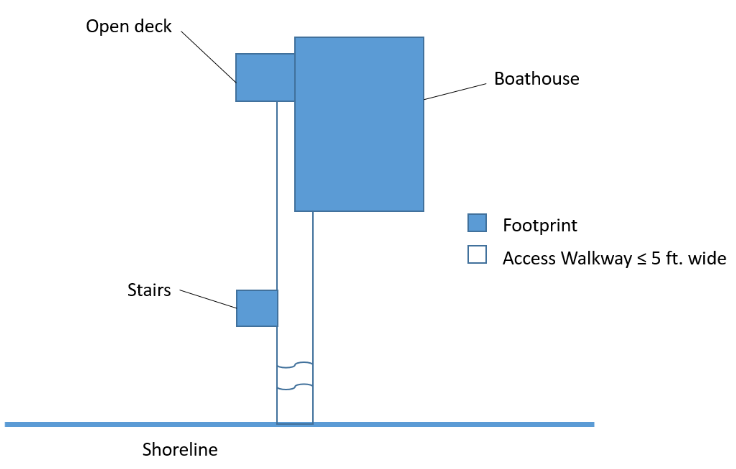
b.
Maximum total width and covered width. The width of a dock is calculated as the total width of uncovered and covered areas, including any roofed areas and stairs. If the property width at the lateral shoreline is 80 feet or less, the maximum width of a dock shall not exceed 20 feet. If the property width is greater than 80 feet, the maximum width shall not exceed 25 feet. Docks on upland cut canals and the Santa Fe River will be evaluated on a case-by-case basis and the maximum width provisions may not apply.
c.
Maximum height. The maximum height shall not exceed 14 feet as measured from the floor elevation to the highest point of the dock.
d.
Santa Fe River. Docks located on the Santa Fe River shall be limited to a single platform, 160 square feet in maximum size, and shall not include any roofed areas.
(2)
Other permits required. Issuance of a building permit from the Alachua County Building Official for a dock, does not take place of applicable local, federal, state and water management district permits that may be required before beginning construction. If modifications to the design of a County permitted dock are necessary to meet federal, state, or water management district permits, the applicant shall resubmit revised plans to the appropriate County reviewing body.
(3)
Hazards to navigation. A dock may not create a hazardous condition to the navigation of waterways and to other pursuits of water sports. Hazard to navigation means a watercraft or structure erected, under construction or moored that obstructs the navigation of watercraft proceeding along a navigable water or obstructs reasonable riparian access to adjacent properties.
(4)
Impact on natural systems. A dock may not be detrimental to the continued function of natural systems, including aquatic vegetation. All structures shall be constructed to cause the least possible impact to wetland and aquatic vegetation.
(5)
Setbacks. If the property width of the lateral shoreline is 65 feet or greater, the dock must be set back at least 25 feet from the side property lines (see figure below). If the property width at the lateral shoreline is less than 65 feet, the dock must be set back at least ten feet from the property line.
Figure 404.108.2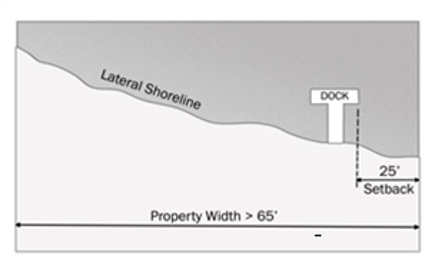
(6)
Walls are prohibited. There shall be no structures enclosed by walls on any side, temporary or permanent. For purposes of this Section, a wall is a continuous, vertical, opaque structure or surface.
(7)
One dock per property. There shall be no more than one dock per single-family residential parcel of land.
(d)
Development Review Committee (DRC) approval. Per Chapter 401, Article V, the DRC may approve docks that do not meet the standards in Section 404.108(c) provided the following conditions are satisfied (see table below). The DRC may also approve reconfigurations of existing docks that do not meet one or more of the standards in Section 404.108(c) and/or this Section provided those standards are not made further non-compliant.
(1)
Maximum size. The total footprint as calculated in Section 404.108(c)(1)a. shall not exceed 900 square feet.
(2)
Maximum width. The maximum width of a dock shall not exceed 40 feet or 40% of the property width at the lateral shoreline, whichever is less. For purposes of this Section, the property width at the lateral shoreline is measured as a straight perpendicular line from one property line to the other at the lake edge. The DRC may authorize a dock serving multiple residences or public access docks to exceed the maximum size and width standards upon determination that such joint use would result in greater environmental protection.
(3)
Maximum covered width. The maximum covered width of a dock shall not exceed 30 feet.
(4)
Setbacks. The DRC may approve exceptions to the setback standard when the County determines that locating any portion of the dock within the setback area is necessary to avoid or minimize adverse impacts to natural resources or riparian rights.
(5)
Santa Fe River. The total footprint of a dock located on the Santa Fe River shall not exceed 300 square feet and all other standards in Section 404.108(c) must be satisfied. A single covered platform may be approved not to exceed 160 square feet.
Table 404.108.1
(Ord. No. 12-09, § 2(Exh. A), 10-9-12; Ord. No. 15-06, § 2(Exh. A), 4-14-15; Ord. No. 2018-19, § 2(Exh. A), 8-14-18; Ord. No. 2019-01, § 2(Exh. A), 1-8-19; Ord. No. 2020-25, § 2(Exh. A), 11-10-20; Ord. No. 2021-12, § 2(Exh. A), 9-28-21; Ord. No. 2022-13, § 1, 6-14-22)
Sec. 404.109. - Hunting or fishing camps.
A hunting or fishing camp may be allowed as a limited use in the A, C-1, or MB district, subject to the following standards and approval by the DRC. Fish camps on property smaller than 40 acres may be allowed by special exception.
(a)
The site for a hunting camp must have at least 500 acres. Where the only activity on the site is a fishing camp, the site must have at least 40 acres of area that is not submerged.
(b)
Sleeping accommodations may be provided within a lodge, cabins, or spaces for recreational vehicles or tents. Where a lodge or cabin(s) is proposed, no more than 25 sleeping rooms shall be provided. No more than 25 recreational vehicle or tent spaces may be provided. A hunting or fishing camp may provide a combination of sleeping accommodations not to exceed 25 total. Where tent spaces are proposed, common sanitary facilities including showers, toilets, and sinks shall be provided.
(c)
One single permanent residence is allowed.
(d)
A 300-foot setback shall be provided on all sides of the property. This shall not be interpreted to prohibit any agricultural or silvicultural activities on the property.
(e)
A unified plan for water distribution and wastewater disposal meeting the requirements of the health department shall be required as part of any application for a hunting or fishing camp.
(f)
All hunting and fishing camps are subject to F.S. Ch. 509, Pt. II, Membership Campgrounds, and F.S. Ch. 513, as applicable.
(g)
Kennels for hunting dogs kept at the site shall meet the applicable standards in Section 404.18.
(h)
Docks provided for fishing camps shall meet the standards in Section 404.108.
(Ord. No. 12-09, § 2(Exh. A), 10-9-12; Ord. No. 13-14, § 2(Exh. A), 8-27-13; Ord. No. 2020-25, § 2(Exh. A), 11-10-20)
Sec. 404.110. - Marina.
A marina is allowed as a permitted use in the MB district subject to development plan approval by the DRC.
(Ord. No. 12-09, § 2(Exh. A), 10-9-12; Ord. No. 13-14, § 2(Exh. A), 8-27-13; Ord. No. 2020-25, § 2(Exh. A), 11-10-20)
Sec. 404.111. - Recreational camps.
Recreational camps are allowed by special exception in the A, C-1, and MB districts in accordance with the following standards:
(a)
The minimum lot area within the A or C-1 districts shall be 40 acres. In the MB district the minimum lot area shall be ten acres.
(b)
Recreational camps in the C-1 district may only be allowed in accordance with an approved management plan as provided in Chapter 406, Article XX.
(c)
The maximum density of cabins, lodges, and/or tent campsites shall not exceed one per two acres. Density shall be calculated as gross density and include all land area exclusive of major water bodies starting at the high water mark.
(d)
Cabins or lodges shall comply with the Florida Building Code and must contain a minimum of 50 square feet of floor space per occupant with a maximum capacity of 25. Use of mobile homes or recreational vehicles for lodging is prohibited.
(e)
A single permanent residence is allowed.
(f)
All structures, cabins, and tent sites shall be set back a minimum of 200 feet from the property line unless otherwise approved as part of the special exception.
(g)
Vehicular access shall be from a paved public roadway unless otherwise approved as part of the special exception.
(h)
A unified plan for water distribution and wastewater disposal meeting the requirements of the Health Department shall be provided as part of any application for a recreational camp.
(i)
Sanitary facilities including showers, toilets, and sinks shall be provided.
(j)
Recreational camps are subject to F.S. Ch. 513.
(Ord. No. 12-09, § 2(Exh. A), 10-9-12; Ord. No. 2020-25, § 2(Exh. A), 11-10-20)

