
Allen City Zoning Code
ARTICLE VII
ZONING DEVELOPMENT STANDARDS
Sec. 7.01.- Purpose.
The standards in this article are intended to establish minimum design criteria for all nonresidential construction.
Sec. 7.02. - Applicability.
The standards for design apply to all nonresidential structures and multifamily structures except as otherwise provided, and to all parking structures and lots within the city.
Sec. 7.03.1. - Parking garages.
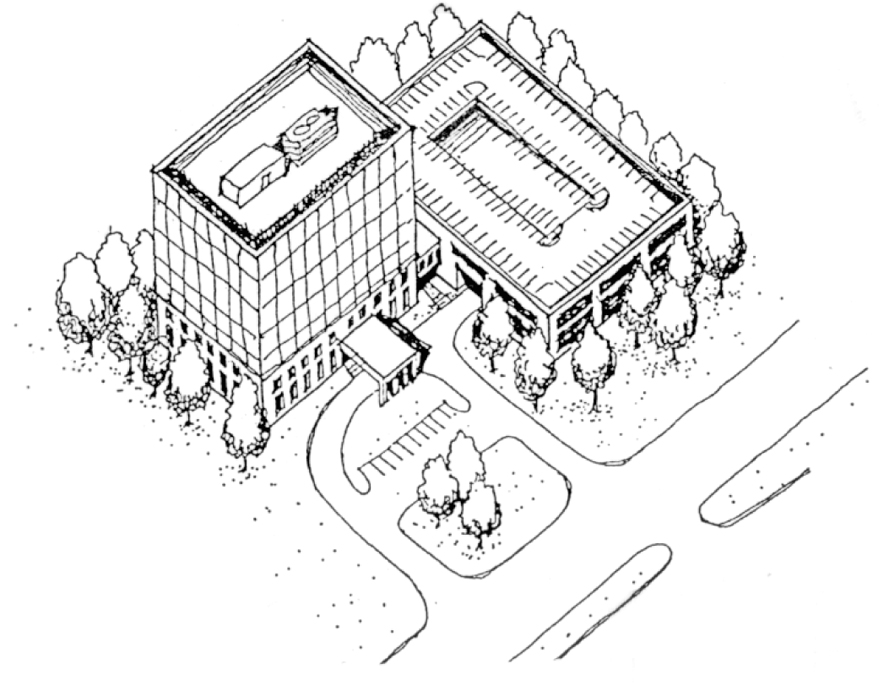
Parking garages shall have architecturally finished facades, complementary to the surrounding buildings. Street front openings in parking structures shall not exceed 55 percent of the facade area.
Where possible, the narrow facade of the parking garage should be oriented to the street to minimize its visual impact.
Sec. 7.03.2. - Exterior facade materials.
1.
All main building exterior wall construction materials that are exposed shall be constructed of 100 percent masonry, including but not limited to stone, brick, tiles, concrete masonry units, cast concrete, concrete stucco, etc. Glazing and framed glazing are considered acceptable alternatives. Synthetic stucco (such as exterior insulation and finish system (EIFS)) may be utilized as an architectural accent material, not to exceed ten percent of the exterior surface of any building facade.
2.
Glazing, doors, windows and door frames, roof system trim, mansards, and similar visible exterior architectural treatments shall be made of materials which complement construction materials.
3.
Accessory buildings shall be constructed of materials that complement the main structure.
4.
When rear facades are visible from adjoining properties and/or a public right-of-way, they shall be of a finished quality and consist of colors and materials that blend with the remainder of the building's primary facade(s).
5.
The installation of security bars, panels, metal grates, or other similar security devices both on the exterior of the structure and any portion of the interior visible from the outside is prohibited. Interior, retractable security screens and grilles may be utilized during non-business hours only.
(Ord. No. 2222-9-03, § 1, 9-23-2003; Ord. No. 3488-6-17, § 3.A, 6-27-2017; Ord. No. 3614-9-18, § 5, 9-25-2018)
Sec. 7.03.3. - Screening mechanical equipment and refuse enclosures.
1.
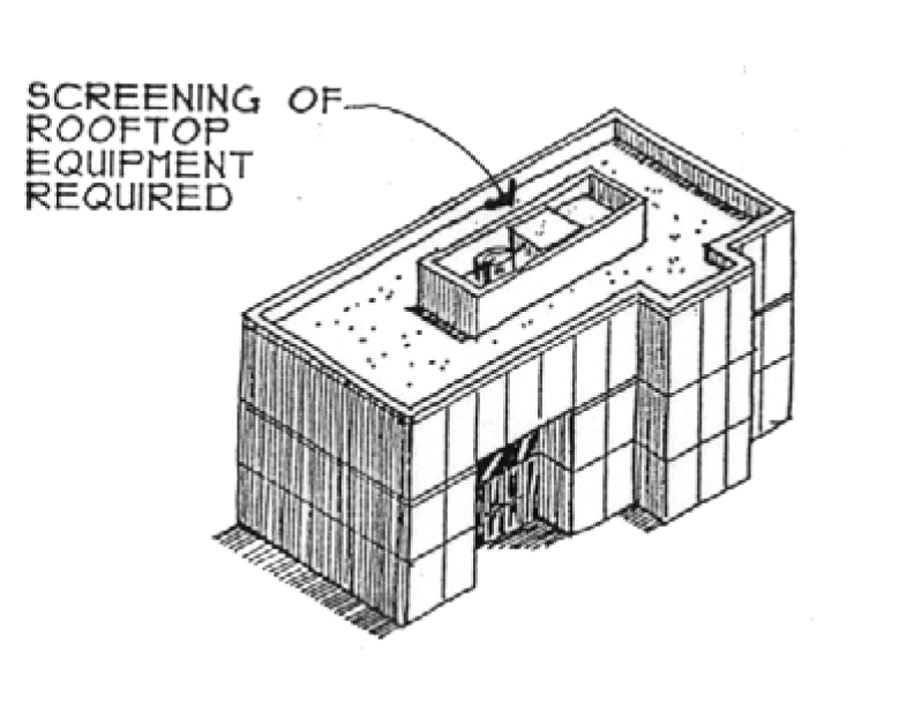
All roof-mounted equipment including, but not limited to, fans, vents, air conditioning units, and cooling towers shall be screened so as not to be visible at ground level from adjacent properties and/or public rights-of-way, including elevated thoroughfare sections.
a.
Overall screening height shall be the height of the highest element of roof-mounted equipment.
b.
The outside of the screening device, if independent of the building facade, shall be painted or otherwise finished in a similar color to the color of the building facade, trim, or roof surface, whichever color is more effective in minimizing the visibility of the equipment and screen from ground level.
2.
All wall-mounted and ground-mounted equipment and appliances including, but not limited to, fans, vents, air conditioning units, and cooling towers, shall be adequately screened from view from public streets and adjoining properties.
a.
Electric vehicle charging station devices are exempt from screening requirements in this section. However, additional equipment related to the electric vehicle charging stations shall be in accordance with subsection 7.03.3.2.
3.
Refuse and recycling collection enclosures.
a.
Approval process. The location of refuse and recycling collection areas shall be approved on a site plan, submitted in accordance with section 6.05. Any modifications to refuse and recycling collection areas, or additions of refuse and recycling containers or compactors, shall require approval of an amended site plan and/or building permit. No business may receive a certificate of occupancy until the construction of the required enclosure is complete.
b.
Location. Refuse and recycling collection areas, whether permanent or designated as staging areas for temporary storage prior to pick up, shall not be located in the front yard of the main building and shall be screened from public view.
c.
Access. Sufficient vehicle access, clearance, and visibility shall be provided as follows:
i.
A minimum unobstructed approach must be provided in front of each serviced container in accordance with the City of Allen commercial trash and recycling guidelines.
ii.
All collection areas and approaches must be on flat level surfaces and designed to accommodate the weight of all equipment and vehicles to service the container.
iii.
A vehicle maneuvering diagram may be required to demonstrate sufficient vehicle access.
d.
Enclosure design. Refuse and recycling enclosures shall be designed as follows:
i.
All refuse and recycling containers shall be screened with an eight-foot masonry wall enclosure. Screening enclosures shall visually and aesthetically compliment the building materials of the primary building located on the same lot or parcel.
ii.
Refuse and recycling collection enclosures shall contain permanent walls on three sides. Pedestrian entries with solid doors may be incorporated into these walls.
iii.
The service opening should not directly face any public right-of-way or any residentially zoned property. The service opening shall incorporate a solid metal gate to visually screen the dumpster or compactor.
iv.
Refuse and recycling collection enclosure doors cannot open into or obstruct the fire lane, access easement, or utility easement.
v.
All drains located inside an enclosure must be connected to the sanitary sewer system through a grease trap. Water connections in or adjacent to the enclosure will only be allowed if the enclosure is plumbed to the sanitary sewer through a grease trap. Trash enclosures with drains must be designed to prevent any rainfall that falls outside the enclosure from entering the sanitary sewer system.
vi.
Enclosures must be designed to accommodate the storage and servicing of all applicable refuse and recycling containers in compliance with the City of Allen commercial trash and recycling guidelines.
(Ord. No. 2593-2-07, § 1(Exh. A), 2-13-2007; Ord. No. 3614-9-18, § 8, 9-25-2018; Ord. No. 3754-6-20, § 1.G, 6-9-2020; Ord. No. 4170-8-25, § 3.A, 8-26-2025)
Sec. 7.03.4. - Outdoor lighting.
1.
Approval authority. The chief building official shall approve lighting of all private facilities, to include, but not limited to, private parking lots, and buildings.
2.
Definitions.
a.
Outdoor or exterior lighting means lighting equipment installed:
(1)
Within the property line and outside of a building located on a subject property, whether attached to poles, building structures, the ground, or any other location, and any associated lighting control equipment, including façade and landscape lighting; and
(2)
On the interior of a building but which is oriented in a direction with the intent and effect of illuminating one or more areas exterior to the building, or with the intent of being viewed from outside.
b.
Fully shielded means outdoor lighting fixtures shielded or constructed so that all light rays emitted by the fixture are projected below the horizontal plane passing through the lowest point on the fixture from which light is emitted, nearly 100 percent cut-off type, as evidenced by the manufacturer's photometric data.
c.
Partially shielded means shielding so that the lower edge of the shield is at or below the centerline of the light source or lamp so as to minimize the light transmission above the horizontal plane, or at least 90 percent of the emitted light projects below the horizontal plane as evidenced by the manufacturer's photometric data.
d.
Unshielded shall mean fixtures lacking any means to restrict the emitted light to below the horizontal plane.
3.
General standards.
a.
Lighting trespass. Light from exterior lighting fixtures shall not directly cross the bounding property line; provided, however, the director may authorize light from exterior lighting fixtures to cross common interior lot lines on contiguous lots in a nonresidential development when necessary to provide constant lighting levels of adjoining parking areas, fire lanes and interior access roadways.
b.
Photometric plan. The director may require submission of a photometric survey to determine the potential for light trespass with respect to the location, height, type, and number of outdoor lighting fixtures proposed to be installed on a property.
c.
Outdoor signs, etc. Outdoor advertising displays, billboards, and signs not exclusively illuminated internally may only use illuminating devices mounted on the top of the advertising display structure that comply with all other provisions of this section. Outdoor advertising signs constructed of translucent materials and wholly illuminated from within do not require shielding.
d.
Glare. Exterior lights shall be constructed in a manner consistent with the Property Maintenance Code Section 6-85(e), Glare.
e.
Under canopy lighting. Light fixtures mounted on canopies or service islands (e.g., at fueling stations) shall be recessed so that the lens cover is recessed or flush with the bottom surface (ceiling) of the canopy.
f.
Shielding. Shielding shall be required in all installations except as specified in this section. The allowable light sources and the requirements for shielding light emissions for outdoor light fixtures shall be as set forth in the following table:
4.
Hours of operation.
a.
Outdoor sales and eating areas, on-site advertising, assembly areas, repair areas, and businesses may be operated during the hours that the facilities are open to the public.
b.
Off-site advertising displays and billboards or signs may be operated from dusk to 11:00 p.m. only; unless fully shielded and pointed downward.
c.
Recreational and sporting areas may operate from dusk to 11:00 p.m., except to conclude a specific recreational or sporting event or similar activity which was in progress prior to 11:00 p.m.
5.
Nonresidential walkway lighting.
a.
The mounting height of luminary fixtures shall not exceed 12 feet.
b.
Pole and wall-mounted fixtures mounted above eight feet shall be fully shielded.
6.
Nonresidential accent lighting.
a.
Lighting may be used to highlight landscape elements, building entries or other important architectural elements, and site elements such as opaque signage, fountains and sculptures.
b.
Lighting shall be concealed or otherwise positioned in such a manner that the light source cannot be seen from any property line of the site on which the light is located.
7.
Nonresidential security lighting.
a.
Pole and wall-mounted fixtures mounted six feet or more above surrounding grade shall be fully shielded.
b.
If a rear yard security light is mounted higher than ten feet, it shall be placed at the property line and directed away from adjacent properties.
8.
Parking lot and loading area lighting.
a.
The mounting height of luminary fixtures shall not exceed the following:
b.
All parking lot and loading area lighting shall comply with the following requirements:
i.
Base cover and base, pole, light arm, and luminaire housing shall all be black, brown, forest green, gray, or other neutral color designed to be complementary to the overall design aesthetic of the development;
ii.
Light pole must be square straight steel, or other standard geometric shape with an anchor base;
iii.
Luminaire shall be generally rectangular or square in shape and have an approved fixture type as described in this section 7.03.4; and
iv.
All lighting fixtures shall be fully shielded.
v.
All electric utility service facilities shall be underground.
9.
Prohibitions.
a.
Laser source light and strobe lights and similar high intensity light sources for advertising or entertainment shall not be projected above the horizontal plane, unless a permit is obtained for specific events and time frames.
b.
Searchlights are not permitted (see section 7.09, sign control).
c.
Inoperative and obsolete lighting fixtures may not be modified, replaced, or upgraded without complying with this section.
d.
Low-pressure sodium lamps are prohibited.
e.
LED or other continuous or connected series of lights are prohibited, except as accent lighting for outdoor patios and seating areas.
f.
No lighting shall be permitted to outline individual windows (whether installed inside or outside of the building), buildings, accessory structures, signs, light poles or other appurtenances on site, except that neon lighting may be used on primary buildings.
10.
Exemptions and alternative designs.
a.
Section not applicable. This section shall not apply to the following types of outdoor lighting:
i.
Navigation and airport lighting required for the safe operation of boats and airplanes;
ii.
Emergency lighting by police, fire, and rescue authorities;
iii.
Gas lighting.
b.
Temporary exemptions.
i.
The chief building official or his designee may approve temporary exemptions from the requirements of this section provided that the duration of the approval shall be for not more than 30 days from the date of approval. No outdoor light fixtures shall be exempt from the requirements of this section for more than 90 days during any 12-month period.
ii.
Requests for renewal of exemptions shall be processed in the same way as the original request.
c.
Alternative designs.
i.
Alternative designs to parking lot and loading area lighting may be approved by the commission and must be compatible with the architecture of the building.
ii.
Architecturally decorative light fixtures used for buildings and walkways, may have the shielding requirements modified in consideration for aesthetics and theme style lighting. Such modifications may be approved by the director when determined that the lighting will not create a nuisance to adjacent properties or the public. The director may require the modifications be approved by the planning commission.
iii.
Notwithstanding paragraphs i. and ii., above, to the contrary, no alternative design shall be approved that increased light trespass on adjacent property.
(Ord. No. 1984-9-01, 9-6-2001; Ord. No. 3125-11-12, § 5, 11-27-2012; Ord. No. 3251-9-14, § 4, 9-9-2014; Ord. No. 3342-12-15, § 5, 12-8-2015; Ord. No. 3488-6-17, § 3.B, 6-27-2017; Ord. No. 3754-6-20, § 1.H, 6-9-2020; Ord. No. 3846-8-21, § 3.A, B, 8-10-2021)
Sec. 7.03.5. - Utility services.
1.
All new residential utility installations, including, but not limited to, electrical, gas, television and telephone/telecommunication, shall be placed underground.
2.
All new nonresidential utility installations, including but not limited to electrical, gas, television, and telephone/telecommunication, shall be placed underground where service is provided adjacent to public street or right-of-way. Where electrical service is provided from an alley or rear easement not located adjacent to a public street, primary electrical service may be provided overhead along the property line. Primary and secondary service routed on the site shall be placed underground.
3.
All new construction within the public street rights-of-way shall be located underground. Where a street is scheduled for reconstruction, new development may be required to provide an escrow of the difference between overhead and underground service.
4.
Nothing herein shall prevent temporary service during construction from being located overhead.
5.
New development shall assume responsibility for all expense related to the underground placement of utilities.
6.
Utility meters and other utility apparatus, including, but not limited to, transformers and switch boxes, shall be located to the rear of the structure unless adequately screened from view from public streets and adjoining properties and shall be suitable for access required for service and maintenance. Adequately screened from view shall include screening walls as well as the utilization of landscaping and other site elements.
7.
All required screening shall meet clearances required by affected utility companies and shall be suitable for access required for service and maintenance. Wall-mounted equipment, including meters (such as banks of electric meters on the rear or side wall of multitenant buildings), shall be screened from public streets by one of the following methods.
a.
Landscaping, including trees or evergreen shrubbery.
b.
Masonry walls in conjunction with landscaping.
c.
Wall-mounted screening devices, such as cabinets or partitions which are architecturally compatible with the building facade.
8.
Electrical transmission (59 or more kilovolts) may be located overhead.
9.
Existing overhead electrical, television, and/or telephone/telecommunication utilities located on the developing property or adjacent right-of-way shall be excluded from the requirement to be placed underground.
(Ord. No. 1939-5-01, 5-3-2001; Ord. No. 1984-9-01, 9-6-2001; Ord. No. 2020-1-02, § 3, 1-17-2002; Ord. No. 2112-11-02, 11-26-2002; Ord. No. 2137-1-03, 1-28-2003; Ord. No. 2844-7-09, § 1, 7-14-2009)
Sec. 7.04.1. - Vehicle parking.
In all districts there shall be provided, at the time any building or structure is erected or structurally altered, off-street parking spaces in accordance with the following requirements:
1.
Rules for computing number of parking spaces, shown in Table 7.04.1. In computing the number of parking spaces required for each of the above uses the following rules shall govern:
a.
"Floor area" shall mean the gross floor area of the specific use.
b.
Where fractional spaces result, the parking spaces required shall be constructed to the nearest whole number.
c.
The director and director of engineering may jointly grant a modification to off-street parking requirements when necessary for the efficient operation of the subject use. Such a modification in parking spaces shall be justified through the development of a parking study prepared by a professional engineer or transportation planner which demonstrates need, reviews industry standards, and proposes a modification that will not result in a parking deficiency.
d.
Whenever a building or use constructed or established after the effective date of this Code is changed or enlarged in floor area, number of employees, number of dwelling units, seating capacity or otherwise, to create a need for an increase in the number of existing parking spaces, such spaces shall be provided on the basis of the enlargement or change. Whenever a building or use existing prior to the effective date of this Code is enlarged in floor area or in the area used, said building or use shall then and thereafter comply with the parking requirements set forth herein.
e.
In the case of mixed uses, the parking spaces required shall equal the sum of the requirements of the various uses computed separately.
f.
Tandem spaces shall not count as required parking.
TABLE 7.04.1. PARKING REQUIREMENTS
2.
Location of parking spaces. All parking spaces required herein shall be located on the same lot with the building or use served, except as follows:
a.
Where an increase in the number of spaces is required by a change or enlargement of use or where such spaces are provided collectively or used jointly by two or more buildings or establishments, the required spaces may be located not to exceed 300 feet from an institutional building served and not to exceed 500 feet from any other nonresidential building served.
b.
A maximum of 50 percent of the parking spaces required for theaters, bowling alleys, dancehalls, nightclubs, cafes, or similar uses, and a maximum of 80 percent of the parking spaces required for a church or other religious facility or school auditorium or similar uses may be provided and used jointly by similar uses not normally open, used or operated during the same hours; provided, however, that written agreement thereto is properly executed and filed as specified below.
c.
In any case where the required parking spaces are not located on the same parcel or lot with the building or use for which the parking is required, or where such spaces are collectively or jointly provided and used, a written agreement, or other instrument approved as to form by the city attorney that contractually binds the owner of the off-site or jointly used parking to retain said off-site or jointly used parking and make it available for use by or for the benefit of the parcel or lot for which the parking is required shall be submitted with the site plan application, or filed with the application for a building permit when a site plan is not required.
3.
Stacking and queuing requirements.
a.
Stacking spaces provide the ability for vehicles to queue on-site prior to receiving a service. In all districts, at the time any building or structure is erected or altered, stacking spaces shall be provided for uses that include, but are not limited to, service stations, drive-through restaurants, drive-in or drive-through banks, and similar uses that allow customers or clients to receive services and/or conduct activities on the property without leaving their vehicle. City staff may require a traffic study to determine the stacking and queuing requirements to properly identify the number of stacking spaces required.
b.
A stacking space shall be a minimum of nine feet in width and 20 feet in length and shall not be located within or interfere with a public street or any other circulation driveway, parking space, fire lane or maneuvering area. Stacking spaces shall be provided behind the vehicle bay door, middle of the service window (e.g. quick service restaurant, dry cleaner), or middle of the service island (e.g. banks), whichever is applicable.
c.
A single stacking space shall be provided after the final window, order board, or stopping point to allow vehicles to pull clear of the transaction area prior to entering an intersecting drive aisle. Buildings and other structures shall be set back a minimum of ten feet from the back of the curb of the intersecting drive aisle to provide adequate visibility and to allow vehicles to safely exit drive-thru lanes and escape lanes prior to merging into intersecting drive aisles.
d.
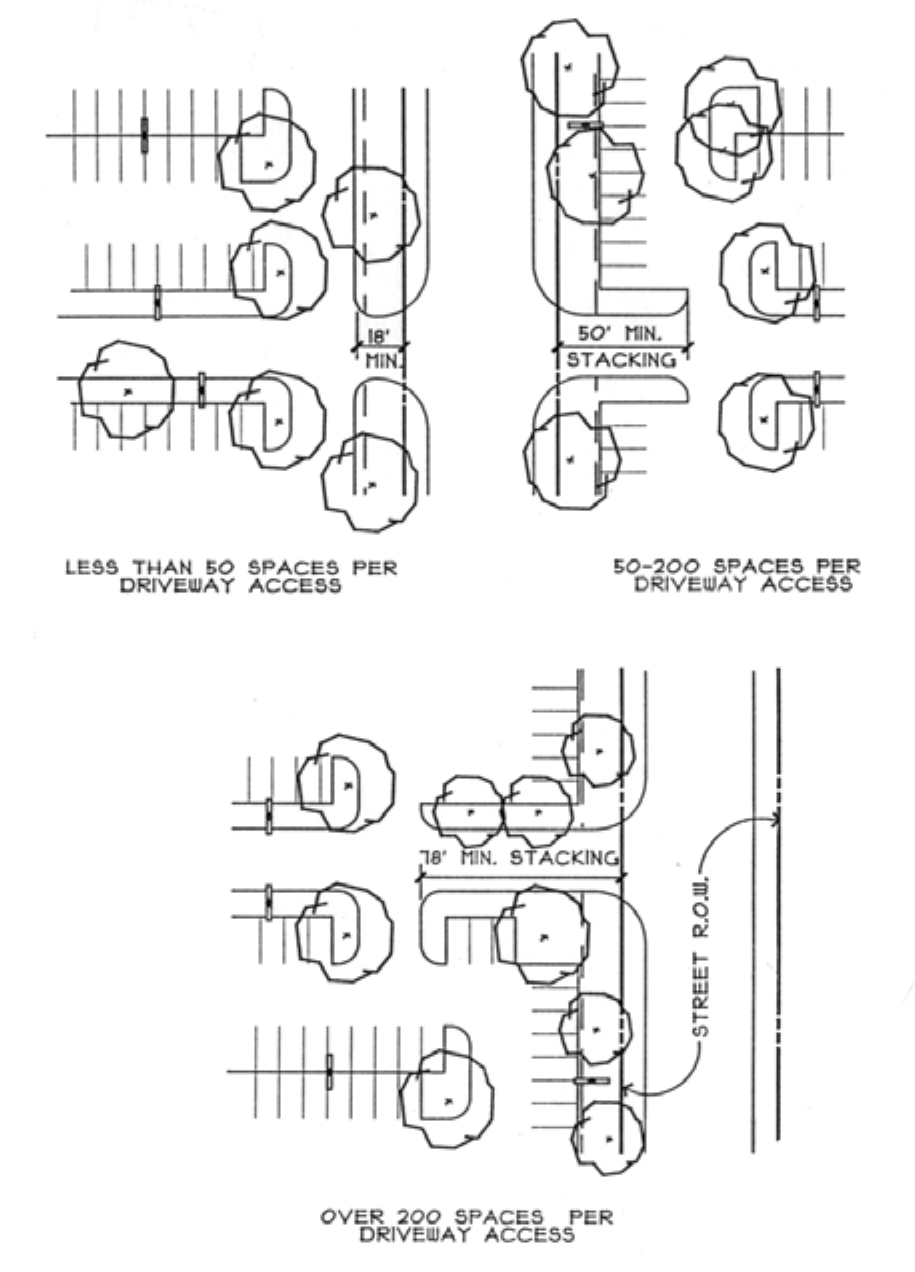
Driveway stacking length is the distance between the street right-of-way line and the near side of the first intersecting interior aisle or parking stall. The minimum length of driveway stacking shall be as follows:
4.
Minimum dimensions for off-street parking.
a.
Ninety-degree angle parking. Each parking space shall be not less than nine feet wide nor less than 18 feet in length. Maneuvering space shall be in addition to parking space and shall be not less than 24 feet wide.
b.
Sixty-degree angle parking. Each parking space shall be not less than nine feet wide perpendicular to the parking angle nor less than 20 feet in length when measured perpendicular to the edge of the maneuvering aisle. Maneuvering space shall be in addition to parking space and shall be not less than 20 feet wide.
c.
Forty-five-degree angle parking. Each parking space shall be not less than nine feet wide perpendicular to the parking angle nor less than 19 feet in length when measured perpendicular to the edge of the maneuvering aisle. Maneuvering space shall be in addition to parking space and shall be not less than 18 feet wide.
d.
Head in parking adjacent to sidewalks. All parking spaces that are oriented perpendicular to an adjacent sidewalk must meet one of the two following options:
i.
The sidewalk adjacent to a parking space measuring 18 feet in depth must maintain a minimum width and clear path of five feet, measured from the back of curb; or
ii.
In cases where a minimum width and clear path of five feet cannot be achieved for the adjacent sidewalk, then wheel stops shall be required to be installed two feet from the face of the adjacent curb with the minimum length of the parking space being 20 feet.
e.
Parallel parking. Each parking space used for parallel parking shall be not less than eight feet wide nor less than 22 feet in length. Maneuvering space not less than 11 feet wide shall be provided in addition to the parking space.
5.
Parking lot construction standards. All parking lots shall be constructed of five-inch reinforced Portland cement concrete over compacted soil subgrade. All required fire lanes shall be constructed of concrete in accordance with the city design standards. Alternative materials such as brick, pavestone, or similar materials may be allowed upon approval by the director of community development.
6.
Dead-end parking.
a.
Dead-end parking aisles exceeding 150 feet in length are prohibited.
b.
A dead-end parking aisle shall include a stall designated and marked "no parking" located at the closed end of the drive aisle that may be used for maneuvering a three-point turnaround.
(Ord. No. 1939-5-01, 5-3-2001; Ord. No. 2459-11-05, § 1, 11-8-2005; Ord. No. 2553-09-06, § 1, 9-12-2006; Ord. No. 2803-2-09, § 1, 2-10-2009; Ord. No. 2900-3-10, §§ 8, 9, 3-23-2010; Ord. No. 2978-12-10, § 10, 12-14-2010; Ord. No. 3086-5-12, § 4, 5-22-2012; Ord. No. 3697-8-19, § 1.F, 8-27-2019; Ord. No. 3754-6-20, § 1.I, 6-9-2020; Ord. No. 3846-8-21, § 3.C, 8-10-2021; Ord. No. 3988-2-23, § 3.A, 2-28-2023; Ord. No. 4170-8-25, § 3.B, 8-26-2025)
Sec. 7.04.2. - Off-street loading.
1.
Every building, or part thereof, erected or occupied for service, manufacturing, storage, warehousing, hotel, mortuary, or any other use similarly involving the receipt or distribution by vehicles of materials or merchandise, shall provide and maintain on the same premises loading space in accordance with the following requirements:
a.
For service or industrial use buildings and establishments, off-street loading facilities shall be provided in accordance with the following schedule:
b.
For hotels, office buildings, restaurants, and similar establishments, off-street loading facilities shall be provided in accordance with the following schedule:
c.
Loading facilities located on the side of a building but not facing a street shall be set back from the front property line a minimum distance of 60 feet.
d.
Driveways, aisles, maneuvering areas, and truck berths shall be designed to accommodate the largest vehicles that would normally be expected to use those particular driveways, aisles, maneuvering areas and truck berths.
e.
Whenever possible, the site should be designed for counterclockwise circulation of large trucks as left turns and lefthand backing maneuvers are easier and safer since the driver's position is on the lefthand side of the vehicle.
f.
All parking, loading and maneuvering of trucks shall be conducted off-street on private property.
g.
Required passenger vehicle parking shall not be allowed within the truck dock apron space.
2.
Screening of loading areas.
a.
Truck loading berths and apron space should not be located on the street side of any building.
b.
In those instances where three or more sides of the building face dedicated streets, loading berths and apron space may be located at the rear or side of the building. This loading area must be screened from view of the abutting streets for a minimum of 35 feet as follows:
i.
By a combination of permanent architectural and landscape elements such as walls, berms, trees and shrubs; and
ii.
Shall meet the standards of section 7.07 of this Code, to the height of the top of the dock door but no greater than 12 feet above the truck dock apron; and
iii.
Shall, when viewed at a perpendicular angle from the street screen the truck berths completely, except for driveway opening(s).
c.
No loading dock or service bay doors shall be constructed on any portion of a front wall or on a side or rear wall within 100 feet of U.S. 75, SH 121, and Greenville Avenue right-of-way, or within 60 feet of any front property line, adjacent to any other street.
(Ord. No. 2593-2-07, § 1(Exh. A), 2-13-2007; Ord. No. 3846-8-21, § 3.D, 8-10-2021)
Sec. 7.05. - Landscaping requirements.[1]
The provisions of this section:
1.
Establish standards for landscaping of nonresidential and multifamily development and surface parking lots.
2.
Establish tree-planting requirements for new single-family residential development.
3.
Provide for reduction hydrocarbons to improve air quality.
4.
Provide for reforestation of the urban area.
5.
Establish standards and requirements for the installation of irrigation systems.
(Ord. No. 3488-6-17, § 3.C, 6-27-2017)
Editor's note— Ord. No. 3488-6-17, § 3, adopted June 27, 2017, amended § 7.05 in its entirety to read as set out herein. The former §§ 7.05, 7.05.1—7.05.5, pertained to similar subject matter and derived from Ord. No. 1984-9-01, adopted Sept. 6, 2001; Ord. No. 2338-9-04, § 1, adopted Sept. 28, 2004; Ord. No. 2425-7-05, § 1, adopted July 26, 2005; Ord. No. 2593-2-07, § 1(Exh. A), adopted Feb. 13, 2007; Ord. No. 2721-3-08, § 1(Exh. A), adopted March 25, 2008; Ord. No. 2900-3-10, § 10, adopted March 23, 2010; Ord. No. 2978-12-10, § 11, adopted Dec. 14, 2010.
Sec. 7.05.1. - Landscape plan approval.
1.
A proposed landscape plan must be submitted with all applications for non-single family residential site plans, and engineering construction plans all for single-family residential developments with. No certificate of occupancy shall be issued until the planting of all landscaping required by the approval landscape plan has been verified by the planning department unless a delay in planting has been granted as the result of operation of the city's water conservation and drought contingency plan adopted in accordance with section 14-14.1 of the Code of Ordinances.
2.
All landscape plans shall be sealed by a Texas registered landscape architect and be generated in a neat and legible manner. The city shall provide the applicant with a landscape review checklist and shall evaluate the appropriateness of the landscape plan and may approve it, or approve it subject to stipulations.
3.
Landscape plans shall be submitted, and landscaping shall be updated, to meet the requirements of this Code when:
a.
A site is being redeveloped; or
b.
Where an existing parking area is altered or expanded to increase the total number of spaces by ⅓ or more of the total existing spaces, then the entire parking lot shall be updated to meet the current landscape standards. This shall include interior parking lot landscaping, parking screening, and required landscaping for street frontages; or
c.
The existing building area square footage increases more than 25 percent.
d.
A modification to the existing landscaping or landscape plan is proposed.
(Ord. No. 3488-6-17, § 3.C, 6-27-2017)
Editor's note— See editor's note to section 7.05.
Sec. 7.05.2. - Standard planting materials.
1.
Minimum caliper for trees required under this section is three inches.
2.
Minimum height required:
a.
Shade trees: Ten feet.
b.
Ornamental trees: Eight feet.
3.
Materials and planting standards must meet the American Association of Nurserymen, Inc., American Standard for Nursery Stock (latest edition).
(Ord. No. 3488-6-17, § 3.C, 6-27-2017)
Editor's note— See editor's note to section 7.05.
Sec. 7.05.3. - Nonresidential and multifamily landscaping requirements.
These standards shall apply to all multifamily and nonresidential districts and to any area within a planned development district containing multifamily and nonresidential uses.
1.
Except as otherwise provided elsewhere in this section, the minimum landscaping area for multifamily and nonresidential uses shall be not less than 10 percent of the area of the site.
2.
The minimum landscaping area for the following nonresidential districts shall be not less than 15 percent of the area of the site:
a.
"GO" Garden Office
b.
"O" Office
3.
Landscape in rights-of-way. All rights-of-way (area located between the property line and the edge of pavement of any adjacent street or alley) shall be planted with turf.
4.
Landscape buffers adjacent to streets. A landscape buffer of the following depths measured from the right-of-way line in which no building, structure or parking shall be located, shall be required adjacent to the right-of-way line of all dedicated public streets as follows:
a.
Adjacent to United States Highway 75: 25 feet.
b.
Adjacent to State Highway 121: 30 feet; provided, however, utilities may be located within the 15 feet portion of the landscape buffer closest to the right-of-way line.
c.
Adjacent to public streets with a right-of-way of 100 feet or more: 15 feet.
d.
Adjacent to public streets with a right-of-way less than 100 feet: 10 feet.
e.
Where public improvements, including acceleration or deceleration lanes are to be constructed within a required landscape buffer area, the director of community development may authorize reduction of the area of the required landscape buffer up to 50 percent; provided, however, the square footage of required landscape area(s) to be constructed within the boundary of the same property must be increased by an amount equal to the square footage of the area by which the required landscape buffer is reduced and such reduction have not already been taken into consideration in previously adopted site plan and/or landscape plan.
f.
Certain corner lots. Corner lots at the intersection of two major or larger thoroughfares classified as P8D, P6D, M6D, M4D, M4U, C4U shall comply with the following landscaping requirements in addition to the required plantings for the landscaped buffer and parking lot landscaping:
i.
A minimum 20-foot wide landscaped buffer shall be located along all street rights-of-way beginning at the corner and extending 175 feet or to the closest driveway. Beyond this point, the landscaped edge may be gradually reduced over a distance of 25 feet to the required width (ten or 15 feet);
ii.
Where the city traffic engineer has determined the need for a right-turn lane, and design constraints exist, the city may consider reducing the landscape buffer. The landscape buffer shall not be reduced to a width of less than ten feet (see section 8.05.2, thoroughfare design standards); and the total amount of landscape buffer reduced (in square feet) must be relocated within the site;
iii.
A minimum landscaped area of 900 square feet shall be located at the intersection corner of the lot and shall be designed to comply with visibility triangle requirements set forth in section 13-1 of the Code of Ordinances.
5.
Landscape buffer planting requirements. Landscape buffers required by subsection 4 above shall comply with the following:
a.
For all lots, one shade tree for every 40 feet of street frontage, or portion thereof, and one ornamental tree for every two shade trees shall be planted.
b.
No more than 50 percent of the landscape buffer area shall be planted with turf. The following shall not be considered "turf": shrubs, trees and groundcover in combination with mulch, crushed granite, river rock, decorative pavers or similar material.
c.
Non-vegetative materials shall not exceed 50 percent of the landscape buffer area, with the design, and installation methods, approved by the parks department.
d.
The requirements for a landscape buffer and tree planting may be modified in the "DD" downtown district in a manner set forth in a landscaping plan approved by the downtown design review board, provided such landscaping plan allows for adequate pedestrian circulation and handicap access.
6.
Surface parking lot landscaping. Landscaping in surface parking lots for non-residential uses shall comply with the following.
a.
Retail uses. One shade tree and one ornamental tree for every 40 parking spaces shall be planted from the outside edge of the parking lot and dispersed within the parking lot area.
b.
Non-retail uses. One shade tree and one ornamental tree for every 30 parking spaces shall be planted, starting from the outside edge of the parking lot, distributed such that one tree per 20 spaces is distributed in the parking lot and the remainder dispersed within the building site.
c.
No parking space shall be more than 50 feet from the center point of any city-approved parking lot tree, other than trees required for street right-of-way landscape buffer plantings or other landscape requirements.
d.
When the parking lot contains more than 200 parking spaces, the parking lot shall be subdivided into separate parking areas of not more than 200 spaces. These parking areas shall be separated by a landscaped area with a minimum width of ten feet.
e.
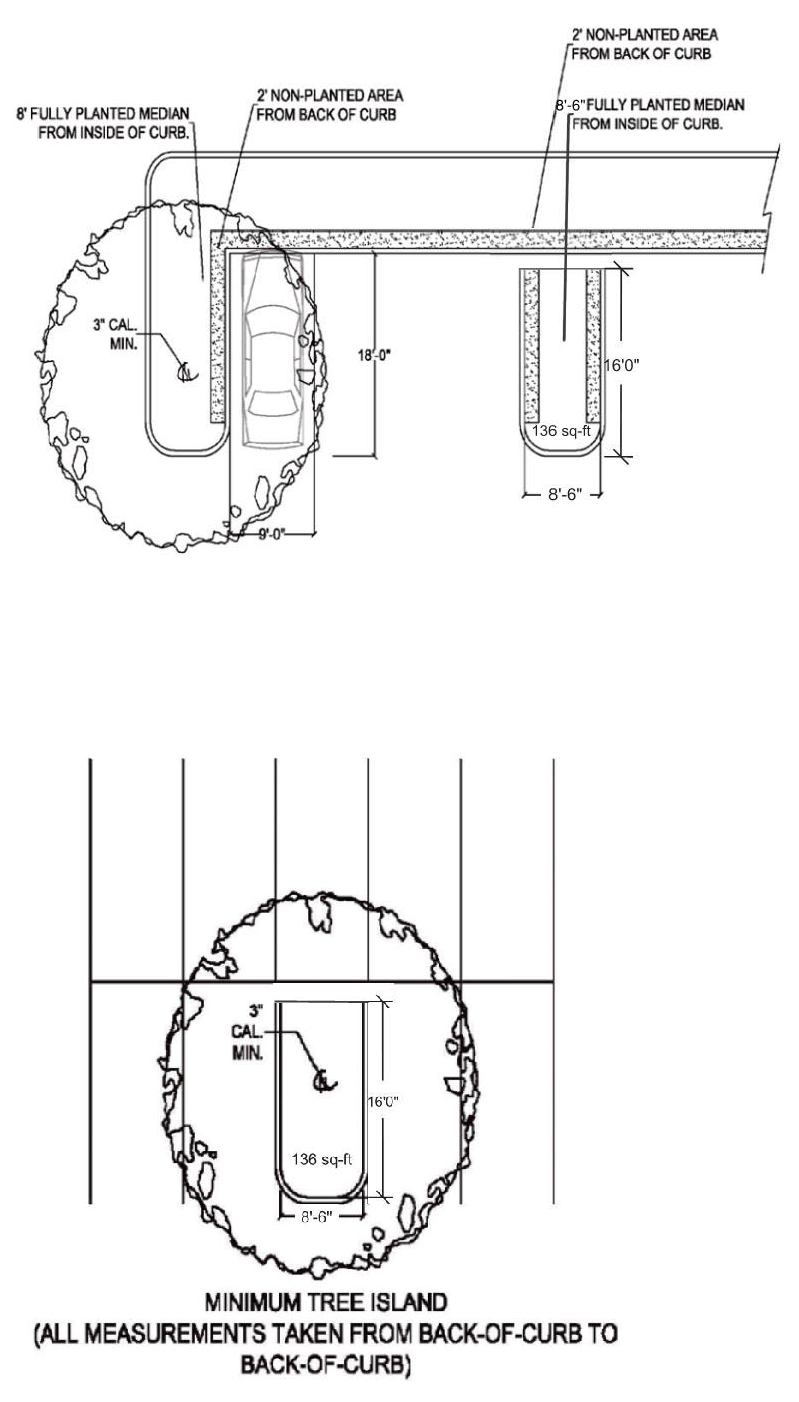
A two-foot-wide non-planted pervious surface area adjacent to the back of the curb shall be installed adjacent to all parking spaces. This area may include mulch, crushed granite, river rock, or similar material. (See figure below for an example.)
f.
A parking lot island shall be located at both ends of every interior and peripheral parking row, regardless of the length of the row.
g.
All peripheral parking rows shall not contain more than ten continuous parking spaces without a landscape island. Each parking lot island shall be no less than eight feet wide and no less than 16 feet in length or the length of the adjacent parking stall, whichever is longer, with an area of not less than 136 square feet. All dimensions shall be measured from back-of-curb to back-of-curb. "Diamond" islands are not allowed. All islands must be fully landscaped. (See figures below for examples.)
h.
Parking lots must be screened from any street right-of-way using evergreen shrubs, berms or a combination of both extending and wrapping around the entire side of all end parking spaces. Both berms and shrubs must be a minimum of 42 inches above the average grade of the parking lot curbs. The slope of a berm shall not exceed a four to one gradient, and the top of the berm shall be rounded, without a "peaked" appearance. Shrubs, when used, must be three gallons and 18 inches in height at the time of planting, and be arranged so that by themselves or in combination with a berm, they create a continual, unbroken screen.
i.
All landscaped areas shall be protected by a raised six-inch concrete curb. Pavement shall not be placed within four feet of a newly planted tree unless a root barrier approved by the director of parks and recreation is used.
j.
Landscaped areas may include shrubs, trees and groundcover in combination with mulch, crushed granite, river rock, decorative pavers or similar material. Non-vegetative materials shall be limited to 50 percent of the landscaped area, with the design, and installation methods, approved by the parks department.
7.
Landscaping/screening for parking lots adjacent to residential areas.
a.
A continuous screen of evergreen shrubs (five-gallon minimum) not less than 42 inches in height shall be planted on a maximum of three feet on center on the boundary of a parking lot facing property zoned for residential use if the parking lot is located within 50 feet of such residentially zoned property and is not otherwise screened from view.
b.
At any location where vehicle headlights may shine directly at residential areas, a headlight screening consisting of shrubs and/or decorative fencing must be installed in a manner to block the light.
8.
Landscaping for multifamily districts. In addition to the requirements above, multi-family developments shall:
a.
In addition to the landscaped buffer required in subsection 1 of this section, eight square feet of landscaping for each parking space shall be provided within the parking lot to include a minimum of one shade tree per ten parking spaces; and
b.
One shade tree per 1,000 square feet of required open space shall be provided.
9.
Fully automated underground irrigation systems shall be installed in all landscaped areas.
(Ord. No. 3488-6-17, § 3.C, 6-27-2017; Ord. No. 3562-3-18, § 4.A, 3-27-2018; Ord. No. 3976-1-23, § 1.H, 1-10-2023; Ord. No. 4125-11-24, § 3, 11-12-2024)
Editor's note— See editor's note to section 7.05.
Sec. 7.05.4. - Tree planting requirements for new single-family residential development (attached and detached).
This section shall apply to all new attached and detached single-family residential developments and to any area within a planned development district containing less restrictive landscaping standards:
1.
Tree planting requirements for new single-family residential development are as follows:
a.
Trees shall be planted within townhome developments in compliance with section 6.06.14 of this Code.
b.
Trees shall be planted in new single-family detached developments as follows:
i.
At least one shade tree shall be planted on each lot with an area of 5,000 square feet or less;
ii.
At least two trees, at least one of which must be a shade tree, shall be planted on each lot with an area greater than 5,000 square feet but less than or equal to 10,000 square feet;
iii.
At least three trees, at least two of which must be shade trees, shall be planted on each lot with an area greater than 10,000 square feet.
2.
All required trees shall be planted prior to requesting a final building inspection of the dwelling unit.
3.
Where screening walls are required adjacent to a public street by section 7.07.4, there shall be a landscape buffer area with the following requirements:
a.
One shade tree and one ornamental tree shall be planted for every 40 feet of street frontage or portion thereof.
b.
No more than 50 percent of the landscape buffer area shall be planted with turf. The following shall not be considered "turf": shrubs, trees and groundcover in combination with mulch, crushed granite, river rock, decorative pavers or similar material.
c.
Nonvegetative materials shall not exceed 50 percent of the landscape buffer area, with the design, and installation methods, approved by the parks department.
The landscape buffer area shall be shown on the preliminary and final plats in accordance with subsection 8.03.3.2.a.xx.
(Ord. No. 3488-6-17, § 3.C, 6-27-2017; Ord. No. 3988-2-23, § 3.B, 2-28-2023)
Editor's note— See editor's note to section 7.05.
Sec. 7.05.5. - Landscape maintenance requirements.
1.
All plant material on property subject to an approved landscape plan shall be maintained in a healthy and growing condition, and must be replaced with plant material of similar variety and size if damaged, destroyed, removed, or dead.
2.
Landscaped areas on property subject to an approved landscape plan shall be kept free of trash, litter, weeds, and other such materials and plants not a part of the landscaping. Materials including mulch, rocks and decorative pavers shall be maintained in accordance with the approved landscape plan.
3.
All irrigation systems shall be maintained in proper operating condition and in accordance with the requirements of this Code.
4.
Entryway or amenity features within city right-of-way shall be developed under the responsibility of a homeowners' association or commercial property owners' association.
5.
Diameters of existing trees are measured at four feet above grade. If the tree is on a slope, measurement shall be from the high side of the slope. Measure above unusual swells in the trunk.
To determine the diameter of a multitrunk tree, measure all the trunks; add the total diameter of the largest trunk to one-half the diameter of each additional trunk. Diameter measurements should be accurate to the nearest one-half inch. Trees may be measured with a caliper, cruise stick, standard tape measure or diameter tape.
(Ord. No. 3488-6-17, § 3.C, 6-27-2017)
Editor's note— See editor's note to section 7.05.
Sec. 7.05.6. - Irrigation plan requirements.
1.
No person shall install an irrigation system in the city without first having obtained a permit authorizing such installation from city's department of building and code compliance. In addition to the permit fee established by the city pursuant to resolution approved by the city council and such other information as may be required by the chief building official, an application for installation of an irrigation system must be accompanied by a full set of plans setting forth the design and operation parameters of the irrigation system to be installed, which plans must comply with this section 7.05.6.
2.
The city shall provide the applicant with an irrigation system plan review checklist, evaluate the appropriateness of the irrigation system plan, and approve the plans or approve the plans subject to conditions. Irrigation plans must comply with all State of Texas design and installation requirements including, but not limited to, applicable provisions of V.T.C.A., 30 Administrative Code ch. 344, as amended. In addition, the installation and operation of all irrigation systems must comply with the requirements of the city's water conservation plan, as amended, adopted pursuant to Code of Ordinances section 14-14.1.
3.
In addition to the provisions of V.T.C.A., 30 Administrative Code ch. 344, as amended, all new irrigation systems installed within the city shall comply with the following:
a.
The irrigation plan shall be sealed by a licensed irrigator or Texas registered landscape architect.
b.
The system must include an automatic controller and sensors that prevent the operation of irrigation during rainfall or in freezing weather.
c.
All non-turf landscape areas shall be designed with drip irrigation and/or pressure compensating tubing (no above-ground spray).
d.
All landscaped areas (including areas of turf-grass), regardless of size, located between the sidewalk and curb/pavement edge for any development shall be designed with drip irrigation and/or pressure compensating tubing (no above-ground spray).
e.
All drip irrigation and/or pressure compensating tubing shall be designed and installed according to manufacturer's specifications. For subsurface installation, application rate shall not exceed 0.21 inches per hour.
f.
Turfgrass areas utilizing irrigation rotors are to be designed and installed using low-angle nozzles.
g.
Irrigation heads shall be installed to provide maximum distribution uniformity. The system shall be designed and installed to provide a distribution uniformity of 63 percent DU LQ or better.
h.
The irrigation design shall prevent overspray on impervious surfaces and excessive runoff.
i.
Irrigation systems that vary from the standards of this Code and are designed to minimize water usage may be reviewed and approved by the city, provided, however, the design and installation requirements must at all times comply with V.T.C.A., 30 Administrative Code, ch. 344, as amended.
4.
New irrigation systems, other than irrigation systems installed on single-family lots, shall be designed with drip irrigation and/or pressure compensating tubing (no above-ground spray) in the following areas:
a.
Landscaped areas (including turfgrass) that are less than ten feet in width and adjacent to impervious surfaces.
b.
Landscape islands with an area of 200 square feet or less.
5.
All new irrigation systems for single-family homes shall have separate zones for a drip system (drip irrigation and/or pressure compensating tubing) around the foundation.
6.
For all irrigation systems other than irrigation systems installed on single-family lots, a certified landscape irrigation auditor shall conduct the following required irrigation audits and inspections:
7.
a.
Installation audit and inspection: Immediately following installation, an irrigation system audit and inspection shall be required for all new irrigation systems. For new developments, documentation of the audit and inspection shall be submitted to the city prior to issuing a certificate of occupancy. The audit and inspection must include an evaluation of the system distribution uniformity and actual zone precipitation rate. The audit shall be performed according to the latest edition of the Recommended Audit Guidelines, published by the Irrigation Association, 6540 Arlington Boulevard, Falls Church, Virginia 22042-6638. Distribution uniformity shall be measured on the largest turfgrass area zone of the irrigation system. Forms for submission and documentation of audit and inspection information shall be made available by the city.
b.
Recurring inspections: An irrigation system audit and inspection shall be required for irrigation systems, new and existing, shall be submitted to the city once every three years, and shall be conducted in the same manner as set forth in subparagraph a., above, regarding the installation audit and inspection. The city shall establish a timeline and procedures for all developments to submit irrigation system audit and inspection documentation to the city for review. Forms for submission and documentation of inspection information shall be made available by the city.
8.
The portion of an irrigation system being expanded or replaced shall comply with the requirements of this section 7.05.6 if:
a.
The existing irrigation systems is expanded to provide irrigation coverage of an additional land area greater than 25 percent of the land area covered by the existing irrigation system; or
b.
The portion of the existing irrigation system being replaced provides irrigation coverage for more than 25 percent of the land area covered by the system.
(Ord. No. 3614-9-18,, § 6, 9-25-2018)
Sec. 7.06.1. - Applicability of tree preservation.
This section applies to all trees in the city, except trees on single-family lots and duplex lots which have received a final inspection.
Sec. 7.06.2. - Tree removal permits.
No person, directly or indirectly, may cut down, destroy, remove or effectively destroy through damaging any tree within the city without first obtaining a tree removal permit, as provided in this section.
1.
Damaged trees. The city must issue a tree removal permit for a protected tree, if the owner requests a tree removal permit and:
• The protected tree is injured, dying, diseased or infested with harmful insects to the extent that it is not likely to survive; or
• The protected tree is in danger of falling or interfering with utility service or creates an unsafe vision clearance; or
• The protected tree in any manner creates a hazardous or dangerous condition so as to endanger the public health, welfare or safety; or
• An arborist certifies that one or more of the foregoing conditions exist; and
• The city inspects the tree and is satisfied that the foregoing conditions are met.
2.
Dangerous conditions. If the owner determines that an emergency situation exists that requires the immediate removal of a tree to protect the safety of persons or property, then the owner may remove the tree only to the extent necessary to eliminate the dangerous situation without a tree removal permit. However, the owner must immediately apply for a tree removal permit. Removal of a tree under this section shall require the owner to comply with the mitigation requirements of this section.
3.
Denial of an application for tree removal permit or any application of this section may be appealed to the board of adjustment.
4.
The trees to be removed pursuant to a tree removal permit shall be completely removed from the site within 90 days after the date on the tree removal permit. The tree removal permit may be extended one time for an additional 30 days. If the work is not completed within the time limit, then a new tree removal permit must be applied for and issued before the work can continue.
Sec. 7.06.3. - Calculation of tree credits.
1.
Credits for tree preservation.
a.
For every protected tree that is preserved as part of a development, the owner shall receive tree credits, according to the following chart.
Six to ten caliper inches, one credit for each caliper inch.
10.1 to 15 caliper inches, two credits for each caliper inch.
Over 15 caliper inches, three credits for each caliper inch.
b.
The city may approve a healthy unprotected tree over 12 caliper inches for tree credits if the tree is located outside the floodplain.
2.
Negative credits for tree loss.
a.
For every protected tree removed, including fence row trees, the owner shall receive negative tree credits or shall be required to plant replacement trees as follows:
Trees six to ten caliper inches, two negative credits for each caliper inch.
Trees 10.1 to 15 caliper inches, four negative credits for each caliper inch.
b.
For any healthy, unprotected tree over 12 caliper inches located outside the floodplain, the owner shall receive negative tree credits calculated at one-half of the caliper inches for such tree if the city determines that the tree should be preserved.
3.
Credits for replacement trees.
a.
Trees 15.1 to 24 caliper inches shall require the replanting of replacement trees equal to two inches for each caliper inch removed. Replacement trees shall be not less than three caliper inches. This requirement shall be in addition to the requirements of section 7.05 et seq., landscaping requirements.
b.
Trees over 24 caliper inches shall require the replanting of replacement trees equal to three inches for each caliper inch removed. Replacement trees shall be not less than three caliper inches. This requirement shall be in addition to the requirements of section 7.05 et seq., landscaping requirements.
c.
Provided that the trees are of a species identified as overstory trees in appendix C and approved by the urban forester. Trees planted as part of the landscape buffer planting and parking lot landscaping shall qualify as replacement trees.
d.
Each replacement tree allowed as a credit must survive in a full healthy state for at least three years. The owner shall replace any tree allowed as a credit if it dies or becomes unhealthy during the three-year period following planting. This obligation shall be evidenced in the tree mitigation agreement between the owner and the city.
4.
Calculation. The owner's total tree credits shall be calculated in accordance with the following: Total tree credits for protected trees preserved, plus total tree credits for healthy unprotected trees preserved, less total healthy desirable unprotected trees removed; plus total tree credits for replacement trees planted, less total negative tree credits for protected trees removed.
(Ord. No. 1939-5-01, 5-3-2001; Ord. No. 2593-2-07, § 1(Exh. A), 2-13-2007)
Sec. 7.06.4. - Replacement of trees.
1.
If the total tree credits is a positive number, then there is no obligation to replant trees under section 7.06, except as otherwise provided.
2.
If the total tree credits is a negative number, the owner must enter into a tree mitigation agreement with the city specifying the obligations of the owner prior to issuance of a certificate of occupancy or at the time public improvements are accepted by the city for maintenance, including:
a.
The owner must plant protected trees to equal or exceed the tree credit number.
b.
The city may allow the owner to plant the replacement trees within public parks and rights-of-way selected by the city.
c.
The owner may elect to defer the planting of the required replacement trees through the escrow of funds to cover the city's cost of planting the replacement trees at a later time based on the cost per caliper inch for planting a tree with a one-year replacement guarantee as established in the fee schedule adopted by resolution of the city council.
3.
City approval of a tree loss mitigation plan shall constitute a tree mitigation agreement between the city and the owner concerning the owner's obligation to plant replacement trees or to pay money in lieu of replacement.
4.
Replacement of trees shall be in accordance with the approved tree loss mitigation plan approved by the city. In approving the tree loss mitigation plan, the city shall consider the species, growing characteristics, root systems, soil conditions and proposed location of replacement trees, as well as other mitigation efforts including, but not limited to, the realignment of rights-of-way or relocation of utilities, which minimize tree loss.
5.
The minimum caliper for replacement trees is three inches.
6.
All replacement trees shall be planted in accordance with the American Association of Nurserymen, Inc. (AAN) Standard: American Standard for Nursery Stock (ANSI Z60.1, latest edition).
7.
The city shall permit payment in lieu of planting replacement trees only in the following circumstances:
a.
The tract is too small to allow on-site replacement;
b.
The city declines to allow the planting of replacement trees in city parks or public rights-of-way; or
c.
There is no suitable location for the planting of replacement trees. A suitable location is one provided with adequate irrigation, proper soils and drainage, and other conditions requisite for the survival of replacement trees.
(Ord. No. 1939-5-01, 5-3-2001; Ord. No. 3125-11-12, § 10, 11-27-2012)
Sec. 7.06.5. - Guidelines for tree protection.
The owner shall adhere to the following tree protection measures on all building sites:
1.
Prior to construction or land development, all protected trees shall be clearly marked;
2.
A protective fence shall be erected around each protected tree or group of protected trees at least beyond the drip line of such tree;
3.
During construction, no access is permitted within the protective fence for any purpose, except cleaning trash that has entered the area;
4.
No attachments or wires of any kind, other than those of a protective nature and approved by the parks and recreation department, may be attached to any protected tree.
Any grade changes, retaining walls, tree wells or other construction activity within ten feet of the drip line of a protected tree shall require approval of the city.
Sec. 7.06.6. - Fence row tree preservation.
1.
The owner shall preserve all fence row trees in a residential development by providing a 15-foot protected area centered 7½ feet on each side of the centerline of the fence row trees, except that fence row trees may be removed and mitigated if approved by the city. Proposed fence row trees removed or mitigated must be identified on any plan presented to the city for approval.
2.
The owner shall preserve all fence row trees in nonresidential developments by providing a 15-foot protected area centered 7½ feet on each side of the centerline of the fence row trees, unless the planning and zoning commission determines that the location of the fence row trees in the nonresidential development is such that the property cannot be developed because of the fence row trees.
3.
Except as provided below, the owner shall not remove fence row trees within the protected area for the purpose of installing utility lines, digging trenches (including irrigation trenches), pouring alley paving, or constructing, erecting or placing any structures. Fence row trees may only be removed to provide access to an existing alley on the other side of the fence row. However, these fence row trees shall accrue negative tree credits as part of the development.
4.
The chief building official or his designee shall approve all residential fences proposed to be located in the protected area.
(Ord. No. 2425-7-05, § 1, 7-26-2005)
Sec. 7.06.7. - Special provisions for agriculture/open space property.
This section applies to real property having an agriculture-open space zoning district classification, or having an agricultural exemption for taxation purposes.
1.
There is no requirement that the owner comply with the mitigation provisions of this Code at the time of the tree removal. However, the property is still subject to the development requirements at such time as development occurs and the trees removed shall be counted as part of the tree credits. The owner must provide a notice in the real property records acknowledging the obligation to mitigate the tree removal.
2.
No tree removal permit may be issued under this section of the Code for any trees that are fence row trees or are historic trees.
Sec. 7.06.8. - Historic tree preservation.
No tree removal permit may be issued for a historic tree unless the owner establishes that preserving the historic tree constitutes an unreasonable financial hardship on the owner. Appeals from this determination shall be to the board of adjustment.
Sec. 7.06.9. - Enforcement of tree preservation.
The urban forester shall be authorized to approve tree loss mitigation plans and to enforce other provisions of this section. The urban forester shall be an employee of the city and certified as an arborist by the International Society of Arboriculture (ISA) or registered as a landscape architect by the Texas Board of Architectural Examiners.
(Ord. No. 1939-5-01, 5-3-2001)
Sec. 7.07. - Fences and walls.
In any residential district or along the common boundary between any residential or nonresidential district where a wall separation is erected, or where a screening wall or fence is required as provided herein, the following standards shall be observed:
1.
Height of fence or wall.
a.
Any living plant screen erected or placed in the front yard shall not exceed four feet in height above the adjacent grade. No fences, walls, structures or buildings shall be allowed in the front yard except fences or walls less than 36 inches in height as part of an unenclosed front porch or uncovered patio and in accordance with section 4.15.1.
b.
Any fence, wall, or living plant screen erected or placed behind the minimum required front yard line may be erected or maintained to a maximum height of eight feet above the adjacent grade.
c.
No fence, screen, wall or other visual barrier shall be placed in such a manner as to obstruct the vision of motor vehicle drivers approaching any street or alley intersection. At all intersections, clear vision shall be maintained in accordance with section 8.05.1 of this Code.
2.
Construction of screening walls or visual barriers.
a.
When screening walls are required by this Code, an approved eight-foot masonry wall, or alternative design approved by the commission, shall be required. Masonry screening walls shall meet the design details described in the following:
i.
Masonry screening walls may be constructed of clay-fired brick or stone masonry units;
ii.
Where screening walls are used to separate land uses or developments and do not front on a public street, pre-cast concrete panels may be used in lieu of clay-fired brick or stone masonry provided they are textured and colored to have the appearance of stone or clay-fired bricks;
iii.
Garbage, trash or refuse container screening shall compliment the primary building materials and may utilize split faced concrete masonry units.
b.
No living plant walls shall be allowed in city right-of-way.
c.
Subdivision or development entry walls shall be located within a dedicated easement of not less than five feet in width at a location approved by the city. No structure shall be permitted which obstructs visibility within the public rights-of-way.
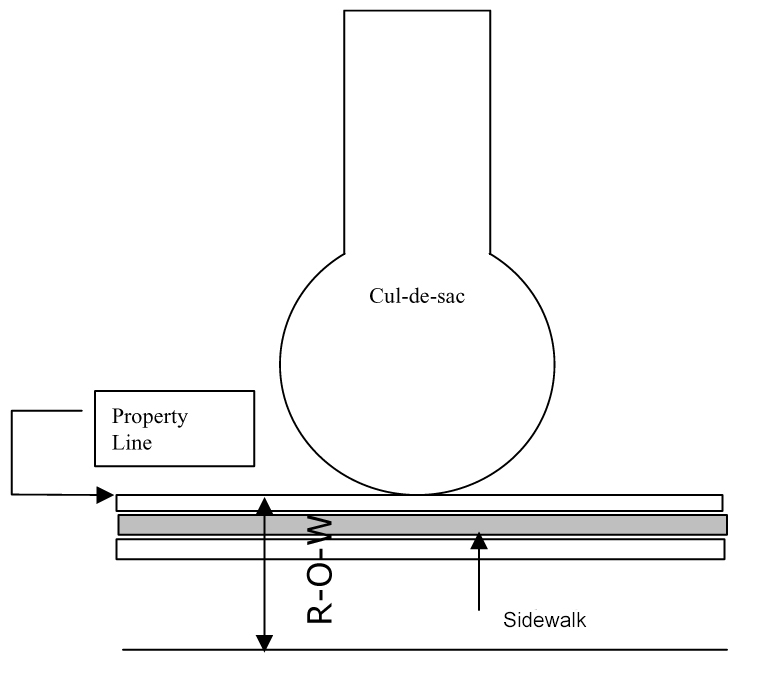
Figure 2
d.
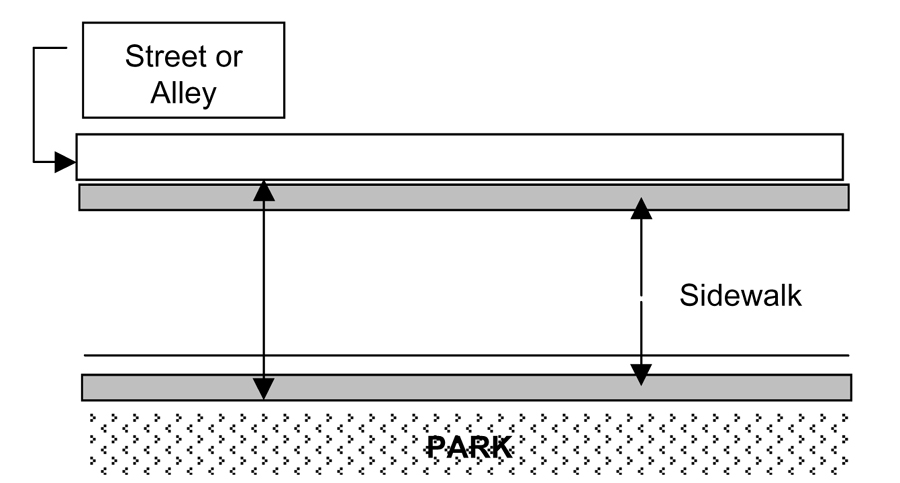
Traffic barriers shall be a minimum of 3½ feet (42 inches) in height and approved by the city traffic engineer where:
Two streets are in close proximity to each; or
An alley is adjacent to city park land or open space; or
An alley is adjacent to a street.
(See Figures 2 and 3.)
e.
The construction of all screening walls, entry walls, and traffic barrier standards shall conform to the appendix F, construction details—paving, and shall be equally finished on both sides of the wall.
f.
Walls or entry features constructed on public right-of-way shall be included in a two-year maintenance bond, and shall be maintained by the developer during this period. After the city accepts public improvements, the mandatory homeowners' association required pursuant to section 8.20 of this Code shall be responsible for maintenance.
Figure 3
g.
All required screening shall meet clearances required by affected utility companies. Wall-mounted equipment, including meters (such as banks of electric meters on the rear or side wall of multitenant buildings), shall be screened from public streets by one of the following methods.
i.
Landscaping, including trees or evergreen shrubbery.
ii.
Masonry walls in conjunction with landscaping.
iii.
Wall-mounted screening devices, such as cabinets or partitions that are architecturally compatible with the facade.
3.
Reserved.
4.
Screening walls or visual barriers required. A screening wall shall be erected or placed in all locations and in accordance with the following provisions:
a.
A screening wall must be eight feet in height and composed of masonry material with no openings constituting more than 40 square inches per square foot of surface area (approximate openings equal 28 percent).
b.
All openings in the wall shall be equipped with gates equal in height and equivalent screening characteristics.
c.
All approved screening walls must be erected prior to the issuance of a certificate of occupancy.
d.
All screening walls shall be maintained in a neat and orderly manner as a condition of use. Failure to adequately maintain such screening wall is cause for revocation of the certificate of occupancy.
e.
Screening walls or visual barriers are required adjacent to existing residential uses and shall be placed and maintained by the property owner at the following locations:
i.
Along any property line or district boundary between any single-family detached or attached or any two-family use or zoning district and any multifamily, mobile home park, or nonresidential use or zoning district, but not across a dividing street between such uses.
ii.
Along any property line or district boundary between any multifamily or urban residential use or zoning district and any nonresidential use or zoning district, but not across a dividing street between such uses.
iii.
Along any arterial or collector adjacent to the rear property line of residential lots or adjacent to a rear alley serving residential lots.
iv.
Along the side yard of any residential lot adjacent to any arterial.
v.
All allowed outdoor storage shall be screened from view from all streets and property lines. Materials, equipment, or commodities shall be stacked no higher than one foot above the top of the screening wall or visual barrier.
vi.
Garbage, trash, or refuse containers shall not be located in front of the main building, and shall be screened from view of the public.
vii.
All wrecking yards, junkyards, or salvage yards shall be screened on all sides.
viii.
All loading facilities facing any street shall be screened from view from the street.
ix.
An alternative to these provisions may be allowed by the planning and zoning commission but would be limited to wrought iron (or aluminum) with masonry columns, board on board fencing with masonry columns at a maximum of 100-foot spacing, with a mow strip and allowing no ground contact for nonmasonry materials, landscaping and berming, or a combination thereof. Requests for alternates must be accompanied by supporting elevations and diagrams. Requests for alternates not listed herein will require city council approval, after a positive recommendation by the planning and zoning commission.
f.
The rear and side lot lines of residential lots adjacent to greenbelts, open space or parks shall be required to have an ornamental metal fence with a minimum height of six feet, unless an alternative is approved by the planning commission.
(Ord. No. 1939-5-01, 5-3-2001; Ord. No. 2020-1-02, § 4, 1-17-2002; Ord. No. 2112-11-02, 11-26-2002; Ord. No. 2137-1-03, 1-28-2003; Ord. No. 2177-6-03, § 1, 6-10-2003; Ord. No. 2425-7-05, § 1, 7-26-2005; Ord. No. 2593-2-07, § 1(Exh. A), 2-13-2007; Ord. No. 2803-2-09, § 2, 2-10-2009; Ord. No. 2900-3-10, § 11, 3-23-2010; Ord. No. 2978-12-10, § 12, 12-14-2010; Ord. No. 3086-5-12, §§ 5, 6, 5-22-2012; Ord. No. 3125-11-12, § 6, 11-27-2012; Ord. No. 3562-3-18, § 4.B, 3-27-2018; Ord. No. 3697-8-19, § 1.G, 8-27-2019; Ord. No. 3846-8-21, § 3.E, 8-10-2021)
Sec. 7.08. - Performance standards.
1.
All residential districts permit uses allowed in more restrictive residential districts, e.g., uses permitted in R-4 single-family residential districts are permitted in R-5 single-family residential districts.
2.
All uses shall be conducted wholly within an enclosed building and required yards shall not be used for display, sale or storage of merchandise or for the storage of vehicles, equipment, containers or waste material unless otherwise specifically provided or as approved with a specific use permit.
3.
No fence, structure, or planting higher than 3½ feet above the established street grades, nor any tree with foliage extending below ten feet above the established street grades, shall be maintained within 20 feet of any street intersection.
4.
In all zoning districts, any permitted principal or accessory use shall conform in operation, location and construction to the performance standards administered by county, state or federal agencies. All uses, including those which may be allowed by PD planned development district or specific use permit, shall conform to the appropriate standard for noise, smoke and particulate matter, odorous matter, fire, explosive hazard, toxic and noxious matter, vibration and glare.
a.
Fire and explosive hazard material.
i.
No use involving the manufacture or storage of compounds or products which decompose by detonation shall be permitted except that chlorates, nitrates, perchlorates, phosphorous and similar substances and compounds in small quantities for use by industry, school laboratories, druggists or wholesalers may be permitted when approved by the fire department.
ii.
The storage and use of all flammable liquids and materials such as pyroxylin plastics, nitrocellulose film, solvents and petroleum products shall be permitted only when such storage or use is approved by the fire department.
b.
Toxic and noxious matter. No operation or use shall emit toxic or noxious matter exceeding ten percent of the threshold concentration or exposure for an industrial worker as set forth by the Texas State Department of Health, Threshold Limit Values Occupational Health Regulation No. 3, as it may be amended from time to time.
c.
Vibration. No operation or use shall create earthborn vibration which exceeds the following displacement in the frequency ranges specified:
d.
Smoke and particulate matter. No operation or use in any district shall cause, create or allow the emission or release for more than three minutes in any one hour any air contaminants which, at the point of emission or within the bounds of the property, are:
i.
In violation of the standards specified by the Texas Natural Resource Conservation Commission (TNRCC).
ii.
Of such opacity as to obscure an observer's view to a degree equal to or greater than that prescribed in subsection i. above, unless the presence of uncombined water is the only reason for failure to comply or when the emission or release is contained in a manner preventing escape into the outside atmosphere.
The emission of particulate matter from all sources shall not exceed one-half pound per acre of property within the plant site in any one hour.
Open storage and open processing operations, including on-site transportation movements displacing airborne dust or other particulate matter such as paint spraying, grain handling, sand or gravel processing or storage, or sand blasting, generating particulate matter in concentrations exceeding four grains per 1,000 cubic feet of air.
e.
Odorous matter. No use or operation shall create a nuisance by generating odors found to be offensive to the public as established by the American Society for Testing Materials A.S.T.M.D. (Standard Method for Measurement of Odor in Atmospheres).
f.
Waste materials. No use or operation shall discharge into the open, onto the ground, or into any drainageway, open pit or pond, any waste materials, liquids, residue or byproducts for storage, decomposition, disposal or fill.
5.
All developments shall meet the requirements of the City of Allen Water Conservation Ordinance in addition to the provisions below:
a.
Vehicle wash facilities using conveyorized, touchless, and/or rollover in-bay technology shall reuse a minimum of 50 percent of water from previous vehicle rinses in subsequent washes.
b.
Vehicle wash facilities using reverse osmosis to produce water rinse with a lower mineral content shall incorporate the unused concentrate in subsequent vehicle washes.
c.
Self-service spray wands used shall emit no more than three gallons of water per minute.
(Ord. No. 1939-5-01, 5-3-2001; Ord. No. 2293-6-04, § 1, 6-8-2004; Ord. No. 2721-3-08, § 1(Exh. A), 3-25-2008; Ord. No. 2978-12-10, § 13, 12-14-2010; Ord. No. 3846-8-21, § 3.F, 8-10-2021; Ord. No. 4083-5-24, § 2, 5-28-2024)
Sec. 7.09.1. - Purpose of sign regulations.
The purpose of these sign regulations is to encourage aesthetically pleasing design consistent with the standards of the adopted comprehensive plan and to establish uniform standards for the placement of signs.
(Ord. No. 1896-12-00, § 1, 12-7-2000; Ord. No. 2099-10-02, § 1, 10-8-2002)
Sec. 7.09.2. - Sign definitions.
The following terms are defined for purposes of this section as follows:
Animation means copy or other images that flash or move.
Code enforcement officer means the chief building official or his designee.
Copy means letters, characters, illustrations, logos, graphics, symbols, writing or any combination thereof, designed to communicate information of any kind, or to advertise, announce or identify a person, entity, business, business product, or to advertise the sale, rental or lease of premises.
Copy area means the area of the sign containing any copy, including the area between separate lines of text and the area between text and any symbol, sign, logo or graphic.
Easement means the property right of one person or entity over the real property of another.
Facade means any separate face of a building, including parapet walls and omitted wall lines, or any part of a building which encloses or covers usable space. Where separate faces are oriented in the same direction or in directions within 45 degrees of one another, they are to be considered as part of a single facade.
Luminescent gaseous tubing means exposed tubes used in or as signs which contain inert gases, including, but not limited to, neon, argon and krypton.
Noncombustible material means any material that will not ignite at or below a temperature of 1,200 degrees Fahrenheit and will not continue to burn or glow at that temperature or shall have a flame spread of 25 or less.
Owner means the owner of the sign, land or structure, or person responsible for erecting, altering, replacing, relocating, or repairing the sign or structure.
Sign means any medium, including its structure and component parts, including a name, identification, description, display and/or illustration, beacon, light, insignia which is affixed, directly or indirectly to or upon any building, structure, or vehicle, or erected inside a building or vehicle and visible from the exterior of the building or vehicle, or erected or maintained on any lot or tract of land which directs attention to an object, product, service, place, activity, person, institution, organization or business without regard to the message content or lack thereof.
Sign area means the gross surface area of the sign, including a single surface of a sign with messages on both sides, the sum of all surfaces where two or more signs share a single structure; and the copy area of a monument sign. In the case of an irregularly shaped sign, the sign area is calculated by enclosing the extreme limits of the sign by no more than four rectangles. The sum of the area of the rectangles shall be the gross surface area. The maximum allowable area is reduced by ten percent for the second and each subsequent rectangle used in the calculation.
Base allowable area means the area calculated by measuring the horizontal length of the facade adjacent to a public street of a major building and multiplying by two.
Maximum allowable area means the maximum area of any sign permitted under this Code.
Sign height means the vertical height of a freestanding sign measured from the top of the adjacent curb to the highest point of the sign or its structure.
Sign setback means the horizontal distance between a sign and the front or side property line, as measured from that part of the sign, including its extremities and supports, nearest any point on an imaginary vertical plane projecting vertically from the front or side property line.
Sign types means signs meeting the following criteria:
Address sign means a sign that displays only the assigned numbers and street name.
Animated sign means any sign which includes action, motion, the optical illusion of action or motion, or color changes of all or any part of the sign or sign facing, through electronic illumination or physical motion, or any sign of which all or any part thereof visibly moves in any fashion whatsoever.
Attached sign means any sign attached to, applied on or supported by any part of a building enclosing usable space, including walls, roofs, canopies, awnings, or arcades.
Awning sign means a sign that is painted directly on canvas or other material with a framework that creates a sloped shading device for windows and/or entryways.
Banner means a single sign or linked grouping of pennants of flexible material (e.g. cloth, paper, vinyl, etc.). Banners will include all flags or pennants that are not national, state or municipal flags, or the official flag of a public institution.
Beacon (or searchlight) means a source of high-intensity light with one or more beams directed into the atmosphere or any other point; or any light with one or more beams that rotate or move.
Billboard means an off-premises outdoor display panel designed to carry advertising.
Building marker means a sign indicating the name of a building and date and information about the structure's historical significance, which is cut into or an integral part of a wall surface; or a wall-mounted or freestanding plaque of bronze or other permanent material describing such information. This is not an address sign.
Canopy sign means any sign that is an integral part of or is attached above or below a canopy, awning, or other protective cover and include signs hung from the underside of a canopy structure either parallel or perpendicular to the building's facade; signs or letters mounted on the top of the canopy structure; signs on the fascia of canopies such as those used by gasoline stations; and those attached to a roof overhang or porch that is not an integral part of the roof that encloses the interior of a structure.
Changeable copy sign means a freestanding sign, or wall-mounted sign, or part of a larger freestanding sign, usually of secondary importance, describing with manually interchangeable plastic letters and symbols movie listings, lunch specials, welcome greetings, etc. Such a sign type includes bulletin boards and theater marquees. This sign type is distinguished from a message center.
Changeable electronic variable message sign (CEVMS) means a sign which permits light to be turned on or off intermittently or which is operated in a way whereby light is turned on or off intermittently, including an illuminated sign on which such illumination is not kept stationary or constant in intensity and color at all times when such sign is in use, including an LED (light emitting diode) or digital sign, and which varies in intensity or color. A CEVMS sign does not include a sign located within the right-of-way that functions as a traffic control device and that is described and identified in the Manual on Uniform Traffic Control Devices (MUTCD) approved by the Federal Highway Administrator as the National Standard.
Civic group sign means a sign identifying groups such as Rotary, Lions Club, Jaycees, etc.
Conforming sign means a sign which is lawfully in place on a tract of land which complies with all zoning regulations.
Construction sign means a sign which indicates the names of architects, engineers, landscape architects, contractors, and/or sponsors, etc. having a role or interest with respect to the structure or project.
Directional sign means any sign relating solely to internal pedestrian and vehicular traffic circulation within a complex or project without any form of advertising.
Electronic message board means any sign that uses lights or colors to form a sign message or graphic wherein the message is electronically programmed and can be modified by electronic processes without altering the face or the surface of the sign. These signs shall not be animated and messages may only be changed once every five minutes.
Flag means fabric containing distinctive colors and patterns that represent an official symbol of a nation, state, school, religious group, or other type of public institution.
Flashing sign means any sign that incorporates the use of a pulsating, blinking, or rotating light source, including a light source that changes or alternates the color of the light in sequence.
Flyer means any advertising circular mounted with glue, nailed, stapled, or otherwise affixed to a pole, fence, wall or other structure.
For sale, rent, or lease sign means a sign that advertises the availability for sale, rent or lease of a tract of land, a structure, or portions of a structure.
Freestanding sign means any type of sign supported by structures or supports that are placed on or anchored in, the ground; are structurally independent of any building or other structure; and are intended to be permanent, including pole, pylon and monument signs. Advertising display supported by uprights or braces in or upon the ground; or any forms that are rigidly affixed or attached to the ground, including but not limited to signs placed on benches, gasoline pumps, oil racks, vending machines, etc. are free-standing signs.
Garage sale sign means a temporary sign advertising occasional sales on residential premises.
Highway sign means a freestanding off-premises sign or billboard located within 660 feet of any state or federal highway right-of-way and visible from the main traveled way requiring an outdoor advertising license from the Texas Department of Transportation.
Identification sign means a sign identifying a complex or group of buildings which does not include the names of individual tenants.
Inflatable sign means any hollow sign expanded or enlarged by the use of air or gas.
Illuminated sign means any sign which has characters, letters, figures, designs or outline illuminated directly or indirectly by electric lights, luminous tubes or other means.
Lamppost sign means a hanging sign attached by metal hinges to a cast iron or cast aluminum tapered and fluted post.
Menu boards means an on-site display of menu items at a drive-in or drive-thru restaurant.
Message center means a sign that changes messages electronically with either an alternating light board, flip panels, or such devices. An alternating time and temperature display is considered a message center sign.
Model home sign means a sign identifying model homes and model home parks, including sales offices.
Monument sign means a freestanding sign having a low profile, made of stone, concrete, metal, brick or similar materials designed to complement the architecture of the building or complex, mounted on a solid base.
Multitenant complex sign means a sign with a primary facility name and a list of the individual stores or businesses mounted on one structural element. Such a sign type includes signage describing a mall arrangement, a strip-center development, an industrial park complex, or a multitenant structure or complex of buildings with a unifying name and a listing of businesses contained within the grouping. An identification sign without listing of individual tenants is not a multitenant complex sign. See "Identification sign."
Mural means a work of art applied directly to a wall, ceiling, or floor surface where forms and/or figures are the dominant elements and not intended for commercial advertising. Any form of wording or logo shall be of secondary nature to a mural.
Nameplate means a sign showing only the name and address of the owner or occupant of the premises.
Nonconforming sign means a sign which does not conform to the requirements of the current regulations which, when removed, shall be required to conform to adopted standards.
Occupation sign means a sign showing only the name and occupation of the owner or occupant of the premises.
Obsolete/abandoned sign means a sign that advertises a product or service no longer available or a business no longer in operation; a sign which is illegible, nonfunctional, in disrepair, or hazardous as a result of lack of maintenance; a nonconforming sign structure that has lost legal status as a result of abandonment or lack of use.
Official sign means a sign erected by a governmental agency within its territorial jurisdiction for the purpose of carrying out an official duty or responsibility and including, but not limited to, traffic signs and signals, zoning signs, and street signs. Special lighting or banners celebrating seasonal or civic events sponsored and/or endorsed by the city council may be official signs.
Off-premises sign means a sign displaying copy that pertains to a business, person, organization, activity, event, place, service, or product not principally located or primarily manufactured or sold on the premises on which the sign is located.
On-premises sign means a sign which advertises or directs attention to a business, person, organization, activity, event, place, service, or product which is manufactured and/or available on the premises where the sign is located.
Permanent sign means an attached or detached sign placed in a fixed location or affixed to a permanent structure of a maximum height and area described in Table 7.23.
Pole sign means a sign mounted on a pole(s).
Political sign means a temporary sign pertaining to a national, state, or local election and erected for the sole purpose of advertising a political candidate, political party or ballot measure.
Portable sign means a sign not permanently attached or affixed to the ground or other permanent structure, or a sign designed to be transported or moved from place to place, including, but not be limited to, signs designed to be transported by means of wheels; signs converted to A- or T-frames; menu and sandwich boards; balloons or any other inflatable forms; umbrellas used for advertising; statues or figures situated on a trailer; or vehicular signs.
Projecting sign means any sign affixed to a building or wall in such a manner that its leading edge extends more than 12 inches beyond the surface of the building or wall.
Protective sign means a sign intended to safeguard the premises, including, but not limited to, "No Parking," "No Trespassing," "Bad Dog," "No Dumping," "No Solicitors" and the like.
Roof sign means an advertising display that is erected, constructed, or mounted on the roof of a structure which encloses the interior space. Signs mounted on an overhang or covering of an entryway or porch are considered canopy signs.
Seasonal decorations means special lighting or banners celebrating seasonal events or holidays.
Security sign means a sign which identifies emergency telephone numbers, hours, and security information.
Special events sign means signs, banners, pennants, or lights as may be authorized for special events.
Subdivision entrance sign means a sign identifying the name of a subdivision without any other information.
Street sign means a sign or signs located at the intersection of a public street.
Temporary signs means a sign which is to be removed within a specified period of time or upon the occurrence of a specified event, meeting the height and area requirements of Table 7.22.
Traffic sign means a sign required to provide for the safety of the traveling public which is placed in accord with the Manual on Uniform Traffic Control Devices (MUTCD).
Vehicular sign means a sign attached to or upon any vehicle where that vehicle is parked within 20 feet of the edge of a parking lot adjacent to the public right-of-way and contains arrows, directional information or promotional advertising relating to a business.
V-shaped sign means a freestanding sign constructed of two panels in the form of a V when seen from above, with a maximum angle between the panels of 45 degrees.
Wall sign means an attached display affixed to a wall or structure that does not project more than 12 inches from the building. See "Attached sign."
Window sign means a sign that is applied or attached to the exterior or interior of a transparent window or glass door.
Zoning sign means a sign required pursuant to section 4.06(5) of this Code located on property for which a zoning change has been requested.
Visibility triangle means the area within a right angle formed by extending the curblines of intersecting streets from the point of intersection for a distance of 45 feet to the hypotenuse, or for streets intersecting a driveway or alley for a distance of 20 feet to the hypotenuse.
Zoning districts means the zoning district in which the sign is located, described as follows:
Single-Family Residential District means an area located in districts zoned "R-1," "R-1.5," "R-2," "R-3," "R-4," "R-5," "R-6," and "R-7" Single-Family Residential and Single-Family Residential Estate Districts.
Multifamily Residential District means an area located in districts zoned "2-F" Duplex, "TH" Townhouse, "MF-12" and "MF-18" Multifamily.
Office and Office Technology District means an area located in districts zoned "GO" Garden Office, "O" Office.
Commercial/Retail District means an area located in districts zoned "LR" Local Retail, "SC" Shopping Center, "LC" Light Commercial, "GB" General Business, "CC" Corridor Commercial.
Industrial District means an area located in districts zoned "IT" Industrial Technology, "LI" Light Industrial, and "HI" Heavy Industrial.
Institutional District means an area located in districts zoned "CF" Community Facilities and "CBD" Institutional.
DD means Downtown District.
(Ord. No. 1896-12-00, § 1, 12-7-2000; Ord. No. 2099-10-02, § 1, 10-8-2002; Ord. No. 2593-2-07, § 1(Exh. A), 2-13-2007; Ord. No. 2900-3-10, § 12.A, 12.B, 3-23-2010; Ord. No. 3272-01-15, § 2, 1-13-2015; Ord. No. 3342-12-15, § 6, 12-8-2015; Ord. No. 3976-1-23, § 1.I, 1-10-2023)
Sec. 7.09.3. - Sign nuisances.
The following signs are deemed a public nuisance and may be removed and impounded without prior notice:
1.
Any sign erected, constructed or placed in a manner that constitutes a traffic hazard; and
2.
Any sign erected in or over any public right-of-way.
(Ord. No. 1896-12-00, § 1, 12-7-2000; Ord. No. 2099-10-02, § 1, 10-8-2002)
Sec. 7.09.4. - Prohibited signs.
The following signs are prohibited:
1.
Off-premises signs, except as specifically allowed by this Code.
2.
Portable signs.
3.
Vehicular signs.
4.
Any sign that uses any combination of forms, words, colors, or lights which imitates emergency or traffic signs or signals.
5.
Any sign erected or affixed within or projecting over any public right-of-way except official signs, special events signs authorized by the City Council, or subdivision entrance signs. No person shall locate, place, or attach any sign, paper, or other material, to a tree, tower, public utility pole or structure, public building, street light, public fence, public right-of-way, fire hydrant, bridge, park bench, or public structure, or public property, or paint, stencil or write on, or otherwise mark on any sidewalk, curb, gutter, street, tree, tower, public utility pole or structure, public building, street light, public fence, public right-of-way, fire hydrant, bridge, park bench, or public structure, or public property, except such signs as allowed by this article or Chapter 10, Article V, of the Code of Ordinances, as amended. Any sign placed on public property, or public right-of-way may be removed without prior notice.
6.
Any sign located within the visibility triangle at the intersection of any public street with a public street, driveway, or alley, and which does not maintain a minimum sight clearance of 200 feet.
7.
Any flashing sign, beacon, or any sign that flutters, undulates, swings, rotates, or moves.
8.
Any changeable electronic variable message sign, animated sign, or message center sign, except message center signs displaying only time and temperature and message center signs as allowed in Table 7.23.
9.
Any banner, flag, balloon, or pennant is prohibited, except as otherwise provided.
10.
Any flyers attached, affixed, stapled, or glued to a pole, fence, wall, or other structure.
11.
Highway signs or billboards, with the exception of billboards existing on the effective date of these regulations.
12.
Signs painted directly on the surface of a building or structure.
13.
Any display or advertisement that includes any obscene, indecent, or immoral matter.
14.
Any sign which exceeds the maximum height and area requirements established in Tables 7.22 and 7.23 and any temporary sign exceeding the time limits established in Table 7.23.
15.
Any obsolete/abandoned sign.
16.
Any sign not specifically permitted by this Code.
(Ord. No. 1896-12-00, § 1, 12-7-2000; Ord. No. 1939-5-01, 5-3-2001; Ord. No. 2099-10-02, § 1, 10-8-2002; Ord. No. 2112-11-02, 11-26-2002; Ord. No. 2425-7-05, § 1, 7-26-2005; Ord. No. 2900-3-10, § 13, 3-23-2010; Ord. No. 3208-2-14, § 1, 2-11-2014; Ord. No. 4153-5-25, § 1, 5-13-2025)
Sec. 7.09.5. - General regulations governing signs.
1.
Temporary signs shall comply with the requirements of Table 7.22 for maximum height, maximum allowable area, maximum number of signs, minimum spacing and setback requirements, and are subject to time or event restrictions.
2.
Permanent signs shall comply with the requirements of Table 7.23 for maximum height, maximum allowable area, maximum number of signs, and minimum spacing and setback requirements.
3.
All permanent signs located in the downtown district shall comply with the requirements of this section 7.09 except as modified by section 4.08.19.13.
4.
Illuminated signs require an electrical contractor voucher to be filed with the building and code compliance department. All illuminated signs shall meet the requirements of the Underwriters Laboratory and the city electrical code.
5.
No sign shall be erected, relocated or maintained in a manner that prevents the free ingress or egress from any door, window or fire escape.
6.
No sign shall be attached to a standpipe or fire escape except official signs.
7.
Any sign erected or maintained within five feet of the public rights-of-way shall be smooth and free of nails, tacks and wires.
8.
Gooseneck reflectors and lights are permitted on freestanding and wall signs provided that lighting or glare does not extend beyond the property line.
9.
Permanent signs of eight feet in height or less shall be monument type.
10.
Attached permanent signs and freestanding signs shall be designed to resist wind load and to receive dead load as required by the city building code. A structural engineer's seal may be required.
11.
The structural elements of permanent signs shall be constructed of materials that are noncombustible and may be supported by noncombustible materials only, and finished in a presentable manner. Wood or unpainted steel supports are prohibited. Heavy timber and other materials may be used only if approved by the chief building official.
12.
Electronic message board signs are only allowed in the following locations:
a.
As an attached (wall) sign located on the primary structure; provided, however:
i.
Only one electronic message board sign is allowed on each primary structure; and
ii.
Electronic message boards are prohibited on canopies and accessory structures.
b.
On a freestanding sign (pole or monument).
c.
As a window sign.
13.
Signs or other advertising structures shall be internally illuminated and may not glare into any residential premises or distract operators of vehicles or pedestrians on the public right-of-way (see subsections 7.03.4.3 (c)—(d)). Illuminated signs are permitted within 150 feet of a single-family residential district so long as such sign does not directly face such single-family residential district.
14.
Illuminated signs may not project glare into any single-family residential premises or distract operators of vehicles or pedestrians on the public right-of-way (see subsection 7.03.4.3 (c)). Illuminated signs are not permitted within 150 feet of any single-family residential district unless such sign does not directly face a single-family residential district or otherwise violate this subsection.
(Ord. No. 1896-12-00, § 1, 12-7-2000; Ord. No. 2099-10-02, § 1, 10-8-2002; Ord. No. 2112-11-02, 11-26-2002; Ord. No. 2978-12-10, § 14, 12-14-2010; Ord. No. 3342-12-15, § 7, 12-8-2015; Ord. No. 3614-9-18, § 7, 9-25-2018; Ord. No. 3976-1-23, § 1.J, 1-10-2023; Ord. No. 4153-5-25, § 2, 5-13-2025; Ord. No. 4170-8-25, § 3.C, 8-26-2025)
Sec. 7.09.6. - Reserved.
(Ord. No. 1896-12-00, § 1, 12-7-2000; Ord. No. 1939-5-01, 5-3-2001; Ord. No. 2099-10-02, § 1, 10-8-2002; Ord. No. 2425-7-05, § 1, 7-26-2005)
Sec. 7.09.7. - Signs not requiring a permit.
The following signs which do not exceed the requirements of Table 7.22 or 7.23 do not require a permit:
1.
Protective signs which may be affixed to walls and fences.
2.
For sale, lease or rent signs.
3.
Political signs.
4.
Nameplates.
5.
Occupational signs.
6.
Memorial signs or tablets.
7.
Garage sale signs.
8.
Security signs.
9.
Window signs.
10.
Official signs.
11.
Seasonal decorations.
12.
Texas state historic markers.
13.
Official flags of governmental jurisdictions, and one flag carrying the emblem of a business firm or other organizations. Flags shall be flown on permanently mounted flagpoles.
(Ord. No. 1896-12-00, § 1, 12-7-2000; Ord. No. 2099-10-02, § 1, 10-8-2002; Ord. No. 2112-11-02, 11-26-2002; Ord. No. 2593-2-07, § 1(Exh. A), 2-13-2007)
Sec. 7.09.7.1. - Political signs.
The following signs are exempt from section 7.09:
1.
A sign that contains primarily a political message and that is located on private real property with the consent of the owner provided the sign: has an effective area 36 feet or less; eight feet or less in height; is not illuminated; or does not have moving elements.
2.
A sign, including a billboard, that contains primarily a political message on a temporary basis and that is generally available for rent or purchase to carry commercial advertising or other messages that are not primarily political.
(Ord. No. 1896-12-00, § 1, 12-7-2000; Ord. No. 2099-10-02, § 1, 10-8-2002; Ord. No. 2112-11-02, 11-26-2002; Ord. No. 2223-9-03, § 1, 9-23-2003; Ord. No. 3208-2-14, § 2, 2-11-2014)
Sec. 7.09.8.2. - Banners and grand opening signs.
1.
Banners. Banners for a single address are limited to a maximum of three banner permits per calendar year, not to run consecutively, and with only one banner per occurrence.
a.
shall only be attached to buildings or poles driven into the ground and shall not be affixed to cars, trees, utility poles, fences or accessory structures.
b.
Banners should not extend above the roofline or beyond the edges of the building to which it is attached.
2.
Grand opening events. A permit for grand opening signage is allowed one time only for new businesses. A permit for grand opening signage may include banners, balloons, pennants and inflatable signs. Grand opening event permits shall be issued within 90 days of the date of opening and shall be limited to 45 days.
3.
Securing signs. Banners, balloons, pennants and inflatable signs shall be securely tethered, fastened or affixed to prevent flapping, fluttering, swinging or moving.
(Ord. No. 1896-12-00, § 1, 12-7-2000; Ord. No. 2099-10-02, § 1, 10-8-2002; Ord. No. 2112-11-02, 11-26-2002; Ord. No. 2978-12-10, § 15, 12-14-2010)
Sec. 7.09.9.1. - Freestanding signs.
1.
No freestanding sign shall be located less than ten feet from any adjacent property line nor less than 100 feet from any single-family residential district.
2.
Monument signs shall be permitted a maximum copy area and a maximum structure size based on the zoning district in which the sign is located. A monument sign shall harmonize aesthetically with the architecture of the establishment it serves.
3.
Freestanding signs shall be protected by wheel or bumper guards when required by the chief building official.
4.
Supporting poles, towers, guys or braces are not allowed.
5.
Freestanding signs shall be placed in concrete base or footings.
6.
Pole signs for gas, food, or lodging may not be located more than 100 feet from the right-of-way line of U.S. 75. The maximum height shall be measured either from the property line, the surface of the abutting service road, or the principal lanes of the freeway, adjacent to the sign location.
7.
The location of any freestanding sign must comply with horizontal and vertical clearance requirements of any utility company with overhead lines.
(Ord. No. 1896-12-00, § 1, 12-7-2000; Ord. No. 2099-10-02, § 1, 10-8-2002; Ord. No. 3342-12-15, § 8, 12-8-2015)
Sec. 7.09.9.2. - Attached (wall or roof) signs.
1.
Attached signs shall not extend more than four feet above roof or parapet wall.
2.
Copy painted, stenciled, affixed, or otherwise applied to any awning shall be included in the calculation of maximum allowable copy area.
3.
Canopy signs in any zoning district shall be installed so that the lowest edge is not less than nine feet above the sidewalk. Canopy signs shall be included in the calculation of maximum allowable copy area.
4.
Roof signs intended to be visible from the air shall, when projected to ground level, form an angle with the ground plane of less than 25 degrees.
(Ord. No. 1896-12-00, § 1, 12-7-2000; Ord. No. 2099-10-02, § 1, 10-8-2002)
Sec. 7.09.10.1. - Sign permit required.
Except as otherwise provided, it shall be unlawful for any person to erect, alter, or relocate within the city any sign without first obtaining a sign permit from the chief building official. The permit may cover more than one sign, but shall apply to only one applicant and one location.
Applications for sign permits shall contain or have attached thereto the following information:
1.
Name, address, and telephone number of owner of the land or structure where the sign is to be constructed, erected or placed.
2.
Name, address, and telephone number of the person responsible for erecting, altering, replacing, relocating, or repairing the sign or structure.
3.
Location of building, structure, or lot to which or upon which the sign is to be constructed, attached erected, or placed.
4.
Position of the sign in relation to nearby buildings or structures, including other signs.
5.
Two blueprints or ink drawings of the plans and specifications, including electrical wiring and the method of construction and attachment to the building or in the ground.
6.
Copy of stress sheets and calculations showing the structure is designed for dead load and wind pressure.
7.
The zoning classification of the property on which the sign is to be or is located and the zoning classification of all property within 250 feet.
8.
Advertising copy for the proposed sign face.
9.
Highway signs require the submission of a copy of the state permit prior to issuance of city permit.
10.
The location of overhead utilities and the acknowledgement of any private utility company concerning vertical and horizontal clearance requirements at the location proposed.
11.
Such other information as the chief building official may require, including certification by a registered professional engineer if deemed necessary to ensure compliance with the structural requirements.
(Ord. No. 1896-12-00, § 1, 12-7-2000; Ord. No. 2099-10-02, § 1, 10-8-2002)
Sec. 7.09.10.2. - Issuance and term of sign permit.
The chief building official shall examine all applications for sign permits and examine plans, specifications, other data and the premises upon which it is proposed to erect or repair any sign, and shall issue a sign permit if the sign meets all requirements of the city, or shall refer the sign to the sign control board for approval if required by this Code. Sign permits expire 90 days after issuance.
Whenever any work for which a permit is required has commenced without first obtaining a permit, a special investigation shall be made before a permit may be issued. An investigation fee in addition to the permit fee may be collected at such time as a permit is issued. The investigation fee shall be an additional fee equal to the amount of the permit fee.
(Ord. No. 1896-12-00, § 1, 12-7-2000; Ord. No. 2099-10-02, § 1, 10-8-2002)
Sec. 7.09.10.3. - Existing nonconforming signs.
Any nonconforming sign in existence prior to the adoption of these regulations may be repaired, but not altered or moved unless made to conform to these regulations. If the sign is removed in order to make repairs, it shall be replaced within 30 days, or the permit is void. Thereafter, the sign shall conform to the requirements of this section.
Notwithstanding other provisions of this section, any sign or signs for which a temporary permit has been issued by the city shall be permitted to remain at the location or locations authorized by the permit for as long as the permit is valid and all the requirements of the permit have been met.
(Ord. No. 1896-12-00, § 1, 12-7-2000; Ord. No. 2099-10-02, § 1, 10-8-2002)
Sec. 7.09.10.4. - Removal of certain signs.
1.
The chief building official shall, without the requirement of notice, order the immediate removal of all signs deemed to be a nuisance under section 7.09.3.
2.
Any existing sign that no longer advertises a bona fide business conducted or product sold on the premises shall be removed by and at the expense of the property owner within 30 days.
3.
The copy on a conforming monument sign that no longer advertises a bona fide business conducted or product sold on the premises shall be removed within 30 days.
4.
The structure, pole, frame, and copy of a nonconforming sign which no longer advertises a bona fide business conducted or product sold on the premises shall be removed in its entirety or altered to meet the requirements of these regulations within 30 days.
5.
The chief building official shall provide a ten-day written notice to the property owner to cure or correct any sign found to be unsafe, insecure, or a menace to the public. If the owner fails to cure or correct, the chief building official shall order the sign removed. The costs of removal shall be assessed against the property and a lien filed in Collin County, unless payment is tendered within 30 days.
6.
The chief building official shall not process any application nor issue any permit for a sign located on the same premises or for any other premises of an owner in violation of section 7.09.
7.
Prohibited signs confiscated by the city will be stored for ten days, and may be claimed by owner by payment of $5.00 per sign, plus any cost of removal. Any confiscated sign not claimed within ten days may be destroyed.
(Ord. No. 1896-12-00, § 1, 12-7-2000; Ord. No. 2099-10-02, § 1, 10-8-2002; Ord. No. 2112-11-02, 11-26-2002)
Sec. 7.09.10.5. - Notice to remove signs.
Except as otherwise provided, in the event the owner fails to comply with the provisions of this section, the chief building official shall send written notice directing the abatement of any violation, personally, or by serving the owner by certified mail or by publication two times within ten days in the official newspaper of the city if the owner cannot be served personally, or if the owner's address is unknown. If the owner fails to comply with the notice of abatement within ten working days after notice, the sign shall be deemed a nuisance. The chief building official shall cause the nuisance to be abated and shall charge all costs and expenses incurred therewith to the owner. The expenses assessed for abatement shall be actual removal expenses, but not less than $25.00, plus an administrative fee of $50.00.
(Ord. No. 1896-12-00, § 1, 12-7-2000; Ord. No. 2099-10-02, § 1, 10-8-2002)
Sec. 7.09.10.6. - Inspection of signs.
The chief building official shall inspect permitted signs on an annual basis, or as often as necessary to ascertain compliance with the requirements of this section.
(Ord. No. 1896-12-00, § 1, 12-7-2000; Ord. No. 2099-10-02, § 1, 10-8-2002)
Sec. 7.09.11.1. - Table 7.22, Temporary signs.
nl = No limit
n/a = Not applicable
All dimensions in feet
(Ord. No. 1896-12-00, § 3, 12-7-2000; Ord. No. 1939-5-01, 5-3-2001; Ord. No. 2099-10-02, § 1(Table 7.22), 10-8-2002; Ord. No. 2112-11-02, 11-26-2002; Ord. No. 2223-9-03, § 2, 9-23-2003; Ord. No. 3342-12-15, § 9, 12-8-2015)
Sec. 7.09.11.2. - Table 7.23, Permanent signs.
n/a = "Not Applicable"
(Ord. No. 1896-12-00, § 3, 12-7-2000; Ord. No. 1939-5-01, 5-3-2001; Ord. No. 2099-10-02, § 1(Table 7.23), 10-8-2002; Ord. No. 2150-3-03, § 1, 3-25-2003; Ord. No. 2112-11-02, 11-26-2002; Ord. No. 2425-7-05, § 1, 7-26-2005; Ord. No. 2433-9-05, § 4, 9-13-2005; Ord. No. 2593-2-07, § 1(Exh. A), 2-13-2007; Ord. No. 3342-12-15, § 10, 12-8-2015; Ord. No. 3562-3-18, § 4.C, 3-27-2018; Ord. No. 3976-1-23, § 1.K, 1-10-2023)
Sec. 7.09.11.3. - Table 7.24, Permanent signs [deleted].
(Ord. No. 1896-12-00, § 3, 12-7-2000; Ord. No. 1939-5-01, 5-3-2001; Ord. No. 2099-10-02, § 1(Table 7.24), 10-8-2002; Ord. No. 2112-11-02, 11-26-2002; Ord. No. 2150-3-03, § 1, 3-25-2003; Ord. No. 2223-9-03, § 2, 9-23-2003; Ord. No. 2433-9-05, § 4, 9-13-2005)

