
Angier City Zoning Code
CHAPTER 7
LANDSCAPING REQUIREMENTS
Section 7.1.- Purpose and applicability.
7.1.1 Purpose. The purpose of this chapter is to regulate the protection, installation, and long-term management of trees and shrubs and to minimize potential nuisances, such as visual impacts, noise, dust, odor, litter, and glare of lights, from adjacent properties. The appropriate use of existing and supplemental landscaping enhances the appearance of built environment and blends new development with the natural landscape. Existing vegetation should be retained where possible to ensure a natural established landscape.
7.1.2 Applicability.
A.
All new developments (except for infill single-family detached residential uses) shall be designed in accordance with the requirements of this chapter. Any expansion of an existing building also requires compliance with the requirements of this chapter.
B.
Generally, the responsibility for screening is that of the more concentrated land use. However, new developments with a less intense use being constructed next to an existing more intense use shall provide the required landscaping on the new development's property.
C.
In cases where an existing, landscaped, or vegetated area is located on the same property as the proposed development, further plantings and/or improvements shall not be required so long as said screened area is of sufficient width and depth and contains adequate and sufficient materials to meet the requirements of this ordinance. If the landscaped or vegetated area is deficient, the developer shall make needed improvements and/or additions to satisfy the landscaping requirements and intent of this ordinance.
7.1.3 Relief from landscaping requirements.
A.
In the event that the unusual topography or elevation of a development site or the location or size of the parcel to be developed would make strict adherence to the requirements of this section serve no meaningful purpose or would make it physically impossible to install and maintain the required landscaping, the planning board may alter the requirements of this section provided the spirit and intent of the section are maintained. Such an alteration may occur only at the request of the developer, who shall submit a plan to the administrator showing existing site features that would screen the proposed use and any additional screen materials the developer may propose to have installed.
B.
The vacancy or non-use of an adjoining parcel shall not constitute grounds for providing relief to the landscaping requirements contained in this ordinance. Neither shall the desire of an owner to make a more intensive use or greater economic use of the property be grounds for reducing the landscaping requirements.
Section 7.2. - General provisions.
A.
To the extent that existing natural vegetation located on the same parcel of land as the proposed development can meet the required screening levels of this section, the use of such materials is encouraged. In such case, these areas shall be designated on the development plan as undisturbed vegetation areas.
B.
No structure other than a wall, fence, sidewalk, mailbox, sign or driveway shall be permitted within a required landscaping area. No off-street parking may take place in any required landscaping area. Where plant materials are required, the required amount of plant materials shall be installed on the side of any wall or fence opposite the new development.
C.
For any parcel of land (which is to be developed), the developer is encouraged to identify any and all significant trees with a caliper of 12 inches or greater located on the lot. Every effort shall be made by the developer to save such trees. No trees with a caliper of 12 inches or greater on designated lots (public or private) shall be cut down without the written permission of the administrator.
Section 7.3. - Landscaping types and requirements.
The provisions of this section are designed to specifically address the application of landscape resources to varying styles of development and the impact of such applications on the appearance, health, and financial well-being of the community. The provisions are broken into three landscaping categories:
A.
Buffers.
B.
Parking lot landscaping.
C.
Residential yards.
7.3.1 Buffers.
A.
Buffers shall be required for all new or expanding development. Refer to the permitted uses table in chapter 3 to find the use group level for the new or expanding use, except as follows:
1.
Development located within the CP zoning district shall provide a Type B buffer along property lines adjacent to any other zoning district.
Use Groups and Buffer Types
Buffer Requirements
B.
If a specific use is not mentioned then it will be the duty of the administrator to determine which existing use is most closely related to the proposed use in order to determine which group to classify the use under. Further, the following use group levels are assumed for undeveloped land: Residential and conservation zoned land is use group level 1, office and institutional zoned land is use group level 2, all commercial zoned land is use group level 3, and commerce park zoned land is use group level 4.
C.
The buffer shall be located entirely on the property of the new or expanding development.
D.
At least two different species of trees and shrubs shall be used to compose the required buffer. The use of crepe myrtles is encouraged.
E.
Under overhead utility lines, two small maturing trees shall be used in lieu of each large maturing tree required. Crepe myrtles are preferred to fulfill this requirement.
7.3.2 Parking lot landscaping.
A.
Parking lot landscaping is required within all parking lots except automobile sales display areas. Instead, perimeter landscaping around automobile sales display areas shall be utilized at the same rate as required below.
B.
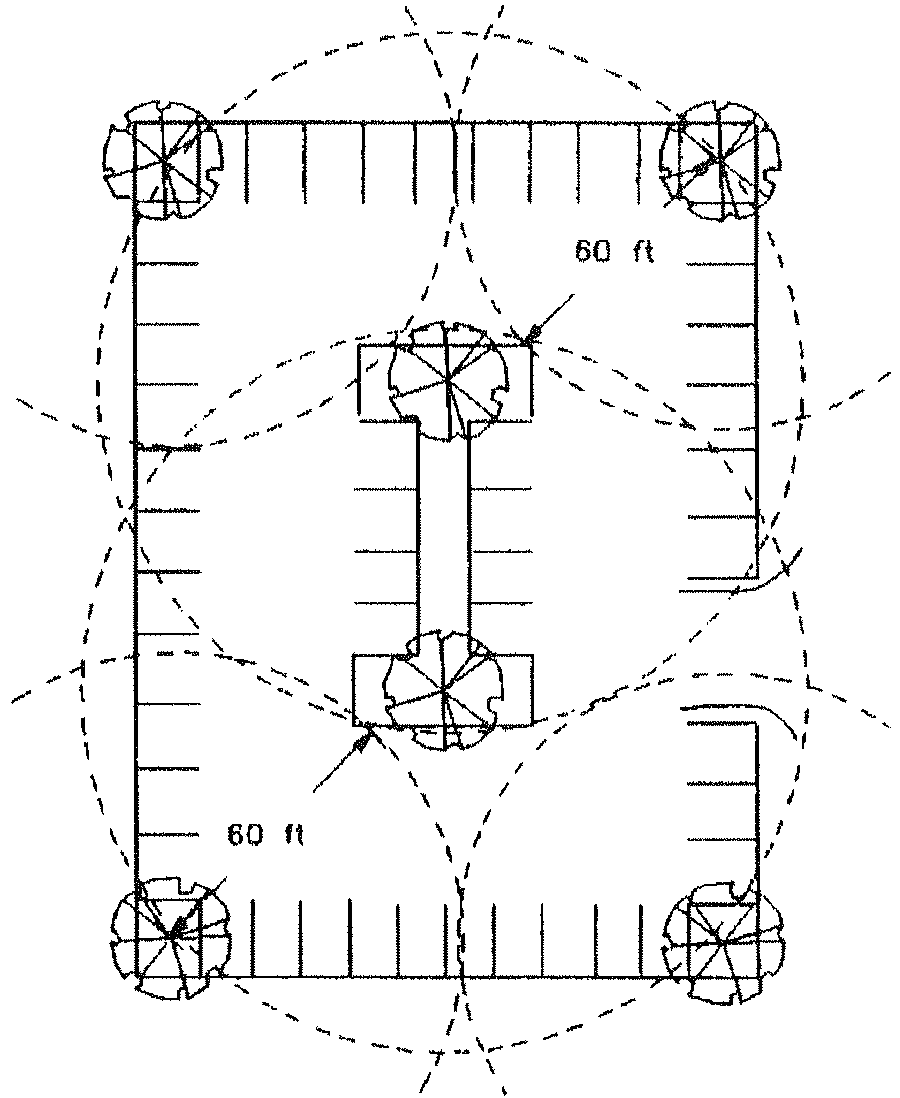
A minimum of one canopy tree shall be located within 60 feet of every parking space. The measurement shall be taken from the base of the tree.
C.
Large maturing canopy trees shall be planted in a manner that provides shade for parking area at maturity. Two small maturing (ornamental) trees shall be used in lieu of canopy trees under overhead utility lines. Crepe myrtles are encouraged as the small maturing tree.
D.
Each planting area shall be a minimum of 49 square feet, with a minimum dimension of seven feet.
E.
Planting areas shall be protected with concrete curbing meeting the specifications for curbing in Chapter 9 Infrastructure.
7.3.3 Residential yard trees (single-family residential lots).
A.
Yard trees are required for every major residential subdivision (five or more lots), except in the RA-30 District.
B.
Trees shall be planted behind the sidewalk outside of the public right-of-way. Maintenance of the trees shall be the responsibility of the individual property owner.
C.
Yard trees may be placed any where on the property except that at least one tree is placed in the front yard. Each lot shall provide canopy trees in accordance with the following schedule:
D.
Two small maturing (ornamental) trees shall be used in lieu of canopy trees under overhead utility lines. Crepe myrtles are encouraged as the small maturing tree.
7.3.4 Screening requirements for outdoor storage, waste containers, and mechanical equipment.
The following requirements shall apply to all existing nonresidential and multifamily development:
A.
Any waste container which exceeds 96 gallons existing at the time of adoption of this section shall be brought into compliance with the following screening requirements within six months of the effective date of the ordinance from which this section derives. For interpretation purposes, waste container shall include any waste container, recycling container, grease trap, oil storage container or any other similar container. The town will offer a $250.00 reimbursement per property in order to offset the costs of coming into compliance. Only businesses existing at the time of the adoption which are required to come into compliance of this section are eligible for this reimbursement. Eligible businesses must apply to the town manager for reimbursement.
B.
All waste containers shall be screened in the form of an opaque wall or fence with a latching gate that will reasonably secure the enclosure from unauthorized entry. The screen shall exceed the height of the waste containers by a minimum of six inches and shall not interfere with the emptying, replacement or removal of waste containers. Chain link fence with slats or other supplemental screenings material shall not be used to meet the requirements of this section. All screening materials shall remain in good condition as determined by the administrator.
The following requirements shall apply to all new and expanding nonresidential and multifamily development.
C.
All waste containers and outdoor storage shall be located to the rear of the principal structure.
D.
All waste containers which exceed 96 gallons shall be screened in the form of an opaque wall or fence with a latching gate that will reasonably secure the enclosure from unauthorized entry. The screen shall exceed the height of the waste containers by a minimum of six inches and shall not interfere with the emptying, replacement or removal of waste containers. Chain link fencing with slats or other supplemental screening material shall not be used to meet the requirements of this section. All screening materials shall remain in good condition as determined by the administrator.
E.
All screening shall utilize building materials that are compatible with those used for the exterior of the principal structure.
F.
Ground-mounted mechanical equipment shall be located to the rear or side yard and screened from view of the street. Roof-mounted mechanical equipment shall be screened from view by a parapet wall or screen wall matching the primary building materials. For the purpose of these requirements, mechanical equipment shall consist of heating, ventilating, air conditioning and refrigeration systems, fuel burning equipment and appurtenances thereof.
7.3.5 Fences and walls. A land use permit shall be required for the installation of a fence within the corporate limits of the town. Fences shall not be installed within or across any private or public easement as shown on the property survey or map recorded at the register of deeds. Fences installed within wetlands or floodplain areas must be installed with a minimum four inches of space at the base to allow for the natural flow of water. Entrance gateways to residential subdivisions are exempt from the following fence and wall standards. Except as otherwise noted in this ordinance, fences or walls are permitted in the various districts subject to the following regulations:
1. Materials may include a combination of the listed permitted materials for each fence type.
2. Lots with one zero side line setback and a zero front yard setback may have a wall on the opposite side yard lot line and front yard line a maximum height of eight feet.
3. Barbed wire permitted for rear yard fences not visible from a street.
4. Fences with a height above six feet may be approved on residential properties with the approval of a special use permit issued by the board of adjustment.
(Ord. of 6-4-2019(1); Ord. of 2-2-2021(1))
Section 7.4. - Landscaping installation and maintenance.
7.4.1 Approved plant list.
;sz=8q;Source: North Carolina Division of Forest Resources
Source: NC State University Horticultural Department
7.4.2 Plant installation standards. The following standards shall apply to all new plant material installed as part of a screen required under these regulations:
A.
Trees to be planted shall be selected from the approved species listed in this chapter. The administrator may approve alternative large or small maturing trees excluding Bradford pears, sweet gum, catalpa, wild cherry, wild elm, princess, hackberry, and tree-of-heaven.
B.
Minimum tree caliper shall be measured six inches above ground on all trees. In cases where medium trees are required, Crepe Myrtle trees are encouraged.
1.
Medium and large tree caliper shall be two and one-half inches or the minimum height shall be ten feet.
2.
Minimum caliper for small trees shall be two inches or the minimum height shall be eight feet.
C.
Minimum shrub size shall be three gallons or the minimum height shall be 18 inches.
D.
Minimum perennial or ground cover size shall be one gallon.
E.
No trees identified as large trees shall be planted under overhead utility lines or within five feet of a utility easement. This does not include low-voltage insulated or covered lines of 240 volts or less, or telephone or cablevision lines.
F.
All plant material installed shall be free from disease.
G.
Plant materials shall be planted in accordance with generally accepted and recommended planting and growing practices.
H.
All plant material shall be installed in a fashion that ensures the availability of sufficient soil and water to sustain health growth.
I.
All plant material shall be planted in a manner which is not intrusive to utilities or pavement.
7.4.3 Landscaping maintenance. Plantings, fences, walls, or berms that are required landscaping shall be properly maintained. The owner of the property where landscaping is required shall be responsible for the maintenance of all landscaping materials. Such maintenance shall include all actions necessary to keep the landscaped area free of litter and debris; to keep plantings healthy; to keep plant growth from interfering with safe vehicular and pedestrian travel, or use of parking areas, or from creating nuisances to adjoining properties; and to keep walls, fences, and berms in good repair and neat appearance. Any vegetation that is part of a required landscaping area shall be replaced within 60 days in the event that it dies. All landscaping materials shall be protected from damage by erosion, motor vehicles, or pedestrians which could reduce the effectiveness of the required landscaping.
7.4.4 Existing trees and root protection standards. During the development and construction of a subdivision, commercial development, or any lot therein, adequate protective measures shall be provided to minimize damage to existing trees and other vegetation. The developer shall make every effort to protect and retain all existing trees, shrubbery, vines, and grasses not actually lying in public streets, drainage-ways, building foundation sites and a construction activity area equal to 20 feet around the building foundation, private driveways, soil absorption waste disposal areas, paths, and trails.
A tree and root preservation plan shall consist of the following type of preventative measures:
A.
Prior to construction, tree protective barriers {such as two-inch by four-inch standards and one-inch by four-inch rails, silt fencing or orange safety fencing, minimum four feet in height} shall be placed around all landscaping to be saved or around root protection area(s), to prevent damage to existing landscaping. These barricades shall be installed prior to grading, construction, or other land disturbing activity, and cannot be constructed from any material not substantial enough to protect the roots, trunks, and crown of the tree. The barricade standards or rails shall be placed a minimum distance of six feet from the edge of the trunk and no less than the drip line of the tree.
B.
No soil disturbance or compaction, stock piling of soil, or other construction materials, vehicular traffic, storage of heavy equipment are allowed in the tree and root protection area(s), or within the drip line of trees to be retained.
C.
Dead trees and scrub growth shall be cut flush with adjacent grade.
D.
Root pruning should be kept to an absolute minimum.
E.
Pruning of existing trees shall be done according to the National Arborists Association standards in a manner that preserves the character of the crown.
F.
Existing trees that die within one year of construction completion shall be removed and replaced by the developer with a new tree(s) selected from the approved tree species list.
G.
No ropes, signs, wires, unprotected electrical installation or other device or material, shall be secured or fastened around or through a tree or shrub.
H.
Unprotected electrical service wires should not be allowed to come into contact with any significant tree or large mature shrubs in the tree and root protection area.
I.
Except for sidewalks and curbs and gutters, no paving with concrete, asphalt or other impervious material within the drip line of trees to be retained shall be allowed, unless no practical alternative exists as determined by the planning board.
7.4.5 Visibility at intersections. Except as herein provided, on a corner lot in any district, no hedge, shrubbery, tree, natural growth, sign, fence, wall, or other obstruction shall be placed or maintained within the sight triangle. In instances where NCDOT sight triangle provisions are applicable, such regulations shall prevail.

