
Archer Lodge City Zoning Code
ARTICLE 10
- MEASUREMENT & DEFINITIONS.
DIVISION 1. - RULES OF LANGUAGE CONSTRUCTION.
The following rules shall apply for construing or interpreting the terms and provisions of this Ordinance.
Sec. 30-10101 - Meanings and intent.
(a)
All provisions, terms, phrases, and expressions contained in this Ordinance shall be interpreted in accordance with the general purposes set forth in § 30-1106, Purpose and Intent, and the specific purpose statements set forth throughout this Ordinance.
(b)
When a specific section of these regulations gives a different meaning than the general definition provided in Division 3 of this Article, the specific section's meaning and application of the term shall control.
(c)
Terms that are not defined are subject to their common or customary meaning.
(Ord. No. AL2021-06-1, § 1, 6-7-2021)
Sec. 30-10102 - Headings, illustrations, and text.
(a)
In the event of a conflict or inconsistency between the text of this Ordinance and any heading, caption, figure, illustration, table, or map, the text shall control.
(b)
Graphics and other illustrations are provided for informational purposes only and should not be relied upon as a complete and accurate description of all applicable regulations or requirements.
(c)
Lists and examples. Unless otherwise specifically indicated, lists of items or examples that use terms like "for example," "including," and "such as," or similar language are intended to provide examples and are not exhaustive lists of all possibilities.
(Ord. No. AL2021-06-1, § 1, 6-7-2021)
Sec. 30-10103 - Time-related language.
(a)
Computation of time. The time in which an act is to be done shall be computed by excluding the first day and including the last day. If a deadline or required date of action falls on a Saturday, Sunday, or holiday observed by the Town, the deadline or required date of action shall be the next day that is not a Saturday, Sunday, or holiday observed by the Town.
(b)
Whenever certain hours are named, they shall mean standard time or daylight savings time as may be in current use by the Town.
(c)
The term "day" means a calendar day, or any day during a week, including business days and weekend days.
(d)
The term "holiday" means a legal holiday recognized by the Town.
(e)
The term "week" means five business days and two weekend days. Weeks commence on a Monday.
(f)
The term "month" means a calendar month.
(g)
The term "year" means a calendar year.
(h)
The term "temporary" shall mean a condition lasting for only a limited period of time; not permanent.
(Ord. No. AL2021-06-1, § 1, 6-7-2021)
Sec. 30-10104 - References.
(a)
References to this Ordinance. A reference to an article, section, subsection, or paragraph means an article, section, subsection, or paragraph of this Ordinance, unless otherwise specified.
(b)
References to other regulations or publications. Whenever reference is made to a resolution, ordinance, statute, regulation, or document, it shall be construed as a reference to the most recent edition or adopted version of such regulation, resolution, ordinance, statute, regulation, or document, unless otherwise specifically stated.
(c)
References to North Carolina General Statutes. Whenever any provision of this Ordinance refers to or cites a section of the North Carolina General Statutes and that section is later amended or superseded, this Ordinance shall be deemed amended to refer to the amended section.
(Ord. No. AL2021-06-1, § 1, 6-7-2021)
Sec. 30-10105 - Authority.
(a)
Delegation of authority. Whenever a provision of this Ordinance requires or authorizes an officer or employee of the Town to do some act or perform some duty, the officer or employee may designate, delegate, or authorize subordinates to perform the act or duty unless the terms of the provision specifically provide otherwise.
(b)
Joint authority. All words giving a joint authority to three or more persons or officers shall be construed as giving such authority to a majority of such persons or officers.
(c)
Public officials and agencies. All public officials, bodies, and agencies to which references are made are those of the Town of Archer Lodge, unless otherwise indicated.
(Ord. No. AL2021-06-1, § 1, 6-7-2021)
Sec. 30-10106 - Terminology.
(a)
Technical and non-technical terms. Words and phrases shall be construed according to the common and approved usage of the language, but technical words and phrases that may have acquired a peculiar and appropriate meaning in law shall be construed and understood according to such meaning.
(b)
Mandatory and discretionary terms. The words "shall," "must," and "will" are mandatory in nature, establishing an obligation or duty to comply with the particular provision. The words "may," "can," and "should" are permissive in nature.
(c)
Conjunctions. Unless the context clearly suggests the contrary, conjunctions shall be interpreted as follows:
(1)
"And" indicates that all connected items, conditions, provisions or events apply.
(2)
"Or" indicates that one or more of the connected items, conditions, provisions, or events apply.
(d)
Tenses, plurals, and gender of words.
(1)
Words used in the past or present tense include the future tense as well as the past and present.
(2)
Words used in the singular number include the plural number and the plural number includes the singular number, unless the context of the particular usage clearly indicates otherwise.
(3)
Words used in the masculine gender include the feminine gender and the neuter, and vice versa.
(e)
Term not defined. If a term used in this Ordinance is not defined, the Town Planner is authorized to interpret the term in accordance with § 30-3306, Determination and Interpretation, based upon the definitions used in professionally accepted sources.
Sec. 30-10107 - Oath.
The term "oath" shall be construed to include an affirmation in all cases in which, by law, an affirmation may be substituted for an oath, and in like cases the terms "swear" and "sworn" shall be equivalent to the terms "affirm" and "affirmed."
(Ord. No. AL2021-06-1, § 1, 6-7-2021)
Sec. 30-10201 - Purpose.
The purpose of this section is to clarify the rules of measurement and exemptions that apply to all principal and accessory uses allowed in this Ordinance. These standards may be modified by other applicable sections of this Ordinance.
(Ord. No. AL2021-06-1, § 1, 6-7-2021)
Sec. 30-10202 - Measurement generally.
(a)
Straight lines. Unless otherwise stated in this Ordinance, distances specified in this Ordinance are to be measured as the length of an imaginary straight line joining two points.
(b)
Rounding. Unless otherwise provided in this section or elsewhere in this Ordinance, numerical operations that result in fractions shall be rounded upwards or downwards in accordance with this section:
(1)
Density. When the determination of the number of dwelling units permitted on a lot results in a fraction of a dwelling unit, any fractional component shall be disregarded and rounded down to the nearest whole number.
(2)
All other instances. All calculations that result in a fractional unit or part of a whole number, a fraction of one-half or more shall be rounded up to the next highest whole unit and a fraction of less than one-half shall be disregarded.
(3)
Irregular shapes. In cases where an irregular shape complicates the application of these standards, the Town Planner shall determine the applicable dimensional, setback, or bulk standards in accordance with the standards in this section and § 30-3306, Determination and interpretation.
(c)
Separation.
(1)
Lot to lot. When the provisions of this Ordinance require separation between two or more lots, or a lot and another feature, separation shall be measured by drawing straight lines from the nearest point of one lot line to the nearest point of the lot line subject to the separation requirement (see Figure 29: Separation).
(2)
Use type to use type. When the provisions of this Ordinance require one use type to be separated from another use type, separation shall be measured by drawing straight lines from the nearest point of the wall of one existing or proposed principal structure to the nearest point of the wall of another existing or proposed structure subject to the separation requirement.
FIGURE 29: SEPARATION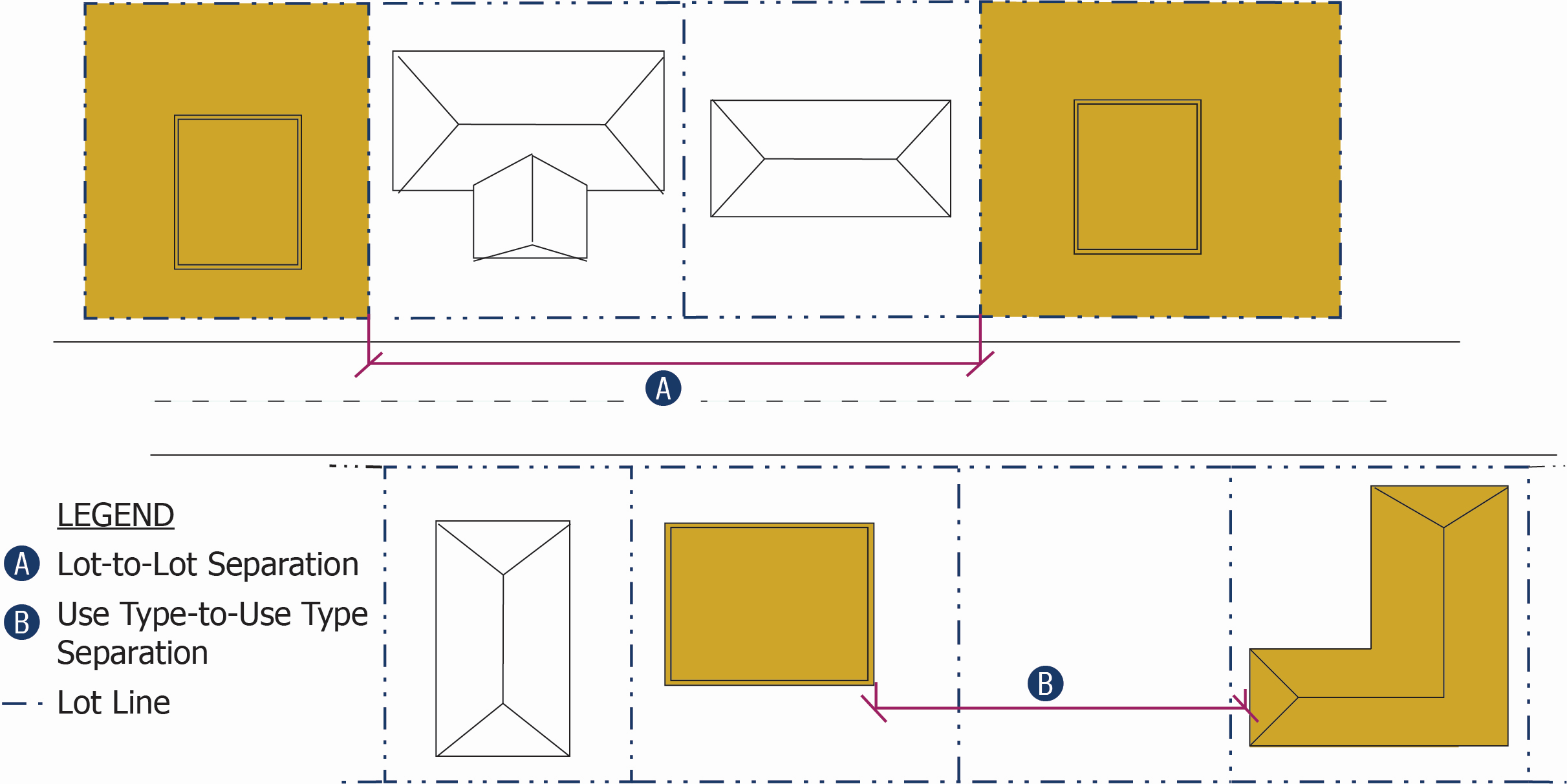
(d)
Abutting versus adjacent.
(1)
Abutting. The term abutting describes a condition where two or more features (a lot line, building, driveway, etc.) are immediately beside or next to one another either on the same lot or on different lots sharing a common lot line.
(2)
Adjacent. The term adjacent describes a condition where two or more similar features (a lot line, building, use type, structure, site feature, etc.) are proximate to one another, but are separated by some form of intervening feature, such as a street, alley, water feature, railroad, lot or property under separate ownership, or natural feature of sufficient size so as to prevent direct site visibility or impede the movement of sound from one feature to another.
(Ord. No. AL2021-06-1, § 1, 6-7-2021)
Sec. 30-10203 - Lot dimensions.
(a)
Lot measurements.
(1)
Acreage. The total number or gross number of acres on a tract or site.
(2)
Lot depth. The dimension measured from the front of the lot to the extreme rear line of the lot. In case of irregularly shaped lots, the mean depth shall be taken (see Figure 30: Lot Measurements).
(3)
Lot width. The width of a lot is measured at right angles to its depth at the edge of the street setback or at a proposed building setback line, whichever is further from the street right-of-way.
(4)
Minimum lot area. The minimum amount of required land area, measured horizontally, that must be included within the lines of a lot. Lands located within any private easements shall be included within the lot area.
(5)
Street frontage. The length of the lot line of a single lot abutting a public or existing private street right-of-way.
FIGURE 30: LOT MEASUREMENTS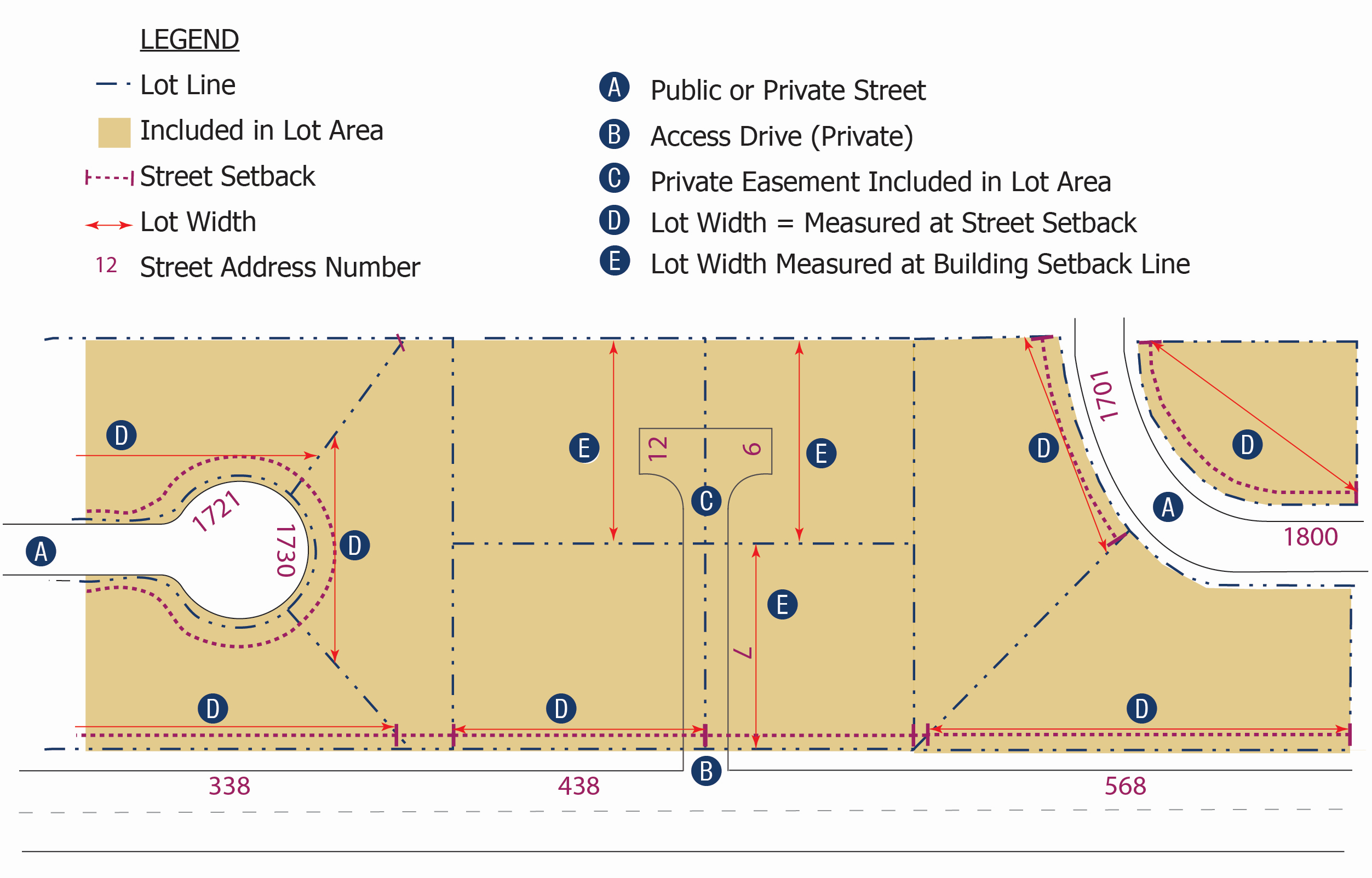
(b)
Lot lines. A lot line is a line of record bounding a lot which separates one lot from another lot or separates that lot from a public or private street or any other public space. The following terms describe differing types of lot lines (see Figure 31: Lot Lines):
(1)
Front lot line. The lot line that fronts or that is parallel and proximate to the street from which the lot's street address is derived. A front lot line does not have to border street right-of-way line.
(2)
Rear lot line. The lot line opposite and most distant from the front lot line.
(3)
Side lot line. The lot line connecting the front and rear lot lines regardless of whether it abuts a right-of-way or another lot line. Side lot lines abut other lots, easements, public trust lands, or rights-of-way other than a street right-of way.
(4)
Street lot line. A lot line that borders a platted street right of way, whether or not the street is actually constructed or open to vehicles or pedestrians.
FIGURE 31: LOT LINES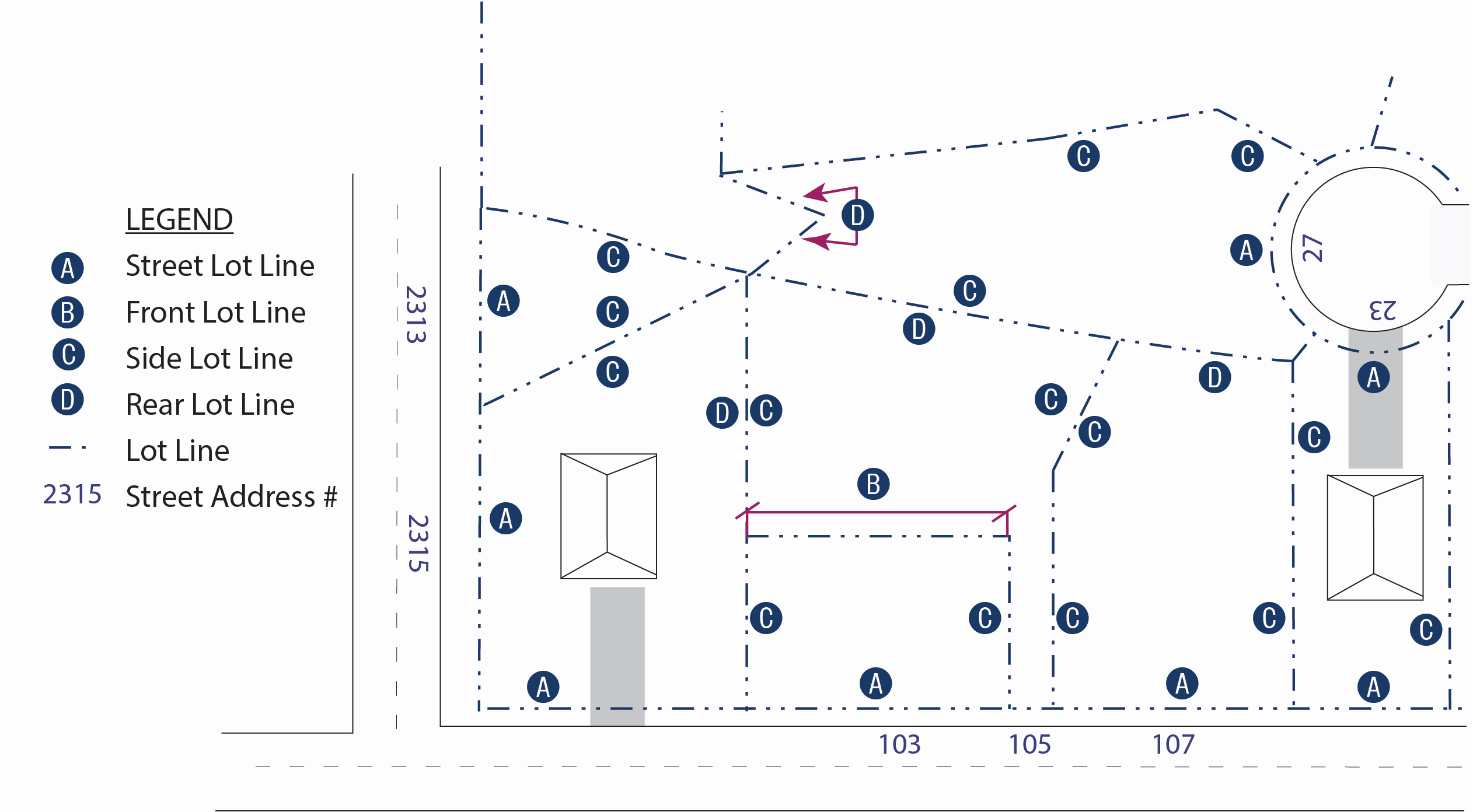
(c)
Lot types.
(1)
Corner lot. A lot which occupies the interior angle at the intersection of two street lines or a single street which make(s) an angle of more than 45 degrees and less than 135 degrees. The front of the lot is the lot line adjacent to the street from which the lot obtains its street address (see Figure 32: Lot Types).
(2)
Flag lot. A lot having shape and configuration so that it connects to street frontage by an extension and/or arm of the main portion of the lot.
(3)
Interior lot. A lot other than a corner lot with only one frontage on a street.
(4)
Lot of record. A lot that is a part of a subdivision, a plat of which has been recorded in the office of the Johnston County Register of Deeds, or a lot described by metes and bounds, the description of which has been recorded with the Johnston County Register of Deeds.
(5)
Through lot (double frontage lot). A lot which fronts upon two parallel streets, and/or which fronts upon two streets which do not intersect at the boundaries of the lot.
(6)
Lots serving condominium use types. Individual condominium uses, whether residential or non-residential, are exempted from minimum lot area requirements in this Ordinance, but shall be located on a larger site or parent tract that meets the standards for the zoning district where located.
LOT 32: LOT TYPES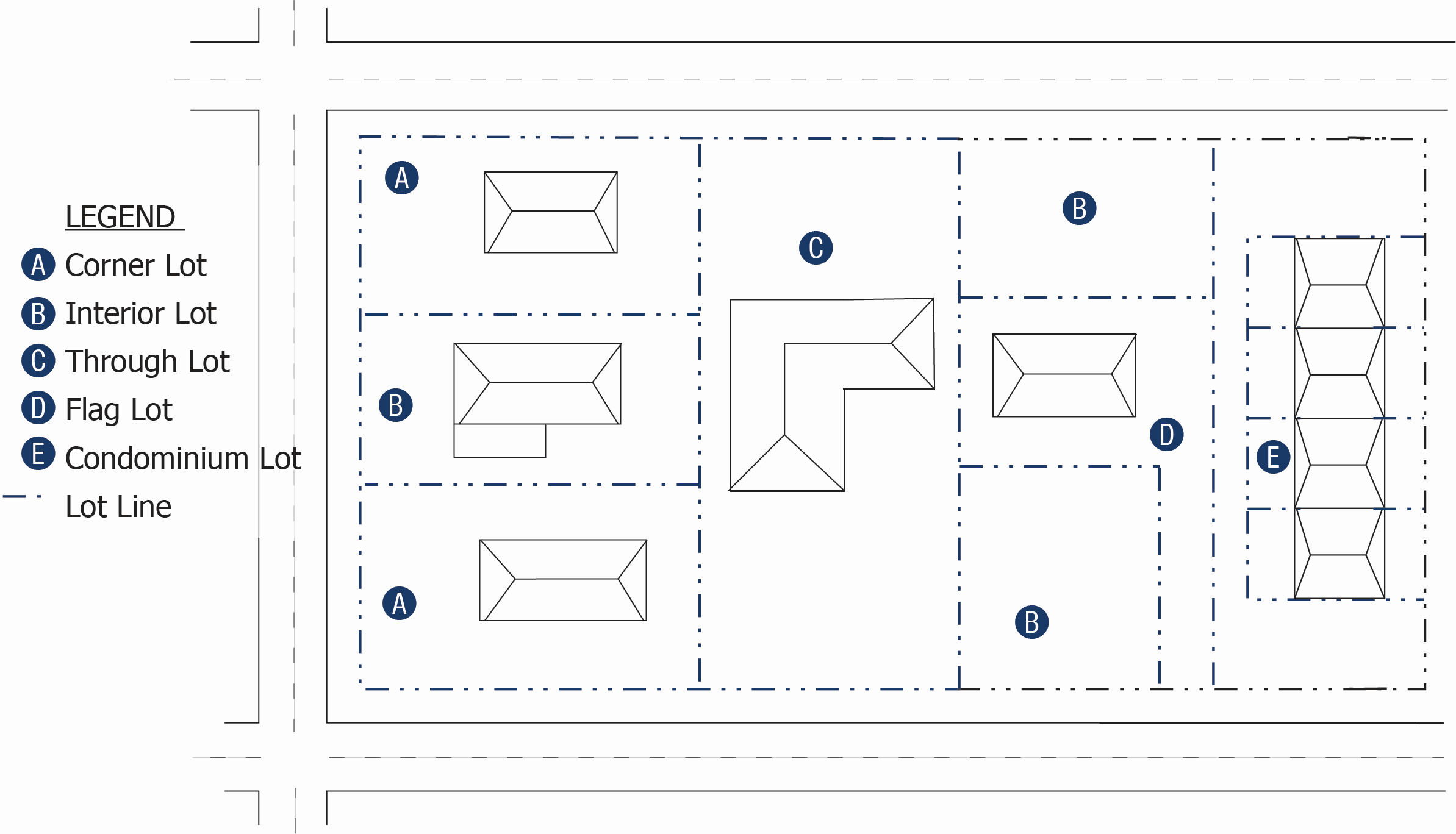
(Ord. No. AL2021-06-1, § 1, 6-7-2021)
Sec. 30-10204 - Density.
Residential density is the maximum allowable number of residential dwelling units permitted on a particular site, tract, lot, or other unit of land area, typically expressed as a maximum number of residential units per acre.
(a)
Calculation.
(1)
Maximum residential density is calculated by dividing the square footage of a lot by the number of square feet in an acre (43,560), then multiplying the maximum number dwelling units allowed in the zoning district, and rounding the product downwards to remove any fractions.
Example:
Lot size: 52,000 square feet/43,560 = 1.19 acres.
Zoning district maximum density is 1.08 units per acre: 1.19 × 1.08 = 1.28.
Maximum number of residential units = 1.0 (fractions are rounded downwards).
(2)
Riparian buffers shall be included in the calculation of the square footage of a tract or site for the purposes of determining the maximum residential density.
(3)
Land area associated with floodplains shall not be included in the calculation of the square footage of a tract or site for the purposes of determining the maximum residential density.
(4)
Land area located within a right-of-way shall not be included in the calculation of allowable density.
(b)
Density equivalence.
(1)
Accessory dwelling units associated with a single-family residential principal use shall be counted towards the maximum allowable residential density.
(2)
When calculating the density for a private dormitory associated with an educational use, two bedrooms in a private dormitory shall be equivalent to one regular dwelling unit.
(3)
Maximum density amounts do not apply to student housing or lodging on college or university campuses when the housing is owned or operated by the college or university. In these instances, residential land uses are considered as an accessory to the college or university principal use.
(Ord. No. AL2021-06-1, § 1, 6-7-2021)
Sec. 30-10205 - Setbacks.
A setback is the horizontal distance from a lot line or street right-of-way line to the nearest part of the applicable building, structure, sign, or activity, measured perpendicularly to the line (see Figure 33: Setbacks).
(a)
Perimeter setback. Setbacks applied to multiple building developments or multiple lot developments that apply only to the outermost buildings along the perimeter of a development. A perimeter setback does not apply along streets, where the minimum or maximum required street setback shall prevail.
(b)
Rear setback. A setback from an interior lot line lying on the opposite side of the lot from the street setback.
(c)
Side setback. Any interior property line setback other than a rear setback.
(d)
Street setback.
(1)
A street setback measured from the right-of-way edge associated with a public street or existing private street.
(2)
The street setback is a minimum setback, and nothing shall prohibit a building from being located farther from the street right-of-way, except where a maximum street setback is specifically identified by this Ordinance or a condition of approval.
(3)
In cases where the street right-of-way edge is not readily identifiable, the location of the right-of-way edge shall be determined by measuring outwards from the street centerline one-half of the total right-of-way width. The right-of-way edge location shall be certified by a professional engineer or land surveyor licensed by the State of North Carolina.
(4)
Lots shall provide a street setback from all lot lines abutting a street. The Town may require a deeper setback from lot lines abutting a street in cases when the ultimate street-right-of-way width has not yet been acquired.
FIGURE 33: SETBACKS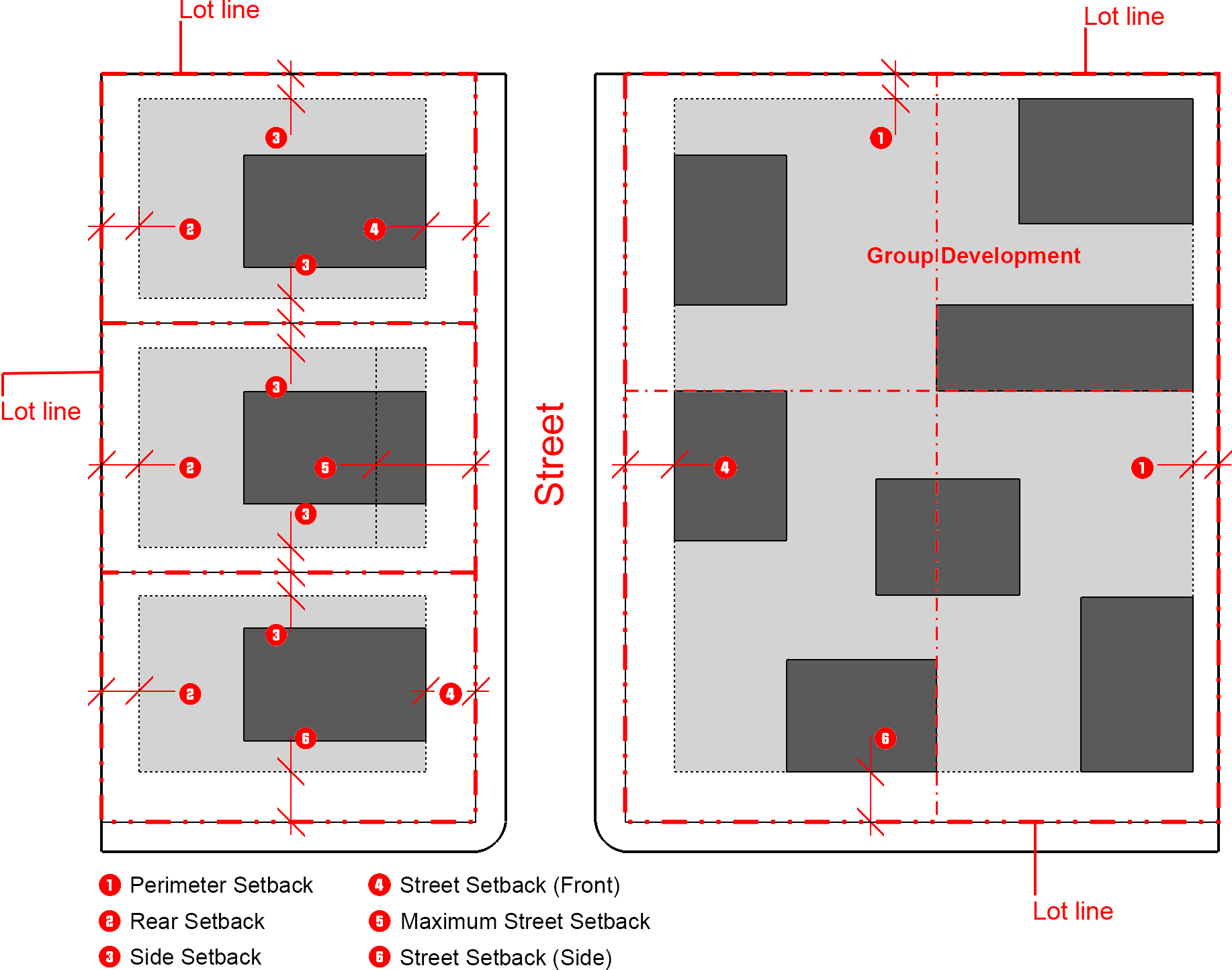
(Ord. No. AL2021-06-1, § 1, 6-7-2021)
Sec. 30-10206 - Lot coverage.
Lot coverage is the percentage of a lot or development site that is covered by buildings or roof structures, excluding allowed projecting eaves and balconies.
(Ord. No. AL2021-06-1, § 1, 6-7-2021)
Sec. 30-10207 - Height.
(a)
Measurement. Building height shall be measured from the finished or established grade elevation following any land disturbing activities (see Figure 34: Height).
(b)
Maximum height. Building height is the vertical distance from a point established as the mean elevation of the finished grade along the front façade of a building to any of the following points:
(1)
The highest point of a flat roof (excluding coping or parapet walls shorter than five feet above the roof deck);
(2)
The deck line of a mansard roof;
(3)
The mid-point of the roof between the ridge and the eaves for a gable, hip, or gambrel roof; or
(4)
To the highest point of a dome, shed, or cricket-style roof.
(c)
Story. A building story is the portion of a building where all rooms share the same floor and ceiling level.
(1)
A crawlspace or basement with an average ceiling height of less than seven feet is not considered as a story.
(2)
An attic with an average ceiling height of less than six feet is not considered a story.
(d)
Exceptions. The following features are exempted from the maximum height requirements in this Ordinance:
(1)
Parapet walls of less than five feet in height above the roof deck;
(2)
Spires, steeples, minarets, belfries, cupolas, domes, and similar architectural features not intended for human habitation;
(3)
Water tanks, vent housings, elevator housings, and equipment covers associated with a building;
(4)
Chimneys, vent pipes, skylights, or mechanical equipment; and
(5)
Bulkheads or a single-story penthouse occupying 25 percent or less of the total roof area.
FIGURE 34: HEIGHT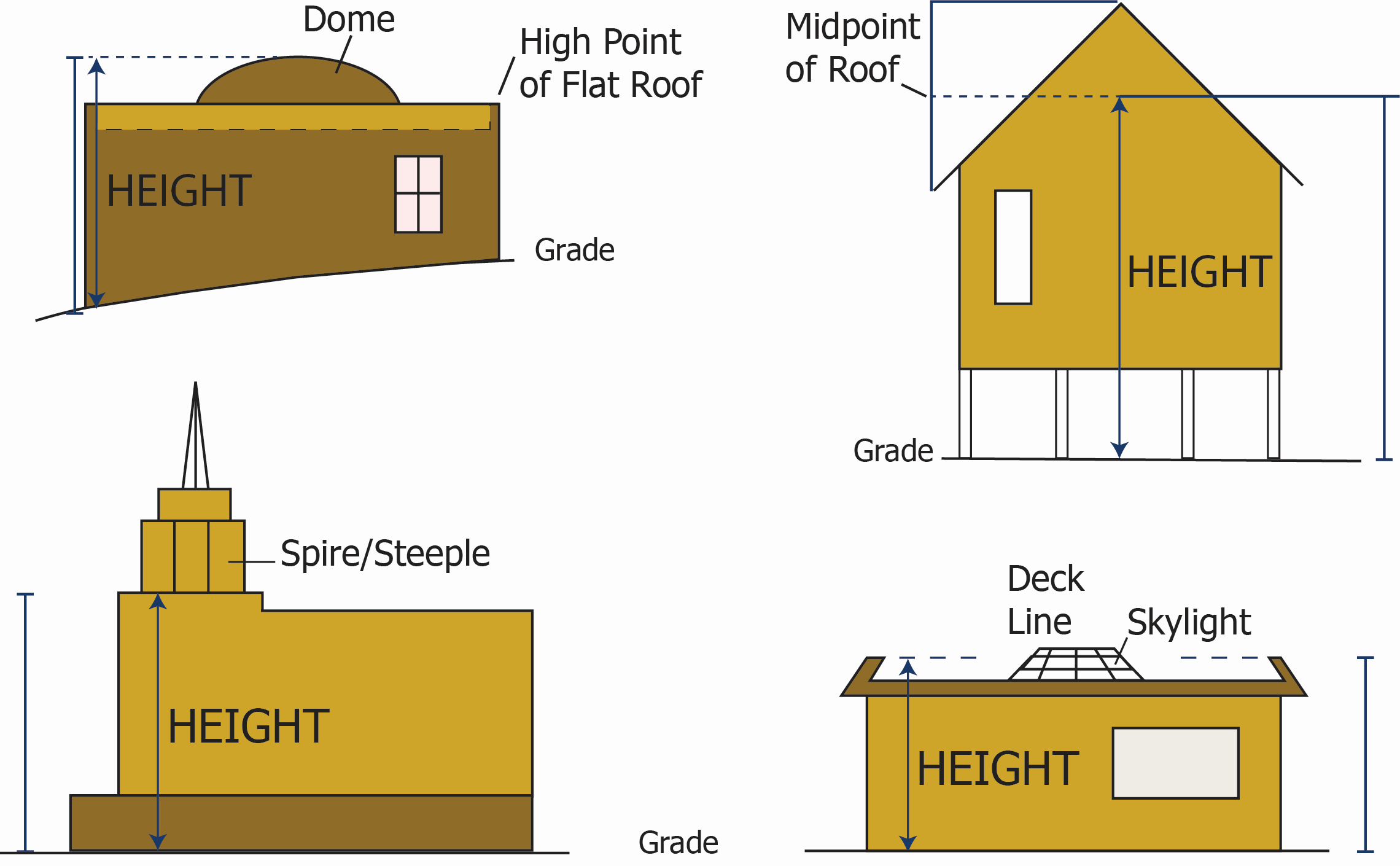
(Ord. No. AL2021-06-1, § 1, 6-7-2021)
Sec. 30-10208 - Slope and elevation.
(a)
Slope. The degree of deviation of the ground surface from a flat, horizontal elevation, usually expressed in percent or degrees of deviation from horizontal.
(b)
Base flood elevation (BFE).
(1)
A determination of the water surface elevations of the base flood as published in the flood insurance study.
(2)
When the BFE has not been provided for land within the special flood hazard area, it may be obtained from engineering studies available from a federal, State, or other source using FEMA approved engineering methodologies. This elevation establishes the Regulatory Flood Protection Elevation.
(c)
Finished grade. The established grade following grading, excavation, or other land-disturbing activity.
(d)
Natural grade. The level of the ground elevation prior to the commencement of development or land disturbing activity.
(Ord. No. AL2021-06-1, § 1, 6-7-2021)
Sec. 30-10209 - Parking space computation.
(a)
Rounding. When computation of the number of required parking spaces results in a fraction, the fraction shall be rounded downwards to the previous whole number.
(b)
Multiple and mixed-uses. Unless otherwise approved, development containing more than one principal use shall provide off-street parking in an amount equal to the total requirements of all individual uses, unless the Town Planner determines that a lower standard would be adequate because of differences in peak operating hours.
(c)
Seat based standards. Where the minimum number of off-street parking spaces is based on the number of seats, all computations shall be based on the number of seats provided, including outdoor and waiting areas.
(d)
Employee based standards. When the minimum number of off-street parking spaces is based on the number of employees, the computations shall be based on the number of employees on the largest shift.
(e)
Floor-area based standards. Where the minimum number of off-street parking spaces is based on square feet of floor area, all computations shall be based on gross floor area. For the purposes of this section, gross floor area shall also include outdoor use area.
(Ord. No. AL2021-06-1, § 1, 6-7-2021)
Sec. 30-10210 - Signage measurement.
(a)
Sign area determination.
(1)
The surface area of a sign is computed as including the entire area within a parallelogram, triangle, circle, semi-circle, or other regular geometric figure, including all of the elements of the display, including incidental or changeable copy signage, frames, display of identification or licensing officially required by any governmental body, and structural elements (see Figure 35: Sign Measurement).
(2)
The supporting structure for a projecting sign shall not be included within the calculation of the surface area of a sign unless otherwise indicated in this Ordinance.
(3)
In the case of signs mounted back-to-back, only one side of the sign is to be included in the calculation of sign face area. Otherwise, the surface area of each sign is to be separately computed.
(4)
When two identical sign faces are placed back to back so that both faces cannot be viewed from any point at the same time, and when such sign faces are part of the same sign structure and are not more than 42 inches apart, the sign area shall be computed by the measurement of one of the faces.
(5)
For multi-faced signs, the sign area shall be computed by including all sign faces visible from any one point.
(6)
In the case of cylindrical signs, signs in the shape of cubes, or other signs, which are substantially three-dimensional with respect to their display surfaces, the entire display surface or surfaces, is included in computations of area.
(7)
Embellishments such as display portions of signs extending outside the general display area, incidental signage, changeable copy, or supplemental signage affixed to or included on a sign or sign support structure shall be computed as part of the total surface area of the sign, unless otherwise indicated in this Ordinance.
(8)
If a sign is attached to an entrance wall or fence, only that portion of that wall or fence on which the sign face or letters are placed shall be calculated in the sign area.
FIGURE 35: SIGN MEASUREMENT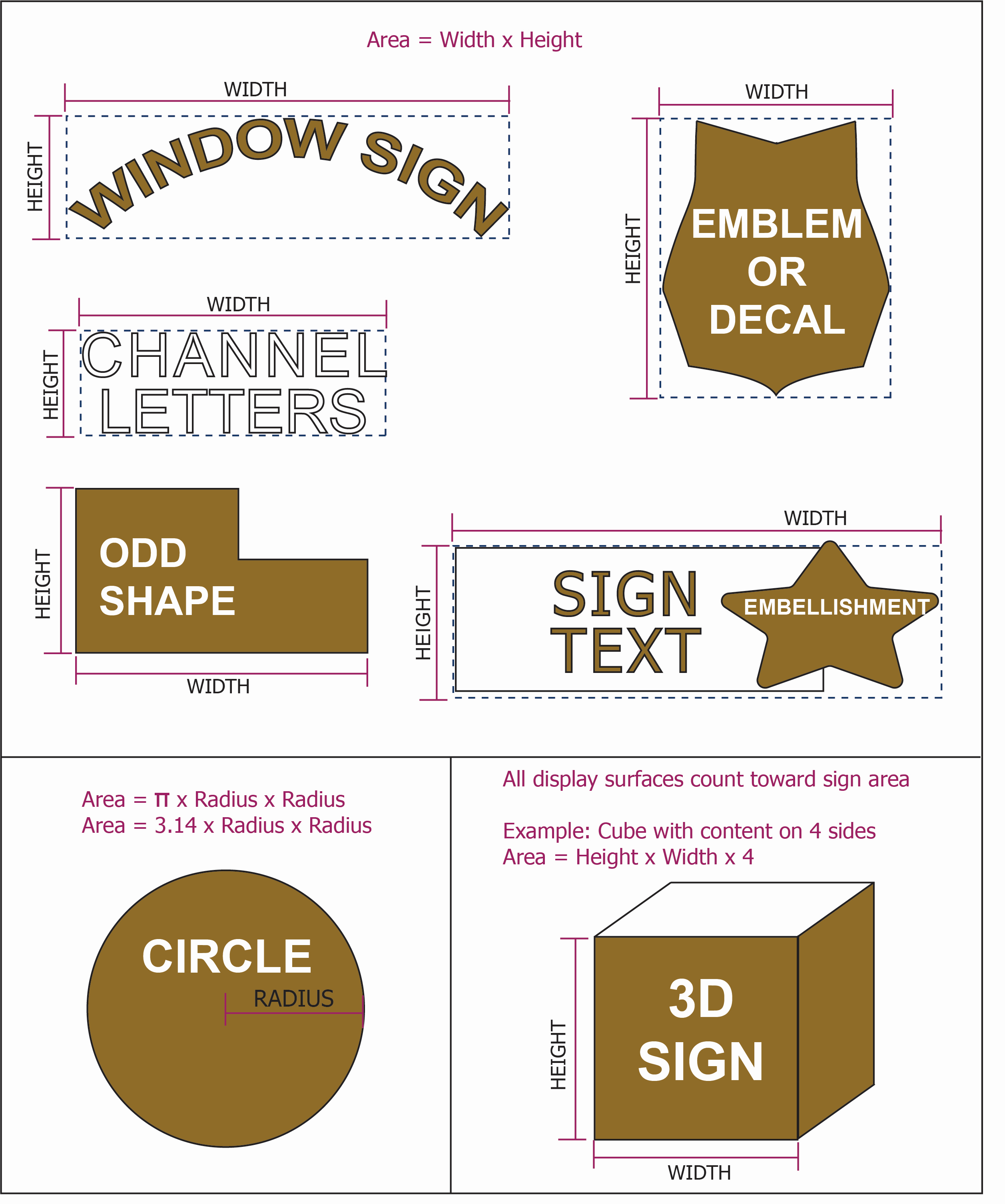
(b)
Sign height determination.
(1)
Sign height shall be computed as the distance from the base of the sign at the finished grade or from the nearest adjacent street grade to which the sign is oriented and on which the lot has frontage, whichever is higher, to the top of the highest component of the sign.
(2)
Finished grade shall be the grade after construction, exclusive of any filling, berming, mounding, or excavating solely for the purpose of locating the sign.
FIGURE 36: SIGN HEIGHT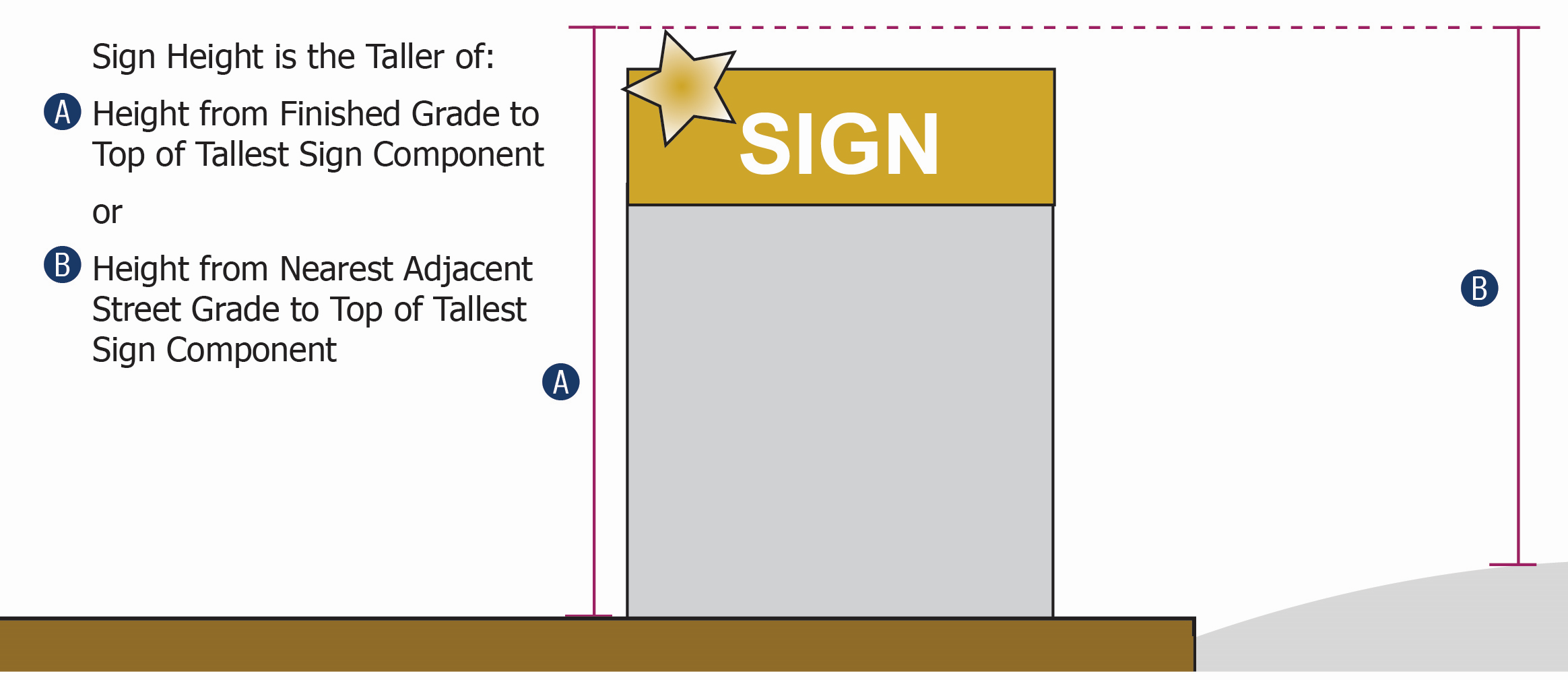
(c)
Wall area (for the purposes of sign area measurement). For the purposes of determining allowable sign area, a wall is the vertical exterior surface of a building, the area of which shall be determined as follows:
(1)
The area of all parallel vertical surfaces along a single building elevation regardless of offsets shall be counted as one wall.
(2)
The front of each unit of a multiple tenant commercial building shall be counted as a separate wall.
(3)
The area of an angled wall surface shall be counted as part of whichever adjoining wall surface it is most parallel with.
(4)
A 45-degree angled wall may be counted as part of the area of either adjoining wall, but not as a part of both.
(Ord. No. AL2021-06-1, § 1, 6-7-2021)
Sec. 30-10211 - Landscaping size computation.
(a)
Determining tree size at time of planting.
(1)
Trees under four inches in caliper. Minimum size at time of planting shall be determined by taking a measurement of the girth or circumference of the tree trunk, in inches, at a height of six inches above the bole, or the location where tree trunk meets the soil it is planted in (see Figure 37: Landscaping Calculation).
(2)
Trees over four, but less than twelve inches, in caliper. Minimum size at time of planting shall be determined by taking a measurement of the girth or circumference of the tree trunk, in inches, at a height of 12 inches above the bole, or the location where tree trunk meets the soil it is planted in.
(b)
Determining tree size of existing trees.
(1)
Existing tree size shall be determined by taking a measurement of the girth or circumference of the tree trunk, in inches, at a height of four-and-one-half feet above the bole, or the location where tree trunk meets the soil it is planted in.
(2)
In the case of a multi-stemmed tree, the cumulative DBH shall be the square root of the sum of all the individual stem diameters squared. As an alternative, the tree's basal area is the sum of the diameters of all tree stems.
(c)
Rounding. When computation of the amount of landscaping material to be provided results in a fraction, the minimum number of shrubs or trees to be provided shall be rounded upwards to the next highest whole number.
(d)
Calculation of required landscaping yard or area distances.
(1)
In cases where a driveway, sidewalk, or trail intersects a required landscaping area or yard, the width of these features shall be subtracted from the yard or area distance.
(2)
In cases where an easement that prohibits the placement of landscaping material intersects a required landscaping yard or area, the width of the easement shall not be subtracted from the required yard or area distance. Required plant material shall be located outside the easement but within the required landscaping area or yard.
FIGURE 37: LANDSCAPING CALCULATION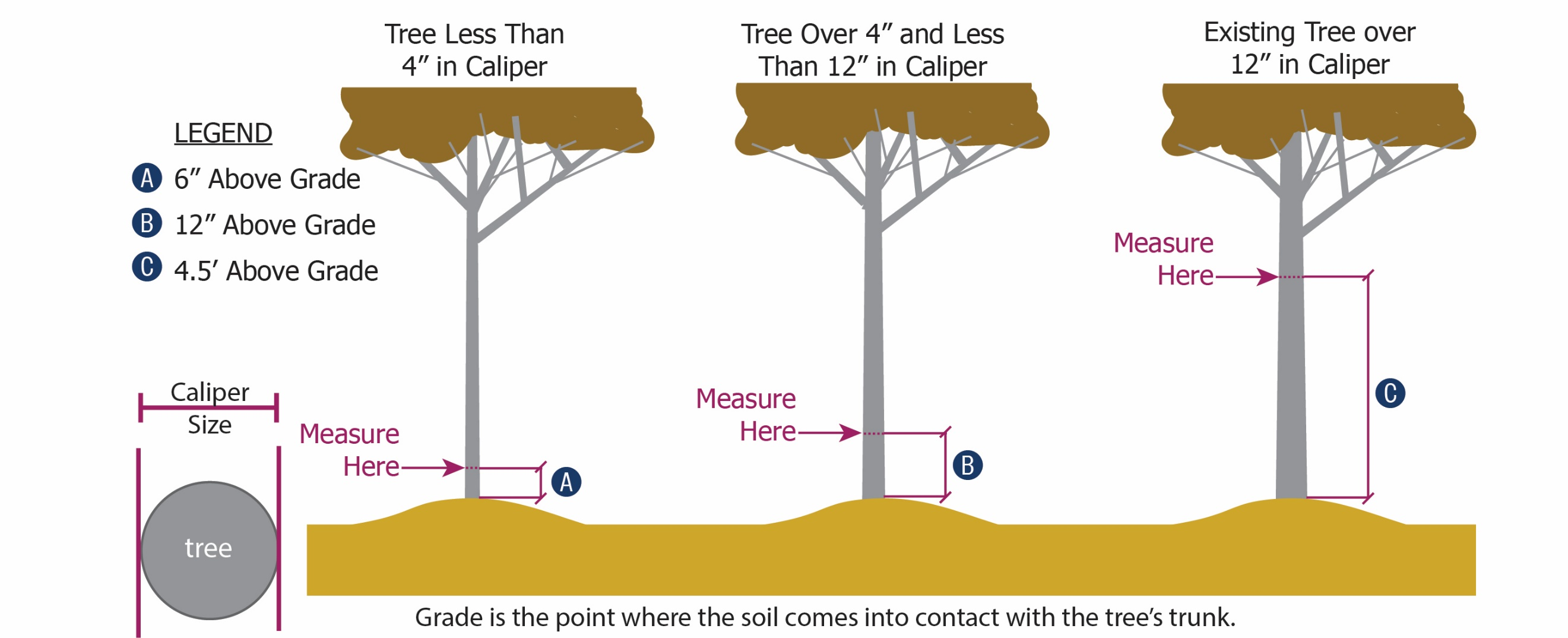
(Ord. No. AL2021-06-1, § 1, 6-7-2021)
Sec. 30-10212 - Fence and wall height.
(a)
Measurement location.
(1)
In cases where a fence or wall is located within a required setback or required yard, fence height shall be determined along the grade of the adjacent lot or street.
(2)
In cases where a fence or wall is located outside a required setback or yard, the height shall be determined based on the finished grade.
(3)
In cases where a fence or wall is placed on a berm, the maximum fence or wall height shall include the height of the berm, as measured from the toe of the slope.
(4)
Fence height shall be measured at the highest point above grade (not including columns or fence posts) on the portion of the fence nearest an abutting or adjacent lot or street right-of-way.
(b)
Column and post height. Columns or posts shall not exceed a height 18 inches above the built height of the fence.
(c)
Railings not included. Safety railings required by the North Carolina State Building Code shall not be included in wall height measurements.
FIGURE 38: FENCE AND WALL HEIGHT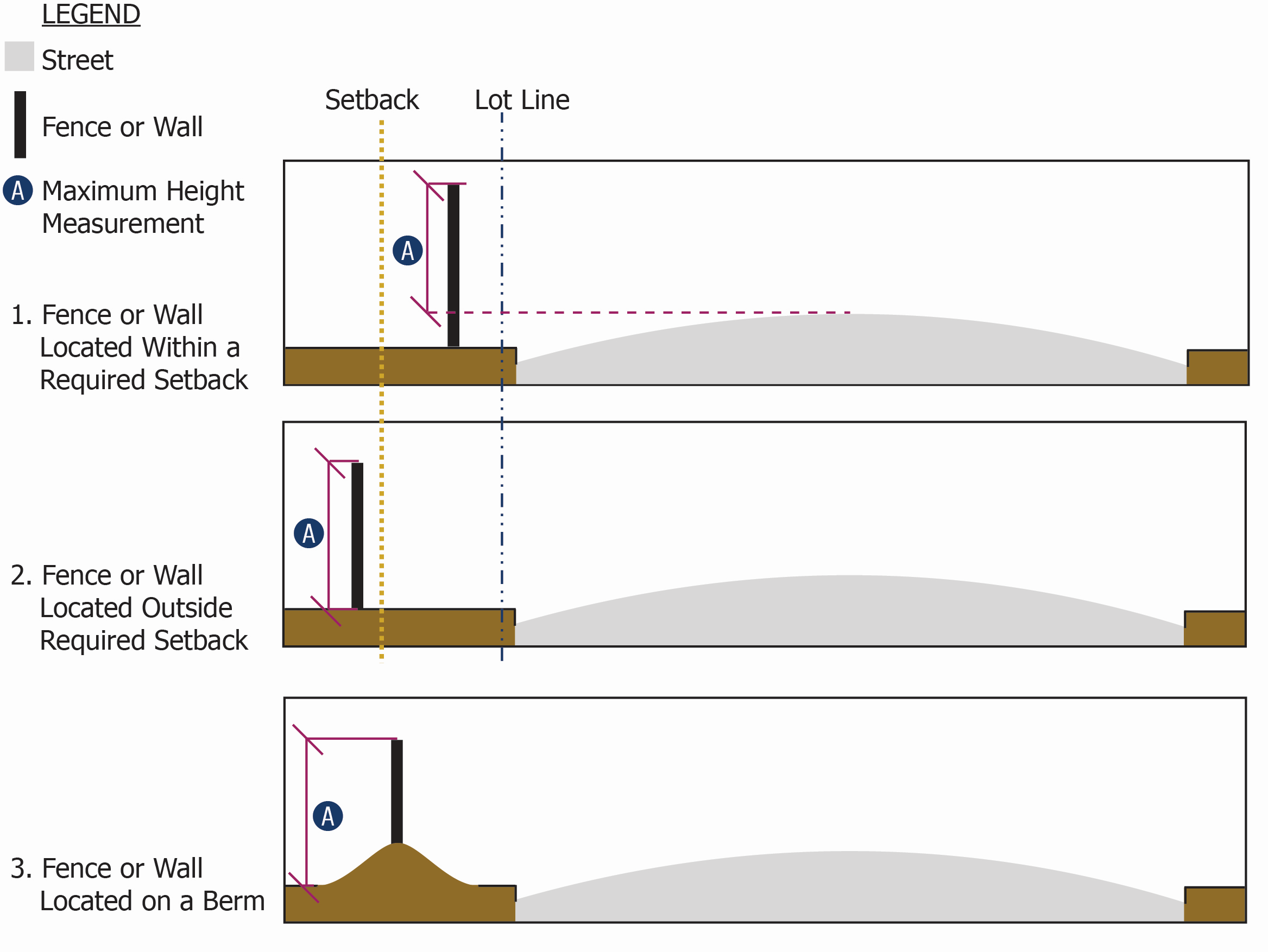
(Ord. No. AL2021-06-1, § 1, 6-7-2021)
Sec. 30-10213 - Exterior lighting measurement.
(a)
Measured at the lot line. Light level measurements shall be made at the lot line of the land upon which light to be measured is being generated. If measurement on private property is not possible or practical, light level measurements may be made at the boundary of the public street right-of-way that adjoins the land.
(b)
Measured at finished grade. Measurements shall be made at finished grade (ground level), with the light-registering portion of the meter held parallel to the ground pointing up. The meter shall have cosine and color correction and have an accuracy tolerance of no greater than plus or minus five percent.
(c)
Measurement device. Measurements shall be taken with a light meter that has been calibrated within the year the measurement was taken.
(Ord. No. AL2021-06-1, § 1, 6-7-2021)
Sec. 30-10301 - Defined terms.
(a)
The words, terms, and phrases in the Table of Defined Terms shall have the meanings ascribed to them in this section, except where the context clearly indicates a different meaning.
(b)
Definitions pertaining solely to the Water Supply Watershed Protection Overlay District (WSWOD) are proceeded by the clause "As used in the water supply watershed protection overlay district."
| TABLE OF DEFINED TERMS | |
|---|---|
| TERM | DEFINITION(S) |
| A | |
| ABANDONMENT | The relinquishment of property or a cessation of the use of the property for a continuous period. |
| ABUTTING | The condition of two parcels of land having a common property line or boundary, including cases where two or more parcels of land adjoin at a corner, but not including cases where parcels of land are separated by a street, water body, or right-of-way. |
| ACCENT | means the use of an alternate material or color to a detail that is emphasized by contrasting with its surroundings. |
| ACCESS EASEMENT | means an easement which grants the right to cross land. |
| ACCESSIBLE PARKING SPACE | means an off-street parking space provided for the exclusive use of vehicles serving disabled persons. |
| ACCESSORY BUILDING | See "Accessory Structure." |
| ACCESSORY DWELLING UNIT | A secondary dwelling unit established in conjunction with and clearly subordinate to a principal dwelling unit, whether part of the same structure as the principal dwelling unit, or as a detached structure on the same lot. |
| ACCESSORY STRUCTURE | means a detached subordinate or incidental structure, the use of which is incidental to the principal structure and which is located on the same lot as the principal structure. |
| ACCESSWAY | means a paved or unpaved travel way intended to serve vehicles for the purposes of obtaining ingress, egress, or circulation around a lot or site. |
| ACTIVE OPEN SPACE SET-ASIDE | Land set aside for the residents or a development and under common ownership that is configured for active forms of recreation. Active open space typically includes playgrounds, athletic fields and courts, and similar features devoted to movement, activity, or sports pursuits. |
| ACTIVE RECREATION USES | Uses or structures intended for specific active recreational uses such as play grounds, ball fields, tennis courts and other similar uses typically located in open space set-aside areas or parks. |
| ADDITION OR EXPANSION | means an extension or increase in the floor area or height of a building or structure. |
| ADJACENT | means a parcel of land or development that shares all or part of a common lot line or boundary with another parcel of land, or a parcel of land that would abut another parcel of land, but for the fact a street, waterbody, or right-of-way divides the parcels. |
| ADJOINING | means when one property adjoins another, shares a common property line or is immediately adjacent to, or abutting it. |
| ADMINISTRATIVE DECISION | Decisions made in the implementation, administration, or enforcement of this UDO or other development regulations that involve the determination of facts and the application of objective standards set forth in this UDO. They are also sometimes referred to as ministerial decisions of administrative determinations. |
| ADMINISTRATIVE HEARING | A proceeding to gather facts needed to make an administrative decision. |
| ADOPTED POLICY GUIDANCE | means the combined future land-use policy guidance provided by the adopted comprehensive plan, area or corridor plans prepared for specific parts of the Town, and system plans related to the Town's infrastructure systems. |
| ADULT ARCADE | means an establishment where, for any form of consideration, one or more motion picture projectors, slide projectors, or similar machines for viewing by five or fewer persons each are used to show films, motion pictures, videocassettes, slides, or other photographic reproductions that are characterized by all emphasis upon the depiction or description of specified sexual activities or specified anatomical areas. |
| ADULT BOOKSTORE |
means an establishment that has as a substantial portion, over 25 percent of total
retail space, of its stock-in-trade and offers for rent or sale, for any consideration,
any one or more of the following:
(1) Books, magazines, periodicals, or other printed matter; or photographs, films, motion pictures, videocassettes, slides, or other visual representations that are characterized by an emphasis upon the depiction or description of specified sexual activities or specified anatomical areas; or (2) Instruments, devices, or paraphernalia that are designed for use in connection with specified sexual activities. |
| ADULT BUSINESS | means any business activity, club or other establishment which permits its employees, members, patrons or guests on its premises to exhibit any specified anatomical areas before any other person or persons. |
| ADULT CARE HOME | means a home with support and supervisory personnel licensed with the state that provides room and board, personal care and habilitation services in a family environment for not more than six resident persons with disabilities and defined in § 168-21 of the North Carolina General Statutes. |
| ADULT DAY CARE FACILITY | means a use of land and buildings licensed by the state that provides care to seven or more aging, disabled or handicapped adults away from their homes, and by persons other than family members, guardians, or custodians. The term "adult day care facility" shall not be construed to include a group care facility. |
| ADULT ESTABLISHMENT | means any business by its nature or use that is intended to serve patrons of age 18 years or older which may or may not be limited to those businesses regulated under § 30-5102 Use types. |
| ADULT MOTION PICTURE THEATER | means an establishment where, for any form of consideration, films, motion pictures, videocassettes, slides, or similar photographic reproductions are shown, and in which a substantial portion, 25 percent, of the total presentation time is devoted to the showing of material characterized by all emphasis on the depiction or description of specified sexual activities or specified anatomical areas. |
| ADULT THEATER | means a theater, concert hall, auditorium or similar establishment characterized by activities featuring the exposure of specified anatomical areas or by specified sexual activities. |
| AGRICULTURAL LAND | means land consisting of ten acres or more that are in actual production and having gross income from the sale of agricultural products produced thereon (together with payments received under a soil conservation or land retirement program) averaging $1,000.00 per year for the immediately preceding three years. Reference Farmland Taxation Act, § 105-277.3 of the North Carolina General Statutes. |
| AGRICULTURE OR HORTICULTURE | The cultivation and production of orchard, garden, or nursery crops on a small or large scale, the production of field grown crops, specialty crops, flowers, fruit, market gardening, nuts, ornamental plants, sod, vegetables, and similar horticultural uses. Uses also include agronomy, aquaculture, fisheries, apiculture, silviculture, plant nurseries, and similar uses. |
| AGRICULTURE SUPPORT SERVICES | Commercial establishments engaged in the sales, repair, rental, and storage of tools, equipment, supplies, and machinery in support of farms, farming, agriculture, or horticulture. Uses also include sales of products grown on a farm, provision of farm—Related experiences (e.g., immersion farming or pick-your-own establishments), wineries, and agritourism. |
| AGRI-TOURISM | means the act of visiting a working farm or any agricultural, horticultural or agri-business operation for the purpose of enjoyment, education or active involvement in the activities of the farm or operation. |
| ALTERNATIVE LANDSCAPE PLAN | means a document prepared by an applicant that proposes an alternative means of compliance with the standards in § 30-6501, Landscaping. |
| ALTERNATIVE PARKING PLAN | means a document prepared by an applicant that proposes an alternative means of compliance with the standards in § 30-6701, Off-Street Parking and Loading. |
| ALZO | means the Archer Lodge Zoning Ordinance. |
| AMATEUR HAM RADIO | Equipment, including antennas, transmitters, and antenna support structures used by a non-professional person in the transmittal of messages and information within the radio frequency portion of the electro-magnetic spectrum. |
| ANIMAL BOARDING OR GROOMING | A commercial establishment providing socialization, training, or housing, in the absence of the owner, for less than 24 hours for pets owned by the general public for which a fee is charged. Such uses may also include bathing, clipping, or services for domestic animals for which a fee is charged. |
| ANTENNA | Communications equipment that transmits and/or receives electromagnetic radio signals used in the provision of all types of wireless telecommunications services. |
| ANTENNA COLLOCATION, MAJOR | Uses involving the placement of antennas on building's roof or wall, placement of antennas on a vertical projection not constructed for communications purposes, or placement of antennas on a communications structure that requires "substantial modifications" as defined in § 160D-931 of the North Carolina General Statutes. |
| ANTENNA COLLOCATION, MINOR | Uses involving the placement of antennas on a vertical projection (including a structure built for communications) that does not require substantial modifications and meets the definition of an "eligible facility" in § 160D-931 of the North Carolina General Statutes. |
| ANTENNA SUPPORT STRUCTURE | The frame, bracket, or other mechanical device, including mounting hardware such as bolts, screws, or other fasteners used to affix an antenna to a telecommunications tower, building, utility pole, or other vertical projection. |
| APPEAL | A request for a review of a determination, decision, or the application of any provision of this Ordinance. |
| APPLICANT | means any person who submits to the Town a request or plans for the purpose of obtaining approval thereof under this Ordinance. |
| APPLICATION | The completed form or forms and all accompanying documents, exhibits, and fees required of an applicant by the appropriate Town department or review authority as part of the development review processes. |
| ARBOR | means a structure with an open roof system providing partial shading and which may also have non-opaque fencing on the outside perimeter. |
| ARCADE | means a series of arches supported by piers or columns. It is typical for an arcade to have habitable floor space directly above it. |
| ARCH OR ARCHWAY | means a curved, semicircular opening in a wall. |
| ARTERIAL STREET | means a street designated as an arterial street in the Town's adopted policy guidance, the applicable comprehensive transportation plan, or by the NCDOT. |
| ARTICULATION | means the presence or projections, recesses, or other architectural features along a building façade. |
| ASPHALT OR CONCRETE PLANT | An industrial establishment engaged in the production of asphalt, macadam, blacktop, concrete, or mortar for use in the construction and repair of buildings, roadways, and vehicular use areas. The use involves the stockpiling of sand, binder and filler, as well as a heater to mix the ingredients, and trucks to deliver products to the site of installation. |
| ASSISTED LIVING FACILITY | A residential facility with support and supervisory personnel for the elderly or infirm that provide rooms, meals, personal care, and supervision of self-administered medication. They may provide other services such as recreational and social activities, financial services, transportation, laundry, and other services appropriate for the residents and designed to provide a relatively independent lifestyle. |
| AUTHORIZED AGENT | A person with express written consent to act upon another's behalf. |
| AUTOMATED TELLER MACHINE | An automated mechanized consumer banking device operated by a financial institution for the convenience of its customers, whether inside or outside of a financial institution, or located in a structure unrelated to the financial institution operating it. Such uses may not serve as the principal use of a parcel of land or site. |
| AUTOMOTIVE SALES OR RENTALS | Premises on which new or used passenger automobiles, trailers, recreational vehicles, or light trucks in operating condition are displayed for sale, lease, or rental. |
| AUTOMOTIVE PARTS AND ACCESSORY SALES | The on-site sale and subsequent installation of various automobile parts and accessories, including but not limited to bed liners, toolboxes, truck tops, or audio systems. Such uses do not include the sale of gasoline or other fuels. |
| AUTOMOTIVE PAINTING/BODY SHOP | Repair of automobiles, vehicles, or trailers, including bodywork, framework, welding, and major painting service. |
| AUTOMOBILE REPAIR AND SERVICING (WITHOUT PAINTING/BODYWORK) | General repair, rebuilding, or reconditioning of engines, motor vehicles, or trailers, not including bodywork, framework, welding, and major painting service. |
| AUTOMOTIVE TOWING AND STORAGE LOT | An establishment operated for the purpose of temporary storage on-site of operable or inoperable vehicles. If an establishment , stacks vehicles or portions of stored vehicles are dismantled or removed for sale, it shall be considered a salvage and junkyard. |
| AWNING | means a plastic, canvas, or metal porch or shade supported by a frame and often foldable that is placed over a storefront, doorway, or window. |
| B | |
| BALCONY | means a platform on the outside of a building that is accessible from an upper-story door or window and bounded by a building wall on at least one side, with its open sides surrounded by a railing. |
| BAR, COCKTAIL LOUNGE, OR PRIVATE CLUB | An establishment having as its principal or predominant use the serving of beer, wine, or liquor for consumption on the premises, and which sets a minimum age requirement for entrance, consistent with State law. The primary source of revenue for such use is derived from alcohol sales, and the secondary source from the serving of food. Such uses may also provide on-site entertainment in the form of live performances, dancing, billiards, or other entertainment activities. |
| BASEMENT | means any area of a building having its floor subgrade (below ground level) on all sides. |
| BAY WINDOW | means a window, typically with two or more sides that is built to project outward from an outside wall. |
| BED AND BREAKFAST | A private residence, generally a single-family residence, engaged in renting one or more dwelling rooms on a daily basis to tourists, vacationers, and business people, where provision of meals is limited to breakfast for guests only. |
| BERM | means an elongated earthen mound typically designed or constructed on a site to separate, screen, or buffer adjacent uses or site features. |
| BEST MANAGEMENT PRACTICES | As used in the water supply watershed protection overlay district, a structural or nonstructural management-based practice used singularly or in combination to reduce nonpoint source inputs to receiving waters in order to achieve water quality protection goals. |
| BICYCLE PARKING SPACE | means land and facilities used for the parking of bicycles, including a mechanism for securing a parked bicycle. |
| BLOCK | The land lying within an area bounded on all sides by streets. |
| BLOCK FACE | The lands abutting on one side of a street and lying between the two nearest intersecting or intercepting streets, railroad right-of-way, watercourse, or un-subdivided land. |
| BOARD OF ADJUSTMENT | means the quasi-judicial body composed of appointed representatives from the Town which are given certain powers under and relative to ordinances of the Town. |
| BONA FIDE FARM |
Any tract or tracts of land used for farm purposes as defined in § 160D-930 of the
North Carolina General Statutes, including the production and activities relating
or incidental to the production of crops, fruits, vegetables, ornamental and flowering
plants, dairy, livestock, poultry, and all other forms of agriculture as defined in
§ 106-581.1 of the North Carolina General Statutes. In addition, the production of
a nonfarm product that the Department of Agriculture and Consumer Services recognizes
as a "Goodness Grows in North Carolina" product that is produced on a farm subject
to a conservation agreement under § 106-743.2 of the North Carolina General Statutes
is a bona fide farm purpose. Any of the following shall constitute sufficient evidence
that the property is being used for bona fide farm purposes:
1. A farm sales tax exemption certificate issued by the Department of Revenue; 2. A copy of the property tax listing showing that the property is eligible for participation in the present use value program pursuant to § 105-277.3 of the North Carolina General Statutes; 3. A copy of the farm owner's or operator's Schedule F from the owner's or operator's most recent federal income tax return; and 4. A forest management plan. |
| BOTTLE SHOP | A commercial establishment engaged in the retail sale of beer, wine, or liquor in sealed containers offered for sale to an individual solely as a sealed container such as a bottle or can. Beverages may be sold for off-site or on-site consumption only in accordance with all applicable State laws and permits. Incidental sale of food or associated merchandise may also take place. |
| BROADCASTING TOWER, RADIO OR TELEVISION | A tower or similar structure devoted to the transmission of television or radio signals. Such uses may also include buildings, studios, and related appurtenances. |
| BUFFER |
An area of natural or planted vegetation adjoining or surrounding a use and unoccupied
in its entirety by any building, structure, paving or portion of such use, for the
purposes of screening and softening the effects of the use.
As used in the water supply watershed protection overlay district, an area of natural or planted vegetation through which stormwater runoff flows in a diffused manner so that the runoff does not become channelized, and which provides for infiltration of the runoff and filtering of pollutants. The buffer is measured landward from the normal pool elevation of impoundments and from the bank of each side of streams or rivers. |
| BUFFER, STREETSCAPE | See "Streetscape Buffer." |
| BUFFER, PERIMETER | means vegetative material and structures (i.e., walls, fences) that are used to separate uses from each other as required by this Ordinance, including the Type A Separation, Type B Intermittent, Type C Semi-Opaque, and Type D, Opaque. |
| BUILDABLE LOT | means a lot of record created under the requirements of this Ordinance, or under the standards of previous requirements, containing sufficient area, exclusive of easements, flood hazards, water bodies, well and wastewater disposal tank fields; sufficient total dimensions; sufficient means wastewater disposal system; and sufficient access to permit construction thereon of a principal building together with its required parking and buffer yards. |
| BUILDING | Any structure used or intended for supporting or sheltering any use or occupancy. |
| BUILDING AXIS | means an imaginary line between two points on a building that describes or explains how the building is organized. For example, the ridgeline of a roof gable depicts a building's axis. |
| BUILDING FAÇADE | means the entire exterior wall of a building facing a lot line measured from the grade to the eave or highest point of a flat or mansard roof. Façades may be on the front, side, or rear elevation of the building. |
| BUILDING FOOTPRINT | means the area occupied by the perimeter of a principal building. Accessory structures and non-building facilities are not included in the building footprint. |
| BUILDING PROJECTION | means an extension of a building wall or building façade projecting outwards from the primary building façade plane typically used to provide visual interest, contain an entrance, or conceal or screen a service element of site feature like a refuse collection container. |
| BUILDING RECESS | means an inset or indentation of a building wall or building façade from the primary building façade plane typically used to accommodate windows, walk-up service features, doorways, or pass-throughs. |
| BUILDING WALL PROJECTION | means an extension of a building wall or building façade projecting outwards from the primary building façade plane typically used to conceal or screen a service element of site feature like a refuse collection container. |
| BUILDING WING | means a portion of a building that is subordinate to the main or central part of the structure. Building wings may share a wall with the main or central part of the building or be joined to it by another ancillary structure like a hallway or a colonnade. |
| BUILDING, ACCESSORY | See "Accessory Building." |
| BUILDING, PRINCIPAL | means a building or, a group of buildings, in which the principal use of the lot is conducted. |
| BUILT-UPON AREA (IMPERVIOUS SURFACE) | As used in the water supply watershed protection overlay district, impervious surface and partially impervious surface to the extent that the partially impervious surface does not allow water to infiltrate through the surface and into the subsoil. "Built-upon area" does not include a slatted deck; the water area of a swimming pool; a surface of number 57 stone, as designated by the American Society for Testing and Materials, laid at least four inches thick over a geotextile fabric; a trail (a linear corridor on land or water protected from motor vehicles, providing public access for recreation or transportation) that is either unpaved or paved as long as the pavement is porous with a hydraulic conductivity greater than 0.001 centimeters per second (1.41 inches per hour); or landscaping material, including, but not limited to, gravel, mulch, sand, and vegetation, placed on areas that receive pedestrian or bicycle traffic or on portions of driveways and parking areas that will not be compacted by the weight of a vehicle, such as the area between sections of pavement that support the weight of a vehicle. |
| BULKY ITEMS SALES | A retail establishment engaged in the retail sale of large or bulky items that are not commonly constructed or maintained indoors, such as truck camper tops, bed liners, prefabricated outdoor buildings, manufactured homes, modular homes, play equipment, portable storage containers, or hot tubs. Such uses may include on-site assembly or fabrication of such items for sale. |
| BUMP OUT | See "Building Projection." |
| BURIAL, PRIVATE | The internment of human remains, whether cremated or otherwise, underground or within a tomb or vault. The broadcast of cremated remains is not considered as a burial. |
| BUSINESS INCUBATOR | A commercial establishment that provides support and encouragement to new business startups and ventures in the form of affordable floor area to rent, shared office space, shared marketing resources, and may also provide management training services and access to financing. Business incubators contain a wide array of use types, including retail, office, personal service, and light manufacturing uses. |
| C | |
| CALIPER | means measurement for determining the size of trees at time of planting. Caliper is the quantity in inches of the diameter of trees measured at six inches or 12 inches above the ground, based on the size of the tree being measured. |
| CAMPER | A portable dwelling (as a special equipped trailer or automobile vehicle) for use during casual travel and camping. |
| CANOPY | means a permanent structure other than an awning made of cloth, metal, or other material attached or unattached to a building for the purpose of providing shelter to patrons or automobiles, or as a decorative feature. A canopy is not a completely enclosed structure. |
| CANOPY TREE | means a species of tree which normally grows to a mature height of 40 feet or more with a minimum mature crown width of 30 feet. |
| CAR WASH OR AUTO DETAILING | An establishment providing the exterior washing of vehicles where vehicles are manually driven or pulled by a conveyor through a system of rollers and/or brushes. Interior cleaning and/or drying may be conducted manually by vehicle operator or on-site attendants. Incidental sales of automobile-related accessories may take place. |
| CASUALTY DAMAGE | The damage to or loss of a nonconforming structure or use that is sudden, unexpected, and unusual. Typically associated with fire, severe weather, or Act of God. |
| CATERING ESTABLISHMENT | A commercial establishment that prepares, delivers, and may or may not serve food and/or beverages to clients in a pre-arranged on-site or off-site location at a pre-arranged time. Catering operations associated with a restaurant are considered eating establishments, and catering associated with a hotel, motel, or conference venue is considered an accessory use. |
| CEMETERY, COLUMBARIUM, MAUSOLEUM | Uses intended for the burial of the dead and dedicated for cemetery purposes. This use type may include a funeral home or mortuary or a mausoleum or columbarium (a structure or vault lined with recesses for cinerary urns), but does not include a crematory. |
| CENTRAL LEADER | means the dominant upright branch (or trunk) of a tree. |
| CERTIFICATE OF OCCUPANCY | means a document issued by the Building Inspector certifying compliance with all applicable State and local construction codes, including all terms of an approved zoning compliance permit or special use permit, and authorizing occupancy of a building or structure. |
| CERTIORARI | A situation where an appellant may file an appeal of a decision directly to a higher court of law. |
| CHANGE OF USE | means the change in the use of a building, structure, or land. "Change of use" includes a change from one use type to another use type. |
| CHANGEABLE COPY | Text or other depictions on the face of a sign that are capable of being revised on a regular or infrequent basis. |
| CHILD CARE, INCIDENTAL | A program or arrangement, licensed by the State and located in the provider's residence where, at any one time, three or more children under the age of 13, receive child care on a regular basis of at least once per week for at least four (but less than 24) hours per day from persons other than their guardians, full-time custodians, or persons related to them by blood, marriage, or adoption. This definition does not include child day care centers, cooperative arrangements among parents, or other activities not defined as child care by § 110-86 of the North Carolina General Statutes. Provision of day care services for more than six children in a residential dwelling is subject to the standards for a child care facility. |
| CHILD DAY CARE FACILITY | means any establishment that provides regular care, activity, and supervision, with or without academic instruction, for five or more children under the age of 16 years and operates more than four hours per day but not more than 18 hours per day. A commercial or nonprofit child care center establishment is not operated as a small or large day care home. The term "child care center" includes infant centers, preschools, and extended day care facilities. These may be operated in conjunction with a business, school, or religious facility, or as an independent land use. A child care center must meet applicable requirements of the State Building Code and must have a fence of at least four feet in height surrounding any play area provided for the children. The operation of the center shall comply with all federal, State and local codes. |
| CHURCH | A structure or place in which worship, ceremonies, rituals, and education are held, together with its accessory buildings and uses (including buildings used for educational and recreational activities), operated, maintained, and controlled under the direction of a religious group. |
| CIVIC, FRATERNAL, & SOCIAL ORGANIZATIONS | A building and related facilities owned and operated by a corporation, association, or group of individuals established for fraternal, social, educational, recreational, or cultural enrichment of its members and primarily not for profit, and whose members meet certain prescribed qualifications for membership and pay dues. |
| CLINIC | means an establishment used for the care, diagnosis, therapy, or counseling of sick, ailing, infirmed, or injured persons or nonmedical therapy and counseling on an out-patient basis. |
| CLUSTER DEVELOPMENT |
means the grouping of buildings in order to conserve land resources and provide for
innovation in the design of the project including minimizing stormwater runoff impacts.
The term "cluster development" includes nonresidential development as well as single-family
residential and multifamily developments.
As used in the water supply watershed protection overlay district, cluster development means the grouping of buildings in order to conserve land resources and provide for innovation in the design of the project including minimizing stormwater runoff impacts. This term includes nonresidential development as well as single-family residential and multi-family developments. |
| CLUSTER MAILBOX UNIT | means a centralized grouping of individually locked and keyed mailboxes meeting the specifications of the United States Postal Service. |
| COFFEE SHOP/BAKERY | A commercial establishment engaged in the retail sale of coffee, tea, breads, and confectionaries for on-site and off-site consumption. Such uses may also offer a limited range of food available for on-site or off-site consumption as well as merchandise associated with home consumption. A coffee shop or bakery may also include, as an accessory use, equipment and facilities to prepare coffee beans or baking raw materials for consumption. Uses engaged solely in material processing for off-site consumption are manufacturing uses. Uses that derive the majority of their income from sales of food are restaurant uses. |
| COLLECTOR STREET | means a street designated as a collector street in the Town's adopted policy guidance, the applicable comprehensive transportation plan, or by the NCDOT. |
| COLLEGE OR UNIVERSITY | A public or private, non-profit institution for post-secondary education offering courses in general or technical education which operates within buildings or premises on land owned or leased by the institution for administrative and faculty offices, classrooms, laboratories, chapels, auditoriums, lecture halls, libraries, student and faculty centers, athletic facilities, dormitories, fraternities and sororities, and other facilities which further the educational mission of the institution. In no event shall this definition prohibit a college or university from engaging in an activity historically conducted by such institutions. |
| COLLOCATION | The placement, installation, modification, or replacement of antenna and related wireless telecommunications equipment on, under, or within an existing or replacement telecommunications tower, utility pole, building, or other vertical projection. |
| COLLOCATION, MAJOR | The placement, installation, modification, or replacement of antenna and related wireless telecommunications equipment on a building's roof, on a building's wall, on a vertical projection not constructed for the provision of wireless telecommunications services, or on a telecommunications tower where the collocation requires "substantial modifications" to the telecommunications tower, as defined in this Ordinance and § 160D-931 of the North Carolina General Statutes. |
| COLLOCATION, MINOR | The placement, installation, modification, or replacement of antenna and related wireless telecommunications equipment on a telecommunications tower that does not require "substantial modifications" and that meets the definition of an "eligible facility request" as defined in this Ordinance and § 160D-931 of the North Carolina General Statutes. |
| COLUMN | means an upright pillar, typically cylindrical and made of stone or concrete, supporting an entablature, arch, or other structure or standing alone as a monument. |
| COMMISSION | As used in the water supply watershed protection overlay district, the N.C. Environmental Management Commission (EMC). |
| COMMON LAW VESTED RIGHT | Legal doctrine that recognizes where property owners have reasonably made a substantial expenditure of money, time, labor or energy in a good faith reliance on a permit from the government, that they acquire "vested rights" or a protected right to complete the development of their land as originally begun despite any changes in the zoning on the property. |
| COMMUNITY CENTER | A public building to be used as a place of meeting, recreation, or social activity and not operated for profit. |
| COMMUNITY CHARACTER | means the sum or combined effect of the attributes and assets that make the Town unique and that establish the Town's "sense of place." Attributes include the resident population, local institutions, visual characteristics, natural features, and shared history. |
| COMPREHENSIVE PLAN | means the Comprehensive Plan for the Town of Archer Lodge, as adopted and amended by the Archer Lodge Town Council. A comprehensive plan sets forth goals, policies, and programs intended to guide the present and future physical, social, and economic development of the jurisdiction. A land-use plan uses text and maps to designate the future use or reuse of land. A comprehensive or land-use plan is intended to guide coordinated, efficient, and orderly development within the planning and development regulation jurisdiction based on an analysis of present and future needs. See § 160D-501 of the North Carolina General Statutes. |
| COMPUTER RELATED SERVICE | A commercial establishment engaged in diagnosis and repair of personal computers and associated peripherals, including printers, network equipment, monitors, and related equipment. Such uses may also procure replacement parts and construct computer components or systems for clients. Limited sale of new or reconstructed computers and computer equipment is an accessory use. Manufacture or assembly of computer systems on an industrial scale or for resale to members of the general public is a light manufacturing use. |
| CONCEPT PLAN | A plan for development intended solely for illustrative purposes to assist a review authority in its consideration of a proposed development. A concept plan may, but does not necessarily need to include, the detailed elements typically found in a site plan (for example, detailed locations of buildings, building sizes, new streets or street access, and the general location and configuration of site features like off-street parking, landscaping, or other elements that create or mitigate impacts on surrounding properties). |
| CONDITION OF APPROVAL | A limitation or stipulation on the range of allowable uses, density, intensity, configuration, or operational parameters of new development or redevelopment. A condition may be proposed by an applicant, a staff member, or a review authority that must be accepted by an applicant and the Town to become binding. |
| CONDOMINIUM | A development containing individually owned dwelling units and jointly owned and shared areas and facilities that is subject to the North Carolina Unit Ownership Act (North Carolina General Statutes Ch. 47A) and/or the North Carolina Condominium Act (Ch. 47C of the North Carolina General Statutes). |
| CONE OF ILLUMINATION | The detectable spread of illumination from a source of exterior lighting. |
| CONSTRUCTION | The erection of any building, structure, on-site improvement, or any preparations (including land disturbing activities) for the same, regardless whether the site is presently improved, unimproved or hereafter becomes unimproved by "demolition," destruction of the improvements located thereon by fire, windstorm or other casualty. |
| CONSTRUCTION PLAT | means a plan with supporting data for a proposed subdivision, developed for the purpose of establishing the layout and provision of roads and utilities. |
| CONTAINERIZED STOCK | means trees or other vegetation delivered for planting or establishment in individual or group containers. |
| CONTINUANCE | The adjournment or postponement of review or a decision on an application for development approval to a specified future date. |
| CONTRACT PURCHASER | A person who has entered into a contract with another party to purchase real property, but who has not yet settled on the purchase. |
| CONTRACTOR SERVICES/YARD | Offices for building, plumbing, or electrical contractors, and related storage facilities. |
| CONVENIENCE STORE | A retail establishment which offers for sale, primarily, the following types of articles: bread, milk, cheese, canned and bottled foods and drinks, tobacco products, beer, wine, candy, papers and magazines, and general hardware articles. Gasoline and/or fast food may also be offered for sale but only as a secondary activity of a convenience store and subject to the standards of this Ordinance. If vehicular maintenance and service are provided, the establishment is not classified as a convenience store. |
| CONVENTIONAL ZONING DISTRICT | A designation or classification applied to certain lots or tracts as shown on the Official Zoning Map. Conventional zoning districts specify the broad range of allowable land use types permitted on lots or tracts within the particular district. The conventional zoning district standards also specify the applicable dimensional requirements for lots and buildings as well as any unique provisions that apply to solely lands in the particular district. |
| COPING | means a finishing or protective course of masonry or cap of metal located at the top of a brick, stone, or masonry wall. |
| CORNICE | means any horizontal member, structural or nonstructural, of any building, projecting outward from the exterior walls at the roof line, including eaves and other roof overhang. |
| COUNTY | means Johnston County, North Carolina. |
| COVENANT | A binding written agreement between two or more private parties regarding the use, occupancy, or configuration of development that runs with the land. |
| CO-WORKING SPACE | A land use that serves as a shared workspace for employees of different organizations. Co-working spaces consist of private, self-contained offices as well as shared or common office workspaces available for rent by more than one individual. Co-working spaces may include shared administrative staff, document production, presentation equipment, storage, kitchens, or private meeting rooms. |
| CRITICAL AREA | As used in the water supply watershed protection overlay district, the area adjacent to a water supply intake or reservoir where risk associated with pollution is greater than from the remaining portions of the watershed. The critical area is defined as extending either one-half mile from the normal pool elevation of the reservoir in which the intake is located or to the ridge line of the watershed (whichever comes first); or one-half mile upstream from the intake located directly in the stream or river (run-of-the- river), or the ridge line of the watershed (whichever comes first). Major landmarks such as highways or property lines may be used to delineate the outer boundary of the critical area if these landmarks are immediately adjacent to the appropriate outer boundary of one-half mile. |
| CULTURAL FACILITY, LIBRARY, OR MUSEUM | A building serving as a repository for a collection of natural, scientific, historical, or literary curiosities or works of art, and arranged, intended, and designed to be used by members of the public for viewing, with or without an admission charge, and which may include as an accessory use the limited retail sale of goods, services, or products such as prepared food to the public. |
| CURB | means a constructed element used to stabilize paving, gutter, planting areas, or sidewalks. |
| CURB OUTLET SYSTEM | As used in the water supply watershed protection overlay district, a curb and gutter with breaks or other outlets used to convey stormwater runoff to vegetated conveyances or other vegetated areas. |
| D | |
| DAY CARE, ADULT | A program operated in a structure other than a single-family dwelling that provides group care and supervision on a less than 24-hour basis, and in a place other than their usual place of residence, to adults 18 years or older who may be physically or mentally disabled, and which is certified or approved to operate by the State of North Carolina. |
| DAY CARE, CHILD | A commercial or non-profit use licensed by the State where, at any one time, three or more unrelated children under the age of 13 receive child care from an unrelated person in a building other than a private residence on a regular basis of at least one occurrence per week for more than four hours per occurrence. Such uses may also involve the provision of educational services in preparation for elementary school. This definition does not include incidental child care, cooperative arrangements among parents, or drop-in or short-term child care provided while parents work part-time or participate in other activities on the premises (e.g., churches, shopping malls, hotels, health spas). |
| DECK | A structure, without a roof, directly adjacent to a principal building which has an average elevation above finished grade. |
| DECORATIVE GLASS | means glass located on an exterior wall of a building that may be transparent, semi-transparent, or opaque. |
| DEDICATION | The act of giving, donating, or dedicating land or infrastructure improvements to a unit of government for their operation and maintenance. |
| DENSITY | means the average number of families, persons, or housing units per acre of land. |
| DESIGNEE | A person selected or designated to carry out a duty or role. |
| DETERMINATION | means a written, final and binding order, requirement or determination regarding as administrative decision. |
| DEVELOPING LAND | means a parcel/lot on which surveying for development is currently taking place or for which an application is currently being reviewed for development by the Town Planner or for which development activities have been approved. |
| DEVELOPER | means a person, including a government agency or redevelopment authority, who undertakes any development and who is the landowner of the property to be developed or who has been authorized by the landowner to undertake development on that property. |
| DEVELOPMENT |
Development means any of the following:
[1] The construction, erection, alteration, enlargement, renovation, substantial repair, movement to another site, or demolition of any structure; [2] Excavation, grading, filling, clearing, or alteration of land; [3] The subdivision of land, as defined in § 160D-802 of the North Carolina General Statutes; or [4] The initiation or substantial change in the use of land or the intensity of the use of land. As used in the water supply watershed protection overlay district, any land-disturbing activity that increases the amount of built-upon area or that otherwise decreases the infiltration of precipitation into the subsoil. |
| DEVELOPMENT ENTRY POINT | A vehicular access point providing ingress or egress to an individual neighborhood or development. |
| DIAMETER AT BREAST HEIGHT (DBH) | Measurement for determining the size of existing trees to be credited towards landscaping requirements or for violations of this Ordinance. DBH is the measurement of the diameter of an existing tree trunk taken at a height of 4 ½ feet above the ground. Trees with multiple trunks should be treated as multiple trees and the DBH for each trunk added to aggregate diameter measurement. |
| DISPERSED FLOW | As used in the water supply watershed protection overlay district, uniform shallow flow that is conveyed to a vegetated filter strip, another vegetated area, or stormwater control measure (SCM). The purpose of dispersed flow is to remove pollutants through infiltration and settling, as well as to reduce erosion prior to stormwater reaching surface waters. |
| DORMER WINDOW | means a window that projects vertically from a sloping roof. |
| DORMITORY | A principal use consisting or of one or more rooms devoted that provide housing with a number of beds that serve as communal sleeping quarters. Such uses may also provide common bathrooms, recreation areas, and storage, but not kitchen facilities. |
| DOT OR NCDOT | means the state department of transportation. |
| DRAINAGEWAY | means any stream, watercourse, channel, ditch or similar physiographic feature draining water from the land. |
| DRIVE AISLE | means a vehicular accessway within a surface parking lot or a parking structure. |
| DRIVE THROUGH | A facility designed to enable a person to transact business while remaining in a motor vehicle. |
| DRIVE-IN RESTAURANT | means an establishment that provides employee curb service or accommodations through special equipment or facilities for the ordering of food or beverage from a vehicle. |
| DRIVEWAY | means a vehicular way, other than a street or alley, that provides vehicular access from a street. When provided as part of a parking lot, the portion of the vehicle accommodation area that consists of a travel lane bounded on either side by an area that is not a part of the vehicle accommodation |
| DRIVEWAY MEDIAN | means a constructed device, whether raised or lowered from grade level, located within a driveway or drive aisle that is used to control traffic direction or limit turning movements. |
| DWELLING | means any building, structure, manufactured home, or mobile home, or part thereof, used and occupied for human habitation or intended to be used for living and/or sleeping by one or more human occupants, and includes any outhouses and appurtenances belonging thereto or usually enjoyed therewith. |
| DWELLING UNIT | means a group of rooms within a dwelling forming a single independent habitable unit used for or intended to be used for living, sleeping, sanitation, cooking and eating purposes by one family only. |
| DWELLING, MANUFACTURED | See "Manufactured Dwelling." |
| DWELLING, MODULAR HOME | means a manufactured building designed to be used as a one-family dwelling which has been constructed and labeled indicating compliance with the state residential building code. |
| DWELLING, MULTIFAMILY | See "Multi-Family Dwelling." |
| DWELLING, SINGLE-FAMILY | See "Single-Family Detached Dwelling." |
| DWELLING, TOWNHOUSE | See "Townhouse." |
| DUPLEX DWELLING | A single detached dwelling on one lot that contains two dwelling units. The units may be located side by side in a horizontal configuration or stacked one above the other in a vertical configuration, sharing common vertical walls or horizontal floors and ceilings. |
| E | |
| EASEMENT | means the right to use or occupy the real property of another owner for a specifically identified purpose. An easement is a recognized interest in real property, but legal title to the underlying land is retained by the owner granting the easement. |
| EAVE | means the projecting lower edges of a roof that overhangs the wall of a building. |
| ELECTRIC VEHICLE CHARGING STATION | An off-street parking space that is served by an electrical component assembly or cluster of component assemblies (battery charging station) designed and intended to transfer electric energy, by conductive or inductive means, from the electric grid or other off-board electrical source to a battery or other energy storage device within an electric vehicle. |
| ELECTRICAL OR PLUMBING FABRICATION | An industrial establishment operated by a contractor, supplier, or distributor engaged in the fabrication and assembly of plumbing fixtures, electrical fixtures, HVAC ducting and equipment, fireplaces, or similar household or commercial features for off-site installation. |
| ELECTRONIC GAMING OPERATION |
means a location where a mechanically, electrically or electronically operated gaming
machine or device, that is owned, leased or otherwise possessed by a sweepstakes sponsor
or promoter, or any of the sweepstakes sponsor's or promoter's partners, affiliates,
subsidiaries or contractors, that is intended to be used by a sweepstakes entrant,
that uses energy, and that is capable of displaying information on a screen or other
mechanism. The term "electronic gaming operations" is applicable to an electronic
gaming machine or device whether or not:
(1) It is server-based. (2) It uses a simulated game terminal as a representation of the prizes associated with the results of the sweepstakes entries. (3) It utilizes software such that the simulated game influences or determines the winning or value of the prize. (4) It selects prizes from a predetermined finite pool of entries. (5) It utilizes a mechanism that reveals the content of a predetermined sweepstakes entry. (6) It predetermines the prize results and stores those results for delivery at the time the sweepstakes entry results are revealed. (7) It utilizes software to create a game result. (8) It requires deposit of any money, coin, or token, or the use of any credit card, debit card, prepaid card, or any other method of payment to activate the electronic machine or device. (9) It requires direct payment into the electronic machine or device, or remote activation of the electronic machine or device. (10) It requires purchase of a related product. (11) The related product, if any, has legitimate value. (12) It reveals the prize incrementally, even though it may not influence if a prize is awarded, or the value of any prize awarded. (13) It determines and associates the prize with an entry or entries at the time the sweepstakes is entered. (14) It is a slot machine or other form of electrical, mechanical, or computer game. |
| ELEMENTARY OR SECONDARY SCHOOL | A public or private school offering general, technical, or alternative instruction at the elementary, middle, and/or high school levels that operates in buildings or structures or on premises on land leased or owned by the educational institution for administrative purposes. Such uses include classrooms, vocational training (including that of an industrial nature for instructional purposes only), laboratories, auditoriums, libraries, cafeterias, after school care, athletic facilities, dormitories, and other facilities that further the educational mission of the institution. |
| ELIGIBLE FACILITY REQUEST | An application for the installation of new or replacement antennas and related wireless telecommunications equipment on an existing telecommunications tower. An eligible facilities request may include increasing the height and/or replacement of an existing telecommunications tower but shall not include any activities that constitute a "substantial modification" as defined in this Ordinance and § 160D-931 of the North Carolina General Statutes. Eligible facility requests are reviewed and decided in accordance with the procedures for a minor collocation. |
| ENCROACHMENT |
The location of a building, structure, or portion of a building or structure in an
open space, setback, yard, or other area typically required to remain free of buildings
or structures.
In flood prone areas, an encroachment is the advance or infringement of uses, fill excavation, buildings, permanent structures or development into a floodplain, which may impede or alter the flow capacity of a floodplain. |
| ENTRANCE, PRIMARY | See "primary entrance." |
| EQUIPMENT CABINET | A non-habitable structure, such as a box, enclosure, vault, shelter, or pedestal, typically located above ground, that contains radios, computers, or other equipment necessary for the transmission or reception of wireless telecommunication signals. |
| EQUIPMENT COMPOUND | An area containing wireless telecommunications equipment serving antennas on a nearby telecommunications tower, utility pole, building, or other vertical projection. An equipment compound is commonly fenced or surrounding by walls that limit access to members of the general public. Nothing shall limit an equipment compound from being located within a building, on the roof of a building, or underground. |
| EROSION AND SEDIMENTATION CONTROL PLAN | As used in the water supply watershed protection overlay district, any plan submitted to the Division of Energy, Mineral and Land Resources or a delegated authority in accordance with § 13A-57 of the North Carolina General Statutes. |
| ESTABLISHED GRADE | The ground elevation at a specific point on a site after completion of development activity or prior to development activity on a vacant site. |
| EVENT VENUE | A commercial establishment and associated grounds engaged in the hosting and production of pre-planned events like weddings, corporate parties, or reunions. Typical accessory uses include kitchens or meal preparation space, limited overnight accommodations, photography studios, facilities to accommodate live or recorded music, on- and off-site parking, and outdoor recreation facilities. |
| EVERGREEN TREE | See "tree, evergreen." |
| EVIDENTIARY HEARING | Means a hearing to gather competent, material, and substantial evidence in order to make findings for a quasi-judicial decision required by this UDO. |
| EXEMPTION | A use, site feature, or development condition that is exempted authorized to deviate from otherwise applicable requirements. |
| EXISTING DEVELOPMENT | As used in the water supply watershed protection overlay district, those projects that are built or those projects that have established a vested right under N.C. law as of Dec. 4, 2009. |
| EXISTING LOT (LOT OF RECORD) | As used in the water supply watershed protection overlay district, a lot which is part of a subdivision, a plat of which has been recorded in the Office of the Johnston County Register of Deeds prior to the adoption of this Ordinance (Dec. 4, 2009), or a lot described by metes and bounds, the description of which has been so recorded prior to the adoption of this Ordinance. |
| EXISTING TREE(S) | means trees or other woody vegetation that exist and are retained on a development site. |
| EXPANSION | means an increase in the floor area of an existing structure or building, or the increase of area of a use. |
| EX-PARTE COMMUNICATION | Any communication between a member of a decision-making body and another person involved in a development application that is made without the presence or knowledge of the other members of the same decision-making body. |
| EXTRACTIVE INDUSTRY | A use involving on-site extraction of surface or subsurface mineral products or natural resources. Typical uses are quarries, borrow pits, sand and gravel operations, mining, hydraulic fracturing, and similar activities. Specifically excluded from this use is grading and removal of dirt associated with an approved site plan or subdivision or excavations associated with, and for the improvement of, a bona fide agricultural use. |
| EXTERIOR ARCHITECTURAL FEATURES | Includes the architectural style, general design and general arrangement of the exterior of a building or other structure, including the color, the kind and texture of the building material, the size and scale of the building, and the type and style of all windows, doors, light fixtures, signs and other appurtenant fixtures. In the case of outdoor advertising signs, "exterior architectural features" shall be construed to mean the style, material, size and location of all such signs. Such "exterior features" shall include historic signs, color and significant landscape, archaeological and natural features of the area. |
| EXTERIOR LIGHTING | Illumination of a building, parking lot, or site feature. |
| F | |
| FABRICATION | means the processing and/or assemblage of various components into a complete or partially completed commodity, fabrication related to stamping, cutting, or otherwise shaping the processed materials into useful objects, and the refining aspects of manufacturing and other initial processing of basic raw materials such as metal, ore, lumber, and rubber, etc., are also included. |
| FAÇADE | See "building façade." |
| FAÇADE WALL | means the entire exterior wall of a building facing a lot line measured from the grade to the eave or highest point of a flat or mansard roof. Façades may be on the front, side, or rear elevation of the building. |
| FAÇADE, FRONT | means the exterior façade of a building where the primary or front entrance is located. Typically, the front façade faces the street from which the building derives its street address. |
| FAÇADE, REAR | means the exterior façade of a building that is opposite the front façade. |
| FAÇADE, SIDE | means the exterior façade of a building perpendicular to the front façade. |
| FALSE (OR OPAQUE) WINDOWS | means an exterior building material provided to replace or approximate a window. |
| FALSE WINDOW OR DISPLAY CASEMENT | means an exterior building material provided to replace or approximate a window, or a glass-fronted niche within a building wall used to display products available for sale. |
| FAMILY | One or more persons related by blood, adoption or marriage living and cooking together as a single housekeeping unit. The number of persons, but not exceeding a total of three unrelated persons, living and cooking together as a single housekeeping unit though not related by blood, adoption or marriage, shall be deemed to constitute a family. |
| FAMILY CARE HOME | A home with support and supervisory personnel that provides room and board, personal care, and habilitation services in a family environment for not more than six resident persons with disabilities. A disabled person is a person with a temporary or permanent physical, emotional, or mental disability including but not limited to an intellectual disability, cerebral palsy, epilepsy, autism, hearing and sight impairments, emotional disturbances and orthopedic impairments but not including mentally ill persons who are dangerous to others as defined in § 122C-3(11)(b) of the North Carolina General Statutes. |
| FAMILY EXCEPTION/EXEMPTION | Family exception regulations allow family members to subdivide property without having to comply with the approval process for major subdivisions (See § 30-3312). Approval is provided by the Town Planner at a fee as stated in the fee schedule. Linear family members consist of parents, their children, their grandchildren, their brothers and sisters. The term "family exception/exemption" does not include aunts, uncles, and cousins. The subdivision must meet the current subdivision and zoning regulations, with the exception of the road standards. |
| FAMILY HEALTH CARE STRUCTURE | A transportable residential structure that is primarily assembled at a location other than its site of installation and provides an environment facilitating a caregiver's provision of care for a mentally or physically impaired person. |
| FARMERS MARKET | A principal use which includes the sale of horticulture or agriculture products, including nursery stock, perennial, annuals, bulbs, mulch, compost, dried flowers, Christmas trees and greens, fresh produce, honey, cider, and similar agriculture products. |
| FASCIA | means a fascia is a board or other exterior material provided at the edge of a building where the roof meets the exterior wall. When gutters are provided, they are typically mounted to the fascia. |
| FENCE OR WALL | means a physical barrier or enclosure consisting of wood, stone, brick, block, wire, metal, or similar material used as a boundary or means of protection, retention, or confinement, but not including a hedge or vegetation. |
| FENESTRATION | means the arrangement of windows and doors on a building's façade. |
| FINANCIAL GUARANTEE | See "Performance Guarantee." |
| FINANCIAL SERVICE | An establishment that provides retail banking services, mortgage lending, or similar financial services to individuals and businesses. Financial institutions include those establishments engaged in the on-site circulation of cash money and check-cashing facilities, but shall not include bail bond brokers. Financial services may also provide automated teller machines (ATM) services, located within a fully enclosed space or building, or along an exterior building wall intended to serve walk-up customers only. Financial services may include drive-through facilities. |
| FINISHED SIDE OF FENCE | The side of a fence configured for the best possible appearance that does not include structural supports or exterior materials with imperfections. |
| FIRE LANE | means a lane or designated area in a parking lot or on a street that is reserved for firefighting equipment or staging of people during a fire and is not intended for the parking of vehicles or storage. |
| FLAG | means the colors and/or emblem of a government body, association, group, business, or corporation. A string of flags is a streamer and is not included in this definition. |
| FLAG LOT | An irregularly shaped lot where the buildable portion of the lot is connected to its street frontage by an arm. Further, in cases where a minimum lot width is prescribed, the arm is less than the presumptive minimum required lot width. |
| FLAGPOLE | means a freestanding structure or structure attached to the wall or roof of a building that is used to display flags. |
| FLEX SPACE | Buildings designed to accommodate a combination of offices (e.g., service establishments and contractor's offices), wholesale establishments, warehousing/distribution, industrial services, and light manufacturing, with the exact proportions of each use being subject to user needs over time. Such uses are treated as principal uses and subject to the standards and limitations applicable to such uses—e.g., parking, and are included in the total gross floor area if located on the same lot. |
| FLOOD AND FLOODING | mean a general and temporary condition of partial or complete inundation of normally dry land areas from the overflow of inland or tidal waters or the unusual and rapid accumulation of runoff of surface waters from any sources. |
| FLOOD HAZARD BOUNDARY MAP | means the official map on which the Federal Emergency Management Agency has delineated both the areas of special flood hazard and the risk management zones applicable to the Town. |
| FLOOR | means the top surface of an enclosed area in a building, including basement, such as, top of slab in concrete slab construction or top of wood flooring in frame construction. |
| FOOD PRODUCTION | An industrial establishment engaged in the production and processing of bulk and packaged foods for off-site consumption. Such uses may also include facilities for storage and transport, but shall not include retail sales directly to members of the public. |
| FOOD TRUCK | A motorized vehicle that is designed to be readily moved and operated for the purpose of preparing and or selling food and or non-alcoholic beverages to the general public on a recurring basis. |
| FOOTCANDLE | A unit of measure of the intensity of light falling on a surface. It is often defined as the amount of illumination the inside surface of a one-foot-radius sphere would be receiving if there were a uniform point source of one candela in the exact center of the sphere. One footcandle is equal to one lumen per square foot. |
| FOOTPRINT | See "building footprint." |
| FORESTED LAND | means land consisting of 20 acres or more of wooded land that are in actual production and have a forestry plan. |
| FORESTRY ACTIVITY | An activity related to plating, maintaining, or removing trees as part of a forestry management plan or bona fide farming activity. |
| FREESTANDING SIGN | means a sign that is permanently embedded and/or anchored in the ground, in concrete, or similar. This includes a sign that has a decorative foundation or base, such as brick and/or stone. A freestanding sign is also known as a pylon sign. |
| FRONT FAÇADE | See "façade, front." |
| FUEL OIL/BOTTLED GAS DISTRIBUTOR | An establishment that stores and distributes fuel oil or bottled gases such as propane, oxygen, or liquid petroleum in bulk quantities for wholesale sale or distribution to retail outlets or end consumers at the point of use. A use engaged in sale of automobile fuel is a retail use. |
| FULL SERVICE ACCESS OR NO CONTROL OF ACCESS | means connections between streets or streets and driveways where no physical or other restrictions to movement exist. For example, a connection from a residential subdivision |
| FUNERAL-RELATED SERVICE | A commercial establishment engaged in the provision of services related to funeral services for humans or pets. Such uses may provide embalming, cremation, and memorial services. Chapels and storage areas are accessory uses. Uses for the internment of human or animal remains are park and open space uses. |
| G | |
| G.S. | means General Statutes of the State of North Carolina. |
| GABLE | means a triangular area of an exterior wall formed by two sloping roofs. |
| GALLERY | means a balcony or platform on an upper floor that projects from the primary wall plane of the building that is open underneath. |
| GAMING MACHINE OR DEVICE | means one that is adapted, or may be readily converted into one that is adapted, for use in such a way that, as a result of the payment of any piece of money or coin or token or any credit card, debit card, prepaid card, or any other method that requires payment to activate play, whether directly into the slot machine or device or resulting in remote activation, such machine or device is caused to operate or may be operated in such manner that the user may receive or become entitled to receive any piece of money, credit, allowance or thing of value, or any check, slug, token or memorandum, whether of value or otherwise, or which may be exchanged for any money, credit, allowance or anything of value, or which may be given in trade, or the user may secure additional chances or rights to use such machine, apparatus or device; or any other machine or device designed and manufactured primarily for use in connection with gambling and which machine or device is classified by the United States as requiring a federal gaming device tax stamp under applicable provisions of the Internal Revenue Code. |
| GATHERING SPACE OR AREA | means a formal or informal area intended for or used by the general public to gather or congregate together for interaction or recreation. |
| GUARD HOUSE, SHELTER, OR GATEHOUSE | An accessory building, whether habitable or not, positioned at the entrance of a development to demarcate the boundary of the development. Such structures may include facilities for seating, guards, bus stops, or similar features. Vehicular gates are not included as part of a guard house, shelter, or gatehouse. |
| GENERAL INDUSTRIAL SERVICES | Establishments engaged in the repair or servicing of agriculture, industrial, business, or consumer machinery, equipment, products, or by-products, including machine shops; tool repair; electric motor repair; repair of scientific or professional instruments; laundry, dry-cleaning, and carpet cleaning plants; film processing; and general industrial service uses. Firms that provide these services do so by mainly providing centralized services for separate retail outlets. Few customers, especially the general public, come to the site. |
| GENERAL STATUTES | A statute is a written law passed the General Assembly that sets forth general propositions of law that courts apply to specific situations. |
| GLARE | The effect produced within the visual field by a high intensity or insufficiently shielded light source that is significantly brighter than the level to which the eyes are adapted, causing annoyance, discomfort, or loss of visual performance or visibility of objects. |
| GLAZING | means the portion of an exterior building surface occupied by glass or windows. |
| GOLF COURSE, PUBLIC | A tract of land under public ownership or operation laid out with at least nine holes for playing the game of golf and improved with tees, greens, fairways, and hazards. A golf course, may include a clubhouse (with or without eating facilities), shelters, a driving range, putting green, maintenance facilities, an irrigation system, and outdoor storage of materials and equipment. |
| GOOD CAUSE | Legally adequate or substantial grounds or reason to take a certain action based upon the circumstances of each individual case. |
| GOOD FAITH | Sincere conduct free from malice or a desire to defraud others. |
| GOVERNMENTAL Use | An office or other facility of a governmental agency that provides administrative and/or direct services to the public, such as, but not limited to, employment offices, public assistance offices, or motor vehicle licensing and registration services. Such uses may also house maintenance and repair centers, equipment, and outdoor storage yards. |
| GRAVEYARD | See "Cemetery, Columbarium, or Mausoleum." |
| GREENWAY | means public open space under the control and maintenance of the Town which has been designated on an officially adopted greenway or open space plan and developed in accordance with the adopted greenway or open space plan. |
| GROSS FLOOR AREA | means the sum of the gross horizontal areas of each floor of the principal building, and any accessory building or structures measured from outside of the exterior walls or from the center line of party walls. The term does not include any area used exclusively for the surface parking of motor vehicles or for building or equipment access, such as stairs, elevator shafts, and maintenance crawlspace. |
| GROUND COVER | means low growing plants such as grasses, ivy, creeping bushes and similar decorative plantings as well as mulch, pine straw, or other similar materials used to cover the ground within required landscaping areas. |
| GROUND-BASED MECHANICAL EQUIPMENT | means utility or other equipment of a mechanical nature that is mounted on or below grade on the site it serves. |
| GROUP HOME | A residential facility (such as an orphanage, shelter, crisis center) with support and supervisory personnel that provides temporary room and board, housekeeping, personal care, or rehabilitation services for more than six persons needing emergency or post-incarceration services (but not including those with mental illness who are dangerous to themselves or others) in accordance with § 168-21 of the North Carolina General Statutes. |
| H | |
| HABITABLE SPACE | A space in a building for living, sleeping, eating, or cooking, or used as a home occupation. |
| HAIR, NAILS, AND SKIN-RELATED SERVICES | A commercial establishment engaged in the provision of services pertaining to hair care, hair styling, hair removal, nail care, makeup, facial treatments, tanning, massage therapy, and similar cosmetic treatments. Such uses may or may not include other spa or salon facilities such as showers, baths, and the incidental sales of food for on-site consumption and personal skin or hair care products. |
| HARDSHIP | Special or specified circumstances that place an unreasonable or disproportionate burden on one applicant or landowner over another. |
| HAZARDOUS MATERIALS | means those materials that are listed in the most current consolidated list of chemicals covered by the Superfund Amendments and Reauthorization Act of 1986, title III. |
| HEALTH CARE USE | A small-scale facility where patients are admitted for examination and treatment by one or more physicians, dentists, or psychologists on a short-term basis. Patients may or may not receive care or lodging overnight, but the facility is not intended for long-term overnight care. Such facilities may include sleeping rooms for care workers and members of patient's families. |
| HEAVY EQUIPMENT SALES, RENTAL, AND REPAIR | Premises on which new or used heavy equipment (tractors, loaders, excavators, backhoes, cranes, lifts, rollers and similar devices) are displayed for sale, lease, or rental. On-site repair and service to heavy equipment is also provided. |
| HEIGHT (OF A STRUCTURE OR PART OF A STRUCTURE) | means the vertical distance from the mean natural grade at the foundation to the highest portion of the structure, or part of a structure. |
| HIGH INTENSITY LED | One or more light emitting diodes that are optimized for providing an extra-bright, highly visible light. |
| HOME OCCUPATION | Any activity carried out for gain by a resident and conducted within the resident's dwelling unit or an allowable accessory structure. |
| HOME OFFICE | The use of a portion of a principal residence for conducting office or commercial-related activity. |
| HOMEOWNERS' ASSOCIATION | An organization of homeowners or property owners of lots or land in a particular subdivision, condominium, or planned development. The owners' association is responsible for maintaining and enhancing the shared private infrastructure (e.g., stormwater, streets, and sidewalks) and common elements such as recreation areas. |
| HORIZONTAL FAÇADE MODULATION | means projections, recesses, ribs, fins, or building wings distributed evenly across the façade of a building. |
| HOTEL OR MOTEL | A building or group of buildings in which sleeping accommodations are offered to the public and intended primarily for rental for temporary occupancy by persons on an overnight basis. Hotels or motels may include an associated eating establishment, conference facilities, and on-site recreational amenities. Hotels or motels regularly offering extended duration stay facilities to patrons are extended stay facilities. Hotel, motel, resorts, lodges, and similar overnight lodging uses are to be considered synonymous uses. |
| HVAC CONTRACTOR | Offices for heating and cooling contractors, and related storage facilities. Such uses may include facilities for the fabrication of metal parts, but creation of metal is a heavy industrial use. |
| I | |
| ILLUMINATED SIGN | means a sign with an artificial light source for the purpose of illuminating the sign. An externally-illuminated sign is illuminated by an external source that reflects light off the surface of a sign face. An internally-illuminated sign has internal light source that emits light through the sign face, i.e., LED, fluorescent, etc. |
| IMPERVIOUS SURFACE | means any material that reduces and prevents absorption of stormwater runoff into previously undeveloped land. |
| INDOOR COMMERCIAL RECREATION | A commercial establishment located entirely indoors that provides recreational, amusement, and entertainment opportunities for patrons, including activities such as billiards, bingo, bowling, video games, escape rooms, fortune tellers, skating rinks, laser tag, trampolines, and climbing walls. |
| INERT DEBRIS | means solid waste consisting solely of material that is virtually inert, that is likely to retain its physical and chemical structure under expected conditions of disposal, and that will not pose a threat to groundwater standards. Inert debris includes material such as concrete, brick, concrete block, uncontaminated soil, rock and gravel. |
| INFILTRATION | As used in the water supply watershed protection overlay district, the movement of storm water runoff into the soil's pore spaces. |
| INTERMITTENT STREAM | As used in the water supply watershed protection overlay district, a well-defined channel that contains water for only part of the year, typically during winter and spring when the aquatic bed is below the perched of seasonal high-water table. The flow may be supplemented by stormwater runoff. |
| INTERNALLY ILLUMINATED | An awning, sign, or canopy with an internal source of illumination. |
| ITINERANT MERCHANT SALES | An individual or business offering goods or services for sale at retail to members of the general public either in their homes, their place of business, or from a vehicle on a lot with an established use or a vacant lot. |
| J | |
| JUNK | means debris or refuse such as metals, plastics, appliances, paper, trash, tires, and other waste; pre-used or unusable; that are worn, deteriorated, or obsolete making them unusable in their existing condition, to include junked, dismantled or wrecked automobiles, machinery, or parts thereof. |
| JUNKED, ABANDONED AND NUISANCE MOTOR VEHICLES |
The term "junked motor vehicle" means an abandoned motor vehicle that also:
(1) Is partially dismantled or wrecked; (2) Cannot be self-propelled or moved in the manner in which it was originally intended to move; (3) Is more than five years old and worth less than $500.00 as provided by the municipality in an ordinance adopted under this section; or (4) Does not display a current license plate. Abandoned vehicle, motor vehicle or vehicles means as defined in § 160A-303(b1) of the North Carolina General Statutes. An abandoned motor vehicle is one that: (1) Has been left upon a street or highway in violation of a law or ordinance prohibiting parking; (2) Is left on property owned or operated by the Town for longer than 24 hours; (3) Is left on private property without the consent of the owner, occupant, or lessee thereof for longer than two hours; or (4) Is left on any public street or highway for longer than seven days. Junked motor vehicle means as defined in § 160A-303(b2) of the North Carolina General Statutes. Nuisance vehicle means a vehicle on public or private property that is determined and declared to be a health or safety hazard, a public nuisance, and unlawful, including a vehicle found to be: (1) A breeding ground or harbor for mosquitoes, other insects, rats or other pests; (2) A point of heavy growth of weeds or other noxious vegetation over eight inches in height; (3) A point of collection of pools or ponds of water; (4) A point of concentration of quantities of gasoline, oil or other flammable or explosive materials as evidenced by odor; (5) One which has areas of confinement which cannot be operated from the inside, such as trunks, hoods, etc.; (6) So situated or located that there is a danger of it falling or turning over; (7) One which is a point of collection of garbage, food waste, animal waste, or any other rotten or putrescent matter of any kind; (8) One which has sharp parts which are jagged or contain sharp edges of metal or glass; or (9) Any other vehicle specifically declared a health and safety hazard and a public nuisance by the Town Council. |
| JUNKYARD | See "Salvage or Junkyard." |
| JUST CAUSE | Legitimate cause; legal or lawful ground for action. |
| K | |
| L | |
| LAND CLEARING DEBRIS | means solid waste generated solely from land clearing activities such as stumps, trees, limbs, brush, grass and other naturally occurring vegetative material. |
| LANDSCAPE FABRIC | means a geotextile material used to control weeds by inhibiting their exposure to sunlight. |
| LANDSCAPE ISLAND | means the portion of a parking lot intended for landscaping material and pervious surfaces. |
| LANDSCAPE STRIP | means linear landscape islands located between two parallel rows of off-street parking spaces. |
| LANDSCAPING | means the improvement of a lot, parcel or tract of land with grass, shrubs, and trees. Landscaping may include pedestrian walks, flower beds, ornamental objects such as fountains, statuary, and objects designed and arranged to produce an aesthetically pleasing effect. |
| LED LIGHTING | means a strip or connected string of semiconductor diodes that emit visible light when electric voltage is applied. |
| LEGISLATIVE DECISION |
means the adoption, amendment, or repeal of a regulation under this UDO.
As used in § 30-3307 Development agreement, a decision to approve, amend, or rescind a development agreement. |
| LEGISLATIVE HEARING | means a hearing to solicit public comment on a proposed legislative decision. |
| LIGHT TRESPASS | Unwanted light that shines from one lot to another. |
| LIGHTING PLAN | A graphic deposition of proposed exterior lighting fixture locations, height, anticipated luminance, and cones of illumination. |
| LOADING SPACE (FACILITY) | means space logically and conveniently located for bulk pickups and deliveries, scaled to delivery vehicles, and not considered as part of the minimum required off-street surface parking. |
| LOCAL STREET | means a street designated as a local street in the Town's adopted policy guidance, the applicable comprehensive transportation plan, or by the NCDOT. |
| LOT | A parcel of land not divided by streets that is or will be occupied by a building and its accessory building(s) or an open air use of land, together with all required yard and other required open spaces, with all forms of required access and necessary utilities. |
| LOT LINE | means a line that marks the boundary of a lot. |
| LOT LINE, INTERIOR | means any lot line that is not a street lot line; a lot line separating a lot from another lot. |
| LOT LINE, STREET | means any lot line separating a lot from a street right-of-way or easement. Where a lot line is located within such street right-of-way or easement, the right-of-way or easement boundary adjacent of the lot shall be considered the street lot line. |
| LOT LINE, ZERO | means any interior lot line along which a structure is allowed with no setback. |
| LOT OF RECORD | means a lot which has been recorded in the office of the register of deeds or a lot described by metes and bounds, the description of which has been recorded in the office of the Register of Deeds. |
| LOT WIDTH | means the horizontal distance measured along a straight line connecting the points at which a line demarcating the minimum street setback required from a street lot line intersects with interior lot lines and/or other street lot lines. |
| LUMEN | A quantitative unit measuring the amount of light emitted by a light source. |
| M | |
| MAJOR MODIFICATION |
A significant deviation in an application, proposed development, or portion of a development
that impacts the operation, appearance, function, value, or compatibility of proposed
development with its surroundings.
A change in the meaning or language of a legal document, such as a contract, agreement, or approval that is made by one party to the document without the consent of the other after it has been signed or completed. |
| MAJOR WATERSHED VARIANCE | As used in the water supply watershed protection overlay district, a variance that is not a "minor watershed variance" as it is defined here. |
| MAKERSPACE | A collaborative workspace that includes shared tools, workspaces, technology, and knowledge in order to assist participants working alone or with collaborators to create and produce ideas, products, and services. Makerspaces can be formed for the purpose of instruction, creation of material for sale, or a combination of the two. |
| MANUFACTURED DWELLING, CLASS A (DOUBLEWIDE) | means a manufactured home of at least 320 square feet and constructed after June 15, 1976, that meets or exceeds the construction standards promulgated by the U.S. Department of Housing and Urban Development that were in effect at the time of construction. Class A manufactured homes do not include any size recreational vehicle, camper trailer or A.N.S.I. park model homes. |
| MANUFACTURED DWELLING, CLASS B (SINGLEWIDE) | means a manufactured home of at least 320 square feet constructed after June 15, 1976, that meets or exceeds the standards promulgated by the U.S. Department of Housing and Urban Development that were in effect at the time of construction, but which does not meet the definition of a class A (doublewide) manufactured home. Class B manufactured homes do not include any size recreational vehicle, camper trailer or A.N.S.I. park model homes. |
| MANUFACTURED DWELLING, CLASS C | means a mobile home constructed prior to June 15, 1976, and/or does not meet the definition of either a class A or a class B manufactured home. |
| MANUFACTURED HOME LOT | means a piece of land within a residential-manufactured home park whose boundaries are delineated in accordance with the requirements of the Ordinance and that is designed and improved in accordance with the requirements of this Ordinance to accommodate one manufactured home. |
| MANUFACTURED HOME PARK | means any lot or part of a lot, or any parcel of land which is used or offered as a location for three or more manufactured homes, regardless of whether or not a charge is made for such accommodations. |
| MANUFACTURED HOME PARK MAJOR COLLECTOR STREET | means any manufactured home park street or road intersecting or providing direct access to a state-maintained road, or a street that regularly serves 40 percent of the residents of the park. |
| MANUFACTURED HOME PARK MINOR COLLECTOR STREET | means any residential-manufactured home park street or road serving only to provide access to the individual spaces. |
| MANUFACTURED HOME SPACE | means a plot of land within a residential-manufactured home park designed for the accommodation of a single manufactured home in accordance with the requirements set forth in this Ordinance. |
| MANUFACTURED HOME STAND OR PAD | means that portion of the manufactured home space designed for and used as the area occupied by the manufactured home proper. |
| MANUFACTURING, HEAVY | Uses that tend to require large amounts of bulk or unrefined materials which are typically processed and stored outdoors on the site. These uses require a significant amount of energy for the processing of raw materials, and are likely to generate significant noise, vibration, dust, glare, heat, odor, smoke, truck traffic, in the immediate vicinity of the use. Heavy manufacturing uses include, but are not limited to: manufacture or assembly of machinery, equipment, instruments, vehicles, appliances, communications equipment, computer or electronic equipment, precision items and other electrical items; the processing of food and related products; lumber mills, pulp and paper mills, and the manufacture of other wood products; and electric power generation plants. |
| MANUFACTURING, LIGHT | Uses that involve indoor processing or assembly of finished or partially finished goods and do not require large stockpiles of raw material. Processing and storage activities take place solely within enclosed buildings, which helps limit (but does not completely prevent) the creation of noise, vibration, dust, glare, heat, odor, and smoke. Examples include, but are not limited to: production or repair of small machines or electronic parts and equipment; woodworking and cabinet building; publishing and lithography; computer design and development; research, development, testing facilities and laboratories; apparel production; sign making; assembly of pre-fabricated parts, manufacture of electric, electronic, or optical instruments or devices; manufacture and assembly of artificial limbs, dentures, hearing aids, and surgical instruments; manufacture, processing, and packing of food products, cosmetics, and manufacturing of components, jewelry, clothing, trimming decorations, and any similar item. |
| MASSAGE | means any manipulation of body muscle or tissue by rubbing, stroking, kneading, or tapping by hand or mechanical device. |
| MASTER PLAN | means a conceptual plan that illustrates and defines land use areas for residential, office, commercial, open spaces, and special facilities or other land uses. General circulation patterns, both vehicular and pedestrian, are identified and indicated on the conceptual plan. |
| MATERIAL RETURN | means the continuation of one or more exterior building materials on one building façade beyond an inside or outside building corner to a logical termination point on a different wall plane. |
| MATURE TREE | means a tree that has reached more than one-third of its expected maximum size. |
| MAXIMUM EXTENT PRACTICABLE | means no feasible or practical alternative exists, as determined by the Town, and all possible efforts to comply with the standards or regulation to minimize potential harmful or adverse impacts have been undertaken by an applicant. Economic considerations may be taken into account but shall not be the overriding factor determining "maximum extent practicable." |
| METAL FABRICATION AND WELDING | An industrial establishment engaged in the production, assembly, and configuration of metal products through the use of mechanical presses, forms, welding, grinding, and other mechanical processes that form, join, or alter the shape of metal but that do not include the creation or production of metal. |
| MICROBREWERY OR MICRODISTILLERY | An establishment engaged in the production and packaging of malt beverages, wine or spirits for distribution, retail, or wholesale both on and off-premise. A microbrewery is a facility that produces less than 15,000 barrels of beer per year and sells the majority of the beer it produces for off-site resale and consumption. A microwinery produces less than 100,000 gallons of wine per year. A microdistillery produces less than 15,000 gallons of alcoholic spirits per year. Accessory uses may include a taproom, seating areas, ancillary sales of related merchandise, event space, and warehouse space for stored product. |
| MINOR MODIFICATION | An insignificant deviation in an application, proposed development, or portion of a development that does not impact the operation, appearance, function, value, or compatibility of proposed development. |
| MINOR WATERSHED VARIANCE | As used in the water supply watershed protection overlay district, a variance from the minimum standards of this Ordinance that results in the relaxation of up to ten per cent of any buffer (vegetated setback), or density requirement applicable to low density development, or the relaxation of up to five per cent of any buffer or density applicable to high density development. For variances to a buffer, the per cent variation shall be calculated using the footprint of the built upon area proposed to encroach within the vegetated setback divided by the total area of the vegetated setback within the project. When the Town's ordinances are more stringent than the State's minimum watershed protection requirements, a variance to the Town's ordinance is a minor watershed variance provided that the result of the variance is not less stringent than the State's rules. |
| MIXED-USE | A format that integrates some combination of residential, commercial, industrial, or institutional use types in one single building or within one single development. Mixed use development may include different use types within the same building or different use types within the same development that is comprised of multiple buildings. |
| MODULAR OR PREFABRICATED CONSTRUCTION | means construction of prefabricated units which are fabricated prior to erection or installation in a building or structure and may be shipped to their final on-site location. |
| MULTI-BUILDING DEVELOPMENT | means developments that include two or more buildings on one or more lots that is planned, organized, and managed as a single development for the purposes of the development standards. |
| MULTI-FAMILY DEVELOPMENT | means a development that includes three or more dwelling units configured in one or more buildings on the same lot or development site. The development includes shared parking areas, shared open spaces around the development, active recreation features, and centralized waste/refuse collection facilities. |
| MULTI-FAMILY DWELLING | A structure containing three or more dwelling units that are not located on individual lots. Units may be located side by side in a horizontal configuration or stacked one above the other in a vertical configuration, sharing common vertical walls or horizontal floors and ceilings. Multi-family dwellings include what are commonly called apartments, or condominium units, but not single-family attached dwellings. |
| MULTIPLE LOT DEVELOPMENT | means developments that include two or more buildings on two or more lots that is planned, organized, and managed as a single development for the purposes of the development standards. |
| MULTI-USE PATH | means a form of infrastructure that supports multiple recreation and transportation opportunities, such as walking, bicycling, inline skating and people in wheelchairs. Paths re typically surfaced with asphalt, concrete, or firmly packed crushed aggregate. |
| N | |
| NATIVE TREE | See "tree, native." |
| NEON LIGHTING | means tubing, whether flexible or rigid, mounted to a building wall or other building feature for the purposes of providing illumination, security, attracting attention, or displaying a message. |
| NEW DEVELOPMENT | For the purposes of the riparian buffer standards, any development project that does not meet the definition of existing development set out in this Ordinance. |
| NONCONFORMING FEATURE | means a physical feature, characteristic, or a use, building structure, or other development of land that was lawfully established prior to the effective date of the Ordinance, but does not conform to the requirements of this Ordinance. |
| NONCONFORMING LOT | means a lot that was lawfully created prior to the effective date of this Ordinance but does not conform to the requirements of this Ordinance. |
| NONCONFORMING LOT OF RECORD | As used in the water supply watershed protection overlay district, a lot described by a plat or deed that was recorded prior to Dec. 4, 2009 that does not meet the minimum lot size or other development requirements of this Ordinance. |
| NONCONFORMING SIGN | means a sign that was erected legally but does not comply with these sign regulations. |
| NONCONFORMING USE | means a use of land, buildings, or structures that was lawfully established prior to the effective date of this Ordinance but does not conform to the use regulations for the zoning district in which it is located. |
| NORMAL WATER LEVEL OR POOL ELEVATION | As used in the water supply watershed protection overlay district, the water level within a pond, lake, or other impoundment natural or man-made (including beaver ponds). At the elevation of the outlet structure or spillway(i.e., the elevation of the permanent pool). The normal water level is typically identified by the lowest edge of terrestrial vegetation. |
| NOTICE OF PUBLIC HEARING | The formal legal notification of a public hearing on a proposed development application. A "published notice" is one required to be printed in a newspaper of general circulation. A "mailed notice" is one delivered to specified individuals by US Mail. A "posted notice" is a sign posted on or near the property subject to the application. |
| NOTICE OF VIOLATION | A notice indicating a violation of this Ordinance. |
| NURSING HOME | means a structure designed or used for residential occupancy and providing limited medical or nursing care on the premises for occupants 24 hours a day, but not including a hospital or mental health center. |
| O | |
| OATH | The term "oath" shall be construed to include an affirmation in all cases in which, by law, an affirmation may be substituted for an oath, and in like cases the terms "swear" and "sworn" shall be equivalent to the terms "affirm" and "affirmed." |
| OCCUPANCY | The act, state, or condition of holding, possessing, residing, or otherwise using a premises, lot, site, building, or dwelling. |
| OFFICE, MEDICAL | A room or group of rooms used for the purpose of providing medical care or treatment, including therapeutic services and counselling. Examples of medical offices include physicians, dentists, ophthalmologists, chiropractors, psychologists, and similar medical specialists. Medical offices may or may not include laboratories, medication sales, and physical therapy facilities as an accessory use. Use types where medical professionals from differing firms or practices provide services or where patients receive treatment or services beyond the scope of a typical office visit are health care uses. |
| OFFICE, PROFESSIONAL | A room or group of rooms used for conducting the affairs of a business, profession. Examples of professional offices include offices for lawyers, accountants, engineers, architects, and similar professions. Professional offices may include a shared kitchen, lobby area, meeting rooms, and document production areas. |
| OFFICIAL PLANS | mean any plans officially adopted by the Town Council as a guide for the development of the Town consisting of maps, charts, and texts. |
| OFFICIAL ZONING MAP | The Official Zoning Map upon which the boundaries of various zoning districts are drawn and which is an integral part of this Ordinance. |
| OFF-SITE VIEWS | Views of or into a development site from off-site locations such as other lots, rights-of-way, or locations within the public realm. |
| ON-CENTER SPACING | Placement of landscape material in a regularly-spaced pattern of equal distance between plants. |
| OPACITY | means a measurement indicating the degree of obscuration of light or visibility. |
| OPAQUE | means a building, structure, building material, vegetation, or other site feature that forms a solid visual barrier. |
| OPEN SPACE SET-ASIDE | Land or water areas within the site designated for a particular development, not individually owned or dedicated for public use, which is designed and intended for the common use or enjoyment of the residents of the development, but not including any lands occupied by streets, street rights-of-way or off-street parking. |
| OPERATOR | means the person responsible for the operation of a residential-manufactured home park. |
| ORDINARY REPAIRS AND MAINTENANCE | Work done on a sign or structure to prevent deterioration or to replace any part thereof in order to correct any deterioration, decay or damage to any part thereof in order to restore same as nearly as practical to its condition prior to such deterioration, decay or damage. |
| OUTDOOR COMMERCIAL RECREATION | A commercial establishment located entirely primarily outdoors that provides recreational, amusement, and entertainment opportunities for patrons, including activities such as: water parks, miniature golf, go cart racing, obstacle or ropes courses, zip lines, paintball, mechanical rides, and similar attractions. Outdoor commercial recreation uses may include buildings or structures that also provide indoor recreational activities. |
| OUTDOOR DINING AND SEATING | Accessory structures and related facilities that accommodate seating, gathering, dining, or drinking outdoors. Such uses are required to be accessory to a principal use of land. Outdoor dining and seating associated with a principal use shall not take place within a street right-of-way without an encroachment agreement from the right-of-way owner. |
| OUTDOOR DISPLAY/SALES | The keeping of any goods, merchandise, or vehicles, in an unroofed area for marketing or sales purposes. |
| OUTDOOR LIGHTING | means any lighting source designed to illuminate or aesthetically enhance a building, parking, sign, or storage area. Lighting shall be engineered as to be non-glaring on adjacent properties or uses and to be "dark sky," focused as not to exceed the building parapet. |
| OUTDOOR RECREATION, PUBLIC | A public or non-profit establishment located entirely primarily outdoors that provides recreational, amusement, and entertainment opportunities for visitors. Outdoor recreation uses may include buildings or structures that also provide indoor recreational activities as an accessory use. |
| OUTDOOR SEASONAL SALES | The temporary sale of goods or products associated with the season or a cultural event, such as the sale of Christmas trees, pumpkins, or seasonal produce. Such sales typically take place outdoors and in locations not devoted to such sales for the remainder of the year. |
| OUTDOOR SHOOTING RANGE | A commercial establishment designed and operated for the safe discharge of firearms in an outdoor venue by members of the general public. Such uses may include lead reclamation operations, noise control facilities, and sales of ammunition as an accessory use. |
| OUTDOOR STORAGE (AS A PRINCIPAL OR ACCESSORY USE) | The keeping, in an unroofed area, of any goods or materials, particularly goods and materials that have a large size, mass, or volume and are either not easily moved or carried or require a mechanical lifting device (e.g., non-bagged mulch and lumber). This use does not include a junkyard or recycling facility, vehicle fleet storage, or the display and storage of vehicles as part of an automobile sales or rental use. |
| OUTPARCEL OR PAD SITE | means a lot located within a multi-tenant development (e.g., a shopping center) which may or may not have access from a public road abutting the development. The lot is treated as part of the larger development with respect to applicable yard and dimensional requirements. |
| OVERHANG | means the edge of a roof or upper building story projecting outwards. |
| OVERLAY ZONING DISTRICT | A zoning district designation that is applied over one or more previously established conventional or conditional zoning district designations. Overlay districts modify the existing zoning district provisions by either adding additional regulations or providing greater flexibility in deviations from the existing applicable standards. |
| OWNER OR LANDOWNER | means the holder of a title in fee simple. Absent evidence to the contrary, the Town may rely on the Johnston County tax records to determine who is a landowner. The owner may authorize a person holding a valid option, lease, or contract to purchase, to act as his or her agent or representative for the purpose of making applications for development approvals or permits. |
| OWNER ASSOCIATION | An organization of homeowners or property owners of lots or land in a particular subdivision, condominium, or planned development. The owners' association is responsible for maintaining and enhancing the shared private infrastructure (e.g., stormwater, streets, and sidewalks) and common elements such as recreation areas. |
| P | |
| PACKAGING AND PRINTING SERVICES | A commercial establishment providing printing, faxing, copying, document binding, photographic processing, packing, mailbox, mailing, and related services. Printing, document production, and processing services may be provided either on- or off-site. Such uses may also provide computer terminals, copiers, and similar equipment for self-service use by customers. |
| PARAPET | means a building façade that rises above the roof level, typically obscuring a gable or flat roof as well as any roof-mounted equipment. |
| PARCEL/LOT | means land bounded by lines legally established for the purpose of property division. |
| PARK OR PLAYGROUND | Land used for recreation, exercise, sports, education, rehabilitation, or similar activities, or a land area intended to enhance the enjoyment of natural features or natural beauty, specifically excluding commercially operated amusement parks. |
| PARKING BAY | means two off-street parking spaces serving an individual manufactured home space. |
| PARKING LOT | The portion of a site or development dedicated to vehicular ingress and egress, off-street parking, parking aisles, internal travel ways, fire lanes, and other areas dedicated to vehicular use, but not necessarily including vehicular storage areas. |
| PARKING LOT CONNECTION | Vehicular access provided between the vehicular use areas of two or more development sites or parcels of land intended to allow travel between the sites without the use of a street. |
| PARKING OF COMMERCIAL VEHICLES | The temporary parking of a commercial vehicle and an associated trailer used for daily or occasional private transportation at a residential dwelling. Parking of vehicles in excess of 10,000 pounds of gross vehicle weight shall be considered parking of heavy trucks or trailers. The presence of a commercial vehicle while work is being performed on a dwelling or lot shall not constitute parking of commercial vehicle as an accessory use. |
| PARKING OF HEAVY TRUCKS or TRAILERS | The temporary parking of motor vehicles over 10,000 pounds of gross vehicle weight and associated trailers or equipment. The presence of a commercial vehicle while work is being performed on a building or lot shall not constitute parking of a heavy truck or trailer as an accessory use. |
| PARKING OF RECREATIONAL VEHICLES | The temporary parking or storage of a commercial vehicle such as a recreational vehicle, camper, travel trailer, boat, or similar equipment. Recreational vehicles shall not be used as accessory dwelling units. |
| PARKING PLAN | means a plan or diagram prepared by an applicant for development that depicts the required and provided number of parking spaces (if different from the required number of parking spaces. The plan also shows points of vehicular ingress and egress, drive aisles, the locations of parking lot landscaping islands, pedestrian circulation features, and off-street loading facilities. |
| PARKING SPACE | means a location where an automobile or passenger truck is temporarily stored. |
| PARKING STUDY | means an analysis of the minimum number of off-street parking spaces necessary to serve a proposed use type. |
| PASSIVE OPEN SPACE SET-ASIDE | Open space areas designated for passive recreation uses including walking trails, pathways, gazebos, picnic areas, fountains, and similar areas. Such areas may also include undisturbed natural vegetation. |
| PENALTY | Punishment for violation of a law or rule. |
| PERENNIAL STREAM | As used in the water supply watershed protection overlay district, a well-defined channel that contains water year-round during a year of normal rainfall with the aquatic bed located below the perched or seasonal high-water table for most of the year. Groundwater is the primary source of water for a perennial stream. But it also carries stormwater. |
| PERFORMANCE GUARANTEE | means cash or other guarantee provided by an applicant in-lieu of completion of public infrastructure or required public site feature prior to issuance of a building permit or other development approval. |
| PERIMETER BUFFER | See "Buffer, Perimeter." |
| PERIMETER PARKING LOT LANDSCAPING | means required landscaping located around the perimeter of a parking lot. |
| PERSON | means an individual, partnership, firm, association, joint venture, public or private corporation, trust, estate, commission, board, public or private institution, utility, cooperative, interstate body, the State of North Carolina and its agencies and political subdivisions including the Town, or other legal entity. |
| PERSON WITH DISABILITIES | means a person with a temporary or permanent physical, emotional, or mental disability, including, but not limited to, mental retardation, cerebral palsy, epilepsy, autism, hearing and sight impairments, emotional disturbances and orthopedic impairments, but not including mentally ill persons who are dangerous to others as defined in § 122C-3(11)(b) of the North Carolina General Statutes. |
| PERVIOUS | A substance that allows water to pass through it. |
| PHARMACY | A commercial establishment engaged in the storage, preparation, and sale of drugs and other medications to customers at retail. Pharmacy uses may also offer a wide variety of food, household goods, or other personal products for sale. A pharmacy may also incorporate a medical technician who provides on-site medical assistance and counselling to patrons. Pharmacies that exceed the floor area thresholds for large format retail uses shall be considered as a large format retail use. |
| PHASE | The discrete portion of a proposed development. |
| PILASTER | means a rectangular column with a capital and base that is attached or affixed to a wall as an ornamental design feature. |
| PLACE OF WORSHIP | See "Church." |
| PLANNED DEVELOPMENT | An area of land under unified ownership or control to be developed and improved as a single entity under a planned development master plan in accordance with this Ordinance. |
| PLANNING BOARD | means the body appointed by the Town Council to develop and recommend long range development plans and policies, and to advise the Town Council in matters pertaining to current physical development and zoning for the Town's planning jurisdiction. |
| PLANTING SEASON | means the dormant time of the year for trees beginning with leaf drop and ending with bud break; generally late fall to early spring. |
| PLANTING STRIP | means required landscaping material configured in a linear strip. |
| PLAT | means a map, generally of a development, showing the location, boundaries, and ownership of individual properties. A plat may simply be the device for officially recording ownership changes or lot divisions. |
| PLAY EQUIPMENT | Recreational equipment, whether temporary or permanent, placed for the exercise and enjoyment of persons on the site of a different principal use. |
| PLOT PLAN | means a simple drawing or sketch depicting compliance with one or more requirements of this Ordinance. |
| PORCH | A covered projection (can be glazed or screened) from the main wall of a building, with a separate roof, that is not used for livable space. |
| PORTABLE STORAGE CONTAINER | A moveable container intended for storage of personal property, waste, or debris, that is brought to a site on a temporary basis. |
| PORTICO | means a large porch usually with a pediment usually associated with an entrance, supported by columns. |
| PRELIMINARY PLAT | means a map showing data for a proposed subdivision, developed for the purpose of showing the general layout of lots and roads. |
| PRE-APPLICATION CONFERENCE | A meeting or conference conducted by a potential applicant for a permit or development approval and Town staff for the purposes of discussing a potential application or Town rules regarding development. A pre-application conference does not constitute an approval or denial of an application. |
| PRIMARY ENTRANCE | means the place of ingress and egress to a building, parcel, or development used most frequently by the public. |
| PRIMARY FAÇADE PLANE | means the largest portion of a building wall in terms of area on a single building façade that maintains a uniform distance from the abutting lot line. |
| PRIMARY STREET | means the street that provides the street or property address for a lot or building. |
| PRINCIPAL STRUCTURE OR BUILDING | means a structure in which is conducted the principal use(s) of the lot on which it is located. |
| PRINCIPAL USE | means the primary purpose or function that a lot serves, or is intended to serve, according to its zoning classification. |
| PRODUCE STAND | A building or structure used for the retail sales of fresh fruits, vegetables, flowers, herbs or plants grown on the same parcel of land where the stand is located. Such use may also involve the accessory sales of other unprocessed foodstuffs, home processed food products such as jams, jellies, pickles, sauces or baked goods, and homemade handicrafts. No commercially packaged handicrafts or commercially processed or packaged foodstuffs shall be sold. Such uses also include "pick your own" establishments where customers gather their own produce from the fields for purchase and off-site consumption. |
| PROFESSIONAL ENGINEER | means a civil, structural, or traffic engineer licensed by the State of North Carolina. |
| PROJECTION | means habitable space projecting outwards from the main wall of a building. |
| PROPERTY | means all real property subject to this UDO. The term includes any improvements or structures customarily regarded as part of real property. |
| PROTECTED AREA | As used in the water supply watershed protection overlay district, "Protected area" means the area adjoining and upstream of the critical area in a WS-IV water supply in which protection measures are required. The boundary of a protected area is defined as: (a) extending either five miles in an as-the-river-runs manner upstream from and draining to the normal pool elevation of the reservoir in which the intake is located or to the ridge line of the watershed, whichever is nearest the normal pool elevation of the reservoir; (b) extending either 10 miles in an as-the-river-runs manner upstream from and draining to the intake located directly in the stream or river run-of-the-river or to the ridge line of the watershed, whichever is nearest the intake. In some cases, the protected area shall encompass the entire watershed; or (c) extending a different distance from the reservoir or intake as adopted by the Commission during the reclassification process pursuant to Rule .0104 of this Subchapter. |
| PROTOTYPICAL ARCHITECTURE | means exterior building materials and architecture that is standardized for a particular use type or franchise operation. |
| PUBLIC CONVENIENCE CENTER/TRANSFER STATION | A publicly-owned and operated facility for the purposes of collection of trash and waste for relocation to a sorting facility or permanent long term storage location. |
| PUBLIC HEARING, LEGISLATIVE | A public hearing held for the purpose of soliciting public comments on a proposed development application. Reasonable time limits on speakers may be imposed and responsible decorum maintained. However, unlike quasi-judicial hearings, there is no requirement for oaths, no limits on expression of personal opinions, and no limit on discussing the matter outside the context of the hearing. |
| PUBLIC HEARING, QUASI-JUDICIAL | A public hearing involving the legal rights of specific parties conducted by the Town Council or the Board of Adjustment based on evidence and sworn testimony presented during the public hearing. Decisions made during such hearings are based upon and supported by the record developed at the hearing, and involve findings of fact and conclusions of law made by the review authority. |
| PUBLIC MEETING | A gathering of Town officials and interested members of the public to discuss an action of the Town or consider a development application. Unlike a public hearing, no prior public notification is required for a public meeting, and the acceptance of testimony from meeting attendees is at the discretion of the review authority conducting the public meeting. |
| PUBLIC OR COMMUNITY SEWER SYSTEM | means any sewer system whether owned and operated publicly or privately unless the sewer source is located on a lot and serves only that lot in accordance with § 130A-343 of the North Carolina General Statutes. |
| PUBLIC OR COMMUNITY WATER SUPPLY SYSTEM | means any water system whether owned and operated publicly or privately unless that water source is located on a lot and serves only that lot in accordance with § 130A-343 of the North Carolina General Statutes. |
| PUBLIC SAFETY FACILITY | A facility that serves as the base of operations for a fire company, police precinct, sheriff's office, or emergency medical technician operation. Such facilities may also include living quarters for personnel, equipment storage, and vehicular maintenance areas. |
| Q | |
| QUALIFIED INDIVIDUAL | As used in the water supply watershed protection overlay district, a person certified to perform stream determinations by completing and passing the Surface Water Identification Training and Certification (SWITC) course offered by the N.C. Div. of Water Resources at N.C. State University. |
| QUASI-JUDICIAL | means a decision involving the finding of facts regarding a specific application of a development regulation and that requires the exercise of discretion when applying the standards of the regulation. The term includes, but is not limited to, decisions involving variances, special use permits, and appeals of administrative determinations. Decisions on the approval of subdivision plats and site plans are quasi-judicial in nature if the regulation authorizes a decision-making board to approve or deny the application based not only upon whether the application complies with the specific requirements set forth in the regulation, but also on whether the application complies with one or more generally stated standards requiring a discretionary decision on the findings to be made by the decision-making board. Quasi means "as if". |
| QUORUM | The minimum number of Town Council, Planning Board, or Board of Adjustment members that must be present in order to conduct official business or take official action. |
| R | |
| REASONABLE ACCOMMODATION | means a change, exception, or adjustment to the standards of the UDO that may be necessary for a person with a disability to have an equal opportunity to use and enjoy a dwelling, including public and common use spaces. The Town Council may grant reasonable accommodations following a quasi-judicial procedure. The Board of Adjustment may grant a variance to make a reasonable accommodation. See to the U.S. Fair Housing Act, 42 United States Code sections 3601 through 3619. |
| RECESS | means habitable space that is recessed inwards from the main wall of a building. |
| RECONSTRUCTION | means rebuilding structures on a site with a pre-existing use that was demolished or removed. |
| RECREATION AREAS, ACTIVE | include playfields, tot lots, tennis courts, swimming pools and similar active play uses. |
| RECREATIONAL VEHICLES AND CAMPER TRAILERS | means a vehicular-type portable structure without permanent foundation that can be towed, hauled or driven and primarily designed as temporary living accommodation for recreational, camping and travel use, and including, but not limited to, travel trailers, truck campers, camping trailers, A.N.S.I. park model homes and self-propelled motor homes, sail and motor boats. All recreation vehicles must be classified mobile and bear a current license plate; and be able to evacuate in a timely manner in case of emergency. Parking or storage of recreational vehicles shall not be used for living, sleeping, housekeeping, storage or business purposes. |
| RECYCLING CENTER | A facility engaged solely in the storage, processing, resale, or reuse of recyclable and recovered materials. |
| REDEVELOPMENT |
means installation of any improvements, new construction, or reconstruction on a lot
or site that has pre-existing uses.
As used in the water supply watershed protection overlay district, any land-disturbing activity that does not result in a net increase in built- upon area and that provides greater or equal stormwater control to that of the previous development. |
| REFUSE COLLECTION CONTAINER | means a metal or plastic container used for the collection and temporary storage of refuse or waste for pickup by the Town or a solid waste management contractor. |
| REGISTER OF DEEDS | means the Johnston County Register of Deeds. |
| REMEDY | The manner in which a right or law is enforced or satisfied when a violation of the UDO or related law has occurred. |
| RENTAL MANUFACTURED/MOBILE HOMES | mean manufactured/mobile homes that are available on a rental or lease basis. |
| REPAIR SERVICE | An establishment primarily engaged in the provision of repair services for electronics, bicycles, clocks, watches, shoes, guns, canvas products, appliances, and office equipment; including tailor; locksmith; and upholsterer. Repair establishments do not include outdoor storage of goods, materials, or equipment. Repair of cars, trucks, or similar heavy equipment is a vehicle-related establishment. |
| REQUIRED LANDSCAPE AREA | means an area required to be planted with trees, shrubs, or ground cover as required by § 30-6501, Landscaping. |
| RESERVATION | An obligation, shown on a subdivision or site plan, to keep land free from development and available for public acquisition for a stated period of time. |
| RESIDENTIAL DEVELOPMENT | As used in the water supply watershed protection overlay district, buildings for residence such as attached and detached single- family dwellings, apartment complexes, condominiums, townhouses, cottages, etc. and their associated outbuildings such as garages, storage buildings, gazebos, etc. and customary home occupations. |
| RESTAURANT, INDOOR AND/OR OUTDOOR SEATING | An establishment where meals or prepared food, including beverages and confections, are served to customers for consumption on or off the premises. Seating for patrons consuming products on site are located either indoors or outdoors, and the use does not provide drive-through service. Such uses may include a bar or cocktail lounge as an accessory use. |
| RESTAURANT WITH DRIVE-THROUGH/DRIVE-UP SERVICE | An establishment where meals or prepared food, including beverages and confections, are prepared and made available to customers for on-site or off-site consumption. Seating for on-site consumption of products may be located either indoors or outdoors. The use also includes a window intended to serve patrons who do not leave their vehicles to order, receive, and consume order products. Such uses typically do not include a bar or cocktail lounge. |
| RETAINING WALL | means a structure, either masonry, metal, or treated wood, designed to prevent the lateral displacement of soil, rock, fill, or other similar material. |
| RETAIL USE | An establishment that sells goods directly to the consumer, where such goods are available for immediate purchase and removal by the purchaser. Examples include stores selling, leasing, or renting consumer, home, and business goods, whether new or used, including art and art supply stores, audio/video stores, bicycle sales, book stores, clothing stores, department stores, dry good sales, electronic equipment stores, fabric shops, furniture stores, florist shops, garden supply centers, gift shops, grocery stores, hardware stores, stores that sell household products, jewelry stores, office supply stores, pet and pet supply stores, and similar uses. Accessory uses may include storage of products for sale, offices, concessions, seating areas, areas for testing of products prior to purchase, and provision of product-related service or repair. |
| RETENTION POND | means a stormwater control measure consisting of a depression in the land that retains stormwater flow for gradual release into the surrounding soil. |
| REVEGETATION PLAN | means a plan depicting the re-establishment or replanting of required vegetation or landscaping material on a lot or site where clearing has taken place in violation of this Ordinance or a condition of approval. |
| REVIEW AUTHORITY | means a Town official, appointed board, or elected body charged with review and decision-making responsibilities for certain types of development applications required by this Ordinance. |
| REZONING OR ZONING MAP AMENDMENT | means an amendment to this UDO for the purpose of changing the zoning district that is applied to a specified property or properties. The term also includes (i) the initial application of zoning when land is added to the territorial jurisdiction of the Town and (ii) the application of an overlay zoning district. The term does not include (i) the initial adoption of a zoning map by a local government, (ii) the repeal of a zoning map and readoption of a new zoning map for the entire planning jurisdiction, or (iii) updating the zoning map to incorporate amendments to the names of zoning districts made by zoning text amendments where there are no changes in the boundaries of the zoning district or land uses permitted in the districts(s). |
| RIDING STABLE | A building or structure devoted to the care and keeping of horses maintained for personal or recreational purposes. |
| RIGHT-OF-WAY | Shall mean that property located within and adjoining the streets, roads and highways within the Town, which rights-of-way are owned by the Town or the State or are otherwise maintained by the Town or the State. |
| ROOF FORM | means the configuration of the top of a building, including its pitch, amount of overhang, shape, surfacing materials, and colors. |
| ROOF PITCH | means the amount of rise or the vertical increase in elevation over the run or the horizontal distance of a roof. |
| ROOF PLANES | means portions of a roof constructed at different angles to one another. |
| ROOF RAKE | means the portion of a gabled roof that extends past the exterior wall of the building. |
| ROOF SIGN | means a sign erected on or over the roof of a building or a sign that is affixed to a wall or facade where any part of the sign extends above that wall or facade. |
| ROUTINE MAINTENANCE |
Simple, small-scale activities (usually requiring only minimal skills or training)
associated with regular (daily, weekly, monthly, etc.), recurring, and preventative
upkeep of a building, equipment, or machine against normal wear and tear.
For the purposes of the telecommunications use-specific standards, routine maintenance includes cleaning, repair, and replacement of existing antennas, antenna support structures, wireless telecommunications equipment, equipment cabinets, equipment compounds, telecommunications towers, utility poles, or other vertical projections used to deliver wireless telecommunications services. Activities that result in larger, taller, more visible, more impactful, or additional wireless telecommunications equipment are not considered routine maintenance. |
| S | |
| SALES FLOOR AREA | means the gross floor area used for display and sale of merchandise, sales office and other areas available to the public/patron. |
| SALVAGE OR JUNKYARD | An establishment where junk, waste, discarded, salvaged, or similar materials such as old metals, wood, slush, lumber, glass, paper, rags, cloth, bagging, cordage, barrels, containers, and the like, are brought, sold, exchanged, baled, packed, disassembled, stored, or handled, including used lumber and building material yards, housewrecking yards, heavy equipment wrecking yards, and yards or places where salvaged house wrecking or structural steel materials are stored, handled, and sold. This definition includes automobile wrecking or automobile wrecking yards and establishments for the sale, purchase, or storage of second-hand cars, clothing, salvaged machinery, furniture, radios, stoves, refrigerators, or similar household goods and appliances, all of which shall be usable, nor shall it apply to the processing of used, discarded, or salvaged materials incident to manufacturing activity on the same site where such processing occurs. |
| SCREENING WALL | means a wall, whether part of habitable space or not, that interrupts off-site views into a site. |
| SECONDARY ENTRANCE | means an entrance into a building located on a side or rear building façade. |
| SECURITY LIGHTING | Exterior illumination of a building, parking area, or other site feature for the purposes of security. |
| SELF-SERVICE STORAGE | A storage building or buildings that are divided into sections or compartments for the storage of business or personal items on a temporary or long-term basis only where all units have individual exterior access. Such uses may also include facilities for outdoor storage. |
| SETBACK | A required distance from a lot line or development boundary for a principal or accessory building and some required site feature. |
| SETBACK, INTERIOR | means the horizontal distance between the interior lot line or parcel/lot line and any structure on such lot, measured perpendicular to the lot line. |
| SETBACK, STREET | means the horizontal distance between the street right-of-way and any structure on such lot, measured perpendicular to the street lot line. |
| SEVERE PRUNING | means the pruning, cutting, or otherwise damaging of the natural form of a tree or shrub, whether existing or planted, such that a significant or noticeable portion of the crown system is removed (e.g., 25 percent of the crown removed from a tree, or the continued cutting/trimming of trees previously pruned illegally, or pruning of trees that must grow naturally to meet the landscaping requirements), and/or if more than one-third of the overall circumference of a tree is exposed by pruning cuts. |
| SEXUALLY ORIENTED BUSINESS | means any business activity, club or other establishment, within which the exhibition, showing, rental, or sale of materials distinguished or characterized by an emphasis on material depicting, describing, or exhibiting specified anatomical areas or relating to specified sexual activities is permitted. Sexually oriented businesses shall include, but are not limited to, adult arcades, adult bookstores, adult motion picture theaters, adult theaters, and massage parlors. These terms are further defined in this section. |
| SHADE TREE | See "Tree, Shade." |
| SHARED USE PATH (MULTI-USE TRAIL OR GREENWAY) | a facility designed to meet ADA standards, which may be used by bicyclists, pedestrians, and other non-motorized users. The path is separated from the roadway by an open-space or a physical barrier or within an independent right-of-way. A rail trail, built within the right-of-way of a former railroad, is a shared use path. (From Bicycle and Pedestrian Plan [2020]). |
| SHIELDING (OR SHIELDED) | A light fixture constructed and installed in such a manner that all light emitted by it, either directly from the lamp (bulb) or a diffusing element, or indirectly by reflection or refraction from any part of the fixture, is projected below the horizontal plane of the fixture. |
| SHOPPING CENTER | means an integrated group of commercial establishments that is planned, developed, owned and managed as a unit and provides on-site parking facilities sufficient to serve its own parking demands. |
| SHRUB | means a woody plant, smaller than a tree, consisting of several small stems emerging from the ground, or small branches near the ground. Shrubs may be deciduous or evergreen. |
| SIDEWALK | means a paved area running parallel to the street for the purposes of pedestrian travel and to facilitate pedestrian access to adjacent streets and land. |
| SIGHT DISTANCE TRIANGLE | means the triangular area formed by a diagonal line connecting two points located at designated locations on intersecting right-of-way lines or a right-of-way line and the curb or a driveway. |
| SIGN | Any words, lettering, numerals, parts of letters or numerals, figures, phrases, sentences, emblems, devices, designs, trade names or trademarks by which any message is made known, including any surface, fabric or other material or structure designed to carry such devices that are used to designate or attract attention to an individual, a firm, an event, an association, a corporation, a profession, a business or a commodity or product that are exposed to public view. The definition of a sign does not include flags, badges, or insignias of any governmental unit. |
| SIGN CABINET | A metal enclosure housing sign face displays and methods of internal illumination, when provided. |
| SIGN FACE AREA | The portion of sign that contains the message being conveyed. |
| SIGN HEIGHT | The height to the tallest point of a sign structure. |
| SIGN SUPPORT STRUCTURE | The framework and structural support for a sign. |
| SIGN, CHANGEABLE COPY | A sign with a portion of the face area that accommodates the regular or occasional manual modification to the message or copy. |
| SIGN, FENCE WRAP | A temporary sign affixed to fencing surrounding an active construction site. |
| SIGN, FLASHING | A sign with a message that is intermittently on and off or supplemented with lights that turn on and off in rapid succession. |
| SIGN, GOVERNMENT | Any temporary or permanent sign erected and maintained for any government purposes. |
| SIGN, INFLATABLE | A hollow sign that is intended to expand as air is pumped inside of it. Inflatable signs are tethered to the ground or some other structure. |
| SIGN, MOVING | A sign that moves or has moving parts, including but not limited to the sign face area, the sign support structure, or some other element of the sign. Flags and banners are not considered moving signs. |
| SIGN, MONUMENT (GROUND) | Any sign, other than a pylon sign, that is attached directly to the ground by means of a supporting system comprised of a solid pedestal, or other bracing system where there is no open space between the bottom of the sign face area and the ground. Monument signs are configured so that the base of the sign support structure is at least as wide as the sign face area. Any sign with an opening between the bottom of the sign's face area and ground or where the sign face area is wider than the sign support structure shall be considered as a pylon or "freestanding" sign. Monument signs are not mounted to a building wall, and are not located within a street right-of-way. |
| SIGN, POLITICAL | Any sign that advocates for a particular political candidate, party, position, or political action that is made available for view by the public before and during the portion of a calendar year when elections are underway as described in § 136-32 of the North Carolina General Statutes. Political signs are also referred to as "campaign" signs or "election" signs. |
| SIGN, PORTABLE | A pedestrian-oriented movable sign that sits on the grade located proximate to the primary entrance of the non-residential or mixed use being advertised. Portable signs are also referred to as "A-frame" signs or "Board" signs. The sign shall be self-supporting and only visible during operating hours. Portable signs are configured with a broader base then a top or are equipped with supports to ensure they remain stable in normal wind conditions. |
| SIGN, PROJECTING | Any sign that projects outward from a building's exterior wall where the sign face area is not parallel to the building wall upon which is mounted. Projecting signs are also referred to as "marquee" signs. Signs mounted to a building wall with sign face areas that are parallel to the building wall are considered "wall" signs. |
| SIGN, PYLON (FREESTANDING) | A sign which is placed on or anchored in the ground with one or more supports that are not part of a building or other structure and with open space between the bottom of the sign face area and the grade beneath it. |
| SIGN, SUBDIVISION | A ground sign located at the entrance to a subdivision consisting of two or more lots. Subdivision signs shall be located outside all street rights-of-way, and shall not be located on a lot with a principal building. |
| SIGN, TEMPORARY | A sign comprised of non-permanent materials that be easily moved from one location to another. |
| SIGN, TRAFFIC WARNING | Signage devoted to warning motorists, pedestrians, or bicyclists of a potential traffic hazard or other danger. |
| SIGN, WALL | Any sign, other than a projecting sign, that is mounted to or painted on an exterior building wall. Wall signs have only one sign face and are configured to be parallel to the building wall upon which they are located. Signs mounted perpendicular to a wall are "projecting" signs. Signs visible through a window are "window" signs. |
| SIGN, WINDOW | A sign affixed to or visible through the surface of a window or glass door that is intended to be visible to the public from outside the building. Signs painted on glass and etched or frosted glass that includes text or symbols shall be considered as a window sign. Signs not visible from off-site areas are exempted from these standards. Signs mounted to a building's exterior wall are "wall" signs. |
| SIGNIFICANT TREE(S) | overstory trees of eight inches or more in diameter at breast height (DBH) and understory trees of two inches or greater DBH are "significant." |
| SINGLE-FAMILY DETACHED DWELLING | A dwelling containing one principal dwelling unit meeting the minimum size requirements in the North Carolina Building Code that is occupied by one family and that is not physically attached to any other principal structure on an individual lot. For regulatory purposes, this term does not include manufactured dwellings, mobile homes, or recreational vehicles. An accessory dwelling unit may be within, attached to, or on the same lot as a single-family detached home. |
| SINGLE-FAMILY RESIDENTIAL | As used in the water supply watershed protection overlay district, any development where: 1) no building contains more than one dwelling unit, 2) every dwelling unit is on a separate lot, and 3) where no lot contains more than one dwelling unit. |
| SITE PLAN | means a scaled drawing and supporting text showing the relationship between lot lines and the existing or proposed uses, buildings, or structures on the lot. The site plan may include site-specific details such as building areas, building height and floor area, setbacks from lot lines and street rights-of-way, intensities, densities, utility lines and locations, parking, access points, roads, and stormwater control facilities that are depicted to show compliance with all legally required development regulations that are applicable to the project and the site plan review. A site plan may also be approved as part of a special use permit or other decision. |
| SITE PLAN REVIEW | means the process whereby the Town review agents review plans, of a development proposal which is a permitted use, to ensure that it complies with applicable development regulations. Review agents may include Johnston County building inspections, Johnston County Environmental Health, the Fire Chief, Emergency Management Services, NC Department of Transportation, the Town Planner, public utilities, and stormwater administration. |
| SITE SPECIFIC VESTING PLAN | may be in the form of, but not be limited to, any of the following approved: a planned development master plan, a major subdivision final plat, a preliminary or general development plan, or a special use permit. Unless otherwise expressly provided by this Ordinance such a plan shall include the approximate boundaries of the site; significant topographical and other natural features effecting development of the site; the approximate location on the site of the proposed buildings, structures, and other improvements; the approximate dimensions, including height, of the proposed buildings and other structures; and the approximate location of all existing and proposed infrastructure on the site, including water, sewer, roads, bicycle facilities and pedestrian walkways. |
| SLATS, FENCE | means thin strips of wood, plastic, or other material woven between the components of a chain link-style fence or gate. |
| SMALL WIRELESS FACILITY | A wireless telecommunications facility consisting of an antenna and associated wireless telecommunications equipment installed on a utility pole, public utility pole, building, or other vertical projection not specifically intended for the accommodation of wireless telecommunications facilities (e.g., a traffic signal mast arm, a light standard, sign pole, etc.) that does not exceed the maximum size requirements for such facilities as listed in § 160D-947 of the North Carolina General Statutes. |
| SMALL-TOWN CHARACTER | means the sum or combined effect of the attributes and assets that make the Town unique and that establish the Town's "sense of place." Attributes include the resident population, local institutions, visual characteristics, natural features, and shared history. |
| SMOOTH-FACED CONCRETE BLOCK | means concrete blocks that do not include adornment or any surface relief. |
| SOFFIT | means the exterior material mounted to the underside of the roof rafters that project past the edge of an exterior building wall. |
| SOLAR COLLECTOR | means a device, structure or a part of a device or structure for which the primary purpose is to transform solar radiant energy into thermal, mechanical, chemical, or electrical energy. The device may be roof-mounted or ground-mounted as an accessory use in all zoning districts and in order to qualify as an accessory use the solar collector(s) shall be designed to produce no more than 150 percent of the on-site use's energy consumption per billing period. |
| SOLAR ENERGY CONVERSION, MAJOR | A solar collection system that generates electricity from sunlight to a wholesale electricity market through a regional transmission organization and an inter-connection with the local utility power grid and/or for direct distribution to more than one property or consumer as a commercial venture. Solar farms shall consist of a minimum of three individual photovoltaic modules (solar panels), which are an assembly of solar cells to generate electricity. Solar facilities constructed only for the production of electricity dedicated to another facility collocated at the same site, or a solar facility which is clearly a subordinate accessory land use, shall not be subject to the special use permit requirements. |
| SOLAR ENERGY SYSTEM (SMALL SCALE) | A system consisting of solar panels, modules, and related equipment (e.g., heat exchanger, pipes, inverter, wiring, storage) that collects solar radiation and transfers it as heat to a carrier fluid for use in hot water heating or space heating and cooling, and/or that collects solar energy and converts it into electricity. As an accessory use, a solar energy system is designed to primarily meet on-site demands (but may include transfer of excess electricity to an electric utility grid) and components are typically mounted on the roof(s) of principal or accessory structures, but may be mounted on other parts of structures, or on the ground. |
| SOLID WASTE | means any debris or refuse, including, but not limited to, metals, plastics, appliances, construction debris, paper, household trash, tires, land clearing debris, inert debris, junk and inoperable vehicles, and other waste. |
| SPA, DAY OR MEDICAL | A business establishment which people visit for professionally administered personal care treatments, including, but not limited to, massages, facials, waxing, skin exfoliations, manicures, pedicures, and other body treatments. Such uses may include a retail cosmetic medical operation that operates under the supervision of a licensed health care professional and offers nonsurgical cosmetic "medical" treatments. |
| SPECIAL EVENT | Temporary activities or events conducted by civic, philanthropic, educational, or religious organizations, or activities of a business or organization that is not part of its daily activities and are open to the public. Such activities include, but are not limited to, closeout sales, grand openings, fundraising or membership drives, carnivals, fairs, circuses, and tent revivals. |
| SPECIAL USE | means a use of land, buildings, or structures that is identified in this Ordinance as a use that because of its inherent nature, extent, and external effects, requires special care in the control of its location, design, and methods of operation in order to ensure protection of the community wide public health, safety, and welfare. |
| SPECIAL USE PERMIT | means a permit issued by the Town Council authorizing the development of a parcel/lot for a special use. |
| SPECIFIED ANATOMICAL AREAS | means less than completely and opaquely covered human genitals, pubic regions, buttocks and female breasts below a point immediately above the top of the areola. |
| SPECIFIED SEXUAL ACTIVITIES |
means:
(1) Human genitals in a state of sexual stimulation or arousal; (2) Acts of human masturbation, sexual intercourse, sodomy; or (3) Fondling or other erotic touching of human genitals, pubic regions, buttocks or female breasts. |
| STABLE, RIDING | See "Riding Stable." |
| STATE | means the State of North Carolina. |
| STOP WORK ORDER | An order issued by the Town to a landowner or developer to cease and desist all land-disturbing or development activity on a site pending resolution of a problem or conflict. |
| STORAGE OF UNLICENSED OR INOPERABLE VEHICLES OR TRAILERS | The retention of one or more automobiles, trucks, trailers, or other motor vehicle that does not include a lawful license plate or that is no longer capable of locomotion on its own. |
| STORMWATER CONTROL MEASURE | means a physical device, site feature, or construction technique intended to eliminate or reduce contact or exposure of pollutants to stormwater or remove pollutants from stormwater prior to discharge from the measure. |
| STORMWATER CONTROL MEASURE (SCM) (BEST MANAGEMENT PRACTICE (BMP)) | As used in the water supply watershed protection overlay district, a permanent structural device that is designed, constructed, and maintained to remove pollutants from stormwater runoff by promoting settling or filtration; or to mimic the natural hydrologic cycle by promoting infiltration, evapo-transpiration, post filtering discharge, reuse of stormwater or a combination thereof. |
| STREET |
The term "street" has the following classifications:
(1) Alley means a public vehicular way providing service access along rear or side property lines of lots which are also served by one of the other listed street types. (2) Clear zone means the unobstructed, relatively flat area bordering the edge of payment that allows a driver to stop safely or regain control of a vehicle that leaves the roadway. The clear zone may consist of a shoulder, recoverable slope, or a clear run-out area. The desired minimum width of a clear zone is dependent upon traffic volumes and speeds and on the roadside geometry. (3) Collector means a street whose principal function is to carry traffic between residential streets, cul-de-sacs and major and minor thoroughfares, but that may also provide direct access to abutting properties. It is designed to carry more than 3,500 but less than 6,000 trips per day. Typically, a collector is able to serve, directly or indirectly, between 350 and 600 dwelling units. (4) Cul-de-sac means a short street having one end open to traffic and the other permanently terminated by a vehicular turnaround. (5) Frontage means a street that is parallel and adjacent to a major or minor thoroughfare, which provides access to abutting properties, protection from through traffic, and control of access to the major or minor thoroughfare. (6) Local means a street whose principal function is provide access to adjacent properties. They are intended to accommodate land parcel ingress and egress. Through-traffic movement is difficult and discouraged by traffic controls and street design. Examples of local roads include streets internal to subdivisions and sparsely-developed rural areas. (7) Private means a street or road that is not dedicated as a public right-of-way, which is privately maintained by a homeowners' association or a road maintenance agreement and is not taken over for maintenance by NCDOT and requires a Subdivision Streets Disclosure Statement in accordance with § 136-102.6 of the North Carolina General Statutes. (8) Public means a street or road that is dedicated as a public right-of-way, which is accepted and taken over for maintenance by NCDOT. |
| STREET - cont'd. |
(9) Thoroughfare, major, means a street serving the principal network for high volumes
of traffic or high speed traffic. This street type consists of at least two travel
lanes in each direction. A major thoroughfare shall be designated where the anticipated
average daily volume exceeds 10,000 vehicles. Residences shall not have access to
a major thoroughfare.
(10) Thoroughfare, minor, means a street designed primarily to collect and distribute traffic between the local street network and major thoroughfares. This street type generally consists of more than one travel lane in each direction. A minor thoroughfare shall be designated where the anticipated average daily volume ranges exceeding 6.000 vehicles but is less than 10,000 vehicles. Residences should not have access to a minor thoroughfare. |
| STREET (ROAD) | As used in the water supply watershed protection overlay district, a right-of-way for vehicular traffic which affords the principal means of access to abutting properties. |
| STREET CLASSIFICATIONS |
The five street classifications for the Town are:
(1) Arterial: Arterial streets function primarily to serve through-traffic movement. Limited land-access service may be accommodated. Traffic controls and street design are intended to provide efficient through-traffic movement. All U.S. and some North Carolina numbered highways are examples of arterial streets. (2) Collector: Collector streets penetrate areas, neighborhoods, public service areas, and districts. They are intended to provide both through-traffic and land-access services in relatively equal proportions, often linking the local street system to the arterial street system. Examples of a collector street include some N.C. and S.R. numbered streets. (3) Local: Local streets primarily serve land-access functions. They are intended to accommodate land parcel ingress and egress. Through-traffic movement is difficult and discouraged by traffic controls and street design. Examples of a local street include streets internal to subdivisions and rural areas. (4) Public: A street owned by the North Carolina Department of Transportation or another government. (5) Private: A street owned by a non-governmental person, including, but not limited to, corporations, partnerships, individuals, and homeowner's associations. |
| STREET INTERSECTION APPROACH | means the portion of a street proximate to an intersection. |
| STREET TO A COLLECTOR STREET | means a street intersection that is not restricted to emergency vehicles only and allows full turning movements. |
| STREETSCAPE BUFFER | means landscaping provided on individual lots abutting arterial and collector streets but located outside the street right-of-way. |
| STRUCTURAL ALTERATION | means any change, except for regular repair or replacement, in the supporting members of a structure, such as, but not limited to, bearing walls, columns, beams, or girders. |
| STRUCTURAL SOIL | means a planting medium that can be compacted to pavement design and installation requirements while permitting root growth. |
| STRUCTURE | As used in the water supply watershed protection overlay district, anything constructed or erected, including but not limited to buildings, which requires location on the land or attachment to something having permanent location on the land. |
| STRUCTURE, PRINCIPAL | means a structure, or where the context so indicates, a group of structures in or which is conducted the principal use of the lot on which such structure is located. |
| SUBDIVIDER | means any person who subdivides or develops any land deemed to be a subdivision as defined in this section. |
| SUBDIVISION |
means any division of a tract or parcel of land into two or more lots, building sites,
or other divisions for the purpose of sale or building development, whether immediate
or future. It includes any division of land involving the dedication of a new street
or change in existing streets. The following divisions of land are not included in
this definition and are not subject to this Ordinance:
(1) The combination or recombination of portions of previously subdivided and recorded lots, where the total number of lots is not increased and the resultant lots are equal to or exceed the standards set forth in this Ordinance, and the minimum gross lot size, minimum lot width and minimum street frontage standards of this Ordinance; (2) The division of land into parcels greater than ten acres in area, where no public street right-of-way dedication or opening of streets is involved; (3) The public acquisition, by purchase, of strips of land for the purpose of widening or opening of streets; or (4) The division of a tract in single ownership whose entire land area is no greater than two acres into not more than three lots, where no street right-of-way dedication is involved and where the resultant lots are equal to or exceed the standards set forth in this Ordinance. (5) The division of a tract into parcels in accordance with the terms of a probated will or in accordance with intestate succession under Chapter 29 of the North Carolina General Statutes. In subsection (1) of this definition, the phrase "previously subdivided and recorded" means under a recorded plat or other instrument of transfer containing a metes and bounds description if lots were created prior to the existence of applicable subdivision regulations, or under a validly approved and recorded plat if such lots were created after the existence of applicable subdivision regulations. In subsection (2) of this definition, the phrase "where no street right-of-way dedication is involved" means that adequate access to such lot is provided by an approved existing street (public or private). |
| SUBDIVISION, COMMERCIAL |
means the subdivision of an existing development on a parcel/lot or recorded parcel
that consists of institutional, industrial, commercial and/or office uses. Such a
subdivision would create two or more individual lots plus land developed and designated
for the common use and benefit of the occupants/owners of the individual commercial
subdivision lots provided:
(1) That an entity is designated to be legally responsible for maintenance and control of the common land areas; (2) That the property has an approved site plan, valid for the development, prior to application for commercial subdivision; (3) That all parking areas, drive aisles, and open space if applicable, shall be the common land area; and (4) The individual lots within a commercial subdivision shall meet the lot design standards of this Ordinance. |
| SUBDIVISION, MAJOR |
means any subdivision that:
(1) Includes any new dedication of public right-of-way (2) Establishes or extends a public water line; (3) Establishes or extends a sanitary sewer line; or (4) Creates five or more lots (including the originating tract or parent parcel). For the purposes of this definition, a public water line or sanitary sewer line shall be a line not solely intended as a service line serving a single lot; rather it is a line that is designed and configured to serve two or more lots or to connect two or more existing lines. |
| SUBDIVISION, MINOR |
means a subdivision of a parent parcel, creating four lots or less (including the
originating tract or parent parcel), that:
(1) Does not involve any new dedication of public right-of-way to give access to interior lots or parcels; (2) Does not involve the extension of public water or sanitary sewage lines; (3) Will not adversely affect the development of the remainder of the parcel or of adjoining property; and (4) Will not create any new or residual parcels which do not satisfy the requirements of this Ordinance or other applicable local and State controls. For the purposes of this definition, a public water line or sanitary sewer line shall be a line not solely intended as a service line serving a single lot; rather it is a line that is designed and configured to serve two or more lots or to connect two or more existing lines. |
| SUBSTANTIAL MODIFICATION | The collocation of antenna and related wireless telecommunications equipment on an existing telecommunications tower that necessitates replacement of the existing tower, structural additions to the existing tower that increase its height or the length of protrusions from the tower, or increases in the size of the equipment compound by an amount specified in § 160D-931 of the North Carolina General Statutes. Collocations requiring structural modifications are reviewed and decided in accordance with the procedures for a major collocation. Collocations involving changes to an existing telecommunications tower or equipment compound beyond those identified as "substantial modifications" in § 160D-931 in the North Carolina General Statutes are reviewed and decided in accordance with the procedures for a major telecommunications tower. |
| SWIMMING POOL/HOT TUB | An above- or below-ground structure that is filled with water and used for swimming or relaxing. |
| T | |
| TATTOO AND PIERCING ESTABLISHMENT |
An establishment whose principle business activity, either in terms of operation or
as held out to the public, is the practice of one or more of the following:
1. Placing of designs, letters, figures, symbols, or other marks upon or under the skin of any person, using ink or other substances that result in the permanent coloration of the skin by means of the use of needles or other instruments designed to contact or puncture the skin; or 2. Performance of body modification including puncturing or cutting a part of the human body so as to create an opening in which jewelry may be worn. |
| TELECOMMUNICATIONS TOWER | A vertical projection, typically comprised of steel, designed to support antenna and associated wireless telecommunications equipment for the purpose of sending and receiving wireless telecommunications signals. Utility poles or other vertical projections intended for a purpose other than provision of wireless telecommunications services are not considered to be telecommunications towers. |
| TELECOMMUNICATIONS TOWER, CONCEALED | A telecommunications tower and associated wireless telecommunications equipment that is integrated as an architectural feature into an existing structure (such as a steeple, bell tower, clock tower, silo, etc.), or that is designed to conceal the presence of the tower, antennas, and related wireless telecommunications equipment in a manner so that the purpose of the tower is obscured. |
| TELECOMMUNICATIONS TOWER, MAJOR | The construction or installation of a new telecommunications tower with a height of 30 feet or more above the adjacent pre-construction grade and associated equipment, including the equipment compound, access, electrical service, and other related facilities. |
| TELECOMMUNICATIONS TOWER, MINOR | The construction or installation of a new telecommunications tower with a height of less than 30 feet above the adjacent pre-construction grade or that meets the definition of a concealed telecommunications tower. |
| TEMPORARY DWELLING | An emergency shelter or other structure established to serve as a temporary domicile while an existing principal residence is constructed, repaired, or located. |
| TEMPORARY REAL ESTATE OFFICE | A temporary commercial establishment, typically associated with a residential subdivision or building that serves as a base of operations for persons selling real estate or for potential buyers to inspect model dwelling units. |
| TEMPORARY WIRELESS FACILITY | A portable, self-contained wireless facility that provides wireless telecommunications services on a temporary or emergency basis. A temporary wireless facility may include a generator to provide power to the facility. |
| TEN (10) YEAR STORM OR TEN-YEAR STORM INTENSITY | As used in the water supply watershed protection overlay district, the maximum rate of rainfall of a duration equivalent to the time of concentration expected, on the average, once in every ten years. Ten-year storm intensities are estimated by the National Oceanic and Atmospheric Administration Precipitation Frequency Data Server (PFDS), which is incorporated herein by reference, including subsequent amendments and additions. It may be accessed at no cost at http://hdsc.nws.noaa.gov/hdsc/pfds/. |
| THEATRE | A building, or part thereof, which contains an assembly hall with or without stage which may be equipped with curtains and permanent stage scenery or mechanical equipment adaptable to the showing of plays, operas, motion pictures, performances, spectacles, and similar forms of entertainment. Theatres that also serve meals at tables prior to or during a performance are specialty eating establishments. |
| THOROUGHFARE STREET | means a street designated as a thoroughfare street in the Town's adopted policy guidance, the applicable comprehensive transportation plan, or by the NCDOT. |
| TOOL/STORAGE SHED | An accessory structure with or without electricity used for the keeping of tools and equipment or general storage purposes. |
| TOWN | means the Town of Archer Lodge, North Carolina. |
| TOWNHOUSE | A dwelling unit that is physically attached to one or more other dwelling units, each on its own lot. Individual lots may or may not be surrounded by a larger tract that incorporates shared parking, recreation features, or access. The larger tract may or may not be owned in common by the landowners of individual lots. |
| TOWN PLANNER | means the employee designated by the Town Administrator in charge of the Town's planning, zoning, and subdivision functions. |
| TOXIC SUBSTANCE | As used in the water supply watershed protection overlay district, any substance or combination of substances (including disease causing agents), which after discharge and upon exposure, ingestion, inhalation, or assimilation into any organism, either directly from the environment or indirectly by ingestion through food chains, has the potential to cause death, disease, behavioral abnormalities, cancer, genetic mutations, physiological malfunctions (including malfunctions or suppression in reproduction or growth) or physical deformities in such organisms or their off spring or other adverse health effects. |
| TRANSFER STATION | See "Public Convenience Center/Transfer Station." |
| TRAVEL TRAILER | means any vehicle, house car, camp car, or any portable or moveable vehicle on wheels, skids, rollers, or blocks either self-propelled or propelled by any other means which is used or designed to be used for residential living, sleeping, commercial, or utility purposes, but not including those vehicles primarily designed for the transportation of goods. |
| TREE CANOPY | means the layer of vegetation formed by the crowns of mature trees. |
| TREE PROTECTION AREA | means the portion of a lot or site with existing trees located inside tree protection fencing. |
| TREE PROTECTION FENCING | means fencing or other barrier provided to protect trees to be retained from damage or encroachment during the development process. |
| TREE TOPPING | means the removal of the central leader and primary upper branches of a tree. |
| TREE, CANOPY | means a species of tree which normally grows to a mature height of 40 feet or more with a minimum mature crown width of 30 feet. |
| TREE, EVERGREEN | means a woody plant with one or more stems that does not lose the majority of its leaves during winter or dormancy. |
| TREE, HARDWOOD | means a deciduous tree with broad leaves that produces fruit or a nut and goes dormant during winter months. |
| TREE, PROTECTED | means a tree that is present prior to the commencement of development or land disturbance that is required or intended to remain after completion of development or land disturbing activities. |
| TREE, SHADE | means a tree with a crown that provides shade to the surface area within a parking lot and associated parking spaces. |
| TREE, UNDERSTORY | means a species of tree which normally grows to a mature height of 15 to 35 feet. |
| TRELLIS | means a framework of light wooden or metal bars, chiefly used as a support for fruit trees or climbing plants. |
| TRUCK OR FREIGHT TERMINAL | A use where trucks, trailers, and cargo are stored, where loading and unloading is carried on regularly, and where minor maintenance of these types of vehicles is performed. |
| U | |
| UNDERGROUND STORAGE TANK | A container used for the storage of gas, liquid, powder, or other substance that is all or partially below grade. Pipes, pumping equipment, and ventilation features are considered part of an underground storage tank. |
| UNDERSTORY TREE | See "Tree, Understory." |
| UNDEVELOPED LAND | means a parcel/lot on which no residential, commercial, office or industrial activity is taking place. |
| URBAN HEAT ISLAND | means a portion of an urban or metropolitan area that is significantly warmer than its surroundings due to additional paving, building mass, and lack of shade. The temperature difference usually is larger at night than during the day and is most apparent when winds are weak. |
| USE | means the specific activity or function for which land, a building, or a structure is designated, arranged, intended, occupied, or maintained. |
| USABLE OPEN SPACE | A parcel or parcels of land or an area of water as a combination of both land and water and designed for the recreational use and enjoyment of residents of the proposed development, not including streets or off-street parking areas. Not more than one half of the required usable open space may be areas covered by water. Usable open space shall be substantially free of structures but may contain such improvements as are appropriate for the benefit of residents. A maximum of five percent of the area designated as usable open space may be covered by structures clearly ancillary to the recreational use of the space. Except for such structures, all usable open space shall be unobstructed except for plants, lawn furniture, swimming pools, terraces, walkways, play equipment, etc., so arranged to provide for the free movement of the people within the space. No portion of any such usable open space shall be located in any required yard area adjacent to a public street. Parking areas, vehicle drives and storage areas shall not be included in the calculation of usable open space. |
| USE, SPECIAL | means a use permitted on a parcel/lot only after a special use permit has been issued by Town Council. |
| UTILITY, MAJOR | Infrastructure services providing regional or community-wide service that normally entail the construction of new buildings or structures such as water towers, waste treatment plants, potable water treatment plants, natural gas citygates, and solid waste facilities. |
| UTILITY, MINOR | Infrastructure services that need to be located in or near the neighborhood or use type where the service is provided. Examples of minor utilities include water and sewage pump stations, storm water retention and detention facilities, telephone exchanges, electrical substations, and surface transportation stops such as bus stops and park-and-ride facilities. |
| V | |
| VARIANCE | means a relaxation of the strict terms of a specific provision of this Ordinance authorized by the Board of Adjustment. |
| VEGETATED CONVEYANCE | As used in the water supply watershed protection overlay district, a permanent designed waterway lined with vegetation that is used to convey stormwater runoff at a non-erosive e velocity within or away from a developed area. |
| VEGETATED FILTER STRIP | As used in the water supply watershed protection overlay district, a vegetated conveyance that (i) is graded with a uniform transverse slope of 8 percent or less; (ii) the pH, compaction and other attributes of the first 12 inches of soil shall be adjusted as necessary to promote the establishment and growth of plants.; and (iii) the vegetated conveyance is planted with non-clumping, deep-rooted grass sod; and (iv) has soils that are stabilized with temporary means such as straw or matting until the permanent vegetation has taken root of the runoff is directed elsewhere until vegetation is established. |
| VEGETATED SETBACK (BUFFER) | As used in the water supply watershed protection overlay district, an area of natural or established vegetation adjacent to surface waters through which stormwater runoff flows in a diffuse manner to protect surface waters from degradation due to development activities. |
| VEGETATIVE COVER | means the presence of vegetation (whether tree, shrubs, or ground cover) in a particular location. |
| VEHICULAR USE AREA | means an off-street parking space or parking lot along with associated drive aisles and means on ingress or egress. |
| VERTICAL FAÇADE MODULATION | means the organization of an individual building façade into a base, middle, and cap configuration where there are discernable differences in exterior materials, building wall planes, or architectural detailing along the façade from the grade to the top of the building. |
| VETERINARY CLINIC | A facility for the care and treatment of animals, including household pets and larger domesticated animals. Such facilities may be entirely indoors or may have both indoor and outdoor components. |
| VIOLATION | A breach, infringement, or transgression of a law or requirement in this Ordinance or a permit or other development approval. |
| VISUALLY TRANSPARENT | means glass or glazing that does not obstruct the view into a structure. |
| W | |
| WALL OFFSET | means a projection or recess located in or along a building wall. |
| WALL PACK | An exterior lighting device that is flush-mounted on a vertical wall surface. |
| WALL PLANE | means the exterior surface of a building wall relative to the lot line it abuts. |
| WALL PLANE, PRIMARY | means the largest portion of a building wall in terms of area on a single building façade that maintains a uniform distance from the abutting lot line. |
| WALL, BUILDING | means the entire surface area, including windows and doors, of an exterior wall of a building. |
| WALL, PARAPET | A building façade that rises above the roof level, typically obscuring a gable or flat roof as well as any roof-mounted equipment. |
| WAREHOUSE | An industrial use engaged in distribution of manufactured products, supplies, and equipment. May also include a use engaged in storage of manufactured products, supplies, and equipment excluding bulk storage of materials that are flammable or explosive or that present hazards or conditions commonly recognized as offensive. |
| WATER DEPENDENT STRUCTURE | As used in the water supply watershed protection overlay district, any structure for which the use requires access to or proximity to or citing within surface waters to fulfill its basic purpose, such as boat ramps, boat houses, docks, and bulkheads. Ancillary facilities such as restaurants, outlets for boat supplies, parking lots and commercial boat storage areas are not water dependent structures. |
| WATERSHED | As used in the water supply watershed protection overlay district, the entire land area contributing surface drainage to a specific point (e.g., the water supply intake.) |
| WATERSHED ADMINISTRATOR | As used in the water supply watershed protection overlay district, the Town Planner of the Town who is the official responsible for administration and enforcement of this Ordinance. |
| WHOLESALE SALES | Establishments or places of business primarily engaged in selling merchandise to retailers; to industrial, commercial, institutional, or professional business users; or to other wholesalers. Wholesale establishment does not include contractor's materials or office or retail sales uses. |
| WIRELESS TELECOMMUNICATIONS FACILITY | A facility dedicated to the broadcast and/or receiving of wireless telecommunications signals for the purpose of communication, public safety, or data transfer. Wireless telecommunications facilities consist of one or more antenna, cabling or other means to send to telecommunications signals to associated equipment, a support structure, and a dedicated power source. Wireless telecommunications facilities include the following: telecommunications towers (concealed, major, minor), collocations (major and minor), small wireless facilities, and temporary wireless facilities. |
| X | |
| Y | |
| YARD | An open space on the same lot with a building or group of buildings which open space lies between the building or group of buildings and the nearest lot line and is occupied and unobstructed from the ground upward by buildings or structures except by permitted accessory buildings or uses. |
| Z | |
| ZONING COMPLIANCE PERMIT | means a permit issued by the Town authorizing the recipient to make use of property in accordance with the requirements of this Ordinance. |
(Ord. No. AL2021-06-1, § 1, 6-7-2021; Ord. No. AL2022-08-1 (UDO-TA-2-22), § 1, 8-1-2022; Ord. No. AL2022-08-2 (UDO-TA-3-22), § 1, 8-1-2022; Ord. No. AL2024-08-1, 8-5-2024)

