
Archer Lodge City Zoning Code
ARTICLE 6
- DEVELOPMENT STANDARDS.
Sec. 30-6101 - Site access and on-site circulation.
(a)
Purpose and intent. The purpose of this section is to ensure the safe and efficient movement of vehicles, bicyclists, pedestrians, and deliveries on development sites in the Town's planning jurisdiction. More specifically, these standards are intended to:
(1)
Protect the health and safety of Town residents and visitors;
(2)
Ensure pedestrian accessibility is included in site planning;
(3)
Protect the safety of motorists, pedestrians, and bicyclists from traffic entering or exiting the street system; and
(4)
Encourage alternative forms of transportation.
(b)
Applicability.
(1)
General. Except where otherwise expressly stated, the standards in this section apply to all new development in the Town's planning jurisdiction.
(2)
Existing development. Compliance with these standards shall also apply to redevelopment of an existing structure, building, or use when it is expanded, enlarged, or otherwise increased in intensity in an amount equivalent to or beyond 50 percent.
(3)
Conflict. In the event of conflict or overlap with the standards in this section and the standards in Article 6, Development Standards the standards in Article 7, Subdivisions, shall control.
(c)
Timing of review. Development subject to these standards shall be reviewed for compliance at the time of site plan, or special use permit review, as appropriate. In cases where a development application is considered by more than one review authority, the decision regarding compliance with these standards shall be made by the review authority making the final decision on the application under review.
(d)
Site access and circulation standards.
(1)
Access to lots.
a.
While every lot is not required to have lot frontage on a public street, every lot shall abut or have direct access, via a driveway configured in accordance with § 30-6101(d)(3), Driveways, to a public street.
b.
A single shared driveway may serve a maximum of up to three lots. A driveway serving four or more lots shall be configured as a private street meeting the applicable standards in § 30-7301, Roads.
c.
No building or structure shall be constructed or placed on a lot that does not abut or have direct access to a public street.
d.
Direct access to a publicly-maintained street shall not extend through or across land in a different zoning district than the lot being served by the access (see Figure 1 Lot Access). This requirement is waived when the land in the different zoning district is classified as a business district, allows the use being served by the direct access, or provides the sole means of access for the use.
FIGURE 1: LOT ACCESS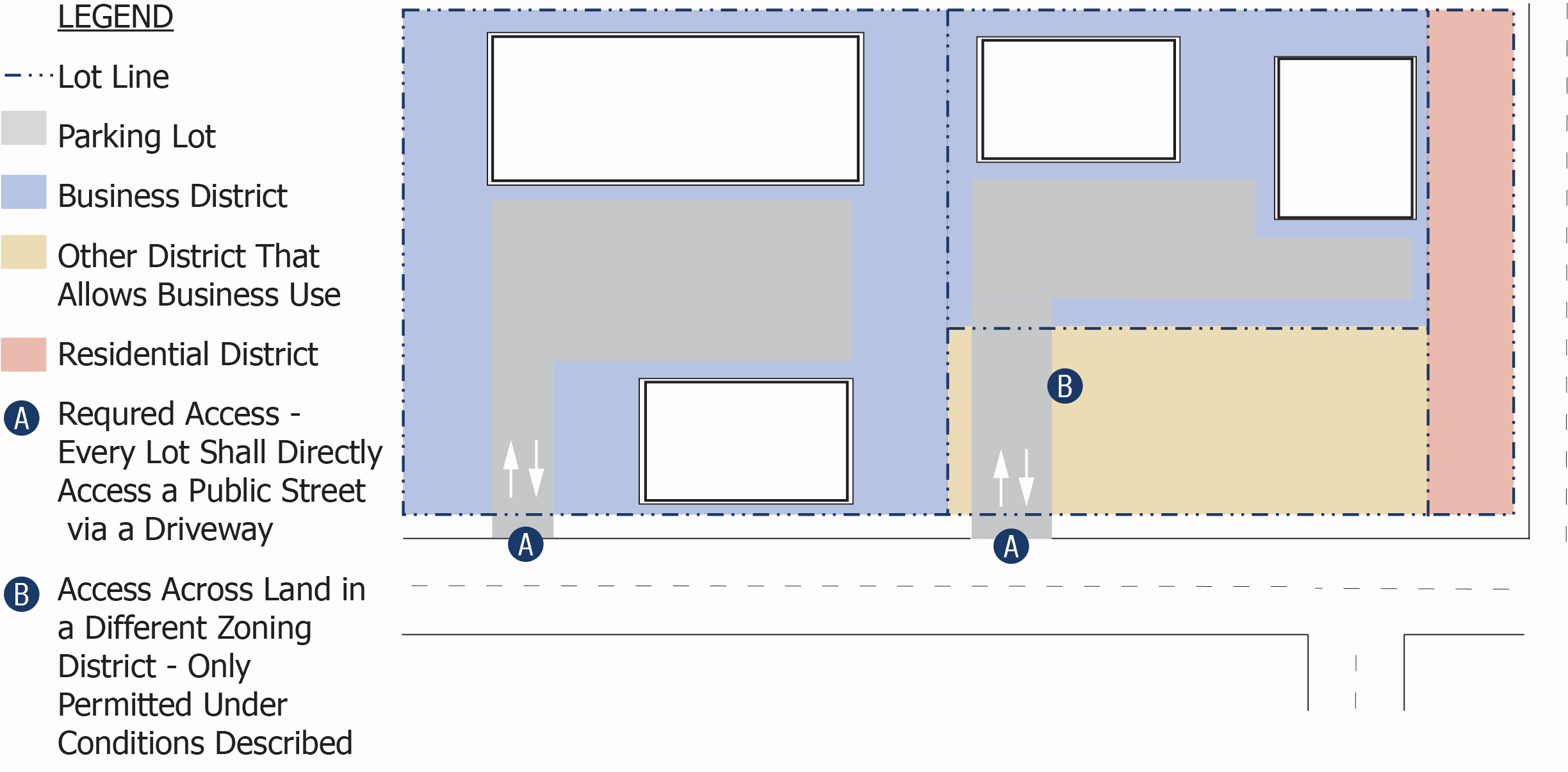
d.
Vacant lots of record established prior to November 2, 2020, that do not abut a publicly-maintained street may establish access through a permanent access easement, provided the lot is used for one single-family detached dwelling and its allowable accessory uses, and provided the easement complies with the following:
1.
The easement is recorded in the offices of the register of deeds;
2.
The minimum easement width is 20 feet;
3.
The minimum separation between the easement and any other platted access or right-of-way is at least 150 feet;
4.
The location of the easement is recorded on a plat; and
5.
The easement permits ingress, egress, regress, and necessary utilities to serve the lot.
(2)
Compliance with street requirements. Development subject to the standards in this section that includes construction activity affecting streets or street rights-of-way shall also comply with the standards in Article 7, Division 3, Streets and Sidewalks.
(3)
Driveways.
a.
Driveways providing ingress or egress to a state-maintained or private street shall be placed and constructed in accordance with the "Policy on Street and Driveway Access to North Carolina Highways" adopted by the North Carolina Department of Transportation (NCDOT), as amended.
b.
All new driveways connecting to State-maintained streets shall obtain a driveway permit from NCDOT prior to the construction.
c.
Driveway configuration.
1.
Vehicles can enter and exit from a lot without posing any substantial danger to themselves, pedestrians, bicycles, or vehicles traveling on abutting streets.
2.
Interference with the free and convenient flow of traffic on abutting or surrounding streets is minimized.
3.
Driveway radii shall be designed in accordance with the NCDOT's or the Town's specifications and shall not extend beyond side lot lines.
4.
No driveway serving an off-street parking area or providing on-site circulation is permitted within any required landscaping area, but driveways may be installed across these areas.
5.
Driveways shall be as nearly perpendicular to the street right-of-way as possible (see Figure 2 Driveway Configuration).
6.
Driveways shall line up with other driveways/streets across the street, where practicable.
7.
Driveways on corner lots shall provide access from the street with less traffic, to the maximum extent practicable.
FIGURE 2: DRIVEWAY CONFIGURATION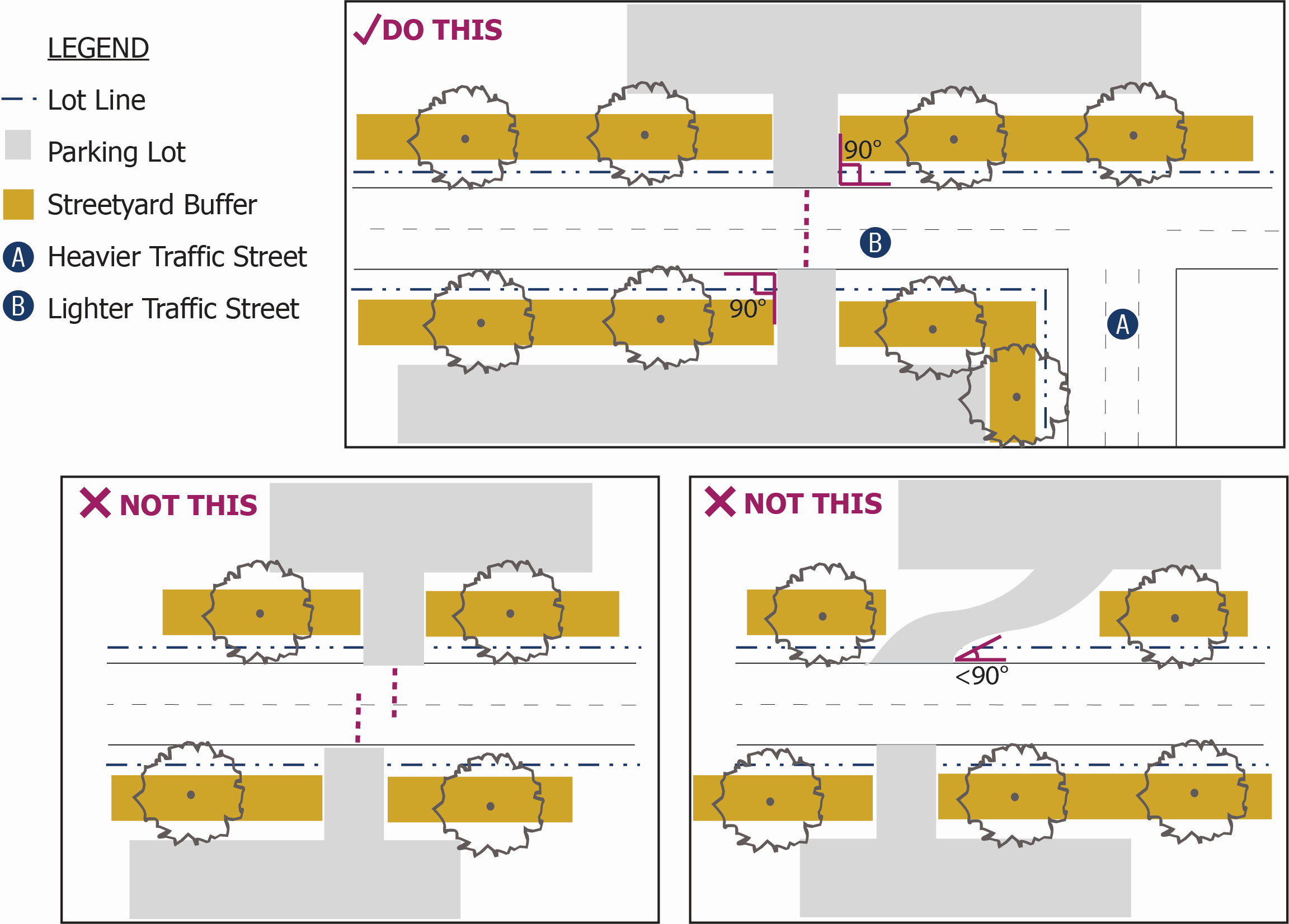
d.
Driveway spacing.
1.
No portion of any driveway leading from a street shall be closer than 100 feet to the corner of any adjacent street intersection measured from the edge of the right-of-way.
2.
On lots with less than 100 feet of lot width, the driveway shall be located as far as practicable from the adjacent street intersection.
3.
Except when configured as paired driveways, driveways serving individual single-family detached dwellings, individual single-family attached dwellings, duplex, triplex, or quadruplex buildings shall be located at least 50 linear feet from any other driveway on the same or different lot. For the purposes of this section, paired driveways are up to two driveways, whether on the same or different lots, where one side of a driveway is no greater than five feet away from the side of the other paired driveway.
e.
Driveway surfacing. New driveways established after the effective date of these standards that abut a paved street shall be surfaced with asphalt or six inches of concrete for a distance of at least five feet from the edge of the right-of-way or the driveway radius point, whichever is greater. New driveways established after the effective date of these standards serving a multi-family, commercial, institutional, or industrial use shall be fully paved with asphalt, concrete, pavers, or other suitable all-weather surfacing other than crushed stone.
(4)
Shared driveways.
a.
Up to a maximum of four individual residential lots configured with single-family detached dwellings may establish access across one or more different lots via a single shared driveway provided the shared driveway (see Figure 3, Shared Driveways):
1.
Is located within a recorded access easement recorded in the offices of the register of deeds;
2.
The minimum easement width is 25 feet and the driveway is at least 15 feet in width;
3.
The minimum separation between the easement and any other platted access or right-of-way is at least 150 feet;
4.
The location of the easement is recorded on a plat;
5.
The easement permits ingress, egress, regress, and necessary utilities to serve the lot; and
6.
The shared driveway connects to a publicly maintained or a private street built to public street standards.
b.
Maintenance of a shared driveway shall be the responsibility of the landowners whose lots receive access via the shared driveway. In no instance shall the Town be responsible for maintenance or repair of a shared driveway.
c.
Shared driveways serving more than four individual residential lots configured with single-family detached dwellings shall be configured in accordance with the standards for public or private roads in § 30-7301, Roads.
FIGURE 3: SHARED DRIVEWAYS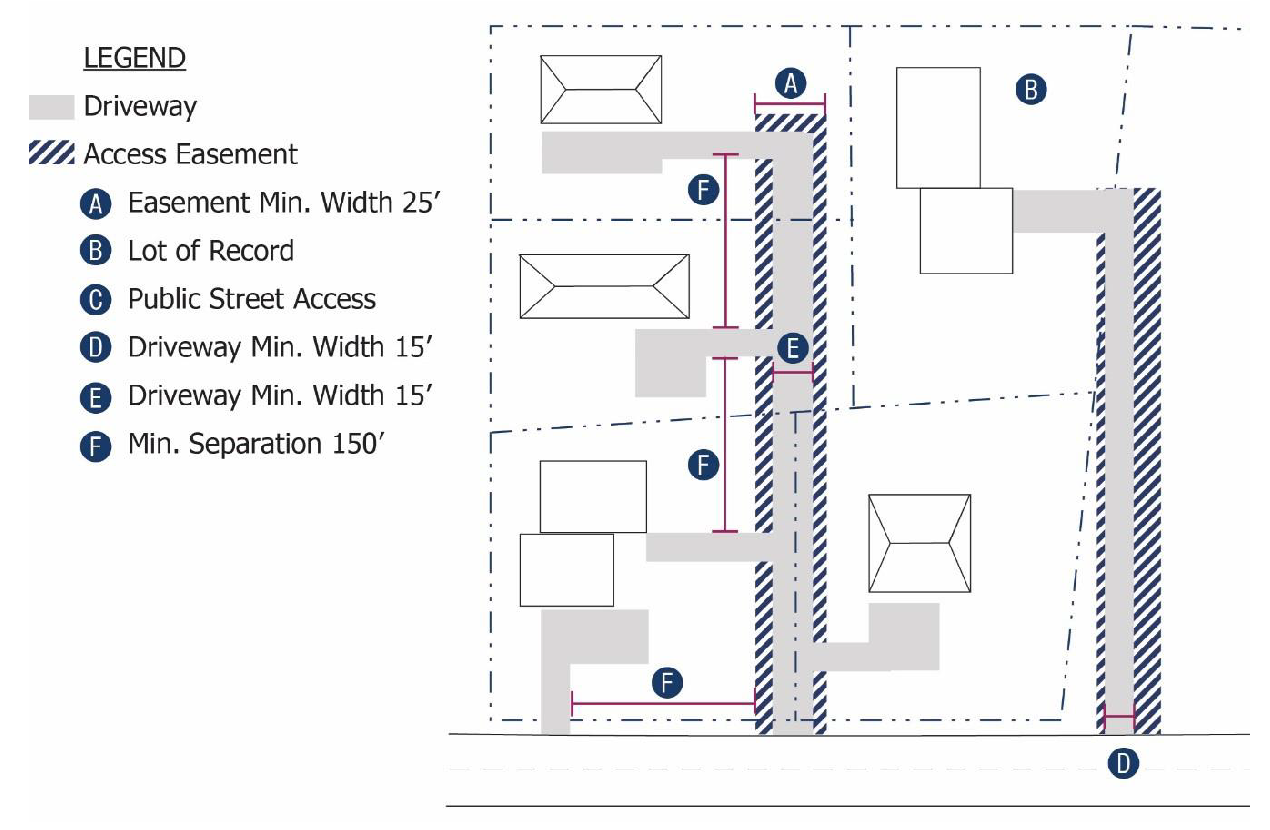
(5)
Sight distance triangles.
a.
Corner lots and lots with driveways, alleys, or other methods of ingress/egress to a street shall include sight distance triangles to ensure visibility for drivers and pedestrians moving through or in an intersection. Required sight distance triangles shall be configured in accordance with the sight distance triangle requirements table below.
b.
No planting, structure, fence, wall, slope, embankment, parked vehicle, or other obstruction to vision between the heights of two-and-one-half feet and ten feet above the centerline grades of intersecting streets or accessways may be located within a required sight distance triangle (see Figure 4 Sight Distance Triangles).
FIGURE 4: SIGHT DISTANCE TRIANGLE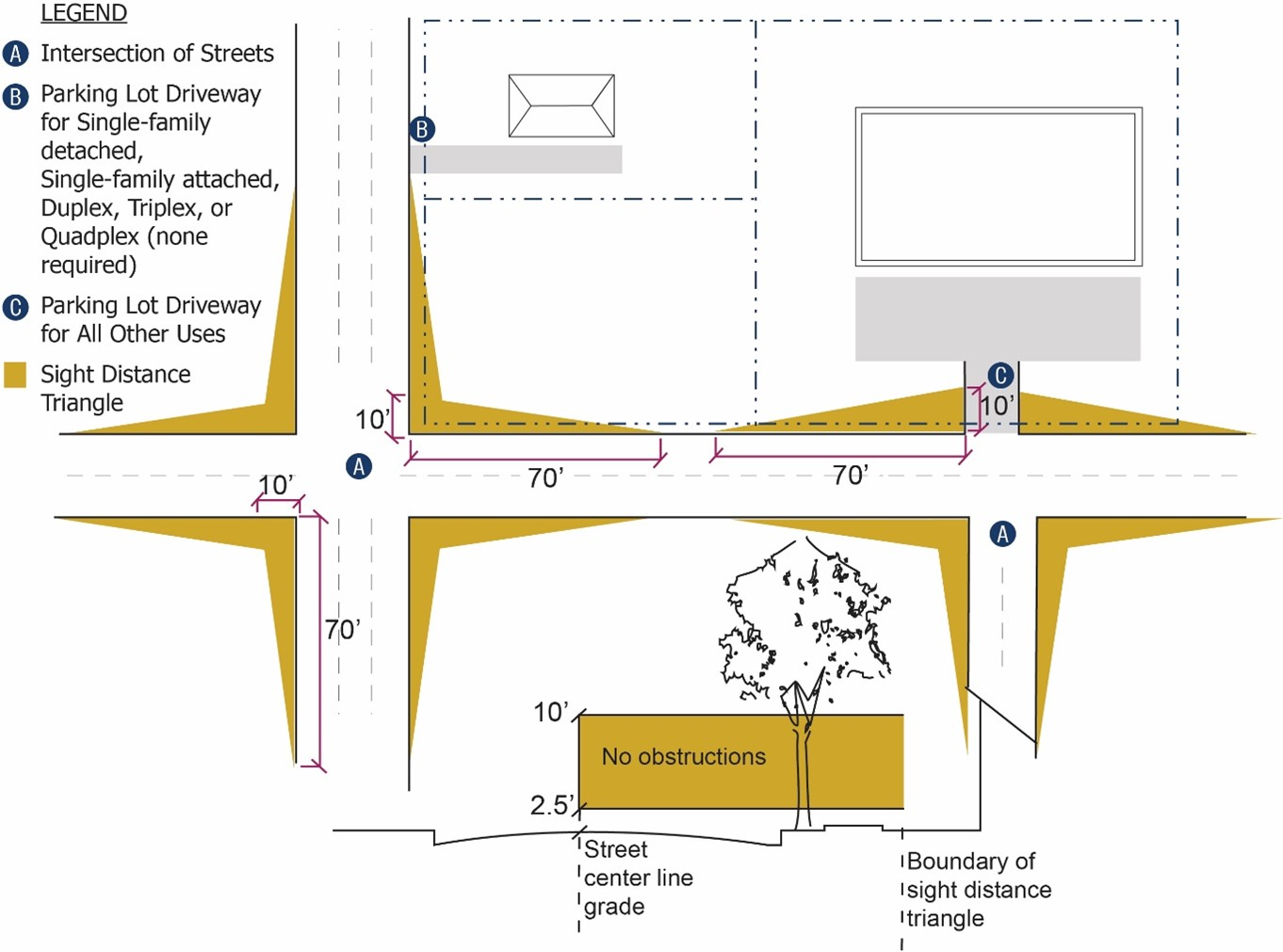
(6)
On-site pedestrian walkways. On-site pedestrian walkways that minimize conflict between pedestrians and vehicles shall be provided on all non-residential, mixed-use, and multi-family development sites, and shall be configured in accordance with the following standards.
a.
On-site pedestrian walkways shall connect building entrances to off-street parking areas and to other building entrances on the same site (see Figure 4A On-Site Pedestrian Walkways).
b.
Development subject to these standards shall provide at least one connection to an existing or planned public sidewalk or existing greenway via an on-site pedestrian walkway configured in accordance with these standards. In cases where existing or planned sidewalks do not exist, at least one on-site pedestrian connection shall continue to the right-of-way edge.
c.
Connections shall be made to all existing or planned adjacent transit facilities, to the maximum extent practicable.
d.
On-site pedestrian walkways shall be paved with asphalt, concrete, or other all-weather material, and shall be of contrasting color or materials when crossing parking lot drive aisles.
e.
On-site pedestrian walkways shall be positively drained and configured to avoid areas of pooling water.
f.
On-site pedestrian walkways shall be in compliance with applicable state and federal requirements, including ADA requirements.
FIGURE 4A: ON-SITE PEDESTRIAN WALKWAYS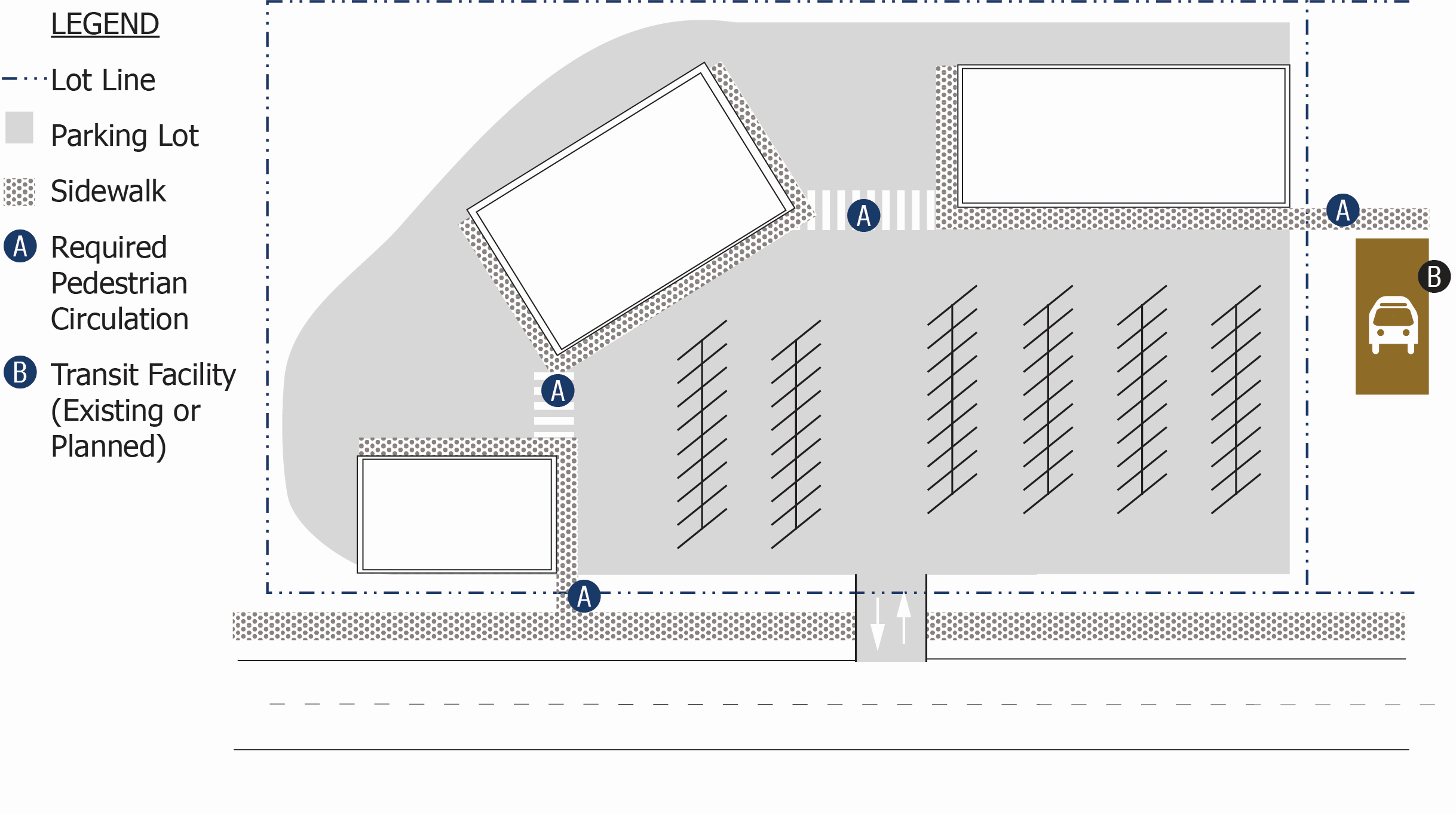
(7)
Compliance with requirements for sidewalks. Development subject to the standards in this section shall comply with all applicable standards in § 30-7301, Roads, and § 30-7303, Sidewalks.
(Ord. No. AL2021-06-1, § 1, 6-7-2021; Ord. No. AL2022-08-2 (UDO-TA-3-22), § 1, 8-1-2022; Ord. No. AL2023-01-1 (UDO-TA-1-23), § 1, 1-3-2023)
Sec. 30-6102 - Accessibility for the handicapped.
Except for single-family dwellings, all buildings and facilities used by the general public shall be accessible to and usable by the physically handicapped in accordance with the building code provisions as established by the state.
(Ord. No. AL2021-06-1, § 1, 6-7-2021)
Sec. 30-6201 - Commercial building design standards.
(a)
Purpose and intent. These commercial design standards supplement the applicable zoning district and use-specific standards of this Article and provide minimum requirements for the design of commercial development. These standards are intended to provide clarity on the Town's expectations for new commercial development quality and appearance. More specifically, the purpose of these standards is to:
(1)
Implement the policy guidance from the comprehensive plan regarding protection of the desired small-town community character;
(2)
Assure a fair and consistent application of the commercial design standards to new development and redevelopment;
(3)
Foster increased compatibility between commercial development and nearby residences;
(4)
Encourage the maintenance of a village atmosphere; and
(5)
Promote property values and protect existing public and private investment.
(b)
Applicability. The standards in this section shall be applied to the following forms of development and land use activities:
(1)
New commercial development. The establishment of new principal structures containing or intended for a commercial, office, personal service, retail, restaurant, or light industrial use type, as identified in the principal table of uses found in this Article.
(2)
Changes in use. Changes in use of an existing principal building or development site where the new use is subject to these commercial design standards, but no additions or expansions are proposed shall comply with the requirements in § 30-6201(e), Commercial site configuration standards, but are not required to comply with the standards in § 30-6201(f), Building configuration standards.
(3)
Additions and expansions to existing development. Increases in an existing commercial building's floor area or a commercial site's impervious surface by 51 percent or more beyond that in existence on the effective date of these standards shall require full compliance with these provisions.
(4)
Reconstruction of existing buildings. Reconstruction of an existing commercial building shall be treated as new development for the purposes of these standards.
(c)
Exemptions.
(1)
The standards in this section shall not apply to the following forms of development:
a.
Commercial development existing prior to effective date of these standards unless subject to a change in use, reconstruction, addition, or expansion;
b.
Commercial development taking place as part of a bona fide farm;
c.
Commercial development subject to a historic landmark designation or subject to standards applicable in a local historic district; and
d.
Development of civic, religious, or fraternal organization use types.
e.
Adult uses and gaming establishments shall be exempted from the transparency standards in § 30-6201(F)(8), Transparency.
(d)
Timing of review. Development subject to these standards shall be reviewed for compliance at the time of site plan, special use permit, or conditional rezoning application review, as appropriate. In cases where a development application is considered by more than one review authority, the decision regarding compliance with these standards shall be made by the review authority making the final decision on the application under review.
(e)
Commercial site configuration standards. Development subject to these commercial design standards shall comply with the following:
(1)
Building placement.
a.
All principal and accessory buildings shall be set back at least 20 linear feet from the ultimate right-of-way boundary of any adjacent street. The ultimate right-of-way boundary location shall be as indicated in the Town's adopted policy guidance, the applicable comprehensive transportation plan adopted by NC CAMPO, or as indicated by the NCDOT. In cases where the ultimate right-of-way boundary is not identified, the building setback shall be measured from the centerline of the existing right-of-way outwards for a minimum distance corresponding to one-half of the currently specified right-of-way width plus 20 feet.
b.
All development subject to these standards shall have a maximum setback of 50 feet from the ultimate right-of-way boundary of any adjacent street.
(2)
Outparcel development. Development on outparcels or pad sites associated with a commercial development shall comply with the following requirements (see Figure 5 Outparcel Development):
a.
Spaces between buildings on outparcels or pad sites shall include pedestrian amenities such as plazas, seating areas, and gathering places in addition to off-street parking spaces.
b.
Outparcel buildings on lots at street corners shall be located and configured to define the corner through a combination of:
1.
Locating the building as close to the rights-of-way as is practicable;
2.
Limiting surface parking between the building and the streets;
3.
Providing a public gathering space adjacent to the corner; and
4.
Distinctive roof form or other pedestrian features such as porches, canopies, or arcades.
FIGURE 5: OUTPARCEL DEVELOPMENT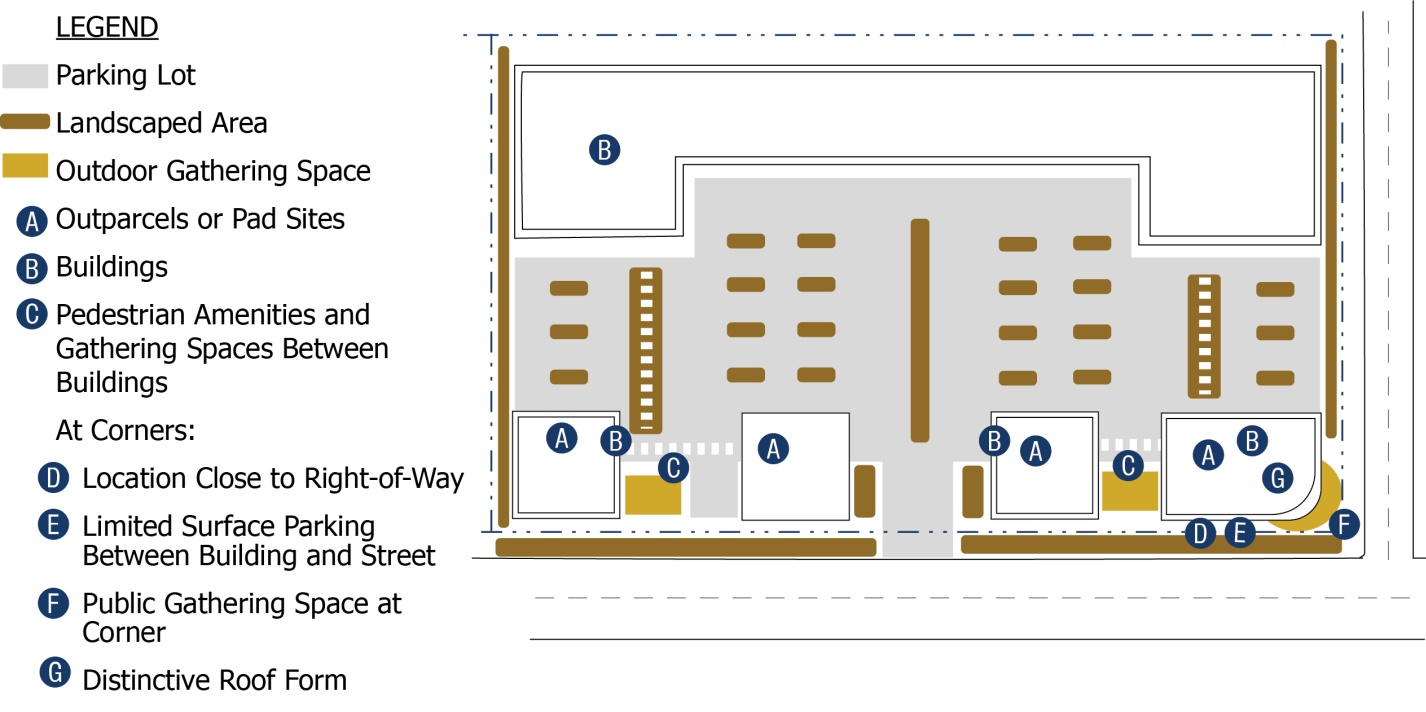
(3)
On-site circulation.
a.
All driveways shall be constructed so that vehicles can enter and exit from a lot without posing any substantial danger to themselves, pedestrians, bicycles, or vehicles traveling on abutting streets and that any interference with the free and convenient flow of traffic on abutting or surrounding streets is minimized. In no instance shall a driveway be configured so that a vehicle must back onto an arterial, collector, or thoroughfare street.
b.
Driveways shall be as nearly perpendicular to the street right-of-way as possible.
c.
In cases where two or more commercial uses are located on adjacent lots along a street, the off-street parking lots serving the uses shall be connected to one another so that a vehicle may travel from one establishment to another without use of the street network (see Figure 6 Parking Lot Connection). Where a required parking lot connection eliminates a required landscape planting area or required off-street parking space, the landscaping and off-street parking requirements shall be reduced to accommodate the parking lot connection. Compliance with this standard shall be waived in cases where a parking lot connection would create unsafe turning movements or pedestrian conflicts.
FIGURE 6: PARKING LOT CONNECTION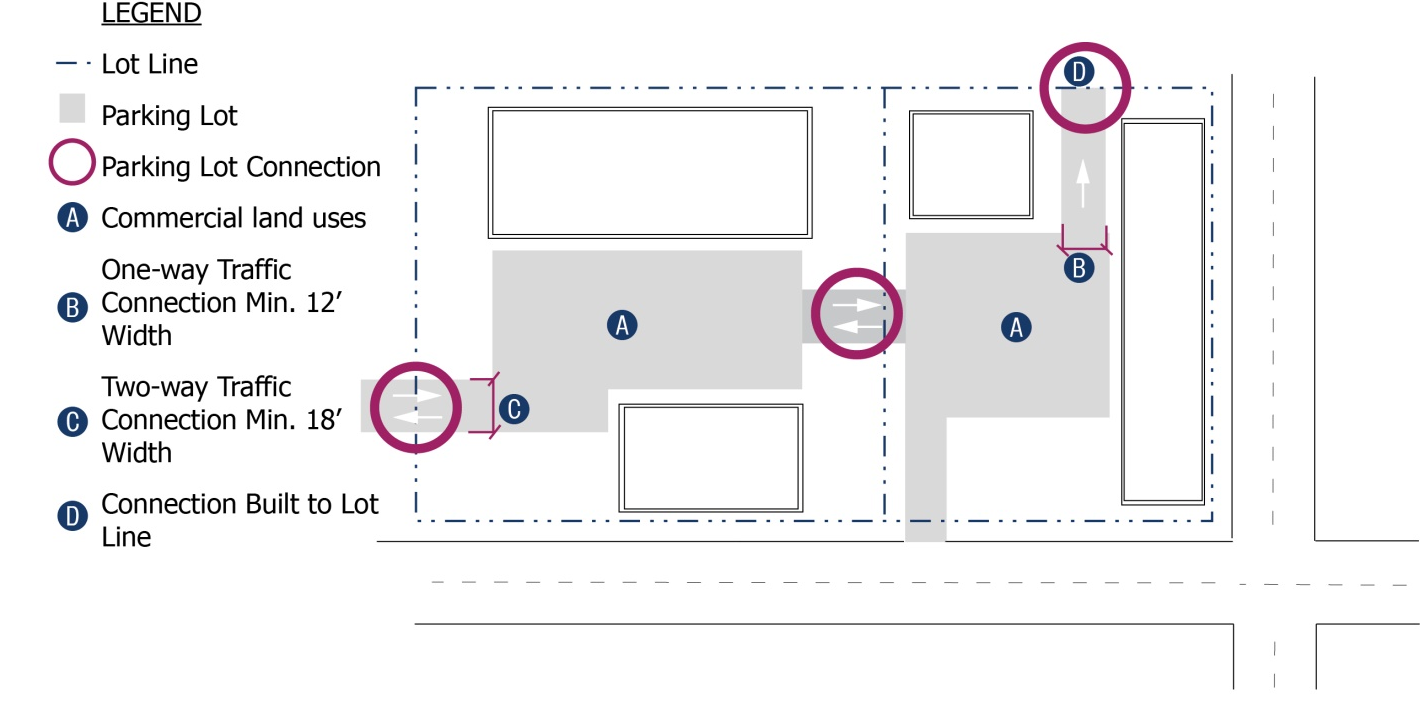
(4)
Off-street parking location.
a.
The placement of all off-street parking to the side or rear of the building it serves is strongly encouraged. Buildings of one story in height may have up to one single-loaded row of off-street parking spaces between the front façade of a building and the street it faces.
b.
Buildings of two stories in height may have up to two rows of parking spaces between the front façade of a building and the street it faces (see Figure 7 Parking Placement).
c.
Multi-building developments shall be configured so that off-street parking areas are internal to the site and located behind the buildings located adjacent to streets.
FIGURE 7: PARKING PLACEMENT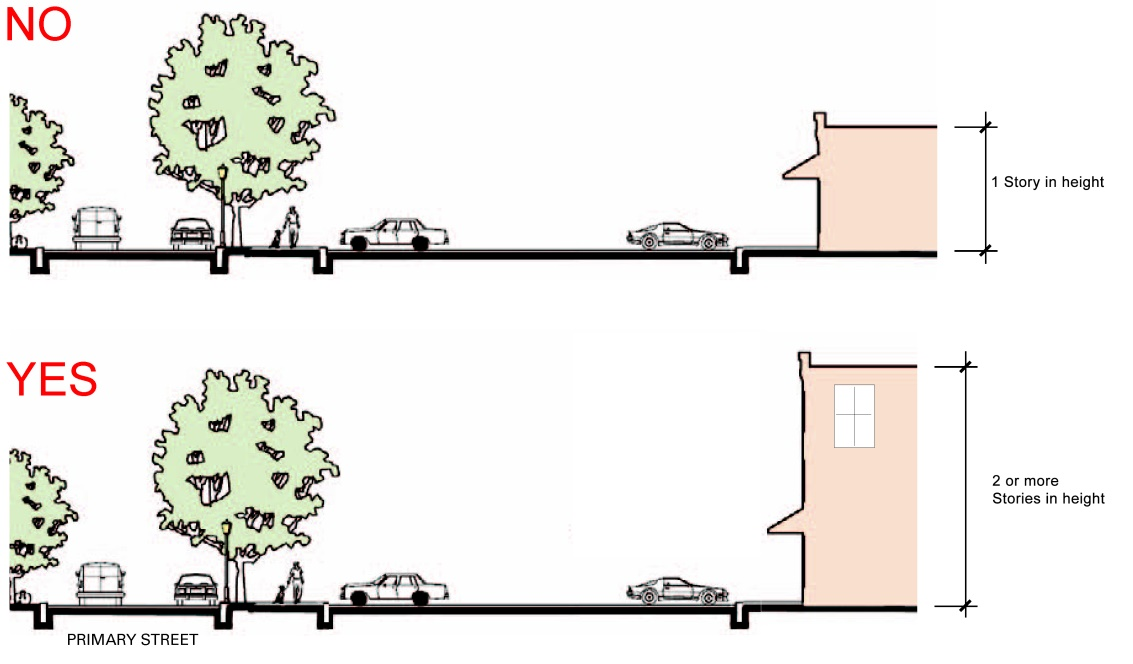
(5)
Signage.
a.
No flashing, moving, or portable signs shall be permitted.
b.
In no instance shall a window sign or signage placed on or in a window or transparent door obscure more than two square feet of the window or door's total area.
(6)
Service areas.
a.
Off-street loading areas, service areas, refuse/recycling collection areas, and outdoor storage of equipment or raw materials shall be located to the side or rear of a principal building. In addition, such features shall be screened through the use of an opaque fence or wall of a minimum height necessary to obscure views from on-site and off-site locations.
b.
Outdoor display of products available for sale may be located in front or a principal building and are not required to be screened provided these areas are physically accessible to patrons. Areas utilized for the display of products for sale that are not physically accessible to patrons shall be considered areas of outdoor storage and shall be located and screened in accordance with these standards.
(7)
Equipment screening.
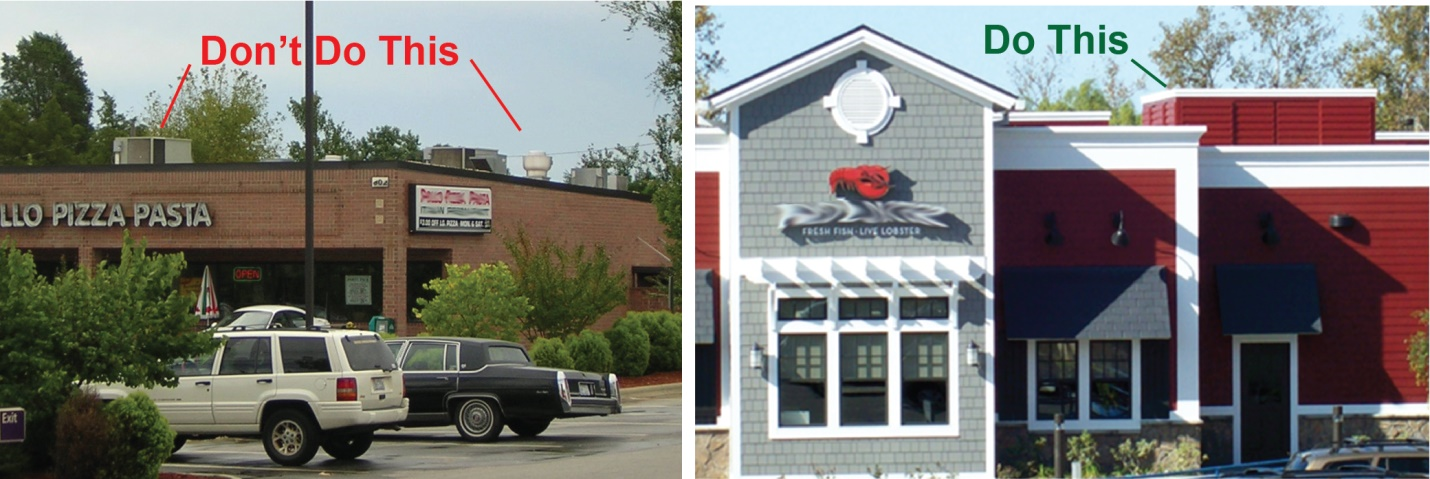
a.
All ground-based and roof-mounted equipment shall be fully screened from view from adjacent streets, parks, open space, and residentially-used lots (see Figure 8 Rooftop Screening).
b.
Wall-mounted mechanical equipment mounted at heights over 36 inches from grade and measuring 16 inches or more in any dimension shall be fully screened, concealed, or camouflaged to minimize its appearance from adjacent streets, parks, open space, and residentially-used lots.
FIGURE 8: ROOFTOP SCREENING
(8)
Stormwater control measures.
a.
Stormwater control measures, including, but not limited to, retention ponds and detention basins, shall either be configured as site amenities or be fully screened from view on all sides by evergreen opaque vegetation reaching a minimum height of six feet above grade within three years of planting.
b.
Stormwater control measures (SCMs) shall be considered as site amenities when all of the following are present:
1.
They are not surrounded by a fence intended to exclude pedestrians;
2.
Finished grades around the SCM do not inhibit walking;
3.
They include landscaping features such as trees and shrubs;
4.
There is some form of central feature or focal point such as a fountain;
5.
Seating or a walking path is provided adjacent to the SCM; and
6.
Stormwater control measures shall comply with all applicable Johnston County requirements.
(9)
Utilities. New utility service, including electricity, required to serve development subject to these standards shall be located underground. Nothing in these standards shall be construed to require existing above-ground utilities to be placed underground as part of new development.
(f)
Building configuration standards. Buildings subject to these commercial design standards shall comply with the following:
(1)
Maximum building size. Individual principal buildings subject to these standards shall maintain a maximum total floor area in accordance with the following:
a.
Lots that front and are accessed by an arterial or thoroughfare street may include up to one principal building with a maximum total floor area of 40,000 square feet.
b.
Lots that front and are accessed by a collector street may include up to one principal building with a maximum total floor area of 25,000 square feet.
c.
Lots that front and are accessed by a local street may include up to one principal building with a maximum total floor area of 10,000 square feet.
d.
Nothing shall limit the cumulative total amount of floor area within a multiple building development, provided that the largest principal building does not exceed the applicable maximum set forth in this section, and provided that each additional building within the multi-building development is no larger than 50 percent of the applicable maximum building size.
(2)
Orientation.
a.
The primary entrance shall be architecturally and functionally designed on the front façade facing the primary street (see Figure 9 Building Orientation).
b.
Except for multi-building developments such as shopping centers or campus-style developments, the front façade of the principal structure shall be parallel to the front lot line and street.
c.
Nothing shall limit a secondary entrance from facing an off-street parking lot.
FIGURE 9: BUILDING ORIENTATION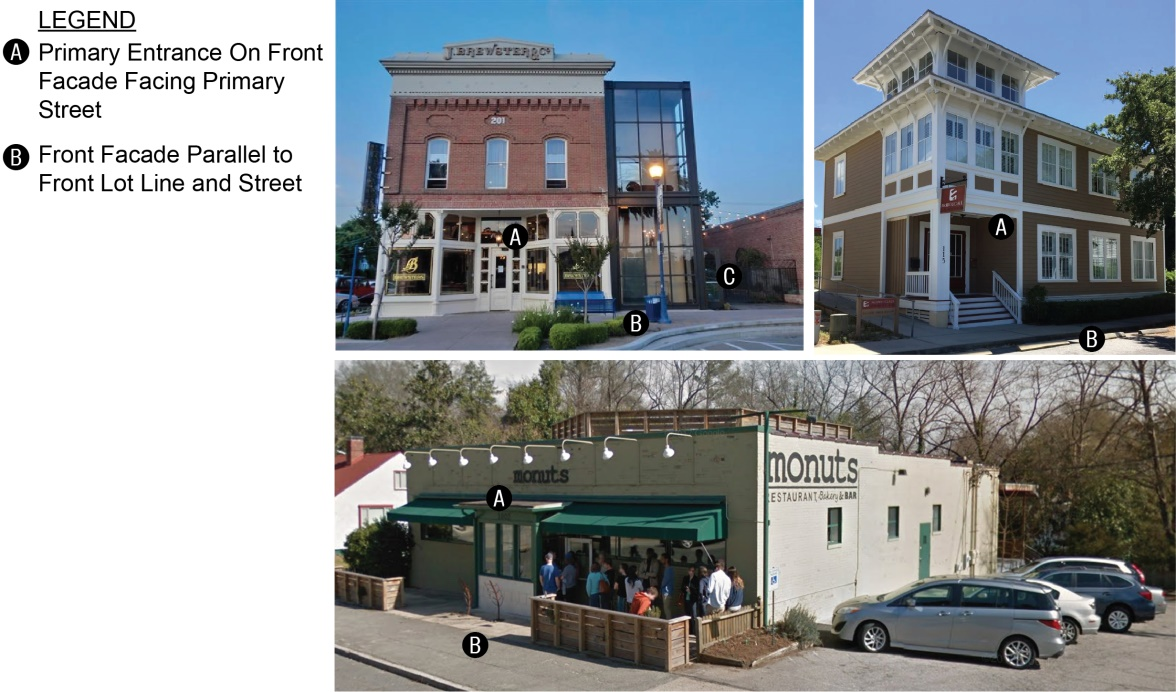
(3)
Primary entrance.
a.
Building entrances shall be designated as a primary or a secondary entrance by the applicant, but each principal building shall have at least one primary entrance. Nothing shall limit a building from having multiple primary entrances.
b.
Primary building entrances shall be visually prominent and shall include at least three of the following features (see Figure 10 Primary Building Entrances):
1.
Changes in building material or color;
2.
Changes in paving or walking surface materials;
3.
A significant architectural feature that extends above the primary roof height;
4.
A projection or recess of at least five feet beyond the adjacent wall plane;
5.
Outdoor pedestrian gathering or seating areas capable of serving at least five people at the same time;
6.
A canopy, awning, portico, archway, arcade, or other covering that extends outwards from the building wall by at least five feet;
7.
Glazing that extends upwards for at least 75 percent of the building's height proximate to the entrance door(s);
8.
Architectural detailing around the entryway such as tilework, entablature, or integrated moldings; or
9.
Fountains, artwork, or landscaping plantings in raised planters immediately adjacent to the entrance door(s).
FIGURE 10: PRIMARY BUILDING ENTRANCES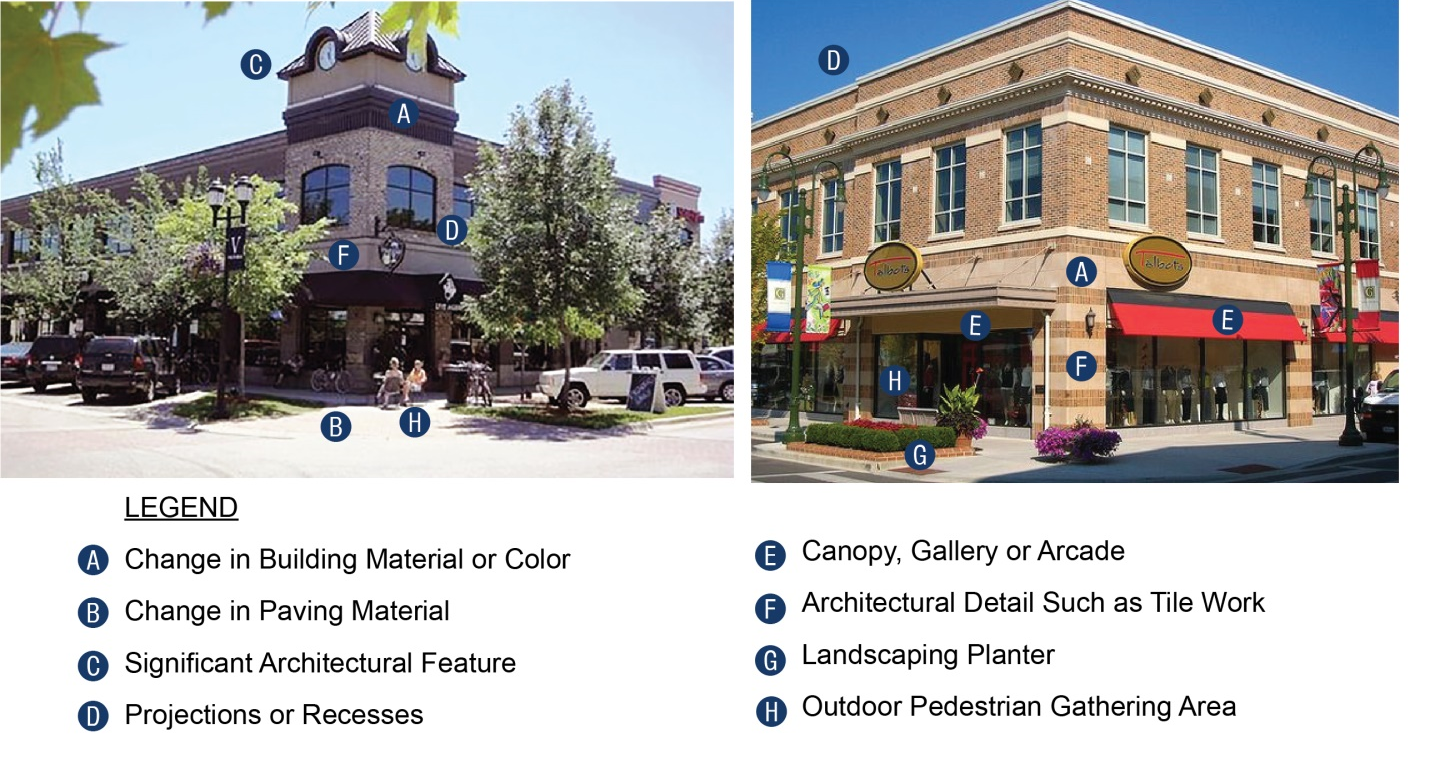
(4)
Exterior materials.
a.
Configuration.
1.
Where two or more materials are proposed on a building façade, the heavier or more massive material (like stone) shall be located below the lighter or less massive material (stucco).
2.
Heavier details may be permitted as details on corners or around doors and windows.
3.
Material changes shall take place at locations such as the intersection of building wings, the intersection of differing storefronts or leaseholds, interior corners, or other logical locations.
4.
Material changes shall not take place at outside corners and material returns shall be included to a logical termination point past an exterior building corner such as a bump-out, building wing, or change in wall direction (see Figure 11 Commercial Building Materials).
b.
Prohibited materials. The following materials shall be prohibited on any primary or secondary building façade walls:
1.
Untextured tilt-up concrete panels;
2.
Pre-fabricated steel panels;
3.
Corrugated sheet metal;
4.
Smooth-face concrete blocks;
5.
Vinyl siding, soffit, or fascia;
6.
Synthetic stucco within two feet of the grade;
7.
Asphalt shingles or siding; or
8.
Mirrored glass.
FIGURE 11: COMMERCIAL BUILDING MATERIALS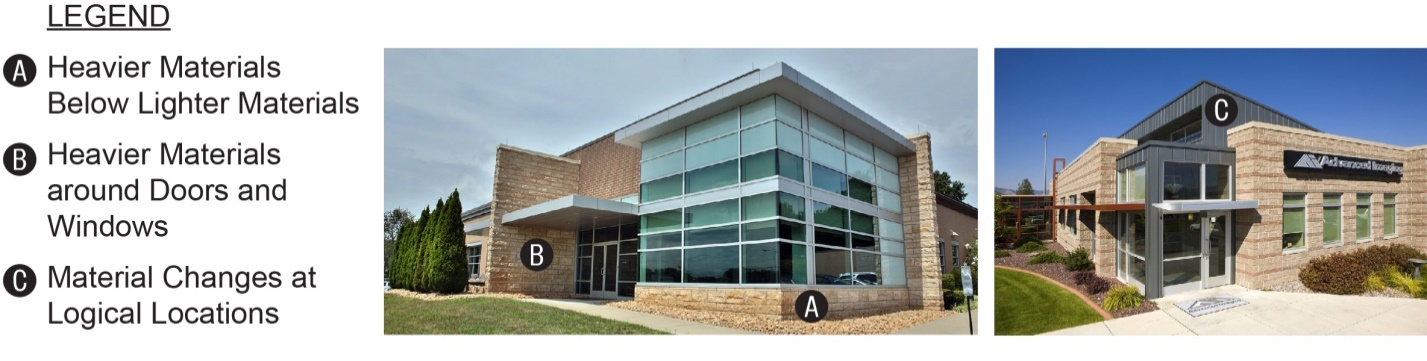
c.
Color.
1.
Primary colors. Overly bright, neon, or "day-glow" colors shall not be used as primary exterior building colors. Nothing shall limit traditional community material colors.
2.
Accent colors. Building trim and accent areas may feature brighter colors, including primary colors, but these colors may not comprise more than 15 percent of any building façade.
d.
Compatibility in multi-building developments. Buildings on outparcels or pad sites shall incorporate materials that are similar to and compatible with those used on the primary buildings in the development. Corporate or prototypical architecture shall be reconfigured as necessary in order to comply with this standard.
(5)
Building articulation. Buildings subject to these standards shall be configured so that no single façade visible from a street shall extend for longer than 35 linear feet without inclusion of one or more of the following features:
a.
The use of projections or recesses in the building façade wall with a depth of between 18 inches and 36 inches from the primary façade plane and a minimum span of eight feet (see Figure 12 Commercial Building Articulation);
b.
The use of columns, pilasters, or other architectural detail harmonious with the general design of the structure with a minimum width of eight inches and spaced no less than every ten feet on-center;
c.
Distinct changes in building materials or colors from grade to the roof; or
d.
A single vertical accent or focal point extending well above the primary roofline, such as a tower feature, located on a prominent building corner.
FIGURE 12: COMMERCIAL BUILDING ARTICULATION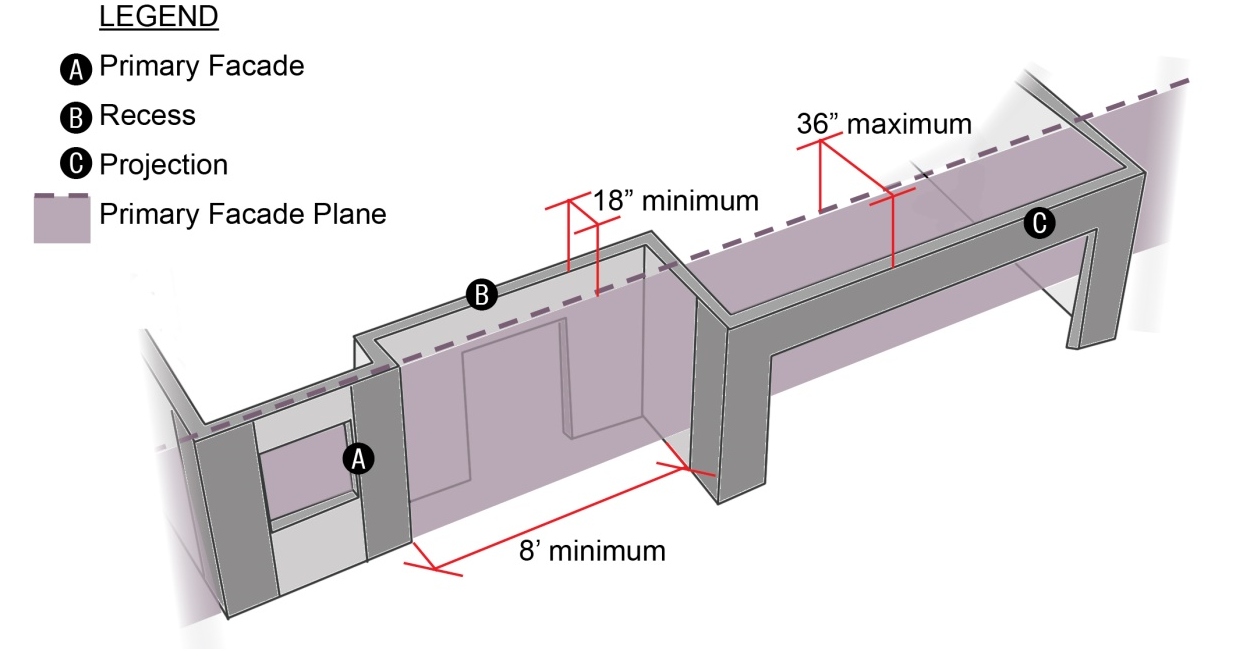
(6)
Roof form.
a.
Roof pitches less than 3:12 and flat roofs shall require a parapet wall on all building sides visible from a street.
b.
Parapet walls, when provided, shall fully screen all roof-top mechanical equipment from view from the street and shall include decorative cornices or caps.
c.
A pitched roof shall have eaves that extend a minimum of 12 inches beyond the building face.
d.
Gable roofs shall incorporate roof rakes that project outwards a minimum of at least 12 inches from the building face.
(7)
Canopies. Except for canopies associated with fuel sales, overhead canopies intended to cover the vehicles of patrons shall be configured in accordance with the following standards:
a.
The total number of canopies shall be limited to one per building;
b.
The canopy shall be physically connected to the principal structure;
c.
The canopy shall be located to the side or rear of the structure, or configured so that it has the appearance of being enclosed by building walls on at least two sides;
d.
The canopy shall be configured of consistent or complimentary materials and colors as the primary exterior materials, including canopy supports;
e.
The canopy shall be subject to maximum height standards for buildings in the zoning district where located; and
f.
Any exterior lighting from under the canopy shall be configured so that the source of illumination (the bulb) is recessed into the canopy and is not visible from off-site areas.
(8)
Transparency.
a.
Buildings subject to these standards shall be configured so that building façades visible from streets shall include a window or functional general access doorway at least every 20 feet along the façade (see Figure 13 Commercial Transparency). False windows or display casements are an allowable alternative, as approved by the Town Planner.
b.
At least 25 percent of the first ten feet in height of a façade facing a street shall be transparent.
c.
Ventilation grates or emergency exit doors located at the first floor level oriented toward a street shall be decorative.
FIGURE 13: COMMERCIAL TRANSPARENCY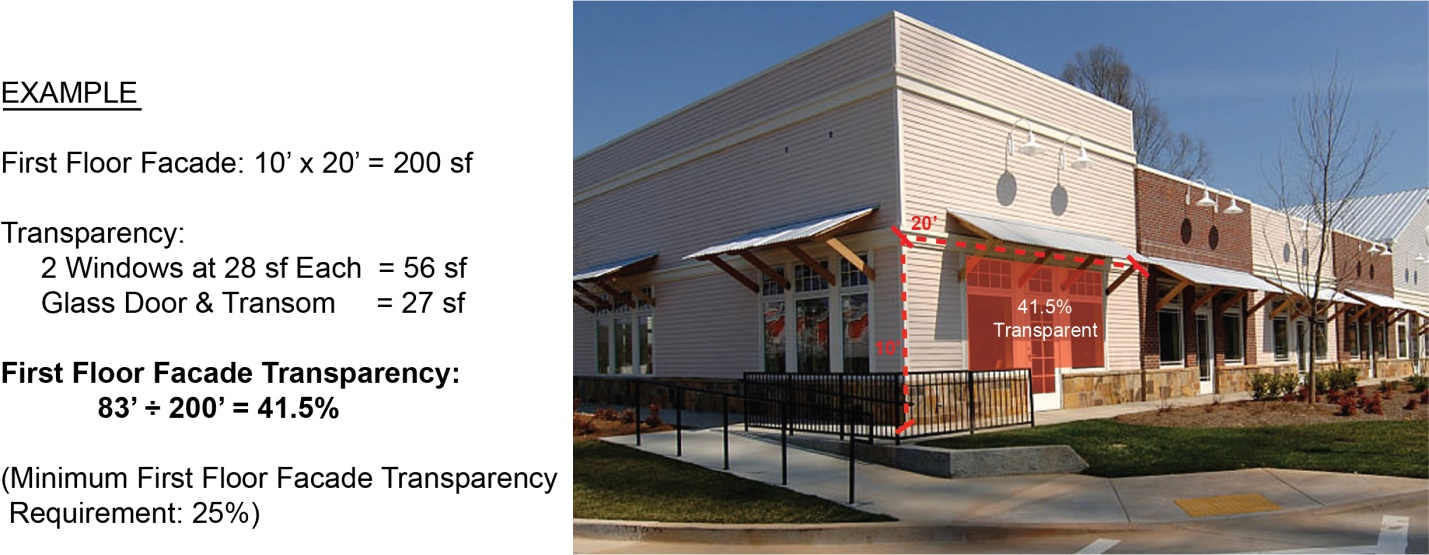
(9)
Lighting.
a.
Buildings subject to these standards shall not include neon lighting that is visible from off-site areas.
b.
In no instance shall any exterior lighting flash, blink, or give the appearance of movement.
c.
LED lighting strips around windows or doors are prohibited on the building exterior or within the interior if the lighting strip is visible from off-site areas.
(Ord. No. AL2021-06-1, § 1, 6-7-2021)
Sec. 30-6202 - Multi-family design standards.
(a)
Purpose and intent. These multi-family residential design standards supplement the applicable zoning district and use-specific standards of this Article by providing the minimum requirements for design and configuration of multi-family development within the Town's jurisdiction. They are intended to:
(1)
Ensure multi-family development takes place in a manner consistent with the context, scale, and proportion of its surroundings;
(2)
Promote greater compatibility between new multi-family development and other allowable use types, particularly adjacent residential single-family detached dwellings;
(3)
Establish expectations for minimum level of quality for multi-family development;
(4)
Encourage creativity in design and promote individual project identity;
(5)
Create neighborhoods with enhanced architectural and visual interest; and
(6)
Preserve property values and protect public and private investment.
(b)
Applicability. Except where expressly exempted in writing in this Article, the standards in this section shall apply to the following forms of development:
(1)
New multi-family dwellings;
(2)
New triplex and quadplex dwellings;
(3)
New multi-unit residential structures within a continuing care retirement community use type; and
(4)
New assisted living facilities and nursing homes.
(c)
Exemptions. The following forms of development shall be exempted from these standards:
(1)
Single-family attached development, unless subject to voluntary consent by the landowner;
(2)
Duplex dwellings, unless subject to voluntary consent by the landowner;
(3)
Renovation or redevelopment of existing multi-family structures; and
(4)
Routine maintenance and repairs.
(d)
Timing of review. Development subject to these standards shall be reviewed for compliance at the time of site plan, or special use permit review, as appropriate. In cases where a development application is considered by more than one review authority, the decision regarding compliance with these standards shall be made by the review authority making the final decision on the application under review.
(e)
Site design requirements.
(1)
Street network.
a.
On sites including new streets, an interconnected network of streets shall be provided, to the maximum extent practicable, and streets shall connect to adjacent existing streets outside of the development.
b.
Vehicular driveways into a development with ten or more dwelling units shall be at least 100 feet away from any major intersection, to the maximum extent practicable.
c.
Driveways shall be consolidated in order to reduce curb cuts, to the maximum extent practicable.
(2)
Building orientation.
a.
Buildings that abut streets shall be oriented parallel to the street they front rather than being oriented at an angle to the street.
b.
On corner lots, the long axis of the building shall be parallel to the longest lot frontage unless such orientation is incompatible with adjacent, existing development along the same street (see Figure 14 Multi-family Building Orientation).
c.
Buildings within multiple-building developments shall be clustered in order to define open space recreation areas and development entry points.
FIGURE 14: MULTI-FAMILY BUILDING ORIENTATION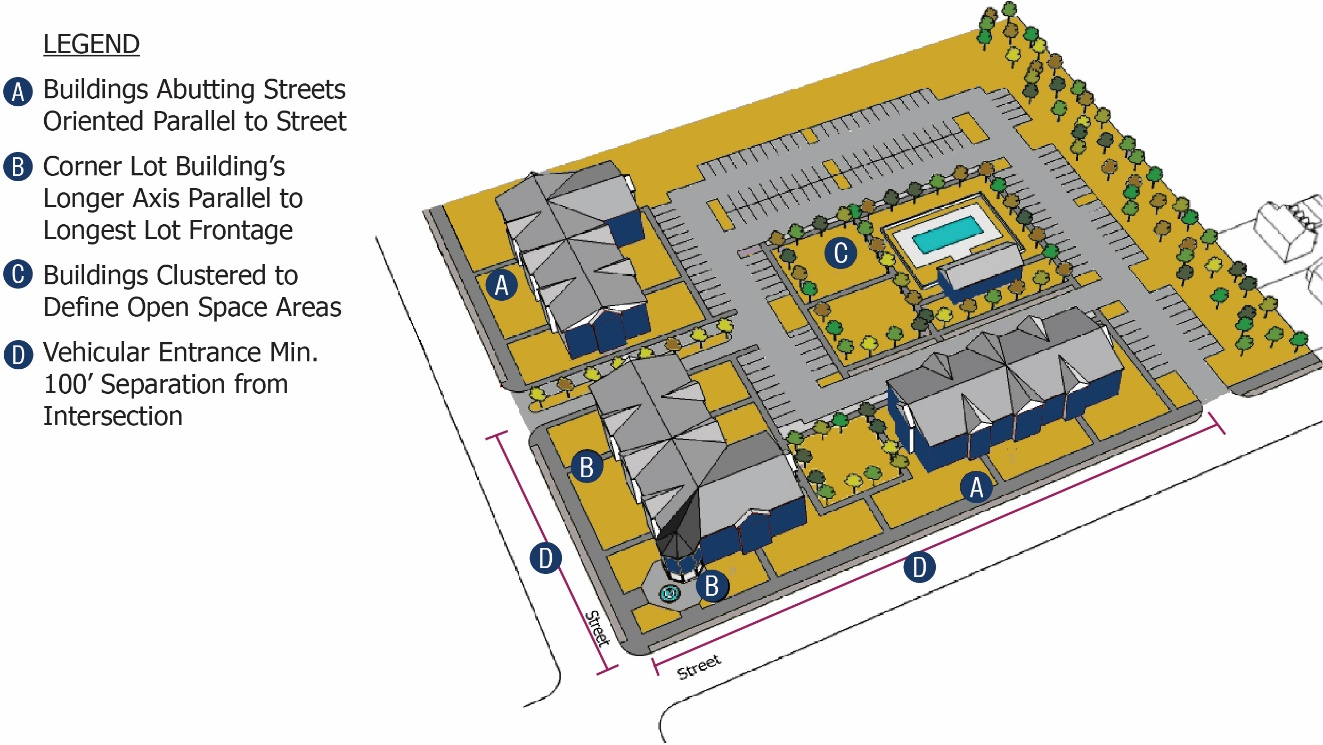
(3)
Accessory structures. Accessory uses and structures associated with a development subject to these standards shall comply with the following:
a.
Street-facing detached garages on corner lots shall be located to the side or rear of buildings.
b.
Access to accessory structures (such as garages, carports, storage areas, etc.) shall be provided from alleys or secondary streets, to the maximum extent practicable.
c.
Accessory buildings shall include exterior materials, colors, and roof form designed to be consistent with the principal structure.
d.
Accessory structures shall not physically obstruct pedestrian entrances.
e.
Centralized refuse collection containers, if provided, shall be located in an enclosed area located to the rear of principal buildings.
(4)
Site features.
a.
Except for nursing homes, development subject to these standards shall not include a gate or obstruction that blocks access to the site for vehicles, bicycles, or pedestrians.
b.
Off-street parking serving guests shall be evenly distributed throughout the development.
c.
Shared solid waste facilities shall be evenly distributed throughout the development or be centrally located and fully screened from all on-site and off-site views.
d.
Detached garages or carports shall not be located between a principal building and the street it faces.
e.
New utilities shall be provided underground, and utility vaults shall be clustered in areas outside of required landscaping.
(f)
Building design requirements.
(1)
Building entrances.
a.
The façades of buildings abutting streets shall be configured so that entryways to individual dwelling units or shared entrances face the street.
b.
Access to upper-floor dwelling units shall be obtained from shared internal entries. In no instance shall walkways to individual upper-story dwelling units take place on the exterior of the building.
c.
Individual ground-floor and shared entryways shall be sheltered from the weather either by:
1.
Recessing the entrance at least three feet to the inside of the primary ground floor façade plane; or
2.
Inclusion of an overhead architectural treatment that extends outward at least three feet from the primary façade plane.
(2)
Building façades.
a.
Buildings subject to these standards shall maintain a consistent level of architectural detailing and composition on each building façade facing a street.
b.
Building façades facing streets shall provide a minimum of three of the following architectural elements (see Figure 15 Multi-family Building Façades):
1.
A covered porch or terrace;
2.
One or more dormer windows or cupolas;
3.
Eyebrow windows;
4.
Awnings or overhangs;
5.
Decorative moldings;
6.
Shutters;
7.
Pillars, posts, or pilasters;
8.
One or more bay windows with a minimum 12-inch projection from the façade plane;
9.
Multiple windows with a minimum of four-inch-wide trim;
10.
Corniced parapets;
11.
Eaves with a minimum of four-inch-wide trim; or
12.
Integral planters that incorporate landscaped areas and/or places for sitting.
13.
Garage entries, loading and service entries, utility rooms, stairs, elevators, or similar features shall not occupy more than 20 percent of the width of a building façade facing a street.
14.
Attached street-facing garages serving individual dwelling units shall be recessed at least three feet inwards from the primary first floor façade plane or be associated with an upper-story projection that exists above the garage.
15.
Developments with three or more principal buildings shall provide variation in building size, shape, height, color, and roofline in a manner that allows different buildings to be distinguished from one another.
FIGURE 15: MULTI-FAMILY BUILDING FACADES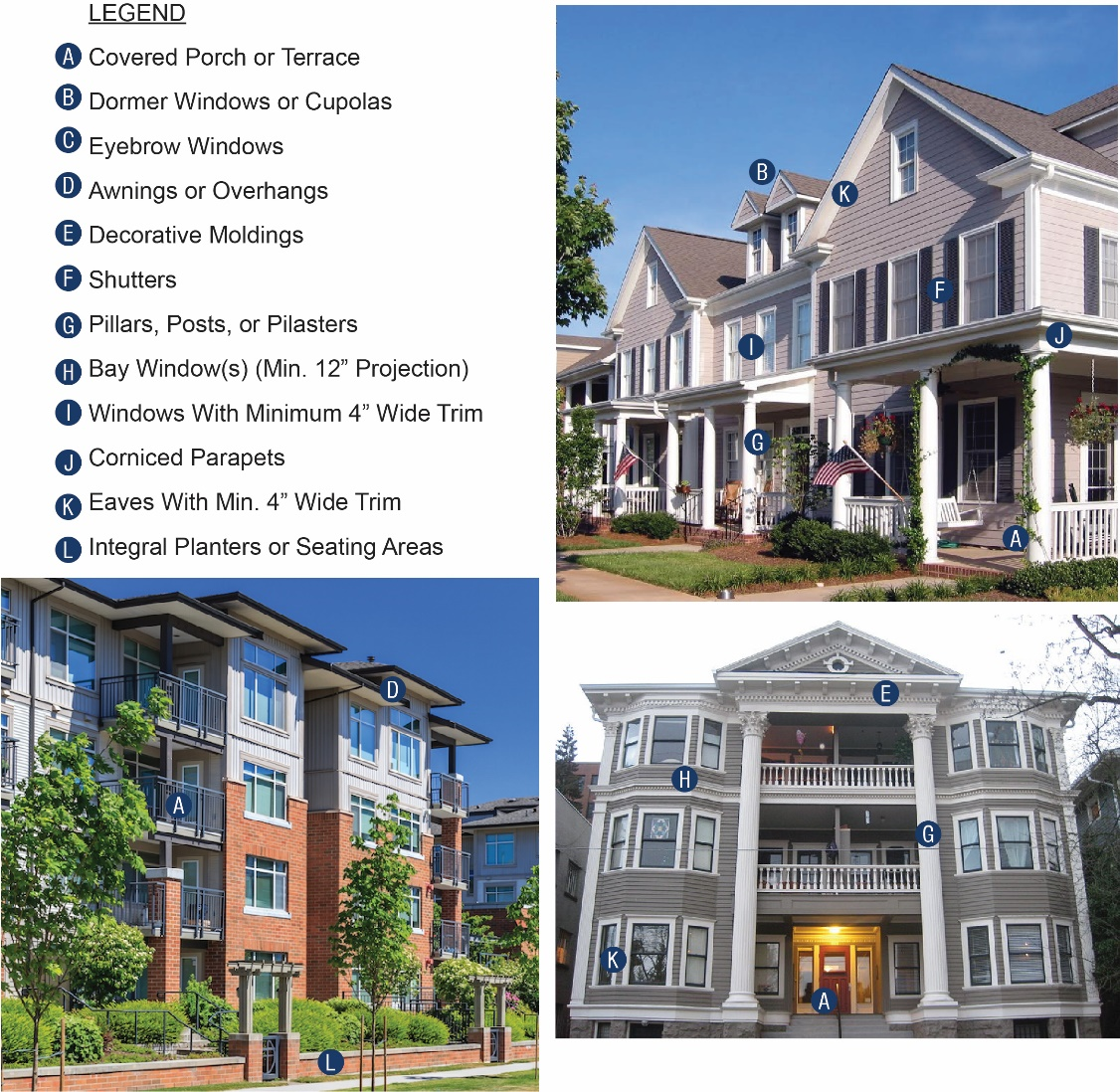
(3)
Building massing.
a.
Upper story façade walls shall not project beyond the ground floor footprint except to accommodate bump-outs with windows.
b.
In the case of two-story buildings, the exterior façade walls of the second floor shall be in line with or setback from the first floor façade walls (see Figure 16 Multi-Family Building Massing).
FIGURE 16: MULTI-FAMILY BUILDING MASSING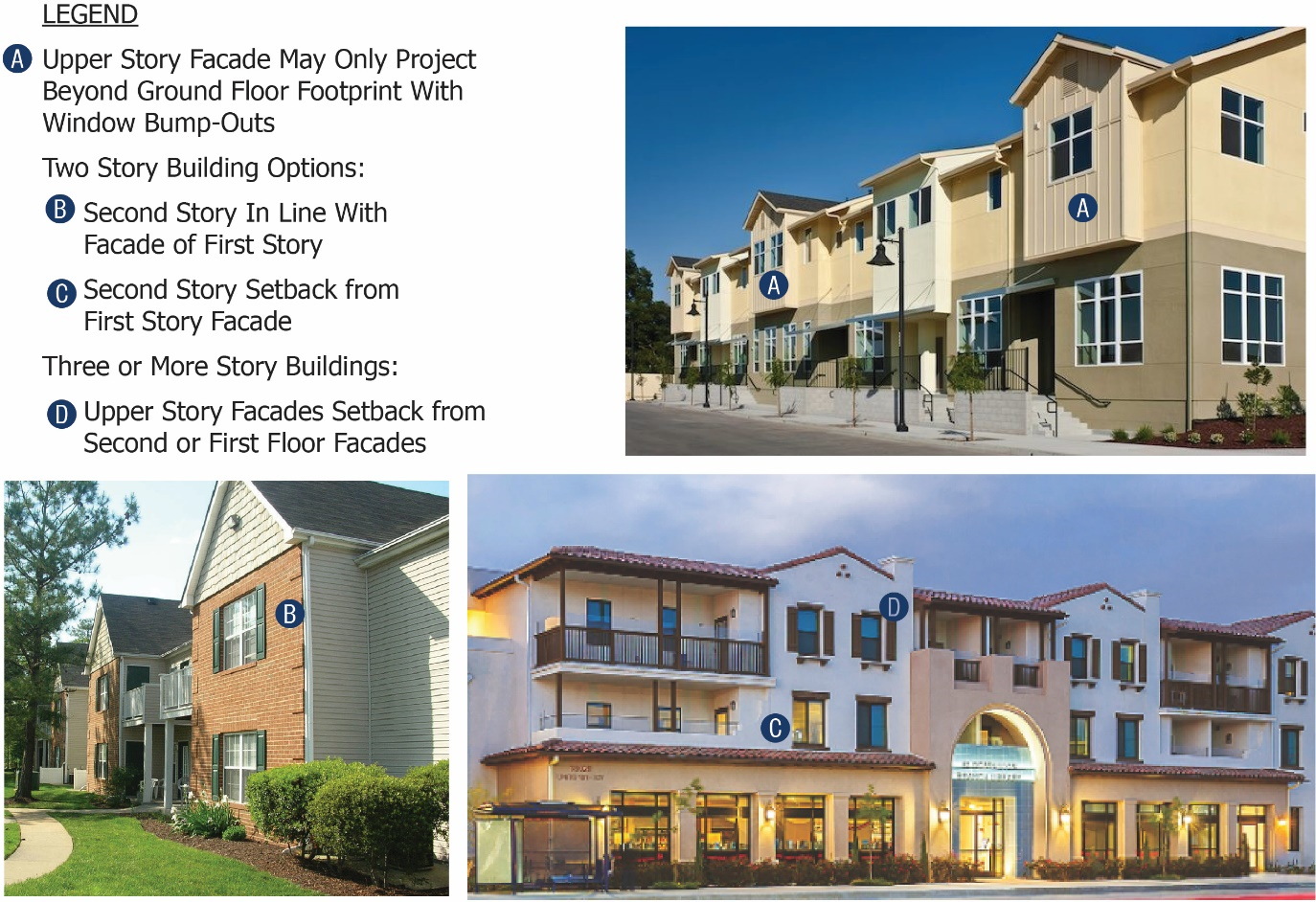
(4)
Building articulation.
a.
Street-facing building façades shall be articulated with wall offsets, in the form of recesses or projections from the primary façade plane, of at least two feet for every 35 linear feet of façade frontage (see Figure 17 Multi-family Façade Articulation).
b.
Where provided, projections or recesses shall extend from the grade to the top of the highest story in line with the ground-floor footprint.
FIGURE 17: MULTI-FAMILY FAÇADE ARTICULATION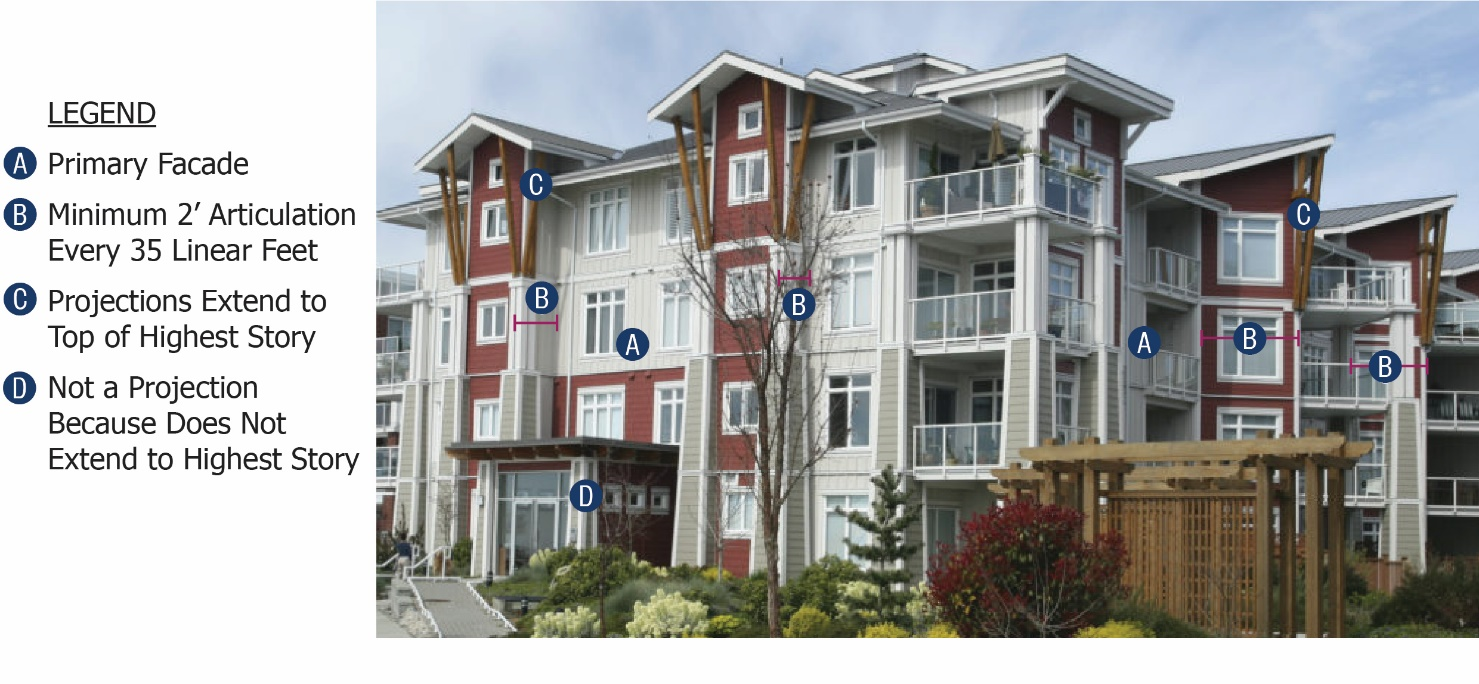
(5)
Building height.
a.
Buildings subject to the standards of this section shall have a maximum height of two stories or 18 feet within 100 feet of a lot with an existing single-family detached residential dwelling, without an intervening street (see Figure 18 Multi-family Building Height).
b.
Building stories that are 75 percent or more below the finished grade at the front of the lot shall not be counted towards the number of allowable stories.
FIGURE 18: MULTI-FAMILY BUILDING HEIGHT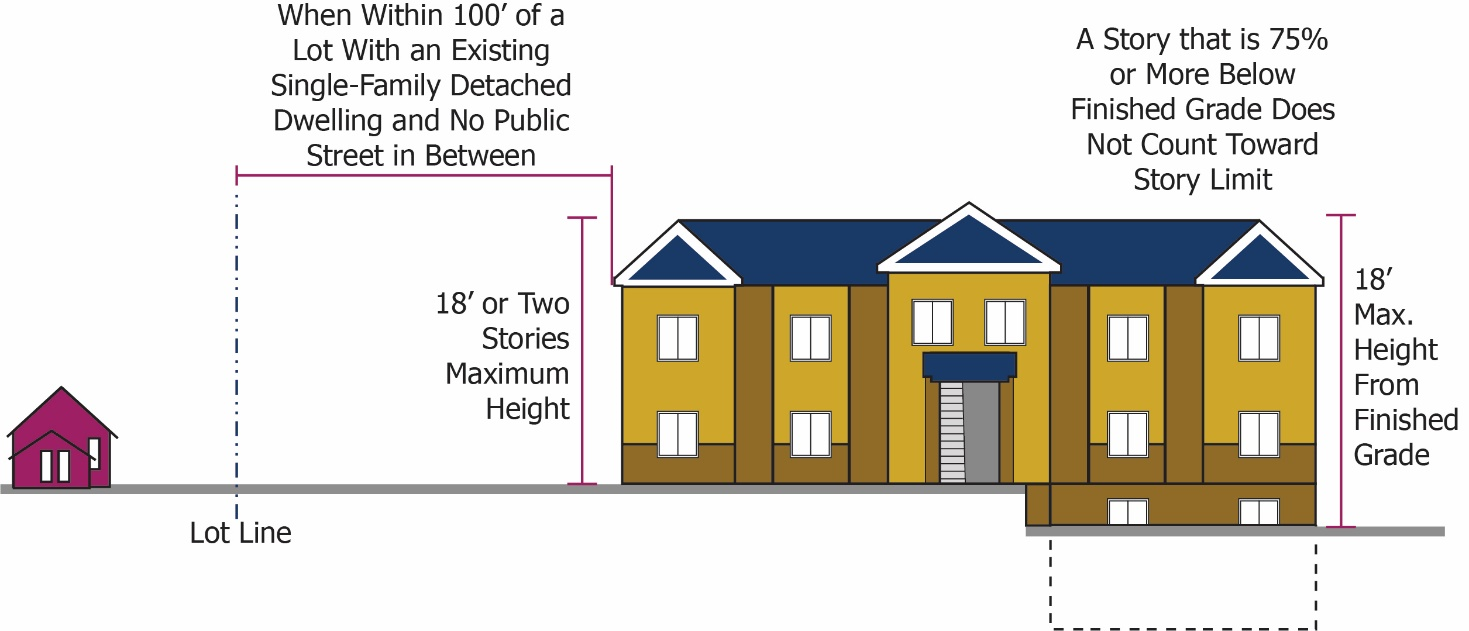
(6)
Roof form.
a.
Development shall incorporate roof pitches between 3:12 and 12:12 or shall incorporate parapet walls with a dimensional cornice around a flat roof.
b.
Alternative roof forms or pitches are encouraged for small roof sections over porches, entryways, or similar features.
c.
Buildings with eaves shall be configured such that no single horizontal eave continues for more than 60 linear feet without being broken up by a gable, building projection, and articulation feature.
d.
Buildings with overhanging eaves and roof rakes shall extend at least six inches past supporting walls.
(7)
Building materials and colors.
a.
Configuration.
1.
Buildings subject to these standards shall include at least two primary exterior materials on any single building.
2.
Changes in colors and materials shall take place at internal corners or in logical locations, such as: building wings, bays, bump-outs, or recesses (see Figure 19 Multi-family Building Materials). In no instance shall exterior materials or colors change at outside corners.
3.
Heavier or more bulky exterior materials shall be located beneath or below lighter materials.
b.
Prohibited materials. The following materials shall be prohibited on any façade facing a street, open space, or district intended primarily for single-family detached development:
1.
Smooth-faced concrete block;
2.
Corrugated metal siding; or
3.
Synthetic stucco within two feet of the grade.
FIGURE 19: MULTI-FAMILY BUILDING MATERIALS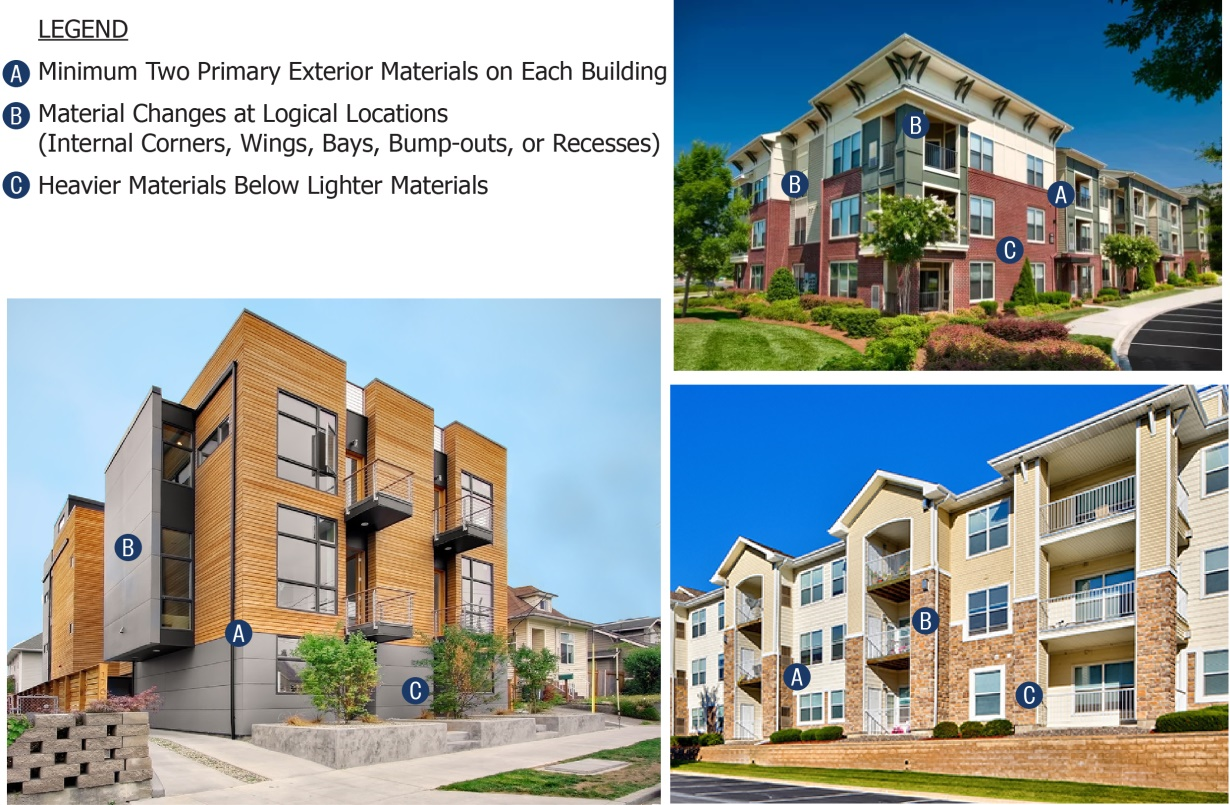
(Ord. No. AL2021-06-1, § 1, 6-7-2021)
Sec. 30-6203 - Site design standard.
(a)
Intent. It is the intent of this Article to provide performance standards to ensure that development within the Town planning jurisdiction will be designed, arranged, and constructed in a safe, orderly, and visually harmonious manner, and will reflect the basic character of the development site and its immediate surroundings as well as the nature of the proposed uses of the site.
(b)
Applicability. Except where otherwise specifically provided in this Article, no land or structure shall be used or occupied, and no grading excavation, removal of soil, clearing a site or placing fill shall take place on land contemplated for development, and no structure, or part of a structure, shall be constructed, erected, altered, renovated or moved except in compliance with the standards specified in this Article and as shown on a sketch or site plan approved by the Town.
(c)
General site arrangement and criteria.
(1)
Developments shall be arranged so as to be visually harmonious both within the development site and in relation to adjacent developments. Site design elements of the development shall be integrated to the degree of their compatibility with each other and shall be separated to the degree of their incompatibility.
(2)
All site plans shall demonstrate a high quality of overall site design and in the design and construction of site elements, including appropriate consideration of the relationship and balance among site elements, the relationship of the development to natural features, neighboring developments, and access and circulation systems, retention of natural vegetation, minimal alteration of natural topography, mitigation of erosion and sedimentation, mitigation of stormwater drainage and flooding, arrangements and orientation of buildings and amenities in relation to each other and to neighboring streets, landscaping, preservation or enhancement of vistas, and mitigation of traffic impacts. Structures shall be placed and arranged so as not to adversely affect adjacent property. Adverse effects shall include, but are not limited to, the removal of lateral support, the creation of hazard, nuisance, danger or inconvenience, unreasonable loss of light and air, or unreasonable loss of privacy or views. Where standards contradict, the stricter standard shall apply.
(d)
Site design. All site designs shall address design elements that include landscape preservation, location of buildings, drives, parking and circulation, pedestrian and bicycles facilities, and site drainage within the physical constraints of a particular site. The site design shall adequately address the following key site design objectives:
(1)
Preserves natural land contours and natural drainage-ways, whenever possible;
(2)
Is compatible with the positive character of the surrounding area in terms of both existing character and desired future character;
(3)
Where possible, incorporates significant tree masses and/or specimen trees as an integral design factor;
(4)
Minimizes harm and disruption to existing plant and animal life;
(5)
Sets aside areas whose physical conditions make them unsuitable for development as conservation areas or as open space; and
(6)
Utilize the adopted Town's bicycle and pedestrian plan and the North Carolina Department of Transportation Complete Streets Policy (latest edition).
Reference: https://www.ncdot.gov/divisions/bike-ped/Documents/2019-08-28-complete-streets-policy.pdf
(7)
Follow the Town's adopted plans, including, but not limited to, the comprehensive plan.
(Ord. No. AL2021-06-1, § 1, 6-7-2021)
Sec. 30-6301 - Outdoor lighting standards.
(a)
In developments contemplating the use of outdoor lighting to ensure the security of property and the safety of persons using such development, streets, sidewalks and facilities, all principal entrances to the development, and internal areas as appropriate, should be sufficiently lighted to ensure the safety of residents and the security of the building.
(b)
All streets within a major subdivision, multi-family development, multi-building commercial development, or manufactured home park shall incorporate a street lighting system to ensure the security of property and the safety of persons using such development, streets, driveways, and facilities.
(c)
Down lighting shall be provided where possible. Overflow lighting shall be prohibited, and all light pollution shall be minimized to the maximum extent practical.
(d)
All development shall incorporate street lighting and signs per the standards of, § 30-6302, Street lights, which are adopted by reference as if incorporated fully herein to ensure the security of property and the safety of persons using such development, streets, driveways and facilities.
(Ord. No. AL2021-06-1, § 1, 6-7-2021)
Sec. 30-6302 - Street lights.
(a)
Street lighting service levels.
(1)
It is the Town's objective to provide street lighting in accordance with the Illumination Engineering Society (IES) standards for various classes of streets. These nationally recognized standards acknowledge such key variables as use of streets, prevalence of entering and exiting right-of-way, parking and existing physical conditions on or near the streets. Standards relate to amount of light, noted in terms of foot-candles, and uniformity of light, stated as a ratio of average to minimum foot-candles along a given distance. These standards result in service levels that increase according to use. Higher levels of lighting correspond to higher usage by motorists and/or pedestrians.
(2)
Allowances are made for differences in the intensity of use and safety needs. Selective reduction of service levels for certain classes of streets, primarily those classed as residential, is necessary because of high costs involved with conversion to full IES standards.
(b)
Street classifications. IES's "Illumination Guide" groups streets into different classes-expressway, commercial, intermediate and residential. These area classes are further subdivided into major, collector and local categories with standards established for each. These categories correspond to Archer Lodge street classifications with the IES "major" category corresponding to our "arterial" classification.
(c)
Street lighting guidelines. Provision of lighting along streets in Town enhances the safe movement of motorists, pedestrians and other users of public right-of-way. The Town's street light system is designed to support the following guidelines:
(1)
IES standards should be used town-wide as the basis for establishment of lighting levels for new lighting installation along non-residential streets. These streets should be lighted to 100 percent of IES standards. Residential streets should be lighted at 220-foot intervals, with amendments as needed to consider local conditions such as topography, traffic volumes, number of intersections, crime rates and other factors. Town streets are being classified based on operational definitions of lighting by IES and consistent with street classifications as referenced in this section. Conversion to IES standards for existing non-residential streets and to spacing at 220-foot intervals for residential streets town-wide will be phased over several years. Priority for implementation will be based on use, with commercial, intermediate and residential area classes being converted in that order.
(2)
High-pressure sodium luminaries should be installed on all streets, with lamps suggested by IES according to classification. The Town standard for residential street lighting is a typical 9,500 lumen economical traditional luminaries, mounted on a 12-foot fiberglass pole or a 9,500-lumen cut-off cobra luminary, mounted on a 25-foot wood pole. Exceptions to this standard may be approved by the Town Planner when a duly authorized officer of a neighborhood group requests another configuration of hardware, provided any additional hardware costs are paid by the developer or representative prior to installation of the lights; and provided the alternative configuration results in the same operational costs to the Town as the Town standard fixtures.
(3)
Underground wiring should be provided for all new fixture installations.
(4)
The Town Planner will determine the circumstances in which implementation guidelines may be waived. Examples include, but are not limited to: adjustments for areas with particularly high incidence of crime; significant public demand for additional services; and physical conditions associated with conversion of existing lighting. If there are permanent overhead utility lines, the Town Planner may waive the requirement for underground lines for new lights.
(d)
Street lighting standards. The following standards and specifications are to assist developers in the placement and selection of street lights for use on streets classified as residential only. For information on lighting for streets with higher classifications, contact the Town Planner. Where appropriate, a street lighting plan should be prepared as a part of a development application for approval by the Town Planner.
(1)
Placement.
a.
Street lights should be located an average of 220 feet apart. A minimum of one street light should be located at every intersection and at the end of every cul-de-sac.
b.
Where possible any street light not located at an intersection should be located on a property line.
c.
On streets with a width of 44 feet or greater (back of curb to back of curb), street lights should be staggered on either side of the street.
d.
On streets with a lesser width, street lights should be located on the side with a sidewalk if only one sidewalk exists. They should be staggered if sidewalks do not exist or if there are sidewalks on both sides of the street.
e.
Street lights should be located within the road right-of-way a minimum of three feet from the back of curb or edge of road pavement.
f.
Street lights should be located a minimum of three feet from the edge of any paved sidewalk.
(2)
Fixture selection.
a.
The Town's standard residential lighting fixture is the 9,500 lumen "economical traditional" luminaire provided by Duke Energy Progress Company. The luminaire should be mounted on a 12 feet black fiberglass pole.
b.
A 9,500-lumen cut-off lens cobra fixture can also be used when mounted on a 25 feet wooden pole.
c.
Other ornamental fixtures may be selected if they provide a comparable lighting level and are approved by the Town. If there are any additional costs for installation and maintenance, the developer will pay "up front" such costs.
(Ord. No. AL2021-06-1, § 1, 6-7-2021)
Sec. 30-6303 - Outdoor lighting.
All non-residential, mixed-use, manufactured home parks, and multi-family development shall be designed to provide safe, convenient, and efficient lighting for pedestrians and vehicles. Lighting shall be designed in a consistent and coordinated manner for the entire site. The lighting and lighting fixtures shall be integrated and designed to enhance the visual impact of the project on the community and, where practicable, should be designed to blend into the surrounding landscape. Lighting design and installation shall ensure that lighting accomplishes onsite lighting needs without intrusion on adjoining properties.
(a)
Lighting plan. A site lighting plan shall be required as part of the application and site plan review for all non-residential, mixed-use, and multi-family developments exceeding four dwelling units.
(b)
Site lighting design requirements. Lighting shall be used to provide safety while accenting key architectural elements and to emphasize landscape features. Light fixtures shall be designed as an integral design element that complements the design of the project. This can be accomplished through style, material, or color. All lighting fixtures designed or placed to illuminate any portion of a site shall meet the following requirements:
(1)
Fixture (luminaire). The light source shall be completely concealed behind an opaque surface and recessed within an opaque housing and shall not be visible from any street right-of-way or adjoining land. Overhead lighting fixtures shall be designed to prevent light from emitting upwards toward the sky. Under-canopy lighting fixtures should be completely recessed within the canopy.
(2)
Fixture height. Lighting fixtures shall be a maximum of 30 feet in height within the parking lot and shall be a maximum of 15 feet in height within non-vehicular pedestrian areas. Pedestrian scale lighting at a height not exceeding 12 feet is encouraged. All light fixtures located within 50 feet of any adjacent residential use or residentially zoned property boundary shall not exceed 15 feet in height.
(3)
Light source (lamp). Incandescent, florescent, metal halide, or color corrected high-pressure sodium are preferred. The Town Planner shall have the authority to approve other lamp types (including light emitting diodes [LEDS] and fiber optics) provided the color emitted is similar to the preferred types. Non-color corrected high pressure sodium lamps are prohibited. The same light source type must be used for the same or similar types of lighting on any one site throughout any development.
(4)
Mounting. Fixtures shall be mounted in such a manner that the cone of light is contained onsite and does not cross any lot line of the site.
(5)
Limit lighting to periods of activity. Where practicable, the use of sensor technologies, timers, or other means to activate lighting during times when it will be needed may be required by the Town Planner to conserve energy, provide safety, and promote compatibility between different land uses.
(c)
Illumination levels. All site lighting shall be designed so that the level of illumination as measured in footcandles (fc) at any one point meets the standards in the table below, with minimum and maximum levels measured on the pavement within the lighted area and average level (the overall generalized ambient light level) measured as a not-to-exceed value calculated using only the area of the site intended to receive illumination.
(d)
Excessive illumination. Lighting within any lot that unnecessarily illuminates and substantially interferes with the use or enjoyment of any other property is prohibited. Lighting unnecessarily illuminates another lot if it exceeds the requirements of this subsection.
(1)
Lighting shall not be oriented to direct glare or excessive illumination onto streets in a manner that may distract or interfere with the vision of drivers on such streets.
(2)
Fixtures used to accent landscaping or art shall be located, aimed, or shielded to minimize light spill into the night sky.
(3)
Blinking or flashing lights shall be prohibited unless the lights are required as a safety feature.
(e)
Illuminated tubing. Any exterior illuminated tubing or strings of lights, including, but not limited to, those outlining property lines, building, structures, open sales areas, rooflines, doors, window, or the edges of walls except holiday lights are prohibited.
(f)
Nonconforming lighting. Lighting fixtures existing as of the date of adoption of the ordinance from which this section is derived, may remain, and shall be considered lawful nonconforming structures. Modifications, replacement, or expansions shall conform to the standards of this section.
(Ord. No. AL2021-06-1, § 1, 6-7-2021)
Sec. 30-6401 - Purpose and intent.
These standards provide development standards for permanent fences and privacy walls on individual lots or development sites. These standards are proposed to protect the health and safety of the public while balancing the practical uses for fencing and walls like security and privacy with the need for aesthetic quality and a high-quality built environment. More specifically, these standards are intended to:
(a)
Provide for privacy and security on individual lots;
(b)
Ensure proper construction techniques are followed and that fences and walls are maintained in good repair;
(c)
Assist with the transition between public and private spaces; and
(d)
Ensure fencing and walls are consistent with the Town's requirements.
(Ord. No. AL2021-06-1, § 1, 6-7-2021)
Sec. 30-6402 - Applicability.
(a)
Generally. The provisions of this section shall apply to all construction or replacement of all fences, screening walls, or retaining walls. A fence or wall may only be erected in accordance with the standards in this section.
(b)
Pre-existing development. Lawfully-established fences and walls established prior to June 7, 2021, that do not comply with these standards shall be subject to the applicable standards in Article 8: Nonconformities.
(Ord. No. AL2021-06-1, § 1, 6-7-2021)
Sec. 30-6403 - Exemptions.
The following are exempted from the standards in this section:
(a)
Bona fide farms and agricultural use types on lots subject to present-use value taxation;
(b)
Fences under two feet in height; and
(c)
Temporary fences for construction sites, including but not limited to: fencing necessary for soil erosion and sedimentation control and tree protection.
(Ord. No. AL2021-06-1, § 1, 6-7-2021)
Sec. 30-6404 - Locational standards.
(a)
General. No fence or wall shall:
(1)
Be located within the public right-of-way (except for public fences or walls, or as needed for retention of soil);
(2)
Impede visibility of the required property address number; or
(3)
Block pedestrian access from doors or windows.
(b)
Easements.
(1)
In cases where a fence or wall is proposed within an easement, the applicant shall provide evidence of the easement owner's consent regarding placement of the fence or wall.
(2)
The landowner shall remain solely liable for any repair or replacement if any portion of the fence or wall located within a required easement is damaged during maintenance or construction activities within the easement by the easement owner or their agent.
(c)
Block drainage. Fences or walls shall not alter or impede the natural flow of water in any stream, creek, drainage swale, or ditch.
(d)
Obstructions at intersections. Except for necessary retaining walls, no fence or wall shall be located within a required sight distance triangle.
(e)
Required setbacks. Fences or walls may be located within required setbacks, but shall not encroach onto a separate lot.
(f)
Required landscaping areas. Fences or walls may be located in required landscaping areas provided the screening function of the landscaping area is maintained.
(Ord. No. AL2021-06-1, § 1, 6-7-2021)
Sec. 30-6405 - Maximum height.
(a)
Residential zoning districts.
(1)
Fences and walls not over four feet high may project into or may enclose any front yard.
(2)
Side and rear yards may be enclosed by fences or walls up to six feet in height.
(3)
In cases where a fence or wall is outside a required setback or required landscaping area, it may exceed the maximum height in this section but in no case shall it exceed the height of the principal building on the lot.
(b)
Non-residential and agricultural districts. A solid or open fence or wall may be erected to a maximum height of ten feet within in any setback area.
(Ord. No. AL2021-06-1, § 1, 6-7-2021)
Sec. 30-6406 - Wind loading.
All fencing and walls subject to the standards of this section shall be constructed in accordance with the North Carolina State Building Code, and shall be designed and constructed in order to meet the minimum applicable wind loading standards for Archer Lodge as identified in the State Building Code or other supporting documents.
(Ord. No. AL2021-06-1, § 1, 6-7-2021)
Sec. 30-6407 - Materials.
(a)
Fences and walls shall be designed, constructed, and maintained to ensure a minimum useful life of at least ten years.
(b)
The following materials shall be prohibited for use as a part of a fence or wall: wooden pallets, tires, debris, junk, rolled plastic, sheet metal, untreated or unpainted plywood, readily flammable material, or waste materials shall be prohibited, unless the materials have been recycled and reprocessed, for marketing to the general public as building materials designed to resemble new building materials (e.g., picket fencing made from recycled plastic and fiber).
(c)
In no instance shall tarps or silt fencing remain on a lot or site after completion of construction.
(Ord. No. AL2021-06-1, § 1, 6-7-2021)
Sec. 30-6408 - Maintenance.
(a)
Any fence or wall which, through neglect, lack of repair, type or manner of construction, method of placement or otherwise, constitutes a hazard or endangers any person, animal, or property is in violation of this Article.
(b)
When a fence or wall is in violation of this Article, the Town Planner shall require the owner or occupant of the property upon which the fence or wall is located to repair, replace, or demolish the fence or wall in accordance with all applicable standards in this Article.
(Ord. No. AL2021-06-1, § 1, 6-7-2021)
Sec. 30-6501 - Landscaping.
(a)
Purpose and intent. The purpose of these provisions is to establish minimum requirements for the provision and maintenance of functionally adequate, attractive screening and buffering of buildings, site features, and off-street parking areas. These standards are intended to:
(1)
Promote and increase design compatibility between different land uses, while ensuring attractive views from streets and adjacent properties;
(2)
Assist in delineating separations of spaces, structures, uses, and activities on a site, or between adjacent sites; and
(3)
Shield adjacent properties from potentially adverse external impacts of adjacent land uses and activities.
(b)
Applicability. The standards in this section apply to the following forms of development:
(1)
New principal buildings or uses. New principal buildings or open uses of land, including publicly-owned buildings or sites, constructed, reconstructed, or established after the effective date of these standards.
(2)
Improvements and expansions. Improvements and expansions of principal buildings, parking areas, or open uses of land by 20 percent or more shall require the development to fully comply with these standards prior to occupancy.
(3)
Multi-phase development. Multi-family, non-residential, and mixed-use development that is planned and developed in phases shall be required to install landscaping that is associated with the active phase or phases only, unless an alternative arrangement is otherwise agreed to by the Town Planner. An active phase of a development is the one that is subject to permitted and on-going development activity.
(c)
Exemptions. The following forms of development are exempted from these standards.
(1)
Changes to an existing or development of a new proposed single-family detached or duplex dwelling on a residentially-zoned lot.
(2)
Routine maintenance of existing vegetation, such as watering and fertilizing.
(3)
The removal of dead trees and shrubs, or trees and shrubs that have been diagnosed and determined to be diseased beyond treatment, provided the screening function of the landscaping is maintained or re-established. Failure to maintain the screening function of a required landscaping area is a violation of this Article.
(4)
Pruning of vegetation, provided the screening function of the required landscaping is maintained. Severe pruning is a violation of this Article and shall require replacement of required vegetation.
(5)
Repaving or restriping of a parking lot provided there is no increase in parking lot size or the number of parking spaces.
(d)
Timing of review. Development subject to these standards shall be reviewed for compliance at the time of site plan, or special use permit, application review, as appropriate. In cases where a development application is considered by more than one review authority, the decision regarding compliance with these standards shall be made by the review authority making the final decision on the application under review.
(e)
Landscape plan required.
(1)
Generally.
a.
A landscape plan depicting how required landscaping will be planted in accordance with these standards shall be included with an application for site plan, preliminary plat, or zoning compliance, as appropriate, to ensure compliance with this section.
b.
The landscape plan shall be approved prior to, or concurrent with, the approval of a site plan, preliminary plat, or the issuance of a zoning compliance permit.
c.
A landscape plan shall contain, at a minimum, the following:
1.
Location of required planting material;
2.
Grouping or clusters of planting material, if proposed;
3.
Identification of required plants, including their scientific names;
4.
Minimum and maximum dimensions of all planting yard areas;
5.
Calculations determining the number of canopy trees, understory trees, and shrubs required;
6.
Locations, species, sizes, and methods of protection during construction for existing vegetation to be retained and counted towards minimum landscaping requirements; and
7.
Existing topography, or proposed topography where site grading is proposed to occur.
(2)
Phased development. Development subject to these standards that is planned in phases may submit a landscape plan for the entire development, or separate landscape plans for each phase, which shall be approved prior to approval of the final plat.
(3)
Landscaping in a stormwater retention or detention pond. If trees or shrubs are proposed on or within 20 feet of the embankment of a stormwater retention or detention pond, a landscape plan showing the retention or detention pond and surrounding landscaping must be submitted for review to determine that the safety and functionality of the device will not be compromised by the trees or shrubs.
(f)
Plant material specifications.
(1)
Canopy tree size.
a.
Canopy trees shall have a minimum height at maturity of 40 feet and a minimum crown width of 30 feet (see Figure 20 Plant Material Specifications).
b.
All canopy trees shall have a minimum height of eight feet, or more, and a minimum caliper size of two inches, or more, at planting.
c.
Evergreen trees shall be a minimum of six feet in height at planting.
(2)
Understory tree size.
a.
Understory trees shall have a minimum height at maturity of 15 to 40 feet, except that trees to be placed below overhead utility lines may not exceed a mature height of 20 feet (see Figure 20 Plant Material Specifications).
b.
All understory trees shall have a minimum height of four feet, or more, and a minimum caliper size of one and one-half inches, or more, at planting.
c.
Nothing shall limit the use of multi-stemmed understory trees provided that 25 percent or more of the leaders meet these requirements.
(3)
Shrub size.
a.
All shrubs shall be at least a three-gallon size and have a minimum height or spread of 18 inches at the time of planting (see Figure 20 Plant Material Specifications).
b.
Shrubs shall reach a minimum height of 36 inches and a spread of 30 inches within three years of planting.
c.
Decorative grasses may be proposed as a substitute for shrubs, provided the grasses meet the height and spread requirements and are approved by the Town Planner.
FIGURE 20: PLANT MATERIAL SPECIFICATIONS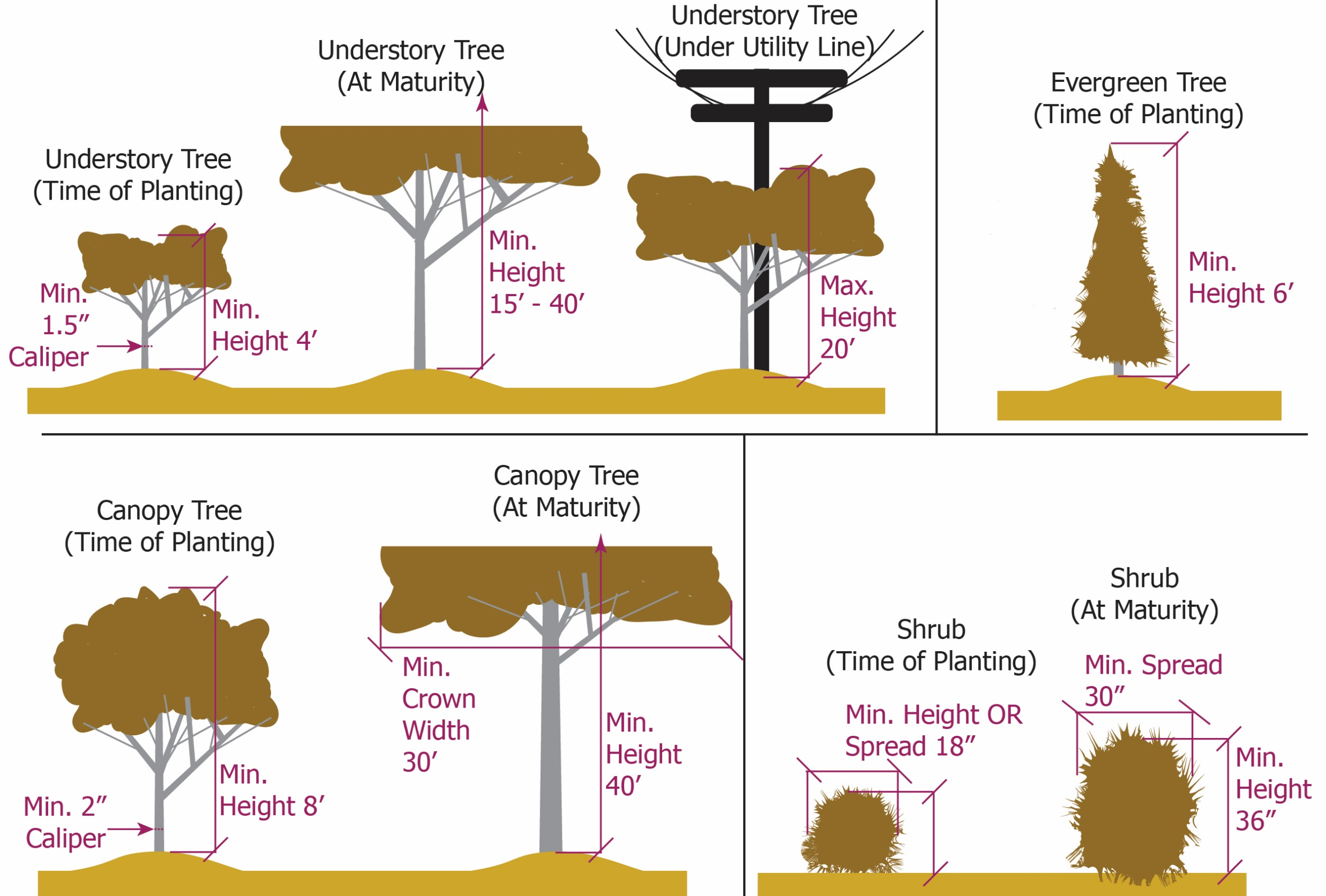
(4)
Species.
a.
Plant materials shall be selected in accordance with the Archer Lodge Plant List (See Article 11, Division 2 Recommended Plant List).
b.
Required landscaping materials shall be cold-hardy for the location where planted.
c.
Plant species used in required landscaping areas must be native species or species of a locally-adapted nature. Other species require approval by the Town Planner.
(5)
Stabilization.
a.
Required landscaping areas shall be stabilized and maintained with vegetative cover, mulch, decorative gravel, cinders, or other approved materials to prevent soil erosion and allow rainwater infiltration.
b.
Required landscaping areas with slopes of 15 percent or more shall be stabilized with vegetative cover (not mulch or gravel) designed to minimize erosion. Required vegetative cover shall be established and functional prior to issuance of a certificate of occupancy.
c.
Use of landscape fabric on slopes of 15 percent or more is discouraged.
(g)
Landscaping placement.
(1)
Outside public street rights-of-way. Required landscaping material shall not be located within a street right-of-way.
(2)
Grouping of plant material.
a.
Except for street trees, vegetation within a Type A perimeter buffer, shrubs around a parking lot, or when vegetation is included as a screening device, required plant material may generally be grouped or clustered, however, the overall screening intent must be adequately addressed.
b.
Required plant material in a Type A perimeter buffer may not be grouped and shall be planted according to the required on-center spacing in the table of perimeter buffer configuration.
c.
Shrubs intended to screen features like refuse collection areas or mechanical equipment may not be grouped if such grouping results in the failure to meet the minimum screening standards of this Article.
(3)
Multiple-lot development. A multiple-lot development is not required to provide perimeter buffers along lot lines internal to the development, but the perimeter of the development shall be subject to the standards in § 30-6501(K), Perimeter buffers.
(4)
Easements.
a.
Trees and shrubs may be located within a required easement on a case-by-case basis with the permission of the easement holder.
b.
When landscaping is within an easement, the landowner is responsible for replacement of any required vegetation if maintenance or other actions result in its removal.
c.
When landscaping is planted in a drainage easement, it shall not impact the easement design or impede the flow of water through the easement.
d.
Where an easement and a required landscape area coincide and there is a prohibition on planting within the easement, then the required landscaping area shall be located outside the easement.
(5)
Setback smaller than required landscaping area. In cases where a required setback is smaller or narrower than a required landscaping area, the landscaping area width or size shall not be reduced.
(6)
Fire protection system. Minimum clear separation distances required by the current adopted version of the North Carolina Fire Code and any Fire Code appendices adopted by Johnston County shall be maintained for landscaping near a fire protection system.
(7)
Permitted encroachments.
a.
The following features may be located entirely within required landscaping areas, provided the screening function of the landscaping is maintained:
1.
Principal buildings, provided the minimum setbacks of the zoning district where located are maintained;
2.
Fences and walls;
3.
Berms with a maximum height of 12 feet or less;
4.
Landscaping features such as, ornamental pools, planting boxes, sculpture, arbors, trellises, and birdbaths;
5.
Pet shelters, well houses, and mechanical enclosures;
6.
On-grade patios, steps, benches, outdoor fireplaces, playground equipment serving an individual dwelling unit, accessibility ramps, roof overhangs, and fire escapes;
7.
Ornamental entry columns, gates, fences, walls, and retaining walls;
8.
Flagpoles of 30 feet in height or less;
9.
Lamp and address posts;
10.
Utility cabinets of four feet in height or less;
11.
Mailboxes; and
12.
Signage.
b.
The following features may cross a required landscaping area in a manner that minimizes the impact to the required landscaping:
1.
Driveways, sidewalks, pedestrian walkways, greenways, or multi-use trails;
2.
Utilities; and
3.
Stormwater management facilities.
(8)
Prohibited features. The following features shall not be located within a required landscaping area:
a.
An accessory structure or open air use;
b.
Off-street parking or loading areas; or
c.
Outdoor storage or display of products for sale.
(h)
Time of installation.
(1)
A certificate of occupancy shall not be issued, until all required plant materials have been placed in accordance with the approved site plan and requirements of this section.
(2)
In cases where a certificate of occupancy is requested but all required plant materials have not yet been installed or approved by the Town due to limitations of the planting season or commercial unavailability of acceptable plant species, the applicant shall furnish the following:
a.
A signed contract for the installation of all required landscape materials specifying the types of plant materials yet to be installed and the anticipated date of installation; and
b.
A performance guarantee for the amount of the contract configured in accordance with the applicable requirements of this Article.
(i)
Maintenance and replacement.
(1)
Responsibility.
a.
The responsibility for maintenance of required landscaping areas shall remain with the owner of the property, their successors, heirs, or assignees.
b.
Maintenance is required in order to ensure the proper functioning of the plantings as a landscaped area which reduces or eliminates nuisance and/or conflict.
c.
Damaging or failing to adequately maintain required landscaping material is a violation of this Article.
(2)
Maintenance.
a.
All plantings shall be maintained in an attractive and healthy condition. Maintenance shall include, but not be limited to: watering, mulching, fertilizing, pest management, mowing, weeding, removal of litter and dead plant material, and necessary pruning and trimming.
b.
Necessary pruning and trimming shall be accomplished in accordance with the Tree Care Industry Association (TCIA) Standards for the Professional Arborist, and shall not include:
1.
The topping of trees;
2.
Removal of 30 percent or more of the crown material in one calendar year; or
3.
Any other similarly severe procedures that may cause irreparable harm to the natural form of the tree.
c.
Dead or diseased plantings shall be removed. Unless specifically exempted (such as understory trees shaded by canopy trees), replacement plantings shall be provided for any dead, diseased, or removed vegetation when such replacement plantings are necessary to meet the standards or this Article or maintain the screening objective of the landscaping material.
1.
Landscape structural features such as walls, fences, berms, or water features shall be maintained in a structurally safe and attractive condition.
2.
Where other uses, including pedestrian and bicycle accessways, are allowed within a required landscaping area, these uses shall be maintained to provide for their safe use.
(3)
Excessive pruning or trimming prohibited. Pruning or trimming exceeding the TCIA standards or activities exceeding necessary pruning or trimming identified in this subsection shall be a violation of this Article and shall require replacement of damaged vegetation.
(4)
Replacement required.
a.
Any disturbed landscaping areas, areas of preserved existing vegetation, or required plant material shall be replaced in accordance with the approved development application and these standards.
b.
Trees or vegetation that die within one year of construction completion shall be removed and replaced with new vegetation of equal or greater size.
c.
Replacement trees and/or shrubs shall be planted within 180 days of removal of required vegetation.
(5)
Revegetation plan required. In cases where required landscaping or existing vegetation required to be preserved is damaged, disturbed, or removed, a revegetation plan shall be submitted for review and approval by the Town Planner, in accordance with the following standards:
a.
Any tree with a caliper of at least eight inches that is damaged or removed shall be replaced with one or more trees that have a caliper of at least two and one-half inches and a cumulative caliper equal to or greater than the original tree.
b.
Trees damaged or destroyed less than eight inches in diameter shall be replaced to satisfy the performance criteria of this section.
c.
Shrubs may also be required to restore the landscaping performance criteria for the disturbed area.
(6)
Location of replacement trees and vegetation.
a.
Replanting shall be located within the vicinity of the violation.
b.
If the area is too small for sufficient growth, a more suitable location on the site may be selected, as permitted by the Town Planner.
(j)
Parking lot landscaping. All parking lots serving multi-family, mixed-use, and non-residential developments shall comply with the following parking lot landscaping standards.
(1)
Interior plantings.
a.
Area to be landscaped. For the purposes of this section, the interior of a parking lot shall be all of the area within the outer boundary of the parking lot including interior and corner landscape islands intended to fulfill the interior parking lot landscaping requirements, but not including landscaping planted around the perimeter of the parking lot (see Figure 8 Parking Lot Landscaping).
b.
Landscaping islands and strips. A parking aisle with more than 12 vehicle spaces in a single row shall provide and maintain landscaping islands at each end or provide landscaping strips along the full length of the row, in accordance with the following standards.
1.
Islands shall have a minimum dimension of nine feet and a minimum area of 162 square feet, including the curb (if curbing is provided).
2.
Landscape islands that do not contain canopy trees shall contain three or more shrubs and also may contain understory trees.
3.
Landscaping islands intended for the placement of canopy or understory trees shall maintain a minimum width of nine feet.
4.
Landscape strips between adjoining rows of parking spaces or serving as driveway medians shall have a minimum dimension of nine feet, including the curb (if provided). Landscape strips that do not have canopy trees shall include shrubs planted no more than five feet on-center.
5.
Landscaping strips running the full length of a row of parking spaces shall be provided so that no more than six rows of parking spaces are provided without a landscaping strip.
c.
Separation of light poles and trees. In order to prevent the need to excessively trim required trees within landscape areas and to maintain the effectiveness of parking area exterior lighting, light poles shall be spaced at least ten linear feet from a canopy tree trunk, to the maximum extent practicable.
d.
Protection of landscape islands.
1.
Landscape islands shall be protected from vehicle damage by the installation of curbing, wheel stops, or other comparable methods.
2.
The placement of plant material within landscape islands shall allow for a two and one-half-foot vehicle overhang from the face of the curb or wheel stop.
e.
Protection from pedestrian walkways. In cases where a pedestrian walkway must be located within five feet of a tree trunk, wooden walkways, pervious pavers, or other methods shall be used to ensure the required tree is not damaged by the walkway.
f.
Stormwater management. A landscape island may be designed to function as a stormwater management device, provided its landscaping performance function is maintained.
g.
Structural soil required. Landscaping islands and strips located within a parking lot shall be comprised of properly-prepared structural soil that has been properly amended and cultivated to support healthy vegetation.
(2)
Perimeter plantings.
a.
Intent. Parking lot perimeter landscaping shall be designed to soften the view of the parking lot from an abutting street or development and to filter spillover light from vehicle headlights. Required plant material shall be planted in such a way as to best achieve this intent.
b.
Location. Required plant material shall be placed adjacent to the perimeter of the parking lot (see Figure 21 Parking Lot Landscaping).
c.
Planting rate. Parking lot perimeter landscaping shall consist of a single continuous row of evergreen shrubs planted no greater than three feet on-center and within five feet of the parking lot edge.
d.
Size of plant material.
1.
Shrubs used for parking lot perimeter landscaping shall be of a minimum size necessary to achieve a maximum height of 36 inches above grade within three years of planting.
2.
In cases when vegetation provided as perimeter plantings around a parking lot grow to a height exceeding 48 inches above grade, they shall be trimmed or pruned as necessary to maintain a minimum height of 36 inches.
3.
It shall be a violation of this Article to remove or severely prune shrubs required as parking lot perimeter vegetation to a height of less than 36 inches.
e.
Alternatives. Perimeter parking lot plantings may be supplemented or replaced through use of a vegetated berm or an opaque fence or wall that meets the screening objective of this section.
f.
Exemptions.
1.
Where off-street parking lots are adjacent to one another, but on different lots, perimeter plantings or other forms of screening are not required along the common boundary between the two parking lots.
2.
Developments consisting of multiple lots that are planned and developed as a single, unified, or consolidated project may be configured so that perimeter plantings are only located around the perimeter of the entire development instead of between parking lots and buildings located within the development.
FIGURE 21: PARKING LOT LANDSCAPING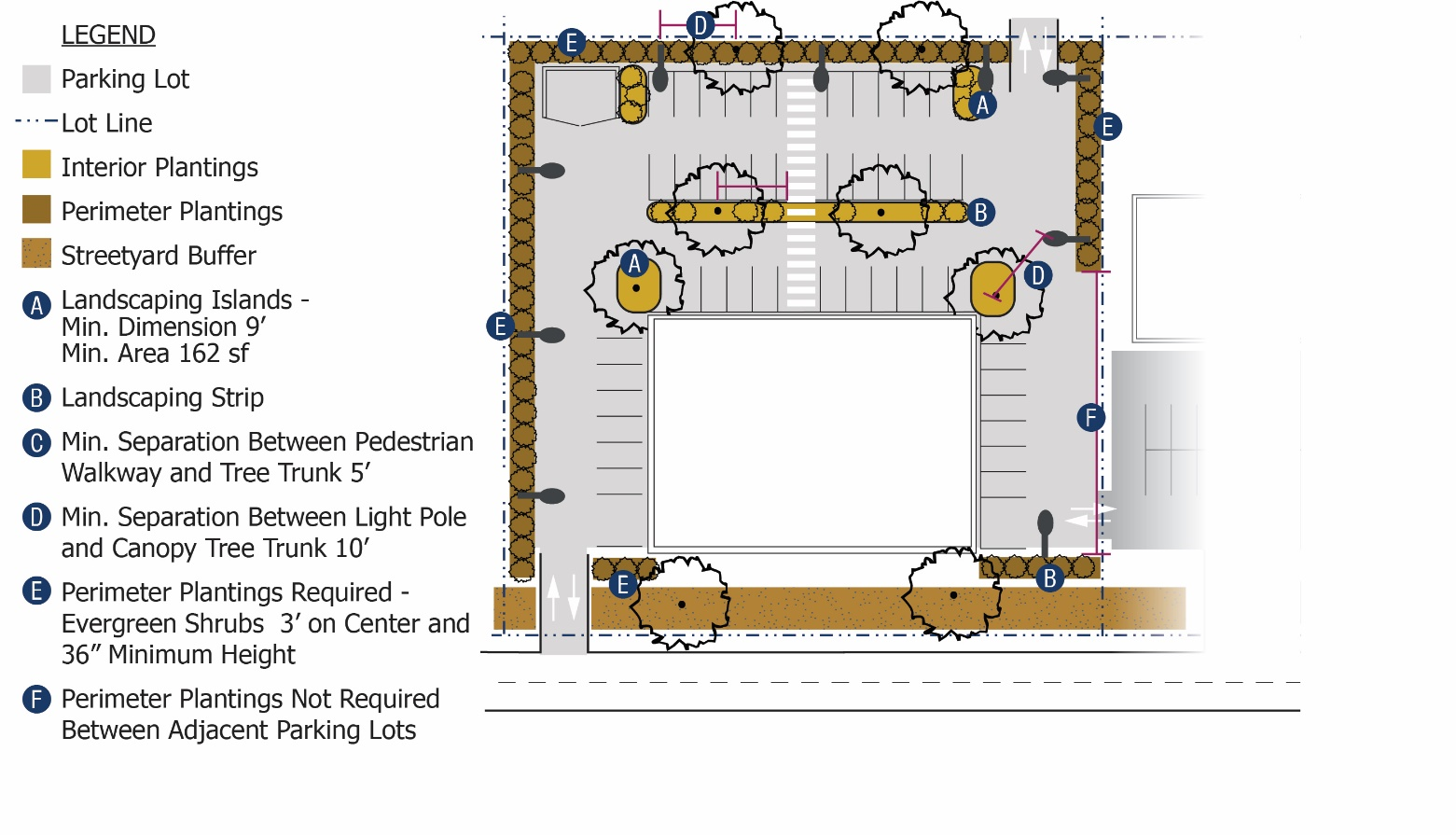
(k)
Perimeter buffers.
(1)
Purpose and intent. These standards are proposed to eliminate or minimize potential nuisances, such as dirt, litter, noise, glare of lights, signs, and unsightly buildings or parking areas through physical and visual separation between land uses in separate zoning districts.
(2)
Applicability.
a.
All development shall comply with the perimeter buffer standards in this section.
b.
Development shall provide perimeter buffers along the side and rear lot lines in accordance with the table of buffer application.
c.
Lot lines abutting street rights-of-way shall comply with the standards in § 30-6501(l), Streetscape Buffers.
(3)
Buffers distinguished. The perimeter buffer configuration table establishes the standards for four perimeter buffers, including the minimum requirements for each of the following buffer types:
a.
Type A, Separation Buffer;
b.
Type B, Intermittent Buffer;
c.
Type C, Semi-Opaque Buffer; and
d.
Type D, Opaque Buffer.
(4)
Buffer determination.
a.
The lot or site being developed is the one responsible for providing the required perimeter buffer, which shall be located solely upon the lot or site being developed.
b.
The type of perimeter buffer required is based upon the zoning district designation of the land being developed as well as the zoning district designation of the abutting lots (see buffer application table).
(5)
Buffer configuration.
a.
Perimeter buffers required by this section shall be located along the outer perimeter of the lot and shall extend to the connecting lot lines.
b.
In cases where the lot line is within a drainage swale, the perimeter buffer shall extend to the edge of the swale instead of the lot line.
c.
A perimeter buffer may be located along shared access easements between parcels in nonresidential developments.
(6)
Buffer application. The buffer application table below specifies the type of perimeter buffer that development shall provide between it and adjacent land, based on the zoning district of the development site and that of the adjacent land. The buffer type is indicated by a letter corresponding to one of the four buffer types described in the perimeter buffer configuration table.
(7)
Exemptions. Developments consisting of multiple lots that are planned and developed as a single, unified, or consolidated project may be configured so that perimeter buffers are only located around the perimeter of the entire development instead of between lots within the development.
| PERIMETER BUFFER CONFIGURATION TABLE | |
| Type A: Separation Buffer The Type A Separation perimeter buffer serves as a visual break between land ownership or zoning district designations. It is not intended to provide substantial visual or acoustic buffering. The image below shows an approximation of this buffer type at maturity. | |
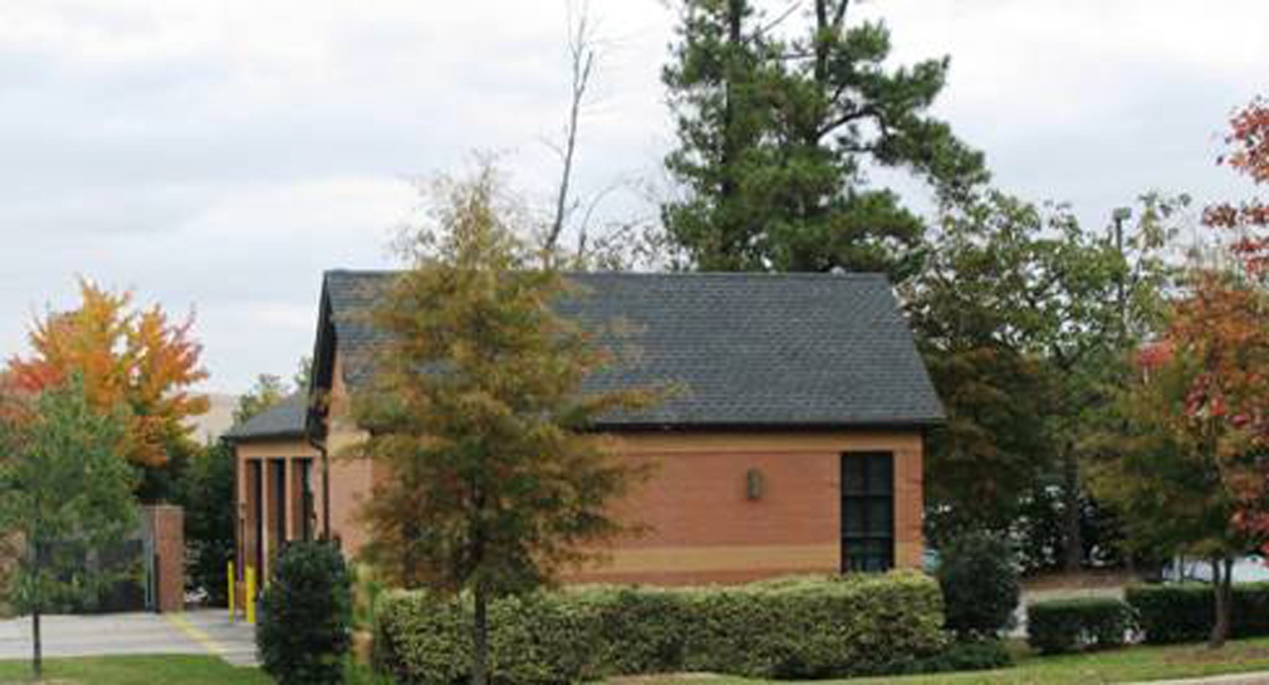 | |
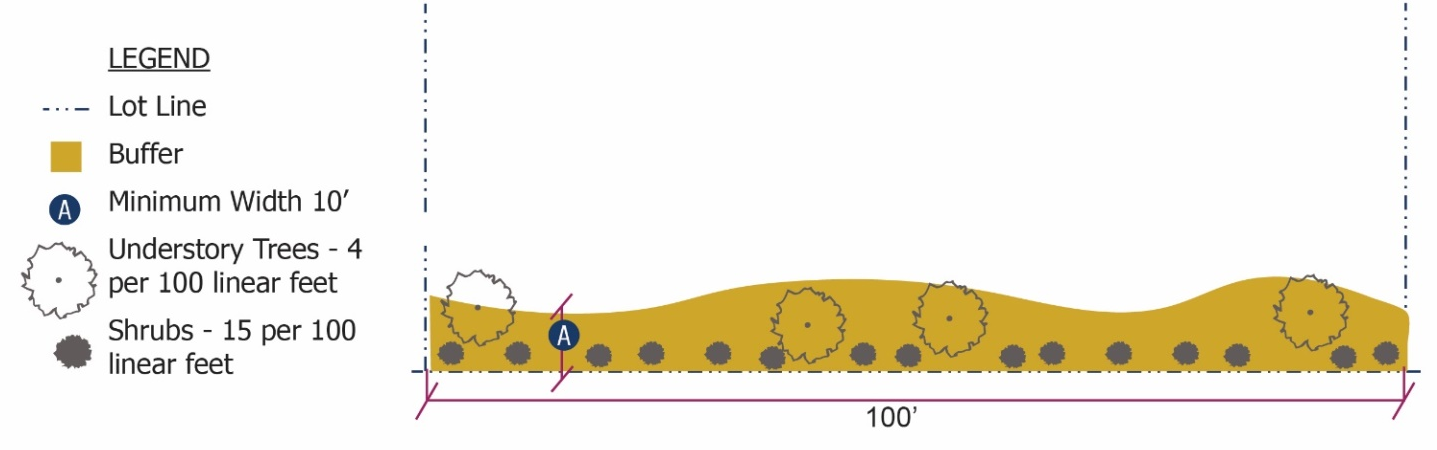 | |
| Buffer Configuration | Requirement |
| Buffer width (feet) | 10 |
| Required canopy trees per every 100 linear feet (#)/Maximum on-center spacing (feet) | None |
| Required understory trees per every 100 linear feet (#)/Maximum on-center spacing (feet) | 4/None [1] |
| Shrubs per every 100 linear feet (#)/Maximum on-center spacing (feet) [2] | 15/None [1] |
| Minimum evergreen shrub percentage (%) | 50 |
|
NOTES:
[1] Grouping of trees or shrubs is permitted provided there is no un-vegetated portion of the buffer exceeding 30 feet in length. [2] In the event a fence or wall is provided, shrubs shall be planted between the fence or wall and the lot line. Shrubs shall be no closer than 3 feet to the lot line. | |
| PERIMETER BUFFER CONFIGURATION TABLE | |
| Type B: Intermittent Buffer The Type B Intermittent perimeter buffer functions as an intermittent visual screen from the ground to a height of five feet. It is intended to partially block visibility between different uses but not totally obstruct visual contact from one use to another. The image below shows an approximation of this buffer type at maturity. | |
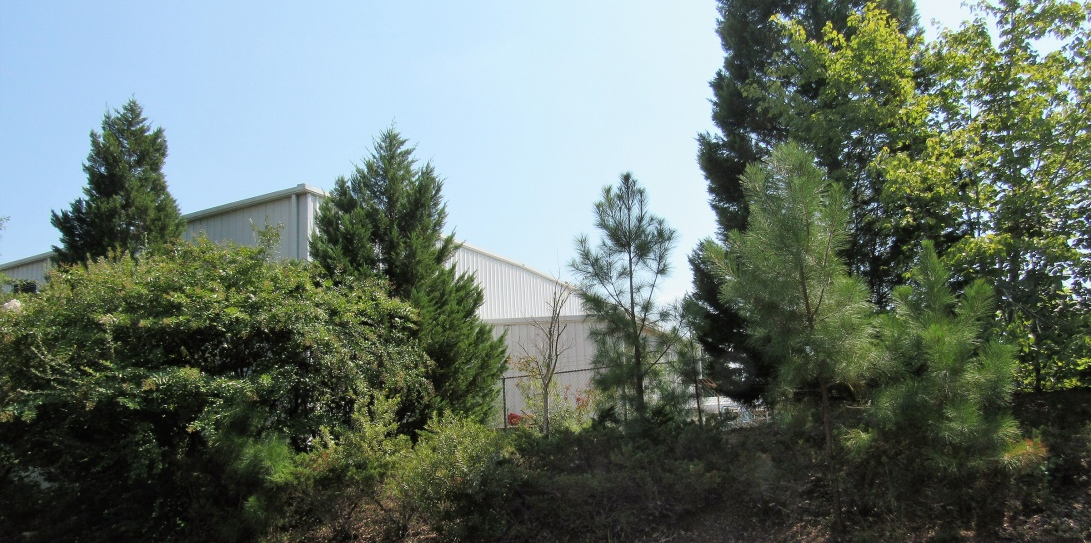 | |
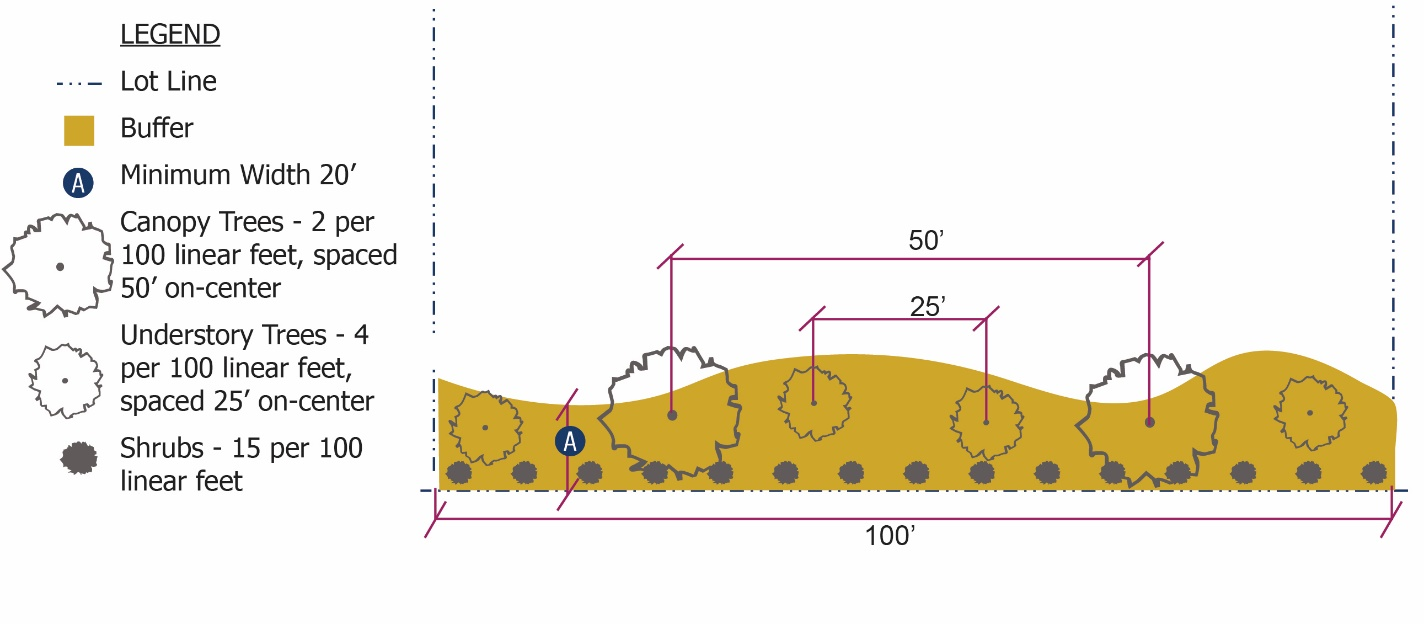 | |
| Buffer Configuration | Requirement |
| Buffer width (feet) | 20 |
| Required canopy trees per every 100 linear feet (#)/Maximum on-center spacing (feet) | 2/50 |
| Required understory trees per every 100 linear feet (#)/Maximum on-center spacing (feet) | 4/25 [1] |
| Shrubs per every 100 linear feet (#)/Maximum on-center spacing (feet) [2] | 15/None [1] |
| Minimum evergreen shrub percentage (%) | 60 |
|
NOTES:
[1] Grouping of trees or shrubs is permitted provided there is no un-vegetated portion of the buffer exceeding 20 feet in length. [2] In the event a fence or wall is provided, shrubs shall be planted between the fence or wall and the lot line. Shrubs shall be no closer than 3 feet to the lot line. | |
| PERIMETER BUFFER CONFIGURATION TABLE | |
| Type C: Semi-Opaque Buffer The Type C Semi-Opaque perimeter buffer functions as a partially opaque screen from the ground to a height of six feet. This type of buffer prevents visual contact between uses but not total obstruction from one use to another. The buffer creates a sense of visual separation but provides only minor acoustic separation. The image below shows an approximation of this buffer type at maturity. | |
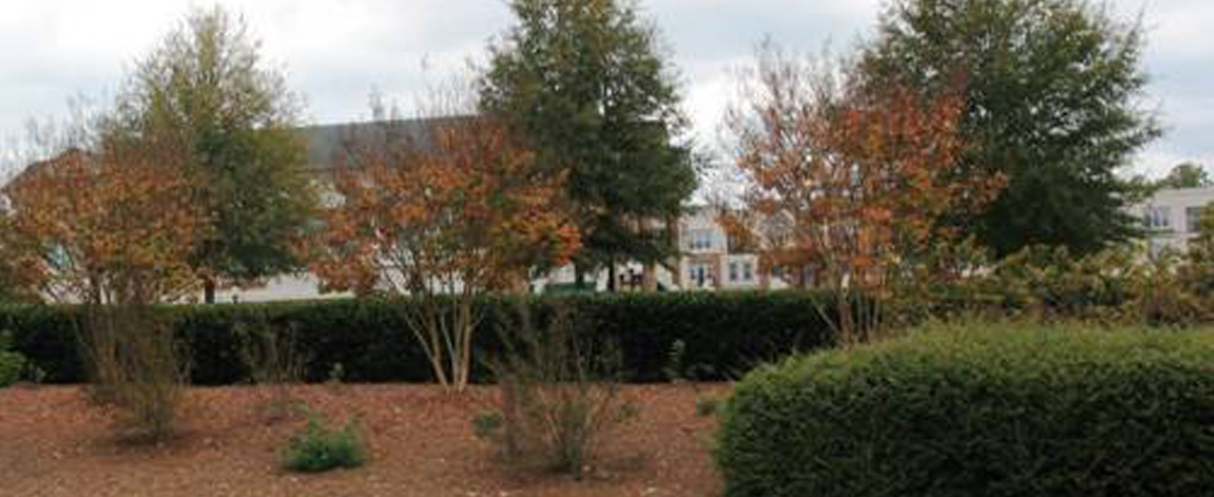 | |
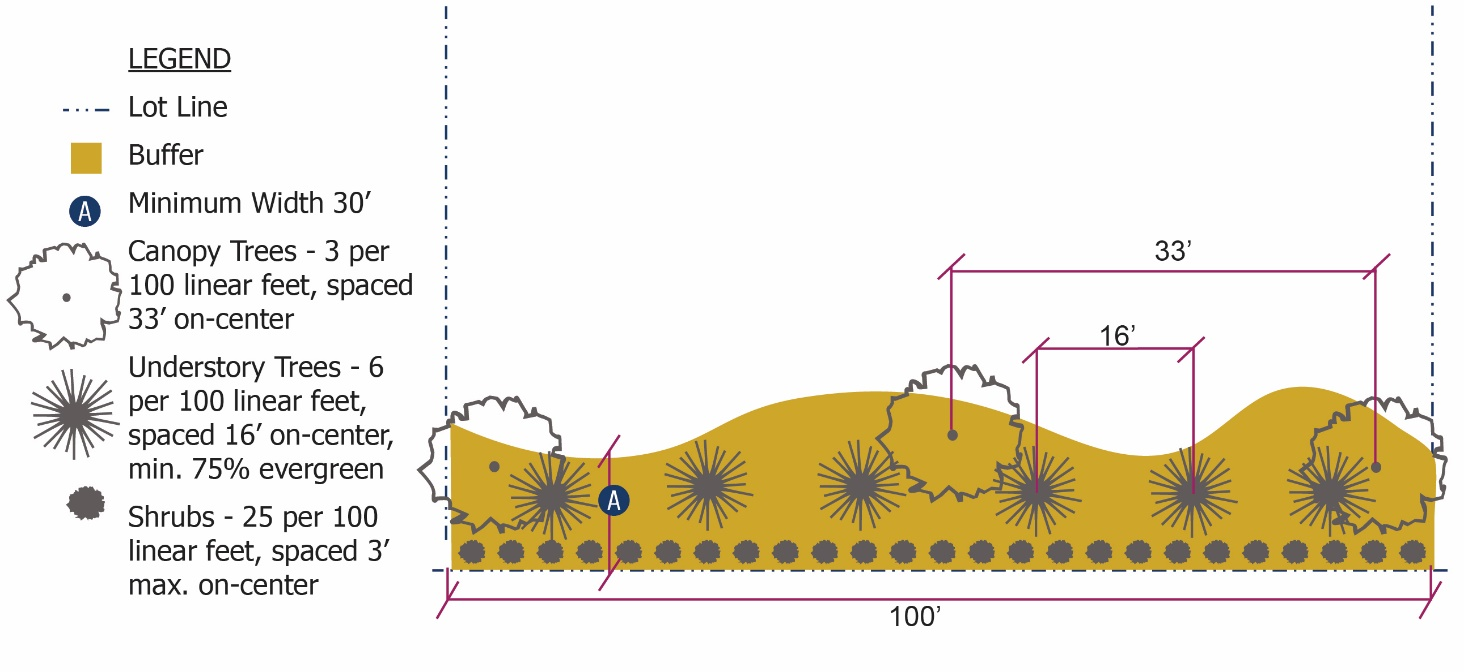 | |
| Buffer Configuration | Requirement |
| Buffer width (feet) | 30 |
| Required canopy trees per every 100 linear feet (#)/Maximum on-center spacing (feet) | 3/33 |
| Required understory trees per every 100 linear feet (#)/Maximum on-center spacing (ft) | 6/16 [3] |
| Shrubs per every 100 linear feet (#)/Maximum on-center spacing (feet) [2] | 25/4 [3] |
| Minimum evergreen shrub percentage (%) | 75 |
|
NOTES:
[1] Provision of a semi-opaque fence or wall allows the buffer width to be reduced by 5 feet. [2] Provision of a fully-opaque fence, wall, or berm allows the buffer width to be reduced by 10 feet. [3] Grouping of trees or shrubs is permitted within 20 feet of the edge of a street right-of-way provided there is no un-vegetated portion of the buffer exceeding 10 feet in length. [4] In the event a fence or wall is provided, shrubs shall be planted between the fence or wall and the lot line. Shrubs shall be no closer than 3 feet to the lot line. | |
| PERIMETER BUFFER CONFIGURATION TABLE | |
|
Type D: Opaque Buffer
The Type D Opaque perimeter buffer functions as a fully opaque screen from the ground to a height of eight feet. This type of buffer provides a strong sense of visual and acoustic separation between uses. The image below shows an approximation of this buffer type at maturity. | |
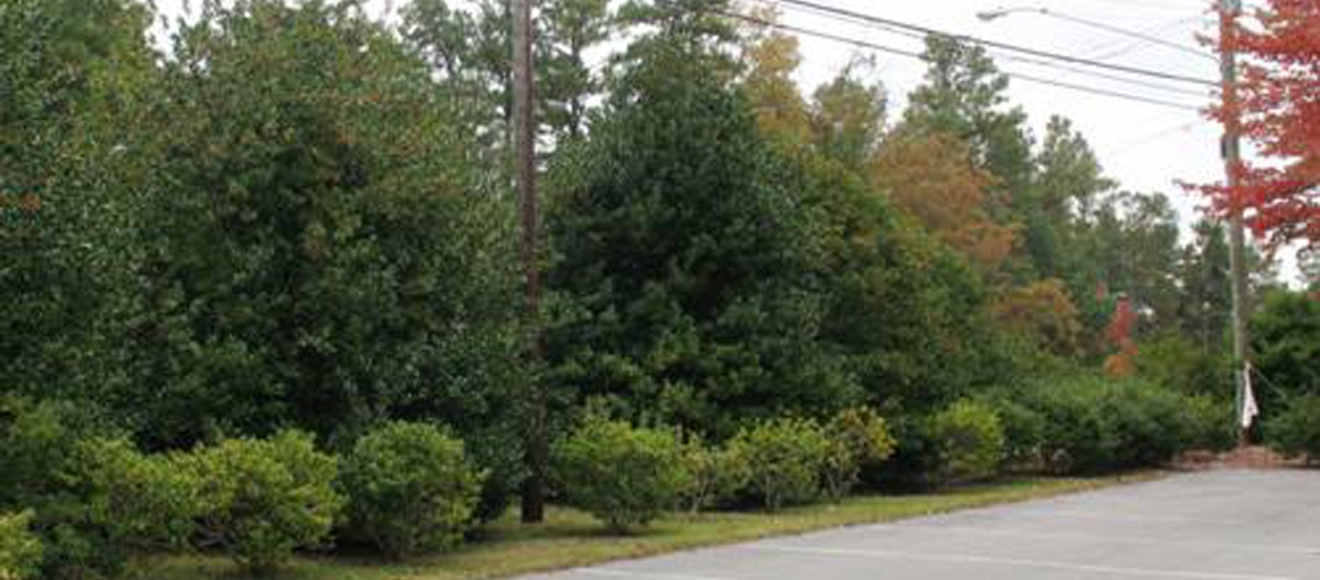 | |
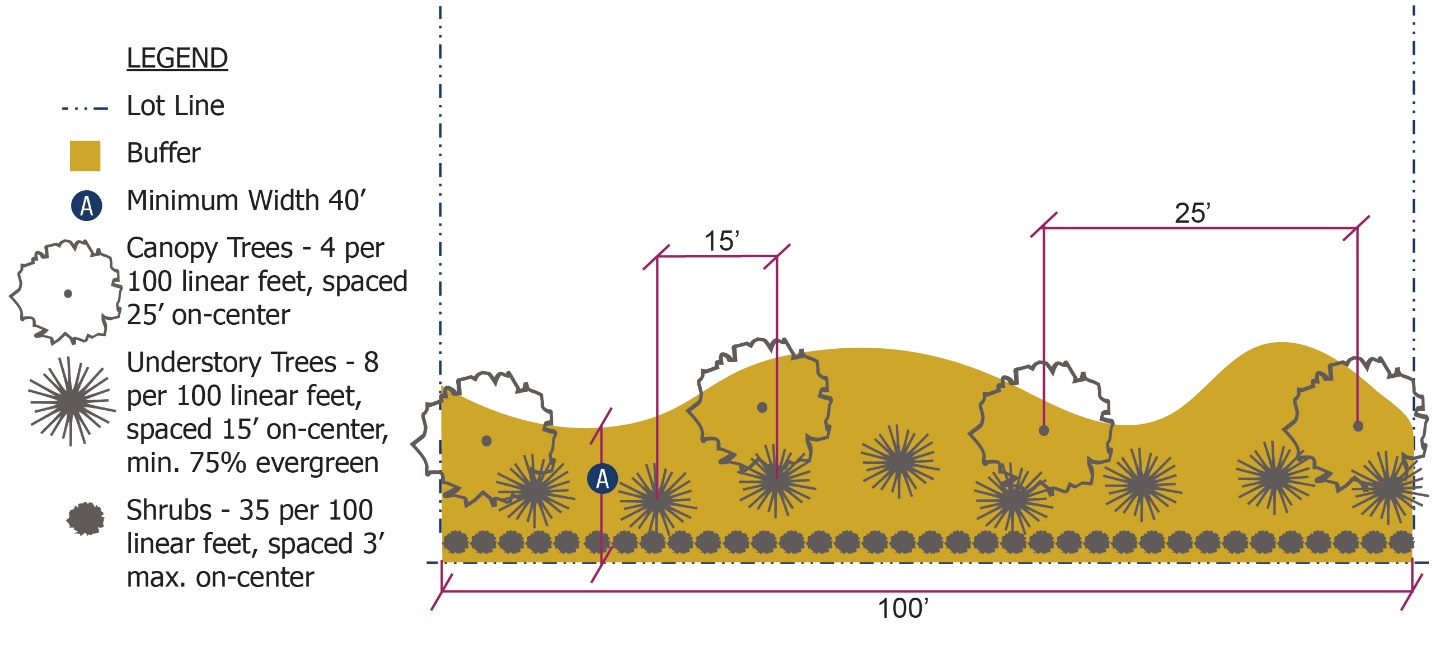 | |
| Buffer Configuration | Requirement |
| Buffer width (feet) | 40 |
| Required canopy trees per every 100 linear feet (#)/Maximum on-center spacing (feet) | 4/25 |
| Required understory trees per every 100 linear feet (#)/Maximum on-center spacing (feet) | 8/15 |
| Shrubs per every 100 linear feet (#)/Maximum on-center spacing (feet) [2] | 35/3 |
| Minimum evergreen shrub percentage (%) | 100 |
|
NOTES:
[1] Provision of a semi-opaque fence or wall allows the buffer width to be reduced by 5 feet. [2] Provision of a fully-opaque fence, wall, or berm allows the buffer width to be reduced by 10 feet. [3] In the event a fence or wall is provided, shrubs shall be planted between the fence or wall and the lot line. Shrubs shall be no closer than 3 feet to the lot line. | |
(l)
Streetscape buffers.
(1)
Purpose and intent. Streetscape buffers are proposed to soften the view of development from the Town's street rights-of-way, and are intended to:
a.
Enhance pedestrian orientation and encourage pedestrian travel;
b.
Address urban heat islands by providing shade for streets and sidewalks;
c.
Provide shade on sidewalks;
d.
Promote the Town's "sense of place;"
e.
Support property values by enhancing the aesthetic character of the Town's streets; and
f.
Provide habitat for flora and fauna.
(2)
Applicability.
a.
The standards in this section shall apply to all lot lines bounded by the following features, whether existing or identified in the Town's adopted policy guidance.
1.
Local streets;
2.
Collector streets; and
3.
Arterial streets.
b.
In cases where a future street is planned but its approximate location is not indicated on an adopted or approved Town map or plan, streetscape buffering shall not be required on lots abutting the future street alignment.
(3)
Exemption. Streetscape buffers are not required along lot lines abutting the following features:
a.
Driveways, private drives, or alleys;
b.
Lot lines abutting platted street rights-of-way that are or have remained unopened for at least 15 years; and
c.
Lot frontages where the entirety of the lot frontage is within a required sight distance triangle.
(4)
Required plant material. Streetscape buffers shall be configured in one of the following three ways (see Figure 22 Streetscape Buffer Configuration):
a.
Three canopy trees for every 100 linear feet of lot frontage; or
b.
Two canopy trees and two understory trees for every 100 linear feet of lot frontage; or
c.
Four understory trees for every 100 linear feet, where overhead utilities are present.
(5)
Placement.
a.
Vegetation required as part of a streetscape buffer shall be located outside the street right-of-way.
b.
Canopy trees shall be located within ten feet of the right-of-way edge.
c.
Understory trees shall be located within five feet of the right-of-way edge.
d.
An alternative location may be approved by the Town Planner in cases where underground utilities, drainage easements, topography, or other obstructions make placement of streetscape buffer vegetation in accordance with these standards impractical.
(6)
Prohibited features. Off-street parking, off-street loading, merchandise display, or outdoor storage shall not take place within a required streetscape buffer.
FIGURE 22: STREETSCAPE BUFFER CONFIGURATION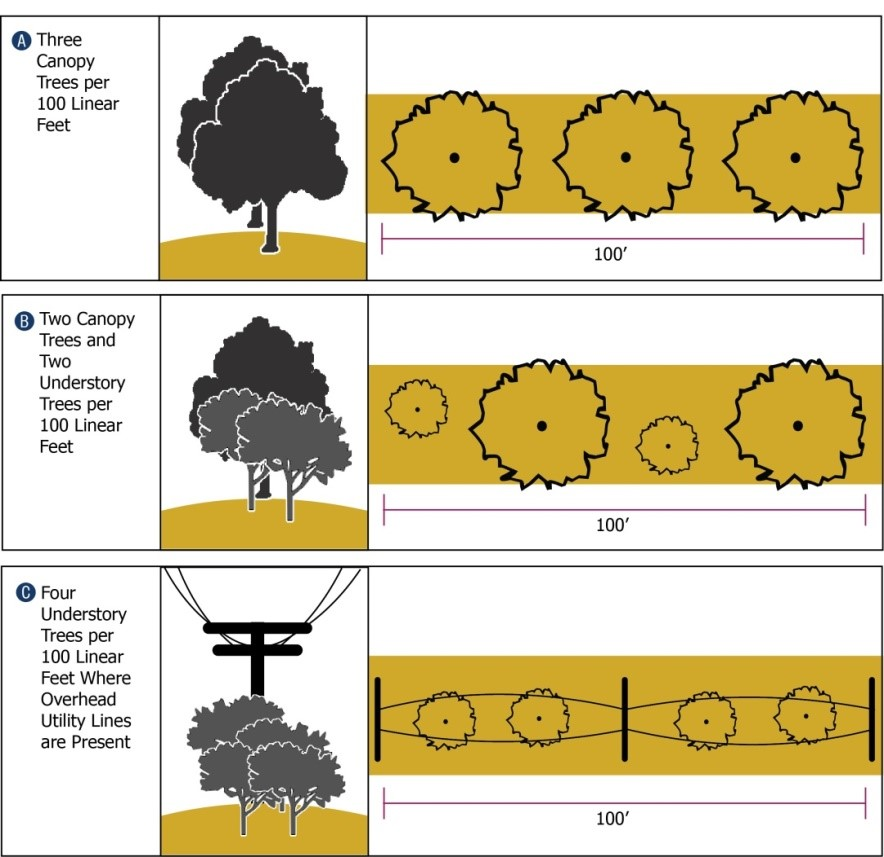
(Ord. No. AL2021-06-1, § 1, 6-7-2021)
Sec. 30-6502 - Screening.
(a)
Purpose and intent. These standards are intended to reduce the visual impact of solid waste collection structures, service areas, and mechanical equipment upon the public realm and adjacent lots as well as to enhance the aesthetics of development in the Town.
(b)
Applicability. Unless exempted in accordance with § 30-6501(c), Exemptions, the standards in this section apply to the following:
(1)
Principal buildings constructed or open uses of land established after the effective date of these standards;
(2)
Changes in use;
(3)
Expansions of principal building floor area 1,000 or more square feet or expansions of off-street parking of 2,000 or more square feet;
(4)
Solid waste collection dumpsters, bins, and compactors;
(5)
Recycling facilities (including cardboard recycling);
(6)
Ground-based climate control equipment;
(7)
Ground-based mechanical equipment (including electrical generators);
(8)
Above ground storage tanks; and
(9)
Loading equipment.
(c)
Exemptions. Solid waste collection facilities and mechanical equipment serving single-family detached and duplex dwellings shall be exempted from these standards, but these standards shall apply within manufactured home parks.
(d)
General standards.
(1)
Location. No site features subject to these standards shall be located between the principal structure and the street it fronts.
(2)
Screening required. Site features subject to these standards shall be screened from view from streets, public parks, urban open space set-asides, single-family detached residential dwellings, and duplex dwellings.
(e)
Screening methods.
(1)
Site features subject to these standards shall be screened by any of the following methods, in single use or in combination (see Figure 23 Screening Methods):
a.
Evergreen vegetation configured to provide a fully-opaque screen to a minimum height of six feet within four years of planting;
b.
Vegetated berms supplemented with plantings as necessary to provide a fully-opaque screen to a minimum height of six feet within three years of planting;
c.
An opaque fence constructed of treated wood, rot-resistant wood (such as cypress or redwood), plastic, or vinyl;
d.
A masonry wall constructed of brick, textured concrete masonry units, or stuccoed block; or
e.
Walls of a principal or accessory structure.
(2)
In no instance shall a chain link fence with plastic slats or attached fabric meet the opacity requirements for screening in this Article.
(3)
Screening techniques shall be of sufficient height and design to effectively screen the facility from the view from adjacent properties and streets.
(f)
Specific standards for solid waste and recycling facilities exceeding 100 gallons of capacity.
(1)
Solid waste and recycling receptacles shall be so located so as to be convenient for collection and shall be appropriate to the type and size of the development or use being served.
(2)
All trash and recycling receptacles shall meet the minimum setback requirements of the underlying zoning district.
(3)
All required dumpster, recycling, and trash handling facilities shall be designed with appropriate means of access to a street or alley in a manner that will least interfere with traffic movement and will most facilitate the service of the facilities.
(4)
Space allocated to any trash handling facilities shall not be used to satisfy the space requirements for off-street parking or loading facilities, nor shall any parking or loading spaces be used to satisfy the space requirements for any dumpster or trash handling facility.
FIGURE 23: SCREENING METHODS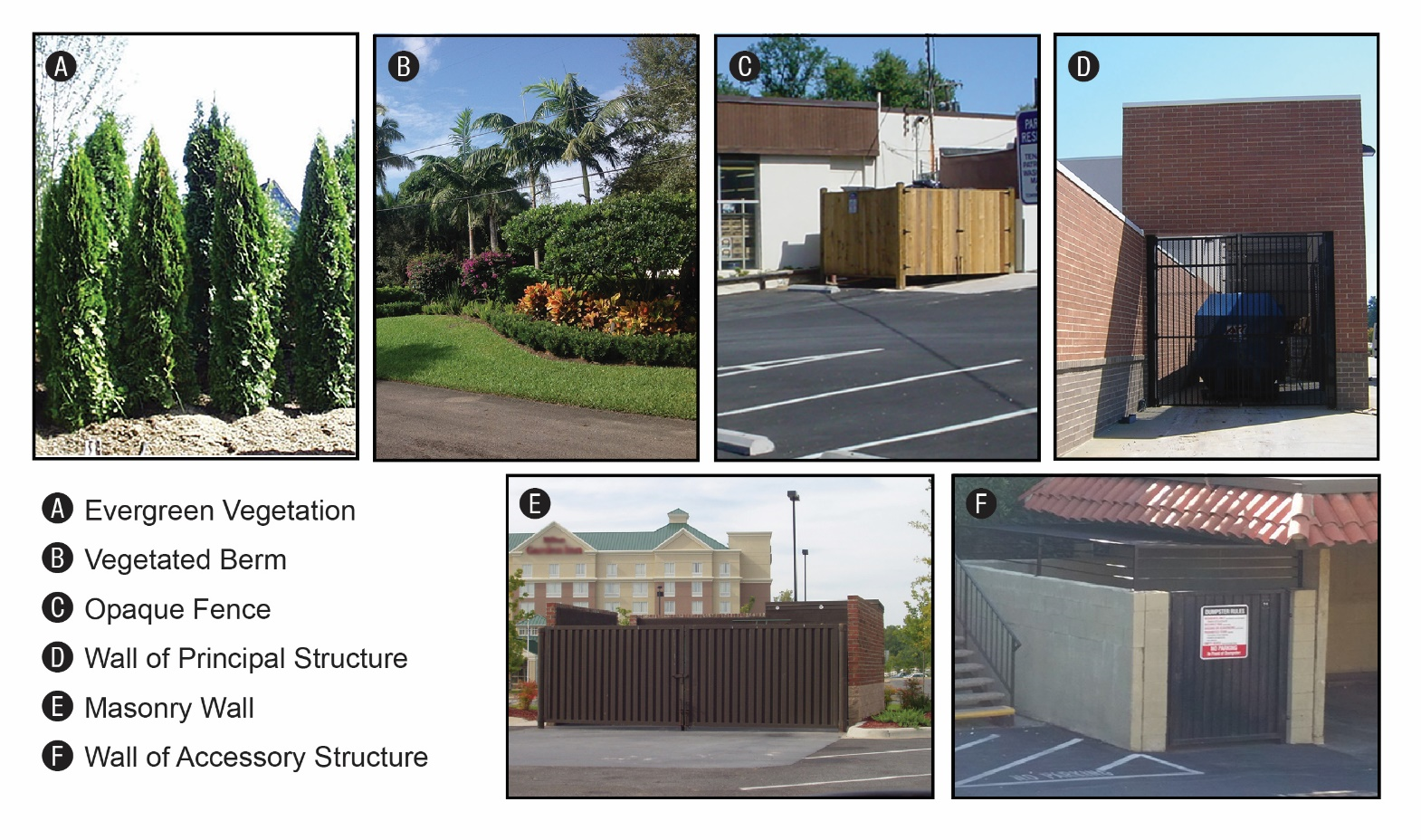
(Ord. No. AL2021-06-1, § 1, 6-7-2021)
Sec. 30-6503 - Planting flexibility.
(a)
Credit for existing vegetation.
(1)
In order to encourage the preservation of established, healthy vegetation, credit shall be given towards the landscaping requirements in this section for preservation of existing trees and shrubs that are pre-existing within required landscaping areas at a rate of 1.25 times the amount of existing, healthy vegetation to be retained.
(2)
Vegetation to be credited towards these requirements shall be protected with tree protection devices approved by the Town Planner before and during development of the site and maintained thereafter in a healthy growing condition.
(b)
Revisions to approved landscape plans. Due to seasonal planting problems and/or a lack of plant availability, approved landscape plans may require minor revisions. Minor revisions to planting plans may be approved by the Town Planner if:
(1)
There is no reduction in the quantity of plant material.
(2)
There is no significant change in size or location of plant materials.
(3)
The new plants are of the same general category (i.e., canopy tree, understory tree, evergreen, or shrub) and have the same general design characteristics (mature height, crown spread, etc.) as the materials being replaced.
(c)
Alternative landscape plans. An alternate landscape plan that allows modifications to the requirements of this section may be approved by the Town Planner in accordance with the following.
(1)
Conditions justifying alternative landscape plan. Any of the following natural physical conditions may be used as a justification for an alternative landscape plan:
a.
Wetland areas;
b.
Topography;
c.
Non-arable soils;
d.
Difficult or unusual lot configuration;
e.
Utility, access, drainage, or maintenance easements;
f.
A desire to retain existing on-site vegetation;
g.
Natural rock formations;
h.
Required landscaping areas that are in permanent shade resulting from a building or structure; and
i.
Impractical situations that would result from application of this section.
(2)
Intent. To be approved, any alternative landscape plan shall meet the intent of the applicable planting yard(s) and the purpose and intent of the landscaping standards of this section.
(3)
Allowable modifications. The following landscape standards may be modified by an alternate landscape plan.
a.
The location of required plant materials;
b.
The width of required planting areas;
c.
The configuration of required plant materials; and
d.
The number of required plant materials.
(4)
Justification required. The alternative landscape plan shall include justification for the modifications requested, based upon, but not limited to, the following:
a.
The presence or planned location of public utilities, infrastructure, or easements;
b.
The location of existing healthy vegetation or other beneficial site features to be retained after development;
c.
The size, shape, or topographic elevation of the site relative to the street(s) it abuts; and
d.
The need to protect solar access or avoid permanently shaded areas on the site.
(Ord. No. AL2021-06-1, § 1, 6-7-2021)
Sec. 30-6601 - Purpose and intent.
The purpose of this section is to help ensure the provision and maintenance of open space resources that encourage recreation and the gathering of Town residents and visitors. These standards are further intended to:
(a)
Establish the standards under which residential, mixed-use, and non-residential development shall set aside a portion of the development area as open space;
(b)
Distinguish between the characteristics, requirements, and appropriate locations for open space set-asides, based on the zoning district designation; and
(c)
Establish minimum ownership and maintenance standards for homeowner and property owner associations related to open space set-asides.
(Ord. No. AL2021-06-1, § 1, 6-7-2021)
Sec. 30-6602 - Applicability.
(a)
Unless exempted by this section, the standards in this section shall apply to all new single-family detached residential subdivisions, duplex development, multi-family development, and mixed-use development.
(b)
Redevelopment of the use types listed in (a) above conducted after June 7, 2021, shall comply with the standards in this section, to the maximum extent practicable, and shall provide its pro rata share of open space set-aside.
(Ord. No. AL2021-06-1, § 1, 6-7-2021)
Sec. 30-6603 - Exemptions.
The following forms of development shall be exempted from the standards in this section:
(1)
Development of an individual single-family detached dwelling (including manufactured homes) on its own lot;
(2)
Subdivisions comprised solely of four or fewer lots where all lots intended for single-family detached residential dwellings; and
(3)
Developments of two acres or less in total area.
(Ord. No. AL2021-06-1, § 1, 6-7-2021)
Sec. 30-6604 - Minimum open space set-aside requirements.
(a)
Amount.
(1)
All development subject to these standards shall set aside 15 percent of the development's total area for use as open space set-aside.
(2)
Nothing shall limit the provision of a greater minimum percentage or other type of open space set-aside, provided the minimum requirements in this section are met.
(3)
Land dedicated for parkland and for shared use paths or trails shall be credited toward open space set-aside requirements.
(b)
Type.
(1)
Development subject to these standards shall configure at least 65 percent of the open space set-aside for active recreation in accordance with § 30-6605(a), Active open space set aside. The balance of the open space set-aside shall be configured for passive recreation in accordance with § 30-6605(b), Passive open space set-aside.
(2)
Nothing shall prevent more than 65 percent of the open space set-aside from being configured for active recreational uses.
(Ord. No. AL2021-06-1, § 1, 6-7-2021)
Sec. 30-6605 - Open space set-aside configuration.
Open space set-asides shall be configured in accordance with the following standards (see Figure 24 Open Space Set-Aside Configuration).
(a)
Active open space set-aside. Active open space set-asides provide for active recreational needs of the residents or visitors they serve. Active features include fields and courts as well as built structures. Active open space set-asides shall meet the following standards:
(1)
Configuration.
a.
Lands set aside as active open space set-aside shall be compact and contiguous unless the land is used as a continuation of an existing trail, or specific natural or topographic features require a different configuration.
b.
Active open space set-aside areas shall be located so as to be readily accessible and useable by residents and users of the development.
c.
Where possible, a portion of the open space set-aside should provide focal points for the development.
d.
Where the development site is adjacent to existing or planned trails, parks, or other public open area land, the open space set-aside shall, to the maximum extent practicable, be located to adjoin, extend, and enlarge the trail, park, or other open area.
(2)
Allowable features. The following types of features are allowable in and credited towards active open space set-asides:
a.
Lands dedicated for public parks or greenways when not already credited towards urban open space set-asides;
b.
Swimming pools, splash pads, and areas devoted to water play for children;
c.
Athletic fields and courts;
d.
Boat launches and swimming platforms;
e.
Club houses;
f.
Playgrounds and play structures for children; and
g.
Obstacle courses and exercise trails.
(b)
Passive open space set-aside. Passive open space set-asides are intended to provide land area that is undeveloped, or that is developed with low-intensity recreational features (such as those for walking or sitting), landscaping, replacement trees, or stormwater control measures that are configured as a site amenity.
(1)
Allowable features. The land area occupied by any of the following types of features is credited towards required passive open space set-aside:
a.
Walking, bicycling, and equestrian trails;
b.
Boardwalks;
c.
Gardens and greenway trails;
d.
Benches and seating areas;
e.
Tables, shelters, grills, and related picnicking facilities;
f.
Lawn areas and community greens;
g.
Lakes, ponds, wetlands, swamps, canals, and streams;
h.
Piers and docks for fishing or viewing wildlife; and
i.
Undisturbed land subject to a deed restriction or conservation easement.
(2)
Site features credited towards passive open space set-aside requirements.
a.
The following site features shall be credited towards passive open space set-aside requirements:
1.
Lands dedicated for public parks or greenways, when not already credited towards active or urban open space set-asides;
2.
Required landscaping areas;
3.
Tree save areas;
4.
U.S. Army Corps of Engineers designated 404 wetlands;
5.
Riparian buffer areas;
6.
Natural heritage areas; and
7.
Land area occupied by stormwater control measures, including retention ponds, fully vegetated detention basins, and other bio-retention devices, provided these facilities are treated as a site amenity.
b.
In order to be considered a site amenity that is credited towards passive open space set-aside requirements, stormwater control measures shall include all the following:
1.
Pedestrian access to the facility;
2.
Gentle slopes of three-to-one (3:1) or less;
3.
Pedestrian elements such as paths, benches, and similar aspects to and around the facility; and
4.
Vegetation, whether planted or retained.
FIGURE 24: OPEN SPACE SET-ASIDE CONFIGURATION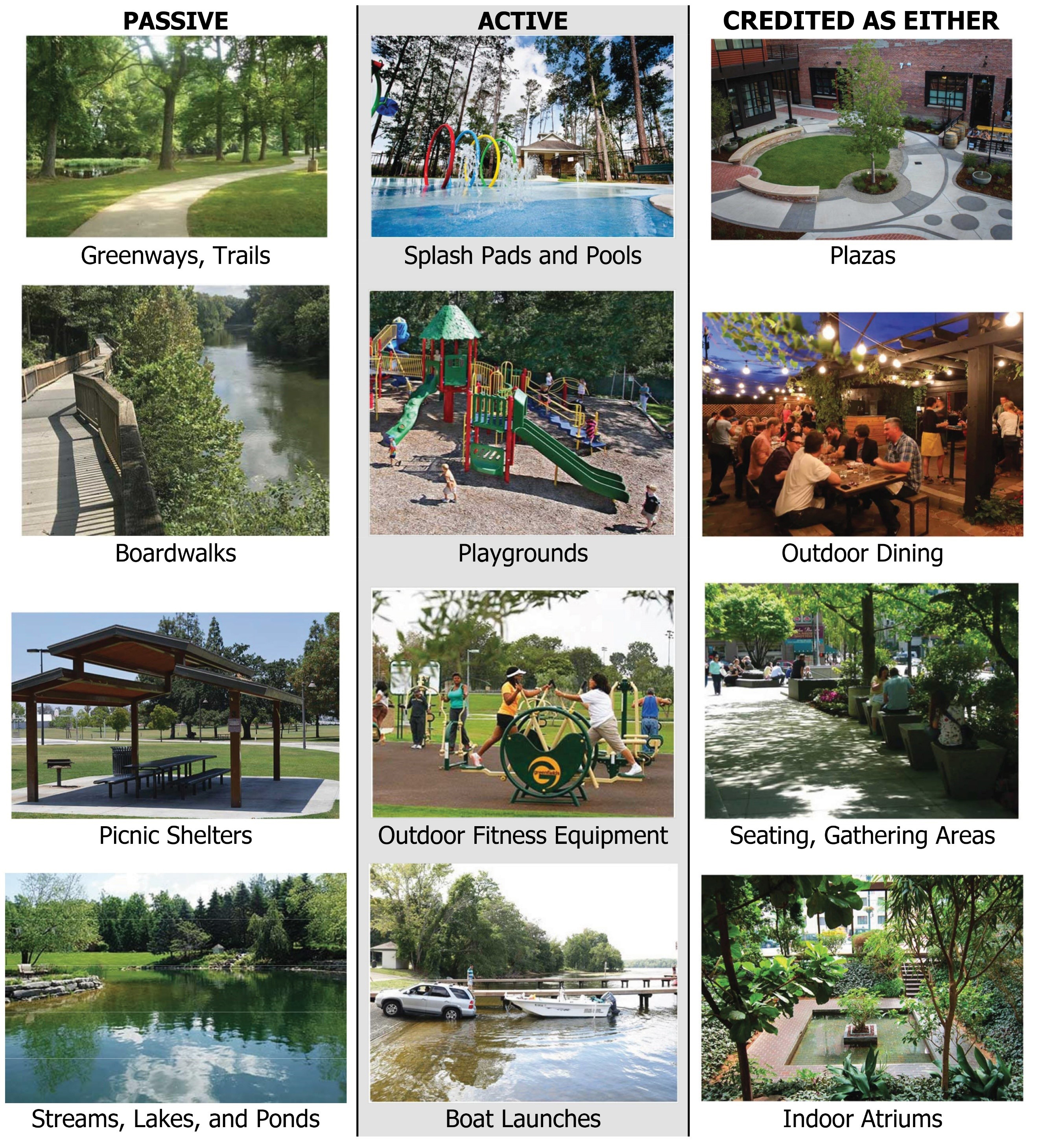
(c)
Access to open space. All open space must be pedestrian accessible. Open space not contiguous to a proposed subdivision street must have a minimum of a 20-foot fee-simple access.
(Ord. No. AL2021-06-1, § 1, 6-7-2021)
Sec. 30-6606 - Ownership of open space set-aside.
Open space set-asides are intended to remain under private ownership while being available for use by residents and visitors in the development where located. Ownership of open space set-asides shall remain with the owner of the land, except in the following circumstances:
(a)
Owners' association. All open space set-aside areas may be owned jointly or in common by the owners of the development through a recognized homeowners' or property owners' association, which shall be established in accordance with § 30-7701, Required restrictive covenants and review by Town.
(b)
Nonprofit organization. The landowners may decide to convey an open space set-aside to a nonprofit organization such as a land trust or land conservancy for management and maintenance if the Town is provided adequate assurance the set-aside will be properly managed and maintained.
(c)
Dedicated to town or other public agency. In some cases, certain lands designated as open space set-asides, such as wildlife habitat or greenways, may be dedicated to the Town or other public agency during the development review process. The Town Council shall determine which lands and under what conditions open space set-asides may be dedicated to the Town or other public agency.
(Ord. No. AL2021-06-1, § 1, 6-7-2021)
Sec. 30-6607 - Maintenance of open space set-asides.
(a)
The owner of the land shall be responsible for maintenance of all open space set-aside areas (including land, vegetation, private infrastructure, greenways, and other features) in accordance with this Ordinance and any conditions of approval associated with the development.
(b)
Failure to maintain open space set-aside areas is a violation of this Ordinance subject to the remedies and penalties in Article 9: Violations.
(Ord. No. AL2021-06-1, § 1, 6-7-2021)
Sec. 30-6608 - Payments in lieu of provision or dedication.
(1)
Payments in lieu of provision or dedication. In lieu of providing or dedicating open space set-aside required pursuant to this section, an applicant/developer may choose to make a payment to the Town. If the required open space to be provided is less than one acre, then fee-in- lieu shall be required.
(2)
Use of fees-in-lieu. The Town shall use such fees only for the acquisition or development of open space, recreation, or park sites to serve residents of the Town.
(3)
Amount. The amount of the fee-in-lieu shall be the product of the total number of proposed dwelling units proposed multiplied by the fee established in the Town's adopted fee schedule. The applicant/developer shall make the payment before occupancy or approval of a final plat, as appropriate. The Town Planner may allow phasing of payments consistent with the approved phasing of the development.
(Ord. No. AL2021-06-1, § 1, 6-7-2021)
Sec. 30-6701 - Off-street parking and loading.
(a)
Purpose and intent. The purpose of this section is to ensure provision of off-street parking and loading facilities in proportion to the generalized parking, loading, and transportation demand of the different uses allowed by this Article. The standards are further intended to:
(1)
Provide for adequate off-street parking, off-street loading, and safe movement of vehicles into, out of, and through parking areas;
(2)
Allow for flexibility to accommodate alternative solutions to off-street parking and loading needs, where such flexibility is consistent with the Town's adopted policy guidance;
(3)
Reduce the aesthetic impact of surface parking lots in business areas and lands proximate to residential neighborhoods through standards addressing on-site parking lot locations;
(4)
Avoid excessive paved surface areas and the resulting problems associated with stormwater runoff and urban heat islands; and
(5)
Protecting compatibility between adjacent uses of land.
(b)
Applicability. The standards in this section shall apply to all development in the Town's planning jurisdiction, unless exempted in accordance with § 30-6701(c), Exemptions.
(1)
Generally. Whenever a building is constructed, an open-air use of land is conducted, or a principal or accessory use is established, the development shall meet the requirements of this section.
(2)
Additions and expansions. Whenever a building, open air use of land, or principal or accessory use is enlarged or increased in capacity by 20 percent or more, the entire development shall comply with these requirements.
(3)
Changes in use.
a.
If the principal use changes, then the new principal use shall meet the requirements of this section, except that if the use change results in an increase of less than five percent in the required number of parking spaces, or less than two additional parking spaces, no additional parking spaces are required.
b.
In cases where an existing parking lot does not comply with the parking lot configuration requirements of this section, changes in use shall require the parking lot's configuration to be brought into compliance with these standards to the maximum extent practicable.
(c)
Exemptions. The standards in this section shall not apply to the following forms of development:
(1)
Lawfully-established lots of record existing prior to November 2, 2020, that contain a single-family detached residential structure and are not served by an alley;
(2)
Re-striping an existing parking lot which does not create a deficient number of parking spaces or a nonconforming situation;
(3)
Establishment of a single-family detached home is exempted from the standards in this section but shall comply with the table of minimum off-street parking requirements.
(d)
Timing of review. Development subject to these standards shall be reviewed for compliance at the time of site plan, or special use permit review, as appropriate. In cases where a development application is considered by more than one review authority, the decision regarding compliance with these standards shall be made by the review authority making the final decision on the application under review.
(e)
Off-street parking requirements.
(1)
Parking plan required. Every application for a site plan or building permit shall include a parking plan or plot plan drawn to scale and fully-dimensioned as necessary in order to demonstrate compliance with the standards in this Article.
(2)
Minimum off-street parking spaces required. The minimum number of off-street parking spaces required for development shall be in accordance with the applicable use type listed in the table of minimum off-street parking requirements.
(3)
Use of on-street parking. Off-street parking required by this section shall be provided without the use of streets.
(4)
Off-street parking space maximum. Commercial use types shall limit the total number of off-street parking spaces provided to not more than 150 percent of the minimum parking spaces required in the table of minimum off-street parking requirements.
(5)
Use type not listed. For use types that do not correspond to the use types listed in the, table of minimum off-street parking requirements, any one of the following actions may be taken as part of determining the applicable off-street parking requirements:
a.
The applicant may provide a parking study for the use(s) prepared by a professional engineer licensed by the State of North Carolina;
b.
The applicant may propose a text amendment to the Town's zoning regulations;
c.
The applicant may request a formal determination of these off-street parking standards by the Town Planner (which may be appealed to the board of adjustment); or
d.
The Town Planner may determine the minimum parking space requirement based on a similar use in accordance with the standards of this Article.
(6)
Developments with multiple use types or lots.
a.
Development containing more than one principal use shall provide the minimum number of off-street parking spaces in an amount equal to the total required for all individual principal uses in the development.
b.
Developments consisting of multiple lots that are planned and developed as a single, unified, or consolidated project may be configured to locate a portion of the required parking for one lot on another in the same development.
(7)
Use of required off-street parking spaces.
a.
Off-street parking areas used for any of the following vehicles are not credited towards the minimum number of required off-street parking spaces and such vehicles shall be located outside required off-street parking spaces and any street rights-of-way:
1.
Vehicles for sale or lease;
2.
Vehicles being stored, serviced, or repaired; or
3.
Vehicles belonging to the use, such as company vehicles.
b.
Required off-street parking spaces shall not be used for any purpose other than the temporary parking of operable vehicles.
c.
In no instance shall motor vehicle servicing or repair of a vehicle take place within a required off-street parking space except for washing and emergency service necessary to start the vehicle.
(8)
Driveways used to meet parking requirements. Driveways of sufficient size may be used to accommodate required off-street parking spaces only for the following uses:
a.
Boarding/rooming houses;
b.
Duplex, triplex, and quadplex dwellings;
c.
Cemeteries;
d.
Family care and group homes;
e.
Single-family attached dwellings in developments of six or fewer dwellings; and
f.
Single-family detached dwellings (including manufactured and mobile homes).
(9)
Minimum off-street parking requirements table.
(10)
Bicycle parking.
a.
Applicability.
1.
Bicycle parking facilities shall be provided on all new commercial, mixed-use, multi-family, and institutional use types served by 20 or more off-street parking spaces for vehicles.
2.
Bicycle parking shall not be required for industrial use types.
b.
Rate of provision. Bicycle parking spaces shall be provided at a rate of one bicycle parking space for every 20 off-street parking spaces for automobiles. Nothing shall limit the provision of more bicycle parking spaces than are otherwise required.
c.
Configuration.
1.
Bicycle parking should be accessible to the primary entrances of the development and located in a visible, well-lit area (see Figure 25 Bicycle Parking).
2.
Bicycle parking shall be served by a pedestrian walkway connecting the bicycle parking to the closest primary building entrance.
3.
Bicycle parking shall be located where it does not interfere with pedestrian traffic and is protected from conflicts with vehicular traffic.
4.
Bicycle parking may be accommodated within street setback areas.
5.
A bicycle rack or other device shall be provided to enable bicycles to be secured.
FIGURE 25: BICYCLE PARKING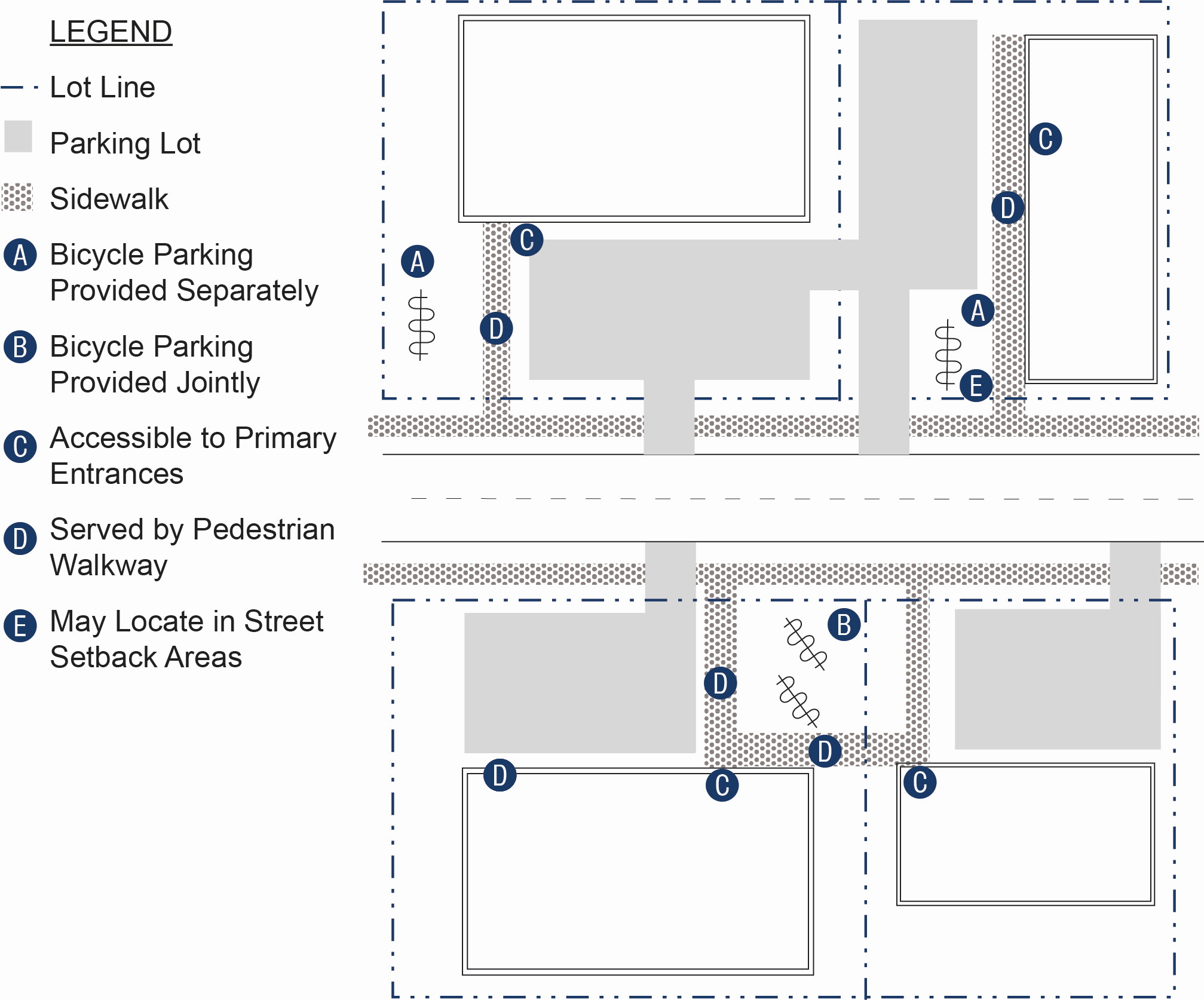
d.
Shared bicycle parking spaces. Nothing shall limit uses on the same block face from establishing shared or consolidated bicycle parking spaces in central or mid-block locations, provided there are sufficient bicycle parking spaces for all uses sharing the required bicycle parking.
(f)
Parking lot configuration.
(1)
General.
a.
All required off-street parking spaces shall be located on the same lot as the principal use, they serve, except as allowed in § 30-6701(g), Alternatives.
b.
Required off-street parking shall be maintained for the duration of the principal use and shall not be reduced unless the principal use ceases or changes.
c.
Except where allowed by this Article, off-street parking spaces shall be not be located in any required landscaping or stormwater management area.
d.
Off-street parking spaces shall not protrude into any street, fire lane, drive aisle, sidewalk, greenway, or pedestrian connection.
(2)
Dimensional standards for parking spaces and aisles. Off-street parking spaces and drive aisles serving them shall comply with the minimum dimensional standards established in the table of dimensional standards for off-street parking lots.
(3)
Compact parking spaces.
a.
Compact car off-street parking spaces with a minimum width of eight and one-half feet and a minimum depth of 18 feet may be provided for up to 30 percent of the minimum parking requirements in the table of minimum off-street parking requirements.
b.
In no instance shall the minimum size of a compact parking space be further reduced.
(4)
Parking space access.
a.
All off-street parking spaces shall be accessed directly from drive aisles or private driveways and not directly from arterial or collector streets.
b.
All off-street parking areas shall be designed with an appropriate means of vehicular access to a street or alley in a manner that allows for safe vehicular movements.
(5)
Vehicle backing. Vehicular use areas shall be designed so that a vehicle is not required to back onto a street to enter or exit the parking lot, a parking space, or a stacking space.
(6)
Surface materials. All off-street parking spaces, accessible parking spaces, drive aisles, and vehicular use areas shall be paved and maintained with concrete, asphalt, or similar material of sufficient thickness and consistency to support anticipated traffic volumes and weights.
(7)
Grading and drainage. The parking lot shall be graded, properly drained, stabilized, and maintained to minimize dust and erosion. Parking lots shall not impound stormwater unless surface impoundment is required as a method of stormwater management. However, in no instance shall surface impoundment result in a fewer number of off-street parking spaces than required in the table of minimum off-street parking requirements.
(8)
Markings. All parking spaces and lanes in parking lots shall be clearly delineated with paint lines, curbs, or other treatment.
(9)
Curbs and wheel stops. All off-street parking spaces shall have curbs or wheel stops located so that no part of the parked vehicle extends onto or over a sidewalk, walkway of six feet in width or less, adjacent property, or landscape area.
(10)
Separation from fire protection facilities. No required off-street parking space take place within designated fire lanes or be located within 15 feet of a fire hydrant or other fire protection facility.
(11)
Exterior lighting. Exterior lighting in parking lots shall be designed to provide illumination of parking lot areas for the purposes of safe vehicle and pedestrian circulation.
(12)
Landscaping. Parking lot landscaping shall be provided in accordance with § 30-205, Landscaping.
(13)
Accessible parking spaces.
a.
Accessible parking spaces for the disabled are required for all forms of development except single-family detached dwellings.
b.
Accessible parking spaces shall be in accordance with the regulations set forth by the Americans with Disabilities Act and the North Carolina Building Code.
c.
Accessible (handicapped) parking spaces shall be provided in accordance with the North Carolina Building Code requirements.
(g)
Alternatives. Development may deviate from the off-street parking requirements in this section through approval of an alternative parking plan accepted by the Town Planner and configured in accordance with the following:
(1)
Deviation from required minimum. An applicant may propose a reduced rate of provision for off-street parking less than that specified in the table of minimum off-street parking requirements, in accordance with a parking study prepared by a professional engineer licensed by the State of North Carolina. The parking study shall document why fewer spaces than required will be adequate while still protecting the public's health, safety, and welfare.
(2)
Provision over the maximum allowed. An applicant proposing development subject to the standards in § 30-6701(e)(4), Off-Street parking space maximum, may propose a total number of off-street parking spaces that exceeds the maximum allowed only through the provision of a parking study prepared by a professional engineer licensed by the State of North Carolina. The parking study shall document why the provision of off-street parking spaces beyond the maximum authorized is necessary for the public's health, safety, or welfare.
(3)
Off-site parking. Up to 50 percent of off-street parking space requirements for an existing building may be met by locating required parking in an off-site location, in accordance with the following standards:
a.
The off-site parking is located within 1,000 feet from the use it serves, as measured from the entrance of the use to the nearest off-site parking space.
b.
A sidewalk or paved pedestrian walkway is provided to the off-site parking area from the use.
c.
In cases where the off-site parking is located on land under separate ownership from the use it serves, the off-site parking shall be subject to a written agreement executed by the owners involved and filed with the Town Planner prior to the use of off-site parking facilities. The agreement shall guarantee the long-term availability of the off-site parking in question.
d.
Should an off-site parking agreement cease, then the use shall be considered a nonconformity, unless the use is brought into compliance with the minimum off-street parking requirements of this section.
(4)
Shared parking. The required off-street parking for a use may be met with shared use of the required off-street parking spaces of another use, only in accordance with the following standards:
a.
The use of shared off-street parking spaces shall be subject to a shared parking agreement executed by the landowners of the uses involved, approved by the Town Planner , and recorded in the office of the Register of Deeds for Johnston County where the development is located.
b.
The shared parking agreement shall guarantee the long-term availability of the shared parking spaces in question. Nothing shall limit the percentage of required off-street parking spaces that may be provided through a shared parking agreement.
c.
The shared parking is located within 1,000 feet, as measured from the entrance of the use to the nearest shared parking space.
d.
A sidewalk or paved pedestrian walkway is provided to the shared parking area from the use.
e.
The uses served by the shared parking must have different peak parking demands, differences in hours or days of operation, or otherwise operate such that the uses sharing parking have access to the required minimum number of off-street parking spaces when in operation.
f.
Should the shared parking agreement cease, then the use(s) formerly served by shared parking shall be considered a nonconformity, unless the use(s) is brought into compliance with the minimum off-street parking requirements of this section.
(h)
Off-street loading.
(1)
Loading facilities required. Every application for a non-residential use shall ensure that adequate off-street loading facilities are provided so that loading vehicles do not occupy required off-street parking spaces, block vehicular access, or prevent appropriate on-site maneuvering.
(2)
Minimum off-street loading space requirements.
a.
A minimum number of off-street loading spaces is not established; however, if off-street loading spaces are provided, they shall be provided and maintained in sufficient numbers to adequately handle the needs of a non-residential use.
b.
Failure to provide or maintain off-street loading spaces when they are necessary to serve the development is a violation of this Article.
c.
In no instance shall an off-street loading space occupy a required off-street parking space or interrupt the safe operation of vehicles or circulation of pedestrian or bicycles.
d.
Each off-street loading space shall be designed with an appropriate means of vehicular access to a street or alley in a manner that will least interfere with traffic circulation.
(3)
Location. No off-street loading space shall be located within a required setback or within 30 feet of a street intersection.
(4)
Dimensional standards for loading spaces. When off-street loading spaces are provided, they shall comply with the following minimum requirements (see Figure 26 Off-Street Loading Spaces):
a.
Except for loading spaces used by semi-tractor trailers, off-street loading spaces shall be at least ten feet wide and at least 30 feet long.
b.
Off-street loading spaces used by semi-tractor trailers shall be at least 70 feet long.
c.
Overhead clearance for an off-street loading space shall be at least 15 feet.
d.
Off-street loading spaces shall be designed so that no backing onto or from a public street is necessary.
FIGURE 26: OFF-STREET LOADING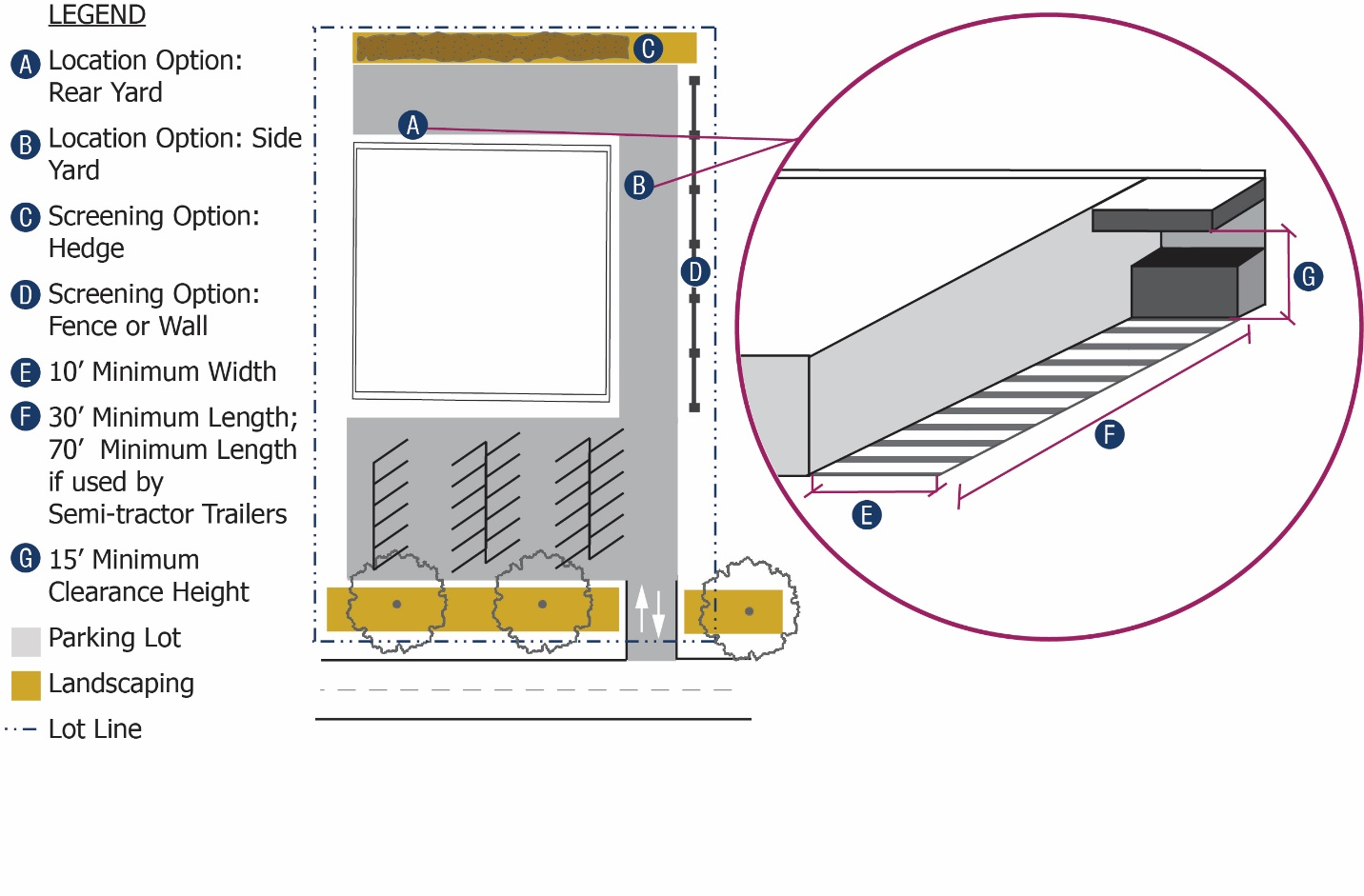
(Ord. No. AL2021-06-1, § 1, 6-7-2021; Ord. No. AL2022-08-2 (UDO-TA-3-22), § 1, 8-1-2022)
Sec. 30-6801 - Intent.
This section provides guidance and standards for signage across the Town's planning jurisdiction. The erection and maintenance of signs is controlled and regulated in order to promote the health, safety, welfare, convenience, and enjoyment of travel on streets and sidewalks. These provisions are also intended to balance between the promotion of beneficial commerce, protection of free speech, and the protection of community character. More specifically, these standards are intended to:
(a)
Promote traffic safety;
(b)
Avoid interference with protected free speech;
(c)
Regulate the content of signs to the least extent possible and only when absolutely necessary to protect public health and safety;
(d)
Regulate off-premise signage in accordance with State law and federal jurisprudence;
(e)
Ensure that any content-based signage standards serve a compelling public purpose and are as narrowly-tailored as possible;
(f)
Promote economic development and beneficial commerce;
(g)
Ensure residents and visitors can locate desired goods, services, and destinations;
(h)
Avoid conflicts between advertising and public safety signage;
(i)
Reflect the aesthetic character and design quality anticipated in the Town's adopted policy guidance; and
(j)
Minimize any detrimental effects of signage on adjacent properties.
(Ord. No. AL2021-06-1, § 1, 6-7-2021)
Sec. 30-6802 - Applicability.
Except for the sign types exempted from these standards identified in § 30-6803 Signs exempt from permit requirements, all signs shall be constructed, erected, affixed, placed, posted, painted, repainted, hung, or otherwise established only in accordance with the standards in this section.
(Ord. No. AL2021-06-1, § 1, 6-7-2021)
Sec. 30-6803 - Signs exempt from permit requirements.
The following forms of signage shall not be subject to these signage standards, but may be subject to other applicable standards in this Ordinance, such as the requirement to obtain a building permit. Applicants shall be responsible for securing all required permits prior to erecting or modifying any of the following forms of excluded signage:
(a)
Fence-wrap signs affixed to fences surrounding a construction site in accordance with the standards in § 160D-908 of the North Carolina General Statutes;
(b)
Legal notices required by governmental bodies, public utilities, or civic associations;
(c)
Governmental signage, including flags, street signs, traffic warning signs, and other signage provided solely by governmental agencies for public health and safety;
(d)
Building cornerstones, historical plaques, or grave markers;
(e)
Signage associated with public transit stops;
(f)
Holiday displays on lots within all zoning districts;
(g)
Historic markers;
(h)
Signage that is not visible from any off-site areas (e.g., entirely enclosed by opaque walls that prevent the visibility of signage from any off-site areas); and
(i)
Signage associated with off-street parking spaces or the prohibition of parking in certain locations like fire lanes, bus lanes, or loading zones.
(Ord. No. AL2021-06-1, § 1, 6-7-2021)
Sec. 30-6804 - Prohibited sign types.
The following signs, sign construction, and displays are prohibited throughout the Town's jurisdiction:
(a)
Outdoor advertising, except for outdoor advertising lawfully established prior to (insert the effective date of this Ordinance), which may be permitted to continue as a nonconforming use only in accordance with Article 8, Nonconformities, and § 160D-912 of the North Carolina General Statutes;
(b)
Off-premise signage;
(c)
Moving signs, excluding flags, banners, and clocks;
(d)
Flashing, scrolling, twirling, or blinking signs;
(e)
Gas- or air-filled balloons, figures, and other inflatable signs;
(f)
Signs on the roof or above the parapet of a building;
(g)
Any sign which the Town Planner determines obstructs the view of bicyclists, pedestrians, or motorists using any street, approach to any street intersection, sidewalk, public trail, or which interferes with the effectiveness of or obscures any traffic sign, device, or signal;
(h)
Signs, lights, rotating features, words, and other devices, which resemble or may be erroneously construed as traffic signals, traffic signs, or emergency vehicle lights;
(i)
Illuminated or highly reflective signs that law enforcement determines hampers the vision of motorists, pedestrians, or bicyclists;
(j)
Any sign which interferes with free passage from or obstructs any fire escape, downspout, door, stairway, ladder, or opening intended as a means of ingress or egress;
(k)
Any sign placed on a utility pole, street sign post, traffic signal support, hydrant, bridge, tree, aspect of public infrastructure, or street paving that is not installed or approved by an appropriate governmental agency;
(l)
Signs with speakers intended for audio playback; and
(m)
Use of vinyl or fabric material over or around a cabinet sign frame.
(Ord. No. AL2021-06-1, § 1, 6-7-2021)
Sec. 30-6805 - General requirements for all signage.
(a)
Permit required. Unless exempted by or prohibited by these standards, all signage shall obtain approval of a zoning compliance permit prior to establishment or modification.
(b)
Dimensions and measurement. All sign heights, maximum face area, and related dimensional requirements shall be determined in accordance with § 30-10210, Signage measurement.
(c)
Location and placement. All signs shall conform to these standards:
(1)
Permitted signs shall be located outside of the street right-of-way, behind sidewalk areas and outside of required sight distance triangles, except where encroachments are specifically permitted by the provisions of this Ordinance.
(2)
All attached signs shall be mounted and attached to buildings in a secure manner and shall be maintained in good repair for safety and appearance.
(3)
No person other than persons authorized by the Town shall damage, trim, destroy, or remove trees, shrubs, or other vegetation located within the public right-of-way of any street or road for the purpose of placing a sign or increasing or enhancing the visibility of a sign; nor shall such work be performed on property that is not under the ownership or control of the person performing or responsible for such work, unless done pursuant to the express authorization of the person owning the property where such trees or shrubs are located.
(d)
Signs in the right-of-way. No sign shall be permitted within a street right-of-way except in accordance with the standards in this section.
(1)
Only the following signs may be permitted in a street right-of-way:
a.
Governmental signage erected by the Town of Archer Lodge or Johnston County;
b.
Signage erected by NCDOT;
c.
Emergency warning signage erected by a governmental agency, public utility, or contractor performing work within the right-of-way; or
d.
Political signs.
(2)
In cases where signs permitted within a street right-of-way are located above a sidewalk or vehicular travelway, the sign shall maintain a minimum vertical clearance of at least nine feet above the sidewalk and twelve feet above the paving, curb, gutter, or grade, as appropriate.
(3)
In the event the establishment or realignment of a street results in an existing sign becoming wholly or partially within the right-of-way in violation of these standards, the sign shall be removed at the expense of the person or agency establishing or realigning the street.
(4)
Removal of illegal signs in right-of-way and public properties.
a.
The Town Planner may remove any sign placed on public property or within any public right-of-way in violation of this Ordinance.
b.
Signage determined to be in violation of this Ordinance and removed from public property or a public right-of-way shall be discarded.
c.
Penalties may be levied for each such illegal sign as prescribed Article 9: Enforcement.
(e)
Material and structural requirements. All signs shall conform to these standards:
(1)
All signs, except those protected by glass or other transparent cover, shall be constructed of materials that are permanent in nature and that will not rapidly deteriorate, fade, fall apart, or in any way become a hazard to the public health, safety, and general welfare.
(2)
All permanently installed signs shall be able to resist normal loads from positive and negative wind pressure, snow, and other conditions as required by the State Building Code.
(3)
The Town Planner may require sign load calculations and attachment design from a professional engineer licensed by the State, and require the same engineer to certify the sign's installation in accordance with all applicable specifications.
(f)
Sign illumination. Signs may be externally or internally lit in full compliance with all applicable lighting standards in this Ordinance and the State building code. The following forms of illumination shall be prohibited:
(1)
Neon signage, excluding "Open" signs;
(2)
Flashing or intermittent illumination; and.
(3)
No indirect or internally illuminated sign shall have only partial illumination for a period of more than 30 successive days.
(g)
Changeable copy. Areas devoted to changeable copy on a sign shall be subject to the following standards:
(1)
Changeable copy areas may only be located on monument or wall signs;
(2)
No more than 50 percent of the sign face area may be devoted to changeable copy area;
(3)
As a means of avoiding distractions for drivers, bicyclists, and pedestrians, the display of changeable copy shall not change more than once per minute;
(4)
Outdoor advertising signs shall not include areas devoted to changeable copy; and
(5)
Signage copy shall not be animated, and shall not blink, scroll, flash, or have other moving effects. This provision shall not restrict the copy from changing from one message to another.
(h)
Sign maintenance.
(1)
All signs shall be kept free from defective or missing parts or peeling paint.
(2)
The Town Planner may require the painting, repair, or alteration of a sign, at the owner's expense, if such sign constitutes a hazard to the public health, safety, or general welfare by reason of inadequate maintenance, dilapidation, or obsolescence.
(3)
Written notice of such repair shall be given to the owner in accordance with the procedures in Article 9: Enforcement.
(i)
Inspections.
(1)
All signs for which a permit is required shall be subject to inspection by the Town.
(2)
The Town Planner or a designee shall be authorized to enter at all reasonable times upon any property or premises to ascertain whether the provisions of this Ordinance are being obeyed.
(j)
Damaged signs prohibited.
(1)
Surface appearance. No sign shall have more than 20 percent of its surface area covered with disfigured, cracked, ripped, or peeling paint or poster paper for a period of more than 30 consecutive days.
(2)
Broken displays. No sign shall remain with a bent or broken display area, broken supports, loose appendages or struts or stand more than 15 degrees from the perpendicular for a period of more than 30 consecutive days.
(3)
Destroyed and damaged signs.
a.
Signs established prior to June 7, 2021 that are either damaged beyond repair or destroyed shall be replaced within 60 days of being damaged or destroyed.
b.
The replacement sign shall be built to the same or smaller size and specifications as the damaged or destroyed sign.
(k)
Sign removal. The following signs may be removed by the Town:
(1)
Substandard signs. The owners of any sign judged to be substandard by a Building Inspector shall be notified in writing and shall have 30 days in which to make repairs. Failure to comply with such notification within 30 days is a violation of this Ordinance and the Town may remove such sign at the expense of the owner or lessee thereof plus administrative fees.
(2)
Signs on public property. Any non-governmental sign installed or placed on public property or within a public right-of-way is subject to confiscation and disposal. The Town shall have the right to recover the full costs of removal and disposal from the person placing such a sign.
(3)
Illegal temporary signs. Any illegal temporary is subject to confiscation and disposal. The Town shall have the right to recover the full costs of removal and disposal from the person placing such a temporary sign.
Sec. 30-6806 - Signs in residential districts.
Signs located on a lot in a residential district shall comply with the standards in the table below (see Figure 27 for images of sign types):
(Ord. No. AL2021-06-1, § 1, 6-7-2021)
Sec. 30-6807 - Signs in non-residential and planned development districts.
Signs located on a lot in a non-residential or planned development district shall comply with the standards in the table below (see Figure 27 for images of sign types):
| FIGURE 27: SIGN TYPES | |
|---|---|
 Wall Sign Wall Sign |  Projecting Sign Projecting Sign |
 Monument Sign Monument Sign |  Pylon Sign Pylon Sign |
 Portable Sign Portable Sign |  Windows Sign Windows Sign |
(Ord. No. AL2021-06-1, § 1, 6-7-2021)
Sec. 30-6808 - Unified sign plan; requirements; enforcement.
(a)
The owners or developers of two or more contiguous lots or any multi-tenant use of a commercial property, including, but not limited to, shopping centers, convenience centers, or office complexes, shall submit a unified sign plan for approval as part of their site plan application, or at a later date. No sign permit application will be accepted for such property or use until a unified sign plan is approved by the Town Planner.
(b)
The application for a unified sign plan shall indicate the following:
(1)
Colors;
(2)
Letter/graphics style;
(3)
Location of each sign;
(4)
Materials to be used in construction;
(5)
Maximum dimensions and proportions; and
(6)
Other standards imposed by the applicant.
(c)
A copy of the approved unified sign plan, including any amendments, must be kept on file with the Town.
(d)
It shall be the responsibility of the applicant and/or property owner to enforce the terms of the approved unified sign plan.
(e)
After approval of a unified sign plan, no sign shall be erected, placed, painted, or maintained except in conformance with the approved plan.
(Ord. No. AL2021-06-1, § 1, 6-7-2021)
Sec. 30-6809 - Existing signs not conforming to unified sign plan.
If any new or amended unified sign plan is filed for a property on which existing signs are located, the amended plan shall include a schedule for bringing into conformance, within three years, all signs not conforming to the proposed amended plan or to the requirements of this Article in effect on the date of submission.
(Ord. No. AL2021-06-1, § 1, 6-7-2021)
Sec. 30-6810 - Temporary signs.
Temporary signage is permitted on a lot or site in accordance with the following standards:
(a)
Up to one temporary sign shall be permitted on a lot or development site.
(b)
A temporary sign may have a maximum sign face area of four square feet per side.
(c)
In no instance shall a temporary sign be located within a right-of-way of have a height exceeding four feet above the grade at the base of the sign.
(d)
Temporary signs shall not be located within required sight distance triangles, but are permitted within required landscaping areas, provided they do not impact the performance objectives of required landscaping.
(e)
Temporary signs shall not be internally or externally illuminated.
(f)
There shall be no maximum duration for the placement of a temporary sign, and nothing shall prohibit the replacement of one temporary sign with another temporary sign.
(Ord. No. AL2021-06-1, § 1, 6-7-2021)
Sec. 30-6811 - Political signs.
Political signs shall comply with the following standards:
(a)
May not be illuminated;
(b)
Shall not be located on any trees, utility poles, publicly-owned property, or within a public street right-of-way, except NCDOT right-of-way in accordance with § 136-32 of the North Carolina General Statutes;
(c)
May not exceed four square feet in area and four feet in height, if freestanding; and
(d)
May be displayed during a period beginning with the established filing date for an election and concluding five days after the election. In the event of a runoff election, political signs for the candidates involved may remain on display until five days after the runoff election.
(Ord. No. AL2021-06-1, § 1, 6-7-2021)
Sec. 30-6901 - Collection of solid waste and recyclables.
All multifamily, mobile home park, office, commercial, institutional and industrial developments should provide secure, safe, and sanitary facilities for the storage and pickup of solid waste and recyclables. Such facilities shall be convenient to collection and shall be appropriate to the type and size of the development or use being served. All solid waste and recyclable storage facilities shall be screened by a solid wall, fence, tight evergreen hedge, or combination of a wall, fence, or hedge in accordance with article provisions. Such screening shall be of sufficient height and design to effectively screen the facility from the view from adjacent properties and streets.
FIGURE 28: SOLID WASTE DUMPSTER ENCLOSURES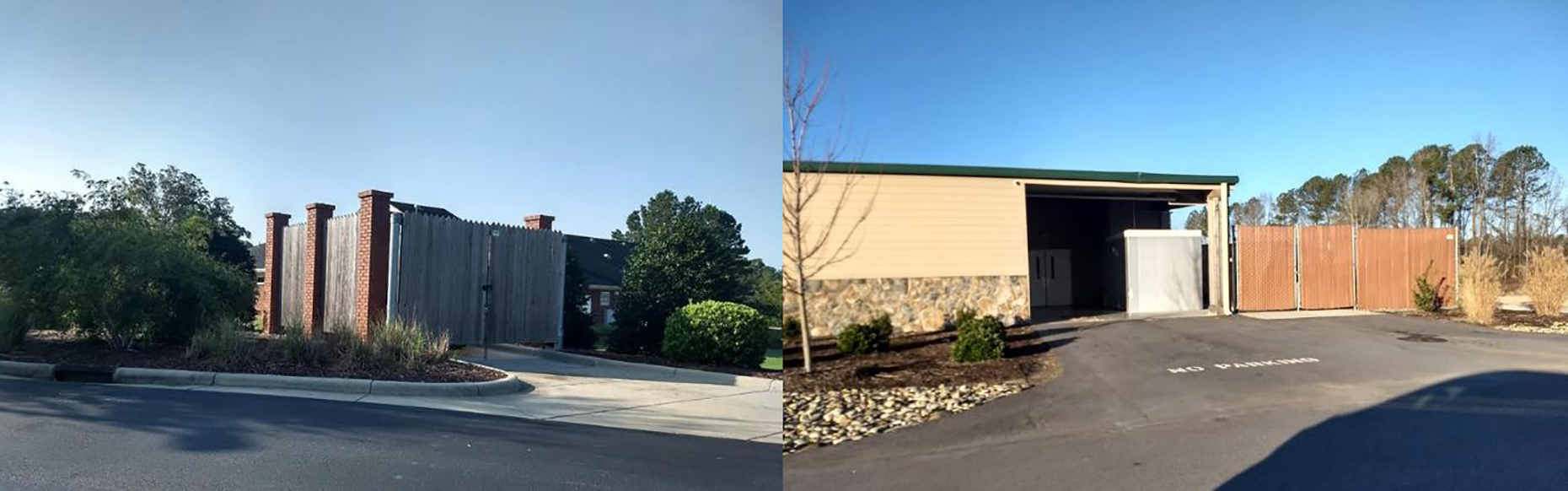
(Ord. No. AL2021-06-1, § 1, 6-7-2021)
Sec. 30-61001 - Traffic impact analysis (TIA) submittal requirement.
(a)
Purpose. Archer Lodge is committed to maintaining and improving the quality of life for current and future citizens. A major factor affecting the quality of life has become traffic congestion along the major thoroughfares and local streets within urbanizing areas. By requiring a traffic impact analysis (TIA), the Town can evaluate the effect proposed development will have on the Town's existing traffic system and enable the Town to require specific improvements. The intent of this section is to provide developers with a clear policy as to the Town's TIA expectations and to ensure that all developments are treated equally through the establishment of specific guidelines and improvement requirements.
(b)
Requirement thresholds.
(1)
Residential subdivision proposing 100 lots/units or more, no matter how many phases are proposed.
(2)
Proposed nonresidential subdivision which generates an average daily traffic count of 1,000+ vehicles per day or 100+ trips during peak hour of generator. This traffic count must be based on the latest version of the Institute of Transportation Engineers (ITE) Trip Generation Manual.
(3)
Any residential or nonresidential development requiring a special use permit or site plan approval which generates an average daily traffic count of 1,000+ vehicles per day or 100+ trips during peak hour of generator. This traffic count must be based on the latest version of the Institute of Transportation Engineers (ITE) Trip Generation Manual.
(4)
Note #1: The count is cumulative; as a proposed development reaches the threshold, a TIA will be required for the entire development. As new phases are proposed and once a development has reached the threshold, an additional TIA will be conducted for each additional phase.
(5)
Note #2: Failure to meet all requirements listed within this section may constitute disapproval of the development request.
(c)
Retention of expert assistance and reimbursement by applicant.
(1)
The Town shall identify consultants and/or experts who are able to prepare, review and evaluate the traffic impact of the proposed development.
(2)
The Town will present a list of the consultants identified in (a) to the applicant. The applicant shall select one firm from the list to conduct a TIA for the applicant's proposed development at the applicant's expense.
(3)
The Town, applicant and consultant shall agree in writing to the scope of work and costs of the TIA. The selected consultant shall provide draft and final versions of the TIA directly to the Town.
(4)
The Town may retain a consultant to review and evaluate the applicant's TIA. Any cost associated with the Town's review shall be paid by the applicant. The applicant will provide funds for the review at step (2) above. The Town will hold the funds in escrow until either used for a TIA review or returned to the applicant.
(d)
Traffic impact analysis guidelines. All traffic impact analyses shall be completed in accordance with the guidelines listed in section 3 of the Johnston County Land Design Manual.
(e)
Improvement requirements.
(1)
Left turn lane, right turn lane, and/or right turn taper. Based on requirements of the NCDOT Driveway Manual or other NCDOT standards.
(2)
Additional right-of-way. If a subject development falls along a road projected to be widened by NCDOT or an adopted Town or Johnston County plan, additional right-of-way along the development's road frontage shall be dedicated as deemed acceptable by NCDOT.
(3)
Offsite improvements. If a road segment or intersection is currently performing at level of service (LOS) D or better and is projected to perform at LOS E or F at the time of build-out, improvements to maintain the road segment or intersection at LOS D must be included. If a road segment or intersection is currently performing at level of service (LOS) E or F and is projected to continue to perform at LOS E or F at the time of build-out, the TIA shall demonstrate how an LOS D could be achieved and also specify what improvements must be made to ensure that the road segment or intersection is not degraded any further than the current levels.
(4)
Other necessary improvements. Additional improvements may be required based on the TIA recommendations related to topographic/environmental conditions, sight distance, street offsets, conflicting movements, existing traffic accident counts, circulation, and other potential traffic issues resulting from the proposed development. Additionally, the planning board may determine that additional improvements are necessary to ensure the safety and welfare of the Town's citizens and travelers.
(Ord. No. AL2021-06-1, § 1, 6-7-2021)
Sec. 30-61101 - Sedimentation, erosion control and stormwater management.
All subdivisions and site-planned developments shall meet the following requirements:
(a)
The Johnston County Stormwater Management Ordinance (Johnston County Land Development Ordinance, Art. VII) and the Stormwater Design Manual, which were adopted by reference on October 12, 2012 as if set out fully in this Article;
(b)
The Johnston County Erosion and Sedimentation Control Ordinance, which was adopted by reference by the Town on September 8, 2014; Approved by the Johnston County Commissioners of Oct. 6, 2014 and subsequently approved by the N.C. Sedimentation Control Commission on Nov. 20, 2014;
(c)
§ 30-4502, Water supply watershed protection overlay (WSWOD) district;
(d)
Town of Archer Lodge Town Code of Ordinances Chapter 14, Flood Damage Prevention.
(Ord. No. AL2021-06-1, § 1, 6-7-2021)

