
Archer Lodge City Zoning Code
ARTICLE 3
- PROCEDURES.
DIVISION 1. - SUMMARY PROCEDURES TABLE.
(Ord. No. AL2021-06-1, § 1, 6-7-2021; Ord. No. AL2021-11-1 (UDO-TA-1-21), § 1, 11-15-2021; Ord. No. AL2022-08-1 (UDO-TA-2-22), § 1, 8-1-2022; Ord. No. AL2023-01-1 (UDO-TA-1-23), § 1, 1-3-2023)
Sec. 30-3201 - Pre-application conference.
(a)
Purpose. The purpose of a pre-application conference is to provide an opportunity for the applicant to learn about the submittal requirements, procedures, and standards applicable to a particular development application. A pre-application conference is also an opportunity for Town staff to become familiar with, and offer preliminary comments about the scope, features, and impacts of the proposed development, as it relates to the standards in this Ordinance.
(b)
Applicability.
(1)
Pre-Application conference required. A pre-application conference between the applicant and Town staff is required before submittal of the following applications:
a.
Administrative adjustments;
b.
Comprehensive plan amendments;
c.
Development agreements;
d.
Planned developments;
e.
Site plans;
f.
Special use permits; and
g.
Variances (to include flood hazard area and watershed protection).
(2)
Pre-application conference optional. A pre-application conference between the applicant and Town staff is optional before submittal of the following applications:
a.
Determinations and interpretations;
b.
Major subdivisions;
c.
Minor subdivisions;
d.
Reasonable accommodations;
e.
Rezonings/Map amendments;
f.
Text amendments; and
g.
Vested rights certificates.
(3)
Pre-Application conference not conducted. A town pre-application conference is not required or conducted as part of applications filed by the town, or for applications made directly to Johnston County or for the following. Johnston County may require a pre-application conference.
a.
Appeals;
b.
Building permits*;
c.
Certificates of occupancy*;
d.
Exempt subdivisions;
e.
Expedited subdivisions;
f.
Final plats;
g.
Floodplain development permits;
h.
Temporary use permits; and
i.
Zoning compliance permits.
* Applications made directly to Johnston County.
(c)
Scheduling. Applicants shall contact the town planner to schedule a pre-application conference.
(d)
Procedure.
(1)
Following receipt of a request for a pre-application conference, the Town Planner shall schedule the conference and notify the applicant of the time and location. During the conference, Town staff members will explain the application review process and any special issues or concerns regarding the subject proposal.
(2)
The applicant is encouraged to submit a sketch or conceptual plan, if appropriate, to Town staff during the pre-application conference.
(3)
In cases where a pre-application conference is required, the Town Planner shall forward a brief written summary of the issues discussed during the pre-application conference to the applicant for inclusion with the application materials.
(e)
Effect.
(1)
When required, a completed pre-application conference entitles an applicant to take the next step in the application process. Applications types requiring a pre-application conference will not be accepted until after the mandatory pre-application conference has been completed.
(2)
Discussions at a pre-application conference are not binding on the applicant or the Town and do not constitute application submittal for formal review of an application, approval of an application by the Town, an affirmative action by the Town with respect to any development proposal or potential application, or any action that would entitle a potential applicant to vested rights or the ability to exercise any rights under permit choice provisions.
(Ord. No. AL2021-06-1, § 1, 6-7-2021)
Sec. 30-3202 - Application filing and acceptance.
(a)
Authority to file applications. Unless expressly stated otherwise in this Ordinance, development applications associated with a particular lot or site reviewed under this Ordinance shall be submitted by the landowner, contract purchaser, agent of the landowner, or other person having a recognized property interest in the land on which development is proposed. Agents may be asked to provide proof of agency.
(b)
Application content. The Town Planner is authorized to establish the application content and forms, which shall be maintained in the offices of the Planning Department.
(c)
Application fees.
(1)
The Town Council shall establish application fees and may amend and update those fees, as necessary. Fees shall cover the costs of review, including public notification, as required.
(2)
No action shall be taken on an application and no application approval shall be issued until all required application fees are paid in full.
(d)
Submittal and review schedule.
(1)
The Town Planner is authorized to and shall establish specific rules for filing and review schedules (including time frames for review) for the various types of development applications, which shall be on file and available for inspection in the offices of the Planning Department during normal business hours.
(2)
Nothing shall require or prohibit the Town Planner from reducing the amount of time necessary for review of an application as workflow allows, but the timeframes for public notice in § 30-3204 Public notification, shall not be reduced.
(e)
Application submittal.
(1)
Applications shall be filed with the Town Planner in the form established by the Town Planner, along with the appropriate application fee.
(2)
An application shall not be considered to be submitted until determined to be complete in accordance with § 30-3202(g) Determination of application completeness.
(3)
No application shall be reviewed or decided until after it is determined to be complete.
(4)
No application shall be accepted for development proposed on a lot or site until property taxes are paid in full, as determined by the Johnston County Tax Assessor.
(f)
Burden of presenting complete application. The burden of presenting and maintaining a complete application shall be solely upon the applicant.
(g)
Determination of application completeness. On receiving a development application, the Town Planner shall determine, within seven days, whether the application is complete or incomplete. A complete application is one that:
(1)
Contains all information and materials identified in the appropriate Town documentation as required for submittal of the particular type of application;
(2)
Is in the form and number of copies required by the appropriate Town documentation;
(3)
Is legible and printed to scale (where appropriate);
(4)
Is signed by the person with the authority to file the application (verifiable electronic signatures are permitted);
(5)
Includes information in sufficient detail to evaluate whether or not the application complies with the applicable review standards in this Ordinance;
(6)
Is accompanied by the fee established for the particular type of application; and
(7)
Includes material associated with a pre-application conference if one is required.
(h)
Application incomplete.
(1)
If the application is incomplete, the Town Planner shall notify the applicant of the deficiencies in writing.
(2)
The applicant may correct the deficiencies and resubmit the application for completeness determination.
(3)
Application processing shall stop following delivery of a notice of incomplete application until all deficiencies are addressed and the application is determined to be complete, or the applicant declares the application to be complete in accordance with § 30-3202(j) Declaration of completeness by applicant.
(i)
Application complete.
(1)
On determining that the application is complete, it shall be considered as submitted, the Town shall notify the applicant and commence review in accordance with the procedures and standards of this Ordinance.
(2)
Nothing shall preclude the Town Planner or a review authority from re-evaluating an application for completeness in the event application inadequacies are revealed at a date subsequent to an application being declared complete.
(j)
Declaration of completeness by applicant.
(1)
If, upon receipt of notice of application deficiencies by the Town Planner, an applicant wishes to have the application processed without further amendment or revision, the applicant shall provide written notice to the Town Planner that they desire the application to be processed without further amendment or revision.
(2)
Upon receipt of written notice to process the application without further amendment or revision, the Town Planner shall process the application in accordance with the standards in this Ordinance. In no instance shall additional materials or information be added to the application by the applicant. Nothing shall limit an applicant from withdrawing an application in accordance with § 30-3210 Modification, continuance, or withdrawal.
(Ord. No. AL2021-06-1, § 1, 6-7-2021; Ord. No. AL2022-03-1 (UDO-TA-1-22), § 1, 3-7-2022)
Sec. 30-3203 - Staff review and action.
(a)
Initial staff review.
(1)
Following application completeness determination, development application materials shall be distributed by the Town Planner to all appropriate staff and review agencies for review and comment.
(2)
Applications shall be reviewed during the review cycle in place when the application is determined to be complete.
(3)
In considering the application, the Town Planner or other Town staff (as appropriate), shall review the application, relevant support material, and any comments or recommendations from other staff and review agencies to which the application was referred.
(4)
If deficiencies in complying with applicable standards of this Ordinance are identified, the Town Planner shall notify the applicant of such deficiencies in writing and provide the applicant a reasonable opportunity to discuss them and revise the application accordingly.
(b)
Staff report and recommendation.
(1)
The Town Planner shall prepare a written staff report on any application to be reviewed or decided by the Planning Board, Town Council, or the Board of Adjustment.
(2)
Except for appeals and variances. the staff report shall conclude whether the application complies with all applicable review standards of this Ordinance, and recommend one of the decisions authorized for the particular type of application, based on the review standards applicable to the application type.
(3)
In cases where the staff finds an application does not comply with the provisions of this Ordinance the staff report shall cite the specific code section(s) in question and the reasons why the application fails to comply.
(4)
The staff report may identify and recommend modifications to the development proposal that specify how compliance deficiencies might be corrected and how adverse effects of the development application (if any) might be mitigated.
(5)
A staff report is not required for applications decided by the Town Planner or the Technical Review Committee, though one may be prepared.
(c)
Distribution of application and staff report. In cases where a staff report is prepared, the town planner shall take the following actions within a reasonable time period before the application is scheduled for review:
(1)
Schedule and ensure any required public notice of the application (if appropriate) is prepared in accordance with § 30-3204 Public notification;
(2)
Transmit the application, related materials, and staff report to the appropriate review authority(ies);
(3)
Transmit a copy of the staff report and any related materials to the applicant; and
(4)
Make the application, related materials, and staff report available for examination by the public.
(Ord. No. AL2021-06-1, § 1, 6-7-2021)
Sec. 30-3204 - Public notification.
(a)
Public notification requirements.
(1)
Applicable state law. All development applications subject to public notification shall comply with standards in §§ 160D-601, 160D-602, 160D-405, 160D-406, 160D-702, 160D-705, and 160D-1405 of the North Carolina General Statutes (as appropriate) and the other provisions in this Ordinance related to public notice.
(2)
Notice type and timing. The town planner shall ensure public notification (whether via published notice, mailed notice, or posted notice) is provided in accordance with the requirements in the table of public notice and scheduling below for the type of application and the type of notice. In computing the required time periods, the day the notice is published, mailed, or posted shall not be included, but the day of the hearing shall be included.
(b)
Published notice requirements.
(1)
When the provisions of this Ordinance require that public notice be published, the Town Planner shall publish a notice in a newspaper that is published weekly and that has general circulation in the community.
(2)
The form and content of the notice shall comply with the applicable N.C. General Statute.
(3)
A copy of the published notice shall also be published on the Town's website.
(c)
Mailed notice requirements.
(1)
Mailed notice specified in the Table of Public Notice and Scheduling, shall be mailed to:
a.
All landowners subject to the application;
b.
The applicant, if different from the landowner; and
c.
All landowners entitled to receive notice by the North Carolina General Statutes (including landowners located outside the Town) whose address is known by reference to the latest County tax listing.
(2)
Notice shall be deemed mailed by its deposit in the United States mail, first class or certified (as appropriate), properly addressed, postage paid, or other form of mailing authorized by N.C. Rule of Civil Procedure 4.
(3)
The content and form of the notice shall comply with the applicable requirements in the North Carolina General Statutes.
(4)
A copy of the mailed notice shall be maintained in the Planning Department for public inspection during normal business hours.
(5)
The Town may choose, in some cases, and in its sole discretion, to provide mailed public notice to parties beyond that required by the North Carolina General Statutes. Failure of the Town to provide mailed public notice beyond the minimum requirements specified in the General Statutes shall not invalidate the proceedings or subject the Town to claims of failure of due process.
(d)
Posted notice requirements. Posted notice shall be made by the Town Planner or designee, and shall comply with the following:
(1)
A sign shall be placed on the subject property in a conspicuous location so as to be clearly visible to the traveled portion of the respective street. Where the land subject to the notice does not have frontage on a public street, the sign shall be erected on the nearest street right-of-way with an attached notation generally indicating the direction and distance to the land subject to the application.
(2)
The content and form of the notice shall comply with the applicable requirements in the North Carolina General Statutes.
(e)
Constructive notice.
(1)
Minor defects in any notice shall not impair the notice or invalidate proceedings if a bona fide attempt is made to comply with applicable notice requirements. Minor defects in notice may include, but are not limited to:
a.
Errors in a legal description;
b.
Errors or omissions in the tax listing provided by the County; or
c.
Typographical or grammatical errors that do not impede communication of the notice to affected parties.
(2)
Failure of a party to receive written notice shall not invalidate subsequent action. In all cases, however, the requirements for the timing of the notice and for specifying the time, date, and place of a public hearing and the location of the subject property(ies) shall be strictly adhered to.
(Ord. No. AL2021-06-1, § 1, 6-7-2021)
Sec. 30-3205 - Public meetings and hearings.
(a)
Public meetings. Applications subject to a recommendation by the Planning Board in the Summary Procedures Table, shall be heard by the Planning Board during a public meeting (not a public hearing noticed in accordance with § 30-3204 Public notification). The public meeting shall be open to the public and shall be conducted in accordance with the Planning Board's adopted rules of procedure for public meetings. There is no requirement to allow public comment or testimony during a public meeting.
(b)
Legislative public hearings.
(1)
Except for applications for reasonable accommodations. special use permits, applications decided by the Town Council listed in the Summary Procedures Table, shall be reviewed during a legislative public hearing subject to prior public notification in accordance with § 30-3204, Public notification.
(2)
The legislative public hearing shall be open to the public and shall be conducted in accordance with the review authority's adopted rules of procedure for public hearings. Attendees shall be afforded the opportunity to comment or provide testimony during a public hearing, as authorized in the adopted rules of procedure.
(c)
Quasi-judicial public hearings. Some applications (e.g., determinations, special use permits, appeals, variances) in the Summary Procedures Table, are decided following a quasi-judicial public hearing, which shall be conducted in accordance with the review authority's rules of procedure and the following:
(1)
Opportunity to present testimony and evidence. Any party with standing shall be afforded a reasonable opportunity to present testimony and evidence in support of or in opposition to the application, and to ask questions of the applicant, the applicant's witnesses, Town staff, and the Town staff's witnesses and any other witnesses. Only persons with standing, as defined in subsection (6) may cross-examine adverse witnesses, present witnesses and arguments to the board, make motions and objections and generally act as an advocate for their matter.
(2)
Limitation on evidence. The Chair or other presiding officer may place reasonable and equitable limitations on the presentation of evidence and arguments and the cross examination of witnesses so that the matter at issue may be heard and decided without undue delay, including the presentation of repetitive or irrelevant testimony. The Chair may limit or exclude incompetent evidence, immaterial evidence, repetitive evidence, and ad hominem attacks.
(3)
Members excused under certain circumstances. A member may be excused from participation and voting on a particular issue by majority vote of the remaining members if the members participation or voting would violate § 30-2105 Conflicts of interest. Ex parte communications between an applicant or an affected party and a member of the review authority deciding the application are prohibited. If it occurs, it shall be disclosed during the quasi-judicial public hearing. Nothing shall limit communication between the applicant and Town staff regarding the application.
(4)
Subpoenas.
a.
The Chairperson, or in the chairperson's absence anyone acting as Chairperson, may subpoena witnesses and compel the production of evidence.
b.
To request issuance of a subpoena, persons with standing, as defined under § 30-3205(c)(6) may make a written request to the Chairperson explaining why it is necessary for certain witnesses or evidence to be compelled.
c.
The Chairperson shall issue requested subpoenas he or she determines to be relevant, reasonable in nature and scope, and not oppressive.
d.
The Chairperson shall rule on any motion to quash or modify a subpoena.
e.
Decisions regarding subpoenas made by the Chairperson may be appealed to the full Board of Adjustment.
f.
If a person fails or refuses to obey a subpoena issued pursuant to this subsection, the Board of Adjustment or the party seeking the subpoena may apply to the general court of justice for an order requiring that its subpoena be obeyed, and the court shall have jurisdiction to issue these orders after notice to all proper parties.
(5)
Objections. Before witness testimony, the review authority shall hear and rule on any objections to documents in the record, or any Town staff report provided to the review authority.
(6)
Standing. The following persons shall have standing to file an appeal, request a variance, or participate as a party in an action before the board. Anyone who:
a.
Has an ownership interest in the property that is the subject of the action, a leasehold interest in the property that is the subject of the action, or an interest created by easement, restriction, or covenant in the property that is the subject of the action.
b.
Has an option or contract to purchase the property that is the subject of the action.
c.
Was an applicant for an administrative decision by the Town staff.
d.
Any other person who will suffer special damages as the result of the action before the review authority.
e.
An incorporated or unincorporated association to which owners or lessees of property in a designated area belong by virtue of their owning or leasing property in that area, or an association otherwise organized to protect and foster the interest of the particular neighborhood or local area, so long as at least one of the members of the association would have standing as an individual to bring or challenge action and the association was not created in response to the particular development or issue that is the before the review authority.
f.
The Town of Archer Lodge by action of the Town Council.
(7)
Conduct of a quasi-judicial hearing. The Board of Adjustment and Town Council will conduct all quasi-judicial hearings according to the following rules:
a.
Evidence and burden of proof. All persons who intend to present evidence to the review authority shall be sworn by the Chairperson or acting Chairperson.
1.
All findings and conclusions necessary to the decision shall be based upon reliable, competent and material evidence. Competent evidence (evidence admissible in a court of law) shall be preferred whenever reasonably available.
2.
The term "competent evidence" shall not preclude reliance by the review authority on evidence that would not be admissible under the rules of evidence as applied in the trial division of the North Carolina Courts (i) except for items noted in sub-subdivisions (a), (b), and (c) of this subsection below that are conclusively incompetent, the evidence was admitted without objection, or (ii) the evidence appears to be sufficiently trustworthy and was admitted under such circumstances that it was reasonable for the review authority to rely upon it. The term "competent evidence," as used in this subsection, shall, regardless of the lack of a timely objection, not be deemed to include the opinion testimony of lay witnesses as to any of the following:
a.
The use of property in a particular way would affect the value of other property;
b.
The increase in vehicular traffic resulting from a proposed development would pose a danger to the public safety; or
c.
Matters about which only expert testimony would generally be admissible under the rules of evidence.
b.
The burden of presenting evidence sufficient to allow the reviewing authority to reach the conclusions of law required for variances and special use permits, as well as the burden of persuasion on those issues remains with the applicant or proponent, except that in an appeal of a staff decision, the staff has he initial burden of presenting evidence to justify the staff's initial order or decision that is being appealed.
(8)
Voting.
a.
Variances shall be approved by a four-fifths majority of the Board of Adjustment.
b.
All other decisions made by a review authority hearing a quasi-judicial matter require a simple majority.
(9)
Board action.
a.
Every quasi-judicial decision shall be based upon competent, material, and substantial evidence in the record. Each quasi-judicial decision shall be reduced to writing and reflect the review authority's determination of contested facts and conclusions of law and their application to the applicable ordinance standards.
b.
The review authority shall make its decision in a reasonable time. The review authority may continue a hearing to another time. The review authority may conduct the public testimony phase of the hearing at one meeting and make findings of fact and conclusions of law at another meeting. The parties may agree to continuances, subject to review authority approval.
(10)
Appeals to Johnston County Superior Court. Every quasi-judicial decision shall be subject to review by the Johnston County Superior Court by proceedings in the nature of certiorari. A petition for review shall be filed with the Clerk of superior court by the later of 30 days after the decision is effective or after a written copy thereof is given in accordance with § 30-3207, Written notice of decision. When first-class mail is used to deliver a notice, three days shall be added to the time to file the petition.
(d)
Other public hearings. Decisions by the Town Council on a site plan application shall be conducted as a public hearing following notification of the public in accordance with § 30-3204, Public notification.
(e)
Record.
(1)
A recording shall be made of all public hearings and the recording shall be kept for at least two years.
(2)
Accurate minutes shall also be kept of all proceedings, but a transcript need not be made.
(3)
Whenever practicable, all documentary evidence presented at a hearing as well as all other types of physical evidence shall be made a part of the record of the proceedings and shall be maintained by the Town in accordance with its records retention policies.
(Ord. No. AL2021-06-1, § 1, 6-7-2021)
Sec. 30-3206 - Conditions of approval.
(a)
Conditions of approval may be applied to the approval of an application subject to a quasi-judicial procedure as identified in the Summary Procedures Table, as deemed necessary by a review authority.
(b)
Conditions of approval shall be limited in both type and amount to those that address:
(1)
The conformance of the development to this Ordinance or other applicable Town ordinances;
(2)
The conformance of the development to the adopted policy guidance; and
(3)
The impacts reasonably expected to be generated by the development on the public and surrounding land.
(c)
All conditions of approval shall be expressly set forth in the development permit or approval and may be subject to appeal in accordance with § 30-3302, Appeals.
(d)
Conditions of approval must be consented to by both the deciding review authority and the applicant. Applicant consent must be in writing.
(Ord. No. AL2021-06-1, § 1, 6-7-2021)
Sec. 30-3207 - Written notice of decision.
(a)
Procedure. The written decision shall be signed by the Chairperson or other duly authorized member of the review authority. A quasi-judicial decision is effective upon filing the written decision with the review authority's Secretary.
(b)
Content. The notification of decision on an application shall be issued in the name of the applicant or applicant's agent, as appropriate, directed to: (i) The applicant, (ii) The landowner both to the address(es) identified in the application materials, and (iii) the other parties in interest (if any) and (iv) any persons who make a written request for a copy of the determination to the Town Planner. The notice shall identify the following:
(1)
The land or matter subject to the application;
(2)
A reference to any approved plans, as appropriate;
(3)
The approved use(s), if any;
(4)
Any conditions of approval or other applicable requirements; and
(5)
Any order, finding or certificate approved and issued.
(c)
Timing. Except where otherwise stated in this Ordinance, the Town Planner shall provide the applicant written notification of a decision or action within 10 business days after a final decision on a development application. The decision of the review authority shall be delivered by personal delivery, electronic mail, or by first-class mail. The Town Planner shall certify that proper notice has been made if required.
(d)
Copy of decision. In addition to providing notification of a decision on an application to an applicant, the Town Planner shall make a copy of the decision available to the public in the offices of the Planning Department during normal business hours.
(Ord. No. AL2021-06-1, § 1, 6-7-2021)
Sec. 30-3208 - Effect of development approval.
(a)
Effect. Approval of a development application in accordance with this Ordinance authorizes only the particular use, plan for development, or other specific activity approved.
(b)
Permit prerequisite. In the event a permit or development approval is a prerequisite to another permit or development approval (e.g., administrative adjustment or variance approval prior to a site plan approval), development may not take place until all prerequisite approvals are obtained. Approval of one development application does not guarantee approval of any subsequent development application.
(c)
Transfer.
(1)
Except when otherwise specified, development approvals shall run with the land and may be transferred from one owner to another, provided the land, structure, or use type continues to be used for the same purpose for which the approval was granted.
(2)
The terms and requirements of the approval shall continue to apply to all subsequent owners or interests.
(Ord. No. AL2021-06-1, § 1, 6-7-2021)
Sec. 30-3209 - Phased development.
In the case of phased development, site plans and major subdivisions shall include:
(a)
An illustration of all of the phases or the development;
(b)
A schedule for completion of public and private infrastructure associated with the development; and
(c)
All necessary improvements within the phase as well as outside the phase, but necessary to serve the development withing the phase being proposed for construction first.
(Ord. No. AL2021-06-1, § 1, 6-7-2021)
Sec. 30-3210 - Modification, continuance or withdrawal.
(a)
Modification of application. An applicant may revise an application during a public hearing in response to recommendations or suggestions of the review authority.
(1)
In response to questions or comments by persons appearing at the hearing or to suggestions or recommendations by the review authority, the applicant may agree to modify their application in writing, including the plans and specifications submitted. In the alternative, the review authority may continue the hearing so that the application and/or plans may be revised and submitted to the Town.
(2)
Unless such modifications are so substantial or extensive that the review authority cannot reasonably be expected to perceive the nature and impact of the proposed changes without revised plans before it, the review authority may approve the application with the stipulation that the permit will not be issued until plans reflecting the agreed upon changes are submitted to the review authority's Secretary. The review authority may approve an application modified during a public hearing provided that a zoning compliance permit will not be issued until plans reflecting the agreed upon changes are submitted to and approved by the appropriate Town staff members.
(b)
Continuances and withdrawals.
(1)
The review authority may continue the hearing until a subsequent meeting to take additional information. No further notice of a continued hearing need be published unless a period of 60 days or more elapses between hearing dates.
(2)
An applicant may request that a review authority's consideration of an application at public meeting or hearing be continued by submitting a written request to the Town Planner.
(3)
Town planner action. If public notice has not been provided in accordance with this Ordinance prior to the request for a continuance, the Town Planner shall consider and decide the request. A request for continuance shall be approved only in cases where the applicant needs additional time to prepare evidence, secure approval from outside agencies, or bring the application into closer alignment with the adopted policy guidance or the requirements of this Ordinance.
(4)
Review authority action.
a.
If public notice has been provided in accordance with this Ordinance prior to a request for a continuance, the request for continuance shall be placed on the agenda of the review authority on the date the application is to be considered. The review authority may approve the request for good cause.
b.
The applicant shall be responsible for any additional public notification expenses.
(c)
Continuance of public hearing.
(1)
The review authority may continue a public hearing until a subsequent meeting and may keep the hearing open to receive additional information up to the point when a final decision is made.
(2)
No further notice of a continued hearing is required unless a period of eight or more weeks lapse between hearing dates.
(d)
Withdrawal.
(1)
An applicant may withdraw an application at any time.
(2)
If an applicant withdraws an application for the same land after public notification two times within a single calendar year, the same application may not be resubmitted for a period of one year from the date of the second withdrawal. Application fees for withdrawn applications shall not be refunded.
(Ord. No. AL2021-06-1, § 1, 6-7-2021)
Sec. 30-3211 - Reconsideration.
(a)
If a development application requiring a public hearing is denied, no application proposing the same or similar development on all or part of the same land shall be submitted within one year after the date of denial unless the review authority approves a reduction in this time limit in accordance with subsection (b) below. For the purposes of this section, "the same or similar development" shall mean:
(1)
The same use type(s) in the same approximate location(s) as the denied application; or
(2)
The same use type(s) in the same approximate building configuration (e.g., building height, floor area, massing) as the denied application.
(b)
The owner of land subject to this subsection, or the owner's authorized agent, may submit a written request for reduction of the time limit, along with a fee to defray the cost of processing the request, to the Town Planner, who shall transmit the request to the review authority. The review authority may grant the request only on a finding by a majority of its membership that the owner or agent has demonstrated that:
(1)
There is a substantial change in circumstances relevant to the issues or facts considered during review of the prior application that might reasonably affect the review authority's application of the relevant review standards to the development proposed in the new application; or
(2)
New or additional information is available that was not available at the time of review of the prior application and that might reasonably affect the review authority's application of the relevant review standards to the development proposed in the new application; or
(3)
The new application proposed to be submitted is materially different from the prior application; or
(4)
The final decision on the prior application was based on a material mistake of fact.
(Ord. No. AL2021-06-1, § 1, 6-7-2021)
Sec. 30-3301 - Administrative adjustment/modifications.
(a)
Purpose and intent. This is a new procedure in 2020 that allows the Town Planner to administratively reduce a numeric standard by up to 10% as a "safety valve" to accommodate difficult sites without having to require a variance, or an amendment to an approved preliminary subdivision plat, site plan, conditional district rezoning or conditional use permit. There are specific criteria that clarify when this can be used, and for what purposes. Requests exceeding 10 percent would be required to obtain a variance or the applicant could choose to file an amendment to the original approval.
(b)
Applicability. Administrative adjustments may not change:
(1)
The permitted uses; or
(2)
The permitted density of the overall development or any phase lines.
(c)
Examples of adjustments that may be made by the Town Planner.
(1)
Changes to the location of entrances or driveways, minor rearrangement of internal streets, turn lanes, drives, or access restrictions;
(2)
Increases in or changes to the configuration of parking areas;
(3)
Increases in or changes to the configuration or location of open space or placement of required amenities;
(4)
Changes to the arrangement or location of buildings, provided there is no increase in number;
(5)
Changes to the proposed building elevation or façade, including materials, provided that the change retains the same general architectural character and same building height;
(6)
Changes to the configuration of landscape yards, including types of materials, provided the screening function is maintained;
(7)
Decreases in residential density or non-residential gross floor area; and
(8)
Minor changes to lot line locations, provided there is no increase in the total number of lots and provided all lots comply with the dimensional requirements for the zoning district where located.
(d)
Procedure. The owner or owner's agent shall request an adjustment in writing following the requirement of 30-3201(d), Pre-application conference.
(1)
Pre-Application conference. Mandatory (see § 30-3201 Pre-application conference).
(2)
Application submittal. Applicable (see § 30-3202 Application filing and acceptance).
(3)
Staff Review and action. Applicable (see § 30-3203, Staff review and action).
(e)
Decision. The Town Planner shall have 10 business days to issue a written decision and approve or deny the adjustment.
(f)
Review criteria. The Town Planner shall review the application based on the standards of the adjustment requested. An administrative adjustment shall be approved if the applicant demonstrates all of the following:
(1)
The administrative adjustment:
a.
Is required to compensate for some unusual aspect of the site or the proposed development that is not shared by landowners in general; or
b.
Supports an objective or goal from the purpose and intent statements of the zoning district where it is located; or
c.
Is necessary to allow for proper functioning of on-site wastewater or stormwater management devices; or
d.
Saves healthy existing trees;
e.
The administrative adjustment does not exceed the maximum allowable threshold;
f.
The administrative adjustment will not pose a danger to the public health or safety;
g.
The administrative adjustment will not have a negative impact on the function or performance of onsite wastewater or stormwater management structures;
h.
Adverse impacts resulting from the administrative adjustment will be fully mitigated; and
i.
The development standard being adjusted is not the subject of a previously approved administrative adjustment on the same site.
(g)
Amendment. A second adjustment to the same standard, ordinance, or approval is not available, except in cases where the cause of the second adjustment is not caused by the owner or owner's agents. In no case will the first and any subsequent adjustments be greater than a 10 percent deviation from the original.
EXAMPLE: Landowner seeks a 5 percent side yard setback for an accessory building. The set back is ten feet. The Town Planner grants an adjustment of six inches. Upon digging foundations the landowner strikes bed rock. The landowner asks for a second adjustment. The Town Planner may grant a six inch adjustment.
(h)
Expiration. Adjustments expire at the same time as the permit being adjusted would have expired without the adjustment.
(i)
Appeal. The landowner or landowner's agent may apply for an amendment to the permit for which the adjustment was sought or bring an appeal under § 30-3302 Appeals.
(Ord. No. AL2021-06-1, § 1, 6-7-2021)
Sec. 30-3302 - Appeals.
(a)
Introduction.
(1)
The Board of Adjustment shall determine contested facts. The decision of the Board of Adjustment shall be based on competent, material and substantial evidence in the record. The Board of Adjustment may reverse or affirm (wholly or partly) or may modify the order, requirement or decision or determination appealed from and shall issue a written decision containing the Board's decisions as to contested facts and the application of the facts to the standards of this Ordinance. To this end, the Board of Adjustment shall have all the powers of the Town staff from whom the appeal is taken.
(2)
An appeal from any final administrative order or decision of the Town staff charged with enforcement of the UDO may be taken to the Board of Adjustment by any person with standing, as defined in § 30-3205(c)(6) Standing. An appeal is taken by filing a written notice of appeal specifying the grounds with the Board of Adjustment Secretary. A notice of appeal shall be considered filed with the Town and the Board of Adjustment when delivered to the Town Clerk.
(b)
Time to appeal. The property owner, applicant, or other party with standing shall have 30 days from the receipt of written notice to file an appeal. If delivery of the decision is by first class mail, the time to appeal shall be 33 days unless the appellant provides evidence of the date of delivery.
(c)
Stay of enforcement actions. An appeal stays all actions by the Town enforcing the requirements of this Ordinance unless the Town staff who made the decision files an affidavit with the Board of Adjustment stating the facts of the case and how a stay of enforcement will cause imminent peril to life or property or that a stay would interfere with ordinance enforcement because the violation is transitory. If the enforcement action is not stayed by Johnston County Superior Court, the person appealing may file a request that the Board of Adjustment hear the matter in 15 calendar days. The 15 day deadline is mandatory.
(d)
Procedure.
(1)
After receipt of notice of an appeal, the Board of Adjustment Secretary shall schedule the time for a hearing which shall be at the next regular or special meeting, but in no case later than 60 days from the filing of notice of appeal.
(2)
Written notice of the appeal shall be sent to the appellant, property owner, applicant and all abutting property owners by the Town staff following the procedures in § 30-3204, Public notification.
(3)
The Town staff who made the decision shall send all documents and exhibits constituting the record of the decision being appealed to the Board of Adjustment, the person who made the appeal and the owner of the property.
(4)
When an appeal is taken to the Board of Adjustment, the designated Town staff shall have the initial burden of presenting to the Board of Adjustment sufficient evidence and argument to justify the order or decision appealed from. The burden of presenting evidence and argument to the contrary then shifts to the appellant, who shall also have the burden of persuasion.
(5)
The staff who made the decision, or the current incumbent in that position, shall appear as a witness at the hearing.
(6)
The board shall hear the appeal following the procedural rules in § 30-3205, Public meetings and hearings.
(7)
The Board of Adjustment shall make its decision in a reasonable time following the requirements of § 30-3205, Public meetings and hearings and § 30-3207, Written notice of decision.
(Ord. No. AL2021-06-1, § 1, 6-7-2021)
Sec. 30-3303 - Building permit.
The Johnston County Building Inspections Department issues building permits after receiving a zoning compliance permit issued by the Town Planner or designee.
(Ord. No. AL2021-06-1, § 1, 6-7-2021)
Sec. 30-3304 - Certificate of occupancy.
The Johnston County Building Inspections Department issues certificates of occupancy after the Town Planner checks the site for compliance with the zoning compliance permit (See § 30-3323).
(Ord. No. AL2021-06-1, § 1, 6-7-2021)
Sec. 30-3305 - Comprehensive plan.
(a)
Comprehensive plan required. The Town Council shall adopt and reasonably maintain a comprehensive plan that sets forth goals, policies, and programs intended to guide the present and future physical, social, and economic development of the Town. A comprehensive plan is required by § 160D-501(a) of the North Carolina General Statutes in order to adopt and apply development regulations.
(b)
Adoption and effect. Adoption and amendment of the comprehensive plan follows the same procedure as UDO text amendments. The Planning Board shall provide a written recommendation to the Town Council on plans and their amendments.
(c)
Effect of zoning map amendments. If a zoning map amendment is adopted that is deemed inconsistent with the adopted comprehensive plan, the zoning amendment shall also amend any future land use plan map in the approved comprehensive plan, and no additional request or application is required.
(1)
A plan amendment and a zoning map amendment may be considered concurrently.
(d)
Comprehensive plan defined. The comprehensive plan, with the accompanying maps, plats, charts, and descriptive matter, shall show the Town Council's policies and intentions for coordinated, efficient and orderly development of the Town based on an analysis of present and future needs. The planning process shall include opportunities for citizen engagement in plan preparation and adoption. The comprehensive plan may include issues and opportunities facing the Town, including:
(1)
Consideration of trends, values expressed by citizens, community vision, and guiding principles for growth and development;
(2)
The pattern of desired growth and development and civic design, including the location, distribution and characteristics of future land uses, urban form, utilities and transportation networks;
(3)
Employment opportunities, economic development and community development;
(4)
Acceptable levels of public services and infrastructure to support development, including water, waste disposal, utilities, emergency services, transportation, education, recreation, community facilities and other public services, including plans and policies for provision of financing for public infrastructure;
(5)
Housing with a range of types and affordability to accommodate persons and households of all types and incomes;
(6)
Recreation and open spaces;
(7)
Mitigation of natural hazards such as flooding, winds, wildfires, and unstable lands;
(8)
Protection of the environment and natural resources, including agricultural resources, mineral resources, and water and air quality;
(9)
Protection of significant architectural, scenic, cultural, historical, or archaeological resources; and
(10)
Analysis and evaluation of implementation measures, including regulations, public investments and educational programs.
(Ord. No. AL2021-06-1, § 1, 6-7-2021)
Sec. 30-3306 - Determinations and interpretations.
(a)
Purpose. There are two distinct types of determinations. The first type is questions of interpretation of the Official Zoning Map. The Board of Adjustment interprets the zoning map and passes upon disputed questions of lot lines or district boundary lines and similar questions. If such questions arise in the context of an appeal from a decision of the Town, they shall be handled as provided in § 30-3302 Appeals. The second type is a process to allow an applicant to obtain a written interpretation of (i) the meaning of a word, phrase, clause, section, or division of the UDO, or (ii) the meaning of a permit issued pursuant to this UDO.
(b)
Interpretation of the Official Zoning Map.
(1)
Application. An application for a map interpretation shall be submitted to the Board of Adjustment by filing a copy of the application with the Board of Adjustment Secretary. The application shall contain sufficient information to enable the Board of Adjustment to make the necessary interpretation.
(2)
Standards. Where uncertainty exists as to the boundaries shown on the Town of Archer Lodge Official Zoning Map, the following rules shall apply:
a.
Boundaries indicated as approximately following the centerlines of alleys, streets, highways, streams, or railroads shall be construed to follow such centerlines;
b.
Boundaries indicated as approximately following lot lines, Town limits, shall be construed as following such lines, limits or boundaries;
c.
Boundaries indicated as following shorelines shall be construed to follow such shorelines, and in the event of change in the shoreline shall be construed as following such shorelines; and
d.
Where a district boundary divides a lot or where distances are not specifically indicated, the boundary shall be determined by measurements from the Town of Archer Lodge Official Zoning Map.
(c)
Determinations of the meaning of the UDO.
(1)
Applicability. The Town Planner is responsible for written interpretations, including, but not limited to interpretations of:
a.
The meaning of the text in this Ordinance;
b.
Interpretations of whether an unlisted use is comparable to a use listed in the Principal Use Table;
c.
Definitions of undefined terms; and
d.
Compliance with conditions of approval.
(2)
Interpretations distinguished.
a.
Only formal interpretations issued in accordance with this procedure are subject to appeal as an administrative decision.
b.
Any written or oral interpretations that do not meet the strict requirements of this section are advisory interpretations.
c.
Advisory interpretations have no binding effect and are not considered formal interpretations subject to appeal.
(3)
Interpretation procedure.
a.
Pre-application conference. Optional (see § 30-3201, Pre-application conference).
b.
Application submittal and acceptance. Applicable (see § 30-3202 Application filing and acceptance). Any person may request a formal interpretation of any provision of this Ordinance, the location of a zoning district boundary, how a proposed use may be treated, a definition, or a prior condition of approval, provided the request:
1.
Relates to a specific parcel of property, section of this UDO, or prior development approval;
2.
Is made in writing; and
3.
States all of the necessary facts to make the interpretation or enable research.
c.
If a request relates to a particular lot or site and the applicant is not the owner, agent or contract purchaser, the applicant must certify that a copy of the request has been provided to the landowner prior to submittal to the Town.
(4)
Staff review and action.
a.
Applicable (see § 30-3203, Staff review and action).
b.
The Town Planner shall review the request and make interpretations in accordance with subsection (4) below.
c.
The Town Planner may request additional information from an applicant as necessary to make an interpretation.
d.
Prior to rendering an interpretation, the Town Planner may consult with the Town Attorney or other Town officials.
(5)
Interpretation review standards.
a.
Unlisted uses. Interpretation of whether an unlisted use is similar to a use identified in the Principal Use Table (see § 30-5207), shall be based on consistency with the Town's adopted plan(s) and the following standards:
1.
The function, product, or physical characteristics of the use;
2.
The impact on adjacent lands created by the use;
3.
The type, size, and nature of buildings and structures associated with the use;
4.
The type of sales (retail, wholesale), and the size and type of items sold and displayed on the premises;
5.
The types of items stored (such as vehicles, inventory, merchandise, chemicals, construction materials, scrap and junk, and raw materials including liquids and powders);
6.
The volume and type of vehicle traffic generated by the use, and the parking demands of the use;
7.
Any processing associated with the use, including assembly, manufacturing, warehousing, shipping, distribution, and whether it occurs inside or outside a building;
8.
Any dangerous, hazardous, toxic, or explosive materials associated with the use;
9.
The amount and nature of any nuisances generated on the premises, including but not limited to noise, smoke, odor, glare, vibration, radiation, and fumes; and
10.
Any prior applicable interpretations made by the Town Planner or decisions made by the Board of Adjustment.
b.
Undefined term. If a term in this Ordinance is undefined or the meaning is unclear, the Town Planner may interpret the term based upon appropriate definitions in any of the following sources:
1.
Planning-related definitions in publications prepared or offered by the American Planning Association or the Urban Land Institute;
2.
The Oxford Dictionary of Construction, Surveying, and Civil Engineering;
3.
The North Carolina General Statutes;
4.
The North Carolina Administrative Code;
5.
The State Building Code;
6.
Black's Law Dictionary; or
7.
Other professionally-accepted source.
c.
Text provisions and prior approvals. Interpretation of this text and approved applications shall be based on the standards in Art. 10, Div. 1. Rules of Language Construction, and the following considerations:
1.
When the legislative intent of a provision is unclear, the Town Planner shall consider the clear and plain meaning of the provision's wording, as defined by the meaning and significance given specific terms used in the provision-as established in § 30-10301 Defined terms, and by the common and accepted usage of the term;
2.
The intended purpose of the provision, as indicated by purpose statements, its context and consistency with surrounding and related provisions, and any legislative history related to its adoption;
3.
The general purposes served by this Ordinance, as set forth in § 30-1106 Purpose and Intent; and
4.
Consistency with the Town's adopted plan(s).
(6)
Effect.
a.
A written interpretation shall be binding on subsequent decisions by the Town Planner or other administrative officials in applying the same provision of this Ordinance or the Official Zoning Map in the same circumstance, unless the interpretation is modified in accordance with this section, the interpretation is later determined to have been made in error, or the text of this Ordinance is amended.
b.
The Town Planner shall maintain a record of written interpretations that shall be available in the Planning Department for public inspection, on reasonable request, during normal business hours.
c.
After the Town Planner determines the use category or use type in which the unlisted use is best classified, then the unlisted use shall be subject to all applicable requirements of that use category or use type.
d.
After making an interpretation of an unlisted use, the Town Planner shall determine whether the unlisted use is likely to be common or recur frequently, and whether its omission is likely to lead to uncertainty and confusion. On determining that the unlisted use is likely to be common and would lead to confusion if unlisted, the Town Planner shall initiate an application for an amendment to the text of this Ordinance. Until final action is taken on the text amendment, the Town Planner's decision shall be binding.
e.
If after making an interpretation of an unlisted use, the Town Planner determines that the unlisted use is of an unusual or transitory nature, and unlikely to recur frequently, the determination shall be binding without further action or amendment of this Ordinance.
(7)
Appeal. Appeal of a decision on an interpretation made by the Town Planner shall be reviewed and decided by the BOA in the nature of certiorari and in accordance with § 30-3302 Appeals.
(Ord. No. AL2021-06-1, § 1, 6-7-2021)
Sec. 30-3307 - Development agreement.
(a)
Introduction and purpose. Development projects often occur in multiple phases over several years, requiring a long term commitment of public and private resources. Such developments may create community impacts and opportunities that are difficult to accommodate within traditional zoning processes. Because of their scale and duration, such projects require careful coordination of public capital facilities planning, financing and construction schedules and phasing of the private development. Such large projects involve substantial commitment of private capital, which developers are usually unwilling to risk without sufficient assurances that development standards will remain stable through the extended period of the development. Such developments often permit the Town and developers to experiment with different or non-traditional types of development standards and concepts while managing impacts on surrounding areas. To better structure and manage development approvals for such developments and ensure their proper integration into local capital facilities programs, the Town needs flexibility to negotiate such developments. Therefore, the Town may enter into developments agreements subject to the requirements of this section.
(b)
Powers supplemental. Development authorized by a development agreement shall comply with all applicable laws, including Town ordinances affecting he development of property. The section is supplemental to the powers conferred on the Town and does not preclude or superseded the other provisions of this Ordinance. When the Town Council approves rezoning of any property associated with an executed and recorded development agreement, the provisions of § 30-3314 Planned development, § 30-3316 Rezoning/Map amendment, or § 30-3320 Text amendment, apply.
(c)
Town Council approval required.
(1)
Development Agreements and major modifications of development agreements must be approved by the Town Council following notice and a public hearing. The notice and public hearing shall follow the requirements of § 30-3314 Planned development, § 30-3316 Rezoning/ Map amendment, or § 30-3320 Text amendment, above. In addition, the notice must specify the property subject to the development agreement, the uses proposed for the property, and where a copy of the proposed development agreement may be obtained or inspected.
(2)
The Town Council may adopt a development agreement as a stand-alone ordinance, or as a part of this Ordinance. A development agreement may be considered concurrently with a zoning map or text amendment affecting the property subject to the agreement, a preliminary subdivision plat, a site plan, other permit found in this Ordinance.
(d)
Size and duration. The development agreement shall be of a reasonable term specified in the agreement. A development agreement may include developable property of any size.
(e)
Contents of development agreement. A development agreement shall contain at least all of the following:
(1)
A legal description of the property subject to the agreement and the names of its legal and equitable property owners.
(2)
The duration of the agreement. However, the parties are not precluded from entering into subsequent development agreements that may extend the original duration period.
(3)
The development uses permitted on the property, including population densities, and building types, intensities, placement on the site, and design.
(4)
A description of public facilities that will service the development, including who provides the facilities, the date any new public facilities, if needed, will be constructed, and a schedule to assure public facilities are available concurrent with the impacts of the development. If the development agreement provides that the Town will provide certain public facilities the agreement shall provide that the delivery date of the public facilities is tied to successful performance by the developer in implementing the proposed development, such as meeting defined completion percentages or other performance standards.
(5)
A description, where appropriate, of any reservation or dedication of land for public purposes and any provisions to protect environmentally sensitive property.
(6)
A description of all Town development permits approved or needed to be approved for the development of the property together with a statement indicating that the failure of the agreement to address a particular permit, condition, term, or restriction does not relieve the developer of the necessity of complying with the law governing their permitting requirements, conditions, terms, or restrictions.
(7)
A description of any conditions, terms, restrictions, or other requirements determined to be necessary by the Town for the public health, safety, or welfare of its citizens.
(8)
A description, where appropriate, of any provisions for the preservation and restoration of historic structures.
(9)
A development schedule, including commencement dates and interim completion dates at no greater than five-year intervals; provided, however, the failure to meet a commencement or completion date shall not, in and of itself, constitute a material breach of the development agreement pursuant to § 160D-1008 of the North Carolina General Statutes but must be judged based upon the totality of the circumstances.
(10)
A provision that the Town Planner periodically review the development agreement as which time the developer shall demonstrate good faith compliance with the terms of the agreement.
(11)
A development agreement may provide some or all of the following:
a.
A definition of what constitutes a "major modification."
b.
A provision that the entire development or any phase be commenced or completed by a date certain.
c.
Any other matter, including defined performance standards, mutually acceptable terms regarding provision of public facilities and other amenities and the allocation of financial responsibility for their provision, provided any impact mitigation measures offered by the developer beyond those that could be required by Town under § 160D-804 of the North Carolina General Statutes shall be expressly enumerated and provided that the agreement contain no tax or impact fee not authorized by law.
d.
Performance guarantees in compliance with § 160D-804(d) of the North Carolina General Statutes.
e.
Penalties available for breach in lieu of termination of an agreement, including but not limited to penalties allowed for violation of this Ordinance.
(f)
Record development agreement. The developer shall record the development agreement at the Johnston County Register of Deeds within 14 days of execution of an agreement. No permits may be issued until an agreement is recorded. The burdens of a development agreement are binding upon, and the benefits of the agreement shall inure to all successors in interest to the parties to the agreement.
(g)
Procedures to approve debt. If any obligation of the Town in a development agreement constitutes debt, the Town Council shall comply with the any applicable constitutional and statutory procedures for approval of the debt, at the time of the obligation to incur the debt and before the debt becomes enforceable against the Town.
(h)
Breach and cure. If the Town finds and determines that the developer has committed a material breach to a development agreement, the Town shall notify the developer in writing setting forth with reasonable particularity the nature of the breach and evidence supporting the finding and providing the developer a reasonable time in which to cure the material breach.
(1)
If the developer fails to cure the material breach within the time given, then the Town may terminate or modify the development agreement, provided the notice of termination or modification may be appealed the Board of Adjustment in the matter provided by § 30-3302 Appeals.
(2)
Any party to a development agreement may enforce the agreement notwithstanding any changes to the Town's development regulations made subsequent to the date of the agreement. Any party to the agreement may file an action of injunctive relief to enforce the terms of a development agreement.
(i)
Definitions. The following definitions apply to this section:
(1)
Development. The planning for or carrying out of a building activity, the making of a material change in the use or appearance of any structure or property, or the dividing of land into two or more parcels. "Development", as designated in a law or development permit, includes the planning for and all other activity customarily associated with it unless otherwise specified. When appropriate to the context, "development" refers to the planning for or the act of developing or to the result of development. Reference to a specific operation is not intended to mean that the operation or activity, when part of other operations or activities, is not development. Reference to particular operations is not intended to limit the generality of this item.
(2)
Public facilities. Major capital improvements, including, but not limited to, transportation, sanitary sewer, solid waste, drainage, potable water, educational, parks and recreational, and health systems and facilities.
(Ord. No. AL2021-06-1, § 1, 6-7-2021)
Sec. 30-3308 - Exempt subdivision certification.
(a)
Purpose and intent. The purpose for this exempt subdivision procedure is to establish a clear and predictable procedure for the Town to determine and document that a proposed division of land is exempted from the subdivision requirements of this Ordinance in accordance with § 160D-802 of the North Carolina General Statutes.
(b)
Applicability.
(1)
The following forms of land division (see Figure 1: Exempt Subdivision) are exempt subdivisions exempted from the subdivision requirements of this Ordinance (but not from the provisions in this section):
a.
A combination or recombination of portions of previously subdivided and recorded lots that does not increase the total number of lots, and the resultant lots are equal to or exceed the standards of this Ordinance;
b.
The division of land into parcels greater than ten acres where no street right-of-way dedication is involved;
c.
Public acquisition involving the purchase of strips of land for the widening or opening of streets;
d.
Division of a tract of land in single ownership, where the total area of all land in the land division is no greater than two acres, the division creates no more than three lots, where no street right-of- way dedication is involved, and the resultant lots are equal to or exceed the standards of this Ordinance; or
e.
The division of a tract into parcels in accordance with the terms of a probated will or in accordance with Chapter 29 of the North Carolina General Statutes.
f.
Divisions of land that are not consistent with these criteria shall not be considered exempt subdivisions and shall be subject to the applicable review procedure and subdivision requirements of this UDO.
FIGURE 1: EXEMPT SUBDIVISION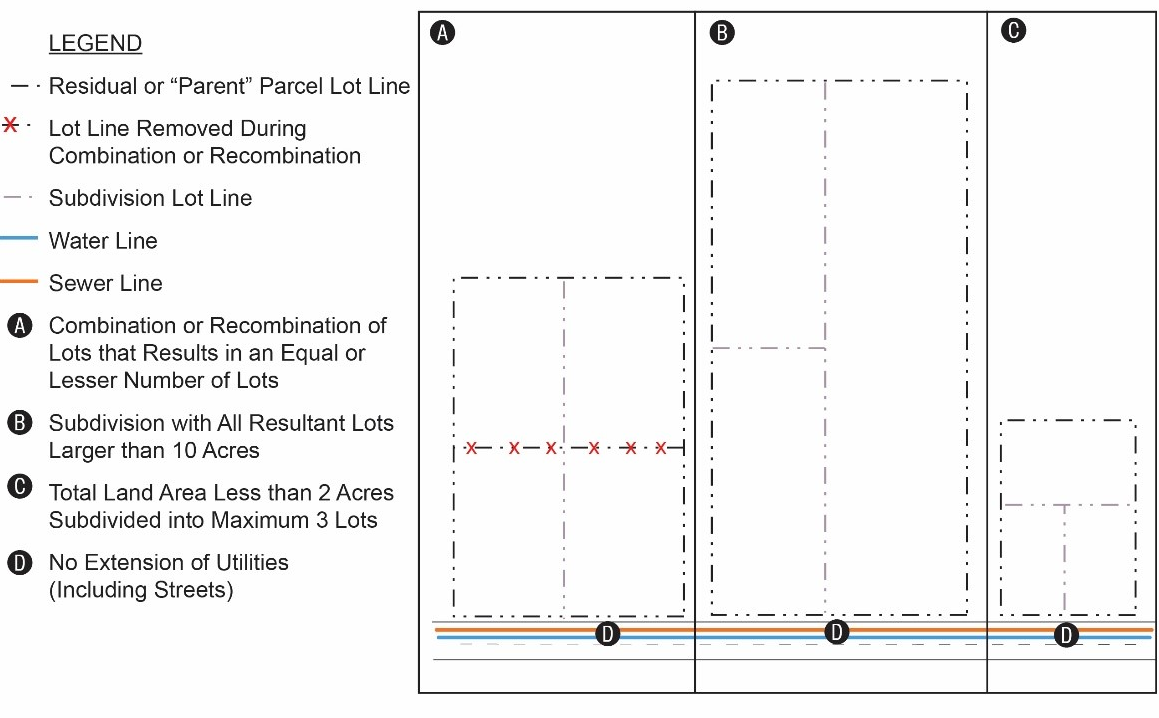
(c)
Subdivision exemption review procedure.
(1)
Pre-application conference. Optional (see § 30-3201, Pre-application conference).
(2)
Application submittal. Applicable (see § 30-3202, Application filing and acceptance).
a.
An application for exempt subdivision determination may be filed by the Town Planner, the Planning Board, the Town Council, a landowner, or a contract purchaser.
b.
Except for subdivisions where all lots shall be served by a central wastewater system, applications for a subdivision exemption shall include an evaluation from Johnston County Environmental Health Department indicating that an on-site wastewater system may be used on each lot included in the subdivision.
(3)
Staff review and action.
a.
Applicable (see § 30-3203, Staff review and action).
b.
The Town Planner shall review the application in accordance with subsection (d) below exempt subdivision review standards, and certify that the land division qualifies as an exempt subdivision.
(d)
Recordation. If an exempt subdivision plat or other document is prepared by the applicant, it shall be certified by the Town Planner, and shall be recorded in the office of the Johnston County Register of Deeds.
(e)
Exempt subdivision review standards. A division of land shall be certified as an exempt subdivision if it:
(1)
Is excluded from the definition of a subdivision in accordance with § 160D-802 of the North Carolina General Statutes; and
(2)
Complies with all applicable standards in Article 4, Zoning Districts; and
(3)
Complies with all standards or conditions of any applicable permits and development approvals; and
(4)
Complies with all other applicable requirements in the Town Code of Ordinances.
(f)
Effect.
(1)
A division of land determined to be an exempt subdivision shall be exempted from the subdivision standards of this Ordinance, but development of land within an exempt subdivision shall remain subject to the requirements for an improvement permit from the Johnston County Environmental Health Department, as well as all applicable standards in this Ordinance.
(2)
In the event a division of land does not qualify as an exempt subdivision, it shall be reviewed in accordance with the applicable subdivision procedure and shall be subject to all applicable subdivision standards in this Ordinance.
(g)
Appeal. Appeal of a decision on an exempt subdivision shall be reviewed and decided by the Board of Adjustment in accordance with § 30-3302, Appeals.
(Ord. No. AL2021-06-1, § 1, 6-7-2021)
Sec. 30-3309 - Expedited subdivision.
(a)
Exception for subdivision of land in single ownership established by § 160D-802 of the North Carolina General Statutes. The Town Planner will review a final plat prior to recordation, and sign the required certificates, only if all the following conditions apply:
(1)
The division will not create parcels greater than ten acres where no street right-of-way dedication is involved.
(2)
No part of the tract or parcel to be divided has been divided under this subsection in the ten years prior to division.
(3)
The entire area of the tract or parcel to be divided is greater than five acres.
(4)
After division, no more than three lots result from the division.
(5)
After division, all resultant lots comply with all of the following:
a.
Any lot dimension size requirements of the applicable land-use regulations, if any.
b.
The use of the lots is in conformity with the applicable zoning requirements, if any.
c.
A permanent means of ingress and egress is recorded for each lot.
(Ord. No. AL2021-06-1, § 1, 6-7-2021)
Sec. 30-3310 - Final plat.
(a)
Application requirements. Applications for final plat approval of subdivisions shall be filed with the Town Planner. The Town Planner shall prescribe the form of application, as well as any other material they may reasonably require to determine compliance with this division. Final plats shall comply with the mapping requirements of this section, the standards in Article 7 Subdivisions, and the certification and endorsement requirements of Article 11, Division 3, Plat certificates. For major subdivisions, a preliminary plat for the lots shown on the proposed final plat must have been approved and not expired before a final plat approval application may be accepted. As part of the application for final plat approval, the applicant shall certify one of the following:
(1)
That all required improvements (streets, utilities, storm drainage facilities, street signs, and facilities for common use, if any) approved as part of the preliminary plat approval and serving lots shown on the final plat have been completed, or
(2)
That a performance guarantee has been posted and approved by the Town.
(3)
That the development requires only review of the final plat per this section.
(b)
Town planner's action. When the Town Planner accepts an application for final plat approval of a subdivision, the Town Planner shall determine if the final plat conforms to all applicable regulations and to an approved valid preliminary plat if a major subdivision. They shall approve or deny the application.
(c)
Actions subsequent to decision. If an application for final plat approval of a subdivision is approved, the Town Planner shall endorse their approval on a minimum of two reproducible Mylar originals of the final plat. The applicant shall record the final plat in the office of the Johnston County Register of Deeds. Approval of any final plat is void if it is not properly recorded within 60 calendar days after the Town Planner's endorsement of the approval. The Town Planner may extend this deadline provided the applicant has demonstrated a good faith effort to comply with the deadline, but for reasons beyond their control, fails to meet the requirements of the Register of Deeds for recordation within that period. Such plat shall conform to the drawing specifications, certifications and endorsement requirements of this section, Article 7 Subdivisions, and Article 11 Division 3, Plat certifications.
(d)
Appeal of decision. The Town Planner's decision on a final plat approval application may be appealed to the Board of Adjustment under an appeal of administrative decision in § 30-3302, Appeals.
(e)
Specifications for drawings.
(1)
Format. The requirements of this section apply to the format of drawings.
(2)
Plat. The plat shall be drawn to the standards of § 47-30 of the North Carolina General Statutes, Plats and Subdivision; Mapping Requirements at a scale between 1:100 and 1:20. Under special circumstances, with the Town Planner's approval, a preliminary plat can be drawn to another scale which can clearly and accurately display the necessary information for review. The plat shall show the following:
(3)
Title data. Name of the subdivision, the names and addresses of the owner or owners, name of designer of the plat, scale, date, approximate north point, and in large letters the words "Preliminary Plat."
(4)
Existing data. Property lines, street lines and names, greenways, sidewalks, bicycle facilities, principal buildings, existing utility lines (water, sewer, electric, gas, etc.) watercourses (intermittent and perennial), wetlands, bridges, public/private easements, names of adjacent: subdivisions, property owners, zoning districts, land uses, distance to nearest street intersection, voluntary agricultural districts, corporate limits and/or planning district lines; and an inset sketch map showing the subdivision's location in relation to the Town and general area.
(5)
Data relating to subdivision. Names, locations and other dimensions and/or metes and bounds of proposed streets, lots, easements, building lines, gross acreage to be developed, development existing and proposed impervious surfaces, buffers, and recreational/open space areas, if appropriate. A statement describing the water supply and sanitary sewage disposal facilities proposed to be installed in the subdivision.
(6)
Floodway data. The boundaries of both the floodway and floodplain, shown on maps entitled flood hazard boundary map, shall be shown clearly.
(7)
Dedications for future right-of-way. Whenever land to be subdivided includes any part of a planned thoroughfare improvement shown on the official plan(s) adopted by the Town, the applicant shall dedicate the right-of-way in the location and to the width specified in the comprehensive plan or roadway project to the North Carolina Department of Transportation or homeowners' association, whichever applies. Land reserved for future right-of-way shall not be counted in satisfying any yard, area, or dimensional requirements.
(8)
Stormwater Management Statement as required in the Johnston County Storm Water Management Ordinance and/or Johnston County Stormwater Design Manual.
(f)
Final plat. The final plat shall show the following:
(1)
Title and documentation data. Name of subdivision, the township, the name of the licensed surveyor under whose supervision the plat was prepared; the date of the plat; the scale and north point; and all endorsements and certifications required by in Article 11, Division 3, Plat certificates.
(2)
Data relating to the subdivision. Lines and names of streets; lines of all lots, easements, areas devoted to common use, with notes stating clearly their proposed use, required landscape buffers, any limitations and the person or entity responsible for continued maintenance; corporate and/or other boundaries; lots numbered consecutively through the subdivision; building lines; metes and bounds survey information sufficient to determine readily on the ground the location of every street, lot line, boundary line, block line, easements line, and building line; the radius central angle, and tangent distance for both street lines of curved streets, the locations and types of all permanent monuments; the names of subdivisions, subdivision entrance sign easement, and streets adjoining the platted subdivision; if applicable, the location of mail kiosk; and designation of all streets and easements within the subdivision as public or private.
(3)
State statute. All data shown on the final plat shall be consistent with the provisions set out in § 47-30 of the North Carolina General Statutes.
(4)
All easements and their function shall be shown on the final plat. Drainage easements shall comply with Johnston County's Storm Water Management Ordinance, Johnston County Stormwater Design Manual, and NCDOT Subdivision Road Standards.
(5)
Floodway data. The boundaries of both the floodway and 100-year floodplain zone, as shown on the map entitled "Flood Boundary and Floodway Map," shall be shown. The FIRM panel and its adoption date shall be shown.
(6)
Future streets. All streets intended for future extension either within or beyond the boundaries of the subdivision shall clearly be indicated on the plat, by the words "Reserved for Future Public Access."
(7)
Subdivision road disclosure statement. The subdivision road disclosure statement shall be shown on the final plat. All roads shown on the final plat shall be designated in accordance with §136-102.6 of the North Carolina General Statutes and designation as a public road shall be conclusively presumed an offer of dedication to the public. Where roads are dedicated to the public but not accepted into a municipal or the state system, before lots are sold, a statement explaining the status of the road shall be noted on the final plat.
(8)
Plat certificates. As required by Article 11, Division 3, Plat certificates.
(g)
Distribution of recorded plat and recorded covenants. When approved by the Town Planner, they shall endorse his/her approval on a minimum of two reproducible Mylar originals of the final plat. The Town Planner may or approve a final plat with conditions. The applicant shall record such plats with the Johnston County Register of Deeds returning one to the Town Planner, along with a recorded copy of the required covenants in 30 days. The applicant shall provide a copy of the recorded plat to the Johnston County Department of Environmental Health and the Department of Public Utilities.
(Ord. No. AL2021-06-1, § 1, 6-7-2021; Ord. No. AL2022-08-2 (UDO-TA-3-22), § 1, 8-1-2022)
Sec. 30-3311 - Floodplain development permit.
See Town Code of Ordinances Chapter 14, Flood Damage Prevention.
(Ord. No. AL2021-06-1, § 1, 6-7-2021)
Sec. 30-3312 - Major subdivision.
(a)
Preliminary plat approval. All major subdivisions, whether configured in accordance with the definition of a major subdivision in § 30-10301 Definitions, or referred by the Town Planner, must have a preliminary plat approved by the Planning Board prior to any construction or final plat approval.
(b)
Preliminary conference. Optional (see § 30-3201, Pre-application conference).
(c)
Application submittal requirements. Applications for major preliminary plat approval shall be filed with the Town Planner. The Town Planner shall not accept an application unless it complies with all UDO requirements, including written confirmation that the applicant is the owner or agent having a valid ownership interest, or a valid enforceable contract or option for an ownership interest in the property involved. An incomplete application shall be returned to the applicant, with a notation of its deficiencies.
(d)
Town Planner's Report. The Town Planner shall forward to the planning board an analysis of an application for major preliminary plat approval with his/her recommendation.
(e)
Planning Board review and action.
(1)
After receiving the Town Planner's report on an application for major subdivision preliminary plat approval, the Planning Board shall consider the application at its next regularly scheduled meeting. No formal public hearing will be held. The Planning Board may hear comments and questions. The Planning Board may place reasonable and fair limitations on comments, arguments, and questions to avoid undue delay. The applicant shall bear the burden of establishing that they are entitled to approval of the application.
(2)
The Planning Board shall act on an application for major subdivision preliminary plat approval after reviewing the application, the Town Planner's report, and public comment on the application. It shall base its action on its findings as to conformity with all applicable requirements of this Article. Its action shall be one of the following: approval, approval subject to conditions, tabled to address deficiencies identified by the Planning Board, or denial. The Planning Board may impose reasonable conditions on its approval to ensure compliance with the UDO.
(3)
The Town Planner shall notify the applicant in writing of the planning board's decision and shall file a copy of the decisions.
(f)
Expiration of preliminary plat approval. Preliminary plat approval, or re-approval, for a major or commercial subdivision shall be effective for three years from the date of approval with no extension allowed by the Town Planner or a designee. An extension may be requested of the Planning Board for an additional three-year period. Otherwise the vesting provisions in Article 1, Division 3 shall apply.
(g)
Appeal of decision. The Planning Board's decision on an application for a preliminary plat approval for a major subdivision may be appealed to the Johnston County Superior Court within 30 days from receipt of written notice of the decision.
(Ord. No. AL2021-06-1, § 1, 6-7-2021; Ord. No. AL2022-08-2 (UDO-TA-3-22), § 1, 8-1-2022)
Sec. 30-3313 - Minor subdivision.
(a)
Application submittal requirements. Applications for minor subdivision approval, along with any required fees, shall be filed with the Town Planner. The Town Planner shall prescribe the form of applications, as well as any other material that may reasonably be required to determine compliance with this division. Minor subdivision plats shall comply with the definition of a minor subdivision in § 30-10301 Definitions, the mapping requirements of § 30-3310 Final plat, Article 7, Subdivisions, and Article 11, Division 3 Plat certificates. The Town Planner shall not review an application unless it is complete and complies with the requirements of the UDO. An incomplete application shall be returned to the applicant, with a notation of its deficiencies.
(b)
Town Planner's action. When an application for minor subdivision approval is accepted, the Town Planner shall determine if the plat and application conform with all applicable regulations. The Town Planner shall act on an application based solely on the findings as to compliance with applicable regulations. The Planner shall approve, approve subject to conditions, deny, or refer the application. The Town Planner may impose reasonable conditions on their approval to ensure the subdivision complies with the intent and requirements of the UDO.
(c)
Referral as a major subdivision. In the event the Town Planner determines, following review, that a proposed minor subdivision qualifies as a major subdivision, or that the minor subdivision is land already subject to a prior minor subdivision application approval, or is land abutting and under common ownership with land already subject to a prior minor subdivision application, or is requested by the applicant to be reviewed as a major subdivision, the Town Planner shall refer to the major subdivision approval process. If the Town Planner refers the minor subdivision application to a major subdivision review, an amended application shall be submitted as required in § 30-3312, Major subdivision.
(d)
Actions subsequent to decision. The Town Planner shall notify the applicant of their decision on the applicant's application for a minor subdivision approval and shall file a copy of the decision in the office of the Town Planner. The Town Planner shall endorse their approval on a minimum of two reproducible Mylar originals of the final plat if they approve an application or approve it with conditions. The applicant shall record such plats with the Johnston County Register of Deeds returning one to the Town Planner and one copy to the Johnston County Department of Environmental Health. Approval of any minor subdivision plat is void if it is not properly recorded within 60 days after the Town Planner's approval. The Town Planner may extend this deadline provided the applicant has demonstrated a good faith effort to comply with the deadline, but for reasons beyond their control, fails to meet the requirements of the Register of Deeds for recordation within that period. Plats shall conform to the drawing specifications and certification requirements of § 30-3310 Final plat, Article 7, Subdivisions, and Article 11, Division 3, Plat certificates.
(e)
Appeal of Decision. Minor subdivisions not approved by the Town Planner may be appealed to the Board of Adjustment in accordance with § 30-3302 Appeals.
(Ord. No. AL2021-06-1, § 1, 6-7-2021; Ord. No. AL2022-08-2 (UDO-TA-3-22), § 1, 8-1-2022)
Sec. 30-3314 - Planned development.
(a)
Purpose and intent. The purpose for the planned development procedure is to provide a uniform means for amending the Official Zoning Map to establish a planned development (PD) zoning district. The planned development district creates opportunities for master planned development that is developed under unified control in accordance with flexible standards and procedures that are conducive to creating mixed-use, pedestrian-oriented development that makes efficient use of land while protecting natural resources. It is the intent of these standards to allow an applicant to propose a wide variety of allowable uses and the flexible application of some of the development standards in Article 6, Development Standards, in return for a higher quality of development with more amenities than might otherwise result from a strict application of the standards in this Ordinance.
(b)
Applicability. The standards in this section may be applied to any land of one acre in area or more and under unified control.
(c)
Planned development procedure.
(1)
Pre-application conference. Applicable (see § 30-3201, Pre-application conference).
(2)
Application submittal.
a.
Applicable (see § 30-3202, Application filing and acceptance).
b.
Planned development applications may not be initiated by anyone other than the landowner(s) of the land subject to the application or a contract purchaser with written approval to submit the application by the landowner(s).
c.
The application shall include a master plan depicting the general configuration and relationship of the principal elements of the proposed development, including uses, general building types, density/intensity, resource protection, pedestrian and vehicular circulation, open space, public facilities, and phasing.
d.
The application shall also include a terms and conditions document that identifies how the proposed development will meet or exceed the standards of this Ordinance, how any required environmental mitigation will take place, and outline how public facilities will be provided to serve the planned development.
e.
To ensure unified control, the application shall also include a copy of the title to all land that is part of the proposed PD zoning district classification.
f.
An applicant may file an application for a preliminary plat and/or a site plan concurrently with a planned development master plan and terms of conditions document.
(3)
Staff review and action.
a.
Applicable (see § 30-3203, Staff review and action).
b.
The Town Planner shall review the application, prepare a staff report, and provide a recommendation in accordance with § 30-3314(d) Planned development review standards.
(4)
Review by planning board.
a.
Public meeting is required per § 30-3205, Public meetings and hearings.
b.
The Planning Board, following review during a public meeting, shall make a recommendation on an application in accordance with § 30-3314(d), Planned development review standards.
c.
In cases where a planned development application includes a site plan, the Planning Board shall review the site plan portion of the application and make a recommendation on the site plan for consideration by the Town Council, who shall decide the site plan portion with the other application materials.
(5)
Public notice. Applicable (see § 30-3204, Public notification).
(6)
Review and decision by Town Council.
a.
Applicable. See § 30-3205, Public meetings and hearings.
b.
The Town Council, after the conclusion of a legislative public hearing, shall decide the application in accordance with § 30-3314(d) Planned development review standards.
c.
The decision shall be one of the following:
1.
Approval of the planned development subject to the PD master plan and PD terms and conditions statement in the application;
2.
Approval of the planned development subject to additional or revised conditions related to the planned development master plan or planned development terms and conditions document;
3.
Denial of the planned development; or
4.
Remand of the planned development application back to the Planning Board for further consideration.
d.
In making its decision, the Town Council shall adopt a written statement including each of the following:
1.
Whether the planned development application (and associated zoning map amendment) is approved, denied, or remanded; and
2.
The degree to which the planned development application (and associated zoning map amendment) is or is not consistent with the Town's adopted plans and policies; and
3.
The ways in which the planned development application (and associated zoning map amendment) is or is not consistent with the Town's adopted plans and policies; and
4.
Whether approval of the planned development application also amends or does not amend the Town's adopted comprehensive land use plan; and
5.
If the adopted land use plan is amended as part of the application approval, a description of the change in conditions to meet the development needs of the Town that were taken into account as part of the approval; and
6.
An explanation of why the action taken by the Town Council is reasonable; and
7.
An explanation of why the action taken by the Town Council is in the public interest.
(d)
Planned development review standards.
(1)
The advisability of amending the zoning map to establish a planned development district is a matter committed to the legislative discretion of the Town Council and is not controlled by any one factor. In determining whether to adopt or deny a planned development, the Town Council may consider the standards in § 30-3316 Rezoning/Map amendment, and the standards for the proposed f PD district in Article 4, Division 4, Planned Development (PD) District.
(2)
In the event an applicant files an application for a preliminary plat concurrently with a planned development application, the Town Council shall review and decide the preliminary plat portion of the application in accordance with the standards in § 30-3312, Major subdivision.
(3)
In the event an applicant files an application for a site plan concurrently with the planned development application, the Town Council shall review and decide the site plan portion of the application in accordance with the standards in § 30-3317, Site Plan.
(e)
Designation on the Official Zoning Map. Designation of a PD zoning district on the Official Zoning Map shall note the ordinance number approving the PD zoning classification.
(f)
Effect.
(1)
Lands rezoned to a planned development (PD) district shall be subject to the approved PD master plan and the approved PD terms and conditions.
(2)
The master plan and terms and conditions are binding on the land as an amendment to the Official Zoning Map.
(3)
The applicant may apply for and obtain subsequent development permits and approvals necessary to implement the PD master plan in accordance with the appropriate procedures and standards set forth in this UDO.
(g)
Expiration.
(1)
If no application for approval of a preliminary plat or site plan for any part of the approved PD master plan is submitted within two years after approval of the planned development, the Town Planner shall initiate a zoning map amendment application to rezone the land back to its prior zoning classification or any other conventional zoning classification determined to be appropriate. Such time period shall not be extended with transfer of ownership.
(2)
Upon written request submitted at least 30 days before expiration of the two-year period provided in subsection (1) above, and upon a showing of good cause, the Town Planner may grant one extension not to exceed one year for the applicant to submit required development applications.
(h)
Appeal.
(1)
Appeal of a decision on a planned development shall be subject to review by the Johnston County Superior Court.
(2)
Petitions for review must be filed with the Clerk of Court within 30 days of the date the decision is filed in the office of the Town Clerk and delivered by personal delivery, electronic mail, or first-class mail to the applicant, landowner, and to any person who has submitted a written request for a copy, prior to the date the decision becomes effective (Or § 30-3207, Written notice of decision.)
(Ord. No. AL2021-06-1, § 1, 6-7-2021)
Sec. 30-3315 - Reasonable accommodation.
(a)
Introduction. The Town Council is authorized to grant reasonable accommodations under the Federal Fair Housing Act for the circumstances set forth in this section, except that the Board of Adjustment may provide a reasonable accommodation through a variance as provided in § 30-3321, Variance. Where the request for a reasonable accommodation includes both a request that may be granted by a variance and a request that does not come under the definition of variance, then the entire request shall be heard by the Town Council. For example, variances may not be used to obtain a change of use.
(b)
Persons authorized to file applications. An application for a reasonable accommodation may be filed only by the owner of the land affected by the reasonable accommodation; an agent, lessee, or contract purchaser specifically authorized by the owner to file such application; or any unit of government that is not the owner of the lot but proposes to acquire the lot by purchase, gift, or condemnation.
(c)
Pre-application conference. Before filing an application for a reasonable accommodation, the applicant may request a pre-application conference with the Town Planner under § 30-3201, Pre-application conference.
(d)
Application filing and contents. An application for a reasonable accommodation shall be filed with the Town Planner and contain:
(1)
The applicant's contact information (name, mailing address, phone number, fax number and email address);
(2)
The contact information for the owner(s) of the property (if different from the applicant);
(3)
The address of the property at which the reasonable accommodation is requested;
(4)
A description of the reasonable accommodation requested;
(5)
A statement explaining how and why the request meets the approval criteria in this section for a reasonable accommodation; and
(6)
A notarized signature of the applicant and property owner(s) (if different from the applicant).
(7)
No filing fee shall be required for the application.
(e)
Action by the Town Council. The Town Council (or the Board of Adjustment if accommodation is a request for a variance) shall hold a quasi-judicial hearing on the proposed reasonable accommodation. The review authority shall decide the request upon a majority vote of the members. The quasi-judicial hearing shall be conducted in accordance with the hearing procedures of § 30-3205(c), Quasi-judicial public hearings. An appeal from a final decision of either review authority shall be governed by § 30-3205(c)(10).
(f)
Approval criteria. The review authority shall grant a reasonable accommodation to any provision of this Ordinance if the review authority finds by the greater weight of the evidence that the proposed reasonable accommodation is both reasonable and necessary, in accordance with the following criteria:
(1)
Reasonable. An accommodation will be determined to be reasonable if it would not undermine the legitimate purposes and effects of existing zoning regulations, and if it will not impose significant financial and administrative burdens upon the Town and/or constitute a substantial or fundamental alteration of this Ordinance.
(2)
Necessary. An accommodation will be determined to be necessary if it would provide direct or meaningful therapeutic amelioration of the effects of the particular disability, handicap, or institutionalized persons and would afford handicapped or disable persons' equal opportunity to enjoy and use housing in residential districts in the Town.
(Ord. No. AL2021-06-1, § 1, 6-7-2021)
Sec. 30-3316 - Rezoning/map amendment.
(a)
Who may propose an amendment. The Official Zoning Map may be amended only by the Town Council, according to the procedures of this section. Proposed amendments may be initiated by the property owners or their agents, Town Council, or the Planning Board.
(b)
Down-zoning. No amendment to zoning regulations or a zoning map that down-zones property shall be initiated nor is it enforceable without the written consent of all property owners whose property is the subject of the down-zoning amendment unless the down-zoning amendment is initiated by the Town Council. For purposes of this section, "down-zoning" means a zoning ordinance that affects an area of land in one of the following ways:
(1)
By decreasing the development density of the land to be less dense than was allowed under its previous usage.
(2)
By reducing the permitted uses of the land that are specified in a zoning ordinance or land development regulation to fewer uses than were allowed under its previous usage.
(c)
Procedures. Except for amendments initiated by the Town Council, Planning Board, or Town staff, no proposed amendment to the zoning map shall be considered by the Town Council, nor a public hearing held until an application containing the following information is submitted by the applicant:
(1)
A statement of the present zoning classification.
(2)
The name and signature of the applicant and owner if the owner is not the applicant.
(3)
The tax parcel number of the lot proposed to be rezoned.
(4)
The names and addresses of the owners of the lot in question.
(5)
The names of the owners and use of each abutting property. Abutting properties include those separated from the parcel to be rezoned by a street, railroad, or other transportation corridor.
(6)
A completed application form with fee paid.
(7)
The applicant shall provide any additional information related to the proposed amendment requested in writing by the Town Planner, Planning Board or Town Council. The Town Planner shall transmit the original application to the Town Council and the original application shall be filed in the office of the Town Planner and Town Clerk after consideration by the Town Council.
(d)
Planning Board review. After a complete application is submitted, the Planning Board shall issue a written recommendation with statements of consistency and reasonableness to the Town Council.
(1)
Statements of consistency and reasonableness. In accordance with §§ 160D-604 and 160D-605 of the North Carolina General Statutes, the Planning Board shall advise and comment on whether the proposed amendment is consistent with any comprehensive plan that has been adopted and any other officially adopted plan, as applicable. The Planning Board shall provide a written recommendation to the Town Council that addresses plan consistency and other matters deemed appropriate by the Planning Board, but a comment by the Planning Board that a proposed amendment is inconsistent with a comprehensive plan or any other officially adopted plan, as applicable, shall not preclude consideration or approval by the Town Council. The Planning Board shall also provide a statement analyzing the reasonableness of the proposed rezoning. This statement of reasonableness may consider, among other factors, (i) the size, physical conditions, and other attributes of the area proposed to be rezoned, (ii) the benefits and detriments to the landowners, the neighbors, and the surrounding community, (iii) the relationship between the current actual and permissible development on the tract and adjoining areas and the development that would be permissible under the proposed amendment; (iv) why the action taken is in the public interest; and (v) any changed conditions warranting the amendment.
(e)
Public hearing procedures.
(1)
Notifications. Notice is required. Notice will be made as provided in § 30-3204, Public notifications.
(2)
No amendment shall be adopted by the Town Council until they have held a public hearing on the amendment. The public hearing may be held after the Town Council receives a recommendation from the Planning Board, or if no recommendation is forthcoming, the public hearing may be held after the Planning Board's 65 day deadline or the Town Council's extension, if provided, has elapsed.
(3)
Town council statement. After the public hearing, and prior to adopting or rejecting any zoning amendment, the Town Council shall adopt a written statement(s) describing whether its action is consistent with an adopted comprehensive plan and is reasonable and in the public interest. The Town Council statements shall follow the requirements in subsection (d)(1) above.
(f)
Citizen comments. If any resident or property owner in the Town submits a written statement regarding a proposed zoning map amendment to the Town Clerk at least two business days prior to the proposed vote on such change, the Town Clerk shall deliver the written statement(s) to the Town Council with the meeting agenda or, if received later, to the Town Council before the meeting.
(Ord. No. AL2021-06-1, § 1, 6-7-2021)
Sec. 30-3317 - Site plan.
(a)
Site plan application submittal requirements.
(1)
Site plans applications are required for all developments except detached single family. Site plan applications may be submitted in conjunction with other permit applications, or alone. For example, if a commercial subdivision has already received zoning and subdivision approval, then a site plan application may be submitted by itself. In other cases, site plan applications are requirements for a permit application. For example, site plan applications are required either with or subsequent to special use permit applications. In cases where a special use permit is approved subject to a concept plan, approval of a site plan consistent with the approved concept plan shall also be required. A pre-application conference is mandatory (See § 30-3201, Pre-application conference). The Town Planner should be consulted for details on the procedural requirements.
(2)
Applications for a site plan permit shall be submitted to the Town Planner. The Town Planner shall prescribe the form on which applications are made. Applications shall include the information listed in Article 11, Division 5 Information required with site plans and subdivisions. The Town Planner shall prescribe any other material that may reasonably be required to determine compliance with this Ordinance. Two copies of the application and attachments shall be submitted to the Town Planner. No application shall be accepted by the Town Planner unless it complies with § 30-3202, Application filing and acceptance.
(b)
Action on the application.
(1)
On receipt of a completed application for a site plan, the Town Planner shall review as required in § 30-3203, Staff review and action. Site plans will be forwarded to the Planning Board for a written recommendation to the Town Council. Public notice of the hearing shall be made in accordance with § 30-3204, Public notification.
(c)
Decision. The Town Council shall review and decide the application for a site plan. The Town Council may impose such reasonable conditions as detailed in § 30-3206, Conditions of approval.
(d)
Actions subsequent to decision. In the case of denial, approval or approval with conditions of a site plan application, the Town Planner shall notify the applicant as required in § 30-3207, Written notice of decision. If approved, the Town Planner may issue the zoning compliance permit if no other permits or approvals are required. Where a building permit or stormwater management permit is required, such permit shall not be issued prior to the issuance of the site plan permit and shall comply with the approved site plan, including all conditions of approval thereto (See § 30-3208, Effect of development approval).
(e)
Appeal of decision. A decision by the Town Council in granting or denying a site plan, may be appealed to the Superior Court within 30 days of the decision.
(f)
Modification of site plan permits. The Town Planner may approve a modification of a site plan (including site plans approved as a part of another permit application, such as a special use permit.) in accordance with § 30-3301, Administrative Adjustment. Except for minor modifications in accordance with § 30-3301, an application for modification of a site shall be reviewed in accordance with the procedures established in this Article for a new site plan.
(g)
Expiration and revocation of site plan approvals.
(1)
Starting time limit. If the use, construction, or activity authorized by approval of an application for a site plan permit or modification of a site plan permit is not started within 24 months of the date of approval, the permit shall expire, and any Town permit issued pursuant to the approval may be voidable. The Town Planner may grant an extension of the starting time limit for up to 12 months. The Town Planner shall determine whether the use, construction, or activity has started.
(2)
Revocation of site plan permit. If any conditions of a site plan permit or modification of a site plan permit, or requirements of this Article applicable to the permit or modification are violated, the Town Council may revoke the permit or modification. The Town Council may reinstate a revoked site permit or modification of a zoning compliance permit if it determines that:
a.
The holder of the revoked permit or modification submitted a request for reinstatement within 90 days of the revocation;
b.
The violations that were the cause of the revocation have been corrected; and
c.
The development fully complies with all conditions of the permit or modification and all applicable requirements of this Article.
(Ord. No. AL2021-06-1, § 1, 6-7-2021; Ord. No. AL2022-08-1 (UDO-TA-2-22), § 1, 8-1-2022)
Sec. 30-3318 - Special use permit.
(a)
Permitted special uses provide for a more detailed review of applications for certain uses. Subject to the Article 6 Development Standards, certain uses of property are allowed in specified districts where those uses would not otherwise be acceptable. Special uses, in some circumstances, may be compatible with and desirable in the districts in which they are designated, but they may also have characteristics which could have detrimental effects on adjacent properties, or even the entire Town area, if not properly designed and controlled. By means of controls exercised through the special use permit procedures, uses of property which would otherwise be undesirable in certain districts can be developed to minimize any bad effects they might have on surrounding properties.
(b)
Special uses require a permit from the Town Council.
(c)
Applications for a special use permit shall be accompanied by either a concept plan or a site plan, at the applicant's option. In cases where a concept plan is submitted, the special use, if approved, shall also be required to obtain site plan approval in accordance with § 30-3317, Site plan. Concept plans are more general in nature than site plans, but must show the approximate building placement, building size, proposed streets, utility extensions, street access, as well as adequate details on the proposed use and site features to allow the Town Council to discern any potentially deleterious impacts of the proposed use and how those impacts will be mitigated. The site plan application filed subsequent to the special use permit approval shall be substantially consistent with the approved concept plan.
(d)
In cases where an applicant chooses to file a site plan concurrently with the application for a special use permit, the TRC shall review the site plan for consistency with this Ordinance prior to consideration of the special use permit application by the Town Council. The TRC shall provide comments on the site plan for consideration by the Town Council during its consideration. The Town Council shall review and decide the site plan concurrently with the special use permit application.
(e)
Special use permits shall only be granted after the Town Council has held a public hearing using the procedure set forth in § 30-3205(c), Quasi-Judicial public hearings.
(1)
Pre-application conferences with the Town Planner are mandatory in accordance with § 30-3201, Pre-application conference.
(2)
Applications for special use permits and a fee in accordance with the fee schedule adopted by the Town Council shall be received by the Town Planner in accordance with § 30-3202 Application filing and acceptance.
(3)
The Town Council shall call for a public hearing. Public notice of the hearing shall be made in accordance with § 30-3204, Public notification.
(4)
Public hearings by the Town Council for special use permits shall be conducted in accordance with following § 30-3205(c), Quasi-judicial public hearings and the following:
a.
The Mayor shall summarize the evidence that has been presented, giving the parties opportunity to make objections or corrections. The Town Council members, parties, or other persons with standing (See § 30-3205(c)(6)) shall be the only persons allowed to ask questions of a witness.
b.
At a special meeting called for the purpose; the Town Council may view the premises.
c.
The Town Council may continue the hearing until a certain date and time.
d.
In order to issue a special use permit, the Town Council shall consider each of the following conditions, and based on the evidence presented at the hearing, make findings in regard to each and must find that the issuance of the special use permit promotes the public health, safety, and welfare and is in the best interest of the Town:
1.
Will not materially endanger the public health, safety if located where proposed;
2.
Complies with all standards, conditions, and specifications of the UDO, including Article 5 Use Regulations, and Article 6 Development Standards;
3.
Will not substantially injure the value of the abutting land, or the special use is a public necessity;
4.
Will be in harmony with the area in which it is to be located;
5.
Is in general conformity with the Town's adopted policy guidance; and
6.
Will not exceed the Town's ability to provide adequate public facilities (fire and rescue, utilities, etc.).
e.
If the Town Council approves a special use permit, it may, as part of the terms of such approval, impose any additional reasonable conditions and safeguards as may be necessary to ensure that the criteria for the granting of such a permit will be followed per § 30-3206, Conditions of approval. Where appropriate, such conditions may include requirements that streets and/or utility rights-of-way be dedicated to the public, and that provisions be made for recreational space and facilities. The Town Council may not impose conditions for which the Town does not have statutory authority, including taxes, impact fees, building design elements for one-or two-family dwellings and driveway improvements in excess of those allowed by § 160D-702(b) of the North Carolina General Statutes.
f.
The Town Council's final decisions shall be shown in the order of the case as entered in the Town Council's minutes and signed by the Clerk and the Mayor on approval of the minutes by the Town Council. Such order shall show the reasons for the determinations, with a summary of the evidence introduced and the findings of fact made by the Town Council. When a special use permit is granted, the order shall state the facts that support findings required to be made before such permit is issued. The order shall state in detail what, if any, conditions and safeguards the Town Council imposes in connection with granting of a special use permit. The record shall be final when it is filed in the Town Clerk's office.
g.
The order of the decision in each case shall be prepared, filed in the Clerk's office, and furnished to any person as stipulated in § 30-3207, Written notice of decision.
h.
A copy of the record shall be filed in the office of the Johnston County Register of Deeds.
(f)
Effect.
(1)
Applicable (see § 30-3208, Effect of development approval).
(2)
A special use and the associated concept plan or site plan approval are perpetually binding and run with the land, unless amended.
(3)
An action invalidating a special use condition of approval (such as exceeding maximum allowable intensity or hours of operation limitation) shall render the special use permit as well as the concept plan or site plan approval null and void.
(g)
Amendment. Applicable. Minor modifications may be considered in accordance with § 30-3301, Administrative adjustments/modifications, but a major modification (such as changes in density or changes in use types) requires a new application and approval by the Town Council following a quasi-judicial hearing.
(h)
State and federal requirements. Special uses shall meet all applicable State and federal requirements for location and operation. Failure to maintain compliance with those requirements may result in the revocation of the special use permit.
(i)
Expiration.
(1)
Replacement. If a special use is replaced by a use otherwise permitted by right in the zoning district, the special use permit approval is deemed abandoned and the special use permit approval is null and void, but the site plan approval is unaffected, provided there are no physical changes to the building or the site.
(2)
Failure to complete construction. Unless otherwise stated in the special use permit approval, a special use permit shall expire and become null and void two years after the date of issuance if:
a.
The authorized use has not commenced;
b.
No substantial construction activity has taken place; or
c.
Construction activities have started but the value of all construction activity after two years is less than five percent of the estimated total cost of construction.
(3)
Extension.
a.
An applicant may request an extension of a special use permit approval in writing to the Town Planner at least 30 days prior to expiration.
b.
Extension requests shall be reviewed and decided by the Town Council.
c.
Up to one extension for a maximum period of one year may be granted if:
1.
The applicant has proceeded towards completion of construction in good faith and with due diligence; and
2.
Conditions have not changed to the extent that a new application is warranted in the sole discretion of the Town Council.
(j)
Appeal.
(1)
Appeal of a decision on a special use permit shall be subject to review by the Johnston County Superior Court by proceedings in the nature of certiorari and in accordance with § 160D-1402 of the North Carolina General Statutes.
(2)
Petitions for review must be filed with the Clerk of Court within 30 days of the date the decision is filed in the office of the appropriate review authority and delivered by personal delivery, electronic mail, or first- class mail to the applicant, landowner, and to any person who has submitted a written request for a copy, prior to the date the decision becomes effective.
(k)
The special use permit may be reviewed by the Town on a periodical basis.
(l)
No denied special use permit can be resubmitted for the same type of request unless conditions have so changed that a new application is warranted.
(Ord. No. AL2021-06-1, § 1, 6-7-2021; Ord. No. AL2022-08-1 (UDO-TA-2-22), § 1, 8-1-2022)
Sec. 30-3319 - Temporary use permit.
(a)
Purpose and intent. The purpose of this section is to establish a uniform mechanism for reviewing temporary uses, structures, special events, and temporary signage to ensure they comply with the standards in Article 5, Division 3, Temporary uses.
(b)
Applicability. The provisions of this section shall apply to all proposed temporary uses, temporary structures, special events, and temporary signage set forth in Article 5, Division 3, Temporary uses.
(c)
Temporary use permit procedure.
(1)
Application submittal. Applicable (see § 30-3202, Application filing and acceptance).
(2)
Staff review and action.
a.
Applicable (see § 30-3203, Staff review and action).
b.
The Town Planner shall review and decide the application in accordance with subsection (d) Temporary Use Permit Review Standards below.
(d)
Temporary use permit review standards.
(1)
A temporary use permit shall be approved if it complies with:
a.
The standards in Article 5, Division 3, Temporary uses;
b.
Any applicable standards in Article 6, Division 7, Signage;
c.
The State Building Code;
d.
The applicable requirements of Johnston County Environmental Health Department, including all improvement permit requirements;
e.
All standards or conditions of any prior, applicable permits, and development approvals; and
f.
All other applicable requirements of this Ordinance, the Town Code of Ordinances, State law, and federal law.
(e)
Effect. Applicable (see § 30-3211, Effect of development approval).
(f)
Amendment. Applicable. Minor modifications may be considered in accordance with § 30-3301, Administrative adjustment/modification. If the amendment is a major modification a new application for a Temporary Use Permit is required.).
(g)
Expiration. Approval of a temporary use permit shall be effective beginning on the date of approval and shall remain effective for the period indicated in the permit.
(h)
Appeal. Appeal of a decision on a temporary use permit shall be reviewed and decided by the Board of Adjustment in the nature of certiorari and in accordance with § 30-3302, Appeals.
(Ord. No. AL2021-06-1, § 1, 6-7-2021)
Sec. 30-3320 - Text amendment.
(a)
Purpose and intent. This section provides a uniform means for amending the text of this Ordinance whenever the public necessity, changed conditions, convenience, general welfare, or appropriate land use practices justify or require doing so.
(b)
Applicability.
(1)
The standards and requirements of this section shall apply to applications to revise the text of this Ordinance.
(2)
The requirements in this section shall not apply to amendments of the Comprehensive Plan or other functional plans and documents (see § 30-3305, Comprehensive plan).
(c)
Text amendment procedure.
(1)
Pre-application conference. Required (see § 30-3201, Pre-application conference).
(2)
Application submittal.
a.
Applicable (see § 30-3202, Application filing and acceptance).
b.
An application for a text amendment to this Ordinance may be filed by anyone. However, § 30-3316 (a)(1) down zoning applies to text amendments.
(3)
Staff review and action.
a.
Applicable (see § 30-3203, Staff review and action).
b.
The Town Planner shall prepare a staff report and provide a recommendation in accordance with § 30-3320(e), Text amendment review standards.
(4)
Review by planning board.
a.
Applicable (see § 30-3205, Public meetings and hearings).
b.
The Planning Board, following review during a public meeting, shall make a recommendation on an application in accordance with § 30-3320(e), Text amendment review standards.
c.
The Planning Board shall comment on whether or not the text amendment is consistent with the Town's adopted plans and is reasonable and in the public interest in the same manner that the Planning Board comments on rezonings/map amendments (See § 30-3316(c), Rezoning/Map amendments).
(5)
Public notice. Required (see § 30-3204, Public notification).
(d)
Review and decision by Town Council.
(1)
Applicable (see § 30-3205, Public meetings and hearings).
(2)
The Town Council, after the conclusion of a legislative public hearing, shall decide the application in accordance with § 30- 3320(e), Text amendment review standards.
(3)
The decision shall be one of the following:
a.
Adoption of the text amendment as proposed;
b.
Adoption of a revised text amendment;
c.
Denial of the text amendment; or
d.
Remand of the text amendment application to the Planning Board for further consideration.
(4)
In making its decision, the Town Council shall adopt a written statement including each of the following:
a.
Whether the text amendment application is approved, denied, or remanded; and
b.
The degree to which the text amendment application is or is not consistent with the Town's adopted plans including the Comprehensive Plan; and
c.
Whether approval of the text amendment application also amends or does not amend the Comprehensive Plan; and
d.
If the adopted policy guidance is amended as part of the application approval, a description of the change in conditions to meet the development needs of the Town that were taken into account as part of the approval; and an explanation of why the action taken by the Town Council is reasonable in accordance with § 30-3316(c), Rezoning; and
e.
An explanation of why the action taken by the Town Council is in the public interest 30-3316, (c) Procedures.
(e)
Text amendment review standards. The advisability of amending the text of this Ordinance is a matter committed to the legislative discretion of the Town Council and is not controlled by any one factor. In determining whether to adopt or deny the proposed UDO text amendment, the Town Council may, but is not required to consider whether and the extent to which the proposed text amendment:
(1)
Is consistent with the Town's adopted plans including the Comprehensive Plan;
(2)
Is not in conflict with any provision of this Ordinance or the Town Code of Ordinances;
(3)
Is required by changed conditions;
(4)
Addresses a demonstrated community need;
(5)
Addresses an unforeseen matter or use of land not present when the Ordinance was adopted;
(6)
Is consistent with the purpose and intent of the zoning districts in this Ordinance, or would improve compatibility among uses and ensure efficient development within the Town;
(7)
Would result in a logical and orderly development pattern;
(8)
Addresses other factors determined to be relevant by the Town Council; and
(9)
Would not result in significantly adverse impacts on the natural environment, including but not limited to water, air, noise, stormwater management, wildlife, vegetation, and the natural functioning of the environment.
(f)
Effect. Applicable (see § 30-3209, Effect of development approval).
(g)
Amendment. Amendment of a text amendment approval may only be reviewed and considered in accordance with the procedures and standards established for its original approval.
(h)
Appeal.
(1)
Appeal of a decision on a UDO text amendment shall be subject to review by the Johnston County Superior Court.
(2)
Petitions for review must be filed with the Clerk of Court within 30 days of the date the decision is filed in the office of the appropriate review authority and delivered by personal delivery, electronic mail, or first- class mail to the applicant, landowner, and to any person who has submitted a written request for a copy, prior to the date the decision becomes effective.
(Ord. No. AL2021-06-1, § 1, 6-7-2021)
Sec. 30-3321 - Variance.
(a)
A complete application for a variance shall be submitted to the board of adjustment by filing a copy of the application with the Town Planner in accordance with § 30-3202, Application filing and acceptance.
(b)
The Town Planner shall advertise the hearing in accordance with the requirements of § 30-3204, Public notification.
(c)
When presented to the Board of Adjustment at the hearing, the application for a variance shall be accompanied by a report as required by § 30-3203, Staff review and action.
(d)
The Board of Adjustment shall hold a hearing following the requirements of § 30-3205(c), Quasi-judicial public hearings.
(e)
No change in permitted uses may be authorized by variance.
(f)
A variance may be granted by the Board of Adjustment if it concludes that strict enforcement of the Ordinance would result in unnecessary hardships for the applicant upon a showing of all of the following:
(1)
Unnecessary hardship would result from the strict application of the Ordinance. It shall not be necessary to demonstrate that, in the absence of the variance, no reasonable use can be made of the property; and
(2)
The hardship results from conditions that are peculiar to the property, such as location, size, or topography. Hardships resulting from personal circumstances, as well as hardships resulting from conditions that are common to the neighborhood or the general public, may not be the basis for granting a variance. A variance may be granted when necessary and appropriate to make a reasonable accommodation under the Federal Fair Housing Act for a person(s) with a disability (See § 30-3315, Reasonable accommodation); and
(3)
The hardship did not result from actions taken by the applicant or the property owner. The act of purchasing property with knowledge that circumstances exist that may justify the granting of a variance shall not be regarded as a self-created hardship; and
(4)
The requested variance is consistent with the spirit, purpose, and intent of the Ordinance, such that public safety is secured, and substantial justice is achieved.
(g)
If a motion to grant a variance is not made or fails to receive the four-fifths vote necessary for adoption, then a motion to deny the variance shall be in order. If the Board of Adjustment finds that any one or more of the four criteria set forth in subsection (f) above are not satisfied, the variance cannot be granted. A motion to deny may be adopted as the Board of Adjustment's decision if supported by more than one-fifth of the Board of Adjustment's membership.
(h)
Before granting a variance, the Board of Adjustment must take a separate vote and vote affirmatively (by a four-fifths majority) on each of the four required findings stated in subsection (f) above. Insofar as practicable, a motion to make an affirmative finding on each of the requirements set forth in subsection (f) shall include a statement of the specific reasons or findings of fact supporting such motion.
(i)
In granting variances, the Board of Adjustment may impose such reasonable conditions as will ensure that the use of the property to which the variance applies will be as compatible as practicable with the surrounding properties.
(j)
A variance shall run with the land. The variance shall be recorded at the Johnston County Register of Deeds office.
(k)
The nature of the variance and any conditions attached to it, shall be entered on the face of the zoning compliance permit, or the zoning compliance permit may simply note the issuance of the variance and refer to the written record of the variance for further information. All such conditions are enforceable in the same manner as any other applicable requirement of this division. No change in permitted uses may be authorized by variance.
(Ord. No. AL2021-06-1, § 1, 6-7-2021)
Sec. 30-3322 - Vested rights certificate.
(a)
Introduction. This section is intended to implement the provisions of § 160D-108.1 of the North Carolina General Statutes pursuant to which a statutory zoning vested right is established upon the approval of a site specific vesting plan approved after November 14, 2013. Site specific vesting plans are defined in accordance with § 30-1303, Site-specific vesting plan. A variance or special use permit with a site plan that fails to describe with reasonable certainty the type and intensity of use for a specific parcel or parcels of property shall not constitute a valid application for a site-specific vesting plan. A zoning vested right is defined as a right pursuant to § 160D-108.1 of the North Carolina General Statutes to undertake and complete the development and use of property under the terms and conditions of an approved site-specific development plan.
(b)
Establishment of a statutory vested right. Vested rights are established in accordance with § 30-1304, Establishment of a zoning vested rights.
(c)
Approval procedures and approval authority.
(1)
Except as otherwise provided for in this section, an application for specific vesting plan approval shall be processed in accordance with the procedures established by ordinance and shall be considered by the designated approval authority for the specific type of zoning or zoning compliance permit or approval for which application is made.
(2)
In order to obtain a zoning vested right, the applicant must request in writing at the time of application that the application be considered and acted on by the Town Council following notice and a public hearing as provided in § 30-3204, Public notification, and 30-3205, Public meetings and hearings. In order for a zoning vested right to be established upon approval of a site specific vesting plan, the applicant must indicate at the time of application, on a form to be provided by the Town, that a zoning vested right is being sought.
(3)
Each map, plat, site plan or other document evidencing a site specific vesting plan shall contain the following notation: "Approval of this plan established a zoning vested right under § 160D-108.1 of the North Carolina General Statutes unless terminated at an earlier date, the zoning vested right shall be valid until two years from date of issuance."
(4)
Following approval or conditional approval of a site specific vesting plan, nothing in this section shall exempt such a plan from subsequent reviews and approvals to ensure compliance with the terms and conditions of the original approval, provided that such reviews and approvals are not inconsistent with the original approval.
(5)
Nothing in this section shall prohibit the revocation of the original approval or other remedies for failure to comply with applicable terms and conditions of the approval or this Ordinance.
(d)
Duration.
(1)
A zoning right that has been vested as provided in this section shall remain vested for a period of two years unless specifically and unambiguously provided by the Town Council as provided in this subsection (c) above. This vesting shall not be extended by any amendments or modifications to a site specific vesting plan unless expressly provided by the Town Council at the time the amendment or modification is approved.
(2)
Notwithstanding the provisions of subsections (a) and (b) above, the Town Council may provide that rights shall be vested for a period exceeding two years but not exceeding five years where warranted in light of all relevant circumstances, including, but not limited to, the size of the development, the level of investment, the need for or desirability of the development, economic cycles, and market conditions. These determinations shall be in the sound discretion of the Town Council at the time the site specific vesting plan is approved.
(3)
Upon issuance of a building permit, the expiration provisions of §§ 160D-1111 and 160D-1115 of the North Carolina General Statutes apply, except that a building permit shall not expire or be revoked because of the running time while a zoning vested right under this section is outstanding.
(e)
Termination. A zoning right that has been vested as provided in this section shall terminate:
(1)
At the end of the application vesting period with respect to buildings and uses for which no valid building permit application has been filed;
(2)
With the written consent of the affected landowner;
(3)
Upon finding by the Town Council, by ordinance after notice and a public hearing, that natural or manmade hazards on or in the immediate vicinity of the property, if uncorrected, would pose a serious threat to the public health, safety, and welfare if the project were to proceed as contemplated in the approved site specific development plan;
(4)
Upon payment to the affected landowner of compensation for all costs, expenses, and other losses incurred by the landowner, including, but not limited to, all fees paid in consideration of financing, and all architectural, engineering, planning, marketing, legal, and other consultant's fees incurred after approval by the Town, together with interest thereon at the legal rate until paid. Compensation shall not include any diminution in the value of the property which is caused by such action;
(5)
Upon findings by the Town Council, by ordinance after notice and a public hearing, that the landowner or his representative intentionally supplied inaccurate information or made material misrepresentations which made a difference in the approval by the approval authority of the site specific development plan; or
(6)
Upon the enactment or promulgation of a State or federal law or regulation that precludes development as contemplated in the approval, in which case the approval authority may modify the affected provisions, upon a finding that the change in State or federal law has a fundamental effect on the plan, by ordinance after notice and public hearing.
(f)
Limitations. Nothing in this Article is intended or shall be deemed to create any zoning vested right other than those established pursuant to § 160D-108.1 of the North Carolina General Statutes.
(Ord. No. AL2021-06-1, § 1, 6-7-2021)
Sec. 30-3323 - Zoning compliance permit.
(a)
Zoning compliance permit required. Except as otherwise specifically provided in this Article, it shall be unlawful to begin any excavation, removal of soil, clearing of site, or placing any fill on lands contemplated for development, or to begin any construction, moving, alteration, or renovation, except for ordinary repairs, of any building or other structure, including accessory structures and signs, until the Town Planner has issued for a zoning compliance permit, certifying that such development complies with the applicable provisions of this Article.
(b)
Submittal requirements/sketch or site plan review required.
(1)
All applications for a zoning compliance permit shall include a either a site plan application or a sketch plan application.
(2)
Site plans are required for applications for a variance, subdivision plat, floodplain development permit, or special use permit. See § 30-3317 Site plan and Article 11, Division 5, Information required with site plans and subdivisions for further details.
(3)
Sketch plan review and approval by the Town Planner as appropriate, shall be required prior to the issuance of a zoning compliance permit for single family dwellings or duplexes, residential additions, accessory structures or accessory uses on a lot. The Town Planner shall prescribe the form on which applications are made.
(4)
Applications requiring a sketch plan shall include :
a.
The name and address of the owner and applicant, if not the same person;
b.
The approximate total acreage of the proposed development;
c.
The locations of buildings, lot boundaries, impervious surfaces, and square footage total, easements and building setback lines; and
d.
Any other information the owner or applicant believes necessary to obtain the informal opinion of the planning staff as to proposed development's compliance with the requirements of this Ordinance. If the principal structure is less than ten feet from a lot boundary line, or if additional information is needed to evaluate compliance, the Town Planner may require a survey drawn, signed, and sealed by a North Carolina licensed engineer, architect, or professional surveyor.
e.
If the property is located in a floodplain, the application must comply with the requirements of Chapter 14 of the Town Code of Ordinances.
(5)
Applications which are not complete shall be returned to the applicant in a reasonable time, not to exceed 60 days, depending on the complexity of the application, with a notation of the deficiencies in the application.
(c)
Pre-application conferences with the Town Planner are mandatory in accordance with § 30-3201, Pre-application conference.
(d)
Action on the application. On receipt of a completed application for a zoning compliance permit, the Town Planner shall cause an analysis to be made pursuant to § 30-3203, Staff review and action. The Town Planner shall determine if any applicable conditions of an approved special use permit or variance have been met. No zoning compliance permit will be issued until all necessary NCDOT (curb cut or other applicable permit requirements) and/or Johnston County Environmental Health Department (septic system and/or well) requirements for the proposed work and/or Johnston County Public Utilities (Stormwater) have issued permits for the work that have been given to the Town Planner for the proposed work. Where a building permit, stormwater management permit, or floodplain development permit is required, such permit shall not be issued prior to the issuance of the zoning compliance permit required for the development. The aforementioned permits shall comply with the approved zoning compliance permit, including all conditions of approval thereto.
(e)
Actions subsequent to decision. In the case of approval or approval with conditions of an application for a zoning compliance permit, the Town Planner shall issue the zoning compliance permit. In case of denial on an application, the applicant shall be notified, in writing, of the reasons for such denial. No building or structure for which a zoning compliance permit has been issued shall be used or occupied until, after final zoning compliance inspection, a certificate of occupancy has been issued indicating compliance with the provisions of this Ordinance and all other State and local laws, including the conditions of all other required permits.
(f)
Appeal of decision. A decision by the Town Planner in granting or denying site plan approval may be appealed within 30 days to the Board of Adjustment in accordance with the provisions of § 30-3302, Appeals.
(g)
Modification of zoning compliance permits. The Town Planner may approve a modification of zoning compliance permit long as such changes continue to comply with the approving action (if any) and all other applicable requirements. An application for modification of a zoning compliance permit shall be reviewed in accordance with the procedures established in this Ordinance.
(h)
Expiration and revocation of zoning compliance permit approvals.
(1)
Starting time limit. If the use, construction, or activity authorized by approval of an application for a zoning compliance permit or modification of a zoning compliance permit is not started within 24 months of the date of approval, the permit shall expire, and any Town permit issued pursuant to the approval shall be void (except for permits issued as a result of quasi-judicial process). The Town Planner may grant an extension of the starting time limit for up to 12 months. The Town Planner shall determine whether the use, construction, or activity has started.
(2)
Revocation of zoning compliance permit. If any conditions of a zoning compliance permit or modification of a zoning compliance permit, or requirements of this Ordinance applicable to the permit or modification are violated, the Town Planner may revoke the permit or modification in accordance with the process used for its establishment. the Town Planner may reinstate a revoked zoning compliance permit or modification of a zoning compliance permit if he determines that:
a.
The holder of the revoked permit or modification submitted a request for reinstatement within 90 days of the revocation;
b.
The violations that were the cause of the revocation have been corrected; and
c.
The development fully complies with all conditions of the permit or modification and all applicable requirements of this Article.

