
Astoria City Zoning Code
ARTICLE 7
OFF-STREET PARKING AND LOADING
(Section 7.180, Parking in the Downtown Area, Exception added by Ordinance 99-21, 11-1-99; Section 7.180 deleted by Ordinance 14-03, 4-21-14)
7.010 PARKING AND LOADING AREAS REQUIRED
- Off-street parking areas and off-street loading areas meeting the applicable requirements of this Section shall be provided and maintained:
- For each separate use in any building or structure erected after the adoption of this ordinance.
- For additional seating capacity, floor area, guest rooms, or dwelling units added to any existing structure or lot.
- When the use of the structure or portion thereof is changed.
- Where a structure is added to, or a portion thereof changes in use such that additional parking or loading is required, only the number of additional spaces required under Sections 7.100 and 7.160 for the area added or changed in use need be provided. Nevertheless, if the lot or structure as used prior to the addition or change of use did not have the number of parking and loading spaces required by Sections 7.100 and 7.160 and such deficiency was not lawfully nonconforming, parking for the entire building or use shall be provided as required by Sections 7.100 through 7.160.
- When additional parking or loading area is required or added to an existing nonconforming parking or loading area, the entire parking and loading area shall be improved as provided in Section 7.110 and landscaped setbacks from streets shall be provided as required in Section 7.170.
7.020 REDUCTION OF PARKING AREA PROHIBITED; EXCEPTION
Off-street parking and loading areas which existed on the effective date of this ordinance or which are provided as required by this Section shall be maintained, or equivalent parking and loading areas provided; except that if this ordinance reduces the number of required off-street parking or loading spaces, an affected use may diminish its parking and loading area to the new requirements.
7.030 LOCATION
- Off-street parking and loading areas required by this ordinance shall be provided on the same lot with the use except that:
- In any residential zone, up to 50% of vehicle parking spaces for dwellings and other uses permitted in a residential zone may be located on contiguous lots or on a lot across a street or other right-of-way from the lot with the primary use.
- In non-residential zones, up to 50% of the required parking area may be located off the site of the primary use or structure provided it is within 300 feet of such site.
- Off-street parking is incidental to the use which it serves. As such, it shall be located in a zone appropriate to that use, or where a public parking area is a specific permitted use.
- Allowed On-Street Parking. When on-street (within a right-of-way) parking spaces are allowed to be counted toward the required off-street parking spaces for a proposed use/site, the on-street parking spaces shall not be used exclusively by that use/site but shall be available for general public use at all times. Signs or other actions that limit general public use of on-street spaces are prohibited.
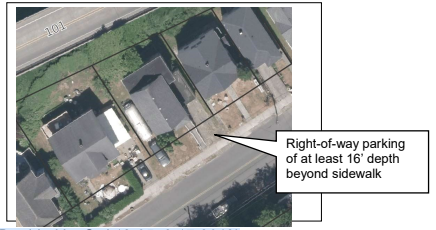
- Existing Parking within Right-of-Way. Existing parking areas located within a right-of-way between the property line and the paved portion of the right-of-way may be counted toward the required off-street parking spaces as follows:
- The parking area shall exist at the time of the proposed use application;
- The parking area shall meet minimum parking space dimensions and not extend into pedestrian walkway/sidewalk, or into adjacent properties;
- The City Engineer shall review and approve the location of the parking space;
- The applicant shall obtain an administrative Type I permit for use of the area for parking.
- The parking area shall be in compliance with City Code 6.100 (Clear Vision Ordinance) and shall not create a safety hazard.
- Recreational vehicles, boats, and/or non-operable vehicles shall not be parked and/or stored in the parking areas located within a right-of-way between the property line and the paved portion of the right-of-way as allowed in Section 7.030.D.
Amended by Ord. 22-01 on 11/7/2022
7.040 FRACTIONAL MEASUREMENTS
When calculations for determining the number of required off-street parking or loading spaces result in a requirement of fractional space, any fraction of a space less than one-half shall be disregarded, and a fraction of one-half or greater shall be counted as one full space.
7.050 OWNERSHIP OF PARKING AND LOADING AREAS
- Except as provided for joint use parking in Section 7.070, the land to be provided for off-street parking and loading areas, including driveways, aisles, and maneuvering areas shall be:
- Owned by the owner of the property served by the parking; or
- In commercial and industrial zones, the parking may be provided by a permanent and irrevocable easement appurtenant to the property served by the parking; or
- Be leased for a minimum term of five (5) years, provided that upon expiration or termination of the lease, the parking requirements of this ordinance shall otherwise be fully met within 90 days or the use discontinued until such requirements are met.
7.060 OFF-STREET VEHICLE PARKING REQUIREMENTS
- Except as otherwise specifically provided in this ordinance, off-street parking spaces shall be provided in amounts not less than those set forth in Section 7.100.
- For any proposed use not listed in Section 7.100, the Community Development Director shall determine the parking space requirement for the most nearly similar use listed in Section 7.100 with regard to traffic generation.
7.062 SPECIAL EXCEPTIONS TO OFF-STREET VEHICLE PARKING REQUIREMENTS
- Developed Sites Exemption. Existing buildings which encompass all or a major portion of a lot with little or no possibility of providing off-street parking in compliance with City Code may apply to the Community Development Director for authority to participate in a program whereby, in lieu of providing required off-street parking, annual payments would be made to the City for the purpose of supporting mass transit, and development of public parking. As an alternative to making annual cash payments, the applicant may, with approval of the City Council, provide a public service of equal or greater value than the cash payment.
- Participation in the Program. The Director shall approve participation in the program upon a finding that the lack of required off-street parking will not result in a public safety hazard. Participation involving the provision of compensation in the form of public service in lieu of cash payments also requires the concurrence of the City Council.
- Location. This exception shall apply to any change of use or expansion of a use in all zones except those areas where the provision of off-street parking is otherwise exempted.
- Compensation.
- Cash Payments.
The fee to be paid for each parking space not provided shall be $180.00 per year.
The fee shall be paid annually on a per space basis. The number of spaces subject to a fee shall be the difference between the number of off-street spaces provided and the number required by the Astoria Development Code, or, where a Variance is issued, the number of spaces authorized by Variance.
Payments shall be made to the City of Astoria at the beginning of each year the applicant is involved in the program, and shall be made, in accordance with a payment schedule to be established by the Community Development Department. - Compensation in Lieu of Cash Payments.
Compensation in lieu of cash payments may be accepted only upon a finding by the City Council that there is both a need for the proposed public service, and that the value of the service is equivalent to or greater than the cash payment described in Section 3(a) above. (Section 7.062 Added by Ordinance 93-08, 10-18-93; amended by Ordinance 96-04, 5-6-96)
- Cash Payments.
- Modification of Parking Space Requirements.
- The applicant may propose a parking space standard that is different than the standard in Section 7.100, for review and action by the Community Development Director through a Type II variance, pursuant to Article 9. The applicant’s proposal shall consist of a written request, and a parking analysis prepared by a qualified professional. The parking analysis, at a minimum, shall assess the average parking demand and available supply for existing and proposed uses on the subject site; opportunities for shared parking with other uses in the vicinity; existing public parking in the vicinity; transportation options existing or planned near the site, such as frequent bus service, carpools, or private shuttles; and other relevant factors. The Community Development Director may reduce the off-street parking standards for sites with one or more of the following features:
- Site has a bus stop with existing or planned frequent transit service (15-minute headway or less) located adjacent to it, and the site’s frontage is improved with a bus stop waiting shelter, consistent with the standards of the applicable transit service provider: Allow up to a 20 percent reduction to the standard number of automobile parking spaces;
- Site has dedicated parking spaces for carpool/vanpool vehicles: Allow up to a 10 percent reduction to the standard number of automobile parking spaces;
- Site has dedicated parking spaces for motorcycle and/or scooter or electric carts: Allow reductions to the standard dimensions for parking spaces and the ratio of standard to compact parking spaces;
- Available on-street parking spaces adjacent to the subject site in amounts equal to the proposed reductions to the standard number of parking spaces.
- Site has more than the minimum number of required bicycle parking spaces: Allow up to a 10 percent reduction to the number of automobile parking spaces. (Section 7.062.B added by Ordinance 14-03, 4-21-14; scrivner’s error amended per Ord 19-05, 6-17-2019)
- The applicant may propose a parking space standard that is different than the standard in Section 7.100, for review and action by the Community Development Director through a Type II variance, pursuant to Article 9. The applicant’s proposal shall consist of a written request, and a parking analysis prepared by a qualified professional. The parking analysis, at a minimum, shall assess the average parking demand and available supply for existing and proposed uses on the subject site; opportunities for shared parking with other uses in the vicinity; existing public parking in the vicinity; transportation options existing or planned near the site, such as frequent bus service, carpools, or private shuttles; and other relevant factors. The Community Development Director may reduce the off-street parking standards for sites with one or more of the following features:
- Downtown Area. Uses in the C-4 Zone (Central Commercial) and uses between 7th and 14th Streets in the A-2 (Aquatic Two Development) and S-2A Zones (Tourist Oriented Shoreland) are not required to provide off-street parking.
Exception: In the C-4 Zone, off-street parking and loading requirements shall apply to Lots 1, 2, 3, Block 40, McClure’s Addition (south side of 600 Block Duane Street) as required by Amendment A99-02, Ordinance 99-21. (Section 7.062.C added by Ordinance 14-03, 4-21-14)
7.070 JOINT USE OF PARKING AREAS
A. The Community Development Director may authorize the joint use of parking areas by the following uses or activities as a Conditional Use in every zone under the following conditions:
- Up to 50% of the off-street parking spaces required by this ordinance for a church, auditorium in a school, theater, bowling alley, night club, eating or drinking establishment may be satisfied by the off-street parking spaces provided by uses occupied only during the daytime on weekdays.
- Up to 50% of the off-street parking spaces required by this ordinance for any daytime use may be satisfied by the parking spaces provided for nighttime or Sunday uses.
- All jointly used spaces shall be located with relation to all uses relying on such spaces within the applicable distance set forth in Section 7.030.
- The Planning Commission must find that there is no substantial conflict in the principal operating hours of the buildings or uses for which joint use of off-street parking facilities is proposed.
- A properly drawn legal instrument executed by the parties concerned with joint use of off-street parking facilities, approved as to form and manner of execution by Legal Counsel, shall be filed with the Community Development Director. Joint use parking privileges shall continue in effect only so long as such an instrument, binding on all parties, remains in force. If such instrument becomes legally ineffective, then parking shall be provided as otherwise required in this ordinance within 60 days.
7.080 CLASSIFICATION OF USES FOR PURPOSES OF JOINT USE PARKING
- The following uses are considered daytime uses for purposes of Section 7.070:
- Bank or other financial institution.
- Business service establishment.
- Clothing, shoe repair, or service establishment.
- Household equipment or furniture store.
- Manufacturing or wholesale building.
- Personal service establishment.
- Retail store.
- Other similar primarily daytime uses as determined by the Community Development Director.
- The following uses are considered nighttime or Sunday uses for purposes of Section 7.070:
- Auditoriums incidental to a public or private school.
- Church.
- Eating and drinking establishment, only open after 5:00 p.m.
- Night Club.
- Theater.
- Other similar primarily nighttime uses as determined by the Community Development Director.
7.090 OFF-STREET LOADING
- Except as otherwise specifically provided in this ordinance, off-street loading shall be provided in amounts not less than those set forth in Section 7.160.
- A parking area meeting the requirements of Sections 7.100 through 7.110 may also be used for loading when the use does not require a delivery vehicle which exceeds a combined vehicle and load rating of 20,000 pounds, and when the parking area is within 25 feet of the building or use which it serves.
- Downtown Area. Uses in the C-4 Zone (Central Commercial) and uses between 7th and 14th Streets in the A-2 (Aquatic Two Development) and S-2A Zones (Tourist Oriented Shoreland) are not required to provide off-street loading.
Exception: In the C-4 Zone, off-street parking and loading requirements shall apply to Lots 1, 2, 3, Block 40, McClure’s Addition (south side of 600 Block Duane Street) as required by Amendment A99-02, Ordinance 99-21.
7.100 MINIMUM PARKING SPACE REQUIREMENTS
Table 7.100 – Off-Street Parking Space Requirements by Use.
The following are minimum off-street parking requirements by use category. The Community Development Director or Planning Commission, as applicable, may increase the required off-street parking based on anticipated need for a specific conditional use. Off-street vehicle parking requirements are calculated to include consideration of employee and customer/client uses.
For off-street parking requirement calculations, gross floor area as defined in Section 1.400 shall not include outdoor storage areas. Gross floor area for off-street parking calculations shall include exterior space utilized for the use which results in expanded use on the site such as outdoor seating area for an eating/drinking establishment.
| Use Categories | Minimum Parking Requirements
|
| RESIDENTIAL CATEGORIES | |
All Dwellings not otherwise listed | 0.65 spaces per bedroom with a maximum total of 2 spaces for single-family or two-family dwellings, including each unit in a cottage cluster development. |
| Accessory Dwelling | No additional parking is required. |
| Group Living Facility, Room and Board Facililty | 4 spaces plus one per employee;
Calculation is based on the maximum number of employees on one shift, not total employment.. |
| Group Living Facililty, Long-term Care Facility | 1 space per 8 bedrooms plus one per employee Calculation is based on the maximum number of employees on one shift, not total employment. |
| Residential Home or Residential Facility | 2 spaces plus 1 additional space per 3 beds for the home/facility |
| COMMERCIAL CATEGORIES | |
| Animal hospital or kennel | 1 space per 300 sq. ft. gross floor area |
| Automotive repair & service, gas station | 1 space per 1,000 sq. ft. gross floor area |
| Bed and Breakfast, Inn | 1 additional off-street space for each bedroom used for transient lodging plus off-street spaces required for the
dwelling and associated uses such as assembly areas or restaurant. |
| Daycare, Family/Home | 1 space, plus required parking for dwelling |
| Daycare Center | 1 space per employee |
| Eating and Drinking / Restaurant | 1 space per 500 sq. ft. if no seating;
1 space per 250 sq. ft. with seating. |
| Educational Services, not a school (e.g., tutoring or similar services, excluding single student tutoring facilities) | 1 space per 300 sq. ft. gross floor area |
| Home Stay Lodging | 1 additional off-street space for each bedroom used for transient lodging plus off-street spaces required for the dwelling. |
| Home Occupation with customers and/or non-resident employees | 1 additional space per anticipated customer/employee at a specific time in excess of one person at a time |
| Hotels, Motels, other transient lodging facilities not listed, and similar uses | 1 space per guest room.
See also, parking requirements for associated uses, such as restaurants, entertainment uses, drinking establishments, assembly facilities. |
| Laundromat and dry cleaner | 1 space per 350 sq. ft. gross floor area |
| Mortuary/Funeral Home | 1 space per 300 sq. ft. gross floor area |
| Offices: General, medical/dental, professional | 1 space per 500 sq. ft. gross floor area |
| Personal Services (i.e. salon, spa, barber, animal grooming, out-patient veterinary services) | 1 space per chair, table, or booth for customers |
| Repair or Service other than automotive | 1 space per 500 sq. ft. gross floor area |
| Retail Sales, General Merchandise | 1 space per 500 sq. ft. gross floor area |
| Retail Sales, Bulk with a building (lumber and construction materials, furniture, appliances, and similar sales) | 1 space per 1,000 sq. ft. gross floor area |
| Retail Sales, Outdoor with no building or building of less than 200 sq. ft. (i.e. automotive, nursery, bulk retail, produce, etc.) | 1 space per 1,000 sq. ft. of site used for retail display/storage |
| INDUSTRIAL CATEGORIES | |
| Industrial Service, not otherwise categorized | 1 space per 1,000 sq. ft. gross floor area |
| Light Manufacturing | 1 space per 2 employees on the largest shift |
| Manufacturing and Production, Heavy Industrial with building greater than 5,000 sq. ft. | 1 space per 2,500 sq. ft. gross floor area |
| Marina | 0.25 spaces per boat berth or docking space |
| Mini-Storage | 1 space per four units |
| Seafood Processing and Associated Uses | 1 space per full-time equivalent employee plus 1 space per 10 seasonal employees. Seasonal parking may be reduced with proof that employees are bussed to site. |
| Wholesale, Warehouse, Freight Service | 1 space per 1,500 sq. ft. gross floor area |
| INSTITUTIONAL CATEGORIES | |
| Community Service, including Government Offices and Services | Same requirement as non-institutional use for the category |
| Jail | 1 space per 2,000 sq. ft. gross floor area |
| Medical Center/Hospital with overnight stay | 1 space per 300 sq. ft. gross floor area |
| Membership organization, club, lodge | Same as specified use requirement such as eating and drinking establishment, public assembly, school, etc. |
| Parks and Open Space | Parking based on projected parking demand for planned uses. See Recreation, outdoor. |
| Public Assembly | 1 space per 100 sq. ft. of public assembly area where no seats provided; or 1 space per five seats where provided |
| Religious Institutions and Houses of Worship | 1 space per 100 sq. ft. of main assembly gross floor area; additional parking is not required for associated use areas if not
used at same time as main assembly area |
| School, Pre-School through Middle-School | 1.5 space per classroom |
| School, High School | 7 spaces per classroom |
| School, College & Vocational | 1 space per 400 sq. ft. of gross floor area; and 1 space per 2 dorm rooms |
| RECREATIONAL CATEGORIES | |
| Aquatic center, sports club, gym, rink, recreation center, health club, bowling alley, and other similar indoor entertainment | 1 space per 400 sq. ft. gross floor area |
| Museum, art gallery, library | 1 space per 600 sq. ft. gross floor area |
| Outdoor recreational park, Public playground | None |
| Outdoor recreational park, Commercial park | 1 space per 1,000 sq. ft. gross land area |
| Sports Field | 1 space per 100 sq. ft. of public assembly area where no seats provided; or 1 space per five seats where provided |
| Theater, indoor arena: Single venue | 1 space per 3 seats |
| Theater, indoor arena: Multiplex | 1 space per 6 seats |
| OTHER CATEGORIES | |
| Accessory Uses | Parking standards for accessory uses are the same as for primary uses, but are pro-rated based on the percentage of estimated overall parking demand, subject to City review and approval. |
| Temporary Uses | Parking standards for temporary uses are the same as for primary uses, except that the Community Development Director or Planning Commission, as applicable, may reduce or waive certain development and designs standards for temporary uses. |
| Transportation and Communications Facilities (operation, maintenance, preservation, and construction) | None, except where temporary parking is required for construction staging areas |
Amended by Ord. 22-01 on 11/7/2022
7.105 BICYCLE PARKING
- Standards. Bicycle parking spaces shall be provided for new development, change of use, and major renovation, at a minimum, based on the standards in Table 7.105. Major renovation is defined as construction valued at 33% or more of the assessed value of the existing structure.
Where an application is subject to Conditional Use Permit approval or the applicant has requested a reduction to an automotive parking standard, pursuant to Section 7.062, the Community Development Director or Planning Commission, as applicable, may require bicycle parking spaces in addition to those in Table 7.105.
Table 7.105: Minimum Required Bicycle Parking SpacesUse Minimum Number of Spaces Long and Short Term Bicycle Parking Percentages Multi-Dwelling Unit
Residential Structure with 4 or more dwelling units1 bike space per 4 dwelling units 75% long term
25% short termCommercial 1 bike spaces per primary use or 1 per 10 vehicle spaces, whichever is greater 50% long term
50% short termIndustrial 1 bike spaces per primary use or 1 per 20 vehicle spaces, whichever is greater 25% long term
75% short termParks (active recreation areas greater than 10,000 sq. ft.) 4 bike spaces per 10,000 sq. ft. 100% short term Schools (all types) 1 bike spaces per 4 classrooms 50% long term
50% short termInstitutional Uses and Places of Worship 1 bike space per 20 vehicle spaces 100% short term Other Uses 2 bike spaces per primary use or 1 per 10 vehicle spaces, whichever is greater 50% long term
50% short term - Design and Location.
- All bicycle parking shall be securely anchored to the ground or to a structure.
- All bicycle parking shall be designed so that bicycles may be secured to them without undue inconvenience, including being accessible without removing another bicycle.
- All bicycle parking should be integrated with other elements in the planter strip when in the public right-of-way.
- Direct access from the bicycle parking area to the public right-of-way shall be provided at-grade or by ramp access, and pedestrian access shall be provided from the bicycle parking area to the building entrance.
- Bicycle parking shall not impede or create a hazard to pedestrians or vehicles, and shall not conflict with the vision clearance standards of City Code Section 6.100.
- Short-term bicycle parking.
- Short-term bicycle parking shall consist of a stationary rack or other approved structure to which the bicycle can be locked securely.
- If more than 10 short-term bicycle parking spaces are required, at least 50% of the spaces must be sheltered. Sheltered short-term parking consists of a minimum 7-foot overhead clearance and sufficient area to completely cover all bicycle parking and bicycles that are parked correctly.
- Short-term bicycle parking shall be located within 50 feet of the main building entrance or one of several main entrances, and no further from an entrance than the closest automotive parking space.
- Long-term bicycle parking. Long-term bicycle parking shall consist of a lockable enclosure, a secure room in a building on-site, monitored parking, or another form of sheltered and secure parking.
- Exemptions. This Section does not apply to single-family, two-family, and three-unit multi-family housing, home occupations, and agricultural uses. The Community Development Director or Planning Commission as applicable may exempt other uses upon finding that, due to the proximity of public bicycle parking facilities, the nature of the use, or its location, it is unlikely to have any patrons or employees arriving by bicycle.
Amended by Ord. 22-01 on 11/7/2022
7.110 PARKING AND LOADING AREA DEVELOPMENT REQUIREMENTS
All parking and loading areas required under this ordinance, except those for a single-family dwelling, Accessory Dwelling Unit, or two-family dwelling on an individual lot unless otherwise noted, shall be developed and maintained as follows:
- Location on site. Required yards adjacent to a street, shall not be used for parking and loading areas unless otherwise specifically permitted in this ordinance. Side and rear yards which are not adjacent to a street may be used for such areas when developed and maintained as required in this ordinance.
- Surfacing. All parking and loading areas and driveways thereto shall be paved with asphalt, concrete or other hard surface approved by the City Engineer. Parking and loading areas shall be adequately designed, graded, and drained.
- Bumper guards or wheel barriers. Permanently affixed bumper guards or wheel barriers are required and shall be so installed that no portion of a vehicle will project into a public right-of-way or over adjoining property. The area beyond the wheel barriers or bumper guards shall be surfaced as required in Section 7.110.B or landscaped. The vehicle may extend past the bumper guard into a landscaped area a maximum of 2.5’.
- Size of parking spaces and maneuvering areas. The parking area, each parking space, and all maneuvering areas shall be of sufficient size and all curves and corners of sufficient radius as determined by the City Engineer to permit the safe operation of a standard size vehicle subject to the following minimum requirements:
- Full size parking spaces shall be nine and one half (9.5) feet wide and 20 feet long.
- Compact parking spaces shall be eight and one half (8.5) feet wide and 16 feet long for no more than 50% of the parking spaces required.
An increase to 75% compact may be approved administratively by the Community Development Director upon a finding that anticipated use would not require compliance. An increase greater than 75% may be approved by the Community Development Director as a Type II Variance in accordance with Article 9. - Where a landscaped area, fence, or wall is adjacent to a parking space, the parking space shall be ten (10) feet wide.
- A maximum of 2.5’ of a parking stall required length may extend beyond the wheel barrier into a landscaped area. The parking stall shall not extend into a pedestrian walkway area.
- Access. Parking or loading areas having more than four (4) spaces in the same block shall be designed so that vehicles do not back into public streets, or do not use public streets for maneuvering. All entrances and exits onto public streets shall first have a Driveway Permit from the Engineering Department and shall be designed and constructed to City standards. This does not prohibit individual driveways located within the same block for separate, independent uses.
- Lighting. Parking or loading areas that will be used at nighttime shall be lighted. All areas shall comply with applicable lighting standards in Section 3.128.
- Landscaping.
- Landscaping shall be provided as required in Section 7.170 and Section 3.105 through 3.120.
- Required landscaped yards shall not be used for parking.
- Additional Requirements.
- Directional signs and pavement marking shall be used to control vehicle movement in parking area.
- Aisle Widths. Aisles with parking adjacent on one or both sides, depending on angle of parking spaces:
Minimum Width 0 - 40 degrees 12 feet 41 - 45 degrees 13 feet 46 - 55 degrees 15 feet 56 - 70 degrees 18 feet 71 - 90 degrees 24 feet
Amended by Ord. 22-01 on 11/7/2022
7.120 DRIVEWAY DEVELOPMENT STANDARDS
All driveways providing access to parking spaces and loading areas required under this ordinance, including those for a single-family dwelling on a lot, shall conform to the Astoria City Code Sections 2.050 through 2.100 and Development Code Section 3.008.D, in addition to requirements in the Astoria Engineering Design Standards for Roadways (Chapter 4).
(Section 7.120 amended by Ordinance 14-03, 4-21-14)
Amended by Ord. 22-01 on 11/7/2022
7.130 OUTDOOR STORAGE AREA SURFACING
- Where commercial, industrial, or shoreland zones permit outdoor storage, or if such storage is permitted as part of a Conditional Use in any zone, such storage areas and any access driveway shall be paved and shall have plans for off-site drainage approved by the City.
7.140 PARKING PLAN REQUIRED
Plans, at a workable scale, for all parking and loading areas required under this Section, shall be submitted to the Community Development Director for approval prior to issuance of a permit; or, if no building permit is required, at the time of application for a driveway permit; or, if no such permit is required, prior to commencing any paving or use of the parking or loading area. No such work or use shall commence prior to approval by the City of the plans required by this Section.
7.150 ACCESSIBLE PARKING SPACES
- Effective September 1, 1990, existing and new parking spaces for disabled persons shall be required by law at all public and government buildings.
- The size, location, dimension, and marking for accessible parking spaces shall be in accordance with current State and Federal regulations for accessible parking facilities.
(Section 7.150 amended by Ordinance 14-03, 4-21-14)
Amended by Ord. 22-01 on 11/7/2022
7.160 MINIMUM LOADING SPACE REQUIREMENTS
- Multi-Family Dwelling Units.If a recreational or service building is provided, at least one of the required loading spaces shall be located in conjunction with the recreational or service building.
USE OR GROSS SQUARE
FOOTAGE OF FLOOR AREAMINIMUM NO.
OF SPACESMINIMUM SIZE OF SPACE WIDTH LENGTH HEIGHT 0 - 49 Units 0 12 ft 19 ft 12 ft 50 - 99 Units 1 " " " 100 - 199 Units 2 " " " 200 and over Units 3 " " " - For Buildings Used Entirely for Office Occupancy.For each additional 100,000 square feet of any portion thereof over 250,000 square feet, one additional loading space.
USE OR GROSS SQUARE FOOTAGE OF FLOOR AREA MINIMUM NO. OF SPACES MINIMUM SIZE OF SPACE WIDTH LENGTH HEIGHT Under 5,000 sq ft 0 12 ft 30 ft 14 ft 5,000 - 59,999 sq ft 1 " " " 60,000 - 249,999 sq ft 2 " " " - Commercial, Non-office, Public and Semi-Public.For each additional 100,000 square feet of any portion thereof over 250,000 square feet, one additional loading space.
USE OR GROSS SQUARE FOOTAGE OF FLOOR AREA MINIMUM NO. OF SPACES MINIMUM SIZE OF SPACE WIDTH LENGTH HEIGHT Under 5,000 sq ft 0 12 ft 55 ft 14 ft 5,000 - 59,999 sq ft 1 " " " 60,000 - 249,999 sq ft 2 " " " - Industrial.For each additional 100,000 square feet or any portion thereof over 760,000 square feet, an additional loading space is required.
USE OR GROSS SQUARE FOOTAGE OF FLOOR AREA MINIMUM NO. OF SPACES MINIMUM SIZE OF SPACE WIDTH LENGTH HEIGHT Under 5,000 sq ft 0 12 ft 55 ft 14 ft 5,000 - 99,999 sq ft 1 " " " 100,000 - 239,999 sq ft 3 " " " 240,000 - 319,000 sq ft 5 " " " 320,000 - 399,000 sq ft 6 " " " 400,000 - 489,999 sq ft 7 " " " 490,000 - 579,999 sq ft 8 " " " 580,000 - 669,999 sq ft 9 " " " 670,000 - 759,999 sq ft 10 " " "
7.170 LANDSCAPING OF OUTDOOR STORAGE OR PARKING AREAS
- A minimum of 5% of the gross parking lot area shall be designed and maintained as landscaped area, subject to the standards in Sections 3.105 through 3.120. This requirement shall apply to all parking lots with an area of 600 square feet or greater. Approved sight obscuring fences or vegetative buffers shall be constructed where commercial parking lots abut Residential Zones. The minimum 5% landscaping shall be counted as part of the total landscaping required for the property.
- There shall be a 15’ landscaped buffer area maintained between outdoor storage areas, parking areas, and/or driving surfaces and the top of bank along the shoreline. Except as otherwise noted, parked vehicle bumpers may overhang a maximum of 2.5’ beyond a bumper guard into the landscaped area.
Amended by Ord. 22-01 on 11/7/2022

