
Avon City Zoning Code
CHAPTER 4
Use Standards
4.1 Accessory Uses
- Accessory uses are allowed, subject to district limitations, provided they are:
- Incidental to the principal use;
- Operated and maintained on the same lot as the principal use;
- Subordinate in height, area, purpose, and location to the principal use; and
- Compatible in style and materials with the principal use. Where authorized by this Ordinance, wireless communication service facilities may be considered an accessory use.
- Except as provided elsewhere in this Ordinance, all or part of an accessory use must be behind the rear building line of the principal building. Furthermore, all or part of each accessory use or must adhere to the side or rear yard requirements of the district.
- Accessory uses are not permitted prior to the construction and operation of the principal use.
- Accessory uses are not permitted within any easement.
4.2 Accessory Dwelling Units
- The purpose of this section is to allow accessory dwelling units in certain situations to:
- Create new housing units while respecting the look and scale of single-dwelling development;
- Support more efficient use of existing housing stock and infrastructure;
- Provide housing that responds to changing family needs, smaller households, and increasing housing costs; and
- Provide accessible housing for seniors and persons with disabilities.
- An accessory dwelling unit (ADU) is defined as a smaller, secondary home on the same lot as a primary dwelling. ADUs are independently habitable and provide the basic requirements of shelter, heating, cooking, and sanitation. There are two types of ADUs:
- Garden cottages are detached structures. Examples include converted garages or new construction.
- Accessory suites are attached to or part of the primary dwelling. Examples include converted living space, attached garages, basements, or attics; additions; or a combination thereof.
- See 3.2 Permitted Use Table for the zoning districts where ADU’s are permitted.
- One ADU is permitted per residentially zoned lot.
- An ADU may be created through new construction, conversion of an existing structure, addition to an existing structure, or conversion of a qualifying existing house to a garden cottage while simultaneously constructing a new primary dwelling on the site.
- ADUs are exempt from the residential density standards of this code.
- Applications for ADUs must meet the following criteria.
- The applicant must demonstrate that the ADU complies with all development and design standards of this Ordinance.
- The applicant must demonstrate that the proposed modifications comply with applicable building and fire safety codes
- The applicant must demonstrate that the ADU complies with all development and design standards of this Ordinance.
- Occupancy and use standards for an ADU are the same as those applicable to a primary dwelling on the same site.
- All ADUs must meet the following design standards in addition to the base zoning district standards:
- Size: An ADU cannot exceed 800 square feet or the size of the primary dwelling, whichever is less.
- Parking: No additional parking is required for an ADU. Existing required parking for the primary dwelling must be maintained or replaced on-site.
- Exterior Finish Materials: Exterior finish materials must visually match in type, size and placement, the exterior finish materials of the primary dwelling.
- Windows: If the street-facing façade of the ADU is visible from the street, its windows must match, in proportion and orientation, the windows of the primary dwelling.
- Eaves: If the primary dwelling has eaves, the ADU must have eaves that project the same distance from the building. If the primary dwelling does not have eaves, no eaves are required for the ADU.
- Accessory Suites must meet the following design standards:
- Location of Entrances: Only one entrance may be located on the facade of the primary dwelling facing the street, unless the primary dwelling contained additional entrances before the accessory suite was created. Entrances that do not have access from the ground, such as entrances from balconies or decks, are exempt from this requirement.
- Exterior Stairs: Fire escapes or exterior stairs for access to an upper-level accessory suite cannot be located on the front of the primary dwelling.
- Garden cottages must meet the following design standards:
- Height: The building height cannot exceed 20 feet or the height of the primary dwelling, whichever is less.
- Building Setbacks: Garden cottages must be located at least 6 feet behind the primary dwelling unless the garden cottage is in an existing detached structure that does not meet this standard.
- Building Coverage: The building coverage of a garden cottage may not be larger than the building coverage of the primary dwelling.
- Yard Setbacks: No portion of an existing building that encroaches within a required yard setback may be used as a garden cottage unless the building complies with setback exemptions available in this Ordinance.
- Exemptions: Garden cottages are eligible for the following exemptions:
- Garden cottages are exempt from the Design Standards for Garden Cottages above if they (i) are under 500 square feet and under 18-foot average height, or (ii) meet the architectural standards for residential districts (7.9 Architectural Standards – Residential Districts).
- If a garden cottage is proposed for an existing detached accessory structure that does not meet one or more of the Design Standards for Garden Cottages above, the structure is exempt from the standards it does not meet. Alterations that would move the structure out of conformance with standards are not allowed. If any floor area is added to a detached accessory structure, the entire structure must meet the Design Standards for Garden Cottages.
- Garden cottages are exempt from the Design Standards for Garden Cottages above if they (i) are under 500 square feet and under 18-foot average height, or (ii) meet the architectural standards for residential districts (7.9 Architectural Standards – Residential Districts).
4.3 Adult Businesses
- Purpose: The purpose of this ordinance is to regulate adult businesses to promote the health, safety, morals, and general welfare of the Town, and to establish reasonable, uniform regulations to prevent injurious location and concentration of adult businesses within the Town.
The provisions of this ordinance do not seek to limit or restrict the content of any communicative materials, including adult materials. It is not the intent of this Ordinance to restrict or deny access to adult materials protected by the First Amendment, or to deny access by distributors and exhibitors of adult entertainment to their intended market. It is not the intent of this Ordinance to condone or legitimize the distribution of obscene material. - Classification:
- Principal Uses: The following adult businesses are permitted according to 3.2 Permitted Use Table, the provisions of this article, and local licensing requirements:
- Adult media stores
- Adult cabarets
- Adult entertainment facilities
- Adult motels
- Adult motion picture theaters
- Adult theaters
- Escort agencies
- Lingerie modeling studio
- Nude modeling studios
- Sexual encounter centers
- Sex shops
- Accessory Uses: An adult business cannot be an accessory use.
- Prohibited Uses: The following adult businesses are not permitted within any district in the Town:
- Adult arcades
- Video viewing booths
- Unlicensed and/or sex-oriented massage establishments
- Principal Uses: The following adult businesses are permitted according to 3.2 Permitted Use Table, the provisions of this article, and local licensing requirements:
- Location of Adult Businesses: Adult businesses are permitted according to the 3.2 Permitted Use Table and the location requirements below.
- Non-Conforming Adult Businesses: Any Adult business lawfully operating prior to the effective date of this ordinance is considered a non-conforming use and subject to CHAPTER 1: GENERAL PROVISIONS, with the following modifications:
- When the non-conforming adult business is discontinued or abandoned for a period of 90 days, the use cannot later be reestablished or resumed.
- Non-conforming adult businesses cannot be enlarged or altered in any way, except modifying the use to a conforming use.
- If 2 or more adult businesses do not meet the separation requirements between adult uses described below, but are otherwise within a permissible location, the adult business first established and continually operating at a particular location is the conforming use. The later-established business is non-conforming.
- When the non-conforming adult business is discontinued or abandoned for a period of 90 days, the use cannot later be reestablished or resumed.
- Separation Requirements:
- For this ordinance, distance is measured as a straight line from the nearest portion of the building or structure where an adult business is conducted, to the nearest property line of the use requiring separation. Measurements are made in a straight line, without regarding intervening structures or objects. No adult use is permitted adjacent to, or within the same building, as any of the uses in this subsection, regardless of the total distance between the uses.
- Adult businesses cannot be established within 1,000 feet of the following uses:
- Another adult business
- A religious institution or place of worship
- A public or private elementary or secondary school
- A public or private park or recreational area
- The property line of a lot devoted to a residential use
- Adult Businesses must not be established within 1,500 feet of the boundary of any residential district.
- Adult Businesses must not be established adjacent to or within the same block as the following uses:
- A library
- A day care center
- An adult business lawfully operating as a conforming use does not become a non-conforming use if any of the uses mentioned above are established after the adult business approval is granted.
- Non-Conforming Adult Businesses: Any Adult business lawfully operating prior to the effective date of this ordinance is considered a non-conforming use and subject to CHAPTER 1: GENERAL PROVISIONS, with the following modifications:
- Special Regulations for Media and Adult Media Stores:
- Adult media in a shop consisting of 10% to 40% percent of the gross floor area, gross shelf area, or stock in trade, must be kept in a separate room or section of the shop. This room or section must:
- not be open to anyone under the age of 18.
- be physically and visually separated from the rest of the store by an opaque wall of durable material, reaching at least eight feet high or to the ceiling, whichever is less;
- have access controlled by electronic or other means to assure people under age 18 will not easily gain admission and the general public will not accidentally enter the room or section; or continuous video or window surveillance of the room is conducted by store personnel; and
- provide signage at the entrance stipulating that people under 18 years old are not permitted inside.
- A media store where adult media constitutes no more than 10% of the gross floor area or gross shelf area, and no more than 10% of the stock in trade, the same for zoning purposes as any other retail goods establishment.
- A media store where adult media constitutes more than 40% of the gross floor area or gross shelf area, or more than 40% of the stock in trade, will be regulated as an adult retail facility according to the terms and conditions of this Ordinance.
- Adult media in a shop consisting of 10% to 40% percent of the gross floor area, gross shelf area, or stock in trade, must be kept in a separate room or section of the shop. This room or section must:
- Special Regulations for Adult Cabarets and Nude Dancing: All adult cabaret and nude dancing performances must take place in rooms or sections greater than 750 square feet in area, on a raised stage at least 18 inches above the floor, and in a location visible to other patrons and employees.
- Signs and Display of Materials:
- Signs for an adult business must conform with the sign requirements of 6.14 - 6.17 Signage for the district. No sign for an adult business is permitted to contain sexually explicit messages or drawings.
- No adult business is permitted to display any adult products publicly.
- Exemptions: A person appearing in a state of nudity is not considered an adult business if the person appearing in a state of nudity did so in a modeling class operated:
- By a school, college, junior college, or university licensed by the State of Indiana supported entirely or partly by taxation;
- By a private college or university maintaining and operating educational programs where credits are transferable to a college, junior college, or university supported entirely or partly by taxation; or
- In a structure:
- which has no sign visible from the exterior of the structure and no other advertising that indicates a nude person is available for viewing;
- where a student must enroll at least 3 days in advance of the class; and
- where no more than one nude model is on the premises at any one time.
4.4 Bed And Breakfast Establishments
Bed and breakfast establishments, where allowed, must adhere to the following requirements:
- Bed and breakfast establishments must be located within and accessory to an owner occupied single-family detached home.
- Bed and breakfast establishments must comply with all local, county, and state fire and health regulations.
- No ancillary commercial use can be operated in connection with a bed and breakfast establishment.
- The operation of a bed and breakfast establishment is not a home occupation.
- A bed and breakfast establishment is limited to no more than 5 guestrooms for rent.
- Accommodations cannot be provided to a guest for more than 14 consecutive days.
4.5 Confined Feeding Operations
- Development Plan approval by the Plan Commission is required prior to constructing or operating a new Confined Feeding Operation (CFO) or expanding and existing CFO.
- Minimum Setbacks: A minimum setback of 250 feet is required for all yards. The setback is measured from the property line to the nearest foundation of the CFO.
- Minimum Road Frontage: The minimum road frontage is 150 feet.
- Permitted Entrances: A CFO site may have up to 2 entrances to a State Highway or State Road. The applicant must obtain a driveway permit from the Indiana Department of Transportation prior to construction of the entrance(s). A CFO site is limited to one entrance on streets other than a State Highway or State Road.
- Required Minimum Separation Distances:
- For a residential dwelling unit not located on the proposed site the applicable separation distances are:
- Foundation to Foundation: At least 2,640 feet measured from the foundation of the CFO structure to foundation of the residential dwelling unit. This separation distance may be reduced to not less than 1,320 feet with the use of odor mitigation tactics listed below.
- Property line to Property Line: At least 1,320 feet measured from the property line of the CFO parcel to the property line of the parcel containing the residential dwelling unit. This separation distance may be reduced to not less than 660 feet with use of odor mitigation tactics listed below.
- Calculation of Separation Reduction: The separation distance may be reduced by using odor mitigation tactics. The reduction is calculated by multiplying the number of mitigation tactics used by 0.125 and then multiplying that product times the required separation distance. The maximum reduction is 50% of the required separation distance.
- Odor Mitigation Tactics:
- Deep Pit: Minimum 14-month storage pit pumped once per year.
- Berm and Vegetation Screens: Combination of berm and vegetation screen around perimeter of site.
- Dietary Program: Diet changed every 21 days to minimize nutrient excretion into pit.
- Power Washing: Animal barns washed and cleaned every 6 months to minimize dust particles that carry odor.
- Slatted Floors: Animals stay clean and reduces manure build up that creates odor.
- Pit Additives: Chemicals or biologicals that reduce omission of odor by reducing pH levels.
- Solid-Liquid Separation: Separating urea from solid fecal matter mechanically or with sedimentation basin.
- Air Treatment: Trapping air vented and treating prior to discharge to atmosphere.
- Anaerobic Digester: Process by which microorganisms breakdown biodegradable material in the absence of oxygen.
- School or educational institution – 5,280 feet;
- Church or religious institution – 2,640 feet;
- Open legal drain, stream, or river (without a 20-foot filter strip) — 500 feet;
- Open legal drain, stream or river (with a 20-foot filter strip) — 300 feet;
- Residential subdivision – 2,640 feet;
- Water well (other than the one servicing the CFO) — 500 feet;
- High Employment Centers (100+ fulltime equivalent employees) – 2,640 feet;
- Business or commercial use (not otherwise specified above) – 2,640 feet;
- For a residential dwelling unit not located on the proposed site the applicable separation distances are:
- Truck Turnaround: A cul-de-sac or T-shaped turnaround area must be provided to prevent semi-trailers from backing onto a road. The turnaround area must have an all-weather surface with adequate dimensions for a semi-trailer to turn around on the site.
- Clean Record: The proposed owner of the CFO must not have any violations from the Indiana Department of Environmental Management (IDEM) during the previous 5-year period.
- Neighboring Property Owner Waiver: A landowner, other than the applicant, may waive the required separation distance by executing a written, irrevocable waiver in recordable form acceptable to the Administrator. The waiver must be submitted with the application, create a covenant that runs with the land in perpetuity, and be recorded in the Office of the Hendricks County Recorder within 14 days of the approval of the development plan. The applicant is responsible for providing the Administrator a copy of the recorded waiver within 5 days of the recording.
- Separation distances apply to CFO only. The separation distances in this article apply only to the siting of CFO facilities on the property and do not restrict the rights of the landowner to use, develop, and enjoy the landowner's real estate, other than the land on which the CFO is located. The separation distances cannot be used by the applicant or any other person as a basis to restrict the use, development, or enjoyment of the property.
4.6 Home Occupations
- In addition to conforming to the regulations for accessory uses and structures set forth, home occupations must comply with the following:
- The operator of the home occupation must reside in the dwelling unit containing the home occupation.
- The home occupation must be conducted entirely within the principal building and be subordinate to the principal residential use of the structure. No work can be conducted within an attached or detached garage. Limited storage may be allowed in an attached or detached garage provided the storage does not create a nuisance or prevent using the garage for parking motor vehicles.
- The home occupation must not interfere with delivering utilities or other services to the neighborhood.
- The activity must not generate noise, vibrations, smoke, dust, odors, heat, glare, or interfere with radio or television reception in the area exceeding normal production of a residential dwelling unit.
- Toxic, explosive, flammable, radioactive, or other hazardous materials cannot be used, sold, or stored on the site. Materials common to an ordinary household use are permitted, provided the quantity of materials does not exceed ordinary household amount.
- Altering the residential appearance of the principal building is prohibited. One non-animated, non-illuminated, nonflashing announcement plate is allowed. This plate must be attached flat against the wall of the residence and must not exceed one square foot in total surface area.
- Visitors to the home occupation are not permitted between 9:00 p.m. and 6:00 a.m. The home occupation must not cause a significant increase in the amount of traffic or parking on any residential street. Deliveries for the home occupation must not restrict traffic circulation and may only occur between 9:00 a.m. and 5:00 p.m., Monday through Friday.
- Outdoor display or storage of materials, goods, supplies, or equipment is prohibited.
- The total interior floor area used for the home occupation cannot exceed 25% of the total interior floor area of the dwelling. In no case can the area of a home occupation exceed 600 square feet.
- Only one person who is not a resident of the dwelling unit may be employed on-site.
- More than one home occupation may be permitted within an individual dwelling unit provided the cumulative impact of the home occupations do not exceed the standards and limitations for a single home occupation.
- The following uses are prohibited as home occupations:
- Animal hospitals, kennels, or exotic animal sales
- Barber shops or beauty parlors
- Clubs, including fraternities and sororities
- Funeral parlors
- Medical or dental clinics
- Nursing homes
- Restaurants
- Vehicle or machine repair
- Welding or machine shops
- Other similar uses as determined by the Administrator
- Any violation of this section is a violation of this Ordinance and subject enforcement (CHAPTER 9: ADMINISTRATION AND ENFORCEMENT).
4.7 Mobile Home Parks
- Purpose: These provisions provide for the development of mobile home parks in a well-planned environment located along major arterials or major collector thoroughfares. Mobile home parks are approved only through the Planned Unit Development Process.
- Accessory Uses: Accessory uses, buildings, and structures commonly associated with a mobile home park may be permitted, subject to the provisions of 4.1 Accessory Uses and any limitation of this article.
- Bulk Regulations: The bulk regulations that apply to mobile home parks are according to Table 4-2 MHP Mobile Home Park District Bulk Matrix below.
Table 4-2 MHP Mobile Home Park District Bulk MatrixBulk Standards MHP Mobile Home Park Minimum Lot Area Area per mobile home site 4,500 sf Maximum number of units per acre 7 mobile homes Minimum Lot Width Park 150' Mobile home lot 40' Maximum Lot Coverage Park area excluding mobile homes 90% Mobile home lot 50% Accessory buildings 750 sf Maximum Lot Depth to Width Ratio Mobile home 3:1 Maximum Height Accessory 18' Principal Building (other than mobile home) 35' Minimum Yards for Mobile Home Park Front 60' Side 50' Rear 50' Minimum Yards for Mobile Home Lot Front 10' Side 12.5’, but at least 25’ between mobile homes at the closet point. Rear 12.5’, but at least 25’ between mobile homes at the closet point. Accessory Structures Front 10' Side 7.5’, but at least 25’ between mobile homes and accessory structures at the closet point. Rear 7.5’, but at least 25’ between mobile homes and accessory structures at the closet point. - If a legal, nonconforming mobile home, manufactured home, or an industrial residential structure (herein after "nonconforming structure") on a parcel of real property used for residential purposes within a mobile home community is damaged, or destroyed, or removed, the owner of the parcel will be permitted to reconstruct, repair, renovate, or replace the nonconforming structure without losing the status of the structure or parcel, or any part of the parcel, as a legal, nonconforming structure or use if the construction, repair or renovation, or replacement meets the following requirements:
- The structure will continue to be used for residential purposes; and,
- The new foundation of the constructed, repaired or renovated, or replaced structure may not exceed the square footage of the foundation of the damaged, destroyed, or removed structure.
- The structure will continue to be used for residential purposes; and,
- Site Development Regulations for Mobile Home Parks: A mobile home park must comply with the following requirements.
- Have acceptable vehicular access to major arterials and collectors that can accommodate its traffic needs.
- A minimum site area of 3 acres and a minimum of 20 mobile home spaces.
- Each mobile home lot contains a mobile home slab constructed so the slab does not heave, shift or settle unevenly under the weight of the mobile home due to frost action, inadequate drainage, vibration, or other forces. The slab contains anchors and tie downs at each corner of the slab.
- Streets within a mobile home park comply with the Town’s standards for street design and construction.
- Each mobile home lot is accessed only from the internal road network and not perimeter roads.
- A minimum of 300 square feet of open space for each dwelling unit, with at least 150 square feet being located on each mobile home lot. Open space not located on a mobile home space may be in common areas distributed throughout the park that creates an open space network throughout the park.
- Pedestrian network connecting each mobile home lot and common facilities. At a minimum, this is a 3-foot-wide paved walkway separate from internal streets and parking areas.
- A mobile home chassis may not rest more than 3 feet above the ground elevation at the lowest point.
- Each mobile home is skirted with a building material that is (1) similar in appearance to the material of the rest of the mobile home, or (2) in a material that gives the appearance of a permanent foundation.
- The space beneath a mobile home cannot be used for storage.
- All mobile homes and mobile home parks must meet the requirements of IC 16-41-27.
4.8 Outdoor Storage And Outdoor Display
These standards to outdoor storage and outdoor display apply as accessory uses in all zoning districts.
- Outdoor storage for business uses is only permitted if delineated on an approved development plan and in accordance with the following:
- A lot’s outdoor storage area must not exceed 50% of the gross floor area of the principal building.
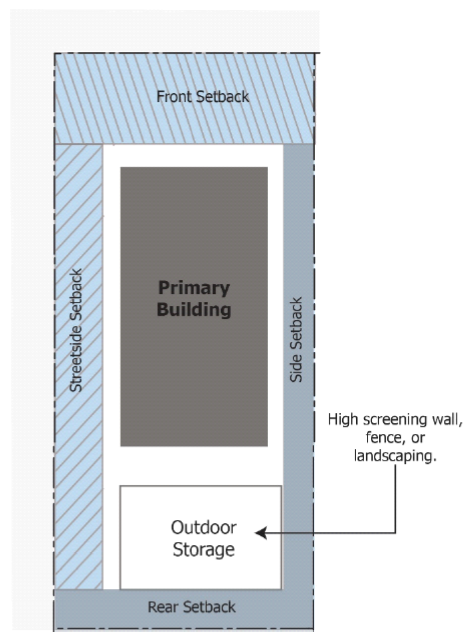
- Outdoor storage areas must be in a side or rear yard immediately adjacent to the principal building and must not encroach onto any required building setback.
- Outdoor storage areas must be incorporated into the design of the principal building as follows:
- Outdoor storage areas must be completely screened from view from any adjacent property or right-of-way.
- Outdoor storage areas must be screened on all sides at least 7 feet high with a solid wall, fence, or landscaping, or a combination of these elements. A wall or fence must use materials consistent or complementary to the principal building. Chain link fencing is prohibited.
- Access into outdoor storage areas must occur from a side or rear yard. Access gates must be opaque and architecturally compatible with the materials used on the principal building.
- All materials, product or merchandise stored in an outdoor storage area must be stacked no higher than 12 inches below the top of the wall.
- Outdoor storage may be permitted in industrial uses, subject to the following standards:
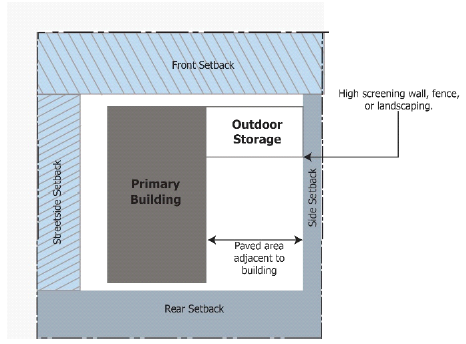
- Outdoor storage is not permitted in the established front yard or in a yard adjoining a residential district.
- Outdoor storage areas must be screened as follows:
- Continuous screening by a combination of walls, fencing, and landscaping at least 6 feet high.
- Stored materials must not be stacked higher than 12 inches below the top of the wall or screen. Equipment and vehicles must be stored at their lowest state.
- Within outdoor storage areas, high-volume travel lanes, and an area 50 feet deep adjacent to the building must be paved with asphalt or concrete. The remainder of the outdoor storage may be finished with stone. Curbing is not required around outdoor storage areas.
- Any proposed outdoor sales display must be delineated on an approved development plan and in accordance with the following:
- The development plan must include the types of merchandise and products, location, landscaping, and other improvements of the outdoor sales display area.
- Pedestrian circulation areas cannot be obstructed.
- Outdoor sales display areas must be delineated and compatible with the design of the building and the context of the site.
- Enhanced screening or landscaping ensuring the compatibility of the proposed use with adjoining areas may be required.
- Approval of an amendment to the development plan is required prior to altering an outdoor display area.
- The following uses are exempt from the outdoor sales display requirements:
- Automobile dealerships, and other similar uses as determined by the Administrator or Plan Commission.
- Outdoor sales displays that otherwise comply with the outdoor storage standards above.
- Merchandise associated with a temporary use or event.
4.9 Outdoor Eating Areas
Outdoor cafes and eating areas in any zoning district are subject to these standards.
- All outdoor eating areas must conform to State and County Health Department regulations and code.
- Music and other audio devices must be maintained at a level not audible 40 feet from the source or 90 decibels or less when measured 6 feet from source.
- Outdoor eating areas must not impede pedestrian traffic or force pedestrians into vehicle travel lanes. A 6-foot pedestrian access area must be maintained on the perimeter of the outdoor café and eating area. The Director of Public Works may approve a narrower pedestrian access area. The pedestrian access area must remain clear of obstructions.
- Outdoor eating areas used for more than 7 days in a calendar year are deemed permanent. Permanent outdoor cafes and eating areas require development plan approval to ensure compliance with this Ordinance and compatibility with the surrounding area and Zoning District.
4.10 Residential Facility For The Mentally Ill
A residential facility for the mentally ill as defined in this Ordinance and by IC 12-28-4-7 may not be located within 3,000 feet of another residential facility for the mentally ill, as measured between lot lines.
4.11 Short-Term Rentals
These standards are intended to ensure compatibility between short-term rentals and the residential character of the surrounding neighborhood. Short-term rentals must meet the standards contained in this article and be operated so the average neighbor, under normal circumstances, is not aware of their existence.
The following circumstances do not constitute a short-term rental:
- Family Occupancy: Any member of a family and the family’s guests may occupy a dwelling if owned by the family. Family occupancy extends to guest houses or similarly separate dwellings legally located on the same premises as the primary building and used without remuneration to the owner.
- House Sitting: During the temporary absence of the owner and the owner’s family, the owner may permit non-owner occupancy without remuneration to the owner.
- Dwelling Sales: Occupancy of up to 90 days after closing by a prior owner after the sale of a dwelling is permitted.
- Estate Representative: Occupancy by a personal representative, trustee, or guardian of the estate, with or without remuneration is permitted.
All short-term rentals are subject to the following performance standards:
- When provided, off-street parking must occur only on designated paved portions of the lot, such as driveways.
- Rental of the dwelling is done in a manner consistent with the character of the surrounding neighborhood.
- The owner provides the renter the following information prior to occupancy and posts this information in a conspicuous location within the dwelling:
- The name and telephone number of the contact person who may be reached any time the dwelling is rented;
- Notification of the maximum occupancy permitted in the dwelling;
- Notification and instructions of the parking locations;
- The owner’s contact person must always be available to accept calls when the dwelling is rented. The contact person must have a key to the dwelling and be capable of being physically present at the dwelling within 3 hours to address issues.
- The appearance of the dwelling must not conflict with the residential character of the neighborhood. The dwelling must be properly maintained and kept in good repair, so the use does not detract from the general appearance of the neighborhood.
- Renters must not encroach on neighboring properties.
- The premises must be maintained free of debris and unwholesome substances. Garbage must be kept in a closed container and disposed of on a regular, weekly schedule.
- Renters must not create a nuisance. For purposes of this chapter, a nuisance includes, but is not limited to, any activity that violates the Town noise regulations.
- Short-term rentals must not be used to house sex offenders; operate a structured sober living home; manufacture, exhibit, distribute, or sell illegal drugs, liquor, pornography, or obscenity; or operate an adult business as defined in IC 12-7-2-1.8.
A short-term rental permit is required prior to the use of any property as a short-term rental. Any change in the use or construction of a dwelling resulting in noncompliance with Town or state standards, as determined by the Administrator, will void the short-term rental permit approval.
4.12 Small Cell Facilities
- Small Cell Facilities must be operated and maintained in a manner that does not interfere with public safety (police, traffic control, fire, and emergency services) equipment.
- If the Administrator determines a wireless provider’s activity in the right-of-way creates an imminent risk to public safety, the Administrator may provide written notice to the wireless provider demanding correction of the risk. If the wireless provider fails to address the risk within 24-hours of the notice, the Town may take action to reasonably address the risk and charge the wireless provider the documented cost of such actions.
- Permitted Use: A wireless provider has the right as a permitted use (subject to review and conditions) to collocate Small Cell Facilities and install, maintain, modify, operate, and replace poles in the right-of-way. Structures and facilities must be installed and maintained to not create a safety hazard, obstruct or hinder the public’s safe use of the right-of-way, or obstruct the legal use of the right-of-way by utilities.
- Permit Requirements:
- A permit is required prior to collocating a Small Cell Facility or installing a new, modified, or replacement pole or support structure associated with a Small Cell Facility. The Town may require an applicant to obtain additional permits provided the additional permits do not apply exclusively to Small Cell Facilities. If a wireless provider fails to comply with the permit requirements, the Town, in its sole discretion, may restore the right-of-way to its prior condition and charge the wireless provider the documented cost of restoration, plus a penalty not to exceed $1,000.
- Within rights-of-way under the control of the Indiana Department of Transportation (“INDOT”), the wireless provider requests the Town’s written consent to the wireless provider’s application for an INDOT permit. The Town cannot unreasonably withhold their consent.
- Applications required by this article are filed with the Administrator on forms provided by the Administrator in the number and manner designated. The applicant may designate portions of the application containing proprietary or confidential information by clearly marking each such page as “proprietary” or “confidential.” The Town endeavors to protect the designated materials from public disclosure to the fullest extent permitted by State law.
4.13 Solar Energy Systems As Accessory Uses
- Solar energy systems are a permitted accessory use in all zoning districts, subject to the requirements of this article. Solar carports and associated electric vehicle charging equipment are a permitted accessory use on surface parking lots in all districts regardless of the existence of another building. Ground-mounted systems do not count toward the maximum number of accessory structures permitted.
- Solar energy systems must meet the following height requirements:
- Building or roof-mounted solar energy systems cannot exceed the maximum height allowed in the zoning district where the solar energy system is located. For purposes of height measurement, solar energy systems other than building-integrated systems are permitted the same height exceptions as building-mounted mechanical equipment.
- Ground- or pole-mounted solar energy systems cannot exceed 15 feet in height when oriented at maximum tilt.
- Solar carports in non-residential districts cannot exceed 20 feet in height.
- A solar energy system must meet the accessory structure setback for the zoning district where it is located and the requirements below.
- Roof- or Building-mounted Solar Energy Systems: The collector surface and mounting devices for roof-mounted solar energy systems cannot extend beyond the exterior perimeter of the building on which the system is mounted or built, unless the collector and mounting system has been explicitly engineered to safely extend beyond the edge, and setback standards are not violated. Exterior piping for solar hot water systems is allowed to extend beyond the perimeter of the building on a side yard. Solar collectors mounted on the sides of buildings and serving as awnings are considered building-integrated systems and are regulated as awnings.
- Ground-mounted Solar Energy Systems: Ground-mounted solar energy systems cannot extend into a side or rear yard setback when oriented at minimum design tilt.
- Solar energy systems in residential districts must minimize visual impacts from the public right-of-way to the extent that doing so does not adversely affect the cost or efficacy of the system, consistent with IC 36-7-2-8.
- Building-Integrated Photovoltaic Systems: Building-integrated photovoltaic solar energy systems are allowed even if the system is visible from the public right-of-way. If the building component where the system is integrated meets all required setback, land use, or performance standards for the district where the building is located.
- Aesthetic Restrictions: Roof-mounted or ground-mounted solar energy systems cannot be restricted for aesthetic reasons if:
- The system is not visible from the closest edge of any public right-of-way other than an alley.
- Roof-mounted systems on pitched roofs visible from a right-of-way have the same pitch as the roof and are no more than 10 inches above the roof.
- Roof-mounted systems on flat roofs visible from a right-of-way are not more than 5 feet above the finished roof. Such systems are exempt from any rooftop equipment or mechanical system screening requirements.
- Reflectors: Solar energy systems using a reflector to enhance solar production must minimize the glare from the reflector onto adjacent or nearby properties.
- A ground-mounted system must meet the lot coverage requirements for the zoning district where it is located except:
- Ground-mounted systems are exempt from lot coverage or impervious surface standards if the soil under the collector is maintained in vegetation and not compacted.
- Solar carports in non-residential districts are exempt from lot coverage limitations.
- Solar energy systems requiring a building permit or Improvement Location Permit must provide a site plan with the permit application.
- Electric solar energy system components must have an Underwriters Laboratory (UL) or equivalent listing and solar hot water systems must have a Solar Rating and Certification Corporation (SRCC) or equivalent rating.
- Solar energy systems require approval of local building code officials, consistent with the State of Indiana Building Code. Solar thermal systems must comply with HVAC related requirements of the Energy Code and applicable Indiana State Plumbing Code requirements. Photovoltaic systems must comply with the Indiana State Electric Code.
- For grid-tied solar energy systems, the interconnection application must be submitted to the utility prior to applying for required Town permits. Off-grid systems are exempt from this interconnection application requirement.
4.14 Solar Energy Systems As Principal Uses
The Town permits the development of commercial- and large-scale solar energy systems where they present few land use conflicts with current and future development patterns and they meet the requirements of this article.
- Site Design:
- Setbacks: Large-scale solar arrays must meet the following setback requirements:
- The setback from a non-participating landowner’s property line must meet the setback for buildings or structures for the district where the system is located.
- Setbacks between parcels participating in the project may be waived upon agreement of the landowners.
- Setbacks from roadways: 50 feet for arterial streets and 40 feet for all other streets.
- Setbacks from residential dwellings: 150 feet from any existing residential dwelling unit of a nonparticipating landowner. Setbacks from participating landowner dwelling units must meet building setbacks or required yards for the district where the project is located.
- The setback distance is measured from the edge of the solar energy system array, excluding security fencing, screening, or berming.
- Setbacks may be reduced by up to 50%, but in no case be less than 30 feet, if the array has a landscape buffer that screens the array from view.
- Screening: Large-scale solar energy systems must be screened from existing residential dwellings. A landscape plan showing the type and extent of proposed screening is required as part of the development plan application. The screening must be consistent with the Town’s buffer landscaping standards used when for land uses requiring screening.
- Height: Large-scale solar energy systems cannot exceed a height of 20 feet.
- Ground Cover and Buffer Areas: Largescale ground-mounted solar energy systems are required to adhere to the following standards. The Town may require additional site-specific conditions.
- The ground under and around solar panels and within the buffer areas must be planted, established, and maintained in perennial vegetated ground cover.
- To the maximum extent feasible for the site conditions, the ground cover should be a diverse seed mix of native species specific to the local area. The applicant should seek guidance from a Landscape Architect, the Soil and Water Conservation District office, or the Indiana Native Plant Society.
- The owner/operator must maintain the ground cover removing invasive or noxious plant species identified by the Indiana Invasive Species Council without harming perennial vegetation.
- Solar energy systems proposing to install, establish, and maintain pollinator-friendly vegetative cover must demonstrate the quality of their habitat by using guides such as Purdue University 2020 Indiana Solar Site Pollinator Habitat Planning Scorecard, or other third party solar-pollinator scorecards designed for Midwestern ecosystems, soils, and habitat.
- Projects certified and maintained as pollinator-friendly compliant are exempt from landscaping requirements and post-construction stormwater management controls that may be otherwise required under Avon’s development regulations, unless required due to written commitments or conditions of approval by the Plan Commission or the Board of Zoning Appeals.
- Foundations: The application for building permits must include a certification by a qualified engineer that the design of the solar panel racking and support is within accepted professional standards, given local soil and climate conditions.
- Power and communication lines running between banks of solar panels and to nearby electric substations or interconnections with buildings must be buried underground. Power and communication lines between the project and the point of interconnection with the transmission system may be overhead.
- Barbed wire or woven wire fencing are not permitted as perimeter fencing for the site. Wildlife-friendly fencing designs that include clearance at the bottom of the fence are preferred. Alternative fencing can be used if the site is incorporating agrivoltaics.
- Setbacks: Large-scale solar arrays must meet the following setback requirements:
- Large-scale solar projects are subject to the Town’s stormwater management and erosion and sediment control provisions and Nonpoint Pollution Discharge Elimination System (NPDES) permit requirements. Solar collectors are not considered impervious surfaces if the project complies with ground cover standards described in this article.
- Large-scale solar projects must comply with all applicable local, state, and federal regulatory codes, including the State of Indiana Uniform Building Code, as amended, and the National Electric Code, as amended.
- Development Plan Required: Development Plan approval is required for largescale solar projects. The development plan must show the locations of all solar arrays, other structures, property lines, rights-of-way, service roads, floodplains, wetlands, and other protected natural resources, topography, electric equipment, and all other characteristics requested by Avon. The site plan should show all zoning districts and overlay districts.
- Decommissioning: A decommissioning plan is required to ensure that facilities are properly removed after their useful life.
- Decommissioning of the system occurs if the project does not produce power for 12 consecutive months. An owner may petition for an extension of this period upon showing of reasonable circumstances causing the delay in the start of decommissioning.
- The decommissioning plan identifies provisions for removing all structures and foundations to a depth of 48”, restoring soil and vegetation, and assurances that financial resources will be available to fully decommission the site.
- The Plan Commission or Administrator may require the posting of a bond, letter of credit, or other financial surety to ensure proper decommissioning.
4.15 Temporary Uses, Events, And Structures
- Authorization: Temporary uses may be allowed according to these provisions if a temporary use permit is obtained first, according to 8.14 Temporary Use Permit.
- General Regulations:
- A temporary use is not permitted if:
- It causes significant negative impact, including aesthetic impact, on adjacent property or on the area as a whole.
- It causes, or potentially causes, a threat to public safety. The additional vehicular traffic generated by the use would have detrimental effects on surrounding streets and uses.
- It conflicts with a previously authorized temporary use.
- Temporary signs are only permitted according to the provisions of article 6.16 Signage – General Standards.
- Every temporary use must comply with the regulations applicable in its district, unless expressly provided otherwise.
- Temporary uses must comply with any conditions imposed by the Administrator to protect the public health, safety, and general welfare.
- A temporary use is not permitted if:
- Temporary Uses Permitted:
- Seasonal Sales of merchandise or the display of merchandise may be allowed in any commercial district if:
- No merchandise is placed in a required front yard.
- In shared parking lots, the sale or display of merchandise does not encroach into parking areas of other merchants.
- The use is limited to 30 consecutive days, and no more than 4 such sales may be held each year.
- Where free standing tents are used, the structures must not cover more than 800 square feet in surface area and must be inspected by the Fire Marshall.
- House, apartment, garage, and yard sales may be allowed in any residential district subject to the following:
- Sale merchandise is limited to the personal possessions of the owner occupant of the dwelling unit where the sale is being conducted.
- The use is limited to a period not more than 3 consecutive days,
- No more than 2 such sales can be conducted from the same residence in any twelve-month period.
- The hours of operation are limited to 8 a.m. to 8 p.m.
- One sign, not to exceed 6 square feet in area, is permitted in the yard of the sale premises.
- Christmas tree sales may be allowed in any district other than a residential district subject to the following:
- Such use is limited to not more than 45 days.
- Trees must be removed from the premises no later than December 31st of the same year.
- The use must provide adequate customer parking, traffic access, and have no adverse impact on other properties.
- Christmas trees must not be stored or displayed within 15 feet of any building.
- One sign, not to exceed 16 square feet in area, is permitted if it is placed only on the sale lot.
- Fireworks sales may be permitted in any industrial district subject to the following conditions:
- The use is limited to not more than 45 days.
- The use must provide adequate customer parking, traffic access, and have no adverse impact on other properties.
- Only one temporary use permit for fireworks sales can be issued per site within a 12-month period.
- Fireworks sales are not permitted if visible from US 36, Avon Avenue, or Dan Jones Road between 100 N and 100 S.
- The use must be inspected and approved by the Fire Marshall before any sales can begin.
- Contractors’ offices and equipment sheds may be allowed in any district subject to the following:
- The use must be accessory to an active construction project and be located on the same lot or within the same phase of the subdivision under construction.
- The use must not contain sleeping or cooking accommodations.
- The use must not exceed the duration of the active construction phase of the project.
- Real Estate offices, including model units, may be allowed in any district subject to the following:
- The use is accessory to an active new development and must not be constructed before to secondary plat approval of the subdivision.
- The use must not contain sleeping or cooking accommodations unless located in a model dwelling unit. However, a model dwelling unit may not be used as residence or sleeping quarters during the active selling or leasing period in the development.
- The use is limited to the active selling or leasing period in the development and to activities related to the development.
- The office cannot used as the general office or headquarters of any business entity.
- Model units/homes must not be located within 100 feet of the entrance to the subdivision unless off street parking is provided.
- Indoor and outdoor art, craft, and plant shows, outdoor exhibits and display of merchandise and outdoor sales may be allowed in any district other than a residential district, subject to following:
- The use must provide adequate customer parking, traffic access, and the absence of an adverse impact on other properties.
- Every such sale must not exceed 3 consecutive days.
- No more than 2 sales are permitted in the same location in any 12-month period.
- The uses are not permitted to be visible from anywhere along US 36, Avon Avenue, or Dan Jones Road between 100 N and 100 S, except as stated in below.
- Permanent outdoor sales of merchandise, or any temporary outdoor sales not defined as a temporary use, in this section are not permitted in any district unless permission is granted by the Plan Commission through the development plan process for an approved permitted use or special exception.
- Farm Product Sales may be allowed in any non-residential district subject to the following:
- The farm product sale does not use permanent structures.
- The sale of products or merchandise is limited to fresh (never having been frozen or packaged) dairy goods, fruits, vegetables, juices, flowers, plants, herbs, and spices produced or grown by the vendor; and baked goods made by the vendor.
- Civic and religious carnivals may be allowed in any district, but only when sponsored by a not-for-profit religious, philanthropic, or civic group or organization, subject to the following:
- The use provides adequate customer parking, traffic access, and does not create an adverse impact on other properties.
- The use is limited to 4 consecutive days when located within or abutting a residential district or 10 days when in any other district.
- The use does not operate after 11:00 p.m.
- The concessionaire responsible for the operation of the use submits to the Administrator, Fire Department and Police Department, an application for a Temporary Use Permit and the following:
- a site layout for emergency vehicles displaying adequate ingress and egress routes without dead-end aisles;
- a plan for vehicle parking including handicapped parking;
- a plan for fire extinguishers or fire safety equipment showing the location and number of the equipment;
- a plan for a first aid station;
- a plan for refuse containers and service pickup showing the location and number of the equipment;
- a plan for restroom facilities; and
- a plan for site clean-up upon event termination.
- Sidewalk sales may be allowed in any commercial district subject to the following:
- The sales are organized as an areawide sidewalk sale with other merchants in the same retail center.
- No more than 4 such sales are permitted in any 12-month period.
- The sale is not permitted for more than 3 consecutive days.
- Items for sale are displayed so a clear walking path at least 5 feet wide is provided.
- Tents may be permitted in any district when in connection with a permitted, accessory, temporary, or special event or use, subject to the following:
- All tents must be constructed of fire-retardant material and erected securely. Guy wires, stakes, or other supports are clearly marked and secured.
- Tents are not allowed to remain for more than 2 days longer than the associated use can remain or, in the absence of any such period, 10 days.
- Every tent must comply with the bulk, yard, and space requirements applicable to the district in which it is located.
- Every tent must be inspected by the Fire Marshall prior to the beginning of any activity.
- Civic uses of public places may be permitted in any district when authorized by the governmental entity owning or controlling such property, provided the use or activity does not impose an adverse effect on neighboring streets or property.
- Charity Drop Boxes may be permitted in any commercial or industrial district subject to the following:
- The use is limited to no more than 45 days.
- The location of drop boxes does not interfere with pedestrian or vehicular movement within the site.
- No more than 4 temporary use permits per site for such use are issued within any 12-month period.
- The placement of charity drop boxes on the lot is subject to approval by the Administrator when the temporary use permit is issued.
- Other similar temporary uses may be permitted in any district if the Administrator considers the use consistent with the purpose and intent of this section and appropriate for the district.
- Seasonal Sales of merchandise or the display of merchandise may be allowed in any commercial district if:
4.16 Wireless Communications Facilities
- Purpose: The purpose of this article is to regulate the placement, construction, and modification of wireless communication service facilities to protect public health, safety, and general welfare while not interfering with the development of the wireless telecommunications marketplace within of the Town.
- District Requirements: Wireless communication service facilities may be allowed as follows:
- In the C-1 District special exception approval is required and the facilities cannot exceed a height of 150 feet.
- In all other commercial districts, facilities less than 150 feet high are permitted by right. Special exception approval is required for facilities taller than 150 feet. Facilities cannot exceed a height of 250 feet.
- In industrial districts, facilities less than 200 feet in height are permitted by right. Special exception approval is required for facilities taller than 200 feet. Facilities cannot exceed a height of 250 feet.
- Wireless communication service facilities are prohibited in all other zoning districts.
- Wireless communication service facilities are exempt from maximum height limitations established in each zoning district. Wireless communication service facilities requiring a special exception are subject to 8.8 Special Exceptions. Wireless communication service facilities permitted by right are subject to the requirements of 8.11 Improvement Location Permit and 8.10 Development Plans. A wireless communications facility may be located on a lot occupied by another principal structure.
- When measuring roof or building mounted facilities, the height is measured from the finish grade at the base of the building to the top of any attached equipment that extends over the top of the structure.
- The Town encourages the collocation antennae on existing or planned commercial wireless telecommunications service facilities to minimize the proliferation of antenna support structures and achieve the most efficient use of land within the community. The collocation of subsequent antennae on existing facilities only requires obtaining an Improvement Location Permit (see 8.11 Improvement Location Permit).
- Applications: Applications for establishing a wireless telecommunications service facility must include:
- The name, address, and telephone number of the owner and lessee of the land where the wireless telecommunications service facility is situated. If the applicant is not the property owner, proof of the owner’s consent is required.
- The name, address, and telephone number of all owners of other wireless communication service facilities within the service area of the proposed facility, including municipally owned property.
- Documentation, signed by an engineer licensed in the State of Indiana, stating the facility is designed according to the Town’s building code and with national standards for steel towers, in addition to all other applicable state and federal regulations.
- An affidavit attesting the applicant made diligent, but unsuccessful, efforts to receive permission to install or co-locate on another service provider’s facility within the service area desired by the applicant and that the proposed site is of practical necessity for the applicant. A diligent effort requires that all owners of potentially suitable structures within 1/4-mile radius of the proposed wireless communications tower site are contacted and that one or more of the following reasons for not selecting such structure apply:
- The proposed antennas and related equipment would exceed the structural capacity of the existing structure, and its reinforcement could not be accomplished at a reasonable cost.
- The proposed antennas and related equipment would cause radio frequency interference with other existing equipment for that existing structure, and the interference could not be prevented at a reasonable cost.
- The existing structures do not have adequate location, space, access, or height to accommodate the proposed equipment or will not allow it to perform its intended function.
- Addition of the proposed antennas and related equipment would result in electromagnetic radiation from the structure exceeding applicable standards established by the Federal Communications Commission.
- A commercially reasonable agreement could not be reached with the owners of the structures.
- General Requirements: In addition to any other requirement prescribed by this Ordinance, a wireless communication service facility is required to meet the following requirements:
- A facility cannot be established or used within the Town until all necessary local, state, or federal approvals and permits have been secured.
- A facility cannot be located in any required yard setback, nor may a free standing or guy anchored facility be located within 50 feet of any property boundary line.
- A free standing or guy anchored facility cannot be located closer than 1,500 feet from a residential district, residential use, or planned unit development district containing residential structures.
- All guy wires must be situated on the same lot as the commercial and cannot be located within the required yard areas (setbacks) of the zoning district.
- When located on a site as an accessory use, free standing or guy anchored facilities and their accessory structures must be located behind the principle building line. Vehicle access to the tower and accessory structures cannot interfere with the parking or vehicular circulation of the principal use.
- Wireless communication service facilities must be designed to be compatible with neighboring buildings and uses. Efforts must be taken to preserve or enhance the existing character of a site’s topography and vegetation.
- Facilities must be designed to accommodate three or more wireless communication providers to facilitate the colocation of other service provider’s facilities.
- Facilities must be painted to blend or match with a host building or the environment. The facility must be a single color, with a flat, matte, non-gloss, non-florescent finish. The color scheme for the facility is subject to the approval of the Plan Commission as a part of the development plan review process.
- Free standing or guy anchored facilities, including any accessory building or structure, must be enclosed by a fence or wall at least 6 feet high. All fences and walls must be screened with appropriate landscaping so within 3 years of construction no more than 2/3 of the surface of the fence or wall is visible from a public street or from any adjoining residential lot.
- No advertising, logos, or corporate symbols are permitted on any wireless communication service facility or any accessory building or structure.
- Every facility must be fully automated. No employee of the communication provider may be stationed at the site, except for the completing periodic maintenance.
- Equipment storage shelters associated with a facility must be compatible with the surrounding built or natural environment and must not exceed a height of 15 feet nor a floor area of 450 square feet.
- No signals, lights, or other illumination are permitted on the wire facilities unless required by the Federal Communication Commission, the Federal Aviation Administration, or the Town.
- Every wireless communication service facility must be separated from all other wireless communication service facilities by a minimum of 1,500 feet.
- No wireless communication service facility may disturb or diminish the radio, television, or similar reception for any adjoining property.
- If a wireless communication service facility becomes abandoned, obsolescent, or ceases to be used, except from an act of God, it must be taken down and removed from the premises by the owner of the facility, its agents, or the person having control of the premises within 6 months of a finding by the Administrator of its abandonment, obsolescence, or cessation of use.
- Wireless communication facilities must be accessible from a public street by an easement or private drive at least 12 feet wide and covered with a dust-free, all-weather surface.

