
Avon City Zoning Code
CHAPTER 6
Improvement Standards
6.1 Landscaping -- General Standards
- The landscaping requirements of this chapter are intended to foster developments that protect and preserve the appearance, character, health, safety, and welfare of the community. Specifically, these regulations are intended to increase the compatibility of adjacent uses, and, in doing so, minimize the harmful impact of noise, dust, motor vehicle headlight glare or other artificial light intrusions, and other objectionable activities or impacts conducted or created by adjoining or nearby uses.
- Enforcement of Landscaping Requirements: Wherever a landscape plan is required by this Ordinance, the plan becomes part of any development review application. An improvement location permit cannot be issued without first obtaining approval of a required landscape plan. All plantings must be installed to obtain a Certificate of Occupancy. Temporary Certificates of Occupancy may be issued should weather conditions or planting seasons hinder the installation of the plant material. Failure to implement an approved landscape plan is a violation of this Ordinance and subject to CHAPTER 9: ADMINISTRATION AND ENFORCEMENT.
- Landscape Plan: A landscape plan is required as part of development plan review according to 8.10 Development Plans. The Administrator may also require a landscape plan as part of a site plan required for the issuance of an improvement location permit.
Content of Landscape Plan: Landscape plans must contain the following information:- The location and dimension of all existing and proposed structures, parking lots, rights-of-way, sidewalks, bicycle paths, signs, refuse disposal areas, bicycle parking areas, fences, freestanding electrical equipment, recreational facilities, and other freestanding structural features as determined necessary by the Administrator.
- The location, quantity, size and name (botanical and common) of all existing plants to remain and all proposed plant materials to be installed.
- The location of existing buildings, structures and plant materials on adjacent property within 20 feet of the site.
- Existing and proposed grading of the site (including proposed berming) indicating contours, at no more than 2 foot intervals.
- The type and boundaries of all proposed ground cover, including grass.
- Elevations of all proposed fences noting the materials to be used.
- Elevations, cross sections, and other details requested by the Administrator.
- A legend, scale, and north arrow.
- Selection, Installation and Maintenance of Plant Materials:
- Selection: Plant materials must be of good quality and capable of withstanding the climate extremes of central Indiana. Wherever possible, native species should be used in landscaping. Plant material is selected for its form, texture, color, pattern of growth, and suitability to local conditions. Size and density of plant material, both at the time of planting and at maturity, are additional criteria considered when selecting plant materials. The use of drought tolerant plant material is preferred. Use of salt tolerant plant material is required for landscaping near streets and other rights-of-way.
- Installation: Landscaping materials must be installed according to the American Association of Nurserymen standards. Installation of plant material may be delayed until the next planting season, as determined by the Administrator.
- Maintenance: Landscaping materials must be maintained in good condition to present a healthy appearance. Plant material not in this condition must be replaced. The owner of the premises guarantees all plant material to live for one year and provides the Town with a maintenance bond in an amount equal to 20% of the installation cost of the plant material. The owner is responsible for the maintenance, repair, and replacement of all plant materials and irrigation systems. Replacement of materials must be done within 6 months of the Administrator determining a plant is dead, severely damaged, or diseased, or within the next planting season, whichever is earlier.
- Changes to Approved Landscape Plans: Any change or deviation to an approved landscape plan requires the approval of the Administrator or the Plan Commission. The Administrator approves changes in plant materials due to the unavailability of approved species or changes to placement because of site constraints identified during construction. Landscape improvements not in conformance with an approved landscape plan are a violation of this Ordinance and subject to CHAPTER 9: ADMINISTRATION AND ENFORCEMENT.
- Vision Clearance: Vision clearance standards must be maintained according to 5.21 Vision Clearance Standards.
6.2 Landscaping -- Design Standards And Guidelines
Landscape plans must be prepared based on the following design standards and guidelines. Design standards are numerically measurable and can be definitively evaluated for compliance, however, design guidelines are not precisely measurable and therefore, compliance is evaluated based on appropriateness.
- Design Materials:
- Shade Trees: Shade trees must have a minimum caliper of 2.5 inches.
- Ornamental Trees: Ornamental trees must have a minimum caliper of 1.5 inches. They may be single or multi trunk plants providing screening and seasonal interest with attractive fruit, flowers and trunks or branching.
- Evergreen Trees: Evergreens must be at least 6 feet in height at the time of planting.
- Shrubs: Shrubs must have a minimum height of 18 inches at planting. Shrubs used to create hedges must be spaced to form a continuous visual screen.
- Mounds: Mounds must have a minimum top width of at least 2 feet, a maximum slope of 3:1 and cannot exceed 8 feet in height. The toe of the slope cannot be closer than 5 feet from the right-of-way line and/or property line. Mounds must be set back from retention and detention areas so the toe of the slope is not closer than 15 feet from the top of bank or high water level of the retention or detention area. The design and location of a mound cannot interfere with the vision clearance.
- Fences and Walls: Fences and walls must be consistent in shape, character, and placement with other fencing used within the development.
- Ground Cover: Ground cover includes living materials or low-growing plants installed to provide a continuous cover of the ground surface. Ground cover cannot exceed 6 inches in height at maturity. Domestic turf grasses should be used in areas with little or no slope to prevent water runoff.
- Prohibited Materials: Gravel and asphalt are not considered ground cover for the purposes of this chapter. Rocks and bark are not considered ground cover, although they are permitted as decorative accents.
- Plant Material Substitutions:
- Whenever shade trees are required by the ordinance, ornamentals may be substituted at a rate of 2 ornamental trees for each shade tree.
- Whenever shade or ornamental trees are required by this ordinance, evergreens may be substituted at a rate of one evergreen for each ornamental tree or 2 evergreen trees for each shade tree, unless otherwise specified.
- Where shrubs are required, trees may be substituted at a rate of one shade or evergreen tree per 5 shrubs or one ornamental tree per 3 shrubs.
- Design Guidelines:
- Scale and Nature of Landscaping: The scale and nature of landscaping should be appropriate to the size of the structures. For example, large scaled plants should complement large scaled buildings.
- Evergreens: Evergreens should be incorporated into the landscape treatment of a site and are required when a screen or buffer is required to ensure the integrity of the screen or buffer through all seasons. Screening referred to in this chapter as “year-round” consists primarily of evergreen plants, so the screen remains dense in all seasons.
- Energy Conservation: Plant material placement should be designed to reduce the energy consumption needs of a development. Deciduous trees should be placed on the south and west sides of buildings to shade buildings from summer sun and allow winter sun to warm the building. Evergreens and other dense plant material should be concentrated on the north and west sides of buildings to dissipate the effect of winter winds. Shade trees in pedestrian areas should be located to maximize shade to pedestrians.
- Softening of Walls and Fences: Plant material should be placed intermittently against long expanses of building walls, fences, and other barriers to create a softening effect. This additional planting is not required when variations in the design of the barrier create visual interest at interval no more than 20 feet.
- Planting Beds: Planting beds should be mulched with bark chips, feather rocks, or similar materials. Mulch is not a substitute for plant material.
- Detention/Retention Basins and Ponds: Detention/retention basins and ponds must be landscaped with a mix of trees, shrubs, ground cover, and turf. A vegetative buffer strip at least 10 feet wide must be planted around the shoreline to discourage waterfowl from using the pond. The vegetative buffer strip must be planted with grasses and wildflowers that retain their height throughout the winter. Where the top of a detention/ retention basin is within 10 feet of a sidewalk, a fence at least 4 feet in height is required. The type of fence provided should be cohesive with the types of fences within the development and the zoning district.
- Landscaping at Utility Facilities: Landscaping around solar arrays, telecommunications towers, wind farms, and similar facilities must utilize native plants beneficial to wildlife. The Administrator may approve alternate landscape designs using native plants that are equal or better than the required landscaping.
- Low Impact Development: The Administrator may approve alternate landscape designs integrating Low Impact Development stormwater techniques such as rain gardens, bioswales, etc.
6.3 Landscaping -- Preservation Of Existing Plant Material
- General:
- To the greatest extent possible, when a property develops existing trees must be protected in place unless it can be demonstrated that site design restrictions necessitate their removal.
- The determination of which tress must be saved is guided by the following principles:
- The practicability of arranging site plan components around existing features. Site improvements should be designed to preserve tree masses, individual tree specimens, and small stands of trees. Natural woodland areas should be protected wherever feasible.
- The condition of the vegetation with respect to continued vitality.
- The practical and economic possibility of designing the site to preserve existing vegetation.
- The desirability or undesirability of a tree or species by reason of its appearance, historic or ecological significance, botanical characteristics, and the function the vegetation would fulfill as a site plan component.
- The potential for interference with utility services or with vision clearance standards along roads or walkways.
- The possibility of preserving the vegetation while meeting the development needs through pruning rather than removal.
- Exemptions: The requirements of this section do not apply:
- During a period of emergency, such as a tornado, ice storm, flood or any other such extreme act of nature;
- If a tree creates a hazardous or dangerous condition posing an imminent danger to the environment; property; or public health, safety, and welfare, as verified by the Administrator prior to the removal of the tree;
- To a public agency or utility company removing trees within utility easements;
- To an area where a permanent structure is or will be located within the building area of a lot;
- To trees on developed single-family lots;
- To trees less than 12 caliper inches on lots less than 20,000 sq. ft.;
- To dead, substantially injured, diseased, or damaged trees as verified prior to removal by the Administrator;
- To government agencies, tree farms, nurseries, and agricultural uses provided tree removal is consistent with normal and regular business activity.
- Protected Trees:
- Reasonable efforts are required to preserve the protected tree species listed in the Avon Landscape Manual with the following minimum protected sizes:
- Deciduous trees with a caliper of 6 inches or larger,
- Evergreen trees with a caliper of 8 inches or larger, and
- Ornamental trees with a caliper of 2 inches or larger.
- Each tree preserved greater than 8 inches in caliper may be counted toward the required plant materials at a rate of 2 required shade or evergreen trees or 4 required ornamental trees. Preserved trees cannot count toward the caliper inches required for mitigation of any trees removed.
- Tree protection barriers are required during the development of the site. Barriers must be specified on the landscape plan and placed at or beyond the drip line of trees to be protected. These barriers must remain in place during heavy construction on the site and no vehicles, machinery, tools, chemicals, construction materials, or temporary soil deposits may be permitted within the barriers, nor may any notice or other object be nailed or stapled to protected trees.
- Reasonable efforts are required to preserve the protected tree species listed in the Avon Landscape Manual with the following minimum protected sizes:
- Requirements for Development Plans: All applications for an Improvement Location Permit or Development Plan Review that require tree removal must include the following items:
- A tree survey plan including:
- A scale map prepared and sealed by a registered landscape architect, registered land surveyor, or licensed professional engineer showing the proposed development (including buildings, parking area, streets, sidewalks, driveways, utilities, and water retention areas) and noting the location of all protected trees at the minimum protected size or greater within the area to be modified from its natural state. Dense stands of trees can be outlined noting the number, species, caliper and category of trees. Trees at the minimum protected size or greater to be removed must be indicated.
- A schedule identifying the quantity of protected trees and their caliper by species to be removed.
- A tree replacement plan including:
- The proposed location of all replacement trees within the proposed development. This information can be included as part of the overall landscape plan for the development.
- A schedule indicating the quantity, size (caliper and height), and species of all replacement plantings. A total must be provided for each species type.
- A tree survey plan including:
- Permitted Tree Removal Areas:
- Removal of protected trees is permitted within the area used, or to be used, by a permanent structure within the lot building area and 10 feet to either side, front, or rear of the structure, without replacement planting.
- Removal of protected trees is permitted on the entire site for access roads, parking areas, canopies, patios, decks, sidewalks, utility installation, water retention and similar necessary development needs provided replacement plantings are installed consistent with the provisions below.
- Reasonable effort must be demonstrated to preserve protected trees at the minimum protected size or greater within all tree removal areas. Reasonable effort includes consideration of alternate building design, building location, parking area layout, parking area location, or water retention location.
- Tree Replanting:
- When used for the replacement of protected trees of 24 caliper inches or less, replanted Category I and Category II trees must be at least 10 feet tall and have a trunk at least 2 caliper inches, and replanted Category III trees must be at least 6 feet tall and have a trunk at least one caliper inch.
- When used for the replacement of protected trees greater than 24 caliper inches, replanted Category I, II, or III trees must be at least 12 feet tall and have a trunk of at least 3.5 caliper inches.
- Use of native tree species is encouraged. Trees used in replanting must be from the same Category as the protected trees being removed.
- Tree replanting must be done at a minimum rate of one caliper inch for every 1.5 caliper inches designated to be removed on the Tree Survey Plan. If the site cannot physically accommodate replanting required, the Plan Commission may approve a financial contribution for the value of the trees to the Town’s Parks Department in lieu of a specific number of caliper inches.
- Tree Removal without Approval: Protected tree removed prior to approval are replaced at higher planting standards.
- Replanted Category I and Category II trees must be at least 10 feet tall with a minimum caliper of 3 inches. Replanted Category III trees must be at least 6 feet tall with a minimum caliper of 2 inches.
- Protected trees must be replaced at a minimum rate of one caliper inch for every one caliper inch.
6.4 Landscaping -- Minimums
Yards within the Town of Avon must be landscaped primarily with turf or other plant materials. Pavement of yards other than for parking or loading purposes is prohibited. In new residential subdivisions, each lot must be planted with shade trees at a rate of one tree for every 3,500 s.f of lot area. For the purposes of calculating landscaping requirements, each fraction of a tree counts as one whole tree. Where there is insufficient room to place a shade tree on a lot, the shade tree may be planted within a common area within the subdivision.
6.5 Landscaping -- Foundation Plantings
Landscaping is required at the base of all principal buildings. Foundation planting must be located adjacent to the building or within 12 feet of the building when a sidewalk runs adjacent to the building.
- Required Landscape Area: A landscaped area at least 5 feet wide must be provided around the perimeter of all principal buildings, excluding access to the buildings such as loading areas and doorways. Walkways do not constitute access points to the building, as landscape areas may be provided adjacent to the walkway.
- Coverage: Foundation landscaping areas must remain open and free of paving except where paving at access points is required.
- Plant Material: Foundation landscaping is a combination of shade or ornamental trees, evergreens, shrubbery, hedges and/or other plants at a rate of at least one ornamental tree plus 10 shrubs per 50 linear feet of landscape area. Plant material substitutions may be made according to 6.2.A(9) Plant Material Substitutions. At least 10% of the required shrubs must be perennials. Attention should be given to screening mechanical equipment, softening large expanses of building walls, and accenting building entrances and architectural features.
- Ground Cover: Except where occupied by planting beds, foundation landscaping areas must be planted with sod, or another comparable ground cover, as determined appropriate by the Plan Commission.
6.6 Landscaping -- Parkways
- Applicability: The following requirements apply to the areas within rights-of-way (1) between the curb and sidewalk, and (2) within medians between traffic lanes.
- General Landscape Requirements: Unpaved portions of rights-of-way must be planted with turf, trees, shrubs, and/or ground cover.
- Parkway Trees:
- Quantity and Spacing: Parkway trees are required in the right-of-way adjacent to the parcel planted at the rate of at least one tree per 50 lineal feet. Where appropriate, parkway trees may be clustered in the right-of-way.
- Species: A variety of compatible species should be included in the planting plan for a specific site. Tree species are reviewed and approved by the Administrator with particular regard for site appropriate species. Trees proposed for placement along streets should be selected from the Town of Avon Landscape Manual.
- Parkway Ground Surface Treatment:
- Native grasses maintained to not more than 6 inches high are permitted adjacent to vacant or unimproved properties. Rocks, gravel, bark, or other similar materials are prohibited in these locations.
- Turf is recommended on slope grades up to 50% (2 horizontal: 1 vertical). Turf is not recommended on slopes greater than 50%.
- Driveways and walkways are permitted in parkways.
- Brick pavers, gravel, concrete, or asphalt not a part of driveways or walkways, and shrubs or groundcover exceeding 18 inches high at maturity are prohibited in parkways.
- Parkways Along Signature Streets: Along streets identified as Signature Streets on the Thoroughfare Plan, a minimum 20-foot-wide landscape buffer is required along all new development and right-of-way. The buffer area may include a berm. A meandering sidewalk a minimum of 6-feet wide or a 10-foot multi use path must be constructed as directed by staff. Landscaping to create an effective screen includes at least 50% evergreens, and deciduous trees, shrubs, and annuals/perennials. If a berm is used it must meet the standards set forth in 6.8 Buffers. One tree and 10 shrubs must be planted for every 50 lineal feet of street frontage. Public Art may substitute for a portion of the landscaping at the approval of the Plan Commission.
6.7 Landscaping -- Parking Lots
- Applicability: Parking lots designed for 10 or more parking spaces must provide landscaping according to the provisions of this article. Parking lots designed with fewer parking spaces must provide landscaping as deemed appropriate by the Administrator.
- Interior Parking Lot Landscaping:
- Area Required: At least 5% of the interior of a parking lot must be devoted to landscaping. Landscape islands and divider medians used to meet the requirement of 6.13 Parking - Specific Requirements may be included toward satisfying this requirement. Landscaping areas located along the perimeter of a parking lot beyond the curb or edge of pavement of the lot cannot be included toward satisfying this requirement.
- Location: Interior planting islands at least 6 inches above the finish surface must be dispersed throughout the parking lot to maximize canopy cover and shade the parking lot while aesthetically corresponding to the size and shape of the parking lot.
- Material: The primary plant materials used in parking lots are shade trees. Shrubbery may be used to supplement the tree plantings but must not be the sole contribution to such landscaping.
- Planting: At least one shade tree must be provided for every 300 square feet of landscaping area, provided each landscape island has a minimum of one shade tree. At least 50% of every interior parking lot landscaping area must be planted with an approved groundcover in the appropriate density to achieve complete cover within 2 years. Mulch may be substituted for other ground cover if it is applied to the landscaping area and maintained at a thickness of at least 3 inches.
- Perimeter Parking Lot Landscaping:
- Landscape Area: Where perimeter landscaping is required, it must be at least 5 feet wide measured from the back of curb and excluding any parking space overhang area. Perimeter landscaping is required on all sides of the parking lot not immediately adjacent to the building served by the parking lot.
- Required Improvements: The perimeter landscape area must provide the following landscape improvements:
- Shade Trees: At least one tree for every 50 lineal feet of length. Shade trees may be clustered based on specific site conditions.
- Shrubs: Shrubs, at least 18 inches at planting and not to exceed 4 feet at maturity, clustered or spaced linearly to form a continuous dense hedge. A shrub hedge must run the full length of the lot when abutting a residential use and 75% of the lot when abutting a non-residential use. Evergreen shrub hedges are required adjacent to residential properties in order to limit headlight glare in all seasons.
- Groundcover: Landscaped areas not occupied by shrub masses must be planted in turf or other groundcover.
- Wall: A masonry wall having a significant design variation evenly spaced at intervals of not more than 20 lineal feet.
6.8 Landscaping -- Buffers
- General: Landscape buffers are required for transitions between uses. Landscape buffers are reserved for the plant material and mounds or fencing as required within this section. Parking, driveways, sidewalks, accessory buildings or other impervious surfaces are not permitted, unless specifically authorized by the Plan Commission or the Administrator. In commercial and industrial districts, landscape buffers may be located within required yards for the applicable district regulations. In residential districts, landscape buffers are in addition to the required yard for the applicable district regulations. Where a continuous solid screen is required, the density of the planting must form a solid visual screen within 3 years of the date planted. Where both landscape buffers and parking lot landscaping is required, the more restrictive standard applies. For the purposes of calculating landscaping requirements, each fraction of a tree is counted as one whole tree.
- Location of Landscape Buffers: Landscape buffers are located on the outer perimeter of a lot, extending from the lot line inward, except when prohibited by certain easements or road rights-of-way. In such cases the landscape buffer extends to such easement or right-of-way. Landscape buffers run the entire length of the lot line along which they are required.
- Landscape Buffers for Multi Family Uses: Where a multiple family use abuts a single-family use or two-family residential use, or another multiple family use, a landscape buffer at least 10 feet wide with a solid, yearround screen of at least 6 feet high is required. The screen must be achieved using at least one of the following:
- Evergreen trees or shrubs planted at a rate of at least one tree/shrub for every 30 feet of the yard length. The trees/shrubs may be clustered only to create a more effective screen. Ornamental or shade tree substitutions are only permitted if the result creates a solid, year-round screen at least 6 feet high.
- Undulating mounding with a minimum top width of at least 2 feet and a maximum side slope of 3 feet horizontal to one foot vertical (3:1). Mounding must have a minimum height of 3 feet and a maximum height of 8 feet. Mounding should vary in width and height. Straight, monolithic mounds without variation are prohibited. Mounds must be planted with a combination of ground cover, shrubs, and trees creating a solid, year-round screen to a minimum height of 6 feet.
- A solid opaque fence 6 feet in height along 100% of the yard length.
- An intermittent solid, opaque fence 6 feet in height supplemented with landscaping to create a solid visual screen along the entire yard length. Where a fence is proposed, the Plan Commission may approve a reduction in the width of a buffer yard.
- Areas not planted with trees or shrubs must be maintained as turf or other ground cover.
- Landscape Buffers for Commercial, Institutional, and Industrial Uses: Where a lot in a Commercial District or Industrial district abuts a residential district or use, a landscape buffer at least 30 feet wide with a solid, year-round screen at least 8 feet high is required. Buffer widths for Institutional Uses may be reduced if the applicant can show the use will have no significant effect on the abutting residential district or use, subject to approval by the Zoning Administrator. A combination of mounding and plantings is encouraged to ensure the minimum height is reached within 3 years of planting. Where mounding is not used, either dense evergreens or a solid opaque fence must be used to ensure continuous screening all times of the year. The screen must be achieved using at least one of the following:
- Evergreen trees or shrubs planted at a rate of at least one tree/shrub for every 30 feet of the yard length. The trees/shrubs may be clustered only to create a more effective screen. Ornamental or shade tree substitutions are only permitted if the result creates a solid, year-round screen at least 8 feet high.
- Mounding with a minimum top width of at least 2 feet and a maximum side slope of 3 feet horizontal to one foot vertical (3:1). Mounding cannot exceed 8 feet in height. Mounds must be planted with a combination of ground cover, shrubs, and trees creating a solid, year-round screen to a minimum height of 8 feet.
- A solid opaque fence 6 feet in height along 100% of the yard length.
- An intermittent solid, opaque fence 6 feet in height supplemented with landscaping to create a solid visual screen along the entire yard length. Where a fence is proposed, the Plan Commission may approve a reduction in the width of a buffer yard.
- Areas not planted with trees or shrubs must be maintained as turf or other ground cover.
- Landscape Buffers for Residential Subdivisions: For all one- and two-family subdivisions, a landscape yard at least 30 feet wide is required where the subdivision abuts an existing public roadway. The buffer must be located in (1) a common area or (2) as a landscape easement on private lots with an obligation in the covenants for the homeowner’s association to maintain the landscape buffer if the lot owner does not. The required buffer must be achieved using at least one of the following:
- Planting at a rate of at least one shade tree, one evergreen tree and 3 shrubs for every 30 feet of the yard, as measured along the property line. Living plant materials must cover a minimum of 70% of the required landscape area within 5 years of planting. The required plant materials may be installed in any arrangement and do not need to be linear in design.
- Mounding with a minimum top width of at least 2 feet and a maximum side slope of 3 feet horizontal to one foot vertical (3:1). The mounding cannot exceed 8 feet in height. Mounds must be planted with a combination of ground cover, shrubs, and trees. Mounding is required adjacent to perimeter roads.
- A solid, opaque fence at least 6 feet in height along 100% of the yard length.
- An intermittent solid, opaque fence at least 6 feet in height supplemented with landscaping.
- Where a fence is proposed, the Plan Commission may approve a reduction in the width of the buffer yard.
- Areas not planted with trees or shrubs must be maintained as turf or other groundcover.
- Planting at a rate of at least one shade tree, one evergreen tree and 3 shrubs for every 30 feet of the yard, as measured along the property line. Living plant materials must cover a minimum of 70% of the required landscape area within 5 years of planting. The required plant materials may be installed in any arrangement and do not need to be linear in design.
- Landscape Buffers for Planned Unit Development Districts: Planned Unit Development Districts must provide landscape buffers based upon the type of use within the PUD and the use of the abutting property. For example, a commercial use area of a PUD abutting an existing residential use would provide the buffer required in 6.8(D) Landscaping Buffers. The specific design of the landscape buffer can further be defined in the PUD if changes are being proposed.
6.9 Landscaping -- Additional Screening Requirements
- Trash Receptacles: Trash receptables in all zoning districts must be screened on three sides by a solid wood, brick or masonry structure to a minimum height of 6 feet and a maximum height of 8 feet. The fourth side provides access for refuse collection. This side must be gated with a solid, opaque gate. The gate must always remain closed trash is not being loaded or unloaded. All refuse must be kept within containers with the lids closed.
- Loading Berths: Loading berths must be completely screened with a 6 to 8-foot-high, uniformly solid fence, wall, landscape screen, or combination of these elements.
- Mechanical and Electrical Equipment: Building mechanical and electrical equipment visible from any public thoroughfare or residential use or district must be screened from view by means of fence, walls, landscape screens, or other approved method. Screening must be architecturally compatible with the primary structure.
- Outdoor Uses and Storage: Outdoor non-residential manufacturing, assembling, repairing, maintenance and storage within 50 feet of a public street or residential district must be completely enclosed by a 6-foot-high screen consisting of a solid fence, masonry wall, dense plant material, mounding, or any combination of these elements.
6.10 Lighting Standards
- Light Trespass: Outdoor lighting must limit light spillage onto adjacent property. Compliance can be achieved by utilizing fixture shielding, directional control designed into fixtures, fixture location, height, or aim, or a combination of these elements. Measured at any point along a property line, the maximum light spillage cannot exceed:
- 0.10 footcandles onto adjoining agricultural uses and residential uses.
- 0.30 footcandles onto adjoining commercial uses, industrial uses, and public rights-of-way.
- 0.10 footcandles onto adjoining agricultural uses and residential uses.
- Illumination of Buildings and Other Vertical Structures:
- Illumination of buildings or other structures is limited to security lighting or highlighting architectural features. Security lighting is limited to illumination of doorways, windows, or other points of entry. Building lighting other than security lighting cannot emit more than 1200 lumens.
- Lighting fixtures must be located or directed so light is directed only onto the building surface. All fixtures illuminating buildings must be fully shielded.
- For statues, monuments, fountains, or other objects that may be difficult to reliably and consistently illuminate with downward lighting, spotlights may be used to confine the illumination to the object of interest.
- Spotlights may be used to illuminate flags. Floodlights directed above the horizontal are prohibited when illuminating a flag.
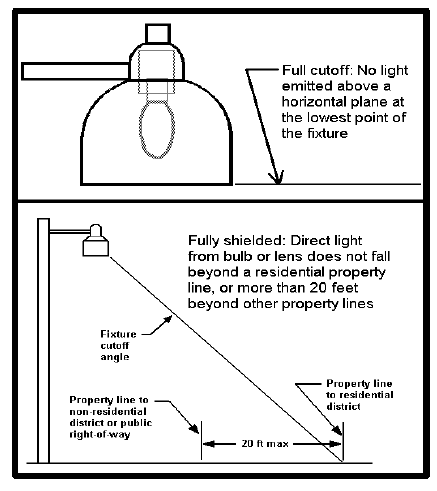
- Parking Lot Lighting: Lighting fixtures serving parking lots must be full cutoff fixtures. The maximum average illumination level for a parking lot is 1.6 foot-candles at grade level. The minimum average illumination level for a parking lot is 0.1 footcandles at grade level when the parking lot is in use. Light fixtures located on the perimeter of parking lots within 20 feet of a property line must use shielding to minimize light spillage at the property line.
- Lighting of Exterior Display or Open Sales Areas: If illuminated, exterior displays or open sales areas must be illuminated so the average maintained illumination at grade level is no more than 4 foot-candles. Light fixtures located less than 3 times the fixture mounting height from a residential property line or 2 times the fixture mounting height from nonresidential property lines, must use shielding to limit light spillage at the property line.
- Lighting of Walkways, Bikeways, Parks and Playgrounds: Where lighting is provided for walkways, bikeways, or parks, the following requirements apply:
- The walkway, pathway, or ground area is illuminated to a level of 0.5 foot-candles.
- The vertical illumination levels at a height of 5 feet above grade cannot exceed 0.5 average foot-candles.
- Lighting fixtures must direct light downward. The initial output of light sources cannot exceed 1,000 lumens.
- Lighting of Canopies and Bays:
- The average horizontal illumination at grade level under canopies cannot exceed 15 foot-candles.
- If illuminated, areas used for vehicle storage must be illuminated according to the requirements for Parking Lot Lighting.
- Light fixtures mounted on or under canopies must be full cutoff unless indirect lighting is being used to direct upward and then reflect down from the ceiling of the structure. In this case, light fixtures must be shielded to direct illumination exclusively on the ceiling of the structure.
- Lights cannot be mounted on the top or sides of a canopy. The sides of a canopy cannot be illuminated.
- Lighting for drive-through bays must be fully shielded.
- The average horizontal illumination at grade level under canopies cannot exceed 15 foot-candles.
- Outdoor Activity Facilities:
- Outdoor activity facilities may have unique lighting needs for performing or playing areas. A design plan detailing the lighting requirements of the performing or playing areas, and how to minimize unwanted glare, illumination of surrounding streets and properties, and nighttime atmospheric light pollution.
- If floodlighting is used, the center beam must be aimed below the horizontal plane at least 1/2 the angular beam spread of the fixture. A registered engineer must certify the design and installation of such lighting systems comply with the requirements of this Ordinance.
- Except for sporting events covered by intrastate televised broadcast, the illumination of the playing field or performing area cannot be exceeded 30 foot-candles.
- Street Lighting: All new, repaired, or replaced street lights must conform to the specifications established by the Public Works Director.
- Neon Lighting: Light sources consisting of glass tubes filled with neon, argon, krypton, or other similar gas (“neon lighting”) are excluded from shielding and line-of-sight requirements but must comply with the light trespass requirements. Neon lighting is not considered security lighting.
- Other Outdoor Lighting:
- Outdoor lighting not otherwise specified in this Ordinance emitting more than 1200 lumens must be full cutoff and fully shielded. Bulbs in outdoor light fixtures emitting from 600 to 1200 lumens may be installed in fixtures that are not full cutoff and may be visible from the property line provided, however, such bulbs must be frosted glass or covered by frosted glass or other similarly translucent material.
- A spotlight or floodlight of less than 1800 lumens need not be full cutoff or fully shielded if its center beam is aimed at a point not beyond any property lines and no less than 45 degrees below horizontal, is used for security lighting purposes only, and is motion detector activated and cycles off within five minutes after the cessation of motion within its field of view. Such security lighting cannot be activated by normal business or resident activity.
- Tower or antenna lighting is not permitted unless required by the Federal Aviation Administration.
- The use of search lights, laser lighting, or lights that pulse, flash, rotate or simulate motion for advertising or promotions is prohibited.
- Lighting Plan: Wherever a lighting plan is required by this Ordinance, it becomes an integral part of any development review application. An improvement location permit cannot be issued without first obtaining approval of a required lighting plan. A lighting plan must include the following:
- A plan showing buildings, landscaping, parking areas, and the locations of all proposed exterior lighting fixtures, with designation of cutoff and/or shielded fixtures;
- A description of the outdoor light fixtures including manufacturer's catalog cuts, photometric report with candela distribution, drawings, and shielding information;
- Analysis and illuminance level diagrams showing the proposed installation conforms to the lighting level standards in this ordinance.
- Changes to an approved lighting plan must be subject to review and approval by the Administrator.
- Enforcement: Failure to adhere to the lighting requirements of this Ordinance or an approved lighting plan is a violation of this Ordinance and subject to the procedures of CHAPTER 9: ADMINISTRATION AND ENFORCEMENT.
- Exceptions:
- The temporary use of low wattage or low voltage lighting for public festivals, celebrations, and the observance of holidays are exempt from this Ordinance except where they create a hazard or nuisance from glare. However, consideration to light trespass requirements must be demonstrated prior to commencing the use of the temporary lighting.
- Emergency lighting and traffic control lighting are exempt from the requirements of this chapter.
- Lights Not Conforming to This Chapter:
- Authority to Continue: Any lawful lighting fixtures located within the Town at the effective date of this Ordinance or after the effective date of this Ordinance, which do not conform to the provisions of this chapter, may continue provided the lighting remains in conformance with the provisions of this chapter.
- Ordinary Maintenance and Repair: Nothing in this chapter relieves the owner or beneficial user of legal nonconforming lighting, or the owner of the property on which the legal nonconforming lighting is located, from the provisions of this chapter regarding safety, maintenance, and repair. Normal maintenance, including replacing light bulbs, cleaning, or routine repair of legal nonconforming light fixtures, is not a condition which triggers a loss of lawful status described below, unless such maintenance increases the nonconforming aspects of the lighting.
- Loss of Lawful Status: Legal nonconforming status terminates under the following conditions:
- if a light fixture is no longer used for a period of 6 months it is deemed abandoned and cannot be reestablished; or
- if a lighting fixture is structurally altered such that its nonconforming aspects increase; or
- if a lighting fixture is relocated, replaced, or moved in any way; or the lighting fixture is damaged, and the cost of repair exceeds 50% of its replacement value.
- if a light fixture is no longer used for a period of 6 months it is deemed abandoned and cannot be reestablished; or
- Removal Pursuant to Public Order: Lighting found by a governmental agency to create public hazard can be ordered removed or altered at any time.
6.11 Parking And Loading
- Off-Street Parking and Loading Required: Unless otherwise restricted in this Ordinance, off-street parking and loading facilities are permitted as an accessory use in all zoning districts. All uses, buildings, structures, and building additions established after the effective date of this Ordinance, must provide accessory parking and loading facilities as specified.
- General Requirements:
- Change of Use or Intensity of Use: Where the use of an existing building or structure is changed; or where the intensity of a use is increased through addition of dwelling units, gross floor area, or other units of measurement, parking and loading facilities must be provided for the increase required for the new use or the increase in intensity.
- No Reduction of Existing Parking and Loading Facilities: Accessory off-street parking facilities in existence on the effective date of this Ordinance and located on the same lot as the building or use served cannot be reduced below the requirements for this Ordinance.
- Additional Parking and Loading Facilities for Existing Uses: Nothing in this Ordinance prevents the voluntary establishment of off-street parking or loading facilities to serve any existing use or building, provided the parking or loading facilities either: (a) meet all regulations of this Ordinance governing the location, design, amount, and operation of such facilities, or (b) bring the existing lot into closer conformity with the standards prescribed herein. The establishment of additional parking facilities, including the expansion of existing parking lots, requires an improvement location permit.
- Type of Facilities: Off-street parking and loading facilities for all types of uses may be provided in either paved surface lots, underground, including under a building or structure, or in parking structures conforming to the provisions of this Ordinance.
- Parking Plan Required: An application for an improvement location permit for a commercial, industrial, or multi-family development or remodel, must include a parking site plan, drawn to scale and fully dimensioned, showing all proposed parking or loading facilities to be provided.
- Location of Off-Street Parking Facilities: Except for Town owned property, off-street parking and loading facilities must be located on the same lot as the associated use. In residential districts, off-street parking facilities cannot be in any required yard, (except driveways may cross through a required yard). In the commercial and industrial districts, off-street parking facilities may be in any yard., but no closer than 5 feet from any side or rear property line or 10 feet from any right-of-way line. Parking facilities cannot be located closer than 20 feet from any right-of-way line along US 36, Dan Jones Road, or Avon Avenue. Customer or employee parking is prohibited on driveway approaches, landscaped areas, cross access driveways, frontage roads, adjacent alleys, streets, public right-of-ways, or vacant lots, except as authorized below.
- Off-Site Parking Provisions: Off-street parking may be provided off-site in the following limited circumstances.
- In commercial districts, parking facilities may be located within 300 feet of the building they are required to serve.
- In industrial districts, parking facilities may be located within 600 feet of the building they are required to serve.
- These distances are measured from the nearest point of the parking facility to the nearest point of the building the facility is required to serve.
- Shared Parking:
- Off-street parking facilities for separate uses may be provided collectively if the total number of spaces provided collectively is not less than the sum of the separate requirements for each such use, and that the collective facilities meet all regulations governing location of accessory parking spaces in relation to the use served.
- The Plan Commission may authorize up to a 25% reduction of the total number of required parking spaces for uses jointly providing parking when their respective hours of operation do not substantially overlap. The property owners involved in the shared parking facility must provide:
- Enough data to indicate there is not a substantial conflict in the principal hours of operation of the uses.
- A legal agreement approved by the Town Attorney guaranteeing the parking spaces are maintained as long as the uses participating are in existence or unless the required parking is provided elsewhere according to this chapter. This agreement must be recorded with the Hendricks County Recorder’s Office.
- Approval of a shared parking agreement is considered a waiver request and is evaluated according to the provisions of 8.16 Waiver of Design Standards.
- Off-Site Parking Provisions: Off-street parking may be provided off-site in the following limited circumstances.
- Size and Access Off-Street Parking Area:
- The dimension of a required off-street parking space is set forth in Table 6.1 below.
- Each required off-street parking space must open directly upon an aisle or driveway as set forth below. No portion of a street or alley may be used in computing such aisle or access area. All off-street parking facilities must be designed with appropriate means of vehicular access to a street.
- The first 20 feet of a drive must be kept free from parking maneuvers.
- The minimum turning radius of all parking drives is 10 feet.
Table 6.1 Standards for Parking Spaces, Aisles and Parking BaysAngle of Parking Width of Space Vertical Clearance Depth of Space Width of Aisle
One way/two way45 10' 8' 20' 15’/24’ 60 10' 8' 20' 18’/24’ 90 10' 8' 20' 24’/24’ Parallel 8' 8' 22' 14’/22’ Aisle with no parking (drive-thru) 12’/24’
- Off-Street Parking Area:
- Grading, Surfacing and Striping: Off-street parking areas or structures must be graded for proper drainage. The minimum grade is 1%. The maximum grade is 5%, except for access ramps that may have a grade up to 8%.
- Off-street parking areas must be fully improved with a hard surface pavement such as asphalt or concrete capable of carrying a wheel load of 4,000 pounds. Parking areas must be maintained in a manner preventing the release of dust and be free of trash and debris.
- Gravel parking areas may be approved only by the Board of Zoning Appeals through the special exception process. In its review, the Board considers the practical difficulty in developing a paved lot on the property, the location of the proposed gravel lot, and the period the gravel lot will be used.
- The surface of parking areas must be striped to define each parking space.
- Wheel Stops: Pedestrian walkways adjacent to parking spaces must be protected from vehicle encroachment through wheel stops. Wheel stops must have a minimum height of 6 inches above the finish surface of the parking area, be properly anchored, and maintained in good condition. Wheel stops are not required when adjacent to pedestrian walkways 6 feet or more in width.
- Landscape Islands: All rows of parking spaces must have terminal islands and at least one island every 15 parking spaces. Islands must have concrete curbs and at least 130 square feet of area with a minimum width of 8 feet.
- Curbing:
- Concrete curbing is required along perimeter of the parking area and along any interior island.
- Where necessary, wheel stops, or other devices are required to insure motor vehicles do not encroach beyond a parking space or into a required yard or landscaping.
- Paving and curbing of off-street parking areas must be at least 5 feet from any property line unless it can be specifically demonstrated the intent is to extend the parking to adjoining properties. A parking plan showing the extension of the parking must be submitted and approved during the review process.
- Parking areas in commercial and industrial districts must have at least a 5-foot separation from the wall of a building.
- Sight Clearance: Access points for off-street parking areas must meet the vision clearance requirements of 5.21 Vision Clearance Standards.
- Use:
- Required accessory off-street parking facilities can only be used for the parking of passenger automobiles or light trucks (less than one-ton capacity), of patrons, occupants, or employees of the site’s primary use.
- Unless otherwise authorized by this Ordinance, off-street parking areas cannot be used for the sale, repair, dismantling, or serving of any vehicles, equipment, materials, or supplies.
- Illumination: Parking area lighting must meet the requirements specified in 6.10 Lighting Standards.
- Pedestrian Circulation: Retail uses, restaurants, and other uses where pedestrian traffic is anticipated must provide a 5-foot perimeter sidewalk within 10 feet of the building on all sides of the structure adjacent to the parking area and on all sides of the building where direct public access is provided to the building.
6.12 Parking -- Computation And General Requirements
- Computation of Required Spaces:
- Basis for Computation: The total number of required parking spaces is based upon the parking requirement for the principal use of the lot except that where residential uses and nonresidential uses occupy the same zoning lot, the number of parking spaces for the residential uses are calculated separately from, and in addition to, the parking requirements for the nonresidential uses.
- Fractional Spaces: When the calculation of the number of required parking spaces results in a fraction, any fraction requires one additional parking space.
- Stacking Requirements for Drive-Through Facilities:
- A drive-through facility must provide stacking spaces prescribed by Table 6.2. The stacking spaces cannot interfere with the ingress and egress of the offstreet parking provided on the site.
Table 6.2 – Stacking Requirements for Drive-Through FacilitiesType of Use Stacking Spaces Required (per lane) Bank Teller 4 Automated Teller 3 Restaurants 6 Car Wash Automated 6 Car Wash Non-automated 3 Pharmacies 3 Gas Stations 2 Others not Listed As determined by the Administrator - Each stacking space must be at least 20 feet long, and each lane of stacking spaces must be at least 12 feet wide. Lane widths should be delineated with pavement markings. However, individual spaces within the lane need not be marked.
- Each drive-through lane must have a by-pass lane at least 12 feet wide. When the by-pass lane also serves as a drive aisle for parking, the minimum aisle width noted in Table 6.1 must be provided. By-pass lanes do not need to be marked.
- A drive-through facility must provide stacking spaces prescribed by Table 6.2. The stacking spaces cannot interfere with the ingress and egress of the offstreet parking provided on the site.
- Required Spaces: The minimum automobile off-street parking required is provided in Table 6.3 below.
Table 6.3 – Off Street Parking RequirementsRESIDENTIAL PRIMARY USES Vehicle Min Household Living Dwellings - Single-Family Detached 2.0/DU Dwellings - Duplex 1.25/DU Dwellings - Triplex and Fourplex 1.25/DU Dwellings - Bungalow Court 1.25/DU Dwellings - Townhouse 1.25/DU Dwellings - Apartment Building: Small 1.25/DU Dwellings - Apartment Building: Large 1.25/DU Upper Story Residential 1.00/DU Live/Work 1.00/DU Mobile home 1.5/DU Group Living Assisted Living Facilities 0.75/unit Fraternity, Sorority, or Student Housing 1.25/unit Group Residential Facility 0.75/unit Nursing Home, Hospice 0.75/unit CIVIC, PUBLIC & INSTITUTIONAL PRIMARY USES Basic Utilities Utility, Major Impact 0.5/1,000 sf of GFA Utility, Minor Impact 0.5/1,000 sf of GFA Community/Public Services Child Care Facilities 1/1,000 sf of GFA Community Center 0.5/1,000 sf of GFA Correctional Institution 0.5/1,000 sf of GFA Fairgrounds No requirement Hospital 2.5/1,000 sf of GFA Municipal & Government Buildings 1/1,000 sf of GFA Cultural/Special Purpose/Public Parks & Open Space Cemetery 1/1,000 sf of GFA Libraries and Museums 1/1,000 sf of GFA Parks and playgrounds No requirements Education Schools - public and private 1/1,000 sf of GFA Schools - vocational 1/1,000 sf of GFA Public & Religious Assembly All Types COMMERCIAL SALES, SERVICES, AND REPAIR PRIMARY USES Adult Business All Types 2.5/1,000 sf of GFA Arts, Recreation & Entertainment Arts, Recreation, Entertainment, Indoor 2.5/1,000 sf of GFA Arts, Recreation, Entertainment, Outdoor 2.5/1,000 sf of GFA Sports and/or Entertainment Arena or Stadium 1/1,000 sf of GFA Parking of Vehicles Parking Garage No requirement Parking Lot No requirement Eating & Drinking Establishments Restaurants – class A 5/1,000 sf of GFA Restaurants - class B 5/1,000 sf of GFA Taverns & lounges 5/1,000 sf of GFA Lodging Accommodations Bed and Breakfast Establishments 1/guest room Hotel or Motel 1/guest room Office Dental/Medical Office or Clinic 3.5/1,000 sf of GFA Office, All Others 2/1,000 sf of GFA Retail Sales, Service & Repair Animal Sales and Services, Household Pets 2.5/1,000 sf of GFA Animal Sales and Services, All Others 1.5/1,000 sf of GFA Food Sales or Market 2.5/1,000 sf of GFA Pawn Shop 2.5/1,000 sf of GFA Retail Sales, Service & Repair, Outdoor 2.5/1,000 sf of GFA Retail Sales, Service & Repair, Special Handling 2.5/1,000 sf of GFA Retail Sales, Service & Repair, All Others 2.5/1,000 sf of GFA Vehicle/Equipment Sales, Service & Repair Automobile Services, Light 0.5/1,000 sf of GFA Automobile Services, Heavy 0.5/1,000 sf of GFA Auto/Motorcycle/Boat/Light Truck Sales or Rentals 0.5/1,000 sf of GFA Heavy Vehicle/Equipment Sales, Rentals & Service 0.5/1,000 sf of GFA INDUSTRIAL, MANUFACTURING, AND WHOLESALE PRIMARY USES Communications & Information Communication Services 0.5/1,000 sf of GFA Telecommunication Towers No requirement Telecommunication Facilities – All Others No requirement Industrial Services Contractors, Special Trade – General 0.5/1,000 sf of GFA Contractors, Special Trade – Heavy/Contractor Yard 0.5/1,000 sf of GFA Food Preparation and Sales, Commercial 0.5/1,000 sf of GFA Laboratory, Research, and Development Services 0.5/1,000 sf of GFA Manufacturing & Extraction and Energy Producing Systems Manufacturing, Fabricating, & Assembly – General 0.5/1,000 sf of GFA Manufacturing, Fabricating, & Assembly – Heavy 0.5/1,000 sf of GFA Mining & Extraction and Energy Producing Systems Mineral Extraction No requirement Refining or manufacturing of asphalt, cement, gypsum, lime, or wood preservatives No requirement Sand & gravel extraction or sales No requirement Transportation Facilities Airport 0.5/1,000 sf of GFA Heliport 0.5/1,000 sf of GFA Mass Transit Facility (Bus/Light-Rail) 0.5/1,000 sf of GFA Transportation services – rail & air 0.5/1,000 sf of GFA Rail distribution yards 0.5/1,000 sf of GFA Waste Related Services Composting Facility No requirement Recycling recovery and center No requirement Salvage or junk yards No requirement Solid Waste Facility No requirement Wholesale Storage, Warehouse & Distribution Automobile Towing Service Storage Yard 0.5/1,000 sf of GFA Self-Storage Facilities 0.1/1,000 sf of GFA Truck Freight Terminal/Distribution Center 0.25/1,000 sf of GFA Vehicle Storage, Commercial 0.5/1,000 sf of GFA Wholesale Trade or Storage, General 0.5/1,000 sf of GFA Wholesale Trade or Storage, Light 0.5/1,000 sf of GFA AGRICULTURE PRIMARY USES Anhydrous Ammonia Storage & Distribution 0.5/1,000 sf of GFA Aquaculture 0.5/1,000 sf of GFA Confined Feeding No requirement Farm No requirement Plant Nursery 0.5/1,000 sf of GFA Roadside Produce Stand 0.5/1,000 sf of GFA Sale Barn for Livestock 0.5/1,000 sf of GFA Slaughterhouse 0.5/1,000 sf of GFA - Required Spaces – Bicycles: Bicycle parking spaces must be provided as follows:
- Location and Placement Standards:
- Bicycle parking must be located as close or closer than the nearest car parking space to the building entrance, other than those spaces for persons with disabilities.
- Bicycle parking facilities cannot interfere with accessible paths of travel or accessible parking as required by the American with Disabilities Act.
- Bicycle racks cannot block the building entrance or inhibit pedestrian flow.
- Bicycle racks are located to protect bicycles from damage from automobiles.
- Bicycle racks are designed to minimize visual clutter and be maintained in good condition.
- Bicycle racks are securely anchored to the ground.
- Design Standards:
- Each bicycle rack is designed to accommodate a minimum of 2 bicycles, one per side parked parallel to the rack. Bicycle racks must be designed as an inverted “U” unless an alternative is approved by the Plan Commission.
- Bicycle racks are designed to resist cutting, rusting, bending and deformation.
- The surfacing of bicycle parking areas is designed and maintained to be free of mud and snow.
- Required bicycle parking spaces are at least 4 feet wide by 6 feet long with a vertical clearance of at least 6 feet.
- Bicycle racks are placed on 48-inch centers.
- The minimum required bicycle parking is evenly divided between each public entrance to the building. Bicycle racks may be grouped together provided a landscape divider is included once every 5 bicycle racks. Landscape areas must be at least 3 feet wide by 6 feet long planted with a mix of shrubs and perennials.
- Required Number:
- Commercial/Non-Residential Uses: A minimum of one bicycle rack must be provided for every 20 automobile parking spaces required. Each development must have at least one bicycle rack.
- Multi-Family Uses: One bicycle rack must be provided for every 8 automobile parking spaces. Each multi-family development must have at least one bicycle rack.
- In all cases, the maximum required bicycle parking spaces is 20. Nothing in this ordinance prevents a developer from providing bicycle parking beyond the minimum or maximum requirement.
- A reduction in the minimum required automobile parking may be approved by the Plan Commission equal to the number of required bicycle parking spaces provided. ADA accessible parking spaces must still be provided based on the required automobile parking prior to the adjustment for bicycle parking spaces.
- When the intensity of use of any building, structure or premises increases and additional automobile parking is required, additional bicycle parking is also required. If the increase requires additional parking spaces of 35% or more of the existing total, bike parking must be provided for the total number of parking spaces on site.
- Location and Placement Standards:
- Accessible Parking Spaces: Accessible parking must be provided for any building or use according to the following minimum requirements and any further requirements hereafter adopted by federal, state, or local law. Accessible parking spaces must be provided at the rate listed in Table 6.4 – Accessible Parking Spaces.
- The dimensions of accessible parking spaces and applicable aisles must conform to ADA standards for accessible design.
- For every 8 accessible spaces, at least one must be served by an access aisle at least 8 feet wide. The space is designated as van accessible.
- Every accessible parking space must be in closest proximity to the most accessible entrance of the principal building.
- The ramp from the access aisle to the sidewalk or other transition to the principal use cannot exceed a slope of 1:12.
- The vertical clearance for accessible parking spaces must be at least 8 feet and 2 inches. The vertical clearance for passenger loading zones must be at least 9 feet 6 inches.
- Accessible spaces must be designated by the international access symbol. Signs are placed at least 5 1/2 feet above ground level to not to be obscured by parked vehicles. The mobility-impaired symbol must also be painted on the ground to the rear of the parking space.
Table 6.4 - Accessible Parking SpacesTotal Off-Street Parking Spaces Provided Accessible Spaces Required 1 to 25 1 26 to 50 2 51 to 75 3 76 to 100 4 101 to 150 5 151 to 200 6 201 to 300 7 301 to 400 8 401 to 500 9 501 to 1,000 2% of total parking spaces provided over 1,000 20 plus 1 space for each 100 parking spaces over 1,000
6.13 Parking -- Specific Requirements
- Storage of Recreational Vehicles and Trailers: The following requirements apply to the parking or storage of recreational vehicles and trailers in residential districts.
- Recreational vehicles and trailers may be parked or stored in accessory buildings.
- Recreational vehicles and trailers may be parked or stored in the open provided no part of the vehicle or trailer projects into any required side or rear yard setback and the parking area has a hard asphalt or concrete surface. Recreational vehicles and trailers may be parked on a driveway, provided they do not block the garage or any required parking space. A recreational vehicle or trailer cannot be parked in the open in a front yard or blocking any public right-of-way or sidewalk.
- Only one recreational vehicle or trailer can be parked or stored in the open on a lot at any one time.
- Parked or stored recreational vehicles and trailers cannot be occupied or used for living, sleeping or housekeeping purposes. Connections to gas, electric, water, or sanitary sewer service are prohibited.
- Recreational vehicles may be parked in a required parking space on a driveway or on a residential street for visitation purposes for a time period not to exceed 7 days in duration, with a maximum total of 14 cumulative days per year. Trailers are always prohibited on residential streets.
- Nothing in this ordinance should be construed to convey a right to a private property owner to violate a covenant restriction or agreement. Property owners should consult their homeowner’s association and their real estate title documents to avoid potential violations.
- Commercial Vehicles in Residential Districts: The parking of a commercial, self-propelled vehicle in a residential zoning district is prohibited, except that one commercial vehicle of not more than 3 tons capacity may be parked on any lot on which there is located a principal building, provided, however, that such vehicle is parked in an enclosed garage or accessory building, and is used by an occupant on the premises. This requirement does not apply to the temporary loading of commercial vehicles in any residential district.
- Off-Street Loading General Requirements:
- Location:
- All required loading berths must be located on the same lot as the use served.
- Loading berths must be screened per 6.9 Landscaping – Additional Screening.
- Loading berths must be at least 35 feet from the intersection of any two streets.
- Loading berths cannot be in a front yard.
- Pavement or curbing must be at least 5 feet from any property line unless it can be demonstrated that the intent is to extend the paving to adjoining properties. A plan showing the paving extension must be submitted and approved during the review process.
- Size:
- For local pick-up and delivery trucks the loading berth must be at least 12 feet wide by 30 feet long, exclusive of aisle and maneuvering space, with a vertical clearance of at least 12 feet.
- For over-the-road tractor-trailers the loading berth must be at least 14 feet wide by 60 feet long, exclusive of aisle and maneuvering space, with a vertical clearance of at least 15 feet.
- Access: Each required off-street loading berth must be designed with appropriate means of vehicular access to a street or alley in a manner that will least interfere with traffic movement. Access routes are approved by the Administrator or the Plan Commission.
- Surfacing: All off-street loading berths must be surfaced with a bituminous asphalt or concrete capable of bearing a live load of 200 pounds per square foot.
- Repair and Service: No motor vehicle repair work or service is permitted in conjunction with loading facilities, except washing of accessory vehicles and emergency repair service necessary to start vehicles.
- Utilization: Space allocated for off-street loading use cannot be used to satisfy the space requirements for any off-street parking facilities.
- Minimum Facilities: Uses requiring off-street loading facilities but located in buildings of less floor area than the minimum prescribed, must provide adequate receiving facilities accessible by motor vehicles off any adjacent alley, service drive, or open space on the same lot.
- Location:
- Off-Street Loading Specific Requirements: The requirements for off-street loading facilities are as shown in Table 6.5. Loading spaces are only required for uses which receive or transmit goods or wares by truck delivery.
Table 6.5 – Off-Street Loading RequirementsUse Type Number of Spaces Required Retail/Commercial 7,500 - 75,000 sf of gross floor area 1 loading space each additional 50,000 sf of gross floor area 1 loading space Office 10,000 - 100,000 sf of gross floor area 1 loading space each additional 100,000 sf of gross floor area 1 loading space Institutional and Recreational 10,000 - 100,000 sf of gross floor area 1 loading space each additional 75,000 sf of gross floor area 1 loading space Industrial 5,000 - 25,000 sf of gross floor area 1 loading space 25,000 - 75,000 sf of gross floor area 2 loading space each additional 50,000 sf of gross floor area 1 loading space
6.14 Signage -- Purpose And Manner
- Purpose: The purpose of this section is to provide a legal framework for the comprehensive regulation of signs in the Town of Avon. These regulations are designed to advance the Town of Avon's substantial interests in the following:
- Promoting traffic and pedestrian safety;
- Promoting the Town's unique residential, commercial, industrial, institutional, agricultural, and other zoning districts, and the overlay districts that apply to these zoning districts;
- Encouraging signs of good design that enhance the development environment, and are integrated and harmonious to the sites they serve;
- Promoting development that enhances property values;
- Preserving open space;
- Minimizing the visual clutter associated with multiple signs either on the same property or in signs near one another; and
- Protecting the health, safety, and general welfare of the residents of the Town.
- Manner of Regulation: The Town of Avon regulates signs only to advance its substantial governmental interests. These regulations do not consider the content of the regulated speech, are narrowly tailored to advance the Town's substantial interests, and leave open ample alternative channels of communication for information.
6.15 Signage -- Exemptions And Nonconforming Signs
- Exemptions: The following signs are exempt from sign permit requirements, provided they meet the remaining requirements of this chapter and this Ordinance. Such signs are not counted against the maximum signage allowance set forth for the zoning district in 6.16 Signage General Standards.
- Public Service Signs: Signs used for safety purposes relative to the repair or maintenance of streets, sidewalks, or utilities in a public right-of-way.
- Address Signs: Address numbers not exceeding 2 square feet in area.
- Governmental: Signs and public notices erected or required by governmental bodies, or authorized for a public purpose by any law, statute, or ordinance.
- Public Information Signs: Signs identifying the telephone, restrooms, and similar facilities, providing no advertising matter accompanies the sign.
- Historical Identification Signs: Signs for property designated by the Federal, State, or local governments as a historical location, site, or landmark, provided such sign does not exceed 12 square feet.
- Miscellaneous Information Matter: Matter appearing on newspaper vending boxes, automatic teller machines, and other vending machines, or matter appearing on or adjacent to entry doors such as "Push," "Pull," "Open," "Closed," "Vacancy" and "No Vacancy" or matter appearing on display windows or doors denoting hours of operation, credit cards accepted, and similar information.
- Remembrances: Tablets, grave markers, headstones, statuary/memorial plaques or remembrances of persons or events that are non-commercial in nature.
- No Trespassing Signs: No trespassing signs, warning signs (e.g., "Beware of Dog") and other such signs regulating the use of property when such signs do not exceed 2 square feet in area.
- Private Traffic Direction Signs: Private traffic direction signs directing traffic movement in and around a site, provided such signs do not exceed 4 square feet in area and 4 feet in height for each sign and that such signs contain no commercial messages.
- Signs Not Conforming to this Chapter:
- Authority to Continue: Any lawful sign located within the Town at the effective date of this Ordinance or annexed into the Town after the effective date of this Ordinance, that does not conform to the provisions of this chapter, may continue provided the sign remains in conformance with the provisions of this section.
- Conditions of Lawful Status: For the purposes of this chapter, legal nonconforming status is conferred only on signs authorized by a sign permit or variance. If no sign permit was required under the applicable preceding laws and the sign was otherwise in compliance with the requirements of the preceding, the sign retains its legal nonconforming status.
- Ordinary Maintenance and Repair: Nothing in this section relieves the owner, user, or owner of the property on which the legal nonconforming sign is located from the provisions of this chapter regarding safety, maintenance, and repair. Normal maintenance, including repainting, cleaning, or routine repair of a legal nonconforming sign, is not a condition triggering a loss of lawful status described below, unless such maintenance increases the nonconforming aspects of the sign.
- Repairs Pursuant to Public Order: Nothing in this section is deemed to prevent the restoration of a legal nonconforming sign to a safe condition to comply with and order of a public official.
- Loss of Lawful Status:
- Legal nonconforming status terminates under the following conditions:
- if the sign is not used for a period of 6 months it is deemed abandoned and cannot be reestablished; or
- if a sign is structurally altered so its nonconforming aspects increase;
- if a sign is relocated, replaced, or moved in any way;
- if a sign is damaged and the cost of repair exceeds 50% of its replacement value.
- Upon losing its legal nonconforming status, the sign must immediately be brought into compliance with this chapter, or the sign must be removed. For this subsection, the changing of copy is not considered the replacement of an existing legal nonconforming sign.
- Legal nonconforming status terminates under the following conditions:
- Unenforceability During Elections: No regulation or ordinance relating to the number of signs, with a surface area less than 32 square feet is enforceable 60 days before an election until 12:01 a.m. the 6th day after the election, unless enforcement is necessary to ensure public safety. This regulation applies to general elections, municipal elections, primary elections, school district elections, and special elections.
6.16 Signage -- General Standards
- General Limitations:
- No sign can be erected or maintained that prevents free ingress or egress from any door, window, or fire escape. Signs cannot be attached to a standpipe or fire escape.
- A sign cannot have more than 2 sign faces.
- A sign cannot project above the top line of the building silhouette (either the top edge of the roof or the top of a parapet). A roof-integral sign cannot exceed a height of 6 feet, nor an overall height of 26 feet measured from grade to the sign's highest point.
- A building mounted sign cannot project into the public right-of-way. A sign attached to a building must be at least 9 feet above grade and may extend up to 18 inches from the face of the building.
- Permitted signs in residential districts must be located outside the right-of-way and may be located anywhere on the property provided they are no closer than 10 feet to any property line.
- Specific Limitations:
- Awnings, Canopies, and Marquees:
- The distance from the average grade to the top edge of awnings, canopies, and marquees cannot exceed 20 feet.
- The bottom edge of an awning, canopy, or marquee must provide at least 10 feet of clearance over walkways and 15 of clearance over driveways.
- The area of awning, canopy and marquee signs is counted toward the maximum sign area for wall signs.
- Changeable Copy Signs:
- Where permitted, one changeable copy sign is allowed per zoning lot.
- Changeable copy signs must be used with pylon or ground signs. These signs are included in maximum area requirement for either the pylon sign or ground sign.
- A changeable copy sign cannot exceed 30% of the permitted sign area of the host sign.
- The owner of a changeable copy sign may substitute noncommercial copy in place of any other commercial or noncommercial copy. The substitution of copy is allowed by right without a new or additional permit. Nothing in this section should be construed as favoring commercial speech over noncommercial speech or favoring a noncommercial message over another noncommercial message.
- Awnings, Canopies, and Marquees:
- Illumination: In addition to the lighting requirements of this section, the illumination of signs must meet the following requirements.
- Location and Design of Light Source: When an external light source is used to illuminate a sign, such source must be designed, located, shielded, and directed to prevent casting of direct light upon any public right-of-way or residential property, or any point 20 feet or more outside adjoining property lines. Light fixtures must be top mounted and directed below the horizontal, except ground-mounted signs no higher than 6 feet which may be illuminated with ground-mounted or bottom-mounted lighting fixtures.
- Level of Illumination for Externally Illuminated Signs: The average level of illumination on the vertical surface of an externally illuminated sign cannot exceed 30 foot-candles, except when ground-mounted or bottom-mounted lighting fixtures are used, in which case the average level of illumination cannot exceed 20 foot-candles. If a reflective type of bulb or incandescent lamp is used on the exterior surface of any sign, it cannot expose the face of the bulb, light or lamp to any public right-of-way or adjacent property.
- Signs Adjacent to Residential Districts: A sign within 600 feet of a residential district cannot be illuminated unless the sign is visibly obstructed from view from the residential district.
- Neon Lighting: Signs using neon lighting are considered internally illuminated signs and are subject to the requirements for internally illuminated signs.
- Sign Area Computation: The following principles control the computation of sign area.
- Computation of Area of Individual Signs: The area of a sign face is computed by calculating the area of the smallest square, circle, rectangle, triangle, or combination of shapes that encompass the extreme limits of the writing, representation, emblem, color, or other display, together with any material or color forming an integral part of the background of the display or used to differentiate the sign from the backdrop or structure against which it is placed. Supporting framework or bracing is not included in the calculation unless the framework or bracing is made part of the message or face of the sign.
- Computation of Area of Multiple-Faced Signs: The sign area for a sign with more than one face is computed by adding together the area of all sign faces visible from any one point. When two identical sign faces are placed back-to-back so both faces cannot be viewed from any point at the same time and when the sign faces are part of the same sign structure not more than 42 inches apart, the sign area is computed by the measurement of one of the faces. Signs that require other signs to display full meaning, such as individually displayed letters or pictorial displays, are considered one sign. If both faces of a sign are visible from any one point, both sign faces are computed separately.
- Computation of Height: The height of a sign is computed as the distance from the base of the sign at normal grade to the top of the highest attached component of the sign. Normal grade is construed to be the lower of the existing grade prior to construction or the newly established grade after construction, exclusive of any filling, mounding, or excavating solely for the purpose of locating the sign. In cases where the normal grade cannot reasonably be determined, sign height is computed on the assumption that the elevation of the normal grade at the base of the sign is equal to the elevation of the nearest point of the crown of a public street or the grade of the land at the principal entrance to the principal structure on the zone lot, whichever is lower.
- Construction, Design, and Maintenance:
- Signs must meet the construction and design standards for signs in the Town's Building Code.
- All signs must be maintained in good aesthetic and structural condition. The Administrator has the authority to pursue enforcement for signs violating these sign regulations.
- Litter Control: All signs and the premises surrounding the sign must be maintained in a clean, sanitary, and inoffensive condition, and free and clear of all noxious substances, rubbish, and weeds.
- Landscaping Requirements:
- Ground, pylon, or integrated center identification signs must meet the landscaping standards hereinafter specified.
- For every square foot of sign surface area at least 0.5 square feet of landscape area must be provided around the base of the sign.
- Signs exceeding 10 feet above the average surrounding grade are required to provide an additional one square foot of landscaped area for each foot of height. Fractional portions of a foot are rounded up to the next whole number.
- Required landscaped areas must be improved with plantings of a size and quantity proportionate to the size and height of the sign as determined by the Administrator. The landscaped area must also include ground protection such as ground cover plants, landscaping bark, or decorative stone.
- The property owner must maintain the landscaping including replacement of any dead or diseased vegetation, trimming overgrown vegetation, and maintaining any groundcover.
- Sign landscaping must be installed at the time the sign is erected.
- Signage along a street classified as a Signature Street on the Thoroughfare Plan must have a masonry base and/or supports (if used) and be cohesive with the development and buffer. Landscaping, perennials, and annuals must be planted around the signage to enhance the feel.
- Ground, pylon, or integrated center identification signs must meet the landscaping standards hereinafter specified.
- Prohibited Signs:
- Signs adversely affecting traffic and pedestrian safety are prohibited including:
- Signs or sign structures placed within public rights-of-way except for official traffic or information signs erected on behalf of the Town, Hendricks County, the State of Indiana, or the United States of America;
- Signs imitating traffic or information signs;
- Signs or sign structures that impede the vision clearance area (see 5.21 Vision Clearance Standards) of any intersection;
- Signs that move or give the appearance of movement that distract or can distract operators of motor vehicles; and
- Signs or sign structures located on any structures within the rights-ofway, such as utility poles, light standards, traffic control devices, or similar structures.
- Signs adversely affecting the development environment are prohibited including:
- Signs painted on or attached to trees, rocks, or other natural features;
- Signs painted directly on an exterior portion of a building, fence, roof, or chimney;
- Signs embedded in wall structures or roof shingles;
- Portable signs;
- Signs placed on parked vehicles, boats, trailers or other movable structures;
- Signs that display obscene matter.
- Signs adversely affecting traffic and pedestrian safety are prohibited including:
- Temporary Signs: Temporary signs are permitted in the Town if a sign permit is obtained first. Temporary signs must comply with the applicable regulations contained in this chapter.
- Temporary signs exceeding 6 square feet require a permit. Applications for temporary sign permits must include a diagram depicting the number, location, size and other information identifying any proposed signage.
- A temporary sign cannot exceed 32 square feet per sign face and cannot have its own illumination source.
- A temporary sign cannot exceed 10 feet in height if freestanding. If placed on a building, the temporary sign must remain one foot below the roofline.
- A temporary sign is allowed for a period not to exceed 60 days.
- A landowner or occupant may not apply for more than 2 temporary sign permits during any 12-month period.
6.17 Signage -- Specific Requirements
- Regulation by District Classification:
- Residential Districts: The following signs maybe permitted in residential districts. Signs in residential districts can display only muted colors and must be compatible with the surrounding landscape.
Residential Districts Max. Number Max. Area Max. Height Illumination Ground or Wall-
single family subdivision identification1 two-faced sign per entrance or 2 complementary one-sided face signs per entrance. 20 sf 8 feet Each sign may be illuminated. Ground or Wall-
multiple family complex identification1 two-faced sign per entrance or 2 one-sided face signs per entrance. 24 sf 8 feet Each sign may be illuminated. Ground or Wall-
Non-Residential Uses permitted in Residential Districts1 ground sign and 1 wall sign per public street frontage. 40 sf per sign 6 feet Ground signs may be illuminated and may contain changeable copy. Wall signs cannot be illuminated. Each sign must indicate only the name and address of the building or use, conditions of operation, and associated information. Signs cannot include promotional information. Temporary Promotional See Article 6.16 Exempt See Article 6.16
No more than 2 exempt signs are permitted on any premise at any one time, regardless of the content or type of sign. This limitation does not apply to political signs. - Commercial Districts: The following signs may be permitted in commercial districts. No more than one free standing sign (either pylon or ground) are permitted per road frontage, except where a unified center sign is used, in which case one sign is permitted per entrance to the center.
C-1 Neighborhood Commercial and C-3 Transitional Office Maximum Number Maximum Area Max. Height Min. Setback Ground Signs 1 sign per street frontage. 40 sf per sign 6 feet 5 feet. 10’ when abutting a residential district. Wall Signs 1 sign per public street frontage. For multiple tenant buildings: 1 sign per tenant bay 1 sf of area for each linear foot of building face per public street frontage, provided the maximum area for each street frontage does not exceed 100 sf. For multiple tenant buildings: 1 sf for each linear foot of tenant space per public street frontage, provided the maximum area per street frontage does not exceed 100 sf Awnings & Canopies Awnings and Canopies may be permitted, however, if such structures incorporate signage, the signage will be counted as, and included in the wall sign area requirements. Temporary Promotional See Article 6.16 Exempt See Article 6.16 C-2 General Commercial Maximum Number Maximum Area Max. Height Min. Setback Ground Signs 1 sign per 300 feet of public street frontage. Minimum separation: 100 feet. 60 sf per sign 6 feet 10 feet Wall-
multiple tenant1 sign per tenant bay. Tenants with frontage on more than one street may be permitted one additional sign, provided no more than one sign is displayed on each street frontage. 1.5 sf of area for each linear foot of building face per public street frontage and 0.5 square foot of area for each linear foot of building face per private street frontage, provided the maximum area for each street frontage does not exceed 300 sf. Wall-
single tenant2 signs per public street frontage. 1.5 square foot of area for each linear foot of building face per street frontage, provided the maximum area for each street frontage does not exceed 150 sf. Awnings & Canopies Awnings and Canopies may be permitted, however, if such structures incorporate signage, the signage will be counted as, and included in the wall sign area requirements. Marquee A marquee sign may be permitted, however, the sign will be counted as and included in the wall sign area requirements. Temporary Promotional See Article 6.16 Exempt See Article 6.16 - Industrial Districts: The following signs may be permitted in the Industrial. No more than one free standing sign (either pylon or ground) is permitted per road frontage, except where a unified center sign is used, in which case one sign is permitted per entrance to the center.
I-1Transitional Industrial, I-2 Light Industrial and I-3 Heavy Industrial Max. Number Maximum Area Max. Height Min. Setback Ground Signs 1 sign per public street frontage. 60 sf per sign 6 feet 10 feet Wall Signs 1 sign per public street frontage. 1 sf of area for each linear foot of building face per public street frontage, provided the maximum area for each street frontage does not exceed 100 sf. Awnings & Canopies Awnings and Canopies may be permitted, however, if such structures incorporate signage, the signage will be counted as, and included in, the wall sign area requirements. Temporary Promotional See Article 6.16 Exempt See Article 6.16
- Residential Districts: The following signs maybe permitted in residential districts. Signs in residential districts can display only muted colors and must be compatible with the surrounding landscape.
- Integrated Center Signs: For unified centers under single ownership or unified control, or individual uses with a collective and contiguous minimum frontage of 400 feet along one road, one additional business sign in addition to those signs permitted in this section is permitted for each main entrance to such center, subject to the following:
- The sign must indicate only the name and location of the center and the name and type of business of the occupants of the center.
- The sign must be a pylon or a ground mounted sign style.
- The maximum surface area of the sign cannot exceed 100 sf.
- The maximum height of the sign is 20 feet.
- The sign must follow the setback requirements for the style of sign in the district in which it is located.
- Integrated center signs must be located on one of the properties within the integrated center. Where an integrated center does not have frontage on a major public street, the Board of Zoning Appeals may issue a special exception for an off-site integrated center sign.
- Localized Alternative Sign Regulations:
- Authority: Office parks, universities, colleges, medical centers, and institutions having multi-building campuses may establish a localized alternative sign regulation plan for their property subject to review and approval by the Board of Zoning Appeals pursuant to the procedures for special exceptions.
- Application: In addition to the application requirements for special exceptions and sign permits, the localized alternative sign regulation plan must also specify standards for consistency among all signs within the affected area including:
- color scheme;
- lettering or graphic style;
- lighting;
- location of each sign; and
- sign materials and dimensions.
- Sign Plan Control: A localized alternative sign regulation plan approved by special exception is binding on all real property and premises in the plan area.
- Adherence: If approved, the localized alternative sign regulation plan controls and in lieu of the standards in the sections above.
- Conforming Outdoor Advertising Signs Along US Highway 36:
- Applicability: This section applies to conforming outdoor advertising signs located along US Highway 36 and any other highway where control of outdoor advertising signs is required under 23 U.S.C. 131.
- As used in this section, the term "conforming outdoor advertising signs" means an outdoor advertising sign, display, or device located within 660 feet of the nearest edge of right-of-way and visible from the main travel way, so long as the sign, display, or device is regulated by and conforms to the requirements of 23 U.S.C. 131, 23 Code of Federal Regulations 750.708, and Indiana Code 8-23-20. The following signs are not conforming outdoor advertising signs:
- Signs, displays, or devices advertising the sale or lease of property upon which the sign is located; and
- Signs, displays, or devices, including those which may be changed at reasonable intervals by electronic process or by remote control, advertising activities conducted on the property on which the sign is located.
- Elevation or Relocation of Conforming Outdoor Advertising Signs: The owner or operator of a conforming outdoor advertising sign may seek special exception approval to elevate, adjust, or relocated a conforming outdoor advertising sign if the sign is no longer visible or becomes obstructed or the sign must be moved due to any of the following:
- Noise abatement;
- Safety measure;
- Grade changes;
- Construction;
- The placement of a directional sign;
- The widening of a highway; or,
- Aesthetic improvements made by an agency of the State.
- Noise abatement;
- Regulation of Elevation or Relocation: If the special exception is approved, the owner or operator of a conforming outdoor advertising sign may:
- Elevate the conforming outdoor advertising sign so the entire advertising content of the sign is visible;
- Adjust the angle of the sign so the entire advertising content of the sign is visible; or,
- Relocate the sign within 500 feet of its current location, as long as the sign complies with all applicable spacing requirements detailed in this Ordinance and the new location is in an area zoned for commercial or industrial use.

