
Belle Meade City Zoning Code
14-202 Definitions
- General statement: Certain words, phrases, and terms shall be used hereinafter in this chapter, and in the administration and enforcement hereof. For such purposes, the following definitions, and rules of interpretation of certain words, phrases, and terms set out hereinafter are hereby adopted:
- The singular number includes the plural and the plural the singular.
- The word "lot" includes the words "plot" "site" and "building site”.
- The word "building" includes the word "structure" whether enclosed or unenclosed, temporary, or permanent.
- Terms and definitions: Words in the text of this chapter shall be interpreted in accordance with the provisions set forth in this section. Where words have not been defined, the definition found in the most current edition of Harris, Dictionary of Architecture and Construction, (McGraw-Hill) and/or the Merriam-Webster Dictionary shall be used.
- "Accessory use or building." An accessory use or building is a subordinate use or building customarily incident to and located on the same lot or site with, or inside, the main or principal use or building.
- "Addition." Any new construction which increases the height or floor area of an existing building or adds to it.
- “Attic.” The area at the top of the dwelling with a height of 7’ or less.
- "Building envelope." The area on a lot available for the construction of a dwelling, or other accessory buildings incidental to the same, enclosed by the front setback line, the rear setback line, and the two side setback lines.
- “Cabana”. A cabana is generally a three-sided structure with an open side facing an outdoor space or swimming pool.
- "Communication facilities.” Any facility that transmits electromagnetic waves for use by persons other than those occupying the structure on which the facility is located, and includes communication towers.
- “Communication tower". Any structure that serves the sole purpose of supporting a communication tower and/or on which the antenna or other transmitting devices of a communication facility are visible to other than the property owner.
- “Conditional use.” A land use that, because of its unique characteristics or potential impact on the city and surrounding neighbors may be compatible only if certain conditions are required that mitigate or eliminate the detrimental impacts.
- “Directly affected property owner.” For the purposes of meeting notification, this includes all properties that are within two property distances to the subject property. In other words, the adjoining properties (two lots in distance) in all directions to the application property.
- "Dog kennel/dog run." A specific area enclosed by a fence or other means (other than the entire fenced back yard), such area intended for the confinement of one or more dogs.
- “Driveway/parking area.” A private vehicle access route and associated parking areas between the street and a use on a lot, plot, or site.
- "Dwelling." Also referred to as a Single-Family Dwelling or Residence. A building or structure or portion thereof which is occupied or arranged for occupancy as a single home or residence which also includes sanitary and cooking facilities for one or more persons, either permanently or temporarily.
- "Floor area ratio." That ratio is defined by the numerator of "gross floor area" as divided by the square footage of the lot.
- "Footprint." All ground areas occupied or covered by a dwelling whether enclosed or not.
- "Front building line." That portion of the dwelling defined by its exterior wall, which is closest to the front lot line.
- "Front yard." A required area of open space on a lot, unobstructed by man-made buildings or structures, located between the front setback line and the front lot line.
- “Garden structures.” A detached decorative structure that is used in conjunction with the use and enjoyment of outdoor areas. Examples of Garden Structures include but are not limited to potting sheds, arbors, pergolas, gazebos, outdoor fireplaces, and greenhouses less than 250 square feet in area.
- "Green space." The undeveloped portion of a lot planted with grass, trees, flowers, shrubs, or other vegetation.
- “Greenhouse”. A glass or plastic enclosed building used for cultivating plants that is more than 250 square feet in area.
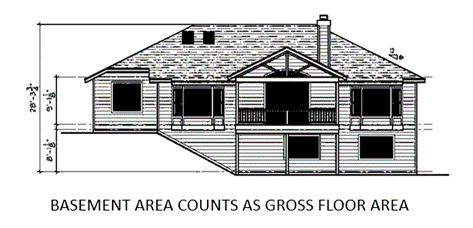
- "Gross floor area" The sum of square feet (area) of all floors to equal the total square footage of any dwelling as measured to the outside wall, including attached garage (whether conditioned or not), roofed porches and balconies (screened, enclosed, or open), porte cocheres, and other similar areas. A maximum 25% of the floor space of any basement that has an exterior door and/or pedestrian access/height at or above finish grade counts as gross floor area (image below). A basement that does not have an exterior door and/or pedestrian access/height at or above finished grade does not count as gross floor area. Gross floor area does not include an attic as defined in this section.
- "Hardscape." Any improved area of any lot that is not included in the definition of "gross floor area”. See Table 2 for example, conditions, and approval procedures. The definition of hardscape does not include driveways and parking areas.
- "Hardscape ratio." The ratio of the square footage of hardscape to the square footage of the lot.
- "Height of building." The vertical distance from the average existing undisturbed natural grade along the front building line to the highest point of the roof surface of such building.
- “Home-based business.” This use must be completely within the residence or completely within any accessory structure and may include, but is not limited to:
- Office of a physician, dentist, musician, lawyer, accountant, architect, or other professional persons. No medical or dental practice or other scientific activity that requires laboratory, operating room, etc., shall be permitted. Only consultation and examination normally performed without special equipment found in a "treatment room" or a clinic may be carried on.
- Home sales or custom manufacture and sales of goods such as linens, clothing, household articles or decoration, silver, jewelry, paintings, or the like. Such goods and articles may not be "stocked" or warehoused in anticipation of future sales. Such sales and manufacture must be carried on completely within the residence or completely within any accessory structure.
- "Immediate family." The owner(s) of a lot, the spouse of an owner, the parents, parents in law, children, children in law and grandchildren of the owner(s)
- “Landscape water feature/ornamental pool.” An outdoor fixture whose dominant use is aesthetic consisting of a catch basin, reservoir, or chamber from which one or more jets or streams of water is emitted.
- "Living quarters." Accommodations provided by an owner for occupancy from time to time by members of the owner's immediate family, domestic help, or health care providers whose presence on the premises is required by the owner or other family members
- "Lot, plot or site." One contiguous piece or parcel of land, not divided or separated by property of any third party or by any street, walkway or other public right-of-way, which is occupied or proposed to be occupied by one main or principal building or use and its accessory buildings and uses, and which includes within its boundaries the open spaces required by this chapter, and which is either (i) defined as a single lot on a recorded subdivision plan or plat of record in the Register's Office for Davidson County, Tennessee, or (ii) separately described as a single tract in a property deed recorded in the Register's Office for Davidson County, Tennessee, prior to the enactment of Ordinance No. 39 on August 16, 1950.
- “Lot of record.” A lot that was separately described as a single tract in a property deed recorded prior to the date of enactment of Ordinance No. 39, on August 16, 1950, the minimum lot area shall be the area of such tract as described in such deed; provided. This definition applies to a tract which on November 20, 1996, was held in common ownership with an adjoining tract, the separation from which would result in a side yard, rear yard, or other zoning violation on the tract from which separated, and provided further that the application of this paragraph shall not exempt any lot to which this paragraph may otherwise apply from compliance with all setback requirements of the zoning classification.
- "Lot lines, property lines, boundary." Lot line, property line, or boundary means a boundary of a lot. Lot line terms used are:
- A front lot line is defined as the boundary of the lot contiguous to the right of way of the nearest public street or road. If the lot is a corner lot, the lot lines adjoining all and any rights of way shall be front lot lines.
- A rear lot line is opposite to, and the most distant from, the front lot line. The rear lot line on any lot of triangular or other irregular shape shall be considered as a line entirely within the lot but not less than ten (10) feet in length and parallel to and most distant from the front lot line.
- A side lot line is a boundary line which is neither a front lot line nor a rear lot line. On irregular lots, all other property lines other than the front and rear shall be side lot lines.
- “Mechanical equipment.” All compressors, generators, or other equipment necessary to the operation of the heating, ventilating and air conditioning equipment, and/or other mechanical systems included in a building or structure shall be located at or below ground level within the building envelope in which such building or structure is also located. This definition does not include boxes and/or structures placed on properties directly by a public utility agency.
- “Multi-family housing.” A structure or group of structures with more than one dwelling unit intended to provide temporary or permanent housing.
- "Non-conforming use or structure." A use or structure which met the requirements of the Zoning Code at the time it was commenced or constructed, or which was commenced or constructed prior to the enactment of the Zoning Code, but which does not meet the current requirements of this chapter.
- “Open carport.” A structure of metal, canvas or column construction open on at least two (2) sides used generally for covering vehicles. A carport is typically considered a "detached structure" regardless of size and its proximity to the home or garage
- "Permanent sign." Any sign that is intended for other than temporary use or a limited period. A permanent sign is generally affixed or attached to a pole or other structure or is characterized by construction materials, a foundation or anchoring indicative of an intent to display the sign for more than a limited period.
- "Pool house." A structure constructed in connection with a swimming pool, which may contain bathrooms, dressing rooms and cooking facilities.
- "Porte cochere." A roofed structure extending from and structurally integrated into a building over an adjacent driveway intended to shelter those loading and unloading a vehicle. The definition of porte-cochere does not include the definition of an open carport.
- “Principle use,” The primary use for which land or a building is or may be intended, occupied, maintained, arranged or designed as established by this Ordinance.
- "Rear yard." A required area of open space on a lot, unobstructed by man-made buildings or other structures, not otherwise permitted in this chapter, and located between the rear setback line and the rear lot line.
- "Retaining walls." Retaining walls are walls constructed for the purpose of retaining earth.
- “Right-of-way.” A general term denoting land, property. or interest therein, usually in a strip, acquired for or devoted to transportation purposes.
- “Root or storm cellar.” An underground room outside of the dwelling used for the storage of food products or to provide shelter during storm and/or disaster events.
- "Setback line." A setback line is a line within a lot or site generally parallel to the front, rear, or side lot line, between which and such front, rear, or side lot line, as the case may be, no buildings, structures, or portions thereof, may be constructed, except as is otherwise herein provided.
- "Short term rental unit." A residential dwelling that is rented wholly or partially for a fee for a period of less than thirty (30) continuous days.
- "Side yards." Required areas of open space on a lot, unobstructed by man-made buildings or other structures, not otherwise permitted in this chapter, and located between the side building lines and the side lot lines. In the case of corner lots, all lot lines which are not contiguous to a street shall be considered side or rear lot lines.
- “Sight visibility triangle”. The area located at the intersection of two streets, whether public or private, or a street and private driveway through which an unobstructed view of approaching traffic is necessary for motorists.
- "Sign." Any device, fixture, placard, or structure that uses color, form, graphic, illumination, symbol, or writing to advertise, announce or identify a person or entity, or to communicate information of any kind.
- “Sports court.” Any dedicated hardscape area used for active recreation including, but not limited to, racquetball courts, basketball courts.
- “Storage Shed”. Structures for the housing or storage of tools, machinery and/or equipment for the general maintenance of a residence.
- “Swimming pool.” A structure intended for swimming, recreational bathing or wading that contains water. This includes in-ground, hot tubs, spas, and fixed-in-place wading pool.
- “Tennis court.” A designated area for the playing of tennis only including all areas within their enclosures.
- "Temporary sign." Any sign constructed of paper, cloth, canvas, plastic sheet, cardboard, wallboard, plywood, or other materials that appears to be intended for temporary use and display for a limited time period. "Temporary sign" includes a banner and may also mean a sign made of more durable materials such as metal, wood, or hard plastic, but lacking a foundation or anchoring indicative of an intent to display the sign for more than a limited period.
- "Yards." Yards are required areas of open space on the same lot or site with the existing or a proposed main building or use, bounded by the adjoining lot lines, open, unoccupied, and unobstructed by man-made buildings or structures from ground level to the sky.
- "Zoning map." A map of the City of Belle Meade, Davidson County, Tennessee, prepared by Barge, Cauthen & Associates dated October 24, 2006, as revised by this ordinance.
HISTORY
Repealed & Replaced by Ord. 2024-14 on 9/18/2024
Repealed & Replaced by Ord. 2024-14 on 9/18/2024

