
Belvidere City Zoning Code
ARTICLE 7
- PERFORMANCE STANDARDS
Sec. 150.701.- Purpose.
The purpose of this article is to indicate the requirements for access, visibility, off-street parking, off-street loading, exterior storage, exterior lighting, vibration, noise, building design and construction, hazardous materials, satellite dishes, wind energy systems, fencing, and screening for all development occurring within the jurisdiction of this chapter (see § 150.007). It also includes design requirements for large developments.
(Ord. No. 801G, § 3, 3-6-06)
Sec. 150.702. - Access standards.
(A)
Purpose. The purpose of this section is to alleviate or prevent congestion of public rights-of-way so as to promote the safety and general welfare of the public by establishing minimum requirements for the provision of access to public rights-of-way in accordance with the utilization of various sites.
(B)
City approval required. Any and all proposed access drives on the subject property shall be depicted as to their location and configuration on the site plan required for the development of the subject property (refer to § 150.906).
(C)
Number of access points.
(1)
Each lot shall have not more than two access points on any street frontage adjacent to any lot. Said access shall require approval by the director of public works.
(2)
In no instance shall any lot be permitted more than one access point on any one street if its frontage on said street is less than 85 linear feet (as measured along the right-of-way line).
(3)
On arterial streets and in certain areas experiencing, or expected to experience, congestion and/or safety problems, access to a lot may be required to be located via an access point located on an adjacent property or another street frontage.
(D)
Residential uses. Residential uses shall not have access points onto a nonresidential collector or arterial street unless such street has the only available frontage.
(E)
Nonresidential uses. Nonresidential uses shall not have access points onto a residential street unless such street has the only available frontage.
(F)
Access near street intersections. No access point shall be located closer than 100 feet from the intersection of any two street rights-of-way unless such street is the only available frontage on the subject property. In all cases, access points shall be located as far from an intersection as the lot size permits.
(G)
Distance between access drives. The minimum distance between access drives serving the same property shall be 25 feet (edge to edge), as measured at the property line. A distance in excess of said 25 feet may be required if, in the opinion of the director of public works, present or projected traffic factors warrant a greater distance.
(H)
Angle of intersection with public right-of-way. All access drives shall intersect with any public right-of-way at an angle of not less than 75 degrees, and shall intersect at an angle of 90 degrees wherever possible.
(I)
Distance from property line. The distance from an access drive to the property line of an adjacent property shall not be inconsistent with the zoning district standard as specified in § 150.105.
(J)
Width of driveways. All access drives shall have a minimum width of 12 feet for one- and two-family dwellings. For all other land uses, access drives accommodating one-way traffic shall have a minimum width of 14 feet and drives accommodating two-way traffic shall have a minimum width of 26 feet. All access drives shall have a maximum width of 30 feet for all residential uses, and 35 feet for all non-residential uses, as measured at the right-of-way line. Access drives may be flared between the right-of-way line and the roadway up to a maximum of five additional feet in either direction.
(K)
Traffic control. The traffic generated by any use shall be channelized and controlled in a manner which avoids congestion on public streets and other safety hazards. Traffic into and out of all off-street parking, loading and traffic circulation areas serving six or more parking spaces shall be forward moving, with no backing into streets or pedestrian ways. Traffic control devices shall be required as determined by the director of public works.
(L)
Paving of access. All access approach areas located within a street right-of-way shall be paved to the satisfaction of the director of public works with a hard, all-weather surface, and shall be maintained so as to prevent the transport of gravel, dirt, or other eroded material from the subject property into the right-of-way. This requirement must be fulfilled before building occupancy, unless granted a time-specific extension in writing by the director of public works.
(Ord. No. 801G, § 3, 3-6-06; Ord. No. 957G, § 1, 4-7-08; Ord. No. 240H, § 6, 12-1-14; Ord. No. 587H, § 7, 7-5-22)
Sec. 150.703. - Visibility standards.
(A)
Purpose. The purpose of this section is to alleviate or prevent congestion of public rights-of-way so as to promote the safety and general welfare of the public by establishing minimum requirements for the provision of vehicular visibility.
(B)
Requirement. In order to provide a clear view of intersecting streets to motorists there shall be a triangular area of clear vision formed by the two intersecting streets and a chord connecting said centerlines. The distance requirement for the vision triangle shall be 25 feet from the right-of-way of all intersections. Generally, the following standards shall apply:
(1)
No object or planting which obstructs sight lines over 2½ feet in height above the surface of the roadbed shall be allowed in a vision clearance triangle, except the following:
A.
Telephone, telegraph, and power transmission poles;
B.
Lines and portable equipment;
C.
Open-type fence (e.g., chain link or wrought iron fencing) not exceeding a height of four feet above the roadbeds and not encroaching closer that six inches to any public right-of-way;
D.
The growing of flowers and shrubbery, providing that they shall not exceed 3½ feet in height above the roadbeds;
E.
Deciduous trees, providing that said trees shall not be planted closer than ten feet to the point of intersection of the rights-of-way lines.
(2)
No overhanging tree branches or foliage, which obstructs sight lines regardless of whether said trees are planted within the traffic visibility triangle, shall be allowed within the space between 2½ feet and ten feet above the surface of the roadbed in a vision clearance triangle.
(3)
Enforcement of this subsection shall be upon complaint to the zoning administrator or zoning staff.
(C)
Depiction on required site plan. Except in the downtown where no requirement is imposed, any and all visibility triangles located on the subject property shall be depicted as to their location and configuration on the site plan required for the development of the subject property (refer to § 150.906).
(Ord. No. 801G, § 3, 3-6-06)
Sec. 150.704. - Off-street parking and traffic circulation design standards.
(A)
Purpose. The purpose of this section is to alleviate or prevent congestion of public rights-of-way so as to promote the safety and general welfare of the public by establishing minimum requirements for the provision of off-street parking and circulation in accordance with the utilization of various sites.
(B)
Depiction on required site plan. Any and all parking and traffic circulation areas proposed to be located on the subject property shall be depicted as to their location and configuration on the site plan required for the development of the subject property. Each and every on-site parking space designed to serve as required parking shall not be located farther than 500 feet, except as permitted by the zoning administrator, of shortest walking distance from the access to all of the various areas it is designated to serve. A garage stall, meeting the access requirements of § 150.703(F)(4), below, shall be considered a parking space. Parking spaces for any and all vehicles shall be clearly indicated on said site plan.
(C)
Use of off-street parking areas. The use of all required off-street parking areas shall be limited to the parking of operable vehicles not for lease, rent, or sale. Within residential districts, required parking spaces shall only be used by operable cars and trucks.
(D)
Traffic circulation and traffic control. Site circulation shall be designed to provide for the safe and efficient movement of all traffic entering, exiting, and on the site. Circulation shall be provided to meet the individual needs of the site with specific mixing of access and through movements, and where required, shall be depicted on the required site plan. Circulation patterns shall conform with the general rules of the road and all traffic control measures shall meet the requirements of the Manual of Uniform Traffic Control Devices.
(E)
Installation and maintenance of off-street parking and traffic circulation areas. All off-street parking and traffic circulation areas shall be completed prior to building occupancy, unless a performance bond acceptable to the city or equivalent for the installation of said improvements is deposited with the city, and shall be maintained in a dust-free condition at all times. In no instance or manner shall any offstreet parking or traffic circulation area be used as a storage area, except as provided for by § 150.706(D) and (E).
(F)
Off-street parking and traffic circulation design standards.
(1)
Surfacing and marking. All off-street parking and traffic circulation areas (including all residential driveways—except those within the RH district) shall be paved with a hard, all-weather surface, to the satisfaction of the city engineer or director of public works. Said surfaces intended for six or more parking stalls shall be marked in a manner which clearly indicates required parking spaces.
(2)
Curbing. Passenger vehicle parking lots, including drive aisles and driveways, shall provide a six-inch curb and gutter of adequate height as approved by the city engineer or director of public works and which is properly located to ensure that no part of any vehicle will project beyond the required setbacks of this chapter. The city engineer or director of public works does not possess the authority to waive the required curbing. Truck parking lots do not require curb and gutter to be present.
(3)
Lighting. All off-street parking and traffic circulation areas serving 13 or more cars shall be lit so as to ensure the safe and efficient use of said areas during the hours of use. The illumination level shall be between 0.2 and 1.0 foot-candles for said areas, and said illumination level shall not exceed the standards of § 150.707.
(4)
Access. Each required off-street parking space shall open directly upon an aisle or driveway that is wide enough and designed to provide a safe and efficient means of vehicular access to the parking space without directly backing or maneuvering a vehicle into a public right-of-way. All off-street parking and traffic circulation facilities shall be designed with an appropriate means of vehicular access to a street or alley, in a manner which least interferes with traffic movements. No driveway across public property or requiring a curb cut shall exceed a width of 35 feet for commercial and industrial land uses or 30 feet for residential land uses. Parking spaces located behind an enclosed garage and located directly off a through aisle shall be a minimum of 30 feet deep.
(5)
Signage. All signage located within, or related to, required off-street parking or traffic circulation shall comply with the requirements of article 10.
(6)
Handicapped parking spaces. Parking for the handicapped shall be provided at a size, number, location, and with signage as specified by state and federal regulations.
(7)
Parking space design standards. Other than parking required to serve the handicapped, every and all provided off-street parking space shall comply with the minimum requirements of Table 150.704(F)(8). All parking spaces shall have a minimum vertical clearance of at least seven feet.
(8)
Parking lot design standards. Horizontal widths for parking rows, aisles, and modules shall be provided at widths no less than listed in Table 150.704(F)(8), and shown on the following page. Additional design standards apply to "group developments" (see § 150.205).
(9)
Landscaping. Parking lot landscaping shall comply with the requirements of the paved area landscaping requirements in § 150.604(A)(3).
Table 150.704(F)(8). Parking Layout Dimensions
1 Parking spaces located behind an enclosed garage and located directly off a thorough aisle shall be at least 30 feet deep.
2 This dimension represents (AW) for one-way traffic. For two-way traffic, widen to a minimum (AW) of 26.0 feet.
3 The dimensions shown are the minimum stall dimensions.
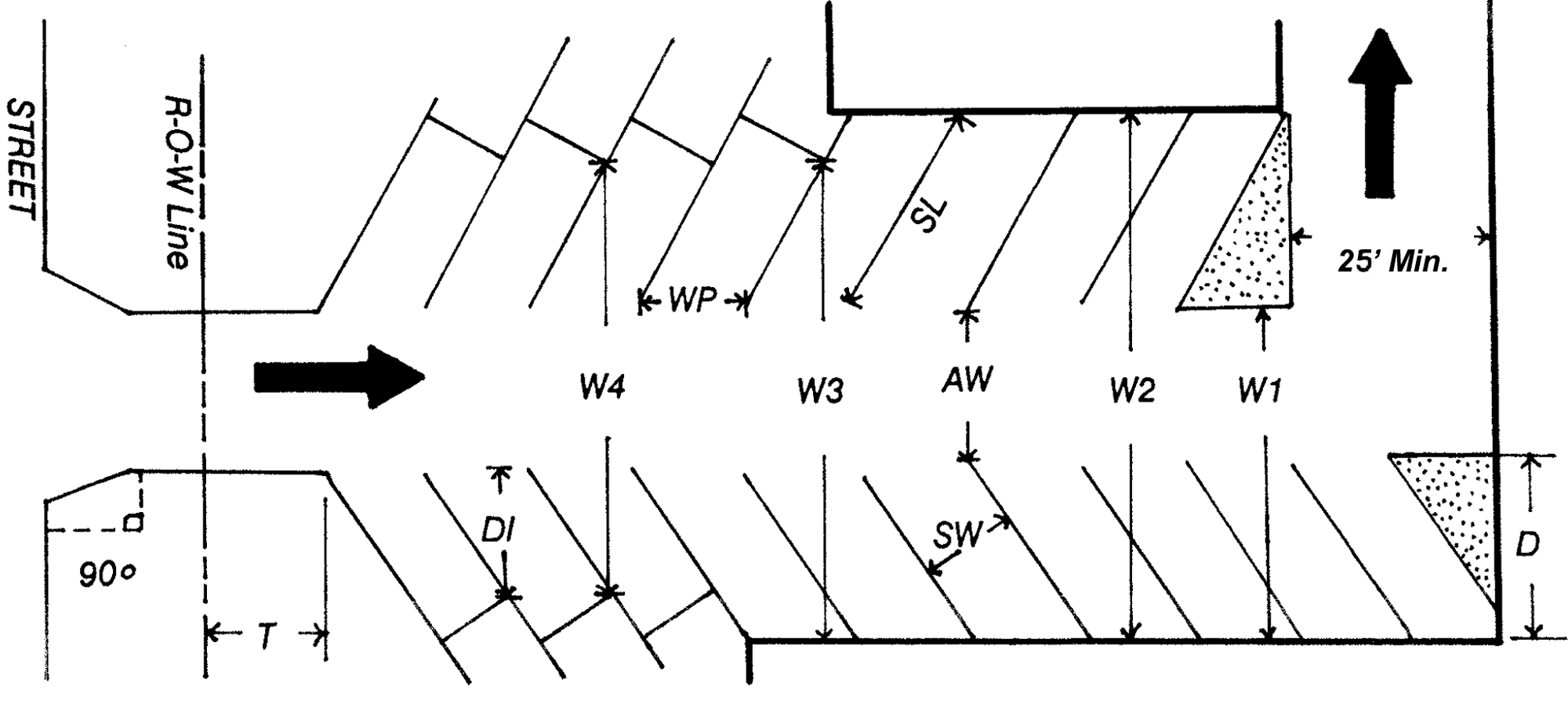
Typical Parking Layout Dimensions
(G)
Calculation of minimum required parking spaces.
(1)
General Guidelines for Calculating Required Parking Spaces. The requirements of § 150.704(G)(3), below, shall be used to determine the minimum required number of off-site parking spaces which must be provided on the subject property. Requirements are generally tied to the capacity of the use; the gross floor area of the use; or the number of employees which work at the subject property during the largest work shift. The term "capacity" as used herein means the maximum number of persons that may be accommodated by the use as determined by its design or by the city's building code regulations, whichever number is greater. References herein to "employee(s) on the largest work shift" means the maximum number of employees working at the facility during a single given day, regardless of the time period during which this occurs, and regardless of whether any such person is a full-time employee. The largest work shift may occur on any particular day of the week or during a lunch or dinner period in the case of a restaurant. In all cases, one reserved parking space shall be provided for each vehicle used by the operation during business hours. Said spaces shall be in addition to those off-street spaces required for each land use by § 150.204. Where said parking needs of any land use exceed the minimum requirements of this chapter, additional parking spaces sufficient to meet the average maximum weekly peak-hour parking space demand shall be provided by the property owner.
(2)
Joint and off-site parking facilities.
A.
Parking facilities which have been approved by the zoning administrator to provide required parking for one or more uses, shall provide a total number of parking spaces which shall not be less than the sum total of the separate parking needs for each use during any peak hour parking period when said joint parking facility is utilized at the same time by said uses.
B.
Each parking space designed to serve as joint parking shall not be located farther than 500 feet, except as permitted by the zoning administrator, from the access to all of the various areas it is designated to serve (see § 150.204(F)(1)).
C.
The applicant(s) for approval of a joint parking facility shall demonstrate to the zoning administrator's satisfaction that there is no substantial conflict in the demand for parking during the principal operating hours of the two or more uses for which the joint parking facility is proposed to serve.
D.
A legally binding instrument, detailing maintenance and liability responsibilities, shall be executed by any and all parties to be served by said joint parking facility. This instrument shall be recorded with the county recorder's office.
(3)
Minimum off-street parking requirements for land uses. The off-street parking requirements for each land use are listed within § 150.204.
(4)
Provision of fee-in-lieu of parking spaces development. Within the central business (CB) district, the parking requirements of this chapter are hereby waived, unless the zoning administrator notes otherwise.
(5)
Locational prohibitions for off-street parking areas.
A.
Off-street parking shall not be located on non-paved surfaces. Off-street parking shall not be located between the principal structure on a residential lot and a street right-of-way, except within residential driveways and parking lots designated on the approved site plan (see § 150.906).
B.
No private parking shall occur on street terraces, driveways, or any other areas located within a public right-of-way not explicitly designated by the city council.
(6)
Minimum permitted throat length. Table 150.704(G)(6) shall be used to determine the minimum permitted throat length of access drives serving parking lots, as measured from the right-of-way line along the centerline of the access drive:
Table 150.704(G)(6). Minimum Permitted Throat Length
(H)
No truck shall be parked or allowed to stand on any property in any zoning district except for planned industrial, general industrial and heavy industrial zoning districts. This subsection shall not apply to vehicles which are actively loading or unloading cargo or persons and which otherwise comply with the City of Belvidere Municipal Code and other relevant Statutes of the State of Illinois. Truck parking or standing within industrial zoned districts shall be governed by applicable portions of this code, The City of Belvidere Municipal Code and relevant statutes and ordinances.
Notwithstanding the foregoing, vehicles designed to transport more than 16 persons may also be parked or stored on property being utilized by an institutional land use. Such parking or storage shall fully comply with all other applicable portions of the City of Belvidere Municipal Code, including this code.
(Ord. No. 801G, § 3, 3-6-06; Ord. No. 2H, § 1, 1-5-09; Ord. No. 240H, §§ 7, 8, 12-1-14; Ord. No. 341H, § 2, 4-3-17)
Sec. 150.705. - Off-street loading standards.
(A)
Purpose. The purpose of this section is to prevent congestion of public rights-of-way and private lots so as to promote the safety and general welfare of the public by establishing minimum requirements for the provision of loading facilities on various sites.
(B)
Applicability. Any use which has a gross floor area of 6,000 square feet or more, and which requires deliveries or makes shipments, shall provide off-street loading facilities in accordance with the regulations of this section.
(C)
Location. All loading berths shall be located 25 feet or more from the intersection of two street right-of-way lines. Loading berths shall not be located within any required front yard or street yard setback area. Access to the loading berth shall be located in conformance with § 150.702. All loading areas shall be located on the private lot and shall not be located within, or so as to interfere with, any public right-of-way.
(D)
Size of loading area. The first required loading berth shall be designed in accordance with table 150.705(D). All remaining required loading berths shall be a minimum of 25 feet in length. All required loading berths shall have a minimum vertical clearance of 14 feet. The following standards shall be the minimum used to design loading areas:
Table 150.705(D). Loading Standards
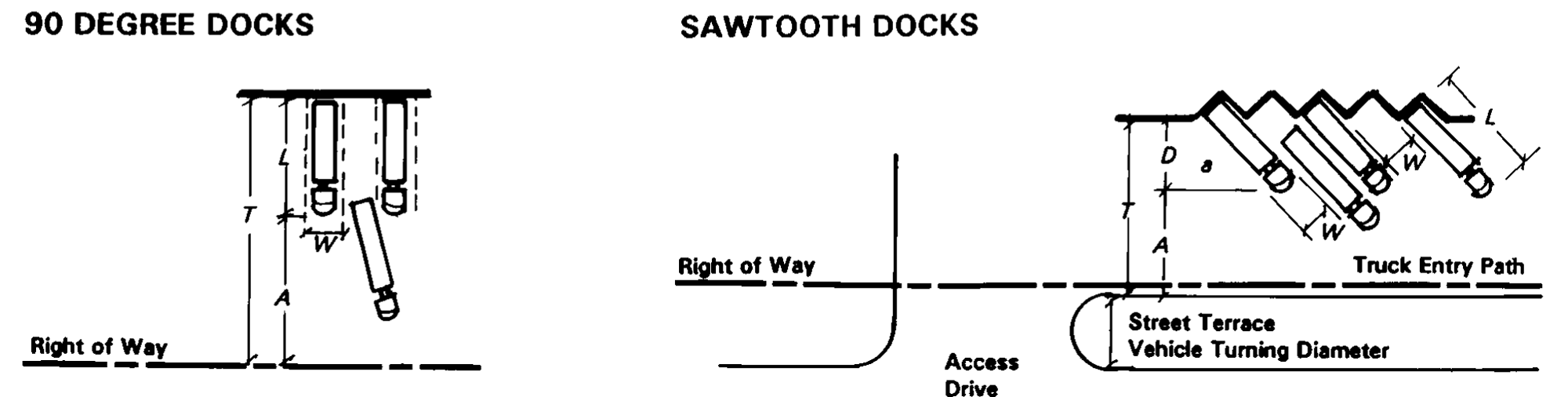
Docks
(E)
Access to loading area. Each loading berth shall be located so as to facilitate access to a public street or alley, and shall not interfere with other vehicular or pedestrian traffic per § 150.704, and shall not interfere with the function of parking areas. In no instance shall loading areas rely on backing movements into public rights-of-way.
(F)
Surfacing and marking. All required loading areas shall be paved and maintained in a dust-free condition at all times. Said surface shall be marked in a manner which clearly indicates required loading areas.
(G)
Use of required loading areas. The use of all required loading areas shall be limited to the loading and unloading of vehicles. Said area shall not be used to provide minimum required parking spaces. No parking or storage shall be allowed in these areas.
(H)
Lighting. All loading areas shall be lit so as to not exceed the standards of § 150.707.
(I)
Signage. All signage located within, or related to, loading areas shall comply with the requirements of article 10.
(J)
Depiction on required site plan. Any and all required loading areas proposed to be located on the subject property shall be depicted as to their location and configuration on the site plan required for the development of the subject property (refer to § 150.906).
(K)
Calculation of required loading spaces.
(1)
Indoor institutional land uses. One loading berth shall be required for each building having a gross floor area of 6,000 square feet to 29,999 square feet. For such uses located in buildings having a gross floor area of 30,000 square feet or greater, two loading berths shall be required.
(2)
Commercial (except offices), storage/disposal, transportation, and industrial land uses. One loading berth shall be required for each building having a gross floor area of 6,000 square feet to 29,999 square feet. For such uses located in buildings having a gross floor area of 30,000 square feet or greater, an additional loading berth shall be required for any portion of each 50,000 square feet of gross floor area in addition to the original 29,999 square feet.
(3)
Office land uses. One loading berth shall be required for each building having a gross floor area of 6,000 square feet to 99,999 square feet. For such uses located in buildings having a gross floor area of 100,000 square feet or greater, an additional loading berth shall be required for any portion of each 100,000 square feet of gross floor area in addition to the original 99,999 square feet.
(L)
Regulations and restrictions contain[ed] in § 150.705(C) and 150.705 shall not apply to properties annexed to the city in 1998.
(Ord. No. 801G, § 3, 3-6-06; Ord. No. 4H, § 1, 2-2-09)
Sec. 150.706. - Exterior storage standards for residential, office and commercial districts.
(A)
Purpose. The purpose of this section is to control the use of residential, office and commercial property for exterior storage so as to promote the safety and general welfare of the public. For exterior storage in agricultural and industrial districts, refer to §150.204.
(B)
Requirements for exterior storage of recreational vehicles in residential zoning districts. No person shall park or store recreational vehicles on a lot in a residential district except within a fully enclosed structure or except as provided herein.
(1)
For the purposes of this section, a recreational vehicle or equipment shall include boats, boats with trailers, motor homes, motor coaches, pickup campers, camping trailers, travel trailers, fifth-wheel trailers, large utility trailers, race cars and their trailers, canoes or kayaks and their trailers, tent campers, folding campers, utility railers, carnival equipment and their trailers, and cases or boxes used to transport recreational vehicles or their equipment, and similar equipment and vehicles.
(2)
Outside parking of recreational vehicles and equipment are subject to the following provisions:
A.
No more than one recreational vehicle may be parked or stored outside a fully enclosed structure. A recreational vehicle shall not be located closer than three feet to a side or rear lot line and not closer than 15 feet of any street. A recreational vehicle shall not be parked on or over any part of any public sidewalk. Recreational vehicles shall only be parked or stored upon a paved surface that complies with the City of Belvidere Municipal Code.
B.
The recreational vehicle shall be maintained and be in good condition and safe for effective performance for the function in which it was intended. The exterior of the vehicle shall be intact.
C.
Recreational vehicles shall be roadworthy. Vehicles that require a license shall be properly licensed.
D.
No recreational vehicles or equipment shall be parked or stored in any open space outside a building unless such equipment is wholly owned by the property owner, who shall be in residence at the property in question. If the property is rented, such storage shall be permitted to the tenant only provided that such equipment is owned by the tenant.
E.
All equipment shall be parked or stored as inconspicuously as possible on the property. The area around the equipment or vehicle must be kept weed free and free of accumulation of other storage material.
F.
At no time shall a recreational vehicle be used for permanent living, sleeping, or materials storage. No recreational vehicle shall be permanently connected to water, gas, electric, or sanitary sewer service.
(C)
Requirements for exterior commercial vehicle and material storage in residential zoning districts. No person shall store materials on a lot in a residential district except within a fully enclosed structure or except as provided herein.
(1)
For the purposes of this chapter, outdoor storage of materials shall include all materials and equipment not related to recreational vehicles or play equipment.
(2)
The total area devoted to exterior material storage on each lot shall not exceed 100 square feet. Said storage may occur in multiple locations, as regulated below.
A.
No exterior material storage shall occur in the front or street yard.
B.
In the side or rear yard, exterior material storage shall not be located closer than three feet to a side or rear lot line. Such storage shall be located to minimize visibility from adjoining properties and the public street.
(3)
No commercial vehicle exceeding a class B license plate shall be parked overnight in residentially zoned districts on the street, or in parking spaces or garages accessory to residential dwellings.
(D)
Requirements for exterior commercial vehicle and equipment storage in office and commercial districts. No person shall park or store commercial vehicles on a lot in an office or commercial district except within a fully enclosed structure or except as provided herein.
(1)
For the purposes of this ordinance, a commercial vehicle or equipment shall include vehicles with commercial logos, trailers, and similar equipment, vehicles, and storage units.
(2)
Outside parking of commercial vehicles and equipment are subject to the following provisions:
A.
The commercial vehicle shall be maintained and be in good condition and safe for effective performance for the function in which it was intended. The exterior of the vehicle shall be intact.
B.
Commercial vehicles shall be roadworthy. Vehicles that require a license shall be properly licensed.
C.
The commercial vehicle shall be associated with the primary use of the property
(3)
As set forth in § 150.704, truck (as defined in § 150.013) parking and standing are prohibited in all non industrial zoning districts with the exception of vehicles actively engaged in loading and unloading.
(E)
Requirements for exterior material storage in office and commercial districts. In all office and commercial zoning districts (see § 150.102 for a listing of these districts), all materials and equipment shall be stored within a completely enclosed building except for the following which shall not be located within any front yard or required street yard (except for vehicles in designated parking spaces) and shall be stored a minimum of five feet from any and all property lines: screened refuse containers; construction materials, landscape materials and related equipment connected within on-site construction; and off-street parking.
(F)
Inoperative motor vehicles and junk. Refer to § 110-421 et seq. of the Belvidere Municipal Code.
(Ord. of 3-6-06; Ord. No. 848G, § 1, 9-5-06; Ord. No. 2H, § 1, 1-5-09; Ord. No. 375H, § 3, 11-6-17; Ord No. 453H, § 1, 5-6-19; Ord. No. 619H, § 1, 4-3-23)
Sec. 150.707. - Exterior lighting standards.
(A)
Purpose. The purpose of this section is to regulate the spill-over of light and glare on operators of motor vehicles, pedestrians, and land uses in the vicinity of a light source in order to promote traffic safety and to prevent the creation of nuisances.
(B)
Applicability. This section shall be applied to the installation of all new and replacement private outdoor lighting fixtures. Outdoor lighting fixtures legally installed prior to the effective date of this chapter shall not be required to comply with these outdoor lighting standards; however, any replacement of said lighting fixtures shall comply with all outdoor lighting standards as set forth in this section.
(C)
Definitions. See § 150.013 for definitions of exterior light fixture and shielded light fixture.
(D)
Depiction on required site plan. Where a development requires site plan review under section § 150.906, all outdoor lighting fixtures shall be depicted and described on the required site plan or on a separate lighting plan. Depending on the complexity of the proposal or projected impact of lighting, the city may also require the following information:
(1)
A catalog page, cut sheet, or photography of the outdoor lighting fixtures(s) including the mounting method and light cut-off angles.
(2)
A photometric plot plan, drawn to the same scale as the site plan, and indicating the location of all lighting fixtures proposed, mounting and/or installation height in feet, the average illumination level (in footcandles) within the parking lot, and illumination levels at regular intervals around the site and at property lines.
(E)
Requirements.
(1)
Maximum luminaire height. The maximum permitted luminaire height shall be 30 feet in all nonresidential zoning districts, and 25 feet in all residential districts. The height of both the pole and base shall be considered in the measurement of luminaire height.
(2)
Orientation of fixture. In no instance shall an exterior lighting fixture be oriented so that the lighting element (or a transparent shield) is visible from a property located within a residential zoning district. The use of shielded luminaries and careful fixture placement is encouraged so as to facilitate compliance with this requirement.
(3)
Intensity of illumination.
A.
In no instance shall the amount of illumination attributable to exterior lighting, as measured at the property line, exceed 0.50 foot-candles above ambient lighting conditions on a cloudless night.
B.
The maximum average on-site lighting in non-residential zoning districts shall be 2.4 foot-candles (500 watts metal halide or high pressure sodium, 250 watts low pressure sodium).
C.
The maximum average on-site lighting in residential zoning districts shall be 0.90 foot-candles (185 watts metal halide or high pressure sodium, 90 watts low pressure sodium).
D.
The following exceptions shall be permitted:
1.
Outdoor recreation facilities and assembly areas: Maximum average on-site lighting of 3.60 foot-candles (750 watts metal halide or high pressure sodium, 375 watts low pressure sodium).
2.
Auto display lots and gas station pump islands: Maximum average on-site lighting of 2.0 foot-candles ( 500 watts metal halide or high pressure sodium, 250 watts low pressure sodium).
(4)
Location. No exterior light fixture shall be located within any required bufferyard, or within three feet of any property line.
(5)
Flashing, flickering and other distracting lighting. Flashing, flickering and/or other exterior or interior lighting which may distract motorists are prohibited.
(6)
Hours of illumination. Within one hour after closing of the store, completion of the final work shift, or completion of specific activities associated with an institutional use, only building mounted security lighting and up to 25 percent of all other outdoor lighting fixtures may remain illuminated.
(7)
Minimum lighting standards. All areas designated on required site plans for vehicular parking, loading, or circulation and used for any such purpose after sunset shall provide artificial illumination in such areas at a minimum intensity of 0.2 foot-candles.
(8)
Street lighting. Street lighting shall conform to the standards set forth by the state for state and federal highways, the county for county highways, and the city for other streets and highways located within the city.
(9)
Temporary security lighting. Temporary security lighting triggered by motion or noise shall be permitted and exempt from the above provisions. Sensors for such lighting shall not be triggered by activity located off the subject property. Such lighting shall not remain on for more than 15 minutes beyond the triggering event.
(10)
Special events lighting. Any temporary use using exterior lighting which is not in complete compliance with the requirements of this section shall secure a temporary use permit from the city clerk's office (refer to § 150.905).
(11)
Nonconforming lighting. All lighting fixtures existing prior to the effective date of this chapter shall be considered as legal conforming structures. However, such fixtures are encouraged to be extinguished by 11:00 p.m. All replacement fixtures shall fully comply with the requirements of this section. Where nonconforming lighting is deemed to create a public nuisance by the zoning administrator, it shall not be subject to the protections of § 150.707 and may be ordered to be modified or removed so as to conform to the standards of this section.
(Ord. No. 801G, § 3, 3-6-06; Ord. No. 957G, § 1, 4-7-08)
Sec. 150.708. - Vibration standards.
(A)
Purpose. The purpose of this section is to regulate the creation of vibration which adversely effects adjoining properties in order to prevent the creation of nuisances and to promote the general welfare of the public.
(B)
Applicability. The requirements of this section apply to all new uses and activities, which create detectable vibrations, except that these standards shall not apply to vibrations created during the construction of the principal use on the subject property. Existing uses should try to attempt, but are not required to meet these standards.
(C)
Depiction on required site plan. Any activity or equipment which create detectable vibrations outside the confines of a building shall be depicted as to its location on the site plan required for the development of the subject property (see § 150.906).
(D)
Requirements. No activity or operation shall cause or create earthbone vibrations in excess of the displacement values given below.
(E)
Method of measurement. Measurements shall be made at or beyond the adjacent lot line or the nearest residence district boundary line, as described below. Vibration displacements shall be measured with an instrument capable of simultaneously measuring in three mutually perpendicular directions. The maximum permitted displacements shall be determined in each zoning district by the following formula:
D = K/f, where D = displacement in inches
K = a constant to be determined by reference to the tables below
f = the frequency of vibration transmitted through the ground, cycles per second
Table 150.708(E)(1). Vibration Performance Standards
(Ord. No. 801G, § 3, 3-6-06)
Sec. 150.709. - Noise standards.
(A)
Purpose. The purpose of this section is to regulate the creation of noise which adversely affects adjoining properties in order to prevent the creation of nuisances and to promote the general welfare of the public.
(B)
Applicability. The requirements of this section apply to all uses and activities which create detectable noise, except that these standards shall not apply to noise created during the construction of the principal use on the subject property, or by incidental traffic, parking, loading, maintenance or agricultural operations.
(C)
Requirements. All noise shall be muffled so as not be objectionable due to intermittence, beat frequency or shrillness. The sound pressure level, to be measured as described in subsection (E), below, shall not exceed the following decibel levels in the designated octave bands within the designated zoning districts:
Table 150.709(C)(1). Maximum Permitted Noise Level in Zoning Districts
(D)
Objectionable sounds of an intermittent nature which are not easily measured shall be controlled so as not to become a nuisance to adjacent uses.
(E)
The sound levels shall be measured with a sound level meter and associated octave band filter as prescribed by the American Standards Association.
(F)
Noises that were in effect as of the effective date of this chapter shall be considered legal nonconforming noises. The burden of proof to demonstrate that said noises were in effect prior to the effective date of this chapter shall be the responsibility of the noise producer.
(Ord. No. 801G, § 3, 3-6-06)
Sec. 150.710. - Building design and exterior construction material standards.
(A)
Purpose. The purpose of this section is to establish general development performance standards. These standards are intended and designed to assure compatibility of uses; to prevent urban blight, deterioration, and decay; and to enhance the health, safety, and general welfare of the residents of the community.
(B)
Building. The City of Belvidere's overall approach encourages a variety of architectural styles. However, basic harmony is intended to prevail so that no one structure detracts from the attractiveness of the overall environment. City staff shall review building design in order to ensure architectural compatibility and integrity, exterior building materials shall be approved by planning staff prior to any installation regardless of their apparent compliance with this section of the code.
(C)
I-90 industrial corridor building exterior. Those properties that are zoned planned industrial (PI) and general industrial (GI) districts that lay south of Grant Highway and those properties that lay north of Grant Highway and are bounded by the Union Pacific Railroad, Townhall Industrial Park and 1-90. Colors, materials, finishes, and building form shall be coordinated in a consistent manner on the front, side, and rear exterior walls. Materials shall be one of the following:
(1)
Hard burned clay brick color and texture to be approved.
(2)
Concrete masonry. Units shall be those generally described by the National Concrete Masonry Association as "customized architectural concrete masonry units" or shall be broken faced brick type units with marble aggregate or split face or broke off concrete block. There shall be no exposed concrete block on the exterior of any building. Any concrete masonry units that have a gray cement color shall be coated.
(3)
Concrete may be poured in place, tilt-up or pre-cast. Poured in place and tilt-up walls shall have a finish of stone, a texture or a coating. Textured finishes, except in special cases, shall be coated. Pre-cast units which are not uniform in color shall be coated. Coating shall be an approved cementatious or epoxy type with a ten-year minimum life expectancy.
(4)
Natural stone. Crushed aggregate or other stone based materials adhered to a siding style wall shall not be regarded as natural stone.
(5)
Glass curtain walls.
(6)
Metal siding may be used only in combination with one of the approved materials unless the metal siding mimics or is consistent in appearance with other permitted materials. Metal siding may only be used with the prior approval of staff to ensure compliance with this section. Any metal siding proposed for use shall be entirely coated with a colorfast, abrasion and corrosion resistant, long life (minimum of 20 years) finish that is resistant to chemicals, withstands temperature extremes, and has a low permeability. Such panels shall be insulated (facing shall carry a U.L. Approval), have a vapor barrier and have a minimum eight-foot (from floor) interior wear wall. Any material utilized to attach the metal siding to the building shall be concealed or the utilization of shadow panels or semi-concealed fastener panels with fasteners painted to match the panels shall be required.
(7)
Other materials approved by city staff.
(8)
The building exterior requirements of this section are intended to be minimum requirements and more stringent requirements may be imposed by city staff, taking into consideration public interests such as coordinating a consistent appearance and quality of construction with adjacent structures, the size of the proposed structure, the topography of the site, and the proximity of the structure to public rights-of-way.
(9)
Notwithstanding anything to the contrary within this chapter, buildings constructed prior to the adoption of this chapter located within the PI or GI districts may be expanded and/or renovated without complying with the regulations found within § 150.710(C).
(D)
Building design and construction requirements: Planned office and commercial districts (PB, GB, CB). All buildings hereinafter constructed, expanded, remodeled or otherwise improved within these districts shall be designed in such a manner so that it provides a basic harmony with and does not detract from the overall attractiveness of surrounding development and shall be constructed of the following materials:
(1)
Brick.
(2)
Concrete masonry. Units shall be those generally described by the National Concrete Masonry Association as "customized architectural concrete masonry units" or shall be broken faced brick type units with marble aggregate or split face or broke off concrete block. There shall be no exposed concrete block on the exterior of any building. Any concrete masonry units that have a gray cement color shall be coated.
(3)
Concrete may be poured-in-place, tilt-up, or precast. Poured-in-place and tilt-up walls shall have a finish of stone, a texture or a coating. Textured finish, except in special cases, shall be coated. Precast units which are not uniform in color shall be coated. Coating shall be an approved cementatious or epoxy type with a ten year minimum life expectancy.
(4)
Natural stone.
(5)
Any other material approved by city staff.
(6)
Metal panels may be used only to accentuate or as a finish material within these districts. Any metal panel proposed for use within these districts as a finish material or to accentuate building shall be entirely coated with a colorfast, abrasion, and corrosion resistant, long life (minimum of 20 years) finish that is resistant to chemicals, withstands temperature extremes, and has a low permeability. Any material utilized to attach the metal panels to the building shall be concealed or the utilization of shadow panels or semi-concealed fastener panels with fasteners painted to match the panels shall be required.
(E)
Building design and construction requirements: Multiple family districts (MR-8S and MR-8L), and neighborhood office (NO) and neighborhood business (NB) districts and the institutional (I) district. All buildings hereinafter constructed, expanded, remodeled, or otherwise improved within this district shall be designed in such a manner so they provide basic harmony with and do not detract from the overall attractiveness of surrounding development and shall be constructed of the following materials
(1)
Brick.
(2)
Natural stone.
(3)
Other materials approved by city staff.
(F)
Mechanical equipment. All mechanical equipment, including roof mounted, shall be integrated into the design of the structure to the extent possible, enclosed or screened as part of the overall architectural design.
(G)
Maintenance. The exterior walls and roofs of buildings shall be maintained in a clean, orderly, and attractive condition; free of cracks, dents, punctures, breakage, and other forms of visible marring. Materials that become excessively faded, chalked, cracked, chipped, damaged or otherwise deteriorated shall be replaced, refinished, repaired or repainted in accordance with the reasonable determination and order of the zoning administrator or zoning enforcement officer within 60 days notice of such defect.
(H)
Screening of outdoor storage. All materials, equipment, and receptacles and containers for refuse and recyclables shall be stored within a building or fully screened so as not to be visible from adjoining properties, and be located in the side or rear yard, except for construction and landscaping materials currently being used or intended for use on the premises within six months.
(I)
Construction and maintenance. Every fence shall be constructed in a substantial, workmanlike manner and of material reasonably suited for the purpose for which the fence is proposed to be used. Every fence shall be maintained in a condition of reasonable repair and shall not be allowed to become and remain in a condition of disrepair or danger or constitute a nuisance, public or private. Any such fence which is, or has become, dangerous to the public safety, health or welfare, is a public nuisance and shall be repaired. Link fences, wherever permitted, shall be constructed in such a manner that no barbed ends shall be at the top except for limited outdoor storage areas.
(J)
Trademark architecture. Trademark architecture shall not be permitted, unless approved by city staff.
(K)
Procedures. Architectural design is subject to the site plan review process (see § 150.906).
(L)
Appeals. Unless otherwise provided herein, appeals to the requirements contained in these standards shall be heard by the planning and zoning commission.
(M)
Reserved.
(Ord. of 3-6-06; Ord. No. 880G, § 1, 1-2-07; Ord. No. 2H, § 1, 1-5-09; Ord. No. 24H, § 12, 9-8-09; Ord. No. 164H, § 4, 12-3-12; Ord. No. 303H, § 2, 8-1-16; Ord. No. 701H, § 20, 11-4-24)
Sec. 150.711. - Hazardous materials standards.
(A)
Purpose. The purpose of this section is to provide information to the city regarding the nature of land uses which involve research, production, storage, disposal, handling, and/or shipment of hazardous materials.
(B)
Applicability. The requirements of this section apply to all land uses and activities involving any one or more of the following:
(1)
Any material for which the state requires notification of a local fire department; or
(2)
Any other uses, activities, or materials, which are subject to county, state, or federal hazardous, or related, materials regulations.
(C)
Standards.
(1)
All land uses involving such hazardous materials shall submit a written description of such materials and the operations involving such materials conducted on their property as part of the required site plan submittal (see § 150.906).
(2)
A groundwater protection plan worksheet as provided by the county soil and water conservation district shall be completed.
(Ord. No. 801G, § 3, 3-6-06; Ord. No. 2H, § 1, 1-5-09)
Sec. 150.712. - Fencing standards.
(A)
Purpose. The purpose of this section is to regulate the materials, location, height, and maintenance of fencing, landscaping walls and decorative posts in order to prevent the creation of nuisances and to promote the general welfare of the public.
(B)
Applicability. The requirements of this section apply to all fencing, landscape walls and decorative posts equal to, or exceeding, 30 inches in height, for all land uses and activities; excluding public utilitites and local, state, or federal government uses which may use up to eight foot fences with four courses of barbed wire regardless of the applicable bulk regulations of the zoning district.
(C)
Standards.
(1)
Materials.
A.
Residential districts. Acceptable materials for constructing fencing, landscape walls, and decorative posts include wood, stone, brick, wrought iron, chain link, and wire mesh, except that wire mesh fencing is not permitted within required front yard or street yard areas. All finished exteriors of fence shall be colored in a uniform manner with the exception of fluorescent colored paint which is prohibited.
B.
Nonresidential districts. Acceptable materials for constructing fencing, landscape walls, and decorative posts include wood, stone, brick, wrought iron, chain link, and wire mesh. Barbed wire fencing shall only be permitted in the industrial districts when in conjunction with outdoor storage, wholesaling and commercial vehicle/truck parking areas. Any fence within a street yard, including along property lines which intersect a right-of-way, shall be a maximum of 60 percent opaque.
C.
Temporary fencing. Temporary fencing, including the use of wood or plastic snow fences for the purposes of limiting snow drifting between November 1 and April 1, protection of excavation and construction sites, and the protection of plants during grading and construction is permitted for up to 180 consecutive days and no more than 180 consecutive days per calendar year. Temporary fencing must be setback six inches from the public right-of-way.
D.
Snow fences. Snow fences constructed of wood and wire, and/or plastic shall be permitted only as temporary fences.
(2)
Location. On all properties, no fence, landscape wall, or decorative post shall be located closer than six inches to the front yard or street yard property line. Fences may be located up to any property line abutting a side or year yard. No fence, structure or planting shall be maintained in such manner that visibility is obstructed from intersecting streets within 80 feet in each direction from the intersection of the street centerlines.
(3)
Maximum height. Fences shall not exceed four feet in height except on corner lots where the height shall not exceed 3½ feet within 30 feet of the intersection of the nearest right-of-way lines. An exception is allowed for chain link or wrought iron type fencing which may be four feet in height up to any intersection, provided that the chain link is kept free of all vegetation or any other sight restrictions.
A.
Within the side or rear yard of a residentially zoned property the maximum height is seven feet. On through lots, fences located in the yard that abuts a city-dedicated street (not inclusive of Grandview Trail east of Cloverdale Way for a distance of 2,470 feet) and is not considered its principal frontage shall not exceed five feet in height.
B.
Within the side or rear yard of a commercially or institutionally zoned property, the maximum height is seven feet, except that security fences may exceed this height.
C.
Within the side or rear yard of an industrially zoned property, the maximum height is eight feet, except fencing for outdoor storage or wholesaling land uses which may be increased to ten feet in height.
D.
Within the front and corner side yard of an industrially zoned property, chain link may be up to eight feet in height, security fencing may exceed this height.
(4)
Orientation. Any and all fences, landscape walls, or decorative posts shall be erected so as to locate visible supports and other structural components toward the subject property. All finished sides of a fence shall face out from the interior of the lot on which the fence is located and shall not include any signage that is not integral to the construction elements of the fence.
(5)
Maintenance. Any and all fences, landscape walls, or decorative posts shall be maintained in a structurally sound and attractive manner.
(Ord. of 3-6-06; Ord. No. 848G, § 1, 9-5-06; Ord. No. 2H, § 1, 1-5-09; Ord. No. 619H, § 2, 4-3-23)
Sec. 150.713. - Signal-receiving antennas (satellite dishes) standards.
(A)
Purpose. This section regulating the placement of signal receiving antennas (including roof-mounted antennas which are greater than 15 feet and satellite dishes which are greater than 18 inches) is adopted to:
(1)
Provide uniform regulation of all signal receiving antenna devices;
(2)
Secure placement of such antennas in an aesthetically sensitive manner while allowing users reasonable reception of signals;
(3)
Protect the public from injury from antennas that are inadequately mounted, unduly susceptible to wind pressure, improperly installed and wired, or are placed on structures insufficiently designed or constructed to safely support the antenna; and
(4)
Provide for placement of such antennas in locations that preserve access to rear property areas by firefighting apparatus and emergency personnel.
(B)
Definitions.
(1)
For purposes of this section, a "signal-receiving antenna" is defined as any apparatus capable of receiving communications from a transmitter or a transmitter relay located in a planetary orbit. This definition includes all types of signal receiving antennas, including, without limitation, parabolic antennas, home earth stations, satellite television disks, UHF and VHF television antennas, and AM, FM, ham and short-wave radio antennas, regardless of the method of mounting.
(2)
"Owner" means the holder of record of an estate in possession of fee simple, or for life, in land or real property, or a vendee of record under a land contract for the sale of an estate in possession in fee simple or for life but does not include the vendor under a land contract. A tenant shall be considered such owner to the extent of his interest. The personal representative of at least one owner shall be considered an owner.
(C)
Installation standards. Signal receiving antennas installed in any zoning district within the city shall comply with the following provisions:
(1)
Setbacks.
A.
Any signal receiving antenna and its mounting post shall be located a minimum of ten feet from any property line.
B.
Subject to the provisions herein, signal-receiving antennas shall only be located in the rear yard of any lot. If reasonable reception of signals is not possible with a rear yard placement due to the physical characteristics of the lot and area, the signal-receiving antenna shall be placed in the side yard of the lot. In the event that reasonable reception of signals is not possible by locating the signal receiving antenna on the rear or side yard of the property, such antenna may be placed in the front yard or on the roof of structures on the property. For corner lots, a side yard is only a yard that does not face a street.
C.
If side yard, front yard or roof mounting is requested, the zoning administrator shall determine where reasonable reception is possible, based on evidence provided by the person seeking to erect or construct the antenna.
(2)
Mounting. Signal receiving antennas attached to the wall or roof of any principal or accessory structure shall be permitted only if the structure is properly constructed to carry all imposed loading and complies with applicable state and local building code requirements. The zoning administrator may require engineering calculations.
(3)
Diameter. The diameter of the signal receiving antenna shall not exceed 15 feet in diameter for commercial uses or ten feet in diameter for residential uses, except for systems used to provide community antenna television services.
(4)
Height.
A.
A ground-mounted signal receiving antenna, including any platform or structure upon which said antenna is mounted or affixed, may not exceed 18 feet in height, as measured from the ground to the highest point of the dish.
B.
A roof-mounted antenna may not exceed 15 feet in height above the surrounding roof line as measured from the lowest point of the existing roof line.
(5)
Wind pressure. All signal receiving antennas shall be permanently mounted in accordance with the manufacturer's specifications for installation. All such installations shall meet a minimum wind load design velocity of 80 mph.
(6)
Temporary placement. No portable or trailer-mounted signal receiving antenna shall be allowed, except for temporary installation for on-site testing and demonstration purposes for periods not exceeding five days. However, such trial placement shall be in accordance with all provisions of this section. Failure to comply shall result in a citation being issued for violation of this section. Any person making such temporary placement shall first give written notice to the zoning administrator of the date when such placement shall begin and end.
(7)
Advertising. No form of advertising or identification, sign or mural is allowed on the signal receiving antenna other than the customary manufacturer's identification plates.
(8)
Interference with broadcasting. Signal receiving antennas shall be filtered and/or shielded so as to prevent the emission or reflection of an electromagnetic radiation that would cause any harmful interference with the radio and/or television broadcasting or reception on adjacent properties. In the event that harmful interference is caused subsequent to its installation, the owner of the signal receiving antenna shall promptly take steps to eliminate the harmful interference in accordance with Federal Communications Commission regulations.
(9)
Aesthetic considerations. Signal receiving antennas shall be located and designed to reasonably reduce visual impact from surrounding properties at street level.
(D)
Enforcement.
(1)
It shall be unlawful to construct, use, build or locate any signal receiving antenna in violation of any provisions of this section.
(2)
Any person, firm or corporation who fails to comply with the provisions of this section shall be subject to the general penalty found in § 150.914.
(Ord. No. 801G, § 3, 3-6-06)
Sec. 150.714. - Wind energy systems standards.
(A)
Construction of wind energy systems. No person shall construct or operate a wind energy conversion system (WECS) without having fully complied with the provisions of this section. WECS are allowed only as a special use in all zoning districts.
(B)
Application requirements. An application for a permit to build a wind energy system shall include the following:
(1)
The property lines of the proposed site of construction.
(2)
Proposed location of the WECS.
(3)
Location and description of all structures located on the property where the WECS site is proposed.
(4)
Location of all above-ground utility lines within a radius equal to two times the height of the proposed WECS.
(5)
Location of all underground utility lines on the property where a WECS site is proposed.
(6)
Dimensional representation of the structural components of the tower construction including the base and footings.
(7)
Schematic of electrical systems associated with the WECS including all existing and proposed electrical connections.
(8)
Manufacturer's specifications and installation and operation instructions or specific WECS design information.
(9)
Certification by a registered professional engineer that the tower design is sufficient to withstand wind load requirements for structure.
(C)
Blade clearance. The minimum distance between the ground and any protruding blade(s) utilized on a WECS shall be 15 feet, as measured at the lowest point of the arc of the blades. The minimum distance shall be increased as necessary to provide for vehicle clearance in locations where over-sized vehicles might travel.
(D)
Climbing towers, tower access. Access to towers shall be controlled by fences six feet in height around the tower and anti-climbing devices. Other existing local regulations shall cover wind systems as well. A sign indicating shock hazard shall be placed on the tower. Such sign shall state: "Warning. Electrical shock hazard. No unauthorized persons on tower. No Trespassing." Cables, ropes or wires used to secure the WECS shall be appropriately marked to prevent accidental bodily harm.
(E)
Tower construction. Tower construction shall be in accordance with all applicable sections of the state statutes.
(F)
Utility interconnection. The WECS, if interconnected to a utility system, shall meet the requirements for interconnection and operate as set forth in the electrical utility's then-current service regulations applicable to WECS.
(G)
Setback requirements.
(1)
No WECS shall be constructed in any required setback, dedicated easement, or dedicated roadway.
(2)
Installation of any WECS may not be nearer to any property lines or right-of-way for overhead electrical transmission or distribution lines than two times the height of the WECS structure.
(H)
Noise. During all operations, from commencement through abandonment, all noise and vibrations shall conform with the requirements of the Belvidere Municipal Code.
(I)
Interference with navigational systems. No WECS shall be installed or operated in such a manner that is not in compliance with Federal Aviation Administration regulations.
(J)
Electrical distribution lines. All WECS electrical distribution lines shall be located underground.
(K)
Required safety features.
(1)
All WECS shall be designed with an automatic overspeed control to render the system inoperable when winds are blowing in excess of the speeds for which the machine is designed.
(2)
All WECS shall have a manually operable method to render the system inoperable in the event of a structural or mechanical failure of any part of the system including the automatic overspeed control.
(3)
All WECS shall be designed with an automatic control to render the system inoperable in case of loss of utility power to prevent the WECS from supplying power to a de-energized electrical distribution system.
(4)
Any WECS thereof declared to be unsafe by the zoning administrator by reason of inadequate maintenance, dilapidation, obsolescence, fire hazard, disaster, damage or abandonment is hereby declared to be a public nuisance and shall be abated by repair, rehabilitation, demolition, or removal in accordance with the procedures set forth in the Belvidere Municipal Code.
(L)
Maintenance. The zoning administrator or his representative shall have the right, at any reasonable time, to enter, in the company of the owner or his agent, the premises on which a WECS has been constructed to inspect all parts of said WECS installation and require that repairs or alterations be made within 30 days if, in his or her judgment, there exists a deficiency in the structural stability of the system.
(M)
Inspections. A yearly inspection at a fee to be determined from time to time shall be made by the building inspector to certify the safety and maintenance of the WECS and accessory structures.
(N)
Removal required. For WECS that have not been in operation for one year, the owner or operator shall completely dismantle and remove the WEC.
(Ord. No. 801G, § 3, 3-6-06)
Sec. 150.715. - Swimming pools standards.
(A)
Definition. See chapter 22 of the Belvidere Municipal Code and appendix G of the 2003 International Building Code as adopted therein by the city.
(Ord. No. 801G, § 3, 3-6-06)
Sec. 150.716. - Screening standards.
(A)
Purpose. The purpose of this section is to regulate screening to minimize the visibility of mechanical equipment, refuse containers, and any permitted outdoor storage.
(B)
Applicability. The requirements of this section apply to all mechanical equipment, whether building- or ground-mounted, refuse containers, and any permitted outdoor storage, as approved through the site plan review process.
(C)
Standards.
(1)
Mechanical equipment, refuse containers, and any permitted outdoor storage shall be fully concealed from on-site and off-site ground level views, with materials identical to those used on the building exterior. However, painted or stained gates may be used as approved through the site plan review process.
(2)
The use of varying roof heights and parapets shall be employed rather that fence-type screening to screen rooftop mechanicals.
(3)
The use of landscaping or building wall extensions shall be employed rather than fence-type screening to screen ground mechanicals, refuse containers, and permitted outdoor storage areas.
(Ord. No. 801G, § 3, 3-6-06)
Sec. 150.717. - Design requirements for large developments.
All new institutional, commercial, and office developments exceeding 40,000 square feet of gross floor area shall be considered "group developments" and shall comply with all requirements of § 150.205. All uses classified as group developments require a special use permit per § 150.904. These conditions shall also be applied to all building additions to existing buildings that bring the total buildings size to over 40,000 gross square feet. Such conditions shall apply to both new development and to portions of development prior to the adoption of this ordinance. This 40,000 square foot limit shall apply to individual freestanding buildings and to multiple-building developments in which the combined total of all structures within a development (regardless of diverse lotting, use, or tenancy) combine to more than 40,000 gross square feet.
(Ord. No. 801G, § 3, 3-6-06)

