
Berkeley County Unincorporated
City Zoning Code
City Zoning Code
ARTICLE 17
- BUFFERYARDS
Bufferyards
17.1.- Purpose.
Buffer requirements are established under this ordinance as a means of separating different land uses from each other, and hence eliminating or minimizing potential nuisances, such as dirt, litter, noise, glare, odor or danger from fire or explosions, which might otherwise result from too close spacing of conflicting uses.
17.2. - Definitions.
17.2.1.
Bufferyard. The required bufferyard as defined in section 2.3.120 of this ordinance and outlined in article 17.
17.2.2.
Drip line. A line that may be drawn on the ground under a tree, corresponding with the outermost extent of the tree's branches.
17.2.3.
Emergency. As defined for this article only, an event or events, condition, or disease that has damaged, destroyed, or inflicted a tree or trees such that the continued presence of such damaged, destroyed, or diseased tree or trees imminently threatens human life or health, or surrounding foliage life or health, or creates an adverse condition to any property in proximity thereto.
17.2.4.
Mature tree. A tree which has reached approximately 75 percent or more of the tallest expected height or full canopy growth.
17.2.5.
Protected tree. Any tree, other than a pine species, that is eight inches or larger in diameter, measured at a point four feet above the ground. For trees with multi-stemmed trunks, all stems shall be measured and added together to determine the total diameter. Pine trees that are 18 inches diameter or larger shall also be considered protected trees.
17.2.6.
Specimen tree. Any tree, other than a pine species, that measures 24 inches or larger in diameter, measured at a point four feet above the ground. For trees with multi-stemmed trunks, all stems shall be measured and added together to determine the total diameter. Pine trees that are 30 inches [in] diameter or larger shall also be considered specimen trees.
17.2.7.
Tree removal. Any direct or indirect human action, that causes damage inflicted to a tree or root system of a tree, by machinery; girdling; poisoning; storage of materials; soil compaction; changing the natural grade above or below the root system or around the trunk; damage inflicted on the tree permitting fungus; infection or pest infestation; excessive pruning; excessive thinning; paving with concrete, asphalt or other impervious material within such proximity as to be harmful to the tree; or any act of malicious damage to a tree. Excessive pruning or thinning shall be pruning or thinning that exceeds more than 25 percent of the leaf surface on both the lateral branch and the overall foliage of a mature tree that is pruned within a growing season.
17.2.8.
Tree survey. A plan prepared by a South Carolina state licensed land surveyor, arborist, engineer or landscape architect that depicts the location, species, and diameter of all existing protected and specimen trees that are located within any required bufferyard of any site.
(Ord. No. 07-07-43, 7-23-2007)
17.3. - Location of bufferyards.
Bufferyards shall be located at the outer perimeter of a lot or parcel, and shall be measured inward from the boundary line, unless otherwise stated.
A.
Right-of-way. Bufferyards shall not be located on any portion of any existing public or private street right-of-way.
B.
Drainage easements. Required landscape buffers may be reduced by the width of the easement, but in no case shall the buffer width be less than ten feet. Required buffers shall be noted on all plats, plans, and permit requests submitted for review and approval under this ordinance.
(Ord. No. 07-07-43, 7-23-2007)
17.4. - Exemptions.
Unless expressly exempted, the buffering standards of this ordinance shall apply to all new nonresidential development and all new residential or planned unit developments (15 or more lots). Single-family and duplex development on individual lots shall be exempt from the land use buffer requirements of this section.
Required bufferyards for all new residential or planned unit developments shall be a minimum width of 100 feet between the proposed lot lines and all existing perimeter county, state and/or federally maintained paved roadways at the time of the approval of the proposed plan and/or development plan. Proposed residential and/or planned unit developments adjacent to the Francis Marion National Forest shall also be required to have a 100 foot minimum width buffer between proposed lot lines and the boundary of the national forest. Optional reductions of bufferyards found in section 17.7.4 shall not be applicable to these requirements.
(Ord. No. 04-11-68, 11-23-2004; Ord. No. 07-07-43, 7-23-2007)
17.5. - Uses within bufferyards.
Uses within bufferyards shall be guided by the following:
A.
Passive recreation, and may contain pedestrian, bike, or equestrian trails, provided the plant material amount is not reduced because of the trail, the total width of the bufferyard is maintained or increased by the width of the trail, and all other ordinance regulations are met.
B.
Golf courses may be installed within a bufferyard, as long as installed landscaping, natural vegetation, wetlands or other natural features contribute significantly to the bufferyard.
C.
In no event shall swimming pools, tennis courts, sports fields, or other active recreational facilities be permitted in bufferyards.
D.
Parking is not permitted in the buffer area.
E.
The zoning administrator shall be authorized to allow on-premises signs, fences, walls, berms, mailboxes, community boat ramps, permitted driveways, and sidewalks within required buffers. Other improvements may be allowed within buffers if the zoning administrator determines that such improvements will not detract from the intended purpose and function of the buffer or have any adverse affect on adjacent property.
F.
Utility easements shall not be located within the 100-foot perimeter bufferyard of a proposed residential or planned unit development unless the placement of the utility easement is necessary and in such case may bisect the required bufferyard.
(Ord. No. 04-11-68, 11-23-2004; Ord. No. 07-07-43, 7-23-2007)
17.6. - Maintenance responsibilities.
The owner of the property is responsible for the maintenance and repair of bufferyards. Bufferyards shall be maintained in good condition so as to represent a healthy, neat, and orderly appearance at least equal to the original development, including keeping the area clean of debris and trash, routine painting and repairing of fencing, and trimming landscaping. Dead landscaping shall be replaced within six months.
(Ord. No. 07-07-43, 7-23-2007)
17.7. - Bufferyard requirements.
Bufferyard requirements for each type of development are set forth in the following table. These requirements will vary depending upon the proposed use and the existing use(s) or zoning districts on the adjoining property. As a result, if there are differing uses or districts on two sides of a parcel, different bufferyard standards might apply on each side.
17.7.1. Determination of bufferyard requirements. The bufferyard standard will be determined at the time a development plan is approved, or if no development plan is prepared, at the time a building permit is issued.
17.7.2. Planting standards. The following minimum standards shall apply to shrubs and trees in the class B, class C, class D, and class E planting areas at the time of the completion of the development:
A.
Shrubs: Minimum of three-gallon and 18 inches to 24 inches in height.
B.
Understory trees: Minimum of six feet in height.
C.
Canopy trees: Minimum of eight feet in height.
D.
Fencing: Shall be an opaque material such as wood, brick, or masonry.
17.7.3. Bufferyard standards. The following standard will be used in establishing bufferyard requirements:
Notwithstanding the above standards, plantings along the sides of a structure shall not be so dense as to impede necessary access to the rear of the structure.
Agriculture: Land used for agricultural purposes including farming, horticulture, truck gardens, commercial nurseries, and the raising and keeping of farm animals.
Intensive animal production: The large-scale production principally for the sale of [to] others of animals or their products, including, but not limited to: dairy animals and dairy products; livestock, including dairy and beef cattle, poultry, sheep, swine, horses, ponies, mules, and goats; including the breeding and grazing of all such animals and required by SCDHEC standards to obtain an agricultural NPDES permit for waste disposal.
Residential 1: Single-family detached.
Residential 2: Duplex and single-family attached.
Residential 3: Multifamily and all other residential uses including mobile home parks.
Social and cultural: Land uses including schools, centers for culture and the arts, religious uses, and recreation.
Business and retail: Any commercial or office use allowed in urban commercial zoning districts or the office and institutional zoning district.
Rural and neighborhood commercial: Any commercial use allowed in the rural and neighborhood zoning districts.
Transportation: Ground establishments providing for the interchange of passenger and freight including, but not limited to, bus passenger and parking terminals, truck terminals, railroad passenger and freight terminals, railway express freight terminals, taxicab stands and yards, and airports. Truckstops are also included in this definition.
Light industry: Commerce and light industrial uses, including, but not limited to, product assemblage and repair, research and development, office/service facilities, and indoor storage/warehousing/manufacturing of finished parts or products, or similar uses.
Heavy industry: Heavy industrial uses and processing plants, including, but not limited to, the mechanical or chemical transformation of organic or inorganic substances into new products.
Outdoor storage: The keeping, in an unenclosed area, of any goods, junk, material, merchandise, or vehicles in the same place for more than 24 hours.
Governmental services: Utilities and public safety facilities.
17.7.4. Optional reductions of bufferyards. Recognizing that not all situations are similar, several bufferyard alternatives
are available. These alternatives provide relief in the width of the bufferyard while
increasing the standards in other areas. These alternatives can be used, by approval
of the zoning administrator, upon demonstration that the alternative fulfills the
intent of this ordinance.
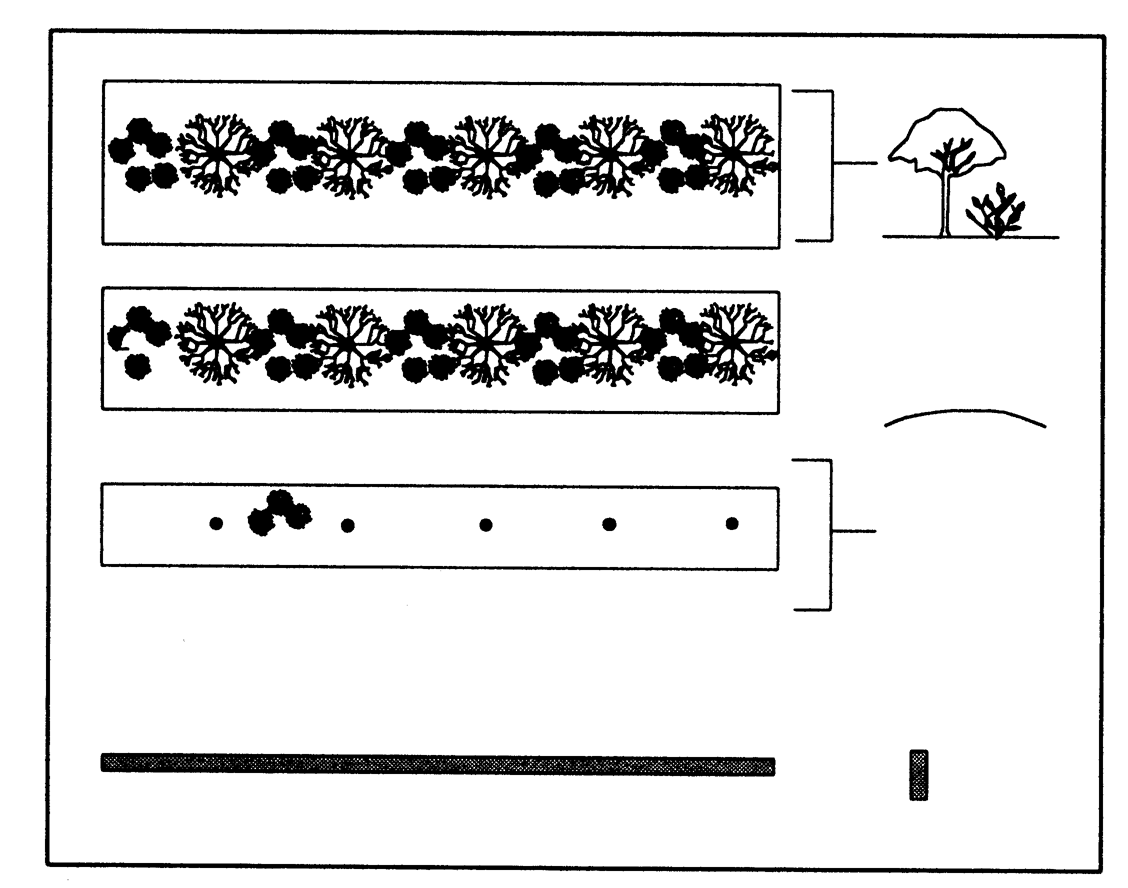
Optional Reductions of Bufferyards
A.
Alternative 1: Buffering requirements reduced by 25 percent:
1.
Minimum width may be reduced by 25 percent with inclusion of a landscaped earth berm in addition to the required number of planted shrubs, understory and canopy trees.
2.
Berms shall be constructed within the property boundary meeting the following requirements:
a.
Minimum height: Two feet.
b.
Minimum crown width: Two feet.
c.
Minimum slope: 2:1.
3.
Approval of berm design shall be required prior to buffer reduction approval.
4.
Berm shall have plantings consisting of ground covers such as shrubs, ivy, flowers, and grasses.
B.
Alternative 2: Buffering requirements reduced by 50 percent:
1.
Minimum width may be reduced by 50 percent or ten feet and required number of shrubs may be reduced by 40 percent per 100 linear feet with inclusion of a landscaped wall or fence.
2.
Wall standards:
a.
Minimum height: Six feet.
b.
Wall material: Wood, brick or masonry.
3.
Shrubs shall reach one-third of the height of the wall within three years.
C.
Alternative 3: Buffering requirements reduced by 60 percent:
1.
Minimum width may be reduced by 60 percent or 12 feet and required number of shrubs may be reduced by 40 percent per 100 linear feet with inclusion of a landscaped wall or fence, and a planted earth berm.
2.
Berms shall be constructed within the property boundaries meeting the following requirements:
a.
Minimum height: Two feet.
b.
Minimum crown width: Two feet.
c.
Minimum slope: 2:1.
3.
Approval of berm design shall be required prior to buffer reduction approval.
4.
Berm shall have plantings consisting of ground covers such as shrubs, ivy, flowers, and grasses.
5.
Wall standards:
a.
Minimum height: Six feet.
b.
Wall material: Wood, brick or masonry.
6.
Shrubs shall reach one-third of the height of the wall within three years.
D.
Alternative 4: Waiver or reduction of buffer requirements:
1.
Land use buffers shall be provided in accordance with the standards of this section, provided that the zoning administrator shall be authorized to modify or waive buffer requirements if it is determined that:
a.
Buffers will not serve any useful purpose due to the fact that fences, walls, berms, or landscaping of at least equivalent height, opacity, and maintenance already exist on the adjacent parcel.
b.
The area of required buffer would exceed 25 percent of the site proposed for development.
E.
Alternative buffer (mining only). When the adjacent property contains a vegetated strip equal to or exceeding the distance and vegetation quantity of the required mine site's buffer then the required bufferyard plant material may be reduced by 50 percent or the mechanical planting of evergreen trees may be substituted in lieu of the deciduous trees and shrubs provided:
1.
Loblolly Pines are planted on the site;
2.
Plant material must setback ten feet from the perimeter property line;
3.
Three rows of plant material spaced ten feet apart must be installed;
4.
Each tree must be planted in a staggered fashion ten feet on center.
(Ord. No. 07-07-43, 7-23-2007; Ord. No. 14-11-38, 11-24-2014)
17.8. - Retention of existing vegetation.
The existing natural landscape, especially plants, shrubs, and trees native to the area, shall be preserved to the extent reasonable and feasible. Vegetation and plant material that exists on a parcel prior to its development may be used to satisfy the landscaping standards of this section provided that it meets the size and location requirements of this ordinance. To this end, a tree survey shall be required for all areas of a parcel or development that will be used to satisfy the bufferyard requirements herein. Such survey shall show the location, species, and diameter of all existing protected and specimen trees within the required bufferyard.
It shall be unlawful to remove any protected or specimen tree within the bufferyard area without a permit. Violation of this section shall be a misdemeanor violation of the zoning ordinance, with each protected or specimen tree removed constituting a separate violation. In addition, the county may require replanting of unlawfully removed trees at a rate of three new trees of three-inch caliper or greater for each protected tree removed, and five new trees of three-inch caliper or greater for each specimen tree removed. Violation of the replanting requirement will result in a hold all review and approval of building permits, certificates of occupancy, and all future phases or development plans until the violation is rectified.
Indiscriminate clearing or stripping of other natural vegetation is also to be avoided. Existing vegetation to be removed or retained shall be reviewed as part of the site plan, building permit, or subdivision process by the zoning administrator. No landscaping may be removed before approval of the site plan, building permit, or preliminary subdivision review. The criteria to be applied by the zoning administrator as appropriate, are topographical constraints on design, drainage, ingress and egress, utilities and other factors reasonably related to health, safety and welfare of the public, the nature and quality of the landscaping installed to replace existing natural landscaping and such other factors as may be relevant and proper.
17.8.1.
If a required buffer is clear cut prior to submittal of a tree survey, and if there is no readily available way to determine how many protected and/or specimen trees were removed, for purposes of determining the penalties to be assessed, it shall be assumed that the number of such trees removed equals three times the number of trees, canopy and understory, that would otherwise be required to be planted in a buffer area, without optional reductions (see article 17 subitem 7.3, bufferyard standards), unless the bufferyard area started out void of vegetation (i.e. an agricultural field, meadow, etc.).
(Ord. No. 07-07-43, 7-23-2007)
17.9. - Landscape plans.
Buffers must be clearly indicated on submitted site plans for permit approval and are to be drawn to the same scale. Existing vegetation that will be protected and retained as part of the buffer must be included with all new proposed plantings within the buffer areas and identified on the required tree survey. Proposed plantings are to be drawn depicting maturity.
(Ord. No. 07-07-43, 7-23-2007)
17.10. - Miscellaneous requirements.
17.10.1.
Trees and shrubs shall be installed in accordance with the recommendations of the 2004 American Standard for Nursery Stock, as published by the American Nursery and Landscaping Association.
(Ord. No. 07-07-43, 7-23-2007)
17.11. - Financial guarantees.
17.11.1.
Recognizing that trees and shrubs have a higher survival rate when planted at certain recommended times of year, the county may issue building certificates of occupancy and/or land development approvals without requiring immediate installation of required landscaping/bufferyards. In such cases, the owner shall be required to submit a performance bond, cashier's check, letter of credit or other acceptable security with the county guaranteeing the completion of said improvements in compliance with the requirements herein. The security must be in a form and by an issuer acceptable to the county.
17.11.2.
The county shall have the right to refuse such security for any and/or required improvements and to require construction and installation thereof by the property owner.
17.11.3.
Where accepted by the county, the security shall:
A.
Empower the county to draw on funds on deposit in an institution of the developer's choice, or accept such funds for deposit to its own account.
B.
Be in an amount equal to 150 percent of the cost, as estimated by the landscape installation contractor and approved by the zoning administrator or his designee, of any improvements which have not been constructed in compliance with the requirements of this ordinance prior to the posting of said security and for which sufficient certification has been furnished.
C.
Provide the county the legal right to reasonably enter, unhindered, the property for purposes of installing said improvements in accordance with the approved landscaping plan, if the zoning administrator determines that the property owner has failed to satisfy the requirements of this ordinance. The county shall provide written notice to the property owner of intent to enter the property for purposes of installing the required improvements. Such notice shall be sent via certified mail, and postmarked not less than 15 days prior to such action.
(Ord. No. 07-07-43, 7-23-2007)
17.12. - Requirements for plantings and maintenance of bufferyard material.
Landscape materials installed in accordance with the requirements of this ordinance shall be healthy stock at time of installation, free from diseases or pests that may threaten the longevity of the plants. Further, all landscape beds shall be properly mulched and watered to promote healthy growth. Any shrub, tree, or other landscape material planted to satisfy the requirements of this ordinance shall be replaced within three months of determined clear cutting or in the event that the shrubs, trees, or landscape material within the bufferyard dies within three years of installation. Failure to install the correct number of trees or shrubs or failure to replace any dead landscape material as per this section shall be a misdemeanor violation of the zoning ordinance, with each shrub or tree constituting a separate violation.
(Ord. No. 07-07-43, 7-23-2007)
17.13. - Demarcation and protection of preserved trees.
Trees that are to be retained shall be clearly marked with surveyor's ribbon. In addition, a "do not disturb" perimeter shall be established around each such tree during all construction on the property. The perimeter shall consist of staking and surveyor's ribbon installed to correspond with the drip line of the tree, and shall serve to identify the area within which it is not permissible to operate or store construction equipment or materials, and/or perform any land disturbing activities.
(Ord. No. 07-07-43, 7-23-2007)
17.14. - Emergency situations.
If, for an emergency reason, a protected or specimen tree within a bufferyard must be removed, written notification must be sent to the zoning administrator at least five business days before the removal shall take place. The written notification must include the property location, type of tree(s), size of the tree(s) to be removed due to an emergency, and a detailed description of the emergency. If for an immediate emergency due to, but not limited to, earthquake, fire, flood, high winds, severe erosion, sinkhole, or other categorized natural disaster, the planning and zoning department must receive a phone call of notification. If no phone call could be made or the immediate emergency takes place after normal operating hours, a letter from a fire chief, sheriff, police chief, other public safety office, or county supervisor shall be submitted to the planning and zoning department within five business days of the event.
(Ord. No. 07-07-43, 7-23-2007)

