
Bessemer City City Zoning Code
CHAPTER 10
DEFINITIONS
10.1 - GENERAL DEFINITIONS
Definitions of terms, phrases and words used in this Code follows.
Abandoned. A use shall be considered abandoned when:
•
The use is discontinued for a continuous period of at least 180 days, other than in association with the settlement of an estate or for any cause that is seasonal in nature); or,
•
The premises are devoted to another use; or,
•
Failure to take all positive action to resume the nonconforming use with reasonable dispatch, including the failure to advertise the property for sale or for lease for a period of at least two years.
Abutting property(ies). A property that is adjacent to or having a common boundary with the subject site. For purposes of zoning map amendments (NCGS 160D-602), abutting properties include those properties that are separated by a street, railroad, or other transportation corridor.
Active construction. On-site activities such as installation, erection, fabrication, alteration, demolition or removal of structures, facilities, or additions that contribute directly to the completion of improvements contemplated or shown on construction plans.
Adjacent [property(ies)]. One or more lots or tracts that abut or touch and having a boundary, or portion thereof, which is contiguous to the lot in question. Such determination shall be made by extending the exterior lot lines of the lot in question to adjacent lots and/or adjacent roads, streams, easements, or rights-of-way. The term "adjacent" or "adjacent property" shall also mean "contiguous" or "contiguous property", "abutting" or "abutting property", "adjacent or adjacent property".
Adjoining [property(ies)]. See "Adjacent property".
Administrative decision. Decisions made in the implementation, administration, or enforcement of development regulations that involves the determination of facts and the application of objective standards set forth in this chapter or local government development regulations. These are sometimes referred to as "ministerial" decisions or "administrative determinations."
Administrative hearing. A proceeding to gather facts needed to make an administrative decision.
Administrator. A person, and/or their designee and any other officials, department heads, or staff that are designated by the city council for the administration of this Code.
Alley. A travel way that affords only a secondary means of access to an abutting property and is not intended for general traffic circulation.
Alteration. A change in the size, configuration, or location of a structure; or a change in the use of a structure or lot from a previously approved or legally existing size, configuration, location, or use.
Antenna. Any system of wires, poles, rods, or similar devices used for the transmission or reception of electromagnetic waves external to or attached to the exterior of any building.
Antenna, amateur radio. An antenna owned and utilized by an FCC-licensed amateur radio operator.
Apartment. A room or suite of rooms, with toilet and culinary accommodations, used or designed for use as a residence by a family and is located in a building that contains two or more such rooms or suites.
Appeal. An appeal to the board of adjustment where it is alleged that there is error in any order, requirement, decision, or determination made by the administrator in the enforcement of this Code.
Arterial, minor. A road so designated on the most recently adopted version of the Gaston Urban Area Thoroughfare Plan. Roads designated as "minor thoroughfares" shall also be classified as "minor arterials" for purposes of this Code.
Arterial, principal. A road so designated on the most recently adopted version of the Gaston Urban Area Thoroughfare Plan. Roads designated on the Cherryville Thoroughfare Plan as "major thoroughfares" shall also be classified as "principal arterials" for purposes of this Code.
Awning. A shelter projecting from and supported by the exterior wall of a building made of cloth, fabric, metal, plastic, or other non-rigid material on a supporting framework that may be raised or retracted from a building to a flat position against the building.
Figure 10-1 Awning Example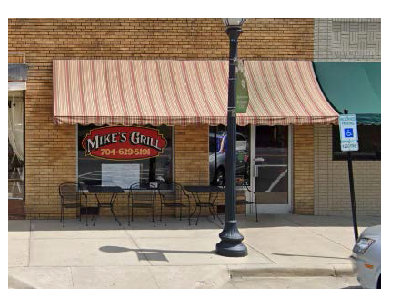
Banner. A sign intended to be hung either with or without a frame, possessing characters, letters, illustrations, or ornamentations applied to plastic or fabric of any kind, excluding flags and emblems of political, professional, religious, educational, or corporate organizations.
Bay window. A window or series of windows forming a bay or recess in a room and projecting outward from the wall.
Beacon. Any light with one or more beams directed into the atmosphere or directed at one or more points not on the same site as the light source; also, any light with one or more beams that rotate or move.
Bedroom. A fully enclosed interior room as shown on the building plan for the structure having, as a minimum, a doorway, window, and closet.
Berm. Any elongated earthen mound designed or constructed on a site to separate, screen or buffer adjacent land uses.
Bona fide farm purposes. Agricultural activities as set forth in G.S. 160D-903.
Building. Any structure used or intended for supporting or sheltering any use or occupancy.
Building, accessory. See "Structure, accessory".
Building elevation. The view of any building or other structure from any one of four sides showing features such as construction materials, design, height, dimensions, windows, doors, other architectural features, and the relationship of grade to floor level.
Building face. The dominant structural feature of the elevation of any side of a building. For example, the building face of a two-story dwelling unit with a one-story porch is the two-story elevation of the structure.
Figure 10-2 Building Face Diagram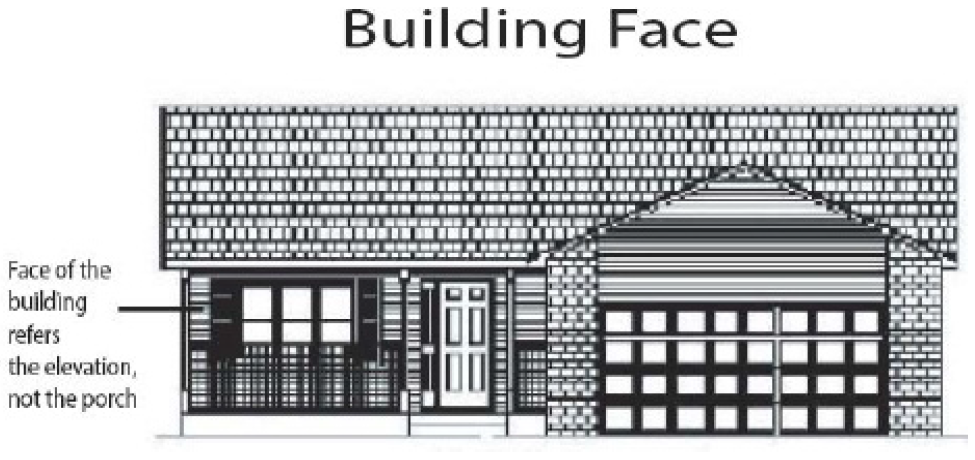
Building footprint. The outline of the total area of a lot or site that is surrounded by the exterior walls of a building or portion of a building, exclusive of courtyards. In the absence of surrounding exterior walls, the building footprint shall be the area under the horizontal projection of the roof.
Figure 10-3 Building Footprint Diagram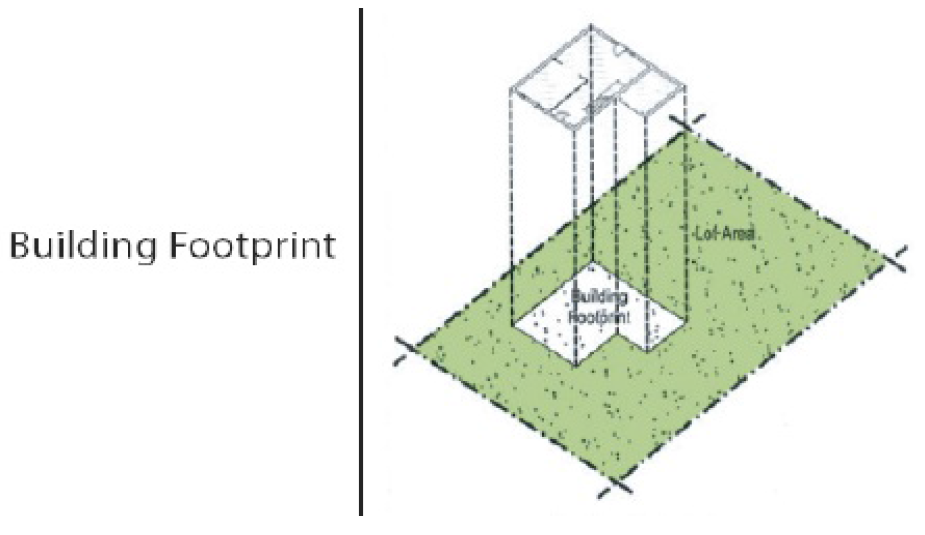
Building height. The vertical distance from the mean elevation of the finished grade along the front of the building to the highest point of a flat roof, a mansard roof, or a gable, hip, or gambrel roof. Roof appurtenances such as skylights; roof structures for elevators; stairways; tanks; heating, ventilating and air conditioning equipment; or similar operating and/or maintenance equipment shall be excluded from this measurement. In computing the height of a building, the height of a basement, if below the grade from which the height is measured, shall not be included.
Building setback line. A line establishing the minimum allowable distance between the nearest portion of any building (or any attached appurtenance thereof), and the nearest edge of the street right-of-way when measured perpendicular thereto.
Figure 10-4 Building Setback Line Diagram
Building permit. An official document issued by Gaston County pursuant to this Code and the state building code that authorizes the erection, construction, reconstruction, restoration, alteration, enlargement, conversion, remodeling, demolition, moving, or repair of a building or structure.
Building, principal. A building in which is conducted the principal use of the lot on which it is situated. A multi-occupant property may have more than one principal building.
Bulletin board. A board for posting notices that are designed to be read by pedestrians.
Figure 10-5 Bulletin Board Diagram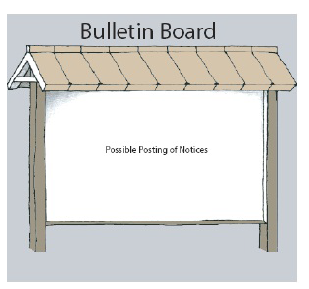
Caliper. A horticultural method of measuring the diameter of a tree trunk for the purpose of size grading. The caliper of the trunk is measured six inches above the ground for trees up to and including four inches in diameter, 12 inches above the ground for trees greater than four inches up to 12 inches in diameter, and at breast height (4.5 feet) for trees greater than 12 inches in diameter.
Canopy. A permanent a permanent, multi-sided structure, attached to a building or any other free-standing structure, that may have roof supports but no walls, for the purpose of providing shelter to patrons or automobiles, or as a decorative feature on a building wall. It shall not be considered an enclosure.
Figure 10-6 Canopy Example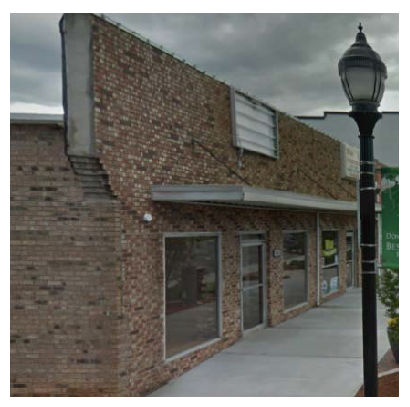
Certificate of compliance. A statement, signed by the administrator, setting forth that a building, structure, or use complies with this Code.
Certificate of occupancy. A document issued by the proper authority allowing the occupancy or use of a building and certifying that the structure or use has been constructed or will be used in compliance with all applicable building codes and regulations.
Changeable copy. The display area of a sign where characters, letters, or illustrations can be changed or rearranged without altering the face or surface of the sign.
Figure 10-7 Changeable Copy
Example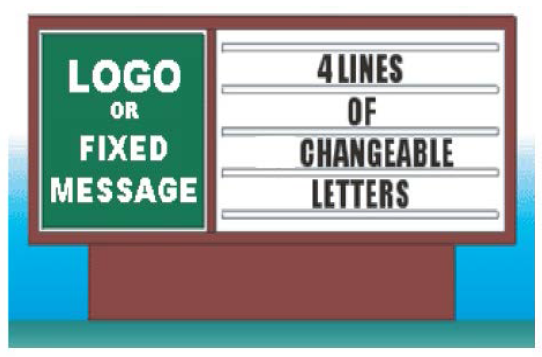
Charter. As defined in G.S. 160A-1(2).
City. As defined in G.S. 160A-1(2).
Co-location. The location of wireless telecommunication antennae or equipment from more than one provider on one common tower, building or cabinet.
Commercial message. Any sign, wording, logo, or other representation, that, directly or indirectly, names, advertises, or calls attention to a business, product, service, or other commercial activity.
Common open space. Land and/or water areas within the site designated for a particular development, not individually owned or dedicated for public use, which are designed and intended for the common use or enjoyment of the residents of the development but not including any lands occupied by streets, street rights-of-way, or off-street parking.
Common open space, improved. Common open space which has been improved with recreational areas and amenities such as, but not limited to, ballfields, tennis courts, swimming pools, nature trails, clubhouses, etc.
Comprehensive plan. Those plans and policies formally adopted by the city council, that includes policy statements, goals and objectives, maps, and statistical data for the physical and economic development of the community. This includes, but is not limited to, considerations from the Bessemer City Pedestrian Plan, Edgewood Road Gateway Plan, Small Area Plan for Downtown, and the Historic District Map.
Conditional zoning. A legislative zoning map amendment with site-specific conditions incorporated into the zoning map amendment.
Construction. The act of adding an addition to an existing building or structure, or the erection of a new principal or accessory building or structure on a lot; or the addition of walls, driveways, or parking lots, or the addition of appurtenances to a building or structure.
County. Any one of the counties listed in G.S. 153A-10.
Cul-de-sac. Any street having only one outlet for vehicular traffic.
Decision-making board. A governing board, planning board, board of adjustment, historic district board, or other board assigned to make quasi-judicial decisions.
Deck. A structure without a roof, either freestanding or attached to a building, which is supported by posts or pillars. A deck may be located on the rear or side of a building but is not located on the front of a building.
Figure 10-8 Deck Diagram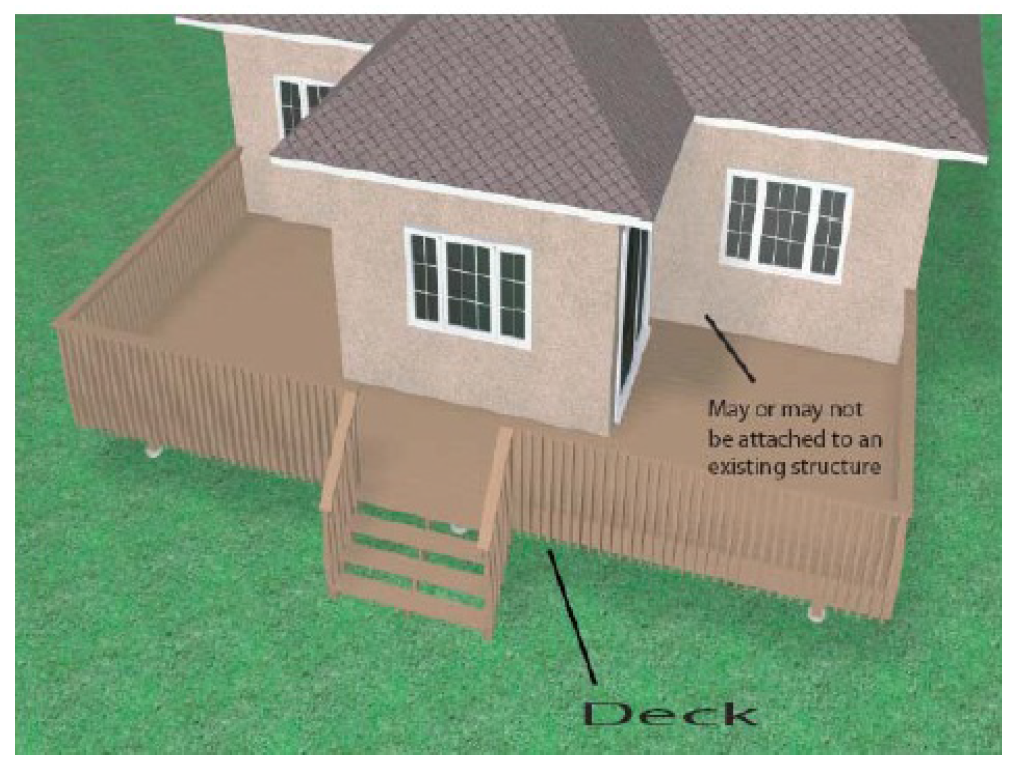
Density, gross. A ratio expressed as the number of dwelling units per gross acre. The ratio is derived by dividing the total number of dwelling units by the total land area of the parcel(s) to be developed.
Determination. A written, final, and binding order, requirement, or determination regarding an administrative decision.
Developer. A person, including a governmental agency or redevelopment authority, who intends to undertake any development and who is the landowner of the property to be developed or who has been authorized by the landowner to undertake development on that property.
Development. Unless the context clearly indicates otherwise, the term means:
•
The construction, erection, alteration, enlargement, renovation, substantial repair, movement to another site, or demolition of any structure;
•
Excavation, grading, filling, clearing, or alteration of land;
•
The subdivision of land as defined in G.S. 160D-802; or
•
The initiation or substantial change in the use of land or the intensity of use of land.
This definition does not alter the scope of regulatory authority granted by this Code.
Development approval. An administrative or quasi-judicial approval made pursuant to this Code that is written and that is required prior to commencing development or undertaking a specific activity, project, or development proposal. Development approvals include, but are not limited to, zoning permits, site plan approvals, special use permits, variances, and certificates of appropriateness. The term also includes all other regulatory approvals required by regulations adopted pursuant to his chapter, including plat approvals, permits issued, development agreements entered into, and building permits issued.
Development regulation. A Land Development Code, zoning regulation, subdivision regulation, erosion and sedimentation control regulation, floodplain or flood damage prevention regulation, mountain ridge protection regulation, stormwater control regulation, wireless telecommunication facility regulation, historic preservation or landmark regulation, housing code, state building code enforcement, or any other regulation adopted pursuant to the Bessemer City Code of Codes, or a local act or charter that regulates land use or development.
Diameter at breast height (DBH). The measurement of the diameter of a tree trunk over 12 inches in diameter taken at a height of four and one-half feet above the ground.
Display of goods, outdoors. The display and sale of products outside of a building or structure including garden supplies, clothing, toys, play equipment, agricultural products, building and landscape materials, food, and beverages.
Drive-in window. A window or other opening in the wall of a principal or accessory building through which goods or services are provided directly to customers in motor vehicles by means that eliminate the need for such customers to exit their motor vehicles.
Figure 10-9 Drive-In Window Diagram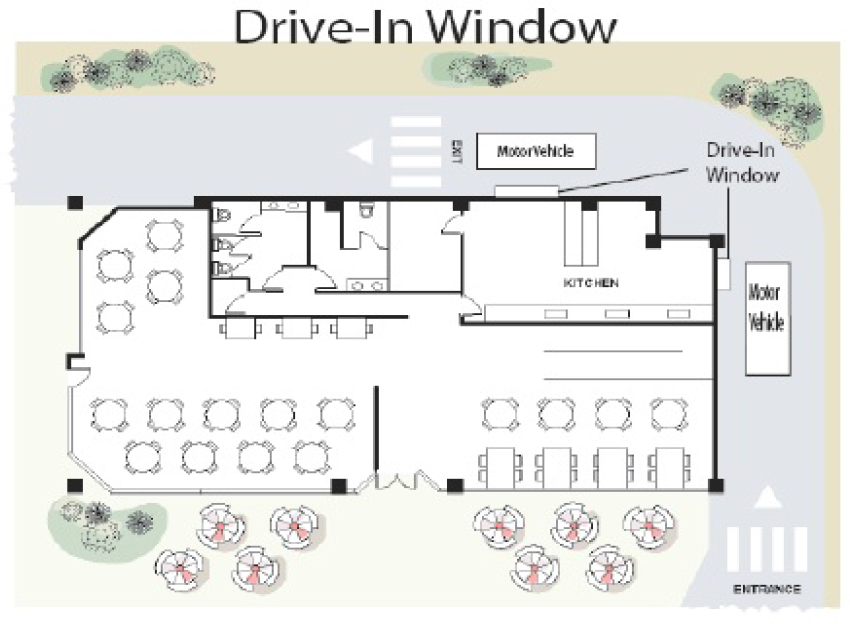
Driveway, front-loaded. A driveway that begins at, or abuts, the front yard line of the lot.
Figure 10-10 Front-Loaded Driveway Diagram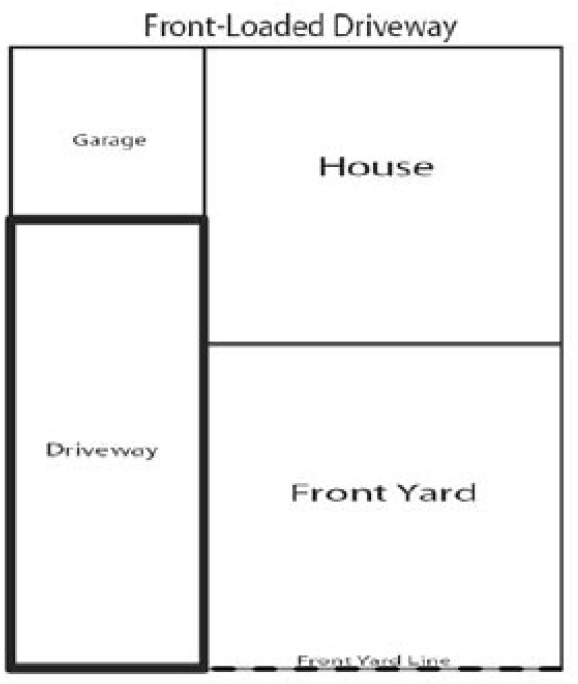
Dwelling. Any building, structure, manufactured home or mobile home, or part thereof, used and occupied for human habitation or intended to be so used, and includes any outhouses and appurtenances belonging thereto or usually enjoyed therewith, except that for purposes of Article 12 of GS 160D, it does not include any manufactured home, mobile home, or recreational vehicle, if used solely for a seasonal vacation purpose.
Dwelling unit. A single unit providing complete, independent living facilities for one or more persons, including permanent provisions for living, sleeping, eating, cooking and sanitation.
Dwelling, attached. A dwelling unit attached side-by-side to one or more other dwelling units by common vertical walls. Each dwelling unit shall be located on a separately deeded lot. Townhouses and duplexes are examples.
Dwelling, detached. A dwelling unit not attached to another dwelling unit that is developed with open yards on at least three sides.
Dwelling, manufactured home. A residential dwelling unit that: 1. Is not constructed in accordance with the standards set forth in the North Carolina State Building Code; 2. Is composed of one or more components, each of which was substantially assembled in a manufacturing plant and designed to be transported to the home site on its own chassis, and 3. Is at least 40 feet in length and eight feet in width. A manufactured home may also be referred to as a "mobile home".
Easement. A grant by a property owner to the public, a corporation, or other person or persons of the right to use an identifiable piece of land for specified purposes, such as for access or utilities, and which has been recorded in the Gaston County Register of Deeds Office.
Encroachment. The projection or intrusion of a building, structure, or other land-disturbing activity into an area where such projections are typically prohibited.
Engineer. A professional engineer licensed by the State of North Carolina.
Entrance, primary. An entrance or entrances leading from collector streets, major thoroughfares, arterials, or highways to subdivisions, multi-family uses, planned developments, industrial, commercial, or office and institutional subdivisions and developments.
Entrance, secondary. An entrance, or entrances, other than the primary entrance, leading from collector or local streets to subdivisions, multi-family uses, planned developments, industrial, commercial, or office and institutional subdivisions.
Essential services. Publicly or privately owned facilities or systems for the distribution of gas, electricity, steam, or water, the collection and disposal of sewage or refuse; the transmission of communications; or similar functions necessary for the provision of public services. The provision of public safety services (i.e., law enforcement, emergency medical services, rescue services, fire protection), governmental uses, and related services shall be included as an essential service as described in Essential Service, Class 4. Essential Services are divided into the following four classes as defined below.
Evidentiary hearing. A hearing to gather competent, material, and substantial evidence in order to make findings for a quasi-judicial decision required by this Code.
Extraterritorial jurisdiction (ETJ). The area adjacent to and beyond the municipal limits over which the municipality has been granted an exercise of municipal governmental powers, including but not limited to the power to regulate development, in accordance with North Carolina General Statutes, § 160D-202.
Façade. The exterior wall of a building exposed to public view or that wall viewed by persons who are not in such building.
Figure 10-11 Facade Diagram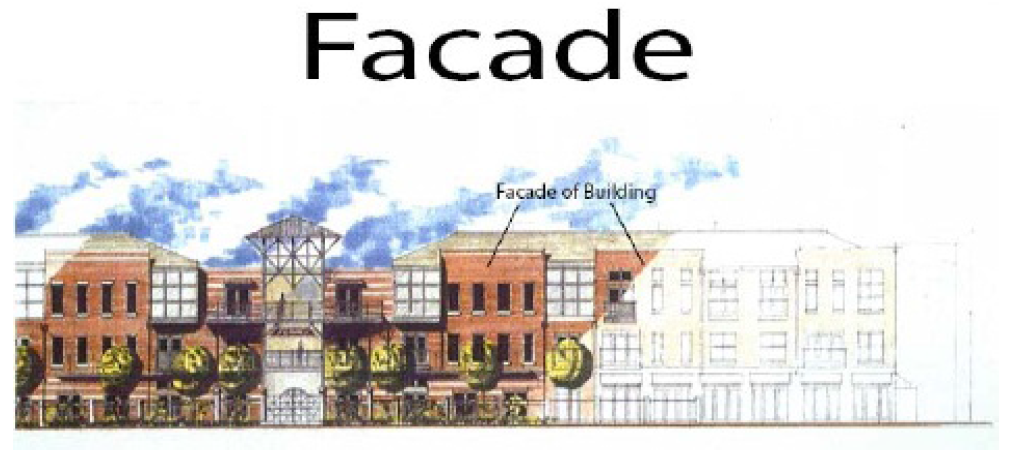
Façade, primary. Primary Façade means the exterior Façade or Façades of a structure or structures which contains a principal pedestrian entrance and is oriented towards a street.
Family. An individual, or two or more persons related by blood, marriage or adoption living together as a single housekeeping unit, exclusive of household servants; or a group of not more than six persons who need not be related by blood, marriage, or adoption living together as a single housekeeping unit.
Family burial ground. A privately owned, noncommercial graveyard created and maintained for the interment of family members of the property owner and restricted to such use.
Familial relationship. Spouse, parent, child, brother, sister, grandparent, or grandchild. The term includes the step, half, and in-law relationships.
Family member. Direct lineal descendants (children, grandchildren, and great grandchildren) and direct lineal ascendants (father, mother, grandfather, and grandmother); and brothers, sisters.
Fence. An exterior structure serving as an enclosure, barrier, or boundary made of materials commonly considered to be fence materials.
Fence, deer. A fence specifically designed to thwart the movement of deer and similar animals. Such fences are typically eight to ten feet in height and have an electrically charged wire on top.
Flag. A piece of durable fabric of distinctive design attached to a permanent pole that is used as a symbol or decorative feature.
Floor/area ratio. The gross floor area of all buildings and structures on a lot divided by the lot area. When computing this figure, the gross floor area of all enclosed parking deck buildings shall be excluded.
Figure 10-12 Floor Area Ratio Diagram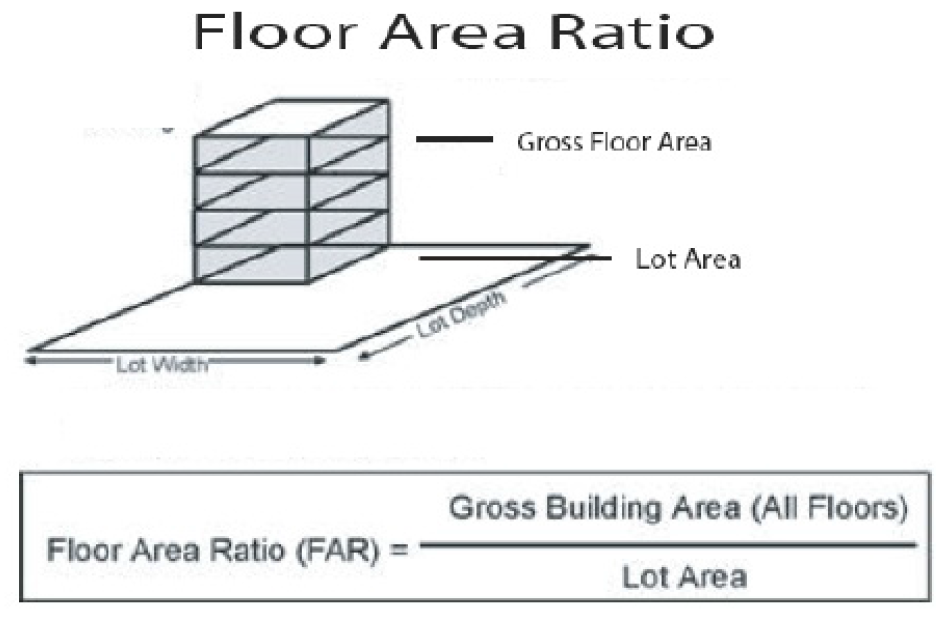
Fueling Pump. A fuel-dispensing pump, which may contain more than one fuel nozzle, designed to accommodate one or two vehicles at a time. If two vehicles are accommodated at the same time, fuel nozzles serving the two vehicles shall be located on opposite sides of the fuel pump.
Governing board. The city council. The term is inter-changeable with the terms "board of aldermen" and "boards of commissioners" and shall mean any governing board without regard to the terminology employed in charters, local acts, other portions of the General Statutes, or local customary usage.
Grade, finished. A reference plane representing the average of finished ground level adjoining the building at all exterior walls. When the finished ground level slopes away from the exterior walls, the reference plane shall be established by the lowest points within the area between the building and the lot line or between the building and a point six feet from the building and the lot line or between the building and a point six feet from the building, whichever is closer to the building.
Figure 10-13 Finished Grade Diagram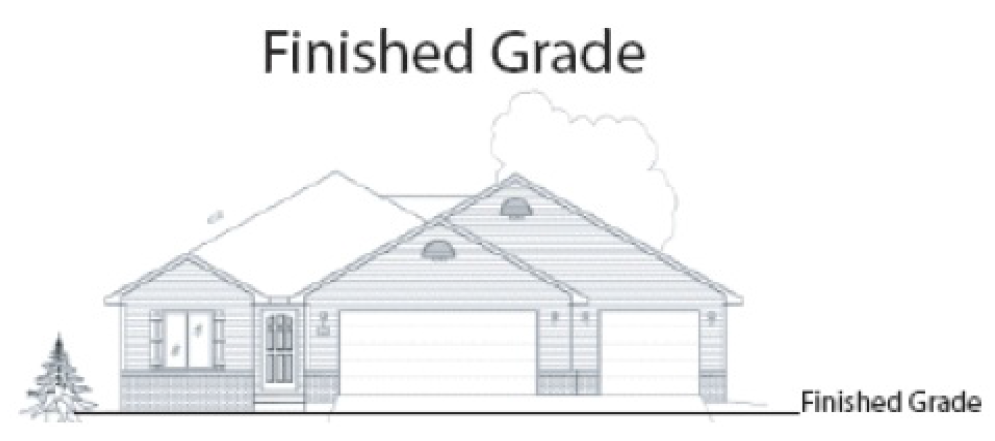
Grade, street. The height of the top of the curb, or if no curb exists, the height of the edge of pavement in the lane of travel adjacent to the side of the street at which the grade is being measured.
Gross floor area. The sum of the gross horizontal areas of each floor of a principal building, and any accessory building or structures measured from outside of the exterior walls or from the centerline of party walls. The term does not include any area used exclusively for the surface parking of motor vehicles or for building or equipment access, such as stairs, elevator shafts, and maintenance crawlspace. This term also excludes pedestrian walkways and common areas within enclosed shopping facilities.
Figure 10-14 Gross Floor Area Diagram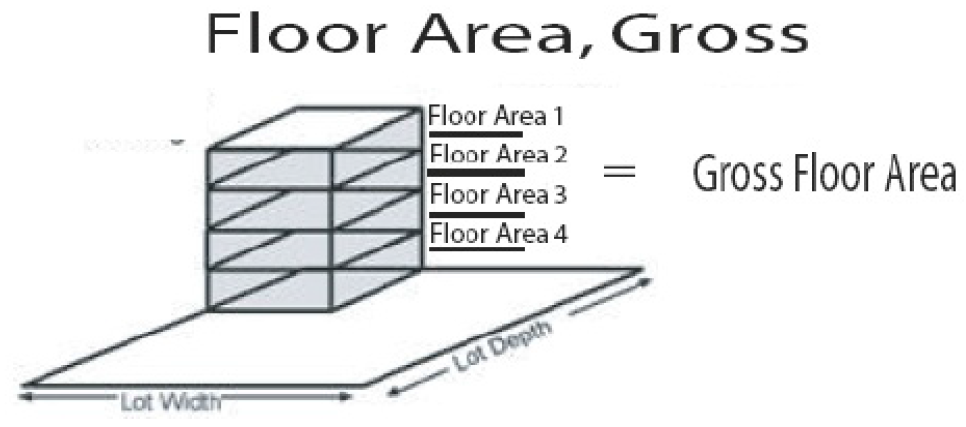
Ground cover. Low growing plants such as grasses, ivies, creeping bushes and similar decorative plantings. Where required by this Code, ground covers shall have the capability of soil stabilization and erosion control.
Handicapped person. A person with a physical or mental impairment which substantially limits one or more of such person's major life activities; a person with a record of having such an impairment; or a person who is regarded as having such an impairment. This term does not include current, illegal use of or addiction to a controlled substance as defined in 21 U.S.C. § 802.
Holiday decorations. Signs or displays including illumination which are a non-permanent installation celebrating national, state, and local holidays, religious or cultural holidays, or other holiday seasons. Illumination stall be static; no flashing, blinking, or strobing lights.
House, atrium. An attached or semi-attached one-story house on a small lot, said lot having a small yard space that is surrounded by the house and its privacy walls. As distinguished from a "patio house," an atrium house usually has a smaller lot size and is always attached (to another unit) in some fashion.
House, lot line. A single-family detached dwelling unit that is placed against one of the side lot lines. Such dwelling unit has a front and rear yard but only one side yard.
House, patio. A single-family dwelling on a separate lot with open space on three sides on that lot.
HVAC equipment. External heating, ventilation, air conditioning, and other mechanical and utility equipment, including but not limited to, hoses, pipes, vents, fans, compressors, pumps, and heating and cooling units associated with buildings and accessory structures.
Figure 10-15 HVAC Equipment Diagram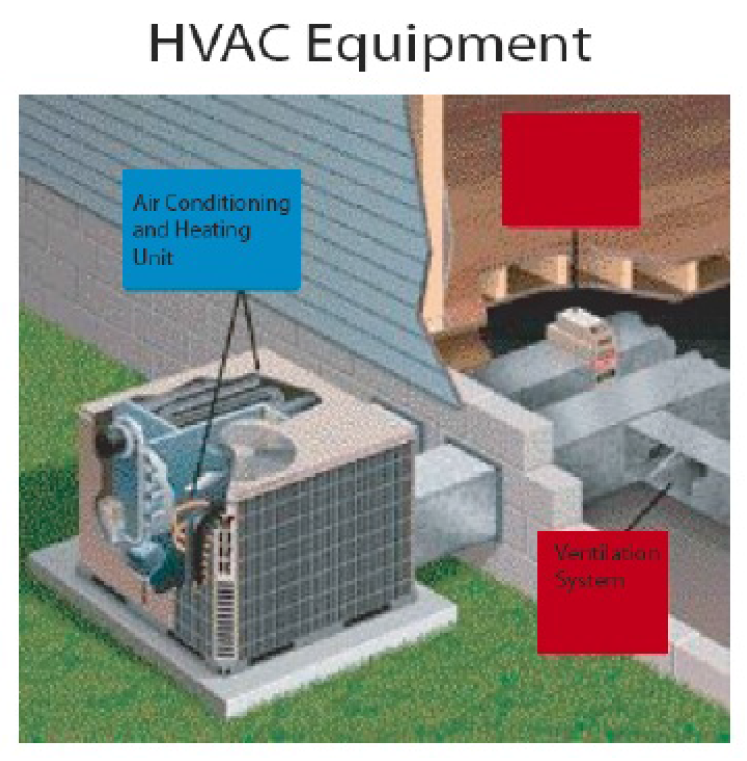
Innovative projects. Development projects that, by their proposed mixture of uses and/or layout, require mutual planning between the city and the developer to ensure project feasibility and compatibility with surrounding uses.
Impervious surface. Any material that reduces and prevents absorption of storm water into previously undeveloped land. This includes but is not limited to, buildings, roads, pavement, gravel surfaces, etc. Items not considered to be "impervious" include the water area of a swimming pool and wooden slatted decks.
Impervious surface ratio. The gross area of all impervious surfaces on a lot divided by the lot area.
Land-disturbing activity. Any use of the land by any person for residential, industrial, educational, institutional, or commercial development, or for highway and road construction and maintenance, that results in a change in the natural cover or topography and that may cause or contribute to sedimentation. Within watershed management areas, land-disturbing activity shall include the clear cutting of trees unless specifically exempted by this Code.
Landowner. Any owner of a legal or equitable interest in real property, including the heirs, devisees, successors, assigns, and agent or personal representative of the owner. The person shown on the records of the Gaston County Register of Deeds shall be presumed to be the person in control of the property.
Leasable area, gross. The total floor area for which a tenant pays rent and which is designed for the tenant's occupancy and exclusive use.
Legislative decision. The adoption, amendment, or repeal of a regulation under this chapter or an applicable local act. It also includes the decision to approve, amend, or rescind a development agreement consistent with the provisions of Article 10 of the N.C.G.S Chapter 160D.
Legislative hearing. A hearing to solicit public comment on a proposed legislative decision.
Local Act. As defined in G.S. 160A-1(5).
Local government. A city or county.
Logo. The graphic or pictorial presentation of a message, including, but not limited to, the use of shapes, designs, decorations, emblems, trademarks, symbols, or illustrations, or the superimposition of letters or numbers or any other use of graphics or images other than the sequential use of letters and numbers.
Figure 10-16 Logo Diagram
Lot. A parcel of land whose boundaries have been established by some legal instrument such as a recorded deed or a recorded map and which is recognized as a separate legal entity for purposes of transfer of title.
Figure 10-17 Lot Types Diagram
Lot area. The total area circumscribed by the boundaries of a lot, except that: (i) when the legal instrument creating a lot shows the boundary of the lot extending into a public street right-of-way, then the lot boundary for purposes of computing the lot area shall be the street right-of-way line, or (ii) if the right-of-way line cannot be determined, a line running parallel to and 30 feet from the center of the traveled portion of the street shall be used to calculate the area.
Lot line. A line of record bounding a lot that separates one lot from another lot or separates that lot from a public or private street or any other public space.
Figure 10-18 Lot Line Diagram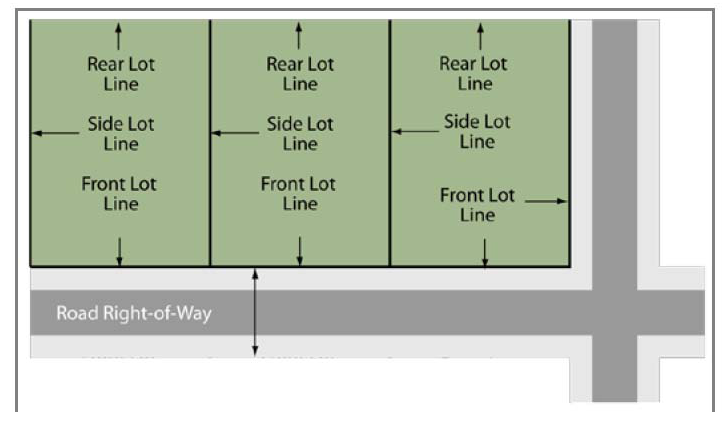
Lot line, front. The lot line that separates a lot from a street right-of-way.
Lot line, interior. A lot line that does not have street frontage.
Lot line, rear. The lot line opposite and most distant from the front lot line.
Lot line, side. Any lot line abutting another lot and which is not a front or rear lot line.
Lot of record. A lot or combination of contiguous lots described pursuant to the most current plat or metes and bounds description or descriptions recorded in the office of the Gaston County Register of Deeds.
Lot width. The horizontal distance between side lot lines at the front building line measured parallel with the front lot line.
Figure 10-19 Lot Width Diagram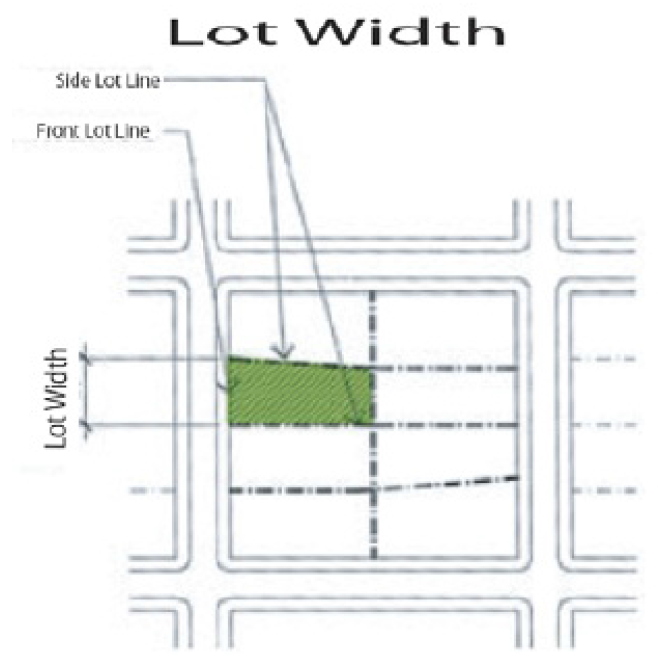
Lot, corner. A lot which occupies the interior angle at the intersection of two street lines which make an angle of more than 45 degrees and less than 135 degrees with each other. The street line forming the least frontage shall be deemed the front of the lot.
Lot, interior. A lot other than a corner lot.
Lot, nonconforming. Any lot of record which does not meet the minimum yard or area requirements established in these regulations at the time of this Code's adoption or any amendment thereto.
Lot, through. A lot that fronts upon two parallel streets, or that fronts upon two streets that do not intersect at the boundaries of the street.
Manufactured goods. Manufacturing, refining, processing, or assembly of goods or products or goods.
Mobile home. See "Dwelling, manufactured home".
Modular home. A dwelling unit constructed in accordance with the standards set forth in the North Carolina Building Code (uniform residential code for one and two-family dwellings) and composed of components substantially assembled in a manufacturing plant and transported to the building site for final assembly on a permanent foundation. A "modular home", as herein defined, shall be deemed to be a single-family dwelling for purposes of this Code.
Nonconformity. Any use, building, structure, lot, or sign that was lawful at the time it was constructed or established but which fails to comply with one or more of the applicable regulations or standards of this Code.
Non-commercial copy. A sign message through pictures, illustrations, symbols and/or words, or any combination thereof, which does not contain any reference to a business or product but displays a substantive message, statement or expression that is protected by the First Amendment to the Constitution of the United States.
Organic waste. Materials that are primarily composed of yard trimmings, wood waste, dead trees and other dead vegetation, Christmas trees, wood pallets, land clearing debris and other similar materials.
Outparcel. A lot located within a planned multi-tenant development that does not have direct access from a public road abutting the development. Said lot may contain no more than one principal use and the outparcel lot may be exempt from the yard and bulk requirements of the underlying zoning district.
Figure 10-20 Outparcel Diagram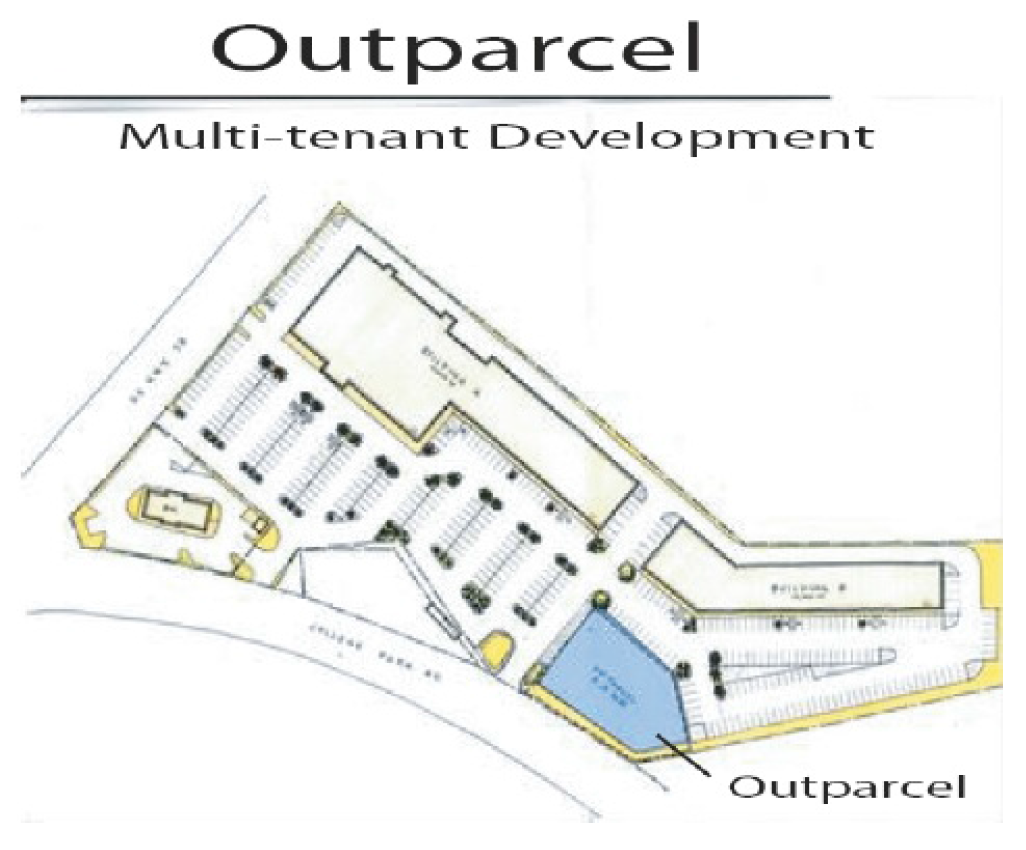
Parapet. That portion of a building wall or false front that extends above the roofline.
Parking bay. A parking module consisting of one or more sets of one or two rows of parking spaces and the aisle from which motor vehicles enter and leave.
Figure 10-21 Parking Bays Diagram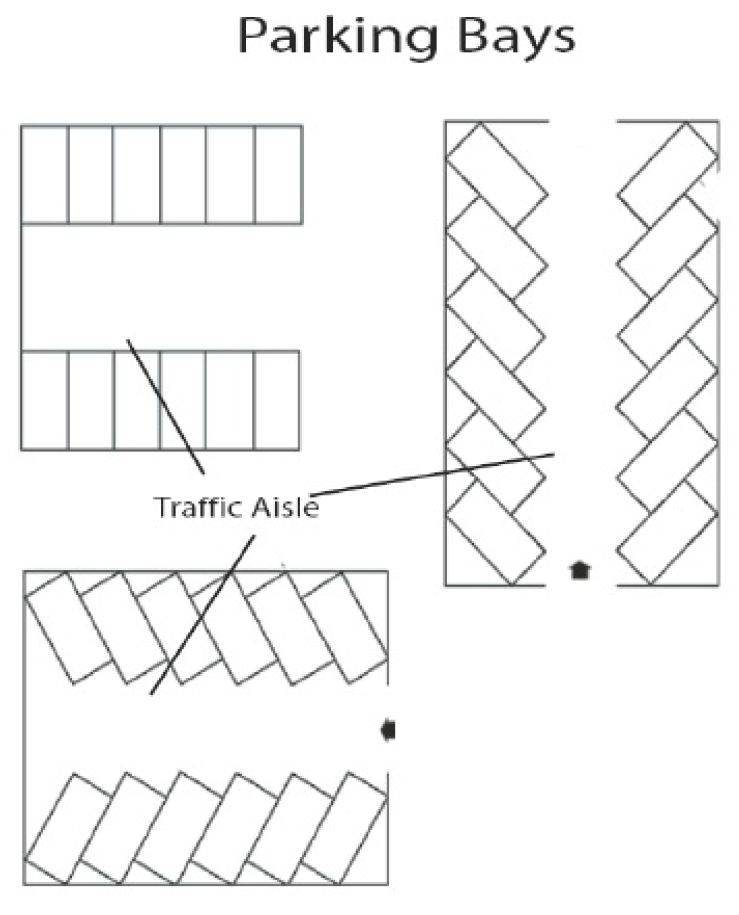
Parking deck. A building designed and used for the storage of motor vehicles and which may contain retail or office uses on its ground floor.
Parking facility, overflow. An off-street parking area intended for the storage of vehicles for special, athletic, or other occasional events. Such a facility is not typically used more than ten times a year.
Parking space, off-street. An area located outside of any street right-of-way that is designed to accommodate the parking of vehicles.
Pennant. Any lightweight plastic, fabric, or other material, whether or not containing a message of any kind, which is suspended from a rope, wire, string, or pole, usually in series, and which is designed to move in the wind.
Figure 10-22 Pennant Diagram
Permit, zoning. A document issued by the administrator that is required before commencing any construction, reconstruction, alteration, conversion or installation of a building or structure or before establishing, extending, or changing any use on any lot.
Person. An individual, partnership, firm, association, joint venture, public or private corporation, trust, estate, commission, board, public or private institution, utility, cooperative, interstate body, the State of North Carolina and its agencies and political subdivisions, or other legal entity.
Planning and development regulation jurisdiction. The geographic area within which the city may undertake planning and apply the development regulations authorized by this Code.
Planning board. Any board or commission established pursuant to G.S. 160D-301.
Plat. A map or plan of a parcel of land that is to be or has been subdivided showing such subdivision. A plat for a subdivision occurring after the effective date of this Code shall be recorded with the Gaston County Register of Deeds office and shall contain all information herein required.
Plaza. A paved area surrounded by buildings or streets and located in such manner so as to be accessible by pedestrians. Such area is improved with benches, ornamental and/or drinking fountains, works of art, etc. Part of the plaza may contain a grassed area.
Playground. A smaller-sized area developed with facilities primarily for children that may include benches, slides, play equipment, walk trails, etc. As opposed to a "park", a playground is usually smaller and does not contain athletic fields.
Porch. A projection from an outside wall of a dwelling which is covered by a roof and/or sidewalls (other than the sides of the building to which the porch is attached) for the purpose of providing shade or shelter from the elements.
Premises. A parcel of real property with a separate and distinct number or designation shown on a recorded plat, record of survey, parcel map or subdivision map. When a lot is used together with one or more contiguous lots for a single use or planned development, all of the lots so used, including any lots used for off-street parking, shall be considered single premises for purposes of these regulations.
Private residential quarters. An accessory dwelling either attached or part of the principal residential use or separate from the principal use in the form of a guest house or garage apartment provided that such dwelling is not rented or occupied for gain and provided that no accessory building containing such use is constructed on a lot until the construction of the principal dwelling has commenced. The principal dwelling on the lot containing the private residential quarters shall be owner-occupied.
Property. All real property subject to land-use regulation by a local government and includes any improvements or structures customarily regarded as a part of real property.
Quasi-judicial decision. A decision involving the finding of facts regarding a specific application of a development regulation and that requires the exercise of discretion when applying the standards of the regulation. The term includes, but is not limited to, decisions involving variances, special use permits, certificates of appropriateness, and appeals of administrative determinations. Decisions on the approval of subdivision plats and site plans are quasi-judicial in nature if the regulation authorizes a decision-making board to approve or deny the application based not only upon whether the application complies with the specific requirements set forth in the regulation, but also on whether the application complies with one or more generally stated standards requiring a discretionary decision on the findings to be made by the decision-making board.
Recreation, active. Recreation requiring some constructed facilities and organized activities.
Recreational vehicle. See "Vehicle, recreational".
Right-of-way. An area owned or maintained by the City of Bessemer City or the State of North Carolina, a public utility, a railroad, or a private concern for the placement of such utilities and/or facilities for the passage of vehicles or pedestrians, including roads, pedestrian walkways, utilities, or railroads.
Road, frontage. A road that is in close proximity to and parallels a limited access road and is designed to provide access to roads that abut said limited access road.
Road, private. Any right-of-way used for purposes of motor vehicle travel that has not been accepted for maintenance or ownership purposes by a public entity.
Road, public. Any right-of-way not less than 30 feet in width set aside for public travel and either which has been accepted for maintenance by the State of North Carolina or Bessemer City, has been established as a public road prior to the date of adoption of this Code, or which has been dedicated to the State of North Carolina or Bessemer City for public travel by the recordation of a plat of a subdivision with the Gaston County Register of Deeds Office.
Satellite dish. An apparatus capable of receiving a communications signal from a transmitter relay located in planetary orbit.
Setback. A minimum distance specified for the various zoning districts measured inward from a property line that shall remain unoccupied and unobstructed upward except as may be permitted elsewhere in this Code.
Figure 10-23 Setback Diagram
Setback line. See "Building setback line".
Setback, front. That portion of the front yard that shall remain unoccupied and unobstructed from the ground upward except as may be permitted elsewhere in this Code.
Setback, rear. That portion of the rear yard that shall remain unoccupied and unobstructed from the ground upward except as may be permitted elsewhere in this Code.
Setback, side. That portion of the side yard that shall remain unoccupied and unobstructed from the ground upward except as may be permitted elsewhere in this Code.
Shrub. An ornamental plant that is at least two feet tall above the highest root at the time of planting.
Sight triangle. The horizontal and vertical areas at the intersections of streets and/or driveways which must remain unobstructed, in order to ensure that drivers can see traffic and pedestrians around the corner of the intersection, entrance or driveway.
Sign. Any device, structure, fixture, painting, emblem, or visual that uses words, graphics, colors, illumination, symbols, numbers, or letters for the purpose of communicating a message. A sign includes all poles, frames, and other supports upon which such display is made.
Sign, abandoned. A sign which has not identified or advertised a current business, service, owner, product, or activity for a period of at least 180 days.
Sign face. The portion of the sign used for display of sign copy including all background area, pictures, and any other advertising devices shown in the sign. Excluded from this definition are the sign frame and supports.
Sign, awning. A sign located on an awning.
Sign, building marker. Any sign indicating the name of a building and date and incidental information about its construction. Such sign is typically cut into a masonry surface or made of bronze or other permanent material.
Sign, changeable copy. Any sign designed so that letters or numbers attached to the sign can be periodically changed to indicate a different message.
Sign copy. Any combination of letters, numbers or other graphical representation that is intended to inform, direct, or otherwise transmit information.
Sign, directional. A sign fronting on a road containing only the name of the principal use, insignia, trademark, directional arrow and/or distance to the principal use. Such use shall not be visible to the motorist at the location at which the sign is placed.
Figure 10-24 Directional Sign Diagram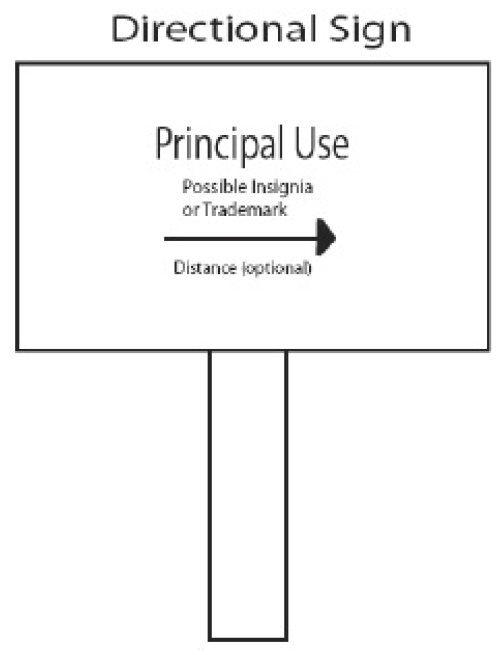
Sign, directory. A ground or building sign that lists tenants or occupants of a building or project, with unit numbers, arrows, or other directional information.
Figure 10-25 Directory Sign Example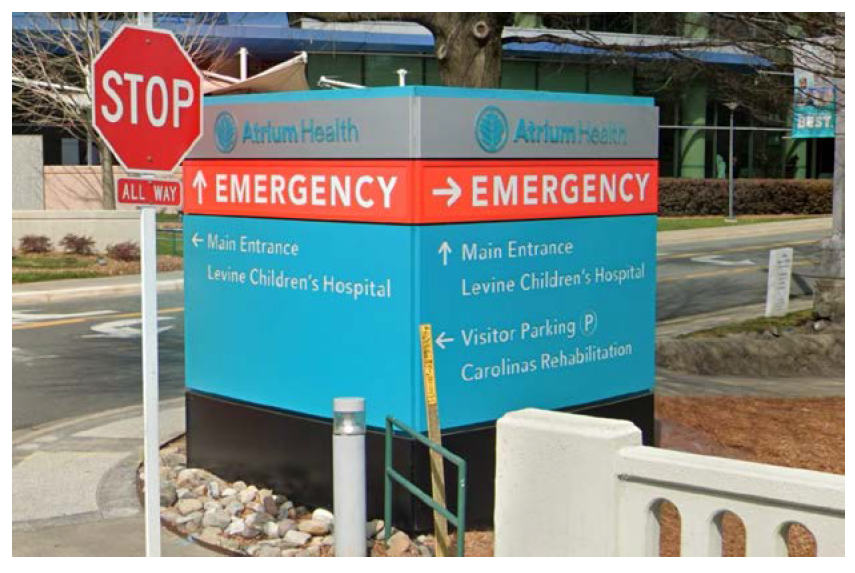
Sign, flashing. A sign, the illumination of which is not constant in intensity when in use, and that exhibits sudden or marked changes in lighting effects.
Sign, government. A sign, usually erected and maintained by a public agency, that provides the public with information and in no way relates to a business, commercial activity, or specific use. Examples include, but are not limited to, speed limit signs, city limits signs, stop signs and street name signs.
Sign, ground. Any sign which extends from the ground or which has supports which places the bottom thereof less than two feet from the ground directly beneath the sign. A "monument" sign shall be considered to be a "ground sign."
Figure 10-26 Graound Sign
Diagram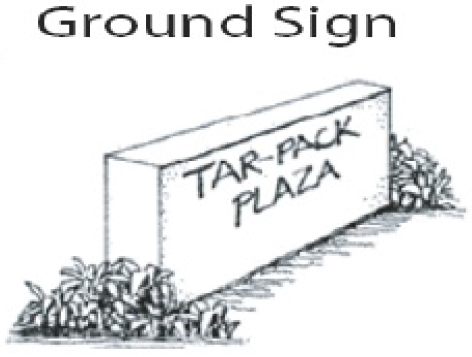
Sign, identification. A sign bearing the address of the premises or name of occupant but containing no logo or commercial message.
Sign, incidental. A sign, generally informational, that has a purpose secondary to the use of the site on which it is located, displayed for the direction and convenience of the public (Examples: "no parking," "entrance," "loading only," "telephone," and other similar information and directives). No sign with a commercial message legible from a position off the site on which the sign is located shall be considered an "incidental sign."
Figure 10-27 Incidental Sign
Examples
Sign illumination. A source of any artificial or reflected light, either directly from a source of light incorporated in, or indirectly from an artificial source.
•
External illumination: Artificial light, located away from the sign, which lights the sign, the source of which may or may not be visible to persons viewing the sign from any street, sidewalk, or adjacent property.
•
Internal illumination: A light source that is concealed or contained within the sign and becomes visible in darkness through a translucent surface. Message center signs, digital displays, and signs incorporating neon lighting shall not be considered internal illumination for the purposes of this Code.
•
Back-lit illumination: A sign using a 3-dimensional message, logo, etc., which is lit in such a way as to produce a halo effect.
Sign, Light Emitting Diode (LED). A sign using light emitting diode technology that is designed to project an advertising display that is controlled via the use of a computer or similar type equipment. Such sign may emit messages that are either scrolled or static.
Sign, mailbox. The writing, text, representation, graphic, emblem, or other display, together with any material or color forming an integral part of the background of the display that is placed on or is in any way affixed to a mailbox used for the purposes of official mail delivery to a lot.
Sign, menu board. An accessory sign providing items and prices associated with a drive-through window.
Sign, monument. See "Sign, ground".
Sign, non-commercial copy. A sign, other than a "political sign" that contains a message through pictures, illustrations, symbols and/or words, or any combination thereof, which does not contain any reference to a business or product but displays a substantive message, statement or expression that is protected by the First Amendment to the Constitution of the United States.
Sign, nonconforming. A sign that, on the effective date of this Code or the date of any subsequent amendment thereto, does not conform to one or more of the regulations set forth in this Code.
Sign, off-premises advertising. A sign, other than a "directional sign", "real estate sign", "political sign", "non-commercial copy sign" or other sign specially allowed by this Code to be placed off-premises, that draws attention to or communicates information about a business, service, or commodity that exists or is conducted, sold, offered, maintained, or provided at a location other than the premises where the sign is located. An "off-premises advertising sign" may also be referred to as a "billboard."
Figure 10-28 Off-Premises Advertising Sign Example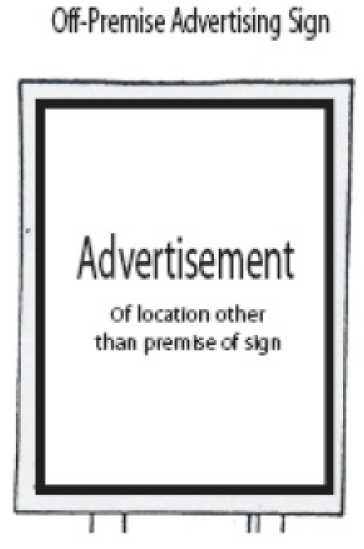
Sign, pole. A detached sign erected and maintained on a freestanding frame, mast, or pole and not attached to any building but not including ground-mounted or monument signs. The bottom of such signs shall be greater than two feet from the ground directly beneath the sign.
Figure 10-29 Pole Sign Example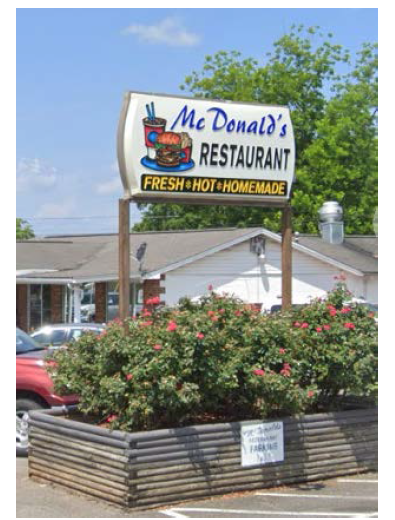
Sign, political. A temporary sign that consists of a poster, placard, board, banner, or other similar medium that contains a message related to a candidate running for office or a ballot issue, and which contains no commercial message.
Sign, portable. Any sign not permanently attached to the ground or other permanent structure, nor specifically constructed for such attachment; or a sign designed to be transported, including but not limited to the following: signs designed to be transported by means of wheels; signs converted to A- or T-frames; gas- or hot-air-filled balloons.
Figure 10-30 Portable Sign
Examples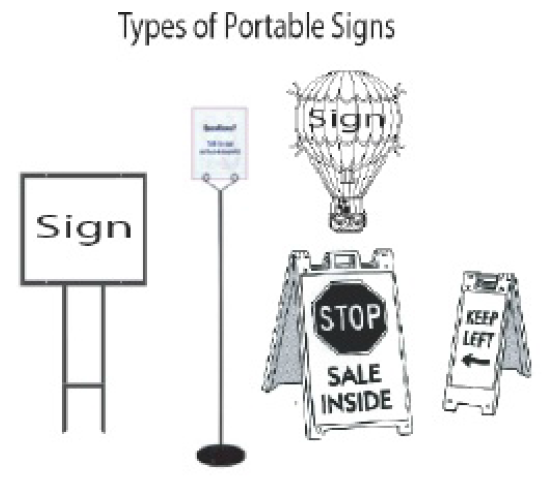
Sign, projecting. Any sign other than a wall, awning, canopy, or marquee sign, which is affixed to a building and is supported only by the wall on which the sign is mounted.
Figure 10-31 Projecting Sign
Diagram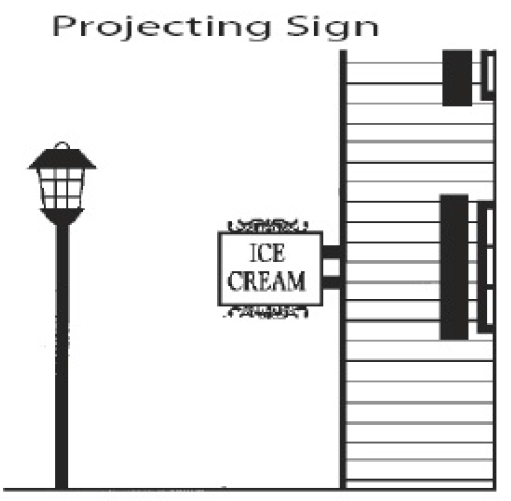
Sign, real estate. A sign that is used to offer for sale, lease, or rent the premises upon which such sign is placed.
Sign, roof. A sign erected or maintained in whole or in part upon or over the roof or parapet of a building.
Figure 10-32 Roof Sign Examples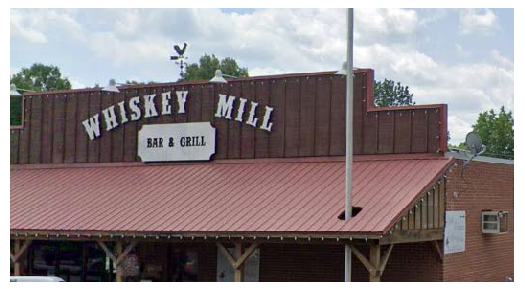
Sign, rotating. A sign that revolves or turns or has external sign elements that revolve or turn. Such signs may be power-driven or be propelled by the force of wind or air.
Sign, sandwich board. A temporary A-frame sign, not secured or attached to the ground or any building or structure, composed of a sign panel and supporting structure or one or more panels that form both the structure and sign face, and that is intended to be placed in a sidewalk or pedestrian way.
Figure 10-33 Sandwich Board Sign Diagram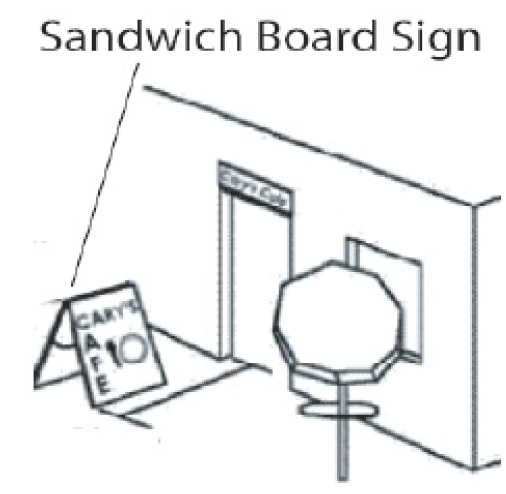
Sign, subdivision identification. A sign that gives the name of a residential or non-residential subdivision or multi-family development.
Sign, suspended. A sign that is suspended from the underside of a horizontal plane surface and supported by such surface.
Figure 10-34 Suspended Sign Diagram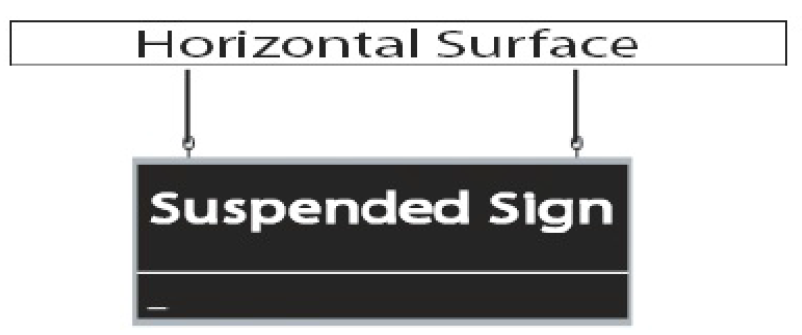
Sign, wall. Any sign directly attached to an exterior wall of a building or dependent upon a building for its support with its exposed face parallel or approximately parallel to the plane of the building or structure on which the sign is affixed. Signs directly painted on walls shall be considered wall signs.
Site plan. A scaled drawing and supporting text showing the relationship between lot lines and the existing or proposed uses, buildings, or structures on the lot. The site plan may include, but is not limited to, site-specific details such as building areas, building height and floor area, setbacks from lot lines and street rights-of-way, intensities, densities, utility lines and locations, parking, access points, roads, and stormwater control facilities, that are depicted to show compliance with all legally required development regulations that are applicable to the project and the site plan review. A site plan approval based solely upon application of objective standards is an administrative decision and a site plan approval based in whole or in part upon the application of standards involving judgment and discretion is a quasi-judicial decision. A site plan may also be approved as part of a conditional zoning decision.
Site plan, major. A site plan which involves the development of 100,000 square feet or more of building area.
Site plan, minor. A site plan which involves the development of less than 100,000 square feet of building area.
Site specific development plan. A dimensioned presentation of the proposed development of a specified parcel of land that reflects thereon the location of buildings, easements, parking arrangements, public access, street pattern and other similar features.
Site specific vesting plan. A plan submitted to a local government in which the applicant requests vesting pursuant to N.C.G.S. 160D-108.1, describing with reasonable certainty on the plan the type and intensity of use for a specific parcel or parcels of property.
Sleeping unit. A room or space in which people sleep, which can also include permanent provisions for living, eating, and either sanitation or kitchen facilities but not both. Such rooms and spaces that are also part of a dwelling unit are not sleeping units.
Slope. Degree of deviation of a surface from the horizontal that is measured as a numerical ratio or percent. Expressed as a ratio, the first number is the horizontal distance (run) and the second is the vertical distance (rise), e.g., 2:1. Slope can also be expressed as the rise over the run when used in building applications when referencing roof pitches, e.g., 6:12.
Special event. Any organized event, specifically including, but not limited to, a circus, carnival, cultural event, fair, party, communal camping, or celebration, which may reasonably be expected to increase the risk of: (1) Damage to public or private property, beyond normal wear and tear; (2) Injury to persons; (3) Public or private disturbances or nuisances;(4) Unsafe impediments or distractions to, or congestion of, vehicular or pedestrian travel; (5) Significant additional police, fire, trash removal, maintenance, or other public services demands; or (6) Other significant adverse effects upon the public health, safety, or welfare. The term "special event" shall not include any organized activities conducted at sites and facilities that are legal uses and structures under this Code and that are typically intended and used for such activities. Examples of such activities include, but are not necessarily limited to, sporting events such as 10K runs not held on public rights-of-way, golf, soccer, softball, and baseball tournaments conducted on courses or fields intended and used for such activities; wedding services conducted at reception halls; funeral services; religious services; or noncommercial activities occurring within, or upon the grounds of, a private residence or upon the common areas of a multi-family residential development.
Special use permit. A permit issued to authorize development or land uses in a particular zoning district upon presentation of competent, material, and substantial evidence establishing compliance with one or more general standards requiring that judgment and discretion be exercised as well as compliance with specific standards. This definition includes permits previously referred to as "conditional use permits" or "special exceptions."
Square. An open space area that is surrounded by streets and/or buildings, that is accessible by the pedestrian, and that includes walks, lawns, and trees. As opposed to a "plaza", a "square" consists primarily of landscaped and natural areas.
Staging space. An area of temporary standing storage for one automobile awaiting drive-in service or commodity pickup.
Story, building. That portion of a building included between the surface of any floor and the surface of the floor next above, except that the topmost story shall be that portion of a building included between the surface of the topmost floor and the ceiling or roof above.
Street, center line. The line surveyed and monumented as the center line of the street; or, if such center line has not been surveyed, it shall be the line running midway between the curbs or ditches of such street.
Street, collector. A roadway that, while providing access to abutting land parcels, enables moderate volumes of traffic to move efficiently between local streets and the major street network.
Street, marginal access. A street which is parallel to and adjacent to a principal or minor arterial and which provides access to abutting properties and protection from through traffic.
Street, residential. An improved street predominantly used to provide access to abutting residential properties.
Street right-of-way. An area of land occupied or intended to be occupied by a public street, for such purpose, areas claimed by a municipality or the State of North Carolina for such purposes, or actually used for such purposes.
Structure. A combination of materials to form a construction for use, occupancy, or ornamentation whether installed on, above, or below the surface of land or water.
Structure, accessory. A structure clearly subordinate to the principal structure located on the same lot as the principal structure used for purposes customarily incidental to the principal structure. An accessory structure may also be referred to as an "accessory building." Accessory structures may be attached to or detached from the principal structure.
Figure 10-35 Accessory Structure Examples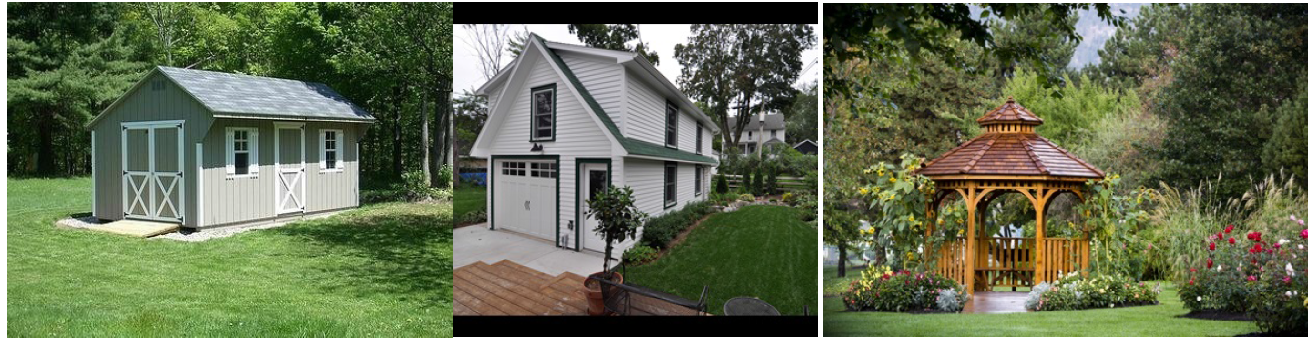
Structure, detached. A structure having no party wall or common wall or other physical attachment or connection with another structure.
Structure, nonconforming. Any structure lawfully existing on the effective date of these regulations, or any amendment to it rendering such structure nonconforming, which does not comply with all of the standards and regulations of these regulations or any amendment thereto.
Structure, permanent. A structure constructed for permanent occupancy that is in compliance with all applicable North Carolina building codes and all applicable local and state standards.
Structure, principal. A structure containing the principal use which takes place on the lot. A principal structure may also be referred to as a "principal building."
Structure, temporary. A structure not intended for permanent occupancy and designed for easy removal off premises. Examples include, but are not limited to, produce stands, revival tents, mobile classrooms, etc.
Subdivision. All divisions of a tract or parcel of land into two or more lots, building sites, or the divisions when any one or more of those divisions is created for the purpose of sale or building development (whether immediate or future) and shall include all divisions of land involving the dedication of a new street or a change in existing streets; but the following shall not be included within this definition nor be subject to any regulations enacted pursuant to this Code.
•
The combination or recombination of portions of previously subdivided and recorded lots where the total number of lots is not increased and the resultant lots are equal to or exceed the exceed the standards and regulations prescribed by this Code
•
The division of land into parcels greater than ten acres where no street right-of-way dedication is involved;
•
The public acquisition by purchase of strips of land for the express purpose of widening or opening of streets or for public transportation system corridors.
•
The division of a tract in single ownership whose entire area is no greater than two acres into not more than three lots, where no street right-of-way dedication is involved and where the resultant lots are equal to or exceed the standards of the City.5. The division of a tract into parcels in accordance with the terms of a probated will or in accordance with intestate succession under Chapter 29 of the General Statutes.
Subdivision, major. A subdivision where (1) new streets (public or private) are proposed, or (2) the entire tract to be subdivided is greater than ten acres in size; or (3) where more than five lots will result after the subdivision is completed or (4) where extension of any sewer or water system is required.
Subdivision, minor. A subdivision where (1) no new streets (public or private) are proposed; and (2) the entire tract to be subdivided is ten acres or less in size; and (3) where no more than five will result after the subdivision is completed and (4) where no extension of any sewer or water system is required.
Technical review committee (TRC). A committee appointed by the governing board to review and recommend plats in a manner as specified in this Code.
Thoroughfare. A road so designated on the most recently adopted version of the thoroughfare plan of the Gaston Metropolitan Planning Organization (MPO) or other officially adopted plan.
Thoroughfare, major. See "Principal arterial".
Thoroughfare, minor. See "Minor arterial".
Thoroughfare plan. The most recently adopted version of the thoroughfare plan of the metropolitan planning organization of the Gaston Urban Area.
Tower, ham radio. See term "Antenna, amateur radio".
Tower, lattice. A freestanding and self-supporting structure consisting of connected sections of metal supports used to support telecommunication equipment. These towers can be either three- or four-legged steel girder structures designed typically to support multiple telecommunications users.
Figure 10-36 Lattice Tower Diagram
Tower, monopole. A freestanding and self-supporting single pole structure that supports telecommunication equipment.
Tower, stealth. Man-made trees, clock towers, bell steeples, light poles and similar alternative-design mounting structures that camouflage or conceal the presence of antennae or towers. Typically, such a telecommunication tower and/or its equipment are incorporated into the supporting structure and assume the color, texture, and appearance of the supporting structure.
Figure 10-37 Stealth Tower Examples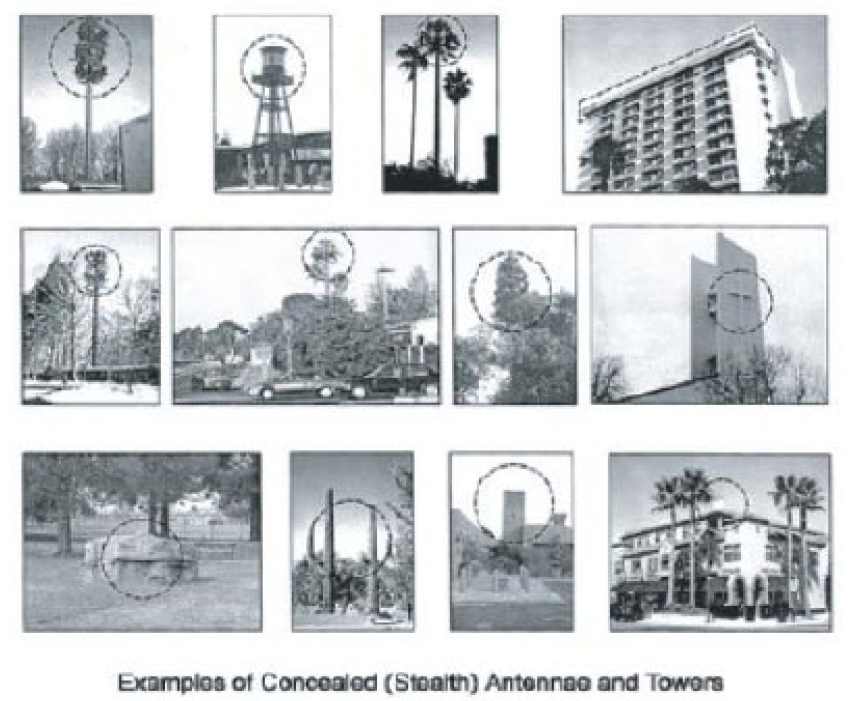
Tract, parent. A parcel or tract respectively, lawfully in existence on the effective date of this Code, from which lots are subdivided from and created.
Traffic impact analysis. A report produced by a qualified professional (i.e., Transportation Engineer, Transportation Planner, Traffic Engineer, etc.), that, at a minimum, addresses the following items in relationship to the proposed subdivision:
•
An estimation of traffic generated;
•
An estimation of trip distribution to and from the development;
•
An analysis of the existing road system serving the development (to the nearest major intersections) and the effect of the development on that system;
•
A listing of proposed improvements, both on and off-site, and their effect on the existing system.
Tree, canopy. A tree, either single or multi-stemmed (i.e., in clump form) that has a height of at least ten feet and is of a species which, at maturity, can be expected to reach a height in excess of 40 feet under normal growing conditions in the local climate. If the tree is single-stemmed, it shall have a caliper of at least one inch at the time of planting.
Tree, understory. A tree, either single or multi-stemmed (i.e., in clump form) which has a height of at least five feet and is of a species which at maturity, can be expected to reach a height of ten to 40 feet under normal growing conditions in the local climate. If the tree is single-stemmed, it shall have a caliper at the time of planting of at least three-quarters of an inch.
Trip generation report. A report produced by a qualified professional (i.e., transportation engineer, transportation planner, traffic engineer, etc.), that provides the estimated peak hour trip generation by the proposed use or uses.
Use, accessory. A use that is customarily incidental and subordinate to the principal use or structure and located on the same lot with such principal use or structure.
Use by right. See "Use, permitted".
Use, incidental. A use located on the same lot as a primary use but is subordinate and minor in significance to the principal use, and which bears a reasonable relationship with the principal use.
Use, nonconforming. A use or activity which does not conform to the use regulations of this Code for the district in which it is located either at the effective date of this Code or as a result of subsequent amendments which are incorporated into this Code at some future date.
Use, permitted. A use category, indicated by an "X" in Table 7.1-1 that is allowed by right in a certain zoning district. These uses are subject to all other applicable regulations of this Code.
Use, principal. The primary or predominant use of any lot.
Use, temporary. A land use or structure this is needed or in place only for short periods.
Variance. A relaxation of the strict terms of a specific provision of this Code as approved by the board of adjustment in accordance with the provisions of article [chapter] 6 of this Code.
Vehicle, commercial. A truck of any type used or maintained primarily to transport material or to operate a power attachment or tool. Any vehicle with advertising or business designation affixed to it shall be considered a commercial vehicle, except for passenger vehicles having such affixations.
Vehicle, emergency. A vehicle of a police or fire department, rescue squad, or similar public service agency that is used in response to an emergency call.
Vehicle, inoperable. A vehicle that for a continuous period of more than 72 hours has been in a state of disrepair and is incapable of being moved under its own power.
Vehicle, junked. Per NCGS 160A-303, a motor vehicle that does not display a lawful and valid license plate and:
•
Is partially dismantled or wrecked; or,
•
Cannot be self-propelled or moved in the manner in which it was originally intended to move; or,
•
Is more than five years old and appears to be worth less than $100.00.
Vehicle, passenger. An automobile, van, or pickup truck used exclusively as a passenger vehicle and/or for hauling property of the owner. Pickup trucks may qualify as passenger vehicles only when used exclusively as passenger vehicles or for hauling property of the owner and not equipped as a camper or a commercial vehicle.
Vehicle, recreational. A vehicle that is designed as a temporary (as opposed to permanent) dwelling for travel, recreational or vacation uses. This term shall include "camping trailer", "motor home", "travel trailer", "truck camper" and "R.V.". This term shall not include "manufactured homes" or "modular homes."
Vehicle, septic tank. A vehicle used primarily for the purpose of cleaning, maintaining, and repairing septic tank systems.
Vehicle, solid waste. A vehicle used primarily for the transport of solid waste.
Vested right. The right to undertake and complete the development and use of property under the terms and conditions of an approved site-specific site and/or subdivision plan or through a "common law" vested right as described in section 7.7.
Wall, building. The entire surface area, including windows and doors, of an exterior wall of a building. As used in this Code, the area of a wall will be calculated for a maximum of 50 feet in height of a building. The term may also be referred to simply as a "wall" or "exterior wall."
Wall, shared. A common or shared wall between two separate structures, buildings, or dwelling units.
Water, public. Any water system defined as such by the North Carolina Division of Health Services that complies with the regulations of the North Carolina Division of Health Services and the community water system standard code adopted by Bessemer City.
Wireless communications. Any personal wireless service, including but not limited to, cellular, personal communication services (PCS), specialized mobile radio (SMR), enhanced specialized mobile radio (ESMR), and unlicensed spectrum services utilizing devices described in Part 15 of the FCC rules and regulations (e.g., wireless internet services and paging).
Working days. Days exclusive of Saturdays, Sundays, and legal holidays observed by the city.
Yard, front. An area measured between the edge of the public street right-of-way line, and the front of a building, projected to the side lot lines. On corner lots, the front yard shall be measured perpendicular from the street lot line having the shortest linear footage. If both street lot lines have equal linear footage, the property owner shall determine the location of the front yard where no principal structure is located. If a principal structure is located on such a lot, the front yard shall be based on the architectural orientation of the building. The determination of front (side and rear yards) in a planned multi-tenant development shall be considered on a case-by-case basis.
Yard, rear. A yard extending the full width of the lot on which a principal building is located and situated between the rear lot line and a line parallel thereto and passing through the point of the principal building nearest the rear lot line.
Yard sale. The sale or offering for sale to the general public of over five items of personal property on any portion of a lot in a residential zoning district, whether within or outside any building. This may also be referred to as a "garage sale", "carport sale", or "rummage sale."
Yard, side. A space extending from the front yard to the rear yard between the principal building and the side lot line as measured perpendicular from the side lot line to the closest point of the principal building.
Figure 10-38 Yard Types Diagram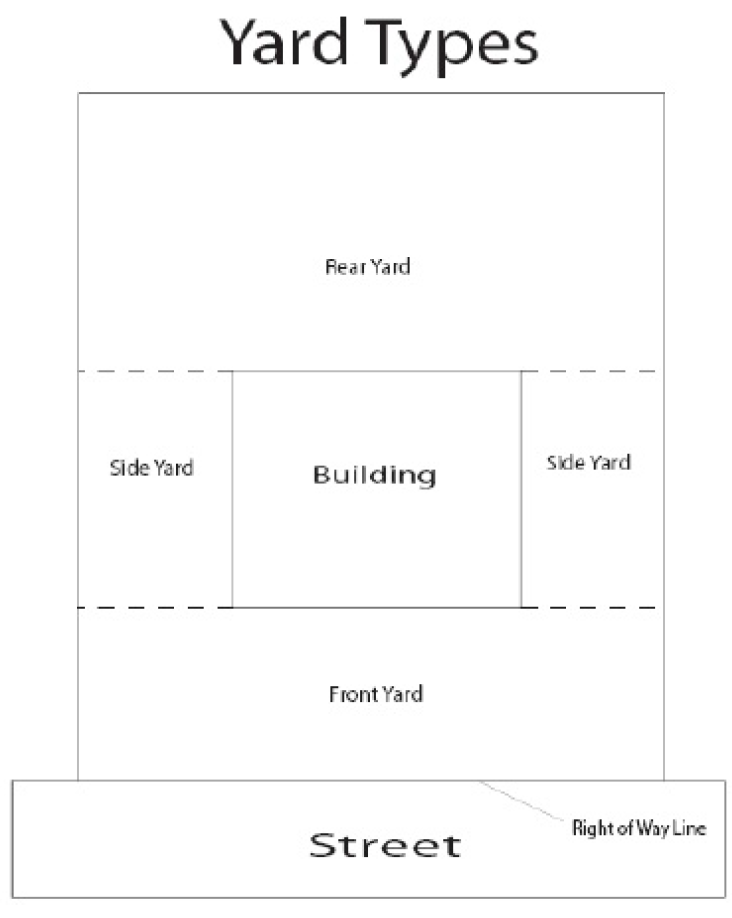
( Ord. of 7-11-2022(1) )
10.2 - USE DEFINITIONS
Definitions of terms, phrases and words used in this Code as they related to USES are as follows:
Adult establishment. Any structure or use of land that meets the definition of "adult establishment" as outlined in NCGS 14-202.10 and includes but is not limited to adult video stores and adult hotels.
Agricultural use. The production of plants and animals useful to man, including but not limited to: forages and sod crops; grains and seed crops; dairy animals and dairy products, poultry and poultry products; rheas, ostrich, emu, livestock, including beef cattle, sheep, swine, llamas, horses, ponies, [NOTE: Horses and ponies must be raised commercially on a horse farm for the purpose of sale to qualify as an "agricultural use" and are distinct from riding stables or boarding facilities, which do not quality as an "agricultural use"], mules, or goats or any mutations or hybrids thereof, including the breeding and grazing of any or all of such animals; bees and apiary products; fur animals; trees and forest products; fruits of all kinds, including nuts; vegetables; nursery, floral and ornamental products; or lands devoted to a soil conservation or forestry management program. In addition, an "agricultural use" shall also include land used as pasture or in the commercial production of fish hatcheries or aquaculture. An "agricultural use" shall also include the keeping of livestock for commercial or noncommercial purposes. Livestock includes but is not limited to poultry and hoofed animals such as cattle, horses, swine, goats, and sheep. Also included in this definition of agricultural uses are agricultural accessory buildings, and sales of agricultural products grown or raised on the premises. Not included in this definition are the commercial slaughtering of animals for marketing and farm tenant dwellings. Other uses which shall not be deemed as "agricultural uses" include (i) zoos and (ii) kennels. For the purposes of this Code, "agricultural uses" are divided into three classes:
•
Agricultural uses, Class I: Low impact, residentially compatible, accessory agricultural uses, such as community and backyard gardens, bee keeping, chicken coops/ hen keeping, and similar uses.
•
Agricultural uses, Class II: The growing of all agricultural and horticultural products (e.g., corn, soybeans, cotton), nurseries, and commercial greenhouses. Riding academies, riding corrals and tracks, and boarding stables; any other animal husbandry use, except that listed herein as a Class III use. Any Class I use as a principal use or exceeding the standards allowed for a Class I use.
•
Agricultural uses, Class III: Dairy barns; high-density cattle pens; stock yards; poultry houses; manure storage; hog parlors; hog and rabbit meat production centers.
Airport. A facility where aircraft can land and take off on a recurring basis and which is equipped with hangers, refueling facilities and/or repair facilities.
Airstrip. An area of land or water that is designed or used on a recurring basis for the landing and takeoff of aircraft, ultra lights, model airplanes or other flying apparatus excluding hot air balloons, and which does not contain hangers, refueling facilities or repair facilities.
Amusement and sporting facility, indoor. A for-profit commercial facility providing entertainment or games of skill activities to the general public for a fee and that is wholly enclosed in a building. This shall include, but not be limited to, a bowling alley, indoor paintball facility and movie theatre. This definition does not include game rooms.
Amusement and sporting facility, outdoor.(Office/commercial services/retail principal uses). A for-profit commercial facility providing recreational activities outside of an enclosed building. Typical uses include miniature golf, golf driving range, skeet shooting, etc., but does not include a stadium.
Animal hospital (indoor). A place where animals are given medical or surgical treatment and the boarding of animals is incidental to the hospital use. All facilities associated with an animal hospital shall be located indoors.
Animal hospital (with outdoor kennel). A place where animals are given medical or surgical treatment and the boarding of animals is incidental to the hospital use. Facilities may be located outdoors and may include but not be limited to kennels and training/ exercise areas.
Animal kennel. An indoor or outdoor place where more than five dogs or other domesticated animals are groomed, bred, boarded, trained, kept, and/or sold either as a principal use or an accessory to a residential use.
Animal shelter. See "Animal kennel".
Art gallery. A commercial establishment where individual pieces of art are sold to the general public on a retail basis. Works of art may also occasionally be sold on an auction basis at such an establishment.
Assisted living center. An institution licensed by the state as an "assisted living residence" and which provides, at a minimum, one meal a day, housekeeping service and personal care services to seven or more aged or disabled residents.
ATM. See "Automatic teller machine".
Auction house. A facility that is used for the purpose of having auctions on a regularly established basis. Auctions may be held indoors or outdoors.
Auditorium/assembly hall/amphitheatre. A structure or facility designed, intended, or used primarily for outside and/or inside performing art events or other spectator events and contains seating for spectators of those events. The sale of beverages, snack foods, and sundries geared to on-premises consumption or usage by spectators shall be permitted.
Automated teller machine (ATM). An automated device that performs banking or financial functions at a location outside of or remote from the controlling financial institution. Such facility may also be referred to as an "ATM".
Automobile body shop. Any building, premises, and land in which or upon which a business is conducted that primarily involves the painting of vehicles or external repairing of damaged vehicles.
Automobile detail shop. An establishment primarily engaged in the hand cleaning and waxing of automobiles. Such activities may take place indoors and outdoors. Such establishments are distinguished from "car washes" in that there is no automated equipment involved with the cleaning or waxing the vehicles.
Automobile hobbyist. The use of a structure or building for storing and restoring automobiles for hobby purposes, with no automobile-related commercial or sales activity taking place. All vehicles shall be titled to the tenant of the building and all automobile restoration and repair shall be done indoors.
Automobile repair shop. A commercial establishment whose primary purpose involves the maintenance and servicing of vehicles. "Auto body work" (i.e., work normally associated with an "automobile body shop,") may not be performed on premises unless the zoning district in which the use is located allows an "automobile body shop." The sale of automotive fuels and accessory automobile parts to the public may be provided on an accessory basis. Notwithstanding, an "automobile repair shop" is differentiated from an "auto parts store" in that the sale of automotive parts is not the primary service being offered.
Automobile service station. A use where vehicular fuels are sold at the retail level and where the installation of automotive items such as lubricants, tubes, batteries, and similar accessories takes place and where minor automobile repair and maintenance work is conducted. Vehicle repair services (except for paint and body work) may be conducted on premises. Not more than one automatic car wash may be provided on site so long as the car wash meets all of the criteria in that zoning district for an "Automatic Car Wash". Such use shall be distinguished from a "convenience store" given that the primary product for sale is automotive fuel and not food and sundry items.
Automobile towing and wrecker service. An establishment primarily engaged in the towing of motor vehicles and vehicular storage associated with vehicle accidents and violations. This shall not include vehicular salvaging operations or the sale of salvaged vehicular parts. This use is not to be construed as a junkyard and salvage yard. An "automobile towing and wrecker service" may be part of an "automobile body shop" in zoning districts where an "automobile body shop" is allowed.
Automobile, truck, boat, motorcycle, manufactured home and recreational vehicle sales and rental. Any building, premises, and land, in which or upon the primary use of land is a business that involves the maintenance, servicing or sale of new or used automobiles, boats, heavy equipment and/or manufactured homes. This may also include light trucks [i.e., trucks weighing less than two and one-half tons] or vans, trailers, or recreation vehicles. Also included in this definition is vehicle leasing, rental, parking service, preparation or repair work conducted as an accessory use. Notwithstanding the above, any premise upon which there is a regular sale of three or more boats, vehicles, etc. shall be considered an "automobile, truck, boat, motorcycle, manufactured home and recreational vehicle sales and rental" establishment.
Bail bond. An office that engages in the sale or issuance of bail bonds or other financial transfers for the purpose of securing the release from jail of an accused defendant pending trial.
Bank. See "Financial institution".
Bed and breakfast inn. A use that (i) takes place within a building that prior to such establishment, was designed and used as a single-family residence, (ii) that consists of renting one or more dwelling rooms on a daily basis to tourist, vacationers and similar transients, (iii) where the provision of meals, if provision of meals is made, is limited to the breakfast meal, and is available only to guests, and (iv) where the bed and breakfast operation is conducted primarily by persons who reside in the dwelling unit, with the assistance of not more than the equivalent of one full-time employee. The maximum number of rooms available for rent shall be five; the maximum length of stay shall be 14 consecutive days.
Beverage store. An establishment that is primarily in the business of selling beverages (including beer and wine) to the public.
Billboard. See "Sign, off-premises advertising".
Billiard parlor. A business establishment open to the public whose primary source of income is from billiards.
Body piercing establishment. See "Tattoo parlor/body piercing establishment".
Bona fide farm. A farm use that includes the production and activities relating or incidental to the production of crops, grains, fruits, vegetables, ornamental and flowering plants, dairy, livestock, poultry, and all other forms of agriculture, as defined in G.S. 106-581.1. The following shall indicate a farm is being used for bona fide purposes:
•
A farm sales tax exemption certificate issued by the Department of Revenue.
•
A copy of the property tax listing showing that the property is eligible for participation in the present-use value program pursuant to G.S. 105-277.3.
•
A copy of the farm owner's or operator's Schedule F from the owner's or operator's most recent federal income tax return.
•
A forest management plan.
Botanical garden. A facility owned by a public or private nonprofit entity containing at least ten acres of land that is primarily used for the public display and conservation of plants and related botanical education and research purposes. Such facility may also include the following facilities: conservatories; greenhouses; plant maintenance and propagation facilities; visitor centers; museums; education and research facilities; trails; boat touring and mooring facilities; bird, insect, and water life observation facilities; living farm museums; petting zoos; concession facilities including meeting rooms, eating establishments, lodging and gift shops; and permanent housing for caretakers and other on-site employees.
Building materials and lumber sales. An establishment where lumber and building materials goods are the primary products sold.
Bus or train terminal, passenger. Any premises for the transient housing or parking of inter-city motor-driven buses (e.g., Greyhound, Trailways) and the loading and unloading of passengers going on such bus trips. Refer to "transit station" for facilities designed to accommodate intra-city transit services.
Business services. The provision of services required for the day-to-day operation of a business such as, but not limited to, consulting service, photocopy, or office supply. Examples of such uses include: "Kinkos", "UPS Store", "Mailboxes". Such stores may have extended operating hours.
Camping and recreational vehicle park. Land containing two or more campsites which are located, established, or maintained for occupancy by people in temporary living quarters, such as tents, recreation vehicles, or travel trailers which are used for recreation, vacation purposes or temporary housing for construction or farm workers. Occupancy for recreation or vacation purposes shall be limited to individual stays of no greater than 30 days and occupancy for temporary housing shall be limited to individual stays of no greater than 180 days.
Car wash, automatic Class I. A parcel of land whose principal use is a facility for washing automobiles using a chain conveyor or other method of moving cars along, or moving an automatic washing device along, and automatic application of cleaner, brushes, rinse-water, and heat for drying. Accessory self-vacuuming facilities shall be allowed. The retail sale of fuels may also be provided in an accessory capacity.
Car wash, automatic Class II. A commercial establishment primarily engaged in the washing of automobiles, motorcycles, and pick-up and panel trucks. Such washing shall be done using a combination of automatic washing devices and manual labor provided by the commercial establishment.
Car wash, self service. A commercial establishment primarily engaged in the washing of automobiles, motorcycles, and pick-up and panel trucks. Such washing shall be done manually by the customer (i.e., the use of fully automated devices which move the vehicle through a washing device shall not be permitted). Accessory self-vacuuming facilities shall be allowed.
Cemetery. Property used for the interment of the dead, which use may include the commercial sale and location of burial lots, crypts, or vaults for use exclusively on the subject property. A cemetery shall not be used for the preparation or embalming of bodies or the cremation of bodies. This definition shall be construed to include bona fide pet cemeteries.
Charitable service facility. A facility, other than a food pantry (see definition), operated by a public or private entity that directly distributes charity or relief services directly to the public. Examples of such a facility include soup kitchens and homeless shelters. Public office facilities (e.g., Department of Social Service facilities) and a church/place of worship shall not be deemed a charitable service facility.
Check cashing establishment. A business engaged in cashing checks for the general public as an element of its operation that exceeds 50 percent of its gross revenue and is not licensed by the appropriate state or federal agencies as a bank, savings and loan, or credit union. Primary signage associated with a business that includes the phrase "check cashing" will be considered prima facie evidence that the business is a check cashing business.
Church/place of worship. A building or structure, or group of buildings or structures, which by design and construction are primarily intended for conducting organized religious services whose site may include an accessory area for the interment of the dead. Certain customary accessory uses shall be allowed to take place on church premises. These include bookshops, recreation centers, outdoor playing fields, youth facilities, parsonage, cemetery, food pantry, and certain types of day care centers and schools. The overnight lodging of transient persons shall not be considered as a customary accessory use. Such accessory uses shall be subject to any applicable supplemental regulations located elsewhere in this Code.
Club, private (without adult entertainment). A for-profit establishment that (1) is organized and operated solely for a social and recreational purposes; (2) and which may include the sale of alcoholic beverages; (3) and that is not open to the general public, but open only to the members of the organization and their bona fide guests. Excluded from this definition are facilities used by nonprofit fraternal and service organizations.
College/university. A private or public educational institution where students attend to earn associates, baccalaureate, masters, or doctoral degrees. A college/university shall not be considered a "vocational school" or a "school for the arts."
Commercial services. A business offering personal retail services including but not limited to dry cleaning (outlets), shoe repair, key making, tailoring and alterations.
Commercial vehicle and truck storage. A piece of property that is used primarily for the outdoor storage, on a regular basis, of trucks and other commercial vehicles, excluding septic tank and solid waste vehicles.
Community center. A building used for recreational, social, educational, and cultural activities owned and operated by a public or nonprofit group or agency.
Construction trailer (temporary use). A structure standing on wheels towed or hauled by another vehicle and used for neither overnight nor year-round occupancy at a construction site on a temporary basis for office and/or storage purposes.
Continuing care facility. A residential complex that contains a variety of living facilities that may include independent living units (i.e., apartments, condominiums, cottages), assisted living (domiciliary care) facilities and/or nursing home beds. Residents of such a facility may either pay rent or purchase their living quarters. If the unit is occupant-owned, the unit normally reverts to the development owner upon the death of the resident or to a surviving spouse.
Convenience store. A one story, retail store containing less than 3,000 square feet of gross floor area that is designed and stocked to sell primarily fuel, food (packaged and/or prepared), beverages, and other household supplies to customers who purchase relatively few items (in contrast to a "grocery store"). A "convenience store" is designed to attract and depends upon a large volume of stop-and-go traffic.
Correctional facility. A facility operated by a governmental entity (or a private contractor thereof) used primarily for the incarceration or housing of persons serving criminal sentences. State prisons, prison camps, and penitentiaries are examples of such a facility.
Country club. A land area and buildings containing recreational facilities, clubhouses and usual accessory uses, open to members and their guests that is privately operated. Uses at a country club frequently include golf courses, swimming pools (outdoors), and clubhouses. Meal service may be available but is generally limited to members and their guests.
Crematorium. A facility whose primary function is for the cremation of human bodies or animals.
Day care center, accessory. A day care center facility located on the premises or adjacent to the premises of an office use, institutional use, commercial use, industrial use, or group development for the primary purpose of care for the dependents of employees of such commercial, office, institutional or industrial use. At least 66 percent of the clients enrolled shall be dependents of employees of the establishment or group development sponsoring such facility.
Day care center, Class A. A place where daytime care is provided to not more than six pre-school children, handicapped persons, or senior citizens, and not more than three school aged children unrelated by blood or marriage to, and not the legal wards or foster children of the attendant adult, within an occupied residence. Persons who are related by blood or marriage to the attendant adult shall not be counted as patrons of the day care center.
Day care center, Class B. A place where daytime care is provided to more than six but less than 50 pre-school children, after school care children, handicapped persons, or senior citizens unrelated by blood or marriage, and not the legal wards or foster children of the attendant adult. Persons who are related by blood or marriage to the attendant adult shall not be counted as patrons of the day care center.
Day care center, Class C. A place where daytime care is provided to 50 or more pre-school children, after school care children, handicapped persons, or senior citizens unrelated by blood or marriage, and not the legal wards or foster children of the attendant adult. Persons who are related by blood or marriage to the attendant adult shall not be counted as patrons of the day care center.
Development, multi-family. A tract of land under individual, corporate, firm, partnership or association ownership, or under common control evidenced by duly recorded contracts or agreements that is planned and developed as an integral unit in a single development operation or in a definitely programmed series of development operations. Such development shall consist of two or more duplex buildings, or three or more dwelling units sharing one or more common walls. The development shall have a unified or coordinated design of buildings and a coordinated organization of service areas and common open space area.
Distribution/wholesale/storage operations. A facility where goods are received and/or stored for delivery to wholesale customers in remote locations.
Drive-through facility. A business or facility which is designed or intended to enable a customer to transact business without exiting a motor vehicle parked on or moving through the premises.
Dry cleaning outlet. An establishment engaged in providing laundry, dry cleaning and other related services on a pickup and drop off basis to individual customers.
Duplex. See "Dwelling, two-family".
Dwelling, manufactured home Class A. A manufactured home that meets or exceeds the construction standards promulgated by the U.S. Department of Housing and Urban Development that were in effect at the time of construction and that satisfies each of the following additional criteria: (a) The minimum width (the width being the narrower of the two overall dimensions) of the main body of the manufactured home as assembled on the site shall be at least 22 feet for a distance extending along the length (the length being the longer of the two overall dimensions) of at least 20 feet. (b) The pitch of the roof of the manufactured home has a minimum vertical rise of two and two-tenths feet for each 12 feet of horizontal run; the roof is finished with a type of shingle that is commonly used in standard residential construction and which does not exceed the reflectivity of gloss white paint; the roof has an overhang (eave) extending at least ten inches from each vertical exterior wall. A site-installed gutter may be counted in the width of the eave. (c) The exterior siding consists of wood, hardboard, vinyl, brick, or aluminum and shall be comparable in composition, appearance, and durability to the exterior siding commonly used in standard residential construction, and which does not exceed the reflectivity of gloss white paint. (d) A continuous, permanent masonry foundation or masonry curtain wall, unpierced except for required ventilation and access, shall be installed upon a poured concrete footer after placement on the lot, and before occupancy. (e) The tongue, axles, transporting lights, and removable towing apparatus are removed after placement on the lot and before occupancy. (f) The manufactured home is set up on the site in accordance with the standards set by the N.C. Department of Insurance. (g) Stairs, porches, entrance platforms and other means of entrance and exit to the manufactured home shall be installed and constructed in accordance with the standards set by the N.C. Department of Insurance. (h) A front porch, a minimum of eight feet in width and eight feet in depth.
Dwelling, manufactured home Class B. A manufactured home that meets all of the criteria of a Class A manufactured home, except criteria (a), (b), (c), and (e).
Dwelling, manufactured home Class C. A manufactured home that meets all of the requirements of a Class A manufactured home, except criteria (a), (b), (c), (d), and (e); provided however, said manufactured home shall be installed with permanent type non-reflective skirting specifically manufactured for manufactured homes, pressure treated wood (except plain standard-surface, pressure treated plywood shall not be considered acceptable), or masonry underpinning. Such underpinning or skirting shall be installed under all elements of the manufactured home and be unpierced except for required ventilation and an access door.
Dwelling, manufactured home Class D. A manufactured home that does not meet the requirements of a Class A, Class B, or Class C manufactured home.
Dwelling, mixed use. A structure that contains both a principal residential and nonresidential (i.e., office or retail) use.
Dwelling, multi-family. A building or portion thereof designed or occupied as two or more duplex buildings or three or more dwelling units sharing common walls.
Dwelling, single-family. A detached building designed for or occupied exclusively by one family, but not to include manufactured homes as defined by this Code.
Dwelling, two-family. Two dwelling units, including modular homes, attached along and sharing one or more common walls and located on a single lot.
Electronic gaming operation. Any business enterprise, whether as a principal or accessory use, where persons utilize three or more electronic machines, including, but not limited to computers and gaming terminals, to conduct games including but not limited to sweepstakes, lotteries, games, and/or games of chance, and where cash, merchandise, or other items of value are redeemed or otherwise distributed, whether or not the value of such distribution is determined by electronic games played or by predetermined odds, which have a finite pool of winners. The term includes, but is not limited to internet sweepstakes, video sweepstakes, or cybercafes. This definition does not include any lottery endorsed, approved, or sponsored by the State of North Carolina, or arcade games of skill.
Essential services, Class 1. Transmission lines (whether, subterranean or overhead) including electrical, natural gas, and water distribution lines; sewer gravity lines and pressure mains; underground septic tanks and drain fields, cable television and telephone transmission lines; or similar utility lines; pumping stations; lift stations; telephone switching facilities [up to 100 square feet gross floor area].
Essential services, Class 2. Telecommunication facilities, elevated water storage tanks; booster stations, package treatment plants, telephone switching facilities [over 100 square feet gross floor area], substations, or other similarly required facilities in connection with telephone, electric, steam, water, sewer, or other similar utilities.
Essential services, Class 3. Generation facilities such as power plants; sanitary landfills; septic tank waste disposal facilities.
Essential services, Class 4. A use or facility owned or operated by the City or its designee, serving in one of the following capacities, including, but not limited to: an agency office, rescue services (including volunteer rescue services), emergency medical services, public safety station, fire station (including volunteer fire station), public safety services and dispatch, or personnel training and development center. A public safety station may contain living quarters for on-duty personnel. Facilities for the maintenance of equipment housed at the operation site are also permitted. The following uses and/or activities shall not be classified as a Class 4 essential service: vehicle storage yard; outdoor/indoor firing range; jail; prison; sanitary landfill; solid waste transfer or disposal facility; wastewater treatment facility; educational or health institution; university; group home; half- way house or housing for persons who are participating in work release programs or who have previously served and completed terms of imprisonment for violations of criminal laws.
Family care home. A home with support and supervisory personnel that provides room and board, personal care, and habilitation services in a family environment for not more than six resident handicapped persons, six unwed mothers and their neonates, or six battered persons with their children.
Farm, bona fide. The production and activities relating or incidental to the productions of crops, fruits, vegetables, sod or ornamental and flowering plants, dairy, livestock, poultry, and all other forms of agricultural products having a domestic or foreign market meeting one of the present use value criteria: 1) Agricultural land, consisting of at least ten acres, or horticultural land, consisting of at least five acres. both of which may be in one or tracts that are in actual production; 2) A minimum of 20 acres of forestland for which a woodland management plan has been prepared by the U.S. Forest Service.
Farm supply store. An establishment where feed, seed, animal, and agricultural supplies are primarily sold in bulk quantities.
Farmers market. An outdoor market at which fruits and vegetables are regularly sold to the general public on a retail basis. Vehicles used to transport the products to be sold shall be limited to cars, vans, and trucks. Other food items may also be sold at such establishments.
Financial institution. A commercial bank, a mortgage bank, a savings bank, a saving and loan association, or a credit union any of which are licensed, insured, or chartered by the United States of America or the State of North Carolina. Manned drive-through services are provided on site. Outdoor automatic teller machines (ATMs) may or may not be provided.
Flea market. An occasional or periodic market held in an open area or structure where goods are offered for sale to the general public by individual sellers from open or semi-open facilities, booths, or temporary structures.
Flex space. A building or portion thereof that can be used and/or easily converted to use for office, wholesale sales, distribution, or storage use
Food catering facility. A facility at which a prearranged amount and type of food is prepared for consumption off-premises or in a meeting room on premises. A food catering facility differs from a restaurant in that food is not offered for sale to the general public on a retail basis.
Food pantry. A facility operated by a public or non-profit entity that directly distributes unprepared packaged food items to the public on a charitable basis. Such facilities may also distribute clothing to the general public in such manner.
Fraternal and service organization meeting facility (nonprofit and not-for-profit). A facility operated by an association of persons for activities which include, but are not limited to social, literary, political, educational, fraternal, charitable, or labor activities, with regular meetings and membership requirements. The facility is not operated for profit or to render a service that is customarily conducted as a business.
Freeway. A major thoroughfare providing for high-speed mobility and having no at-grade crossings.
Freight and flying services. A facility operated for the transport of goods, merchandise, materials, and commodities of any kind that may be transported from one place to another by air.
Funeral home. A facility used for the preparation of the deceased for burial and the display of the deceased and ceremonies connected therewith. Such facility may also sell caskets and other items associated with a funeral service.
Furniture store. A retail establishment that is primarily engaged in the sale of home of office furniture and related goods.
Gameroom. A building or a part of a building containing eight or more video, pinball, or similar player-operated amusement devices, in any combination, for commercial use. An establishment containing a gameroom may have more than one principal use.
Garage/yard sale (temporary use).See "Yard sale".
Golf course. A tract of land for playing golf, improved with tees, fairways, hazards and which may include clubhouses and shelters. Such definition shall not include "miniature golf" or "golf driving range" establishments.
Greenhouse, commercial. See "Nursery (garden)".
Grocery store. An establishment, over 3,000 square feet in area, which may sell a wide variety of fresh produce, canned and packaged food items, small household goods and similar items which are consumed and used off premises. In addition, the store may contain a delicatessen section in which prepared foods are sold and may be consumed on premises in a specially designed sit-down area. Such stores may also contain manned internal bank branches. Sales of grocery items are highly dependent on comparison shopping.
Grooming services. Establishments engaged primarily in providing services to a person's grooming needs. Such services include, but are not limited to, barbershops, beauty shops, tanning salons and nail salons. Tattoo parlors shall NOT be included under this definition.
Group home. A facility, other than a family care home, that is licensed by the State of North Carolina, that has support and supervisory personnel and provides room and board, personal care, or habilitation services in a family environment for more than six but not more than 30 handicapped persons, unwed mothers with their neonates, and battered spouses with their children.
Health and behavioral care facility. A facility designed to offer two or more health and behavioral services to clients. Such services may include limited medical care and health education, parenting program, adoption agency, and counseling center.
Heavy equipment sales and service. A facility where vehicles or other apparatus commonly used in commercial, industrial or construction enterprises are sold and serviced. This includes, but is not limited to, trucks, trailers, bulldozers, cranes, backhoes, rollers, loaders, and lifts, each having a gross weight of two and one-half tons or more.
Heliport/helistop. An area designated to be used for the landing or takeoff of helicopters including operations facilities such as maintenance, loading, storage, fueling and terminal facilities.
Home occupation. A nonresidential use conducted within a dwelling unit which is clearly incidental and subordinate to the residential use and, when observed from beyond the lot on which it is located, does not give visual, audible, sensory, or physical evidence.
Hospital. An institution providing physical and mental health services primarily for human inpatient medical or surgical care for the sick or injured, including related facilities such as laboratories, outpatient services, training facilities, central service facilities, emergency services, and staff offices. A hospital shall provide facilities for the overnight and extended stay of persons in need of medical treatment and may have accessory uses such as a prayer chapel, gift shop, cafeteria, etc. that serves the needs of staff, patients, and visitors.
Hotel. A facility containing six or more rooms and offering transient lodging accommodations to the general public and which may provide additional services such as restaurants, lounges, meeting rooms and recreation facilities. Less than 25 percent of the rooms for rent shall have direct access to the outside. An "adult hotel or motel" shall not be considered a "hotel" and shall be governed as an "adult establishment."
Hotel, full service. An establishment providing a minimum of 100 sleeping rooms (a suite shall be counted as two sleeping rooms) that have interior access. A "hotel" also has a restaurant with full table service, lounge, meeting facilities consisting of a minimum of 5,000 square feet in one room (said room may be divided by flexible partitions) and may include other hotel-related amenities and guest services.
Infill residential development. See "Residential development, infill".
Landfill, land clearing and inert debris (major). An off-premises commercial disposal site other than a minor land clearing and inert debris landfill (as herein defined) for stumps, limbs, leaves, concrete, brick, wood, and uncontaminated earth. The North Carolina Division of Solid Waste Management must approve the disposal of any other types of wastes.
Landfill, land clearing and inert debris (minor).
Industrial/distribution/heavy impact principal uses. An off-premises commercial disposal site that meets each of the following conditions: 1. The fill material shall consist of debris strictly limited to concrete, brick, concrete block, uncontaminated soil, rock, gravel, limbs, leaves, and stumps. 2. The North Carolina Division of Solid Waste Management must approve disposal of any other types of wastes. 3. The fill activity will cover two. acres or less and be in operation for three. years or less.
Landfill, onsite. A landfill which is located within the confines of property being developed or in use and used only for the disposal of acceptable on-site natural materials (e.g., stumps, tree limbs, etc.) which are generated on the property being developed.
Laundromat. A commercial facility open to the general public where coin-operated washing and drying machines are available for use.
Library. A public facility for the shared use, but not sale, of literary, musical, artistic, or reference materials.
Loading space, off-street. An off-street space or berth on the same lot with a building or contiguous to a group of buildings for the temporary parking of commercial vehicles while loading or unloading merchandise or materials.
Machine, metal and woodworking shop. A workshop in which work, including but not limited to metal and woodwork, is machined, assembled, or finished.
Manufactured goods, Class 1. All manufacturing industries except those listed as "Manufacturing Goods, Class 2" or "Manufacturing Goods, Class 3".
Manufactured goods, Class 2. The following manufacturing industries:
•
Pickled fruits and vegetables
•
Flour and other grain mill products, sugar refining
•
Animal feeds and pet foods
•
Fats and oils
•
Beer/malt beverages, wines, brandy, distilled and blended liquor; roasted coffee
The following manufacturing of:
•
Non-chocolate confectionery manufacturing
•
Rice milling
•
Tobacco products
•
Dyeing and finishing textiles, except wool fabrics and knot goods
•
Coated fabrics, rubberized and not rubberized; canvas and related
•
Sawmills and planing mills, general
•
Wood building and mobile (manufactured) homes
•
Wood preserving; reconstituted wood products; pulp mills; paper mills; paperboard mills
•
Industrial inorganic chemicals; plastic materials, synthetic resins, and rubber; cellulosic and other man-made fibers, except glass
•
Soaps, detergents, and cleaning preparations; perfumes, cosmetics, and other toilet preparations
•
Paints, varnishes, lacquers, enamels, and allied products
•
Industrial organic chemicals; agricultural chemicals (fertilizers, pesticides, etc.)
•
Miscellaneous chemical products (e.g., adhesives, sealants, explosives, printing ink, carbon black, and other chemical and chemical preparations)
•
Lubricating oils and greases
•
Products of petroleum and coal
•
Tires and inner tubes
•
Plastic products when resins are made at the same facility
•
Leather tanning and finishing
•
Flat glass; glass and glassware;
•
Cement, hydraulic
•
Structural clay products
•
Pottery and related products except handmade pottery and arts and crafts operations involving no more than 1,000 cubic feet of kiln space
•
Concrete gypsum and plastic products; cut stone and stone products
•
Abrasive products; asbestos products; mineral wool;
•
Minerals and earth, ground or otherwise treated
•
Non-clay refractories
•
Miscellaneous nonmetallic mineral products
•
Steel works, blast furnaces, and rolling and finishing mills; iron and steel foundries; primary and secondary smelting and refining of nonferrous metals; rolling, drawing, and extruding of nonferrous metals; nonferrous foundries;
•
Metal heat treating; metal forging-iron, steel and nonferrous; coating and engraving of metals and allied services
•
Manufacture of other primary metal products
•
Manufacture of ordnance (arms, ammunition, etc.) and accessories except vehicles and guided missiles
•
Power, distribution, and specialty transformers
•
Electrical industrial carbon and graphic products
•
Storage batteries; primary batteries, dry and wet
•
Motor vehicles; truck, bus, and passenger car bodies; truck trailers; motor homes;
•
Aircraft; guided missiles and space vehicles and parts
•
Camping trailers
•
(Military) tanks (and related armored vehicles) but not tank components
•
All photographic supplies but not photographic equipment
•
All inks, paints, oils, enamels, and crayons
•
Carbon paper and inked ribbons
•
Linoleum, asphalt-felt-base, and other hard surface floor covering
Manufactured goods, Class 3. The following manufacturing industries:
•
Meat packing plants and poultry dressing plants
•
Processing and packing of canned, cured, fresh, or frozen fish and seafood
•
Petroleum refining
•
Asphalt paving and roofing materials
•
Mining
Marina, accessory. A facility which is accessory to a residential development and which provides boat slips for use by the residents of such development and their guests.
Marina, commercial. A commercial facility containing moorings and boat slips available for use by the general public and which may also offer supply and repair services.
Master plan. A master plan is a phased or multi-staged site plan that contains and shows sufficient development details to the approving body of the city in order for them to make an informed decision.
Maternity home. A home licensed to provide care for pregnant females as well as provide space for live-in house parents.
Military reserve center. A place used for training reserve military personnel and where military arms and military equipment may be stored.
Mini-warehouse. A structure containing separate storage spaces of varying sizes leased or rented on an individual basis. No outdoor storage shall be allowed in conjunction with the facility with the following exceptions: boats, cars; motorcycles; trailers; motor homes, pickup trucks and similar-type and size vehicles. All such areas devoted for outdoor storage shall be in areas so designated for such storage. Use of the leased storage spaces shall be for storage purposes only.
Model sales home. A permanent building intended for ultimate use as a residential dwelling unit that is typical of the dwellings in the residential development where it is located and which is temporarily used by the builder for the purpose of display and sales associated with residential property where the builder has other homes for sale in the same development or subdivision.
Motel. An establishment providing transient accommodations containing six or more rooms with at least 25 percent of all rooms having direct access to the outside without the necessity of passing through the main lobby of the building.
Multi-family development. A tract of land under individual, corporate, firm, partnership or association ownership, or under common control evidenced by duly recorded contracts or agreements; planned and developed as an integral unit in a single development operation or in a definitely programmed series of development operations. Such development shall consist of two or more duplex buildings, or three or more dwelling units sharing one or more common walls. The development shall have a unified or coordinated design of buildings and a coordinated organization of service areas and common open space area.
Motor home. See "Vehicle, recreational".
Museum. A structure that serves as a repository for a collection of curiosities or objects of interest or works of art intended to be viewed by members of the public with or without admission costs. It may include an accessory use with the sale of goods/gifts to the public and/or an eating establishment for visitors and employees.
Nursery (garden). A commercial enterprise conducted on land where flowers, shrubs and similar horticultural products are raised and sold to general public. Nurseries may include the use of greenhouses for growing purposes. Goods may also be grown and displayed outdoors.
Nursing home. A licensed facility that provides supportive service to six or more elderly or disabled in-house residents who need a wide range of health and support services located on the site, such as medical and nursing care, central dining, and transportation services.
Office. A room or group of rooms used for the conduct of a business, profession, service, industry, or government where retail trade is not conducted.
Office, medical services. An office (as herein defined) facility containing space for patient waiting rooms, treatment areas and laboratory space for medical doctors (MDs), osteopaths, chiropractors, dentists, podiatrists, acupuncturists, psychologists, licensed nurse/midwifes, licensed physical therapists, licensed nurse practitioners, licensed respiratory therapists or optometrists.
Outdoor event (temporary use). Circuses, fairs, carnivals, festivals, and other types of outdoor events that run on a temporary basis and are intended to or are likely to attract substantial crowds.
Outdoor resale business. A business that sells used merchandise (other than automobiles, trucks, boats, motorcycles, manufactured homes, or recreational vehicles) and stores or displays this merchandise outdoors on a regular basis.
Outdoor storage yard (contractor). A place where construction equipment and goods used by building contractors are externally stored on a regular basis.
Overflow parking facility. See "Parking facility, overflow".
Package treatment plant. A small self-contained sewage treatment facility built to serve developed areas that lie beyond the service area of sanitary sewers.
Paintball facility. A commercial facility providing either an indoor or outdoor enclosed area for customers to participate in paintball games and related activities.
Park. A facility operated by a public entity that is open to the public for outdoor active recreational uses, including, but not limited to: ballfields, swimming facilities, camping facilities, and which contains improvements designed specifically for such active recreational uses. Such facilities may also contain improvements designed for passive recreational uses.
Parking lot (principal use). An open, hard-surfaced area, other than a street or public way, that is used for the storage, for limited periods of time, of passenger vehicles and commercial vehicles, and is available to the public, whether for compensation, free, or as an accommodation to clients or customers. Off-street parking areas that are provided in association with a particular use shall not be considered as being a "parking lot" as herein defined.
Pet services. An indoor facility for grooming (shampooed, clipped, etc.), boarding, retail sales, or other services provided to small animals, typically considered as household pets. Examples include a doggy daycare or a pet spa. For the purpose of this definition, animals shall exclude horses, cattle, swine, sheep, goats, geese, or fowl. All animal activities at this facility will be compliant with the North Carolina Animal Welfare Act.
Petroleum distribution facility. A business involved in the bulk sale of gasoline, methanol, liquid propane, kerosene, aviation fuels, fuel oil, diesel oils, and similar petroleum products. Such products are purchased from petroleum terminals and are sold to customers or consumers at either the wholesale or retail level. In no instance shall an "automobile service station," or "convenience store," or "mini-mart" be considered a "petroleum distribution facility."
Planned unit development (PUD). A development containing a minimum of ten acres that is planned and developed as an integral unit containing one or more commercial, institutional, or manufacturing uses.
Portable toilet services. A commercial establishment that leases, delivers and services portable chemical toilets and which has a valid permit to discharge effluent into a public sanitary sewer system.
Post office. A facility operated by the United States Postal Service for the delivery of both domestic and international mail.
Produce stand, temporary. The seasonal sale of any form of agricultural or horticultural products at a retail stand on the property (or properties owned by same person) where produced.
Property owner. See "Landowner".
Public safety station. A facility operated by a public agency, a private contractor thereof, or by a private nonprofit volunteer organization and used for the base of operations and/or housing of equipment or personnel for the provision of dispatched public safety services including law enforcement, fire protection, rescue services, and/or emergency medical services. Such a facility may contain living quarters for on-duty personnel. Facilities for the maintenance of equipment housed at the operation site are also permitted.
Racetrack, large. A facility where full size vehicles and/or animals are raced for speed and/or endurance.
Racetrack, small. A facility where model cars, model aircraft, go-karts and similar reduced-scale objects are raced for speed and/or endurance.
Railroad terminal and yard. An area of land covered with tracks for switching, storing, moving, repairing, and weighing of railroad cars, trains, or engines.
Recreation center and sports center. Public or non-profit health or exercise clubs, tennis or other racquetball courts, swimming pools, YMCAs, YWCAs, or similar uses which constitute principal uses and are enclosed in buildings and are operated on a fee or membership basis primarily for the use of persons who do not reside on the same lot as that on which the facility is located. Accessory uses to such facilities may include snack bars, pro shops, and locker rooms, each of which is designed and intended primarily for the use of patrons of the recreation and sports center.
Recycling collection facility. A building or enclosed space used for the collection and processing of recyclable materials that have been deposited on-site by the public or collected from various recycling deposit station sites.
Recycling deposit station. A structure or closable bin at which newspapers, aluminum cans, plastics products, glass, corrugated paper, or backyard waste (i.e., grass cuttings, tree limbs, etc.) are deposited for the purpose of being recycled. All such goods shall be housed at all times within the structure. The outdoor storage of all goods to be recycled shall be prohibited.
Recycling station, accessory. A recycling station facility which does not constitute the principal use on the lot upon which it is located and at which household goods are deposited for recycling purposes and which are later transferred to a recycling processing facility or deposit station. Such facilities may or may not be manned and may be located either outdoors or within a principal building. If accessory to a principal residential use, it shall be available for use only by the residents thereof.
Residential development, infill. A residential development on a lot of one to five acres that allows for detached single-family dwellings and twin homes to be developed in a denser manner than would otherwise be allowed by the underlying zoning district.
Restaurant. A commercial establishment where food and drink are prepared and purchased on premises (either outdoors or indoors). The establishment may provide indoor or outdoor eating facilities or may be geared partially or primarily for takeout food. If food consumption facilities are provided, they shall largely be within the building. Such establishment shall not have manned drive-through facilities. Restaurants, if properly licensed, may also serve alcoholic beverages.
Restaurant, fast food. A commercial establishment where most customers order and are served their food at a counter or in a motor vehicle in packages prepared to leave the premises, or able to be taken to a table or counter to be consumed.
Restaurant with drive through. A commercial establishment where food is prepared and purchased within the principal building or through a drive-through window. The establishment may provide indoor eating facility or may be geared partially or primarily for takeout food.
Retail, light. A building, property, or activity the principal use or purpose of which is the retail sale of goods, products, or merchandise directly to the consumer. Such a retail establishment shall not be classified as a "retail, light" use, if listed elsewhere in the table of uses of this Code. Examples of excluded uses include restaurants and convenience stores.
Riding stable. A commercial facility where horses are sheltered and which may also contain grounds for the riding of horses. Horse racing shall not be allowed to take place on the grounds.
Rodeo. A public performance featuring bronco riding, calf roping, steer wrestling, bull riding and other similar activities.
Rodeo, accessory. A public performance featuring bronco riding, calf roping, steer wrestling, horse show, bull riding and other similar activities on a tract or parcel of land where a bona fide farm or ranch is the principal use.
School, elementary and middle (public and private). Any public, private or parochial institution offering instruction at the elementary or junior high school levels in the branches of learning and study required to be taught in the public schools of North Carolina.
School, senior high (public and private). Any public, private or parochial institution offering instruction at the high school level in the branches of learning and study required to be taught in the public schools of North Carolina.
School, vocational. A secondary or higher education facility primarily teaching usable skills that prepares students, who may be of all age groups, for jobs in a specific trade or vocation upon graduation. Examples of vocational schools include schools that teach auto mechanics, secretarial studies, machine repair, computer technology, etc.
Schools for the arts, etc. A school where classes in the various arts (e.g., dance, painting, sculpting, singing) are taught. As differentiated from a "vocational school", such schools are usually attended by persons of all ages where professional placement after graduation is not of significant importance. Such classes shall not be given by or to persons who are nude, or who otherwise are clothed in such manner so as to classify the use as an "adult establishment" as defined in NCGS 14-202.10.
Sewer, community. Any package treatment plant or other sewage treatment facility serving two or more sources not connected to individual or public systems and having a design capacity or greater than 3,000 gallons daily and/or a discharge to surface water, as permitted by the State of North Carolina. In addition, this definition shall include all connections to such a system.
Shopping center. A group of two of more retail establishments constructed and developed in one or more phases with customer and employee parking and merchandise and other loading facilities provided on-site. A shopping center may be located and developed on one or more lots, may contain one or more outparcels, and may include one or more principal buildings.
Solid waste transfer station. A fixed facility where non-hazardous solid waste materials are taken from a collection vehicle, temporarily stored or stockpiled, and ultimately placed in a transportation unit for movement to another facility.
Stadium. A structure or facility designed, intended, or used primarily for outside athletic events and containing seating for over 100 spectators of those events, but not including a racetrack. The sale of beverages, snack foods, and sundries geared to on-premises consumption or usage by spectators shall be permitted.
Swimming pool sales, service and supplies. A facility where swimming pools and swimming pool-related products are displayed and sold. Such facility may have the outdoor display of products for sale.
Tattoo parlor/body piercing establishment. An establishment whose principal business activity is (1) placing ink under the skin using needles that result in the coloration of the skin or (2) for piercing of the body (other than for the ear).
Taxidermist. A facility used for the operation of a taxidermy business.
Telecommunications equipment buildings. The buildings in which the electronic receiving and relay equipment for a telecommunication facility are housed.
Tire recap facility. A facility engaged in the business of recapping tires.
Tire sales, new and/or used. A place where the principal use is the sale or installation of new, used or retread tires and tubes to the general public. Tires may be stored, maintained, altered, repaired, changed, prefabricated, or disposed on the premises. Other ancillary indoor car repair services (other than services associated with a "body shop") may be provided on premises.
Tower, radio and television broadcast. A tower and/or associated station which receives and/or sends radio and/or television waves such as radio towers. This definition does not include amateur radio antennae.
Tower, telecommunication. A telecommunications facility that consists of the equipment and structure(s) (including any accessory structures required to house transmitting or maintenance equipment) designed to support antennae used for transmitting or receiving communications, including wireless communications, and data transmissions. towers, or similar structures installed on or attached to tops of buildings, water tanks, or similar facilities, shall be included in this definition. This definition also includes accessory buildings and related equipment required for the telecommunication facility. This definition does not include ham radio operations, radio broadcast towers, or television broadcast towers, or personal satellite dishes. Examples of telecommunications towers and facilities include monopoles and lattice construction steel structures.
Townhouse. A form of single-family attached dwelling where three or more dwelling units located on separate lots are joined by a common building wall.
Train terminal. See "Bus or train terminal, passenger".
Transit station. Any premises designed for the loading and unloading of rail and/or bus passengers from a public transit system. Facilities commonly referred to as "bus stops" and which are designed to accommodate a handful of passengers (at most) at one time, shall not be considered as being "transit stations."
Truck stop. A facility typically offering multiple services to the traveling public that is particularly designed to serve the need of freight trucks and their drivers. Such facilities typically include fuel stations (dispensing fuel for trucks, and perhaps, for automobiles), one or more eating establishments and/or sale of prepared food, sales of convenience and sundry items, shower facilities, and overnight lodging facilities. Not all such facilities are provided at all truck stops. The foregoing definition distinguishes a "truck stop" from (1) a convenience store, (2) mini-mart, express fuel, (3) shopping center, and (4) planned multi-tenant development.
Truck terminal. A facility where cargo is stored and where trucks load and unload cargo on a regular basis for delivery.
Truck washing facility. A commercial establishment primarily engaged in the washing of tractor-trailer trucks. Such washing shall be done using self-service facilities or by fully automated machines.
Warehouse. A building or group of buildings for the storage of goods or wares belonging either to the owner of the facility or to one or more lessees of space in the facility of both, with access to contents only through management personnel.
Wood waste grinding operation. A facility where organic wastes are treated or processed for recycling or reuse in soil-plant related industries, including activities such as grinding or chipping land clearing debris, high carbon wood waste, nitrogen yard waste, and untreated and unpainted pallets or construction wood waste into mulch or fuel.
( Ord. of 7-11-2022(1) )

