
Big Bear Lake City Zoning Code
CHAPTER 17
25 - RESIDENTIAL ZONES
17.25.010 - Intent and purpose of residential zones.
A.
The residential zones are established to implement Land Use Goal L3 of the general plan, "To provide for development of housing opportunities to meet the long-term needs of permanent and part-time residents as well as visitors, and all demographic and economic segments of the population, while preserving the character and integrity of residential neighborhoods."
B.
In addition to implementing the goals and policies of the general plan with respect to residential land use, this chapter and the accompanying official zoning map are intended to achieve the following objectives:
1.
To reserve appropriately located areas for residential use at various ranges of dwelling unit densities and type;
2.
To ensure adequate access, privacy, and open space for each dwelling;
3.
To protect residential properties and dwellings from incompatible uses, light, glare, odors, visual blight, and other objectionable conditions;
4.
To facilitate the provision of utility services and other public facilities commensurate with anticipated population, dwelling unit density, and service requirements; and
5.
To promote design and construction techniques that complement the natural resources and topography of Big Bear Lake's mountain setting, and that encourage energy and water conservation.
(Ord. 2003-333 § 4 (Exh. A (part)), 2003)
(Ord. No. 2011-417, § 4(Exh. A), 12-12-2011)
17.25.020 - Residential zone districts.
Three base zone districts are established as follows:
A.
Residential-Low (R-L) Zone.
1.
The residential-low (R-L) zone is established for the development of single-family detached dwellings at a maximum density of one dwelling unit per gross acre, and a minimum lot size of forty thousand (40,000) square feet. Actual permitted lot size and density within the R-L zone shall be determined by the underlying general plan designation, and by topographic, environmental, physical or infrastructural constraints.
2.
The R-L zone is appropriate for areas that are, or are planned to be, used for low-density single-family residential development. Development within the R-L zone generally consists of single-family homes on larger lots, where the keeping of horses is permitted. Accessory uses to support the primary residential use and accessory equestrian uses are also permitted. Some non-residential uses, which are complementary and not detrimental to residential neighborhoods, are conditionally permitted.
3.
The R-L zone is compatible with the following general plan land use designations:
a.
Equestrian estates (EE), provided that a gross residential density of one unit per acre is not exceeded; or
b.
Rural residential (RR), provided that a gross residential density of one unit per two and one-half acres is not exceeded.
B.
Single-Family Residential (R-1) Zone.
1.
The single-family residential (R-1) zone is established for the development of single-family detached homes at gross densities ranging from one to four dwelling units per acre and a minimum lot size of seven thousand two hundred (7,200) square feet. Actual permitted density and lot size shall be determined by the underlying general plan designation, and by topographic, environmental, physical, and infrastructural constraints. In order to encourage the production of housing affordable to low-to-moderate income households, density bonuses of up to one hundred percent (100%) may be granted in this zone, subject to approval of an agreement pursuant to Section 17.03.230.
2.
Development within the R-1 zone generally consists of single-family residential neighborhoods of a suburban type and density. The keeping of horses is not permitted in this zone. Accessory uses to support the primary residential use are allowed. Non-residential uses, which are complementary and not detrimental to residential neighborhoods, are conditionally permitted.
3.
The R-1 zone is compatible with the following general plan land use designations:
a.
Single-family residential two du/ac (SFR-2), provided that a gross residential density of two units per acre is not exceeded. Minimum lot size within this designation shall be eighteen thousand (18,000) square feet.
b.
Single-family residential three du/ac (SFR-3), provided that a gross residential density of three units per acre is not exceeded. Minimum lot size within this designation shall be ten thousand (10,000) square feet.
c.
Single-family residential four du/ac (SFR-4), provided that a gross residential density of four units per acre is not exceeded. Minimum lot size within this designation shall be seven thousand two hundred (7,200) square feet.
C.
Multiple Residential (R-3) Zone.
1.
The multiple residential (R-3) zone is established for the development of grouped housing, such as townhouses, condominiums, apartments, and mobilehome parks, at gross densities ranging from four to twelve (12) dwelling units per acre. The actual permitted density shall be determined based on topographical, environmental, physical, and infrastructural constraints. In order to encourage the production of housing affordable to low-to-moderate income households, density bonuses may be granted in this zone, subject to approval of an agreement pursuant to Section 17.03.230 (Affordable Housing Agreements).
2.
Development within the R-3 zone generally consists of attached or grouped dwelling units within a development site that share common access, open spaces, and amenities. This zone may also be appropriate for single-family detached units on smaller lots within the context of an approved specific plan. The R-3 zone permits the development of self-contained residential communities which provide recreational facilities and amenities to serve residents, as well as for smaller-scale attached dwellings on a single residential lot (such as a duplex). Accessory uses to support the primary residential use are allowed. Non-residential uses, which are complementary and not detrimental to residential neighborhoods, are conditionally permitted.
3.
The R-3 zone is compatible with the multiple family residential (MFR) general plan land use designation.
D.
Multiple Residential (R-4) Zone.
1.
The multiple residential (R-4) zone is established for the development of grouped housing, such as townhouses, condominiums, apartments, and mobile home parks, at gross densities ranging from twenty (20) to twenty-four (24) dwelling units per acre. The actual permitted density shall be determined based on topographical, environmental, physical, and infrastructural constraints. In order to encourage the production of housing affordable to low-to-moderate income households, density bonuses may be granted in this zone, subject to approval of an agreement pursuant to Section 17.03.230 (Affordable Housing Agreements).
2.
Development within the R-4 zone generally consists of attached or grouped dwelling units within a development site that share common access, open spaces, and amenities. The R-4 zone permits the development of self-contained residential communities which provide recreational facilities and amenities to serve residents.
3.
The R-4 zone is compatible with the multiple family residential-4 (MFR-4) general plan land use designation.
(Ord. 2003-333 § 4 (Exh. A (part)), 2003)
(Ord. No. 2011-417, § 4(Exh. A), 12-12-2011; Ord. No. 2022-506, § 4(Exh. A), 10-3-2022)
17.25.030 - Principal uses permitted in residential zones.
A.
Principal uses permitted within residential zones shall be those included on Table 17.25.030.A. In the event that a determination is requested as to whether a principal use is permitted in the residential zones which is not listed on Table 17.25.030.A, the reviewing authority shall make that determination in accordance with Section 17.03.210.
B.
Where Table 17.25.030.A indicates that a use is permitted subject to a specific land use approval process, procedures for that approval process set forth in Chapter 17.03 shall be followed, except as otherwise indicated. Where Table 17.25.030.A indicates that a use is subject to special development standards contained in this chapter, the applicable sections of this chapter shall be referenced in review and approval of said use.
C.
This section shall not be construed to supersede more restrictive use regulations in the conditions, covenants and restrictions of any property or dwelling unit.
D.
The minimum lot size on which multiple family dwellings may be established is seven thousand two hundred (7,200) square feet. A lot of this size may accommodate no more than two dwelling units. For lots on which three or more dwellings are proposed, no less than three thousand five hundred (3,500) square feet of net lot area shall be provided per dwelling unit.
Table 17.25.030.A
PRINCIPAL USES PERMITTED IN RESIDENTIAL ZONES
P = permitted use without land use approval; other permits may be required.
PPR = permitted subject to approval of a plot plan review pursuant to Section 17.03.160.
CUP = permitted subject to approval of a conditional use permit pursuant to Section 17.03.170.
1 Subdivision map required for any subdivision of land or air rights.
2 Subject to special development and/or performance standards in this chapter.
— = Not permitted.
(Ord. 2005-349 § 4(part), 2005: Ord. 2003-333 § 4 (Exh. A (part)), 2003)
(Ord. No. 2011-417, § 4(Exh. A), 12-12-2011; Ord. No. 2017-454, § 4(Exh. 1, § D), 6-12-2017; Ord. No. 2022-506, § 4(Exh. A), 10-3-2022; Ord. No. 2024-520, § 4(Exh. A), 12-11-2024)
17.25.040 - Accessory uses permitted in residential zones.
A.
Accessory uses permitted within residential zones shall be those included on Table 17.25.040.A. In the event that a determination is requested as to whether an accessory use is permitted in the residential zones which is not listed on Table 17.25.040.A, the reviewing authority shall make that determination in accordance with Section 17.03.210.
B.
Where Table 17.25.040.A indicates that a use is permitted subject to a specific approval process, procedures for that approval process set forth in Chapter 17.03 of the Development Code shall be followed in granting that approval, except as otherwise indicated. Where Table 17.25.040.A indicates that a use is permitted subject to special development standards contained in this chapter, the applicable sections of this chapter shall be referenced in review and approval of said use.
C.
This section shall not be construed to supersede more restrictive use regulations in the conditions, covenants and restrictions of any property or dwelling unit.
D.
No accessory use or structure shall be constructed or established on any lot unless there is a primary use on said lot, and the accessory use or structure is incidental to and related to the primary use.
E.
No accessory use or structure shall be constructed or established on any lot prior to the time of construction of the principal structure to which it is accessory. This paragraph shall not be construed to govern the sequencing of a construction project in which both the principal and accessory structures are to be built and occupied simultaneously.
F.
The use and or keeping of sea-train containers, box cars, cargo boxes, truck trailers, or similar items for purposes of storage is prohibited in residential zones except for temporary construction purposes as authorized through approval of a temporary use permit pursuant to Section 17.03.290.
Table 17.25.040.A
ACCESSORY USES AND STRUCTURES PERMITTED IN RESIDENTIAL ZONES
P = permitted use without land use approval; other permits may be required.
PPR = permitted subject to approval of a plot plan review pursuant to Section 17.03.160.
CUP = permitted subject to approval of a conditional use permit pursuant to Section 17.03.170.
TDH = permitted subject to approval of a temporary dependent housing unit, pursuant to Section 17.25.130.
HOP = permitted subject to approval of a home occupation permit, pursuant to Section 17.03.270.
VR = permitted subject to approval of a vacation-rental license in accordance with Chapter 4.01 of this Code.
SE = permitted subject to approval of a special event permit, pursuant to Section 17.03.300.
SP = permitted subject to approval of a sign permit, pursuant to Chapter 17.12.
TUP = permitted subject to approval of a temporary use permit, pursuant to Section 17.03.290.
1 Subject to special development standards in this chapter.
2 Offspring of animals maintained on the same property in compliance with applicable laws and regulations that are less than four months old or that have not been weaned, whichever is longer, shall not be subject to the maximum density or number limitations established by this chapter.
— = Not permitted.
(Ord. 2003-333 § 4 (Exh. A (part)), 2003; Ord. No. 2011-417, § 4(Exh. A), 12-12-2011; Ord. No. 2019-471, § 4(Att. C), 7-8-2019; Ord. No. 2020-478, § 5(Exh. 1), 1-27-2020; Ord. No. 2020-487, § 4(Exh. 1), 12-14-2020; Ord. No. 2021-488, § 5(Exh. A), 1-11-2021; Ord. No. 2022-503, § 4(Exh. 1), 8-15-2022; Ord. No. 2022-506, § 4(Exh. A), 10-3-2022; Ord. No. 2025-523, § 4(Exh. A), 11-12-2025)
17.25.050 - General standards for residential development.
A.
The development standards set forth in Table 17.25.050.A are intended to provide minimum standards for residential development, unless otherwise noted. These standards should be used in conjunction with the special development standards contained in this chapter applicable to specific uses as indicated on said table.
B.
This section shall not be construed to supersede more restrictive site development standards contained in the conditions, covenants and restrictions of any property or dwelling unit, or as shown on the composite development plan or final map for any subdivision. However, in no case shall private deed restrictions or map requirements be interpreted to allow a lesser standard (in the case of a minimum standard) or a greater standard (in the case of a maximum standard) than the development standards set forth herein.
C.
Deviations from the standards set forth in this section may only be allowed by approval of a variance or minor deviation, pursuant to Section 17.03.180; or through approval of a comprehensive development plan pursuant to Section 17.03.280 (Specific Plan Review) or Section 17.03.220 (Development Agreements).
D.
Nothing in this section shall be construed as making lots illegal which were legally created prior to the adoption of these regulations. For information on non-conforming uses and structures, see Section 17.03.320 of the Development Code.
E.
Requests for reasonable accommodations as required by fair housing law shall be subject to Section 17.03.350.
Table 17.25.050.A
GENERAL DEVELOPMENT STANDARDS IN RESIDENTIAL ZONES
(Ord. 2003-333 § 4 (Exh. A (part)), 2003)
(Ord. No. 2011-417, § 4(Exh. A), 12-12-2011; Ord. No. 2022-503, § 4(Exh. 1), 8-15-2022; Ord. No. 2022-506, § 4(Exh. A), 10-3-2022)
17.25.060 - Additional setback regulations.
A.
General Setback Provisions.
1.
Each lot or parcel of residentially-zoned land shall have minimum front, side, and rear yard setbacks, and setbacks between buildings, as required for the zone in which the property is located, for the specific use when applicable, or by this section, whichever requirement is the greatest, except as modified by an adopted specific plan or development agreement. The reviewing authority may require setbacks greater than the minimum requirement in order to meet the goals and policies of the general plan, including but not limited to minimizing grading, tree removal, degradation of sensitive habitat, land use impacts, or other similar objectives.
2.
In a case where a final tract map has been recorded that indicates minimum setback requirements less than those set forth in this chapter, the setback requirements of this chapter shall apply. In a case where a final tract map or composite development plan has been approved or recorded that indicates setback requirements in excess of those set forth in this chapter, the greater standard shall apply.
3.
Setbacks from streets shall be measured from the edge of the ultimate public or private street right-of-way, to the nearest edge of the building.
B.
Setbacks for Animal Uses Applicable to All Residential Zones.
1.
Each animal-keeping land use shall include all structures necessary to maintain and care for the animals (e.g. barn, coops, corral, pens, stables, etc.).
2.
Any building or permanent enclosure used for keeping animals shall be located at least fifty (50) feet from the front property line, and at least forty (40) feet from any dwelling on an adjacent lot used for human habitation, public parks, schools, hospitals, churches or similar assembly-type uses. For purposes of this section, buildings used for human habitation shall not include attached or detached garages or storage buildings.
3.
Animal enclosures shall be located at least five feet from interior side and rear property lines, and fifteen (15) feet from side street rights-of-way (excepting bridle paths). Fences used for animal enclosures shall be at least five feet in height and shall be of such construction as to preclude their escape. For purposes of this section, animal enclosures shall include areas used for maintaining, grazing, riding, leading, exercising, tying, hitching, stabling, and allowing animals to run at large. This section shall not preclude the riding or leading of horses to or from the premises in order to gain access to a bridle path, trail or street.
4.
Animals shall be kept at least 100 feet away from any domestic water well.
C.
Setbacks for Accessory Structures Applicable to R-L and R-1 Zones.
1.
Where the elevation of the lot at a point twenty (20) feet from the lot line facing the street from which access is gained is seven or more feet above or below the grade of the centerline of the street, a private garage and/or carport, attached or detached, and associated entries (not including rooms), shall have a minimum setback of five feet from the front or street side lot line, provided that all of the following requirements are met: (1) such garage does not exceed fifteen (15) feet in overall height as measured from the centerline of the street; (2) such main entry does not exceed fifteen (15) feet above natural grade; (3) such garage is not closer than twenty-five (25) feet to the centerline of the street; and (4) all required parking can be provided on the lot.
2.
A guest house shall not be located closer than ten (10) feet (including eaves) from the rear property line; the front and side yard shall be the same as required for the main structure.
3.
A minimum distance of six feet is required between any other detached accessory structure and a primary residential structure established on the same lot or parcel of land.
D.
Setbacks for Accessory Structures Applicable to All Residential Zones.
1.
All satellite dishes and antennae shall meet the setback requirements of the zone.
2.
Swimming pools and spas at grade, including all accessory or appurtenant structures and equipment, may encroach into interior side and rear yard setbacks but no closer than five feet to the lot line; in no case shall these structures be permitted within the front yard or side street yard. In cases where accessory equipment is housed in an enclosed building, the setbacks shall be the same as for storage sheds.
3.
Tennis courts and play courts shall be set back a minimum of fifteen (15) feet from the rear and side lot lines, and ten (10) feet from any other structure; they are not permitted within the front setback (see Section 17.25.140).
4.
Portable storage sheds, children's playhouses, and other similar non-habitable accessory structures that are less than ten (10) feet in height shall not be located closer (including eaves) than ten (10) feet to the rear lot line.
5.
Storage sheds, children's playhouses, attached or detached patio covers, gazebos, and other similar non-habitable structures that are over ten (10) feet in height shall not be located closer than fifteen (15) feet from the rear property line. The front and side yard setbacks shall be the same as required for the main structure.
6.
A fence or wall not more than six feet in height or a hedge maintained so as not to exceed six feet in height may be located on the interior side or rear lot lines, provided that such fence, wall, or hedge does not exceed a height of forty-eight (48) inches within the required front yard or street side yard (except as provided in paragraph 7 below).
7.
Within the required front yard and street side yards of residentially zoned properties, a solid fence, wall, or hedge may not exceed forty-eight (48) inches in height. Fences may exceed forty-eight (48) inches in height in these areas provided that either the entire fence or the portion of the fence above forty-eight (48) inches above natural grade shall be of decorative open-view materials (e.g., tubular steel, wrought-iron, split rail, or other material which does not obstruct views). Any such wall or fence shall be located within the property line of the subject parcel and outside of any access easement. Within zone R-3, any gates for vehicles must be set back a minimum of twenty (20) feet from the property line to allow for vehicle parking when the gate is closed.
8.
Where garages that serve residential uses are accessed from an alley at the rear of the lot, the garage may encroach into the required rear yard up to five feet from the rear lot line.
E.
Setbacks for Non-Residential Uses in Residential Zones.
1.
A church, library, museum, camp, conference center, retreat center, or other institutional use conditionally permitted in residential zones shall be located at least twenty-five (25) feet from any lot or boundary line of adjoining property which is zoned or used for residential purposes, and at least fifteen (15) feet from side, side street and rear lot lines which do not abut residential properties, in addition to meeting other setback requirements of the zone.
2.
In the case of a church, library, museum, camp, conference center, retreat center, or other institutional use conditionally permitted in residential zones, no required front yard or side street yard is to be used for the parking of vehicles. Parking may be permitted in the interior side and rear yards provided that such parking is located at least five feet from the side or rear lot line.
3.
For hotels, motels, bed and breakfast establishments, and other commercial lodging facilities located in residential zones, the minimum side yard setback shall be ten (10) feet; except that when the buildings are arranged on the site so that the rear of the building abuts one side yard and faces the opposite side yard, the front of the building shall be no closer than fifteen (15) feet to the side property line which it faces. When such uses are located on a site in parallel rows which face each other across a courtyard, the minimum building separation shall be thirty (30) feet from the front of one building to the front of the other.
F.
Distances Between Buildings for Multiple Family Residential Developments.
1.
The minimum distance from the front of one residential building to the front of another residential building within the same development project shall be thirty (30) feet.
2.
Except as specified in paragraph 1 above, a minimum distance of fifteen (15) feet is required between all principal residential buildings established on the same lot or parcel of land.
3.
The minimum distance between all principal residential buildings and any accessory building or accessory structure shall be the minimum separation requirement stated in the California Residential Code, Section R302, as amended from time to time.
G.
Permitted Projections into Required Setbacks.
1.
Eaves, awnings, cornices, chimneys, wing walls, bay windows without floor area, or other similar architectural features attached to the main building and supported at or behind the building setback line, may project into any required yard a maximum of three feet, except that in no case may such features encroach closer than thirty (30) inches to the property line. Bay windows exceeding twelve (12) feet in width or fifty percent (50%) or more of the width of the wall on which they are located must conform to the setback requirements for the main structure.
2.
Uncovered decks, balconies, platforms, entryways, landings, and walkways which do not extend above the level of the ground floor of the building or do not exceed a height of forty-eight (48) inches above grade may encroach into any required front or street side yard not more than six feet, and into any required interior side or rear yard by not more than six feet or closer than two feet to the property line. An openwork railing not more than four feet in height may be installed or constructed on any such structure.
3.
Uncovered bridges or platforms providing access to required parking areas, parking platforms, and main entries may be permitted in the front or street side setback areas, providing that no portion of said bridge or platform other than required handrails or guardrails may exceed eighteen (18) inches in height as measured from the grade of the edge of right-of-way. An openwork railing not more than four feet in height may be installed or constructed on any such structure.
4.
Open and unenclosed fire escapes, stairways and door stoops may encroach by not more than three feet into a rear or interior side yard, provided that they are no closer than three feet from the property line; these features may not project into required front or street side yards.
5.
Planter boxes or masonry planters, not to exceed a height of forty-two (42) inches, may project into the required front or rear yard setback by no more than six feet; such features may not encroach into side yard setbacks.
6.
Fireplace structures not wider than eight feet may encroach into required yards up to two feet, but no closer than three feet to the property line.
7.
Guard railings for safety protection may be located in any front or side street yard provided they are not more than forty-eight (48) inches in height.
8.
Attached, unenclosed patio roofs may encroach into the required rear yard but no closer than fifteen (15) feet from the property line, and shall be counted as part of the building coverage on the lot.
(Ord. 2003-333 § 4 (Exh. A (part)), 2003)
(Ord. No. 2011-417, § 4(Exh. A), 12-12-2011; Ord. No. 2020-484, § 4(Exh. 3), 9-14-2020; Ord. No. 2020-487, § 4(Exh. 1), 12-14-2020; Ord. No. 2025-523, § 4(Exh. A), 11-12-2025)
17.25.070 - Residential parking standards.
A.
General Parking Requirements for Residential Zones.
1.
Off-street parking shall be provided for any new building constructed and for any new uses established, for any addition or enlargement of an existing building or use, and for any change in the occupancy of a building or the manner in which any use is conducted, that would result in additional parking spaces being required, subject to the provisions of this section.
2.
No existing use of land or existing structure where parking for said use or structure was conforming at the time of establishment or modification, shall be deemed to be nonconforming solely because of the lack of off-street parking facilities prescribed by this section. Facilities being used for off-street parking may be reduced in capacity to the minimum standards prescribed in this chapter to provide for landscaping and snow storage.
3.
All off-street parking spaces and driveway areas shall be paved with a solid concrete or asphalt surface, except for parking decks constructed with wood, and maintained for the duration of the use requiring such areas in accordance with city standards; except that clearly delineated parking spaces and driveway areas that were legally established before January 1, 2004, and that are comprised of a minimum of a one-inch-deep gravel surface are permitted to be maintained. Any expansion of existing parking spaces or driveway area shall be paved.
4.
All required parking spaces, including covered spaces, shall be maintained exclusively for the parking of vehicles of the occupant(s) of the premises or their guests.
5.
All required off-street parking spaces shall be located on the same lot as the use to be served.
6.
Vehicle parking shall be allowed within designated driveways, parking pads or garages. No parking of vehicles shall be permitted within the natural open space area provided within the front, side or rear yards of the dwelling unit.
7.
Where the application of the off-street parking requirements results in a fractional number of spaces, a fraction of one-half or greater shall be rounded to the next higher whole number, and a fraction of less than one-half shall not be counted.
8.
The required parking is cumulative for all of the uses proposed on the same lot, except as otherwise approved. The applicant may submit a parking study prepared by a qualified traffic engineer to justify the provision of a lesser number of spaces than that required by this section, based on shared use of spaces, the nature of the use, or other factors, and the reviewing authority may approve a reduction of the parking requirement based upon the recommendations contained in the approved parking study as part of the land use approval process. In the event no other land use approval process is required to establish the uses in question, a minor modification allowing reduction in required parking based upon an approved parking study may be approved.
9.
The off-street parking requirements contained in this section are minimums for the listed uses. If evidence before the reviewing authority shows that a specific application will result in a higher demand for parking than is normally expected for that type of use, a greater number of spaces may be required.
10.
Parking of abandoned, unlicensed, or inoperative vehicles is subject to and will be abated pursuant to applicable provisions of this Code and the California Vehicle Code.
11.
Commercial vehicles, as defined in Section 22507.5 of the California Vehicle Code, shall not be parked on any public or private property used for residential purposes unless they are (1) in the process of making an immediate pickup or delivery of goods; or (2) making a service call to the occupants of the premises; or (3) said vehicle is used by an occupant of the premises as a primary means of transportation to and from work.
12.
The minimum dimensions of an uncovered parking space are nine feet (width) by nineteen (19) feet (length).
B.
Parking for Single Family Residential Zones and Uses.
1.
Single-family detached residential dwelling units in any zone shall be provided with a minimum of two parking spaces, which may be tandem spaces.
2.
No alteration of a single family dwelling unit which has at least one covered parking space at the time such alteration is proposed shall be approved, if said alteration would result in the elimination of all covered parking spaces on the lot; at least one covered parking space shall be maintained.
3.
Parking for recreational vehicles, boats, trailers, camper shells, off-road vehicles, personal watercraft and similar items is permitted within the side yard or rear yard of the dwelling unit, provided that such items are stored on a paved surface and that screening is provided from adjacent rights-of-way. These items shall not be parked within the area of the lot considered to be the front yard (excluding the driveway). No more than two of these items may be kept on a single-family residential lot, except within a permitted, enclosed building.
4.
Except as otherwise allowed by a home occupation permit issued pursuant to Section 17.03.270, parking or storage of commercial or business-related vehicles, equipment, materials, and tools is not permitted on single-family residential lots; except that a business or commercial vehicle regularly used to transport a resident of the home to and from that person's place of employment is exempt from this restriction.
5.
The use of tents, canopies or similar devices to shade vehicles is not allowed in residential zones. Where provided, covered parking shall consist of permanent structures, such as garages or carports, and shall meet all applicable codes. This section shall not be interpreted to restrict the use of vehicle coverings that are attached to the vehicle and are not affixed to the ground.
6.
Where provided, garages and carports shall meet all applicable codes. A single-car garage for single-family residential use shall have minimum clear inside dimensions of ten (10) feet (width) by twenty (20) feet (length). A double-car garage shall have minimum inside dimensions of twenty (20) feet by twenty (20) feet. Additional parking spaces within an enclosed garage shall be a minimum of nine by nineteen (19) feet each.
7.
The minimum driveway width for a single-family residence shall be twelve (12) feet, and the maximum driveway width at the street shall be twenty-four (24) feet. Driveways for garages accommodating three or more vehicles shall be tapered down at the street.
8.
Driveways for single-family residential uses shall not exceed a grade of fourteen percent (14%), except as otherwise approved by the city engineer and fire department.
C.
Parking for Small-Scale Multiple Family Residential Uses (Two, Three, Four, or Five Family Dwellings).
1.
Construction of new attached or detached two, three, four, or five family dwellings shall be required to provide two parking spaces per dwelling unit, of which one parking space shall be covered. When the addition of new units to existing units is proposed to increase the residential density of the site, at least one covered parking space for each existing and proposed dwelling unit on the site shall be provided, in addition to the required uncovered parking.
2.
For additions and/or alterations to existing two, three, four, or five family dwellings which do not result in increased density on the site, and for which there exists no covered parking spaces at the time the addition or alteration is proposed, provision of covered parking spaces shall not be required; except that any such addition or alteration shall not be located or configured on the lot so as to preclude the future construction of accessible, covered parking spaces for each unit on the lot.
3.
Parking spaces provided pursuant to this section shall be located no further than one hundred (100) feet from the main entry of the dwelling unit they are intended to serve, except as otherwise approved by the reviewing authority to limit tree removal or grading.
4.
Parking for recreational vehicles, boats, trailers, camper shells, off-road vehicles, personal watercraft and similar items is permitted within the side yards or rear yards of the dwelling units, provided that such items are stored on a paved surface and that screening is provided from adjacent rights-of-way. These items shall not be parked within the area of the lot considered to be the front yard (excluding the driveway) of any dwelling unit. No more than two of these items may be kept on the lot, except within a permitted, enclosed building.
5.
Except as otherwise allowed by a home occupation permit issued pursuant to Section 17.03.270, parking or storage of commercial or business-related vehicles, equipment, material and tools is not permitted; except that a business or commercial vehicle regularly used to transport a resident of one of the units to and from that person's place of employment is exempt from this prohibition.
D.
Parking for Large-Scale Multiple Family Residential Uses (Six or More Dwelling Units).
1.
Multiple-family residential projects with six or more dwelling units (excluding manufactured home parks and manufactured home subdivisions; see Section 17.25.180) shall provide a minimum of one parking space for each studio or one-bedroom unit; two spaces per each two or three bedroom unit; and three spaces for each unit with four or more bedrooms.
2.
In addition to required parking for residents, each multiple family project shall provide a minimum of two guest parking spaces for each four units up to twelve (12) units; one space for each four units for the thirteenth (13th) to the forty-eighth (48th) unit; and one space for each additional six units above forty-eight (48) units. These spaces shall be designed to be accessible to guests and visitors and shall not be allocated to individual units.
3.
At least fifty percent (50%) of the total parking spaces on the site shall be covered.
4.
A driveway apron of no less than five feet in length shall be provided between any garage and the adjacent private street or drive aisle of a multiple family residential project.
5.
Parking spaces designated for each dwelling unit shall be located no farther than one hundred (100) feet from the unit they are intended to serve, except as otherwise approved by the reviewing authority to limit tree removal or grading. For housing projects where parking spaces are not designated for specific dwelling units, parking shall be located within one hundred fifty (150) feet of all dwelling unit entrances.
6.
Pedestrian walkways shall be designated and clearly delineated between parking areas and residences. The parking area shall be designed to minimize the need for pedestrians to cross parking aisles or landscaped areas in order to reach their destinations.
7.
Parking for recreational vehicles, boats, trailers, camper shells, off-road vehicles, personal watercraft and similar items may be allowed as part of the site plan for the project, provided that a designated area is provided for such items with a paved surface and that screening is provided from adjacent properties and the interior of the site by use of a decorative six-foot visual barrier. This area shall be used for storage by residents only.
E.
Parking for Other Uses Allowed in Residential Zones.
1.
Parking for non-residential uses permitted in residential zones, such as churches, schools and other primary uses listed in Table 17.25.010.A. shall be required as specified in Table 17.35.070.A. and other applicable regulations in Chapter 17.35.
2.
Parking for boarding and rooming houses shall be provided at a ratio of one space per guest room, plus three spaces. Parking spaces shall be located no more than one hundred (100) feet from building entrances.
3.
The off-street parking requirement for a vacation rental is one parking space per bedroom. Parking shall be provided in a garage, legally established driveway, or other legally established parking space or spaces.
4.
The parking requirement for any use not specifically listed shall be determined by the city planner on the basis of the requirements for similar uses.
F.
Design Standards for Parking Areas. The following parking lot standards shall apply to all residential uses other than single-family residential:
1.
Driveways providing access to garages, carports, and open parking spaces shall be a minimum of twelve (12) feet in width for one-way traffic, and twenty-four (24) feet for two-way traffic, except as otherwise approved by the city to minimize grading and/or tree removal. In no case shall a two-way drive aisle be less than twenty (20) feet in width.
2.
Any driveway providing access for fire apparatus shall be a minimum of twenty (20) feet, with a minimum turning radius of forty (40) feet.
3.
Head-in or diagonal parking spaces shall be no less than nine feet in width and nineteen (19) feet in length; parallel parking spaces shall have a minimum dimension of ten (10) feet by twenty-four (24) feet. Minimum vertical clearance for parking spaces shall be fifteen (15) feet for uncovered spaces and eight feet for covered spaces. No reduction in these dimensions shall be permitted.
4.
The minimum drive aisle width for one-way aisle shall be provided as follows:
5.
Parking with access for disabled persons shall be provided in accordance with state law. Each parking space designated for use by the handicapped shall consist of a rectangular area not less than fourteen (14) feet wide by nineteen (19) feet long, and shall be located in an area not exceeding two percent (2%) slope. All spaces shall be located near or convenient to a level or ramped entrance, not exceeding a five percent (5%) slope, to the facility served by the parking space. Parking spaces for the handicapped shall be signed and restricted for use by the handicapped only.
6.
Parking lots and driveways shall be constructed with three inches of asphalt paving over four inches of aggregate base, except as otherwise approved by the city engineer based upon the recommendations of an approved soils study provided by a qualified soils engineer. Alternate surface material may be considered if it is shown that such material will not cause adverse effects and that it will remain in a usable condition.
7.
Parking areas shall be graded and provided with permanent storm drainage facilities. Surfacing, curbing, and drainage improvements shall be sufficient to preclude free flow of water onto adjacent properties or public streets and to preclude standing pools of water within the parking facility.
8.
The maximum grade of parking lots shall not exceed five percent. The maximum grade of driveways serving parking lots shall not exceed ten percent (10%).
9.
Each parking space shall be individually accessible, except that automobiles may be parked in tandem where the parking area is serving a single dwelling (including dwellings in multiple-family developments where each dwelling has its own driveway) and where the tandem parking is not more than two cars in depth. Both tandem spaces must be for the same dwelling and not more than one such space may be enclosed.
10.
Parking lots shall be designed so that vehicles do not have to exit the site to get from one parking space to another. Design shall ensure that no vehicle must back into a public right of way to maneuver into or out of the site.
11.
Parking lots shall be designed in consideration of existing trees on the site, in conformance with Chapter 17.10. Existing trees over six inches DBH shall be preserved to the extent practicable in the design of parking lots. Within lots having six or more parking spaces, trees shall be provided at a ratio of one tree per six parking spaces, which may include existing trees to be preserved on site or newly planted trees, provided that any such trees counted to meet this requirement must be located within ten (10) feet of the parking area.
12.
For multiple family residential projects with private streets or driveways, visitor parking shall be provided in off-street visitor parking bays within one hundred fifty (150) feet of all dwelling units. Visitor parking shall be clearly delineated through proper signage as approved by the planning division.
13.
In parking lots where headlights from vehicles will shine into adjacent residential units, screening of headlight glare shall be provided which may include but not be limited to screen walls, berms, landscape planting, or a combination thereof.
14.
For parking lots with six or more spaces, at least five percent of the parking area shall be landscaped. The parking area shall be computed by adding the areas used for access drives, aisles, stalls, maneuvering and landscaping within that portion of the premises that is devoted to vehicular parking and circulation. Any planter area containing trees shall be no less than five feet in width, excluding paving.
15.
Where the side of a parking space abuts a landscaped planter, a minimum twelve (12) inch wide paved landing strip shall be provided adjacent to the parking space to accommodate passengers exiting the vehicle. Where the front of a parking space abuts a walkway, the walkway shall be a minimum of six feet in width to allow for vehicle overhang.
16.
Parking lots shall be designed to accommodate snow plowing and snow storage. An area for snow storage shall be designated on the site plan, which shall be adequate to accommodate snow on the site without diminishing the number of parking spaces available. Snow storage area may be combined with required landscape area, provided that plant materials will not be damaged by plowing operations. No wheel stops or raised curbs shall be permitted within parking areas.
17.
All parking areas shall be maintained in good condition at all times, free from potholes and excessive cracking, with pavement striping clearly visible.
18.
In the event practical difficulties and hardships result from the strict enforcement of the parking standards due to existing permanent buildings or an irregularly shaped parcel, the city planner may grant a minor deviation to the standards with respect to allowance of limited off-site parking, maximum of fifteen percent (15%) reduction to on-site parking spaces, or minor reconfiguration of existing parking to comply with accessibility requirements, pursuant to Section 17.03.180 of the Development Code. All other requests to deviate from residential parking standards must be approved through the variance procedure pursuant to said section.
(Ord. 2003-333 § 4 (Exh. A (part)), 2003)
(Ord. No. 2011-417, § 4(Exh. A), 12-12-2011; Ord. No. 2020-487, § 4(Exh. 1), 12-14-2020; Ord. No. 2021-495, § 4(Att. A), 8-16-2021)
17.25.080 - Residential site design standards.
A.
Grading and Clearing.
1.
Except for minor landscaping or weed removal, no lot may be graded or vegetation cleared until such action is shown on and consistent with an approved development plan or permit, which may include subdivision map, use permit, grading permit, and encroachment permit. Grading should be limited to the extent feasible to accommodate a building footprint for structures, parking, access, landscaping, and snow storage.
2.
Existing trees and vegetation shall be preserved to the maximum extent possible. No live trees over six inches DBH shall be removed without prior approval, as required by Chapter 17.10, and replacement trees may be required by the reviewing authority.
3.
Development should relate to the natural surroundings and follow natural contours as much as possible. Graded slopes should be rounded and contoured to blend with the existing terrain. Split-level pads, built-up foundations, stepped footings, and similar techniques should be used in areas of moderate to steep gradient. Grading should be designed to complement the project's orientation, scale, height, design, and transition with surrounding properties.
B.
Site Access. Direct access shall be provided to all residential development from a public right-of-way or private street, as approved by the city engineer. The use of private easements over adjacent lots as the only access to new residential lots is not allowed; however, this provision shall not preclude adjacent property owners from granting reciprocal access rights to each to share a common driveway.
C.
Open Space and Landscaping.
1.
Landscaping shall be provided in accordance with this section, Chapter 17.10, and applicable regulations of the department of water, as these requirements may be amended from time to time. Installation of new landscape planting on residential lots, which may include expanding landscaped areas within an existing landscaped lot, or replacing existing plant materials with new plant materials of a different variety and water consumption, shall be subject to the requirements of this section.
2.
The following landscape standards shall apply to installation of new landscape planting in all single-family residential development, in any zone, after the effective date of this Development Code:
a.
Prior to installation of any new landscape planting, applicable permits shall be obtained from the Big Bear Lake Department of Water.
b.
Grass, turf, or sod areas shall not exceed twenty-five percent (25%) of the available landscape area up to a maximum of one thousand (1,000) square feet.
c.
Except for allowable turf area, landscaped areas shall include the use of drought-tolerant plant materials and drip irrigation systems, along with other xeriscape techniques such as use of decorative rock and hardscape.
d.
Landscaping shall be maintained in accordance with the approved landscape plan.
e.
Watering hours and restrictions shall be observed as set by the Big Bear Lake Department of Water.
3.
Landscape plans for multiple family residential projects and other conditionally permitted uses within residential zones shall be reviewed and approved by the appropriate reviewing authority prior to installation of new landscape planting after the effective date of this Development Code, and shall comply with the following requirements:
a.
At least thirty-five percent (35%) of the project area shall be maintained as open space; however, not all of this area must be landscaped with plant materials or irrigated. To the extent feasible, the city encourages the preservation of native forest habitat within development projects, especially for portions of the site having significant numbers of trees.
b.
The use of grass, turf, sod and similar plant materials shall be limited to the extent possible, but shall in no case exceed fifteen percent (15%) of the landscaped area on the site (excluding natural areas left in native habitat). Where used, turf shall be a low-water using variety, and the turf area shall be designed for maximum efficiency of irrigation.
c.
Of the portion of the site that is landscaped with non-turf plant material, eighty percent (80%) of this area shall be planted using low-water using plants.
d.
Landscape plants shall be grouped on the site according to water usage, with low-water using plants grouped together.
e.
Turf and other high-water using plants which depend on sprinkler irrigation shall not be planted within the critical root zones of native conifer and oak trees.
f.
Ground cover areas shall be planted with low-growing container plants and mulch (instead of flatted ground cover).
g.
All shrub and ground cover areas shall be mulched as specified on the landscape plans.
h.
Irrigation systems should include drip heads to the extent feasible, automatic controllers, and soil moisture sensing devices. Where spray irrigation heads are used, they shall be designed so as not to spray on paved areas, walkways, rights-of-way, native conifers or oaks, or buildings.
i.
Watering hours and restrictions shall be observed as set by the Big Bear Lake Department of Water.
D.
Walls and Fences.
1.
Materials for fences and walls on residential properties shall be of decorative construction, in keeping with the primary buildings and the mountain environment. Razor wire, barbed wire, and other similar types of security fencing are prohibited in residential zones. Except for use in animal enclosures on lots of one acre or greater, untreated chain link fencing is not permitted in residential zones. Chain link fencing which is treated with a dark green, black or brown finish is allowed on residential lots.
2.
All concrete or masonry block retaining walls visible from off site shall be made of split face block, faced with rock, or similarly treated to be visually attractive.
E.
Lighting.
1.
For the purposes of establishing lighting requirements, the following terms shall apply:
"Cutoff" shall mean the point at which all direct light rays from the bulb are completely shielded from view.
"Footcandles" shall mean the measurement of lighting level at the property line at ground level, as measured with a direct-reading, portable light meter. The measurement shall be made after dark, first with the lights on and then again with the lights off. The difference between the two readings shall meet the standard for maximum permitted illumination in footcandles.
"Luminaire" shall mean the lighting fixture containing the light source or bulb.
"Luminaire height" shall mean the distance from ground level to the highest point of the luminaire (including base and pedestal).
2.
Within residential zones, all luminaires shall be designed to have a cutoff of less than ninety (90) degrees, as shown on the following illustration:
Luminaire with less than 90 cutoff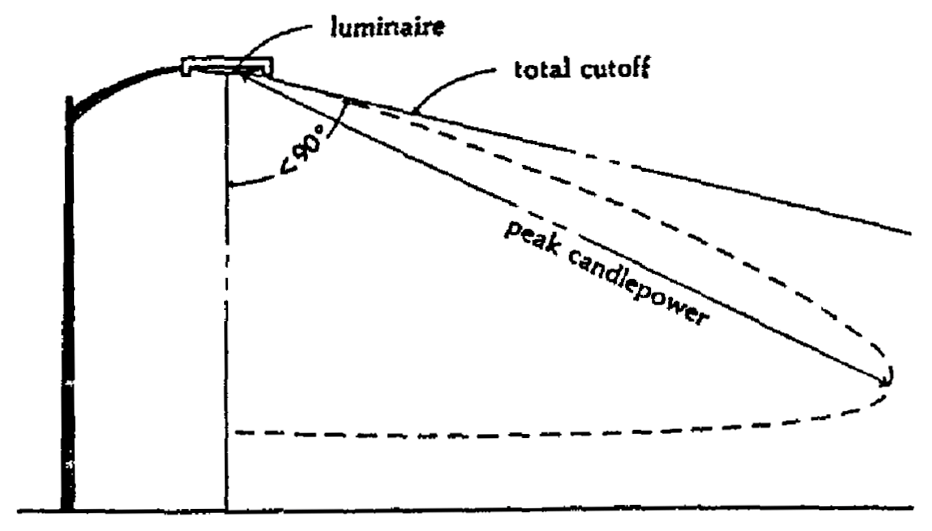
3.
Maximum permitted luminaire height shall be fifteen (15) feet.
4.
Minimum permitted illumination within parking areas and walkways in residential projects of four or more dwelling units shall be 0.25 footcandles.
5.
Maximum permitted illumination within all residential projects, regardless of size, shall be 0.5 footcandles.
6.
Decorative incandescent fixtures of forty (40) watts or less are allowed within residential districts without approval.
7.
Any security lighting used within residential zones, including single-family residential uses, shall be placed so that the bulb or light source is not visible off-site, the light is directed down, and the light level at the property line does not exceed 0.25 footcandles.
F.
Snow Shedding and Snow Storage.
1.
An area equal to a minimum of five percent of all uncovered required parking and driveway areas shall be provided on site for the storage of snow. All designated snow storage areas shall be at least ten (10) feet in width and depth and shall be readily accessible and usable. These areas shall be substantially free and clear of obstructions. No parking may be permitted in snow storage areas, and parking spaces on site shall not be designated for snow storage. Storage of snow on adjacent properties owned by others is not permitted.
2.
Structures and eaves shall not be located so as to shed snow from a building onto an adjacent lot.
G.
Flood Hazard Mitigation. All new residential development shall be designed in accordance with the city's Flood Management Ordinance, as it may be amended from time to time.
(Ord. 2003-333 § 4 (Exh. A (part)), 2003)
(Ord. No. 2011-417, § 4(Exh. A), 12-12-2011)
17.25.090 - Residential building design standards.
A.
Single-Family Residential Design Standards. The following standards shall be applied to all permitted construction or installation within the city of all detached single-family structures, additions thereto, and all accessory structures, including but not limited to garages, guest houses, temporary dependent housing units, and storage buildings, except as otherwise authorized by state law.
1.
All dwelling units shall be placed on permanent foundations in accordance with building and safety department requirements.
2.
Siding material shall consist of wood, stone, brick, decorative masonry block, stucco, or similar material. Synthetic products of a similar appearance, equivalent durability, and providing equivalent fire resistance, may be approved by the city, provided that such products are similar to and compatible with the residences in the surrounding neighborhood. Metal siding, if used, shall be non-reflective and horizontally overlapping. The exterior covering material shall extend to a point at or near grade, except that if an approved solid wood, metal, concrete or masonry perimeter foundation is used, the exterior covering material need not extend below the top of the foundation. Accessory structures shall use the same or similar colors, materials, and design features as the primary structure, to the extent practicable.
3.
All residential structures shall have eave and gable overhangs of not less than twelve (12) inches measured from the vertical side of the residential structure, unless overhangs are architecturally incompatible with the design of the structure as approved by the city planner or his/her designee. Roof materials shall be non-flammable; wood shake shingles are prohibited. Roof pitch shall not be less than 2:12.
4.
All entries and exits shall be completed in accordance with requirements of the building and safety department and the Big Bear Lake Fire Protection District.
5.
Minimum habitable floor area of principal residential structures shall be five hundred (500) square feet measured from the exterior of the structure; except that applications to expand existing structures which are less than five hundred (500) square feet in area, in order to more nearly meet this requirement, may be approved if such expansion proposal meets all other applicable code requirements.
6.
Minimum floor width and depth shall each average at least nineteen (19) feet, measured from the exterior of the structure (excluding garages, porches, patios, eaves, cabanas, and pop-outs).
7.
Utility hookups and an area to accommodate installation of a clothes washer and dryer shall be provided within the primary structure or within an enclosed accessory structure.
8.
Except as otherwise provided within this Development Code, any manufactured home installed or constructed in accordance with the provisions of this section shall be allowed wherever the zoning allows construction of a single-family structure.
9.
A building permit for the issuance of a manufactured home not within an approved and properly licensed manufactured home development shall not be issued, if more than ten (10) years have elapsed between the date of manufacture and the date of the application for the issuance of the permit to install such manufactured home.
10.
Every dwelling unit must conform to the height, setback, lot coverage and other applicable provisions of the zone in which it is proposed to be located.
B.
Multiple Family Residential Design Standards.
1.
Dwelling Size. The following minimum dwelling areas shall be computed by calculating the living areas as measured from the outside walls and excluding garages, carports, exterior courtyards, patios, and balconies, except as otherwise approved in conjunction with approval of an affordable housing project:
Minimum Dwelling Areas
2.
All multiple family developments with four or more dwelling units shall provide twenty-five percent (25%) of the site in usable common open space for passive and active recreational uses. For purposes of meeting this requirement, usable open space areas shall not include public or private rights-of-way; vehicle parking areas; areas less than fifteen (15) feet in width adjacent to or between structures; required building setback areas; private patios or yards; or areas having a slope greater than 3:1.
3.
Each dwelling unit shall have a private (walled or fenced) patio, balcony, or yard area of not less than two hundred (200) square feet in area or twenty-five percent (25%) of the dwelling unit size, whichever is less.
4.
All multiple family developments with six or more dwelling units shall provide recreational amenities within the site, which may include but are not limited to the following: swimming pool; spa or Jacuzzi; clubhouse; tot lot with play equipment; picnic-barbecue area; court game facilities; or other amenity as approved by the reviewing authority. The type of amenities required shall be dependent upon the nature of the development, and shall be approved in conformance with the following schedule:
Required Residential Amenities in
Multiple Family Developments
5.
Climatic conditions shall be considered in locating common open spaces; to the extent feasible, these areas should be screened from wind, provided with shade from summer sun, and open to winter sunshine.
6.
Each dwelling unit shall be provided with a minimum of one hundred fifty (150) cubic feet of private enclosed storage space within the garage, carport, or within or adjacent to the dwelling unit.
7.
Dead-end driveways of over one hundred (100) feet in length shall not be allowed in multi-family projects.
8.
All portions of single-story structures shall be within one hundred fifty (150) feet of access by emergency vehicles; all portions of multi-story structures shall be within fifty (50) feet of emergency vehicle access.
9.
Common laundry facilities of sufficient number and accessibility, consistent with the number of living units and the California Building Code, shall be provided, if dwelling units are not plumbed and wired for laundry facilities.
10.
Each dwelling unit shall be plumbed and wired for a washing machine and dryer, if no common laundry facilities are provided.
11.
Management and security plans shall be submitted for review and approval for multiple family developments with ten (10) or more dwelling units.
12.
Trash collection areas shall be covered and dispersed throughout the project, and must be screened, where feasible, from view of the street through placement of the primary building, landscaping, or other appropriate means. Trash collection areas not located within a building shall be paved and located a minimum of five feet from the private street or drive aisle. Trash enclosures shall be constructed in accordance with city standards, and the location shall be approved by the disposal provider. Trash enclosures shall be constructed of masonry block tall enough to screen the containers, architecturally enhanced to match the primary building, and fitted with solid metal or wood gates attached to steel poles embedded in concrete, and be located at least five feet from any structure, and outside of the front and street side setback areas. One trash area shall be provided for the first ten (10) dwelling units or fraction thereof, and one for each additional ten (10) units or fraction thereof.
13.
All accessible areas of the development, including entries, walkways, active outdoor/landscape areas, parking areas, and refuse enclosures shall include dusk to dawn lighting for security purposes. The lighting shall be energy efficient, stationary, recessed or hooded, directed downward and shall not extend onto adjacent properties or public rights-of-way. The lighting intensity shall be compatible with the residential neighborhood. Lighting standards shall be of decorative design, complementary to the design of the main structures.
14.
Placement of buildings and open space areas shall be designed to facilitate visibility by residents, passers-by, and law enforcement personnel. Passageways having dead-ends or lacking visibility from adjacent buildings, walkways, and/or streets shall not be allowed.
15.
Roof access from all buildings shall be internal; no outside ladders may be attached to buildings.
16.
All rooftop equipment, excluding solar panels, shall be screened through architectural means in keeping with the design of the main structure(s).
17.
Drainage downspouts, roof vents, and other equipment shall be painted to match the surface to which they are attached.
18.
Roof-mounted mechanical equipment shall be screened by architectural means, such as incorporation into the building design. Ground-mounted utility equipment, mechanical equipment, and associated service areas shall be hidden or screened through building placement, walls, fences, berms or landscaping, as approved by the reviewing authority.
19.
Dwelling units shall be pre-wired to accommodate cable reception. Satellite dish antennas shall be prohibited on roofs, and shall be screened in a manner which is compatible with adjacent structures.
20.
Multiple residential structures shall be designed so as to break up massing of long walls or roof planes by offsets, shadow lines, façade treatment, and other similar means. Specifically, each elevation greater than sixty (60) feet in length must provide wall variations (projection or recess) of at least ten (10) feet in depth so that no more than seventy-five percent (75%) of the façade appears unbroken. In addition, buildings with more than one story shall provide massing breaks at least every sixty (60) linear feet along any elevation by stepping back at least thirty percent (30%) of the upper floors by a minimum of ten (10) feet. In situations where multi-story buildings are proposed adjacent to an existing single-story structure, the building must be stepped back so that the portion adjacent to the single-story building is also single-story.
21.
Architectural treatments shall be included on all sides of structures. Specifically, exterior siding materials shall consist of at least two of the following materials; natural wood (or wood-appearing material) in a horizontal or vertical application, natural or cultured stone, or decorative masonry. Acrylic-based stucco (not more than sixty percent (60%) of any one wall surface) may be used only when combined with heavy timber, wood or natural stone and must incorporate heavy reveals and expansions joints. Stone materials may not be painted. Non-reflective metal may only be utilized in small quantities (not more than twenty-five percent (25%) of any wall surface) as an accent material. Blank elevations are not allowed and primary design elements and features incorporated on the primary façade must continue around all sides of the building. Architectural features are encouraged to provide visual interest, and may include but is not limited to bay windows, balconies, covered walkways, dormers, framing around doors and windows and other detailing. Architectural enhancements such as towers, cupolas, ornamental structures, roof projections and other similar extensions shall be designed as an integral component of the building architecture style and design, and must be in scale with the building and surrounding neighborhood or district. Such enhancements shall not be more than twenty-five percent (25%) higher than the primary structure.
22.
All residential structures shall have eave and gable overhangs of not less than twelve (12) inches measured from the vertical side of the structure. Roof materials shall be non-flammable; wood shake singles are prohibited. Roof pitch shall not be less than 2:12, and must be designed to consider ice damming, roof loading and snow accumulation against walls. In addition, treatment of rooflines shall be articulated at least every forty-five (45) feet along the street frontage with the inclusion of dormers, gables, or other architectural features to modify the roof form and/or height. Street-facing gables are encouraged, and design will not allow snow to shed onto any building entryways.
23.
All residential structures will incorporate colors of neutral or muted tones, which may be found in the natural setting, or in accordance with color guidelines approved by the planning commission. Specifically, earth-tones shall be incorporated, primarily focusing on natural shades of green, brown, and grey. At minimum, two natural colors shall be utilized, and not more than four on any building, including one primary base color. Primary building and trim colors must compliment the community's natural setting, be harmonious to surrounding buildings, and shall not include any bright, brilliant, luminescent, or fluorescent hues.
24.
Design of doors, windows, balconies and porches will enhance the building façade, align with the building architecture, provide maximum safety, and comfort in consideration of the mountain climate. Specifically, landscaping, architectural detailing and lighting (at minimum) will enhance doors and entryways for all residential structures, with further enhancements for the main or primary entries. Windows and doors shall be either recessed or trimmed. When trimmed, the trim material shall not be less than three and one-half inches in width by one three-fourths inch in depth, measured from the primary wall surface. When recessed, the primary building wall surface shall not be less than three inches in depth. Raw and unfinished metal windows will not be allowed. Reflective glass and building surfaces shall not be allowed.
25.
All residential structures shall be placed on permanent foundations in accordance with building and safety department requirements.
26.
Buildings constructed on hillsides shall be stepped to follow the natural terrain, shall not substantially alter the natural slope of the site, and site design shall not change natural drainage patterns, and alignment of roads and driveways shall follow site contours to minimize cuts and fills.
27.
Carports, garages, trash enclosures, and other accessory structures shall be designed and constructed using the same design theme and materials as the primary buildings with respect to style, colors and materials.
28.
Individual garages with parking aprons of less than twenty (20) feet in length shall have automatic garage door openers and sectional roll-up doors; in no case shall the drive approach in front of individual garages be less than five feet in length.
29.
Bicycle racks shall be provided in secure locations throughout the project, with the number, type, design, and location to be approved by the reviewing authority.
30.
Sign requirements are as follows:
a.
Identification signage for multiple family housing developments may be permitted in accordance with Section 17.12.090 (Signs).
b.
Adequate directional signs shall be provided to direct traffic to the manager's unit, parking areas, recreation areas, unit numbers, entrances and exits, in accordance with Section 17.12.050.C. (Signs).
(Ord. 2003-333 § 4 (Exh. A (part)), 2003)
(Ord. No. 2011-417, § 4(Exh. A), 12-12-2011; Ord. No. 2022-503, § 4(Exh. 1), 8-15-2022)
17.25.100 - Residential performance standards.
A.
Property Maintenance.
1.
Property owners are responsible for the continuous maintenance of all buildings, structures, yards, landscaping, signs, parking areas, recreational facilities, and other improvements in a manner which does not detract from the appearance of the surrounding area.
2.
Multiple family residential developments and other projects which are subject to the development review process shall be maintained in compliance with all applicable conditions of approval imposed on the project.
3.
For condominium projects, a homeowner's association shall be formed which shall be responsible for maintenance of common recreational facilities, common open space areas, landscaped areas, pathways, private streets, and other common areas identified on the subdivision map. The conditions, covenants and restrictions establishing maintenance shall be approved by the city prior to recordation of the subdivision map.
B.
Fire Protection. Except as otherwise required by the California Fire Code, residential property owners shall be responsible for reducing the accumulation of forest fuels around their property, through implementation of the following measures within ten (10) feet of roads and driveways, and within an area surrounding the dwelling unit(s) from zero to thirty (30) feet in the front and rear yards, or to the property lines (whichever is less); and between the dwelling unit(s) and side property lines:
1.
Remove all dead, burnable fuels, including but not limited to all pine needles and branches on roofs, ground debris, logs and snags, dead trees, grass four inches and higher, pine needles on the ground down to a two-inch depth, and dead branches in bushes and trees.
2.
Stack cut logs or firewood away from any structure.
3.
Thin dense groups of young trees (less than six inches in diameter) to a six to eight foot spacing, measured trunk to trunk. Removal of any live tree with a diameter of more than six inches measured at four and one-half feet above the ground requires approval by the city.
4.
A tree taller than forty-five (45) feet should have its branches trimmed back to the trunk if those branches have any portion lower than twelve (12) to fifteen (15) feet from the ground. A tree shorter than forty-five (45) feet should be trimmed to remove any dead branches up one-third of its total height.
5.
Any branches that have any portions less than ten (10) feet from chimney openings shall be completely trimmed.
6.
All litter generated from clearing and trimming shall be properly disposed of within one week, except that any logs infested with bark beetles shall be treated prior to removal as recommended by the California Department of Forestry or a qualified tree expert.
7.
A layer of one-quarter inch of borax powder or other approved material shall be spread on the tops of all cut pine, fir and cedar stumps within two hours of cutting, except where stumps are ground to below grade.
C.
Outdoor Storage and Uses.
1.
The outdoor storage of any materials or equipment not accessory to the primary use of the property, including lumber, construction materials, inoperable vehicles, auto parts, household appliances, pipe, drums, machinery, furniture, or trash, which is readily visible from off-site, is prohibited; provided, however, that this paragraph shall not preclude the storage of firewood on the property in accordance with Section 17.25.100.B.
2.
No open storage shall be permitted in any required front or side yards adjacent to a street or highway in residential zones.
D.
Line of Sight Restrictions.
1.
A substantially clear line of sight shall be maintained between the driver of a vehicle waiting or yielding at an intersection or driveway and the driver of an approaching vehicle on the other approaches to the intersection or the street being entered from the driveway, as determined by the city engineer.
2.
It shall be the responsibility of the property owner or agent to remove from such property or any adjacent right-of-way any such obstruction that would impede the required clear line of sight.
(Ord. 2003-333 § 4 (Exh. A (part)), 2003)
(Ord. No. 2011-417, § 4(Exh. A), 12-12-2011)
17.25.110 - Bed and breakfast establishments.
The following regulations apply to bed and breakfast establishments operated within single-family residences in any residential zone; bed and breakfast establishments which do not comply with the following regulations are deemed to be commercial lodging establishments and are subject to commercial zoning requirements and approvals for that use.
A.
One parking space per guest room shall be provided in addition to the two required spaces for the owner-operator.
B.
The maximum number of guest rooms shall be five; the minimum number of guest rooms shall be two.
C.
The maximum length of stay shall be thirty (30) days. The total number of occupants, including guests and permanent residents, shall be determined by the chief building official, as set forth by current building codes and ordinances, with a maximum occupancy level of sixteen (16) occupants.
D.
The property owner shall reside full-time on the premises.
E.
Kitchens shall be prohibited in guestrooms, however, mini-refrigerators, microwaves, and coffee makers may be permitted in the guestrooms for the convenience of the guest. No other countertop appliances, including hot plates or similar appliances, shall be allowed.
F.
Notwithstanding the provisions of the Chapter 17.12 of the Development Code (Signs), signs for bed and breakfast facilities in R-L and R-1 zones may be permitted provided the sign area does not exceed twelve (12) square feet, sign height shall not exceed six feet, sign shall be set back a minimum of one foot from the right-of-way; and sign shall be securely attached to the building wall or a wood post in compliance with applicable provisions of Chapter 17.12. Signs may only be externally illuminated.
G.
Smoke detectors shall be installed within each sleeping room and at a point centrally located in the corridor or area giving access to each separate sleeping room. Battery-operated smoke detectors are acceptable provided that they are maintained in good working order at all times, except as required by other applicable codes.
H.
The bed and breakfast shall be equipped with a minimum of one 2A:10B:C type extinguisher with seventy-five (75) feet of travel distance to all portions of the structure; at least one such extinguisher is required per floor. Fire extinguishers(s) shall be mounted in visible locations with the tops of the fire extinguishers mounted between three and five feet above the floor, and shall be accessible to occupants at all times. California State Fire Marshal annual certification tags must be provided and be current on all extinguishers.
I.
Emergency exit routes shall be illuminated with a battery-operated emergency light, so as to provide for safe exiting in the event of electrical failure.
J.
Public use of uses ancillary to the establishment are subject to standards contained in Section 17.25.220 of this chapter.
(Ord. 2003-333 § 4 (Exh. A (part)), 2003)
(Ord. No. 2009-391, § 4(Exh. 1), 6-22-2009; Ord. No. 2011-417, § 4(Exh. A), 12-12-2011)
17.25.120 - Guest houses.
The following regulations apply to guest houses established on a single-family residential lot in any residential zone; guest houses which do not comply with the following regulations are deemed to be additional dwelling units and are subject to density restrictions, zoning requirements and approvals for such use.
A.
A guest house shall be used only by the occupants of the principal dwelling, their nonpaying guests, or domestic employees. The guest house shall not be rented and a deed restriction specifying this requirement shall be recorded by the property owner prior to occupancy of the structure.
B.
A guest house may be permitted only on residentially-zoned properties which contain an existing owner-occupied single-family detached dwelling unit, and which are seven thousand two hundred (7,200) square feet in size or larger.
C.
Only one guest house may be permitted per lot of record.
D.
Guest houses shall be located in the rear of the lot (back yard) and shall not extend into the required front or side yards. Such structures shall conform to all setback and lot coverage standards of the zone.
E.
The floor area of a guest house shall not exceed one thousand two hundred (1,200) square feet. Minimum size shall conform to the requirements of the Uniform Building Code.
F.
There shall be no kitchen, cooking, or wet bar facilities within a guest house.
G.
Design, materials, and construction shall conform to the requirements of Section 17.25.090.A.
H.
The driveway serving the primary dwelling unit shall also serve the guest house.
I.
Each guest house shall be provided with a separate outside entrance, with adequate pedestrian access from a public street to the entrance.
J.
A minimum of one parking space, in a permitted location, shall be provided on the same lot as the guest house, in addition to the required parking spaces serving the primary unit.
K.
Utilities shall not be metered separately for a guest house.
(Ord. 2003-333 § 4 (Exh. A (part)), 2003)
(Ord. No. 2011-417, § 4(Exh. A), 12-12-2011)
17.25.130 - Second units and two-unit projects.
A.
Purpose. The purpose of this section is to allow and appropriately regulate second units and two-unit projects in accordance with Government Code Section 65852.21.
B.
Definition. A "second unit" means the development of a second primary dwelling unit on a legally subdivided lot that is already developed with one primary dwelling unit. A "two-unit project" means the development of two primary dwelling units on a lot that was previously undeveloped.
C.
Application.
1.
Only individual property owners may apply for a two-unit project. "Individual property owner" means a natural person holding fee title individually or jointly in the person's own name or a beneficiary of a trust that holds fee title. "Individual property owner" does not include any corporation or corporate person of any kind (partnership, LP, LLC, C corp, S corp, etc.) except for a community land trust (as defined by Rev. and Tax Code § 402.1(a)(11)(C)(ii)) or a qualified nonprofit corporation (as defined by § 214.15).
2.
A building permit application for a second unit or two-unit project must be submitted on the city's approved form.
3.
The city may establish a fee to recover its costs for adopting, implementing, and enforcing this section of this Code, in accordance with applicable law. The city council may establish and change the fee by resolution. The fee must be paid with the application.
D.
Approval.
1.
An application for a second unit or two-unit project shall be acted upon by the community development director or his/her designee, without discretionary review.
2.
The final inspection of a building permit for a second unit or two-unit project shall not be granted until confirmation is provided to the city that the required documents have been recorded, such as the deed restriction and any required easements.
3.
The approval must require the owner and applicant to hold the city harmless from all claims and damages related to the approval and its subject matter.
4.
The approval must require the owner and applicant to reimburse the city for all costs of enforcement, including attorneys' fees and costs associated with enforcing the requirements of this Code.
E.
Requirements. A second unit or two-unit project must satisfy each of the following requirements:
1.
Map Act Compliance. The lot must have been legally subdivided.
2.
Zone. The property for which a building permit for a second unit or two-unit project is proposed is located in a single-family residential zone. For purposes of this section, a single-family residential zone is a zone where the only residential use that is allowed as a primary use is one single-family residential dwelling unit on a lot, specifically the R-L and R-1 zones. Second units and two-unit projects under this section are prohibited in the multiple family residential (R-3), all commercial, and village specific plan (VSP) zones.
3.
Lot Location.
a.
The lot is not located on a site that is any of the following:
(1)
Prime farmland, farmland of statewide importance, or land that is zoned or designated for agricultural protection or preservation by the voters.
(2)
A wetland.
(3)
Within a very high fire hazard severity zone, unless the site complies with all fire-hazard mitigation measures required by existing building standards.
(4)
A hazardous waste site that has not been cleared for residential use.
(5)
Within a delineated earthquake fault zone, unless all development on the site complies with applicable seismic protection building code standards.
(6)
Within a one hundred (100) year flood hazard area, unless the site has either:
(a)
Been subject to a letter of map revision prepared by the Federal Emergency Management Agency and issued to the local jurisdiction, or
(b)
Meets Federal Emergency Management Agency requirements necessary to meet minimum flood plain management criteria of the National Flood Insurance Program.
(7)
Within a regulatory floodway, unless all development on the site has received a no-rise certification.
(8)
Land identified for conservation in an adopted natural community conservation plan, habitat conservation plan, or other adopted natural resource protection plan.
(9)
Habitat for protected species.
(10)
Land under conservation easement.
b.
The purpose of subsection E.3.a. above is merely to summarize the requirements of Government Code Section 65913.4(a)(6)(B)—(K). (See Gov. Code § 66411.7(a)(3)(C).)
4.
Not Historic. The lot must not be a historic property or within a historic district that is included on the state historic resources inventory. Nor may the lot be or be within a site that is designated by ordinance as a city or county landmark or as a historic property or district.
5.
No Impact on Protected Housing. The second unit or two-unit project must not require or include the demolition or alteration of any of the following types of housing:
a.
Housing that is income-restricted for households of moderate, low, or very low income.
b.
Housing that is subject to any form of rent or price control through a public entity's valid exercise of its policy power.
c.
Housing, or a lot that used to have housing, that has been withdrawn from rental or lease under the Ellis Act (Gov. Code §§ 7060—7060.7) at any time in the fifteen (15) years prior to submission of the urban lot split application.
d.
Housing that has been occupied by a tenant in the last three years. The applicant and the owner of a property for which a second unit or two-unit project is sought must provide a sworn statement as to this fact with the application for the parcel map. The city may conduct its own inquiries and investigation to ascertain the veracity of the sworn statement, including but not limited to, surveying owners of nearby properties; and the city may require additional evidence of the applicant and owner as necessary to determine compliance with this requirement.
6.
Unit Standards. Where a standard is not listed, the standard provided in Development Code Chapter 17.25 shall apply:
a.
Quantity.
(1)
No more than two dwelling units of any kind may be built on a lot that results from an urban lot split. For purposes of this paragraph, "unit" means any dwelling unit, including, but not limited to, a primary dwelling unit, a unit created under this section of this code, an ADU, or a JADU.
(2)
A lot that is not created by an urban lot split may have a second unit or two-unit project under this section, plus any ADU or JADU that must be allowed under state law and the city's ADU ordinance.
b.
Unit Size.
(1)
The total floor area of each dwelling unit that is developed under this section must be:
(a)
Equal to or greater than five hundred (500) square feet in area; and
(b)
Less than or equal to eight hundred (800) square feet in area.
(2)
A dwelling unit that was legally established prior to the second unit and that is larger than eight hundred (800) square feet is limited to the lawful floor area at the time of the urban lot split. The floor area of the original dwelling unit may not be expanded.
(3)
A dwelling unit that was legally established prior to the second unit that is smaller than eight hundred (800) square feet may be expanded to eight hundred (800) square feet after the urban lot split.
c.
Height Restrictions. The maximum building height of a primary dwelling unit shall be twenty-two (22) feet, measured in a manner established in Development Code Section 17.02.030 "Building Height." Relief from setbacks will be granted before relief from building height.
d.
Demolition Cap. The second unit or two-unit project shall not involve the demolition of more than twenty-five percent (25%) of the existing exterior walls of an existing dwelling unit unless the site has not been occupied by a tenant in the last three years.
e.
Lot Coverage. The maximum lot coverage allowed in the residential-low (R-L) zone is thirty percent (30%). The maximum lot coverage allowed in the single family residential (R-1) zone is forty percent (40%). This lot coverage standard is only enforced to the extent that it does not prevent two primary dwelling units on the lot at eight hundred (800) square feet each.
f.
Open Space. The open space requirements shall be those established in Development Code Table 17.25.050.A. for the residential-low (R-L) and single family residential (R-1) zones. This open space standard is only enforced to the extent that it does not prevent two primary dwelling units on the lot at eight hundred (800) square feet each.
g.
Setbacks.
(1)
Generally. All setbacks must conform to those objective setbacks that are imposed through the underlying zone as stated in Development Code Section 17.25.050.
(2)
Exceptions. Notwithstanding subsection (1) above:
(a)
Existing Structures. No setback is required for an existing legally established structure or for a new structure that is constructed in the same location and to the same dimensions as an existing legally established structure.
(b)
Side and Rear Setbacks. The side and rear setbacks imposed by the underlying zone shall be provided, however, these setback regulations must yield to the degree necessary to avoid physically precluding the construction of up to two units on the lot or either of the two units from being at least eight hundred (800) square feet in floor area; but in no event may any structure be less than four feet from a side or rear property line.
(3)
Front and Streetside Setbacks. Where the property is adjacent to a public or private street having a right-of-way width of less than forty (40) feet, the minimum front setback (and streetside setback where the property contains more than one street frontage) shall be twenty (20) feet. Where the property is adjacent to a public or private street having a right-of-way width of forty (40) feet or greater, the minimum front setback (and streetside setback where the property contains more than one street frontage) shall be fifteen (15) feet.
h.
Parking. Each new primary dwelling unit must have at least one off-street parking space per unit unless one of the following applies:
(1)
The lot is located within one-half mile walking distance of either:
(a)
A corridor with fixed route bus service with service intervals no longer than fifteen (15) minutes during peak commute hours; or
(b)
A site that contains:
i.
An existing rail or bus rapid transit station;
ii.
A ferry terminal served by either a bus or rail transit service; or
iii.
The intersection of two or more major bus routes with a frequency of service interval of fifteen (15) minutes or less during the morning and afternoon peak commute periods.
(2)
The site is located within one block of a car-share vehicle location.
i.
Architecture.
(1)
If there is an existing, legal primary dwelling on the lot that was established before the two-unit project, any new second unit shall match the existing primary dwelling unit in architectural style, exterior materials, color, and dominant roof pitch. The dominant roof slope is the slope shared by the largest portion of the roof.
(2)
If there is no legal primary dwelling on the lot before the two-unit project, and if two primary dwellings are proposed for development on the lot, then the two dwellings shall match each other in architectural style, exterior materials, color, and dominant roof pitch. The dominant roof slope is the slope shared by the largest portion of the roof.
(3)
Exterior siding materials of the dwelling units shall consist of at least two of the following materials; wood (or wood-appearing material) in a horizontal application, wood (or wood-appearing material) in a vertical application, natural or cultured stone, decorative masonry, metal, and stucco. Stucco may not be applied to an area greater than sixty percent (60%) of any wall surface. Metal siding shall only be used as an accent material and may not be applied to an area greater than twenty-five percent (25%) of any wall surface.
(4)
All exterior lighting shall comply with Development Code Section 17.25.080.E., Lighting.
(5)
All residential structures shall have eave and gable overhangs of not less than twelve (12) inches measured from the vertical side of the residential structure. Roof materials shall be non-flammable; wood shake shingles are prohibited. Roof pitch shall not be less than 2:12.
(6)
The minimum interior dimensions of a covered or enclosed (garage) parking space is ten (10) feet wide by twenty (20) feet in depth. The minimum uncovered parking space dimension is nine feet wide by nineteen (19) feet in depth.
(7)
Utility hook-ups and an area to accommodate installation of a clothes washer and dryer shall be provided within each dwelling unit.
(8)
Each dwelling unit shall have private (walled or fenced) patio, balcony, or yard area of not less than two hundred (200) square feet in area or twenty-five percent (25%) of the dwelling unit size, whichever is less.
(9)
Each dwelling unit shall be provided with a pedestrian access to the public right-of-way in the driveway, by separate stairs, or a separate concrete walkway.
(10)
The driveway serving the residential unit, or units in the event of a shared driveway, shall not exceed a grade of fourteen percent (14%).
j.
Landscaping. All landscaping shall comply with Development Code Section 17.25.080.C., Open Space and Landscaping, and the provisions of the California Model Water Efficient Landscape Ordinance (MWELO) as adopted by the city and revised from time to time.
k.
Nonconforming Conditions. Where a lot is not created by an urban lot split, a second unit or a two-unit project is proposed, the building permit shall only be approved if all nonconforming zoning conditions are corrected.
l.
Utilities.
(1)
Each primary dwelling unit on the lot must have its own direct utility connection to the utility service provider.
(2)
Each primary dwelling unit on the lot that is or that is proposed to be connected to an onsite wastewater treatment system must first have a percolation test completed within the last five years or, if the percolation test has been recertified, within the last ten (10) years.
m.
Building and Safety. All structures built on the lot must comply with all current local building standards. A project under this section is a change of use and subjects the whole of the lot, and all structures, to the city's current Code.
7.
Fire-Hazard Mitigation Measures. In order to be eligible for a second unit or two-unit project under the provisions of this section, a lot in a very high fire hazard severity zone must comply with each of the following fire-hazard mitigation measures:
a.
The lot must have direct access to a paved public or private street having a right-of-way width of at least forty (40) feet.
b.
The public or private street of way must have at least two independent points of access for fire and life safety to access and for residents to evacuate.
c.
All dwellings on the site must comply with current fire code requirements for dwellings in a very high fire hazard severity zone.
d.
All enclosed structures on the site must have fire sprinklers.
e.
All sides of all dwellings on the site must be within a one hundred fifty (150) foot hose-pull distance from either the public right of way or of an onsite fire hydrant or standpipe.
8.
Separate Conveyance.
a.
Primary dwelling units on the lot may not be owned or conveyed separately from each other.
b.
Condominium airspace divisions and common interest developments are not permitted within the lot.
c.
All fee interest in the lot and all the dwellings must be held equally and undivided by all individual property owners.
9.
Regulation of Uses.
a.
Residential-Only. No non-residential use is permitted on the lot.
b.
No Vacation Rentals. No dwelling unit on the lot may be rented for a period of less than thirty (30) days.
c.
Owner Occupancy. On a lot that was not created by an urban lot split, the property owner requesting a second unit or an urban lot split must sign an affidavit stating that the property owner intends to occupy one of the dwelling units as the property owner's principal residence for a minimum of three years after the urban lot split is approved. The owner occupancy requirement shall be enforced at the time of a final inspection of a building permit on the first structure built on the property.
10.
Deed Restriction. The owner must record a deed restriction, acceptable to the city, that does each of the following:
a.
Expressly prohibits any rental of any dwelling on the property for a period of less than thirty (30) days.
b.
Expressly prohibits any non-residential use of the lot.
c.
Expressly prohibits any separate conveyance of a primary dwelling on the property, any separate fee interest, and any common interest development within the lot.
d.
If the lot is not created by an urban lot split, the deed restriction expressly requires the property owner to live in one of the dwelling units on the lot as the owners' primary residence and legal domicile.
e.
States that the property is formed by an urban lot split and is therefore subject to the city's urban lot split regulations, including all applicable limits on dwelling size and development.
F.
Specific Adverse Impacts.
1.
Notwithstanding anything else in this section, the city may deny an application for a two-unit project if the building official makes a written finding, based on a preponderance of the evidence, that the project would have a "specific, adverse impact" on either public health and safety or on the physical environment and for which there is no feasible method to satisfactorily mitigate or avoid the specific adverse impact.
2.
"Specific adverse impact" has the same meaning as in Gov. Code § 65589.5(d)(2): "a significant, quantifiable, direct, and unavoidable impact, based on objective, identified written public health or safety standards, policies, or conditions as they existed on the date the application was deemed complete" and does not include:
a.
Inconsistency with the zoning ordinance or general plan land use designation; or
b.
The eligibility to claim a welfare exemption under Revenue and Taxation Code Section 214(g).
3.
The building official may consult with and be assisted by planning staff and others as necessary in making a finding of specific, adverse impact.
G.
Remedies. If a second unit or two-unit project violates any part of this Code or any other legal requirement:
1.
The buyer, grantee, or lessee of any part of the property has an action for damages or to void the deed, sale, or contract.
2.
The city may:
a.
Bring an action to enjoin any attempt to sell, lease, or finance the property.
b.
Bring an action for other legal, equitable, or summary remedy, such as declaratory and injunctive relief.
c.
Pursue criminal prosecution, punishable by imprisonment in county jail or state prison for up to one year, by a fine of up to ten thousand dollars ($10,000.00), or both; or a misdemeanor.
d.
Record a notice of violation.
e.
Withhold any or all future permits and approvals.
f.
Pursue all other administrative, legal, or equitable remedies that are allowed by law or this Code.
(Ord. No. 2022-500, § 4(Exh. 2), 3-7-2022)
Editor's note— Ord. No. 2022-500, § 4(Exh. 2), adopted March 7, 2022, repealed § 17.25.130 and enacted a new § 17.25.130 as set out above and later amended. Former § 17.25.130 pertained to temporary dependent housing units and derived from Ord. 2003-333, adopted 2003; and Ord. No. 2011-417, adopted December 12, 2011.
17.25.140 - Tennis courts and play courts.
A.
When located in the rear of the lot (back yard) of a single-family residential lot, a tennis court or play court may be allowed pursuant to this section for use only by the occupants of the principal dwelling or their guests. When located within multiple family residential complexes, a tennis court or play court shall be used only by occupants of the on-site dwelling units or their guests. The court shall not be rented or used for paid instructional purposes.
B.
Within the R-L and R-1 zones, one tennis court or play court may be permitted on a lot of record at least ten thousand (10,000) square feet in size or larger which contains an existing single-family detached dwelling unit, or on a lot adjacent to another lot that contains a residence where both lots are under a common ownership and the combined area of the two parcels is ten thousand (10,000) square feet or larger. Within the R-3 zone, tennis courts or play courts may be permitted only as an accessory use to a single-family residence on a lot of ten thousand (10,000) square feet or greater, or a multi-family development on a lot or parcel of at least one acre or larger. Tennis courts and play courts may be included in the calculation to meet open space requirements.
C.
Within the R-L and R-1 zones, minimum setbacks for tennis or play courts, measured from the property line to the court fence or lighting fixture, shall be as follows:
1.
Side yard setback: fifteen (15) feet.
2.
Rear yard setback: fifteen (15) feet.
3.
Separation between edge of court and any other fence, building or structure: ten (10) feet.
4.
Within the R-3 zone, setbacks for tennis courts shall be the same as the building setback lines established for the R-3 zone. Separation between the edge of the court and any other fence, building or structure shall be ten (10) feet.
D.
Tennis court or play court fencing shall not exceed fifteen (15) feet in height. The fence may be plastic-coated chain link, colored dark green or dark brown, or dark-colored mesh netting or wind screen material. No galvanized chain link or solid fencing is permitted.
E.
No lighting for tennis courts or play courts shall be allowed in residential zones except through approval of a conditional use permit and compliance with the all of the following requirements:
1.
Light standards shall not exceed fourteen (14) feet in height;
2.
Light fixtures shall be designed with shields to prevent glare onto adjacent properties;
3.
Mercury vapor lighting shall not be permitted;
4.
Lighting level shall not exceed 0.25 footcandle at the property line, or one footcandle on the court.
F.
The area graded for a tennis court or game court shall not exceed seven thousand seven hundred (7,700) square feet. Within hillside areas where the location of the proposed court has a slope of over ten percent (10%) prior to construction, a conditional use permit and compliance with all of the following conditions shall be required:
1.
Retaining walls constructed for the court shall not exceed four feet in height at any point along the wall;
2.
A tennis court or play court shall not be located on slopes where the natural terrain prior to grading exceeds a thirty percent (30%) natural slope, or within natural drainage courses;
3.
When grading is required to construct a tennis court or play court, cutting and filling shall be balanced on-site and shall not exceed seven hundred fifty (750) yards.
G.
Tennis courts and play courts in zones R-L and R-1 which are not subject to review under a conditional use permit shall be reviewed pursuant to a minor modification (Section 17.03.250).
(Ord. 2003-333 § 4 (Exh. A (part)), 2003)
(Ord. No. 2011-417, § 4(Exh. A), 12-12-2011)
17.25.150 - Caretaker's residences.
A.
Where a caretaker's residence, as defined in Chapter 17.02, is allowed in any residential or non-residential zones, such caretaker's residence shall be subject to the requirements of this section.
B.
A caretaker's residence may be occupied only by a caretaker, manager, or other person with authority to manage the premises, along with that person's household. No other residential occupancy is permitted.
C.
A caretaker's residence shall not be used as the office space for a business.
D.
Only one caretaker's residence may be permitted per lot, business, or development project.
E.
Construction of a detached caretaker's residence shall meet the requirements of Section 17.25.090.A. Construction of a caretaker's residence attached to another building shall meet the applicable requirements of Section 17.25.090.B. All caretakers' residences shall be affixed to a permanent foundation.
F.
Caretaker's residences shall be designed and constructed with materials that are similar to and compatible with any structures constructed for the primary use, if applicable.
G.
The driveway serving the primary use shall also serve the caretaker's residence. Each caretaker's residence shall be provided with a separate outside entrance, with adequate pedestrian access from a public street to the entrance.
H.
A minimum of one covered parking space, in a permitted location, shall be provided on the same lot as the caretaker's residence, in addition to the required parking spaces serving the primary use.
I.
A caretaker's residence shall not be constructed within a required yard or setback area. No variances shall be granted in order to accommodate a caretaker's residence on the property.
J.
The caretaker's unit shall not be metered separately from the primary structures for utility connections.
K.
Caretaker's residences that are intended to be incorporated into the overall site plan of the property and constructed at the same time as the primary use shall be reviewed and approved as part of the development application for the primary use. A caretaker's residence which is added to an existing facility may be approved pursuant to a minor modification (Section 17.03.250).
(Ord. 2003-333 § 4 (Exh. A (part)), 2003)
(Ord. No. 2011-417, § 4(Exh. A), 12-12-2011)
17.25.160 - Transitional housing facilities.
A.
Transitional housing facilities, designed to serve the special housing needs of families and individuals who are temporarily unable to provide their own independent housing, shall be conditionally permitted in the R-3 zone, and permitted pursuant to approval of a plot plan review in the C-2 zone, subject to meeting all the requirements of this section. A transitional housing facility shall mean a facility that provides temporary residential accommodations for a specified period of time, counseling services, and other support services for seven or more individuals, in order to prepare families and individuals for independent living. This term does not include homeless shelters or congregate meal facilities.
B.
The parcel upon which the transitional housing facility is established shall conform to all standards of the underlying land use designation and zone.
C.
Residential occupancy shall be limited to families or individuals who are temporarily unable to provide their own independent housing due to economic circumstances and/or personal rehabilitation.
D.
Transitional housing facilities shall not be located within one-quarter mile (one thousand three hundred twenty (1,320) feet) of another transitional housing, congregate meal or homeless shelter (measured from property line to property line).
E.
Accommodations shall include the following:
1.
The facility shall provide at least seventy (70) square feet of sleeping space for each resident, not including closet or storage space, multipurpose rooms, bathrooms, dining rooms, or halls.
2.
Sleeping areas shall not be used as a public or general passageway to another room, bath, or toilet.
3.
The facility shall provide at least ten (10) square feet of common living area per bed, not including sleeping space, dining areas, or kitchen areas.
4.
The facility shall provide dining and kitchen areas of a sufficient size to adequately provide for the number of residents living at the facility.
5.
The facility shall provide at least eight square feet of storage area (closet or drawer space) per bed.
6.
The facility shall provide one full bathroom, including sink, toilet, and shower, for every seven beds.
F.
Off-street parking shall be provided to include one space per employee on the largest shift, and one space for every two beds.
G.
Transitional housing shall conform with all other applicable local, state, and federal requirements.
(Ord. 2003-333 § 4 (Exh. A (part)), 2003)
(Ord. No. 2011-417, § 4(Exh. A), 12-12-2011)
17.25.170 - Group living facilities.
A.
Group living facilities for six or more residents, including boarding houses, rooming houses, hostels, single-room occupancies, and similar facilities, shall accommodate a maximum of fifty-four (54) persons per net acre.
B.
Parking shall be provided at a ratio of one space per bedroom, or one space per three beds (in the case of dormitory-type facilities), and two spaces for the manager's unit.
C.
Common areas shall be provided for tenants both within the building (including living room, dining and kitchen areas) and outside (including outdoor seating).
D.
Trash collection shall be contracted with the city's solid refuse disposal contractor as a commercial service, with adequate container capacity and pick-up to avoid accumulation of trash on site. A trash enclosure meeting city standards shall be provided on the site, with the location approved by the disposal company.
E.
Group living facilities with six or fewer residents shall comply with all applicable requirements for a single dwelling unit.
(Ord. 2003-333 § 4 (Exh. A (part)), 2003)
(Ord. No. 2011-417, § 4(Exh. A), 12-12-2011)
17.25.180 - Manufactured home subdivisions and parks.
A.
The minimum site area for new manufactured home parks and subdivisions shall be five acres.
B.
Residential density shall not exceed that permitted by the general plan, except as modified for an affordable housing project.
C.
Home sites shall have the following dimensions and coverage requirements:
1.
Average home site within a manufactured home park shall be three thousand (3,000) square feet, with no site smaller than two thousand five hundred (2,500) square feet.
2.
Minimum lot size within a manufactured home subdivision shall be five thousand (5,000) square feet.
3.
Minimum average width of a manufactured home park site shall be forty-two (42) feet for sites designated for a single-wide manufactured home, or thirty (30) feet plus the width of the dwelling unit for sites designated for double-wide or wider manufactured homes.
4.
Maximum coverage of any home site shall be seventy-five percent (75%) (including the dwelling unit and all accessory structures).
D.
Yards and setbacks for manufactured home sites shall be required as follows:
1.
Front setback: ten (10) feet.
2.
Side setback: either five feet on each side, or zero lot one on one side and ten (10) feet on the opposite side. On corner home sites or lots, the side yard adjoining the private or public street shall not be less than ten (10) feet.
3.
Rear setback: ten (10) feet.
4.
Structural separation between any two dwelling units: ten (10) feet.
E.
All exterior boundaries of the manufactured home park or subdivision shall appear similar to conventional residential developments. Where fences or walls are used, they shall be of decorative construction; no chain-link fencing, barbed wire, or similar materials are permitted. A minimum landscaped area of six feet shall be provided along the project perimeter (inside any perimeter wall or fence), which may include the required yards of adjoining manufactured home sites. Where a perimeter wall or fence is located adjacent to a public right-of-way, a minimum landscaped area of twelve (12) feet shall be provided between the fence or wall and edge of curb or pavement.
F.
A minimum of twenty-five percent (25%) of the site shall be devoted to common usable open space, excluding rights-of-way, vehicle parking areas, areas adjacent to or between structures less than fifteen (15) feet in width, private yards, or slopes greater than 3:1. The area to be used for common recreation facilities shall have a minimum aggregate area of three hundred (300) square feet per dwelling unit.
G.
All manufactured home parks shall provide recreational amenities within the site which may include the following: swimming pool, spa or Jacuzzi, clubhouse, tot lot with play equipment, picnic shelter and barbecue area, game courts, play fields, or similar facilities. The type of amenities shall be approved by the planning commission and provided according to the following schedule:
Required Amenities for Manufactured Home Parks
H.
Permanent parking for recreational vehicles, boats, trailers, camper shells, off-road vehicles, personal watercraft and similar items may be allowed as part of the site plan for the project, provided that a designated area is provided for such items with a paved or impermeable surface and that screening is provided from adjacent properties and the interior of the site by use of a decorative six-foot visual barrier. This area shall be used for storage by residents only.
I.
All utility distribution facilities, including television antennae and service lines serving individual home sites, shall be placed underground. Transformers, terminal boxes, meter cabinets, pedestals, and other appurtenant facilities may be place above ground and screened from view. Water and sewer for each home site shall be installed as approved by the city. All home sites shall be served with natural gas, electricity, and television cable.
J.
No manufactured home shall be installed in a manufactured home park if more than ten (10) years have elapsed between the date of the manufacture of the home and the date of an application for the issuance of a building permit to install the unit.
K.
Each unit shall be equipped with skirting or provided with a support pad which is recessed, in order to give the appearance of the manufactured home being located at grade.
L.
Internal streets shall be designed to provide convenient traffic circulation within the manufactured home park or subdivision. The following minimum standards shall apply unless otherwise approved by the city engineer: the minimum width of any street shall be thirty (30) feet; the streets shall be paved in accordance with city standards; rolled curbs shall be provided on each side of the street.
M.
All recreation facilities and common areas shall be conveniently located within the park or subdivision and be accessible via pedestrian pathways or sidewalks. Such walkways shall also be provided to off-site walkways, where existing.
N.
Parking shall be provided at a ratio of two spaces per dwelling unit, and one guest parking space per every four dwelling units. Common recreation areas, club houses, and similar facilities shall have sufficient parking to serve residents and guests, as determined by the reviewing authority.
O.
Common open space areas shall be landscaped in accordance with a landscape plan approved pursuant to the conditional use permit. Landscaping shall be maintained in accordance with such plan in perpetuity. In addition to the perimeter landscaping, a minimum of one tree shall be provided for each manufactured home lot or space, either within the individual spaces or in common areas.
P.
Trash collection areas shall be dispersed throughout the project. Trash collection areas shall be paved and located a minimum of five feet from the private street or drive aisle. Trash enclosures shall be constructed in accordance with city standards, and the location shall be approved by the refuse disposal provider. Trash enclosures shall be located at least five feet from any structure, and outside of the front and street side setback areas. One trash area shall be provided for the first ten (10) dwelling units or fraction thereof, and one for each additional ten (10) units or fraction thereof.
Q.
Adequate internal and external lighting within all publicly accessible areas of the development, including walkways, shall be provided for security purposes. The lighting shall be energy efficient, stationary, directed away from adjacent properties and public rights-of-way, and of an intensity compatible with the residential neighborhood. Lighting standards shall be of decorative design.
R.
Sign requirements are as follows:
1.
Identification signage for the manufactured home park or subdivision may be permitted in accordance with Section 17.12.090 (Signs).
2.
Adequate directional signs shall be provided to direct traffic to the manager's unit, parking areas, recreation areas, space numbers, entrances and exits, in accordance with Section 17.12.050.C (Signs).
S.
Any manufactured home site that is occupied with a dwelling unit for ninety (90) days or less shall be deemed a transient space. Not more than ten percent (10%) of the manufactured home sites may be used for transient spaces. Sites reserved for transient spaces shall be so designated on the plans submitted with the conditional use permit application. All requirements of this section shall fully apply to transient spaces.
T.
For manufactured home subdivisions, a homeowner's association shall be formed which shall be responsible for maintenance of common recreational facilities, common open space areas, landscaped areas, pathways, private streets, and other common areas identified on the subdivision map. The conditions, covenants and restrictions establishing maintenance shall be approved by the city prior to recordation of the subdivision map.
U.
Mobilehome parks existing on the effective date of this ordinance shall not be deemed nonconforming solely by reason of failure to meet the minimum requirements prescribed in this section, provided that the regulations of this section shall apply to the enlargement or expansion of any such existing mobilehome park.
(Ord. 2003-333 § 4 (Exh. A (part)), 2003)
(Ord. No. 2011-417, § 4(Exh. A), 12-12-2011)
17.25.190 - Senior housing facilities.
All senior group housing shall conform to the following standards, except that when existing multi-family residential uses are converted to senior housing, the reviewing authority may revise or waive any development standard determined to be infeasible, due to the project's design, size, or physical development.
A.
Residential occupancy shall be limited to single persons over fifty-five (55) years of age or married couples of which one spouse is over fifty-five (55) years of age.
B.
The number of dwelling units for senior housing projects shall be based on the underlying general plan designation, except as modified by a density bonus for affordable housing. Congregate care facilities which do not include individual kitchens shall not be subject to density provisions.
C.
Minimum floor areas for each residential unit are required as follows:
1.
Studio apartments: four hundred ten (410) square feet.
2.
One-bedroom apartments: five hundred ten (510) square feet if kitchen, dining, and living areas are combined; five hundred seventy (570) square feet if kitchen, dining, and living areas are separate.
3.
Two-bedroom apartments: six hundred ten (610) square feet if kitchen, dining, and living areas are combined; six hundred seventy (670) square feet if kitchen, dining, and living areas are separate.
D.
The development may provide one or more of the following internal common facilities for the exclusive use of the residents, as an accessory use:
1.
Central cooking and dining rooms;
2.
Beauty and/or barber shop;
3.
Pharmacy (not to exceed one thousand (1,000) square feet);
4.
Medical office or clinic (not to exceed one thousand (1,000) square feet);
5.
Community garden or greenhouse;
6.
Workshop or craft shop;
7.
Exercise room;
8.
Library, computer room, game room, or similar activity area.
E.
Common recreational and entertainment facilities of a size and scale consistent with the number of living units shall be provided. The minimum size shall equal one hundred (100) square feet per living unit. Outdoor open space areas allocated to meet this requirement shall be located with convenient access from the units they serve, and shall be protected from sun and wind through location, design, and landscaping.
F.
Each residential unit shall be plumbed and wired for a washing machine and dryer.
G.
Off-street parking shall be provided at a ratio of one space per dwelling unit, one guest space per every four dwelling units, and one employee space for each employee on the largest shift. All required off-street parking shall be located at a maximum distance of one hundred (100) feet from at least one entrance to the residential building that it serves.
H.
If a shuttle bus stop is located on the site, shaded waiting areas and adequate, striped paved areas for shuttle parking shall be provided.
I.
A bus turnout and shelter may be required by the reviewing authority if the project is located on a collector or arterial street served by public transit.
J.
The primary pedestrian entrance to the development, all common areas, and parking areas, shall be accessible to disabled persons in accordance with state law. Indoor common areas and living units shall be handicapped-accessible or adaptable, and be provided with all necessary safety equipment as well as emergency signal/intercom systems or other measures as determined by the reviewing authority.
K.
Any stairways providing access to upper story dwelling units shall be located internally. The reviewing authority may require provision of elevators.
L.
The project shall be designed to provide for security and safety of residents, guests, and employees.
M.
Lighting, trash enclosures, building design, access, and other design considerations shall conform to the requirements of Section 17.25.090.B (Design Standards for Multiple Family Residential Developments).
N.
Sign requirements are as follows:
1.
Identification signage for the senior housing project may be permitted in accordance with Section 17.12.090 (Signs).
2.
Adequate directional signs shall be provided to direct traffic to the manager's unit, parking areas, recreation areas, unit numbers, entrances and exits, in accordance with Section 17.12.050.C (Signs).
(Ord. 2003-333 § 4 (Exh. A (part)), 2003)
(Ord. No. 2011-417, § 4(Exh. A), 12-12-2011)
17.25.200 - Affordable housing projects.
A.
General Provisions.
1.
For purposes of this section, the following terms shall be defined as follows:
a.
"Affordable housing project" means a project having no less than five dwelling units (excluding any density bonus), for which incentives have been granted by the city to ensure continued affordability pursuant to an approved affordable housing agreement.
b.
"Area median income" means area median income as periodically established by the department of housing and community development pursuant to Section 50093 of the Health and Safety Code.
c.
"Density bonus" means a density increase over the otherwise maximum allowable residential density under the applicable zoning ordinance and land use element of the general plan as of the date of application by the developer to the city.
d.
"Feasible" means capable of being accomplished in a successful manner within a reasonable period of time, taking into account economic, environmental, social, and technological factors.
e.
"Housing development" means one or more groups of projects for residential units constructed in the city, which also includes either a project to substantially rehabilitate and convert an existing commercial building to residential use, or the substantial rehabilitation of an existing multifamily dwelling where the result of the rehabilitation would be a net increase in available residential units.
f.
"Lower income household" means persons and families whose income does not exceed the qualifying limits in Section 50079.5 of the California Health and Safety Code.
g.
"Moderate income household" means moderate-income households as defined in Section 50093 of the Health and Safety Code.
h.
"Qualifying resident" means either: (1) a person sixty-two (62) years of age or older; or (2) fifty-five (55) years of age or older in a senior citizen housing development as defined in Section 51.3 of the California Civil Code.
i.
"Very low income household" means persons or families whose income does not exceed the qualifying limit in Section 50105 of the California Health and Safety Code.
2.
In accordance with the general plan housing element, affordable housing incentives shall be offered to promote establishment of affordable housing, which shall include the following:
a.
A density bonus of no greater than one hundred percent (100%) of the base density, as determined by the general plan land use map; the actual density bonus shall be based upon the number of units provided to households with very low income, lower income, and qualifying residents as defined by state law (Government Code Section 65915 for density bonuses and other incentives). The density bonus may be permitted in geographic areas of the housing development other than the areas where the units for the lower income households are located.
b.
A reduction or waiver of development standards such as parking or setback requirements, minimum lot size, and/or placement of public improvements, provided that the applicant shall demonstrate that the waiver or modification of such development standards is necessary to make the housing project economically feasible. Any such deviation from development standards shall exceed the minimum building standards approved by the State Building Standards Commission as provided in Part 2.5, commencing with Section 18901 of Division 13 of the California Health and Safety Code.
3.
In addition to the mandatory incentives listed in paragraph 2 above, the city may grant the following optional incentives:
a.
Financial incentives such as reduction of or compensation for certain development-related fees, as approved by the city or improvement agency based on evidence provided by the applicant that the project is not economically feasible without such financial incentive;
b.
Other incentives as approved by the city in an affordable housing agreement;
c.
Nothing in this section shall require the city to provide direct financial incentives or publicly-owned land, or to waive fees or dedication requirements on an affordable housing project.
4.
In any case where the city grants incentives to promote the production of affordable housing units pursuant to this section, an affordable housing agreement shall be approved by the city council pursuant to Section 17.03.230 of the Development Code.
5.
Except as otherwise provided in an approved affordable housing agreement, dwelling units constructed in an affordable housing project pursuant to this section shall conform to all applicable development requirements set forth in the Development Code.
6.
When determining the percentage of units that are affordable, the density bonus shall not be included.
7.
When calculating base density or density bonus numbers, any fractional portion of a unit shall not be rounded up.
B.
Housing Developments Eligible for Incentives. A housing development is eligible for incentives under this section if it meets any one of the following requirements:
1.
At least twenty percent (20%) of the total units (excluding density bonus) are reserved for lower income households; or
2.
At least ten percent (10%) of the total units (excluding density bonus) are reserved for very low income households; or
3.
At least fifty percent (50%) of the total units (excluding density bonus) are reserved for qualifying residents.
C.
Time periods and price restrictions for affordable housing projects.
1.
For affordable housing projects on which the city has granted either a density bonus and at least one other incentive, or other incentives having equivalent value based on land cost per dwelling unit, the applicant shall agree to the following requirements:
a.
The continued affordability of all lower income and/or very low income units, or the continued designation of units for qualified residents, for no less than thirty (30) years, or longer if required by the financing requirements of the project;
b.
Rents charged for lower income households shall not exceed thirty percent (30%) of sixty percent (60%) of the area median income;
c.
Rents charged for very low income households shall not exceed thirty percent (30%) of fifty percent (50%) of the area median income;
d.
Provision of for-sale units targeted for lower or very low income households shall be affordable at a cost that such households can realistically qualify for according to standard lending practices, taking into consideration any subsidies or other financial assistance provided to the project.
2.
For affordable housing projects on which the city has granted only a density bonus, with no other incentive, the applicant shall agree to maintain the continued affordability of very low and lower income households for not less than ten (10) years, as specified in paragraph C.1 above.
D.
Calculation of Density Bonus. For housing developments proposing provision of dwelling units set aside for lower income, and very low income households, and/or qualifying residents, a density bonus shall be granted pursuant to California Government Code Section 65915.
E.
Disapproval of Affordable Housing Development. In conformance with Section 65589.5 of the California Government Code, the city shall not disapprove of a housing development project for very low, low or moderate-income households, or condition approval in a manner that renders the project infeasible for development, or approve a lower density than what was requested, unless the appropriate findings contained in said section are made by the reviewing authority.
(Ord. 2003-333 § 4 (Exh. A (part)), 2003)
(Ord. No. 2011-417, § 4(Exh. A), 12-12-2011; Ord. No. 2022-506, § 4(Exh. A), 10-3-2022)
17.25.210 - Accessory dwelling units.
A.
Purpose. The purpose of this section is to allow and regulate accessory dwelling units (ADUs) and junior accessory dwelling units (JADUs) in compliance with Chapter 13 of Division 1 of Title 7 of the California Government Code.
B.
Effect of Conforming. An ADU or JADU that conforms to the standards in this section will not be:
1.
Deemed to be inconsistent with the city's general plan and zoning designation for the lot on which the ADU or JADU is located.
2.
Deemed to exceed the allowable density for the lot on which the ADU or JADU is located.
3.
Considered in the application of any local ordinance, policy, or program to limit residential growth.
4.
Required to correct a nonconforming zoning condition, as defined in subsection C below. This does not prevent the city from enforcing compliance with applicable building standards in accordance with Health and Safety Code Section 17980.12.
C.
Definitions. As used in this section, terms are defined as follows:
"Accessory dwelling unit" or "ADU" means an attached or a detached residential dwelling unit that provides complete independent living facilities for one or more persons and is located on a lot with a proposed or existing primary residence. An accessory dwelling unit also includes the following:
1.
An efficiency unit, as defined by Section 17958.1 of the California Health and Safety Code; and
2.
A manufactured home, as defined by Section 18007 of the California Health and Safety Code.
"Accessory structure" means a structure that is accessory and incidental to a dwelling located on the same lot.
"Complete independent living facilities" means permanent provisions for living, sleeping, eating, cooking, and sanitation on the same parcel as the single-family or multifamily dwelling is or will be situated.
"Efficiency kitchen" means a kitchen that includes all of the following:
1.
A cooking facility with appliances.
2.
A food preparation counter and storage cabinets that are of a reasonable size in relation to the size of the JADU.
"Junior accessory dwelling unit" or "JADU" means a residential unit that satisfies all of the following:
1.
It is no more than five hundred (500) square feet of interior livable space in size.
2.
It is contained entirely within an existing or proposed single-family structure. An enclosed use within the residence, such as an attached garage, is considered to be a part of and contained within the single-family structure.
3.
It includes its own separate sanitation facilities or shares sanitation facilities with the existing or proposed single-family structure.
4.
If the unit does not include its own separate bathroom, then it contains an interior entrance to the main living area of the existing or proposed single-family structure in addition to an exterior entrance that is separate from the main entrance to the primary dwelling.
5.
It includes an efficiency kitchen, as defined above.
"Livable space" means a space in a dwelling intended for human habitation, including living, sleeping, eating, cooking, or sanitation.
"Living area" means the interior habitable area of a dwelling unit, including basements and attics, but does not include a garage or any accessory structure.
"Nonconforming zoning condition" means a physical improvement on a property that does not conform with current zoning standards.
"Passageway" means a pathway that is unobstructed clear to the sky and extends from a street to one entrance of the ADU or JADU.
"Proposed dwelling" means a dwelling that is the subject of a permit application and that meets the requirements for permitting.
"Public transit" means a location, including, but not limited to, a bus stop or train station, where the public may access buses, trains, subways, and other forms of transportation that charge set fares, run on fixed routes, and are available to the public.
"Tandem parking" means that two or more automobiles are parked on a driveway or in any other location on a lot, lined up behind one another.
D.
Approvals. The following approvals apply to ADUs and JADUs created under this section:
1.
Ministerial ADU and Building Permits Required. Every ADU and JADU requires an ADU permit and a building permit. The city will review and approve permit applications in accordance with subsection (d)(3) below.
2.
Processing Fee. The city may charge a fee to reimburse it for costs incurred in processing ADU permits, including the costs of adopting or amending the city's ADU ordinance. The ADU-permit processing fee is determined by the director of community development and approved by the city council by resolution.
3.
Process and Timing.
a.
Completeness.
(i)
Determination in Fifteen (15) Days. The city will determine whether an application to create or serve an ADU or JADU is complete and will provide written notice of the determination to the applicant within fifteen (15) business days after the city receives the application submittal.
(ii)
Incomplete Items. If the city's determination under subsection (D)(3)(a)(i) above is that the application is incomplete, the city's notice must list the incomplete items and describe how the application can be made complete.
(iii)
Cure. After receiving a notice that the application is incomplete, the applicant may cure and address the items that were deemed by the city to be incomplete.
(iv)
Subsequent Submittals. If the applicant submits additional information to address incomplete items, within fifteen (15) business days of the subsequent submittal the city will determine in writing whether the additional information remedies all the incomplete items that the city identified in its original notice. The city may not require the application to include an item that was not included in the original notice.
(v)
Deemed Complete. If the city does not make a timely determination as required by this subsection (a), the application or resubmitted application is deemed complete for the purposes of subsection (c) below.
(vi)
Appeal of Incompleteness. An applicant may appeal the city's determination that the application is incomplete by submitting a written appeal to the city clerk. The planning commission will review the written appeal and affirm or reverse the completeness determination and provide a final written determination to the applicant within sixty (60) business days after receipt of the appeal.
b.
No Discretion or Hearing. Ministerial permits for an ADU or JADU are considered and approved without discretionary review or a hearing.
c.
Deadline to Approve or Deny Ministerial Approvals. The city must approve or deny an application to create an ADU or JADU within sixty (60) days from the date that the city receives a complete application. If the city has not approved or denied the complete application within sixty (60) days, the application is deemed approved unless either:
(i)
The applicant requests a delay, in which case the sixty-day time period is tolled for the period of the requested delay; or
(ii)
When an application to create an ADU or JADU is submitted with a permit application to create a new single-family or multifamily dwelling on the lot, the city may delay acting on the permit application for the ADU or JADU until the city acts on the permit application to create the new single-family or multifamily dwelling, but the application to create the ADU or JADU will still be considered ministerially without discretionary review or a hearing.
d.
Denial. If the city denies an application to create an ADU or JADU, the city must provide the applicant with comments that include, among other things, a list of all the defective or deficient items and a description of how the application may be remedied by the applicant. Notice of the denial and corresponding comments must be provided to the applicant within the sixty-day time period established by subsection (c) above.
e.
Appeal of Denial. An applicant may appeal the city's denial of the application by submitting a written appeal to the city clerk. The planning commission will review the written appeal and affirm or reverse the denial and provide a final written determination to the applicant within sixty (60) business days after receipt of the appeal.
f.
Concurrent Review of Demolition. A demolition permit for a detached garage that is to be replaced with an ADU is reviewed with the application for the ADU and issued at the same time.
E.
Classes.
1.
Class 1: Statutorily Regulated. Class 1 ADUs and JADUs are approved under Government Code Section 66323. If an ADU or JADU complies with each of the general requirements in subsection (F) below, it is allowed in each of the scenarios provided in this subsection (E)(1). An ADU and JADU approved under subsection (E)(1)(a) may be combined with an ADU approved under subsection (E)(1)(b), and ADUs approved under subsection (E)(1)(c) may be combined with ADUs approved under subsection (E)(1)(d).
a.
Converted on Lot with Single-Family. One ADU as described in this subsection (E)(1)(a) and one JADU on a lot with a proposed or existing single-family dwelling on it, where the ADU or JADU:
(i)
Is either: within the space of a proposed single-family dwelling; within the existing space of an existing single-family dwelling; or (in the case of an ADU only) within the existing space of an accessory structure, plus up to one hundred fifty (150) additional square feet if the expansion is limited to accommodating ingress and egress; and
(ii)
Has exterior access that is independent of that for the single-family dwelling; and
(iii)
Has side and rear setbacks sufficient for fire and safety, as dictated by applicable building and fire codes.
(iv)
The JADU complies with the requirements of Government Code Sections 66333 through 66339.
b.
Limited Detached on Lot with Single-Family. One detached, new-construction ADU on a lot with a proposed or existing single-family dwelling, if the detached ADU satisfies each of the following limitations:
(i)
The side- and rear-yard setbacks are at least four feet.
(ii)
The total floor area is eight hundred (800) square feet of livable space or smaller.
(iii)
The peak height above grade does not exceed the applicable height limit in subsection (F)(2) below.
c.
Converted on Lot with Multifamily. One or more ADUs within portions of existing multifamily dwelling structures that are not used as livable space, including but not limited to storage rooms, boiler rooms, passageways, attics, basements, or garages, if each converted ADU complies with state building standards for dwellings. Under this subsection (E)(1)(c), at least one converted ADU is allowed within an existing multifamily dwelling, up to a quantity equal to twenty-five percent (25%) of the existing multifamily dwelling units.
d.
Limited Detached on Lot with Multifamily. No more than two detached ADUs on a lot with a proposed multifamily dwelling, or up to eight detached ADUs on a lot with an existing multifamily dwelling, if each detached ADU satisfies all of the following:
(i)
The side- and rear-yard setbacks are at least four feet. If the existing multifamily dwelling has a rear or side yard setback of less than four feet, the city will not require any modification to the multifamily dwelling as a condition of approving the ADU.
(ii)
The peak height above grade does not exceed the applicable height limit provided in subsection (F)(2) below.
(iii)
If the lot has an existing multifamily dwelling, the quantity of detached ADUs does not exceed the number of primary dwelling units on the lot.
2.
Class 2: Locally Regulated. Class 2 ADUs are approved under Government Code sections 66314—66322. Except for class 1 ADUs approved under subsection (E)(1) above, all ADUs are subject to the standards set forth in subsections (F) and (G) below.
F.
General Requirements. The following requirements apply to all class 1 and class 2 ADUs and JADUs:
1.
Zoning.
a.
A class 1 ADU approved under subsection (E)(1) may be created on a lot in a residential or mixed-use zone.
b.
A class 2 ADU approved under subsection (E)(2) above may be created on a lot that is zoned to allow single-family dwelling residential use or multifamily dwelling residential use.
c.
In accordance with Government Code Section 66333(a), a JADU may only be created on a lot zoned for single-family residences.
2.
Height.
a.
Except as otherwise provided by subsections (F)(2)(b) and (F)(2)(c) below, a detached ADU created on a lot with an existing or proposed single family or multifamily dwelling unit may not exceed sixteen (16) feet in height.
b.
A detached ADU may be up to eighteen (18) feet in height if it is created on a lot with an existing or proposed single family or multifamily dwelling unit that is located within one-half mile walking distance of a major transit stop or high quality transit corridor, as those terms are defined in Section 21155 of the Public Resources Code, and the ADU may be up to two additional feet in height (for a maximum of twenty (20) feet) if necessary to accommodate a roof pitch on the ADU that is aligned with the roof pitch of the primary dwelling unit.
c.
A detached ADU created on a lot with an existing or proposed multifamily dwelling that has more than one story above grade may not exceed eighteen (18) feet in height.
d.
An ADU that is attached to the primary dwelling may not exceed twenty-five (25) feet in height or the height limitation imposed by the underlying zone that applies to the primary dwelling, whichever is lower. Notwithstanding the foregoing, ADUs subject to this subsection (F)(2)(d) may not exceed two stories.
e.
Notwithstanding subsections (a)—(d) above, any ADU that is approved under this section and that has a sloped roof with a pitch of at least 2:12 may be up to thirty (30) feet in height if the ADU is detached from the primary-dwelling structure and up to forty (40) feet in height if the ADU is attached to the primary-dwelling structure.
f.
For purposes of this subsection (F)(2), height is the vertical distance measured from the average level of the highest and lowest point of the portion of the lot covered by the building to the highest point of the structure.
3.
Fire Sprinklers.
a.
Fire sprinklers are required in an ADU or JADU if sprinklers are required in the primary residence.
b.
The construction of an ADU or JADU does not trigger a requirement for fire sprinklers to be installed in the existing primary dwelling.
4.
Rental Term. No ADU or JADU may be rented for a term that is shorter than thirty (30) days. This prohibition applies regardless of when the ADU or JADU was created.
5.
No Separate Conveyance. An ADU or JADU may be rented, but, except as otherwise provided in Government Code Section 66341, no ADU or JADU may be sold or otherwise conveyed separately from the lot and the primary dwelling (in the case of a single-family lot) or from the lot and all of the dwellings (in the case of a multifamily lot).
6.
Septic System. If the ADU or JADU will connect to an onsite wastewater-treatment system, the owner must include with the application a percolation test completed within the last five years or, if the percolation test has been recertified, within the last ten (10) years.
7.
Owner Occupancy.
a.
ADUs. ADUs are not subject to an owner-occupancy requirement.
b.
JADUs.
(i)
Generally. As required by state law, JADUs are generally subject to an owner-occupancy requirement. A natural person with legal or equitable title to the property must reside on the property, in either the primary dwelling or JADU, as the person's legal domicile and permanent residence.
(ii)
Exceptions. The owner-occupancy requirement in this subsection (F)(7)(b) does not apply in either of the following situations:
(a)
The JADU has separate sanitation facilities (i.e. does not share sanitation facilities with the existing primary dwelling unit structure).
(b)
The property is entirely owned by another governmental agency, land trust, or housing organization.
8.
Deed Restriction. Prior to issuance of a certificate of occupancy for an JADU, a deed restriction must be recorded against the title of the property in the county recorder's office and a copy filed with the Director. The deed restriction must run with the land and bind all future owners. The form of the deed restriction will be provided by the city and must provide that:
a.
The JADU may not be sold separately from the primary dwelling.
b.
The JADU is restricted to the approved size and to other attributes allowed by this section.
c.
The deed restriction runs with the land and may be enforced against future property owners.
d.
The deed restriction may be removed if the owner eliminates the JADU, as evidenced by, for example, removal of the kitchen facilities. To remove the deed restriction, an owner may make a written request of the director, providing evidence that the JADU has in fact been eliminated. The director may then determine whether the evidence supports the claim that the JADU has been eliminated. Appeal may be taken from the director's determination consistent with other provisions of this Code. If the JADU is not entirely physically removed, but is only eliminated by virtue of having a necessary component of a JADU removed, the remaining structure and improvements must otherwise comply with applicable provisions of this Code.
e.
The deed restriction is enforceable by the director or his or her designee for the benefit of the city. Failure of the property owner to comply with the deed restriction may result in legal action against the property owner, and the city is authorized to obtain any remedy available to it at law or equity, including, but not limited to, obtaining an injunction enjoining the use of the JADU in violation of the recorded restrictions or abatement of the illegal unit.
9.
Rent Reporting. In order to facilitate the city's obligation to identify adequate sites for housing in accordance with Government Code Sections 65583.1 and 66330, the following requirements must be satisfied:
a.
With the building-permit application, the applicant must provide the city with an estimate of the projected annualized rent that will be charged for the ADU or JADU.
b.
By January 31 of each calendar year, the owner must report the monthly rent charged for the ADU or JADU during the prior calendar year. If the city does not receive the report, the owner is in violation of this Code, and the city may send the owner a notice of violation and allow the owner another thirty (30) days to submit the report. If the owner fails to submit the report within the thirty-day period, the city may enforce this provision in accordance with applicable law.
10.
Building and Safety.
a.
Must Comply with Building Code. Subject to subsection (F)(10)(b) below, all ADUs and JADUs must comply with all local building code requirements.
b.
No Change of Occupancy. Construction of an ADU does not constitute a group R occupancy change under the local building code, as described in Section 310 of the California Building Code, unless the building official or code enforcement division officer makes a written finding based on substantial evidence in the record that the construction of the ADU could have a specific, adverse impact on public health and safety. Nothing in this subsection (F)(10)(b) prevents the city from changing the occupancy code of a space that was uninhabitable space or that was only permitted for nonresidential use and was subsequently converted for residential use in accordance with this section.
11.
Certificate of Occupancy Timing.
a.
Generally. No certificate of occupancy for an ADU or JADU may be issued before the certificate of occupancy is issued for the primary dwelling unit.
b.
Limited Exception for State-Declared Emergencies. Notwithstanding subsection (F)(11)(a) above, a certificate of occupancy for an ADU may be issued before a certificate of occupancy for the primary dwelling if each of the following requirements are met:
(i)
The county is subject to a proclamation of a state of emergency made by the California Governor on or after February 1, 2025.
(ii)
The primary dwelling was substantially damaged or destroyed by an event referenced in the Governor's state of emergency proclamation.
(iii)
The ADU has been issued construction permits and has passed all required inspections.
(iv)
The ADU is not attached to the primary dwelling.
G.
Specific ADU Requirements. The following requirements apply only to class 2 ADUs approved under subsection (E)(2) above. This subsection (G) does not apply to class 1 ADUs or JADUs approved under subsection (E)(1) above.
1.
Maximum Size.
a.
The maximum size of a detached or attached ADU subject to this subsection (G) is eight hundred fifty (850) square feet of interior livable space for a studio or one-bedroom unit and one thousand (1,000) square feet of interior livable space for a unit with two or more bedrooms.
b.
An attached ADU that is created on a lot with an existing primary dwelling is further limited to fifty (50) percent of the floor area of the existing primary dwelling.
c.
Application of other development standards in this subsection (G), such as lot coverage, might further limit the size of the ADU, but no application of the percent-based size limit in subsection (G)(1)(b) above or of front setback, lot coverage, or open-space requirement may require the ADU to be less than eight hundred (800) square feet.
2.
Setbacks.
a.
ADUs that are subject to this subsection (G) must conform to four-foot side and rear setbacks. ADUs that are subject to this subsection (g) must conform to a fifteen-foot front-yard setback from any public right-of-way with a width of forty (40) or more feet and a twenty-foot setback from any public right-of-way with a width of less than forty (40) feet, subject to subsection (G)(1)(c) above.
b.
No setback is required for an ADU that is subject to this subsection (G) if the ADU is constructed in the same location and to the same dimensions as an existing structure.
3.
Lot Coverage. No ADU subject to this subsection (G) may cause the total lot coverage of the lot to exceed fifty percent (50%) on a single-family residential lot or sixty percent (60%) on a multifamily residential lot, subject to subsection (G)(1)(c) above.
4.
Minimum Open Space. There is no minimum open space requirement on a single-family residential lot. On a multifamily residential lot, no ADU subject to subsection (G) may cause the total percentage of open space of the lot to fall below thirty-five percent (35%) subject to subsection (G)(1)(c) above.
5.
Passageway. No passageway, as defined by subsection (C)(9) above, is required for an ADU.
6.
Parking.
a.
Generally. One off-street parking space, with a minimum dimension of nine (9) feet wide by nineteen (19) feet deep, is required for each ADU. The parking space may be provided in setback areas or as tandem parking, as defined by subsection (C)(12) above.
b.
Exceptions. No parking under subsection (G)(6)(a) is required in the following situations:
(i)
The ADU is located within one-half mile walking distance of public transit, as defined in subsection (C)(11) above.
(ii)
The ADU is located within an architecturally and historically significant historic district.
(iii)
The ADU is part of the proposed or existing primary residence or an accessory structure.
(iv)
When on-street parking permits are required but not offered to the occupant of the ADU.
(v)
When there is an established car share vehicle stop located within one block of the ADU.
(vi)
When the permit application to create an ADU is submitted with an application to create a new single-family or new multifamily dwelling on the same lot, provided that the ADU or the lot satisfies any other criteria listed in subsections (G)(6)(b)(i)—(v) above.
c.
No Replacement. When a garage, carport, covered parking structure, or uncovered parking space is demolished in conjunction with the construction of an ADU or converted to an ADU, those off-street parking spaces are not required to be replaced.
7.
Architectural Requirements.
a.
The materials and colors of the exterior walls, roof, and windows and doors must be the same as those of the primary dwelling.
b.
The roof slope must match that of the dominant roof slope of the primary dwelling. The dominant roof slope is the slope shared by the largest portion of the roof.
c.
All luminaires (light sources) must have a cutoff angle of less than ninety (90) degrees. Exterior lights must be placed so that the bulb or light source is not visible off-site, light is directed down, and the light level at the property line does not exceed 0.25 footcandles.
d.
The ADU must have an independent exterior entrance, apart from that of the primary dwelling.
e.
The interior horizontal dimensions of an ADU must be at least ten (10) feet wide in every direction, with a minimum interior wall height of seven feet.
f.
No window or door of the ADU may have a direct line of sight to an adjoining residential property. Each window and door must either be located where there is no direct line of sight or screened using fencing, landscaping, or privacy glass to prevent a direct line of sight.
g.
All windows and doors in an ADU less than thirty (30) feet from a property line that is not a public right-of-way line must either be (for windows) clerestory with the bottom of the glass at least six feet above the finished floor, or (for windows and for doors) utilize frosted or obscure glass.
8.
Landscape Requirements. Evergreen landscape screening must be planted and maintained between the ADU, adjacent parcels, and any public right-of-way as follows:
a.
At least one fifteen-gallon size plant must be provided for every five linear feet of exterior ADU wall. Alternatively, at least one twenty-four-inch box size plant must be provided for every ten (10) linear feet of exterior ADU wall.
b.
Plant specimens must be at least six feet tall when installed. As an alternative, a solid fence of at least six feet in height may be installed.
c.
All landscaping must be drought-tolerant and comply with the State Municipal Efficiency Landscape Ordinance (MWELO).
d.
All landscaping must be of a native species from the city's approved plant list.
H.
Fees. The following requirements apply to all class 1 ADUs and JADUs and class 2 ADUs that are approved under subsections (E)(1) or (E)(2) above.
1.
Impact Fees.
a.
No impact fee is required for a JADU or for an ADU that has less than seven hundred fifty (750) square feet of interior livable space. For purposes of this subsection (H)(1), "impact fee" means a "fee" under the Mitigation Fee Act (Gov. Code § 66000(b)) and a fee under the Quimby Act (Gov. Code § 66477). "Impact fee" here does not include any connection fee or capacity charge for water or sewer service.
b.
A JADU or ADU with less than five hundred (500) square feet of interior livable space does not increase assessable space by five hundred (500) square feet for purposes of Education Code Section 17620(a)(1)(C), and is therefore not subject to school fees under Education Code Section 17620.
c.
Any impact fee that is required for an ADU that has seven hundred fifty (750) square feet or more of interior livable space must be charged proportionately in relation to the square footage of the primary dwelling unit (e.g. the floor area of the ADU, divided by the floor area of the primary dwelling, times the typical fee amount charged for a new dwelling).
2.
Utility Fees.
a.
If an ADU or JADU is constructed with a new single-family home, a separate utility connection directly between the ADU or JADU and the utility and payment of the normal connection fee and capacity charge for a new dwelling are required.
b.
Except as described in subsection (H)(2)(a), JADUs and converted ADUs on a single-family lot that are created under subsection (E)(1)(a) above are not required to have a new or separate utility connection directly between the JADU or ADU and the utility. Nor is a connection fee or capacity charge required. Notwithstanding the rest of this paragraph, a direct utility connection is required for separate conveyance of an ADU when separate conveyance is allowed under this code.
c.
Except as described in subsection (H)(2)(a), all ADUs that are not covered by subsection (H)(2)(b) require a new, separate utility connection directly between the ADU and the utility for any utility that is provided by the city. All utilities that are not provided by the city are subject to the connection and fee requirements of the utility provider.
(i)
The connection is subject to a connection fee or capacity charge that is proportionate to the burden created by the ADU based on either the floor area or the number of drainage-fixture units (DFU) values, as defined by the Uniform Plumbing Code, upon the water or sewer system.
(ii)
The portion of the fee or charge that is charged by the city may not exceed the reasonable cost of providing this service.
I.
Nonconforming Zoning Code Conditions, Building Code Violations, and Unpermitted Structures.
1.
Generally. The city will not deny an ADU or JADU application due to a nonconforming zoning condition, building code violation, or unpermitted structure on the lot that does not present a threat to the public health and safety and that is not affected by the construction of the ADU or JADU.
2.
Unpermitted ADUs and JADUs Constructed Before 2020.
a.
Permit to Legalize. As required by state law, the city may not deny a permit to legalize an existing but unpermitted ADU or JADU that was constructed before January 1, 2020, if denial is based on either of the following grounds:
(i)
The ADU or JADU violates applicable building standards; or
(ii)
The ADU or JADU does not comply with state ADU or JADU law or this ADU ordinance (Development Code Section 17.25.210).
b.
Exceptions:
(i)
Notwithstanding subsection (I)(2)(a) above, the city may deny a permit to legalize an existing but unpermitted ADU or JADU that was constructed before January 1, 2020, if the city makes a finding that correcting a violation is necessary to comply with the standards specified in California Health and Safety Code Section 17920.3.
(ii)
Subsection (I)(2)(a) above does not apply to a building that is deemed to be substandard in accordance with California Health and Safety Code Section 17920.3.
J.
Nonconforming ADUs and Discretionary Approval. Any proposed ADU or JADU that would otherwise be allowed under this section but that does not conform to the objective design or development standards set forth in subsections (A) through (I) of this section may be allowed by the city with a conditional use permit, in accordance with the other provisions of this title.
(Ord. No. 2011-417, § 4(Exh. A), 12-12-2011; Ord. No. 2019-471, § 4(Att. B), 7-8-2019; Ord. No. 2020-478, § 5(Exh. 2), 1-27-2020; Ord. No. 2020-484, § 4(Exh. 1), 9-14-2020; Ord. No. 2023-516, § 4(Exh. 1), 9-13-2023; Ord. No. 2024-519, § 4(Exh. A), 12-11-2024; Ord. No. 2026-527, § 5(Exh. A), 2-11-2026)
17.25.220 - Development and performance standards for ancillary uses within commercial lodging facilities and bed and breakfast establishments.
For the purposes of this section, ancillary use shall mean a use that is clearly incidental and subordinate to a principal use, which shall not cause intensification of the principal use, and which shall not be operated independently of the principal use. Ancillary uses may occur within a building, such as a meeting room, conference room, sunroom, recreation or game room, or dining room; or out-of-doors, such as a pool, spa, patio, deck, gazebo, landscaped or hardscaped area, lawn or garden. For the purpose of this section, any tent, canopy, or similar temporary structure erected over an outdoor space shall comply with the codes and ordinances applicable to enclosed structures and buildings. The following standards and regulations shall apply to uses that are ancillary to bed and breakfast establishments in the residential-low (R-L) and single-family residential (R-1) zones; and to commercial lodges and bed and breakfast establishments within the multiple family residential (R-3) zone on properties of up to one acre in size. Existing or proposed bed and breakfast establishments and commercial lodging facilities located on properties that are greater than one acre in size shall be required to comply with the general Development Code regulations; building, fire and health and safety code regulations, cumulative parking requirements for all uses on the property, and provisions to attenuate noise impacts associated with large facilities and larger ancillary uses.
A.
General Standards.
1.
Ancillary uses at bed and breakfast establishments located within the residential-low (R-L) and single-family residential (R-1) zones shall be open and available only to registered guests. The use of these ancillary uses by non-registered guests is prohibited.
2.
Ancillary uses at bed and breakfast establishments and commercial lodging facilities in the multiple family residential (R-3) zone shall be open and available to registered and non-registered guests, subject to compliance with the regulations contained in this section.
3.
Prior to establishing and/or operating an ancillary use within a bed and breakfast establishment or commercial lodging facility, the business owner shall first obtain approval of a minor modification for existing bed and breakfast establishments or commercial lodging facilities; or a conditional use permit for proposed bed and breakfast establishments or commercial lodging facilities.
4.
Ancillary uses shall comply with all applicable federal, state, county and local requirements, health and safety codes, fire and building codes and adopted ordinances. Applicable requirements include those from San Bernardino County Department of Environmental Health Services pertaining to dining facilities, pools, and spas; California Department of Alcoholic Beverage Control for alcohol service; and all applicable provisions of the Americans with Disabilities Act and the California Fire and Building Code for occupancy limits. In compliance with the California Building Code, permanent restroom facilities shall be provided to serve the ancillary use. Portable or temporary restrooms shall not be used to fulfill this requirement.
5.
Ancillary uses may be advertised as part of the bed and breakfast establishment's or commercial lodging facility's permitted sign.
6.
In no event shall a bed and breakfast establishment or commercial lodging operator operate an ancillary use out-of-doors between the hours of nine p.m. and seven a.m.
7.
The operation or playing of any device which reproduces, produces, or amplifies sound is prohibited in the outdoor areas of the property, but may be allowed within a building or enclosed tent. Amplified noise or sound, including public address systems and live or recorded music, shall be prohibited after nine p.m. No bed and breakfast establishment or commercial lodging facility operator shall operate or permit the operation or playing of any device which reproduces, produces, or amplifies sound in such a manner as to be unreasonably loud, excessive, raucous or disturbing, but in no event shall noise exceed fifty-five (55) decibels (dBs, slow scale) as measured from the property line for a period exceeding ten (10) minutes.
8.
On-site parking shall be provided for the primary use and all ancillary uses occurring on the property pursuant to Table 17.35.070.A Parking Requirements in Commercial and Public Zones as listed for "hotels." As determined by the planning commission, stacked parking in conjunction with a valet service may be considered. In no case shall off site shuttled parking be allowed.
B.
Meeting and Conference Room Space and Maximum Occupancy of Ancillary Use Areas.
1.
The maximum square footage of meeting and conference rooms shall not exceed a total of one thousand (1,000) square feet in area and shall be determined by the applicable parking standards and by all development standards contained in Table 17.25.050.A.
2.
In the residential-low (R-L) or single-family residential (R-1) zone, in no case shall the cumulative total number of people on the property containing a bed and breakfast establishment exceed sixteen (16) people.
3.
In the multiple family residential (R-3) zone, where the property containing a bed and breakfast establishment or commercial lodging facility is one acre or less in size, the cumulative total number of people on the property shall not exceed forty-nine (49) people.
4.
In the multiple family residential (R-3) zone, where the property containing a bed and breakfast establishment or commercial lodging facility is greater than one acre in size, a cumulative total maximum number of people shall not be established by this section, but shall be dependent upon complying with all applicable codes and ordinances to accommodate the people and parking on the property.
5.
In no event shall a meeting or conference room be converted to or used as a separate public dining facility. This provision is not intended to prohibit catered meals to be brought in for meetings, conferences or outdoor gatherings.
C.
Dining Facilities.
1.
Dining areas that are open to the public shall be the dining areas that also serve overnight guests.
2.
Dining areas shall be located and accessed through the interior of the commercial lodging facility; shall not have a separate access point other than for emergency egress, and shall not be located in a separate building.
D.
Incidental Retail.
1.
The limited retail sale of souvenirs and sundries related to the primary bed and breakfast establishment or commercial lodging facility may be permitted.
2.
This use shall be located within the primary structure, shall be limited to the days and hours of the lodging use, and shall not contain a separate exterior access, but shall be accessed only from within the primary structure.
E.
Frequency of Outdoor Ancillary Uses.
1.
Outdoor ancillary uses shall not occur more than two times per calendar month. An occurrence is determined to be one outdoor ancillary use of the property. As an example, where an outdoor ancillary use is held on Saturday at noon and another also on Saturday at six p.m., this shall constitute two occurrences. Likewise, an occurrence on a Saturday and another on Sunday, shall constitute two occurrences. Outdoor ancillary uses shall not occur on consecutive weekends.
2.
In order to monitor the frequency of outdoor ancillary uses, each occurrence shall be reported to the city planning department at least thirty (30) days prior to the occurrence. A registry of the occurrences shall be created which will be made available to the general public in electronic and/or paper form. This registry shall include, but shall not be limited to, the following information: the address where the ancillary use is occurring, the type of ancillary uses and the hours of ancillary use.
F.
Location of Outdoor Ancillary Uses.
1.
Outdoor ancillary uses shall not occur in front of the primary structure on the property, meaning the area between the street or public right-of-way and the structure or building. Areas used for ancillary outdoor uses shall be located to the rear or side of the primary structure on the property in order to retain the residential character of the property as visible from the public right-of-way.
2.
Structures, equipment and other items used in conjunction with outdoor ancillary uses, including, but not limited to tents, canopies, stages, arches, dance floors, tables, chairs, serving stations, shall not be placed within any required building setback area.
G.
Open Space, Fencing and Parking Locations for Bed and Breakfast Establishments and Commercial Lodging Facilities in the Multiple Family Residential (R-3) Zone.
1.
All open space requirements contained in Development Code Section 17.25.050.A. shall be met on the property and shall be provided on the property so that no less than one-third of the open space requirement shall be located in such a manner that is visible from the public right-of-way. The area considered as open space shall be landscaped or natural undisturbed vegetation. Paved surfaces shall not be considered towards meeting the open space requirement.
2.
If rear yard and side yard areas are used for outdoor ancillary uses, then the perimeter of the rear yard and side yard areas shall be fenced with a six-foot high visually obscuring fencing material.
3.
Parking spaces provided on the property for the bed and breakfast establishment or commercial lodging facility shall not be located within the required building setback areas. No more than one-half of the required parking spaces shall be located in front of the primary structure on the property, meaning the area between the street or public right-of-way and the structure or building and all other parking shall be located to the rear of the primary structure on the property in order to retain the residential character of the property as visible from the public right-of-way.
H.
Operational Requirements.
1.
The business owner or a full-time on-site manager shall be on the premises at all times when an ancillary use is occurring.
2.
Adequate security measures shall be implemented at all times when an ancillary use is occurring. Security measures may include, but are not limited to, providing security personnel.
3.
Adequate parking control measures shall be implemented at all times when an ancillary use is occurring. Parking control measures may include, but are not limited to, providing a valet parking service and/or providing parking attendants to direct vehicles to on-site parking spaces.
(Ord. 2005-349 § 4(part), 2005)
(Ord. No. 2009-391, § 4(Exh. 1), 6-22-2009; Ord. No. 2011-417, § 4(Exh. A), 12-12-2011; Ord. No. 2015-439, § 4(Exh. 1), 7-13-2015)
Editor's note— Ord. No. 2009-931, § 4(Exh. 1), adopted June 22, 2009, changed the title of section 17.25.220 from "Development and performance standards for ancillary uses within commercial lodging facilities" to "Development and performance standards for ancillary uses within commercial lodging facilities and bed and breakfast establishments." The historical notation has been preserved for reference purposes.
17.25.230 - Marijuana uses.
A.
Purpose. The purpose of this section is to regulate personal and medical marijuana uses. Nothing in this section shall preempt or make inapplicable any provision of state or federal law.
B.
Definitions. For purposes of this section, the following definitions shall apply:
1.
"Cultivation" means any activity involving the planting, growing, harvesting, drying, curing, grading, or trimming of marijuana.
2.
"Delivery" means the commercial transfer of marijuana or marijuana products to a customer. "Delivery" also includes the use by a retailer of any technology platform owned and controlled by the retailer, or independently licensed under California law that enables customers to arrange for or facilitate the commercial transfer by a licensed retailer of marijuana or marijuana products.
3.
"Distribution" means the procurement, sale, and transport of marijuana and marijuana products between entities for commercial use purposes.
4.
"Licensee" means the holder of any state issued license related to marijuana activities, including but not limited to licenses issued under Division 10 of the Business and Professions Code.
5.
"Manufacture" means to compound, blend, extract, infuse, or otherwise make or prepare a marijuana product.
6.
"Marijuana" means all parts of the plant Cannabis sativa L., whether growing or not; the seeds thereof; the resin extracted from any part of the plant; and every compound, manufacture, salt, derivative, mixture, or preparation of the plant, its seeds or resin. It does not include:
a.
Industrial hemp, as defined in Section 11018.5 of the California Health and Safety Code; or
b.
The weight of any other ingredient combined with marijuana to prepare topical or oral administrations, food, drink, or other product.
7.
"Marijuana accessories" means any equipment, products or materials of any kind which are used, intended for use, or designed for use in planting, propagating, cultivating, growing, harvesting, manufacturing, compounding, converting, producing, processing, preparing, testing, analyzing, packaging, repackaging, storing, smoking, vaporizing, or containing marijuana, or for ingesting, inhaling, or otherwise introducing marijuana or marijuana products into the human body.
8.
"Marijuana products" means marijuana that has undergone a process whereby the plant material has been transformed into a concentrate, including, but not limited to, concentrated cannabis, or an edible or topical product containing marijuana or concentrated cannabis and other ingredients.
9.
"Person" includes any individual, firm, co-partnership, joint venture, association, corporation, limited liability company, estate, trust, business trust, receiver, syndicate, or any other group or combination acting as a unit, and the plural as well as the singular.
10.
"Private residence" means a house, an apartment unit, a mobile home, or other similar dwelling.
11.
"Sale" includes any transaction whereby, for any consideration, title to marijuana is transferred from one person to another, and includes the delivery of marijuana or marijuana products pursuant to an order placed for the purchase of the same and soliciting or receiving an order for the same, but does not include the return of marijuana or marijuana products by a licensee to the licensee from whom such marijuana or marijuana product was purchased.
12.
Any term defined in this section also means the very term as defined in the California Business and Professions Code or the California Health and Safety Code, unless otherwise specified.
C.
Personal Use.
1.
For purposes of this subsection, personal recreational use, possession, purchase, transport, or dissemination of marijuana shall be considered unlawful in all areas of the city to the extent it is unlawful under California law.
2.
Outdoor Cultivation. A person may not plant, cultivate, harvest, dry, or process marijuana plants outdoors in any zoning district of the city. No use permit, building permit, variance, or any other permit or entitlement, whether administrative or discretionary, shall be approved or issued for any such use or activity.
3.
Indoor Cultivation.
a.
A person may not plant, cultivate, harvest, dry, or process marijuana plants inside a private residence, or inside an accessory structure to a private residence located upon the grounds of a private residence, or inside any other enclosed structure within any zoning district of the city. No use permit, building permit, variance, or any other permit or entitlement, whether administrative or discretionary, shall be approved or issued for any such use or activity.
b.
To the extent a complete prohibition on indoor cultivation is not permitted under California law, but state law allows location regulation, a resident may cultivate marijuana plants and harvest, dry or process them in his or her principle place of residence, as long as the resident's cultivation complies with all applicable health and safety standards, including the building code, fire code and any other reasonable standards that the city might establish. Before a person may engage in indoor cultivation, he or she must register with the city and affirm under penalty of perjury on the registration form that the person will comply with all applicable standards and agree to indemnify and defend the city against any claim resulting from or related to the person's cultivation activities. A person may not plant, cultivate, harvest, dry, or process marijuana plants inside any enclosed structure that is not either a private residence or an accessory structure to a private residence located upon the grounds of a private residence.
c.
The community development director will prepare registration forms and processing guidelines for the indoor cultivation of marijuana within a private residence. No indoor cultivation registration shall be allowed prior to the release of these guidelines, and no registration shall be accepted that has not complied fully with the registration requirements.
D.
Medical Use.
1.
Cultivation of medical marijuana pursuant to Section 11362.77 of the California Health and Safety Code is subject to the cultivation requirements laid out in Development Code Section 17.25.230 (c).
2.
The establishment or operation of any medical marijuana collective, cooperative, dispensary, delivery service, operator, establishment, or provider shall be considered a prohibited use in all zoning districts of the city. No use permit, variance, building permit, or any other entitlement or permit, whether administrative or discretionary, shall be approved or issued for the establishment of any collective, cooperative, dispensary, delivery service, operator, establishment, or provider in any zoning district, and no person shall otherwise establish such businesses or operations in any zoning district.
E.
Penalty for Violation. No person, whether as principal, agent, employee or otherwise, shall violate, cause the violation of, or otherwise fail to comply with any of the requirements of this section. Every act prohibited or declared unlawful, and every failure to perform an act made mandatory by this section, shall be a misdemeanor or an infraction, at the discretion of the city attorney or the district attorney. In addition to the penalties provided in this section, any condition caused or permitted to exist in violation of any of the provisions of this section is declared a public nuisance and may be abated as provided in Chapter 8.80 and/or under state law.
(Ord. No. 2011-412, § 3, 5-9-2011)
(Ord. No. 2011-417, § 4(Exh. A), 12-12-2011; Ord. No. 2016-446, § 4, 1-25-2016; Ord. No. 2016-451, § 4, 10-24-2016)

