
Big Bear Lake City Zoning Code
CHAPTER 17
12 - SIGNS2
Prior ordinance history: Ords. 85-118, 94-244 and 95-262.
17.12.010 - Intent and purpose.
The intent of this chapter is to implement Policy CD 7.4 of the City of Big Bear Lake General Plan Community Design Element to ensure that signs enhance, rather than detract from, the natural environment and distinctive mountain architecture, while reducing inconvenience to local businesses. In addition to the objectives expressed in the general plan, this chapter is intended to achieve the following objectives:
A.
To promote and protect the public health, safety and welfare by regulating the design, quality of materials, and construction, illumination, location, number, and maintenance of all signs and sign structures;
B.
To ensure that signs help to index the environment by directing people to their destination in a clear and understandable manner which helps and does not distract motorists;
C.
To help create a sense of place for Big Bear Lake, in keeping with the natural mountain environment, by ensuring that signs are compatible with and enhance the quality of their surroundings;
D.
To allow free expression and individuality by business owners, in keeping with the city's design policies, and protect the right to free speech afforded by the United States Constitution;
E.
To ensure that signs are visible, legible, readable in the circumstances in which they are seen, orderly, free of hazards, in good repair, and conserving of energy;
F.
To protect the city from the blighting influence of excessive, poorly designed or unmaintained signs, so as to preserve and enhance the economic base of the city and safeguard property values;
G.
To assure that signs are appropriate to the type of activity to which they pertain;
H.
To establish a process for the identification and abatement of illegal, abandoned, and improperly maintained signs; and
I.
To establish sign regulations that encourage compliance and that can be economically enforced.
(Ord. 2000-310 § 2(part), 2000)
(Ord. No. 2011-415, § 4(Exh. 1), 8-22-2011)
17.12.020 - Definitions.
As used in this chapter, the following terms and phrases, provided in alphabetical order, shall have the following meanings:
"Abandoned sign." A sign is abandoned when, for a period of one hundred eighty (180) days or more, there is no sign copy appearing on the sign, or where the establishment with which the sign is associated has ceased operation. Any sign which is a conforming sign not in use, but which could be re-used in conjunction with the ownership or operation of a new business on a property, shall not fall under the definition of abandoned. This definition excludes signs for seasonal uses, which are operated intermittently throughout the year, where business has not ceased operation on a permanent basis.
"A-frame sign." See "Portable freestanding sign."
"Alteration." Any change of size, shape, illumination, position, location, construction or supporting structure of an existing sign.
"Animated sign." A sign with action or motion, rotating, flashing or color changes, excepting therefrom wind-actuated elements such as flags, banners, streamers, whirligigs or other similar nature-activated devices.
"Architectural sign." A sign carved into stone, wood, stucco, or concrete; made of bronze or other permanent materials, and made an integral part of the structure as a cornerstone or centerpiece. Such signs typically provide building identification and/or establishment date.

Figure 1: Architectural Sign
example
"Awning." An architectural feature that projects from, and is totally supported by, the exterior wall of a building, is usually positioned above a window or a door, and is temporary in that whether stationary or retractable, it can be removed from the building without altering the building structure. Compare to "Canopy."
"Awning sign." A sign displayed, written, silkscreened, or attached on an awning. Compare to "Canopy sign."

Figure 2: Awning and Awning
Sign examples
"Balloon, inflatable sign," or "inflatable attention-getting device." Any air or gas filled device located, attached, or tethered to the ground, site, merchandise, building, or roof and used for the purposes of signage, advertising or attention-getting.
"Banner." Any sign of durable cloth, plastic, or similar non-rigid material that is attached to a building or other structure erected for another purpose, including any such sign that is vertically attached to a pole, commonly known as a feather banner. Flags, as defined in this section, shall not be considered banners.
"Beacon." Any light with one or more beams directed into the atmosphere or directed at one or more points not on the same lot as the light source; also, any light with one or more beams that rotate or move.
"Billboard." Any off-premise outdoor advertising sign structure that advertises products, services or activities not conducted or performed on the same site upon which the outdoor advertising sign structure is located. This definition does not include "business directional signs."
"Building face." That portion of any exterior elevation of a building extending vertically from grade to top of a parapet wall or eaves, and horizontally across the entire width of the building elevation, excluding corners, bay windows, balconies, or other architectural features which extend beyond the general outermost surface of the exterior wall.
"Building complex." See "Shopping center."
"Bus shelter sign." See "Transit-related temporary signs."
"Business directional sign." A sign on property located along a primary or secondary arterial, which directs attention to a business, function, or establishment, at a location other than the property on which that business functions, or on which that establishment is located. This definition does not include "billboards" ("outdoor advertising sign structure").
"Cabinet sign." A sign consisting of one or more translucent panels containing sign copy, which are interchangeable and which are affixed to an internally illuminated box or cabinet mounted on a building or monument structure.
"Canopy." A multi-sided roofed structure constructed of rigid materials that is cantilevered by a building on one side and columns, pillars, or other support features on another side, for the purpose of providing shade, shelter, or a covered walkway. Compare to "Awning."
"Canopy sign." Any sign hanging from the underside or printed or constructed upon a canopy or attached to the underside of a projecting canopy protruding over public or private sidewalks or right-of-way. Compare to "Awning sign."
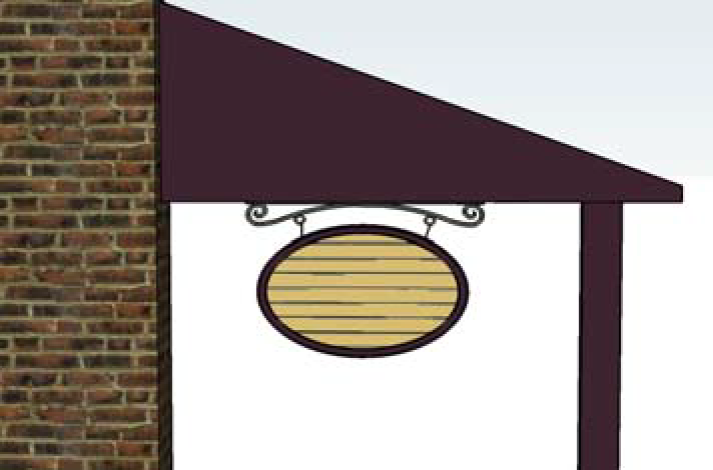
Figure 3: Canopy and Canopy
Sign examples
"Canopy, temporary." A portable or collapsible freestanding roofed structure fully supported at all four corners by columns, pillars, or other support features, with sides which may be enclosed or open, and which is typically used to provide shade or shelter during special events or similar temporary functions.
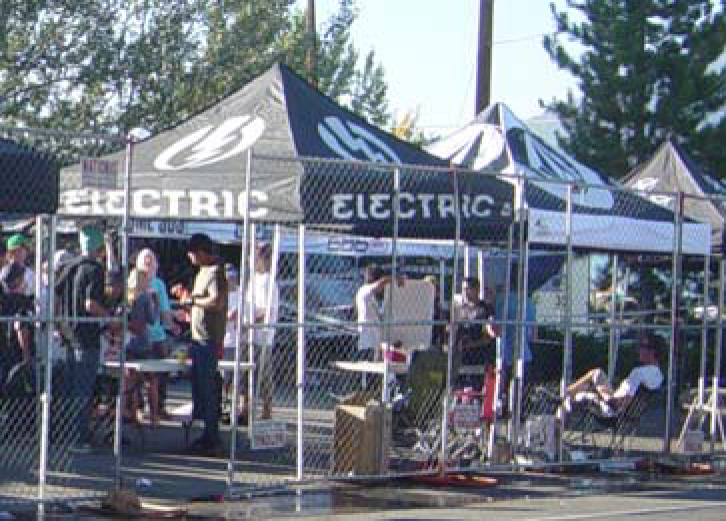
Figure 4: Temporary Canopy
example
"Change of copy." The changing of a commercial or non-commercial message on a lawfully erected sign. A change of copy does not include the following (all of which acts shall be considered as the placing of a new sign): any alteration or reconfiguration of the outside dimensions of a sign, any structural modifications of a sign and/or relocation of all or any portion of a sign.
"Changeable copy sign." A fixed sign face or surface on which message copy can be changed. Changeable copy signs including the following types:
"Manual changeable copy," where the informational content, including numbers, letters, or pictorial graphics, can be changed or altered by manual means.
"Electronic changeable copy," where the informational content, including numbers, letters, or pictorial graphics, may be altered by electrically illuminated (including LED), mechanically driven, or computerized or digital changeable segments. Also known as electronic sign or digital sign, this type of copy or display can be distinguished as the following:
"Static electronic copy," where the informational content is displayed as fixed copy which may be divided into multiple segments, but the copy remains motionless and does not roll, stream, dissolve, or change in brightness or intensity.
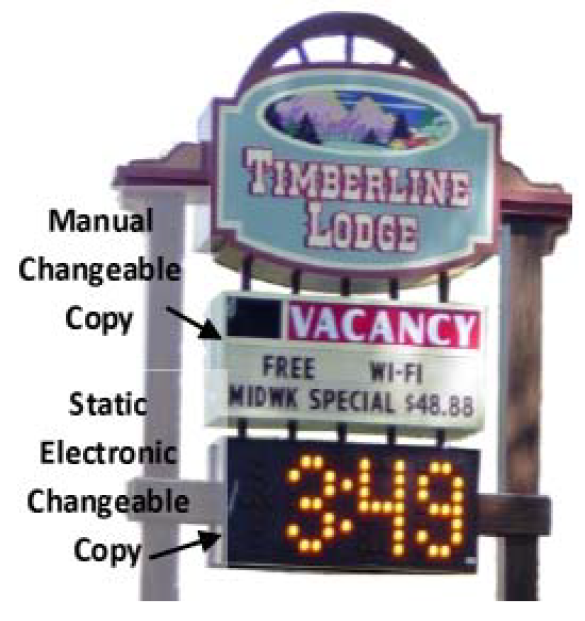
Figure 5: Manual and
Static Electronic Copy
examples
"Dynamic electronic copy," where the informational content is displayed as full-motion copy that rolls, streams, dissolves, or changes in brightness or intensity, similar to a video. Compare to "animated" and "flashing sign."

Figure 6: Dynamic Electronic
Copy example
"Time and temperature sign." Signs displaying the time or the temperature or both.
"Channel letter sign." A sign consisting of individual cut letters generally mounted directly onto a wall surface of a building.

Figure 7: Channel Letter
Sign example
"City planner." The city planner of the City of Big Bear Lake, or his/her designee.
"Commercial signage." Any sign with wording, logo, or other representation that directly or indirectly names, advertises, or calls attention to a business, product, service, or other commercial activity. Compare to "Non-commercial signage."
"Commercial speech." Any message, the prevailing thrust of which is to propose a commercial transaction. Compare to "Non-commercial speech."
"Construct." When used with reference to a sign, means to install, erect, or place on the ground or on a building structure, or to affix, paint or post on or to a building or structure.
"Construction site sign." A temporary sign, located on an active construction site or a site on which a development project is proposed by land use permit or building permit. These typically identify the names, addresses and telephone numbers of parties directly involved in the business occupancy, construction, design, or financing of pending or in-progress physical improvements to the premises.
"Copy." See "Sign copy."
"Decorative banner or flag." A festive graphic display that is made of durable cloth, plastic or similar non-rigid material, and that either displays no message or displays only a predominantly pictorial message that does not directly identify or advertise a business on the premises.
"Development project." For the purpose of this chapter, a development project is a use, building, or group of uses and buildings developed as a unit, typically having common access drives and parking, a uniform design concept, and typically owned and/or operated by a single entity, which may include a property owners association. Typical examples would include a shopping center, multi-tenant commercial or office building, industrial park, single-tenant commercial or industrial building, mobilehome park, apartment complex, or single-family subdivision being developed as an identifiable project.
"Digital sign." See "Changeable copy sign."
"Directional sign." A sign that identifies to motorists or pedestrians an entry or exit point to or from an adjacent public right-of-way, or to or from various points of passage on or within private property.
"Directory sign." A sign or set of similarly designed individual signs placed or displayed in sequence, located at a multi-tenant building or within a small or large shopping center, to list all or part of the businesses within a building or shopping center.
"Display box." A wall mounted sign faced with glass or similar material located at entertainment and food venues, and typically displaying food menus, current entertainment, or other like features.
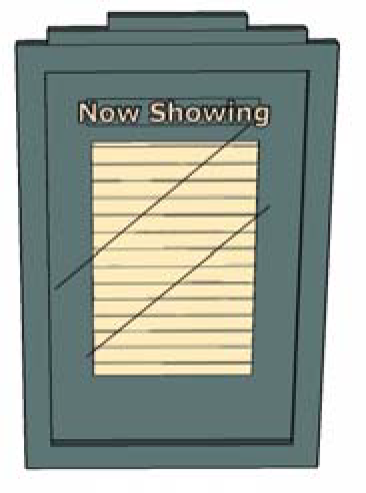
Figure 8: Display Box
example
"Double-faced sign." A sign with copy on two parallel faces, legible from opposite directions.
"Drive-through menu board." A single-sided sign located in the drive-through area of a fast-food restaurant, typically containing an attached or detached speaker and/or verification screen for communicating orders.
"Dynamic sign." See "Changeable copy sign."
"Electronic sign." See "Changeable copy sign."
"Enforcement officer." Any city official or agent designated by the city manager as having authority to enforce the provisions of this chapter.
"Fair market value." The amount to be determined pursuant to Business and Professions Code Section 5412.
"False mansard." A sloped wall segment that is above or projects down and away from a vertical wall of a building, and that is not a building roof, as defined by the California Building Code.
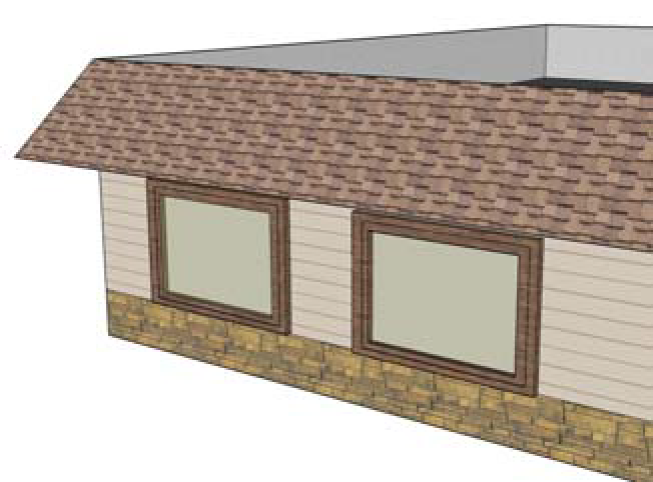
Figure 9: False Mansard
example
"Flag." A device, generally made of durable cloth, plastic or similar non-rigid material, which may be hung vertically or horizontally from a flag pole that is ground-mounted or building-mounted, and usually used as a symbol of a government, school, religion, nationally or internationally recognized organizations, or corporations; and not containing commercial speech.
"Flashing sign." Any sign which contains, or is illuminated by, lights which change in intensity or colors, or which create the illusion of flashing in any manner.
"Fluorescent." A color characterized by a high degree of brightness and reflectivity, also commonly referred to as "day-glow" color.
"Freestanding sign." Any sign supported by structures or supports that are placed on, or anchored in, the ground which are independent from any building or other structure. See also "Height of freestanding sign, portable freestanding sign." This definition includes the following signs ("pole sign" and "monument sign"):
"Pole sign." A freestanding sign wholly supported by one or more poles and otherwise separated from the ground by air.

Figure 10: Pole Sign
example
"Monument sign." A low profile freestanding sign where the width of the sign is at a minimum two times the height, which is supported by a base that extends the entire length of the sign area and is designed as an integral part of the design.

Figure 11: Monument Sign
example
"Frontage, building." The exterior building wall of a structure on the side or sides of the structure fronting and oriented toward a public street or highway, excluding eaves or roof overhangs. Building frontage shall be measured continuously along said building wall for the entire length of the business establishment. Compare to "Frontage, primary"; "Frontage, secondary"; and "Frontage, street or highway" definitions.
"Frontage, primary." That side of the building containing the main entrance to the building.
"Frontage, secondary." Any frontage, other than primary frontage, that has a public entrance to the subject building.
"Frontage, street or highway." Any portion of a lot or parcel of land which abuts a public street or highway. Street or highway frontage shall be measured along the common lot line separating said lot or parcel of land from the public street or highway.
"Gasoline price sign." On-premise signs located at fuel stations, which typically identify the brand or type and price of gasoline sold.
"Glare." The effect produced by brightness sufficient to cause annoyance, discomfort, or loss in visual performance and visibility. Compare to "Illumination intensity."
"Governmental sign." A sign erected and maintained pursuant to and in discharge of any governmental functions, or required by law, ordinance or other governmental regulation. Such signs typically include traffic or similar regulatory devices, traffic or similar regulatory devices, safety signs, legal devices, or warnings at railroad crossings; official traffic, fire and police related signs, temporary traffic-control signs used during construction, utility facilities and substructure location and identification signs and markers required by the City of Big Bear Lake, the State Department of Transportation, or any other public agency. Compare to "Public information sign."
"Height of freestanding signs." The greatest vertical distance measured from grade to the top of the sign and any accompanying architectural feature of the sign. Any intentional grade elevations by mounding, reconfiguration, or by any other means in order to achieve an increased overall height shall be counted in the calculation of sign height.
"Height of non-freestanding signs." The greatest vertical distance measured from the bottom to the top of the sign structure.
"Historic sign." A sign which by its construction, materials, location, unique design, craftsmanship provides historic character and visual significance. Such signs include the following type:
"Historic replication." Where the sign is an exact replication, including materials and size, of a historic sign.
"Holiday decoration." See "Seasonal and holiday decoration."
"Human sign." Any person, mannequin, dress or body form (such as a tailor's dummy), having a visual appearance primarily used for, or having the effect of, attracting attention from the streets, sidewalks or other outside public areas for identification purposes, which in any manner, or by any means, conveys a message, displays, or announces or directs attention to the name, nature, merits, availability, price, or type of goods, services, or products produced, sold, stored, furnished, or available at that location or at any other location.
"Identification sign." A sign limited to identifying the name and/or street address, symbol or insignia, or any combination thereof, of a building, use of persons occupying the premise on which the sign is located.
"Illegal sign." Any sign placed without all required government approvals and permits at the time said sign was placed, or an existing sign that was not constructed in accordance with the ordinances and other applicable laws in effect on the date of construction, or a legal nonconforming sign that has exceeded its authorized amortization period. Compare to "Permitted sign," "Legal nonconforming sign," or "Nonconforming sign."
"Illuminated sign." Any sign employing the use of lighting sources, including neon tubes, for the purpose of decorating, outlining, accentuating or brightening the sign area, resulting in a sign that is internally illuminated, externally illuminated, or backlit.
"Illumination intensity." An expression, in wattage or foot-candles, of visually perceived brightness from an artificial light source. Compare to "Glare."
"Incidental sign." A sign, generally informational, that has a purpose secondary to the use of the lot on which it is located, such as "open/closed," "vacancy," "no parking," "loading only," "telephone," "credit cards accepted," accreditation, or other similar directives. Compare to "Rider sign."
"Inflatable sign." See "Balloon."
"Information kiosk." A freestanding or wall-mounted sign containing locational information directing users to individual uses within a business, industrial or public complex of uses or buildings, and providing information about such uses. The information kiosk may also contain message bulletin boards or community information, but shall not contain advertising. See also "Kiosk."
"Kiosk." See "Information kiosk."
"Legal nonconforming sign." A sign which was legal when first erected, with all necessary permits, but which due to a change in the law became nonconforming. Compare to "Nonconforming sign" or "Illegal sign."
"Logo." A portion of a sign depicting a symbol or trademark, used to enhance consumer recognition of the business enterprise being advertised on the sign.
"Lot." Any piece or parcel of land or a portion of a subdivision, the boundaries of which have been established by some legal instrument of record, that is recognized and intended as a unit for the purpose of transfer of ownership.
"Memorial sign." A commemorative sign, tablet or plaque memorializing a person, event, structure or site. Compare to "Architectural sign."
"Monument sign." See "Freestanding sign."
"Multi-faced sign." A sign with two or more sign faces where any two sign faces are oriented such that they have an interior angle of greater than thirty (30) degrees but no more than ninety (90) degrees from each other.
Figure 12: Multi-Faced Sign
example
"Mural." An artistic expression that is painted on, and made an integral part of, a wall surface, and that does not include identification, advertising or promotional information for a business. Compare to "Painted sign."
"Neon sign." A sign where the informational content, including numbers, letters, or pictorial graphics, are illuminated by gas filled luminous neon tubes. Compare to "Fluorescent" or "Illuminated sign."
"Non-commercial signage." Any signage which is not determined to be commercial signage, as defined herein. Compare to "Commercial signage."
"Non-commercial speech." Any message which is not determined to be commercial speech as defined herein. Compare to "Commercial speech."
"Nonconforming sign." Any sign that does not conform to the requirements of this chapter. Compare to "Legal nonconforming sign" or "Illegal sign."
"Non-structural trim." The molding, battens, caps, nailing strips, lattice, cutouts, or other such features which are attached to the sign structure for purposes of decoration. Compare to "Sign frame."
"Obscene sign." Signage when taken as a whole, which to the average person applying contemporary statewide standards, appeals to the prurient interest and as a whole depicts or describes sexual conduct in a patently offensive way, and that, taken as a whole, lacks serious literary, artistic, political or scientific value. Any determination that a sign is obscene must be made on a case-by-case basis based on applicable laws.
"Offsite sign." Any sign with a message that does not relate directly to an active use of the premises on which it is displayed. Compare to "Onsite sign."
"Onsite sign." Any sign with a message that relates directly to an active use of the premises on which it is displayed. Compare to "Offsite sign."
"Open house sign." A temporary sign that may be located onsite or offsite typically advertising an open house for the purpose of selling a single-family residence, including individual condominiums.
"Outdoor advertising sign structure (billboard)." A sign, display, or device affixed to the ground or attached to or painted or posted onto any part of a building or similar permanent structure, used for the display of an advertisement to the general public when viewed from the exterior of a building or similar enclosed area. This definition does not include business directional signs. See also "Billboard."
"Outdoor display." Refer to Section 17.35.090.D of the Development Code.
"Over-head sign." A sign that extends over the public or private rights-of-way, walkways, and vehicular travel lanes, extending from one side of the right-of-way to the other, including permanent or temporary signs.
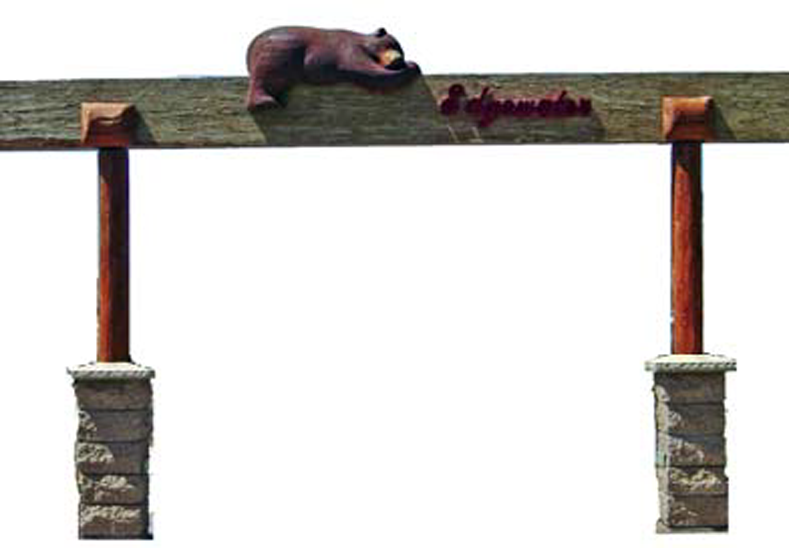
Figure 13: Over-Head Sign
example
"Painted sign." Sign copy painted directly on the building walls or other surfaces, either as non-illuminated copy, or indirectly illuminated copy. Compare to "Wall sign" or "Mural."
"Parapet." The portion of a building wall that rises above the roof level.
"Parapet sign." A wall sign that is located below the top of the parapet line of a building and above the top of the window line of the highest story of the building, and including a sign on a false mansard. Compare to "Roof sign" and" Wall sign."
"Pennants." A series of small flags, often triangular in shape and made of durable cloth, plastic or similar non-rigid material, affixed to a string or cord and strung across a building or site to attract attention.
"Permitted sign." Signs permitted pursuant to this chapter. Compare to "Illegal sign" or "Prohibited sign."
"Pole sign." See "Freestanding sign."
"Political sign." Refer to "Temporary sign."
"Portable freestanding sign." Any sign for which a building permit has not been issued, and which is not permanently affixed or erected, or any sign which is intended to be movable or capable to being moved from place to place, whether or not wheels or other special supports are provided. This definition also includes the following type of sign:
"A-frame sign." A portable freestanding sign constructed of two opposing sign faces, which faces are typically hinged at the top and extend to the ground. Also commonly referred to as a sandwich board or menu board sign.
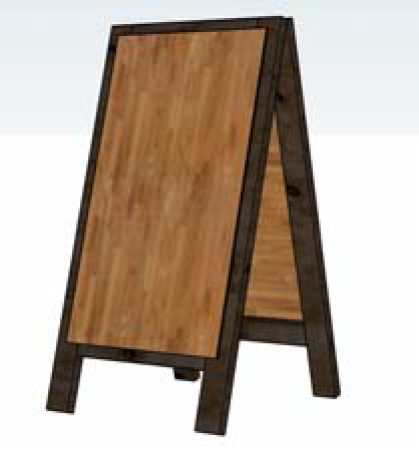
Figure 14: A-frame or Portable Freestanding
Sign example
"Prohibited sign." Signs specified in Section 17.12.060 of this chapter or any sign not in compliance with this chapter. Compare to "Permitted sign."
"Projecting sign." A sign that projects more than twelve (12) inches from the exterior face of a building wall or façade and which uses the building wall as its primary source of support.
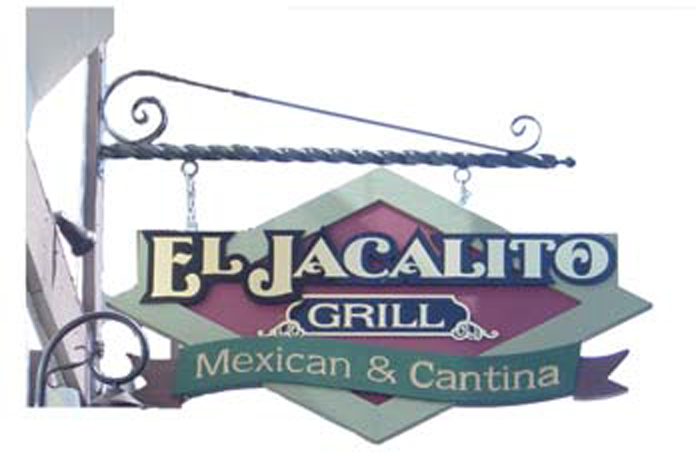
Figure 15: Projecting Sign
example
"Public information sign." A sign that typically only displays a message of potential interest to the general public as a whole that does not include business identification, advertising, or promotional information. Compare to "Governmental sign."
"Real estate sign." A temporary sign that indicates the availability of land or buildings for sale, lease, rent, or other permanent or temporary disposition. Compare to "Open house sign, construction site sign."
"Relocate." When used with reference to a sign, means to move a sign from one location to another or to remove a sign from one location and construct a similar sign at another location.
"Revolving sign." A sign or portion thereof that spins or rotates or contains elements, such as lighting, which creates the illusion of spinning or rotation. Compare to "Animated sign."
"Repair." The renewal of any part of an existing sign for the purpose of its maintenance, including but not limited to repainting, replacement of broken, missing, or faded components, replacement of light bulbs, reattachment of loose parts, and other similar measures. Repair does not include any expansion of sign area, illumination of a previously non-illuminated sign, or other intensification of signage. Compare to "Alteration," "Sign maintenance" or "Upgrade."
"Rider sign." A sign hanging from the bottom edge of a freestanding sign containing information generally secondary to the copy of the sign to which it is hung, including but not limited to such information as accreditation, prices, products, advertised specials, names, etc. The method of attachment is generally by chain, rope, hooks, or other means whereby the rider sign is not a structurally integral part of the principal sign. Compare to "Incidental sign."

Figure 16: Rider Sign example
"Right-of-way, public." A public street, sidewalk, or highway.
"Roof line." The ridge of the roof or the top of the parapet, whichever forms the top line of the building silhouette. See also "Parapet."
"Roof sign." Any sign erected upon, against, or directly above a roof, or projecting above the parapet or roof line of a building. Signs erected on a mansard roof shall not constitute a roof sign. Compare to "Parapet sign."

Figure 17: Roof Sign example
"Seasonal and holiday decoration." Lighting and other materials, including festive flags, in the nature of decorations, clearly incidental to and customarily and commonly associated with any national, state, local or religious holiday.
"Setback area." The setback area shall be that area defined as the "required minimum yard" as specified by the Development Code for each zoning district, unless a specific setback is designated within this chapter.
"Shopping center" or" building complex." A group of three or more commercial retail businesses that have been designed and developed together as an integral unit on a single parcel of land or separate parcels of land and which businesses utilize common off-street parking or access, and which are managed under a common area agreement.
"Sign." Any object having a visual appearance primarily used for or having the effect of attracting attention from the streets, sidewalks or other outside public areas for identification purposes, including but not limited to all outdoor advertising and any card, cloth, paper, paint, plastic, metal, painted glass, or wooden or stone materials, and any and all devices, structural and otherwise, lighted or unlighted, painted or not painted, attached to, made a part of, or placed in the window of, or in the front, rear, sides, or top of any structure on any land or any rock, bush, wall, tree, post, fence, building, or structures, which object in any manner, or by any means, whether enumerated in this subsection or not, conveys a message, announces or directs attention to the name, nature, merits, availability, price, or type of goods, services, or products produced, sold, stored, furnished, or available at that location or at any other location, and including the support elements, distinct background area and decorative embellishments thereof, with the exception of the following:
1.
Such devices not exceeding one square foot in area and bearing property numbers, names of occupants or other similar identification on a site.
2.
Flags and other insignia of any government, not displaying commercial speech.
3.
Legal notices.
4.
Decorative or architectural features of buildings or decorative landscape features, except letters, trademarks, or moving parts.
5.
Seasonal and holiday decorations.
6.
Government traffic controlling devices are not considered signs for purposes of this chapter due to their distinct purpose.
"Sign area (area)." The entire area within a single continuous perimeter which enclose the extreme limits of writing, representation, emblem, or any figure of similar character, background area, trim, or other material, light or color forming an integral part of the display or used to differentiate such sign from the background against which it is placed. In the case of a sign designed with more than one exterior surface, the area shall be computed as including only the maximum single display surface which is visible from any ground position at one time. The supports, trim, frame, or uprights on which any such sign is supported shall not be included in determining the sign area. See also "Sign copy," "Sign face," "Sign frame" and "Sign structure."
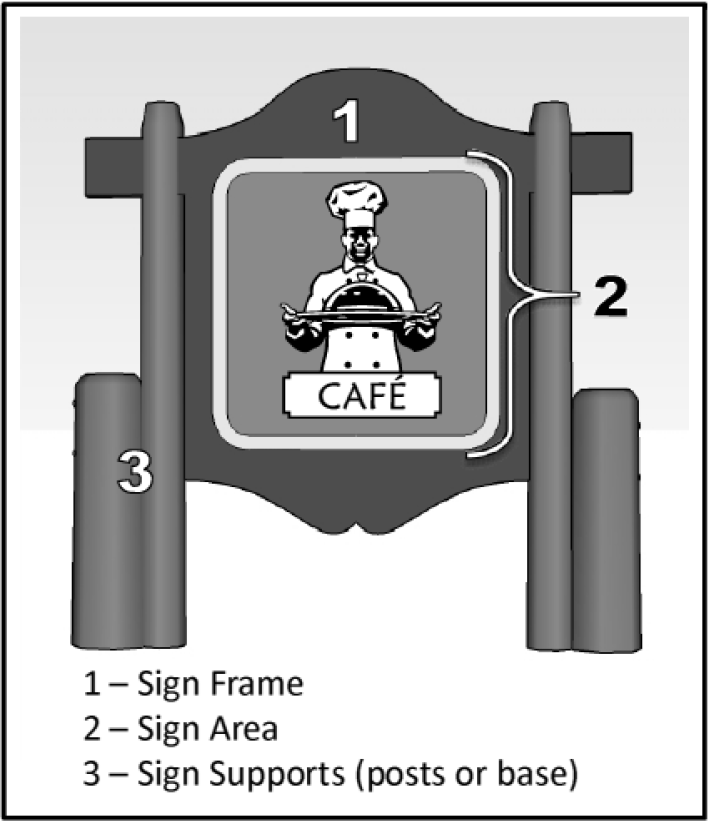
Figure 18: Sign Area
example
"Sign copy (copy)." All portions of a sign that display a message, including any and all letters, words, numerals, characters, illustrations, insignias, symbols, logos, statuary or any other communication material placed upon a sign. See also "Sign area," "Sign face" and "Sign frame."
"Sign face (face)." The exterior surface of a sign, exclusive of structural supports or decorative trim, on which is placed the sign copy that is visible from a single point as a flat surface or a plane. When sign copy is affixed directly to a building face, window, or canopy, sign face shall mean the area within which the sign copy can be enclosed. See also "Sign area," "Sign copy" and "Sign frame."
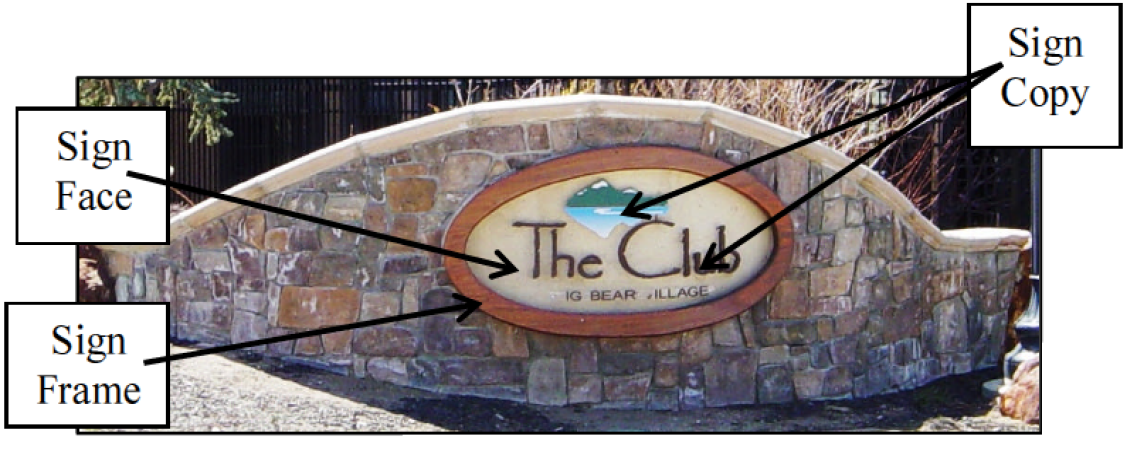
Figure 19: Sign Face, Sign Area, Sign Copy example
"Sign frame" ("frame"). The exterior decorative trim or structural frame that surrounds a sign face and which does not display a message. Compare to "Non-structural trim."
"Sign maintenance." Any activity performed on a sign for the purpose of actively maintaining the sign in its existing approved physical configuration and size dimensions at the specific location approved by the city for the duration of its normal life. Maintenance includes repainting without the changing of advertising message, with substantially the same colors and materials, and the routine replacement of border and trim with substantially the same colors and materials. Customary maintenance does not include raising the height or increasing the dimensions of a sign, adding a back-up panel facing to a single-panel display or turning the facing direction of a single facing sign. Compare to "Alteration," "Repair, upgrade."
"Sign program." A detailed graphic and narrative plan that establishes the specific sign regulations and common aesthetic design characteristics that apply to all signs for a particular ownership parcel, or for a particular area that may include two or more separate but contiguous ownership parcels, and which may include a development project, shopping center, or business complex.
"Sign structure." Any structure designed, intended, or used to support, or illuminate a sign, including portions of any building or structure when so designed or used. See also "Sign area," "Sign copy," "Sign face" and "Sign frame."
"Site." A lot, or group of contiguous lots, with or without development, in single ownership, or having multiple owners, all of who join in an application for signage.
"Static electronic changeable copy sign." See "Changeable copy sign."
"Street." A public or private highway, road or thoroughfare which affords the principal means of access to adjacent lots. Compare to "Right-of-way."
"Temporary sign." Signs to be displayed for a specific period of time or event and which are removed immediately after the completion of the event, as permitted by and defined in this chapter. Temporary signs include but may not be limited to "balloon, inflatable signs," or "inflatable attention-getting devices; banners; construction site signs; open house signs; pennants; political signs; real estate signs; seasonal and holiday decorations; temporary canopy; transit-related temporary signs."
"Time and temperature sign." Refer to "Static electronic changeable copy sign."
"Transit-related temporary sign." Sign affixed to a coach, shelter, bench, or other appurtenant facility owned or operated by an approved transit provider within the city.
"Unlawful sign." A sign that was constructed illegally and which violates this chapter, or which the city planner or building official declares to be unlawful because it has become dangerous to public safety. See also "Illegal sign."
"Upgrade." Any activity intended to improve the design quality and aesthetic appeal of an existing sign, display, or device by modifying structural elements of, or providing substantial cosmetic enhancements to, such sign, display or device. Compare to "Alteration" and "Repair."
"Variance." As defined in Development Code Section [Chapter] 17.02, a variance shall mean a discretionary entitlement that permits the departure from the strict application of the development standards contained in this Development Code, pursuant to Section 17.03.180.
"Vehicle sign." Any sign or advertising device attached to or located on any vehicle, bicycle, pedicab, or trailer parked or traveling on a public right-of-way or public property or on a private property so as to be visible from the public right-or-way, where such sign or advertising device is for the basic purpose of providing advertisement of a business, activity, service or product or directing people to a business or activity located on the same or off-site property. This definition is not intended to apply to standard advertising or identification practices where such signs or advertising devices are painted on or permanently or magnetically attached to a business or commercial vehicle, nor is it intended to apply to standard practices for advertising vehicles for sale which are located on an approved, properly zoned location.
"Vehicle sight distance." The area through which a driver has a clear view of oncoming vehicle and pedestrian traffic when waiting to proceed at a street corner or driveway.
"Wall sign (wall-mounted sign)." Any sign attached to, erected against, or painted or inscribed upon the wall of a building or structure, with the exposed face of the sign in a plane parallel to the plane of said wall and not located above the roof line, parapet or façade (except when enclosed within a dormer or on a "false mansard"), which does not project more than twelve (12) inches from the building wall.

Figure 20: Wall Sign example
"Window sign." A sign that is displayed on the surface of any glass or glazed material, or that is displayed interior and close enough to a window to be reasonably visible from outside the window.

Figure 21: Window Sign
examples
(Ord. 2000-310 § 2(part), 2000)
(Ord. No. 2011-415, § 4(Exh. 1), 8-22-2011)
17.12.030 - Sign permit requirements and procedures.
A.
Sign Permits. Except as otherwise provided in this chapter, no person shall cause or permit the construction, enlargement, remodeling, or upgrade of any sign, outside of a change of copy, without first obtaining a sign permit in accordance with the provisions on this chapter, and any other permits required by law. Signs used in conjunction with a special event are reviewed under the special event permit process, pursuant to Section 17.03.300 in Chapter 17.03.
B.
Building Permits. A building permit must be obtained to erect or modify signs, as required by the California Building Code.
C.
Review Process.
1.
City Planner Review. An application for a sign permit to construct or erect a new sign, replicate a sign that is determined to be historic, or to enlarge or upgrade an existing sign shall be reviewed by the city planner or his/her designee. The city planner or designee shall approve the application if he or she finds that the application complies with this chapter and that the findings for approval as contained in paragraph D of this section can be met by the application.
2.
Time Period for Review. A decision to approve or deny a sign permit application shall be made by the city planner or designee no later than five business days after an application is deemed complete by the city planner, and said decision shall be transmitted to the applicant or placed in the U.S. mail no later than close of business of the fifth working day following the date on which the application was deemed complete. If the application is denied, a written statement shall be provided to the applicant stating the reasons for the denial.
3.
Extension of Review Period. The time period for review as contained in paragraph C.2 of this section may be extended by mutual agreement of the applicant and the city.
4.
Compliance With Standards. In the event that the city planner or designee does not render a decision on a sign permit application in accordance with the time periods established in this section, the sign permit application shall be determined to be approved only if its design and placement conform to the requirements of this chapter. Failure to conform to the time periods for review in this section shall not be interpreted to grant approval of any sign which does not meet the standards, requirements and/or codes of the city, or to grant approval of a deviation or variance from the standards or codes.
5.
Appeals. Any decision made by the city planner may be appealed to the planning commission within ten (10) calendar days after the date the city sends notice to the applicant or interested party of the city planner's decision, and any decision made by the planning commission may be appealed to the city council. The decision of the city council on any appeal shall be final.
6.
Judicial Review. All decisions of the city council reversing or upholding a decision to issue, renew, deny, suspend or revoke a permit are final within ten (10) calendar days, unless appealed by the applicant to a court of competent jurisdiction. The city shall comply with all requirements for expedited judicial review contained in California Code of Civil Procedure Section 1094.8.
D.
Findings for Approval. No sign permit shall be issued unless the city planner or other reviewing authority, if appealed, finds that the application for a sign permit, exclusive of its content, meets all of the following requirements:
1.
The sign is consistent with the general plan;
2.
The sign complies with the requirements of this chapter and with other applicable laws and regulations;
3.
The sign is not detrimental to the public health, safety, or welfare; and
4.
The sign will not have adverse impacts on adjacent properties or rights-of-way, or obstruct the view of other legal signs.
E.
Application Requirements. The application for a sign permit shall be made on the form provided by the city planner and shall be accompanied by a processing fee established by resolution of the city council. The application shall contain all of the following information and materials, except that some requirements may be waived when not applicable to the type of sign being proposed.
1.
Three sets of plans, scaled and fully dimensioned, with the following information:
a.
North arrow, scale, date drawn, applicant, contact person and phone number(s);
b.
Property lines and fronting streets, with street names labeled;
c.
Location and dimensions of all existing signs on site and within fifty (50) feet of the proposed sign location;
2.
The intended location and position of the proposed sign;
3.
Fully dimensioned drawings showing proposed design, size, exact colors, materials and location of the sign or sign structure;
4.
Where applicable, relationship of the proposed sign to existing or proposed adjacent buildings, structure, signs, property lines, streets, and driveways on or adjacent to the parcel where the sign is to be located (may not be needed for wall-mounted signs);
5.
Photographs of all sides of any existing buildings or elevation drawings of sides of proposed buildings and structures where such signs are to be attached;
6.
The method of attachment of the sign to any structure;
7.
Any proposed lighting, including internal and external illumination. Information on lighting intensity may be required, as determined necessary by the city planner;
8.
Where directional signs are proposed, the location of off-street parking facilities, including major points of entry and exit for motor vehicles;
9.
Authorization of the property owner, or of the lessee when so authorized by the owner; and
10.
Other information as determined by the city planner to be needed in order to complete the review of the sign application.
(Ord. 2000-310 § 2(part), 2000)
(Ord. No. 2011-415, § 4(Exh. 1), 8-22-2011)
17.12.040 - Sign program requirements and procedures.
A.
Purpose and Intent. A sign program shall be required and prepared in order to create a unified design theme for all signs within a development project, shopping center, or business complex. The intent of such a program is to create a visually pleasing method of providing compatible and complementary signs throughout the project site; to inform users and tenants of desired sign characteristics; to minimize visual clutter; and to unify the appearance of the development site so as to create a distinctive sense of place.
B.
Contents. A sign program shall include but not be limited to the following information:
1.
A coordinated design theme, incorporating uniform design elements for various types of signs to be used in the project area, including wall signs, freestanding signs, canopy and awning signs, directional signs, and others as appropriate;
2.
Desired use, design, location and size of temporary signs, including window signs, special event signs, flags, banners, portable signs, and others as appropriate;
3.
The desired size, area and location of signs to be located throughout the project site;
4.
Methods by which signs will be attached to buildings and structures;
5.
Methods and levels of illumination;
6.
Choice of colors and lettering styles; and
7.
Other information as determined by the city planner to be necessary to complete the review of the sign program, or as proposed by the applicant.
C.
Review Process.
1.
City Planner Review. Anyone establishing a sign program shall submit such program to the city planner for review in accordance with the provisions of this chapter. The city planner or his/her designee may approve or deny the application based upon its conformance with the requirements of this chapter, or the city planner may forward the application to the planning commission for consideration. The sign program application shall include the required review fee as adopted by the city council.
2.
Time Period for Review. A decision to approve or deny a sign program application shall be made by the reviewing authority no later than thirty (30) calendar days after an application is deemed complete by the city planner. If the application is denied, a written statement shall be provided to the applicant stating the reasons for the denial.
3.
Extension of Review Period. The time period for review as contained in paragraph 2 of this section may be extended by mutual agreement of the applicant and the city.
4.
Compliance With Standards. In the event that the reviewing authority does not render a decision on a sign program application in accordance with the time periods established in this section. The sign program application shall be determined to be approved only if its contents conform to the requirements of this chapter. Failure to conform to the time periods for review in this section shall not be interpreted to grant approval of any sign program which does not meet the standards, requirements and/or codes of the city, or to grant approval of a deviation or variance from the standards or codes.
5.
Appeals. Any decision made by the city planner may be appealed to the planning commission within ten (10) calendar days after the date the city sends notice to the applicant or interested party of the city planner's decision, and any decision made by the planning commission may be appealed to the city council. The decision of the city council on any appeal shall be final.
6.
Judicial Review. All decisions of the city council reversing or upholding a decision to issue, renew, deny, suspend or revoke a permit are final within ten (10) calendar days, unless appealed by the applicant to a court of competent jurisdiction. The city shall comply with all requirements for expedited judicial review contained in California Code of Civil Procedure Section 1094.8.
D.
Findings for Approval. No sign program shall be issued unless the reviewing authority finds that the application for a sign program, exclusive of its content, meets all of the following requirements:
1.
The sign program is consistent with the general plan;
2.
The sign program complies with the requirements of this chapter and with other applicable laws and regulations;
3.
The sign program is not detrimental to the public health, safety, or welfare; and
4.
The sign program will not have adverse impacts on adjacent properties or rights-of-way.
(Ord. 2000-310 § 2(part), 2000)
(Ord. No. 2011-415, § 4(Exh. 1), 8-22-2011)
17.12.050 - Exemptions from sign permit requirements.
The following signs, if not illuminated, shall be permitted without the requirements of a sign permit in all zoning districts; however, they shall comply with other applicable requirements of this chapter. An exempt sign may still require a building permit, pursuant to California Building Code and its appendices and standards, as they may be updated from time to time.
A.
Address numbers and residential identification, based on the city's determination that such signs expedite provision of emergency services and thus provide for public safety and welfare. Required address numbers, in order to comply with state and local fire codes and ordinances that all properties display illuminated address numbers. The size, illumination, and location, for visibility from the public right-of-way, shall comply with applicable requirements as they may be updated from time to time. This exemption also includes one residential building identification sign, used to identify individual residences, not exceeding two square feet in area displaying only the name and/or address of the owner or occupant.
B.
Architectural sign, based on the city's determination that such signs are integrated into the building architecture and provide building identification. Such sign shall be made an integral part of a building or structure and provided that the sign does not exceed eighteen (18) inches in any dimension and limited to providing only the name of the business, building, and/or establishment date.
C.
City-Wide Sign Program. A city-approved sign program for the purpose of providing public information such as entry and district monument signs, information kiosks, wayfinding signs, lightpost banner signs, and signs to inform the general public of community and civic events.
D.
Construction site sign, based on the city's determination that such signs provide for a public convenience and are used for a limited duration of time. The sign(s) shall not exceed a cumulative sign area of thirty-two (32) square feet or as otherwise established by the planning commission or city council for public noticing purposes. If freestanding, sign structures shall not exceed eight feet in height. No sign shall be located in the public right-of-way. The sign(s) shall be removed upon the completion of construction and issuance of a final on the building permit by the building inspector.
E.
Directional signs, for the purpose of indicating the locations of ingress and egress points, parking locations, drive-through lanes, and other similar advisory information, based on General Plan Policy CD 1.4 which calls for provision of a functional and user-friendly built environment, and on the city council's determination that such signs promote traffic safety by directing vehicles off of streets and highways in a safe and orderly manner. Such signs shall be limited in number to five signs, or four signs per frontage for any business premises that has more than one frontage. The maximum dimensions for such signs shall not exceed two square feet in area per sign and three feet in height to the top of the sign.
F.
Flags, based on the city council's determination that the national, state and city flags promote community values of patriotism and honor for these entities. One each national, state, and local governmental flag properly displayed with a maximum of three flags per pole, and flag area shall be proportionate to the height of the flag pole, as recommended by Table 17.12.050.F, below. This exemption includes corporate logo flags and flags of internationally and nationally recognized organizations, when used as a symbol to enhance a sense of place. When mounted on a flag pole, the pole shall not exceed thirty-five (35) feet in height. This provision is not intended to prohibit the display of one flag containing non-commercial speech such as "welcome" or "open". Ground-mounted or building-mounted flags shall provide a minimum of eight feet in clearance above the grade to the bottom edge of the flag. Cumulative flag area on any site shall not exceed one hundred (100) square feet.
Table 17.12.050.F
Recommended Height and Dimensions for Flags
G.
Garage sale, yard sale signs, based on the city's determination that such signs provide for a public convenience and are used for a limited duration of time, and that such signs promote efficient traffic circulation through city streets; provided they are not located in the public right-of-way, not attached to any other signs, do not exceed three square feet in sign area, do not exceed one such sign on-site nor two off-site, and provided that all off-site signs have the consent of the property owner. All such sale signs shall be removed by sunset each day. Under no circumstances shall signs for the same sale be displayed for more than four days.
H.
Governmental signs, based on the city's determination that such signs provide for public welfare, convenience and traffic safety by clearly identifying public or private facilities and warnings, including signs of a duly constituted governmental body, including traffic or similar regulatory devices, safety signs, legal devices, or warnings at railroad crossings; official traffic, fire and police related signs, temporary traffic-control signs used during construction, utility facilities and substructure location and identification signs and markers required by the City of Big Bear Lake, the State Department of Transportation, or any other public agency. This exemption is not intended to exempt governmental and public agencies from obtaining approval from the city planner for a public information sign and complying with applicable design and development standards.
I.
Historic signs, based on the city's General Plan Policy CD 1.3 that the history of Big Bear Lake should be reflected in the community's design, including unique buildings and features which are determined to be of exceptional value to the community. This provision is intended to allow existing signs that are historically significant to remain, even out of compliance with the current provisions of this chapter. A sign that is determined to be historic by the director but damaged beyond repair due to natural causes or determined to be structurally unsound, may be replicated subject to a sign review for historic sign replication. When a historic sign is voluntarily removed, the sign may not be re-installed or replicated and shall comply with provisions of the chapter pertaining to new signs.
J.
Interior signs. Signs located inside a building, courtyard, or other structure provided the sign copy is not visible from outside the building or structure or is not so located as to be conspicuously visible and readable without intentional and deliberate effort from outside the building or structure.
K.
Memorial signs, based on the determination that such signs serve the purpose of identifying and memorializing historic persons and sites within the city in conformance with General Plan Policy CD 1.3.a, which states, in part, that "sites within the city which have historic or cultural significance should be identified and commemorated with plaques, monuments or other means as appropriate."
L.
Open house signs, based on the city's determination that such signs provide for a public convenience, promote the free transfer of land ownership, and are used for a limited duration of time. Signs advertising an open house during the period of the open house only and not to exceed one such sign on-site or two off-site may be permitted; except that if the most direct route to the open house from a the nearest primary or secondary arterial, as designated in the city's general plan, requires a driver to travel on multiple different or discontinuous streets, one additional sign may be displayed at the intersection of each different or discontinuous street, up to a maximum of four additional signs. No signs shall be placed in the public right-of-way, and property owner permission shall be obtained for placement of all signs. Such signs shall be removed at the end of the open house period and under no circumstance be displayed overnight. Each sign shall not exceed three square feet in area and three feet in height, and may be a portable freestanding sign.
M.
Public notices or signs required to be posted by law.
N.
Real estate signs, commercial (sale, lease or exchange by agent or owner), based on the city's determination that such signs provide for a public convenience, promote the free transfer of land ownership, and are used for a limited duration of time. Signs shall not exceed a sign area total of twenty-four (24) square feet. Only one such sign shall be allowed per street frontage. If freestanding, signs structures shall not exceed eight feet in height. No signs shall be located in the public right-of-way. The sign(s) shall be removed within thirty (30) days following close of escrow or termination of listing agreement.
O.
Real estate sign, residential, based on the city's determination that such signs provide for a public convenience, promote the free transfer of land ownership, and are used for a limited duration of time. One un-illuminated, double-faced real estate advertising sign, for sale, lease or rent of residential property may be allowed when the sign is conforming to the following requirements.
1.
Sign area shall not exceed eight square feet and sign height shall not exceed six feet;
2.
The sign shall be situated within the property line and shall not encroach upon public right-of-way; and
3.
The sign shall remain only during the period of time that the premises are being offered for sale, lease or rent and shall be removed seven days after the property is sold, leased or rented or the offer for sale, lease or rent is terminated. Property shall be deemed to be sold upon the close of escrow, upon transfer of legal title, or upon execution of an installment sales contract, whichever occurs first.
P.
Seasonal and holiday decorations, including lighting and flags, based on the city's determination that free expression regarding religious events and holidays is a fundamental right. Seasonal or holiday decorations, in season, shall be removed or changed every ninety (90) days. Multi-colored string lights, excluding single strand white colored lights, shall not be displayed outside of the period between the winter holiday season of November 1 and January 31. A building permit shall be obtained for single strand white colored lights intended to remain in place for more than ninety (90) days.
Q.
Statues of bears or indigenous animals, based on the General Plan Policy CD 2.1 to create a sense of arrival and identity in Big Bear Lake to reinforce a unified sense of place. Such features shall be constructed of durable materials to withstand the climate and look physically natural in appearance, and shall not exceed eight feet in height. Commercial speech shall be prohibited, other than a business identification name, which may be carved in the statue and proportionate in area to the size of the statue. No other signs or products shall be attached, mounted, or displayed on the statue.
R.
Temporary non-commercial signs. The city finds that there is a need to provide for certain temporary non-commercial signs in order to provide opportunities for free expression. The city further finds that it is necessary to regulate the number, size and location of such signs in order to reduce visual clutter and debris throughout the city. All temporary non-commercial signs including, but not limited to religious, charitable, civic, homeowner association, educational, political or cultural posters or special events of civic, philanthropic, educational or religious purposes when in conformance with the following provisions:
1.
Development Standards. Temporary non-commercial signs shall be exempt only if they conform to all of the following standards:
a.
Maximum size of the sign shall not exceed thirty-two (32) square feet and the top of the sign shall not be placed higher than eight feet above grade.
b.
Special event signs shall not be posted for more than thirty (30) days prior to and ten (10) days after such event, except that political signs shall be exempt from the requirement that they may not be posted more than thirty (30) days prior to an election.
c.
Such signs shall not be permitted to be stuck, glued, painted, pasted, posted, nailed, stapled or otherwise affixed to any public property, publicly owned sign, public appurtenance, utility pole, fire hydrant, tree, boulder, or other natural feature, and may not be placed within the public right-of-way.
d.
Such temporary non-commercial signs shall not obscure traffic signs and signals nor block motorists' line of sight.
e.
It shall be unlawful to attach, connect or otherwise affix any sign to another permanent or temporary sign, or direct, permit or allow such action, without the permission of the owner of the permanent or temporary sign.
f.
Property owner permission shall be obtained for erection of temporary signs, provided that written evidence of such permission need not be submitted to the city prior to erection of the signs.
g.
No more than three signs or ninety-six (96) cumulative square feet of temporary non-commercial signage may be erected on any single parcel of land. Signs shall be spaced accordingly to ensure visibility of all signs on the site and to maintain clear vehicle sight distance.
h.
Such temporary non-commercial sign shall contain information about the individual or organization which owns or has erected the sign, along with the address or phone number of such entity.
i.
Such temporary non-commercial signs shall not be illuminated.
j.
Such temporary non-commercial signs shall incorporate the applicable design standards set forth for all signs.
2.
Violation. Except as otherwise provided herein, upon a determination of any violation of the provisions of this subsection regulating all temporary non-commercial signs, the enforcement officer shall send notification in writing to the owner of such sign, if such owner is known, stating that the sign has been determined to be illegally erected and requiring its removal within ten (10) days of the date of such written notice. If a potential violation of this subsection is identified with respect to political signs prior to an election, the enforcement officer shall schedule the matter for public hearing by the planning commission for a decision as to whether a violation has occurred. Upon determination that a violation exists with respect to any temporary non-commercial sign, if the sign is not removed within the specified time period, the enforcement officer may cause the sign to be removed, and shall notify the sign owner in writing of any sign removal, stating the location where his or her sign is being held and that it will be destroyed if not claimed by the owner within ten (10) days after the date of such notice. In the event that the owner does not claim such sign within the ten (10) day period, the enforcement officer may destroy or otherwise dispose of such sign. The owner of the sign shall reimburse the city for the actual costs of removing, storing, and destroying or otherwise disposing of the sign.
3.
Removal of Signs. No person shall remove, destroy, relocate, or otherwise disturb any lawfully-erected temporary non-commercial sign, or direct, permit or allow such removal, destruction, relocation or disturbance, without the permission of the party who erected the sign. It shall be presumed, as to signs for political candidates, that the political candidate or his or her representative is the party who erected the sign. It shall further be presumed that the committee who has registered with the Secretary of State to support a position on a ballot proposition is the party who erected the sign taking the position on the ballot measure. Nothing in this subsection shall prohibit the owner of a piece of property, or his or her authorized representative, from removing a sign from his or her property when the temporary non-commercial sign has been erected without his or her consent; and provided, further, nothing in this subsection shall prevent the enforcement officer or other authorized representative of the city from taking action to abate sign violations.
S.
Vehicle signs. When affixed to registered and operable vehicles, provided that the vehicle is not parked in a required private or public parking space adjacent to a public right-or-way for the primary purpose of advertising. Any sign required by state law or local ordinance to be affixed to a vehicle, or signage required to protect public health, safety and welfare, is also exempt.
T.
Window signs. Window signs not exceeding twenty-five percent (25%) of the window area or one square foot for every lineal foot of building wall on which the window is located, whichever is less, and located on first-floor windows. Sign copy shall be measured by the smallest rectangle or other geometric shape within which the copy can be enclosed.
(Ord. 2000-310 § 2(part), 2000)
(Ord. No. 2011-415, § 4(Exh. 1), 8-22-2011)
17.12.060 - Prohibited signs.
The following signs are prohibited:
A.
Any sign not expressly permitted is prohibited, except as specifically authorized by planning commission interpretation based upon finding that such sign complies with the general plan, including Policy CD 7.4 of the Community Design Element, and that the sign meets the intent of this ordinance as stated in Section 17.12.010.
B.
Architectural or structural features shaped like a product, service or business which exceeds the size and location limitations of this chapter.
C.
Animated signs, with the exception of historical signs and portions of a sign containing non-commercial speech or decorative features.
D.
Banners, including feather banners, except as specifically allowed in this chapter. Refer to Section 17.12.050 (Exempt Signs) for temporary non-commercial signs and Section 17.12.150 (Temporary Signs) for temporary use and special event signs.
E.
Dynamic electronic changeable copy signs.
F.
Flashing signs (except time and temperature signs).
G.
Human signs (except in conjunction with a special event pursuant to Section 17.12.150).
H.
Outdoor advertising sign structures (billboards). With respect to the prohibition of outdoor advertising sign structures, the city council finds as follows:
1.
As stated in the General Plan Community Design Element, "the City's appearance is a major component of its viability as a visitor-oriented destination resort, and aesthetically-pleasing roadways and business districts are key to maintaining and enhancing the local economy. Therefore, some level of sign control is determined to be necessary for economic as well as aesthetic reasons."
2.
Policy CD 7.4 in the General Plan Community Design Element states that signs should "enhance, rather than detract from, the natural environment and distinctive mountain architecture."
3.
Policy CD 2.2 in the General Plan Community Design Element requires, in part, that the city "protect and enhance significant views, where appropriate, through the following measures: a. prohibit the erection of any new billboard within the City."
4.
Based upon the adopted general plan policies and findings, the city council determines that the prohibition of offsite advertising sign structures within the city conforms to the community's objectives as stated in the general plan to maintain views and enhance the scenic qualities of roadways, in order to preserve the city's natural beauty as well as to sustain tourism to support the local economy. Moreover, the city council finds that the prohibition of off-site advertising sign structures does not significantly reduce opportunities for non-commercial advertising because alternative avenues for communication of non-commercial messages have been provided.
I.
Portable freestanding signs, except as specifically allowed in this chapter. Refer to Section 17.12.050 (Exempt Signs) for temporary non-commercial signs and Section 17.12.150 (Temporary Signs) for temporary use and special event signs.
J.
Revolving signs.
K.
Rider signs, when such signs are not inclusive of the sign face and exceed the maximum allowed sign face area.
L.
Signs on natural features. Signs attached to or painted on natural features, such as trees, shrubs or rocks.
M.
Signs on utility poles. Signs supported by or attached to any utility pole, street sign, snow pole, traffic post, traffic signal, or any other similar device.
N.
Signs containing obscene message. Signs that display a message, graphic representation, or other image that is obscene as that term is defined in Section 311 of the Penal Code.
O.
Signs that interfere with traffic devices. Signs which by their color, wording, design, location, or illustration resemble, distract attention from, or conflict with any traffic control device.
P.
Signs that impair public safety. Signs which obscure the view of vehicular or pedestrian traffic on the public right-of-way, or which in any way impair public safety.
Q.
Signs on public property. Signs within the public right-of-way or upon public property (except where approved or required by a government agency), including, but not limited to, any notice, placard, bill, card, poster, sticker, banner, sign, advertising or other device affixed or attached to or upon any public street, walkway, crosswalk, or other right-of-way, curb, lamp post, hydrant, tree, telephone booth or pole, lighting system or any fixture of the police or fire alarm system; provided, however, that over-street signs or transit-related temporary signs otherwise in compliance with this chapter and the California Building Code may be permitted.
R.
Sound emitting signs, excluding voice boxes for drive-up windows.
S.
Temporary signs, except as specifically permitted in this chapter. Refer to Section 17.12.050 (Exempt Signs) for exempt temporary non-commercial signs and Section 17.12.150 (Temporary Signs) for temporary use and special event signs.
T.
Vehicle signs, when parked or stopped for more than seventy-two (72) consecutive hours, or traveling, on a public right-of-way or public property or on a private property or in a required parking space for the general public, so as to be visible from a public right-of-way. This section is not intended to apply to transit-related temporary signs or to standard practices for advertising vehicles for sale which are located on an approved, properly zoned location.
(Ord. 2000-310 § 2(part), 2000)
(Ord. No. 2011-415, § 4(Exh. 1), 8-22-2011)
17.12.070 - General provisions.
The following general provisions are applicable to all signs regulated by this chapter. These general provisions apply in addition to any specific regulations in this chapter.
A.
Calculation.
1.
For wall signs, permitted area for any sign shall be calculated based only on the frontage or side of a building on which the sign is located.
2.
Maximum permitted sign area shall be based on the use of the building or property. When more than one business is located in a building, the allowable sign area for each business shall be based upon the lineal frontage occupied by that business.
B.
Construction. Every sign and all parts, portions, units, and materials comprising the same, together with the frame, background, supports, or anchorage therefore, shall be manufactured, fabricated, assembled, constructed, and erected in compliance with all applicable federal, state, and city laws and regulations. Any person or entity engaged in the business of constructing signs in the city shall have a valid state contractor's license and a city business license, where applicable. No person shall erect, construct or install a sign or cause such sign to be erected, constructed or installed without having first obtained all required permits and licenses.
C.
Maintenance. The following maintenance standards shall apply to all signs:
1.
Every sign and all parts, portions, units and materials comprising the same, together with the frame, background, supports, or anchorage thereof, shall be continuously maintained in a safe, structurally sound, neatly painted, and well-repaired condition.
2.
Signs illuminated either internally or externally must be capable of being fully illuminated and legible and the face(s) must be intact without holes or other exterior facial damage.
3.
Illuminated signs that are damaged or have defective lighting elements shall remain unlighted until repaired.
4.
In the case of abandoned signs, any message or copy pertaining to the abandoned business must be removed and replaced with a blank panel within ninety-one (91) days of user vacancy.
5.
Under no circumstances shall sign cabinets remain empty for periods exceeding ninety (90) days.
6.
No person shall maintain or permit to be maintained on any premises owned or controlled by him/her any sign which is in a dangerous or defective condition. Any such sign shall be promptly removed or repaired by the owner of the sign or the owner of the premises upon notification by the city planner.
D.
Obstruction of Public Passage. No sign may be constructed so as to obstruct any required exit, including windows, doors, fire escapes or other emergency exit of any building.
E.
Non-Commercial Messages. In each instance and under the same conditions to which this chapter permits any sign, a sign containing an ideological, political or other non-commercial message shall be permitted in lieu of a commercial message.
(Ord. 2000-310 § 2(part), 2000)
(Ord. No. 2011-415, § 4(Exh. 1), 8-22-2011)
17.12.080 - Design standards for signs.
In addition to the guidelines contained in the Community Design Element of the general plan, the following design standards shall apply to all signs in the City of Big Bear Lake.
A.
Incentives. The purpose of incentives is to encourage innovative freestanding signs, which by their quality of materials and craftsmanship distinctly enhance the mountain aesthetic of the community. Signs which qualify for incentives require city planner approval of a sign permit, or a sign program if applicable.
1.
Design Criteria. The signs shall incorporate a minimum of three of the following features:
a.
Posts or base and trim constructed of heavy timber logs or rough sawn lumber of six-inch nominal dimension or greater;
b.
Three-dimensional carved, routed, sand-blasted, or lasercut letters, numbers, or pictorial graphics;
c.
Trim or base constructed of natural or cultured stone;
d.
A minimum of one statue or sculptural feature consisting of indigenous animals that are natural in appearance and three-dimensional, and measuring a minimum of four feet in height;
e.
The sign, and statue or sculptural feature if applicable, shall be located in a planter or landscaped area which shall measure a minimum of two feet from the leading edges of the sign and shall surround the sign on a minimum of three sides. The planter or landscape area shall be part of the site's streetscape along the street frontage. The planter or landscape area may include a mix of xeriscape plants and trees, and/or natural features such as stones, boulders, or logs. Any fencing in this area shall be constructed of wood or stone and shall comply with height and setback requirements.
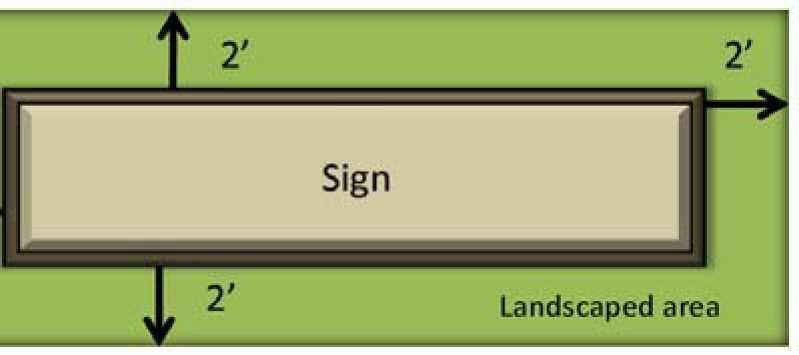
Figure 22: Minimum
Landscaped Area
2.
Maximum Allowances. Signs that incorporate a minimum of three of the items listed in paragraph 1 of this section, above, may be granted a ten percent (10%) increase to the existing sign area. Signs that incorporate a minimum of four items listed in the paragraph 1 may be granted a fifteen percent (15%) increase to the existing sign area. Signs that incorporate all five items listed in the paragraph 1 may be granted a twenty percent (20%) increase to the existing sign area. The increase in sign face shall be proportional to the remaining sign area and all signs will remain subject to maximum height and width dimensions as provided herein.
a.
Signs that are primarily constructed of energy efficient and environmentally friendly features in the areas of materials (re-used or recycled content; regional, renewable, or certified materials), finishes (low-emitting paintings and coatings), and lighting (LED or solar-powered) may be granted a five percent increase to the existing sign area. The checklists identified in Municipal Code Chapter 15.39 (Green Building) may be used in determining appropriate green features. The total incentives shall not increase the sign face by more than twenty-five percent (25%).
3.
Limitations.
a.
A business which receives a sign incentive shall not be eligible for a sign permit for a portable freestanding sign and such existing signs on the site shall be removed upon approval of sign incentives.
b.
Businesses that receive sign incentives shall have no violations of the Municipal Code existing on the property.
B.
Quality of Workmanship and Materials. Signs shall be of a quality commensurate with professional design standards and shall be constructed of durable materials which withstand the elements. No signs made out of paper, cardboard, cloth, plastic sheeting, or other non-durable materials shall be permitted, except as expressly allowed by Section 17.12.150 (Temporary Signs). Lettering, logos and other sign content shall be professionally prepared and shall appear uniform and legible.
C.
Incorporation of Decoration. Only seventy-five percent (75%) of the total sign face may contain sign copy; the remaining twenty-five percent (25%) of the sign face shall be decorative in nature, which may include but not be limited to background enhancement such as color or pictorial graphics, use of decorative trim, or other similar means of enhancing the appearance of the sign face. Due to the nature of channel letter signs, incorporation of decoration may include color, decorative font style, or background materials on which the sign is placed upon.
D.
Materials. With the exception of channel letter signs, signs shall incorporate natural materials which reflect and complement the mountain environment, including wood, rock or stone, decorative ironwork, or a combination of these materials. All poles shall be encased in a decorative material; no bare metal support poles shall be allowed. At least one decorative material shall be incorporated into the sign design, which may include the base, supports, frame, sign face, or trim of the sign. Materials not in keeping with the mountain environment, such as stucco, red tile, or highly reflective materials, shall require approval by the city planner. Materials shall be consistent with and complementary to the materials used in the primary structures on the site.
E.
Design Theme. Each sign shall incorporate at least one design element which reflects a mountain design theme, such as a peaked roof feature, decorative posts or base, decorative wood, stone, rock, or log trim, wood or wood-appearing beams, sculpture, painting, or other such feature. Design theme shall be consistent with and complementary to the design theme used in the primary structures on the site.
F.
Sign Frame. Freestanding sign structures, such as monument or pole signs, shall provide an additional area, measuring at minimum twenty-five percent (25%) of the sign face, for a sign frame to surround the sign face. The frame shall be constructed of wood, logs, or rock materials, or materials which complement the existing primary structures on the site. The frame shall be three-dimensional and natural in appearance when faux materials are used.
G.
Colors. The colors used on the base, frame and support structure of signs shall be consistent with and complementary to the colors of the building(s) on the project site. Fluorescent and "day-glow" colors will not be allowed on permanent sign structures, faces or copy.
H.
Sign Illumination Intensity. The sign permittee shall be required to adjust a sign's illumination level such that it can be determined to be non-excessive as a result of the city planner's evaluation. Illumination shall be considered excessive if it is substantially greater than the illumination of other nearby signs, if it interferes with the visibility of other signs or with the perception of objects or buildings in the vicinity of the sign, if it directs glare toward streets or motorists, if it adversely impacts nearby residences or neighborhoods, or if the illumination reduces the nighttime readability of the sign. Adjustment could include shielding, placement or location of lighting devices, or other similar means. No permit for an illuminated sign shall become valid unless and until the sign's illumination level has been adjusted to the satisfaction of the city planner. The use of energy efficient lighting features, such as solar-powered or light-emitting diodes (LED), are encouraged for signs that are illuminated.
I.
Legibility. Sign lettering shall be of a size, font and spacing so as to be legible in the circumstances in which it is seen. The sign face should show adequate contrast between letters and the background color. Use of condensed capital letters is discouraged in favor of lower case letters with initial letters capitalized. Use of a font with seraphs and varying letter thickness is encouraged, for legibility.
J.
Location. Signs shall not block the view from the street of existing signs on adjacent properties. Sign location and size shall be compatible with and in proportion to the structure or premises to which it is to be affixed. Sign location shall not impede pedestrian access or impair vehicle sight distance at driveways and intersections.
K.
Landscaping. Landscaping or a planter shall be incorporated around the base of all freestanding signs. Planter or landscaped area shall not be less than ten (10) square feet in area. Where feasible, live plant materials and appropriate irrigation as necessary shall be provided within the landscaping area or planter, and shall include evergreen plant material for year-round greenery. Where live planting is not feasible, decorative hardscape shall be provided, such as decorative rock, bricks, pavers, or other similar material. Landscaping shall be maintained in good condition on an on-going basis.
L.
Individuality. Signs are expressive of the individual business owner's identity and appropriate to the type of activity to which they pertain. It is recognized that commercial, retail, office, services, entertainment, industrial and institutional uses will each demonstrate a different sign character, and that individual expression will further modify sign designs. Such variation is allowed, provided that sign design meets applicable standards as contained in this ordinance.
M.
Compatibility. Signs shall be compatible with the visual character of the surrounding area. Signs near residential areas shall be less visually obtrusive than those in commercial areas. Signs in historic or scenic areas shall not distract from the character of these areas.
(Ord. 2000-310 § 2(part), 2000)
(Ord. No. 2011-415, § 4(Exh. 1), 8-22-2011)
17.12.090 - Signs for residential uses.
A.
Permitted Signs. Permitted signs in residential districts include all exempt signs as listed in Section 17.12.050 (Exempt Signs) and those listed below, subject to the locational and size requirements as specified herein.
B.
Bed and Breakfast Establishments. Signs for bed and breakfast establishments located in residential-low (R-L) and single-family residential (R-1) zones are subject to the sign standards listed in Chapter 17.25 (Residential Zones).
C.
Residential Uses. Manufactured home subdivisions and parks, single-family residential development projects and multiple family residential development projects. Identification signs may be permitted, subject to the following requirements:
1.
Number and Type. One wall or monument identification sign may be permitted per primary frontage and one wall per secondary frontage, provided that there is public access to the project from each frontage. No more than two signs may be permitted, and no more than one sign is allowed per frontage, except that if there is no public access from the secondary frontage, no sign shall be allowed on that frontage.
2.
Dimensions. The maximum area of each sign face shall not exceed 24 square feet of which not more than seventy-five percent (75%) may be included within the sign copy. An additional area measuring a minimum of twenty-five percent (25%) of the sign face shall be dedicated to a sign frame as provided in Section 17.12.080 (Design Standards). The sign structure shall not exceed eight feet in height, including the base. The maximum length of any one dimension of the sign face shall not exceed sixteen (16) feet.
3.
Illumination. Signs shall not be internally illuminated.
4.
Setbacks. Monument signs shall be set back at least five feet from the front property line, and at least ten (10) feet from any side or rear property line.
Table 17.12.090.A
PERMISSIBLE SIGNS FOR RESIDENTIAL USES
(Ord. No. 2009-391, § 4(Exh. 1), 6-22-2009; Ord. 2000-310 § 2(part), 2000)
(Ord. No. 2011-415, § 4(Exh. 1), 8-22-2011)
17.12.100 - Signs for institutional uses.
A.
Permitted Signs. Permitted signs for institutional and similar uses, including but not limited to government offices, quasi-public uses such as utility providers, schools, churches, libraries, parks, zoos, mortuaries, hospitals, and fraternal organizations, including all exempt signs as listed in Section 17.12.050 (Exempt Signs) and those listed below, subject to the locational and size requirements as specified herein.
B.
Identification Sign. One wall and one freestanding identification sign on the primary frontage and one wall sign on the secondary frontage may be permitted subject to the following requirements:
1.
Freestanding Sign. A freestanding sign is required and is subject to the following standards:
a.
Number. One freestanding sign on the primary frontage. No more than 1 freestanding sign shall be permitted for each development project.
b.
Dimensions. The maximum area of the sign face on the primary frontage shall not exceed forty (40) square feet in area, of which no more than seventy-five percent (75%) may be included within the sign copy. An additional area measuring a minimum of twenty-five percent (25%) of the sign face shall be dedicated to a sign frame as provided in Section 17.12.080 (Design Standards). The sign structure shall not exceed fourteen (14) feet in height. The maximum length of any one dimension of the sign face shall not exceed ten (10) feet.
c.
Location. The sign structure shall be set back a minimum of one foot from the front property line, and ten (10) feet from any side or rear property line, except that no freestanding sign shall be erected within thirty (30) feet of a property designated for residential use.
2.
Wall Signs. Wall signs may be permitted subject to the following standards:
a.
Number. One wall identification sign may be permitted per each primary and secondary frontage, except that no wall sign shall be permitted on any frontage which faces residentially used or designated property. No more than one sign may be allowed on each frontage of the development project.
b.
Dimensions. The sign on the primary frontage shall not exceed one square foot of sign area for each lineal foot of building frontage or sixty (60) square feet, whichever is less, of which no more than seventy-five percent (75%) may be included within the sign copy. The sign on the secondary frontage shall not exceed one-half square feet of sign area for each lineal foot of building frontage or thirty (30) square feet, whichever is less, of which no more than seventy-five percent (75%) may be included within the sign copy.
c.
Placement. The sign shall not be located above the eave of the roof line, or above the parapet of the roof.
Table 17.12.100.A
PERMITTED SIGN TYPES FOR INSTITUTIONAL USES
(Ord. 2000-310 § 2(part), 2000)
(Ord. No. 2011-415, § 4(Exh. 1), 8-22-2011)
17.12.110 - Signs for commercial retail, office and industrial uses.
A.
Freestanding, Single Tenant Buildings. Except as otherwise provided in this section for specified uses, commercial and industrial businesses not located in a center as defined in Section 17.12.110.F.1 may be permitted the following signs.
1.
Freestanding Signs. A single freestanding sign may be permitted subject to the following standards:
a.
Dimensions. The freestanding sign on the primary frontage shall not exceed fifty (50) square feet in sign face area, of which no more than seventy-five percent (75%) may be included within the sign copy. An additional area measuring a minimum of twenty-five percent (25%) of the sign face shall be dedicated to a sign frame as provided in Section 17.12.080 (Design Standards). The sign structure shall not exceed fourteen (14) feet in height. The maximum length of any one dimension of the sign face shall not exceed ten (10) feet.
b.
Location. The sign structure shall be set back a minimum of one foot from the front property line, and ten (10) feet from any side or rear property line, except that no freestanding sign shall be erected within thirty (30) feet of a property residentially used or designated property.
2.
Wall Signs. Wall signs may be permitted subject to the following standards:
a.
Number. One wall sign may be permitted for the primary frontage, and 1 wall sign may be permitted for any other side of the building that does not face residentially used or designated property.
b.
Dimensions. The sign located on the primary frontage shall not exceed one square foot of sign area for each lineal foot of building frontage, or seventy-five (75) square feet, whichever is less, of which no more than seventy-five percent (75%) may be included within the sign copy. Signs located on any other side of the building shall not exceed one-half square foot of sign area for each lineal foot of building frontage, or forty (40) square feet, whichever is less, of which no more than seventy-five percent (75%) may be included within the sign copy.
c.
Placement. The sign shall not extend above the eave of the roof line or above the parapet of the roof.
3.
Awning Sign. Awnings that contain sign copy may be permitted over doors and/or windows located on the ground floor of a building. An awning shall be proportionate to the width of the door or the window above which it is located. Sign copy shall be applied flat against the leading edge of the awning that is parallel the building wall, and shall not be permitted on the shed, barrel, or slope portion of the awning. Temporary signs shall not be attached to an awning. The cumulative sign area of the awnings on a building wall shall not exceed the maximum allowed for a wall sign, as provided in paragraph 2.b above. Awnings shall have a minimum of eight feet vertical clearance from ground level to the bottom of the sign. Multiple awning signs on a building shall be of a uniform design, size and height.
4.
Projecting Sign or Roof Sign. When the existing building architectural design restricts the placement of allowable wall signs as determined by the planning director, a projecting sign or roof sign may be substituted for the wall sign provided that no more than one sign is provided per building frontage, as provided in paragraph 2.a above. Such signs shall be subject to the following standards:
a.
Projecting Sign. One projecting sign may be substituted for a wall sign on the primary frontage, and one projecting sign on any other side of the building that does not face residentially used or designated property. The maximum sign face shall be twelve (12) square feet in area and the maximum dimension of any side shall be six feet in length. A minimum of eight feet of clearance shall be provided, as measured from the ground level to the bottom edge of the sign. The leading projecting edge of the sign shall be setback a minimum of one foot from the property line. A decorative support frame or bracket shall be required.
b.
Roof Sign. One roof sign may be substituted for a wall sign on the primary frontage, and one roof sign on any other side of the building that does not face residentially used or designated property. Such signs shall be located on the lower one-half portion of the roof below the peak of the roof. The sign area for a roof sign shall be subject to the maximum area for a wall sign as provided in paragraph 2.b above.
Table 17.12.110.A
PERMITTED SIGN TYPES FOR FREESTANDING SINGLE TENANT BUILDINGS
B.
Freestanding Buildings with Multiple Tenants. Each commercial and industrial building with multiple tenants that is free standing and not located in a shopping center or building complex may be permitted the following signs:
1.
Freestanding Signs. Freestanding signs may be permitted subject to the following standards:
a.
Number. One freestanding pole or monument sign may be permitted.
b.
Dimensions. The sign area shall not exceed seventy-five (75) square feet in sign face, of which no more than seventy-five percent (75%) may be included within the sign copy. An additional area measuring a minimum of twenty-five percent (25%) of the sign face shall be dedicated to a sign frame as provided in Section 17.12.080 (Design Standards). The sign structure shall not exceed fourteen (14) feet in height. The maximum length of any one dimension of the sign shall be twelve (12) feet.
c.
The sign structure shall be set back a minimum of one foot from the front property line, and no closer than ten (10) feet from any side or rear property line, except that no freestanding sign shall be erected within thirty (30) feet of a residentially used or designated property.
2.
Individual Tenant Signs. Each tenant may be permitted the following signs:
a.
Wall Signs. One wall sign on the primary frontage, not to exceed one square foot of sign area for each lineal foot of building frontage or seventy-five (75) square feet, whichever is less, of which no more than seventy-five percent (75%) may be included within the sign copy. One wall sign for any other side of the building that does not face residentially used or designated property, not to exceed one-half square feet of sign area for each lineal foot of building frontage, or forty (40) square feet, whichever is less, of which no more than seventy-five percent (75%) may be included within the sign copy. The sign shall not extend above the eave of the roof line or above the parapet of the roof.
b.
Canopy Signs. One canopy sign, not exceeding five square feet of sign area and one and one-half feet in height, may be permitted. Each canopy sign shall have a minimum of eight feet vertical clearance from ground level to the bottom of the sign. All canopy signs within the center or complex shall be of a uniform design, size and height.
3.
Directory Signs. For the purpose of providing convenient identification to customers and emergency services or personnel, a directory sign may be permitted for buildings having more than one tenant as follows:
a.
Number. One directory sign may be permitted per building, for the tenants located in the building.
b.
Dimensions. The directory signs shall not exceed thirty (30) square feet in area and five feet in height, including the base.
c.
Placement. The directory sign may be mounted on the building, or may be a freestanding monument sign. Freestanding directory signs shall not interfere with primary freestanding identification signs and shall be placed no closer than thirty (30) lineal feet from other freestanding signs.
Table 17.12.110.B
PERMITTED SIGN TYPES FOR FREESTANDING BUILDINGS WITH MULTIPLE TENANTS
C.
Shopping Centers and Building Complexes.
1.
Classification. For purposes of this section, shopping centers and building complexes shall be distinguished as follows:
a.
Small shopping centers and building complexes shall mean those having five gross acres in area or less.
b.
Large shopping centers and building complexes shall mean those having more than five gross acres in area.
2.
Small shopping centers and building complexes shall be permitted the following signs:
a.
Freestanding Signs. One freestanding sign may be permitted, subject to the following standards:
(1)
Each center or complex may have no more than one freestanding sign. Sign shall be placed no closer than thirty (30) lineal feet from any other freestanding signs. The distance requirement may be modified by up to ten percent (10%) through approval of a sign program.
(2)
The sign face shall not exceed seventy-five (75) square feet in area of which no more than seventy-five percent (75%) may be included within the sign copy. An additional area measuring a minimum of twenty-five percent (25%) of the sign face shall be dedicated to a sign frame as provided in Section 17.12.080 (Design Standards). The sign structure shall not exceed fourteen (14) feet in height.
(3)
Sign structures shall be located no closer than one foot from the front property line, and no closer than ten (10) feet from any side or rear property line.
(4)
Freestanding signs shall be located a minimum of thirty (30) feet or one-half the lot width, whichever is greater, from residentially designated property.
(5)
Sign lettering shall be clearly readable to persons in vehicles traveling at the posted speed limit. As a general rule, the sign should not contain more than ten (10) pieces of information (including words, initials, numerals, symbols or logos). Letter size, font, letter spacing, letter colors and color of background shall be considered in determining legibility.
(6)
One monument sign may be permitted in addition to the freestanding sign provided that the business names identified on the additional sign shall not be duplicated. The additional monument sign is intended to provide each tenant within shopping centers visibility at the street and public safety and convenience for vehicular traffic. The maximum sign area of the additional monument sign shall not exceed sixty (60) square feet, except when the sign qualifies for sign area incentives pursuant to paragraph A of Section 17.12.080 (Design Standards). Signs shall comply with standards listed in paragraphs (1) through (5) above.
b.
Individual tenants within small shopping centers and building complexes shall be permitted the following signs:
(1)
Wall Signs. One wall sign on the primary frontage, not to exceed one square foot of sign area for each lineal foot of building frontage or seventy-five (75) square feet, whichever is less; of which no more than seventy-five percent (75%) may be included within the sign copy. One wall sign for any other side of the building that does not face residentially used or designated property, not to exceed one-half square feet of sign area for each lineal foot of building frontage, or forty (40) square feet, whichever is less, of which no more than seventy-five percent (75%) may be included within the sign copy.
(2)
Canopy Signs. One canopy sign, not exceeding five square feet of sign area and one and one-half feet in height, may be permitted. Each canopy sign shall have a minimum of eight feet vertical clearance from ground level to the bottom of the sign. All canopy signs within the center or complex shall be of a uniform design, size and height.
c.
Directory Signs. A directory sign may be permitted for sites having more than one tenant as follows:
(1)
Number. One directory sign may be permitted per building, for the tenants located in the building.
(2)
Dimensions. The directory signs shall not exceed thirty (30) square feet in area and five feet in height, including the base.
(3)
Placement. The directory sign may be mounted on the building, or may be a freestanding monument sign. Freestanding directory signs shall not interfere with primary freestanding identification signs and shall be placed no closer than thirty (30) lineal feet from a freestanding pole or monument identification sign.
3.
Large shopping centers and building complexes shall be permitted the following signs:
a.
Freestanding Signs. Freestanding signs may be permitted subject to the following standards:
(1)
Each center or complex may have no more than one freestanding sign. Sign shall be placed no closer than thirty (30) lineal feet from any other freestanding signs. The distance requirement may be modified by up to ten percent (10%) through approval of a sign program.
(2)
The sign face shall not exceed one hundred (100) square feet in area of which no more than seventy-five percent (75%) may be included within the sign copy. An additional area measuring a minimum of twenty-five percent (25%) of the sign faces shall be dedicated to sign frames as provided in Section 17.12.080 (Design Standards). The sign structure shall not exceed fourteen (14) feet in height.
(3)
Sign structures shall be located no closer than one foot from the front property line, and no closer than ten (10) feet from any side or rear property line.
(4)
Freestanding signs shall be located a minimum of fifty (50) feet or one-half the lot width, whichever is greater, from residentially designated property.
(5)
Sign lettering shall be clearly readable to persons in vehicles traveling at the posted speed limit. As a general rule, the sign should not contain more than ten (10) pieces of information (including words, initials, numerals, symbols or logos). Letter size, font, letter spacing, letter colors and color of background shall be considered in determining legibility.
(6)
One or more monument sign(s) may be permitted in addition to the freestanding sign provided that the business names identified on the additional sign(s) shall not be duplicated. The additional monument sign(s) is intended to provide each tenant within shopping centers visibility at the street and public safety and convenience for vehicular traffic. The maximum combined sign area of the additional monument sign shall not exceed eighty (80) square feet, except when the sign qualifies for sign area incentives pursuant to paragraph A of Section 17.12.080 (Design Standards). Signs shall comply with standards listed in paragraphs (1) through (5) above.
b.
Individual tenant signs within large shopping centers and building complexes shall be permitted the following signs:
(1)
Wall Signs. One wall sign may be permitted on the primary frontage, not to exceed one square foot of sign area for each lineal foot of building frontage or one hundred (100) square feet, whichever is less, of which no more than seventy-five percent (75%) may be included within the sign face. One wall sign may be permitted for any other side of the building that does not face residentially used or designated property, not to exceed one-half square feet of sign area for each lineal foot of building frontage or fifty (50) square feet total, whichever is less in area, of which no more than seventy-five percent (75%) may be included within the sign face.
(2)
Canopy Signs. One canopy sign not exceeding five square feet of sign area and one and one-half feet in height may be permitted. Each canopy sign shall have a minimum of eight feet vertical clearance from ground level to the bottom of the sign. All canopy signs within the center shall be of a uniform design, size and height.
c.
Directory Signs. A directory sign may be permitted sites having more than one tenant as follows:
(1)
Number. One directory sign may be permitted per building, for the tenants located in the building.
(2)
Dimensions. The directory sign shall not exceed thirty (30) square feet in area and five feet in height, including the base.
(3)
Placement. The directory sign may be mounted on the building, or may be a freestanding monument sign. Freestanding directory signs shall not interfere with primary freestanding identification signs and shall be placed no closer than thirty (30) lineal feet from a freestanding pole or monument identification sign.
Table 17.12.110.C.2
PERMITTED SIGN TYPES FOR SHOPPING CENTERS AND BUILDING COMPLEXES
SMALL SHOPPING CENTERS
Table 17.12.110.C.3
PERMITTED SIGN TYPES FOR SHOPPING CENTERS AND BUILDING COMPLEXES
LARGE SHOPPING CENTERS
D.
Miscellaneous Commercial Uses. These uses include fast food restaurants, automated or manual service facilities, and gasoline service stations. Due to the unique nature of these commercial uses, the following signs may be permitted:
1.
Gasoline Service Stations. Gasoline service stations may be permitted the following signs:
a.
Freestanding. Freestanding sign may be permitted subject to the following standards:
(1)
Number. One freestanding sign may be permitted for each gasoline service station.
(2)
Dimensions. Except when combined with a price sign, the sign face shall not exceed forty (40) square feet in area, of which no more than seventy-five percent (75%) may be included within the sign copy. An additional area measuring a minimum of twenty-five percent (25%) of the sign face shall be dedicated a sign frame as provided in Section 17.12.080 (Design Standards). The sign shall not exceed fourteen (14) feet in height. When combined with a price sign, the sign face shall not exceed fifty-five (55) square feet in area, of which no more than seventy-five percent (75%) may be included within the sign copy. An additional area measuring a minimum of twenty-five percent (25%) of the sign face shall be dedicated to a sign frame as provided in Section 17.12.080 (Design Standards). Maximum length of any one dimension of the sign shall be ten (10) feet.
(3)
Location. The sign structure shall be located a minimum of one foot from the front property line and ten (10) feet from any side or rear property line, except that no freestanding sign shall be erected within thirty (30) feet of residentially used or designated property.
b.
Wall Sign. Wall signs may be permitted subject to the following standards:
(1)
Number. One wall sign may be permitted for the primary frontage and for any other side of the building that does not face residentially used or designated property.
(2)
Dimensions. The sign located on the primary frontage shall not exceed one square foot of sign area for each lineal foot of building frontage or seventy-five (75) square feet, whichever is less, of which no more than seventy-five percent (75%) may be included within the sign face. The sign located on any other frontage shall not exceed one-half square feet of sign area for each lineal foot of building frontage or forty (40) square feet, whichever is less, of which no more than seventy-five percent (75%) may be included within the sign face.
(3)
Placement. The sign shall not extend above the eave of the roof line, the parapet or the roof.
c.
Price Sign. Price signs may be permitted subject to the following standards:
(1)
Number. One gasoline or fuel price sign per street frontage may be permitted.
(2)
Dimensions. Each sign face shall not exceed fifteen (15) square feet in area. The sign shall not exceed five feet in height.
(3)
Placement. The sign shall be placed on the ground, except as provided in paragraph 1.a.(2) of this section.
(4)
Information. The sign shall display the information required by Sections 13530—13540 of the Business and Professions Code and Section 4201 of Title 4 of the California Administrative Code in the manner required by those sections, as amended.
2.
Fast Food Restaurants. In addition to other sign provisions of this section, fast food restaurants with a drive-through may be permitted menu board signs subject to the following standards:
a.
Number. A maximum of two menu boards may be permitted per fast food restaurant in the drive-through aisle.
b.
Dimensions. Menu boards shall not exceed twenty-five (25) square feet in sign face area each, or fifty (50) square feet in cases where only one menu board is proposed. The sign shall not exceed six feet in height, including the base. For determining this maximum area, any pictures or photographs of food products on the perimeter of the board shall be included within the computation of the maximum area for such board.
3.
Automated or Manual Service Facilities. Signs for drive-up or walk-up service windows or machines, whether freestanding or incorporated into a building, require special consideration which, because of their unlimited variety and character, a uniform sign entitlement cannot be established. Therefore, the sign allowance for such facilities shall be determined when the sign permit application is being reviewed on the basis of their function and use. In no event shall more than one sign be allowed for each machine, and such signs shall not exceed five square feet in area. Such signs shall not be allowed as a method for increasing the basic sign entitlement for the principal use or to function as off-site advertising of the principal use. Examples of such facilities are drive-up or walk-up windows for banks, restaurants, liquor and grocery stores, pharmacies, film processors, propane lockers, DVD sales, bait freezers and ice boxes.
Table 17.12.110.D
PERMISSIBLE SIGNS FOR MISCELLANEOUS USES
(Ord. 2000-310 § 2(part), 2000)
(Ord. No. 2011-415, § 4(Exh. 1), 8-22-2011)
17.12.120 - Static electronic changeable copy signs.
A.
Permit Required. The addition of a static electronic copy sign to an existing sign shall not be considered a change of copy and shall be subject to a sign permit. Any requests for a static electronic sign that does not comply with the size provisions shall require a conditional use permit (CUP), except as specifically provided in this section.
B.
Standards. A static electronic changeable copy sign shall be permissible subject to the definition in Section 17.12.020; the applicable design standards, including a sign frame, in Section
17.12.080; and to the following standards.
1.
Zoning. Electronic changeable copy shall not be permitted in residential zones.
2.
Location. A static electronic changeable copy sign shall be incorporated into a freestanding sign and shall be placed on the below the identification portion of the sign face and on the lower portion of a sign structure. (For an example, refer to Figure 5 in Section 17.12.020 - Definitions).
3.
Maximum Size. The sign shall not exceed six square feet in sign area and shall be inclusive of the maximum sign area allowed for the freestanding sign.
4.
Number. No more than one two-sided sign may be permitted on a freestanding sign, and no more than one sign may be permitted on a property or within a shopping center or building complex site.
5.
Interval. Changes of copy on the electronic board shall remain motionless and shall not change more than once every twenty-four (24) hours, with the exception of time and temperature signs and gas price signs.
6.
Illumination Intensity (Brightness). The illumination intensity shall be consistent with paragraph H of Section 17.12.080 (Design Standards), where the illumination shall be considered excessive if it is substantially greater than the illumination of nearby signs, when it interferes with the visibility of other signs or with perception of objects or buildings in the vicinity of the sign, if it directs glare toward streets or motorists, if it adversely impacts nearby residences or neighborhoods, or if the illumination reduces the nighttime readability of the sign. Signs shall incorporate a dimmer, in order to ensure adjustment of the sign's brightness for compatibility with ambient light levels.
7.
Orientation. Such signs shall be oriented to avoid direct visibility from residential uses or residential zones.
8.
Colors. The background color of the electronic board shall be limited to black, brown, or dark green. The numbers, letters, and pictorial graphics shall limited to white or primary colors. Fluorescent or neon colors shall not be permitted.
(Ord. No. 2011-415, § 4(Exh. 1), 8-22-2011)
17.12.130 - Village sign regulations.
A.
Intent. The village specific plan, Ordinance No. 87-142, has been adopted by the City of Big Bear Lake containing development standards and design guidelines to address specific development issues within the village, as further described in the specific plan itself. This section is intended to implement the goals and objectives of the village specific plan, and to replace the sign regulations contained herein.
B.
Applicability. The provisions described in this Section shall apply to all areas subject to the village specific plan, as defined in the specific plan and illustrated on the village specific plan zoning map. Signs for uses located in commercial and public/quasi-public districts shall conform to the commercial sign requirements of this Chapter, and signs for uses located in the residential district shall conform to the residential sign requirements of this Chapter, in addition to the requirements of this Section.
C.
Village Sign Standards. All provisions of this Chapter shall apply to signs within the village specific plan, except as modified below:
1.
Area. Freestanding signs shall not exceed twenty-four (24) square feet in sign area.
2.
Setbacks. The leading edge of freestanding signs shall be no closer than one foot from the front property line and no closer than one foot from any pedestrian easement or walkway. Canopy signs may overhang pedestrian easements or walkways by no more than thirty-six (36) inches, provided the lowest edge shall be no lower than eight feet.
3.
Height. Freestanding signs shall not exceed ten (10) feet.
4.
Roof Signs. Roof signs shall not be permitted unless no other allowable sign location is available. Where allowed, roof signs shall be located on the lower one-half of the roof and shall not extend above the roof line or parapet line.
5.
Projecting Signs. Projecting signs perpendicular to the building wall may be used for buildings with single or multiple tenants, provided that the sign does not obscure other signs or create sign clutter and shall be subject to the following criteria.
a.
Buildings with Single Tenants. The maximum area of a projecting sign shall be nine square feet. Where a building frontage contains both a wall sign and projecting sign, the sign area shall be cumulative for that frontage. No more than one projecting sign shall be installed on a buildings' frontage which serves pedestrians.
b.
Buildings with Multiple Tenants. Only one projecting sign for each tenant on ground-floor frontage units which serve pedestrians shall be allowed. To reduce visual clutter and maintain a consistent appearance, projecting signs for each tenant shall be uniform in size and shall utilize a matching sign bracket. Where an individual tenant's building frontage contains both a wall sign and projecting sign, the sign area shall be cumulative for that frontage and the maximum projecting sign area shall be three square feet. Where a projecting sign will be installed in lieu of an individual tenant's wall sign, the maximum sign area shall be six square feet. The minimum horizontal distance between all projecting signs mounted on a building wall shall be five feet.
c.
Clearance. The projecting sign may overhang pedestrian easements or public or private walkways by no more than thirty-six (36) inches, provided the lowest edge shall be no lower than eight feet above the surface of the ground. Projecting signs over pedestrian easements or public right-of-ways shall be subject to an encroachment permit and hold harmless agreement or similar as required by the City Engineer.
d.
Height. The maximum height of a projecting sign shall be fifteen (15) feet, as measured from the top edge of the sign face to the surface of the ground, with the exception of frontages along Big Bear Boulevard.
e.
Decorative Bracket. The projecting sign shall be supported by a decorative bracket made of metal, such as wrought iron or cast aluminum, and the color shall be either black, brown, or bronze. The sign bracket should not be mounted onto any decorative architectural portion of a building.
f.
Illumination. The projecting sign may be externally illuminated using a decorative, fully shielded light fixture directed toward the sign to reduce glare or spillover, such as gooseneck lighting or by the backlighting of raised letters on the sign. Examples are shown in the following figures. Illumination intensity shall comply with Section 17.12.080 H. of this Chapter. Internally illuminated projecting signs shall not be permitted.

Figure 1: Fully shielded gooseneck light fixture.
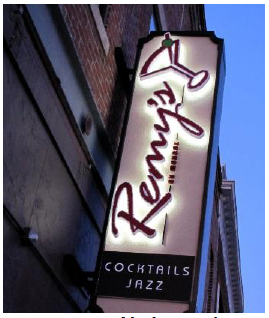
Figure 2: Backlighting of raised letters, creating a halo effect.

Figure 3: Fully shaded light fixture.
g.
Prohibited Sign Materials and Sign Type. The use of plastic panels for the sign face is prohibited. Cabinet signs (also known as a "can" sign), typically consisting of one or more translucent panels containing sign copy which are interchangeable and which are affixed to an internally illuminated box or cabinet mounted on a bracket, shall be prohibited as a projecting sign.
h.
Design Standards. Projecting signs shall be subject to applicable design standards set forth in Section 17.12.080 (design standards for signs).
i.
Amortization Period. Except as otherwise provided in state law for redevelopment project areas, all nonconforming projecting signs in the village, shall have a useful life and legal life of one year, calculated from the effective date of this section. Upon expiration of the sign amortization period, the sign shall be removed by the owner without compensation. Upon determination that a sign is nonconforming, the enforcement officer will issue written notice to the owner or user of the sign or to the owner of the property on which the nonconforming sign is located, requiring conformance or removal therefore if unable to conform. The written notice shall require that the nonconforming projecting sign be removed or altered to comply with the requirements of this Chapter within thirty (30) days from the date of said notice. If, after a reasonable diligent attempt to serve written notice, the owner and user have not received notice, then the city must either post the notice or publish the notice in a local newspaper which is customarily used for notice by the city. If the sign remains thereafter, the city may proceed with abatement procedures or other legal methods, with such costs of removal by the city to be charged against the owner. Nothing in this Section shall preclude any owner or user from voluntarily conforming a nonconforming sign at any time prior to the expiration of the amortization period. For purposes of this Section, written notification deposited in the U.S. mail, or personal delivery, or posting, or publication in a local newspaper shall constitute proper notice.
(Ord. 2000-310 § 2(part), 2000)
(Ord. No. 2011-415, § 4(Exh. 1), 8-22-2011; Ord. No. 2020-485, § 4(Exh. 1), 10-12-2020)
17.12.140 - Business directional signs.
Business directional signs, which direct attention to a business, function, or establishment and that are erected at a location other than the property on which that business, function, or establishment is located, shall be permitted for businesses which are located within the City of Big Bear Lake, pursuant to the provisions of this section. It is the intent of the city council, in allowing such signs, to provide for public safety by directing traffic off of State Highway 18 at appropriate locations so as to minimize traffic congestion. In addition, it is the intent of the city council to provide for the convenience of visitors to the city who are seeking recreational facilities and other attractions, thereby providing for an enjoyable experience by visitors, promoting the visitor-oriented facilities in the city, and contributing to the economic viability of city businesses. As such, business directional signs may contain copy indicating the name and type of business, and a directional symbol or wording; such signs shall not contain advertising information, because such additional information could obscure traffic directional information.
A.
Number Permitted. The number permitted per business located within the City of Big Bear Lake shall be as follows:
1.
Except as provided in paragraph 2 below for winter ski and snowboard resorts, marinas, golf courses, and other public recreational venues, one such sign may be located on primary or secondary arterials as identified in the General Plan Circulation Element, provided that the business shown on the directional sign is not located on Big Bear Boulevard; and
2.
Winter ski and snowboard resorts, marinas and golf courses may each be allowed two off-site business directional signs, provided that the business shown on the directional sign is not located on Big Bear Boulevard.
B.
Sign Location and Size.
1.
A business directional sign shall be approved only where the existing site signs comply with the current sign provisions of this chapter.
2.
Signs shall be attached to an existing freestanding sign. When an existing freestanding sign is not available, sign location and type shall be determined by the land use district in which the sign is proposed to be located and shall be subject to planning commission review and approval.
3.
Except as provided in paragraph 5 below for winter ski and snowboard resorts, marinas and golf courses, sign area shall not exceed twelve (12) square feet per directional sign.
4.
Total cumulative sign area on the site or building displaying the business directional sign shall be in addition to that which is otherwise permitted for that site or building by this chapter.
5.
Maximum sign area for directional signs for winter ski and snowboard resorts, marinas golf courses, and other public recreational venues shall not exceed thirty-six (36) square feet, which shall be calculated in addition to the total sign area allowed on the parcel on which such sign is placed.
6.
The business directional sign area shall be only associated with the subject parcel located off Big Bear Boulevard. The area for the business directional sign shall not be used by any other on-site business.
C.
Property Owner Authorization. Permission from the owner of the property where business directional signs are located shall be submitted to the city planner, along with the sign permit application.
(Ord. 2000-310 § 2(part), 2000)
(Ord. No. 2011-415, § 4(Exh. 1), 8-22-2011)
17.12.150 - Temporary signs.
A.
Temporary Use and Special Event Signs.
1.
Signs to identify locations of temporary uses and special events may be permitted as part of the approval of a temporary use permit or special event permit, without additional sign permits, provided that they meet the requirements of this section. Procedures for special event permits and temporary use permits are located in Chapter 17.03. Temporary uses include but may not be limited to seasonal activities such as holiday tree sales, sales of pumpkins, and haunted houses during limited seasonal periods. Major special events include but are not limited to circuses, carnivals, festivals, outdoor concerts, bicycle races, marathons, car shows, and other activities similar in scope and nature. Minor special events include but are not limited to yard sales, parking lot sales, small-scale arts and crafts sales, bake sales, grand openings, and car washes.
2.
Signs for minor special events and temporary uses shall be limited to one per use and shall be located on-site. Signs for major special events shall not exceed six per event and may be located on- or off-site, with proof of property owner permission. The sign area and height shall be the same as for temporary noncommercial signs; maximum size of the sign shall not exceed thirty-two (32) square feet and the top of the sign shall not be placed higher than eight feet above grade.
3.
Permitted sign types for special events include the following:
a.
Pennants and streamers;
b.
Human signs, provided they do not obstruct or interfere with pedestrian or vehicular traffic;
c.
Balloons and inflatable signs;
d.
Beacons;
e.
Banners, including feather banners;
f.
Portable freestanding signs, such as A-frames.
4.
Special event signs may be displayed no more than thirty (30) days prior to the special event and shall be taken down no later than five days after the event. Signs for other temporary uses may be displayed only during the duration of the temporary use.
5.
Temporary use and special event signs shall not be included in the determination of number or area of signs permitted for permanent signage on a site.
B.
Transit-Related Temporary Signs.
1.
Transit-related temporary signs shall be allowed for the purpose of advertising products, services, goods, attractions, or events. These signs may be affixed to a coach, shelter, bench or other appurtenant facility owned or used by the coach company or agency. For the purposes of this section, the term "coach" shall mean any motor bus, trackless trolley, passenger stage, shuttle, coach, cap, carriage, or other similar mode of transportation. Transit-related temporary signs may be used as specified in the agreement between the City of Big Bear Lake and the transit provider.
2.
Such signs shall not interfere with nor impede pedestrian or vehicular traffic or circulation.
C.
Temporary Commercial Signs.
1.
New Business Sign. New businesses or a business with a change of ownership may be permitted to have a temporary sign for a duration not to exceed up to thirty (30) consecutive days while processing a sign review application for a permanent sign. Such temporary sign may be a wall sign or banner. The size, location, and placement of such signs shall not exceed the restrictions of this chapter for permanent signs. Extensions of time may be authorized by the city planner, not to exceed fifteen (15) additional days, in the event that the permanent sign installation is delayed.
(Ord. 2002-318 § 2(part), 2002; Ord. 2000-310 § 2(part), 2000)
(Ord. No. 2011-415, § 4(Exh. 1), 8-22-2011)
17.12.160 - Variance procedures.
A.
Approval Authority. The city planner or his/her designee may grant a minor deviation (minor variance), with planning commission approval, from the regulations pertaining to signs. All other requests to deviate from the sign regulations in this chapter shall be reviewed by the planning commission as a major deviation (variance), at a duly-noticed public hearing.
B.
Application. In addition to an application for a sign permit and/or sign program, as applicable, the applicant shall submit an application for a minor or major deviation with the city planner, on the form provided and accompanied by the required fee. The applicant shall have the burden of proving that the requested deviation is in conformance with the required findings.
C.
Findings for Approval. Prior to approval of a minor or major deviation for a sign, the reviewing authority shall make the following findings, as applicable:
1.
The building or property on which the sign is to be located is subject to extraordinary or exceptional circumstances or hardship conditions that are not applicable to other properties or buildings within the same district. Exceptional circumstances or hardship conditions include: steep topography, trees, rock outcroppings, odd-shaped lots, substandard lots, natural drainage courses and similar existing conditions. For purposes of meeting this finding, economic reasons are not considered an exceptional or extraordinary circumstance or hardship condition.
2.
The size will not be detrimental to surrounding uses or properties or the community in general;
3.
The approval of the deviation/variance complies with the general plan and the applicable previous of this chapter; and
4.
The strict application of the Development Code and this chapter would prevent the property or business owner from enjoying the same privileges enjoyed by other owners within the same district.
(Ord. 2000-310 § 2(part), 2000)
(Ord. No. 2011-415, § 4(Exh. 1), 8-22-2011)
17.12.170 - Nonconforming signs.
A.
Intent. It is the intent of this section to encourage and promote compliance of existing signs with the provisions of this chapter and the eventual elimination of nonconforming signs. The achievement of full compliance of all signs with the provisions of this chapter is as important as the prohibition of new signs that would violate these regulations. If the sign is one defined by the Outdoor Advertising Act, Section 5499.1, it shall be abated following notice and hearing procedures required by Section 5499.1 et seq. of the Business and Professions Code.
B.
Legal Nonconforming Signs. Every on-site sign becoming nonconforming as a result of this article shall not be required to be removed, except as provided for in California Business and Professions Code Sections 5492, 5493, 5495, and 5497. An existing sign which was constructed in accordance with the ordinances and other applicable laws in effect on the date of construction and which has a current and valid sign permit but becomes nonconforming by adoption of this chapter or other regulation will be allowed to remain within the amortization period unless any of the following occurs:
1.
The sign structure is altered which makes the sign less in compliance with the requirement of this chapter than it was before the alteration; or
2.
The sign structure is relocated to a different location on the site or lot, making it less in compliance with the requirements of this chapter; or
3.
The sign or sign structure is replaced (excluding change of copy).
On the happening of any one of [subsection] 1, 2, or 3 of this section, the sign shall be immediately brought into compliance with this chapter with a new permit secured.
C.
Eminent Domain. Any sign that becomes subject to eminent domain proceedings shall be considered eligible for relocation assistance only, as provided in Section 72620 et seq. of the Government Code.
D.
Repair and Restoration of Nonconforming Structures. Maintenance, repair, and alterations of nonconforming signs that are not historic remain subject to Development Code Section 17.03.320.I, which states that no structural alteration shall be made if the expense of the restoration exceeds fifty percent (50%) of the replacement cost of the structure at the time the construction is proposed.
(Ord. 2000-310 § 2(part), 2000)
(Ord. No. 2011-415, § 4(Exh. 1), 8-22-2011)
17.12.180 - Enforcement.
A.
Any violations of this chapter shall be subject to the enforcement remedies and penalties provided by this chapter, the Big Bear Lake Development Code, Big Bear Lake Municipal Code, and by state and federal law. Each sign and each day is subject to separate infraction violations when applying penalties. It shall be an infraction to install, erect, fail to remove, or maintain any sign without a permit, as required by this chapter. It shall also be a violation to install, erect, fail to remove, or maintain any sign in violation of this chapter. Enforcement may be pursued by issuance of infraction citations, nuisance abatement, injunction, or other remedies available by law. All such penalties may be cumulative.
(Ord. 2000-310 § 2(part), 2000)
(Ord. No. 2011-415, § 4(Exh. 1), 8-22-2011)
17.12.190 - Abatement of illegal and unsafe signs.
A.
Nuisance Abatement. Signs not in compliance with this chapter may be declared to be a public nuisance, and be abated in accordance with the requirements of the Big Bear Lake Municipal Code.
B.
Abatement. Signs located in the public right-of-way or signs which are not in compliance with this chapter may be declared to be a de facto public nuisance subject to abatement by the enforcement officer. In addition to any criminal or civil penalties prescribed by law, the actual costs of abatement of such signs shall become a debt owed to the city by the person responsible for or causing placement of the sign. Said debt shall be subject to cost recovery.
C.
Unmaintained Sign Abatement. All signs shall be kept in good repair at all times or shall be subject to the following:
1.
If the sign is not repaired or under repair within thirty (30) days after notification has occurred, the enforcement officer may issue an infraction citation.
2.
If the sign is not repaired within thirty (30) days after the first citation, a second citation may be issued to the owner and/or user of the sign, and such violation may continue to be assessed each day thereafter until the sign is repaired.
3.
The enforcement officer, upon identification of a hazardous or unsafe sign, shall give written notice to the property owner or party responsible for the sign of the condition or conditions which render the sign hazardous or unsafe, and an order to abate the public nuisance caused by the existence of the hazardous or unsafe sign. The enforcement officer will determine an appropriate time period for abatement of the public nuisance, based on the degree of the hazard. At the expiration of the time period, if the hazard has not been voluntarily abated, the enforcement officer shall proceed to abate the nuisance in accordance with the procedures contained in the Big Bear Lake Municipal Code.
4.
When it is necessary to make an inspection to enforce the provisions of this chapter, or when the enforcement officer has reasonable cause to believe that there exists any sign or condition which makes such sign unsafe, abandoned, illegal or nonconforming, the enforcement officer may petition the court to enter the lot, building, or premises on which such sign is located at all reasonable times to inspect the sign or to perform any duty imposed by this chapter.
D.
Sign Removal. Every legal off-site sign becoming nonconforming as a result of this ordinance may be removed in accordance with the provisions of California Business and Professions Code Sections 5412, 5412.1, 5412.2, and 5412.3. All illegal signs listed below shall be forthwith removed by the owner or by the city with forty-eight (48) hours notice to the owner.
1.
A sign which was legal but nonconforming that becomes illegal and nonconforming by the occurrence of [subsection] C.1, C.2, or C.3 above.
2.
Any illegal sign.
3.
A nonconforming sign which has exceeded its authorized amortization period.
4.
An abandoned sign.
5.
A display existing without permission of owner or lessee.
E.
Amortization Period. Except as otherwise provided in state law for redevelopment project areas, all legal nonconforming signs, other than portable freestanding signs, shall have a useful life and legal life of fifteen (15) years, calculated from the date of adoption of this ordinance. Upon expiration of the sign amortization period, the sign shall be removed by the owner without compensation. Upon determination that a sign is nonconforming, the enforcement officer will issue written notice to the owner or user of the sign or to the owner of the property on which the nonconforming sign is located, requiring conformance or removal therefore if unable to conform. The written notice shall require that the nonconforming portable freestanding sign be removed or altered to comply with the requirements of this chapter within thirty (30) days from the date of said notice. If, after a reasonable diligent attempt to serve written notice, the owner and user have not received notice, then the city must either post the notice or publish the notice in a local newspaper which is customarily used for notice by the city. If the sign remains thereafter, the city may proceed with abatement procedures or other legal methods, with such costs of removal by the city to be charged against the owner. Nothing in this section shall preclude any owner or user from voluntarily conforming a nonconforming sign at any time prior to the expiration of the amortization period. For purposes of this section, written notification deposited in the U.S. mail, or personal delivery, or posting, or publication in a local newspaper shall constitute proper notice.
F.
Amortization Period for Nonconforming Portable Freestanding Signs. All legal nonconforming portable freestanding signs shall be removed within one year of adoption of this ordinance. Upon expiration of the sign amortization period, the nonconforming portable freestanding sign shall be removed by the owner without compensation. Upon determination that a sign is nonconforming, the enforcement officer shall issue written notice to the owner or user of the sign or to the owner of the property on which the nonconforming portable freestanding sign is located and either post the notice or publish the same in a newspaper of general circulation in the City of Big Bear Lake. The written notice shall require that the nonconforming portable freestanding sign be removed or altered to comply with the requirements of this chapter within thirty (30) days from the date of said notice. If the nonconforming portable freestanding sign remains thereafter, the city may proceed with abatement proceedings or other legal methods, with such costs of removal by the city to be charged against the owner. Nothing in this section shall preclude any owner or user from voluntarily conforming a nonconforming sign at any time prior to the expiration of the amortization period. For purposes of this section, written notification deposited in the U.S. mail, or personal delivery, or posting, or publication in a local newspaper shall constitute proper notice.
G.
Inventory of Signs. Within six months of the date of adoption of this Ordinance the city planner shall cause to be performed an inventory of all on-premise and off-site directional signs within the city to identify those which are illegal or abandoned. For the purposes of this subparagraph, the term "illegal" denotes a sign which was erected without compliance with all ordinances and regulations in effect at the time of its construction and erection or use, and the term "abandoned" denotes a sign which remains in place or is not maintained for a period of one hundred eighty (180) days which no longer advertises or identifies an ongoing business, product, or service available on the business premises where the sign is located (excluding seasonal businesses). When the inventory has been completed, the city planner shall report the actual cost of conducting that inventory to the city council so the council may by resolution provide for the recoupment of that cost in the manner authorized by Section 5491.2 of the Business and Professions Code, if desired. Upon completion of the required inventory, the city shall consider at a public hearing with the opportunity for public comment, whether there is a need for the ordinance or regulation that prohibits the use of any on-premises advertising display to take effect. No later than sixty (60) days after six months after the date of adoption of this Ordinance, the city shall commence abatement as provided in this section of the illegal and abandoned signs identified by the inventory.
H.
Nonconforming Signs Abatement. Nonconforming signs which may be abated without payment of compensation. Any sign which does not comply with the requirements of this chapter and which may be abated without the payment of compensation pursuant to Section 5497 or 5498 of the Business and Professions Code shall be brought into compliance with the requirements of this chapter as soon as may reasonably be accomplished and in no event later than twelve (12) months after the date of adoption of this ordinance, unless such period is extended by the planning commission for good cause shown. Any such sign which is not brought into conformance with the requirements of this chapter within that time shall be deemed to be a public nuisance pursuant to California Government Code Section 38771 and shall be abated in accordance with the city's nuisance abatement procedures.
(Ord. 2000-310 § 2(part), 2000)
(Ord. No. 2011-415, § 4(Exh. 1), 8-22-2011)

