
Big Bear Lake City Zoning Code
CHAPTER 17
35 - COMMERCIAL AND PUBLIC ZONES
17.35.010 - Intent and purpose of commercial and public zones.
A.
The commercial and public zones are established to implement the goals and policies of the City of Big Bear Lake General Plan, including but not limited to the following:
Goal L 2—Adopt land use and development policies which encourage growth and diversification of the city's economic base.
Goal L 4—Provide sufficient commercially-designated land to accommodate the city's long-term needs for tourist and recreational facilities, to support the city's role as a market center for the Big Bear Valley, and to provide services to city residents.
Policy L 4.2—Ensure that commercial development provides an attractive environment for business, lodging, entertainment, shopping, and working, and creates long-term value for the community.
Policy L 4.3—Adopt regulations for location, design and operation of commercial uses which, by the intensity of the proposed use or potential secondary land use effects, may have special requirements.
Goal L 5—Provide opportunities for industrial activities needed to support the local economy and recognize existing industrial uses in the city, while ensuring that impacts from industrial uses do not detract from the city's character as a mountain resort through adverse visual, traffic, noise, dust or other impacts.
Goal P 6—Plan for and reserve land to accommodate uses needed for public benefit, including open space, recreation, public improvements, schools, and community facilities.
Policy PS 1.1—Assure the provision of adequate public services and facilities for all residents, businesses and visitors within the community, now and in the future.
B.
In addition to implementing the goals and policies of the general plan with respect to commercial and public land uses, this chapter and the accompanying official zoning map are intended to achieve the following objectives:
1.
To reserve appropriately located areas for commercial uses of various ranges of types and intensities, including office uses, retail stores, service establishments, and light industrial uses to meet the needs of the community;
2.
To ensure adequate access for each business, including access by pedestrians, bicycles, and public transit, and minimize traffic congestion through concentration of businesses within districts and appropriate site design;
3.
To ensure that each site is designed with adequate area to accommodate all required on-site parking, open space, screening, setbacks, service areas, and landscaping;
4.
To create visitor-oriented districts where commercial lodging, dining and entertainment are located together for ease of accessibility and convenience of visitors, and which are protected from incompatible uses;
5.
To protect adjacent properties from incompatible uses, light, glare, odors, visual blight, and other objectionable conditions resulting from uses having a higher intensity;
6.
To facilitate the provision of utility services and other public facilities commensurate with anticipated service requirements;
7.
To promote design and construction techniques that complement the natural resources and topography of Big Bear Lake's mountain setting and that encourage energy and water conservation, through high-quality site planning, architecture, and landscaping;
8.
To ensure that public projects are held to the same standards of development as similar privately-developed projects, and that such projects are designed, constructed, maintained and operated so as to minimize adverse effects on surrounding properties.
(Ord. 2003-333 § 4 (Exh. A (part)), 2003)
(Ord. No. 2011-415, § 4(Exh. 1), 8-22-2011; Ord. No. 2011-417, § 4(Exh. A), 12-12-2011)
17.35.020 - Commercial and public zone districts.
Six base zone districts are established as follows:
A.
Commercial-Services (C-1) Zone.
1.
The commercial-services (C-1) zone is established for the development of professional/administrative offices, personal services, institutional and quasi-public uses serving both a local and community-wide market area. The number of customer visits would typically be less frequent and traffic generation more moderate than for retail commercial uses. Site development regulations and performance standards are designed to make businesses in this zone compatible with adjacent less-intensive uses, including residential districts.
2.
The C-1 zone is appropriate between more intensive commercial districts or highways, and residential uses. This district should be accessible from collector or arterial streets, and be relatively flat and free from environmental constraints. Suitable sites for this zone will contain adequate area to accommodate all required parking, loading, circulation and landscape requirements, and be supported by adequate infrastructure.
3.
The C-1 zone is compatible with the commercial-services (CS) general plan land use designation.
B.
Commercial-General (C-2) Zone.
1.
The commercial-general (C-2) zone is established for the development of businesses that provide a wide variety of goods and services serving both a local and regional market area. The zone is appropriate for shopping centers as well as freestanding businesses. The intent of this zone is to create a pleasant and efficient environment for general retail shopping and business.
2.
The C-2 zone is appropriately located in areas that are or will be occupied by stores and businesses that provide retail sales and services for a wide range of consumer needs, including both short-term and long-term goods. The area should be located along or accessible from major streets and highways, environmentally and topographically suited to large-scale commercial development, with slopes of under ten percent (10%) and with adequate infrastructure to support permitted uses.
3.
The C-2 zone is compatible with the commercial-general (CG) general plan land use designation.
C.
Commercial-Visitor (C-3) Zone.
1.
The commercial-visitor (C-3) zone is established for the development of areas designed primarily for visitor services, including lodging, dining, recreation, entertainment, specialty retail stores, and other supporting uses.
2.
The C-3 zone is appropriately located in areas that are or will be occupied by stores and businesses, which provide services to visitors. The area should be located along or accessible from major streets and highways or adjacent to recreation areas, with adequate infrastructure to support permitted uses.
3.
The C-3 zone is compatible with the commercial-visitor (CV) general plan land use designation.
D.
Commercial-Recreation (C-4) Zone.
1.
The commercial-recreation (C-4) zone is established for the development of destination-oriented recreational facilities serving a regional market area and supportive uses, including ski resorts, marinas, golf courses, snow play facilities, and similar uses. Supportive uses include visitor services, such as lodging, restaurants, specialty retail, and related off-site parking lots.
2.
The C-4 zone is appropriately located in areas that are or will be occupied by major recreational facilities drawing large numbers of visitors. The district should be accessible from major streets and highways, and may be designated on or adjacent to natural features providing recreational opportunities, such as the mountains or lake. Adequate infrastructure should be available to support permitted uses, and operations in this zone should be conducted so as to have no detrimental effect on adjacent properties or on the environment.
3.
The C-4 zone is compatible with the commercial-recreation (C-R) general plan land use designation.
E.
Commercial-Industrial (C-5) Zone.
1.
The commercial-industrial (C-5) zone is established for the development of the most intensive businesses serving a community and regional market area, including construction-related businesses, storage, heavy vehicle repair, equipment storage and rental, light fabrication and assembly of goods, waste management facilities, and utility yards. Establishments in this zone serve both other businesses and the general public with a combination of intensive commercial and light industrial uses.
2.
The C-5 zone is appropriately located in areas that are or will be occupied by businesses that provide heavy commercial and light industrial goods and services to other businesses as well as the general public. The district should be located along or accessible from major streets and highways, on relatively flat land with adequate infrastructure to support permitted uses. Businesses in this zone may use or store hazardous materials and heavy equipment, and may generate noise, dust, emissions, and truck traffic which may be detrimental to less intensive uses; therefore, the use is not appropriate next to residential uses unless adequate separations and buffers are provided. Adequate infrastructure should be available to support permitted uses, and operations in this zone should be conducted so as to have no significant adverse effect on adjacent properties or on the environment.
3.
The C-5 zone is compatible with the industrial (Ind) general plan land use designation.
F.
Public (P) Zone.
1.
The public (P) zone is established to create and preserve areas for public facilities, including but not limited to schools; government administrative facilities; law enforcement and fire stations; libraries; park, recreation, and open space uses; community facilities; public works facilities; utilities; and similar uses needed to serve the needs of the general public.
2.
The P zone is appropriate in areas occupied or planned for public or quasi-public uses or facilities, which can physically accommodate the use and where adequate services exist to serve the intended use.
3.
The P zone is compatible with the public facilities (P) general plan land use designation. In addition, due to the broad service function of this zone and the difficulty of planning all publicly-needed facilities in advance, the P zone may be designated throughout the planning area, provided the use does not conflict with other established uses and conforms to applicable provisions of the general plan.
(Ord. 2003-333 § 4 (Exh. A (part)), 2003)
(Ord. No. 2011-415, § 4(Exh. 1), 8-22-2011; Ord. No. 2011-417, § 4(Exh. A), 12-12-2011)
17.35.030 - Principal uses permitted in commercial and public zones.
A.
Principal uses permitted within commercial and public zones shall be those included on Table 17.35.030.A. In the event that a determination is requested as to whether a principal use is permitted in the commercial and public zones which is not listed on Table 17.35.030.A, the reviewing authority shall make that determination in accordance with Section 17.03.210.
B.
Where Table 17.35.030.A indicates that a use is permitted subject to a specific land use approval process, procedures for that approval process set forth in Chapter 17.03 shall be followed. Where Table 17.35.030.A indicates that a use is subject to special development standards contained in this chapter, the applicable sections of this chapter shall be referenced in review and approval of said use.
C.
This section shall not be construed to supersede more restrictive use regulations in the conditions, covenants and restrictions of any property or dwelling unit.
Table 17.35.030.A
PRINCIPAL USES PERMITTED IN COMMERCIAL AND PUBLIC ZONES
P = permitted use (plot plan review pursuant to Section 17.03.160 may be required for new construction or change of use; minor modification pursuant to Section 17.03.250 may be required for minor changes to existing developments)
CUP = permitted subject to approval of a conditional use permit pursuant to Section 17.03.170.
1 Drive-through facilities subject to the standards in Section 17.35.100
2 Subject to specific regulations contained in this chapter.
3 Subject to special requirements set forth in Title 5 of the Big Bear Lake Municipal Code
4 Subject to special requirements set forth in Table 17.35.050.A (General Development Standards); Section 17.35.220 (Development Standards for Large Retail Uses), and Section 17.03.330 (Transitional Uses and Structures)
5 Subject to buildings containing a minimum of two-floors and not permitted on ground-level or first floors. In the C-3 zone, this footnote only applies to the north side of Moonridge Road, between Elm Street and Rathbun Drive/Club View Drive Intersection.
6 Prohibited in the C-4 zone along Moonridge Road.
7 Property located on Moonridge Road, between Elm Street and Rathbun Drive/Club View Drive Intersection.
— Not permitted.
(Ord. 2004-344 § 4 (Exh. 1 (part)), 2004: Ord. 2003-333 § 4 (Exh. A (part)), 2003)
(Ord. No. 2011-415, § 4(Exh. 1), 8-22-2011; Ord. No. 2011-417, § 4(Exh. A), 12-12-2011; Ord. No. 2012-418, § 5, 4-23-2012; Ord. No. 2017-454, § 4(Exh. 1, § E), 6-12-2017; Ord. No. 2018-461, § 4(Exh. 1.A.), 5-14-2018; Ord. No. 2019-464, § 4(Exh. 1), 5-13-2019; Ord. No. 2020-487, § 4(Exh. 1), 12-14-2020; Ord. No. 2021-488, § 5(Exh. A), 1-11-2021; Ord. No. 2022-503, § 4(Exh. 1), 8-15-2022; Ord. No. 2025-523, § 4(Exh. A), 11-12-2025)
17.35.040 - Accessory uses permitted in commercial and public zones.
A.
Accessory uses permitted within commercial zones shall be those included on Table 17.35.040.A. In the event that a determination is requested as to whether an accessory use is permitted in these zones which is not listed on Table 17.35.040.A, the reviewing authority shall make that determination in accordance with Section 17.03.210.
B.
Where Table 17.35.040.A indicates that a use is permitted subject to a specific approval process, procedures for that approval process set forth in Chapter 17.03 of the Development Code shall be followed in granting that approval, except as otherwise indicated. Where Table 17.35.040.A indicates that a use is permitted subject to special development standards contained in this chapter, the applicable sections of this chapter shall be referenced in review and approval of said use.
C.
This section shall not be construed to supersede more restrictive use regulations in the conditions, covenants and restrictions of any property.
D.
No accessory use or structure shall be constructed or established on any lot unless there is a primary use on said lot, and the accessory use or structure is incidental to and related to the primary use.
E.
No accessory use or structure shall be constructed or established on any lot prior to the time of construction of the principal structure to which it is accessory. This paragraph shall not be construed to govern the sequencing of a construction project in which both the principal and accessory structures are to be built and occupied simultaneously.
(Ord. 2006-366 § 4 (Exh. 2), 2006; Ord. 2003-333 § 4 (Exh. A (part)), 2003)
(Ord. No. 2011-415, § 4(Exh. 1), 8-22-2011; Ord. No. 2011-417, § 4(Exh. A), 12-12-2011)
Table 17.35.040.A
ACCESSORY USES AND STRUCTURES PERMITTED IN COMMERCIAL AND PUBLIC ZONES
P = permitted use (Plot Plan Review pursuant to Section 17.03.160 may be required for new construction or change of use; minor modification pursuant
to Section 17.30.250 may be required for minor changes to existing developments).
CUP = permitted subject to approval of a Conditional Use Permit pursuant to Section
17.03.170.
SE = permitted subject to approval of a Special Event Permit, pursuant to Section
17.03.300.
SP = permitted subject to approval of a Sign Permit, pursuant to Chapter 17.12.
TUP = permitted subject to approval of a Temporary Use Permit, pursuant to Section
17.03.290.
1
Subject to standards contained in this chapter.
— = Not permitted.
(Ord. No. 2017-454, § 4(Exh. 1, § E), 6-12-2017; Ord. No. 2020-484, § 4(Exh. 4), 9-14-2020; Ord. No. 2022-501, § 4(Exh. 1), 4-4-2022; Ord. No. 2022-506, § 4(Exh. A), 10-3-2022)
17.35.050 - General development standards for commercial and public uses.
A.
The development standards set forth in Table 17.35.050.A are intended to provide minimum standards for commercial and public development. These standards should be used in conjunction with the special development standards contained in this chapter applicable to specific uses as indicated on said table.
B.
This section shall not be construed to supersede more restrictive site development standards contained in the conditions, covenants and restrictions of any property, or as shown on the composite development plan or final map for any subdivision. However, in no case shall private deed restrictions or map requirements be interpreted to allow a lesser standard (in the case of a minimum standard) or a greater standard (in the case of a maximum standard) than the development standards set forth herein.
C.
Deviations from the standards set forth in this section may only be allowed by approval of a variance or minor deviation, pursuant to Section 17.03.180; or through approval of a comprehensive development plan pursuant to Section 17.03.280 (Specific Plan Review) or Section 17.03.220 (Development Agreements).
D.
Nothing in this section shall be construed as making lots illegal which were legally created prior to the adoption of these regulations. For information on non-conforming uses and structures, see Section 17.03.320 of the Development Code.
Table 17.35.050.A
GENERAL DEVELOPMENT STANDARDS IN COMMERCIAL ZONES
1
Parcels created within master planned projects are exempt from these standards, provided
that a comprehensive development plan for the entire center is approved and appropriate
easements for reciprocal access, parking, and maintenance are provided.
2
;hg;Development standards for public uses shall be required where applicable, based
upon the use of the site. Where the public use is similar to an office or service
building, the standards contained herein shall apply. For uninhabitable public uses
such as flood control channels, well sites, and pump stations, standards contained
herein may not be applicable and may be modified by the reviewing authority as deemed
appropriate.
3
;hg;Height standards in this table apply where no other standards are specified in
this chapter; where development standards allow different height standards, the more
specific standard shall apply
4
;hg;Subject to the standards contained in Section 17.35.220 (Development Standards for Large Retail Uses), and Section 17.03.330 (Transitional Uses and Structures)
5
;hg;Pedestrian open space, such as plaza's, courtyards and colonnades, shall be applicable
for the open space requirements. Additionally, up to 50% of the uncovered outdoor
dining area may be counted as pedestrian open space.
6
;hg;Architectural features, such as towers, cupolas, ornamental roof structures,
roof projections, uninhabited attic space, or similar structures and features shall
not extend more than twenty-five percent (25%) above the primary structure and is
contingent upon adequate fire department apparatus street access and approach.
7
Property located on Moonridge Road, between Elm Street and Rathbun Drive/Clubview
Drive.
(Ord. 2004-344 § 4 (Exh. 2 (part)), 2004: Ord. 2003-333 § 4 (Exh. A (part)), 2003)
(Ord. No. 2011-415, § 4(Exh. 1), 8-22-2011; Ord. No. 2011-417, § 4(Exh. A), 12-12-2011; Ord. No. 2018-461, § 4(Exh. 1.B.), 5-14-2018; Ord. No. 2021-494, § 4(Exh. 1), 8-16-2021)
17.35.060 - Additional setback regulations.
A.
General Setback Provisions.
1.
Each lot or parcel of commercially-zoned land shall have minimum front, side, and rear yard setbacks as required for the zone in which the property is located, for the specific use when applicable, or by this section, whichever requirement is the greatest, except as modified by an adopted specific plan or development agreement. The reviewing authority may require setbacks greater than the minimum requirement in order to meet the goals and policies of the general plan, including but not limited to minimizing grading, tree removal, degradation of sensitive habitat, land use impacts, or other similar objectives.
2.
In a case where a final tract map, final parcel map, or composite development plan has been recorded that indicates minimum setback requirements less than those set forth in this chapter, the setback requirements of this chapter shall apply. In a case where a final tract map, parcel map, or composite development plan has been approved or recorded that indicates setback requirements in excess of those set forth in this chapter, the greater standard shall apply.
3.
Setbacks from streets shall be measured from the public or private right-of-way, to the nearest edge of the building.
B.
Permitted Projections into Required Setbacks. The following projections into yards are permitted, provided that the applicable requirements of the California Building Code are also met:
1.
Eaves, awnings, cornices, chimneys, wing walls, bay windows without floor area, or other similar architectural features attached to the main building and supported at or behind the building setback line, may project into any required yard a maximum of three feet, except that in no case may such features encroach closer than thirty (30) inches to the property line. Bay windows exceeding twelve (12) feet in width or fifty percent (50%) or more of the width of the wall on which they are located must conform to the setback requirements for the main structure.
2.
Uncovered decks, balconies, platforms, porches, landings, and walkways which do not exceed a height of forty-eight (48) inches above grade may encroach into any required side or rear yard, but not closer than three feet to the property line and not closer than ten (10) feet from any residentially used or designated property.
3.
Stairways and walkways providing access to the main entrance of any building may be permitted in any front or street side yard, provided that no portion of said stairway or walkway other than required handrails may exceed eighteen (18) inches in height as measured from original grade.
4.
Uncovered bridges or platforms providing access to required parking areas and main entries may be permitted in the front or street side setback areas, providing that no portion of said bridge or platform other than required handrails may exceed eighteen (18) inches in height as measured from the grade of the edge of right-of-way.
5.
Open and unenclosed fire escapes, stairways and door stoops may encroach by not more than three feet into a rear or interior side yard, provided that they are no closer than three feet from the property line; these features may not project into required front or street side yards.
6.
Planter boxes or masonry planters, not to exceed a height of forty-two (42) inches, may project into the required front or street side yard setback by no more than six feet.
7.
Fireplace structures not wider than eight feet may encroach into required yards up to two feet, but no closer than three feet to the property line.
C.
Special Setback Requirements.
1.
Sexually oriented uses shall maintain setbacks from other uses pursuant to Chapter 5.98 of the Big Bear Lake Municipal Code.
2.
Gasoline tanks, fuel storage tanks, or any other storage of explosives or hazardous material shall be set back no less than one hundred (100) feet for underground tanks and three hundred (300) feet for above-ground tanks from any residentially used or designated property; day care center; school; hospital; or social care facility.
3.
Bars and nightclubs shall be located no closer than three hundred (300) feet from any residentially used or designated property, commercial day care center, school, or social care facility.
4.
Liquor stores shall be located no closer than fifty (50) feet from any residentially used or designated property, and shall be located no closer than three hundred (300) feet from any commercial day care center, school, or social care facility.
(Ord. 2003-333 § 4 (Exh. A (part)), 2003)
(Ord. No. 2011-415, § 4(Exh. 1), 8-22-2011; Ord. No. 2011-417, § 4(Exh. A), 12-12-2011)
17.35.070 - Parking requirements and standards.
A.
General parking requirements for commercial and applicable public uses.
1.
Off-street parking shall be provided for any new building constructed and for any new uses established, for any addition or enlargement of an existing building or use, and for any change in the occupancy of a building or the manner in which any use is conducted, that would result in additional parking spaces being required, pursuant to the requirements in Table 17.35.070.A and the provisions of this section. This section shall not apply to properties that are located within a city-approved parking lot district or similar offsite parking agreement.
2.
All required off-street parking spaces shall be located on the same lot as the use to be served, except as otherwise permitted through approval of off-site parking facilities. The reviewing authority may approve off-site parking if the following conditions are met by the project:
a.
The proposed off-site parking shall be located within three hundred (300) feet of the use for which it is provided, and there is a continuous approved pedestrian access connecting the off-site parking area with the use.
b.
Clearly visible directional signage shall be provided to direct vehicles and pedestrians between the off-site parking lot and the use being served.
c.
Disabled access and parking shall be provided on the same site as the use, and shall meet all other applicable requirements.
d.
No more than fifty percent (50%) of the required parking shall be provided off-site, except where existing structures preclude the provision of on-site parking.
3.
All parking spaces and areas required by this chapter shall be designed and maintained to be fully usable for the duration of the use requiring such areas and spaces. Where off-site parking is permitted to meet the required parking, all off-site spaces shall be designated for the use and secured through property ownership, long-term lease, or other means as approved by the city to guarantee that the parking shall be provided for the duration of the use.
4.
The required parking is cumulative for all of the uses proposed on the same lot, except as otherwise approved through a shared parking plan or as allowed by Table 17.35.070.A. A shared parking plan may be approved by the reviewing authority based upon submittal and approval of a parking study prepared by a qualified traffic engineer to justify the provision of a lesser number of spaces than that required by this section, based on shared use of spaces, the nature of the use, or other factors. A written agreement shall be approved by all parties and the city and shall be recorded, assuring the continued availability of the parking spaces designated for joint use.
5.
No existing use of land or existing structure where parking for said use or structure was conforming at the time of establishment or modification, shall be deemed to be nonconforming solely because of the lack of off-street parking facilities prescribed by this section. Facilities being used for off-street parking may be reduced in capacity to the minimum standards prescribed in this chapter to provide for landscaping and snow storage.
6.
Except as otherwise specified in Table 17.35.050.A, required setback areas shall not be used for off-street parking purposes. Vehicle parking shall be allowed only within designated parking spaces.
7.
Where the application of the off-street parking requirements results in a fractional number of spaces, a fraction of one-half or greater shall be rounded to the next higher whole number, and a fraction of less than one-half shall not be counted.
8.
The off-street parking requirements contained in this section are minimums for the listed uses. If evidence before the reviewing authority shows that a specific application will result in a higher demand for parking than is normally expected for that type of use, a greater number of spaces may be required.
9.
Temporary use of required parking spaces for non-parking purposes is permitted through approval of a special event permit or temporary use permit, pursuant to Chapter 17.03.
10.
Parking of abandoned, unlicensed, or inoperative vehicles is subject to and will be abated pursuant to applicable provisions of the Big Bear Lake Municipal Code and the California Vehicle Code.
11.
Pedestrian walkways shall be designated and clearly delineated between parking areas and structures. The parking area shall be designed to minimize the need for pedestrians to cross parking aisles or landscaped areas in order to reach their destinations.
12.
A minimum of one loading space shall be provided for every building having five thousand (5,000) or more square feet, except as otherwise approved by the reviewing authority based upon the nature of the use. Where required for truck deliveries, a loading space shall be a minimum of twelve (12) feet wide and twenty-four (24) feet long and shall not be located within the main parking area used by the general public. For uses, which typically receive all deliveries by van, a loading space may be striped with the same dimensions as a parking space, but shall be required in addition to the required number of parking spaces.
13.
The parking requirement for any use not specifically listed shall be determined by the city planner on the basis of the requirements for similar uses.
B.
Design Standards for Parking Areas. The following parking lot standards shall apply to all commercial uses, and to public uses where applicable:
1.
Parking facilities constructed or substantially reconstructed after the effective date of this chapter shall conform to the design standards set forth herein, whether or not the parking is required.
2.
Internal circulation patterns, and location and operations of all access drives, shall be designed and maintained in accordance with accepted principles of traffic engineering and traffic safety. All driveways, which serve as fire lanes, shall conform to the fire code.
3.
Driveways and drive aisles shall be a minimum of twelve (12) feet in width for one-way traffic, and twenty-four (24) feet for two-way traffic, except as otherwise approved by the city to minimize grading and/or tree removal. In no case shall a two-way drive aisle be less than twenty (20) feet in width. When in conformance with the fire code, drive aisle width for one-way drive aisles shall be provided as follows:
4.
Head-in or diagonal parking spaces shall be no less than nine feet in width and nineteen (19) feet in length; parallel parking spaces shall have minimum dimensions of ten (10) feet by twenty-four (24) feet. Minimum vertical clearance for parking spaces shall be fifteen (15) feet. No reduction in these dimensions shall be permitted.
5.
Parking with access for disabled persons shall be provided in accordance with state law. Each parking space designated for use by the handicapped shall consist of a rectangular area not less than seventeen (17) feet wide by nineteen (19) feet long for a van-accessible stall, and fourteen (14) feet wide by nineteen (19) feet long for a standard stall, and shall be located in an area not exceeding two percent slope. All spaces shall be located near or convenient to a level or ramped entrance, not exceeding a five percent slope, to the facility served by the parking space. Parking spaces for the handicapped shall be signed, striped, and restricted for use by the handicapped only, and all signs and striping shall be maintained in a good condition at all times.
6.
Except for parallel parking spaces, when the side of a parking space abuts a building, wall, support column, or other obstruction, which interferes with access to the vehicle, the space shall be a minimum of two feet wider than the required minimum width.
7.
Parking lots, loading spaces and driveways shall be constructed with three inches of asphalt paving over four inches of aggregate base, except as otherwise approved by the city engineer based upon the recommendations of an approved soils study provided by a qualified soils engineer. Alternate surface material may be considered if it is shown that such material will not cause adverse effects and that it will remain in a usable condition.
8.
Parking areas shall be graded and provided with permanent storm drainage facilities. Surfacing, curbing, and drainage improvements shall be sufficient to preclude free flow of water onto adjacent properties or public streets and to preclude standing pools of water within the parking facility.
9.
The maximum grade of parking lots shall not exceed five percent. The maximum grade of driveways serving parking lots shall not exceed ten percent (10%).
10.
Each parking space shall be individually accessible; tandem parking is not allowed in commercial zones, except for special events or circumstances where attendants park vehicles pursuant to an approved parking plan.
11.
Parking lots shall be designed so that vehicles do not have to exit the site to get from one parking space to another. Design shall ensure that no vehicle must back into a public right-of-way to maneuver into or out of the site.
12.
Parking lots shall be designed in consideration of existing trees on the site, in conformance with Chapter 17.10. Existing trees over six inches DBH shall be preserved to the extent practicable in the design of parking lots. Within lots having six or more parking spaces, trees shall be provided at a ratio of one tree per six parking spaces, which may include existing trees to be preserved on site or newly planted trees, provided that any such trees counted to meet this requirement must be located within ten (10) feet of the parking area.
13.
In parking lots where headlights from vehicles will shine into adjacent residentially used or designated property or commercial lodging units, screening of headlight glare shall be provided which may include but not be limited to screen walls, berms, landscape planting, or a combination thereof.
14.
For parking lots with six or more spaces, at least five percent of the parking area shall be landscaped. The parking area shall be computed by adding the areas used for access drives, aisles, stalls, maneuvering and landscaping within that portion of the premises that is devoted to vehicular parking and circulation. Any planter area containing trees shall be no less than five feet in width, excluding paving.
15.
Where the side of a parking space abuts a landscaped planter, a minimum twelve (12) inch wide paved landing strip shall be provided adjacent to the parking space to accommodate passengers exiting the vehicle.
16.
Except as otherwise approved through a snow management plan, parking lots shall be designed to accommodate snow plowing and snow storage. An area equal to a minimum of five percent of all uncovered required parking and driveway areas shall be provided on site for the storage of snow. All designated snow storage areas shall be at least ten (10) feet wide and deep in the smallest dimension and shall be readily accessible and usable. These areas shall be unpaved and shall be substantially free and clear of obstructions (including but not limited to propane tanks, trees, boulders, and dumpsters). No parking may be permitted in snow storage areas, and parking spaces on site may not be designated for snow storage. Storage of snow on adjacent properties is not permitted, except where property is under same ownership. Snow storage area may be combined with required landscape area, provided that plant materials will not be damaged by plowing operations.
17.
No wheel stops or raised curbs shall be located within parking areas in such a way as to obstruct or interfere with snowplowing operations.
18.
All parking areas shall be maintained in good condition at all times, free from potholes and excessive cracking, with required pavement striping and handicapped parking identification clearly visible.
19.
In the event practical difficulties and hardships result from the strict enforcement of the parking standards due to existing permanent buildings or an irregularly shaped parcel, the city planner may grant a minor deviation to the standards with respect to a maximum of fifteen percent (15%) reduction to on-site parking spaces, or minor reconfiguration of existing parking to comply with accessibility requirements, pursuant to Section 17.03.180 of the Development Code. All other requests to deviate from parking standards must be approved through the variance procedure pursuant to said section.
Table 17.35.070.A
PARKING REQUIREMENTS IN COMMERCIAL AND PUBLIC ZONES
Note: Off-street parking requirement shall be based on gross floor area (all floor area from wall to wall, except for bathrooms and utility rooms). Where uses occur outdoors, parking shall be based on the area used.
(Ord. 2003-333 § 4 (Exh. A (part)), 2003)
(Ord. No. 2011-415, § 4(Exh. 1), 8-22-2011; Ord. No. 2011-417, § 4(Exh. A), 12-12-2011; Ord. No. 2018-461, § 4(Exh. 1.C.), 5-14-2018)
17.35.080 - Site design standards.
A.
Grading and Clearing.
1.
Except for minor landscaping improvements or weed removal, no lot may be graded or vegetation cleared until such action is shown on and consistent with an approved development plan or permit, which may include subdivision map, use permit, grading permit, and/or encroachment permit. Grading should be limited to the extent feasible to accommodate a building footprint for structures, parking, access, landscaping, and snow storage.
2.
Existing trees and vegetation shall be preserved to the maximum extent possible. No live trees over six inches DBH shall be removed without prior approval, as required by Chapter 17.10, and replacement trees may be required by the reviewing authority.
3.
Development should relate to the natural surroundings and follow natural contours as much as possible. Graded slopes should be rounded and contoured to blend with the existing terrain. Split-level pads, built-up foundations, stepped footings, and similar techniques should be used in areas of moderate to steep gradient. Grading should be designed to complement the project's orientation, scale, height, design, and transition with surrounding properties.
B.
Site Access.
1.
Direct access shall be provided to and from a public right-of-way, as approved by the city engineer and in conformance with the fire code. Approved access shall not include the use of private easements over adjacent lots, except where a reciprocal parking and access easement has been approved and recorded.
2.
Vehicular access to commercial development shall not be provided through a residential neighborhood; except that when a gated emergency access is required for fire access, such access may be approved by the reviewing authority to exit into a residential area provided that no adverse impacts would result.
3.
Shared vehicular and pedestrian access is encouraged between adjacent commercial sites to the extent feasible, to allow customers to access various businesses without exiting onto adjacent rights-of-way.
4.
Pedestrian access shall be integrated into all commercial and public developments open to the general public, which may include but not be limited to the following improvements:
a.
Transit stops should be connected to buildings by pedestrian walkways;
b.
Public sidewalks within adjacent rights-of-way should be connected to buildings by pedestrian walkways;
c.
Parking areas should be connected to buildings by clearly delineated pedestrian walkways;
d.
Pedestrian walkways should be protected from snow shedding and rainwater dripping off eaves;
e.
Pedestrian walkways should be placed in areas where ice build-up will be mitigated by solar heating (away from north sides of buildings and shaded areas);
f.
Placement of buildings and open space areas should be designed to facilitate visibility by site users, passers-by, and law enforcement personnel to promote public safety. Passageways having dead-ends or lacking visibility from adjacent buildings, walkways, and/or streets should be avoided.
C.
Open Space and Landscaping.
1.
Landscaping shall be provided in accordance with this section, Chapter 17.10, and regulations of the department of water, as these requirements may be amended from time to time.
2.
Watering hours and restrictions established by the department of water shall be complied with at all times.
3.
Landscape plans for commercial projects shall be reviewed and approved by the appropriate reviewing authority prior to installation of landscaping, and shall comply with the following requirements:
a.
At least twenty percent (20%) of the project area shall be maintained as open space; however, not all of this area must be landscaped with plant materials or irrigated. To the extent feasible, the city encourages the preservation of native forest habitat within development projects, especially for portions of the site having significant numbers of trees.
b.
The use of grass, turf, sod and similar plant materials shall be limited to the extent possible, but shall in no case exceed twenty percent (20%) of the landscaped area on the site. Where used, turf shall be a low-water using variety, and the turf area shall be designed for maximum efficiency of irrigation.
c.
The portion of the site that is landscaped with non-turf plant material shall be planted using low-water using plants.
d.
The use of decorative hardscape material in lieu of plant material is encouraged to promote water conservation, which may include bark, rock, pavers, colored or textured concrete, and similar material.
e.
Landscape plants shall be grouped on the site according to water usage, with low-water using plants grouped together. Plants, which depend on sprinkler irrigation, shall not be planted within the critical root zones of native conifer and oak trees.
f.
Ground cover areas shall be planted with low-growing container plants and mulch (instead of flatted ground cover).
g.
All shrub and ground cover areas shall be mulched as specified on the landscape plans.
h.
All new landscaping planted to meet the requirements of this section shall be provided with a permanent irrigation system. Irrigation systems shall be designed to use drip heads, automatic controllers, and soil moisture-sensing devices to the extent practicable, in order to conserve water. Where spray irrigation heads are used, they shall be designed so as not to spray on paved areas, walkways, rights-of-way, native conifers and oaks, or buildings.
i.
Landscaping along Big Bear Boulevard shall incorporate plant materials and design themes of the Big Bear Boulevard Beautification Program, as it may be amended from time to time.
D.
Walls and Fences.
1.
Materials for fences and walls shall be of decorative construction, in keeping with the primary buildings and the mountain environment. For general commercial and office uses that are frequented by the general public, no chain link fencing shall be permitted adjacent to public rights-of-way, but chain link fencing may be used for areas that are substantially screened from public view. Where chain link fencing is visible to the general public, fencing shall be treated with dark colored coating material. Razor wire, barbed wire, and other similar types of security fencing are prohibited.
2.
All retaining walls, foundation walls, and build-up walls visible from off site shall be made of split face block, faced with rock, or similarly treated with decorative material to be visually attractive.
E.
Lighting.
1.
For the purposes of establishing lighting requirements, the following terms shall apply:
"Cutoff" shall mean the point at which all direct light rays from the bulb are completely shielded from view.
"Footcandles" shall mean the measurement of lighting level at the property line at ground level, as measured with a direct-reading, portable light meter. The measurement shall be made after dark, first with the lights on and then again with the lights off. The difference between the two readings shall meet the standard for maximum permitted illumination in footcandles.
"Luminaire" shall mean the lighting fixture containing the light source or bulb.
"Luminaire height" shall mean the distance from ground level to the highest point of the luminaire (including base and pedestal).
2.
Within commercial zones, all luminaires shall be designed to have a cutoff of ninety (90) degrees or less, as shown on the following illustration:
Cutoff Luminaire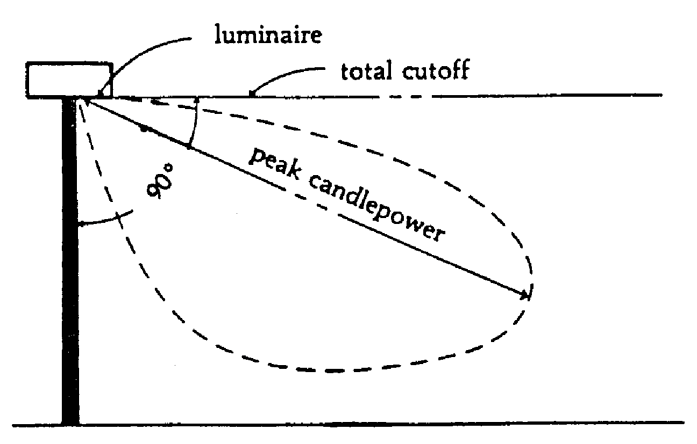
3.
Maximum permitted luminaire height shall be twenty (20) feet within parking lots and sixteen (16) feet within other portions of the development site.
4.
Minimum permitted illumination within parking areas and walkways shall be 0.25 footcandles for low-intensity uses and 1.0 footcandle for high-intensity uses.
5.
Maximum permitted illumination on site shall be 3.0 footcandles for low-intensity uses and 5.0 footcandles for high-intensity uses, except that if the site abuts residentially used or designated land the maximum illumination adjacent to these areas shall be 1.0.
6.
Decorative incandescent fixtures of forty (40) watts or less are allowed without approval.
7.
Lighting fixtures and luminaires shall be of decorative design in keeping with the design theme of the site. Colors shall be dark green, gray, brown, or other earth tone color to blend with the forest environment.
8.
Lighting shall not be used for advertising. The use of searchlights to attract attention is prohibited.
9.
Lights shall not be allowed to blink, flash, change intensity or color, or give the illusion of movement.
10.
Where exterior mounted lights are used to illuminate signage or architectural features, the lights shall be sharply focused and directed to minimize light spillage. Backlighting is encouraged.
11.
Exterior lighting shall be reduced to the extent feasible during hours that the business is not in operation, to preserve views of the night sky.
12.
Security lighting shall be directed downward so that the light source (bulb) is not visible from off site, the light is directed down, and the light level at the property line does not exceed 1.0 footcandle, excluding public street right-of-way.
13.
Upward lighting used to illuminate flags shall be sharply focused and directed to minimize light spillage.
F.
Flood Protection. All new development shall be designed in accordance with the city's Flood Management Ordinance, as it may be amended from time to time.
G.
Trash Collection Areas.
1.
Trash collection areas shall be provided at appropriate locations within commercial and public sites, and the number, type, location and orientation shall be approved by the city and the disposal provider. Trash enclosures shall be located at least five feet from any structure and/or property line, outside of any required setback areas, and screened from public view to the extent possible through building placement and/or landscaping. Trash enclosures shall be located no closer than fifteen (15) feet to any property used or designated for residential uses. In general, enclosures should be located no further than one hundred fifty (150) from the building they are intended to serve.
2.
Trash enclosures and the access drives serving them shall be paved and constructed in accordance with city standards. Except as otherwise approved for low refuse generators, trash enclosures shall be completely enclosed by a six-foot decorative masonry block wall, and shall be designed to integrate with the main structures on the site using the same materials and architectural details. Self-closing gates constructed of solid metal and attached to metal posts embedded in concrete shall be provided. Pedestrian access to the bin area may be provided where appropriate. For low refuse generators such as some professional office uses, commercial bins may be screened behind a wooden fence or other enclosure as approved by the reviewing authority.
3.
All trash shall be stored in metal bins or containers provided by the disposal provider to prevent it from being blown outside the walled enclosure.
4.
Gates shall be maintained in working order and shall remain closed except when the enclosure is being serviced.
5.
Where practical, enclosure areas may be expanded to provide screening for utility equipment.
6.
Trash compactors shall be located away from view from the public right-of-way and screened by walls or building projections which are designed to be architecturally compatible with the main building. Vehicle access to the trash compactor area, and the trash compactor pad, shall be paved with concrete rather than asphalt. The trash compactor area shall be provided with a floor drain and hose bibb to facilitate washing of non-hazardous waste fluids from the area. The design of the trash compactor area shall prevent runoff of waste fluids into adjacent structures or onto adjacent properties.
H.
Equipment Requirements.
1.
All rooftop equipment shall be screened through architectural means in keeping with the design of the main structure(s), which may include use of parapet walls, gables, false chimneys, or similar features. The painting of rooftop equipment to match the roof color, without screening, will not be allowed on new development. Where architectural screening of new rooftop equipment installed on an existing structure is infeasible due to characteristics of the existing structure, the reviewing authority may approve alternate treatments to camouflage the equipment.
2.
Where visible, drainage downspouts, roof vents, and other equipment shall be painted to complement the surface to which they are attached.
3.
Utility equipment and service areas shall be screened through building placement, walls, fences, or landscaping, as approved by the reviewing authority.
4.
Satellite dishes and other antennae shall be screened in a manner, which is compatible with adjacent structures.
5.
Roof access from all buildings shall be internal; no outside ladders may be permanently attached to buildings.
6.
Except as otherwise approved by the reviewing authority based on requirements of utility companies, all utility lines shall be placed underground.
I.
Architectural Requirements.
1.
Structures shall be designed so as to break up long wall or roof planes by offsets, shadow lines, façade treatment, and use of varying materials. Architectural treatments shall be included on all sides of structures. For purposes of meeting this section, use of varying paint colors alone is not sufficient.
2.
Storage buildings, trash enclosures, and other accessory structures shall be designed to incorporate the architecture of the primary buildings with respect to style, colors and materials.
3.
A minimum twelve (12) inch eave shall be provided on all primary structures, where feasible. Sloping roofs are preferred to allow for snow shed, and to maintain a mountain design theme. Structures and eaves shall not be located so as to shed snow from a building onto an adjacent lot.
4.
The use of wood, stone and rock (which may include cultured products) is strongly encouraged on all structures.
5.
All development shall conform to the applicable policies of the general plan community design element.
J.
Bicycle Racks. Bicycle racks shall be provided in secure locations visible to the general public throughout the project, as required by the reviewing authority based upon the use.
K.
Signs. Signs shall conform to Chapter 17.12 of the Development Code.
(Ord. 2003-333 § 4 (Exh. A (part)), 2003)
(Ord. No. 2011-415, § 4(Exh. 1), 8-22-2011; Ord. No. 2011-417, § 4(Exh. A), 12-12-2011)
17.35.090 - Performance standards.
A.
Property Maintenance.
1.
Property owners are responsible for the continuous maintenance of all buildings, structures, yards, landscaping, signs, parking areas, and other improvements in a manner which does not detract from the appearance of the surrounding area.
2.
Projects which are subject to the development review process shall be maintained at all times in compliance with all applicable conditions of approval imposed on the project.
3.
For commercial projects involving multiple ownership of separate parcels, such as a shopping center or condominium office building, a property owners' association shall be formed which shall be responsible for maintenance of common facilities, common open space areas, landscaped areas, pathways, private streets, and other common areas identified on the subdivision map. The conditions, covenants and restrictions establishing maintenance shall be approved by the city prior to recordation of the subdivision map.
B.
Outdoor Storage.
1.
The outdoor storage of any materials or equipment not accessory to the primary use of the property, including lumber, construction materials, inoperable vehicles, auto parts, appliances, pipe, drums, machinery, furniture, or trash, which is readily visible from off-site, is prohibited.
2.
No open storage shall be permitted in any required front or side yards adjacent to a street or highway.
C.
Outdoor Artisans. The following requirements apply to sculptors, carvers, and other artisans conducting operations, display and sales outdoors.
1.
All requirements for parking, landscaping, pedestrian and vehicular access, trash collection, lighting, snow storage, site design, and other requirements of this chapter and applicable codes and ordinances shall apply.
2.
Sawdust and wood trimmings shall not be allowed to accumulate on the site so as to cause a fire hazard or dust problem.
3.
Outdoor use of chainsaws and other power equipment shall be limited to the hours of nine a.m. to seven p.m.
4.
Use and storage of lacquer, stain, varnish and similar materials shall comply with the requirements of the air pollution control district and the fire department.
5.
No more than one portable shade device may be used on the site during business hours, provided the device is less than one hundred (100) square feet in area and is stored indoors when the business not in operation.
6.
Materials and equipment used in conjunction with the business, including uncarved logs, tree trunks, and scaffolding, shall be stored behind the front setback area and substantially screened from public view.
D.
Outdoor Display of Merchandise. This section shall only apply to uses that are not listed as "retail sale of goods serving the general public with some operations outdoors" in Section 17.35.030, which include, but are not limited to, equipment sales, rental; bicycle sales, rental; boats, personal watercraft; spas, pools, hot tubs; recreational vehicles, trailers, sales or rental; automobile sales, new and/or used; plant nurseries, garden shops; auctions, swap meets; motorcycle sales and rental; and farmer's markets; as such uses require a plot plan review or conditional use permit. The intent of this section is to allow a business to display merchandise outdoors for the purpose of attracting customers to shop. The display of large quantities of merchandise for the purpose of expanding retail floor area outdoors, such as clothes on racks or bulk items placed on folding tables or on the ground, shall be prohibited. Outdoor display of merchandise is permitted, provided that approval of the proposed display area has been approved by the city as part of the original land use approval, or through a minor modification pursuant to Section 17.03.250, and that the display conforms to the following requirements:
1.
The display must be in conjunction with the business being conducted within the building occupied by the primary use on the premises, and the items being displayed shall be of the same type that are lawfully displayed and primarily sold throughout the year inside the building on the premises, including exterior vending machines.
2.
No item, or any portion thereof, shall be displayed on public property or right-of-way.
3.
The outdoor display area shall not exceed one hundred (100) square feet in area or one-half of the front yard area, whichever is less. The display shall be located nearest the primary public access door to the business served by the display, but in no case further than ten (10) feet out from the building wall of that business. The outdoor display shall be limited to locations outside of the required setbacks, parking spaces, or landscaped areas, except when those areas exceed the required development standards, and shall be located under porches and eaves to the extent feasible.
4.
Items shall be displayed outdoors only during the normal hours that the business conducted inside the building on the premises is open for business, but no later than ten p.m. At all other times, all merchandise, display racks and display tables shall be stored inside the building during hours that the business is closed.
5.
No item shall be displayed in a manner that causes a safety hazard; obstructs the entrance to any building; does not comply with ADA; interferes with, or impedes the flow of, pedestrian or vehicle traffic; obstructs access to any parking space or drive aisle; is unsightly or creates any other condition that is detrimental to the appearance of the premises or any surrounding property; or in any other manner is detrimental to the public health, safety, or welfare or causes a public nuisance.
6.
No merchandise shall be affixed to buildings or hung on fences, utility poles, vehicles, or other appurtenances. Merchandise area shall be displayed on level ground in a neat and clean manner, and fixtures or racks used to display merchandise shall be maintained in good repair and of an attractive appearance. No canopies or tents shall be placed over an outdoor display area.
7.
The outdoor display shall not include the display of any human signs or temporary signs nor shall any merchandise be displayed on mannequins, body forms, or similar devices.
8.
Outdoor display of merchandise for sale shall not be permitted on properties that front along Village Drive from Paine Road to Knickerbocker Road, and properties that front along Pine Knot Avenue from Big Bear Boulevard to Cameron Drive.
9.
Existing permits for outdoor displays shall become null and void upon the effective date of this ordinance. A business with an existing permit for an outdoor display shall be required to obtain a new permit within sixty (60) days following the effective date of the ordinance amending this section, and the outdoor display shall comply with the standards provided in paragraph D of this section.
E.
Outdoor Seating and Dining Areas. Outdoor seating and dining areas can enhance the pedestrian ambience of commercial areas and are encouraged, provided that public health, safety and welfare are protected. Outdoor seating and dining areas shall be operated in conformance with the following standards, in addition to other applicable regulations:
1.
Location, design and operation of an outdoor seating area shall be reviewed and approved in conjunction with the land use approval of the primary use, or through a modification thereof.
2.
Any outdoor seating area located on the public sidewalk shall be subject to issuance of an encroachment permit and must be immediately adjacent to and abutting the primary use. The area in which the outdoor seating area is located shall extend no further along the sidewalk's length than the actual sidewalk frontage of the primary use. Any outdoor seating area located within the public right-of-way shall provide proof of adequate liability insurance, as approved by the city. No alcohol may be served, and no permanent barriers or structures may be constructed, within the public right-of-way. The business owner shall be required to indemnify the city for any seating within the public right-of-way.
3.
An outdoor seating area may be located on a sidewalk only where the sidewalk is wide enough to accommodate both the normal pedestrian traffic and the proposed seating area. There shall be a minimum of six feet clear distance or fifty percent (50%) of the sidewalk width, whichever is greater, free of obstructions in order to allow adequate pedestrian movement.
4.
All tables and chairs shall be set back not less than four feet from any curb, street, or barrier, and shall not be situated within eight feet of any designated bus stop.
5.
The outdoor seating area shall be clearly identified and delineated from the sidewalk area that will remain open to pedestrians.
6.
All outdoor dining furniture, including tables, chairs, umbrellas, planters, and barriers shall be movable. Umbrellas must be secured with a minimum base of not less than sixty (60) pounds. Outdoor amplified music or speakers shall require approval of a conditional use permit.
7.
No signage may be allowed within an outdoor seating area, except for the name of the operating establishment on the awnings or umbrella valances.
8.
The following requirements apply to outdoor seating areas operated by a restaurant:
a.
The outdoor preparation of food and location of busing facilities are prohibited in outdoor areas. Pre-setting of tables with dishes, utensils, glasses, napkins, or condiments is prohibited. All exterior surfaces shall be easily cleanable and shall be kept clean at all times.
b.
Restrooms for the outdoor seating area shall be provided in the adjoining restaurant.
c.
If the outdoor seating area is greater than twenty percent (20%) of the seating or dining area of the adjacent restaurant, parking shall be provided for the entire outdoor seating area at the required ratio contained in Table 17.35.070.A.
d.
Trash and refuse collection facilities for the outdoor dining area shall not be permitted outside. All trash and litter shall be removed as it accumulates.
e.
Hours of operation for the outdoor dining area shall be the same as those of the adjacent restaurant. Tables, chairs, and all other furniture used in the operation of an outdoor café shall be removed from the sidewalk and stored indoors whenever the restaurant is not in operation.
9.
The city shall have the right and authority, acting through the city planner or his/her designee, to restrict the operation of an outdoor seating area within the public right-of-way because of anticipated or actual problems or conflicts, which may include but are not limited to scheduled festivals and special events, parades, repairs, or emergencies. To the extent possible, the operator shall be given prior written notice of any time period during which the operation of the outdoor seating area will be restricted by the city, but any failure to give prior notice shall not affect the right and power of the city to prohibit the operation of the outdoor seating area at any given time.
F.
Line of Sight Restrictions.
1.
A substantially clear line of sight shall be maintained between the driver of a vehicle waiting or yielding at an intersection or driveway and the driver of an approaching vehicle on the other approaches to the intersection or the street being entered from the driveway, as determined by the city engineer.
2.
It shall be the responsibility of the property owner or agent to remove from such property or any adjacent right-of-way any such obstruction that would impede the required clear line of sight.
(Ord. 2006-366 § 4 (Exh. 1), 2006; Ord. 2003-333 § 4 (Exh. A (part)), 2003)
(Ord. No. 2011-415, § 4(Exh. 1), 8-22-2011; Ord. No. 2011-417, § 4(Exh. A), 12-12-2011)
17.35.100 - Drive-through facilities.
A.
The vehicle stacking capacity of a drive-through facility and the design and location of ordering and pick-up facilities will be determined by the city planner and city engineer based on the nature of the product or service being offered. The required stacking area does not include the vehicle being served. Each stacking space shall be eleven (11) feet wide and twenty (20) feet long. Stacking areas may not block drive aisles, driveways, or access to parking spaces. Drive-through facilities shall be designed so as to avoid conflict with other uses provided on the site, including parking, drive aisles, and pedestrian access.
B.
Except as otherwise approved by the city engineer, the following stacking requirements shall apply:
Drive-Through Stacking Requirements
C.
Upon a change of use within an existing drive-through facility, a minor modification application shall be submitted to the planning division pursuant to Section 17.03.250 to provide for review of the operational requirements as outlined in this section, and modifications to the site design may be required to accommodate the change of use.
D.
Site design should locate the drive-through aisle so that pedestrians do not need to cross the aisle in order to access the main building entrance from the parking lot or street. If a pedestrian walkway intersects a drive-through aisle, the walkway shall be striped and illuminated for visibility and safety. Each drive-through lane shall be constructed with concrete (PCC).
E.
Drive-through aisles shall have a minimum fourteen (14) foot width on curves and a minimum eleven (11) foot width on straight sections, with a minimum inside turning radius of fifteen (15) feet.
F.
Drive-through aisles and associated structures shall be set back from the ultimate curb face of an adjacent public right-of-way a minimum of twenty-five (25) feet.
G.
Drive-through lanes should be screened from public view by orientation of the building and provision of landscaping, change of grade, low screen walls, or a combination thereof.
H.
Drive-through aisles shall not exit directly onto a public right-of-way.
I.
Drive-through restaurants within shopping centers shall have an architectural style consistent with the theme established in the center.
(Ord. 2003-333 § 4 (Exh. A (part)), 2003)
(Ord. No. 2011-415, § 4(Exh. 1), 8-22-2011; Ord. No. 2011-417, § 4(Exh. A), 12-12-2011)
17.35.110 - Automobile service stations and repair facilities.
A.
The minimum lot size shall be twenty thousand (20,000) square feet.
B.
All activities and operations shall be conducted entirely within an enclosed building, except for the dispensing of petroleum products, water and air, and the provision of emergency service of a minor nature.
C.
The cashier location within a service station shall have a direct view of the pump islands.
D.
Interior drive aisles between pump islands shall be a minimum of thirty (30) feet in width.
E.
There shall be a minimum distance of one hundred fifty (150) feet between curb cuts, and driveways shall be located as far away from the curb returns of an intersection as possible.
F.
The width of a driveway shall not exceed thirty-six (36) feet at the sidewalk.
G.
No vehicles may be parked or stored on sidewalks, parkways, driveways, or drive aisles.
H.
Vehicles may be parked on the premises for the purpose of offering said vehicles for sale, in conformance with Ordinance 2001-311, as it may be amended from time to time.
I.
No used or discarded automotive parts or equipment or disabled vehicles may be located outside the main structure, unless screened from view and located on an impervious surface. No junked or wrecked vehicles shall be stored on the site.
J.
Lighting levels under the canopy shall not exceed twenty-five (25) footcandles.
(Ord. 2003-333 § 4 (Exh. A (part)), 2003)
(Ord. No. 2011-415, § 4(Exh. 1), 8-22-2011; Ord. No. 2011-417, § 4(Exh. A), 12-12-2011)
17.35.120 - Convenience stores.
A.
The minimum site area shall be twenty thousand (20,000) square feet without gasoline sales, and forty thousand (40,000) square feet with gasoline sales.
B.
The site shall not have direct access onto a local residential street.
C.
Trash receptacles shall be provided at each building entrance and at convenient locations inside and outside of the convenience store.
D.
A bicycle rack shall be installed in a convenient location visible from the inside of the store.
E.
Public restrooms shall be accessible only from inside the store.
F.
Security lighting, site lighting and/or illuminated signage shall be designed so as not to adversely affect adjacent residential areas.
G.
For security purposes, the windows of a convenience store shall not be fully obstructed with signage and/or display racks. The inside of the store shall be visible to public safety personnel from outside the store.
H.
No video or arcade type games shall be installed or operated on the premises.
I.
The following requirements pertain to concurrent sale of alcohol and gasoline:
1.
No alcoholic beverage shall be displayed within five feet of the cash register or the front door unless it is in a permanently installed cooler.
2.
No advertisement of alcoholic beverages shall be displayed at motor fuel islands or on the building or windows.
3.
No sales of alcoholic beverages shall be made from a drive-up window.
4.
No display or sale of alcoholic beverages shall be made from an ice tub.
5.
Employees on duty between the hours of ten p.m. and two a.m. shall be at least twenty-one (21) years of age to sell alcoholic beverages.
(Ord. 2003-333 § 4 (Exh. A (part)), 2003)
(Ord. No. 2011-415, § 4(Exh. 1), 8-22-2011; Ord. No. 2011-417, § 4(Exh. A), 12-12-2011)
17.35.130 - Shopping centers.
A.
Design of a shopping center shall provide a transition from more sensitive adjacent land uses through setbacks, screening, and buffering from loading, trash collection, and service and storage areas. Lighting shall be low-level and shielded along property lines adjacent to less intensive uses.
B.
A shopping center shall be planned as a group of organized uses and structures in terms of layout, massing, parking, access, drainage, utilities, and other site design considerations.
C.
A shopping center shall be designed with a cohesive theme, using consistent building and landscaping materials and design.
D.
Provisions shall be made for consistent maintenance, reciprocal access, and reciprocal parking.
E.
Vehicle and pedestrian access shall be coordinated and logically linked to provide a comprehensive circulation system.
F.
Shopping centers shall be developed pursuant to a master conditional use permit pursuant to Section 17.03.170, which may be phased. The master CUP shall include a written document outlining the design themes for building architecture, signage, landscaping, maintenance, and the proposed phasing plan. For all buildings to be developed in the first phase, the CUP shall include a precise plan for development, including floor plans and building elevations, as required by Section 17.03.170. Approval for development of individual buildings or pads in later phases may subsequently be granted in accordance with the master CUP through approval of a minor modification pursuant to Section 17.03.250, which shall include the building footprint, floor plans, building elevations, and other precise development information required for that building or phase.
(Ord. 2003-333 § 4 (Exh. A (part)), 2003)
(Ord. No. 2011-415, § 4(Exh. 1), 8-22-2011; Ord. No. 2011-417, § 4(Exh. A), 12-12-2011)
17.35.140 - Nightclubs, bars, cabarets, and similar uses.
A.
Nightclubs, bars, cabarets, and other establishments using amplified sound at a level which may be heard from surrounding properties and rights-of-way, shall be sound insulated to protect nearby residential and commercial lodging uses. Entrances to these uses should be located away from residential and commercial lodging uses. Vestibule entrances (with a double set of doors) shall be installed to block sound.
B.
Adequate indoor waiting areas shall be provided for customers waiting to enter the facility.
C.
No operable windows shall be installed facing a public street or facing areas used or designated for residential or commercial lodging uses, to avoid noise spillage.
D.
Double glazing, masonry walls and other soundproofing measures may be required, based on the type of entertainment.
E.
All fire exits shall be alarmed, and designed so that they cannot be propped open.
F.
Nightclubs, bars, cabarets, and other establishments using amplified sound at a level which may be heard from surrounding properties and rights-of-way, shall be located no closer than three hundred (300) feet from residentially used or designated property, commercial day care center, school, or social care facility.
(Ord. 2003-333 § 4 (Exh. A (part)), 2003)
(Ord. No. 2011-415, § 4(Exh. 1), 8-22-2011; Ord. No. 2011-417, § 4(Exh. A), 12-12-2011)
17.35.150 - Amusement devices and arcades.
A.
No more than three amusement devices, but not to exceed five percent of the public floor area, may be permitted per business without approval of a conditional use permit pursuant to Section 17.03.170. Each machine and playing area shall be allocated a minimum of ten (10) square feet of space.
B.
Amusement devices shall not obstruct or crowd entries, exits, or aisles.
C.
Adult supervision is required and all amusement devices must be placed in an area that is visible to the supervisor at all times.
D.
In granting a conditional use permit for an amusement arcade, the planning commission shall consider the need for adult supervision, hours of operation, proximity to schools and other community uses, compatibility with the surrounding neighborhood and businesses, noise attenuation, bicycle facilities, interior waiting areas, and other similar impacts of the proposed use. Conditions of approval may be applied to the project to mitigate potential impacts.
E.
The application for an amusement arcade shall include a description of the type of machines, a floor plan, and hours of operation. In addition, the applicant shall submit a list of gummed labels containing the owner of every individual business within a three hundred (300) feet radius, along with the property owner mailing list.
(Ord. 2003-333 § 4 (Exh. A (part)), 2003)
(Ord. No. 2011-415, § 4(Exh. 1), 8-22-2011; Ord. No. 2011-417, § 4(Exh. A), 12-12-2011)
17.35.160 - Conversion of residential structures to non-residential uses.
A.
No structure originally designed as a residence (including hotels, motels, and lodges), or as an accessory structure or addition to a residence, shall be used for any commercial or office uses unless the building and site are improved to meet all code requirements for an office or commercial development, including requirements of the Development Code and applicable building and fire codes. Such conversion shall be subject to a plot plan review or conditional use permit process, as required by the use regulations contained in Table 17.35.030.A.
B.
If the access drive to the rear of the lot is less than twenty (20) feet in width, a turnaround shall be provided for vehicles exiting the site, and clear sight shall be provided between the driveway and the rear of the lot.
C.
A residential garage may be used to provide required on-site parking.
D.
Setbacks and yards established for the original structure may be deemed to meet the setback and yard requirements for the new use, provided that if the structures are non-conforming as to setbacks or yard areas, no additional encroachments into yard areas shall be allowed.
E.
Additional landscaping may be required to buffer the non-residential use from adjacent residential uses.
F.
No signs shall shine light into adjacent dwellings. Backlighting of signs is encouraged.
(Ord. 2003-333 § 4 (Exh. A (part)), 2003)
(Ord. No. 2011-415, § 4(Exh. 1), 8-22-2011; Ord. No. 2011-417, § 4(Exh. A), 12-12-2011)
17.35.170 - Reserved.
Editor's note— Ord. No. 2017-454, § 4(Exh. 1, § F), adopted June 12, 2017, repealed § 17.35.170, which pertained to out-of-date major communication facility information and derived from Ord. No. 2003-333, § 4 (Exh. A (part)), adopted in 2003; Ord. No. 2011-415, § 4(Exh. 1), adopted August 22, 2011; and Ord. No. 2011-417, § 4(Exh. A), adopted December 12, 2011.
17.35.180 - Churches, religious institutions, meeting rooms, conference rooms, and similar places of assembly.
A.
Minimum lot size shall be twenty thousand (20,000) square feet, except where such facility is to be located within an existing commercial development.
B.
In addition to other required setbacks of the underlying zone, no building used for assembly purposes shall be located closer than twenty (20) feet from residentially used or designated property.
C.
Outdoor activities may only be conducted between the hours of eight a.m. and eight p.m. Any outdoor activities or events which include the use of tents or amplified sound systems, or which will be held between eight p.m. and eight a.m., will require approval of a special event permit.
D.
Approval of an assembly use does not authorize establishment of any school, day care, nursery, food bank, charitable donation center, emergency service provider, or other use, except as authorized by the conditional use permit for the primary use or a modification thereof.
E.
In the event that a group leases or rents space in an existing commercial facility such as a hotel, restaurant, or banquet facility for the purpose of conducting meetings on a regular and continuing basis, but where such regular meetings are not the primary purpose of the property and all applicable development requirements are met on the property, no conditional use permit is required.
(Ord. 2003-333 § 4 (Exh. A (part)), 2003)
(Ord. No. 2011-415, § 4(Exh. 1), 8-22-2011; Ord. No. 2011-417, § 4(Exh. A), 12-12-2011)
17.35.190 - Massage as an accessory use.
A.
Massage as an accessory use may be allowed in the following cases:
1.
In conjunction with an approved health club, athletic club, gym, hotel, beauty salon, barber or beauty shop, tanning parlor, or similar use; or
2.
In conjunction with an approved medical practice or clinic, provided that massage treatments may only be provided for medical purposes to patients of that medical practice.
B.
Only two permitted massage technicians shall be on duty at any one time, and only two massage chairs or tables shall be provided on the premises.
C.
Massage as an accessory use must be administered by a massage technician who has been issued a business permit and business license pursuant to Section 5.52.020 of the Municipal Code, and who is in compliance with that section.
D.
The accessory massage use must be incidental to the primary business, and the owner of the primary business is not required to obtain a separate massage establishment permit for this accessory use. The owner of the primary business is responsible for the massage activities of all massage technicians employed at the location and must comply with all applicable requirements of Chapter 5.52 of the Municipal Code.
E.
The business license relating to the primary use is subject to revocation if any of the massage activities are in violation of this section or in violation of other applicable code requirements or conditions of approval.
(Ord. 2003-333 § 4 (Exh. A (part)), 2003)
(Ord. No. 2011-415, § 4(Exh. 1), 8-22-2011; Ord. No. 2011-417, § 4(Exh. A), 12-12-2011)
17.35.200 - Commercial daycare facilities.
A.
A day-care facility for children shall be located as follows:
1.
No closer than three hundred (300) feet from gasoline pumps, storage tanks, or any other storage of explosives or hazardous material;
2.
No closer than three hundred (300) feet from any bar, nightclub, or liquor store;
3.
No closer than one thousand (1,000) feet from any sexually-oriented business;
4.
In approving a location for a day care facility, the reviewing authority shall evaluate any adverse effects on children from truck traffic, air emissions, noise, adjacent land uses or other issues affecting the proposed site.
B.
Where a drop-off area is proposed to be provided for the pick-up and delivery of children, the area shall meet the following requirements:
1.
A minimum of one vehicle loading space shall be provided for every twenty (20) children;
2.
Drop-off zone shall be located near the main entryway, so that children will not have to cross the parking lot or any traffic areas to enter the building;
3.
Drop-off area shall be located and designed so that there is no queuing of vehicles onto the adjacent right-of-way.
C.
Play space shall be provided as follows:
1.
A fenced outdoor play area shall be provided with a minimum area of seventy-five (75) square feet per child;
2.
Indoor play areas shall be provided with a minimum area of thirty-five (35) square feet per child;
3.
Restroom facilities shall be provided with a minimum of one toilet per fifteen (15) children.
(Ord. 2003-333 § 4 (Exh. A (part)), 2003)
(Ord. No. 2011-415, § 4(Exh. 1), 8-22-2011; Ord. No. 2011-417, § 4(Exh. A), 12-12-2011)
17.35.210 - Portable storage containers.
A.
The use of truck trailers, metal or wood boxes, segments of pipes, tanks, and similar items which are not designed or intended to be used as a structure, is prohibited for any storage use or occupancy within all commercial and public zones.
B.
The use of portable storage containers, including cargo containers, sea-train containers, and mobile equipment and storage boxes that are not classified as structures, may be permitted for temporary construction activity in the following cases:
1.
Portable storage containers may be used for storage of equipment and materials on active construction sites provided that a valid building permit is in effect, that the container is used in conjunction with the permitted construction activities, and that construction is ongoing on the site. Such containers shall be removed prior to issuance of a final certificate of occupancy for the structure(s) constructed pursuant to the building permit.
2.
Portable storage containers may be used for storage of equipment and materials within an offsite construction staging area, provided that a temporary use permit for such staging area has been granted pursuant to Section 17.03.290, that the grading and/or building permit for the construction project remains valid, that the container is used for the permitted construction activities, and that the construction activity is ongoing. Such containers shall be removed prior to issuance of a final certificate of occupancy for the structures being constructed pursuant to the building permit.
C.
Within the C-2 (commercial-general), C-4 (commercial-recreation), C-5 (commercial-industrial), and P (public) zones, portable storage containers may be used for storage purposes only, as an accessory use to a primary use already legally established on the property, provided that the following requirements are met:
1.
The location, size, type, appearance, and use of portable storage containers shall be subject to city review and approval pursuant to the plot plan review or conditional use permit issued for the primary use, or, if subsequent to commencement of the primary use, through approval of a minor modification of said approval pursuant to Section 17.03.250.
2.
Only two portable storage containers shall be allowed per business or use.
3.
The maximum cumulative size of all portable storage containers on site shall be four hundred (400) square feet. The maximum height shall be ten (10) feet.
4.
The portable storage container shall be placed or screened so as not to be visible from the public right-of-way, from residentially used or designated property, or from commercial lodging establishments.
5.
The portable storage container shall not be placed within any required yard or setback area. The container shall be set back at least twenty (20) feet from any property line and any other storage container, and at least ten (10) feet from any building.
6.
The portable storage container shall be used only for storage purposes. There shall be no habitable space or use by employees or other persons within said container.
7.
There shall be no storage of fuels, gases, petroleum products, combustible or hazardous materials in a portable storage container. The applicant shall provide, in writing, a detailed description of the materials intended to be stored in the container at the time an application for such container is filed.
8.
The portable storage container shall not obstruct or reduce required parking or loading spaces, drive aisles, open space, landscaping, or other site requirements.
9.
The portable storage container shall not be placed within the critical root zone of any tree of six inches DBH or larger.
10.
There shall be no structures attached to the portable storage container, and no such container shall be attached to other structures by roofs, walls, passageways, sheds, canopies, patio covers, or other means.
11.
No utilities may be connected to or provided for the portable storage container.
12.
Fire extinguishers shall be provided in the portable storage container as required by the fire department.
13.
All portable storage containers shall be subject to inspection by the fire department annually, or at any time deemed necessary to verify compliance with this section. The owner of any such container shall be required to allow inspection during normal business hours.
14.
Failure to comply with the requirements of this section and the land use approval for the primary use may result in revocation of approval to maintain a portable storage container on the site.
15.
The approval to use a portable storage container shall apply only to the business for which approval was originally granted. Upon change of use, change of ownership, or cessation of use, the portable storage container shall be removed from the site and the site shall be restored to its original condition, which may include revegetation, within ninety (90) days.
(Ord. 2003-333 § 4 (Exh. A (part)), 2003)
(Ord. No. 2011-415, § 4(Exh. 1), 8-22-2011; Ord. No. 2011-417, § 4(Exh. A), 12-12-2011)
17.35.220 - Development standards regulating large retail uses.
A.
A large retail commercial use shall be defined as the construction or occupancy of a single structure for the express purpose of accommodating one retail tenant on one parcel. When a large retail commercial use is located within a multi-tenant building, or in multiple detached buildings located on the same or adjacent parcel, the retail tenant's space shall define the "building."
B.
Maximum Building Size. Notwithstanding any other provisions of the Development Code, large retail commercial uses identified with Footnote 4 in Table 17.35.030.A shall not occupy a building or collection of buildings on one parcel that exceeds a maximum of forty thousand (40,000) square feet of total indoor gross floor area.
C.
Existing large retail commercial uses identified with Footnote 4 in Table 17.35.030.A that occupy building(s) that exceed forty thousand (40,000) square feet of total indoor gross floor area shall be deemed transitional uses and structures subject to the provisions of Section 17.03.330.
(Ord. 2004-344 § 4 (Exh. 3 (part)), 2004)
(Ord. No. 2011-415, § 4(Exh. 1), 8-22-2011; Ord. No. 2011-417, § 4(Exh. A), 12-12-2011)
17.35.230 - Marijuana uses.
A.
Purpose. The purpose of this section is to regulate commercial and recreational marijuana uses. Nothing in this section shall preempt or make inapplicable any provision of state or federal law.
B.
Definitions. For purposes of this section, the following definitions shall apply:
1.
"Commercial marijuana activity" includes the cultivation, possession, manufacture, distribution, processing, storing, laboratory testing, labeling, transportation, distribution, delivery or sale of marijuana and marijuana products.
2.
"Cultivation" means any activity involving the planting, growing, harvesting, drying, curing, grading, or trimming of marijuana.
3.
"Delivery" means the commercial transfer of marijuana or marijuana products to a customer. "Delivery" also includes the use by a retailer of any technology platform owned and controlled by the retailer, or independently licensed under California law that enables customers to arrange for or facilitate the commercial transfer by a licensed retailer of marijuana or marijuana products.
4.
"Distribution" means the procurement, sale, and transport of marijuana and marijuana products between entities for commercial use purposes.
5.
"Licensee" means the holder of any state issued license related to marijuana activities, including but not limited to licenses issued under Division 10 of the Business and Professions Code.
6.
"Manufacture" means to compound, blend, extract, infuse, or otherwise make or prepare a marijuana product.
7.
"Marijuana" means all parts of the plant Cannabis sativa L., whether growing or not; the seeds thereof; the resin extracted from any part of the plant; and every compound, manufacture, salt, derivative, mixture, or preparation of the plant, its seeds or resin. It does not include:
a.
Industrial hemp, as defined in Section 11018.5 of the California Health and Safety Code; or
b.
The weight of any other ingredient combined with marijuana to prepare topical or oral administrations, food, drink, or other product.
8.
"Marijuana accessories" means any equipment, products or materials of any kind which are used, intended for use, or designed for use in planting, propagating, cultivating, growing, harvesting, manufacturing, compounding, converting, producing, processing, preparing, testing, analyzing, packaging, repackaging, storing, smoking, vaporizing, or containing marijuana, or for ingesting, inhaling, or otherwise introducing marijuana or marijuana products into the human body.
9.
"Marijuana products" means marijuana that has undergone a process whereby the plant material has been transformed into a concentrate, including, but not limited to, concentrated cannabis, or an edible or topical product containing marijuana or concentrated cannabis and other ingredients.
10.
"Person" includes any individual, firm, co-partnership, joint venture, association, corporation, limited liability company, estate, trust, business trust, receiver, syndicate, or any other group or combination acting as a unit, and the plural as well as the singular.
11.
"Sale" includes any transaction whereby, for any consideration, title to marijuana is transferred from one person to another, and includes the delivery of marijuana or marijuana products pursuant to an order placed for the purchase of the same and soliciting or receiving an order for the same, but does not include the return of marijuana or marijuana products by a licensee to the licensee from whom such marijuana or marijuana product was purchased.
12.
Any term defined in this section also means the very term as defined in the California Business and Professions Code or the California Health and Safety Code, unless otherwise specified.
C.
Medical Use.
1.
Cultivation of medical marijuana pursuant to Section 11362.77 of the California Health and Safety Code is subject to the cultivation requirements laid out in Section 17.25.230(c) of the Development Code.
2.
The establishment or operation of any medical marijuana collective, cooperative, dispensary, delivery service, operator, establishment, or provider shall be considered a prohibited use in all zoning districts of the city. No use permit, variance, building permit, or any other entitlement or permit, whether administrative or discretionary, shall be approved or issued for the establishment of any collective, cooperative, dispensary, delivery service, operator, establishment, or provider in any zoning district, and no person shall otherwise establish such businesses or operations in any zoning district.
D.
Commercial Use.
1.
The establishment or operation of any business of commercial marijuana activity is prohibited. No use permit, variance, building permit, or any other entitlement or permit, whether administrative or discretionary, shall be approved or issued for the establishment or operation of any such business or operation. Such prohibited businesses or operations may include, but are not limited to:
a.
The transportation, delivery, storage, distribution, or sale of marijuana, marijuana products, or marijuana accessories;
b.
The cultivation of marijuana;
c.
The manufacturing or testing or marijuana, marijuana products, or marijuana accessories; or
d.
Any other business licensed by the state or other government entity under Division 10 of the California Business and Professions Code, as it may be amended from time to time.
E.
Penalty for Violation. No person, whether as principal, agent, employee or otherwise, shall violate, cause the violation of, or otherwise fail to comply with any of the requirements of this section. Every act prohibited or declared unlawful, and every failure to perform an act made mandatory by this section, shall be a misdemeanor or an infraction, at the discretion of the city attorney or the district attorney. In addition to the penalties provided in this section, any condition caused or permitted to exist in violation of any of the provisions of this section is declared a public nuisance and may be abated as provided in Chapter 8.80 of the Municipal Code and/or under state law.
(Ord. No. 2011-412, § 3, 5-9-2011)
(Ord. No. 2011-415, § 4(Exh. 1), 8-22-2011; Ord. No. 2011-417, § 4(Exh. A), 12-12-2011; Ord. No. 2016-446, § 4, 1-25-2016; Ord. No. 2016-451, § 5, 10-24-2016)
17.35.240 - Emergency shelters.
A.
To accommodate the city's emergency housing need as required by Section 65583(a)(4) of the California Government Code, emergency shelters shall be allowed by right in the C-5 commercial/industrial zone. For the purposes of this chapter, "emergency shelter" shall have the meaning set forth in Section 65582 of the California Government Code. The city shall not require a conditional use permit or other discretionary permit for the construction of an emergency shelter.
B.
The city may not disapprove an emergency shelter unless it makes written findings, based upon substantial evidence in the record, as to one of the following:
1.
The city has met or exceeded the need for emergency shelter as identified in the housing element.
2.
The emergency shelter would have a specific, adverse impact upon the public health or safety, and impact upon the public health or safety.
3.
The denial of the project or imposition of conditions is required in order to comply with specific state or federal law, and there is no feasible method to comply without rendering the development of the emergency shelter financially infeasible.
4.
The emergency shelter is proposed on land zoned for agriculture or resource preservation that is surrounded on at least two sides by land being used for agricultural or resource preservation purposes, or which does not have adequate water or wastewater facilities to serve the project.
5.
The emergency shelter is inconsistent with both the jurisdiction's zoning ordinance and general plan land use designation as specified in any element of the general plan as it existed on the date the application was deemed complete, and the jurisdiction has adopted a revised housing element in accordance with Section 65588 [of the California Government Code] that is in substantial compliance with state law.
C.
Emergency shelters are subject to the general development standards in Table 17.35.050.A. In accordance with the authority granted to the city in Section 65583(a)(4) of the Government Code, an emergency shelter must also meet the following development and management standards:
1.
The shelter may serve no more than six beds per night. This standard shall be reevaluated at the city's discretion based upon any changes in law or policy.
2.
Parking for the shelter shall be provided as required for multiple family residential uses in Section 17.25.070, where number of beds would replace the number of bedrooms for the parking ratio. A six-bed shelter shall require a minimum of four parking spaces.
3.
The waiting and client intake areas shall be at least five hundred (500) square feet in total gross floor area.
4.
The shelter shall prepare and file a management plan with the city that includes clear operational rules and standards, including, but not limited to, standards governing expulsions and lights-out. As part of the management plan, each shelter must provide twenty-four (24) hour on-site supervision.
5.
A shelter may not be located within two hundred fifty (250) feet of another emergency shelter.
6.
No person may stay at an emergency shelter for longer than one hundred eighty (180) consecutive days.
7.
Lighting standards shall comply with the provisions of Section 17.35.080.E (Site Design Standards).
8.
Security shall be provided during the hours the emergency shelter is in operation.
(Ord. No. 2011-415, § 4(Exh. 1), 8-22-2011; Ord. No. 2011-417, § 4(Exh. A), 12-12-2011; Ord. No. 2022-506, § 4(Exh. A), 10-3-2022)
17.35.250 - Low barrier navigation centers.
A.
Purpose. The purpose of this chapter is to establish development standards for low-barrier navigation centers and to ensure this use is constructed and operated in a manner that is consistent with the requirements and allowances of state law, specifically Article 12 of Chapter 3 of Division 1 of Planning and Zoning Law commencing with California Government Code Section 65660.
B.
Applicability. The provisions of this chapter shall apply to all low-barrier navigation center projects.
C.
Permit Required. A planning permit is required prior to establishment of any low-barrier navigation center project meeting either of the following criteria. The permit shall be a ministerial action without discretionary review or a hearing. The city shall notify a developer whether the developer's application is complete within thirty (30) days, pursuant to California Government Code Section 65943. Action shall be taken within sixty (60) days of a complete application being filed.
D.
Development and Operational Standards. A low-barrier navigation center development is a use by-right in areas zoned for mixed-use and nonresidential zones permitting multifamily uses, if it meets the following requirements:
1.
Connected Services. It offers services to connect people to permanent housing through a services plan that identifies services staffing.
2.
Coordinated Entry System. It is linked to a coordinated entry system, so that staff in the interim facility or staff who co-locate in the facility may conduct assessments and provide services to connect people to permanent housing. "Coordinated entry system" means a centralized or coordinated assessment system developed pursuant to Section 576.400(d) or Section 578.7(a)(8), as applicable, of Title 24 of the Code of Federal Regulations, as those sections read on January 1, 2020, and any related requirements, designed to coordinate program participant intake, assessment, and referrals.
3.
Code Compliant. It complies with Chapter 6.5 (commencing with Section 8255) of Division 8 of the Welfare and Institutions Code.
4.
Homeless Management Information System. It has a system for entering information regarding client stays, client demographics, client income, and exit destination through the local Homeless Management Information System, as defined by Section 578.3 of Title 24 of the Code of Federal Regulations.
E.
Definitions.
1.
"Low-Barrier Navigation Centers." A housing-first, low-barrier, service-enriched shelter focused on moving people into permanent housing that provides temporary living facilities while case managers connect individuals experiencing homelessness to income, public benefits, health services, shelter, and housing. "Low barrier" means best practices to reduce barriers to entry, and may include, but is not limited to, the following:
a.
The presence of partners if it is not a population-specific site, such as for survivors of domestic violence or sexual assault, women, or youth.
b.
Pets.
c.
The storage of possessions.
d.
Privacy, such as partitions around beds in a dormitory setting or in larger rooms containing more than two beds, or private rooms.
2.
"Use by Right." Use by right has the meaning defined in subdivision (i) of Section 65583.2. Division 13 (commencing with Section 21000) of the California Public Resources Code shall not apply to actions taken by a public agency to lease, convey, or encumber land owned by a public agency, or to facilitate the lease, conveyance, or encumbrance of land owned by a public agency, or to provide financial assistance to, or otherwise approve, a low-barrier navigation center constructed or allowed by this section.
(Ord. No. 2022-506, § 4(Exh. A), 10-3-2022)

