07 - DEFINITIONS2
Note— This Chapter 20.07 includes definitions for words and phrases used in this UDO. The general rules of interpretation for this UDO are in Section 20.01.030(a) (Rules of Interpretation). Any words or phrases not defined in this Chapter 20.07 shall be given their customary meanings, as determined by the Planning and Transportation Director.
The following terms shall have the following meanings:
"A zone" means portions of the special flood hazard areas (SFHAs) in which the principal source of flooding is runoff from rainfall, snowmelt, or a combination of both. In A zones, floodwaters may move slowly or rapidly, but waves are usually not a significant threat to buildings. These areas are labeled as zone A, zone AE, zones A1-A30, zone AO, zone AH, zone AR and zone A99 on a FIRM. The definitions are presented below:
"Zone A" means areas subject to inundation by the one-percent annual chance flood event. Because detailed hydraulic analyses have not been performed, no base flood elevation or depths are shown.
"Zone AE and A1-A30" means areas subject to inundation by the one-percent annual chance flood event determined by detailed methods. Base flood elevations are shown within these zones. (Zone AE is on new and revised maps in place of zones A1-A30.)
"Zone AH" means areas subject to inundation by one-percent annual chance shallow flooding (usually areas of ponding) where average depths are between one and three feet. Average flood depths derived from detailed hydraulic analyses are shown within this zone.
"Zone AO" means areas subject to inundation by one-percent annual chance shallow flooding (usually sheet flow on sloping terrain) where average depths are between one and three feet. Average flood depths derived from detailed hydraulic analyses are shown within this zone.
"Zone AR" means areas that result from the decertification of a previously accredited flood protection system that is determined to be in the process of being restored to provide base flood protection.
"Zone A99" means areas subject to inundation by the one-percent annual chance flood event, but which will ultimately be protected upon completion of an under-construction federal flood protection system. These are areas of special flood hazard where enough progress has been made on the construction of a protection system, such as dikes, dams, and levees, to consider it complete for insurance rating purposes. Zone A99 may only be used when the flood protection system has reached specified statutory progress toward completion. No base flood elevations or depths are shown.
"AASHTO" means American Association of State Highway and Transportation Officials.
"Abutting" means bordering or touching, such as sharing a common lot line. Lots that are separated by a street, right-of-way, or platted alley are not abutting.
"Accessory dwelling unit (ADU)." See "dwelling, accessory unit."
"ADA" means the Americans with Disabilities Act.
"Addition (to an existing structure)" means any walled and roofed expansion of the perimeter of a structure. For purposes of floodplain regulations, any walled and roofed expansion to the perimeter of a structure in which the addition is connected by a common load-bearing wall other than a firewall. Any walled and roofed addition, which is connected by a firewall or is separated by independent perimeter load-bearing walls, is new construction.
"Adjacent property" means any property that physically touches a given property. For the purposes of this UDO, properties across a public right-of-way are also considered adjacent.
"Affordable housing" means residential developments with a recorded restriction that requires the housing for a certain minimum number of years to be rented or owned by qualified very low and low-income households.
"Agriculture." See "crops and pasturage," and "urban agriculture, noncommercial."
"Alley" means a right-of-way through or partially through a block, intended for secondary vehicular access to the rear or side of properties. However, where vehicle access from the street is not permitted or not possible, an alley may provide primary vehicle access.
"Alteration of a watercourse," for purposes of floodplain regulations, means a dam, impoundment, channel relocation, change in channel alignment, channelization, or change in cross-sectional area of the channel or the channel capacity, or any other modification which may alter, impede, retard or change the direction and/or velocity of the flow of water during conditions of the base flood.
"Amenity center" means a building or facility owned or operated by a corporation or homeowners association intended for a place of meeting, social, cultural, educational, or recreational purposes, to which membership or residency in a specific development or neighborhood is required for participation. Examples may include communal areas, swimming pools, health club facilities, media rooms, or the like.
"Apartment." See "dwelling, multifamily."
"Appeal" means for purposes of floodplain regulations, a request for a review of the floodplain administrator's interpretation of any provision of this ordinance, a request for a variance, or a challenge of a board decision.
"Architectural features" means ornamentation or decorative features attached to or protruding from an exterior wall.
"Area of shallow flooding" means for purposes of floodplain regulations, a designated AO or AH zone on the community's flood insurance rate map (FIRM) with base flood depths from one to three feet where a clearly defined channel does not exist, where the path of flooding is unpredictable and indeterminate, and where velocity flow may be evident. Such flooding is characterized by ponding or sheet flow.
"Area of special flood hazard," for purposes of floodplain regulations, is the land within a community subject to a one percent or greater chance of being flooded in any given year.
"Art gallery, museum, or library" means a facility or area that is open to the public and is intended for the display, appraisal, purchase, sale, loan, of art books, paintings, sculpture, or other works of original art that have architectural, artistic, cultural, literary, historical, or scientific value. Accessory uses can include meeting rooms or cafes.
"Art, public" means a visual work of art that is permanently displayed in a way that it is visible from a public place, street or way. The work of art may include but need not be limited to sculptures, murals, monuments, frescoes, fountains, stained glass, or ceramics.
"Artist studio or workshop" means a facility that includes work or teaching space for one or more artists, artisans, or musicians.
"Assisted living facility" means a facility combining housing, supportive services, personalized assistance, and health care, designed to respond to the individual needs of those who need help with activities of daily living, such as dressing, grooming and bathing, diet, financial management, evacuation of a residence in the event of an emergency, or medication prescribed for self-administration, but do not require hospitalization. An "assisted living facility" does not contain equipment for surgical care or for treatment of disease or injury and does not include "nursing or convalescent home."
"Awning" means a roof-like cover intended to either protect from the weather or as a decorative embellishment, and which is supported and projects from a wall or parapet of a structure over a window, walk, door, or a similar feature.
"Balcony" means an architectural appurtenance located above the first floor that is either entirely unenclosed or covered only by a roof or railing.
"Banner" means a sign with characters, letters, illustrations, or ornamentations applied to cloth, paper, flexible plastic, or fabric of any kind with only such material for backing.
"Bar" or "dance club" means a facility open to the public and characterized by live or televised entertainment, dancing or the serving of alcoholic beverages. Food or packaged alcoholic beverages may be sold but are generally accessory to the primary use.
"Base flood," for purposes of floodplain regulations, means the flood having a one percent chance of being equaled or exceeded in any given year. The base flood may also be referred to as the one percent annual chance flood or one hundred year flood.
"Base Flood Elevation (BFE)" means the water surface elevation of the base flood in relation to a specific datum, usually the North American Vertical Datum of 1988.
"Basement."
"Basement (generally)" means in all other contexts, that portion of a building that is partly or wholly below grade, as measured four feet from the exterior of the foundation wall, regardless of whether the interior space is finished or unfinished. A basement shall be counted as a story for determining building setbacks and number of stories if the front exterior wall of the basement facing a street is not completely below grade and each side of the foundation wall facing the side yard is less than fifty percent covered by grade.
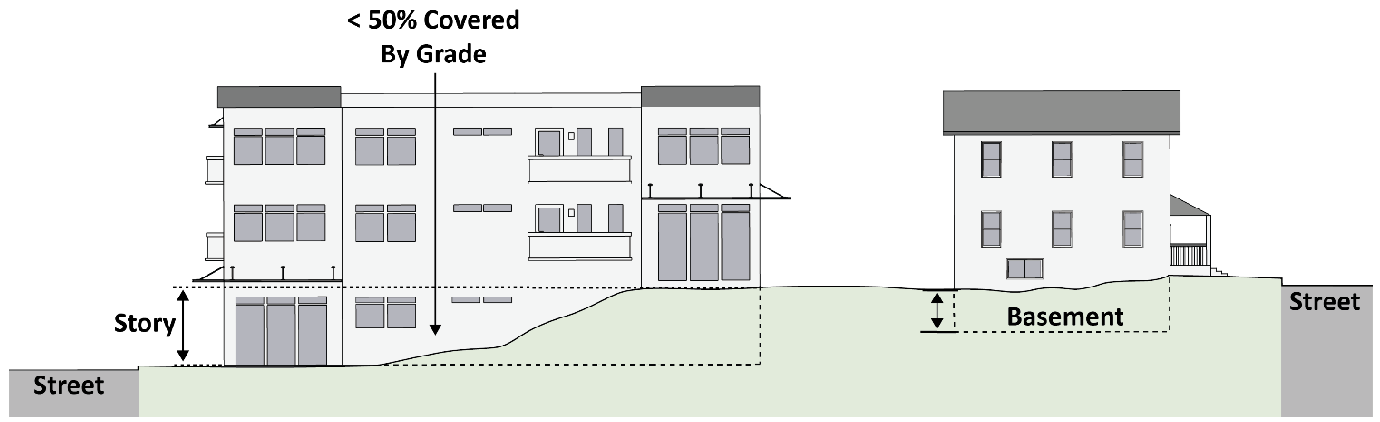
Figure 4: Basement Definition
"Basement (floodplain regulations)" means for purposes of floodplain regulations, that portion of a structure having its floor sub-grade (below ground level) on all sides.
"Bay window" means a large window or series of windows projecting from the outer wall of a building and forming a recess within and that does not extend to the ground on the exterior.
"Bed and breakfast" means a single-family detached dwelling where transient lodging and meals are provided for compensation, that does not meet the definition of a "hotel or motel," or single room occupancy."
"Berm" means a man-made, formed, earth mound of definite height and width used for landscaping and screening purposes, the intent of which is to provide a transition between uses of differing intensity or to screen uses from sight.
"Best available flood layer," for the purposes of floodplain regulations, means floodplain studies and any corresponding floodplain maps prepared and/or approved by the Indiana Department of Natural Resources which provide base flood elevation information, floodplain limits, and/or floodway delineations for flood hazards identified by approximate studies on the currently effective FIRM (Zone A) and/or for waterways where the flood hazard is not identified on available floodplain mapping.
"Bicycle parking facility, class I" means long-term parking facilities that provide a high level of security for long durations (day, overnight, or longer). Class I facilities can include individual lockers, racks in an enclosed, lockable room, or racks or lockers in an indoor area always visible to employees.
"Bicycle parking facility, class II" means short-term parking facilities that provide medium level security for relatively short durations (usually two hours or less). These facilities often include stands or racks and allow a user to secure a bicycle frame and one or both wheels to the facility with a lock.
"Bike lane" means a portion of the street that has been designated and designed for the exclusive use of bicycles with distinct signage and pavement markings.
"Block" means property abutting on one side of a street and lying between the two nearest intersecting or intercepting streets, intersecting railroad, intersecting waterway, or the end of a dead-end street.
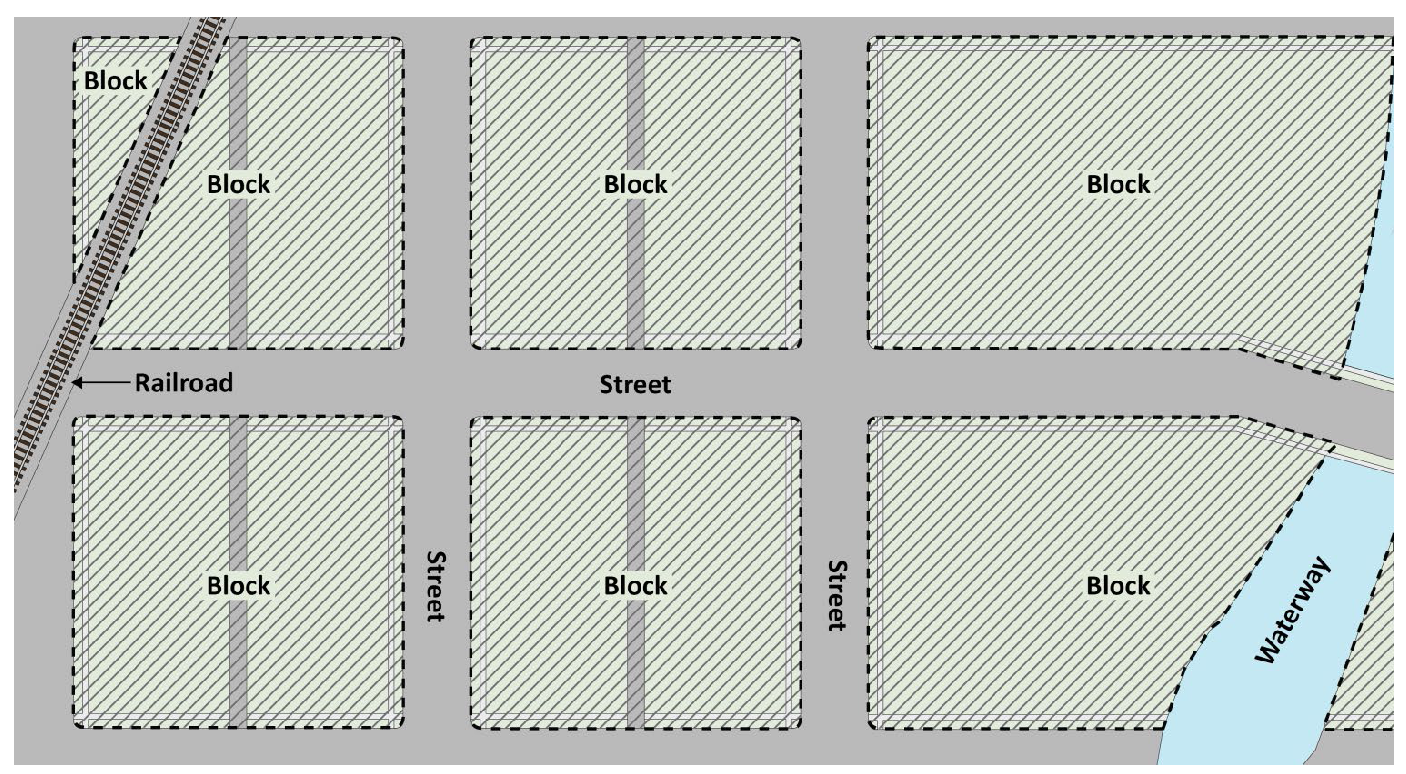
Figure 5: Block Definition
"Block face" means that portion of a block adjacent and parallel to the abutting public street and normally extending from one intersecting street to another.
"Board of Zoning Appeals (BZA)" means the City of Bloomington Advisory Board of Zoning Appeals or any division or designee thereof.
"Book buyback" means a use or business that purchases used higher education books.
"Bottled gas storage or distribution" means a facility that engages in the holding and transportation of bottled gas products.
"Brewpub, distillery, or winery" means a commercial use that brews ales, beers, meads, distilled drinks, wines, and/or similar beverages on site and serves those beverages on site. Off-site sales are permitted as an accessory use.
"Buffer yard" means an area adjacent to side and rear property lines, measured perpendicularly from adjacent property lines, intended to reduce the impacts of proposed uses on adjacent property or natural features and to screen incompatible uses from each other. Buffer yards also help to maintain existing vegetation, to block or reduce noise, glare or other emissions and to maintain privacy.
"Building."
"Building (generally)" means for all other contexts, any structure having a roof supported by columns, walls or air pressure.
"Building (floodplain regulations)." For purposes of floodplain regulations, see "structure."
"Building base" means the street level portion of a building facade. The building base is typically one or two stories tall in height and contains such features as display windows, kick plates, pedestrian entrances and a sign band.
"Building cap" means the uppermost portion of a building facade. The building cap is typically located above the uppermost windows and contains a cornice that is integrated with the roof form and downspouts/gutters for stormwater diversion.
"Building code" means the Indiana Building Code, which establishes and controls the standards for constructing all forms of permanent structures and related matters.
"Building middle" means the area of the facade of a building between the base and the cap. This area includes evenly spaced and similarly sized windows, as well as balconies and other architectural features.
"Building or structure, accessory" means a subsidiary or auxiliary building or structure located on the same zoning lot with the primary building or structure and that is customarily incidental to the primary building or structure or to the primary use of the land. This includes, but is not limited to, automated teller machines (ATMs) and automated ice dispensers.
"Building or structure, attached" means a building or structure that is structurally connected to another structure by a foundation, wall, bridge, or roof line, or appears to be connected. Carports, garages, porch awnings, and the like are considered attached structures and must abide by all regulations pertaining to primary structures.
"Building or structure, detached" means a building or structure that has no structural connection with the primary building or structure or any other building or structure.
"Building or structure, enclosed" means a building or structure that is fully enclosed on all sides by solid walls and a roof that are integral parts of the building and are distinguished from the side or top surfaces of the contents of the building or structure.
"Building or structure, lawful nonconforming" means any building or structure that does not comply with one or more provisions of this UDO, but that lawfully existed upon the effective date of the provisions of this UDO with which the building or structure does not comply.
"Building or structure, primary" means a building or structure in which is conducted any primary use that is a permitted use of the lot on which it is located.
"Building or structure, temporary" means any building or structure that is easily moved, without any foundation or footing, or intended to be used for a limited period of time. Temporary buildings or structures include, but are not limited to, tents, trailers, and other temporary structures that are not, and are not legally required to be, erected under the state, City, and county permit processes for permanent buildings.
"Building permit" means an official document or certification that is issued by the Monroe County Building Department, after issuance of a certificate of zoning compliance, and that authorizes the construction, alteration, enlargement, conversion, reconstruction, remodeling, rehabilitation, erection, demolition, moving, or repair of a building or structure.
"Building, prefabricated" means, for purposes of floodplain regulations, a building that is manufactured and constructed using prefabrication. It consists of factory-made components or units that are transported and assembled on-site to form the complete building.
"Building supply store" means a business establishment that provides materials for sale that are commonly used for building construction purposes.
"Build-to line" means an alignment establishing a certain distance from the front property line where a building must be constructed.
"Build-to range" means the area measured from the property line parallel to the frontage to at least one of the primary structure's front building wall.
"Business school." See "school, trade or business."
"Caliper" means a trunk diameter measurement of nursery stock, as measured at six inches above the ground for trees up to and including four-inch caliper size and measured at twelve inches above the ground for larger sizes.
"Canopy" means a roof-like structure projecting from a wall and supported in whole or in part by vertical supports from the ground and serving to provide shelter from the weather or trees.
"Carport" means a roofed accessory structure not more than fifty percent enclosed by walls for the purpose of providing shelter for one or more motor vehicles.
"Cement production." See "gravel/sand/cement production."
"Cementitious siding" means an exterior building finish that has the shape and appearance of horizontal lap wood siding and is made of a combination of cement, sand, cellulose (wood) fiber, and sometimes clay.
"Cemetery" or "mausoleum" means property used for interment of deceased persons. Cemeteries may include associated mausoleums, columbaria and chapels. The term does not include "mortuary" or "crematory," except where separately permitted, and does not include a pet cemetery.
"Center line" means the midpoint in the width of a public right-of-way. This shall be determined by recorded subdivision plats, or by the historic centerline for all unplatted rights-of-way. In the event that acquisition of additional right-of-way has taken place on one side of a right-of-way, the original centerline prior to such acquisition shall be considered the centerline for the purposes of this UDO.
"Certificate of appropriateness" means a permit issued by the Historic Preservation Commission granting a petitioner approval for the alteration, change, demolition, relocation, excavation, or new construction of a structure within a local historic or conservation district.
"Certificate of occupancy" means a certificate issued by the Monroe County Building Department stating that the occupancy and use of a building or structure complies with the provisions of all applicable Monroe County and City of Bloomington codes and ordinances.
"Certificate of zoning compliance (CZC)" means improvement location permits as authorized by the Indiana Code § 36-7-4-800 Series. A certificate issued under this UDO prior to permitting a person, firm, or corporation to erect, construct, enlarge, alter, repair, move, occupy, use, improve, remove, convert, or demolish any lot, building, structure or sign within its jurisdiction, or permitting a person to change the condition of the land or the use.
"Changeable copy" means a sign that displays words, lines, logos, or symbols that can be easily changed to provide different information without altering the face or surface of such sign.
"Channelized runoff" means water runoff that would have naturally flowed over and through the soil, deflected to and moved through an artificial open channel or waterway that eventually makes its way to surface water resources.
"Check cashing" means a business that for compensation engages in the business of cashing checks, warrants, drafts, money orders, or other commercial paper serving the same purpose. Check cashing also includes a facility that provides loans to individuals in exchange for personal checks as collateral. The term "check cashing" does not include a state or federally regulated bank or credit union.
"Chicken flock" means as defined in Section 7.01.010 (Definition of terms) of the Bloomington Municipal Code, as that definition may be amended, which is expressly incorporated into this UDO by reference.
"Church." See "place of worship."
"City" means the City of Bloomington, Indiana.
"City of Bloomington Survey of Historic Sites and Structures" means those sites and structures listed in the City of Bloomington Survey of Historic Sites and Structures, as it may be amended or replaced with said table being incorporated into this UDO by reference and made a part thereof, two copies of which are on file in the office of the clerk for the legislative body for public inspection.
"Club" or "lodge" means a nonprofit membership organization that holds regular meetings, whose members pay annual dues, that is organized for a common interest, usually cultural, civic, religious, or social, and that has formal written membership requirements. A "club" or "lodge" may, subject to other regulations controlling such uses, maintain dining facilities, serve alcohol, or engage in professional entertainment for the enjoyment of members and their guests. There are no sleeping facilities. This does not include "fraternity or sorority house."
"College." See "school, college or university."
"Collocation" means a space on an existing or proposed communication tower that can be used for the installation and/or mounting of antennas or radio or cellular communication equipment that operates on a different frequency from the initial user.
"Commercial laundry" means an establishment that cleans clothing, carpeting, drapes, and other cloth or synthetic fiber materials using a chemical process. This definition includes uses such as rug cleaning or repair service; pressing of garments or fabrics; carpet or upholstery; power laundry; industrial launderers; and linen supply. Such establishments may also include self-service laundering facilities.
"Commitment" means a written document, in recordable form approved by the City Legal Department, which may include maps, site plans or other exhibits, and that contains the information necessary to affect the provisions of this ordinance or the approval to which the commitment is connected. Commitments are established by the Indiana Code § 36-7-4-1500 Series for establishment of Planned Unit Developments; Indiana Code § 36-7-4-1405 and Indiana Code § 36-7-4-613 for site plans; Indiana Code § 36-7-4-921 for variances; and Indiana Code § 36-7-4-608 for amendments to the zoning maps. Commitments shall be recorded in the office of the Monroe County Recorder.
"Common area" means any portion of a development that is neither part of a lot or tract nor dedicated to the public and is designed and intended for the common usage, benefit or enjoyment of the residents of the development. These areas include open spaces and may include such other uses as parking lots and complementary buildings or structures. Maintenance of such areas is not the responsibility of the City and shall be set forth by the development association in the form of restrictive covenants, which shall guarantee the maintenance of these areas.
"Common area development" means a type of development where the lot area includes only the footprint of a building or the footprint and a limited area outside the footprint. The remainder of the area included in the parent parcel is owned in common by a homeowner's association.
"Common Council" means the Common Council of the City of Bloomington, Indiana.
"Communication facility" means antennas and antenna tower structures including, but not limited to, any towers, equipment enclosures, or other structures intended for use in connection with the wireless transmission or receipt of radio, television, or any other electromagnetic spectrum-based transmissions or receptions. The following shall not be considered as "communications facilities" for the purpose of this definition: satellite reception dishes less than three feet in diameter; wireless communication facilities that are completely located within a primary structure and that operate with the sole purpose of providing communications within that structure; and hand-held wireless communications devices.
"Communication tower" means any structure that is designed and constructed primarily for the purpose of supporting one or more antennas. The term includes radio and television transmission towers, microwave towers, cellular telephone and wireless communication towers, alternative tower structures and the like.
"Community" means for purposes of floodplain regulations, a political entity that has the authority to adopt and enforce floodplain ordinances for the area under its jurisdiction.
"Community center" means a building, together with accessory structures and uses, used for recreational, social, educational, or cultural activities by and for the benefit of community groups and individuals, that is accessible to the general public, and that is not operated for profit.
"Community rating system (CRS)" means for purposes of floodplain regulations, a program developed by the Federal Insurance Administration to provide incentives for those communities in the regular program that have gone beyond the minimum floodplain management requirements to develop extra measures to provide protection from flooding.
"Comprehensive Plan" means the most recently adopted Comprehensive Plan for the City of Bloomington including the Transportation Plan, and any subsequently adopted subarea plans and amendments thereto, prepared by the Plan Commission and legally adopted. The plan includes goals, objectives and strategies for land use, growth management, transportation/ thoroughfares, community facilities and services, environment concerns, infrastructure, aesthetics and identity, economic development, and parks and recreation. The plan is developed and adopted by the Plan Commission pursuant to the Indiana Code § 36-7-4-500 Series and includes any part and/or policies separately adopted and any amendment to such plan and/or policies, or parts thereof.
"Condition of approval" means stipulations or provisions set forth by the Board of Zoning Appeals, Plan Commission, or Common Council required as a prerequisite for approval of a petition.
"Conditional Use" means a use specifically designated as such in this UDO that, because of its unique characteristics, cannot be properly classified as a permitted use in a particular zoning district and that may be conducted only pursuant to a Conditional Use Approval granted by the Board of Zoning Appeals.
"Condominium" means the same as the word is defined by Indiana Code Article 32-25, entitled "Condominiums."
"Conference or convention center" means a facility containing over twenty thousand square feet of gross floor area and designed to accommodate and support meetings or conferences. The facility may be either freestanding or incorporated into a hotel or office facility and may include eating and drinking facilities.
"Connectivity" means the directness of links and the density of connections in the street network. An area with high connectivity has many links, numerous intersections, and minimal dead-ends or culs-de-sac.
"Connector path" means a hard surface linkage or shortcut between two destinations that is not accessible by automobiles.
"Conservation areas" means the cumulative of all areas required to be maintained for environmental preservation.
"Construction support activities" means a temporary structure used as an office for contractors and builders during construction located at a construction site that serves only as an office until the given construction work is completed. This includes contractor's offices, equipment storage, and portable lavatories.
"Continuing care retirement facility" means an establishment for care of the elderly that has common facilities and provides licensed intermediate and skilled nursing facilities for its residents, as well as other supportive services. This use generally incudes a variety of housing types and provides a variety of levels of assistance and care so that its residents may obtain higher levels of care and service as they age without having to move to another residential care facility.
"Contractor's yard" means a lot or portion of a lot or parcel used to store and maintain construction equipment and other materials and facilities customarily required in the building trade by a construction contractor. This definition also includes contractor's office.
"Convalescent home." See "nursing or convalescent home."
"Cooperative housing" means a facility used for the purpose of household living, where the residents share common areas and cooking, dining, and maintenance duties. All residents are shareholders in a cooperative corporation, registered with the Indiana Secretary of State, that owns the property, and are entitled to use of a housing unit in the property, but shall not own a real property interest in the building, land, or other amenities that make up the facility. Membership in the cooperative corporation shall be open regardless of age, sexual orientation, gender, religion, or ethnicity, and governance of the cooperative is provided by the membership. This definition does not include any facility that meets the definition of a student housing or dormitory or a fraternity or sorority house under this UDO or the definition of a condominium under Indiana law.
"Country club" means a membership club catering primarily to its membership and invited guests, providing one or more of the following recreational and social activities: golf, swimming, riding, outdoor recreation, clubhouse and locker rooms. A country club may also include incidental retail sales such as a pro shop and may include dining and catering facilities.
"County" means Monroe County, Indiana.
"Courthouse square" means a geographic area encompassing all buildings facing the Monroe County Courthouse. This shall also include buildings located at the southwest corner of College and Kirkwood, the southeast corner of Walnut and Kirkwood, the northeast corner of Walnut and 6th Street, and the northwest corner of College and 6th Street.
"Covenant" means private and legal restrictions of various kinds on the use and development of a lot. In the case of public health, safety and welfare, covenants may be required by the Plan Commission, that are recorded with the plat and deed. Unless specifically agreed to, covenants are not enforceable by the Plan Commission or its designees, but instead are enforceable in civil court by interested or affected parties.
"Crematory" means a facility containing apparatus intended for use in the act of cremation of deceased persons.
"Critical facility" means for purposes of floodplain regulations, a facility for which even a slight chance of flooding might be too great. Critical facilities include, but are not limited to, schools, nursing homes, hospitals, police, fire, and emergency response installations, installations which produce, use or store hazardous materials or hazardous waste.
"Crops" and "pasturage" means agricultural uses including raising, harvesting, and selling crops, or feeding (including grazing), breeding, managing, selling, or producing livestock, as defined by this UDO, or livestock products, for the production of income. This shall also include any other horticultural, floricultural or viticultural use, and animal husbandry. Crops include field crops, flowers and seeds, fruits, grains, melons, ornamental crops and vegetables. Livestock products include milk, butter, cheese, eggs, meat, fur, and honey. This use does not include feed lots, concentration points, confined feeding, feeder pig operations, livestock auctions, livestock dealers, sale barns, stock yards, transfer stations, forest management and timber harvesting activities, noncommercial residential gardens, or the commercial feeding of garbage or offal to swine or other animals.
"Cul-de-sac" means a street having one end open to traffic and being permanently terminated by a vehicular turnaround at the other end. A stub street is not a cul-de-sac.
"Current preferred practices (CPP)" means a set of practices proven both effective and cost effective at reducing soil erosion and sedimentation during land disturbing activities, including but not limited to silt or erosion-control fences, filter socks, straw bales, sedimentation basins, articulated concrete blocks, mechanically stabilized earth, storm grate filters, or erosion control mats.
"D zone" means unstudied areas where flood hazards are undetermined, but flooding is possible. Flood insurance is available in participating communities but is not required by regulation in this zone.
"Dance club." See "bar or dance club."
"Day care center, adult" means a facility providing care for the elderly and/or functionally impaired adults in a protective setting for a period of less than twenty-four hours per day.
"Day care center, adult or child" means a facility, other than a "child day care home," "assisted living facility," or "nursing/convalescent home" where children or elderly and/or functionally impaired adults receive care from a provider for a period of less than twenty-four hours per day. The term "day care center" includes but is not limited to the following: nursery schools, child care centers, kindergartens and play groups; but does not include kindergartens accredited or recognized by the Indiana State Board of Education, which shall be included within the definition of "school, primary/secondary." The term "day care center" shall include facilities defined as "child care centers" under Indiana Code § 12-7-2-28.4 and facilities defined as "child care homes" under Indiana Code §§ 12-7-2-28.6, 12-7-2-33.7, and Indiana Code § 12-7-2-33.8 in which child care homes are not the primary residence of the provider. Where required by state law, day care centers shall be and remain licensed by the state, pursuant to Indiana Code § 12-17.2 et seq., and shall operate in accordance with their license and all applicable state laws. A "day care center" exempt from state licensing requirements shall provide proof of exemption.
"Day care home, adult" means a residential dwelling unit used as the primary residence of the day care provider where adults receive care from the provider while unattended by a guardian or custodian for a period of less than twenty-four hours per day.
"Day care home, child" means a residential dwelling unit used as the primary residence of the day care provider where children receive care from the provider while unattended by a parent, legal guardian or custodian for a period of less than twenty-four hours per day. A facility shall not be classified as a day care home unless it provides care for no more than sixteen full- or part-time children at any one time. The maximum of sixteen children does not include children of at least seven years of age for whom the provider is a parent, stepparent, guardian, custodian or other relative. The term "child day care home" includes those facilities where fewer than six full- and part-time children (excluding any children for whom the provider is a parent, stepparent, guardian, custodian or other relative) receive care from the provider while unattended by a parent, legal guardian or custodian. Where required by state law, child day care homes shall be and remain licensed by the state and shall be operated in accordance with their license and all applicable state laws. A "child day care home" exempt from state licensing requirements shall provide proof of exemption.
"Deck" means a structure that is typically constructed of wood, elevated from ground level and open to the sky. Decks may be freestanding or attached to a primary structure or building.
"Dedication" means the setting apart of land or interests in land for use by the municipality or public by ordinance, resolution, or entry in the official minutes as by the recording of a plat.
"Demolition" means the complete removal or destruction of any structure excluding its foundation.
"Density" means a unit of measurement describing the number of dwelling units per measured acre. This UDO may regulate density by establishing the permitted number of units per acre or the amount of land, measured in square feet or acres, required per individual unit on the resulting lots.
"Development."
"Development (generally)" means in all other contexts, the construction, reconstruction, conversion, structural alteration, relocation, or enlargement of any structure, any mining, excavation, landfill or land disturbance, or any change in use, or alteration or extension of the use of land.
"Development (floodplain regulations)" means for purposes of floodplain management any man-made change to improved or unimproved real estate including but not limited to:
(1) Construction, reconstruction, or placement of a structure or any addition to a structure;
(2) Installing a manufactured home on a site, preparing a site for a manufactured home or installing a recreational vehicle on a site for more than 180 days;
(3) Installing utilities, erection of walls and fences, construction of roads, or similar projects;
(4) Construction of flood control structures such as levees, dikes, dams, channel improvements, etc.;
(5) Mining, dredging, filling, grading, excavation, or drilling operations;
(6) Construction and/or reconstruction of boat lifts, docks, piers, or seawalls;
(7) Construction and/or reconstruction of bridges or culverts;
(8) Storage of materials; or
(9) Any other activity that might change the direction, height, or velocity of flood or surface waters.
"Development" does not include activities such as the maintenance of existing structures and facilities such as painting, re-roofing; resurfacing roads; or gardening, plowing, and similar agricultural practices that do not involve filling, grading, excavation, or the construction of permanent structures.
"Development plan, PUD" means the name for PUD final plans under the Bloomington Zoning Ordinance effective 1973—1995. See "final plan, PUD."
"Development standards" means height, bulk, density, environmental performance standards, and other standards for development as set forth in this UDO, including landscaping, parking, and other required improvements, excluding those provisions that specifically regulate the use of property.
"Diameter at breast height (DBH)" means the diameter of an existing tree trunk or the cumulative diameter of multiple trunks measured four and one-half feet or fifty-four inches above natural grade.
"Display window" means a window of a store facing onto the street that is used to display merchandise or signage. Display windows typically include a kick plate and are not typically double-hung windows.
"Distribution, warehouse, or wholesale facility" means a facility that is used for storage, wholesale, and/or distribution of manufactured products, supplies, and equipment, but not involved in manufacturing or production. This does not include "bottled gas storage or distribution."
"District, mixed-use or nonresidential" refers to all zoning districts, including Planned Unit Developments, other than those defined as a "residential district."
"District, residential" refers to the R1, R2, R3, R4, RM, RH, and RMH zoning districts and residential portions of Planned Unit Developments.
"DNR" means the Indiana Department of Natural Resources.
"Dripline" means the perimeter of a tree's spread measured to the outermost tips of the branches and extending downward to the ground.
"Drive" means a vehicular access to a development site, including private streets or roads and excluding an aisle serving as direct access to a row of parking spaces.
"Drive apron" means the driving surface area, typically located within the public right-of-way, between the edge of a paved street and the driveway accessing a private property.
"Drive-through" means a facility, building feature, or equipment at which an occupant of a vehicle may make use of the service or business without leaving their vehicle. This use includes drive-by parcel pickup facilities.
"Drive-through bay" means the portion of a drive-through use or structure, including any awnings, structures, or service windows, where individual vehicles are parked to receive service.
"Driveway" means a surfaced area intended solely for the purpose of accessing a garage or parking area, other than an aisle serving as direct access to a row of parking spaces.
"Dwelling, accessory unit" means an additional residential dwelling unit, but not a mobile home, camper, or recreational vehicle, that is located on the same lot as a single-family dwelling unit, either within the same building as the single-family dwelling unit or in a detached building. Without limiting the generality of the previous sentence, this definition includes a transportable living unit that meets either the applicable City building code or the construction standards of the Federal Manufactured Housing Act, contains less than five hundred square feet of gross floor area, is mounted on a permanent foundation, and is connected to City utilities as required for other types of dwelling units.
"Dwelling, cottage development" means a cluster of at least five attached or detached single-family dwellings located within a common development that use shared access, parking, and common spaces. Cottage developments can include homes on individual lots, homes owned as condominiums, or leased homes. This use can include communities of five or more factory built small single-family detached dwellings containing less than five hundred square feet of gross floor area, commonly referred to as tiny homes, provided that each home meets either the Indiana Building Code or the Federal Manufactured Housing Construction and Safety Standards Law of 1974 (42 U.S.C. 5401 et seq.), and that each dwelling has any wheels removed, is mounted on a permanent foundation, and is connected to City water, sewer, and electric services. This definition shall not include a "manufactured home park."
"Dwelling, duplex" means a single building on a single lot containing two dwelling units under one roof, each of which is occupied by one family.
"Dwelling, fourplex" means a single building on a single lot containing four dwelling units under one roof, each of which is occupied by one family.
"Dwelling, live/work" means a dwelling unit containing an integrated living and working space in different areas of the unit.
"Dwelling, manufactured home" means a dwelling unit, designed and built in a factory, which bears a seal certifying that it was built in compliance with the Federal Manufactured Housing Construction and Safety Standards Law of 1974 (42 U.S.C. 5401 et seq.) and that was constructed after January 1, 1981, and that exceeds nine hundred fifty square feet of occupied space. This definition includes double-wide mobile homes of two such units designed to be used in combination at a building site. This definition is not intended to apply to other modular housing or prefabricated housing panels, trusses, or other sub-elements, nor any other dwelling unit that is defined as a "Dwelling, Mobile Home."
"Dwelling, mobile home" means any factory-fabricated portable structure, residential or nonresidential, designed to be towed or transported on its own chassis for placement on a temporary or permanent foundation, or on its own structure or elements thereof, without the aid of house moving equipment or other specialized but separate supporting apparatus, and that is not a "dwelling, manufactured home" as defined by this UDO.
"Dwelling, multifamily" means one or more buildings or portion of buildings on a single lot that contains one or more individual dwelling units, where each unit is occupied by one family and provided with an individual entrance to the outdoors or to a common hallway, and regardless of whether the dwelling units are owned or rented. This definition shall not include "Dwelling, Single-Family Detached", "Dwelling, Single-family Attached", "Dwelling Duplex", "Dwelling, Triplex", "Dwelling, Fourplex" "Student Housing or Dormitory", or "Dwelling Accessory Unit".
"Dwelling, short-term rental" means the rental of an entire dwelling unit for monetary consideration for a period of time less than thirty consecutive days, not including a "bed and breakfast," single room occupancy," or" hotel/motel." This definition does not include offering the use of one's property where no fee is charged or collected.
"Dwelling, single-family attached" means two or more attached single-family dwelling units attached side by side under one roof that share a common vertical side or rear wall reaching from the building foundation to the roof structure, each of which is occupied by one family on its own lot.
"Dwelling, single-family detached" means a single building on a single lot on a permanent foundation containing one residential dwelling unit designed for and occupied by one family and that is completely separate from any other building. This definition includes "dwelling, manufactured home" but does not include "dwelling, mobile home." A single-family detached dwelling may also include an "accessory dwelling unit" if it meets the requirements for that additional use under this UDO.
"Dwelling site" means a site within a manufactured home park and/or mobile home park with required improvements and utilities that is leased for the long-term placement of a manufactured home and/or mobile home.
"Dwelling, triplex" means a single building on a single lot containing three dwelling units under one roof, each of which is occupied by one family.
"Dwelling unit" means one or more rooms containing cooking, living, sanitary, and sleeping facilities, occupied by not more than one family (see definition of "family"). The dwelling unit shall be characterized by but not limited to:
(1)
A single house number with a single mailbox for the receipt of materials sent through the United States mail;
(2)
A single kitchen adequate for the preparation of meals;
(3)
A tenancy based upon a legal relationship of a unitary nature, i.e., a single lease, mortgage, or contractual sales agreement for the entire premises.
A dwelling unit occupied by more than one "family" (see definition) shall be constructed and regulated as a "single room occupancy" (see definition).
"Easement" means a nonpossessory interest in land granted by a property owner to the City, the general public, a corporation, or other persons for specific purposes including but not limited to the construction of utilities, drainage ways, and streets, or for the protection of natural features.
"Easement, conservancy" means an easement that restricts any land-disturbing activities within a defined area. The purpose of a conservancy easement includes retaining or protecting natural, scenic, or open space values of real property; assuring its availability for forest, recreational or open space use, and protecting natural resources.
"Easement, drainage" means an easement that permits the unobstructed flow of upstream stormwater runoff. A drainage easement may include detention or retention ponds, swales, wetlands or underground pipes, and that allows the City utilities department access for installation, maintenance, repair or removal of drainage facilities.
"Easement, karst conservancy" means an easement that restricts any land-disturbing activities within a defined area around a surface karst feature and permits the City of Bloomington the right to enter the property to inspect the easement and alter or repair the karst feature.
"Easement, pedestrian" means an easement that permits the general public the right to access the easement for purposes of walking, running, bicycling, skating, or utilizing certain classes of nonmotorized vehicles, and grants the City the right to construct, alter, repair, maintain, or remove improvements within the easement area.
"Easement, sanitary sewer" means an easement that allows the City utilities department exclusive access for installation, maintenance, repair, or removal of sanitary sewer facilities.
"Easement, temporary turnaround" means an easement that permits the general public the right to access the easement for purposes of turning a motor vehicle around at the end of a stub street. This easement right is terminated when the road is extended to the adjoining property.
"Easement, transit facility" means an easement that grants the public transit authority the right to construct, alter, repair, maintain, or remove structures to be used for awaiting, boarding, or exiting public transportation, or grants the general public the right to utilize the transit facility easement for the purposes of awaiting, boarding, or exiting public transportation.
"Easement, tree preservation" means an easement that prohibits the removal of any tree over six inches in diameter at breast height within the easement area and allows the removal of dead and diseased trees that pose a safety risk or impede drainage, only after first obtaining written approval from the Planning and Transportation Department.
"Easement, utility" means an easement that allows both private and public utility providers access associated with the installation, maintenance, repair, or removal of utility facilities.
"Easement, waterline" means an easement that allows the City utilities department exclusive access for installation, maintenance, repair, or removal of potable water facilities.
"Edge vegetation" means those plants that naturally grow in a transition area between two distinct, but adjoining, plant communities such as those that grow between a forest and an open space, along the edge of the forest.
"EIFS" means exterior insulation and finish system.
"Electric vehicle charging facility" means a facility in which electric vehicle charging services are made available to the public or to members for a fee, including structures, machinery, and equipment necessary and integral to support an electric vehicle, including battery charging stations, rapid charging stations, and battery exchange stations.
"Electronic reader board" means a sign with a fixed or changing display/message composed of a series of lights that may be changed through electronic means.
"Elevated structure" means for purposes of floodplain regulations, a non-basement structure built to have the lowest floor elevated above the ground level by means of fill, solid foundation perimeter walls, filled stem wall foundations (also called chain walls), pilings, or columns (posts and piers).
"Elevation certificate" means for purposes of floodplain regulations, a FEMA form that is routinely reviewed and approved by the White House Office of Management and Budget under the Paperwork Reduction Act, that is encouraged to be used to collect certified elevation information.
"Emergency program" means for purposes of floodplain regulations, the first phase under which a community participates in the NFIP. It is intended to provide a first layer amount of insurance at subsidized rates on all insurable structures in that community before the effective date of the initial FIRM.
"Enclosed area" for purposes of floodplain regulations, (enclosure) is an area of a structure enclosed by walls on all sides.
"Enclosure below the lowest floor" means for the purposes of floodplain regulations, see "Lowest Floor" and "Enclosed Area."
"Enlargement" means the expansion of any use or structure into or onto any portion of a structure or lot not previously occupied by said use or structure or increase in any physical dimension of a structure. Also, expansion of a use into any structure floor area not previously occupied by said use. Enlargement includes expansion of a principal use into floor area previously used as an accessory use, such as expansion of residential living area into a basement, attic or garage not previously used as living area.
"EPA" means United States Environmental Protection Agency.
"Equipment sales or rental" means an establishment engaged in the display, sale, and rental of equipment, tools, supplies, machinery or other equipment used for commercial, industrial, or construction enterprises, such as, but not limited to, trucks, trailers, semi-tractor trailers, farm equipment, bulldozers, cranes, backhoes, rollers, loaders, or lifts. This use includes the selling of manufactured homes that are not intended to be used on the same lot on which they are sold and the sale of farm-specific vehicles such as tractors, tillers, farm trailers, back hoes, graders, boom lifts, and front-end loaders, but not including "vehicle sales or rental."
"Erosion" means the general process by which soils are removed by flowing surface or subsurface water, or by wind, ice or gravity.
"Existing manufactured home park or subdivision" means for purposes of floodplain regulations, a manufactured home park or subdivision for which the construction of facilities for servicing the lots on which the manufactured homes are to be affixed (including, at a minimum, the installation of utilities, the construction of streets, and either final site grading or the pouring of concrete pads) is completed before the effective date of the community's first floodplain ordinance.
"Expansion." See "enlargement."
"Expansion to an existing manufactured home park or subdivision" means for purposes of floodplain regulations, the preparation of additional sites by the construction of facilities for servicing the lots on which the manufactured homes are to be affixed (including the installation of utilities, the construction of streets, and either final site grading or the pouring of concrete pads).
"Exterior finish material, primary" means an exterior finish material that covers more than twenty percent of a building facade. Windows, doors, building trim, cornices, and similar architectural features shall not count toward calculation of the square footage of the building facade.
"Exterior finish material, secondary" means an exterior finishing material that covers twenty percent or less of a building facade. Windows, doors, building trim, cornices, and similar architectural features shall not count toward calculation of the square footage of the building facade.
"FAA" means the United States Federal Aviation Administration.
"Facade" means that portion of any exterior elevation on a building extending from grade to the top of the roof or parapet covering the entire width of the structure. The facade shall include the entire walls, including wall faces, parapets, fascia, windows, doors, canopies, and roof structures. Also, in the case of attached buildings, a portion of the exterior of a building that gives the appearance of a unitary module shall constitute a facade regardless of whether that portion coincides with the sides of individual buildings. (For example, a single building may have more than one facade, and a facade may cross building lines, provided there is unitary ownership or control of both buildings.)
"Facade open area" means areas within a building facade that provide voids or relief, such as windows or balconies.
"Facade, primary" means those portions of a facade that are adjacent to or front on a private or public street, park or plaza.
"Family" means an individual or group of persons that meets at least one of the following definitions.
(1)
An individual or a group of people all of whom are related to each other by blood, marriage, or legal adoption, foster parent responsibility, or other legal status making the person a dependent of one or more persons legally residing in the household under federal or state law.
(2)
A group of no more than five adults aged fifty-five years of age or older living together as a single housekeeping unit in a dwelling unit.
(3)
A group of people whose right to live together is protected by the Federal Fair Housing Act Amendments of 1988, and/or the Bloomington Human Rights Ordinance, as amended and interpreted by the courts, including but not limited to persons that are pregnant.
(4)
In the R1, R2, R3, and R4 zoning districts, and in single-family residential portions of Planned Unit Developments, a group of no more than three adults, and their dependent children, living together as a single housekeeping unit in a dwelling unit.
(5)
In all other zoning districts, "family" also includes a group of no more than five adults and their dependent children, living together as a single housekeeping unit in a dwelling unit.
(6)
A group of people who are shareholders in the same cooperative corporation that owns a facility meeting the definition of cooperative housing in which no more than two adults per bedroom occupy the facility.
"Farm produce sales" means the seasonal selling or offering for sale at retail directly to the consumer of fresh fruits, vegetables, flowers, herbs, or plants, processed food stuffs and products such as jams, honey, pickled products, sauces, and baked goods, where the vendors are generally individuals who have raised the produce or have taken the same or other goods on consignment for retail sales.
"Farmer's market" means an occasional or periodic market held in an open area or structure where groups of individual sellers offer for sale to the public items such as fresh produce, seasonal fruits, fresh flowers, arts and crafts items, and food and beverages dispensed from booths located on site.
"FCC" means United States Federal Communications Commission.
"FEMA" means the Federal Emergency Management Agency.
"FHA" means the Fair Housing Act.
"Fill," for floodplain management purposes, means any material deposited or placed which has the effect of raising the level of the ground surface above the natural grade elevation. Fill material includes but is not limited to consolidated material such as concrete and brick and unconsolidated material such as soil, sand, gravel, and stone.
"Final plan, PUD" means the detailed construction drawings for all or part of a Planned Unit Development.
"Financial institution" means a federal or state-regulated facility that provides financial and banking services to individuals and businesses. These services may include deposit banking and closely related functions such as making loans, investments, and fiduciary activities. The term does not include "check cashing," except where separately permitted. Accessory uses may include automatic teller machines and offices.
"Findings of fact" means the written findings of an approving body as required by Indiana Code § 36-7-4-707 for subdivisions of land, Indiana Code § 36-7-4-915 for actions of the Board of Zoning Appeals, and Indiana Code § 36-7-4-1406 for site plans.
"Firearm sales" means a business in which at least ten percent of the gross floor is used for or ten percent of sales revenues are earned from, the wholesale or retail sale of firearms and ammunition, the repair of firearms, or the creation or fitting of special barrels, stocks, or trigger mechanisms for firearms. This does not include "pawn shop".
"Fitness center" means a facility where members or nonmembers use equipment or space for the purpose of physical exercise, improved circulation or flexibility, and/or weight control. Facilities and activities can include running, jogging, aerobics, weightlifting, court sports, whirlpools, saunas, massage rooms, yoga, karate, dance and swimming, as well as locker rooms, showers, and lockers. This use includes but is not limited to fitness training studios, exercise facilities, gymnasiums, and health clubs.
(1)
"Fitness center, large" is a facility with more than seven thousand five hundred square feet of gross floor area.
(2)
"Fitness center, small" is a facility with up to seven thousand five hundred square feet of gross floor area.
"Flood or flooding" means a general and temporary condition of partial or complete inundation of normally dry land areas from:
(1)
The overflow of inland or tidal waters.
(2)
The unusual and rapid accumulation or runoff of surface waters from any source.
(3)
Mudslides (i.e. mudflows) which are proximately caused by flooding and are akin to a river of liquid and flowing mud on the surfaces of normally dry land areas, as when earth is carried by a current of water and deposited along the path of the current.
Flood or flooding also includes the collapse or subsidence of land along the shore of a lake or similar body of water as a result of erosion or undermining caused by waves or current of water exceeding anticipated cyclical levels that result in a flood as defined above.
"Flood hazard area" means for the purpose of floodplain regulations, areas subject to the one percent annual chance flood. (See "Special Flood Hazard Area")
"Flood insurance rate map (FIRM)" means an official map of a community, on which FEMA has delineated both the areas of special flood hazard and the risk premium zones applicable to the community. A FIRM that has been made available digitally is called a Digital Flood Insurance Rate Map (DFIRM).
"Flood insurance study (FIS)" means the official hydraulic and hydrologic report provided by FEMA. The report contains flood profiles, as well as the FIRM and the water surface elevation of the base flood.
"Flood prone area" means any land area acknowledged by a community as being susceptible to inundation by water from any source. (See "Floodplain")
"Flood Protection Grade (FPG)" means the BFE plus two feet at any given location in the SFHA. For sites within a SFHA designated as "Zone AO," the BFE is equivalent to the flood depth specified on the Flood Insurance Rate Map, measured from the highest adjacent grade. If no flood depth is specified, two feet is used as the minimum depth. (See "Freeboard")
"Floodplain" or "flood prone area" means any land area susceptible to being inundated by water from any source. (See "Flood")
"Floodplain management" means the operation of an overall program of corrective and preventive measures for reducing flood damage and preserving and enhancing, where possible, natural resources in the floodplain, including but not limited to emergency preparedness plans, flood control works, floodplain management regulations, and open space plans.
"Floodplain management regulations" means this UDO and other zoning ordinances, subdivision regulations, building codes, health regulations, special purpose ordinances, and other applications of police power which control development in flood-prone areas. This term describes federal, state, or local regulations in any combination thereof, which provide standards for preventing and reducing flood loss and damage. Floodplain management regulations are also referred to as floodplain regulations, floodplain ordinance, flood damage prevention ordinance, and floodplain management requirements.
"Floodproofing (dry floodproofing)" means a method of protecting a structure that ensures that the structure, together with attendant utilities and sanitary facilities, is watertight to the floodproofed design elevation with walls that are substantially impermeable to the passage of water. All structural components of these walls are capable of resisting hydrostatic and hydrodynamic flood forces, including the effects of buoyancy, and anticipated debris impact forces.
"Floodproofing certificate" means a form used to certify compliance for non-residential structures as an alternative to elevating structures to or above the FPG.
"Floodway" means the channel of a river or other watercourse and the adjacent land areas that must be reserved in order to discharge the base flood without cumulatively increasing the water surface elevation more than a designated height.
"Food production or processing" means a facility that produces or processes food for human consumption and certain related products. This use includes but is not limited to commercial bakeries; dairy products processing; fats and oil product processing; fruit and vegetable canning, preserving, and related processing; grain mill products and by-products; meat, poultry, and seafood canning, curing, and by-product processing; and miscellaneous food preparation from raw products, including catering services that are independent from food stores or restaurants.
"Footprint" means the area of a lot or site included within the surrounding exterior walls of a building or portion of a building, exclusive of courtyards. In buildings or structures with no walls, the building footprint shall be the area under the horizontal projection of the roof.
"Foundation" means the supporting substructure of a building or other structure, including but not limited to basements, slabs, sills, posts, or frost walls.
"Fraternal organization." See "club or lodge."
"Fraternity or sorority house" means a building or portion of a building used for sleeping accommodations, with or without accessory common rooms and cooking and eating facilities, for groups of students where the students living in the building are enrolled at the same college or university, are active members of the same fraternity or sorority, and the fraternity or sorority has been officially recognized by and maintains active affiliation with the college or university. This use shall also include a building or portion of a building in which individual rooms or apartments are leased to individuals, regardless of the ownership of the building, provided that the students living in the building are enrolled at the same college or university, are active members of the same fraternity or sorority, and the fraternity or sorority has been officially recognized by and maintains active affiliation with the college or university.
"Freeboard" means a factor of safety, usually expressed in feet above the BFE, which is applied for the purposes of floodplain management. It is used to compensate for the many unknown factors that could contribute to flood heights greater than those calculated for the base flood.
"Fringe or flood fringe" means the portion of the floodplain lying outside the floodway.
"Front building wall" means the building elevation that fronts on a public street, public parking lot, private parking lot available to the general public, or pedestrian walk where customer access to a structure is available.
"Frontage, building" means those building elevations that face upon either a road or parking area between the building and the road.
"Frontage, lot" means the horizontal distance between the side lot lines measured at the point where the side lot lines intersect the street right-of-way. All sides of a lot that abut a street shall be considered frontage. On curvilinear streets, the arc between the side lot lines shall be considered the lot frontage.
"Functionally dependent use" means for the purposes of floodplain regulation, a use which cannot perform its intended purpose unless it is located or carried out in close proximity to water. The term includes only docking facilities, port facilities that are necessary for the loading and unloading of cargo or passengers, and ship building and ship repair facilities, but does not include long-term storage or related manufacturing facilities.
"Funeral home." See "mortuary."
"Garage" means a building or structure, or part thereof, used or designed to be used for the parking and storage of vehicles.
"Garage, detached" means a detached accessory building in which the sole use is the storage of vehicles and other incidental personal possessions of the premises.
"Geographic information system (GIS)" means a computer system that stores and links non-graphic attributes or geographically referenced data with graphic map features to allow a wide range of information processing and display operations, as well as map production, analysis, and modeling.
"Glare" means the effect produced by brightness sufficient to cause annoyance, discomfort, or loss in visual performance and visibility.
"Government service facility" means a facility owned, operated, or occupied by any level of government to provide a governmental service, but not including offices for the provision of governmental services or facilities for any government operation separately defined in this UDO.
"Grade, finished" means the final grade of a plan that conforms to the approved plan.
"Grade, natural" means for floodplain management purposes, the elevation of the undisturbed natural surface of the ground. Fill placed prior to the date of the initial identification of the flood hazard on a FEMA map is also considered natural grade.
"Grade, street" means the top of the curb, or the top of the edge of the pavement where no curb exists.
"Grade (surface), average finished" means the midpoint between the highest exposed finished grade and lowest exposed finished grade as measured a minimum of four feet from the exterior building facade.
"Grade, unfinished" means the stage at which the grade approximately conforms to the approved plan.
"Gravel, cement, or sand production" means a facility for the sorting, grading, storage, manufacture or mixing of aggregate construction materials such as concrete, cement, gravel, crushed stone, sand or similar products, or products made of these materials.
"Greenhouse, noncommercial" means the accessory or temporary use of a structure whose roof and sides are made largely of glass or other transparent or translucent material and in which the temperature and humidity can be regulated for the cultivation of plants for noncommercial use.
"Grocery" or "supermarket" means a retail establishment where most of the floor area is devoted to the sale of food products, both perishable and dry goods, for home preparation and consumption, and other convenience and household goods.
"Gross floor area" means all of the area contained in a building or buildings without exception, including utilities, stairwells, chimneys and other appurtenant features.
"Ground cover" means in landscaping, low-growing plants with a typical maximum mature height of about twelve inches. Ground cover is sometimes referred to as the "herbaceous layer," "regenerative layer," or "ground flora." They are typically chosen for practical purposes to cover soil where turf grass does not thrive or is not practical or in wooded settings covering the soil surface. Ground cover species do not include non-native turf grass.
"Ground floor" means the level of a building that is situated at or most nearly at street grade.
"Group care home, FHAA, small and large" means a residential dwelling or facility where persons are living, together with staff, as a single housekeeping unit providing care, supervision, and treatment for the exclusive use of citizens protected by the provisions of the Federal Fair Housing Act Amendments of 1988, as defined in that Act and interpreted by the courts, or by any similar legislation of the State of Indiana, including but not limited to facilities providing housing for persons with disabilities, persons with mental health conditions, or persons with developmental disabilities. This use does not include "opioid rehabilitation home, small" or "opioid rehabilitation home, large."
"Group care home, FHAA small" means a facility designed for and occupied by eight or fewer residents living together.
"Group care home, FHAA large" means a facility designed for and occupied by nine or more residents living together.
"Gym." See "fitness center."
"Habitable space" means space in a structure for living, sleeping, eating, or cooking. Bathrooms, toilet compartments, closets, halls, storage or utility space, and similar areas are not considered habitable space.
"HAND" means the City of Bloomington Department of Housing and Neighborhood Development.
"Hardship" means for purposes of floodplain regulations, the exceptional hardship that would result from a failure to grant the requested floodplain variance. The City Board of Zoning Appeals or the hearing officer requires that the variance is exceptional, unusual, and peculiar to the property involved. Mere economic or financial hardship alone is not exceptional. Inconvenience, aesthetic considerations, physical handicaps, personal preferences, or the disapproval of one's neighbors likewise cannot, as a rule, qualify as an exceptional hardship. All of these problems can be resolved through other means without granting a floodplain variance, even if the alternative is more expensive, or requires the property owner to build elsewhere or put the parcel to a different use than originally intended.
"Health club." See "fitness center."
"Hearing officer" means a member of the staff, appointed by the Plan Commission, who hears and makes final decisions on certain variances and certain Conditional Uses, as specified in the Plan Commission rules of procedure. The hearing officer is established pursuant to Indiana Code § 36-7-4-923.
"Hedge" means several plants planted in a sequence or pattern so that the branches and stems of adjacent plants grow together in a manner that results in a meshing or intertwining of stems and branches with little or no passable space left between the plants, thus forming more or less a dense planting area.
"Height, building." Building height shall be defined according to the measurements and exceptions in Section 20.04.020(f) (Building Height).
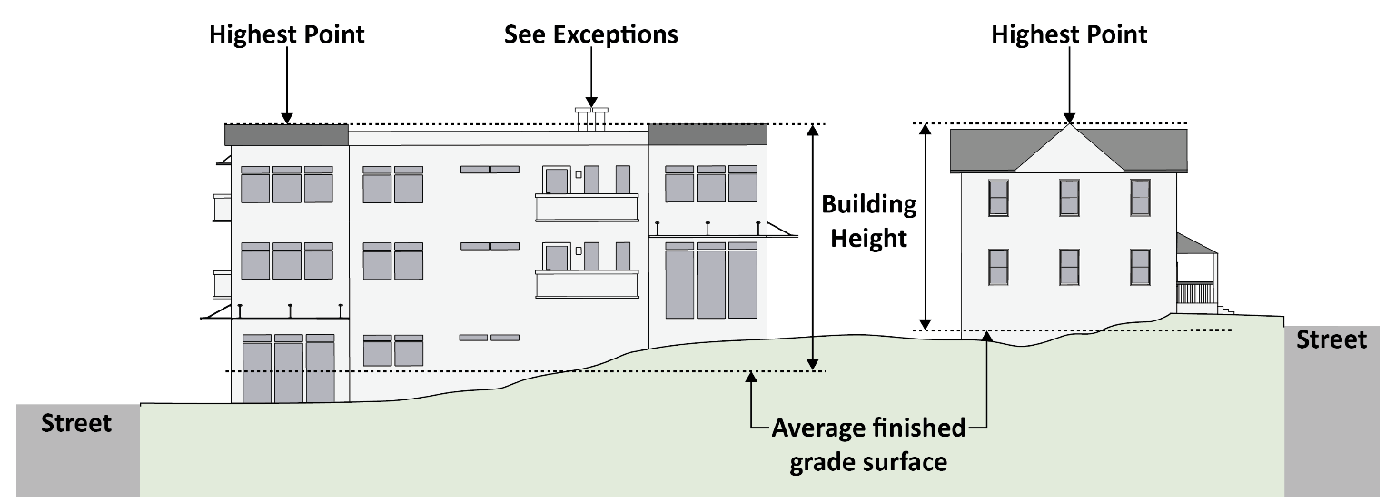
Figure 6: Building Height
"Highest adjacent grade" means for purposes of floodplain regulations, the highest natural elevation of the ground surface, prior to the start of construction, next to the proposed walls of a structure.
"Highly erodible soils" means areas of incline, whether natural or man-made, lacking sufficient vegetation to prevent instability, erosion, or downstream siltation due to soils that are subject to severe erosion when disturbed.
"Home occupation" means an activity or occupation carried on within a dwelling or approved residential accessory structure by members of the family occupying the dwelling and where the use of the home as an occupation shall be incidental and subordinate to the use of the home as a dwelling, unless this UDO states that the activity or occupation is not treated as a home occupation.
"Hospital" means an acute healthcare establishment providing accommodations, facilities and services on a continuous twenty-four-hour basis with overnight (meaning between twelve midnight and five a.m.) beds and services for persons suffering from illness, injury or conditions requiring medical services. The term "hospital" does not include "nursing or convalescent home," "medical clinic," or "methadone treatment facility," or "opioid rehabilitation facility" except where separately permitted.
"Hotel" or "motel" means an establishment in which lodging is provided and offered to the public for compensation, for periods of time not exceeding thirty days and that is commonly known as a hotel or motel in the community in which it is located. This use customarily provides services such as maid service, the furnishing and laundering of linen, telephone and secretarial or desk service, and the use and upkeep of furniture. This use may provide ancillary uses such as conference and meeting rooms, restaurants, bars, gift shops, and recreational facilities. The term "hotel or motel" does not include "single room occupancy," or "bed and breakfast," except where separately permitted.
"HPC" means the City of Bloomington Historic Preservation Commission.
"Hydrologic and hydraulic engineering analysis" means for the purposes of floodplain regulations, analyses performed by a professional engineer licensed by the State of Indiana, in accordance with standard engineering practices that are accepted by the Indiana Department of Natural Resources and FEMA, used to determine the base flood, other frequency floods, flood elevations, floodway information and boundaries, and flood profiles.
"IBC" means Indiana Building Code.
"IC" means Indiana Code.
"IDEM" means Indiana Department of Environmental Management.
"IESNA" means Illuminating Engineering Society of North America.
"Impervious surface" means any surface artificially covered or hardened so as to prevent or impede the percolation or absorption of water into the ground, including but not limited to asphalt, concrete, roofing material, brick, plastic, gravel, or swimming pools.
"Impervious surface coverage." The area of the lot covered by the following shall be included in the calculation of impervious surface coverage in all districts:
(1)
Primary buildings;
(2)
Accessory buildings, parking garages, carports, and utility and storage sheds;
(3)
Porches, stairways, elevated walkways, ground floor decks, paved areas, gravel or stone areas, or areas otherwise covered with impervious surface; and
(4)
Parking areas and driveways, regardless of surfacing materials unless an alternative pervious paving system is approved by the Planning and Transportation Director.
"Increased cost of compliance (ICC)" means for purposes of floodplain regulations, the cost to repair a substantially damaged structure that exceeds the minimal repair cost and that is required to bring a substantially damaged structure into compliance with the local flood damage prevention ordinance. Acceptable mitigation measures are elevation, relocation, demolition, or any combination thereof. All renewal and new business flood insurance policies with effective dates on or after June 1, 1997, will include ICC coverage.
"Indiana State Historic Architectural and Archaeological Research Database" means the Indiana State Historic Architectural and Archaeological Research Database, as the same may be amended from time-to-time, created by and/or administered by the State of Indiana's Division of Historic Preservation and Archaeology.
"International Code Council-Evaluation Service (ICC-ES) Report" means a document that presents the findings, conclusions, and recommendations from a particular evaluation. ICC-ES reports provide information about what code requirements or acceptance criteria were used to evaluate a product, and how the product should be identified, installed.
"Invasive species" means a nonnative or alien plant whose introduction does, or is likely to, cause economic or environmental harm, or harm to human health. A plant is regarded as invasive if it has been introduced by human action to a location, area, or region where it did not previously occur naturally, becomes capable of establishing a breeding population in the new location without further intervention by humans, and spreads widely throughout the new location.
"ITE" means Institute of Transportation Engineers.
"Jail" or "detention facility" means a facility established by a law enforcement agency for the detention of adult or juvenile persons while being processed for arrest or detention, awaiting trial, or for punishment and/or counseling as a result of sentencing by a court of jurisdiction for criminal or antisocial behavior.
"Karst" means a type of geology with distinctive characteristics of relief and drainage arising from the solution of soluble bedrock by natural waters, and in which the drainage is underground in solutionally enlarged fissures and conduits. Karst features may include but not be limited to sinkholes, springs, solution valleys, underground rivers, caverns, disappearing streams, towers, grikes, and conical hills.
"Karst, compound" means any two or more karst features where the last closed contour of the features is located within one hundred feet of each other. The outer boundary of the compound karst feature shall be drawn by connecting the last closed contour of each individual karst feature with a tangential line.
"Karst, subsurface" means karst features expressed under the ground surface.
"Karst, surface" means karst features expressed on the ground surface.
"Kennel" means an establishment where any person engages in a business involving boarding, keeping, letting for hire, dogs, cats or other domestic animals.
"Land disturbing activity" means any man-made change of the land surface including removing vegetative cover, removal of trees, excavating, filling and grading but not including agricultural land uses such as planting, growing, cultivating and harvesting of crops, growing and tending of gardens and landscape modifications.
"Landscape" means any combination of vegetation, such as trees, shrubs, ground cover, thickets or grasses, that are planted, preserved, transplanted, maintained and groomed to develop, articulate and enhance the aesthetic quality of the area as well as provide erosion, drainage and wind control. Landscape may include structural features, such as fences, terraces, arbors, sculptures, fountains, and other appurtenances.
"Landscape area" means that portion of a site that is required to be planted with landscape. Areas on the top of buildings, walls, in planters, or other similar areas do not count as landscape area, for the purpose of minimum landscape area requirements.
"LEED green building rating system" means the most recent version of the Leadership in Energy and Environmental Design (LEED) commercial green building rating system, or other related LEED rating system, approved by the U.S. Green Building Council.
"Length, block" means the distance as measured along the street centerline between intersecting streets.
"Length, cul-de-sac" means the distance as measured along the street centerline between the intersecting street and the center point of the cul-de-sac bulb.
"Letter of final determination (LFD)" means a letter issued by FEMA during the mapping update process which establishes final elevations and provides the new flood map and flood study to the community. The LFD initiates the six-month adoption period. The community must adopt or amend its floodplain management regulations during this six-month period unless the community has previously incorporated an automatic adoption clause.
"Letter of map change (LOMC)" means a general term used to refer to the several types of revisions and amendments to FEMA maps that can be accomplished by letter. They are broken down into the following categories:
(1)
Conditional Letter of Map Revision (CLOMR) means FEMA's comment on a proposed project that would, upon construction, result in modification of the SFHA through the placement of fill outside the existing regulatory floodway.
(2)
Conditional Letter of Map Revision Based on Fill (CLOMR-F) means a letter from FEMA stating that a proposed structure that will be elevated by fill would not be inundated by the base flood.
(3)
Letter of Map Amendment (LOMA) means an amendment by letter to the currently effective FEMA map that establishes that a building or land is not located in a SFHA through the submittal of property specific elevation data. A LOMA is only issued by FEMA.
(4)
Letter of Map Amendment Out as Shown (LOMA-OAS) means an official determination by FEMA that states the property or building is correctly shown outside the SFHA as shown on an effective NFIP map. Therefore, the mandatory flood insurance requirement does not apply. An out-as-shown determination does not require elevations.
(5)
Letter of Map Revision (LOMR) means an official revision to the currently effective FEMA map. It is issued by FEMA and changes flood zones, delineations, and elevations.
(6)
Letter of Map Revision Based on Fill (LOMR-F) means FEMA's modification of the SFHA shown on the FIRM based on the placement of fill outside the existing regulatory floodway.
"Lighting" means any fixed source of light emanating from a man-made device, including but not limited to incandescent mercury vapor, metal halide, or sodium lamps, spotlights, streetlights, or construction and security lights.
"Lighting fixture, full-cutoff" means lighting that is shielded in such a manner that light rays emitted by the fixture, either directly from the lamp or indirectly from the fixture, are projected below a horizontal plane running through the lowest point on the fixture where light is emitted.
"Liquor or tobacco sales" means an establishment that predominantly sells tobacco products or alcoholic beverages for off-premises consumption. This does not include "retail sales" (of any size) or "grocery or supermarket" in which tobacco products or alcoholic beverages make up a minority of the sales of the store.
"Livestock, large" includes domesticated animals that weigh more than three hundred fifty pounds including but not limited to horses, ponies, stallions, colts, geldings, mares, bulls, steers, heifers, cows, calves, mules, alpacas, emus, jacks, jennets and other animals that the Planning and Transportation Director determines to be of similar size, weight, and that have similar impacts on the land. Wild animals requiring a possession permit through the Indiana Department of Natural Resources are excluded from this definition and are prohibited.
"Livestock, medium" includes domesticated animals weighing between one hundred pounds and three hundred fifty pounds including but not limited to sheep, rams, lambs, burros, goats, kids, swine, other animals that the Planning and Transportation Director determines to be of similar size, weight, and that have similar impacts on the land, and any animals normally found in the wild state that are being kept for exhibition or commercial purposes or as private pets. Wild animals requiring a possession permit through the Indiana Department of Natural Resources are excluded from this definition and are prohibited.
"Livestock, small" means small livestock that includes domesticated animals weighing less than one hundred pounds including but not limited to sheep, rams, lambs, burros, goats, kids, swine, other animals that the Planning and Transportation Director determines to be of similar size, weight, and that have similar impacts on the land and any animals normally found in the wild state that are being kept for exhibition or commercial purposes or as private pets. Wild animals requiring a possession permit through the Indiana Department of Natural Resources are excluded from this definition and are prohibited.
"Lodging house." See "single room occupancy."
"Lot" means a contiguous parcel of land in identical ownership throughout, bounded by other lots or streets, and used or set aside and available for use as the site of one or more buildings or other definite purpose. For the purpose of this UDO, a lot may or may not coincide with a lot of record and shall be duly recorded.
"Lot area" means the computed area contained within the boundary of all perimeter lot lines.
"Lot, corner" means a lot having at least two adjacent sides that abut for their full length along streets. Both such lot lines shall be considered front lot lines for the purposes of determining setbacks.
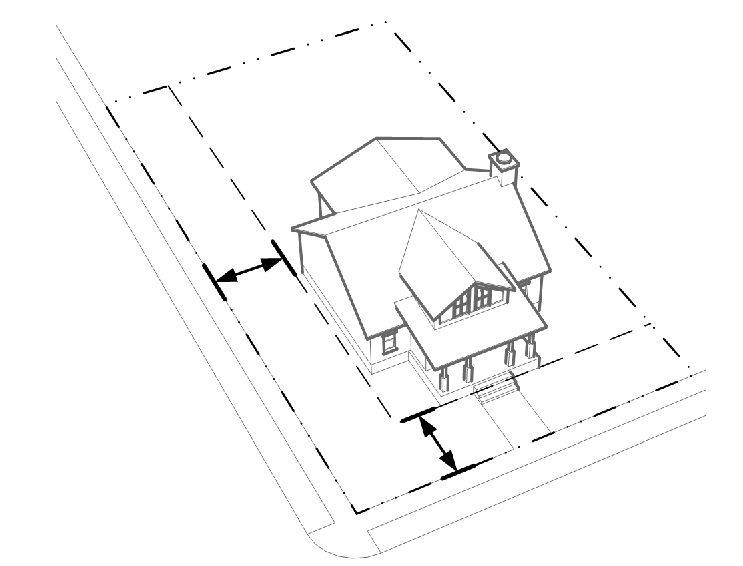
Figure 7: Corner Lot Definition
"Lot depth" means the horizontal distance between the front and rear lot lines.
"Lot, interior" means any lot, the side property line of which abuts the rear property line of one or more lots, and that is not separated by an alley or any other public right-of-way.
"Lot, lawful nonconforming" means any lot of record that does not conform with one or more provisions of this UDO, but that lawfully existed upon the effective date of the provisions of this UDO with which the lot does not conform.
"Lot line, corner" means the point at which two lot lines meet.
"Lot line, front" means that portion of a lot that abuts and runs parallel to a street. For corner lots, both sides that abut a street are front lot lines.
"Lot line, rear" means the line dividing one lot from another and on the opposite side of the lot from the front lot line. In the case of an irregular or triangular shaped lot, a line ten feet inside the lot boundary, parallel to and at the maximum distance from the front lot line. In the case of a corner lot, a lot line that adjoins a front lot line and extends away from the street shall be considered side lot lines.
"Lot line, side" means any lot line that is not a front lot line or a rear lot line.
"Lot of record" means a lot that was created by subdivision, the plat of which has been approved as required by applicable City and state law and recorded in the office of the Monroe County Recorder; or a parcel of land, the bounds of which have been legally established by a separate deed and duly recorded in the office of the Monroe County Recorder. "Legally established" means not in violation of any City or state subdivision regulations existing at the time the lot was established by deed. Also, a parcel described by a single deed containing more than one metes and bounds description shall be one lot of record unless the parcels described by such separate descriptions have, in the past, been lawfully established parcels of record with separate deeds.
"Lot, through" means a lot having a pair of opposite lot lines along two more or less parallel public streets and that is not a corner lot.
"Lot width" means the horizontal distance between side lines measured along a line that is parallel to the front lot line. For lots with existing buildings, the lot width shall be measured at the front building wall of the primary building. For newly created lots, the lot width shall be measured at the minimum required setback distance from the front lot line.
"Lot, zoning" means a single tract of land, located within a single block that is designated by its owner or developer as a tract to be used, developed, or built upon as a unit, under single ownership or control. A zoning lot may or may not coincide with a lot of record.
"Low- and moderate-income housing" means residential housing units that serve individuals, households, or families with annual incomes less than eighty percent of the area median income. These housing units would qualify under Section 20.04.110(c)(2) (Eligibility) for tier 2 affordable housing incentives.
"Lowest adjacent grade" means for purposes of floodplain regulations, the lowest elevation, after completion of construction, of the ground, sidewalk, patio, deck support, or basement entryway immediately next to the structure.
"Lowest floor" means for floodplain management purposes, the lowest elevation described among the following:
(1)
The lowest floor of a building.
(2)
The basement floor.
(3)
The garage floor if the garage is connected to the building.
(4)
The first floor of a structure elevated on pilings or pillars.
(5)
The floor level of any enclosure, other than a basement, below an elevated structure where the walls of the enclosure provide any resistance to the flow of floodwaters. Designs for meeting the flood opening requirement must either be certified by a registered professional engineer or architect or meet or exceed the following criteria:
a.
The walls are designed to automatically equalize the hydrostatic flood forces on the walls by allowing for the entry and exit of floodwaters.
b.
At least two openings are designed and maintained for the entry and exit of floodwater; and these openings provide a total net area of at least one square inch for every one square foot of enclosed area. The bottom of all such openings shall be no higher than one foot above the exterior grade or the interior grade immediately beneath each opening, whichever is higher. Doorways and windows do not qualify as openings.
"Lumen" means a unit that measures the quantity of light that shines on an area of one square foot, every point of which one foot is away from a light source equal to one foot candle.
"Lux" means a unit of illumination equal to the direct illumination on a surface that is one meter from a uniform point source of one candle intensity, or equal to one lumen per square meter.
"Manufactured home" means for purposes of floodplain regulations, a structure, transportable in one or more sections, which is built on a permanent chassis and is designed for use with or without a permanent foundation when attached to the required utilities. The term "manufactured home" does not include a "recreational vehicle."
"Manufactured home park" means a parcel of land containing two or more dwelling sites, with required improvements and utilities that are leased for the long-term placement of "mobile home dwellings" and/or "manufactured home dwellings." A "manufactured home park" does not include an establishment primarily engaged in the sale of "mobile home dwellings" or "manufactured home dwellings" where unoccupied units are parked for inspection or sale.
"Manufactured home park or subdivision" means for purposes of floodplain regulations, a parcel (or contiguous parcels) of land divided into two or more manufactured home lots for rent or sale.
"Manufacturing, artisan" means an establishment or business where an artist, artisan, or craftsperson teaches, makes, or fabricates crafts or products by hand or with minimal automation and may include direct sales to consumers. This definition includes uses such as small-scale fabrication but is not limited to, manufacturing, and other industrial uses and processes such as welding and sculpting.
"Manufacturing, heavy" means the assembly, fabrication, or processing of goods and materials using processes that ordinarily have greater than minimal impacts on the environment, or that ordinarily have significant impacts on the use and enjoyment of adjacent property in terms of truck traffic, railroad activities, noise, smoke, fumes, visual impact, odors, glare, or health and safety hazards, or that otherwise do not meet the definition of "light manufacturing." This use may include outdoor activities and outdoor storage. Heavy manufacturing generally includes processing and fabrication of products made from extracted or raw materials or products involving flammable, hazardous, or explosive materials and processes, uses involving the fabrication, use, or repair of heavy special purpose equipment. Examples of this use include beverage bottling plants, tool and die shops, motor vehicle or heavy machinery assembly, carpet or furniture manufacturing, dairy works, ice works, metal fabrication, stonecutting, and food processing, unless performed on a scale that meets the definition of "artisan manufacturing." "Heavy manufacturing" shall not include any use that is otherwise listed specifically in Table 03-1 as a permitted or Conditional Use.
"Manufacturing, light" means the assembly, fabrication, or processing of goods and materials using processes that ordinarily do not involve significant truck traffic or railroad operations and do not create material amounts of noise, smoke, fumes, odors, glare, or health or safety hazards outside of the building or lot where such assembly, fabrication, or processing takes place, and where such processes are housed entirely within an enclosed building, except as may be authorized in this UDO. Light manufacturing generally includes processing and fabrication of finished products predominantly from previously prepared materials and includes processes not involving flammable or explosive materials. Examples of activities include but are not limited to fabrication of sporting goods or wearing apparel, small medical or specialty equipment, or musical instruments; commercial digital printing operations; and assembly of small appliances or equipment. The term "light manufacturing" shall not include any use that is otherwise listed specifically in Table 03-1 as a permitted or Conditional Use.
"Market value" means for purposes of floodplain regulations, the building value, excluding the land (as agreed to between a willing buyer and seller), as established by what the local real estate market will bear. Market value can be established by independent certified appraisal, replacement cost depreciated by age of building (actual cash value) or adjusted assessed values.
"Mausoleum." See "cemetery or mausoleum."
"Mayor" means the mayor of the City of Bloomington, Indiana.
"Medical clinic" means a health care facility where patients are admitted for examination and treatment on an outpatient basis by one or more physicians, dentists, other medical personnel, psychologists, or social workers, and where patients are not lodged overnight. This use includes immediate medical care clinics, ambulatory surgical care (as defined by Indiana Code § 16-18-2-14), and outpatient care facilities. This definition does not include "methadone treatment facility."
"Meeting, banquet, or event facility" means a facility with or without food preparation equipment, available for lease by private parties to accommodate private functions including, but not limited to, banquets, meetings, receptions, fellowship, and other social functions and available on a rental basis to the general public. A "meeting, banquet, or event facility" may also include on site kitchen/catering facilities.
"Methadone treatment facility" means a clinic or facility engaged in dispensing Methadone (dolophine) for the purpose of elimination or reduction of opiate use by individuals suffering from substance use disorder. This definition does not include "opioid rehabilitation facility."
"Mitigation" means for purposes of floodplain regulations, sustained actions taken to reduce or eliminate long-term risk to people and property from hazards and their effects. The purpose of mitigation is twofold: to protect people and structures, and to minimize the cost of disaster response and recovery.
"Mobile home park." See "manufactured home park."
"Monopole" means a single, self-supporting vertical pole used to support telecommunications equipment, with no guy wire anchors or lattice, usually consisting of a galvanized or other unpainted metal or a wooden pole with below grade foundations.
"Mortuary" means an establishment where the deceased are physically prepared for final interment.
"Mosque." See "place of worship."
"Motel." See "hotel or motel."
"Motor vehicle" means any self-propelled vehicle that requires state license plate registration to be used on public roads and highways, including any non-motorized attachments, such as, but not limited to, trailers or other conveyances that are connected to or propelled by the actual motorized portion of the vehicle.
"Multi-tenant center" means a group of separate buildings with multiple tenants, operating under a common name or management; a single building containing multiple uses where there are specific exterior entrance ways for individual uses; or a group of uses on separate but adjoining properties that request treatment as a multiuse complex.
"Multi-tenant nonresidential center, large-scale" means a group of two or more retail establishments, managed as a unit, sharing a common site, parking area and entrances, and having a gross floor area of one hundred thousand square feet or greater.
"Multi-use path" means a hard-surface pathway physically separated from the street by a tree plot, located within the public right-of-way, and designed for bicyclists, pedestrians, and other non-motorized traffic.
"Multi-use trail" means a hard-surface, off-road pathway used by bicyclists, pedestrians, and other nonmotorized traffic typically located within or along a greenway.
"Mural" means a painting on the side of a building, wall, or structure; or a painting on the ground or the ceiling of a building or structure. A mural that does not function as a sign is not regulated by the Unified Development Ordinance. Murals that function as a sign are regulated in the Unified Development Ordinance as a wall sign.
"MUTCD" means the Manual on Uniform Traffic Control Devices.
"National Flood Insurance Program (NFIP)" means the federal program that makes flood insurance available to owners of property in participating communities nationwide through the cooperative efforts of the federal government and the private insurance industry.
"National Geodetic Vertical Datum (NGVD) of 1929." As corrected in 1929 is a vertical control used as a reference for establishing varying elevations within the floodplain.
"Native species" means naturally occurring, indigenous plants within the City of Bloomington. Native species are adapted to the soil and climate in which they live and have evolved defenses to many diseases and pests.
"Nature preserve" means areas with environmental resources intended to remain in a predominately natural or undeveloped state to provide resource protection or passive recreation.
"New construction" means for floodplain purposes, any structure for which the "start of construction" commenced on or after the effective date of floodplain management regulations adopted by a community and includes any subsequent improvements to such structures.
"New manufactured home park or subdivision" means for purposes of floodplain regulations, a manufactured home park or subdivision for which the construction of facilities for servicing the lots on which the manufactured homes are to be affixed (including at a minimum, the installation of utilities, the construction of streets, and either final site grading or the pouring of concrete pads) is completed on or after the effective date of the community's first floodplain ordinance.
"Night club." See "bar or dance club."
"Non-boundary river floodway" means the floodway of any river or stream other than a boundary river.
"North American Vertical Datum of 1988 (NAVD 88)." As adopted in 1993 is a vertical control datum used as a reference for establishing varying elevations within the floodplain.
"Nursing or convalescent home" means an extended or intermediate care establishment licensed by the State of Indiana, that maintains and operates continuous day and night facilities providing room and board, personal services and skilled nursing care to individuals who, by reason of advanced age, chronic illness, or infirmity, are unable to care for themselves. Such home does not contain equipment for surgical care or for the treatment of injury. This definition includes "rest home."
"Obstruction," for purposes of floodplain regulations, includes, but is not limited to, any dam, wall, wharf, embankment, levee, dike, pile, abutment, protection, excavation, canalization, bridge, conduit, culvert, building, wire, fence, rock, gravel, refuse, fill, structure, vegetation, or other material in, along, across or projecting into any watercourse which may alter, impede, retard or change the direction and/or velocity of the flow of water; or due to its location, its propensity to snare or collect debris carried by the flow of water, or its likelihood of being carried downstream.
"Office" means a facility in which business, professional, administrative and/or clerical activities are conducted, including but not limited to insurance agencies, architects, lawyers, engineers, real estate offices, government offices, motor vehicle licensing branches, post offices, radio/TV stations, research centers, social services, testing laboratories, advertising agencies, travel agencies, abstract and title agencies or insurance companies, and stockbrokers. This use does not include "medical clinic," "methadone treatment facility," or "opioid rehabilitation facility." Accessory uses may include cafeterias, health and exercise facilities, or other amenities primarily for the use of employees in the firm or building.
"Official Zoning Map" means a map of the City of Bloomington, Indiana, that legally delineates the boundaries of zoning districts as they apply to the properties within the City. There is only one Official Zoning Map, and it is kept up to date by the Plan Commission and the Planning and Transportation Director.
"One-percent annual chance flood" means the flood that has a one percent chance of being equaled or exceeded in any given year. See "regulatory flood."
"Open space" means an area of land not covered by buildings, parking structures, or accessory uses except for recreational structures. Open space may include nature areas; streams and floodplains; meadows or open fields containing baseball, football, and soccer fields, golf courses, swimming pools, bicycle paths, etc. Open space does not include street rights-of-way, platted lot area, private yards, patio areas, or land scheduled for future development.
"Opioid rehabilitation facility" means a facility, clinic, or office engaged in treating or counseling patients for reduction and management of opiate use, which may, but need not, include treatments involving medication, and where patients do not receive housing or overnight accommodation.
"Opioid rehabilitation home" means a dwelling where persons are living together, with or without staff, as a single housekeeping unit providing care, supervision, or treatment to reduce dependence or maintain independence of opioid drugs. An opioid rehabilitation home is subject to the protections of the Federal Fair Housing Act Amendments of 1988, as defined in that Act and interpreted by the courts, as they apply to citizens in drug addiction treatment programs, and by any similar legislation of the State of Indiana.
"Opioid rehabilitation home, small" means a facility designed for and occupied by eight or less residents living together.
"Opioid rehabilitation home, large" means a facility designed for and occupied by nine or more residents living together.
"Orchard or tree farm, commercial" means a group of trees grown for either home or commercial use where products are sold on site or transported to market.
"Outdoor retail and display" means the outdoor sale and display area of retail goods, produce, plants, handcrafts, and the like conducted on the same lot or parcel as the principal business with which such activities are associated.
"Outline plan" means the name for PUD district ordinance text and PUD preliminary plans under the Bloomington Zoning Ordinance effective 1973—1995. See "preliminary plan, PUD" or "PUD district ordinance."
"Outlot" means a lot of record in a subdivision, nonresidential center or Planned Unit Development that is adjacent to a (public or private) street, roadway or frontage road, and is intended for an additional and separate building or buildings within the development.
"Owner" means any person, group of persons, firm or firms, corporation or corporations, or any other legal entity having legal title to or sufficient proprietary interest in the land sought to be developed under these regulations, or their legal representative.
"Parapet" means that portion of a wall that extends above the roof line.
"Parcel." See "lot."
"Park" means a parcel of land available to the public for passive and/or active recreation and is maintained and governed by the Bloomington Parks Board.
"Parking space" means space within a public or private parking area for the storage of one passenger automobile or commercial vehicle under a one and one-half ton capacity.
"Partial demolition" means the complete or substantial removal or destruction of any exterior portion of a structure, which shall include but not be limited to:
(1)
Complete or substantial removal or destruction of a porch, wing, cupola, addition, or similar feature; or
(2)
Partial demolition of a roof shall include work that results in any change to the pitch of any portion of the roof, or; covering or otherwise obscuring an existing roof with a new roof of different pitch or material, or; adding any gable, dormer or other similar feature to an existing roof; or
(3)
Any work resulting in the obscuring from view of forty percent or more of the exterior of any facade on the structure; or, removal or destruction of the exterior surface of forty percent or more of the area of any exterior facade on the structure; or
(4)
Construction or attachment of any addition to a structure; or
(5)
Replacement of any window or door where the window or door opening is enlarged or obscured from view; or
(6)
Creation of any new window or door opening.
"Pasture" means land covered with grass or similar plants suitable for animals, such as cows and sheep, to eat.
"Patio" means a level-surfaced area, which may or may not be directly adjacent to a principal building, that has an average elevation of not more than thirty inches above finished grade, and without walls or a roof, usually constructed of concrete, brick, or other masonry material.
"Pavement" means a durable surface permanently and completely covered with asphalt, concrete, brick, paving blocks, or another surface approved by the City. Crushed gravel, stone, rock, dirt, sand, and grass are not permitted as a paved surface. Permeable parking pavers do not fall under this definition and must meet separate criteria. See "permeable parking pavers."
"Pawn shop" means an establishment that engages, in whole or in part, in the business of loaning money on the security of pledges of personal property, or deposits or conditional sales of personal property, or the purchase or sale of personal property.
"Pedestrian entrance, primary" means the principal ingress and egress to and from a building for pedestrian traffic.
"Permanent display cabinet" means a cabinet that is attached to a building that is constructed of durable materials and intended to display signage within.
"Permanent foundation" means a structural system for transposing loads from a structure to the earth at a depth below the established frost line without exceeding the safe bearing capacity of the supporting soil.
"Permeable parking pavers" means a pavement system with traditional strength characteristics, but that allows rainfall to percolate through it rather than running off. A permeable pavement system utilizes either porous asphalt, pervious concrete, or plastic pavers interlaid in a running bond pattern and either pinned or interlocked in place. Porous asphalt consists of an open graded coarse aggregate held together by asphalt with sufficient interconnected voids to provide a high rate of permeability. Pervious concrete is a discontinuous mixture of Portland cement, coarse aggregate, admixtures, and water that allow for passage of runoff and air. Gravel or crushed stone is not considered a "permeable parking paver."
"Personal services" means establishments primarily engaged in providing services involving the care of a person or of the care or repair of his or her personal goods or apparel. Personal services usually includes but is not limited to: laundry, including cleaning and pressing service, beauty shops, barbershops, shoe repair, personal copying/shipping services, health spas, photographic studios, tailor/seamstress shop, indoor equipment/party/event rental, tanning salon, tattoo and piercing parlor, bicycle and sports equipment repair, small appliance repair, and similar uses. This definition does not include "commercial laundry."
"Personal service, small" means a facility with not more than seven thousand five hundred square feet of gross floor area.
"Personal service, large" means a facility with more than seven thousand five hundred square feet of gross floor area.
"Pet grooming" means a facility where animals are trained for a fee, bathed, clipped, or combed for the purpose of enhancing their aesthetic value or health and for which a fee is charged. This use does not include the overnight boarding of animals, unless as an incidental use.
"Petitioner" means the property owner or a person legally empowered in writing by the property owner to act on the property owner's behalf, and who thereby has the property owner's authority to make representations and decisions before City officials regarding the use and/or development of the subject real property. The term includes the petitioner's representative.
"Petitioner's representative" means a person legally empowered in writing by the petitioner to act on the petitioner's behalf, and who thereby has the petitioner's authority to make representations and decisions before City officials regarding the use and/or development of the subject real property.
"Physical map revision (PMR)" means an official republication of a community's FEMA map to effect changes to base (one percent annual chance) flood elevations, floodplain boundary delineations, regulatory floodways, and planimetric features. These changes typically occur as a result of structural works or improvements, annexations resulting in additional flood hazard areas, or correction to base flood elevations or SFHAs.
"Place of worship" means a structure and outdoor or indoor facilities used for public worship and accessory educational, cultural, and social activities.
"Plan Commission" means the City of Bloomington Advisory Plan Commission or any division thereof. The City of Bloomington Plan Commission is an advisory Plan Commission serving the City of Bloomington as defined under Indiana Code § 36-7-1-2, as amended.
"Planned Unit Development (PUD)" means a large-scale unified development approved under the provisions of Section 20.02.050 (Planned Unit Development Districts). Generally a Planned Unit Development consists of a parcel or parcels of land, controlled by a single landowner, to be developed as a single entity that does not correspond in size of lots, bulk or type of buildings, density, lot coverage, and/or required open space to the regulations established in any district of the Unified Development Ordinance. A Planned Unit Development requires approval through a zoning map amendment. The uses and standards expressed in the PUD district ordinance constitute the use and development regulations for the Planned Unit Development site in lieu of the regulations for a standard zoning district.
"Planning and Transportation Director" means the officer appointed by and/or delegated the responsibility for the administration of this UDO's regulations by the Plan Commission, as well as administration of the Planning and Transportation Department for the City of Bloomington, Indiana. The term includes the Planning and Transportation Director's authorized representatives.
"Plant nursery or greenhouse, commercial" means an establishment for the growth, display, and/or wholesale of plants, shrubs, trees, and materials used in indoor or outdoor planting, conducted within or without an enclosed building.
"Plat" means a map or chart indicating the subdivision or re-subdivision of land, either recorded or in a form suitable to be recorded.
"Plat committee" means a committee authorized in the Plan Commission rules that has authority to approve or deny primary plats, secondary plats, and requests for vacation of plats or parts of plats.
"Plat, primary" means the primary plat, pursuant to the Indiana Code § 36-7-4-700 Series for primary plats, is the plat and plans upon which the approval of a proposed subdivision is based.
"Plat, secondary" means the secondary plat, pursuant to Indiana Code § 36-7-4-700 Series for secondary plats, is the plat document in recordable form. A secondary plat shall substantially conform to the preceding primary plat, or section thereof.
"Police, fire, or rescue station" means a center operated by a government agency, for the protection of citizens and property from, and for providing public responses to, crime, fire, injury, or other emergencies. This use may include administrative offices, storage of equipment, temporary detention facilities, and the open or enclosed parking of patrol vehicles. This use does not include a "jail or detention facility."
"Porch" means a roofed structure that is not more than fifty percent enclosed (except for removable screens, or screen doors), on at least two sides, that projects from the exterior wall of a building. If a porch extends from the front of a building or from any side of the building that faces a street, that side of the porch must be open, and the side(s) that faces the street must not be more than fifty percent enclosed (except for removable screens, or screen doors).
"Preliminary plan, PUD" means a drawing or map made to measurable scale upon which is presented a description and definition of the way in which the design requirements of the Planned Unit Development are to be met.
"Premises." See "property."
"Preschool." See "school, public or private."
"Preservation area" means sites with environmental resources intended to be preserved in their natural state.
"Primary school." See "school, public or private."
"Principally above ground" means, for purposes of floodplain regulations, at least fifty-one percent of the actual cash value of the structure, less land value, is above ground.
"Property" means a lot, parcel, tract, or plot of land and the improvements thereon.
"Proposal" means any new construction, including accessory structures of at least eight hundred forty square feet, or any building addition larger than ten percent of the gross floor area of a structure.
"Public improvements" means the erection, construction, alteration, operation, or maintenance of facilities serving the public interest that may include but are not limited to storm drainage facilities, streets, highways, parkways, sidewalks, pedestrian-ways, transportation corridors, trees, lawns, landscaping, parking areas, lot improvements, or utilities.
"Public place" means any area on public or private property that is easily accessible and clearly visible to the general public. If located on private property, the area must be open to the general public and clearly visible from adjacent public property such as a street or other public thoroughfare or sidewalk.
"Public safety and nuisance" mean for purposes of floodplain regulations, anything which is injurious to the safety or health of an entire community, neighborhood or any considerable number of persons, or unlawfully obstructs the free passage or use, in the customary manner, of any navigable lake, or river, bay, stream, canal, or basin.
"Public way" means any street, alley, channel, tunnel, bridge, easement, right-of-way, or other way that is dedicated or granted for public use.
"PUD district ordinance" means an ordinance adopted by the Common Council, the purpose of which is to designate a parcel of real property as a Planned Unit Development zoning district; to specify uses or a range of uses permitted in the Planned Unit Development zoning district; to specify development requirements in the Planned Unit Development zoning district; to specify the plan documentation and supporting documentation that may be required; to specify any limitation applicable to the Planned Unit Development zoning district; and to meet the requirements of Indiana Code § 36-7-4-1500 et seq.
"Quarry" means a lot of land or part thereof used for the purpose of extracting stone, sand, gravel, fill, or topsoil for sale.
"Quarry adaptive reuse" means redevelopment of a quarry whose operation is no longer feasible into another less intensive use upon completion of environmental mitigation.
"Real estate sales or model home" mean a dwelling or dwelling unit representative of other dwellings or units offered for sale or lease or to be built in an area of residential development within the City. Before occupancy by a family, a model home may be used as a temporary sales office for the development in which it is located.
"Recreation, indoor" means facilities for entertainment, sports, and recreational activities such as bowling, billiards, arcades, skating, swimming, tennis, teen clubs, escape rooms, and similar indoor activities taking place inside an enclosed building. This definition shall not include gambling devices, adult motion picture theaters, adult entertainment businesses, or any other devices prohibited by law.
"Recreation, outdoor" means commercial entertainment, recreation or games of skill where any portion of the activity takes place outside of a building. Such activities include, but are not limited to, miniature golf, bungee jumping, amusement parks, golf courses, golf driving ranges, drive-in theaters, and other similar uses. This does not include any activities offered by the public sector in a park or playground.
"Recreational equipment" means play apparatuses such as basketball courts, batting cages, swing sets, slides, sandboxes, poles for nets, picnic tables, lawn chairs, barbecue stands, and similar equipment or structures but not including tree houses, swimming pools, playhouses, basketball goals attached to primary or accessory structures, motorized vehicles, trailers, or storage sheds.
"Recreational vehicle" means for purposes of floodplain regulations, a vehicle which is:
(1)
Built on a single chassis;
(2)
Four hundred square feet or less when measured at the largest horizontal projections;
(3)
Designed to be self-propelled or permanently towable by a light duty truck; and
(4)
Designed primarily not for use as a permanent dwelling, but as quarters for recreational camping, travel, or seasonal use.
"Recycling drop-off, self-serve" means an accessory or incidental use that serves as a drop-off point for temporary storage for non-hazardous recoverable or recyclable goods such as, but not limited to, newspapers, glassware, plastics, and metal cans. This definition does not include the on-site processing of such items.
"Regular program" means for purposes of floodplain regulations, the phase of the community's participation in the NFIP where more comprehensive floodplain management requirements are imposed, and higher amounts of insurance are available based upon risk zones and elevations determined in a FIS.
"Regulatory flood" means the flood having a one percent chance of being equaled or exceeded in any given year, as calculated by a method and procedure that is acceptable to and approved by the Indiana Department of Natural Resources and the Federal Emergency Management Agency. The regulatory flood elevation at any location is as defined in Section 20.04.040(c) (General Standards). The "regulatory flood" is also known by the term "base flood," "one-percent annual chance flood," and "one-hundred-year flood."
"Regulatory flood elevation" means the water-surface elevation of the base flood or the one-hundred-year flood as defined by the Federal Emergency Management Agency.
"Repetitive loss" means flood-related damages sustained by a structure on two separate occasions during a ten-year period for which the cost of repairs at the time of each such flood event, on the average, equaled or exceeded twenty-five percent of the market value of the structure before the damage occurred.
"Rescue station." See "police/fire/rescue station."
"Residential care home." See "group home/residential care home."
"Rest home." See "nursing or convalescent home."
"Restaurant" means an establishment that sells food or beverages in a ready-to-consume state, in individual servings, that the customer consumes while seated at tables or counters located in or immediately adjacent to the building in which the use is located, and that may include carry-out service. This includes any portion of an establishment used for seating for the consumption of food on the premises that sells prepared food or beverages, such as a bakery, delicatessen, cafes, and coffee shops.
"Retail sales" means establishments engaged in selling goods or merchandise to the general public for personal or household consumption and rendering services incidental to the sale of such goods. This use does not include any form of retail sales listed separately in Table 03-1.
"Retail sales, small" means a facility or establishment with up to five thousand square feet of gross floor area.
"Retail sales, medium" means a facility or establishment with between five thousand one and ten thousand square feet of gross floor area.
"Retail sales, large" means a facility or establishment with between ten thousand one and sixty thousand square feet of gross floor area.
"Retail sales, big box" means a facility or establishment with more than sixty thousand square feet of gross floor area.
"Retention facilities" means facilities dedicated to the permanent on-site maintenance of stormwater.
"Right-of-way" means a strip of land reserved for, occupied, or intended to be occupied by transportation facilities, public utilities, or other special public uses that may include sidewalks, bicycle or pedestrian pathways, streets, alleys, or other public thoroughfares, or buffers adjacent to same. Right-of-way may be held in the form of easement or fee.
"Riparian buffer" means wooded or vegetated areas along creeks, streams, rivers, or designated regulated drains. The area on each bank designated as a riparian area shall be no wider than the average width of the creek, stream or river at normal flow elevation, but be no less than ten feet in width from the top of banks.
"Riverine" means, for the purposes of floodplain regulations, means relating to, formed by, or resembling a river (including tributaries), stream, brook, etc.
"Road." See "street."
"Rules of procedure" means the rules which govern how a decision-making body conducts meetings and reaches its conclusions.
"Salvage or scrap yard" means a facility, usually outdoors, where waste or scrap materials are bought, sold, exchanged, collected, salvaged, stored, baled, packed, disassembled, or handled, including, but not limited to, motor vehicles or parts thereof, used lumber, household garbage, inoperable machinery or appliances, scrap iron and other metals, paper, plastics, glass, rags or tires. Where such materials are a by-product of a permitted use, such activity shall be considered "outdoor storage," as defined and permitted separately in this UDO.
"Sand production." See "gravel, cement, or sand production."
"School, college or university" means an institution other than a "school, trade or business" that provides full-time or part-time education beyond high school.
"School, public or private" means a public or private institution that offers instruction in any of the branches of learning and study comparable to that taught in the public schools through high school level under the Indiana School Laws, including pre-school, pre-kindergarten, kindergarten, elementary school, and junior and senior high schools. This use does not include "school, trade or business," or "school, college or university."
"School, trade or business" means a private or public educational facility with a curriculum that is not comparable to that taught in the public schools through the high school level and focused upon skills required in business, trades, or the arts.
"Searchlight" means a powerful light equipped with a reflector to produce a bright beam intended to draw attention.
"Seasonal sales" means any business or use (primary or accessory) that may include but not be limited to retail sales of garden supplies and equipment; roadside stands for the sale of fruits and vegetables, plants, flowers, Christmas trees, pumpkins, fireworks; and other similar businesses or uses. This definition does not include "farm produce sales."
"Secondary school." See "school, public or private."
"Section 1316" means for purposes of floodplain regulations, that section of the National Flood Insurance Act of 1968, as amended, which states that no new flood insurance coverage shall be provided for any property that the administrator finds has been declared by a duly constituted state or local zoning authority or other authorized public body to be in violation of state or local laws, regulations, or ordinances that intended to discourage or otherwise restrict land development or occupancy in flood-prone areas.
"Sediment" means solid mineral or organic material that, in suspension, is being transported, or has been moved from its original site by air, water, gravity or ice and has been deposited at another location.
"Setback" means the required distance between any structure or parking area and the lot lines of the lot or parcel on which they are located.
"Setback, B-line trail" means the line that defines the minimum distance that any area used for structures or vehicle parking spaces shall be separated from the B-line trail right-of-way.
"Setback, front" means the line that defines the depth of the required front yard measured from the front property line to a regulated structure. The front setback shall be measured from the proposed right-of-way as indicated on the transportation plan except that the front setback adjacent to a street classified as neighborhood residential in the transportation plan shall be measured from the existing right-of-way. The front setback shall be parallel with the street right-of-way line. For individual building sites in the RMH zoning district, the front setback is measured from the edge of pavement of the interior streets. For corner lots, the front setback shall apply to all frontages adjacent to a street right-of-way.
"Setback, front smallest" means the smallest existing front setback of the primary residential structures abutting and along the same block face as the subject property. For corner lots, the smallest front setback of the abutting primary residential structures on both block faces may be used to determine the average front setback.
"Setback, parking" means the line that defines the minimum distance that any area used for vehicle parking spaces shall be separated from the street right-of-way. The parking setback shall be parallel with the street right-of-way line.
"Setback, rear" means the line that defines the width or depth of the required rear yard. The rear setback line shall be parallel with the property line.
"Setback, side" means the line that defines the width or depth of the required side yard. The side setback line shall be parallel with the property line.
"Sexually oriented business" means any establishment, whether conducted permanently or intermittently, that primarily engages in the business of offering a service or product, for sale, display, exhibition, or viewing, that is distinguished or characterized by an emphasis on matter depicting, describing, or relating to specified sexual activities or specified anatomical areas. This includes but is not limited to adult bookstores, adult cabarets, adult motion picture theaters, adult novelty stores, adult video arcades, bathhouses, and lingerie modeling studios.
"Sheet flow area" means, for the purposes of floodplain regulations, see "area of shallow flooding".
"Shrub" means a woody plant that is usually greater than three feet but less than twenty feet in height that generally exhibits spreading stems and a bushy appearance.
"Sidewalk" means a hard-surface pathway within the street right-of-way that is designated for the exclusive use of pedestrian traffic.
"Sign" means any display or device placed on a property in any fashion that can be seen from a public place or a public right-of-way that is designed, intended, or used to convey any identification, message or information other than an address number.
"Sign, awning" means a wall sign that is a part of or attached to an awning, canopy, or other fabric, plastic, or structural protective cover over a door, entrance, window, or outdoor service area.
"Sign, freestanding" means a sign anchored directly to the ground or supported by one or more posts, columns, or other vertical structures or supports; and not attached to or dependent for support from any building.
"Sign height" means the vertical distance measured from either the ground at the base of the sign or from the crown of an adjacent street to the highest point of the sign or sign structure, whichever is greater.
"Sign, lawful nonconforming" means any sign lawfully existing at the time of the enactment of any provision of this UDO, or any amendment thereto, with which the sign does not comply.
"Sign, multi-tenant" means an identification sign for a commercial site with multiple tenants, displaying the names of each tenant on the site.
"Sign, permanent" means a sign attached to a building or structure and that is made of materials intended for long-term use.
"Sign, portable" means any sign not permanently attached to the ground or other permanent structure, or a sign designed to be transported including, but not limited to, signs designed to be transported by means of wheels.
"Sign, projecting" means a sign attached to and projecting out from a building face or wall, generally at right angles to the building. Projecting signs include signs that are totally in the right-of-way, partially in the right-of-way, or fully on private property.
"Sign, public" means a sign erected by or on the order of a public officer in the performance of a public duty, such as signs to promote safety, no trespassing, or traffic signs; signs to indicate transit stops; memorial plaques; or signs of historic interest.
"Sign, sandwich board" means a movable sign not secured or attached to the ground or surface upon which it is located and constructed in such a manner as to form an "A" or a tent-like shape, hinged or not hinged at the top; each angular face held at an appropriate distance by a supporting member.
"Sign, temporary" means any sign that is not permanently anchored or secured to a building and not having supports or braces permanently secured to the ground, including but not limited to: banners, pennants, or advertising displays including portable signs that are intended to be displayed for a limited period of time.
"Sign, tenant panel" means individual panels on a multi-tenant sign advertising one specific business within the center.
"Sign, wall" means a sign attached to and/or integral with the exterior wall of a building or structure with the exposed face of the sign in a plane parallel to the plane of the exterior wall and that does not project more than twelve inches from the exterior wall surface.
"Sign, window" means any sign or advertising device affixed to the interior or exterior of a window or placed immediately behind a window frame so as to be seen from persons outside the building.
"Single room occupancy" means a residential building where individuals rent individual bedrooms and share common facilities such as kitchen, bathrooms, and common area that is occupied by a group of persons, for periods of thirty days or longer, that do not meet the definition of "family," where the use does not meet the definition of "bed and breakfast," "fraternity or sorority house," "student housing or dormitory," "supportive housing," "residential care facility," or "hotel or motel."
"Site, lawful nonconforming" means a site used and/or developed such that the site does not conform with one or more development standards contained in this UDO, but where such nonconformity and such use and/or development lawfully existed upon the effective date of the provisions of this UDO with which the site does not conform.
"Site plan" means a map of a site, drawn accurately to scale, showing existing and proposed features of the site including but not limited to buildings and other structures, circulation, grading, trees, and landscaping, sufficient for the review required in this UDO. A "site plan" shall serve as the development plan regulated by the Indiana Code § 36-7-4-1400 Series.
"Solar collector, ground or building mounted" means a system of panels, wiring, and related equipment used to transform direct solar energy into thermal, chemical, or electrical energy that is mounted either to the ground or to a building.
"Solid waste disposal facility" means, for the purposes of floodplain regulation, any facility involved in the storage or disposal of non-liquid, non-soluble materials ranging from municipal garbage to industrial wastes that contain complex and sometimes hazardous substances. Solid waste also includes sewage sludge, agricultural refuse, demolition wastes, mining wastes, and liquids and gases stored in containers.
"Special event" means a temporary use on public or private property that is not excluded from regulation by this UDO and is not listed as a separate temporary use by this UDO. This use includes but is not limited to fundraising activities, educational, historic, religious, and patriotic displays or exhibits, circuses, amusements, outdoor concerts, festivals, revivals, street fairs, outdoor arts and crafts fairs, and other organized community events.
"Special exception" means a process under the Bloomington Zoning Ordinance effective 1973—1995 whereas a use that is so designated may be approved by the board of zoning appeals if it meets special conditions.
"Special flood hazard area (SFHA)" means, for the purposes of floodplain regulation, synonymous with "areas of special flood hazard" and floodplain, means those lands within the jurisdiction of the City subject to a one percent or greater chance of flooding in any given year. Special flood hazard areas are designated by the Federal Emergency Management Agency on Flood Insurance Rate Maps and Flood Insurance Studies as Zones A, AE, AH, AO, A1 30, A99, or VE. The SFHA includes areas that are flood prone and designated from other federal, state or local sources of data including but not limited to best available flood layer maps provided by or approved by the Indiana Department of Natural Resources, historical flood information reflecting high water marks, previous flood inundation areas, and flood prone soils associated with a watercourse.
"Special flood hazard area (SFHA) zones" means portions of the SFHA in which the principal source of flooding is runoff from rainfall, snowmelt, or a combination of both. In A zones, floodwaters may move slowly or rapidly, but waves are usually not a significant threat to buildings. These areas are labeled as zone A, zone AE, zones A1-A30, zone AO, zone AH, zone AR and zone A99 on a FIRM. The definitions are presented below:
"Zone A" means areas subject to inundation by the one-percent annual chance flood event. Because detailed hydraulic analyses have not been performed, no base flood elevation or depths are shown.
"Zone AE and A1-A30" means areas subject to inundation by the one-percent annual chance flood event determined by detailed methods. Base flood elevations are shown within these zones. (Zone AE is on new and revised maps in place of zones A1-A30.)
"Zone AH" means areas subject to inundation by one-percent annual chance shallow flooding (usually areas of ponding) where average depths are between one and three feet. Average flood depths derived from detailed hydraulic analyses are shown within this zone.
"Zone AO" means areas subject to inundation by one-percent annual chance shallow flooding (usually sheet flow on sloping terrain) where average depths are between one and three feet. Average flood depths derived from detailed hydraulic analyses are shown within this zone.
"Zone AR" means areas that result from the decertification of a previously accredited flood protection system that is determined to be in the process of being restored to provide base flood protection.
"Zone A99" means areas subject to inundation by the one-percent annual chance flood event, but which will ultimately be protected upon completion of an under-construction federal flood protection system. These are areas of special flood hazard where enough progress has been made on the construction of a protection system, such as dikes, dams, and levees, to consider it complete for insurance rating purposes. Zone A99 may only be used when the flood protection system has reached specified statutory progress toward completion. No base flood elevations or depths are shown.
"Specified anatomical areas" means any of the following:
(1)
Less than completely and opaquely covered human genitals, pubic region, buttocks, anus or female breasts below a point immediately above the top of the areolae; or
(2)
Human male genitals in a discernible turgid state, even if completely and opaquely covered.
"Specified sexual activities" means any of the following:
(1)
Human genitals in a state of sexual stimulation or arousal;
(2)
Acts of or simulation of human masturbation, sexual intercourse or sodomy;
(3)
Fondling or other erotic touching of human genitals, pubic regions, buttocks or female breasts;
(4)
Flagellation or torture in the context of a sexual relationship;
(5)
Masochism, erotic or sexually oriented torture, beating or the infliction of pain;
(6)
Erotic touching, fondling or other such contact with an animal by a human being; or
(7)
Human excretion, urination, menstruation, vaginal or anal irrigation as part of or in connection with any of the activities set forth subsections (1) through (6) above.
"Stadium" means a permanent facility for the staging of amateur and/or professional sporting events, concerts, or similar activities consisting of an open-air or enclosed arena/stadium and related support facilities.
"Staff" means the Planning and Transportation Director and all employees of the Planning and Transportation Department of the City under the supervision of the Planning and Transportation Director, and subject to the authority of the Planning and Transportation Director.
"Standardized business" means any type of commercial establishment located in the Courthouse Square Downtown Character Overlay or University Village Downtown Character Overlay, that are required by contractual or other arrangement or affiliation to offer or maintain standardized services, merchandise, menus, employee uniforms, trademarks, logos, signs, or exterior design. This use does not include "office" uses located above the ground floor and any commercial businesses located in such a manner as to be devoid of any building frontage that is visible to a street.
"Start of construction" means for purposes of floodplain regulations, includes substantial improvement, and means the date the building permit was issued, provided the actual start of construction, repair, reconstruction, or improvement was within one hundred eighty days of the permit date. The actual start means either the first placement of permanent construction of a structure on a site, such as the pouring of a slab or footings, the installation of piles, the construction of columns, or any work beyond the stage of excavation; or the placement of a manufactured home on a foundation. Permanent construction does not include land preparation, such as clearing, grading and filling; nor does it include the installation of streets and/or walkways; nor does it include excavation for a basement, footings, piers, foundations, or the erection of temporary forms; nor does it include the installation on the property of accessory buildings, such as garages or sheds not occupied as dwelling units or not part of the main structure. For a substantial improvement, the actual start of construction means the first alteration of any wall, ceiling, floor, or other structural part of a building, whether or not that alteration affects the external dimensions of the building.
"State" means the State of Indiana.
"Stone processing" means manufacturing establishments primarily engaged in cutting, shaping, and finishing marble, granite, slate, and other stone for building and miscellaneous uses.
"Storage, outdoor" means the storage of any material outside of an enclosed building for a period greater than twenty-four hours, including but not limited to storage of items awaiting processing or repair. This use does not include "vehicle sales or rental" or accessory "outdoor retail and display" uses.
"Storage, self-service" means a building or group of buildings consisting of individual, self-contained units that are leased to individuals, organizations, or businesses for self-service storage of personal property.
"Story" means the portion of a building intended for human occupancy included between the upper surface of a floor and the upper surface of the next floor above or the roof, ignoring atriums and other features that extend vertically more than fifteen feet. For single-family, duplex, triplex, and fourplex uses, any portion of a story exceeding fourteen feet in height shall be considered as an additional story for each fourteen feet or fraction thereof.
"Stream, intermittent" means a stream that flows during certain times of the year when smaller upstream waters are flowing and when groundwater provides enough water for stream flow. Runoff from rainfall or other precipitation supplements the flow of an intermittent stream, also called a seasonal stream. During dry periods, such streams my not have flowing surface water, but they do have a discernable stream bed. Larger seasonal streams are more common in dry areas. An artificial drainageway (made by humans) is not an intermittent stream.
"Stream, perennial" means a year-round stream that typically has water flowing in it year-round. Most of the water comes from smaller upstream waters or groundwater while runoff from rainfall or other precipitation is supplemental.
"Street" means a public thoroughfare, including road, highway, drive, lane, avenue, place, boulevard, and any other thoroughfare that has been constructed to public street standards.
"Street lighting plan" means a site plan showing the location and type of streetlights to be installed including type of fixture and bulb type.
"Street, stub" means a street intended to be extended in conjunction with the subdivision and development of adjacent unplatted land.
"Structural alterations" means any change in the supporting members of a building or structure such as bearing walls, partitions, columns, beams, or girders; or any change in the footprint or increase in the size of living space. Structural alterations also include substantial roofing and siding work when repairs are made to the structure beneath.
"Structure."
"Structure (generally)" means in all other contexts, anything constructed or erected that requires location on the ground or attachment to something having a location on the ground, including but not limited to buildings, sheds, detached garages, mobile homes, manufactured homes, above-ground storage tanks, freestanding signs, and other similar items.
"Structure (floodplain regulations)" means for purposes of floodplain regulations, a walled and roofed building, including a gas or liquid storage tank, which is principally above ground. The term includes a manufactured home, as well as a prefabricated building. It also includes recreational vehicles installed on a site for more than one hundred eighty consecutive days.
"Structure, accessory."
"Structure, accessory (generally)." See "building or structure, accessory."
"Structure, accessory (floodplain regulations)" means for purposes of floodplain regulations, a structure with a floor area four hundred square feet or less that is on the same parcel of property as a principal structure and the use of which is incidental to the use of the principal structure; an accessory structure specifically excludes structures used for human habitation.
(1)
Accessory structures are considered walled and roofed where the structure includes at least two outside rigid walls and a fully secured roof.
(2)
Examples of accessory structures include but are not necessarily limited to two-car detached garages (or smaller), carports, storage and tool sheds, and small boathouses.
(3)
The following may have uses that are incidental or accessory to the principal structure on a parcel but are generally not considered to be accessory structures by the NFIP:
a.
Structures in which any portion is used for human habitation, whether as a permanent residence or as temporary or seasonal living quarters, such as a detached garage or carriage house that includes an apartment or guest quarters, or a detached guest house on the same parcel as a principal residence;
b.
Structures used by the public, such as a place of employment or entertainment; and
c.
Development that does not meet the NFIP definition of a structure for floodplain management purposes. Examples includes, but are not necessarily limited to, a gazebo, pavilion, picnic shelter, or carport that is open on all sides (roofed but not walled).
"Structure, historic" means for purposes of floodplain regulations, any structure that is:
(1)
Listed individually in the National Register of Historic Places (a listing maintained by the Department of the Interior) or preliminarily determined by the Secretary of the Interior as meeting the requirements for individual listing on the National Register;
(2)
Certified or preliminarily determined by the Secretary of the Interior as contributing to the historical significance of a registered historic district or a district preliminarily determined by the Secretary to qualify as a registered historic district;
(3)
Individually listed on a state inventory of historic places in states with historic preservation programs which have been approved by the Secretary of the Interior; or
(4)
Individually listed on a local inventory of historic places in communities with historic preservation programs that have been certified by (a) an approved state program as determined by the Secretary of Interior, or (b) directly by the Secretary of Interior in states without approved programs.
"Student housing or dormitory" means a multiple-family dwelling designed primarily as housing for, or likely to be occupied by, unmarried undergraduate or post-graduate students, including but not limited to:
(1)
Multiple-family dwellings that contain any living units with four or more bedrooms; or
(2)
Multiple-family dwellings with more than ten dwelling units where more than thirty-three percent of the living units contain three bedrooms; or
(3)
Residential buildings that do not meet the definition of a "single room occupancy" or "hotel or motel," in which any of the bedrooms require the use of a common hallway shared by more than three bedrooms, to access the nearest bathroom facilities or to access a cooking area containing a built-in sink, refrigerator, and stove or oven.
For purposes of determining whether a multiple-family dwelling meets this definition, the City may consider the degree to which the facility is occupied by undergraduate or post-graduate students and the degree to which occupancy is marketed to undergraduate or post-graduate students. This use does not include a "fraternity or sorority."
"Subdivision" means the division of a parent tract or other piece of land into at least two smaller lots or the combination of two or more smaller lots into one lot so that, either now or in the future, the subdivider can transfer ownership, construct buildings or establish a use, or create new building sites for leasehold, and as further defined in the Unified Development Ordinance.
"Substantial damage" means for purposes of floodplain regulations, damage of any origin sustained by a structure whereby the cost of restoring the structure to its before damaged condition would equal or exceed fifty percent of the market value of the structure before the damage occurred.
"Substantial demolition" means the moving or razing of a building including the removal or enclosure of fifty percent or more of the structure.
"Substantial improvement" means for purposes of floodplain regulations, any reconstruction, rehabilitation, addition, or other improvement of a structure, the cost of which equals or exceeds fifty percent of the market value of the structure before the "start of construction" of the improvement. This term includes structures that have incurred "repetitive loss" or "substantial damage" regardless of the actual repair work performed. The term does not include improvements of structures to correct existing violations of state or local health, sanitary, or safety code requirements.
"Substantial removal," as used in the definition of "partial demolition" means an alteration, pulling down, destruction or removal of a portion of a structure which jeopardizes a structure's individual eligibility for listing in the National Register of Historic Places.
"Supermarket." See "grocery or supermarket."
"Supportive housing" means a dwelling where persons are living, together with staff, as a single housekeeping unit providing care, supervision, and treatment for the exclusive use of persons requiring medical, correctional, or other mandated supervision or a protective environment to avoid past or likely future violence, whose right to live together is not protected by the Federal Fair Housing Act Amendments, as amended and as interpreted by the courts, and that does not meet the definition of another use in this UDO. This use does not include an "opioid rehabilitation home, small" or "opioid rehabilitation home, large," but includes and is not limited to:
(1)
An owner-occupied or nonprofit residential dwelling for the exclusive use of at least two but not more than eight persons, who, together with staff, live as a single housekeeping unit but do not require twenty-four-hour medical or nursing care.
(2)
A temporary or permanent shelter for persons experiencing temporary homelessness. For persons experiencing homelessness, there is no requirement that the persons live in a single housekeeping unit or that the shelter provide care exclusively to persons requiring medical, correctional, or other mandated supervision or a protective environment.
(3)
A domestic violence shelter, which is a public or private building or structure housing residents for the purpose of the rehabilitation or special care for victims of domestic violence or emotional or mental abuse.
"Supportive housing, small" means a facility designed for and occupied by no more than seven residents living together.
"Supportive housing, large" means a facility designed for and occupied by eight or more residents living together.
"Suspension" means for purposes of floodplain regulations, the removal of a participating community from the NFIP because the community has not enacted and/or enforced the proper floodplain management regulations required for participation in the NFIP.
"Swimming pool" means a self-contained body of water at least eighteen inches deep and eight feet in diameter or width and used for recreational purposes. It may be above or below ground level and shall be considered an accessory structure/use.
"Synagogue." See "place of worship."
"Tavern." See "bar or dance club."
"Thoroughfare plan." See "Transportation Plan."
"Tobacco sales." See "liquor or tobacco sales."
"Tract." See "lot."
"Tract, parent" means a unit, or contiguous units, of land under single ownership that is being proposed for subdivision.
"Trade school." See "school, trade or business."
"Trailer." See "dwelling, mobile home" and "dwelling, manufactured home."
"Transportation Plan" means the official thoroughfare plan for Bloomington, Indiana entitled "Transportation Plan" adopted as a part of the Comprehensive Plan, and on file in the Office of the City Clerk, City engineer, or Planning and Transportation Department, which are by this reference made a part of this code, showing location, alignment, functional classification, width of roadway, and minimum developed cross-sections of existing and proposed thoroughfares.
"Transportation terminal" means any premises for the transient housing or parking of motor driven trucks or buses and the loading and unloading of passengers or materials.
"Tree, canopy" means a deciduous tree that normally achieves an overall height at maturity of at least forty feet, and whose mature height and branch structure provide foliage primarily on the upper half of the tree. The purpose of a canopy tree is to provide shade to adjacent ground areas.
"Tree, heritage" means a tree that is unique and important to the community because of its species, age, size, location, or historic significance.
"Tree, interior" means a tree used for the interior of a site rather than in the "tree plot" and that is not restricted by its characteristics. These trees include canopy, ornamental and evergreen trees.
"Tree, ornamental" means a small to medium sized tree cultivated for its aesthetic characteristics rather than for its use.
"Tree plot" means the area within the right-of-way typically located between the street and the sidewalk/pedestrian path that is used for the planting of street trees.
"Tree protection barrier" means temporary fencing used to protect existing trees, including roots and crowns, from damage or loss during project construction. The tree protection barrier shall surround the tree dripline and delineate the area where land disturbing activity may not occur.
"Tree protection zone (TPZ)" means a zone of protected space surrounding a tree or group of trees extending from the topmost branch or leader downward to thirty-six inches below the surrounding ground surface level and includes the critical root zone.
"Tree, street" means trees suitable for planting along public streets and highways, and in locations where low-maintenance, hardy specimens with high canopies and little detritus are required.
"Trellis" means a structure of light bars of wood or metal crossing each other at intervals, having latticed open space in between, typically used as a framework for climbing vegetation.
"Unified Development Ordinance (UDO)" means this entire document as approved and with any subsequent amendments. The Unified Development Ordinance includes both the zoning ordinance, authorized by the Indiana Code § 36-7-4-600 Series and the subdivision control ordinance, authorized by the Indiana Code § 36-7-4-700 Series.
"University." See "school, college or university."
"Urban agriculture, noncommercial" means the cultivation of food and/or horticultural crops, composting, aquaponics, aquaculture and/or hydroponics. Such use may include the production and sale of food products from food grown on the premises. Noncommercial urban agriculture may be divided into separate plots for cultivation by one or more individuals or may be farmed collectively by members of the group and may include common areas maintained and used by group members. This definition includes gardens, container gardens, edible landscapes, residential greenhouses, herb gardens, rooftop gardens, berry patches, vegetable gardens and other similar activities. Urban agriculture uses shall not include the raising of animals, except as permitted elsewhere in the Bloomington Municipal Code.
"Use" means the purposes for which land, a building, or structure thereon is designed, arranged, or intended, or for which it is occupied, maintained, let, or leased.
"Use, abandonment of" means the relinquishment of property or a cessation of the use of property for a continuous period of twelve months by the owner.
"Use, accessory" means an activity that is conducted or located on the same zoning lot as the primary building or use served, except as may be specifically provided elsewhere in this UDO; is clearly and customarily incidental to, subordinate in purpose to, and serving the primary use; and is either in the same ownership as the primary use or is clearly operated and maintained solely for the comfort, convenience, necessity, or benefit of the occupants, employees, customers, or visitors of the primary use.
"Use, change in" includes, for any portion of a building (excluding individual tenant space in a single building multi-tenant center), structure, or lot:
(1)
Any change from a residential use to a nonresidential use;
(2)
Any change from a nonresidential use to multifamily use;
(3)
Any change from one residential land use to another;
(4)
Any increase in the number of dwelling units;
(5)
Any establishment of a use on a previously unused site, or the inclusion of a new use in addition to an existing use;
(6)
Any use which requires a Conditional Use Approval;
(7)
Any change from a single-tenant to a multi-tenant center or building;
(8)
Any use that differs from the previous use of a building or land, as determined by subheadings in Table 03-1 (Allowed Use Table), or where the new use differs substantially in the amount of required parking, traffic generation, number or frequency of customers/users, hours of operation, or other similar aspects of the use; and
(9)
Any establishment of a new use after a previous use has been abandoned, as defined by this UDO.
"Use, conditional." See "Conditional Use."
"Use, establishment of" means the initiation of a new use on a property or the initiation of a use on a property where the previous use has been discontinued; or, reestablishment of a prior conforming use that has been discontinued for a period of twelve months or more.
"Use, individual nonresidential" means a use and building that is located either on an outlot or not part of a larger commercial building that contains more than one business.
"Use, lawful nonconforming" means any use of land or structure that does not conform with one or more provisions of this UDO, but that lawfully existed upon the effective date of the provisions of this UDO with which the use does not conform.
"Use, permitted" means a use that may be lawfully established in a particular zoning district provided it conforms to all applicable requirements, regulations and standards.
"Use, temporary" means any use that is established only for a fixed period of time, which must be discontinued upon the expiration of the time limit provided in this UDO, and that does not involve the construction or alteration of any permanent structure as distinguished from the same uses when permitted in full compliance with all applicable zoning, site plan, construction, and permit requirements. Temporary uses shall include uses conducted from tents, trailers, and other temporary structures not erected under the state and City permit processes for permanent buildings. The term "temporary use" shall not include events sponsored by the public on park, right-of-way, or other public lands.
"Utility substation and transmission facility" means an assemblage of equipment for purposes other than energy generation or use, through which electric energy in bulk is passed for the purposes of switching or modifying its characteristics to meet the needs of the general public; provided that in residential districts an electric substation shall not include rotating equipment, storage of materials, trucks or repair facilities, housing of repair crews, or office or place of business.
"Variance, development standards" means a specific approval to deviate from the development standards (such as height, bulk, area) that this UDO otherwise prescribes, granted pursuant to Indiana Code § 36-7-4-918.5.
"Variance, floodplain" means for purposes of floodplain regulations, a grant of relief from the requirements of this ordinance consistent with the variance conditions herein.
"Vehicle." See "motor vehicle."
"Vehicle fleet operations" means central facility for the dispatch, distribution, storage, staging, refueling, and loading of vehicles that are owned, leased, or operated for a common purpose, with or without associated offices. Typical uses include, but are not limited to, ambulance service, taxi dispatch, meals-on-wheels dispatch, staging areas for shared vehicle services, and other operations that require frequent arrival and departure of cars or vans such as courier, delivery, and express services, cleaning services, key and lock services, security services, autonomous vehicle services, and taxi services. This use does not include a "transportation terminal."
"Vehicle fleet operations, small" means a facility or establishment designed to accommodate up to twenty-five vehicles.
"Vehicle fleet operations, large" means a facility or establishment designed to accommodate more than twenty-five vehicles.
"Vehicle fuel station" means a facility limited to retail sales to the public of gasoline, biodiesel, electricity, ethanol fuel blends, hydrogen, natural gas or other fuels for motor vehicles, as well as motor oil, lubricants, travel aides, and minor automobile accessories. When a primary use of land, accessory use may include convenience food and beverage sales.
"Vehicle impound storage" means a lot or part of a lot used only for the temporary storage of damaged, abandoned or impounded motor vehicles, excluding salvage and sales. This use does not include "salvage or scrap yard," except where separately permitted.
"Vehicle parking garage" means a structure or portion of a structure composed of one or more levels or floors used exclusively for the parking or storage of motor vehicles. A parking structure may be totally below grade (as in an underground parking garage) or either partially or totally above grade, with those levels being either open or enclosed. This use does not include a primary use surface parking lot.
"Vehicle repair, major" means an establishment primarily engaged in vehicle repair, rebuilding, reconditioning, or mechanical servicing of motor vehicle engines, transmissions, frames, including auto body repairs, framework, welding, and major painting. This use does not include "vehicle fuel station" or "vehicle wash."
"Vehicle repair, minor" means an establishment primarily engaged in providing minor motor vehicle repair services such as lubrication, oil and tire changes, engine tune-ups, brake repair, tire replacement, interior and exterior cleaning and polishing, installation of after-market accessories such as tinting, auto alarms, spoilers, sunroofs, headlight covers, and similar items. This definition does not include engine degreasing or major repairs such as vehicle bodywork, painting, or repair of engines or transmissions or "vehicle fuel station" or "vehicle wash."
"Vehicle sales or rental" means an establishment that specializes in the sale, lease, or rental of light motor vehicles, including automobiles, vans, light trucks, light trailers, boats, ATVs, snowmobiles, and recreational vehicles. This definition does not include salvage operations, scrap operations, vehicle impound yards, or commercial parking lots available for short-term use.
"Vehicle wash" means a facility for washing, cleaning, drying and waxing of passenger vehicles, recreational vehicles, or other light duty equipment. A car wash may be self-service or full service.
"Veterinary clinic" means an establishment where animals or pets are given medical or surgical treatment and are cared for during the time of such treatment. This use does not include a "kennel," and overnight boarding of animals shall only be permitted when incidental to such medical treatment and limited to short periods of time.
"Violation" means for purposes of floodplain regulations, the failure of a structure or other development to be fully compliant with the ordinance.
"Vision clearance triangle" means an area of unobstructed vision at street intersections between two and one-half and nine feet above the gutter line and within a triangular area at the street corner, which area is bounded by the street property lines of the corner lot. The vision clearance triangle leg length shall be as specified in the most current edition of the Policy on Geometric Design of Highways and Streets published by the American Association of State Highway Transportation Officials (AASHTO).
"Walled and roofed" means, for the purposes of floodplain regulations, a building that has two or more exterior rigid walls and a fully secured roof and is affixed to a permanent site.
"Watercourse" means for purposes of floodplain regulations, a lake, river, creek, stream, wash, channel or other topographic feature on or over which waters flow at least periodically. Watercourse includes specifically designated areas in which substantial flood damage may occur.
"Wetland" means those areas inundated or saturated by surface or ground water at a frequency or duration sufficient to support, and under normal circumstances, do support, a prevalence of vegetation specifically adapted for life in saturated soil conditions. Wetlands generally include swamps, marshes, bogs, and similar areas. For the purpose of this definition, a wetland must have one or more of the following attributes:
(1)
At least periodically, the land supports hydrophytes;
(2)
The substrate is predominately undrained hydric soil;
(3)
The substrate is nonsoil and is saturated with water or covered by shallow water at least some time during the year.
"Wetland, jurisdictional" means any wetland under the jurisdiction of the state or federal government.
"Wind energy system, large" means a facility or equipment that converts wind energy into electrical power for the primary purpose of sale, resale, or off-site use and that has an output rating greater than one hundred KW.
"Wind energy system, small" means a facility or equipment that converts wind energy into electrical power primarily to support the principal use(s) on the same property, that is mounted to the ground or a rooftop, and that has a rated capacity of one hundred KW or less.
"Window, display." See "display window."
"Window frame" means the fixed frame of a window, consisting of two jambs, a head, and a sill.
"Window lintel" means a horizontal structure member, such as a beam made of steel, stone or wood, over the window that carries the weight of the wall above.
"Window sill" means the horizontal bottom member of a window frame. The sill can be made of brick, stone, wood, etc.
"Wooded area" means a contiguous, vegetated area featuring a dense, closed canopy of trees whose branches interlock to provide nearly continuous shade.
"Workforce housing" means residential housing units that serve individuals, households, or families with annual incomes less than one hundred twenty percent of the area median income. These housing units would be covered under Section 20.04.110(c)(2) (Eligibility) for tier 1 affordable housing.
"X zone" means for purposes of floodplain regulations, the area where the flood hazard is less than that in the SFHA. Shaded X zones shown on recent FIRMs (B zones on older FIRMs) designate areas subject to inundation by the flood with a 0.2 percent chance of being equaled or exceeded (the five-hundred-year flood). Unshaded X zones (C zones on older FIRMs) designate areas where the annual exceedance probability of flooding is less than 0.2 percent.
"Yard" means a space on the same lot with a primary building that is open and unobstructed except as otherwise authorized by this UDO.
"Yard, front" means the horizontal space between the nearest foundation of a building or structural appurtenance, or roof eave (whichever is closer) to the front lot line, extending to the side lines of the lot, and measured as the shortest distance from that foundation to the front lot line.
"Yard, rear" means the horizontal space between the nearest foundation or structural appurtenance of a building to a rear lot line, extending to the side lines of the lot, and measured as the shortest distance from the foundation to the rear lot line.
"Yard, side" means the horizontal space between the nearest foundation or structural appurtenance of a building to the side lot line.
"Zone" means for purposes of floodplain regulations, a geographical area shown on a FIRM that reflects the severity or type of flooding in the area.
"Zone A." See definition for "A zone."
"Zone B, C, and X" means for purposes of floodplain regulations, areas identified in the community as areas of moderate or minimal hazard from the principal source of flood in the area. However, buildings in these zones could be flooded by severe, concentrated rainfall coupled with inadequate local drainage systems. Flood insurance is available in participating communities but is not required by regulation in these zones. (Zone X is used on new and revised maps in place of zones B and C.)
"Zoning district, base" means a zoning district as shown on the Official Zoning Map that is used as a starting point for the regulations of a Planned Unit Development district ordinance.
(Amd. of 1-14-2020; Ord. No. 20-07, § I(Att. B), 4-15-2020; Ord. No. 21-15, § II (Att. A), 4-21-2021; Ord. No. 21-21, § II (Att. A), 4-21-2021; Ord. No. 21-22, § II (Att. A), 4-21-2021; Ord. No. 22-11, § II(Att. A), 5-18-2022; Ord. No. 22-08, § II(Att. A), 5-18-2022; Ord. No. 23-04, § 2(Att. A), 4-19-2023; Ord. No. 23-05, § 2(Att. A), 4-19-2023; Ord. No. 2025-14, § II(Att. A), 5-21-2025; Ord. No. 2025-29, § II(Att. A), 8-6-2025; Ord. No. 2025-41, § II(Att. A), 11-19-2025)
07 - DEFINITIONS2
Note— This Chapter 20.07 includes definitions for words and phrases used in this UDO. The general rules of interpretation for this UDO are in Section 20.01.030(a) (Rules of Interpretation). Any words or phrases not defined in this Chapter 20.07 shall be given their customary meanings, as determined by the Planning and Transportation Director.
The following terms shall have the following meanings:
"A zone" means portions of the special flood hazard areas (SFHAs) in which the principal source of flooding is runoff from rainfall, snowmelt, or a combination of both. In A zones, floodwaters may move slowly or rapidly, but waves are usually not a significant threat to buildings. These areas are labeled as zone A, zone AE, zones A1-A30, zone AO, zone AH, zone AR and zone A99 on a FIRM. The definitions are presented below:
"Zone A" means areas subject to inundation by the one-percent annual chance flood event. Because detailed hydraulic analyses have not been performed, no base flood elevation or depths are shown.
"Zone AE and A1-A30" means areas subject to inundation by the one-percent annual chance flood event determined by detailed methods. Base flood elevations are shown within these zones. (Zone AE is on new and revised maps in place of zones A1-A30.)
"Zone AH" means areas subject to inundation by one-percent annual chance shallow flooding (usually areas of ponding) where average depths are between one and three feet. Average flood depths derived from detailed hydraulic analyses are shown within this zone.
"Zone AO" means areas subject to inundation by one-percent annual chance shallow flooding (usually sheet flow on sloping terrain) where average depths are between one and three feet. Average flood depths derived from detailed hydraulic analyses are shown within this zone.
"Zone AR" means areas that result from the decertification of a previously accredited flood protection system that is determined to be in the process of being restored to provide base flood protection.
"Zone A99" means areas subject to inundation by the one-percent annual chance flood event, but which will ultimately be protected upon completion of an under-construction federal flood protection system. These are areas of special flood hazard where enough progress has been made on the construction of a protection system, such as dikes, dams, and levees, to consider it complete for insurance rating purposes. Zone A99 may only be used when the flood protection system has reached specified statutory progress toward completion. No base flood elevations or depths are shown.
"AASHTO" means American Association of State Highway and Transportation Officials.
"Abutting" means bordering or touching, such as sharing a common lot line. Lots that are separated by a street, right-of-way, or platted alley are not abutting.
"Accessory dwelling unit (ADU)." See "dwelling, accessory unit."
"ADA" means the Americans with Disabilities Act.
"Addition (to an existing structure)" means any walled and roofed expansion of the perimeter of a structure. For purposes of floodplain regulations, any walled and roofed expansion to the perimeter of a structure in which the addition is connected by a common load-bearing wall other than a firewall. Any walled and roofed addition, which is connected by a firewall or is separated by independent perimeter load-bearing walls, is new construction.
"Adjacent property" means any property that physically touches a given property. For the purposes of this UDO, properties across a public right-of-way are also considered adjacent.
"Affordable housing" means residential developments with a recorded restriction that requires the housing for a certain minimum number of years to be rented or owned by qualified very low and low-income households.
"Agriculture." See "crops and pasturage," and "urban agriculture, noncommercial."
"Alley" means a right-of-way through or partially through a block, intended for secondary vehicular access to the rear or side of properties. However, where vehicle access from the street is not permitted or not possible, an alley may provide primary vehicle access.
"Alteration of a watercourse," for purposes of floodplain regulations, means a dam, impoundment, channel relocation, change in channel alignment, channelization, or change in cross-sectional area of the channel or the channel capacity, or any other modification which may alter, impede, retard or change the direction and/or velocity of the flow of water during conditions of the base flood.
"Amenity center" means a building or facility owned or operated by a corporation or homeowners association intended for a place of meeting, social, cultural, educational, or recreational purposes, to which membership or residency in a specific development or neighborhood is required for participation. Examples may include communal areas, swimming pools, health club facilities, media rooms, or the like.
"Apartment." See "dwelling, multifamily."
"Appeal" means for purposes of floodplain regulations, a request for a review of the floodplain administrator's interpretation of any provision of this ordinance, a request for a variance, or a challenge of a board decision.
"Architectural features" means ornamentation or decorative features attached to or protruding from an exterior wall.
"Area of shallow flooding" means for purposes of floodplain regulations, a designated AO or AH zone on the community's flood insurance rate map (FIRM) with base flood depths from one to three feet where a clearly defined channel does not exist, where the path of flooding is unpredictable and indeterminate, and where velocity flow may be evident. Such flooding is characterized by ponding or sheet flow.
"Area of special flood hazard," for purposes of floodplain regulations, is the land within a community subject to a one percent or greater chance of being flooded in any given year.
"Art gallery, museum, or library" means a facility or area that is open to the public and is intended for the display, appraisal, purchase, sale, loan, of art books, paintings, sculpture, or other works of original art that have architectural, artistic, cultural, literary, historical, or scientific value. Accessory uses can include meeting rooms or cafes.
"Art, public" means a visual work of art that is permanently displayed in a way that it is visible from a public place, street or way. The work of art may include but need not be limited to sculptures, murals, monuments, frescoes, fountains, stained glass, or ceramics.
"Artist studio or workshop" means a facility that includes work or teaching space for one or more artists, artisans, or musicians.
"Assisted living facility" means a facility combining housing, supportive services, personalized assistance, and health care, designed to respond to the individual needs of those who need help with activities of daily living, such as dressing, grooming and bathing, diet, financial management, evacuation of a residence in the event of an emergency, or medication prescribed for self-administration, but do not require hospitalization. An "assisted living facility" does not contain equipment for surgical care or for treatment of disease or injury and does not include "nursing or convalescent home."
"Awning" means a roof-like cover intended to either protect from the weather or as a decorative embellishment, and which is supported and projects from a wall or parapet of a structure over a window, walk, door, or a similar feature.
"Balcony" means an architectural appurtenance located above the first floor that is either entirely unenclosed or covered only by a roof or railing.
"Banner" means a sign with characters, letters, illustrations, or ornamentations applied to cloth, paper, flexible plastic, or fabric of any kind with only such material for backing.
"Bar" or "dance club" means a facility open to the public and characterized by live or televised entertainment, dancing or the serving of alcoholic beverages. Food or packaged alcoholic beverages may be sold but are generally accessory to the primary use.
"Base flood," for purposes of floodplain regulations, means the flood having a one percent chance of being equaled or exceeded in any given year. The base flood may also be referred to as the one percent annual chance flood or one hundred year flood.
"Base Flood Elevation (BFE)" means the water surface elevation of the base flood in relation to a specific datum, usually the North American Vertical Datum of 1988.
"Basement."
"Basement (generally)" means in all other contexts, that portion of a building that is partly or wholly below grade, as measured four feet from the exterior of the foundation wall, regardless of whether the interior space is finished or unfinished. A basement shall be counted as a story for determining building setbacks and number of stories if the front exterior wall of the basement facing a street is not completely below grade and each side of the foundation wall facing the side yard is less than fifty percent covered by grade.
Figure 4: Basement Definition
"Basement (floodplain regulations)" means for purposes of floodplain regulations, that portion of a structure having its floor sub-grade (below ground level) on all sides.
"Bay window" means a large window or series of windows projecting from the outer wall of a building and forming a recess within and that does not extend to the ground on the exterior.
"Bed and breakfast" means a single-family detached dwelling where transient lodging and meals are provided for compensation, that does not meet the definition of a "hotel or motel," or single room occupancy."
"Berm" means a man-made, formed, earth mound of definite height and width used for landscaping and screening purposes, the intent of which is to provide a transition between uses of differing intensity or to screen uses from sight.
"Best available flood layer," for the purposes of floodplain regulations, means floodplain studies and any corresponding floodplain maps prepared and/or approved by the Indiana Department of Natural Resources which provide base flood elevation information, floodplain limits, and/or floodway delineations for flood hazards identified by approximate studies on the currently effective FIRM (Zone A) and/or for waterways where the flood hazard is not identified on available floodplain mapping.
"Bicycle parking facility, class I" means long-term parking facilities that provide a high level of security for long durations (day, overnight, or longer). Class I facilities can include individual lockers, racks in an enclosed, lockable room, or racks or lockers in an indoor area always visible to employees.
"Bicycle parking facility, class II" means short-term parking facilities that provide medium level security for relatively short durations (usually two hours or less). These facilities often include stands or racks and allow a user to secure a bicycle frame and one or both wheels to the facility with a lock.
"Bike lane" means a portion of the street that has been designated and designed for the exclusive use of bicycles with distinct signage and pavement markings.
"Block" means property abutting on one side of a street and lying between the two nearest intersecting or intercepting streets, intersecting railroad, intersecting waterway, or the end of a dead-end street.
Figure 5: Block Definition
"Block face" means that portion of a block adjacent and parallel to the abutting public street and normally extending from one intersecting street to another.
"Board of Zoning Appeals (BZA)" means the City of Bloomington Advisory Board of Zoning Appeals or any division or designee thereof.
"Book buyback" means a use or business that purchases used higher education books.
"Bottled gas storage or distribution" means a facility that engages in the holding and transportation of bottled gas products.
"Brewpub, distillery, or winery" means a commercial use that brews ales, beers, meads, distilled drinks, wines, and/or similar beverages on site and serves those beverages on site. Off-site sales are permitted as an accessory use.
"Buffer yard" means an area adjacent to side and rear property lines, measured perpendicularly from adjacent property lines, intended to reduce the impacts of proposed uses on adjacent property or natural features and to screen incompatible uses from each other. Buffer yards also help to maintain existing vegetation, to block or reduce noise, glare or other emissions and to maintain privacy.
"Building."
"Building (generally)" means for all other contexts, any structure having a roof supported by columns, walls or air pressure.
"Building (floodplain regulations)." For purposes of floodplain regulations, see "structure."
"Building base" means the street level portion of a building facade. The building base is typically one or two stories tall in height and contains such features as display windows, kick plates, pedestrian entrances and a sign band.
"Building cap" means the uppermost portion of a building facade. The building cap is typically located above the uppermost windows and contains a cornice that is integrated with the roof form and downspouts/gutters for stormwater diversion.
"Building code" means the Indiana Building Code, which establishes and controls the standards for constructing all forms of permanent structures and related matters.
"Building middle" means the area of the facade of a building between the base and the cap. This area includes evenly spaced and similarly sized windows, as well as balconies and other architectural features.
"Building or structure, accessory" means a subsidiary or auxiliary building or structure located on the same zoning lot with the primary building or structure and that is customarily incidental to the primary building or structure or to the primary use of the land. This includes, but is not limited to, automated teller machines (ATMs) and automated ice dispensers.
"Building or structure, attached" means a building or structure that is structurally connected to another structure by a foundation, wall, bridge, or roof line, or appears to be connected. Carports, garages, porch awnings, and the like are considered attached structures and must abide by all regulations pertaining to primary structures.
"Building or structure, detached" means a building or structure that has no structural connection with the primary building or structure or any other building or structure.
"Building or structure, enclosed" means a building or structure that is fully enclosed on all sides by solid walls and a roof that are integral parts of the building and are distinguished from the side or top surfaces of the contents of the building or structure.
"Building or structure, lawful nonconforming" means any building or structure that does not comply with one or more provisions of this UDO, but that lawfully existed upon the effective date of the provisions of this UDO with which the building or structure does not comply.
"Building or structure, primary" means a building or structure in which is conducted any primary use that is a permitted use of the lot on which it is located.
"Building or structure, temporary" means any building or structure that is easily moved, without any foundation or footing, or intended to be used for a limited period of time. Temporary buildings or structures include, but are not limited to, tents, trailers, and other temporary structures that are not, and are not legally required to be, erected under the state, City, and county permit processes for permanent buildings.
"Building permit" means an official document or certification that is issued by the Monroe County Building Department, after issuance of a certificate of zoning compliance, and that authorizes the construction, alteration, enlargement, conversion, reconstruction, remodeling, rehabilitation, erection, demolition, moving, or repair of a building or structure.
"Building, prefabricated" means, for purposes of floodplain regulations, a building that is manufactured and constructed using prefabrication. It consists of factory-made components or units that are transported and assembled on-site to form the complete building.
"Building supply store" means a business establishment that provides materials for sale that are commonly used for building construction purposes.
"Build-to line" means an alignment establishing a certain distance from the front property line where a building must be constructed.
"Build-to range" means the area measured from the property line parallel to the frontage to at least one of the primary structure's front building wall.
"Business school." See "school, trade or business."
"Caliper" means a trunk diameter measurement of nursery stock, as measured at six inches above the ground for trees up to and including four-inch caliper size and measured at twelve inches above the ground for larger sizes.
"Canopy" means a roof-like structure projecting from a wall and supported in whole or in part by vertical supports from the ground and serving to provide shelter from the weather or trees.
"Carport" means a roofed accessory structure not more than fifty percent enclosed by walls for the purpose of providing shelter for one or more motor vehicles.
"Cement production." See "gravel/sand/cement production."
"Cementitious siding" means an exterior building finish that has the shape and appearance of horizontal lap wood siding and is made of a combination of cement, sand, cellulose (wood) fiber, and sometimes clay.
"Cemetery" or "mausoleum" means property used for interment of deceased persons. Cemeteries may include associated mausoleums, columbaria and chapels. The term does not include "mortuary" or "crematory," except where separately permitted, and does not include a pet cemetery.
"Center line" means the midpoint in the width of a public right-of-way. This shall be determined by recorded subdivision plats, or by the historic centerline for all unplatted rights-of-way. In the event that acquisition of additional right-of-way has taken place on one side of a right-of-way, the original centerline prior to such acquisition shall be considered the centerline for the purposes of this UDO.
"Certificate of appropriateness" means a permit issued by the Historic Preservation Commission granting a petitioner approval for the alteration, change, demolition, relocation, excavation, or new construction of a structure within a local historic or conservation district.
"Certificate of occupancy" means a certificate issued by the Monroe County Building Department stating that the occupancy and use of a building or structure complies with the provisions of all applicable Monroe County and City of Bloomington codes and ordinances.
"Certificate of zoning compliance (CZC)" means improvement location permits as authorized by the Indiana Code § 36-7-4-800 Series. A certificate issued under this UDO prior to permitting a person, firm, or corporation to erect, construct, enlarge, alter, repair, move, occupy, use, improve, remove, convert, or demolish any lot, building, structure or sign within its jurisdiction, or permitting a person to change the condition of the land or the use.
"Changeable copy" means a sign that displays words, lines, logos, or symbols that can be easily changed to provide different information without altering the face or surface of such sign.
"Channelized runoff" means water runoff that would have naturally flowed over and through the soil, deflected to and moved through an artificial open channel or waterway that eventually makes its way to surface water resources.
"Check cashing" means a business that for compensation engages in the business of cashing checks, warrants, drafts, money orders, or other commercial paper serving the same purpose. Check cashing also includes a facility that provides loans to individuals in exchange for personal checks as collateral. The term "check cashing" does not include a state or federally regulated bank or credit union.
"Chicken flock" means as defined in Section 7.01.010 (Definition of terms) of the Bloomington Municipal Code, as that definition may be amended, which is expressly incorporated into this UDO by reference.
"Church." See "place of worship."
"City" means the City of Bloomington, Indiana.
"City of Bloomington Survey of Historic Sites and Structures" means those sites and structures listed in the City of Bloomington Survey of Historic Sites and Structures, as it may be amended or replaced with said table being incorporated into this UDO by reference and made a part thereof, two copies of which are on file in the office of the clerk for the legislative body for public inspection.
"Club" or "lodge" means a nonprofit membership organization that holds regular meetings, whose members pay annual dues, that is organized for a common interest, usually cultural, civic, religious, or social, and that has formal written membership requirements. A "club" or "lodge" may, subject to other regulations controlling such uses, maintain dining facilities, serve alcohol, or engage in professional entertainment for the enjoyment of members and their guests. There are no sleeping facilities. This does not include "fraternity or sorority house."
"College." See "school, college or university."
"Collocation" means a space on an existing or proposed communication tower that can be used for the installation and/or mounting of antennas or radio or cellular communication equipment that operates on a different frequency from the initial user.
"Commercial laundry" means an establishment that cleans clothing, carpeting, drapes, and other cloth or synthetic fiber materials using a chemical process. This definition includes uses such as rug cleaning or repair service; pressing of garments or fabrics; carpet or upholstery; power laundry; industrial launderers; and linen supply. Such establishments may also include self-service laundering facilities.
"Commitment" means a written document, in recordable form approved by the City Legal Department, which may include maps, site plans or other exhibits, and that contains the information necessary to affect the provisions of this ordinance or the approval to which the commitment is connected. Commitments are established by the Indiana Code § 36-7-4-1500 Series for establishment of Planned Unit Developments; Indiana Code § 36-7-4-1405 and Indiana Code § 36-7-4-613 for site plans; Indiana Code § 36-7-4-921 for variances; and Indiana Code § 36-7-4-608 for amendments to the zoning maps. Commitments shall be recorded in the office of the Monroe County Recorder.
"Common area" means any portion of a development that is neither part of a lot or tract nor dedicated to the public and is designed and intended for the common usage, benefit or enjoyment of the residents of the development. These areas include open spaces and may include such other uses as parking lots and complementary buildings or structures. Maintenance of such areas is not the responsibility of the City and shall be set forth by the development association in the form of restrictive covenants, which shall guarantee the maintenance of these areas.
"Common area development" means a type of development where the lot area includes only the footprint of a building or the footprint and a limited area outside the footprint. The remainder of the area included in the parent parcel is owned in common by a homeowner's association.
"Common Council" means the Common Council of the City of Bloomington, Indiana.
"Communication facility" means antennas and antenna tower structures including, but not limited to, any towers, equipment enclosures, or other structures intended for use in connection with the wireless transmission or receipt of radio, television, or any other electromagnetic spectrum-based transmissions or receptions. The following shall not be considered as "communications facilities" for the purpose of this definition: satellite reception dishes less than three feet in diameter; wireless communication facilities that are completely located within a primary structure and that operate with the sole purpose of providing communications within that structure; and hand-held wireless communications devices.
"Communication tower" means any structure that is designed and constructed primarily for the purpose of supporting one or more antennas. The term includes radio and television transmission towers, microwave towers, cellular telephone and wireless communication towers, alternative tower structures and the like.
"Community" means for purposes of floodplain regulations, a political entity that has the authority to adopt and enforce floodplain ordinances for the area under its jurisdiction.
"Community center" means a building, together with accessory structures and uses, used for recreational, social, educational, or cultural activities by and for the benefit of community groups and individuals, that is accessible to the general public, and that is not operated for profit.
"Community rating system (CRS)" means for purposes of floodplain regulations, a program developed by the Federal Insurance Administration to provide incentives for those communities in the regular program that have gone beyond the minimum floodplain management requirements to develop extra measures to provide protection from flooding.
"Comprehensive Plan" means the most recently adopted Comprehensive Plan for the City of Bloomington including the Transportation Plan, and any subsequently adopted subarea plans and amendments thereto, prepared by the Plan Commission and legally adopted. The plan includes goals, objectives and strategies for land use, growth management, transportation/ thoroughfares, community facilities and services, environment concerns, infrastructure, aesthetics and identity, economic development, and parks and recreation. The plan is developed and adopted by the Plan Commission pursuant to the Indiana Code § 36-7-4-500 Series and includes any part and/or policies separately adopted and any amendment to such plan and/or policies, or parts thereof.
"Condition of approval" means stipulations or provisions set forth by the Board of Zoning Appeals, Plan Commission, or Common Council required as a prerequisite for approval of a petition.
"Conditional Use" means a use specifically designated as such in this UDO that, because of its unique characteristics, cannot be properly classified as a permitted use in a particular zoning district and that may be conducted only pursuant to a Conditional Use Approval granted by the Board of Zoning Appeals.
"Condominium" means the same as the word is defined by Indiana Code Article 32-25, entitled "Condominiums."
"Conference or convention center" means a facility containing over twenty thousand square feet of gross floor area and designed to accommodate and support meetings or conferences. The facility may be either freestanding or incorporated into a hotel or office facility and may include eating and drinking facilities.
"Connectivity" means the directness of links and the density of connections in the street network. An area with high connectivity has many links, numerous intersections, and minimal dead-ends or culs-de-sac.
"Connector path" means a hard surface linkage or shortcut between two destinations that is not accessible by automobiles.
"Conservation areas" means the cumulative of all areas required to be maintained for environmental preservation.
"Construction support activities" means a temporary structure used as an office for contractors and builders during construction located at a construction site that serves only as an office until the given construction work is completed. This includes contractor's offices, equipment storage, and portable lavatories.
"Continuing care retirement facility" means an establishment for care of the elderly that has common facilities and provides licensed intermediate and skilled nursing facilities for its residents, as well as other supportive services. This use generally incudes a variety of housing types and provides a variety of levels of assistance and care so that its residents may obtain higher levels of care and service as they age without having to move to another residential care facility.
"Contractor's yard" means a lot or portion of a lot or parcel used to store and maintain construction equipment and other materials and facilities customarily required in the building trade by a construction contractor. This definition also includes contractor's office.
"Convalescent home." See "nursing or convalescent home."
"Cooperative housing" means a facility used for the purpose of household living, where the residents share common areas and cooking, dining, and maintenance duties. All residents are shareholders in a cooperative corporation, registered with the Indiana Secretary of State, that owns the property, and are entitled to use of a housing unit in the property, but shall not own a real property interest in the building, land, or other amenities that make up the facility. Membership in the cooperative corporation shall be open regardless of age, sexual orientation, gender, religion, or ethnicity, and governance of the cooperative is provided by the membership. This definition does not include any facility that meets the definition of a student housing or dormitory or a fraternity or sorority house under this UDO or the definition of a condominium under Indiana law.
"Country club" means a membership club catering primarily to its membership and invited guests, providing one or more of the following recreational and social activities: golf, swimming, riding, outdoor recreation, clubhouse and locker rooms. A country club may also include incidental retail sales such as a pro shop and may include dining and catering facilities.
"County" means Monroe County, Indiana.
"Courthouse square" means a geographic area encompassing all buildings facing the Monroe County Courthouse. This shall also include buildings located at the southwest corner of College and Kirkwood, the southeast corner of Walnut and Kirkwood, the northeast corner of Walnut and 6th Street, and the northwest corner of College and 6th Street.
"Covenant" means private and legal restrictions of various kinds on the use and development of a lot. In the case of public health, safety and welfare, covenants may be required by the Plan Commission, that are recorded with the plat and deed. Unless specifically agreed to, covenants are not enforceable by the Plan Commission or its designees, but instead are enforceable in civil court by interested or affected parties.
"Crematory" means a facility containing apparatus intended for use in the act of cremation of deceased persons.
"Critical facility" means for purposes of floodplain regulations, a facility for which even a slight chance of flooding might be too great. Critical facilities include, but are not limited to, schools, nursing homes, hospitals, police, fire, and emergency response installations, installations which produce, use or store hazardous materials or hazardous waste.
"Crops" and "pasturage" means agricultural uses including raising, harvesting, and selling crops, or feeding (including grazing), breeding, managing, selling, or producing livestock, as defined by this UDO, or livestock products, for the production of income. This shall also include any other horticultural, floricultural or viticultural use, and animal husbandry. Crops include field crops, flowers and seeds, fruits, grains, melons, ornamental crops and vegetables. Livestock products include milk, butter, cheese, eggs, meat, fur, and honey. This use does not include feed lots, concentration points, confined feeding, feeder pig operations, livestock auctions, livestock dealers, sale barns, stock yards, transfer stations, forest management and timber harvesting activities, noncommercial residential gardens, or the commercial feeding of garbage or offal to swine or other animals.
"Cul-de-sac" means a street having one end open to traffic and being permanently terminated by a vehicular turnaround at the other end. A stub street is not a cul-de-sac.
"Current preferred practices (CPP)" means a set of practices proven both effective and cost effective at reducing soil erosion and sedimentation during land disturbing activities, including but not limited to silt or erosion-control fences, filter socks, straw bales, sedimentation basins, articulated concrete blocks, mechanically stabilized earth, storm grate filters, or erosion control mats.
"D zone" means unstudied areas where flood hazards are undetermined, but flooding is possible. Flood insurance is available in participating communities but is not required by regulation in this zone.
"Dance club." See "bar or dance club."
"Day care center, adult" means a facility providing care for the elderly and/or functionally impaired adults in a protective setting for a period of less than twenty-four hours per day.
"Day care center, adult or child" means a facility, other than a "child day care home," "assisted living facility," or "nursing/convalescent home" where children or elderly and/or functionally impaired adults receive care from a provider for a period of less than twenty-four hours per day. The term "day care center" includes but is not limited to the following: nursery schools, child care centers, kindergartens and play groups; but does not include kindergartens accredited or recognized by the Indiana State Board of Education, which shall be included within the definition of "school, primary/secondary." The term "day care center" shall include facilities defined as "child care centers" under Indiana Code § 12-7-2-28.4 and facilities defined as "child care homes" under Indiana Code §§ 12-7-2-28.6, 12-7-2-33.7, and Indiana Code § 12-7-2-33.8 in which child care homes are not the primary residence of the provider. Where required by state law, day care centers shall be and remain licensed by the state, pursuant to Indiana Code § 12-17.2 et seq., and shall operate in accordance with their license and all applicable state laws. A "day care center" exempt from state licensing requirements shall provide proof of exemption.
"Day care home, adult" means a residential dwelling unit used as the primary residence of the day care provider where adults receive care from the provider while unattended by a guardian or custodian for a period of less than twenty-four hours per day.
"Day care home, child" means a residential dwelling unit used as the primary residence of the day care provider where children receive care from the provider while unattended by a parent, legal guardian or custodian for a period of less than twenty-four hours per day. A facility shall not be classified as a day care home unless it provides care for no more than sixteen full- or part-time children at any one time. The maximum of sixteen children does not include children of at least seven years of age for whom the provider is a parent, stepparent, guardian, custodian or other relative. The term "child day care home" includes those facilities where fewer than six full- and part-time children (excluding any children for whom the provider is a parent, stepparent, guardian, custodian or other relative) receive care from the provider while unattended by a parent, legal guardian or custodian. Where required by state law, child day care homes shall be and remain licensed by the state and shall be operated in accordance with their license and all applicable state laws. A "child day care home" exempt from state licensing requirements shall provide proof of exemption.
"Deck" means a structure that is typically constructed of wood, elevated from ground level and open to the sky. Decks may be freestanding or attached to a primary structure or building.
"Dedication" means the setting apart of land or interests in land for use by the municipality or public by ordinance, resolution, or entry in the official minutes as by the recording of a plat.
"Demolition" means the complete removal or destruction of any structure excluding its foundation.
"Density" means a unit of measurement describing the number of dwelling units per measured acre. This UDO may regulate density by establishing the permitted number of units per acre or the amount of land, measured in square feet or acres, required per individual unit on the resulting lots.
"Development."
"Development (generally)" means in all other contexts, the construction, reconstruction, conversion, structural alteration, relocation, or enlargement of any structure, any mining, excavation, landfill or land disturbance, or any change in use, or alteration or extension of the use of land.
"Development (floodplain regulations)" means for purposes of floodplain management any man-made change to improved or unimproved real estate including but not limited to:
(1) Construction, reconstruction, or placement of a structure or any addition to a structure;
(2) Installing a manufactured home on a site, preparing a site for a manufactured home or installing a recreational vehicle on a site for more than 180 days;
(3) Installing utilities, erection of walls and fences, construction of roads, or similar projects;
(4) Construction of flood control structures such as levees, dikes, dams, channel improvements, etc.;
(5) Mining, dredging, filling, grading, excavation, or drilling operations;
(6) Construction and/or reconstruction of boat lifts, docks, piers, or seawalls;
(7) Construction and/or reconstruction of bridges or culverts;
(8) Storage of materials; or
(9) Any other activity that might change the direction, height, or velocity of flood or surface waters.
"Development" does not include activities such as the maintenance of existing structures and facilities such as painting, re-roofing; resurfacing roads; or gardening, plowing, and similar agricultural practices that do not involve filling, grading, excavation, or the construction of permanent structures.
"Development plan, PUD" means the name for PUD final plans under the Bloomington Zoning Ordinance effective 1973—1995. See "final plan, PUD."
"Development standards" means height, bulk, density, environmental performance standards, and other standards for development as set forth in this UDO, including landscaping, parking, and other required improvements, excluding those provisions that specifically regulate the use of property.
"Diameter at breast height (DBH)" means the diameter of an existing tree trunk or the cumulative diameter of multiple trunks measured four and one-half feet or fifty-four inches above natural grade.
"Display window" means a window of a store facing onto the street that is used to display merchandise or signage. Display windows typically include a kick plate and are not typically double-hung windows.
"Distribution, warehouse, or wholesale facility" means a facility that is used for storage, wholesale, and/or distribution of manufactured products, supplies, and equipment, but not involved in manufacturing or production. This does not include "bottled gas storage or distribution."
"District, mixed-use or nonresidential" refers to all zoning districts, including Planned Unit Developments, other than those defined as a "residential district."
"District, residential" refers to the R1, R2, R3, R4, RM, RH, and RMH zoning districts and residential portions of Planned Unit Developments.
"DNR" means the Indiana Department of Natural Resources.
"Dripline" means the perimeter of a tree's spread measured to the outermost tips of the branches and extending downward to the ground.
"Drive" means a vehicular access to a development site, including private streets or roads and excluding an aisle serving as direct access to a row of parking spaces.
"Drive apron" means the driving surface area, typically located within the public right-of-way, between the edge of a paved street and the driveway accessing a private property.
"Drive-through" means a facility, building feature, or equipment at which an occupant of a vehicle may make use of the service or business without leaving their vehicle. This use includes drive-by parcel pickup facilities.
"Drive-through bay" means the portion of a drive-through use or structure, including any awnings, structures, or service windows, where individual vehicles are parked to receive service.
"Driveway" means a surfaced area intended solely for the purpose of accessing a garage or parking area, other than an aisle serving as direct access to a row of parking spaces.
"Dwelling, accessory unit" means an additional residential dwelling unit, but not a mobile home, camper, or recreational vehicle, that is located on the same lot as a single-family dwelling unit, either within the same building as the single-family dwelling unit or in a detached building. Without limiting the generality of the previous sentence, this definition includes a transportable living unit that meets either the applicable City building code or the construction standards of the Federal Manufactured Housing Act, contains less than five hundred square feet of gross floor area, is mounted on a permanent foundation, and is connected to City utilities as required for other types of dwelling units.
"Dwelling, cottage development" means a cluster of at least five attached or detached single-family dwellings located within a common development that use shared access, parking, and common spaces. Cottage developments can include homes on individual lots, homes owned as condominiums, or leased homes. This use can include communities of five or more factory built small single-family detached dwellings containing less than five hundred square feet of gross floor area, commonly referred to as tiny homes, provided that each home meets either the Indiana Building Code or the Federal Manufactured Housing Construction and Safety Standards Law of 1974 (42 U.S.C. 5401 et seq.), and that each dwelling has any wheels removed, is mounted on a permanent foundation, and is connected to City water, sewer, and electric services. This definition shall not include a "manufactured home park."
"Dwelling, duplex" means a single building on a single lot containing two dwelling units under one roof, each of which is occupied by one family.
"Dwelling, fourplex" means a single building on a single lot containing four dwelling units under one roof, each of which is occupied by one family.
"Dwelling, live/work" means a dwelling unit containing an integrated living and working space in different areas of the unit.
"Dwelling, manufactured home" means a dwelling unit, designed and built in a factory, which bears a seal certifying that it was built in compliance with the Federal Manufactured Housing Construction and Safety Standards Law of 1974 (42 U.S.C. 5401 et seq.) and that was constructed after January 1, 1981, and that exceeds nine hundred fifty square feet of occupied space. This definition includes double-wide mobile homes of two such units designed to be used in combination at a building site. This definition is not intended to apply to other modular housing or prefabricated housing panels, trusses, or other sub-elements, nor any other dwelling unit that is defined as a "Dwelling, Mobile Home."
"Dwelling, mobile home" means any factory-fabricated portable structure, residential or nonresidential, designed to be towed or transported on its own chassis for placement on a temporary or permanent foundation, or on its own structure or elements thereof, without the aid of house moving equipment or other specialized but separate supporting apparatus, and that is not a "dwelling, manufactured home" as defined by this UDO.
"Dwelling, multifamily" means one or more buildings or portion of buildings on a single lot that contains one or more individual dwelling units, where each unit is occupied by one family and provided with an individual entrance to the outdoors or to a common hallway, and regardless of whether the dwelling units are owned or rented. This definition shall not include "Dwelling, Single-Family Detached", "Dwelling, Single-family Attached", "Dwelling Duplex", "Dwelling, Triplex", "Dwelling, Fourplex" "Student Housing or Dormitory", or "Dwelling Accessory Unit".
"Dwelling, short-term rental" means the rental of an entire dwelling unit for monetary consideration for a period of time less than thirty consecutive days, not including a "bed and breakfast," single room occupancy," or" hotel/motel." This definition does not include offering the use of one's property where no fee is charged or collected.
"Dwelling, single-family attached" means two or more attached single-family dwelling units attached side by side under one roof that share a common vertical side or rear wall reaching from the building foundation to the roof structure, each of which is occupied by one family on its own lot.
"Dwelling, single-family detached" means a single building on a single lot on a permanent foundation containing one residential dwelling unit designed for and occupied by one family and that is completely separate from any other building. This definition includes "dwelling, manufactured home" but does not include "dwelling, mobile home." A single-family detached dwelling may also include an "accessory dwelling unit" if it meets the requirements for that additional use under this UDO.
"Dwelling site" means a site within a manufactured home park and/or mobile home park with required improvements and utilities that is leased for the long-term placement of a manufactured home and/or mobile home.
"Dwelling, triplex" means a single building on a single lot containing three dwelling units under one roof, each of which is occupied by one family.
"Dwelling unit" means one or more rooms containing cooking, living, sanitary, and sleeping facilities, occupied by not more than one family (see definition of "family"). The dwelling unit shall be characterized by but not limited to:
(1)
A single house number with a single mailbox for the receipt of materials sent through the United States mail;
(2)
A single kitchen adequate for the preparation of meals;
(3)
A tenancy based upon a legal relationship of a unitary nature, i.e., a single lease, mortgage, or contractual sales agreement for the entire premises.
A dwelling unit occupied by more than one "family" (see definition) shall be constructed and regulated as a "single room occupancy" (see definition).
"Easement" means a nonpossessory interest in land granted by a property owner to the City, the general public, a corporation, or other persons for specific purposes including but not limited to the construction of utilities, drainage ways, and streets, or for the protection of natural features.
"Easement, conservancy" means an easement that restricts any land-disturbing activities within a defined area. The purpose of a conservancy easement includes retaining or protecting natural, scenic, or open space values of real property; assuring its availability for forest, recreational or open space use, and protecting natural resources.
"Easement, drainage" means an easement that permits the unobstructed flow of upstream stormwater runoff. A drainage easement may include detention or retention ponds, swales, wetlands or underground pipes, and that allows the City utilities department access for installation, maintenance, repair or removal of drainage facilities.
"Easement, karst conservancy" means an easement that restricts any land-disturbing activities within a defined area around a surface karst feature and permits the City of Bloomington the right to enter the property to inspect the easement and alter or repair the karst feature.
"Easement, pedestrian" means an easement that permits the general public the right to access the easement for purposes of walking, running, bicycling, skating, or utilizing certain classes of nonmotorized vehicles, and grants the City the right to construct, alter, repair, maintain, or remove improvements within the easement area.
"Easement, sanitary sewer" means an easement that allows the City utilities department exclusive access for installation, maintenance, repair, or removal of sanitary sewer facilities.
"Easement, temporary turnaround" means an easement that permits the general public the right to access the easement for purposes of turning a motor vehicle around at the end of a stub street. This easement right is terminated when the road is extended to the adjoining property.
"Easement, transit facility" means an easement that grants the public transit authority the right to construct, alter, repair, maintain, or remove structures to be used for awaiting, boarding, or exiting public transportation, or grants the general public the right to utilize the transit facility easement for the purposes of awaiting, boarding, or exiting public transportation.
"Easement, tree preservation" means an easement that prohibits the removal of any tree over six inches in diameter at breast height within the easement area and allows the removal of dead and diseased trees that pose a safety risk or impede drainage, only after first obtaining written approval from the Planning and Transportation Department.
"Easement, utility" means an easement that allows both private and public utility providers access associated with the installation, maintenance, repair, or removal of utility facilities.
"Easement, waterline" means an easement that allows the City utilities department exclusive access for installation, maintenance, repair, or removal of potable water facilities.
"Edge vegetation" means those plants that naturally grow in a transition area between two distinct, but adjoining, plant communities such as those that grow between a forest and an open space, along the edge of the forest.
"EIFS" means exterior insulation and finish system.
"Electric vehicle charging facility" means a facility in which electric vehicle charging services are made available to the public or to members for a fee, including structures, machinery, and equipment necessary and integral to support an electric vehicle, including battery charging stations, rapid charging stations, and battery exchange stations.
"Electronic reader board" means a sign with a fixed or changing display/message composed of a series of lights that may be changed through electronic means.
"Elevated structure" means for purposes of floodplain regulations, a non-basement structure built to have the lowest floor elevated above the ground level by means of fill, solid foundation perimeter walls, filled stem wall foundations (also called chain walls), pilings, or columns (posts and piers).
"Elevation certificate" means for purposes of floodplain regulations, a FEMA form that is routinely reviewed and approved by the White House Office of Management and Budget under the Paperwork Reduction Act, that is encouraged to be used to collect certified elevation information.
"Emergency program" means for purposes of floodplain regulations, the first phase under which a community participates in the NFIP. It is intended to provide a first layer amount of insurance at subsidized rates on all insurable structures in that community before the effective date of the initial FIRM.
"Enclosed area" for purposes of floodplain regulations, (enclosure) is an area of a structure enclosed by walls on all sides.
"Enclosure below the lowest floor" means for the purposes of floodplain regulations, see "Lowest Floor" and "Enclosed Area."
"Enlargement" means the expansion of any use or structure into or onto any portion of a structure or lot not previously occupied by said use or structure or increase in any physical dimension of a structure. Also, expansion of a use into any structure floor area not previously occupied by said use. Enlargement includes expansion of a principal use into floor area previously used as an accessory use, such as expansion of residential living area into a basement, attic or garage not previously used as living area.
"EPA" means United States Environmental Protection Agency.
"Equipment sales or rental" means an establishment engaged in the display, sale, and rental of equipment, tools, supplies, machinery or other equipment used for commercial, industrial, or construction enterprises, such as, but not limited to, trucks, trailers, semi-tractor trailers, farm equipment, bulldozers, cranes, backhoes, rollers, loaders, or lifts. This use includes the selling of manufactured homes that are not intended to be used on the same lot on which they are sold and the sale of farm-specific vehicles such as tractors, tillers, farm trailers, back hoes, graders, boom lifts, and front-end loaders, but not including "vehicle sales or rental."
"Erosion" means the general process by which soils are removed by flowing surface or subsurface water, or by wind, ice or gravity.
"Existing manufactured home park or subdivision" means for purposes of floodplain regulations, a manufactured home park or subdivision for which the construction of facilities for servicing the lots on which the manufactured homes are to be affixed (including, at a minimum, the installation of utilities, the construction of streets, and either final site grading or the pouring of concrete pads) is completed before the effective date of the community's first floodplain ordinance.
"Expansion." See "enlargement."
"Expansion to an existing manufactured home park or subdivision" means for purposes of floodplain regulations, the preparation of additional sites by the construction of facilities for servicing the lots on which the manufactured homes are to be affixed (including the installation of utilities, the construction of streets, and either final site grading or the pouring of concrete pads).
"Exterior finish material, primary" means an exterior finish material that covers more than twenty percent of a building facade. Windows, doors, building trim, cornices, and similar architectural features shall not count toward calculation of the square footage of the building facade.
"Exterior finish material, secondary" means an exterior finishing material that covers twenty percent or less of a building facade. Windows, doors, building trim, cornices, and similar architectural features shall not count toward calculation of the square footage of the building facade.
"FAA" means the United States Federal Aviation Administration.
"Facade" means that portion of any exterior elevation on a building extending from grade to the top of the roof or parapet covering the entire width of the structure. The facade shall include the entire walls, including wall faces, parapets, fascia, windows, doors, canopies, and roof structures. Also, in the case of attached buildings, a portion of the exterior of a building that gives the appearance of a unitary module shall constitute a facade regardless of whether that portion coincides with the sides of individual buildings. (For example, a single building may have more than one facade, and a facade may cross building lines, provided there is unitary ownership or control of both buildings.)
"Facade open area" means areas within a building facade that provide voids or relief, such as windows or balconies.
"Facade, primary" means those portions of a facade that are adjacent to or front on a private or public street, park or plaza.
"Family" means an individual or group of persons that meets at least one of the following definitions.
(1)
An individual or a group of people all of whom are related to each other by blood, marriage, or legal adoption, foster parent responsibility, or other legal status making the person a dependent of one or more persons legally residing in the household under federal or state law.
(2)
A group of no more than five adults aged fifty-five years of age or older living together as a single housekeeping unit in a dwelling unit.
(3)
A group of people whose right to live together is protected by the Federal Fair Housing Act Amendments of 1988, and/or the Bloomington Human Rights Ordinance, as amended and interpreted by the courts, including but not limited to persons that are pregnant.
(4)
In the R1, R2, R3, and R4 zoning districts, and in single-family residential portions of Planned Unit Developments, a group of no more than three adults, and their dependent children, living together as a single housekeeping unit in a dwelling unit.
(5)
In all other zoning districts, "family" also includes a group of no more than five adults and their dependent children, living together as a single housekeeping unit in a dwelling unit.
(6)
A group of people who are shareholders in the same cooperative corporation that owns a facility meeting the definition of cooperative housing in which no more than two adults per bedroom occupy the facility.
"Farm produce sales" means the seasonal selling or offering for sale at retail directly to the consumer of fresh fruits, vegetables, flowers, herbs, or plants, processed food stuffs and products such as jams, honey, pickled products, sauces, and baked goods, where the vendors are generally individuals who have raised the produce or have taken the same or other goods on consignment for retail sales.
"Farmer's market" means an occasional or periodic market held in an open area or structure where groups of individual sellers offer for sale to the public items such as fresh produce, seasonal fruits, fresh flowers, arts and crafts items, and food and beverages dispensed from booths located on site.
"FCC" means United States Federal Communications Commission.
"FEMA" means the Federal Emergency Management Agency.
"FHA" means the Fair Housing Act.
"Fill," for floodplain management purposes, means any material deposited or placed which has the effect of raising the level of the ground surface above the natural grade elevation. Fill material includes but is not limited to consolidated material such as concrete and brick and unconsolidated material such as soil, sand, gravel, and stone.
"Final plan, PUD" means the detailed construction drawings for all or part of a Planned Unit Development.
"Financial institution" means a federal or state-regulated facility that provides financial and banking services to individuals and businesses. These services may include deposit banking and closely related functions such as making loans, investments, and fiduciary activities. The term does not include "check cashing," except where separately permitted. Accessory uses may include automatic teller machines and offices.
"Findings of fact" means the written findings of an approving body as required by Indiana Code § 36-7-4-707 for subdivisions of land, Indiana Code § 36-7-4-915 for actions of the Board of Zoning Appeals, and Indiana Code § 36-7-4-1406 for site plans.
"Firearm sales" means a business in which at least ten percent of the gross floor is used for or ten percent of sales revenues are earned from, the wholesale or retail sale of firearms and ammunition, the repair of firearms, or the creation or fitting of special barrels, stocks, or trigger mechanisms for firearms. This does not include "pawn shop".
"Fitness center" means a facility where members or nonmembers use equipment or space for the purpose of physical exercise, improved circulation or flexibility, and/or weight control. Facilities and activities can include running, jogging, aerobics, weightlifting, court sports, whirlpools, saunas, massage rooms, yoga, karate, dance and swimming, as well as locker rooms, showers, and lockers. This use includes but is not limited to fitness training studios, exercise facilities, gymnasiums, and health clubs.
(1)
"Fitness center, large" is a facility with more than seven thousand five hundred square feet of gross floor area.
(2)
"Fitness center, small" is a facility with up to seven thousand five hundred square feet of gross floor area.
"Flood or flooding" means a general and temporary condition of partial or complete inundation of normally dry land areas from:
(1)
The overflow of inland or tidal waters.
(2)
The unusual and rapid accumulation or runoff of surface waters from any source.
(3)
Mudslides (i.e. mudflows) which are proximately caused by flooding and are akin to a river of liquid and flowing mud on the surfaces of normally dry land areas, as when earth is carried by a current of water and deposited along the path of the current.
Flood or flooding also includes the collapse or subsidence of land along the shore of a lake or similar body of water as a result of erosion or undermining caused by waves or current of water exceeding anticipated cyclical levels that result in a flood as defined above.
"Flood hazard area" means for the purpose of floodplain regulations, areas subject to the one percent annual chance flood. (See "Special Flood Hazard Area")
"Flood insurance rate map (FIRM)" means an official map of a community, on which FEMA has delineated both the areas of special flood hazard and the risk premium zones applicable to the community. A FIRM that has been made available digitally is called a Digital Flood Insurance Rate Map (DFIRM).
"Flood insurance study (FIS)" means the official hydraulic and hydrologic report provided by FEMA. The report contains flood profiles, as well as the FIRM and the water surface elevation of the base flood.
"Flood prone area" means any land area acknowledged by a community as being susceptible to inundation by water from any source. (See "Floodplain")
"Flood Protection Grade (FPG)" means the BFE plus two feet at any given location in the SFHA. For sites within a SFHA designated as "Zone AO," the BFE is equivalent to the flood depth specified on the Flood Insurance Rate Map, measured from the highest adjacent grade. If no flood depth is specified, two feet is used as the minimum depth. (See "Freeboard")
"Floodplain" or "flood prone area" means any land area susceptible to being inundated by water from any source. (See "Flood")
"Floodplain management" means the operation of an overall program of corrective and preventive measures for reducing flood damage and preserving and enhancing, where possible, natural resources in the floodplain, including but not limited to emergency preparedness plans, flood control works, floodplain management regulations, and open space plans.
"Floodplain management regulations" means this UDO and other zoning ordinances, subdivision regulations, building codes, health regulations, special purpose ordinances, and other applications of police power which control development in flood-prone areas. This term describes federal, state, or local regulations in any combination thereof, which provide standards for preventing and reducing flood loss and damage. Floodplain management regulations are also referred to as floodplain regulations, floodplain ordinance, flood damage prevention ordinance, and floodplain management requirements.
"Floodproofing (dry floodproofing)" means a method of protecting a structure that ensures that the structure, together with attendant utilities and sanitary facilities, is watertight to the floodproofed design elevation with walls that are substantially impermeable to the passage of water. All structural components of these walls are capable of resisting hydrostatic and hydrodynamic flood forces, including the effects of buoyancy, and anticipated debris impact forces.
"Floodproofing certificate" means a form used to certify compliance for non-residential structures as an alternative to elevating structures to or above the FPG.
"Floodway" means the channel of a river or other watercourse and the adjacent land areas that must be reserved in order to discharge the base flood without cumulatively increasing the water surface elevation more than a designated height.
"Food production or processing" means a facility that produces or processes food for human consumption and certain related products. This use includes but is not limited to commercial bakeries; dairy products processing; fats and oil product processing; fruit and vegetable canning, preserving, and related processing; grain mill products and by-products; meat, poultry, and seafood canning, curing, and by-product processing; and miscellaneous food preparation from raw products, including catering services that are independent from food stores or restaurants.
"Footprint" means the area of a lot or site included within the surrounding exterior walls of a building or portion of a building, exclusive of courtyards. In buildings or structures with no walls, the building footprint shall be the area under the horizontal projection of the roof.
"Foundation" means the supporting substructure of a building or other structure, including but not limited to basements, slabs, sills, posts, or frost walls.
"Fraternal organization." See "club or lodge."
"Fraternity or sorority house" means a building or portion of a building used for sleeping accommodations, with or without accessory common rooms and cooking and eating facilities, for groups of students where the students living in the building are enrolled at the same college or university, are active members of the same fraternity or sorority, and the fraternity or sorority has been officially recognized by and maintains active affiliation with the college or university. This use shall also include a building or portion of a building in which individual rooms or apartments are leased to individuals, regardless of the ownership of the building, provided that the students living in the building are enrolled at the same college or university, are active members of the same fraternity or sorority, and the fraternity or sorority has been officially recognized by and maintains active affiliation with the college or university.
"Freeboard" means a factor of safety, usually expressed in feet above the BFE, which is applied for the purposes of floodplain management. It is used to compensate for the many unknown factors that could contribute to flood heights greater than those calculated for the base flood.
"Fringe or flood fringe" means the portion of the floodplain lying outside the floodway.
"Front building wall" means the building elevation that fronts on a public street, public parking lot, private parking lot available to the general public, or pedestrian walk where customer access to a structure is available.
"Frontage, building" means those building elevations that face upon either a road or parking area between the building and the road.
"Frontage, lot" means the horizontal distance between the side lot lines measured at the point where the side lot lines intersect the street right-of-way. All sides of a lot that abut a street shall be considered frontage. On curvilinear streets, the arc between the side lot lines shall be considered the lot frontage.
"Functionally dependent use" means for the purposes of floodplain regulation, a use which cannot perform its intended purpose unless it is located or carried out in close proximity to water. The term includes only docking facilities, port facilities that are necessary for the loading and unloading of cargo or passengers, and ship building and ship repair facilities, but does not include long-term storage or related manufacturing facilities.
"Funeral home." See "mortuary."
"Garage" means a building or structure, or part thereof, used or designed to be used for the parking and storage of vehicles.
"Garage, detached" means a detached accessory building in which the sole use is the storage of vehicles and other incidental personal possessions of the premises.
"Geographic information system (GIS)" means a computer system that stores and links non-graphic attributes or geographically referenced data with graphic map features to allow a wide range of information processing and display operations, as well as map production, analysis, and modeling.
"Glare" means the effect produced by brightness sufficient to cause annoyance, discomfort, or loss in visual performance and visibility.
"Government service facility" means a facility owned, operated, or occupied by any level of government to provide a governmental service, but not including offices for the provision of governmental services or facilities for any government operation separately defined in this UDO.
"Grade, finished" means the final grade of a plan that conforms to the approved plan.
"Grade, natural" means for floodplain management purposes, the elevation of the undisturbed natural surface of the ground. Fill placed prior to the date of the initial identification of the flood hazard on a FEMA map is also considered natural grade.
"Grade, street" means the top of the curb, or the top of the edge of the pavement where no curb exists.
"Grade (surface), average finished" means the midpoint between the highest exposed finished grade and lowest exposed finished grade as measured a minimum of four feet from the exterior building facade.
"Grade, unfinished" means the stage at which the grade approximately conforms to the approved plan.
"Gravel, cement, or sand production" means a facility for the sorting, grading, storage, manufacture or mixing of aggregate construction materials such as concrete, cement, gravel, crushed stone, sand or similar products, or products made of these materials.
"Greenhouse, noncommercial" means the accessory or temporary use of a structure whose roof and sides are made largely of glass or other transparent or translucent material and in which the temperature and humidity can be regulated for the cultivation of plants for noncommercial use.
"Grocery" or "supermarket" means a retail establishment where most of the floor area is devoted to the sale of food products, both perishable and dry goods, for home preparation and consumption, and other convenience and household goods.
"Gross floor area" means all of the area contained in a building or buildings without exception, including utilities, stairwells, chimneys and other appurtenant features.
"Ground cover" means in landscaping, low-growing plants with a typical maximum mature height of about twelve inches. Ground cover is sometimes referred to as the "herbaceous layer," "regenerative layer," or "ground flora." They are typically chosen for practical purposes to cover soil where turf grass does not thrive or is not practical or in wooded settings covering the soil surface. Ground cover species do not include non-native turf grass.
"Ground floor" means the level of a building that is situated at or most nearly at street grade.
"Group care home, FHAA, small and large" means a residential dwelling or facility where persons are living, together with staff, as a single housekeeping unit providing care, supervision, and treatment for the exclusive use of citizens protected by the provisions of the Federal Fair Housing Act Amendments of 1988, as defined in that Act and interpreted by the courts, or by any similar legislation of the State of Indiana, including but not limited to facilities providing housing for persons with disabilities, persons with mental health conditions, or persons with developmental disabilities. This use does not include "opioid rehabilitation home, small" or "opioid rehabilitation home, large."
"Group care home, FHAA small" means a facility designed for and occupied by eight or fewer residents living together.
"Group care home, FHAA large" means a facility designed for and occupied by nine or more residents living together.
"Gym." See "fitness center."
"Habitable space" means space in a structure for living, sleeping, eating, or cooking. Bathrooms, toilet compartments, closets, halls, storage or utility space, and similar areas are not considered habitable space.
"HAND" means the City of Bloomington Department of Housing and Neighborhood Development.
"Hardship" means for purposes of floodplain regulations, the exceptional hardship that would result from a failure to grant the requested floodplain variance. The City Board of Zoning Appeals or the hearing officer requires that the variance is exceptional, unusual, and peculiar to the property involved. Mere economic or financial hardship alone is not exceptional. Inconvenience, aesthetic considerations, physical handicaps, personal preferences, or the disapproval of one's neighbors likewise cannot, as a rule, qualify as an exceptional hardship. All of these problems can be resolved through other means without granting a floodplain variance, even if the alternative is more expensive, or requires the property owner to build elsewhere or put the parcel to a different use than originally intended.
"Health club." See "fitness center."
"Hearing officer" means a member of the staff, appointed by the Plan Commission, who hears and makes final decisions on certain variances and certain Conditional Uses, as specified in the Plan Commission rules of procedure. The hearing officer is established pursuant to Indiana Code § 36-7-4-923.
"Hedge" means several plants planted in a sequence or pattern so that the branches and stems of adjacent plants grow together in a manner that results in a meshing or intertwining of stems and branches with little or no passable space left between the plants, thus forming more or less a dense planting area.
"Height, building." Building height shall be defined according to the measurements and exceptions in Section 20.04.020(f) (Building Height).
Figure 6: Building Height
"Highest adjacent grade" means for purposes of floodplain regulations, the highest natural elevation of the ground surface, prior to the start of construction, next to the proposed walls of a structure.
"Highly erodible soils" means areas of incline, whether natural or man-made, lacking sufficient vegetation to prevent instability, erosion, or downstream siltation due to soils that are subject to severe erosion when disturbed.
"Home occupation" means an activity or occupation carried on within a dwelling or approved residential accessory structure by members of the family occupying the dwelling and where the use of the home as an occupation shall be incidental and subordinate to the use of the home as a dwelling, unless this UDO states that the activity or occupation is not treated as a home occupation.
"Hospital" means an acute healthcare establishment providing accommodations, facilities and services on a continuous twenty-four-hour basis with overnight (meaning between twelve midnight and five a.m.) beds and services for persons suffering from illness, injury or conditions requiring medical services. The term "hospital" does not include "nursing or convalescent home," "medical clinic," or "methadone treatment facility," or "opioid rehabilitation facility" except where separately permitted.
"Hotel" or "motel" means an establishment in which lodging is provided and offered to the public for compensation, for periods of time not exceeding thirty days and that is commonly known as a hotel or motel in the community in which it is located. This use customarily provides services such as maid service, the furnishing and laundering of linen, telephone and secretarial or desk service, and the use and upkeep of furniture. This use may provide ancillary uses such as conference and meeting rooms, restaurants, bars, gift shops, and recreational facilities. The term "hotel or motel" does not include "single room occupancy," or "bed and breakfast," except where separately permitted.
"HPC" means the City of Bloomington Historic Preservation Commission.
"Hydrologic and hydraulic engineering analysis" means for the purposes of floodplain regulations, analyses performed by a professional engineer licensed by the State of Indiana, in accordance with standard engineering practices that are accepted by the Indiana Department of Natural Resources and FEMA, used to determine the base flood, other frequency floods, flood elevations, floodway information and boundaries, and flood profiles.
"IBC" means Indiana Building Code.
"IC" means Indiana Code.
"IDEM" means Indiana Department of Environmental Management.
"IESNA" means Illuminating Engineering Society of North America.
"Impervious surface" means any surface artificially covered or hardened so as to prevent or impede the percolation or absorption of water into the ground, including but not limited to asphalt, concrete, roofing material, brick, plastic, gravel, or swimming pools.
"Impervious surface coverage." The area of the lot covered by the following shall be included in the calculation of impervious surface coverage in all districts:
(1)
Primary buildings;
(2)
Accessory buildings, parking garages, carports, and utility and storage sheds;
(3)
Porches, stairways, elevated walkways, ground floor decks, paved areas, gravel or stone areas, or areas otherwise covered with impervious surface; and
(4)
Parking areas and driveways, regardless of surfacing materials unless an alternative pervious paving system is approved by the Planning and Transportation Director.
"Increased cost of compliance (ICC)" means for purposes of floodplain regulations, the cost to repair a substantially damaged structure that exceeds the minimal repair cost and that is required to bring a substantially damaged structure into compliance with the local flood damage prevention ordinance. Acceptable mitigation measures are elevation, relocation, demolition, or any combination thereof. All renewal and new business flood insurance policies with effective dates on or after June 1, 1997, will include ICC coverage.
"Indiana State Historic Architectural and Archaeological Research Database" means the Indiana State Historic Architectural and Archaeological Research Database, as the same may be amended from time-to-time, created by and/or administered by the State of Indiana's Division of Historic Preservation and Archaeology.
"International Code Council-Evaluation Service (ICC-ES) Report" means a document that presents the findings, conclusions, and recommendations from a particular evaluation. ICC-ES reports provide information about what code requirements or acceptance criteria were used to evaluate a product, and how the product should be identified, installed.
"Invasive species" means a nonnative or alien plant whose introduction does, or is likely to, cause economic or environmental harm, or harm to human health. A plant is regarded as invasive if it has been introduced by human action to a location, area, or region where it did not previously occur naturally, becomes capable of establishing a breeding population in the new location without further intervention by humans, and spreads widely throughout the new location.
"ITE" means Institute of Transportation Engineers.
"Jail" or "detention facility" means a facility established by a law enforcement agency for the detention of adult or juvenile persons while being processed for arrest or detention, awaiting trial, or for punishment and/or counseling as a result of sentencing by a court of jurisdiction for criminal or antisocial behavior.
"Karst" means a type of geology with distinctive characteristics of relief and drainage arising from the solution of soluble bedrock by natural waters, and in which the drainage is underground in solutionally enlarged fissures and conduits. Karst features may include but not be limited to sinkholes, springs, solution valleys, underground rivers, caverns, disappearing streams, towers, grikes, and conical hills.
"Karst, compound" means any two or more karst features where the last closed contour of the features is located within one hundred feet of each other. The outer boundary of the compound karst feature shall be drawn by connecting the last closed contour of each individual karst feature with a tangential line.
"Karst, subsurface" means karst features expressed under the ground surface.
"Karst, surface" means karst features expressed on the ground surface.
"Kennel" means an establishment where any person engages in a business involving boarding, keeping, letting for hire, dogs, cats or other domestic animals.
"Land disturbing activity" means any man-made change of the land surface including removing vegetative cover, removal of trees, excavating, filling and grading but not including agricultural land uses such as planting, growing, cultivating and harvesting of crops, growing and tending of gardens and landscape modifications.
"Landscape" means any combination of vegetation, such as trees, shrubs, ground cover, thickets or grasses, that are planted, preserved, transplanted, maintained and groomed to develop, articulate and enhance the aesthetic quality of the area as well as provide erosion, drainage and wind control. Landscape may include structural features, such as fences, terraces, arbors, sculptures, fountains, and other appurtenances.
"Landscape area" means that portion of a site that is required to be planted with landscape. Areas on the top of buildings, walls, in planters, or other similar areas do not count as landscape area, for the purpose of minimum landscape area requirements.
"LEED green building rating system" means the most recent version of the Leadership in Energy and Environmental Design (LEED) commercial green building rating system, or other related LEED rating system, approved by the U.S. Green Building Council.
"Length, block" means the distance as measured along the street centerline between intersecting streets.
"Length, cul-de-sac" means the distance as measured along the street centerline between the intersecting street and the center point of the cul-de-sac bulb.
"Letter of final determination (LFD)" means a letter issued by FEMA during the mapping update process which establishes final elevations and provides the new flood map and flood study to the community. The LFD initiates the six-month adoption period. The community must adopt or amend its floodplain management regulations during this six-month period unless the community has previously incorporated an automatic adoption clause.
"Letter of map change (LOMC)" means a general term used to refer to the several types of revisions and amendments to FEMA maps that can be accomplished by letter. They are broken down into the following categories:
(1)
Conditional Letter of Map Revision (CLOMR) means FEMA's comment on a proposed project that would, upon construction, result in modification of the SFHA through the placement of fill outside the existing regulatory floodway.
(2)
Conditional Letter of Map Revision Based on Fill (CLOMR-F) means a letter from FEMA stating that a proposed structure that will be elevated by fill would not be inundated by the base flood.
(3)
Letter of Map Amendment (LOMA) means an amendment by letter to the currently effective FEMA map that establishes that a building or land is not located in a SFHA through the submittal of property specific elevation data. A LOMA is only issued by FEMA.
(4)
Letter of Map Amendment Out as Shown (LOMA-OAS) means an official determination by FEMA that states the property or building is correctly shown outside the SFHA as shown on an effective NFIP map. Therefore, the mandatory flood insurance requirement does not apply. An out-as-shown determination does not require elevations.
(5)
Letter of Map Revision (LOMR) means an official revision to the currently effective FEMA map. It is issued by FEMA and changes flood zones, delineations, and elevations.
(6)
Letter of Map Revision Based on Fill (LOMR-F) means FEMA's modification of the SFHA shown on the FIRM based on the placement of fill outside the existing regulatory floodway.
"Lighting" means any fixed source of light emanating from a man-made device, including but not limited to incandescent mercury vapor, metal halide, or sodium lamps, spotlights, streetlights, or construction and security lights.
"Lighting fixture, full-cutoff" means lighting that is shielded in such a manner that light rays emitted by the fixture, either directly from the lamp or indirectly from the fixture, are projected below a horizontal plane running through the lowest point on the fixture where light is emitted.
"Liquor or tobacco sales" means an establishment that predominantly sells tobacco products or alcoholic beverages for off-premises consumption. This does not include "retail sales" (of any size) or "grocery or supermarket" in which tobacco products or alcoholic beverages make up a minority of the sales of the store.
"Livestock, large" includes domesticated animals that weigh more than three hundred fifty pounds including but not limited to horses, ponies, stallions, colts, geldings, mares, bulls, steers, heifers, cows, calves, mules, alpacas, emus, jacks, jennets and other animals that the Planning and Transportation Director determines to be of similar size, weight, and that have similar impacts on the land. Wild animals requiring a possession permit through the Indiana Department of Natural Resources are excluded from this definition and are prohibited.
"Livestock, medium" includes domesticated animals weighing between one hundred pounds and three hundred fifty pounds including but not limited to sheep, rams, lambs, burros, goats, kids, swine, other animals that the Planning and Transportation Director determines to be of similar size, weight, and that have similar impacts on the land, and any animals normally found in the wild state that are being kept for exhibition or commercial purposes or as private pets. Wild animals requiring a possession permit through the Indiana Department of Natural Resources are excluded from this definition and are prohibited.
"Livestock, small" means small livestock that includes domesticated animals weighing less than one hundred pounds including but not limited to sheep, rams, lambs, burros, goats, kids, swine, other animals that the Planning and Transportation Director determines to be of similar size, weight, and that have similar impacts on the land and any animals normally found in the wild state that are being kept for exhibition or commercial purposes or as private pets. Wild animals requiring a possession permit through the Indiana Department of Natural Resources are excluded from this definition and are prohibited.
"Lodging house." See "single room occupancy."
"Lot" means a contiguous parcel of land in identical ownership throughout, bounded by other lots or streets, and used or set aside and available for use as the site of one or more buildings or other definite purpose. For the purpose of this UDO, a lot may or may not coincide with a lot of record and shall be duly recorded.
"Lot area" means the computed area contained within the boundary of all perimeter lot lines.
"Lot, corner" means a lot having at least two adjacent sides that abut for their full length along streets. Both such lot lines shall be considered front lot lines for the purposes of determining setbacks.
Figure 7: Corner Lot Definition
"Lot depth" means the horizontal distance between the front and rear lot lines.
"Lot, interior" means any lot, the side property line of which abuts the rear property line of one or more lots, and that is not separated by an alley or any other public right-of-way.
"Lot, lawful nonconforming" means any lot of record that does not conform with one or more provisions of this UDO, but that lawfully existed upon the effective date of the provisions of this UDO with which the lot does not conform.
"Lot line, corner" means the point at which two lot lines meet.
"Lot line, front" means that portion of a lot that abuts and runs parallel to a street. For corner lots, both sides that abut a street are front lot lines.
"Lot line, rear" means the line dividing one lot from another and on the opposite side of the lot from the front lot line. In the case of an irregular or triangular shaped lot, a line ten feet inside the lot boundary, parallel to and at the maximum distance from the front lot line. In the case of a corner lot, a lot line that adjoins a front lot line and extends away from the street shall be considered side lot lines.
"Lot line, side" means any lot line that is not a front lot line or a rear lot line.
"Lot of record" means a lot that was created by subdivision, the plat of which has been approved as required by applicable City and state law and recorded in the office of the Monroe County Recorder; or a parcel of land, the bounds of which have been legally established by a separate deed and duly recorded in the office of the Monroe County Recorder. "Legally established" means not in violation of any City or state subdivision regulations existing at the time the lot was established by deed. Also, a parcel described by a single deed containing more than one metes and bounds description shall be one lot of record unless the parcels described by such separate descriptions have, in the past, been lawfully established parcels of record with separate deeds.
"Lot, through" means a lot having a pair of opposite lot lines along two more or less parallel public streets and that is not a corner lot.
"Lot width" means the horizontal distance between side lines measured along a line that is parallel to the front lot line. For lots with existing buildings, the lot width shall be measured at the front building wall of the primary building. For newly created lots, the lot width shall be measured at the minimum required setback distance from the front lot line.
"Lot, zoning" means a single tract of land, located within a single block that is designated by its owner or developer as a tract to be used, developed, or built upon as a unit, under single ownership or control. A zoning lot may or may not coincide with a lot of record.
"Low- and moderate-income housing" means residential housing units that serve individuals, households, or families with annual incomes less than eighty percent of the area median income. These housing units would qualify under Section 20.04.110(c)(2) (Eligibility) for tier 2 affordable housing incentives.
"Lowest adjacent grade" means for purposes of floodplain regulations, the lowest elevation, after completion of construction, of the ground, sidewalk, patio, deck support, or basement entryway immediately next to the structure.
"Lowest floor" means for floodplain management purposes, the lowest elevation described among the following:
(1)
The lowest floor of a building.
(2)
The basement floor.
(3)
The garage floor if the garage is connected to the building.
(4)
The first floor of a structure elevated on pilings or pillars.
(5)
The floor level of any enclosure, other than a basement, below an elevated structure where the walls of the enclosure provide any resistance to the flow of floodwaters. Designs for meeting the flood opening requirement must either be certified by a registered professional engineer or architect or meet or exceed the following criteria:
a.
The walls are designed to automatically equalize the hydrostatic flood forces on the walls by allowing for the entry and exit of floodwaters.
b.
At least two openings are designed and maintained for the entry and exit of floodwater; and these openings provide a total net area of at least one square inch for every one square foot of enclosed area. The bottom of all such openings shall be no higher than one foot above the exterior grade or the interior grade immediately beneath each opening, whichever is higher. Doorways and windows do not qualify as openings.
"Lumen" means a unit that measures the quantity of light that shines on an area of one square foot, every point of which one foot is away from a light source equal to one foot candle.
"Lux" means a unit of illumination equal to the direct illumination on a surface that is one meter from a uniform point source of one candle intensity, or equal to one lumen per square meter.
"Manufactured home" means for purposes of floodplain regulations, a structure, transportable in one or more sections, which is built on a permanent chassis and is designed for use with or without a permanent foundation when attached to the required utilities. The term "manufactured home" does not include a "recreational vehicle."
"Manufactured home park" means a parcel of land containing two or more dwelling sites, with required improvements and utilities that are leased for the long-term placement of "mobile home dwellings" and/or "manufactured home dwellings." A "manufactured home park" does not include an establishment primarily engaged in the sale of "mobile home dwellings" or "manufactured home dwellings" where unoccupied units are parked for inspection or sale.
"Manufactured home park or subdivision" means for purposes of floodplain regulations, a parcel (or contiguous parcels) of land divided into two or more manufactured home lots for rent or sale.
"Manufacturing, artisan" means an establishment or business where an artist, artisan, or craftsperson teaches, makes, or fabricates crafts or products by hand or with minimal automation and may include direct sales to consumers. This definition includes uses such as small-scale fabrication but is not limited to, manufacturing, and other industrial uses and processes such as welding and sculpting.
"Manufacturing, heavy" means the assembly, fabrication, or processing of goods and materials using processes that ordinarily have greater than minimal impacts on the environment, or that ordinarily have significant impacts on the use and enjoyment of adjacent property in terms of truck traffic, railroad activities, noise, smoke, fumes, visual impact, odors, glare, or health and safety hazards, or that otherwise do not meet the definition of "light manufacturing." This use may include outdoor activities and outdoor storage. Heavy manufacturing generally includes processing and fabrication of products made from extracted or raw materials or products involving flammable, hazardous, or explosive materials and processes, uses involving the fabrication, use, or repair of heavy special purpose equipment. Examples of this use include beverage bottling plants, tool and die shops, motor vehicle or heavy machinery assembly, carpet or furniture manufacturing, dairy works, ice works, metal fabrication, stonecutting, and food processing, unless performed on a scale that meets the definition of "artisan manufacturing." "Heavy manufacturing" shall not include any use that is otherwise listed specifically in Table 03-1 as a permitted or Conditional Use.
"Manufacturing, light" means the assembly, fabrication, or processing of goods and materials using processes that ordinarily do not involve significant truck traffic or railroad operations and do not create material amounts of noise, smoke, fumes, odors, glare, or health or safety hazards outside of the building or lot where such assembly, fabrication, or processing takes place, and where such processes are housed entirely within an enclosed building, except as may be authorized in this UDO. Light manufacturing generally includes processing and fabrication of finished products predominantly from previously prepared materials and includes processes not involving flammable or explosive materials. Examples of activities include but are not limited to fabrication of sporting goods or wearing apparel, small medical or specialty equipment, or musical instruments; commercial digital printing operations; and assembly of small appliances or equipment. The term "light manufacturing" shall not include any use that is otherwise listed specifically in Table 03-1 as a permitted or Conditional Use.
"Market value" means for purposes of floodplain regulations, the building value, excluding the land (as agreed to between a willing buyer and seller), as established by what the local real estate market will bear. Market value can be established by independent certified appraisal, replacement cost depreciated by age of building (actual cash value) or adjusted assessed values.
"Mausoleum." See "cemetery or mausoleum."
"Mayor" means the mayor of the City of Bloomington, Indiana.
"Medical clinic" means a health care facility where patients are admitted for examination and treatment on an outpatient basis by one or more physicians, dentists, other medical personnel, psychologists, or social workers, and where patients are not lodged overnight. This use includes immediate medical care clinics, ambulatory surgical care (as defined by Indiana Code § 16-18-2-14), and outpatient care facilities. This definition does not include "methadone treatment facility."
"Meeting, banquet, or event facility" means a facility with or without food preparation equipment, available for lease by private parties to accommodate private functions including, but not limited to, banquets, meetings, receptions, fellowship, and other social functions and available on a rental basis to the general public. A "meeting, banquet, or event facility" may also include on site kitchen/catering facilities.
"Methadone treatment facility" means a clinic or facility engaged in dispensing Methadone (dolophine) for the purpose of elimination or reduction of opiate use by individuals suffering from substance use disorder. This definition does not include "opioid rehabilitation facility."
"Mitigation" means for purposes of floodplain regulations, sustained actions taken to reduce or eliminate long-term risk to people and property from hazards and their effects. The purpose of mitigation is twofold: to protect people and structures, and to minimize the cost of disaster response and recovery.
"Mobile home park." See "manufactured home park."
"Monopole" means a single, self-supporting vertical pole used to support telecommunications equipment, with no guy wire anchors or lattice, usually consisting of a galvanized or other unpainted metal or a wooden pole with below grade foundations.
"Mortuary" means an establishment where the deceased are physically prepared for final interment.
"Mosque." See "place of worship."
"Motel." See "hotel or motel."
"Motor vehicle" means any self-propelled vehicle that requires state license plate registration to be used on public roads and highways, including any non-motorized attachments, such as, but not limited to, trailers or other conveyances that are connected to or propelled by the actual motorized portion of the vehicle.
"Multi-tenant center" means a group of separate buildings with multiple tenants, operating under a common name or management; a single building containing multiple uses where there are specific exterior entrance ways for individual uses; or a group of uses on separate but adjoining properties that request treatment as a multiuse complex.
"Multi-tenant nonresidential center, large-scale" means a group of two or more retail establishments, managed as a unit, sharing a common site, parking area and entrances, and having a gross floor area of one hundred thousand square feet or greater.
"Multi-use path" means a hard-surface pathway physically separated from the street by a tree plot, located within the public right-of-way, and designed for bicyclists, pedestrians, and other non-motorized traffic.
"Multi-use trail" means a hard-surface, off-road pathway used by bicyclists, pedestrians, and other nonmotorized traffic typically located within or along a greenway.
"Mural" means a painting on the side of a building, wall, or structure; or a painting on the ground or the ceiling of a building or structure. A mural that does not function as a sign is not regulated by the Unified Development Ordinance. Murals that function as a sign are regulated in the Unified Development Ordinance as a wall sign.
"MUTCD" means the Manual on Uniform Traffic Control Devices.
"National Flood Insurance Program (NFIP)" means the federal program that makes flood insurance available to owners of property in participating communities nationwide through the cooperative efforts of the federal government and the private insurance industry.
"National Geodetic Vertical Datum (NGVD) of 1929." As corrected in 1929 is a vertical control used as a reference for establishing varying elevations within the floodplain.
"Native species" means naturally occurring, indigenous plants within the City of Bloomington. Native species are adapted to the soil and climate in which they live and have evolved defenses to many diseases and pests.
"Nature preserve" means areas with environmental resources intended to remain in a predominately natural or undeveloped state to provide resource protection or passive recreation.
"New construction" means for floodplain purposes, any structure for which the "start of construction" commenced on or after the effective date of floodplain management regulations adopted by a community and includes any subsequent improvements to such structures.
"New manufactured home park or subdivision" means for purposes of floodplain regulations, a manufactured home park or subdivision for which the construction of facilities for servicing the lots on which the manufactured homes are to be affixed (including at a minimum, the installation of utilities, the construction of streets, and either final site grading or the pouring of concrete pads) is completed on or after the effective date of the community's first floodplain ordinance.
"Night club." See "bar or dance club."
"Non-boundary river floodway" means the floodway of any river or stream other than a boundary river.
"North American Vertical Datum of 1988 (NAVD 88)." As adopted in 1993 is a vertical control datum used as a reference for establishing varying elevations within the floodplain.
"Nursing or convalescent home" means an extended or intermediate care establishment licensed by the State of Indiana, that maintains and operates continuous day and night facilities providing room and board, personal services and skilled nursing care to individuals who, by reason of advanced age, chronic illness, or infirmity, are unable to care for themselves. Such home does not contain equipment for surgical care or for the treatment of injury. This definition includes "rest home."
"Obstruction," for purposes of floodplain regulations, includes, but is not limited to, any dam, wall, wharf, embankment, levee, dike, pile, abutment, protection, excavation, canalization, bridge, conduit, culvert, building, wire, fence, rock, gravel, refuse, fill, structure, vegetation, or other material in, along, across or projecting into any watercourse which may alter, impede, retard or change the direction and/or velocity of the flow of water; or due to its location, its propensity to snare or collect debris carried by the flow of water, or its likelihood of being carried downstream.
"Office" means a facility in which business, professional, administrative and/or clerical activities are conducted, including but not limited to insurance agencies, architects, lawyers, engineers, real estate offices, government offices, motor vehicle licensing branches, post offices, radio/TV stations, research centers, social services, testing laboratories, advertising agencies, travel agencies, abstract and title agencies or insurance companies, and stockbrokers. This use does not include "medical clinic," "methadone treatment facility," or "opioid rehabilitation facility." Accessory uses may include cafeterias, health and exercise facilities, or other amenities primarily for the use of employees in the firm or building.
"Official Zoning Map" means a map of the City of Bloomington, Indiana, that legally delineates the boundaries of zoning districts as they apply to the properties within the City. There is only one Official Zoning Map, and it is kept up to date by the Plan Commission and the Planning and Transportation Director.
"One-percent annual chance flood" means the flood that has a one percent chance of being equaled or exceeded in any given year. See "regulatory flood."
"Open space" means an area of land not covered by buildings, parking structures, or accessory uses except for recreational structures. Open space may include nature areas; streams and floodplains; meadows or open fields containing baseball, football, and soccer fields, golf courses, swimming pools, bicycle paths, etc. Open space does not include street rights-of-way, platted lot area, private yards, patio areas, or land scheduled for future development.
"Opioid rehabilitation facility" means a facility, clinic, or office engaged in treating or counseling patients for reduction and management of opiate use, which may, but need not, include treatments involving medication, and where patients do not receive housing or overnight accommodation.
"Opioid rehabilitation home" means a dwelling where persons are living together, with or without staff, as a single housekeeping unit providing care, supervision, or treatment to reduce dependence or maintain independence of opioid drugs. An opioid rehabilitation home is subject to the protections of the Federal Fair Housing Act Amendments of 1988, as defined in that Act and interpreted by the courts, as they apply to citizens in drug addiction treatment programs, and by any similar legislation of the State of Indiana.
"Opioid rehabilitation home, small" means a facility designed for and occupied by eight or less residents living together.
"Opioid rehabilitation home, large" means a facility designed for and occupied by nine or more residents living together.
"Orchard or tree farm, commercial" means a group of trees grown for either home or commercial use where products are sold on site or transported to market.
"Outdoor retail and display" means the outdoor sale and display area of retail goods, produce, plants, handcrafts, and the like conducted on the same lot or parcel as the principal business with which such activities are associated.
"Outline plan" means the name for PUD district ordinance text and PUD preliminary plans under the Bloomington Zoning Ordinance effective 1973—1995. See "preliminary plan, PUD" or "PUD district ordinance."
"Outlot" means a lot of record in a subdivision, nonresidential center or Planned Unit Development that is adjacent to a (public or private) street, roadway or frontage road, and is intended for an additional and separate building or buildings within the development.
"Owner" means any person, group of persons, firm or firms, corporation or corporations, or any other legal entity having legal title to or sufficient proprietary interest in the land sought to be developed under these regulations, or their legal representative.
"Parapet" means that portion of a wall that extends above the roof line.
"Parcel." See "lot."
"Park" means a parcel of land available to the public for passive and/or active recreation and is maintained and governed by the Bloomington Parks Board.
"Parking space" means space within a public or private parking area for the storage of one passenger automobile or commercial vehicle under a one and one-half ton capacity.
"Partial demolition" means the complete or substantial removal or destruction of any exterior portion of a structure, which shall include but not be limited to:
(1)
Complete or substantial removal or destruction of a porch, wing, cupola, addition, or similar feature; or
(2)
Partial demolition of a roof shall include work that results in any change to the pitch of any portion of the roof, or; covering or otherwise obscuring an existing roof with a new roof of different pitch or material, or; adding any gable, dormer or other similar feature to an existing roof; or
(3)
Any work resulting in the obscuring from view of forty percent or more of the exterior of any facade on the structure; or, removal or destruction of the exterior surface of forty percent or more of the area of any exterior facade on the structure; or
(4)
Construction or attachment of any addition to a structure; or
(5)
Replacement of any window or door where the window or door opening is enlarged or obscured from view; or
(6)
Creation of any new window or door opening.
"Pasture" means land covered with grass or similar plants suitable for animals, such as cows and sheep, to eat.
"Patio" means a level-surfaced area, which may or may not be directly adjacent to a principal building, that has an average elevation of not more than thirty inches above finished grade, and without walls or a roof, usually constructed of concrete, brick, or other masonry material.
"Pavement" means a durable surface permanently and completely covered with asphalt, concrete, brick, paving blocks, or another surface approved by the City. Crushed gravel, stone, rock, dirt, sand, and grass are not permitted as a paved surface. Permeable parking pavers do not fall under this definition and must meet separate criteria. See "permeable parking pavers."
"Pawn shop" means an establishment that engages, in whole or in part, in the business of loaning money on the security of pledges of personal property, or deposits or conditional sales of personal property, or the purchase or sale of personal property.
"Pedestrian entrance, primary" means the principal ingress and egress to and from a building for pedestrian traffic.
"Permanent display cabinet" means a cabinet that is attached to a building that is constructed of durable materials and intended to display signage within.
"Permanent foundation" means a structural system for transposing loads from a structure to the earth at a depth below the established frost line without exceeding the safe bearing capacity of the supporting soil.
"Permeable parking pavers" means a pavement system with traditional strength characteristics, but that allows rainfall to percolate through it rather than running off. A permeable pavement system utilizes either porous asphalt, pervious concrete, or plastic pavers interlaid in a running bond pattern and either pinned or interlocked in place. Porous asphalt consists of an open graded coarse aggregate held together by asphalt with sufficient interconnected voids to provide a high rate of permeability. Pervious concrete is a discontinuous mixture of Portland cement, coarse aggregate, admixtures, and water that allow for passage of runoff and air. Gravel or crushed stone is not considered a "permeable parking paver."
"Personal services" means establishments primarily engaged in providing services involving the care of a person or of the care or repair of his or her personal goods or apparel. Personal services usually includes but is not limited to: laundry, including cleaning and pressing service, beauty shops, barbershops, shoe repair, personal copying/shipping services, health spas, photographic studios, tailor/seamstress shop, indoor equipment/party/event rental, tanning salon, tattoo and piercing parlor, bicycle and sports equipment repair, small appliance repair, and similar uses. This definition does not include "commercial laundry."
"Personal service, small" means a facility with not more than seven thousand five hundred square feet of gross floor area.
"Personal service, large" means a facility with more than seven thousand five hundred square feet of gross floor area.
"Pet grooming" means a facility where animals are trained for a fee, bathed, clipped, or combed for the purpose of enhancing their aesthetic value or health and for which a fee is charged. This use does not include the overnight boarding of animals, unless as an incidental use.
"Petitioner" means the property owner or a person legally empowered in writing by the property owner to act on the property owner's behalf, and who thereby has the property owner's authority to make representations and decisions before City officials regarding the use and/or development of the subject real property. The term includes the petitioner's representative.
"Petitioner's representative" means a person legally empowered in writing by the petitioner to act on the petitioner's behalf, and who thereby has the petitioner's authority to make representations and decisions before City officials regarding the use and/or development of the subject real property.
"Physical map revision (PMR)" means an official republication of a community's FEMA map to effect changes to base (one percent annual chance) flood elevations, floodplain boundary delineations, regulatory floodways, and planimetric features. These changes typically occur as a result of structural works or improvements, annexations resulting in additional flood hazard areas, or correction to base flood elevations or SFHAs.
"Place of worship" means a structure and outdoor or indoor facilities used for public worship and accessory educational, cultural, and social activities.
"Plan Commission" means the City of Bloomington Advisory Plan Commission or any division thereof. The City of Bloomington Plan Commission is an advisory Plan Commission serving the City of Bloomington as defined under Indiana Code § 36-7-1-2, as amended.
"Planned Unit Development (PUD)" means a large-scale unified development approved under the provisions of Section 20.02.050 (Planned Unit Development Districts). Generally a Planned Unit Development consists of a parcel or parcels of land, controlled by a single landowner, to be developed as a single entity that does not correspond in size of lots, bulk or type of buildings, density, lot coverage, and/or required open space to the regulations established in any district of the Unified Development Ordinance. A Planned Unit Development requires approval through a zoning map amendment. The uses and standards expressed in the PUD district ordinance constitute the use and development regulations for the Planned Unit Development site in lieu of the regulations for a standard zoning district.
"Planning and Transportation Director" means the officer appointed by and/or delegated the responsibility for the administration of this UDO's regulations by the Plan Commission, as well as administration of the Planning and Transportation Department for the City of Bloomington, Indiana. The term includes the Planning and Transportation Director's authorized representatives.
"Plant nursery or greenhouse, commercial" means an establishment for the growth, display, and/or wholesale of plants, shrubs, trees, and materials used in indoor or outdoor planting, conducted within or without an enclosed building.
"Plat" means a map or chart indicating the subdivision or re-subdivision of land, either recorded or in a form suitable to be recorded.
"Plat committee" means a committee authorized in the Plan Commission rules that has authority to approve or deny primary plats, secondary plats, and requests for vacation of plats or parts of plats.
"Plat, primary" means the primary plat, pursuant to the Indiana Code § 36-7-4-700 Series for primary plats, is the plat and plans upon which the approval of a proposed subdivision is based.
"Plat, secondary" means the secondary plat, pursuant to Indiana Code § 36-7-4-700 Series for secondary plats, is the plat document in recordable form. A secondary plat shall substantially conform to the preceding primary plat, or section thereof.
"Police, fire, or rescue station" means a center operated by a government agency, for the protection of citizens and property from, and for providing public responses to, crime, fire, injury, or other emergencies. This use may include administrative offices, storage of equipment, temporary detention facilities, and the open or enclosed parking of patrol vehicles. This use does not include a "jail or detention facility."
"Porch" means a roofed structure that is not more than fifty percent enclosed (except for removable screens, or screen doors), on at least two sides, that projects from the exterior wall of a building. If a porch extends from the front of a building or from any side of the building that faces a street, that side of the porch must be open, and the side(s) that faces the street must not be more than fifty percent enclosed (except for removable screens, or screen doors).
"Preliminary plan, PUD" means a drawing or map made to measurable scale upon which is presented a description and definition of the way in which the design requirements of the Planned Unit Development are to be met.
"Premises." See "property."
"Preschool." See "school, public or private."
"Preservation area" means sites with environmental resources intended to be preserved in their natural state.
"Primary school." See "school, public or private."
"Principally above ground" means, for purposes of floodplain regulations, at least fifty-one percent of the actual cash value of the structure, less land value, is above ground.
"Property" means a lot, parcel, tract, or plot of land and the improvements thereon.
"Proposal" means any new construction, including accessory structures of at least eight hundred forty square feet, or any building addition larger than ten percent of the gross floor area of a structure.
"Public improvements" means the erection, construction, alteration, operation, or maintenance of facilities serving the public interest that may include but are not limited to storm drainage facilities, streets, highways, parkways, sidewalks, pedestrian-ways, transportation corridors, trees, lawns, landscaping, parking areas, lot improvements, or utilities.
"Public place" means any area on public or private property that is easily accessible and clearly visible to the general public. If located on private property, the area must be open to the general public and clearly visible from adjacent public property such as a street or other public thoroughfare or sidewalk.
"Public safety and nuisance" mean for purposes of floodplain regulations, anything which is injurious to the safety or health of an entire community, neighborhood or any considerable number of persons, or unlawfully obstructs the free passage or use, in the customary manner, of any navigable lake, or river, bay, stream, canal, or basin.
"Public way" means any street, alley, channel, tunnel, bridge, easement, right-of-way, or other way that is dedicated or granted for public use.
"PUD district ordinance" means an ordinance adopted by the Common Council, the purpose of which is to designate a parcel of real property as a Planned Unit Development zoning district; to specify uses or a range of uses permitted in the Planned Unit Development zoning district; to specify development requirements in the Planned Unit Development zoning district; to specify the plan documentation and supporting documentation that may be required; to specify any limitation applicable to the Planned Unit Development zoning district; and to meet the requirements of Indiana Code § 36-7-4-1500 et seq.
"Quarry" means a lot of land or part thereof used for the purpose of extracting stone, sand, gravel, fill, or topsoil for sale.
"Quarry adaptive reuse" means redevelopment of a quarry whose operation is no longer feasible into another less intensive use upon completion of environmental mitigation.
"Real estate sales or model home" mean a dwelling or dwelling unit representative of other dwellings or units offered for sale or lease or to be built in an area of residential development within the City. Before occupancy by a family, a model home may be used as a temporary sales office for the development in which it is located.
"Recreation, indoor" means facilities for entertainment, sports, and recreational activities such as bowling, billiards, arcades, skating, swimming, tennis, teen clubs, escape rooms, and similar indoor activities taking place inside an enclosed building. This definition shall not include gambling devices, adult motion picture theaters, adult entertainment businesses, or any other devices prohibited by law.
"Recreation, outdoor" means commercial entertainment, recreation or games of skill where any portion of the activity takes place outside of a building. Such activities include, but are not limited to, miniature golf, bungee jumping, amusement parks, golf courses, golf driving ranges, drive-in theaters, and other similar uses. This does not include any activities offered by the public sector in a park or playground.
"Recreational equipment" means play apparatuses such as basketball courts, batting cages, swing sets, slides, sandboxes, poles for nets, picnic tables, lawn chairs, barbecue stands, and similar equipment or structures but not including tree houses, swimming pools, playhouses, basketball goals attached to primary or accessory structures, motorized vehicles, trailers, or storage sheds.
"Recreational vehicle" means for purposes of floodplain regulations, a vehicle which is:
(1)
Built on a single chassis;
(2)
Four hundred square feet or less when measured at the largest horizontal projections;
(3)
Designed to be self-propelled or permanently towable by a light duty truck; and
(4)
Designed primarily not for use as a permanent dwelling, but as quarters for recreational camping, travel, or seasonal use.
"Recycling drop-off, self-serve" means an accessory or incidental use that serves as a drop-off point for temporary storage for non-hazardous recoverable or recyclable goods such as, but not limited to, newspapers, glassware, plastics, and metal cans. This definition does not include the on-site processing of such items.
"Regular program" means for purposes of floodplain regulations, the phase of the community's participation in the NFIP where more comprehensive floodplain management requirements are imposed, and higher amounts of insurance are available based upon risk zones and elevations determined in a FIS.
"Regulatory flood" means the flood having a one percent chance of being equaled or exceeded in any given year, as calculated by a method and procedure that is acceptable to and approved by the Indiana Department of Natural Resources and the Federal Emergency Management Agency. The regulatory flood elevation at any location is as defined in Section 20.04.040(c) (General Standards). The "regulatory flood" is also known by the term "base flood," "one-percent annual chance flood," and "one-hundred-year flood."
"Regulatory flood elevation" means the water-surface elevation of the base flood or the one-hundred-year flood as defined by the Federal Emergency Management Agency.
"Repetitive loss" means flood-related damages sustained by a structure on two separate occasions during a ten-year period for which the cost of repairs at the time of each such flood event, on the average, equaled or exceeded twenty-five percent of the market value of the structure before the damage occurred.
"Rescue station." See "police/fire/rescue station."
"Residential care home." See "group home/residential care home."
"Rest home." See "nursing or convalescent home."
"Restaurant" means an establishment that sells food or beverages in a ready-to-consume state, in individual servings, that the customer consumes while seated at tables or counters located in or immediately adjacent to the building in which the use is located, and that may include carry-out service. This includes any portion of an establishment used for seating for the consumption of food on the premises that sells prepared food or beverages, such as a bakery, delicatessen, cafes, and coffee shops.
"Retail sales" means establishments engaged in selling goods or merchandise to the general public for personal or household consumption and rendering services incidental to the sale of such goods. This use does not include any form of retail sales listed separately in Table 03-1.
"Retail sales, small" means a facility or establishment with up to five thousand square feet of gross floor area.
"Retail sales, medium" means a facility or establishment with between five thousand one and ten thousand square feet of gross floor area.
"Retail sales, large" means a facility or establishment with between ten thousand one and sixty thousand square feet of gross floor area.
"Retail sales, big box" means a facility or establishment with more than sixty thousand square feet of gross floor area.
"Retention facilities" means facilities dedicated to the permanent on-site maintenance of stormwater.
"Right-of-way" means a strip of land reserved for, occupied, or intended to be occupied by transportation facilities, public utilities, or other special public uses that may include sidewalks, bicycle or pedestrian pathways, streets, alleys, or other public thoroughfares, or buffers adjacent to same. Right-of-way may be held in the form of easement or fee.
"Riparian buffer" means wooded or vegetated areas along creeks, streams, rivers, or designated regulated drains. The area on each bank designated as a riparian area shall be no wider than the average width of the creek, stream or river at normal flow elevation, but be no less than ten feet in width from the top of banks.
"Riverine" means, for the purposes of floodplain regulations, means relating to, formed by, or resembling a river (including tributaries), stream, brook, etc.
"Road." See "street."
"Rules of procedure" means the rules which govern how a decision-making body conducts meetings and reaches its conclusions.
"Salvage or scrap yard" means a facility, usually outdoors, where waste or scrap materials are bought, sold, exchanged, collected, salvaged, stored, baled, packed, disassembled, or handled, including, but not limited to, motor vehicles or parts thereof, used lumber, household garbage, inoperable machinery or appliances, scrap iron and other metals, paper, plastics, glass, rags or tires. Where such materials are a by-product of a permitted use, such activity shall be considered "outdoor storage," as defined and permitted separately in this UDO.
"Sand production." See "gravel, cement, or sand production."
"School, college or university" means an institution other than a "school, trade or business" that provides full-time or part-time education beyond high school.
"School, public or private" means a public or private institution that offers instruction in any of the branches of learning and study comparable to that taught in the public schools through high school level under the Indiana School Laws, including pre-school, pre-kindergarten, kindergarten, elementary school, and junior and senior high schools. This use does not include "school, trade or business," or "school, college or university."
"School, trade or business" means a private or public educational facility with a curriculum that is not comparable to that taught in the public schools through the high school level and focused upon skills required in business, trades, or the arts.
"Searchlight" means a powerful light equipped with a reflector to produce a bright beam intended to draw attention.
"Seasonal sales" means any business or use (primary or accessory) that may include but not be limited to retail sales of garden supplies and equipment; roadside stands for the sale of fruits and vegetables, plants, flowers, Christmas trees, pumpkins, fireworks; and other similar businesses or uses. This definition does not include "farm produce sales."
"Secondary school." See "school, public or private."
"Section 1316" means for purposes of floodplain regulations, that section of the National Flood Insurance Act of 1968, as amended, which states that no new flood insurance coverage shall be provided for any property that the administrator finds has been declared by a duly constituted state or local zoning authority or other authorized public body to be in violation of state or local laws, regulations, or ordinances that intended to discourage or otherwise restrict land development or occupancy in flood-prone areas.
"Sediment" means solid mineral or organic material that, in suspension, is being transported, or has been moved from its original site by air, water, gravity or ice and has been deposited at another location.
"Setback" means the required distance between any structure or parking area and the lot lines of the lot or parcel on which they are located.
"Setback, B-line trail" means the line that defines the minimum distance that any area used for structures or vehicle parking spaces shall be separated from the B-line trail right-of-way.
"Setback, front" means the line that defines the depth of the required front yard measured from the front property line to a regulated structure. The front setback shall be measured from the proposed right-of-way as indicated on the transportation plan except that the front setback adjacent to a street classified as neighborhood residential in the transportation plan shall be measured from the existing right-of-way. The front setback shall be parallel with the street right-of-way line. For individual building sites in the RMH zoning district, the front setback is measured from the edge of pavement of the interior streets. For corner lots, the front setback shall apply to all frontages adjacent to a street right-of-way.
"Setback, front smallest" means the smallest existing front setback of the primary residential structures abutting and along the same block face as the subject property. For corner lots, the smallest front setback of the abutting primary residential structures on both block faces may be used to determine the average front setback.
"Setback, parking" means the line that defines the minimum distance that any area used for vehicle parking spaces shall be separated from the street right-of-way. The parking setback shall be parallel with the street right-of-way line.
"Setback, rear" means the line that defines the width or depth of the required rear yard. The rear setback line shall be parallel with the property line.
"Setback, side" means the line that defines the width or depth of the required side yard. The side setback line shall be parallel with the property line.
"Sexually oriented business" means any establishment, whether conducted permanently or intermittently, that primarily engages in the business of offering a service or product, for sale, display, exhibition, or viewing, that is distinguished or characterized by an emphasis on matter depicting, describing, or relating to specified sexual activities or specified anatomical areas. This includes but is not limited to adult bookstores, adult cabarets, adult motion picture theaters, adult novelty stores, adult video arcades, bathhouses, and lingerie modeling studios.
"Sheet flow area" means, for the purposes of floodplain regulations, see "area of shallow flooding".
"Shrub" means a woody plant that is usually greater than three feet but less than twenty feet in height that generally exhibits spreading stems and a bushy appearance.
"Sidewalk" means a hard-surface pathway within the street right-of-way that is designated for the exclusive use of pedestrian traffic.
"Sign" means any display or device placed on a property in any fashion that can be seen from a public place or a public right-of-way that is designed, intended, or used to convey any identification, message or information other than an address number.
"Sign, awning" means a wall sign that is a part of or attached to an awning, canopy, or other fabric, plastic, or structural protective cover over a door, entrance, window, or outdoor service area.
"Sign, freestanding" means a sign anchored directly to the ground or supported by one or more posts, columns, or other vertical structures or supports; and not attached to or dependent for support from any building.
"Sign height" means the vertical distance measured from either the ground at the base of the sign or from the crown of an adjacent street to the highest point of the sign or sign structure, whichever is greater.
"Sign, lawful nonconforming" means any sign lawfully existing at the time of the enactment of any provision of this UDO, or any amendment thereto, with which the sign does not comply.
"Sign, multi-tenant" means an identification sign for a commercial site with multiple tenants, displaying the names of each tenant on the site.
"Sign, permanent" means a sign attached to a building or structure and that is made of materials intended for long-term use.
"Sign, portable" means any sign not permanently attached to the ground or other permanent structure, or a sign designed to be transported including, but not limited to, signs designed to be transported by means of wheels.
"Sign, projecting" means a sign attached to and projecting out from a building face or wall, generally at right angles to the building. Projecting signs include signs that are totally in the right-of-way, partially in the right-of-way, or fully on private property.
"Sign, public" means a sign erected by or on the order of a public officer in the performance of a public duty, such as signs to promote safety, no trespassing, or traffic signs; signs to indicate transit stops; memorial plaques; or signs of historic interest.
"Sign, sandwich board" means a movable sign not secured or attached to the ground or surface upon which it is located and constructed in such a manner as to form an "A" or a tent-like shape, hinged or not hinged at the top; each angular face held at an appropriate distance by a supporting member.
"Sign, temporary" means any sign that is not permanently anchored or secured to a building and not having supports or braces permanently secured to the ground, including but not limited to: banners, pennants, or advertising displays including portable signs that are intended to be displayed for a limited period of time.
"Sign, tenant panel" means individual panels on a multi-tenant sign advertising one specific business within the center.
"Sign, wall" means a sign attached to and/or integral with the exterior wall of a building or structure with the exposed face of the sign in a plane parallel to the plane of the exterior wall and that does not project more than twelve inches from the exterior wall surface.
"Sign, window" means any sign or advertising device affixed to the interior or exterior of a window or placed immediately behind a window frame so as to be seen from persons outside the building.
"Single room occupancy" means a residential building where individuals rent individual bedrooms and share common facilities such as kitchen, bathrooms, and common area that is occupied by a group of persons, for periods of thirty days or longer, that do not meet the definition of "family," where the use does not meet the definition of "bed and breakfast," "fraternity or sorority house," "student housing or dormitory," "supportive housing," "residential care facility," or "hotel or motel."
"Site, lawful nonconforming" means a site used and/or developed such that the site does not conform with one or more development standards contained in this UDO, but where such nonconformity and such use and/or development lawfully existed upon the effective date of the provisions of this UDO with which the site does not conform.
"Site plan" means a map of a site, drawn accurately to scale, showing existing and proposed features of the site including but not limited to buildings and other structures, circulation, grading, trees, and landscaping, sufficient for the review required in this UDO. A "site plan" shall serve as the development plan regulated by the Indiana Code § 36-7-4-1400 Series.
"Solar collector, ground or building mounted" means a system of panels, wiring, and related equipment used to transform direct solar energy into thermal, chemical, or electrical energy that is mounted either to the ground or to a building.
"Solid waste disposal facility" means, for the purposes of floodplain regulation, any facility involved in the storage or disposal of non-liquid, non-soluble materials ranging from municipal garbage to industrial wastes that contain complex and sometimes hazardous substances. Solid waste also includes sewage sludge, agricultural refuse, demolition wastes, mining wastes, and liquids and gases stored in containers.
"Special event" means a temporary use on public or private property that is not excluded from regulation by this UDO and is not listed as a separate temporary use by this UDO. This use includes but is not limited to fundraising activities, educational, historic, religious, and patriotic displays or exhibits, circuses, amusements, outdoor concerts, festivals, revivals, street fairs, outdoor arts and crafts fairs, and other organized community events.
"Special exception" means a process under the Bloomington Zoning Ordinance effective 1973—1995 whereas a use that is so designated may be approved by the board of zoning appeals if it meets special conditions.
"Special flood hazard area (SFHA)" means, for the purposes of floodplain regulation, synonymous with "areas of special flood hazard" and floodplain, means those lands within the jurisdiction of the City subject to a one percent or greater chance of flooding in any given year. Special flood hazard areas are designated by the Federal Emergency Management Agency on Flood Insurance Rate Maps and Flood Insurance Studies as Zones A, AE, AH, AO, A1 30, A99, or VE. The SFHA includes areas that are flood prone and designated from other federal, state or local sources of data including but not limited to best available flood layer maps provided by or approved by the Indiana Department of Natural Resources, historical flood information reflecting high water marks, previous flood inundation areas, and flood prone soils associated with a watercourse.
"Special flood hazard area (SFHA) zones" means portions of the SFHA in which the principal source of flooding is runoff from rainfall, snowmelt, or a combination of both. In A zones, floodwaters may move slowly or rapidly, but waves are usually not a significant threat to buildings. These areas are labeled as zone A, zone AE, zones A1-A30, zone AO, zone AH, zone AR and zone A99 on a FIRM. The definitions are presented below:
"Zone A" means areas subject to inundation by the one-percent annual chance flood event. Because detailed hydraulic analyses have not been performed, no base flood elevation or depths are shown.
"Zone AE and A1-A30" means areas subject to inundation by the one-percent annual chance flood event determined by detailed methods. Base flood elevations are shown within these zones. (Zone AE is on new and revised maps in place of zones A1-A30.)
"Zone AH" means areas subject to inundation by one-percent annual chance shallow flooding (usually areas of ponding) where average depths are between one and three feet. Average flood depths derived from detailed hydraulic analyses are shown within this zone.
"Zone AO" means areas subject to inundation by one-percent annual chance shallow flooding (usually sheet flow on sloping terrain) where average depths are between one and three feet. Average flood depths derived from detailed hydraulic analyses are shown within this zone.
"Zone AR" means areas that result from the decertification of a previously accredited flood protection system that is determined to be in the process of being restored to provide base flood protection.
"Zone A99" means areas subject to inundation by the one-percent annual chance flood event, but which will ultimately be protected upon completion of an under-construction federal flood protection system. These are areas of special flood hazard where enough progress has been made on the construction of a protection system, such as dikes, dams, and levees, to consider it complete for insurance rating purposes. Zone A99 may only be used when the flood protection system has reached specified statutory progress toward completion. No base flood elevations or depths are shown.
"Specified anatomical areas" means any of the following:
(1)
Less than completely and opaquely covered human genitals, pubic region, buttocks, anus or female breasts below a point immediately above the top of the areolae; or
(2)
Human male genitals in a discernible turgid state, even if completely and opaquely covered.
"Specified sexual activities" means any of the following:
(1)
Human genitals in a state of sexual stimulation or arousal;
(2)
Acts of or simulation of human masturbation, sexual intercourse or sodomy;
(3)
Fondling or other erotic touching of human genitals, pubic regions, buttocks or female breasts;
(4)
Flagellation or torture in the context of a sexual relationship;
(5)
Masochism, erotic or sexually oriented torture, beating or the infliction of pain;
(6)
Erotic touching, fondling or other such contact with an animal by a human being; or
(7)
Human excretion, urination, menstruation, vaginal or anal irrigation as part of or in connection with any of the activities set forth subsections (1) through (6) above.
"Stadium" means a permanent facility for the staging of amateur and/or professional sporting events, concerts, or similar activities consisting of an open-air or enclosed arena/stadium and related support facilities.
"Staff" means the Planning and Transportation Director and all employees of the Planning and Transportation Department of the City under the supervision of the Planning and Transportation Director, and subject to the authority of the Planning and Transportation Director.
"Standardized business" means any type of commercial establishment located in the Courthouse Square Downtown Character Overlay or University Village Downtown Character Overlay, that are required by contractual or other arrangement or affiliation to offer or maintain standardized services, merchandise, menus, employee uniforms, trademarks, logos, signs, or exterior design. This use does not include "office" uses located above the ground floor and any commercial businesses located in such a manner as to be devoid of any building frontage that is visible to a street.
"Start of construction" means for purposes of floodplain regulations, includes substantial improvement, and means the date the building permit was issued, provided the actual start of construction, repair, reconstruction, or improvement was within one hundred eighty days of the permit date. The actual start means either the first placement of permanent construction of a structure on a site, such as the pouring of a slab or footings, the installation of piles, the construction of columns, or any work beyond the stage of excavation; or the placement of a manufactured home on a foundation. Permanent construction does not include land preparation, such as clearing, grading and filling; nor does it include the installation of streets and/or walkways; nor does it include excavation for a basement, footings, piers, foundations, or the erection of temporary forms; nor does it include the installation on the property of accessory buildings, such as garages or sheds not occupied as dwelling units or not part of the main structure. For a substantial improvement, the actual start of construction means the first alteration of any wall, ceiling, floor, or other structural part of a building, whether or not that alteration affects the external dimensions of the building.
"State" means the State of Indiana.
"Stone processing" means manufacturing establishments primarily engaged in cutting, shaping, and finishing marble, granite, slate, and other stone for building and miscellaneous uses.
"Storage, outdoor" means the storage of any material outside of an enclosed building for a period greater than twenty-four hours, including but not limited to storage of items awaiting processing or repair. This use does not include "vehicle sales or rental" or accessory "outdoor retail and display" uses.
"Storage, self-service" means a building or group of buildings consisting of individual, self-contained units that are leased to individuals, organizations, or businesses for self-service storage of personal property.
"Story" means the portion of a building intended for human occupancy included between the upper surface of a floor and the upper surface of the next floor above or the roof, ignoring atriums and other features that extend vertically more than fifteen feet. For single-family, duplex, triplex, and fourplex uses, any portion of a story exceeding fourteen feet in height shall be considered as an additional story for each fourteen feet or fraction thereof.
"Stream, intermittent" means a stream that flows during certain times of the year when smaller upstream waters are flowing and when groundwater provides enough water for stream flow. Runoff from rainfall or other precipitation supplements the flow of an intermittent stream, also called a seasonal stream. During dry periods, such streams my not have flowing surface water, but they do have a discernable stream bed. Larger seasonal streams are more common in dry areas. An artificial drainageway (made by humans) is not an intermittent stream.
"Stream, perennial" means a year-round stream that typically has water flowing in it year-round. Most of the water comes from smaller upstream waters or groundwater while runoff from rainfall or other precipitation is supplemental.
"Street" means a public thoroughfare, including road, highway, drive, lane, avenue, place, boulevard, and any other thoroughfare that has been constructed to public street standards.
"Street lighting plan" means a site plan showing the location and type of streetlights to be installed including type of fixture and bulb type.
"Street, stub" means a street intended to be extended in conjunction with the subdivision and development of adjacent unplatted land.
"Structural alterations" means any change in the supporting members of a building or structure such as bearing walls, partitions, columns, beams, or girders; or any change in the footprint or increase in the size of living space. Structural alterations also include substantial roofing and siding work when repairs are made to the structure beneath.
"Structure."
"Structure (generally)" means in all other contexts, anything constructed or erected that requires location on the ground or attachment to something having a location on the ground, including but not limited to buildings, sheds, detached garages, mobile homes, manufactured homes, above-ground storage tanks, freestanding signs, and other similar items.
"Structure (floodplain regulations)" means for purposes of floodplain regulations, a walled and roofed building, including a gas or liquid storage tank, which is principally above ground. The term includes a manufactured home, as well as a prefabricated building. It also includes recreational vehicles installed on a site for more than one hundred eighty consecutive days.
"Structure, accessory."
"Structure, accessory (generally)." See "building or structure, accessory."
"Structure, accessory (floodplain regulations)" means for purposes of floodplain regulations, a structure with a floor area four hundred square feet or less that is on the same parcel of property as a principal structure and the use of which is incidental to the use of the principal structure; an accessory structure specifically excludes structures used for human habitation.
(1)
Accessory structures are considered walled and roofed where the structure includes at least two outside rigid walls and a fully secured roof.
(2)
Examples of accessory structures include but are not necessarily limited to two-car detached garages (or smaller), carports, storage and tool sheds, and small boathouses.
(3)
The following may have uses that are incidental or accessory to the principal structure on a parcel but are generally not considered to be accessory structures by the NFIP:
a.
Structures in which any portion is used for human habitation, whether as a permanent residence or as temporary or seasonal living quarters, such as a detached garage or carriage house that includes an apartment or guest quarters, or a detached guest house on the same parcel as a principal residence;
b.
Structures used by the public, such as a place of employment or entertainment; and
c.
Development that does not meet the NFIP definition of a structure for floodplain management purposes. Examples includes, but are not necessarily limited to, a gazebo, pavilion, picnic shelter, or carport that is open on all sides (roofed but not walled).
"Structure, historic" means for purposes of floodplain regulations, any structure that is:
(1)
Listed individually in the National Register of Historic Places (a listing maintained by the Department of the Interior) or preliminarily determined by the Secretary of the Interior as meeting the requirements for individual listing on the National Register;
(2)
Certified or preliminarily determined by the Secretary of the Interior as contributing to the historical significance of a registered historic district or a district preliminarily determined by the Secretary to qualify as a registered historic district;
(3)
Individually listed on a state inventory of historic places in states with historic preservation programs which have been approved by the Secretary of the Interior; or
(4)
Individually listed on a local inventory of historic places in communities with historic preservation programs that have been certified by (a) an approved state program as determined by the Secretary of Interior, or (b) directly by the Secretary of Interior in states without approved programs.
"Student housing or dormitory" means a multiple-family dwelling designed primarily as housing for, or likely to be occupied by, unmarried undergraduate or post-graduate students, including but not limited to:
(1)
Multiple-family dwellings that contain any living units with four or more bedrooms; or
(2)
Multiple-family dwellings with more than ten dwelling units where more than thirty-three percent of the living units contain three bedrooms; or
(3)
Residential buildings that do not meet the definition of a "single room occupancy" or "hotel or motel," in which any of the bedrooms require the use of a common hallway shared by more than three bedrooms, to access the nearest bathroom facilities or to access a cooking area containing a built-in sink, refrigerator, and stove or oven.
For purposes of determining whether a multiple-family dwelling meets this definition, the City may consider the degree to which the facility is occupied by undergraduate or post-graduate students and the degree to which occupancy is marketed to undergraduate or post-graduate students. This use does not include a "fraternity or sorority."
"Subdivision" means the division of a parent tract or other piece of land into at least two smaller lots or the combination of two or more smaller lots into one lot so that, either now or in the future, the subdivider can transfer ownership, construct buildings or establish a use, or create new building sites for leasehold, and as further defined in the Unified Development Ordinance.
"Substantial damage" means for purposes of floodplain regulations, damage of any origin sustained by a structure whereby the cost of restoring the structure to its before damaged condition would equal or exceed fifty percent of the market value of the structure before the damage occurred.
"Substantial demolition" means the moving or razing of a building including the removal or enclosure of fifty percent or more of the structure.
"Substantial improvement" means for purposes of floodplain regulations, any reconstruction, rehabilitation, addition, or other improvement of a structure, the cost of which equals or exceeds fifty percent of the market value of the structure before the "start of construction" of the improvement. This term includes structures that have incurred "repetitive loss" or "substantial damage" regardless of the actual repair work performed. The term does not include improvements of structures to correct existing violations of state or local health, sanitary, or safety code requirements.
"Substantial removal," as used in the definition of "partial demolition" means an alteration, pulling down, destruction or removal of a portion of a structure which jeopardizes a structure's individual eligibility for listing in the National Register of Historic Places.
"Supermarket." See "grocery or supermarket."
"Supportive housing" means a dwelling where persons are living, together with staff, as a single housekeeping unit providing care, supervision, and treatment for the exclusive use of persons requiring medical, correctional, or other mandated supervision or a protective environment to avoid past or likely future violence, whose right to live together is not protected by the Federal Fair Housing Act Amendments, as amended and as interpreted by the courts, and that does not meet the definition of another use in this UDO. This use does not include an "opioid rehabilitation home, small" or "opioid rehabilitation home, large," but includes and is not limited to:
(1)
An owner-occupied or nonprofit residential dwelling for the exclusive use of at least two but not more than eight persons, who, together with staff, live as a single housekeeping unit but do not require twenty-four-hour medical or nursing care.
(2)
A temporary or permanent shelter for persons experiencing temporary homelessness. For persons experiencing homelessness, there is no requirement that the persons live in a single housekeeping unit or that the shelter provide care exclusively to persons requiring medical, correctional, or other mandated supervision or a protective environment.
(3)
A domestic violence shelter, which is a public or private building or structure housing residents for the purpose of the rehabilitation or special care for victims of domestic violence or emotional or mental abuse.
"Supportive housing, small" means a facility designed for and occupied by no more than seven residents living together.
"Supportive housing, large" means a facility designed for and occupied by eight or more residents living together.
"Suspension" means for purposes of floodplain regulations, the removal of a participating community from the NFIP because the community has not enacted and/or enforced the proper floodplain management regulations required for participation in the NFIP.
"Swimming pool" means a self-contained body of water at least eighteen inches deep and eight feet in diameter or width and used for recreational purposes. It may be above or below ground level and shall be considered an accessory structure/use.
"Synagogue." See "place of worship."
"Tavern." See "bar or dance club."
"Thoroughfare plan." See "Transportation Plan."
"Tobacco sales." See "liquor or tobacco sales."
"Tract." See "lot."
"Tract, parent" means a unit, or contiguous units, of land under single ownership that is being proposed for subdivision.
"Trade school." See "school, trade or business."
"Trailer." See "dwelling, mobile home" and "dwelling, manufactured home."
"Transportation Plan" means the official thoroughfare plan for Bloomington, Indiana entitled "Transportation Plan" adopted as a part of the Comprehensive Plan, and on file in the Office of the City Clerk, City engineer, or Planning and Transportation Department, which are by this reference made a part of this code, showing location, alignment, functional classification, width of roadway, and minimum developed cross-sections of existing and proposed thoroughfares.
"Transportation terminal" means any premises for the transient housing or parking of motor driven trucks or buses and the loading and unloading of passengers or materials.
"Tree, canopy" means a deciduous tree that normally achieves an overall height at maturity of at least forty feet, and whose mature height and branch structure provide foliage primarily on the upper half of the tree. The purpose of a canopy tree is to provide shade to adjacent ground areas.
"Tree, heritage" means a tree that is unique and important to the community because of its species, age, size, location, or historic significance.
"Tree, interior" means a tree used for the interior of a site rather than in the "tree plot" and that is not restricted by its characteristics. These trees include canopy, ornamental and evergreen trees.
"Tree, ornamental" means a small to medium sized tree cultivated for its aesthetic characteristics rather than for its use.
"Tree plot" means the area within the right-of-way typically located between the street and the sidewalk/pedestrian path that is used for the planting of street trees.
"Tree protection barrier" means temporary fencing used to protect existing trees, including roots and crowns, from damage or loss during project construction. The tree protection barrier shall surround the tree dripline and delineate the area where land disturbing activity may not occur.
"Tree protection zone (TPZ)" means a zone of protected space surrounding a tree or group of trees extending from the topmost branch or leader downward to thirty-six inches below the surrounding ground surface level and includes the critical root zone.
"Tree, street" means trees suitable for planting along public streets and highways, and in locations where low-maintenance, hardy specimens with high canopies and little detritus are required.
"Trellis" means a structure of light bars of wood or metal crossing each other at intervals, having latticed open space in between, typically used as a framework for climbing vegetation.
"Unified Development Ordinance (UDO)" means this entire document as approved and with any subsequent amendments. The Unified Development Ordinance includes both the zoning ordinance, authorized by the Indiana Code § 36-7-4-600 Series and the subdivision control ordinance, authorized by the Indiana Code § 36-7-4-700 Series.
"University." See "school, college or university."
"Urban agriculture, noncommercial" means the cultivation of food and/or horticultural crops, composting, aquaponics, aquaculture and/or hydroponics. Such use may include the production and sale of food products from food grown on the premises. Noncommercial urban agriculture may be divided into separate plots for cultivation by one or more individuals or may be farmed collectively by members of the group and may include common areas maintained and used by group members. This definition includes gardens, container gardens, edible landscapes, residential greenhouses, herb gardens, rooftop gardens, berry patches, vegetable gardens and other similar activities. Urban agriculture uses shall not include the raising of animals, except as permitted elsewhere in the Bloomington Municipal Code.
"Use" means the purposes for which land, a building, or structure thereon is designed, arranged, or intended, or for which it is occupied, maintained, let, or leased.
"Use, abandonment of" means the relinquishment of property or a cessation of the use of property for a continuous period of twelve months by the owner.
"Use, accessory" means an activity that is conducted or located on the same zoning lot as the primary building or use served, except as may be specifically provided elsewhere in this UDO; is clearly and customarily incidental to, subordinate in purpose to, and serving the primary use; and is either in the same ownership as the primary use or is clearly operated and maintained solely for the comfort, convenience, necessity, or benefit of the occupants, employees, customers, or visitors of the primary use.
"Use, change in" includes, for any portion of a building (excluding individual tenant space in a single building multi-tenant center), structure, or lot:
(1)
Any change from a residential use to a nonresidential use;
(2)
Any change from a nonresidential use to multifamily use;
(3)
Any change from one residential land use to another;
(4)
Any increase in the number of dwelling units;
(5)
Any establishment of a use on a previously unused site, or the inclusion of a new use in addition to an existing use;
(6)
Any use which requires a Conditional Use Approval;
(7)
Any change from a single-tenant to a multi-tenant center or building;
(8)
Any use that differs from the previous use of a building or land, as determined by subheadings in Table 03-1 (Allowed Use Table), or where the new use differs substantially in the amount of required parking, traffic generation, number or frequency of customers/users, hours of operation, or other similar aspects of the use; and
(9)
Any establishment of a new use after a previous use has been abandoned, as defined by this UDO.
"Use, conditional." See "Conditional Use."
"Use, establishment of" means the initiation of a new use on a property or the initiation of a use on a property where the previous use has been discontinued; or, reestablishment of a prior conforming use that has been discontinued for a period of twelve months or more.
"Use, individual nonresidential" means a use and building that is located either on an outlot or not part of a larger commercial building that contains more than one business.
"Use, lawful nonconforming" means any use of land or structure that does not conform with one or more provisions of this UDO, but that lawfully existed upon the effective date of the provisions of this UDO with which the use does not conform.
"Use, permitted" means a use that may be lawfully established in a particular zoning district provided it conforms to all applicable requirements, regulations and standards.
"Use, temporary" means any use that is established only for a fixed period of time, which must be discontinued upon the expiration of the time limit provided in this UDO, and that does not involve the construction or alteration of any permanent structure as distinguished from the same uses when permitted in full compliance with all applicable zoning, site plan, construction, and permit requirements. Temporary uses shall include uses conducted from tents, trailers, and other temporary structures not erected under the state and City permit processes for permanent buildings. The term "temporary use" shall not include events sponsored by the public on park, right-of-way, or other public lands.
"Utility substation and transmission facility" means an assemblage of equipment for purposes other than energy generation or use, through which electric energy in bulk is passed for the purposes of switching or modifying its characteristics to meet the needs of the general public; provided that in residential districts an electric substation shall not include rotating equipment, storage of materials, trucks or repair facilities, housing of repair crews, or office or place of business.
"Variance, development standards" means a specific approval to deviate from the development standards (such as height, bulk, area) that this UDO otherwise prescribes, granted pursuant to Indiana Code § 36-7-4-918.5.
"Variance, floodplain" means for purposes of floodplain regulations, a grant of relief from the requirements of this ordinance consistent with the variance conditions herein.
"Vehicle." See "motor vehicle."
"Vehicle fleet operations" means central facility for the dispatch, distribution, storage, staging, refueling, and loading of vehicles that are owned, leased, or operated for a common purpose, with or without associated offices. Typical uses include, but are not limited to, ambulance service, taxi dispatch, meals-on-wheels dispatch, staging areas for shared vehicle services, and other operations that require frequent arrival and departure of cars or vans such as courier, delivery, and express services, cleaning services, key and lock services, security services, autonomous vehicle services, and taxi services. This use does not include a "transportation terminal."
"Vehicle fleet operations, small" means a facility or establishment designed to accommodate up to twenty-five vehicles.
"Vehicle fleet operations, large" means a facility or establishment designed to accommodate more than twenty-five vehicles.
"Vehicle fuel station" means a facility limited to retail sales to the public of gasoline, biodiesel, electricity, ethanol fuel blends, hydrogen, natural gas or other fuels for motor vehicles, as well as motor oil, lubricants, travel aides, and minor automobile accessories. When a primary use of land, accessory use may include convenience food and beverage sales.
"Vehicle impound storage" means a lot or part of a lot used only for the temporary storage of damaged, abandoned or impounded motor vehicles, excluding salvage and sales. This use does not include "salvage or scrap yard," except where separately permitted.
"Vehicle parking garage" means a structure or portion of a structure composed of one or more levels or floors used exclusively for the parking or storage of motor vehicles. A parking structure may be totally below grade (as in an underground parking garage) or either partially or totally above grade, with those levels being either open or enclosed. This use does not include a primary use surface parking lot.
"Vehicle repair, major" means an establishment primarily engaged in vehicle repair, rebuilding, reconditioning, or mechanical servicing of motor vehicle engines, transmissions, frames, including auto body repairs, framework, welding, and major painting. This use does not include "vehicle fuel station" or "vehicle wash."
"Vehicle repair, minor" means an establishment primarily engaged in providing minor motor vehicle repair services such as lubrication, oil and tire changes, engine tune-ups, brake repair, tire replacement, interior and exterior cleaning and polishing, installation of after-market accessories such as tinting, auto alarms, spoilers, sunroofs, headlight covers, and similar items. This definition does not include engine degreasing or major repairs such as vehicle bodywork, painting, or repair of engines or transmissions or "vehicle fuel station" or "vehicle wash."
"Vehicle sales or rental" means an establishment that specializes in the sale, lease, or rental of light motor vehicles, including automobiles, vans, light trucks, light trailers, boats, ATVs, snowmobiles, and recreational vehicles. This definition does not include salvage operations, scrap operations, vehicle impound yards, or commercial parking lots available for short-term use.
"Vehicle wash" means a facility for washing, cleaning, drying and waxing of passenger vehicles, recreational vehicles, or other light duty equipment. A car wash may be self-service or full service.
"Veterinary clinic" means an establishment where animals or pets are given medical or surgical treatment and are cared for during the time of such treatment. This use does not include a "kennel," and overnight boarding of animals shall only be permitted when incidental to such medical treatment and limited to short periods of time.
"Violation" means for purposes of floodplain regulations, the failure of a structure or other development to be fully compliant with the ordinance.
"Vision clearance triangle" means an area of unobstructed vision at street intersections between two and one-half and nine feet above the gutter line and within a triangular area at the street corner, which area is bounded by the street property lines of the corner lot. The vision clearance triangle leg length shall be as specified in the most current edition of the Policy on Geometric Design of Highways and Streets published by the American Association of State Highway Transportation Officials (AASHTO).
"Walled and roofed" means, for the purposes of floodplain regulations, a building that has two or more exterior rigid walls and a fully secured roof and is affixed to a permanent site.
"Watercourse" means for purposes of floodplain regulations, a lake, river, creek, stream, wash, channel or other topographic feature on or over which waters flow at least periodically. Watercourse includes specifically designated areas in which substantial flood damage may occur.
"Wetland" means those areas inundated or saturated by surface or ground water at a frequency or duration sufficient to support, and under normal circumstances, do support, a prevalence of vegetation specifically adapted for life in saturated soil conditions. Wetlands generally include swamps, marshes, bogs, and similar areas. For the purpose of this definition, a wetland must have one or more of the following attributes:
(1)
At least periodically, the land supports hydrophytes;
(2)
The substrate is predominately undrained hydric soil;
(3)
The substrate is nonsoil and is saturated with water or covered by shallow water at least some time during the year.
"Wetland, jurisdictional" means any wetland under the jurisdiction of the state or federal government.
"Wind energy system, large" means a facility or equipment that converts wind energy into electrical power for the primary purpose of sale, resale, or off-site use and that has an output rating greater than one hundred KW.
"Wind energy system, small" means a facility or equipment that converts wind energy into electrical power primarily to support the principal use(s) on the same property, that is mounted to the ground or a rooftop, and that has a rated capacity of one hundred KW or less.
"Window, display." See "display window."
"Window frame" means the fixed frame of a window, consisting of two jambs, a head, and a sill.
"Window lintel" means a horizontal structure member, such as a beam made of steel, stone or wood, over the window that carries the weight of the wall above.
"Window sill" means the horizontal bottom member of a window frame. The sill can be made of brick, stone, wood, etc.
"Wooded area" means a contiguous, vegetated area featuring a dense, closed canopy of trees whose branches interlock to provide nearly continuous shade.
"Workforce housing" means residential housing units that serve individuals, households, or families with annual incomes less than one hundred twenty percent of the area median income. These housing units would be covered under Section 20.04.110(c)(2) (Eligibility) for tier 1 affordable housing.
"X zone" means for purposes of floodplain regulations, the area where the flood hazard is less than that in the SFHA. Shaded X zones shown on recent FIRMs (B zones on older FIRMs) designate areas subject to inundation by the flood with a 0.2 percent chance of being equaled or exceeded (the five-hundred-year flood). Unshaded X zones (C zones on older FIRMs) designate areas where the annual exceedance probability of flooding is less than 0.2 percent.
"Yard" means a space on the same lot with a primary building that is open and unobstructed except as otherwise authorized by this UDO.
"Yard, front" means the horizontal space between the nearest foundation of a building or structural appurtenance, or roof eave (whichever is closer) to the front lot line, extending to the side lines of the lot, and measured as the shortest distance from that foundation to the front lot line.
"Yard, rear" means the horizontal space between the nearest foundation or structural appurtenance of a building to a rear lot line, extending to the side lines of the lot, and measured as the shortest distance from the foundation to the rear lot line.
"Yard, side" means the horizontal space between the nearest foundation or structural appurtenance of a building to the side lot line.
"Zone" means for purposes of floodplain regulations, a geographical area shown on a FIRM that reflects the severity or type of flooding in the area.
"Zone A." See definition for "A zone."
"Zone B, C, and X" means for purposes of floodplain regulations, areas identified in the community as areas of moderate or minimal hazard from the principal source of flood in the area. However, buildings in these zones could be flooded by severe, concentrated rainfall coupled with inadequate local drainage systems. Flood insurance is available in participating communities but is not required by regulation in these zones. (Zone X is used on new and revised maps in place of zones B and C.)
"Zoning district, base" means a zoning district as shown on the Official Zoning Map that is used as a starting point for the regulations of a Planned Unit Development district ordinance.
(Amd. of 1-14-2020; Ord. No. 20-07, § I(Att. B), 4-15-2020; Ord. No. 21-15, § II (Att. A), 4-21-2021; Ord. No. 21-21, § II (Att. A), 4-21-2021; Ord. No. 21-22, § II (Att. A), 4-21-2021; Ord. No. 22-11, § II(Att. A), 5-18-2022; Ord. No. 22-08, § II(Att. A), 5-18-2022; Ord. No. 23-04, § 2(Att. A), 4-19-2023; Ord. No. 23-05, § 2(Att. A), 4-19-2023; Ord. No. 2025-14, § II(Att. A), 5-21-2025; Ord. No. 2025-29, § II(Att. A), 8-6-2025; Ord. No. 2025-41, § II(Att. A), 11-19-2025)

