
Bossier City City Zoning Code
ARTICLE 13
- LANDSCAPING, BUFFERING, SCREENING AND FENCES
Sec. 13.1 - Purpose.
This section is designated to provide standards for the installation and maintenance of landscaping, walls and screening devices so as to enhance the overall appearance of the community. This is accomplished by encouraging the installation of attractive landscaping along public streets and by screening from view those uses that may be unattractive to the public eye. Landscaping materials, including ground covers, shrubs and trees further facilitate the control of erosion and the reduction of glare and dust, as well as the visual softening of building masses. Walls and screening devices allow for the separation of unrelated uses and the combination thereof, help to effectuate privacy, logical development, and the enhancement of property values.
Sec. 13.2 - Applicability.
13.2.1
Nonresidential. New nonresidential development in all districts shall be subject to all provisions of this section, provided that cumulative expansions of the floor area of buildings on a lot or building tract do not exceed fifty (50) percent of the existing floor area, shall not be subject to the requirements of this section.
A.
Due to the unique characteristics and reduction of setbacks within the B-4; Downtown District, landscaping requirements are limited to the tree requirement for the off-street parking areas only.
13.2.2
Multi-family Residential. New multi-family residential development shall be subject to the following provisions of this section.
Sec. 13.3 - General Requirements.
13.3.1
Landscape plan. Any proposed building or use shall be shown on a landscape plan indicating the location of existing and proposed buildings, parking areas, street improvements, locations and types of landscaped areas, walls, screening devices and watering devices. The appropriate number of copies of the landscape plan as outlined in the application packet shall be submitted to the Executive Director or designated representative at the time any application for a development plan or site plan is submitted. The Executive director or designated representative shall review and approve the landscape plan prior to approval of any development plan or site plan for the property. All landscape plans shall be in conformity with any development plan or site plan submitted for the property.
Sec. 13.4 - Waiver of Landscape Requirements.
The MPC has the authority to waive or vary any portion of Sections 13.7—13.10.3 of this article and may do so where unusual circumstances, common sense and good judgment dictate. The affected business owner may submit a written request for waiver citing rationale therefore. The MPC will document their decision and rationale of all waiver requests and shall be reviewed following the procedures for a Conditional Use as stated in Section 3.3.2.
Sec. 13.5 - Enforcement.
No Certificate of Occupancy shall be approved before completion of landscaping except as follows: If due to excessive heat or the seasonal nature of plant materials, landscaping has not been completed at the time that a Certificate of Occupancy could be granted, and such certificate is requested the zoning office may grant a temporary Certificate of Occupancy to the owner or his agent, which will be valid for a three month time limitation for completion of the landscaping requirements.
Sec. 13.6 - Maintenance Requirements.
13.6.1
Landscaped areas shall be reasonably maintained by the owner or the lessee of the property, including pruning, trimming, watering and other requirements necessary to create an attractive appearance for the development.
13.6.2
Any plant material not surviving shall be replaced within 30 days of its demise. The Executive Director designated representative may grant extensions because of excessive heat or seasonal requirements:
13.6.3
Lack of maintenance of required landscaping material shall constitute a violation of this chapter.
Sec. 13.7 - Landscaping Standards.
13.7.1
Street yard landscaping. This is the area extending from the front building line to the street line. All undeveloped areas of the street yard shall be landscaped. Each lot or building tract shall be required to provide landscaped areas equal to the following minimum amounts.
A.
A minimum of 20 percent of the street yard of each lot or tract shall be landscaped.
B.
Landscaping required to satisfy other provisions of this section and lying within the street yard may be used to satisfy the requirements of this subsection:
13.7.2
Street buffer landscaping. The area of the lot adjacent to the street right-of-way line and extending into the lot for a minimum width as provided below shall be landscaped, except for necessary driveways. Street buffer landscaping shall count toward the 20 percent landscaping requirements.
A.
The minimum width of the landscaped street buffer, on arterial streets, as designated in the Comprehensive Plan, shall be 20 feet measured from the property line or street right-of-way.
B.
The minimum width of the landscaped street buffer for all other types of street classifications, whether public or private, shall be 10 feet measured from the property line.
C.
If the landscaping buffer is reduced, the business owner should compensate with additional landscaping in other areas on the site.
D.
The Planning Department may reduce the street buffer on arterials streets to no less than 10' in cases where strict enforcement of this code would result in undue hardship on the business owner. The business owner shall provide additional landscaped areas, elsewhere on the site, to compensate for the loss of landscaped area due to the reduction of the street buffer.
13.7.3
Parking area landscaping. Landscaped areas shall be provided within off-street parking areas at a minimum ratio of 50 square feet per 10 parking spaces. Landscaped areas within parking lots shall be counted toward the 20 percent street yard-landscaping requirement.
13.7.4
Irrigation. All required landscaped areas shall include an irrigation system to provide for the maintenance of landscaping. The irrigation system shall be designed to provide water to 100 percent of the required landscaped areas.
Sec. 13.8 - Tree Planting Standards.
13.8.1
Street buffer trees and shrubs. Trees shall be planted or existing trees preserved within the street buffer landscaping area according to the following provisions:
A.
Street buffer trees shall be provided in a ratio of 1 tree for every 30 feet of linear frontage. If overhead utility lines are present along the street buffer, the required trees shall be of a variety that does not exceed 25 feet in height at maturity.
B.
Street buffer trees shall be a minimum of three-inch caliper and shall be of a drought tolerant variety as noted below.
C.
Understory shrubs, designed to attain a minimum of three feet in height and be a minimum of 3 gallon in size at planting, shall be planted within the building frontage, in designated beds, at a ratio of 1 shrub per 3 lineal feet of street frontage.
D.
Additional trees may be substituted for up to 50% of the required amount of shrubs at the ratio of one (1) additional tree for every 10% of shrubs being substituted.
E.
Industrial developments are exempt from the understory shrub and irrigation requirement. Some means of irrigation is highly recommended and should be included as part of the landscaping plan.
13.8.2
Parking area trees. Trees shall be planted or existing trees preserved within off-street parking areas according to the following provisions.
A.
One tree shall be provided for each 10 parking spaces provided on the site.
B.
Parking area trees shall have a minimum of three-inch caliper at time of planting.
C.
All parking spaces shall be located within 75 feet of a tree that is located within the same parking area, measured from the trunk of the tree.
13.8.3
Tree species. Tree species included in the approved tree planting and replacement list shall satisfy the tree planting requirements of this section.
13.8.4
Measurement of trees. Unless specified otherwise, tree caliper shall be measured at a height of 12 inches above the ground. Multi-trunk trees shall be measured with the largest trunk at full caliper added to one-half of the remaining trunks at caliper.
A.
Multi-trunk trees shall not be utilized within the street buffer, unless overhead utility lines are present, or for more than 50 percent of the total number of trees required to meet the landscaping requirements on a site.
13.8.5
Credit for large trees.
A.
Existing trees, which are located within the front yard, that have either been preserved or replanted and meet the minimum standards of the following tree credit schedule may be substituted or credited against the requirements. Tree planting standards are as follows. Fractional measurements shall be rounded to the nearest whole number. Caliper width shall be measured at a point 4 feet above natural grade level.
Tree Credit Schedule
However, no tree credits shall be allowed or permitted for trees that are dead, dying, diseased, or infested with harmful insects; tree's which have not been adequately protected using required tree protection measures.
(Ord. No. 51-2020, 5-5-2020)
Sec. 13.9 - Screening Standards.
13.9.1
Parking areas. Parking areas should be screened from street view to a minimum height of 3 feet above the highest finished grade adjacent to the street or curb line of the parking area. Such screening may be accomplished by the use of a variety of plants and shrub or berms.
13.9.2
Outdoor storage areas. All outdoor storage areas for materials, trash, mechanical equipment (to include ground based satellite dishes), vehicles, or other similar items shall be screened from street view by a minimum 6-foot high screening device. Such screening device shall consist of wood fencing, or a wall constructed of or finished with materials to match the main building of the site.
13.9.3
Loading and service bays. All loading, delivery, and service bays, except for driveway openings, shall be screened from street view by a minimum 6-foot high screening device. Such screening device shall consist either of plant material or a wood, brick, masonry wall with stucco or mortar wash, or compatible alternatives approved by the Executive Director or designer. Repair bays in motor vehicle repair facilities shall not be oriented to face any arterial street. Service bays in motor vehicle service facilities such as, but not limited to oil change, automotive detailing or other similar types of service facilities shall not face arterial streets, but may apply to the MPC for Conditional Use approval of alternative means of screening the service bays from the street such as the use of berms and/or landscaping. Approval shall follow the procedures of Section 3.3.2.
13.9.4
Height of screening devices. The height of screening devices shall be measured from the highest finished adjacent grade of the element to be screened.
13.9.5
Screening Plant Selection List. Plants used to satisfy screening standards may include, but shall not be limited to, the following species.
Arborvitae (Arborvitae sp.)
Azaleas (Rhododendron sp.)
Cherry Laurel (Prunus caroliniana)
Elaeagnus (Elaeagnus sp.)
Glossy Privet (Ligustrun lucidum)
Hollies (Ilex sp.)
Indian Hawthorn (Raphiolepis indica)
Junipers (Juniperus sp.)
Oleander (Nerium oleander)
Pampas grass (Cortaderia selloana)
Photinia (Photinia fraseri—red tip)
Pittosporum (Pittosporum tobira)
Privet (Ligustrum sp.)
Pyracantha (Pyracantha sp.)
Sweet Viburnum (Viburnum sp.)
13.9.6
Recommended Tree List. Trees listed include attributes of each species. A good street tree is one that has a non-aggressive root system or a deep root system.
Sec. 13.10 - Residential Compatibility Standards.
13.10.1
Applicability. The residential compatibility standards of this section apply to the following:
A.
Nonresidential development adjacent to single family residential property or an existing residence or vacant land zoned or designated on the Comprehensive Master Plan for residential use.
B.
Multi-family development adjacent to single-family detached residences or vacant land zoned or designated on the Comprehensive Master Plan for such use.
13.10.2
Compatibility buffer. A landscaped buffer shall be located on the site of the nonresidential or multi-family use along all property lines adjacent to the existing or proposed single family residential uses, subject to the following standards:
A.
Wood, brick, stone or masonry wall with all exterior finishes being the same, shall be constructed within the buffer. Such walls shall have no vehicular access point into or from an alley and shall be a minimum of 6 feet in height at the building line and shall be stepped down to a maximum height of 4 feet within the front building setback. Required fences or walls shall be adequately maintained, including replacing broken and warped boards or cracking and/or crumbling brick walls.
If an existing fence or wall is utilized as part of the buffer, the maintenance of the existing wall shall be shared by both the owner of the existing fence or wall and the occupancy or use that is required to have the compatibility buffer installed.
B.
Landscaped setback shall consist of a minimum 10' of landscaped buffer for the B-1 zoning district and a 25' landscaped buffer for all other zoning districts. Evergreen trees being a minimum of 10' to 12' in height at time of planting and being a minimum of 3" caliper width shall be provided at a ratio of 1 tree per 20 lineal feet of buffer area and spaced evenly along and within the buffer.
13.10.3
Compatibility setback.
A.
Nonresidential or multi-family buildings, main or accessory, shall be set back from the property adjacent to an existing or proposed residential use a minimum of forty feet (40'). This allows for the 25' landscaped buffer, and a drive aisle between the properties. Drive aisles shall be placed on the building side of the buffer.
B.
Single story Nonresidential or Multi-family buildings may utilize a 25' compatibility buffer, if the side of the building facing the adjacent residential property has no access to the general public and no parking or drive aisles exist between the building and adjacent residential property. The development shall still meet the additional setback requirement below if applicable. A 4' wide sidewalk or 4' square patio will be allowed within the compatibility buffer.
C.
Multiple story apartments or commercial buildings, adjacent to a Single Family residence or property zoned for single family development, shall be setback, on additional foot (1') for every foot (1') above the first floor level in addition to the compatibility buffer.
Sec. 13.11 - Plant Unit Options Table.
For suggested groupings of plants and shrubs to satisfy the landscaping requirements of a site (see table below).
| Plant Unit Options | ||
| Plant Unit Options | Quantity, Size & Type of Plants | Illustration |
| Alternative Unit A |
1 - 3 in. caliper Canopy Tree
2 - 1½ in. cal./6′ high Understory 11 - 3 ft. high Shrub | 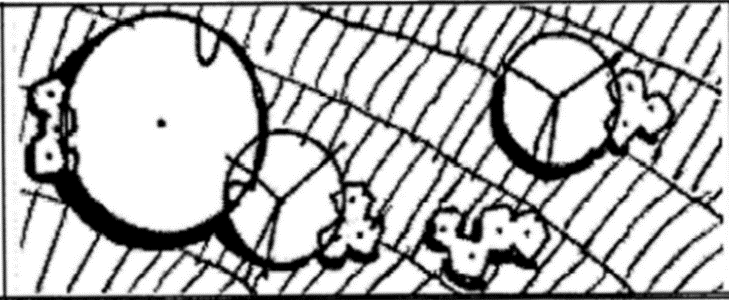 |
|
Alternative Unit B
(see note 1 below) |
1 - 2.5 in. caliper Canopy Tree
1 - 1½ in. cal./6′ high Understory 1 - 8 ft. high Evergreen 11 - 3 ft. high Shrub | 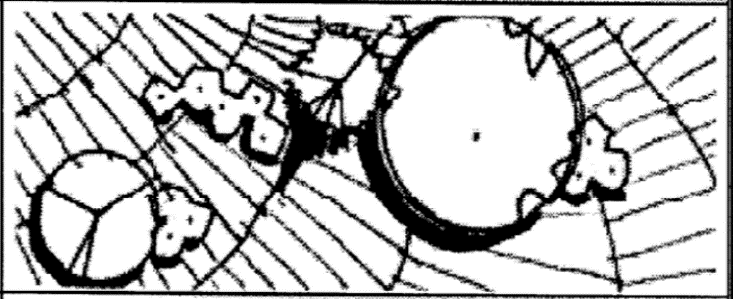 |
|
Alternative Unit C
(see note 1 below) |
2 - 1½ in. cal./6′ high Understory
3 - 8 ft. high Evergreen 7 - 3 in. high Shrub | 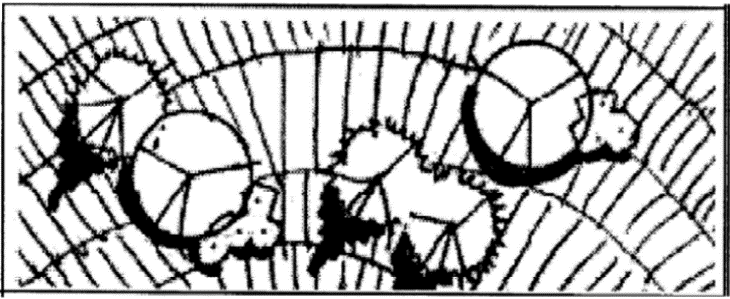 |
|
Alternative Unit D
(see note 1 below) |
4 - 8 ft. high Evergreen
15 - 3 ft. high Shrub | 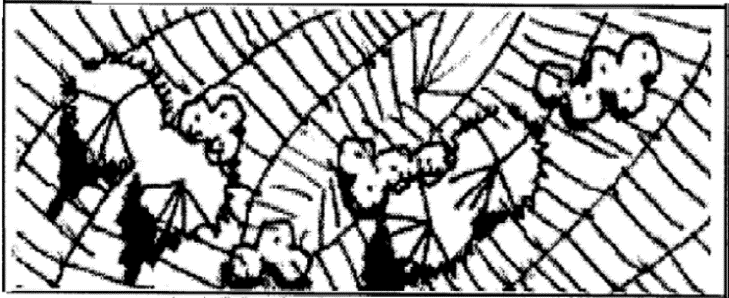 |
|
Alternative Unit E
(see note 2 below) |
2 - 3 in. caliper Canopy Tree
3 - 3 ft. high Shrub |  |
|
1. Preferred for year-round screen.
2. May be required where visibility is required for safe automobile operation. | ||
Sec. 13.12 - Fences and Walls.
Fences and walls may be permitted to enclose yards subject to the following:
13.12.1
Materials and Height.
A.
All fences shall be constructed of materials expressly designed for fences, such as wood pickets, chain link, wrought iron or combination of masonry columns and any of the previously listed materials. All fences shall be maintained in a state of good repair. It is recommended that applicants review their subdivision covenants, if applicable before applying to the City or Parish for a building permit. Fence height is limited to seven (7) feet unless approved as a Conditional Use following the approval procedures of Section 3.3.2 and shall meet all or a portion of the below criteria:
1.
May be approved as a component of a Planned Unit Development.
2.
May be utilized as an exterior perimeter fence for lots located on highways or other streets, railroads, and utilized for compatibility buffers, noise abatement or security.
3.
May be approved on the exterior perimeter of a subdivision as a component of the subdivision master development plan or subdivision plat.
4.
Wooden fences, taller than six (6) feet in height, shall have a minimum of three (3) cross members to prevent warping of the wooded pickets. Methods of construction, for fences taller than seven (7) feet in height, shall be reviewed as a component of the "Conditional Use" approval process.
B.
On a corner lot, where a rear yard faces the street (on one side), any type of fence may extend from the rear property line along the building set back line at a height of 7 feet. Any fence that crosses the building setback line (front or side) shall not exceed 4 feet in height.
C.
Fences or perimeter walls along street yards that are also rear yards area allowed provided: The fence design along road frontages shall ensure a uniform appearance and shall conform to the street bufferyard requirements in Section 13.1.
D.
Masonry walls (brick, stone, etc.) or combination wrought iron/masonry are limited to the perimeter of subdivisions. All fencing between lots must be chain link or wood. Solid masonry, cinder block or a combination of masonry columns and wood are prohibited between lots within a residential subdivision unless approved as a component of a Planned Unit Development. Height of fences, within the PUD, shall be approved by the MPC zoning board as part of the development plan.
E.
In the A-1, A-2, I-1 and I-2 districts, security chain link fences shall be permitted within the front setback at a maximum height of 8 feet. It shall be determined by the zoning department that the fence does not interfere with visibility.
F.
Barbed wire, razor wire, spiked posts, electrified or similar fencing shall be a Permitted use in the R-A, A-1, A-2, I-1 and I-2 districts. In the B-Districts, this type of fencing must be approved by the Planning Commission as a Conditional Use following the procedures of Section 3.3.2, and shall not be located within 30 feet of an R-E, R-LD, R-MD or R-HD district boundary.
G.
In the RFD, RT and B-Districts, all fencing taller than 4 feet in a street yard must be approved as a Special Exception Use, Section 5.2.4.
H.
In all Residential Districts within the City Limits of Bossier City, fences up to 8 feet in height, may be approved by Special Exception Use, following the procedures of Section 3.3.3. The following shall apply:
1.
Fences taller than 7 feet in height shall not be erected between residences, unless the separation between the residences is at least 20 feet.
2.
If an active Home Owner's Association exists, approval of any fence taller than 7 feet must include review and approval by the HOA.
3.
The fence height should not exceed the fence height allowed within the subdivision covenants.
4.
The 8 foot fence shall meet the standards of Subsection 13.12.1.A.4 above.
13.12.2
Fences in Front or Street Yards. Fences in the front yard of corner and interior lots shall not exceed 4 feet high and shall be set back at least 1 foot from any sidewalks situated on the right-of-way.
A.
Within the unincorporated area of the Bossier Parish Metropolitan Planning Commission jurisdiction, residential front yard fences shall be approved only by Special Exception following the procedures of Section 3.3.3.
1.
Exceptions. Property zoned R-A Residence Agriculture.
Sec. 13.13 - Clear Visibility Triangle.
13.13.1
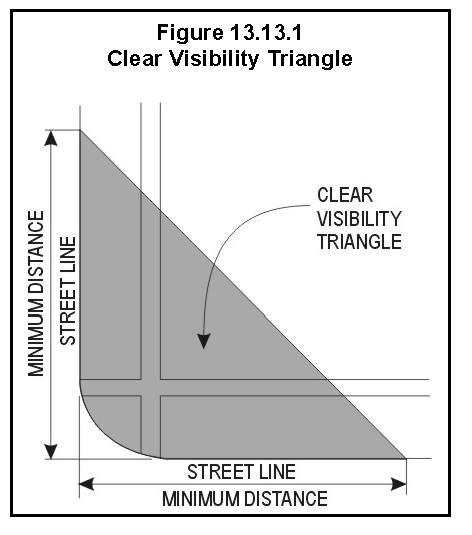
When any public right-of-way or access way intersects a public right-of-way or when the subject property abuts the intersection of two or more public rights-of-way, no fence, wall, hedge or other structure or planting shall be erected, placed or maintained that obstructs view at a level between three (3) feet and ten (10) feet above the street grade and within the clear visibility triangles as defined in Subsections (A) and (B) below. Within the clear visibility triangle, unobstructed cross-visibility shall be provided. However, trees having limbs and having foliage trimmed in such a manner that no limbs or foliage extend into the unobstructed cross-visibility area shall be allowed, provided they are located so as not to create a traffic hazard.
A.
Corner Lot. On a lot at the corner of two public streets, the clear visibility triangle shall be formed by the intersecting street lines and a straight line joining the street lines at points which are the following minimum distances from the point of intersection measured along the street lines.
Table 13.13.1
Clear Visibility Triangle Distance Requirements
B.
Accessway. For an accessway other than a single-family residential driveway, the clear visibility triangle shall be formed by the intersecting lines of the accessway and the public right-of-way, and a straight line joining those two lines at points which are 15 feet distant from the point of intersection. The clear visibility triangle shall be formed on both sides of the accessway on the subject property.
13.13.2
Modification.
A.
This clear visibility triangle standard may be modified by the Zoning Officer when deemed necessary by the City or Parish Engineer to ensure traffic safety.
B.
This clear visibility triangle standard shall not apply within the B-5 district.

