
Bossier City City Zoning Code
ARTICLE 3
- PROCEDURES AND ADMINISTRATION
Sec. 3.1 - Purpose.
This Article establishes the procedures for all approvals, administrative reviews, relief, and appeals provided for in this Code. It provides diagrams for the major procedures to be followed.
Sec. 3.2 - Zoning permit and certificate of occupancy.
No structure or land shall be used, occupied or changed in use until a Certificate of Occupancy or Zoning Permit is issued by the Metropolitan Planning Department as required by this code.
3.2.1
Zoning permit. When applicable, no building or other permit, license or other document of approval, for which the use of may be subject to the provisions of this Code, shall be issued by any department, agency, or board of the City/Parish until zoning approval is obtained from the Metropolitan Planning Department stating that the intended occupancy of the permit, license or other document is in full compliance with the provisions of this Code.
A.
Documentation. Approval shall be documented through either of the following:
1.
A Zoning Permit issued by the Metropolitan Planning Department.
2.
Signoff by the Metropolitan Planning Department on the appropriate section of the Building Permit application forwarded.
B.
Application. To receive a Zoning Permit or Building Permit signoff, an applicant shall submit all required application fees and 2 copies of each of the following:
1.
A survey plat of the lot(s) on which the intended occupancy or improvements are to be situated, prepared and certified by a Registered Surveyor or Professional of Record as required.
2.
A Site plan indicating:
a.
Location of the building on the site.
b.
Accurate dimensions of the site, building and setbacks.
c.
Location and intended layout of off-street parking and loading spaces.
d.
Location, layout, size and species of required landscaping and buffering.
e.
Such other information as may be necessary for the enforcement of this Code.
3.2.2
Certificate of Occupancy. A Certificate of Occupancy may be issued by the Metropolitan Planning Department only after all intended site improvements and building construction has been completed in accordance with the Zoning or Building Permit and all applicable requirements of this code.
A.
Application and Fees. Fees for a Certificate of Occupancy shall be approved by the MPC as part of the schedule fees. The Certificate of Occupancy shall be issued only after any required final inspections have been conducted and approved by the appropriate agency.
B.
Inspections. An inspector from the Metropolitan Planning Department or a designated inspector from the Bossier City Inspections Department may perform a field inspection to determine compliance with the regulations of this Code under the following circumstances:
1.
Any change in business name, occupancy, ownership, or proprietorship.
2.
Any change in use or increase in intensity of existing uses.
3.
Any change in exterior dimension(s) of the principal structure.
4.
Any change in off-street parking or loading configuration.
5.
Any subdivision of or sale in property that results in reduction of lot size.
C.
Certificate of Occupancy without Zoning Permit. If a change in use or occupancy requires no site improvements or structural changes that require a Building Permit or other certificate, an applicant may apply directly for a Certificate of Occupancy.
D.
Period of Effect. Once issued, a Certificate of Occupancy shall be in effect for its specified occupant, use, lot, and site configuration for an indefinite period. Any changes specified in Section 3.2.2.B that occur may require a new Certificate of Occupancy.
E.
Exclusion for Residential Occupancy Changes. Single Family construction and any change in residential occupancy of a residential unit within a multiple-family structure, or manufactured housing park site shall be excluded from the requirements of obtaining a Certificate of Occupancy, unless the change in occupancy occurs directly in conjunction with:
1.
New construction (Single Family residential exempt),
2.
Remodeling that results in a change of exterior dimensions, or
3.
Increase in the number of dwelling units within a structure.
3.2.3
Temporary Use Permits. Application requirements, general standards, and approval procedures for temporary uses are specified in Subsection 3.4.4.
Sec. 3.3 - Land use review procedures.
The provisions in this Section shall apply to any intended change in land use, temporary use, or accessory use.
3.3.1
Provisional Uses.
A.
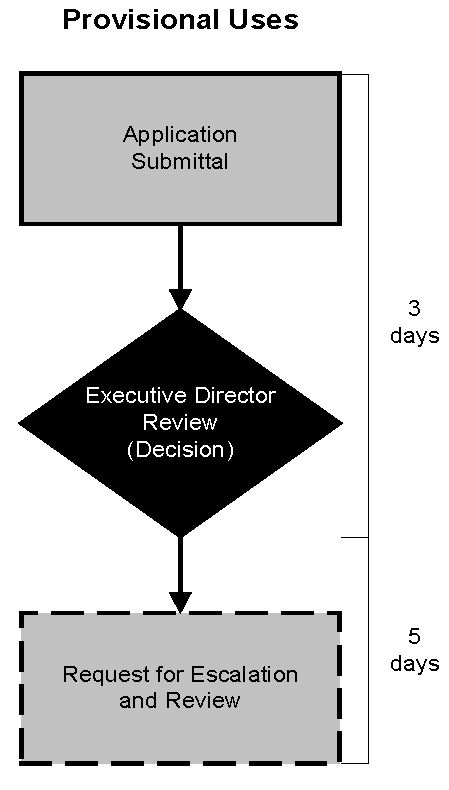
Applicability. If a proposed change in land use, land development project or other improvement is listed in the Use Table referenced in Section 5.3 as a Provisional Use (P*) for its intended district, the Executive Director shall make a determination that all appropriate provisional use standards in Section 5.6 are met before issuing a Certificate of Occupancy or Zoning Permit.
B.
Review. The Executive Director may request additional information from the applicant in making a determination that the standards in Section 5.6 will be met.
C.
Notification. The Executive Director shall approve or disapprove the application following the receipt of a complete application and shall advise the applicant of approval or non-approval.
D.
Expiration. A Provisional Use determination shall expire after 1 year unless the applicant submits a request for extension. The Executive Director may grant one 6-month extension.
E.
Review of a Provisional Use Decision.
1.
Any determination of a Provisional Use by the Executive Director may be affirmed, reversed or revised by the Bossier City-Parish Metropolitan Planning Commission at the request of the following:
a.
The Executive Director.
b.
The applicant.
c.
Any member of the Bossier City-Parish Metropolitan Planning Commission.
d.
The Mayor of Bossier City or any City Council Member.
e.
Any Member of the Bossier Parish Police Jury.
2.
The request must be submitted to the Executive Director in writing within 5 business days of the determination.
3.
The Bossier City-Parish Metropolitan Planning Commission shall follow the same review procedures as a Conditional Use, as stated in Section 3.2.2, for a Provisional Use review.
4.
If the applicant initiates the request for escalation, he/she shall be responsible for payment of any associated application fees for processing the request.
3.3.2
Conditional Uses.
A.
Applicability. If a proposed change in land use, land development project or other improvement is listed in the Use Table as a Conditional Use ("C") for its intended district, the Bossier City-Parish Metropolitan Planning Commission shall make a determination that all appropriate Conditional Use standards in Section 5.6 are met before issuing a zoning certificate.
B.
Submission Requirements. An application for Conditional Use review shall consist of information necessary for the Metropolitan Planning Commission to make a determination regarding the Conditional Use request, including, but not limited to the following:
1.
Documentation for a Major or Minor Site Plan Review as specified in Subsection 3.7.3.
2.
A site plan showing the proposed siting of structures and uses on the subject property.
3.
The proposed land coverage of intended development, expressed in terms of acres if applicable.
4.
An analysis addressing the consistency of the proposed conditional use with the character and purpose of the zoning district in which it would be located shall be provided by MPC staff.
5.
Any relevant information regarding the traffic impact of such proposed use.
6.
The consistency of the proposed use with the Comprehensive Plan shall be provided by the MPC staff.
7.
Any additional documentation supporting the appropriateness of the intended use as might be required by Section 5.6.
8.
Either an operational site plan or floor plan as recommended by the planning staff.
C.
Staff Review and Report.
1.
Within 30 days after receipt of a complete application and required fees, the Executive Director shall add the Conditional Use request to the next available scheduled regular meeting of the Metropolitan Planning Commission and prepare a staff report that reviews the proposed development in light of the Comprehensive Plan, the review criteria listed above, and the requirements of this Code.
2.
The Executive Director shall mail or provide a copy of the report to the Metropolitan Planning Commission and the applicant at least 7 days prior to the scheduled hearing.
3.
Notification of surrounding property owners, for a Conditional Use request, shall follow the same procedure as a zoning amendment as required in Section 3.9.7.
D.
Action by Metropolitan Planning Commission.
1.
The Metropolitan Planning Commission shall hold a public hearing on the Conditional Use application.
2.
After review of the conditional use application and the public hearing, the Metropolitan Planning Commission shall make a written finding and give its approval; approval with modifications or conditions; or disapproval to the conditional use request.
3.
If approval or approval with modifications and conditions is granted, the decision shall be communicated in writing to the applicant; and the applicant shall thereby be authorized to submit a development plan application consistent with this Code.
E.
Action by the Bossier City Council or Bossier Parish Police Jury. The MPC will forward, to the appropriate Legislative body, its Recommendations regarding the Conditional Use, including but not limited to, that development must be in accordance with any approved site or operational site plan. The Legislative body may, after public hearing and review, vote to approve the conditional use, deny the conditional use, modify or impose such additional conditions to the conditional use application as it deems appropriate, or remand to the MPC for further consideration of the conditions to be imposed. This procedure shall only apply to Alcohol and Conditional Uses as listed in the Use Table of Article 5 of this Code.
F.
Conditional Use Review Criteria. The Metropolitan Planning Commission may approve a Conditional Use application only if the applicant demonstrates that the proposed use and any associated development:
1.
Will conform to any specified standards for the intended use enumerated in Section 5.6.
2.
Is consistent with the goals, objectives and policies of the Bossier City-Parish Comprehensive Plan, as amended.
3.
Will be consistent with the "purpose statements" of the applicable district specified in Section 4.1.
G.
Appeal. An applicant or resident of the Metropolitan Planning Commission's jurisdiction that is aggrieved by the Metropolitan Planning Commission's Conditional Use determination, may appeal such determination to the District Court of Bossier Parish within 30 days of the Metropolitan Planning Commission's finding.
H.
Expiration of Approval. A conditional use approval shall expire after one year unless the applicant re-submits a complete development plan review application to the MPC Board.
3.3.3
Special Exception Uses.
A.
Applicability. If a proposed change in land use, land development project or other improvement is listed in the Use Table as a Special Exception Use ("S") for its intended district, the Bossier City-Parish Zoning Board of Adjustment shall make a determination that all appropriate Special Exception use standards in Section 5.6 are met before issuing a Certificate or Occupancy or Zoning Permit.
B.
Submission Requirements. An application for special exception review shall consist of information necessary for the Board of Zoning Adjustment to make a determination regarding the special exception request, including, but not limited to the following:
1.
If required as a condition for approval, documentation for a Major or Minor Site Plan Review as specified in Subsection 3.7.2.
2.
The proposed land coverage of intended development, expressed in terms of area covered by buildings, paved surfaces and unpaved open space areas.
3.
An analysis addressing the consistency of the proposed special exception use with the character and purpose of the zoning district in which it would be located shall be provided by the MPC staff.
4.
Any relevant information regarding the traffic impact of such proposed use.
5.
The consistency of the proposed use with the Comprehensive Plan.
C.
Staff Review and Report.
1.
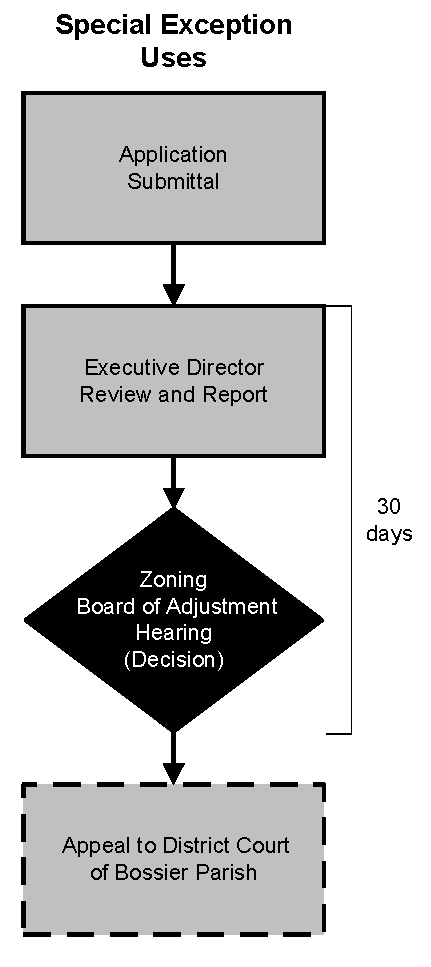
Within 30 days after receipt of a complete application and required fees, the Executive Director shall add the Special Exception Use request to the next available agenda of the Zoning Board of Adjustment and prepare a staff report that reviews the proposed development in light of the Comprehensive Plan, the review criteria listed below, and the requirements of this Code.
2.
The Executive Director shall mail or provide a copy of the report to the Zoning Board of Adjustment and the applicant at least 7 days prior to the scheduled hearing.
D.
Action by Zoning Board of Adjustment.
1.
The Zoning Board of Adjustment shall hold a public hearing on the Special Exception application.
2.
After review of the special exception application and the public hearing, the Zoning Board of Adjustment shall make a written finding and give its approval; approval with modifications or conditions; or disapproval to the special exception request.
3.
If approval or approval with modifications and conditions is granted, the decision shall be communicated in writing to the applicant; and the applicant shall thereby be authorized to submit a development plan application consistent with this Code.
E.
Special Exception Review Criteria. The Zoning Board of Adjustment may approve an application for use by Special Exception only if the applicant is able to demonstrate that the proposed use and any associated development:
1.
Will conform to any specified standards for the intended district and use enumerated in Section 5.6.
2.
Will be in accordance with the Bossier City-Parish Comprehensive Plan.
3.
Will be consistent with the "purpose statements" of the applicable district specified in Subsection 4.1.
4.
Will be compatible with the existing uses adjacent to and near the property.
5.
Will not be hazardous, detrimental or disturbing to present surrounding land uses due to noise, glare, smoke, dust, odor, fumes, water pollution or general nuisance.
6.
Will not otherwise adversely affect the development of the general neighborhood or of the district in which the use is proposed.
7.
Will be consistent with existing and planned pedestrian and vehicular circulation adjacent to and near the property.
8.
Will have adequate water supply, sewage collection and disposal, stormwater facilities, waste disposal and other public services.
9.
Will not be contrary to the public health, safety and welfare, provided that a denial based exclusively on this language shall include explicit findings regarding the way in which granting the special exception would be contrary to the public health, safety and welfare.
F.
Appeal. Any applicant aggrieved by the Board's determination may appeal such determination to the District Court of Bossier Parish within 30 days of the Board's decision.
G.
Expiration of Approval. A Special Exception approval shall expire after one year unless the applicant re-submits a complete development plan review application to the Board of Adjustment.
3.3.4
Temporary Use Permits. Temporary uses, which are allowed in accordance with Section 6.7, require a Temporary Use Permit from the Bossier City-Parish Planning Department before the proposed use or activity may begin.
A.
A completed application form and the required fees shall be submitted to the Planning Department. The Executive Director may request other data, plans, and information necessary to assess the potential impacts of the proposed temporary use, to make findings, and to establish appropriate conditions for the temporary use.
B.
A temporary use permit shall be approved, modified, conditioned, or denied by the Executive Director within 5 business days after submittal of a complete application.
C.
Findings. The Executive Director may approve, or conditionally approve a 10 day temporary use permit application, only when all of the following findings are made:
1.
The site is physically suitable for the type and intensity of the temporary land use;
2.
The proposed temporary use is compatible with the land uses presently on the site and with existing land uses in the general area;
3.
There are adequate provisions for public and private utilities and services to ensure that the proposed temporary use would not be detrimental to public health and safety;
4.
Adequate provisions for public access to serve the proposed temporary use are provided;
5.
Any negative impacts of the proposed temporary use are mitigated; and
6.
Adequate provisions for emergency access to serve the proposed temporary use are provided.
D.
Conditions of Approval. In approving an application for a temporary use permit, the Executive Director may impose conditions deemed reasonable and necessary to ensure that the permit will be in accordance with the findings required by this Subsection and to satisfy public needs directly caused by the proposed temporary use. These conditions may involve any pertinent factors affecting the operation of such temporary event, or use, and may include, but are not limited to:
1.
The applicant for a temporary use permit, if a natural person, shall be at least 18 years of age. If the applicant applies for a permit on land belonging to another, the applicant must provide the building official with a notarized copy of the owner's written consent. The applicant must be domiciled in Louisiana or provide a registered agent for service of process within Louisiana.
2.
Provision for a fixed period of time, not to exceed the provisions in Section 6.7 for a temporary use, or for a shorter period of time as determined by the Executive Director.
3.
Provision for temporary parking facilities, including vehicular ingress and egress and appropriate circulation.
4.
Regulation of nuisance factors such as, but not limited to, prevention of glare or direct illumination on adjacent properties, noise, vibration, smoke, dust, dirt, odors, gases, and heat.
5.
Regulation of temporary structures and facilities, including placement, height and size, location of equipment and open spaces, including buffer areas and other yards.
6.
Provision of sanitary and medical facilities.
7.
Provision of solid, hazardous and toxic waste collection and disposal.
8.
Provision of security and safety measures.
9.
Provision of regulation of signs.
10.
Regulation of operating hours and days, including limitation of the duration of the temporary use.
11.
Upon expiration or revocation of a temporary use permit, the applicant shall clean the site of all debris, whether generated by the temporary use or not.
12.
A requirement that the approval of the requested temporary use permit is contingent upon compliance with applicable provisions of the Federal, State, Parish and City Codes.
13.
Required off-street parking for temporary and principal commercial uses, in accordance with Article 12 may be reduced up to 10 percent.
14.
Any other conditions which will ensure the operation of the proposed temporary use in an orderly and efficient manner and in accordance with the intent and purpose.
E.
Revocation. A temporary use permit may be revoked or modified effective immediately upon written notice of violation by the Executive Director, or his official designee, if any one of the following findings can be made:
1.
Circumstances have materially changed so that one or more of the required findings is no longer present;
2.
The temporary use permit was obtained by misrepresentation or fraud;
3.
One or more of the conditions of the temporary use permit have not been met; or
4.
The use is in violation of any statute, ordinance, law, or regulation.
F.
Appeals. Any decision of the Executive Director on a temporary use permit application may be appealed to the Zoning Board of Adjustment within 10 days of the action of the Executive Director.
3.3.5
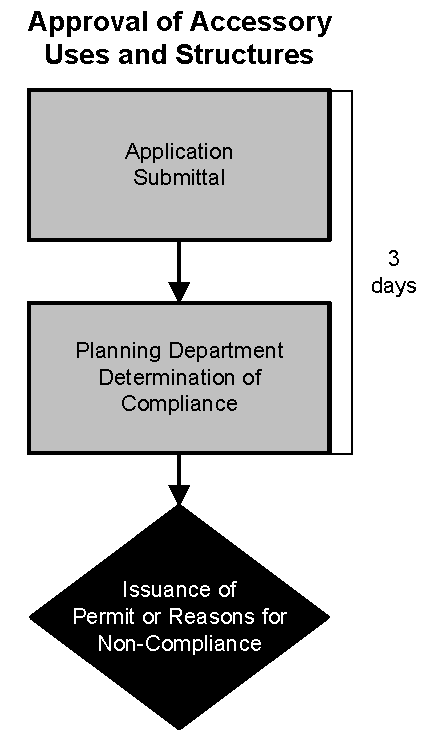
Approval of Accessory Uses and Structures. Accessory uses and structures, which are allowed by right in conjunction with a principal use in accordance with Subsection 6.5, require a determination of compliance by the Bossier City-Parish Planning Department before any building permit is issued by the Bossier City Permits Department or appropriate Bossier Parish agency.
A.
The Bossier City Permits Department or Bossier Parish agency shall, upon receipt, forward a copy of any building permit application involving an accessory structure or use to the Planning Department.
B.
The Planning Department shall determine compliance with existing yard, height, use and other zoning requirements after submittal of a complete application and shall return this determination to the referring agency.
C.
If an intended accessory use or structure is determined to be noncompliant with this Code, the department shall indicate the reasons for noncompliance and any appropriate remedies or conditions that would enable compliance. The Bossier City Permits Department or appropriate Bossier Parish agency may issue a building permit on the basis of these recommended conditions.
D.
The Metropolitan Planning Commission, City of Bossier City and the Bossier Parish Police Jury cannot enforce deed restrictions or covenants as they are private agreements between the seller and the property owner. Because the governing bodies and the planning department are not party to the covenants or deed restrictions, they have no legal authority or jurisdiction to enforce them. Enforcement action is typically taken by an active Homeowner's Association, or an individual property owner who is also part of the same covenants or restrictions. Either party may take the violation before a court of law for judgement and enforcement of the covenants or restrictions.
(Ord. No. 20-2019, 2-19-2019; Ord. No. 75-2021, 8-3-2021)
Sec. 3.4 - Miscellaneous Application Reviews.
3.4.1
On-premises Signs.
A.
Sign Location Permit Required. On-premises signs requiring a permit under Subsection 8.4.1 shall be installed, constructed, or modified only in accordance with a duly issued and valid Sign Location Permit and if required, a subsequent Building Permit issued by the Permits and Inspections Office. No Building Permit shall be reviewed or issued for a sign until a Sign Location Permit has been first issued by the Executive Director.
1.
One application for a Sign Location Permit may include multiple signs on the same lot or parcel.
2.
An application for a Sign Location Permit shall include:
a.
The name, address and telephone number of the sign owner;
b.
The name and address of the person or firm who will install, construct, or modify the sign, if not the sign owner; and
c.
Detailed drawings that show the dimensions, design, structure, and location of each particular sign.
3.
During a 1 year period after the issuance of a Sign Location Permit, the zoning department shall inspect the premises that are the subject of the permit.
a.
If the sign installation, construction, or modification has not been substantially completed at the time of inspection, the sign permit shall lapse and become void.
b.
If the sign installation, construction, or modification is substantially complete, but the sign does not comply with the requirements of Section 8.3, then the Executive Director or their official designee shall notify the owner in writing of the nature of the noncompliance, upon which notice the owner shall have 30 days to correct the noncompliance.
c.
If the noncompliance is not corrected within the 30-day period, the sign permit shall lapse and become void.
B.
Previously Approved and Preexisting On-Premises Signs. Whenever any use having one or more previously approved or preexisting on premises signs requires a Certificate of Occupancy due to change in ownership or land use, the signs requiring a permit under Subsection 8.2.1 shall be permitted to remain only in accordance with a duly issued and valid Sign Location Permit issued by the Executive Director.
1.
One application for a Sign Location Permit may include multiple signs on the same lot or parcel.
2.
A Sign Location Permit application for a previously approved or preexisting sign shall include:
a.
The name, address and telephone number of the sign owner; and
b.
Photographs that adequately depict the design, structure, and location of each particular sign. Photos shall be at least 4 inches by 6 inches in size and shall include a scale reference item, such as a surveyor's rod, near the sign so that dimensions can be reasonably determined.
c.
A copy of the previously approved Sign Location Permit, if any exists.
3.
If a previously approved or preexisting sign is not in compliance with this Code, it shall be removed or brought into compliance before the Certificate of Occupancy may be issued.
C.
Assignment of Permits. Sign Location Permits may not be assigned to a successor as owner of the premises or holder of a business license for the premises.
D.
Sign Inspection; Warning and Removal. The Planning Department may from time to time inspect signs. Such inspection shall be to determine continuing compliance with this Article and with the terms and conditions of the sign construction or continuance permit, if any.
1.
If a sign does not comply with the requirements of this Article and/or the terms and conditions of the permit, then the Executive Director shall notify the sign owner in writing of the nature of the noncompliance, upon which notice the sign owner shall have 30 days to correct the noncompliance. If a sign is prohibited pursuant to this Section or Section 8.2, then no such notice is required and the Executive Director may proceed pursuant to Paragraph 3 for uncorrected noncompliance.
2.
If the noncompliance is corrected within the 30-day period, then the Executive Director shall issue a letter to the sign owner stating that the sign that was the subject of the noncompliance notice under Paragraph 1 is now in compliance.
3.
If the noncompliance is not corrected within the 30-day period, the Executive Director shall issue notice to that effect to the sign owner and:
a.
The Sign Location Permit, if any, shall lapse and become void; and
b.
The sign owner shall remove the sign within 10 days of receipt of the notice. If the sign is not removed within that time, the Planning Department may remove the sign without further notice and at the permit holder or sign owner's expense.
4.
If there are multiple signs on the premises, including multiple signs subject to a single Sign Location Permit, the Executive Director may simultaneously proceed according to Paragraph 2 above for compliant signs and Paragraph 3 above for noncompliant signs.
3.4.2
Off-Premises Signs.
A.
Sign Location Permits.
1.
Purpose. The purpose of the Sign Location Permit is to assure compliance, through review of plans and inspection during construction, with all of the requirements established by this Code and related provisions of the Building Code.
2.
Applicability or Activities Subject to Review.
a.
No off-premises sign shall hereafter be demolished, erected, moved, added to, or structurally altered without a Sign Location Permit issued by the Planning Department in conformity with the provisions of this Section. No Sign Location Permit or Building Permit issued under the provisions of this Chapter shall be considered valid unless signed by the Building Official and the Executive Director or their designees.
b.
Normal maintenance of a sign shall not require a Sign Location Permit.
B.
Application.
1.
An application for an off-premises Sign Location Permit shall be filed with the Executive Director shall include the following:
a.
A completed application on the form provided by the Executive Director.
b.
One copy of a site plan showing data about the site and distances to all existing signs and the location, and construction details including design, materials, colors, height, width, depth, and square footage of the sign;
(1)
The site plan shall also show all clear visibility triangles, proximity to interstate or arterial that it is directed to and all required setbacks from adjoining properties;
(2)
If not shown on the site plan, a separate drawing shall show the distance from the nearest residential property and from all off-premise signs larger than 72 square feet and located within 1,000 feet of the proposed sign.
c.
The name, address and telephone number of the sign owner and of the sign contractor and 24-hour emergency contact information of the sign manager and at least one alternate.
d.
Information on the zoning of the site, surrounding zoning and site access;
e.
Any other pertinent data as may be required to ensure compliance with this Article; and
f.
A copy of a recorded lease or memorandum of understanding between the sign company and the property owner. Article 9 of this Code must be referenced and attached to the lease or memorandum.
2.
Approval Criteria. The sign must comply with the requirements of Article 9 and all other applicable requirements of this Code.
3.
Review. If the application is complete, the Executive Director shall schedule the application for the next meeting of the Metropolitan Planning Commission Zoning Board occurring at least 30 days after receipt of the complete application. At that meeting, the MPC shall consider the application and take testimony from the applicant and other interested persons.
4.
Action. The Metropolitan Planning Commission may approve the application, disapprove the application or approve the application with conditions.
5.
Permit. If the Metropolitan Planning Commission approves the application or approves it with conditions, the Executive Director or their designee shall issue a Sign Location Permit upon receipt of a site plan, making the site plan a condition of the permit and including in the permit any non-message oriented conditions imposed by the MPC. If the application is disapproved, the Executive Director shall notify the applicant in writing of the disapproval.
6.
Duration, Effect. The permit shall contain an expiration date, which shall be 180 days after the date of approval or approval with conditions by the Metropolitan Planning Commission. From the date of issuance until the expiration date, the Sign Location Permit shall entitle the holder to apply for a Building Permit for the sign subject to the sign location permit. A sign location permit may be extended once by the zoning board for a period of not more than 180 days. After the expiration of a sign location permit or any extension thereof, no application for a sign from the same sign vendor on the same lot of record or the same tax parcel may be accepted or considered for a period of at least 1 year from the date of expiration.
C.
Enforcement.
1.
The Director of Permits and Inspections and the Executive Director or their designees are hereby authorized and directed to enforce all the provisions of this Code. Upon presentation of proper credentials, the Director of Permits and Inspections and the Executive Director or their designees may enter any building, structure or premises in the Bossier City-Parish MPC planning limits to perform any duty imposed by this Code.
2.
The Director of Permits and Inspections or the Executive Director may order the removal of any sign erected or maintained in violation of the ordinance. The Director of Permits and Inspections or the MPC Executive Director or their designee shall give 10 days' notice in writing to the owner of such sign or of the buildings structure or premises on which such sign is located, to remove the sign or bring it into compliance. If the sign owner fails to comply with that order, the Director of Permits and Inspection or the MPC Executive Director may:
a.
Seek prosecution of the sign owner;
b.
Request that the attorney for the Parish or the City, as applicable, seek a court order of abatement or seek appropriate injunctive relief; or
c.
Authorize the removal of the sign after a temporary restraining order is obtained with the costs to be assessed against the property if the MPC Executive Director or Director of Permits and Inspections finds that the sign presents an immediate threat of danger to the safety of the public.
3.4.3
Telecommunications Facilities.
A.
Application for a telecommunications facility shall be made upon a form to be provided by the Metropolitan Planning Commission. The Zoning Board may waive submittal requirements or require additional information based on project specific factors.
B.
The initial submittal shall include:
1.
A site plan drawn to a measurable scale showing the metes and bounds and existing features of the site including existing structures, roads, trees, and other significant natural features.
2.
A map identifying the applicant's existing telecommunications facilities within the MPC jurisdiction. The map shall include an illustration of the estimated coverage area for all existing and proposed antenna sites for the applicant and/or service provider.
3.
A letter to the Executive Director stating that the system, including the antennas and associated equipment, conforms to the radio-frequency radiation emission standards adopted by the FCC.
4.
All applicable filing fees for processing and monitoring the application as established by the MPC.
C.
If warranted by the project (as determined by the MPC), the applicant may also be asked to provide:
1.
A letter explaining the site selection process including information about other sites that were considered and reasons for their rejection. In addition, carriers may be asked to demonstrate that facilities have been designed to attain the minimum height required from a technological standpoint for the proposed site.
2.
Visual impact demonstrations using photo-simulations, story poles, elevations or other visual or graphic illustrations to determine potential visual impact including proper coloration and blending of the facility with the proposed site (number of copies, if applicable, to be determined by the Executive Director).
3.
A landscape plan that shows existing vegetation, indicating any vegetation proposed for removal, and identifying proposed planting by type, size, and location.
3.4.4
Temporary Uses. Temporary uses not to exceed 1 year in duration, may be approved in the districts specified in the Use Table contained in this Code, by application to the MPC Board. Temporary Uses may be approved no more than two consecutive time periods on the same site.
A.
Application.
1.
Applicant. An applicant must be an adult resident of the State of Louisiana, a Louisiana-registered agent of that person, or a Louisiana corporation.
2.
Required Information. The applicant shall provide the Planning Department with the following information:
a.
Proof of ownership of the subject property or, if the application is for a permit on a site belonging to another, a notarized copy of or the owner's written consent and proof of ownership;
b.
Boundaries and dimensions of the site;
c.
Distance to nearest buildings and adjacent streets and curbs;
d.
Details of on-site traffic circulation and parking;
e.
Locations and specifications of necessary electrical sources;
f.
Locations of available permanent or portable sanitary facilities;
g.
Locations, types and sizes of temporary structures or enclosures;
h.
Estimates of daily attendance, if applicable;
i.
Other information, if requested and reasonably related to the protection of public health, welfare and safety.
B.
Approval Procedure. A temporary use shall be approved as a Permitted, Provisional, or Conditional Use or as a Special Exception in accordance with the Use Table.
C.
General Location and Setbacks. Setbacks for temporary uses are exempt from the yard requirements specified in Section 6.4 of this Code, provided they conform to the following requirements:
1.
Front (street) yard: 25 feet.
2.
Side yards:
a.
5 feet, non-industrial districts.
b.
10 feet, industrial districts.
3.
Rear yard: 25 feet.
4.
Temporary, open-air tent canopies having no sides and intended primarily to provide shading must be set back a minimum of 5 feet from the property line. These canopies may be permitted for up to 90 days.
D.
Exemptions.
1.
Construction Offices. Temporary construction offices, to be used for construction management purposes during the construction period of a project, are exempt from the requirement of applying for a permit.
2.
"Ten-Day" General Merchandise Sales Permits. The Executive Director may approve a Temporary Use Permit for a duration of up to 10 days, subject to the following standards:
a.
The applicant must provide a display diagram for tent sales, which illustrates how the merchandise will be displayed inside the tent. Other than samples of the merchandise intended to be sold, all sale merchandise shall be inside the tent. During hot weather conditions, sides of an enclosed tent may be raised.
b.
Applicant must post the company name, address and telephone number along with product warranty information, if applicable, in a conspicuous place within the tent at the permitted site. Lettering must be a minimum of 1 inch tall.
c.
Ten-day permits for retail sales shall not be approved in the R-E, R-LD, R-MD, R-HD, or R-MHP districts.
d.
A Temporary Use Permit for retail use must be applied for a minimum of 48 hours in advance of setup.
E.
Other Requirements.
1.
Upon expiration or revocation of a Temporary Use Permit, the applicant shall clean the site of all debris, whether generated by the temporary use or not.
2.
The Metropolitan Planning Commission or Executive Director may specify additional requirements or restrictions on temporary uses including but not limited to hours of operation, noise mitigation measures, lighting restrictions, architectural appropriateness or appearance and/or materials, odor controls, and other conditions.
F.
Revocation Provisions. The Temporary Use Permit may be revoked if:
1.
The applicant has misrepresented any material fact on his or her application and supporting materials;
2.
The temporary use fails or ceases to comply with applicable standards or criteria for issuance of a permit;
3.
The operation of the temporary use violates any statute, law, ordinance or regulation;
4.
The operation of the temporary use constitutes a nuisance or poses a real or potential threat to the health, safety or welfare of the public;
5.
The Executive Director or Metropolitan Planning Commission reserves the right to revoke a Temporary Use Permit, if it is determined that the use has become a traffic hazard based on standards established in the current edition of the Manual of Uniform Traffic Control Devices.
(Ord. No. 72-2025, §§ 1, 2, 7-1-2025)
Sec. 3.5 - Planned Unit Developments.
3.5.1
Purpose. A Planned Unit Development (PUD) is utilized for Mixed Use Developments and for the purpose of allowing and encouraging greater variety of design and flexibility from existing zoning requirements for Commercial, Industrial, and Multi-Family Residential buildings comprising a planned unit and for allowing of mixing of zoning classifications within a proposed development. The provisions of this Subsection, waives the requirement for a separate lot for each building and permits two or more buildings to be erected on the same lot. Additionally, district development standards may be modified when it is determined that the overall benefits of the proposed Planned Unit Development to the community justify their adjustment.
3.5.2
Submission Requirements.
A.
An application form as provided by the Planning Department for a Minor or Major Planned Unit Development and appropriate fee as required by the current Schedule of Fees.
B.
A project description and plan documents in conformance with Section 11.4.7 and the requirements of major or minor Site Plan Review, in accordance with Section 3.7.
3.5.3
Site Plan Review and Administration of Modifications during Development.
A.
Site Plan Review and administration of modifications of a proposed Planned Unit Development shall be performed in accordance with the Site Plan Review procedures contained in Section 3.7.
B.
A Minor Planned Unit Development may be approved by the Executive Director after submittal of a site plan to the MPC office. A Minor PUD is defined as a second, commercial or industrial, building located on the same building site as the primary building and requires no dimensional or other modifications to the District Development Standards in which the PUD is located. Any additional buildings, after the administrative approval of the second building, shall require an approval as a Major PUD.
C.
All Major Planned Unit Developments shall be reviewed by the Metropolitan Planning Commission, using the procedures for approval of a Conditional Use as specified in Subsection 3.8.2D.
D.
Requirements and review procedures for a Single Family Detached Residential Planned Unit Development are listed in Article 11 of this Code.
3.5.4
Planned Unit Development Documentation. If approved, the Planned Unit Development shall be considered part of the Zoning Map.
3.5.5
Effect and Amendments.
A.
Approval of a Planned Unit Development shall be binding upon the property owner, heirs and assigns. All subsequent building permit applications, zoning permit applications, Zoning Map amendments or intended subdivision actions shall consider the adopted site plan and all conditions of its approval.
B.
Any intended change in occupancy that results in a higher intensity of use or change in site configuration that results in a change in traffic patterns, reduction in required green or open space, or modification of any approved condition, shall require an amendment to the Planned Unit Development, following the procedures contained in this Section.
Sec. 3.6 - Appeals.
3.6.1
Variances.
A.
Purpose. A variance may be approved by the Zoning Board of Adjustment if the Board concludes that the strict enforcement of any dimensional or performance standard set forth in this Code would result in unnecessary hardship to the applicant and that by granting the variance, the spirit of this Code will be observed, public welfare and safety will not be diminished, and substantial justice will be done.
B.
Who May File. The owner, developer or otherwise responsible agent, shall initiate a request for a variance by filing an application with the Executive Director.
C.
Submission Requirements. An application for variance shall consist of information necessary for the Zoning Board of Adjustment to make a determination regarding the variance request, including but not limited to the following:
1.
A site plan to scale accurately showing the variance(s) requested.
2.
Certification, written and signed by the development site owner of record, that such owner formally consents to the proposed development or signature on an application provided by the zoning office.
3.
Any supporting documentation deemed necessary by the applicant or Executive Director.
D.
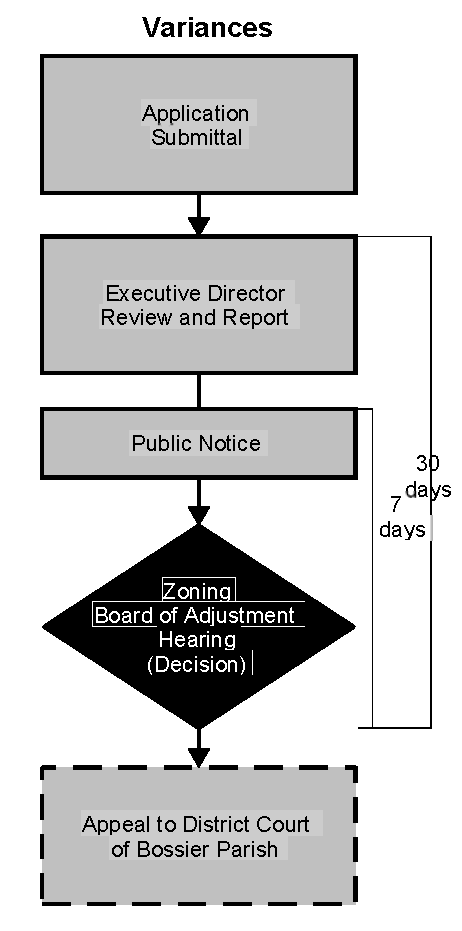
Staff Review and Report. The Executive Director shall schedule the variance for consideration the next scheduled public meeting, of the Zoning Board of Adjustment within 30 days after receipt of a complete application and required fees. The Executive Director shall provide a copy of the agenda and staff recommendations to the applicant and to the Zoning Board of Adjustment within 7 days of the meeting for which the application is scheduled to be reviewed.
E.
Action by Zoning Board of Adjustment.
1.
The Zoning Board of Adjustment shall hold a public hearing on the variance application.
2.
Public Notification shall follow the same notification procedure as a zoning amendment.
3.
After review of the variance application and the public hearing, the Zoning Board of Adjustment shall make a written finding and give its approval; approval with modifications or conditions; or disapproval to the variance request.
4.
If approved, or approved with modifications or conditions, the decision shall be communicated in writing to the applicant; and the applicant shall thereby be authorized to submit a development plan application consistent with this Article.
F.
Variances approved by Administrative Action by the Executive Director.
1.
Insubstantial features of an application for a rear or side setback variance may be approved administratively by the Executive Director in accordance with MPC Policy.
G.
Criteria for Approval of Variances.
1.
Required Findings of Fact. A variance may be granted by the Zoning Board of Adjustment if the Board concludes that the strict enforcement of any design and performance standard set forth in this Code would result in a practical difficulty and unnecessary hardship to the applicant and that by granting the variance, the spirit of this Code will be observed, public welfare and safety will not be diminished and substantial justice done. A variance may only be granted in an individual case of unnecessary hardship if the Board determines and expresses in writing all or part of the following findings of fact:
a.
There are extraordinary and exceptional conditions pertaining to the particular piece of property.
b.
These conditions do not generally apply to other properties in the vicinity.
c.
Because of these conditions, the application of the ordinance to the particular piece of property would effectively prohibit or unreasonably restrict the utilization of the property.
d.
The need for the variance(s) is not the result of the applicant's own actions.
e.
Granting of the variance(s) does not substantially conflict with the Bossier City-Parish Comprehensive Plan and the purposes of this Code; and
f.
Authorization of the variance(s) will not be of substantial detriment to adjacent property or the public good, and the character of the district will not be harmed by the granting of the variance.
2.
Limitations. The Board may not grant a variance, the effect of which would be any of the following:
a.
To permit any use of land or a structure that is not allowed in the applicable district.
b.
To allow the physical extension of a nonconforming use.
c.
To increase the density of a use above that permitted by the applicable district.
d.
To vary the On Premises or Off Premises sign regulations.
3.
Factors not to be Considered. The fact that property may be utilized more profitably, should any variance(s) be granted, may not be considered grounds for the variance(s).
4.
Hardship Due to Eminent Domain. Where the alleged hardship results from the taking of part of the property of the applicant by eminent domain, thus reducing the land area available for required parking, unpaved open space, buffers and other purposes, the applicant shall have the burden of proving that, after good faith efforts by the applicant or the applicant's predecessor, the condemning authority failed or refused to provide the applicant compensation adequate to cover the value of both the land actually taken and the economic impacts of the reduction in the size of the remaining property; only if the applicant meets such burden of proof will a hardship under these conditions be considered adequate to justify the granting of a variance.
H.
Appeal. Any party aggrieved by the Board's determination may appeal such determination to the District Court of Bossier Parish within 30 days.
1.
Within six (6) months of the date of denial, a subsequent application for the same approval will not be reviewed or heard unless there is a substantial new evidence available, or if a significant mistake of law or fact affected prior denial.
2.
If the application is resubmitted earlier than six (6) months from the date of denial, the subsequent application must include a detailed statement of the grounds justifying its consideration.
3.
The Executive Director will make a determination as to whether the subsequent application is appropriate for resubmittal prior to the expiration of the six (6) month wait requirement. If the Executive Director finds that there are no new grounds for consideration of the subsequent application, he/she will summarily, and without hearing, deny the request.
I.
Expiration of Approval. A variance approval shall expire after one year unless the proposed development is pursued as set forth below:
1.
The applicant re-submits a complete development plan review application to the Board of Adjustments; or
2.
Where development plan approval is not required, the applicant completes the approved activity designated in the variance.
3.6.2
Written Interpretations.
A.
Responsibility. The Executive Director may, subject to the procedures, standards and limitations hereinafter set out, render interpretations of any provision of this Code or any rule or regulation issued pursuant to it. Types of interpretation include but are not limited to:
1.
Applicability of a specific land use as a permitted, provisional, conditional or special exception use in Table 5.3 [Use Table].
2.
Definition of specific land uses within the context of the Classification of Uses specified in Section 5.4.
3.
Precise location of mapped district boundary lines.
B.
Initiation. A request for interpretation of the text provisions or Zoning Map of this Code may be initiated by any resident of the Bossier City-Parish Metropolitan Planning Commission jurisdiction, or may be initiated by the Executive Director in response to a particular application.
C.
Procedure.
1.
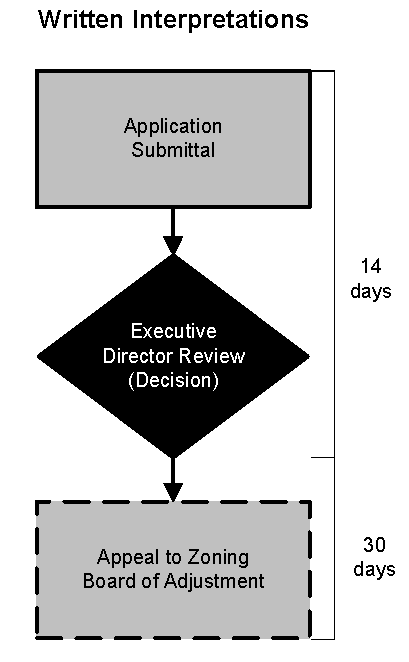
Written Request for Non Use Interpretation. Except as provided in Paragraph 2 below, a request for interpretation of any provision of this Code shall be submitted in writing to the Executive Director. It shall set forth the specific provision or provisions to be interpreted, the facts of the specific situation giving rise to the request for an interpretation, and the precise interpretation claimed by the applicant to be correct. Before the rendering of any interpretation, the Executive Director may require such further facts and information as are, in his judgment, necessary to a meaningful interpretation of the provision in question.
2.
Application for Use Interpretation. Applications for a use interpretation shall be submitted to the Executive Director. The application shall be in such form and contain such information as shall be prescribed from time to time by the Executive Director.
3.
Action by Executive Director. Within 14 days following the receipt of a completed request or application for interpretation, the Executive Director shall inform the applicant in writing of the interpretation. The Executive Director shall state any specific precedent, reasons and analysis upon which such interpretation is based.
4.
Criteria for Use Interpretations. The following criteria shall govern the Executive Director, and the Zoning Board of Adjustment on appeals from the Executive Director, in issuing use interpretations:
a.
Section 5.4, "Use Categories," shall guide the decision of the Executive Director.
b.
No use interpretation shall permit a use listed as a prohibited use in any district to be established in any such district or any less restrictive district.
c.
No use interpretation shall permit any use in a particular district unless such use is substantially similar to other uses permitted in such district and is more similar to such other uses than to uses permitted or specially permitted in a more restrictive district.
d.
If the proposed use is most similar to a use permitted as a provisional, conditional or special exception use in the district in which it is proposed to be located, then any use interpretation permitting such use shall be conditioned on the appropriate approval procedure determined by Subsections 3.3.1—3.3.3.
5.
Effect of Favorable Use Interpretation. No use interpretation finding a particular use to be permitted or specially permitted in a specified district shall be construed to authorize the establishment of such use nor the development, construction, reconstruction, alteration or moving of any building or structure. The finding shall merely authorize the subsequent preparation, filing and processing of applications for any permits and approvals that may be required by this or other codes.
6.
Documentation of Interpretations. Following an interpretation by the Executive Director, such interpretation shall be appended to the official copy of this Code and distributed with any future copies until such time as a formal amendment renders such appendix redundant.
7.
Appeal. A request for appeal of an interpretation made by the Executive Director may be submitted to the Zoning Board of Adjustment within 30 days of the action of the Executive Director.
3.6.3
Appeal of Administrative Decisions. An appeal of any decision by the Executive Director or Administrative Official, in the enforcement of this Code, may be made to the Zoning Board of Adjustment.
A.
Request for appeal must be submitted to the Executive Director within 10 days of said decision.
B.
The Executive Director must place the appeal on the agenda of the next available scheduled meeting of Zoning Board of Adjustment and notify the appellant of the date, time and place of that meeting.
C.
The Zoning Board of Adjustment, at its discretion, may receive sworn testimony from the appellant, Executive Director, Metropolitan Planning Commission Members, and others deemed appropriate to the issues.
D.
The appeal shall be heard and considered in open session.
E.
Decision and notification by the Zoning Board of Adjustment shall be made in the same manner as a Special Exception, as described of Subsection 3.3.3D.
(Ord. No. 51-2020, 5-5-2020)
Sec. 3.7 - Site Plan Review.
3.7.1
Purpose. It is the purpose of this section to establish procedures that will enable the City or Parish to review certain proposed improvements of property within the Metropolitan Planning Commission's jurisdiction in order to ensure the orderly and harmonious development of property in a manner that shall:
A.
Promote the most beneficial relation between present and proposed uses of land.
B.
Allow development of property commensurate with the present and foreseeable availability and capacity of City or Parish facilities and services. The following factors shall be considered in arriving at a conclusion concerning proposed development of property:
1.
The projected population of the proposed development or the proposed intensity of use and the effect the proposal will have on the capacity of existing water and sanitary sewer lines to avoid overloading existing systems;
2.
Zoning restrictions at the time of the proposal;
3.
The Bossier City-Parish Comprehensive Plan, as amended, and other specific community plans;
4.
The City's or Parish's plans for future construction and provision for public facilities and services; and
5.
The existing and planned public facilities and utility services for the area that will be affected by the proposed site use.
C.
Encourage adequate provision of surface and subsurface storm water drainage, in order to assure that future development and other properties in the MPC jurisdiction will not be adversely affected.
D.
Provide screening of parking, truck loading, waste disposal and outdoor storage areas from adjacent properties in accordance with Article 12 of this Code.
E.
Provide for orderly, safe and efficient circulation of traffic in the development and throughout the City and Parish.
F.
Minimize adverse environmental impacts on the developing property and adjoining properties.
3.7.2
Site Plans Required.
A.
Site plan submittal and review is required for all actions specified in Table 3.7.2.
Table 3.7.2
Actions Requiring Site Plan Review
B.
In addition to the requirements specified in Table 3.7.2, a Major Site Plan is required for all provisional, conditional and special use requests when specified in Section 5.4.
3.7.3
Site Plans Required for Single-Family Residential Lots and all Commercial/Retail, Commercial/Office and Industrial Properties.
A.
Minor Site Plan—Single-Family Residential Lots, Commercial or Industrial development less than 5,000 square feet and Accessory Structures. Submittal requirements for a minor site plan shall include the following information:
1.
Date of preparation and a north arrow.
2.
A site plan prepared to a legible scale.
3.
Property lines with dimensions to the nearest 1/10 of a foot, and total acreage or square footage of the site.
4.
Location and exterior dimensions, and square footage of the proposed building.
5.
Locations and dimensions of all easements located on the site.
6.
Indicate the front building setback line, as well as the side and rear setback lines.
7.
Location and dimensions of existing or proposed driveways.
8.
Legal description or street address of the property.
9.
Name and address of the owner of record of the property, the applicant, and the name of the person preparing the site plan.
10.
A Floodplain Statement is required.
B.
Major Site Plan—Commercial/Retail, Commercial/Office, Industrial Property, and Planned Unit Developments. Submittal requirements for a major site plan shall include the following information:
1.
Date of preparation and a north arrow.
2.
A site plan prepared to a legible scale.
3.
Property lines with dimensions to the nearest 1/10 of a foot, and total acreage or square footage of the site.
4.
Location, exterior dimensions, square footage and intended uses of the proposed buildings(s). (For use in determining parking & loading zones.)
5.
Indicate the front building setback line, as well as the side and rear.
6.
Location, grade and dimensions of all existing and proposed paved surfaces, including parking and loading areas.
7.
Location and dimensions of existing structures, including setback distances from property lines and the distances between structures.
8.
Location of all existing and proposed outdoor recycling, trash, solid waste and dumpster areas, including methods of screening these areas.
9.
Location and type of all existing and proposed signs. A separate Sign location and Building permit shall be required for all signage.
10.
Plans and proposed methods of erosion control for the development. This information may be provided on a sheet separate from the site plan.
11.
Location of streams, bodies of water and wetlands on the site or intruding from an adjacent property.
12.
Location of areas within the 100-year floodplain.
13.
Location, amount and type of proposed lighting, fencing, walls and other screening. This should include a separate lighting plan with sufficient detail to indicate compliance with Section 12.6 of this Code. A photoelectric plan may be required by the Executive Director.
14.
Indication of traffic circulation and parking plan, including the number of required parking spaces based on the square footage of the proposed building and its intended use. This should include an inset of a typical cross-section of proposed streets and parking areas showing roadway location, type of curb and gutter, paving and sidewalks to be installed, adjacent to the landscape buffer.
15.
Location and size of all easements, location and size of existing and proposed utilities, including water, sanitary sewer, storm sewer, gas electrical, telephone, cable T.V., plus all existing or proposed fire hydrants. This information may be provided on a sheet separate from the site plan.
16.
Indicate existing and proposed contours at intervals not to exceed five feet, provided that at least two contours are shown. This information may be provided on a sheet separate from the site plan. Contours of adjacent property may be requested as deemed necessary by the City Engineer.
17.
When deemed necessary, a complete storm water runoff plan for the site, including grades or elevations of storm sewer systems, direction of surface flow, detention areas, outlet control structures and devices, and storm water calculations. This information should be provided on a sheet separate from the Site Plan.
18.
Location, species of trees and plants, and amount of all proposed landscaping materials. This information may be provided on a Landscaping Plan Sheet separate from the site plan.
19.
Legal description or street address of the property.
20.
Name and address of the owner of record of the property, the applicant, and the name of the person preparing the site plan. Site plans must be signed and sealed by a Louisiana licensed surveyor or a professional of record.
21.
Location and specifications for any existing or proposed above ground or below ground storage facilities for any chemical, salts, flammable materials or hazardous materials.
3.7.4
Operational Site Plan. An Operational Site Plan, as defined in Section 3.9.4E, may be required as a component of a zoning amendment, planned unit development, conditional use or other applicable approvals by the MPC or staff as stated in this Code.
3.7.5
Subdivision Covenants and Deed Restrictions. The City of Bossier City, Bossier Parish Police Jury and the Metropolitan Planning Commission cannot enforce deed restrictions or covenants as they are private agreements between the seller and the property owner. Because the governing bodies and the MPC are not party to the covenants or deed covenants or deed restrictions, they have no authority or jurisdiction to enforce them. Enforcement action is typically taken by an active Homeowner's Association, or an individual property owner who is also part of the same covenants or deed restrictions. Either party has the option take the violation before a court of law for judgement and enforcement of the covenants or deed restrictions.
Sec. 3.8 - Subdivision Approval.
3.8.1
Minor Subdivisions.
A.
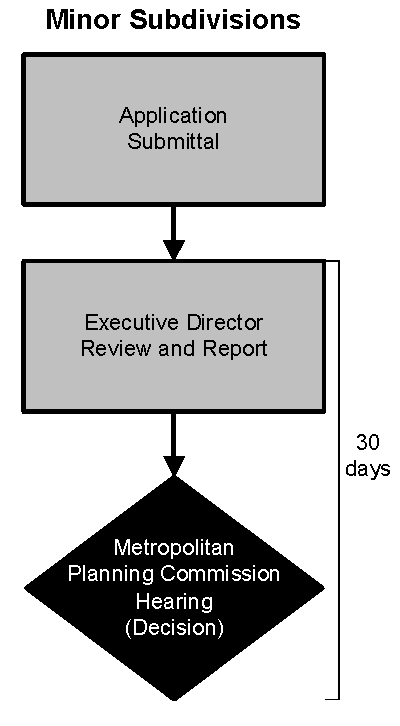
Purpose. The minor subdivision procedures of this subsection are intended to provide an alternative to the major subdivision process that is a less costly and time-consuming. The minor subdivision process allows for a one-step approval process with final action by the Metropolitan Planning Commission or the Executive Director.
B.
Applicability.
1.
Amended plats, street dedications, revocation plats, subdivisions, or re-subdivisions that:
a.
Create no more than two buildable lots,
b.
Do not include the creation of any new street or other public improvement,
c.
Do not reduce lot size below the minimum area or frontage requirements established by ordinance,
d.
Otherwise meet all the requirements of the subdivision regulations and zoning ordinances, may be considered for approval under minor subdivision procedures of this subsection under authority of La. R.S. 33:113.1.A.
2.
Any proposed minor subdivision that is clearly intended to evade the major subdivision procedures of this section and would result in a de facto major subdivision through the combination of previous contiguous minor subdivisions, is not eligible to use the provisions of this subsection.
3.
Parcels are eligible for a minor subdivision approval only once, and further divisions of the original or newly created parcel shall be processed as a major subdivision.
C.
Application Submittal.
1.
Requests for minor subdivision approval shall be submitted to the Planning Department.
2.
Each application shall be accompanied by:
a.
The applicable filing fee.
b.
A completed minor subdivision application form, including a statement of its intended purpose.
c.
The plat shall contain the information specified by the City or Parish Engineer.
D.
Review by the Executive Director.
1.
Upon receipt of a complete application, the Executive Director or their official designee shall review the application for completeness and compliance with appropriate provisions of this Code, other City or Parish ordinances, and other applicable regulations.
2.
If the application and accompanying information are complete, the Executive Director shall place the minor subdivision on the agenda of the next Metropolitan Planning Commission meeting, unless the Minor Plat is to be approved administratively. The Executive Director shall provide a copy of the agenda and any staff recommendations to the applicant within 7 days of the meeting for which the application is scheduled to be reviewed.
3.
Minor subdivision plats, amended plats, in which lot density is not increased, and street dedication or abandonment plats located within the jurisdiction of the Bossier MPC may be approved by the Executive Director. If approved, the Executive Director shall affix his/her signature on an original copy of the minor subdivision plat and the MPC staff shall forward the plat to the appropriate governmental body or offices.
E.
Review and Action by the Metropolitan Planning Commission or Executive Director.
1.
Review Criteria. Approval or disapproval of Minor Subdivisions shall be based on the following criteria:
a.
Any new lots created by the minor subdivision will meet the land area, open space, and yard requirements for the district in which the minor subdivision is located.
b.
Any easements created or extended as a result of approval will satisfy the requirements of the respective parties to the easements and the City or Parish Engineer.
c.
The minor subdivision will not result in a substantial increase in service requirements (e.g. utilities, schools, traffic control, street, etc.) or will not constitute a significant deviation from the criteria upon which ratification of any original plat was granted.
2.
Action by the Metropolitan Planning Commission.
a.
If required, the Metropolitan Planning Commission shall review the minor subdivision application, accompanying information, any staff recommendations and public comments at its regularly scheduled meeting.
b.
The Metropolitan Planning Commission shall make a written finding and give its approval; approval with modifications or conditions; or disapproval to the minor subdivision.
c.
If approved, the current chairman of the Metropolitan Planning Commission shall affix his/her signature on an original copy of the minor subdivision plat and the MPC staff shall forward said plat to the appropriate governmental body or offices.
d.
If approved with conditions or modifications, the applicant shall submit a revised plat to the Executive Director that complies with all conditions or modifications specified by the Metropolitan Planning Commission. Upon approval by the Executive Director, the Chairman of the Metropolitan Planning Commission or the Executive Director shall affix his/her signature on an original copy of the minor subdivision plat.
3.
Parish Police Jury Approval. All minor subdivisions located in the unincorporated areas of the Metropolitan Planning Commission jurisdiction must be reviewed by the Bossier Parish Police Jury, or by the Bossier Parish Engineer, if authorized under the parish subdivision regulations. If heard by the governing body, the plat must receive a majority vote to be approved.
3.8.2
Major Subdivisions.
A.
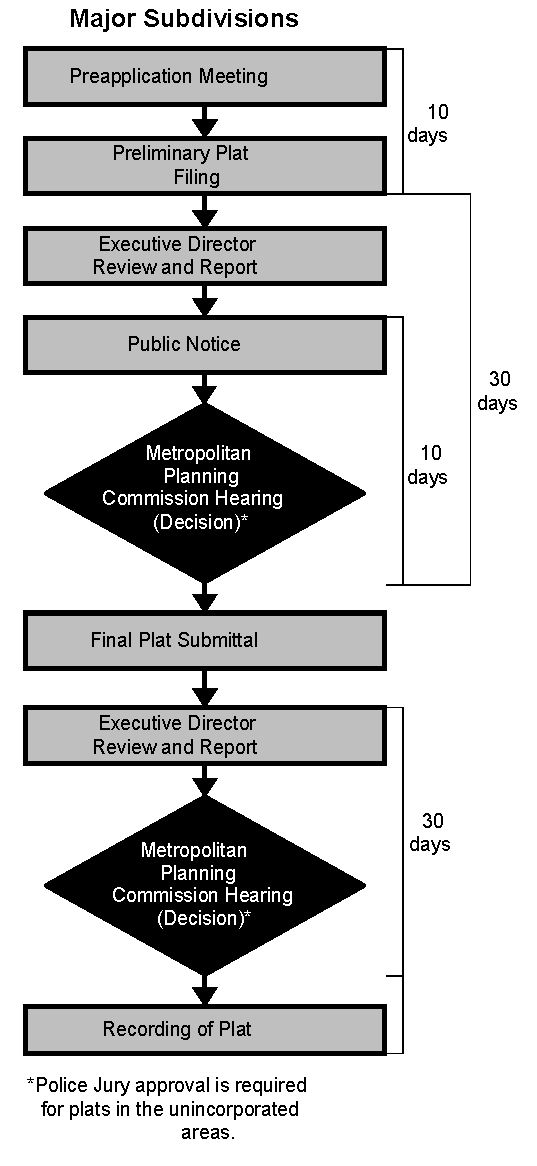
Purpose. The major subdivision procedures of this section are intended to provide a standardized review process for major subdivisions. The major subdivision process may require a three-step review process with final action by the Metropolitan Planning Commission and acceptance of any dedications by the governing body.
B.
Applicability.
1.
The major subdivision procedures of this section apply to all subdivisions that create 3 or more lots, or involve the construction and dedication of new streets, utilities or other public facilities.
2.
For residential subdivisions located in the unincorporated areas of the Bossier MPC jurisdiction, resubdividing of previously platted and recorded lots within an individual unit of said subdivision, or the entire subdivision if comprised of only one unit when the intent is to create a separate buildable lot, shall not be of a size less than the average size of all the buildable lots within that recorded unit or create a lot of lesser than this average size without the permission of the Bossier Parish Police Jury. Permission must be obtained prior to submittal of a plat to the Bossier MPC.
C.
Pre-application Meeting (Unincorporated area).
1.
At least 10 days before filing a preliminary plat application, the applicant shall meet with the Bossier Parish Engineer and the Planning staff and present the following information:
a.
A sketch or preliminary concept plan for the proposed subdivision, prepared in accordance with the requirements of Subsection 11.3.1.
b.
A general description of the existing conditions of the site and the suitability of the site for the proposed development. This information should include data on existing land and soil characteristics, existing covenants and agreements, availability of utilities and other public facilities, proposed use of each portion of the subdivision, proposed lot sizes and building sizes and other pertinent data as may be needed to describe the proposed development.
2.
The Bossier Parish Engineer and the Planning Department shall alert the developer to any special known problems and request additional exhibits, if needed.
3.
Favorable consideration or comment by the Bossier Parish Engineer or Planning Department staff shall, under no circumstances, be construed as preliminary or tentative approval. This must come from the Metropolitan Planning Commission and Bossier Parish Police Jury, if applicable.
D.
Preliminary Plat.
1.
Application. The developer shall file a preliminary plat with the Executive Director in accordance with the following conditions:
a.
The developer shall submit a minimum of 2 copies of the preliminary plat of the proposed subdivision, together with any supplementary data specified by these regulations, at least 30 days prior to being scheduled for a regularly scheduled Metropolitan Planning Commission meeting.
b.
The subdivision fee, as published in the Metropolitan Planning Commission's fee schedule, before the preliminary plat is accepted for Planning staff review and Metropolitan Planning Commission consideration.
c.
The contents of the preliminary plat submittal, as required by the application provided by the Planning office and any additional information required by City or Parish Engineer.
d.
The preliminary plat approval may run concurrently with a zoning amendment application.
2.
Public Notification. Upon determination that the developer's application material is complete and the pre-application meeting, if required has been held, the Executive Director shall:
a.
Cause a notice to be published in an officially designated newspaper qualified to publish legal notices in Bossier Parish giving the name of the proposed subdivision, the owner, a brief description of the intended project, and the approximate acreage. The notice shall be published at least 10 days prior to a regular meeting of the Metropolitan Planning Commission at which the preliminary plat is to be considered initially.
b.
Notify all property owners within a 300' radius of the proposed preliminary plat and the HOA if one exists, by mail according to a list of such property owners provided by the developer.
3.
Major Subdivision Review. The Planning Department shall review the proposed subdivision and prepare a written evaluation report for the Metropolitan Planning Commission. Approval or disapproval of major subdivisions shall be based on the following criteria:
a.
The proposed master development plan and subdivision is in substantial compliance with the Bossier City-Parish Comprehensive Plan and all applicable codes and statutes.
b.
Any new lots created by the proposed subdivision shall meet the land area, open space, and yard requirements for the zoning district in which the subdivision is located.
c.
Layout of all proposed blocks, streets, lots and public improvements shall conform to the design requirements specified in Section 11.4.
d.
Proposed public improvements to the subdivision shall conform to the standards specified in Section 11.5.
e.
Offsite factors, such as the adequacy of existing street or utility systems serving the proposed site, may be taken into consideration such that a subdivision is not rendered as scattered or premature.
4.
Action by the Metropolitan Planning Commission.
a.
In the public hearing, the Metropolitan Planning Commission shall review the, master development plan, subdivision application, accompanying information, any staff recommendations and public comments.
b.
The Metropolitan Planning Commission shall make a written finding and give its approval; approval with modifications or conditions; or disapproval to the subdivision.
c.
The Executive Director shall give written notice to the developer of the action of the Metropolitan Planning Commission. If the preliminary plat has been disapproved, or conditionally approved, the notice shall specifically state the ways in which the preliminary plat fails to conform to these regulations or state any conditions set forth by the Metropolitan Planning Commission.
d.
If the tract depicted on a Preliminary Plat is located in the unincorporated area of the MPC jurisdiction and is intended to be annexed into the Bossier City limits, the annexation of such tract into the city limits shall be completed prior to the plat being heard at a public hearing before the MPC.
5.
General Conditions of Preliminary Plat Approval.
a.
Approval of a preliminary plat does not constitute acceptance of the subdivision; it only authorizes preparation of the final plat. No improvements shall take place within the platted area prior to approval of the preliminary plat, and the submittal and approval of construction plans by the City or Parish Engineer.
b.
Approval of a preliminary plat by the Metropolitan Planning Commission shall be effective for no more than 2 years from the date approval was granted unless, upon application by the developer, the Metropolitan Planning Commission may grant a one-time extension to not exceed 1 year. If construction of improvements has not been started within such 2 year period, or within an extension period, a preliminary plat must be resubmitted and approved following the procedures of Section 3.8.2.D.
c.
A final plat may cover a part of the area included in the approved preliminary plat; provided, that:
(1)
The area represented by the final plat is of sufficient size to permit the economical installation of public improvements.
(2)
The proposed improvements are consistent with those proposed in the preliminary plat.
E.
Final Plat.
1.
General Standards. Following approval of the preliminary plat for a major subdivision, the final plat may be submitted to the Executive Director for review.
2.
Submittal Requirements. The developer shall submit all of the following:
a.
Completed final plat application form.
b.
A signed original plat.
3.
Approval Criteria. The final plat shall be approved if all provisions of these regulations have been met, including any conditions set forth by the Metropolitan Planning Commission on the preliminary plat. No final plat shall be considered if it differs materially from the preliminary plat as previously approved. If the final plat differs materially from the previously approved preliminary plat, a new public hearing shall be required to consider the changes. Material differences may be, but are not limited to the following:
a.
A change in lot density.
b.
A change in street alignment.
c.
A change in lot configuration.
d.
A decrease in Green/Open space approved on the Preliminary Plat.
4.
Approval Procedures.
a.
Upon receiving a complete final plat submittal and any supplemental documentation, the Executive Director may endorse the Final Plat if the plat does not differ materially from the preliminary plat and all conditions of the Preliminary Plat approval set forth by the MPC have been completed.
A final plat shall not be considered for approval, by the appropriate entity, until any accompanying zoning amendment application, if applicable, has received final approval by the appropriate governing body.
5.
MPC approval of Final Plats. If the Final Plat is reviewed by the MPC, the chairperson of the Metropolitan Planning Commission shall date and endorse the original final plat.
a.
The Metropolitan Planning Commission's approval of any final plat located in the unincorporated portions of the MPC jurisdiction must also receive approval by a majority vote of the Bossier Parish Police Jury.
b.
After the Final Plat is approved and recorded, the developer shall submit electronic media as specified by the City or Parish Engineer to the appropriate offices.
F.
Recording of Final Plat. The developer shall submit the endorsed Final Plat to the Clerk of Court of Bossier Parish within 2 years of the approval by the Metropolitan Planning and when applicable, the Bossier Parish Police Jury.
1.
If the Final Plat is not recorded within 2 years of Final approval of the appropriate entity, the plat must be re-submitted for review by the Metropolitan Planning Commission and Bossier Parish Police Jury when applicable.
G.
Acceptance of Public Land and Improvements.
1.
Approval of the final plat shall constitute acceptance by the City or Parish of the dedication of any street or other public way, all easements, any recreational facility or any other space shown on the plat.
2.
The City or Parish shall become the owners of said property and improvements at the time of recording by the Clerk of Court and Recorder of Bossier Parish and shall assume maintenance responsibility for same.
H.
Lot Pinning, Warranty of Improvements and Provision of "As Built" Drawings.
1.
The developer shall provide survey monuments in accordance with the pinning requirements specified in Subsection 11.3.5.
2.
The developer shall comply with any post-acceptance warranty requirements specified in Section 11.6.
Sec. 3.9 - Amendment Procedures.
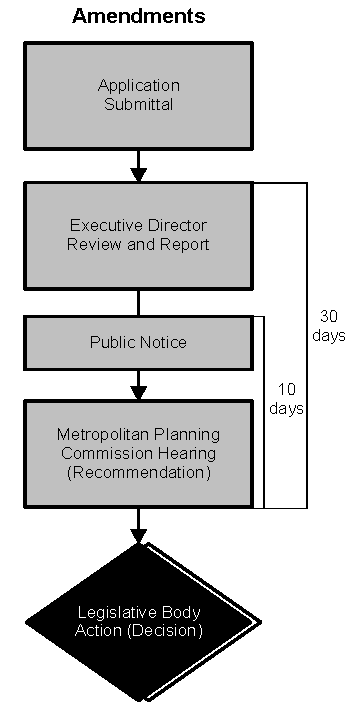
3.9.1
Purpose. The provisions of this section are intended to prescribe procedures by which amendments may be made to this Code, including changes to the text and the boundaries of districts as shown on the Zoning Map.
3.9.2
Amendment Policy. This Code is based on the Bossier City-Parish Comprehensive Plan and is intended to carry out the objective of a sound, stable and desirable development environment. It is recognized that casual change or amendment to the chapter would be detrimental to the achievement of that objective, and it is therefore declared to be the public policy to amend this chapter only when one or more of the following conditions prevail:
A.
Changed or changing conditions in a particular area or in the metropolitan area generally, as documented in the Bossier City-Parish Comprehensive Plan, make a change in the chapter necessary and desirable.
B.
Increased or increasing needs for business or industrial sites, in addition to sites that are available, make it necessary and desirable to rezone an area or to extend the boundaries of an existing district.
C.
The subdivision or imminent subdivision of open land into individual building sites makes reclassification necessary and desirable.
D.
There is a manifest error in this Code.
3.9.3
Initiation of Amendments. Amendments to the text or zoning maps contained in this Code may be initiated by any of the following bodies or persons:
A.
The City of Bossier City Council.
B.
The Bossier Parish Police Jury.
C.
The Bossier City/Parish Metropolitan Planning Commission.
D.
Any person by filing a written application with the Bossier City-Parish Metropolitan Planning Commission.
3.9.4
Application Requirements. An application for amendment to this Code shall contain at least the following:
A.
Applicant and owner.
1.
Name and address of the applicant.
2.
If the amendment would require a change in the zoning map:
a.
The names and addresses of all persons directly owning property that would be rezoned.
b.
The names and addresses of all persons that own 5 percent or more of any corporation, partnership, or entity that owns property that would be rezoned.
3.
Signed concurrence of all direct owners of the property for which rezoning is being requested.
4.
A listing of all parties to encumbrances of parcels and structures on the property for which rezoning is being requested.
5.
Sufficient evidence to establish that the applicant represents the interests of all owners of the property and structures that would be rezoned.
6.
Sufficient evidence to establish that the applicant intends to actually develop the property and has the means and ability to do so.
B.
Property description. If the proposed amendment would require a change in the Zoning Map, the applicant shall submit a written metes and bounds legal description of the land area involved.
C.
Listing of Surrounding Property Owners. The applicant shall provide a listing of the names and addresses of all owners of property that are within a 300-foot radius of the rezoning.
D.
Reason for amendment. The applicant shall submit a written statement of the nature of and reason for the amendment in accordance with Subsection 3.9.2 above, Amendment policy. In addition, if the proposed amendment would require a change in the Zoning Map, the applicant shall submit a site plan and development schedule of the proposal with the application.
E.
Required Land Use Designation and Site Plan Submission; Optional Operational Site Plan Submission.
1.
The applicant shall designate the land use of the property which is the subject of the application.
2.
The applicant shall submit a Major or Minor site plan in accordance with Section 3.7.
3.
Review of the proposed land use and site plan shall be conducted concurrently during the MPC public hearing of the application as a Conditional Use following the procedures of Section 3.3.2.d. If approved, the proposed land use and site plan shall be binding upon the property owner, successors, heirs, and assigns.
4.
The applicant for any commercial land use has the option to submit for concurrent review with the proposed land use in lieu of a Major or Minor site plan, an Operational Site Plan meeting the site plan requirements of Section 3.7 and reviewed as a Conditional Use under the procedures of Section 3.3.3.2.d. but also designating and limiting areas for on-site operations related to the proposed commercial land use, which may include but not be limited to:
a.
Designated and limited areas for placement of cargo container units,
b.
Designated and limited areas for placement of garbage/trash compactors,
c.
Designated and limited areas for placement of recycled cardboard, store racks, and wooden pallets,
d.
Designated and limited truck routes for 18-wheeler type vehicles,
e.
Designated and limited parking/unloading areas for delivery vendors,
f.
Designated and limited areas for outdoor sales and storage of display items (if applicable),
g.
Designated and limited areas for seasonal sales (if applicable), particularly if proposed to be conducted in any parking area,
h.
Designated and limited areas for retail outdoor garden center/landscaping sales (if applicable),
i.
Designated and limited trash and waste pickup hours,
j.
Designated and limited hours for any forklift usage at the rear of a building,
k.
Landscaping and landscaping maintenance schedule (as provided in any landscape plan submitted),
l.
Site lighting (as provided in any site lighting plan submitted).
If approved, the proposed land use and Operational Site Plan shall be binding upon the property owner, successors, heirs, and assigns.
F.
Any intended change in occupancy or site configuration resulting in a higher intensity of use, change in traffic patterns, reduction in required open space, or modification of any approved condition shall require a new public hearing. Notification of the public hearing shall follow the procedures of a zoning amendment as specified in Subsection 3.9.4.C.
G.
Fee. Deposit with the planning commission a fee in the amount specified in the current schedule for processing and advertising the application.
3.9.5
Administrative Examination.
A.
Upon receipt of an initial application, the Executive Director shall determine whether the application requirements specified in Subsection 3.9.4 have been met. If the application is incomplete, it shall be returned to the applicant with notification of which items are still needed.
B.
Upon receipt of a complete application with fees, the Planning Department shall examine the application and make such investigation as is necessary to determine the appropriateness of the proposed amendment.
C.
Within 30 days of receipt of a complete application with fees, the Executive Director shall transmit the application, together with any reports and recommendations, to the Metropolitan Planning Commission.
3.9.6
Preliminary Hearing by Metropolitan Planning Commission. The Metropolitan Planning Commission shall hold a preliminary hearing on any Code amendment application.
A.
The hearing shall be held at the Metropolitan Planning Commission's next available regularly scheduled monthly meeting following receipt of the application and recommendations from the Executive Director.
B.
The Executive Director shall notify the applicant and appropriate Bossier City/Parish departmental staff persons of the time and place of the preliminary hearing.
C.
After conducting a preliminary hearing the Metropolitan Planning Commission shall approve the application for public hearing and shall notify the applicant of the time and place of such public hearing.
D.
If the Metropolitan Planning Commission determines that additional information is required, the applicant shall furnish said information within 14 days of the scheduled public hearing.
E.
If the amendment involves a change in zoning classification of land located within the unincorporated area of the MPC jurisdiction and is intended to be annexed into the city limits of Bossier City, the annexation shall be completed prior to any public hearing being scheduled for review before the MPC.
3.9.7
Public Hearing Notification. The Executive Director shall give public notice thereof, as required by law. The Planning Department shall:
A.
Notify the owners of surrounding property within a 300' radius, by regular mail within 10 days of the public hearing, of the time and place of the hearing. The applicant shall provide the names and mailing addresses of all recipients.
B.
Shall post a notice of such hearing on the property or in the public right-of-way near the subject property in a location that can be easily read from the property line.
C.
At least 10 days prior to the public hearing, shall cause a notice of the public hearing be printed in a newspaper having general circulation within the Metropolitan Planning Commission's jurisdiction. The notice shall include:
1.
Time and place of the public hearing.
2.
Address or description any properties intended to be rezoned.
3.
Purpose of the amendment.
3.9.8
Public Hearing.
A.
The Metropolitan Planning Commission shall prepare a record of its proceedings for each proposed Code amendment, showing the grounds of its recommendation.
B.
The record of the proceedings shall be filed in the office of the Planning Department and shall be a public record.
C.
A copy of the record of proceedings shall be placed on the Bossier Metropolitan Planning Commission website after adoption by the zoning board.
3.9.9
Legislative Body Action. The appropriate legislative body for the jurisdiction affected by the proposed Code amendment shall examine all applications and reports submitted to it and shall take such further action as it deems necessary and desirable. Before enacting any amendment, the appropriate legislative body may hold a public hearing thereon, and shall give public notice thereof, as required by law. In cases of an unfavorable recommendation from the Planning Commission, the appropriate legislative body may overturn the unfavorable recommendation by a 2/3 vote of the entire membership of the City Council or Bossier Parish Police Jury, as the case may be.
A.
Conditions. If an application for an amendment to the Zoning Map contains representations that a specified area will be developed in accordance with a submitted site plan and time schedule, and if the area is rezoned substantially as proposed in the application, the appropriate legislative body may fix conditions that may include:
1.
Posting of a performance bond so as to ensure development in accordance with such plan and time schedule.
2.
Requiring that no permit for the construction of any structures within the area shall be issued until the area has been examined and zoned or rezoned for its most appropriate use.
3.
Conditions fixed in Zoning Map amendments shall run with the land in the area involved and shall be binding upon the applicants, their heirs, successors and assigns for amendments.
B.
Reconsideration.
1.
No land for which an application for rezoning has been denied by the appropriate legislative body shall be considered again by the Metropolitan Planning Commission for at least 6 months from the date such application was denied.
2.
The Bossier Parish Police Jury permits the rehearing of an earlier decision with approval by a 2/3 vote, if notified within 10 days of the original decision.
C.
Consideration of Rollback Action. In all cases where property is rezoned and is not used for the purpose for which it was rezoned within a period of 1 year from the date of legislative body approval, the Metropolitan Planning Commission may, upon its own notice, call a public hearing for the purpose of considering return of the zoning classification back to that which existed at the time of the original application.

