
Bossier City City Zoning Code
ARTICLE 14
- MANUFACTURED HOUSING PARK STANDARDS
Sec. 14.1 - Purpose.
Manufactured housing parks are permitted in the R-MHP district to provide locational opportunities for manufactured homes, constructed in accordance with standards of the U.S. Department of Housing and Urban Development. The manufactured housing park requirements are intended to provide standards for orderly development, adequate emergency vehicle circulation, open areas, and landscaping.
Sec. 14.2 - Districts Allowed.
Manufactured Housing Parks are allowed only in the R-MHP district.
Sec. 14.3 - Area Requirements.
All manufactured housing parks shall comply with the minimum lot area requirements contained in Table 6.2.
Sec. 14.4 - Types of Structures Allowed.
All types of manufactured and modular homes, as defined in Article 18 of this Code, are permitted in manufactured home parks. Recreational Vehicles that are utilized for permanent housing may not occupy more than 50 percent of the Manufactured Housing Park.
Sec. 14.5 - General Park Requirements.
14.5.1
Perimeter Landscape Area. All manufactured housing parks shall comply with the bufferyard standards contained in Article 13 of this Code.
14.5.2
Required Outdoor Areas. An outdoor area of 2,500 square feet or 100 square feet per manufactured housing site, whichever is greater, is required. There may be more than one outdoor area and each must be at least 2,500 square feet. Required open areas must be available for the use of all park residents.
14.5.3
Trees. Trees are required along all public or private streets with spacing of 40 feet.
14.5.4
Other Structures. Other structures within the manufactured housing park for uses accessory to the operation of the park, such as laundries, storage, garages, park offices, and recreational facilities are allowed and are subject to the setback and height requirements for the R-MHP district. Any accessory use that draws its trade from outside the park is prohibited. These structures may not be located within required outdoor areas.
Sec. 14.6 - Parking and Circulation.
14.6.1
Parking. One parking space per unit is required. This parking space must be located in the area designated as part of a manufactured home space. The parking space must be paved in accordance with the standard specified in Subsection 12.5.14.E.
14.6.2
Circulation. Access and circulation within the manufactured housing park shall be provided by streets, public or private, or driveways. Access must be provided to each space. Circulation plans for manufactured housing parks must be approved by the Fire Chief of the jurisdiction in which the park is located.
A.
All private streets must be a minimum of 25 feet in width, or 30 feet if parking is allowed on the street.
B.
Streets that do not allow parking must be posted as not allowing parking.
C.
All streets, public or private, must meet the constructions standards as stated in Section 11.5.2 of this Code.
D.
All streets must be named and posted with their names.
Sec. 14.7 - Individual Manufactured Home Space Requirements.
14.7.1
Minimum Lot Width and Depth. Spaces for manufactured homes must be a minimum of 35 feet. Individual spaces shall be designed with enough depth to accommodate a manufactured home that is eighty (80) feet in length and meet all building setbacks required in this Article and lot area requirements of Section 6.2.
14.7.2
Access. In addition to the dimensional standards contained in this Article, manufactured housing parks shall comply with the applicable design standards in Article 12. Each space must have access to a street constructed in accordance with the requirements in Subsection 14.6.2. Site Plan Review, as specified in Section 3.7 is required for initial approval or expansion.
14.7.3
Other Requirements.
A.
Drainage and Utility Systems.
1.
Each unit shall be provided adequate drainage and utility easements approved by the City or Parish Engineer.
2.
The park owner shall meet the minimum requirements established of all utility providers.
B.
Sanitation. The park owner shall provide for solid waste and trash pickup and disposal.
C.
Tie-Downs. Every manufactured home to be located in a manufactured housing park shall be equipped with adequate foundations and tie-downs, intended to secure such units against movement, settling and overturning.
1.
Number of Tie-Downs Required. All manufactured housing sites shall be provided with tie-downs in accordance with Table 14.7.3.
Table 14.7.3
Manufactured Home Park
Tie-Down Requirements
2.
Ground Anchors. In instances where the unit is not tied down to a slab, ground anchors may be provided. The following standards shall apply:
a.
Anchors shall be bolted on concrete, screw auger or anchor driven or any other type manufactured and approved for use.
b.
All anchors shall be galvanized, high tensile steel, not less than ⅝ inch in diameter, with drop forged closed eye or any other approved method of anchorage. All anchors shall be at least 4 feet long, installed to full depth according to manufacturers' recommendation, with only the eye protruding above grade for connecting the tie-down system.
c.
Connections to the housing unit I-beam frame shall be a ⅝ inch or larger drop forged closed eye, bolted through a hole drilled through the frame or by any other approved and adequate wrap-around, hood or clamp method.
d.
Drop forged turnbuckles no less than ⅝ inch with closed eyes and screw pins shall be attached to the frame above and to the ground anchor below, and securely tightened in place. Steel straps or cables may be used in lieu of turnbuckles if they are of equal or greater strength and are securely tightened in place with a tensioning tool and clamped.
Sec. 14.8 - Recreational Vehicle (RV) Park Standards.
14.8.1
Applicability. This section applies to recreational vehicle parks only. RV parks are considered as privately-owned campgrounds and are classified in Section 5.4 as "Commercial Recreation/Entertainment, Outdoor" and are permitted only in districts where uses in this category are allowed.
14.8.2
Permitted Activities.
A.
Overnight stays in a motorized or non-motorized recreational vehicle is permitted. The vehicle shall be specifically designed or modified for overnight accommodation.
B.
Overnight stays in tents or cabins for a period of 30 days or less is permitted with approval by the Executive Director provided:
1.
The recreational vehicle park is located at least 1,000 feet from an R-E, R-LD, R-MD, or R-HD district.
2.
The area for tents or cabins consists of less than 30 percent of the total area of the park.
3.
The area for tents or cabins is clearly designated as a separate area from the motorized and non-motorized recreational vehicles.
4.
Overnight stays longer than a period of 30 days may be approved by the Metropolitan Planning Commission as a Conditional Use following the procedures of Section 3.3.2 of this Code.
14.8.3
Park Area. Recreational vehicle parks shall have a minimum area of 10 acres.
14.8.4
Lot Configuration.
A.
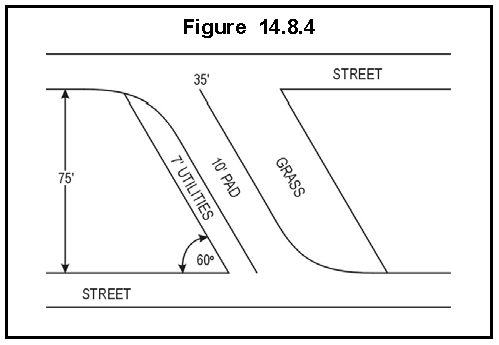
Minimum size shall be 35 feet by 65 feet.
B.
Pull-through lots should be at a 60-degree angle.
C.
Lots along the perimeter may be at a 90-degree angle.
D.
Setbacks must conform with the requirements in Table 14.8.4.
Table 14.8.4
RV Park Setback Requirements
E.
Parking pads should be placed such that the side yard will be on the right side of the recreational vehicle, so that the vehicle's entry door opens to the yard. See Figure 14.8.4 below.
14.8.5
Special Conditions.
A.
Adequate sidewalks shall be provided for access to any buildings used by park patrons, such as pavilion, laundry, showers or restrooms.
B.
A drainage plan shall be approved by the City or Parish Engineer.
C.
Sanitation, fire protection and utility services shall be provided with approval by appropriate City, Parish, or State authorities.
D.
The park owner shall be responsible for private solid waste services.
E.
Street lighting shall be placed along interior streets with a minimum of 200 feet spacing and a maximum of 300 feet. All electrical supply lines for street lights shall be underground.
F.
If entry to the recreational vehicle park is from a Principal Arterial, acceleration and deceleration lanes shall be provided with approval by the Louisiana Department of Transportation and Development, or the City or Parish Engineer.

