
Bossier City City Zoning Code
ARTICLE 5
- USE REGULATIONS
Sec. 5.1 - Purpose.
The purpose of this Article is to assure that all land shall be developed, used, or occupied in conformity with the regulations herein prescribed for the district in which such structure or use is located.
Sec. 5.2 - Types of Uses.
The Use Table in Section 5.3 enumerates the status of permitted, provisional, conditional, and special exception uses for each use category and zoning district. All of the non-temporary use categories listed in the Use Table are defined and described in the Subsection 5.4.1.
5.2.1
Uses Permitted by Right. A "P" in a cell of the Use Table indicates that a use is allowed by right in the respective district. Such uses are subject to all other applicable regulations of this Title.
5.2.2
Provisional Uses.
A "P*" in a cell of the Use Table indicates a use category that is also permitted by right, provided that it is determined by the Executive Director to meet the additional listed standards contained in Section 5.6. Such uses are subject to all other applicable regulations of this Code.
5.2.3
Conditional Uses. A "C" in a cell of the Use Table indicates a use category that is allowed conditionally, provided that it is determined by the Planning Commission to meet the additional listed standards, if any, contained in Section 5.6 and approved in accordance with in the Conditional review procedures of Section 5.6. Such uses are subject to all other applicable regulations of this Code.
5.2.4
Special Exception Uses. An "S" in a cell of the Use Table indicates that a use category is allowed only if reviewed and approved as a Special Exception Use, in accordance with the Special Exception review procedures of Section 3.3.3. Special Exception Uses are subject to all other applicable regulations of this Code.
5.2.5
Prohibited Uses. A blank cell in the Use Table indicates that a use category is not allowed in the respective district.
5.2.6
Uses Not Listed. The Executive Director shall determine whether or not an unlisted use is part of an existing use category defined in Subsection 5.4.1 or is substantially similar to an already defined use, using the criteria in Subsection 5.4.1A.
Sec. 5.3 - Use Table.
(Ord. No. 51-2020, 5-5-2020)
Sec. 5.4 - Use Categories.
Use categories classify land uses and activities into use categories based on common functional, product, or physical characteristics. Characteristics include the type and amount of activity, the type of customers or residents, how goods or services are sold or delivered and site conditions. The use categories provide a systematic basis for assigning present and future land uses to appropriate districts.
5.4.1
Classification of Uses. Principal uses are assigned to the category that most closely describes the nature of the principal use. The "Characteristics" subsection of each use category describes the common characteristics of each principal use.
A.
Considerations Regarding Principal Uses. Determination of appropriate categories for proposed principal uses shall be made by the Executive Director in accordance with the provisions of Subsection 3.6.1, Written Interpretations. The following considerations shall be used to determine the appropriate category for a use not specifically listed in the Use Table or the examples in the use category descriptions contained in this Section, and whether the activities are to be considered principal or accessory uses:
1.
The actual or projected characteristics of the activity in relationship to the stated characteristics of each use category;
2.
The relative amount of site area or floor space and equipment devoted to the activity;
3.
Relative amounts of sales from each activity;
4.
The customer type for each activity;
5.
The relative number of employees in each activity;
6.
Hours of operation;
7.
Building and site arrangement;
8.
Vehicles used with the activity;
9.
The relative number of vehicle trips generated by the use;
10.
Signs;
11.
How the use advertises itself; and
12.
Whether the activity is likely to be found independent of the other activities on the site.
B.
Developments with Multiple Principal Uses. When all principal uses of a development fall within one use category, the entire development is assigned to that use category. For example, a development that contains a coffee shop, bookstore and bakery would be classified in the Retail Sales and Service category because all of the development's principal uses are in that category. When the principal uses of a development fall within different use categories, each principal use is classified in the applicable category and each use is subject to all applicable regulations for that category. Developments with multiple principal uses, such as shopping centers, shall incorporate only those uses allowed in the underlying district.
C.
Accessory Uses. Accessory uses are allowed by right in conjunction with a principal use unless otherwise stated elsewhere in this Code. Also, unless otherwise stated, accessory uses are subject to the same regulations as the principal use. Common accessory uses are listed as examples in the use category descriptions.
D.
Use of Examples. The "Examples" subsection of each use category lists common examples of uses included in the respective use category. The names of these sample uses are generic. They are based on common meanings and not on what a specific use may call itself. For example, a use that calls itself "Wholesale Warehouse" but sells mostly to consumers is included in the Retail Sales and Service category rather than the Wholesale Sales category. This is because the activity on the site matches the characteristics of the Retail Sales and Service category.
5.4.2
Residential Use Categories.
A.
Group Living.
1.
Characteristics. Group Living is characterized by the residential occupancy of a structure by a group of people who do not meet the definition of Household Living. The size of the group may be larger than the average size of a household. Tenancy is arranged on a monthly or longer basis. Uses where tenancy may be arranged for a shorter period are not considered residential. They are considered to be a form of transient lodging (see Public Accommodation category). Generally, Group Living structures have a common eating area for residents. The residents may receive care, training, or treatment, as long as the care givers also reside at the site.
2.
Accessory Uses. Accessory uses commonly associated with Group Living are recreational facilities, dining facilities and parking of vehicles for occupants and staff.
3.
Examples. Examples of Group Living include dormitories; fraternities and sororities; monasteries and convents; nursing and convalescent homes; some group homes for the physically disabled, mentally disabled, or emotionally disturbed; some residential programs for drug and alcohol treatment; and alternative or post incarceration facilities.
4.
Exceptions.
a.
Lodging where tenancy may be arranged for periods of less than 30 days is classified in the Public Accommodations category.
b.
Lodging where the residents meet the definition of Household and where tenancy is arranged on a month-to-month basis, or for a longer period is classified as Household Living.
c.
Congregate care facilities where individual units meet the definition of a dwelling unit in Section 18.2 are classified as Household Living.
B.
Household Living.
1.
Characteristics. Household Living is characterized by the residential occupancy of a dwelling unit by a household. Tenancy is arranged on a month-to-month or longer basis.
2.
Accessory Uses. Accessory uses commonly associated with Household Living are recreational activities, raising of pets, hobbies and parking of the occupants' vehicles. Home occupations are accessory uses that are subject to additional requirements, enumerated in Subsection 6.6.4.
3.
Examples. Uses include living in houses, duplexes, triplexes and other multiple-dwelling structures; retirement center apartments; some congregate care facilities; manufactured housing and other structures with self-contained dwelling units.
4.
Exceptions. Lodging in a dwelling unit or where units are rented on a less than monthly basis is classified in the Public Accommodations category.
5.4.3
Public and Civic Use Categories.
A.
Community Service.
1.
Characteristics. Community Services are uses of a public, nonprofit, or charitable nature generally providing a local service to people of the community. Generally, they provide the service on-site or have employees at the site on a regular basis. The service is ongoing, not just for special events. Community centers or facilities that have membership provisions are open to the general public to join at any time, (for instance, any senior citizen could join a senior center). The use may provide special counseling, education, or training of a public, nonprofit or charitable nature.
2.
Accessory Uses. Accessory uses may include offices; meeting areas; food preparation areas; parking; health and therapy areas; and athletic facilities.
3.
Examples. Examples include libraries, museums, senior centers, community centers, youth club facilities, hospices and social service facilities.
4.
Exceptions.
a.
Private lodges, clubs and private or commercial athletic or health clubs are classified as Retail Sales and Service.
b.
Parks are classified as Parks and Open Areas.
c.
Resident treatment centers are classified as Group Living.
d.
Uses where tenancy is arranged on a month-to-month basis or for a longer period are residential and are classified as Household or Group Living.
B.
Day Care.
1.
Characteristics. Day Care uses provide care, protection and supervision for more than 6 children or adults on a regular basis away from their primary residence for less than 24 hours per day.
2.
Accessory Uses. Accessory uses include offices, recreation areas and parking.
3.
Examples. Examples include preschools, child care centers, nursery schools, latch key programs and adult day care programs.
4.
Exceptions. Day Care does not include public or private schools or facilities operated in connection with an employment use, shopping center or other principal use, where children are cared for while parents or guardians are occupied on the premises or in the immediate vicinity. In-home care for 6 or fewer individuals is considered a home occupation (accessory use) and subject to additional requirements, enumerated in Subsection 6.6.4.
C.
Educational Facilities.
1.
Characteristics. This category includes public and private schools at the primary, elementary, middle, junior high, or high school level that provide state-mandated basic education. This category also includes colleges and other institutions of higher learning that offer courses of general or specialized study leading to a degree or certification. Colleges tend to be in campus-like settings or on multiple blocks.
2.
Accessory Uses. Accessory uses at schools include play areas, cafeterias, recreational and sport facilities, auditoriums and before- or after-school day care. Accessory uses at colleges include offices, housing for students, food service, laboratories, health and sports facilities, theaters, meeting areas, parking, maintenance facilities and support commercial.
3.
Examples. Examples include public and private daytime schools, boarding schools, military academies, universities, liberal arts colleges, seminaries, community colleges, nursing and medical schools not accessory to a hospital, extension centers, and leased office and commercial space used as a classroom.
4.
Exceptions. Preschools are classified as Day Care uses. Commercial business colleges or trade schools are classified as Retail Sales and Service uses.
D.
Government Facilities.
1.
Characteristics. Government facilities include offices, storage, maintenance and other facilities for the operation of local, state or federal government.
2.
Accessory Uses. Accessory uses include storage, maintenance and fueling facilities, satellite offices and parking areas.
3.
Examples. Examples include city and parish administrative offices, maintenance facilities, fire stations, police stations and emergency medical and ambulance stations, post offices, and local, state or federal offices.
a.
Detention centers may only be permitted as a Conditional Use following the procedures of Section 3.3.2 of this code.
4.
Exceptions.
a.
Passenger terminals for airports and regional bus service are classified as Passenger Terminals.
b.
Town, parish or state parks are classified as Parks and Open Areas.
c.
Water and wastewater facilities, gas, electric and other infrastructure services, whether public or private, are classified as Utilities.
d.
Waste and recycling services are classified as Waste Related Services.
E.
Medical Centers.
1.
Characteristics. Medical Centers include uses providing medical or surgical care to patients and offering overnight care.
2.
Accessory Uses. Accessory uses include out-patient clinics, offices, laboratories, teaching facilities, meeting areas, cafeterias, parking, maintenance facilities and housing facilities for staff or trainees.
3.
Examples. Examples include medical centers and hospitals.
4.
Exceptions.
a.
Uses that provide exclusive care and planned treatment or training for psychiatric, alcohol, or drug problems, where patients are residents of the program, are classified in the Group Living category.
b.
Medical clinics that provide care where patients are generally not kept overnight are classified as Office.
F.
Parks and Open Areas.
1.
Characteristics. Parks and Open Areas are uses of land focusing on natural areas consisting mostly of vegetative landscaping or outdoor recreation, community gardens, or public squares. Lands tend to have few structures.
2.
Accessory Uses. Accessory uses may include club houses, maintenance facilities, concessions, caretaker's quarters and parking.
3.
Examples. Examples include parks, beach accesses, publicly-owned golf courses, cemeteries, public squares, plazas, recreational trails, botanical gardens and nature preserves.
4.
Exceptions. Privately-owned golf courses are classified as Commercial Recreation/Entertainment, Outdoor uses.
G.
Religious Institutions.
1.
Characteristics. Religious Institutions provide a variety of facilities, including buildings that primarily provide meeting areas for religious activities.
2.
Accessory Uses. Accessory uses include religious school facilities, meeting rooms, parking, and caretaker's housing.
3.
Examples. Examples include churches, temples, synagogues and mosques.
4.
Exceptions. Congregate care facilities where individual units meet the definition of a dwelling unit in Section 18.2 are classified as Household Living.
5.4.4
Commercial Use Categories.
A.
Commercial Parking.
1.
Characteristics. Commercial Parking facilities provide parking that is not accessory to a specific use. A fee may or may not be charged. A facility that provides both accessory parking for a specific use and regular fee parking for people not connected to the use is also classified as a Commercial Parking facility.
2.
Accessory Uses. Small structures intended to shield parking attendants from the weather.
3.
Examples.
a.
Examples include short- and long-term fee parking facilities and mixed parking lots (partially accessory to a specific use, partly for rent to others), and off premises remote parking sites with shuttle service for casino employees.
b.
A standalone truck parking area, where commercial vehicles are used each day but are stored during non-business hours.
4.
Exceptions.
a.
Parking facilities that are accessory to a principal use, but that charge the public to park for occasional events nearby, are not considered Commercial Parking facilities.
b.
Parking facilities that are accessory to a principal use are not considered Commercial Parking uses, even if the operator leases the facility to the principal use or charges a fee to the individuals who park in the facility.
c.
Public transit park-and-ride facilities are classified as Major Utilities.
d.
Sales or servicing of vehicles is classified as Vehicle Sales and Service.
B.
Commercial Recreation/Entertainment, Indoor.
1.
Characteristics. Indoor Recreation/Entertainment uses are commercial uses that offer recreation or entertainment activities, events or attractions to the general public.
2.
Accessory Uses. Accessory Uses may include offices, food and beverage concessions, and parking.
3.
Examples.
a.
Indoor Recreation/Entertainment includes such uses as movie theaters, video game arcades, bowling alleys, pool halls, dance halls, and indoor firing ranges.
b.
Indoor Recreation/Entertainment also includes casinos, casino support areas, riverboat casino onshore facilities, and enterprises operating more than 10 video poker devices.
4.
Exceptions.
a.
Health Clubs and Spas are classified as Retail Sales and Service.
b.
Night Clubs and Bars are classified as commercial Drinking Establishments.
c.
Rooms or areas within hotels or commercial Eating and Drinking Establishments that are exclusively designated for the use electronic gambling machines such as video poker are classified as accessory uses, provided the gaming area does not exceed 10 percent of the total floor area of the occupancy.
d.
An enclosed area containing 10 or fewer video poker devices is classified as an accessory use to an eating establishment, drinking establishment, or public accommodation facility.
e.
Sexually oriented entertainment establishments are classified as Sexually Oriented Businesses.
C.
Commercial Recreation/Entertainment, Outdoor.
1.
Characteristics. Outdoor Commercial Recreation/Entertainment uses are privately owned commercial uses that provide recreation or entertainment-oriented activities.
2.
Accessory Uses. Accessory uses may include indoor or outdoor restaurants, bars, food and beverage concessions, pari-mutuel wagering activities, parking and maintenance facilities.
3.
Examples.
a.
Outdoor Commercial Recreation uses that are participatory in nature and include such facilities as golf courses; driving ranges; miniature golf courses; and active sports complexes including such uses as tennis courts, ball fields and basketball courts.
b.
Theme park, amusement park, boardwalk, or midway type attractions such as rides, bumper cars, go-cart tracks, game booths and all other similar attractions.
c.
Outdoor Commercial Entertainment uses that are for the benefit of spectators and include such facilities as amphitheaters, race tracks, and band shells.
d.
Privately-owned outdoor areas for temporary, short-term overnight accommodations such as commercial campgrounds and recreational vehicle parks.
4.
Exceptions.
a.
Publicly-owned golf courses and campgrounds are classified as Parks and Open Areas.
D.
Eating and Drinking Establishments.
1.
Fast-food restaurant.
a.
Characteristics. Establishments characterized by large carry-out clientele, long hours of service and high turnover rates for eat-in customers. Such establishments typically feature extensive window service, counter-service and self-service with limited if any table-service.
b.
Examples. Franchised hamburger, fish, and chicken establishments; similar non-franchised establishments; ice cream, donut, and yogurt stores; delicatessen counters; coffee bars that feature coffees and similar drinks with very limited food service.
c.
Accessory Uses. Off-street customer and employee parking areas; drive-through windows.
d.
Uses Not Included. Any establishment serving alcoholic beverages, lounges or bars, Microbreweries or Microdistilleries or any establishment classified as a High Turnover restaurant.
e.
Related but Different Uses and Distinctions.
(1)
High turnover restaurants generally have table service and limited carry-out service. Any establishment otherwise meeting the definition of fast-food restaurant but including non-amplified live entertainment shall be considered a High Turnover restaurant.
(2)
A coffee shop with sit-down service and complete meal offerings is considered a high turnover restaurant, while a coffee bar, offering primarily coffee and related drinks, falls under this category.
2.
High-turnover restaurant.
a.
Characteristics. High-turnover restaurants typically feature sit-down service and/or table service, although some cafeterias and buffets also fall in this category. The high turnover restaurant has little carry-out service but may have a drive-thru and provide drive up service. Turnover times are typically 1 hour or less per customer. These restaurants may in some cases feature live entertainment.
b.
Examples. Chain, family-style restaurants featuring modest prices; high-volume, cafeteria service steakhouses; coffee shops; franchised and chain pizza restaurants that emphasize sit-down, eat-in service.
c.
Accessory Uses. Off-street customer and employee parking areas; accessory bar or lounge, when occupying less than 25 percent of the total floor area.
d.
Uses Not Included. Fast-food restaurant.
e.
Related but Different Uses and Distinctions.
(1)
Fast-food restaurants are characterized by a high percentage of carry-out service and have limited table service.
3.
Bar or Lounge.
a.
Characteristics. A bar is an establishment that may include food service but that emphasizes the service of alcoholic beverages for consumption on the premises.
b.
Examples. Lounge or bar.
c.
Accessory Uses. Live entertainment; off-street parking for employees and customers; in some districts, as a Conditional Use, a nightclub.
4.
Microbrewery or Microdistillery.
a.
Characteristics. A brewpub or microbrewery is a bar, accessory bar in a restaurant or a small brewery that manufactures up to 12,500 barrels of fermented malt beverages per year on premises, for either consumption on premises or for off-premises consumption in sealed containers sold directly to the consumer. Approval shall follow the procedures of a "Conditional Use" as stated in Article 3.3.2 of this code. (For amounts greater than 12,500 barrels per year, see Manufacturing and Production, Section 5.4.5B.)
A microdistillery is a bar, accessory bar in a restaurant or a small distillery that manufactures up to 12,000 gallons per year of alcoholic beverages per year on premises for either consumption on premises or for off-premises consumption in sealed containers sold directly to the consumer. Approval shall follow the procedures of a "Conditional Use" as stated in Article 3.3.2 of this code.(For amounts greater than 12,000 gallons per year, see Manufacturing and Production, Section 5.4.5B).
b.
Examples. Brewpub, Microbrewery or Microdistillery.
c.
Uses Not Included.
(1)
Sales of alcoholic beverages produced elsewhere and sold for consumption off the premises.
(2)
Production greater than 12,500 barrels of fermented malt beverages per year, 12,000 gallons of distilled beverages or production and packaging for off premises sales of any amount of product greater than 60 percent of those amounts. (Manufacturing and Production, Section 5.4.5.)
d.
Related but Different Uses and Distinctions. Distinctions from bars are generally not critical because the uses are typically allowed in the same locations and under the same conditions.
5.
Accessory Restaurant.
a.
Characteristics. An accessory restaurant is not necessarily separated by a permanent wall from the Principal Use to which it is accessory, and generally shares one or more entrances, as well as restrooms, coatrooms and other facilities, with the restaurant. No sales of alcoholic beverages shall be permitted.
b.
Examples. Bowling alley snack bar; school cafeteria; hospital cafeteria; cinema snack bar; soda fountain; supermarket delicatessen.
c.
Accessory Uses. Not applicable.
d.
Uses Not Included. Clubhouse; Bar or Lounge.
6.
Accessory Bar.
a.
Characteristics. An accessory bar is a part of a high turnover restaurant offering alcoholic beverages. An accessory bar is typically not separated by a permanent wall from the restaurant to which it is accessory, and generally shares 1 or more entrances, as well as restrooms, coatrooms and other facilities, with the restaurant. An establishment with an accessory bar will generally characterize itself in its signs, advertising and other promotions as a restaurant or food-service establishment rather than as a bar.
b.
Examples. Lounge or bar area in a restaurant used in part as a waiting area for restaurant customers; pool bar; service bar in a restaurant but without separate seating; lounge or bar area integrated into the space used by a quality or high turnover restaurant.
c.
Accessory Uses. Not applicable.
E.
Major Event Entertainment.
1.
Characteristics. Major Event Entertainment uses are characterized by activities and structures that draw large numbers of people to specific events or shows. Activities are generally of a spectator nature.
2.
Accessory Uses. Accessory uses may include restaurants, bars, concessions, parking and maintenance facilities.
3.
Examples. Examples include stadiums, arenas, race tracks, auditoriums, exhibition and meeting areas, and fairgrounds.
4.
Exceptions.
a.
Banquet halls that are part of hotels or restaurants are accessory uses to those uses, which are included in the Eating Establishments and Public Accommodation categories.
b.
Theaters are classified as Commercial Recreation/Entertainment.
c.
An entertainment event associated with a casino is accessory to the casino.
F.
Office.
1.
Characteristics. Office uses are characterized by activities conducted in an office setting and generally focusing on business, government, professional, medical, or financial services.
2.
Accessory Uses. Accessory uses may include cafeterias, day care and health facilities, parking, or other amenities primarily for the use of employees in the firm or building.
3.
Examples. Examples include professional services such as lawyers, accountants, engineers, or architects; financial businesses such as lenders, brokerage houses or real estate agents; data processing; sales offices; public utility offices; TV and radio studios; medical and dental clinics, medical and dental labs; and blood-collection facilities.
4.
Exceptions.
a.
Offices that are part of and located with a principal use in another category are considered accessory to the firm's primary activity. Headquarters offices, when in conjunction with or adjacent to a principal use in another category, are considered part of the other category.
b.
Contractors and others who perform services off-site are included in the Office category if equipment and materials are not stored on-site and fabrication, services, or similar work is not carried on at the site.
G.
Public Accommodation.
1.
Characteristics. Dwelling units or other accommodations normally arranged for short term stays of less than 30 days for rent, lease or interval occupancy.
2.
Accessory Uses. Accessory uses may include pools and other recreational facilities; limited storage; and offices. Restaurants, bars, nightclubs or other eating, drinking or entertainment establishments are permitted as Accessory Uses when occupying less than 10 percent of the total floor area.
3.
Examples. Examples include hotels, motels, inns, bed and breakfast establishments, and resorts.
4.
Exceptions.
a.
Recreational Vehicle Parks and on-water marina slips, which are classified as Commercial Recreational/Entertainment.
b.
Any facility that does not provide regular housekeeping services shall be classified as Residential, Household Living.
H.
Retail Sales and Service.
1.
Characteristics. Retail Sales and Service firms are involved in the sale, lease or rent of new or used products to the general public. They may also provide services or product repair for consumer and business goods.
2.
Accessory Uses. Accessory uses may include offices, storage of goods, manufacture or repackaging of goods for on-site sale and parking.
3.
Examples. Examples include uses from the two following groups:
a.
Sales-Oriented: Stores selling, leasing, or renting consumer, home and business goods including art, art supplies, bicycles, clothing, dry goods, electronic equipment, fabric, furniture, garden supplies, gifts, groceries, hardware, home improvements, household products, jewelry, pets, pet food, pharmaceuticals, plants, printed material, stationary and videos; and food sales.
b.
Service-Oriented: Banks; laundromats; laundry and dry-cleaning drop-off establishments; photographic studios; photocopy and blueprint services; hair, tanning and personal care services; psychics and mediums; martial arts schools; dance or music studios; health clubs and gyms; taxidermists; funeral homes; veterinarians; animal grooming; repair of televisions, bicycles, clocks, watches, shoes, guns, canvas products, appliances and office equipment; photo drop-off; tailor; locksmith; and upholsterer.
4.
Exceptions.
a.
Restaurants are classified as Eating Establishments.
b.
Laundry and dry-cleaning plants are classified as Industrial Service.
c.
Lumber yards and other building material sales that sell primarily to contractors and do not have a retail orientation are classified as Wholesale Sales.
d.
Repair and service of consumer motor vehicles, motorcycles and light and medium trucks is classified as Vehicle Service.
e.
Sexually oriented retail establishments are classified as Sexually Oriented Businesses.
I.
Vehicle Sales and Service.
1.
Characteristics. Vehicle Sales and Service uses provide sales, leasing or service of consumer vehicles including passenger vehicles, motorcycles, light and medium trucks, boats and recreational vehicles.
2.
Accessory Uses. Accessory uses may include offices, sales of parts and vehicle storage.
3.
Examples. Examples include automobile, truck, trailer, boat or other vehicle dealerships; full-service, mini-service and self-service gas stations; car washes; quick lubrication services; vehicle repair, transmission or muffler shop; towing service; auto body shop; alignment shop; auto upholstery shop; auto detailing; and new and used tire sales and mounting.
4.
Exceptions.
a.
Refueling facilities for vehicles that belong to a specific use (fleet vehicles) are considered accessory uses if they are located on the site of the principal use.
b.
On-water boat sales and services shall be classified as a marina in the Commercial Recreation/Outdoor category.
J.
Teen Club.
1.
Characteristics. A business establishment, which advertises, holds itself out to the public as, or is operated primarily as a "Teen Club" providing entertainment to patrons between the ages of 16 and 19. Clubs shall be closed between the hours of 12:00 a.m. and 6:00 a.m. and provided further that on Sunday mornings such clubs shall be closed until twelve o'clock (12:00) noon. Person's over the age of 19 shall not enter, frequent or remain on the premises of any teen club. Duly authorized city inspectors, parents, legal guardians or chaperons of any of the patrons are not prohibited from remaining on or inspecting the premises of a teen club.
2.
Accessory Uses. Accessory uses may include offices, storage areas, food service, off-street parking for employees and customers in some districts.
3.
Uses not included. Any establishment selling or serving alcoholic beverages.
K.
Truck and Travel Plaza.
1.
Characteristics. Truck and Travel Plaza is a business of which the primary purpose is to sell fuel and to provide services to local and over the road truck drivers and their vehicles.
2.
Accessory Uses. Accessory uses may include restaurants, overnight parking for trucks, trucker's rest lounges, sales of parts and vehicle service, grocery stores, and video poker rooms.
5.4.5
Industrial Use Categories.
A.
Industrial Service.
1.
Characteristics. Industrial Service firms are engaged in the repair or servicing of industrial, business or consumer machinery, equipment, products or by-products. Firms that service consumer goods do so by mainly providing centralized services for separate retail outlets. Contractors and building maintenance services and similar uses perform services off-site. Few customers, especially the general public, come to the site.
2.
Accessory Uses. Accessory activities may include offices, parking and storage.
3.
Examples. Examples include welding shops; machine shops; tool repair; electric motor repair; repair of scientific or professional instruments; building, heating, plumbing or electrical contractors; printing, publishing and lithography; exterminators; janitorial and building maintenance services; fuel oil distributors; research, testing and development laboratories; centralized laundry, dry-cleaning and carpet cleaning plants; and photo-finishing laboratories.
4.
Exceptions. Contractors and others who perform services off-site are included in the Office category, if major equipment and materials are not stored on-site and fabrication or similar work is not carried on at the site.
B.
Manufacturing and Production.
1.
Characteristics. Manufacturing and Production firms are involved in the manufacturing, processing, fabrication, packaging, or assembly of goods. Natural, man-made, raw, secondary, or partially completed materials may be used. Products may be finished or semi-finished and are generally made for the wholesale market, for transfer to other plants, or to order for firms or consumers. Goods are generally not displayed or sold on site, but if so, they are clearly a subordinate part of sales. Relatively few customers come to the manufacturing site.
2.
Accessory Uses. Accessory activities may include offices, cafeterias, parking, employee day care and health facilities, employee recreational facilities, warehouses, storage yards, repair facilities, truck fleets and caretaker's quarters.
3.
Examples. Examples include catering establishments; woodworking, including cabinet makers; production of chemical, rubber, leather, clay, bone, plastic, stone, or glass materials or products; movie production facilities; concrete batching and asphalt mixing; production or fabrication of metals or metal products including enameling and galvanizing; manufacture or assembly of equipment, instruments, including musical instruments, appliances, precision items and other electrical items; production of artwork and toys; and sign making.
4.
Exceptions.
a.
Manufacturing of goods to be sold primarily on-site and to the general public are classified as Retail Sales and Service.
b.
Manufacture and production of goods from composting organic material is classified as Waste Related Service.
c.
Processing of food and related products or slaughter houses, which must be approved as a Conditional Use following the procedures of Section 3.3.2.
C.
Railroad Yards.
1.
Characteristics. Railroad yards are areas containing multiple railroad tracks used for rail car switching, assembling of trains, and transshipment of goods from other transportation modes to or from trains.
2.
Accessory Uses. Accessory uses include offices, employee facilities, equipment storage areas, and rail car maintenance and repair facilities.
3.
Exceptions. Long-term storage of inactive railroad cars is classified as Vehicle Storage.
D.
Warehouse and Freight.
1.
Characteristics. Warehouse and Freight Movement firms are involved in the storage or movement of goods for themselves or other firms. Goods are generally delivered to other firms or directly to the final consumer, except for some will-call pickups. There is little on-site sales activity with the customer present.
2.
Accessory Uses. Accessory uses may include offices, truck fleet parking and maintenance areas.
3.
Examples. Examples include separate warehouses used by retail stores such as furniture and appliance stores; household moving and general freight storage; cold storage plants, including frozen food lockers; parcel services; and the stockpiling of sand, gravel, or other aggregate materials.
4.
Exceptions.
a.
Uses that involve the transfer of storage of solid or liquid wastes are classified as Waste Related Service.
b.
Mini-Warehouses or Climate Controlled warehouse facilities may also be classified as Retail Sales and Service and are allowed in the B-3; General Business District in addition to the Industrial Districts.
c.
In the unincorporated portions of the jurisdiction of the Bossier City-Parish MPC, mini-warehouse facilities may be approved in the R-A, Residential Agriculture District as a Conditional Use in accordance with the procedures of Section 3.3.2. Site Plan Review, as specified in Section 3.7.1 is also required for approval or expansion.
d.
Regional warehousing and freight services, with a total square footage of less than 125,000 square feet in size, may be approved in the B-3 district as a Conditional Use following the procedures of Section 3.3.2.
E.
Waste Related.
1.
Characteristics. Waste Related services are characterized by uses that receive solid or liquid wastes or broken items from others for disposal on the site or for transfer to another location; uses that collect sanitary wastes or uses that manufacture or produce goods or energy from the composting of organic material.
2.
Accessory Uses. Accessory uses may include salvage or recycling of materials, offices and repackaging and transshipment of by-products.
3.
Examples. Examples include automobile salvage yards, waste transfer or composting facilities and recycling centers.
4.
Exceptions. Disposal of dirt, concrete, asphalt and similar non-decomposable materials is considered fill.
F.
Wholesale Sales.
1.
Characteristics. Wholesale Sales firms are involved in the sale, lease, or rent of products primarily intended for industrial, institutional, or commercial businesses. The uses emphasize on-site sales or order taking and often include display areas. Businesses may or may not be open to the general public, but sales to the general public are limited. Products may be picked up on-site or delivered to the customer.
2.
Accessory Uses. Accessory uses may include offices, product repair, warehouses, parking, minor fabrication services and repackaging of goods.
3.
Examples. Examples include sale or rental of commercial or industrial machinery, equipment, heavy trucks, automobile and equipment auctions, building materials, special trade tools, welding supplies, machine parts, electrical supplies, janitorial supplies, restaurant equipment and store fixtures; internet/mail order distribution centers; and wholesalers of food, clothing, auto parts, and building hardware.
4.
Exceptions.
a.
Firms that engage primarily in sales to the general public or on a membership basis are classified as Retail Sales and Service.
b.
Firms that are primarily storing goods with little on-site business activity are classified as Warehouse and Freight.
c.
Order processing activities associated with mail order or Internet businesses, where the product is intangible (such as a computer file containing music) or where handling and delivery of the tangible product is performed off premises, are classified as Commercial Office.
5.4.6
Utilities and Transportation.
A.
Passenger Terminals.
1.
Characteristics. Passenger Terminals includes facilities for the landing and takeoff of airplanes and helicopters, including loading and unloading areas. Facilities may be improved or unimproved. Passenger Terminals also includes passenger terminals for bus service.
2.
Accessory Uses. Accessory uses include freight handling areas, concessions, offices, parking and maintenance and fueling facilities.
3.
Examples. Examples include airports, bus passenger terminals, helicopter landing facilities, and water taxi docking areas.
4.
Exceptions.
a.
Bus passenger stations for local service such as mass transit stops and park-and-ride facilities are classified as Utilities.
b.
Private helicopter landing facilities that are accessory to another use may be considered Accessory Uses subject to all the regulations and approval criteria for helicopter landing facilities.
B.
Radio Frequency Transmission Facilities.
1.
Characteristics. Radio Frequency Transmission Facilities includes all devices, equipment, machinery, structures or supporting elements necessary to produce non-ionizing electromagnetic radiation within the range of frequencies from 100 KHz to 300 GHz and operating as a discrete unit to produce a signal or message. Towers may be self-supporting, guyed, or mounted on poles or buildings.
2.
Accessory Uses. Accessory use may include transmitter facility buildings.
3.
Examples. Examples include broadcast towers, communication towers, and point to point microwave towers.
4.
Exceptions.
a.
Receive-only antennae are not included in this category.
b.
Radio and television studios are classified in the Office category.
c.
Radio Frequency Transmission Facilities that are public safety facilities are classified as Utilities.
C.
Rail lines and utility corridors.
1.
Characteristics. This category includes railroad tracks and lines for the movement of trains. The land may be owned or leased by the railroad. The category also includes public or private passageways, including easements, for the express purpose of transmitting or transporting electricity, natural gas, petroleum products, water, sewage, communication signals, or other similar services on a regional level.
2.
Examples. Examples include rail trunk and feeder lines; regional electrical transmission lines; and regional gas and oil pipelines.
3.
Exceptions.
a.
Railroad lead and spur lines for delivery of rail cars to sites or for unloading of rail cars on specific sites are classified as accessory to the primary use of the site.
b.
Rail lines and utility corridors that are located within motor vehicle rights-of-way are not included.
c.
Light rail lines are not included.
d.
Electrical distribution lines and minor transmission lines, which customarily occupy highway and street rights-of-way are not included.
e.
Railroad yards are classified in the Railroad Yards category. A rail line used for the long-term storage of rail cars is classified in the Vehicle Storage category.
D.
Telecommunication Facilities/Towers.
1.
Characteristics. A telecommunications facility is typified by a freestanding tower or tall, unoccupied structure used for the transmission of radio- or microwave-frequency signals. Rooftop tower or monopole extensions to an existing occupied building shall also be included as a telecommunications tower. Commercial satellite dishes, horns, or ground-array antennae for transmittal and receiving of messages outside the atmosphere, often located on the premises of a television or radio broadcasting studio.
2.
Accessory Uses. Equipment structures, utility sheds or vehicle garages, and fences.
3.
Examples. Radio antenna, television antenna, microwave antenna, mast extension to a tall building, commercial satellite dish located adjacent to a television studio.
4.
Exceptions. Residential satellite dish, amateur radio aerial or antenna, rooftop television aerial, vehicle-mounted antennae or dish used for remote broadcasting, military communications installations.
E.
Vehicle Storage.
1.
Characteristics. Vehicle storage occupancy is typified by large, open exterior areas where automobiles, trucks, busses, construction equipment, railroad cars, boats, semi-trailers, and similar vehicles are stored for extended periods. Vehicle storage areas generally are not open to the public and are often surrounded by a security fence.
2.
Accessory Uses. Accessory uses may include a small office for check-in and check-out or a watch-person shelter.
3.
Examples. Transit vehicle storage area, long-term railroad car storage spur, police automobile impoundment yard, postal vehicle storage, and commercial long-term automobile storage lot.
4.
Exceptions. Long-term storage of vehicles in a state of disrepair is classified as a Waste Related use. Storage areas adjacent to a vehicle sales or maintenance facility, manufacturing plant, or freight terminal are accessory uses to their respective principal uses.
F.
Utilities.
1.
Characteristics. Major Utilities are infrastructure services providing area-wide service. Minor utilities are infrastructure services that need to be located in or near the area where the service is provided. Utility uses generally do not regularly have employees at the site. Services may be publicly or privately provided.
2.
Accessory Uses. Accessory uses may include parking and control, monitoring, data or transmission equipment.
3.
Examples.
a.
Examples of Major Utilities include water towers, waste treatment plants electrical substations and pipeline pump stations.
b.
Examples of Minor Utilities include water and sewage pump stations, storm water retention and detention facilities, and natural gas pressure regulators.
4.
Exceptions.
a.
Maintenance yards and buildings are classified as Industrial Services.
b.
Utility offices are classified as Offices.
5.4.7
Other Use Categories.
A.
Agriculture.
1.
Characteristics. Agriculture includes activities that primarily involve raising, producing or keeping plants or animals.
2.
Accessory Uses. Accessory uses include produce stands; dwellings for proprietors and employees of the use; and animal training.
3.
Examples. Examples include breeding or raising of fowl or other animals; dairy farms; stables; riding academies; kennels or other animal boarding places; farming, truck gardening, forestry and tree farming; and wholesale plant nurseries.
4.
Exceptions.
a.
Processing of animal or plant products are classified as Manufacturing and Production.
b.
Livestock auctions are classified as Wholesale Sales.
c.
Plant nurseries that are oriented to retail sales are classified as Retail Sales and Service.
B.
Mining.
1.
Characteristics. Mining includes mining or extraction of energy, mineral, aggregate or soil resources from the ground or water for off-site use.
2.
Accessory Uses. Accessory uses include storage, sorting, stockpiling, or transfer off-site of the mined material.
3.
Examples.Examples include quarrying or dredging for sand, gravel or other aggregate materials; topsoil extraction, mining; and oil, gas, or geothermal drilling.
(Ord. No. 51-2020, 5-5-2020)
Sec. 5.5 - Individual Use Standards.
Reserved. [This section is reserved for additional standards governing permitted uses, as designated in the Use Table.]
Sec. 5.6 - Provisional, Conditional, and Special Exception Use Standards.
This section describes the standards governing individual provisional, conditional and special exception uses, including: common standards for buffering, location, bulk, and scale; and standards of an environmental nature that apply to open space uses. When specified, an application for provisional, conditional or special exception Approval or expansion shall comply with the site plan review process specified in Section 3.7.1, to ensure that standards specified herein are met. If the use is to be contained in a subdivision, the lots for such uses shall be so designated in the preliminary and final plat.
5.6.1
Single-family Detached Dwellings.
A.
Single-family detached dwellings in the RFD district shall be situated on lots that front a local street. Single-family dwellings on corner lots abutting either Arterial or Collector streets shall face the intersecting local street.
B.
Only Modular Homes, as defined in Article 18, shall be utilized as infill housing in existing residential subdivisions, review and approval shall be by the Board of Adjustment following a public hearing in accordance with the procedures of Section 3.3.3 and meeting the requirements of Section 5.6.1.C.
1.
Exceptions. Subdivisions zoned and approved for the placement of Manufactured or Modular homes.
C.
Within the unincorporated jurisdiction of the Bossier MPC the placement of a Manufactured or Modular Home, as defined in Article 18, on a single parcel of land that is located within 300' of a R-LD, R-MD or R-E zoning classification, shall require approval by the Board of Adjustment following a public hearing in accordance with the procedures of Section 3.3.3, Special Exception Use. Measurement shall be made in a straight line, without regard to intervening structures or objects, from the nearest property line of the tract where a manufactured or modular home is to be located to the nearest property line of the residentially zoned tract.
1.
The home shall be designed to blend in with the neighboring residences. For example:
a.
The home shall have a composition roof with a minimum of 3:12 pitch.
b.
Proportions of the modular or Manufactured home shall be comparable to those of the existing neighboring residences.
c.
A modular home shall be erected on a foundation system the same as the majority of the neighboring residences, if used as infill of an existing subdivision.
d.
Neighboring residence shall be defined as any residence located within a 300' radius of the tract of land or lot on which the home is to be located.
e.
If required, the home shall meet all tie-down requirements as stated in Table 14.7.3.
d.
If required, One Hundred (100) percent of the undercarriage of the home shall be skirted. The color of the skirting shall complement the manufactured or modular home.
D.
Separate Dwelling Unit for a Caregiver. In the unincorporated areas of the Bossier City-Parish MPC planning area, a single manufactured or modular home may be permitted on the same tract of land as a primary residence without the requirement of a subdivision plat in the R-A; Residential Agriculture District. The occupant of the separate dwelling shall be a designated caregiver as defined below. Approval shall be as a Special Exception and shall follow the procedures described in Section 3.3.3 of this Code. The following conditions for approval shall apply:
1.
Caregiver is defined as an individual who is responsible for the care of an elderly, ill or disabled person residing in the primary dwelling.
2.
The primary residence on the property shall be occupied by the sole or majority owner of the property.
3.
The tract of land on which the separate single family dwelling is to occupy shall be a minimum of two acres in area and only one separate Dwelling Unit shall be allowed per individual tract.
4.
The tract of land must meet all Bossier Parish Health Department standards for potable water and sewage treatment.
5.
The additional single family dwelling shall be separated from the primary residence by a distance of at least twice the minimum side yard setback requirement. The residence shall not be located in the front yard and all efforts should be made to locate the separate dwelling in the rear yard.
6.
All efforts should be made to allow the separate dwelling to share a driveway with the primary residence. Any new driveway cuts must be approved by the Bossier Parish Engineer prior to applying for the Special Exception Use.
7.
The Special Exception Use approval shall not supersede any subdivision covenants that would not allow a separate residence.
8.
If approved, the owner of the property shall within 10 days, file in the office of the Parish Recorder, with a filed stamped copy to the Planning Department, a declaration of covenants, which have been approved by the Executive Director, stating the right to maintain a separate dwelling ceases upon transfer of title of the land. Failure to timely submit the required copy of the recorded covenant will be grounds to revoke the Special Exception Use for occupation of the separate dwelling and shall be considered a violation of this Code and subject to the penalties herein. Upon transfer of the title, the separate single family dwelling must be removed or the new owner must apply for Special Exception Use as a residence under Section 5.6.1D. to continue using the separate dwelling.
9.
If approved, the owner of the property shall submit a new Special Exception Use application and the appropriate fees to the Zoning Board of Adjustment every second year that the separate residence is occupied. The purpose of the hearing is to confirm the status of the occupant is the same as the original approval if the occupant has changed, the relationship of the individual to the land owner will still comply with the above requirements.
5.6.2
Accessory Dwelling Unit (ADU). One freestanding single-family Accessory Dwelling may be constructed in rear or side yard of an existing owner-occupied single-family residence within the R-A; Residence Agriculture district, or in the rear yard of the R-E, R-LD and R-MD districts, within the incorporated area of Bossier City, provided that:
A.
Approval of an Accessory Dwelling Unit shall be by "Conditional Use" following the approval procedures of Section 3.3.2 of this Code.
B.
The Accessory Dwelling Unit shall be utilized strictly as a guest house for visitors and shall not be utilized for short or long term rental. The ADU shall only be occupied for durations of no longer than 30 consecutive days at one time and for a cumulative time period of no more than 50% of any 1 year period.
C.
Accessory Dwelling Unit Size. The permitted size of the ADU shall be determined by lot size as stated below:
1.
Up to 12,000 square feet in area - 800 sq. ft heated area.
2.
12,001—25,000 square feet in area - 1,200 sq. ft. heated area.
3.
25,001 square feet to 1 acre in area - 1,600 sq. ft. heated area.
4.
Tracts or Lots greater than 1 acre in area - Up to 50% of the heated area of the primary dwelling or 1,600 sq. ft. of heated area, whichever is greater.
D.
Minimum Setback Requirements.
1.
The Accessory Dwelling Unit shall be separated from the Primary Dwelling by a minimum distance of twice the side yard setback requirement and shall be located in any required yard.
2.
Rear yard setback shall be a minimum of 20 feet.
3.
Side yard setback shall be a minimum of 10 feet.
5.6.3
Residential Uses in the RFD, B-Districts and Industrial Districts. Residential development, not to include Detached Single Family infill, may be permitted in the Riverfront Development (RFD) District when included as a component of a mixed-used project. Residential uses, when located within an operating business, in the RFD and B-Districts, are limited to an apartment or living area located within the establishment. Apartments or living areas are reserved for the owner or a live-in manager of the business. In the I-1, I-2 and A-1 Districts, in addition to the living areas allowed in the commercial districts, a detached residence for security personnel may be granted as a Conditional Use by the Metropolitan Planning Commission following the procedures of Section 3.3.2.
5.6.4
Community Service Facility within Residential Districts. A public library may be permitted in certain residential districts shown in the Use Table, provided it abuts and draws access from an Arterial or Collector street.
5.6.5
Day Care Facility.
A.
A day care facility may be permitted in certain residential districts shown in the Use Table, provided it abuts and draws access from an Arterial or Collector street. Site Plan Review, as specified in Section 3.7, is required for any day care center located within a residential district for approval or expansion.
B.
State licensing requirements shall be met, including those pertaining to building, fire, safety and health codes.
C.
Outdoor play or activity areas shall be fenced or otherwise enclosed on all sides, as approved by the Executive Director, and shall consist of developable lands, but shall not include driveways, parking area or drop off areas.
D.
An on-site vehicle turnaround, or separate entrance and exit points, as well as passenger loading/unloading areas, shall be provided.
E.
When a day care facility is located in a shopping center or shares parking and/or access with other commercial uses, the parking area and drop off areas shall function independently of and be physically separate from the general parking and circulation pattern of the other stores or businesses. It is recommended that the day care facility should occupy either the end unit of the multiple occupancy building or a separate structure.
F.
In residential districts, no structural or decorative changes that will alter the exterior residential character of an existing residential structure used for a day care center shall be permitted. Any new or remodeled structure must be designed to be compatible with the residential character of the surrounding neighborhood.
5.6.6
Elementary, Middle or Junior High School. A public or private elementary, middle or junior high school shall be permitted in certain residential districts shown in the use table provided it abuts and draws access from an Arterial or Collector street. The minimum site area shall be 2 acres.
5.6.7
High School or College Campus. A public or private high school or college campus shall abut and draw access from an Arterial or Collector street. The minimum site area shall be 2 acres. Site Plan Review, as specified in Section 3.7, is required for approval or expansion.
5.6.8
Educational Facilities, Other. Private business schools, trade schools, and other specialized learning centers shall be permitted provided the interior space of the total occupancy shall not exceed 7,000 square feet as a "Provisional Use". Educational facilities, with total occupancy greater than 7,000 square feet may apply for approval as a "Conditional Use" following the procedures as specified in Section 3.3.2.
5.6.9
Government Facilities. A fire station shall be permitted in the residential districts indicated in the Use Table and the RFD District provided it abuts and draws access from an Arterial or Collector street.
5.6.10
Medical Centers. A medical center may be permitted in the commercial districts indicated in the Use Table provided it abuts and draws access from an Arterial or Collector street. Site Plan Review, as specified in Section 3.7.1, is required for approval or expansion.
5.6.11
Cemetery.
A.
Any new cemetery shall be located on a site containing not less than 20 acres. Grave sites or burial lots shall be situated on land that is not subject to periodic inundations.
B.
All structures, including, but not limited to, mausoleums, permanent monuments or maintenance buildings, shall be set back not less than 30 feet from any property line or street right-of-way line. All grave sites or burial lots shall be set back not less than 10 feet from any property line or street right-of-way.
5.6.12
Religious Institution. This use is permitted in various districts as a Provisional or Conditional Use. Particularly in residential districts, religious institutions are considered good neighbors based on their scale. Most of the standards deal with ensuring the scale and location of the use are consistent with the character of the district and neighborhood in which it is located and with limiting the associated adverse impacts so they are consistent with other uses permitted in the district. The following standards for Provisional and Conditional are presented below:
A.
Scale. Building scale is a key element in this designation. Three scale types are identified—neighborhood, community, and regional—based on floor area.
1.
Neighborhood scale limits the total floor area of all development on the site to 25,000 square feet. In the R-A, R-E, R-LD, R-MD, R-HD, RFD, and districts, neighborhood scale is the maximum permitted as a Conditional Use.
2.
Community scale consists of buildings with floor area of 25,001 to 80,000 square feet. In the R-A, B-1, B-2, and B-3 districts, community scale is the maximum permitted as a Provisional Use, provided the scale of the facility is compatible with the neighboring residential uses and that the traffic will not have any negative impacts of large numbers of trips cutting through the neighborhoods.
3.
Regional scale institutions are those greater than 80,000 square feet. Regional scale uses are permitted only in the R-A and B-3 districts as a Conditional Use following the approval procedures of Section 3.3.2.
B.
Street Location.
1.
A community or regional scale religious institution should be in close proximity to an Arterial or Collector street to service a larger community.
5.6.13
Commercial Parking.
A.
A commercial parking lot shall have asphalt or concrete paving for all surfaces used for vehicle parking. The facility shall comply with the landscaping standards for off-street parking contained in Section 13.1.
B.
The vehicle parking area in a commercial parking lot shall comply with all yard requirements for the district in which it is located.
C.
Display of any "for sale" or similar temporary signage on a vehicle is prohibited.
D.
A commercial parking lot with a capacity greater than 100 vehicles shall be subject to Site Plan Review, as specified in Section 3.7.2, as a requirement for approval or expansion.
5.6.14
Fast-food Restaurant.
A.
A fast-food restaurant that utilizes a drive-through-pickup lane, or drive-up service is a permitted use in the B-3, B-5 and RFD districts.
B.
A fast-food restaurant, with a drive-through pickup lane, or drive-up service shall be permitted as a Conditional Use in the B-4 District. Approval or expansion shall be subject to Site Plan Review, as specified in Section 3.7.2.
5.6.15
Drinking Establishments.
A.
Location.
1.
No drinking establishment (lounge or bar) that offers alcohol for retail sale shall be located within 300 feet of the uses disallowed by state or local ordinances. Measurement from these uses shall be conducted as stated in state or local ordinances.
2.
Any Conditional Use approval for a drinking establishment by the Planning Commission must be sustained through adoption of an Ordinance by the appropriate governing body for the jurisdiction in which the premises is located. Specific procedures are described in Section 3.3.2.
B.
Separation and Buffering.
1.
When the premises of a drinking establishment abuts any residential district, the structure(s) shall be at least 50 feet from the nearest point within that residential district.
2.
When the premises of a drinking establishment abuts any residential, all off-street parking areas shall be at least 25 feet from the nearest point within that residential district.
C.
Hours of Operation and Outdoor Service. The Planning Commission may restrict the hours of operation and outdoor services when it is determined that the noise, glare or traffic might adversely impact a nearby residential neighborhood.
D.
Site Plan Review. Approval or expansion shall be subject to Site Plan Review, as specified in Section 3.7.
E.
Approval by Governing Body. Any Conditional Use approval for the sale of alcoholic beverages by the Planning Commission, must be sustained through adoption of an Ordinance by the appropriate governing body for the jurisdiction in which the premises is located.
F.
Exclusion of Right. Nothing contained in this Code shall be construed to mean that approval or expansion of a drinking establishment may be obtained under these provisions as a matter of right.
G.
Discontinuation of Sales. Discontinuation of the actual sales of alcoholic beverages, in any drinking establishment for a period of six months, shall require the submittal of a new application for a Conditional Use Permit to sell alcohol.
5.6.16
Major Event Entertainment.
A.
Access.
1.
Major event entertainment facilities with an attendance capacity of less than 5,000 persons shall abut and draw access from an Arterial or Collector Street.
2.
Major event entertainment facilities with an attendance capacity of 5,000 persons or more shall abut and draw access from 2 arterial streets or an arterial and collector street.
B.
Approval or expansion shall be subject to Site Plan Review, as specified in Section 3.7.2.
5.6.17
Public Accommodation.
A.
Public accommodation in the R-A, R-E, and R-LD districts shall be limited to owner-occupied bed and breakfast facilities having 6 or less guest rooms.
B.
Approval or expansion of any public accommodation facility having 100 or more rooms shall be subject to Site Plan Review, as specified in Section 3.7.2.
5.6.18
Sexually Oriented Business. It is the purpose of this Code to regulate sexually oriented businesses located within the Bossier City Parish Metropolitan Planning Commission jurisdiction to promote the health, safety, and general welfare of the citizens of the City of Bossier City and the Parish of Bossier, and to establish reasonable and uniform regulations to prevent the deleterious secondary effects of sexually oriented businesses. The provisions of the ordinance have neither the purpose nor effect of imposing a limitation or restriction on the content of any communicative materials or activities. Similarly, it is not the intent nor effect of this Code to restrict or deny access by adults to sexually oriented materials protected by the First Amendment to the United States Constitution or the corresponding provisions of the Louisiana Constitution, or to deny access by the distributors and exhibitors of sexually oriented entertainment to their intended market. Neither is it the intent nor effect of this Code to in any way condone or legitimize the distribution of obscene material harmful to minors.
A.
Characteristics. A sexually oriented business provides commercial products and/or fee-based services directed toward human sexual stimulation or titillation for non-medical purposes.
B.
Location Requirements.
1.
No sexually oriented business shall be operated within 1,000 feet of:
a.
A bona fide religious institution, public library, public playground or school, except a school for business education as a business college or school.
b.
A residential zoning district.
c.
A lot dedicated or devoted to a residential use.
d.
A day care center or kindergarten.
e.
Another sexually oriented business or located within a structure that contains another sexually oriented business.
f.
A nonprofit educational museum.
2.
Sexually oriented businesses shall be allowed only in the B-3, General Business District.
C.
Measurement.
1.
Measurement shall be made in a straight line, without regard to intervening structures or objects, from the nearest portion of the structure where a sexually oriented business is located or conducted to the nearest property line of the premises of a religious institution, public park, public or private elementary or secondary school, day care or kindergarten, residential district, or lot dedicated or devoted to a residential use.
2.
Measurement between any two sexually oriented businesses shall be made in a straight line, without regard to intervening structures or objects, from the closest exterior wall of one establishment to the exterior wall of the other establishment.
D.
Exceptions. Sexual activities or treatment therapies associated with a licensed medical or psychological practice are excluded from this category. Artistic nude or semi-nude modeling within a classroom or studio of a state approved college is also excluded.
E.
Nonconformities.
1.
Any sexually oriented business lawfully operating on March 15, 1994 shall be deemed nonconforming. A nonconforming use shall not be enlarged, increased or altered. Any change in use shall require full compliance with all of the provisions of this chapter and the applicable codes. If two or more sexually oriented businesses are within 1,000 feet of one another and otherwise in a permissible location, the business which was established first and continually operating at a particular location is the conforming use and the later-established business(es) is nonconforming.
2.
A sexually oriented business lawfully operating as a conforming use is not rendered a nonconforming use by the location, subsequent to approval of the sexually oriented business, of a religious institution, public park, public or private elementary or secondary school, day care or kindergarten, residential district or residential lot within 1,000 feet of the sexually oriented business.
F.
Issuance of Certificate of Occupancy. Prior to issuance of a Certificate of Occupancy, the owner or applicant shall be required to sign a written statement verifying that a sexually oriented business is being operated as defined by this Code.
G.
Definitions.
1.
Adult Arcade. Any place to which the public is permitted or invited wherein coin-operated or slug-operated or electronically, electrically, or mechanically controlled still or motion picture machines, projectors, or other image-producing devices are maintained to show images to five or fewer persons per machine at any time, and where the images so displayed are distinguished or characterized by the depicting or describing of "specified sexual activities" or "specified anatomical areas," defined herein.
2.
Adult Bookstore or Adult Video Store. A commercial establishment in which a substantial portion of its stock in trade consists of books, videos, tapes, cassettes, photographs, slides, magazines, and other periodicals which are distinguished or characterized by an emphasis on "specified sexual activities" or specified anatomical areas," as defined herein.
3.
Adult Cabaret [SOB]. A night club, bar, restaurant, or similar commercial establishment which regularly features persons who appear in a state of nudity or live performances which are characterized by the exposure of "specified sexual activities" or "specified anatomical areas."
4.
Adult Retail Store. A business in which a substantial portion of the stock in trade consists of items or products other than printed matter which are characterized by an emphasis on "specified sexual activities" or "specified anatomical areas," as defined herein.
5.
Adult Theater. Any theater, concert hall, auditorium or similar establishment with a capacity of more than five persons where, for any form of consideration, films, motion pictures, video cassettes, slides, or similar photographic reproductions are regularly shown which are characterized by the depiction or description of "specified sexual activities" or "specified anatomical areas, " as defined herein, or features persons who appear in a state of nudity or live performances which are characterized by the exposure of specified sexual activities or specified anatomical areas, as defined herein.
6.
Escort. A person who, for consideration, agrees or offers to act as a companion, or date for another person, and/or agrees or offers to privately model lingerie or perform a striptease for another person.
7.
Escort Agency. A person or commercial establishment who furnishes, offers to furnish, or advertises to furnish escorts as one of its primary business purposes, for a fee, tip or other consideration.
8.
Nude Model Studio. Any place where a person who appears in a state of nudity or displays "specified anatomical areas, " as defined herein, is provided to be observed, sketched, drawn, painted, sculptured, photographed, or similarly depicted by other persons who pay money or any form of consideration.
9.
Nudity or State of Nudity. The appearance of a human bare buttock, anus, male genitals, female genitals, or female breast.
10.
Semi-Nude. A state of dress in which clothing covers no more than the genitals, pubic region, and areola of the female breast, as well as portions of the body covered by supporting straps or devices.
11.
Sexual Encounter Center. A commercial establishment which, as one of its primary business purposes, offers for any form of consideration, physical contact in the form of wrestling or tumbling between persons of the opposite sex or activities between male and female persons and/or persons of the same sex when one or more of the persons is in a state of nudity or semi-nude.
12.
Sexually Oriented Business. Any adult arcade, adult bookstore or adult video store, adult cabaret, adult retail store, adult theater, escort agency, nude model studio, or sexual encounter center.
13.
Specified Anatomical Areas. Less than completely and opaquely covered human genitals, pubic region, buttock; human genitals in a discernibly erect state, even if completely and opaquely covered; or any combination of the aforementioned.
14.
Specified Sexual Activities. Depiction of male genitals in a state of sexual arousal, female genitals; acts of masturbation, sexual intercourse, oral copulation, sodomy, bestiality; touching of human genitals, pubic region, buttocks, anus; or any combination of the aforementioned.
5.6.19
Dry Cleaning Facility. Dry cleaning establishments in the B-2 district shall be for pick-up and delivery of dry cleaned items only. The dry-cleaning process shall be conducted off-site. Conventional laundering, packaging, pressing, and alteration services are permitted.
5.6.20
Bank, Financial Institution or Pawn Shop.
A.
Any drive-through lanes accessory to a bank, savings and loan organization, or similar financial institution shall meet the vehicle stacking space requirements specified in Subsection 12.5.12.
B.
Exterior display or storage of any motor vehicle, boat, trailer, camper or other large item for sale is permitted only in the B-3 district. Occupancy shall comply with the requirements of Subsection 5.6.26.
5.6.21
Landscape Nursery. In the R-A district, retail sales of a landscape nursery shall be limited to plant materials, seeds, bulbs, soil, mulch, fertilizer, and growing containers. A landscape nursery in the R-A district shall not include sales of hardware, tools, or non-organic accessories. A gift shop may be approved as a "Conditional Use" following the procedures of Section 3.3.2.
5.6.22
Liquor Store and Retail Sales (Off-Premises consumption).
A.
Location. No establishment selling alcohol shall be located within 300 feet of the premises of a public playground or of a building occupied exclusively as a bona fide church, synagogue, public library, daycare or school except a school of business education as a business college or school. Measurement shall be conducted as stated in state and local ordinances.
B.
Approval by Governing Body. Any Conditional Use approval for alcohol sales by the Planning Commission must be sustained through adoption of an Ordinance by the appropriate governing body for the jurisdiction in which the premises is located. Specific procedures are described in Subsection 3.3.2.
C.
Exclusion of Right. Nothing contained in this Code shall be construed to mean that approval or expansion of a liquor store may be obtained under these provisions as a matter of right.
D.
Discontinuation of Sales. Discontinuation of the actual sales of alcoholic beverages for a period of six months shall require the submittal of a new application for Conditional Use approval.
5.6.23
Pharmacy. Any drive-through lanes accessory to a pharmacy shall meet the vehicle area stacking area requirements specified in Subsection 12.5.12.
5.6.24
Veterinary Service. Veterinary services are divided into the following sub-categories:
A.
General Veterinary Service. This sub-category includes all veterinary medical services for large and small animals and includes overnight boarding of animals in outdoor pens. Occupancy in this sub-category is permitted only in the R-A and I-1 districts.
B.
Small Animal Hospital. This sub-category includes veterinary medical services with the establishment providing overnight boarding in indoor pens for domestic pets and other small animals generally weighing less than 100 pounds. Occupancy in this sub-category is permitted only in the R-A, B-3, B-4 and I-1 districts.
5.6.25
Motor Vehicle Repair. The following restrictions shall apply to motor vehicle repair facilities:
A.
Visibly damaged customer vehicles awaiting painting or body repair shall not be parked in the front yard.
B.
In any side or rear yards, vehicles awaiting painting or body repair shall be screened by a minimum 6 foot wood fence or wall.
C.
Vehicle tire sales or repair operations shall only store tires, new or used, inside the primary building the business is operating from or in an enclosed accessory structure that complies with all the requirements of this Code.
D.
When automobile repair or maintenance is performed in a side yard, the work area shall be screened from view by a minimum of a 6 foot screening fence or wall.
E.
Within B-4; Downtown Business District motor vehicle repair is only permitted as an accessory use with a new vehicle sales establishment.
5.6.26
Motor Vehicle Sales, Watercraft Sales, Rental or Service.
A.
Parking and storage of boats or motor vehicles, such as automobiles and trucks, shall be on an asphalt or concrete surface and not parked within the public right-of-way.
B.
Approval or expansion of a boat or vehicle sales, service or rental establishment occupying a lot larger than 30,000 square feet shall be subject to Site Plan Review, as specified in Section 3.7.1.
C.
Repair of vehicles shall not take place within the building frontage portion of the property, as defined in Subsection 18.2.17.
D.
Vehicle tire sales or repair operations shall only store tires, new or used, inside the primary building the business is operating from or in an enclosed accessory structure that complies with all the requirements of this Code.
E.
Used motor vehicle sales in the RFD; Riverfront District is permitted as an accessory use to a new vehicle sales establishment only.
F.
In the B-4 Downtown District, vehicle sales are limited to new vehicle sales facilities only.
G.
All vehicles displayed at a vehicle sales facility shall be in operating condition as defined in Article 18 of this Code.
5.6.27
Manufacturing and Production. Small-scale manufacturing, cooking, assembly or fabricating activities customarily associated with a retail artisan shall be permitted in the B-4 and RFD districts provided the following conditions are met:
A.
Floor area of the occupancy shall be less than 1,500 square feet. Uses requiring a floor area of greater than 1,500 square feet may be approved as a "Conditional Use" following the procedures of Section 3.3.2.
B.
All production activities shall be conducted indoors.
5.6.28
Warehouse and Freight Service, Personal and Climate Controlled Warehouse Facilities. Warehousing and freight service activities may be permitted in the B-3 District as a Conditional Use following the approval procedures of Section 3.3.2. The following minimal conditions shall apply:
A.
Warehouse and Freight Services are limited to a single building that is no more than 125,000 square feet in size. The premises shall abut and draw access from an Arterial or Collector Street as designated in the Comprehensive Plan. Storage of all merchandise shall be conducted inside the primary building.
B.
Mini Warehouses or Climate Controlled warehouse facilities are for storage purposes only. Individual units shall not be utilized for offices. Parking areas and drive aisles shall not be used for the repair and maintenance of motor vehicles or other similar activities.
C.
Site Plan Review, as specified in Section 3.7, is required for approval or expansion.
5.6.29
Waste-Related Service.
A.
The site must be located at least 1,000 feet from the nearest R-E, R-LD, R-MD, R-HD, RMHP or RMHS district boundary.
B.
Site Plan Review, as specified in Section 3.7, is required for approval or expansion.
C.
Salvage yards must be screened by a fence no less than 8 feet in height on all sides. The fence must be opaque and constructed of materials specifically designed for fences. The screening fence must be kept clean of any signage. Waste materials stored at the site shall not exceed the height of the screening fence. The site shall comply with all applicable landscaping buffers.
5.6.30
Wholesale Sales. Wholesale Sales in the B-3, General Business District is limited to uses such as wholesale clubs that sell to businesses and the general public usually by membership.
5.6.31
Radio Frequency Transmission Facilities. All towers, transmitters and accessory facilities shall comply with the provisions of Article 10 of this Code.
5.6.32
Rail Lines and Utility Corridors. Approval for establishment or expansion of any rail or utility corridor shall be subject to Site Plan Review, as specified in Section 3.7.
5.6.33
Agriculture. Except in the R-A district, agriculture shall be limited to the growing of row and field crops.
A.
The raising of farm animals may be allowed as a "Special Exception Use" in the R-E; Residential classification. All buildable lots within the entire development shall be no smaller than two (2) acres in area. Types and number of animals shall be controlled by the Covenants and Restrictions of the development. Approval shall follow the procedures of Section 3.3.3 of this Code.
5.6.34
Mining. The premises of a mining operation must be located at least 500 feet from the nearest boundary of an R-E, R-LD, R-MD, R-HD, or R-MHP district.
5.6.35
A-1 District Uses. Uses in the North (A-1) District are allowed as Provisional and Conditional uses only in the Accident Potential Zone I (APZ I) and the Accident Potential Zone II (APZ II) areas. Uses allowed in these districts will follow the recommendations and guidelines in the most current AICUZ Study. The allowed uses in these Accident Potential Zones are restricted to the number of individuals on the site at any given time. The gathering of employees and customers cannot result in a gathering on site of a density of more than 25 persons per acre per hour during a 24-hour period, not to exceed 50 persons per acre at any time. Uses allowed in the North (A-I) District zone cannot produce smoke emissions of a nature that could interfere with aircraft or conduct operations that would attract birds. Land uses in this district will not be allowed outdoor neon lighting, flashing lights, or lighting of an intense nature that would be detrimental to the operation of aircraft. All allowed uses in the A-1 district will follow the guidelines recommended in the Land Use Compatibility Use Zone (AICUZ) Study.
5.6.36
Teen Club.
A.
Location.
1.
The premises of a teen club must me located at least 500' from the nearest boundary of an establishment selling or serving alcoholic beverages and at least 1,000 feet from any establishment classified as a Sexually Oriented Business.
2.
Measurement shall be made in a straight line, without regard to intervening structures or objects, from the nearest portion of the structure where a Teen Club is located or conducted to the nearest property line of the premises of an establishment classified as a Sexually Oriented Business.
B.
Separation and Buffering.
1.
When the premises of a Teen Club abuts any residential district, the structure(s) shall be at least 50' from the nearest point within the residential district.
2.
When the premises of a Teen Club abuts and residential district, all off-street parking areas must be at least 25 feet from the nearest point within the residential district.
5.6.37
Manufactured or Modular Commercial and Industrial Buildings. When used as a primary structure and placed in the RFD District or within the B-1—B-3 Districts, a factory built, manufactured or modular commercial or industrial building, shall be reviewed as a "Conditional Use" following the procedures of Section 3.3.2. The modular or manufactured building shall comply with, but not limited to, the following requirements:
A.
Should be compatible in character to the surrounding structures.
B.
When located within 300 feet of residential properties the building shall be compatible with the surrounding residences, such as, but not limited to the following standards:
1.
The structure shall have a pitched roof rather than a flat roof. Pitched roofs should be of a similar pitch to the surrounding residences.
2.
The exterior of the structure shall meet the architectural standards of this Code.
3.
The structure shall have residential style windows with divided panes to blend in with the surrounding residences.
C.
The building shall comply with all the requirements of a permanent, site-built structure, as stated in this Code.
5.6.38
Monuments and Accessory Structures. Within the unincorporated areas of the Bossier MPC jurisdiction, monuments and accessory structures, as defined in Article 18 of this Code, desiring additional height not allowed by district development standards, may apply for the additional height as a Special Exception Use following the approval procedures of Section 3.3.3. The following standards shall apply:
A.
Additional height may be allowed in the R-A; Residence Agriculture District and the B-3; General Business District only.
B.
The structure shall be sited so as to provide a minimum fall zone measured by a radius that is equal to the height of the structure. A fall zone is an area within the site, which is wholly under ownership control of the applicant. A fall zone is an area within which no other structure or property or use can be located around a monument or accessory structure. This provision shall apply unless a dedicated easement is provided by the affected property owner(s).
C.
Each required front, side and rear yard shall be increased at least 1 foot per foot of excess height requested.
1.
The increased height requirement, when adjacent to a public street, may be waived if the applicant provides a satisfactory site plan that illustrates the minimum fall zone of the monument or accessory structure does not fall upon any portion of the public street pavement or paved shoulder area.
D.
The applicant shall provide written verification that the structure meets all FAA requirements.
E.
Lighting of the structure shall follow FAA requirements and not be deemed hazardous or detrimental to any local airfield operations. Lighting shall not consist of beacons, colored lights or revolving reflective clear bulbs, strobe lights, or incandescent lights that expose the face of the bulb to any public thoroughfare or adjacent property.
F.
The applicant shall provide a statement from a Louisiana-licensed engineer attesting that the monument or accessory structure is designed to be structurally sound.
G.
The structure shall not incorporate into the design of or have as part of any architectural feature of the structure any language, trademark or any other feature that can be construed as commercial signage.
H.
Basic structure materials should be muted with matte and earth tones colors in the family of beige, tans, or other neutral colors indigenous to the surrounding areas in effort to preserve the original appearance of Bossier Parish. Avoid using highly reflective surfaces that will generate glare, especially at the pedestrian level. Neon and bright colors are prohibited. High quality and low maintenance materials are encouraged. Select building materials that will age with grace and avoid colored materials that may streak or fade.
5.6.39
Used Tire Dealer. This use is permitted in the B-3; General Business, I-1; Light Industrial and the A-1; North Airbase Buffer zoning classifications as Provisional Use. A used tire dealer shall comply with the following requirements:
A.
By January 31 of every year, renewal of the Certificate of Occupancy (C/O) shall be required for all retail used tire dealers. Renewal of the C/O may be granted if the dealer has remained in compliance with all the Provisional Use requirements during the previous year. Appropriate fees for a C/O shall apply to the yearly renewal. Failure of renewal of the C/O or noncompliance during the previous year, are grounds for revocation or denial of the business's Certificate of Occupancy and occupational license. A Certificate of Occupancy shall not be issued without proof of compliance of state law as stated in R.S. 47:350(E).
B.
A schedule of regular pickup of scrap tires shall be provided to the MPC office. Tire pickup and disposal shall be by a licensed carrier and evidence of disposal at a properly licensed disposal site, such as a disposal receipt, shall be provided to the MPC office prior to renewal of the Certificate of Occupancy. Scrap tires shall be disposed of a minimum of every three (3) months unless otherwise approved by the MPC inspectors following a site inspection.
C.
Storage of tires shall be inside the primary building, or inside an accessory building(s) no greater than 3,200 cubic feet in volume, so that all tires are shielded from the elements at all times. Movable trailers or other similar vehicles shall not be utilized for use As tire storage. Storage of tires within the service bay area, shall not be in a manner that prohibits the service bay area for use of the removal or installation of tires.
D.
Outdoor display of tires is limited to the building frontage only and no more than sixteen (16) tires at any given time. Display tires shall not be placed in the street right-of-way and shall be removed from sight during closing hours.
E.
Tire removal and installation shall not be conducted in parking areas or within the building frontage, as defined by this Code.
F.
Used tire dealers shall comply with all applicable State of Louisiana requirements.
5.6.40
Animal Rescue Shelter (Private).
A.
Characteristics (Definition). Private Animal Rescue Shelters are individuals or groups that house and care for homeless animals, in approved facilities, with the intent of placing the animals in responsible more permanent homes as quickly as possible. This definition does not include municipally owned shelters.
B.
Zoning and Separation requirements. Private Animal Rescue Shelters may only be approved by Conditional Use, following the procedures of Section 3.3.2 of this Code, in the following zoning districts, the B-3; General Business District, the R-A; Residential Agriculture District and the I-1; Light Industry District. The following minimum standards shall apply:
1.
When located in a B-3 district, the occupancy shall be limited to small animals weighing less than 30 pounds. The boarding of the animals shall be permitted inside the building only. No outside kennels or outside exercise areas shall be permitted when approved in a B-3 district.
2.
When located adjacent to a single family residence or property zoned R-LD, the compatibility buffer requirement may be imposed by the MPC as a condition of the approval.
3.
When located in an R-A district, all animals shall be separated from an adjoining single family residence by a minimum distance of 100 feet. Measurements shall be taken in a straight line, without regard to intervening structures or objects, from the closest exterior wall or supporting column of the adjoining residence to the nearest point of the fence that will enclose the outside area where animals may be boarded or exercised.
4.
Private Animal Shelters shall comply with all applicable Federal, State and Local ordinances.
(Ord. No. 20-2019, 2-19-2019)
Sec. 5.7 - Overlay District Uses.
5.7.1
Gateway Overlay District.
A.
Uses Permitted by Right. Uses that are allowed as permitted or provisional uses in the underlying district, except the following, which shall become conditional uses if they are permitted or provisional in the underlying district:
1.
Eating establishments; drinking establishments; commercial entertainment, indoor; commercial entertainment, outdoor.
2.
Vehicle sales and service, commercial parking, and transportation terminals.
B.
Prohibited Uses. The following uses shall be prohibited:
1.
All uses prohibited in the underlying district.
2.
Lumber yards.
3.
Vehicle storage.
4.
Warehouses.
5.
Accessory outdoor storage of merchandise.
6.
Off-premises advertising signs.
7.
Electrical substations and transmission lines.
C.
Setback and Area Requirements.
1.
Outdoor sales and dining areas shall be set back at least 20 feet from the frontage right-of-way.
2.
The minimum landscape surface shall be 30 percent or the amount specified for the underlying district in Section 6.4, whichever is greater.
D.
Miscellaneous Requirements.
1.
All on-site utilities shall be underground.
2.
Parking shall be in the rear yard, except as permitted by the Metropolitan Planning Commission.
3.
All garbage and refuse containers shall be screened from view from streets and adjacent sites.
4.
Satellite dishes greater than 18 inches in diameter shall be screened from view from the frontage street.
5.
Roof-mounted equipment, including but not limited to, storage tanks, compressor units, vent stacks greater than 4 inches in diameter, and elevator machinery, shall be integrated into the building design and screened from the view from the frontage street. Roof-top screening shall use building materials similar to the façade of the building on which such items are located to create a smooth, clean appearance.
5.7.2
Neighborhood Conservation Conditional Use Overlay Districts.
A.
Purpose. Neighborhood Conservation Conditional Use Overlay Districts are intended to promote the health, safety, economic, cultural and general welfare of the citizens of the City of Bossier City and the Parish of Bossier by encouraging the conservation and enhancement of the urban environment. Specifically, the goal of such districts is to reduce conflicts between expanding or robustly stabilized residential development in established neighborhoods and the operation of mixed uses on tracts zoned for nonresidential purposes which are within, adjacent to, or in proximity with such established residential neighborhoods and made such a part of such districts.
The purposes of these overlay districts for neighborhoods which voluntarily seek and qualify for designation as a Neighborhood Conservation Conditional Use Overlay District are:
1.
To maintain desirable and unique neighborhood character and integrity by focusing special attention on the maintenance of the physical environment; the enhancement of physical, social, and economic resources; the protection and strengthening of distinctive and recognized neighborhood identity, charm and flavor; and the accommodation of desirable mixed uses on tracts zoned for nonresidential purposes which are within, adjacent to, or in proximity with such established residential neighborhoods and made a part of the district;
2.
To promote reinvestment in the neighborhood by fostering stable property values and enhancing the economic viability of the neighborhood and the City of Bossier City/Parish in general;
3.
To preserve the mature cultural character of the neighborhood;
4.
To encourage and strengthen civic pride;
5.
To set standards for the maintenance of the character of the neighborhood by guiding operations on commercial and other property zoned for nonresidential purposes within the Neighborhood Conservation Conditional Use Overlay District so as to be compatible with existing residential development in the type of uses and site-specific activities permitted, including setback and area requirements and hours of operation, by declaring all uses on such property to be conditional uses and, therefore, subject to the site plan review process specified in Section 3.7 and as further provided herein, and;
6.
To foster the harmonious, orderly, and efficient growth, development, and redevelopment of the City of Bossier City and the Parish of Bossier.
B.
Designation Criteria. To be designated a Neighborhood Conservation Conditional Use Overlay District, an area must meet the following criteria:
1.
The proposed district must contain a minimum contiguous area of 4 acres and at least 25 parcels;
2.
The proposed district should be a logical neighborhood unit;
3.
The proposed district must have been originally platted or developed at least 10 years ago prior to the application;
4.
At least 75% of the land area in the proposed district must be presently improved;
5.
At least 80% of the land area in the proposed district must be zoned residential; and
6.
The proposed district must be considered "stable," meaning it is expected to remain substantially the same over the next 20 years with continued maintenance on property. While some changes in structures, land uses, and densities may occur, all such changes are expected to be compatible with surrounding residential development.
C.
Initiation.
1.
Designation of an area as a Neighborhood Conservation Conditional Use Overlay District must be initiated by a group of persons who collectively own more than 50% of the assessed value of the land, within the area of the request. An agent or representative (hereafter, "applicant") for a group that satisfies this requirement may file an application with the Planning Office on a form furnished by the Metropolitan Planning Commission.
2.
An application for designation as a Neighborhood Conservation Overlay District must include the following:
a.
An application fee as set by the Metropolitan Planning Commission;
b.
A map showing existing zoning and land uses on all of the land in the area of the request, and on all land (including streets and alleys) within 200 feet, measured from the boundary of the area of the request;
c.
A list of names and addresses of all property owners in the area of the request;
d.
A list of all neighborhood associations, homeowners associations, or other organizations representing the interests of property owners in the area of the request. This list shall include information such as the number of members and the officer's names, mailing addresses, and phone numbers.
e.
A statement of justification. This statement should:
(1)
Specifically point out the factors which render the area of request eligible for designation as a Neighborhood Conservation Conditional Use Overlay District, and
(2)
Explain in detail how and why such a classification would be in the best interests of the City of Bossier City or Parish of Bossier as a whole.
f.
Any additional information that the Planning Director determines to be necessary.
D.
Determination of Eligibility.
1.
Upon receipt of an application for designation of an area as a Neighborhood Conservation Conditional Use Overlay District, the Planning Director shall determine the eligibility of the area for such classification in accordance with the criteria set forth in Section 5.7.3.B, Designation Criteria.
2.
If the Planning Director determines that the proposed area is not eligible for designation, he shall notify the applicant of this fact in writing, sent to the address shown on the application. This decision is appealable to the Metropolitan Planning Commission. The appeal must be filed and the appropriate application fee paid within 30 days of the date written notice is given to the applicant of the Planning Director's decision.
3.
The decision of the Metropolitan Planning Commission as to eligibility is final. If the Metropolitan Planning Commission determines that the area is not eligible for classification as a Neighborhood Conservation Conditional Use Overlay District, no further applications for such classification may be considered for the area of request for two years from the date of decision, unless waived by action of the Metropolitan Planning Commission.
E.
Neighborhood Conservation Plan Formulation, Presentation, and MPC Review.
1.
If the Planning Director determines that an area is eligible for classification as a Neighborhood Conservation Conditional Use Overlay District, he shall notify the applicant of this fact in writing, sent to the address shown on the application.
2.
Thereafter, the group making the application is responsible for formulating a draft Neighborhood Conservation Conditional Use Overlay Plan. With the help of the MPC office, the plan will consist of a map and such other textual and graphic material as may be necessary, indicating land uses, building types and designs, existing site uses (designated as developed or undeveloped), traffic circulation, signage, off-street parking, and proposed regulation of nonresidential uses proposed as conditional uses, including types of uses and site-specific operations permitted, including setback and area requirements and hours of operation, to promote the purposes of the district.
3.
The group making the application is responsible for scheduling a public meeting to receive comment regarding the draft plan. The group making the application shall be responsible for providing written notice of the public meeting to all property owners in the proposed district. The notice must be given not less than 10 days before the date set for the meeting. Notice is given by depositing the notice, properly addressed and postage paid, in the United States mail to the property owners as evidenced by the last approved tax roll. At or following the public meeting, written approval of the draft plan must be obtained by more than 50% of the group making the initial application. This written approval can be made in the form a petition.
4.
Upon satisfying the prerequisites of subsections 2 and 3 of this section, the group making the application shall notify the Planning Director, providing evidence of the satisfaction of such prerequisites as reasonably suitable to the Planning Director.
5.
Thereafter, the Planning Director shall prepare a conceptual Neighborhood Conservation Conditional Use Overlay Plan for the proposed district, utilizing but not limited to the draft plan provided by the group making application, for presentation to the Metropolitan Planning Commission.
6.
The Metropolitan Planning Commission shall make a recommendation regarding the plan.
7.
If the Metropolitan Planning Commission recommends the adoption of the plan, the plan shall be incorporated in a proposed Neighborhood Conservation Conditional Use Overlay District ordinance which shall be reviewed by the MPC prior to being forwarded to the appropriate governing body for further action. The ordinance shall provide that all uses on tracts located within the district which are zoned for nonresidential purposes shall become Conditional Uses, with required submission and approval of site plan review under Section 3.7. This review shall also incorporate and require such operational site plan features as types of uses and site-specific operations permitted, including setback and area requirements and hours of operation.
F.
City Council or Bossier Parish Police Jury Review. The appropriate governing body shall hold a public hearing before making a decision regarding the recommendation of the MPC concerning the proposed Neighborhood Conservation Conditional Use Overlay District. After holding the public hearing, the City Council or Parish Police Jury shall make a decision regarding the proposed district and if adoption has been recommended by the Metropolitan Planning Commission, the proposed ordinance creating the district.
5.7.3
National Cyber Research Park Overlay District (NCRP-OD).
Research Park District Regulations
Standards Clause. To the extent any portion of this Overlay District requires a more restrictive provision or more specific standard than the remaining terms of the Bossier City-Parish Unified Development Code ("UDC"), such provision or standard of this Overlay District shall govern; otherwise, the remaining terms of the UDC, as it may be amended, shall apply. The more restrictive provision shall be considered to be the one that imposes the greater restriction or more stringent control on development.
A.
Purpose and Intent. The intent of the Research Park (RP) District Regulations is to produce a high quality and aesthetically pleasing development that complements the sites' natural beauty. The following will help preserve and enhance an environment pleasing to occupants, visitors and neighbors.
B.
Department of Defense (DoD) Minimum Antiterrorism Standards for Buildings. The Research Park will be home to many new facilities including facilities that require high security. With the need for this level of security, the Research Park wants to provide the tools and the most economical method to minimize fatalities in the event of an attack. The United Facilities Criteria (UFC) is arranged to provide a set of standards and design strategies that minimizes the probability of mass casualties and potential terrorist attacks for which DoD personnel work and live.
C.
Standards for Buildings. All new development must refer to the latest adoption of the Unified Facilities Criteria, (UFC) 4-010-01 for design standards designated for buildings, equipment, landscaping, parking, roads and other protective building measures.
Facilities not intended for DoD personnel, may apply for a waiver from the DoD Standards.
D.
Amendments of Guidelines. From time to time these Guidelines may be amended, repealed and adopted. At such time all appended will be made a part of these Guidelines. Each owner/applicant is responsible for obtaining a copy of the most current Guidelines for development.
E.
Architectural Review. All applications, submitted for development within the Research Park Overlay District, shall be subject to review by the Design Review Board (DRB). The following will be considered:
1.
Materials. Materials shall be appropriate for the use of buildings and for relationship to other materials including those uses on buildings in surrounding areas.
2.
Colors and Textures. Colors and textures shall be appropriate for the size and scale of the building, and for relationship to the site and surrounding buildings.
3.
Architectural details and ornaments. Architectural details and ornaments shall be meaningful to the overall design and appropriate for the size and scale of the building.
4.
Mechanical equipment. Mechanical equipment shall be considered as it affects rooftop appearance, sidewall openings, sound levels, smoke, and other nuisance aspects.
5.
Drives, and parking areas. Drives and parking areas shall be considered as they affect the appearance from the street and from the site as well. The relationship of paving to the building shall be appropriate considering factors such as landscaping, safety, and drainage from the site.
6.
Lighting. Lighting shall be considered for appropriateness of nighttime illumination of the grounds, drives, walks, parking areas, the building, and its effect upon surrounding areas.
7.
Signs. Signs shall be considered for appropriateness of size, scale, shape, color, content, text and illumination in relation to the site.
8.
Utilities. Adequate utilities, parking, access roads, drainage, landscape planting and other essential facilities and amenities to be provided.
9.
Ingress and egress. Adequate measures will be taken to provide ingress and egress designed so as to minimize traffic congestion in the public streets.
10.
Roof Utilities or Mounted Units. Any equipment, mechanical or otherwise, located on the roof shall be screened from public view on all sides of the building including the rear. Rooftop screening shall be integrated into the architecture of the building in terms of massing, materials and details. Ideally, the screening for rooftop equipment shall be part of the roof design.
F.
Permitted Uses.
Intent. It is the intent of this article to encourage Research and Development within the National Cyber Research Park (NCRP). This district is devoted to business, research, education, science, and other related production activities. The uses are, but not limited to development facilities, corporate, divisional, regional headquarters, pilot plans and prototype production facilities that require a high degree of scientific input, information processing and human interaction. All allowable uses will be determined on a case by case basis by the Cyber Innovation Center (CIC) Board.
No building structure, or land shall be used and no building structure shall be hereafter erected, structurally altered, enlarged, or maintained, except for one or more of the following uses:
1.
Agricultural Uses and agribusiness will be allowed based on CIC approval.
2.
Laboratories and related facilities intended for basic and applied research, development of the technology based products and services, or testing of technology-based products and services.
3.
Facilities intended for production or assembly of products of scientific or technologic nature, provide that this production is supported by on-site research or product development activities.
4.
Pilot plants in which prototype production processes can be tested and used for assembly of products of a technological nature.
5.
Corporate, regional and divisional headquarters of technology-based or knowledge-driven companies and organizations.
6.
Technology-dependent or computer-based facilities dedicated to the processing of data or analysis of information, provided that these information services are supported by on-site research or product development.
7.
Offices and related facilities of not for profit research or educational institutes, as well as professional, training, research or engineering associations.
8.
Professional training facilities provided that these facilities maintain ongoing cooperative relationships with Continuing Education or Extension Programs.
9.
Private and Public Colleges, scientific, experimental research testing facilities.
10.
Limited sleeping quarters for scientist and laboratory technicians, custodians and caretakers that are demonstrated to be necessary to carry out a permitted use.
11.
Federal, state, parish, city or public owned or operated uses.
12.
Any other facilities reasonably related to Research and Development and the intended character of the Research Park, provided these uses are specifically approved by the director of the NCRP.
13.
Services and Retail consumer service establishments and other accessory uses (not including wholesale sales) are allowed in connection with any permitted use. Such uses will be primarily for the convenience of employees, students, or faculty of establishments permitted as principal uses; provided, however, that commercial uses shall not occupy more than five percent of the total floor area of all buildings on any lot or group of contiguous lots in common ownership or control.
14.
Accessory Structures may be permitted in the Research Park for support of the principle structure for mechanical purposes only. The NCRP board will determine final approval.
G.
Temporary Uses. No temporary uses shall be allowed within the Research Park.
H.
Nonconforming Uses. Except as otherwise provided herein, the lawful use of land, buildings, signs and structures existing at the effective date of this Code and does not conform to the previsions thereof, shall be contained and herein legally defined as a Nonconforming use. The uniform provisions for the regulation of these uses can be found in Article 7, Nonconformities, of the Unified Development Code.
I.
Outdoor Storage. Storage of equipment, materials, motor vehicles, boats, trailers, recreational vehicles, portable storage containers, or the like shall not be kept or stored on any lot or yard within the Research Park.
J.
Building Height and Limitations. No building structure or improvement shall exceed 70 feet, above grade, except as permitted by the Design Review Board. Building height will also be evaluated in concert with the overall architectural character of each building and the relationship of the building to existing and proposed development within the Research Park.
K.
Performance Standards.
Intent. The intent of this article is to provide that research and related activities conducted in the Research Park shall be established and maintained with proper appearance from streets and adjoining properties and to provide that such permitted uses shall be good neighbors to adjoining properties by the control and or mitigation of pollutants, odor, noise, vibration, glare, fire hazards, water pollution, liquid wastes, toxic materials, radioactivity, radiation, electromagnetic emissions, and any other factors considered to be offensive and hazardous.
Tenants and/or property users within the Research Park shall comply with all applicable governmental laws with respect to the environment, health and safety, in addition to the Environmental Performance Standards.
The following performance standards shall be required for all permitted uses located in the Research Park District:
1.
Air Pollution. Any use that emits any air contaminant, as defined by the State air pollution laws, shall conform to all applicable federal, state and local laws, rules and regulations regarding air quality.
2.
Odor. No odors shall be emitted that are detectable with Instruments at or beyond and property line.
3.
Noise. Every use shall be operated to comply with the noise limitations specified in Article 15.5.1, Noise, Unified Development Code of the Bossier City, Louisiana, as the same may be amended or revised.
4.
Heat and Vibration. There shall be no emission by any use or occupancy of objectionable heat or vibration that is humanly perceptible beyond any boundary of the lot on which the use is located.
5.
Glare. No direct or reflected glare shall be produced so as to be visible at or beyond any lot line.
6.
Site Lighting. Site lighting should create safe lighting conditions visibility, accenting important elements of the building and to create clear visual night time order to the site, and distinguish between various site uses such as roads, parking, walkways, recreation spaces, etc.
Site lighting will be provided to meet the following:
a.
All exterior wiring, including but not limited to driveway, walkways, area, parking and decorative lighting must be underground.
b.
All light fixtures will be oriented to avoid glare, direct or reflected, onto the adjacent properties and streets are minimized.
c.
Each tenant will maintain all light fixtures in proper operating condition.
7.
Fire, Trenching and Explosive Hazards. All tenants using and or storing explosive or hazardous materials shall be in accordance with Fire Prevention and Protection, Chapter 50, Article II, Section 31-43 Code of Ordinances, Bossier City, Louisiana. All buildings should be built with reasonable precautions in accordance with all applicable codes regarding such hazards.
8.
Water Pollution and Disposal of Liquid Wastes. For wastewater Disposal, refer to the requirements and limitations in Chapter 114, Article III, Code of Ordinances, City of Bossier City, Louisiana. No use in any zone may discharge any waste contrary to the provisions of the City or State law governing discharges of radiological, chemical or biological wastes into surface or subsurface waters.
9.
Drainage and Storm Water Management. The overall storm water management system should be designed to minimize water collection at building foundations, entrances, and service ramps. Owner/tenant should provide positive drainage away from all buildings in accordance with the accepted drainage practice approved by a City of Bossier Engineer. Incorporating fountains and water sculptures in the landscape design is encouraged, for aesthetic reasons, as well as for recirculation and aeration of water.
10.
Electromagnetic Emissions. The tenant shall not operate any device in such a manner that it will cause electromagnetic interference with other Research Park tenants' communication systems. If it is found that a Tenant is producing interference, NCRP will work with the Tenant to eliminate the interference. The tenant will be responsible for any costs associated with corrective actions required.
11.
Radiation and Radioactive Materials. At a minimum, tenants must comply with the requirements of Federal, State, and local laws and any other regulations applicable to the property. The Research Park Director may establish additional, acceptable limits and standards in writing.
12.
Waste. It is the responsibility of the tenant to follow all restrictions, directives, guidelines and laws of all applicable governmental bodies and under its own industrial safety standards to treat and dispose of wastes in a manner that complies with all applicable laws.
L.
Required Yards*. Yards facing an existing or proposed street, other than a controlled access highway, shall be considered front yards. Such yards shall have a minimum depth of one hundred and fifty (150) feet.
All other yards shall have a minimum depth of fifty (50) feet.
* Facilities not intended for DoD Personnel may apply for a waiver from the Department of Defense Antiterrorism Standards. (Final approval to be determined by the NCRP Board.) If the waiver is approved, the Required Yard standards are to be used in place of DoD Standards.
M.
Density Regulations. Density of development will be subject to design review by the Design Review Committee. It will be evaluated with the objective of creating a campus-like environment.
1.
Buildings should not cover an area greater than thirty percent (30%) of the total area of the tract upon which the buildings are located.
2.
Buildings and paved areas shall not cover and area greater than fifty (50%) of the total area of the tract
3.
The minimum lot size for development is five (5) acres.
4.
Minimum lot width of each tract shall not be less than three hundred (300) feet measured at the minimum building line.
N.
Utilities. Water, sewer, gas, electric, and telecommunications services shall be located underground.
O.
Parking Requirements.
1.
Off-Street Parking Standards. All parking will be designated to be consistent with the campus like amenities with the Research Park.
The minimum number of off-street parking spaces shall be provided as follows:
a.
Research & Development: 1/400 sq. ft. of gross floor area.
b.
Office and Business Uses: 1/400 sq. ft. of gross floor area.
c.
Warehouse & Storage Uses: 1/100 sq. ft. of gross floor area.
d.
Educational Uses: 1/250 sq. ft. of gross floor area.
Parking will not be permitted on any Street, Driveway, Alley, right-of-way or any portion of the common areas.
All parking areas shall be paved with concrete.
P.
Loading Areas. Loading areas shall provide sufficient on-site loadings facilities to accommodate the proposed site activities. Truck loading and receiving areas shall not have the docks or the dock doors directly facing the public roads, or front yards within the Research Park. All loading areas shall be screened on all sides as not to be visible from existing or proposed streets. Avoid placing service and loading areas where they will be visible from adjacent buildings or where they will impact designed view corridors.
Service areas such as loading or dumpster service shall also be constructed with concrete paving.
Q.
Landscape Standards and Design. The overall landscaping concept for the NCRP is to use plant materials and landscape elements along all streets and major public open space areas. By contrast, more individual landscape designs may be used close to the buildings, although some similarity among each lot is encouraged. In this way the overall uniformity of landscaping for the park as a whole is balanced with the individual expressions that give identity to each building. Landscaping within the Research Park shall be used in a manner to enhance the architecture of the buildings, to provide windbreaks, shade and to create pleasant pedestrian areas and to soften and break-up parking and other paved areas.
1.
Landscape Requirements.
All landscaping that is approved by the Design Review Board shall be completed and installed within 90 days of substantial completion of construction, and in any event prior to the issuance of the Certificate of Occupancy.
Every building site on which a building shall be placed, shall be landscaped in the following manner:
a.
All yards required under this Code shall be landscaped and maintained. A minimum of one tree per 20 linear feet of distance for each boundary line shall be planted in the required yards;
b.
All off-street parking areas shall be screened, from view from streets by the use of earth berms and landscaping materials;
c.
All off-street parking areas, to include drives within the parking areas, greater than either twenty (20) automobile spaces or 6,000 square feet shall have at least five (5) percent of the interior of the parking area landscaped in planting islands or peninsulas. Width of islands or peninsulas shall be a minimum width of at least five (5) feet between backs of curbs and at least one tree per twenty (20) parking spaces shall be planted within the planting islands or peninsulas in addition to other landscaping materials and plants;
d.
One Hundred (100) percent of all landscaped and grassed open areas shall be watered or irrigated by means of an automatic irrigation system.
2.
Plant Materials. Listed below are the recommended plant materials that should make up the majority of plant materials used within the Research Park and the Research Park Commercial District. These plants are well adapted to the region and well suited to the climate and soils found within the park. The landscape scheme should express the character of the region. While not all plants shown on the recommended list are native, they visually blend with native plant materials. Some variation from the list might be allowed with approval, but the list should be adhered to so that a visual continuity is developed throughout the park.
Recommended Plant Materials List:
Listed below are the plant materials that are specifically not recommended for the Research Park. These are inappropriate because of maintenance and/or visual characteristics. Visual landscape character of individual sites, which are incongruous with the rest of the park are not allowed.
Plant Materials Specifically Not Recommended for the Site:
3.
Site Run-Off Detention Areas. Where site run-off requires detention areas, the areas should be designed as a public amenity and is aesthetically pleasing to the public view. Use storm water retention ponds to create new park- like settings or natural areas within the development. Take measures such as adding fountains, creating pathways around the ponds and adding landscaping to enhance the park-like setting. Generally avoid fencing around ponds; however, in some cases, limited architectural fencing of modest height may be included to enhance the park-like setting.
4.
Tree Preservation. Existing natural areas should be preserved whenever possible, and provide for a windbreak, shade and public amenity.
5.
Open Space. Open space and landscaped areas shall be covered with a variety of trees, shrubs, ground cover, and sod or with materials like mulch, not exposed gravel rock. Colored mulch shall be avoided. Boulders are encouraged.
Use species from the recommended plant list. This should be appropriate for site conditions including available sunlight, water and root and canopy space. Landscape architects may propose alternatives. Creativity is encouraged and will be reviewed as a part of the architectural review.
6.
Auxiliary Landscaping Elements. The Research Park encourages the use and application of other landscaping elements that provide overall consistency in design and character of the Research Park. Other elements include, but not limited to:
a.
Installation of additional vegetated buffers providing additional color and variety within parking lots.
b.
Water features (must have circulatory water; no standing water will be permitted).
c.
Benches, walls, stairs, ramps, sculptures etc.
7.
Public Art. Site features and elements play a very large role in helping define visual character and are especially important for new development within the NCRP. By actively engaging the public, designers, artists decision makers, we can work collaboratively to create unique places that transform the way people see and experience the NCRP. Public art is encouraged throughout the development. This type of art establishes a strong visual identity within the Research Park. It is recommended that this type of artwork be location within reasonable visibility or accessibility to the public from a major road or located at the building entrance.
8.
Recycling. The Research Park encourages reduction in product usage. Recycling makes good business sense and, it is everyone's business: it saves resources and energy; it saves money; it protects landfill space; it reduces litter and illegal dumping; it creates new jobs; and it may be a new source of income. There is considerable need to conserve Earth's precious resources. We can help educate our families and communities about the importance of recycling for our environment, and how each of us can make a difference for a better world by recycling.
The Research Park encourages this effort and wants to be better stewards towards the environment and create a place that is in favor of keeping "Bossier Beautiful"
9.
Leadership in Energy and Environmental Design (LEED). The NCRP would like to encourage the adoption of environmental friendly guidelines based on the Leadership in Energy and Environmental Design, or LEED. These rating systems are designated by the U.S. Green Building Council and have been incorporated in buildings all across the nation.
The guidelines include performance targets and have recommendations for energy efficiency, storm water management and drainage, reductions in potable water and the management and recycling of material resources. Including these guidelines within development aims to meet human needs while preserving the environment so that these needs can be met, not only in the present, but in the indefinite future.
The National Cyber Research Park believes that there is a way to Design, construct and operate our built environments in harmony with the natural environment. The adoption of the LEED is a powerful demonstration of civic responsibility. These development practices Are consistent with the purpose of the NCRP and reinforces that the NCRP is a place where innovation lives!
R.
Research Park Sign Regulations.
Purpose and Intent. The Intent of this article is to encourage attractive signage, lighting and visual media that aid in the orientation and or identification of uses and activities within the Research Park. These provisions further intend to enhance a park-like environment by controlling the number, placement, materials an size of signs located in the Research Park. All exterior signs will be evaluated by the Design Review Board and must be designed in keeping with the architectural character of the Research Park. The size, color, location, design, format and materials of the sign will be consistent with the lot design and building architecture. The emphasis of signs shall be identification of businesses, not on product or service advertising.
1.
Definition. A sign is defined as any device, object, fixture, placard, or structure that uses any color, form, graphic, illumination, symbol, or writing to advertise, announce the purpose of, or identify the purpose of any person or entity, or to communicate information of any kind to the public.
2.
Permits Required. For permitting requirements, reference Article 8.2, Permitted and Prohibited On-premises Signs, Unified Development Code.
3.
Signage Limitations. Signs containing moving devices/elements, flashing lights, or banners are prohibited. No off-premises, billboards, roof signs, portable signs, pole signs or temporary signs, other than construction signs and real estate signs shall be allowed.
4.
Permitted Signs. The following signs are permitted:
a.
Monument Signs. The monument sign signals a site entrance, identifies the occupant(s) and/or facility name, gives the street address, and may contain site directional information.
(1)
A monument sign shall have the following dimensions: a height of eight feet one inch; a width of eight feet; and a depth of 12 to 18 inches.
(2)
A monument sign shall have one face. The upper four feet of that face shall display only the name(s) and/or logo(s) of the resident firm(s) or of the complex. The address and directional information may be displayed on the bottom four feet of the face. A one-inch reveal shall separate the two halves.
(3)
The names on the upper half of the monument should be so positioned as to leave a minimum clear margin of eight inches along the top and each side and four inches along the bottom.
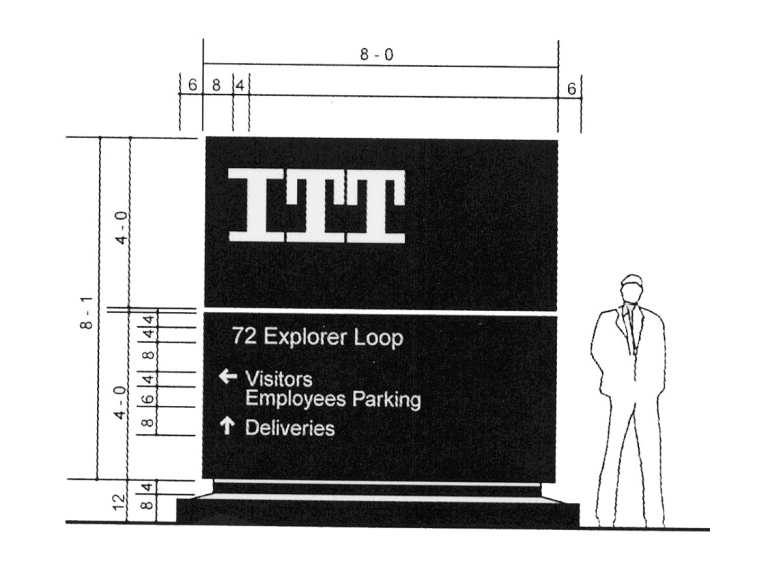
(4)
A monument sign may contain one, two, or three company names and logos. If more than three companies occupy a single facility, only the facility name may be placed on the monument sign.
(5)
The color, typography and logo combination used on the upper half of the monument sign may be selected by the tenant firm, but the background must be one continuous color.
(6)
Only the upper half of the monument sign may be internally illuminated.
(7)
One monument sign per access road to a site shall be permitted.
(8)
The monument sign shall be placed parallel to an existing public road, either within or outside the public street right-of-way and must be located a minimum of 20 feet from the curb of said public road and 15 feet from the curb of the site access road.
b.
Incidental ground signs. Incidental ground signs provide information needed to move about within a site. The signs can display standard traffic control symbols, speed limits, and directional and identification information.
(1)
Incidental ground signs shall display only regulatory, directional, traffic control, and identification information and the firm(s) or complex name or and/or logo.
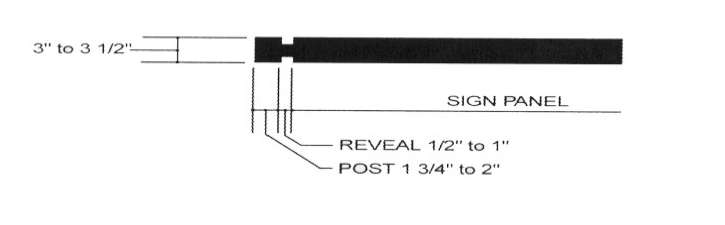
(2)
Incidental ground signs shall be of post and panel construction and shall not exceed six feet in height and four feet in panel width. Dimension details are presented in the following illustration.
(3)
Incidental ground signs shall not be located closer than 50 feet to an existing or proposed public street right-of-way and shall be a minimum of ten feet from an existing or proposed curb of any entrance drive or access way.
c.
Building mounted signs. Building mounted signs allow the tenant(s) or facility to identify itself on the face of the building.
(1)
Building mounted signs shall include only the name and/or logo of the resident firm(s) or complex.
(2)
Only one building mounted sign per firm, complex or building may be erected per street frontage.
(3)
Building mounted sign for a firm or complex shall not exceed ten percent of the gross area of the face of the main building fronting a street.
(4)
A building mounted sign shall be part of or mounted directly on the building wall and shall not project more than 12 inches from the building surface. Signs and murals painted directly upon the building are not permitted.
(5)
Roof mounted signs are prohibited.
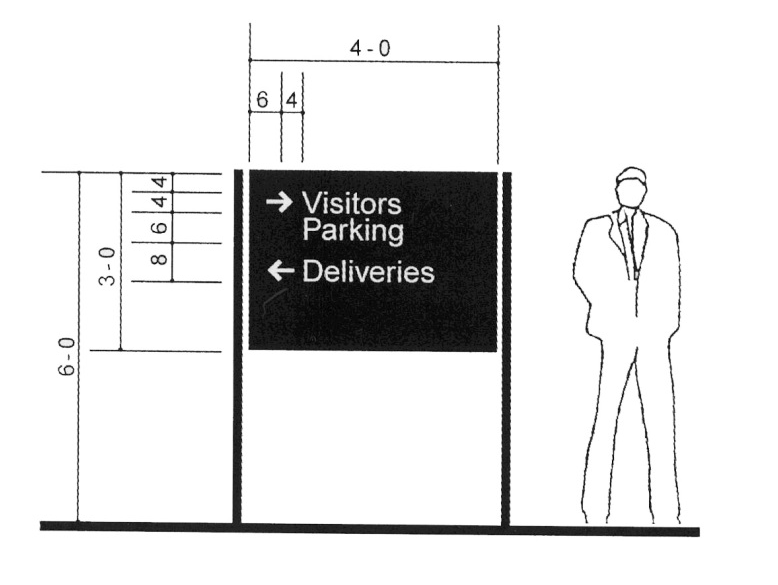
(6)
If a building has two or three tenants, each may have a building mounted sign. Where multiple tenant building mounted signs occur, their combined area shall not exceed 20 percent of the gross area of the face of the main building fronting a street, and they shall be visually equal in size and positioned according to a consistent format.
(7)
If a building has four or more tenants, no tenant names shall appear on the building, but the facility name may be placed on the building and said sign shall not exceed ten (10) percent of the gross area of the face of the main building fronting a street.
(8)
The building tenant(s) may select the material, color, typography and format for building mounted signs. Illumination of such signs is optional.
d.
Identity, information and traffic control signs. Entry, directory, and loop, traffic control, street name and directional monument signs installed and maintained by the City of Bossier City are permitted in street rights-of-way only if they don't impede on the traffic visibility.
e.
Ingress and egress signs.
f.
Real Estate signs. Provided the area on one side of any such sign shall not exceed twenty (20) square feet; on unimproved property the area on one side of such signs shall not exceed thirty-two (32) square feet; and not more than one such sign shall be erected for each 250 feet of frontage or fraction thereof.
S.
Commercial District Regulations.
Purpose and Intent. The National Cyber Research Park Commercial District is designed to provide an appropriate location for services, restaurants, and limited retail activities that primarily serve immediate personnel and visitors. This district will provide the amenities and services that cater to the needs of people that work and/or frequent the area.
The Commercial District is an integral part of the Research Park and is here to promote the most desirable use of land and direction of development in accord with a well-considered Master Plan and to strengthen the economic base of the area.
T.
District Development Standards. The uses within the Research Park Commercial District shall follow the development standards of the B-3 General Business District as stated in Article 6, District Development Standards, of the Unified Development Code.
U.
Architectural Review. All applications are subject to be reviewed by the Design Review Board. The following will be considered:
1.
Materials. Materials shall be appropriate for the use of building and for relationship to other materials including those used on buildings in surrounding areas.
2.
Colors and textures. Colors and textures shall be appropriate for the size and scale of the building, and for relationship to the site and surrounding buildings.
3.
Architectural details and ornaments. Architectural details and ornaments shall be meaningful to the overall design and appropriate for the size and scale of the building.
Long expanses of blank walls shall be avoided through the use of wall articulation. Breaking the continuous plane of the wall can be accomplished by recessing vertical segments of the wall at several intervals also a course of brick or other masonry material can be applied to the exterior wall to add visual interest at certain junctures in the wall.
4.
Mechanical Equipment. Mechanical equipment shall be considered as it affects rooftop appearance, sidewall openings, sound levels, smoke, and other nuisance aspects.
5.
Approaches, drives and parking areas. Approaches, drives and parking areas shall be considered as they affect the appearance from the street and from the site as well. The relationship of paving to the building shall be appropriate considering factors such as landscaping, safety, and drainage from the site.
6.
Lighting. Lighting shall be considered for the appropriateness of nighttime illumination of the grounds, drives, walks, parking areas, the building and its effect upon surrounding areas.
7.
Signs. Signs shall be considered for appropriateness of size, scale, shape, color, content, text and illumination in relation to the site.
8.
Adequate utilities. Adequate utilities, parking, access roads, drainage, landscape planting and other essential facilities and amenities are to be provided.
9.
Ingress and egress. Adequate measures will be taken to provide ingress and egress designed so as to minimize traffic congestion in the public streets.
10.
Roof Utilities or Mounted Units. Any equipment, mechanical or otherwise, located on the roof shall be screened from public view on all sides of the building including the rear.
Rooftop screening shall be integrated into the architecture of the building in terms of massing, materials and details. Ideally, the screening for rooftop equipment shall be part of the roof design.
V.
Permitted Uses. No building, structure, or land shall be used and no building or structure shall hereafter be erected, structurally altered, enlarged, or maintained except for one or more of the uses herein cited and subject to the conditions stated herein:
1.
Ambulatory health care facilities, including dental care.
2.
Bakeries, where the products made are sold exclusively at retail on the premises.
3.
Banks and credit unions.
4.
Barber shops, beauty parlors, reducing salons.
5.
Book stores and newsstands.
6.
Confectionery stores.
7.
Conference/convention centers.
8.
Climate Controlled Warehouses
9.
Drug stores and apothecaries.
10.
Dry cleaning establishments utilizing only non-flammable dry cleaning fluids.
11.
Emergency health care clinics.
12.
Florist shops.
13.
Gift Shops.
14.
Supermarket.
15.
Health clubs or gyms.
16.
Hotels.
17.
Municipal, Parish, State or Federal uses.
18.
Nurseries, kindergartens or day care centers for children.
19.
Office buildings.
20.
Office supply and computer supply stores.
21.
Off-premises liquor sales are conditionally allowed provided that such uses shall be located in a commercial establishment with gross sales of more than fifty percent in grocery/food items and further provided that such uses shall not be located within 300 feet of the premises of a religious institution, educational facility, or library.
22.
Performing arts center.
23.
Print shops and copying services.
24.
Restaurants, delicatessens, and cafes. No Drive-Thru window or service is permitted.
25.
Shoe stores, shoe repair shops, and tailor shops.
26.
Spa or Wellness centers.
27.
Teleconferencing centers.
28.
Other Retail sales and services may be permitted if it supports and/or complements uses permitted with the Research Park District. (Final approval shall be determined by the NRCP Board.)
W.
Temporary Uses. No temporary uses shall be allowed in the NCRP Commercial District.
X.
Outdoor Storage. Storage of equipment, materials, motor vehicles, boats, trailers, recreational vehicles, portable storage containers, or the like shall not be kept or stored on any lot or yard within the Research Park Commercial District.
Y.
Research Park Commercial District Sign Regulations. All exterior signs will be evaluated by the Design Review Board and must be designed in keeping with the architectural character of the Research Park. The size, color, location, design, format and materials of the sign will be consistent with the lot design and building architecture. The emphasis of signs shall be on identification of businesses, not on product or service advertising.
1.
Permits Required. For permitting requirements, reference Article 8.2, Permitted and Prohibited On-Premises Signs, of the Unified Development Code.
2.
Freestanding signs are limited to ground-mounted Monument Signs only.
3.
Monument Sign Dimensions. All monument signs shall have the following dimensions: a height of eight feet one inch, a width of eight feet; and a depth of 12 to 18 inches.
4.
Sign Materials. Sign materials should be compatible with the architectural character of the building or the development in style, location, size, configuration, materials, and color.
5.
Sign Limitations. Signs containing moving devices/elements, flashing lights, or banners are prohibited. No off-premises, billboards, roof signs, portable signs or temporary signs, other than construction and real estate signs shall be allowed.
5.7.4
Barksdale Boulevard Redevelopment Overlay District (B-BROD).
Overlay District Standards
Standards Clause. The uses within the B-BROD shall follow the development standards of the B-3; General Business District as stated in Article 6; District Development Standards, of the Unified Development Code. Existing uses, structures and sites shall be subject to the provision of Article 7; Nonconformities, of the Unified Development Code.
The following additional criteria shall be included as conditions for new developments with the B-BROD which are not subject to the provision of Article 7; Nonconformities, of the Unified Development Code:
A.
In addition to any landscaping and buffering requirements contained in Article 13, a twenty foot (20') bufferyard/landscaping strip shall be provided and maintained on the Barksdale Boulevard frontage. A bufferyard is defined as a unit of land together with required landscaping which may be required between land uses to eliminate minimize conflicts between them.
B.
New driveways along Barksdale Boulevard shall be limited to a maximum of thirty-five feet (35'), subject to all requirements and approvals of the Louisiana Department of Transportation and Development.
C.
A reduction in parking requirements shall be provided as an incentive for existing developed sites to install or provide cross-access easements. Existing sites which add cross-access easements shall be given a 20 percent reduction in required parking spaces and exempt from replacing parking eliminated by the cross-access easement.
(Ord. No. 51-2020, 5-5-2020)

