Boston City Zoning Code
ARTICLE 64
APPENDIX
APPENDIX A to ARTICLE 64 - Design Guidelines for Planned Development Area Development Plans in the Dartmouth/Columbus Community Commercial Subdistrict
The following design guidelines apply to any Planned Development Area Development Plan within the Dartmouth/Columbus Community Commercial Subdistrict.
A.
General Design Guidelines.
1.
Proposed Projects described in the Development Plan should contribute to the architectural integrity of the South End Historic Landmark District.
2.
Building design should express a building's uses and function.
B.
Building Massing. The massing of buildings described in the Development Plan should be compatible with the massing -of surrounding buildings in adjacent subdistricts. The four areas described in the following guidelines are shown on Map A of this Appendix A.
1.
Area 1. Within Area 1, the following guidelines apply:
a.
Building massing and design should adhere strictly to the South End Historic Landmark District Standards and Criteria issued by the Boston Landmarks Commission.
b.
The Dartmouth Street elevation should reflect and respond to the scale of the Tent City elevation along Dartmouth Street. Building massing along Dartmouth Street should be set back from the street line at a distance similar to that of the Tent City setback along Dartmouth Street.
2.
Area 2. Within Area 2, the following guidelines apply:
a.
Building massing should reflect the height, massing, and design scale of Tent City and other buildings adjacent to or across the street from Area 2. The Dartmouth Street elevation, in particular, should reflect and respond to the scale of the Tent City elevation along Dartmouth Street. Building massing along Dartmouth Street should be set back from the street line at a distance similar to that of the Tent City setback along Dartmouth Street.
b.
The massing and design of buildings facing Dartmouth Street and Tent City, to the west, and Clarendon Street, to the east, should provide distinctive architectural gateways to the South End from Back Bay.
c.
On the Clarendon Street side of Area 2, building massing and design should enhance the View of the block from the east and should provide an entrance of equal importance to that on the Dartmouth Street side.
3.
Area 3. Within Area 3, the following guidelines apply:
a.
Area 3 should provide a transition zone in which the massing of the Proposed Project steps down in gradation from the higher scale of Area 1 to the lower scale of Area 2.
b.
The building massing within Area 3 should reflect the height, massing, and design scale of Tent City and other buildings facing this area.
4.
Area 4. Within Area 4, the following guidelines apply:
a.
Building massing and design should adhere strictly to the South End Historic Landmark District Standards and Criteria issued by the Boston Landmarks Commission.
b.
In Area 4, the upper portion of any building should be set back at a distance sufficient to allow for reasonable access to sunlight for buildings adjacent to Area 4.
C.
Transportation and Pedestrian Access.
1.
Dartmouth Street is the least favored point of access for deliveries and loading; efforts should be made to use other points of entry for deliveries and loading.
2.
Direct internal access from the Back Bay MBTA Station into the Proposed Project should be considered and explored.
3.
Project design and decisions regarding pedestrian and vehicular access to the Proposed Project should be coordinated with ongoing MBTA efforts to redesign the Clarendon Street bus loop.
APPENDIX B TO ARTICLE 64 - Design Guidelines for Planned Development Area Development Plans in the Economic Development Area Sub-districts
The following design guidelines apply to any Planned Development Area Development Plan within the Economic Development Area North, Central and South Subdistricts.
A.
Design Guidelines
1.
Proposed Projects in the South End Landmark District must be reviewed and approved by the South End Landmark District Commission.
2.
Building design should express a building's uses and function.
3.
Newly constructed Street Walls should be built to match the existing Street Wall line found on the Block on which the Street Wall faces. If there is no determinable Street Wall line on the Block, then the Street Wall should match the Street Wall Line of the adjacent Blocks.
4.
Ground floor facades, especially for commercial uses, should be open and transparent.
5.
Open spaces, building entrances, shop fronts, shop windows, shop entrances, and similar elements should be designed to enhance pedestrian activity and encourage an active street life. Blank walls without windows facing onto pedestrian areas should be avoided..
6.
A zone for signs on the Building facade should be established, defined by a change in facade color and/or materials, or by an articulation of the facade, and all permanent signs mounted on the Building facade should be located within such zone. In Buildings with multiple stores, the sign zone should be subdivided so that each section clearly relates to an individual store. Signs should be designed and located so as not to obscure architectural elements or ornamental details of the building facade. Internally-lit signs should be designed so as not to create a hazard or nuisance through excessive brightness, and such signs should be constructed so that bulbs, wires, and other lighting equipment located inside the sign are not visible through the face of the sign. (Refer to Section 64-35 of this Article.)
7.
Temporary banners or signs need to be submitted to the BRA for review and approval prior to installation.
8.
If a security grate is to be used on a Building, it should be a see-through grille with decorative elements rather than a roll-up steel door. Such security grate should be mounted inside of the storefront
B.
Massing
1.
In EDA Central and South, New or rehabilitated Buildings should reflect and complement the scale andarchitectural character of historically-distinctive Buildings in the surrounding area.
2.
In EDA Central, Building massing within Area 3 should be designed to transition from the higher scale of Area 4 and the lower scale of Areas 1 and 2.
3.
For industrial Buildings in EDA South, design of new construction and rehabilitation of existing Buildings should be compatible with pedestrian activity, where practicable. Loading zones should be clearly marked both at the ground plane and through the use of architectural features, such as canopies and the like. Where the provision of windows in the Street Wall is impracticable, articulation of the Street Wall by other means is encouraged.
4.
In EDA South, building massing along East Canton Street should acknowledge the height, massing and design scale of the residential buildings across the street.
5.
In EDA South, building massing should be designed to transition from lower scale along Albany Street (Area 2) to higher scale of Area 3.
C.
Site Plan
1.
Site planning, including location and orientation of Building footprint, open space, and vehicular access should be designed to provide new through-block connections to enhance circulation within the subdistrict and reinforce the historic East - West street pattern (See Section 64-29.3 on Lot Coverage Requirements for PDA Projects).
2.
Vehicular access to and egress from a site should minimize traffic impacts on adjacent roadways and provide visual access for drivers and pedestrians.
3.
Parking, storage and disposal areas, and the entrance to accessory parking within a main Building should not be located in the front of Buildings. Such areas should be located within Buildings and on secondary elevations. If such areas are visible from a public way they should be appropriately screened and buffered.
4.
Shawmut Avenue, Washington Street and Harrison Avenues should be avoided as points of access for loading and servicing.
5.
Projects with frontage on Traveler Street will be required to provide an enhanced landscaped edge which may include the following: tree plantings, landscape furniture such as benches and like, planting beds, way-finding elements Appropriate hardscape surface elements for pedestrians.
(Text Amd. No. 434, § 3, 6-13-2018)
APPENDIX C TO ARTICLE 64 - EDA NORTH
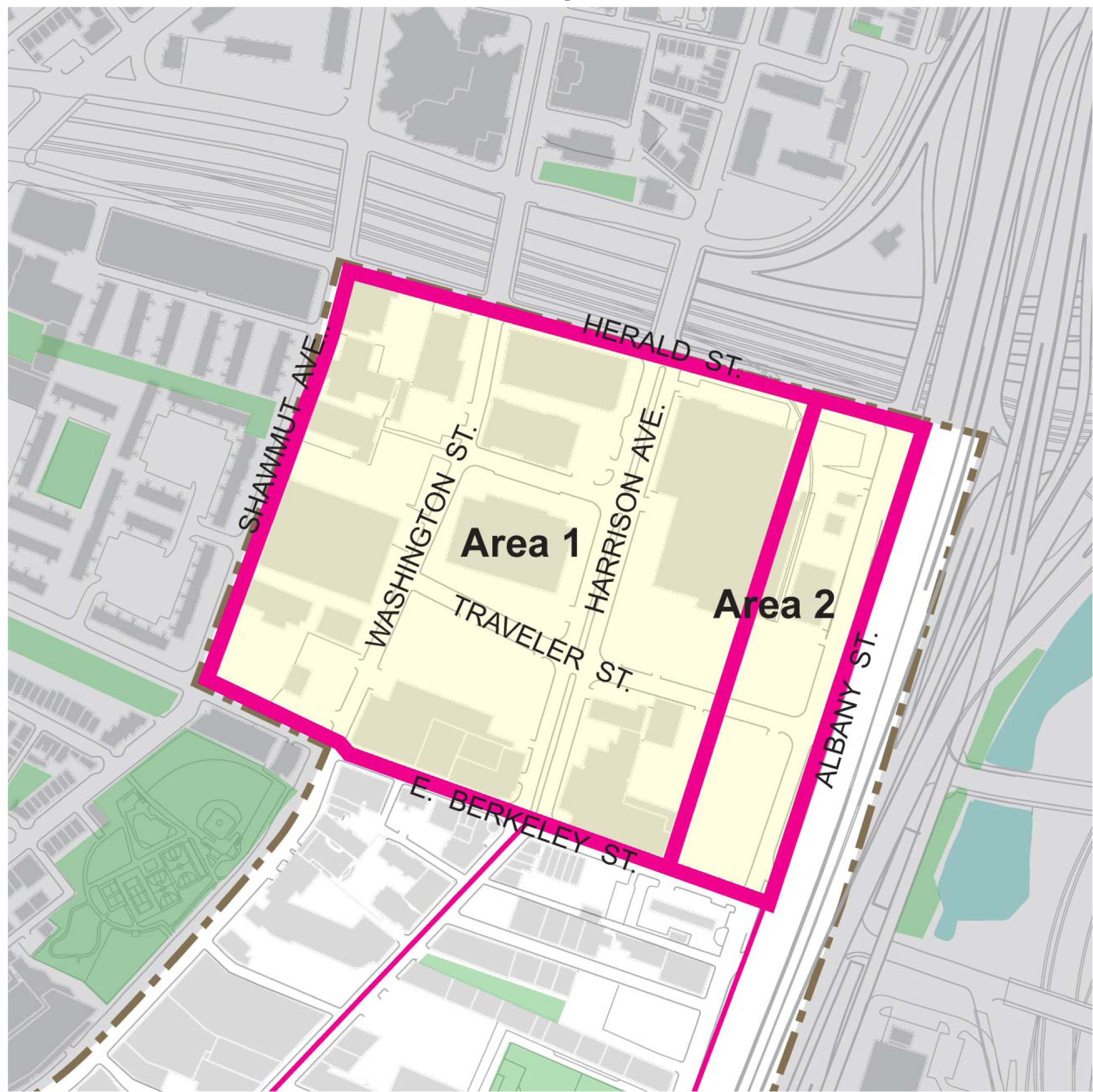
Area 1: Within that portion of the subdistrict that is beyond 165 feet from Albany Street.
Area 2: Within that portion of the subdistrict that is within 165 feet from Albany Street.
APPENDIX D TO ARTICLE 64 - EDA CENTRAL
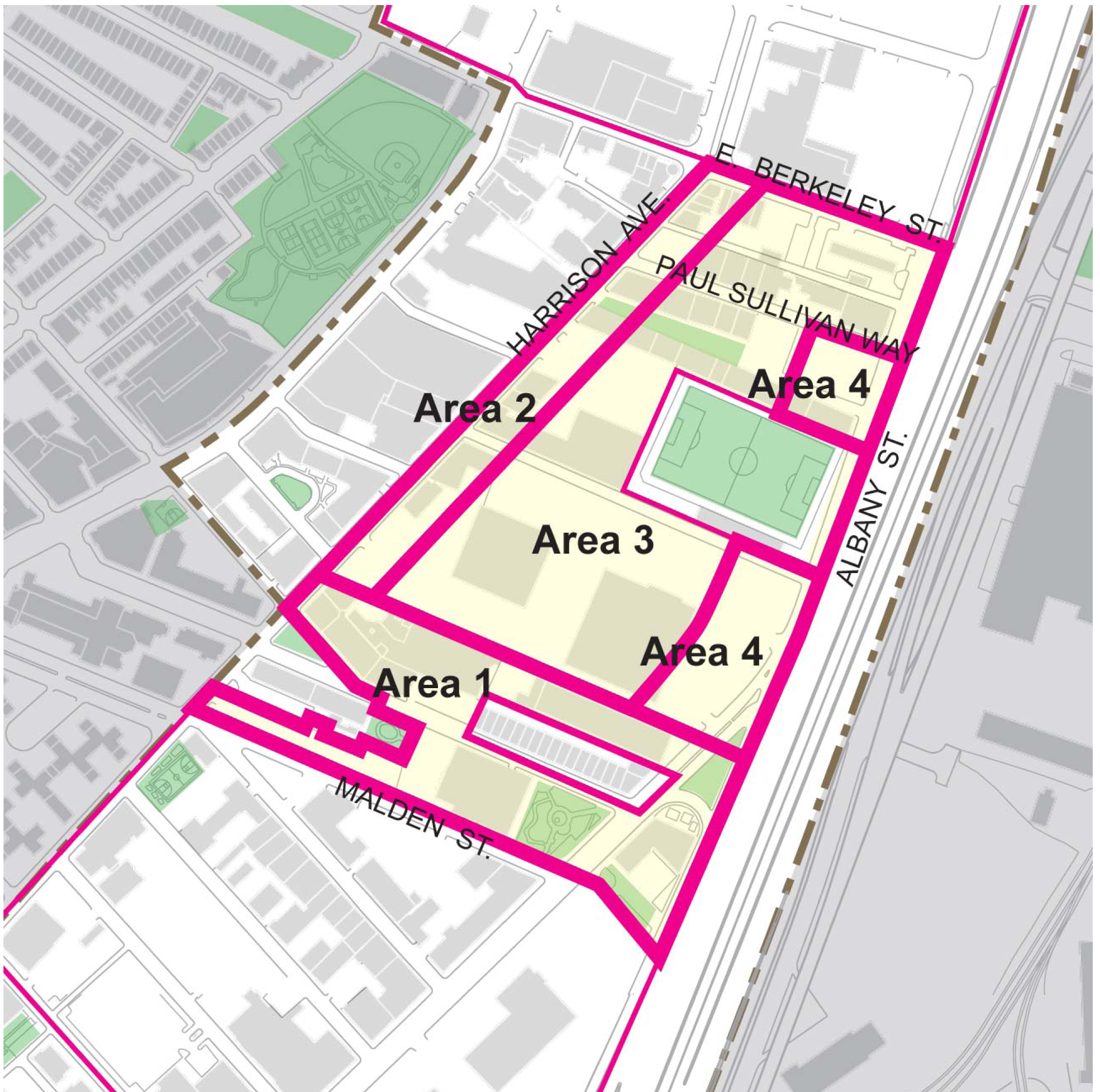
Area 1: Within that portion of the subdistrict that is shown in this Appendix D as Area 1 and that is between the western Street Line of Albany Street and the eastern Street Line of Harrison Avenue.
Area 2: Within that portion of the subdistrict that is within 100 feet of the eastern Street Line of Harrison Avenue.
Area 3: Within that portion of the subdistrict that is beyond 100 feet from the eastern Street Line of Harrison Avenue.
Area 4: Within 165 feet from Albany Street running from the centerline between Paul Sullivan Way on the north and the southern parcel boundary for the existing MBTA operations site to the south.
APPENDIX E TO ARTICLE 64 - EDA SOUTH
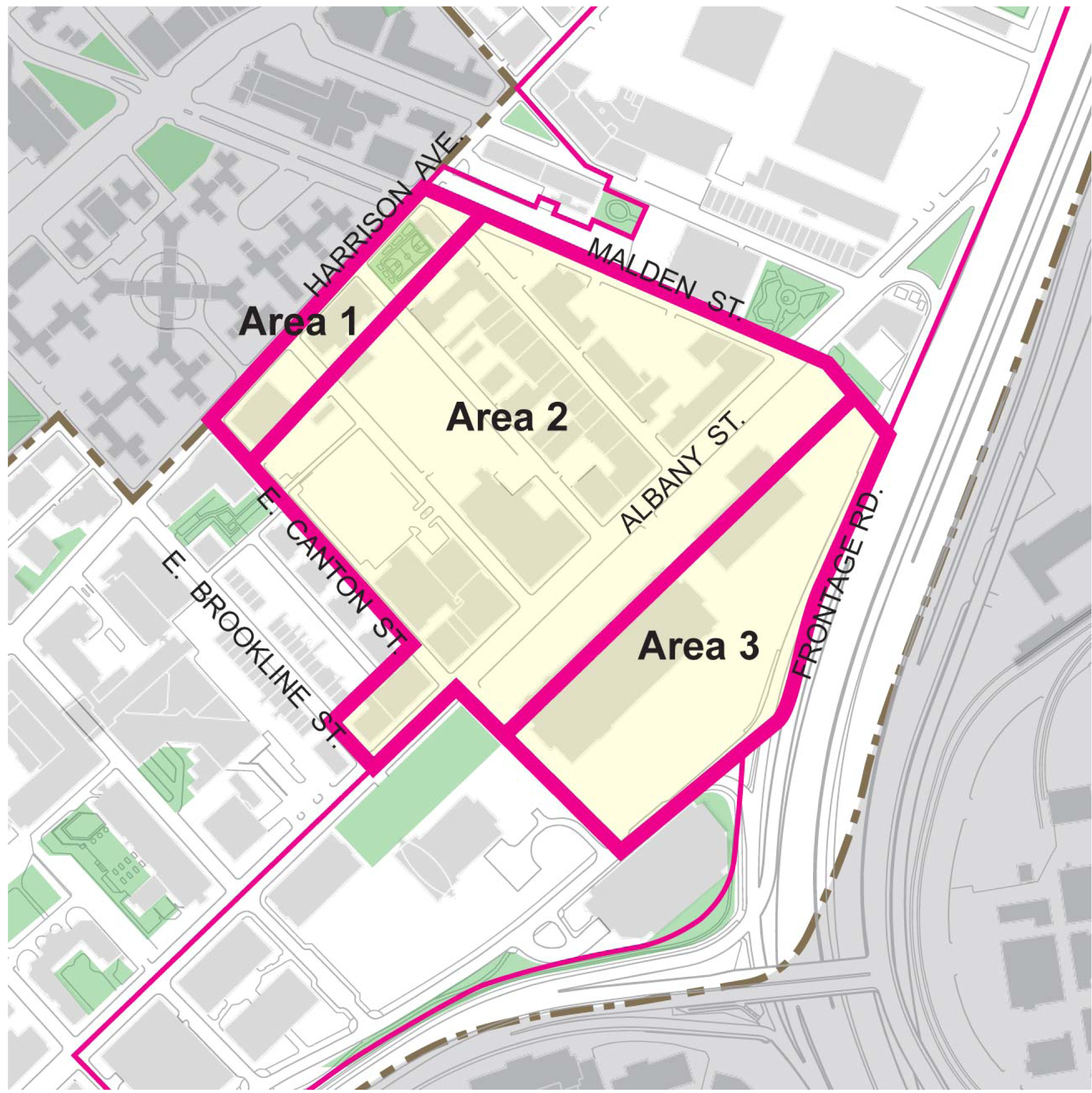
Area 1: Within that portion of the subdistrict that is within 100 feet from the eastern Street Line of Harrison Avenue.
Area 2: Within that portion of the subdistrict that is beyond 100 feet from the eastern Street Line of Harrison Avenue.
Area 3: Within that portion of the subdistrict that is beyond 100 feet from the eastern Street Line of Albany Street and toward the Expressway.
APPENDIX F TO ARTICLE 64 - BIOSQUARE EDA
Area 1: Within that portion of the subdistrict that is within 100 feet from the eastern Street Line of Albany Street.
Area 2: Within that portion of the subdistrict that is beyond 100 feet from the eastern Street Line of Albany Street.