
Boulder City Zoning Code
CHAPTER 6
Use Standards6
Editor's note— Ord. No. 8523, §§ 10, 11, adopted June 21, 2022, amended chapter 6 in its entirety to read as herein set out. Former chapter 6, §§ 9-6-1—9-6-12, pertained to similar subject matter. See Code Comparative Table for complete derivation.
9-6-1.- Schedule of Permitted Land Uses.
The schedule in Table 6-1 shows the uses that are permitted, conditionally permitted, prohibited, or that may be permitted through use review.
(a)
Explanation of Table Abbreviations: The abbreviations and symbols used in Table 6-1 of this section have the following meanings:
(1)
Allowed Uses: An "A" in a cell indicates that the use type is permitted by right in that zoning district, subject to compliance with any applicable specific use standards set forth in this chapter.
(2)
Conditional Uses: A "C" in a cell indicates that the use type will be reviewed in accordance with the procedures established in Section 9-2-2, "Administrative Review Procedures," B.R.C. 1981. Conditional use applications shall also meet any applicable specific use standards set forth in this chapter.
(3)
Use Review Uses: A "U" in a cell indicates that the use type will be reviewed in accordance with the procedures established in Section 9-2-15, "Use Review," B.R.C. 1981. Use review applications shall also meet any applicable specific use standards set forth in this chapter.
(4)
Prohibited Uses: A hyphen ("-") in a cell indicates that the use type is prohibited in that zoning district.
(5)
Specific Use Standards: Cells containing bracket symbols ("[ ]") indicate that there are specific use standards associated with the use type in that district that must be complied with. Regardless of whether or not a use is allowed by right, conditional use, or use review, specific use standards may apply. The standards may require a different review process or impose certain limitations. The applicable specific use standards are identified and cross-referenced in the right-most column of Table 6-1. Several specific use standards may apply to a use type. If there is any inconsistency between the bracket designation in Table 6-1 and the specific use standards in Chapter 9-6, the specific use standards shall control.
(b)
Additional Standards:
(1)
Uses are also subject to all other applicable requirements of this title.
(2)
Additional Use Standards in Form-Based Code Areas or Overlay Districts:
(A)
Uses in Form-Based Code Areas: Uses located on a lot or parcel designated in Appendix L, "Form-Based Code Areas," are subject to the requirements of this chapter, but, if developed pursuant to a form-based code review, may also be subject to additional use standards pursuant to Chapter 9-14, "Form-Based Code."
(B)
Uses in Overlay Districts: Uses located on a lot or parcel located within an overlay district designated in Chapter 9-3, "Overlay Districts," B.R.C. 1981, are subject to the requirements of this chapter, but may also be subject to additional use standards pursuant to the overlay district standards described in that chapter.
(c)
Structure of the Use Classification System: Land uses are organized according to a three-tiered hierarchy consisting of use classifications, use categories, and use types. This classification system is intended to provide a structure that groups similar uses together for ease in locating or identifying a use and to simplify the classification of new uses.
(1)
Use Classifications: Each use is grouped under one of these seven broad use classifications: Residential Uses; Public, Institutional, and Community Uses; Commercial Uses; Industrial Uses; Agricultural and Natural Resource Uses.
(2)
Use Categories: Use categories are subgroups of uses in each classification that have common functional or physical characteristics, such as the type and amount of activity, types of goods, services, occupants or users/customers, or operational characteristics.
(3)
Use Types: Use types are the specific land uses that can be established in a zoning district, such as duplex, restaurant, or building material sales.
(d)
Interpretation: The city manager may decide questions of interpretation as to which use type that a use not specifically listed in Table 6-1 is properly assigned to, based on precedents, similar situations, and relative impacts. Upon written application, a city manager interpretation as to which use type a use not specifically listed is properly assigned to may be appealed to the BOZA pursuant to Section 9-2-3, "Variances and Interpretations," B.R.C. 1981. Any use not specifically listed in Table 6-1 of this section is not allowed unless it is determined to be included in a use type as provided by this section.
(e)
Multiple Uses of Land Permitted and Accessory Uses: Allowed uses, conditional uses, and uses permitted by use review may be located in the same building or upon the same lot. Any use may be allowed as an accessory use if it meets the definition of an accessory use.
TABLE 6-1: USE TABLE
Ordinance Nos. 8523 (2022); 8556 (2023); 8571 (2023); 8590 (2023); 8599 (2024); 8650 (2025); 8669 (2025); 8745 (2026); 8751 (2026)
9-6-2. - Specific Use Standards - General.
(a)
Purpose: The purpose of this chapter is to set forth additional requirements for specified uses of land. The requirements are intended to ensure that the use is compatible with the surrounding area.
(b)
Scope: Specific use standards are the standards contained in Sections 9-6-2 through 9-6-7, B.R.C. 1981. Specific use standards apply as follows:
(1)
Allowed Uses: Uses that are permitted by right and are subject to specific use standards in this chapter shall be established, operated, and maintained in compliance with any applicable specific use standards. The establishment of these uses is not subject to a review procedure.
(2)
Conditional Uses: Uses that may be approved as a conditional use are uses that are appropriate in a given zoning district if the applicant demonstrates that the use meets the applicable specific use standards of this chapter. Conditional uses will be reviewed pursuant to the procedures in Section 9-2-2, "Administrative Review Procedures," B.R.C. 1981.
(3)
Use Review Uses: Uses that require a use review are uses that are suitable in a location if the applicant demonstrates that the use meets the use review criteria in Section 9-2-15, "Use Review," B.R.C. 1981, and the applicable specific use standards of this chapter.Use reviews will be reviewed pursuant to the procedures in Section 9-2-15, B.R.C. 1981.
(c)
Specific Use Standards that Apply to Several Use Types: The specific use standards in this chapter are generally organized by use classification, use category, and use type. Some specific use standards apply to several use types that are part of different use classifications and use categories. Such standards that apply to use types within different classifications are set forth within this subsection (c).
(1)
Specific Use Standards for Uses in the BC Zoning Districts:
(A)
Review Process: In the BC-1 and BC-2 zoning districts, the following standards apply to the uses listed in Table 6-2:
TABLE 6-2: USES WITH SPECIFIC USE STANDARDS IN THE BC-1 AND BC-2 ZONING DISTRICTS
(i)
Allowed Use: The uses listed in Table 6-2 are allowed by right unless the use is located within an area designated in Appendix N "Business Community (BC) Areas Subject to Special Use Restrictions."
(ii)
Conditional Use: If located in one of the mapped areas in Appendix N, the use may be approved as a conditional use if it meets all of the following standards:
a.
The use shall not be located on the ground floor, with the exception of minimum necessary ground level access.
b.
The combined floor area of any nonresidential uses in Table 6-2 shall be limited to ten percent of the total floor area on the lot or parcel except that if the use is located within an approved site review or planned unit development, the combined floor area of any nonresidential uses subject to this section shall be limited to ten percent of the total floor area within the boundaries of the site review or planned unit development approval in the BC zoning district.
c.
A principal use of any automobile parking lot or garage shall be a park and ride facility.
(iii)
Use Review: A use that is not allowed by right or as a conditional use may be approved only pursuant to a use review. In addition to meeting the use review criteria, the applicant shall demonstrate that the use on the ground floor or with a combined floor area larger than ten percent of the total floor area, as applicable, will not adversely affect the intended function and character of the area as a neighborhood serving business area where retail-type stores predominate on the ground floor. In determining whether this criterion is met, the reviewing authority shall consider the location and design of the proposed use and the existing and approved uses on the lot or parcel and in the area.
Ordinance Nos. 8523 (2022); 8556 (2023); 8697 (2025)
9-6-3. - Specific Use Standards - Residential Uses.
(a)
Residential Uses:
(1)
This Subsection (a) sets forth standards for uses in the residential use classification that are subject to specific use standards pursuant to Table 6-1, Use Table.
(2)
Residential Uses in the IG and IM Zoning Districts: The following standards apply in the IG and IM zoning districts to residential uses that may be approved pursuant to a use review:
(A)
Location: Dwelling units may be constructed only on a lot or parcel that meets one or more of the following requirements (i), (ii), or (iii). If a lot or parcel meets this location standard, the approving authority shall presume that the standard in Paragraph 9-2-15(e)(4), B.R.C. 1981, has been met.
(i)
The residential use is consistent with the land use plan or map in an adopted subcommunity or area plan; or
(ii)
The lot or parcel is located within one-quarter mile of the Boulder Junction transit station. Distance shall be measured by the city manager on official maps as the radius from the closest point on the perimeter of the applicant's lot or parcel to the closest point on the transit station lot; or
(iii)
At least one-sixth of the perimeter of the lot or parcel is contiguous with a residential use that includes one or more dwelling units, a residential zoning district, or a city- or county-owned park or open space. Contiguity shall not be affected by the existence of a platted street or alley, a public or private right-of-way, or a public or private transportation right-of-way or area.
(B)
Floor Area Ratios (FAR): The following floor area ratio standards apply to a lot or parcel in the IG or IM zone with a residential use:
(i)
FAR by Use: Residential floor area is limited to a 1.0 FAR. Non-residential floor area is limited to a 0.5 FAR in the IG zone and 0.4 FAR in the IM zone.
(ii)
Additional Residential FAR for Certain Industrial Mixed-Use Projects: If 0.3 or more of allowed nonresidential FAR consists, individually or in combination, of building and landscaping contractors, building material sales, business support services, equipment repair and rentals, light manufacturing, non-vehicular repair and rental services, research and development, service of vehicles, warehouse or distribution facilities, or wholesale businesses, the maximum residential FAR is 1.25.
(iii)
FAR Averaging Across Parcels in Site Review: The FAR limits of this subparagraph (a)(2)(B) may be modified in a site review to permit averaging of these FAR limits across multiple lots or parcels that are subject to the site review and within the same zoning district provided that, when averaged across the lots and parcels, the FAR standards are met and do not result in a FAR exceeding that permitted under this subparagraph.
(C)
Setbacks from Existing Oil and Gas Operations: The use is located no closer than 2,000 feet from a well pad of an existing single-well oil and gas operations use in pre-production, no closer than 2,500 feet from any well pad of an existing multi-well (two or more) oil and gas operations use in pre-production, and no closer than 500 feet from any well pad of an existing oil and gas operations use in production. The use is located no closer than 250 feet from any oil and gas operations use that is capped and abandoned pursuant to the requirements of Section 9-6-7(b)(15), B.R.C. 1981.
(D)
Buffers From Adjacent Land Uses: The applicant shall provide visual screening, which may include, without limitation, walls, fences, topographic changes, horizontal separation, or plantings for those areas that are adjacent to loading docks, truck or other delivery vehicle ingress or egress areas, dumpsters or other recycling vessels, and outdoor storage areas.
(E)
Environmental Suitability: The applicant shall demonstrate that the proposed use will not be affected by any adverse health or safety impacts associated with potential on-site pollution or contamination beyond that which is customarily acceptable for land that is used for residential purposes. This shall be demonstrated through the use of the environmental assessment required to be submitted with the application. If such environmental assessment identifies any potential adverse health or safety impacts on future residents of the site, the applicant shall also be required to submit further assessments that demonstrate that such concerns are not present or submit a plan for the mitigation measures that are necessary to alleviate any adverse impacts to public health, safety, and welfare.
(F)
Construction Standards for Noise Mitigation: The applicant shall utilize construction standards that will achieve an interior day-night average noise level of no more than forty-five decibels, anticipating potential exterior day-night average industrial noise levels of seventy-three decibels measured at the property line. Such standards shall be in compliance with Chapter 10-5, "Building Code," B.R.C. 1981. Noise shall be measured in a manner that is consistent with the federal Housing and Urban Development's standards in Sections 24 CFR §§ 51.100 to 51.106 for the "measure of external noise environments," or similar standard adopted by the city manager in the event that such rule is repealed. The applicant shall provide written certification prior to the issuance of a certificate of occupancy that the sound abatement and attenuation measures were incorporated in the construction and site design as recommended by a professional engineer.
(G)
Declaration of Use Required: Before receiving a building permit, all owners shall sign a declaration of use, including all the conditions for continued use, to be recorded in the office of the Boulder County Clerk and Recorder to serve as actual and constructive notice to potential purchasers and tenants of the owner's property status as a residential use within an industrial zoning district classification.
HOUSEHOLD LIVING
(b)
Household Living Uses:
(1)
This subsection (b) sets forth specific use standards that apply to uses listed in the household living use category of Table 6-1, Use Table.
(2)
Household Living Uses in the RMX-2 Zoning District: The following standards apply in the RMX-2 zoning district to uses in the household living use category that are allowed by right:
(A)
Minimum Number of Housing Types: No person shall develop land in the RMX-2 zoning district with household living uses, with the exception of mobile home parks, unless the following housing types are provided:
(i)
For lots or parcels one acre or less, at least one housing type;
(ii)
For lots or parcels that are greater than one acre but less than five acres, at least two housing types; and
(iii)
For lots or parcels that are five acres or more, at least three housing types. The minimum number of any housing type for lots or parcels that are more than five acres shall be five dwelling units.
(B)
Maximum Percentage of Any One Housing Type: No person shall develop a lot or parcel of one acre or more with more than fifty percent of any one housing type in the RMX-2 zoning district. This standard does not apply to mobile home parks.
(3)
Household Living Uses in the MU-3 Zoning District:
(A)
Applicability: The following standards apply in the MU-3 zoning district to uses in the household living use category that front onto Pearl Street and may be approved as a conditional use:
(i)
The first floor above the finished grade at the street level fronting onto Pearl Street shall be constructed to permit a portion of the first floor as specified in Subparagraph (b)(3)(A)(ii) to be used for a restaurant, brewpub, or tavern use, personal service use, or retail sales use that is permitted in the MU-3 zoning district.
(ii)
The nonresidential spaces shall have a minimum depth of twenty feet measured from the front of the building along the Pearl Street frontage to the inside wall opposite of the street frontage. Building entries for uses above the first floor may be permitted to the extent necessary to provide access.
(iii)
The nonresidential space required by this section shall be used as a nonresidential principal use as permitted by Section 9-6-1, "Schedule of Permitted Land Uses," B.R.C. 1981, and not be used for any residential principal or accessory uses.
(iv)
No existing nonresidential space fronting onto Pearl Street shall be converted to residential space inconsistent with this paragraph.
(v)
The first floor frontage requirements for nonresidential uses of this section and the requirements for window location, door location, and minimum lot frontage in "Table 7-1: Form and Bulk Standards" may be modified for an individual landmark or a building within a historic district that has received a landmark alteration certificate as required by Chapter 9-11, "Historic Preservation," B.R.C. 1981.
(c)
Duplex:
(1)
In the BR-1 and BR-2 Zoning Districts:
(A)
Review Process: In the BR-1 and BR-2 zoning districts, the following review process applies to duplexes:
(i)
Allowed Use: A duplex is allowed by right if the use meets the following standards:
a.
All units on the lot or parcel are permanently affordable units meeting the requirements in Chapter 9-13, "Inclusionary Housing," B.R.C. 1981; or
b.
The use is not located on the ground floor along a major street, as defined by Appendix A, "Major Streets," B.R.C. 1981, with the exception of minimum necessary ground level access. The limitation on ground floor use along a major street applies to a depth of 30 feet measured from the building's major street facing façade.
(ii)
Use Review: A duplex that is not allowed by right may be approved only pursuant to a use review.
(2)
In the IMS Zoning District:
(A)
Review Process: In the IMS zoning district, a duplex is allowed by right if at least fifty percent of the floor area of the building is for nonresidential use. A duplex that is not allowed by right may be approved only pursuant to a use review.
(d)
Dwelling Unit, Attached:
(1)
In the RH-6 Zoning District:
(A)
In the RH-6 zoning district, attached dwelling units shall be located in a development that includes townhouse dwelling units. Attached dwelling units may only be located on a corner that has street frontage on two sides.
(2)
In the BT-1 and BT-2 Zoning Districts:
(A)
Review Process: In the BT-1 and BT-2 zoning districts, attached dwelling units are allowed by right if the use is not located on the ground floor facing a street, with the exception of minimum necessary ground level access. Attached dwelling units that are not allowed by right may be approved only pursuant to a use review.
(3)
In the BMS Zoning District:
(A)
Review Process Outside UHGID: Attached dwelling units located in the BMS zoning district and outside the University Hill general improvement district are allowed by right if the use is not located on the ground floor facing a street, with the exception of minimum necessary ground level access. Attached dwelling units that are not allowed by right may be approved only pursuant to a use review.
(B)
Review Process Within UHGID: Attached dwelling units located in the BMS zoning district and within the University Hill general improvement district are subject to the following review process:
(i)
Conditional Use: Attached dwelling units may be approved as a conditional use if the units meet the following standards:
a.
The units are all permanently affordable units meeting the requirements in Chapter 9-13, "Inclusionary Housing," B.R.C. 1981; and
b.
With the exception of minimum necessary ground level access, the use is not located on the ground floor facing a street.
(ii)
Use Review: Attached dwelling units that may not be approved as a conditional use may be approved only pursuant to a use review.
(4)
In the BR-1 and BR-2 Zoning Districts:
(A)
Review Process: In the BR-1 and BR-2 zoning districts, the following review process applies to attached dwelling units:
(i)
Allowed Use: Attached dwelling units are allowed by right if the use meets the following standards:
a.
All units on the lot or parcel are permanently affordable units meeting the requirements in Chapter 9-13, "Inclusionary Housing," B.R.C. 1981; or
b.
The use is not located on the ground floor along a major street, as defined by Appendix A, "Major Streets," B.R.C. 1981, with the exception of minimum necessary ground level access. The limitation on ground floor use along a major street applies to a depth of 30 feet measured from the building's major street facing façade.
(ii)
Use Review: Attached dwelling units that are not allowed by right may be approved only pursuant to a use review.
(5)
In the IMS Zoning District:
(A)
Review Process: In the IMS zoning district, attached dwelling units are allowed by right if at least fifty percent of the floor area of the building is for nonresidential use. Attached dwelling units that are not allowed by right may be approved only pursuant to a use review.
(6)
In the RR-1, RR-2, RE, and RL-1 Zoning Districts:
(A)
In the RR-1, RR-2, RE, and RL-1 zoning districts, attached dwelling units are allowed by right provided that no lot exceeds three dwelling units and are otherwise prohibited.
(e)
Dwelling Unit, Detached:
(1)
In the RR-1, RR-2, RE, RL-1, RL-2, RM-2, P, and A Zoning Districts:
(A)
Applicability: In the RR-1, RR-2, RE, RL-1, RL-2, RM-2, P, and A zoning districts, the following standards apply to a detached dwelling unit with two kitchens that may be approved as a conditional use or pursuant to a use review:
(i)
Second Kitchen Shall Not Create an Additional Dwelling Unit: The second kitchen shall be incidental to occupancy of the entire house in common by all occupants and shall not be designed or used to create or allow for the creation of a second dwelling unit. In determining whether the second kitchen creates or may create an additional dwelling unit, the city manager shall consider whether the proposed kitchen can be separated from the remainder of the dwelling unit, with other rooms, including a bathroom, with a separate exterior access.
(ii)
Owner Occupied: The detached dwelling unit within which the second kitchen is located is actually and physically occupied as a principal residence by at least one owner of record of the lot or parcel upon which the detached dwelling unit is located who possesses at least an estate for life or a fifty-percent fee simple ownership interest.
(iii)
Agreement Required: If such use is approved, the city manager and the property owner shall record an agreement with the Boulder County Clerk and Recorder, whereby the property owner acknowledges and agrees that the dwelling unit shall only be used as a single dwelling unit and in compliance with the conditional use approval. The agreement shall also bind the owner and occupants and the owner's heirs, successors-in-interest, assigns and lessees.
(2)
In the RH-1, RH-2, RH-3, RH-4, RH-5, RH-7, MU-1, MU-2, and MU-4 Zoning Districts:
(A)
Review Process: In the RH-1, RH-2, RH-3, RH-4, RH-5, RH-7, MU-1, MU-2, and MU-4 zoning districts, the following review process applies to detached dwelling units:
(i)
Allowed Use: A detached dwelling unit is allowed by right if it existed on the lot or parcel on August 6, 2019, or where more than one dwelling unit is on the lot or parcel. For purposes of this limitation, "existed on" means a detached dwelling unit that is constructed on or before said date or for which a complete building permit application was submitted on or before said date provided the applicant pursues all requirements and deadlines set by the city manager and this code for the construction of the unit.
(ii)
Use Review: A new detached dwelling unit that is not allowed by right may be approved pursuant to a use review if the approving authority finds that:
a.
The use meets the use review criteria in Paragraphs 9-2-15(e)(2), (3), and (4), "Use Review," B.R.C. 1981;
b.
The dwelling unit is designed to create pedestrian interest through design elements such as design detail, location of building frontages, location of entrances and windows, and front porches; and
c.
The dwelling unit is located in an area where detached dwelling units predominate.
(3)
In the BT-1 and BT-2 Zoning Districts:
(A)
Review Process: In the BT-1 and BT-2 zoning districts, a detached dwelling unit is allowed by right if the use is not located on the ground floor facing a street, with the exception of minimum necessary ground level access. A detached dwelling unit that is not allowed by right may be approved only pursuant to a use review.
(4)
In the BR-1 and BR-2 Zoning Districts:
(A)
Review Process: In the BR-1 and BR-2 zoning districts, the following review process applies to detached dwelling units:
(i)
Allowed Use: A detached dwelling unit is allowed by right if the use meets the following standards:
a.
All units on the lot or parcel are permanently affordable units meeting the requirements in Chapter 9-13, "Inclusionary Housing," B.R.C. 1981; or
b.
The use is not located on the ground floor along a major street, as defined by Appendix A, "Major Streets," B.R.C. 1981, with the exception of minimum necessary ground level access. The limitation on ground floor use along a major street applies to a depth of 30 feet measured from the building's major street facing façade.
(ii)
Use Review: A detached dwelling unit that is not allowed by right may be approved only pursuant to a use review.
(f)
Efficiency Living Unit:
(1)
In the BMS Zoning District:
(A)
Review Process Outside UHGID: Efficiency living units located in the BMS zoning district and outside the University Hill general improvement district are allowed by right if the use is not located on the ground floor facing a street, with the exception of minimum necessary ground level access. Efficiency living units that are not allowed by right may be approved only pursuant to a use review.
(B)
Review Process Within UHGID: The following review process applies to efficiency living units located in the BMS zoning district and within the University Hill general improvement district:
(i)
Conditional Use: Efficiency living units may be approved as a conditional use if the units are permanently affordable units meeting the requirements in Chapter 9-13, "Inclusionary Housing," B.R.C. 1981, and the use is not located on the ground floor facing a street.
(ii)
Use Review: Efficiency living units that may not be approved as a conditional use may be approved only pursuant to a use review. In addition to meeting the use review criteria, the units must be permanently affordable units meeting the requirements in Chapter 9-13, "Inclusionary Housing," B.R.C. 1981.
(2)
In the BR-1 and BR-2 Zoning District:
(A)
Review Process: In the BR-1 and BR-2 zoning districts, the following review process applies to efficiency living units:
(i)
Allowed Use: Efficiency living units are allowed by right if the use meets the following standards:
a.
All units on the lot or parcel are permanently affordable units meeting the requirements in Chapter 9-13, "Inclusionary Housing," B.R.C. 1981; or
b.
The use is not located on the ground floor along a major street, as defined by Appendix A, "Major Streets," B.R.C. 1981, with the exception of minimum necessary ground level access. The limitation on ground floor use along a major street applies to a depth of 30 feet measured from the building's major street facing façade.
(ii)
Use Review: Efficiency living units that are not allowed by right may be approved only pursuant to a use review.
(3)
In the IMS Zoning District:
(A)
Review Process: In the IMS zoning district, efficiency living units are allowed by right if less than 40 percent of total units in the building are efficiency living units and at least fifty percent of the floor area of the building is for nonresidential use. Efficiency living units that are not allowed by right may be approved only pursuant to a use review.
(g)
Live-Work Unit:
(1)
General Standards: The following standards apply to live-work units:
(A)
The commercial or industrial activity may be any nonresidential use allowed in the same zoning district, subject to any applicable specific use standards or review process for that use.
(B)
The residential use is located above or behind a ground floor space for nonresidential use.
(C)
A resident of the live-work unit must be responsible for the work performed in the nonresidential use.
(D)
Only one kitchen is permitted.
(2)
In the Industrial Zoning Districts:
(A)
Review Process: In the industrial zoning districts, live-work units may be approved as a conditional use if at least fifty percent of the floor area of the building is for nonresidential use. Floor area within the live-work unit is considered residential floor area.
(h)
Townhouse:
(1)
In the BR-1 and BR-2 Zoning Districts:
(A)
Review Process: In the BR-1 and BR-2 zoning districts, the following review process applies to townhouses:
(i)
Allowed Use: A townhouse is allowed by right if the use meets the following standards:
a.
All units on the lot or parcel are permanently affordable units meeting the requirements in Chapter 9-13, "Inclusionary Housing," B.R.C. 1981; or
b.
The use is not located on the ground floor along a major street, as defined by Appendix A, "Major Streets," B.R.C. 1981, with the exception of minimum necessary ground level access. The limitation on ground floor use along a major street applies to a depth of 30 feet measured from the building's major street facing façade.
(ii)
Use Review: A townhouse that is not allowed by right may be approved only pursuant to a use review.
(2)
In the IMS Zoning Districts:
(A)
Review Process: In the IMS zoning district, a townhouse is allowed by right if at least fifty percent of the floor area of the building is for nonresidential use. A townhouse that is not allowed by right may be approved only pursuant to a use review.
GROUP LIVING
(i)
Boarding House:
(1)
In the MU-4, BT-1, BT-2, and BMS Zoning Districts:
(A)
Applicability: In the MU-4, BT-1, BT-2, and BMS zoning districts, a boarding house shall meet the following standards:
(i)
Review Process: A boarding house is allowed by right if the use is not located on the ground floor facing a street, with the exception of minimum necessary ground level access. A boarding house that is not allowed by right may be approved only pursuant to a use review.
(ii)
General Standard: The use shall not be located in the University Hill general improvement district.
(2)
In the BR-1 and BR-2 Zoning Districts:
(A)
Review Process: In the BR-1 and BR-2 zoning districts, the following review process applies to boarding houses:
(i)
Allowed Use: A boarding house is allowed by right if the use meets the following standards:
a.
All units on the lot or parcel are permanently affordable units meeting the requirements in Chapter 9-13, "Inclusionary Housing," B.R.C. 1981; or
b.
The use is not located on the ground floor along a major street, as defined by Appendix A, "Major Streets," B.R.C. 1981, with the exception of minimum necessary ground level access. The limitation on ground floor use along a major street applies to a depth of 30 feet measured from the building's major street facing façade.
(ii)
Use Review: A boarding house that is not allowed by right may be approved only pursuant to a use review.
(j)
Congregate Care Facility, Custodial Care Facility, and Residential Care Facility:
(1)
Applicability: This subsection (j) sets forth standards for congregate care facilities, custodial care facilities, and residential care facilities that are subject to specific use standards pursuant to Table 6-1, Use Table.
(2)
Intensity: The number of dwelling units or sleeping rooms or accommodations shall be consistent with Section 9-8-6, "Density Equivalencies for Group Residences and Hostels," B.R.C. 1981.
(3)
In the BMS Zoning District:
(A)
Review Process: In the BMS zoning district, congregate care facilities, custodial care facilities, and residential care facilities may be approved as a conditional use if the use is not located on the ground floor facing a street, with the exception of minimum necessary ground level access. Congregate care facilities, custodial care facilities, or residential care facilities that may not be approved as a conditional use may be approved only pursuant to a use review.
(4)
In the BC-1 and BC-2 Zoning Districts:
(A)
Review Process: In the BC-1 and BC-2 zoning districts, the following review process applies to congregate care facilities, custodial care facilities, and residential care facilities:
(i)
Conditional Use: Congregate care facilities, custodial care facilities, or residential care facilities shall not be located on the ground floor, with the exception of minimum necessary ground level access.
(ii)
Use Review: Congregate care facilities, custodial care facilities, or residential care facilities that may not be approved as a conditional use may be approved only pursuant to a use review. In addition to meeting the use review criteria, the applicant shall demonstrate that the use on the ground floor will not adversely affect the intended function and character of the area as a neighborhood serving business area where retail-type stores predominate on the ground floor. In determining whether this criterion is met, the reviewing authority shall consider the location and design of the proposed use and the existing and approved uses on the property and in the area.
(k)
Fraternity, Sorority, and Dormitory:
(1)
In the BT-1, BT-2, and BMS Zoning Districts:
(A)
Applicability: In the BT-1, BT-2, and BMS zoning districts, fraternities, sororities, and dormitories shall meet the following standards:
(i)
Review Process: Fraternities, sororities, and dormitories are allowed by right if the use is not located on the ground floor facing a street, with the exception of minimum necessary ground level access. Fraternities, sororities, and dormitories that are not allowed by right may be approved only pursuant to a use review.
(ii)
General Standard: The use shall not be located in the University Hill general improvement district.
(2)
In the BR-1 and BR-2 Zoning Districts:
(A)
Review Process: In the BR-1 and BR-2 zoning districts, the following review process applies to fraternities, sororities, and dormitories:
(i)
Allowed Use: Fraternities, sororities, and dormitories are allowed by right if the use meets the following standards:
a.
All units on the lot or parcel are permanently affordable units meeting the requirements in Chapter 9-13, "Inclusionary Housing," B.R.C. 1981; or
b.
The use is not located on the ground floor along a major street, as defined by Appendix A, "Major Streets," B.R.C. 1981, with the exception of minimum necessary ground level access. The limitation on ground floor use along a major street applies to a depth of 30 feet measured from the building's major street facing façade.
(ii)
Use Review: Fraternities, sororities, and dormitories that are not allowed by right may be approved only pursuant to a use review.
(l)
Group Home Facility:
(1)
The following standards apply to any group home facility that may be approved as a conditional use or pursuant to a use review:
(A)
General Standards: Any group home facility approved as a conditional use or pursuant to a use review shall meet the following standards:
(i)
Intensity: The number of dwelling units or sleeping rooms or accommodations shall be consistent with Section 9-8-6, "Density Equivalencies for Group Residences and Hostels," B.R.C. 1981.
(ii)
Concentration: In order to prevent the potential creation of an institutional setting by concentration of group homes in a neighborhood, no group home facility may locate within three hundred feet of another group home facility, but the city manager may permit two such facilities to be located closer than three hundred feet apart if they are separated by a physical barrier, including, without limitation, an arterial, a collector, a commercial district or a topographic feature that avoids the need for dispersal. The planning department will maintain a map showing the locations of all group home facilities in the city.
(iii)
Safety: No person shall make a group home facility available to an individual whose tenancy would constitute a direct threat to the health or safety of other individuals or whose tenancy would result in substantial physical damage to the property of others. A determination that a person poses a direct threat to the health or safety of others or a risk of substantial physical damage to property must be based on a history of overt acts or current conduct of that individual and must not be based on general assumptions or fears about a class of disabled persons.
(B)
In the BMS Zoning District:
(i)
Review Process: In the BMS zoning district, group home facilities may be approved as a conditional use if the use is not located on the ground floor facing a street, with the exception of minimum necessary ground level access. Group home facilities that are not approved as a conditional use may be approved only pursuant to a use review.
(C)
In the BC-1 and BC-2 Zoning Districts:
(i)
Review Process: In the BC-1 and BC-2 zoning districts, the following review process applies to group home facilities:
a.
Conditional Use: Group home facilities may be approved as a conditional use if they are not located on the ground floor, with the exception of minimum necessary ground level access.
b.
Use Review: Group home facilities that are not approved as a conditional use may be approved only pursuant to a use review. In addition to meeting the use review criteria, the applicant shall demonstrate that the use on the ground floor will not adversely affect the intended function and character of the area as a neighborhood serving business area where retail-type stores predominate on the ground floor. In determining whether this criterion is met, the reviewing authority shall consider the location and design of the proposed use and the existing and approved uses on the property and in the area.
(m)
Transitional Housing:
(1)
The following standards apply to any transitional housing facility that may be approved as a conditional use or pursuant to a use review:
(A)
General Standards: Any transitional housing approved as a conditional use or pursuant to a use review shall meet the following standards:
(i)
Density: The maximum number of dwelling units within a transitional housing facility shall be the same as is permitted within the underlying zoning district.
(B)
In the BC-1 and BC-2 Zoning Districts:
(i)
Review Process: In the BC-1 and BC-2 zoning districts, the following review process applies to transitional housing:
a.
Conditional Use: Transitional housing may be approved as a conditional use if the use is not located on the ground floor, with the exception of minimum necessary ground level access.
b.
Use Review: Transitional housing that may not be approved as a conditional use may be approved only pursuant to a use review. In addition to meeting the use review criteria, the applicant shall demonstrate that the use on the ground floor will not adversely affect the intended function and character of the area as a neighborhood serving business area where retail-type stores predominate on the ground floor. In determining whether this criterion is met, the reviewing authority shall consider the location and design of the proposed use and the existing and approved uses on the property and in the area.
RESIDENTIAL ACCESSORY
(n)
Accessory Dwelling Unit:
(1)
The following standards apply to an accessory dwelling unit:
(A)
General Standards: An accessory dwelling unit shall meet the following standards:
(i)
Lot Limitations: An accessory dwelling unit may be established on a lot with one detached dwelling unit. One accessory dwelling unit may be located on a lot.
(ii)
Maximum Floor Area: The accessory dwelling unit shall be limited to the maximum floor area set forth in Table 6-3. The board of zoning adjustment may grant a variance to this floor area requirement pursuant to Section 9-2-3, "Variances and Interpretations," B.R.C. 1981.
Table 6-3: Maximum Floor Area
(iii)
Rental License: No owner of the property shall allow, or offer to allow through advertisement or otherwise, any person to occupy the accessory dwelling unit or the principal dwelling unit as a tenant or lessee or otherwise for a valuable consideration unless such rented unit has been issued a valid rental license by the city manager consistent with the requirements of Chapter 10-3, "Rental Licenses," B.R.C. 1981.
(iv)
Short-Term Rental: Short-term rental of an accessory dwelling unit and short-term rental of a principal dwelling unit on a lot or parcel with an accessory dwelling unit are prohibited except as specifically authorized in Section 10-3-19, "Short-Term Rentals," B.R.C. 1981.
(v)
No Independent Conveyance: No person shall convey an accessory dwelling unit independently of the principal dwelling unit on the lot or parcel.
(vi)
Utilities: The accessory dwelling unit shares utility hookups and meters with the principal dwelling unit, unless a separate utility hookup is approved pursuant to the City of Boulder Design and Construction Standards.
(vii)
Declaration of Use for Affordable Accessory Dwelling Units: Before obtaining approval for an affordable accessory dwelling unit, all owners shall sign a declaration of use, including all the standards for continued use, to be recorded in the office of the Boulder County Clerk and Recorder to serve as actual and constructive notice of the legal status of the owner's property. The declaration shall include a sworn certification that the unit will meet the affordability standard and a statement of the number of bedrooms.
(viii)
Prior Approvals: Any prohibition of accessory dwelling units in any prior planned development, planned residential development, planned unit development, site review, or use review approval is void and shall not be enforced, provided the accessory dwelling unit is established consistent with the requirements of this subsection.
a.
Review Process: The establishment of an accessory dwelling unit on a property subject to a planned development, planned residential development, planned unit development, or site review shall be reviewed and approved under the minor modification process and standards in Subsection 9-2-14(k) and shall be deemed to not alter the basic intent of the site plan approval under Subparagraph 9-2-14(k)(1)(B), provided the proposal meets the remaining minor modification standards.
b.
Use Review Exception: An accessory dwelling unit may be established as an accessory use to a detached dwelling unit that is subject to a use review approval without an amendment or minor modification review under Section 9-2-15, "Use Review," B.R.C. 1981.
(ix)
Amendments: The owner of an accessory dwelling unit may amend the approved size, affordability status, or other characteristics of an approved accessory dwelling unit by filing a building permit application that demonstrates compliance with applicable accessory dwelling unit standards.
(2)
Attached Accessory Dwelling Units: In addition to the general standards in Paragraph (n)(1) of this section, the following standards apply to attached accessory dwelling units:
(A)
Interior Connections: All attached accessory dwelling units shall be physically separated by a wall or a lockable door. If there is an interior connection between the accessory dwelling unit and the principal dwelling prior to the creation of the accessory dwelling unit, the connection together with the lockable, physical separation shall be maintained for the duration of the accessory dwelling unit.
(B)
Rear Yard Setback: The minimum rear yard setback for principal buildings established in Table 7-1 does not apply to a principal building with an attached accessory dwelling unit provided the following standards are met:
(i)
Any floor area of the building located within the area of the minimum rear yard setback established in Table 7-1 is solely floor area of the accessory dwelling unit;
(ii)
The attached accessory dwelling unit portion of the building has a rear yard setback of five feet or more;
(iii)
In the RR, RE, RL, and RMX-1 districts, the maximum building coverage of the attached accessory dwelling unit portion of the building and any accessory buildings or structures within the area of the minimum rear yard setback established in Table 7-1 is 500 square feet; and
(iv)
The maximum height of any portion of the building located within the area of the minimum rear yard setback established in Table 7-1 is 20 feet. The height of this portion of the building shall be measured to the uppermost point of the portion of the building with the accessory dwelling unit consistent with Section 9-7-5, "Building Height," B.R.C. 1981.
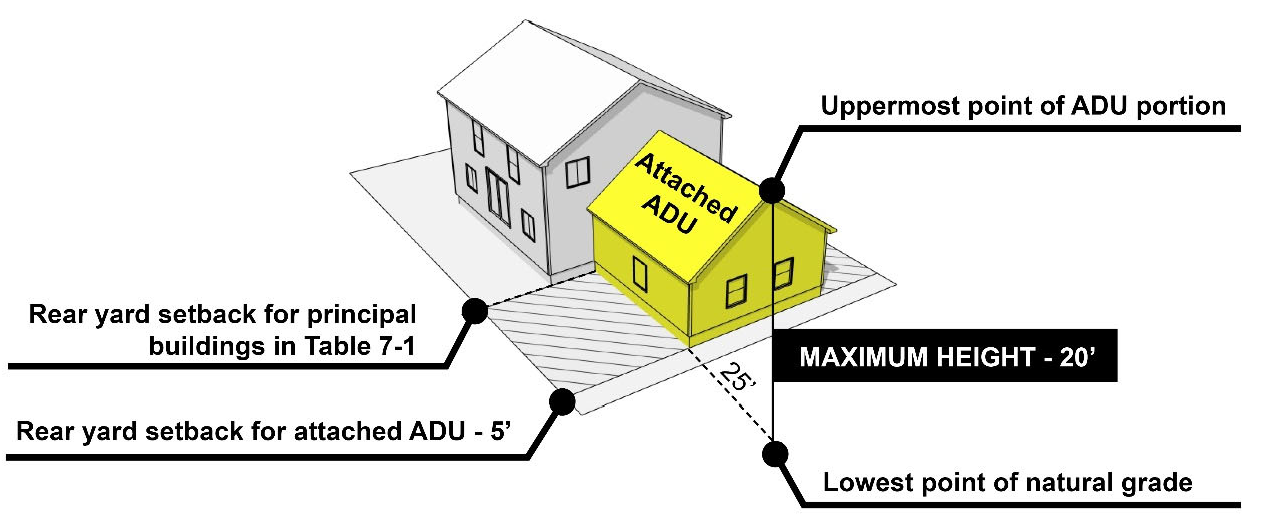
Figure 6-1: Maximum Height of Attached ADU in Rear Yard Setback
(3)
Detached Accessory Dwelling Units: In addition to the general standards in Paragraph (n)(1) of this section, the following standards apply to detached accessory dwelling units:
(A)
Maximum Height: The maximum height of accessory buildings with a detached accessory dwelling unit shall not be greater than twenty feet. The city manager may modify this height standard if the building meets one of the following:
(i)
If the roof pitch is 8:12 or steeper, provided the building height does not exceed 25 feet; or
(ii)
If a legal existing accessory building is converted to a detached accessory dwelling unit, provided that no changes are proposed to the existing accessory building's height, floor area, or roof form.
(o)
Home Occupation:
(1)
A home occupation is allowed by right if the accessory use meets the following standards:
(A)
Standards:
(i)
Such use is conducted entirely within a principal or accessory building and is not carried on by any person other than the inhabitants living there.
(ii)
Such use is clearly incidental and secondary to the residential use of the dwelling and does not change the residential character thereof.
(iii)
The total area used for such purposes does not exceed one-half the first floor area of the user's dwelling unit.
(iv)
There is no change in the outside appearance of the dwelling unit or lot indicating the conduct of such home occupation, including, without limitation, advertising signs or displays.
(v)
There is no on-site sale of materials or supplies except incidental retail sales. Remote or virtual sales with no on-site consumer visits are permitted.
(vi)
There is no exterior storage of material or equipment used as a part of the home occupation.
(vii)
No equipment or process is used in such home occupation that creates any glare, fumes, odors or other objectionable condition detectable to the normal senses at the boundary of the lot if the occupation is conducted in a detached dwelling unit, or outside the dwelling unit if conducted in an attached dwelling unit.
(B)
Cottage Food and Fresh Produce Exception: A home occupation use meeting the requirements of Chapter 6-17, "Cottage Foods and Fresh Produce," B.R.C. 1981, is exempt from the requirements of Subparagraphs (1)(A)(i), (iv), (v), (vi) and (vii) above. Gardens are exempt from Subparagraph (iii) above. Such use shall be permitted as an allowed use in all zoning districts in which a home occupation is permitted.
(C)
Identification and Contact Information: No person shall engage in a home occupation unless such person has obtained a business license from the city. No administrative review pursuant to Section 9-2-2, "Administrative Review Procedures," B.R.C. 1981, is required.
(D)
Prohibitions: No person shall engage in a home occupation except in conformance with all of the requirements of Paragraph (o)(1)(A) of this section, except as provided in Paragraph (o)(1)(B) of this section.
Ordinance Nos. 8523 (2022); 8556 (2023); 8571 (2023); 8590 (2023); 8599 (2024); 8620 (2024); 8622 (2024); 8650 (2025); 8651 (2025); 8696 (2025); 8697 (2025); 8745 (2026)
9-6-4. - Specific Use Standards - Public and Institutional Uses.
COMMUNITY, CULTURAL, AND EDUCATIONAL
(a)
Club or Lodge:
(1)
In the BMS Zoning District:
(A)
Review Process: In the BMS zoning district, a club or lodge is allowed by right if the use is not located on the ground floor facing a street, with the exception of minimum necessary ground level access. A club or lodge that is not allowed by right may be approved only pursuant to a use review.
(b)
Community Services:
(1)
In the BMS and DT-4 Zoning Districts:
(A)
Review Process: In the BMS and DT-4 zoning districts, community services are allowed by right if the use is not located on the ground floor facing a street, with the exception of minimum necessary ground level access. Community services that are not allowed by right may be approved only pursuant to a use review.
(c)
Specialized Instruction Facility:
(1)
In the MU-4 Zoning District:
(A)
In the MU-4 zoning district, specialized instruction facilities are allowed by right for 20,000 square feet or less of floor area per lot or parcel, and are otherwise prohibited.
(2)
In the BMS Zoning District:
(A)
Review Process: In the BMS zoning district, a specialized instruction facility is allowed by right if the use is not located on the ground floor facing a street, with the exception of minimum necessary ground level access. A specialized instruction facility that is not allowed by right may be approved only pursuant to a use review.
(3)
In the Industrial Zoning Districts:
(A)
In the industrial zoning districts, a specialized instruction facility is allowed by right for less than 20,000 square feet of floor area per use. A specialized instruction facility that is not allowed by right may be approved only pursuant to a use review.
CARE AND SHELTER
(d)
Daycare Center:
(1)
The following standards apply to any daycare center, except home daycares, that may be approved as a conditional use or pursuant to a use review:
(A)
Fencing is provided around outdoor play areas.
(B)
If the use is adjacent to an arterial, collector, or minor arterial as shown in Appendix A, "Major Streets," of this title, off-street loading and unloading areas are provided.
(C)
Child daycare facilities are properly licensed by the State Department of Social Services.
(D)
For nursery care (any child under the age of eighteen months), the facility provides fifty square feet of useable indoor floor area per child or a total of six hundred square feet of useable floor area, whichever is greater.
(E)
For child care other than nursery care, the facility provides thirty square feet of useable indoor floor area per child or a total of six hundred square feet of useable floor area, whichever is greater.
(F)
All child day care facilities shall provide a minimum of seventy-five square feet of usable outdoor play area per child or a total of two thousand four hundred square feet of useable outdoor play area, whichever is greater.
(G)
In the MH and RH-6 zoning districts, the use shall not provide care to more than fifty persons, not including employees.
(e)
Day Shelters, Emergency Shelters, and Overnight Shelters:
(1)
This subsection (e) sets forth standards for day shelters, emergency shelters, and overnight shelters that are subject to specific use standards pursuant to Table 6-1, Use Table.
(2)
General Requirements for All Shelters: The following criteria apply to any day, emergency, or overnight shelters:
(A)
Good Neighbor Meeting and Management Plan: The intent of a good neighbor meeting and management plan is to ensure that shelter owners and operators are informed of the effects upon neighboring properties of operating such a facility, and are educated about ways to mitigate, reduce, or eliminate potential impacts upon neighboring properties. Owners and operators shall implement a good neighbor plan when establishing a shelter that meets the following standards:
(i)
Meeting With Surrounding Property Owners Required: The owners or operators of a shelter shall be required to organize and participate in a meeting with the surrounding property owners pursuant to Section 9-2-4, "Good Neighbor Meetings and Management Plans," B.R.C. 1981.
(ii)
Preparation and Distribution of a Proposed Management Plan: The owner or operator shall prepare a proposed management plan pursuant to Section 9-2-4, "Good Neighbor Meetings and Management Plans," B.R.C. 1981, and present it to the surrounding property owners at the neighbor meeting.
(iii)
School Safety Plan: Any facility that is within six hundred feet from a school that proposes to admit clients that may be under the influence of alcohol shall also develop a safety plan, in consultation with the school and the superintendent of the Boulder Valley School District, if applicable, to ensure safety of the school's students. For the purpose of this subsection, school means a public, parochial, or nonpublic school that provides a basic academic education in compliance with the school attendance laws for students in grades kindergarten through the eighth grade. "Basic academic education" has the same meaning as set forth in § 22-33-104(2)(b), C.R.S.
(iv)
Resubmission and Amendment of a Management Plan: Every three years, or when the owner or operator changes the operating characteristics in a manner that does not comply with the approved management plan, whichever occurs first, the owner or operator shall resubmit a management plan. No owner or operator shall fail to resubmit a management plan that meets the requirements of this subsection. The city manager is authorized to require an owner or operator to organize, host, and participate in a good neighbor meeting if the manager determines that such a meeting will be of assistance in identifying additional adverse impacts that may have been created by the facility. The management plan shall address how the facility will address any additional adverse impacts that have been identified by the manager. The manager will approve the management plan upon finding that any such additional adverse impacts will be mitigated by amendments to the management plan.
(B)
Additional Requirements for Day Shelters: The following additional criteria apply to any day shelter:
(i)
Onsite Staffing: No facility shall be open for use by clients unless there is staff on site to supervise and oversee the clients.
(ii)
Waiting Areas: No person shall allow or permit clients of a facility to queue or otherwise wait for the facility to open or to otherwise be admitted into the facility in the public right-of-way. The facility shall provide an indoor or outdoor waiting area in a size adequate to prevent the anticipated number of clients from queuing into or otherwise waiting in the public right-of-way.
(iii)
Outdoor Area: The facility shall provide an outdoor area, screened from the surrounding properties and the public right-of-way for use of clients once admitted to the facility.
(C)
Additional Requirements for Emergency Shelters: The following additional requirements apply to any emergency shelter:
(i)
Waiver of Good Neighbor Meeting and Management Plan Requirement: The city manager may waive the requirement that the applicant organize, host, and participate in a good neighbor meeting upon finding that the applicant will not require a use review, and that the needs of the facility's clients for anonymity and a safe and secure environment will be compromised by such a meeting.
(ii)
Maximum Occupancy: No person shall permit the maximum occupancy of a facility to exceed the following unless approved pursuant to an occupancy increase:
a.
Sleeping Areas: For emergency shelter facilities that operate with sleeping rooms or with open air dormitory type sleeping areas, the following occupancy standards apply:
1.
Residential Districts: For any zoning district that is classified as a residential zoning district pursuant to Section 9-5-2, "Zoning Districts," B.R.C. 1981, the maximum number of residents of the facility shall not exceed six persons for each dwelling unit that would otherwise be permitted based on the lot area or open space on the site.
2.
Business Districts: For any zoning district that is classified as a commercial zoning district pursuant to Section 9-5-2, "Zoning Districts," B.R.C. 1981, the maximum number of residents of the facility shall not exceed six persons for each dwelling unit that would otherwise be permitted based on the lot area or open space on the site. Up to two additional persons per dwelling unit equivalents in the business zoning districts is permitted if the property is not adjacent to a residential zoning district classification as set forth in Section 9-5-2, "Zoning Districts," B.R.C. 1981. For the purpose of this subparagraph, adjacent means separated by an alley, a street that is a minor arterial or lesser classification on the Transportation Master Plan functional classification map, or a property line, notwithstanding a break in a survey, that is shared between the facility and another property.
3.
Industrial Districts: For any zoning district that is classified as an industrial zoning district pursuant to Section 9-5-2, "Zoning Districts," B.R.C. 1981, the maximum number of residents of the facility shall not exceed six persons for each one thousand six hundred square feet of lot area on the site. Up to two additional persons for each one thousand six hundred square feet of lot area on the site in an industrial zoning district is permitted if the property is not adjacent to a residential zoning district classification as set forth in Section 9-5-2, "Zoning Districts," B.R.C. 1981. For the purpose of this subparagraph, adjacent means separated by an alley, a street that is a minor arterial or lesser classification on the Transportation Master Plan functional classification map, or a property line, notwithstanding a break in a survey, that is shared between the facility and another property.
4.
Occupancy Increase: For an applicant that cannot meet the conditional standards for occupancy increases set forth in this subparagraph, or otherwise is limited to six occupants per dwelling unit equivalent, the maximum occupancy of a facility may be increased from six up to ten occupants per dwelling unit equivalents upon approval of a use review pursuant to Section 9-2-15, "Use Review," B.R.C. 1981.
b.
Attached Housing: For emergency shelter facilities that are located in zoning districts that permit attached housing, that operate as separate attached dwelling units, each dwelling unit equivalent shall constitute two attached dwelling units. No person shall occupy such dwelling unit except in accordance with the occupancy standards set forth in Section 9-8-6, "Occupancy Equivalencies for Group Residences," B.R.C. 1981, for dwelling units.
c.
Detached Housing: For emergency shelter facilities that are located in zoning districts that do not permit attached housing, each detached dwelling unit shall constitute one dwelling unit. No person shall occupy such a dwelling unit except in accordance with the occupancy standards set forth in Section 9-8-6, "Occupancy Equivalencies for Group Residences," B.R.C. 1981, for a dwelling unit.
d.
Calculating Occupancy: The maximum occupancy for a facility shall include the occupants of the facility in addition to the occupants of overnight shelter uses and transitional housing uses that are also located on the property.
(iii)
Review Standards: Uses designated as conditional uses in Section 9-6-1, "Schedule of Permitted Land Uses," B.R.C. 1981, shall be processed under the provisions of this paragraph unless the applicant makes a request to increase the maximum occupancy per dwelling unit equivalent from six persons per dwelling unit equivalent up to ten occupants for sleeping room or dormitory type sleeping areas.
(D)
Additional Standards for Overnight Shelters: The following additional criteria apply to any overnight shelter:
(i)
On-Site Staffing: No facility shall be open for use by clients unless there is staff on-site to supervise and oversee the clients.
(ii)
Waiting Areas: No person shall allow or permit clients of a facility to queue or otherwise wait for the facility to open or to otherwise be admitted into the facility in the public right-of-way. The facility shall provide an indoor or outdoor waiting area in a size adequate to prevent the anticipated number of clients from queuing into or otherwise waiting in the public right-of-way.
(iii)
Maximum Occupancy: No person shall permit the maximum occupancy of a facility to exceed the following unless approved pursuant to an occupancy increase:
a.
Residential Districts: For any zoning district that is classified as a residential zoning district pursuant to Section 9-5-2, "Zoning Districts," B.R.C. 1981, the maximum number of residents of the facility shall not exceed four persons for each dwelling unit that would otherwise be permitted based on the lot area or open space on the site.
b.
Business Districts: For any zoning district that is classified as a commercial zoning district pursuant to Section 9-5-2, "Zoning Districts," B.R.C. 1981, the maximum number of residents of the facility shall not exceed four persons for each dwelling unit that would otherwise be permitted based on the lot area or open space on the site. Up to two additional persons per dwelling unit equivalent in the business zoning districts is permitted if the property is not adjacent to a residential zoning district classification as set forth in Section 9-5-2, "Zoning Districts," B.R.C. 1981. For the purpose of this subparagraph, adjacent means separated by an alley, a street that is a minor arterial or lesser classification on the Transportation Master Plan functional classification map, or a property line, notwithstanding a break in a survey, that is shared between the facility and another property.
c.
Industrial Districts: For any zoning district that is classified as an industrial zoning district pursuant to Section 9-5-2, "Zoning Districts," B.R.C. 1981, the maximum number of residents of the facility shall not exceed four persons for each one thousand six hundred square feet of lot area on the site. Up to two additional persons for each one thousand six hundred square feet of lot area on the site in an industrial zoning district is permitted if the property is not adjacent to a residential zoning district classification as set forth in Section 9-5-2, "Zoning Districts," B.R.C. 1981. For the purpose of this subparagraph, adjacent means separated by an alley, a street that is a minor arterial or lesser classification on the Transportation Master Plan functional classification map, or a property line, notwithstanding a break in a survey, that is shared between the facility and another property.
d.
Calculating Occupancy: The maximum occupancy for a facility shall include the occupants of the facility in addition to the occupants of emergency shelter uses and transitional housing uses that are also located on the property.
e.
Occupancy Increase: For an applicant that cannot meet the conditional standards for occupancy increases set forth in this subparagraph, or otherwise is limited to four occupants per dwelling unit equivalent, the maximum occupancy of a facility may be increased from four or six up to eight occupants per dwelling unit equivalents upon approval of a use review pursuant to Section 9-2-15, "Use Review," B.R.C. 1981.
(iv)
Review Standards: Uses designated as conditional uses in Section 9-6-1, "Schedule of Permitted Land Uses," B.R.C. 1981, shall be processed under the provisions of this paragraph unless the applicant proposes to exceed the following standards. In such cases, the applicant will also be required to complete the use review process pursuant to Section 9-2-15, "Use Review," B.R.C. 1981.
a.
High Density Residential: In the RH zoning districts, a use review will also be required if the applicant requests the maximum occupancy per dwelling unit equivalent be increased from four up to eight occupants.
b.
Business - Community, Business - Main Street, and Business - Transitional Districts: In the BC, BT, and BMS zoning districts, a use review will also be required if the maximum occupancy per dwelling unit equivalent is increased from four up to eight occupants.
INFRASTRUCTURE
(f)
Wireless Communications Facility:
(1)
Applicability: This subsection (f) sets forth standards for wireless communication facilities in the public right-of-way as outlined in subsection (2) or not located in the public right-of-way as specified in subsection (3) as well as the applicable review processes and required review timeframes.
(2)
Standards for wireless communications facilities located in the public right-of-way: Small cell facilities in the public right-of-way shall follow the standards located in Section 8-6-6.5, "Small Cell Facilities in the Public Right-of-Way Permits," B.R.C. 1981.
(A)
Review Criteria: The city manager shall approve the request if the request:
(i)
Is an eligible facilities request for an eligible support structure with no substantial change, new stand-alone small cell facility, or collocation of a non-eligible facility request and small cell facility;
(ii)
Complies with the originally approved design elements and other conditions of approval, including but not limited to colors, textures, surfaces, scale, character, mounting, projection and siting, or any approved amendments thereto, except where noncompliance with those elements or conditions is solely limited to the thresholds of increase in height, increase in width, addition of cabinets or new excavation or deployment area identified in the definition of substantial change;
(iii)
Does not defeat the concealment elements of the eligible support structure. Any design element that places the wireless communications facility out of view, hides it from being noticed, blends it with its surroundings or otherwise minimizes the visual or aesthetic impact of the facility is a concealment element of the eligible support structure; and
(iv)
Complies with the standards pursuant to Section 8-6-6.5, "Small Cell Facilities in the Public Right-of-Way Permits," B.R.C. 1981, if the request is a small cell facility in the right-of-way.
(3)
Standards for wireless communications facilities not located in the public right-of-way: A wireless communications facility may be approved as a conditional use and principal use on a lot if the following standards are met:
(A)
The antenna for the wireless communications facility shall be attached to a principal building designed and constructed for a primary purpose other than supporting a wireless communications facility, except as authorized to be attached to water towers in Subparagraph (O).
(B)
Architectural Compatibility: The antenna must be architecturally compatible with the building and wall, penthouse, or mechanical equipment enclosure on which it is mounted and designed and located so as to minimize any adverse aesthetic impact.
(C)
Screening: The antenna shall be painted or fully screened to match as closely as possible to the color and texture of the wall, penthouse, or mechanical equipment enclosure on which it is mounted.
(D)
Wall Mounts: The antenna shall be mounted on a wall of an existing building in a configuration as flush to the wall as technically possible to ensure both the functionality of the antenna and to minimize visual impact. The antenna and any associated screening shall not project above the wall on which it is mounted.
(E)
Antenna Mounts on Roof Appurtenances: The antenna may be attached to an existing conforming penthouse or mechanical equipment enclosure which projects above the roof of the building. The antenna and any associated screening may not project any higher than the penthouse or enclosure (no increase in height is permitted) and must be mounted as flush to the existing penthouse or enclosure as technically possible to ensure both the functionality of the antenna and to minimize visual impact.
(F)
Roof Mounts of Antennas and Transmission Equipment on Buildings Less Than Fifty-Five Feet Tall: On buildings fifty-five feet or less in height, an antenna and transmission equipment may be mounted on the roof if:
(i)
The manager finds that it is not technically possible or aesthetically desirable to mount the antenna on a wall, penthouse or mechanical equipment enclosure;
(ii)
No portion of the wireless communications facility causes the height of the building to exceed the limitations set forth in Sections 9-7-1, "Schedule of Form and Bulk Standards," 9-7-5, "Building Height," and 9-7-6, "Building Height, Conditional," B.R.C. 1981;
(iii)
No wireless communications facility covers more than ten percent of the roof area of a building, and the aggregate of any wireless communications facilities and any appurtenances do not exceed an aggregate of twenty-five percent of the roof area;
(iv)
Roof-mounted antennas are completely screened from view by materials that are consistent and compatible with the building design, color, and materials; and
(v)
No portion of the wireless communications facility exceeds ten feet above the height of the existing building.
(G)
Transmission Equipment and Screening: Transmission equipment other than antennas shall not be mounted to a building wall, penthouse or mechanical equipment enclosure and shall be designed and located to minimize any adverse aesthetic impact. Such equipment shall be invisible from view whenever possible, for example, by locating within the principal building, on the roof so as to be invisible from adjacent street and properties or behind parapet walls. When it is not possible to locate such equipment out of sight, it must be located to minimize its visibility and be designed to be screened from view by materials that are consistent and compatible with the building design, color and materials without increasing the apparent height of the building. Where it is not possible to locate such equipment within or on the roof of the building, it may be located in ground mounted cabinets. Such ground mounted equipment shall, to the extent possible, be screened from view through undergrounding, design that is architecturally consistent with that of the building, or other design options, approved by the manager, that will blend the equipment with the surrounding setting and built environment, including but not limited to materials, colors, textures, and landscaping. When determining whether a certain location that minimizes adverse aesthetic impacts is possible, functionality of the equipment may be considered. All buildings, shelters, cabinets, and other accessory components shall be grouped as closely as possible. Excavation or deployment of transmission equipment up to thirty feet in any direction outside a tower's site does not constitute a substantial change in the physical dimensions of a tower or base station. Deployments outside the site boundary, including the thirty feet of the boundary for towers is limited to transmission equipment and not new towers. The expansion of up to thirty feet is subject to all other applicable requirements of the B.R.C. 1981.
(H)
Site Review and PUD Approval: If a proposed wireless communications facility is located on a building or lot subject to an approved planned unit development or site review, a minor modification to the approval is required prior to the issuance of a building permit. A minor modification is not required for eligible facilities requests.
(I)
Historic Preservation Rules: No wireless communications facility shall be permitted on property designated as an individual landmark or as part of a historic district, unless such wireless communications facility has been approved through the issuance of a landmark alteration certificate pursuant to Sections 9-11-13, "Landmark Alteration Certificate Application," 9-11-14, "Staff Review of Application for Landmark Alteration Certificate," 9-11-15, "Landmark Alteration Certificate Hearing," 9-11-16, "Call-Up by City Council," 9-11-17, "Issuance of Landmark Alteration Certificate," and 9-11-18, "Standards for Landmark Alteration Certificate Applications," B.R.C. 1981. A landmark alteration certificate is not required for eligible facilities requests.
(J)
Exclusion of Competitors Prohibited: No wireless communications facility owner or lessee or officer or employee thereof shall act to exclude or to attempt to exclude any other competitor from using the same building for the location of other wireless communications facilities.
(K)
Co-Location of Facilities: No wireless communications facility owner or lessee or officer or employee thereof shall fail to cooperate in good faith to accommodate other competitors in their attempts to use the same building for other wireless communications facilities. If a dispute arises about the feasibility of accommodating another competitor, the city manager may require a third party technical study, at the expense of either or both parties, in the discretion of the manager, based upon the relative fault of the parties, to resolve the dispute.
(L)
Technical Standards: No wireless communications facility owner or lessee shall fail to assure that the wireless communications facility complies at all times with the then-current applicable American National Standards Institute or Federal Communications Commission standards, whichever is more stringent, for cumulative field measurements of radio frequency power densities and electromagnetic fields. After installation, but prior to putting the wireless communications facility in service, each wireless communications facility owner shall provide a certification by an independent professional engineer to that effect.
(M)
Interference With TV or Radio Signals Prohibited: No wireless communications facility owner or lessee shall fail to assure that the wireless communications facility does not cause localized interference with reception of television and radio broadcasts as required by the Federal Communications Commission.
(N)
Public and Residential Zoning Districts: In the P, RR-1, RR-2, RE, RL-1, RL-2, RM-1, RM-2, RM-3, RH-6, and MH zoning districts, no person shall mount or maintain a wireless communications facility on a lot, parcel, or building containing a residential use.
(O)
Water Towers: Notwithstanding that a water tower may be considered an accessory building or use, antennas may be placed on water towers in compliance with the standards set forth in this subsection. No portion of any wireless communications facility shall extend above the height of the water tower walls. For the purposes of this subsection, water tower means a freestanding, aboveground, water storage facility, usually round or cylindrical in shape.
(P)
Prohibition: No person shall locate a wireless communications facility upon any lot or parcel except as provided in this subsection.
(Q)
Conditions of Approval: Compliance with the provisions of this subsection are conditions of any approval granted under this subsection.
(R)
Modifications: The city manager may approve a modification to the requirements of this subsection that would result in a violation of state or federal law or to allow a design that better minimizes the visual and aesthetic impacts of the wireless communications facility. The manager may not modify the height standards of Subparagraph (F)(ii) under this Subparagraph (R).
(S)
Summary of Appropriate Locations: Table 6-5 of this section summarizes the allowable location for an antenna and transmission equipment.
TABLE 6-5: ANTENNA AND TRANSMISSION EQUIPMENT LOCATIONS
(4)
Application Fees: An applicant shall pay the fees described in Section 4-20-43, "Development Application Fees," B.R.C. 1981, for wireless communications facilities.
(5)
Review Processes: Wireless communications facilities subject to this section shall be reviewed as follows:
(A)
New wireless communications facilities: New wireless communications facilities, collocation or modification to such use, other than those listed in subsection (B) shall be reviewed in accordance with the procedures established in Section 9-2-2, "Administrative Review Procedures," B.R.C. 1981, and the requirements of this subsection.
(i)
Timeframes for review: The review timeframes for applications in this subsection are summarized in Table 6-6.
(B)
Eligible facilities and small cell requests: Eligible facilities requests, including small cell facilities and equipment changes with no substantial change, new small cell facilities, and collocation for non-eligible facilities request small cell facilities shall be reviewed pursuant to the following procedures and standards:
(i)
Application Requirements: The applicant shall submit a request, for the facilities subject to this section, on an application form provided by the city manager and shall include all information necessary for the manager to consider the type of request, including, whether the application is an eligible facilities request or small cell facility and also demonstrates compliance with the review criteria established by this subsection. If the application is for a small cell facility, the application must additionally demonstrate that the application meets the standards in Section 8-6-6.5, "Small Cell Facilities in the Public Right-of-Way Permits," B.R.C. 1981, if the request is a small cell facility in the right-of-way. The city manager shall determine the application to be complete when all required documentation and information is submitted pursuant to the review and timeframe for review provided for by this subsection. The application may not require the applicant to demonstrate a need or business case for the proposed modification or collocation.
(ii)
Review:
a.
Type of Review: Upon receipt of an application subject to this subsection, the city manager shall review administratively and determine whether such application submittal so qualifies. begin review for completeness.
b.
Timeframe for Review: Within the review timeframe as shown in Table 6-6 from the date on which an applicant submits an application seeking approval of the request, the manager shall approve an application unless the manager determines that the application is not an eligible facilities request, new small cell facility, or collocation for non-eligible facility request small cell facility.
c.
Tolling of Timeframe for Review: The review timeframe as shown in Table 6-6 begins to run when the complete application is submitted. The city manager and the applicant may mutually agree to toll the review period. The review timeframe shall also be tolled where the manager determines that the application is incomplete. The review period is tolled for incompleteness pursuant to the following standards:
1.
Within thirty days of receipt of the application, the manager must notify the applicant in writing, clearly and specifically delineating all missing documents or information required for determination of an eligible facilities request;
2.
The written incompleteness notice tolls the timeframe for review;
3.
The timeframe for review begins running again when the applicant makes a supplemental submission in response to the manager's notice of incompleteness;
4.
Within ten days of the supplemental submission, the city manager shall notify the applicant in writing that the supplemental submission did not provide the information identified in the original incompleteness notice; and
5.
The timeframe is tolled in the case of a second or subsequent incompleteness notice pursuant to the procedures for the first incompleteness notice. Second or subsequent incompleteness notices may not specify missing documents or information that were not delineated in the original incompleteness notice.
d.
Failure to Act: In the event that the city manager fails to act on a request seeking approval for an eligible facilities request within the timeframe for review, accounting for any tolling, the request shall be deemed granted. The effective date of any deemed-granted approval, regardless of the facility type, shall be the day the city receives written notice from the applicant, after the review period, accounting for any tolling, has expired, that the application has been deemed granted. If the application requires a traffic control plan or other permit related to public safety, the applicant shall not commence construction or substantially change the wireless communication facility until a traffic control plan or other permit is obtained.
(iii)
Decision: If the city manager finds the review criteria of Subparagraph (2)(A) are met, the manager shall approve the request. If the manager finds that the applicant's request does not meet the criteria of Subparagraph (2)(A), the manager may approve with written conditions or deny the request and provide a written disposition with the reasons for conditional approval or denial, as well as any conditions required at the time of approval, to the applicant. The manager's decision shall be supported by substantial evidence in the written record. Upon issuance of the denial decision, the manager shall review the application pursuant to the procedures established in Section 9-2-2, "Administrative Review Procedures," B.R.C. 1981, and the requirements of this subsection and may request additional information and documents from the applicant to permit appropriate review.
(iv)
Compliance with Other Laws: Consistent with C.R.S. § 29-27-405(2), all work on wireless communications facilities, including eligible facilities requests, must be completed in accordance with all generally applicable laws, regulations or other rules reasonably related to public health and safety, including but not limited to, building and safety codes. Additionally, the city specifically finds that:
a.
All work on wireless communications facilities that occurs within or otherwise impacts any city right-of-way by its very nature impacts public safety, including without limitation the need to ensure the structural stability of facilities and associated infrastructure, the need to ensure adequate sightlines for both pedestrian and vehicular traffic, and the need to control and re-route traffic. The city requires that prior to any such work is performed, all generally applicable permits related to that work must be obtained; and
b.
If the city manager determines that any work to be conducted on a wireless communications facility located on private property impacts public safety, including without limitation the need to ensure the structural stability of facilities and associated infrastructure, the city manager may require generally applicable permits in accordance with this subsection.
(v)
Remedies: The applicants and the city may bring a claim related to § 6409 of the Spectrum Act (codified at 47 U.S.C. 1455) to any court of competent jurisdiction.
(C)
Timeframes for Review: Table 6-6 summarizes the review timeframes from the date of submittal for wireless communication facilities. Any of the timeframes identified in Table 6-6 may be extended by mutual agreement of the applicant and the city.
TABLE 6-6: TIMEFRAME FOR REVIEW
(i)
The review timeframes above for applications other than those for eligible facilities requests may be tolled if it is determined by the city manager, based on available resources, that it cannot reasonably and adequately review the application due to another pending application for affordable housing, renewable energy, project of a government entity, or any other project for which law establishes a timeline to review permits. The city shall advise the applicant in writing of the duration of the tolling and the reason for its determination.
(ii)
The timeframes for review under this subsection shall apply only to applications for wireless communications facilities under this subsection, and any other application specific to a specific wireless site, and shall not apply to any building, right-of-way, or any other non-wireless site-specific permit issued by the city pursuant to the provisions of the Boulder Revised Code 1981. Unless otherwise agreed to by applicant and the city manager, if a decision on the application is not issued according to the timeframe provided above, the application shall be deemed approved, and the permit shall be issued. If the approval is for a concealed wireless communications facility, the written decision shall specifically identify that the wireless communications facility is a concealed facility.
(6)
Abandonment and Removal: No property owner or applicant shall fail to remove a wireless communications facility that is abandoned or is unused for a period of six months.
Ordinance Nos. 8523 (2022); 8571 (2023); 8590 (2023); 8694 (2025); 8696 (2025); 8745 (2026)
9-6-5. - Specific Use Standards - Commercial Uses.
FOOD, BEVERAGE, AND LODGING
(a)
Bed and Breakfast:
(1)
The following standards apply to bed and breakfast uses that may be approved as a conditional use or pursuant to a use review:
(A)
The structure is compatible with the character of the neighborhood in terms of height, setbacks, and bulk. Any modifications to the structure are compatible with the character of the neighborhood.
(B)
No structure contains more than twelve guest rooms. The number of guest rooms shall not exceed the occupancy limitations set forth in Section 9-8-6, "Density Equivalencies for Group Residences and Hostels," B.R.C. 1981.
(C)
No cooking facilities including, without limitation, stoves, hot plates, or microwave ovens are permitted in the guest rooms. No person shall permit such use.
(D)
One attached exterior sign is permitted to identify the bed and breakfast, subject to the requirements of Section 9-9-21, "Signs," B.R.C. 1981.
(E)
No long-term rental of rooms is permitted. No person shall permit a guest to remain in a bed and breakfast for a period in excess of thirty days.
(F)
No restaurant use is permitted. No person shall serve meals to members of the public other than persons renting rooms for nightly occupancy and their guests.
(G)
No person shall check in or check out of a bed and breakfast or allow another to do so except between the times of 6 a.m. and 9 p.m.
(b)
Brewery, Distillery, and Winery:
(1)
General Standard: Any brewery, distillery, or winery approved as a conditional use or pursuant to a use review must also meet the following standard:
(A)
Any restaurant within the brewery, distillery, or winery does not exceed thirty percent of the total floor area of the facility, or one thousand square feet, whichever is greater.
(2)
In the IS-1, IS-2, and IMS Zoning Districts:
(A)
In the IS-1, IS-2, and IMS zoning districts, breweries, distilleries, and wineries shall meet the following standards:
(i)
Review Process: In the IS-1, IS-2, and IMS zoning districts, the following review process applies:
a.
Allowed Use: Breweries, distilleries, and wineries are allowed by right if the use does not include a restaurant.
b.
Conditional Use: Breweries, distilleries, and wineries that are not allowed by right may be approved as a conditional use if any restaurant is closed between the hours of 11 p.m. and 5 a.m.
c.
Use Review: If the use is not allowed by right or as a conditional use, the use may be approved only pursuant to a use review subject to the use review criteria in Paragraphs 9-2-15(e)(2), (3), and (4) "Use Review," B.R.C. 1981.
(ii)
General Standard: No brewery, distillery, or winery shall exceed 15,000 square feet in floor area.
(3)
In the IG and IM Zoning Districts:
(A)
In the IG and IM zoning districts, breweries, distilleries, and wineries shall meet the following standards:
(i)
Review Process: In the IG and IM zoning districts, the following review process applies:
a.
Allowed Use: Breweries, distilleries, and wineries are allowed by right if the use does not exceed 15,000 square feet in floor area and does not include a restaurant.
b.
Conditional Use: If the use exceeds 15,000 square feet in floor area or includes a restaurant, it may be approved as a conditional use if any restaurant is closed between the hours of 11 p.m. and 5 a.m.
c.
Use Review: If the use is not allowed by right or as a conditional use, the use may be approved only pursuant to a use review subject to the use review criteria in Paragraphs 9-2-15(e)(2), (3), and (4) "Use Review," B.R.C. 1981.
(c)
Hostel:
(1)
In the MU-4, BMS, DT-4, and DT-5 Zoning Districts:
(A)
Review Process: In the MU-4, BMS, DT-4, and DT-5 zoning districts, a hostel is allowed by right if the use is not located on the ground floor facing a street, with the exception of minimum necessary ground level access. A hostel that is not allowed by right may be approved only pursuant to a use review.
(d)
Mobile Food Vehicle:
(1)
General Standards: The following applies to any mobile food vehicle:
(A)
Location: Mobile food vehicles may operate in any of the following locations:
(i)
Lot or Parcel: On a lot or parcel in the Mixed Use, Business, Downtown, or Industrial zoning districts.
(ii)
Right-of-Way: Within public right-of-way in the IS-1, IS-2, IG, IM, IMS, or P zoning districts.
(iii)
City Park: In any zoning district in parking lots or other areas within a city park designated by the city manager or in public right-of-way abutting a city park designated by the city manager.
(iv)
Organized Event: As part of an organized event in any zoning district, as follows:
a.
On public property or in the public right-of-way as part of an organized event, special event, or street closure permit that is granted pursuant to the authority in Section 4-18-2, "Public Property Use Permit," B.R.C. 1981, or other relevant code section; or
b.
On public or private property or in the public right-of-way as part of a special festival event pursuant to Chapter 4-12, "Special Festival Events," B.R.C. 1981.
(v)
Airport: In the public zoning district at the Boulder Municipal Airport in such areas and manner within Lot 2, Airport South Subdivision, as approved by the city manager pursuant to Section 11-4-4, "Special Airport Activity Permits," B.R.C. 1981.
(B)
Distancing Requirements: The mobile food vehicle shall be located at least:
(i)
150 feet from any residential zoning districts, unless the use is allowed by subparagraphs (d)(1)(A)(iii), (d)(1)(A)(iv), or (d)(1)(A)(v);
(ii)
150 feet from any existing restaurant. In the BC-1 zoning district, the city manager may waive this requirement if the applicant, at the time of permit issuance, and each renewal of a permit, submits to the city manager signed statements supporting the issuance of the permit from every restaurant within 150 feet of the proposed food truck location;
(iii)
If within the public right-of-way, at least 200 feet from any other mobile food vehicle in the public right-of-way; and
(iv)
Distances shall be measured by the city on official maps as the radius from the closest points on the perimeter of the applicant's mobile food vehicle to the closest point of the designated residential zone or property of the restaurant. For purposes of this subsection, the term restaurant shall include "eating places" and "retail bakeries" as defined by the Standard Industrial Classification Manual. With regard to measurement between two or more mobile food vehicles in the public right-of-way, measurement shall be in the form of standard measuring devices, including and not limited to, a tape measure.
(C)
Limit Per Property: In the Mixed Use, Business, and Downtown zoning districts, no property shall have more than four mobile food vehicles.
(D)
Organized Event: Mobile food vehicles that are allowed pursuant to an organized event or street closure permit under subparagraph (d)(1)(A)(iv) are not subject to the distancing requirements or limits of subparagraphs (d)(1)(B) and (C), but are subject to any conditions imposed in connection with the event.
(2)
Mobile Food Vehicle License.
(A)
License: No person shall operate a mobile food vehicle without a license or in violation of the conditions of a license. The license will be valid for twelve consecutive months or such time as the city manager may by rule designate. The license applicant shall meet the following requirements in the application and, as applicable, during the license term:
(i)
Provide proof of, and maintain, a valid driver's license, motor vehicle registration, and current motor vehicle insurance;
(ii)
Or in the case of a bicycle mobile food vehicle; provide proof of, and maintain, a valid driver's license or state issued picture identification card and evidence of insurance coverage required by Section 4-1-8, "Insurance Required," B.R.C. 1981;
(iii)
Provide proof of, and maintain, a Colorado retail food license for a mobile unit;
(iv)
Provide proof of, and maintain, a valid sales use tax license;
(v)
Pay the fee prescribed by Section 4-20-66, "Mobile Food Vehicle Sales," B.R.C. 1981.
(B)
Licensing Requirement: The general licensing provisions of Chapter 4-1, "Licenses and Permits," B.R.C. 1981, apply to mobile food vehicle licenses.
(i)
As a condition of accepting the license, the applicant shall sign an agreement, in a form acceptable to the city manager, in which the applicant agrees to meet all requirements under this section and Chapter 4-1, "General Licensing Provisions," B.R.C. 1981, and assume responsibility for the actions and omissions of its agents and employees in the performance of or failure to perform its obligation under the permit.
(ii)
The city manager may prohibit the issuance of additional licenses in specified areas of the city in the interest of avoiding traffic congestion or preserving the public health, safety, and welfare.
(C)
Operating Requirements: No person who operates any mobile food vehicle shall:
(i)
Obstruct the pedestrian or bicycle access or the visibility of motorists, nor obstruct parking lot circulation or block access to a public street, alley, path, or sidewalk;
(ii)
Locate any vehicle, structure, or device upon a public sidewalk within the extended boundaries of a crosswalk, or within ten feet of the extension of any building entranceway, doorway, or driveway;
(iii)
Fail to maintain, and provide proof when requested, of written consent from the private property owner authorizing the property to be used for the proposed use with regard to mobile food vehicle sales on private property;
(iv)
Fail to park legally or fail to park in a manner consistent with city manager approval of parking within any city-owned parking lot;
(v)
Operate before 7 a.m. or after 9 p.m. and for more than a maximum of four hours at any one approved location;
(vi)
Set up any structures, canopies, tables, or chairs;
(vii)
Sell anything other than food and nonalcoholic beverages;
(viii)
Provide amplified music;
(ix)
Place signs/banners in or alongside the public right-of-way or across roadways. Signs must be permanently affixed to or painted on the mobile food vehicle;
(x)
Fail to have the vehicle attended at all times;
(xi)
Fail to permanently display to the public in the food handling area of the mobile food vehicle the permit authorizing such use;
(xii)
Fail to provide at least three separate and clearly marked receptacles for trash, recycling, and compost and properly separate and dispose of all trash, refuse, compost, recycling, and garbage that is generated by the use;
(xiii)
Cause any liquid wastes used in the operation to be discharged from the mobile food vehicle;
(xiv)
Sell in transit. "In transit" as used in this subsection shall mean traveling from one destination to another either by roadway, sidewalk, or path and in the case of a human powered mobile food vehicle shall also include any stops along the way;
(xv)
Fail to abide by all other ordinances of the city.
(D)
The general licensing provisions of Chapter 4-1, "Licenses and Permits," B.R.C. 1981, shall apply.
(e)
Restaurant, Brewpub, and Tavern:
(1)
Applicability: This Subsection (e) sets forth standards for restaurants, brewpubs, and taverns that are subject to specific use standards pursuant to Table 6-1, Use Table.
(2)
Floor Area Measurement:
(A)
When determining whether a restaurant, brewpub, or tavern meets the maximum floor area requirements under this subsection, the applicant shall include all areas inside the use measured to the inside surface of the outside walls, except for floor area that is used exclusively for storage that is located on another floor of the building.
(3)
Standards for Outdoor Seating:
(A)
Applicability: The following standards apply to any outdoor seating area that is within 300 feet (measured from the perimeter of the subject property) of a residential zoning district:
(i)
Music: Exterior amplified sound and live music are prohibited prior to 10 a.m. and after 11 p.m.
(ii)
Sound Levels: The outdoor seating area shall not generate noise exceeding the levels permitted in Chapter 5-9, "Noise," B.R.C. 1981.
(iii)
Trash: All trash located within the outdoor seating area; on the restaurant, brewpub, or tavern property; and on adjacent streets, sidewalks, and properties shall be picked up and properly disposed of or stored inside the building immediately after closing. No trash or recycling shall be disposed of in any outdoor dumpster or receptacle between the hours of 10 p.m. and 7 a.m. the next day.
(4)
In the RH-3 and RH-7 Zoning Districts:
(A)
In the RH-3 and RH-7 zoning districts, restaurants, brewpubs, and taverns are allowed by right if the use meets the following standards, and are otherwise prohibited:
(i)
The use has a maximum floor area of 2,000 square feet; and
(ii)
The use closes no later than 11 p.m.
(5)
In the MU-2, MU-3, MU-4, BT-1, BT-2, BMS, DT-1, DT-2, and DT-3 Zoning Districts:
(A)
Review Process: In the MU-2, MU-3, MU-4, BT-1, BT-2, BMS, DT-1, DT-2, and DT-3 zoning districts, the following review process applies to restaurants, brewpubs, and taverns:
(i)
Allowed Use: Restaurants, brewpubs, and taverns are allowed by right if the use meets the following standards:
a.
The use has a maximum floor area of 4,000 square feet; and
b.
The use closes no later than 11 p.m.
(ii)
Use Review: Restaurants, brewpubs, and taverns that are not allowed by right may be approved only pursuant to a use review. In the BMS, DT-1, DT-2, and DT-3 zoning districts, restaurants, brewpubs, and taverns approved pursuant to a use review are subject to the following standard:
a.
Good Neighbor Meetings and Management Plans Required: Owners and operators of restaurant, brewpub, and tavern uses shall organize and participate in a meeting with the surrounding property owners pursuant to Section 9-2-4, "Good Neighbor Meetings and Management Plans," B.R.C. 1981.
(6)
In the Industrial Zoning Districts:
(A)
Brewpubs and Taverns: Brewpubs and taverns are prohibited in the industrial zoning districts.
(B)
Restaurants: In the industrial zoning districts, the following applies to restaurants:
(i)
Review Process: In the industrial zoning districts, restaurants are allowed by right if the use is closed between the hours of 11 p.m. and 5 a.m. and is incorporated in a building with industrial, residential, or office uses. Restaurants that are not allowed by right may be approved only pursuant to a use review.
(7)
In the P Zoning District:
(A)
Brewpubs and Taverns: Brewpubs and taverns are prohibited in the P zoning district.
(B)
Restaurants: In the P zoning district, the following applies to restaurants:
(i)
Review Process: The following review process applies:
a.
Allowed Use: Restaurants are allowed by right if the use meets the following standards:
1.
The restaurant is located in a regional park where the use and any associated outdoor seating is no closer than 500 feet to a residential zoning district; and
2.
The approval authority for the lease by the public agency owning the regional park finds that the lease and management plan ensure that the use is reasonably compatible with and has minimal negative impacts that are material in nature on surrounding uses, natural areas, and wildlife.
b.
Use Review: Restaurants that are not allowed by right may be approved only pursuant to a use review. In addition to meeting the use review criteria, the use must be located in a regional park.
(ii)
General Standard: A restaurant that is not located in a regional park is prohibited.
RECREATION AND ENTERTAINMENT
(f)
Art Studio or Workshop:
(1)
In the MU-1, MU-2, and MU-3 Zoning Districts:
(A)
Review Process: In the MU-1, MU-2, and MU-3 zoning districts, art studios or workshops are allowed by right for 2,000 square feet or less of floor area per lot or parcel. Art studios or workshops that are not allowed by right may be approved only pursuant to a use review.
(g)
Indoor Athletic Facility:
(1)
In the RL-2, RM-2, RM-1, RM-3, and RMX-1 Zoning Districts:
(A)
In the RL-2, RM-2, RM-1, RM-3, and RMX-1 zoning districts, an indoor athletic facility may be approved only pursuant to a use review. In addition to meeting the use review criteria, the floor area of the use shall not exceed 250 square feet.
(2)
In the RH-3, RH-7, MU-1, MU-2, and MU-3 Zoning Districts:
(A)
Review Process: In the RH-3, RH-7, MU-1, MU-2, and MU-3 zoning districts, an indoor athletic facility is allowed by right if the floor area does not exceed 1,000 square feet. An indoor athletic facility that is not allowed by right may be approved only pursuant to a use review.
(3)
In the BT-1, BT-2, and BMS Zoning Districts:
(A)
Review Process: In the BT-1, BT-2, and BMS zoning districts, an indoor athletic facility is allowed by right if the floor area does not exceed 2,000 square feet. An indoor athletic facility that is not allowed by right may be approved only pursuant to a use review.
(4)
In the Industrial Zoning Districts:
(A)
Review Process: In the industrial zoning districts, an indoor athletic facility is allowed by right if the floor area does not exceed 5,000 square feet. An indoor athletic facility that is not allowed by right may be approved only pursuant to a use review.
(h)
Special Festival Event:
(1)
Standards: Special festival events are allowed by-right if the use meets the following standards:
(i)
Such uses are temporary, limited to no more than fourteen days in any annual period per event, unless otherwise approved by the city manager, and are part of a special festival event approved pursuant to Chapter 4-12, "Special Festival Events," B.R.C. 1981;
(ii)
The use is located within a special festival event boundary established in a permit approved pursuant to Chapter 4-12, "Special Festival Events," B.R.C. 1981.
(iii)
Such uses may not result in unsafe conditions or unacceptable levels of congestion or result in damage to private or public property, including in the public right-of-way;
(iv)
Upon termination of the use and on days for which no event is approved, the lot or parcel shall be returned substantially to its original condition unless otherwise approved by the city manager. All litter, fences, borders, tie-down materials, and other items associated with the event shall be promptly removed. Unless otherwise approved by the city manager, "promptly," as used in this subparagraph, shall mean within five days;
(v)
Special festival events shall only be conducted by the owner or lessee of the property or with the permission of the owner or lessee of the property on which it is conducted;
(vi)
Prior approvals and nonconformities: A special festival event does not constitute a modification, enlargement, expansion or other modification to a prior approval under Chapter 9-2, "Review Processes," B.R.C. 1981, nor an expansion of a nonconforming use and does not require a development review application under Chapter 9-2 nor any amendment or modification of a prior approval thereunder.
(i)
Temporary Event:
(1)
Temporary events may be approved as a conditional use if the following standards are met:
(A)
Such uses are temporary and limited to 14 days in any three-month period, unless otherwise approved by the city manager;
(B)
Such uses conducted from movable structures or upon vacant lots shall submit a site plan, including, without limitation, the location, setback from property line, screening, sign and fence locations, if applicable, and electric meter locations or power source;
(C)
Applicants shall obtain the appropriate sales tax license and, if applicable, temporary fence permits;
(D)
All exterior areas used for such uses and the lot or parcel that such uses occur upon shall meet the bulk requirements of Section 9-7-1, "Schedule of Form and Bulk Standards," B.R.C. 1981;
(E)
Such uses may not result in unsafe conditions or unacceptable levels of congestion;
(F)
Upon termination of the use and on days for which no event is approved, the lot or parcel shall be returned substantially to its original condition unless otherwise approved by the city manager. All litter, fences, borders, tie-down materials, and other items associated with the temporary event shall be promptly removed. Unless otherwise approved by the city manager, "promptly," as used in this subparagraph, shall mean within five days; and
(G)
Temporary events shall only be conducted by the owner or lessee of the property or with the permission of the owner or lessee of the property on which it is conducted.
(H)
Prohibitions: No person shall sell merchandise or services from a motor vehicle, trailer, mobile home, or tent upon any public or private property, including, without limitation, lots, or portions thereof that are vacant or used for parking except as provided in this section.
(I)
City Manager Authorized to Issue Rules: The city manager may adopt rules necessary for the implementation and interpretation of this subsection under the procedures of Chapter 1-4, "Rulemaking," B.R.C. 1981. Such rules may include, without limitation, limiting the number of permits issued for temporary events during a special festival event to avoid any undue congestion and uphold the public health, safety, and welfare.
OFFICE USES
(j)
Office Uses:
(1)
This subsection sets forth standards for uses in the office uses category that are subject to specific use standards pursuant to Table 6-1, Use Table.
(2)
Office Uses in the MU-4 Zoning District:
(A)
Review Process: In the MU-4 zoning district, the following review process applies to office uses:
(i)
Allowed Use: Office uses are allowed by right if the individual office use does not exceed 20,000 square feet in floor area of the building.
(ii)
Use Review: Office uses that may not be approved by right may be approved pursuant to a use review if the approving authority finds that the use:
a.
Meets the use review criteria in Paragraphs 9-2-15(e)(2), (3), and (4), "Use Review," B.R.C. 1981; and
b.
The proposed use will contribute to a diversity of uses in the area and to making the area a lively and engaging place.
(k)
Medical Office:
(1)
In the MU-1, MU-2, and MU-3 Zoning Districts:
(A)
Review Process: In the MU-1, MU-2, and MU-3 zoning districts, a medical office is allowed by right if the floor area of the use does not exceed 5,000 square feet. A medical office that is not allowed by right may be approved only pursuant to a use review.
(2)
In the DT-4 Zoning District:
(A)
Review Process: In the DT-4 zoning district, a medical office is allowed by right if the use is not located on the ground floor facing a street, with the exception of minimum necessary ground level access. A medical office that is not allowed by right may be approved only pursuant to a use review.
(3)
In the IG Zoning District:
(A)
Review Process: In the IG zoning district, the following standards apply to any medical office that may be approved as a conditional use:
(i)
The use must be located on a lot or parcel designated in Appendix K, "Properties Where Medical Offices May Be Located as Conditional Uses in the IG Zoning District;"
(ii)
The use must be located in a building existing on the lot or parcel with a certificate of occupancy on or before April 7, 2015, or in a building for which a building permit application for new construction on the lot or parcel was submitted on or before April 7, 2015; and
(iii)
Any changes to the building for the medical office use shall not result in a cumulative total increase in floor area of more than ten percent of the floor area of the building existing on April 7, 2015, or shown in the building permit application submitted on or before April 7, 2015, as applicable.
(l)
Office:
(1)
In the RH-3, RH-7, MU-1, MU-2, and MU-3 Zoning Districts:
(A)
Review Process: In the RH-3, RH-7, MU-1, MU-2, and MU-3 zoning districts, an office is allowed by right if the floor area of the use does not exceed 5,000 square feet. An office that is not allowed by right may be approved only pursuant to a use review.
(2)
In the DT-4 Zoning District:
(A)
Review Process: In the DT-4 zoning districts, an office is allowed by right if the use is not located on the ground floor facing a street, with the exception of minimum necessary ground level access. An office that is not allowed by right may be approved only pursuant to a use review.
(3)
In the IS-1, IS-2, and IMS Zoning Districts:
(A)
In the IS-1, IS-2, and IMS zoning districts, an office is allowed by right if the floor area of the use does not exceed 5,000 square feet and is otherwise prohibited.
(4)
In the IG and IM Zoning Districts:
(A)
Review Process: In the IG and IM zoning districts, the following review process applies to offices:
(i)
Allowed Use: An office as a principal use is allowed by right if the use does not exceed 50,000 square feet in floor area. This restriction does not apply to administrative offices.
(ii)
Use Review: If the office is not allowed by right, the use may be approved only pursuant to a use review. In addition to meeting the use review criteria in Paragraphs 9-2-15(e)(2), (3), and (4) "Use Review," B.R.C. 1981, the applicant shall demonstrate that:
a.
The area in the zoning district in which the office is located will remain a place primarily used for industrial uses or research and development; and
b.
For buildings constructed after March 18, 2023, the building design includes features that allow the building to be adapted in the future for industrial uses or research and development. Such features may include, without limitation, ceiling heights and integration of loading doors.
(m)
Research and Development:
(1)
In the RH-3, RH-7, MU-1, MU-2, and MU-3 Zoning Districts:
(A)
Review Process: In the RH-3, RH-7, MU-1, MU-2, and MU-3 zoning districts, a research and development use is allowed by right if the floor area of the use does not exceed 5,000 square feet. A research and development use that is not allowed by right may be approved only pursuant to a use review.
(2)
In the IS-1, IS-2, and IMS Zoning Districts:
(A)
Review Process: In the IS-1, IS-2, and IMS zoning districts, a research and development use is allowed by right if the floor area of the use does not exceed 5,000 square feet and is otherwise prohibited.
RETAIL SALES USES
(n)
Building Material Sales:
(1)
In the BC-1 and BC-2 Zoning Districts:
(A)
In the BC-1 and BC-2 zoning districts, building material sales that may be approved pursuant to a use review shall not exceed 15,000 square feet of floor area on the lot or parcel. Otherwise, the use is prohibited.
(2)
In the Industrial Zoning Districts:
(A)
Review Process: In the industrial zoning districts, building material sales uses are allowed by right for 15,000 square feet or less of floor area per lot or parcel. Building material sales that are not allowed by right may be approved only pursuant to a use review.
(o)
Convenience Retail Sales:
(1)
In the RL-2, RM-2, RM-1, RM-3, and RMX-1 Zoning Districts:
(A)
In the RL-2, RM-2, RM-1, RM-3, and RMX-1 zoning districts, convenience retail sales that may be approved pursuant to a use review shall not exceed 2,000 square feet in floor area per lot or parcel. Otherwise, the use is prohibited.
(2)
In the RH-3, RH-7, MU-1, MU-2, and MU-3 Zoning Districts:
(A)
Review Process: In the RH-3, RH-7, MU-1, MU-2, and MU-3 zoning districts, convenience retail sales are allowed by right if the floor area of the use does not exceed 2,000 square feet. Convenience retail sales that are not allowed by right may be approved only pursuant to a use review.
(p)
Fuel Sales:
(1)
The following standards apply to any fuel sales use that may be approved as a conditional use or pursuant to a use review:
(A)
There is adequate space to allow up to three cars to stack in a line at a pump without using any portion of the adjacent street.
(B)
The visual impact of the use is minimized and screened from adjacent rights-of-way and properties through placement of buildings, screening, landscaping, and other site design techniques.
(C)
Dispensing pumps are not located within twenty-five feet of a property line abutting a street.
(D)
The location, size, design, and operating characteristics of the proposed facility are reasonably compatible with the use of nearby properties.
(E)
A minimum landscaped side yard setback of twenty feet and a minimum rear yard landscaped setback of twenty-five feet are required where the use abuts residential uses or residential zoning districts.
(F)
Fuel sales in industrial zones shall only be permitted in association with a convenience retail store.
(G)
Servicing of vehicles is limited to the checking and adding of fluids and air and the cleaning of windows. No other repair or servicing of vehicles is permitted on site.
(q)
Retail Sales:
(1)
In the MU-1, BT-1, and BT-2 Zoning Districts:
(A)
Review Process: In the MU-1, BT-1, and BT-2 zoning districts, retail sales are allowed by right if the floor area of the use does not exceed 2,000 square feet. Retail sales that are not allowed by right may be approved only pursuant to a use review.
(2)
In the MU-2 and MU-3 Zoning Districts:
(A)
Review Process: In the MU-2 and MU-3 zoning districts, retail sales are allowed by right if the floor area of the use does not exceed 5,000 square feet. Retail sales that are not allowed by right may be approved only pursuant to a use review.
(3)
In the MU-4, BMS, BC-1, BC-2, DT-1, DT-2, and DT-3 Zoning Districts:
(A)
Review Process: In the MU-4, BMS, BC-1, BC-2, DT-1, DT-2, and DT-3 zoning districts, retail sales are allowed by right if the use has less than 20,000 square feet of floor area. Retail sales that are not allowed by right may be approved only pursuant to a use review.
(4)
In the Industrial Zoning Districts:
(A)
In the industrial zoning districts, retail sales are allowed by right if the use does not exceed 2,000 square feet of floor area and is incorporated in a building with industrial, residential, or office uses. Otherwise, the use is prohibited.
SERVICE USES
(r)
Business support Service:
(1)
In the MU-4, BMS, IS-1, IS-2, and IMS Zoning Districts:
(A)
Review Process: In the MU-4, BMS, IS-1, IS-2, and IMS zoning districts, a business support service is allowed by right if the floor area of the use is less than 10,000 square feet. A business support service that is not allowed by right may be approved only pursuant to a use review.
(s)
Financial Institution:
(1)
In the RH-3, RH-7, MU-1, MU-2, and MU-3 Zoning Districts:
(A)
Review Process: In the RH-3, RH-7, MU-1, MU-2, and MU-3 zoning districts, a financial institution is allowed by right if the floor area of the use does not exceed 5,000 square feet. A financial institution that is not allowed by right may be approved only pursuant to a use review.
(2)
In the MU-4 Zoning District:
(A)
Review Process: In the MU-4 zoning district, the following review process applies to financial institutions:
(i)
Allowed Use: Financial institutions are allowed by right if the individual financial institution does not exceed 20,000 square feet in floor area of the building.
(ii)
Use Review: Financial institutions that may not be approved by right may be approved pursuant to a use review if the approving authority finds that the use:
a.
Meets the use review criteria in Paragraphs 9-2-15(e)(2), (3), and (4), "Use Review," B.R.C. 1981; and
b.
The proposed use will contribute to a diversity of uses in the area and to making the area a lively and engaging place.
(3)
In the BMS, DT-1, DT-2, DT-3, DT-4, and DT-5 Zoning Districts:
(A)
Review Process: In the BMS, DT-1, DT-2, DT-3, DT-4, and DT-5 zoning districts, the following review process applies to financial institutions:
(i)
Allowed Use: A financial institution is allowed by right if the use is not located on the ground floor facing a street, with the exception of minimum necessary ground level access.
(ii)
Use Review: A financial institution that is not allowed by right may be approved only pursuant to a use review. In addition to meeting the use review criteria, the applicant shall demonstrate that the use contributes to an active and vibrant pedestrian streetscape.
(t)
Media Production:
(1)
In the MU-1, MU-2, and MU-3 Zoning Districts:
(A)
Review Process: In the MU-1, MU-2, and MU-3 zoning districts, a media production use is allowed by right if the floor area of the use does not exceed 5,000 square feet. A media production use that is not allowed by right may be approved only pursuant to a use review.
(2)
In the BMS Zoning District:
(A)
Review Process: In the BMS zoning district, a media production use is allowed by right if the use is not located on the ground floor facing a street, with the exception of minimum necessary ground level access. A media production use that is not allowed by right may be approved only pursuant to a use review.
(u)
Non-Vehicular Repair and Rental Service:
(1)
In the MU-1, MU-2, MU-3, MU-4, BT-1, BT-2, and BMS Zoning Districts:
(A)
Review Process: In the MU-1, MU-2, MU-3, MU-4, BT-1, BT-2, and BMS zoning districts, a non-vehicular repair and rental service is allowed by right if the floor area of the use does not exceed 5,000 square feet. A non-vehicular repair and rental service that is not allowed by right may be approved only pursuant to a use review.
(v)
Neighborhood Business Center:
(1)
The following standards apply to any neighborhood business center that may be approved pursuant to a use review:
(A)
Site Review Required: The application for a neighborhood business center may only be approved as part of a site review application under Section 9-2-14, "Site Review," B.R.C. 1981;
(B)
Size: The entire neighborhood business center shall not exceed three acres in size and is located so as to provide services primarily to existing residential development in the surrounding neighborhood;
(C)
Type and Size Compatible: The nonresidential uses are of a type and size appropriate for the service and convenience of the residents of the residential development or the surrounding residential neighborhood;
(D)
Placement, Design and Character Compatible: The placement, design and character of the nonresidential uses are complementary to and compatible with the predominantly residential character of the residential development or the surrounding established residential neighborhood;
(E)
Permitted Nonresidential Uses: The nonresidential uses permitted are restaurants, as set forth in Subparagraph (w)(1)(F) of this section, and the list of uses and their respective size limitations set forth in Table 6-6 of this section, notwithstanding any restrictions within Section 9-6-1, "Schedule of Permitted Land Uses," B.R.C. 1981. Each "use" shall be a separate business or commercial operation; and
TABLE 6-6: NEIGHBORHOOD BUSINESS CENTER USE RESTRICTIONS
(F)
Restaurant Restrictions: Restaurants are permitted as a use within a neighborhood business center provided the following criteria are met, notwithstanding any restriction within Section 9-6-1, "Schedule of Permitted Land Uses," B.R.C. 1981:
(i)
Size: The gross floor area of the restaurant does not exceed one thousand five hundred square feet in size, and up to three hundred additional square feet of floor area may be utilized for storage purposes only;
(ii)
Proportion of Development: The restaurant use is included in a development containing other uses approved as part of the neighborhood business center and does not exceed twenty-five percent of the gross floor area of the project;
(iii)
Drive-Thru Uses Prohibited: The restaurant does not contain a drive-thru facility;
(iv)
Trash Storage: A screened trash storage area is provided adjacent to the restaurant use, in accordance with the requirements of Section 9-9-18, "Trash Storage and Recycling Areas," B.R.C. 1981;
(v)
Loading Area: A loading area meeting the requirements of Section 9-9-9, "Off-Street Loading Standards," B.R.C. 1981, provided adjacent to the restaurant use;
(vi)
Signage: Signage complies with a sign program approved as part of the review by the city manager consistent with the requirements of Section 9-9-21, "Signs," B.R.C. 1981; and
(vii)
Environmental Impacts: Any environmental impact including, without limitation, noise, air emissions and glare is confined to the lot upon which the restaurant use is located and is controlled in accordance with applicable city, state, and federal regulations.
(w)
Personal Service Use:
(1)
In the IG and IMS Zoning Districts:
(A)
Review Process: In the IG and IMS zoning districts, personal service uses are allowed by right if the use does not exceed 2,000 square feet of floor area and is incorporated in a building with industrial, residential, or office uses. Otherwise, the use is prohibited.
VEHICLE-RELATED USES
(x)
Drive-Thru Use:
(1)
The following standards apply to any drive-thru use that may be approved pursuant to a use review:
(A)
No drive-thru facility is allowed in any Downtown (DT) district unless the property is located directly abutting Canyon Boulevard.
(B)
Hazardous and other adverse effects on adjacent sites and streets are avoided.
(C)
The location of any access to the drive-thru facility from an adjacent street does not impair its traffic-carrying capacity.
(D)
Internal circulation and access to and egress from the site do not substantially impair the movement of other modes of transportation, such as bicycles and pedestrians, to and through the site.
(E)
Clearly marked pedestrian crosswalks are provided for each walk-in customer access to the facility adjacent to the drive-thru lanes.
(F)
The drive-thru use is screened from adjacent rights-of-way and properties through placement of the use, screening, landscaping, or other site design techniques.
(G)
Environmental impacts, including, without limitation, noise, air emissions and glare are not significant for the employees of the facility or the surrounding area.
(H)
Any curb cuts serving the use are not located within two hundred feet of any intersection of the rights-of-way of any two of the major streets or major arterials shown on the map of major streets.
(I)
The location, size, design, and operating characteristics of the proposed facility are such that the drive-thru operation will be reasonably compatible with and have minimal negative impact on the use of nearby properties.
(J)
The noise generated on the site is inaudible to adjacent residential uses, measured at or inside the property line of property other than that on which the sound source is located.
(K)
Nonconforming drive-thrus shall comply with the criteria of Subsection 9-10-2(d), B.R.C. 1981.
(y)
Fuel Service Station:
(1)
The following standards apply to any fuel service station that may be approved as a conditional use or pursuant to a use review:
(A)
General Standards: Any fuel service station that may be approved as a conditional use or pursuant to a use review shall meet the following standards:
(i)
Areas for the storage of vehicles to be serviced in excess of twenty-four hours are in enclosed areas or shielded from view from adjacent properties.
(ii)
There is adequate space to allow up to three cars to stack in a line at a pump without using any portion of the adjacent street.
(iii)
The visual impact of the use is minimized and screened from adjacent rights-of-way and properties through placement of buildings, screening, landscaping, and other site design techniques.
(iv)
Dispensing pumps are not located within twenty-five feet of a property line abutting a street.
(v)
In addition to the stacking requirements of Subparagraph (1)(A)(ii) of this subsection, adequate space is provided for the storage of two vehicles per service bay off-street.
(vi)
The location, size, design, and operating characteristics of the proposed facility are reasonably compatible with the use of nearby properties.
(vii)
A minimum landscaped side yard setback of twenty feet and a minimum rear yard landscaped setback of twenty-five feet are required where the use abuts residential uses or residential zoning districts.
(B)
In the BC-1, BC-2, BR-1, BR-2, IS-1, IS-2, and IG Zoning Districts:
(i)
Review Process: In the BC-1, BC-2, BR-1, BR-2, IS-1, IS-2, and IG zoning districts, the following review process applies to fuel service stations:
a.
Conditional Use: A fuel service station may be approved as a conditional use if it is not located adjacent to any residential uses.
b.
Use Review: Fuel service stations that may not be approved as a conditional use may be approved only pursuant to a use review.
(z)
Principal Parking Facility:
(1)
In the DT-1, DT-2, DT-3, and DT-5 Zoning Districts:
(A)
Applicability: In the DT-1, DT-2, DT-3, and DT-5 zoning districts, the following standards apply to any automobile parking garage as a principal use on a lot that is over 20,000 square feet and may be approved pursuant to a use review:
(i)
Building Setbacks: The building shall be set back fifteen feet from any property line adjacent to a public street, but not an alley, for any portions of the building between thirty-five feet and forty-five feet in height. The facade of the building shall be set back thirty feet from any property line adjacent to a public street, but not an alley, for any portions of the building between forty-five feet and fifty-five feet in height. All portions of a building above the permitted height shall also be required to meet the requirements set forth in Section 9-2-14, "Site Review," B.R.C. 1981.
(ii)
Maximum Number of Stories: The requirements for the maximum number of stories set forth in Section 9-7-1, "Schedule of Form and Bulk Standards," B.R.C. 1981, shall not be applied to the parking areas within automobile parking garages.
(iii)
First Floor Wrap Required: No person shall build an automobile parking garage pursuant to the provisions of this subsection without providing a first floor retail wrap meeting the following standards:
a.
The depth of the retail wrap is a minimum of twenty-five and a maximum of thirty feet;
b.
The wrap faces on all streets, except alleys, for the entire length of the building, except for those places necessary to provide ingress and egress into the parking areas; and
c.
The space is used for retail, restaurant, and other pedestrian-oriented uses otherwise permitted or approved in the zoning district.
(iv)
Second Floor Wrap Required: No person shall build an automobile parking garage pursuant to the provisions of this subsection without providing a second floor wrap meeting the following standards:
a.
The depth of the second floor wrap is a minimum of fifteen feet and a maximum of thirty feet;
b.
The second floor wrap faces on all streets, except alleys, for the entire length of the building; and
c.
The space is for any use otherwise permitted or approved for the zoning district.
(v)
Floor Area Ratio Requirements: The maximum floor area ratio for non-parking uses shall be 0.7. Uninhabitable space shall not be included in the floor area ratio calculation for non-parking uses. The floor area ratios set forth in Section 9-7-1, "Schedule of Form and Bulk Standards," B.R.C. 1981, and the floor area ratio requirements applying to the Downtown (DT) districts, as shown in Section 9-8-1, "Schedule of Intensity Standards," B.R.C. 1981, shall not be applied to an automobile parking garage.
(vi)
Modified Through Site Review: The provisions in Subparagraphs(1)(A)(i), (iii), (iv), and (v) of this section may be modified as part of a site review pursuant to Section 9-2-14, "Site Review," B.R.C. 1981, if the approving authority finds that the design of the structure provides other features that mitigate the adverse effects of the building on the street and on pedestrians.
(aa)
Sales or Rental of Vehicles:
(1)
The following standards apply to any sales or rental of vehicles that may be approved as a conditional use or pursuant to a use review:
(A)
General Standards: Any sales or rental of vehicles approved as a conditional use or pursuant to a use review shall meet the following standards:
(i)
No person shall allow outdoor intercoms and similar devices that electronically amplify sound to be audible at or beyond the property line.
(ii)
The use shall not be open for business during the hours of 9 p.m. through 7 a.m.
(iii)
During regular business hours, outdoor lighting on the property shall not exceed an average of ten footcandles.
(iv)
During all other times, outdoor lighting on the property shall be in conformance with the standards set forth in Section 9-9-16, "Lighting, Outdoor," B.R.C. 1981.
(B)
In the BCS Zoning District:
(i)
Review Process: In the BCS zoning district, sales or rental of vehicles are allowed by right if the use is not located within 500 feet of a residential zoning district. Sales or rental of vehicles that are not allowed by right may be approved only pursuant to a use review.
(C)
In the IS-1, IS-2, and IG Zoning Districts:
(i)
Review Process: In the IS-1, IS-2, and IG zoning districts, sales or rental of vehicles are allowed by right if the use is not located within 500 feet of a residential zoning district. Sales or rental of vehicles that are not allowed by right may be approved only as a conditional use.
(bb)
Service of Vehicles:
(1)
General Standard: Any outdoor storage may not exceed five consecutive days.
(2)
In the MU-4 and BMS Zoning Districts:
(A)
In the MU-4 and BMS zoning districts, outdoor storage is prohibited between the hours of 9 p.m. and 7 a.m. of the following day.
(3)
In the BCS Zoning District:
(A)
In the BCS zoning district, service of vehicles is allowed by right if the use does not include outdoor storage. Service of vehicles that is not allowed by right may be approved only pursuant to a use review.
Ordinance Nos. 8523 (2022); 8556 (2023); 8571 (2023); 8590 (2023); 8620 (2024); 8622 (2024); 8651 (2025); 8696 (2025); 8745 (2026); 8751 (2026); 8767 (2026)
9-6-6. - Specific Use Standards - Industrial Uses.
STORAGE, DISTRIBUTION, AND WHOLESALING
(a)
Outdoor Display of Merchandise:
(1)
The following standards apply to the outdoor display of merchandise:
(A)
Merchandise shall not be located within any required yard adjacent a street;
(B)
Merchandise shall not be located within or obstruct vehicular circulation areas or sidewalks;
(C)
Merchandise shall be screened to the extent possible from the view of adjacent streets; and
(D)
Outdoor display is for the temporary display of merchandise and not for the permanent storage of stock.
PRODUCTION AND PROCESSING
(b)
General Manufacturing:
(1)
General Standards: Any general manufacturing use approved pursuant to a use review shall also meet the following standards:
(A)
The applicant demonstrates that the use is not detrimental to the public health, safety, or general welfare; and
(B)
The applicant demonstrates that any noise, smoke, vapor, dust, odor, glare, vibration, fumes, or other environmental contamination is controlled in accordance with applicable city, state, or federal regulations.
(c)
Light Manufacturing:
(1)
In the MU-4 and BCS Zoning Districts:
(A)
Review Process: In the MU-4 and BCS zoning districts, light manufacturing is allowed by right with a maximum of 15,000 square feet of floor area per lot or parcel and is otherwise prohibited.
(2)
In the IS-1 and IS-2 Zoning Districts:
(A)
Review Process: In the IS-1 and IS-2 zoning districts, light manufacturing is allowed by right with a maximum of 15,000 square feet of floor area per lot or parcel. Light manufacturing that is not allowed by right may be approved only pursuant to a use review.
(d)
Recycling Collection Facilities - Large:
(1)
Large recycling collection facilities that may be approved pursuant to a use review shall meet the following standards:
(A)
The facility shall meet all setback and landscaping requirements of the zoning district in which it is located.
(B)
The facility shall not abut a property zoned for residential use.
(C)
The facility shall be screened from the public right-of-way by operating:
(i)
Within an enclosed building, or
(ii)
Within an area enclosed by an opaque fence at least seven feet in height with landscaping, and at least one hundred and fifty feet from property zoned, planned in the Boulder Valley Comprehensive Plan, or occupied for residential use.
(D)
All exterior storage of material shall be in sturdy containers or enclosures which are covered, secured, and maintained in good condition, or shall be baled or pelletized. Storage containers for flammable material shall be constructed of nonflammable material. Oil storage shall be in containers approved by the city fire department. No storage, excluding truck trailers and overseas containers, shall be visible above the height of the fencing.
(E)
The site shall be maintained free of vermin infestation and shall be cleaned of litter and loose debris on at least a daily basis.
(F)
If the facility is located within five hundred feet of property zoned, planned under the Boulder Valley Comprehensive Plan, or occupied for residential use, it shall not operate between 7:00 p.m. and 7:00 a.m.
(G)
Any container provided for after-hours donation of recyclable materials shall be at least fifty feet from any property zoned, planned in the Boulder Valley Comprehensive Plan, or occupied for residential use, shall be of sturdy, rustproof construction, shall have sufficient capacity to accommodate materials collected, and shall be secure from unauthorized entry or removal of materials.
(H)
The containers shall be clearly marked to identify the type of materials that may be deposited. The facility shall display a notice stating that no material shall be left outside the recycling containers.
(I)
The facility shall be clearly marked with the name and phone number of the facility operator and the hours of operation.
(e)
Recycling Collection Facilities - Small:
(1)
Small recycling collection facilities that may be approved as a conditional use or pursuant to a use review shall meet the following standards:
(A)
The facility shall not exceed seven feet in height.
(B)
The facility shall not be located within thirty feet of land zoned, planned in the Boulder Valley Comprehensive Plan, or occupied for residential use.
(C)
The facility shall be screened from the public right-of-way and adjacent properties by an opaque fence at least seven feet high.
(D)
A facility is permitted only in conjunction with an existing conforming commercial use or public use.
(E)
Space that will be periodically needed for removal of materials or exchange of containers is not counted toward the two hundred fifty square foot limit.
(F)
The fence opacity and height screening requirements may be modified or waived by the city manager upon a finding that the design and configuration of the containers in which the recyclable materials are to be deposited are such that screening by such a fence is not necessary.
(G)
The facility shall use no power-driven processing equipment, except for reverse vending machines.
(H)
All containers shall be constructed of durable waterproof and rustproof material, maintained in that condition, covered when the site is not attended, and secured from unauthorized entry or removal of material.
(I)
All recyclable material shall be stored in the containers when an attendant is not present.
(J)
The facility shall be maintained free of vermin infestation, and mobile facilities, at which the collection truck or other container is removed at the end of each collection day, shall be swept at least at the end of each collection day.
(K)
Collection of deposited recyclable material from a facility located within one hundred feet of a property zoned or occupied for residential use shall occur only during the hours between 7:00 a.m. and 7:00 p.m.
(L)
Containers shall be clearly marked to identify the type of material which may be deposited. The facility shall be clearly marked to identify the name and telephone number of the facility operator and the hours of operation, and shall display a notice stating that no material shall be left outside the recycling enclosure or containers.
(M)
Any signs relating to the facility in an approved site review shall be consistent with the approved uniform sign program pursuant to Subsection 9-9-21(k), B.R.C. 1981.
(N)
The facility shall not impair any required landscaping.
(O)
Mobile recycling units shall have an area clearly marked to prohibit other vehicular parking during hours when the mobile unit is scheduled to be present.
(f)
Recycling Processing Facility:
(1)
Recycling processing facilities that may be approved as a conditional use or pursuant to a use review shall meet the following standards:
(A)
The facility shall not be located within one hundred fifty feet of land zoned, planned in the Boulder Valley Comprehensive Plan, or occupied for residential use.
(B)
Processors shall operate in a wholly enclosed building except for incidental storage, or within an area enclosed on all sides by an opaque fence or wall not less than seven feet in height and landscaped on all street frontages.
(C)
Setbacks and landscaping requirements shall be those provided for the zoning district in which the facility is located.
(D)
All exterior storage of material shall be in sturdy containers or enclosures which are covered, secured, and maintained in good condition, or shall be baled or pelletized. Storage containers for flammable materials shall be constructed of nonflammable material. Oil storage shall be in containers approved by the city fire department. No storage, except for truck trailers or overseas containers, shall be visible above the height of the fencing.
(E)
The site shall be maintained free of vermin infestation, shall be cleaned of litter and loose debris on at least a daily basis, and shall be secured from unauthorized entry and removal of materials when attendants are not present.
(F)
Space shall be provided on site for the anticipated peak load of customers to circulate, park and deposit recyclable materials. If the facility is open to the public, space shall be provided for a minimum of ten customers or the peak load, whichever is higher, unless the city manager determines that allowing overflow traffic is compatible with surrounding businesses and public safety.
(G)
If the facility is located within five hundred feet of property zoned, planned in the Boulder Valley Comprehensive Plan, or occupied for residential use, it shall not be in operation between 7:00 p.m. and 7:00 a.m. The facility shall be administered by on-site personnel during the hours the facility is open.
(H)
Any containers provided for after-hours donation of recyclable materials shall be at least fifty feet from any property zoned, planned in the Boulder Valley Comprehensive Plan, or occupied for residential use; shall be of sturdy, rustproof construction; shall have sufficient capacity to accommodate materials collected; and shall be secure from unauthorized entry or removal of materials.
(I)
Containers shall be clearly marked to identify the type of material that may be deposited. The facility shall display a notice stating that no material shall be left outside the recycling containers.
(J)
No dust, fumes, smoke, vibration, or odor from the facility shall be detectable on neighboring properties.
Ordinance Nos. 8523 (2022); 8556 (2023); 8696 (2025)
9-6-7. - Specific Use Standards - Agriculture and Natural Resource Uses.
(a)
Community Garden:
(1)
Standards: The following standards apply to all community garden uses:
(A)
Retail Use Prohibited: Sales of goods or products are prohibited on the community garden unless otherwise permitted by Subsection 9-6-5(i), "Temporary Event," B.R.C. 1981, or within any commercial use permitted within a nonresidential zoning district.
(B)
Use of Manure: No person shall store or use manure in a community garden unless it is dried and unless it is tilled into the ground within forty-eight hours of delivery.
(C)
Water Conveyance: The site must be designed and maintained so that water is conveyed off-site into a city right-of-way or drainage system without adversely affecting adjacent property.
(D)
Water Conservation: No person shall use sprinkler irrigation between the hours of 10 a.m. and 6 p.m. Drip irrigation or watering by hand with a hose may be done at any time.
(E)
Mechanized Equipment: No person shall operate mechanized equipment, including, without limitation, lawn mowers, roto-tillers, garden tractors, and motorized weed trimmers, between the hours of 8 p.m. and 8 a.m. Monday through Friday, and between the hours of 8 p.m. and 10 a.m. Saturday and Sunday.
(F)
Maintenance: No person shall fail to maintain the community garden in an orderly manner, including necessary watering, pruning, pest control, and removal of dead or diseased plant materials and otherwise in compliance with the provisions of Title 6, "Health, Safety and Sanitation," B.R.C. 1981.
(G)
Trash/Compost: No person shall fail to screen trash and compost receptacles from adjacent properties through landscaping, fencing, or storage within structures and remove trash and compost from the site weekly. Compost piles shall be set back at least ten feet from any property line.
(H)
Setbacks: Structures accessory to the community garden use, such as accessory storage or utility buildings, gazebos, trellises, or accessory greenhouse structures, and activity areas exclusive of garden plots, shall comply with all applicable principal structure form and bulk standards in the applicable zoning district per Chapter 9-7, "Form and Bulk Standards," B.R.C. 1981.
(I)
Identification and Contact Information: No person shall establish the use until the community garden operator or coordinator has executed and filed an affidavit with the city manager confirming compliance of the use with the standards of this subsection. A sign shall be posted clearly visible from the public right-of-way that includes the name and contact information of the garden manager or coordinator.
(b)
Oil and Gas Operations: The following criteria apply to oil and gas operations:
(1)
Purpose and Scope: The requirements of this subsection shall apply to geophysical exploration for oil and gas and any oil and gas operations use:
(A)
Consistent with state legislation enacted by Colorado Senate Bill 19-181, the intent of this section is to protect and promote the public health, safety, welfare, and the environment and wildlife resources and regulate the surface impacts of oil and gas operations in a reasonable manner to address matters including the following: local land use impacts; the location and siting of oil and gas facilities; impacts to public facilities and services; water quality and sources, noise, vibration, odor, light, dust, air emissions and air quality, land disturbance, reclamation procedures, cultural resources, emergency preparedness and coordination with first responders, security, and traffic and transportation impacts; financial securities, indemnification, insurance; other nuisance-type effects of oil and gas development; and to provide for planned and orderly use of land and protection of the environment in a manner consistent with constitutional rights. The city will deny applications where the proposed oil and gas operations cannot be conducted in a manner that appropriately protects and minimizes adverse impact to public health, safety, and welfare, and the environment and wildlife.
(B)
In reviewing any oil and gas operations, the city will seek to:
(i)
Anticipate and avoid or minimize and mitigate potential environmental impacts, including to soil, groundwater, and air, associated with oil and gas development, particularly in and around other land uses.
(ii)
Anticipate and avoid or minimize and mitigate potential impacts to historical and cultural resources associated with oil and gas development, particularly in and around other land uses.
(iii)
Work with operators to identify and locate alternative oil and gas locations from the perspective of protecting public health, safety, and welfare and the environment and wildlife.
(iv)
Gather complete information to assist the city in its analysis of proposed oil and gas development and proposed locations.
(v)
Continuously identify and require state-of-the-art equipment, protocols, and technology to protect the public health, safety, and welfare and the environment and wildlife.
(vi)
Avoid, anticipate and minimize and mitigate, through risk analysis and management, potential risks associated with oil and gas facilities, processes and pipelines, including accidents and incidents, particularly in and around other land uses.
(vii)
Maximize preparedness for emergency accidents and incidents related to oil and gas development through emergency preparedness and response planning and infrastructure development such as real-time monitoring, evacuation routes, and warning systems.
(viii)
Avoid or minimize and mitigate community impacts including those related to traffic, noise, odor and air pollution, dust, light pollution, and visual impacts.
(ix)
Require operators to have adequate site-specific financial assurances to cover the full life of operations, including properly plugging and abandoning wells and environmental reclamation.
(x)
Monitor and inspect oil and gas facilities in all phases of development and operation for the protection of public health, safety, and welfare and the environment, including wildlife resources.
(xi)
Use all available methods to enforce the provisions of these regulations.
(2)
Setback Buffers From Adjacent Land Uses: A well pad for a single-well oil and gas operation shall be located no closer than two thousand feet and a well pad for a multi-well (two or more) oil and gas operation shall be located no closer than two thousand five hundred feet from any existing residential use, residential zone, school, daycare center, hospital, senior living facility, assisted living facility, outdoor venue, playground, permanent sports field, amphitheater, public park and recreation use, or other similar public outdoor facility, but not including trails or City of Boulder open space.
(3)
Surface Use Agreements, Rights of Way, and Easements: Operators of oil and gas operations commonly enter into surface use agreements, right of way agreements, easements, and other types of access agreements with landowners. To avoid inconsistency, the city recommends that agreements with landowners related to the proposed oil and gas operations not be finalized until the applicant has completed and received approval for a use review for oil and gas operations.
(4)
Pre-Application Meeting Required: No person shall file an application for an oil and gas operations use, including an application for geophysical exploration pursuant to this subsection (b), until a pre-application review has been completed including a meeting with the city manager. The purpose of the meeting is for the city manager to review the proposed oil and gas operation use in a manner that ensures compliance with city standards and applicable state and federal regulations. The meeting will also enable the operator and city to explore site-specific concerns associated with the proposed locations, discuss project impacts and potential mitigation methods, including field design and infrastructure construction to avoid, minimize and mitigate adverse impacts, to discuss coordination of field design with other existing or potential development and operators, to identify sampling and monitoring plans for air and water quality, and other elements as required by these rules. The meeting shall occur at least sixty days before any development review application is filed. Any applicant of a pre-application shall submit registration materials meeting the requirements of Section 9-6-7(b)(14)(A), B.R.C. 1981 and which must be accepted as complete by the city at least 60 days prior to scheduling a pre-application meeting.
(A)
Alternative Site Analysis: At the pre-application meeting referenced in this paragraph (4), the applicant shall identify at least two proposed locations for the oil and gas operation. The city shall review all proposed locations in order to determine which location complies with these rules. If the city determines none of the proposed locations comply with the setback requirements contained in subsection (2) or the purpose of these rules, the applicant shall submit new proposed locations. Following the pre-application meeting, the city will prepare a report identifying the location it determines best comports with the requirements and purpose of subsection (2). For each location, the applicant shall identify:
(i)
The location and zoning.
(ii)
Distance of the proposed oil and gas facility to any existing residential use, residential zone, school, daycare center, hospital, senior living facility, assisted living facility, outdoor venue, playground, permanent sports field, amphitheater, public park and recreation use, dwellings and recreation use, open space, water body, wetland, floodplain, floodway, active, inactive and decommissioned well, and roadway.
(iii)
Natural and manmade features.
(iv)
Water sources.
(v)
Justification for a preferred alternative site.
(vi)
Materials to be submitted to the COGCC to satisfy the COGCC alternative location analysis requirement, if requested by the COGCC.
(5)
Permits for Geophysical Exploration: The following requirements apply to any request for geophysical mineral testing operations ("seismic testing"):
(A)
No person shall conduct any seismic testing unless an oil and gas geophysical exploration permit has been issued by the city manager pursuant the standards of this section. If the applicant submits information that is inadequate, the city manager may deny a permit.
(B)
To apply for a permit, the applicant shall provide:
(i)
Vibration Monitoring and Control Plan Map. A map of the exploration area that identifies all of the following within eight hundred feet of all source points in the testing area:
a.
Water supplies for domestic, public, or agricultural use;
b.
Domestic, commercial, and industrial structures;
c.
Areas affected by previous mining activities;
d.
Geologic hazards;
e.
Areas subject to the one hundred-year flood and areas within the conveyance zone or high hazard zone as defined in Section 9-16, B.R.C 1981;
f.
Identification of wildlife resources; and
g.
Water, sewer, oil, gas, and chemical facilities and pipelines in the testing area.
(ii)
A map showing the proposed travel routes of all vibration-generating seismic testing equipment;
(iii)
A complete application for any work in the public right of way and public easements pursuant to Chapter 8-5, "Work in the Public Right-of-Way and Public Easements," B.R.C. 1981;
(iv)
Insurance Coverage. The following minimum operator insurance coverage with an insurance company or companies with a Best rating (or equivalent insurance rating agency) of A- or better, authorized to do business in Colorado, for any work done pursuant to the permit, which the applicant shall provide evidence of and the operator shall maintain at all times while activities are conducted under the permit, including the required additional insured language:
a.
Commercial general liability coverage on an occurrence form, ISO CG00 01 or equivalent, with minimum limits of $1,000,000 for each occurrence and a $2,000,000 general aggregate and a $2,000,000 products completed operations aggregate. Such policy shall include (1) broad form and blanket contractual liability coverage covering all operations of the insured, (2) action over coverage for insured's own employees, (3) blowout, explosion, and cratering liability, underground resources and equipment liability coverage, and severability of interests, (4) subsidence, (5) sudden and accidental pollution liability coverage.
b.
Automobile liability coverage for any owned, hired, and non-owned automotive equipment used in the performance of work under the permit with minimum limits of $1,000,000 for each accident. Such insurance shall include coverage for bodily injury, death, and property damage arising out of ownership, maintenance, or use of any motorized vehicle on or off the site, and contractual liability coverage.
c.
Workers' compensation coverage with the statutory benefits and limits, and employer's liability coverage with minimum limits of $1,000,000 for each accident and with a minimum $1,000,000 disease-policy limit and with a minimum $1,000,000 disease-policy limit for each employee.
d.
Umbrella/excess liability coverage on a following form basis or at least as broad as underlying in the amount of at least $25,000,000 per occurrence and aggregate, to apply excess of commercial general liability, automobile liability, and employer's liability.
e.
Professional liability coverage for errors and omissions with minimum limits of $10,000,000 per loss and a $10,000,000 aggregate limit if professional services are provided by the operator. Professional liability provisions indemnifying the city for loss and expense resulting from errors, omission, mistakes or malpractice is acceptable and may be written on a claims-made basis. Any retroactive date under the policy shall precede the date of any work done pursuant to the permit and either continuous coverage will be maintained or an extended discovery period will be exercised for a period of two years beginning at the time work done pursuant to the permit is completed.
f.
Pollution liability coverage for bodily injury, property damage or environmental damage arising out of a pollution incident caused in whole or in part by any work done pursuant to the permit including completed operations. The minimum limits required are a $15,000,000 aggregate limit. If the coverage is written on a claims-made basis, the applicant shall warrant that any retroactive date applicable to coverage under the policy precedes any work done pursuant to the permit and that continuous coverage will be maintained or an extended discovery period will be exercised for a period of three years beginning from the time that work under the permit is completed.
g.
Aircraft Coverage. If, as part of the performance of the operations, operator operates any unmanned aerial system, or hires any such operations through a vendor or subcontractor, operator shall provide and maintain liability insurance for operations of the unmanned aerial system. This liability insurance shall be provided by either a separate aviation policy or an endorsement to the general liability policy required hereunder, provided that the limits of liability shall be no less than $1,000,000 per occurrence.
h.
The City of Boulder, its elected and appointed officials, directors, officers, employees, agents and volunteers shall be included as additional insureds for the general liability coverage, automobile liability, umbrella/excess coverage, and pollution liability policies listed above for ongoing and completed operations. Additional insured endorsement must be at least as broad as ISO form CG20 10 11 85 for the general liability policy and umbrella/excess policy and for the other policies listed above to the extent commercially available. Coverage shall be primary and non-contributory to any insurance available to additional insured, which shall be stated on the certificate of insurance. All policies of operator shall waive subrogation against additional insureds.
i.
The applicant shall require adequate insurance of its contractors and subcontractors, including but not limited to professional liability/errors and omissions with a minimum limit of $10,000,000 per loss and a $10,000,000 aggregate limit if professional services are provided by a contractor or subcontractor with any retroactive date under the policy preceding the effective date of any work done pursuant to the permit; and either continuous coverage shall be maintained or an extended discovery period will be exercised for a period of two years beginning at the time work under the permit is completed. The operator and applicant will be responsible for any and all damage or loss suffered by the city as a result of the work being performed by the operator or any subcontractor as described in this subsection.
j.
The applicant shall furnish a certificate of insurance to show that the insurance specified in this paragraph is in force, stating policy numbers, dates of expiration, limits of liability and coverages thereunder and endorsements or policy language providing the coverage under subparagraph g, above. All policies and the operator shall provide for thirty days' written notice to the city manager prior to the cancellation, non-renewal or expiration of any insurance referred to therein. Approval, disapproval or failure to act by city manager regarding any insurance supplied by the operator shall not relieve the operator of full responsibility or liability for damages and accidents.
k.
The approving authority may approve an exception to the insurance coverage requirements if the applicant demonstrates that the required coverage is not reasonably commercially available considering the work proposed under the permit and its associated risk and that the proposed alternative approach is appropriate to ensure that adverse impacts to public health, safety and welfare and the environment and wildlife of the geophysical exploration activities are minimized or mitigated.
(i)
A financial guarantee in a form and amount satisfactory to the city manager sufficient to guarantee applicant's obligation to restore all property damaged by seismic testing to its pre-testing condition;
(ii)
Copies of written permission from every landowner of property where the operator is going to use or place equipment for geophysical exploration;
(iii)
A vibration monitoring and control plan prepared by a vibration monitoring specialist. The vibration monitoring specialist must be an independent, professional engineer licensed in the state of Colorado or a professional geologist as defined in C.R.S 34-1-201. This vibration monitoring and control plan shall include:
a.
The name of the firm providing the vibration monitoring services;
b.
Specifications of the monitoring equipment to be used;
c.
Specifications of the energy source to be utilized for the source points;
d.
If vibroseis trucks will be utilized, the plan should discuss:
1.
The number of vibroseis trucks;
2.
The distance between the vibroseis trucks;
3.
The drive level to be used;
4.
The sweep duration; and
5.
The sweep frequency range.
e.
Measurement locations and field procedures for setting up vibration monitors;
f.
Procedures for data collection and analysis which include examples of vibration monitoring field sheets and vibration event analysis;
g.
Results of on-site vibration attenuation study (walk away test) with prediction of maximum expected particle velocity at each monitoring location;
h.
Means and methods of providing warning when the response values are reached;
i.
Generalized plans of action to be implemented in the event any response value is reached. This plan must include positive measures by the operator to control vibrations (e. g., reducing drive level, increasing stand-off distances, dropping source points); and
j.
Procedures for addressing complaints and claims of damage.
(iv)
Additional information, if, in the city manager's judgment, the application does not contain sufficient information to permit an appropriate review.
(v)
Payment of the geophysical exploration permit fee prescribed in Section 4-20-42, "Development Application Fees," B.R.C. 1981.
(C)
The following requirements will apply to all permits to conduct geophysical exploration:
(i)
Implementation of a vibration monitoring and control plan approved by the city manager. The city manager may require modifications to the plan submitted by the applicant.
(ii)
Methods involving explosive material ("shotholes") are prohibited.
(iii)
All geophysical activities will be strictly limited to the areas, methodologies, and routes indicated in the maps and plans approved by the permit.
(iv)
All geophysical activities will be strictly limited to the hours of operation noted in the approved permit. In no case will the city manager permit geophysical activities between 6 p.m. and 8 a.m.
(v)
The applicant's vibration monitoring specialist will be on site throughout all geophysical activities to ensure city permit conditions are met and will report whether the testing complies with the approved permit.
(vi)
If any utility line(s) or other above or below ground features must be removed or altered during geophysical operations, the applicant will provide a letter from the utility owner authorizing the removal or alteration and notify the city at least three days prior to any such removal or modification and comply with any additional permitting requirements imposed by the city.
(vii)
The applicant must obtain any permits required for work in the public right of way or public easements pursuant to Chapter 8-5, "Work in the Public Right of Way and Public Easements," B.R.C. 1981.
(viii)
No seismic testing activities will be permitted in the flood conveyance zone. The applicant shall comply with the regulations for floodplains in Sections 9-3-2 through 9-3-6, B.R.C. 1981.
(ix)
Ground vibration monitoring will be required for any source points located within four hundred feet of any structures identified in the map of the exploration area. The vibration monitoring specialist must conduct the analysis and interpretation of the collected vibration monitoring data for comparison to appropriate vibration limits and must prepare weekly reports for weekly submittal to the city.
(x)
Ground vibration amplitudes will be limited to the following response values:
a.
The response values for ground vibration include a threshold value of 0.2 inches per second and a limiting value of 0.3 inches per second. The city manager may approve higher values if found acceptable by the city manager based on the feature of concern. The applicant must submit an engineering report for review and approval by the city to request approval of higher values.
1.
If a threshold value is reached, the applicant shall:
A.
Immediately notify the city manager;
B.
Meet with the city manager to discuss the need for response action(s);
C.
If directed by the city manager during the above meeting that a response action is needed, submit within twenty-four hours a detailed specific plan of action based as appropriate on the generalized plan of action submitted previously as part of the vibration-monitoring plan. Seismic testing cannot resume until the detailed specific plan of action is approved by the city manager; and
D.
If directed by the city manager, implement response actions within twenty-four hours of submitting a detailed plan of action.
2.
If a limiting value is reached, the applicant must:
A.
Immediately notify the city manager and suspend vibration producing activities in the affected area, except for those actions necessary to avoid exceeding the limiting value;
B.
Meet with the city manager to discuss the need for response actions; and
C.
If directed by the city manager during the above meeting that a response action is needed, submit within twenty-four hours a detailed specific plan of action based as appropriate on the generalized plan of action submitted previously as part of the vibration-monitoring plan. Seismic testing cannot resume until the detailed specific plan of action is approved by the city manager.
D.
If directed by the city manager, implement response actions within twenty-four hours of submitting a detailed specific plan of action, so that the limiting value is not exceeded.
(xi)
Ten days prior to vibration monitoring pursuant to the vibration monitoring and control plan, the applicant shall submit a certificate of calibration to the city manager for any vibration monitoring equipment that will be used on site. The certificate must certify that the instruments are calibrated and maintained in accordance with the equipment manufacturer's calibration requirements and that calibrations are traceable to the U.S. National Institute of Standards and Technology. All instrumentation must have been calibrated by the manufacturer or a certified calibration laboratory within one year of their use on site.
(xii)
During the exploration activity, the applicant must provide weekly reports to the city manager summarizing any vibration monitoring data collected. The reports must be prepared and signed by the vibration monitoring specialist. The city manager may request a different reporting schedule where appropriate.
(xiii)
In addition to the above, the city manager may impose additional conditions on the conduct of seismic testing that are necessary and reasonable to protect the public health, safety, and welfare and the environment or wildlife resources.
(D)
Notice and Property Inspection.
(i)
After a permit is issued by the city manager, the applicant shall provide, at applicant's cost, notice of the seismic testing to each owner of property and each address located within eight hundred feet of any source point as depicted in the approved vibration monitoring and control plan map at least ten days before the testing is to occur.
a.
The notice shall include:
1.
A description of the project including the duration, physical effects, precautions applicant is taking, and precautions the property owner should take;
2.
Complaint procedures for property owners and residents;
3.
An offer of property and water well baseline condition inspections at applicant's expense, which, upon property owner's request, will be completed at least three days prior to seismic testing. Results of such testing will be provided to the property owner and maintained by applicant for at least three years. All baseline condition testing must be completed by a qualified technician, who is subject to city manager approval, who will report: the date of inspection, name of property owner, address of property owner, property owner contact information, description of the property, age of structures, material of structures and foundations. The technician must take high resolution photographs and video to document the present state of all structures on the property, including roads, bridges, and sidewalks. The technician should note any chemical and physical weathering or any other structural defects. All water well samples shall be collected by a qualified technician and include the date and time of sample, property owner name, address, contact information and water type and conditions, well type, depth, age, casing type and length, drilling contractor, whether the water is conditioned or filtered, sample point type, and any other useful information; and
4.
The notice shall further include an offer of property and water well condition inspections at applicant's expense after the testing is complete, the results of which will be provided to the property owner and maintained by applicant for at least three years.
(E)
Appeals. Permits for geophysical exploration shall be decided by the city manager. The decision of the city manager shall be subject to call-up by the planning board, or appeal by any aggrieved party to the planning board, subject to the call-up and appeal procedure of Section 9-4-4, "Appeals, Call-Ups, and Public Hearings," B.R.C. 1981.
(6)
COGCC Approval: It is the applicant's responsibility to design an oil and gas operation that is compliant with all applicable federal and state regulations including the Environment Protection Agency, Colorado Oil and Gas Conservation Commission, Air Quality Control Commission, and the Colorado Department of Public Health and Environment requirements. COGCC approval of any application does not constitute city approval, and compliance with all terms and conditions of this title is required prior to the commencement of any new oil and gas operations in the city. Wherever the Oil and Gas Conservation Act, §§ 34-60-101 et seq., C.R.S., requires local government approval prior to COGCC approval, use review pursuant to Section 9-2-15, "Use Review", B.R.C. 1981, and findings of compliance with this subsection must be completed before applications are submitted to the COGCC.
(7)
Review and Approval: All applications to establish oil and gas operations will be reviewed pursuant to Section 9-2-15, "Use Review," B.R.C. 1981, and the review authority for a use review pursuant to this section shall be the planning board, subject to city council call-up. The planning board shall make a decision on the oil and gas operations use review application following a staff recommendation based on the requirements of this section.
(8)
Good Neighbor Meeting Required: Prior to submittal of a use review application for an oil and gas operations use, the applicant shall conduct a good neighbor meeting with neighboring property owners and residents within one mile of the proposed site and other interested parties consistent with Section 9-2-4, "Good Neighbor Meetings and Management Plans," B.R.C. 1981, except that the purpose of this meeting is for the applicant to inform nearby property owners and residents of the proposed oil and gas operations and to inform the applicant and operator of the concerns of neighboring property owners and residents. The applicant shall provide mailed notice to all property owners and addresses within one mile of the proposed oil and gas operations use site a minimum of ten days before the meeting, and the notice shall provide information about the proposed use, proposed location, and date and time of the meeting. The applicant shall provide any interested person an opportunity to comment on the proposed plans. At the meeting, the applicant must provide an overview of the proposed oil and gas operations. The issues to be addressed at this meeting may include, without limitation, facility locations, requirements for oil and gas operations under this section, suggested mitigation measures to ensure compliance with the requirements of this section. A good neighbor meeting is not required for an application for a geophysical exploration permit.
(9)
Public Notice Requirements: Notice of any use review application for oil and gas operations shall be provided consistent with the requirements of Table 4-2 in Subsection 9-4-3(a), B.R.C. 1981. The applicant, at its cost, shall be required to meet the following notice requirements:
(A)
Mailed notice shall be provided to owners of wells registered with the Colorado Division of Water Resources, owners of municipal or other public water bodies, and owners or managers of irrigation ditches and reservoirs within one mile of the parcel on which the oil and gas operation is proposed to be located and within one-half mile of either side of the full length of the planned wellbore and bottom location. The applicant is responsible for determining the addresses of such water source owners and providing a list of such owners to the city manager. If other sites come into consideration during application processing, the city manager may require the applicant to provide supplemental notice as described here with reference to the new sites.
(B)
The notice must contain the following:
(i)
A message in bolded 14-point or larger font on the front page of the notice that states as follows: "Attention: An oil and gas operation consisting of up to [number of wells] and [description of other facilities] is being proposed in your area. Please read this notice carefully." Slight variations in this notice language may be approved by the city manager at the applicant's request;
(ii)
A description of the proposed oil and gas operation, including the legal description; parcel number; a street address for the site, if available from the city; the company name of the applicant; the name of an applicant contact; the current business address, telephone number, and email address for the applicant contact; a vicinity map; and a brief description and overview of the proposed oil and gas operation (e.g., a detailed description of the timeframe for facility construction and estimated duration of drilling and any proposed hydraulic fracturing);
(iii)
Information concerning the facilities and equipment proposed at the site when operational, and proposed access roads and gathering lines;
(iv)
The case number of the application;
(v)
An attachment provided by the city manager explaining the applicable review process and explaining that the public may review the full application file on the city website or may contact the city planning department;
(vi)
A statement concerning the city's right to enter the property that is the subject of the application as follows: "For the purpose of implementing and enforcing the city's use review process, city staff may from time to time need to enter onto the property that is the subject of a use review application."; and
(vii)
The current mailing address, website address, email, and telephone number for both the city planning department and the COGCC, as well as a statement that additional information on the application will be available from the planning department.
(C)
Notice Review. Prior to sending the notice, the applicant must submit a copy of the proposed notice for review by the city manager. If the city manager determines that the notice does not comply with the requirements of this subsection the city manager may require the applicant to modify the notice.
(10)
Consultant and Public Agency Review and Referrals:
(A)
Consultant Referrals: The city manager may require the review of a third-party consultant at the choice of the city manager and at the expense of the applicant to assist the city in its review of the risks and impacts of oil and gas operations. The applicant will be notified of the city's intent to retain consultants and the applicant shall escrow funds with the city sufficient to cover the anticipated costs of the consultant review. The applicant will be responsible for the actual costs associated with the constant review and will be refunded any excess escrowed funds.
(B)
Public Agency Referrals: Upon the city manager finding an application complete, the city manager will refer the application materials to the City Department of Open Space and Mountain Parks, the County Department of Parks & Open Space, Boulder County Public Health, the Boulder Fire-Rescue Department, the Boulder Police Department, the Boulder Office of Emergency Management, the COGCC and CDPHE, and any appropriate special district and school district for review and comment. As deemed necessary in the city manager's sole discretion, the city manager may also refer the application to other government agencies or entities for review and comment. Referral comments on the proposal must be returned to the city manager within seventy-five days of date of referral, unless the city manager determines additional time is necessary. If the proposed oil and gas operation is on or within one thousand five hundred feet of City of Boulder open space as defined in Charter Section 171 or Boulder County Parks and Open Space property or property over which Boulder County holds a conservation easement, the city Open Space and Mountain Parks Director or county Parks and Open Space Director may refer the Application to the Open Space Board of Trustees ("OSBT") or the Parks and Open Space Advisory Committee ("POSAC") for a public hearing. After the public hearing, the OSBT or the POSAC may forward recommendations for assuring the protection of environmental, ecological, wildlife, recreational, historical, archeological, and agricultural resources of the open space, which may include recommendations to deny the application or to modify the location or density of the oil and gas operation.
(11)
Use Review Application Requirements for Oil and Gas Operations: In addition to any information required by Section 9-2-15, "Use Review," B.R.C. 1981, the applicant shall provide the following information:
(A)
All materials and information required by Subsection 9-2-6(a), B.R.C. 1981.
(B)
A written statement containing the following information:
(i)
A statement of the current ownership and a legal description of all of the land included in the project.
(ii)
An explanation of the objectives to be achieved by the project, including, without limitation, building descriptions, sketches or elevations that may be required to describe the objectives.
(iii)
A development schedule indicating the approximate date when construction of the project or phases of the project can be expected to begin and be completed.
(iv)
Copies of any special agreements, conveyances, restrictions or covenants that will govern the use, maintenance and continued protection of the goals of the project.
(v)
Site selection rationale including but not limited to maps and a narrative explaining the reasons the applicant chose the proposed site or sites for the oil and gas operations with respect to other possible locations, alternative locations to the proposed site, and why the alternative locations were not chosen.
(vi)
Response to topics raised during the required pre-application meeting and a description of any follow up items or changes since the pre-application review.
(vii)
Complaint Protocol. Description of a process for the operator's acceptance, processing, and resolution of any and all complaints submitted to state agencies or the operator directly by members of the public stemming from any adverse impact from oil and gas operations. At a minimum, the operator shall notify the city manager of any complaints in writing no later than twenty-four hours after receipt.
(C)
Verification of Legal Rights.
(i)
Mineral Rights and Surface Access Rights. Proof of ownership of, or lease rights to, the mineral rights and accompanying surface lands where oil and gas facilities are proposed, including copies of all easements, licenses or right-of-way agreements necessary to lay any pipelines associated with the application. Identification of all persons with a real property interest in the lands where the proposed oil and gas facilities will be located. A current title report supporting the asserted mineral interests and surface access. A map of the mineral interests applicant will produce with the proposed oil and gas operations.
(ii)
Roads. Information demonstrating that the applicant has or will have the right to use or construct temporary and permanent private access roads that are necessary for the proposed oil and gas operations. A copy of any signed or proposed agreements with landowner(s) regarding road construction, maintenance, and improvements necessitated by the proposed oil and gas operations. Any recorded or historical easements providing access to or across the parcel(s) must be provided.
(iii)
Pipelines and Gathering Lines. Information demonstrating that the applicant has or will have the right to use or construct temporary and permanent gas, oil or water (fresh, produced, or waste) pipelines and gathering lines that are necessary for the proposed oil and gas operations. A copy of any signed or proposed agreements with landowner(s) regarding pipeline construction, maintenance, and improvements necessitated by the proposed oil and gas operations.
(D)
A certified list of all instances within the ten years prior to the application in which the COGCC, CDPHE, other state agency, any federal agency, any city, or any county issued a notice of alleged violation or found that the applicant or operator violated applicable state, federal, or local requirements during the course of drilling, operation, or decommissioning of a well. The list must identify the date of the violation or alleged violation, the entity or agency issuing the notice or making the determination, the nature of the non-compliance, and, if applicable, the final resolution of the issue. If no such instances of non-compliance exist, the applicant or operator must certify to that effect.
(E)
A list of all incidents (including but not limited to accidents, spills, releases, and injuries) within the past ten years that occurred at facilities owned or operated by the operator or a subsidiary or affiliate under the same management as the operator, including incidents involving contractors. Applicant shall also list any root cause analyses conducted and corrective actions taken in response to the incidents, including internal changes to corporate practices or procedures.
(F)
Information related to the applicant's financial fitness to undertake the proposed oil and gas operations, including materials (audited, where appropriate) such as the following:
(i)
Balance sheets for the previous five fiscal years;
(ii)
Operating cash flow statements for the previous 5 fiscal years;
(iii)
List of long- and short-term debt obligations;
(iv)
List of undercapitalized liabilities;
(v)
Statements necessary to calculate net profit margin, debt ratio, and instant or current solvency ratio;
(vi)
Certified copies of all current financial assurances filed with the COGCC; and
(vii)
Tax returns for the prior five years.
(G)
Insurance Coverage. The following minimum operator insurance coverages with an insurance company or companies with a Best rating (or equivalent insurance rating agency) of A- or better, authorized to do business in Colorado, for any work done pursuant to an approval for the oil and gas operations use, which the applicant shall provide evidence of and maintain at all times while activities are conducted under the approval, including the required additional insured language:
(i)
Commercial General Liability. Commercial general liability coverage on an occurrence form, ISO CG00 01 or equivalent, with minimum limits of $1,000,000 for each occurrence and a $2,000,000 general aggregate and a $2,000,000 products completed operations aggregate. Such policy shall include (1) broad form and blanket contractual liability coverage covering all operations of the insured, (2) action over coverage for insured's own employees, (3) blowout, explosion, and cratering liability, underground resources and equipment liability coverage, and severability of interests, (4) subsidence, (5) sudden and accidental pollution liability coverage. The operator's insurance shall provide products/completed operations coverage for three years after completion of oil and gas operations. The applicant shall include an endorsement with the certificate.
(ii)
Automobile Liability. Automobile liability coverage for any owned, hired, and non-owned automotive equipment used in the proposed oil and gas operations with minimum limits of $1,000,000 for each accident. Such insurance shall include coverage for bodily injury, death, and property damage arising out of ownership, maintenance, or use of any motorized vehicle on or off the site, and contractual liability coverage.
(iii)
Workers' Compensation and Employer's Liability. Workers' compensation coverage with the statutory benefits and limits, and employer's liability coverage with minimum limits of $1,000,000 for each accident and with a minimum $1,000,000 disease-policy limit and with a minimum $1,000,000 disease-policy limit for each employee.
(iv)
Umbrella/Excess Liability. Umbrella/excess liability coverage on a following form basis or at least as broad as underlying in the amount of at least $25,000,000 per occurrence and aggregate, to apply excess of commercial general liability, automobile liability, and employer's liability.
(v)
Professional Liability (Errors and Omissions). Professional liability coverage for errors and omissions with minimum limits of $10,000,000 per loss and a $10,000,000 aggregate limit if professional services are provided by the operator. Professional liability provisions indemnifying the city for loss and expense resulting from errors, omission, mistakes or malpractice is acceptable and may be written on a claims-made basis. Any retroactive date under the policy shall precede the date of the use review approval and either continuous coverage will be maintained until final reclamation obligations are completed to the city manager's satisfaction.
(vi)
Pollution Liability. Pollution liability coverage for bodily injury, property damage or environmental damage arising out of a pollution incident caused in whole or in part by the operator including completed operations. Coverage shall include emergency response expenses, pollution liability during transportation (if applicable) and at non-owned waste disposal site (if applicable). The minimum limit required is $25,000,000. If the coverage is written on a claims-made basis, the operator shall warrant that any retroactive date applicable to coverage under the policy precedes the effective date of any use review approval. Continuous coverage shall be maintained until final reclamation obligations are completed to the city manager's satisfaction.
(vii)
Control of Well Coverage/Operator's Extra Expense. Coverage for costs and expenses related to bringing a well back under control, pollution cleanup costs incurred due to pollution that results from a well-out-of-control event, legal liability for pollution-related bodily injury or property damage arising from a well-out-of-control event, and re-drill and other extra expense incurred to restore the well, to the extent possible, to its pre-loss condition, to the extent reasonably available. The minimum limits required are $25,000,000 per occurrence/loss. Continuous coverage shall be maintained until final reclamation obligations are completed to the city manager's satisfaction. To the extent available, the city shall be named as an additional insured for ongoing operations and completed operations.
(viii)
Aircraft Coverage. If, as part of the performance of the operations, operator operates any unmanned aerial system, or hires any such operations through a vendor or subcontractor, operator shall provide and maintain liability insurance for operations of the unmanned aerial system. This liability insurance shall be provided by either a separate aviation policy or an endorsement to the general liability policy required hereunder, provided that the limits of liability shall be no less than $1,000,000 per occurrence.
(ix)
Waiver of Subrogation. Operator shall waive and cause its insurers to waive for the benefit of the city any right of recovery or subrogation which the insurer may have or acquire against the city or any of its elected and appointed officials, directors, officers, employees, agents, and volunteers for payments made or to be made under such policies.
(x)
Additional Insured. The City of Boulder, its elected and appointed officials, directors, officers, employees, agents and volunteers shall be additional insureds for the general liability, automobile liability, umbrella/excess coverage and pollution liability policies listed above for ongoing and completed operations. Additional insured endorsement must be at least as broad as ISO form CG20 10 11 85 for the general liability policy and umbrella/excess policies and for the other policies listed above to the extent commercially available. Coverage shall be primary and non-contributory to any insurance available to additional insured, which shall be stated on the certificate of insurance.
(xi)
Contractors. The operator shall require adequate insurance of its contractors and subcontractors, including but not limited to professional liability/errors and omissions with a minimum limit of $10,000,000 per loss and a $10,000,000 aggregate limit if professional services are provided by a contractor or subcontractor with any retroactive date under the policy preceding the date of any work done pursuant to the approval of the oil and gas operations use; and either continuous coverage shall be maintained or an extended discovery period will be exercised for a period of two years beginning at the time operation under the approval is completed. The operator shall be responsible for any and all damage or loss suffered by the city as a result of the work being performed by operator or any contractor or subcontractor.
(xii)
Operator shall furnish a certificate of insurance to show that the insurance specified in this paragraph is in force, stating policy numbers, dates of expiration, limits of liability and coverages thereunder and endorsements or policy language providing the coverage under paragraphs (ix) and (x) above. All policies and the operator shall provide for thirty days' written notice to city prior to the cancellation, non-renewal or expiration of any insurance referred to therein. Approval, disapproval or failure to act by city regarding any insurance supplied by the operator shall not relieve the operator of full responsibility or liability for damages and accidents.
(H)
Financial Fitness and Assurances. The applicant shall provide adequate financial assurances to guarantee performance of all conditions of approval attached to any use review approval for the lifetime of the oil and gas facility until final reclamation obligations are completed to the city manager's satisfaction. With the application, applicant shall submit a description of the type(s) of financial assurance it expects to provide to meet those requirements. The type and amount of financial assurances provided will be determined by the city manager with any use review approval.
(I)
Water Wells: A map of any domestic or commercial water wells or irrigation wells within one mile of the parcel or parcels on which the proposed oil and gas operations will be located and within one mile of either side of the full length of each proposed wellbore.
(J)
General Site Plan: A site plan with a north arrow showing the major details of the proposed development, prepared on a scale of not less than one inch equals one hundred feet providing sufficient detail to evaluate the features of the development required by this subsection. The site plan shall contain, insofar as applicable, the information set forth in this subsection including:
(i)
The existing topographic character of the land, showing contours at two-foot intervals;
(ii)
The site and location of proposed uses with dimensions indicating the distance from property lines;
(iii)
The location and size of all existing and proposed buildings, structures, and improvements and the general location of adjacent streets, structures and properties;
(iv)
The maximum height of all buildings and building elevations, including details on drilling equipment, showing exterior colors and materials;
(v)
The internal traffic and circulation systems, off-street parking areas, service areas, loading areas, and major points of access to public rights-of-way; and
(vi)
The areas that are to be conveyed, dedicated, or reserved for streets, alleys, and easements.
(K)
Wetland Plan: A plan depicting all surface water bodies including but not limited to, lakes streams, wetlands or aquatic habitat, riparian areas, and riparian corridors identified in the city's adopted streams, wetlands, and water bodies maps or otherwise found on or within one mile of the site on which the oil and gas operations are proposed to be located, and within one mile of either side of the full length of each proposed wellbore. The map shall also depict irrigation ditches or laterals and reservoirs.
(L)
Floodplain Plan: The areas subject to the one-hundred-year flood as defined in Chapter 9-16, "Definitions," B.R.C. 1981, and any area of the site that is within a conveyance zone or high hazard zone as defined in Chapter 9-16, B.R.C. 1981.
(M)
Natural Features Plan: Plans for preservation of natural features existing on the site or plans for mitigation of adverse impacts to natural features existing on the site from the proposed development and anticipated uses. Natural features include, without limitation, healthy long-lived trees, significant plant communities, ground and surface water, wetlands, riparian areas, drainage areas aquatic and terrestrial organisms, plant and animal communities, and habitat for species on the Federal Endangered Species List, "Species of Special Concern in Boulder County" designated by Boulder County, or if prairie dogs (Cynomys ludiovicianus) are present on the site, a statement of intent that specifies how the applicant will address the prairie dogs consistent with the standards for prairie dogs in Chapter 6-1, "Animals," B.R.C. 1981.
(N)
Tree Inventory: A tree inventory that includes the location, size, species and general health of all trees with a diameter of six inches and over measured fifty-four inches above the ground on the property or in the landscape setback of any property adjacent to the development. The inventory shall indicate which trees will be adversely affected and what if any steps will be taken to mitigate the impact on the trees. The tree inventory shall be prepared by a certified arborist that has a valid contractor license pursuant to Chapter 4-28, "Tree Contractor License," B.R.C. 1981.
(O)
Landscape Plan: A general landscaping plan at the time of initial submission to be followed by a detailed landscaping plan prior to or as a condition of approval, showing the spacing, sizes, specific types of landscaping materials, quantities of all plants and whether the plant is coniferous or deciduous. All trees with a diameter of six inches and over measured fifty-four inches above the ground on the property or in the landscape setback of any property adjacent to the development shall be shown on the landscaping plan.
(P)
Vegetation Management Plan: A vegetation management plan identifying plant species that are on the parcel(s) on which the oil and gas operations are proposed to be located, their location, and the proposed method of management. This plan must include an integrated management strategy to prevent and manage the growth of invasive weeds during oil and gas operations and reclamation or any mining activities.
(Q)
Revegetation and Reclamation Plan. A plan illustrating how all disturbed areas will be revegetated and reclaimed, including areas disturbed during flowline abandonment. The plan shall include timing, methods, materials to be used, including any proposed soil amendments, and procedures for ensuring successful revegetation, including an on-going maintenance plan that ensures successful establishment of vegetation and successful weed management. Revegetation and reclamation will include the use of native or other plant species, as approved by the city manager, and full establishment of appropriate vegetation for a minimum of three consecutive growing seasons.
(R)
Visual Mitigation and Screening Plan: A preliminary visual mitigation and screening plan in compliance with applicable COGCC rules, including but not limited to a list of the proposed colors for the operations, which are observable from any roadway, providing for paint that is uniform, non-contrasting, nonreflective color tones, and with colors matched to but slightly darker than the surrounding landscape and a listing of the operations' equipment. The plan shall include information on how the operator will screen or fence the proposed facility in order to mitigate visual impacts, protect wildlife and prevent unauthorized persons from entering the facility.
(S)
Land Use Analysis: A land use analysis identifying all existing activities and uses (including in particular and without limitation any existing residential use, residential zone, school, daycare center, hospital, senior living facility, assisted living facility, outdoor venue, playground, permanent sports field, amphitheater, public park and recreation use, or other similar public outdoor facility) on surrounding lands within two miles, or as otherwise required by the city manager, of the parcel(s) where the oil and gas operations are proposed to be located and a plan demonstrating that the required setbacks to specified land uses in this section are met.
(T)
Materials required by the City of Boulder Design and Construction Standards, including, without limitation, a traffic study, master utility plan, utility report, stormwater management report and plans and drainage report and plan for any application that proposes to construct or have an impact on public improvements.
(U)
Dust suppression Plan: A dust suppression plan detailing how the applicant will prevent excessive dust escaping from the oil and gas operations and all associated roads; a plan for preventing fugitive dust, sand, or silica materials escaping from any oil and gas operations.
(V)
Facility Layout and Pipeline and Gathering Line Plans: A facility layout plan and pipeline and gathering line plan and equipment elevations including but not limited to the following:
(i)
Construction location diagram and cross-sections including location and finish grades.
(ii)
Operational facility layout plans including the location of drill sites, storage and staging areas and equipment such as wellheads, pumping units, tanks, mining equipment and treaters.
(iii)
The location of access roads and ingress and egress to and from public roads.
(iv)
Elevations, diagrams and sample pictures of all structures, wellheads, pumping units, tanks, treaters, drills, fencing and walls depicting the location, appearance showing their location, height of any building and structures calculated per Section 9-7-5, B.R.C. 1981, and materials and elevations for all fences, temporary workspaces and permanent areas of disturbance for all phases of development, fencing, and an equipment list.
(v)
A wellbore risk analysis of the anti-collision evaluation for all proposed wells conducted for or under the same terms as required in COGCC Rules.
(vi)
An area of disturbance map and dimensions of the proposed oil and gas operations use, indicating both temporary and permanent disturbance areas, in square feet and acres.
(vii)
A map of proposed new roads and improvements to existing roads that will be necessary for the proposed oil and gas operations use, as well as identification of the road surface planned for each road or road improvement.
(viii)
A pipeline plan including but not limited to the following: The specific location and route, depicted in plan and profile drawings, of each flowline, and fresh, produced, or waste water pipeline, and any other transport pipeline necessary for the oil and gas facilities and operations, through the lifetime of the oil and gas facilities and operations, and their distances from: existing or proposed residential, commercial, or industrial buildings; places of public assembly; surface water bodies; natural resources identified under Subparagraph (M) above; geologic hazards; agricultural lands; other public and private utility lines within one hundred feet of the pipeline; and public or private roads; the size, operating pressure, material, and locations of each line and what materials they will carry; whether pipelines will be co-located with proposed or existing lines; and identification of all pipeline segments that will be constructed by boring and the location of the boring operation.
(W)
Shadow Analysis: A shadow analysis depicting shadows on December 21, as described in the solar analysis instructions provided by the city manager, and depicting shadows calculated pursuant to Subsection 9-9-17(d), B.R.C. 1981, for those buildings that affect adjacent properties.
(X)
Outdoor Lighting Plan: An outdoor lighting plan meeting the requirements of Subsection 9-9-16(g), B.R.C. 1981.
(Y)
Electrification Plan: An electrification plan identifying all sources of electricity that will be brought to or used at the proposed oil and gas location during all phases, including drilling, completion, and operations, and meeting the requirements of the City of Boulder Design and Construction Standards.
(Z)
Operations and Risk Assessment Plan: An operations and risk assessment plan describing in detail the daily operations of the proposed oil and gas operations use including the method, schedule, and duration of time for drilling, completion, production, extraction techniques, and decommissioning, as well as written procedures detailing employee training requirements and training records and adherence to safety protocols in response to any potential risks identified in the risk assessment plan.
(AA)
The following detailed reports and plans prepared by independent experts, engineers, or consultants referenced in this section to be retained by the applicant and subject to approval by the city manager and necessary to determine compliance with the standards and criteria of this section:
(i)
Air Quality Report: Air quality report containing the following:
a.
Analysis of Existing Emissions. An independent expert's inventory of methane, volatile organic compounds, nitrogen oxides, CO2, and particulate emissions for all oil and gas facilities and operations in Boulder County owned or operated by the applicant for the calendar year prior to registration or renewal. Operators must submit all air pollution emission notices for hazardous air pollutants submitted to the CDPHE Air Pollution Control Division to the independent expert for review.
b.
Air Quality Modeling. A qualified, independent modeling study that considers all relevant environmental and atmospheric conditions and:
1.
Assesses the existing air quality at the proposed site;
2.
Predicts the anticipated emissions (including hazardous air pollutants, methane, volatile organic compounds, nitrogen oxides, CO2, and particulate emissions) from the proposed oil and gas facilities and operations, assuming use of and identifying all emissions control equipment and processes intended for use at the oil and gas facilities; and
3.
Models the impacts on air quality from the proposed oil and gas facilities and operations over their lifetime, until final reclamation obligations are completed to the city's satisfaction, including the compounding effects of climate change on ozone and particulate pollution in the city and taking into account and identifying all relevant factors including natural conditions and other air quality impacts from any existing or foreseeable source.
(ii)
Odor Plan: A list of all odor reduction measures that will be used to address the predicted odors from the proposed oil and gas facilities and operations and meet Section 9-6-7(b)(12)(E), B.R.C. 1981. Identification of all natural features (e.g., topography, prevailing wind patterns, vegetation) that will aggravate or mitigate odor impacts on the areas within two thousand feet of the parcel(s) where the oil and gas facilities are proposed to be located. At a minimum, the plan shall indicate that the applicant will notify the city manager in writing of any complaints no later than twenty-four hours after receipt.
(iii)
Noise and Vibration Study and Plan: A noise and vibration study and plan including the following:
a.
Monitoring Plan. An independent expert's plan for the creation of the baseline report and noise modeling, including the proposed receptor locations, proposed test periods, and proposed times of year for monitoring and the software and methodology for modeling. This plan must be approved by the city manager prior to the creation of a baseline report or noise modeling. This plan must demonstrate that the baseline report and noise modeling will comply with the current version of American National Standards Institute S 1.4: Specifications for Sound Level Meters.
b.
Baseline Noise Report. Report of dBA and dBC ambient noise levels over twenty-four-hour test periods for at least three consecutive weekdays and three consecutive weekend periods at the site in different weather conditions, according to the monitoring plan. The baseline noise reports must include wind speed and direction, rainfall data, season conducted, and any other relevant conditions.
c.
Noise Modeling. Using an industry-recognized noise modeling software, modeling of expected dBA and dBC noise levels from the proposed oil and gas facilities and operations during all phases of development and operation, assuming use of and identifying all noise-mitigating equipment and measures intended for use at the proposed oil and gas facilities or operations. All noise modeling must include a list of all noise sources, reference noise data used in the model for each source, noise attenuation specifications for any proposed noise walls, and a scaled map showing predicted noise levels.
d.
Vibration Analysis. An analysis of the probability of vibration as a result of the oil and gas operations and how the possibility of vibration will be avoided or mitigated.
e.
Complaint Procedure. A plan for responding to noise or vibration complaints and communicating the results to the complainant and to the city manager. The operator shall notify the city manager in writing of any complaints no later than twenty-four hours after receipt.
(iv)
Flood Protection and Mitigation Plan: If the proposed oil and gas operations are within the one hundred-year or five-hundred-year floodplain, an independent engineer's plan that describes how flood protection measures and flood response actions, such as remote shut-in procedures and anchoring, will be implemented.
(v)
Baseline Soil Conditions Report and Geotechnical Report: An independent expert's report detailing the soil conditions on the site on which the proposed oil and gas operations will be located. The report will address the United States Department of Agriculture National Resources Conservation Service classification of the soils, the organic and inorganic characteristics of the soil, and any existing contamination or sensitive soil features existing on the site.
(vi)
Natural Resources Impact Report: An independent expert's report and maps identifying significant natural ecosystems or environmental features, significant natural communities, rare plant areas, high biodiversity areas, natural landmarks, and natural areas, as identified in the Boulder Valley Comprehensive Plan or through other sources, using the best available information, and identifying the anticipated impacts of the proposed oil and gas facilities and operations on these resources, and providing recommendations for avoiding or minimizing such impacts.
(vii)
Cultural and Historical Resources Survey: A cultural, historical, and archeological survey of the site where the oil and gas operations are proposed to be located done in consultation with History Colorado.
(viii)
Traffic and Roadway Impact Report: A traffic and roadway impact report containing the following:
a.
A transportation impact study, as defined in the Design and Construction Standards, covering all areas affected by the proposed oil and gas facilities or operations and prepared by a Colorado licensed professional engineer.
b.
A map of the City of Boulder and Boulder County streets and roadways indicating proposed trip routes for all traffic serving the oil and gas operations during all phases of well development and operations, for the lifetime of the oil and gas operations use until final reclamation obligations are completed to the city manager's satisfaction.
c.
For each segment of proposed traffic routes, the types, sizes, weight, number of axles, volumes, and frequencies (daily, weekly, total) and timing (times of day) of all vehicles to be used during all phases of the proposed oil and gas operations.
d.
The intended measures the applicant will take to ensure safety, maintenance of road condition, and the quality of life experience of other users of the transportation system, adjacent residents, and affected property owners, including without limitation, operational measures to minimize impacts to the public including, but not limited to, time of day, time of week, vehicle fuel and emissions reduction technology, noise minimization, and traffic control safety measures, maintenance practices on any proposed route, including without limitation, grading of unpaved roads, dust suppression, vehicle cleaning necessary to minimize re-entrained dust and seeds from noxious weeds from adjacent roads, snow and ice management, sweeping of paved roads and shoulders, pothole patching, repaving, crack sealing, and chip sealing necessary to maintain an adequate surface of paved roads along the proposed route; and any necessary physical infrastructure improvements to ensure public safety for all modes of travel including non-motorized modes along travel routes to and from the site.
(ix)
Agricultural Assessment. An independent expert's report identifying the anticipated impacts of the proposed oil and gas operations use on any current agricultural uses and the existing productivity of the lands where the industrial uses are proposed.
(x)
Water Quality Report and Plan: A water quality report and plan including the following:
a.
Testing of Existing Conditions. A qualified, independent expert's assessment of existing water quality conditions on and adjacent to the parcel(s) where the oil and gas operations use will be located based on testing as follows:
1.
Identification of and offers to owners to sample all domestic water wells and water sources located within one mile of the parcel or parcels on which the oil and gas operations use is proposed to be located and within one-half mile of either side of the full length of each proposed wellbore. For all water wells and water sources for which the applicant is given permission by the owners;
2.
Initial collection and testing of baseline samples from available water sources within twelve months prior to the commencement of drilling a well, or within twelve months prior to the re-stimulation of an existing well for which no samples were collected and tested during the previous twelve months;
3.
Analysis. All sampling shall be performed by the applicant according to the specified methods in 40 C.F.R. Part 136, including sample containers, preservation methods, and holding time limits, for the analytes listed in Table 6-7, "Water Quality Analytes"; and
4.
GPS coordinates, at sub-meter resolution, for all water wells and water sources tested.
A.
An operator may rely on existing sampling data collected from water sources within the radius described above, provided the data was collected within the previous twelve months, the data includes the constituents listed in Table 1, and there has been no oil and gas activity within a one-mile radius in the time between the original sampling and the present.
B.
If the operator is unable to locate and obtain permission from the owner of a water source to be tested, the operator must advise the city manager that the operator could not obtain access to the water source from the surface owner.
C.
The operator will submit a monitoring report to the city manager with the application, including reporting on damaged or unsanitary water well conditions; existing, adjacent potential pollution sources; water odor; water color; presence of sediment; bubbles and effervescence; and the existence and amount of any Table 6-7 analytes found. Copies of the report will be provided to the COGCC and the water source owners within ten days after the operator's receipt of the report.
If sampling shows water contamination, the city manager may require additional measures including the following: if free gas or a dissolved methane concentration level greater than one milligram per liter (mg/l) is detected in a water source, determination of the gas type using gas compositional analysis and stable isotope analysis of the methane (carbon and hydrogen) or if the test results indicate thermogenic or a mixture of thermogenic and biogenic gas, an action plan to determine the source of the gas; or additional reporting to Boulder County Public Health.
b.
Modeling of Impacts. An independent expert's modeling of the water quality impacts on any water bodies and groundwater within one mile, or as otherwise determined, of the oil and gas operations use.
Table 6-7: WATER QUALITY ANALYTES
(xi)
Water Quantity Control, supply and Use Report: A water quality control, supply and use report including the following:
a.
An estimate of the amount of water needed for all phases of the oil and gas operations use.
b.
Considering the prohibitions in Section 11-1-59, "Water Use, Sale, or supply for Oil and Gas Extraction Prohibited," B.R.C. 1981, the supply source of water intended for use by the proposed oil and gas facility or operations.
c.
A list of all available sources of water for the proposed oil and gas operations, and if multiple supply sources are available, analysis of which source is least detrimental to the environment.
d.
An independent expert's assessment of the impacts of the proposed use of water described in subparagraphs a. and b. above. Impacts to, at a minimum, downstream users, groundwater users, agricultural lands and users, terrestrial and aquatic wildlife, plant communities, and recreation must be considered.
(xii)
Water Management Plan: An independent expert's recommendation of measures that will avoid or minimize the impacts identified in Subsection (b)(11)(AA)(xi)d. above and address the water use standards in Subparagraph 9-6-7(b)(12)(M), B.R.C. 1981. The plan shall include an estimate of the amount of produced water and other wastewater that will be generated by the proposed oil and gas operations, including a description and evaluation of potential flowback and produced water volume reduction options through recycling, reuse or other beneficial uses and the rationale for the methods to be employed.
(xiii)
Stormwater Quality Control: A plan and report for establishing compliance with the stormwater management provisions of Chapter 11-5, "Stormwater and Flood Management Utility," B.R.C. 1981, and the City of Boulder Design and Construction Standards, and with all water quality or stormwater quality control permits obtained from the city or any other agency. For purposes of Chapter 11-5, B.R.C. 1981, the oil and gas facility shall be considered an applicable development site as defined in Section 11-5-2, "Definitions," B.R.C. 1981. With reference to such standards, the plan must include:
a.
Containment of pollutants.
b.
A list of the control measures that will be employed to prevent illicit or inadvertent discharges of contaminated stormwater, which may include containment impoundments, energy dissipators, sediment traps, check dams, culverts, and level spreaders or similar devices.
c.
Spill notification and response plans.
d.
A non-radioactive means of tracing fracking fluid migration from the oil and gas operations, such as identifying the isotopic fingerprint of the operator's fracking flowback fluids, for use in tracing any subsequent water contamination.
e.
The timing and means of applicant providing the city with the information it provides to the COGCC ensuring compliance with the water quality protection standards contained in COGCC rules and associated forms.
(xiv)
Flowline Management Plan: A flowline management plan including the following:
a.
Description of how the operator intends to adhere to the integrity management procedures listed in COGCC Rule 1104.c-f.
b.
A copy of the leak protection and monitoring plan required by COGCC Rule 1104.g, as applicable.
c.
A map at a scale of one inch equals two hundred fifty feet (1" = 250') or such scale as required by COGCC showing the location of all existing and proposed flowlines associated with the oil and gas operations. For each existing and proposed flowline, the map shall denote its size and the maximum pressure at which it is or will be operated, and its depth from the surface. An electronic map meeting these requirements and compatible with the city's GIS mapping system shall also be provided.
d.
Description of the measures planned to minimize land disturbance and impacts to vegetation.
(xv)
Waste Management Study and Plan: A waste management study and plan that includes the following:
a.
Projected Waste: An independent expert's assessment projecting the types and amounts of waste (including construction waste, drilling mud, fracking fluids, exploration, and production waste) that will be generated by the oil and gas operations use throughout its lifetime, until final reclamation obligations are completed to the city manager's satisfaction. The assessment will include description of any sources of technically enhanced naturally occurring radioactive material used in or generated by the oil and gas operations use.
b.
Waste Management Plan: A plan for disposal of all waste generated by the oil and gas operations use, including use of truck or pipeline transport with details of anticipated truck trips (routes, number of trips, timing of trips). The plan will identify whether waste materials will be stored on site and, if so, how such storage will avoid adverse impacts to the oil and gas operations use parcel(s), surrounding lands, water and natural resources, air quality, and public health, safety, and welfare. The plan must specify whether on-site storage of drilling mud is contemplated and, if so, how the applicant will eliminate odors leaving the site.
(xvi)
Existing Mines Risk Study: An independent engineer's study and assessment of the degree and type of risks posed by interaction of the proposed oil and gas operations use with existing or former mining operations, such as subsurface features resulting from other mineral mining activities within one mile of the proposed oil and gas operations use and within one mile of either side of the full length of each proposed wellbore.
(xvii)
Hazardous Materials Management Plan: Hazardous materials management plan that identifies hazardous materials that will be used or stored at the facility or site, (including those disclosed through the "Frac Focus" process or other chemical disclosure registry directed by the COGCC), the physical hazards they present, the quantity on hand (daily and maximum), the storage method and location, and any other pertinent information that is of value to employees exposed to the materials and/or first responders in the event of an accident or incident. Operator shall provide copies of all safety data sheets to the city manager prior to each phase of operations. Safety data sheets shall meet the standards of 29 C.F.R. 1910.1200(g).
(xviii)
Emergency Preparedness Plan: The emergency preparedness plan must consist of at least the following information:
a.
Name, address and phone number, including twenty-four-hour emergency numbers for at least two persons located in or near the City of Boulder who are responsible for emergency field operations. The operator is responsible for ensuring that at least one of these emergency contacts can be on the site of any emergency within fifteen minutes.
b.
Protocols for notification of emergency response services and the city manager, including contact names and numbers for each such agency, for use in reporting any incident causing or threatening to cause personal injury or property damage, quickly thereafter as practicable and in no instance more than twenty-four hours later.
c.
An as-built facilities electronic map compatible with the city's GIS system, as determined by the city manager, depicting the locations and type of above and below ground facilities including sizes and depths below grade of all onsite and offsite oil and gas gathering and transmission lines and associated equipment, isolation valves, surface operations and their functions. The as-built map must be submitted within thirty days of the ready-for-service date.
d.
Transportation routes to and from oil and gas operations for emergency response and management purposes, including at least two evacuation routes and health care facilities that would be used.
e.
Detailed information addressing each potential emergency that may be associated with the operations. This will include events such as the following: well integrity issues; explosions; fires; gas, oil or water pipeline leaks or ruptures; hydrogen sulfide or other toxic or explosive gas emissions; and hazardous material vehicle accidents or spills. This will also include external hazards to the site such as earthquakes, lightning, floods, high winds, tornadoes, blizzards, terrorism, vandalism, or wildfire.
f.
The threshold or triggers constituting an emergency must be identified.
g.
The plan must include a provision that any spill outside of the containment area or that has the potential to leave the facility or to threaten a water body or groundwater must be reported to the emergency dispatch and the city manager immediately, and in no case more than four hours after such spill is discovered, in addition to all necessary reporting to state agencies.
h.
Project-specific emergency preparedness plans are required for any project that involves drilling or penetrating through known zones of hydrogen sulfide gas.
i.
The plan must include a provision that obligates the operator to reimburse the appropriate emergency response service providers for costs incurred in connection with any emergency. The appropriate emergency response service provider may specify alternative methods for reimbursement of its services. If requested by the emergency response agency, operator will include a provision in the plan that addresses regular training exercises.
j.
Detailed information on safety management showing that the operator has adequate personnel, ongoing safety training of all on-site personnel, safety supplies, and funding to be able to always immediately implement the emergency response plan during construction and operations.
k.
As applicable, the plan must include provisions that obligate the operator to keep onsite and make immediately available to any emergency responders the identification and corresponding Safety Data Sheets of all products used, stored or transported to the site, including fracking fluids. Operators must timely provide safety data sheets to the public in response to a written request. In cases of spills or other emergency events, the plan must include provisions establishing a notification process to emergency responders of potential products they may encounter, including the products used in the hydraulic fracturing fluids.
l.
The plan must include a provision establishing a process by which the operator periodically engages with the surrounding residents and landowners to educate them on the risks of the onsite operations, explain emergency procedures, engage in evacuation exercises, and to establish a process for surrounding neighbors to communicate with the operator.
m.
The plan must include a process by which the community can submit concerns and complaints and be assured of responses.
n.
Operator shall maintain onsite storage of aqueous film forming foam (which shall not contain PFAS), absorption boom and granulated materials for ready deployment in case of leaks or other emergencies. Operator shall notify first responders of the location of said materials.
o.
Operator shall provide a copy of its emergency response plan for any natural gas or hazardous liquid pipelines regulated by the Pipeline and Hazardous Materials Safety Administration or the Colorado Public Utilities Commission for those pipelines operated within the city.
(xix)
Abandoned Wells Plan: An abandoned wells plan that includes the following:
a.
A map at a scale designated by the city manager showing the location, including the latitude and longitudinal coordinates (GPS location), of abandoned and temporarily abandoned wells.
b.
Copy of the most recent mechanical integrity test report submitted to COGCC for each temporarily abandoned well.
c.
Copy of Form 6 Notice of Intent to Abandon submitted to COGCC.
d.
Quarterly inspections of temporarily abandoned and shut-in wells for surface impacts.
(xx)
Wildlife Assessment: An independent expert's report (i) identifying the presence and population numbers of: species listed in the Boulder County Wildlife Species of Concern listing; Species of Greatest Conservative Need Tier 1 and Tier 2 as identified by Colorado Parks and Wildlife; and federally-designated threatened or endangered species, (ii) a general biodiversity survey, in consultation with the city manager, of the major taxa of terrestrial and aquatic organisms, including insects and other macroinvertebrates, amphibians and birds, (iii) identifying the anticipated impacts of the proposed oil and gas facilities and operations on wildlife and wildlife habitat, and (iv) recommending measures for avoiding or minimizing such impacts.
(xxi)
supplemental Information: If at any point during the use review process, the city manager determines that additional information is required to conduct adequate review of the application in light of the standards and criteria, the city manager may suspend the application review until the additional information is received.
(12)
Criteria: An applicant for an oil and gas operations use must demonstrate that the use will protect and minimize adverse impacts to public health, safety, and welfare and the environment and wildlife. To minimize adverse impacts means, to the extent necessary and reasonable, to protect public health, safety, and welfare and the environment and wildlife by avoiding adverse impacts from oil and gas operations and minimizing and mitigating the extent and severity of those impacts that cannot be avoided. If the approving authority determines that the applicant has not shown that the proposed use will be designed and conducted in a manner that protects and minimizes adverse impacts to the public health, safety, and welfare and the environment and wildlife, the approving agency will deny the application. In determining whether the use meets the standards, the approving authority shall consider the impacts of the proposed use in light of the direct and indirect impacts and the cumulative impacts. In determining whether the application meets these standards, the approving authority will consider whether the applicant has demonstrated each of the following requirements:
(A)
Operations and Risk Assessment Plan: The operations and risk assessment plan includes responses to the review criteria of this paragraph and demonstrates that the use, if approved, will meet these criteria.
(B)
Worker Training and Safety: The use will be operated in a manner that avoids or sufficiently minimizes and mitigates adverse impacts to public health, safety, and welfare and the environment and wildlife that could be caused by human error or negligence. All workers, including contractors, at oil and gas operations have any applicable nationally recognized certifications and training for the work they are performing. This includes, but is not limited to, hazard communications training, hazardous waste operations certifications, heavy equipment operator training, occupational safety and health training etc. The use will be conducted in a manner that avoids or sufficiently minimizes and mitigates risks of personal injury and property damage.
(C)
Financial Fitness and Assurance: The use will avoid or sufficiently minimize and mitigate adverse impacts to public health, safety, and welfare and the environment and wildlife resulting from financial instability of the operator. The applicant has sufficient financial stability to operate the proposed oil and gas operations use for the lifetime of the use until final reclamation obligations are completed to the city's satisfaction. The applicant must provide forms of financial assurance sufficient to guarantee performance of all conditions of approval and obligations through the lifetime of the proposed oil and gas operations until final reclamation obligations are completed to the city's satisfaction, which may include environmental financial guarantees.
(D)
Air quality and dust: The use will:
(i)
Avoid or sufficiently minimize and mitigate emission-related impacts to public health, safety, and welfare and the environment;
(ii)
Not cause or contribute to exceedances of the National Ambient Air Quality Standards, cause degradation to air quality, or interfere with the attainment of ozone standards for the Denver Metro/North Front Range ozone non-attainment areas established by the U.S. Environmental Protection Agency;
(iii)
Not contribute particulate matter to the air in a manner that fails to protect public health; and
(iv)
Eliminate, capture, or minimize all potentially harmful emissions, including methane, minimize and contain dust associated with onsite activities and traffic to the property, and demonstrate how the operator will prevent and mitigate gas leaks and air emissions.
(E)
Odor: The use will avoid or sufficiently minimize and mitigate adverse impacts on public health, safety, and welfare and the environment and wildlife from odor. No odor, including any chemical odor, from the use shall be detectable after dilution with two or more volumes of odor free air as measured at the property line of the oil and gas operations property.
(F)
Noise: The use will avoid or sufficiently minimize and mitigate adverse impacts to public health, safety, and welfare and the environment from noise and vibration and not create noise that unreasonably exceeds the existing ambient noise levels. In no instance may the use produce dBA noise exceeding limits set by the COGCC or exceeding the limits set in Chapter 5-9, "Noise," B.R.C. 1981. For purposes of the noise standards under Chapter 5-9, B.R.C. 1981, drilling, completions, and hydraulic fracturing shall not be considered construction work activity.
(G)
Vibration: The use will avoid or sufficiently minimize and mitigate adverse impacts related to vibrations significant enough or long enough in duration to cause adverse impacts to the public health, safety, and welfare, the environment, wildlife, or quality of life of surrounding residents and occupants or damage to existing structures.
(H)
Outdoor Lighting: The use will be conducted in a manner that avoids or sufficiently minimizes and mitigates light pollution on neighboring properties and is compliant with Chapter 9-9-16, "Outdoor Lighting," B.R.C. 1981.
(I)
Grading, Drainage, and Erosion: To prevent adverse impacts to the environment, the use will not cause erosion or sedimentation and will be conducted consistent with any approved grading, drainage, stormwater management and erosion control plan(s).
(J)
Protection of Water Bodies, Riparian Areas and Wetlands: The use will avoid or sufficiently minimize and mitigate adverse impacts to all surface water bodies including, but not limited to, irrigation ditches and reservoirs, as well as wetlands or aquatic habitat, riparian areas, and riparian corridors mapped on the city's adopted stream, wetland and water body maps or identified through the use review process using the best available information and is compliant with Section 9-3-9, "Stream, Wetlands, and Water Body Protection," B.R.C. 1981.
(K)
Floodplains and Floodways: In addition to compliance with the flood protection measures in Chapter 9-3, "Overlay Districts," B.R.C. 1981, the use will avoid or sufficiently minimize and mitigate the risk of adverse impacts to public health, safety, and welfare and the environment and wildlife from floods. Above-ground oil and gas facilities are prohibited in the flood conveyance zone and flood high hazard zone. Above-ground oil and gas facilities must be located outside a floodplain unless the applicant proves that no other sites can be reasonably used, or if reasonably necessary to avoid or sufficiently minimize and mitigate adverse impacts to public health, safety, and welfare, the environment and wildlife.
(L)
Adequate Water supply: The available and proposed water supply is the least detrimental to the environment among the available sources and adequate to meet the needs of the facility.
(M)
Water Use and Quality: The use will prevent adverse impacts to public health, safety, and welfare and the environment by avoiding degradation of surface and ground waters which may otherwise adversely impact, without limitation water users, groundwater users, water delivery systems, agricultural lands and operations, recreational water body health, terrestrial and aquatic life.
(N)
Land Disturbance and Soil Quality: The use will:
(i)
Avoid or sufficiently minimize and mitigate adverse impacts to the surface lands under and immediately surrounding all oil and gas operations use. Considerations in applying this standard include, but are not limited to, alteration of the natural topography and existing vegetation, the scope of the proposed oil and gas facilities or operations, the amount of cut and fill, run-off and erosion potential, and soil stability, and
(ii)
Avoid or sufficiently minimize and mitigate adverse impacts to baseline soil conditions.
(O)
Natural Resources: The use will avoid or sufficiently minimize and mitigate adverse impacts to significant natural ecosystems or environmental features, significant natural communities, rare plant areas, high biodiversity areas, natural landmarks, and natural areas, as identified in the Boulder Valley Comprehensive Plan, other sources, or through the use review process using the best available information.
(P)
Cultural and Historic Resources: The use will avoid or sufficiently minimize and mitigate adverse impacts to or loss of potentially significant cultural, historic, or archaeological resources as identified in the city's historic survey information or through the use review process, resources eligible for city designation as a historical landmark, and sites listed in or eligible for listing in the State or National Registers of Historic Places.
(Q)
Transportation, Roadways, and Access: The use shall be designed and implemented to avoid or minimize and mitigate impacts to physical infrastructure of the city's multi-modal transportation system, ensure public safety, avoid traffic conflicts and crashes, and maintain quality of life for other users of the city transportation system, adjacent residents, and affected property owners as a result of truck traffic associated with the site.
(R)
Surrounding Buildings: The use shall be sited and operated in a manner so that the facility is compatible with surrounding buildings. In applying this standard, separation from surrounding buildings shall be considered the most effective measure to ensure compatibility between proposed oil and gas operations use and existing buildings. Considerations for application of this standard may also include, but are not limited to, impacts on used or occupied structures; the natural topography and existing vegetation; the location of surrounding buildings, prevailing weather patterns, including wind directions and air flow; and hilltops, ridges, slopes, and silhouetting.
(S)
Recreational Activity, Trails, Bikeways: The use will avoid or sufficiently minimize and mitigate adverse impacts to the quality and quantity of both active and passive recreational activities, trails, and bikeways maintained by the city or that are mapped or identified through the use review process using the best available information.
(T)
Visual Impact and Screening: The use, including but not limited to drilling rigs, holding tanks, parking areas, equipment storage areas, and pipelines, shall be screened from adjacent properties and the public right-of-way by either landscaping or walls or combination thereof. Any screening and the facility shall be designed and painted to avoid causing visual degradation to the scenic attributes or character of the area.
(U)
Revegetation, Reclamation, and Vegetation Management: Oil and gas operations will avoid or sufficiently minimize and mitigate adverse impacts to affected lands resulting from land disturbance, vegetation clearing, and weed incursion. The operator must fully reclaim all areas of disturbance and revegetate if necessary. Vegetation must be fully established pursuant to approved revegetation and reclamation plans and the vegetation management plan.
(V)
Electrification: The use will avoid or sufficiently minimize and mitigate adverse impacts from the use of generators and fossil fuel combustion. Operations will be electrified to the highest degree possible. Renewable energy sources will be required unless the applicant proves that they are not feasible in which case off-site renewable offsets may be substituted.
(W)
Pipelines and Gathering Lines: All flowlines and fresh, produced, or wastewater pipelines and gathering lines: will be routed and constructed to avoid or sufficiently minimize and mitigate adverse impacts to current and planned infrastructure and natural resources and to public health, safety, and welfare and the environment and wildlife, without compromising pipeline integrity and safety; any such lines constructed in public right-of-way and easements shall meet the requirements of Chapter 8-6, "Public Right-of-Way Encroachments," B.R.C. 1981. Pipelines crossing streams, ditches, or other water bodies must be bored underneath the water body meeting the requirements of the City of Boulder Design and Construction Standards and Chapter 9-3-9 "Stream, Wetlands, and Water Body Protection." B.R.C. 1981.
(X)
Waste: The use will avoid or sufficiently minimize and mitigate adverse impacts to public health, safety, and welfare and the environment and wildlife from waste materials. All waste generated by oil and gas facilities and operations will be stored, transported, and disposed of safely. Injection wells and disposal wells are prohibited.
(Y)
Emergency Preparedness and Response: In response to a developed risks analysis plan, the use will avoid or sufficiently minimize and mitigate risks of and appropriately prepare for emergency situations such as explosions, fires, gas, oil or water pipeline leaks, ruptures, hydrogen sulfide or other toxic gas or fluid emissions, and hazardous material vehicle accidents or spills. Oil and gas operations shall ensure that, in the event of an emergency, adequate practices, procedures, and infrastructure are in place to protect public, health, safety, and welfare and the environment and wildlife and repair damage caused by emergencies.
(Z)
Abandoned Wells: The abandoned wells plan demonstrates how adverse impacts to public health, safety, and welfare and the environment are prevented and how risks associated with abandoned wells are eliminated or minimized and mitigated.
(AA)
;hg;Wildlife Impacts: Oil and gas facilities and operations will avoid or sufficiently minimize and mitigate adverse impacts to wildlife habitat and migration corridors and wildlife, including species listed in the Boulder County Wildlife Species of Concern listing; Species of Greatest Conservation Need Tier 1 and Tier 2 as identified by Colorado Parks and Wildlife; and federally designated threatened or endangered species, as mapped by those agencies, or identified on the site.
(13)
Conditions of Approval and Operating Standards for Oil and Gas Operations Use: The approving authority will not approve an application unless the applicant demonstrates that the oil and gas operation use will avoid or minimize and mitigate impacts to the public health, safety and welfare and the environment. If the application is approvable, the approving authority may add conditions if they are necessary for the application to meet the review criteria or to ensure compliance with the standards in this subsection (b). Conditions may include but are not limited to the following:
(A)
Locational Restrictions: The approving authority may adjust or restrict the locations of any or all proposed oil and gas operations, which may include, without limitation, consolidating, distributing, or re-locating facilities; sharing of existing infrastructure by multiple oil and gas operations; minimizing the installation of new facilities and avoiding additional disturbance to the environment, landowners, and natural resources; or modification of proposed travel routes for some or all phases of the oil and gas operations.
(B)
Scope Adjustments: The approving authority may adjust the scope of operations such as to change the size and density of facilities which may include, without limitation, reductions or limitations on the number of total wells, reductions or limitations on the number of wells per pad; or changes to the dimensions of the proposed facilities.
(C)
Timing and Phasing: The approving authority may restrict the timing and phasing including, but not limited to, separating the overall project into phases over a period of time; establishing the timeline for commencement and duration of all or some phases of oil and gas operations use; establishing the times in which all or some phases of oil and gas operations are conducted with respect to weather, agricultural activities, wildlife needs and other seasonal concerns; or limiting times of day and night in which operations are conducted.
(D)
Air Quality: To protect air quality and public health, the approving authority may require emissions control measures, including, but not limited to, one or more of the following unless otherwise stated as a requirement:
(i)
Compliance with the current, most protective air quality regulations and health-based standards, which may include regulations and standards set by the EPA, CDPHE, COGCC, Centers for Disease Control, or other relevant authorities.
(ii)
Continuous monitoring during all phases from pre-production through the end of production, which may monitor air quality at the oil and gas operation, nearby properties, and other areas of concern. Monitoring system must be capable of immediately alerting operator of increases in monitored air pollutant concentrations.
(iii)
A leak detection and repair program that may include:
a.
Use of best available technology leak detection, such as infra-red cameras and hydrocarbon analyzers;
b.
Regular on-site inspections at a frequency determined by the city manager;
c.
Immediate leak repair;
d.
Reporting of monitoring and inspection results to the city manager, who may make such reports available to the public;
e.
Operator maintenance of all images and data obtained from leak detection devices for ten years, to be made available to the city manager upon request; and
f.
Immediate reporting of all leaks detected to the city manager.
(iv)
Completion of wells using reduced emission completion practices.
(v)
Requiring closed-loop pitless systems for containment and/or recycling of all drilling, completion, flowback and produced fluids.
(vi)
Routine flaring is prohibited. In the event of an emergency, operators may be required to shut-in the well if the emergency lasts longer than twenty-four hours; routine maintenance does not constitute an emergency.
a.
Routine flaring is the flaring of natural gas during the normal course of oil and gas production for reasons other than safety, emergencies, during well maintenance activities, or other conditions outside of the control of the operator.
b.
For any permitted flaring, other than during flaring permitted during pre-production, operators must comply with the following:
1.
Provide manufacture test or other data demonstrating hydrocarbon destruction or control efficiency that complies with a design destruction efficiency of ninety-eight percent or better;
2.
Use an auto igniter or continuous pilot light;
3.
Provide proof that any flare, auto ignition system, recorder, vapor recovery device or other equipment used to meet the hydrocarbon destruction or control efficiency requirement is installed, calibrated, operated, and maintained in accordance with the manufacturer's recommendations, instructions, and operating manuals; and
4.
Use electronic surveillance monitors to detect when pilot lights on control devices are extinguished.
(vii)
Venting is prohibited during all phases unless approved by the city manager or required in situations where there is an immediate threat to public health, safety, and welfare, the environment, and wildlife.
(viii)
Require all pneumatics to be non-emitting pneumatic controllers.
(ix)
Zero-emission desiccant dehydrators or ninety-eight percent control of hydrocarbon emissions from glycol dehydrators.
(x)
Operator participation in Natural Gas STAR or other voluntary programs to encourage innovation in pollution control.
(xi)
Emission reduction measures in immediate response to posting of air quality action day advisories by CDPHE for the area of the operations, including minimizing vehicle and engine idling, reducing truck and employee traffic, delaying vehicle refueling, suspending or delaying use of gas-powered ancillary equipment, postponing well maintenance and storage tank hydrocarbon liquid loadout, postponing construction and maintenance activities.
(xii)
Consolidation and centralization of product treatment and storage equipment and compression equipment.
(xiii)
Use of a pressure-suitable separator and vapor recovery unit.
(xiv)
Require dry seals on centrifugal compressors.
(xv)
Routing of emissions from rod-packing and other components on reciprocating compressors to vapor collection systems.
(xvi)
Control emissions by ninety-eight percent during storage tank hydrocarbon liquids loadout (i.e., loading out liquids from storage tanks to trucks).
(xvii)
Prohibit manual venting during well liquids unloading activities, use best management practices during liquids unloading activities, including the installation of artificial lift, and automated plunger lifts or other forms of artificial lift or a control device capable of destroying hydrocarbons by (ninety-eight percent or better). Best management practices are practices designed to prevent or reduce impacts of the activity to air, water, soil, or biological resources, and to minimize adverse impacts to public health, safety, and welfare and the environment and wildlife resources.
(xviii)
;hg;Reduction or elimination of emissions from flowline maintenance activities such as pigging, including routing emissions to a vapor collection system.
(E)
Operations:
(i)
Requirement for use of pipelines to transport all gas and fluid materials, including oil, natural gas, produced water, and waste products, to and from the oil and gas facilities.
(ii)
Delay of well completions until pipeline or gathering line transport is in place for all hydrocarbon products and produced water or other wastewater.
(iii)
Limitations on on-site storage tanks.
(iv)
Restrictions on field maintenance of vehicles involving hazardous materials.
(v)
Requirement that vehicles are only refueled on impervious surfaces and never during storm events.
(F)
Inspections:
(i)
Operators shall inspect all their oil and gas facilities, including their shut-in and temporarily abandoned facilities, as follows:
a.
Soil sampling for contamination within the boundaries of existing facility pads annually and along pipeline routes annually or after any spill required to be reported.
b.
Visual inspections for liquid leaks at least every thirty days and along pipeline routes at least every thirty days.
(ii)
Operators shall report the date, methodology, subject, and results of all inspections to the city manager monthly.
(iii)
Notice of Completion of Clean-Up Activities: Following successful completion of clean-up activities, the operator shall provide written notice to the city manager and owners of abutting properties within three days of completion.
(G)
Water supply:
(i)
Measures necessary to avoid, minimize, and mitigate the impacts of the proposed water use, including recycling.
(ii)
Any necessary water agreements must be secured prior to any oil and gas operations commencing.
(H)
Waste: Compliance with the city-approved waste management plan, including routine testing of all applicable waste for technically enhanced naturally occurring radioactive material.
(I)
Water Quality and Stormwater Quality Control: On-going water quality monitoring and use of protective measures such as those listed in this section:
(i)
Follow-up and on-going testing of all water sources and water wells within one mile of the parcel or parcels on which the oil and gas facilities are proposed to be located and within one-half mile of either side of the full length of each proposed wellbore. Sampling requirements may include:
a.
Testing for the analytes listed in Table 6-7, Water Quality Analytes.
b.
Post-completions and periodic on-going monitoring samples collected from one up-gradient and one down-gradient source and tested pursuant to the following time frame:
1.
One sample within six months after completion.
2.
One sample between twelve and eighteen months after completion.
3.
One sample between sixty and seventy-two months after completion.
4.
For multi-well pads, collection shall occur annually during active drilling and completion and on the subsequent dates listed in this section.
c.
If the operator is unable to locate and obtain permission from the surface owner of a water source to be tested, the operator must advise the city manager that the applicant could not obtain access to the water source from the surface owner.
d.
In any case, the city manager may require the applicant to drill a water monitoring well on the well pad to ensure that groundwater samples are collected from the aquifer(s) through which the well will penetrate.
e.
All sampling shall be performed by the applicant according to the specified methods in 40 C.F.R. Part 136, including sample containers, preservation methods, and holding time limits.
f.
The location of each tested water source will be noted using a GPS with sub-meter resolution.
g.
Reporting on damaged or unsanitary water well conditions, adjacent potential pollution sources, odor, water color, sediment, bubbles, and effervescence.
h.
The operator will submit a monitoring report to the city with the application, including reporting on damaged or unsanitary water well conditions; existing, adjacent potential pollution sources; water odor; water color; presence of sediment; bubbles and effervescence; and the existence and amount of any Table 6-7 analytes found. Copies of the report will be provided to the COGCC and the water source owners within ten days after the operator's receipt of the report.
i.
If sampling shows water contamination, additional measures may be required including the following:
1.
If free gas or a dissolved methane concentration level greater than one milligram per liter (mg/l) is detected in a water source, determination of the gas type using gas compositional analysis and stable isotope analysis of the methane (carbon and hydrogen).
2.
If the test results indicate thermogenic or a mixture of thermogenic and biogenic gas, an action plan to determine the source of the gas.
3.
Immediate notification to the city manager, the COGCC, Boulder County Public Health, and the owner of the water source if the methane concentration increases by more than five mg/l between sampling periods, or increases to more than ten mg/l.
4.
Immediate notification to the city manager, the COGCC, Boulder County Public Health, and the owner of the water source if benzene, toluene, ethylbenzene or xylene (BTEX) or total petroleum hydrocarbons (TPH) are detected as a result of testing. Such detections may result in required subsequent sampling for additional analytes.
5.
Further water source sampling in response to complaints from water source owners.
j.
Timely production and distribution of test results, well location, and analytical data in electronic deliverable format to the city manager, the COGCC, Boulder County Public Health, and the water source owners.
k.
The city may limit or prohibit toxic chemicals in hydraulic fracturing fluids to avoid, minimize and mitigate surface impacts.
l.
No produced water or other wastewater may be sprayed or otherwise dispersed on any lands or waters within the city.
m.
Compliance with Chapter 11-5, "Stormwater and Flood Management Utility," B.R.C. 1981, the City of Boulder Design and Construction Standards, and all water quality or stormwater quality permits from the city, state, and other agencies.
n.
Flowback and produced water reporting including:
1.
A complete characterization of the operator's flowback and produced water streams, including chemical analyses, radioactivity analyses, total dissolved solid concentrations and rate of flowback and production fluid at each well;
2.
Amount of flowback and production fluid generated by each well that is recycled or reused for oil and gas operations; and
3.
An accounting of all flowback and produced water from the well to final disposal, including all temporary holding facilities.
(J)
Spills, Leaks, and Releases:
(i)
Containment: Secondary or tertiary containment for oil and gas operations may be required.
(ii)
Reporting: Spills, leaks, and releases of any substance other than fresh water, including spills of produced water, oil, condensate, natural gas liquids, all spills, gas leaks, and exploration and production waste, must be reported to emergency response as required and to the city immediately upon discovery and no later than six hours thereafter. If the city determines the spill or leak is reportable to any agency when the operator disagrees, the city may make such report.
(iii)
Clean-Up: Any leak, release, or spill will be cleaned up according to applicable city, state and federal laws, including Colorado Water Quality Control Commission regulations, the Oil and Pollution Act and the Clean Water Act. Operators will notify the city immediately upon completion of clean-up activities, at which time the city will inspect the site and either approve the clean-up or impose additional requirements and remedies for violations.
(iv)
Root Cause Analysis: Submission to the city of a root cause analysis of any spill, leak, or release of any substance other than fresh water that resulted in serious bodily injury, fatality, or serious environmental harm, was a Grade 1 gas leak as defined by the COGCC, or is otherwise requested by the city manager within thirty days of the leak, spill, or release.
(K)
Revegetation and Reclamation:
(i)
Specific revegetation and reclamation measures for all areas disturbed by any oil and gas, including pipelines, in accordance with the revegetation and reclamation plan approved by the city.
(ii)
Revegetation and reclamation shall include the use of native or other plant species approved by the city manager, integrated management of weed control and preventions, and full establishment of appropriate vegetation for a minimum of three consecutive growing seasons.
(iii)
Requirement that revegetation and reclamation, both preliminary and final, begin as soon as possible after decommissioning of any oil and gas operations or completion of construction and in no case later than sixty days thereafter. Full establishment of revegetation and reclamation occurs only after a minimum of three growing seasons demonstrating establishment of desirable plant species.
(L)
Site Management:
(i)
Trash: Prohibition on burning of trash in association with an oil and gas operation.
(ii)
Removal of Non-Permanent Equipment: Time limits for non-permanent equipment remaining on site.
(iii)
Access Roads: Conditions to prevent run-off, erosion and other negative impacts to access roads and abutting lands.
(M)
Vegetation Management: Oil and gas operations uses must manage vegetation and comply with the approved vegetation management plan.
(N)
Drought-Tolerant Landscaping: All landscaping for screening and reclamation or other purposes will include drought tolerant species that are native and suitable for current and projected future climate conditions and the soil conditions of the area.
(O)
Soils: Post-completion analysis. Pre-reclamation analysis of soil profiles including soil invertebrates and microorganisms.
(P)
Compliance with Emergency Response Plan: Following use review approval, if applicable, adherence to a city approved emergency response plan is an on-going condition of approval.
(Q)
Site Security: Oil and gas facilities must be kept secure from trespassers and risk of vandalism.
(R)
Remote Monitoring and Control: Use of supervisory control and data acquisition or other remote monitoring of wells, including remote telemetry units, onsite control valves, onsite data acquisition devices, radio network/modems, and the ability to trigger an automatic shut-down of a facility.
(S)
Seismicity: Operator shall conduct continuous seismic monitoring during fracking operations.
(i)
Seismic events greater than 2.0 on Richter scale shall be reported to the city manager and to COGCC.
(ii)
If a seismic event occurs, the city manager may require cessation of operations immediately. If the manager orders cessation, the operator may only resume work once the city manager is satisfied with the actions taken to reduce the likelihood of further seismicity and has notified the operator that work may be resumed.
(iii)
Operations shall be immediately suspended for any seismic event measuring 4.0 or above on the Richter scale. Operator may only resume work once the city manager is satisfied with the actions taken to reduce the likelihood of further seismicity and has notified the operator that work may be resumed.
(T)
Noise:
(i)
The operator shall conduct the use in compliance with and ensure compliance of the use with Chapter 5-9, "Noise," B.R.C 1981. Based on results of ambient noise testing and other site-specific conditions, additional noise limits and conditions may be imposed on a case-by-case basis.
(ii)
Continuous noise monitoring of any oil and gas operations use meeting the most recent version of the American National Standard Institute's Specification for Sound Level Meters.
(iii)
Use of sound walls and other physical barriers to prevent noise leaving the site.
(iv)
Electrification from on-site renewable energy sources or, if approved by the city manager, through the purchase of an adequate share in a community facility that is located so that the energy will be delivered to the oil and gas operations site by direct connection to the off-site renewable energy facility, so that the generator delivers the energy to the local utility or distribution entity serving the oil and gas operations site, or so that the generator delivers to an electrical network that is interconnected with the local utility or distribution entity serving the oil and gas operations site.
(v)
Use of quiet drilling and completion equipment, such as the Quiet Fleet design provided by Liberty Oilfield Services.
(vi)
For well pads that are not electrically operated, use of quiet design mufflers (also referred to as hospital grade or dual dissipative) or equivalent.
(vii)
Use of electric drill rigs.
(viii)
The use of liquefied natural gas dual fuel hydraulic fracturing pumps.
(ix)
Use of acoustically insulated housing or covers to enclose motors or engines.
(x)
No pipe unloading or workover operations will occur between 7:00 p.m. and the following 7:00 a.m.
(U)
Odor:
(i)
Compliance with Section 9-6-7(b)(12)(E), B.R.C. 1981, including on-going monitoring for compliance.
(ii)
Odor reduction requirements may include:
a.
Using minimum low odor Category IV or better drilling fluid. This could include non-diesel-based drilling muds including drilling muds that are low odor and do not contain benzene, toluene, ethylbenzene or xylene.
b.
Adding odorants that are not a masking agent.
c.
Additional or enhanced measures during peak odor-producing phases or times such as increasing additive concentration.
d.
Wipe down drill pipe each time drilling operation "trips" out.
e.
Adding chillers to the mud systems.
f.
Using filtration systems or additives to minimize odors from drilling and fracturing fluids except that the operator shall not mask odors.
g.
Enclosing shale shakers to contain fumes from exposed mud where safe and feasible.
h.
Removing drilling mud from drill pipe as it is removed from the well.
i.
Prohibition on exposed drilling mud.
j.
Limitation or prohibition on use of diesel generators.
(V)
Visual Impacts: Conditions to reduce adverse visual impacts such as; specifications on facility color, screening measures such as berming, visual barriers, and landscaping.
(W)
Dust: Limitations on or requirements for activities to control dust; storage requirements for sand, silica, and similar materials to prevent fugitive particulates. Particulate control measures, including proof of compliance with state-required dust control measures and imposition of an opacity requirement as tested using EPA Method 9.
(X)
Traffic: Conditions necessary to ensure public safety for all modes of travel, including but not limited to adjustment of travel routes during some or all phases of development.
(Y)
City Transportation Infrastructure:
(i)
Maintenance practices to protect transportation infrastructure and compliance with the City of Boulder Design and Construction Standards.
(ii)
Improvements to existing transportation system infrastructure to support the proposed oil and gas facilities at applicant's cost. These improvements may have to be constructed by the applicant or may be constructed by the city. If the applicant disputes the city's statement of necessary transportation infrastructure improvements or the costs thereof, the applicant may engage a licensed civil engineer to perform an independent study and provide the results thereof to the city for its consideration, at the applicant's cost.
(iii)
Standards and specifications for construction and maintenance of access roads required for the proposed oil and gas operations.
(iv)
Measures to protect existing transportation infrastructure, such as weight restrictions, prevention of mud and sediment tracking, and prohibition on the use of tire chains.
(Z)
Pipeline Conditions: To minimize surface impacts from pipelines or subsurface work to pipelines that may create surface impacts, the following conditions related to pipelines may be considered:
(i)
Requirements for pipelines to be in place or imminently available prior to completion of any new well.
(ii)
Specific setbacks from features of concern.
(iii)
Conditions on depth of cover and clearance distances from subsurface features or improvements.
(iv)
Conditions for protection of trenches during construction.
(v)
Construction conditions related to protection of streams, rivers, irrigation ditches and wetlands.
(vi)
As-built reporting, including the latitudinal and longitudinal coordinates (GPS coordinates), materials and operating pressures of all flowlines and fresh water, produced water, or wastewater pipelines and depicting the locations of other subsurface features or improvements crossed by such lines.
(vii)
Leak detection system.
(viii)
Inspection protocol, in addition to city inspections.
(ix)
A risk-based engineering study by an independent, Colorado licensed professional engineer retained by the applicant and subject to approval by the city prior to placement and construction of proposed pipelines.
(x)
Without compromising pipeline integrity and safety, applicant may be required to share existing pipeline rights-of-way and consolidate new corridors for pipeline rights-of-way to minimize impact.
(AA)
Gathering Line Conditions: To minimize surface impacts from gathering lines or subsurface work to gathering lines that may create surface impacts, the following conditions related to gathering lines may be considered:
(i)
Gathering lines shall be sited to avoid areas containing existing or proposed residential, commercial, and industrial buildings; places of public assembly; surface water bodies; and city open space and parks.
(ii)
Without compromising pipeline and gathering line integrity and safety, the operator shall share existing pipeline or gathering line rights-of-way and consolidate new corridors for pipeline or gathering line rights-of-way to minimize adverse impacts.
(iii)
Setbacks from residential, commercial, or industrial buildings, places of public assembly, the high-water mark of any surface water body and sensitive environmental features will be determined on a case-by-case basis in consideration of the size and type of gathering line proposed and features of the proposed site.
(iv)
The operator must make available to the city manager upon request all records submitted to Pipeline and Hazardous Materials Safety Administration or the Colorado Public Utilities Commission including those related to inspections, pressure testing, pipeline accidents and other safety events.
(AB)
Flood Protection: Compliance with a city-approved flood mitigation plan; any additional conditions necessary to avoid, minimize, and mitigate risks of adverse impacts from oil and gas operations.
(AC)
Applications and Permits: The applicant must obtain city, state and federal permits or approvals required for the operations and provide copies to the city manager prior to any construction activities. In addition to use review approval, applicants may be required to obtain city permits including but not limited to floodplain development permits, grading and erosion control permits, building or construction permits, oversize/overweight permits, and working in the public right-of-way or easement permits.
(AD)
Certification and Reporting: The operator will submit to the city manager copies of all reports related to the oil and gas operations use made to any agency at the local, state or federal level within thirty days of their submission to the original recipient.
(AE)
Financial Guarantees:
(i)
Financial guarantees such as irrevocable letters of credit, irrevocable trusts, or other financial guarantees in a form satisfactory to the city. These may include environmental financial guarantees.
(ii)
Additional assurances may be required if circumstances during the lifetime of the oil and gas operations through the time final reclamation are completed to the city's satisfaction.
(iii)
Copies of all financial guarantees and insurance renewals promptly supplied to the city manager.
(iv)
Upon transfer, financial guarantees will only be returned or cancelled once they are replaced by equivalent financial guarantees secured by the applicant/operator.
(AF)
Notice of Financial or Legal Status Change: Operators will provide notice to the city manager within ten days of any significant change in status related to the operator's financial condition or legal status, including but not limited to insolvency, filing for bankruptcy protections, change of entity type, merger with or acquisition by another entity, and receipt of cease and desist or stop work orders issued by any applicable agency or entity.
(AG)
Re-Assessment of Conditions: All conditions of approval may specify that the city may re-assess their effectiveness in meeting the standards of this subsection after commencement of oil and gas operations.
(AH)
Representations of Record: Any approved use review is subject to all commitments of record, including verbal representations made by the applicant at any public hearing and written commitments in the application file, and without limitation must encompass compliance with all approved mitigation plans.
(14)
Additional Requirements: The following additional requirements apply to any person intending to apply for an oil and gas operations use in the city or any oil and gas operations use approved pursuant to this subsection:
(A)
Registration Required: All operators for an oil and gas operations use within the city must have a current and valid city registration in place meeting the following requirements.
(i)
Submission and Renewal: All operators must submit the following operator registration information and pay the registration or renewal fee. If an operator or person designates any portion of a document or submission to the city as "confidential" and if the city determines that the document meets the confidentiality provisions of the Colorado Open Records Act, it may be exempt from disclosure to the public, provided that any page containing such information is clearly labeled with the words "Confidential Information." All submissions under this section are subject to subparagraph (E)(vii) below:
a.
Operator company name, address, email, and mobile phone contact information and the name, address, email, and mobile phone contact information of two individuals serving as a twenty-four-hour emergency contact and who can ensure a timely and comprehensive response to any emergency.
b.
A map that shows all of the operator's mineral rights, including lease rights, whether owned by the operator named in subsection (a) and a subsidiary or affiliate under the same management as the operator, within the city or inside or within two thousand feet of the boundaries of Boulder County.
c.
A certified list of all instances within the ten years prior to the registration in which the COGCC, CDPHE, other state agency, any federal agency, any city, or any county issued a notice of alleged violation or found that the operator violated applicable state, federal, or local requirements during the course of drilling, operations, or decommissioning of a well. The list must identify the date of the violation or alleged violation, the entity or agency issuing the notice or making the determination, the nature of the non-compliance, and, if applicable, the final resolution of the issue. If no such instances of non-compliance exist, the operator must certify to that effect.
d.
A list of all incidents (including but not limited to accidents, spills, releases, and injuries) within the past ten years that occurred at facilities owned or operated by operator or a subsidiary or affiliate under the same management as the operator, including incidents involving contractors. The operator shall also list any root cause analyses conducted and corrective actions taken in response to the incidents, including internal changes to corporate practices or procedures.
e.
Information related to the operator's financial fitness to undertake the proposed oil and gas operations use, including materials (audited, where appropriate) such as the following: balance sheets for the previous five fiscal years; operating cash flow statements for the previous five fiscal years; list of long- and short-term debt obligations; list of undercapitalized liabilities; statements necessary to calculate net profit margin, debt ratio, and instant or current solvency ratio; certified copies of all current financial assurances filed with the COGCC; and tax returns for the prior five years.
f.
Complaint Protocol: Description of a process for the operator's acceptance, processing, and resolution of any and all complaints submitted to state agencies or the operator directly by members of the public stemming from any adverse impact from oil and gas operations use.
g.
Copy of emergency response plan for any natural gas or hazardous liquid pipelines regulated by PHMSA or the PUC operated in the city.
(ii)
New operators to City of Boulder must submit registration materials that are accepted by the city at least sixty days prior to scheduling a pre-application meeting.
(iii)
Operator registration must be updated and renewed by July 31 of each year.
(B)
Inspections: Any oil and gas operations use may be inspected by the city at any time to ensure compliance with the requirements of any applicable city permits or the provisions of this subsection. Unless urgent circumstances exist, the city will use best efforts to ensure that four hours prior notice is given to the operator's contact person at the telephone number on file. City inspections will be coordinated with the operator to ensure operator presence onsite to the extent possible and to ensure the site visit is conducted in accordance with all applicable operator safety requirements. Inspections in response to odor complaints will occur as soon as feasible upon receipt of the complaint.
(C)
Records: Operators will make available to the city at its request all records or reports required by the CDPHE, the COGCC, the Colorado Public Utilities Commission, the Occupational Safety and Health Administration, and the Pipeline and Hazardous Materials Safety Administration.
(D)
Suit to Enjoin COGCC Rule Violation: If the city manager discovers a violation or threatened violation of Title 34, Article 60 of the Colorado Revised Statutes or any rule, regulation, or order made under that Article, the city manager will notify the COGCC in writing. If the COGCC fails to bring suit to enjoin any actual or threatened violation, then the city attorney's office may file an action on behalf of the city seeking injunctive relief.
(E)
Other Remedies: In addition to the remedies listed in Subsection 9-15-3, "Administrative Procedures and Remedies," the city manager may take one or more of the following actions to remedy a violation of this subsection, or of a use review approval for oil and gas operations:
(i)
Require increased operator or city inspection frequency at operator's expense.
(ii)
Require mandatory equipment upgrades.
(iii)
Require audit of the systems or equipment involved in the violation(s).
(iv)
Require increased reporting to the city.
(v)
Require independent third parties to conduct the inspections required in subparagraph (b)(13)(F).
(vi)
If three or more violations of the standards of this subsection or of any conditions of approval have been found to have occurred within six months, the city manager may suspend the use review approval until all violations have been remedied or for a period of thirty days.
(vii)
If the city manager finds that the applicant, including any employee, officer, agent, or representative of the applicant, has made a false representation of, or omitted material facts in the application, or in support thereof, in writing or orally to any city employee, or the planning board or city council, which the applicant, its employee, officer agent and/or representative knew or reasonably should have known was materially false, misleading, deceptive, or inaccurate, the city manager may revoke the use review approval.
(viii)
If the city manager determines that the public health, safety, or welfare requires emergency suspension of the use, the city manager may take such action subject to the standards of Section 1-3-4, "Exceptions for Emergencies," B.R.C. 1981.
(F)
Other Enforcement Remedies: In addition to any enforcement measures referenced in this subsection (b), the city has the right to any and all other enforcement measures and remedies provided in this title, the Boulder Revised Code or by other law, including but not limited to seeking relief through the courts to enforce an approved use, or to stop or abate any oil and gas operations use occurring or about to occur without the use review, required permits, or other city approvals or inconsistent with these regulations or any conditions of approval. Nothing in this section shall limit the remedies available to the city for a violation of any provision of this subsection.
(15)
Permit for Well and Pipeline Abandonment or Decommissioning of an Oil and Gas Operation:
(A)
An operator may not commence activities to plug, re-plug, abandon, or otherwise decommission an oil and gas well, flowline, or associated fresh water, produced water or wastewater pipeline until the city manager has reviewed and provided written approval for entry and surface operations to the operator as part an administrative review pursuant to Section 9-2-2, "Administrative Review," B.R.C. 1981.
(B)
Plugging/Re-Plugging, Abandoning or Decommissioning Wells:
(i)
COGCC rules: Operators will comply with all COGCC rules regarding plugging, abandoning, and decommissioning oil and gas wells.
(ii)
Coordinates: The operator must provide the city with the surveyed coordinates of the decommissioned, plugged, or abandoned well.
(iii)
Marking: Unless otherwise requested by the surface owner, the operator must leave onsite a permanent physical marker of the well location.
(C)
Pipeline Abandonment: Operators shall remove any flowline or fresh water, produced water, or associated wastewater pipeline proposed to be abandoned or decommissioned unless otherwise authorized in writing by the city manager after consultation with the landowner. If the city manager approves of abandonment in place of the line, operator shall strictly comply with all COGCC rules.
(D)
Conditions of Approval of Well and Pipeline Abandonment: With any approval of a permit, the city manager will provide the operator with city requirements for surface activities for plugging and abandoning wells and pipelines. These requirements may include but are not limited to:
(i)
Timing constraints.
(ii)
With respect to any pipeline abandoned in place, a tracer in any nonmetal line.
(iii)
Specific reclamation and revegetation requirements.
(16)
Exceptions: As part of the use review process, an applicant may request an exception from any standard of this subsection. A request for an exception may be included in the applicant's application and shall be processed, reviewed, and granted, granted with conditions, or denied in accordance with and as part of the use review. An exception from the application of any standard of this subsection may be requested on the basis of one or more of the following circumstances:
(A)
There is no technology commercially available to conduct the proposed oil and gas operations in compliance with the standard and granting an exception from the standard will not have an adverse effect on the public health, safety, and welfare and the environment and wildlife.
(B)
An alternative approach not contemplated by the standard is demonstrated to provide a level of protection of the public health, safety, and welfare and the environment and wildlife, that would be at least equivalent to the otherwise applicable standard.
(C)
Because of unique physical circumstances or conditions existing on or near the site of the oil and gas operations use, the application of the standard would create an undue or unnecessary hardship or would jeopardize public health, safety, or welfare or the environment or wildlife and granting the exception from the standard will not have an adverse effect on the public health, safety, and welfare and the environment and wildlife.
(D)
An exception to the two thousand five hundred-foot setback standards under Paragraph (b)(2), "Setback Buffers from Adjacent Land Uses," B.R.C. 1981, but to no less than two thousand feet, may be approved if the applicant demonstrates that the proposed location for the oil and gas operations, operating plans, and conditions of approval will provide substantially equivalent protections for public health, safety, and welfare and the environment and wildlife resources compared to the otherwise required setback.
(E)
An exception to the insurance coverage requirements may be approved if the applicant demonstrates that the required coverage is not reasonably commercially available considering the size of the use and its associate risk and that the proposed alternative approach is appropriate to ensure compliance with the standards of this Subsection (b), "Oil and Gas Operations," B.R.C. 1981.
(17)
Coordination with the State on Air Quality: Pursuant to Section 25-7-128(4), C.R.S., upon the issuance of any notice and order or approval of any permit or use review pursuant to this subsection, the city shall transmit to the Air Quality Control Commission a copy of any notice and order, permit, or notice of disposition for a use review. Pursuant to Section 25-7-128(6), C.R.S., the city shall confer and coordinate its activities regarding efforts to control or abate air pollution consistent with that standard.
Ordinance Nos. 8514 (2021); 8523 (2022); 8751 (2026)

