
Boulder City Zoning Code
CHAPTER 8
Intensity Standards8
Adopted by Ordinance No. 7476.
9-8-1.- Schedule of Intensity Standards.
The purpose of this chapter is to indicate the requirements for the allowed intensity of all types of development, including maximum density for residential developments based on allowed number of units. All primary and accessory structures are subject to the standards set forth in Table 8-1 of this section except that developments within an area designated in Appendix L, "Form-Based Code Areas," and subject to the standards or Chapter 9-14, "Form-Based Code," are exempt from Table 8-1 and Sections 9-8-1 through 9-8-4, B.R.C. 1981. Developments within an area designated in Appendix L, "Form-Based Code Areas," and subject to the standards or Chapter 9-14, "Form-Based Code," are subject to the standards of Sections 9-8-5, "Occupancy of Dwelling Units," 9-8-6, "Density Equivalencies for Group Residences and Hostels," and 9-8-7, "Density of Efficiency Living Units," B.R.C. 1981. No person shall use any land within the city authorized by Chapter 9-6, "Use Standards," B.R.C. 1981, except according to the following requirements unless modified through a use review under Section 9-2-15, "Use Review," B.R.C. 1981, or a site review under Section 9-2-14, "Site Review," B.R.C. 1981, or granted a variance under Section 9-2-3, "Variances and Interpretations," B.R.C. 1981, or approved through a form-based code review under Section 9-2-16, "Form-Based Code Review," B.R.C. 1981.
TABLE 8-1: INTENSITY STANDARDS
Footnotes:
(a)
This requirement may increase based on building height pursuant to Subsection 9-9-11(c), B.R.C. 1981.
(b)
For properties within an area designated in Appendix L, "Form-Based Code Areas," and developed pursuant to a form-based code review, the footnoted requirement is not applicable. Refer to Chapter 9-14, "Form-Based Code," for specific form, bulk, intensity, and outdoor space requirements.
(c)
This requirement may be modified pursuant to Section 9-2-14(h)(6)(C), B.R.C. 1981, for specified zoning districts.
(d)
Except as allowed under the additional density standards in Section 9-8-3, "Density in the RR-1, RR-2, RL-1, RMX-1, and RH-7 Districts," B.R.C. 1981. Any dwelling units created under this exception shall not be considered nonconforming to the intensity standards of Chapter 9-8, "Intensity Standards," B.R.C. 1981.
(e)
Dwelling units per acre on a lot or parcel in the RMX-2 zoning district are limited to 10 dwelling units per acre. This limitation may be modified up to 20 dwelling units per acre pursuant to a site review.
(f)
Floor area ratio (FAR) in the RH-2 zoning district may be increased up to a maximum FAR of 1.07 in a site review.
(g)
FAR in the BT-1 zoning district may be increased up to a maximum FAR of 1.4 in a site review.
(h)
FAR in the BT-2 zoning district may be increased up to a maximum FAR of 0.9 in a site review.
(-)
No standard.
Ordinance Nos. 7522 (2007); 7571 (2007); 7577 (2007); 7624 (2008); 7655 (2009); 7684 (2009); 7850 (2012); 7887 (2013) ; 7963 (2014); 8121 (2016); 8409 (2020); 8515 (2023); 8599 (2024); 8651 (2025); 8666 (2025) 8669 (2025)
9-8-2. - Floor Area Ratio Requirements.
(a)
Purpose: The purpose of the floor area ratio requirements is to limit the impacts of the use that result from increased building size.
(b)
Maximum Floor Area Ratio: The maximum floor area ratio on a lot or parcel shall be the greatest of the following:
(1)
The floor area set forth in this section;
(2)
The floor area approved prior to June 3, 1997, as part of a valid existing or unexpired planned development (PD), planned residential development (PRD), planned unit development (PUD), or a site review; or
(3)
The floor area on the lot or parcel on June 3, 1997.
(c)
Calculating Floor Area Ratios and Floor Area Ratio Additions: The floor area ratio shall be calculated based on all buildings on a lot according to the definitions in Chapter 9-16, B.R.C., 1981, "Floor Area," "Floor Area Ratio," "Uninhabitable Space," and "Basement". In addition to the floor area ratio limitations set forth in Table 8-1, Intensity Standards, B.R.C. 1981, floor area ratio additions may be added above the base floor area ratio and certain floor areas may be excluded from the floor area calculations as set forth in Table 8-2 of this section.
TABLE 8-2: FLOOR AREA RATIO ADDITIONS
Footnotes:
(a)
FAR up to 1.85 if property is located in a general improvement district providing off-street parking.
(b)
The maximum additional FAR component is 1.0. FAR additional components may be combined, but shall not exceed the 1.0 maximum total floor are ratio limit.
(c)
See Subparagraph 9-2-14(h)(6)(B), B.R.C. 1981.
(d)
For properties located in an area designated in Appendix L, "Form-Based Code Areas," and developed pursuant to a form-based code review, the floor area and floor area ratio (FAR) requirements do not apply. Refer to Chapter 9-14, "Form-Based Code," B.R.C. 1981, for specific form, bulk, intensity, and outdoor space requirements.
(e)
See Subsection 9-6-3(a)(2), B.R.C. 1981.
(f)
Floor area ratio (FAR) in the RH-2 zoning district may be increased up to a maximum FAR of 1.07 in a site review.
(g)
FAR in the BT-1 zoning district may be increased up to a maximum FAR of 1.4 in a site review.
(h)
FAR in the BC zoning districts may be increased up to a maximum FAR of 2.0 provided the lot or parcel is located within an area identified in Appendix N, "Business Community (BC) Areas Subject to Special Use Restrictions."
(-)
Not applicable.
_____
(d)
District-Specific Standards:
(1)
Maximum Floor Area in the RR-1, RR-2, RE, RL-1, RL-2, and RMX-1 Zoning Districts:
(A)
Purpose: The purpose of a floor area ratio standard is to address the proportionality of building size to lot size and allow variation in building form within the established building envelope.
(B)
Scope: All construction related to principal and accessory buildings shall comply with the floor area ratio requirements of this section. This section applies to all construction related to residential buildings, including new construction, building additions, or modification of existing buildings as follows:
(i)
All principal and accessory buildings in the RR-1, RR-2, RE, and RL-1 zoning districts, including lots located in planned developments, planned residential developments, and planned unit developments.
(ii)
All principal and accessory buildings in the RMX-1 zoning district, including lots located in planned developments, planned residential developments, and planned unit developments.
(iii)
In the RL-2 zoning district, the floor area ratio requirements shall apply to lots that are 8,000 square feet or larger, used for detached dwelling units that are not within the boundaries of a planned development, planned residential development, planned unit development, or an approved site review.
(iv)
In the RL-2 zoning district, the floor area ratio requirements shall apply to all lots and parcels used for detached dwelling units that are within the boundaries of a planned development, planned residential development, and planned unit development that are shown on Appendix H to this title.
(v)
For projects subject to site review in Section 9-2-14, "Site Review," B.R.C. 1981, the floor area shall be calculated based upon each lot or parcel.
(C)
Maximum Floor Area Permitted: The maximum floor area shall be the floor area that is in Table 8-3, "Maximum Floor Area Ratio in the RR, RE, RL-1, and RMX-1 Zoning Districts."
TABLE 8-3: MAXIMUM FLOOR AREA RATIO IN THE RR, RE, RL, AND RMX-1 ZONING DISTRICTS
(D)
Floor Area Counted: The maximum floor area allowed includes the floor area of all levels.
(i)
The amount of contributing floor area of the lowest level shall be calculated as follows:
(Length of the perimeter of the wall that is exposed more than 3 feet above adjacent finished grade) ÷ (Total length of the perimeter of the wall) = (the percentage of the floor area that is counted on lowest level). See Figure 8-1.
Window wells or door wells shall not be considered an exposed wall if the following standards are met: distance of the opening of the well is no more than four feet, measured perpendicular to the wall; the well does not exceed five feet in length measured parallel to the wall; and the cumulative length of all wells along any front, rear, or side yard does not exceed twenty feet in length for each such yard.
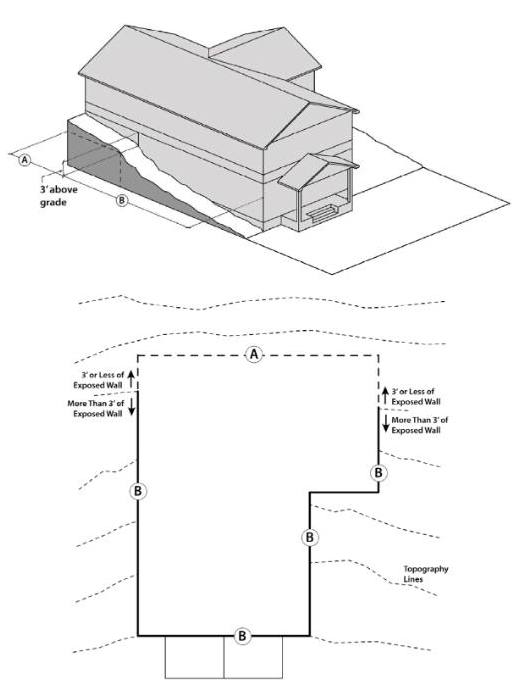
Figure 8-1: Floor Area Ratio Calculation for Lowest Level Floor with Totally or Partially
Exposed Walls
Wall area A is partially exposed above grade by three feet or less. Wall area B is exposed above grade by more than three feet. For example:
(Length of wall B) / (Length of wall A + B) = The percent of floor area calculated towards FAR.
(ii)
The floor area of a high volume space where the distance between any floor and the bottom of the framed ceiling directly above it is sixteen feet or more shall be counted twice. If the distance between any floor and the bottom of the framed ceiling above it is twenty-six feet or more, the floor area shall be counted three times. Up to 150 square feet of a stairwell shall not be considered a high volume space subject to the requirements of this paragraph.
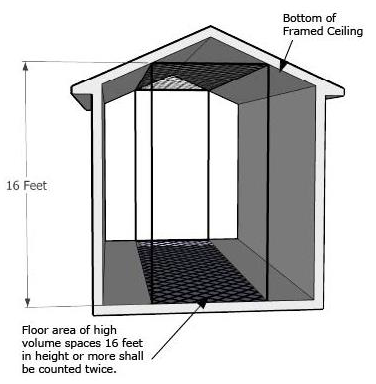
High Volume Spaces
(E)
Floor Area Exempt for Accessory Buildings in Historic Districts and associated with Individual Landmarks: Floor area for accessory buildings may be exempted from the maximum floor area permitted if the following standards are met:
(i)
The accessory building contributes to the historic significance of an individual landmark or a historic district;
(ii)
The accessory building was built during the individual landmark or historic district's period of significance;
(iii)
Only that portion of the accessory building built during the period of significance is eligible for an exemption; and
(iv)
The floor area subject to this exemption is added to another principal or accessory building on the same property and approved as part of a landmark alteration certificate pursuant to Section 9-11-12, "Landmark Alteration Certificate Required," B.R.C. 1981.
(2)
Maximum Additional Floor Area:
(A)
In the DT-2 district, the maximum FAR additional components floor area consisting of either residential floor area, parking within the principal building or detached garages that is not included in the FAR calculation is 0.5 FAR.
(B)
In the DT-5 district, the maximum FAR additional components that can be added to the base FAR in Table 8-2 shall be a floor area ratio of 1.0. Each component of the additional FAR shall not exceed the maximum FAR additional components listed in Table 8-2. To be eligible for the nonresidential floor area, prior to issuance of a building permit, the applicant shall pay the housing linkage fee in Section 4-20-62, "Capital Facility Impact Fee," B.R.C. 1981, for each square foot of additional floor area above the base floor area ratio for which the addition is requested.
(3)
Floor Area Transfers in the DT-5 Zoning Districts: In the DT-5 district, floor area may be transferred from one lot or parcel to another lot or parcel, as provided for by this paragraph. Approval of a floor area transfer shall permit the transfer of all of the supplemental floor area permitted by Table 8-2 of this section to another lot or parcel and permit the same amount of unrestricted floor area to be constructed on the parcel from which the bonus floor area was sent. A floor area transfer will be approved if the approving authority finds that the following criteria have been met as a part of a site review approval pursuant to Section 9-2-14, "Site Review," B.R.C. 1981:
(A)
The lot or parcel from which the floor area is transferred is adjacent to, with a common boundary between, the two lots or parcels. Adjacency shall not be affected by the existence of a public right-of-way;
(B)
Both the sending and receiving lots or parcels are located in the same zoning district as the lot that will receive the additional floor area;
(C)
The floor area on either lot or parcel does not exceed the floor area allowed, with floor area bonuses for each lot or parcel; and
(D)
A phasing plan that addresses the timing of the construction of all of the floor area is approved that ensures that the bonus floor area will be constructed prior to or concurrent with any unrestricted floor area that is transferred to another lot or parcel.
(4)
General Improvement Districts Providing Off-Street Parking: In the BMS district, the FAR may be increased up to 1.85 if the property is located in a general improvement district providing off-street parking.
(5)
Land Use Intensity and Height Modifications: The floor area ratio in select zoning districts may be increased pursuant to Subsection 9-2-14(h)(6), "Site Review," B.R.C. 1981.
Ordinance Nos. 5623 (1994); 5930 (1997); 7079 (2000); 7117 (2001); 7210 (2002); 7351 (2004); 7484 (2006); 7522 (2007); 7535 (2007); 7624 (2008); 7655 (2009); 7684 (2009); 7699 (2009); 7706 (2009); 7710 (2010); 7730 (2010); 7788 (2011); 7813 (2011); 7878 (2012); 7887 (2013); 7921 (2013); 8121 (2016); 8409 (2020); 8515 (2023); 8599 (2024); 8651 (2025); 8666 (2025); 8669 (2025)
9-8-3. - Density in the RR-1, RR-2, RL-1, RMX-1, and RH-7 Districts.
(a)
Duplexes or Two Detached Dwelling Units in the RR-1, RR-2, and RL-1 zoning districts: A duplex or two detached dwelling units may be developed in the RR-1, RR-2, and RL-1 zoning districts if the lot or parcel meets the following standards:
(1)
Location Near Transit Corridors: The lot or parcel is located within 350 feet of a transit corridor identified in Appendix J, "Duplexes Along Transit Corridors," B.R.C. 1981. The distance shall be measured on an official city map, identified by the city manager, from the closest point on the perimeter of the applicant's property to the closest point on the edge of the public right-of-way of the transit corridor; and
(2)
Minimum Lot Area: The lot or parcel meets the minimum lot area established in Table 8-1, "Intensity Standards," for the zoning district or the lot or parcel is a nonstandard lot that is smaller than the minimum lot area established in Table 8-1 for the zoning district and the following requirements are met:
(A)
In the RR-1 and RR-2 zoning districts, the lot or parcel is at least 7,500 square feet, or
(B)
In the RL-1 zoning district, the lot or parcel is at least 3,500 square feet.
(b)
Additional Density in the RMX-1 District: In the RMX-1 zoning district, the minimum lot area per dwelling unit requirement is reduced from 6,000 square feet to 2,500 square feet, except on a lot or parcel under the following circumstance:
(1)
Following the demolition of a principal building without permits required for such demolition under the Boulder Revised Code.
(c)
Additional Density in the RH-7 District: In the RH-7 zoning district, the open space per lot may be reduced from sixty percent to thirty percent of the lot if at least half of the open space provided meets the open space requirements of Paragraph 9-9-11(e)(3), B.R.C. 1981.
Ordinance Nos. 7522 (2007); 7571 (2007); 7655 (2009); 7684 (2009); 7850 (2012); 8599 (2024); 8666 (2025); 8697 (2025)
9-8-4. - Housing Types and Density Bonuses Within an RMX-2 Zoning District.
(a)
Density Bonus for the Provision of Additional Affordable Housing: The approving authority may approve a maximum density increase up to ten additional dwelling units per acre if all of the following standards are met:
(1)
Site Review Required: The plan for the development is approved as part of a site review pursuant to Section 9-2-14, "Site Review," B.R.C. 1981;
(2)
Five Unit Per Acre Bonus: At least thirty percent of all units that are proposed to be built in the development shall meet the requirements for permanently affordable units set forth in Chapter 9-13, "Inclusionary Housing," B.R.C. 1981, to be eligible for a density bonus for up to five additional dwelling units per acre;
(3)
Eight Unit Per Acre Bonus: At least thirty-five percent of all units that are proposed to be built in the development shall meet the requirements for permanently affordable units set forth in Chapter 9-13, "Inclusionary Housing," B.R.C. 1981, to be eligible for a density bonus for up to eight additional dwelling units per acre;
(4)
Ten Unit Per Acre Bonus: At least forty percent of all units that are proposed to be built in the development shall meet the requirements for permanently affordable units set forth in Chapter 9-13, "Inclusionary Housing," B.R.C. 1981, to be eligible for a density bonus for up to ten additional dwelling units per acre; and
(5)
Limits on a Density Bonus: The approving authority may prohibit or limit an increase in density if the applicant fails to demonstrate that it can satisfy the criteria of approval set forth in Section 9-2-14, "Site Review," B.R.C. 1981.
Ordinance Nos. 7116 (2001); 7701 (2010); 8523 (2022)
9-8-5. - Occupancy of Dwelling Units.
(a)
General Occupancy Restrictions: No person shall occupy a dwelling unit in violation of the occupancy limitations of Chapter 10-2, "Property Maintenance Code," B.R.C. 1981. A violation of this section shall be considered a violation of Title 10.
(b)
Prior Approvals: Any requirement under a city approval granted under this title that restricts occupancy based on familial relationship, such as number of unrelated persons, or restricts occupancy beyond the occupancy permitted by Chapter 10-2, "Property Maintenance Code," B.R.C. 1981, is void and shall not be enforced. Notwithstanding the foregoing, this subsection does not apply to any residential occupancy limit based on the standards in Chapter 9-13, "Inclusionary Housing," B.R.C. 1981, or based on any local, state, federal or political subdivision affordable housing program guidelines.
Ordinance Nos. 7522 (2007); 7724 (2010); 8072 (2015); 8119 (2017); 8256 (2018); 8372 (2020); 8523 (2022); 8556 (2023); 8571 (2023); 8585 (2023); 8599 (2024); 8622 (2024); 8651 (2025)
9-8-6. - Density Equivalencies for Group Residences and Hostels.
The permitted density for the following uses shall be calculated as indicated below. The density equivalencies shall not be used to convert existing uses referenced in this section to dwelling units except as set forth in subsection (g). The number of allowed dwelling units shall be determined by using Section 9-8-1, "Schedule of Intensity Standards," B.R.C. 1981:
(a)
Boarding or Rooming House, Fraternity, Sorority, or Dormitory: In boarding or rooming houses, fraternities, sororities, or dormitories, three sleeping rooms constitute one dwelling unit.
(b)
Hostel: In hostels, three sleeping rooms constitute one dwelling unit, but the planning board may increase the density of a hostel to four sleeping rooms per dwelling unit through a use review as provided in Section 9-2-15, "Use Review," B.R.C. 1981.
(c)
Custodial Care and Residential Care Facilities: In custodial care and residential care facilities, eight sleeping rooms or accommodations without kitchen facilities constitute one dwelling unit. If units are provided in a household living configuration, one detached dwelling unit constitutes one dwelling unit and one attached dwelling unit constitutes one dwelling unit.
(d)
Group Home Facilities: In group home facilities, eight sleeping rooms or accommodations without kitchen facilities constitute one dwelling unit. If units are provided in a household living configuration, one detached dwelling unit constitutes one dwelling unit and one attached dwelling unit constitutes one dwelling unit.
(e)
Congregate Care Facility: In congregate care facilities, five sleeping rooms or accommodations without kitchen facilities constitute one dwelling unit, three attached dwelling units constitute one dwelling unit, and one detached dwelling unit constitutes one dwelling unit.
(1)
A congregate care facility that is built or the use is established after October 31, 2013, and uses the dwelling unit equivalency of three attached dwelling units to constitute one dwelling unit shall meet the following additional standards:
(A)
The facility shall include a minimum of ten attached congregate care dwelling units.
(B)
The average dwelling unit floor area for attached congregate care facilities shall not exceed one thousand square feet per unit, and no single dwelling unit shall exceed one thousand two hundred square feet. The average dwelling unit floor area shall include the floor area within the attached dwelling unit and associated storage areas and shall exclude common areas and garages.
(2)
A congregate care facility built or the use is established prior to October 31, 2013, may use the definition of congregate care to define the use classification and the average floor area per dwelling units for attached and detached dwelling units in effect when the congregate care facility was built or the use was established.
(f)
Bed and Breakfast: Three guest rooms in a bed and breakfast constitute one dwelling unit. In any bed and breakfast, up to twelve guest rooms are permitted, provided the provisions of Subsection 9-6-5(a), B.R.C. 1981, are met.
(g)
Conversion of Rooming Units to Dwelling Units: Pursuant to approval of a use review under Section 9-2-15, "Use Review," B.R.C. 1981, for nonconforming uses, rooming units in RM and RH zoning districts that were legally established under prior zoning ordinances and have continued as a legal nonconforming use may be converted to dwelling units at a ratio of four rooming units to one dwelling unit.
Ordinance Nos. 7832 (2013); 7890 (2013); 8235 (2018); 8409 (2020); 8523 (2022); 8556 (2023); 8651 (2025); 8696 (2025)
9-8-7. - Density of Efficiency Living Units.
(a)
Dwelling Unit Equivalents for Efficiency Living Units: For purposes of the density limits of Section 9-8-1, "Schedule of Intensity Standards," B.R.C. 1981, two efficiency living units constitute one dwelling unit.
(b)
Dwelling Unit Equivalents for Moderate Income Housing: For purposes of counting dwelling units under the provisions of Ordinance No. 4638, as amended, "Moderate Income Housing," one efficiency living unit equals one dwelling unit.
Ordinance Nos. 7597 (2008); 8585 (2023); 8600 (2024); 8651 (2025)

