
Boulder City City Zoning Code
CHAPTER 23
OFF STREET PARKING AND LOADING REQUIREMENTS
11-23-1.- PURPOSE.
In order to progressively alleviate or prevent traffic congestion and shortage of curb spaces, off street parking and loading facilities are required to be provided incidental to new land uses, and to major alterations and enlargements of existing uses. The number of parking spaces and loading berths, as herein prescribed, are in proportion to the needs of such facilities as are created by the particular type of land use. Off street parking and loading areas are to be laid out in a manner which will ensure their usefulness; protect the public safety; and where necessary, be required to provide the necessary setbacks, landscaping and walls, in order to protect and insulate the surrounding land uses from their impact.
(Ord. 841, 2-23-1988, eff. 3-23-1988)
11-23-2. - OFF STREET PARKING FACILITIES REQUIRED.
A.
Prior to the construction of a structure, or a major alteration or enlargement of a site or structure, there shall be provided plans for off street parking facilities in accordance with the regulations as herein prescribed. A "major alteration or enlargement" is any change of use, or an addition which would increase the number of parking spaces required by not less than ten percent (10%) of the total number.
B.
"Gross floor area" is the floor area assigned to a use of each floor, mezzanine and basement within the surrounding exterior walls of the building, excluding elevator shafts, stairwells, mechanical equipment rooms, restrooms and courtyards.
C.
"Fractional measurements" involving parking spaces shall result in the requirement of one additional off street parking space.
(Ord. 841, 2-23-1988, eff. 3-23-1988)
D.
The number of off street parking spaces required for each use shall be as follows:
(Ord. 1182, 11-26-2002, eff. 12-18-2002; Ord. No. 1729, 8-22-2023, eff. 9-14-2023)
11-23-3. - PARKING REQUIREMENTS FOR USES NOT SPECIFIED.
Where parking requirements for any use are not specifically defined herein or stipulated elsewhere in this title, such parking requirements shall be determined by the planning commission, and shall be based upon the requirements for the most comparable use specified herein, or in proportion to the need of such facilities as is created by the particular type of land use.
(Ord. 841, 2-23-1988, eff. 3-23-1988)
A.
Upon receipt of a complete application and applicable fees, the Community Development Director shall cause notices to be given in accordance with the procedures and requirements set forth in Section 11-35-2 of this Code.
(Ord. 883, 2-26-1991, eff. 3-20-1991)
11-23-4. - GENERAL PARKING AND LOADING PROVISIONS.
A.
Access. Each off-street parking space shall be provided with adequate ingress and egress, with sufficient room for turning and maneuvering on the site; provided, however, in any R1 (Single-Family Residential), ME (Mobile Home Estates) or MP (Mobile Home Park) Zone, each space need not have individual ingress and egress. An adjoining alley may be considered as part of the site in determining the adequacy of the space required for the turning and maneuvering of vehicles, but in no case shall an adjoining street be considered for such purpose. The location and design of all entrances and exits shall be subject to the approval of the City Engineer.
B.
Location.
1.
The off-street parking requirements as herein set forth shall be located on the same lot or parcel or on an adjoining lot or parcel as the structure or use they are intended to serve. The Commission may allow the establishment of the off-street parking area to be located within five hundred feet (500') of the premises to which the parking requirements pertain, and may be located in a residential zone if the land lies adjacent to any building or use being established in a commercial zone.
2.
Space for required off-street parking and loading shall not occupy any part of the clear vision triangle, but may be included as part of a required open space for a rear or side yard.
C.
Mixed Occupancies. In the case of mixed uses in a building or on a lot, the total requirements for off-street parking facilities shall be the sum of the requirements for the various uses, computed separately. Off-street parking facilities provided for one use shall not be considered as providing required parking facilities for any other use.
D.
Reduction In Area. No off-street parking area shall be encroached upon by buildings, vehicle storage or any other use, nor shall such space be reduced in area except by recommendation of the Planning Commission and approval by the City Council; and then only after proof that, by reason of reduction in floor area, seating area or other factors controlling the regulation of such parking facilities, the proposed reduction in off-street parking is reasonable. Application for such reduction or encroachment shall be made in accordance with the provisions of Chapter 30 of this Title, Conditional Uses.
E.
Off-Street Loading Spaces Required. In any district in connection with every building or part thereof, hereafter erected and having a gross floor area of five thousand (5,000) square feet or more, which is to be occupied for any office, commercial, manufacturing or industrial purpose or for any other purpose similarly requiring the receipt or distribution by vehicles of material or merchandise, there shall be provided and maintained on the same lot with such building at least one off-street loading space not less than twelve feet in width, thirty five feet in length and fourteen feet clearance in height (12' x 35' x 14'), plus one additional such loading space for each additional twenty thousand (20,000) square feet of floor area.
(Ord. 841, 2-23-1988, eff. 3-23-1988)
11-23-5. - IMPROVEMENTS REQUIRED.
A.
Parking Plan. A plan of any proposed parking area shall be submitted to the Community Development Director or Building Official, at the time of filing an application for a building permit for the building to which the parking area is accessory. No building permit shall be issued unless the parking plan has been approved by the Community Development Director or Building Official. The parking plan shall clearly indicate the proposed development, including location, size, shape, design, entrances and exits, curb cuts, lighting, landscaping, screening, paving specifications, including bumper curbs and such other data features and appurtenances as the Community Development Director or Building Official may deem pertinent. If any parking requirements are based on a use, such as restaurants, lounges, cafes, where seating is the criteria, a seating plan shall be submitted with the construction drawings.
A temporary certificate of occupancy may be issued by the Building Official for the use of a portion or portions of a building or structure prior to the completion of the entire development as proposed on the parking plan when, in the judgment of the Building Official, the delay in the completion of the improvements are due to circumstances beyond the control of the owner.
1.
Minimum Design Standards. The parking plan shall conform to the minimum design standards contained in table I which follows:
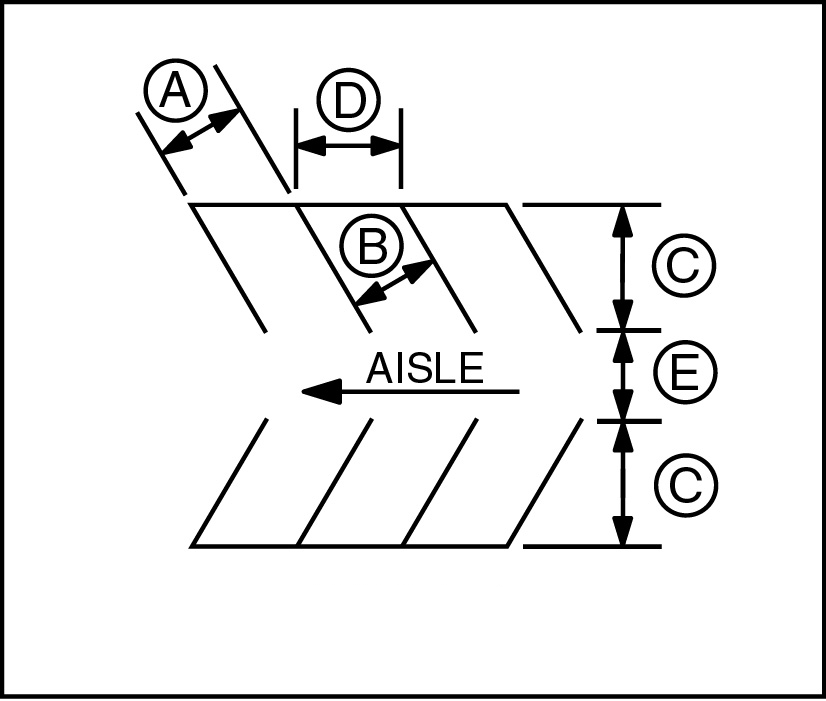
CHART III
2.
Handicapped Drivers. Every parking lot designed for use by the general public in whole or in part shall be provided with parking spaces for the exclusive use of handicapped drivers. Parking spaces so received and designated for handicapped parking shall be located within the parking lot in those areas that are most accessible to the use the parking lot is accessory to. The number of parking spaces provided for handicapped drivers shall be as follows:
3.
Marking And Signs. All parking stalls shall be marked on the pavement for each vehicle to be parked. Operational restrictions such as one-way aisles shall be clearly indicated with appropriate signs or pavement markings.
a.
Handicapped parking spaces shall be marked in blue. The international symbol of accessibility shall be painted in each handicapped space.
b.
Handicapped parking spaces shall have a sign identifying "Handicapped Parking" and the penalty fine as required by Nevada Revised Statutes 484.408.
4.
Entrances And Exits. Each parking lot shall have not more than two (2) entrances and one common exit for each street frontage. Construction of driveways shall comply with the Boulder City uniform standard drawings.
5.
Deviation Or Modification. Any deviation or modification of the parking requirements as herein set forth must be approved by the planning commission. No final inspection or occupancy permit shall be issued by the building official until all the improvements as shown on the parking plan have been properly installed.
6.
Granting Of Minor Plan Modifications. Notwithstanding any other provisions of this chapter, the community development director may allow for certain minor parking plan modifications without public hearing as required by chapter 32, "Variances", of this title subject to the following limitations:
a.
Permit minor modifications as may be necessary to achieve an appropriate design in the proposed parking area.
b.
Permit minor modifications in the minimum parking design standards where, in the particular instance, such modification will not be inconsistent with the purpose of this chapter.
c.
For the purpose of this section, minor modifications shall be construed to be modifications amounting to ten percent (10%) or less of any requirements for achieving the minimum parking design standards.
(Ord. 841, 2-23-1988, eff. 3-23-1988)
B.
Pavement And Treatment Of Public Or Private Parking, Outdoor Sales Or Display Areas.
1.
All off street parking areas shall be surfaced or paved with asphaltic concrete pavement, concrete pavement or other similarly durable hardened improved surface, contained by perimeter curbing material, all subject to the approval of the building official and shall be so graded and drained as to dispose of all surface water in a manner that will not cause erosion or damage outside of the parking area.
a.
Exception For Temporary Uses. Every parcel of land hereafter used for temporary private or public parking, sales or display (temporary meaning 30 continuous days or less as approved by the city) shall be surfaced or paved with asphaltic concrete pavement, concrete pavement, or with a two inch (2") deep gravel base with a defined edge that is treated as needed to eliminate dust, subject to approval by the building official, and shall be maintained in good condition during the duration of the temporary parking, sales or display.
b.
Exception For Special Events. Standards for temporary parking for special events as per title 4, chapter 1 of this code shall be as established by the city's special events review board.
2.
Persons operating parking lots shall maintain such lots to provide a smooth and durable surface, adequately drained and free from dust.
3.
Display for the purpose of sale of any motor vehicle or other merchandise upon any vacant lot, private parking lot, or unimproved portion of a public right of way is not permitted without a business license under the provisions of title 4 of this code.
4.
Where such areas adjoin residential zones, unless otherwise separated by a public street, they shall be separated therefrom by a solid masonry wall or similar sight obscuring fence six feet (6') in height, provided that said wall shall not exceed four feet (4') in height where it is in the front yard area of an abutting zone which requires a front setback area.
(Ord. 1497, 4-23-2013, eff. 5-16-2013)
C.
Border Barricades.
1.
Every parking area that is not separated by a wall from any street or alley upon which it abuts shall be provided with bumper curbs, said curb installation shall be as per city standards.
2.
Every parking area located in a zone other than R1 abutting property located in R1 zones shall be separated from such property by a solid masonry wall six feet (6') in height, measured from the finished surface grade of such parking area closest to the contiguous R1 zoned property; provided, that the masonry wall shall not exceed four feet (4') in height within fifteen feet (15') of any street line.
D.
Parking Lot Landscaping. Repealed and replaced by Section 11-25-7 of this Code.
E.
Lighting.
1.
Where all night parking is permitted, parking lots shall be lighted from sunset to sunrise. Where parking is customarily permitted for some lesser portion of the hours of darkness, parking lots shall be lighted for those hours the parking is customarily permitted. The lights shall be so arranged as to reflect the light away from adjoining lots and shall provide a distribution of light which is ample to distinguish silhouettes.
2.
Any lights provided to illuminate any parking area shall be arranged so as to reflect the light away from any premises upon which a dwelling unit is located. Open bulbs shall not be permitted. Proper shades shall be used to control such installations to prevent glare and light from infringing upon adjoining properties.
F.
Fire Access. All vehicles shall be so stored that they may be reached readily in case of fire or other emergency.
G.
Conflicting Provisions. In the event the requirements of the uniform standard specifications for public works construction off site improvements, Clark County area, Nevada, or any other chapter, standards and specification, as they now exist or may hereafter be amended or adopted, are in conflict with the provisions of this chapter, such specific requirements are hereby repealed to the extent of such conflict but no further, and the provisions of this chapter shall prevail.
(Ord. 841, 2-23-1988, eff. 3-23-1988)
(Ord. 1724, 6-13-2023, eff. 6-6-2023)
11-23-6. - OFF STREET PARKING AND LOADING REQUIREMENTS IN THE CBD CENTRAL BUSINESS DISTRICT.
The CBD central business district is a supplemental special district which, when superimposed over any zone downtown as per the adopted zoning map, exempts the uses located therein from the provisions of subsection 11-23-2D, sections 11-23-3 and 11-23-4 of this chapter, and subjects such users to the following off street parking and loading requirements. The purpose for this supplemental district is to encourage traditional downtown business and development in the historic commercial center of the city where public parking lots are in existence and where on street parking is permitted by the city in designated areas.
A.
No additional parking spaces are required on site for existing buildings, additions to existing buildings, or new buildings.
B.
There shall be no reduction of existing parking or loading spaces on a developed lot.
(Ord. 1526, 9-23-2014, eff. 10-16-2014)
11-23-7. - RESIDENTIAL PARKING STANDARDS FOR INDIVIDUAL SINGLE-FAMILY LOTS OR MOBILE HOME SITES.
A.
Off Street Parking Required. Sufficient off street parking shall be provided and maintained for all vehicles. The minimum required number of parking spaces to be provided shall be as specified in section 11-23-2 of this chapter, except for lots that are substandard in area. When parking is provided, the parking area shall comply with the other requirements of this chapter.
B.
Driveway and Parking Surface Materials.
1.
Primary Driveways and Parking Areas:
a.
Any driveway accessed directly from a street is a primary driveway and shall be paved from side to side.
b.
For the purposes of this section, paving is defined as a hard surface such as concrete pavement, asphaltic concrete pavement, brick, or other similarly durable hardened improved surface with a defined edge, subject to approval by the Building Official.
2.
Secondary Driveways And Parking Areas:
a.
A driveway that extends off of a primary driveway or alley to access a parking area in a side or rear yard is a secondary driveway, and may utilize gravel, landscape rock, or paving as defined herein.
b.
Vehicles may be driven over a secondary driveway as defined herein, but parking may occur over gravel or landscape rock only in a side or rear yard.
C.
Allowable Parking Area Within Front Yards In The R1-7, R1-8, R1-10, R1-15, ME And MP Zones.
1.
For the purposes of this section, the front yard is the required front setback area for the zone. There are no paving limits beyond the required front yard area.
2.
The maximum coverage for parking (primary driveway) in any front yard area shall not exceed fifty percent (50%) of the front yard area.
3.
Exception. All dwellings shall be permitted a minimum driveway width of twelve feet (12') and minimum driveway area of four hundred (400) square feet within the front yard.
4.
Standards For Semicircular Driveways.
a.
If the width of the semicircular driveway does not exceed twelve feet (12'), the total parking area may exceed fifty percent (50%) of the front yard. A greater width may be permitted as long as the total parking area does not exceed fifty percent (50%) of the front yard.
b.
There shall be no more than two (2) access points on the premises for the semicircular drive.
5.
Any new access point to a public right of way requires approval of the city engineer prior to construction.
D.
Front Yard Parking And Driveways Prohibited In Certain Areas Of The Historic District.
1.
New driveways and parking areas shall be prohibited within residential front yards along the following streets within the boundaries of the Boulder City historic district: Arizona, Ash, Birch, Cherry, Colorado, Denver, Park and Utah Streets, and the portion of Avenue B north of Arizona Street.
2.
Any lot which does not have direct vehicular access to an alley or side street shall be permitted to have a driveway within the front yard meeting the other requirements of this section.
E.
Parking Actions Prohibited.
1.
It shall be prohibited to park or store vehicles or any other objects or structures on vacant lots within residential zones. The reference to vehicles includes, but is not limited to, trailers, boats, equipment or machinery, whether operable or licensed or not.
2.
Parking on public property (including sidewalks and the area between the sidewalk and the street) shall be regulated as per the provisions of title 10, chapter 6 of this code.
F.
Carports. Carports attached to a dwelling are regulated as per subsection 11-20-3F of this title. Detached carports are regulated as per subsection 11-20-2B of this title as an accessory structure.
(Ord. 1497, 4-23-2013, eff. 5-16-2013; Ord. 1653, exh. A, 10-27-2020, eff. 11-19-2020)

