
Brentwood City Zoning Code
ARTICLE I
- IN GENERAL
Sec. 78-1.- Title and map.
This chapter shall be known and may be cited as "The Zoning Ordinance of Brentwood, Tennessee," and the map herein referred to, which is identified by the title, "Official Zoning Map, Brentwood, Tennessee," and all explanatory matters thereon are hereby adopted and made a part of this chapter. The official zoning map shall be located in the city hall and shall be identified by the signature of the mayor attested by the city recorder. The official zoning map may be amended; provided, however, that, no amendment of the official zoning map shall become effective until after such change and entry has been made on such map and signed by the mayor and attested by the city recorder.
(Code 1978, § 11-201)
Sec. 78-2. - Purpose.
The zoning regulations and districts as set forth in this chapter have been made in accordance with a zoning plan for the purpose of promoting the health, safety, morals and general welfare of the community. The regulations are designed to lessen congestion in the streets; to secure safety from fire, panic and other dangers; to provide adequate light and air; to prevent overcrowding of land; to avoid undue concentration of population; to facilitate the adequate provision of transportation, water, sewerage, schools, parks and other public requirements. This chapter has been prepared with reasonable consideration, among other things, as to the character of each district and its peculiar suitability for particular uses, and with a view of conserving the value of buildings and encouraging the most appropriate use of land throughout the city.
(Code 1978, § 11-202)
Sec. 78-3. - Definitions.
The following words, terms and phrases, when used in this chapter, shall have the meanings ascribed to them in this section, except where the context clearly indicates a different meaning:
Abuts or abutting means lots or land adjoining but separated by a common property line; also, those lots or lands which adjoin if property lines are extended to the centerlines of streets. Centerline of street means an imaginary line that is equidistant from the outer edges of the pavement section of the street.
Bed and breakfast lodge means a dwelling in which overnight accommodations and meals are provided to visitors for compensation.
Buildable area means the area of a lot remaining after the minimum yard requirements for that specific zoning district have been met. See illustrations following this section.
Build-to line means a horizontal distance at which at least 70 percent of a wall of the first story of a structure must be located from the front property line.
Consignment sale means a sale of items on behalf of the owner of the items by someone other than the owner, with a portion of the sale proceeds being returned to the owner. An auction or other sale held at the home of a deceased resident or a resident who is relocating for the purpose of disposing of the resident's household assets shall not be considered a consignment sale.
Dwelling means a structure designed and used primarily for human habitation. For the purpose of this chapter, the word "dwelling" shall not include a travel trailer, hotel, motel or dormitory extended stay hotel.
(1)
Dwelling, detached single-family means a residential structure dwelling unit other than a mobile home, located on a single lot, and constructed with no connection by a common wall to another dwelling unit. The terms, "detached single-family dwelling" and "detached single-family residence," as used in this chapter, shall be synonymous.
(2)
Dwellings, townhouse means two or more attached single-family dwelling units, located on separate lots, constructed side by side with a common wall between each two units. At points of attachment, such townhouse dwellings are separated from one another by continuous vertical walls without opening from the basement floor to the roof.
(3)
Dwelling unit means an area within a structure designed and constructed for occupancy to be occupied by one family or other single housekeeping unit as may be permitted by this chapter, with separate kitchen, bathrooms and bedrooms. A structure may consist of one detached single-family dwelling unit; or more than one attached single-family dwelling units in the case of townhouse dwellings; or such dwelling units as may be permitted in a comprehensive retirement community located within an SI-4 zoning district.
Extended stay hotel means a facility offering transient lodging accommodations to the general public in which, in addition to normal sleeping beds, some or all of the rental units also provide cooking or kitchen facilities. Cooking and kitchen facilities indicative of an extended stay hotel shall include any of the following: stove, microwave oven, dishwasher, kitchen- type sink, disposal, refrigerator (intended for use by the occupant for storing food and drinks), storage cabinets and vinyl floor area typically found in a food preparation or eating area. An extended stay hotel unit may also include one or more separate attached bedrooms and living areas.
Floodway overlay district means the "flood hazard district" established pursuant to article III, division 15 of this chapter.
Floor area ratio (FAR) means the total floor area of the buildings on a lot divided by the total lot area. Excluded from floor area measurement shall be unoccupied areas of the building such as mechanical rooms, stairwells, elevator shafts and structure parking spaces. In addition, the total lot area shall be measured using the original lot size prior to any non-compensated dedication of land for streets, on-street parking, sidewalks and other public improvements.
Foundation means the lowest portion of a structure consisting of the footers, slab, block, concrete or other building materials constructed under and upon the ground for the purpose of supporting the structure. For purposes of this chapter, the term "foundation" is synonymous with the term "footprint."
Garage sale means a sale conducted on residential property for the purpose of disposing of personal property belonging to the owner or tenant of the residential property and/or other residential property owners or tenants within the same neighborhood; or a sale conducted on service institution property for the purpose of disposing of personal property donated to an institution or an organization within or supported by such institution, wherein no portion of the sale proceeds is returned to the donor. "Personal property" as used in this definition, means property which is owned, utilized and maintained by an individual or members of his or her residence and acquired in the normal course of living in or maintaining a residence.
Grade means the slope of the land or rate of change in elevation of a lot or property. For purposes of this definition, the grade for any existing or potential lot or property shall be classified as follows:
(1)
Conventional - lots or property with less than 15 percent grade and not located in a legally designated floodway overlay district.
(2)
Transitional - lots or property with at least 15 percent grade but less than 25 percent grade.
(3)
Steep - lots or property with 25 percent grade or greater.
(4)
Floodway - any lot or property with a portion or all of the area located in a legally designated floodway overlay district and subject the regulations and limitations on development under article III, division 15 of this chapter.
Home occupation means any of the following:
(1)
A business activity which is based in a residence and is subject to the business licensing and taxation requirements of Chapter 62, Article III of this Code;
(2)
An occupation which is principally carried out or practiced in a residence and which is subject to the state privilege tax imposed pursuant to T.C.A., Title 67, Chapter 4, Part 17, as the same may be amended or replaced; or
(3)
An activity which is:
a.
Based in a residence;
b.
Performed or carried out for compensation; and
c.
Generates more than ten deliveries per month (other than by U.S. mail), or generates visits from clients, customers, associates or other persons on a regular basis. "Regular basis," as used in this definition, means more than four occasions per month.
Hotel or motel means a facility offering transient lodging accommodations to the general public consisting of sleeping rooms and bathrooms only. A hotel or motel which is not an extended stay hotel is distinguished from an extended stay hotel in that it shall not include cooking or kitchen facilities within any guest unit. Cooking or kitchen facilities shall include but are not limited to: stove, microwave oven, dishwasher, kitchen-type sink, disposal, refrigerator (intended for use by the occupant for storing food and drinks), storage cabinets and vinyl floor area typically found in a food preparation or eating area.
Landscape treatment means the use of both natural and artificial materials to enhance the physical appearance of a site, to improve its environmental setting, to screen all or part of one land use from another, to prevent erosion and excessive surface water runoff, or to protect the public safety.
Loading and unloading space means an area for the loading and unloading of trucks or other vehicles at least 55 feet in depth, 12 feet in width, (with an overhead clearance of not less than 14 feet), exclusive of access, platform or maneuvering area.
Lot means a piece, parcel or plot of land occupied or to be occupied by buildings and accessory buildings and including the open spaces required under this chapter.
(1)
Lot coverage means the relationship between the size of the building site and the amount of land utilized by principal and accessory structures.
(2)
Lot line means the boundary dividing a given lot from a street, an alley or adjacent lots.
(3)
Lot of record means a lot, the boundaries of which are recorded in the county register's office.
Mechanical penthouse means an enclosed area on the roof of flat-roofed buildings that houses mechanical operations of the building. The penthouse shall be set back from the building line a distance equal to its height.
Open space residential development means a residential subdivision incorporating permanent internal open space for use by all homeowners within the subdivision, and developed in accordance with open space residential provisions of this chapter.
Planned development means an interrelated development adhering to a master development plan and located on a single tract of land, or on two or more tracts of land which may be separated only by a street or other right-of-way. A planned development may be characterized by a single structure or two or more adjoined structures in separate ownership and having zero-foot side setbacks on internal lot lines or by two or more tracts in separate ownership and with separate structures.
Preschool means an educational facility that only teaches pre-first-grade children; that maintains a curriculum recognized by the state or a national or international accrediting body and employs teachers that hold certification to teach preschool by the state or a national or international accrediting body.
Rear service lane means an alley or similar thoroughfare which affords rear lot access to the abutting property and has a right-of-way of 25 feet or less.
Residential child care facility means any facility which exclusively provides full-time care and living facilities for children 18 years of age and younger outside their own homes in facilities owned and operated by a not-for-profit institution, society or agency.
Roof line means the point at which a roof intersects the wall of a building or the top of a parapet, if any.
Sexually oriented businesses means those establishments falling under the definition of "sexually oriented businesses" in section 18-152 of this Code, as said section may be amended or replaced.
Street means any public or private way set aside for public travel 21 feet or more in width. The word "street" shall include the words "road," "highway" and "thoroughfare."
(1)
Arterial street or system means a continuous highway or system of highways, carrying heavy and relatively fast traffic, which connects cities and currently absorbs collector traffic, as shown on the major thoroughfare plan of the city.
(2)
Minor street means a street whose principal function is to provide access to abutting properties rather than move large volumes of traffic.
(3)
Circulation means the flow of traffic, goods or people within and through an area.
(4)
Collector street means an urban street which collects traffic from minor streets and feeds it into the arterial system; includes the principal entrance streets of a residential development and streets for major circulation within such development as shown on the major thoroughfare plan of the city.
Structure means any constructed or erected material or combination of materials requiring space on a lot.
(1)
Type A structures include but are not limited to all types of dwellings and other buildings; carports and garages; satellite dish antennas; play structures; storage sheds; storm shelters; windmills; swimming pools and equipment; tennis courts; pet enclosures; porches; decks; gazebos; and freestanding fireplaces.
(2)
Type B structures include but are not limited to driveways and sidewalks; concrete/masonry or wooden steps; at-grade patios; arbors; pergolas; at-grade mechanical equipment/pads; fences; retaining walls; fountains; outdoor furniture; freestanding signs; basketball goals; and similar yard accessories.
(3)
Additional definitions pertaining to structures are set forth below:
a.
Accessory structure means a secondary structure, the use of which is incidental to that of a principal structure on the same lot.
b.
Accessory building means a detached accessory structure with at least 50 square feet of gross floor area or ground space and a roof.
c.
Principal structure means the primary structure(s) in which activities are conducted on the lot. In any residential district, the dwelling shall be deemed the principal structure on the lot. In any commercial or service/institution district, the climate-controlled buildings used for activities shall be deemed the principal structure(s) on the lot. A canopy, carport or garage shall be deemed a part of the principal structure if it is permanently attached to the principal structure; it is not a "semi-detached" structure, as defined below; and all associated building components and materials for the canopy, carport or garage are similar to the principal structure.
d.
Semi-detached means a structure which is permanently connected to the principal structure by means of a covered walkway.
e.
Height of structure means the vertical distance of a structure measured from the lowest ground level to the highest point of the roof; excluding any mechanical penthouse.
f.
Story means that portion of a structure located between the usable surface of a floor and the usable surface of the floor located above or below, and designed for human occupancy.
g.
Gross floor area means the sum of the gross horizontal areas of the floors of a dwelling or other building as measured from the exterior face of exterior walls or from the centerline of a common wall separating two buildings. Not included in this calculation are the mechanical penthouse areas.
h.
Storm shelter means any underground habitable structure designed and used for emergency shelter from severe weather or other catastrophe. The term "storm shelter" shall also include any structure referred to as a "fallout shelter." A detached storm shelter shall be considered as a type of accessory structure.
i.
Portable storage structure means any portable container, storage unit or other portable structure, that can be or is used for the storage of personal property of any kind and which is located for such purposes outside a principal structure.
Subdivision means the division of a tract or parcel of land into two or more lots, sites, or other divisions requiring new street or utility construction, or any division of less than five acres, for the purpose, whether immediate or future, of sale or building development, and includes resubdivision and when appropriate to the context, relates to the process of resubdividing or to the land or area subdivided. In the event the definition of "subdivision" contained within T.C.A. § 13-4-301(4)(B) is amended or replaced, or any other statute hereafter makes another definition of "subdivision" applicable to the city, then such newly adopted definition shall supersede the definition set forth herein.
Yard means the entire area of the lot including front, side and rear yards. The buildable or usable area of the yard is subject to restrictions on the location and placement of type A and B structures through the establishment of minimum separation requirements (setbacks) from the adjoining lots and right-of-way and by the recording of public utility and drainage easements. (See illustration following.)
(1)
Front yard means the yard extending across the entire width of a lot between the right-of-way line of a public street and the front elevation of a principal structure, including covered porches, canopies and carports.
(2)
Rear yard means the yard extending across the entire width of the lot between the rear lot line and the rear elevation of the principal building, including covered porches, canopies and carports.
(3)
Side yard means a yard extending along the side lot line from the front yard to the rear yard and lying between the side lot line and the side elevation of the principal building, including covered porches, canopies and carports.
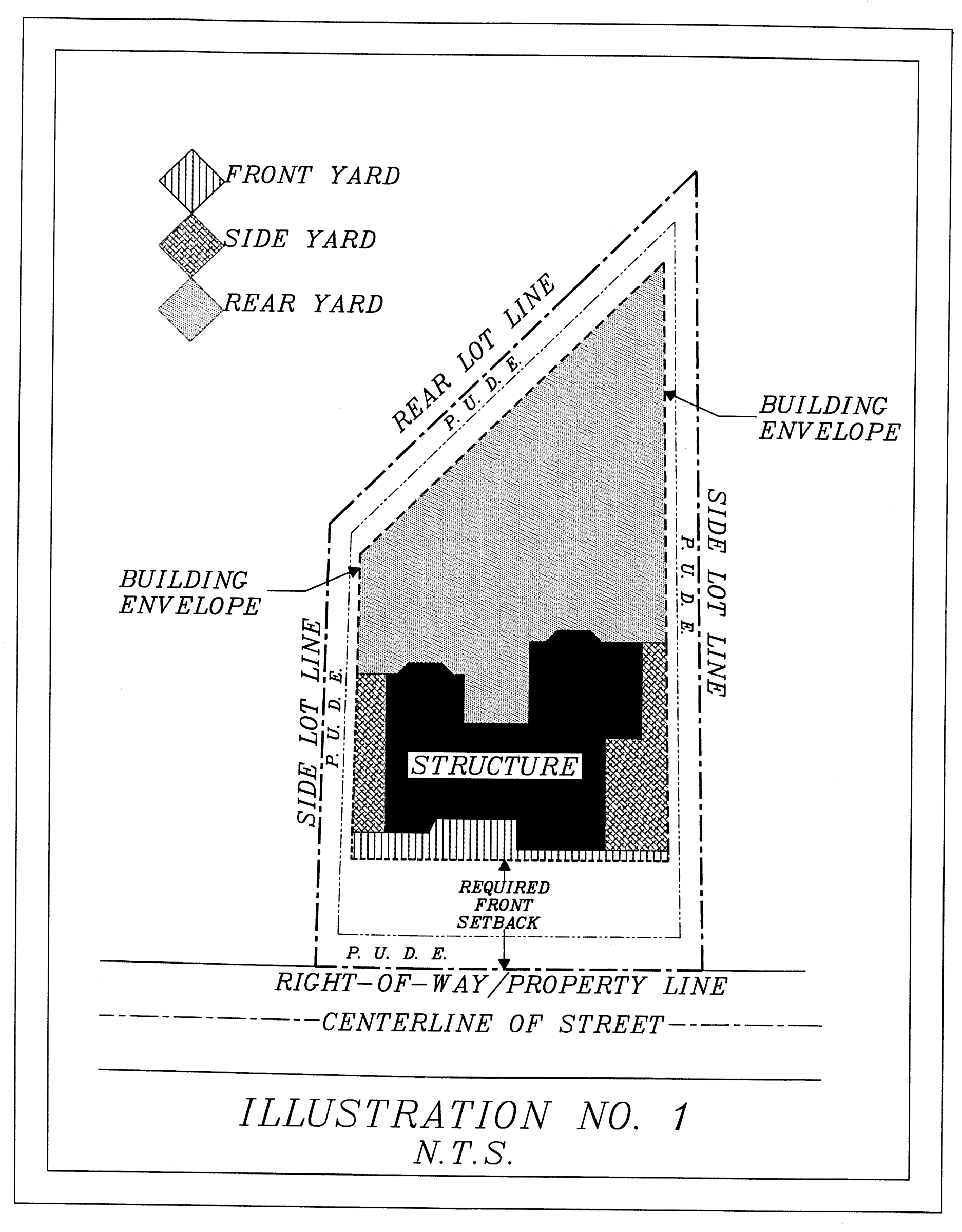
(Code 1978, § 11-203; Ord. No. 95-26, § 1, 6-12-95; Ord. No. 96-05, § 1, 3-25-96; Ord. No. 96-40, § 1, 10-28-96; Ord. No. 96-45, § 1, 12-9-96; Ord. No. 98-12, § 1, 6-22-98; Ord. No. 98-14, § 1, 6-22-98; Ord. No. 99-11, § 1, 7-26-99; Ord. No. 2000-15, § 1, 10-22-2001; Ord. No. 2001-21, § 1, 11-26-2001; Ord. No. 2002-14, § 2, 8-26-2002; Ord. No. 2002-21, § 1, 10-28-2002; Ord. No. 2003-01, §§ 1, 2, 4-14-2003; Ord. No. 2004-01, §§ 1, 2, 2-25-2004; Ord. No. 2004-20, §§ 1, 2, 6-28-2004; Ord. No. 2005-17, §§ 1, 2, 7-11-2005; Ord. No. 2005-23, §§ 1, 2, 10-24-2005; Ord. No. 2007-12, § 1, 4-23-2007; Ord. No. 2008-08, § 2, 6-24-2008; Ord. No. 2008-18, § 1, 11-10-2008; Ord. No. 2009-09, § 2, 9-28-2009; Ord. No. 2009-13, § 8, 1-25-2010; Ord. No. 2019-07, § 1, 8-26-2019)
Cross reference— Definitions and rules of construction generally, § 1-2.
Sec. 78-4. - Compliance required.
No building or land shall hereafter be used and no building or part thereof shall be erected, moved or altered unless for a use expressly permitted by and in conformity with the regulations specified in this chapter for the district in which it is located.
(Code 1978, § 11-204)
Sec. 78-5. - Nonconforming lots, uses of land, structures, and uses of structures and premises.
(a)
Intent. Within the districts established by this chapter or amendments that may later be adopted, there exist lots, structures, and uses of land and structures which were lawful before the provisions of this chapter were passed or amended, but which would be prohibited, regulated, or restricted under the terms of these provisions or future amendment. It is the intent of this chapter to permit these nonconformities to continue until they are removed, but not to encourage their survival. Such uses are declared to be incompatible with permitted uses in the districts involved. It is further the intent of this chapter that the nonconformities shall not be enlarged upon, expanded or extended, nor be used as grounds for adding other structures or uses prohibited elsewhere in the same district. A nonconforming use of a structure, a nonconforming use of land or a nonconforming use of a structure and land shall not be extended or enlarged after passage of the provisions of this chapter by attachment on a building or premises of additional signs intended to be seen from off the premises, or by the addition of other uses of a nature which would be prohibited generally in the district involved. To avoid undue hardship, nothing in this chapter shall be deemed to require a change in the plans, construction, or designated use of any building on which actual construction was lawfully begun prior to the effective date of adoption or amendment of the provisions of this chapter and upon which actual building construction has been diligently carried on. Actual construction is hereby defined to include the placing of construction materials in permanent position and fastened in a permanent manner; except that where demolition or removal of an existing building has been substantially begun preparatory to rebuilding, such demolition or removal shall be deemed to be actual construction, provided that work shall be diligently carried on until completion of the building involved.
(b)
Nonconforming lots of record. In any district in which single-family dwellings are permitted, notwithstanding limitations imposed by other provisions of this chapter, a single-family dwelling and customary accessory buildings may be erected on any single lot of record at the effective date of adoption or amendment of the provisions of this chapter. Such lot must be in separate ownership and not of continuous frontage with other lots in the same ownership. This provision shall apply even though such lot fails to meet the requirements for the area or width, or both, that are generally applicable in the district, provided that yard dimensions and other requirements not involving area or width, or both, of the lot shall conform to the regulations for the district in which such lot is located. Variance of area, width and yard requirements shall be obtained only through action of the board of zoning appeals. If two or more lots or combinations of lots and portions of lots with continuous frontage in single ownership are of record at the time of passage or amendment of the provisions of this chapter, and if all or part of the lots do not meet the requirements for lot width and area as established by this chapter, the lands involved shall be considered to be an undivided parcel for the purposes of this chapter, and no portions of such parcel shall be used or sold which do not meet lot width and area requirements established by these chapters, nor shall any division of the parcel be made which leaves remaining any lot with width or area below the requirements stated in this chapter.
(c)
Nonconforming uses of land. Where, at the effective date of adoption or amendment of the provisions of this chapter, lawful use of land exists that is made no longer permissible under the terms of this chapter as enacted or amended, such use may be continued, so long as it remains otherwise lawful, subject to the following provisions:
(1)
No such nonconforming use shall be enlarged or increased, nor extended to occupy a greater area of land than was occupied at the effective date of adoption or amendment of this chapter.
(2)
No such nonconforming use shall be moved in whole or in part to any other portion of the lot or parcel occupied by such use at the effective date of adoption or amendment of this chapter.
(3)
If any such nonconforming use of land ceases for any reason for a period of more than 30 days, any subsequent use of such land shall conform to the regulations specified by this chapter for the district in which such land is located.
(d)
Nonconforming structures. Where a lawful structure exists at the effective date of adoption or amendment of the provisions of this chapter that could not be built under its terms by reason of restrictions on area, lot coverage, height, yards or other characteristics of the structure or its location on the lot, or where an otherwise lawful structure completed prior to April 15, 1996, encroaches into the setbacks required by this chapter, such structure may be continued so long as it remains otherwise lawful, subject to the following provisions:
(1)
No such structure may be enlarged or altered in a way which increases its nonconformity.
(2)
Should such structure be destroyed by any means to an extent of more than 50 percent of its replacement cost at time of destruction, it shall not be reconstructed except in conformity with the provisions of this chapter. Notwithstanding the foregoing, nonconforming structures which have been in existence for more than 75 years or which are part of historically significant sites designated as such by resolution of the board of commissioners may be reconstructed if recommended by the Brentwood Historic Commission. The historic commission shall consider whether such reconstruction is appropriate to retain or enhance the historic importance of the structure or site. Any reconstruction must be so substantially similar as to be a visual scale replica of the exterior elevations of the structure that has been destroyed. If recommended by the historic commission, the building official may issue such permits as appropriate subject to submittal of required plans as applicable. The owner of the property shall have 18 months from the date the damage occurred to present a plan for the reconstruction of the affected structure to the historic commission for their review.
(3)
Should such structure be moved for any reason for any distance whatever, it shall thereafter conform to the regulations for the district in which it is located after it is moved.
(e)
Nonconforming uses of structures. If a lawful use of a structure and premises in combination exists at the effective date of adoption or amendment of the provisions of this chapter, that would not be allowed in the district under its terms, the lawful use may be continued so long as it remains otherwise lawful, subject to the following provisions:
(1)
No existing structure devoted to a use not permitted by this chapter in the district in which it is located shall be enlarged, extended, constructed, reconstructed, moved or structurally altered except in changing the use of the structure to a use permitted in the district in which it is located.
(2)
Any nonconforming use may be extended throughout any parts of a building which were manifestly arranged or designed for such use at the time of adoption or amendment of the provisions of this chapter, but no such use shall be extended to occupy any land outside such building.
(3)
Any structure, or structure and land in combination, in or on which a nonconforming use is superseded by a permitted use, shall thereafter conform to the regulations for the district in which such structure is located, and the nonconforming use may not thereafter be resumed.
(4)
When a nonconforming use of a structure, or structure and premises in combination, is discontinued or abandoned for six consecutive months, the structure or structure and premises in combination shall not thereafter be used except in conformance with the regulations of the district in which it is located.
(5)
Where nonconforming use status applies to a structure and premises in combination, removal or destruction of the structure shall eliminate the nonconforming status of the land.
(f)
Repairs and maintenance. On any building devoted in whole or in part to any nonconforming use, work may be done in any period of 12 consecutive months on ordinary repairs, or on repair or replacement of nonbearing walls, fixtures, wiring or plumbing to an extent not exceeding ten percent of the current replacement value of the building, provided that the cubic content of the building as it existed at the time of passage or amendment of the provisions of this chapter shall not be increased. Nothing in this chapter shall be deemed to prevent the strengthening or restoring to a safe condition of any building or part thereof declared to be unsafe by an official charged with protecting the public safety, upon order of such official.
(g)
Conflicts with state or federal law. The provisions and requirements of this section shall be modified or waived as necessary to allow for compliance with T.C.A. § 13-7-208, or such provisions of state or federal law as may apply.
(Code 1978, § 11-205; Ord. No. 96-12, § 1, 5-28-96; Ord. No. 98-03, § 1, 3-9-98; Ord. No. 2022-07, § 1, 6-27-2022)
Sec. 78-6. - Erection of more than one principal structure on a lot.
With the exception of planned housing developments, only one principal structure and its customary accessory structures shall hereafter be erected on any lot in a residential district.
(Code 1978, § 11-206)
Sec. 78-7. - Reduction in lot area prohibited.
No lot shall be reduced in area so that yards, lot area per family, lot width, building area, or other requirements of this chapter are not maintained. This section shall not apply when a portion of a lot is acquired for a public purpose, or in projects approved under open space residential development provisions.
(Code 1978, § 11-207)
Sec. 78-8. - Placement of structures on a lot.
(a)
Type A structures, as defined herein, may be located only in the buildable area of the lot, except that gazebos and accessory buildings on residential lots may be placed outside the buildable area to the extent that such placement is permitted under the applicable provisions of this Code.
(b)
Unless otherwise restricted within this Code, type B structures, as defined herein, may be placed anywhere within the lot.
(Code 1978, § 11-208; Ord. No. 2005-17, § 3, 7-11-2005; Ord. No. 2008-18, § 2, 11-10-2008)
Sec. 78-9. - Rear yard abutting public street or authorized private street.
When the rear yard of a lot abuts a public street or a private street authorized by the planning commission, all structures built in that rear yard shall observe the same setback from the property line as required for adjacent properties which front on that street.
(Code 1978, § 11-209; Ord. No. 96-03, § 2, 3-25-96)
Sec. 78-10. - Fences and screening walls.
(a)
Definitions. For the purposes of this section, the following definitions shall apply:
Fence shall mean any self-standing structure, partition and/or wall erected to enclose a piece of land to provide privacy, security and/or sound absorption/reflection. For the purposes of this section, a screening wall shall be considered a fence.
Open fence shall mean any fence having no more than 50 percent of its surface covered.
Perimeter fence shall mean any fence running approximately parallel to and within 20 feet of a lot line.
Solid fence shall mean any fence having more than 50 percent of its surface covered.
(b)
Materials and type of installations permitted. Fences may be constructed or erected only in accordance with the following provisions:
(1)
Permitted materials. Fences shall be constructed of redwood, cedar, pressure treated lumber, chain link, wood and vinyl plank, split rail, wrought iron, concrete, stone or masonry materials; or masonry columns in combination with one of the previously listed materials.
(2)
Prohibited materials. Fences made of plywood, plastic sheeting, cloth and similar nondurable materials are expressly prohibited. Fences made with barbed wire and/or like material and chain link fences with exposed spike ends are prohibited, except for fences that fall within the agricultural exemption set forth in this section or other fences which were in existence prior to June 1, 2005 and are maintained in accordance with this section.
(3)
Support orientation. Any exposed support and cross framing for a fence shall be located on the inside of the fence and oriented toward the principal portion of the property upon which the fence is erected to serve. The finished side of a fence shall face the adjacent properties and street.
(4)
Agricultural exemption. Barbed wire fences shall be permitted for agricultural uses on tracts that are a minimum size of three acres.
(5)
Swimming pools. Pools shall be protected by a fence in accordance with the minimum requirements in the city's building code.
(6)
Perimeter fences on residential lots. No more than one perimeter fence may be constructed or erected on a residential lot; provided, however, that additional fences meeting the criteria established in this section may be constructed within the interior of a lot.
(7)
Height/design limitations:
a.
Standard height/design criteria. Open and solid fences may be constructed or erected in any yard, provided that such fences shall not exceed the height limits established below:
1.
Four feet in height for any front or side yard adjacent to a street, except as authorized below.
2.
Six feet in any other yard, except as authorized below.
b.
Height exceptions. Taller fences may be permitted in all yards in all zoning districts in accordance with the requirements below, provided that construction plans prepared by a qualified professional engineer shall be submitted for the approval of the planning and codes department for any solid fences exceeding eight feet in height.
1.
Commercial and service-institution property. As a part of the site plan approval process, the planning commission may approve taller fences when it is determined to be necessary to minimize the effects of the development on the adjacent property and/or for safety/security purposes.
2.
Residential property. Open fences, not to exceed six feet in height, and of a permitted material other than chain link, may be permitted on residential lots in side yards adjacent to streets and in front yards. Open or solid fences, not to exceed eight feet in height, may surround any patio or deck adjacent or attached to a residence.
3.
Utilities/parks/schools exemptions. Open fences in excess of six feet in height used for athletic and security purposes shall be permitted for public utilities, at schools and in all public parks.
4.
Temporary construction site. Open fences up to eight feet in height shall be permitted for safety and security purposes for the duration of the construction project.
5.
Any fence of permitted materials which exceeds the height limits established herein may continue to exist if such fence was in existence prior to June 1, 2005 and is otherwise maintained in accordance with this section.
(8)
Prohibited areas:
a.
Public right-of-way. Fences shall be prohibited on any street or public right-of-way. In addition, any fence constructed or erected after June 1, 2005 must be placed a minimum of three feet away from any public sidewalk or bikeway.
b.
Easements. No fence may be placed within any section of a recorded public utility, drainage or detention pond easement, unless authorized in writing by the city engineer, in accordance with section 58-6 of this Code, as the same may be amended or replaced.
c.
Sight distance limitations. No fence shall be placed on private property near an intersection and/or driveway entrance in a manner that creates a visual obstruction or safety hazard for vehicular traffic and pedestrians.
(9)
Maintenance. All fences shall be maintained in a safe, structurally sound and upright condition, and present a uniform appearance so as not to constitute a hazard, blight or condition of disrepair. Examples of hazards, blight or conditions of disrepair shall include, but not limited to: leaning fences; fences that are missing slats, parts, or blocks; holes; breaks; rot; cracking or peeling paint; rust; graffiti; or other broken, damaged, or removed material.
(10)
Replacement/removal. Any existing fence not conforming to the provisions of this section shall be repaired or removed, except for fences which are specifically allowed to continue to exist under the provisions herein. Any replacement or substantial repair (greater than 50 percent rebuilding) of an existing fence which has been allowed to remain, under the provisions of this section, shall be carried out in accordance with the requirements of this section. This requirement shall not preclude the complete removal and nonreplacement of a fence.
(11)
Administration and enforcement. The provisions of this section shall be administered and enforced as follows:
a.
Compliance. No permit shall be required for the construction of a fence; provided, however, that no solid fence exceeding eight feet in height may be constructed or erected until construction plans prepared by a qualified professional engineer have been approved by the planning and codes department. Furthermore, prior to the installation of a fence, it shall be the responsibility of the property owner to verify the location of property lines, public right-of-way, easements and utility installations; to confirm that the type and placement of the proposed fence will comply with the restrictive covenants and other regulations in force for the subdivision or development; and to secure any additional required approvals. While not required, the use of a licensed land surveyor to verify property line, easement and utility locations prior to installation is strongly encouraged.
b.
Enforcement. The planning and codes director and his designees are authorized and directed to enforce all of the provisions of this section. This authority empowers such individuals to perform any necessary inspections, and to issue related citations for enforcement of this section.
c.
Violation notice. The planning and codes director or his designees shall order the removal or remediation of any fence in violation of this section, providing 30 days' written notice to the owner to achieve compliance. If the owner fails to achieve compliance, a citation to municipal court shall be issued. When a good faith effort to bring the fence into compliance has begun, an additional 30 days may be provided for correction prior to the issuance of the citation. Notwithstanding the foregoing, if the planning and codes director or any of his designees determine that a fence poses an immediate and substantial threat to the public health and safety, such fence shall be immediate removed or remediated immediately.
(Ord. No. 2005-09, § 1, 5-23-2005)
Sec. 78-11. - Principal structure; frontage to a public street.
(a)
Except as provided in subsections (b) and (c) below, all lots shall have at least 50 feet of frontage on an arterial road, collector road or local road as designated in section 78-483, or on a private street permitted under chapter 58, article IV of this Code.
(b)
Lots fronting on a permanent cul-de-sac and located within an open space residential development (OSRD) zoning district may have a frontage of not less than 35 feet, and lots located in the C-4 town center zoning district fronting any public street may have frontage of not less than 25 feet. Such lots shall be approved by the planning commission at the time of approval of the preliminary plan or final plat.
(c)
The planning commission may waive the lot frontage requirement in subsection (a) above for lots within a planned commercial development that do not front an arterial road, collector road or local road as designated in section 78-483 if a permanent private access easement is established to serve such lots. The location of any such easement must be approved by the planning commission and identified on the master plan for the development and the subdivision plat for the lot(s). The minimum width for any such easement shall be 24 feet, provided that the planning commission may, in its discretion, require a wider easement in order to prevent traffic congestion and safety hazards. Provisions for repairs and maintenance of the easement shall be clearly established to the satisfaction of the planning commission. The planning commission may withhold its approval of any lots not fronting a public street if such satisfactory provisions have not been established or if the planning commission determines that the creation of such lots is not in the public interest.
(Code 1978, § 11-211; Ord. No. 92-3, § 1, 3-9-92; Ord. No. 96-03, § 3, 3-25-96; Ord. No. 96-40, § 1, 10-28-96; Ord. No. 97-12, § 1, 5-27-97; Ord. No. 2004-01, § 3, 2-25-2004)
Sec. 78-12. - Private street subdivisions.
(a)
No subdivision shall be developed as or converted to a private street subdivision unless a property owners association or other legal entity acceptable to the city shall be created with responsibility for street maintenance and resurfacing, street lighting, and the installation and maintenance of interior traffic control devices. A single property owners association or other legal entity shall be established with authority for the entire development as reflected in the original master plan approved by the planning commission. All legal instruments pertaining to the establishment of the property owners association and responsibility for the maintenance of the private streets, including but not limited to master deeds, bylaws and declarations of covenants shall be approved as to legal form by the city attorney and subject to review and approval by the city's director of planning. A clear description of the geographical area covered by the property owners association shall be included within such instruments. The approved documents shall be recorded in Williamson County.
(b)
The master deed and declaration of covenants for the subdivision shall be created or amended so as to provide for maintenance of private streets and related improvements in the subdivision as the responsibility of the property owners association and not of the City of Brentwood, provided that until such time as the private streets and related improvements are completed and conveyed to the property owners association, the developer shall bear all maintenance responsibilities. The legal instruments establishing the property owners association may provide for general assessments to be paid by property owners for maintaining streets and improvements prior to their conveyance to the property owners association. The planning commission may require a maintenance bond to be posted to assure the performance by the developer and, ultimately, the property owners association of all required maintenance.
(c)
The master deed or declaration of covenants for the subdivision shall also require the property owners association to establish a maintenance fund and to assess all property owners on a uniform basis for the ongoing and future cost of maintaining the private streets, street lights and traffic control devices, including appropriate reserves for future roadway resurfacing needs. Joint maintenance provisions mutually enforceable and running with the land for all property served by the private streets shall provide that each property owner bears joint and several liability for the maintenance of the private streets and related improvements in the subdivision. Such provisions shall also specify that in the event an individual lot owner fails to pay the property owners association the maintenance fee, the association shall be obligated to place a lien on the property to collect those funds for the benefit of all the residents of the subdivision. In addition, the association shall be entitled to recover reasonable attorney fees and other costs associated with such collections.
(d)
The city engineer may establish minimum specifications for the ongoing maintenance of private streets and related improvements which shall be met by the property owners association. The city shall have the right to perform or have performed periodic inspections of the private streets and related improvements to verify that such specifications are being followed. However, the city shall assume no liability for defects or hazards existing in such streets and improvements. The legal instruments establishing the property owners association shall provide that the association shall hold the city harmless and indemnify it against all costs, including defense costs, resulting from claims based on defects or hazards in private streets and related improvements.
(e)
If a private street subdivision includes a golf course which allows nonresident members, then an agreement between the property owners association and the entity responsible for operation of the golf course may establish an equitable share of the responsibility for maintenance of the private streets which shall be assumed by the entity responsible for operation of the golf course, based on the anticipated impact of the golf course on use of the private streets.
(f)
The legal instruments establishing the property owners association shall require that each property owner in the subdivision acknowledge the potential for delays in emergency responses due to limited access to the subdivision. Such legal instruments shall further provide that the property owners association shall hold all city and county governmental agencies of Brentwood and Williamson County harmless and indemnify such agencies against all costs, including defense costs, resulting from claims based on delays in emergency responses due solely to limited access to the subdivision and properties therein.
(g)
No owner of property within a private street subdivision shall receive a discount or rebate on taxes assessed to such property, except for such discounts or rebates as may also be made available by state statute or local ordinance for owners of property in other areas. The final plat of subdivision, the master deed and the declaration of covenants for each private street subdivision shall incorporate language acceptable to the city attorney acknowledging that there will be no discount or rebate on taxes assessed to such property, except as provided in this subsection.
(Ord. No. 96-03, § 4, 3-25-96; Ord. No. 97-10, § 1, 4-28-97)
Sec. 78-13. - Conversion to public or private street.
(a)
No private street shall be converted to a public street, nor shall any public street be converted to a private street, unless the requirements set forth in chapter 58, article IV of this Code are met.
(b)
The planning commission shall have the authority to grant variances for nonconformance with land use and zoning regulations, such as minimum setbacks, which may be created by the designation of private streets as public streets.
(Ord. No. 96-03, § 5, 3-25-96)
Sec. 78-14. - Minimum site requirements for residential lots.
(a)
Prior to the approval of a preliminary plan or concept development plan for a new residential subdivision by the planning commission, the engineering department may require the submission of detailed design and field survey data from a licensed professional engineer sufficient to verify that all of the proposed lots and roads can be developed to comply with the minimum design requirements and applicable subdivision regulations. The plan shall also identify all proposed variances to the city's subdivision regulations, including but not limited to street grades and lengths of cul-de-sacs, plus the location, height, length, and design of any retaining walls needed to ensure compliance with city codes and subdivision regulations.
(b)
Prior to the issuance of a building permit for a transitional residential lot, a site development plan shall be prepared by a licensed professional engineer or licensed landscape architect for review and approval by the engineering department showing existing topographic information from field run survey data; boundary and setback lines; public utility and drainage easements; proposed city-owned utilities; existing and proposed drainage pipes; surface drainage features such as ditches and swales to be connected to public drainage lines and/or to direct or redirect stormwater run-off; location of retaining walls; the proposed building footprint and driveway plan, including finished floor elevations and finished grades of pavement and ground lines; identification of existing trees in excess of four-inch caliper and trees to be preserved; and the location and timing of installation of erosion control features.
(c)
Construction plans for foundations, retaining walls and driveways for transitional lots shall also be prepared by a licensed professional engineer and submitted to the engineering department prior to the issuance of a building permit. No building permit shall be approved which requires the installation of retaining walls with a height in excess of ten feet within the building envelope and/or six feet within other eligible portions of the lot. The height shall be measured from the top of the wall to the finished elevation grade at the bottom.
(d)
No clear cutting of trees or grading of a transitional lot shall be permitted until approval of the site plan by the engineering department.
(e)
No certificate of occupancy shall be issued by the planning and codes department until the engineering department has inspected the lot to determine compliance with the approved site development plan.
(Ord. No. 96-04, § 1, 3-25-96; Ord. No. 98-04, § 1, 3-9-98; Ord. No. 2007-12, § 2, 4-23-2007)
Sec. 78-15. - Historic and archeological preservation requirements.
An application for a subdivision of property, site development plan and/or zoning district amendment shall identify all significant historic and archeological features and structures (as designated by the board of commissioners) that are located on the affected property or within 500 feet of the boundary of the affected property. Any proposed development plan for the affected tract shall be guided by city zoning and subdivision regulations and the principles and standards contained within the publication, "Saving the Farmstead" (a publication of the Heritage Foundation of Franklin and Williamson County dated December 1996.) The development plan shall be configured in a manner that protects the historic and archeological features on the property to the greatest extent feasible and practical. The plan shall be subject to review and comments by a qualified historic preservation consultant retained by the city and the recommendations of the Brentwood Historic Commission. Upon approval of a development plan by the planning commission, no grading or building permits shall be issued by the city manager or his designee until stabilization measures are in place to permanently protect the feature from the impact of nearby construction.
(Ord. No. 2000-23, § 2, 8-28-2000)
Sec. 78-16. - Temporary buildings and operations.
Temporary buildings and operations in connection with and on the site of building or land developments, including grading, paving, installation of utilities, erection of field offices, erection of structures for storage of equipment and building materials and the like shall be permitted in any zoning district, and model homes shall be permitted in residential districts, provided that:
(1)
No permit for any above referenced structure shall be issued without the approval of the planning and codes director and any such permit shall be subject to such conditions as the planning and codes director may require in order to protect the character of the district in which the proposed temporary use is located.
(2)
No permit shall be for a period of more than 12 months, renewable by the planning and codes director for periods of not more than six months.
(3)
The planning and codes director shall have the right to refer applications for such permits to the planning commission for consideration and approval when unique or unusual conditions warrant. Furthermore, any application for a permit denied by the planning and codes director under this section shall be referred to the planning commission for review and final decision if the applicant chooses to appeal the decision.
(Code 1978, § 11-216; Ord. No. 2000-23, § 1, 8-28-2000; Ord. No. 2002-04, § 1, 4-8-2002)
Sec. 78-17. - Classification of districts.
(a)
Established. For the purpose of this chapter, the city is hereby divided into zoning districts, as designated in article III of this chapter.
(b)
Boundaries. The boundaries of the city's zoning districts are subject to the following:
(1)
The boundaries of districts are hereby established as shown on the official zoning map entitled "City of Brentwood Zoning Map," which is a part of this chapter by reference and which shall be kept on file and available for review in the offices of the city's planning and codes department.
(2)
Unless otherwise indicated on the zoning map, the boundaries are lot lines, the centerlines of streets or alleys, railroad rights-of-way, or the corporate limit lines as they existed at the time of the enactment of the provisions of this chapter. Questions concerning the exact locations of district boundaries shall be determined by the board of zoning appeals.
(3)
Where a district boundary divides a lot, as existing at the time provisions of this chapter take effect, and the major portion of the lot is in the less restricted district, the regulations relative to that district may be extended to 20 feet within the more restricted district within the lot.
(Code 1978, §§ 11-218, 11-219; Ord. No. 2000-23, § 1, 8-28-2000; Ord. No. 2008-08, §§ 3, 4, 6-24-2008)
Sec. 78-18. - Limited duration for erection of tents.
(a)
Erection of tents for 30 days or less shall require the approval of the planning and codes director. The planning and codes director shall have the right to refer such applications to the planning commission for consideration and approval when unique or unusual conditions warrant. Furthermore, any application for a permit denied by the planning and codes director under this section shall be referred to the planning commission for review and final decision if the applicant chooses to appeal the decision. For a period of more than 30 days, approval shall be required from the planning commission.
(b)
A cash bond of $100.00 must be deposited with the city to ensure that all codes and regulations of the city are met.
(c)
In two days following the removal of the tent, the land must be free of all litter and returned to its original condition inasmuch as possible. On and after the third day, the city will reserve the right to clear any litter remaining, deducting expenses from the cash bond. Remaining cash on deposit, net of any applicable cleanup expenses, shall be returned by the seventh day following removal of the tent or after certification by the city manager or his appointed designee that the land is free of litter, whichever occurs last.
(Code 1978, § 11-220; Ord. No. 2000-23, § 1, 8-28-2000; Ord. No. 2002-04, § 2, 4-8-2002)
Sec. 78-19. - Single-family residences.
(a)
For purposes of this chapter, a dwelling unit will be considered a single-family residence only if its permanent occupants are limited to one of the following categories:
(1)
One individual.
(2)
Any number of persons related by blood, marriage, adoption or foster care.
(3)
A group of persons consisting of an individual or any number of persons related by blood, marriage, adoption or foster care, such occupant(s) being referred to as the "primary occupant(s)" for the purposes of this section; plus no more than one person who is not related to a primary occupant, and the biological or adoptive children of that person; all of whom occupy the dwelling unit and function as a single housekeeping unit with common kitchen facilities. Providing unrestricted access to the entire dwelling to all occupants; sharing food and other necessities; and sharing household expenses and responsibilities are indications that a group of persons is living as a single housekeeping unit. For purposes of this section, at least one of the "primary occupants" of a residence must have evidence of a legal right to occupy the property, such as being named on a deed or lease to the property.
(4)
Not more than eight unrelated mentally retarded, mentally handicapped or physically handicapped persons (as determined by any duly authorized entity, including governmental agencies or licensed medical practitioners) pursuant to the requirements of T.C.A. § 13-24-102. Such a residence may also be occupied by three additional persons acting as houseparents or guardians, who need not be related to each other or to any of the other persons residing in the home. Notwithstanding the foregoing, a group home operated as a for-profit commercial enterprise shall not be a permitted use within a residential zoning district. As used in this section, "mentally handicapped" does not include:
1.
Persons who are mentally ill and, because of such mental illness, pose a likelihood of serious harm as defined in T.C.A. § 33-6-501, or who have been convicted of serious criminal conduct related to such mental illness.
2.
The current, illegal use of a controlled substance.
(b)
For purposes of this section, a person will be considered "not related" to a primary occupant if the relationship between such person and such primary occupant is more distant in degree than that of first cousins.
(c)
If a person:
(1)
Occupies a dwelling for more than 21 days within any 12-month period;
(2)
Registers to vote using the address of a dwelling;
(3)
Receives mail at a dwelling;
(4)
Registers a vehicle or applies for a driver's license using the address of the dwelling; or
(5)
Is registered to attend school, using the address of the dwelling, or is registered as a home school student at such address;
then such person is considered to be a permanent occupant of a dwelling for purposes of this section, and shall be subject to the limitations on the number of permanent occupants established herein.
(d)
For purposes of this chapter, the following are not considered to be single-family residences:
(1)
Boarding houses.
(2)
Apartment houses.
(3)
Dwelling units in which one or more rooms are rented to unrelated tenants.
(4)
Dwelling units in which separate portions are designated for or used as separate housekeeping units.
(5)
Structures or portions of structures which are designed or constructed for any of the above purposes;
and such structures and uses of structures are explicitly prohibited in each residential zoning district unless otherwise specifically permitted. Notwithstanding the foregoing, "single-family residence" may include a dwelling unit which includes separate quarters for persons who are related by blood, marriage or adoption to the primary occupants, provided such quarters are connected by interior passageways to the other portions of the dwelling unit, and are not rented to any unrelated tenants or otherwise used in violation of this chapter. If more than one meter is installed for the same type of household utility service, it will be presumed that a structure is not being used as a single-family residence.
(e)
With the exception of bed and breakfast lodges permitted under the provisions of this chapter, no single-family residence or portion thereof may be rented out to any tenant(s) for a period of less than three months. As used in this subsection, "tenant(s)" shall refer to one or more persons actually occupying a residence or portion thereof. Notwithstanding the foregoing, if a tenant has occupied a residence for a period of three months or more, the same tenant's occupancy may subsequently be extended for periods of less than three months.
(f)
Notwithstanding any other provisions to the contrary, subject to the city manager's approval, and for such periods of time as the city manager deems reasonable and necessary, a single-family residence may include, on a temporary basis, one or more persons, not related to the primary occupants, who have been dislocated from their permanent residence due to an officially recognized local, regional or national emergency. A report shall be provided to advise the board of commissioners and the planning and codes department of any such situations approved by the city manager.
(Ord. No. 2005-23, § 3, 10-24-2005; Ord. No. 2009-09, § 1, 9-28-2009)
Sec. 78-20. - Solid waste storage and screening.
(a)
Definitions. For the purposes of this section, the following definitions shall apply:
Dumpster shall mean a commercial garbage container of two cubic yards or more in size, serviced with a front end or rear end loader truck. Dumpster shall also mean a commercial compactor.
Masonry shall mean any concrete, block or durable brick material.
Solid gate shall mean any gate having more than 50 percent of its surface covered. Wood plank, vinyl and chain link gates with wood or vinyl slats shall be considered solid gates.
Trash can shall mean a portable can, cart or similar waste receptacle with a capacity of up to 96 gallons.
(b)
Use of dumpsters and trash cans; enclosures.
(1)
Residential sites. Dumpsters shall not be used within any residential zoning district, except for:
a.
Dumpsters used at nonconforming commercial or service institution sites, subject to the provisions of this section.
b.
Temporary construction dumpsters and special event dumpsters, subject to the provisions of this section.
(2)
Commercial and service institution sites. Except as otherwise provided herein, dumpsters and other waste receptacles on commercial or service institution sites (including nonconforming sites in residential zoning districts) shall be located only within designated solid waste disposal areas, which shall be completely and permanently enclosed and screened from public view. All such enclosures shall be constructed of masonry or stone materials that match the exterior treatment used on the building. Enclosures made of wood, "EIFS" (exterior insulation and finish systems), vinyl and similar nondurable materials are expressly prohibited. Each enclosure of a solid waste disposal area shall be constructed at a height sufficient to entirely screen all dumpsters and other waste receptacles, and shall include a solid gate to close off the enclosure.
(3)
Exemptions.
a.
Trash cans. For all commercial and service institution sites utilizing trash cans, as defined above, as the only waste receptacles, a designated solid waste disposal area is not required if such trash cans are stored inside or if no more than three trash cans are stored per business in an area behind the principal structure and not visible from the front of the structure or from any public street abutting the property. If trash cans are to remain in a visible area, a permanently screened area shall be constructed in conformance with the above-referenced requirements. Trash cans may not be stored in the front yard area. Notwithstanding the foregoing, trash cans used primarily by customers or the general public may be provided at entrances to buildings and other convenient locations.
b.
Educational facilities. All existing primary and secondary schools within the city as of May 1, 2006 shall be exempt from the above-referenced enclosure requirements. This exemption shall apply to both public and private school campuses. However, schools constructed after May 1, 2006 and associated additions to existing schools constructed after May 1, 2006 and requiring use or relocation of a dumpster shall meet all enclosure requirements established in this Code.
c.
Residential child care facility exemption. All structures that are part of existing residential child care facilities within the city as of May 1, 2006 shall be exempt from the above-referenced enclosure requirements.
d.
Construction dumpsters. Temporary dumpsters needed for construction projects, including rehabilitation and remodeling projects, shall be exempt from the above-referenced enclosure requirements if prior approval has been obtained from the city's planning and codes department. Such approval may be granted in six-month increments. Dumpsters shall be removed if construction activities are suspended for more than 30 days.
e.
Special-event dumpsters. Temporary dumpsters needed for special cultural, social, civic or recreational events shall be exempt from the above-referenced enclosure requirements if prior approval has been obtained from the city's planning and codes department. Such dumpsters may be allowed for no more than 30 days.
f.
Fencing/screening. Dumpsters that are not visible from the public right-of-way or adjoining properties and are located in larger fenced or screened areas of a parcel that are not accessible to the general public, as verified by the planning and codes department, shall be exempt from the above-referenced enclosure requirements.
g.
Shared disposal areas. The planning commission may approve a method for shared solid waste disposal areas among adjoining land uses and/or parcels if the proposal improves operational efficiency and convenience and meets the projected solid waste storage and disposal requirements of each participant. As a condition of approval, the planning commission shall require the participating property owners to establish and record a permanent access and use easement, and to reference said easement on the final plat(s), to ensure ongoing joint availability and establish responsibility for maintenance of the shared disposal area. The shared disposal area shall meet all other requirements of this section.
(4)
Maintenance. All solid waste disposal area enclosures shall be maintained in a safe, structurally sound condition, and present a uniform appearance so as not to constitute a hazard, blight or condition of disrepair. Examples of hazards, blight or conditions of disrepair shall include, but are not limited to: enclosures without gates; fences or gates that are missing slats, parts, or blocks; holes; breaks; rot; cracking or peeling paint; rust; graffiti; or other broken, damaged or removed material.
(c)
Administration and enforcement. The provisions of this section shall be administered and enforced as follows:
(1)
Compliance.
a.
Properties in the C-4 commercial town center district. The city created the C-4 zoning district to encourage the redevelopment of the city's original commercial areas. The city recognizes that redevelopment in this district will take several years to complete. Therefore, enclosures of solid waste disposal areas for properties in the C-4 zoning district shall not be required until October 1, 2011 unless redevelopment occurs first.
b.
Nonconforming commercial and service-institutional properties located in residential zoning districts. For commercial and service institutional development sites located on residentially zoned property in the city, the enclosure requirements established above shall apply. Each such site in existence as of May 1, 2006 shall be brought into compliance with the provisions herein no later than October 1, 2008, unless redevelopment occurs first.
c.
All other commercial and service institutional properties. Each commercial and service institutional site in existence as of May 1, 2006 and not located in the C-4 zoning district or a residential zoning district shall be brought into compliance with the provisions of this section no later than October 1, 2006, unless 1) redevelopment is underway as of May 1, 2006, or 2) the property owner plans to redevelop the property before October 1, 2008. For those property owners planning to redevelop their properties before October 1, 2008, a letter of intent must be submitted to the planning and codes department, along with a letter of credit guaranteeing completion of a solid waste disposal area enclosure in compliance with this Code no later than October 1, 2008. Said letter of credit shall be established in the amount of $10,000.00 and shall be drawn on a financial institution which has an office or branch within 50 miles of the corporate limits of the city that is authorized to accept a demand on the letter of credit. In lieu of a letter of credit, a certified check or cashier's check with no expiration date may be provided. If redevelopment of the property does not occur by October 1, 2008, or the enclosure is not constructed before that date, the property owner shall be considered in violation of this Code each day from October 1, 2008 forward, until the required enclosure is built. Furthermore, the city shall draw down the entire amount of the letter of credit, or deposit the certified or cashier's check, and shall hold the funds derived therefrom until construction is substantially underway, at which time such funds shall be returned to the property owner. If a property owner fails to either install a required solid waste area enclosure or submit a letter of intent to redevelop by October 1, 2006, the property owner will be considered in violation of this Code each day from October 1, 2006 forward, until the required enclosure is built.
(2)
Enforcement. The planning and codes director and his designees are authorized and directed to enforce all of the provisions of this section.
(3)
Violation notice. The planning and codes director or his designees shall order the removal of any dumpster or remediation of any solid waste storage area in violation of this section, providing 30 days' written notice to the property owner to achieve compliance prior to issuance of a citation for violation of this section. When a good faith effort is underway to either remove an unlawful dumpster or bring the site into compliance with the solid waste storage area screening requirements, an additional 30 days may be provided for correction prior to the issuance of the citation. Notwithstanding the foregoing, if the planning and codes director or any of his designees determine that a solid waste storage area site poses an immediate and substantial threat to the public health and safety, such area shall be cleaned and trash and other health and safety hazards removed or remediated immediately.
(Ord. No. 2006-04, § 1, 4-24-2006)
Sec. 78-21. - Traffic and parking impacts.
(a)
In conjunction with the review of a subdivision plan or a commercial or service institution site development plan, the city manager, planning and codes director or the planning commission may require the applicant to provide a traffic impact study to determine the potential impact of the proposed development on the existing traffic network and/or the effects of traffic system improvements and alterations proposed by the applicant on the existing network. Alternatively, or as a supplement to any traffic impact study provided by the applicant, the city may retain an independent consultant to perform such a traffic impact study, or to review and analyze a traffic impact study provided by the applicant. As a condition of approval of a subdivision plan or a commercial or service institution site development plan, the planning commission may require that the applicant provide for such measures as may be found necessary by a traffic impact study to mitigate the impact of the proposed development on the existing traffic network.
(b)
In conjunction with the review of a subdivision plan or a commercial or service institution site development plan, the city manager, planning and codes director or the planning commission may require the applicant to provide a parking impact study to determine the proposed development's potential requirement for parking and impact on the surrounding area and/or the effects of the applicant's proposed parking plan on parking for the area. Alternatively, or as a supplement to any parking impact study provided by the applicant, the city may retain an independent consultant to perform such a parking impact study, or to review and analyze a parking impact study provided by the applicant. As a condition of approval of a subdivision plan or a commercial or service institution site development plan, the planning commission shall require the applicant to provide adequate parking on-site or off-site including, but not limited to, surface parking lots, on-street parking spaces, structured parking, shared parking arrangements with non-conflicting land uses, and/or contributions to the city for the construction of a public parking lot or structure.
(Ord. No. 2008-08, § 5, 6-24-2008; Ord. No. 2010-18, § 11, 11-22-2010)
Sec. 78-22. - Accessory buildings.
(a)
Intent. It is the intent of this section that accessory buildings should be unobtrusive, should not compete visually with the principal structure; and should not detract from the character of the surrounding neighborhood. It is further the intent of this section that, on parcels less than five acres in size, accessory buildings should remain subordinate, in terms of mass, size and height, to the principal structure.
(b)
Limitations/standards. Except where prohibited by subsections 78-165(b)(4) and 78-184(b)(2)c., accessory buildings which are customarily incidental to the other uses permitted in this division may be placed or constructed on any parcel within a residential zoning district, provided that all requirements for accessory buildings as set below are met.
(1)
Application. An application must be submitted to the city prior to construction or installation of an accessory building. Each application for approval of an accessory building shall be accompanied by:
a.
Building plans, elevations and cross section drawings in an accurate scale, with detail sufficient to determine height, dimensions, and materials and colors for exterior walls and roofs.
b.
A site plan, showing property location, lot setbacks and proposed location of the accessory building,and identifying neighboring properties.
c.
Any other information that may be needed to show compliance with this section.
(2)
[Approval.] Approval for an accessory building must be obtained from:
a.
The board of zoning appeals, for any accessory building of more than 12 feet in height or with a gross floor area of more than 225 square feet, except when such building is located in the AR-IP zoning district and within the hillside protection overlay. When located within the AR-IP zoning district and the hillside protection overlay, then only planning commission review of the site plan including the accessory building shall be required.
b.
The planning department staff, for any accessory building not requiring the approval of the board of zoning appeals or planning commission. "Planning department staff," as used in this section, means the city's planning director or such persons authorized by the planning director to review and approve accessory building applications.
(3)
Number of accessory buildings allowed. Only one accessory building shall be allowed on each parcel, except where the size of the parcel is three or more acres in size. On parcels of at least three but less than five acres in size, two accessory buildings shall be allowed. On parcels of five or more acres in size, two accessory buildings shall be allowed, plus any additional accessory buildings that are essential for agricultural activities conducted on the property. "Agricultural activities," as used in this section, shall include activities such as the raising of crops; keeping of horses and other equines, chickens and other fowl, cattle, pigs, sheep and goats; and related harvesting, storage, breeding and dairy operations.
(4)
Maximum floor space. Except on parcels of three or more acres in size, no accessory building shall exceed 1,000 square feet of gross floor area in any R-1 (large lot residential) zoning district, or 750 square feet of gross floor area in any other residential zoning district.
(5)
Maximum height. Except for accessory buildings that are essential for agricultural activities conducted on parcels of five or more acres in size, no accessory building shall exceed the lesser of:
a.
A height of 25 feet, measured from the lowest ground level of the structure to the highest point of the roof; or
b.
The height of the principal structure located on the parcel, with both the accessory building and the principal structure being measured from the lowest ground level of the structure to the highest point of the roof.
(6)
Location/orientation. No accessory building shall be erected in any required front yard. Each accessory building on parcels of less than five acres in size shall be located within the rear yard. Each accessory building on parcels of five or more acres in size shall be located within the rear or side yard. Each accessory building shall be placed at least ten feet away from any other building on the property and shall be set back from any adjoining property line as set forth in the specific zoning district regulations herein. Any accessory building on a corner lot shall conform with the applicable setback for both intersecting streets. The board of zoning appeals or the planning department staff may also establish specific location and/or orientation requirements as a condition of approval for an accessory building, in order to minimize the view of the accessory building from public streets or neighboring properties and to protect the character of the surrounding neighborhood. An owner of property who fails to comply with such location or orientation requirements shall be in violation of this division.
(7)
Exterior colors. As a condition of approval, the board of zoning appeals or the planning department staff may require that exterior colors for an accessory building be compatible with the principal structure, unless the accessory building is to be located on a parcel of five or more acres in size and more than 150 feet from any property boundary.
(8)
Exterior materials/roof pitch. As a condition of approval for an accessory building exceeding 225 square feet of gross floor area or 12 feet in height, the board of zoning appeals shall require that exterior materials and roof pitch for the accessory building be compatible with the principal structure, unless the accessory building is to be located on a parcel of five or more acres in size and more than 150 feet from any property boundary. For any detached carport or garage or for any semi-detached accessory building not requiring the approval of the board of zoning appeals, the planning department staff shall require that exterior materials and roof pitch for the accessory building be compatible with the principal structure, unless the accessory building is to be located on a parcel of five or more acres in size and more than 150 feet from any property boundary. Notwithstanding the foregoing, the requirement that exterior materials and roof pitch be compatible with the principal structure may be waived if the board of zoning appeals, or the planning department staff for structures not requiring the approval of the board of zoning appeals, should determine that neighboring properties and the surrounding neighborhood in general will not be harmed.
(9)
Landscaping. The board of zoning appeals or the planning department staff may establish reasonable requirements for the installation and maintenance of landscaping improvements as a condition of approval of an accessory building in order to protect the existing character of the surrounding neighborhood. An owner of property who fails to install or maintain required landscaping improvements established as a condition of approval of an accessory building shall be in violation of this division.
(10)
Living/sleeping quarters. Except on parcels of three or more acres in size, no accessory building shall be designed and/or used for living quarters or sleeping quarters.
(c)
Prohibited accessory buildings. The following types of accessory buildings are expressly prohibited, except where located on parcels of five or more acres in size and more than 150 feet from any property boundary:
(1)
Accessory buildings composed primarily of wooden or metal posts with a metal roof, including carports constructed of such components, with or without a concrete pad.
(2)
Accessory buildings composed primarily of wooden or metal posts and materials such as cloth fabric, vinyl or tarpaulin covers, with or without a concrete pad (excluding tents and patio furnishings erected on a temporary basis.)
(d)
Storm shelters. Detached storm shelters shall be subject to the provisions of this section and the following additional conditions:
(1)
Excluding required ventilation and access doors on the surface, storm shelters shall be located entirely underground and within the buildable area in the rear yard. Any such shelter shall be completely below the natural grade of the affected site, and no mounding or other alteration of the natural grade shall be permitted in accommodating the storm shelter.
(2)
The gross floor area of a storm shelter shall not exceed 200 square feet.
(3)
A storm shelter and the gross floor area within it shall not be counted toward the maximum number and size limitations placed on other types of permitted accessory buildings.
(4)
The construction of a storm shelter shall comply with all applicable building and safety code provisions, including normal building permit and inspection requirements.
(e)
Play structures/pet enclosures. Play structures and pet enclosure structures shall be exempt from the provisions of this section, except that:
(1)
All play structures and pet enclosure structures must comply with applicable setback requirements.
(2)
An application must be submitted to the city prior to construction or installation of a play structure or pet enclosure structure that exceeds 15 feet in height or includes more than 50 square feet of gross floor area or ground space enclosed by solid walls. Approval must be obtained from:
a.
The board of zoning appeals, for any play structure or pet enclosure structure of more than 15 feet in height or more than 225 square feet of gross floor area or ground space enclosed by solid walls. All other limitations and standards set forth above in subsection (b) of this section shall apply.
b.
The planning department staff, for any play structure or pet enclosure structure with more than 50 square feet of gross floor area or ground space enclosed by solid walls, but not exceeding 225 square feet of enclosed gross floor area or 15 feet in height.
(3)
One play structure and one pet enclosure structure per lot and the gross floor area within them shall not be counted toward the maximum number and size limitations placed on other types of permitted accessory buildings. For those play structures and pet enclosure structures for which advance approval is required hereunder, all other limitations and standards set forth above in subsection (b) of this section shall apply.
(f)
Construction or installation without prior approval; maintenance of approved buildings. Any person who initiates construction or installation of an accessory building without necessary approvals and permits shall be subject to all penalties set forth in the applicable building codes, in addition to any penalties which may be imposed for violation of this division. An owner or other person responsible for property on which an approved accessory building is located shall be in violation of this division if the conditions of approval established by the city are not upheld, or if the accessory building fails to comply with any other provision of this Code or any other code adopted by the city. The planning department staff may also require an accessory building or portable storage structure to be relocated or removed if determined to be in violation of the requirements of this section.
(g)
Lawful nonconforming accessory buildings. An accessory building which pre-dated the adoption of this section shall be considered lawful if it complied with all applicable laws and governmental regulations in effect before this section was adopted. An owner or other person responsible for property on which such an accessory building is located shall be in violation of this division if the accessory building fails to comply with any applicable provision of this Code, other than this section, or any other code adopted by the city.
(Ord. No. 2008-18, § 3, 11-10-2008; Ord. No. 2023-03, § 3, 4-24-2023)
Sec. 78-23. - Semi-detached structures.
In any residential zoning district, a semi-detached structure shall be deemed a part of the principal structure if connected by a covered walkway of ten feet or less in length, provided that all associated building components and materials for the covered walkway and the semi-detached structure are similar to the principal structure; and provided further that a door leads directly to the covered walkway from the principal structure and that the covered walkway can be directly accessed from the semi-detached structure. A semi-detached structure which is not part of the principal structure shall be considered as an accessory structure; provided further that if such a structure meets the definition of "accessory building," it shall be subject to the provisions of section 78-22 herein. No sleeping quarters shall be permitted within a semi-detached structure except on parcels of three acres or more.
(Ord. No. 2008-18, § 4, 11-10-2008)
Sec. 78-24. - Portable storage structures.
The use of portable storage structures shall be subject to the following restrictions:
(1)
There must be no more than one portable storage structure per parcel.
(2)
A portable storage structure may be located in the driveway of a parcel. A portable storage structure which is not located in the driveway must comply with all front, side and rear yard setback requirements.
(3)
A portable storage structure may not remain at a property in any zoning district in excess of six months in any 12-month period. A portable storage structure may not remain in the front yard of any parcel for more than ten days.
(Ord. No. 2008-18, § 5, 11-10-2008)
Sec. 78-25. - Windmills.
Windmills may be placed or constructed on a parcel only under the following conditions:
(1)
Windmills shall be located only on parcels of five acres or more in size.
(2)
No windmill shall exceed 150 feet in height.
(3)
Each windmill shall be set back a distance equal to 125 percent of its total height from:
a.
Any public right-of-way.
b.
Any overhead utility lines or related poles or guy wires.
c.
Any dwellings or other buildings.
d.
Any other windmills or related guy wires.
e.
All property lines.
(4)
Approval for a windmill must be obtained from the board of zoning appeals prior to construction or installation. The board of zoning appeals may establish additional conditions of approval, taking into account public safety considerations and the effect on neighboring properties and the surrounding neighborhood in general.
(Ord. No. 2008-18, § 6, 11-10-2008)
Sec. 78-26. - Limitations on home occupation uses.
(a)
Home occupations, as defined in section 78-3, may be practiced on any property within a residential zoning district only after issuance of a permit pursuant to section 78-27 or section 78-28. No building permit, certificate of occupancy or business license for any such use shall be authorized or issued by the city if a permit for the home occupation has not been granted. A permit for a home occupation that is to be continued must be renewed with the city annually, on a schedule to be established by the planning and codes department, and shall expire if not renewed by the established renewal date. Continuation of a home occupation after a permit has expired shall be a violation of this section, subject to enforcement action by the city. Home occupations which have been approved by the board of zoning appeals may be renewed administratively without further action by the board of zoning appeals, upon certification by the occupant that the occupant has complied with the permit as approved, including any and all conditions of approval established by the board of zoning appeals. Subject to the authority of the board of zoning appeals to waive or relax certain restrictions for historically significant structures pursuant to subsection 78-28(b), all home occupation uses for which permits are required under this division shall be subject to the following limitations:
(1)
The home occupation shall be located and conducted in the dwelling unit only, provided that, to the extent childcare is permitted as a home occupation, this limitation shall not apply.
(2)
The principals and any other persons employed on the property in furtherance of the home occupation shall be residents of the dwelling unit in which it is located; provided, however, that where the board of zoning appeals finds that a hardship exists, one nonresident of the property may be employed on the property in furtherance of the home occupation on a temporary basis for a period not to exceed 12 months.
(3)
Not more than ten percent of the total floor area in the dwelling unit shall be devoted to the home occupation, provided that, to the extent childcare is permitted as a home occupation, this limitation shall not apply.
(4)
The dwelling unit shall not be used as a primary or incidental storage facility for a business, industrial, commercial or agricultural activity conducted elsewhere.
(5)
No articles, materials, goods or equipment indicative of the home occupation shall be visible from any public street or stored outside the dwelling unit.
(6)
The home occupation shall not be advertised by the display of goods or signs on the lot on which it is located.
(7)
The proposed use shall not allow noise, odor, fumes or smoke to escape beyond the property boundaries, nor may the proposed use create a nuisance of any kind which would adversely affect the residential character of the neighborhood in which it is located.
(8)
No clients or customers shall visit the property, except as approved by the board of zoning appeals. Traffic generated by clients or customers visiting the property shall not exceed one vehicle at any given time.
(9)
The provisions of this section shall not be used under any circumstances to permit:
a.
Driver education or any use that requires overnight parking of more than one vehicle.
b.
Barbershops, beauty shops, gift shops, gun sales, florist shops, restaurants or other retail activities that are traditionally conducted in a commercial zoning district.
c.
Childcare operations for which a state license would be required.
(b)
Failure to comply with the requirements established herein for home occupations or any additional conditions required by the board of zoning appeals shall be considered a violation of this Code. Furthermore, such noncompliance may result in revocation of the permit for the home occupation at the discretion of the planning and codes director, for permits issued pursuant to section 78-27, or the board of zoning appeals, for permits issued pursuant to section 78-28.
(c)
The provisions of this section shall not apply to the following activities, for which no home occupation permit shall be required:
(1)
General farming activities allowed within the zoning district.
(2)
Childcare which is provided:
a.
On an irregular basis, not to exceed four occasions per month; or
b.
For no more than one child who is not a resident of the dwelling where the childcare is provided; or
c.
For one or more children who are residents of the dwelling where the childcare is provided or who are related to a resident of the dwelling where the childcare is provided.
(3)
Bed and breakfast lodges which have been permitted by the board of zoning appeals under the applicable provisions of this chapter.
(d)
Fees charged for home occupation permit applications, home occupation renewals and merchandise sale permit applications shall be as follows:
(1)
For home occupation permit applications reviewed only by the planning and codes department pursuant to section 78-27, the applicant shall pay $30.00 at the time the application is submitted.
(2)
For home occupation permit applications reviewed by the board of zoning appeals, the applicant shall pay a one-time fee of $150.00.
(3)
For renewal of previously approved home occupation permits, a fee of $20.00 shall be paid at the time of renewal.
(4)
For merchandise sales conducted pursuant to section 78-29, the applicant shall pay $100.00 at the time the merchandise sale application is submitted; provided, however, that the fee shall be waived for a merchandise sale application which is considered by the board of zoning appeals at the same time the home occupation permit application is initially considered. Applications for merchandise sales held after the home occupation permit has been granted shall be accompanied by the required $100.00 fee.
(Ord. No. 2009-09, § 3, 9-28-2009; Ord. No. 2021-16, § 4, 8-23-2021)
Sec. 78-27. - Home occupation uses permitted under administrative review.
(a)
Upon application by the occupant, a home occupation that is a proposed secondary use of property within a residential zoning district may be permitted by the planning and codes department if the department determines that:
(1)
The home occupation will not generate vehicular traffic from clients or customers; and
(2)
The home occupation will not otherwise pose an obvious threat to the health, safety and welfare of others.
(b)
Any person granted a permit by the planning and codes department for a home occupation under this section shall be required to comply with all requirements of home occupations as specified in section 78-26. For any home occupation permitted by the planning and codes department under this section, no business transaction shall occur on the property other than through electronic communications.
(c)
If, in the opinion of the planning and codes director, the proposed home occupation fails to meet the criteria of this section or any other requirements set forth in this chapter, or if an existing permit is revoked due to the occupant's failure to comply with requirements of the permit, the occupant shall have the right to appeal the decision to the board of zoning appeals.
(Ord. No. 2009-09, § 3, 9-28-2009)
Sec. 78-28. - Home occupation uses permitted on appeal.
(a)
Upon application by the occupant, a home occupation that is a proposed secondary use of property within a residential zoning district, and is expected to generate traffic from clients or customers, may be permitted if approved by the board of zoning appeals. Furthermore, the board of zoning appeals may consider appeals whenever a permit has been denied or revoked by the planning and codes director pursuant to section 78-27. Any person granted a permit for a home occupation under this section shall be required to comply with all requirements for home occupation uses as specified in section 78-26. The approval of the board of zoning appeals shall be subject to such additional conditions and limitations as the board may require in order to preserve and protect the character of the neighborhood in which the proposed use is located. In considering an application for a home occupation, or in establishing conditions and limitations in conjunction with the approval of a home occupation, the board of zoning appeals shall take into account the potential impact of the proposed use on the surrounding area, including the potential for the proposed use to become a nuisance or a threat to the health, safety and welfare of others.
(b)
To promote historic preservation, the board of zoning appeals may allow broader latitude for home occupations carried out at any location which is designated by the board of commissioners as historically significant and is on a lot of at least four acres in size or served by an arterial roadway. Home occupations at such locations shall be subject to the following conditions:
(1)
In approving applications for home occupations at any such location, the board of zoning appeals may waive or relax restrictions on:
a.
Use of areas within the property other than the dwelling unit.
b.
Client visitation, allowing more than one vehicle in conjunction with client visits at any given time, provided that the board of zoning appeals may establish the maximum number of client vehicles to be permitted on the property at any given time.
c.
Maximum percentage of building use for business purposes, allowing more than ten percent, but no more than 50 percent, of the total floor area in the dwelling unit to be devoted to the home occupation.
d.
Nonresident employee support, provided that no more than two persons who are not residents of the property may be employed in conjunction with the home occupation.
e.
Signage, provided that a "residential personal identification sign" allowed under section 78-420(b)(6) of this Code may be utilized to identify the home occupation use. No other exterior signage on the property shall be utilized to identify the home occupation use.
(2)
No restrictions set forth in section 78-26 may be waived or relaxed by the board of zoning appeals, except as set forth above.
(3)
Prior to waiving or relaxing any restrictions, the board of zoning appeals shall consider the amount of traffic expected to be generated by the proposed use, along with any other factors which may have an impact on the surrounding area. The applicant shall also demonstrate to the satisfaction of the board of zoning appeals that a clear access for emergency vehicles will be maintained at all times. Prior to consideration by the board of zoning appeals, such emergency vehicle access shall be reviewed by the fire marshal. The fire marshal may make recommendations for improvements, which may be incorporated into any conditions of approval adopted by the board of zoning appeals. The board of zoning appeals may, at its discretion, require the applicant to submit, at the applicant's cost:
a.
A site plan, showing the proposed layout of parking areas for the property, along with ingress and egress; and/ or
b.
An opinion from a traffic engineer as to the sufficiency of the proposed ingress and egress, along with recommendations for any measures which should be taken to mitigate traffic impacts associated with the home occupation.
(4)
Any approval of a home occupation at a historically significant site may be accompanied by such additional special conditions as may be necessary to protect the character of the site and the surrounding areas.
(5)
The historic commission shall provide a recommendation prior to a decision of the board of zoning appeals to waive or relax restrictions for a home occupation at a historically significant site.
(Ord. No. 2009-09, § 3, 9-28-2009)
Sec. 78-29. - Merchandise sales in conjunction with home occupation uses.
Notwithstanding any of the provisions of section 78-26, merchandise sales may be conducted in conjunction with a lawful home occupation permitted under the provisions of this chapter, subject to the following restrictions:
(1)
Any such sale must be conducted inside the home occupation permit holder's residence.
(2)
No more than two merchandise sales shall occur at the same location in any calendar year.
(3)
The duration of a single merchandise sale shall not exceed three days.
(4)
Approval of a home occupation shall not constitute approval of any merchandise sale. Authorization to conduct a merchandise sale under these provisions shall require submittal of a separate application and issuance of a merchandise sale permit by the board of zoning appeals. Approval for up to two merchandise sales for the ensuing 12-month period may be requested on the same application, provided that the board of zoning appeals, at its discretion, may limit the number of merchandise sales to one sale. A merchandise sale permit shall be valid only for the dates authorized by the board of zoning appeals, and a new permit shall be required for any subsequent merchandise sales.
(Ord. No. 2009-09, § 3, 9-28-2009)

