
Brentwood City Zoning Code
ARTICLE V
- SIGNS5
Editor's note— Ord. No. 2003-06, § 1, adopted May 27, 2003, amended Art. V, Signs, to read as set forth in §§ 78-416—78-421. Formerly, such article, §§ 78-416—78-421, pertained to the same subject matter and was derived from the 1978 Code, § 12-105; Ord. No. 91-31, § 1, adopted June 20, 1991; Ord. No. 94-25, adopted June 13, 1994; and Ord. No. 99-17, § 1, adopted Oct. 25, 1999.
Sec. 78-416.- Findings, purpose and effect.
(a)
Findings. The board of commissioners hereby finds as follows:
(1)
Exterior signs have a substantial impact on the character and quality of the environment.
(2)
Signs provide an important medium through which individuals may convey a variety of messages.
(3)
Signs can create traffic hazards, aesthetic concerns and detriments to property values, thereby threatening the public health, safety and welfare.
(4)
The city's zoning regulations have always included the regulation of signs in an effort to provide adequate means of expression and to promote the economic viability of the business community, while protecting the city and its citizens from a proliferation of signs of a type, size, location and character that would adversely impact upon the aesthetics of the community and threaten the health, safety and welfare of the community. The regulation of the physical characteristics of signs within the city has had a positive impact on traffic safety and the appearance of the community.
(b)
Purpose and intent. It is not the purpose or intent of this article to regulate the message displayed on any sign; nor is it the purpose or intent of this article to regulate any building design or any display not defined as a sign, or any sign which cannot be viewed from outside a building. The purpose and intent of this article is to:
(1)
Regulate the number, location, size, type, illumination and other physical characteristics of signs within the city in order to promote the public health, safety and welfare.
(2)
Maintain, enhance and improve the aesthetic environment of the city by preventing visual clutter that is a threat to traffic safety and is harmful to the appearance of the community.
(3)
Improve the visual appearance of the city while providing for effective means of communication, consistent with constitutional guarantees.
(4)
Provide for fair and consistent enforcement of the sign regulations set forth herein under the zoning authority of the city.
(c)
Effect. A sign may be erected, mounted, displayed or maintained in the city if it is in conformance with the provisions of these regulations. The effect of this article, as more specifically set forth herein, is to:
(1)
Allow a wide variety of sign types in commercial zones, and a more limited variety of signs in other zones, subject to the standards set forth in this article.
(2)
Allow certain small, unobtrusive signs incidental to the principal use of a site in all zones when in compliance with the requirements of this article.
(3)
Provide for temporary signs in limited circumstances.
(4)
Prohibit signs whose location, size, type, illumination or other physical characteristics negatively affect the environment and where the communication can be accomplished by means having a lesser impact on the environment and the public health, safety and welfare.
(5)
Provide for the enforcement of the provisions of this article.
(Ord. No. 2003-06, § 1, 5-27-2003; Ord. No. 2016-04, § 1, 7-25-2016)
Sec. 78-417. - Definitions.
The words, terms and phrases set out below, when used in this article, shall have the meanings ascribed to them in this section, except where the context clearly indicates a different meaning.
Abandoned sign means a nonconforming sign that was lawfully placed on the property in conjunction with a particular use, that use having been subsequently discontinued for:
(1)
The period of time provided under T.C.A. § 13-7-208(g) if the use is an industrial, commercial or other business use.
(2)
A period of 30 days or more, for all other types of uses.
Animated means using movement, projection, or change of lighting or other electrical impulses to depict action or create a special effect. In addition to any other sign that is animated, beacons and scrolling message boards are considered to be animated signs under this article.
Athletic event means a sports competition between teams from two or more schools. "Athletic event" does not include practices, scrimmages or any non-athletic school or community events.
Banner means any sign made of fabric or other flexible material that is mounted to a pole or otherwise mounted to allow movement caused by wind, or mounted on the ground and supported by poles. Flags, as defined herein, shall not be considered as banners under this article. Banners may be mounted on interior parking lot light poles within commercial and service institution districts, as permitted herein, and may display generic, seasonal or holiday graphics, and/or the name or logo of the development only. Banners shall not contain a commercial message. Banners must be made of weather resistant materials and mounted using rust proof materials. All banners shall be maintained in good repair and uniform in appearance and theme.
Building marker means any sign which is cut into a masonry surface of a building or made of bronze or other material which is architecturally compatible with the building and installed on the face of the building, including signs indicating the name of a building and/or incidental information about its construction.
Canopy sign means any sign that is a part of, attached to, or made up of an awning, canopy, or other protective cover over a door, entrance, window or outdoor service area. A marquee is not a canopy.
Commercial message means any wording or other representation that directly or indirectly names, advertises or calls attention to an individual business, product, service or other commercial activity, including wording such as "open," "grand opening", "sale" or "closing" in order to draw attention to a business.
Construction sign means a sign conveying information about a building project, such as the name and use of the building being constructed, and the names of architects, engineers, contractors, and other persons involved with the construction project.
Dilapidated sign means any sign that is structurally unsound, has defective parts, or is in need of painting or other maintenance.
Directional sign means a permanent sign erected for purposes of identification, direction or public safety.
Directory sign means a sign located at a driveway intersection within a service institution district property or a commercial subdivision, including signs with such information as the names and locations of the occupants and facilities located within the property.
Electronic message display means any sign that displays still images, scrolling images or moving images, including video and animation, utilizing a series or grid of lights that may be changed through electronic means, including but not limited to cathode ray, light emitting diode (LED) display, plasma screen, liquid crystal display (LCD), fiber optic or other electronic media or technology.
Flag means any fabric or bunting containing distinctive colors, patterns or symbols that is used as a symbol of a governmental, commercial or non-commercial entity.
(1)
Commercial flag means any flag which displays a commercial message, as defined herein.
(2)
Non-commercial flag means any flag not displaying a commercial message, as defined herein.
Freestanding sign means any sign that is anchored in the ground and that is independent of any building.
Front façade means the wall of a building that faces the front property line, as recorded on the plat and/or site plan. If a building is located on a corner parcel, the side which includes the primary entrance shall be considered the front façade. If a building located on a corner parcel contains a primary entrance on more than one side, the longer side with a primary entrance shall be considered the front façade. Notwithstanding the foregoing, in a building with multiple tenants, the front façade for a tenant with an individual outside primary entrance shall be the exterior wall area which includes the tenant's primary entrance. If the tenant is located at the corner of a building, the longer side with a primary entrance shall be considered the front façade.
Illegal sign means any sign which is a prohibited sign or does not comply with the requirements established herein, is not a lawful nonconforming sign and is not exempted by law from the requirements established herein.
Illuminated sign, (internally) means any sign that transmits light through its face or any part thereof.
Incidental sign means a sign, generally informational, that has a purpose secondary to the use of the lot on which it is located, including signs with messages such as "no parking", "entrance", "exit", "loading only", "no trespassing", "no hunting", "phone", "ATM", etc.
Inflatable sign means any sign that is either expanded to its full dimensions or supported by gases contained within the sign, or sign parts, at a pressure greater than atmospheric pressure.
Marquee sign means any sign attached to, or made part of, a marquee or other permanent roof-like structure that projects beyond a building face and is not supported from the ground.
Menu board means a structure primarily designed for the display of menu items and prices for the purpose of placing orders for such items in conjunction with a restaurant utilizing drive-through or curbside service.
Non-commercial means not naming, advertising or calling attention to a business or commercial product, service or activity. However, where the name of a business is merely incidental to the primary purpose of a sign displayed on residential property, such as may be the case with a real estate sign or baby announcement, such sign shall be deemed non-commercial.
Nonconforming sign means any existing permanent sign or sign structure which does not conform to the provisions of this article, but was lawfully erected and complied with the sign regulations in effect at the time it was erected.
Painted wall sign means a wall sign or display painted directly on an exterior surface, exclusive of window or door glass areas.
Permanent sign means any sign that is intended for other than temporary use or a limited period. A permanent sign is generally affixed or attached to the exterior of a building, or to a pole or other structure, by adhesive or mechanical means, or is otherwise characterized by construction materials, a foundation or anchoring indicative of an intent to display the sign for more than a limited period.
Political preference sign means any temporary sign erected on private property for the purpose of supporting a political candidate or stating a position regarding a political issue.
Portable sign means a sign designed or intended to be readily relocated, and not permanently affixed to the ground or to a structure, regardless of modifications that limit its movability. For the purposes of this article, portable signs shall not be considered permanent signs. Temporary signs which are otherwise provided for in this article shall not be considered portable signs for purposes of this article. A sign attached to or mounted on a vehicle or trailer shall be considered a portable sign for purposes of this article if:
(1)
The sign face is larger than six square feet in area; and
(2)
The vehicle or trailer is parked on the same property for more than two consecutive hours or more than four total hours between sunrise and sunset and is visible from the public right-of-way.
Projecting sign means any sign, other than a wall sign, which is affixed to and projects from a building, wall or support structure such as a column, forming an angle between said building or wall and the face of the sign.
Public agency means the federal, state or local government or any agency or office of the federal, state or local government.
Public right-of-way/public way means a strip of ground dedicated for public use, usually for a public street, public infrastructure and/or waterway. For the purposes of this article, such rights-of way shall be considered to extend a minimum of ten feet from the edge of pavement, or to the dedicated right-of-way boundary, whichever is further.
Real estate sign means a temporary sign erected by the owner or the owner's agent, advertising the real property upon which the sign is located for rent, lease or sale; or a sign advertising the development of a subdivision and the sale of lots.
Retail means a business whose principal function is the sale of goods, entertainment or services (including food and beverage services) directly to consumers, who generally pay at the time goods are purchased or services are rendered.
Roof line means the highest horizontal point of the wall visible to the public, excluding any architectural feature which extends above such apparent horizontal roof line if such feature is fully enclosed and considered an integral part of the occupied space, such as an atrium or high ceiling.
Roof sign means any sign erected wholly or partially above the roof line.
Sandwich board sign means a sign composed of two surfaces displaying a message or graphic and set up in a triangular shape.
Scoreboard means a structure located within an athletic field, with the ability to display changing scores and other information pertaining to the activities on the field; provided, however, the scoreboard may also display additional content.
Sign means any device, fixture, placard, or structure that uses color, form, graphic, illumination, symbol, or writing to advertise, announce, or identify a person or entity, or to communicate information of any kind. "Sign" does not include:
(1)
Seasonal or holiday displays that do not contain a commercial message.
(2)
Outdoor murals, sculptures or other artworks that do not contain a commercial message; provided that where such outdoor art is part of a site that is subject to the planning commission's jurisdiction, the outdoor art shall be subject to the planning commission's review and approval.
Sign administrator means the person designated by the city manager as the staff member assigned to oversee the enforcement and interpretation of this article.
Sign area means square foot area enclosed by the perimeter of the sign face. With respect to signs that are composed of a combination of individual symbols, letters, figures, illustrations, messages, forms, and/or panels, sign area shall be considered to include all such components together with their background, surrounding frame, and any cutouts or extensions. The sign area shall not include any supporting structure or bracing.
Sign face means the entire area of a sign upon, against or through which sign copy is placed.
Sign structure means any structure that supports, has supported, or is capable of supporting a sign, including any decorative cover for the sign structure. This definition shall not include a building, fence, wall, or earthen berm.
Snipe sign means any sign that is affixed by any means to trees, utility poles, fences or other objects, where the sign is not an incidental sign allowed pursuant to section 78-420 herein.
Subdivision means the division of land into smaller tracts for any planned, self-contained residential or office development.
Subdivision entrance sign means any sign located at the entrance to a subdivision as defined in this article.
Swinging sign means any sign installed on an arm, mast or similar appendage that is not, in addition, permanently fastened to an adjacent wall or upright pole.
Temporary sign means any sign constructed of paper, cloth, canvas, plastic sheet, cardboard, wallboard, plywood or other like materials that appears to be intended for temporary use and display for a limited time period. "Temporary sign" may also mean a sign made of more durable materials such as metal, wood or hard plastic, but lacking a foundation or anchoring indicative of an intent to display the sign for more than a limited period.
Tubular lighting means lighting such as but not limited to neon, gas, fiber optics, or other similar forms of lighting, used to outline a building façade, canopy, awning, architectural feature or any other structural component of a building for the purpose of drawing visual attention to a business or other building occupant.
Two sign faces means any sign constructed on a single set of supports, with messages visible on either side, or a "V" type sign with a common support in the center of the "V".
Wall sign means any sign, other than a projecting sign, that is attached to or painted on any wall of any building, awning or canopy and extends from the plane of the wall, canopy or awning less than 12 inches. This definition shall not include freestanding walls.
Window sign means any sign placed inside a window or upon a window pane. For purposes of this article, window signs may be permanent or temporary and are subject to applicable provisions herein.
(Ord. No. 2003-06, § 1, 5-27-2003; Ord. No. 2006-14, § 1, 7-24-2006; Ord. No. 2007-01, § 1, 2-26-2007; Ord. No. 2016-04, § 1, 7-25-2016; Ord. No. 2019-07, § 6, 8-26-2019)
Sec. 78-418. - General provisions.
(a)
Nonconforming signs.
(1)
The utilization of a nonconforming sign, as defined in this article, may continue until:
a.
The sign becomes an abandoned sign, as defined in this article; or
b.
The use of the property on which the sign is located changes.
(2)
In the event of a change in the use of the property, all nonconforming signs must be removed or modified to comply with the provisions of this article. All new signs on the property must comply with the provisions of this article.
(3)
Any substantial modification to a nonconforming sign shall be deemed a relinquishment of the nonconforming status and shall result in the reclassification of such sign as an illegal sign, unless:
a.
The modification is permitted under T.C.A. § 13-7-208.
b.
The modification brings the sign into compliance with the provisions of this article.
c.
The modification is limited to painting or refinishing the surface of the existing sign face or sign structure so as to maintain appearance.
(b)
Calculations-measurement standards. The following principles shall control the computation of sign area and sign height:
(1)
Computation of the area of individual signs. The sign area shall be determined by computing the area of the smallest square, rectangle, circle or triangle that will encompass the extreme limits of the sign face, including any open areas within the sign face (see definition, "sign area.")
(2)
Computation of area of multi-faced signs. The sign area for a sign with more than one face shall be computed by adding together the area of all sign faces, except where otherwise provided herein for temporary signs in residential districts.
(3)
Computation of height. Sign height is measured from the average level of the grade below the sign to the topmost point of the sign. Average grade shall be the lower of existing grade prior to construction or newly established grade after construction. Any berming, filling, or excavating solely for the purpose of locating the sign, shall be computed as part of the sign height.
(c)
Design, construction and maintenance of signs. All signs shall be designed, constructed and maintained in accordance with the follow standards:
(1)
General provisions. All signs shall comply with applicable provisions of the adopted building and electrical codes. Except for banners, flags, temporary signs, sandwich board signs and window signs allowed hereunder, all signs shall be constructed of permanent materials that are permanently attached to the ground or a structure. All signs shall be maintained in good structural condition, in compliance with all applicable codes.
(2)
Spacing. All permanent freestanding signs on any premises shall be spaced at minimum 200-foot intervals along each public way that views the premises, unless otherwise provided for by this article.
(3)
Sight distance triangle. All entrance signs and freestanding signs located near the corners of an intersection, shall be located outside of the sight distance triangle. Such triangle shall be composed of two lines, measured at a distance of 35 feet running along each leg of the road or driveway pavement surfaces, and a third connecting line to form a triangular area. This area shall be free of any permanent or temporary signs that may inhibit a clear sight visibility for motorists.
(4)
Sign illumination. Sign illumination shall only be achieved through the following standards:
a.
A white, steady, stationary light of reasonable intensity may be directed solely at the sign. The light source shall be shielded from adjacent buildings and streets, and shall not be of sufficient brightness to cause glare or other nuisances to adjacent land uses.
b.
Internal illumination shall provide steady, stationary lighting through translucent materials.
c.
If the sign or sign structure is internally illuminated or backlit by any means, the entire lighted area shall be included within the allowable signage calculation for the site. This standard shall also apply to signs affixed to any portion of a building as an architectural feature, such as but not limited to awnings, canopies or roof lines.
d.
All electrical service to ground mounted signs shall be placed underground. Electrical service to other signs shall be concealed from public view.
(5)
Setback. All permanent signs shall be set back at least five feet from the public right-of-way, unless otherwise specified by this article. No permanent sign shall be located within a public utility or drainage easement, unless authorized by the city engineer in accordance with section 58-6 of this Code. Temporary signs shall be located at least ten feet from the back of the street curb, edge of pavement or stabilized shoulder, unless a greater distance is required to remove such sign from the public right-of-way or sight distance triangle. No temporary signs shall be permitted within any median which is within a public right-of-way.
(6)
Design. The various parts of a sign shall be compatible in design quality.
(d)
Interior signs. Signs within the interior of a building, other than window signs as defined herein, are exempt from the provisions of this article.
(Ord. No. 2003-06, § 1, 5-27-2003; Ord. No. 2006-01, § 2, 2-26-2007; Ord. No. 2016-04, § 1, 7-25-2016)
Sec. 78-419. - Prohibited signs.
Except as may be authorized by this article, the following signs shall be prohibited, and may neither be erected nor maintained.
(a)
Outdoor signs containing or consisting of banners, posters, pennants, ribbons, streamers, spinners, balloons or other similarly moving devices which may move as a result of wind pressure, except when used as a temporary sign in a residential district or as otherwise provided for in this article.
(b)
Swinging signs, except for projecting signs as allowed within the C-2, C-3 and C-4 zoning districts.
(c)
Snipe signs.
(d)
Animated signs or electronic message displays of any type, other than:
(1)
Scoreboards in service institution districts.
(2)
Menu boards allowed in C-2 and C-3 zoning districts.
(3)
Signage incorporated into an ATM.
(4)
Gasoline pump signs allowed under 78-420(e)(5).
(5)
Signs operated by or on behalf of a governmental entity.
(e)
Any sign erected in a public right-of-way, except for signs placed by or on behalf of a governmental entity.
(f)
Roof signs, or signs extending beyond the main roof line, provided that signs may be mounted on an architectural feature extending beyond the roof line if such feature is fully enclosed and considered an integral part of the occupied space, such as an atrium or high ceiling.
(g)
Abandoned or dilapidated signs.
(h)
Portable signs, other than signs associated with mobile food service vehicles, subject to the limitations established in section 18-185(l) of this Code, or sandwich board signs allowed in the C-2, C-3 and C-4 zoning districts.
(i)
Inflatable signs.
(j)
Projecting signs, except as allowed within the C-2, C-3 and C-4 zoning districts.
(k)
Any exterior tubular lighting outside the area of any allowable wall sign and not included in the measurable area of the sign face.
(l)
Any internally illuminated sign, unless allowed within a commercial district.
(m)
Marquee signs.
(n)
Any commercial sign located in a service institution or residential district unless otherwise provided for in this article.
(o)
Any sign that obstructs free ingress or egress through a required door, window, fire escape or other required exit way.
(p)
Any sign which by reason of its location, position, size, shape or color may obstruct, impair or otherwise interfere with the view of, or be confused with, any traffic control sign or signal erected by or owned by a public authority. To those ends, no sign shall use the words, "slow", "stop", "caution", "yield", "danger", "warning" or "go" in a manner that misleads, confuses or distracts a vehicle driver.
(q)
Any sign which by reason of its location, position, size, shape, materials or other physical characteristics poses a safety hazard to drivers, pedestrians, bicyclists or residents.
(r)
Any sign that exhibits statements, words or pictures of an obscene nature, as defined by the United States Supreme Court.
(s)
Any other sign not specified in section 78-420 herein and which is not a lawful nonconforming sign.
(Ord. No. 2003-06, § 1, 5-27-2003; Ord. No. 2006-14, § 2, 7-24-2006; Ord. No. 2016-04, § 1, 7-25-2016; Ord. No. 2017-02, § 7, 2-27-2017; Ord. No. 2019-07, § 7, 8-26-2019)
Sec. 78-420. - Allowable signs by zoning district.
All signs designated in this section shall conform to the standards established herein, in addition to those applicable standards set forth elsewhere in chapter 78.
(a)
Signs allowed in all zoning districts. The signs listed below are allowed in all zoning districts, provided that such signs are on private property unless otherwise provided; that such signs are maintained in a manner that does not create a safety hazard; and that the specific restrictions set forth for each type of sign listed below shall apply wherever such a sign is erected, displayed or maintained.
(1)
Any sign erected, maintained or otherwise posted, owned or leased by the federal government, the state or the city, or any official sign or notice issued or required to be displayed on private property by any court or public agency, whether permanent or temporary.
(2)
A directional sign or a warning or information sign erected or authorized by any public agency, whether permanent or temporary.
(3)
A private street or road name sign, located at an intersection, that does not exceed two square feet per face and does not include any commercial message.
(4)
Incidental signs, as defined in this article, not exceeding two square feet in area per face.
(5)
Temporary window signs that do not exceed 25 percent of the area of the window or any glass door to which they are attached. All window signs shall be in conformance with all applicable safety and electrical codes.
(6)
Permanent window signs that do not exceed ten percent of the area of the window or any glass door to which they are attached. All window signs shall be in conformance with all applicable safety and electrical codes.
(7)
Signs denoting a property as historic and placed by or on behalf of a public agency.
(8)
Building marker. One building marker, limited to four square feet of sign face, may be displayed on the face of a building.
(9)
Street numbers on building façades, not to exceed 12 inches in height, and street numbers and names on mailboxes.
(10)
Signs associated with mobile food service vehicles, subject to the limitations established in section 18-185(l) of this Code.
(b)
Signs permitted in all residential districts (including AR, R-1, R-2, OSRD and OSRD-IP):
(1)
Signs listed in section 78-420(a) herein.
(2)
Subdivision entrance signs. Such signs shall be located at the primary entrance(s) to a development as identified on a preliminary plan approved by the planning commission. The signs shall be located on private property within a platted sign or landscape easement or within the subdivision's common open space. The sign location shall be subject to the approval of the planning commission. Such signs shall be maintained by an established homeowners' or property owners' association.
Specifications: Sign area - 120 square feet per sign maximum per entrance, which may be divided among not more than two freestanding sign faces (no single sign face shall exceed 60 square feet); maximum of three entrance locations per subdivision; sign height - six feet, maximum; setback - ten feet, minimum.
(3)
Homeowners' association signs. One permanent freestanding sign with changeable non-commercial content may be erected and maintained by a subdivision's homeowners' or property owners' association. The sign shall be located on the subdivision's common open space or private property within the subdivision.
Specifications: Sign area - 20 square feet, maximum, which may be divided by two sign faces; sign height - six feet, maximum.
(4)
Bed and breakfast lodge signs. One permanent freestanding sign may be erected at the driveway entrance to a permitted bed and breakfast lodge and may include a commercial message. The sign shall be compatible in design with the historic elements of the site and shall not be internally or externally illuminated.
Specifications: Sign area - Maximum of eight square feet total, to be contained on a maximum of two sign faces, no one sign face containing more than four square feet; sign height - six feet, maximum.
(5)
Residence signs. One permanent freestanding sign per residence shall be allowed, with non-commercial content including but not limited to resident names or the name of the home.
Specifications: Sign area - Two square feet, maximum, except that residential tracts of ten acres or more shall be allowed two such sign faces not to exceed 20 square feet per face; sign height - six feet, maximum.
(6)
Temporary signs, including banners. In addition to the other signs identified in this subsection, temporary, freestanding, non-commercial signs may be posted on any lot in a residential district at any given time. This category includes, but is not limited to: real estate signs; political preference signs; garage sale signs; baby announcements; lost pet signs; social/special event announcements; or any other non-commercial messages. Home occupation or contractor signs shall be considered commercial signs, and are not allowed within any residential district.
Specifications: Sign area for lots of five acres or less - 20 square feet, maximum, which may be divided into a maximum of five signs, provided that no single sign may exceed eight square feet in area; sign area for lots exceeding five acres - 32 square feet, maximum, which may be contained on one sign or multiple signs; sign height for all lots - six feet, maximum. Where a temporary sign contains two back-to-back sign faces, the sign area shall be computed using only one of the sign faces.
During the period when a subdivision is under development and until all lots are sold, one additional temporary sign may be erected within the subdivision on property owned by the developer. No such sign shall exceed 32 square feet in area, on one sign face; ten feet in width; and six feet in height.
(7)
Non-commercial flags.
Specifications: No flag shall exceed 40 square feet per face; flag pole height - 25 feet, maximum. No more than one flag pole may be erected on a lot consisting of three acres or less; for lots exceeding three acres, one additional flag pole per acre may be erected. Flag poles must meet minimum yard setback requirements.
(c)
Signs allowed in service institution districts:
(1)
Signs listed in section 78-420(a) herein.
(2)
Freestanding signs specified in this subsection. The size of the support structure for any freestanding sign shall not exceed the sign face by more than 100 percent. Such signs shall not be internally illuminated.
a.
Directory signs. Such signs shall be located at driveway intersections within a development. Directory signs may also be located in a joint user access easement or private platted sign easement abutting the nearest public street, if specifically approved by the planning commission prior to construction.
Specifications:Sign area - 16 square feet, maximum, which may be divided by a maximum of four sign faces per driveway intersection; sign height - six feet, maximum.
b.
Other permanent signs. Such signs shall be limited to two freestanding sign faces per road frontage, up to a maximum of four sign faces on a property with multiple entrances.
Specifications: Sign area - 160 square feet maximum, which may be divided by a maximum of four sign faces (no sign face shall exceed 40 square feet); sign height - six feet, maximum; sign structure width - 20 feet, maximum.
c.
Temporary signs, except banners. Temporary freestanding signs shall be limited to two per lot at any given time. Such signs include but are not limited to construction signs, political preference signs and social/special event announcements.
Specifications: Sign area - 32 square feet sign maximum, which may be divided by a maximum of two sign faces (signs with two sign faces may not exceed 16 square feet per sign face; signs with one sign face may not exceed 32 square feet); sign height - six feet, maximum.
(3)
Wall signs. Wall signs shall be mounted in flat against a wall of the building and shall not be internally illuminated.
Specifications: Sign area - Total sign area is limited to 40 square feet, using a maximum of three wall signs for the building. For the purposes of this article, the area of painted wall signs and canopy signs shall be calculated and deducted from the total allowable wall sign area. In no event shall canopy signage exceed 30 square feet.
(4)
Athletic field signs and scoreboards. Such signs and scoreboards shall be erected or mounted in a safe and secure manner. Scoreboard illumination shall comply with applicable lighting requirements for the underlying service institution district. Except for score and time keeping only, electronic message displays that are incorporated into scoreboards shall be operated at no other time except one hour prior to an athletic event until 30 minutes after the event has concluded, and during maintenance and testing periods, provided that no such electronic message display shall be operated between 10:30 p.m. and 7:00 a.m. Except for 100 square feet of advertising area, commercial messages shall not be displayed on any scoreboard other than on an electronic message display.
Specifications: Athletic field signs other than scoreboards shall be limited to a height of six feet and an area of 60 square feet each. A scoreboard, including any electronic message display, may not exceed a height of 40 feet. An electronic message display incorporated into a scoreboard may not exceed 710 square feet in area. Only one single-sided electronic message display will be allowed per campus.
(5)
Non-commercial flags.
Specifications: Flag pole height - 25 feet, maximum, subject to any exception approved by the planning commission pursuant to section 78-73 of this chapter. No more than three flag poles may be erected on a lot consisting of three acres or less; for lots exceeding three acres, one additional flag pole per acre may be erected. Flag poles must meet minimum yard setback requirements.
(6)
Decorative banners. Decorative banners may be displayed on interior parking lot light poles within a service institution district. Such banners may display generic, seasonal or holiday graphics, and/or the name or logo of the development. Banners shall not contain a commercial message.
Specifications: Banners having two faces may be installed on interior parking lot light poles, not to exceed a total of ten square feet in area per banner. Up to a maximum of two banners mounted on opposite sides of the light pole may be permitted. Banners must be mounted a minimum of 12 feet above the surface of the parking lot, as measured from the bottom of the banner. Alternate heights may be approved by staff, if banners do not extend over a paved accessway, sidewalk or parking area. Banners may be displayed on no more than 25 percent of the interior light poles within the project.
(d)
Signs allowed in C-1 (commercial office) districts:
(1)
Signs listed in section 78-420(a) herein.
(2)
Freestanding signs specified in this subsection. The size of the support structure for any freestanding sign shall not exceed the sign face by more than 100 percent.
a.
Subdivision entrance signs. Such signs shall be located at the primary entrance(s) to an office development. The signs shall be located on private property within a joint user access easement or private platted sign easement, provided that the sign location has been specifically approved by the planning commission prior to construction. Such signs shall be maintained by an established property owners association or other entity identified on the easement documents.
Specifications: Sign area - 160 square feet, maximum, which may be divided by a maximum of four sign faces (no single sign face shall exceed 80 square feet); sign height - six feet, maximum; sign structure width - 20 feet, maximum, for each sign face, or 40 feet, maximum, for single-faced signs which are set back a minimum of 100 feet from the public right-of-way.
b.
Directory signs. Such signs shall be located at driveway intersections within a development. Directory signs may also be located in a joint user access easement or private platted sign easement abutting the nearest public street, if specifically approved by the planning commission prior to construction.
Specifications: Sign area - 16 square feet, maximum, which may be divided by a maximum of four sign faces per driveway intersection; sign height - six feet, maximum.
c.
Other permanent signs. Such signs shall be limited to one freestanding sign per road frontage. The signs may be located in a joint user access easement or private platted sign easement abutting the nearest public street, if specifically approved by the planning commission prior to construction.
Specifications: Sign area - 80 square feet, maximum, which may be divided by a maximum of two sign faces (no sign face shall exceed 40 square feet); sign height - six feet, maximum; sign structure width - 20 feet, maximum.
d.
Temporary signs. Temporary freestanding signs shall be limited to two per lot at any given time and a display period not to exceed 60 days per lot for all such signs in any calendar year. Such signs include but are not limited to real estate signs, construction signs, political preference signs, notices such as "now hiring" or "grand opening" and social/special event announcements. Notwithstanding the foregoing, additional temporary freestanding signs may be displayed as follows:
1.
During any period when a parcel is offered for sale or property within the parcel is offered for lease, one additional temporary freestanding sign may be displayed.
2.
One additional temporary freestanding sign may be displayed for the duration of a construction project, from the time of issuance of a building permit until the issuance of a certificate of occupancy.
Specifications: Sign area - 32 square feet sign maximum, which may be divided by a maximum of two sign faces (signs with two sign faces may not exceed 16 square feet per sign face; signs with one sign face may not exceed 32 square feet); sign height - six feet, maximum.
(3)
Wall signs. Wall signs shall be mounted flat against a wall of the building and shall not be internally illuminated.
Specifications:
a.
Total wall sign area on each wall shall not exceed ten percent of the wall area. The area of painted wall signs and canopy signs shall be calculated and deducted from the total allowable wall sign area. In no event shall canopy signage exceed 30 square feet.
b.
One-story building (any) or multistory building with single tenant: Sign area - One square foot of signage per linear foot of front façade, maximum, provided further that no single sign shall exceed 60 square feet and no building shall be allowed more than three signs.
c.
Multistory building with multiple tenants: Sign area - Total sign area is limited to 40 square feet, using a maximum of three wall signs for the building.
(4)
Non-commercial flags.
Specifications: Area - No flag shall exceed 40 square feet per face; flag pole height - 25 feet, maximum, subject to any exception approved by the planning commission pursuant to section 78-73 of this chapter. No more than three flag poles may be erected on a lot consisting of three acres or less; for lots exceeding three acres, one additional flag pole per acre may be erected. Flag poles must meet minimum yard setback requirements.
(5)
Commercial flags. The total area of the flag shall be doubled (to take into account both flag faces) and the resulting amount deducted against the allowable freestanding sign area for the site. A flag and a freestanding sign combination is permissible only in those circumstances where the total area of both the flag (doubled) and the freestanding sign do not exceed the total allowable area for freestanding signs on the site.
Specifications: Sign area - No flag shall exceed 24 square feet per face; flag pole height - 25 feet, maximum.
(6)
Decorative banners. Decorative banners may be displayed on light poles within a planned commercial office development. Such banners may display generic, seasonal or holiday graphics. Banners shall not contain a commercial message.
Specifications: Banners having two faces may be installed on interior parking lot light poles, not to exceed a total of ten square feet in area per banner. A maximum of two banners mounted on opposite sides of the light pole are permitted. Banners must be mounted a minimum of 12 feet above the surface of the parking lot, as measured from the bottom of the banner. Alternate heights may be approved by staff, if banners do not extend over a paved accessway, sidewalk or parking area. Banners may be displayed on no more than 25 percent of the interior light poles within the project.
(e)
Signs allowed in C-2 (commercial retail) districts and C-3 (commercial service-warehouse) districts:
(1)
Signs listed in section 78-420(a) herein.
(2)
Freestanding signs specified in this subsection. The size of the support structure for any freestanding sign shall not exceed the sign face by more than 100 percent.
a.
Subdivision entrance signs. Such signs shall be located at the primary entrance(s) to an office development. The signs shall be located on private property within a joint user access easement or private platted sign easement, provided that the sign location has been specifically approved by the planning commission prior to construction. Such signs shall be maintained by an established property owners association or other entity identified on the easement documents.
Specifications: Sign area - 160 square feet, maximum, which may be divided by a maximum of four sign faces (no sign face shall exceed 80 square feet); sign height - six feet, maximum; sign structure width - 20 feet, maximum, for each sign face, or 40 feet, maximum, for single faced signs which are set back a minimum of 100 feet from the public right-of-way.
b.
Directory signs. Such signs shall be located at driveway intersections within a development. Directory signs may also be located in a joint user access easement or private platted sign easement abutting the nearest public street, if specifically approved by the planning commission prior to construction.
Specifications: Sign area - 16 square feet, maximum, which may be divided by a maximum of four sign faces per driveway intersection; sign height - six feet, maximum.
c.
Other permanent signs. Such signs shall be limited to one freestanding sign per road frontage. The signs may be located in a joint user access easement or platted private sign easement abutting the nearest public street, if specifically approved by the planning commission prior to construction.
Specifications: Sign height - six feet, maximum; sign structure width - 20 feet, maximum; sign area - businesses less than 10,000 square feet (of gross square footage): 80 square feet total, to be contained on a maximum of two sign faces, no one sign face containing more than 40 square feet; businesses of 10,000 to 100,000 square feet (of gross square footage): 160 square feet total, to be contained on a maximum of four sign faces, no one sign face containing more than 80 square feet; businesses over 100,000 square feet (of gross square footage): 250 square feet total, to be contained on a maximum of four sign faces, no one sign face containing more than 125 square feet.
d.
Sandwich board signs. One such sign may be placed in front of any retail business, provided, however that no such sign may be placed within the public right-of-way, including any sidewalk area that is within the public right-of-way. Such signs shall be removed each day at the close of business.
Specifications: Such signs shall have a maximum of two display surfaces and shall not exceed eight square feet per side or 48 inches in height. The base of a sandwich board sign must be placed no further than two feet beyond the front façade of the retail business and so as not to interfere with or obstruct pedestrian traffic; provided further that a sandwich board sign must leave a minimum of six feet of clearance for pedestrian traffic.
e.
Temporary signs. Temporary freestanding signs other than sandwich board signs allowed in front of individual businesses shall be limited to two per lot at any given time and a display period not to exceed 60 days per lot for all such signs in any calendar year. Such signs include but are not limited to real estate signs, construction signs, political preference signs notices such as "now hiring" or "grand opening" and social/special event announcements. Notwithstanding the foregoing, additional temporary freestanding signs may be displayed as follows:
1.
During any period when a parcel is offered for sale or property within the parcel is offered for lease, one additional temporary freestanding sign may be displayed.
2.
One additional temporary freestanding sign may be displayed for the duration of a construction project, from the time of issuance of a building permit until the issuance of a certificate of occupancy.
Specifications: Sign area - 32 square feet sign maximum, which may be divided by a maximum of two sign faces(signs with two sign faces may not exceed 16 square feet per sign face; signs with one sign face may not exceed 32 square feet); sign height - six feet, maximum.
(3)
Wall signs. Wall signs shall be mounted flat against a wall of the building. Wall signs for non-retail uses on upper floors shall not be internally illuminated. For purposes of this section, an "upper floor" is any floor on any side of a building sitting atop a floor which is at or above grade level.
Specifications:
a.
Total wall sign area on each wall shall not exceed ten percent of the wall area. The area of painted wall signs and canopy signs shall be calculated and deducted from the total allowable wall sign area. In no event shall canopy signage exceed 30 square feet. In addition, all wall signs shall comply with the following standards:
(4)
Projecting signs. For the benefit of pedestrians, one sign may be suspended from a canopy or balcony, or bracketed from the building over the sidewalk, near the main entrance to each business. Additionally, one projecting sign may be bracketed from the building at each entrance to a parking garage. Such signs shall not be internally illuminated.
Specifications: No single projecting sign shall exceed eight square feet or project more than five feet from a wall or support structure to which it is attached. Such signs shall have a minimum clearance of seven and one-half feet from the sidewalk.
(5)
Motor fuel business signs. In addition to any other signs allowed on the property, retailers of motor fuel shall be allowed to display the following signs:
a.
Gasoline pump signs. Signage may be mounted on each pump façade, not to exceed a total of two square feet per pump. Such signage shall be in addition to the display of any information required by state or federal law.
b.
Canopy signs. When the property includes an enclosed principal structure, the area of all canopy signs shall be calculated and deducted from the total allowable wall sign area. With the exception of the measurable area of the canopy sign, no internal illumination or back lighting of the canopy surface or canopy roof line shall be allowed.
Specifications: Sign area - 30 square feet, maximum, divided between not more than three canopy signs (no single sign shall exceed ten percent per façade).
c.
Signs displaying information required by state and federal law pertaining to the sale of motor fuel or kerosene. Signs displaying such information shall not be counted toward the number of signs otherwise allowed on the property, provided that no other content is displayed on such signs beyond that required by law.
(6)
Menu boards, as defined herein, for use in conjunction with a restaurant providing drive-through or curbside service, provided that:
a.
Such structures shall be included in the development site plan as approved by the planning commission and shall be contained within the buildable area of the site.
b.
Restaurants providing drive-through but not curbside service may have no more than two menu boards per drive-through lane, not to exceed six feet in height and 30 square feet in total size per menu board.
c.
Restaurants providing curbside service may have no more than one menu board per bay, not to exceed six square feet per sign face for each menu board.
(7)
Non-commercial flags.
Specifications: Area - No flag shall exceed 40 square feet per face; flag pole height - 25 feet, maximum, subject to any exception approved by the planning commission pursuant to section 78-73 of this chapter. No more than three flag poles may be erected on a lot consisting of three acres or less; for lots exceeding three acres, one additional flag pole per acre may be erected. Flag poles must meet minimum yard setback requirements.
(8)
Commercial flags. The total area of the flag shall be doubled (to take into account both flag faces) and the resulting amount deducted against the allowable freestanding sign area for the site. A flag and a freestanding sign combination is permissible only in those circumstances where the total area of both the flag (doubled) and the freestanding sign do not exceed the total allowable area for freestanding signs on the site.
Specifications: Sign area - No flag shall exceed 24 square feet per face; flag pole height - 25 feet, maximum.
(9)
Decorative banners. Decorative banners may be displayed on interior parking lot light poles within a planned commercial retail or mixed use development. Such banners may display generic, seasonal or holiday graphics, and/or the name or logo of the development. Banners shall not contain a commercial message.
Specifications: Banners having two faces may be installed on interior parking lot light poles, not to exceed a total area of ten square feet per banner. A maximum of two banners mounted on opposite sides of the light pole are permitted. Banners must be mounted a minimum of 12 feet above the surface of the parking lot, as measured from the bottom of the banner. Alternate heights may be approved by staff, if they do not extend over a paved accessway, sidewalk or parking area.
(f)
Signs allowed in C-4 (commercial town center) districts:
(1)
Signs listed in section 78-420(a) herein.
(2)
Wall signs. Wall signs shall be mounted flat against a wall of the building and installed in locations that do not detract from the design and appearance of the building. Internally illuminated or back-lighted signage shall be permitted only through the use of individual letters or characters mounted directly against the building. "Raceway" signs, in which letters or characters are mounted on a channel box containing wiring, transformers and/or other electrical components, shall be prohibited. (See examples, below.) External lighting for signs shall only be permitted through the use of gooseneck or other decorative lighting fixtures. (See examples, below.)
Specifications: Specifications for wall signs in C-4 districts shall be the same as those for wall signs in C-2 and C-3 districts. (See section 78-420(e)(3).)
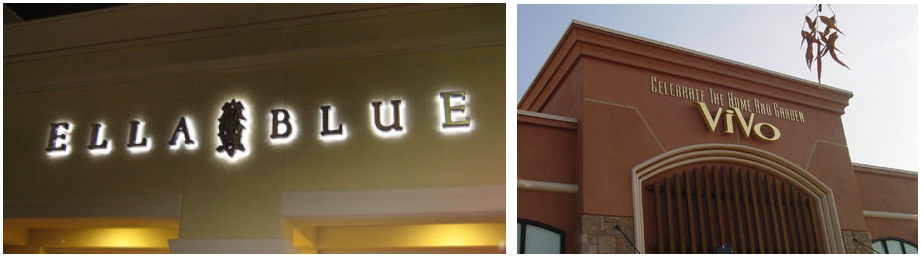
Examples of permitted wall sign types in C-4 districts
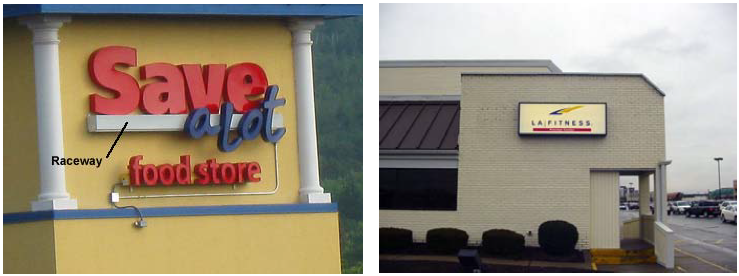
Examples of prohibited wall sign types in C-4 districts
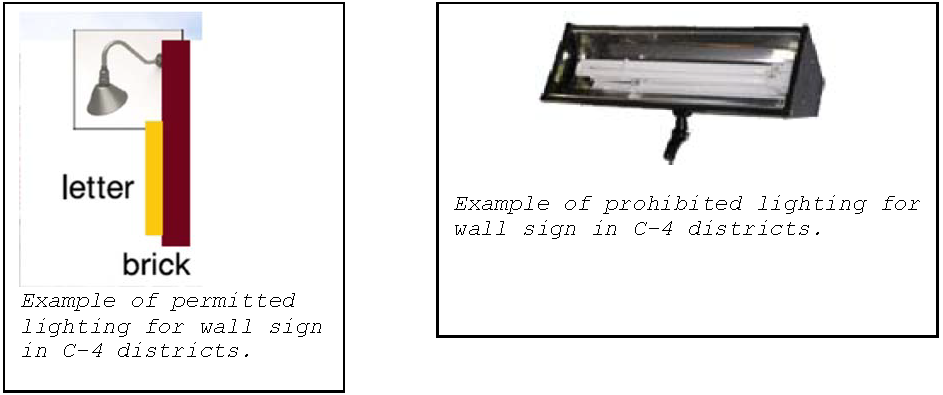
(3)
Projecting signs. For the benefit of pedestrians, one sign may be suspended from a canopy or balcony, or bracketed from the building over the sidewalk, near the main entrance to each business. Additionally, one projecting sign may be bracketed from the building at each entrance to a parking garage. Such signs shall not be internally illuminated.
Specifications: No single projecting sign shall exceed eight square feet or project more than five feet from a wall or support structure to which it is attached. Such signs shall have a minimum clearance of seven and one-half feet from the sidewalk.
(4)
Non-commercial flags.
Specifications: Area - No flag shall exceed 40 square feet per face; flag pole height - 25 feet, maximum, subject to any exception approved by the planning commission pursuant to section 78-73 of this chapter. No more than three flag poles may be erected on a lot consisting of three acres or less; for lots exceeding three acres, one additional flag pole per acre may be erected.
(5)
Temporary signs. Temporary freestanding signs other than sandwich board signs allowed in front of individual businesses may be displayed as follows:
a.
During any period when a parcel is offered for sale or property within the parcel is offered for lease, one temporary freestanding sign may be displayed.
b.
One additional temporary freestanding sign may be displayed for the duration of a construction project, from the time of issuance of a building permit until the issuance of a certificate of occupancy.
(6)
Sandwich board signs. One such sign may be placed in front of any business, provided, however that no such sign may be placed within the public right-of-way, including any sidewalk area that is within the public right-of-way. Such signs shall be removed each day at the close of business.
Specifications: Such signs shall have a maximum of two display surfaces and shall not exceed eight square feet per side or 48 inches in height. The base of a sandwich board sign must be placed no further than two feet beyond the front façade of the retail business and so as not to interfere with or obstruct pedestrian traffic; provided further that a sandwich board sign must leave a minimum of six feet of clearance for pedestrian traffic.
(7)
Decorative banners. Decorative banners may be displayed on interior parking lot light poles within a planned commercial retail or mixed use development. Such banners may display generic, seasonal or holiday graphics, and/or the name or logo of the development. Banners shall not contain a commercial message.
Specifications: Banners having two faces may be installed on interior parking lot light poles, not to exceed a total area of ten square feet per banner. A maximum of two banners mounted on opposite sides of the light pole are permitted. Banners must be mounted a minimum of 12 feet above the surface of the parking lot, as measured from the bottom of the banner. Alternate heights may be approved by staff, if the banners do not extend over a paved accessway, sidewalk or parking area.
(Ord. No. 2003-06, § 1, 5-27-2003; Ord. No. 2003-25, § 1, 11-25-2003; Ord. No. 2005-06, §§ 1, 2, 4-25-2005; Ord. No. 2005-16, §§ 1, 2, 6-27-2005; Ord. No. 2007-01, §§ 3—8, 2-26-2007; Ord. No. 2010-03, § 1, 4-26-2010; Ord. No. 2016-04, § 1, 7-25-2016; Ord. No. 2017-02, § 8, 2-27-2017; Ord. No. 2019-07, §§ 8—14, 8-26-2019; Ord. No. 2025-06, § 1, 6-23-2025)
Sec. 78-421. - Administration and enforcement.
(a)
Regulatory enforcement. The sign administrator is hereby authorized and directed to enforce all of the provisions of this article. This authority empowers the sign administrator to perform any necessary inspections, or to have such inspections conducted on the sign administrator's behalf. The sign administrator may direct that citations be issued for violations of the provisions of this article.
(b)
Violation notice. The sign administrator shall order the removal of any sign erected or maintained in violation of this article, providing the owner or tenant of the premises upon which the offending sign is located ten days' written notice to comply with the provisions of this article. If, after ten days, the property owner or tenant has failed to comply with this article, a citation to municipal court shall be issued. When good faith efforts to bring a sign into compliance have begun within ten days of the notice of violation, the sign administrator may extend the time period for compliance with this article to a period not to exceed 30 days. In cases where the owner of the premises has previously been notified of violations on two or more occasions, a citation may be issued without prior written notice.
(c)
Impoundment/disposal of signs. The sign administrator, the municipal codes officer and their designees shall have the authority to remove without notice any illegal sign on the public right-of-way or other public property, or any illegal sign attached to fences, posts, utility poles or natural features such as trees. Such signs shall be considered litter and shall be subject to disposal.
(d)
Letter of compliance. Prior to erecting or displaying a sign or banner, a property owner or tenant or the agent of a property owner or tenant may submit a written request to the sign administrator for verification that the sign or banner as proposed complies with the requirements of this article. The sign administrator may require that any person requesting such verification complete such forms or submit such information as may be needed by the sign administrator to make a determination.
(Ord. No. 2003-06, § 1, 5-27-2003; Ord. No. 2016-04, § 1, 7-25-2016; Ord. No. 2019-07, § 15, 8-26-2019)

